EP3490304A1 - Method for identifying access point and hotspot, and related product - Google Patents
Method for identifying access point and hotspot, and related product Download PDFInfo
- Publication number
- EP3490304A1 EP3490304A1 EP17877516.9A EP17877516A EP3490304A1 EP 3490304 A1 EP3490304 A1 EP 3490304A1 EP 17877516 A EP17877516 A EP 17877516A EP 3490304 A1 EP3490304 A1 EP 3490304A1
- Authority
- EP
- European Patent Office
- Prior art keywords
- upgraded
- application
- applications
- mobile terminal
- upgrade
- Prior art date
- Legal status (The legal status is an assumption and is not a legal conclusion. Google has not performed a legal analysis and makes no representation as to the accuracy of the status listed.)
- Granted
Links
Images



Classifications
-
- H—ELECTRICITY
- H04—ELECTRIC COMMUNICATION TECHNIQUE
- H04W—WIRELESS COMMUNICATION NETWORKS
- H04W48/00—Access restriction; Network selection; Access point selection
- H04W48/20—Selecting an access point
-
- G—PHYSICS
- G06—COMPUTING OR CALCULATING; COUNTING
- G06F—ELECTRIC DIGITAL DATA PROCESSING
- G06F8/00—Arrangements for software engineering
- G06F8/60—Software deployment
- G06F8/65—Updates
-
- H—ELECTRICITY
- H04—ELECTRIC COMMUNICATION TECHNIQUE
- H04W—WIRELESS COMMUNICATION NETWORKS
- H04W28/00—Network traffic management; Network resource management
- H04W28/02—Traffic management, e.g. flow control or congestion control
- H04W28/0247—Traffic management, e.g. flow control or congestion control based on conditions of the access network or the infrastructure network
-
- H—ELECTRICITY
- H04—ELECTRIC COMMUNICATION TECHNIQUE
- H04W—WIRELESS COMMUNICATION NETWORKS
- H04W28/00—Network traffic management; Network resource management
- H04W28/02—Traffic management, e.g. flow control or congestion control
- H04W28/0284—Traffic management, e.g. flow control or congestion control detecting congestion or overload during communication
-
- H—ELECTRICITY
- H04—ELECTRIC COMMUNICATION TECHNIQUE
- H04W—WIRELESS COMMUNICATION NETWORKS
- H04W48/00—Access restriction; Network selection; Access point selection
- H04W48/16—Discovering, processing access restriction or access information
-
- H—ELECTRICITY
- H04—ELECTRIC COMMUNICATION TECHNIQUE
- H04W—WIRELESS COMMUNICATION NETWORKS
- H04W84/00—Network topologies
- H04W84/02—Hierarchically pre-organised networks, e.g. paging networks, cellular networks, WLAN [Wireless Local Area Network] or WLL [Wireless Local Loop]
- H04W84/10—Small scale networks; Flat hierarchical networks
- H04W84/12—WLAN [Wireless Local Area Networks]
Definitions
- the present disclosure relates to the field of Internet technology, and more particularly to a method for identifying an access point (AP) and a hotspot, and related products.
- AP access point
- mobile terminals such as mobile phones, tablets, etc.
- the performance of the mobile terminals required by users is increasingly higher, not only high processing speed is required, but also the consumption of traffic of the mobile terminals is cared by the users.
- the mobile terminal determines by default that network communication can be conducted via a wireless fidelity (Wi-Fi).
- Wi-Fi wireless fidelity
- a method for identifying an AP and a hotspot, and related products are provided according to embodiments of the present disclosure, which can distinguish between the hotspot and the AP.
- a method for identifying an AP and a hotspot includes the following.
- IP internet protocol
- a device for identifying an AP and a hotspot includes an obtaining unit, a detecting unit, and a determining unit.
- the obtaining unit is configured to obtain an IP address of a gateway when a mobile terminal is in a Wi-Fi connection state.
- the detecting unit is configured to detect whether a preset Wi-Fi list contains the IP address.
- the determining unit is configured to determine that the mobile terminal is connected to a hotspot when the detecting unit detects that the IP address is in the preset Wi-Fi list.
- the determining unit is further configured to determine that the mobile terminal is connected to an AP when the detecting unit detects that the IP address is not in the preset Wi-Fi list.
- a mobile terminal in a third aspect of the present disclosure, includes a processor, a memory, and one or more programs.
- the one or more programs are stored in the memory and configured to be executed by the processor.
- the programs include instructions which are operable to implement part or all of the operations described in the first aspect.
- a computer storage medium configured to store computer programs which are operable with a computer to implement part or all of the operations described in the first aspect.
- a computer program product in a fifth aspect of the present disclosure, includes a non-transitory computer readable storage medium configured to store computer programs.
- the computer programs are operable with a computer to implement part or all of the operations described in the first aspect.
- the computer program product may be a software installation package.
- a mobile terminal when in a wireless fidelity (Wi-Fi) connection, a mobile terminal automatically updates at least one application to be upgraded by default. At this point, if the mobile terminal is connected to a hotspot shared by another mobile terminal, the another mobile terminal generates more data traffic. However, at present, the mobile terminal is unable to distinguish between a hotspot and an access point (AP). To this end, embodiments of the present disclosure provide a method for identifying an AP and a hotspot, and related products, which can distinguish between a hotspot and an AP.
- Wi-Fi wireless fidelity
- Mobile terminal in the embodiments of the disclosure may include smart phones (such as Android® phones, iOS® phones, Windows Phones, etc.), tablet PCs, palmtops, on-board equipment, laptops, mobile Internet devices (MID), wearable devices, or the like.
- smart phones such as Android® phones, iOS® phones, Windows Phones, etc.
- tablet PCs such as Samsung Galaxy Tabs, Samsung Galaxy Tabs, etc.
- palmtops such as Samsung Galaxy Tabs, etc.
- on-board equipment such as Samsung Galaxy Tabs, etc.
- laptops such as Samsung Galaxy Tabs, etc.
- MID mobile Internet devices
- a router is equipped with a dynamic host configuration protocol (DHCP) server.
- the DHCP server can assign an internet protocol (IP) address to a mobile terminal, that is, an IP address of the mobile terminal.
- IP internet protocol
- An IP address of a gateway is attached to an Offer message and an acknowledgement (ACK) message replied by the DHCP server in a process that the mobile terminal obtains an IP address through a DHCP protocol.
- a routing path is formed between the IP address of the mobile terminal and the IP address of the gateway.
- the mobile terminal is in communication with the router via the routing path, that is, data transmission can be performed between the mobile terminal and the router.
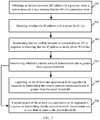
- FIG. 1 is a flow chart illustrating a method for identifying an AP and a hotspot according to a first embodiment of the present disclosure.
- the method for identifying an AP and a hotspot provided in the first embodiment includes the following.
- an IP address of a gateway is obtained when a mobile terminal is in a Wi-Fi connection state.
- the mobile terminal When the mobile terminal is in the Wi-Fi connection state, the mobile terminal may be connected to a router, or connected to a hotspot.
- the DHCP server built in the router can assign an IP address to the mobile terminal, where the IP address is referred to as an IP address of a gateway.
- the hotspot In the process of connecting the mobile terminal to the hotspot, the hotspot can assign an IP address to the mobile terminal, where the IP address is also referred to as an IP address of a gateway. Since different objects can act as different gateways, IP addresses of different gateways are different accordingly. Therefore, by merely distinguishing IP addresses of gateways, it can be determined whether the IP address of the gateway is an IP address of an AP or an IP address of a hotspot.
- a routing path i.e., a routing path formed between the IP address of the mobile terminal and the IP address of the gateway, the routing path can be used to receive or transmit data
- the IP address of the gateway can be obtained from the routing path.
- the preset Wi-Fi list may be pre-stored in the mobile terminal before the operation at 101.
- an IP address assigned by a hotspot has certain characteristics, and so part of IP addresses assigned by the hotspot can be stored to form the preset Wi-Fi list. Therefore, when the IP address is contained in the preset Wi-Fi list, it means that the mobile terminal is connected to a hotspot; when the IP address is not contained in the preset Wi-Fi list, it means that the mobile terminal is connected to an AP.
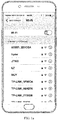
- FIG. 1a a schematic diagram illustrating the preset Wi-Fi list is provided.
- the preset Wi-Fi list contains at least one of 192.168.40. X and 172.20.19. Y , where X and Y are integers ranging from 0 to 255.
- X and Y are integers ranging from 0 to 255.
- the preset Wi-Fi list mentioned above may be re-defined.
- the mobile terminal is determined to be connected to a hotspot when the IP address is in the preset Wi-Fi list.
- the mobile terminal is determined to be connected to an AP when the IP address is not in the preset Wi-Fi list.
- the IP address When the IP address is in the preset Wi-Fi list, it indicates that the mobile terminal is connected to the hotspot. When the preset Wi-Fi list does not contain the IP address, it indicates that the mobile terminal is connected to the AP. Therefore, it can be determined whether the mobile terminal is connected to the hotspot or the AP when the mobile terminal is in the Wi-Fi connection state.
- the mobile terminal When the mobile terminal is connected to the hotspot, since the hotspot is generally based on a mobile communication network (e.g., 2G, 3G, 4G, etc.), charging of traffic is often expensive. In this case, when part of applications in the mobile terminal need to be upgraded, much traffic is required to be consumed.
- the mobile terminal When the mobile terminal is connected to the AP, since the AP is generally based on a router, it is not necessary to consider the consumption of traffic, therefore, in this situation, applications in the mobile terminal which need to be upgraded can be upgraded.
- the mobile terminal can obtain the IP address of the gateway when the mobile terminal is in the Wi-Fi connection state, and determine whether the IP address is in the preset Wi-Fi list.
- the preset Wi-Fi list contains at least one of 192.168.40.X and 172.20.19. Y , where X and Y are integers ranging from 0 to 255.
- the IP address is in the preset Wi-Fi list of the current gateway, it means that the mobile terminal is connected to the hotspot; otherwise, it means that the mobile terminal is connected to the AP.
- the IP address of the gateway is obtained when the mobile terminal is in the Wi-Fi connection state. Whether the IP address is in the preset Wi-Fi list is detected. The mobile terminal is determined to be connected to the hotspot when the IP address is in the preset Wi-Fi list. The mobile terminal is determined to be connected to the AP when the IP address is not in the preset Wi-Fi list. Therefore, whether the mobile terminal is connected to the hotspot or the AP can be distinguished.
- FIG. 2 is a flow chart illustrating a method for identifying an AP and a hotspot according to a second embodiment of the present disclosure.
- the method for identifying an AP and a hotspot provided in the second embodiment includes the following.
- an IP address of a gateway is obtained when a mobile terminal is in a Wi-Fi connection state.
- the mobile terminal is determined to be connected to a hotspot when the IP address is in the preset Wi-Fi list.
- total traffic required by at least one application to be upgraded is estimated.
- the at least one application to be upgraded may include one or more applications.
- the at least one application to be upgraded may be a type of applications, that is, applications that need to be upgraded are collectively referred to as applications to be upgraded.
- traffic that needs to be consumed during upgrade operation may be different. Therefore, the traffic that needs to be consumed during upgrade operation of each application to be upgraded needs to be estimated.
- the at least one application to be upgraded includes, but is not limited to, a map application (e.g., Baidu map®, Google map®, etc.), an instant messenger application (e.g., WeChat®, QQ®, etc.), a social application (e.g., Weibo®, Renren®, Facebook®, etc.), a group purchase application (e.g., Dazhongdianping®, Meituan®, etc.), a browser application, a payment application, and the like.
- the at least one application to be upgraded may include one or more applications to be upgraded.
- the at least one application to be upgraded includes one application to be upgraded, the amount of traffic required by the application to be upgraded to the latest version can be estimated.
- the current version of the application to be upgraded can be compared with the latest version to determine the amount of data to-be-downloaded, and the traffic consumed by upgrade of the application to be upgraded can be estimated according to the amount of data.
- the at least one application to be upgraded includes multiple applications to be upgraded.
- the total traffic required by the at least one application to be upgraded is estimated as follows.
- Traffic required by upgrade of each application to be upgraded is estimated.
- the total traffic is obtained by adding up the traffic required by upgrade of each application to be upgraded.
- the traffic required by upgrade of each application to be upgraded can be estimated, and then the total traffic required by the applications to be upgraded can be obtained by adding up the traffic required by upgrade of each application to be upgraded.
- an upgrade request carrying the total traffic is sent to the hotspot,.
- the mobile terminal can send the upgrade request to the hotspot, where the upgrade request carries the total traffic.
- the hotspot can automatically send a confirmation message to the mobile terminal in response to the upgrade request.
- the hotspot often grants the upgrade request of the mobile terminal in response to a permission instruction.
- the hotspot receives a confirmation instruction and sends the confirmation message to the mobile terminal in response to the upgrade request.
- the at least one application to be upgraded is upgraded when the confirmation message transmitted in response to the upgrade request is received from the hotspot.
- the mobile terminal can upgrade the at least one application to be upgraded when the confirmation message transmitted in response to the upgrade request is received from the hotspot.
- the at least one application to be upgraded includes multiple applications to be upgraded.
- the at least one application to be upgraded is upgraded as follows.
- a usage frequency of each application to be upgraded is obtained. All the applications to be upgraded are upgraded in descending order of the usage frequencies of the applications to be upgraded.
- the usage frequency of each application to be upgraded can be obtained, and all the applications to be upgraded are upgraded in the descending order of the usage frequencies of the applications to be upgraded.
- the applications to be upgraded include an App A , an App B, and an App C , where the usage frequency of the App B is greater than that of the App A , and the usage frequency of the App A is greater than that of the App C .
- the App B is upgraded first, the App A is then upgraded after upgrading the App B , and after upgrading the App A , the App C is upgraded.
- the at least one application to be upgraded includes multiple applications to be upgraded.
- the at least one application to be upgraded is upgraded as follows.
- Traffic required by upgrade of each application to be upgraded is determined. All the applications to be upgraded are upgraded in ascending order of the traffic required by upgrade of each application to be upgraded.
- the traffic required by upgrade of each application to be upgraded can be determined, and all the applications to be upgraded are upgraded in ascending order of the traffic required by upgrade of each application to be upgraded.
- the applications to be upgraded include the App A , the App B, and the App C , where the traffic required by upgrading the App B is greater than that of the App A , and the traffic required by upgrading the App A is greater than that of the App C .
- the App C is upgraded first, the App A is then upgraded after upgrading the App C , and after upgrading the App A , the App B is upgraded.
- part of the multiple applications to be upgraded may be upgraded first, and then the remaining applications may be upgraded.
- the at least one application to be upgraded includes multiple applications to be upgraded.
- the at least one application to be upgraded is upgraded as follows.
- Multiple categories are obtained by classifying the multiple applications to be upgraded. A priority of each of the multiple categories is determined. All the applications to be upgraded are upgraded according to the priority of each of the multiple categories.
- the multiple categories can be obtained by classifying the multiple applications to be upgraded.
- the priority of each of the multiple categories can be determined. All the applications to be upgraded can be upgraded according to the priority of each of the multiple categories. Therefore, the multiple applications can be upgraded according to the priorities of the categories.
- the IP address of the gateway is obtained when the mobile terminal is in the Wi-Fi connection state. Whether the IP address is in the preset Wi-Fi list is detected. The mobile terminal is determined to be connected to the hotspot when the IP address is in the preset Wi-Fi list. The total traffic required by the at least one application to be upgraded is estimated. The upgrade request carrying the total traffic is sent to the hotspot. The at least one application to be upgraded is upgraded when the confirmation message transmitted in response to the upgrade request is received from the hotspot. Therefore, whether the mobile terminal is connected to the hotspot or the AP can be distinguished. Moreover, in the case that the mobile terminal is connected to the hotspot, the total traffic required by the at least one application to be upgraded can be estimated, and the upgrade operation is performed only after receiving the confirmation message transmitted by the hotspot.
- FIG. 3 is a flow chart illustrating a method for identifying an AP and a hotspot according to a third embodiment of the present disclosure.
- the method for identifying an AP and a hotspot provided in the third embodiment includes the following.
- an IP address of a gateway is obtained when a mobile terminal is in a Wi-Fi connection state.
- the mobile terminal is determined to be connected to an AP when the IP address is not in the preset Wi-Fi list.
- the preset threshold herein may be defaulted by a system or set by a user.
- the current network transmission rate may be a network transmission rate at current time, or certainly may be an average value of network transmission rates in a preset period.
- the network transmission rate is not stable enough, that is, sometimes the network transmission rate is high, and sometimes the network transmission rate is slow. Therefore, an average network transmission rate in a period can be used as the current network transmission rate.
- the preset period herein may be a period closest to the current time, so that the network transmission rate can be obtained accurately.
- all the at least one application to be upgraded is upgraded when the current network transmission rate is higher than the preset threshold.
- all the at least one application to be upgraded involved in the above operation for upgrading all the at least one application to be upgraded can be specified by a user.
- an App A , an App B, an App C , and an App D that need to be upgraded are displayed on a display screen of the mobile terminal, and the App A , the App C , and the App D may be selected by the user to be upgraded.
- an upgraded version provides a poor user experience , these applications may not be selected to be upgraded.
- the at least one application to be upgraded may include one or more applications.
- the at least one application to be upgraded may be a type of applications, that is, applications that need to be upgraded are collectively referred to as applications to be upgraded.
- traffic that needs to be consumed during upgrade operation may be different. Therefore, the traffic that needs to be consumed during upgrade operation of each application to be upgraded needs to be estimated.
- the at least one application to be upgraded includes, but is not limited to, a map application (e.g., Baidu map®, Google map®, etc.), an instant messenger application (e.g., WeChat®, QQ®, etc.), a social application (e.g., Weibo®, Renren®, Facebook®, etc.), a group purchase application (e.g., Dazhongdianping®, Meituan®, etc.), a browser application, a payment application, and the like.
- the at least one application to be upgraded may include one or more applications to be upgraded.
- the at least one application to be upgraded includes multiple applications to be upgraded
- a usage frequency of each application to be upgraded can be obtained, and all the applications to be upgraded are upgraded in descending order of the usage frequencies of the applications to be upgraded.
- the applications to be upgraded include the App A , the App B, and the App C , where the usage frequency of the App B is greater than that of the App A , and the usage frequency of the App A is greater than that of the App C .
- the App B is upgraded first, the App A is then upgraded after upgrading the App B , and after upgrading the App A , the App C is upgraded.
- the at least one application to be upgraded includes multiple applications to be upgraded
- traffic required by upgrade of each application to be upgraded can be determined, and all the applications to be upgraded are upgraded in ascending order of the traffic required by upgrade of each application to be upgraded.
- the applications to be upgraded include the App A , the App B , and the App C , where the traffic required by upgrading the App B is greater than that of the App A , and the traffic required by upgrading the App A is greater than that of the App C .
- the App C is upgraded first, the App A is then upgraded after upgrading the App C , and after upgrading the App A , the App B is upgraded.
- part of the multiple applications to be upgraded may be upgraded first, and then the remaining applications may be upgraded.
- the at least one application to be upgraded includes multiple applications to be upgraded
- multiple categories can be obtained by classifying the multiple applications to be upgraded. A priority of each of the multiple categories is determined. All the applications to be upgraded are upgraded according to the priority of each of the multiple categories. Therefore, the applications to be upgraded can be upgraded according to the priorities of the categories.
- part of the at least one application to be upgraded can be upgraded when the current network transmission rate is lower than or equal to the preset threshold.
- part of the at least one application to be upgraded can be upgraded.
- Part of the at least one application to be upgraded may also include two or more applications to be upgraded, and so different applications can be upgraded sequentially. Certainly, in the case that the number of applications to be upgraded is small, all the applications to be upgraded can be upgraded simultaneously.
- part of the applications to be upgraded can be upgraded as follows.
- the usage frequency of each application to be upgraded can be obtained, and all the applications to be upgraded can be upgraded in descending order of the usage frequencies of all of the applications to be upgraded.
- the applications to be upgraded include the App A , the App B, and the App C , where the usage frequency of the App B is greater than that of the App A , and the usage frequency of the App A is greater than that of the App C .
- the App B is upgraded first, the App A is then upgraded after upgrading the App B, and after upgrading the App A , the App C is upgraded.
- the IP address of the gateway is obtained when the mobile terminal is in the Wi-Fi connection state. Whether the IP address is in the preset Wi-Fi list is detected. The mobile terminal is determined to be connected to the AP when the IP address is in the preset Wi-Fi list. Whether the current network transmission rate is higher than the preset threshold is determined. All the at least one application to be upgraded can be upgraded when the current network transmission rate is higher than the preset threshold. Part of the at least one application to be upgraded can be upgraded when the current network transmission rate is lower than or equal to the preset threshold. Therefore, whether the mobile terminal is connected to the hotspot or the AP can be distinguished. In the case that the mobile terminal is connected to the AP, upgrading part of or all the at least one application to be upgraded can be determined according to the current network transmission rate.
- a device configured to implement the above method for identifying an AP and a hotspot is provided herein below.
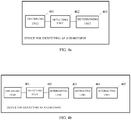
- FIG. 4a is a block diagram illustrating a device for identifying an AP and a hotspot according to an embodiment of the present disclosure.
- the device for identifying an AP and a hotspot provided in this embodiment includes an obtaining unit 401, a detecting unit 402, and a determining unit 403.
- the obtaining unit 401 is configured to obtain an IP address of a gateway when a mobile terminal is in a Wi-Fi connection state.
- the detecting unit 402 is configured to detect whether the IP address is in a preset Wi-Fi list.
- the determining unit 403 is configured to determine that the mobile terminal is connected to a hotspot when the detecting unit 402 detects that the IP address is in the preset Wi-Fi list.
- the determining unit 403 is further configured to determine that the mobile terminal is connected to an AP when the detecting unit 402 detects that the IP address is not in the preset Wi-Fi list.
- the preset Wi-Fi list contains at least one of 192.168.40. X and 172.20.19. Y , where X and Y are integers ranging from 0 to 255.
- FIG. 4b illustrates a device that is a modification of the device for identifying an AP and a hotspot illustrated in FIG. 4a .
- the device illustrated in FIG. 4b further includes an estimating unit 404 and an interacting unit 405.
- the estimating unit 404 is configured to estimate total traffic required by the at least one application to be upgraded after the determining unit 403 determines that the mobile terminal is connected to the hotspot.
- the interacting unit 405 is configured to send an upgrade request carrying the total traffic to the hotspot.
- the interacting unit 405 is further configured to upgrade the at least one application to be upgraded when a confirmation message transmitted in response to the upgrade request is received from the hotspot.
- the at least one application to be upgraded includes multiple applications to be upgraded.
- the estimating unit 404 is configured to estimate traffic required by upgrade of each application to be upgraded, and to obtain the total traffic by adding up the traffic required by upgrade of each application to be upgraded.
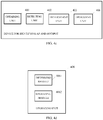
- FIG. 4c illustrates yet another device that is a modification of the device for identifying an AP and a hotspot illustrated in FIG. 4a .
- the device illustrated in FIG. 4c further includes an upgrading unit 406.
- the upgrading unit 406 is configured to upgrade the at least one application to be upgraded after the determining unit 403 determines that the mobile terminal is connected to the AP.
- FIG. 4d is a block diagram illustrating the upgrading unit 406 of the device for identifying an AP and a hotspot illustrated in FIG. 4c .
- the upgrading unit 406 includes a determining module 4061 and an upgrading module 4062.
- the determining module 4061 is configured to determine whether a current network transmission rate is higher than a preset threshold.
- the upgrading module 4062 is configured to upgrade all the at least one application to be upgraded when the current network transmission rate is higher than the preset threshold.
- the upgrading module 4062 is further configured to upgrade part of the at least one application to be upgraded when the current network transmission rate is lower than or equal to the preset threshold.
- the at least one application to be upgraded includes multiple applications to be upgraded, and the upgrading unit 406 is configured to obtain a usage frequency of each application to be upgraded, and to upgrade all the applications to be upgraded in descending order of the usage frequencies of the applications to be upgraded.
- the at least one application to be upgraded includes multiple applications to be upgraded.
- the upgrading unit 406 is configured to determine traffic required by upgrade of each application to be upgraded, and to upgrade all the applications to be upgraded in ascending order of the traffic required by upgrade of each application to be upgraded.
- the at least one application to be upgraded includes multiple applications to be upgraded.
- the upgrading unit 406 is configured to obtain multiple categories by classifying the multiple applications to be upgraded, to determine a priority of each of the multiple categories, and to upgrade all the applications to be upgraded according to the priority of each of the multiple categories.
- the IP address of the gateway is obtained when the mobile terminal is in the Wi-Fi connection state. Whether the IP address is in the preset Wi-Fi list is detected. The mobile terminal is determined to be connected to the hotspot when the IP address is in the preset Wi-Fi list. The mobile terminal is determined to be connected to the AP when the IP address is not in the preset Wi-Fi list. Therefore, whether the mobile terminal is connected to the hotspot or the AP can be distinguished.
- each “unit” used herein should be understood as the broadest meaning as possible, and an object for achieving functions defined by each "unit” may be, for example, an application-specific integrated circuit (ASIC), a single circuit, a processor (shared, dedicated, or chipset) for executing one or more software or firmware programs and a memory, a combinational logic circuit, and/or other suitable components that can achieve the above described functions.
- ASIC application-specific integrated circuit
- processor shared, dedicated, or chipset
- memory a combinational logic circuit, and/or other suitable components that can achieve the above described functions.
- a sending unit 301 configured to send an IP address renewal request to a first DHCP server within a preset period can be implemented by a mobile terminal illustrated in FIG. 5 .
- a processor 3000 can invoke executable program codes in a memory 4000 to send the IP address renewal request to the first DHCP server within the preset period when the IP address of the mobile terminal has the validity period less than the preset threshold.
- FIG. 5 is a block diagram illustrating a mobile terminal according to an embodiment of the present disclosure.
- the mobile terminal in the embodiment includes at least one input device 1000, at least one output device 2000, at least one processor 3000 (such as a CPU), and a memory 4000.
- the input device 1000, the output device 2000, the processor 3000, and the memory 4000 are coupled with each other via a bus 5000.
- the at least one input device 1000 may be a touch panel, a physical button, a mouse, or the like.
- the at least one output device 2000 may be a display screen.
- the memory 4000 may be a high speed RAM memory, or may be a non-volatile memory such as a disk memory.
- the memory 4000 is configured to store a set of program codes.
- the input device 1000, the output device 2000, and the processor 3000 are configured to invoke the program codes stored in the memory 4000 to carry out the following.
- the processor 3000 is configured to obtain an IP address of a gateway when the mobile terminal is in a Wi-Fi connection state, to detect whether the IP address is in a preset Wi-Fi list, to determine that the mobile terminal is connected to a hotspot when the IP address is in the preset Wi-Fi list, and to determine that the mobile terminal is connected to an AP when the IP address is not in the preset Wi-Fi list.
- the preset Wi-Fi list contains at least one of 192.168.40. X and 172.20.19. Y , where X and Y are integers ranging from 0 to 255.
- the processor 3000 is further configured to estimate total traffic required by at least one application to be upgraded, to send an upgrade request carrying the total traffic to the hotspot, and to upgrade the at least one application to be upgraded when a confirmation message transmitted in response to the upgrade request is received from the hotspot.
- the at least one application to be upgraded includes multiple applications to be upgraded.
- the processor 3000 configured to estimate the total traffic required by the at least one application to be upgraded is configured to estimate traffic required by upgrade of each application to be upgraded, and to obtain the total traffic by adding up the traffic required by upgrade of each application to be upgraded.
- the processor 3000 is further configured to upgrade at least one application to be upgraded.
- the processor 3000 configured to upgrade the at least one application to be upgraded is configured to detect whether a current network transmission rate is higher than a preset threshold, to upgrade all the at least one application to be upgraded when the current network transmission rate is higher than the preset threshold, and to upgrade part of the at least one application to be upgraded when the current network transmission rate is lower than or equal to the preset threshold.
- the at least one application to be upgraded includes multiple applications to be upgraded.
- the processor 3000 configured to upgrade the at least one application to be upgraded is configured to obtain a usage frequency of each application to be upgraded, and to upgrade all the applications to be upgraded in descending order of the usage frequencies of the applications to be upgraded.
- the at least one application to be upgraded includes multiple applications to be upgraded.
- the processor 3000 configured to upgrade the at least one application to be upgraded is configured to determine traffic required by upgrade of each application to be upgraded, and to upgrade all the applications to be upgraded in ascending order of the traffic required by upgrade of each application to be upgraded.
- the at least one application to be upgraded includes multiple applications to be upgraded.
- the processor 3000 configured to upgrade the at least one application to be upgraded is configured to obtain multiple categories by classifying the multiple applications to be upgraded, to determine a priority of each of the multiple categories, and to upgrade all the applications to be upgraded according to the priority of each of the multiple categories.
- Embodiments of the present disclosure further provide a computer storage medium.
- the computer storage medium is configured to store programs which, when executed, are operable to implement part or all of operations of the methods for identifying an AP and a hotspot described in the foregoing method embodiments.
- Embodiments of the present disclosure further provide a computer program product.
- the computer program product includes a non-transitory computer readable storage medium configured to store computer programs.
- the computer programs are operable with a computer to implement part or all of operations of the methods for identifying an AP and a hotspot described in the foregoing method embodiments.
- embodiments of the present disclosure can be provided as a method, an apparatus (device), or a computer program product. Accordingly, the above embodiments of present disclosure may be implemented through hardware, software, or any other combination thereof.
- the present disclosure may take the form of a computer program product embodied on one or more computer readable storage medium (including but not limited to a disk memory, a CD-ROM, an optical memory, etc.) including computer readable program codes.
- Computer programs are stored or distributed in a suitable medium, and are provided together with other hardware or are as part of certain hardware, or are distributed in other forms, such as an Internet-based form, other wired or wireless telecommunication-system-based form, or the like.
- These computer program instructions can also be stored in a computer readable memory that can direct a computer or other programmable data processing devices to operate in a certain manner, to enable instructions stored in the computer readable memory to produce an article of manufacture including an instruction device for implementing functions specified in one or more procedures of the flow charts or one or more blocks of the block diagrams.
- These computer program instructions can also be loaded into a computer or other programmable data processing devices, to enable a computer or other programmable devices to perform a series of operational steps to achieve computer processing, such that instructions executed on a computer or other programmable devices can provide steps for implementing functions specified in one or more procedures of the flow charts or one or more blocks of the block diagrams.
Landscapes
- Engineering & Computer Science (AREA)
- Computer Networks & Wireless Communication (AREA)
- Signal Processing (AREA)
- Computer Security & Cryptography (AREA)
- Software Systems (AREA)
- General Engineering & Computer Science (AREA)
- Theoretical Computer Science (AREA)
- Physics & Mathematics (AREA)
- General Physics & Mathematics (AREA)
- Mobile Radio Communication Systems (AREA)
Abstract
Description
- This application claims priority to Chinese Patent Application No.
201611117899.0, filed December 7, 2016 - The present disclosure relates to the field of Internet technology, and more particularly to a method for identifying an access point (AP) and a hotspot, and related products.
- With the rapid development of information technology, mobile terminals (such as mobile phones, tablets, etc.) are becoming more and more popular. The performance of the mobile terminals required by users is increasingly higher, not only high processing speed is required, but also the consumption of traffic of the mobile terminals is cared by the users.
- In the related art, generally, when the mobile terminal is in a Wi-Fi connection, the mobile terminal determines by default that network communication can be conducted via a wireless fidelity (Wi-Fi).
- A method for identifying an AP and a hotspot, and related products are provided according to embodiments of the present disclosure, which can distinguish between the hotspot and the AP.
- In a first aspect of the present disclosure, a method for identifying an AP and a hotspot is provided. The method includes the following.
- An internet protocol (IP) address of a gateway is obtained when a mobile terminal is in a Wi-Fi connection state. Whether the IP address is in a preset Wi-Fi list is detected. The mobile terminal is determined to be connected to a hotspot when the IP address is in the preset Wi-Fi list. The mobile terminal is determined to be connected to an AP when the IP address is not in the preset Wi-Fi list.
- In a second aspect of the present disclosure, a device for identifying an AP and a hotspot is provided. The device includes an obtaining unit, a detecting unit, and a determining unit. The obtaining unit is configured to obtain an IP address of a gateway when a mobile terminal is in a Wi-Fi connection state. The detecting unit is configured to detect whether a preset Wi-Fi list contains the IP address. The determining unit is configured to determine that the mobile terminal is connected to a hotspot when the detecting unit detects that the IP address is in the preset Wi-Fi list. The determining unit is further configured to determine that the mobile terminal is connected to an AP when the detecting unit detects that the IP address is not in the preset Wi-Fi list.
- In a third aspect of the present disclosure, a mobile terminal is provided. The mobile terminal includes a processor, a memory, and one or more programs. The one or more programs are stored in the memory and configured to be executed by the processor. The programs include instructions which are operable to implement part or all of the operations described in the first aspect.
- In a fourth aspect of the present disclosure, a computer storage medium is provided. The computer storage medium is configured to store computer programs which are operable with a computer to implement part or all of the operations described in the first aspect.
- In a fifth aspect of the present disclosure, a computer program product is provided. The computer program product includes a non-transitory computer readable storage medium configured to store computer programs. The computer programs are operable with a computer to implement part or all of the operations described in the first aspect. The computer program product may be a software installation package.
- To describe technical solutions in embodiments of the present disclosure more clearly, the following briefly introduces the accompanying drawings required for describing the embodiments. Apparently, the accompanying drawings in the following description merely illustrate some embodiments of the present disclosure. Those of ordinary skill in the art may also obtain other drawings based on these accompanying drawings without creative efforts.
-
FIG. 1 is a flow chart illustrating a method for identifying an AP and a hotspot according to a first embodiment of the present disclosure. -
FIG. 1a is a schematic diagram illustrating a Wi-Fi list according to an embodiment of the present disclosure. -
FIG. 2 is a flow chart illustrating a method for identifying an AP and a hotspot according to a second embodiment of the present disclosure. -
FIG. 3 is a flow chart illustrating a method for identifying an AP and a hotspot according to a third embodiment of the present disclosure. -
FIG. 4a is a block diagram illustrating a device for identifying an AP and a hotspot according to an embodiment of the present disclosure. -
FIG. 4b is another block diagram illustrating the device for identifying an AP and a hotspot illustrated inFIG. 4a according to an embodiment of the present disclosure. -
FIG. 4c is yet another block diagram illustrating the device for identifying an AP and a hotspot illustrated inFIG. 4a according to an embodiment of the present disclosure. -
FIG. 4d is a block diagram illustrating an upgrading unit of the device for identifying an AP and a hotspot illustrated inFIG. 4c according to an embodiment of the present disclosure. -
FIG. 5 is a block diagram illustrating a mobile terminal according to an embodiment of the present disclosure. - In general, when in a wireless fidelity (Wi-Fi) connection, a mobile terminal automatically updates at least one application to be upgraded by default. At this point, if the mobile terminal is connected to a hotspot shared by another mobile terminal, the another mobile terminal generates more data traffic. However, at present, the mobile terminal is unable to distinguish between a hotspot and an access point (AP). To this end, embodiments of the present disclosure provide a method for identifying an AP and a hotspot, and related products, which can distinguish between a hotspot and an AP.
- Hereinafter, technical solutions embodied by the embodiments of the disclosure will be described in a clear and comprehensive manner in reference to the accompanying drawings intended for the embodiments. It is evident that the embodiments described herein constitute merely some rather than all of the embodiments of the disclosure. Based on the embodiments of the present disclosure, other embodiments derived by those of ordinary skill in the art without creative efforts all fall in the protection scope of the present disclosure.
- The terms "first", "second", "third", "fourth", and the like used in the specification, the claims, and the accompany drawings of the present disclosure are used to distinguish different objects rather than describe a particular order. The terms "include", "comprise", and "have" as well as variations thereof are intended to cover non-exclusive inclusion. For example, a process, method, system, product, or apparatus including a series of steps or units is not limited to the listed steps or units, on the contrary, it can optionally include other steps or units that are not listed; alternatively, other steps or units inherent to the process, method, product, or device can be included either.
- The term "embodiment" or "implementation" referred to herein means that a particular feature, structure, or feature described in conjunction with the embodiment may be contained in at least one embodiment of the present disclosure. The phrase appearing in various places in the specification does not necessarily refer to the same embodiment, nor does it refer to an independent or alternative embodiment that is mutually exclusive with other embodiments. It is explicitly and implicitly understood by those skilled in the art that an embodiment described herein may be combined with other embodiments.
- "Mobile terminal" in the embodiments of the disclosure may include smart phones (such as Android® phones, iOS® phones, Windows Phones, etc.), tablet PCs, palmtops, on-board equipment, laptops, mobile Internet devices (MID), wearable devices, or the like. The above-mentioned terminals are merely illustrative and not exhaustive, including but not limited to the above-described mobile terminals.
- Generally, a router is equipped with a dynamic host configuration protocol (DHCP) server. The DHCP server can assign an internet protocol (IP) address to a mobile terminal, that is, an IP address of the mobile terminal. An IP address of a gateway is attached to an Offer message and an acknowledgement (ACK) message replied by the DHCP server in a process that the mobile terminal obtains an IP address through a DHCP protocol. A routing path is formed between the IP address of the mobile terminal and the IP address of the gateway. The mobile terminal is in communication with the router via the routing path, that is, data transmission can be performed between the mobile terminal and the router.
-
FIG. 1 is a flow chart illustrating a method for identifying an AP and a hotspot according to a first embodiment of the present disclosure. The method for identifying an AP and a hotspot provided in the first embodiment includes the following. - At 101, an IP address of a gateway is obtained when a mobile terminal is in a Wi-Fi connection state.
- When the mobile terminal is in the Wi-Fi connection state, the mobile terminal may be connected to a router, or connected to a hotspot. In the process of connecting the mobile terminal to the router (i.e., an AP), the DHCP server built in the router can assign an IP address to the mobile terminal, where the IP address is referred to as an IP address of a gateway. In the process of connecting the mobile terminal to the hotspot, the hotspot can assign an IP address to the mobile terminal, where the IP address is also referred to as an IP address of a gateway. Since different objects can act as different gateways, IP addresses of different gateways are different accordingly. Therefore, by merely distinguishing IP addresses of gateways, it can be determined whether the IP address of the gateway is an IP address of an AP or an IP address of a hotspot.
- In one embodiment, when the mobile terminal is in the Wi-Fi connection state, a routing path (i.e., a routing path formed between the IP address of the mobile terminal and the IP address of the gateway, the routing path can be used to receive or transmit data) can be obtained, and the IP address of the gateway can be obtained from the routing path.
- At 102, whether the IP address is in a preset Wi-Fi list is detected.
- In one embodiment, the preset Wi-Fi list may be pre-stored in the mobile terminal before the operation at 101. Generally, an IP address assigned by a hotspot has certain characteristics, and so part of IP addresses assigned by the hotspot can be stored to form the preset Wi-Fi list. Therefore, when the IP address is contained in the preset Wi-Fi list, it means that the mobile terminal is connected to a hotspot; when the IP address is not contained in the preset Wi-Fi list, it means that the mobile terminal is connected to an AP. As illustrated in
FIG. 1a , a schematic diagram illustrating the preset Wi-Fi list is provided. - In one embodiment, the preset Wi-Fi list contains at least one of 192.168.40.X and 172.20.19. Y, where X and Y are integers ranging from 0 to 255. For example, when the IP address of the gateway is 192.168.40.1, it indicates that the mobile terminal is connected to a hotspot. Furthermore, along with the evolution of technologies, the standard of communication may also change. In this case, the preset Wi-Fi list mentioned above may be re-defined.
- At 103, the mobile terminal is determined to be connected to a hotspot when the IP address is in the preset Wi-Fi list.
- At 104, the mobile terminal is determined to be connected to an AP when the IP address is not in the preset Wi-Fi list.
- When the IP address is in the preset Wi-Fi list, it indicates that the mobile terminal is connected to the hotspot. When the preset Wi-Fi list does not contain the IP address, it indicates that the mobile terminal is connected to the AP. Therefore, it can be determined whether the mobile terminal is connected to the hotspot or the AP when the mobile terminal is in the Wi-Fi connection state. When the mobile terminal is connected to the hotspot, since the hotspot is generally based on a mobile communication network (e.g., 2G, 3G, 4G, etc.), charging of traffic is often expensive. In this case, when part of applications in the mobile terminal need to be upgraded, much traffic is required to be consumed. When the mobile terminal is connected to the AP, since the AP is generally based on a router, it is not necessary to consider the consumption of traffic, therefore, in this situation, applications in the mobile terminal which need to be upgraded can be upgraded.
- What needs to be illustrated is that, in general, the mobile terminal can obtain the IP address of the gateway when the mobile terminal is in the Wi-Fi connection state, and determine whether the IP address is in the preset Wi-Fi list. The preset Wi-Fi list contains at least one of 192.168.40.X and 172.20.19.Y, where X and Y are integers ranging from 0 to 255. When the IP address is in the preset Wi-Fi list of the current gateway, it means that the mobile terminal is connected to the hotspot; otherwise, it means that the mobile terminal is connected to the AP.
- It can be seen that, by means of the embodiments of the present disclosure, the IP address of the gateway is obtained when the mobile terminal is in the Wi-Fi connection state. Whether the IP address is in the preset Wi-Fi list is detected. The mobile terminal is determined to be connected to the hotspot when the IP address is in the preset Wi-Fi list. The mobile terminal is determined to be connected to the AP when the IP address is not in the preset Wi-Fi list. Therefore, whether the mobile terminal is connected to the hotspot or the AP can be distinguished.
- Consistent with the above embodiment,
FIG. 2 is a flow chart illustrating a method for identifying an AP and a hotspot according to a second embodiment of the present disclosure. The method for identifying an AP and a hotspot provided in the second embodiment includes the following. - At 201, an IP address of a gateway is obtained when a mobile terminal is in a Wi-Fi connection state.
- At 202, whether the IP address is in a preset Wi-Fi list is detected.
- At 203, the mobile terminal is determined to be connected to a hotspot when the IP address is in the preset Wi-Fi list.
- For the operations at 201 to 203, reference can be made to the corresponding operations of the method for identifying an AP and a hotspot described in conjunction with
FIG. 1 , which will not be repeated herein. - At 204, total traffic required by at least one application to be upgraded is estimated.
- In one embodiment, the at least one application to be upgraded may include one or more applications. The at least one application to be upgraded may be a type of applications, that is, applications that need to be upgraded are collectively referred to as applications to be upgraded. For different applications, traffic that needs to be consumed during upgrade operation may be different. Therefore, the traffic that needs to be consumed during upgrade operation of each application to be upgraded needs to be estimated. The at least one application to be upgraded includes, but is not limited to, a map application (e.g., Baidu map®, Google map®, etc.), an instant messenger application (e.g., WeChat®, QQ®, etc.), a social application (e.g., Weibo®, Renren®, Facebook®, etc.), a group purchase application (e.g., Dazhongdianping®, Meituan®, etc.), a browser application, a payment application, and the like. The at least one application to be upgraded may include one or more applications to be upgraded. When the at least one application to be upgraded includes one application to be upgraded, the amount of traffic required by the application to be upgraded to the latest version can be estimated. In an implementation, the current version of the application to be upgraded can be compared with the latest version to determine the amount of data to-be-downloaded, and the traffic consumed by upgrade of the application to be upgraded can be estimated according to the amount of data.
- In one embodiment, the at least one application to be upgraded includes multiple applications to be upgraded. For the operation at 204, the total traffic required by the at least one application to be upgraded is estimated as follows.
- Traffic required by upgrade of each application to be upgraded is estimated. The total traffic is obtained by adding up the traffic required by upgrade of each application to be upgraded.
- When the at least one application to be upgraded includes multiple applications to be upgraded, the traffic required by upgrade of each application to be upgraded can be estimated, and then the total traffic required by the applications to be upgraded can be obtained by adding up the traffic required by upgrade of each application to be upgraded.
- At 205, an upgrade request carrying the total traffic is sent to the hotspot,.
- The mobile terminal can send the upgrade request to the hotspot, where the upgrade request carries the total traffic. Assuming that the hotspot has been set, for example, to grant the upgrade request under the condition that the traffic requested via the upgrade request is lower than a preset threshold, the hotspot can automatically send a confirmation message to the mobile terminal in response to the upgrade request. Certainly, the hotspot often grants the upgrade request of the mobile terminal in response to a permission instruction. As an example, the hotspot receives a confirmation instruction and sends the confirmation message to the mobile terminal in response to the upgrade request.
- At 206, the at least one application to be upgraded is upgraded when the confirmation message transmitted in response to the upgrade request is received from the hotspot.
- The mobile terminal can upgrade the at least one application to be upgraded when the confirmation message transmitted in response to the upgrade request is received from the hotspot.
- In one embodiment, the at least one application to be upgraded includes multiple applications to be upgraded. For the operation at 206, the at least one application to be upgraded is upgraded as follows.
- A usage frequency of each application to be upgraded is obtained. All the applications to be upgraded are upgraded in descending order of the usage frequencies of the applications to be upgraded.
- When the at least one application to be upgraded includes multiple applications to be upgraded, the usage frequency of each application to be upgraded can be obtained, and all the applications to be upgraded are upgraded in the descending order of the usage frequencies of the applications to be upgraded. For example, the applications to be upgraded include an App A, an App B, and an App C, where the usage frequency of the App B is greater than that of the App A, and the usage frequency of the App A is greater than that of the App C. In this case, the App B is upgraded first, the App A is then upgraded after upgrading the App B, and after upgrading the App A, the App C is upgraded.
- In one embodiment, the at least one application to be upgraded includes multiple applications to be upgraded. For the operation at 206, the at least one application to be upgraded is upgraded as follows.
- Traffic required by upgrade of each application to be upgraded is determined. All the applications to be upgraded are upgraded in ascending order of the traffic required by upgrade of each application to be upgraded.
- When the at least one application to be upgraded includes multiple applications to be upgraded, the traffic required by upgrade of each application to be upgraded can be determined, and all the applications to be upgraded are upgraded in ascending order of the traffic required by upgrade of each application to be upgraded. For instance, the applications to be upgraded include the App A, the App B, and the App C, where the traffic required by upgrading the App B is greater than that of the App A, and the traffic required by upgrading the App A is greater than that of the App C. In this situation, the App C is upgraded first, the App A is then upgraded after upgrading the App C, and after upgrading the App A, the App B is upgraded.
- In one embodiment, when the at least one application to be upgraded includes multiple applications to be upgraded, part of the multiple applications to be upgraded may be upgraded first, and then the remaining applications may be upgraded.
- In one embodiment, the at least one application to be upgraded includes multiple applications to be upgraded. For the operation at 206, the at least one application to be upgraded is upgraded as follows.
- Multiple categories are obtained by classifying the multiple applications to be upgraded. A priority of each of the multiple categories is determined. All the applications to be upgraded are upgraded according to the priority of each of the multiple categories.
- When the at least one application to be upgraded includes multiple applications to be upgraded, the multiple categories can be obtained by classifying the multiple applications to be upgraded. The priority of each of the multiple categories can be determined. All the applications to be upgraded can be upgraded according to the priority of each of the multiple categories. Therefore, the multiple applications can be upgraded according to the priorities of the categories.
- According to the embodiment of the present disclosure, the IP address of the gateway is obtained when the mobile terminal is in the Wi-Fi connection state. Whether the IP address is in the preset Wi-Fi list is detected. The mobile terminal is determined to be connected to the hotspot when the IP address is in the preset Wi-Fi list. The total traffic required by the at least one application to be upgraded is estimated. The upgrade request carrying the total traffic is sent to the hotspot. The at least one application to be upgraded is upgraded when the confirmation message transmitted in response to the upgrade request is received from the hotspot. Therefore, whether the mobile terminal is connected to the hotspot or the AP can be distinguished. Moreover, in the case that the mobile terminal is connected to the hotspot, the total traffic required by the at least one application to be upgraded can be estimated, and the upgrade operation is performed only after receiving the confirmation message transmitted by the hotspot.
- Consistent with the above embodiment,
FIG. 3 is a flow chart illustrating a method for identifying an AP and a hotspot according to a third embodiment of the present disclosure. The method for identifying an AP and a hotspot provided in the third embodiment includes the following. - At 301, an IP address of a gateway is obtained when a mobile terminal is in a Wi-Fi connection state.
- At 302, whether an IP address is in a preset Wi-Fi list is detected.
- At 303, the mobile terminal is determined to be connected to an AP when the IP address is not in the preset Wi-Fi list.
- For the operations at 301 to 303, reference can be made to the corresponding operations of the method for identifying an AP and a hotspot described in conjunction with
FIG. 1 , which will not be repeated herein. - At 304, whether a current network transmission rate is higher than a preset threshold is determined.
- The preset threshold herein may be defaulted by a system or set by a user. The current network transmission rate may be a network transmission rate at current time, or certainly may be an average value of network transmission rates in a preset period. Generally, the network transmission rate is not stable enough, that is, sometimes the network transmission rate is high, and sometimes the network transmission rate is slow. Therefore, an average network transmission rate in a period can be used as the current network transmission rate. The preset period herein may be a period closest to the current time, so that the network transmission rate can be obtained accurately.
- At 305, all the at least one application to be upgraded is upgraded when the current network transmission rate is higher than the preset threshold.
- In one embodiment, all the at least one application to be upgraded involved in the above operation for upgrading all the at least one application to be upgraded can be specified by a user. For example, an App A, an App B, an App C, and an App D that need to be upgraded are displayed on a display screen of the mobile terminal, and the App A, the App C, and the App D may be selected by the user to be upgraded. Considering that, as to some applications, an upgraded version provides a poor user experience , these applications may not be selected to be upgraded.
- In one embodiment, the at least one application to be upgraded may include one or more applications. The at least one application to be upgraded may be a type of applications, that is, applications that need to be upgraded are collectively referred to as applications to be upgraded. For different applications, traffic that needs to be consumed during upgrade operation may be different. Therefore, the traffic that needs to be consumed during upgrade operation of each application to be upgraded needs to be estimated. The at least one application to be upgraded includes, but is not limited to, a map application (e.g., Baidu map®, Google map®, etc.), an instant messenger application (e.g., WeChat®, QQ®, etc.), a social application (e.g., Weibo®, Renren®, Facebook®, etc.), a group purchase application (e.g., Dazhongdianping®, Meituan®, etc.), a browser application, a payment application, and the like. The at least one application to be upgraded may include one or more applications to be upgraded.
- In one embodiment, when the at least one application to be upgraded includes multiple applications to be upgraded, a usage frequency of each application to be upgraded can be obtained, and all the applications to be upgraded are upgraded in descending order of the usage frequencies of the applications to be upgraded. For example, the applications to be upgraded include the App A, the App B, and the App C, where the usage frequency of the App B is greater than that of the App A, and the usage frequency of the App A is greater than that of the App C. In this case, the App B is upgraded first, the App A is then upgraded after upgrading the App B, and after upgrading the App A, the App C is upgraded.
- In one embodiment, when the at least one application to be upgraded includes multiple applications to be upgraded, traffic required by upgrade of each application to be upgraded can be determined, and all the applications to be upgraded are upgraded in ascending order of the traffic required by upgrade of each application to be upgraded. For instance, the applications to be upgraded include the App A, the App B, and the App C, where the traffic required by upgrading the App B is greater than that of the App A, and the traffic required by upgrading the App A is greater than that of the App C. In this situation, the App C is upgraded first, the App A is then upgraded after upgrading the App C, and after upgrading the App A, the App B is upgraded.
- In one embodiment, when the at least one application to be upgraded includes multiple applications to be upgraded, part of the multiple applications to be upgraded may be upgraded first, and then the remaining applications may be upgraded.
- In one embodiment, when the at least one application to be upgraded includes multiple applications to be upgraded, multiple categories can be obtained by classifying the multiple applications to be upgraded. A priority of each of the multiple categories is determined. All the applications to be upgraded are upgraded according to the priority of each of the multiple categories. Therefore, the applications to be upgraded can be upgraded according to the priorities of the categories.
- At 306, part of the at least one application to be upgraded can be upgraded when the current network transmission rate is lower than or equal to the preset threshold.
- When the current network transmission rate is lower than or equal to the preset threshold, part of the at least one application to be upgraded can be upgraded. Part of the at least one application to be upgraded may also include two or more applications to be upgraded, and so different applications can be upgraded sequentially. Certainly, in the case that the number of applications to be upgraded is small, all the applications to be upgraded can be upgraded simultaneously.
- In one embodiment, for the operation at 306, part of the applications to be upgraded can be upgraded as follows.
- 61) A usage frequency of each of the applications to be upgraded is determined.
- 62) Each application to be upgraded that has the usage frequency higher than a preset frequency threshold is upgraded.
- The usage frequency of each application to be upgraded can be obtained, and all the applications to be upgraded can be upgraded in descending order of the usage frequencies of all of the applications to be upgraded. For example, the applications to be upgraded include the App A, the App B, and the App C, where the usage frequency of the App B is greater than that of the App A, and the usage frequency of the App A is greater than that of the App C. In this case, the App B is upgraded first, the App A is then upgraded after upgrading the App B, and after upgrading the App A, the App C is upgraded.
- By adopting the embodiment of the present disclosure, the IP address of the gateway is obtained when the mobile terminal is in the Wi-Fi connection state. Whether the IP address is in the preset Wi-Fi list is detected. The mobile terminal is determined to be connected to the AP when the IP address is in the preset Wi-Fi list. Whether the current network transmission rate is higher than the preset threshold is determined. All the at least one application to be upgraded can be upgraded when the current network transmission rate is higher than the preset threshold. Part of the at least one application to be upgraded can be upgraded when the current network transmission rate is lower than or equal to the preset threshold. Therefore, whether the mobile terminal is connected to the hotspot or the AP can be distinguished. In the case that the mobile terminal is connected to the AP, upgrading part of or all the at least one application to be upgraded can be determined according to the current network transmission rate.
- Consistent with the above embodiment, a device configured to implement the above method for identifying an AP and a hotspot is provided herein below.
-
FIG. 4a is a block diagram illustrating a device for identifying an AP and a hotspot according to an embodiment of the present disclosure. The device for identifying an AP and a hotspot provided in this embodiment includes an obtainingunit 401, a detectingunit 402, and a determiningunit 403. - The obtaining
unit 401 is configured to obtain an IP address of a gateway when a mobile terminal is in a Wi-Fi connection state. - The detecting
unit 402 is configured to detect whether the IP address is in a preset Wi-Fi list. - The determining
unit 403 is configured to determine that the mobile terminal is connected to a hotspot when the detectingunit 402 detects that the IP address is in the preset Wi-Fi list. - The determining
unit 403 is further configured to determine that the mobile terminal is connected to an AP when the detectingunit 402 detects that the IP address is not in the preset Wi-Fi list. - In one embodiment, the preset Wi-Fi list contains at least one of 192.168.40.X and 172.20.19. Y, where X and Y are integers ranging from 0 to 255.
- In one embodiment,
FIG. 4b illustrates a device that is a modification of the device for identifying an AP and a hotspot illustrated inFIG. 4a . Compared withFIG. 4a , the device illustrated inFIG. 4b further includes anestimating unit 404 and an interactingunit 405. - The estimating
unit 404 is configured to estimate total traffic required by the at least one application to be upgraded after the determiningunit 403 determines that the mobile terminal is connected to the hotspot. - The interacting
unit 405 is configured to send an upgrade request carrying the total traffic to the hotspot. - The interacting
unit 405 is further configured to upgrade the at least one application to be upgraded when a confirmation message transmitted in response to the upgrade request is received from the hotspot. - In one embodiment, the at least one application to be upgraded includes multiple applications to be upgraded. The estimating
unit 404 is configured to estimate traffic required by upgrade of each application to be upgraded, and to obtain the total traffic by adding up the traffic required by upgrade of each application to be upgraded. - In one embodiment,
FIG. 4c illustrates yet another device that is a modification of the device for identifying an AP and a hotspot illustrated inFIG. 4a . Compared withFIG. 4a , the device illustrated inFIG. 4c further includes anupgrading unit 406. - The
upgrading unit 406 is configured to upgrade the at least one application to be upgraded after the determiningunit 403 determines that the mobile terminal is connected to the AP. - In one embodiment,
FIG. 4d is a block diagram illustrating theupgrading unit 406 of the device for identifying an AP and a hotspot illustrated inFIG. 4c . Theupgrading unit 406 includes a determiningmodule 4061 and anupgrading module 4062. - The determining
module 4061 is configured to determine whether a current network transmission rate is higher than a preset threshold. - The
upgrading module 4062 is configured to upgrade all the at least one application to be upgraded when the current network transmission rate is higher than the preset threshold. - The
upgrading module 4062 is further configured to upgrade part of the at least one application to be upgraded when the current network transmission rate is lower than or equal to the preset threshold. - In one embodiment, the at least one application to be upgraded includes multiple applications to be upgraded, and the
upgrading unit 406 is configured to obtain a usage frequency of each application to be upgraded, and to upgrade all the applications to be upgraded in descending order of the usage frequencies of the applications to be upgraded. - In one embodiment, the at least one application to be upgraded includes multiple applications to be upgraded. The
upgrading unit 406 is configured to determine traffic required by upgrade of each application to be upgraded, and to upgrade all the applications to be upgraded in ascending order of the traffic required by upgrade of each application to be upgraded. - In one embodiment, the at least one application to be upgraded includes multiple applications to be upgraded. The
upgrading unit 406 is configured to obtain multiple categories by classifying the multiple applications to be upgraded, to determine a priority of each of the multiple categories, and to upgrade all the applications to be upgraded according to the priority of each of the multiple categories. - It can be seen that, by means of the devices for identifying an AP and a hotspot described in the embodiments of the present disclosure, the IP address of the gateway is obtained when the mobile terminal is in the Wi-Fi connection state. Whether the IP address is in the preset Wi-Fi list is detected. The mobile terminal is determined to be connected to the hotspot when the IP address is in the preset Wi-Fi list. The mobile terminal is determined to be connected to the AP when the IP address is not in the preset Wi-Fi list. Therefore, whether the mobile terminal is connected to the hotspot or the AP can be distinguished.
- What needs to be noted is that the devices for identifying an AP and a hotspot described in the embodiments of the disclosure are presented in the form of functional units. The term "unit" used herein should be understood as the broadest meaning as possible, and an object for achieving functions defined by each "unit" may be, for example, an application-specific integrated circuit (ASIC), a single circuit, a processor (shared, dedicated, or chipset) for executing one or more software or firmware programs and a memory, a combinational logic circuit, and/or other suitable components that can achieve the above described functions.
- As an example, when the IP address of the mobile terminal has a validity period less than a preset threshold, a sending
unit 301 configured to send an IP address renewal request to a first DHCP server within a preset period can be implemented by a mobile terminal illustrated inFIG. 5 . In one embodiment, aprocessor 3000 can invoke executable program codes in amemory 4000 to send the IP address renewal request to the first DHCP server within the preset period when the IP address of the mobile terminal has the validity period less than the preset threshold. - Consistent with the above embodiments,
FIG. 5 is a block diagram illustrating a mobile terminal according to an embodiment of the present disclosure. The mobile terminal in the embodiment includes at least oneinput device 1000, at least oneoutput device 2000, at least one processor 3000 (such as a CPU), and amemory 4000. Theinput device 1000, theoutput device 2000, theprocessor 3000, and thememory 4000 are coupled with each other via abus 5000. - In an implementation, the at least one
input device 1000 may be a touch panel, a physical button, a mouse, or the like. - In an implementation, the at least one
output device 2000 may be a display screen. - In an implementation, the
memory 4000 may be a high speed RAM memory, or may be a non-volatile memory such as a disk memory. Thememory 4000 is configured to store a set of program codes. Theinput device 1000, theoutput device 2000, and theprocessor 3000 are configured to invoke the program codes stored in thememory 4000 to carry out the following. - The
processor 3000 is configured to obtain an IP address of a gateway when the mobile terminal is in a Wi-Fi connection state, to detect whether the IP address is in a preset Wi-Fi list, to determine that the mobile terminal is connected to a hotspot when the IP address is in the preset Wi-Fi list, and to determine that the mobile terminal is connected to an AP when the IP address is not in the preset Wi-Fi list. - In one embodiment, the preset Wi-Fi list contains at least one of 192.168.40.X and 172.20.19. Y, where X and Y are integers ranging from 0 to 255.
- In one embodiment, after determining that the mobile terminal is connected to the hotspot, the
processor 3000 is further configured to estimate total traffic required by at least one application to be upgraded, to send an upgrade request carrying the total traffic to the hotspot, and to upgrade the at least one application to be upgraded when a confirmation message transmitted in response to the upgrade request is received from the hotspot. - In one embodiment, the at least one application to be upgraded includes multiple applications to be upgraded. The
processor 3000 configured to estimate the total traffic required by the at least one application to be upgraded is configured to estimate traffic required by upgrade of each application to be upgraded, and to obtain the total traffic by adding up the traffic required by upgrade of each application to be upgraded. - In one embodiment, after determining that the mobile terminal is connected to the AP, the
processor 3000 is further configured to upgrade at least one application to be upgraded. - In one embodiment, the
processor 3000 configured to upgrade the at least one application to be upgraded is configured to detect whether a current network transmission rate is higher than a preset threshold, to upgrade all the at least one application to be upgraded when the current network transmission rate is higher than the preset threshold, and to upgrade part of the at least one application to be upgraded when the current network transmission rate is lower than or equal to the preset threshold. - In one embodiment, the at least one application to be upgraded includes multiple applications to be upgraded. The
processor 3000 configured to upgrade the at least one application to be upgraded is configured to obtain a usage frequency of each application to be upgraded, and to upgrade all the applications to be upgraded in descending order of the usage frequencies of the applications to be upgraded. - In one embodiment, the at least one application to be upgraded includes multiple applications to be upgraded. The
processor 3000 configured to upgrade the at least one application to be upgraded is configured to determine traffic required by upgrade of each application to be upgraded, and to upgrade all the applications to be upgraded in ascending order of the traffic required by upgrade of each application to be upgraded. - In one embodiment, the at least one application to be upgraded includes multiple applications to be upgraded. The
processor 3000 configured to upgrade the at least one application to be upgraded is configured to obtain multiple categories by classifying the multiple applications to be upgraded, to determine a priority of each of the multiple categories, and to upgrade all the applications to be upgraded according to the priority of each of the multiple categories. - Embodiments of the present disclosure further provide a computer storage medium. The computer storage medium is configured to store programs which, when executed, are operable to implement part or all of operations of the methods for identifying an AP and a hotspot described in the foregoing method embodiments.
- Embodiments of the present disclosure further provide a computer program product. The computer program product includes a non-transitory computer readable storage medium configured to store computer programs. The computer programs are operable with a computer to implement part or all of operations of the methods for identifying an AP and a hotspot described in the foregoing method embodiments.
- Although the present disclosure has been described herein in combination with various embodiments of the present disclosure, in the process of implementing the disclosure seeking for protection, those skilled in the art will understand and derive other embodiments based on the specification, the claims, and the accompanying drawings of the present disclosure as viewed. The term "comprising" in the claims does not exclude other components or steps. In addition, the term "a/ an" or "one" does not exclude a plurality of components or steps. A single processor or other units may fulfill several functions described in the claims. Certain technical features are described in different dependent claims, however, possible combination of these technical features can be made to achieve a good effect.
- Those skilled in the art will appreciate that embodiments of the present disclosure can be provided as a method, an apparatus (device), or a computer program product. Accordingly, the above embodiments of present disclosure may be implemented through hardware, software, or any other combination thereof. In addition, the present disclosure may take the form of a computer program product embodied on one or more computer readable storage medium (including but not limited to a disk memory, a CD-ROM, an optical memory, etc.) including computer readable program codes. Computer programs are stored or distributed in a suitable medium, and are provided together with other hardware or are as part of certain hardware, or are distributed in other forms, such as an Internet-based form, other wired or wireless telecommunication-system-based form, or the like.
- The present disclosure has been described with reference to flow charts and/or block diagrams of the methods, apparatuses (devices), and computer program products of the embodiments of the disclosure. It will be understood that computer program instructions are operable to implement each procedure of the flow charts and/or each block of the block diagrams, and to implement a combination thereof. These computer program instructions can be provided for a processor of a general-purpose computer, a special-purpose computer, an embedded processor, or other programmable data processing devices to produce a machine, to enable instructions executed by a processor of a computer or other programmable data processing devices to produce a device for implementing functions specified in one or more procedures of the flow charts or one or more blocks of the block diagrams.
- These computer program instructions can also be stored in a computer readable memory that can direct a computer or other programmable data processing devices to operate in a certain manner, to enable instructions stored in the computer readable memory to produce an article of manufacture including an instruction device for implementing functions specified in one or more procedures of the flow charts or one or more blocks of the block diagrams.
- These computer program instructions can also be loaded into a computer or other programmable data processing devices, to enable a computer or other programmable devices to perform a series of operational steps to achieve computer processing, such that instructions executed on a computer or other programmable devices can provide steps for implementing functions specified in one or more procedures of the flow charts or one or more blocks of the block diagrams.
- While the disclosure has been described with respect to the specific features and embodiments thereof, it should be understood that various modifications and combinations can be made herein without departing from the spirit and scope of the disclosure. Accordingly, the specification and the accompanying drawings are merely illustrative illustration of the disclosure as defined by the claims attached, and can be regarded as covering any and all modifications, variations, combinations or equivalents within the scope of the disclosure. It will be apparent that those skilled in the art can make various modifications and variations to the disclosure without departing from the spirit and scope of the disclosure. Thus, it is intended that the present disclosure covers such modifications and variations thereof on the basis of such modifications and variations falling within the scope of the claims and the equivalents thereof.
Claims (20)
- A method for identifying an access point, AP, and a hotspot, comprising:obtaining an internet protocol, IP, address of a gateway when a mobile terminal is in a wireless fidelity, Wi-Fi, connection state;detecting whether the IP address is in a preset Wi-Fi list;determining that the mobile terminal is connected to a hotspot in response to detecting that the IP address is in the preset Wi-Fi list; anddetermining that the mobile terminal is connected to an AP in response to detecting that the IP address is not in the preset Wi-Fi list.
- The method of claim 1, wherein the preset Wi-Fi list contains at least one of 192.168.40.X and 172.20.19.Y, and X and Y are integers ranging from 0 to 255.
- The method of claim 1 or claim 2, further comprising the following after determining that the mobile terminal is connected to the hotspot:estimating total traffic required by at least one application to be upgraded;sending, to the hotspot, an upgrade request carrying the total traffic; andupgrading the at least one application to be upgraded when a confirmation message transmitted in response to the upgrade request is received from the hotspot.
- The method of claim 3, wherein the at least one application to be upgraded comprises a plurality of applications to be upgraded, and estimating the total traffic required by the at least one application to be upgraded comprises:estimating traffic required by upgrade of each of the plurality of applications to be upgraded; andobtaining the total traffic by adding up the traffic required by upgrade of each of the plurality of applications to be upgraded.
- The method of claim 1 or claim 2, further comprising the following after determining that the mobile terminal is connected to the AP:
upgrading at least one application to be upgraded. - The method of claim 4, wherein upgrading the at least one application to be upgraded comprises:determining whether a current network transmission rate is higher than a preset threshold;upgrading all the at least one application to be upgraded in response to determining that the current network transmission rate is higher than the preset threshold; andupgrading part of the at least one application to be upgraded in response to determining that the current network transmission rate is lower than or equal to the preset threshold.
- The method of claim 4, wherein the at least one application to be upgraded comprises a plurality of applications to be upgraded, and upgrading the at least one application to be upgraded comprises:obtaining a usage frequency of each of the plurality of applications to be upgraded; andupgrading all the plurality of applications to be upgraded in descending order of the usage frequency of each of the plurality of applications to be upgraded.
- The method of claim 4, wherein the at least one application to be upgraded comprises a plurality of applications to be upgraded, and upgrading the at least one application to be upgraded comprises:determining traffic required by upgrade of each of the plurality of applications to be upgraded; andupgrading all the plurality of applications to be upgraded in ascending order of the traffic required by upgrade of each of the plurality of applications to be upgraded.
- The method of claim 4, wherein the at least one application to be upgraded comprises a plurality of applications to be upgraded, and upgrading the at least one application to be upgraded comprises:obtaining a plurality of categories by classifying the plurality of applications to be upgraded;determining a priority of each of the plurality of categories; andupgrading all the plurality of applications to be upgraded according to the priority of each of the plurality of categories.
- A device for identifying an access point, AP, and a hotspot, comprising:an obtaining unit, configured to obtain an internet protocol, IP, address of a gateway when a mobile terminal is in a wireless fidelity, Wi-Fi, connection state;a detecting unit, configured to detect whether the IP address is in a preset Wi-Fi list; anda determining unit, configured to determine that the mobile terminal is connected to a hotspot when the detecting unit detects that the IP address is in the preset Wi-Fi list;the determining unit being further configured to:
determine that the mobile terminal is connected to an AP when the detecting unit detects that the IP address is not in the preset Wi-Fi list. - The device of claim 10, wherein the preset Wi-Fi list contains at least one of 192.168.40.X and 172.20.19.Y, and X and Y are integers ranging from 0 to 255.
- The device of claim 10 or claim 11, further comprising:an estimating unit, configured to estimate total traffic required by at least one application to be upgraded after the determining unit determines that the mobile terminal is connected to the hotspot; andan interacting unit, configured to send an upgrade request carrying the total traffic to the hotspot;the interacting unit being further configured to:
upgrade the at least one application to be upgraded when a confirmation message transmitted in response to the upgrade request is received from the hotspot. - The device of claim 10 or claim 11, further comprising:
an upgrading unit, configured to upgrade at least one application to be upgraded after the determining unit determines that the mobile terminal is connected to the AP. - The device of claim 13, wherein the upgrading unit comprises:a determining module, configured to determine whether a current network transmission rate is higher than a preset threshold;an upgrading module, configured to upgrade all the at least one application to be upgraded when the current network transmission rate is higher than the preset threshold;the upgrading module being further configured to:
upgrade part of the at least one application to be upgraded when the current network transmission rate is lower than or equal to the preset threshold. - The device of claim 13, wherein the at least one application to be upgraded comprises a plurality of applications to be upgraded, and the upgrading unit is configured to:obtain a usage frequency of each of the plurality of applications to be upgraded; andupgrade all the plurality of applications to be upgraded in descending order of the usage frequency of each of the plurality of applications to be upgraded.
- The device of claim 13, wherein the at least one application to be upgraded comprises a plurality of applications to be upgraded, and the upgrading unit is configured to:determine the traffic required by upgrade of each of the plurality of applications to be upgraded; andupgrade all the plurality of applications to be upgraded in ascending order of the traffic required by upgrade of each of the plurality of applications to be upgraded.
- The device of claim 13, wherein the at least one application to be upgraded comprises a plurality of applications to be upgraded, and the upgrading unit is configured to:obtain a plurality of categories by classifying the plurality of applications to be upgraded;determine a priority of each of the plurality of categories; andupgrade all the plurality of applications to be upgraded according to the priority of each of the plurality of categories.
- A mobile terminal, comprising:a processor; anda memory;the processor being configured to invoke codes or instructions stored in the memory to implement the method of any of claims 1 to 9.
- A computer storage medium, configured to store computer programs which are operable with a computer to implement the method of any of claims 1 to 9.
- A computer program product, comprising a non-transitory computer readable storage medium configured to store computer programs, the computer programs being operable with a computer to implement the method of any of claims 1 to 9.
Applications Claiming Priority (2)
| Application Number | Priority Date | Filing Date | Title |
|---|---|---|---|
| CN201611117899.0A CN106851779A (en) | 2016-12-07 | 2016-12-07 | A kind of method and mobile terminal for recognizing access point and focus |
| PCT/CN2017/101467 WO2018103405A1 (en) | 2016-12-07 | 2017-09-12 | Method for identifying access point and hotspot, and related product |
Publications (3)
| Publication Number | Publication Date |
|---|---|
| EP3490304A1 true EP3490304A1 (en) | 2019-05-29 |
| EP3490304A4 EP3490304A4 (en) | 2019-10-23 |
| EP3490304B1 EP3490304B1 (en) | 2023-10-25 |
Family
ID=59139639
Family Applications (1)
| Application Number | Title | Priority Date | Filing Date |
|---|---|---|---|
| EP17877516.9A Active EP3490304B1 (en) | 2016-12-07 | 2017-09-12 | Method for identifying access point and hotspot, and related products |
Country Status (4)
| Country | Link |
|---|---|
| US (1) | US10743252B2 (en) |
| EP (1) | EP3490304B1 (en) |
| CN (1) | CN106851779A (en) |
| WO (1) | WO2018103405A1 (en) |
Families Citing this family (9)
| Publication number | Priority date | Publication date | Assignee | Title |
|---|---|---|---|---|
| CN106851779A (en) * | 2016-12-07 | 2017-06-13 | 广东欧珀移动通信有限公司 | A kind of method and mobile terminal for recognizing access point and focus |
| US10567873B2 (en) | 2017-07-27 | 2020-02-18 | Tracfone Wireless, Inc. | Device and process for powering smart speakers and providing internet connectivity for the same |
| CN107493243A (en) * | 2017-08-25 | 2017-12-19 | 海南智媒云图科技股份有限公司 | The method and device that a kind of fixed network and focus WIFI is distinguished |
| CN109451518B (en) * | 2018-12-27 | 2022-07-15 | 青岛海信移动通信技术股份有限公司 | Method and equipment for distinguishing WLAN access mode of terminal |
| CN109743745B (en) * | 2019-02-19 | 2021-01-22 | 北京三快在线科技有限公司 | Mobile network access type identification method and device, electronic equipment and storage medium |
| CN112312519B (en) | 2019-07-31 | 2022-12-27 | 华为技术有限公司 | Equipment identification method and related device |
| CN111526607B (en) * | 2020-04-14 | 2022-07-08 | 北京小米移动软件有限公司 | Communication data processing method and device, terminal device and storage medium |
| CN112235849A (en) * | 2020-10-19 | 2021-01-15 | 展讯半导体(成都)有限公司 | Method, system, electronic device, and medium for identifying Wi-Fi hotspot type |
| CN114518896B (en) * | 2022-04-07 | 2022-07-22 | 山西正合天科技股份有限公司 | Industrial personal computer control method and system based on vehicle-mounted application |
Family Cites Families (12)
| Publication number | Priority date | Publication date | Assignee | Title |
|---|---|---|---|---|
| US8532004B2 (en) * | 2011-01-10 | 2013-09-10 | Lenovo (Singapore) Pte. Ltd. | Power management on portable devices |
| CN103313429B (en) * | 2013-07-10 | 2016-12-28 | 江苏君立华域信息安全技术有限公司 | A kind of processing method identifying forgery WIFI hot spot |
| CN103442376A (en) * | 2013-08-06 | 2013-12-11 | 深圳市同洲电子股份有限公司 | Wireless hot spot identification method, related equipment and system |
| US20150089595A1 (en) * | 2013-09-24 | 2015-03-26 | Shun Yao | Method and system for facilitating online gaming |
| CN104349423B (en) * | 2014-06-30 | 2015-11-18 | 腾讯科技(深圳)有限公司 | From the method, system and device of the WLAN (wireless local area network) that is dynamically connected |
| CN104185294B (en) * | 2014-08-04 | 2018-01-30 | 广东欧珀移动通信有限公司 | The recognition methods of mobile phone focus and identification device |
| CN105142217A (en) * | 2015-09-19 | 2015-12-09 | 北京暴风科技股份有限公司 | MAC address combined positioning method based on push and wireless fidelity (WiFi) hot spot |
| CN105307242A (en) * | 2015-11-13 | 2016-02-03 | 魅族科技(中国)有限公司 | Wi-Fi network application method and terminal |
| CN105578492A (en) * | 2015-12-21 | 2016-05-11 | 联想(北京)有限公司 | Information processing method and electronic device |
| CN105550003A (en) * | 2015-12-25 | 2016-05-04 | 北京奇虎科技有限公司 | Application updating system and method |
| CN105636079A (en) * | 2015-12-26 | 2016-06-01 | 小米科技有限责任公司 | Network determining method and device |
| CN106851779A (en) * | 2016-12-07 | 2017-06-13 | 广东欧珀移动通信有限公司 | A kind of method and mobile terminal for recognizing access point and focus |
-
2016
- 2016-12-07 CN CN201611117899.0A patent/CN106851779A/en active Pending
-
2017
- 2017-09-12 WO PCT/CN2017/101467 patent/WO2018103405A1/en not_active Ceased
- 2017-09-12 EP EP17877516.9A patent/EP3490304B1/en active Active
-
2019
- 2019-01-22 US US16/253,623 patent/US10743252B2/en not_active Expired - Fee Related
Also Published As
| Publication number | Publication date |
|---|---|
| WO2018103405A1 (en) | 2018-06-14 |
| US10743252B2 (en) | 2020-08-11 |
| US20190200287A1 (en) | 2019-06-27 |
| CN106851779A (en) | 2017-06-13 |
| EP3490304B1 (en) | 2023-10-25 |
| EP3490304A4 (en) | 2019-10-23 |
Similar Documents
| Publication | Publication Date | Title |
|---|---|---|
| EP3490304B1 (en) | Method for identifying access point and hotspot, and related products | |
| US11310239B2 (en) | Network connection method, hotspot terminal and management terminal | |
| EP3410759B1 (en) | Method and access point for accessing network by internet-of-things device | |
| CN109542614B (en) | Resource allocation method, device, terminal and storage medium | |
| US9264901B2 (en) | Method, apparatus, and system for establishing data connection | |
| EP3852405B1 (en) | Communication method and device | |
| US10009838B2 (en) | Access point connection method and electronic device thereof | |
| CN105684520B (en) | Method for establishing wireless local area network communication connection and electronic device thereof | |
| CN108536461A (en) | Resource regeneration method, device, terminal and storage medium | |
| CN111277361B (en) | Transport block size determination method and communication device | |
| CN107360633B (en) | Pairing connection method and device of virtual reality system and virtual reality system | |
| EP2753048B1 (en) | Apparatus and method for providing a near field communication function in a portable terminal | |
| WO2017096909A1 (en) | Data connection establishing method and apparatus | |
| CN107968848B (en) | A method, terminal device and storage medium for obtaining IP address | |
| US20130138796A1 (en) | Distance-based network resource discovery | |
| EP2854027B1 (en) | Method for downloading application program, user equipment and application server | |
| CN110166191B (en) | Method and device for determining monitoring information of search space | |
| CN104702678B (en) | Document transmission method and device | |
| CN112787769A (en) | Method, device, equipment and storage medium for determining NFI | |
| EP3674893B1 (en) | Search resource recommendation method and related product | |
| CN107819761B (en) | Data processing method and device and readable storage medium | |
| US10237861B2 (en) | Information transmission method, device, and system | |
| CN103746844A (en) | Terminal networking allocation method and device | |
| CN110839296B (en) | Network resource scheduling method, device, storage medium and mobile terminal | |
| WO2019011328A1 (en) | Wireless access method and device |
Legal Events
| Date | Code | Title | Description |
|---|---|---|---|
| STAA | Information on the status of an ep patent application or granted ep patent |
Free format text: STATUS: THE INTERNATIONAL PUBLICATION HAS BEEN MADE |
|
| PUAI | Public reference made under article 153(3) epc to a published international application that has entered the european phase |
Free format text: ORIGINAL CODE: 0009012 |
|
| STAA | Information on the status of an ep patent application or granted ep patent |
Free format text: STATUS: REQUEST FOR EXAMINATION WAS MADE |
|
| 17P | Request for examination filed |
Effective date: 20190219 |
|
| AK | Designated contracting states |
Kind code of ref document: A1 Designated state(s): AL AT BE BG CH CY CZ DE DK EE ES FI FR GB GR HR HU IE IS IT LI LT LU LV MC MK MT NL NO PL PT RO RS SE SI SK SM TR |
|
| AX | Request for extension of the european patent |
Extension state: BA ME |
|
| A4 | Supplementary search report drawn up and despatched |
Effective date: 20190920 |
|
| RIC1 | Information provided on ipc code assigned before grant |
Ipc: G06F 8/65 20180101ALI20190916BHEP Ipc: H04W 48/16 20090101AFI20190916BHEP |
|
| RAP1 | Party data changed (applicant data changed or rights of an application transferred) |
Owner name: GUANGDONG OPPO MOBILE TELECOMMUNICATIONS CORP., LT |
|
| DAV | Request for validation of the european patent (deleted) | ||
| DAX | Request for extension of the european patent (deleted) | ||
| STAA | Information on the status of an ep patent application or granted ep patent |
Free format text: STATUS: EXAMINATION IS IN PROGRESS |
|
| 17Q | First examination report despatched |
Effective date: 20201223 |
|
| GRAP | Despatch of communication of intention to grant a patent |
Free format text: ORIGINAL CODE: EPIDOSNIGR1 |
|
| STAA | Information on the status of an ep patent application or granted ep patent |
Free format text: STATUS: GRANT OF PATENT IS INTENDED |
|
| RIC1 | Information provided on ipc code assigned before grant |
Ipc: H04W 84/12 20090101ALN20230719BHEP Ipc: H04W 48/20 20090101ALN20230719BHEP Ipc: H04W 48/16 20090101AFI20230719BHEP |
|
| INTG | Intention to grant announced |
Effective date: 20230802 |
|
| GRAS | Grant fee paid |
Free format text: ORIGINAL CODE: EPIDOSNIGR3 |
|
| GRAA | (expected) grant |
Free format text: ORIGINAL CODE: 0009210 |
|
| STAA | Information on the status of an ep patent application or granted ep patent |
Free format text: STATUS: THE PATENT HAS BEEN GRANTED |
|
| AK | Designated contracting states |
Kind code of ref document: B1 Designated state(s): AL AT BE BG CH CY CZ DE DK EE ES FI FR GB GR HR HU IE IS IT LI LT LU LV MC MK MT NL NO PL PT RO RS SE SI SK SM TR |
|
| REG | Reference to a national code |
Ref country code: GB Ref legal event code: FG4D |
|
| REG | Reference to a national code |
Ref country code: CH Ref legal event code: EP |
|
| REG | Reference to a national code |
Ref country code: DE Ref legal event code: R096 Ref document number: 602017075822 Country of ref document: DE |
|
| REG | Reference to a national code |
Ref country code: IE Ref legal event code: FG4D |
|
| REG | Reference to a national code |
Ref country code: LT Ref legal event code: MG9D |
|
| P01 | Opt-out of the competence of the unified patent court (upc) registered |
Effective date: 20240110 |
|
| REG | Reference to a national code |
Ref country code: NL Ref legal event code: MP Effective date: 20231025 |
|
| REG | Reference to a national code |
Ref country code: AT Ref legal event code: MK05 Ref document number: 1625985 Country of ref document: AT Kind code of ref document: T Effective date: 20231025 |
|
| PG25 | Lapsed in a contracting state [announced via postgrant information from national office to epo] |
Ref country code: NL Free format text: LAPSE BECAUSE OF FAILURE TO SUBMIT A TRANSLATION OF THE DESCRIPTION OR TO PAY THE FEE WITHIN THE PRESCRIBED TIME-LIMIT Effective date: 20231025 |
|
| PG25 | Lapsed in a contracting state [announced via postgrant information from national office to epo] |
Ref country code: GR Free format text: LAPSE BECAUSE OF FAILURE TO SUBMIT A TRANSLATION OF THE DESCRIPTION OR TO PAY THE FEE WITHIN THE PRESCRIBED TIME-LIMIT Effective date: 20240126 |
|
| PG25 | Lapsed in a contracting state [announced via postgrant information from national office to epo] |
Ref country code: IS Free format text: LAPSE BECAUSE OF FAILURE TO SUBMIT A TRANSLATION OF THE DESCRIPTION OR TO PAY THE FEE WITHIN THE PRESCRIBED TIME-LIMIT Effective date: 20240225 |
|
| PG25 | Lapsed in a contracting state [announced via postgrant information from national office to epo] |
Ref country code: LT Free format text: LAPSE BECAUSE OF FAILURE TO SUBMIT A TRANSLATION OF THE DESCRIPTION OR TO PAY THE FEE WITHIN THE PRESCRIBED TIME-LIMIT Effective date: 20231025 |
|
| PG25 | Lapsed in a contracting state [announced via postgrant information from national office to epo] |
Ref country code: AT Free format text: LAPSE BECAUSE OF FAILURE TO SUBMIT A TRANSLATION OF THE DESCRIPTION OR TO PAY THE FEE WITHIN THE PRESCRIBED TIME-LIMIT Effective date: 20231025 |
|
| PG25 | Lapsed in a contracting state [announced via postgrant information from national office to epo] |
Ref country code: ES Free format text: LAPSE BECAUSE OF FAILURE TO SUBMIT A TRANSLATION OF THE DESCRIPTION OR TO PAY THE FEE WITHIN THE PRESCRIBED TIME-LIMIT Effective date: 20231025 |
|
| PG25 | Lapsed in a contracting state [announced via postgrant information from national office to epo] |
Ref country code: LT Free format text: LAPSE BECAUSE OF FAILURE TO SUBMIT A TRANSLATION OF THE DESCRIPTION OR TO PAY THE FEE WITHIN THE PRESCRIBED TIME-LIMIT Effective date: 20231025 Ref country code: IS Free format text: LAPSE BECAUSE OF FAILURE TO SUBMIT A TRANSLATION OF THE DESCRIPTION OR TO PAY THE FEE WITHIN THE PRESCRIBED TIME-LIMIT Effective date: 20240225 Ref country code: GR Free format text: LAPSE BECAUSE OF FAILURE TO SUBMIT A TRANSLATION OF THE DESCRIPTION OR TO PAY THE FEE WITHIN THE PRESCRIBED TIME-LIMIT Effective date: 20240126 Ref country code: ES Free format text: LAPSE BECAUSE OF FAILURE TO SUBMIT A TRANSLATION OF THE DESCRIPTION OR TO PAY THE FEE WITHIN THE PRESCRIBED TIME-LIMIT Effective date: 20231025 Ref country code: BG Free format text: LAPSE BECAUSE OF FAILURE TO SUBMIT A TRANSLATION OF THE DESCRIPTION OR TO PAY THE FEE WITHIN THE PRESCRIBED TIME-LIMIT Effective date: 20240125 Ref country code: AT Free format text: LAPSE BECAUSE OF FAILURE TO SUBMIT A TRANSLATION OF THE DESCRIPTION OR TO PAY THE FEE WITHIN THE PRESCRIBED TIME-LIMIT Effective date: 20231025 Ref country code: PT Free format text: LAPSE BECAUSE OF FAILURE TO SUBMIT A TRANSLATION OF THE DESCRIPTION OR TO PAY THE FEE WITHIN THE PRESCRIBED TIME-LIMIT Effective date: 20240226 |
|
| PG25 | Lapsed in a contracting state [announced via postgrant information from national office to epo] |
Ref country code: SE Free format text: LAPSE BECAUSE OF FAILURE TO SUBMIT A TRANSLATION OF THE DESCRIPTION OR TO PAY THE FEE WITHIN THE PRESCRIBED TIME-LIMIT Effective date: 20231025 Ref country code: RS Free format text: LAPSE BECAUSE OF FAILURE TO SUBMIT A TRANSLATION OF THE DESCRIPTION OR TO PAY THE FEE WITHIN THE PRESCRIBED TIME-LIMIT Effective date: 20231025 Ref country code: PL Free format text: LAPSE BECAUSE OF FAILURE TO SUBMIT A TRANSLATION OF THE DESCRIPTION OR TO PAY THE FEE WITHIN THE PRESCRIBED TIME-LIMIT Effective date: 20231025 Ref country code: NO Free format text: LAPSE BECAUSE OF FAILURE TO SUBMIT A TRANSLATION OF THE DESCRIPTION OR TO PAY THE FEE WITHIN THE PRESCRIBED TIME-LIMIT Effective date: 20240125 Ref country code: LV Free format text: LAPSE BECAUSE OF FAILURE TO SUBMIT A TRANSLATION OF THE DESCRIPTION OR TO PAY THE FEE WITHIN THE PRESCRIBED TIME-LIMIT Effective date: 20231025 Ref country code: HR Free format text: LAPSE BECAUSE OF FAILURE TO SUBMIT A TRANSLATION OF THE DESCRIPTION OR TO PAY THE FEE WITHIN THE PRESCRIBED TIME-LIMIT Effective date: 20231025 |
|
| PG25 | Lapsed in a contracting state [announced via postgrant information from national office to epo] |
Ref country code: DK Free format text: LAPSE BECAUSE OF FAILURE TO SUBMIT A TRANSLATION OF THE DESCRIPTION OR TO PAY THE FEE WITHIN THE PRESCRIBED TIME-LIMIT Effective date: 20231025 |
|
| PG25 | Lapsed in a contracting state [announced via postgrant information from national office to epo] |
Ref country code: CZ Free format text: LAPSE BECAUSE OF FAILURE TO SUBMIT A TRANSLATION OF THE DESCRIPTION OR TO PAY THE FEE WITHIN THE PRESCRIBED TIME-LIMIT Effective date: 20231025 |
|
| REG | Reference to a national code |
Ref country code: DE Ref legal event code: R097 Ref document number: 602017075822 Country of ref document: DE |
|
| PG25 | Lapsed in a contracting state [announced via postgrant information from national office to epo] |
Ref country code: SK Free format text: LAPSE BECAUSE OF FAILURE TO SUBMIT A TRANSLATION OF THE DESCRIPTION OR TO PAY THE FEE WITHIN THE PRESCRIBED TIME-LIMIT Effective date: 20231025 |
|
| PG25 | Lapsed in a contracting state [announced via postgrant information from national office to epo] |
Ref country code: SM Free format text: LAPSE BECAUSE OF FAILURE TO SUBMIT A TRANSLATION OF THE DESCRIPTION OR TO PAY THE FEE WITHIN THE PRESCRIBED TIME-LIMIT Effective date: 20231025 Ref country code: SK Free format text: LAPSE BECAUSE OF FAILURE TO SUBMIT A TRANSLATION OF THE DESCRIPTION OR TO PAY THE FEE WITHIN THE PRESCRIBED TIME-LIMIT Effective date: 20231025 Ref country code: RO Free format text: LAPSE BECAUSE OF FAILURE TO SUBMIT A TRANSLATION OF THE DESCRIPTION OR TO PAY THE FEE WITHIN THE PRESCRIBED TIME-LIMIT Effective date: 20231025 Ref country code: IT Free format text: LAPSE BECAUSE OF FAILURE TO SUBMIT A TRANSLATION OF THE DESCRIPTION OR TO PAY THE FEE WITHIN THE PRESCRIBED TIME-LIMIT Effective date: 20231025 Ref country code: EE Free format text: LAPSE BECAUSE OF FAILURE TO SUBMIT A TRANSLATION OF THE DESCRIPTION OR TO PAY THE FEE WITHIN THE PRESCRIBED TIME-LIMIT Effective date: 20231025 Ref country code: DK Free format text: LAPSE BECAUSE OF FAILURE TO SUBMIT A TRANSLATION OF THE DESCRIPTION OR TO PAY THE FEE WITHIN THE PRESCRIBED TIME-LIMIT Effective date: 20231025 Ref country code: CZ Free format text: LAPSE BECAUSE OF FAILURE TO SUBMIT A TRANSLATION OF THE DESCRIPTION OR TO PAY THE FEE WITHIN THE PRESCRIBED TIME-LIMIT Effective date: 20231025 |
|
| PLBE | No opposition filed within time limit |
Free format text: ORIGINAL CODE: 0009261 |
|
| STAA | Information on the status of an ep patent application or granted ep patent |
Free format text: STATUS: NO OPPOSITION FILED WITHIN TIME LIMIT |
|
| 26N | No opposition filed |
Effective date: 20240726 |
|
| PG25 | Lapsed in a contracting state [announced via postgrant information from national office to epo] |
Ref country code: SI Free format text: LAPSE BECAUSE OF FAILURE TO SUBMIT A TRANSLATION OF THE DESCRIPTION OR TO PAY THE FEE WITHIN THE PRESCRIBED TIME-LIMIT Effective date: 20231025 |
|
| PG25 | Lapsed in a contracting state [announced via postgrant information from national office to epo] |
Ref country code: SI Free format text: LAPSE BECAUSE OF FAILURE TO SUBMIT A TRANSLATION OF THE DESCRIPTION OR TO PAY THE FEE WITHIN THE PRESCRIBED TIME-LIMIT Effective date: 20231025 |
|
| REG | Reference to a national code |
Ref country code: DE Ref legal event code: R119 Ref document number: 602017075822 Country of ref document: DE |
|
| PG25 | Lapsed in a contracting state [announced via postgrant information from national office to epo] |
Ref country code: MC Free format text: LAPSE BECAUSE OF FAILURE TO SUBMIT A TRANSLATION OF THE DESCRIPTION OR TO PAY THE FEE WITHIN THE PRESCRIBED TIME-LIMIT Effective date: 20231025 |
|
| REG | Reference to a national code |
Ref country code: CH Ref legal event code: PL |
|
| PG25 | Lapsed in a contracting state [announced via postgrant information from national office to epo] |
Ref country code: LU Free format text: LAPSE BECAUSE OF NON-PAYMENT OF DUE FEES Effective date: 20240912 |
|
| GBPC | Gb: european patent ceased through non-payment of renewal fee |
Effective date: 20240912 |
|
| PG25 | Lapsed in a contracting state [announced via postgrant information from national office to epo] |
Ref country code: DE Free format text: LAPSE BECAUSE OF NON-PAYMENT OF DUE FEES Effective date: 20250401 |
|
| PG25 | Lapsed in a contracting state [announced via postgrant information from national office to epo] |
Ref country code: GB Free format text: LAPSE BECAUSE OF NON-PAYMENT OF DUE FEES Effective date: 20240912 |
|
| REG | Reference to a national code |
Ref country code: BE Ref legal event code: MM Effective date: 20240930 |
|
| PG25 | Lapsed in a contracting state [announced via postgrant information from national office to epo] |
Ref country code: BE Free format text: LAPSE BECAUSE OF NON-PAYMENT OF DUE FEES Effective date: 20240930 |
|
| PG25 | Lapsed in a contracting state [announced via postgrant information from national office to epo] |
Ref country code: FR Free format text: LAPSE BECAUSE OF NON-PAYMENT OF DUE FEES Effective date: 20240930 |
|
| PG25 | Lapsed in a contracting state [announced via postgrant information from national office to epo] |
Ref country code: CH Free format text: LAPSE BECAUSE OF NON-PAYMENT OF DUE FEES Effective date: 20240930 |
|
| PG25 | Lapsed in a contracting state [announced via postgrant information from national office to epo] |
Ref country code: IE Free format text: LAPSE BECAUSE OF NON-PAYMENT OF DUE FEES Effective date: 20240912 |
|
| PG25 | Lapsed in a contracting state [announced via postgrant information from national office to epo] |
Ref country code: FI Free format text: LAPSE BECAUSE OF FAILURE TO SUBMIT A TRANSLATION OF THE DESCRIPTION OR TO PAY THE FEE WITHIN THE PRESCRIBED TIME-LIMIT Effective date: 20231025 |
|
| PG25 | Lapsed in a contracting state [announced via postgrant information from national office to epo] |
Ref country code: CY Free format text: LAPSE BECAUSE OF FAILURE TO SUBMIT A TRANSLATION OF THE DESCRIPTION OR TO PAY THE FEE WITHIN THE PRESCRIBED TIME-LIMIT; INVALID AB INITIO Effective date: 20170912 |
|
| PG25 | Lapsed in a contracting state [announced via postgrant information from national office to epo] |
Ref country code: HU Free format text: LAPSE BECAUSE OF FAILURE TO SUBMIT A TRANSLATION OF THE DESCRIPTION OR TO PAY THE FEE WITHIN THE PRESCRIBED TIME-LIMIT; INVALID AB INITIO Effective date: 20170912 |