EP3489231A1 - Piperazine derivative - Google Patents
Piperazine derivative Download PDFInfo
- Publication number
- EP3489231A1 EP3489231A1 EP17830975.3A EP17830975A EP3489231A1 EP 3489231 A1 EP3489231 A1 EP 3489231A1 EP 17830975 A EP17830975 A EP 17830975A EP 3489231 A1 EP3489231 A1 EP 3489231A1
- Authority
- EP
- European Patent Office
- Prior art keywords
- compound
- esi
- alkyl
- salt
- added
- Prior art date
- Legal status (The legal status is an assumption and is not a legal conclusion. Google has not performed a legal analysis and makes no representation as to the accuracy of the status listed.)
- Granted
Links
- 0 CC(*)CC(C(O)=O)N Chemical compound CC(*)CC(C(O)=O)N 0.000 description 5
- ZMPQPFIHDFIAIL-NSHDSACASA-N CC(C)(C)C[C@@H](C(N1CCNCC1)=O)NC(C)=O Chemical compound CC(C)(C)C[C@@H](C(N1CCNCC1)=O)NC(C)=O ZMPQPFIHDFIAIL-NSHDSACASA-N 0.000 description 1
- IUDXMWNAQBHCBQ-UHFFFAOYSA-N CC(C)(C)N(CC1C(O)=O)CC1c(cc1F)ccc1Cl Chemical compound CC(C)(C)N(CC1C(O)=O)CC1c(cc1F)ccc1Cl IUDXMWNAQBHCBQ-UHFFFAOYSA-N 0.000 description 1
- SMIQFAREKWHNFI-UHFFFAOYSA-N CC(C)(C)N(CC1C(O)=O)CC1c(nc1)ccc1Cl Chemical compound CC(C)(C)N(CC1C(O)=O)CC1c(nc1)ccc1Cl SMIQFAREKWHNFI-UHFFFAOYSA-N 0.000 description 1
- NPPUVBRNUKLDLF-XZOQPEGZSA-N CC(C)(C)N(C[C@H]1C(N(CC2)CCN2C(CCC2CCCC2)=O)=O)C[C@H]1c(c(F)c1)ccc1F Chemical compound CC(C)(C)N(C[C@H]1C(N(CC2)CCN2C(CCC2CCCC2)=O)=O)C[C@H]1c(c(F)c1)ccc1F NPPUVBRNUKLDLF-XZOQPEGZSA-N 0.000 description 1
- WTHQRTGWWQHCPE-XJUOHMSHSA-N CC(C)(C)N(C[C@H]1C(N(CC2)CCN2C([C@H](C2CCCC2)N)=O)=O)C[C@H]1c(c(F)c1)ccc1F Chemical compound CC(C)(C)N(C[C@H]1C(N(CC2)CCN2C([C@H](C2CCCC2)N)=O)=O)C[C@H]1c(c(F)c1)ccc1F WTHQRTGWWQHCPE-XJUOHMSHSA-N 0.000 description 1
- YWLGHDFRVHAGHW-HNNXBMFYSA-N CC(C)(C)OC(N(CC1)CCN1C([C@H](Cc(cccc1)c1Cl)N)=O)=O Chemical compound CC(C)(C)OC(N(CC1)CCN1C([C@H](Cc(cccc1)c1Cl)N)=O)=O YWLGHDFRVHAGHW-HNNXBMFYSA-N 0.000 description 1
- JRKHSLUVTQKPKF-QMMMGPOBSA-N COC([C@H](CC(CC1)=CCC1(F)F)N)=O Chemical compound COC([C@H](CC(CC1)=CCC1(F)F)N)=O JRKHSLUVTQKPKF-QMMMGPOBSA-N 0.000 description 1
- PANZGUVGWRQUKN-NRHGISANSA-N C[C@@H](C1)NCCN1C([C@H](C1CCCCC1)NC(C)=O)O Chemical compound C[C@@H](C1)NCCN1C([C@H](C1CCCCC1)NC(C)=O)O PANZGUVGWRQUKN-NRHGISANSA-N 0.000 description 1
- LFEDMOZUUWLVSC-LOWVWBTDSA-N C[C@@H](C1)NC[C@@H](C)N1C([C@H](CC(C)(C)C)NC(C)=O)=O Chemical compound C[C@@H](C1)NC[C@@H](C)N1C([C@H](CC(C)(C)C)NC(C)=O)=O LFEDMOZUUWLVSC-LOWVWBTDSA-N 0.000 description 1
- QXYFZHXJSHENKV-GFCCVEGCSA-N C[C@H](CN(CC1)S(c2ccccc2[N+]([O-])=O)(=O)=O)N1C(OC(C)(C)C)=O Chemical compound C[C@H](CN(CC1)S(c2ccccc2[N+]([O-])=O)(=O)=O)N1C(OC(C)(C)C)=O QXYFZHXJSHENKV-GFCCVEGCSA-N 0.000 description 1
- JERHFKYFUHTQLV-YRYLYKBFSA-N O=C(/C=C/c(cc1)ccc1Br)N([C@@H](Cc1ccccc1)CO1)C1=O Chemical compound O=C(/C=C/c(cc1)ccc1Br)N([C@@H](Cc1ccccc1)CO1)C1=O JERHFKYFUHTQLV-YRYLYKBFSA-N 0.000 description 1
- LBHWQDRHBUDUJG-BOMBAVFCSA-N O=C(C(CN(C1)C2CCOCC2)C1c(cc1)ccc1Cl)N([C@@H](Cc1ccccc1)CO1)C1=O Chemical compound O=C(C(CN(C1)C2CCOCC2)C1c(cc1)ccc1Cl)N([C@@H](Cc1ccccc1)CO1)C1=O LBHWQDRHBUDUJG-BOMBAVFCSA-N 0.000 description 1
- SLJXUCYBQKCBSJ-RBUKOAKNSA-N O=C([C@H](CN(C1)C2CCOCC2)[C@@H]1c(c(F)c1)ccc1Cl)N1CC2(CC2)NCC1 Chemical compound O=C([C@H](CN(C1)C2CCOCC2)[C@@H]1c(c(F)c1)ccc1Cl)N1CC2(CC2)NCC1 SLJXUCYBQKCBSJ-RBUKOAKNSA-N 0.000 description 1
Classifications
-
- C—CHEMISTRY; METALLURGY
- C07—ORGANIC CHEMISTRY
- C07D—HETEROCYCLIC COMPOUNDS
- C07D405/00—Heterocyclic compounds containing both one or more hetero rings having oxygen atoms as the only ring hetero atoms, and one or more rings having nitrogen as the only ring hetero atom
- C07D405/14—Heterocyclic compounds containing both one or more hetero rings having oxygen atoms as the only ring hetero atoms, and one or more rings having nitrogen as the only ring hetero atom containing three or more hetero rings
-
- A—HUMAN NECESSITIES
- A61—MEDICAL OR VETERINARY SCIENCE; HYGIENE
- A61K—PREPARATIONS FOR MEDICAL, DENTAL OR TOILETRY PURPOSES
- A61K31/00—Medicinal preparations containing organic active ingredients
- A61K31/33—Heterocyclic compounds
- A61K31/395—Heterocyclic compounds having nitrogen as a ring hetero atom, e.g. guanethidine or rifamycins
- A61K31/495—Heterocyclic compounds having nitrogen as a ring hetero atom, e.g. guanethidine or rifamycins having six-membered rings with two or more nitrogen atoms as the only ring heteroatoms, e.g. piperazine or tetrazines
- A61K31/496—Non-condensed piperazines containing further heterocyclic rings, e.g. rifampin, thiothixene or sparfloxacin
-
- A—HUMAN NECESSITIES
- A61—MEDICAL OR VETERINARY SCIENCE; HYGIENE
- A61P—SPECIFIC THERAPEUTIC ACTIVITY OF CHEMICAL COMPOUNDS OR MEDICINAL PREPARATIONS
- A61P13/00—Drugs for disorders of the urinary system
- A61P13/02—Drugs for disorders of the urinary system of urine or of the urinary tract, e.g. urine acidifiers
-
- A—HUMAN NECESSITIES
- A61—MEDICAL OR VETERINARY SCIENCE; HYGIENE
- A61P—SPECIFIC THERAPEUTIC ACTIVITY OF CHEMICAL COMPOUNDS OR MEDICINAL PREPARATIONS
- A61P13/00—Drugs for disorders of the urinary system
- A61P13/10—Drugs for disorders of the urinary system of the bladder
-
- A—HUMAN NECESSITIES
- A61—MEDICAL OR VETERINARY SCIENCE; HYGIENE
- A61P—SPECIFIC THERAPEUTIC ACTIVITY OF CHEMICAL COMPOUNDS OR MEDICINAL PREPARATIONS
- A61P43/00—Drugs for specific purposes, not provided for in groups A61P1/00-A61P41/00
-
- C—CHEMISTRY; METALLURGY
- C07—ORGANIC CHEMISTRY
- C07D—HETEROCYCLIC COMPOUNDS
- C07D207/00—Heterocyclic compounds containing five-membered rings not condensed with other rings, with one nitrogen atom as the only ring hetero atom
- C07D207/02—Heterocyclic compounds containing five-membered rings not condensed with other rings, with one nitrogen atom as the only ring hetero atom with only hydrogen or carbon atoms directly attached to the ring nitrogen atom
- C07D207/04—Heterocyclic compounds containing five-membered rings not condensed with other rings, with one nitrogen atom as the only ring hetero atom with only hydrogen or carbon atoms directly attached to the ring nitrogen atom having no double bonds between ring members or between ring members and non-ring members
- C07D207/10—Heterocyclic compounds containing five-membered rings not condensed with other rings, with one nitrogen atom as the only ring hetero atom with only hydrogen or carbon atoms directly attached to the ring nitrogen atom having no double bonds between ring members or between ring members and non-ring members with hetero atoms or with carbon atoms having three bonds to hetero atoms with at the most one bond to halogen, e.g. ester or nitrile radicals, directly attached to ring carbon atoms
- C07D207/12—Oxygen or sulfur atoms
-
- C—CHEMISTRY; METALLURGY
- C07—ORGANIC CHEMISTRY
- C07D—HETEROCYCLIC COMPOUNDS
- C07D241/00—Heterocyclic compounds containing 1,4-diazine or hydrogenated 1,4-diazine rings
- C07D241/02—Heterocyclic compounds containing 1,4-diazine or hydrogenated 1,4-diazine rings not condensed with other rings
- C07D241/04—Heterocyclic compounds containing 1,4-diazine or hydrogenated 1,4-diazine rings not condensed with other rings having no double bonds between ring members or between ring members and non-ring members
-
- C—CHEMISTRY; METALLURGY
- C07—ORGANIC CHEMISTRY
- C07D—HETEROCYCLIC COMPOUNDS
- C07D307/00—Heterocyclic compounds containing five-membered rings having one oxygen atom as the only ring hetero atom
- C07D307/02—Heterocyclic compounds containing five-membered rings having one oxygen atom as the only ring hetero atom not condensed with other rings
- C07D307/04—Heterocyclic compounds containing five-membered rings having one oxygen atom as the only ring hetero atom not condensed with other rings having no double bonds between ring members or between ring members and non-ring members
- C07D307/18—Heterocyclic compounds containing five-membered rings having one oxygen atom as the only ring hetero atom not condensed with other rings having no double bonds between ring members or between ring members and non-ring members with hetero atoms or with carbon atoms having three bonds to hetero atoms with at the most one bond to halogen, e.g. ester or nitrile radicals, directly attached to ring carbon atoms
- C07D307/20—Oxygen atoms
-
- C—CHEMISTRY; METALLURGY
- C07—ORGANIC CHEMISTRY
- C07D—HETEROCYCLIC COMPOUNDS
- C07D309/00—Heterocyclic compounds containing six-membered rings having one oxygen atom as the only ring hetero atom, not condensed with other rings
- C07D309/02—Heterocyclic compounds containing six-membered rings having one oxygen atom as the only ring hetero atom, not condensed with other rings having no double bonds between ring members or between ring members and non-ring members
- C07D309/08—Heterocyclic compounds containing six-membered rings having one oxygen atom as the only ring hetero atom, not condensed with other rings having no double bonds between ring members or between ring members and non-ring members with hetero atoms or with carbon atoms having three bonds to hetero atoms with at the most one bond to halogen, e.g. ester or nitrile radicals, directly attached to ring carbon atoms
- C07D309/14—Nitrogen atoms not forming part of a nitro radical
-
- C—CHEMISTRY; METALLURGY
- C07—ORGANIC CHEMISTRY
- C07D—HETEROCYCLIC COMPOUNDS
- C07D401/00—Heterocyclic compounds containing two or more hetero rings, having nitrogen atoms as the only ring hetero atoms, at least one ring being a six-membered ring with only one nitrogen atom
- C07D401/14—Heterocyclic compounds containing two or more hetero rings, having nitrogen atoms as the only ring hetero atoms, at least one ring being a six-membered ring with only one nitrogen atom containing three or more hetero rings
-
- C—CHEMISTRY; METALLURGY
- C07—ORGANIC CHEMISTRY
- C07D—HETEROCYCLIC COMPOUNDS
- C07D403/00—Heterocyclic compounds containing two or more hetero rings, having nitrogen atoms as the only ring hetero atoms, not provided for by group C07D401/00
- C07D403/02—Heterocyclic compounds containing two or more hetero rings, having nitrogen atoms as the only ring hetero atoms, not provided for by group C07D401/00 containing two hetero rings
- C07D403/06—Heterocyclic compounds containing two or more hetero rings, having nitrogen atoms as the only ring hetero atoms, not provided for by group C07D401/00 containing two hetero rings linked by a carbon chain containing only aliphatic carbon atoms
Definitions
- the present invention relates to a piperazine derivative or a salt thereof which has a melanocortin 4 receptor (hereinafter, referred to as an MC 4 receptor) agonistic action and can be used as an active ingredient of a pharmaceutical composition such as a pharmaceutical composition for preventing or treating bladder and/or urinary tract diseases.
- a piperazine derivative or a salt thereof which has a melanocortin 4 receptor (hereinafter, referred to as an MC 4 receptor) agonistic action and can be used as an active ingredient of a pharmaceutical composition such as a pharmaceutical composition for preventing or treating bladder and/or urinary tract diseases.
- Urine storage and voiding are important roles of the lower urinary tract and regulated by a coordinated action of the bladder and the urethra. That is, during urine storage, the bladder smooth muscle is relaxed while the urethral smooth muscle and the external urethral sphincter are contracted, whereby a state of high urethral resistance is maintained, and urinary continence is maintained. On the other hand, during voiding, the bladder smooth muscle is contracted, the urethral smooth muscle is relaxed, and the contraction of the external urethral sphincter is also suppressed.
- dysfunctions in the lower urinary tract include urine storage dysfunctions such as overactive bladder in which urine cannot be retained during urine storage, and voiding dysfunctions in which urine cannot be drained sufficiently during voiding due to an increase in the urethral resistance or a decrease in the contractile force of the bladder. In some cases, these two dysfunctions simultaneously develop.
- Voiding dysfunctions are caused by an increase in the urethral resistance or a decrease in the bladder contractile force during voiding, and lead to voiding difficulty, straining during voiding, attenuation of the urinary stream, extension of voiding time, an increase in residual urine, a decrease in voiding efficiency, or the like.
- a voiding dysfunction accompanied by benign prostatic hyperplasia is well-known, which is characterized by partial obstruction of the urethra due to nodular hypertrophy of the prostate tissues.
- adrenergic ⁇ 1 receptor antagonists are being used as therapeutic drugs for the voiding dysfunction associated with benign prostatic hyperplasia ( Pharmacology, 65, 119-128 (2002 )).
- An increase in the urethral resistance is also caused by functional obstruction in detrusor-external urethral sphincter dyssynergia or the like resulting from neurological diseases or neurological disorders.
- the effectiveness of adrenergic ⁇ 1 receptor antagonists is unclear ( Journal of Pharmacological Sciences, 112, 121-127 (2010 )).
- Melanocortins are peptides generated by the processing from proopiomelanocortin, and examples thereof include an adrenocorticotropic hormone, and ⁇ -, ⁇ -, and ⁇ - melanocyte stimulating hormones ( ⁇ -, ⁇ -, and ⁇ -MSH). Hitherto, five subtypes (MC 1 to MC 5 ) of melanocortin receptor (MC receptor) have been reported. Any of the subtypes belongs to a G protein-coupled receptor of a class A, and activates an adenylate cyclase via the Gs protein so as to increase the amount of cAMPs.
- the MC 4 receptors are widely distributed in the central nervous system, and are known to play an important role in feeding behavior, energy metabolism regulation, sexual function, and the like ( Folia Pharmacologica Japonica, 128, 53-55 (2006 )).
- a compound represented by the formula (A) has an MC 4 receptor agonistic action and is useful for treating and/or preventing diseases relating to the activation of the MC 4 receptor, such as obesity, diabetes, and sexual dysfunction (in particular, erectile dysfunction).
- Patent Document 1 In the formula, R 1 represents a C 1-10 alkyl group which may be substituted with R 3 or the like, R 2 represents phenyl which may be substituted with R 3 or the like, X represents C 1-8 alkyl which may be substituted with R 3 or the like, and m represents 0 or the like. See Patent Document 1 for other symbols.
- a compound represented by the formula (D) has an MC 4 receptor agonist action and is useful for treating and/or preventing diseases relating to the activation of the MC 4 receptor, such as obesity, diabetes, and sexual dysfunction (in particular, erectile dysfunction).
- Patent Document 2 In the formula, R 1 represents a C 1-8 alkyl group which may be substituted with R 3 or the like, and R 2 represents phenyl which may be substituted with R 9 or the like. See Patent Document 2 for other symbols.
- a compound represented by the formula (E) can be used as a ligand of a melanocortin receptor, for treating diseases such as feeding disorder, obesity, inflammation, pain, chronic pain, skin disorder, skin and hair pigmentation, sexual dysfunction, dry eyes, acne, anxiety neurosis, depression, Cushing's disease, and the like.
- Patent Document 3 Patent Document 3
- A represents C 5-7 cycloalkyl, aryl, or heteroaryl
- X 1 and X 3 represent CR 5 R 6 or the like
- X 2 represents NR 8
- R 3 represents aryl which may be substituted. See Patent Document 3 for other symbols.
- the present invention provides a piperazine derivative which has an MC 4 receptor agonistic action and can be used as an active ingredient of a pharmaceutical composition for preventing or treating bladder and/or urinary tract diseases.
- the present inventors conducted extensive studies for creating a novel therapeutic drug for bladder and/or urinary tract diseases. As a result, they have found that an MC 4 receptor agonist relaxes the urethra and decreases the urethral pressure. Furthermore, the present inventors have found that in rat models with drug-induced voiding dysfunction, there is a decrease inhibiting action in voiding efficiency and an increase inhibiting action in the amount of the residual urine ( WO2017/022733 ).
- each of known MC 4 receptor agonists have an action on central nervous system such as feeding disorders, obesity, sexual disorder, and the like.
- the agonists are used for preventing or treating bladder and/or urinary tract diseases
- the present inventors have considered it is preferable to separate the action on bladder and/or urinary tract diseases from the action on central nervous system. Therefore, for the purpose of creating a compound having a potent action on bladder and/or urinary tract diseases, the present inventors have conducted further extensive studies.
- a piperazine derivative as a compound of the formula (I) has an excellent MC 4 receptor agonistic activity, and have also discovered that the piperazine derivative can be used as a drug for preventing or treating bladder and/or urinary tract diseases, thereby completing the present invention.
- the present invention relates to a compound of the formula (I) or a salt thereof, as well as a pharmaceutical composition comprising a compound of the formula (I) or a salt thereof and a pharmaceutically acceptable excipient.
- Ring A represents
- the present invention also relates to a pharmaceutical composition for preventing or treating bladder and/or urinary tract diseases, comprising the compound of the formula (I) or a salt thereof.
- the pharmaceutical composition includes an agent for preventing or treating bladder and/or urinary tract diseases, comprising the compound of the formula (I) or a salt thereof.
- the present invention relates to use of the compound of the formula (I) or a salt thereof for the manufacture of a pharmaceutical composition for preventing or treating bladder and/or urinary tract diseases; use of the compound of the formula (I) or a salt thereof for preventing or treating bladder and/or urinary tract diseases; the compound of the formula (I) or a salt thereof for use in preventing or treating bladder and/or urinary tract diseases; and a method for preventing or treating bladder and/or urinary tract diseases, comprising administering to a subject an effective amount of the compound of the formula (I) or a salt thereof.
- the present invention also relates to the compound of the formula (I) or a salt thereof which is a MC 4 receptor agonist; the compound of the formula (I) or a salt thereof for use as a MC 4 receptor agonist; and a MC 4 receptor agonist comprising the compound of the formula (I) or a salt thereof.
- the "subject” is a human or another animal in need of such prevention or treatment, and in a certain embodiment, a human in need of such prevention or treatment.
- the compound of the formula (I) or a salt thereof is a compound having a peripheral MC 4 receptor agonistic activity.
- the action on bladder and/or urinary tract diseases can be separated from the action on central nervous system. Therefore, the compound or a salt thereof is expected to be useful as an active ingredient of a pharmaceutical composition for preventing or treating bladder and/or urinary tract diseases.
- the "bladder and/or urinary tract diseases” refer to, for example, voiding dysfunctions in underactive bladder, hypotonic bladder, acontractile bladder, detrusor underactivity, neurogenic bladder, urethral relaxation failure, detrusor-external urethral sphincter dyssynergia, overactive bladder, urinary frequency, nocturia, urinary incontinence, benign prostatic hyperplasia, interstitial cystitis, chronic prostatitis, urethral calculus, and the like; and, in a certain aspect, voiding dysfunctions in underactive bladder, hypotonic bladder, acontractile bladder, detrusor underactivity, neurogenic bladder, urethral relaxation failure, detrusor-external urethral sphincter dyssynergia, and benign prostatic hyperplasia.
- C 1-6 alkyl refers to linear or branched alkyl having 1 to 6 carbon atoms. Examples thereof include methyl, ethyl, n-propyl, isopropyl, n-butyl, isobutyl, sec-butyl, tert-butyl, n-pentyl, n-hexyl, and the like.
- C 1-6 alkyl is C 1-4 alkyl; in a certain aspect, methyl, isopropyl, or tert-butyl; in a certain aspect, isopropyl or tert-butyl; in a certain aspect, methyl; and in a certain aspect, tert-butyl.
- C 3-8 cycloalkyl refers to a saturated hydrocarbon ring group having 3 to 8 carbon atoms, which may have a bridge. Examples thereof include cyclopropyl, cyclobutyl, cyclopentyl, cyclohexyl, and the like. In a certain aspect, C 3-8 cycloalkyl is C 3-6 cycloalkyl; in a certain aspect, cyclopropyl; and in a certain aspect, cyclohexyl.
- saturated hetero ring refers to a 3- to 8-membered monocyclic saturated heterocyclic group containing one or two hetero atoms selected from oxygen, sulfur, and nitrogen as a ring-constituting atom, in which the sulfur or nitrogen as a ring atom may be oxidized to form an oxide or a dioxide.
- Examples thereof include azetidinyl, pyrrolidinyl, piperidyl, piperazinyl, azepanyl, diazepanyl, morpholinyl, thiomorpholinyl, oxetanyl, tetrahydrofuranyl, tetrahydropyranyl, dioxolanyl, dioxanyl, tetrahydrothiopyranyl, and the like.
- oxygen-containing saturated hetero ring refers to 3- to 8-membered monocyclic saturated heterocyclic group containing one or two oxygen atoms as ring-constituting atoms, among the aforementioned saturated hetero rings. Examples thereof include oxetanyl, tetrahydrofuranyl, tetrahydropyranyl, dioxolanyl, and dioxanyl.
- the oxygen-containing saturated hetero ring is tetrahydrofuranyl or tetrahydropyranyl; in a certain aspect, tetrahydrofuranyl; and in a certain aspect, tetrahydropyranyl.
- halogen means F, Cl, Br, or I. In a certain aspect, the halogen is F or Cl; and in a certain aspect, F.
- the saturated hydrocarbon ring which is formed together by R 2a , R 2b , and the carbon atoms to which they are bonded is, in a certain aspect, a C 3-8 saturated hydrocarbon ring; in a certain aspect, C 3-6 saturated hydrocarbon ring; and in a certain aspect, cyclopropane.
- substituents acceptable in the "C 1-6 alkyl which may be substituted", the “C 3-8 cycloalkyl which may be substituted", the “saturated hetero ring which may be substituted", and the "phenyl which may be substituted” include C 1-6 alkyl, -O-(C 1-6 alkyl), C 3-8 cycloalkyl, halogen, cyano, and the like.
- the substituent acceptable in the "C 1-6 alkyl which may be substituted" in R 1 is -O-(C 1-6 alkyl), C 3-8 cycloalkyl, halogen, or cyano; in a certain aspect, C 3-8 cycloalkyl; and in certain aspect, cyclopropyl.
- the substituent acceptable in the "C 1-6 alkyl which may be substituted" in R 2a and R 2b is -O-(C 1-6 alkyl), C 3-8 cycloalkyl, halogen, or cyano; in a certain aspect, -O-(C 1-6 alkyl); and in a certain aspect, methoxy.
- the substituent acceptable in the "C 1-6 alkyl which may be substituted" in R 3 is -O-(C 1-6 alkyl) or halogen.
- the substituent acceptable in the "C 3-8 cycloalkyl which may be substituted" in R 3 is C 1-6 alkyl, -O-(C 1-6 alkyl), or halogen; in a certain aspect, C 1-6 alkyl or halogen; and in a certain aspect, methyl or F.
- the substituent acceptable in the "phenyl which may be substituted" in R 3 is halogen or cyano; and in a certain aspect, F, Cl, or cyano.
- Examples of the specific compounds included in the present invention include following compounds or salts thereof:
- a tautomer or a geometrical isomer can exist depending on the type of substituents.
- the compound of the formula (I) is described in only one isomer form in some cases.
- the present invention includes other isomers, and also includes compounds from which isomers are separated, or mixtures thereof.
- the compound of the formula (I) has asymmetric carbon atoms or axis chirality in some cases, and therefore, optical isomers may exist based on such cases.
- the present invention also includes the compounds from which optical isomers of the compound of the formula (I) are separated, or mixtures thereof.
- the present invention also includes a pharmaceutically acceptable prodrug of the compound of the formula (I).
- the pharmaceutically acceptable prodrug is a compound having a group that can be converted into an amino group, a hydroxyl group, a carboxyl group, or the like through solvolysis or under physiological conditions. Examples of the group forming the prodrug include the groups described in Prog. Med., 5, 2157-2161 (1985 ) and " Pharmaceutical Research and Development” (Hirokawa Publishing Company, 1990), Vol. 7 , Molecular Design, 163-198 .
- the salt of the compound of the formula (I) is a pharmaceutically acceptable salt of the compound of the formula (I) and may form an acid addition salt or a salt with a base depending on the type of substituents.
- Specific examples thereof include acid addition salts with inorganic acids such as hydrochloric acid, hydrobromic acid, hydroiodic acid, sulfuric acid, nitric acid, and phosphoric acid and with organic acids such as formic acid, acetic acid, propionic acid, oxalic acid, malonic acid, succinic acid, fumaric acid, maleic acid, lactic acid, malic acid, mandelic acid, tartaric acid, dibenzoyltartaric acid, ditoluoyltartaric acid, citric acid, methanesulfonic acid, ethanesulfonic acid, benzenesulfonic acid, p-toluenesulfonic acid, aspartic acid, and glutamic acid, and salts with metal cations such as sodium
- the present invention also includes various hydrates or solvates and polymorphic crystalline substances of the compound of the formula (I) or a salt thereof.
- the present invention also includes compounds labeled with various radioactive or nonradioactive isotopes.
- the compound of the formula (I) or a salt thereof can be prepared by applying various known synthesis methods using the characteristics based on the basic structure or the type of substituents thereof.
- an appropriate protective group a group that can be easily converted into the relevant functional group
- the aforementioned protective group include the protective groups described in " Greene's Protective Groups in Organic Synthesis (4th edition, 2006)", P. G. M. Wuts and T. W. Greene and the like, and the protective group may be appropriately selected and used depending on the reaction conditions thereof.
- a desired compound can be obtained by introducing the protective group and carrying out a reaction, and then removing the protective group as necessary.
- prodrugs of the compound of the formula (I) can be prepared by introducing a specific group or by further carrying out the reaction by using the obtained compound of the formula (I) during the steps from starting material to intermediate, just as in the case of the aforementioned protective group.
- the reaction can be carried out by applying methods known to a person skilled in the art, such as common esterification, amidation, and dehydration.
- This reaction is a method for preparing a compound of the formula (Ia), in which R 4a represents -C(O)R 9 in the formula (I) representing the compound of the present invention.
- This reaction is carried out using the compound of the formula (a) and the compound of the formula (b) in equivalent amounts, or either thereof in an excess amount, by stirring a mixture in a solvent which is inert to the reaction in the presence of a condensing reagent, under from cooling to heating, preferably at -20°C to 60°C, usually for 0.1 hours to 5 days.
- the solvent used herein is not particularly limited, and examples thereof include aromatic hydrocarbons such as benzene, toluene, xylene, and the like, halogenated hydrocarbons such as dichloromethane, 1,2-dichloroethane, chloroform, and the like, ethers such as diethyl ether, tetrahydrofuran, dioxane, dimethoxyethane, and the like, N,N-dimethylformamide, dimethylsulfoxide, ethyl acetate, acetonitrile, water, and a mixture thereof.
- aromatic hydrocarbons such as benzene, toluene, xylene, and the like
- halogenated hydrocarbons such as dichloromethane, 1,2-dichloroethane, chloroform, and the like
- ethers such as diethyl ether, tetrahydrofuran, dioxane, dimethoxyethane, and the like
- condensing reagent examples include, but are not limited to, O-(7-aza-1H-benzotriazol-1-yl)-N,N,N',N'-tetramethyluronium hexafluorophosphate (HATU), 1-(3-dimethylaminopropyl)-3-ethylcarbodiimide, dicyclohexylcarbodiimide, 1,1'-carbonyldiimidazole, and diphenylphosphoryl azide, and phosphorous oxychloride.
- an additive for example, 1-hydroxybenzotriazole
- organic bases such as triethylamine, N,N-diisopropyl ethylamine, N-methylmorpholine, and the like or inorganic bases such as potassium carbonate, sodium carbonate, potassium hydroxide, and the like.
- the compound of the formula (b) is converted into a reactive derivative and then reacted with the compound of the formula (a).
- the reactive derivative of the carboxylic acid include acid halides that can be obtained by the reaction with a halogenating agent such as phosphorus oxychloride, thionyl chloride, and the like, mixed acid anhydrides obtained by the reaction with isobutyl chloroformate and the like, and active esters obtained by condensation with 1-hydroxybenzotriazole and the like.
- the reaction between these reactive derivatives and the compound of the formula (a) can be performed in a solvent which is inert to the reaction such as halogenated hydrocarbons, aromatic hydrocarbons, ethers, and the like, under from cooling to heating, preferably at a temperature of -20°C to 60°C.
- a solvent which is inert to the reaction such as halogenated hydrocarbons, aromatic hydrocarbons, ethers, and the like
- organic bases such as triethylamine, N,N-diisopropyl ethylamine, N-methylmorpholine, and the like.
- This reaction is a method for preparing the compound of the formula (Ib), in which Ring A in the compound of the formula (I) is by an amidation reaction between the compound of the formula (c) and the compound of the formula (d).
- the reaction conditions are the same as in Production Process 1.
- PG represents a protective group such as tert-butoxycarbonyl group.
- This production process is a method for preparing the compound of the formula (a) that is a starting compound of Production Process 1 and the compound of the formula (c) that is a starting compound of Production Process 2.
- This step is a method for preparing a compound of the formula (g) by an amidation reaction between the compound of the formula (e) and the compound of the formula (f).
- the reaction conditions are the same as in Production Process 1.
- This step is a method for preparing the compound of the formula (c) by deprotecting the compound of the formula (g).
- the deprotecting step can be carried out with reference to " Protective Groups in Organic Synthesis (4th edition)” Greene & Wuts, John Wiley & Sons Inc, 2006 .
- This step is a method for preparing the compound of the formula (j) by an amidation reaction between the compound of the formula (c) and the compound of the formula (h).
- the reaction conditions are the same as in Production process 1.
- This step is a method for preparing the compound of the formula (a) by deprotecting the compound of the formula (j).
- the deprotecting step can be performed with reference to " Protective Groups in Organic Synthesis (4th edition)” Greene & Wuts, John Wiley & Sons Inc, 2006 .
- R 4aa represents R 9 C(O) or R 9 S(O) 2 .
- This production process is a method for preparing the compound of the formula (p), in which R 4a represents R 4aa and R 4b represents H in the compound of the formula (d) that is a starting compound of Production Process 2.
- This reaction can be performed in a solvent which is inert to the reaction, such as halogenated hydrocarbons, aromatic hydrocarbons, ethers, and the like, under from cooling to heating, preferably at a temperature of -20°C to 60°C.
- a solvent which is inert to the reaction such as halogenated hydrocarbons, aromatic hydrocarbons, ethers, and the like
- organic bases such as triethylamine, N,N-diisopropyl ethylamine, N-methylmorpholine, and the like.
- the compound of the formula (I) is purified by being isolated as a free compound, a salt, a hydrate, a solvate, or a polymorphic crystalline substance thereof.
- the salt of the compound of the formula (I) can also be prepared by a conventional salt formation reaction.
- Isolation and purification can be performed through a general chemical operation such as extraction, fractional crystallization, and various types of fractional chromatography techniques.
- isomers can be prepared by selecting appropriate starting compounds or by separation using differences in physicochemical properties between the isomers.
- optical isomers can be obtained by means of a general optical resolution method for racemic isomers (for example, fractional crystallization for inducing diastereomer salts with optically active bases or acids, and chromatography using a chiral column or the like).
- the isomers can also be prepared from an appropriate optically active starting compound.
- the pharmacological activities of the compound of the formula (I) were confirmed by the following tests.
- the doses of the test compounds are expressed in terms of the weight of free forms.
- test examples can be performed according to known methods. In a case where commercially available reagents, kits, and the like are used, the present test examples can be performed according to the instructions attached to the commercially available products.
- Test Example 1 Test for Evaluating Human MC Receptor Activation, Using Cells Expressing Human MC 4 , MC 1 , and MC 3 Receptors
- a human MC 4 receptor gene (GenBank Accession No.: NM_005912.2), a human MC 1 receptor gene (GenBank Accession No.: NM_002386.3), or a human MC 3 receptor gene (GenBank Accession No.: NM_019888.3) was introduced into an expression vector pcDNATM 3.1/V5-His TOPO (registered trademark) (Thermo Fisher Scientific Inc).
- An expression vector for a human MC 4 , MC 1 , or MC 3 receptor was introduced into FreeStyleTM 293-F cells (Thermo Fisher Scientific Inc., product number: R790-07).
- electroporation was employed. That is, 1 ⁇ 10 7 FreeStyleTM 293-F cells were suspended in 80 ⁇ L of an Electroporation Buffer (Thermo Fisher Scientific Inc., product number: B201-100), and 20 ⁇ g of the expression vector was added thereto.
- the resultant was put into a cuvette (OC-100 Processing Assembly, MaxCyte, Inc.) and electroporated with MaxCyte STX (registered trademark) (MaxCyte, Inc.).
- the cells were cultured for a day, suspended in a Cell Banker (registered trademark) 1 (TAKARA BIO INC. or JUJI FIELD Inc., product number: BLC-1), and stored frozen until they were used.
- test compound a final concentration of 1 pM to 30 ⁇ M
- an assay buffer Hank's balanced salt solution, 5 mM 4-(2-hydroxyethyl)-1-piperazineethanesulfonic acid (HEPES), 0.5 mM 3-isobutyl-1-methylxanthine (IBMX), 0.1% bovine serum albumin, pH 7.4
- ⁇ -MSH a final concentration of 1 pM to 30 ⁇ M was added to OptiPlate-384 (PerkinElmer, Inc.).
- the suspension of the cells transiently expressing the human MC 4 , MC 1 , or MC 3 receptor prepared using the assay buffer was added thereto at 1,000 cells/well, and then left to stand at room temperature for about 1 hour. Thereafter, an Eu-cAMP tracer solution and an ULightTM-anti-cAMP solution were added thereto, and then the resulting solution was left to stand at room temperature for about 1 hour.
- the amount of cAMP was calculated using EnVision (registered trademark) (PerkinElmer Inc.).
- the efficacy (EC 50 ( ⁇ M) was calculated by a non-linear regression method with a Sigmoid-Emax model, by defining the maximum reaction using ⁇ -MSH as 100% and the reaction using the vehicle alone as 0%, respectively.
- EC 50 values of some example compounds of the present invention are shown in Table 1.
- Ex represents the Example No. of the test compound, and NT represents Not Tested.
- [Table 1] Ex EC 50 ( ⁇ M) MC 4 MC 1 MC 3 3 0.008 5.7 0.31 4 0.0068 1 0.27 5 0.006 0.71 0.55 6 0.019 2.6 1.8 7 0.077 0.68 4.4 8 0.01 1.7 1 9 0.089 NT NT 10 0.012 NT NT 11 0.011 1.6 0.89 12 0.014 NT NT 13 0.034 NT NT 14 0.024 0.61 1.8 15 0.22 NT NT 16 0.014 NT NT 17 0.04 NT NT 18 0.062 NT NT 19 0.38 NT NT 20 0.023 8 1.2 21 0.13 NT NT 22 0.18 NT NT 23 0.023 0.87 0.45 24 0.078 1.5 6.4 25 0.12 NT NT 26 5 NT NT 27 1 NT NT 28 0.0055 NT
- the example compounds of the present invention have an agonistic activity against the human MC 4 receptor. It was also confirmed that among the example compounds of the present invention, in the example compounds evaluated regarding the human MC 1 and MC 3 receptors, the EC 50 values for the human MC 1 and MC 3 receptors are at higher concentrations than the EC 50 values for the human MC 4 receptor, and the compounds selectively act on the MC 4 receptor.
- Test Example 2 Test for Evaluating Rat MC 4 Receptor Activation, Using Cells Expressing Rat MC 4 Receptor
- a rat MC 4 receptor gene (GenBank Accession No.: NM_013099.3) was introduced into an expression vector pcDNATM 3.1/V5-His TOPO (registered trademark) (Thermo Fisher Scientific Inc.).
- An expression vector for a rat MC 4 receptor was introduced into FreeStyleTM 293-F cells (Thermo Fisher Scientific Inc.).
- electroporation was employed. That is, 1 ⁇ 10 7 FreeStyleTM 293-F cells were suspended in 80 ⁇ L of an electroporation buffer (Thermo Fisher Scientific Inc.), and 20 ⁇ g of the expression vector was added thereto. The resultant was put into a cuvette (OC-100 Processing Assembly, MaxCyte, Inc.) and electroporated with MaxCyte STX (registered trademark) (MaxCyte, Inc.). The cells were cultured for a day, suspended in a Cell Banker (registered trademark) 1 (TAKARA BIO INC. or JUJI FIELD Inc.), and stored frozen until they were used.
- test compound a final concentration of 1 pM to 30 ⁇ M
- an assay buffer Hank's balanced salt solution, 5 mM HEPES, 0.5 mM IBMX, 0.1% bovine serum albumin, pH 7.4
- ⁇ -MSH a final concentration of 1 pM to 30 ⁇ M
- the suspension of the cells transiently expressing the rat MC 4 receptor that was prepared using the assay buffer was added thereto at 1,000 cells/well, and then left to stand at room temperature for about 1 hour. Thereafter, an Eu-cAMP tracer solution and an ULightTM-anti-cAMP solution were added thereto, and the resulting solution was left to stand at room temperature for about 1 hour.
- the amount of cAMP was calculated using EnVision (registered trademark) (PerkinElmer Inc).
- an efficacy (EC 50 ( ⁇ M) was calculated by a non-linear regression method with a Sigmoid-Emax model, by defining the maximum reaction using ⁇ -MSH as 100% and the reaction using a vehicle alone as 0%, respectively.
- the present Test Example was performed by partially modifying the technique reported as a testing system for evaluating a urethral resistance-reducing action ( European Journal of Pharmacology, 679, 127-131 (2012 )).
- Male Wistar rats (Charles River Laboratories Japan, Inc.) were anesthetized with urethane (1.2 g/kg ip), and immobilized in a supine position.
- the midline incision was performed in the lower abdominal portion such that the bladder was exposed.
- the bladder apex was incised, and from the incision site, a microchip pressure transducer catheter (3.5 Fr, Millar, Inc) was inserted and implanted into the inside of the urethra.
- a cannula for drug administration was implanted into the femoral vein.
- phenylephrine hydrochloride Sigma-Aldrich Co. LLC., 30 ⁇ g/kg
- phenylephrine hydrochloride (Sigma-Aldrich Co. LLC., 30 ⁇ g/kg) was intravenously administered to induce an increase in the urethral pressure.
- the above operation was repeated twice or more so as to confirm the stability of the phenylephrine hydrochloride-induced urethral pressure increasing reaction.
- a test compound dissolved in 20% dimethyl acetamide, 10% Cremophor (registered trademark), and 70% physiological saline
- phenylephrine hydrochloride was administered.
- the procedure of the administration of the test compound and the administration of phenylephrine hydrochloride was repeated at an interval of about 30 minutes, and 3 to 5 doses of the test compound was evaluated (the test compound was administered at increasing doses).
- the obtained data was introduced into a personal computer through PowerLab (registered trademark) (ADInstruments, Inc.) and analyzed using LabChart (registered trademark) (ADInstruments, Inc.).
- the value (AUC value, mmHg ⁇ s) of the area under the urethral pressure for one minute before and after administration of phenylephrine hydrochloride was determined to calculate the difference ( ⁇ AUC value) between the AUC value before the administration of phenylephrine hydrochloride and the AUC value after the administration of phenylephrine hydrochloride.
- the ⁇ AUC value obtained before administering the test compound was regarded as being 100%, and based on this, the ratio (reaction rate) of the ⁇ AUC value of the test compound at each dose was calculated.
- the dose at which the obtained reaction rate became 60% (40% as an inhibition rate) was defined as ID 40 , and the ID 40 values of the test compounds were calculated by non-linear regression.
- ID 40 values of some example compounds of the present invention are shown in Table 3. Ex represents the Example No. of the test compound. [Table 3] Ex ID 40 (g/kg) 3 0.0089 4 0.011 5 0.025 6 0.046 8 0.015 11 0.028 14 0.071 16 0.011 20 0.04
- the residual urine was collected by gravity through the cannula implanted into the bladder and weighed, and the weight was taken as the amount of the residual urine. Furthermore, the intravesical pressure was measured by a pressure transducer (Nihon Kohden Corporation, product numbers: DX-100) through the bladder cannula.
- the test compound or the vehicle was administered into the stomach, and atropine sulfate (Sigma-Aldrich Co. LLC., 0.01 mg/kg) as an anticholinergic drug and midodrine hydrochloride (Sigma-Aldrich Co. LLC., 0.3 mg/kg) as an ⁇ 1 adrenergic receptor agonist were intravenously administered to induce voiding dysfunction.
- the value obtained by the administration of the vehicle and the value obtained by the administration of the test compound were compared in a Dunnett's multiple comparison test with a statistically significant difference (P ⁇ 0.05), and the minimum dose at which the inhibitory action on a decrease in voiding efficiency or on an increase of the amount of residual urine observed was defined as a minimum effective dose (4 rats per group).
- the minimum effective doses of some example compounds of the present invention are shown in Table 4.
- Ex represents the Example No. of the test compound.
- MED represents a minimum effective dose.
- [Table 4] Ex MED (mg/kg ig) 4 0.01 5 0.01 6 0.03 8 0.01 11 0.03 From the above results, it was found that the example compounds of the present invention have inhibitory effect on a decrease in the voiding efficiency or on an increase of the amount of residual urine.
- Test example 5 Rat Erection-Inducing Action
- test compounds (10 mg/kg) or vehicles (20% dimethyl acetamide, 10% Cremophor (registered trademark), and 70% physiological saline) were intravenously administered through the caudal vein. After the administration, the rats were placed in a plastic transparent observation cages, and whether or not penile erection occurs was measured for up to 1 hour after the administration. As a result of using some of the example compound of the present invention as a test compound, it was confirmed that the example compound does not have an erection-inducing effect which is an effect on central nervous system.
- Test example 7 Test for Metabolic Stability in Human Liver Microsomes
- test compound and human liver microsomes (0.2 mg protein/mL) were incubated in a 100 mmol/L phosphate buffer (pH 7.4) containing 0.1 mmol/L EDTA and 1 mmol/L NADPH for a defined period of time at 37°C. Then, an aqueous solution containing acetonitrile was added thereto so as to stop the reaction. Thereafter, the sample was analyzed with LC-MS/MS, and in vitro clearance was calculated by an integration plot.
- the compound of the formula (I) has a human MC 4 receptor-selective agonistic activity, and that the compound has inhibitory effect on phenylephrine-induced urethral pressure increase in vivo. Furthermore, it was confirmed that in a rat model with a voiding dysfunction, the compound has an inhibitory effect on a decrease in voiding efficiency and an increase of the amount of residual urine. In addition, it was confirmed that some of the compounds of the formula (I) do not exhibit an erection-inducing effect which is an effect on the central nervous system.
- the compound of the formula (I) is expected to be useful for preventing or treating bladder and/or urinary tract diseases, particularly, voiding dysfunctions in bladder and/or urinary tract diseases.
- the compound of the formula (I) is expected to be useful for preventing or treating voiding dysfunctions in underactive bladder, hypotonic bladder, acontractile bladder, detrusor underactivity, neurogenic bladder, urethral relaxation failure, detrusor-external urethral sphincter dyssynergia, overactive bladder, urinary frequency, nocturia, urinary incontinence, benign prostatic hyperplasia, interstitial cystitis, chronic prostatitis, urethral calculus, or the like.
- the compound of the formula (I) is expected to be useful for preventing or treating voiding dysfunctions in underactive bladder, hypotonic bladder, acontractile bladder, detrusor underactivity, neurogenic bladder, urethral relaxation failure, detrusor-external urethral sphincter dyssynergia, and benign prostatic hyperplasia.
- a pharmaceutical composition containing one kind or two or more kinds of the compound of the formula (I) or a salt thereof as an active ingredient can be prepared using excipients generally used in the related art, that is, excipients for pharmaceutical preparation, carriers for pharmaceutical preparation, and the like according to generally used methods.
- Administration can be accomplished either by oral administration by using tablets, pills, capsules, granules, powders, solutions, and the like or by parenteral administration, such as injections such as intraarticular, intravenous, and intramuscular injections, suppositories, eye drops, eye ointments, transdermal solutions, ointments, transdermal patches, transmucosal solutions, transmucosal patches, inhalers, and the like.
- parenteral administration such as injections such as intraarticular, intravenous, and intramuscular injections, suppositories, eye drops, eye ointments, transdermal solutions, ointments, transdermal patches, transmucosal solutions, transmucosal patches, inhalers, and the like.
- Solid compositions for oral administration are used in the form of tablets, powders, granules, or the like.
- one kind or two or more kinds of active ingredients are mixed with at least one inactive excipient.
- the compositions may contain inactive additives such as lubricants, disintegrating agents, stabilizers, and solubilization assisting agents. If necessary, tablets or pills may be coated with sugar or films of gastric- or enteric-soluble substances.
- Liquid compositions for oral administration include pharmaceutically acceptable emulsions, solutions, suspensions, syrups, elixirs, or the like and also include generally used inert diluents such as purified water or ethanol.
- inert diluents such as purified water or ethanol.
- the liquid compositions may also contain auxiliary agents such as solubilization assisting agents, moistening agents, and suspending agents, sweeteners, flavors, aromatics, or antiseptics.
- Injections for parenteral administration include sterile aqueous or non-aqueous solutions, suspensions, or emulsions.
- Aqueous solvents include, for example, distilled water for injection or physiological saline.
- the non-aqueous solvents include alcohols such as ethanol.
- These compositions may further contain tonicity agents, antiseptics, moistening agents, emulsifying agents, dispersing agents, stabilizers, or solubilization assisting agents. These are sterilized by filtration through bacteria retaining filter, mixing with a bactericide, or irradiation, for example.
- these can also be used by preparing sterile solid compositions, and dissolving or suspending the solid compositions in sterile water or sterile solvents for injection before use.
- Agents for external use include ointments, plasters, creams, gels, poultices, sprays, lotions, eye drops, eye ointments, and the like.
- the agents contain generally used ointment bases, lotion bases, aqueous or non-aqueous solutions, suspensions, emulsions, and the like.
- transmucosal agents such as inhalers or transnasal agents
- those in the form of a solid, liquid, or semi-solid state are used, and can be prepared according to the methods known in the related art.
- known excipients, pH adjusting agents, antiseptics, surfactants, lubricants, stabilizers, or thickening agents may be appropriately added thereto.
- appropriate devices for inhalation or blowing can be used.
- the compound may be administered alone, administered as powder of a formulated mixture, or administered as a solution or suspension in combination with pharmaceutically acceptable carriers.
- Dry powder inhalers or the like may be used for single dosing or multiple dosing, and dry powder or powder-containing capsules may be used. Alternatively, these may be a pressurized aerosol spray which uses appropriate ejection agents such as a suitable gas including chlorofluoroalkane, carbon dioxide, and the like.
- the daily dose is generally about 0.001 mg/kg to 100 mg/kg, preferably 0.1 mg/kg to 30 mg/kg, and more preferably 0.1 mg/kg to 10 mg/kg, per body weight, and the composition is administered at the above dose in one portion or in 2 to 4 divided portions.
- a suitable daily dose is about 0.0001 mg/kg to 10 mg/kg per body weight, and the composition is administered once a day or plural times a day.
- a transmucosal agent is administered at a dose from about 0.001 mg/kg to 100 mg/kg per body weight, once a day or plural times a day. The doses are appropriately determined according to the individual in consideration of the symptoms, age, gender, and the like.
- the pharmaceutical composition of the present invention contains 0.01% by weight to 100% by weight, and in a certain embodiment, 0.01% by weight to 50% by weight of one or more kinds of the compound of the formula (I) or a salt thereof, which is an active ingredient.
- the compound of the formula (I) can be used in combination with various agents for treating or preventing the diseases for which the compound of the formula (I) is considered to be effective.
- the combined preparation may be administered simultaneously, or separately and continuously, or at a desired time interval.
- the preparations administered simultaneously may be a combination preparation or may be prepared individually.
- the method for preparing the compound of the formula (I) will be more specifically described with reference to Examples, but the present invention is not limited to the following compounds described below.
- the production processes for the starting compounds will be described in Preparation Examples.
- the method for preparing the compound of the formula (I) is not limited to the preparation methods in specific Examples shown below, and the compound of the formula (I) can be prepared according to a combination of these preparation methods or methods apparent to a person skilled in the art.
- the compound marked with "#” represents an optical isomer which has the absolute steric configuration described in the chemical structural formula and in which the steric configuration in the asymmetric carbon moiety with no description of the steric configuration is single but undetermined.
- the compound marked with "*” indicates the compound has the denoted steric configuration, in which the steric form in the asymmetric carbon moiety with no description of the steric configuration is a mixture of R and S isomers.
- HCl is shown in a chemical structural formula
- it means that the compound is a monohydrochloride.
- 2HCl is shown in a chemical structural formula, it means that the compound is a dihydrochloride.
- concentration mol/l is represented by M.
- a 1 M aqueous sodium hydroxide solution means a 1 mol/l aqueous sodium hydroxide solution.
- N,N-diisopropylethylamine 5 mL
- O-(7-aza-1H-benzotriazol-1-yl)-N,N,N',N'-tetramethyluronium hexafluorophosphate 5.5 g
- 3S,4R -1-tert-butyl-4-(2,4-difluorophenyl)pyrrolidine-3-carboxylate
- (2R,5S)-2,5-dimethylpiperazine-1-carboxylic acid tert-butyl ester monohydrochloride 3 g
- N,N-dimethylformamide 30 mL
- the reaction mixture was ice-cooled, and a saturated aqueous sodium hydrogen carbonate solution was added thereto, followed by stirring. Water was added to the reaction mixture, and then extraction was performed using ethyl acetate. The organic layer was washed with a saturated aqueous sodium hydrogen carbonate solution, water, and brine. The organic layer was dried over anhydrous sodium sulfate, the insoluble material was separated by filtration, and the filtrate was concentrated under reduced pressure.
- N,N-diisopropylethylamine (6.2 mL), N-(tert-butoxycarbonyl)-4-methyl-L-leucine (3 g), and O-(7-aza-1H-benzotriazol-1-yl)-N,N,N',N'-tetramethyluronium hexafluorophosphate (4.8 g) were added to a mixture of [(3S,4R)-1-tert-butyl-4-(2,4-difluorophenyl)pyrrolidine-3-yl][(2S,5R)-2,5-dimethylpiperazin-1-yl]methanone dihydrochloride (4.68 g) and N,N-dimethylformamide (50 mL) with ice cooling, followed by stirring for 2 hours at room temperature.
- the reaction mixture was ice-cooled, and a saturated aqueous sodium hydrogen carbonate solution was added thereto, followed by stirring. Water was added to the reaction mixture, and then extraction was performed using ethyl acetate. The organic layer was washed with a saturated aqueous sodium hydrogen carbonate solution, water, and brine. After the organic layer was dried over anhydrous sodium sulfate, the insoluble material was separated by filtration, and the filtrate was concentrated under reduced pressure.
- Hydrogen chloride (4 M dioxane solution, 25 mL) was added to a mixture of ⁇ (2S)-1-[(2R,5S)-4- ⁇ [(3S,4R)-1-tert-butyl-4-(2,4-difluorophenyl)pyrrolidin-3-yl]carbonyl ⁇ -2,5-dimethylpiperazin-1-yl]-4,4-dimethyl-1-oxopentan-2-yl ⁇ carbamic acid tert-butyl ester (5.80 g) and ethanol (60 mL) with ice cooling.
- Acetic anhydride (0.9 mL) was added to a suspension of 3-cyclopentyl-L-alanine (1 g) and a 5% aqueous sodium hydrogen carbonate solution (20 mL) with ice cooling, followed by stirring overnight at room temperature. 1 M hydrochloric acid was added thereto so as to adjust the pH thereof to be 1 to 2, followed by stirring for 30 minutes. The precipitated solid was collected by filtration, washed with water, and dried for 3 hours at 40°C under reduced pressure. The obtained solid was washed with diisopropyl ether, collected by filtration, and dried, thereby obtaining N-acetyl-3-cyclopentyl-L-alanine (597 mg) as a solid.
- the solvent was evaporated under reduced pressure, a saturated aqueous sodium hydrogen carbonate solution was added to the residue, and extraction was performed using chloroform.
- the organic layer was dried over anhydrous sodium sulfate, the insoluble material was separated by filtration, and the filtrate was concentrated under reduced pressure.
- aqueous solution 33 mL of citric acid (12.5 g) was added to a mixture of tert-butyl 3-(4,4-dimethylcyclohex-1-en-1-yl)-N-(diphenylmethylidene)-L-alaninate (5.47 g) and tetrahydrofuran (66 mL), followed by stirring for 3 hours at room temperature.
- Diisopropyl ether was added to the reaction mixture, and the aqueous layer was separated. Potassium carbonate was added to the aqueous layer, extraction was performed using chloroform, and the organic layer was dried over anhydrous magnesium sulfate.
- N,N-diisopropylethylamine (0.352 mL) and acetyl chloride (0.088 mL) were added to a mixture of 3-(4,4-dimethylcyclohexyl)-L-alanine tert-butyl ester monohydrochloride (300 mg) and dichloromethane (3 mL), followed by stirring for 1 hour at room temperature.
- a saturated aqueous sodium hydrogen carbonate solution was added to the reaction mixture, and extraction was performed using ethyl acetate. The organic layer was washed with a 5% aqueous citric acid solution and with brine, and dried over anhydrous magnesium sulfate.
- Zinc (4.0 g) was put into a reaction container and dried by heating with a heating gun under reduced pressure. N,N-dimethylformamide (5 mL) and iodine (96 mg) were added to the reaction container, followed by stirring for 3 minutes at room temperature. Iodine (96 mg) was added to the reaction mixture, and then a N,N-diemethylformamide (10 mL) solution of N-(tert-butoxycarbonyl)-3-iodo-L-alanine methyl ester (5.0 g) was added thereto, followed by stirring for 15 minutes at room temperature.
- Lithium hydroxide monohydrate (89 mg) was added to a mixture of N-acetyl-3-(4,4-difluorocyclohexyl)-L-alanine methyl ester (223 mg), tetrahydrofuran (4.5 mL), and water (1.2 mL), followed by stirring for 1 day at room temperature.
- 1 M hydrochloric acid was added to the reaction mixture, and extraction was performed using ethyl acetate.
- the organic layer was washed with brine and dried over anhydrous magnesium sulfate.
- the insoluble material was separated by filtration, and the filtrate was concentrated under reduced pressure, thereby obtaining N-acetyl-3-(4,4-difluorocyclohexyl)-L-alanine (111 mg) as a solid.
- N,N-dimethylformamide (22 ⁇ L) was added to a dichloromethane (15 mL) suspension of 4-fluorocinnamic acid (1.00 g) at room temperature. Under an argon atmosphere, a dichloromethane (7 mL) solution of oxalyl chloride (1 mL) was added dropwise to the ice-cooled reaction mixture for about 10 minutes. The reaction mixture was warmed to room temperature and stirred overnight. The reaction mixture was concentrated under reduced pressure, and the obtained residue was dissolved in dichloromethane (7 mL).
- reaction mixture was subjected to extraction using ethyl acetate and washed with brine.
- the organic layer was dried over anhydrous magnesium sulfate, the insoluble material was separated by filtration, and the filtrate was concentrated under reduced pressure.
- N,N-diisopropylethylamine (1.20 mL) was added to a mixture ice-cooled diethyl ⁇ 2-[(4S)-4-benzyl-2-oxo-1,3-oxazolidin-3-yl]-2-oxoethyl ⁇ phosphate (2.10 g), lithium chloride (315 mg), and acetonitrile (42.0 mL), followed by stirring for 10 minutes at the same temperature.
- To the reaction mixture was added 5-chloro-2-pyridine carboxaldehyde (840 mg), followed by warming to room temperature and stirring overnight. The reaction mixture was poured into water, followed by stirring for 1 hour at room temperature. The generated solid was collected by filtration and washed with water.
- Trifluoroacetic acid (30 ⁇ L) was added to a mixture of (4S)-4-benzyl-3-[(2E)-3-(4-fluorophenyl)prop-2-enoyl]-1,3-oxazolidin-2-one (400 mg) and dichloromethane (4 mL) at room temperature, and then a dichloromethane (2 mL) solution of N-(methoxymethyl)-2-methyl-N-[(trimethylsilyl)methyl]propane-2-amine (350 mg) was added thereto, followed by stirring overnight.
- Trifluoroacetic acid 140 ⁇ L was added to the reaction mixture at room temperature, and then a dichloromethane (1 mL) solution of N-(methoxymethyl)-2-methyl-N-[(trimethylsilyl)methyl]propane-2-amine (150 mg) was added thereto, followed by stirring for 3 days.
- Chloroform and a saturated aqueous sodium hydrogen carbonate solution were added to the reaction mixture, and an aqueous layer and an organic layer were separated.
- the aqueous layer was extracted using chloroform, and the organic layers were combined and dried over anhydrous sodium sulfate. Then, the insoluble material was separated by filtration, and the filtrate was concentrated under reduced pressure.
- Lithium hydroxide monohydrate (1.19 g) was added to a mixture of (4S)-4-benzyl-3- ⁇ [1-tert-butyl-4-(4-fluorophenyl)pyrrolidin-3-yl]carbonyl ⁇ -1,3-oxazolidin-2-one (6 g, Preparation Example 67, a fraction eluted later, a single steroisomer in which the absolute configuration of the 3-position and the 4-position of the pyrrolidine ring is undetermined), tetrahydrofuran (90 mL), and water (30 mL) under ice-cooling, followed by stirring for 3 hours at room temperature.
- the reaction mixture was ice-cooled, and 1 M hydrochloric acid (28.3 mL) was added thereto.
- the reaction mixture was diluted with water, and ethyl acetate was added thereto so as to separate an aqueous layer and an organic layer.
- the organic layer was extracted using water, and the aqueous layers were combined and concentrated under reduced pressure.
- Azeotropic distillation was performed three times by using ethanol, thereby obtaining 1-tert-butyl-4-(4-fluorophenyl)pyrrolidine-3-carboxylic acid (5.74 g, a single steroisomer in which the absolute configuration of the 3-position and the 4-position of the pyrrolidine ring is undetermined) as a solid.
- the organic layer was extracted using 1 M hydrochloric acid, and then potassium carbonate was added to the aqueous layer so as to basify the aqueous layer.
- the aqueous layer was extracted using chloroform.
- the aqueous layer was extracted using a mixed solvent of chloroform-methanol (5:1).
- the organic layers were combined and dried over anhydrous sodium sulfate. Then, the insoluble material was separated by filtration, and the filtrate was concentrated under reduced pressure.
- Azeotropic distillation was performed three times on the obtained residue by using toluene, thereby obtaining N- ⁇ (2S)-4,4-dimethyl-1-[(3S)-3-methylpiperazin-1-yl]-1-oxopentan-2-yl ⁇ acetamide (1.74 g) as a solid.
- reaction mixture was ice-cooled, and methanol (150 mL) was added dropwise thereto. Then, a mixture of concentrated hydrochloric acid (80 mL) and water (220 mL) was added dropwise thereto, followed by stirring for 1 hour with ice-cooling.
- the reaction mixture was extracted using tert-butylmethyl ether. The organic layers were combined, washed with brine, and dried over anhydrous magnesium sulfate. The insoluble material was separated by filtration, and the filtrate was concentrated under reduced pressure. Hexane (100 mL) was added to the obtained residue, and the mixture was stirred for 1 hour at room temperature and then for 1 hour with ice cooling.
- the reaction mixture was cooled to room temperature and then poured into water (320 mL), followed by stirring for 1 hour at room temperature.
- the generated solid was collected by filtration, and the obtained solid was dried at 50°C under reduced pressure.
- the obtained solid was added to a mixed solution of hexane (160 mL) and diisopropyl ether (16 mL), and the mixture was stirred for 4 hours at 70°C, and then stirred overnight while being left to cool to room temperature.
- the solid was collected by filtration and dried under reduced pressure at 50°C, thereby obtaining (1S)-1-(4-chloro-2-fluorophenyl)-2-(tetrahydro-2H-pyran-4-ylamino)ethanol (7.90 g) as a solid.
- diethyl chlorophosphate (4.33 mL) was added to a mixture of 3- ⁇ [(2S)-2-(4-chloro-2-fluorophenyl)-2-hydroxyethyl](tetrahydro-2H-pyran-4-yl)amino ⁇ propanenitrile (9.38 g) and tetrahydrofuran (47 mL) at -15°C. Then, lithium bis(trimethylsilyl)amide (1.1 M tetrahydrofuran solution, 60 mL) was added dropwise to the reaction mixture while keeping the temperature at -5°C or lower.
- the reaction mixture was stirred for 1.5 hours at a temperature within a range of -7°C to -15°C, and then water (110 mL) was added thereto, followed by extraction by using diisopropyl ether. After being washed with brine, the organic layer was ice-cooled and extracted using 3 M hydrochloric acid. The obtained aqueous layer was basified by the addition of a 50% aqueous sodium hydroxide solution, and extracted using diisopropyl ether. The organic layer was washed with brine and then dried over anhydrous sodium sulfate.
- N,N-diisopropylethylamine (800 ⁇ L) and propionyl chloride (180 ⁇ L) were added to a mixture of (2S)-2-amino-4,4-dimethyl-1- ⁇ (3S)-3-methyl-4-[(2-nitrophenyl)sulfonyl]piperazin-1-yl ⁇ penta-1-one monohydrochloride (827 mg) and dichloromethane (16 mL) with ice-cooling.
- the reaction solution was stirred for 4 hours at room temperature and ice-cooled.
- a saturated sodium hydrogen carbonate solution was added thereto, followed by stirring.
- the aqueous layer was extracted using chloroform, and the organic layers were combined and washed with a saturated aqueous sodium hydrogen carbonate solution, a 5% aqueous citric acid solution, and brine.
- the organic layer was dried over anhydrous sodium sulfate, and the insoluble material was separated by filtration.
- the filtrate was concentrated under reduced pressure, thereby obtaining (3S,4R)-4-(2,4-difluorophenyl)-1-[(2-nitrophenyl)sulfonyl]pyrrolidine-3-carboxylic acid methyl ester (5.53 g) as a solid.
- the precipitated solid was separated by filtration, and the filtrate was concentrated, thereby obtaining a solid. Both the solids were mixed together, a saturated aqueous sodium hydrogen carbonate was added thereto, and then extraction was performed using chloroform. The organic layer was dried over anhydrous sodium sulfate. Then, the insoluble material was separated by filtration, and the filtrate was concentrated under reduced pressure.
- the obtained compound was subjected to azotropic distillation by using toluene, thereby obtaining N- ⁇ (2S)-1-[(3S)-4- ⁇ [(3S,4R)-4-(2,4-difluorophenyl)pyrrolidin-3-yl]carbonyl ⁇ -3-methylpiperazin-1-yl]-4,4-dimethyl-1-oxopentan-2-yl ⁇ acetamide (404 mg) as a solid.
- Trifluoromethane sulfonic acid samarium (III) (100 mg) was added to a mixture of (4S)-4-benzyl-3- ⁇ [1-tert-butyl-4-(5-chloropyridin-2-yl)pyrrolidin-3-yl]carbonyl ⁇ -1,3-oxazolidin-2-one (925 mg, Preparation Example 70, a fraction eluted later, a single steroisomer in which the absolute configuration of the 3-position and the 4-position of the pyrrolidine ring is undetermined) and methanol (15.0 mL), followed by stirring overnight at room temperature. The reaction mixture was concentrated under reduced pressure.
- the obtained residue was purified by basic silica gel column chromatography (chloroform), thereby obtaining methyl 1-tert-butyl-4-(5-chloropyridin-2-yl)pyrrolidine-3-carboxylate (504 mg, a single steroisomer in which the absolute configuration of the 3-position and the 4-position of the pyrrolidine ring is undetermined) as an oil.
- Acetic acid (30 ⁇ L), a formaldehyde solution (37% aqueous solution, 41 ⁇ L), sodium acetate (90 g), and sodium triacetoxyborohydride (165 mg) were added to a mixture of (2S)-2-amino-1-[(3S)-4- ⁇ [(3S,4R)-1-tert-butyl-4-(2,4-difluorophenyl)pyrrolidin-3-yl]carbonyl ⁇ -3-methylpiperazin-1-yl]-2-cyclohexyl ethanone dihydrochloride (300 mg) and dichloromethane (6 mL), followed by stirring for 6 days at room temperature.
- the reaction mixture was diluted with chloroform, a saturated aqueous sodium hydrogen carbonate solution was added thereto, and then the organic layer was separated.
- the aqueous layer was extracted using chloroform, and the organic layers were combined and dried over anhydrous sodium sulfate. Then, the insoluble material was separated by filtration, and the solvent was evaporated under reduced pressure.
- Trifluoroacetic acid (4.5 mL) was added to a mixture of (2S)-4-[(2S)-2-acetamide-2-cyclohexylacetyl]-2-methylpiperazine-1-carboxylic acid tert-butyl ester (4.50 g) and dichloromethane (45 mL) under ice cooling, followed by stirring overnight at room temperature. Trifluoroacetic acid (4.5 mL) was added to the reaction mixture, followed by stirring for 2 days at room temperature. The reaction mixture was concentrated, a saturated aqueous sodium hydrogen carbonate solution was added to the residue, and extraction was performed using chloroform. The organic layer was dried over anhydrous sodium sulfate, and the insoluble material was separated by filtration.
- reaction mixture was cooled to room temperature, and ethyl acetate was then added thereto, followed by washing with water and drying over anhydrous sodium sulfate. Then, the insoluble material was separated by filtration, and the solvent was evaporated under reduced pressure.
- Potassium carbonate (42 g) was added to a mixture of tetrahydro-2H-pyran-4-amine hydrochloride (14 g) and acetonitrile (500 mL), followed by stirring for 15 minutes at room temperature.
- Chloromethyltrimethylsilane (22 mL) and potassium iodide (19 g) were added to the reaction mixture, followed by stirring for 36 hours at 60°C. After the reaction mixture was cooled to room temperature, the solid was separated by filtration, and the filtrate was concentrated under reduced pressure.
- N,N-diisopropylethylamine 2.5 mL
- acetyl chloride 320 ⁇ L
- (2S)-2-amino-1-[(2R,5S)-4- ⁇ [(3S,4R)-1-tert-butyl-4-(2,4-difluorophenyl)pyrrolidin-3-yl]carbonyl ⁇ -2,5-dimethylpiperazin-1-yl]-4,4-dimethylpentan-1-one dihydrochloride (2.39 g) and dichloromethane (25 mL) with ice cooling, followed by stirring for 1 hour at room temperature.
- the reaction mixture was diluted with chloroform, a saturated aqueous sodium hydrogen carbonate solution was added thereto under ice cooling while stirring, and the organic layer was separated.
- the aqueous layer was extracted using chloroform, and the organic layers were combined and washed with a saturated aqueous sodium hydrogen carbonate solution.
- the organic layer was dried over anhydrous sodium sulfate, the insoluble material was separated by filtration, and the solvent was evaporated under reduced pressure.
- N,N-diisopropylethylamine 48 mL
- acetyl chloride 5.3 mL
- (2S)-2-amino-1-[(3S)-4- ⁇ [(3S,4R)-1-tert-butyl-4-(2,4-difluorophenyl)pyrrolidin-3-yl]carbonyl ⁇ -3-methylpiperazin-1-yl]-2-cyclohexyl ethanone dihydrochloride 40.43 g
- dichloromethane 600 mL
- the reaction mixture was stirred for 3 hours at room temperature and then ice-cooled, and a 5% aqueous sodium hydrogen carbonate solution (500 mL) was added thereto, followed by stirring for 30 minutes.
- the organic layer was separated, and the aqueous layer was extracted using chloroform.
- the organic layers were combined and washed with a 5% aqueous sodium hydrogen carbonate solution and brine.
- the organic layer was dried over anhydrous sodium sulfate, the insoluble material was then separated by filtration, and the filtrate was concentrated under reduced pressure.
- N-acetyl-3-cyclopentyl-L-alanine (119 mg), O-(7-aza-1H-benzotriazol-1-yl)-N,N,N',N'-tetramethyluronium hexafluorophosphate (291 mg), and N,N-diisopropylethylamine (0.14 mL) were added to a mixture of [(3S,4R)-1-tert-butyl-4-(2,4-difluorophenyl)pyrrolidin-3-yl][(2S)-2-methylpiperazin-1-yl]methane (200 mg) and N,N-dimethylformamide (4 mL) with ice cooling, followed by stirring overnight at room temperature.
- Chloroform and a saturated aqueous sodium hydrogen carbonate solution were added to the reaction mixture such that the organic layer was separated.
- the aqueous layer was extracted using chloroform, and the organic layers were combined and washed with a saturated aqueous sodium hydrogen carbonate solution and brine.
- the organic layer was dried over anhydrous sodium sulfate, the insoluble material was separated by filtration, and the filtrate was concentrated under reduced pressure.
- Chloroform and a saturated aqueous sodium hydrogen carbonate solution were added to the reaction mixture, and the organic layer was separated.
- the aqueous layer was extracted using chloroform, and the organic layers were combined and dried over anhydrous sodium sulfate.
- the insoluble material was separated by filtration, and the filtrate was concentrated under reduced pressure.
- the obtained compound was dissolved in ethyl acetate (3 mL), and hydrogen chloride (4 M ethyl acetate solution, 200 ⁇ L) was added thereto with ice cooling, followed by stirring for 10 minutes.
- the reaction mixture was concentrated, thereby obtaining a solid.
- the compound of the formula (I) or a salt thereof is a compound having an MC 4 receptor agonistic activity, and is expected to be useful as an active ingredient of a pharmaceutical composition for preventing or treating bladder and/or urinary tract diseases, particularly, underactive bladder, hypotonic bladder, acontractile bladder, detrusor underactivity, neurogenic bladder, urethral relaxation failure, detrusor-external urethral sphincter dyssynergia, and voiding dysfunctions in benign prostatic hyperplasia.
- bladder and/or urinary tract diseases particularly, underactive bladder, hypotonic bladder, acontractile bladder, detrusor underactivity, neurogenic bladder, urethral relaxation failure, detrusor-external urethral sphincter dyssynergia, and voiding dysfunctions in benign prostatic hyperplasia.
Landscapes
- Chemical & Material Sciences (AREA)
- Organic Chemistry (AREA)
- Health & Medical Sciences (AREA)
- General Health & Medical Sciences (AREA)
- Life Sciences & Earth Sciences (AREA)
- Veterinary Medicine (AREA)
- Public Health (AREA)
- Medicinal Chemistry (AREA)
- Animal Behavior & Ethology (AREA)
- Pharmacology & Pharmacy (AREA)
- Bioinformatics & Cheminformatics (AREA)
- Nuclear Medicine, Radiotherapy & Molecular Imaging (AREA)
- Engineering & Computer Science (AREA)
- General Chemical & Material Sciences (AREA)
- Chemical Kinetics & Catalysis (AREA)
- Urology & Nephrology (AREA)
- Epidemiology (AREA)
- Pharmaceuticals Containing Other Organic And Inorganic Compounds (AREA)
- Plural Heterocyclic Compounds (AREA)
Abstract
Description
- The present invention relates to a piperazine derivative or a salt thereof which has a melanocortin 4 receptor (hereinafter, referred to as an MC4 receptor) agonistic action and can be used as an active ingredient of a pharmaceutical composition such as a pharmaceutical composition for preventing or treating bladder and/or urinary tract diseases.
- Urine storage and voiding are important roles of the lower urinary tract and regulated by a coordinated action of the bladder and the urethra. That is, during urine storage, the bladder smooth muscle is relaxed while the urethral smooth muscle and the external urethral sphincter are contracted, whereby a state of high urethral resistance is maintained, and urinary continence is maintained. On the other hand, during voiding, the bladder smooth muscle is contracted, the urethral smooth muscle is relaxed, and the contraction of the external urethral sphincter is also suppressed. Examples of dysfunctions in the lower urinary tract include urine storage dysfunctions such as overactive bladder in which urine cannot be retained during urine storage, and voiding dysfunctions in which urine cannot be drained sufficiently during voiding due to an increase in the urethral resistance or a decrease in the contractile force of the bladder. In some cases, these two dysfunctions simultaneously develop.
- Voiding dysfunctions are caused by an increase in the urethral resistance or a decrease in the bladder contractile force during voiding, and lead to voiding difficulty, straining during voiding, attenuation of the urinary stream, extension of voiding time, an increase in residual urine, a decrease in voiding efficiency, or the like. As a cause of an increase in the urethral resistance, a voiding dysfunction accompanied by benign prostatic hyperplasia is well-known, which is characterized by partial obstruction of the urethra due to nodular hypertrophy of the prostate tissues. Currently, adrenergic α1 receptor antagonists are being used as therapeutic drugs for the voiding dysfunction associated with benign prostatic hyperplasia (Pharmacology, 65, 119-128 (2002)). An increase in the urethral resistance is also caused by functional obstruction in detrusor-external urethral sphincter dyssynergia or the like resulting from neurological diseases or neurological disorders. In patients with these diseases, the effectiveness of adrenergic α1 receptor antagonists is unclear (Journal of Pharmacological Sciences, 112, 121-127 (2010)).
- Meanwhile, as a factor for decreasing the contractile force of the bladder during voiding, aging, diabetes, benign prostatic hyperplasia, neurological diseases such as Parkinson's disease and multiple sclerosis, spinal cord injury, nerve damage caused by pelvic surgery, and the like are known (Reviews in Urology, 15, 11-22 (2013)). As therapeutic drugs for a decrease in the bladder contractile force during voiding, bethanechol chloride which is a non-selective muscarinic receptor agonist and distigmine bromide which is a cholinesterase inhibitor are known. However, these drugs are known to have cholinergic side effects such as diarrhea, abdominal pain, sweating, and the like. Furthermore, cholinergic crisis is expressed as a serious side effect in some cases, and accordingly, caution is required in using the drugs (UBRETID (registered trademark) tablet 5 mg package insert, Torii Pharmaceutical Co., Ltd., Besacolin (registered trademark) powder 5% package insert, Eisai Co., Ltd.).
- In voiding dysfunctions caused by an increase in the urethral resistance or a decrease in the bladder contractile force as described above, residual urine after voiding may be observed in some cases. Increased residual urine may cause a decrease in effective bladder capacity, and this leads to overactive bladder symptoms such as urinary frequency, or severe symptoms such as hydronephrosis in some cases. Therefore, there is a demand for a therapeutic drug which is more effective on bladder and/or urinary tract diseases or symptoms thereof caused by an increase in the urethral resistance during voiding or a decrease in the bladder contractile force (Reviews in Urology, 15, 11-22 (2013)).
- Melanocortins are peptides generated by the processing from proopiomelanocortin, and examples thereof include an adrenocorticotropic hormone, and α-, β-, and γ- melanocyte stimulating hormones (α-, β-, and γ-MSH). Hitherto, five subtypes (MC1 to MC5) of melanocortin receptor (MC receptor) have been reported. Any of the subtypes belongs to a G protein-coupled receptor of a class A, and activates an adenylate cyclase via the Gs protein so as to increase the amount of cAMPs. The MC4 receptors are widely distributed in the central nervous system, and are known to play an important role in feeding behavior, energy metabolism regulation, sexual function, and the like (Folia Pharmacologica Japonica, 128, 53-55 (2006)).
- As representative MC4 receptor agonists, the following compounds have been reported.
- It is described that a compound represented by the formula (A) has an MC4 receptor agonistic action and is useful for treating and/or preventing diseases relating to the activation of the MC4 receptor, such as obesity, diabetes, and sexual dysfunction (in particular, erectile dysfunction). (Patent Document 1)

- It is described that some compounds including the compounds of the following formulae (B) and (C) have a binding activity with respect to a human MC4 receptor.
-

- It is described that a compound represented by the formula (D) has an MC4 receptor agonist action and is useful for treating and/or preventing diseases relating to the activation of the MC4 receptor, such as obesity, diabetes, and sexual dysfunction (in particular, erectile dysfunction). (Patent Document 2)


- It is described that a compound represented by the formula (E) can be used as a ligand of a melanocortin receptor, for treating diseases such as feeding disorder, obesity, inflammation, pain, chronic pain, skin disorder, skin and hair pigmentation, sexual dysfunction, dry eyes, acne, anxiety neurosis, depression, Cushing's disease, and the like.
-

- It is described that some compounds including the compounds of the following formulae (F) and (G) have a binding activity with respect to a human MC4 receptor.
-

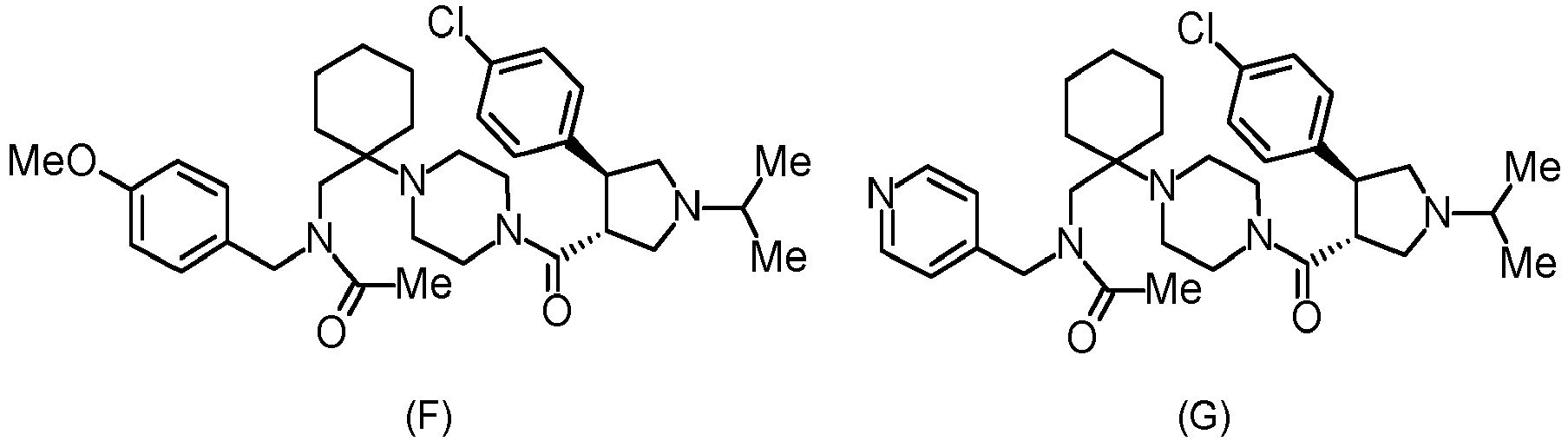
-
- [Patent Document 1]
WO 2004/078717 - [Patent Document 2]
WO 2006/020277 - [Patent Document 3]
WO 2005/040109 -
- [Non-Patent Document 1] Bioorganic Medicinal Chemistry Letters 2010, 20(15), 4483
- [Non-Patent Document 2] Bioorganic Medicinal Chemistry Letters 2007, 17(24), 6825
- The present invention provides a piperazine derivative which has an MC4 receptor agonistic action and can be used as an active ingredient of a pharmaceutical composition for preventing or treating bladder and/or urinary tract diseases.
- The present inventors conducted extensive studies for creating a novel therapeutic drug for bladder and/or urinary tract diseases. As a result, they have found that an MC4 receptor agonist relaxes the urethra and decreases the urethral pressure. Furthermore, the present inventors have found that in rat models with drug-induced voiding dysfunction, there is a decrease inhibiting action in voiding efficiency and an increase inhibiting action in the amount of the residual urine (
WO2017/022733 ). - On the other hand, each of known MC4 receptor agonists have an action on central nervous system such as feeding disorders, obesity, sexual disorder, and the like. In a case where the agonists are used for preventing or treating bladder and/or urinary tract diseases, it is not preferable that the MC4 receptor agonists express an action on central nervous system (for example, an erection-inducing action) when administered at an effective amount. From this viewpoint, the present inventors have considered it is preferable to separate the action on bladder and/or urinary tract diseases from the action on central nervous system. Therefore, for the purpose of creating a compound having a potent action on bladder and/or urinary tract diseases, the present inventors have conducted further extensive studies.
- As a result, the present inventors have found that a piperazine derivative as a compound of the formula (I) has an excellent MC4 receptor agonistic activity, and have also discovered that the piperazine derivative can be used as a drug for preventing or treating bladder and/or urinary tract diseases, thereby completing the present invention.
- That is, the present invention relates to a compound of the formula (I) or a salt thereof, as well as a pharmaceutical composition comprising a compound of the formula (I) or a salt thereof and a pharmaceutically acceptable excipient.

Ring A represents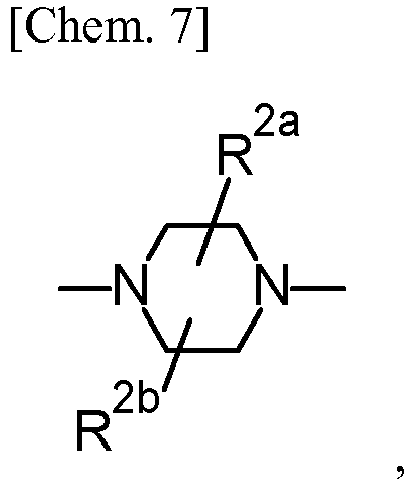
- R1 represents C1-6 alkyl which may be substituted, C3-8 cycloalkyl which may be substituted, or a saturated hetero ring which may be substituted,
- R2a and R2b are the same as or different from each other and each represent H or C1-6 alkyl which may be substituted,
- R2a and R2b do not simultaneously represent H,
- in a case where R2a and R2b are bonded to the same carbon, R2a, R2b, and the carbon atom to which they are bonded may form a saturated hydrocarbon ring together,
- R3 represents C1-6 alkyl which may be substituted, C3-8 cycloalkyl which may be substituted, or phenyl which may be substituted,
- R4a represents H, C1-6 alkyl, -C(O)R9, or -S(O)2R9,
- R4b represents H or C1-6 alkyl,
- X represents CR8 or N,
- R5, R6, R7, and R8 are the same as or different from each other and each represent H or halogen,
- R9 represents C1-6 alkyl which may be substituted or C3-8 cycloalkyl which may be substituted, and
- n represents 0 or 1.)
- In addition, unless otherwise specified, when symbols in a certain chemical formula in the present specification are also used in another chemical formula, the same symbol represents the same meaning.
- The present invention also relates to a pharmaceutical composition for preventing or treating bladder and/or urinary tract diseases, comprising the compound of the formula (I) or a salt thereof. The pharmaceutical composition includes an agent for preventing or treating bladder and/or urinary tract diseases, comprising the compound of the formula (I) or a salt thereof.
- The present invention relates to use of the compound of the formula (I) or a salt thereof for the manufacture of a pharmaceutical composition for preventing or treating bladder and/or urinary tract diseases; use of the compound of the formula (I) or a salt thereof for preventing or treating bladder and/or urinary tract diseases; the compound of the formula (I) or a salt thereof for use in preventing or treating bladder and/or urinary tract diseases; and a method for preventing or treating bladder and/or urinary tract diseases, comprising administering to a subject an effective amount of the compound of the formula (I) or a salt thereof.
- The present invention also relates to the compound of the formula (I) or a salt thereof which is a MC4 receptor agonist; the compound of the formula (I) or a salt thereof for use as a MC4 receptor agonist; and a MC4 receptor agonist comprising the compound of the formula (I) or a salt thereof.
- In addition, the "subject" is a human or another animal in need of such prevention or treatment, and in a certain embodiment, a human in need of such prevention or treatment.
- The compound of the formula (I) or a salt thereof is a compound having a peripheral MC4 receptor agonistic activity. The action on bladder and/or urinary tract diseases can be separated from the action on central nervous system. Therefore, the compound or a salt thereof is expected to be useful as an active ingredient of a pharmaceutical composition for preventing or treating bladder and/or urinary tract diseases.
- Hereinafter, the present invention will be specifically described.
- In the present specification, the "bladder and/or urinary tract diseases" refer to, for example, voiding dysfunctions in underactive bladder, hypotonic bladder, acontractile bladder, detrusor underactivity, neurogenic bladder, urethral relaxation failure, detrusor-external urethral sphincter dyssynergia, overactive bladder, urinary frequency, nocturia, urinary incontinence, benign prostatic hyperplasia, interstitial cystitis, chronic prostatitis, urethral calculus, and the like; and, in a certain aspect, voiding dysfunctions in underactive bladder, hypotonic bladder, acontractile bladder, detrusor underactivity, neurogenic bladder, urethral relaxation failure, detrusor-external urethral sphincter dyssynergia, and benign prostatic hyperplasia.
- The "C1-6 alkyl" refers to linear or branched alkyl having 1 to 6 carbon atoms. Examples thereof include methyl, ethyl, n-propyl, isopropyl, n-butyl, isobutyl, sec-butyl, tert-butyl, n-pentyl, n-hexyl, and the like. (Hereinafter, the number of carbon atoms will be described in the same manner.) In a certain aspect, C1-6 alkyl is C1-4 alkyl; in a certain aspect, methyl, isopropyl, or tert-butyl; in a certain aspect, isopropyl or tert-butyl; in a certain aspect, methyl; and in a certain aspect, tert-butyl.
- The "C3-8 cycloalkyl" refers to a saturated hydrocarbon ring group having 3 to 8 carbon atoms, which may have a bridge. Examples thereof include cyclopropyl, cyclobutyl, cyclopentyl, cyclohexyl, and the like. In a certain aspect, C3-8 cycloalkyl is C3-6 cycloalkyl; in a certain aspect, cyclopropyl; and in a certain aspect, cyclohexyl.
- The "saturated hetero ring" refers to a 3- to 8-membered monocyclic saturated heterocyclic group containing one or two hetero atoms selected from oxygen, sulfur, and nitrogen as a ring-constituting atom, in which the sulfur or nitrogen as a ring atom may be oxidized to form an oxide or a dioxide. Examples thereof include azetidinyl, pyrrolidinyl, piperidyl, piperazinyl, azepanyl, diazepanyl, morpholinyl, thiomorpholinyl, oxetanyl, tetrahydrofuranyl, tetrahydropyranyl, dioxolanyl, dioxanyl, tetrahydrothiopyranyl, and the like.
- The "oxygen-containing saturated hetero ring" refers to 3- to 8-membered monocyclic saturated heterocyclic group containing one or two oxygen atoms as ring-constituting atoms, among the aforementioned saturated hetero rings. Examples thereof include oxetanyl, tetrahydrofuranyl, tetrahydropyranyl, dioxolanyl, and dioxanyl. In a certain aspect, the oxygen-containing saturated hetero ring is tetrahydrofuranyl or tetrahydropyranyl; in a certain aspect, tetrahydrofuranyl; and in a certain aspect, tetrahydropyranyl.
- The "halogen" means F, Cl, Br, or I. In a certain aspect, the halogen is F or Cl; and in a certain aspect, F.
- In a case where R2a and R2b on a piperazine ring constituting Ring A are bonded to the same carbon, the saturated hydrocarbon ring which is formed together by R2a, R2b, and the carbon atoms to which they are bonded is, in a certain aspect, a C3-8 saturated hydrocarbon ring; in a certain aspect, C3-6 saturated hydrocarbon ring; and in a certain aspect, cyclopropane.
- In the present specification, "may be substituted" means that a group has no substituent or has 1 to 5 substituents. In a case where a group has a plurality of substituents, the substituents may be the same as or different from each other.
- Examples of substituents acceptable in the "C1-6 alkyl which may be substituted", the "C3-8 cycloalkyl which may be substituted", the "saturated hetero ring which may be substituted", and the "phenyl which may be substituted" include C1-6 alkyl, -O-(C1-6 alkyl), C3-8 cycloalkyl, halogen, cyano, and the like.
- In a certain aspect, the substituent acceptable in the "C1-6 alkyl which may be substituted" in R1 is -O-(C1-6 alkyl), C3-8 cycloalkyl, halogen, or cyano; in a certain aspect, C3-8 cycloalkyl; and in certain aspect, cyclopropyl.
- In a certain aspect, the substituent acceptable in the "C1-6 alkyl which may be substituted" in R2a and R2b is -O-(C1-6 alkyl), C3-8 cycloalkyl, halogen, or cyano; in a certain aspect, -O-(C1-6 alkyl); and in a certain aspect, methoxy.
- In a certain aspect, the substituent acceptable in the "C1-6 alkyl which may be substituted" in R3 is -O-(C1-6 alkyl) or halogen.
- In a certain aspect, the substituent acceptable in the "C3-8 cycloalkyl which may be substituted" in R3 is C1-6 alkyl, -O-(C1-6 alkyl), or halogen; in a certain aspect, C1-6 alkyl or halogen; and in a certain aspect, methyl or F.
- In a certain aspect, the substituent acceptable in the "phenyl which may be substituted" in R3 is halogen or cyano; and in a certain aspect, F, Cl, or cyano.
- Some aspects of the compound of the formula (I) or a salt thereof will be shown below.
- (1) A compound or a salt thereof, in which Ring A is


- (2) A compound or a salt thereof, in which R1 represents C1-6 alkyl which may be substituted, C3-8 cycloalkyl which may be substituted, or a saturated hetero ring which may be substituted. In a certain aspect, a compound or a salt thereof, in which R1 represents C1-6 alkyl which may be substituted, C3-8 cycloalkyl, or an oxygen-containing saturated hetero ring. In a certain aspect, a compound or a salt thereof, in which R1 represents C1-6 alkyl or an oxygen-containing saturated hetero ring. In a certain aspect, a compound or a salt thereof, in which R1 represents C1-6 alkyl. In a certain aspect, a compound or a salt thereof, in which R1 represents tert-butyl.
- (3) A compound or a salt thereof, in which R2a and R2b are the same as or different from each other and each represent H or C1-6 alkyl which may be substituted; R2a and R2b do not simultaneously represent H; and in a case where R2a and R2b are bonded to the same carbon, R2a, R2b, and the carbon atom to which they are bonded may form a saturated hydrocarbon ring together. In a certain aspect, a compound or a salt thereof, in which R2a and R2b are the same as or different from each other and each represent H or C1-6 alkyl which may be substituted; R2a and R2b do not simultaneously represent H; and in a case where R2a and R2b are bonded to the same carbon, R2a, R2b, and the carbon atom to which they are bonded may form a C3-8 saturated hydrocarbon ring together. In a certain aspect, a compound or a salt thereof, in which R2a and R2b are the same as or different from each other and each represent H or C1-6 alkyl; and R2a and R2b do not simultaneously represent H. In a certain aspect, a compound or a salt thereof, in which R2a and R2b are the same as or different from each other and each represent H or methyl; and R2a and R2b do not simultaneously represent H.
- (4) A compound or a salt thereof, in which R3 represents C1-6 alkyl which may be substituted, C3-8 cycloalkyl which may be substituted, or phenyl which may be substituted. In a certain aspect, a compound or a salt thereof, in which R3 represents C1-6 alkyl, C3-8 cycloalkyl which may be substituted, or phenyl which may be substituted. In a certain aspect, a compound or a salt thereof, in which R3 represents C1-6 alkyl, C3-8 cycloalkyl, or phenyl which may be substituted with one or two substituents selected from the group consisting of halogen and cyano. In a certain aspect, a compound or a salt thereof, in which R3 represents C1-6 alkyl, C3-8 cycloalkyl, or phenyl which may be substituted with one cyano group. In a certain aspect, a compound or a salt thereof, in which when n represents 0, R3 represents C3-8 cycloalkyl, and when n represents 1, R3 represents C1-6 alkyl. In a certain aspect, a compound or a salt thereof, in which when n represents 0, R3 represents cyclohexyl, and when n represents 1, R3 represents isopropyl or tert-butyl.
- (5) A compound or a salt thereof, in which R4a represents H, C1-6 alkyl, -C(O)R9, or -S(O)2R9; and R4b represents H or C1-6 alkyl. In a certain aspect, a compound or a salt thereof, in which R4a represents H, C1-6 alkyl, -C(O)R9, or -S(O)2R9; R4b represents H or C1-6 alkyl; in a case where R4a represents H, R4b also represents H; and in a case where R4a represents C1-6 alkyl, R4b also represents C1-6 alkyl. In a certain aspect, a compound or a salt thereof, in which R4a represents -C(O)R9 or -S(O)2R9; and R4b represents H. In a certain aspect, a compound or a salt thereof, in which R4a represents -C(O)R9; and R4b represents H.
- (6) A compound or a salt thereof, in which X represents CR8 or N. In a certain aspect, a compound or a salt thereof, in which X represents CR8.
- (7) A compound or a salt thereof, in which R5, R6, R7, and R8 are the same as or different from each other and each represent H or halogen. In a certain aspect, a compound or a salt thereof, in which R5 represents H, R6 represents halogen; R7 represents H; and R8 represents H or halogen. In a certain aspect, a compound or a salt thereof, in which R5 represents H; R6 represents F or Cl; R7 represents H; and R8 represents H or F.
- (8) A compound or a salt thereof, in which R9 represents C1-6 alkyl which may be substituted or C3-8 cycloalkyl which may be substituted. In a certain aspect, a compound or a salt thereof, in which R9 represents C1-6 alkyl or C3-8 cycloalkyl. In a certain aspect, a compound or a salt thereof, in which R9 represents C1-6 alkyl. In a certain aspect, a compound or a salt thereof, in which R9 represents methyl.
- (9) A compound or a salt thereof, in which n represents 0 or 1. In a certain aspect, a compound or a salt thereof, in which n represents 0. In a certain aspect, a compound or a salt thereof, in which n represents 1.
- (10) A compound which is a combination of two or more groups described above in (1) to (9).
Specifically, examples of the combination described above in (10) include the following aspects. - (11) The compound of the formula (I) or a salt thereof, in which Ring A is

- R1 represents C1-6 alkyl which may be substituted, C3-8 cycloalkyl, or an oxygen-containing saturated hetero ring,
- R2a and R2b are the same as or different from each other and each represent H or C1-6 alkyl which may be substituted,
- R2a and R2b do not simultaneously represent H,
- in a case where R2a and R2b are bonded to the same carbon, R2a, R2b, and the carbon atom to which they are bonded may form a saturated hydrocarbon ring together,
- R3 represents C1-6 alkyl, C3-8 cycloalkyl which may be substituted, or phenyl which may be substituted,
- R4a represents H, C1-6 alkyl, -C(O)R9, or -S(O)2R9,
- R4b represents H or C1-6 alkyl,
- in a case where R4a represents H, R4b also represents H, and in a case where R4a represents C1-6 alkyl, R4b also represents C1-6 alkyl,
- X represents CR8 or N,
- R5, R6, R7, and R8 are the same as or different from each other and each represent H or halogen,
- R9 represents C1-6 alkyl or C3-8 cycloalkyl, and
- n represents 0 or 1.
- (12) The compound or a salt thereof described in (11), in which Ring A is

- R1 represents C1-6 alkyl or oxygen-containing saturated hetero ring,
- R2a and R2b are the same as or different from each other and each represent H or C1-6 alkyl,
- R2a and R2b do not simultaneously represent H,
- R3 represents C1-6 alkyl, C3-8 cycloalkyl, or phenyl which may be substituted with one or two substituents selected from the group consisting of halogen and cyano,
- R4a represents -C(O)R9 or -S(O)2R9,
- R4b represents H,
- R5 represents H,
- R6 represents halogen,
- R7 represents H,
- R8 represents H or halogen, and
- R9 represents C1-6 alkyl.
- (13) The compound or a salt thereof described in (12), in which Ring A is

- (14) The compound or a salt thereof described in (13), in which
R3 represents C1-6 alkyl, C3-8 cycloalkyl, or phenyl which may be substituted with one cyano group,
R4a represents -C(O)R9,
R4b represents H, and
X represents CR8. - (15) The compound or a salt thereof described in (14), in which
R1 represents C1-6 alkyl,
when n represents 0, R3 represents C3-8 cycloalkyl, and
when n represents 1, R3 represents C1-6 alkyl. - (16) The compound or a salt thereof described in (15), in which
R1 represents tert-butyl,
R2a and R2b are the same as or different from each other and each represent H or methyl,
R2a and R2b do not simultaneously represent H,
when n represents 0, R3 represents cyclohexyl,
when n represents 1, R3 represents isopropyl or tert-butyl,
X represents CR8,
R6 represents F or Cl,
R8 represents H or F, and
R9 represents methyl. - Examples of the specific compounds included in the present invention include following compounds or salts thereof:
- N-{(1S)-2-[(3S)-4-{[(3S,4R)-1-tert-butyl-4-(2,4-difluorophenyl)pyrrolidin-3-yl]carbonyl}-3-methylpiperazin-1-yl]-1-cyclohexyl-2-oxoethyl}acetamide,
- N-{(2S)-1-[(3S)-4-{[(3S,4R)-1-tert-butyl-4-(2,4-difluorophenyl)pyrrolidin-3-yl]carbonyl}-3-methylpiperazin-1-yl]-4,4-dimethyl-1-oxopentan-2-yl}acetamide,
- N-{(2S)-1-[(2R,5S)-4-{[(3S,4R)-1-tert-butyl-4-(2,4-difluorophenyl)pyrrolidin-3-yl]carbonyl}-2,5-dimethylpiperazin-1-yl]-4,4-dimethyl-1-oxopentan-2-yl}acetamide,
- N-{(2S)-1-[(2R,5S)-4-{[1-tert-butyl-4-(4-fluorophenyl)pyrrolidin-3-yl]carbonyl}-2,5-dimethylpiperazin-1-yl]-4,4-dimethyl-1-oxopentan-2-yl}acetamide, and
- N-{(2S)-1-[(2R)-4-{[(3S,4R)-1-tert-butyl-4-(4-chloro-2-fluorophenyl)pyrrolidin-3-yl]carbonyl}-2-methylpiperazin-1-yl]-4-methyl-1-oxopentan-2-yl}acetamide.
- In the compound of the formula (I), a tautomer or a geometrical isomer can exist depending on the type of substituents. In the present specification, the compound of the formula (I) is described in only one isomer form in some cases. However, the present invention includes other isomers, and also includes compounds from which isomers are separated, or mixtures thereof.
- Further, the compound of the formula (I) has asymmetric carbon atoms or axis chirality in some cases, and therefore, optical isomers may exist based on such cases. The present invention also includes the compounds from which optical isomers of the compound of the formula (I) are separated, or mixtures thereof.
- The present invention also includes a pharmaceutically acceptable prodrug of the compound of the formula (I). The pharmaceutically acceptable prodrug is a compound having a group that can be converted into an amino group, a hydroxyl group, a carboxyl group, or the like through solvolysis or under physiological conditions. Examples of the group forming the prodrug include the groups described in Prog. Med., 5, 2157-2161 (1985) and "Pharmaceutical Research and Development" (Hirokawa Publishing Company, 1990), Vol. 7, Molecular Design, 163-198.
- The salt of the compound of the formula (I) is a pharmaceutically acceptable salt of the compound of the formula (I) and may form an acid addition salt or a salt with a base depending on the type of substituents. Specific examples thereof include acid addition salts with inorganic acids such as hydrochloric acid, hydrobromic acid, hydroiodic acid, sulfuric acid, nitric acid, and phosphoric acid and with organic acids such as formic acid, acetic acid, propionic acid, oxalic acid, malonic acid, succinic acid, fumaric acid, maleic acid, lactic acid, malic acid, mandelic acid, tartaric acid, dibenzoyltartaric acid, ditoluoyltartaric acid, citric acid, methanesulfonic acid, ethanesulfonic acid, benzenesulfonic acid, p-toluenesulfonic acid, aspartic acid, and glutamic acid, and salts with metal cations such as sodium, potassium, magnesium, calcium, and aluminum, salts with organic bases such as methylamine, ethylamine, and ethanolamine, salts with various amino acids and amino acid derivatives such as acetylleucine, lysine, and ornithine, ammonium salts, and the like.
- The present invention also includes various hydrates or solvates and polymorphic crystalline substances of the compound of the formula (I) or a salt thereof. In addition, the present invention also includes compounds labeled with various radioactive or nonradioactive isotopes.
- The compound of the formula (I) or a salt thereof can be prepared by applying various known synthesis methods using the characteristics based on the basic structure or the type of substituents thereof. At the time of preparation, depending on the type of functional group, from the viewpoint of the preparation technology, it is in some cases effective to substitute the relevant functional group with an appropriate protective group (a group that can be easily converted into the relevant functional group) during the steps from starting material to intermediate. Examples of the aforementioned protective group include the protective groups described in "Greene's Protective Groups in Organic Synthesis (4th edition, 2006)", P. G. M. Wuts and T. W. Greene and the like, and the protective group may be appropriately selected and used depending on the reaction conditions thereof. In this method, a desired compound can be obtained by introducing the protective group and carrying out a reaction, and then removing the protective group as necessary.
- In addition, prodrugs of the compound of the formula (I) can be prepared by introducing a specific group or by further carrying out the reaction by using the obtained compound of the formula (I) during the steps from starting material to intermediate, just as in the case of the aforementioned protective group. The reaction can be carried out by applying methods known to a person skilled in the art, such as common esterification, amidation, and dehydration.
- Hereinafter, typical preparation methods for the compound of the formula (I) will be described. Each production process can also be carried out with reference to the reference documents attached to the description of the production process. The preparation methods of the present invention are not limited to the following examples.
-


- This reaction is a method for preparing a compound of the formula (Ia), in which R4a represents -C(O)R9 in the formula (I) representing the compound of the present invention.
- This reaction is carried out using the compound of the formula (a) and the compound of the formula (b) in equivalent amounts, or either thereof in an excess amount, by stirring a mixture in a solvent which is inert to the reaction in the presence of a condensing reagent, under from cooling to heating, preferably at -20°C to 60°C, usually for 0.1 hours to 5 days. The solvent used herein is not particularly limited, and examples thereof include aromatic hydrocarbons such as benzene, toluene, xylene, and the like, halogenated hydrocarbons such as dichloromethane, 1,2-dichloroethane, chloroform, and the like, ethers such as diethyl ether, tetrahydrofuran, dioxane, dimethoxyethane, and the like, N,N-dimethylformamide, dimethylsulfoxide, ethyl acetate, acetonitrile, water, and a mixture thereof. Examples of the condensing reagent include, but are not limited to, O-(7-aza-1H-benzotriazol-1-yl)-N,N,N',N'-tetramethyluronium hexafluorophosphate (HATU), 1-(3-dimethylaminopropyl)-3-ethylcarbodiimide, dicyclohexylcarbodiimide, 1,1'-carbonyldiimidazole, and diphenylphosphoryl azide, and phosphorous oxychloride. In some cases, it is preferable to use an additive (for example, 1-hydroxybenzotriazole) for the reaction. Furthermore, in some cases, for smooth progress of the reaction, it is advantageous to perform the reaction in the presence of organic bases such as triethylamine, N,N-diisopropyl ethylamine, N-methylmorpholine, and the like or inorganic bases such as potassium carbonate, sodium carbonate, potassium hydroxide, and the like.
- Furthermore, it is also possible to use a method in which the compound of the formula (b) is converted into a reactive derivative and then reacted with the compound of the formula (a). Examples of the reactive derivative of the carboxylic acid include acid halides that can be obtained by the reaction with a halogenating agent such as phosphorus oxychloride, thionyl chloride, and the like, mixed acid anhydrides obtained by the reaction with isobutyl chloroformate and the like, and active esters obtained by condensation with 1-hydroxybenzotriazole and the like. The reaction between these reactive derivatives and the compound of the formula (a) can be performed in a solvent which is inert to the reaction such as halogenated hydrocarbons, aromatic hydrocarbons, ethers, and the like, under from cooling to heating, preferably at a temperature of -20°C to 60°C. In some cases, for smooth progress of the reaction, it is advantageous to perform the reaction in the presence of organic bases such as triethylamine, N,N-diisopropyl ethylamine, N-methylmorpholine, and the like.
- "Organic Functional Group Preparations (2nd edition)", S. R. Sandler and W. Karo, Vol. 1, Academic Press Inc., 1991
"Courses in Experimental Chemistry (5th edition)" edited by The Chemical Society of Japan, Vol. 16 (2005) (Maruzen) -

- This reaction is a method for preparing the compound of the formula (Ib), in which Ring A in the compound of the formula (I) is

- The reaction conditions are the same as in Production Process 1.
- Here, "the compound of the formula (Ib)" and "the compound of the formula (I)" are the same meaning, and refer to the same compound.
-


- This production process is a method for preparing the compound of the formula (a) that is a starting compound of Production Process 1 and the compound of the formula (c) that is a starting compound of Production Process 2.
- This step is a method for preparing a compound of the formula (g) by an amidation reaction between the compound of the formula (e) and the compound of the formula (f). The reaction conditions are the same as in Production Process 1.
- This step is a method for preparing the compound of the formula (c) by deprotecting the compound of the formula (g). The deprotecting step can be carried out with reference to "Protective Groups in Organic Synthesis (4th edition)" Greene & Wuts, John Wiley & Sons Inc, 2006.
- This step is a method for preparing the compound of the formula (j) by an amidation reaction between the compound of the formula (c) and the compound of the formula (h). The reaction conditions are the same as in Production process 1.
- This step is a method for preparing the compound of the formula (a) by deprotecting the compound of the formula (j). As in Step 2, the deprotecting step can be performed with reference to "Protective Groups in Organic Synthesis (4th edition)" Greene & Wuts, John Wiley & Sons Inc, 2006.
-

- This production process is a method for preparing the compound of the formula (p), in which R4a represents R4aa and R4b represents H in the compound of the formula (d) that is a starting compound of Production Process 2.
- This reaction can be performed in a solvent which is inert to the reaction, such as halogenated hydrocarbons, aromatic hydrocarbons, ethers, and the like, under from cooling to heating, preferably at a temperature of -20°C to 60°C. In some cases, for smooth progress of the reaction, it is advantageous to carry out the reaction in the presence of organic bases such as triethylamine, N,N-diisopropyl ethylamine, N-methylmorpholine, and the like.
- The compound of the formula (I) is purified by being isolated as a free compound, a salt, a hydrate, a solvate, or a polymorphic crystalline substance thereof. The salt of the compound of the formula (I) can also be prepared by a conventional salt formation reaction.
- Isolation and purification can be performed through a general chemical operation such as extraction, fractional crystallization, and various types of fractional chromatography techniques.
- Various isomers can be prepared by selecting appropriate starting compounds or by separation using differences in physicochemical properties between the isomers. For example, optical isomers can be obtained by means of a general optical resolution method for racemic isomers (for example, fractional crystallization for inducing diastereomer salts with optically active bases or acids, and chromatography using a chiral column or the like). Furthermore, the isomers can also be prepared from an appropriate optically active starting compound.
- The pharmacological activities of the compound of the formula (I) were confirmed by the following tests.
- The pharmacological activities of the compound of the formula (I) were confirmed by the following tests. In the present specification, the doses of the test compounds are expressed in terms of the weight of free forms.
- Unless otherwise specified, the present test examples can be performed according to known methods. In a case where commercially available reagents, kits, and the like are used, the present test examples can be performed according to the instructions attached to the commercially available products.
- Test Example 1: Test for Evaluating Human MC Receptor Activation, Using Cells Expressing Human MC4, MC1, and MC3 Receptors
- A human MC4 receptor gene (GenBank Accession No.: NM_005912.2), a human MC1 receptor gene (GenBank Accession No.: NM_002386.3), or a human MC3 receptor gene (GenBank Accession No.: NM_019888.3) was introduced into an expression vector pcDNA™ 3.1/V5-His TOPO (registered trademark) (Thermo Fisher Scientific Inc).
- An expression vector for a human MC4, MC1, or MC3 receptor was introduced into FreeStyle™ 293-F cells (Thermo Fisher Scientific Inc., product number: R790-07). For the introduction, electroporation was employed. That is, 1 × 10⁷ FreeStyle™ 293-F cells were suspended in 80 µL of an Electroporation Buffer (Thermo Fisher Scientific Inc., product number: B201-100), and 20 µg of the expression vector was added thereto. The resultant was put into a cuvette (OC-100 Processing Assembly, MaxCyte, Inc.) and electroporated with MaxCyte STX (registered trademark) (MaxCyte, Inc.). The cells were cultured for a day, suspended in a Cell Banker (registered trademark) 1 (TAKARA BIO INC. or JUJI FIELD Inc., product number: BLC-1), and stored frozen until they were used.
- Measurement was carried out by using a LANCE (registered trademark) Ultra cAMP Kit (PerkinElmer, Inc.) in accordance with the attached instructions. That is, after dissolution in DMSO, the test compound (a final concentration of 1 pM to 30 µM) diluted with an assay buffer (Hank's balanced salt solution, 5 mM 4-(2-hydroxyethyl)-1-piperazineethanesulfonic acid (HEPES), 0.5 mM 3-isobutyl-1-methylxanthine (IBMX), 0.1% bovine serum albumin, pH 7.4), or α-MSH (Bachem Inc., a final concentration of 1 pM to 30 µM) was added to OptiPlate-384 (PerkinElmer, Inc.). Furthermore, the suspension of the cells transiently expressing the human MC4, MC1, or MC3 receptor prepared using the assay buffer was added thereto at 1,000 cells/well, and then left to stand at room temperature for about 1 hour. Thereafter, an Eu-cAMP tracer solution and an ULight™-anti-cAMP solution were added thereto, and then the resulting solution was left to stand at room temperature for about 1 hour. The amount of cAMP was calculated using EnVision (registered trademark) (PerkinElmer Inc.).
- For the agonistic activity, the efficacy (EC50 (µM)) was calculated by a non-linear regression method with a Sigmoid-Emax model, by defining the maximum reaction using α-MSH as 100% and the reaction using the vehicle alone as 0%, respectively.
- The EC50 values of some example compounds of the present invention are shown in Table 1. Ex represents the Example No. of the test compound, and NT represents Not Tested.
[Table 1] Ex EC50 (µM) MC4 MC1 MC3 3 0.008 5.7 0.31 4 0.0068 1 0.27 5 0.006 0.71 0.55 6 0.019 2.6 1.8 7 0.077 0.68 4.4 8 0.01 1.7 1 9 0.089 NT NT 10 0.012 NT NT 11 0.011 1.6 0.89 12 0.014 NT NT 13 0.034 NT NT 14 0.024 0.61 1.8 15 0.22 NT NT 16 0.014 NT NT 17 0.04 NT NT 18 0.062 NT NT 19 0.38 NT NT 20 0.023 8 1.2 21 0.13 NT NT 22 0.18 NT NT 23 0.023 0.87 0.45 24 0.078 1.5 6.4 25 0.12 NT NT 26 5 NT NT 27 1 NT NT 28 0.0055 NT NT 29 0.28 NT NT 30 1.8 NT NT - From the above results, it was confirmed that the example compounds of the present invention have an agonistic activity against the human MC4 receptor. It was also confirmed that among the example compounds of the present invention, in the example compounds evaluated regarding the human MC1 and MC3 receptors, the EC50 values for the human MC1 and MC3 receptors are at higher concentrations than the EC50 values for the human MC4 receptor, and the compounds selectively act on the MC4 receptor.
- A rat MC4 receptor gene (GenBank Accession No.: NM_013099.3) was introduced into an expression vector pcDNA™ 3.1/V5-His TOPO (registered trademark) (Thermo Fisher Scientific Inc.).
- An expression vector for a rat MC4 receptor was introduced into FreeStyle™ 293-F cells (Thermo Fisher Scientific Inc.). For the introduction, electroporation was employed. That is, 1 × 10⁷ FreeStyle™ 293-F cells were suspended in 80 µL of an electroporation buffer (Thermo Fisher Scientific Inc.), and 20 µg of the expression vector was added thereto. The resultant was put into a cuvette (OC-100 Processing Assembly, MaxCyte, Inc.) and electroporated with MaxCyte STX (registered trademark) (MaxCyte, Inc.). The cells were cultured for a day, suspended in a Cell Banker (registered trademark) 1 (TAKARA BIO INC. or JUJI FIELD Inc.), and stored frozen until they were used.
- Measurement was carried out in accordance with the attached instructions, using a LANCE (registered trademark) Ultra cAMP Kit (PerkinElmer, Inc.). That is, after dissolution in DMSO, the test compound (a final concentration of 1 pM to 30 µM) diluted with an assay buffer (Hank's balanced salt solution, 5 mM HEPES, 0.5 mM IBMX, 0.1% bovine serum albumin, pH 7.4), or α-MSH (Bachem Inc., a final concentration of 1 pM to 30 µM) was added to OptiPlate-384 (PerkinElmer, Inc.). Furthermore, the suspension of the cells transiently expressing the rat MC4 receptor that was prepared using the assay buffer was added thereto at 1,000 cells/well, and then left to stand at room temperature for about 1 hour. Thereafter, an Eu-cAMP tracer solution and an ULight™-anti-cAMP solution were added thereto, and the resulting solution was left to stand at room temperature for about 1 hour. The amount of cAMP was calculated using EnVision (registered trademark) (PerkinElmer Inc).
- For the agonistic activity, an efficacy (EC50 (µM)) was calculated by a non-linear regression method with a Sigmoid-Emax model, by defining the maximum reaction using α-MSH as 100% and the reaction using a vehicle alone as 0%, respectively.
- The EC50 values of some example compounds of the present invention are shown in Table 2. Ex represents the Example No. of the test compound.
[Table 2] Ex EC50 (µM) 4 0.002 5 0.0033 6 0.016 7 0.015 8 0.0047 11 0.01 14 0.0088 20 0.0076 23 0.0048 24 0.046 - From the above results, it was confirmed that the example compounds of the present invention have an agonistic activity against the rat MC4 receptor.
- The present Test Example was performed by partially modifying the technique reported as a testing system for evaluating a urethral resistance-reducing action (European Journal of Pharmacology, 679, 127-131 (2012)). Male Wistar rats (Charles River Laboratories Japan, Inc.) were anesthetized with urethane (1.2 g/kg ip), and immobilized in a supine position. The midline incision was performed in the lower abdominal portion such that the bladder was exposed. The bladder apex was incised, and from the incision site, a microchip pressure transducer catheter (3.5 Fr, Millar, Inc) was inserted and implanted into the inside of the urethra. In addition, a cannula for drug administration was implanted into the femoral vein. After the urethral pressure was stabilized, phenylephrine hydrochloride (Sigma-Aldrich Co. LLC., 30 µg/kg) was intravenously administered to induce an increase in the urethral pressure. At an interval of about 30 minutes, the above operation was repeated twice or more so as to confirm the stability of the phenylephrine hydrochloride-induced urethral pressure increasing reaction. Then, a test compound (dissolved in 20% dimethyl acetamide, 10% Cremophor (registered trademark), and 70% physiological saline) was intravenously administered, and after 5 minutes, phenylephrine hydrochloride was administered. The procedure of the administration of the test compound and the administration of phenylephrine hydrochloride was repeated at an interval of about 30 minutes, and 3 to 5 doses of the test compound was evaluated (the test compound was administered at increasing doses). The obtained data was introduced into a personal computer through PowerLab (registered trademark) (ADInstruments, Inc.) and analyzed using LabChart (registered trademark) (ADInstruments, Inc.). For the evaluation, the value (AUC value, mmHg·s) of the area under the urethral pressure for one minute before and after administration of phenylephrine hydrochloride was determined to calculate the difference (ΔAUC value) between the AUC value before the administration of phenylephrine hydrochloride and the AUC value after the administration of phenylephrine hydrochloride. The ΔAUC value obtained before administering the test compound was regarded as being 100%, and based on this, the ratio (reaction rate) of the ΔAUC value of the test compound at each dose was calculated. The dose at which the obtained reaction rate became 60% (40% as an inhibition rate) was defined as ID40, and the ID40 values of the test compounds were calculated by non-linear regression.
- The ID40 values of some example compounds of the present invention are shown in Table 3. Ex represents the Example No. of the test compound.
[Table 3] Ex ID40 (g/kg) 3 0.0089 4 0.011 5 0.025 6 0.046 8 0.015 11 0.028 14 0.071 16 0.011 20 0.04 - From the above results, it was found that the example compounds of the present invention have inhibitory effect on phenylephrine-induced urethral pressure increase.
- Male Sprague Dawley (SD) rats (Japan SLC, Inc.) were anesthetized with isoflurane and a cannula was placed in the bladder, the stomach, and the jugular vein. Then, the rats were awakened in a Ballman cage (Natsume Seisakusho Co., Ltd.). After a post-operative stabilization period, physiological saline was continuously infused into the bladder by an infusion pump (Terumo Corporation, product number: TE-331 S, STC-528) to induce voiding. Infusion of the physiological saline was stopped as soon as the voiding began, and the amount of the voided urine was measured using an electronic top-loading balance installed under the Ballman cage. After voiding ended, the residual urine was collected by gravity through the cannula implanted into the bladder and weighed, and the weight was taken as the amount of the residual urine. Furthermore, the intravesical pressure was measured by a pressure transducer (Nihon Kohden Corporation, product numbers: DX-100) through the bladder cannula. The test compound or the vehicle was administered into the stomach, and atropine sulfate (Sigma-Aldrich Co. LLC., 0.01 mg/kg) as an anticholinergic drug and midodrine hydrochloride (Sigma-Aldrich Co. LLC., 0.3 mg/kg) as an α1 adrenergic receptor agonist were intravenously administered to induce voiding dysfunction. The voiding efficiency (= [voided amount/(voided amount + amount of residual urine)] × 100) and the amount of the residual urine before and after the administration of the test compound or the vehicle were measured, and the amount changed was evaluated. The value obtained by the administration of the vehicle and the value obtained by the administration of the test compound were compared in a Dunnett's multiple comparison test with a statistically significant difference (P < 0.05), and the minimum dose at which the inhibitory action on a decrease in voiding efficiency or on an increase of the amount of residual urine observed was defined as a minimum effective dose (4 rats per group).
- The minimum effective doses of some example compounds of the present invention are shown in Table 4. Ex represents the Example No. of the test compound. MED represents a minimum effective dose.
[Table 4] Ex MED (mg/kg ig) 4 0.01 5 0.01 6 0.03 8 0.01 11 0.03 - Male SD rats (Charles River Laboratories Japan, Inc.) were used. Some test compounds (10 mg/kg) or vehicles (20% dimethyl acetamide, 10% Cremophor (registered trademark), and 70% physiological saline) were intravenously administered through the caudal vein. After the administration, the rats were placed in a plastic transparent observation cages, and whether or not penile erection occurs was measured for up to 1 hour after the administration. As a result of using some of the example compound of the present invention as a test compound, it was confirmed that the example compound does not have an erection-inducing effect which is an effect on central nervous system.
- A test compound, and human liver microsomes (0.1 mg protein/mL) were incubated in a 100 mmol/L phosphate buffer (pH 7.4) containing 0.1 mmol/L EDTA and 1 mmol/L NADPH with midazolam as a substrate for 20 minutes at 37°C. Then, an aqueous solution containing acetonitrile was added thereto so as to stop the reaction. Thereafter, the sample was analyzed with LC-MS/MS, and Remaining Activity I was calculated using the following equation.

- Ai,I: The amount of produced metabolite after the reaction in the presence of a test compound at a known concentration in Inhibition Test I
- A0,I: The amount of produced metabolite after the reaction in the absence of a test compound in Inhibition Test I
- A test compound and human liver microsomes (0.1 mg protein/mL) were incubated in a 100 mmol/L phosphate buffer (pH 7.4) containing 0.1 mmol/L EDTA and 1 mmol/L NADPH for a defined period of time at 37°C, followed by incubation with midazolam as a substrate for a defined period of time at 37°C. Then, an aqueous solution containing acetonitrile was added thereto so as to stop the reaction. Thereafter, the sample was analyzed with LC-MS/MS, and Remaining Activity II was calculated using the following equation.

- Ai,II: The amount of produced metabolite after the reaction in the presence of a test compound at a known concentration in Inhibition Test II
- A0,II: The amount of produced metabolite after the reaction in the absence of a test compound in Inhibition Test II
- A test compound and human liver microsomes (0.2 mg protein/mL) were incubated in a 100 mmol/L phosphate buffer (pH 7.4) containing 0.1 mmol/L EDTA and 1 mmol/L NADPH for a defined period of time at 37°C. Then, an aqueous solution containing acetonitrile was added thereto so as to stop the reaction. Thereafter, the sample was analyzed with LC-MS/MS, and in vitro clearance was calculated by an integration plot.
- As is evident from the results of each of the above tests, it was confirmed that the compound of the formula (I) has a human MC4 receptor-selective agonistic activity, and that the compound has inhibitory effect on phenylephrine-induced urethral pressure increase in vivo. Furthermore, it was confirmed that in a rat model with a voiding dysfunction, the compound has an inhibitory effect on a decrease in voiding efficiency and an increase of the amount of residual urine. In addition, it was confirmed that some of the compounds of the formula (I) do not exhibit an erection-inducing effect which is an effect on the central nervous system. Accordingly, the compound of the formula (I) is expected to be useful for preventing or treating bladder and/or urinary tract diseases, particularly, voiding dysfunctions in bladder and/or urinary tract diseases. For example, the compound of the formula (I) is expected to be useful for preventing or treating voiding dysfunctions in underactive bladder, hypotonic bladder, acontractile bladder, detrusor underactivity, neurogenic bladder, urethral relaxation failure, detrusor-external urethral sphincter dyssynergia, overactive bladder, urinary frequency, nocturia, urinary incontinence, benign prostatic hyperplasia, interstitial cystitis, chronic prostatitis, urethral calculus, or the like. Particularly, the compound of the formula (I) is expected to be useful for preventing or treating voiding dysfunctions in underactive bladder, hypotonic bladder, acontractile bladder, detrusor underactivity, neurogenic bladder, urethral relaxation failure, detrusor-external urethral sphincter dyssynergia, and benign prostatic hyperplasia.
- A pharmaceutical composition containing one kind or two or more kinds of the compound of the formula (I) or a salt thereof as an active ingredient can be prepared using excipients generally used in the related art, that is, excipients for pharmaceutical preparation, carriers for pharmaceutical preparation, and the like according to generally used methods.
- Administration can be accomplished either by oral administration by using tablets, pills, capsules, granules, powders, solutions, and the like or by parenteral administration, such as injections such as intraarticular, intravenous, and intramuscular injections, suppositories, eye drops, eye ointments, transdermal solutions, ointments, transdermal patches, transmucosal solutions, transmucosal patches, inhalers, and the like.
- Solid compositions for oral administration are used in the form of tablets, powders, granules, or the like. In such solid compositions, one kind or two or more kinds of active ingredients are mixed with at least one inactive excipient. According to the conventional methods, the compositions may contain inactive additives such as lubricants, disintegrating agents, stabilizers, and solubilization assisting agents. If necessary, tablets or pills may be coated with sugar or films of gastric- or enteric-soluble substances.
- Liquid compositions for oral administration include pharmaceutically acceptable emulsions, solutions, suspensions, syrups, elixirs, or the like and also include generally used inert diluents such as purified water or ethanol. In addition to the inert diluent, the liquid compositions may also contain auxiliary agents such as solubilization assisting agents, moistening agents, and suspending agents, sweeteners, flavors, aromatics, or antiseptics.
- Injections for parenteral administration include sterile aqueous or non-aqueous solutions, suspensions, or emulsions. Aqueous solvents include, for example, distilled water for injection or physiological saline. Examples of the non-aqueous solvents include alcohols such as ethanol. These compositions may further contain tonicity agents, antiseptics, moistening agents, emulsifying agents, dispersing agents, stabilizers, or solubilization assisting agents. These are sterilized by filtration through bacteria retaining filter, mixing with a bactericide, or irradiation, for example. Furthermore, these can also be used by preparing sterile solid compositions, and dissolving or suspending the solid compositions in sterile water or sterile solvents for injection before use.
- Agents for external use include ointments, plasters, creams, gels, poultices, sprays, lotions, eye drops, eye ointments, and the like. The agents contain generally used ointment bases, lotion bases, aqueous or non-aqueous solutions, suspensions, emulsions, and the like.
- As transmucosal agents such as inhalers or transnasal agents, those in the form of a solid, liquid, or semi-solid state are used, and can be prepared according to the methods known in the related art. For example, known excipients, pH adjusting agents, antiseptics, surfactants, lubricants, stabilizers, or thickening agents may be appropriately added thereto. For administering the transmucosal agents, appropriate devices for inhalation or blowing can be used. For example, by using a known device or spray such as a metered-dose administration inhalation device, the compound may be administered alone, administered as powder of a formulated mixture, or administered as a solution or suspension in combination with pharmaceutically acceptable carriers. Dry powder inhalers or the like may be used for single dosing or multiple dosing, and dry powder or powder-containing capsules may be used. Alternatively, these may be a pressurized aerosol spray which uses appropriate ejection agents such as a suitable gas including chlorofluoroalkane, carbon dioxide, and the like.
- For oral administration, the daily dose is generally about 0.001 mg/kg to 100 mg/kg, preferably 0.1 mg/kg to 30 mg/kg, and more preferably 0.1 mg/kg to 10 mg/kg, per body weight, and the composition is administered at the above dose in one portion or in 2 to 4 divided portions. For intravenous administration, a suitable daily dose is about 0.0001 mg/kg to 10 mg/kg per body weight, and the composition is administered once a day or plural times a day. In addition, a transmucosal agent is administered at a dose from about 0.001 mg/kg to 100 mg/kg per body weight, once a day or plural times a day. The doses are appropriately determined according to the individual in consideration of the symptoms, age, gender, and the like.
- Although varying depending on administration routes, formulations, administration sites, or the types of excipients or additives, the pharmaceutical composition of the present invention contains 0.01% by weight to 100% by weight, and in a certain embodiment, 0.01% by weight to 50% by weight of one or more kinds of the compound of the formula (I) or a salt thereof, which is an active ingredient.
- The compound of the formula (I) can be used in combination with various agents for treating or preventing the diseases for which the compound of the formula (I) is considered to be effective. The combined preparation may be administered simultaneously, or separately and continuously, or at a desired time interval. The preparations administered simultaneously may be a combination preparation or may be prepared individually.
- Hereinafter, the method for preparing the compound of the formula (I) will be more specifically described with reference to Examples, but the present invention is not limited to the following compounds described below. The production processes for the starting compounds will be described in Preparation Examples. The method for preparing the compound of the formula (I) is not limited to the preparation methods in specific Examples shown below, and the compound of the formula (I) can be prepared according to a combination of these preparation methods or methods apparent to a person skilled in the art.
- In the tables shown below, the following abbreviations are used in some cases.
- PEx: preparation example No., Ex: example No., PSyn: method for preparing example (the number in the column of PSyn indicates that the compound is prepared using the corresponding starting material by the same method as used for preparing the compound with the number as the preparation example compound No; for example, a compound with 3 in the column of PSyn means that the compound is prepared by the same method as that used for preparing the compound of Preparation Example 3), syn: method for preparing example compound (The number in the column of Syn indicates that the compound is prepared using the corresponding starting material by the same method as that used for preparing the compound with the number as the example compound No; for example, a compound with 1 in the column of Syn means that the compound is prepared by the same method as that used for preparing the compound of Example 1), Str: chemical structural formula, DAT: physicochemical data, Me: methyl
ESI+: m/z values in mass spectroscopy (ionization ESI, representing [M+H]+ unless specified), ESI-: m/z values in mass spectroscopy (ionization ESI, representing [M-H]- unless specified), APCI/ESI+: (ionization APCI/ESI; APCI/ESI means that APCI and ESI are performed simultaneously; representing [M+H]+ unless specified), EI: m/z values in mass spectroscopy (ionization EI, representing [M]+ unless specified), CI+: m/z values in mass spectroscopy (ionization CI, representing [M+H]+ unless specified)
NMR1: δ value (ppm) of signals in 1H-NMR in pyridine-d5, NMR2: δ value (ppm) of signals in 1H-NMR in CDCl3, s: singlet, m: multiplet
Unless otherwise specified, the compound represents an optical isomer having an absolute steric configuration described in the chemical structural formula. The compound marked with "#" represents an optical isomer which has the absolute steric configuration described in the chemical structural formula and in which the steric configuration in the asymmetric carbon moiety with no description of the steric configuration is single but undetermined. The compound marked with "*" indicates the compound has the denoted steric configuration, in which the steric form in the asymmetric carbon moiety with no description of the steric configuration is a mixture of R and S isomers. - In a case where HCl is shown in a chemical structural formula, it means that the compound is a monohydrochloride. In a case where 2HCl is shown in a chemical structural formula, it means that the compound is a dihydrochloride.
- For the sake of convenience, the concentration mol/l is represented by M. For example, a 1 M aqueous sodium hydroxide solution means a 1 mol/l aqueous sodium hydroxide solution.
- Under an argon atmosphere, N,N-diisopropylethylamine (5 mL) and O-(7-aza-1H-benzotriazol-1-yl)-N,N,N',N'-tetramethyluronium hexafluorophosphate (5.5 g) were added to a mixture of (3S,4R)-1-tert-butyl-4-(2,4-difluorophenyl)pyrrolidine-3-carboxylate (4 g), (2R,5S)-2,5-dimethylpiperazine-1-carboxylic acid tert-butyl ester monohydrochloride (3 g), and N,N-dimethylformamide (30 mL) with ice cooling, followed by stirring overnight at room temperature. The reaction mixture was ice-cooled, and a saturated aqueous sodium hydrogen carbonate solution was added thereto, followed by stirring. Water was added to the reaction mixture, and then extraction was performed using ethyl acetate. The organic layer was washed with a saturated aqueous sodium hydrogen carbonate solution, water, and brine. The organic layer was dried over anhydrous sodium sulfate, the insoluble material was separated by filtration, and the filtrate was concentrated under reduced pressure. The obtained residue was purified by silica gel column chromatography (chloroform:methanol = 100:0 to 80:20), thereby obtaining (2R,5S)-4-{[(3S,4R)-1-tert-butyl-4-(2,4-difluorophenyl)pyrrolidin-3-yl]carbonyl}-2,5-dimethylpiperazine-1-carboxylic acid tert-butyl ester (5.80 g) as a solid.
- Hydrogen chloride (4 M dioxane solution, 30 mL) was added to a mixture of (2R,5S)-4-{[(3S,4R)-1-tert-butyl-4-(2,4-difluorophenyl)pyrrolidin-3-yl]carbonyl}-2,5-dimethylpiperazine-1-carboxylic acid tert-butyl ester (5.80 g) and ethanol (50 mL) with ice cooling, followed by stirring for 14 hours at room temperature. The solvent was evaporated under reduced pressure, thereby obtaining [(3S,4R)-1-tert-butyl-4-(2,4-difluorophenyl)pyrrolidine-3-yl][(2S,5R)-2,5-dimethylpiperazin-1-yl]methanone dihydrochloride (5.28 g) as a solid.
- Under an argon atmosphere, N,N-diisopropylethylamine (6.2 mL), N-(tert-butoxycarbonyl)-4-methyl-L-leucine (3 g), and O-(7-aza-1H-benzotriazol-1-yl)-N,N,N',N'-tetramethyluronium hexafluorophosphate (4.8 g) were added to a mixture of [(3S,4R)-1-tert-butyl-4-(2,4-difluorophenyl)pyrrolidine-3-yl][(2S,5R)-2,5-dimethylpiperazin-1-yl]methanone dihydrochloride (4.68 g) and N,N-dimethylformamide (50 mL) with ice cooling, followed by stirring for 2 hours at room temperature. The reaction mixture was ice-cooled, and a saturated aqueous sodium hydrogen carbonate solution was added thereto, followed by stirring. Water was added to the reaction mixture, and then extraction was performed using ethyl acetate. The organic layer was washed with a saturated aqueous sodium hydrogen carbonate solution, water, and brine. After the organic layer was dried over anhydrous sodium sulfate, the insoluble material was separated by filtration, and the filtrate was concentrated under reduced pressure. The obtained residue was purified by silica gel column chromatography (chloroform:methanol = 100:0 to 80:20), thereby obtaining {(2S)-1-[(2R,5S)-4-{[(3S,4R)-1-tert-butyl-4-(2,4-difluorophenyl)pyrrolidin-3-yl]carbonyl}-2,5-dimethylpiperazin-1-yl]-4,4-dimethyl-1-oxopentan-2-yl} carbamic acid tert-butyl ester (6.30 g) as a solid.
- Hydrogen chloride (4 M dioxane solution, 25 mL) was added to a mixture of {(2S)-1-[(2R,5S)-4-{[(3S,4R)-1-tert-butyl-4-(2,4-difluorophenyl)pyrrolidin-3-yl]carbonyl}-2,5-dimethylpiperazin-1-yl]-4,4-dimethyl-1-oxopentan-2-yl}carbamic acid tert-butyl ester (5.80 g) and ethanol (60 mL) with ice cooling. The reaction mixture was stirred for 14 hours at room temperature, and then hydrogen chloride (4 M dioxane solution, 10 mL) was added thereto at room temperature. The reaction mixture was stirred for 5 hours at room temperature, and then the solvent was evaporated under reduced pressure, thereby obtaining (2S)-2-amino-1-[(2R,5S)-4-{[(3S,4R)-1-tert-butyl-4-(2,4-difluorophenyl)pyrrolidin-3-yl]carbonyl}-2,5-dimethylpiperazin-1-yl]-4,4-dimethylpentan-1-one dihydrochloride (5.35 g) as a solid.
- Hydrogen chloride (4 M ethyl acetate solution, 27 mL) was added to a mixture of (3S)-4-{[(3S,4R)-1-tert-butyl-4-(2,4-difluorophenyl)pyrrolidin-3-yl]carbonyl}-3-methylpiperazine-1-carboxylic acid tert-butyl ester (10.22 g) and ethanol (100 mL) with ice cooling, followed by stirring overnight at room temperature. The reaction solution was concentrated under reduced pressure, a saturated aqueous sodium hydrogen carbonate solution was added to the obtained residue, and then extraction was performed using chloroform. The organic layer was dried over anhydrous sodium sulfate, and the insoluble material was separated by filtration. The filtrate was concentrated under reduced pressure, thereby obtaining [(3S,4R)-1-tert-butyl-4-(2,4-difluorophenyl)pyrrolidin-3-yl][(2S)-2-methylpiperazin-1-yl]methanone (7.65 g) as an oil.
- Acetic anhydride (0.9 mL) was added to a suspension of 3-cyclopentyl-L-alanine (1 g) and a 5% aqueous sodium hydrogen carbonate solution (20 mL) with ice cooling, followed by stirring overnight at room temperature. 1 M hydrochloric acid was added thereto so as to adjust the pH thereof to be 1 to 2, followed by stirring for 30 minutes. The precipitated solid was collected by filtration, washed with water, and dried for 3 hours at 40°C under reduced pressure. The obtained solid was washed with diisopropyl ether, collected by filtration, and dried, thereby obtaining N-acetyl-3-cyclopentyl-L-alanine (597 mg) as a solid.
- Hydrogen chloride (4 M dioxane solution, 15 mL) was added to a mixture of [(2S)-1-[(3S)-4-{[(3S,4R)-1-tert-butyl-4-(2,4-difluorophenyl)pyrrolidin-3-yl]carbonyl}-3-methylpiperazin-1-yl]-3-(2-chlorophenyl)-1-oxopropan-2-yl]carbamic acid tert-butyl ester (4.03 g) and ethanol (60 mL) with ice cooling, followed by stirring for 24 hours at room temperature. The solvent was evaporated under reduced pressure, a saturated aqueous sodium hydrogen carbonate solution was added to the residue, and extraction was performed using chloroform. The organic layer was dried over anhydrous sodium sulfate, the insoluble material was separated by filtration, and the filtrate was concentrated under reduced pressure. The obtained residue was purified by silica gel column chromatography (chloforom:methanol = 100:0 to 80:20), thereby obtaining (2S)-2-amino-1-[(3S)-4-{[(3S,4R)-1-tert-butyl-4-(2,4-difluorophenyl)pyrrolidin-3-yl]carbonyl}-3-methylpiperazin-1-yl]-3-(2-chlorophenyl)propan-1-one (2.51 g) as a solid.
- A mixture of (4,4-dimethylcyclohex-1-en-1-yl)methanol (5.18 g) and dichloromethane (60 mL) was ice-cooled, and phosphorus tribromide (3.80 mL) was added thereto. The reaction mixture was heated to room temperature and then stirred for 3 hours. A saturated aqueous sodium hydrogen carbonate solution was added to the reaction mixture, and extraction was performed using chloroform. The organic layer was washed with brine and dried over anhydrous magnesium sulfate. The insoluble material was separated by filtration, and the filtrate was concentrated under reduced pressure. The obtained residue was purified by silica gel column chromatography (hexane), thereby obtaining 1-(bromomethyl)-4,4-dimethylcyclohexene (5.60 g) as an oil.
- tert-Butyl N-(diphenylmethylidene)glycinate (4.80 g) and (R)-4,4-dibutyl-2,6-bis(3,4,5-trifluorophenyl)-4,5-dihydro-3H-dinaphtho[2,1-c:1',2'-e]azepinium bromide (122 mg) were added to a mixture of 1-(bromomethyl)-4,4-dimethylcyclohexene (5.60 g) and toluene (54 mL). After the reaction mixture was ice-cooled, an aqueous solution (54 mL) of potassium hydroxide (27 g) was added thereto, followed by stirring for 15 hours with ice cooling. Water was added to the reaction mixture, and extraction was performed using diethyl ether. The organic layer was washed with brine and dried over anhydrous magnesium sulfate. The insoluble material was separated by filtration, and the filtrate was concentrated under reduced pressure. The obtained residue was purified by silica gel column chromatography (hexane:ethyl acetate = 100:0 to 93:7), thereby obtaining tert-butyl 3-(4,4-dimethylcyclohex-1-en-1-yl)-N-(diphenylmethylidene)-L-alaninate (5.47 g) as an oil.
- An aqueous solution (33 mL) of citric acid (12.5 g) was added to a mixture of tert-butyl 3-(4,4-dimethylcyclohex-1-en-1-yl)-N-(diphenylmethylidene)-L-alaninate (5.47 g) and tetrahydrofuran (66 mL), followed by stirring for 3 hours at room temperature. Diisopropyl ether was added to the reaction mixture, and the aqueous layer was separated. Potassium carbonate was added to the aqueous layer, extraction was performed using chloroform, and the organic layer was dried over anhydrous magnesium sulfate. The insoluble material was separated by filtration, and the filtrate was concentrated under reduced pressure, thereby obtaining 3-(4,4-dimethylcyclohex-1-en-1-yl)-L-alanine tert-butyl ester (2.78 g) as an oil.
- Under a nitrogen atmosphere, 10% palladium hydroxide on carbon (540 mg) was added to a mixture of 3-(4,4-dimethylcyclohex-1-en-1-yl)-L-alanine tert-butyl ester (2.68 g) and ethanol (53.0 mL) at room temperature. The reaction mixture was stirred for 5 hours under a hydrogen atmosphere at room temperature. Celite was added to the reaction mixture, followed by stirring for 15 minutes at room temperature. The reaction mixture was filtered through celite, and the filtrate was concentrated under reduced pressure. Under a nitrogen atmosphere, ethanol (53.0 mL) and 10% palladium hydroxide on carbon (540 mg) were added to the residue at room temperature. Under a hydrogen atmosphere at 3 atm, the reaction mixture was stirred for 15 hours at room temperature. The reaction mixture was filtered through celite, and the filtrate was concentrated under reduced pressure, thereby obtaining 3-(4,4-dimethylcyclohexyl)-L-alanine tert-butyl ester monohydrochloride (2.67 g) as a solid.
- N,N-diisopropylethylamine (0.352 mL) and acetyl chloride (0.088 mL) were added to a mixture of 3-(4,4-dimethylcyclohexyl)-L-alanine tert-butyl ester monohydrochloride (300 mg) and dichloromethane (3 mL), followed by stirring for 1 hour at room temperature. A saturated aqueous sodium hydrogen carbonate solution was added to the reaction mixture, and extraction was performed using ethyl acetate. The organic layer was washed with a 5% aqueous citric acid solution and with brine, and dried over anhydrous magnesium sulfate. The insoluble material was separated by filtration, and the filtrate was concentrated under reduced pressure, thereby obtaining N-acetyl-3-(4,4-dimethylcyclohexyl)-L-alanine tert-butyl ester (360 mg) as a oil.
- Hydrogen chloride (4 M dioxane solution, 1.2 mL) was added to a mixture of N-acetyl-3-(4,4-dimethylcyclohexyl)-L-alanine tert-butyl ester (360 mg) and ethanol (3.6 mL), followed by stirring for 2 hours at room temperature. Hydrogen chloride (4 M dioxane solution, 3 mL) was added to the reaction mixture, followed by stirring for 1 day at room temperature. The reaction mixture was concentrated, thereby obtaining N-acetyl-3-(4,4-dimethylcyclohexyl)-L-alanine (292 mg) as a solid.
- Zinc (4.0 g) was put into a reaction container and dried by heating with a heating gun under reduced pressure. N,N-dimethylformamide (5 mL) and iodine (96 mg) were added to the reaction container, followed by stirring for 3 minutes at room temperature. Iodine (96 mg) was added to the reaction mixture, and then a N,N-diemethylformamide (10 mL) solution of N-(tert-butoxycarbonyl)-3-iodo-L-alanine methyl ester (5.0 g) was added thereto, followed by stirring for 15 minutes at room temperature. To the reaction mixture were added tris(dibenzylideneacetone)dipalladium (0) (696 mg), 2-dicyclohexylphosphino-2',6'-dimethoxyphenyl (624 mg), and trifluoromethane sulfonic acid 4,4-difluorocyclohex-1-en-1-yl ester (4.5 g) were added, followed by stirring for 1 day at 60°C. A saturated aqueous sodium hydrogen carbonate solution was added to the reaction mixture, and the resulting mixture was filtered through celite. The aqueous layer was extracted using ethyl acetate, and the organic layer was washed with water. The organic layer was washed with brine and dried over anhydrous magnesium sulfate. The insoluble material was separated by filtration, and the filtrate was concentrated under reduced pressure. The obtained residue was purified by silica gel column chromatography (hexane:ethyl acetate = 90:10 to 75:25), thereby obtaining N-(tert-butoxycarbonyl)-3-(4,4-difluorocyclohex-1-en-1-yl)-L-alanine methyl ester (4.73 g) as an oil.
- Lithium hydroxide monohydrate (89 mg) was added to a mixture of N-acetyl-3-(4,4-difluorocyclohexyl)-L-alanine methyl ester (223 mg), tetrahydrofuran (4.5 mL), and water (1.2 mL), followed by stirring for 1 day at room temperature. 1 M hydrochloric acid was added to the reaction mixture, and extraction was performed using ethyl acetate. The organic layer was washed with brine and dried over anhydrous magnesium sulfate. The insoluble material was separated by filtration, and the filtrate was concentrated under reduced pressure, thereby obtaining N-acetyl-3-(4,4-difluorocyclohexyl)-L-alanine (111 mg) as a solid.
- N,N-dimethylformamide (22 µL) was added to a dichloromethane (15 mL) suspension of 4-fluorocinnamic acid (1.00 g) at room temperature. Under an argon atmosphere, a dichloromethane (7 mL) solution of oxalyl chloride (1 mL) was added dropwise to the ice-cooled reaction mixture for about 10 minutes. The reaction mixture was warmed to room temperature and stirred overnight. The reaction mixture was concentrated under reduced pressure, and the obtained residue was dissolved in dichloromethane (7 mL). Under an argon atmosphere, the solution was added dropwise to a dichloromethane (15 mL) suspension of ice-cooled (4S)-4-benzyl-1,3-oxazolidin-2-one (1.1 g), lithium chloride (1.29 g), and triethylamine (4.3 mL) for about 10 minutes. The reaction mixture was warmed to room temperature and stirred overnight. A 5% aqueous citric acid solution was added to the reaction mixture, and an aqueous layer and an organic layer were separated. The aqueous layer was extracted using chloroform, and the organic layers were combined and washed with brine, followed by drying over anhydrous sodium sulfate. Then, the insoluble material was separated by filtration, and the filtrate was concentrated under reduced pressure. The obtained residue was purified by silica gel column chromatography (chloroform:methanol = 100:0 to 95:5), thereby obtaining (4S)-4-benzyl-3-[(2E)-3-(4-fluorophenyl)prop-2-enoyl]-1,3-oxazolidin-2-one (1.42 g) as a solid.
- A mixture of diethyl {2-[(4S)-4-benzyl-2-oxo-1,3-oxazolidin-3-yl]-2-oxoethyl}phosphate (8.55 g) and tetrahydrofuran (100 mL) was ice-cooled, and then sodium hydride (55% oil dispersion, 1.2 g) was added thereto, followed by stirring for 10 minutes. 4-Chloro-3,5-difluorobenzaldehyde (4.64 g) was added thereto, and then the mixture was warmed to room temperature. The reaction mixture was stirred for 2 hours at room temperature, and then a saturated aqueous ammonium chloride solution was added thereto. The reaction mixture was subjected to extraction using ethyl acetate and washed with brine. The organic layer was dried over anhydrous magnesium sulfate, the insoluble material was separated by filtration, and the filtrate was concentrated under reduced pressure. The obtained residue was purified by silica gel column chromatography (chloroform:methanol = 100:0 to 95:5), thereby obtaining (4S)-4-benzyl-3-[(2E)-3-(4-chloro-3,5-difluorophenyl)prop-2-enoyl]-1,3-oxazolidin-2-one (6.04 g) as a solid.
- N,N-diisopropylethylamine (1.20 mL) was added to a mixture ice-cooled diethyl {2-[(4S)-4-benzyl-2-oxo-1,3-oxazolidin-3-yl]-2-oxoethyl}phosphate (2.10 g), lithium chloride (315 mg), and acetonitrile (42.0 mL), followed by stirring for 10 minutes at the same temperature. To the reaction mixture was added 5-chloro-2-pyridine carboxaldehyde (840 mg), followed by warming to room temperature and stirring overnight. The reaction mixture was poured into water, followed by stirring for 1 hour at room temperature. The generated solid was collected by filtration and washed with water. The obtained solid was dried under reduced pressure at 60°C, thereby obtaining (4S)-4-benzyl-3-[(2E)-3-(5-chloropyridin-2-yl)prop-2-enoyl]-1,3-oxazolidin-2-one (1.65 g) as a solid.
- Trifluoroacetic acid (30 µL) was added to a mixture of (4S)-4-benzyl-3-[(2E)-3-(4-fluorophenyl)prop-2-enoyl]-1,3-oxazolidin-2-one (400 mg) and dichloromethane (4 mL) at room temperature, and then a dichloromethane (2 mL) solution of N-(methoxymethyl)-2-methyl-N-[(trimethylsilyl)methyl]propane-2-amine (350 mg) was added thereto, followed by stirring overnight. Trifluoroacetic acid (140 µL) was added to the reaction mixture at room temperature, and then a dichloromethane (1 mL) solution of N-(methoxymethyl)-2-methyl-N-[(trimethylsilyl)methyl]propane-2-amine (150 mg) was added thereto, followed by stirring for 3 days. Chloroform and a saturated aqueous sodium hydrogen carbonate solution were added to the reaction mixture, and an aqueous layer and an organic layer were separated. The aqueous layer was extracted using chloroform, and the organic layers were combined and dried over anhydrous sodium sulfate. Then, the insoluble material was separated by filtration, and the filtrate was concentrated under reduced pressure. The obtained residue was purified by silica gel column chromatography (chloroform:methanol = 100:0 to 90:10), thereby obtaining (4S)-4-benzyl-3-{[1-tert-butyl-4-(4-fluorophenyl)pyrrolidin-3-yl]carbonyl}-1,3-oxazolidin-2-one (203 mg, a fraction eluted earlier, a single steroisomer in which the absolute configuration of the 3-position and the 4-position of the pyrrolidine ring is undetermined) as a solid. Furthermore, a single isomer (110 mg, Preparation Example 67, a fraction eluted later) in which the steric configurations of the 3-position and the 4-position of pyrrolidine were different was obtained as a solid.
- Lithium hydroxide monohydrate (1.19 g) was added to a mixture of (4S)-4-benzyl-3-{[1-tert-butyl-4-(4-fluorophenyl)pyrrolidin-3-yl]carbonyl}-1,3-oxazolidin-2-one (6 g, Preparation Example 67, a fraction eluted later, a single steroisomer in which the absolute configuration of the 3-position and the 4-position of the pyrrolidine ring is undetermined), tetrahydrofuran (90 mL), and water (30 mL) under ice-cooling, followed by stirring for 3 hours at room temperature. The reaction mixture was ice-cooled, and 1 M hydrochloric acid (28.3 mL) was added thereto. The reaction mixture was diluted with water, and ethyl acetate was added thereto so as to separate an aqueous layer and an organic layer. The organic layer was extracted using water, and the aqueous layers were combined and concentrated under reduced pressure. Azeotropic distillation was performed three times by using ethanol, thereby obtaining 1-tert-butyl-4-(4-fluorophenyl)pyrrolidine-3-carboxylic acid (5.74 g, a single steroisomer in which the absolute configuration of the 3-position and the 4-position of the pyrrolidine ring is undetermined) as a solid.
- Under an argon atmosphere, potassium carbonate (5.11 g) and 4-tert-butylbenzenethiol (5 mL) were added to a mixture of N-[(2S)-4,4-dimethyl-1-{(3S)-3-methyl-4-[(2-nitrophenyl)sulfonyl]piperazin-1-yl}-oxopentan-2-yl]acetamide (8.41 g) and N,N-dimethylformamide (84 mL), followed by stirring for 3.5 hours. The reaction mixture was ice-cooled, water was added thereto, and extraction was performed using ethyl acetate. The organic layer was extracted using 1 M hydrochloric acid, and then potassium carbonate was added to the aqueous layer so as to basify the aqueous layer. The aqueous layer was extracted using chloroform. The aqueous layer was extracted using a mixed solvent of chloroform-methanol (5:1). The organic layers were combined and dried over anhydrous sodium sulfate. Then, the insoluble material was separated by filtration, and the filtrate was concentrated under reduced pressure. Azeotropic distillation was performed three times on the obtained residue by using toluene, thereby obtaining N-{(2S)-4,4-dimethyl-1-[(3S)-3-methylpiperazin-1-yl]-1-oxopentan-2-yl}acetamide (1.74 g) as a solid.
- Under a nitrogen atmosphere, a mixture of borane-N,N-diethylaniline complex (46.2 g), (S)-5,5-diphenyl-2-methyl-3,4-propano-1,3,2-oxaoxazaborolidine (1 M toluene solution, 5 mL), and tert-butylmethyl ether (250 mL) was heated to 35°C. Then, a solution of 2-chloro-1-(4-chloro-2-fluorophenyl)ethanone (51 g) in tert-butylmethyl ether (300 mL) was added dropwise thereto at 40°C for 2 hours. After dropwise addition ended, the mixture was stirred overnight while being left to cool to room temperature. The reaction mixture was ice-cooled, and methanol (150 mL) was added dropwise thereto. Then, a mixture of concentrated hydrochloric acid (80 mL) and water (220 mL) was added dropwise thereto, followed by stirring for 1 hour with ice-cooling. The reaction mixture was extracted using tert-butylmethyl ether. The organic layers were combined, washed with brine, and dried over anhydrous magnesium sulfate. The insoluble material was separated by filtration, and the filtrate was concentrated under reduced pressure. Hexane (100 mL) was added to the obtained residue, and the mixture was stirred for 1 hour at room temperature and then for 1 hour with ice cooling. The generated solid was collected by filtration and washed with ice-cooled hexane. The obtained solid was dried under reduced pressure at room temperature, thereby obtaining (1S)-2-chloro-1-(4-chloro-2-fluorophenyl)ethanol (42.4 g) as a solid.
- A mixture of (1S)-2-chloro-1-(4-chloro-2-fluorophenyl)ethanol (8 g) and methanol (4 mL) was ice-cooled, and tetrahydro-2H-pyran-4-amine (20 mL) and sodium hydroxide (1.7 g) were added thereto. The reaction mixture was stirred at 60°C overnight.
- The reaction mixture was cooled to room temperature and then poured into water (320 mL), followed by stirring for 1 hour at room temperature. The generated solid was collected by filtration, and the obtained solid was dried at 50°C under reduced pressure. The obtained solid was added to a mixed solution of hexane (160 mL) and diisopropyl ether (16 mL), and the mixture was stirred for 4 hours at 70°C, and then stirred overnight while being left to cool to room temperature. The solid was collected by filtration and dried under reduced pressure at 50°C, thereby obtaining (1S)-1-(4-chloro-2-fluorophenyl)-2-(tetrahydro-2H-pyran-4-ylamino)ethanol (7.90 g) as a solid.
- Under a nitrogen atmosphere, a mixture of (1S)-1-(4-chloro-2-fluorophenyl)-2-(tetrahydro-2H-pyran-4-ylamino)ethanol (7.9 g) and acrylonitrile (34 mL) was stirred for 47 hours at 70°C. The reaction mixture was cooled to room temperature and then concentrated under reduced pressure. The obtained residue was purified by silica gel column chromatography (hexane:ethyl acetate = 6:4 to 0:10), thereby obtaining 3-{[(2S)-2-(4-chloro-2-fluorophenyl)-2-hydroxyethyl](tetrahydro-2H-pyran-4-yl)amino}propanenitrile (9.38 g) as an oil.
- Under an argon atmosphere, diethyl chlorophosphate (4.33 mL) was added to a mixture of 3- { [(2S)-2-(4-chloro-2-fluorophenyl)-2-hydroxyethyl](tetrahydro-2H-pyran-4-yl)amino}propanenitrile (9.38 g) and tetrahydrofuran (47 mL) at -15°C. Then, lithium bis(trimethylsilyl)amide (1.1 M tetrahydrofuran solution, 60 mL) was added dropwise to the reaction mixture while keeping the temperature at -5°C or lower. The reaction mixture was stirred for 1.5 hours at a temperature within a range of -7°C to -15°C, and then water (110 mL) was added thereto, followed by extraction by using diisopropyl ether. After being washed with brine, the organic layer was ice-cooled and extracted using 3 M hydrochloric acid. The obtained aqueous layer was basified by the addition of a 50% aqueous sodium hydroxide solution, and extracted using diisopropyl ether. The organic layer was washed with brine and then dried over anhydrous sodium sulfate. The insoluble material was separated by filtration, and the filtrate was concentrated under reduced pressure, thereby obtaining 3-ambo-(3R,4R)-4-(4-chloro-2-fluorophenyl)-1-(tetrahydro-2H-pyran-4-yl)pyrrolidine-3-carbonitrile (8.96 g) as an oil.
- Under a nitrogen atmosphere, a 50% aqueous sodium hydroxide solution (4.30 mL) was added to a mixture of 3-ambo-(3R,4R)-4-(4-chloro-2-fluorophenyl)-1-(tetrahydro-2H-pyran-4-yl)pyrrolidine-3-carbonitrile (8.96 g) and ethanol (40 mL), followed by stirring for 5 hours at 100°C. The reaction mixture was cooled to room temperature, and then ethanol (45 mL) and methanol (80 mL) were added thereto. The mixture was ice-cooled, and concentrated sulfuric acid (2.20 mL) was added thereto. Anhydrous sodium sulfate and celite were added to the mixture, and then the insoluble material was removed by filtration through celite. The solid was washed with a mixed solution of ethanol:methanol (1:1), and the obtained filtrate was concentrated under reduced pressure. To the obtained residue was added 2-propanol (25 mL), followed by stirring for 10 minutes at room temperature. Then, tert-butylmethyl ether (80 mL) was added thereto. The mixture was stirred for 4 hours at 70°C and then stirred overnight at room temperature. The generated solid was collected by filtration, washed with a mixed solution of 2-propanol:tert-butylmethyl ether (1:3), and then dried at 50°C under reduced pressure, thereby obtaining (3S,4R)-4-(4-chloro-2-fluorophenyl)-1-(tetrahydro-2H-pyran-4-yl)pyrrolidine-3-carboxylic acid (5.55 g) as a solid.
- Under an argon atmosphere, N,N-diisopropylethylamine (800 µL) and propionyl chloride (180 µL) were added to a mixture of (2S)-2-amino-4,4-dimethyl-1-{(3S)-3-methyl-4-[(2-nitrophenyl)sulfonyl]piperazin-1-yl}penta-1-one monohydrochloride (827 mg) and dichloromethane (16 mL) with ice-cooling. The reaction solution was stirred for 4 hours at room temperature and ice-cooled. A saturated sodium hydrogen carbonate solution was added thereto, followed by stirring. Chloroform was added to the reaction mixture so as to separate the organic layer, and the aqueous layer was extracted using chloroform. The organic layers were combined and washed with a saturated aqueous sodium hydrogen carbonate solution, a 5% aqueous citric acid solution, and brine. The organic layer was dried over anhydrous sodium sulfate, and then the insoluble material was separated by filtration. The filtrate was concentrated under reduced pressure, thereby obtaining N-[(2S)-4,4-dimethyl-1-{(3S)-3-methyl-4-[(2-nitrophenyl)sulfonyl]piperazin-1-yl}-1-oxopentan-2-yl]propanamide (861 mg) as a solid.
- A solution of 2-nitrobenzenesulfonyl chloride (6.7 g) in tetrahydrofuran (50 mL) was added dropwise for 30 minutes to a mixture of 2-chloro-L-phenylalanine (5g), water (100 mL), and triethylamine (10 mL) with ice cooling. After being stirred for 3 hours at room temperature, the reaction mixture was ice-cooled, and concentrated hydrochloric acid was added dropwise thereto until the pH became 1. The reaction mixture was diluted with water, and then extraction was performed using chloroform. The organic layer was washed with brine and dried over anhydrous sodium sulfate, and the insoluble material was separated by filtration. The filtrate was concentrated under reduced pressure, chloroform and diethyl ether were added to the obtained residue, and the resultant was concentrated again. The obtained residue was triturated with diethyl ether and then collected by filtration, thereby obtaining 2-chloro-N-[(2-nitrophenyl)sulfonyl]-L-phenylalanine (3.06 g) as a solid.
- Under an argon atmosphere, 2-nitrobenzenesulfonyl chloride (2.9 g) and triethylamine (2 mL) were added to a mixture of (3S,4R)-4-(2,4-difluorophenyl)pyrrolidine-3-carboxylic acid methyl ester (2.88 g) and dichloromethane (30 mL) with ice cooling, followed by stirring for 4 days at room temperature. The reaction mixture was diluted with chloroform, a saturated aqueous sodium hydrogen carbonate solution was added thereto. The aqueous layer was extracted using chloroform, and the organic layers were combined and washed with a saturated aqueous sodium hydrogen carbonate solution, a 5% aqueous citric acid solution, and brine. The organic layer was dried over anhydrous sodium sulfate, and the insoluble material was separated by filtration. The filtrate was concentrated under reduced pressure, thereby obtaining (3S,4R)-4-(2,4-difluorophenyl)-1-[(2-nitrophenyl)sulfonyl]pyrrolidine-3-carboxylic acid methyl ester (5.53 g) as a solid.
- Under an argon atmosphere, potassium carbonate (2.43 g) and 4-tert-butylbenzene thiol (2.2 mL) were added to a mixture of (2S)-4-{2-chloro-N-[(2-nitrophenyl)sulfonyl]-L-phenylalanine}-2-methylpiperazine-1-carboxylic acid tert-butyl ester (4.99 g) and N,N-dimethylformamide (50 mL), followed by stirring overnight at room temperature. Water was added to the reaction mixture, and extraction was performed using ethyl acetate. The organic layer was dried over anhydrous sodium sulfate. Then, the insoluble material was separated by filtration, and the filtrate was concentrated under reduced pressure. The obtained residue was purified by silica gel column chromatography (chloroform:methanol = 100:0 to 90:10), thereby obtaining (2S)-4-(2-chloro-L-phenylalanine)-2-methylpiperazine-1-carboxylic acid tert-butyl ester (3.11 g) as a solid.
- Hydrogen chloride (4 M dioxane solution, 4 mL) was added to a mixture of (2S)-4-(N-acetyl-2-chloro-L-phenylalanine)-2-methylpiperazine-1-carboxylic acid tert-butyl ester (3.35 g) and ethanol (35 mL) under ice cooling, followed by stirring overnight at room temperature. Hydrogen chloride (4 M dioxane solution, 4 mL) was added thereto at room temperature, followed by stirring overnight. The reaction mixture was concentrated under reduced pressure, diethyl ether and ethanol were added to the obtained residue, followed by concentration under reduced pressure until the amount of the solvent became about 15 mL. The precipitated solid was separated by filtration, and the filtrate was concentrated, thereby obtaining a solid. Both the solids were mixed together, a saturated aqueous sodium hydrogen carbonate was added thereto, and then extraction was performed using chloroform. The organic layer was dried over anhydrous sodium sulfate. Then, the insoluble material was separated by filtration, and the filtrate was concentrated under reduced pressure. The obtained residue was purified by silica gel column chromatography (chloroform:methanol = 100:0 to 90:10), thereby obtaining N-{(2S)-3-(2-chlorophenyl)-1-[(3S)-3-methylpiperazin-1-yl]-1-oxopropan-2-yl}acetamide (968 mg) as a solid.
- Under an argon atmosphere, potassium carbonate (340 mg) and 4-tert-butylbenzene thiol (0.33 mL) were added to a mixture of N-{(2S)-1-[(3S)-4-({(3S,4R)-4-(2,4-difluorophenyl)-1-[(2-nitrophenyl)sulfonyl]pyrrolidin-3-yl}carbonyl)-3-methylpiperazin-1-yl]-4,4-dimethyl-1-oxopentan-2-yl}acetamide (650 mg) and N,N-dimethylformamide (6.5 mL), followed by stirring for 4 days at room temperature. Water and ethyl acetate were added to the reaction mixture, and then the reaction mixture was stirred so as to separate the aqueous layer and the organic layer. The organic layer was extracted using 1 M hydrochloric acid, and the aqueous layer was basified using potassium carbonate. The entirety of the aqueous layers was collected and extracted using chloroform. The aqueous layer was extracted again by using a mixed solvent of chloroform-methanol (5:1). The organic layers were combined and dried over anhydrous sodium sulfate. Then, the insoluble material was separated by filtration, and the filtrate was concentrated under reduced pressure. The obtained compound was subjected to azotropic distillation by using toluene, thereby obtaining N-{(2S)-1-[(3S)-4-{[(3S,4R)-4-(2,4-difluorophenyl)pyrrolidin-3-yl]carbonyl}-3-methylpiperazin-1-yl]-4,4-dimethyl-1-oxopentan-2-yl} acetamide (404 mg) as a solid.
- Trifluoromethane sulfonic acid samarium (III) (100 mg) was added to a mixture of (4S)-4-benzyl-3-{[1-tert-butyl-4-(5-chloropyridin-2-yl)pyrrolidin-3-yl]carbonyl}-1,3-oxazolidin-2-one (925 mg, Preparation Example 70, a fraction eluted later, a single steroisomer in which the absolute configuration of the 3-position and the 4-position of the pyrrolidine ring is undetermined) and methanol (15.0 mL), followed by stirring overnight at room temperature. The reaction mixture was concentrated under reduced pressure. The obtained residue was purified by basic silica gel column chromatography (chloroform), thereby obtaining methyl 1-tert-butyl-4-(5-chloropyridin-2-yl)pyrrolidine-3-carboxylate (504 mg, a single steroisomer in which the absolute configuration of the 3-position and the 4-position of the pyrrolidine ring is undetermined) as an oil.
- Concentrated hydrochloric acid (6.00 mL) was added to a mixture of methyl 1-tert-butyl-4-(5-chloropyridin-2-yl)pyrrolidine-3-carboxylate (500 mg, a single steroisomer in which the absolute configuration of the 3-position and the 4-position of the pyrrolidine ring is undetermined) and dioxane (6.00 mL) at room temperature. The reaction mixture was stirred for 6 hours at 60°C. After being left to cool to room temperature, the reaction mixture was concentrated under reduced pressure. Toluene was added to the obtained residue, followed by concentration under reduced pressure. The obtained residue was dissolved in 2-propanol and then diluted with diisopropyl ether. The mixture was stirred for 1 hour at room temperature, and the generated solid was collected by filtration. The obtained solid was dried at 50°C under reduced pressure, thereby obtaining 1-tert-butyl-4-(5-chloropyridin-2-yl)pyrrolidine-3-carboxylic acid monohydrochloride (493 mg, a single steroisomer in which the absolute configuration of the 3-position and the 4-position of the pyrrolidine ring is undetermined) as a solid.
- Water (10 mL) and lithium hydroxide monohydrate (1.09 g) were added to a mixture of (3S,4R)-4-(2,4-difluorophenyl)-1-[(2-nitrophenyl)sulfonyl]pyrrolidine-3-carboxylic acid methyl ester (5.53 g) and tetrahydrofuran (50 mL) at room temperature, followed by stirring for 30 minutes. Tetrahydrofuran (50 mL) and water (15 mL) were added to the reaction mixture, followed by stirring for 3 hours. 1 M hydrochloric acid (25.9 mL) was added thereto with ice cooling, and extraction was performed using ethyl acetate. The organic layer was washed with brine and then dried over anhydrous sodium sulfate. The insoluble material was separated by filtration, and the filtrate was concentrated under reduced pressure, thereby obtaining (3S,4R)-4-(2,4-difluorophenyl)-1-[(2-nitrophenyl)sulfonyl]pyrrolidine-3-carboxylic acid (5.04) as a solid.
- Acetic acid (30 µL), a formaldehyde solution (37% aqueous solution, 41 µL), sodium acetate (90 g), and sodium triacetoxyborohydride (165 mg) were added to a mixture of (2S)-2-amino-1-[(3S)-4-{[(3S,4R)-1-tert-butyl-4-(2,4-difluorophenyl)pyrrolidin-3-yl]carbonyl}-3-methylpiperazin-1-yl]-2-cyclohexyl ethanone dihydrochloride (300 mg) and dichloromethane (6 mL), followed by stirring for 6 days at room temperature. The reaction mixture was diluted with chloroform, a saturated aqueous sodium hydrogen carbonate solution was added thereto, and then the organic layer was separated. The aqueous layer was extracted using chloroform, and the organic layers were combined and dried over anhydrous sodium sulfate. Then, the insoluble material was separated by filtration, and the solvent was evaporated under reduced pressure. The residue was purified by basic silica gel column chromatography (hexane:ethyl acetate = 100:0 to 0:100), thereby obtaining (2S)-1-[(3S)-4-{[(3S,4R)-1-tert-butyl-4-(2,4-difluorophenyl)pyrrolidin-3-yl]carbonyl}-3-methylpiperazin-1-yl]-2-cyclohexyl-2-(methylamino)ethanone (87 mg) as a solid.
- Perchloric acid (70%, 0.47 mL) was added to a mixture of (3S,4R)-4-(4-fluorophenyl)pyrrolidine-3-carboxylic acid monohydrochloride (890 mg) and tert-butyl acetate (11 mL) under ice cooling. The reaction mixture was stirred overnight at room temperature. AIM aqueous sodium hydroxide solution was added thereto such that the pH thereof became 8, and extraction was performed using ethyl acetate. The organic layer was washed with brine and then dried over anhydrous magnesium sulfate. The insoluble material was separated by filtration, and the filtrate was concentrated under reduced pressure, thereby obtaining (3S,4R)-4-(4-fluorophenyl)pyrrolidine-3-carboxylic acid tert-butyl ester (889 mg) as an oil.
- Hydrogen chloride (4 M dioxane solution, 6.6 mL) was added to a mixture of (3S,4R)-4-(4-fluorophenyl)-1-isopropylpyrrolidine-3-carboxylic acid tert-butyl ester (822 mg) and dioxane (6.6 mL) at room temperature, followed by stirring for 3 days. The reaction mixture was concentrated under reduced pressure, thereby obtaining (3S,4R)-4-(4-fluorophenyl)-1-isopropylpyrrolidine-3-carboxylic acid monohydrochloride (769 mg) as a solid.
- Trifluoroacetic acid (4.5 mL) was added to a mixture of (2S)-4-[(2S)-2-acetamide-2-cyclohexylacetyl]-2-methylpiperazine-1-carboxylic acid tert-butyl ester (4.50 g) and dichloromethane (45 mL) under ice cooling, followed by stirring overnight at room temperature. Trifluoroacetic acid (4.5 mL) was added to the reaction mixture, followed by stirring for 2 days at room temperature. The reaction mixture was concentrated, a saturated aqueous sodium hydrogen carbonate solution was added to the residue, and extraction was performed using chloroform. The organic layer was dried over anhydrous sodium sulfate, and the insoluble material was separated by filtration. The filtrate was concentrated under reduced pressure, thereby obtaining N-{(1S)-1-cyclohexyl-2-[(3S)-3-methylpiperazin-1-yl]-2-oxoethyl}acetamide (2.84 g) as a solid.
- To a mixture of (3S,4R)-1-benzyl-4-(4-chloro-2-fluorophenyl)pyrrolidine-3-carboxylic acid methyl ester (4.67 g) and 1,2-dichloroethane (75 mL) was added 1-chloroethyl chloroformate (4.50 mL) under ice cooling. The reaction mixture was stirred for 5 hours at 90°C. After being cooled to room temperature, the reaction mixture was concentrated under reduced pressure. Methanol (75 mL) was added to the obtained residue, followed by heating to reflux for 1 hour. After being cooled to room temperature, the reaction mixture was concentrated under reduced pressure. The obtained solid was washed with diisopropyl ether and then dried under reduced pressure, thereby obtaining (3S,4R)-4-(4-chloro-2-fluorophenyl)pyrrolidine-3-carboxylic acid methyl ester monohydrochloride (3.99 g) as a solid.
- To a mixture of (S)-(+)-3-hydroxytetrahydrofuran (800 mg), 4-dimethylaminopyridine (111 mg), and pyridine (7.4 mL) was added p-bromobenzenesulfonyl chloride (2.55 g) at 5°C. The reaction mixture was stirred for 24 hours at room temperature. The reaction mixture was concentrated under reduced pressure, and then 1 M hydrochloric acid and ethyl acetate were added thereto to perform liquid separation. The organic layer was washed with brine and then dried over anhydrous magnesium sulfate. The insoluble material was separated by filtration, and the filtrate was concentrated under reduced pressure, thereby obtaining 4-bromobenzene sulfonic acid (3S)-tetrahydrofuran-3-yl ester (1.57 g) as an oil.
- Under an argon atmosphere, a mixture of 4-bromobenzene sulfonic acid (3S)-tetrahydrofuran-3-yl ester (388 mg), N-{(2S)-1-[(3S)-4-{[(3S,4R)-4-(4-chloro-2-fluorophenyl)pyrrolidin-3-yl]carbonyl}-3-methylpiperazin-1-yl]-4,4-dimethyl-1-oxopentan-2-yl}acetamide (250 mg), N,N-diisopropylethylamine (0.43 mL), and N-methyl-2-pyrrolidone (2.5 mL) was stirred for 5 hours at 110°C. The reaction mixture was cooled to room temperature, and ethyl acetate was then added thereto, followed by washing with water and drying over anhydrous sodium sulfate. Then, the insoluble material was separated by filtration, and the solvent was evaporated under reduced pressure. The residue was purified by silica gel column chromatography (chloroform-methanol = 100:0 to 80:20), thereby obtaining N-{(2S)-1-[(3S)-4-({(3S,4R)-4-(4-chloro-2-fluorophenyl)-1-[(3R)-tetrahydrofuran-3-yl]pyrrolidin-3-yl}carbonyl)-3-methylpiperazin-1-yl]-4,4-dimethyl-1-oxopentan-2-yl}acetamide (85 mg) as an oil.
- Potassium carbonate (42 g) was added to a mixture of tetrahydro-2H-pyran-4-amine hydrochloride (14 g) and acetonitrile (500 mL), followed by stirring for 15 minutes at room temperature. Chloromethyltrimethylsilane (22 mL) and potassium iodide (19 g) were added to the reaction mixture, followed by stirring for 36 hours at 60°C. After the reaction mixture was cooled to room temperature, the solid was separated by filtration, and the filtrate was concentrated under reduced pressure. The obtained residue was purified by silica gel column chromatography (chloroform-methanol = 95:5 to 90:10), thereby obtaining N-[(trimethylsilyl)methyl]tetrahydro-2H-pyran-4-amine (16.8 g) as an oil.
- Potassium carbonate (620 mg) and methanol (7.3 mL) were added to an aqueous formaldehyde solution (37%, 15 mL) under ice cooling. N-[(trimethylsilyl)methyl]tetrahydro-2H-pyran-4-amine (16.8 g) was added dropwise to the reaction mixture under ice cooling, followed by stirring for 1 hour. The reaction mixture was stirred for 1 hour at 10°C to 15°C. The reaction mixture was ice-cooled, and potassium carbonate (25 g) was added thereto, followed by stirring for 1 hour. The reaction mixture was heated to room temperature and then stirred overnight. Diethyl ether was added to the reaction mixture, and the insoluble material was removed by decantation. The organic layer was washed with brine and dried over anhydrous sodium sulfate. The insoluble material was separated by filtration and concentrated under reduced pressure (water bath 21°C, 100 mbar), thereby obtaining N-(methoxymethyl)-N-[(trimethylsilyl)methyl]tetrahydro-2H-pyran-4-amine (19.1 g) as an oil.
- To a mixture of tert-butyl (2R)-2-methylpiperazine-1-carboxylate (8.40 g), triethylamine (6.5 mL), and dichloromethane (60 mL) was added 2-nitrobenzenesulfonyl chloride (9.48 g) under ice cooling. The reaction mixture was stirred for 1 hour at room temperature. The reaction mixture was concentrated under reduced pressure, and ethyl acetate and a saturated aqueous sodium hydrogen carbonate solution were added to the obtained residue to perform liquid separation. The organic layer was washed with water, 0.5 M hydrochloric acid, water, an aqueous sodium hydrogen carbonate solution, and brine, followed by drying over anhydrous magnesium sulfate. The insoluble material was separated by filtration, and the filtrate was concentrated under reduced pressure, thereby obtaining (2R)-2-methyl-4-[(2-nitrophenyl)sulfonyl]piperazine-1-carboxylic acid tert-butyl ester (16.2 g) as a solid.
- At room temperature, acetone (0.74 mL), acetic acid (0.19 mL), and sodium triacetoxyborohydride (1.07 g) were added to a mixture of (3S,4R)-4-(4-fluorophenyl)pyrrolidine-3-carboxylic acid tert-butyl ester (889 mg) and dichloromethane (14 mL). The reaction mixture was stirred for 1 hour at room temperature. A saturated aqueous sodium hydrogen carbonate solution was added to the reaction mixture, and extraction was performed using chloroform. The organic layer was dried over anhydrous magnesium sulfate, and the insoluble material was separated by filtration. The solvent was evaporated under reduced pressure, and the obtained residue was purified by silica gel column chromatography (chloroform-methanol = 100:0 to 98:2), thereby obtaining (3S,4R)-4-(4-fluorophenyl)-1-isopropylpyrrolidine-3-carboxylic acid tert-butyl ester (822 mg) as an oil.
- Under an argon atmosphere, N,N-diisopropylethylamine (2.5 mL) and acetyl chloride (320 µL) were added to a mixture of (2S)-2-amino-1-[(2R,5S)-4-{[(3S,4R)-1-tert-butyl-4-(2,4-difluorophenyl)pyrrolidin-3-yl]carbonyl}-2,5-dimethylpiperazin-1-yl]-4,4-dimethylpentan-1-one dihydrochloride (2.39 g) and dichloromethane (25 mL) with ice cooling, followed by stirring for 1 hour at room temperature. The reaction mixture was diluted with chloroform, a saturated aqueous sodium hydrogen carbonate solution was added thereto under ice cooling while stirring, and the organic layer was separated. The aqueous layer was extracted using chloroform, and the organic layers were combined and washed with a saturated aqueous sodium hydrogen carbonate solution. The organic layer was dried over anhydrous sodium sulfate, the insoluble material was separated by filtration, and the solvent was evaporated under reduced pressure. The residue was purified by silica gel column chromatography (chloroform-methanol = 100:0 to 80:20), thereby obtaining N-{(2S)-1-[(2R,5S)-4-{[(3S,4R)-1-tert-butyl-4-(2,4-difluorophenyl)pyrrolidin-3-yl]carbonyl}-2,5-dimethylpiperazin-1-yl]-4,4-dimethyl-1-oxopentan-2-yl}acetamide (1.57 g) as a solid.
- At room temperature, hydrogen chloride (4 M ethyl acetate solution, 700 µL) was added to a mixture of N-{(2S)-1-[(2R,5S)-4-{[(3S,4R)-1-tert-butyl-4-(2,4-difluorophenyl)pyrrolidin-3-yl]carbonyl}-2,5-dimethylpiperazin-1-yl]-4,4-dimethyl-1-oxopentan-2-yl}acetamide (1 g) and diethyl ether (20 mL), followed by stirring for 30 minutes. The precipitated solid was collected by filtration and then dried under reduced pressure, thereby obtaining N-{(2S)-1-[(2R,5S)-4-{[(3S,4R)-1-tert-butyl-4-(2,4-difluorophenyl)pyrrolidin-3-yl]carbonyl}-2,5-dimethylpiperazin-1-yl]-4,4-dimethyl-1-oxopentan-2-yl}acetamide monohydrochloride (1.01 g) as a solid.
- Under a nitrogen atmosphere, N,N-diisopropylethylamine (48 mL) and acetyl chloride (5.3 mL) were added to a mixture of (2S)-2-amino-1-[(3S)-4-{[(3S,4R)-1-tert-butyl-4-(2,4-difluorophenyl)pyrrolidin-3-yl]carbonyl}-3-methylpiperazin-1-yl]-2-cyclohexyl ethanone dihydrochloride (40.43 g) and dichloromethane (600 mL) with ice cooling. The reaction mixture was stirred for 3 hours at room temperature and then ice-cooled, and a 5% aqueous sodium hydrogen carbonate solution (500 mL) was added thereto, followed by stirring for 30 minutes. The organic layer was separated, and the aqueous layer was extracted using chloroform. The organic layers were combined and washed with a 5% aqueous sodium hydrogen carbonate solution and brine. The organic layer was dried over anhydrous sodium sulfate, the insoluble material was then separated by filtration, and the filtrate was concentrated under reduced pressure. The obtained residue was purified by silica gel column chromatography (chloroform-methanol = 100:0 to 80:20), thereby obtaining a solid. Ethyl acetate (600 mL) was added to the obtained solid, and then the insoluble material was separated by filtration. Hydrogen chloride (4 M ethyl acetate solution, 18 mL) was added to the filtrate with ice cooling, followed by stirring for 10 minutes. The solvent was evaporated under reduced pressure, and diethyl ether (250 mL) was added to the residue under an argon atmosphere, followed by stirring for 30 minutes. The precipitated solid was collected by filtration and then dried under reduced pressure, thereby obtaining N-{(1S)-2-[(3S)-4-{[(3S,4R)-1-tert-butyl-4-(2,4-difluorophenyl)pyrrolidin-3-yl]carbonyl}-3-methylpiperazin-1-yl]-1-cyclohexyl-2-oxoethyl}acetamide monohydrochloride (31.3 g) as a solid.
- Under an argon atmosphere, N-acetyl-3-cyclopentyl-L-alanine (119 mg), O-(7-aza-1H-benzotriazol-1-yl)-N,N,N',N'-tetramethyluronium hexafluorophosphate (291 mg), and N,N-diisopropylethylamine (0.14 mL) were added to a mixture of [(3S,4R)-1-tert-butyl-4-(2,4-difluorophenyl)pyrrolidin-3-yl][(2S)-2-methylpiperazin-1-yl]methane (200 mg) and N,N-dimethylformamide (4 mL) with ice cooling, followed by stirring overnight at room temperature. Ethyl acetate, a saturated aqueous sodium hydrogen carbonate solution, and water were added to the reaction mixture. The aqueous layer was extracted using ethyl acetate, and the organic layers were combined and washed with brine. The organic layer was dried over anhydrous magnesium sulfate, the insoluble material was separated by filtration, and the filtrate was concentrated under reduced pressure. The obtained residue was purified by silica gel column chromatography (chloroform:methanol = 100:0 to 90:10), thereby obtaining an oil. The obtained oil was dissolved in ethyl acetate (2 mL), and hydrogen chloride (4 M ethyl acetate solution, 1 mL) was added thereto, followed by stirring for 10 minutes at room temperature. The solvent was evaporated under reduced pressure, and then the resultant was made into powder by using diethyl ether. The obtained solid was washed with diethyl ether and then dried, thereby obtaining N-{(2S)-1-[(3S)-4-{[(3S,4R)-1-tert-butyl-4-(2,4-difluorophenyl)pyrrolidin-3-yl]carbonyl}-3-methylpiperazin-1-yl]-3-cyclopentyl-1-oxopropan-2-yl}acetamide monohydrochloride (186 mg) as a solid.
- [(3S,4R)-1-tert-butyl-4-(2,4-difluorophenyl)pyrrolidin-3-yl][(2S)-2-methylpiperazin-1-yl]methanone dihydrochloride (272 mg), O-(7-aza-1H-benzotriazol-1-yl)-N,N,N',N'-tetramethyluronium hexafluorophosphate (284 mg), and N,N-diisopropylethylamine (0.319 mL) were added to a mixture of N-acetyl-3-(4,4-dimethylcyclohexyl)-L-alanine (150 mg) and N,N-dimethylformamide (3 mL), followed by stirring for 40 minutes at room temperature. Water was added to the reaction mixture, and extraction was performed using ethyl acetate. The organic layer was washed with water and then with a saturated aqueous sodium hydrogen carbonate solution. The organic layer was washed with brine and dried over anhydrous magnesium sulfate. The insoluble material was separated by filtration, and the filtrate was concentrated under reduced pressure. The obtained residue was purified by silica gel column chromatography (chloroform:methanol = 100:0 to 92:8). Hydrogen chloride (4 M ethyl acetate solution, 0.311 mL) was added to the obtained oil in an ethyl acetate solution (2 mL), followed by stirring for 30 minutes at room temperature. The reaction mixture was concentrated, and the obtained solid was washed with hexane and dried, thereby obtaining N-[(2S)-1-[(3S)-4-{[(3S,4R)-1-tert-butyl-4-(2,4-difluorophenyl)pyrrolidin-3-yl]carbonyl}-3-methylpiperazin-1-yl]-3-(4,4-dimethylcyclohexyl)-1-oxopropan-2-yl]acetamide monohydrochloride (78 mg) as a solid.
- Under an argon atmosphere, (3S,4R)-4-(4-chloro-2-fluorophenyl)-1-(tetrahydro-2H-pyran-4-yl)pyrrolidine-3-carboxylic acid (145 mg), O-(7-aza-1H-benzotriazol-1-yl)-N,N,N',N'-tetramethyluronium hexafluorophosphate (185 mg), and N,N-diisopropylethylamine (85 µL) were added to a mixture of N-{(2S)-4,4-dimethyl-1-[(3S)-3-methylpiperazin-1-yl]-1-oxopentan-2-yl}acetamide (100 mg) and N,N-dimethylformamide (2 mL) with ice cooling, followed by stirring for 7 hours at room temperature. The reaction mixture was ice-cooled, and a saturated aqueous sodium hydrogen carbonate solution was added thereto, followed by stirring. Water was added to the reaction mixture, and extraction was performed using ethyl acetate. The organic layer was washed with a saturated aqueous sodium hydrogen carbonate solution, water, and brine. The organic layer was dried over anhydrous sodium sulfate, the insoluble material was separated by filtration, and the filtrate was concentrated under reduced pressure. The obtained residue was purified by silica gel column chromatography (chloroform:methanol = 100:0 to 80:20). Hydrogen chloride (4 M ethyl acetate solution, 200 µL) was added to a mixture of the obtained compound and ethyl acetate (2 mL), followed by stirring. The solvent was evaporated under reduced pressure, and diethyl ether was added to the obtained residue so as to make the residue into powder. The solid was collected by filtration and then dried under reduced pressure, thereby obtaining N-{(2S)-1-[(3S)-4-{[(3S,4R)-4-(4-chloro-2-fluorophenyl)-1-(tetrahydro-2H-pyran-4-yl)pyrrolidin-3-yl]carbonyl}-3-methylpiperazin-1-yl]-4,4-dimethyl-1-oxopentan-2-yl}acetamide monohydrochloride (141 mg) as a solid.
- At room temperature, acetone (55 µL) and acetic acid (15 µL) were added to a mixture of N-{(2S)-1-[(3S)-4-{[(3S,4R)-4-(2,4-difluorophenyl)pyrrolidin-3-yl]carbonyl}-3-methylpiperazin-1-yl]-4,4-dimethyl-1-oxopentan-2-yl}acetamide (120 mg) and dichloromethane (2.4 mL), followed by stirring for 30 minutes. Sodium triacetoxyborohydride (210 mg) was added to the mixture with ice cooling, followed by stirring overnight at room temperature. Chloroform and a saturated aqueous sodium hydrogen carbonate solution were added to the reaction mixture such that the organic layer was separated. The aqueous layer was extracted using chloroform, and the organic layers were combined and washed with a saturated aqueous sodium hydrogen carbonate solution and brine. The organic layer was dried over anhydrous sodium sulfate, the insoluble material was separated by filtration, and the filtrate was concentrated under reduced pressure. The obtained residue was purified by silica gel column chromatography (chloroform:methanol = 100:0 to 80:20). Hydrogen chloride (4 M ethyl acetate solution, 200 µL) was added to a mixture of the obtained compound and ethyl acetate (2 mL) with ice cooling, followed by stirring. The reaction mixture was concentrated, and the obtained residue was triturated with diethyl ether, then collected by filtration, and dried, thereby obtaining N-{(2S)-1-[(3S)-4-{[(3S,4R)-4-(2,4-difluorophenyl)-1-isopropylpyrrolidin-3-yl]carbonyl}-3-methylpiperazin-1-yl]-4,4-dimethyl-1-oxopentan-2-yl}acetamide monohydrochloride (89 mg) as a solid.
- Acetic acid (20 µL) and a formaldehyde solution (37% aqueous solution, 145 µL) were added to a mixture of (2S)-2-amino-1-[(3S)-4-{[(3S,4R)-1-tert-butyl-4-(2,4-difluorophenyl)pyrrolidin-3-yl]carbonyl}-3-methylpiperazin-1-yl]-3-(2-chlorophenyl)propan-1-one (200 mg) and dichloromethane (4 mL), followed by stirring. Sodium triacetoxyborohydride (230 mg) was added thereto at room temperature, followed by stirring for 23 hours. Chloroform and a saturated aqueous sodium hydrogen carbonate solution were added to the reaction mixture, and the organic layer was separated. The aqueous layer was extracted using chloroform, and the organic layers were combined and dried over anhydrous sodium sulfate. The insoluble material was separated by filtration, and the filtrate was concentrated under reduced pressure. The obtained residue was purified by silica gel column chromatography (chloroform:methanol = 100:0 to 90:10). The obtained compound was dissolved in ethyl acetate (3 mL), and hydrogen chloride (4 M ethyl acetate solution, 200 µL) was added thereto with ice cooling, followed by stirring for 10 minutes. The reaction mixture was concentrated, thereby obtaining a solid. The obtained solid was washed with diethyl ether and then dried, thereby obtaining (2S)-1-[(3S)-4-{[(3S,4R)-1-tert-butyl-4-(2,4-difluorophenyl)pyrrolidin-3-yl]carbonyl}-3-methylpiperazin-1-yl]-3-(2-chlorophenyl)-2-(dimethylamino)propan-1-one dihydrochloride (114 mg) as a solid.
- Under an argon atmosphere, triethylamine (90 µL) and methanesulfonyl chloride (15 µL) were added to a mixture of (2S)-2-amino-1-[(3S)-4-{[(3S,4R)-4-(4-chloro-2-fluorophenyl)-1-(tetrahydro-2H-pyran-4-yl)pyrrolidin-3-yl]carbonyl}-3-methylpiperazin-1-yl]-4-methylpentan-1-one dihydrochloride (100 mg) and dichloromethane (2 mL) with ice cooling, followed by stirring overnight at room temperature. Chloroform and a saturated aqueous sodium hydrogen carbonate solution were added to the reaction mixture. The aqueous layer was separated, and extracted using chloroform. The organic layers were combined and dried over anhydrous sodium sulfate. Then, the insoluble material was separated by filtration. The filtrate was concentrated under reduced pressure, and the obtained residue was purified by silica gel column chromatography (chloroform:methanol = 100:0 to 80:20). Hydrogen chloride (4 M ethyl acetate solution, 200 µL) was added to a mixture of the obtained compound and ethyl acetate (2 mL) with ice cooling, followed by stirring. The solvent was evaporated under reduced pressure to afford a residue. The obtained residue was triturated with diethyl ether. The solid was collected by filtration and then dried under reduced pressure, thereby obtaining N-{(2S)-1-[(3S)-4-{[(3S,4R)-4-(4-chloro-2-fluorophenyl)-1-(tetrahydro-2H-pyran-4-yl)pyrrolidin-3-yl]carbonyl}-3-methylpiperazin-1-yl]-4-methyl-1-oxopentan-2-yl}methanesulfonamide monohydrochloride (85 mg) as a solid.
- Hydrogen chloride (4 M dioxane solution, 165 mL) was added to a mixture of {(1S)-2-[(3S)-4-{[(3S,4R)-1-tert-butyl-4-(2,4-difluorophenyl)pyrrolidin-3-yl]carbonyl}-3-methylpiperazin-1-yl]-1-cyclohexyl-2-oxoethyl}carbamic acid tert-butyl ester (39.9 g) and ethanol (400 mL) with ice cooling, followed by stirring overnight at room temperature. The solvent was evaporated under reduced pressure, thereby obtaining (2S)-2-amino-1-[(3S)-4-{[(3S,4R)-1-tert-butyl-4-(2,4-difluorophenyl)pyrrolidin-3-yl]carbonyl}-3-methylpiperazin-1-yl]-2-cyclohexylethanone dihydrochloride (40.6 g) as a solid.
- The compounds of Preparation Examples and Examples shown in the following tables were prepared by the same method as in the Preparation Examples and Examples described above.
[Table 5] PEx PSyn Str DAT 1 1 
ESI+: 480 2 1 
ESI+: 466 3 1 
ESI+: 462 4 1 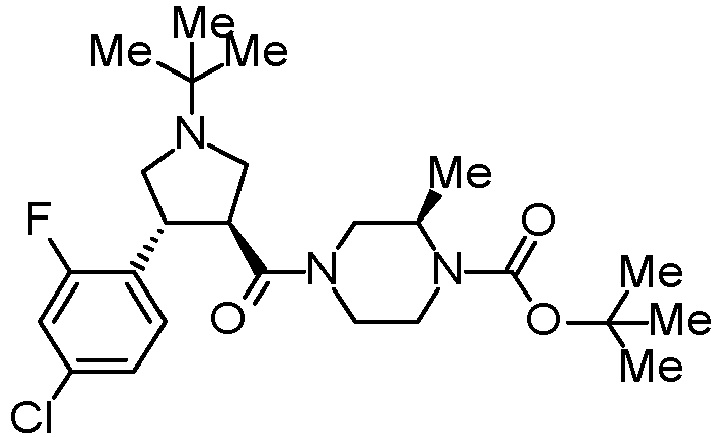
ESI+: 482 [Table 6] PEx PSyn Str DAT 5 1 
ESI+: 524 6 1 
ESI+: 558 7 1 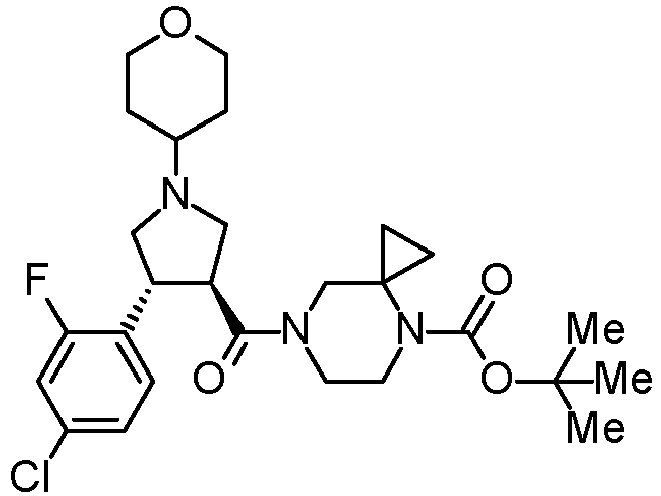
ESI+: 522 8 1 
ESI+: 510 [Table 7] PEx PSyn Str DAT 9 1 
ESI+: 664 10 10 
ESI+: 380 11 10 
ESI+: 366 12 10 
ESI+: 362 13 10 
ESI+: 286 [Table 8] PEx PSyn Str DAT 14 10 
ESI+: 424 15 10 
ESI+: 458 16 10 
ESI+: 422 17 10 
ESI+: 410 [Table 9] PEx PSyn Str DAT 18 18 
ESI+: 608 19 18 
ESI+: 647 20 18 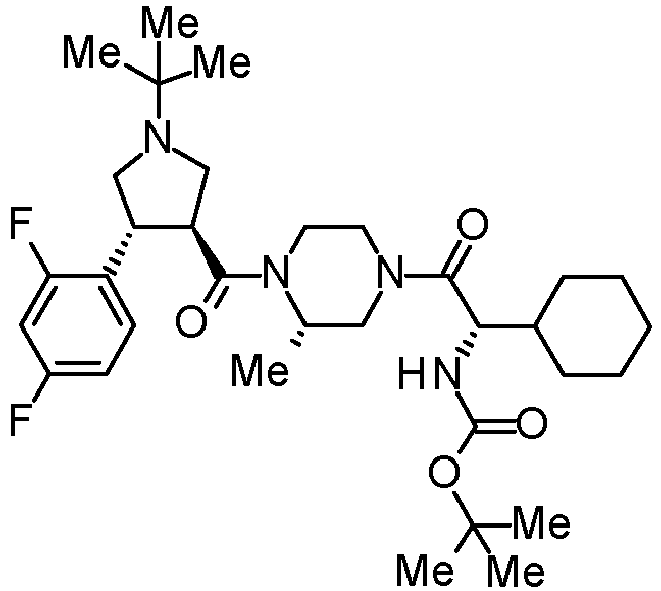
ESI+: 606 [Table 10] PEx PSyn Str DAT 21 18 
ESI+: 594 22 18 
ESI+: 648 23 18 
ESI+: 590 24 18 
ESI+: 513 [Table 11] PEx PSyn Str DAT 25 18 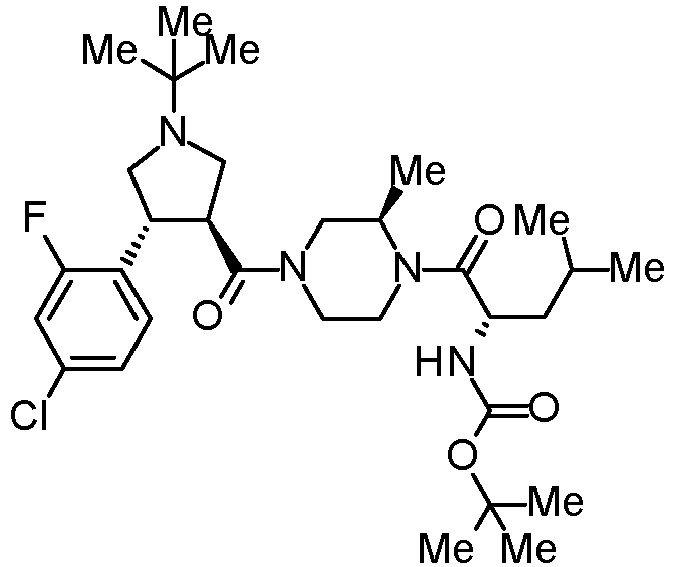
ESI+: 596 26 18 
ESI+: 652 27 18 
ESI+: 671 [Table 12] PEx PSyn Str DAT 28 18 
ESI+: 650 29 18 
ESI+: 624 30 18 
ESI+: 638 31 18 
ESI-: 565 [Table 13] PEx PSyn Str DAT 32 18 
ESI+: 592 33 33 
ESI+: 508 34 33 
ESI+: 547 35 33 
ESI+: 494 [Table 14] PEx PSyn Str DAT 36 33 
ESI+: 220 37 33 
ESI+: 490 38 33 
ESI+: 413 39 33 
ESI+: 495 40 33 
ESI+: 551 [Table 15] PEx PSyn Str DAT 41 33 
ESI+: 550 42 33 
ESI+: 524 43 33 
ESI+: 538 44 33 
ESI+: 491 [Table 16] PEx PSyn Str DAT 45 45 
ESI+: 366 46 45 
ESI+: 382 47 47 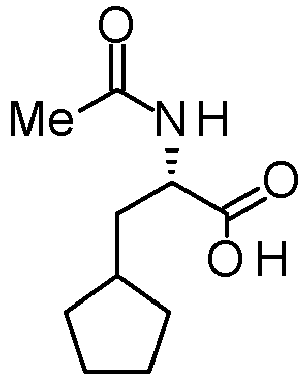
ESI+: 200 48 47 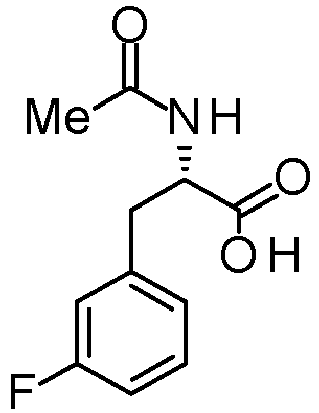
ESI+: 226 49 49 
ESI+: 547 [Table 17] PEx PSyn Str DAT 50 49 
ESI+: 571 51 51 
CI+: 203 52 52 
ESI+: 418 53 53 
ESI+: 254 54 54 
ESI+: 256 [Table 18] PEx PSyn Str DAT 55 54 
ESI+: 222 56 56 
ESI+: 298 57 56 
ESI+: 264 58 80 
ESI+: 455 59 80 
ESI+: 424 [Table 19] PEx PSyn Str DAT 60 60 
ESI+: 242 61 61 
ESI+: 320 62 62 
ESI+: 250 63 63 
ESI+: 326 64 63 
ESI+: 404 65 65 
ESI+: 400 [Table 20] PEx PSyn Str DAT 66 66 
ESI+: 343 67 67 
ESI+: 425 68 67 
ESI+: 505 69 67 
APCI/ESI+: 477 [Table 21] PEx PSyn Str DAT 70 67 
ESI+: 442 71 71 
ESI+: 266 72 71 
ESI+: 346 73 71 
APCI/ESI+: 318 74 74 
ESI+: 270 75 75 
EI: 208 [Table 22] PEx PSyn Str DAT 76 76 
ESI+: 274 77 77 
ESI+: 327 78 78 
ESI+: 309 79 79 
ESI+: 328 80 80 
ESI+: 469 81 81 
ESI+: 385 [Table 23] PEx PSyn Str DAT 82 82 
ESI+: 427 83 83 
ESI+: 382 84 84 
ESI+: 324 85 85 
ESI+: 479 86 86 
ESI+: 297 [Table 24] PEx PSyn Str DAT 87 87 
ESI+: 283 88 88 
ESI-: 411 89 89 
ESI+: 519 90 90 
NMR2: 1.40 (9H, s), 2.83-2.92 (2H, m), 3.25-3.36 (2H, m), 3.37-3.51 (2H, m), 6.95-7.04 (2H, m), 7.17-7.24 (2H, m) 91 91 
ESI+: 252 [Table 25] PEx PSyn Str DAT 92 92 
ESI+: 282 93 74 
ESI+: 270 94 94 
ESI+: 258 95 94 
ESI+: 241 96 96 
ESI+: 329 [M+Na]+ 97 96 
ESI+: 331 [M+Na]+ [Table 26] PEx PSyn Str DAT 98 98 
ESI+: 565 99 98 
ESI+: 566 100 98 
ESI+: 325 101 101 
ESI+: 188 102 102 
CI+: 232 103 103 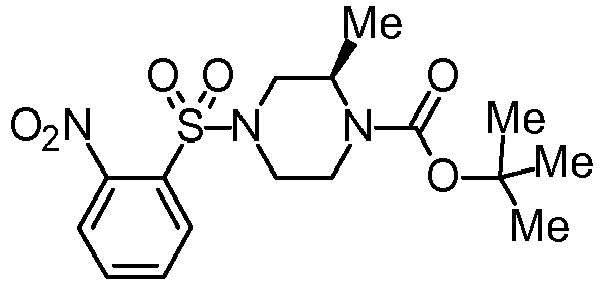
APCI/ESI+: 286 [M-Boc+H]+ [Table 27] PEx PSyn Str DAT 104 104 
ESI+: 308 105 33 
ESI+: 427 106 80 
ESI+: 469 107 74 
ESI+: 284 108 81 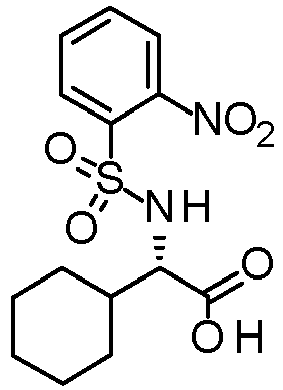
ESI-: 341 [Table 28] PEx PSyn Str DAT 109 18 
ESI-: 524 110 83 
ESI+: 340 111 80 
ESI+: 382 112 65 
ESI+: 382 [M+Na]+ 113 67 
ESI+: 459 114 71 
ESI+: 300 [Table 29] PEx PSyn Str DAT 115 63 
ESI+: 382 [M+Na]+ 116 67 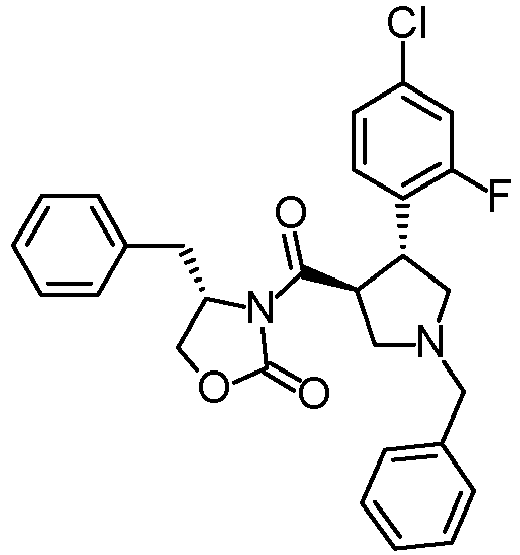
ESI+: 493 117 86 
ESI+: 350 118 82 
ESI+: 443 119 88 
ESI+: 429 [Table 30] PEx PSyn Str DAT 120 1 
ESI+: 633 [M+Na]+ 121 10 
ESI+: 511 122 18 
ESI+: 761 [M+Na]+ 123 33 
ESI+: 638 [Table 31] PEx PSyn Str DAT 124 80 
ESI+: 702 [M+Na]+ 125 85 
ESI+: 495 126 67 
ESI+: 533 127 63 
ESI+: 408 [M+Na]+ [Table 32] PEx PSyn Str DAT 128 67 
ESI+: 515 129 71 
ESI+: 354 130 10 
APCI/ESI+: 286 131 18 
ESI+: 535 [M+Na]+ 132 33 
ESI+: 413 [Table 33] PEx PSyn Str DAT 133 80 
ESI+: 477 [M+Na]+ 134 67 
ESI+: 469 135 71 
ESI+: 310 136 88 
ESI+: 311 [Table 34] PEx PSyn Str DAT 137 18 
APCI/ESI+: 525 138 33 
APCI/ESI+: 425 139 80 
APCI/ESI+: 467 140 83 
APCI/ESI+: 282 141 74 
ESI+: 284 [Table 35] PEx PSyn Str DAT 142 18 
ESI+: 527 143 71 
ESI+: 372 [Table 36] Ex Syn Str DAT 1 1 
ESI+: 550 2 1 
ESI+: 538 3 6 
ESI+: 594 4 4 
ESI+: 550 NMR1: 0.91-1.49 (24H, m), 1.62-1.98 (2H, m), 2.04-2.11 (3H, m), 2.26-5.57 (13H, m), 6.92-7.16 (2H, m), 8.05-8.53 (1H, m), 9.09-9.21 (1H, m) [Table 37] Ex Syn Str DAT 5 4 
ESI+: 538 NMR1: 0.7-1.90 (21H, m), 2.07-2.14 (3H, m), 2.19-5.44 (14 H, m), 7.12-7.38 (2H, m), 8.03-8.51 (1H, m), 8.92-9.04 (1H, m) 6 6 
ESI+: 548 NMR1: 0.97-2.02 (23H, m), 2.07-2.17 (3H, m), 2.21-5.23 (14H, m), 6.92-7.13 (2H, m), 8.08-8.50 (1H, m), 8.78-8.94 (1H, m) 7 6 
ESI+: 589 8 6 
ESI+: 535 NMR1: 0.74-1.48 (21H, m), 1.51-1.96 (2H, m), 2.01-2.12 (3H, m), 2.20-5.49 (14H, m), 6.88-7.14 (2H, m), 8.03-8.50 (1H, m), 9.07-9.22 (1H, m) [Table 38] Ex Syn Str DAT 9 6 
ESI+: 573 10 6 
ESI+: 561 11 6 
ESI+: 531 NMR1: 0.87-1.50 (24H, m), 1.61-1.98 (2H, m), 2.04-2.11 (3H, m), 2.22-5.55 (13H, m), 7.04-7.17 (2H, m), 7.66-7.97 (2H, m), 9.09-9.21 (1H, m) 12 6 
ESI+: 611 [Table 39] Ex Syn Str DAT 13 6 
ESI+: 606 14 6 
ESI+: 581 15 6 
ESI+: 533 16 16 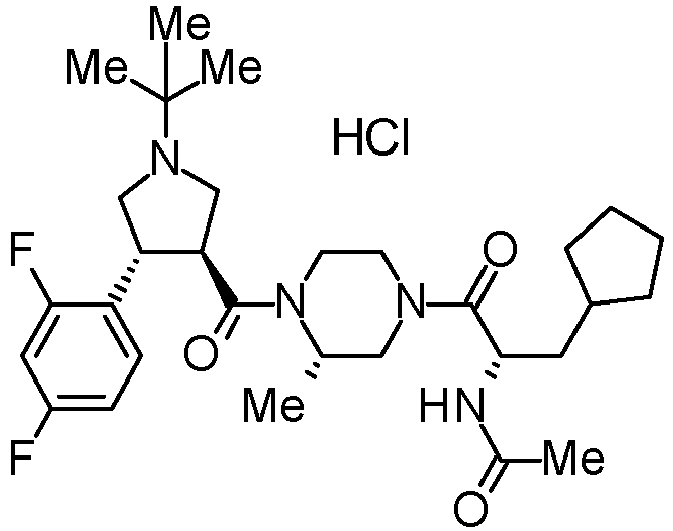
ESI+: 548 [Table 40] Ex Syn Str DAT 17 16 
ESI+: 573 18 18 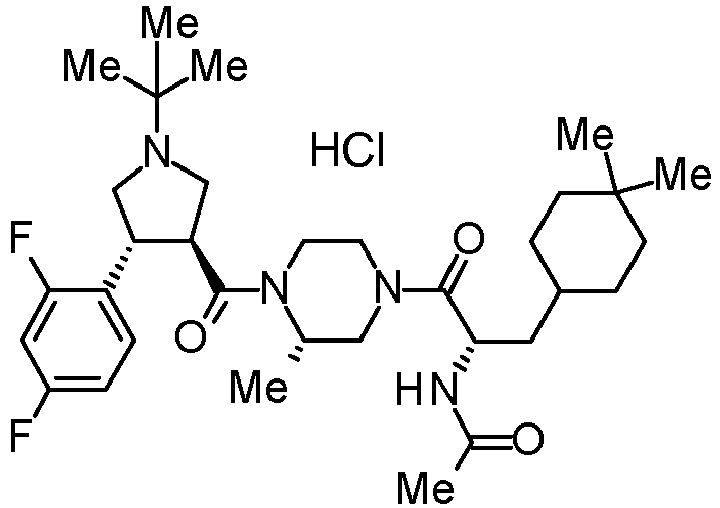
ESI+: 590 19 18 
ESI+: 598 20 20 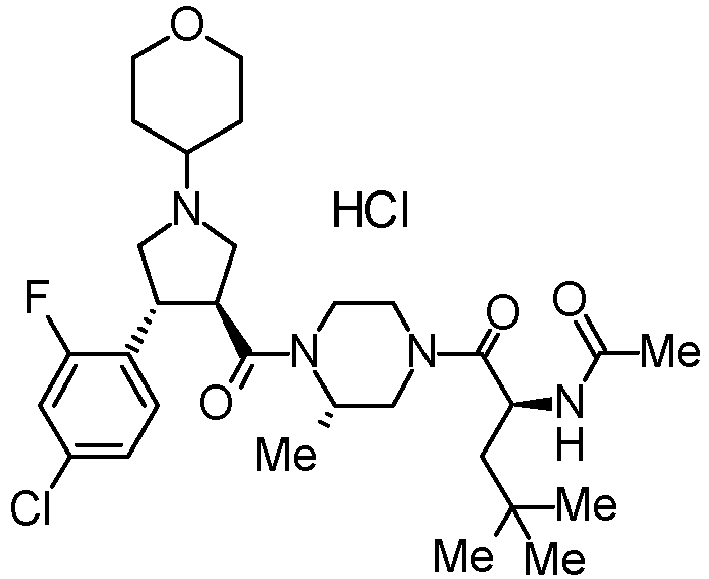
ESI+: 579 [Table 41] Ex Syn Str DAT 21 20 
ESI+: 593 22 20 
ESI+: 624 23 20 
ESI+: 535 24 24 
ESI+: 522 [Table 42] Ex Syn Str DAT 25 24 
ESI+: 562 26 24 
ESI+: 494 27 24 
ESI+: 534 28 28 
ESI+: 575 [Table 43] Ex Syn Str DAT 29 29 
ESI+: 601 30 30 
ESI+: 506 31 4 
ESI+: 566 32 16 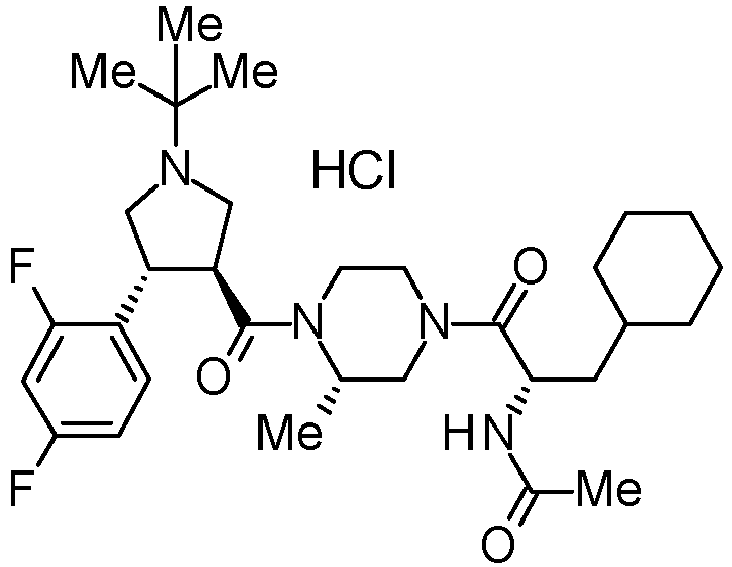
ESI+: 562 [Table 44] Ex Syn Str DAT 33 4 
ESI+: 565 34 20 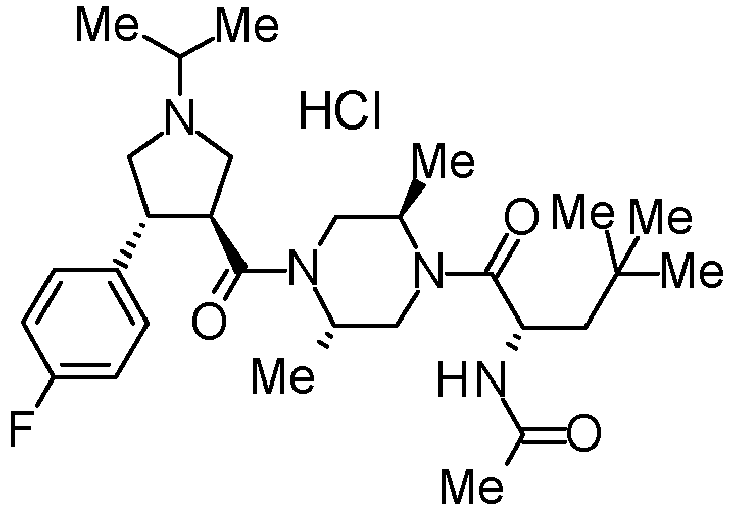
ESI+: 518 35 20 
ESI+: 565 36 20 
ESI+: 552 [Table 45] Ex Syn Str DAT 37 20 
ESI+: 624 38 20 
ESI+: 607 39 20 
ESI+: 562 [Table 46] Ex Syn Str DAT 40 20 
ESI+: 563 41 20 
ESI+: 575 42 24 
ESI+: 548 [Table 47] Ex Syn Str DAT 43 24 
ESI+: 534 - The compound of the formula (I) or a salt thereof is a compound having an MC4 receptor agonistic activity, and is expected to be useful as an active ingredient of a pharmaceutical composition for preventing or treating bladder and/or urinary tract diseases, particularly, underactive bladder, hypotonic bladder, acontractile bladder, detrusor underactivity, neurogenic bladder, urethral relaxation failure, detrusor-external urethral sphincter dyssynergia, and voiding dysfunctions in benign prostatic hyperplasia.
Claims (14)
- A compound of the formula (I) or a salt thereof:

Ring A represents R1 represents C1-6 alkyl which may be substituted, C3-8 cycloalkyl which may be substituted, or a saturated hetero ring which may be substituted,R2a and R2b are the same as or different from each other and each represent H or C1-6 alkyl which may be substituted,R2a and R2b do not simultaneously represent H,in a case where R2a and R2b are bonded to the same carbon, R2a, R2b, and the carbon atom to which they are bonded may form a saturated hydrocarbon ring together,R3 represents C1-6 alkyl which may be substituted, C3-8 cycloalkyl which may be substituted, or phenyl which may be substituted,R4a represents H, C1-6 alkyl, -C(O)R9, or -S(O)2R9,R4b represents H or C1-6 alkyl,X represents CR8 or N,R5, R6, R7, and R8 are the same as or different from each other and each represent H or halogen,R9 represents C1-6 alkyl which may be substituted or C3-8 cycloalkyl which may be substituted, andn represents 0 or 1.)
 - The compound or a salt thereof according to claim 1, wherein R1 represents C1-6 alkyl which may be substituted, C3-8 cycloalkyl, or an oxygen-containing saturated hetero ring,
R3 represents C1-6 alkyl, C3-8 cycloalkyl which may be substituted, or phenyl which may be substituted,
R4a represents H, C1-6 alkyl, -C(O)R9, or -S(O)2R9,
R4b represents H or C1-6 alkyl,
in a case where R4a represents H, R4b also represents H, and in a case where R4a represents C1-6 alkyl, R4b also represents C1-6 alkyl, and
R9 represents C1-6 alkyl or C3-8 cycloalkyl. - The compound or a salt thereof according to claim 2, wherein Ring A is
 R1 represents C1-6 alkyl or an oxygen-containing saturated hetero ring,R2a and R2b are the same as or different from each other and each represent H or C1-6 alkyl,R2a and R2b do not simultaneously represent H,R3 represents C1-6 alkyl, C3-8 cycloalkyl, or phenyl which may be substituted with one or two substituents selected from the group consisting of halogen and cyano,R4a represents -C(O)R9 or -S(O)2R9,R4b represents H,R5 represents H,R6 represents halogen,R7 represents H,R8 represents H or halogen, andR9 represents C1-6 alkyl.
 - The compound or a salt thereof according to claim 3, wherein
Ring A is

- The compound or a salt thereof according to claim 4, wherein R3 represents C1-6 alkyl, C3-8 cycloalkyl, or phenyl which may be substituted with one cyano group,
R4a represents -C(O)R9,
R4b represents H, and
X represents CR8. - The compound or a salt thereof according to claim 5, wherein R1 represents C1-6 alkyl,
when n represents 0, R3 represents C3-8 cycloalkyl, and
when n represents 1, R3 represents C1-6 alkyl. - The compound or a salt thereof according to claim 6, wherein R1 represents tert-butyl,
R2a and R2b are the same as or different from each other and each represent H or methyl,
R2a and R2b do not simultaneously represent H,
when n represents 0, R3 represents cyclohexyl,
when n represents 1, R3 represents isopropyl or tert-butyl,
X represents CR8,
R6 represents F or Cl,
R8 represents H or F, and
R9 represents methyl. - The compound or a salt thereof according to claim 1, wherein the compound is a compound selected from the following group:N-{(1S)-2-[(3S)-4-{[(3S,4R)-1-tert-butyl-4-(2,4-difluorophenyl)pyrrolidin-3-yl]carbonyl}-3-methylpiperazin-1-yl]-1-cyclohexyl-2-oxoethyl}acetamide,N-{(2S)-1-[(3S)-4-{[(3S,4R)-1-tert-butyl-4-(2,4-difluorophenyl)pyrrolidin-3-yl]carbonyl}-3-methylpiperazin-1-yl]-4,4-dimethyl-1-oxopentan-2-yl}acetamide,N-{(2S)-1-[(2R,5S)-4-{[(3S,4R)-1-tert-butyl-4-(2,4-difluorophenyl)pyrrolidin-3-yl]carbonyl}-2,5-dimethylpiperazin-1-yl]-4,4-dimethyl-1-oxopentan-2-yl}acetamide,N-{(2S)-1-[(2R,5S)-4-{[1-tert-butyl-4-(4-fluorophenyl)pyrrolidin-3-yl]carbonyl}-2,5-dimethylpiperazin-1-yl]-4,4-dimethyl-1-oxopentan-2-yl}acetamide, andN-{(2S)-1-[(2R)-4-{[(3S,4R)-1-tert-butyl-4-(4-chloro-2-fluorophenyl)pyrrolidin-3-yl]carbonyl}-2-methylpiperazin-1-yl]-4-methyl-1-oxopentan-2-yl}acetamide.
- A pharmaceutical composition comprising the compound or a salt thereof according to claim 1 and a pharmaceutically acceptable excipient.
- The pharmaceutical composition according to claim 9 for preventing or treating bladder and/or urinary tract diseases.
- Use of the compound or a salt thereof according to claim 1 for the manufacture of a pharmaceutical composition for preventing or treating bladder and/or urinary tract diseases.
- Use of the compound or a salt thereof according to claim 1 for preventing or treating bladder and/or urinary tract diseases.
- The compound or a salt thereof according to claim 1 for use in preventing or treating bladder and/or urinary tract diseases.
- A method for preventing or treating bladder and/or urinary tract diseases, comprising administering to a subject an effective amount of the compound or a salt thereof according to claim 1.
Priority Applications (1)
| Application Number | Priority Date | Filing Date | Title |
|---|---|---|---|
| PL17830975T PL3489231T3 (en) | 2016-07-19 | 2017-07-18 | Piperazine derivative |
Applications Claiming Priority (2)
| Application Number | Priority Date | Filing Date | Title |
|---|---|---|---|
| JP2016141542 | 2016-07-19 | ||
| PCT/JP2017/025842 WO2018016458A1 (en) | 2016-07-19 | 2017-07-18 | Piperazine derivative |
Publications (3)
| Publication Number | Publication Date |
|---|---|
| EP3489231A1 true EP3489231A1 (en) | 2019-05-29 |
| EP3489231A4 EP3489231A4 (en) | 2020-03-04 |
| EP3489231B1 EP3489231B1 (en) | 2021-06-09 |
Family
ID=60992481
Family Applications (1)
| Application Number | Title | Priority Date | Filing Date |
|---|---|---|---|
| EP17830975.3A Active EP3489231B1 (en) | 2016-07-19 | 2017-07-18 | Piperazine derivative |
Country Status (10)
| Country | Link |
|---|---|
| US (1) | US10710988B2 (en) |
| EP (1) | EP3489231B1 (en) |
| JP (1) | JP6908041B2 (en) |
| CN (1) | CN109563074B (en) |
| AR (1) | AR109086A1 (en) |
| ES (1) | ES2880174T3 (en) |
| PL (1) | PL3489231T3 (en) |
| PT (1) | PT3489231T (en) |
| TW (1) | TW201811769A (en) |
| WO (1) | WO2018016458A1 (en) |
Families Citing this family (3)
| Publication number | Priority date | Publication date | Assignee | Title |
|---|---|---|---|---|
| EP3824906A1 (en) | 2016-12-21 | 2021-05-26 | Amgen Inc. | Anti-tnf alpha antibody formulations |
| CN113929598A (en) * | 2021-11-24 | 2022-01-14 | 上海吉奉生物科技有限公司 | Synthesis method of (S) -2-tert-butyloxycarbonylamino-3- (4, 4-difluorocyclohexyl) propionic acid |
| CN114478346A (en) * | 2021-12-31 | 2022-05-13 | 和鼎(南京)医药技术有限公司 | Method for preparing Upacatinib intermediate |
Family Cites Families (7)
| Publication number | Priority date | Publication date | Assignee | Title |
|---|---|---|---|---|
| US7115607B2 (en) | 2001-07-25 | 2006-10-03 | Amgen Inc. | Substituted piperazinyl amides and methods of use |
| EP1469851B1 (en) * | 2002-01-23 | 2006-10-11 | Eli Lilly And Company | Melanocortin receptor agonists |
| US7160886B2 (en) | 2003-03-03 | 2007-01-09 | Merck & Co., Inc. | Acylated piperazine derivatives as melanocortin-4 receptor agonists |
| US20050192286A1 (en) | 2003-10-22 | 2005-09-01 | Neurocrine Biosciences, Inc. | Ligands of melanocortin receptors and compositions and methods related thereto |
| JP2008506779A (en) | 2004-07-19 | 2008-03-06 | メルク エンド カムパニー インコーポレーテッド | Acylated piperidine derivatives as agonists of melanocortin-4 receptor |
| CA2615209A1 (en) * | 2005-08-01 | 2007-02-08 | Pfizer Limited | Mc4r-ag0nists for the treatment of urinary tract dysfunction |
| PT3333165T (en) * | 2015-08-04 | 2019-10-29 | Astellas Pharma Inc | Piperazine derivative |
-
2017
- 2017-07-18 US US16/314,730 patent/US10710988B2/en not_active Expired - Fee Related
- 2017-07-18 ES ES17830975T patent/ES2880174T3/en active Active
- 2017-07-18 PL PL17830975T patent/PL3489231T3/en unknown
- 2017-07-18 WO PCT/JP2017/025842 patent/WO2018016458A1/en not_active Ceased
- 2017-07-18 AR ARP170101999A patent/AR109086A1/en unknown
- 2017-07-18 TW TW106123979A patent/TW201811769A/en unknown
- 2017-07-18 PT PT178309753T patent/PT3489231T/en unknown
- 2017-07-18 EP EP17830975.3A patent/EP3489231B1/en active Active
- 2017-07-18 JP JP2018528537A patent/JP6908041B2/en not_active Expired - Fee Related
- 2017-07-18 CN CN201780044430.5A patent/CN109563074B/en not_active Expired - Fee Related
Also Published As
| Publication number | Publication date |
|---|---|
| AR109086A1 (en) | 2018-10-24 |
| ES2880174T3 (en) | 2021-11-23 |
| EP3489231A4 (en) | 2020-03-04 |
| TW201811769A (en) | 2018-04-01 |
| CN109563074A (en) | 2019-04-02 |
| PL3489231T3 (en) | 2021-10-25 |
| PT3489231T (en) | 2021-07-14 |
| JPWO2018016458A1 (en) | 2019-05-09 |
| WO2018016458A1 (en) | 2018-01-25 |
| JP6908041B2 (en) | 2021-07-21 |
| US10710988B2 (en) | 2020-07-14 |
| CN109563074B (en) | 2021-09-28 |
| EP3489231B1 (en) | 2021-06-09 |
| US20190202815A1 (en) | 2019-07-04 |
Similar Documents
| Publication | Publication Date | Title |
|---|---|---|
| EP3153511B1 (en) | 2-acylaminothiazole derivative for use in the prevention or treatment of bladder/urinary tract diseases | |
| EP1963311B1 (en) | Chromane substituted benzimidazoles and their use as acid pump inhibitors | |
| BR112015020963B1 (en) | compounds derived from 2-acylaminothiazole, pharmaceutical composition comprising said compounds and therapeutic use thereof | |
| EP3489231B1 (en) | Piperazine derivative | |
| EP3333165B1 (en) | Piperazine derivative | |
| EP2615096B1 (en) | Quinoxaline compound | |
| EP2546255A1 (en) | Benzazepine compound | |
| EP3196200B1 (en) | 2-aminothiazole derivatives or salt thereof as muscarinic m3 ligands for the treatment of bladder diseases | |
| EP3388423B1 (en) | Nk1 receptor antagonist | |
| EP1486501B1 (en) | Aminomethyl-substituted thiazolobenzimidazole derivative | |
| CN1938021A (en) | Ion channel modulators | |
| HK1232520B (en) | 2-acylaminothiazole derivative or salt thereof |
Legal Events
| Date | Code | Title | Description |
|---|---|---|---|
| STAA | Information on the status of an ep patent application or granted ep patent |
Free format text: STATUS: THE INTERNATIONAL PUBLICATION HAS BEEN MADE |
|
| PUAI | Public reference made under article 153(3) epc to a published international application that has entered the european phase |
Free format text: ORIGINAL CODE: 0009012 |
|
| STAA | Information on the status of an ep patent application or granted ep patent |
Free format text: STATUS: REQUEST FOR EXAMINATION WAS MADE |
|
| 17P | Request for examination filed |
Effective date: 20190116 |
|
| AK | Designated contracting states |
Kind code of ref document: A1 Designated state(s): AL AT BE BG CH CY CZ DE DK EE ES FI FR GB GR HR HU IE IS IT LI LT LU LV MC MK MT NL NO PL PT RO RS SE SI SK SM TR |
|
| AX | Request for extension of the european patent |
Extension state: BA ME |
|
| DAV | Request for validation of the european patent (deleted) | ||
| DAX | Request for extension of the european patent (deleted) | ||
| A4 | Supplementary search report drawn up and despatched |
Effective date: 20200203 |
|
| RIC1 | Information provided on ipc code assigned before grant |
Ipc: C07D 405/14 20060101ALI20200128BHEP Ipc: A61P 13/02 20060101ALI20200128BHEP Ipc: A61P 43/00 20060101ALI20200128BHEP Ipc: A61P 13/10 20060101ALI20200128BHEP Ipc: C07D 401/14 20060101AFI20200128BHEP Ipc: C07D 403/06 20060101ALI20200128BHEP Ipc: A61K 31/496 20060101ALI20200128BHEP |
|
| GRAP | Despatch of communication of intention to grant a patent |
Free format text: ORIGINAL CODE: EPIDOSNIGR1 |
|
| STAA | Information on the status of an ep patent application or granted ep patent |
Free format text: STATUS: GRANT OF PATENT IS INTENDED |
|
| INTG | Intention to grant announced |
Effective date: 20210112 |
|
| GRAS | Grant fee paid |
Free format text: ORIGINAL CODE: EPIDOSNIGR3 |
|
| GRAA | (expected) grant |
Free format text: ORIGINAL CODE: 0009210 |
|
| STAA | Information on the status of an ep patent application or granted ep patent |
Free format text: STATUS: THE PATENT HAS BEEN GRANTED |
|
| AK | Designated contracting states |
Kind code of ref document: B1 Designated state(s): AL AT BE BG CH CY CZ DE DK EE ES FI FR GB GR HR HU IE IS IT LI LT LU LV MC MK MT NL NO PL PT RO RS SE SI SK SM TR |
|
| REG | Reference to a national code |
Ref country code: GB Ref legal event code: FG4D |
|
| REG | Reference to a national code |
Ref country code: CH Ref legal event code: EP Ref country code: AT Ref legal event code: REF Ref document number: 1400408 Country of ref document: AT Kind code of ref document: T Effective date: 20210615 |
|
| REG | Reference to a national code |
Ref country code: DE Ref legal event code: R096 Ref document number: 602017040132 Country of ref document: DE |
|
| REG | Reference to a national code |
Ref country code: IE Ref legal event code: FG4D |
|
| REG | Reference to a national code |
Ref country code: PT Ref legal event code: SC4A Ref document number: 3489231 Country of ref document: PT Date of ref document: 20210714 Kind code of ref document: T Free format text: AVAILABILITY OF NATIONAL TRANSLATION Effective date: 20210707 |
|
| REG | Reference to a national code |
Ref country code: NL Ref legal event code: FP |
|
| REG | Reference to a national code |
Ref country code: SE Ref legal event code: TRGR |
|
| REG | Reference to a national code |
Ref country code: GR Ref legal event code: EP Ref document number: 20210401729 Country of ref document: GR Effective date: 20210813 |
|
| REG | Reference to a national code |
Ref country code: LT Ref legal event code: MG9D |
|
| PG25 | Lapsed in a contracting state [announced via postgrant information from national office to epo] |
Ref country code: HR Free format text: LAPSE BECAUSE OF FAILURE TO SUBMIT A TRANSLATION OF THE DESCRIPTION OR TO PAY THE FEE WITHIN THE PRESCRIBED TIME-LIMIT Effective date: 20210609 Ref country code: BG Free format text: LAPSE BECAUSE OF FAILURE TO SUBMIT A TRANSLATION OF THE DESCRIPTION OR TO PAY THE FEE WITHIN THE PRESCRIBED TIME-LIMIT Effective date: 20210909 Ref country code: FI Free format text: LAPSE BECAUSE OF FAILURE TO SUBMIT A TRANSLATION OF THE DESCRIPTION OR TO PAY THE FEE WITHIN THE PRESCRIBED TIME-LIMIT Effective date: 20210609 Ref country code: LT Free format text: LAPSE BECAUSE OF FAILURE TO SUBMIT A TRANSLATION OF THE DESCRIPTION OR TO PAY THE FEE WITHIN THE PRESCRIBED TIME-LIMIT Effective date: 20210609 |
|
| REG | Reference to a national code |
Ref country code: ES Ref legal event code: FG2A Ref document number: 2880174 Country of ref document: ES Kind code of ref document: T3 Effective date: 20211123 |
|
| PG25 | Lapsed in a contracting state [announced via postgrant information from national office to epo] |
Ref country code: RS Free format text: LAPSE BECAUSE OF FAILURE TO SUBMIT A TRANSLATION OF THE DESCRIPTION OR TO PAY THE FEE WITHIN THE PRESCRIBED TIME-LIMIT Effective date: 20210609 Ref country code: NO Free format text: LAPSE BECAUSE OF FAILURE TO SUBMIT A TRANSLATION OF THE DESCRIPTION OR TO PAY THE FEE WITHIN THE PRESCRIBED TIME-LIMIT Effective date: 20210909 Ref country code: LV Free format text: LAPSE BECAUSE OF FAILURE TO SUBMIT A TRANSLATION OF THE DESCRIPTION OR TO PAY THE FEE WITHIN THE PRESCRIBED TIME-LIMIT Effective date: 20210609 |
|
| PG25 | Lapsed in a contracting state [announced via postgrant information from national office to epo] |
Ref country code: SK Free format text: LAPSE BECAUSE OF FAILURE TO SUBMIT A TRANSLATION OF THE DESCRIPTION OR TO PAY THE FEE WITHIN THE PRESCRIBED TIME-LIMIT Effective date: 20210609 Ref country code: SM Free format text: LAPSE BECAUSE OF FAILURE TO SUBMIT A TRANSLATION OF THE DESCRIPTION OR TO PAY THE FEE WITHIN THE PRESCRIBED TIME-LIMIT Effective date: 20210609 Ref country code: RO Free format text: LAPSE BECAUSE OF FAILURE TO SUBMIT A TRANSLATION OF THE DESCRIPTION OR TO PAY THE FEE WITHIN THE PRESCRIBED TIME-LIMIT Effective date: 20210609 Ref country code: EE Free format text: LAPSE BECAUSE OF FAILURE TO SUBMIT A TRANSLATION OF THE DESCRIPTION OR TO PAY THE FEE WITHIN THE PRESCRIBED TIME-LIMIT Effective date: 20210609 Ref country code: CZ Free format text: LAPSE BECAUSE OF FAILURE TO SUBMIT A TRANSLATION OF THE DESCRIPTION OR TO PAY THE FEE WITHIN THE PRESCRIBED TIME-LIMIT Effective date: 20210609 |
|
| REG | Reference to a national code |
Ref country code: DE Ref legal event code: R097 Ref document number: 602017040132 Country of ref document: DE |
|
| PG25 | Lapsed in a contracting state [announced via postgrant information from national office to epo] |
Ref country code: MC Free format text: LAPSE BECAUSE OF FAILURE TO SUBMIT A TRANSLATION OF THE DESCRIPTION OR TO PAY THE FEE WITHIN THE PRESCRIBED TIME-LIMIT Effective date: 20210609 |
|
| PLBE | No opposition filed within time limit |
Free format text: ORIGINAL CODE: 0009261 |
|
| STAA | Information on the status of an ep patent application or granted ep patent |
Free format text: STATUS: NO OPPOSITION FILED WITHIN TIME LIMIT |
|
| PG25 | Lapsed in a contracting state [announced via postgrant information from national office to epo] |
Ref country code: DK Free format text: LAPSE BECAUSE OF FAILURE TO SUBMIT A TRANSLATION OF THE DESCRIPTION OR TO PAY THE FEE WITHIN THE PRESCRIBED TIME-LIMIT Effective date: 20210609 |
|
| 26N | No opposition filed |
Effective date: 20220310 |
|
| PG25 | Lapsed in a contracting state [announced via postgrant information from national office to epo] |
Ref country code: LU Free format text: LAPSE BECAUSE OF NON-PAYMENT OF DUE FEES Effective date: 20210718 Ref country code: AL Free format text: LAPSE BECAUSE OF FAILURE TO SUBMIT A TRANSLATION OF THE DESCRIPTION OR TO PAY THE FEE WITHIN THE PRESCRIBED TIME-LIMIT Effective date: 20210609 |
|
| PGFP | Annual fee paid to national office [announced via postgrant information from national office to epo] |
Ref country code: SE Payment date: 20220615 Year of fee payment: 6 Ref country code: PT Payment date: 20220630 Year of fee payment: 6 Ref country code: NL Payment date: 20220615 Year of fee payment: 6 Ref country code: IT Payment date: 20220613 Year of fee payment: 6 Ref country code: IE Payment date: 20220609 Year of fee payment: 6 Ref country code: GB Payment date: 20220606 Year of fee payment: 6 |
|
| PGFP | Annual fee paid to national office [announced via postgrant information from national office to epo] |
Ref country code: PL Payment date: 20220621 Year of fee payment: 6 Ref country code: GR Payment date: 20220622 Year of fee payment: 6 Ref country code: BE Payment date: 20220621 Year of fee payment: 6 |
|
| PGFP | Annual fee paid to national office [announced via postgrant information from national office to epo] |
Ref country code: FR Payment date: 20220609 Year of fee payment: 6 |
|
| PGFP | Annual fee paid to national office [announced via postgrant information from national office to epo] |
Ref country code: TR Payment date: 20220714 Year of fee payment: 6 Ref country code: ES Payment date: 20220801 Year of fee payment: 6 Ref country code: DE Payment date: 20220531 Year of fee payment: 6 Ref country code: AT Payment date: 20220627 Year of fee payment: 6 |
|
| PGFP | Annual fee paid to national office [announced via postgrant information from national office to epo] |
Ref country code: CH Payment date: 20220801 Year of fee payment: 6 |
|
| REG | Reference to a national code |
Ref country code: AT Ref legal event code: UEP Ref document number: 1400408 Country of ref document: AT Kind code of ref document: T Effective date: 20210609 |
|
| PG25 | Lapsed in a contracting state [announced via postgrant information from national office to epo] |
Ref country code: CY Free format text: LAPSE BECAUSE OF FAILURE TO SUBMIT A TRANSLATION OF THE DESCRIPTION OR TO PAY THE FEE WITHIN THE PRESCRIBED TIME-LIMIT Effective date: 20210609 |
|
| PG25 | Lapsed in a contracting state [announced via postgrant information from national office to epo] |
Ref country code: HU Free format text: LAPSE BECAUSE OF FAILURE TO SUBMIT A TRANSLATION OF THE DESCRIPTION OR TO PAY THE FEE WITHIN THE PRESCRIBED TIME-LIMIT; INVALID AB INITIO Effective date: 20170718 |
|
| REG | Reference to a national code |
Ref country code: DE Ref legal event code: R119 Ref document number: 602017040132 Country of ref document: DE |
|
| REG | Reference to a national code |
Ref country code: CH Ref legal event code: PL |
|
| REG | Reference to a national code |
Ref country code: SE Ref legal event code: EUG |
|
| REG | Reference to a national code |
Ref country code: NL Ref legal event code: MM Effective date: 20230801 |
|
| REG | Reference to a national code |
Ref country code: AT Ref legal event code: MM01 Ref document number: 1400408 Country of ref document: AT Kind code of ref document: T Effective date: 20230718 |
|
| REG | Reference to a national code |
Ref country code: BE Ref legal event code: MM Effective date: 20230731 |
|
| GBPC | Gb: european patent ceased through non-payment of renewal fee |
Effective date: 20230718 |
|
| PG25 | Lapsed in a contracting state [announced via postgrant information from national office to epo] |
Ref country code: GR Free format text: LAPSE BECAUSE OF NON-PAYMENT OF DUE FEES Effective date: 20240207 |
|
| PG25 | Lapsed in a contracting state [announced via postgrant information from national office to epo] |
Ref country code: NL Free format text: LAPSE BECAUSE OF NON-PAYMENT OF DUE FEES Effective date: 20230801 |
|
| PG25 | Lapsed in a contracting state [announced via postgrant information from national office to epo] |
Ref country code: AT Free format text: LAPSE BECAUSE OF NON-PAYMENT OF DUE FEES Effective date: 20230718 |
|
| REG | Reference to a national code |
Ref country code: IE Ref legal event code: MM4A |
|
| PG25 | Lapsed in a contracting state [announced via postgrant information from national office to epo] |
Ref country code: NL Free format text: LAPSE BECAUSE OF NON-PAYMENT OF DUE FEES Effective date: 20230801 Ref country code: MK Free format text: LAPSE BECAUSE OF FAILURE TO SUBMIT A TRANSLATION OF THE DESCRIPTION OR TO PAY THE FEE WITHIN THE PRESCRIBED TIME-LIMIT Effective date: 20210609 Ref country code: GR Free format text: LAPSE BECAUSE OF NON-PAYMENT OF DUE FEES Effective date: 20240207 Ref country code: DE Free format text: LAPSE BECAUSE OF NON-PAYMENT OF DUE FEES Effective date: 20240201 Ref country code: AT Free format text: LAPSE BECAUSE OF NON-PAYMENT OF DUE FEES Effective date: 20230718 Ref country code: PT Free format text: LAPSE BECAUSE OF NON-PAYMENT OF DUE FEES Effective date: 20240118 Ref country code: CH Free format text: LAPSE BECAUSE OF NON-PAYMENT OF DUE FEES Effective date: 20230731 Ref country code: GB Free format text: LAPSE BECAUSE OF NON-PAYMENT OF DUE FEES Effective date: 20230718 |
|
| PG25 | Lapsed in a contracting state [announced via postgrant information from national office to epo] |
Ref country code: SE Free format text: LAPSE BECAUSE OF NON-PAYMENT OF DUE FEES Effective date: 20230719 Ref country code: FR Free format text: LAPSE BECAUSE OF NON-PAYMENT OF DUE FEES Effective date: 20230731 Ref country code: BE Free format text: LAPSE BECAUSE OF NON-PAYMENT OF DUE FEES Effective date: 20230731 |
|
| PG25 | Lapsed in a contracting state [announced via postgrant information from national office to epo] |
Ref country code: IE Free format text: LAPSE BECAUSE OF NON-PAYMENT OF DUE FEES Effective date: 20230718 |
|
| PG25 | Lapsed in a contracting state [announced via postgrant information from national office to epo] |
Ref country code: IT Free format text: LAPSE BECAUSE OF NON-PAYMENT OF DUE FEES Effective date: 20230718 Ref country code: IE Free format text: LAPSE BECAUSE OF NON-PAYMENT OF DUE FEES Effective date: 20230718 |
|
| REG | Reference to a national code |
Ref country code: ES Ref legal event code: FD2A Effective date: 20240828 |
|
| PG25 | Lapsed in a contracting state [announced via postgrant information from national office to epo] |
Ref country code: MT Free format text: LAPSE BECAUSE OF FAILURE TO SUBMIT A TRANSLATION OF THE DESCRIPTION OR TO PAY THE FEE WITHIN THE PRESCRIBED TIME-LIMIT Effective date: 20210609 |
|
| PG25 | Lapsed in a contracting state [announced via postgrant information from national office to epo] |
Ref country code: ES Free format text: LAPSE BECAUSE OF NON-PAYMENT OF DUE FEES Effective date: 20230719 |
|
| PG25 | Lapsed in a contracting state [announced via postgrant information from national office to epo] |
Ref country code: ES Free format text: LAPSE BECAUSE OF NON-PAYMENT OF DUE FEES Effective date: 20230719 |
|
| PG25 | Lapsed in a contracting state [announced via postgrant information from national office to epo] |
Ref country code: PL Free format text: LAPSE BECAUSE OF NON-PAYMENT OF DUE FEES Effective date: 20230718 |
|
| PG25 | Lapsed in a contracting state [announced via postgrant information from national office to epo] |
Ref country code: PL Free format text: LAPSE BECAUSE OF NON-PAYMENT OF DUE FEES Effective date: 20230718 |
|
| PG25 | Lapsed in a contracting state [announced via postgrant information from national office to epo] |
Ref country code: TR Free format text: LAPSE BECAUSE OF NON-PAYMENT OF DUE FEES Effective date: 20230718 |