EP3488582B1 - Exchanging network server registration credentials over a d2d network - Google Patents
Exchanging network server registration credentials over a d2d network Download PDFInfo
- Publication number
- EP3488582B1 EP3488582B1 EP17729623.3A EP17729623A EP3488582B1 EP 3488582 B1 EP3488582 B1 EP 3488582B1 EP 17729623 A EP17729623 A EP 17729623A EP 3488582 B1 EP3488582 B1 EP 3488582B1
- Authority
- EP
- European Patent Office
- Prior art keywords
- network
- client device
- credentials
- network registration
- server
- Prior art date
- Legal status (The legal status is an assumption and is not a legal conclusion. Google has not performed a legal analysis and makes no representation as to the accuracy of the status listed.)
- Active
Links
Images



Classifications
-
- H—ELECTRICITY
- H04—ELECTRIC COMMUNICATION TECHNIQUE
- H04L—TRANSMISSION OF DIGITAL INFORMATION, e.g. TELEGRAPHIC COMMUNICATION
- H04L63/00—Network architectures or network communication protocols for network security
- H04L63/06—Network architectures or network communication protocols for network security for supporting key management in a packet data network
- H04L63/061—Network architectures or network communication protocols for network security for supporting key management in a packet data network for key exchange, e.g. in peer-to-peer networks
-
- H—ELECTRICITY
- H04—ELECTRIC COMMUNICATION TECHNIQUE
- H04L—TRANSMISSION OF DIGITAL INFORMATION, e.g. TELEGRAPHIC COMMUNICATION
- H04L63/00—Network architectures or network communication protocols for network security
- H04L63/18—Network architectures or network communication protocols for network security using different networks or channels, e.g. using out of band channels
-
- H—ELECTRICITY
- H04—ELECTRIC COMMUNICATION TECHNIQUE
- H04L—TRANSMISSION OF DIGITAL INFORMATION, e.g. TELEGRAPHIC COMMUNICATION
- H04L65/00—Network arrangements, protocols or services for supporting real-time applications in data packet communication
- H04L65/10—Architectures or entities
- H04L65/1016—IP multimedia subsystem [IMS]
-
- H—ELECTRICITY
- H04—ELECTRIC COMMUNICATION TECHNIQUE
- H04L—TRANSMISSION OF DIGITAL INFORMATION, e.g. TELEGRAPHIC COMMUNICATION
- H04L65/00—Network arrangements, protocols or services for supporting real-time applications in data packet communication
- H04L65/1066—Session management
- H04L65/1073—Registration or de-registration
-
- H—ELECTRICITY
- H04—ELECTRIC COMMUNICATION TECHNIQUE
- H04W—WIRELESS COMMUNICATION NETWORKS
- H04W12/00—Security arrangements; Authentication; Protecting privacy or anonymity
- H04W12/04—Key management, e.g. using generic bootstrapping architecture [GBA]
-
- H—ELECTRICITY
- H04—ELECTRIC COMMUNICATION TECHNIQUE
- H04W—WIRELESS COMMUNICATION NETWORKS
- H04W36/00—Hand-off or reselection arrangements
- H04W36/0005—Control or signalling for completing the hand-off
- H04W36/0011—Control or signalling for completing the hand-off for data sessions of end-to-end connection
- H04W36/0033—Control or signalling for completing the hand-off for data sessions of end-to-end connection with transfer of context information
-
- H—ELECTRICITY
- H04—ELECTRIC COMMUNICATION TECHNIQUE
- H04W—WIRELESS COMMUNICATION NETWORKS
- H04W36/00—Hand-off or reselection arrangements
- H04W36/0005—Control or signalling for completing the hand-off
- H04W36/0011—Control or signalling for completing the hand-off for data sessions of end-to-end connection
- H04W36/0033—Control or signalling for completing the hand-off for data sessions of end-to-end connection with transfer of context information
- H04W36/0038—Control or signalling for completing the hand-off for data sessions of end-to-end connection with transfer of context information of security context information
-
- H—ELECTRICITY
- H04—ELECTRIC COMMUNICATION TECHNIQUE
- H04W—WIRELESS COMMUNICATION NETWORKS
- H04W48/00—Access restriction; Network selection; Access point selection
- H04W48/08—Access restriction or access information delivery, e.g. discovery data delivery
-
- H—ELECTRICITY
- H04—ELECTRIC COMMUNICATION TECHNIQUE
- H04W—WIRELESS COMMUNICATION NETWORKS
- H04W48/00—Access restriction; Network selection; Access point selection
- H04W48/08—Access restriction or access information delivery, e.g. discovery data delivery
- H04W48/10—Access restriction or access information delivery, e.g. discovery data delivery using broadcasted information
-
- H—ELECTRICITY
- H04—ELECTRIC COMMUNICATION TECHNIQUE
- H04W—WIRELESS COMMUNICATION NETWORKS
- H04W52/00—Power management, e.g. Transmission Power Control [TPC] or power classes
- H04W52/02—Power saving arrangements
- H04W52/0209—Power saving arrangements in terminal devices
- H04W52/0261—Power saving arrangements in terminal devices managing power supply demand, e.g. depending on battery level
- H04W52/0274—Power saving arrangements in terminal devices managing power supply demand, e.g. depending on battery level by switching on or off the equipment or parts thereof
- H04W52/0277—Power saving arrangements in terminal devices managing power supply demand, e.g. depending on battery level by switching on or off the equipment or parts thereof according to available power supply, e.g. switching off when a low battery condition is detected
-
- H—ELECTRICITY
- H04—ELECTRIC COMMUNICATION TECHNIQUE
- H04W—WIRELESS COMMUNICATION NETWORKS
- H04W88/00—Devices specially adapted for wireless communication networks, e.g. terminals, base stations or access point devices
- H04W88/02—Terminal devices
- H04W88/04—Terminal devices adapted for relaying to or from another terminal or user
-
- H—ELECTRICITY
- H04—ELECTRIC COMMUNICATION TECHNIQUE
- H04W—WIRELESS COMMUNICATION NETWORKS
- H04W36/00—Hand-off or reselection arrangements
- H04W36/03—Reselecting a link using a direct mode connection
- H04W36/033—Reselecting a link using a direct mode connection in pre-organised networks
-
- H—ELECTRICITY
- H04—ELECTRIC COMMUNICATION TECHNIQUE
- H04W—WIRELESS COMMUNICATION NETWORKS
- H04W36/00—Hand-off or reselection arrangements
- H04W36/14—Reselecting a network or an air interface
- H04W36/144—Reselecting a network or an air interface over a different radio air interface technology
- H04W36/1446—Reselecting a network or an air interface over a different radio air interface technology wherein at least one of the networks is unlicensed
-
- Y—GENERAL TAGGING OF NEW TECHNOLOGICAL DEVELOPMENTS; GENERAL TAGGING OF CROSS-SECTIONAL TECHNOLOGIES SPANNING OVER SEVERAL SECTIONS OF THE IPC; TECHNICAL SUBJECTS COVERED BY FORMER USPC CROSS-REFERENCE ART COLLECTIONS [XRACs] AND DIGESTS
- Y02—TECHNOLOGIES OR APPLICATIONS FOR MITIGATION OR ADAPTATION AGAINST CLIMATE CHANGE
- Y02D—CLIMATE CHANGE MITIGATION TECHNOLOGIES IN INFORMATION AND COMMUNICATION TECHNOLOGIES [ICT], I.E. INFORMATION AND COMMUNICATION TECHNOLOGIES AIMING AT THE REDUCTION OF THEIR OWN ENERGY USE
- Y02D30/00—Reducing energy consumption in communication networks
- Y02D30/70—Reducing energy consumption in communication networks in wireless communication networks
Definitions
- Embodiments relate to exchanging network server registration credentials over a device-to-device (D2D) network.
- D2D device-to-device
- Client devices with device-to-device (D2D) capability can communicate directly with other D2D client devices, and some D2D client devices can also communicate with access points (APs) which can connect the D2D client devices to one or more external networks.
- APs access points
- some D2D client devices can be configured to connect to an AP in a vehicle (e.g., a car) through which various in-vehicle features can be accessed (e.g., outputting audio via an in-vehicle audio system, using the in-vehicle audio system to engage in a phone call instead of using microphones and speakers equipped on the D2D client device, etc.).
- Access to certain network services are only granted after a registration procedure.
- a D2D client device can register with the network server and receive a set of network registration credentials which are specific to that particular D2D client device and are used by the D2D client device to access one or more network services. Any D2D client device (or AP) that has not registered itself with the network server and has not received the set of network registration credentials will not typically be capable of accessing these network services.
- US 2008/0039139 discloses a method for sharing credentials.
- US 2014/165165 discloses device credentialing for Network Access.
- US 2013/247161 discloses a method for subscription sharing.
- the present invention is directed to subject-matter as disclosed by the appended claims.
- a client device may be mobile or stationary, and may communicate with a wired access network and/or a radio access network (RAN).
- UE may be referred to interchangeably as an "access terminal” or “AT”, a “wireless device”, a “subscriber device”, a “subscriber terminal”, a “subscriber station”, a “user terminal” or UT, a "mobile device”, a “mobile terminal”, a “mobile station” and variations thereof.
- AT access terminal
- AT wireless device
- subscriber device a "subscriber terminal”
- a subscriber station a “user terminal” or UT
- UEs can communicate with a core network via the RAN, and through the core network the UEs can be connected with external networks such as the Internet.
- UEs can be embodied by any of a number of types of devices including but not limited to cellular telephones, personal digital assistants (PDAs), pagers, laptop computers, desktop computers, PC cards, compact flash devices, external or internal modems, wireless or wireline phones, and so on.
- PDAs personal digital assistants
- a communication link through which UEs can send signals to the RAN is called an uplink channel (e.g., a reverse traffic channel, a reverse control channel, an access channel, etc.).
- a communication link through which the RAN can send signals to UEs is called a downlink or forward link channel (e.g., a paging channel, a control channel, a broadcast channel, a forward traffic channel, etc.).
- a downlink or forward link channel e.g., a paging channel, a control channel, a broadcast channel, a forward traffic channel, etc.
- traffic channel can refer to either an uplink / reverse or downlink / forward traffic channel.
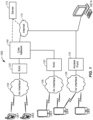
- FIG. 1 illustrates a high-level system architecture of a wireless communications system 100 in accordance with an embodiment of the disclosure.
- the wireless communications system 100 contains UEs 1... N.
- UEs 1... 2 are illustrated as cellular calling phones
- UEs 3...5 are illustrated as cellular touchscreen phones or smart phones
- UE N is illustrated as a desktop computer or PC.
- UEs 1... N are configured to communicate with an access network (e.g., a RAN 120, an access point 125, etc.) over a physical communications interface or layer, shown in FIG. 1 as air interfaces 104, 106, 108 and/or a direct wired connection.
- the air interfaces 104 and 106 can comply with a given cellular communications protocol (e.g., CDMA, EVDO, eHRPD, GSM, EDGE, W-CDMA, LTE, etc.), while the air interface 108 can comply with a wireless IP protocol (e.g., IEEE 802.11).
- the RAN 120 may include a plurality of access points that serve UEs over air interfaces, such as the air interfaces 104 and 106.
- the access points in the RAN 120 can be referred to as access nodes or ANs, access points or APs, base stations or BSs, Node Bs, eNode Bs, and so on. These access points can be terrestrial access points (or ground stations), or satellite access points.
- the RAN 120 may be configured to connect to a core network 140 that can perform a variety of functions, including bridging circuit-switched (CS) calls between UEs served by the RAN 120 and other UEs served by the RAN 120 or a different RAN altogether, and can also mediate an exchange of packet-switched (PS) data with external networks such as Internet 175.
- CS circuit-switched
- PS packet-switched
- UE N is shown as connecting to the Internet 175 directly (i.e., separate from the core network 140, such as over an Ethernet connection of Wi-Fi or 802.11-based network).
- the Internet 175 can thereby function to bridge packet-switched data communications between UEs 1... N via the core network 140.
- the access point 125 that is separate from the RAN 120.
- the access point 125 may be connected to the Internet 175 independent of the core network 140 (e.g., via an optical communications system such as FiOS, a cable modem, etc.).
- the air interface 108 may serve UE 4 or UE 5 over a local wireless connection, such as IEEE 802.11 in an example.
- UE N is shown as a desktop computer with a wired connection to the Internet 175, such as a direct connection to a modem or router, which can correspond to the access point 125 itself in an example (e.g., for a WiFi router with both wired and wireless connectivity).
- a server 170 is shown as connected to the Internet 175, the core network 140, or both.
- the server 170 can be implemented as a plurality of structurally separate servers, or alternately may correspond to a single server.
- the server 170 is configured to support one or more communication services (e.g., Voice-over-Internet Protocol (VoIP) sessions, Push-to-Talk (PTT) sessions, group communication sessions, social networking services, etc.) for UEs that can connect to the server 170 via the core network 140 and/or the Internet 175, and/or to provide content (e.g., web page downloads) to the UEs.
- VoIP Voice-over-Internet Protocol
- PTT Push-to-Talk
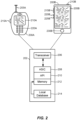
- FIG. 2 illustrates examples of UEs (i.e., client devices) in accordance with embodiments of the disclosure.
- UE 200A is illustrated as a calling telephone and UE 200B is illustrated as a touchscreen device (e.g., a smart phone, a tablet computer, etc.).
- an external casing of UE 200A is configured with an antenna 205A, display 210A, at least one button 215A (e.g., a PTT button, a power button, a volume control button, etc.) and a keypad 220A among other components, as is known in the art.
- button 215A e.g., a PTT button, a power button, a volume control button, etc.
- an external casing of UE 200B is configured with a touchscreen display 205B, peripheral buttons 210B, 215B, 220B and 225B (e.g., a power control button, a volume or vibrate control button, an airplane mode toggle button, etc.), and at least one front-panel button 230B (e.g., a Home button, etc.), among other components, as is known in the art.
- a touchscreen display 205B peripheral buttons 210B, 215B, 220B and 225B (e.g., a power control button, a volume or vibrate control button, an airplane mode toggle button, etc.), and at least one front-panel button 230B (e.g., a Home button, etc.), among other components, as is known in the art.
- UE 200B can include one or more external antennas and/or one or more integrated antennas that are built into the external casing of UE 200B, including but not limited to Wi-Fi antennas, cellular antennas, satellite position system (SPS) antennas (e.g., global positioning system (GPS) antennas), and so on.
- SPS satellite position system
- GPS global positioning system
- the platform 202 can receive and execute software applications, data and/or commands transmitted from the RAN 120 that may ultimately come from the core network 140, the Internet 175 and/or other remote servers and networks (e.g., application server 170, web URLs, etc.).
- the platform 202 can also independently execute locally stored applications without RAN interaction.
- the platform 202 can include a transceiver 206 operably coupled to an application specific integrated circuit (ASIC) 208, or other processor, microprocessor, logic circuit, or other data processing device.
- ASIC application specific integrated circuit
- the ASIC 208 or other processor executes an application programming interface (API) layer 210 that interfaces with any resident programs in a memory 212 of the wireless device.
- the memory 212 can be comprised of read-only or random-access memory (RAM and ROM), EEPROM, flash cards, or any memory common to computer platforms.
- the platform 202 also can include a local database 214 that can store applications not actively used in the memory 212, as well as other data.
- the local database 214 is typically a flash memory cell, but can be any secondary storage device as known in the art, such as magnetic media, EEPROM, optical media, tape, soft or hard disk, or the like.
- an embodiment of the disclosure can include a UE (e.g., UE 200A, 200B, etc.) including the ability to perform the functions described herein.
- the various logic elements can be embodied in discrete elements, software modules executed on a processor or any combination of software and hardware to achieve the functionality disclosed herein.
- the ASIC 208, the memory 212, the API layer 210 and the local database 214 may all be used cooperatively to load, store and execute the various functions disclosed herein and thus the logic to perform these functions may be distributed over various elements.
- the functionality could be incorporated into one discrete component. Therefore, the features of the UEs 200A and 200B in FIG. 2 are to be considered merely illustrative and the disclosure is not limited to the illustrated features or arrangement.
- the wireless communications between UEs 200A and/or 200B and the RAN 120 can be based on different technologies, such as CDMA, W-CDMA, time division multiple access (TDMA), frequency division multiple access (FDMA), Orthogonal Frequency Division Multiplexing (OFDM), GSM, or other protocols that may be used in a wireless communications network or a data communications network.
- CDMA Code Division Multiple Access
- W-CDMA time division multiple access
- FDMA frequency division multiple access
- OFDM Orthogonal Frequency Division Multiplexing
- GSM Global System for Mobile communications
- voice transmission and/or data can be transmitted to the UEs from the RAN using a variety of networks and configurations. Accordingly, the illustrations provided herein are not intended to limit the embodiments of the disclosure and are merely to aid in the description of aspects of embodiments of the disclosure.
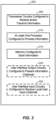
- FIG. 3 illustrates a communications device 300 that includes structural components in accordance with an embodiment of the disclosure.
- the communications device 300 can correspond to any of the above-noted communications devices, including but not limited to UEs 1... N, UEs 200A and 200B, any component included in the RAN 120 such as base stations, access points or eNodeBs, any component of the core network 140, any components coupled to the Internet 175 (e.g., the application server 170), and so on.
- communications device 300 can correspond to any electronic device that is configured to communicate with (or facilitate communication with) one or more other entities over the wireless communications system 100 of FIG. 1 .
- the communications device 300 includes transceiver circuitry configured to receive and/or transmit information 305.
- the transceiver circuitry configured to receive and/or transmit information 305 can include a wireless communications interface (e.g., Bluetooth, Wi-Fi, Wi-Fi Direct, Long-Term Evolution (LTE) Direct, etc.) such as a wireless transceiver and associated hardware (e.g., an RF antenna, a MODEM, a modulator and/or demodulator, etc.).
- a wireless communications interface e.g., Bluetooth, Wi-Fi, Wi-Fi Direct, Long-Term Evolution (LTE) Direct, etc.
- LTE Long-Term Evolution
- the transceiver circuitry configured to receive and/or transmit information 305 can correspond to a wired communications interface (e.g., a serial connection, a USB or Firewire connection, an Ethernet connection through which the Internet 175 can be accessed, etc.).
- a wired communications interface e.g., a serial connection, a USB or Firewire connection, an Ethernet connection through which the Internet 175 can be accessed, etc.
- the communications device 300 corresponds to some type of network-based server (e.g., the application server 170)
- the transceiver circuitry configured to receive and/or transmit information 305 can correspond to an Ethernet card, in an example, that connects the network-based server to other communication entities via an Ethernet protocol.
- the transceiver circuitry configured to receive and/or transmit information 305 can include sensory or measurement hardware by which the communications device 300 can monitor its local environment (e.g., an accelerometer, a temperature sensor, a light sensor, an antenna for monitoring local RF signals, etc.).
- the transceiver circuitry configured to receive and/or transmit information 305 can also include software that, when executed, permits the associated hardware of the transceiver circuitry configured to receive and/or transmit information 305 to perform its reception and/or transmission function(s).
- the transceiver circuitry configured to receive and/or transmit information 305 does not correspond to software alone, and the transceiver circuitry configured to receive and/or transmit information 305 relies at least in part upon structural hardware to achieve its functionality.
- the transceiver circuitry configured to receive and/or transmit information 305 may be implicated by language other than "receive "and "transmit", so long as the underlying function corresponds to a receive or transmit function.
- functions such as obtaining, acquiring, retrieving, measuring, etc., may be performed by the transceiver circuitry configured to receive and/or transmit information 305 in certain contexts as being specific types of receive functions.
- functions such as sending, delivering, conveying, forwarding, etc., may be performed by the transceiver circuitry configured to receive and/or transmit information 305 in certain contexts as being specific types of transmit functions.
- Other functions that correspond to other types of receive and/or transmit functions may also be performed by the transceiver circuitry configured to receive and/or transmit information 305.
- the communications device 300 further includes at least one processor configured to process information 310.
- Example implementations of the type of processing that can be performed by the at least one processor configured to process information 310 includes but is not limited to performing determinations, establishing connections, making selections between different information options, performing evaluations related to data, interacting with sensors coupled to the communications device 300 to perform measurement operations, converting information from one format to another (e.g., between different protocols such as wmv to .avi, etc.), and so on.
- the at least one processor configured to process information 310 can include a general purpose processor, a DSP, an ASIC, a field programmable gate array (FPGA) or other programmable logic device, discrete gate or transistor logic, discrete hardware components, or any combination thereof designed to perform the functions described herein.
- a general purpose processor may be a microprocessor, but in the alternative, the at least one processor configured to process information 310 may be any conventional processor, controller, microcontroller, or state machine.
- a processor may also be implemented as a combination of computing devices (e.g., a combination of a DSP and a microprocessor, a plurality of microprocessors, one or more microprocessors in conjunction with a DSP core, or any other such configuration).
- the at least one processor configured to process information 310 can also include software that, when executed, permits the associated hardware of the at least one processor configured to process information 310 to perform its processing function(s). However, the at least one processor configured to process information 310 does not correspond to software alone, and the at least one processor configured to process information 310 relies at least in part upon structural hardware to achieve its functionality. Moreover, the at least one processor configured to process information 310 may be implicated by language other than "processing", so long as the underlying function corresponds to a processing function. For example, functions such as evaluating, determining, calculating, identifying, etc., may be performed by the at least one processor configured to process information 310 in certain contexts as being specific types of processing functions. Other functions that correspond to other types of processing functions may also be performed by the at least one processor configured to process information 310.
- the communications device 300 further includes memory configured to store information 315.
- the memory configured to store information 315 can include at least a non-transitory memory and associated hardware (e.g., a memory controller, etc.).
- the non-transitory memory included in the memory configured to store information 315 can correspond to RAM, flash memory, ROM, erasable programmable ROM (EPROM), EEPROM, registers, hard disk, a removable disk, a CD-ROM, or any other form of storage medium known in the art.
- the memory configured to store information 315 can also include software that, when executed, permits the associated hardware of the memory configured to store information 315 to perform its storage function(s).
- the memory configured to store information 315 does not correspond to software alone, and the memory configured to store information 315 relies at least in part upon structural hardware to achieve its functionality.
- the memory configured to store information 315 may be implicated by language other than "storing", so long as the underlying function corresponds to a storing function.
- functions such as caching, maintaining, etc., may be performed by the memory configured to store information 315 in certain contexts as being specific types of storing functions.
- Other functions that correspond to other types of storing functions may also be performed by the memory configured to store information 315.
- the communications device 300 further optionally includes user interface output circuitry configured to present information 320.
- the user interface output circuitry configured to present information 320 can include at least an output device and associated hardware.
- the output device can include a video output device (e.g., a display screen, a port that can carry video information such as USB, HDMI, etc.), an audio output device (e.g., speakers, a port that can carry audio information such as a microphone jack, USB, HDMI, etc.), a vibration device and/or any other device by which information can be formatted for output or actually outputted by a user or operator of the communications device 300.
- the user interface output circuitry configured to present information 320 can include the display 210A or 205B.
- the user interface output circuitry configured to present information 320 can be omitted for certain communications devices, such as network communications devices that do not have a local user (e.g., network switches or routers, remote servers, etc.).
- the user interface output circuitry configured to present information 320 can also include software that, when executed, permits the associated hardware of the user interface output circuitry configured to present information 320 to perform its presentation function(s).
- the user interface output circuitry configured to present information 320 does not correspond to software alone, and the user interface output circuitry configured to present information 320 relies at least in part upon structural hardware to achieve its functionality.
- the user interface output circuitry configured to present information 320 may be implicated by language other than "presenting", so long as the underlying function corresponds to a presenting function. For example, functions such as displaying, outputting, prompting, conveying, etc., may be performed by the user interface output circuitry configured to present information 320 in certain contexts as being specific types of presenting functions. Other functions that correspond to other types of storing functions may also be performed by the user interface output circuitry configured to present information 320.
- the communications device 300 further optionally includes user interface input circuitry configured to receive local user input 325.
- the user interface input circuitry configured to receive local user input 325 can include at least a user input device and associated hardware.
- the user input device can include buttons, a touchscreen display, a keyboard, a camera, an audio input device (e.g., a microphone or a port that can carry audio information such as a microphone jack, etc.), and/or any other device by which information can be received from a user or operator of the communications device 300.
- the communications device 300 corresponds to UE 200A or UE 200B as shown in FIG.
- the user interface input circuitry configured to receive local user input 325 can include the keypad 220A, button 215A, the display 205B (if a touchscreen), etc.
- the user interface input circuitry configured to receive local user input 325 can be omitted for certain communications devices, such as network communications devices that do not have a local user (e.g., network switches or routers, remote servers, etc.).
- the user interface input circuitry configured to receive local user input 325 can also include software that, when executed, permits the associated hardware of the user interface input circuitry configured to receive local user input 325 to perform its input reception function(s).
- the user interface input circuitry configured to receive local user input 325 does not correspond to software alone, and the user interface input circuitry configured to receive local user input 325 relies at least in part upon structural hardware to achieve its functionality.
- the user interface input circuitry configured to receive local user input 325 may be implicated by language other than "receiving local user input", so long as the underlying function corresponds to a receiving local user input function. For example, functions such as obtaining, receiving, collecting, etc., may be performed by the user interface input circuitry configured to receive local user input 325 in certain contexts as being specific types of receiving local user input functions. Other functions that correspond to other types of receiving local user input functions may also be performed by the user interface input circuitry configured to receive local user input 325.
- any software used to facilitate the functionality of the configured structural components of 305 through 325 can be stored in the non-transitory memory associated with the memory configured to store information 315, such that the configured structural components of 305 through 325 each performs their respective functionality (i.e., in this case, software execution) based in part upon the operation of software stored by the memory configured to store information 315.
- the at least one processor configured to process information 310 can format data into an appropriate format before being transmitted by the transceiver circuitry configured to receive and/or transmit information 305, such that the transceiver circuitry configured to receive and/or transmit information 305 performs its functionality (i.e., in this case, transmission of data) based in part upon the operation of structural hardware associated with the at least one processor configured to process information 310.
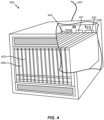
- the server 400 may correspond to one example configuration of the application server 170 described above.
- the server 400 includes a processor 401 coupled to volatile memory 402 and a large capacity nonvolatile memory, such as a disk drive 403.
- the server 400 may also include a floppy disc drive, compact disc (CD) or DVD disc drive 406 coupled to the processor 401.
- the server 400 may also include network access points 404 coupled to the processor 401 for establishing data connections with a network 407, such as a local area network coupled to other broadcast system computers and servers or to the Internet.
- a network 407 such as a local area network coupled to other broadcast system computers and servers or to the Internet.
- the server 400 of FIG. 4 illustrates one example implementation of the communications device 300, whereby the transceiver circuitry configured to transmit and/or receive information 305 corresponds to the network access points 404 used by the server 400 to communicate with the network 407, the at least one processor configured to process information 310 corresponds to the processor 401, and the memory configuration to store information 315 corresponds to any combination of the volatile memory 402, the disk drive 403 and/or the disc drive 406.
- the optional user interface output circuitry configured to present information 320 and the optional user interface input circuitry configured to receive local user input 325 are not shown explicitly in FIG. 4 and may or may not be included therein.
- FIG. 4 helps to demonstrate that the communications device 300 may be implemented as a server, in addition to a UE as in FIG. 2 .
- FIG. 5 illustrates an example of IMS architecture in accordance with an embodiment of the disclosure.
- a first cluster of application servers denoted as AS 1-1, AS 1-2 ... AS 1-N is configured to provide IMS service to UEs and is located (or deployed) in a first region
- a second cluster of application servers denoted as AS 2-1, AS 2-2 ... AS 2-N is configured to provide IMS service to UEs is located (or deployed) in a second region.
- other clusters of application servers can be deployed in other cluster regions as well.
- each cluster of application servers is assumed to be operated by the same operator (e.g., Sprint, Verizon, AT&T, etc.).
- FIG. 5 each cluster of application servers is assumed to be operated by the same operator (e.g., Sprint, Verizon, AT&T, etc.).
- FIG. 5 each cluster of application servers is assumed to be operated by the same operator (e.g., Sprint, Verizon, AT&T, etc.).
- UEs 1...N are assumed to be operating in cluster region R1 and are configured to connect either to a 3GPP RAN 120A or a non-3GPP RAN 120B (e.g., a wired Ethernet connection, a Wi-Fi connection such as access point 125, etc.). UEs 1...N can then connect to an IMS network 500 through either the 3GPP RAN 120A or the non-3GPP RAN 120B.
- a 3GPP RAN 120A or a non-3GPP RAN 120B e.g., a wired Ethernet connection, a Wi-Fi connection such as access point 125, etc.
- the IMS network 500 is shown as illustrating a particular set of IMS components, including a proxy call session control function (P-CSCF) 505, an interrogating CSCF (I-CSCF) 510, a serving CSCF (S-CSCF) 515 and a Home Subscriber Server (HSS) 520.
- P-CSCF proxy call session control function
- I-CSCF interrogating CSCF
- S-CSCF serving CSCF
- HSS Home Subscriber Server
- the P-CSCF 505, I-CSCF 510 and S-CSCF 515 are sometimes referred to collectively as the CSCF
- the CSCF is responsible for signaling via Session Initiation Protocol (SIP) between the Transport Plane, Control Plane, and the Application Plane of the IMS network 500.
- SIP Session Initiation Protocol
- the P-CSCF 505 is responsible for interfacing directly with Transport Plane components and is the first point of signaling within the IMS network 500 for any end-point, such as UEs 1... N. Once an endpoint acquires IP connectivity, the end point will cause a registration event to occur by first signaling to the P-CSCF 505.
- the P-CSCF 505 is a proxy for SIP messages from end-points to the rest of the IMS network 500. It is usually in a home network of the end point, but may reside in a visited network of the end point.
- the P-CSCF 505 will use a DNS look-up to identify a target I-CSCF 510 to send SIP messages, which could be an I-CSCF 510 in its own network or another I-CSCF 510 across an administrative domain.
- the P-CSCF 505 can also be responsible for policy decisions (e.g., via an integrated or standalone Policy Decision Function (PDF) in Releases 5 or 6 of IMS, via a Policy Charging and Resource Function (PCRF) in Release 7 of IMS, etc.).
- PDF Policy Decision Function
- PCRF Policy Charging and Resource Function
- the main function of the I-CSCF 510 is to proxy between the P-CSCF 505 as entry point and S-CSCF 515 as control point for applications found in the Applications Plane.
- the P-CSCF 505 When the P-CSCF 505 receives a registration request SIP message, it will perform a DNS look-up to discover the appropriate I-CSCF 510 to route the message.
- the I-CSCF 510 Once the I-CSCF 510 receives the SIP message, it will perform a look-up operation with the HSS 520 via Diameter to determine the S-CSCF 515 that is associated with the end-point terminal. Once it receives this information, it will forward the SIP message to the appropriate S-CSCF 515 for further treatment.
- the S-CSCF 515 is responsible for interfacing with the Application Servers (AS) (e.g., such as AS 1-1, AS 1-2 ... AS 1-N in cluster region R1, or AS 2-1, AS 2-2 ... AS 2-N in cluster region 2, and so on) in the Application Plane.
- AS Application Servers
- the S-CSCF 515 Upon receiving a registration request SIP message from an I-CSCF 510, the S-CSCF 515 will query the HSS 520 via Diameter protocol to register the terminal as being currently served by itself. Subsequent session establishment requires knowing which S-CSCF 515 is responsible for the terminal session control. As part of the registration process, the S-CSCF 515 uses credentials it obtains from the query to the HSS 520 to issue an SIP message "challenge" back to the initiating P-CSCF 505 to authenticate the terminal.
- AS Application Servers
- the S-CSCF 515 is also responsible for routing SIP messages to the AS allowing for the Control Plane session control to interact with the Application Plane application logic. To do this, the S-CSCF 515 uses information obtained from the HSS 520 in the form of Initial Filter Criteria (IFC) that acts as triggers against inbound session establishment requests.
- IFC Initial Filter Criteria
- the IFC includes rules that define how and where SIP messages should be routed to the various application servers that may reside in the Application Plane.
- the S-CSCF 515 may also act on Secondary Filter Criteria (SFC) obtained from the application servers during the course of messaging with them.
- SFC Secondary Filter Criteria
- a UE that requests IMS service (e.g., registration to set-up or join a VoIP session, a PTT session, a group communication session, etc.) from the IMS network 500 is assigned (or registered) to a target application server that is selected by the S-CSCF 515, as noted above.
- the IMS network 500 will attempt to select, as the target application server, an application server that is physically close to the UE and is also known to be capable of providing the requested IMS service.
- FIG. 6A illustrates a D2D network 600A in accordance with an embodiment of the disclosure.
- the D2D network 600A includes UEs 1... 3 which are configured to communicate with each other via D2D links 605A, 610A and 615A.
- the D2D links 605A, 610A and 615A can be based upon any well-known D2D communication scheme, including but not limited to Bluetooth, Near Field Communication (NFC), Wi-Fi or IEEE 802.11, Wi-Fi Direct, LTE-Direct (LTE-D), and so on.
- NFC Near Field Communication
- Wi-Fi Wireless Fidelity
- IEEE 802.11 Wi-Fi Direct
- LTE-Direct LTE-Direct
- FIG. 6B illustrates a D2D network 600B in accordance with another embodiment of the disclosure.
- the D2D network 600B includes an AP 605B and UEs 1... 3 which are configured to communicate with each other via D2D links 610B and 615B (which not shown explicitly in FIG. 6A , UE 1 and UE 3 may also be capable of D2D communication).
- each of UEs 1...3 are further connected to the AP 605B via D2D links 620B, 625B and 630B.
- the D2D links 610B-630B can be based upon any well-known D2D communication scheme, including but not limited to Bluetooth, NFC, Wi-Fi or IEEE 802.11, Wi-Fi Direct, LTE-D, and so on.
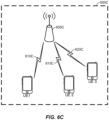
- FIG. 6C illustrates a D2D network 600C in accordance with another embodiment of the disclosure.
- the D2D network 600C includes an AP 605C and UEs 1...3.
- UEs 1...3 in the D2D network 600C of FIG. 6C are not setup for D2D communication with each other.
- each of UEs 1...3 are connected to the AP 605C via D2D links 610C, 615C and 620C, which can be based upon any well-known D2D communication scheme, including but not limited to Bluetooth, NFC, Wi-Fi or IEEE 802.11, Wi-Fi Direct, LTE-D, and so on.
- D2D networks as used herein may include UEs in direct communication with each other without a supporting AP (e.g., FIG. 6A ), UEs that are in direct communication with each other with a supporting AP (e.g., FIG. 6B ) and/or UEs that are in direct communication with an AP without being configured for direct communication with each other (e.g., FIG. 6C ).
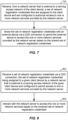
- FIG. 7 illustrates a process of sharing one or more network registration credentials in accordance with an embodiment of the disclosure.
- the process of FIG. 7 may be performed by a client device, such as any of UEs 1... 3 in any of the D2D networks depicted in FIGS. 6A-6C .
- the client device receives, from a network server (e.g., application server 170, server 400, an application server or a component of IMS network 500, etc.) that is external to a serving access network (e.g., RAN 120) of the client device, a set of network registration credentials that are assigned to the client device and are configured to authorize access to one or more network services provided by the network server.
- the set of network registration credentials can include any type of network registration credential that is used by the network server to verify the client device's registration to the network service(s) provided by the network server, including but not limited to subscriber identity module (SIM) credentials, a username and password combination, and so on.
- SIM subscriber identity module
- the network services that can be accessed using the above-noted set of network registration credentials includes IMS-based communication sessions (e.g., phone calls, video calls, emergency calls, an IMS call pulling or VICE, etc.), video streaming services (e.g., Netflix movie streaming, etc.), music streaming services (e.g., Pandora, Spotify, iTunes, etc.), file uploads or downloads, and so on.
- IMS-based communication sessions e.g., phone calls, video calls, emergency calls, an IMS call pulling or VICE, etc.
- video streaming services e.g., Netflix movie streaming, etc.
- music streaming services e.g., Pandora, Spotify, iTunes, etc.
- the client device shares the set of network registration credentials with an external device via a D2D connection to permit the external device to access the one or more network services provided by the network server based on the shared set of network registration credentials.
- the external device can include another D2D-connected client device (e.g., any of UEs 1...3 in the D2D network 600A of FIG. 6A or the D2D network 600B of FIG. 6B ) or a serving AP (e.g., AP 605B in FIG. 6B or AP 605C in FIG. 6C ).
- the external device can use the shared set of network registration credentials to access the one or more network services on behalf of the client device (e.g., offloading a transmit-receive function between the client device and the RAN from the client device to the external device during initial session setup by handing off an existing session), the external device can use the shared set of network registration credentials to access the one or more network services for its own purposes (e.g., an operator of the external device initiates a network service session), the external device can distribute the shared set of network registration credentials to yet another external device (e.g., AP aggregates the network registration credentials of its served UEs for selective redistribution among the served UEs) or any combination thereof.
- the client device e.g., offloading a transmit-receive function between the client device and the RAN from the client device to the external device during initial session setup by handing off an existing session
- the external device can use the shared set of network registration credentials to access the one or more network services for its own purposes (e.g., an operator of
- FIG. 8 illustrates a process of accessing a network service based on one or more shared network registration credentials in accordance with an embodiment of the disclosure.
- the process of FIG. 8 may be performed by a client device, such as any of UEs 1...3 in any of the D2D networks depicted in FIGS. 6A-6C , or alternatively by an AP, such as AP 605B of FIG. 6B or AP 605C of FIG. 6C .
- the device receives a set of network registration credentials via a D2D connection, the set of network registration credentials being assigned to a given client device (e.g., any of UEs 1...3 in any of the D2D networks depicted in FIGS. 6A-6C ) by a network server (e.g., application server 170, communications device 300, server 400, an application server or a component of IMS network 500, etc.) that is external to a serving access network (e.g., RAN 120) of the given client device and configured to permit access to one or more network services provided by the network server.
- a network server e.g., application server 170, communications device 300, server 400, an application server or a component of IMS network 500, etc.
- a serving access network e.g., RAN 120
- the set of network registration credentials received at block 800 may correspond to the set of network credentials shared at block 705 during the process of FIG. 7 .
- the set of network registration credentials received at block 800 may correspond to the set of network credentials shared at block 905 during the process of FIG. 9 , which is discussed in more detail below.
- the device interacts with the network server to access the one or more network services based on the set of network registration credentials.
- the interaction that occurs at block 805 can be performed on behalf of the given client device that shared the set of network registration credentials.
- the device performing the process of FIG. 8 is an in-vehicle AP and the given client device is a smartphone.
- the smartphone may share the set of network registration credentials with the in-vehicle AP at block 800 to facilitate the in-vehicle AP to act as an end-point for a phone call by performing a transmit-receive function for any call-related traffic exchanged with the RAN, which conserves battery life on the smartphone.
- the in-vehicle AP may then relay the call traffic to the smartphone for playback, or alternatively may route any call traffic to an in-vehicle audio system for playback.
- the interaction that occurs at block 805 may be in association with a session that is initiated by the device performing the process of FIG. 8 .
- the device performing the process of FIG. 8 is a first smartphone and the given client device is a second smartphone.
- the first smartphone may use the shared network registration credentials of the second smartphone to initiate a communication session that does not involve the second smartphone, with the first smartphone effectively masquerading as the second smartphone from the perspective of the network server.
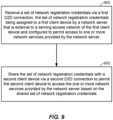
- FIG. 9 illustrates a process of redistributing network registration credentials that are received from another D2D client device to which the shared network registration credentials are assigned in accordance with an embodiment of the disclosure.
- the process of FIG. 9 may be performed by a client device, such as any of UEs 1...3 in any of the D2D networks depicted in FIGS. 6A-6C , or alternatively by an AP, such as AP 605B of FIG. 6B or AP 605C of FIG. 6C .
- the device receives a set of network registration credentials via a first D2D connection, the set of network registration credentials being assigned to a first client device (e.g., any of UEs 1...3 in any of the D2D networks depicted in FIGS. 6A-6C ) by a network server (e.g., application server 170, server 400, an application server or a component of IMS network 500, etc.) that is external to a serving access network (e.g., RAN 120) of the first client device and configured to permit access to one or more network services provided by the network server.
- the set of network registration credentials received at block 800 may correspond to the set of network credentials shared at block 705 during the process of FIG. 7 .
- the device shares the set of network registration credentials with a second client device (e.g., any of UEs 1...3 in any of the D2D networks depicted in FIGS. 6A-6C ) via a second D2D connection to permit the second client device to access the one or more network services provided by the network server based on the shared set of network registration credentials.
- a second client device e.g., any of UEs 1...3 in any of the D2D networks depicted in FIGS. 6A-6C
- the process of FIG. 9 permits an AP or even another D2D client device to redistribute network registration credentials assigned to a particular D2D client device.
- the operation of block 900 can repeat multiple times, so that the device performing the process of FIG. 9 aggregates sets of network registration credentials assigned to different D2D client devices and/or by different network servers into a network registration credential table.
- the set of network registration credentials that is shared at block 905 can be selected from the network registration credential table based on one or more selection criteria, including whether or not the second client device identified a particular set of network registration credentials, whether or not the second client device identifies a desired network service (e.g., in which case block 905 will exclude one or more sets of network registration credentials that cannot provide the desired network service), or any combination thereof.
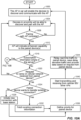
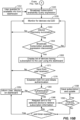
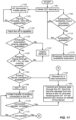
- FIGS. 10A-11 illustrate more detailed implementations of certain aspects of the processes described above with respect to FIGS. 7-9 in accordance with embodiments of the disclosure.
- the processes of FIGS. 8-9 can be performed at a D2D client device or an AP, with FIGS. 10A-B depicting an AP-specific implementation of some aspects of these processes while FIG. 11 depicts D2D client device-specific implementation of some aspects of these processes.
- the AP referred to with respect to FIGS. 10A-11 is provisioned within a car, although a vehicle-specific AP implementation is not required in other embodiments.
- the AP in the car enables D2D client devices to discover and communicate with the AP.
- the AP may broadcast a Service Set Identifier (SSID) to facilitate the discovery function. This permits any D2D client devices within communication range of the AP to discover the AP and pair with the AP, at block 1004.
- SSID Service Set Identifier
- the AP determines whether pairing is complete at block 1008. If not, the process returns to block 1004. Otherwise, once pairing is complete, the AP indicates its enhanced capability function to each paired D2D client device at block 1012.
- the AP notifies each paired D2D client device that the AP is storing (e.g., in local memory or a local server connected to the AP) one or more sets of network registration credentials (e.g., subscription information) that can be used to access certain network services.
- network registration credentials e.g., subscription information
- the AP determines whether to add new subscription information from one or more of the paired D2D client devices to the local server (e.g., such as when the subscription information in the local server is empty). If the AP determines to add new subscription information, the process advances to block 1048 (described below). Otherwise, at block 1020, the AP determines whether or not a request to camp on a cellular network using existing subscription information stored in the local server is received by one of the paired D2D client devices. If no request to camp on a cellular network using existing subscription information is received at block 1020, the process returns to block 1004.
- the AP determines whether the requesting D2D client device is attempting to transfer an existing connection to the AP (e.g., handing off a transmit-receive function for a phone call to the AP to save battery life on the requesting D2D client device), at block 1024. If the AP determines that the requesting D2D client device is not attempting to transfer an existing connection to the AP at block 1024, then the AP initiates a new connection with a base station of the cellular network (and/or other types of wireless access points) at block 1028, after which the process advances to block 1036.
- the AP determines whether the requesting D2D client device is attempting to transfer an existing connection to the AP (e.g., handing off a transmit-receive function for a phone call to the AP to save battery life on the requesting D2D client device), at block 1024. If the AP determines that the requesting D2D client device is not attempting to transfer an existing connection to the AP at block 10
- the AP determines that the requesting D2D client device is attempting to transfer an existing connection to the AP at block 1024, then the AP initiates fetches the existing cellular connection information and (if not already maintained at the AP) the subscription information from the requesting D2D client device, at block 1032.
- the AP may be provisioned with cellular connectivity (e.g., a MODEM and associated hardware / software) to access one or more radio access technology (RAT)-types (e.g., LTE, 3G, 4G, multiple RATs at the same time via multimode operation, etc.).
- RAT radio access technology
- the AP defines a priority for the requesting D2D client device based on the type of traffic carried on the communication session that is being supported on the AP. For example, a higher-priority may be allocated to a real-time or delay-sensitive communication session (e.g., a voice call, a PTT call, etc.), while a lower-priority may be allocated to other types of sessions (e.g., a file transfer session, etc.).
- the AP starts to transmit and receive data associated with the communication session from the cellular base station and/or other wireless access points at block 1040.
- the AP relays any real-time traffic for the communication session to the requesting D2D client device without delay, while saving any delay-sensitive traffic in the local server.
- the saved delay-sensitive traffic from block 1044 may be made available to the requesting D2D client device upon request. While the relaying function is performed at block 1044, the AP can continue to perform the D2D client device discovery procedure at block 1000.
- the AP broadcasts a Subscription availability Query expression.
- the transmission of block 1048 can occur periodically, or in response to an event (e.g., detection that the AP does not have access to any subscription information at block 1016, or a user-initiated query for available subscription information from a dashboard interface of the car at block 1052).
- the AP monitors for any D2D client devices via a D2D interface at block 1056.
- the process returns to block 1056 and the AP continues to monitor for one or more D2D client devices.
- the AP determines if the discovered at least one D2D client device is broadcasting a subscription availability expression indicating that the discovered at least one D2D client device has subscription availability, at block 1064. At block 1064, if the discovered at least one D2D client device does not have subscription availability, the process returns to block 1056 and the AP continues to monitor for one or more D2D client devices. Otherwise, at block 1064, if the discovered at least one D2D client device has subscription availability, then a list of each discovered D2D client device with subscription availability is displayed to the user using the car dashboard at block 1068.
- the AP determines whether any user input indicative of a device selection is received in response to the display of block 1068. If not, the process returns to block 1056 and the AP continues to monitor for one or more D2D client devices. Otherwise, if one of the displayed devices is selected at block 1072, then the AP establishes a D2D link with the selected D2D client device and initiates authentication at block 1076. At block 1080, if the authentication is not determined to be successful, then the AP sends a failure notification to the user via the car dashboard at block 1084. Otherwise, at block 1080, if the authentication is determined to be successful, then a request is sent to the selected D2D client device to retrieve that device's subscription information at block 1088.
- T_wait timer a wait timer with a given expiration period
- T_wait timer may start running when the request is sent at block 1088. If T_wait timer expires at block 1096 before the requested subscription information is received from the selected device, then the process advances to block 1084.
- the AP saves the subscription information into the local server and updates one or more D2D client devices (e.g., the paired D2D client devices that have registered to receive subscription availability updates and/or have requested access to subscription information) regarding the new subscription information at block 1098.
- D2D client devices e.g., the paired D2D client devices that have registered to receive subscription availability updates and/or have requested access to subscription information
- FIGS. 10A-B illustrate a particular sequence of operations, it will be appreciated that these operations can be executed in parallel and/or in different sequences in other embodiments of the disclosure.
- the new subscription information acquisition procedure described between blocks 1048-1098 can occur in parallel with other subscription information being used to access network services as described between blocks 1000-1044.
- the process of FIGS. 10A-B can execute at the AP in parallel with the process of FIG. 11 being executed at one or more D2D client devices in the car, as will now be described.
- a given D2D client device in the car initiates D2D discovery at block 1100. Based on the D2D discovery from block 1100, the given D2D client device determines whether a Subscription availability Query expression is discovered, at block 1105 (e.g., such as the Subscription availability Query expression that is broadcasted by the AP at block 1048 of FIG. 10B ). If a Subscription availability Query expression is discovered at block 1105, then the given D2D client device determines whether any subscription information is available to be shared with the AP, at block 1110. If so, the given D2D client device broadcasts a Subscription availability expression at block 1115 (e.g., which can be received at the AP at block 1064 of FIG. 10B ).
- a Subscription availability Query expression e.g., such as the Subscription availability Query expression that is broadcasted by the AP at block 1048 of FIG. 10B .
- the D2D discovery can also result in the AP being discovered, which results in pairing between the given D2D client device and the AP being initiated at block 1120. If the pairing is determined not to be successful at block 1125, the process returns to block 1120 where the pairing initiation can be re-attempted. Otherwise, if the pairing is determined to be successful at block 1125, AP capability information is fetched at block 1130 (e.g., as described above with respect to block 1012 of FIG. 10A ). If the AP capability information does not indicate that enhanced subscription information capability is available at block 1135, then the given D2D client device interacts with the AP in accordance with legacy behavior at block 1140.
- the AP capability information indicates that enhanced subscription information capability is available at block 1135 (e.g., as in block 1012 of FIG. 10A ) but a received signal strength of the AP is less than or equal to a signal strength threshold (R TH ) and/or a user override is not enabled at block 1145, then the given D2D client device interacts with the AP in accordance with legacy behavior at block 1140. Otherwise, if the AP capability information indicates that enhanced subscription information capability is available at block 1135 (e.g., as in block 1012 of FIG. 10A ) and a received signal strength of the AP is greater than R TH and/or a user override is enabled at block 1145, then the process advances to block 1150.
- R TH signal strength threshold
- the given D2D client device determines whether an existing cellular connection is available based on the given D2D client device's own subscription information. If not, the given D2D client device sends a request to the AP to setup a new connection using subscription information that was shared with the AP by some other D2D client device at block 1155 (e.g., as in blocks 1024-1028 of FIG. 10A ), after which the process advances to block 1180.
- the given D2D client device determines that an existing cellular connection is available based on the given D2D client device's own subscription information at block 1150, the given D2D client device starts a timer (T_est) at block 1160.
- T_est timer
- the given D2D client device initiates a transfer of subscription information for the existing cellular connection to the AP at block 1165 (e.g., as in block 1032 of FIG. 10A ). If the connection transfer does not complete before expiration of T_est at blocks 1170-1175, then the process advances to block 1165 and a new connection is initiated.
- the AP performs the transmit-receive functions for the transferred connection that were previously performed by the given D2D client device at block 1180 (e.g., as in blocks 1040-1044 of FIG. 10A ). As discussed above, this may involve the AP performing a relay function whereby a local D2D interface (e.g., Bluetooth, NFC, etc.) is used to exchange data to/from the given D2D client device, with the AP interacting with external cellular and/or non-cellular APs on behalf of the given D2D client device.
- a local D2D interface e.g., Bluetooth, NFC, etc.
- the AP is an optional component with respect to the network registration credential sharing procedures described in various embodiments of the disclosure.
- FIG. 12 illustrates AP-based implementations of the processes of FIGS. 7-9 with respect to the D2D network 600B of FIG. 6B or 600C of FIG. 6C in accordance with embodiments of the disclosure
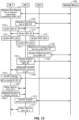
- FIG. 13 illustrates implementations of the processes of FIGS. 7-9 that do not rely upon an AP with respect to the D2D network 600A of FIG. 6A in accordance with embodiments of the disclosure.
- UE 1 registers with a network server 1280 (e.g., application server 170, communications device 300, server 400, an application server or a component of IMS network 500, etc.) and receives a first set of network registration credentials at block 1200 (e.g., as in block 700 of FIG. 7 ).
- UE 2 also registers with the network server 1280 and receives a second set of network registration credentials at block 1205 (e.g., as in block 700 of FIG. 7 ).
- UEs 1 and 2 could receive network registration credentials from different network servers, and a single network server is described with respect to the process of FIG. 12 for convenience of explanation.
- UE 1 shares the first set of network registration credentials with the AP (e.g., AP 605B or AP 605C) over a D2D interface at block 1210 (e.g., as in block 705 of FIG. 7 , block 800 of FIG. 8 , block 900 of FIG. 9 and/or block 1092 of FIG. 10B ), and UE 2 shares the second set of network registration credentials with the AP over the D2D interface at block 1215 (e.g., as in block 705 of FIG. 7 , block 800 of FIG. 8 , block 900 of FIG. 9 and/or block 1092 of FIG. 10B ).
- the AP e.g., AP 605B or AP 605C
- UE 2 shares the second set of network registration credentials with the AP over the D2D interface at block 1215 (e.g., as in block 705 of FIG. 7 , block 800 of FIG. 8 , block 900 of FIG. 9 and/or block 1092 of FIG. 10B ).
- the AP updates a network registration credential table to include the first and second sets of network registration credentials at block 1220 (e.g., similar to block 1098 of FIG. 10B ).
- the network registration credentials can be shared with the AP as needed (e.g., in response to a request for network service access received by another D2D client device paired with the AP).
- UE 3 requests access to a network service at block 1225, and the AP shares the first set of network registration credentials with UE 3 to permit UE 3 to access the network service at block 1230 (e.g., as in block 800 of FIG. 8 ).
- the AP scans the network registration credential table to identify one or more sets of network registration credentials capable of providing the network service, and then selects the first set of network registration credentials from the identified set(s).
- the AP can simply facilitate a list of the available network registration credentials to be displayed to the user of UE 3 (e.g., via UE 3 or a separate display controlled by the AP) from which the user can indicate a selection of a desired credential to use to access the network service.
- UE 3 uses the first set of network registration credentials (which is actually assigned by the network server 1280 to UE 1) to access the network service via the network server 1280 at block 1235 (e.g., as in block 805 of FIG. 8 ). It will be appreciated that the AP is not involved with the actual server interaction that occurs at block 1235, in contrast to the network service access scenarios described above with respect to FIGS. 10A-11 .
- UE 2 begins to access a network service via the network server 1280 using its own set of network registration credentials (i.e., the second set of network registration credentials) at block 1240.
- UE 2 is performing a transmit-receive function that includes transmitting and/or receiving data between UE 2 and the RAN to exchange the data with the network server 1280 in association with the network service.
- UE 2 later decides to handoff the transmit-receive function to the AP, and thereby negotiates network service handoff to the AP at block 1245 (e.g., as in blocks 1020-1024 of FIG. 10A or blocks 1165-1170 of FIG. 11 ).
- the network server 1280 is not necessarily aware of this handoff, as the same set of network registration credentials will be used by the AP to interact with the network server 1280 in association with the network service. Also, because UE 2 already shared the second set of network registration credentials with the AP, the AP can simply load the second set of network registration credentials from the network registration credential table during block 1245. In an alternative embodiment, the sharing at block 1210 can be triggered by (and thereby performed in conjunction with) the handoff negotiation at block 1245.
- the AP accesses the network service using the second set of network registration credentials on behalf of UE 2 (e.g., as in block 805 of FIG. 8 or blocks 1036-1044 of FIG. 10A ).
- the AP optionally relays data to/from UE 2 in association with the network service over the D2D interface at block 1255, as described above with respect to blocks 1036-1044 of FIG. 10A and block 1180 of FIG. 11 .
- Block 1255 is optional because the user of UE 2 could alternatively use a user interface (e.g., a car dashboard, in-vehicle audio system, etc.) associated with the AP to engage with the network server 1280 instead of a user interface on UE 2.
- a user interface e.g., a car dashboard, in-vehicle audio system, etc.
- the phone call could be transferred to an in-vehicle audio system (with microphone(s) and speaker(s) such that UE 2 is bypassed altogether without the need to relay phone media between the AP and UE 2.
- blocks 1240-1255 show a network service connection that is transferred from UE 2 to the AP, it is also possible for the AP to initiate a new network service connection on behalf of any of its served UEs.
- UE 1 requests access to a network service that does not have an existing connection (or session) with UE 1.
- UE 1 wants the AP to handle the network service connection (e.g., to save battery life, etc.).
- the AP accesses the network service using the second set of network registration credentials on behalf of UE 1 (e.g., as in block 805 of FIG. 8 or blocks 1036-1044 of FIG. 10A ).
- UE 1 is not forced to use this particular set of network registration credentials for the network service session being supported via the AP.
- UE 1 may not want to use its own network registration credentials (e.g., because these credentials are being used for UE 3's network service session and no concurrent sessions are permitted by UE 1's particular network registration credentials, etc.), and UE 1 can indicate this preference to the AP in the request of block 1265.
- the AP may dynamically select the set of network registration credentials to be used for a particular network service session based on various selection criteria.
- the AP optionally relays data to/from UE 1 in association with the network service over the D2D interface at block 1275, similar to block 1255.
- UE 1 registers with the network server 1280 and receives a first set of network registration credentials at block 1300 (e.g., as in block 700 of FIG. 7 ).
- UE 2 also registers with the network server 1280 and receives a second set of network registration credentials at block 1305 (e.g., as in block 700 of FIG. 7 ).
- UEs 1 and 2 could receive network registration credentials from different network servers, and a single network server is described with respect to the process of FIG. 13 for convenience of explanation.
- UE 1 shares the first set of network registration credentials with UEs 2 and 3 over a D2D interface at block 1310 (e.g., as in block 705 of FIG. 7 , block 800 of FIG. 8 and/or block 900 of FIG. 9 ), and UE 2 shares the second set of network registration credentials with UEs 1 and 3 over the D2D interface at block 1315 (e.g., as in block 705 of FIG. 7 , block 800 of FIG. 8 and/or block 900 of FIG. 9 ).
- UEs 1... 3 each update a network registration credential table to include the first and second sets of network registration credentials at blocks 1320-1330.
- FIG. 1310 e.g., as in block 705 of FIG. 7 , block 800 of FIG. 8 and/or block 900 of FIG. 9
- UEs 1... 3 each update a network registration credential table to include the first and second sets of network registration credentials at blocks 1320-1330.
- FIG. 1310 e.g., as in block 705
- some UEs in the D2D network need not maintain complete network registration tables (e.g., if UE 3 is not interested in network services associated with the first set of network registration credentials, then the first set of network registration credentials need not be stored in UE 3's network registration table at block 1325).
- the network registration credentials can be shared among the UEs connected to the D2D network as needed (e.g., in response to a request for network service access received from one of the connected UEs).
- UE 3 determines to access a network service using the first set of network registration credentials from UE 3's network registration credential table.
- UE 3 scans its network registration credential table to identify one or more sets of network registration credentials capable of providing the network service, and then selects the first set of network registration credentials from the identified set(s).
- UE 3 thereby uses the first set of network registration credentials (which is actually assigned by the network server 1280 to UE 1) to access the network service via the network server 1280 at block 1340 (e.g., as in block 805 of FIG. 8 ).
- UE 2 begins to access a network service via the network server 1280 using its own set of network registration credentials (i.e., the second set of network registration credentials) at block 1345.
- UE 2 is performing a transmit-receive function that includes transmitting and/or receiving data between UE 2 and the RAN to exchange the data with the network server 1280 in association with the network service.
- UE 2 later decides to handoff transmit-receive functions associated with the network service to UE 1 (e.g., because UE 1 has more battery life than UE 2, or UE 1 is plugged in and UE 2 is not, or UE 1 has network connectivity or a faster processor, etc.), and thereby negotiates network service handoff to UE 1 at block 1350.
- the network server 1280 is not necessarily aware of this handoff, as the same set of network registration credentials will be used by UE 1 to interact with the network server 1280 in association with the network service. Also, because UE 2 already shared the second set of network registration credentials with UE 1, UE 1 can simply load the second set of network registration credentials from the network registration credential table during block 1350.
- the sharing at block 1310 can be triggered by (and thereby performed in conjunction with) the handoff negotiation at block 1350.
- UE 1 accesses the network service using the second set of network registration credentials on behalf of UE 2 (e.g., as in block 805 of FIG. 8 ).
- UE 1 optionally relays data to/from UE 2 in association with the network service over the D2D interface at block 1360.
- Block 1360 is optional because the user of UE 2 could alternatively simply switch to UE 1 and stop using UE 2 for interaction with the network service altogether.
- blocks 1345-1360 show a network service connection that is transferred from UE 2 to UE 1, it is also possible for a UE to initiate a new network service connection on behalf of any of other peer UE.
- UE 1 requests access to a network service that does not have an existing connection (or session) with UE 1.
- UE 1 wants UE 2 to handle the network service connection (e.g., to save battery life, etc.).
- UE 2 accesses the network service using the second set of network registration credentials on behalf of UE 1 (e.g., as in block 805 of FIG. 8 ).
- UE 1 even though UE 1 has its own set of network registration credentials, UE 1 is not forced to use this particular set of network registration credentials for the network service session being supported via UE 2.
- UE 1 may not want to use its own network registration credentials (e.g., because these credentials are being used for UE 3's network service session and no concurrent sessions are permitted by UE 1's particular network registration credentials, etc.), and UE 1 can indicate this preference to UE 2 in the request of block 1365.
- UE 2 may dynamically select the set of network registration credentials to be used for a particular network service session based on various selection criteria.
- UE 2 optionally relays data to/from UE 1 in association with the network service over the D2D interface at block 1375. Block 1375 is optional because the user of UE 1 could alternatively simply switch to UE 2 and stop using UE 2 for interaction with the network service altogether.
- DSP digital signal processor
- ASIC application specific integrated circuit
- FPGA field programmable gate array
- a general purpose processor may be a microprocessor, but in the alternative, the processor may be any conventional processor, controller, microcontroller, or state machine.
- a processor may also be implemented as a combination of computing devices, e.g., a combination of a DSP and a microprocessor, a plurality of microprocessors, one or more microprocessors in conjunction with a DSP core, or any other such configuration.
- a software module may reside in RAM memory, flash memory, ROM memory, EPROM memory, EEPROM memory, registers, hard disk, a removable disk, a CD-ROM, or any other form of storage medium known in the art.
- An exemplary storage medium is coupled to the processor such that the processor can read information from, and write information to, the storage medium.
- the storage medium may be integral to the processor.
- the processor and the storage medium may reside in an ASIC.
- the ASIC may reside in a user terminal (e.g., UE).
- the processor and the storage medium may reside as discrete components in a user terminal.
- the functions described may be implemented in hardware, software, firmware, or any combination thereof. If implemented in software, the functions may be stored on or transmitted over as one or more instructions or code on a computer-readable medium.
- Computer-readable media includes both computer storage media and communication media including any medium that facilitates transfer of a computer program from one place to another.
- a storage media may be any available media that can be accessed by a computer.
- such computer-readable media can comprise RAM, ROM, EEPROM, CD-ROM or other optical disk storage, magnetic disk storage or other magnetic storage devices, or any other medium that can be used to carry or store desired program code in the form of instructions or data structures and that can be accessed by a computer.
- any connection is properly termed a computer-readable medium.
- the software is transmitted from a website, server, or other remote source using a coaxial cable, fiber optic cable, twisted pair, digital subscriber line (DSL), or wireless technologies such as infrared, radio, and microwave
- the coaxial cable, fiber optic cable, twisted pair, DSL, or wireless technologies such as infrared, radio, and microwave are included in the definition of medium.
- Disk and disc includes compact disc (CD), laser disc, optical disc, digital versatile disc (DVD), floppy disk and blu-ray disc where disks usually reproduce data magnetically, while discs reproduce data optically with lasers. Combinations of the above should also be included within the scope of computer-readable media.
Landscapes
- Engineering & Computer Science (AREA)
- Computer Networks & Wireless Communication (AREA)
- Signal Processing (AREA)
- Computer Security & Cryptography (AREA)
- Multimedia (AREA)
- General Engineering & Computer Science (AREA)
- Computing Systems (AREA)
- Computer Hardware Design (AREA)
- Business, Economics & Management (AREA)
- General Business, Economics & Management (AREA)
- Mobile Radio Communication Systems (AREA)
- Data Exchanges In Wide-Area Networks (AREA)
- Optical Communication System (AREA)
- Separation Of Suspended Particles By Flocculating Agents (AREA)
- Telescopes (AREA)
Applications Claiming Priority (2)
| Application Number | Priority Date | Filing Date | Title |
|---|---|---|---|
| US15/214,080 US10616808B2 (en) | 2016-07-19 | 2016-07-19 | Exchanging network server registration credentials over a D2D network |
| PCT/US2017/034631 WO2018017186A1 (en) | 2016-07-19 | 2017-05-26 | Exchanging network server registration credentials over a d2d network |
Publications (2)
| Publication Number | Publication Date |
|---|---|
| EP3488582A1 EP3488582A1 (en) | 2019-05-29 |
| EP3488582B1 true EP3488582B1 (en) | 2023-06-07 |
Family
ID=59054222
Family Applications (1)
| Application Number | Title | Priority Date | Filing Date |
|---|---|---|---|
| EP17729623.3A Active EP3488582B1 (en) | 2016-07-19 | 2017-05-26 | Exchanging network server registration credentials over a d2d network |
Country Status (9)
| Country | Link |
|---|---|
| US (1) | US10616808B2 (enExample) |
| EP (1) | EP3488582B1 (enExample) |
| JP (1) | JP2019526959A (enExample) |
| KR (1) | KR20190030210A (enExample) |
| CN (1) | CN109479058B (enExample) |
| BR (1) | BR112019000885A2 (enExample) |
| CA (1) | CA3028373C (enExample) |
| TW (1) | TWI777960B (enExample) |
| WO (1) | WO2018017186A1 (enExample) |
Families Citing this family (8)
| Publication number | Priority date | Publication date | Assignee | Title |
|---|---|---|---|---|
| US10356096B2 (en) * | 2017-02-17 | 2019-07-16 | At&T Intellectual Property I, L.P. | Authentication using credentials submitted via a user premises device |
| KR102429535B1 (ko) * | 2017-09-26 | 2022-08-05 | 삼성전자주식회사 | 사물인터넷 장치의 네트워크 등록 방법 및 그 장치 |
| US10708318B2 (en) * | 2018-03-21 | 2020-07-07 | Ofinno, Llc | Supporting termination access domain selection for a dual registered wireless device |
| FR3095567B1 (fr) * | 2019-04-29 | 2021-04-16 | Airbus Ds Slc | Reseau de communication et procede de gestion decentralisee de communications via le reseau de communication |
| US11539545B2 (en) * | 2019-08-19 | 2022-12-27 | Sonos, Inc. | Multi-network playback devices |
| CN115104283B (zh) * | 2020-02-10 | 2025-05-30 | 三星电子株式会社 | 电子设备和用于在电子设备中执行对等服务的方法 |
| CN114760112B (zh) * | 2022-03-28 | 2023-09-12 | 厦门盈趣科技股份有限公司 | 一种面向无线局域网络的智能家居设备入网方法、系统、设备及存储介质 |
| CN115996126B (zh) * | 2022-12-02 | 2023-11-03 | 北京深盾科技股份有限公司 | 信息交互方法、应用设备、辅助平台及电子设备 |
Citations (1)
| Publication number | Priority date | Publication date | Assignee | Title |
|---|---|---|---|---|
| US20160021489A1 (en) * | 2014-07-16 | 2016-01-21 | Electronics And Telecommunications Research Institute | Master ims terminal for sharing ims-based service, slave ims terminal for sharing ims-based service, system for sharing ims-based service, and sharing method |
Family Cites Families (27)
| Publication number | Priority date | Publication date | Assignee | Title |
|---|---|---|---|---|
| US6748244B2 (en) * | 2001-11-21 | 2004-06-08 | Intellisist, Llc | Sharing account information and a phone number between personal mobile phone and an in-vehicle embedded phone |
| KR100735427B1 (ko) | 2005-02-07 | 2007-07-04 | 삼성전자주식회사 | 이동 통신 단말의 sim 카드 공유 방법 |
| US9037850B2 (en) * | 2006-03-17 | 2015-05-19 | Sandisk Il Ltd. | Session handover between terminals |
| US20080039139A1 (en) | 2006-08-14 | 2008-02-14 | Sandisk Il Ltd. | Method For Sharing Credentials |
| US20080081611A1 (en) * | 2006-10-03 | 2008-04-03 | Sierra Wireless, Inc. | Method and apparatus for sharing cellular account subscription among multiple devices |
| US7986914B1 (en) * | 2007-06-01 | 2011-07-26 | At&T Mobility Ii Llc | Vehicle-based message control using cellular IP |
| US8265599B2 (en) | 2008-05-27 | 2012-09-11 | Intel Corporation | Enabling and charging devices for broadband services through nearby SIM devices |
| US8863256B1 (en) * | 2011-01-14 | 2014-10-14 | Cisco Technology, Inc. | System and method for enabling secure transactions using flexible identity management in a vehicular environment |
| JPWO2012098580A1 (ja) * | 2011-01-19 | 2014-06-09 | パナソニック株式会社 | 有機発光素子の製造方法、有機表示パネル、有機発光装置、機能層の形成方法、インク、基板、有機発光素子、有機表示装置、および、インクジェット装置 |
| US9032493B2 (en) * | 2011-03-31 | 2015-05-12 | Intel Corporation | Connecting mobile devices, internet-connected vehicles, and cloud services |
| US20120266217A1 (en) * | 2011-04-15 | 2012-10-18 | Skype Limited | Permitting Access To A Network |
| US8554970B2 (en) * | 2011-04-18 | 2013-10-08 | Nokia Corporation | Method, apparatus and computer program product for creating a wireless docking group |
| US9338159B2 (en) * | 2012-03-19 | 2016-05-10 | Nokia Technologies Oy | Method and apparatus for sharing wireless network subscription services |
| US20150085848A1 (en) * | 2012-04-26 | 2015-03-26 | Nokia Corporation | Method and Apparatus for Controlling Wireless Network Access Parameter Sharing |
| US20140006826A1 (en) * | 2012-06-30 | 2014-01-02 | Mahesh Wagh | Low power low frequency squelch break protocol |
| US8977856B2 (en) * | 2012-08-31 | 2015-03-10 | Blackberry Limited | Methods and apparatus for use in sharing credentials amongst a plurality of mobile communication devices |
| EP2741459A1 (en) | 2012-12-04 | 2014-06-11 | Alcatel Lucent | Method and device for allowing a user equipment without sim card to take advantage of a mobile data subscription of its user to access a wireless network |
| US9112844B2 (en) | 2012-12-06 | 2015-08-18 | Audible, Inc. | Device credentialing for network access |
| CN104937976B (zh) * | 2013-01-20 | 2019-03-22 | 苹果公司 | 经由无线对等连接来卸载业务的方法、设备和装置 |
| EP2974131B1 (en) * | 2013-03-13 | 2020-09-09 | Intel Corporation | Device-to-device communication for resource sharing |
| US20140341085A1 (en) * | 2013-05-14 | 2014-11-20 | Qualcomm Incorporated | Selecting an application server at which to register one or more user equipments for an internet protocol multimedia subsystem (ims) session |
| US10158996B2 (en) | 2013-10-10 | 2018-12-18 | Nokia Solutions And Networks Oy | Enabling cellular access |
| US9432363B2 (en) * | 2014-02-07 | 2016-08-30 | Apple Inc. | System and method for using credentials of a first client station to authenticate a second client station |
| US9854051B2 (en) * | 2014-04-25 | 2017-12-26 | Wilmerding Communications Llc | Using proxy devices as dynamic data relays |
| US9883384B2 (en) | 2014-07-16 | 2018-01-30 | Qualcomm Incorporated | UE-based network subscription management |
| US10044592B2 (en) * | 2014-11-04 | 2018-08-07 | Asustek Computer Inc. | Method and apparatus for device to device communication in a wireless communication system and related apparatus using the same |
| US9699817B2 (en) * | 2014-12-16 | 2017-07-04 | Qualcomm Incorporated | Methods to preemptively search and select LTE-direct expressions for uninterrupted device-to-device communication |
-
2016
- 2016-07-19 US US15/214,080 patent/US10616808B2/en active Active
-
2017
- 2017-05-26 CA CA3028373A patent/CA3028373C/en active Active
- 2017-05-26 JP JP2019502002A patent/JP2019526959A/ja active Pending
- 2017-05-26 CN CN201780044070.9A patent/CN109479058B/zh active Active
- 2017-05-26 BR BR112019000885-3A patent/BR112019000885A2/pt unknown
- 2017-05-26 EP EP17729623.3A patent/EP3488582B1/en active Active
- 2017-05-26 WO PCT/US2017/034631 patent/WO2018017186A1/en not_active Ceased
- 2017-05-26 KR KR1020197001679A patent/KR20190030210A/ko not_active Ceased
- 2017-06-12 TW TW106119421A patent/TWI777960B/zh active
Patent Citations (1)
| Publication number | Priority date | Publication date | Assignee | Title |
|---|---|---|---|---|
| US20160021489A1 (en) * | 2014-07-16 | 2016-01-21 | Electronics And Telecommunications Research Institute | Master ims terminal for sharing ims-based service, slave ims terminal for sharing ims-based service, system for sharing ims-based service, and sharing method |
Also Published As
| Publication number | Publication date |
|---|---|
| JP2019526959A (ja) | 2019-09-19 |
| CA3028373C (en) | 2024-06-11 |
| TW201804861A (zh) | 2018-02-01 |
| CN109479058B (zh) | 2021-12-28 |
| KR20190030210A (ko) | 2019-03-21 |
| EP3488582A1 (en) | 2019-05-29 |
| US20180027458A1 (en) | 2018-01-25 |
| TWI777960B (zh) | 2022-09-21 |
| CN109479058A (zh) | 2019-03-15 |
| US10616808B2 (en) | 2020-04-07 |
| WO2018017186A1 (en) | 2018-01-25 |
| CA3028373A1 (en) | 2018-01-25 |
| BR112019000885A2 (pt) | 2019-04-30 |
Similar Documents
| Publication | Publication Date | Title |
|---|---|---|
| EP3488582B1 (en) | Exchanging network server registration credentials over a d2d network | |
| US11736927B2 (en) | Network assisted device-to-device discovery for peer-to-peer applications | |
| US9571611B2 (en) | Updating rich communication suite capability information over a communications network | |
| US9277522B2 (en) | Exchanging rich communication suite capability information in a communications system | |
| US10904326B2 (en) | Network assisted device-to-device discovery for peer-to-peer applications | |
| US9532302B2 (en) | Communication network having proximity service discovery and device self-organization | |
| US9584996B2 (en) | Selectively triggering a communicative action based on whether a quorum condition for a peer-to-peer group is satisfied | |
| HK1220069B (zh) | 针对对等应用的网络辅助的设备对设备发现 |
Legal Events
| Date | Code | Title | Description |
|---|---|---|---|
| STAA | Information on the status of an ep patent application or granted ep patent |
Free format text: STATUS: UNKNOWN |
|
| STAA | Information on the status of an ep patent application or granted ep patent |
Free format text: STATUS: THE INTERNATIONAL PUBLICATION HAS BEEN MADE |
|
| PUAI | Public reference made under article 153(3) epc to a published international application that has entered the european phase |
Free format text: ORIGINAL CODE: 0009012 |
|
| STAA | Information on the status of an ep patent application or granted ep patent |
Free format text: STATUS: REQUEST FOR EXAMINATION WAS MADE |
|
| 17P | Request for examination filed |
Effective date: 20181212 |
|
| AK | Designated contracting states |
Kind code of ref document: A1 Designated state(s): AL AT BE BG CH CY CZ DE DK EE ES FI FR GB GR HR HU IE IS IT LI LT LU LV MC MK MT NL NO PL PT RO RS SE SI SK SM TR |
|
| AX | Request for extension of the european patent |
Extension state: BA ME |
|
| DAV | Request for validation of the european patent (deleted) | ||
| DAX | Request for extension of the european patent (deleted) | ||
| STAA | Information on the status of an ep patent application or granted ep patent |
Free format text: STATUS: EXAMINATION IS IN PROGRESS |
|
| 17Q | First examination report despatched |
Effective date: 20200819 |
|
| REG | Reference to a national code |
Ref country code: DE Ref legal event code: R079 Free format text: PREVIOUS MAIN CLASS: H04L0029060000 Ipc: H04L0009400000 Ref document number: 602017069528 Country of ref document: DE |
|
| GRAP | Despatch of communication of intention to grant a patent |
Free format text: ORIGINAL CODE: EPIDOSNIGR1 |
|
| STAA | Information on the status of an ep patent application or granted ep patent |
Free format text: STATUS: GRANT OF PATENT IS INTENDED |
|
| RIC1 | Information provided on ipc code assigned before grant |
Ipc: H04W 88/04 20090101ALN20221224BHEP Ipc: H04W 52/02 20090101ALN20221224BHEP Ipc: H04W 48/10 20090101ALN20221224BHEP Ipc: H04W 36/14 20090101ALN20221224BHEP Ipc: H04W 36/00 20090101ALI20221224BHEP Ipc: H04L 9/40 20220101AFI20221224BHEP |
|
| INTG | Intention to grant announced |
Effective date: 20230118 |
|
| GRAS | Grant fee paid |
Free format text: ORIGINAL CODE: EPIDOSNIGR3 |
|
| GRAA | (expected) grant |
Free format text: ORIGINAL CODE: 0009210 |
|
| STAA | Information on the status of an ep patent application or granted ep patent |
Free format text: STATUS: THE PATENT HAS BEEN GRANTED |
|
| AK | Designated contracting states |
Kind code of ref document: B1 Designated state(s): AL AT BE BG CH CY CZ DE DK EE ES FI FR GB GR HR HU IE IS IT LI LT LU LV MC MK MT NL NO PL PT RO RS SE SI SK SM TR |
|
| REG | Reference to a national code |
Ref country code: GB Ref legal event code: FG4D |
|
| REG | Reference to a national code |
Ref country code: CH Ref legal event code: EP Ref country code: AT Ref legal event code: REF Ref document number: 1578063 Country of ref document: AT Kind code of ref document: T Effective date: 20230615 |
|
| REG | Reference to a national code |
Ref country code: DE Ref legal event code: R096 Ref document number: 602017069528 Country of ref document: DE |
|
| REG | Reference to a national code |
Ref country code: NL Ref legal event code: FP |
|
| REG | Reference to a national code |
Ref country code: LT Ref legal event code: MG9D |
|
| PG25 | Lapsed in a contracting state [announced via postgrant information from national office to epo] |
Ref country code: SE Free format text: LAPSE BECAUSE OF FAILURE TO SUBMIT A TRANSLATION OF THE DESCRIPTION OR TO PAY THE FEE WITHIN THE PRESCRIBED TIME-LIMIT Effective date: 20230607 Ref country code: NO Free format text: LAPSE BECAUSE OF FAILURE TO SUBMIT A TRANSLATION OF THE DESCRIPTION OR TO PAY THE FEE WITHIN THE PRESCRIBED TIME-LIMIT Effective date: 20230907 Ref country code: ES Free format text: LAPSE BECAUSE OF FAILURE TO SUBMIT A TRANSLATION OF THE DESCRIPTION OR TO PAY THE FEE WITHIN THE PRESCRIBED TIME-LIMIT Effective date: 20230607 |
|
| REG | Reference to a national code |
Ref country code: AT Ref legal event code: MK05 Ref document number: 1578063 Country of ref document: AT Kind code of ref document: T Effective date: 20230607 |
|
| PG25 | Lapsed in a contracting state [announced via postgrant information from national office to epo] |
Ref country code: RS Free format text: LAPSE BECAUSE OF FAILURE TO SUBMIT A TRANSLATION OF THE DESCRIPTION OR TO PAY THE FEE WITHIN THE PRESCRIBED TIME-LIMIT Effective date: 20230607 Ref country code: LV Free format text: LAPSE BECAUSE OF FAILURE TO SUBMIT A TRANSLATION OF THE DESCRIPTION OR TO PAY THE FEE WITHIN THE PRESCRIBED TIME-LIMIT Effective date: 20230607 Ref country code: LT Free format text: LAPSE BECAUSE OF FAILURE TO SUBMIT A TRANSLATION OF THE DESCRIPTION OR TO PAY THE FEE WITHIN THE PRESCRIBED TIME-LIMIT Effective date: 20230607 Ref country code: HR Free format text: LAPSE BECAUSE OF FAILURE TO SUBMIT A TRANSLATION OF THE DESCRIPTION OR TO PAY THE FEE WITHIN THE PRESCRIBED TIME-LIMIT Effective date: 20230607 Ref country code: GR Free format text: LAPSE BECAUSE OF FAILURE TO SUBMIT A TRANSLATION OF THE DESCRIPTION OR TO PAY THE FEE WITHIN THE PRESCRIBED TIME-LIMIT Effective date: 20230908 |
|
| PG25 | Lapsed in a contracting state [announced via postgrant information from national office to epo] |
Ref country code: FI Free format text: LAPSE BECAUSE OF FAILURE TO SUBMIT A TRANSLATION OF THE DESCRIPTION OR TO PAY THE FEE WITHIN THE PRESCRIBED TIME-LIMIT Effective date: 20230607 |
|
| PG25 | Lapsed in a contracting state [announced via postgrant information from national office to epo] |
Ref country code: SK Free format text: LAPSE BECAUSE OF FAILURE TO SUBMIT A TRANSLATION OF THE DESCRIPTION OR TO PAY THE FEE WITHIN THE PRESCRIBED TIME-LIMIT Effective date: 20230607 |
|
| PG25 | Lapsed in a contracting state [announced via postgrant information from national office to epo] |
Ref country code: IS Free format text: LAPSE BECAUSE OF FAILURE TO SUBMIT A TRANSLATION OF THE DESCRIPTION OR TO PAY THE FEE WITHIN THE PRESCRIBED TIME-LIMIT Effective date: 20231007 |
|
| PG25 | Lapsed in a contracting state [announced via postgrant information from national office to epo] |
Ref country code: SM Free format text: LAPSE BECAUSE OF FAILURE TO SUBMIT A TRANSLATION OF THE DESCRIPTION OR TO PAY THE FEE WITHIN THE PRESCRIBED TIME-LIMIT Effective date: 20230607 Ref country code: SK Free format text: LAPSE BECAUSE OF FAILURE TO SUBMIT A TRANSLATION OF THE DESCRIPTION OR TO PAY THE FEE WITHIN THE PRESCRIBED TIME-LIMIT Effective date: 20230607 Ref country code: RO Free format text: LAPSE BECAUSE OF FAILURE TO SUBMIT A TRANSLATION OF THE DESCRIPTION OR TO PAY THE FEE WITHIN THE PRESCRIBED TIME-LIMIT Effective date: 20230607 Ref country code: PT Free format text: LAPSE BECAUSE OF FAILURE TO SUBMIT A TRANSLATION OF THE DESCRIPTION OR TO PAY THE FEE WITHIN THE PRESCRIBED TIME-LIMIT Effective date: 20231009 Ref country code: IS Free format text: LAPSE BECAUSE OF FAILURE TO SUBMIT A TRANSLATION OF THE DESCRIPTION OR TO PAY THE FEE WITHIN THE PRESCRIBED TIME-LIMIT Effective date: 20231007 Ref country code: EE Free format text: LAPSE BECAUSE OF FAILURE TO SUBMIT A TRANSLATION OF THE DESCRIPTION OR TO PAY THE FEE WITHIN THE PRESCRIBED TIME-LIMIT Effective date: 20230607 Ref country code: CZ Free format text: LAPSE BECAUSE OF FAILURE TO SUBMIT A TRANSLATION OF THE DESCRIPTION OR TO PAY THE FEE WITHIN THE PRESCRIBED TIME-LIMIT Effective date: 20230607 Ref country code: AT Free format text: LAPSE BECAUSE OF FAILURE TO SUBMIT A TRANSLATION OF THE DESCRIPTION OR TO PAY THE FEE WITHIN THE PRESCRIBED TIME-LIMIT Effective date: 20230607 |
|
| PG25 | Lapsed in a contracting state [announced via postgrant information from national office to epo] |
Ref country code: PL Free format text: LAPSE BECAUSE OF FAILURE TO SUBMIT A TRANSLATION OF THE DESCRIPTION OR TO PAY THE FEE WITHIN THE PRESCRIBED TIME-LIMIT Effective date: 20230607 |
|
| REG | Reference to a national code |
Ref country code: DE Ref legal event code: R097 Ref document number: 602017069528 Country of ref document: DE |
|
| PLBE | No opposition filed within time limit |
Free format text: ORIGINAL CODE: 0009261 |
|
| STAA | Information on the status of an ep patent application or granted ep patent |
Free format text: STATUS: NO OPPOSITION FILED WITHIN TIME LIMIT |
|
| PG25 | Lapsed in a contracting state [announced via postgrant information from national office to epo] |
Ref country code: DK Free format text: LAPSE BECAUSE OF FAILURE TO SUBMIT A TRANSLATION OF THE DESCRIPTION OR TO PAY THE FEE WITHIN THE PRESCRIBED TIME-LIMIT Effective date: 20230607 |
|
| PG25 | Lapsed in a contracting state [announced via postgrant information from national office to epo] |
Ref country code: SI Free format text: LAPSE BECAUSE OF FAILURE TO SUBMIT A TRANSLATION OF THE DESCRIPTION OR TO PAY THE FEE WITHIN THE PRESCRIBED TIME-LIMIT Effective date: 20230607 |
|
| 26N | No opposition filed |
Effective date: 20240308 |
|
| PG25 | Lapsed in a contracting state [announced via postgrant information from national office to epo] |
Ref country code: SI Free format text: LAPSE BECAUSE OF FAILURE TO SUBMIT A TRANSLATION OF THE DESCRIPTION OR TO PAY THE FEE WITHIN THE PRESCRIBED TIME-LIMIT Effective date: 20230607 Ref country code: IT Free format text: LAPSE BECAUSE OF FAILURE TO SUBMIT A TRANSLATION OF THE DESCRIPTION OR TO PAY THE FEE WITHIN THE PRESCRIBED TIME-LIMIT Effective date: 20230607 |
|
| PG25 | Lapsed in a contracting state [announced via postgrant information from national office to epo] |
Ref country code: BG Free format text: LAPSE BECAUSE OF FAILURE TO SUBMIT A TRANSLATION OF THE DESCRIPTION OR TO PAY THE FEE WITHIN THE PRESCRIBED TIME-LIMIT Effective date: 20230607 |
|
| PG25 | Lapsed in a contracting state [announced via postgrant information from national office to epo] |
Ref country code: BG Free format text: LAPSE BECAUSE OF FAILURE TO SUBMIT A TRANSLATION OF THE DESCRIPTION OR TO PAY THE FEE WITHIN THE PRESCRIBED TIME-LIMIT Effective date: 20230607 |
|
| REG | Reference to a national code |
Ref country code: CH Ref legal event code: PL |
|
| PG25 | Lapsed in a contracting state [announced via postgrant information from national office to epo] |
Ref country code: MC Free format text: LAPSE BECAUSE OF FAILURE TO SUBMIT A TRANSLATION OF THE DESCRIPTION OR TO PAY THE FEE WITHIN THE PRESCRIBED TIME-LIMIT Effective date: 20230607 |
|
| PG25 | Lapsed in a contracting state [announced via postgrant information from national office to epo] |
Ref country code: LU Free format text: LAPSE BECAUSE OF NON-PAYMENT OF DUE FEES Effective date: 20240526 |
|
| PG25 | Lapsed in a contracting state [announced via postgrant information from national office to epo] |
Ref country code: MC Free format text: LAPSE BECAUSE OF FAILURE TO SUBMIT A TRANSLATION OF THE DESCRIPTION OR TO PAY THE FEE WITHIN THE PRESCRIBED TIME-LIMIT Effective date: 20230607 Ref country code: LU Free format text: LAPSE BECAUSE OF NON-PAYMENT OF DUE FEES Effective date: 20240526 Ref country code: CH Free format text: LAPSE BECAUSE OF NON-PAYMENT OF DUE FEES Effective date: 20240531 |
|
| REG | Reference to a national code |
Ref country code: BE Ref legal event code: MM Effective date: 20240531 |
|
| PG25 | Lapsed in a contracting state [announced via postgrant information from national office to epo] |
Ref country code: BE Free format text: LAPSE BECAUSE OF NON-PAYMENT OF DUE FEES Effective date: 20240531 |
|
| PGFP | Annual fee paid to national office [announced via postgrant information from national office to epo] |
Ref country code: NL Payment date: 20250421 Year of fee payment: 9 |
|
| PGFP | Annual fee paid to national office [announced via postgrant information from national office to epo] |
Ref country code: DE Payment date: 20250409 Year of fee payment: 9 |
|
| PGFP | Annual fee paid to national office [announced via postgrant information from national office to epo] |
Ref country code: GB Payment date: 20250410 Year of fee payment: 9 |
|
| PGFP | Annual fee paid to national office [announced via postgrant information from national office to epo] |
Ref country code: FR Payment date: 20250409 Year of fee payment: 9 |
|
| PGFP | Annual fee paid to national office [announced via postgrant information from national office to epo] |
Ref country code: IE Payment date: 20250408 Year of fee payment: 9 |
|
| PG25 | Lapsed in a contracting state [announced via postgrant information from national office to epo] |
Ref country code: HU Free format text: LAPSE BECAUSE OF FAILURE TO SUBMIT A TRANSLATION OF THE DESCRIPTION OR TO PAY THE FEE WITHIN THE PRESCRIBED TIME-LIMIT; INVALID AB INITIO Effective date: 20170526 |
|
| PG25 | Lapsed in a contracting state [announced via postgrant information from national office to epo] |
Ref country code: CY Free format text: LAPSE BECAUSE OF FAILURE TO SUBMIT A TRANSLATION OF THE DESCRIPTION OR TO PAY THE FEE WITHIN THE PRESCRIBED TIME-LIMIT; INVALID AB INITIO Effective date: 20170526 |