EP3487232A1 - Flexibles gateway für heterogene vorrichtungsverwaltung - Google Patents
Flexibles gateway für heterogene vorrichtungsverwaltung Download PDFInfo
- Publication number
- EP3487232A1 EP3487232A1 EP18206547.4A EP18206547A EP3487232A1 EP 3487232 A1 EP3487232 A1 EP 3487232A1 EP 18206547 A EP18206547 A EP 18206547A EP 3487232 A1 EP3487232 A1 EP 3487232A1
- Authority
- EP
- European Patent Office
- Prior art keywords
- interface circuit
- electronic device
- channels
- communication protocol
- communication
- Prior art date
- Legal status (The legal status is an assumption and is not a legal conclusion. Google has not performed a legal analysis and makes no representation as to the accuracy of the status listed.)
- Withdrawn
Links
Images





Classifications
-
- H—ELECTRICITY
- H04—ELECTRIC COMMUNICATION TECHNIQUE
- H04W—WIRELESS COMMUNICATION NETWORKS
- H04W16/00—Network planning, e.g. coverage or traffic planning tools; Network deployment, e.g. resource partitioning or cells structures
- H04W16/14—Spectrum sharing arrangements between different networks
-
- H—ELECTRICITY
- H04—ELECTRIC COMMUNICATION TECHNIQUE
- H04L—TRANSMISSION OF DIGITAL INFORMATION, e.g. TELEGRAPHIC COMMUNICATION
- H04L69/00—Network arrangements, protocols or services independent of the application payload and not provided for in the other groups of this subclass
- H04L69/18—Multiprotocol handlers, e.g. single devices capable of handling multiple protocols
-
- H—ELECTRICITY
- H04—ELECTRIC COMMUNICATION TECHNIQUE
- H04W—WIRELESS COMMUNICATION NETWORKS
- H04W16/00—Network planning, e.g. coverage or traffic planning tools; Network deployment, e.g. resource partitioning or cells structures
- H04W16/14—Spectrum sharing arrangements between different networks
- H04W16/16—Spectrum sharing arrangements between different networks for PBS [Private Base Station] arrangements
-
- H—ELECTRICITY
- H04—ELECTRIC COMMUNICATION TECHNIQUE
- H04W—WIRELESS COMMUNICATION NETWORKS
- H04W48/00—Access restriction; Network selection; Access point selection
- H04W48/16—Discovering, processing access restriction or access information
-
- H—ELECTRICITY
- H04—ELECTRIC COMMUNICATION TECHNIQUE
- H04W—WIRELESS COMMUNICATION NETWORKS
- H04W48/00—Access restriction; Network selection; Access point selection
- H04W48/18—Selecting a network or a communication service
-
- H—ELECTRICITY
- H04—ELECTRIC COMMUNICATION TECHNIQUE
- H04W—WIRELESS COMMUNICATION NETWORKS
- H04W72/00—Local resource management
- H04W72/12—Wireless traffic scheduling
- H04W72/1215—Wireless traffic scheduling for collaboration of different radio technologies
-
- H—ELECTRICITY
- H04—ELECTRIC COMMUNICATION TECHNIQUE
- H04W—WIRELESS COMMUNICATION NETWORKS
- H04W74/00—Wireless channel access
- H04W74/08—Non-scheduled access, e.g. ALOHA
- H04W74/0808—Non-scheduled access, e.g. ALOHA using carrier sensing, e.g. carrier sense multiple access [CSMA]
-
- H—ELECTRICITY
- H04—ELECTRIC COMMUNICATION TECHNIQUE
- H04W—WIRELESS COMMUNICATION NETWORKS
- H04W88/00—Devices specially adapted for wireless communication networks, e.g. terminals, base stations or access point devices
- H04W88/02—Terminal devices
- H04W88/06—Terminal devices adapted for operation in multiple networks or having at least two operational modes, e.g. multi-mode terminals
-
- H—ELECTRICITY
- H04—ELECTRIC COMMUNICATION TECHNIQUE
- H04W—WIRELESS COMMUNICATION NETWORKS
- H04W88/00—Devices specially adapted for wireless communication networks, e.g. terminals, base stations or access point devices
- H04W88/16—Gateway arrangements
Definitions
- the described embodiments relate to techniques for communicating information among electronic devices.
- the described embodiments relate to techniques for facilitating an integrated Internet of Things ("IoT") system, including communication using different communication protocols and a programmable/configurable IoT services manager.
- IoT Internet of Things
- IoT Internet of Things
- the IoT offers the promise of highly automated systems that improve efficiency, enhance accuracy and expand economic activity in a diverse set of markets, such as: smart cities, hospitality, retail, education, housing, and manufacturing.
- the IoT marketplace is diverse, with competing commercial entities offering devices/endpoints, networks, middleware and cloud-based platforms and services.
- the marketplace lacks interoperability standards, which restricts communication and the exchange of data among components in these systems.
- the IoT remains fragmented and siloed, which forces users to purchase additional dedicated equipment (such as separate gateways for electronic devices from different manufacturers and providers, and/or additional network switches to connect to different cloud-based service providers) in an attempt to build integrated solutions.
- additional dedicated equipment such as separate gateways for electronic devices from different manufacturers and providers, and/or additional network switches to connect to different cloud-based service providers
- a first group of described embodiments relates to an electronic device that provides concurrent communication using different communication protocols.
- This electronic device includes one or more antenna nodes that can couple to one or more antennas.
- the electronic device includes a first interface circuit and/or a second interface circuit, wherein the first interface circuit is communicatively coupled to at least a first subset of the one or more antenna nodes and the second interface circuit is communicatively coupled to at least a second subset of the one or more antenna nodes, and wherein the first interface circuit and the second interface circuit, respectively, communicate using different communication protocols in a shared band of frequencies.
- the second interface circuit performs a scan of available channels in the shared band of frequencies.
- the second interface circuit may determine that there are one or more used channels in the shared band of frequencies that are reserved or used with the first communication protocol, which may be associated with the first interface circuit in the electronic device or another electronic device. Alternatively, the second interface circuit may receive, from the first interface circuit, information specifying one or more used channels in the shared band of frequencies that are reserved or used by the first communication protocol. Next, the second interface circuit masks the one or more used channels from the available channels, and the second interface circuit selects one or more channels from remaining available channels for use with the second communication protocol.
- the electronic device may include an access point or an eNodeB.
- the shared band of frequencies may include 2.4 GHz.
- the first communication protocol and the second communication protocol may include two of: Bluetooth, Bluetooth low energy, Zigbee, Z-Wave, LoRaWAN, Thread, 6LoWPAN and an IEEE 802.11-compatible communication protocol.
- the first interface circuit may communicate first packets or frames using the first communication protocol and the one or more used channels, and/or the second interface circuit may communicate second packets or frames using the second communication protocol and the one or more selected channels.
- the communication by the first interface circuit or the second interface circuit may be concurrent with each other or with another instance, respectively, of the second interface circuit or the first interface circuit.
- one of the first interface circuit and the second interface circuit is coupled to the electronic device using a port in the electronic device, such as a Universal Serial Bus.
- a second group of described embodiments provides an electronic device that assigns traffic to different queues.
- This electronic device includes one or more antenna nodes that can couple to one or more antennas.
- the electronic device includes am interface circuit communicatively coupled to the one or more antenna nodes.
- the electronic device receives, at the interface circuit, one or more packets or frames associated with another electronic device.
- the electronic device determines, based at least in part on information in the one or more packets or frames, a queue priority associated with the other electronic device.
- the electronic device When the electronic device receives, at the interface circuit, one or more additional packets or frames associated with the other electronic device, the electronic device provides additional information included in the one or more additional packets or frames to a queue in a set of queues having a latency corresponding to the queue priority.
- the electronic device may include an access point or an eNodeB.
- the set of queues may include a first queue having a first latency and a second queue having a second latency that is smaller than the first latency.
- the queue priority may be determined based at least in part on a header in the one or more packets or frames and a stored data structure with characteristics of different electronic devices.
- the characteristics may include one or more of: an interval between communications with a given electronic device, whether the communications are scheduled, or a type of power source in the given electronic device.
- the additional information may include a type of data traffic, and the data traffic may be provided to the queue based at least in part on a priority associated with the type of data traffic.
- a third group of described embodiments provides a services manager.
- This services manager includes: a gateway that communicates with one or more electronic devices via a communication protocol (such as Message Queuing Telemetry Transport or "MQTT" a control and management plane with system-configuration information; and a data plane with a registry of the one or more other electronic devices, rules for the one or more other electronic devices, and application programming interfaces (APIs) for service providers.
- the services manager provides a programmable, modular and integrated system for flexibly and securely exchanging data and associated services among the other electronic devices, the services manager and the service providers.
- resources in the services manager associated with different service providers may be contained in separate virtual machines. Alternatively or additionally, the resources from different service providers may be included in "containers," such as docker containers).
- the control and management plane and the data plane may be implemented in separate software stacks in the services manager.
- a fourth group of described embodiments provides an electronic device that translates, into a unified format, information associated with one or more other electronic devices, which was received, at an interface circuit in the electronic device, using different communication protocols. Then, the electronic device provides, from the interface circuit, the translated information for one or more additional electronic devices using another communication protocol.
- a fifth group of described embodiments provides an electronic device and/or a services manager that facilitates security by selectively including communication with first electronic devices in an inclusion list and/or by selectively excluding communication with second electronic devices in an exclusion list.
- Another embodiment provides a computer-readable storage medium with a program module for use with the electronic device or the services manager.
- this program module When executed by the electronic device or the services manager, this program module causes the electronic device or the services manager to perform at least some of the aforementioned operations in one or more of the preceding embodiments.
- Another embodiment provides a method, which may be performed by the electronic device or the services manager. This method includes at least some of the aforementioned operations in one or more of the preceding embodiments.
- an electronic device such as an access point or an eNodeB that provides concurrent or co-existing communication using different communication protocols.
- An interface circuit in the electronic device may communicate using communication protocol in a shared band of frequencies.
- the interface circuit may perform a scan of available channels in the shared band of frequencies, and may detect one or more used channels in the shared band of frequencies that are reserved or used by another communication protocol (such as a primary channel that is used by the communication protocol and the other communication protocol).
- the interface circuit may receive, from another interface circuit in the electronic device, information specifying the one or more used channels in the shared band of frequencies that are reserved or used by the other communication protocol.
- the interface circuit may mask the one or more used channels from the available channels, and the interface circuit may select one or more channels from the remaining available channels for use with the communication protocol.
- this communication technique may facilitate concurrent communication between the electronic device and one or more other electronic devices using the communication protocol and the other communication protocol. Consequently, the communication technique may improve the communication performance (such as reduced latency and interference) of the electronic device, which may improve the user experience when communicating using the electronic device and, more generally, may enable the IoT.
- the electronic device may provide additional information included in the one or more additional packets or frames to a queue in a set of queues in the electronic device that have a latency corresponding to the queue priority.
- a services manager may provide a programmable, modular and integrated system for flexibly and securely exchanging data and associated services among one or more other electronic devices, the services manager and service providers.
- services manager may include: a gateway that communicates with one or more electronic devices via a communication protocol (such as Message Queuing Telemetry Transport or MQTT); a control and management plane with system-configuration information; and a data plane with a registry of the one or more other electronic devices, rules for the one or more other electronic devices, and application programming interfaces (APIs) for the service providers.
- a communication protocol such as Message Queuing Telemetry Transport or MQTT
- MQTT Message Queuing Telemetry Transport
- control and management plane with system-configuration information
- data plane with a registry of the one or more other electronic devices, rules for the one or more other electronic devices, and application programming interfaces (APIs) for the service providers.
- APIs application programming interfaces
- the services manager may address current obstacles to the IoT.
- the services manager may remove siloes between components from different manufacturers and providers (such as local electronic devices that provide sensors and actuators and service providers), and may facilitate dynamic services for customers (such as services that are configured and provided as needed).
- the services manager facilitates interoperability of disparate components from different manufacturers and providers without requiring a standard or retrofitting of legacy equipment.
- the services manager may eliminate the need for additional (and expensive) dedicated equipment (such as separate gateways for electronic devices from different manufacturers and/or additional network switches to connect to different cloud-based service providers).
- the services manager may enable integrated solutions and the IoT, which may allow a wide variety of valued-added applications and services, enhanced economic activity and enhanced user experiences and customer satisfaction.
- electronic devices such as an access point or an eNodeB communicate frames or packets in accordance with one or more wireless communication protocol, such as an Institute of Electrical and Electronics Engineers (IEEE) 802.11 standard (which is sometimes referred to as "Wi-Fi,” from the Wi-Fi Alliance of Austin, Texas), Bluetooth (from the Bluetooth Special Interest Group of Kirkland, Washington), Bluetooth low energy or BLE (from the Bluetooth Special Interest Group of Kirkland, Washington), Zigbee (from the Zigbee Alliance of Davis, California), Z-Wave (from Sigma Designs, Inc.
- IEEE 802.11 which is sometimes referred to as "Wi-Fi,” from the Wi-Fi Alliance of Austin, Texas
- Bluetooth from the Bluetooth Special Interest Group of Kirkland, Washington
- Bluetooth low energy or BLE from the Bluetooth Special Interest Group of Kirkland, Washington
- Zigbee from the Zigbee Alliance of Davis, California
- Z-Wave from Sigma Designs, Inc.
- Wi-Fi and Bluetooth are used as illustrative examples. However, a wide variety of communication protocols (such as Long Term Evolution or LTE, another cellular-telephone communication protocol, etc.) may be used.
- the access point may communicate with other access points and/or computers in a network using a wired communication protocol, such as an IEEE 802.3 standard (which is sometimes referred to as "Ethernet”), MQTT and/or another type of wired interface.
- a wired communication protocol such as an IEEE 802.3 standard (which is sometimes referred to as "Ethernet"), MQTT and/or another type of wired interface.
- FIG. 1 presents a block diagram illustrating an example of communication among one or more access points 110, one or more electronic devices 112 (such as a cellular telephone), a services manager 114, and one or more computers 116 associated with service providers in accordance with some embodiments.
- access points 110 may communicate with each other and other components in FIG. 1 using wireless and/or wired communication.
- access points 110 may include a physical access point and/or a virtual access point that is implemented in software in an environment of an electronic device or a computer.
- at least some of access points 110 may communicate with electronic devices 112 using wireless communication.
- the wired communication among access points 110 and other components may occur via network 118 (such as an intra-net, a mesh network, point-to-point connections and/or the Internet) and may use a network communication protocol, such as Ethernet or MQTT.
- network communication protocol such as Ethernet or MQTT.
- the wireless communication using Wi-Fi or another wireless communication protocol may involve: transmitting advertising frames on wireless channels, detecting one another by scanning wireless channels, establishing connections (for example, by transmitting association or attach requests), and/or transmitting and receiving packets or frames (which may include the association requests and/or additional information as payloads).
- wireless communication by access points 110 also involves the use of dedicated connections, such as via a peer-to-peer ("P2P") communication technique.
- P2P peer-to-peer
- access points 110, electronic devices 112, services manager 114 and/or computers 116 may include subsystems, such as a networking subsystem, a memory subsystem and a processor subsystem.
- access points 110 and electronic devices 112 may include radios 120 in the networking subsystems. More generally, access points 110 and electronic devices 112 can include (or can be included within) any electronic devices with the networking subsystems that enable access points 110 and electronic devices 112 to communicate with each other using wireless and/or wired communication.
- This wireless communication can comprise transmitting advertisements on wireless channels to enable access points 110 and/or electronic devices 112 to make initial contact or detect each other, followed by exchanging subsequent data/management frames (such as association requests and responses) to establish a connection, configure security options (e.g., Internet Protocol Security), transmit and receive packets or frames via the connection, etc.
- security options e.g., Internet Protocol Security
- radio 120-5 is coupled to a separate antenna module ("A.M.") 126 by a cable 128.
- wireless signals 122 are transmitted from radios 120-1 and/or 120-2 in access point 110-1. These wireless signals may be received by radio 120-3 in electronic device 112-1.
- access point 110-1 may transmit frames or packets. In turn, these frames or packets may be received by electronic device 112-1.
- access point 110-1 may allow electronic device 112-1 to communicate with other electronic devices, computers and/or servers via network 118.
- the communication between at least pairs of components in FIG. 1 may be characterized by a variety of performance metrics, such as: a received signal strength ("RSSI"), a data rate, a data rate for successful communication (which is sometimes referred to as a "throughput"), an error rate (such as a retry or resend rate), a mean-square error of equalized signals relative to an equalization target, intersymbol interference, multipath interference, a signal-to-noise ratio, a width of an eye pattern, a ratio of number of bytes successfully communicated during a time interval (such as 1-10 seconds) to an estimated maximum number of bytes that can be communicated in the time interval (the latter of which is sometimes referred to as the "capacity" of a communication channel or link), and/or a ratio of an actual data rate to an estimated data rate (which is sometimes referred to as "utilization").
- RSSI received signal strength
- data rate such as a data rate for successful communication
- throughput an error rate
- processing a packet or frame in access points 110 and electronic devices 112 includes: receiving wireless signals 122 with the packet or frame; decoding/extracting the packet or frame from received wireless signals 122 to acquire the packet or frame; and processing the packet or frame to determine information contained in the packet or frame.
- FIG. 1 Although we describe the network environment shown in FIG. 1 as an example, in alternative embodiments, different numbers or types of electronic devices may be present. For example, some embodiments comprise more or fewer electronic devices. As another example, in another embodiment, different electronic devices are transmitting and/or receiving packets or frames.
- one of access points 110 may perform at least some aspects of the communication technique. This may allow access points 110 to become one-touch points of access to the IoT using a single framework. In particular, access points 110 may facilitate the dynamic integration of multiple electronic devices and service providers in a variety of applications, as well as easy deployment and upgrades.
- radio 120-2 may receive, from radio 120-1 (if access point 110-1 includes radio 120-1), information specifying one or more used channels in the shared band of frequencies that are reserved or used by the Bluetooth communication protocol. Next, radio 120-2 may mask the one or more used channels from the available channels (such as by masking out 8-16 MHz corresponding to primary channel 1), and radio 120-2 may select one or more channels from remaining available channels for use with the Wi-Fi communication protocol, such as a new primary channel.
- channel masking may be used to facilitate co-existing and/or concurrent communication among access points 110 and electronic devices 112 using two different communication protocols in the shared band of frequencies.
- radios 120-1 and 120-2 While access point 110-1 is illustrated with separate radios 120-1 and 120-2, in some embodiments these radios are combined into a single radio or integrated circuit. Alternatively or additionally, packet-traffic arbitration between radios 120-1 and 120-2 may be used. In particular, when one of the radios is transmitting or receiving using a channel and a first communication protocol, it may communicate a hold (such as a hold signal or instruction) to the other radio, so that the other radio temporarily does not communicate using the channel and a second communication protocol.
- a hold such as a hold signal or instruction
- additional communication capability is added to access point 110-1 via a plug-in module, such as a dongle (which is sometimes referred to as a "USB dongle") that is inserted into a USB port in access point 110-1.
- a plug-in module such as a dongle (which is sometimes referred to as a "USB dongle") that is inserted into a USB port in access point 110-1.
- radio 120-1 may be a USB dongle that adds Bluetooth communication capability to access point 110-1. In conjunction with software on access point 110-1, this may enable communication-protocol recognition and translation, as well as communication via another communication protocol (as was just described).
- access point 110-1 may assigns traffic associated with one or more of electronic devices 112 to different queues.
- access point 110-1 may receive, at radio 120-1 or 120-2, one or more packets or frames associated with another electronic device, e.g. , that were sent by electronic device 112-1. Then, access point 110-1 may determine, based at least in part on information in the one or more packets or frames, a queue priority associated with electronic device 112-1. For example, access point 110-1 may use a header in the one or more packets or frames to identify electronic device 112-1, such as a media access control ("MAC") address.
- MAC media access control
- access point 110-1 may provide additional information included in the one or more additional packets or frames to a queue in a set of queues having a latency corresponding to the determined queue priority.
- access point 110-1 may use electronic-device fingerprinting based on information in one or more headers and/or a data structure with characteristics of electronic devices to determine the queue priority. This capability may allow access point 110-1 to respond in an appropriate manner, such as a rapid or fast response to intermittent data from a high-priority electronic device, such as a smoke detector or a fire alarm.
- a high-priority electronic device such as a smoke detector or a fire alarm.
- services manager 114 may enable dynamic integrated solutions with disparate (and otherwise potentially incompatible) components, such as one or more sensors and/or actuators from different manufacturers, and/or one or more service providers. These different components may be associated with different (unrelated) entities, such as different companies or organizations.
- controller 124 is used to configure settings of access points 110, such as transmit power, a transmit antenna pattern, a receive antenna pattern, etc.
- controller 124 may provide Wi-Fi control and management planes.
- controller 124 may initialize IoT services that are facilitated and managed by services manager 114, i.e. , services manager 114 may provide IoT data plane and control and management plane.
- services manager 114 may provide a partner portal for Wi-Fi and IoT management by one or more of computers 116.
- controller 124 may be combined with services manager 114 in a single device.
- controller 124 and/or services manager 114 may be local devices where access points 110 and electronic devices 112 are installed and used, or may be at a remote location (such as a cloud-based implementation).
- access points 110 and services manager 114 may provide a single-access network for Wi-Fi and IoT traffic.
- Access points 110 and services manager 114 may: manage network across different physical layers, provide sensor-to-backend management, and/or distributed decision-making (such as at the edge immediately behind a firewall versus backend processing).
- access points 110 and services manager 114 may be: transport protocol agnostic, architecture agnostic to the transport layer, and/or may support a variety of communication or transport protocols, such as Zigbee, BLE and/or other IoT communication protocols.
- access points 110 and services manager 114 may: provide a network backbone for a variety of services, enable end-to-end services for multiple connected ecosystems, and/or provide end-to-end solutions with a simplified value chain and a single network.
- the communication technique may allow access points 110 and/or services manager 114 to provide flexible and secure exchange of data and the associated services. Moreover, the communication technique may remove siloes between components from different manufacturers and providers (such as local electronic devices that provide sensors and actuators and service providers), and may facilitate dynamic services for customers (such as services that are configured and provided as needed). Furthermore, services manager 114 may facilitate interoperability of disparate components from different manufacturers and providers without requiring a standard or retrofitting of legacy equipment. Additionally, services manager 114 may eliminate the need for additional (and expensive) dedicated equipment (such as separate gateways for electronic devices from different manufacturers and/or additional network switches to connect to different cloud-based service providers). Thus, services manager 114 may enable integrated solutions and the IoT, which may allow a wide variety of valued-added applications and services, enhanced economic activity and enhanced user experiences and customer satisfaction.
- access points 110 may be eNodeBs (not shown).
- an eNodeB may communicate with at least one of access points 110, e . g ., using an LTE-WLAN aggregation ("LWA") communication protocol.
- LWA LTE-WLAN aggregation
- gateways often operate within closed proprietary ecosystems, which can make it difficult to integrate a wide array of management platforms and disparate sensor networks. These problems are typically compounded by architectural limitations.
- the gateways may have monolithic non-modular architectures that often are not scalable and customizable for different sensor network deployment scenarios, and these gateways are usually tied to expensive purpose-built hardware.
- access points 110 may aggregate and disburse data across disparate sensors, and may include data-acquisition and data transformation capabilities (such as a data acquisition and transformation engine or control logic).
- services manager 114 may include: a gateway abstraction service, an internal software development kit ("SDK”) that allows management of a control and management plane, and/or a partner services SDK that allows partner services providers to manage contained resources in services manager 114 that are associated with the partner services providers.
- SDK software development kit
- partner services SDK that allows partner services providers to manage contained resources in services manager 114 that are associated with the partner services providers.
- communication between services manager 114 and access points 110 may use a communication protocol, such as MQTT.
- FIG. 2 presents a drawing illustrating an example of functionality of an access point 200, such as access point 110-1 in FIG. 1 .
- Access point 200 may include an embedded IoT gateway and may provide a sensor management platform that is programmable and that can be easily integrated with existing management solutions.
- the core gateway functions in access point 200 may include: different communication-protocol stacks, a hardware for communication-protocol abstraction (which can provide a unified view of sensors to management platform), data acquisition (such as data aggregation and transformation), prioritization (data/traffic prioritization), management (which can access and set an electronic-device configuration), security (secure electronic-device authentication/actuation and cryptographic services, such as storing one or more encryption keys associated with particular electronic devices), data transport (such as MQTT), a connection manager and/or a gateway API services module and communication-protocol abstraction.
- a hardware for communication-protocol abstraction which can provide a unified view of sensors to management platform
- data acquisition such as data aggregation and transformation
- prioritization data/traffic prioritization
- management which can access and set an electronic-device configuration
- security secure electronic-device authentication/actuation and cryptographic services, such as storing one or more encryption keys associated with particular electronic devices
- data transport such as MQTT
- access point 200 may include: an event manager core application (for different communication protocols, such as Zigbee or BLE), a profile manager for the different communication protocols, a security manager, a queue manager, an electronic-device registry, electronic-device discovery and/or a monitor that ensures safe and appropriate operation (such as by detecting an anomaly), and that tracks communication performance, etc.
- an event manager core application for different communication protocols, such as Zigbee or BLE
- a profile manager for the different communication protocols such as Zigbee or BLE
- security manager for the different communication protocols
- a queue manager for the different communication protocols
- electronic-device registry for the different communication protocols
- electronic-device discovery and/or a monitor that ensures safe and appropriate operation (such as by detecting an anomaly), and that tracks communication performance, etc.
- access point 200 may translate, into a unified format, the information associated with the one or more electronic devices 112, which may have been received by access point 200, at an interface circuit in access point 200, using different communication protocols. Then, access point 200 may send or communicate the translated information in a unified and consistent manner to a services manager, such as services manager 114 ( FIG. 1 ). For example, access point 200 may provide, from an interface circuit in access point 200, the translated information for one or more additional electronic devices (such as services manager 114 in FIG. 1 ) using another communication protocol, such as MQTT.
- MQTT another communication protocol
- access point 200 may provide security by selectively including communication with an electronic device (such as electronic device 112-1 in FIG. 1 ) in an inclusion list and/or by selectively excluding communication with another electronic devices (such as electronic device 112-2 in FIG. 1 ) in an exclusion list.
- an electronic device such as electronic device 112-1 in FIG. 1
- another electronic devices such as electronic device 112-2 in FIG. 1
- the black and/or white lists may be applied by access point 200 following a scan.
- FIG. 3 presents a block diagram illustrating an example of a Virtual Internet of Things (“VIoT”) services manager 300, such as services manager 114 in FIG. 1 .
- This services manager may include: a gateway that communicates with one or more access points 110 ( FIG. 1 ) via a communication protocol (such as MQTT); a control and management plane with system-configuration information; and a data plane with a registry of the one or more of electronic devices 112 ( FIG. 1 ), rules for the one or more of electronic devices 112, and APIs for service providers.
- Services manager 300 may provide a programmable, modular and integrated system for flexibly and securely exchanging data and associated services among access points 110, electronic devices 112, services manager 114 or 300, and computers 116 in FIG. 1 .
- services manager 300 may include a control and management plane.
- the control and management plane may include: control management, an IoT physical layer, a gateway (such as a gateway engine, control logic or module), a sensor endpoint, and/or associated licenses.
- the control and management plane may provide system-architecture configuration, such as: transmit power, Internet Protocol or IP addresses, etc.
- Services manager 300 may be a dual-stack, open-programmable, virtualized sensor-management gateway platform. It may be highly customizable, deployable in multiple network topologies, and may be integrated with existing management networks.
- the dual-stack, open-programmable, virtualized sensor-management gateway platform may be an enterprise-grade sensor-management platform.
- services manager 300 may be a policy-driven virtualized wireless gateway that manages a sensor network that includes one or more types of sensors from one or more manufacturers, and which may use different communication protocols.
- the open framework may facilitate sensor management in separate virtual machines, which may offer different vertical services.
- access point 200 ( FIG. 2 ) and/or services manager 300 addresses a typical sensor-network management system, which may include: wireless sensor devices, a physical communication layer, a network connectivity/protocol layer, and/or a gateway layer.
- access point 200 ( FIG. 2 ) may include a data acquisition layer.
- a data acquisition engine or control logic may enable gateway communication at scale with many sensors using disparate sensor connectivity or communication protocols (such as BLE, Zigbee, Z-Wave, etc.).
- This data acquisition layer may include the drivers and metadata information used to recognize and communicate with the different sensor types using different communication protocols.
- access point 200 may include an aggregation and translation layer.
- many of the sensor connectivity or communication protocols are rudimentary and fragmented. For example, Zigbee or BLE often does not provide support for IP.
- the aggregation and translation layer may perform the function of normalizing the data collected across these sensors.
- This block may perform packet processing and encapsulation functions for disparate incoming sensor packets and the output of this block may be normalized data in a standard format (such as MQTT) that is recognizable by a programmable application layer.
- services manager 300 may include a programmable application layer.
- a smart-gateway abstraction service in services manager 300 may provide a full edge analysis engine or module.
- the programmable application layer may implement blocks and functions, such as: a message broker, a rules engine or module, an onboarding engine or module, an electronic-device registry, a store and forward engine or module, and/or an encryption engine of control logic.
- this layer may host a runtime environment and/or libraries that enable a third-party IoT SDKs, such as the partner service-provider SDKs.
- the routing of data packets to different third-parties may be based on predefined policies specified by a user, such as a customer or a service-provider partner.
- services manager 300 may include an open management interface layer.
- Services manager 300 may be a self-contained virtual machine that includes APIs that enable customers and/or service-provider partners to add another layer of contextualization/customization based at least in part on specific business needs. This flexibility may make services manager 300 highly programmable and rapidly deployable.
- services manager 300 may be architected as a dual-stack gateway.
- a first stack may include the data acquisition layer and the aggregation and translation layer. As discussed previously, the first stack may physically reside in a wireless access point (such as access point 200 in FIG. 2 ) and/or in on-premise gateway hardware.
- a second stack may include the programmable application layer and the open management interface layer.
- the second stack is a virtual machine that can reside on any of the wireless gateway hardware, such as access point 200 ( FIG. 2 ), controller 124 ( FIG. 1 ), services manager 300.
- the second stack may be on-premise, in a data center or may be cloud-based. Therefore, in general functionality of access point 200 ( FIG. 2 ) and/or services manager 300 may be implemented by an arbitrary component, such as a local or a distributed electronic device or system.
- the dual-stack architecture may provide flexibility to be deployed in an arbitrary network topology.
- this architecture may enable a distributed gateway architecture.
- the core functions of the solution (which is sometimes referred to as an "IoT gateway") implemented in access point 200 ( FIG. 2 ) and services manager 300 may include: centralized management (secure onboarding management of sensors and gateways), data aggregation (aggregate and transform data from multiple gateways), edge analytics (process data at the edge, i.e. , behind the firewall, from multiple gateways), hardware abstraction (provide unified view/management of different sensor types), and/or rules and alerts (create rules and alerts, predictive analysis, etc.).
- centralized management secure onboarding management of sensors and gateways
- data aggregation aggregate and transform data from multiple gateways
- edge analytics process data at the edge, i.e. , behind the firewall, from multiple gateways
- hardware abstraction provide unified view/management of different sensor types
- rules and alerts create rules and alerts, predictive analysis, etc.
- the technology and capabilities of the solution implemented in access point 200 ( FIG. 2 ) and services manager 300 may include: self-contained container/virtual machine that can be hosted anywhere (such as a controller, a switch, in the cloud, etc.). Moreover, the solution may have multi-tenants, which provides flexible deployment models and allows the use of a public and/or a private cloud. Furthermore, the solution may have the ability to host 3 rd -party SDKs and may provide a unified view of sensors/gateways. Additionally, the solution may incorporate edge computing capabilities ( e.g ., via a partner SDK and/or internal capability). The solution may be highly modular with a cloud-scale architecture.
- an open, programmable IoT gateway module may be programmed through a multitude of management platforms using one or more interfaces.
- the IoT gateway may be capable of machine learning and intelligent decision making at the edge without backhauling information to the cloud, e.g ., intelligent channel selection and assignment of channels across disparate wireless radios (such as Zigbee, Bluetooth, Wi-Fi, LoRaWAN, etc.).
- the IoT gateway may automatic detect anomalies and may dynamically use rules for creation/insertion to suppress anomalies.
- the IoT gateway may provide notifications, intelligent tracking and geo fencing of IoT and sensor assets.
- the IoT gateway may intelligently identity and classify electronic devices, e.g.
- the IoT gateway may also prioritize electronic devices and/or electronic-device categories based on the learned characteristics, which may be used to prioritization of messages and/or message categories. In some embodiments, the IoT gateway may guarantee delivery of certain IoT messages, such as based at least in part on prioritization, intelligent classification and/or machine learning
- FIG. 4 presents a block diagram illustrating an example of a software architecture of services manager 300.
- services manager 300 may include: an MQTT broker, a hardware abstraction layer API, an MQTT client, VIoT platform services (such as Java/Python runtime platform services), a gateway/sensor onboarding management, alerts/notifications, gateway/sensor actions, a rules engine/tracking/geo fencing, store and forward, and/or data transformation and filter.
- MQTT broker a hardware abstraction layer API
- MQTT client such as Java/Python runtime platform services
- VIoT platform services such as Java/Python runtime platform services
- gateway/sensor onboarding management such as Java/Python runtime platform services
- alerts/notifications gateway/sensor actions
- a rules engine/tracking/geo fencing store and forward, and/or data transformation and filter.
- services manager 300 may include: 3 rd -party edge analytics, a RESTful API (which uses HTTP requests to GET, PUT, POST and DELETE data) for provisioning, actuation, statistics aggregation and management, a web server, an authentication sub-system, and/or a database.
- the 3 rd -party edge analytics may interface to external analytics services
- the web server may interface to one or more external cloud-based components, partner management portals, dashboard services and/or mobile applications.
- the database may include information, such as: an electronic-device registry, telemetry data, electronic-device configuration, authentication, rules and/or profiles ( e.g ., electronic-device characteristics).
- services manager 300 supports blockchain for highly secure environments.
- FIG. 5 presents a drawing illustrating an example of an onboarding work flow 500.
- sensors may be provisioned via an API call.
- services manager 300 may create entry in an electronic-device registry.
- one or more of sensor 510 may provide a sensor associate request to a gateway in access point 200.
- access point 200 may provide a sensor authorization request to services manager 300, and may receive an authorization response.
- access point 200 may provide information about sensor capabilities (and, more generally, characteristics of sensors 510).
- services manager 300 may receive an API call to get or set sensors, which may be forwarded to one or more of sensors 510.
- one or more of sensors 510 (such as sensor 510-2) may provide telemetry data.
- Associated transformed data may be provided by access point 200 to services manager 300. Additionally, services manager 300 may process the transformed data and/or may trigger local rules.
- FIG. 6 presents a drawing illustrating an example of a deployment architecture 600.
- This architecture may include: one or more electronic devices 112 (which may include one or more sensors), one or more access points 110 (or gateways), and one or more services managers 610.
- Services managers 610 may publish or subscribe messages via controller MQTT publish topics. For example, services managers 610 may publish or subscribe messages using channels (which may be static or dynamic) having associated priorities.
- a given services manager may dynamically configure subdomains in access points 110 and/or electronic devices 112 ( FIG. 1 ) to define a range of communication using a communication protocol, such as MQTT.
- the given services manager may dynamically define channels for data traffic with access points 110 and/or electronic devices 112, where the channels are associated with different topics.
- FIG. 7 presents a flow diagram illustrating an example of a method 700 for providing concurrent communication using different communication protocols, which may be performed by an electronic device, such as access point 110-1 in FIG. 1 .
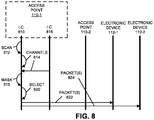
- a second interface circuit in the electronic device may perform a scan (operation 710) of available channels in a shared band of frequencies using a second communication protocol.
- the second interface circuit may determine that there are one or more used channels (operation 712) in the shared band of frequencies that are reserved or used with a first communication protocol, which may be associated with a first interface circuit in the electronic device or another electronic device.
- the second interface circuit may receive, from a first interface circuit, information (operation 714) specifying the one or more used channels in the shared band of frequencies that are reserved or used by the first communication protocol.
- the second interface circuit may mask the one or more used channels (operation 716) from the available channels, and the second interface circuit may select one or more channels (operation 718) from remaining available channels for use with the second communication protocol.
- the electronic device may include an access point or an eNodeB.
- the shared band of frequencies may include 2.4 GHz, 3.5 GHz, 5 GHz, 60 GHz and/or another band of frequencies.
- the first communication protocol and the second communication protocol may include two of: Bluetooth, Bluetooth low energy, Zigbee, Z-Wave, LoRaWAN, Thread, 6LoWPAN and an IEEE 802.11-compatible communication protocol.
- the electronic device optionally performs one or more additional operations.
- the first interface circuit may communicate first packets or frames using the first communication protocol and the one or more used channels
- the second interface circuit may communicate second packets or frames using the second communication protocol and the one or more selected channels.
- the communication by the first interface circuit or the second interface circuit may be concurrent with each other or with another instance, respectively, of the second interface circuit or the first interface circuit in another electronic device.
- one of the first interface circuit and the second interface circuit is coupled to the electronic device using a port in the electronic device, such as a Universal Serial Bus.
- interface circuit 810 may receive, from interface circuit 816, information specifying the one or more used channels 814 in the shared band of frequencies that are reserved or used by the first communication protocol.
- interface circuit 810 may communicate one or more packets 822 or frames to electronic device 112-1 using the second communication protocol, and concurrently, interface circuit 816 may communicate one or more packets 824 or frames to electronic device 112-2 using the first communication protocol.
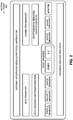
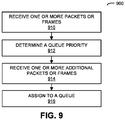
- operation 912 associated with the other electronic device.
- the electronic device may provide additional information, included in the one or more additional packets or frames, to a queue (operation 916) in a set of queues having a latency corresponding to the queue priority.
- the electronic device may include an access point or an eNodeB.
- the queue priority may be determined based at least in part on a header in the one or more packets or frames and a stored data structure with characteristics of different electronic devices.
- the characteristics may include one or more of: an interval between communications with a given electronic device, whether the communications are scheduled, or a type of power source in the given electronic device.
- the additional information may include a type of data traffic, and the data traffic may be provided to the queue based at least in part on a priority associated with the type of data traffic.
- a first subset of the one or more other electronic devices that have battery power are assigned to the second queue and a remainder of the one or more other electronic devices are assigned to the first queue.
- the first subset of the one or more electronic devices have a high priority (such as a smoke detector, a carbon-monoxide detector, a burglar alarm, etc.)
- the first subset of the one or more electronic devices may be assigned to the first queue and the remainder of the one or more other electronic devices may be assigned to the second queue.
- FIG. 10 presents a drawing illustrating an example of communication among access point 110-1 and electronic device 112-1.
- interface circuit 1010 in access point 110-1 may receive one or more packets 1012 or frames from electronic device 112-1.
- Information 1014 in the one or more packets or frames 1012 (such as a MAC address or another identifier of electronic device 112-1) may be provided to processor 1016 in access point 110-1.
- processor 1016 may access one or more characteristics 1018 of electronic device 112-1 stored in memory 1020.
- processor 1016 may determine, based at least in part on information 1014 and characteristics 1018, a queue priority 1022 associated with electronic device 112-1.
- interface circuit 1010 may provide additional information 1026, included in the one or more additional packets or frames 1024, to a queue in a set of queues in memory 1020 having a latency corresponding to queue priority 1022.
- FIG. 11 presents a block diagram illustrating an electronic device 1100 in accordance with some embodiments, such as one of access points 110, electronic devices 112, services manager 114 or computers 116.
- This electronic device includes processing subsystem 1110, memory subsystem 1112, and networking subsystem 1114.
- Processing subsystem 1110 includes one or more devices configured to perform computational operations.
- processing subsystem 1110 can include one or more microprocessors, ASICs, microcontrollers, programmable-logic devices, one or more graphics processing units, and/or one or more digital signal processors ("DSPs").
- DSPs digital signal processors
- Memory subsystem 1112 includes one or more devices for storing data and/or instructions for processing subsystem 1110 and networking subsystem 1114.
- memory subsystem 1112 can include dynamic random access memory (“DRAM”), static random access memory (“SRAM”), and/or other types of memory.
- instructions for processing subsystem 1110 in memory subsystem 1112 include: one or more program modules or sets of instructions (such as program module 1122 or operating system 1124), which may be executed by processing subsystem 1110.
- the one or more computer programs or program modules may constitute a computer-program mechanism.
- instructions in the various modules in memory subsystem 1112 may be implemented in: a high-level procedural language, an object-oriented programming language, and/or in an assembly or machine language.
- the programming language may be compiled or interpreted, e.g., configurable or configured (which may be used interchangeably in this discussion), to be executed by processing subsystem 1110.
- memory subsystem 1112 can include mechanisms for controlling access to the memory.
- memory subsystem 1112 includes a memory hierarchy that comprises one or more caches coupled to a memory in electronic device 1100. In some of these embodiments, one or more of the caches is located in processing subsystem 1110.
- memory subsystem 1112 is coupled to one or more high-capacity mass-storage devices (not shown).
- memory subsystem 1112 can be coupled to a magnetic or optical drive, a solid-state drive, or another type of mass-storage device.
- memory subsystem 1112 can be used by electronic device 1100 as fast-access storage for often-used data, while the mass-storage device is used to store less frequently used data.
- Networking subsystem 1114 includes one or more devices configured to couple to and communicate on a wired and/or wireless network (i.e. , to perform network operations), including: control logic 1116, an interface circuit 1118, an optional cable 1106 and one or more antennas 1120 (or antenna elements), which may be included in an optional antenna module 1130.
- control logic 1116 an interface circuit 1118
- an optional cable 1106 and one or more antennas 1120 (or antenna elements), which may be included in an optional antenna module 1130.
- FIG. 11 includes antenna module 1130
- electronic device 1100 includes one or more nodes, such as nodes 1108, e . g ., a pad, which can be coupled to antenna module 1130.
- electronic device 1100 may or may not include antenna modules 1130.
- an exclusion zone of the given antenna pattern includes a low-intensity region of the given antenna pattern. While the intensity is not necessarily zero in the exclusion zone, it may be below a threshold, such as 3dB or lower than the peak gain of the given antenna pattern.
- the given antenna pattern may include a local maximum (e.g ., a primary beam) that directs gain in the direction of electronic device 1100 that is of interest, and one or more local minima that reduce gain in the direction of other electronic devices that are not of interest. In this way, the given antenna pattern may be selected so that communication that is undesirable (such as with the other electronic devices) is avoided to reduce or eliminate adverse effects, such as interference or crosstalk.
- Bus 1128 may include an electrical, optical, and/or electro-optical connection that the subsystems can use to communicate commands and data among one another. Although only one bus 1128 is shown for clarity, different embodiments can include a different number or configuration of electrical, optical, and/or electro-optical connections among the subsystems.
- the communication technique may be used in a variety of network interfaces.
- the operations in the preceding embodiments were implemented in hardware or software, in general the operations in the preceding embodiments can be implemented in a wide variety of configurations and architectures. Therefore, some or all of the operations in the preceding embodiments may be performed in hardware, in software or both.
- at least some of the operations in the communication technique may be implemented using program module 1122, operating system 1124 (such as a driver for interface circuit 1118) or in firmware in interface circuit 1118.
- the communication technique may occur while processing system 1110 executes program module 1122.
- the communication technique may be implemented at runtime of program module 1122.
- at least some of the operations in the communication technique may be implemented in a physical layer, such as hardware in interface circuit 1118.
- the access point may concurrently transmit to or receive frames or packets from two or more electronic devices.
- the communication protocol in a WLAN may use orthogonal frequency division multiple access (OFDMA).
Landscapes
- Engineering & Computer Science (AREA)
- Computer Networks & Wireless Communication (AREA)
- Signal Processing (AREA)
- Computer Security & Cryptography (AREA)
- Mobile Radio Communication Systems (AREA)
Applications Claiming Priority (1)
| Application Number | Priority Date | Filing Date | Title |
|---|---|---|---|
| US201762586885P | 2017-11-15 | 2017-11-15 |
Publications (1)
| Publication Number | Publication Date |
|---|---|
| EP3487232A1 true EP3487232A1 (de) | 2019-05-22 |
Family
ID=64331808
Family Applications (1)
| Application Number | Title | Priority Date | Filing Date |
|---|---|---|---|
| EP18206547.4A Withdrawn EP3487232A1 (de) | 2017-11-15 | 2018-11-15 | Flexibles gateway für heterogene vorrichtungsverwaltung |
Country Status (2)
| Country | Link |
|---|---|
| US (2) | US10582394B2 (de) |
| EP (1) | EP3487232A1 (de) |
Cited By (1)
| Publication number | Priority date | Publication date | Assignee | Title |
|---|---|---|---|---|
| EP3771156A1 (de) * | 2019-07-24 | 2021-01-27 | Minol Messtechnik W. Lehmann GmbH & Co. KG | Gebäudeseitig installierbare vorrichtung zur heim- und/oder gebäudeautomatisierung und verfahren |
Families Citing this family (16)
| Publication number | Priority date | Publication date | Assignee | Title |
|---|---|---|---|---|
| US10728054B2 (en) | 2015-11-04 | 2020-07-28 | Futurewei Technologies, Inc. | System and method for VNF termination management |
| US10582394B2 (en) * | 2017-11-15 | 2020-03-03 | Arris Enterprises Llc | Flexible gateway for heterogenous-device management |
| US11616781B2 (en) * | 2017-12-05 | 2023-03-28 | Goldilock Secure s.r.o. | Air gap-based network isolation device |
| US10862971B2 (en) | 2018-04-27 | 2020-12-08 | EMC IP Holding Company LLC | Internet of things gateway service for a cloud foundry platform |
| US10715640B2 (en) * | 2018-07-13 | 2020-07-14 | EMC IP Holding Company LLC | Internet of things gateways of moving networks |
| US11277351B2 (en) * | 2018-11-08 | 2022-03-15 | Arris Enterprises Llc | Priority-based queueing for scalable device communication |
| WO2020251963A1 (en) | 2019-06-11 | 2020-12-17 | Arris Enterprises Llc | Network performance monitoring and anomaly detection |
| EP4026302B1 (de) * | 2019-09-06 | 2023-09-20 | R3 Iot Limited | Ein gateway zur kommunikation mit "onborading" geräten und verfahren dafür |
| CN111601397B (zh) * | 2020-05-08 | 2021-08-20 | 河北平普科技有限公司 | 一种基于移动终端的向区块链系统发送交易信息的方法及系统 |
| CN111641717B (zh) * | 2020-06-01 | 2022-11-11 | 重庆高开清芯智联网络科技有限公司 | 一种物联网系统内节点数据的管理方法 |
| CN112671638B (zh) * | 2021-01-13 | 2022-10-04 | 北京方正数码有限公司 | 一种用于多协议转换的网关结构 |
| US12218832B1 (en) * | 2021-03-31 | 2025-02-04 | Amazon Technologies, Inc. | Managing and routing payloads for client edge devices that use multiple types of radios |
| US11751069B2 (en) * | 2021-05-06 | 2023-09-05 | Nivid Technologies | System and method for identification, selection and validation of best network access for IoT devices |
| US11711862B1 (en) | 2021-07-15 | 2023-07-25 | T-Mobile Usa, Inc. | Dual connectivity and carrier aggregation band selection |
| TWI767821B (zh) * | 2021-08-13 | 2022-06-11 | 大陸商美律電子(深圳)有限公司 | 物聯網系統 |
| US20250031200A1 (en) * | 2023-07-18 | 2025-01-23 | Comcast Cable Communications, Llc | Systems and Methods for Traffic Management |
Citations (6)
| Publication number | Priority date | Publication date | Assignee | Title |
|---|---|---|---|---|
| US20150146656A1 (en) * | 2013-11-26 | 2015-05-28 | Marvell World Trade Ltd. | Coexistence techniques for wide area network devices operating in unlicensed bands |
| US20160286251A1 (en) * | 2015-03-25 | 2016-09-29 | Samsung Electronics Co., Ltd. | Device supporting multipath transport control protocol and method by which device receives video data through streaming |
| US20170041859A1 (en) * | 2015-08-06 | 2017-02-09 | Ruckus Wireless, Inc. | Discovery and security in lwa communication |
| US20170202015A1 (en) * | 2016-01-11 | 2017-07-13 | Apple Inc. | Channel access policy control during wireless communication |
| EP3211937A1 (de) * | 2016-02-23 | 2017-08-30 | Nokia Technologies Oy | Verfahren, vorrichtung und computerprogrammprodukt zur auswahl eines drahtlosnahbereichskommunikationskanals |
| US20170311171A1 (en) * | 2016-04-21 | 2017-10-26 | Apple Inc. | Dynamic frequency selection proxy |
Family Cites Families (24)
| Publication number | Priority date | Publication date | Assignee | Title |
|---|---|---|---|---|
| US5712624A (en) * | 1995-03-03 | 1998-01-27 | Motorola, Inc. | Method and apparatus for optimizing receiver synchronization in a radio communication system |
| US9225632B2 (en) | 2005-09-16 | 2015-12-29 | Hewlett Packard Enterprise Development Lp | Globally fair polling for packet switched routers using dynamically biased arbitration |
| US20080159208A1 (en) * | 2006-12-28 | 2008-07-03 | Motorola, Inc. | Method and apparatus for allocation of shared spectrum in a wireless communication system |
| KR101502599B1 (ko) * | 2008-01-30 | 2015-03-13 | 삼성전자주식회사 | 통신 시스템을 위한 접속 모드 제어 장치 및 그 방법 |
| US20120327778A1 (en) | 2011-06-22 | 2012-12-27 | Cygnus Broadband, Inc. | Systems and methods for prioritizing and scheduling packets in a communication network |
| US8775669B2 (en) * | 2010-03-25 | 2014-07-08 | United Parcel Service Of America, Inc. | Data communication systems and methods |
| US8411692B2 (en) * | 2010-08-26 | 2013-04-02 | Sony Corporation | Multi-hop heterogeneous wireless device feature sharing |
| US8976744B2 (en) | 2010-11-03 | 2015-03-10 | Broadcom Corporation | Vehicle communication network including wireless communications |
| US8843177B2 (en) * | 2011-04-22 | 2014-09-23 | Belkin International, Inc. | Mobile electronic device accessory and method of providing the same |
| US8732031B2 (en) | 2012-06-12 | 2014-05-20 | Sensity Systems, Inc. | Lighting infrastructure and revenue model |
| US8875154B2 (en) * | 2013-01-25 | 2014-10-28 | American Megatrends, Inc. | Interface specific and parallel IPMI message handling at baseboard management controller |
| US9407573B2 (en) * | 2013-08-29 | 2016-08-02 | Mentor Graphics Corporation | Bandwidth control in a controller area network (CAN) |
| US9577773B2 (en) * | 2014-05-06 | 2017-02-21 | Verizon Patent And Licensing Inc. | Station assisted interference measurement |
| US10078865B2 (en) | 2014-09-08 | 2018-09-18 | Leeo, Inc. | Sensor-data sub-contracting during environmental monitoring |
| US9949169B2 (en) * | 2015-05-22 | 2018-04-17 | Qualcomm Incorporated | Control flow enhancements for LTE-unlicensed |
| US9967080B2 (en) * | 2015-06-10 | 2018-05-08 | Qualcomm Incorporated | Techniques for managing medium access to multi-channels of a shared radio frequency spectrum band |
| US20180206282A1 (en) * | 2015-07-13 | 2018-07-19 | Intel Corporation | Bearer splitting |
| US10397388B2 (en) * | 2015-11-02 | 2019-08-27 | Hand Held Products, Inc. | Extended features for network communication |
| US10820356B2 (en) * | 2015-12-11 | 2020-10-27 | Huawei Technologies Co., Ltd. | Method and system for contention-based channel allocation |
| FR3048150B1 (fr) * | 2016-02-22 | 2018-11-09 | Thales | Systeme integre de radiocommunication a couverture cellulaire hierarchique ordonnee |
| US10123214B2 (en) * | 2016-12-14 | 2018-11-06 | Dell Products, Lp | Method and apparatus for optimizing multi-protocol radio technology using local QOS advertising |
| US10333807B2 (en) * | 2016-12-22 | 2019-06-25 | Dell Products, Lp | Method and apparatus for selecting among multi-protocol radio technology using local QoS advertisement |
| US10411755B2 (en) * | 2017-04-18 | 2019-09-10 | Ajou University Industry-Academic Cooperation Foundation | Method of sharing spectrum by frequency hopping and communication system using the same |
| US10582394B2 (en) * | 2017-11-15 | 2020-03-03 | Arris Enterprises Llc | Flexible gateway for heterogenous-device management |
-
2018
- 2018-11-08 US US16/185,002 patent/US10582394B2/en active Active
- 2018-11-15 EP EP18206547.4A patent/EP3487232A1/de not_active Withdrawn
-
2020
- 2020-01-22 US US16/749,022 patent/US11678197B2/en active Active
Patent Citations (6)
| Publication number | Priority date | Publication date | Assignee | Title |
|---|---|---|---|---|
| US20150146656A1 (en) * | 2013-11-26 | 2015-05-28 | Marvell World Trade Ltd. | Coexistence techniques for wide area network devices operating in unlicensed bands |
| US20160286251A1 (en) * | 2015-03-25 | 2016-09-29 | Samsung Electronics Co., Ltd. | Device supporting multipath transport control protocol and method by which device receives video data through streaming |
| US20170041859A1 (en) * | 2015-08-06 | 2017-02-09 | Ruckus Wireless, Inc. | Discovery and security in lwa communication |
| US20170202015A1 (en) * | 2016-01-11 | 2017-07-13 | Apple Inc. | Channel access policy control during wireless communication |
| EP3211937A1 (de) * | 2016-02-23 | 2017-08-30 | Nokia Technologies Oy | Verfahren, vorrichtung und computerprogrammprodukt zur auswahl eines drahtlosnahbereichskommunikationskanals |
| US20170311171A1 (en) * | 2016-04-21 | 2017-10-26 | Apple Inc. | Dynamic frequency selection proxy |
Cited By (1)
| Publication number | Priority date | Publication date | Assignee | Title |
|---|---|---|---|---|
| EP3771156A1 (de) * | 2019-07-24 | 2021-01-27 | Minol Messtechnik W. Lehmann GmbH & Co. KG | Gebäudeseitig installierbare vorrichtung zur heim- und/oder gebäudeautomatisierung und verfahren |
Also Published As
| Publication number | Publication date |
|---|---|
| US20200162933A1 (en) | 2020-05-21 |
| US20190150074A1 (en) | 2019-05-16 |
| US10582394B2 (en) | 2020-03-03 |
| US11678197B2 (en) | 2023-06-13 |
Similar Documents
| Publication | Publication Date | Title |
|---|---|---|
| US11678197B2 (en) | Flexible gateway for heterogeneous-device management | |
| US11277351B2 (en) | Priority-based queueing for scalable device communication | |
| US12132808B2 (en) | User interface for configuring device-specific IOT applications | |
| US11564074B2 (en) | GAP and GATT adaptation protocol over internet protocol | |
| US11546150B2 (en) | Secure scalable link key distribution using bootsrapping | |
| Khanh et al. | Wireless communication technologies for IoT in 5G: Vision, applications, and challenges | |
| US11395150B2 (en) | Coordinated and distributed frequency separation during coexisting communication | |
| US11140529B2 (en) | Multi-access edge computing (MEC) based multi operator support for C-V2X systems | |
| Palattella et al. | Internet of things in the 5G era: Enablers, architecture, and business models | |
| US9479450B2 (en) | Resolving communication collisions in a heterogeneous network | |
| US8917651B2 (en) | Associating wi-fi stations with an access point in a multi-access point infrastructure network | |
| JP2022522630A (ja) | 5g以降を用いた産業自動化 | |
| US20170111301A1 (en) | Client side queue sharding | |
| US20230389060A1 (en) | Allocating Resources To A Plurality Of Mobile Devices | |
| US20230393878A1 (en) | Dynamic access-point configuration with containerized applications | |
| US12603849B2 (en) | Method and apparatus for updating packet processing rule at high speed in SDN network environment | |
| WO2025144605A1 (en) | Coordinated peer-to-peer transmission opportunities | |
| US12621719B2 (en) | Conflict management in a shared O-RAN architecture | |
| US20240422622A1 (en) | Conflict management in a shared o-ran architecture | |
| CN119968793A (zh) | 用于多发射/接收点无线操作的增强型无线接入网波束信令和波束故障恢复 | |
| CN118614049A (zh) | 用于支持无标签以太网帧的技术 | |
| Yousuf et al. | BOARD OF EXAMINERS |
Legal Events
| Date | Code | Title | Description |
|---|---|---|---|
| PUAI | Public reference made under article 153(3) epc to a published international application that has entered the european phase |
Free format text: ORIGINAL CODE: 0009012 |
|
| STAA | Information on the status of an ep patent application or granted ep patent |
Free format text: STATUS: THE APPLICATION HAS BEEN PUBLISHED |
|
| AK | Designated contracting states |
Kind code of ref document: A1 Designated state(s): AL AT BE BG CH CY CZ DE DK EE ES FI FR GB GR HR HU IE IS IT LI LT LU LV MC MK MT NL NO PL PT RO RS SE SI SK SM TR |
|
| AX | Request for extension of the european patent |
Extension state: BA ME |
|
| STAA | Information on the status of an ep patent application or granted ep patent |
Free format text: STATUS: REQUEST FOR EXAMINATION WAS MADE |
|
| 17P | Request for examination filed |
Effective date: 20191122 |
|
| RBV | Designated contracting states (corrected) |
Designated state(s): AL AT BE BG CH CY CZ DE DK EE ES FI FR GB GR HR HU IE IS IT LI LT LU LV MC MK MT NL NO PL PT RO RS SE SI SK SM TR |
|
| STAA | Information on the status of an ep patent application or granted ep patent |
Free format text: STATUS: EXAMINATION IS IN PROGRESS |
|
| 17Q | First examination report despatched |
Effective date: 20200210 |
|
| GRAP | Despatch of communication of intention to grant a patent |
Free format text: ORIGINAL CODE: EPIDOSNIGR1 |
|
| STAA | Information on the status of an ep patent application or granted ep patent |
Free format text: STATUS: GRANT OF PATENT IS INTENDED |
|
| RIC1 | Information provided on ipc code assigned before grant |
Ipc: H04W 88/06 20090101ALN20230531BHEP Ipc: H04W 74/08 20090101ALI20230531BHEP Ipc: H04W 72/12 20090101ALI20230531BHEP Ipc: H04W 48/18 20090101ALI20230531BHEP Ipc: H04W 48/16 20090101AFI20230531BHEP |
|
| RIC1 | Information provided on ipc code assigned before grant |
Ipc: H04W 88/06 20090101ALN20230608BHEP Ipc: H04W 74/08 20090101ALI20230608BHEP Ipc: H04W 72/12 20090101ALI20230608BHEP Ipc: H04W 48/18 20090101ALI20230608BHEP Ipc: H04W 48/16 20090101AFI20230608BHEP |
|
| RIC1 | Information provided on ipc code assigned before grant |
Ipc: H04W 88/06 20090101ALN20230615BHEP Ipc: H04W 74/08 20090101ALI20230615BHEP Ipc: H04W 72/12 20090101ALI20230615BHEP Ipc: H04W 48/18 20090101ALI20230615BHEP Ipc: H04W 48/16 20090101AFI20230615BHEP |
|
| INTG | Intention to grant announced |
Effective date: 20230704 |
|
| STAA | Information on the status of an ep patent application or granted ep patent |
Free format text: STATUS: THE APPLICATION IS DEEMED TO BE WITHDRAWN |
|
| 18D | Application deemed to be withdrawn |
Effective date: 20231115 |