EP3487119A1 - Zweikanaliges authentifizierungsproxysystem mit fähigkeit zur erkennung von anwendungsmanipulation und verfahren dafür - Google Patents
Zweikanaliges authentifizierungsproxysystem mit fähigkeit zur erkennung von anwendungsmanipulation und verfahren dafür Download PDFInfo
- Publication number
- EP3487119A1 EP3487119A1 EP17827821.4A EP17827821A EP3487119A1 EP 3487119 A1 EP3487119 A1 EP 3487119A1 EP 17827821 A EP17827821 A EP 17827821A EP 3487119 A1 EP3487119 A1 EP 3487119A1
- Authority
- EP
- European Patent Office
- Prior art keywords
- authentication
- app
- data
- mobile terminal
- terminal
- Prior art date
- Legal status (The legal status is an assumption and is not a legal conclusion. Google has not performed a legal analysis and makes no representation as to the accuracy of the status listed.)
- Granted
Links
Images




Classifications
-
- H—ELECTRICITY
- H04—ELECTRIC COMMUNICATION TECHNIQUE
- H04L—TRANSMISSION OF DIGITAL INFORMATION, e.g. TELEGRAPHIC COMMUNICATION
- H04L9/00—Cryptographic mechanisms or cryptographic arrangements for secret or secure communications; Network security protocols
- H04L9/32—Cryptographic mechanisms or cryptographic arrangements for secret or secure communications; Network security protocols including means for verifying the identity or authority of a user of the system or for message authentication, e.g. authorization, entity authentication, data integrity or data verification, non-repudiation, key authentication or verification of credentials
- H04L9/3215—Cryptographic mechanisms or cryptographic arrangements for secret or secure communications; Network security protocols including means for verifying the identity or authority of a user of the system or for message authentication, e.g. authorization, entity authentication, data integrity or data verification, non-repudiation, key authentication or verification of credentials using a plurality of channels
-
- H—ELECTRICITY
- H04—ELECTRIC COMMUNICATION TECHNIQUE
- H04L—TRANSMISSION OF DIGITAL INFORMATION, e.g. TELEGRAPHIC COMMUNICATION
- H04L63/00—Network architectures or network communication protocols for network security
- H04L63/08—Network architectures or network communication protocols for network security for authentication of entities
- H04L63/0884—Network architectures or network communication protocols for network security for authentication of entities by delegation of authentication, e.g. a proxy authenticates an entity to be authenticated on behalf of this entity vis-à-vis an authentication entity
-
- G—PHYSICS
- G06—COMPUTING OR CALCULATING; COUNTING
- G06F—ELECTRIC DIGITAL DATA PROCESSING
- G06F21/00—Security arrangements for protecting computers, components thereof, programs or data against unauthorised activity
- G06F21/30—Authentication, i.e. establishing the identity or authorisation of security principals
- G06F21/44—Program or device authentication
-
- G—PHYSICS
- G06—COMPUTING OR CALCULATING; COUNTING
- G06F—ELECTRIC DIGITAL DATA PROCESSING
- G06F21/00—Security arrangements for protecting computers, components thereof, programs or data against unauthorised activity
- G06F21/30—Authentication, i.e. establishing the identity or authorisation of security principals
- G06F21/31—User authentication
- G06F21/316—User authentication by observing the pattern of computer usage, e.g. typical user behaviour
-
- G—PHYSICS
- G06—COMPUTING OR CALCULATING; COUNTING
- G06F—ELECTRIC DIGITAL DATA PROCESSING
- G06F21/00—Security arrangements for protecting computers, components thereof, programs or data against unauthorised activity
- G06F21/30—Authentication, i.e. establishing the identity or authorisation of security principals
- G06F21/45—Structures or tools for the administration of authentication
- G06F21/46—Structures or tools for the administration of authentication by designing passwords or checking the strength of passwords
-
- G—PHYSICS
- G06—COMPUTING OR CALCULATING; COUNTING
- G06F—ELECTRIC DIGITAL DATA PROCESSING
- G06F21/00—Security arrangements for protecting computers, components thereof, programs or data against unauthorised activity
- G06F21/50—Monitoring users, programs or devices to maintain the integrity of platforms, e.g. of processors, firmware or operating systems
- G06F21/55—Detecting local intrusion or implementing counter-measures
- G06F21/554—Detecting local intrusion or implementing counter-measures involving event detection and direct action
-
- H—ELECTRICITY
- H04—ELECTRIC COMMUNICATION TECHNIQUE
- H04L—TRANSMISSION OF DIGITAL INFORMATION, e.g. TELEGRAPHIC COMMUNICATION
- H04L63/00—Network architectures or network communication protocols for network security
- H04L63/02—Network architectures or network communication protocols for network security for separating internal from external traffic, e.g. firewalls
- H04L63/0281—Proxies
-
- H—ELECTRICITY
- H04—ELECTRIC COMMUNICATION TECHNIQUE
- H04L—TRANSMISSION OF DIGITAL INFORMATION, e.g. TELEGRAPHIC COMMUNICATION
- H04L63/00—Network architectures or network communication protocols for network security
- H04L63/08—Network architectures or network communication protocols for network security for authentication of entities
- H04L63/083—Network architectures or network communication protocols for network security for authentication of entities using passwords
- H04L63/0838—Network architectures or network communication protocols for network security for authentication of entities using passwords using one-time-passwords
-
- H—ELECTRICITY
- H04—ELECTRIC COMMUNICATION TECHNIQUE
- H04L—TRANSMISSION OF DIGITAL INFORMATION, e.g. TELEGRAPHIC COMMUNICATION
- H04L63/00—Network architectures or network communication protocols for network security
- H04L63/08—Network architectures or network communication protocols for network security for authentication of entities
- H04L63/0876—Network architectures or network communication protocols for network security for authentication of entities based on the identity of the terminal or configuration, e.g. MAC address, hardware or software configuration or device fingerprint
-
- H—ELECTRICITY
- H04—ELECTRIC COMMUNICATION TECHNIQUE
- H04L—TRANSMISSION OF DIGITAL INFORMATION, e.g. TELEGRAPHIC COMMUNICATION
- H04L63/00—Network architectures or network communication protocols for network security
- H04L63/12—Applying verification of the received information
- H04L63/123—Applying verification of the received information received data contents, e.g. message integrity
-
- H—ELECTRICITY
- H04—ELECTRIC COMMUNICATION TECHNIQUE
- H04L—TRANSMISSION OF DIGITAL INFORMATION, e.g. TELEGRAPHIC COMMUNICATION
- H04L63/00—Network architectures or network communication protocols for network security
- H04L63/12—Applying verification of the received information
- H04L63/126—Applying verification of the received information the source of the received data
-
- H—ELECTRICITY
- H04—ELECTRIC COMMUNICATION TECHNIQUE
- H04L—TRANSMISSION OF DIGITAL INFORMATION, e.g. TELEGRAPHIC COMMUNICATION
- H04L63/00—Network architectures or network communication protocols for network security
- H04L63/14—Network architectures or network communication protocols for network security for detecting or protecting against malicious traffic
- H04L63/1441—Countermeasures against malicious traffic
- H04L63/1466—Active attacks involving interception, injection, modification, spoofing of data unit addresses, e.g. hijacking, packet injection or TCP sequence number attacks
-
- H—ELECTRICITY
- H04—ELECTRIC COMMUNICATION TECHNIQUE
- H04L—TRANSMISSION OF DIGITAL INFORMATION, e.g. TELEGRAPHIC COMMUNICATION
- H04L9/00—Cryptographic mechanisms or cryptographic arrangements for secret or secure communications; Network security protocols
- H04L9/08—Key distribution or management, e.g. generation, sharing or updating, of cryptographic keys or passwords
-
- H—ELECTRICITY
- H04—ELECTRIC COMMUNICATION TECHNIQUE
- H04L—TRANSMISSION OF DIGITAL INFORMATION, e.g. TELEGRAPHIC COMMUNICATION
- H04L9/00—Cryptographic mechanisms or cryptographic arrangements for secret or secure communications; Network security protocols
- H04L9/08—Key distribution or management, e.g. generation, sharing or updating, of cryptographic keys or passwords
- H04L9/0861—Generation of secret information including derivation or calculation of cryptographic keys or passwords
- H04L9/0863—Generation of secret information including derivation or calculation of cryptographic keys or passwords involving passwords or one-time passwords
-
- H—ELECTRICITY
- H04—ELECTRIC COMMUNICATION TECHNIQUE
- H04L—TRANSMISSION OF DIGITAL INFORMATION, e.g. TELEGRAPHIC COMMUNICATION
- H04L9/00—Cryptographic mechanisms or cryptographic arrangements for secret or secure communications; Network security protocols
- H04L9/32—Cryptographic mechanisms or cryptographic arrangements for secret or secure communications; Network security protocols including means for verifying the identity or authority of a user of the system or for message authentication, e.g. authorization, entity authentication, data integrity or data verification, non-repudiation, key authentication or verification of credentials
-
- H—ELECTRICITY
- H04—ELECTRIC COMMUNICATION TECHNIQUE
- H04L—TRANSMISSION OF DIGITAL INFORMATION, e.g. TELEGRAPHIC COMMUNICATION
- H04L9/00—Cryptographic mechanisms or cryptographic arrangements for secret or secure communications; Network security protocols
- H04L9/32—Cryptographic mechanisms or cryptographic arrangements for secret or secure communications; Network security protocols including means for verifying the identity or authority of a user of the system or for message authentication, e.g. authorization, entity authentication, data integrity or data verification, non-repudiation, key authentication or verification of credentials
- H04L9/321—Cryptographic mechanisms or cryptographic arrangements for secret or secure communications; Network security protocols including means for verifying the identity or authority of a user of the system or for message authentication, e.g. authorization, entity authentication, data integrity or data verification, non-repudiation, key authentication or verification of credentials involving a third party or a trusted authority
- H04L9/3213—Cryptographic mechanisms or cryptographic arrangements for secret or secure communications; Network security protocols including means for verifying the identity or authority of a user of the system or for message authentication, e.g. authorization, entity authentication, data integrity or data verification, non-repudiation, key authentication or verification of credentials involving a third party or a trusted authority using tickets or tokens, e.g. Kerberos
-
- H—ELECTRICITY
- H04—ELECTRIC COMMUNICATION TECHNIQUE
- H04L—TRANSMISSION OF DIGITAL INFORMATION, e.g. TELEGRAPHIC COMMUNICATION
- H04L9/00—Cryptographic mechanisms or cryptographic arrangements for secret or secure communications; Network security protocols
- H04L9/32—Cryptographic mechanisms or cryptographic arrangements for secret or secure communications; Network security protocols including means for verifying the identity or authority of a user of the system or for message authentication, e.g. authorization, entity authentication, data integrity or data verification, non-repudiation, key authentication or verification of credentials
- H04L9/3226—Cryptographic mechanisms or cryptographic arrangements for secret or secure communications; Network security protocols including means for verifying the identity or authority of a user of the system or for message authentication, e.g. authorization, entity authentication, data integrity or data verification, non-repudiation, key authentication or verification of credentials using a predetermined code, e.g. password, passphrase or PIN
-
- H—ELECTRICITY
- H04—ELECTRIC COMMUNICATION TECHNIQUE
- H04L—TRANSMISSION OF DIGITAL INFORMATION, e.g. TELEGRAPHIC COMMUNICATION
- H04L9/00—Cryptographic mechanisms or cryptographic arrangements for secret or secure communications; Network security protocols
- H04L9/32—Cryptographic mechanisms or cryptographic arrangements for secret or secure communications; Network security protocols including means for verifying the identity or authority of a user of the system or for message authentication, e.g. authorization, entity authentication, data integrity or data verification, non-repudiation, key authentication or verification of credentials
- H04L9/3226—Cryptographic mechanisms or cryptographic arrangements for secret or secure communications; Network security protocols including means for verifying the identity or authority of a user of the system or for message authentication, e.g. authorization, entity authentication, data integrity or data verification, non-repudiation, key authentication or verification of credentials using a predetermined code, e.g. password, passphrase or PIN
- H04L9/3228—One-time or temporary data, i.e. information which is sent for every authentication or authorization, e.g. one-time-password, one-time-token or one-time-key
-
- H—ELECTRICITY
- H04—ELECTRIC COMMUNICATION TECHNIQUE
- H04W—WIRELESS COMMUNICATION NETWORKS
- H04W12/00—Security arrangements; Authentication; Protecting privacy or anonymity
- H04W12/06—Authentication
-
- H—ELECTRICITY
- H04—ELECTRIC COMMUNICATION TECHNIQUE
- H04W—WIRELESS COMMUNICATION NETWORKS
- H04W12/00—Security arrangements; Authentication; Protecting privacy or anonymity
- H04W12/30—Security of mobile devices; Security of mobile applications
-
- G—PHYSICS
- G06—COMPUTING OR CALCULATING; COUNTING
- G06F—ELECTRIC DIGITAL DATA PROCESSING
- G06F2221/00—Indexing scheme relating to security arrangements for protecting computers, components thereof, programs or data against unauthorised activity
- G06F2221/21—Indexing scheme relating to G06F21/00 and subgroups addressing additional information or applications relating to security arrangements for protecting computers, components thereof, programs or data against unauthorised activity
- G06F2221/2119—Authenticating web pages, e.g. with suspicious links
-
- G—PHYSICS
- G06—COMPUTING OR CALCULATING; COUNTING
- G06F—ELECTRIC DIGITAL DATA PROCESSING
- G06F2221/00—Indexing scheme relating to security arrangements for protecting computers, components thereof, programs or data against unauthorised activity
- G06F2221/21—Indexing scheme relating to G06F21/00 and subgroups addressing additional information or applications relating to security arrangements for protecting computers, components thereof, programs or data against unauthorised activity
- G06F2221/2129—Authenticate client device independently of the user
-
- H—ELECTRICITY
- H04—ELECTRIC COMMUNICATION TECHNIQUE
- H04L—TRANSMISSION OF DIGITAL INFORMATION, e.g. TELEGRAPHIC COMMUNICATION
- H04L2209/00—Additional information or applications relating to cryptographic mechanisms or cryptographic arrangements for secret or secure communication H04L9/00
- H04L2209/80—Wireless
Definitions
- the present invention relates to a two-channel authentication proxy system and method for detecting application (app) tampering in which a mobile terminal is used as an authentication tool.
- the present invention relates to a method of detecting tampering of a specific application installed on a mobile terminal which is used as an authentication tool, and an authentication proxy system and method in which a reliable authentication proxy server authenticates N (N ⁇ 1) websites by using a mobile terminal without performing individual authentication and the results are relayed to a registered website requiring authentication.
- An owner of a smart phone can be specified through mobile terminal device information of a smart phone on which an app is installed. In this way, authentication for specifying a user is possible through only device authentication without inputting an identification (ID)/password.
- app stores recommend developers to obfuscate sources before releasing apps.
- a mobile banking app is being widespread, and various kinds of important information such as authentication information for banking may be leaked when a tampering app is executed. Therefore, there is a technology for verifying integrity of an app in conjunction with a tampering detection server when the app is executed.
- Patent Publication No. 10-2013-0112786 "Application for Authentication, Membership Registration, and Payment Services Based on Mobile Communication Terminal (Kim Juhan)"
- Literature 1 discloses a technology for acquiring data through a quick response (QR) code or near field communication (NFC) with an app installed on a mobile terminal and transferring data of an agreed format by running an authentication app or transferring the data of the agreed format (see FIG. 7 ) by running an authentication app in a mobile web browser of the mobile terminal when the acquired data is the data of the agreed format such that authentication, joining, and payment may be performed in a client terminal without inputting any ID or password.
- QR quick response
- NFC near field communication
- an app installed on a smart phone may be analyzed through reverse engineering (decompiling), and then a source code thereof may be extracted. Even when source codes are obfuscated, it is not possible to ensure that obfuscation technology is always perfect, and it is likely that a source code will be leaked by an internal developer.
- a source code is analyzed, a parameter type transferred to an authentication proxy server and an encryption algorithm may be obtained. Therefore, it is possible to set and encrypt fake data in a parameter and transfer the fake data to the authentication proxy server.
- OSs mobile operating systems
- a malicious attacker acquires a password and device information of a person who is a target for an attack and then installs a tampered app whose parameter can be tampered on a smart phone of the attacker. Subsequently, collected device information is set in a parameter, and authentication is attempted, such that the malicious attacker may be authenticated with the set device information by an authentication proxy server.
- the mobile banking app requires a separate tampering detection system because it is necessary to check integrity of the app in conjunction with a tampering detection server immediately after the app is executed. However, if possible, it would be better to detect tampering of apps without a separate tampering detection system.
- the present invention is directed to providing a mobile application (app) tampering detection method in which an authentication attempt for a malicious purpose is blocked by authenticating a device and checking the authenticity of an app installed on the device even when an attacker having a malicious purpose acquires an app source, creates and installs a fake app whose parameter can be tampered, acquires device information and authentication information required for authentication, and attempts authentication.
- the present invention is also directed to providing an authentication proxy system for preventing damage from a phishing/pharming website, which is a webpage created to be so delicate that it is difficult to distinguish between truth and falsehood with the naked eye by an attacker having a malicious purpose to induce access, by blocking a user's access to unregistered websites.
- the present invention is also directed to providing an authentication proxy system for fundamentally preventing joining or login (authentication) to an age-limited website, which limits access according to age, when a user of a mobile terminal is underage on the basis of the user's birthdate.
- the present invention is also directed to providing an authentication proxy system in which a reliable third-party organization performs authentication by proxy and keeps authentication records, when an authentication-related conflict occurs, a person who makes an authentication request cannot deny that the authentication request has not been made by himself or herself because data tracking is possible, and it is possible to prevent repudiation by preventing a man-in-the-middle (MITM) attack and a replay attack in a network.
- MITM man-in-the-middle
- One aspect of the present invention provides an authentication proxy system using a mobile terminal, the system including, in order to register a device and an authentication application (app) of a mobile terminal 100 whose identity has been verified: a client terminal 10 of an authentication proxy server 200 configured to receive key inputs of a phone number of the mobile terminal 100 and an app password for check and apply for use of an authentication app 110; the authentication proxy server 200 including an authentication app usage acceptance unit 205 configured to register the phone number of the mobile terminal 100 and the app password in a terminal information table 291 in response to the application for use of the authentication app 110 from the client terminal 10, and a terminal information registration unit 206 configured to issue a one-time app identification (ID) and register terminal information when the terminal information and the app password for check are received due to access of the mobile terminal 100; and the mobile terminal 100 having the authentication app 110 configured to be executed and approved for use at first and then to acquire the terminal information, get the app password input for check, request terminal registration, receive the one-time app ID, a primary decryption check code, and a secondary
- the terminal information may include at least a terminal identification number and the phone number of the mobile terminal 100
- the terminal information registration unit 206 may include: a means configured to determine whether there is an application for use of the authentication app 110 by referring to the terminal information table 291 with the received phone number and app password, issue an initial one-time app ID when an application is valid, acquire a user ID by referring to a user information table 293 with the received phone number, and register the terminal by updating the terminal information table 291 with the terminal identification number, the user ID, and the one-time app ID; and a means configured to respond to the mobile terminal 100 which has requested terminal registration with the one-time app ID and content of the primary and secondary decryption check codes 202 after registration of the terminal information.
- the private area 111 may be a dedicated area in which only the authentication app 110 is authorized to read and write, and at least the one-time app ID, the primary decryption check code, and the secondary decryption check code are stored, and when the app is removed or reinstalled (repackaged), data stored in the private area 111 may be deleted.
- the authentication app 110 installed on the mobile terminal 100 may include: a netkey receiving unit 112 configured to receive a parameter composed of a header portion and a data portion when the app is executed and determine whether the parameter has consistency; an encryption and authentication request unit 113 configured to generate and encrypt authentication request data and request authentication; an authentication result receiving unit 114 configured to receive at least a result code, a user name, a website name, and an encrypted new app ID; a one-time app ID update unit 115 configured to decrypt the encrypted new app ID and update the private area 111 with the decrypted new app ID; and an authentication result display unit 116 configured to generate and display a message including the user name and the website name according to the result code.
- a netkey receiving unit 112 configured to receive a parameter composed of a header portion and a data portion when the app is executed and determine whether the parameter has consistency
- an encryption and authentication request unit 113 configured to generate and encrypt authentication request data and request authentication
- an authentication result receiving unit 114 configured to receive at least a result code
- the authentication proxy server 200 may further include: a decryption and authentication proxy unit 210 configured to decrypt encrypted authentication request data and perform authentication by proxy in response to an authentication request from the mobile terminal 100; a token relay unit 220 configured to relay at least a user ID and a token to a service server 300 and receive a result code; a relay log recording unit 230 configured to record details of the token relayed for preventing repudiation; a one-time app ID issuing unit 240 configured to issue and update a new one-time app ID; and an authentication result transmitting unit 250 configured to generate authentication result data and respond to the authentication request with the authentication result data.
- a decryption and authentication proxy unit 210 configured to decrypt encrypted authentication request data and perform authentication by proxy in response to an authentication request from the mobile terminal 100
- a token relay unit 220 configured to relay at least a user ID and a token to a service server 300 and receive a result code
- a relay log recording unit 230 configured to record details of the token relayed for preventing repudiation
- the encryption and authentication request unit 113 may include: an information acquisition means configured to acquire a terminal identification number, acquire the one-time app ID, the primary decryption check code, and the secondary decryption check code from the private area 111, acquire an app version of the authentication app 110, and receive the key input of the app password; a primary encryption means configured to attach the secondary decryption check code to the data portion of the parameter and encrypt the data portion by using the app password as an encryption key; a secondary encryption means configured to attach the primary decryption check code and the app version to the primarily encrypted data and encrypt the primarily encrypted data by using the one-time app ID as an encryption key; and a data generation means configured to generate the authentication request data by attaching the terminal identification number to the secondarily encrypted data, and the encryption and authentication request unit 113 may request the authentication proxy server 200 to authenticate the generated authentication request data.
- the decryption and authentication proxy unit 210 may include: a means for authenticating a device of the mobile terminal 100 and configured to extract a terminal identification number and encrypted data from the received authentication request data and acquire the user ID, the one-time app ID, and the app password by using the terminal identification number as a key and referring to the terminal information table 291; an app authentication means configured to primarily decrypt the encrypted data by using the one-time app ID as a decryption key, extract the primary decryption check code from the primarily decrypted data, and detect whether the app has been tampered and then reinstalled (repackaged) by determining whether the extracted primary decryption check code coincides with a primary decryption check code in a memory; an app version identification means configured to extract an app version from the primarily decrypted data and determine whether the extracted app version coincides with an app version in the memory; an app password authentication means configured to extract encrypted data from the primarily decrypted data, secondarily decrypt the encrypted data by using the app
- the relay log recording unit 230 may set a token issuer ID in a relay log table 294 to an affiliated store ID for specifying the service server 300 which has issued the token, set a processed token to the token, set an authentication result to the result code received from the service server 300, set a user ID to the user ID of the mobile terminal 100, set a token processing time stamp to a system time of the authentication proxy server 200, and register the set data such that data tracking is possible and repudiation of an authentication result can be prevented when an authentication-related conflict occurs.
- Another aspect of the present invention provides an authentication method implemented in a two-channel authentication proxy system, the method including: a parameter check step (S100) in which an authentication app 110 checks whether there is each item of a parameter composed of a header portion and a data portion and consistency of the parameter; a step (S102) of acquiring an access URL of an authentication proxy server 200 related to an identification code of the header portion; an information acquisition step (S103) of collecting data including a one-time app ID and required for an authentication request; a step (S104) of receiving a key input of an app password which will be used as an encryption key; a data generation and encryption step (S105) of generating and encrypting authentication request data which will be transmitted to the authentication proxy server 200; an authentication request step (S106) of accessing the acquired URL, transmitting the authentication request data, and receiving authentication result data; a step (S107) of extracting encrypted data from the authentication result data, and updating a private area 111 with data obtained by decrypting the encrypted data with the one-time app ID as
- the information acquisition step (S103) may include acquiring terminal information (a terminal identification number and a phone number) and an app version, acquire the one-time app ID, a primary decryption check code, and a secondary decryption check code from the private area 111, and when acquisition of an app ID fails, determining that the authentication app 110 has been reinstalled (repackaged) and displaying an error.
- terminal information a terminal identification number and a phone number
- an app version acquire the one-time app ID, a primary decryption check code, and a secondary decryption check code from the private area 111, and when acquisition of an app ID fails, determining that the authentication app 110 has been reinstalled (repackaged) and displaying an error.
- the data generation and encryption step (S105) may include: a primary encryption step of attaching a secondary decryption check code to the data portion of the parameter and encrypting the data portion by using the app password as an encryption key; a secondary encryption step of attaching a primary decryption check code and an app version to the primarily encrypted data and encrypting the primarily encrypted data by using the one-time app ID as an encryption key; and generating authentication request data by attaching a terminal identification number to the secondarily encrypted data, wherein the one-time app ID and the app password may be used as encryption keys of symmetric-key cryptography such that the one-time app ID and the app password may be indirectly transmitted.
- the authentication result data may include at least an authentication result code, the user name of a user of a mobile terminal 100, the website name of a service server 300 registered with the authentication proxy server 200, and a new app ID which is encrypted by using the one-time app ID as an encryption key.
- Still another aspect of the present invention provides an authentication method implemented in a two-channel authentication proxy system in which latest version information of an authentication app 110 and primary and secondary decryption check code information is loaded into a memory of an authentication proxy server 200 upon start of the system, the method including: an authentication request reception step (S200) of receiving authentication request data due to access of a mobile terminal 100; a mobile terminal authentication step (S201) of extracting a terminal identification number and encrypted data from the authentication request data and acquiring a user ID, a one-time app ID, and an app password by using the terminal identification number as a key and referring to a terminal information table 291; a primary decryption and app authentication step (S202) of acquiring primarily decrypted data and performing app authentication; a secondary decryption and authentication proxy step (S203) of acquiring secondarily decrypted data and performing authentication by proxy; a token relay step (S204) of encrypting at least the authenticated user ID and a token with an encryption key for access, relaying the encrypted
- the primary decryption and app authentication step (S202) may include: an app authentication step of primarily decrypting the encrypted data by using the one-time app ID as a decryption key, extracting a primary decryption check code from the primarily decrypted data, detecting whether the authentication app 110 installed on the mobile terminal 100 has been tampered and then reinstalled (repackaged) based on whether the extracted primary decryption check code coincides with a primary decryption check code in the memory; and a step of extracting an app version from the primarily decrypted data and checking a latest version of the authentication app 110 based on whether the extracted app version coincides with an app version in the memory.
- the secondary decryption and authentication proxy step (S203) may include: an app password authentication step of extracting the encrypted data from the primarily decrypted data, secondarily decrypting the encrypted data by using the app password as a decryption key, extracting the secondary decryption check code from the secondarily decrypted data, and checking password coincidence based on whether the extracted secondary decryption check code coincides with a secondary decryption check code in the memory; a website authentication step of determining whether an authentication proxy service contract has been made for a website; and an age authentication step of determining whether an age of a user of the mobile terminal 100 is appropriate for an age limit of the service server 300.
- the website authentication step may include: extracting an affiliated store ID from the secondarily decrypted data, acquiring a URL, an affiliated store name, an age limit for access, and the encryption key for access by using the extracted affiliated store ID as a key and referring to an affiliated store information table 292, and determining whether an authentication proxy service contract has been made for the website.
- the age authentication step may include: extracting an age limit from the secondarily decrypted data and acquiring a user name and a birthdate by referring to a user information table 293 with the user ID; calculating an age of the user of the mobile terminal 100 by comparing a date of the system and the birthdate; and determining that age authentication has failed when the calculated age is under the age limit or an age limit for access.
- the token relay log recording step (S205) may include setting a token issuer ID to an affiliated store ID of the secondarily decrypted data, setting a processed token to the token of the secondarily decrypted data, setting an authentication result to the authentication result code received from the service server 300 as a token relay result, setting a user ID to the user ID of the mobile terminal 100, setting a token processing time stamp to a system time of the authentication proxy server 200, and registering the set data in a relay log table 294 such that data tracking is possible and repudiation of an authentication result can be prevented when an authentication-related conflict occurs.
- the authentication-success response transmission step (S207) may include encrypting the new app ID by using the app ID as an encryption key, generating the authentication result data including at least the authentication result code received from the service server 300, a user name, an affiliated store name, and the encrypted new app ID, and responding to the mobile terminal 100 with the authentication result data.
- Yet another aspect of the present invention provides a recording medium in which a program for a mobile terminal 100 to perform a two-channel authentication proxy method for detecting app tampering is recorded to be read by a control unit of the mobile terminal 100.
- a reliable third-party organization performs authentication by proxy, keeps authentication records, and ensures authentication, thereby replacing an authentication certificate.
- the technical spirit of the present invention lies in registering a mobile terminal 100 for authentication with an authentication proxy server 200, and giving a one-time application (app) identification (ID) to an app 110 installed on the registered mobile terminal 100, thus detecting reinstallation (repackaging) after device duplication or app tampering of a mobile terminal, which may occur after initial registration of the mobile terminal, blocking a minor's access to a harmful website by checking an age of a mobile terminal user, and preventing phishing/pharming damage through website authentication.
- app application identification
- FIG. 1 is a diagram showing a configuration of a two-channel authentication proxy system according to an exemplary embodiment of the present invention.
- the two-channel authentication proxy system may include a client terminal 10, a mobile terminal 100, an authentication proxy server 200, a service server 300, and the like.
- the client terminal 10 may be a well-known personal computer (PC), a tablet PC, and a smart television (TV) (a digital TV capable of bidirectional communication), or a payment and financial terminal, such as a point-of-sale (POS) terminal, an automatic teller machine (ATM), and the like.
- the client terminal 10 may be a terminal, such as a vending machine, a taxi payment device, etc., which may communicate with the service server 300 by wire or wirelessly through a communication network 900 and receive a netkey, or may be an online or offline window terminal of the authentication proxy server of the present exemplary embodiment.
- the mobile terminal 100 When the mobile terminal 100 accesses a mobile webpage of the service server 300, the mobile terminal 100 may be a client terminal of the service server 300.
- the mobile terminal 100 is a well-known mobile phone or smart phone.
- An app 110 for transferring a netkey to the authentication proxy server 200 is provided in the mobile terminal 100, and a camera is attached to the mobile terminal 100 to scan a quick response (QR) code (a two-dimensional code) and receive a netkey, or the mobile terminal 100 has a netkey receiving app which has a near field communication (NFC) function to receive a netkey when the mobile terminal 100 comes close to an NFC tag or a terminal transmitting data through NFC.
- QR quick response
- NFC near field communication
- the mobile terminal 100 may download the netkey receiving app and a netkey transfer app (will be referred to as the authentication app 110 below) from the App Store of Apple Inc., the Play Store of Google LLC, or another store for registering and managing apps and have the downloaded apps installed.
- the mobile terminal 100 may be launched with the netkey receiving app and the authentication app 110 installed thereon by a terminal manufacturing company, but the present invention is not limited thereto.
- the mobile terminal 100 may execute a mobile web browser, access the mobile webpage of the service server 300 via the communication network 900, receive data including a netkey, call and execute the authentication app 110, and transfer authentication request data including the netkey to the authentication proxy server 200.
- the mobile terminal 100 may execute the netkey receiving app, receive data including a netkey by scanning an image of a QR code displayed in a client terminal, call and execute the authentication app 110, and transfer authentication request data including the netkey to the authentication proxy server 200.
- the mobile terminal 100 may execute the netkey receiving app, access an NFC tag or a terminal which transmits data through NFC, receive data including a netkey, call and execute the authentication app 110, and transfer authentication request data including the netkey to the authentication proxy server 200.
- the authentication app 110 is executed by the netkey receiving app or a mobile web browser app, and received parameter data is data having an agreed format including a netkey (see FIG. 7 ) and includes a header portion and a data portion.
- the authentication app 110 acquires a uniform resource locator (URL) of the authentication proxy server 200 related to an identification code of the header portion from a URL list (in the form of a file, a database (DB), or a fixed URL) attached to the app, generates authentication request data including a terminal identification number and a netkey, and transfers the authentication request data to the authentication proxy server 200.
- a uniform resource locator URL of the authentication proxy server 200 related to an identification code of the header portion from a URL list (in the form of a file, a database (DB), or a fixed URL) attached to the app, generates authentication request data including a terminal identification number and a netkey, and transfers the authentication request data to the authentication proxy server 200.
- biometric authentication fingerprint, vein, iris, etc.
- biometric information of a user of the mobile terminal 100 may be acquired and converted partially or fully and uniformly, and the converted biometric information may be used instead of a password.
- the mobile terminal 100 may include a well-known storage device.
- the storage device may be a read only memory (ROM), a universal subscriber identity module (USIM), and a non-volatile mobile memory and is a recording medium in which an operating system (OS) of the mobile terminal, an app that is an exemplary embodiment of the present invention, various apps, files subordinate to the apps, a DB, and a private area for apps are stored.
- OS operating system
- the terminal identification number is a number for uniquely identifying the mobile terminal 100 and may be an international mobile equipment identify (IMEI), a mobile subscriber international integrated services digital network (ISDN) number (MSISDN), a phone number, or the like.
- IMEI international mobile equipment identify
- ISDN mobile subscriber international integrated services digital network
- UUID universally unique identifier
- the authentication proxy server 200 may be a server connected to a mobile communication service company which keeps subscriber information and payment information of mobile terminals, a server connected to a financial company, in which an account has been made and thus personal information is held, after personal verification, or a server connected to an organization, which holds personal information, after personal verification.
- An exemplary embodiment of the present invention is a server connected to a mobile communication service company but is not limited thereto.
- the authentication proxy server 200 may hold subscriber information of N (N ⁇ 1) subscribers who use mobile terminals 100 and affiliated store information of N (N ⁇ 1) service servers 300 for which an authentication proxy service contract has been made, or may be connected to the information.
- the authentication proxy server 200 specifies an individual by using subscriber information and terminal information of a mobile terminal 100 which accesses the authentication proxy server 200 via the communication network 900, performs authentication by proxy, and relays at least a token and an authenticated user ID to an associated service server 300 among N (N ⁇ 1) service servers, a user needs not provide each piece of authentication information (an ID/a password) to the service server.
- the service server 300 Since the service server 300 has information on members who have joined the service server 300 by using user IDs generated by the authentication proxy server 200 as netkeys, the authentication proxy server 200 can authenticate the members, and the service server 300 can authenticate the members with authenticated user IDs relayed together with tokens. Also, the service server 300 has information including server IDs, Internet protocol (IP) addresses, decryption keys, etc. of the N (N ⁇ 1) authentication proxy servers for which the authentication proxy service contract has been made.
- IP Internet protocol
- the service server 300 includes at least a token issuing unit which issues and registers a token at a request from a client terminal, a token retrieving and processing unit which retrieves and processes the token by connecting the mobile terminal 100 and the authentication proxy server 200, and a token processing monitoring unit which monitors token processing and asynchronously notifies the client terminal that the token has been processed when the token is processed.
- a token is initially issued, a time at which a token has been issued and a use (joining, login, or payment) of the token may be stored as token information by using a unique token as a key.
- a user ID whose token has been processed and a time at which the token has been processed are updated.
- the service server 300 When the client terminal 10 or the mobile terminal 100 accesses the service server 300 by wire or wirelessly via the communication network 900 and requests a netkey, the service server 300 responds to the netkey request by issuing a token.
- the service server 300 connects the mobile terminal 100 and the authentication proxy server 200 and retrieves the token, the service server 300 checks an access path of the authentication proxy server 200 which has relayed the token, decrypts encrypted data, checks validity of the token, and performs retrieval processing on the token according to a purpose of the issued token.
- the communication network 900 is a wired or wireless communication network and denotes an IP network, a third generation (3G) network, a fourth generation (4G) network, or a network in which data transmission and reception is possible according to next-generation mobile communication in the future.
- the communication network 900 is a broad concept encompassing existing IP networks, dedicated lines, and virtual private network (VPN) lines.
- FIG. 2 is a block diagram showing a procedure of registering a device and the authentication app 110 of the mobile terminal 100 with the authentication proxy server 200 according to an exemplary embodiment of the present invention.
- the authentication proxy server 200 has a user information table 293 in which information on mobile terminal subscribers is registered.
- a user having the mobile terminal 100 may undergo a personal verification procedure at an online or offline window of the authentication proxy server 200 and then apply, from the client terminal 10 at the window, for use of the authentication app 110 by making key inputs of a phone number of the mobile terminal 100 and an app password for check.
- An authentication app usage acceptance unit 205 of the authentication proxy server 200 may store the received phone number of the mobile terminal 100 and the received app password in a terminal information table 291.
- the authentication app 110 installed on the mobile terminal 100 may be run by the user, and an agreement for use may be made once at first.
- the authentication app 110 may receive a key input of the app password which has been registered during application for app use, acquire terminal information (at least a terminal identification number and a phone number), and request terminal registration by transmitting the acquired terminal information to the authentication proxy server 200.
- biometric authentication fingerprint, vein, iris, etc.
- biometric information of the user of the mobile terminal 100 may be acquired and converted partially or fully and uniformly, and the converted biometric information may be registered and used instead of an app password.
- the authentication proxy server 200 which receives the terminal registration request refers to the terminal information table 291 with the phone number and the app password received from a terminal information registration unit 206 and determines whether there is an application for use of the authentication app 110. When an application is valid, the authentication proxy server 200 issues an initial one-time app ID, acquires a user ID by referring to the user information table 293 with the received phone number, and registers the terminal by updating the terminal information table 291 with the terminal identification number, the user ID, and the one-time app ID.
- the authentication app 110 installed on the mobile terminal 100 may receive the one-time app ID, the primary decryption check code, and the secondary decryption check code as a response to the terminal registration request and store the received data in a private area 111 in which only the authentication app 110 is authorized to read and write.
- FIG. 3 is a block diagram showing a configuration of an authentication proxy system for detecting app tampering according to an exemplary embodiment of the present invention.
- the authentication app 110 of the mobile terminal 100 is executed by a netkey receiving app or a mobile web browser app and may include the private area 111 which can be accessed by only the authentication app 110, a netkey receiving unit 112, an encryption and authentication request unit 113, an authentication result receiving unit 114, a one-time app ID update unit 115, and an authentication result display unit 116.
- a one-time app ID, a primary decryption check code, and a secondary decryption check code are stored due to application for use of the authentication app 110 and registration of the authentication app 110. Since data stored in the private area 111 is deleted when the app is removed or tampered and then reinstalled (repackaged), the authentication proxy server 200 which manages the one-time app ID can detect tampering of the authentication app 110.
- the netkey receiving unit 112 compares parameter data which is received by the authentication app 110 upon execution with the format of FIG. 7 to check whether each item of a header portion and a data portion exists, the size of each item, etc., acquires a URL of the authentication proxy server 200 related to an identification code of the header portion, and receives a key input of an app password.
- the encryption and authentication request unit 113 acquires a terminal identification number, acquires the one-time app ID, the primary decryption check code, and the secondary decryption check code from the private area 111, acquires an app version of the authentication app 110, attaches the secondary decryption check code to the data portion of the parameter, primarily encrypts the data portion in a symmetric key method by using the app password as an encryption key, attaches the primary decryption check code and the app version to the primarily encrypted data, secondarily encrypts the primarily encrypted data in the symmetric key method by using the one-time app ID as an encryption key, generates authentication request data (see FIG. 8 ) by attaching the terminal identification number to the secondarily encrypted data, and requests authentication from the authentication proxy server 200.
- the authentication result receiving unit 114 receives authentication result data (see FIG. 9 ) from the authentication proxy server 200 as a response to the authentication request.
- the one-time app ID update unit 115 decrypts symmetric-key encrypted data in the authentication result data by using the one-time app ID as a decryption key and updates the private area 111 with the decrypted data by using a new app ID.
- the authentication result display unit 116 generates a message including a user name and a website name according to a result code in the authentication result data and displays the message in the mobile terminal 100 (see FIG. 10 ).
- the authentication proxy server 200 keeps latest version information of the authentication app 110 in app version information 201, and decryption check codes for checking whether decryption of encrypted data is normal are kept in the primary and secondary decryption check codes 202.
- the app version and the decryption check codes are loaded into a memory (RAM) together with a program when the authentication proxy server 200 is started.
- the authentication proxy server 200 includes a decryption and authentication proxy unit 210, a token relay unit 220, a relay log recording unit 230, a one-time app ID issuing unit 240, and an authentication result transmitting unit 250.
- a DB 290 includes at least the terminal information table 291, an affiliated store information table 292, the user information table 293, and a relay log table 294, and a DB server may be configured as a separate server.
- the decryption and authentication proxy unit 210 includes a means for authenticating a device of the mobile terminal 100 and which extracts the terminal identification number and the encrypted data from the received authentication request data and acquires a user ID, the one-time app ID, and the app password by using the terminal identification number as a key and referring to the terminal information table 291; an app authentication means which primarily decrypts the encrypted data by using the one-time app ID as a decryption key, extracts the primary decryption check code from the primarily decrypted data, and detects whether the app has been tampered and then reinstalled (repackaged) by determining whether the extracted primary decryption check code coincides with a primary decryption check code in the memory; an app version identification means which extracts the app version from the primarily decrypted data and determines whether the extracted app version coincides with an app version in the memory; an app password authentication means which extracts the encrypted data from the primarily decrypted data, secondarily decrypts the encrypted data
- the token relay unit 220 may extract a token from the secondarily decrypted data, encrypt data including at least the extracted token and the user ID of the authenticated mobile terminal 100 with the encryption key for access, relay the token to the URL of the service server 300 by using the encrypted data as a parameter, and receive an authentication result including an authentication result code.
- the relay log recording unit 230 is capable of tracking data when an authentication-related conflict occurs, and thus intended to prevent a person who makes an authentication request cannot deny that the authentication request has not been made by himself or herself.
- a reliable third-party organization performs authentication by proxy, keeps authentication records, ensures authentication, and thus may replace an authentication certificate.
- a token issuer ID is set to the affiliated store ID of the secondarily decrypted data
- a processed token is set to the token in the secondarily decrypted data
- an authentication result is set to the authentication result code received from the service server 300 as a token relay result
- a user ID is set to the user ID of the mobile terminal 100
- a token processing time stamp is set to a system time of the authentication proxy server 200, and the set information is registered in the relay log table 294 for preventing repudiation, such that repudiation of an authentication result can be prevented.
- the one-time app ID issuing unit 240 issues a new app ID for the authentication app 110 of the mobile terminal 100 and updates the terminal information table 291 with the new app ID by using the terminal identification number as a key.
- the authentication result transmitting unit 250 encrypts the new app ID by using the app ID as an encryption key, generates authentication result data (see FIG. 9 ) including the result code received from the service server 300, the user name, and the affiliated store name, and transmits the authentication result data to the mobile terminal 100 as a response to the authentication request.
- the terminal information table 291 may include at least the terminal identification number, the phone number, the user ID, the one-time app ID, and the app password as information on the mobile terminal 100.
- the affiliated store information table 292 registers information provided by a provider of the service server 300 when a provider of the authentication proxy server contracts with the provider of the service server 300 for an authentication proxy service.
- the information includes at least affiliated store IDs, affiliated store names, affiliated store URLs, age limits for access, and encryption keys for access.
- the affiliated store IDs may be unique service provider numbers, and the age limits for access block joining and login of a user whose age is under certain ages.
- the encryption keys for access are symmetric-key encryption keys for encrypting data when the authentication proxy server 200 and the service server 300 exchange data and may be periodically and arbitrarily changed by the service server 300.
- the user information table 293 (see FIG. 13 ) includes at least user IDs, user names, birthdates, and phone numbers, and the user IDs are uniquely issued by the authentication proxy server 200 and the service server 300 as IDs for specifying user of mobile terminals.
- the relay log table 294 for preventing repudiation includes at least token issuer IDs, processed tokens, authentication results, user IDs, and token processing time stamps.
- FIG. 4 is a sequence diagram showing an authentication proxy process for login authentication.
- the process includes a step S1 in which a user runs a mobile web browser in the mobile terminal 100, accesses a website of the service server 300, and requests a netkey for login, a token issuing step S2 in which the service server 300 receiving the request for a netkey for login issues and registers a unique token, generates data in an agreed format (see FIG. 7 ), and responds to the request with the generated data, a step S3 in which the mobile terminal 100 receiving the netkey receives a key input of a password by calling the authentication app 110, generates authentication request data (see FIG.
- a step S4 in which the authentication proxy server 200 performs authentication of the accessing mobile terminal and user by proxy in response to the access and the authentication request of the mobile terminal 100 and relays an authenticated user ID and the token to the service server 300
- a token retrieval processing step S5 in which the service server 300 retrieving the token checks an access path of the authentication proxy server 200 which has relayed the token, decrypts encrypted data, check validity of the token, performs login processing with the received user ID, and responds with an authentication result
- a step S6 in which the authentication proxy server 200 receiving the authentication result records a token relay log, updates an app ID by issuing a new app ID, generates authentication result data (see FIG.
- FIG. 5 is a flowchart illustrating processing of the authentication app 110 of the mobile terminal 100.
- the process includes a parameter check step (S100) of comparing a parameter, which is received when the authentication app 110 is executed, with the format of FIG. 7 and checking whether each item of a header portion and a data portion exists, the size of each item, and the like; a step (S109) of displaying an error screen when a check result is no good (NG); a step (S102) of acquiring an access URL of the authentication proxy server 200 related to an identification code of the header portion when check results are normal; an information acquisition step (S103) of acquiring terminal information (a terminal identification number and a phone number) and an app version and acquiring a one-time app ID, a primary decryption check code, and a secondary decryption check code stored in the private area 111; a step (S104) of receiving a key input of an app password when the information is acquired normally; a step (S105) of attaching the secondary decryption check code to the data portion of the parameter, primarily encrypting the data portion in the symmetric key method
- FIG. 6 is a flowchart illustrating an authentication proxy process in an authentication proxy server.
- the process includes a step (S200) of receiving authentication request data due to access of the mobile terminal 100; a terminal authentication step (S201) of extracting a terminal identification number and encrypted data from the authentication request data and acquiring a user ID, a one-time app ID, and an app password by using the terminal identification number as a key and referring to the terminal information table 291; a step (S202) including a step of processing a step S208 when the terminal authentication fails, an app authentication step of, when the terminal authentication succeeds, primarily decrypting the encrypted data by using the acquired one-time app ID as a decryption key, extracting a primary decryption check code from the primarily decrypted data, and detecting whether the authentication app 110 installed on the mobile terminal 100 has been tampered and then reinstalled (repacked) based on whether the extracted primary decryption check code coincides with a primary decryption check code in a memory, and a step of extracting an app version from the
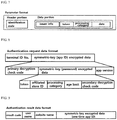
- FIG. 7 shows a format of a parameter received when the authentication app 110 of the mobile terminal 100 is executed.
- a header portion may include an identification code related to a website to which access will be given, and a data portion may include a netkey composed of a token and information on an issuer of the token, a processing category (code information related to one of joining, authentication, payment, transfer, and an item to be added in the future), and processing-related data which is an age limit when the processing category is joining or authentication and is amount information when the processing category is payment or transfer.
- a processing category code information related to one of joining, authentication, payment, transfer, and an item to be added in the future
- processing-related data which is an age limit when the processing category is joining or authentication and is amount information when the processing category is payment or transfer.
- the issuer information includes at least an affiliated store ID and may further include a country code of a service provider who runs the service server 300 and a server ID of an authentication proxy server which performs authentication by proxy in the corresponding country in order to handle authentication of a foreign website.
- FIG. 8 is a data format with which the mobile terminal 100 requests authentication while accessing the authentication proxy server 200.
- an app ID and an app password are not directly included in authentication request data, and an indirect transfer method is used in which the app ID and the app password are used as encryption keys for encryption and it is determined whether the app ID and the app password coincide with those stored in a memory based on whether the authentication request data has been decrypted normally.
- FIG. 9 is a data format of an authentication result with which the authentication proxy server 200 responds to the mobile terminal 100.
- FIG. 10 shows a screen of a mobile terminal which displays an authentication result.
- the displayed screen shows a name of a mobile terminal user and a name of website for which authentication has succeeded, and the website name can be checked through two channels. Therefore, it is possible to stop accessing an undesired website.
- FIGS. 11 to 14 show table structures and example data of the DB 290 of the authentication proxy server 200 according to an exemplary embodiment of the present invention, but the DB 290 is not limited thereto.
- the service server 300 and the authentication proxy server 200 for implementing the present invention are common server devices including a storage unit, an input unit, a control unit, and a communication unit.
- the service server 300 and the authentication proxy server 200 may have a web server and a DB server, and the DB server may be installed in the same server device or a separate server device.
- the present invention can be also implemented as a computer-readable code in a computer-readable recording medium.
- the computer-readable recording medium includes any kind of recording devices in which data that can be read by a computer system is stored.
- the aforementioned token is issued by a service server, and the service server may set a unique identifier to a valid time.
- the token is valid when it is retrieved and processed within the set valid time by the service server which has issued the token, fundamentally preventing a man-in-the-middle (MITM) attack and a replay attack in a network.
- MITM man-in-the-middle
- the aforementioned netkey includes at least a one-time token and identification information (an affiliated store ID) of an issuer which has issued the token.
- token including token, netkey, and authentication proxy server are defined in consideration of their functionality in the present invention and may vary depending on an intention of a user or an operator, a usual practice, or the like. Therefore, definitions thereof should be made based on the entire content of the present specification.
- the present invention provides a two-channel authentication proxy system for detecting application (app) tampering when a tampered authentication app is reinstalled (repackaged).
Landscapes
- Engineering & Computer Science (AREA)
- Computer Security & Cryptography (AREA)
- Computer Networks & Wireless Communication (AREA)
- Signal Processing (AREA)
- Computer Hardware Design (AREA)
- General Engineering & Computer Science (AREA)
- Theoretical Computer Science (AREA)
- Software Systems (AREA)
- Computing Systems (AREA)
- Physics & Mathematics (AREA)
- General Physics & Mathematics (AREA)
- Health & Medical Sciences (AREA)
- General Health & Medical Sciences (AREA)
- Social Psychology (AREA)
- Power Engineering (AREA)
- Telephonic Communication Services (AREA)
- Mobile Radio Communication Systems (AREA)
- Management, Administration, Business Operations System, And Electronic Commerce (AREA)
Applications Claiming Priority (2)
| Application Number | Priority Date | Filing Date | Title |
|---|---|---|---|
| KR1020160088062A KR101680525B1 (ko) | 2016-07-12 | 2016-07-12 | 앱 위변조 탐지 가능한 2채널 인증 대행 시스템 및 그 방법 |
| PCT/KR2017/006406 WO2018012747A1 (ko) | 2016-07-12 | 2017-06-19 | 앱 위변조 탐지 가능한 2채널 인증 대행 시스템 및 그 방법 |
Publications (4)
| Publication Number | Publication Date |
|---|---|
| EP3487119A1 true EP3487119A1 (de) | 2019-05-22 |
| EP3487119A4 EP3487119A4 (de) | 2020-03-04 |
| EP3487119B1 EP3487119B1 (de) | 2023-08-09 |
| EP3487119C0 EP3487119C0 (de) | 2023-08-09 |
Family
ID=57576384
Family Applications (1)
| Application Number | Title | Priority Date | Filing Date |
|---|---|---|---|
| EP17827821.4A Active EP3487119B1 (de) | 2016-07-12 | 2017-06-19 | Zweikanaliges authentifizierungsproxysystem mit fähigkeit zur erkennung von anwendungsmanipulation und verfahren dafür |
Country Status (9)
| Country | Link |
|---|---|
| US (1) | US10305902B2 (de) |
| EP (1) | EP3487119B1 (de) |
| JP (1) | JP6725679B2 (de) |
| KR (1) | KR101680525B1 (de) |
| CN (1) | CN108604991B (de) |
| AU (1) | AU2017295345B2 (de) |
| CA (1) | CA3029516C (de) |
| ES (1) | ES2961812T3 (de) |
| WO (1) | WO2018012747A1 (de) |
Families Citing this family (34)
| Publication number | Priority date | Publication date | Assignee | Title |
|---|---|---|---|---|
| US11966907B2 (en) * | 2014-10-25 | 2024-04-23 | Yoongnet Inc. | System and method for mobile cross-authentication |
| US10749858B2 (en) * | 2015-09-04 | 2020-08-18 | Hewlett Packard Enterprise Development Lp | Secure login information |
| US11552968B2 (en) | 2015-10-28 | 2023-01-10 | Qomplx, Inc. | System and methods for detecting and mitigating golden SAML attacks against federated services |
| US20220014555A1 (en) | 2015-10-28 | 2022-01-13 | Qomplx, Inc. | Distributed automated planning and execution platform for designing and running complex processes |
| US11570209B2 (en) | 2015-10-28 | 2023-01-31 | Qomplx, Inc. | Detecting and mitigating attacks using forged authentication objects within a domain |
| US12598197B2 (en) | 2015-10-28 | 2026-04-07 | Qomplx Llc | System and methods for detecting authentication object forgery or manipulation attacks |
| US10911452B2 (en) * | 2016-11-22 | 2021-02-02 | Synergex Group (corp.) | Systems, methods, and media for determining access privileges |
| KR101955950B1 (ko) * | 2017-06-12 | 2019-06-24 | 주식회사 엔터소프트 | 다채널 인증 방법, 이를 위한 인증 서버와 인증 단말 |
| US10635792B2 (en) * | 2017-08-31 | 2020-04-28 | Sybase 365, Inc. | Multi-factor authentication with URL validation |
| KR102026533B1 (ko) * | 2017-10-30 | 2019-09-27 | (주) 빌트온 | 모바일용 애플리케이션과 애플리케이션 서버 사이에서 송수신되는 데이터를 중계하고 추출하는 프록시 서버 및 이를 포함하는 빅데이터 추출 시스템 및 방법 |
| US11265699B2 (en) | 2018-02-23 | 2022-03-01 | T-Mobile Usa, Inc. | Identifier-based access control in mobile networks |
| US10637858B2 (en) | 2018-02-23 | 2020-04-28 | T-Mobile Usa, Inc. | Key-derivation verification in telecommunications network |
| WO2019219205A1 (en) * | 2018-05-18 | 2019-11-21 | Telefonaktiebolaget Lm Ericsson (Publ) | Application program access control |
| US11178148B2 (en) * | 2018-08-21 | 2021-11-16 | HYPR Corp. | Out-of-band authentication to access web-service with indication of physical access to client device |
| US11477190B2 (en) * | 2019-05-01 | 2022-10-18 | Salesforce, Inc. | Dynamic user ID |
| US11218486B2 (en) * | 2019-05-20 | 2022-01-04 | At&T Intellectual Property I, L.P. | Edge-node authentication for functions as a service |
| US11985122B2 (en) * | 2019-07-16 | 2024-05-14 | Linkme Technologies Inc. | Method and apparatus for sharing content data between networked devices |
| US11562351B2 (en) * | 2019-08-09 | 2023-01-24 | Its, Inc. | Interoperable mobile-initiated transactions with dynamic authentication |
| KR20210057609A (ko) * | 2019-11-12 | 2021-05-21 | 김금철 | 매체나 앱이나 웹사이트 등과 연동하는 앱시스템 |
| EP3863316A1 (de) * | 2020-02-07 | 2021-08-11 | Continental Teves AG & Co. OHG | Authentifizierungsverfahren |
| TWI777467B (zh) | 2020-03-30 | 2022-09-11 | 台灣積體電路製造股份有限公司 | 半導體裝置及其製造方法 |
| US11410982B2 (en) | 2020-03-30 | 2022-08-09 | Taiwan Semiconductor Manufacturing Co., Ltd. | Semiconductor devices and methods of manufacturing |
| CN113093678B (zh) * | 2021-04-07 | 2022-12-20 | 国能(泉州)热电有限公司 | 一种电厂dcs系统数据处理方法 |
| CN113423100B (zh) * | 2021-06-23 | 2024-03-29 | 宁夏新立电子有限公司 | 一种基于aes加密的nb仪表检验方法、系统及设备 |
| CN113609463B (zh) * | 2021-10-08 | 2022-01-04 | 湖南宸瀚信息科技有限责任公司 | 一种基于区块链身份管理的物联网系统 |
| US12353530B1 (en) * | 2021-12-08 | 2025-07-08 | T Stamp Inc. | Shape overlay for proof of liveness |
| CN114386054B (zh) * | 2021-12-08 | 2025-06-17 | 天翼物联科技有限公司 | 用于消息存储处理和安全认证的控制方法、系统和介质 |
| KR20230095741A (ko) | 2021-12-22 | 2023-06-29 | 김주한 | 2채널 문자 인증 시스템 및 그 방법 |
| CN114444525B (zh) * | 2022-01-11 | 2023-07-21 | 芯电智联(北京)科技有限公司 | 一种预防nfc标签丢失的方法及系统 |
| CN114967504B (zh) * | 2022-07-07 | 2023-02-17 | 广东长天思源环保科技股份有限公司 | 一种基于标识解析的环境监测运维平台 |
| CN116032483A (zh) * | 2022-12-05 | 2023-04-28 | 北京网瑞达科技有限公司 | Web资源发布的控制方法、装置、设备、存储介质及系统 |
| US12401543B2 (en) * | 2022-12-29 | 2025-08-26 | Garantir LLC | Sharing secrets over one or more computer networks using proxies |
| CN116708039B (zh) * | 2023-08-07 | 2023-11-21 | 深圳竹云科技股份有限公司 | 基于零信任单包认证的访问方法、装置及系统 |
| CN118018333B (zh) * | 2024-04-10 | 2024-06-25 | 国网浙江省电力有限公司杭州市富阳区供电公司 | 一种网口锁解锁控制方法、系统、设备及存储介质 |
Family Cites Families (31)
| Publication number | Priority date | Publication date | Assignee | Title |
|---|---|---|---|---|
| US1039001A (en) * | 1912-05-01 | 1912-09-17 | Joseph F Winkler | Animal-trap. |
| JP4475449B2 (ja) * | 2001-07-18 | 2010-06-09 | ソフトバンクモバイル株式会社 | 復号化装置および電子機器 |
| JP4186512B2 (ja) * | 2002-05-20 | 2008-11-26 | ソニー株式会社 | サービス提供システム、機器端末およびその処理方法、認証装置および方法、サービス提供装置および方法、並びにプログラム |
| JP2007264835A (ja) * | 2006-03-27 | 2007-10-11 | Nec Corp | 認証方法およびシステム |
| JP5309496B2 (ja) * | 2007-08-09 | 2013-10-09 | 日本電気株式会社 | 認証システムおよび認証方法 |
| KR101012872B1 (ko) * | 2009-09-16 | 2011-02-08 | 주식회사 팬택 | 플랫폼 보안 장치 및 방법 |
| US20100185868A1 (en) * | 2010-03-21 | 2010-07-22 | William Grecia | Personilized digital media access system |
| JP2011238036A (ja) * | 2010-05-11 | 2011-11-24 | Ikutoku Gakuen | 認証システム、シングルサインオンシステム、サーバ装置およびプログラム |
| JP5386458B2 (ja) * | 2010-09-30 | 2014-01-15 | ヤフー株式会社 | 認証システム、認証データ生成装置及び認証方法 |
| US8843750B1 (en) * | 2011-01-28 | 2014-09-23 | Symantec Corporation | Monitoring content transmitted through secured communication channels |
| US8943320B2 (en) * | 2011-10-31 | 2015-01-27 | Novell, Inc. | Techniques for authentication via a mobile device |
| KR20130112786A (ko) | 2012-04-04 | 2013-10-14 | 김주한 | 이동통신 단말기를 이용한 인증, 회원등록 그리고 결제 서비스를 위한 애플리케이션 |
| EP2701415A1 (de) * | 2012-08-24 | 2014-02-26 | Raja Kuppuswamy | Mobile elektronische Vorrichtung und ihre Verwendung für elektronische Transaktionen |
| CN102891843B (zh) * | 2012-09-18 | 2015-04-29 | 北京深思洛克软件技术股份有限公司 | 本地服务单元认证安卓客户端应用程序的方法 |
| US9898734B2 (en) * | 2012-12-19 | 2018-02-20 | Deutsche Telekom Ag | Method and system for terminal device-based communication between third-party applications and an electronic wallet |
| KR101294805B1 (ko) * | 2012-12-21 | 2013-08-08 | (주)씽크에이티 | 2-채널 앱인증 방법 및 시스템 |
| US8595810B1 (en) * | 2013-01-13 | 2013-11-26 | Mourad Ben Ayed | Method for automatically updating application access security |
| KR101513694B1 (ko) * | 2013-02-26 | 2015-04-22 | (주)이스톰 | Otp 인증 시스템 및 방법 |
| WO2015042349A1 (en) * | 2013-09-20 | 2015-03-26 | Oracle International Corporation | Multiple resource servers with single, flexible, pluggable oauth server and oauth-protected restful oauth consent management service, and mobile application single sign on oauth service |
| KR20150053663A (ko) | 2013-11-08 | 2015-05-18 | 김주한 | 이동통신단말기를 이용한 다채널 인증과 금융 이체 방법 및 시스템 |
| CN103763428B (zh) * | 2013-12-12 | 2017-11-07 | 北京宝利明威软件股份有限公司 | 一种移动终端上的应用管理系统和方法 |
| US9792458B2 (en) * | 2014-05-05 | 2017-10-17 | Ims Health Incorporated | Platform to build secure mobile collaborative applications using dynamic presentation and data configurations |
| US9836594B2 (en) * | 2014-05-19 | 2017-12-05 | Bank Of America Corporation | Service channel authentication token |
| CN105323291A (zh) * | 2014-08-04 | 2016-02-10 | 中兴通讯股份有限公司 | 移动应用统一登录处理方法及装置 |
| US9961048B2 (en) * | 2014-09-07 | 2018-05-01 | Definitive Data Security, Inc. | System and associated software for providing advanced data protections in a defense-in-depth system by integrating multi-factor authentication with cryptographic offloading |
| US9906525B1 (en) * | 2014-11-11 | 2018-02-27 | HYPR Corp. | Systems and methods for facilitating secure authentication of third-party applications and/or websites using a biometric-enabled transitory password authentication device |
| CN104486343B (zh) * | 2014-12-18 | 2018-06-19 | 广东粤铁科技有限公司 | 一种双因子双向认证的方法及系统 |
| CN104539634B (zh) * | 2015-01-22 | 2017-08-29 | 北京成众志科技有限公司 | 一种移动应用安全增强授权与认证的方法 |
| WO2016123112A1 (en) * | 2015-01-26 | 2016-08-04 | Mobile Iron, Inc. | Secure access to cloud-based services |
| CN104751049B (zh) * | 2015-03-09 | 2018-09-04 | 广东欧珀移动通信有限公司 | 一种应用程序安装方法及移动终端 |
| CN104980338A (zh) * | 2015-05-12 | 2015-10-14 | 上海斐讯数据通信技术有限公司 | 基于移动智能终端的企业即时通讯安全应用系统 |
-
2016
- 2016-07-12 KR KR1020160088062A patent/KR101680525B1/ko active Active
-
2017
- 2017-06-19 AU AU2017295345A patent/AU2017295345B2/en active Active
- 2017-06-19 JP JP2018548880A patent/JP6725679B2/ja active Active
- 2017-06-19 CA CA3029516A patent/CA3029516C/en active Active
- 2017-06-19 WO PCT/KR2017/006406 patent/WO2018012747A1/ko not_active Ceased
- 2017-06-19 EP EP17827821.4A patent/EP3487119B1/de active Active
- 2017-06-19 ES ES17827821T patent/ES2961812T3/es active Active
- 2017-06-19 US US16/076,699 patent/US10305902B2/en active Active
- 2017-06-19 CN CN201780011374.5A patent/CN108604991B/zh active Active
Also Published As
| Publication number | Publication date |
|---|---|
| CN108604991B (zh) | 2021-06-15 |
| US20190044943A1 (en) | 2019-02-07 |
| JP2019519827A (ja) | 2019-07-11 |
| CN108604991A (zh) | 2018-09-28 |
| AU2017295345A1 (en) | 2019-01-24 |
| JP6725679B2 (ja) | 2020-07-22 |
| EP3487119A4 (de) | 2020-03-04 |
| ES2961812T3 (es) | 2024-03-14 |
| EP3487119B1 (de) | 2023-08-09 |
| AU2017295345B2 (en) | 2020-08-13 |
| WO2018012747A1 (ko) | 2018-01-18 |
| US10305902B2 (en) | 2019-05-28 |
| CA3029516C (en) | 2024-01-23 |
| EP3487119C0 (de) | 2023-08-09 |
| CA3029516A1 (en) | 2018-01-18 |
| KR101680525B1 (ko) | 2016-12-06 |
Similar Documents
| Publication | Publication Date | Title |
|---|---|---|
| EP3487119B1 (de) | Zweikanaliges authentifizierungsproxysystem mit fähigkeit zur erkennung von anwendungsmanipulation und verfahren dafür | |
| US12548007B2 (en) | Terminal for conducting electronic transactions | |
| US10552823B1 (en) | System and method for authentication of a mobile device | |
| US20200067705A1 (en) | Methods, apparatuses, and computer program products for frictionless electronic signature management | |
| US20170244676A1 (en) | Method and system for authentication | |
| KR101451359B1 (ko) | 사용자 계정 회복 | |
| US20200196143A1 (en) | Public key-based service authentication method and system | |
| US20200076588A1 (en) | Security authentication system for generating secure key by combining multi-user authentication elements and security authentication method therefor | |
| KR101210260B1 (ko) | 통합센터를 이용한 유심칩기반 모바일 오티피 인증장치 및 인증방법 | |
| US11620650B2 (en) | Mobile authentication method and system therefor | |
| KR101799517B1 (ko) | 인증 서버 및 방법 | |
| KR20190111006A (ko) | 인증 서버, 인증 시스템 및 방법 | |
| KR102481213B1 (ko) | 로그인 인증 처리를 위한 시스템 및 방법 | |
| KR102160892B1 (ko) | 공개키 기반의 서비스 인증 방법 및 시스템 | |
| KR20150135171A (ko) | 고객 전화번호 입력에 기초한 로그인 처리 시스템 및 그 제어방법 | |
| JP4578352B2 (ja) | 通信媒介装置、データ提供装置およびデータ提供システム | |
| US20220269770A1 (en) | Information processing system, server apparatus, information processing method, and computer program product | |
| KR101592475B1 (ko) | 회원제 인터넷 사이트 불법 이용 방지 시스템 | |
| JP2019133555A (ja) | 通信システム、端末装置およびプログラム | |
| KR20130132116A (ko) | 고객 전화번호 입력에 기초한 로그인 처리 시스템 및 그 제어방법 | |
| KR20130113634A (ko) | 서비스 실행을 인증하기 위한 방법, 웹 서버, 서비스 서버, 시스템 및 인증 장치 |
Legal Events
| Date | Code | Title | Description |
|---|---|---|---|
| STAA | Information on the status of an ep patent application or granted ep patent |
Free format text: STATUS: THE INTERNATIONAL PUBLICATION HAS BEEN MADE |
|
| PUAI | Public reference made under article 153(3) epc to a published international application that has entered the european phase |
Free format text: ORIGINAL CODE: 0009012 |
|
| STAA | Information on the status of an ep patent application or granted ep patent |
Free format text: STATUS: REQUEST FOR EXAMINATION WAS MADE |
|
| 17P | Request for examination filed |
Effective date: 20190212 |
|
| AK | Designated contracting states |
Kind code of ref document: A1 Designated state(s): AL AT BE BG CH CY CZ DE DK EE ES FI FR GB GR HR HU IE IS IT LI LT LU LV MC MK MT NL NO PL PT RO RS SE SI SK SM TR |
|
| AX | Request for extension of the european patent |
Extension state: BA ME |
|
| DAV | Request for validation of the european patent (deleted) | ||
| DAX | Request for extension of the european patent (deleted) | ||
| A4 | Supplementary search report drawn up and despatched |
Effective date: 20200204 |
|
| RIC1 | Information provided on ipc code assigned before grant |
Ipc: H04L 29/06 20060101ALI20200129BHEP Ipc: H04L 9/08 20060101ALI20200129BHEP Ipc: G06F 21/55 20130101ALI20200129BHEP Ipc: H04W 12/06 20090101ALI20200129BHEP Ipc: G06F 21/44 20130101ALI20200129BHEP Ipc: H04W 12/00 20090101ALI20200129BHEP Ipc: H04L 9/32 20060101AFI20200129BHEP |
|
| STAA | Information on the status of an ep patent application or granted ep patent |
Free format text: STATUS: EXAMINATION IS IN PROGRESS |
|
| 17Q | First examination report despatched |
Effective date: 20211029 |
|
| REG | Reference to a national code |
Ref legal event code: R079 Free format text: PREVIOUS MAIN CLASS: H04L0009320000 Ipc: H04L0009400000 Ref country code: DE Ref legal event code: R079 Ref document number: 602017072562 Country of ref document: DE Free format text: PREVIOUS MAIN CLASS: H04L0009320000 Ipc: H04L0009400000 |
|
| RIC1 | Information provided on ipc code assigned before grant |
Ipc: H04L 9/08 20060101ALI20220630BHEP Ipc: H04W 12/06 20090101ALI20220630BHEP Ipc: H04W 12/30 20210101ALI20220630BHEP Ipc: G06F 21/55 20130101ALI20220630BHEP Ipc: G06F 21/44 20130101ALI20220630BHEP Ipc: H04L 9/32 20060101ALI20220630BHEP Ipc: H04L 9/40 20220101AFI20220630BHEP |
|
| GRAP | Despatch of communication of intention to grant a patent |
Free format text: ORIGINAL CODE: EPIDOSNIGR1 |
|
| STAA | Information on the status of an ep patent application or granted ep patent |
Free format text: STATUS: GRANT OF PATENT IS INTENDED |
|
| INTG | Intention to grant announced |
Effective date: 20230224 |
|
| GRAS | Grant fee paid |
Free format text: ORIGINAL CODE: EPIDOSNIGR3 |
|
| GRAA | (expected) grant |
Free format text: ORIGINAL CODE: 0009210 |
|
| STAA | Information on the status of an ep patent application or granted ep patent |
Free format text: STATUS: THE PATENT HAS BEEN GRANTED |
|
| AK | Designated contracting states |
Kind code of ref document: B1 Designated state(s): AL AT BE BG CH CY CZ DE DK EE ES FI FR GB GR HR HU IE IS IT LI LT LU LV MC MK MT NL NO PL PT RO RS SE SI SK SM TR |
|
| REG | Reference to a national code |
Ref country code: GB Ref legal event code: FG4D |
|
| REG | Reference to a national code |
Ref country code: CH Ref legal event code: EP |
|
| REG | Reference to a national code |
Ref country code: DE Ref legal event code: R096 Ref document number: 602017072562 Country of ref document: DE |
|
| REG | Reference to a national code |
Ref country code: IE Ref legal event code: FG4D |
|
| U01 | Request for unitary effect filed |
Effective date: 20230911 |
|
| U07 | Unitary effect registered |
Designated state(s): AT BE BG DE DK EE FI FR IT LT LU LV MT NL PT SE SI Effective date: 20231018 |
|
| PG25 | Lapsed in a contracting state [announced via postgrant information from national office to epo] |
Ref country code: GR Free format text: LAPSE BECAUSE OF FAILURE TO SUBMIT A TRANSLATION OF THE DESCRIPTION OR TO PAY THE FEE WITHIN THE PRESCRIBED TIME-LIMIT Effective date: 20231110 |
|
| PG25 | Lapsed in a contracting state [announced via postgrant information from national office to epo] |
Ref country code: IS Free format text: LAPSE BECAUSE OF FAILURE TO SUBMIT A TRANSLATION OF THE DESCRIPTION OR TO PAY THE FEE WITHIN THE PRESCRIBED TIME-LIMIT Effective date: 20231209 |
|
| PG25 | Lapsed in a contracting state [announced via postgrant information from national office to epo] |
Ref country code: RS Free format text: LAPSE BECAUSE OF FAILURE TO SUBMIT A TRANSLATION OF THE DESCRIPTION OR TO PAY THE FEE WITHIN THE PRESCRIBED TIME-LIMIT Effective date: 20230809 Ref country code: NO Free format text: LAPSE BECAUSE OF FAILURE TO SUBMIT A TRANSLATION OF THE DESCRIPTION OR TO PAY THE FEE WITHIN THE PRESCRIBED TIME-LIMIT Effective date: 20231109 Ref country code: IS Free format text: LAPSE BECAUSE OF FAILURE TO SUBMIT A TRANSLATION OF THE DESCRIPTION OR TO PAY THE FEE WITHIN THE PRESCRIBED TIME-LIMIT Effective date: 20231209 Ref country code: HR Free format text: LAPSE BECAUSE OF FAILURE TO SUBMIT A TRANSLATION OF THE DESCRIPTION OR TO PAY THE FEE WITHIN THE PRESCRIBED TIME-LIMIT Effective date: 20230809 Ref country code: GR Free format text: LAPSE BECAUSE OF FAILURE TO SUBMIT A TRANSLATION OF THE DESCRIPTION OR TO PAY THE FEE WITHIN THE PRESCRIBED TIME-LIMIT Effective date: 20231110 |
|
| PG25 | Lapsed in a contracting state [announced via postgrant information from national office to epo] |
Ref country code: PL Free format text: LAPSE BECAUSE OF FAILURE TO SUBMIT A TRANSLATION OF THE DESCRIPTION OR TO PAY THE FEE WITHIN THE PRESCRIBED TIME-LIMIT Effective date: 20230809 |
|
| REG | Reference to a national code |
Ref country code: ES Ref legal event code: FG2A Ref document number: 2961812 Country of ref document: ES Kind code of ref document: T3 Effective date: 20240314 |
|
| PG25 | Lapsed in a contracting state [announced via postgrant information from national office to epo] |
Ref country code: SM Free format text: LAPSE BECAUSE OF FAILURE TO SUBMIT A TRANSLATION OF THE DESCRIPTION OR TO PAY THE FEE WITHIN THE PRESCRIBED TIME-LIMIT Effective date: 20230809 Ref country code: RO Free format text: LAPSE BECAUSE OF FAILURE TO SUBMIT A TRANSLATION OF THE DESCRIPTION OR TO PAY THE FEE WITHIN THE PRESCRIBED TIME-LIMIT Effective date: 20230809 Ref country code: CZ Free format text: LAPSE BECAUSE OF FAILURE TO SUBMIT A TRANSLATION OF THE DESCRIPTION OR TO PAY THE FEE WITHIN THE PRESCRIBED TIME-LIMIT Effective date: 20230809 Ref country code: SK Free format text: LAPSE BECAUSE OF FAILURE TO SUBMIT A TRANSLATION OF THE DESCRIPTION OR TO PAY THE FEE WITHIN THE PRESCRIBED TIME-LIMIT Effective date: 20230809 |
|
| REG | Reference to a national code |
Ref country code: DE Ref legal event code: R097 Ref document number: 602017072562 Country of ref document: DE |
|
| PLBE | No opposition filed within time limit |
Free format text: ORIGINAL CODE: 0009261 |
|
| STAA | Information on the status of an ep patent application or granted ep patent |
Free format text: STATUS: NO OPPOSITION FILED WITHIN TIME LIMIT |
|
| 26N | No opposition filed |
Effective date: 20240513 |
|
| U20 | Renewal fee for the european patent with unitary effect paid |
Year of fee payment: 8 Effective date: 20240625 |
|
| PG25 | Lapsed in a contracting state [announced via postgrant information from national office to epo] |
Ref country code: MC Free format text: LAPSE BECAUSE OF FAILURE TO SUBMIT A TRANSLATION OF THE DESCRIPTION OR TO PAY THE FEE WITHIN THE PRESCRIBED TIME-LIMIT Effective date: 20230809 |
|
| PG25 | Lapsed in a contracting state [announced via postgrant information from national office to epo] |
Ref country code: IE Free format text: LAPSE BECAUSE OF NON-PAYMENT OF DUE FEES Effective date: 20240619 |
|
| PGFP | Annual fee paid to national office [announced via postgrant information from national office to epo] |
Ref country code: GB Payment date: 20250623 Year of fee payment: 9 |
|
| U20 | Renewal fee for the european patent with unitary effect paid |
Year of fee payment: 9 Effective date: 20250617 |
|
| PGFP | Annual fee paid to national office [announced via postgrant information from national office to epo] |
Ref country code: TR Payment date: 20250612 Year of fee payment: 9 |
|
| PGFP | Annual fee paid to national office [announced via postgrant information from national office to epo] |
Ref country code: ES Payment date: 20250703 Year of fee payment: 9 |
|
| PGFP | Annual fee paid to national office [announced via postgrant information from national office to epo] |
Ref country code: CH Payment date: 20250701 Year of fee payment: 9 |
|
| PG25 | Lapsed in a contracting state [announced via postgrant information from national office to epo] |
Ref country code: CY Free format text: LAPSE BECAUSE OF FAILURE TO SUBMIT A TRANSLATION OF THE DESCRIPTION OR TO PAY THE FEE WITHIN THE PRESCRIBED TIME-LIMIT; INVALID AB INITIO Effective date: 20170619 |
|
| PG25 | Lapsed in a contracting state [announced via postgrant information from national office to epo] |
Ref country code: HU Free format text: LAPSE BECAUSE OF FAILURE TO SUBMIT A TRANSLATION OF THE DESCRIPTION OR TO PAY THE FEE WITHIN THE PRESCRIBED TIME-LIMIT; INVALID AB INITIO Effective date: 20170619 |