EP3484892B1 - 1,2,4-triazolo-[3,4-b]-1,3,4-thiadiazole derivatives - Google Patents
1,2,4-triazolo-[3,4-b]-1,3,4-thiadiazole derivatives Download PDFInfo
- Publication number
- EP3484892B1 EP3484892B1 EP17742219.3A EP17742219A EP3484892B1 EP 3484892 B1 EP3484892 B1 EP 3484892B1 EP 17742219 A EP17742219 A EP 17742219A EP 3484892 B1 EP3484892 B1 EP 3484892B1
- Authority
- EP
- European Patent Office
- Prior art keywords
- group
- compound according
- triazolo
- methyl
- och
- Prior art date
- Legal status (The legal status is an assumption and is not a legal conclusion. Google has not performed a legal analysis and makes no representation as to the accuracy of the status listed.)
- Active
Links
- 0 Cc(nc1NC)nc(*)c1N=C Chemical compound Cc(nc1NC)nc(*)c1N=C 0.000 description 2
- AYVRAXSWHNOEEQ-UHFFFAOYSA-N Cc1c[nH]c(N=C(N)N2)c1C2=O Chemical compound Cc1c[nH]c(N=C(N)N2)c1C2=O AYVRAXSWHNOEEQ-UHFFFAOYSA-N 0.000 description 2
- MCHAYULJHMZXHB-UHFFFAOYSA-N CC(C=NC1)=CC1Br Chemical compound CC(C=NC1)=CC1Br MCHAYULJHMZXHB-UHFFFAOYSA-N 0.000 description 1
- AWIZMJKYADRJLJ-UHFFFAOYSA-N CN(C)S(c(c(Cc1nnc2[s]c(-c(ccc([N+]([O-])=O)c3)c3Cl)n[n]12)c1)cc(OC)c1OC)(=O)=O Chemical compound CN(C)S(c(c(Cc1nnc2[s]c(-c(ccc([N+]([O-])=O)c3)c3Cl)n[n]12)c1)cc(OC)c1OC)(=O)=O AWIZMJKYADRJLJ-UHFFFAOYSA-N 0.000 description 1
- NBGLPMTZPFOIHM-UHFFFAOYSA-N CN(C)S(c(c(Cc1nnc2[s]c(-c3cc(N)ccc3)n[n]12)c1)cc(OC)c1OC)(=O)=O Chemical compound CN(C)S(c(c(Cc1nnc2[s]c(-c3cc(N)ccc3)n[n]12)c1)cc(OC)c1OC)(=O)=O NBGLPMTZPFOIHM-UHFFFAOYSA-N 0.000 description 1
- XWJSWNUFFHSRQD-UHFFFAOYSA-N Cc1n[nH]c(N=C)c1/C(/N)=N\C Chemical compound Cc1n[nH]c(N=C)c1/C(/N)=N\C XWJSWNUFFHSRQD-UHFFFAOYSA-N 0.000 description 1
- VQXHGXDVBHJJJU-UHFFFAOYSA-N Cc1n[nH]c2ncnc(N)c12 Chemical compound Cc1n[nH]c2ncnc(N)c12 VQXHGXDVBHJJJU-UHFFFAOYSA-N 0.000 description 1
Classifications
-
- A—HUMAN NECESSITIES
- A61—MEDICAL OR VETERINARY SCIENCE; HYGIENE
- A61K—PREPARATIONS FOR MEDICAL, DENTAL OR TOILETRY PURPOSES
- A61K31/00—Medicinal preparations containing organic active ingredients
- A61K31/33—Heterocyclic compounds
- A61K31/395—Heterocyclic compounds having nitrogen as a ring hetero atom, e.g. guanethidine or rifamycins
- A61K31/41—Heterocyclic compounds having nitrogen as a ring hetero atom, e.g. guanethidine or rifamycins having five-membered rings with two or more ring hetero atoms, at least one of which being nitrogen, e.g. tetrazole
- A61K31/433—Thidiazoles
-
- A—HUMAN NECESSITIES
- A61—MEDICAL OR VETERINARY SCIENCE; HYGIENE
- A61K—PREPARATIONS FOR MEDICAL, DENTAL OR TOILETRY PURPOSES
- A61K31/00—Medicinal preparations containing organic active ingredients
- A61K31/33—Heterocyclic compounds
- A61K31/395—Heterocyclic compounds having nitrogen as a ring hetero atom, e.g. guanethidine or rifamycins
- A61K31/435—Heterocyclic compounds having nitrogen as a ring hetero atom, e.g. guanethidine or rifamycins having six-membered rings with one nitrogen as the only ring hetero atom
- A61K31/44—Non condensed pyridines; Hydrogenated derivatives thereof
- A61K31/4427—Non condensed pyridines; Hydrogenated derivatives thereof containing further heterocyclic ring systems
- A61K31/4439—Non condensed pyridines; Hydrogenated derivatives thereof containing further heterocyclic ring systems containing a five-membered ring with nitrogen as a ring hetero atom, e.g. omeprazole
-
- A—HUMAN NECESSITIES
- A61—MEDICAL OR VETERINARY SCIENCE; HYGIENE
- A61K—PREPARATIONS FOR MEDICAL, DENTAL OR TOILETRY PURPOSES
- A61K35/00—Medicinal preparations containing materials or reaction products thereof with undetermined constitution
-
- A—HUMAN NECESSITIES
- A61—MEDICAL OR VETERINARY SCIENCE; HYGIENE
- A61P—SPECIFIC THERAPEUTIC ACTIVITY OF CHEMICAL COMPOUNDS OR MEDICINAL PREPARATIONS
- A61P35/00—Antineoplastic agents
-
- C—CHEMISTRY; METALLURGY
- C07—ORGANIC CHEMISTRY
- C07D—HETEROCYCLIC COMPOUNDS
- C07D513/00—Heterocyclic compounds containing in the condensed system at least one hetero ring having nitrogen and sulfur atoms as the only ring hetero atoms, not provided for in groups C07D463/00, C07D477/00 or C07D499/00 - C07D507/00
- C07D513/02—Heterocyclic compounds containing in the condensed system at least one hetero ring having nitrogen and sulfur atoms as the only ring hetero atoms, not provided for in groups C07D463/00, C07D477/00 or C07D499/00 - C07D507/00 in which the condensed system contains two hetero rings
- C07D513/04—Ortho-condensed systems
Definitions
- the present invention relates to new 1,2,4-triazolo-[3,4-b]-1,3,4-thiadiazole derivatives, their methods of production and use in cancer treatment.
- Heterocyclic compounds that include thiazolic or thiadiazolic chemical structures have shown very important biologic activities such as antibacterial [a) Holla, B.S., Shivananda, M.K., Akberali, P.M., Baliga, S., Safeer, S., Farmaco, 1996, 51, 785 . b) Zhang, Z.Y., Sum, X.W., Chu, C.H., Zhao, L., J. Chim. Chem. Soc., 1997, 44, 535 .
- the present invention provides new 1,2,4-triazolo-[3,4-b]-1,3,4-thiadiazole derivatives and their pharmaceutically acceptable salts, their methods of production and biologic activity.
- the compounds of the present invention can be applied in anticancer therapies due to their anticancer activity which is accompanied by low acute toxicity.
- the present invention provides 1,2,4-triazolo-[3,4-b]-1,3,4-thiadiazoles of formula (I) or pharmaceutically acceptable salts thereof wherein,
- R 1 and R 2 are the same or different and are selected from the group consisting of C 1 -C 3 alkyl, phenyl, methylphenyl. More preferably, R 1 and R 2 are methyl.
- R 4 , R 5 , R 6 , R 7 are the same or different and they are selected from the group consisting of H, Cl, Br, I, NH 2 , OCH 3 . More preferably, R 4 and R 7 are H, R 5 and R 6 are OCH 3 .
- R 8 is selected from the group consisting of substituted or unsubstituted phenyl, benzyl, pyridyl, wherein the substituent or substituents are selected from the group consisting of methyl, F, Cl, Br, I, NO 2 , CN, NH 2 , OCH 2 X, CH 2 X, CX 3 , CH 2 CH 2 X, OH, wherein X is selected from the group consisting of H, F, Cl, Br, I. More preferably, R 8 is selected from the group consisting of substituted or unsubstituted phenyl, pyridyl, wherein the substituent or substituents are selected from the group consisting of F, Cl, NO 2 .
- R 10 is selected from the group consisting of C 1 -C 3 alkyl, phenyl. More preferably, R 10 is methyl.
- R 11 and R 12 are the same or different and they are C 1 -C 3 alkyl. More preferably, R 11 and R 12 are methyl.
- the compounds of formula (I) contain at least one basic group and consequently they can form pharmaceutically acceptable salts through treatment with a suitable acid.
- suitable acids include pharmaceutically acceptable organic acids as well as pharmaceutically acceptable inorganic acids.
- pharmaceutically acceptable salts include chloride, bromide, sulphate, phosphate, nitrate, acetate, propionate, butyrate, maleate, tartarate, citrate, lactate, oxalate, succinate and benzoate.
- the compounds of formula (I) or their pharmaceutically acceptable salts can be used in the treatment of different types of malignant neoplasms (solid tumors, lymphomas and leukemia).
- malignant neoplasms solid tumors, lymphomas and leukemia.
- they are used in the treatment of ovarian cancer, breast cancer, prostate cancer, lung cancer and lymphomas. More preferably, they are used in the treatment of ovarian adenocarcinoma and small cell and non-small cell lung cancer.
- the compounds of formula (I) or their pharmaceutically acceptable salts show powerful cytostatic and cytotoxic action and low acute and systemic toxicity.
- compositions which comprise a compound of formula (I) or a pharmaceutically acceptable salt thereof.
- a pharmaceutical composition can be formulated so that it can be administrated through the appropriate route such as oral, intranasal, topical or parenteral administration.
- a pharmaceutical composition can be formulated into tablet, capsule, powder, solution, suspension, ointment or gel.
- Such a composition generally contains apart from a compound of formula (I) or a pharmaceutically acceptable salt thereof, a pharmaceutically acceptable carrier.
- Such a carrier may comprise excipients well known in the art, such as diluents, binders, fillers, disintegrants, lubricants, solvents, thickening agents, suspending agents, gelling agents, buffers or preservatives. These compositions can be prepared following methods which are well known in the art.
- the present invention further provides a process for the preparation of compounds of formula (I) or their pharmaceutically acceptable salts.
- Sulfonyl chlorides (V) can be synthesized from the reaction of aromatic esters (VI) with chlorosulfonic acid.
- Sulfonamides (IV) can be produced though the reaction of sulfonyl chlorides (V) with amines.
- Hydrazides (III) can be prepared from sulfonamides (IV) with the treatment with aqueous hydrazine according to the methodology of Camoutsis and his colleagues ( Ezabadi IR, Camoutsis C, Zoumpoulakis P, Geronikaki A, Sokovi ⁇ M, Glamocilija J, Ciri ⁇ A. Bioorg Med Chem. 2008, 16(3):1150-61 ).
- Steps 4 and 5 can be performed according to the method of Mathew and his colleagues ( Mathew, V.; Keshavayya, J; Vaidya, V. P.; Giles, D. Eur. J. Med. Chem., 2007, 42, 521 ).
- hydrazides (III) can react with carbon disulfide and hydrazine, producing the amino triazoles (II) via the intermediates potassium salts of dithiocarbamates.
- amino triazoles (II) can be converted into 3,6-disubstitued 1,2,4-triazolo[3,4-b]-1,2,4 thiazoles (I) reacting with acids in the presence of phosphorus oxychloride.
- the reaction mixture is cooled, dissolved in cold water and neutralized with 10% hydrochloric acid.
- the precipitate is collected by filtration, washed with cold water, dried and recrystallized in methanol.
- the present example illustrates the cytostatic-cytotoxic effects of the following compounds of the present invention against the human ovarian cancer cell lines UWB1,289 (with mutant BRCA1), UWB1,289 + BRCA1, OVCAR-3, SCOV-3, the human breast cancer cell lines MCF -7 [expressing estrogen receptors, insulin-like growth factor binding proteins (IGFBP) BP-2, BP-4; BP-5), oncogene WNT7B], T-47D (positive for the expression of all steroid receptors and the oncogene WNT7B), the human cancer cell line of hormone-resistant prostate cancer PC-3, the human acute T-leukemia cell line MOLT-4 (do not show expression of the mutant P53 oncogene), and the human lung carcinoma cell line A549 bearing a mutation in the KRAS oncogene (p.G12S c.34G> A).
- SKOV-3 (SKOV-3) (ATCC HTB 77) and OVCAR-3 (ATCC® HTB-161 TM )
- SKOV-3 Human ovarian adenocarcinoma cells, which are grown easily in monolayer culture with epithelial-like morphology.
- SKOV-3 are resistant to tumor necrosis factor (TNF) and to other cytotoxic drugs such as cisplatin, and adriamycin, while OVCAR-3 are resistant to adriamycin, cisplatin and melphalan.
- TNF tumor necrosis factor
- OVCAR-3 are resistant to adriamycin, cisplatin and melphalan.
- These cell lines express androgens, estrogens and progesterone receptors.
- SCID mice When SKOV-3 or OVCAR-3 cells are subcutaneously implanted in nude mice, SCID mice, a moderately differentiated tumor develops, and the resulting model resembles primary ovarian adenocarcinoma in humans.
- Human ovarian adenocarcinoma cells which are grown easily in monolayer culture, have morphology of epithelial cancer cells and do not express estrogenic and progesterone receptors. Also, UWB1.289 cells have mutated the p53 tumor suppressor gene and positive Wilms' tumor protein (WT) expression, have no functional BRCA1 gene and are positive for the expression of cytokeratin 7 (CK-7), calretinin and Wilms' tumor protein (WT). Finally they are sensitive to ionizing radiation.
- WT Wilms' tumor protein
- Human ovarian adenocarcinoma cells derived from UBWB1,289, in which the presence of the BRCA1 gene has been restored. They grow easily in culture, creating monolayers, have morphology of epithelial cancer cells and do not express estrogenic and progesterone receptors. They are not susceptible to ionizing radiation and radioimmune chemical agents (e.g., alkylating agents). Also, UWB1.289 cells have mutated the p53 tumor suppressor gene, and are positive for the expression of cytokeratin 7 (CK-7), calretinin and Wilms' tumor protein (WT).
- CK-7 cytokeratin 7
- WT Wilms' tumor protein
- All cancer cell lines are stored in a liquid nitrogen tank in 2.5 ml cryovials (Corning-Costar, Cambridge, MA).
- DMSO dimethylsulfoxide
- the Cells were grown as monolayer cultures in T-75 flasks (Corning-Costar, Cambridge, MA) and maintained at 37° C in 5% CO 2 incubator & 100% relative humidity.
- the cultures medium used are McCoy's 5a Medium, supplemented with 10% fetal bovine serum (FBS, Gibco) and 1% antibiotics (100 IU/ml penicillin/100 ⁇ g/ml streptomycin), sterilized by filtration (Corning-Costar filter, diameter 0.2 ⁇ m, RPMI-1640 and 50% RPMI-1640 (Catalog No 30-2001) plus 50% Mammary Epithelial Growth Medium (MEGM), supplemented with 10% fetal bovine serum (FBS, Gibco) and 1% antibiotics (100 IU/ml penicillin/100 ⁇ g/ml streptomycin).
- FBS fetal bovine serum
- antibiotics 100 IU/ml penicillin/100 ⁇ g/ml streptomycin
- the passage is performed every 3-4 to days as follows: Cells are washed with sterile PBS (Phosphate buffered saline): 8 g/l NaCl, 0,2 g/l KCI, 1,15 g/l Na 2 HPO4 ⁇ 0,2 g/l KH 2 PO4. pH:7,4), add 2-3 ml 0.05% trypsin (Gibco 1:250) and 0.02% EDTA to cover the monolayer and incubate the flask at 37°C for 5-10 minutes. Trypsin-EDTA, is used mainly to detach the cells from the flask and prepare a single cell suspension. Finally, the number of cells can be determined by direct counting using a Neubauer chamber and cell viability is determined by staining the cells with trypan blue.
- PBS Phosphate buffered saline
- the viability of cultured cells was estimated by an (3-(4,5-imethylthiazol-2-yl)-2,5-diphenyltetrazolium bromide (MTT) metabolic assay as described previously ( Finlay GJ, Wilson WR and Baguley BC: Comparison of in vitro activity of cytotoxic drugs towards human carcinoma and leukaemia cell lines. Eur J Cancer Clin Oncol 22: 655-662, 1986 ; Alley MC, Scudiero DA, Monks A, Hursey ML, Czerwinski MJ, Fine DL, et al. Feasibility of drug screening with panels of human tumor cell lines using a microculture tetrazolium assay. Cancer Res 1988; 48:589-601 ).
- MTT (Sigma, St Louis, Missouri, USA) was dissolved in PBS in a concentration of 5 mg/ml, filter sterilized, and stored at 4°C. MTT (50 ⁇ l of stock solution) was added to each culture and incubated for 3 h at 37°C to allow metabolization. Formazan crystals were solubilized by DMSO (100 ⁇ l). Absorbance of the converted dye was measured at a wavelength of 540nm on ELISA reader (BioTek, Winooski, Vermont, USA).
- the percentage growth inhibition was calculated according to National Cancer Institute (NCI) as: [(Tt72x)-(Ct24) / (Ct72)-(Ct24)] x 100 for concentrations for which Tt72x>Ct24 and [(Tt72x)-(Ct24)/(Ct24) x 100 for concentrations for which Tt72x ⁇ Ct24
- the 12 derivatives of 1,2,4,triazolo-[3,4-b]-1,3,4- thiadiazole TS167, TS70, TS61, TS60, TS59, TS58, TS51, TS56, TS54, TS55, TS52, TS65 exhibit a potent cytostatic (IG50 ⁇ 100 ⁇ M) than cytotoxic anticancer activity at the concentration tested, with IC50 >100 ⁇ M in all 9 human cancer cell lines.
- the acute toxicity of the compounds was assessed from lethality by testing different concentrations, starting at 100mg/kg.
- the therapeutic dose of tested compound is defined as LD10 (lethal dose for 10% of animals).
- stock solutions of the tested compounds were prepared immediately before use. They were suspended in corn oil in the desired concentration following initial dissolution in 10% dimethylsulfoxide (DMSO).
- DMSO dimethylsulfoxide
- C57BI/6 male and female were used for toxicity studies. Mice were kept under conditions of constant temperature and humidity in sterile cages with water and food.
- Table 3 Compound LD50 (mg/kg) LD10 (mg/kg) TS53 375 >500 TS63 430 >500 TS62 480 >500 TS25 345 >500 TS26 365 >500 TS50 >500 >500 TS66 >500 >500 TS167 >500 >500 TS71 >500 >500 TS57 >500 >500
Landscapes
- Health & Medical Sciences (AREA)
- Chemical & Material Sciences (AREA)
- Organic Chemistry (AREA)
- General Health & Medical Sciences (AREA)
- Veterinary Medicine (AREA)
- Pharmacology & Pharmacy (AREA)
- Life Sciences & Earth Sciences (AREA)
- Animal Behavior & Ethology (AREA)
- Medicinal Chemistry (AREA)
- Public Health (AREA)
- Epidemiology (AREA)
- Chemical Kinetics & Catalysis (AREA)
- General Chemical & Material Sciences (AREA)
- Nuclear Medicine, Radiotherapy & Molecular Imaging (AREA)
- Pharmaceuticals Containing Other Organic And Inorganic Compounds (AREA)
- Nitrogen And Oxygen Or Sulfur-Condensed Heterocyclic Ring Systems (AREA)
- Nitrogen Condensed Heterocyclic Rings (AREA)
- Thiazole And Isothizaole Compounds (AREA)
Description
- The present invention relates to new 1,2,4-triazolo-[3,4-b]-1,3,4-thiadiazole derivatives, their methods of production and use in cancer treatment.
- Cancer still remains a fatal health problem even if progress in therapeutics has been noted. Nowadays, a constant increase in deaths from different types of cancer has been observed and it is estimated that in 2030 deaths will reach 12 million. Usually, anticancer therapy is considered as a challenge because of its high toxicity which accompanies it. Main side effects of anticancer drugs are nausea, vomiting, diarrhea, alopecia and infections (which are usually caused by leukopenia). Consequently, the development of new no or less toxic active anticancer drugs is of the utmost importance and necessity.
- Heterocyclic compounds that include thiazolic or thiadiazolic chemical structures have shown very important biologic activities such as antibacterial [a) Holla, B.S., Shivananda, M.K., Akberali, P.M., Baliga, S., Safeer, S., Farmaco, 1996, 51, 785. b) Zhang, Z.Y., Sum, X.W., Chu, C.H., Zhao, L., J. Chim. Chem. Soc., 1997, 44, 535. c) Demirbas, N., Demirbas, A., Karaoglu, S.A., Celik, E., Arkivoc., 2005, 1, 75.], anticancer [a) Ibrahim, D.A., Eur. J. Med. Chem., 2009, 44, 2776 b) Al-Masoudi, N.A., Al-Soud, Y.A., Nucleos:Nucleot. Nucleic Acids, 2008, 27, 1034. c) Chowrasia, D., Karthikeyan, C., Choure, L., Sahabjada, Gupta, M., Arshad, Md., Trivedi, P., Arab. J. of Chem., 2013, doi:10.1016/j.arabjc.2013.08.026. d) Ilango, K., Valentina, P., Eur. J. Chem., 2010, 1, 50.], antiviral [a) Kritsanida, M., Mouroutsou, A., Marakos, P., Pouli, N., Papakonstantinou-Garoufalias, S., Pannecouque, C., Witvrouw, M., Declercq, E., Farmaco, 2002, 57, 253. b) Invidiata, F.P., Simoni, D., Skintu, F., Pinna, N., Farmaco., 1996, 51, 659. c) Srivastava, V., Sen, S., Shekar, R., Indian J. Chem., 1994, 33B, 344.], anti-inflammatory [a) Chawla, G., Kumar, U., Bawa, S., Kumar, J., J. Enzyme Inhib. Med. Chem., 2012, 27, 658. b) Amir, M., Harish, K., Javed, S.A., Eur. J. Med. Chem., 2008, 43, 2056. c) Prasad, A.R., Ramlingam, T., Bhaskar Rao A., Diwan, P.B., Sattur., Indian J. Chem., 1986, 25B, 566.], analgesic [a) Srivastava, V., Sen, S., Shekar, R., Indian J. Chem., 1994, 33B, 344. b) Chawla, G., Kumar, U., Bawa, S., Kumar, J., J. Enzyme Inhib. Med. Chem., 2012, 27, 658.], antifungal [a) Karabasanagouda, T., Adhikari, A.V., Suchethasettey, N., Eur. J. Med. Chem., 2007, 42, 521. b) Tiwari, N., Chaturvedi, B., Nizamuddin., Agric. Biol. Chem., 1988, 52, 1229.] and anthelmintic [α) El-Khawass, S.M., Khalil, M.A., Hazzaa, A.A., Bassiouny, H.A., Loutfy, N.F., Farmaco. 1989, 44, 703. 2. Imitiaz, M., Kumar, V., Indian J. Chem., 1992, 31B, 673.]. In older studies, some amino- and diimino thiadiazole derivatives have shown anticancer activity [a) Hill, D.L. Cancer Chemother. Pharmacol. 1980, 4, 215. b) Nelson, J.A., Rose, L.M., Benette, L. Cancer Res. 1977, 37, 182. c) Tsukamoto, K., Suno, M., Igarashi, K., Kozai, Y., Sugino, Y., Cancer Res. 1975, 35, 2631]. Additional 1,2,4-triazole-[3,4-b]-1,3,4-thiadiazole derivatives for use against proliferative disorders including various forms of cancer have been disclosed in
WO 2007/064797 . - The present invention provides new 1,2,4-triazolo-[3,4-b]-1,3,4-thiadiazole derivatives and their pharmaceutically acceptable salts, their methods of production and biologic activity. The compounds of the present invention can be applied in anticancer therapies due to their anticancer activity which is accompanied by low acute toxicity.
- The present invention provides 1,2,4-triazolo-[3,4-b]-1,3,4-thiadiazoles of formula (I) or pharmaceutically acceptable salts thereof

- R1 and R2 are the same or different and are selected from the group consisting of C1-C5 alkyl, phenyl, methylphenyl,
- R3 is selected from the group consisting of CH2R8, CH2CH2R8, CH=CHR8, CH2CH2CH2R8, CH2CH=CHR8, CH=CHCH2R8, CH=CH-OR8, CH2-OR8, CH2CH2-OR8, CH=CH-NHR8, CH2-NHR8, CH2CH2-NHR8, CH=CH-SR8, CH2-SR8, CH2CH2-SR8,

- substituted or unsubstituted phenyl, benzyl, pyridyl, pyrimidinyl, triazinyl, triazinanyl, oxazinyl, oxazinanyl, cyclohexanyl, cyclohexenyl, cyclohexadienyl, pyranyl, oxathianyl, piperidinyl, cyclopentanyl, cyclopentenyl, cyclopentadienyl, pyrrolidinyl, pyrrolyl, furanyl, oxazolidinyl, pyrazolidinyl, thiophenyl, oxathiinyl, oxathiolyl, oxathiolanyl, wherein the substituent or substituents are selected from the group consisting of methyl F, Cl, Br, I, NO2, CN, NH2, OCH2X, CH2X, CX3, CH2CH2X, OH wherein X is selected from the group consisting of H, F, Cl, Br, I,
- R4, R5, R6, R7 are the same or different and are selected from the group consisting of H, F, Cl, Br, I, NO2, CN, NH2, OCH3, OH, NHCH2CH3, N(CH3)2,
- R8 is selected from the group consisting of

- substituted or unsubstituted phenyl, benzyl, pyridyl, pyrimidinyl, triazinyl, triazinanyl, oxazinyl, oxazinanyl, cyclohexanyl, cyclohexenyl, cyclohexadienyl, pyranyl, oxathianyl, piperidinyl, cyclopentanyl, cyclopentenyl, cyclopentadienyl, pyrrolidinyl, pyrrolyl, furanyl, oxazolidinyl, pyrazolidinyl, thiophenyl, oxathiinyl, oxathiolyl, oxathiolanyl, wherein the substituent or substituents are selected from the group consisting of methyl F, Cl, Br, I, NO2, CN, NH2, OCH2X, CH2X, CX3, CH2CH2X, OH wherein X is selected from the group consisting of H, F, Cl, Br, I,
- R9 is selected from the group consisting of NHR10, NR11R12,
- R10 is selected from the group consisting of C1-C5 alkyl, phenyl,
- R11 and R12 are the same or different and they are C1-C5 alkyl.
- Preferably, R1 and R2 are the same or different and are selected from the group consisting of C1-C3 alkyl, phenyl, methylphenyl. More preferably, R1 and R2 are methyl.
- Preferably, R3 is selected from the group consisting of CH2R8, CH2CH2R8, CH=CHR8, CH2CH2CH2R8, CH2CH=CHR8, CH=CHCH2R8,


- Preferably, R4, R5, R6, R7 are the same or different and they are selected from the group consisting of H, Cl, Br, I, NH2, OCH3. More preferably, R4 and R7 are H, R5 and R6 are OCH3.
- Preferably, R8 is selected from the group consisting of


- Preferably, R10 is selected from the group consisting of C1-C3 alkyl, phenyl. More preferably, R10 is methyl.
- Preferably, R11 and R12 are the same or different and they are C1-C3 alkyl. More preferably, R11 and R12 are methyl.
- The compounds of formula (I) contain at least one basic group and consequently they can form pharmaceutically acceptable salts through treatment with a suitable acid. Suitable acids include pharmaceutically acceptable organic acids as well as pharmaceutically acceptable inorganic acids. Examples of pharmaceutically acceptable salts include chloride, bromide, sulphate, phosphate, nitrate, acetate, propionate, butyrate, maleate, tartarate, citrate, lactate, oxalate, succinate and benzoate.
- The compounds of formula (I) or their pharmaceutically acceptable salts can be used in the treatment of different types of malignant neoplasms (solid tumors, lymphomas and leukemia). Preferably, they are used in the treatment of ovarian cancer, breast cancer, prostate cancer, lung cancer and lymphomas. More preferably, they are used in the treatment of ovarian adenocarcinoma and small cell and non-small cell lung cancer.
- The compounds of formula (I) or their pharmaceutically acceptable salts show powerful cytostatic and cytotoxic action and low acute and systemic toxicity.
- The present invention provides also pharmaceutical compositions which comprise a compound of formula (I) or a pharmaceutically acceptable salt thereof. Such a pharmaceutical composition can be formulated so that it can be administrated through the appropriate route such as oral, intranasal, topical or parenteral administration. For example, such a pharmaceutical composition can be formulated into tablet, capsule, powder, solution, suspension, ointment or gel. Such a composition generally contains apart from a compound of formula (I) or a pharmaceutically acceptable salt thereof, a pharmaceutically acceptable carrier. Such a carrier may comprise excipients well known in the art, such as diluents, binders, fillers, disintegrants, lubricants, solvents, thickening agents, suspending agents, gelling agents, buffers or preservatives. These compositions can be prepared following methods which are well known in the art.
- The present invention further provides a process for the preparation of compounds of formula (I) or their pharmaceutically acceptable salts.
- A general route of synthesis of 1,2,4-triazolo-[3,4-b]-1,3,4-thiadiazole is presented below in Scheme 1.

- Sulfonyl chlorides (V) can be synthesized from the reaction of aromatic esters (VI) with chlorosulfonic acid. Sulfonamides (IV) can be produced though the reaction of sulfonyl chlorides (V) with amines. Hydrazides (III) can be prepared from sulfonamides (IV) with the treatment with aqueous hydrazine according to the methodology of Camoutsis and his colleagues (Ezabadi IR, Camoutsis C, Zoumpoulakis P, Geronikaki A, Soković M, Glamocilija J, Cirić A. Bioorg Med Chem. 2008, 16(3):1150-61). Steps 4 and 5 can be performed according to the method of Mathew and his colleagues (Mathew, V.; Keshavayya, J; Vaidya, V. P.; Giles, D. Eur. J. Med. Chem., 2007, 42, 521). Thus, hydrazides (III) can react with carbon disulfide and hydrazine, producing the amino triazoles (II) via the intermediates potassium salts of dithiocarbamates. Finally, amino triazoles (II) can be converted into 3,6-disubstitued 1,2,4-triazolo[3,4-b]-1,2,4 thiazoles (I) reacting with acids in the presence of phosphorus oxychloride.
-

- In a flask containing 2-(3,4-dimethoxyphenyl)methyl acetate (3.7 g, 17.65 mmol), CHCl3 (35 ml) is added and then chlorosulfonic acid (5.28 ml, 79.4 mmol) dropwise at 0 ° C under an Ar atmosphere. The solution obtains a dark purple color and is stirred at room temperature for 4 h. The reaction is quenched by the gradual addition of water (35 ml) at 0 ° C, followed by extractions with DCM (3x35 ml), drying the organic layer with Na2SO4, condensation and column chromatography with 2: 1 elution solvent PS / EA. The product is collected as a white solid in 88% yield.
- In an autoclave system containing 2-(2-(chlorosulfonyl)-4,5-dimethoxyphenyl)methyl acetate (450mg, 1.46mmol) dissolved in THF (1.8ml), a solution of dimethylamine was added in THF 2M (1.47 mL, 2.92 mmol) at 0 ° C. The reaction is stirred at room temperature for 1 h and a pale yellow solid is observed. After the reaction is completed, the solution is decanted into a flask with the required amount of DCM, concentrated on a rotary evaporator and the product is collected as a pale yellow solid in 100% yield.
- In a cold solution of -(N,N-dimethylosulfamoyl)-4,5-dimethoxy-phenylacetyl hydrazide (0.01 mol), in absolute ethanol (150 mL), potassium hydroxide (0.015 mol) and carbon disulfide (0.015 mol) are added. The reaction mixture is stirred at room temperature for 20h. During the reaction, the intermediate potassium salt of dithiocarbamate precipitates. Subsequently, dry ether (150 mL) is added in order to complete the crystallization of the formed salt, which is obtained by filtration and further dryed with dry ether.
- The salt as suspension in 80% aqueous hydrazine (0.02 mol), is stirred while heated under reflux for 2 h. The reaction mixture is cooled, dissolved in cold water and neutralized with 10% hydrochloric acid. The precipitate is collected by filtration, washed with cold water, dried and recrystallized in methanol.
- Yield: 56%, M.p. 222-223 °C (CH3OH), 1H NMR (500 MHz, DMSO-d6) δ 13.30 (s, 1H), 7.15 (s, 1H), 6.92 (s, 1H), 5.46 (s, 2H), 4.20 (s, 2H), 3.71 (s, 3H), 3.68 (s, 3H), 3.22 (s, 6H), 13C NMR (126 MHz, DMSO-d6) δ 165.8, 151.8, 151.5, 147.1, 127.7, 126.3, 115.6, 112.7, 55.9, 36.8, 28.1. Analysis: C13H19N5O4S2 (373). Calc.%: C:41.82, H:5.09, N:18.76 Found: C:41.77, H:5.12, N:18.79
- The mixture of 5-[2-(N,N-dimethylsulfamoyl)-4,5-dimethoxy-benzyl]-4-amino-3-mercapto-1,2,4-triazole (0.01 mol) and benzoic acid (0.01 mol) in dry phosphorous oxychloride (3.7 mL) is stirred while heated under reflux for 2h. The reaction mixture is cooled to room temperature and then poured into ice. The excess of phosphorus oxychloride is neutralized with dry potassium carbonate and appropriate amount of potassium hydroxide until the pH of the reaction is above 8. The solid is filtered off, washed extensively with water and dried.

- Yield: 74%, M.p. 212-214 °C (CH3OH), 1H-NMR (CDCl3) δ 7.95 (d, J = 6.9 Hz, 2H), 7.68 (m, 1H), 7.63 (m, 2H), 7.30 (s, 1H), 7.21 (s, 1H), 4.78 (s, 2H), 3.84 (s, 3H), 3.80 (s, 3H), 2.63 (s, 6H), I.R. v m-1 1601 (C=N), 1573, 1513, 1470, 1446 (C=C), 1265 (N-N=C), 1328 (S-O antisym.), 1141 (S-O sym.), Analysis: C20H21N5O4S2 (459). Calc.%: C:52.28, H:4.57, N:15.25 Found: C:52.25, H:4.53, N:15.27
- According to the methodology of example 1, the synthesis of the following thiazoles has been completed.
-

- Yield: 52%. M.p. 228-229 °C (CH3OH-CH2Cl2), 1H-NMR (CDCl3) δ 7.97 (d, J=8.5 Hz, 2H), 7.71 (d, J=8.6 Hz, 2H), 7.30 (s, 1H), 7.20 (s, 1H), 4.78 (s, 2H), 3.84 (s, 3H), 3.79 (s, 3H), 2.62 (s, 6H), I.R. v cm-1 1600(C=N), 1573, 1519, 1470 (C=C), 1272 (N-N=C), 1339(S-O antisym.), 1138 (S-O sym), Analysis: C20H20N5O4S2Cl (493.5). Calc.%: C:48.63, H:4.05, N:14.18 Found: C:48.65, H:4.01, N:14.21.
-

- Yield: 65%. M.p. 216-217 °C (CH3OH), 1H-NMR (CDCl3) δ 8.57 (d, J = 2.3 Hz, 1H), 8.40 (dd, J = 8.7, 2.3 Hz, 1H), 8.27 (d, J = 8.7 Hz, 1H), 7.30 (s, 1H), 7.20 (s, 1H), 4.80 (s, 2H), 3.84 (s, 3H), 3.80 (s, 3H), 2.61 (s, 6H), I.R. v m-1 1603(C=N), 1573, 1518, 1476 (C=C), 1269 (N-N=C), 1331 (S-O antisym.), 1138 (S-O sym.), Analysis: C20H19N6O6S2Cl (538.5). Calc.%: C:44.56, H:3.52, N:15.60. Found: C:44.53, H:3.55, N:15.63.
-

- Yield: 46%. M.p. 142-144 °C (CH3OH), 1H-NMR (CDCl3) 5 8.18 (d, J = 8.5 Hz, 1H), 8.08 (s, 1H), 8.02 (d, J = 8.5 Hz, 1H), 7.30 (s, 1H), 7.22 (s, 1H), 4.80 (s, 2H), 3.84 (s, 3H), 3.80 (s, 3H), 2.62 (s, 6H), I.R. v m-1 1600(C=N), 1573, 1510, 1476 (C=C), 1271 (N-N=C), 1344 (S-O antisym.), 1133 (S-O sym.), Analysis: C21H22N6O6S2 (518). Calc.%: C:48.64, H:4.24, N:16.21. Found: C:48.68, H:4.21, N:16.25.
-

- Yield: 38%. M.p. 169-170 °C (CH3OH),1H-NMR (CDCl3) δ 7.30 (s, 1H), 7.22 (s, 1H), 7.14 (s, 2H), 4.78 (s, 2H), 3.89 (s, 6H), 3.84 (s, 3H), 3.80 (s, 3H), 3.76 (s, 3H), 2.62 (s, 6H), I.R. v m-1 1630(C=N), 1586, 1459, 1414 (C=C), 1267 (N-N=C), 1333 (S-O antisym.), 1127 (S-O sym.), Analysis: C23H27N5O7S2 (549). Calc.%: C:50.27, H:4.92, N:12.75. Found: C:50.25, H:4.96, N:12.78.
-

- Yield: 36%. M.p. 219-220 °C (C2H5OH), 1H-NMR (CDCl3) δ 7.30 (s, 1H), 7.23 (t, J = 7.8 Hz, 1H), 7.20 (s, 1H),7.13 (m, 1H), 7.03 (d, J=8.35 Hz, 1H), 6.82 (d, J=8.2 Hz, 1H), 4.75 (s, 2H), 3.84 (s, 3H), 3.79 (s, 3H), 2.61 (s, 6H), I.R. v m-1 2436' 3382, 3267 (N-H), 1608 (C=N), 1555, 1514, 1474 (C=C), 1265 (N-N=C), 1328 (S-O antisym.), 1141 (S-O sym.), Analysis: C20H22N6O4S2 (474). Calc.%: C:50.63, H:4.64, N:17.72. Found: C:50.60, H:4.61, N:17.75.
-

- Yield: 20%. M.p. 164-165 °C (C2H5OH), 1H-NMR (CDCl3) δ 7.44 (dd, J = 8.0, 1.4 Hz, 1H), 7.29 (m, 1H), 7.28 (s, 1H), 7.16 (s, 1H), 6.93 (d, J = 8.4 Hz, 1H), 6.71 (bs, 2H, NH2), 6.68 (t, J = 7.5 Hz, 1H), 4.81 (s, 2H), 3.84 (s, 3H), 3.78 (s, 3H), 2.63 (s, 6H), I.R. v cm-1, 3450, 3347 (N-H), 1626 (C=N), 1579, 1512, 1473 (C=C), 1272 (N-N=C), 1322 (S-O antisym.), 1129 (S-O sym.), Analysis: C20H26N6O4S2 (474). Calc.%: C:50.63, H:4.64, N:17.72. Found: C:50.65, H:4.67, N:17.69.
-

- Yield: 18%. M.p. 179-181 °C (C2H5OH), 1H-NMR (CDCl3) δ 7.58 (dd, J = 8.6, 2.9 Hz, 2H), 7.29 (d, J = 3.0 Hz, 1H), 7.19 (d, J = 2.8 Hz, 1H), 6.68 (dd, J = 8.6, 2.9 Hz, 2H), 6.17 (s, 2H), 4.72 (s, 2H), 3.84 (s, 3H), 3.78 (s, 3H), 2.61 (s, 6H), I.R. v m-1 3457, 3348, 3237 (N-H), 1603 (C=N), 1577, 1518, 1461 (C=C), 1265 (N-N=C), 1331 (S-O antisym.), 1138 (S-O sym.), Analysis: C20H26N6O4S2 (474). Calc.%: C:50.63, H:4.64, N:17.72. Found: C:50.60, H:4.59, N:17.70.
-

- Yield: 18%. M.p. 178-179 °C (CH3OH); 1H-NMR (CDCl3) δ 7.42 - 7.36 (m, 4H), 7.36 - 7.30 (m, 1H), 7.28 (s, 1H), 7.13 (s, 1H), 4.69 (s, 2H), 4.44, (s, 2H), 3.84 (s, 3H), 3.76 (s, 3H), 2.57 (s, 6H), I.R. v cm-1 1601 (C=N), 1565, 1517, 1475 (C=C), 1267 (N-N=C), 1339 (S-O antisym.), 1140 (S-O sym.), Analysis: C21H23N5O4S2 (473). Calc.%: C:53.27, H:4.86, N:14.80. Found: C:53.23, H:4.89, N:14.83.
-

- Yield: 58%. M.p. 165-166 °C (CH3OH), 1H-NMR (CDCl3) δ 7.30 (d, J = 8.0 Hz, 1H), 7.29 (s, 1H), 7.13 (s, 1H), 6.97 (s, 1H), 6.94 (d, J = 7.7 Hz, 1H), 6.90 (dd, J = 8.3, 2.5 Hz, 1H), 4.70 (s, 2H), 4.41 (s, 2H), 3.84 (s, 3H), 3.77 (s, 3H), 3.75 (s, 3H), 2.57 (s, 6H), I.R. v m-1 1607 (C=N), 1581, 1515, 1491 (C=C), 1266 (N-N=C), 1334 (S-O antisym.), 1139 (S-O sym.), Analysis: C22H25N5O5S2 (503). Calc.%: C:52.48, H:4.97, N:13.91. Found: C:52.44, H:4.95, N:12.88.
-

- Yield: 52%. M.p. 184-185 °C (CH3OH), 1H-NMR (CDCl3) δ 7.30 (d, J = 8.6 Hz, 2H), 7.29 (s, 1H), 7.13 (s, 1H), 6.94 (d, J = 8.6 Hz, 2H), 4.69 (s, 2H), 4.36 (s, 2H), 3.84 (s, 3H), 3.77 (s, 3H), 3.75 (s, 3H), 2.57 (s, 6H), I.R. v cm-1 1610 (C=N), 1571, 1514, 1476 (C=C), 1267 (N-N=C), 1340 (S-O antisym.), 1140 (S-O sym.), Analysis: C22H25N5O5S2 (503). Calc.%: C:52.48, H:4.97, N:13.91. Found: C:52.45, H:4.99, N:13.94.
-

- Yield: 50%. M.p. 139-140 °C (CH3OH), 1H-NMR (CDCl3) δ 7.29 (s, 1H), 7.13 (s, 1H), 6.99 (s, 1H), 6.95 (d, J = 8.2 Hz, 1H), 6.90 (dd, J = 8.3, 2.0 Hz, 1H), 4.70 (s, 2H), 4.35 (s, 2H), 3.84 (s, 3H), 3.77 (s, 3H), 3.75 (s, 3H), 3.73 (s, 3H), 2.58 (s, 6H), I.R. v m-1 1602 (C=N), 1555, 1516, 1462 (C=C), 1266 (N-N=C), 1336 (S-O antisym.), 1139 (S-O sym.), Analysis: C23H27N5O6S2 (533). Calc.%: C:51.78, H:5.06, N:13.13. Found%: C:51.81, H:5.10, N:13.15.
-

- Yield: 14%. M.p. 128-129 °C (CH3OH), 1H-NMR (CDCl3) δ 7.30 - 7.26 (m, 3H), 7.23 - 7.17 (m, 3H), 7.12 (s, 1H), 4.69 (s, 2H), 3.82 (s, 3H), 3.77 (s, 3H), 3.04 (t, J = 7.4 Hz, 2H), 2.68 (t, J = 7.7 Hz, 2H), 2.59 (s, 6H), 2.03 (p, J = 7.6 Hz, 2H), I.R. v m-1 1600 (C=N), 1574, 1516, 1478 (C=C), 1267 (N-N=C), 1334 (S-O antisym.), 1139 (SO sym.), Analysis: C23H27N5O4S2 (501). Calc.%: C:55.09, H:5.38, N:13.97. Found%: C:55.11, H:5.41, N:14.01.
-

- Yield: 32%. M.p. 198-199 °C (CH3OH), 1H-NMR (CDCl3) δ 8.76, (s, 1H), 8.23 - 8.00 (m, 2H), 7.69 (s, 1H), 7.37 - 7.15 (m, 2H), 4.79 (s, 2H), 3.83 (s, 3H), 3.78 (s, 3H), 2.62 (s, 6H), I.R. v m-1 1599 (C=N), 1576, 1517, 1456 (C=C), 1270 (N-N=C), 1335 (S-O antisym.), 1137 (S-O sym.), Analysis: C19H20N6O4S2 (460). Calc.%: C:49.56, H:4.34, N:18.26. Found%: C:49.60, H:4.31, N:18.30.
-

- Yield: 37%. M.p. 231-232 °C (C2H5OH), 1H-NMR (CDCl3) δ 8.85 (d, J = 5.0 Hz, 2H), 7.91 (d, J = 5.0 Hz, 2H), 7.30 (s, 1H), 7.21 (s, 1H), 4.80 (s, 2H), 3.84 (s, 3H), 3.80 (s, 3H), 2.63 (s, 6H), I.R. v cm-1 1600 (C=N), 1561, 1507, 1473, 1411 (C=C), 1274 (N-N=C), 1337 (S-O antisym.), 1138 (S-O sym.), Analysis: C19H20N6O4S2 (460). Calc.%: C:49.56, H:4.34, N:18.26. Found%: C:49.58, H:4.37, N:18.23.
-

- Yield: 41%. M.p. 227-228 °C (C2H5OH), 1H-NMR (CDCl3) δ 9.10 (d, J = 2.0 Hz, 1H), 8.98 (d, J = 2.2 Hz, 1H), 8.58 (s, 1H), 7.30 (s, 1H), 7.22 (s, 1H), 4.79 (s, 2H), 3.84 (s, 3H), 3.80 (s, 3H), 2.63 (s, 6H), I.R. v m-1 1600 (C=N), 1573, 1516, 1481, 1440, 1412 (C=C), 1270 (N-N=C), 1338 (S-O antisym.), 1140 (S-O sym.), Analysis: C19H19BrN6O4S2 (539). Calc.%: C:42.30, H:3.52, N:15.58. Found%: C:42.32, H:3.49, N:15.56.
-

- Yield: 44%. M.p. 191-193 °C (CH3OH-CH2Cl2); 1H-NMR (CDCl3) δ 7.81 (d, J = 7.1 Hz, 2H), 7.64 (d, J = 16.4 Hz, 1H), 7.60 (d, J = 16.3 Hz, 1H), 7.52 - 7.40 (m, 3H), 7.30 (s, 1H), 7.16 (s, 1H), 4.73 (s, 2H), 3.84 (s, 3H), 3.80 (s, 3H), 2.62 (s, 6H), I.R. v m-1 1630 (CH=CH), 1600 (C=N), 1575, 1576, 1475 (C=C), 1267 (N-N=C), 1332 (SO antisym.), 1138 (S-O sym.), Analysis: C22H23N5O4S2 (485). Calc.%: C:54.43, H:4.74, N:14.43. Found%: C:54.45, H:4.71, N:14.39.
-

- Yield: 73%. M.p. 210-212 °C. 1H NMR (500 MHz, DMSO-d6) δ 7.89 (dd, J = 8.6, 5.6 Hz, 2H), 7.65 (d, J = 16.4 Hz, 1H), 7.58 (d, J = 16.4 Hz, 1H), 7.36 - 7.25 (m, 2H), 7.16 (s, 1H), 4.72 (s, 2H), 3.84 (s, 3H), 3.79 (s, 3H), 2.60 (s, 6H). I.R. v m-1 2926, 2853, 1736, 1631, 1601, 1513, 1494, 1474, 1387, 1337, 1268, 1231, 1139, 1156, 1048.
-

- Yield: 72%. M.p. 229-231 °C. 1H NMR (500 MHz, DMSO-d6) δ 7.84 (d, J = 8.6 Hz, 2H), 7.64 (s, 2H), 7.53 (d, J = 8.6 Hz, 2H), 7.30 (s, 1H), 7.15 (s, 1H), 4.72 (s, 2H), 3.84 (s, 3H), 3.79 (s, 3H), 2.61 (s, 6H). 13C NMR (126 MHz, DMSO-d6) δ 165.7, 151.9, 147.2, 146.3, 139.4, 134.8, 133.3, 129.8, 129.0, 127.9, 126.1, 119.0, 115.5, 112.7, 55.9, 36.8, 27.6. I.R. v m-1 2934, 2844, 1726, 1633, 1516, 1488, 1473, 1410, 1381, 1339, 1268, 1224, 1139, 1175, 1087.
-

- Yield: 52%. M.p. 212-215 °C. 1H NMR (500 MHz, DMSO-d6) δ 7.92 - 7.73 (m, 2H), 7.68 (td, J = 8.1, 5.8 Hz, 1H), 7.55 (td, J = 8.6, 2.4 Hz, 1H), 7.30 (s, 1H), 7.21 (s, 1H), 4.78 (s, 2H), 3.84 (s, 3H), 3.80 (s, 3H), 2.63 (s, 6H). I.R. v m-1 2929, 2844, 1589, 1516, 1474, 1387, 1338, 1270, 1228, 1174, 1155, 1140, 1042
-

- Yield: 41%. M.p. 178-179 °C (CH3OH-CH2Cl2), 1H-NMR (CDCl3) δ 7.37 - 7.31 (m, 2H), 7.29 (s, 1H), 7.13 (s, 1H), 7.09 (d, J = 7.7, 1.0 Hz, 2H), 7.06 - 7.01 (m, 1H), 5.55 (s, 2H), 4.72 (s, 2H), 3.84 (s, 3H), 3.78 (s, 3H), 2.58 (s, 6H), I.R. v m-1 1598 (C=N), 1572, 1516, 1479 (C=C), 1267 (N-N=C), 1337 (S-O antisym.), 1139 (S-O sym.), Analysis: C21H23N5O5S2 (489). Calc.%: C:51.53, H:4.70, N:14.31. Found%: C:51.51, H:4.67, N:14.33.
-

- Yield: 37%. M.p. 154-155 °C (CH3OH-CH2Cl2), 1H-NMR (CDCl3) δ 7.29 (s, 1H), 7.21 (m, 1H), 7.17 (d, J = 7.5 Hz, 1H), 7.10 (s, 1H), 6.95 (d, J = 8.2 Hz, 1H), 6.84 (t, J=7.26 Hz, 1H), 4.67 (s, 2H), 3.84 (s, 3H), 3.77 (s, 3H), 3.75 (s, 3H), 3.29 (m, 2H), 3.01 (t, J = 7.5 Hz, 4H), 2,56 (s, 6H), I.R. v m-1 1601 (C=N), 1569, 1519, 1477 (C=C), 1267 (N-N=C), 1336 (S-O antisym.), 1139 (S-O sym.), Analysis: C23H27N5O5S2 (517). Calc.%: C:53.38, H:5.22, N:13.53. Found%: C:53.41, H:5.19, N:13.56.
-

- Yield: 41%. M.p. 151-152 °C (CH3OH-CH2Cl2), 1H-NMR (CDCl3) δ 7.29 (s, 1H), 7.18 (d, J = 8.3 Hz, 2H), 7.11 (s, 1H), 6.83 (d, J = 8.1 Hz, 2H), 4.67 (s, 2H), 3.83 (s, 3H), 3.77 (s, 3H), 3.71 (s, 3H), 2.99 (t, J = 7.6 Hz, 2H), 2.55 (s, 6H), I.R. v cm-1 1601 (C=N), 1569, 1519, 1477 (C=C), 1267 (N-N=C), 1336 (S-O antisym.), 1139 (S-O sym.), Analysis: C23H27N5O5S2 (517). Calc.%: C:53.38, H:5.22, N:13.53. Found%: C: 53.35, H:5.24, N:13.50.
-

- Yield: 45%. M.p. 237-239 °C, 1H NMR (500 MHz, CDCl3) δ 7.86 (s, 1H), 7.74 (d, J = 7.7 Hz, 1H), 7.56 (d, J = 8.0 Hz, 1H), 7.53 - 7.39 (m, 2H), 6.99 (s, 1H), 4.90 (s, 2H), 3.93 (s, 3H), 3.87 (s, 3H), 2.72 (s, 6H). 13C NMR (126 MHz, CDCl3) δ 164.9, 153.1, 152.5, 147.7, 146.8, 135.7, 132.7, 130.9, 130.8, 127.9, 127.03, 127.0 125.3, 114.4, 113.4, 56.4, 56.2, 36.9, 27.9. I.R. v cm-1 3088, 3056, 2955, 2927, 2852, 2616, 1598, 1573, 1518, 1482, 1470, 1439, 1405, 187, 1339, 1270, 1228, 1175, 1139, 1101, 1078, 1043.
-

- Yield: 53%. M.p. 223-225 °C, 1H NMR (500 MHz, CDCl3) δ 8.39 (d, J = 8.7 Hz, 2H), 8.08 (d, J = 8.7 Hz, 2H), 7.45 (s, 1H), 7.00 (s, 1H), 4.94 (s, 2H), 3.93 (s, 3H), 3.88 (s, 3H), 2.73 (s, 6H), 13C NMR (126 MHz, CDCl3) δ 163.9, 153.1, 152.5, 150.1, 147.9, 147.1, 134.8, 128.2, 127.5, 126.9, 124.7, 114.5, 113.1, 113.1, 56.4, 37.1, 28.0, I.R. v m-1 3108, 3004, 2931, 2837, 1600, 1534, 1571, 1518, 1471, 1351, 1337, 1270, 1227, 1138, 1049
-

- Yield: 66%. M.p. 220-223 °C, 1H NMR (500 MHz, DMSO-d6) δ 8.02 (dd, J = 8.8, 5.2 Hz, 2H), 7.48 (t, J = 8.8 Hz, 2H), 7.30 (s, 1H), 7.20 (s, 1H), 4.78 (s, 2H), 3.84 (s, 3H), 3.79 (s, 3H), 2.62 (s, 6H), I.R. v m-1 2933, 2842,1602, 1517, 1475, 187, 1337, 1268, 1241, 1225, 1139, 1042
-

- Yield: 29%. M.p. 162-164 °C, 1H NMR (500 MHz, DMSO-d6) δ 8.74 (s, 1H), 8.69 (d, J = 8.4 Hz, 1H), 8.50 (d, J = 8.6 Hz, 1H), 7.29 (s, 1H), 7.13 (s, 1H), 4.74 (s, 2H), 3.83 (s, 3H), 3.79 (s, 3H), 2.58 (s, 6H), 13C NMR (126 MHz, DMSO-d6) δ 161.2, 153.8, 151.9, 150.5, 149.3, 147.3, 146.3, 128.2, 127.7, 127.6, 126.9, 126.1, 124.3, 115.4, 112.8, 55.9, 55.8, 36.7, 27.6, I.R. v m-1 2917, 2850, 1729, 1555, 1514, 1457, 1346, 1308, 1270, 1223, 1137, 1042
- The present example illustrates the cytostatic-cytotoxic effects of the following compounds of the present invention against the human ovarian cancer cell lines UWB1,289 (with mutant BRCA1), UWB1,289 + BRCA1, OVCAR-3, SCOV-3, the human breast cancer cell lines MCF -7 [expressing estrogen receptors, insulin-like growth factor binding proteins (IGFBP) BP-2, BP-4; BP-5), oncogene WNT7B], T-47D (positive for the expression of all steroid receptors and the oncogene WNT7B), the human cancer cell line of hormone-resistant prostate cancer PC-3, the human acute T-leukemia cell line MOLT-4 (do not show expression of the mutant P53 oncogene), and the human lung carcinoma cell line A549 bearing a mutation in the KRAS oncogene (p.G12S c.34G> A).

- The R3 substituent of the compounds studied is defined in Table 1:
Table 1 'Evωση R3 'Evωση R3 TS167 C6H5- TS50 4-CH3O-C6H4CH2- TS63 4-Cl-C6H4- TS51 3,4-CH3O-C6H3CH2- TS57 2-NH2-C6H4- TS56 C6H5-OCH2- TS70 3-NH2-C6H4- TS53 C6H5-CH=CH- TS71 4-NH2-C6H4- TS54 2-CH3O-C6H4CH2CH2- TS61 2-Cl-4-NO2-C6H3- TS55 4-CH3O-C6H4CH2CH2- TS60 2-CH3-4-NO2-C6H3- TS52 C6H5CH2CH2CH2- TS59 3,4,5-CH3O-C6H2- TS66 
TS62 C6H5CH2- TS65 
TS58 3-CH3O-C6H4CH2- TS67 
TS22 3-Cl-C6H4- TS25 4-F-C6H4-CH=CH- TS29 3-F-C6H4- TS26 4-Cl-C6H4-CH=CH- - Human ovarian adenocarcinoma cells, which are grown easily in monolayer culture with epithelial-like morphology. SKOV-3 are resistant to tumor necrosis factor (TNF) and to other cytotoxic drugs such as cisplatin, and adriamycin, while OVCAR-3 are resistant to adriamycin, cisplatin and melphalan. These cell lines express androgens, estrogens and progesterone receptors. When SKOV-3 or OVCAR-3 cells are subcutaneously implanted in nude mice, SCID mice, a moderately differentiated tumor develops, and the resulting model resembles primary ovarian adenocarcinoma in humans.
- Human ovarian adenocarcinoma cells, which are grown easily in monolayer culture, have morphology of epithelial cancer cells and do not express estrogenic and progesterone receptors. Also, UWB1.289 cells have mutated the p53 tumor suppressor gene and positive Wilms' tumor protein (WT) expression, have no functional BRCA1 gene and are positive for the expression of cytokeratin 7 (CK-7), calretinin and Wilms' tumor protein (WT). Finally they are sensitive to ionizing radiation.
- Human ovarian adenocarcinoma cells, derived from UBWB1,289, in which the presence of the BRCA1 gene has been restored. They grow easily in culture, creating monolayers, have morphology of epithelial cancer cells and do not express estrogenic and progesterone receptors. They are not susceptible to ionizing radiation and radioimmune chemical agents (e.g., alkylating agents). Also, UWB1.289 cells have mutated the p53 tumor suppressor gene, and are positive for the expression of cytokeratin 7 (CK-7), calretinin and Wilms' tumor protein (WT).
- All cancer cell lines are stored in a liquid nitrogen tank in 2.5 ml cryovials (Corning-Costar, Cambridge, MA). DMSO (dimethylsulfoxide) act as a cryoprotectant and is added to prevent the formation of ice crystals which may lyse the cells. The Cells were grown as monolayer cultures in T-75 flasks (Corning-Costar, Cambridge, MA) and maintained at 37° C in 5% CO2 incubator & 100% relative humidity. The cultures medium used are McCoy's 5a Medium, supplemented with 10% fetal bovine serum (FBS, Gibco) and 1% antibiotics (100 IU/ml penicillin/100 µg/ml streptomycin), sterilized by filtration (Corning-Costar filter, diameter 0.2 µm, RPMI-1640 and 50% RPMI-1640 (Catalog No 30-2001) plus 50% Mammary Epithelial Growth Medium (MEGM), supplemented with 10% fetal bovine serum (FBS, Gibco) and 1% antibiotics (100 IU/ml penicillin/100 µg/ml streptomycin). The passage is performed every 3-4 to days as follows: Cells are washed with sterile PBS (Phosphate buffered saline): 8 g/l NaCl, 0,2 g/l KCI, 1,15 g/l Na2HPO4 κα0,2 g/l KH2PO4. pH:7,4), add 2-3 ml 0.05% trypsin (Gibco 1:250) and 0.02% EDTA to cover the monolayer and incubate the flask at 37°C for 5-10 minutes. Trypsin-EDTA, is used mainly to detach the cells from the flask and prepare a single cell suspension. Finally, the number of cells can be determined by direct counting using a Neubauer chamber and cell viability is determined by staining the cells with trypan blue.

- In the experimental study the in vitro effect of the compound type (I) was evaluated against ovarian cancer cell lines UWB1.289, UWB1.289+BRCA1 καSKOV-3.The cells were plated in 96-well plate (MTP) at a density of 1x10⁴cells/ml per well and maintained for 72 h at 37°C in a 5% CO2 incubator and grown as monolayers. The selection of the initial number of cells was made according to the rate of proliferation of the cell line, in order the cells throughout the experiment are in an exponential (log) growth phase. After 24 hours, cells were treated with 1-100 µmol/l of the tested compounds for 48 h. Experiments were carried out using triplicate wells. The viability of cultured cells was estimated by an (3-(4,5-imethylthiazol-2-yl)-2,5-diphenyltetrazolium bromide (MTT) metabolic assay as described previously (Finlay GJ, Wilson WR and Baguley BC: Comparison of in vitro activity of cytotoxic drugs towards human carcinoma and leukaemia cell lines. Eur J Cancer Clin Oncol 22: 655-662, 1986; Alley MC, Scudiero DA, Monks A, Hursey ML, Czerwinski MJ, Fine DL, et al. Feasibility of drug screening with panels of human tumor cell lines using a microculture tetrazolium assay. Cancer Res 1988; 48:589-601). MTT (Sigma, St Louis, Missouri, USA) was dissolved in PBS in a concentration of 5 mg/ml, filter sterilized, and stored at 4°C. MTT (50 µl of stock solution) was added to each culture and incubated for 3 h at 37°C to allow metabolization. Formazan crystals were solubilized by DMSO (100µl). Absorbance of the converted dye was measured at a wavelength of 540nm on ELISA reader (BioTek, Winooski, Vermont, USA).
- The mean concentrations of each compound that generated 50% or total (100%) growth inhibition (GI56 and TGI, respectively) as well as the compound concentrations that produced cytotoxicity against 50% of the cultured cells [(half maximal inhibitory concentration (IC50)] were calculated using the linear regression method. Using seven absorbance measurements [time 24 h (Ct24), control growth 72 h (Ct72), and test growth in the presence of drug at five concentration levels (Tt72x)], the percentage of growth was calculated at each level of the drug concentrations. The percentage growth inhibition was calculated according to National Cancer Institute (NCI) as: [(Tt72x)-(Ct24) / (Ct72)-(Ct24)] x 100 for concentrations for which Tt72x>Ct24 and [(Tt72x)-(Ct24)/(Ct24) x 100 for concentrations for which Tt72x<Ct24
- GI50: The mean concentration that causes 50% inhibition of cell growth (Growth Inhibition 50%). The calculation of the value is based on the formula:

- TGI: The mean concentration that causes 100% inhibition of cell growth (Total Growth Inhibition). The value is calculated according to the formula:

- IC50: The mean concentration that kills 50% of the cells (Inhibition Concentration 50%). The value is calculated according to the formula:

- The results were analyzed with Student's t-test. P<0.05 was considered to be statistically significant.
- The results of the in vitro study are presented in Table 2.


- The 12 derivatives of 1,2,4,triazolo-[3,4-b]-1,3,4- thiadiazole TS167, TS70, TS61, TS60, TS59, TS58, TS51, TS56, TS54, TS55, TS52, TS65 exhibit a potent cytostatic (IG50<100 µM) than cytotoxic anticancer activity at the concentration tested, with IC50 >100 µM in all 9 human cancer cell lines.
- The acute toxicity of the compounds was assessed from lethality by testing different concentrations, starting at 100mg/kg. The therapeutic dose of tested compound is defined as LD10 (lethal dose for 10% of animals). For intraperitoneal (i.p.) treatment, stock solutions of the tested compounds were prepared immediately before use. They were suspended in corn oil in the desired concentration following initial dissolution in 10% dimethylsulfoxide (DMSO). C57BI/6 male and female were used for toxicity studies. Mice were kept under conditions of constant temperature and humidity in sterile cages with water and food.
- The results from acute toxicity study are presented in Table 3.
Table 3 Compound LD50 (mg/kg) LD10 (mg/kg) TS53 375 >500 TS63 430 >500 TS62 480 >500 TS25 345 >500 TS26 365 >500 TS50 >500 >500 TS66 >500 >500 TS167 >500 >500 TS71 >500 >500 TS57 >500 >500 - It is notable that all the compounds produced relatively very low acute toxicity on C57BI/6 mice. All LD10s from the i.p. administration of the tested 1,2,4 triazolo-[3,4-b]-1,3,4 thiadiazole derivatives were over 350 mg/kg whereas LD50s were not reached in any case. For the derivatives TS50, TS66, TS167, TS71, TS57, TS167, TS70, TS61, TS60, TS59, TS58, TS51, TS56, TS54, TS55, TS52 and TS65, acute toxicity was not demonstrated at the higher of the i.p. administrated dosage and LD10 s and LD50 s were not reached (>500 mg/kg).
Claims (15)
- A compound of formula (I) or a pharmaceutically acceptable salt thereof
 R1 and R2 are the same or different and are selected from the group consisting of C1-C5 alkyl, phenyl, methylphenyl,R3 is selected from the group consisting of
CH2R8, CH2CH2R8, CH=CHR8, CH2CH2CH2R8, CH2CH=CHR8, CH=CHCH2R8, CH=CH-OR8, CH2-OR8, CH2CH2-OR8, CH=CH-NHR8, CH2-NHR8, CH2CH2-NHR8, CH=CH-SR8, CH2-SR8, CH2CH2-SR8, substituted or unsubstituted phenyl, benzyl, pyridyl, pyrimidinyl, triazinyl, triazinanyl, oxazinyl, oxazinanyl, cycloexanyl, cycloexenyl, cycloexadienyl, pyranyl, oxathianyl, piperidinyl, cyclopentanyl, cyclopentenyl, cyclopentadienyl, pyrrolidinyl, pyrrolyl, furanyl, oxazolidinyl, pyrazolidinyl, thiophenyl, oxathiinyl, oxathiolyl, oxathiolanyl, wherein the substituent or substituents are selected from the group consisting of methyl, F, Cl, Br, I, NO2, CN, NH2, OCH2X, CH2X, CX3, CH2CH2X, OH, wherein X is selected from the group consisting of H, F, Cl, Br, I,R4, R5, R6, R7 are the same or different and selected from the group consisting of H, F, Cl, Br, I, NO2, CN, NH2, OCH3, OH, NHCH2CH3, N(CH3)2,R8 is selected from the group consisting of
 substituted or unsubstituted phenyl, benzyl, pyridyl, pyrimidinyl, triazinyl, triazinanyl, oxazinyl, oxazinanyl, cycloexanyl, cycloexenyl, cycloexadienyl, pyranyl, oxathianyl, piperidinyl, cyclopentanyl, cyclopentenyl, cyclopentadienyl, pyrrolidinyl, pyrrolyl, furanyl, oxazolidinyl, pyrazolidinyl, thiophenyl, oxathiinyl, oxathiolyl, oxathiolanyl, wherein the substituent or substituents are selected from the group consisting of methyl, F, Cl, Br, I, NO2, CN, NH2, OCH2X, CH2X, CX3, CH2CH2X, OH, wherein X is selected from the group consisting of H, F, Cl, Br, I,R9 is selected from the group consisting of NHR10, NR11R12,R10 is selected from the group consisting of C1-C5 alkyl, phenyl,R11 and R12 are the same or different and are C1-C5 alkyl.
 - A compound according to claim 1, wherein R1 and R2 are the same or different and are selected from the group consisting of C1-C3 alkyl, phenyl, methyphenyl.
- A compound according to claim 1 or 2, wherein R1 and R2 are methyl.
- A compound according to any one of claims 1 to 3, wherein R3 is selected from the group consisting of CH2R8, CH2CH2R8, CH=CHR8, CH2CH2CH2R8, CH2CH=CHR8, CH=CHCH2R8,
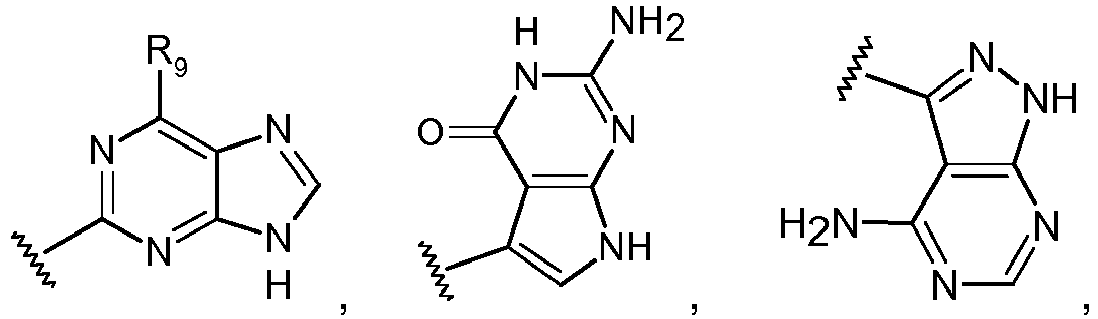
- A compound according to any one of claims 1 to 4, wherein R3 is selected from the group consisting of CH=CHR8, CH2CH2CH2R8,

- A compound according to any one of claims 1 to 5, wherein R4, R5, R6, R7 are the same or different and are selected from the group consisting of H, Cl, Br, I, NH2, OCH3.
- A compound according to any one of claims 1 to 6, wherein R4 and R7 are H, R5 and R6 are OCH3.
- A compound according to any one of claims 1 to 7, wherein R8 is selected from the group consisting of

- A compound according to any one of claims 1 to 8, wherein R8 is selected from the group consisting of

- A compound according to any one of claims 1 to 9, wherein R10 is selected from the group consisting of C1-C3 alkyl, phenyl.
- A compound according to any one of claims 1 to 10, wherein R10 is methyl.
- A compound according to any one of claims 1 to 11, wherein R11 and R12 are the same or different and are C1-C3 alkyl.
- A compound according to any one of claims 1 to 12, wherein R11 and R12 are methyl.
- A pharmaceutical composition comprising a compound of formula (I) according to any one of claims 1 to 13 or a pharmaceutically acceptable salt thereof and a pharmaceutically acceptable carrier.
- A compound according to any one of claims 1 to 13 or a pharmaceutically acceptable salt thereof for use in the treatment of cancer.
Priority Applications (3)
| Application Number | Priority Date | Filing Date | Title |
|---|---|---|---|
| HRP20201793TT HRP20201793T1 (en) | 2016-07-14 | 2017-07-14 | 1,2,4-TRIAZOLO-[3,4-b]-1,3,4-THIADIAZOLE DERIVATIVES |
| SI201730478T SI3484892T1 (en) | 2016-07-14 | 2017-07-14 | 1,2,4-triazolo-(3,4-b)-1,3,4-thiadiazole derivatives |
| RS20201367A RS61112B1 (en) | 2016-07-14 | 2017-07-14 | 1,2,4-triazolo-[3,4-b]-1,3,4-thiadiazole derivatives |
Applications Claiming Priority (2)
| Application Number | Priority Date | Filing Date | Title |
|---|---|---|---|
| GR20160100380A GR1009565B (en) | 2016-07-14 | 2016-07-14 | New 1,2,4-triazole-[3,4-b]-1,3,4-thiadiazole derivatives |
| PCT/EP2017/067908 WO2018011414A1 (en) | 2016-07-14 | 2017-07-14 | NEW 1,2,4-TRIAZOLO-[3,4-b]-1,3,4-THIADIAZOLE DERIVATIVES |
Publications (2)
| Publication Number | Publication Date |
|---|---|
| EP3484892A1 EP3484892A1 (en) | 2019-05-22 |
| EP3484892B1 true EP3484892B1 (en) | 2020-08-26 |
Family
ID=58314472
Family Applications (1)
| Application Number | Title | Priority Date | Filing Date |
|---|---|---|---|
| EP17742219.3A Active EP3484892B1 (en) | 2016-07-14 | 2017-07-14 | 1,2,4-triazolo-[3,4-b]-1,3,4-thiadiazole derivatives |
Country Status (19)
| Country | Link |
|---|---|
| US (1) | US10513529B2 (en) |
| EP (1) | EP3484892B1 (en) |
| JP (1) | JP7005588B2 (en) |
| KR (1) | KR102492136B1 (en) |
| CN (1) | CN109689660B (en) |
| AU (1) | AU2017296088B2 (en) |
| CA (1) | CA3030493C (en) |
| CY (1) | CY1123869T1 (en) |
| DK (1) | DK3484892T3 (en) |
| ES (1) | ES2831301T3 (en) |
| GR (1) | GR1009565B (en) |
| HR (1) | HRP20201793T1 (en) |
| HU (1) | HUE051576T2 (en) |
| LT (1) | LT3484892T (en) |
| PT (1) | PT3484892T (en) |
| RS (1) | RS61112B1 (en) |
| RU (1) | RU2765180C2 (en) |
| SI (1) | SI3484892T1 (en) |
| WO (1) | WO2018011414A1 (en) |
Families Citing this family (1)
| Publication number | Priority date | Publication date | Assignee | Title |
|---|---|---|---|---|
| JP7287606B2 (en) | 2018-08-10 | 2023-06-06 | 株式会社日本スペリア社 | Lead-free solder alloy |
Family Cites Families (5)
| Publication number | Priority date | Publication date | Assignee | Title |
|---|---|---|---|---|
| US20090312374A1 (en) * | 2005-09-21 | 2009-12-17 | University Of Mysore | Derivatives of 4,6-disubstituted 1,2,4-triazolo- 1,3,4-thiadiazole, a process and uses thereof |
| US7728017B2 (en) * | 2005-11-30 | 2010-06-01 | Vertex Pharmaceuticals Incorporated | Inhibitors of c-Met and uses thereof |
| WO2008060578A2 (en) * | 2006-11-15 | 2008-05-22 | Cytovia, Inc. | 3-aryl-6-aryl-[1,2,4] triazolo[3,4-b][1,3,4] thiadiazoles and related compounds as activators of caspases and inducers of apoptosis and the use thereof |
| US20090156594A1 (en) * | 2007-05-21 | 2009-06-18 | Sgx Pharmaceuticals, Inc. | Heterocyclic kinase modulators |
| US8269013B2 (en) * | 2009-05-28 | 2012-09-18 | Vertex Pharmaceuticals Incorporated | Substituted pyrazole inhibitors of c-Met protein kinase |
-
2016
- 2016-07-14 GR GR20160100380A patent/GR1009565B/en active IP Right Grant
-
2017
- 2017-07-14 RU RU2019103997A patent/RU2765180C2/en active
- 2017-07-14 LT LTEP17742219.3T patent/LT3484892T/en unknown
- 2017-07-14 US US16/317,341 patent/US10513529B2/en active Active
- 2017-07-14 WO PCT/EP2017/067908 patent/WO2018011414A1/en not_active Ceased
- 2017-07-14 HU HUE17742219A patent/HUE051576T2/en unknown
- 2017-07-14 AU AU2017296088A patent/AU2017296088B2/en active Active
- 2017-07-14 RS RS20201367A patent/RS61112B1/en unknown
- 2017-07-14 KR KR1020197003864A patent/KR102492136B1/en active Active
- 2017-07-14 SI SI201730478T patent/SI3484892T1/en unknown
- 2017-07-14 CN CN201780056456.1A patent/CN109689660B/en active Active
- 2017-07-14 HR HRP20201793TT patent/HRP20201793T1/en unknown
- 2017-07-14 PT PT177422193T patent/PT3484892T/en unknown
- 2017-07-14 ES ES17742219T patent/ES2831301T3/en active Active
- 2017-07-14 JP JP2019501649A patent/JP7005588B2/en active Active
- 2017-07-14 CA CA3030493A patent/CA3030493C/en active Active
- 2017-07-14 DK DK17742219.3T patent/DK3484892T3/en active
- 2017-07-14 EP EP17742219.3A patent/EP3484892B1/en active Active
-
2020
- 2020-11-05 CY CY20201101045T patent/CY1123869T1/en unknown
Non-Patent Citations (1)
| Title |
|---|
| None * |
Also Published As
| Publication number | Publication date |
|---|---|
| SI3484892T1 (en) | 2021-01-29 |
| WO2018011414A1 (en) | 2018-01-18 |
| US10513529B2 (en) | 2019-12-24 |
| RU2019103997A (en) | 2020-08-14 |
| GR1009565B (en) | 2019-08-06 |
| AU2017296088A1 (en) | 2019-02-21 |
| CY1123869T1 (en) | 2022-03-24 |
| CN109689660A (en) | 2019-04-26 |
| PT3484892T (en) | 2020-11-05 |
| EP3484892A1 (en) | 2019-05-22 |
| CA3030493C (en) | 2023-04-04 |
| HRP20201793T1 (en) | 2020-12-25 |
| DK3484892T3 (en) | 2020-11-16 |
| KR20190030705A (en) | 2019-03-22 |
| JP7005588B2 (en) | 2022-02-10 |
| LT3484892T (en) | 2021-01-25 |
| KR102492136B1 (en) | 2023-01-26 |
| JP2019521146A (en) | 2019-07-25 |
| AU2017296088B2 (en) | 2020-10-22 |
| CA3030493A1 (en) | 2018-01-18 |
| RU2765180C2 (en) | 2022-01-26 |
| HUE051576T2 (en) | 2021-03-01 |
| RS61112B1 (en) | 2020-12-31 |
| GR20160100380A (en) | 2018-03-30 |
| CN109689660B (en) | 2021-08-10 |
| RU2019103997A3 (en) | 2020-09-30 |
| ES2831301T3 (en) | 2021-06-08 |
| US20190194228A1 (en) | 2019-06-27 |
Similar Documents
| Publication | Publication Date | Title |
|---|---|---|
| Hassan et al. | Synthesis and antitumor activity of some new pyrazolo [1, 5-a] pyrimidines | |
| Chen et al. | Novel nicotinoyl pyrazoline derivates bearing N-methyl indole moiety as antitumor agents: Design, synthesis and evaluation | |
| US20040097504A1 (en) | Compositions useful as inhibitors of jak and other protein kinases | |
| Ibrahim et al. | Design, synthesis, in-silico and biological evaluation of novel 2-Amino-1, 3, 4-thiadiazole based hydrides as B-cell lymphoma-2 inhibitors with potential anticancer effects | |
| Zhang et al. | Design, synthesis and bioevaluation of inhibitors targeting HSP90-CDC37 protein-protein interaction based on a hydrophobic core | |
| JP4707393B2 (en) | Anticancer compounds | |
| CN113429408A (en) | Nitrogen-containing heterocyclic compound and preparation method, pharmaceutical composition and application thereof | |
| JP2015151396A (en) | Novel thiochromeno [2,3-c] quinolin-12-one derivative, preparation method and application thereof | |
| US10513529B2 (en) | 1,2,4-triazolo-[3,4-b]-1,3,4-thiadiazole derivatives | |
| AU2016304331B2 (en) | Method of treating cancer with a combination of benzylideneguanidine derivatives and chemotherapeutic agent. | |
| KR20150134731A (en) | Novel triazolylsalicylamide derivatives with aurora kinase inhibiting activity | |
| Devegowda et al. | Novel 6-N-arylcarboxamidopyrazolo [4, 3-d] pyrimidin-7-one derivatives as potential anti-cancer agents | |
| A. Hosny et al. | A New Type of Synthesis of 1, 2, 3‐Thiadiazole and 1, 2, 3‐Diazaphosphole Derivatives Via‐Hurd‐Mori Cyclization | |
| CN110256346A (en) | Phenanthridines ketone compounds and preparation method and application with BRD4 albumen inhibiting effect | |
| EP3098222B1 (en) | Fused acridine derivative and pharmaceutical composition, preparation method and use thereof | |
| HK40003319B (en) | 1,2,4-TRIAZOLO-[3,4-b]-1,3,4-THIADIAZOLE DERIVATIVES | |
| HK40003319A (en) | New 1,2,4-triazolo-[3,4-b]-1,3,4-thiadiazole derivatives | |
| Myrkoa et al. | Current Chemistry Letters | |
| Sadeghi-aliabadi et al. | Short Communication Synthesis and Cytotoxic Assessment of Thieno pyridine Derivatives | |
| Hamama et al. | Month 2018 Synthetic Approach to Some New Annulated 1, 2, 4-Triazine Skeletons with Antimicrobial and Cytotoxic Activities | |
| Dutta et al. | Synthesis, structural characterization and biological activity of 2-(4-methylbenzenesulphonamido) pentanedioic acid amide derivatives: In vitro and in vivo antineoplastic activity | |
| HK1206334B (en) | Dehydrothiamine [2,3-c]quinoline-12-ketone derivatives, and preparation method and application thereof | |
| PL237894B1 (en) | New 5-phenyl-7-methyl-pyrazolo [4,3-e] tetrazolo [4,5-b] [1,2,4] triazine sulfonamide derivatives, method of their preparation, their use and pharmaceutical composition containing them | |
| HK1206334A1 (en) | Dehydrothiamine [2,3-c]quinoline-12-ketone derivatives, and preparation method and application thereof |
Legal Events
| Date | Code | Title | Description |
|---|---|---|---|
| STAA | Information on the status of an ep patent application or granted ep patent |
Free format text: STATUS: UNKNOWN |
|
| STAA | Information on the status of an ep patent application or granted ep patent |
Free format text: STATUS: THE INTERNATIONAL PUBLICATION HAS BEEN MADE |
|
| PUAI | Public reference made under article 153(3) epc to a published international application that has entered the european phase |
Free format text: ORIGINAL CODE: 0009012 |
|
| STAA | Information on the status of an ep patent application or granted ep patent |
Free format text: STATUS: REQUEST FOR EXAMINATION WAS MADE |
|
| 17P | Request for examination filed |
Effective date: 20190212 |
|
| AK | Designated contracting states |
Kind code of ref document: A1 Designated state(s): AL AT BE BG CH CY CZ DE DK EE ES FI FR GB GR HR HU IE IS IT LI LT LU LV MC MK MT NL NO PL PT RO RS SE SI SK SM TR |
|
| AX | Request for extension of the european patent |
Extension state: BA ME |
|
| DAV | Request for validation of the european patent (deleted) | ||
| DAX | Request for extension of the european patent (deleted) | ||
| GRAP | Despatch of communication of intention to grant a patent |
Free format text: ORIGINAL CODE: EPIDOSNIGR1 |
|
| STAA | Information on the status of an ep patent application or granted ep patent |
Free format text: STATUS: GRANT OF PATENT IS INTENDED |
|
| INTG | Intention to grant announced |
Effective date: 20200305 |
|
| GRAS | Grant fee paid |
Free format text: ORIGINAL CODE: EPIDOSNIGR3 |
|
| GRAA | (expected) grant |
Free format text: ORIGINAL CODE: 0009210 |
|
| STAA | Information on the status of an ep patent application or granted ep patent |
Free format text: STATUS: THE PATENT HAS BEEN GRANTED |
|
| AK | Designated contracting states |
Kind code of ref document: B1 Designated state(s): AL AT BE BG CH CY CZ DE DK EE ES FI FR GB GR HR HU IE IS IT LI LT LU LV MC MK MT NL NO PL PT RO RS SE SI SK SM TR |
|
| REG | Reference to a national code |
Ref country code: GB Ref legal event code: FG4D |
|
| REG | Reference to a national code |
Ref country code: CH Ref legal event code: EP |
|
| REG | Reference to a national code |
Ref country code: AT Ref legal event code: REF Ref document number: 1306275 Country of ref document: AT Kind code of ref document: T Effective date: 20200915 |
|
| REG | Reference to a national code |
Ref country code: IE Ref legal event code: FG4D |
|
| REG | Reference to a national code |
Ref country code: DE Ref legal event code: R096 Ref document number: 602017022391 Country of ref document: DE |
|
| REG | Reference to a national code |
Ref country code: FI Ref legal event code: FGE |
|
| REG | Reference to a national code |
Ref country code: PT Ref legal event code: SC4A Ref document number: 3484892 Country of ref document: PT Date of ref document: 20201105 Kind code of ref document: T Free format text: AVAILABILITY OF NATIONAL TRANSLATION Effective date: 20201029 |
|
| REG | Reference to a national code |
Ref country code: HR Ref legal event code: TUEP Ref document number: P20201793 Country of ref document: HR |
|
| REG | Reference to a national code |
Ref country code: RO Ref legal event code: EPE |
|
| REG | Reference to a national code |
Ref country code: CH Ref legal event code: NV Representative=s name: VALIPAT S.A. C/O BOVARD SA NEUCHATEL, CH |
|
| REG | Reference to a national code |
Ref country code: DK Ref legal event code: T3 Effective date: 20201112 |
|
| REG | Reference to a national code |
Ref country code: NL Ref legal event code: FP |
|
| REG | Reference to a national code |
Ref country code: SE Ref legal event code: TRGR |
|
| REG | Reference to a national code |
Ref country code: HR Ref legal event code: T1PR Ref document number: P20201793 Country of ref document: HR |
|
| REG | Reference to a national code |
Ref country code: NO Ref legal event code: T2 Effective date: 20200826 |
|
| REG | Reference to a national code |
Ref country code: EE Ref legal event code: FG4A Ref document number: E020068 Country of ref document: EE Effective date: 20201109 |
|
| REG | Reference to a national code |
Ref country code: SK Ref legal event code: T3 Ref document number: E 36087 Country of ref document: SK |
|
| REG | Reference to a national code |
Ref country code: HU Ref legal event code: AG4A Ref document number: E051576 Country of ref document: HU |
|
| PG25 | Lapsed in a contracting state [announced via postgrant information from national office to epo] |
Ref country code: SM Free format text: LAPSE BECAUSE OF FAILURE TO SUBMIT A TRANSLATION OF THE DESCRIPTION OR TO PAY THE FEE WITHIN THE PRESCRIBED TIME-LIMIT Effective date: 20200826 |
|
| REG | Reference to a national code |
Ref country code: DE Ref legal event code: R097 Ref document number: 602017022391 Country of ref document: DE |
|
| PG25 | Lapsed in a contracting state [announced via postgrant information from national office to epo] |
Ref country code: AL Free format text: LAPSE BECAUSE OF FAILURE TO SUBMIT A TRANSLATION OF THE DESCRIPTION OR TO PAY THE FEE WITHIN THE PRESCRIBED TIME-LIMIT Effective date: 20200826 |
|
| REG | Reference to a national code |
Ref country code: ES Ref legal event code: FG2A Ref document number: 2831301 Country of ref document: ES Kind code of ref document: T3 Effective date: 20210608 |
|
| PLBE | No opposition filed within time limit |
Free format text: ORIGINAL CODE: 0009261 |
|
| STAA | Information on the status of an ep patent application or granted ep patent |
Free format text: STATUS: NO OPPOSITION FILED WITHIN TIME LIMIT |
|
| 26N | No opposition filed |
Effective date: 20210527 |
|
| REG | Reference to a national code |
Ref country code: HR Ref legal event code: ODRP Ref document number: P20201793 Country of ref document: HR Payment date: 20210709 Year of fee payment: 5 |
|
| PG25 | Lapsed in a contracting state [announced via postgrant information from national office to epo] |
Ref country code: MC Free format text: LAPSE BECAUSE OF FAILURE TO SUBMIT A TRANSLATION OF THE DESCRIPTION OR TO PAY THE FEE WITHIN THE PRESCRIBED TIME-LIMIT Effective date: 20200826 |
|
| REG | Reference to a national code |
Ref country code: HR Ref legal event code: ODRP Ref document number: P20201793 Country of ref document: HR Payment date: 20220705 Year of fee payment: 6 |
|
| REG | Reference to a national code |
Ref country code: AT Ref legal event code: UEP Ref document number: 1306275 Country of ref document: AT Kind code of ref document: T Effective date: 20200826 |
|
| REG | Reference to a national code |
Ref country code: HR Ref legal event code: ODRP Ref document number: P20201793 Country of ref document: HR Payment date: 20230630 Year of fee payment: 7 |
|
| PG25 | Lapsed in a contracting state [announced via postgrant information from national office to epo] |
Ref country code: MK Free format text: LAPSE BECAUSE OF FAILURE TO SUBMIT A TRANSLATION OF THE DESCRIPTION OR TO PAY THE FEE WITHIN THE PRESCRIBED TIME-LIMIT Effective date: 20200826 |
|
| REG | Reference to a national code |
Ref country code: HR Ref legal event code: ODRP Ref document number: P20201793 Country of ref document: HR Payment date: 20240704 Year of fee payment: 8 |
|
| PGFP | Annual fee paid to national office [announced via postgrant information from national office to epo] |
Ref country code: SI Payment date: 20250709 Year of fee payment: 9 |
|
| REG | Reference to a national code |
Ref country code: HR Ref legal event code: ODRP Ref document number: P20201793 Country of ref document: HR Payment date: 20250710 Year of fee payment: 9 |
|
| PGFP | Annual fee paid to national office [announced via postgrant information from national office to epo] |
Ref country code: NL Payment date: 20250723 Year of fee payment: 9 Ref country code: LU Payment date: 20250722 Year of fee payment: 9 |
|
| PGFP | Annual fee paid to national office [announced via postgrant information from national office to epo] |
Ref country code: HU Payment date: 20250711 Year of fee payment: 9 |
|
| PGFP | Annual fee paid to national office [announced via postgrant information from national office to epo] |
Ref country code: ES Payment date: 20250819 Year of fee payment: 9 Ref country code: FI Payment date: 20250722 Year of fee payment: 9 Ref country code: PT Payment date: 20250702 Year of fee payment: 9 |
|
| PGFP | Annual fee paid to national office [announced via postgrant information from national office to epo] |
Ref country code: LT Payment date: 20250704 Year of fee payment: 9 Ref country code: DK Payment date: 20250723 Year of fee payment: 9 Ref country code: DE Payment date: 20250722 Year of fee payment: 9 |
|
| PGFP | Annual fee paid to national office [announced via postgrant information from national office to epo] |
Ref country code: NO Payment date: 20250722 Year of fee payment: 9 Ref country code: GR Payment date: 20250721 Year of fee payment: 9 |
|
| PGFP | Annual fee paid to national office [announced via postgrant information from national office to epo] |
Ref country code: PL Payment date: 20250703 Year of fee payment: 9 Ref country code: TR Payment date: 20250708 Year of fee payment: 9 Ref country code: IT Payment date: 20250731 Year of fee payment: 9 |
|
| PGFP | Annual fee paid to national office [announced via postgrant information from national office to epo] |
Ref country code: BG Payment date: 20250718 Year of fee payment: 9 Ref country code: BE Payment date: 20250722 Year of fee payment: 9 Ref country code: GB Payment date: 20250724 Year of fee payment: 9 |
|
| PGFP | Annual fee paid to national office [announced via postgrant information from national office to epo] |
Ref country code: HR Payment date: 20250710 Year of fee payment: 9 |
|
| PGFP | Annual fee paid to national office [announced via postgrant information from national office to epo] |
Ref country code: FR Payment date: 20250723 Year of fee payment: 9 Ref country code: AT Payment date: 20250721 Year of fee payment: 9 |
|
| PGFP | Annual fee paid to national office [announced via postgrant information from national office to epo] |
Ref country code: MT Payment date: 20250724 Year of fee payment: 9 Ref country code: SE Payment date: 20250723 Year of fee payment: 9 Ref country code: CH Payment date: 20250801 Year of fee payment: 9 |
|
| PGFP | Annual fee paid to national office [announced via postgrant information from national office to epo] |
Ref country code: IE Payment date: 20250724 Year of fee payment: 9 Ref country code: RS Payment date: 20250709 Year of fee payment: 9 Ref country code: EE Payment date: 20250724 Year of fee payment: 9 Ref country code: CZ Payment date: 20250701 Year of fee payment: 9 |
|
| PGFP | Annual fee paid to national office [announced via postgrant information from national office to epo] |
Ref country code: RO Payment date: 20250701 Year of fee payment: 9 |
|
| PGFP | Annual fee paid to national office [announced via postgrant information from national office to epo] |
Ref country code: SK Payment date: 20250703 Year of fee payment: 9 |
|
| PGFP | Annual fee paid to national office [announced via postgrant information from national office to epo] |
Ref country code: IS Payment date: 20250718 Year of fee payment: 9 |
|
| PGFP | Annual fee paid to national office [announced via postgrant information from national office to epo] |
Ref country code: LV Payment date: 20250722 Year of fee payment: 9 |
|
| PGFP | Annual fee paid to national office [announced via postgrant information from national office to epo] |
Ref country code: CY Payment date: 20250701 Year of fee payment: 9 |