EP3484702B2 - Laminat und herstellungsverfahren - Google Patents
Laminat und herstellungsverfahren Download PDFInfo
- Publication number
- EP3484702B2 EP3484702B2 EP17748830.1A EP17748830A EP3484702B2 EP 3484702 B2 EP3484702 B2 EP 3484702B2 EP 17748830 A EP17748830 A EP 17748830A EP 3484702 B2 EP3484702 B2 EP 3484702B2
- Authority
- EP
- European Patent Office
- Prior art keywords
- nonwoven
- woven sheet
- lateral direction
- activated
- activation
- Prior art date
- Legal status (The legal status is an assumption and is not a legal conclusion. Google has not performed a legal analysis and makes no representation as to the accuracy of the status listed.)
- Active
Links
Images

Classifications
-
- B—PERFORMING OPERATIONS; TRANSPORTING
- B32—LAYERED PRODUCTS
- B32B—LAYERED PRODUCTS, i.e. PRODUCTS BUILT-UP OF STRATA OF FLAT OR NON-FLAT, e.g. CELLULAR OR HONEYCOMB, FORM
- B32B5/00—Layered products characterised by the non- homogeneity or physical structure, i.e. comprising a fibrous, filamentary, particulate or foam layer; Layered products characterised by having a layer differing constitutionally or physically in different parts
- B32B5/02—Layered products characterised by the non- homogeneity or physical structure, i.e. comprising a fibrous, filamentary, particulate or foam layer; Layered products characterised by having a layer differing constitutionally or physically in different parts characterised by structural features of a fibrous or filamentary layer
- B32B5/022—Non-woven fabric
-
- A—HUMAN NECESSITIES
- A61—MEDICAL OR VETERINARY SCIENCE; HYGIENE
- A61F—FILTERS IMPLANTABLE INTO BLOOD VESSELS; PROSTHESES; DEVICES PROVIDING PATENCY TO, OR PREVENTING COLLAPSING OF, TUBULAR STRUCTURES OF THE BODY, e.g. STENTS; ORTHOPAEDIC, NURSING OR CONTRACEPTIVE DEVICES; FOMENTATION; TREATMENT OR PROTECTION OF EYES OR EARS; BANDAGES, DRESSINGS OR ABSORBENT PADS; FIRST-AID KITS
- A61F13/00—Bandages or dressings; Absorbent pads
- A61F13/15—Absorbent pads, e.g. sanitary towels, swabs or tampons for external or internal application to the body; Supporting or fastening means therefor; Tampon applicators
- A61F13/15577—Apparatus or processes for manufacturing
- A61F13/15699—Forming webs by bringing together several webs, e.g. by laminating or folding several webs, with or without additional treatment of the webs
-
- B—PERFORMING OPERATIONS; TRANSPORTING
- B32—LAYERED PRODUCTS
- B32B—LAYERED PRODUCTS, i.e. PRODUCTS BUILT-UP OF STRATA OF FLAT OR NON-FLAT, e.g. CELLULAR OR HONEYCOMB, FORM
- B32B27/00—Layered products comprising a layer of synthetic resin
- B32B27/12—Layered products comprising a layer of synthetic resin next to a fibrous or filamentary layer
-
- B—PERFORMING OPERATIONS; TRANSPORTING
- B32—LAYERED PRODUCTS
- B32B—LAYERED PRODUCTS, i.e. PRODUCTS BUILT-UP OF STRATA OF FLAT OR NON-FLAT, e.g. CELLULAR OR HONEYCOMB, FORM
- B32B27/00—Layered products comprising a layer of synthetic resin
- B32B27/30—Layered products comprising a layer of synthetic resin comprising vinyl (co)polymers; comprising acrylic (co)polymers
- B32B27/302—Layered products comprising a layer of synthetic resin comprising vinyl (co)polymers; comprising acrylic (co)polymers comprising aromatic vinyl (co)polymers, e.g. styrenic (co)polymers
-
- B—PERFORMING OPERATIONS; TRANSPORTING
- B32—LAYERED PRODUCTS
- B32B—LAYERED PRODUCTS, i.e. PRODUCTS BUILT-UP OF STRATA OF FLAT OR NON-FLAT, e.g. CELLULAR OR HONEYCOMB, FORM
- B32B27/00—Layered products comprising a layer of synthetic resin
- B32B27/32—Layered products comprising a layer of synthetic resin comprising polyolefins
-
- B—PERFORMING OPERATIONS; TRANSPORTING
- B32—LAYERED PRODUCTS
- B32B—LAYERED PRODUCTS, i.e. PRODUCTS BUILT-UP OF STRATA OF FLAT OR NON-FLAT, e.g. CELLULAR OR HONEYCOMB, FORM
- B32B27/00—Layered products comprising a layer of synthetic resin
- B32B27/32—Layered products comprising a layer of synthetic resin comprising polyolefins
- B32B27/327—Layered products comprising a layer of synthetic resin comprising polyolefins comprising polyolefins obtained by a metallocene or single-site catalyst
-
- B—PERFORMING OPERATIONS; TRANSPORTING
- B32—LAYERED PRODUCTS
- B32B—LAYERED PRODUCTS, i.e. PRODUCTS BUILT-UP OF STRATA OF FLAT OR NON-FLAT, e.g. CELLULAR OR HONEYCOMB, FORM
- B32B37/00—Methods or apparatus for laminating, e.g. by curing or by ultrasonic bonding
- B32B37/12—Methods or apparatus for laminating, e.g. by curing or by ultrasonic bonding characterised by using adhesives
- B32B37/1284—Application of adhesive
- B32B37/1292—Application of adhesive selectively, e.g. in stripes, in patterns
-
- B—PERFORMING OPERATIONS; TRANSPORTING
- B32—LAYERED PRODUCTS
- B32B—LAYERED PRODUCTS, i.e. PRODUCTS BUILT-UP OF STRATA OF FLAT OR NON-FLAT, e.g. CELLULAR OR HONEYCOMB, FORM
- B32B37/00—Methods or apparatus for laminating, e.g. by curing or by ultrasonic bonding
- B32B37/14—Methods or apparatus for laminating, e.g. by curing or by ultrasonic bonding characterised by the properties of the layers
- B32B37/16—Methods or apparatus for laminating, e.g. by curing or by ultrasonic bonding characterised by the properties of the layers with all layers existing as coherent layers before laminating
- B32B37/18—Methods or apparatus for laminating, e.g. by curing or by ultrasonic bonding characterised by the properties of the layers with all layers existing as coherent layers before laminating involving the assembly of discrete sheets or panels only
- B32B37/182—Methods or apparatus for laminating, e.g. by curing or by ultrasonic bonding characterised by the properties of the layers with all layers existing as coherent layers before laminating involving the assembly of discrete sheets or panels only one or more of the layers being plastic
-
- B—PERFORMING OPERATIONS; TRANSPORTING
- B32—LAYERED PRODUCTS
- B32B—LAYERED PRODUCTS, i.e. PRODUCTS BUILT-UP OF STRATA OF FLAT OR NON-FLAT, e.g. CELLULAR OR HONEYCOMB, FORM
- B32B38/00—Ancillary operations in connection with laminating processes
- B32B38/0012—Mechanical treatment, e.g. roughening, deforming, stretching
-
- B—PERFORMING OPERATIONS; TRANSPORTING
- B32—LAYERED PRODUCTS
- B32B—LAYERED PRODUCTS, i.e. PRODUCTS BUILT-UP OF STRATA OF FLAT OR NON-FLAT, e.g. CELLULAR OR HONEYCOMB, FORM
- B32B5/00—Layered products characterised by the non- homogeneity or physical structure, i.e. comprising a fibrous, filamentary, particulate or foam layer; Layered products characterised by having a layer differing constitutionally or physically in different parts
- B32B5/22—Layered products characterised by the non- homogeneity or physical structure, i.e. comprising a fibrous, filamentary, particulate or foam layer; Layered products characterised by having a layer differing constitutionally or physically in different parts characterised by the presence of two or more layers which are next to each other and are fibrous, filamentary, formed of particles or foamed
- B32B5/24—Layered products characterised by the non- homogeneity or physical structure, i.e. comprising a fibrous, filamentary, particulate or foam layer; Layered products characterised by having a layer differing constitutionally or physically in different parts characterised by the presence of two or more layers which are next to each other and are fibrous, filamentary, formed of particles or foamed one layer being a fibrous or filamentary layer
- B32B5/26—Layered products characterised by the non- homogeneity or physical structure, i.e. comprising a fibrous, filamentary, particulate or foam layer; Layered products characterised by having a layer differing constitutionally or physically in different parts characterised by the presence of two or more layers which are next to each other and are fibrous, filamentary, formed of particles or foamed one layer being a fibrous or filamentary layer another layer next to it also being fibrous or filamentary
-
- B—PERFORMING OPERATIONS; TRANSPORTING
- B32—LAYERED PRODUCTS
- B32B—LAYERED PRODUCTS, i.e. PRODUCTS BUILT-UP OF STRATA OF FLAT OR NON-FLAT, e.g. CELLULAR OR HONEYCOMB, FORM
- B32B7/00—Layered products characterised by the relation between layers; Layered products characterised by the relative orientation of features between layers, or by the relative values of a measurable parameter between layers, i.e. products comprising layers having different physical, chemical or physicochemical properties; Layered products characterised by the interconnection of layers
- B32B7/04—Interconnection of layers
- B32B7/05—Interconnection of layers the layers not being connected over the whole surface, e.g. discontinuous connection or patterned connection
-
- B—PERFORMING OPERATIONS; TRANSPORTING
- B32—LAYERED PRODUCTS
- B32B—LAYERED PRODUCTS, i.e. PRODUCTS BUILT-UP OF STRATA OF FLAT OR NON-FLAT, e.g. CELLULAR OR HONEYCOMB, FORM
- B32B7/00—Layered products characterised by the relation between layers; Layered products characterised by the relative orientation of features between layers, or by the relative values of a measurable parameter between layers, i.e. products comprising layers having different physical, chemical or physicochemical properties; Layered products characterised by the interconnection of layers
- B32B7/04—Interconnection of layers
- B32B7/12—Interconnection of layers using interposed adhesives or interposed materials with bonding properties
- B32B7/14—Interconnection of layers using interposed adhesives or interposed materials with bonding properties applied in spaced arrangements, e.g. in stripes
-
- B—PERFORMING OPERATIONS; TRANSPORTING
- B32—LAYERED PRODUCTS
- B32B—LAYERED PRODUCTS, i.e. PRODUCTS BUILT-UP OF STRATA OF FLAT OR NON-FLAT, e.g. CELLULAR OR HONEYCOMB, FORM
- B32B38/00—Ancillary operations in connection with laminating processes
- B32B38/0012—Mechanical treatment, e.g. roughening, deforming, stretching
- B32B2038/0028—Stretching, elongating
-
- B—PERFORMING OPERATIONS; TRANSPORTING
- B32—LAYERED PRODUCTS
- B32B—LAYERED PRODUCTS, i.e. PRODUCTS BUILT-UP OF STRATA OF FLAT OR NON-FLAT, e.g. CELLULAR OR HONEYCOMB, FORM
- B32B2262/00—Composition or structural features of fibres which form a fibrous or filamentary layer or are present as additives
- B32B2262/02—Synthetic macromolecular fibres
- B32B2262/0253—Polyolefin fibres
-
- B—PERFORMING OPERATIONS; TRANSPORTING
- B32—LAYERED PRODUCTS
- B32B—LAYERED PRODUCTS, i.e. PRODUCTS BUILT-UP OF STRATA OF FLAT OR NON-FLAT, e.g. CELLULAR OR HONEYCOMB, FORM
- B32B2307/00—Properties of the layers or laminate
- B32B2307/50—Properties of the layers or laminate having particular mechanical properties
- B32B2307/51—Elastic
-
- B—PERFORMING OPERATIONS; TRANSPORTING
- B32—LAYERED PRODUCTS
- B32B—LAYERED PRODUCTS, i.e. PRODUCTS BUILT-UP OF STRATA OF FLAT OR NON-FLAT, e.g. CELLULAR OR HONEYCOMB, FORM
- B32B2307/00—Properties of the layers or laminate
- B32B2307/50—Properties of the layers or laminate having particular mechanical properties
- B32B2307/514—Oriented
- B32B2307/516—Oriented mono-axially
-
- B—PERFORMING OPERATIONS; TRANSPORTING
- B32—LAYERED PRODUCTS
- B32B—LAYERED PRODUCTS, i.e. PRODUCTS BUILT-UP OF STRATA OF FLAT OR NON-FLAT, e.g. CELLULAR OR HONEYCOMB, FORM
- B32B2307/00—Properties of the layers or laminate
- B32B2307/50—Properties of the layers or laminate having particular mechanical properties
- B32B2307/54—Yield strength; Tensile strength
-
- B—PERFORMING OPERATIONS; TRANSPORTING
- B32—LAYERED PRODUCTS
- B32B—LAYERED PRODUCTS, i.e. PRODUCTS BUILT-UP OF STRATA OF FLAT OR NON-FLAT, e.g. CELLULAR OR HONEYCOMB, FORM
- B32B2555/00—Personal care
-
- B—PERFORMING OPERATIONS; TRANSPORTING
- B32—LAYERED PRODUCTS
- B32B—LAYERED PRODUCTS, i.e. PRODUCTS BUILT-UP OF STRATA OF FLAT OR NON-FLAT, e.g. CELLULAR OR HONEYCOMB, FORM
- B32B2555/00—Personal care
- B32B2555/02—Diapers or napkins
Definitions
- This disclosure relates to laminated assemblies comprising nonwoven webs.
- This disclosure relates, more particularly, to non-woven sheets and laminated assemblies which can be used in the field of hygiene, in particular for the manufacture of elastic ears for diapers.
- These laminated assemblies generally comprise two non-woven sheets secured to an elastic film interposed between the two non-woven sheets, the two non-woven sheets and the elastic film being assembled by lamination to form a laminated assembly, also called a trilaminate.
- nonwoven sheets generally have an elongation capacity lower than the elongation capacity of the elastic film, so it is difficult to easily obtain a product with a desired elongation capacity. It is then necessary to carry out a treatment on the trilaminate to stretch it transversely in order to give it a desired transverse elongation capacity.
- the appearance of certain defects, such as holes in the laminated assembly, more particularly in the elastic film, may cause the laminated assembly to break on the production line or when pulled in the elongation direction or unwanted pollution of the laminated assembly resulting in stoppages of the production line in order to clean it.
- the laminated assembly comprising holes, cuts, slits or which is polluted cannot be used and is discarded. Some holes are visible to the naked eye when the laminated assembly is in the unstretched state and may enlarge when the laminate is stretched. It is then easy to detect them. On the other hand, other holes may be present in the elastic alone and be visible to the naked eye only when the laminated assembly is in the stretched state.
- holes, cuts or slits may also form, on the one hand, during the treatment described above, and/or, on the other hand, during the first extension of the laminate assembly, for example when the laminate is used on the finished product, such as a diaper causing it to break. These holes, cuts and/or slits are then very difficult to detect since they are detected on the final application. In all these cases, these holes degrade the quality perceived by the user/customer of the finished product.
- the slits in the elastic film are all the more difficult to detect as they extend in the longitudinal direction and may form in particular during the treatment described above due to the strong transverse stretching giving the trilaminate a desired transverse elongation capacity and/or in particular due to the presence of hard points included in the elastic film.
- the document EP0803602 discloses a composite elastic body.
- the present disclosure relates to a laminated assembly as defined by claim 1 or claim 2, extending in a longitudinal direction and a lateral direction, orthogonal to the longitudinal direction, the assembly comprising a nonwoven sheet and an elastic film laminated together, the nonwoven sheet comprising at least one activated zone extending over a length of the nonwoven sheet measured in the longitudinal direction and over a width strictly less than a width of the nonwoven sheet measured in the lateral direction, the activation rate of the activated zone of the nonwoven sheet in the lateral direction being different from the activation rate of the elastic film in the lateral direction, the activation rate of the activated zone of the nonwoven sheet in the lateral direction being between 20 and 200%.
- the nonwoven web and the elastic film have different activation rates, it is understood that the nonwoven web is activated before being laminated with the elastic film.
- a laminated assembly is obtained which has good elongation capacity in the lateral direction and it is possible to reduce, or even eliminate, the activation of the laminated assembly, i.e. to reduce the activation rate of the laminated assembly, or even for the activation rate of the laminated assembly to be equal to zero (no activation of the laminated assembly).
- nonwoven encompasses all nonwovens falling within the definition commonly accepted by those skilled in the art, typically a web comprising fibers and/or filaments which are consolidated.
- An elastic film is understood to mean a film that can be stretched without breaking under the effect of a stretching force exerted in the lateral direction and that can substantially return to its initial shape and dimensions after release of this stretching force.
- This is, for example, a film that retains a residual deformation or remanence after elongation and release (residual deformation also called "permanent set” or "SET") of less than 20%, more preferably less than 5%, of its initial dimension (before elongation) for an elongation of 100% of its initial dimension, at room temperature (23°C).
- Activation means a process in which the laminated assembly passes through an activation module which stretches the laminated assembly in a direction perpendicular to the direction of travel of the laminated assembly in the activation module in order to increase the elongation capacity of the nonwoven sheets of the laminated assembly.
- Laminate activation is a treatment to reduce the cohesion of the nonwoven fabric structure and to ensure that the laminate can be stretched easily (with less force, for example at 10N).
- the inventors identified that one of the sources of defect and/or pollution and/or formation of holes, cuts and/or cracks originated from the passage of the laminated assembly in the activation module with high activation rates, for example greater than 200%.
- the inventors identified that the activation of the laminated assembly being reduced, or even eliminated, the defects and/or pollution and/or holes in the laminated assembly linked to the passage of the laminated assembly in an activation module were reduced, or even eliminated.
- the activation module comprises two activation rollers each provided with a stack of parallel discs spaced apart from each other.
- the activation rollers and the discs each comprise an axis of symmetry which is oriented in the lateral direction.
- the discs of the first activation roller are arranged in the inter-disc spaces of the second activation roller (preferably in the middle of the inter-disc spaces) and the axes of symmetry of the two activation rollers are spaced apart from each other by a distance less than the diameter of the discs so that the areas of the laminated assembly passing between the discs of the rollers are stretched in the lateral direction, forming the activated areas.
- the fibers and/or filaments of the nonwoven web are stretched and/or broken and the elastic film is stretched. It is understood that the smaller the distance between the axes of symmetry of the two activation rollers, the greater the interpenetration of the discs of the first roller with respect to the second roller and the greater the activation rate.
- the activation rate is the ratio of the difference between the distance between the end of two adjacent discs each belonging to a different activation roller and the distance between the end of these two same discs projected on the axis of symmetry of an activation roller to this distance between the end of these two same discs projected on the axis of symmetry of an activation roller expressed as a percentage.
- the nonwoven sheet is glued to the elastic film
- the forces exerted on the laminated assembly during its passage through the activation module increase and the discs penetrate more deeply into the laminated assembly, the discs may be in contact with the glue which secures the nonwoven sheet and the elastic film.
- the activation disc(s) being in contact with the glue, the laminated assembly remains stuck to the activation disc(s), and, given the speed of the line, in a few seconds the product accumulates in the activation block and the production line must be stopped urgently at the risk of breaking one or more activation discs.
- Such a breakage would require a long and heavy maintenance intervention. In the absence of breakage, it is still necessary to clean the activation module and restart the production line.
- Activation discs are even more likely to be contaminated by glue when the laminates have a nonwoven web with a low grammage. In some cases, this glue can deposit on the laminate and pollute it. This glue can also tear fibers from the nonwoven web, which can then deposit on the laminate and pollute it. In addition, if fibers are torn off, an unwanted hole can form in the nonwoven web.
- the laminated assembly Since the nonwoven web is already activated, once the nonwoven web is laminated with the elastic film, the laminated assembly has a satisfactory elongation capacity and the laminated assembly may not be activated.
- the elastic film is therefore not activated. This advantageously avoids the risks of contamination linked to the transfer of glue onto the discs of the activation module, which in particular requires an emergency stoppage of the production line, avoids stretching the elastic film and avoids forming holes, cuts and/or slits in the elastic film. This can reduce the scrap rate of the laminated assembly and also reduce the downtime of the production line in order to clean it.
- the activated zone of the non-woven sheet has a width at least equal to the width of the elastic film.
- the width of the laminated assembly activation zone is less than the width of the elastic film.
- the non-woven fabric sheet Since the non-woven fabric sheet has been activated before being assembled with the elastic film, it is possible to activate this non-woven fabric sheet over a width that may be equal to or greater than the width of the elastic film. It is understood that the width of the activated area may of course be less than the width of the elastic film.
- the activation rate of the activated area of the nonwoven web in the lateral direction may be between 40 and 200%, more particularly between 40 and 160%.
- the laminate assembly comprising a nonwoven web that has been activated prior to its assembly with the elastic film may be activated.
- the activation rate of the laminate assembly may be less than if the nonwoven web had not been activated before its assembly with the elastic film, with identical elongation capacity of the laminated assembly.
- This advantageously reduces the risks of contamination linked to the transfer of glue onto the discs of the activation module requiring in particular the emergency stoppage of the production line, reduces the stretching of the elastic film and reduces the risk of formation of holes, cuts and/or slits in the elastic film.
- the transfer of glue to the discs is all the more important when the nonwoven sheets used have a low grammage. This allows the scrap rate of the laminated assembly to be reduced and also reduces the downtime of the production line in order to clean it.
- the laminated assembly may be activated less than 200% in the lateral direction, preferably less than 150%, even more preferably less than 125%, especially less than 100%.
- the elastic film may have a width less than the width of the nonwoven web.
- the elastic film may be co-extruded with a non-elastic material to form a film having a width substantially equal to the width of the nonwoven web, the elastic film being joined to the activated area of the nonwoven web.
- the elastic film can be formed by elastic glue.
- the elastic adhesive film can then be extruded onto the nonwoven web and subsequently laminated with this nonwoven web.
- the activated zone can extend over the entire length of the nonwoven web measured in the longitudinal direction.
- a non-woven sheet is, for example, made up of a sheet of fibers and/or filaments produced using Dry-laid (dry process), Wet-laid (wet process), or Spun-laid (melted/extruded process) technology and consolidated by mechanical, thermal, chemical and/or adhesive bonding.
- the nonwoven fabric can be a calendered carded nonwoven fabric.
- Calendered carded nonwoven is a nonwoven comprising a web of fibers having points of consolidation of the web distributed substantially homogeneously over the entire web by thermal consolidation. Consolidation ensures a certain cohesion of the fibers allowing their handling and transport, in particular their winding into a reel and their unwinding. Activation of the calendered carded nonwoven web makes it possible to elongate and/or break the fibers of the nonwoven web and/or to deform the points of consolidation of the web. This increases the elongation capacity of the nonwoven web.
- the fibers of the calendered carded nonwoven web are between 1 and 8 dTex (deciTex), preferably between 1.3 and 6.7 dTex, even more preferably between 1.6 and 5.5 dTex.
- Tex is the SI unit of fineness of textile fibers. It expresses the weight in grams of 1,000 m (meters) of fiber length.
- the nonwoven web is a first nonwoven web
- the laminate assembly includes a second nonwoven web
- the elastic film may be interposed between the first and second nonwoven webs, or the second nonwoven web may be at least partially interposed between the first nonwoven web and the elastic film.
- the elastic film being interposed between the first and second non-woven layers, only the non-woven layers are accessible to the user.
- the elastic film can be formed by elastic glue.
- the elastic glue may be extruded onto the first nonwoven web and the first nonwoven web coated with the elastic glue may then be laminated with the second nonwoven web or vice versa.
- the elastic glue can also be extruded directly between the two nonwoven layers and then the two nonwoven layers and the elastic glue are laminated together.
- the elastic film may be formed by an elastic glue and may be co-extruded with a non-elastic material formed by a non-elastic glue to form a film having a width substantially equal to the width of the nonwoven web, the elastic film being joined to the activated area of the nonwoven web.
- the elastic film may not be activated.
- the second nonwoven sheet may be devoid of an activated area. The second nonwoven sheet is therefore not activated.
- the second nonwoven web comprises at least one activated zone extending over a length of the nonwoven web measured in the longitudinal direction and over a width strictly less than a width of the nonwoven web measured in the lateral direction, the activation rate of the activated zone of the second nonwoven web in the lateral direction being able to be between 20 and 200%.
- the activation rate of the activated area of the second nonwoven sheet in the lateral direction may be between 20 and 200%, in particular between 40 and 200%, even more in particular between 40 and 160%.
- the activation rate of the activated area of the second nonwoven web in the lateral direction may be different from the activation rate of the elastic film in the lateral direction.
- the laminated assembly can be activated after laminating and assembling the two nonwoven webs and the elastic film.
- the second nonwoven web that has been activated before its assembly with the elastic film will have an activation rate different from the activation rate of the elastic film.
- the activation rate of the elastic film being equal to zero, the activation rate of the second nonwoven sheet is different from the activation rate of the elastic film.
- the nonwoven fabric can be a Spunlace type nonwoven.
- Spunlace nonwoven is a nonwoven fabric formed from (endless) filaments and/or fibers generally between 30 and 60 mm (millimeters) in length, consolidated by hydro-bonding.
- Spunlace nonwoven is commonly used in the hygiene sector for its softness and natural deformation capacity. Due to its natural deformation capacity, spunlace nonwoven is particularly prone to the neckdown phenomenon, i.e. when tension is applied to it in a given direction, it undergoes, in the orthogonal direction, a significant deformation. Consequently, on a production line where it is subjected to strong longitudinal tension, a spunlace nonwoven web shrinks significantly in the lateral direction. Thus, for a desired width of the laminate, a spunlace nonwoven web of greater width is generally provided to take into account the neckdown phenomenon.
- the spunlace nonwoven web By activating the spunlace nonwoven web, it is possible to provide a spunlace nonwoven web with a width less than the width of the spunlace nonwoven web that would have been required if the spunlace nonwoven web had not been activated, with a constant laminated assembly width. This reduces the production costs of the laminated assembly. By activating the spunlace nonwoven web beforehand, it is then possible to adjust its width, greater than and/or equal to, less than and/or equal to the width of the spunlace nonwoven before it passes through the production line.
- the non-woven fabric can be a Spunmelt type non-woven fabric.
- Spunmelt nonwovens include Spunbond nonwovens, Meltblown nonwovens, and nonwovens comprising at least one Spunbond layer and at least one Meltblown layer (e.g., SM, SMS, SSMMS, SMSMS, SMMMS, SMMS, SSMMSS, SSMMMSS, SSMMMSSS, ... or any other combination of S and M layers, where S represents a Spunbond layer and M represents a Meltblown layer).
- Spunmelt nonwovens are nonwovens formed from filaments obtained by extrusion.
- Activating the spunmelt nonwoven fabric allows the filaments of the nonwoven fabric to be lengthened and/or broken. This increases the elongation capacity of the nonwoven fabric.
- the activation rate of the activated area of the nonwoven web in the lateral direction may be between 40 and 200%, in particular between 40 and 160%.
- Laminating the nonwoven fabric and elastic film allows the nonwoven fabric and elastic film to be assembled and secured.
- the assembly and securing of the nonwoven fabric and elastic film can be done with or without glue.
- the method may comprise, prior to rolling the nonwoven sheet, a step of coating the nonwoven sheet with an adhesive.
- the glue can be applied to the nonwoven fabric continuously in the longitudinal direction. can also be deposited on the nonwoven web discontinuously in the longitudinal direction.
- the adhesive may be deposited discontinuously in the lateral direction.
- the adhesive thus forms a plurality of adhesive lines, for example continuous in the longitudinal direction, the width of which is less than the width of the activated area.
- the width of the glue lines and their spacing can be adjusted in the lateral direction.
- the method may include, prior to rolling the non-woven sheet, a step of coating the elastic film with an adhesive.
- the nonwoven web is a first nonwoven web
- the manufacturing method comprises a step of providing a second nonwoven web and a step of laminating the second nonwoven web onto the elastic film, or of laminating the second nonwoven web onto the first nonwoven web.
- Laminating the second nonwoven web may be carried out during the laminating with the elastic or be carried out in a separate step, before or after the laminating with the elastic.
- the step of laminating the second nonwoven sheet onto the elastic film can be carried out simultaneously with the step of laminating the first nonwoven sheet onto the elastic film. These laminating steps can also be carried out successively.
- the elastic film can be formed by elastic glue.
- the elastic glue may be extruded onto the first nonwoven web and the first nonwoven web coated with the elastic glue may then be laminated with the second nonwoven web or vice versa.
- the elastic glue can also be extruded directly between the two nonwoven layers and then the two nonwoven layers and the elastic glue are laminated together.
- the second nonwoven web Prior to rolling the second nonwoven web, the second nonwoven web may be activated between 20 and 200%, in the lateral direction, over an area extending over a length of the nonwoven web measured in the longitudinal direction and over a width strictly less than a width of the nonwoven web measured in the lateral direction.
- the activation rate of the activated area of the second nonwoven web in the lateral direction may be between 40 and 200%, in particular between 40 and 160%.
- the method may comprise, prior to rolling the second nonwoven sheet, a step of coating the second nonwoven sheet with an adhesive.
- the adhesive can be applied to the nonwoven web continuously in the longitudinal direction. It can also be applied to the nonwoven web discontinuously in the longitudinal direction.
- the adhesive may be deposited discontinuously in the lateral direction.
- the adhesive thus forms a plurality of adhesive lines, for example continuous in the longitudinal direction, the width of which is less than the width of the activated area.
- the laminated assembly may be activated less than 200% in the lateral direction, particularly less than 150%, more particularly less than 125%, even more particularly less than 100%.
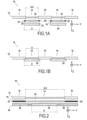
- FIG. 1A is a schematic sectional view along the section plane YZ of a laminated assembly 10 according to a first embodiment.
- Figure 1A is an exploded view of the assembly 10 to show each element of the laminated assembly 10.
- This laminated assembly 10 comprises a nonwoven sheet 12 which extends in a longitudinal direction X and a lateral direction Y, orthogonal to the longitudinal direction X.
- the nonwoven sheet 12 comprises, over the width of the nonwoven sheet 12, two activated zones 14 separated by a non-activated zone 16.
- the nonwoven sheet 12 also comprises on each lateral edge of the nonwoven sheet 12 a non-activated zone 16.
- Activated zone 14 is understood to mean an area 14 activated prior to rolling. We will also speak of a previously activated zone 14.
- the nonwoven sheet 12 may for example be a calendered carded nonwoven, a Spunlace type nonwoven, a Spunmelt type nonwoven.
- the activated zones 14 have a width strictly less than the width of the nonwoven sheet, the width being measured in the lateral direction Y.
- the activated zones 14 extend over the length of the nonwoven sheet 12, the length being measured in the longitudinal direction X.
- the laminated assembly 10 also comprises two elastic films 24 which are connected to the non-woven sheet 12 by glue 18.
- the glue 18 is applied in solid strips 20 on the lateral edges of the elastic films 24 and in narrow lines or nets 22 on the activated zones 14 of the non-woven sheet 12.
- the elastic film 24 As a material for the elastic film 24, it is possible, for example, to envisage using elastic materials comprising a metallocene-type polyolefin, or based on SIS or SBS.
- the elastic film 24 may be formed of three or more layers or be a skinlayer, i.e. an elastic film covered with a skin.
- the width A of each activated zone 14 is less than the width E of each elastic film 24.
- the difference between the width A and the width E may be between 8 and 20 mm, for example this difference may be 14 mm. Such a difference makes it possible to obtain a higher density of fibers/filaments in the non-activated zone and to allow better fixing between the elastic film 24 and the corresponding non-woven sheet 12.
- the sum of the widths of the activated zones may be between 20 and 80% of the width of the corresponding non-woven sheet 12, in particular between 35 and 70% of the width of the non-woven sheet 12.
- the glue 18 is applied to the non-woven sheet 12 over a width equal to the width E of the elastic film 24.
- the area where the glue is applied in strips has a width C less than the width E of the elastic film and substantially equal to the width A of the activated area 14.
- the width C of the area where the glue is applied in threads is different from the width A of the activated area.
- the nonwoven sheet 12 comprises two activated zones 14, it could comprise only one. It could also comprise more than two.
- the two activated zones 14 have the same width A. It could of course be envisaged that the two activated zones 14 have a different width.
- the elastic films 24 are not activated.
- the activation rate of the activated areas 14 of the nonwoven sheet 12 is therefore higher than the activation rate of the elastic films, they are therefore different.
- the activation rate of the activated areas 14 of the nonwoven web 12 will be modified by the activation of the laminated assembly 10.
- the activation rate resulting from the activated areas 14 of the nonwoven web in the lateral direction Y will always remain different from the activation rate of the elastic film 24 in the lateral direction Y, in particular the activation rate resulting from the activated areas 14 of the nonwoven web in the lateral direction Y will be higher than the activation rate of the elastic film 24 in the lateral direction Y.
- the activation rate applied to the laminated assembly 10 may be lower than the activation rate that would have had to be applied to the laminated assembly 10 if the nonwoven sheet 12 had not been activated prior to lamination with the elastic films 24 to obtain the same elongation capacity of the laminated assembly 10. This reduces the risks of pollution of the laminated assembly 10 and/or the risks of creating holes, cuts and/or slits in the elastic films 24.
- each activated zone 14 of the nonwoven sheet 12 in the lateral direction Y is different from one activated zone to another.
- the nonwoven sheet 12 is activated in step 200 during which the two activated zones 14 of the nonwoven sheet 12 are produced.
- the glue 18 is deposited by coating on the nonwoven sheet 12 in step 202 and the elastic films 24 are added to the nonwoven sheet 12 coated with glue 18 in step 204.
- the nonwoven sheet 12 coated with glue 18 and the elastic films 24 are laminated with each other in step 206 in order to form a laminated assembly 10.
- the laminated assembly 10 may then undergo activation of the laminated assembly 10 in the lateral direction Y at step 208.
- the laminated assembly 10 does not include glue 18.
- the Figure 1B is not an exploded view of the laminated assembly 10.
- step 202 is not performed.
- the elastic film 24 is extruded and, while the elastic film 24 is not completely cooled, the nonwoven sheet 12 is laminated with the elastic film 24 so that the fibers and/or filaments of the nonwoven sheet 12 are encapsulated in the elastic film 24.
- the nonwoven sheet 12 of the laminated assembly 10 comprises an activated zone 14 arranged between two non-activated zones 16.
- the non-activated zones 16 are present on each lateral edge of the nonwoven sheet 12.
- the laminated assembly comprises a film 26 comprising the elastic film 24 which has been co-extruded with a non-elastic plastic material 28, for example a polyethylene-based material.
- the width A of the activated zone 14 is equal to the width C of the zone where the glue is applied in strips 22 and the width E of the elastic film 24 is less than the width A of the activated zone 14.
- the width C could be less than the width E.
- the film 26 could comprise several elastic films 24, each elastic film being separated from the other by a non-elastic plastic material 28 co-extruded with the elastic films 24.
- the non-woven sheet 12 could then comprise several activated zones 14 arranged opposite the elastic films 24 or the non-woven sheet 12 could have only one activated zone 14.
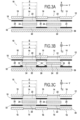
- the laminated assembly 10 comprises two nonwoven sheets 12, 30.
- the first nonwoven sheet 12 is similar to the nonwoven sheet 12 of the Figure 1A
- the second nonwoven sheet 30 does not have an area activated prior to rolling.
- the second nonwoven sheet 30 may be a Spunlace type nonwoven.
- the elastic films 24 are connected to the second non-woven sheet 30 by glue 32. Just like the glue 18, the glue 32 is applied in solid strips 20 on the lateral edges of the elastic films 24 and in narrow lines or nets 22 on the activated zones 14 of the second non-woven sheet 30.
- the width E of the elastic film 24 is greater than the width A of the activated zone 14 and that the zone where the glue is applied in threads has a width C less than the width E of the elastic film but greater than the width A of the activated zone 14.
- the first nonwoven sheet 12 of the third embodiment comprises two activated zones 14, it could comprise only one. It could also comprise more than two.
- the two activated zones 14 have the same width A. It could of course be envisaged that the two activated zones 14 have a different width.
- the elastic films 24 are not activated.
- the activation rate of the activated areas 14 of the first nonwoven sheet 12 is therefore greater than the activation rate of the elastic films, they are therefore different.
- the second nonwoven sheet 30 is not activated, so that the activation rate of the second nonwoven sheet, equal to zero, is different from the activation rate of the activated areas 14 of the first nonwoven sheet 12.
- the laminated assembly 10 it is also possible to envisage activating the laminated assembly 10 in the areas of the laminated assembly where the elastic film 24 is present.
- the first nonwoven sheet 12 having been activated before the lamination of the first nonwoven sheet 12 with the elastic film 24, that is to say prior to the lamination, the activation rate of the activated zones 14 of the first nonwoven sheet 12 will be modified by the activation of the laminated assembly 10.
- the activation rate resulting from the activated zones 14 of the first nonwoven sheet 12 in the lateral direction Y will always remain different from the activation rate of the elastic film 24 in the lateral direction Y.
- the activation rate of the second nonwoven sheet 30 is different from the activation rate of the activated zones 14 of the first nonwoven sheet 12, in particular the activation rate resulting from the activated zones 14 of the nonwoven sheet 12 in the lateral direction Y will be higher than the activation rate of the elastic film 24 in the lateral direction Y.
- each non-woven sheet 12, 30 is coated with glue 18 and that in step 204, the elastic films 24 are added between the two non-woven sheets 12, 30 before the two non-woven sheets 12, 30 are laminated with the elastic films 24 in order to form the laminated assembly 10 of the Figure 3A .
- step 206 the elastic films 24 are laminated with the first nonwoven sheet 12 before being subsequently laminated with the second nonwoven sheet 30 or vice versa.
- the laminated assembly 10 differs from the laminated assembly of the Figure 3A in that the glue 18, 32 has extra thicknesses 33 which ensure even firmer fixing of the elastic films 24 on the non-woven sheets 12, 30.
- the laminated assembly 10 differs from the laminated assembly of the Figure 3A in that the second nonwoven sheet 30 is similar to the nonwoven sheet 12 of the Figure 1A .
- the second nonwoven sheet 30 could comprise more than two activated zones 14.
- the activated zones 14 of the first nonwoven sheet 12 could have a different width than the activated zones 14 of the second nonwoven sheet 30.
- the activated zones 14 of each nonwoven sheet 12, 30 could have different widths.
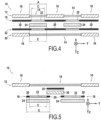
- the laminated assembly 10 comprises two nonwoven sheets 12, 30.
- the first nonwoven sheet 12 is similar to the nonwoven sheet 12 of the Figure 1A and the second nonwoven sheet 30 is similar to the nonwoven sheet 12 of the Figure 2 which has an activated zone 14.
- the width A of each activated zone 14 of the first nonwoven sheet 12 is equal to the width E of each elastic film 24.
- the glue 18 is applied over the entire width of the nonwoven sheet 12.
- the area where the glue is applied in strips has a width C less than the width E of the elastic film.
- the width A of the activated zones is different from the width of the elastic films E.
- the width A could be less or greater than the width E.
- the first nonwoven sheet 12 comprises two activated zones 14, it could comprise only one. It could also comprise more than two.
- the two activated zones 14 of the first nonwoven sheet 12 have the same width A. It could of course be envisaged that the two previously activated zones 14 have a different width.
- the second nonwoven sheet 30 comprises an activated zone 14, it could comprise more than one.
- the elastic films 24 are not activated.
- the activation rate of the activated areas 14 of each nonwoven sheet 12, 30 is therefore greater than the activation rate of the elastic films, the activation rates of each nonwoven sheet 12, 30 in the lateral direction Y are therefore different from the activation rate of the elastic films 24 in the lateral direction Y.
- the activation rate of the first nonwoven sheet 12 in the lateral direction Y may be different from the activation rate of the second nonwoven sheet 30 in the lateral direction Y.
- the activation rate resulting from the activated zones 14 of each nonwoven sheet 12, 30 in the lateral direction Y will always remain different from the activation rate of the elastic film 24 in the lateral direction Y, in particular the activation rate resulting from the activated zones 14 of each nonwoven sheet 12, 30 in the lateral direction Y will be higher than the activation rate of the elastic film 24 in the lateral direction Y.
- the laminated assembly 10 comprises two nonwoven sheets 12, 30.
- the first nonwoven sheet 12 is similar to the nonwoven sheet 12 of the Figure 2 and the second nonwoven sheet 30 is similar to the second nonwoven sheet 30 of the Figure 3A which does not have an activated zone.
- the second nonwoven sheet 30 is partially interposed between the first nonwoven sheet 12 and the elastic films 24.
- the second nonwoven sheet 30 is devoid of an activated zone and is coated with a solid strip 20 of glue.
- the second nonwoven sheet 30 plays, in this fifth embodiment, a role of reinforcement of the first nonwoven sheet 12, in particular of the activated zone 14 of the first nonwoven sheet 12.
- the second nonwoven web 30 may be a calendered carded nonwoven or a spunmelt type nonwoven. As shown in the Figure 5 , the second nonwoven sheet 30 here has a width much smaller than the width of the first nonwoven sheet 12.
- the glue 18 is applied in solid strips 20 between the elastic films 24 and the non-woven sheets 12, 30 so that the solid strips 20 are present on the non-activated areas of the non-woven sheets. 12,30. This ensures firm fixing of the elastic films 24 on the non-woven sheets 12, 30.
- the laminated assembly 10 it is also possible to envisage activating the laminated assembly 10 in the areas of the laminated assembly where the elastic film 24 is present.
- the first nonwoven web 12 having been activated before the lamination of the nonwoven webs 12, 30 with the elastic films 24, i.e. prior to the lamination, the activation rate of the activated area 14 of the first nonwoven web 12 will be modified by the activation of the laminated assembly 10.
- the resulting activation rate of the activated area 14 of the first nonwoven web 12 in the lateral direction Y will always remain different from the activation rate of the elastic film 24 in the lateral direction Y.
- the second nonwoven web 30 is not activated so that the activation rate of the second nonwoven web 30 in the lateral direction Y, which is equal to zero, is different from the activation rate of the activated area 14 of the first nonwoven web 12 and is different from the activation rate of the elastic film 24 in the lateral direction Y, in particular the activation rate resulting from the activated areas 14 of the nonwoven sheet 12 in the lateral direction Y will be higher than the activation rate of the elastic film 24 in the lateral direction Y.
- the first nonwoven sheet 12 or the second nonwoven sheet 30 is coated with a solid strip 20 of glue 18 and that the elastic films 24 are also coated with glue 18, that in step 204, the second nonwoven sheet 30 is added to the first nonwoven sheet 12 and that the elastic films 24 are added to the two nonwoven sheets 12, 30 so that the second nonwoven sheet 30 is partially interposed between the first nonwoven sheet 12 and the elastic films 24.
- the two nonwoven sheets 12, 30 are laminated with the elastic films 24 in order to form the laminated assembly 10 of the Figure 5 .
- the second nonwoven sheet 30 is laminated onto the first nonwoven sheet 12. This step can be carried out at the same time as the lamination of the elastic films 24 onto the two nonwoven sheets 12, 30. These two laminations can also be carried out consecutively. It would also be possible to add a third nonwoven sheet onto which glue could be deposited and to add this third nonwoven sheet on the side of the elastic films 24 opposite the first and second nonwoven sheets 12, 30.
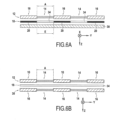
- the laminated assembly 10 comprises a first non-woven sheet 12 similar to the non-woven sheet of the Figure 1A and a second nonwoven sheet similar to the second nonwoven sheet of the Figure 3A .
- the glue 18 is directly coated onto the first nonwoven sheet 12.
- This glue comprises solid strips 20 of glue and solid strips 34 of elastic glue.
- the solid strips 34 of elastic glue form the elastic films.
- the second nonwoven sheet 30 is then attached to the first nonwoven sheet coated with the glue comprising solid strips 34 of elastic glue, the glue 18 and therefore the solid strips 34 of elastic glue are interposed between the nonwoven sheets 12, 30.
- the width A of the activated zone 14 is equal to the width E of the solid strips 34 of the elastic glue. It could be envisaged that the width A is greater or less than the width E.
- the second nonwoven web 30 may comprise one or more activated zones 14.
- the laminated assembly 10 it is also possible to envisage activating the laminated assembly 10 in the areas of the laminated assembly where the solid strips 34 of elastic glue are present.
- the first nonwoven sheet 12 having been activated before the lamination of the first nonwoven sheet 12 with the glue 18, the activation rate of the activated areas 14 of the first nonwoven sheet 12 will be modified by the activation of the laminated assembly 10.
- the resulting activation rate of the activated areas 14 of the first nonwoven sheet 12 in the lateral direction Y will always remain different from the activation rate of the elastic film 24 in the lateral direction Y.
- the laminated assembly 10 differs from the laminated assembly of the Figure 6A in that the second nonwoven sheet 30 is similar to the nonwoven sheet 12 of the Figure 1A and in that the glue 18 consists of a single solid strip 34 of elastic glue.
- the solid strip 34 of elastic glue forms the elastic film.
- FIG 7 represents a processing installation 100 for a non-woven sheet 12, which can in particular be used upstream of a production line for a laminated assembly 10 for producing a non-woven sheet 12
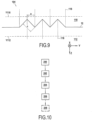
- figure 8 is a schematic view, seen from above, of the non-woven sheet 12 passing at a time t in the treatment installation 100 of the Figure 7 and on which the dimensions of the nonwoven sheet 12 are shown schematically.
- the non-woven sheet 12, once unrolled, is activated locally by the activation module 106 (step 200).
- the activation module 106 comprises two activation rollers 110, 112 each provided with a stack of parallel discs 118 and spaced from each other by a distance 2a.
- the activation rollers 110, 112 and the discs 118 each comprise an axis of symmetry Y110, Y112 which is oriented in the lateral direction Y.
- the discs 118 of the first activation roller 110 are arranged in the inter-disc spaces of the second activation roller 112 and the axes of symmetry Y110, Y112 of the two activation rollers 110, 112 are spaced from each other by a distance less than the diameter of the discs 118 so that the areas of the nonwoven web 12 passing between the discs 12 of the activation rollers 110, 112 are stretched in the lateral direction Y, forming the activated areas 14. At these locations, the fibers and/or filaments of the nonwoven web 12 are stretched and/or broken.
- the activation rate is the ratio of the difference between the distance c between the end of two adjacent discs each belonging to a different activation roller and the distance a between the end of the same two discs projected onto the axis of symmetry of an activation roller to this distance a between the end of the same two discs projected onto the axis of symmetry of an activation roller expressed as a percentage.
- the nonwoven sheet 12 is then deformed more generally by the stretching module 108 which generally comprises a plurality of rollers (not shown) intended to laterally stretch the nonwoven sheet. It is stretched there until it takes on a width Imax greater than the useful width l desired for the laminated assembly manufactured downstream on the production line 116.
- the stretching module 108 which generally comprises a plurality of rollers (not shown) intended to laterally stretch the nonwoven sheet. It is stretched there until it takes on a width Imax greater than the useful width l desired for the laminated assembly manufactured downstream on the production line 116.
- the width management module 114 which comprises means for measuring the width of the nonwoven sheet 12 and means for adjusting, for example by stretching, this width to a desired value, the width of the nonwoven sheet 12 is adjusted to the useful width l that it must maintain over the entire production line 116.
- Examples 7 and 8 each comprise two nonwoven sheets, a first sheet of calendered carded nonwoven without an activated zone and a second sheet of Spunlace type nonwoven without an activated zone and the laminated assembly is then activated at an activation rate of 110% and 93% respectively.
- the elongation at 10 N (Newton) expressed in millimeters (mm) was then measured for Examples 1-8, the measurement samples having a width of 50 mm, the stretching being carried out in the lateral direction Y over a width of 30 mm at a speed of 100 mm/min (millimeter/minute).
- the width of 30 mm is chosen so that only the activated area is tested.
- the value of the maximum force (in N) before rupture of each of the samples was also measured. The results are shown in Table 1 below.
- Example 1 25.0 38
- Example 2 25.1 38
- Example 3 20.2 40
- Example 4 21.2 41
- Example 6 27.7 37
- Example 7 28.0 35
- Example 8 24.5 37
- laminated assemblies 10 (examples 1-6) are obtained having an elongation at 10 N similar to the values obtained for examples 7 and 8 without activating the laminated assembly 10 for examples 1 to 5. It is also found that the maximum force that the laminated assemblies 10 can undergo before breaking (examples 1-6) is greater than the maximum force that the laminated assemblies of examples 7 and 8 can undergo. The laminated assemblies 10 of examples 1-6 can therefore undergo tensile forces in the lateral direction Y which are greater than the tensile forces in the lateral direction Y that the laminated assemblies of examples 7 and 8 can undergo.
- the speed of movement on the production line 116 of the nonwoven sheets does not influence the properties of the laminated assembly 10 (see in particular examples 1 and 2).
- the laminated assembly of example 4 has a more uniform texture/visual than the texture/visual of the laminated assembly of example 8.
- the laminated assembly of example 8 has a more uniform texture/visual than the texture/visual of the laminated assembly of example 6.
- Elongation measurements at 5 N were also carried out on the nonwoven webs alone before lamination. These elongation measurements at 5 N were carried out with a preload of 0.1 N, at a speed of 500 mm/min. The elongation measurements were carried out in the lateral direction Y, also identified as CD, as well as in the longitudinal direction X, also identified as MD.
- Nonwoven 1 is a pre-activated calendered carded nonwoven at 153% of 22 g/m 2 (gram/meter squared).
- Nonwoven 2 is a pre-activated calendered carded nonwoven at 106% of 22 g/m 2 .
- Nonwoven 3 is a non-pre-activated, calendered, carded nonwoven of 22 g/m 2 .
- Nonwoven 4 is a 44% pre-activated Spunlace type nonwoven of 30 g/m 2 .
- Nonwoven 5 is a non-pre-activated Spunlace type nonwoven of 30 g/m 2 . ⁇ u>Table 2 ⁇ /u> Example Sense Elongation at 5 N (in %) Non-woven 1 CD 117 Non-woven 2 CD 72 Non-woven 3 CD 78 Non-woven 4 CD 105 Non-woven 5 CD 102 Non-woven 1 MD 5.4 Non-woven 2 MD 4.1 Non-woven 3 MD 2.8 Non-woven 4 MD 4.4 Non-woven 5 MD 3.0
- Nonwovens 1 to 5 have a weight between 10 g (grams) and 40 g.
- nonwoven 1 has an elongation similar to nonwoven 4 or nonwoven 5, in the CD direction.
- the first and second nonwoven layers can be interchanged.
Landscapes
- Engineering & Computer Science (AREA)
- Health & Medical Sciences (AREA)
- Textile Engineering (AREA)
- Animal Behavior & Ethology (AREA)
- Public Health (AREA)
- Heart & Thoracic Surgery (AREA)
- Vascular Medicine (AREA)
- Life Sciences & Earth Sciences (AREA)
- Epidemiology (AREA)
- General Health & Medical Sciences (AREA)
- Biomedical Technology (AREA)
- Veterinary Medicine (AREA)
- Chemical & Material Sciences (AREA)
- Chemical Kinetics & Catalysis (AREA)
- Manufacturing & Machinery (AREA)
- Mechanical Engineering (AREA)
- Laminated Bodies (AREA)
- Absorbent Articles And Supports Therefor (AREA)
Claims (14)
- Laminat (10), das sich entlang einer Längsrichtung (X) und einer seitlichen Richtung (Y) erstreckt, die orthogonal zu der Längsrichtung (X) ist, wobei das Laminat eine erste Vliesmatte (12) und einen elastischen Film (24) umfasst, die zusammenlaminiert sind, wobei die erste Vliesmatte (12) mindestens eine aktivierte Zone (14) umfasst, die sich über eine in der Längsrichtung (X) gemessene Länge der Vliesmatte und über eine Breite erstreckt, die strikt kleiner als eine in der seitlichen Richtung (Y) gemessene Breite der Vliesmatte ist, wobei die Aktivierungsrate der aktivierten Zone (14) der ersten Vliesmatte (12) in der seitlichen Richtung (Y) sich von der Aktivierungsrate des elastischen Films (24) in der seitlichen Richtung (Y) unterscheidet, wobei die Aktivierungsrate der aktivierten Zone (14) der ersten Vliesmatte (12) in der seitlichen Richtung (Y) zwischen 20 und 200 % beträgt, wobei das Laminat (10) eine zweite Vliesmatte (30) umfasst,
der elastische Film (24) zwischen die erste und die zweite Vliesmatte (12, 30) zwischengelegt ist,
wobei sich die Aktivierungsrate der aktivierten Zone (14) der ersten Vliesmatte (12) in der seitlichen Richtung (Y) von der Aktivierungsrate des aktivierten Zone (14) der zweiten Vliesmatte (30) in der seitlichen Richtung (Y) unterscheidet. - Laminat (10), das sich entlang einer Längsrichtung (X) und einer seitlichen Richtung (Y) erstreckt, die orthogonal zu der Längsrichtung (X) ist, wobei das Laminat eine erste Vliesmatte (12) und einen elastischen Film (24) umfasst, die zusammenlaminiert sind, wobei die erste Vliesmatte (12) mindestens eine aktivierte Zone (14) umfasst, die sich über eine in der Längsrichtung (X) gemessene Länge der Vliesmatte und über eine Breite erstreckt, die strikt kleiner als eine in der seitlichen Richtung (Y) gemessene Breite der Vliesmatte ist, wobei die Aktivierungsrate der aktivierten Zone (14) der ersten Vliesmatte (12) in der seitlichen Richtung (Y) sich von der Aktivierungsrate des elastischen Films (24) in der seitlichen Richtung (Y) unterscheidet, wobei die Aktivierungsrate der aktivierten Zone (14) der ersten Vliesmatte (12) in der seitlichen Richtung (Y) zwischen 20 und 200 % beträgt, das Laminat (10) umfassend eine zweite Vliesmatte (30), und wobei die zweite Vliesmatte (30) zumindest teilweise zwischen die erste Vliesmatte (12) und den elastischen Film (24) zwischengelegt ist,
wobei sich die Aktivierungsrate der aktivierten Zone (14) der ersten Vliesmatte (12) in der seitlichen Richtung (Y) von der Aktivierungsrate des aktivierten Zone (14) der zweiten Vliesmatte (30) in der seitlichen Richtung (Y) unterscheidet. - Laminat (10) nach einem der Ansprüche 1 oder 2, wobei die zweite Vliesmatte (30) keine aktivierte Zone aufweist.
- Laminat (10) nach einem der Ansprüche 1 oder 2, wobei die zweite Vliesmatte (30) mindestens eine aktivierte Zone (14) umfasst, die sich über eine in der Längsrichtung (X) gemessenen Länge der Vliesmatte und über eine Breite erstreckt, die strikt kleiner als eine in der seitlichen Richtung (Y) gemessene Breite der Vliesmatte ist, wobei die Aktivierungsrate der aktivierten Zone (14) der zweiten Vliesmatte (30) in der seitlichen Richtung (Y) zwischen 20 und 200 % beträgt.
- Laminat (10) nach einem der Ansprüche 1 bis 4, wobei sich die Aktivierungsrate der aktivierten Zone (14) der zweiten Vliesmatte (30) in der seitlichen Richtung (Y) von der Aktivierungsrate des elastischen Films (24) in der seitlichen Richtung (Y) unterscheidet.
- Laminat (10) nach einem der Ansprüche 1 bis 5, wobei die Vliesmatte (12, 30) ein kalandriertes kardiertes Vlies ist.
- Laminat (10) nach einem der Ansprüche 1 bis 5, wobei die Vliesmatte (12, 30) ein Vlies vom Typ Spunlace ist.
- Laminat (10) nach einem der Ansprüche 1 bis 5, wobei die Vliesmatte (12, 30) ein Vlies vom Typ Spunmelt ist.
- Verfahren zur Herstellung eines Laminats (10), das sich entlang einer Längsrichtung (X) und einer seitlichen Richtung (Y) erstreckt, die orthogonal zu der Längsrichtung (X) ist, wobei das Verfahren die folgenden Schritte umfasst:- Aktivieren von zwischen 20 und 200 % in der seitlichen Richtung (Y) einer Zone einer ersten Vliesmatte (12), die sich über eine in der Längsrichtung (X) gemessene Länge der ersten Vliesmatte und über eine Breite erstreckt, die strikt kleiner als eine in der seitlichen Richtung (Y) gemessene Breite der ersten Vliesmatte ist;- Bereitstellen eines elastischen Films (24);- Laminieren der ersten Vliesmatte (12) und des elastischen Films (24),- Bereitstellen einer zweiten Vliesmatte (30),- Laminieren der zweiten Vliesmatte (30) und des elastischen Films (24),wobei sich die Aktivierungsrate der aktivierten Zone (14) der ersten Vliesmatte (12) in der seitlichen Richtung (Y) von der Aktivierungsrate des aktivierten Zone (14) der zweiten Vliesmatte (30) in der seitlichen Richtung (Y) unterscheidet.
- Verfahren zur Herstellung eines Laminats (10), das sich entlang einer Längsrichtung (X) und einer seitlichen Richtung (Y) erstreckt, die orthogonal zu der Längsrichtung (X) ist, wobei das Verfahren die folgenden Schritte umfasst:- Aktivieren von zwischen 20 und 200 % in der seitlichen Richtung (Y) einer Zone einer ersten Vliesmatte (12), die sich über eine in der Längsrichtung (X) gemessene Länge der ersten Vliesmatte und über eine Breite erstreckt, die strikt kleiner als eine in der seitlichen Richtung (Y) gemessene Breite der ersten Vliesmatte ist;- Bereitstellen eines elastischen Films (24);- Laminieren der ersten Vliesmatte (12) und des elastischen Films (24),- Bereitstellen einer zweiten Vliesmatte (30),- Laminieren der zweiten Vliesmatte (30) auf die erste Vliesmatte (12),wobei sich die Aktivierungsrate der aktivierten Zone (14) der ersten Vliesmatte (12) in der seitlichen Richtung (Y) von der Aktivierungsrate des aktivierten Zone (14) der zweiten Vliesmatte (30) in der seitlichen Richtung (Y) unterscheidet.
- Herstellungsverfahren nach einem der Ansprüche 9 oder 10, das vor dem Laminieren der Vliesmatte (12) einen Schritt einer Beschichtung der Vliesmatte (12) mit einem Klebstoff (18) umfasst.
- Herstellungsverfahren nach einem der Ansprüche 9 bis 11, wobei vor dem Laminieren der zweiten Vliesmatte (30) die zweite Vliesmatte (30) zwischen 20 und 200 % in der seitlichen Richtung (Y) über eine Zone aktiviert wird, die sich über eine in der Längsrichtung (X) gemessene Länge der Vliesmatte und über eine Breite erstreckt, die strikt kleiner als eine in der seitlichen Richtung (Y) gemessene Breite der Vliesmatte ist.
- Herstellungsverfahren nach einem der Ansprüche 9 bis 12, das vor dem Laminieren der zweiten Vliesmatte (30) einen Schritt eines Beschichtens der zweiten Vliesmatte (30) mit einem Klebstoff (18) umfasst.
- Herstellungsverfahren nach einem der Ansprüche 9 bis 13, wobei das Laminat (10) mindestens zu 200 % in der seitlichen Richtung (Y) aktiviert wird.
Applications Claiming Priority (2)
| Application Number | Priority Date | Filing Date | Title |
|---|---|---|---|
| FR1656808A FR3053921B1 (fr) | 2016-07-15 | 2016-07-15 | Ensemble lamine et procede de fabrication |
| PCT/FR2017/051899 WO2018011516A1 (fr) | 2016-07-15 | 2017-07-11 | Ensemble lamine et procédé de fabrication |
Publications (3)
| Publication Number | Publication Date |
|---|---|
| EP3484702A1 EP3484702A1 (de) | 2019-05-22 |
| EP3484702B1 EP3484702B1 (de) | 2021-06-16 |
| EP3484702B2 true EP3484702B2 (de) | 2025-04-02 |
Family
ID=56920822
Family Applications (1)
| Application Number | Title | Priority Date | Filing Date |
|---|---|---|---|
| EP17748830.1A Active EP3484702B2 (de) | 2016-07-15 | 2017-07-11 | Laminat und herstellungsverfahren |
Country Status (7)
| Country | Link |
|---|---|
| US (1) | US11504940B2 (de) |
| EP (1) | EP3484702B2 (de) |
| JP (1) | JP7096232B2 (de) |
| CN (1) | CN109476112A (de) |
| ES (1) | ES2881258T5 (de) |
| FR (1) | FR3053921B1 (de) |
| WO (1) | WO2018011516A1 (de) |
Families Citing this family (2)
| Publication number | Priority date | Publication date | Assignee | Title |
|---|---|---|---|---|
| FR3098144B1 (fr) * | 2019-07-04 | 2022-01-07 | Aplix Sa | Stratifié élastique à crochets |
| JP7541087B2 (ja) | 2019-11-06 | 2024-08-27 | ニットウ・アドヴァンスト・フィルム・グローナウ・ゲゼルシャフト・ミト・ベシュレンクテル・ハフツング | 弾性ラミネートを製造する方法、および該方法により得られるラミネート |
Citations (10)
| Publication number | Priority date | Publication date | Assignee | Title |
|---|---|---|---|---|
| US6114263A (en) † | 1997-04-04 | 2000-09-05 | The Procter & Gamble Company | Stable web having enhanced extensibility and method for making same |
| US6383431B1 (en) † | 1997-04-04 | 2002-05-07 | The Procter & Gamble Company | Method of modifying a nonwoven fibrous web for use as component of a disposable absorbent article |
| DE29825018U1 (de) † | 1998-03-27 | 2004-02-26 | 3M Company (N.D.Ges.D. Staates Delaware), St. Paul | Laminierter elastischer Streifen |
| WO2005065947A1 (en) † | 2003-12-22 | 2005-07-21 | Kimberly-Clark Worldwide, Inc. | Extensible and stretch laminates and method of making same |
| WO2005110748A1 (en) † | 2004-04-30 | 2005-11-24 | Kimberly-Clark Worldwide, Inc. | Method and apparatus for making extensible and stretchable laminates |
| WO2006073975A1 (en) † | 2004-12-30 | 2006-07-13 | Kimberly-Clark Worldwide, Inc. | Extensible and stretch laminates with comparably low cross-machine direction tension and methods of making same |
| WO2007061486A1 (en) † | 2005-11-22 | 2007-05-31 | Pliant Corporation | Elastic laminates |
| WO2014159724A1 (en) † | 2013-03-12 | 2014-10-02 | Fitesa Nonwoven, Inc. | Extensible nonwoven fabric |
| EP2799606A1 (de) † | 2013-05-03 | 2014-11-05 | Mondi Gronau GmbH | Elastisches Laminat |
| EP3316834B1 (de) † | 2015-06-30 | 2021-10-13 | The Procter & Gamble Company | Stretchlaminat mit schrittweise gestreckter oder geselfter schicht, verfahren zur herstellung und absorbierender einwegartikel damit |
Family Cites Families (13)
| Publication number | Priority date | Publication date | Assignee | Title |
|---|---|---|---|---|
| DE4238541C2 (de) | 1992-11-14 | 1999-01-28 | Amoco Fabrics Zweigniederlassu | Verfahren und Vorrichtung zur Herstellung einer elastischen, mehrschichtigen Materialbahn |
| US5382461B1 (en) * | 1993-03-12 | 1998-11-03 | Clopay Plastic Prod Co | Extrusion laminate of incrementally stretched nonwoven fibrous web and thermoplastic film and method |
| EP0803602A4 (de) * | 1995-01-12 | 2002-06-26 | Japan Absorbent Tech Inst | Elastischer verbundkörper mit mehrstüfiger dehnnbarkeit und verfahren zu ihrer herstellung |
| WO2001009424A1 (en) * | 1999-07-28 | 2001-02-08 | Kimberly-Clark Worldwide, Inc. | Cd extensible cloth-like nonwoven for facing and liner |
| MXPA04000404A (es) * | 2001-07-18 | 2004-03-18 | Polymer Group Inc | Material laminado elastico no tejido. |
| CN1297393C (zh) * | 2001-11-05 | 2007-01-31 | 宝洁公司 | 可变化拉伸的复合材料和制造该复合材料的方法 |
| US20050245162A1 (en) * | 2004-04-30 | 2005-11-03 | Kimberly-Clark Worldwide, Inc. | Multi-capable elastic laminate process |
| US7612001B2 (en) * | 2004-12-22 | 2009-11-03 | Kimberly-Clark Worldwide, Inc. | High performance elastic materials made using styrene block copolymers and mixtures |
| US20070141303A1 (en) * | 2005-12-15 | 2007-06-21 | Steindorf Eric C | Sheet materials with zoned machine direction extensibility and methods of making |
| US8741083B2 (en) | 2006-05-12 | 2014-06-03 | Sca Hygiene Products Ab | Elastic laminate and a method for producing an elastic laminate |
| RU2414203C2 (ru) * | 2006-11-13 | 2011-03-20 | Ска Хайджин Продактс Аб | Поглощающее изделие, содержащее эластичный многослойный материал |
| EP2158888A1 (de) * | 2008-09-01 | 2010-03-03 | 3M Innovative Properties Company | Aktivierbarer Ausgangsstoff eines Verbundstofflaminatnetzes und elastisches Verbundstofflaminatnetz |
| JP6340369B2 (ja) | 2012-09-10 | 2018-06-06 | トレデガー フィルム プロダクツ コーポレイション | 弾性的な積層体を形成する方法 |
-
2016
- 2016-07-15 FR FR1656808A patent/FR3053921B1/fr active Active
-
2017
- 2017-07-11 EP EP17748830.1A patent/EP3484702B2/de active Active
- 2017-07-11 US US16/316,653 patent/US11504940B2/en active Active
- 2017-07-11 WO PCT/FR2017/051899 patent/WO2018011516A1/fr not_active Ceased
- 2017-07-11 CN CN201780044241.8A patent/CN109476112A/zh active Pending
- 2017-07-11 JP JP2019501559A patent/JP7096232B2/ja active Active
- 2017-07-11 ES ES17748830T patent/ES2881258T5/es active Active
Patent Citations (10)
| Publication number | Priority date | Publication date | Assignee | Title |
|---|---|---|---|---|
| US6114263A (en) † | 1997-04-04 | 2000-09-05 | The Procter & Gamble Company | Stable web having enhanced extensibility and method for making same |
| US6383431B1 (en) † | 1997-04-04 | 2002-05-07 | The Procter & Gamble Company | Method of modifying a nonwoven fibrous web for use as component of a disposable absorbent article |
| DE29825018U1 (de) † | 1998-03-27 | 2004-02-26 | 3M Company (N.D.Ges.D. Staates Delaware), St. Paul | Laminierter elastischer Streifen |
| WO2005065947A1 (en) † | 2003-12-22 | 2005-07-21 | Kimberly-Clark Worldwide, Inc. | Extensible and stretch laminates and method of making same |
| WO2005110748A1 (en) † | 2004-04-30 | 2005-11-24 | Kimberly-Clark Worldwide, Inc. | Method and apparatus for making extensible and stretchable laminates |
| WO2006073975A1 (en) † | 2004-12-30 | 2006-07-13 | Kimberly-Clark Worldwide, Inc. | Extensible and stretch laminates with comparably low cross-machine direction tension and methods of making same |
| WO2007061486A1 (en) † | 2005-11-22 | 2007-05-31 | Pliant Corporation | Elastic laminates |
| WO2014159724A1 (en) † | 2013-03-12 | 2014-10-02 | Fitesa Nonwoven, Inc. | Extensible nonwoven fabric |
| EP2799606A1 (de) † | 2013-05-03 | 2014-11-05 | Mondi Gronau GmbH | Elastisches Laminat |
| EP3316834B1 (de) † | 2015-06-30 | 2021-10-13 | The Procter & Gamble Company | Stretchlaminat mit schrittweise gestreckter oder geselfter schicht, verfahren zur herstellung und absorbierender einwegartikel damit |
Also Published As
| Publication number | Publication date |
|---|---|
| ES2881258T3 (es) | 2021-11-29 |
| ES2881258T5 (en) | 2025-08-18 |
| CN109476112A (zh) | 2019-03-15 |
| BR112019000442A2 (pt) | 2019-04-30 |
| EP3484702B1 (de) | 2021-06-16 |
| US20190248104A1 (en) | 2019-08-15 |
| JP7096232B2 (ja) | 2022-07-05 |
| WO2018011516A1 (fr) | 2018-01-18 |
| EP3484702A1 (de) | 2019-05-22 |
| FR3053921A1 (fr) | 2018-01-19 |
| FR3053921B1 (fr) | 2021-06-25 |
| JP2019522582A (ja) | 2019-08-15 |
| US11504940B2 (en) | 2022-11-22 |
Similar Documents
| Publication | Publication Date | Title |
|---|---|---|
| EP3768210B1 (de) | Laminierte anordnung, windel mit solch einer anordnung und verfahren zur herstellung einer solchen anordnung | |
| EP3448194B1 (de) | Verbesserte befestigungsvorrichtung mit verstärkten befestigungselementen | |
| EP1783257B1 (de) | Vliesstofflaminatextrudiertes Elastomer | |
| EP1849599B2 (de) | Verfahren und Vorrichtung um ein Faservlies-Elastomer-Laminat mit Elastizität zu versehen und dadurch hergestelltes Laminat | |
| WO1986001389A1 (fr) | Papier continu stratifie | |
| EP3484702B2 (de) | Laminat und herstellungsverfahren | |
| LU85234A1 (fr) | Tissu ouate doux et resistant a l'humidite et procede pour sa fabrication | |
| EP3128983B1 (de) | Verfahren zur bereitstellung eines laminats mit einem klettverschlussvolumen und resultierendes laminat | |
| EP3245322B1 (de) | Verstärkter vliesstoff, anordnung mit solch einem stoff und verfahren zur behandlung eines vliesstoffes | |
| FR3050620B1 (fr) | Dispositif de retenue ameliore comprenant des elements de retenue renforces | |
| FR3050625B1 (fr) | Dispositif de retenue a crochets ameliore | |
| FR3050622B1 (fr) | Appareillage et procede pour la solidarisation d'un substrat a un ruban plastique | |
| WO2016170249A1 (fr) | Complexe textile incluant une ame tissee a base de fils de carbone, et procede de fabrication d'un tel complexe | |
| FR3050623A1 (fr) | Procede et appareillage ameliores pour la formation d'elements de retenue | |
| EP4188148A1 (de) | Haltevorrichtung, saugfähiger artikel mit solch einer vorrichtung und verfahren zur herstellung solch einer vorrichtung |
Legal Events
| Date | Code | Title | Description |
|---|---|---|---|
| STAA | Information on the status of an ep patent application or granted ep patent |
Free format text: STATUS: UNKNOWN |
|
| STAA | Information on the status of an ep patent application or granted ep patent |
Free format text: STATUS: THE INTERNATIONAL PUBLICATION HAS BEEN MADE |
|
| PUAI | Public reference made under article 153(3) epc to a published international application that has entered the european phase |
Free format text: ORIGINAL CODE: 0009012 |
|
| STAA | Information on the status of an ep patent application or granted ep patent |
Free format text: STATUS: REQUEST FOR EXAMINATION WAS MADE |
|
| 17P | Request for examination filed |
Effective date: 20190214 |
|
| AK | Designated contracting states |
Kind code of ref document: A1 Designated state(s): AL AT BE BG CH CY CZ DE DK EE ES FI FR GB GR HR HU IE IS IT LI LT LU LV MC MK MT NL NO PL PT RO RS SE SI SK SM TR |
|
| AX | Request for extension of the european patent |
Extension state: BA ME |
|
| DAV | Request for validation of the european patent (deleted) | ||
| DAX | Request for extension of the european patent (deleted) | ||
| GRAP | Despatch of communication of intention to grant a patent |
Free format text: ORIGINAL CODE: EPIDOSNIGR1 |
|
| STAA | Information on the status of an ep patent application or granted ep patent |
Free format text: STATUS: GRANT OF PATENT IS INTENDED |
|
| INTG | Intention to grant announced |
Effective date: 20210127 |
|
| GRAS | Grant fee paid |
Free format text: ORIGINAL CODE: EPIDOSNIGR3 |
|
| GRAA | (expected) grant |
Free format text: ORIGINAL CODE: 0009210 |
|
| STAA | Information on the status of an ep patent application or granted ep patent |
Free format text: STATUS: THE PATENT HAS BEEN GRANTED |
|
| AK | Designated contracting states |
Kind code of ref document: B1 Designated state(s): AL AT BE BG CH CY CZ DE DK EE ES FI FR GB GR HR HU IE IS IT LI LT LU LV MC MK MT NL NO PL PT RO RS SE SI SK SM TR |
|
| REG | Reference to a national code |
Ref country code: GB Ref legal event code: FG4D Free format text: NOT ENGLISH |
|
| REG | Reference to a national code |
Ref country code: CH Ref legal event code: EP |
|
| REG | Reference to a national code |
Ref country code: DE Ref legal event code: R096 Ref document number: 602017040394 Country of ref document: DE |
|
| REG | Reference to a national code |
Ref country code: AT Ref legal event code: REF Ref document number: 1401984 Country of ref document: AT Kind code of ref document: T Effective date: 20210715 |
|
| REG | Reference to a national code |
Ref country code: IE Ref legal event code: FG4D Free format text: LANGUAGE OF EP DOCUMENT: FRENCH |
|
| REG | Reference to a national code |
Ref country code: LT Ref legal event code: MG9D |
|
| PG25 | Lapsed in a contracting state [announced via postgrant information from national office to epo] |
Ref country code: HR Free format text: LAPSE BECAUSE OF FAILURE TO SUBMIT A TRANSLATION OF THE DESCRIPTION OR TO PAY THE FEE WITHIN THE PRESCRIBED TIME-LIMIT Effective date: 20210616 Ref country code: BG Free format text: LAPSE BECAUSE OF FAILURE TO SUBMIT A TRANSLATION OF THE DESCRIPTION OR TO PAY THE FEE WITHIN THE PRESCRIBED TIME-LIMIT Effective date: 20210916 Ref country code: FI Free format text: LAPSE BECAUSE OF FAILURE TO SUBMIT A TRANSLATION OF THE DESCRIPTION OR TO PAY THE FEE WITHIN THE PRESCRIBED TIME-LIMIT Effective date: 20210616 Ref country code: LT Free format text: LAPSE BECAUSE OF FAILURE TO SUBMIT A TRANSLATION OF THE DESCRIPTION OR TO PAY THE FEE WITHIN THE PRESCRIBED TIME-LIMIT Effective date: 20210616 |
|
| REG | Reference to a national code |
Ref country code: AT Ref legal event code: MK05 Ref document number: 1401984 Country of ref document: AT Kind code of ref document: T Effective date: 20210616 |
|
| REG | Reference to a national code |
Ref country code: NL Ref legal event code: MP Effective date: 20210616 |
|
| REG | Reference to a national code |
Ref country code: ES Ref legal event code: FG2A Ref document number: 2881258 Country of ref document: ES Kind code of ref document: T3 Effective date: 20211129 |
|
| PG25 | Lapsed in a contracting state [announced via postgrant information from national office to epo] |
Ref country code: NO Free format text: LAPSE BECAUSE OF FAILURE TO SUBMIT A TRANSLATION OF THE DESCRIPTION OR TO PAY THE FEE WITHIN THE PRESCRIBED TIME-LIMIT Effective date: 20210916 Ref country code: SE Free format text: LAPSE BECAUSE OF FAILURE TO SUBMIT A TRANSLATION OF THE DESCRIPTION OR TO PAY THE FEE WITHIN THE PRESCRIBED TIME-LIMIT Effective date: 20210616 Ref country code: RS Free format text: LAPSE BECAUSE OF FAILURE TO SUBMIT A TRANSLATION OF THE DESCRIPTION OR TO PAY THE FEE WITHIN THE PRESCRIBED TIME-LIMIT Effective date: 20210616 Ref country code: LV Free format text: LAPSE BECAUSE OF FAILURE TO SUBMIT A TRANSLATION OF THE DESCRIPTION OR TO PAY THE FEE WITHIN THE PRESCRIBED TIME-LIMIT Effective date: 20210616 Ref country code: GR Free format text: LAPSE BECAUSE OF FAILURE TO SUBMIT A TRANSLATION OF THE DESCRIPTION OR TO PAY THE FEE WITHIN THE PRESCRIBED TIME-LIMIT Effective date: 20210917 |
|
| PG25 | Lapsed in a contracting state [announced via postgrant information from national office to epo] |
Ref country code: AT Free format text: LAPSE BECAUSE OF FAILURE TO SUBMIT A TRANSLATION OF THE DESCRIPTION OR TO PAY THE FEE WITHIN THE PRESCRIBED TIME-LIMIT Effective date: 20210616 Ref country code: EE Free format text: LAPSE BECAUSE OF FAILURE TO SUBMIT A TRANSLATION OF THE DESCRIPTION OR TO PAY THE FEE WITHIN THE PRESCRIBED TIME-LIMIT Effective date: 20210616 Ref country code: RO Free format text: LAPSE BECAUSE OF FAILURE TO SUBMIT A TRANSLATION OF THE DESCRIPTION OR TO PAY THE FEE WITHIN THE PRESCRIBED TIME-LIMIT Effective date: 20210616 Ref country code: NL Free format text: LAPSE BECAUSE OF FAILURE TO SUBMIT A TRANSLATION OF THE DESCRIPTION OR TO PAY THE FEE WITHIN THE PRESCRIBED TIME-LIMIT Effective date: 20210616 Ref country code: PT Free format text: LAPSE BECAUSE OF FAILURE TO SUBMIT A TRANSLATION OF THE DESCRIPTION OR TO PAY THE FEE WITHIN THE PRESCRIBED TIME-LIMIT Effective date: 20211018 Ref country code: SK Free format text: LAPSE BECAUSE OF FAILURE TO SUBMIT A TRANSLATION OF THE DESCRIPTION OR TO PAY THE FEE WITHIN THE PRESCRIBED TIME-LIMIT Effective date: 20210616 Ref country code: SM Free format text: LAPSE BECAUSE OF FAILURE TO SUBMIT A TRANSLATION OF THE DESCRIPTION OR TO PAY THE FEE WITHIN THE PRESCRIBED TIME-LIMIT Effective date: 20210616 |
|
| PG25 | Lapsed in a contracting state [announced via postgrant information from national office to epo] |
Ref country code: PL Free format text: LAPSE BECAUSE OF FAILURE TO SUBMIT A TRANSLATION OF THE DESCRIPTION OR TO PAY THE FEE WITHIN THE PRESCRIBED TIME-LIMIT Effective date: 20210616 |
|
| REG | Reference to a national code |
Ref country code: CH Ref legal event code: PL |
|
| REG | Reference to a national code |
Ref country code: DE Ref legal event code: R026 Ref document number: 602017040394 Country of ref document: DE |
|
| PLBI | Opposition filed |
Free format text: ORIGINAL CODE: 0009260 |
|
| PLAX | Notice of opposition and request to file observation + time limit sent |
Free format text: ORIGINAL CODE: EPIDOSNOBS2 |
|
| PG25 | Lapsed in a contracting state [announced via postgrant information from national office to epo] |
Ref country code: MC Free format text: LAPSE BECAUSE OF FAILURE TO SUBMIT A TRANSLATION OF THE DESCRIPTION OR TO PAY THE FEE WITHIN THE PRESCRIBED TIME-LIMIT Effective date: 20210616 |
|
| 26 | Opposition filed |
Opponent name: MONDI AG Effective date: 20220316 |
|
| PG25 | Lapsed in a contracting state [announced via postgrant information from national office to epo] |
Ref country code: LI Free format text: LAPSE BECAUSE OF NON-PAYMENT OF DUE FEES Effective date: 20210731 Ref country code: DK Free format text: LAPSE BECAUSE OF FAILURE TO SUBMIT A TRANSLATION OF THE DESCRIPTION OR TO PAY THE FEE WITHIN THE PRESCRIBED TIME-LIMIT Effective date: 20210616 Ref country code: CH Free format text: LAPSE BECAUSE OF NON-PAYMENT OF DUE FEES Effective date: 20210731 |
|
| GBPC | Gb: european patent ceased through non-payment of renewal fee |
Effective date: 20210916 |
|
| PG25 | Lapsed in a contracting state [announced via postgrant information from national office to epo] |
Ref country code: LU Free format text: LAPSE BECAUSE OF NON-PAYMENT OF DUE FEES Effective date: 20210711 Ref country code: AL Free format text: LAPSE BECAUSE OF FAILURE TO SUBMIT A TRANSLATION OF THE DESCRIPTION OR TO PAY THE FEE WITHIN THE PRESCRIBED TIME-LIMIT Effective date: 20210616 |
|
| PLBB | Reply of patent proprietor to notice(s) of opposition received |
Free format text: ORIGINAL CODE: EPIDOSNOBS3 |
|
| PG25 | Lapsed in a contracting state [announced via postgrant information from national office to epo] |
Ref country code: IE Free format text: LAPSE BECAUSE OF NON-PAYMENT OF DUE FEES Effective date: 20210711 Ref country code: GB Free format text: LAPSE BECAUSE OF NON-PAYMENT OF DUE FEES Effective date: 20210916 |
|
| REG | Reference to a national code |
Ref country code: DE Ref legal event code: R082 Ref document number: 602017040394 Country of ref document: DE Representative=s name: CBDL PATENTANWAELTE GBR, DE Ref country code: DE Ref legal event code: R082 Ref document number: 602017040394 Country of ref document: DE Representative=s name: CBDL PATENTANWAELTE EGBR, DE |
|
| P01 | Opt-out of the competence of the unified patent court (upc) registered |
Effective date: 20230513 |
|
| PG25 | Lapsed in a contracting state [announced via postgrant information from national office to epo] |
Ref country code: CY Free format text: LAPSE BECAUSE OF FAILURE TO SUBMIT A TRANSLATION OF THE DESCRIPTION OR TO PAY THE FEE WITHIN THE PRESCRIBED TIME-LIMIT Effective date: 20210616 |
|
| PG25 | Lapsed in a contracting state [announced via postgrant information from national office to epo] |
Ref country code: HU Free format text: LAPSE BECAUSE OF FAILURE TO SUBMIT A TRANSLATION OF THE DESCRIPTION OR TO PAY THE FEE WITHIN THE PRESCRIBED TIME-LIMIT; INVALID AB INITIO Effective date: 20170711 |
|
| PG25 | Lapsed in a contracting state [announced via postgrant information from national office to epo] |
Ref country code: MK Free format text: LAPSE BECAUSE OF FAILURE TO SUBMIT A TRANSLATION OF THE DESCRIPTION OR TO PAY THE FEE WITHIN THE PRESCRIBED TIME-LIMIT Effective date: 20210616 |
|
| PG25 | Lapsed in a contracting state [announced via postgrant information from national office to epo] |
Ref country code: MT Free format text: LAPSE BECAUSE OF FAILURE TO SUBMIT A TRANSLATION OF THE DESCRIPTION OR TO PAY THE FEE WITHIN THE PRESCRIBED TIME-LIMIT Effective date: 20210616 |
|
| PUAH | Patent maintained in amended form |
Free format text: ORIGINAL CODE: 0009272 |
|
| STAA | Information on the status of an ep patent application or granted ep patent |
Free format text: STATUS: PATENT MAINTAINED AS AMENDED |
|
| 27A | Patent maintained in amended form |
Effective date: 20250402 |
|
| AK | Designated contracting states |
Kind code of ref document: B2 Designated state(s): AL AT BE BG CH CY CZ DE DK EE ES FI FR GB GR HR HU IE IS IT LI LT LU LV MC MK MT NL NO PL PT RO RS SE SI SK SM TR |
|
| REG | Reference to a national code |
Ref country code: DE Ref legal event code: R102 Ref document number: 602017040394 Country of ref document: DE |
|
| PGFP | Annual fee paid to national office [announced via postgrant information from national office to epo] |
Ref country code: CZ Payment date: 20250616 Year of fee payment: 9 |
|
| REG | Reference to a national code |
Ref country code: ES Ref legal event code: DC2A Ref document number: 2881258 Country of ref document: ES Kind code of ref document: T5 Effective date: 20250818 |
|
| PGFP | Annual fee paid to national office [announced via postgrant information from national office to epo] |
Ref country code: ES Payment date: 20250811 Year of fee payment: 9 |
|
| PGFP | Annual fee paid to national office [announced via postgrant information from national office to epo] |
Ref country code: DE Payment date: 20250711 Year of fee payment: 9 |
|
| PGFP | Annual fee paid to national office [announced via postgrant information from national office to epo] |
Ref country code: TR Payment date: 20250702 Year of fee payment: 9 Ref country code: IT Payment date: 20250708 Year of fee payment: 9 |
|
| PGFP | Annual fee paid to national office [announced via postgrant information from national office to epo] |
Ref country code: BE Payment date: 20250724 Year of fee payment: 9 |
|
| PGFP | Annual fee paid to national office [announced via postgrant information from national office to epo] |
Ref country code: FR Payment date: 20250715 Year of fee payment: 9 |