EP3483972A1 - Lithium-ion non-aqueous battery electrolyte solution, and lithium-ion battery using the electrolyte solution - Google Patents
Lithium-ion non-aqueous battery electrolyte solution, and lithium-ion battery using the electrolyte solution Download PDFInfo
- Publication number
- EP3483972A1 EP3483972A1 EP16908068.6A EP16908068A EP3483972A1 EP 3483972 A1 EP3483972 A1 EP 3483972A1 EP 16908068 A EP16908068 A EP 16908068A EP 3483972 A1 EP3483972 A1 EP 3483972A1
- Authority
- EP
- European Patent Office
- Prior art keywords
- lithium
- ion battery
- carbonate
- aqueous electrolyte
- group
- Prior art date
- Legal status (The legal status is an assumption and is not a legal conclusion. Google has not performed a legal analysis and makes no representation as to the accuracy of the status listed.)
- Granted
Links
Classifications
-
- H—ELECTRICITY
- H01—ELECTRIC ELEMENTS
- H01M—PROCESSES OR MEANS, e.g. BATTERIES, FOR THE DIRECT CONVERSION OF CHEMICAL ENERGY INTO ELECTRICAL ENERGY
- H01M10/00—Secondary cells; Manufacture thereof
- H01M10/05—Accumulators with non-aqueous electrolyte
- H01M10/056—Accumulators with non-aqueous electrolyte characterised by the materials used as electrolytes, e.g. mixed inorganic/organic electrolytes
- H01M10/0564—Accumulators with non-aqueous electrolyte characterised by the materials used as electrolytes, e.g. mixed inorganic/organic electrolytes the electrolyte being constituted of organic materials only
- H01M10/0566—Liquid materials
-
- H—ELECTRICITY
- H01—ELECTRIC ELEMENTS
- H01M—PROCESSES OR MEANS, e.g. BATTERIES, FOR THE DIRECT CONVERSION OF CHEMICAL ENERGY INTO ELECTRICAL ENERGY
- H01M10/00—Secondary cells; Manufacture thereof
- H01M10/05—Accumulators with non-aqueous electrolyte
- H01M10/056—Accumulators with non-aqueous electrolyte characterised by the materials used as electrolytes, e.g. mixed inorganic/organic electrolytes
- H01M10/0564—Accumulators with non-aqueous electrolyte characterised by the materials used as electrolytes, e.g. mixed inorganic/organic electrolytes the electrolyte being constituted of organic materials only
- H01M10/0566—Liquid materials
- H01M10/0567—Liquid materials characterised by the additives
-
- H—ELECTRICITY
- H01—ELECTRIC ELEMENTS
- H01M—PROCESSES OR MEANS, e.g. BATTERIES, FOR THE DIRECT CONVERSION OF CHEMICAL ENERGY INTO ELECTRICAL ENERGY
- H01M10/00—Secondary cells; Manufacture thereof
- H01M10/05—Accumulators with non-aqueous electrolyte
- H01M10/052—Li-accumulators
- H01M10/0525—Rocking-chair batteries, i.e. batteries with lithium insertion or intercalation in both electrodes; Lithium-ion batteries
-
- H—ELECTRICITY
- H01—ELECTRIC ELEMENTS
- H01M—PROCESSES OR MEANS, e.g. BATTERIES, FOR THE DIRECT CONVERSION OF CHEMICAL ENERGY INTO ELECTRICAL ENERGY
- H01M2300/00—Electrolytes
- H01M2300/0017—Non-aqueous electrolytes
- H01M2300/0025—Organic electrolyte
-
- H—ELECTRICITY
- H01—ELECTRIC ELEMENTS
- H01M—PROCESSES OR MEANS, e.g. BATTERIES, FOR THE DIRECT CONVERSION OF CHEMICAL ENERGY INTO ELECTRICAL ENERGY
- H01M4/00—Electrodes
- H01M4/02—Electrodes composed of, or comprising, active material
- H01M4/36—Selection of substances as active materials, active masses, active liquids
- H01M4/48—Selection of substances as active materials, active masses, active liquids of inorganic oxides or hydroxides
- H01M4/50—Selection of substances as active materials, active masses, active liquids of inorganic oxides or hydroxides of manganese
- H01M4/505—Selection of substances as active materials, active masses, active liquids of inorganic oxides or hydroxides of manganese of mixed oxides or hydroxides containing manganese for inserting or intercalating light metals, e.g. LiMn2O4 or LiMn2OxFy
-
- H—ELECTRICITY
- H01—ELECTRIC ELEMENTS
- H01M—PROCESSES OR MEANS, e.g. BATTERIES, FOR THE DIRECT CONVERSION OF CHEMICAL ENERGY INTO ELECTRICAL ENERGY
- H01M4/00—Electrodes
- H01M4/02—Electrodes composed of, or comprising, active material
- H01M4/36—Selection of substances as active materials, active masses, active liquids
- H01M4/48—Selection of substances as active materials, active masses, active liquids of inorganic oxides or hydroxides
- H01M4/52—Selection of substances as active materials, active masses, active liquids of inorganic oxides or hydroxides of nickel, cobalt or iron
- H01M4/525—Selection of substances as active materials, active masses, active liquids of inorganic oxides or hydroxides of nickel, cobalt or iron of mixed oxides or hydroxides containing iron, cobalt or nickel for inserting or intercalating light metals, e.g. LiNiO2, LiCoO2 or LiCoOxFy
-
- H—ELECTRICITY
- H01—ELECTRIC ELEMENTS
- H01M—PROCESSES OR MEANS, e.g. BATTERIES, FOR THE DIRECT CONVERSION OF CHEMICAL ENERGY INTO ELECTRICAL ENERGY
- H01M4/00—Electrodes
- H01M4/02—Electrodes composed of, or comprising, active material
- H01M4/36—Selection of substances as active materials, active masses, active liquids
- H01M4/58—Selection of substances as active materials, active masses, active liquids of inorganic compounds other than oxides or hydroxides, e.g. sulfides, selenides, tellurides, halogenides or LiCoFy; of polyanionic structures, e.g. phosphates, silicates or borates
- H01M4/5825—Oxygenated metallic salts or polyanionic structures, e.g. borates, phosphates, silicates, olivines
-
- Y—GENERAL TAGGING OF NEW TECHNOLOGICAL DEVELOPMENTS; GENERAL TAGGING OF CROSS-SECTIONAL TECHNOLOGIES SPANNING OVER SEVERAL SECTIONS OF THE IPC; TECHNICAL SUBJECTS COVERED BY FORMER USPC CROSS-REFERENCE ART COLLECTIONS [XRACs] AND DIGESTS
- Y02—TECHNOLOGIES OR APPLICATIONS FOR MITIGATION OR ADAPTATION AGAINST CLIMATE CHANGE
- Y02E—REDUCTION OF GREENHOUSE GAS [GHG] EMISSIONS, RELATED TO ENERGY GENERATION, TRANSMISSION OR DISTRIBUTION
- Y02E60/00—Enabling technologies; Technologies with a potential or indirect contribution to GHG emissions mitigation
- Y02E60/10—Energy storage using batteries
Definitions
- the present invention relates to the field of lithium-ion battery technology, and in particular to a non-aqueous electrolyte for a lithium-ion battery, and a lithium-ion battery using the electrolyte.
- Lithium-ion batteries have made great strides in the field of portable electronic products due to their high operating voltage, high safety, long life and absence of memory effect, among other characteristics. With the development of new energy vehicles, lithium-ion batteries have great application prospects in power supply systems for new energy vehicles.
- the non-aqueous electrolyte is a key factor affecting the high- and low-temperature performances of the battery.
- the additive in the non-aqueous electrolyte is particularly important for effecting the high- and low-temperature performances of the battery.
- the electrolyte reacts on the surface of the carbon anode to produce compounds such as Li 2 CO 3 , LiO, LiOH, etc., thereby forming a passivation film on the surface of the anode, which is termed solid electrolyte interface (SEI) film.
- SEI solid electrolyte interface
- the SEI film formed during the initial charging process not only prevents the electrolyte from further decomposing on the surface of the carbon anode, but also has a tunneling effect for lithium ions, allowing only lithium ions to pass through. Therefore, the SEI film dictates the performances of the lithium-ion battery.
- JP-2000-123867A proposes improving battery characteristics by adding vinylene carbonate to the electrolyte.
- Vinylene carbonate can have precedence over the solvent molecules in undergoing a reductive decomposition reaction on the surface of the anode to form a passivation film on the surface of the anode, which prevents the electrolyte from further decomposing on the surface of the electrode, thereby improving the cycling performance of the battery.
- the addition of vinylene carbonate results in generation of gases during storage of the battery at high temperatures, causing the battery to swell.
- the passivation film formed by vinylene carbonate has a high impedance, especially under low temperature conditions, such that lithium precipitation is prone to occur during charging at low temperatures, thus affecting battery safety.
- Fluoroethylene carbonate can also form a passivation film on the surface of the anode to improve the cycling performance of the battery, and the passivation film formed has a relatively low impedance, which can improve the low-temperature discharging performance of the battery.
- fluoroethylene carbonate produces more gases during storage of the battery at high temperatures, which significantly reduces the high-temperature storage performance of the battery.
- the present invention provides a non-aqueous electrolyte for a lithium-ion battery, which is capable of achieving high- and low-temperature performances of the battery at the same time, and further provides a lithium-ion battery comprising the non-aqueous electrolyte.
- a non-aqueous electrolyte for a lithium-ion battery comprising one or more of a compound represented by Structural Formula 1, wherein R 1 , R 2 , R 3 , R 4 , R 5 , and R 6 are each independently selected from hydrogen, a halogen atom or a group having 1 to 5 carbon atoms.
- the group having 1 to 5 carbon atoms is selected from a hydrocarbyl group, a halogenated hydrocarbyl group, an oxygen-containing hydrocarbyl group, a silicon-containing hydrocarbyl group or a cyano-substituted hydrocarbyl group.
- R 1 , R 2 , R 3 , R 4 , R 5 , and R 6 are each independently selected from a hydrogen atom, a fluorine atom, a methyl group, an ethyl group, a trimethylsiloxy group, a cyano group or a trifluoromethyl group.
- the content of the compound represented by Structural Formula 1 is from 0.1% to 5% based on the total mass of the non-aqueous electrolyte for a lithium-ion battery.
- the compound represented by Structural Formula 1 is specifically selected from the following compounds 1 to 9, and
- the non-aqueous electrolyte for a lithium-ion battery further comprises one or more of vinylene carbonate (VC), vinylethylene carbonate (VEC), and fluoroethylene carbonate (FEC).
- VC vinylene carbonate
- VEC vinylethylene carbonate
- FEC fluoroethylene carbonate
- the non-aqueous electrolyte for a lithium-ion battery further comprises one or more of 1,3-propane sultone (1,3-PS), 1,4-butane sultone (BS), and 1,3-propene sultone (PST).
- 1,3-propane sultone (1,3-PS)
- BS 1,4-butane sultone
- PST 1,3-propene sultone
- the non-aqueous organic solvent is a mixture of a cyclic carbonate and a linear carbonate, the cyclic carbonate being selected from one or more of ethylene carbonate, propylene carbonate or butylene carbonate, and the linear carbonate being selected from one or more of dimethyl carbonate, diethyl carbonate, ethyl methyl carbonate or methyl propyl carbonate.
- the lithium salt is selected from one or more of LiPF 6 , LiBOB, LiDFOB, LiBF 4 , LiSbF 6 , LiAsF 6 , LiN(SO 2 CF 3 ) 2 , LiN(SO 2 C 2 F 5 ) 2 , LiC(SO 2 CF 3 ) 3 or LiN(SO 2 F) 2 .
- a lithium-ion battery comprising a cathode, an anode, and a separator disposed between the cathode and the anode, and further comprising the non-aqueous electrolyte for a lithium-ion battery according to the first aspect described above.
- the active material for the cathode is selected from one or more of LiCoO 2 , LiNiO 2 , LiMn 2 O 4 , LiCo 1-y M y O 2 , LiNi 1-y M y O 2 , LiMn 2-y M y O 4 , and LiNi x CO y Mn z M 1-x-y-z O 2 , wherein M is selected from one or more of Fe, Co, Ni, Mn, Mg, Cu, Zn, Al, Sn, B, Ga, Cr, Sr, V or Ti, and 0 ⁇ y ⁇ 1, 0 ⁇ x ⁇ 1, 0 ⁇ z ⁇ 1, and x+y+z ⁇ 1.
- the active material for the cathode is selected from LiFe 1-x M x PO 4 , wherein M is selected from one or more of Mn, Mg, Co, Ni, Cu, Zn, Al, Sn, B, Ga, Cr, Sr, V or Ti, and 0 ⁇ x ⁇ 1.
- the non-aqueous electrolyte for a lithium-ion battery according to the present invention comprises the compound represented by Structural Formula 1.
- the present inventors found that the non-aqueous electrolyte for a lithium-ion battery according to the present invention has excellent high-temperature performance and low-temperature performance due to the presence of the compound represented by Structural Formula 1.
- the present inventors unexpectedly found that the compound represented by Structural Formula 1 has the characteristics of improving the high-temperature performance and the low-temperature performance of lithium-ion batteries very well. Based on this finding, the present invention provides a non-aqueous electrolyte for a lithium-ion battery comprising the compound represented by Structural Formula 1, and a lithium-ion battery using the non-aqueous electrolyte.
- the compound represented by Structural Formula 1 can be prepared by subjecting a polyol (such as erythritol, xylitol, etc.) and a carbonate (such as dimethyl carbonate, diethyl carbonate, ethylene carbonate, etc.) to a transesterification reaction in the presence of an alkaline catalyst, followed by purification by recrystallization or column chromatography.
- a polyol such as erythritol, xylitol, etc.
- a carbonate such as dimethyl carbonate, diethyl carbonate, ethylene carbonate, etc.
- the fluorine-containing compound depicted in Structural Formula 1 can be prepared by subjecting a corresponding carbonate to fluorination with a mixed gas of F 2 /N 2 , followed by purification by recrystallization or column chromatography.
- An exemplary synthetic route is as follows:
- the cyano-containing compound depicted in Structural Formula 1 can be prepared by subjecting a corresponding carbonate to chlorination with a sulfonyl chloride, followed by reaction with NaCN or KCN, and followed by purification by recrystallization or column chromatography.
- An exemplary synthetic route is as follows:
- the trimethylsiloxy-containing compound depicted in Structural Formula 1 can be prepared by subjecting a corresponding hydroxy carbonate to a substitution reaction with a nitrogen silane, followed by purification by recrystallization or column chromatography.
- An exemplary synthetic route is as follows:
- the non-aqueous electrolyte for a lithium-ion battery according to the present invention comprises the compound represented by Structural Formula 1.
- the mechanism of action of the compound is presumed as follows.
- the ethylene carbonate structural units in the molecule of Structural Formula 1 can have precedence over the solvent molecules in undergoing a reductive decomposition reaction, and the reaction product forms a passivation film on the surface of the electrode, which prevents the solvent molecules from further decomposing.
- the passivation film formed is more stable than that formed from ethylene carbonate.
- the passivation film formed can effectively prevent further decomposition of the solvent molecules and lithium salt molecules, the content of the high-impedance LiF component in the passivation film is relatively low, which facilitates the passage of lithium ions, thereby significantly improving the high-temperature storage and low-temperature performances of the battery.
- R 1 , R 2 , R 3 , R 4 , R 5 , and R 6 can each independently be selected from hydrogen, a halogen atom or a group having 1 to 5 carbon atoms.
- R 1 , R 2 , R 3 , R 4 , R 5 , and R 6 are each independently selected from a carbon atom-containing group, it is advantageous to control the number of carbon atoms at 5 or less (including 5). Controlling the number of carbon atoms at 5 or less can reduce the impedance of the battery, and can achieve the high-temperature performance and the low-temperature performance of the battery at the same time. On the contrary, if a carbon atom-containing group having 6 or more carbon atoms is selected as a substituent, the battery impedance will be increased instead, and the high-temperature performance and the low-temperature performance of the battery will be adversely affected.
- the present invention does not select a carbon atom-containing group having 6 or more carbon atoms as a substituent.
- the group having 1 to 5 carbon atoms is preferably a hydrocarbyl group, a halogenated hydrocarbyl group, an oxygen-containing hydrocarbyl group, a silicon-containing hydrocarbyl group or a cyano-substituted hydrocarbyl group.
- a methyl group, an ethyl group, a trimethylsilyloxy group, a cyano group or a trifluoromethyl group is preferred.
- R 1 , R 2 , R 3 , R 4 , R 5 , and R 6 are each independently selected from a hydrogen atom and a fluorine atom.
- the content of the compound represented by Structural Formula 1 in the non-aqueous electrolyte will have a favorable effect on further optimization of the high-temperature performance and the low-temperature performance of the battery.
- the content of the compound represented by Structural Formula 1 is from 0.1% to 5% based on the total mass of the non-aqueous electrolyte for a lithium-ion battery.
- the content is less than 0.1%, it is difficult to sufficiently form a passivation film on the surface of the anode, and thus it is difficult to sufficiently improve the high-temperature and low-temperature performances of the battery using the non-aqueous electrolyte.
- Table 1 Exemplary compounds with respect to the compound represented by Structural Formula 1 are shown in Table 1, but are not limited thereto.
- Table 1 Compound 1 Compound 2 Compound 3 Compound 4 Compound 5 Compound 6 Compound 7 Compound 8 Compound 9
- the non-aqueous electrolyte for a lithium-ion battery according to the present invention may further comprise an additive, which for example may be selected from one or more of vinylene carbonate (VC), vinylethylene carbonate (VEC), and fluoroethylene carbonate (FEC); and may also be selected from one or more of 1,3-propane sultone (1,3-PS), 1,4-butane sultone (BS), and 1,3-propene sultone (PST).
- VC vinylene carbonate
- VEC vinylethylene carbonate
- FEC fluoroethylene carbonate
- additives can form a more stable SEI film on the surface of the graphite anode, thereby significantly improving the cycling performance of the lithium-ion battery.
- These additives may be added in an amount conventionally used in the art, for example, from 0.1% to 5%, preferably from 0.2% to 3%, more preferably from 0.5% to 2%, based on the total mass of the electrolyte.
- the non-aqueous organic solvent is a mixture of a cyclic carbonate and a linear carbonate, the cyclic carbonate being selected from one or more of ethylene carbonate, propylene carbonate or butylene carbonate, and the linear carbonate being selected from one or more of dimethyl carbonate, diethyl carbonate, ethyl methyl carbonate or methyl propyl carbonate.
- a mixture of a high-dielectric-constant cyclic carbonate organic solvent and a low-viscosity linear carbonate organic solvent is used as a solvent for the electrolyte for a lithium-ion battery, so that the organic solvent mixture has a high ionic conductivity, a high dielectric constant and a low viscosity at the same time.
- the lithium salt is selected from one or more of LiPF 6 , LiBF 4 , LiBOB, LiDFOB, LiSbF 6 , LiAsF 6 , LiN(SO 2 CF 3 ) 2 , LiN(SO 2 C 2 F 5 ) 2 , LiC(SO 2 CF 3 ) 3 or LiN(SO 2 F) 2 , and preferably, the lithium salt is LiPF 6 or a mixture of LiPF 6 with one or more other lithium salts.
- One embodiment of the present invention provides a lithium-ion battery, comprising a cathode, an anode, and a separator disposed between the cathode and the anode, and further comprising the non-aqueous electrolyte for a lithium-ion battery according to the present invention.
- the active material for the cathode is selected from one or more of LiCoO 2 , LiNiO 2 , LiMn 2 O 4 , LiCo 1-y M y O 2 , LiNi 1-y M y O 2 , LiMn 2-y M y O 4 , or LiNi x CO y Mn z M 1-x-y-z O 2 , wherein M is selected from one or more of Fe, Co, Ni, Mn, Mg, Cu, Zn, Al, Sn, B, Ga, Cr, Sr, V or Ti, and 0 ⁇ y ⁇ 1, 0 ⁇ x ⁇ 1, 0 ⁇ z ⁇ 1, and x+y+z ⁇ 1.
- the active material for the cathode is selected from LiFe 1-x M x PO 4 , wherein M is selected from one or more of Mn, Mg, Co, Ni, Cu, Zn, Al, Sn, B, Ga, Cr, Sr, V or Ti, and 0 ⁇ x ⁇ 1.
- the cathode material is LiNi 0.5 Co 0.2 Mn 0.3 O 2
- the anode material is an artificial graphite
- Lithium nickel cobalt manganese oxide LiNi 0.5 Co 0.2 Mn 0.3 O 2 as cathode active material, Super-P as conductive carbon black and polyvinylidene fluoride (PVDF) as binder were mixed at a mass ratio of 93:4:3.
- the mixture was dispersed in N-methyl-2-pyrrolidone (NMP) to obtain a cathode slurry.
- NMP N-methyl-2-pyrrolidone
- the slurry was uniformly coated onto both sides of an aluminum foil, oven dried, calendered and vacuum dried. Then an aluminum lead wire was welded to the foil by an ultrasonic welder to obtain a cathode plate having a thickness of 120-150 ⁇ m.
- a three-layered film having a thickness of 20 ⁇ m was placed as a separator between the cathode plate and the anode plate, and the resulting sandwich structure composed of the cathode plate, the anode plate and the separator was wound. Then, the wound structure was flattened and placed into an aluminum foil packaging bag, and baked at 75°C under vacuum for 48 hours to obtain a battery core, which was to be injected with the electrolyte.
- the electrolyte prepared above was injected into the battery core, which was then vacuum packed and left to stand for 24 hours.
- Capacity retention rate discharge capacity at the last cycling / discharge capacity at the first cycling * 100 ⁇ %
- the formed battery was subjected to 1C constant-current and constant-voltage charging to 4.2V at ordinary temperatures, and the initial discharge capacity and the initial thickness of the battery were measured. Then, the battery was stored at 60°C for 30 days, then subjected to 1C discharging to 3V, and the retention capacity and the recovery capacity of the battery and the thickness of the battery after storage were measured.
- the formed battery was subjected to 1C constant-current and constant-voltage charging to 4.2V, and then 1C constant-current discharging to 3.0V, and the discharge capacity was recorded. Then, the battery was subjected to 1C constant-current and constant-voltage charging to 4.2V, left to stand in an environment of -20°C for 12 hours, and then subjected to 0.2C constant-current discharging to 3.0V, and the discharge capacity was recorded.
- Low-temperature discharge efficiency alue at ⁇ 20 ° C 0.2 ⁇ C discharge capacity at ⁇ 20 ° C / 1 ⁇ C discharge capacity at 25 ° C ⁇ 100 ⁇ % .
- Example 2 As shown in Table 2, this example was the same as Example 1 except that 1% of Compound 1 was replaced with 1% of Compound 2 in the preparation of the electrolyte.
- the data of the high-temperature performance and the low-temperature performance obtained in the test are shown in Table 3.
- Example 2 As shown in Table 2, this example was the same as Example 1 except that 1% of Compound 1 was replaced with 1% of Compound 4 in the preparation of the electrolyte.
- the data of the high-temperature performance and the low-temperature performance obtained in the test are shown in Table 3.
- Example 2 As shown in Table 2, this example was the same as Example 1 except that 1% of Compound 1 was replaced with 1% of Compound 8 in the preparation of the electrolyte.
- Table 3 The data of the high-temperature performance and the low-temperature performance obtained in the test are shown in Table 3.
- Example 2 As shown in Table 2, this example was the same as Example 1 except that 1% of Compound 1 was not added in the preparation of the electrolyte.
- the data of the high-temperature performance and the low-temperature performance obtained in the test are shown in Table 3.
- Example 2 As shown in Table 2, this example was the same as Example 1 except that 1% of Compound 1 was replaced with 1% of FEC in the preparation of the electrolyte.
- the data of the high-temperature performance and the low-temperature performance obtained in the test are shown in Table 3.
- Example 2 As shown in Table 2, this example was the same as Example 1 except that 1% of Compound 1 was replaced with 1% of VEC in the preparation of the electrolyte.
- the data of the high-temperature performance and the low-temperature performance obtained in the test are shown in Table 3.
- Example 2 As shown in Table 2, this example was the same as Example 1 except that 1% of Compound 1 was replaced with 1% of VC in the preparation of the electrolyte.
- the data of the high-temperature performance and the low-temperature performance obtained in the test are shown in Table 3.
- Example/Comparative Example The compound represented by Structural Formula 1 and its content Additive and its content
- Example 1 Compound 1: 1% - Example 2
- Compound 2 1% - Example 3
- Compound 4 1% - Example 4
- Compound 8 1% - Comparative example 1 - - Comparative example 2 -
- FEC 1% Comparative example 3 -
- VEC 1% Comparative example 4 - VC: 1%
- Example/Comparative Example Capacity retention rate after 1C cycling at 45°C for 400 cycles Storage at 60°C for 30 days 0.2C discharging efficiency at -20°C Capacity retention rate Capacity recovery rate Thickness expansion rate
- Example 1 84.3% 82.3% 85.6% 12.8% 76.5%
- Example 2 84.6% 83.6% 86.9% 13.8% 76%
- Example 3 85.9% 83.5% 87.5% 14.9% 78.5%
- Example 4 86.8% 84.9% 88.2% 15.8% 77
- this example was the same as Example 1 except that 1% of Compound 1 was replaced with 0.1% of Compound 1 in the preparation of the electrolyte.
- the data of the high-temperature performance and the low-temperature performance obtained in the test are shown in Table 5.
- Example 4 As shown in Table 4, this example was the same as Example 1 except that 1% of Compound 1 was replaced with 2% of Compound 1 in the preparation of the electrolyte.
- the data of the high-temperature performance and the low-temperature performance obtained in the test are shown in Table 5.
- this example was the same as Example 1 except that 1% of Compound 1 was replaced with 3% of Compound 1 in the preparation of the electrolyte.
- the data of the high-temperature performance and the low-temperature performance obtained in the test are shown in Table 5.
- this example was the same as Example 1 except that 1% of Compound 1 was replaced with 5% of Compound 1 in the preparation of the electrolyte.
- the data of the high-temperature performance and the low-temperature performance obtained in the test are shown in Table 5.
- Example/Comparative Example The compound represented by Structural Formula 1 and its content
- Example 5 Compound 1: 0.1%
- Example 6 Compound 1: 2%
- Example 7 Compound 1: 3%
- Example 8 Compound 1: 5%
- Example/Comparative Example Capacity retention rate after 1C cycling at 45°C for 400 cycles Storage at 60°C for 30 days 0.2C discharging efficiency at -20°C Capacity retention rate Capacity recovery rate Thickness expansion rate
- Example 6 84.3% 82.5% 85.8% 11.8% 76%
- Example 7 85.4% 83.6% 87.2% 10.2%
- Example 8 82.3% 81.2% 84.5% 8.3% 73.1%
- Example 6 this example was the same as Example 1 except that 1% of FEC was additionally added in the preparation of the electrolyte.
- the data of the high-temperature performance and the low-temperature performance obtained in the test are shown in Table 7.
- Example 6 this example was the same as Example 1 except that 1% of VEC was additionally added in the preparation of the electrolyte.
- the data of the high-temperature performance and the low-temperature performance obtained in the test are shown in Table 7.
- Example/Comparative Example The compound represented by Structural Formula 1 and its content Additive and its content
- Example 9 Compound 1: 1% FEC: 1% - - Example 10
- Compound 1 1% - VEC: 1% -
- Example 11 Compound 1: 1% - - VC: 1% Comparative example 2 - FEC: 1% - - Comparative example 3 - - VEC: 1% - Comparative example 4 - - - VC: 1% Table 7
- Example retention rate after 1C cycling at 45°C for 400 cycles Capacity retention rate
- Capacity recovery rate Thickness expansion rate discharging efficiency at -20°C
- Example 9 91.3% 82.3% 85.6% 15.3%
Landscapes
- Chemical & Material Sciences (AREA)
- Engineering & Computer Science (AREA)
- General Chemical & Material Sciences (AREA)
- Chemical Kinetics & Catalysis (AREA)
- Electrochemistry (AREA)
- Manufacturing & Machinery (AREA)
- Inorganic Chemistry (AREA)
- General Physics & Mathematics (AREA)
- Condensed Matter Physics & Semiconductors (AREA)
- Physics & Mathematics (AREA)
- Materials Engineering (AREA)
- Crystallography & Structural Chemistry (AREA)
- Secondary Cells (AREA)
- Battery Electrode And Active Subsutance (AREA)
Abstract
Description
- The present invention relates to the field of lithium-ion battery technology, and in particular to a non-aqueous electrolyte for a lithium-ion battery, and a lithium-ion battery using the electrolyte.
- Lithium-ion batteries have made great strides in the field of portable electronic products due to their high operating voltage, high safety, long life and absence of memory effect, among other characteristics. With the development of new energy vehicles, lithium-ion batteries have great application prospects in power supply systems for new energy vehicles.
- In a lithium-ion battery using a non-aqueous electrolyte, the non-aqueous electrolyte is a key factor affecting the high- and low-temperature performances of the battery. In particular, the additive in the non-aqueous electrolyte is particularly important for effecting the high- and low-temperature performances of the battery. During the initial charging of the lithium-ion battery, lithium ions deintercalate from the cathode material of the battery, pass through the electrolyte, and embed into the carbon anode. Due to its high reactivity, the electrolyte reacts on the surface of the carbon anode to produce compounds such as Li2CO3, LiO, LiOH, etc., thereby forming a passivation film on the surface of the anode, which is termed solid electrolyte interface (SEI) film. The SEI film formed during the initial charging process not only prevents the electrolyte from further decomposing on the surface of the carbon anode, but also has a tunneling effect for lithium ions, allowing only lithium ions to pass through. Therefore, the SEI film dictates the performances of the lithium-ion battery.
- In order to improve the performances of lithium-ion batteries, many researchers have attempted to enhance the quality of the SEI film by adding various anode film-forming additives (such as vinylene carbonate, fluoroethylene carbonate, vinylethylene carbonate) to the electrolyte, so as to improve the performances of the battery. For example,
JP-2000-123867A - The present invention provides a non-aqueous electrolyte for a lithium-ion battery, which is capable of achieving high- and low-temperature performances of the battery at the same time, and further provides a lithium-ion battery comprising the non-aqueous electrolyte.
- According to a first aspect of the present invention, there is provided a non-aqueous electrolyte for a lithium-ion battery, comprising one or more of a compound represented by Structural Formula 1,

- As a further improvement of the present invention, the group having 1 to 5 carbon atoms is selected from a hydrocarbyl group, a halogenated hydrocarbyl group, an oxygen-containing hydrocarbyl group, a silicon-containing hydrocarbyl group or a cyano-substituted hydrocarbyl group.
- As a further improvement of the present invention, R1, R2, R3, R4, R5, and R6 are each independently selected from a hydrogen atom, a fluorine atom, a methyl group, an ethyl group, a trimethylsiloxy group, a cyano group or a trifluoromethyl group.
- As a further improvement of the present invention, the content of the compound represented by Structural Formula 1 is from 0.1% to 5% based on the total mass of the non-aqueous electrolyte for a lithium-ion battery.
- As a further improvement of the present invention, the compound represented by Structural Formula 1 is specifically selected from the following compounds 1 to 9,


- As a further improvement of the present invention, the non-aqueous electrolyte for a lithium-ion battery further comprises one or more of vinylene carbonate (VC), vinylethylene carbonate (VEC), and fluoroethylene carbonate (FEC).
- As a further improvement of the present invention, the non-aqueous electrolyte for a lithium-ion battery further comprises one or more of 1,3-propane sultone (1,3-PS), 1,4-butane sultone (BS), and 1,3-propene sultone (PST).
- As a further improvement of the present invention, the non-aqueous organic solvent is a mixture of a cyclic carbonate and a linear carbonate, the cyclic carbonate being selected from one or more of ethylene carbonate, propylene carbonate or butylene carbonate, and the linear carbonate being selected from one or more of dimethyl carbonate, diethyl carbonate, ethyl methyl carbonate or methyl propyl carbonate.
- As a further improvement of the present invention, the lithium salt is selected from one or more of LiPF6, LiBOB, LiDFOB, LiBF4, LiSbF6, LiAsF6, LiN(SO2CF3)2, LiN(SO2C2F5)2, LiC(SO2CF3)3 or LiN(SO2F)2.
- According to a second aspect of the present invention, there is provided a lithium-ion battery, comprising a cathode, an anode, and a separator disposed between the cathode and the anode, and further comprising the non-aqueous electrolyte for a lithium-ion battery according to the first aspect described above.
- As a further improvement of the present invention, the active material for the cathode is selected from one or more of LiCoO2, LiNiO2, LiMn2O4, LiCo1-yMyO2, LiNi1-yMyO2, LiMn2-yMyO4, and LiNixCOyMnzM1-x-y-zO2, wherein M is selected from one or more of Fe, Co, Ni, Mn, Mg, Cu, Zn, Al, Sn, B, Ga, Cr, Sr, V or Ti, and 0≤y≤1, 0≤x≤1, 0≤z≤1, and x+y+z≤1.
- As a further improvement of the present invention, the active material for the cathode is selected from LiFe1-xMxPO4, wherein M is selected from one or more of Mn, Mg, Co, Ni, Cu, Zn, Al, Sn, B, Ga, Cr, Sr, V or Ti, and 0≤x<1.
- The non-aqueous electrolyte for a lithium-ion battery according to the present invention comprises the compound represented by Structural Formula 1. The present inventors found that the non-aqueous electrolyte for a lithium-ion battery according to the present invention has excellent high-temperature performance and low-temperature performance due to the presence of the compound represented by Structural Formula 1.
- The present invention will be further described in detail below with reference to the accompanying drawings.
- In the research aiming to improve the performances of lithium-ion batteries, the present inventors unexpectedly found that the compound represented by Structural Formula 1 has the characteristics of improving the high-temperature performance and the low-temperature performance of lithium-ion batteries very well. Based on this finding, the present invention provides a non-aqueous electrolyte for a lithium-ion battery comprising the compound represented by Structural Formula 1, and a lithium-ion battery using the non-aqueous electrolyte.

- The compound represented by Structural Formula 1 can be prepared by subjecting a polyol (such as erythritol, xylitol, etc.) and a carbonate (such as dimethyl carbonate, diethyl carbonate, ethylene carbonate, etc.) to a transesterification reaction in the presence of an alkaline catalyst, followed by purification by recrystallization or column chromatography. An exemplary synthetic route is as follows:

- The fluorine-containing compound depicted in Structural Formula 1 can be prepared by subjecting a corresponding carbonate to fluorination with a mixed gas of F2/N2, followed by purification by recrystallization or column chromatography. An exemplary synthetic route is as follows:

- The cyano-containing compound depicted in Structural Formula 1 can be prepared by subjecting a corresponding carbonate to chlorination with a sulfonyl chloride, followed by reaction with NaCN or KCN, and followed by purification by recrystallization or column chromatography. An exemplary synthetic route is as follows:

- The trimethylsiloxy-containing compound depicted in Structural Formula 1 can be prepared by subjecting a corresponding hydroxy carbonate to a substitution reaction with a nitrogen silane, followed by purification by recrystallization or column chromatography. An exemplary synthetic route is as follows:

- The non-aqueous electrolyte for a lithium-ion battery according to the present invention comprises the compound represented by Structural Formula 1. The mechanism of action of the compound is presumed as follows. During the initial charging, the ethylene carbonate structural units in the molecule of Structural Formula 1 can have precedence over the solvent molecules in undergoing a reductive decomposition reaction, and the reaction product forms a passivation film on the surface of the electrode, which prevents the solvent molecules from further decomposing. Moreover, as two ethylene carbonate structural units are present in the molecular structure, the passivation film formed is more stable than that formed from ethylene carbonate. Furthermore, as the passivation film formed can effectively prevent further decomposition of the solvent molecules and lithium salt molecules, the content of the high-impedance LiF component in the passivation film is relatively low, which facilitates the passage of lithium ions, thereby significantly improving the high-temperature storage and low-temperature performances of the battery.
- In the compound represented by Structural Formula 1, R1, R2, R3, R4, R5, and R6 can each independently be selected from hydrogen, a halogen atom or a group having 1 to 5 carbon atoms.
- It should be noted that in the case where R1, R2, R3, R4, R5, and R6 are each independently selected from a carbon atom-containing group, it is advantageous to control the number of carbon atoms at 5 or less (including 5). Controlling the number of carbon atoms at 5 or less can reduce the impedance of the battery, and can achieve the high-temperature performance and the low-temperature performance of the battery at the same time. On the contrary, if a carbon atom-containing group having 6 or more carbon atoms is selected as a substituent, the battery impedance will be increased instead, and the high-temperature performance and the low-temperature performance of the battery will be adversely affected. Thus, the present invention does not select a carbon atom-containing group having 6 or more carbon atoms as a substituent. In the present invention, the group having 1 to 5 carbon atoms is preferably a hydrocarbyl group, a halogenated hydrocarbyl group, an oxygen-containing hydrocarbyl group, a silicon-containing hydrocarbyl group or a cyano-substituted hydrocarbyl group. For example, in some preferred embodiments of the present invention, a methyl group, an ethyl group, a trimethylsilyloxy group, a cyano group or a trifluoromethyl group is preferred. In other preferred embodiments of the present invention, R1, R2, R3, R4, R5, and R6 are each independently selected from a hydrogen atom and a fluorine atom.
- Controlling the content of the compound represented by Structural Formula 1 in the non-aqueous electrolyte will have a favorable effect on further optimization of the high-temperature performance and the low-temperature performance of the battery. In a preferred embodiment of the present invention, the content of the compound represented by Structural Formula 1 is from 0.1% to 5% based on the total mass of the non-aqueous electrolyte for a lithium-ion battery. When the content is less than 0.1%, it is difficult to sufficiently form a passivation film on the surface of the anode, and thus it is difficult to sufficiently improve the high-temperature and low-temperature performances of the battery using the non-aqueous electrolyte. When the content exceeds 5.0%, the compound cannot be completely dissolved in the non-aqueous electrolyte, and an excessively thick passivation film is formed on the surface of the anode, which will increase the internal resistance of the battery instead, thereby degrading battery performances. Researches have found that when the content of the compound represented by Structural Formula 1 is less than 0.1% or more than 5% based on the total mass of the non-aqueous electrolyte for a lithium-ion battery, the high-temperature performance and the low-temperature performance of the lithium-ion battery will be decreased to various degrees, as compared to the case when the content is in the range of 0.1%-5%, suggesting that controlling the content of the compound represented by Structural Formula 1 in the non-aqueous electrolyte is of positive significance.
- Exemplary compounds with respect to the compound represented by Structural Formula 1 are shown in Table 1, but are not limited thereto.
Table 1 Compound 1 Compound 2 Compound 3 


Compound 4 Compound 5 Compound 6 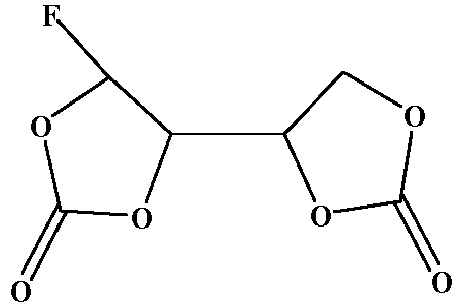
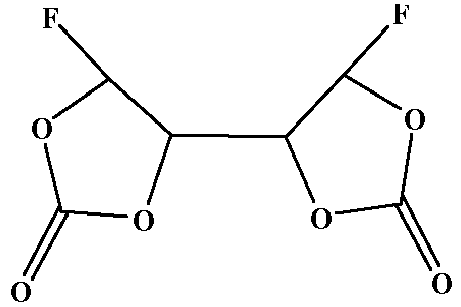

Compound 7 Compound 8 Compound 9 


- The non-aqueous electrolyte for a lithium-ion battery according to the present invention may further comprise an additive, which for example may be selected from one or more of vinylene carbonate (VC), vinylethylene carbonate (VEC), and fluoroethylene carbonate (FEC); and may also be selected from one or more of 1,3-propane sultone (1,3-PS), 1,4-butane sultone (BS), and 1,3-propene sultone (PST). These additives can form a more stable SEI film on the surface of the graphite anode, thereby significantly improving the cycling performance of the lithium-ion battery. These additives may be added in an amount conventionally used in the art, for example, from 0.1% to 5%, preferably from 0.2% to 3%, more preferably from 0.5% to 2%, based on the total mass of the electrolyte.
- Researches have shown that using the compound represented by Structural Formula 1 according to the present invention in combination with the above-mentioned additives, it is possible to obtain an effect superior to that achievable when they are used singly. It is presumed that there is a synergistic effect between them, that is, the compound represented by Structural Formula 1 and the above-mentioned additives work together to improve the cycling performance, the high-temperature storage and/or low-temperature performances of the battery.
- In a preferred embodiment of the present invention, the non-aqueous organic solvent is a mixture of a cyclic carbonate and a linear carbonate, the cyclic carbonate being selected from one or more of ethylene carbonate, propylene carbonate or butylene carbonate, and the linear carbonate being selected from one or more of dimethyl carbonate, diethyl carbonate, ethyl methyl carbonate or methyl propyl carbonate.
- A mixture of a high-dielectric-constant cyclic carbonate organic solvent and a low-viscosity linear carbonate organic solvent is used as a solvent for the electrolyte for a lithium-ion battery, so that the organic solvent mixture has a high ionic conductivity, a high dielectric constant and a low viscosity at the same time.
- In a preferred embodiment of the present invention, the lithium salt is selected from one or more of LiPF6, LiBF4, LiBOB, LiDFOB, LiSbF6, LiAsF6, LiN(SO2CF3)2, LiN(SO2C2F5)2, LiC(SO2CF3)3 or LiN(SO2F)2, and preferably, the lithium salt is LiPF6 or a mixture of LiPF6 with one or more other lithium salts.
- One embodiment of the present invention provides a lithium-ion battery, comprising a cathode, an anode, and a separator disposed between the cathode and the anode, and further comprising the non-aqueous electrolyte for a lithium-ion battery according to the present invention.
- In a preferred embodiment of the present invention, the active material for the cathode is selected from one or more of LiCoO2, LiNiO2, LiMn2O4, LiCo1-yMyO2, LiNi1-yMyO2, LiMn2-yMyO4, or LiNixCOyMnzM1-x-y-zO2, wherein M is selected from one or more of Fe, Co, Ni, Mn, Mg, Cu, Zn, Al, Sn, B, Ga, Cr, Sr, V or Ti, and 0≤y≤1, 0≤x≤1, 0≤z≤1, and x+y+z≤1.
- In a preferred embodiment of the present invention, the active material for the cathode is selected from LiFe1-xMxPO4, wherein M is selected from one or more of Mn, Mg, Co, Ni, Cu, Zn, Al, Sn, B, Ga, Cr, Sr, V or Ti, and 0≤x<1.
- In one embodiment of the present invention, the cathode material is LiNi0.5Co0.2Mn0.3O2, and the anode material is an artificial graphite.
- The present invention will now be described in more detail below by reference to specific examples. It is to be understood that the examples are merely illustrative and are not intended to limit the scope of the present invention.
- Ethylene carbonate (EC), diethyl carbonate (DEC) and ethyl methyl carbonate (EMC) were mixed at a mass ratio of EC:DEC:EMC=1:1:1, then lithium hexafluorophosphate (LiPF6) was added to a molar concentration of 1 mol/L, and then based on the total mass of the electrolyte, 1% of Compound 1 was added (note: Compound 1 here is the Compound 1 shown in Table 1, the same is true for the subsequent examples).
- Lithium nickel cobalt manganese oxide LiNi0.5Co0.2Mn0.3O2 as cathode active material, Super-P as conductive carbon black and polyvinylidene fluoride (PVDF) as binder were mixed at a mass ratio of 93:4:3. The mixture was dispersed in N-methyl-2-pyrrolidone (NMP) to obtain a cathode slurry. The slurry was uniformly coated onto both sides of an aluminum foil, oven dried, calendered and vacuum dried. Then an aluminum lead wire was welded to the foil by an ultrasonic welder to obtain a cathode plate having a thickness of 120-150 µm.
- Artificial graphite as anode active material, Super-P as conductive carbon black, and styrene butadiene rubber (SBR) and carboxymethyl cellulose (CMC) as binder were mixed at a mass ratio of 94:1:2.5:2.5. The mixture was dispersed in deionized water to obtain an anode slurry. The slurry was coated onto both sides of a copper foil, oven dried, calendered and vacuum dried. Then a nickel lead wire was welded to the foil by an ultrasonic welder to obtain an anode plate having a thickness of 120-150 µm.
- A three-layered film having a thickness of 20 µm was placed as a separator between the cathode plate and the anode plate, and the resulting sandwich structure composed of the cathode plate, the anode plate and the separator was wound. Then, the wound structure was flattened and placed into an aluminum foil packaging bag, and baked at 75°C under vacuum for 48 hours to obtain a battery core, which was to be injected with the electrolyte.
- In a glove box in which dew point was controlled below -40° C, the electrolyte prepared above was injected into the battery core, which was then vacuum packed and left to stand for 24 hours.
- Then, conventional battery formation was carried out at initial charging in the following steps: 0.05C constant-current charging for 180 min, 0.2C constant-current charging to 3.95V, vacuum packing for a second time, then further 0.2C constant-current charging to 4.2V, standing at ordinary temperatures for 24 hours, and then 0.2C constant-current discharging to 3.0V.
- The battery was placed in an oven at a constant temperature of 45°C, charged at a constant current of 1C to 4.2V, then charged at a constant voltage until the current dropped to 0.02C, and then discharged at a constant current of 1C to 3.0V. This cycling was repeated, and the discharge capacity at the first cycling and the discharge capacity at the last cycling were recorded. The capacity retention rate following high-temperature cycling was calculated as follows:

- The formed battery was subjected to 1C constant-current and constant-voltage charging to 4.2V at ordinary temperatures, and the initial discharge capacity and the initial thickness of the battery were measured. Then, the battery was stored at 60°C for 30 days, then subjected to 1C discharging to 3V, and the retention capacity and the recovery capacity of the battery and the thickness of the battery after storage were measured. The formulae for calculation are as follows:



- At 25°C, the formed battery was subjected to 1C constant-current and constant-voltage charging to 4.2V, and then 1C constant-current discharging to 3.0V, and the discharge capacity was recorded. Then, the battery was subjected to 1C constant-current and constant-voltage charging to 4.2V, left to stand in an environment of -20°C for 12 hours, and then subjected to 0.2C constant-current discharging to 3.0V, and the discharge capacity was recorded.

- As shown in Table 2, this example was the same as Example 1 except that 1% of Compound 1 was replaced with 1% of Compound 2 in the preparation of the electrolyte. The data of the high-temperature performance and the low-temperature performance obtained in the test are shown in Table 3.
- As shown in Table 2, this example was the same as Example 1 except that 1% of Compound 1 was replaced with 1% of Compound 4 in the preparation of the electrolyte. The data of the high-temperature performance and the low-temperature performance obtained in the test are shown in Table 3.
- As shown in Table 2, this example was the same as Example 1 except that 1% of Compound 1 was replaced with 1% of Compound 8 in the preparation of the electrolyte. The data of the high-temperature performance and the low-temperature performance obtained in the test are shown in Table 3.
- As shown in Table 2, this example was the same as Example 1 except that 1% of Compound 1 was not added in the preparation of the electrolyte. The data of the high-temperature performance and the low-temperature performance obtained in the test are shown in Table 3.
- As shown in Table 2, this example was the same as Example 1 except that 1% of Compound 1 was replaced with 1% of FEC in the preparation of the electrolyte. The data of the high-temperature performance and the low-temperature performance obtained in the test are shown in Table 3.
- As shown in Table 2, this example was the same as Example 1 except that 1% of Compound 1 was replaced with 1% of VEC in the preparation of the electrolyte. The data of the high-temperature performance and the low-temperature performance obtained in the test are shown in Table 3.
- As shown in Table 2, this example was the same as Example 1 except that 1% of Compound 1 was replaced with 1% of VC in the preparation of the electrolyte. The data of the high-temperature performance and the low-temperature performance obtained in the test are shown in Table 3.
Table 2 Example/Comparative Example The compound represented by Structural Formula 1 and its content Additive and its content Example 1 Compound 1: 1% - Example 2 Compound 2: 1% - Example 3 Compound 4: 1% - Example 4 Compound 8: 1% - Comparative example 1 - - Comparative example 2 - FEC: 1% Comparative example 3 - VEC: 1% Comparative example 4 - VC: 1% Table 3 Example/Comparative Example Capacity retention rate after 1C cycling at 45°C for 400 cycles Storage at 60°C for 30 days 0.2C discharging efficiency at -20°C Capacity retention rate Capacity recovery rate Thickness expansion rate Example 1 84.3% 82.3% 85.6% 12.8% 76.5% Example 2 84.6% 83.6% 86.9% 13.8% 76% Example 3 85.9% 83.5% 87.5% 14.9% 78.5% Example 4 86.8% 84.9% 88.2% 15.8% 77.5% Comparative example 1 76.3% 70% 74% 18.6% 70% Comparative example 2 80.1% 78.1% 81.2% 30% 75% Comparative example 3 82.1% 79.1% 83.1% 12.2% 60% Comparative example 4 83.2% 78.5% 82.6% 25.4% 65% - The results show that adding 1% of Compound 1, Compound 2, Compound 4 or Compound 6 to the non-aqueous electrolyte can significantly improve the high-temperature performance and the low-temperature performance of the lithium-ion battery compared to the example without addition.
- As shown in Table 4, this example was the same as Example 1 except that 1% of Compound 1 was replaced with 0.1% of Compound 1 in the preparation of the electrolyte. The data of the high-temperature performance and the low-temperature performance obtained in the test are shown in Table 5.
- As shown in Table 4, this example was the same as Example 1 except that 1% of Compound 1 was replaced with 2% of Compound 1 in the preparation of the electrolyte. The data of the high-temperature performance and the low-temperature performance obtained in the test are shown in Table 5.
- As shown in Table 4, this example was the same as Example 1 except that 1% of Compound 1 was replaced with 3% of Compound 1 in the preparation of the electrolyte. The data of the high-temperature performance and the low-temperature performance obtained in the test are shown in Table 5.
- As shown in Table 4, this example was the same as Example 1 except that 1% of Compound 1 was replaced with 5% of Compound 1 in the preparation of the electrolyte. The data of the high-temperature performance and the low-temperature performance obtained in the test are shown in Table 5.
Table 4 Example/Comparative Example The compound represented by Structural Formula 1 and its content Example 5 Compound 1: 0.1% Example 6 Compound 1: 2% Example 7 Compound 1: 3% Example 8 Compound 1: 5% Table 5 Example/Comparative Example Capacity retention rate after 1C cycling at 45°C for 400 cycles Storage at 60°C for 30 days 0.2C discharging efficiency at -20°C Capacity retention rate Capacity recovery rate Thickness expansion rate Example 5 77.5% 74.8% 79.6% 17.1% 75.2% Example 6 84.3% 82.5% 85.8% 11.8% 76% Example 7 85.4% 83.6% 87.2% 10.2% 75.2% Example 8 82.3% 81.2% 84.5% 8.3% 73.1% - As shown in Table 6, this example was the same as Example 1 except that 1% of FEC was additionally added in the preparation of the electrolyte. The data of the high-temperature performance and the low-temperature performance obtained in the test are shown in Table 7.
- As shown in Table 6, this example was the same as Example 1 except that 1% of VEC was additionally added in the preparation of the electrolyte. The data of the high-temperature performance and the low-temperature performance obtained in the test are shown in Table 7.
- As shown in Table 6, this example was the same as Example 1 except that 1% of VC was additionally added in the preparation of the electrolyte. The data of the high-temperature performance and the low-temperature performance obtained in the test are shown in Table 7.
Table 6 Example/Comparative Example The compound represented by Structural Formula 1 and its content Additive and its content Example 9 Compound 1: 1% FEC: 1% - - Example 10 Compound 1: 1% - VEC: 1% - Example 11 Compound 1: 1% - - VC: 1% Comparative example 2 - FEC: 1% - - Comparative example 3 - - VEC: 1% - Comparative example 4 - - - VC: 1% Table 7 Example/Comparative Capacity Storage at 60°C for 30 days 0.2C Example retention rate after 1C cycling at 45°C for 400 cycles Capacity retention rate Capacity recovery rate Thickness expansion rate discharging efficiency at -20°C Example 9 91.3% 82.3% 85.6% 15.3% 80.5% Example 10 86.5% 83.4% 86.8% 10.4% 72.8% Example 11 88.8% 83.9% 87.1% 13.4% 74.1% Comparative example 2 80.1% 78.1% 81.2% 30% 75% Comparative example 3 82.1% 79.1% 83.1% 12.2% 60% Comparative example 4 83.2% 78.5% 82.6% 25.4% 65% - The results show that addition of an additive (FEC, VEC or VC) on the basis of the compound represented by Structural Formula 1 according to the present invention can further improve the high-temperature performance and the low-temperature performance of the battery. In other words, addition of the compound represented by Structural Formula 1 according to the present invention on the basis of an existing additive (FEC, VEC or VC) can further improve the high-temperature performance and the low-temperature performance of the battery.
- While the above is a further detailed description of the present invention in connection with specific examples, the particular implementation of the present invention should not be deemed to be limited thereto. It will be apparent to those skilled in the art that simple derivations or substitutions are possible without departing from the concept of the present invention and should be regarded as falling into the scope of protection of the present invention.
Claims (10)
- a non-aqueous electrolyte for a lithium-ion battery, comprising one or more of a compound represented by Structural Formula 1,

- The non-aqueous electrolyte for a lithium-ion battery according to claim 1, wherein the group having 1 to 5 carbon atoms is selected from a hydrocarbyl group, a halogenated hydrocarbyl group, an oxygen-containing hydrocarbyl group, a silicon-containing hydrocarbyl group or a cyano-substituted hydrocarbyl group.
- The non-aqueous electrolyte for a lithium-ion battery according to claim 1 or 2, wherein R1, R2, R3, R4, R5, and R6 are each independently selected from a hydrogen atom, a fluorine atom, a methyl group, an ethyl group, a trimethylsiloxy group, a cyano group or a trifluoromethyl group.
- The non-aqueous electrolyte for a lithium-ion battery according to claim 1 or 2, wherein the content of the compound represented by Structural Formula 1 is from 0.1% to 5% based on the total mass of the non-aqueous electrolyte for a lithium-ion battery.
- The non-aqueous electrolyte for a lithium-ion battery according to claim 1 or 2, wherein the compound represented by Structural Formula 1 is specifically selected from the following compounds 1 to 9,


- The non-aqueous electrolyte for a lithium-ion battery according to claim 1 or 2, wherein the non-aqueous electrolyte for a lithium-ion battery further comprises one or more of vinylene carbonate (VC), vinylethylene carbonate (VEC), and fluoroethylene carbonate (FEC);
and preferably, the non-aqueous electrolyte for a lithium-ion battery further comprises one or more of 1,3-propane sultone (1,3-PS), 1,4-butane sultone (BS), and 1,3-propene sultone (PST). - The non-aqueous electrolyte for a lithium-ion battery according to claim 1 or 2, wherein the lithium salt is selected from one or more of LiPF6, LiBOB, LiDFOB, LiBF4, LiSbF6, LiAsF6, LiN(SO2CF3)2, LiN(SO2C2F5)2, LiC(SO2CF3)3 or LiN(SO2F)2; the non-aqueous organic solvent is a mixture of a cyclic carbonate and a linear carbonate, the cyclic carbonate being selected from one or more of ethylene carbonate, propylene carbonate or butylene carbonate, and the linear carbonate being selected from one or more of dimethyl carbonate, diethyl carbonate, ethyl methyl carbonate or methyl propyl carbonate.
- A lithium-ion battery, comprising a cathode, an anode, and a separator disposed between the cathode and the anode, and further comprising the non-aqueous electrolyte for a lithium-ion battery according to any one of claims 1-7.
- The lithium-ion battery according to claim 8, wherein the active material for the cathode is selected from one or more of LiCoO2, LiNiO2, LiMn2O4, LiCo1-yMyO2, LiNi1-yMyO2, LiMn2-yMyO4, or LiNixCOyMnzM1-x-y-zO2, wherein M is selected from one or more of Fe, Co, Ni, Mn, Mg, Cu, Zn, Al, Sn, B, Ga, Cr, Sr, V or Ti, and 0≤y≤1, 0≤x≤1, 0≤z≤1, and x+y+z≤1.
- The lithium-ion battery according to claim 8, wherein the active material for the cathode is selected from LiFe1-xMxPO4, wherein M is selected from one or more of Mn, Mg, Co, Ni, Cu, Zn, Al, Sn, B, Ga, Cr, Sr, V or Ti, and 0≤x<1.
Priority Applications (1)
| Application Number | Priority Date | Filing Date | Title |
|---|---|---|---|
| PL16908068T PL3483972T3 (en) | 2016-07-08 | 2016-12-29 | Non-aqueous electrolyte solution for lithium-ion battery, and lithium-ion battery using the same |
Applications Claiming Priority (2)
| Application Number | Priority Date | Filing Date | Title |
|---|---|---|---|
| CN201610539967.6A CN107591557B (en) | 2016-07-08 | 2016-07-08 | A kind of non-aqueous electrolyte for lithium ion cell and the lithium ion battery using the electrolyte |
| PCT/CN2016/113010 WO2018006564A1 (en) | 2016-07-08 | 2016-12-29 | Lithium-ion non-aqueous battery electrolyte solution, and lithium-ion battery using the electrolyte solution |
Publications (3)
| Publication Number | Publication Date |
|---|---|
| EP3483972A1 true EP3483972A1 (en) | 2019-05-15 |
| EP3483972A4 EP3483972A4 (en) | 2020-02-26 |
| EP3483972B1 EP3483972B1 (en) | 2021-04-14 |
Family
ID=60901675
Family Applications (1)
| Application Number | Title | Priority Date | Filing Date |
|---|---|---|---|
| EP16908068.6A Active EP3483972B1 (en) | 2016-07-08 | 2016-12-29 | Non-aqueous electrolyte solution for lithium-ion battery, and lithium-ion battery using the same |
Country Status (8)
| Country | Link |
|---|---|
| US (1) | US10644352B2 (en) |
| EP (1) | EP3483972B1 (en) |
| JP (1) | JP6717977B2 (en) |
| KR (1) | KR102154803B1 (en) |
| CN (1) | CN107591557B (en) |
| HU (1) | HUE054729T2 (en) |
| PL (1) | PL3483972T3 (en) |
| WO (1) | WO2018006564A1 (en) |
Cited By (2)
| Publication number | Priority date | Publication date | Assignee | Title |
|---|---|---|---|---|
| EP3633780A4 (en) * | 2017-05-27 | 2020-05-06 | Shenzhen Capchem Technology Co., Ltd | NON-AQUEOUS ELECTROLYTE FOR LITHIUM-ION BATTERY AND LITHIUM-ION BATTERY |
| EP3618164A4 (en) * | 2017-04-28 | 2020-05-13 | Shenzhen Capchem Technology Co., Ltd | NON-AQUEOUS LITHIUM-ION BATTERY ELECTROLYTE AND LITHIUM-ION BATTERY |
Families Citing this family (8)
| Publication number | Priority date | Publication date | Assignee | Title |
|---|---|---|---|---|
| CN108808084B (en) * | 2017-04-28 | 2020-05-08 | 深圳新宙邦科技股份有限公司 | Lithium-ion battery non-aqueous electrolyte and lithium-ion battery |
| CN110661028B (en) * | 2018-06-29 | 2021-04-09 | 深圳新宙邦科技股份有限公司 | Lithium ion battery non-aqueous electrolyte and lithium ion battery |
| CN109546217A (en) * | 2018-12-19 | 2019-03-29 | 珠海光宇电池有限公司 | A kind of electrolyte and lithium ion battery being adapted to high capacity graphite cathode |
| CN110994027B (en) * | 2019-12-25 | 2022-05-13 | 湖州昆仑亿恩科电池材料有限公司 | Lithium ion battery electrolyte with good high-temperature cycle characteristic and lithium ion battery |
| CN113130983B (en) * | 2019-12-30 | 2022-12-06 | 深圳新宙邦科技股份有限公司 | Solid electrolyte and solid lithium ion battery |
| CN111763200A (en) * | 2020-07-13 | 2020-10-13 | 香河昆仑化学制品有限公司 | Cyclic carbonic acid vinyl sulfate ester as lithium ion battery electrolyte additive and preparation method thereof |
| JP7725830B2 (en) * | 2021-02-24 | 2025-08-20 | 株式会社Gsユアサ | Nonaqueous electrolyte storage element and method for manufacturing the same |
| US20230231126A1 (en) * | 2022-01-19 | 2023-07-20 | Shenzhen Capchem Technology Co., Ltd. | Lithium ion battery |
Family Cites Families (18)
| Publication number | Priority date | Publication date | Assignee | Title |
|---|---|---|---|---|
| GB1147540A (en) * | 1966-04-19 | 1969-04-02 | Grace W R & Co | Butanetetrol dicarbonates and their production |
| US3663569A (en) * | 1969-09-02 | 1972-05-16 | Atlas Chem Ind | Process for preparing cyclic carbonates from polyhydric alcohols |
| CN1218425C (en) * | 2000-04-17 | 2005-09-07 | 宇部兴产株式会社 | Non-aqueous electrolyte and lithium secondary battery |
| KR100515298B1 (en) * | 2003-03-24 | 2005-09-15 | 삼성에스디아이 주식회사 | A non-aqueous electrolyte and a lithium secondary battery comprising the same |
| DE102004035542A1 (en) * | 2004-07-22 | 2006-02-09 | Henkel Kgaa | Two-component binder |
| JP5055536B2 (en) * | 2005-02-09 | 2012-10-24 | 国立大学法人宇都宮大学 | Highly immobilized carbon dioxide |
| WO2007126068A1 (en) * | 2006-04-27 | 2007-11-08 | Mitsubishi Chemical Corporation | Nonaqueous electrolyte solution and nonaqueous electrolyte secondary battery |
| US8349502B2 (en) * | 2006-09-20 | 2013-01-08 | Lg Chem, Ltd. | Additive for non-aqueous electrolyte and secondary battery using the same |
| WO2008153296A1 (en) * | 2007-06-11 | 2008-12-18 | Lg Chem, Ltd. | Non-aqueous electrolyte and secondary battery comprising the same |
| US20110039163A1 (en) * | 2009-03-31 | 2011-02-17 | Masaki Deguchi | Non-aqueous electrolyte and non-aqueous electrolyte secondary battery using the same |
| CN101931107B (en) * | 2009-06-24 | 2012-10-10 | 聚和国际股份有限公司 | Electrolyte solution for electrochemical device and electrochemical device thereof |
| US9806377B2 (en) * | 2009-12-07 | 2017-10-31 | Sony Corporation | Secondary battery, electrolytic solution, battery pack, electronic device, and electrical vehicle |
| JP2014049294A (en) * | 2012-08-31 | 2014-03-17 | Tdk Corp | Nonaqueous electrolyte for lithium ion secondary battery and lithium ion secondary battery |
| WO2014050873A1 (en) * | 2012-09-28 | 2014-04-03 | ダイキン工業株式会社 | Electrolyte solution, electrochemical device, lithium battery, and module |
| WO2014115784A1 (en) * | 2013-01-25 | 2014-07-31 | 和光純薬工業株式会社 | Electrolyte solution for electrochemical device, and electrochemical device |
| JP2015092476A (en) * | 2013-10-04 | 2015-05-14 | 旭化成株式会社 | Nonaqueous electrolyte, electrolyte for lithium ion secondary batteries and nonaqueous electrolyte battery |
| JP6229453B2 (en) * | 2013-11-22 | 2017-11-15 | 宇部興産株式会社 | Non-aqueous electrolyte and power storage device using the same |
| CN105449278A (en) * | 2015-12-25 | 2016-03-30 | 中南大学 | Siloxane derivative electrolyte for lithium-ion battery and high-voltage lithium-ion battery |
-
2016
- 2016-07-08 CN CN201610539967.6A patent/CN107591557B/en active Active
- 2016-12-29 EP EP16908068.6A patent/EP3483972B1/en active Active
- 2016-12-29 HU HUE16908068A patent/HUE054729T2/en unknown
- 2016-12-29 PL PL16908068T patent/PL3483972T3/en unknown
- 2016-12-29 WO PCT/CN2016/113010 patent/WO2018006564A1/en not_active Ceased
- 2016-12-29 KR KR1020187031658A patent/KR102154803B1/en active Active
- 2016-12-29 JP JP2018556836A patent/JP6717977B2/en active Active
- 2016-12-29 US US16/085,067 patent/US10644352B2/en active Active
Cited By (2)
| Publication number | Priority date | Publication date | Assignee | Title |
|---|---|---|---|---|
| EP3618164A4 (en) * | 2017-04-28 | 2020-05-13 | Shenzhen Capchem Technology Co., Ltd | NON-AQUEOUS LITHIUM-ION BATTERY ELECTROLYTE AND LITHIUM-ION BATTERY |
| EP3633780A4 (en) * | 2017-05-27 | 2020-05-06 | Shenzhen Capchem Technology Co., Ltd | NON-AQUEOUS ELECTROLYTE FOR LITHIUM-ION BATTERY AND LITHIUM-ION BATTERY |
Also Published As
| Publication number | Publication date |
|---|---|
| JP2019515443A (en) | 2019-06-06 |
| EP3483972A4 (en) | 2020-02-26 |
| PL3483972T3 (en) | 2021-10-11 |
| EP3483972B1 (en) | 2021-04-14 |
| JP6717977B2 (en) | 2020-07-08 |
| US10644352B2 (en) | 2020-05-05 |
| CN107591557A (en) | 2018-01-16 |
| WO2018006564A1 (en) | 2018-01-11 |
| KR102154803B1 (en) | 2020-09-11 |
| CN107591557B (en) | 2019-05-21 |
| HUE054729T2 (en) | 2021-09-28 |
| KR20180126578A (en) | 2018-11-27 |
| US20190081354A1 (en) | 2019-03-14 |
Similar Documents
| Publication | Publication Date | Title |
|---|---|---|
| EP3483972B1 (en) | Non-aqueous electrolyte solution for lithium-ion battery, and lithium-ion battery using the same | |
| EP3731325B1 (en) | Non-aqueous electrolyte for lithium-ion battery, and lithium-ion battery | |
| US11757132B2 (en) | Non-aqueous electrolyte for lithium-ion battery and lithium-ion battery | |
| EP3907803B1 (en) | Non-aqueous electrolyte for lithium ion battery and lithium ion battery | |
| CN109994776B (en) | A lithium ion battery non-aqueous electrolyte and lithium ion battery | |
| CN111293361A (en) | Electrolyte for lithium secondary battery and lithium secondary battery including the same | |
| WO2017084109A1 (en) | Non-aqueous electrolyte of lithium ion battery and lithium ion battery | |
| EP3876331B1 (en) | Non-aqueous electrolyte solution for lithium-ion battery and lithium-ion battery using same | |
| KR20240113879A (en) | Electrolyte for Secondary Battery and Lithium Secondary Battery Containing the Same | |
| CN114122493B (en) | Nonaqueous electrolyte for lithium ion battery and lithium ion battery | |
| CN112310466B (en) | Lithium-ion battery non-aqueous electrolyte and lithium-ion battery containing the same | |
| EP4243146B1 (en) | Lithium ion battery non-aqueous electrolyte and lithium ion battery | |
| CN110911744B (en) | Lithium ion battery non-aqueous electrolyte and lithium ion battery | |
| CN110661028A (en) | Lithium ion battery non-aqueous electrolyte and lithium ion battery | |
| CN111864262A (en) | Lithium ion battery non-aqueous electrolyte and lithium ion battery | |
| CN114447429B (en) | Nonaqueous electrolyte for lithium ion battery and lithium ion battery | |
| KR20100135623A (en) | Secondary battery electrolyte with improved safety and lithium secondary battery comprising same | |
| CN115995606B (en) | Non-aqueous electrolyte of lithium ion battery and lithium ion battery | |
| CN111725563A (en) | Lithium ion battery non-aqueous electrolyte and lithium ion battery |
Legal Events
| Date | Code | Title | Description |
|---|---|---|---|
| STAA | Information on the status of an ep patent application or granted ep patent |
Free format text: STATUS: THE INTERNATIONAL PUBLICATION HAS BEEN MADE |
|
| PUAI | Public reference made under article 153(3) epc to a published international application that has entered the european phase |
Free format text: ORIGINAL CODE: 0009012 |
|
| STAA | Information on the status of an ep patent application or granted ep patent |
Free format text: STATUS: REQUEST FOR EXAMINATION WAS MADE |
|
| 17P | Request for examination filed |
Effective date: 20181107 |
|
| AK | Designated contracting states |
Kind code of ref document: A1 Designated state(s): AL AT BE BG CH CY CZ DE DK EE ES FI FR GB GR HR HU IE IS IT LI LT LU LV MC MK MT NL NO PL PT RO RS SE SI SK SM TR |
|
| AX | Request for extension of the european patent |
Extension state: BA ME |
|
| DAV | Request for validation of the european patent (deleted) | ||
| DAX | Request for extension of the european patent (deleted) | ||
| A4 | Supplementary search report drawn up and despatched |
Effective date: 20200129 |
|
| RIC1 | Information provided on ipc code assigned before grant |
Ipc: H01M 4/505 20100101ALN20200123BHEP Ipc: H01M 4/58 20100101ALN20200123BHEP Ipc: H01M 10/0567 20100101AFI20200123BHEP Ipc: H01M 4/525 20100101ALN20200123BHEP Ipc: H01M 10/0525 20100101ALI20200123BHEP |
|
| GRAJ | Information related to disapproval of communication of intention to grant by the applicant or resumption of examination proceedings by the epo deleted |
Free format text: ORIGINAL CODE: EPIDOSDIGR1 |
|
| STAA | Information on the status of an ep patent application or granted ep patent |
Free format text: STATUS: GRANT OF PATENT IS INTENDED |
|
| GRAP | Despatch of communication of intention to grant a patent |
Free format text: ORIGINAL CODE: EPIDOSNIGR1 |
|
| RIC1 | Information provided on ipc code assigned before grant |
Ipc: H01M 10/0525 20100101ALI20201209BHEP Ipc: H01M 10/0567 20100101AFI20201209BHEP Ipc: H01M 4/525 20100101ALN20201209BHEP Ipc: H01M 4/505 20100101ALN20201209BHEP Ipc: H01M 4/58 20100101ALN20201209BHEP |
|
| INTG | Intention to grant announced |
Effective date: 20210113 |
|
| GRAS | Grant fee paid |
Free format text: ORIGINAL CODE: EPIDOSNIGR3 |
|
| GRAA | (expected) grant |
Free format text: ORIGINAL CODE: 0009210 |
|
| STAA | Information on the status of an ep patent application or granted ep patent |
Free format text: STATUS: THE PATENT HAS BEEN GRANTED |
|
| AK | Designated contracting states |
Kind code of ref document: B1 Designated state(s): AL AT BE BG CH CY CZ DE DK EE ES FI FR GB GR HR HU IE IS IT LI LT LU LV MC MK MT NL NO PL PT RO RS SE SI SK SM TR |
|
| REG | Reference to a national code |
Ref country code: GB Ref legal event code: FG4D |
|
| REG | Reference to a national code |
Ref country code: CH Ref legal event code: EP |
|
| REG | Reference to a national code |
Ref country code: DE Ref legal event code: R096 Ref document number: 602016056305 Country of ref document: DE |
|
| REG | Reference to a national code |
Ref country code: IE Ref legal event code: FG4D |
|
| REG | Reference to a national code |
Ref country code: AT Ref legal event code: REF Ref document number: 1383269 Country of ref document: AT Kind code of ref document: T Effective date: 20210515 |
|
| REG | Reference to a national code |
Ref country code: NL Ref legal event code: FP |
|
| REG | Reference to a national code |
Ref country code: SE Ref legal event code: TRGR |
|
| REG | Reference to a national code |
Ref country code: CH Ref legal event code: PK Free format text: BERICHTIGUNG ERFINDER |
|
| REG | Reference to a national code |
Ref country code: LT Ref legal event code: MG9D |
|
| REG | Reference to a national code |
Ref country code: AT Ref legal event code: MK05 Ref document number: 1383269 Country of ref document: AT Kind code of ref document: T Effective date: 20210414 |
|
| REG | Reference to a national code |
Ref country code: HU Ref legal event code: AG4A Ref document number: E054729 Country of ref document: HU |
|
| PG25 | Lapsed in a contracting state [announced via postgrant information from national office to epo] |
Ref country code: HR Free format text: LAPSE BECAUSE OF FAILURE TO SUBMIT A TRANSLATION OF THE DESCRIPTION OR TO PAY THE FEE WITHIN THE PRESCRIBED TIME-LIMIT Effective date: 20210414 Ref country code: BG Free format text: LAPSE BECAUSE OF FAILURE TO SUBMIT A TRANSLATION OF THE DESCRIPTION OR TO PAY THE FEE WITHIN THE PRESCRIBED TIME-LIMIT Effective date: 20210714 Ref country code: AT Free format text: LAPSE BECAUSE OF FAILURE TO SUBMIT A TRANSLATION OF THE DESCRIPTION OR TO PAY THE FEE WITHIN THE PRESCRIBED TIME-LIMIT Effective date: 20210414 Ref country code: FI Free format text: LAPSE BECAUSE OF FAILURE TO SUBMIT A TRANSLATION OF THE DESCRIPTION OR TO PAY THE FEE WITHIN THE PRESCRIBED TIME-LIMIT Effective date: 20210414 Ref country code: LT Free format text: LAPSE BECAUSE OF FAILURE TO SUBMIT A TRANSLATION OF THE DESCRIPTION OR TO PAY THE FEE WITHIN THE PRESCRIBED TIME-LIMIT Effective date: 20210414 |
|
| PG25 | Lapsed in a contracting state [announced via postgrant information from national office to epo] |
Ref country code: LV Free format text: LAPSE BECAUSE OF FAILURE TO SUBMIT A TRANSLATION OF THE DESCRIPTION OR TO PAY THE FEE WITHIN THE PRESCRIBED TIME-LIMIT Effective date: 20210414 Ref country code: GR Free format text: LAPSE BECAUSE OF FAILURE TO SUBMIT A TRANSLATION OF THE DESCRIPTION OR TO PAY THE FEE WITHIN THE PRESCRIBED TIME-LIMIT Effective date: 20210715 Ref country code: IS Free format text: LAPSE BECAUSE OF FAILURE TO SUBMIT A TRANSLATION OF THE DESCRIPTION OR TO PAY THE FEE WITHIN THE PRESCRIBED TIME-LIMIT Effective date: 20210814 Ref country code: PT Free format text: LAPSE BECAUSE OF FAILURE TO SUBMIT A TRANSLATION OF THE DESCRIPTION OR TO PAY THE FEE WITHIN THE PRESCRIBED TIME-LIMIT Effective date: 20210816 Ref country code: NO Free format text: LAPSE BECAUSE OF FAILURE TO SUBMIT A TRANSLATION OF THE DESCRIPTION OR TO PAY THE FEE WITHIN THE PRESCRIBED TIME-LIMIT Effective date: 20210714 Ref country code: RS Free format text: LAPSE BECAUSE OF FAILURE TO SUBMIT A TRANSLATION OF THE DESCRIPTION OR TO PAY THE FEE WITHIN THE PRESCRIBED TIME-LIMIT Effective date: 20210414 |
|
| REG | Reference to a national code |
Ref country code: DE Ref legal event code: R097 Ref document number: 602016056305 Country of ref document: DE |
|
| PG25 | Lapsed in a contracting state [announced via postgrant information from national office to epo] |
Ref country code: DK Free format text: LAPSE BECAUSE OF FAILURE TO SUBMIT A TRANSLATION OF THE DESCRIPTION OR TO PAY THE FEE WITHIN THE PRESCRIBED TIME-LIMIT Effective date: 20210414 Ref country code: CZ Free format text: LAPSE BECAUSE OF FAILURE TO SUBMIT A TRANSLATION OF THE DESCRIPTION OR TO PAY THE FEE WITHIN THE PRESCRIBED TIME-LIMIT Effective date: 20210414 Ref country code: EE Free format text: LAPSE BECAUSE OF FAILURE TO SUBMIT A TRANSLATION OF THE DESCRIPTION OR TO PAY THE FEE WITHIN THE PRESCRIBED TIME-LIMIT Effective date: 20210414 Ref country code: RO Free format text: LAPSE BECAUSE OF FAILURE TO SUBMIT A TRANSLATION OF THE DESCRIPTION OR TO PAY THE FEE WITHIN THE PRESCRIBED TIME-LIMIT Effective date: 20210414 Ref country code: ES Free format text: LAPSE BECAUSE OF FAILURE TO SUBMIT A TRANSLATION OF THE DESCRIPTION OR TO PAY THE FEE WITHIN THE PRESCRIBED TIME-LIMIT Effective date: 20210414 Ref country code: SM Free format text: LAPSE BECAUSE OF FAILURE TO SUBMIT A TRANSLATION OF THE DESCRIPTION OR TO PAY THE FEE WITHIN THE PRESCRIBED TIME-LIMIT Effective date: 20210414 Ref country code: SK Free format text: LAPSE BECAUSE OF FAILURE TO SUBMIT A TRANSLATION OF THE DESCRIPTION OR TO PAY THE FEE WITHIN THE PRESCRIBED TIME-LIMIT Effective date: 20210414 |
|
| PLBE | No opposition filed within time limit |
Free format text: ORIGINAL CODE: 0009261 |
|
| STAA | Information on the status of an ep patent application or granted ep patent |
Free format text: STATUS: NO OPPOSITION FILED WITHIN TIME LIMIT |
|
| 26N | No opposition filed |
Effective date: 20220117 |
|
| PG25 | Lapsed in a contracting state [announced via postgrant information from national office to epo] |
Ref country code: IS Free format text: LAPSE BECAUSE OF FAILURE TO SUBMIT A TRANSLATION OF THE DESCRIPTION OR TO PAY THE FEE WITHIN THE PRESCRIBED TIME-LIMIT Effective date: 20210814 Ref country code: AL Free format text: LAPSE BECAUSE OF FAILURE TO SUBMIT A TRANSLATION OF THE DESCRIPTION OR TO PAY THE FEE WITHIN THE PRESCRIBED TIME-LIMIT Effective date: 20210414 |
|
| PG25 | Lapsed in a contracting state [announced via postgrant information from national office to epo] |
Ref country code: MC Free format text: LAPSE BECAUSE OF FAILURE TO SUBMIT A TRANSLATION OF THE DESCRIPTION OR TO PAY THE FEE WITHIN THE PRESCRIBED TIME-LIMIT Effective date: 20210414 Ref country code: IT Free format text: LAPSE BECAUSE OF FAILURE TO SUBMIT A TRANSLATION OF THE DESCRIPTION OR TO PAY THE FEE WITHIN THE PRESCRIBED TIME-LIMIT Effective date: 20210414 |
|
| REG | Reference to a national code |
Ref country code: BE Ref legal event code: MM Effective date: 20211231 |
|
| PG25 | Lapsed in a contracting state [announced via postgrant information from national office to epo] |
Ref country code: LU Free format text: LAPSE BECAUSE OF NON-PAYMENT OF DUE FEES Effective date: 20211229 Ref country code: IE Free format text: LAPSE BECAUSE OF NON-PAYMENT OF DUE FEES Effective date: 20211229 |
|
| PG25 | Lapsed in a contracting state [announced via postgrant information from national office to epo] |
Ref country code: BE Free format text: LAPSE BECAUSE OF NON-PAYMENT OF DUE FEES Effective date: 20211231 |
|
| PG25 | Lapsed in a contracting state [announced via postgrant information from national office to epo] |
Ref country code: CY Free format text: LAPSE BECAUSE OF FAILURE TO SUBMIT A TRANSLATION OF THE DESCRIPTION OR TO PAY THE FEE WITHIN THE PRESCRIBED TIME-LIMIT Effective date: 20210414 |
|
| P01 | Opt-out of the competence of the unified patent court (upc) registered |
Effective date: 20230601 |
|
| PG25 | Lapsed in a contracting state [announced via postgrant information from national office to epo] |
Ref country code: MK Free format text: LAPSE BECAUSE OF FAILURE TO SUBMIT A TRANSLATION OF THE DESCRIPTION OR TO PAY THE FEE WITHIN THE PRESCRIBED TIME-LIMIT Effective date: 20210414 |
|
| PG25 | Lapsed in a contracting state [announced via postgrant information from national office to epo] |
Ref country code: TR Free format text: LAPSE BECAUSE OF FAILURE TO SUBMIT A TRANSLATION OF THE DESCRIPTION OR TO PAY THE FEE WITHIN THE PRESCRIBED TIME-LIMIT Effective date: 20210414 |
|
| PG25 | Lapsed in a contracting state [announced via postgrant information from national office to epo] |
Ref country code: MT Free format text: LAPSE BECAUSE OF FAILURE TO SUBMIT A TRANSLATION OF THE DESCRIPTION OR TO PAY THE FEE WITHIN THE PRESCRIBED TIME-LIMIT Effective date: 20210414 |
|
| PGFP | Annual fee paid to national office [announced via postgrant information from national office to epo] |
Ref country code: NL Payment date: 20251127 Year of fee payment: 10 |
|
| REG | Reference to a national code |
Ref country code: CH Ref legal event code: U11 Free format text: ST27 STATUS EVENT CODE: U-0-0-U10-U11 (AS PROVIDED BY THE NATIONAL OFFICE) Effective date: 20260101 |
|
| PGFP | Annual fee paid to national office [announced via postgrant information from national office to epo] |
Ref country code: GB Payment date: 20251229 Year of fee payment: 10 |
|
| PGFP | Annual fee paid to national office [announced via postgrant information from national office to epo] |
Ref country code: HU Payment date: 20251124 Year of fee payment: 10 Ref country code: FR Payment date: 20251230 Year of fee payment: 10 |
|
| PGFP | Annual fee paid to national office [announced via postgrant information from national office to epo] |
Ref country code: SE Payment date: 20251218 Year of fee payment: 10 |
|
| PGFP | Annual fee paid to national office [announced via postgrant information from national office to epo] |
Ref country code: PL Payment date: 20251121 Year of fee payment: 10 |
|
| PGFP | Annual fee paid to national office [announced via postgrant information from national office to epo] |
Ref country code: DE Payment date: 20251231 Year of fee payment: 10 |
|
| PGFP | Annual fee paid to national office [announced via postgrant information from national office to epo] |
Ref country code: CH Payment date: 20260101 Year of fee payment: 10 |