EP3481175B1 - Use of an air permeable composite sheet material for propagation plugs for organic production - Google Patents
Use of an air permeable composite sheet material for propagation plugs for organic production Download PDFInfo
- Publication number
- EP3481175B1 EP3481175B1 EP17732343.3A EP17732343A EP3481175B1 EP 3481175 B1 EP3481175 B1 EP 3481175B1 EP 17732343 A EP17732343 A EP 17732343A EP 3481175 B1 EP3481175 B1 EP 3481175B1
- Authority
- EP
- European Patent Office
- Prior art keywords
- acid
- sheet material
- poly
- air permeable
- biodegradable
- Prior art date
- Legal status (The legal status is an assumption and is not a legal conclusion. Google has not performed a legal analysis and makes no representation as to the accuracy of the status listed.)
- Active
Links
Images
Classifications
-
- A—HUMAN NECESSITIES
- A01—AGRICULTURE; FORESTRY; ANIMAL HUSBANDRY; HUNTING; TRAPPING; FISHING
- A01G—HORTICULTURE; CULTIVATION OF VEGETABLES, FLOWERS, RICE, FRUIT, VINES, HOPS OR SEAWEED; FORESTRY; WATERING
- A01G24/00—Growth substrates; Culture media; Apparatus or methods therefor
- A01G24/20—Growth substrates; Culture media; Apparatus or methods therefor based on or containing natural organic material
- A01G24/28—Growth substrates; Culture media; Apparatus or methods therefor based on or containing natural organic material containing peat, moss or sphagnum
-
- A—HUMAN NECESSITIES
- A01—AGRICULTURE; FORESTRY; ANIMAL HUSBANDRY; HUNTING; TRAPPING; FISHING
- A01G—HORTICULTURE; CULTIVATION OF VEGETABLES, FLOWERS, RICE, FRUIT, VINES, HOPS OR SEAWEED; FORESTRY; WATERING
- A01G24/00—Growth substrates; Culture media; Apparatus or methods therefor
- A01G24/20—Growth substrates; Culture media; Apparatus or methods therefor based on or containing natural organic material
- A01G24/22—Growth substrates; Culture media; Apparatus or methods therefor based on or containing natural organic material containing plant material
-
- A—HUMAN NECESSITIES
- A01—AGRICULTURE; FORESTRY; ANIMAL HUSBANDRY; HUNTING; TRAPPING; FISHING
- A01G—HORTICULTURE; CULTIVATION OF VEGETABLES, FLOWERS, RICE, FRUIT, VINES, HOPS OR SEAWEED; FORESTRY; WATERING
- A01G24/00—Growth substrates; Culture media; Apparatus or methods therefor
- A01G24/40—Growth substrates; Culture media; Apparatus or methods therefor characterised by their structure
- A01G24/44—Growth substrates; Culture media; Apparatus or methods therefor characterised by their structure in block, mat or sheet form
-
- A—HUMAN NECESSITIES
- A01—AGRICULTURE; FORESTRY; ANIMAL HUSBANDRY; HUNTING; TRAPPING; FISHING
- A01G—HORTICULTURE; CULTIVATION OF VEGETABLES, FLOWERS, RICE, FRUIT, VINES, HOPS OR SEAWEED; FORESTRY; WATERING
- A01G24/00—Growth substrates; Culture media; Apparatus or methods therefor
- A01G24/60—Apparatus for preparing growth substrates or culture media
-
- B—PERFORMING OPERATIONS; TRANSPORTING
- B29—WORKING OF PLASTICS; WORKING OF SUBSTANCES IN A PLASTIC STATE IN GENERAL
- B29C—SHAPING OR JOINING OF PLASTICS; SHAPING OF MATERIAL IN A PLASTIC STATE, NOT OTHERWISE PROVIDED FOR; AFTER-TREATMENT OF THE SHAPED PRODUCTS, e.g. REPAIRING
- B29C43/00—Compression moulding, i.e. applying external pressure to flow the moulding material; Apparatus therefor
- B29C43/003—Compression moulding, i.e. applying external pressure to flow the moulding material; Apparatus therefor characterised by the choice of material
-
- B—PERFORMING OPERATIONS; TRANSPORTING
- B29—WORKING OF PLASTICS; WORKING OF SUBSTANCES IN A PLASTIC STATE IN GENERAL
- B29C—SHAPING OR JOINING OF PLASTICS; SHAPING OF MATERIAL IN A PLASTIC STATE, NOT OTHERWISE PROVIDED FOR; AFTER-TREATMENT OF THE SHAPED PRODUCTS, e.g. REPAIRING
- B29C43/00—Compression moulding, i.e. applying external pressure to flow the moulding material; Apparatus therefor
- B29C43/02—Compression moulding, i.e. applying external pressure to flow the moulding material; Apparatus therefor of articles of definite length, i.e. discrete articles
- B29C43/10—Isostatic pressing, i.e. using non-rigid pressure-exerting members against rigid parts or dies
-
- B—PERFORMING OPERATIONS; TRANSPORTING
- B29—WORKING OF PLASTICS; WORKING OF SUBSTANCES IN A PLASTIC STATE IN GENERAL
- B29C—SHAPING OR JOINING OF PLASTICS; SHAPING OF MATERIAL IN A PLASTIC STATE, NOT OTHERWISE PROVIDED FOR; AFTER-TREATMENT OF THE SHAPED PRODUCTS, e.g. REPAIRING
- B29C65/00—Joining or sealing of preformed parts, e.g. welding of plastics materials; Apparatus therefor
- B29C65/02—Joining or sealing of preformed parts, e.g. welding of plastics materials; Apparatus therefor by heating, with or without pressure
-
- B—PERFORMING OPERATIONS; TRANSPORTING
- B29—WORKING OF PLASTICS; WORKING OF SUBSTANCES IN A PLASTIC STATE IN GENERAL
- B29C—SHAPING OR JOINING OF PLASTICS; SHAPING OF MATERIAL IN A PLASTIC STATE, NOT OTHERWISE PROVIDED FOR; AFTER-TREATMENT OF THE SHAPED PRODUCTS, e.g. REPAIRING
- B29C66/00—General aspects of processes or apparatus for joining preformed parts
- B29C66/70—General aspects of processes or apparatus for joining preformed parts characterised by the composition, physical properties or the structure of the material of the parts to be joined; Joining with non-plastics material
- B29C66/72—General aspects of processes or apparatus for joining preformed parts characterised by the composition, physical properties or the structure of the material of the parts to be joined; Joining with non-plastics material characterised by the structure of the material of the parts to be joined
- B29C66/729—Textile or other fibrous material made from plastics
- B29C66/7294—Non woven mats, e.g. felt
-
- A—HUMAN NECESSITIES
- A01—AGRICULTURE; FORESTRY; ANIMAL HUSBANDRY; HUNTING; TRAPPING; FISHING
- A01G—HORTICULTURE; CULTIVATION OF VEGETABLES, FLOWERS, RICE, FRUIT, VINES, HOPS OR SEAWEED; FORESTRY; WATERING
- A01G24/00—Growth substrates; Culture media; Apparatus or methods therefor
- A01G24/50—Growth substrates; Culture media; Apparatus or methods therefor contained within a flexible envelope
Definitions
- the present invention relates to the production of propagation plugs, primarily small blocks of sphagnum for the growing of cuttings and seed plants, and of the type consisting of a cylindrical block having an envelope of paper or a similar material and an associated filling of sphagnum or a corresponding substrate material.
- Organic production does not allow for the use of chemically processed or derived fertilizers commonly used in conventional agriculture. Some examples of these fertilizers are Urea, Ammonia, Ammonium Nitrate, Phosphoric Acid, Ammonium Phosphate compounds, and Calcium Nitrate. Materials that are allowed in organic production must be natural, organic materials or raw, mined minerals with few exceptions. When producing propagation plugs having an envelope of paper and an associated filling of sphagnum, it is important that the paper retain its strength when wet, since the paper has a supporting function. This problem has been solved by coating the paper with a binder of petrochemical origin. During the production process of propagation plugs, a continuous paper sheet is folded to a tube.
- the paper is fixed into a tube shape by gluing together parts of the opposing faces of the paper sheet. Sphagnum is then positioned within the formed tube by suction. The continuously formed tube is then cut into propagation plugs of suitable size.
- the adhesive that has conventionally been used for the gluing step is a hot melt adhesive based on resins or waxes, mixed with fillers, pigments, and other additives, such as stabilizers. Neither the conventional binder nor the hot melt adhesive could be used in a paper sheet in propagation plugs for organic production.
- US5595020 discloses an assembly of pots for raising and transplanting seedlings.
- a plurality of cylindrical pots is made of paper and each pot is connected by a connection member into a continuous form.
- the connection member includes slits for allowing the spacing between adjacent pots to be elongated to a length corresponding to one intrarow spacing for various kinds of plants.
- the generally H-shaped or generally U-shaped slits can be vertically and alternatively provided from upper and lower edges of the connection member.
- US5382403 discloses a method of producing substrate blocks, primarily small blocks of sphagnum for the growing af cuttings and seed plants, and of the type consisting of a cylindrical block having an envelope of paper or a similar material and an associated filling of sphagnum or a corresponding substrate material.
- Such blocks can be produced by extrusion of a substrate string that is introduced into a casing tube and cut into pieces of suitable length, and it is common practice that the cylindrical blocks thus produced are mounted in an e.g., vacuum shaped cutting tray of thin plastic, arranged with pockets for receiving the blocks, normally with the blocks somewhat upstanding from the top side of the tray.
- US20060162248 discloses a seed tape including successively arranged germinating units is made of at least one carrier strip as well as at least one layer of biodegradable, gas-permeable material placed on said carrier strip.
- Each germinating unit includes a mixture of carrier, at least one additive, and optionally an adjuvant in addition to one or more seeds.
- the layer of biodegradable, gas-permeable material is flexible and non-woven.
- the additive or additives are water-absorbing. In this manner the seed tape is particularly suited for being subjected to a pre-germination procedure because it possesses a very high capacity of retaining water without disintegrating.
- a first aspect relates to the use of an air permeable composite sheet material for producing continuous lengths of propagation plugs, the air permeable composite sheet material comprising:
- continuous lengths of propagation plugs refers to the production of growth medium, which is made in a continuous line as e.g., disclosed in WO9203914 .
- the length of growth medium is thereafter cut into pieces of suitable size (height relative to the diameter), corresponding to the desired size of a propagation pot.
- biodegradable as used herein describes the chemical dissolution of materials by bacteria or other biological means.
- nonwoven sheet material means a sheet material that has a structure of individual fibers or threads which are interlaid, but not in an identifiable repeating manner.
- Nonwoven sheet materials may be formed by a variety of processes such as, for example, meltblowing processes, spunbonding processes, coforming processes, and hydroentangling.
- the fibers used for the air permeable nonwoven sheet material must be biodegradable, which can be natural or synthetic fibers, e.g., cellulosic fibers, protein fibers or synthetic polymer fibers.
- Natural fibers can comprise pulped or shredded cellulose fibers, such as wood pulp, shredded wood, shredded paper (tissue, newsprint and the like), straw, cotton fiber, composted vegetation, fibrous sphagnum moss, peat moss, shredded stalks including shredded corn stalks and shredded pine straw (including needles, twigs, cones and small branches).
- Shredded vegetation is preferably dry before shredding.
- Protein fibers can e.g., be hair or gelatin.
- Biodegradable synthetic fibers can comprise reconstituted cellulose fibers, such as rayon fibers, vinyl polymer fibers, such as fibrous polyvinyl alcohol and polyamide fibers.
- cellulosic fibers as used herein describes fibers made from an organic compound derived primarily from plants such as trees.
- wood pulp fibers as used herein describes a type of cellulosic fiber made from a lignocellulosic fibrous material prepared by chemically or mechanically separating cellulosic fiber from plants such as trees or cotton.
- regenerable/reconstituted cellulosic fibers describes a type of cellulosic fiber made from wood pulp using a solvent fiber spinning process. The process involves dissolving wood pulp in a solvent and spinning the resultant spinning solution into fibers.
- the biodegradable and air permeable nonwoven sheet material consist of spunlaced fibers without fiber binding materials.
- spunlaced refers to a structure of individual fibers or threads, which are physically entangled, without thermal bonding. Physical entanglement may be achieved using a water entanglement process, or alternatively, a needling process or a combination of both processes.
- the spunlaced fibers provide the strength to the nonwoven sheet without the need for a binder, also, and very importantly for the present use, when the nonwoven sheet is wet.
- the inventor has found that another way of adding strength to the nonwoven sheet, especially when wet, is to treat the nonwoven sheet material with a binder formulation comprising or consisting of polysaccharide containing at least two carboxylic groups and a low molecular weight organic mono-, di- or poly-carboxylic acid in an aqueous carrier.
- the carboxylated polysaccharide is one capable of forming a sol or a gel in the aqueous carrier.
- the carboxylated polysaccharide of the invention is selected from carboxymethyl cellulose (CMC); polyuronic acid, such as galacturonic acid, for instance as comprised by pectin, including; polyuronic acid such as mannuronic acid and guluronic acid, for instance as comprised by alginic acid; oxidatively degraded polyuronic acid, for instance as disclosed in U.S. Pat. No. 6,903,209 ; sodium carboxymethyl starch (CMS), for instance as disclosed in U.S. Pat. No. 4,716,186 ; oxidized starch, for instance as disclosed in U.S. Pat.
- CMC carboxymethyl cellulose
- the carboxylated polysaccharide of the invention comprises its stoichiometric and non-stoichiometric sodium and potassium salts. Two or more carboxylated polysaccharides can be used in admixture.
- the low molecular weight carboxylic acid is an aliphatic carboxylic acid, more specifically a low molecular weight aliphatic di- or three-basic carboxylic acid.
- the low molecular weight organic mono-, di- or poly-carboxylic acid is selected from the group consisting of acetic acid, mandelic acid, citric acid, tartaric acid, aspartic acid, glutamic acid, formic acid, propionic acid, butanoic acid, pentanoic acid, oxalic acid, maleic acid, succinic acid, and glutaric acid; or a mixture of said organic mono-, di- or poly-carboxylic acids.
- the carboxylic acid is preferably one suitable for human consumption, such as acetic acid, mandelic acid, citric acid, tartaric acid, aspartic acid and glutamic acid. Particularly preferred are citric acid and tartaric acid.
- "Low molecular weight" in respect of the aliphatic organic acid of the invention signifies a molecular weight of less than 1000 Da, in particular of less than 500 Da, most preferred of less than 300 Da. Two or more carboxylic acids can be used in admixture.
- the aqueous carrier is preferably water.
- the aqueous carrier may additionally comprise small amounts of inorganic salts such as sodium chloride, anti-oxidant such as ascorbic acid, metal ion scavenging agent such as EDTA, neutral or acidic surfactant, and the like.
- the binder solution is preferably cured within the temperature range from 60° Celsius to 120° Celsius for 3 to 40 minutes. Still higher curing or drying temperatures require correspondingly shorter heating times, such as, for instance from 1 minute or less at 200° Celsius.
- curing can be accomplished by heating the wet surface of the fibrous material for a very short time at a very high temperature, such as for a fraction of a second at a temperature of about 900° Celsius by irradiating the fibrous material with an infrared source.
- An important aspect of the method of the invention is that curing is accomplished by the normal drying temperatures and processing times of the paper machine. The process of the invention does not require non-standard changes in procedures and parameters of the industrial-scale paper machine with which the process is carried out.
- Curing temperature and time is influenced by the nature of the carboxylated polysaccharide, the carboxylic acid, their weight proportions in the carrier, and the physical and chemical nature of the fibrous material.
- a person skilled in the art can determine adequate reaction conditions for a particular combination of carboxylated polysaccharide and carboxylic acid by carrying out a few simple experiments based on the present disclosure.
- the binder formulation may comprise a weight ratio of low molecular carboxylic acid to carboxylated polysaccharide from 0.1 to 30 parts of acid per 100 parts of polysaccharide, more preferred from 5 to 15 parts of acid per 100 parts of polysaccharide.
- the combined concentration of carboxylated carbohydrate and organic acid in the aqueous carrier can vary from 0.1% by weight to 30% by weight.
- a dry weight of from 1 % to 5% is preferred.
- hot-melt adhesive refers to a thermoplastic polymer or copolymer (e.g., polyhydroxybutyrate, polyhydroxyvalerate, or polyhydroxyalkanoate) that is heated to obtain a liquid of flowable viscosity, and, after application, cooled to obtain a solid.
- the molecular weight of the adhesive is tailored to provide good rheology as a melt and sufficient strength as a solid to resist shearing forces experienced in the application.
- the primary feature of hot-melt adhesives is the ability of the thermoplastic material (e.g., polyhydroxybutyrate, polyhydroxyvalerate, or polyhydroxyalkanoate) to flow above a certain temperature, and to provide a strong bond at the normal use temperature. Upon cooling, the material hardens, either through passing through the glass transition temperature or the crystallization temperature. This hardening lends physical integrity to the bond.
- the hot melt may be coated on the entire face, or on both faces, of the biodegradable and air permeable nonwoven sheet material.
- the hot melt is coated only on the one or two side edge areas (in the longitudinal direction) of the biodegradable and air permeable nonwoven sheet material, since only the joining edge area needs fixation.
- the hot melt adhesive comprises or consists of one or more biodegradable bioplastics selected from the group consisting of poly(lactic acid), aliphatic biopolyesters, polyhydroxybutyrate, polyhydroxyvalerate, polyhydroxyalkanoate, cellulose-based bioplastics, and mixtures thereof.
- polyhydroxyalkanoates have shown also to function as soil conditioner.
- soil conditioner implies compounds, which favourably alter the physical and/or chemical properties of soil.
- the concept of using polymer materials as soil conditioners is not new.
- Natural polymers such as polyuronic acids, alginic acids, agar, gum, pectin, starch, etc. have been successfully used in the past for soil conditioning.
- the hot melt adhesive comprises or consists of polyhydroxyalkanoates.
- PHAs polyhydroxyalkanoates
- soil microbes for use as intracellular storage material.
- nonwoven sheet material made from the polymers are generally recognized by soil microbes as a food source.
- the hot melt adhesive comprises or consists of one or more biodegradable bioplastics selected from the group consisting of a poly(3-hydroxybutyrate) homopolymer, a poly(3- hydroxybutyrate-co-4-hydroxybutyrate), a poly(3-hydroxybutyrate-co-3- hydroxyvalerate), a poly(3-hydroxybutyrate-co-5-hydroxyvalerate), a poly(3-hydroxybutyrate-co-3-hydroxyhexanoate), and mixtures thereof.
- biodegradable bioplastics selected from the group consisting of a poly(3-hydroxybutyrate) homopolymer, a poly(3- hydroxybutyrate-co-4-hydroxybutyrate), a poly(3-hydroxybutyrate-co-3- hydroxyvalerate), a poly(3-hydroxybutyrate-co-5-hydroxyvalerate), a poly(3-hydroxybutyrate-co-3-hydroxyhexanoate), and mixtures thereof.
- the hot melt adhesive comprises or consists of one or more biodegradable bioplastics of non-GMO (genetically modified organism) origin.
- the hot melt adhesive comprises at least 50% w/w of one or more biodegradable bioplastics, such as at least 55% w/w, e.g., at least 60% w/w, such as at least 65% w/w, e.g., at least 70% w/w, such as at least 75% w/w, e.g., at least 80% w/w, such as at least 85% w/w, e.g., at least 90% w/w, such as at least 95% w/w, e.g., at least 99% w/w.
- Other components may be inorganic fillers or biodegradable organic fillers.
- hot melt adhesive comprises a reactive filler component, such as an aluminium compound, a magnesium compound, a calcium compound, a barium compound or a mixture thereof.
- a reactive filler component such as an aluminium compound, a magnesium compound, a calcium compound, a barium compound or a mixture thereof.
- acidic functional groups for example carboxylic acid groups, carboxylic acid anhydride groups, hydroxyl groups, acidic amine groups, sulfonic acid groups, phosphonic acid groups, etc.
- the reactive filler may be, for example, in the form of oxides, hydroxides, silicates, etc., or a mixture thereof.
- Some exemplary compounds include, for example, aluminum oxide (Al203), aluminum hydroxide (AI(OH)3), magnesium oxide (Mg0), magnesium hydroxide (Mg(OH)2), calcium oxide (Ca0), calcium hydroxide (Ca(OH)2), barium oxide (Ba0), barium hydroxide (Ba(OH)2), aluminometasilicates, fluoroaluminosilicates and mixtures thereof. Aluminium compounds are particularly preferred, especially aluminium compounds that react with acidic functional groups.
- Aluminium oxide aluminium hydroxide, aluminium silicate, aluminium metasilicate and mixtures thereof are of particular note.
- the reactive filler may be present in the hot-melt adhesive composition in any suitable amount. Of particular note is an amount of about 5% to about 50% by weight, or, of about 10% to about 45% by weight, or, of about 15% to about 40% by weight, based on the weight of the hot-melt adhesive composition. Use of reactive filler in the amounts noted above helps to bring characteristics of the adhesive composition closer to those of the biodegradable and air permeable nonwoven sheet material in terms of thermal expansion, deformation, stiffness, etc.
- the amounts noted above also lead to less shrinkage due to consolidation thus reducing internal stress in the adhesive, to less stress concentration in a joint formed with the adhesive, to better fatigue resistance in the joint, and to decreased sensitivity of the adhesive composition to moisture.
- a second aspect relates to a method of manufacturing continuous lengths of propagation plugs comprising:
- the method further comprises the step of conveying the lining hose containing the compacted sphagnum from the suction chamber by gripping the lining hose and moving the gripped lining hose.
- a third aspect relates to an air permeable composite sheet material supplied on a reel, the sheet material being of the type used for producing continuous lengths of propagation plugs; the composite sheet material comprising:
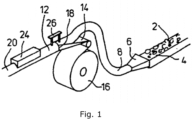
- Figure 1 shows a perspective view of a system performing the method in accordance with various embodiments of the invention.
- Figure 1 shows a perspective view of a system performing the method in accordance with various embodiments of the invention.
- an amount of sphagnum or a corresponding substrate material 2 supplied on a conveyor belt 4 forwardly conveying towards the end of a suction funnel 6.
- the suction funnel 6 projects into a first part 8 of a conveyor pipe. It is not decisive how the sphagnum is supplied to the first part 8 of the conveyor pipe, as long as it is a continuous delivery.
- the first part 8 of the conveyor pipe extends into a folding zone 12, in which an air permeable composite sheet material 14 according to the present invention is supplied from a storage reel 16 and successively wrapped about the first part 8 of the conveyor pipe and continues into a second part 20 of the conveyor pipe.
- the air permeable composite sheet material 14 continues into the second part 20 of the conveyor pipe through a narrow annular slot 18 (holding means 26 is arranged for fixing of the pipe parts in this area) to form an inner lining hose in the second part 20 of the conveyor pipe.
- the air permeable composite sheet material 14 comprises a hot melt adhesive supplied to at least a part of a face of an air permeable biodegradable nonwoven sheet material.
- the hot melt is activated in a heating station 24, whereby the air permeable composite sheet material 14 is stabilized in its hose shape for further advancing inside the second part 20 of the conveyor pipe.
Landscapes
- Life Sciences & Earth Sciences (AREA)
- Environmental Sciences (AREA)
- Engineering & Computer Science (AREA)
- Mechanical Engineering (AREA)
- Textile Engineering (AREA)
- Laminated Bodies (AREA)
- Biological Depolymerization Polymers (AREA)
Description
- The present invention relates to the production of propagation plugs, primarily small blocks of sphagnum for the growing of cuttings and seed plants, and of the type consisting of a cylindrical block having an envelope of paper or a similar material and an associated filling of sphagnum or a corresponding substrate material.
- Organic production does not allow for the use of chemically processed or derived fertilizers commonly used in conventional agriculture. Some examples of these fertilizers are Urea, Ammonia, Ammonium Nitrate, Phosphoric Acid, Ammonium Phosphate compounds, and Calcium Nitrate. Materials that are allowed in organic production must be natural, organic materials or raw, mined minerals with few exceptions. When producing propagation plugs having an envelope of paper and an associated filling of sphagnum, it is important that the paper retain its strength when wet, since the paper has a supporting function. This problem has been solved by coating the paper with a binder of petrochemical origin. During the production process of propagation plugs, a continuous paper sheet is folded to a tube. The paper is fixed into a tube shape by gluing together parts of the opposing faces of the paper sheet. Sphagnum is then positioned within the formed tube by suction. The continuously formed tube is then cut into propagation plugs of suitable size. The adhesive that has conventionally been used for the gluing step is a hot melt adhesive based on resins or waxes, mixed with fillers, pigments, and other additives, such as stabilizers. Neither the conventional binder nor the hot melt adhesive could be used in a paper sheet in propagation plugs for organic production.
-
US5595020 discloses an assembly of pots for raising and transplanting seedlings. A plurality of cylindrical pots is made of paper and each pot is connected by a connection member into a continuous form. The connection member includes slits for allowing the spacing between adjacent pots to be elongated to a length corresponding to one intrarow spacing for various kinds of plants. The generally H-shaped or generally U-shaped slits can be vertically and alternatively provided from upper and lower edges of the connection member. -
US5382403 discloses a method of producing substrate blocks, primarily small blocks of sphagnum for the growing af cuttings and seed plants, and of the type consisting of a cylindrical block having an envelope of paper or a similar material and an associated filling of sphagnum or a corresponding substrate material. Such blocks can be produced by extrusion of a substrate string that is introduced into a casing tube and cut into pieces of suitable length, and it is common practice that the cylindrical blocks thus produced are mounted in an e.g., vacuum shaped cutting tray of thin plastic, arranged with pockets for receiving the blocks, normally with the blocks somewhat upstanding from the top side of the tray. When the young plants have grown to a certain extent the substrate blocks are transferred to plant pots having a larger substrate volume, and the casing material is gradually decomposed, such that the plant can then freely grow its roots out in the plant pot. -
US20060162248 discloses a seed tape including successively arranged germinating units is made of at least one carrier strip as well as at least one layer of biodegradable, gas-permeable material placed on said carrier strip. Each germinating unit includes a mixture of carrier, at least one additive, and optionally an adjuvant in addition to one or more seeds. The layer of biodegradable, gas-permeable material is flexible and non-woven. The additive or additives are water-absorbing. In this manner the seed tape is particularly suited for being subjected to a pre-germination procedure because it possesses a very high capacity of retaining water without disintegrating. - It is an object of the present invention to provide a paper sheet suitable for the production of propagation plugs for organic production.
- A first aspect relates to the use of an air permeable composite sheet material for producing continuous lengths of propagation plugs, the air permeable composite sheet material comprising:
- a biodegradable and air permeable nonwoven sheet material; and
- a hot melt adhesive comprising at least 50% w/w of one or more biodegradable bioplastics;
- wherein the hot melt adhesive is supplied to at least a part of a face of the biodegradable and air permeable nonwoven sheet material;
- wherein the biodegradable and air permeable nonwoven sheet material is coated with a binder formulation consisting of:
- a polysaccharide containing at least two carboxylic groups, selected from the group consisting of carboxymethyl cellulose; polyuronic acid; oxidatively degraded polyuronic acid; sodium carboxymethyl starch; oxidized starch; carboxmethyl hemicellulose; carboxymethyl lignocellulose; and mixtures thereof; or stoichometric and non-stoichiometric sodium and potassium salts thereof;
- a low molecular weight organic mono-, di- or poly-carboxylic acid, selected from the group consisting of acetic acid, mandelic acid, citric acid, tartaric acid, aspartic acid, glutamic acid, formic acid, propionic acid, butanoic acid, pentanoic acid, oxalic acid, maleic acid, succinic acid, and glutaric acid; or a mixture of said organic mono-, di- or poly-carboxylic acids; and
- an aqueous carrier.
- As used in the specification and the appended claims, the singular forms "a", "an", and "the" include plural referents unless the context clearly dictates otherwise. Ranges may be expressed herein as from "about" or "approximately" one particular value and/or to "about" or "approximately" another particular value. When such a range is expressed, another embodiment includes from the one particular value and/or to the other particular value. Similarly, when values are expressed as approximations, by use of the antecedent "about", it will be understood that the particular value forms another embodiment.
- The term "continuous lengths of propagation plugs" refers to the production of growth medium, which is made in a continuous line as e.g., disclosed in
WO9203914 - The term "biodegradable" as used herein describes the chemical dissolution of materials by bacteria or other biological means.
- As used herein, the term "nonwoven sheet material" means a sheet material that has a structure of individual fibers or threads which are interlaid, but not in an identifiable repeating manner. Nonwoven sheet materials may be formed by a variety of processes such as, for example, meltblowing processes, spunbonding processes, coforming processes, and hydroentangling.
- The fibers used for the air permeable nonwoven sheet material must be biodegradable, which can be natural or synthetic fibers, e.g., cellulosic fibers, protein fibers or synthetic polymer fibers. Natural fibers can comprise pulped or shredded cellulose fibers, such as wood pulp, shredded wood, shredded paper (tissue, newsprint and the like), straw, cotton fiber, composted vegetation, fibrous sphagnum moss, peat moss, shredded stalks including shredded corn stalks and shredded pine straw (including needles, twigs, cones and small branches). Shredded vegetation is preferably dry before shredding. Protein fibers can e.g., be hair or gelatin. Biodegradable synthetic fibers can comprise reconstituted cellulose fibers, such as rayon fibers, vinyl polymer fibers, such as fibrous polyvinyl alcohol and polyamide fibers.
- The term "cellulosic fibers" as used herein describes fibers made from an organic compound derived primarily from plants such as trees.
- The term "wood pulp fibers" as used herein describes a type of cellulosic fiber made from a lignocellulosic fibrous material prepared by chemically or mechanically separating cellulosic fiber from plants such as trees or cotton.
- The term "regenerated/reconstituted cellulosic fibers" as used herein describes a type of cellulosic fiber made from wood pulp using a solvent fiber spinning process. The process involves dissolving wood pulp in a solvent and spinning the resultant spinning solution into fibers.
- In one or more embodiments, the biodegradable and air permeable nonwoven sheet material consist of spunlaced fibers without fiber binding materials. The term "spunlaced" as used herein refers to a structure of individual fibers or threads, which are physically entangled, without thermal bonding. Physical entanglement may be achieved using a water entanglement process, or alternatively, a needling process or a combination of both processes. The spunlaced fibers provide the strength to the nonwoven sheet without the need for a binder, also, and very importantly for the present use, when the nonwoven sheet is wet.
- The inventor has found that another way of adding strength to the nonwoven sheet, especially when wet, is to treat the nonwoven sheet material with a binder formulation comprising or consisting of polysaccharide containing at least two carboxylic groups and a low molecular weight organic mono-, di- or poly-carboxylic acid in an aqueous carrier.
- The carboxylated polysaccharide is one capable of forming a sol or a gel in the aqueous carrier. The carboxylated polysaccharide of the invention is selected from carboxymethyl cellulose (CMC); polyuronic acid, such as galacturonic acid, for instance as comprised by pectin, including; polyuronic acid such as mannuronic acid and guluronic acid, for instance as comprised by alginic acid; oxidatively degraded polyuronic acid, for instance as disclosed in
U.S. Pat. No. 6,903,209 ; sodium carboxymethyl starch (CMS), for instance as disclosed inU.S. Pat. No. 4,716,186 ; oxidized starch, for instance as disclosed inU.S. Pat. Nos. 5,959,101 and6,518,419 ; carboxmethyl hemicellulose as such and in admixture with carboxymethyl cellulose, such as disclosed inU.S. 2005/0061204 A1 ; carboxymethyl lignocellulose, such as disclosed inU.S. Pat. No. 7,384,892 . The carboxylated polysaccharide of the invention comprises its stoichiometric and non-stoichiometric sodium and potassium salts. Two or more carboxylated polysaccharides can be used in admixture. - The low molecular weight carboxylic acid is an aliphatic carboxylic acid, more specifically a low molecular weight aliphatic di- or three-basic carboxylic acid. The low molecular weight organic mono-, di- or poly-carboxylic acid is selected from the group consisting of acetic acid, mandelic acid, citric acid, tartaric acid, aspartic acid, glutamic acid, formic acid, propionic acid, butanoic acid, pentanoic acid, oxalic acid, maleic acid, succinic acid, and glutaric acid; or a mixture of said organic mono-, di- or poly-carboxylic acids. The carboxylic acid is preferably one suitable for human consumption, such as acetic acid, mandelic acid, citric acid, tartaric acid, aspartic acid and glutamic acid. Particularly preferred are citric acid and tartaric acid. "Low molecular weight" in respect of the aliphatic organic acid of the invention signifies a molecular weight of less than 1000 Da, in particular of less than 500 Da, most preferred of less than 300 Da. Two or more carboxylic acids can be used in admixture.
- The aqueous carrier is preferably water. The aqueous carrier may additionally comprise small amounts of inorganic salts such as sodium chloride, anti-oxidant such as ascorbic acid, metal ion scavenging agent such as EDTA, neutral or acidic surfactant, and the like.
- The binder solution is preferably cured within the temperature range from 60° Celsius to 120° Celsius for 3 to 40 minutes. Still higher curing or drying temperatures require correspondingly shorter heating times, such as, for instance from 1 minute or less at 200° Celsius. Alternatively, curing can be accomplished by heating the wet surface of the fibrous material for a very short time at a very high temperature, such as for a fraction of a second at a temperature of about 900° Celsius by irradiating the fibrous material with an infrared source. An important aspect of the method of the invention is that curing is accomplished by the normal drying temperatures and processing times of the paper machine. The process of the invention does not require non-standard changes in procedures and parameters of the industrial-scale paper machine with which the process is carried out.
- Curing temperature and time is influenced by the nature of the carboxylated polysaccharide, the carboxylic acid, their weight proportions in the carrier, and the physical and chemical nature of the fibrous material. A person skilled in the art can determine adequate reaction conditions for a particular combination of carboxylated polysaccharide and carboxylic acid by carrying out a few simple experiments based on the present disclosure.
- The binder formulation may comprise a weight ratio of low molecular carboxylic acid to carboxylated polysaccharide from 0.1 to 30 parts of acid per 100 parts of polysaccharide, more preferred from 5 to 15 parts of acid per 100 parts of polysaccharide. The combined concentration of carboxylated carbohydrate and organic acid in the aqueous carrier can vary from 0.1% by weight to 30% by weight. For spray coating, a dry weight of from 1 % to 5% is preferred.
- As used herein, "hot-melt adhesive" refers to a thermoplastic polymer or copolymer (e.g., polyhydroxybutyrate, polyhydroxyvalerate, or polyhydroxyalkanoate) that is heated to obtain a liquid of flowable viscosity, and, after application, cooled to obtain a solid. Generally, the molecular weight of the adhesive is tailored to provide good rheology as a melt and sufficient strength as a solid to resist shearing forces experienced in the application. The primary feature of hot-melt adhesives is the ability of the thermoplastic material (e.g., polyhydroxybutyrate, polyhydroxyvalerate, or polyhydroxyalkanoate) to flow above a certain temperature, and to provide a strong bond at the normal use temperature. Upon cooling, the material hardens, either through passing through the glass transition temperature or the crystallization temperature. This hardening lends physical integrity to the bond.
- The hot melt may be coated on the entire face, or on both faces, of the biodegradable and air permeable nonwoven sheet material. Preferably, the hot melt is coated only on the one or two side edge areas (in the longitudinal direction) of the biodegradable and air permeable nonwoven sheet material, since only the joining edge area needs fixation.
- In one or more embodiments, the hot melt adhesive comprises or consists of one or more biodegradable bioplastics selected from the group consisting of poly(lactic acid), aliphatic biopolyesters, polyhydroxybutyrate, polyhydroxyvalerate, polyhydroxyalkanoate, cellulose-based bioplastics, and mixtures thereof.
- Especially, polyhydroxyalkanoates have shown also to function as soil conditioner. The term soil conditioner implies compounds, which favourably alter the physical and/or chemical properties of soil. The concept of using polymer materials as soil conditioners is not new. Natural polymers such as polyuronic acids, alginic acids, agar, gum, pectin, starch, etc. have been successfully used in the past for soil conditioning. In one or more embodiments, the hot melt adhesive comprises or consists of polyhydroxyalkanoates.
- The polyhydroxyalkanoates (PHAs) are synthesized by soil microbes for use as intracellular storage material. Hence, nonwoven sheet material made from the polymers are generally recognized by soil microbes as a food source.
- In one or more embodiments, the hot melt adhesive comprises or consists of one or more biodegradable bioplastics selected from the group consisting of a poly(3-hydroxybutyrate) homopolymer, a poly(3- hydroxybutyrate-co-4-hydroxybutyrate), a poly(3-hydroxybutyrate-co-3- hydroxyvalerate), a poly(3-hydroxybutyrate-co-5-hydroxyvalerate), a poly(3-hydroxybutyrate-co-3-hydroxyhexanoate), and mixtures thereof.
- Preferably, the hot melt adhesive comprises or consists of one or more biodegradable bioplastics of non-GMO (genetically modified organism) origin.
- The hot melt adhesive comprises at least 50% w/w of one or more biodegradable bioplastics, such as at least 55% w/w, e.g., at least 60% w/w, such as at least 65% w/w, e.g., at least 70% w/w, such as at least 75% w/w, e.g., at least 80% w/w, such as at least 85% w/w, e.g., at least 90% w/w, such as at least 95% w/w, e.g., at least 99% w/w. Other components may be inorganic fillers or biodegradable organic fillers.
- In one or more embodiments, hot melt adhesive comprises a reactive filler component, such as an aluminium compound, a magnesium compound, a calcium compound, a barium compound or a mixture thereof. Preferred are these compounds that react with acidic functional groups, for example carboxylic acid groups, carboxylic acid anhydride groups, hydroxyl groups, acidic amine groups, sulfonic acid groups, phosphonic acid groups, etc. The reactive filler may be, for example, in the form of oxides, hydroxides, silicates, etc., or a mixture thereof. Some exemplary compounds include, for example, aluminum oxide (Al203), aluminum hydroxide (AI(OH)3), magnesium oxide (Mg0), magnesium hydroxide (Mg(OH)2), calcium oxide (Ca0), calcium hydroxide (Ca(OH)2), barium oxide (Ba0), barium hydroxide (Ba(OH)2), aluminometasilicates, fluoroaluminosilicates and mixtures thereof. Aluminium compounds are particularly preferred, especially aluminium compounds that react with acidic functional groups.
- Aluminium oxide, aluminium hydroxide, aluminium silicate, aluminium metasilicate and mixtures thereof are of particular note.
- The reactive filler may be present in the hot-melt adhesive composition in any suitable amount. Of particular note is an amount of about 5% to about 50% by weight, or, of about 10% to about 45% by weight, or, of about 15% to about 40% by weight, based on the weight of the hot-melt adhesive composition. Use of reactive filler in the amounts noted above helps to bring characteristics of the adhesive composition closer to those of the biodegradable and air permeable nonwoven sheet material in terms of thermal expansion, deformation, stiffness, etc.
- The amounts noted above also lead to less shrinkage due to consolidation thus reducing internal stress in the adhesive, to less stress concentration in a joint formed with the adhesive, to better fatigue resistance in the joint, and to decreased sensitivity of the adhesive composition to moisture.
- A second aspect relates to a method of manufacturing continuous lengths of propagation plugs comprising:
- suctioning sphagnum through a pipe into a suction chamber for deposition and compaction within the suction chamber by suction applied through a perforated tube in the suction chamber;
- forming a plug of the compacted sphagnum in an outlet conduit of the suction chamber as part of compacting the sphagnum within the suction chamber;
- introducing an air permeable composite sheet material through an aperture in the pipe; wherein the air permeable composite sheet material comprises:
- a biodegradable and air permeable nonwoven sheet material; and
- a hot melt adhesive comprising at least 50% w/w of one or more biodegradable bioplastics;
- forming a lining hose from the air permeable composite sheet material in an end portion of the pipe adjacent the suction chamber; and
- joining an edge area of the lining hose by conveying the lining hose containing the compacted sphagnum through a heating station, such that thereafter the air permeable nonwoven sheet material is stabilized in its hose shape for further advancing inside the pipe;
- a polysaccharide containing at least two carboxylic groups, selected from the group consisting of carboxymethyl cellulose; polyuronic acid; oxidatively degraded polyuronic acid; sodium carboxymethyl starch; oxidized starch; carboxmethyl hemicellulose; carboxymethyl lignocellulose; and mixtures thereof; or stoichometric and non-stoichiometric sodium and potassium salts thereof;
- a low molecular weight organic mono-, di- or poly-carboxylic acid, selected from the group consisting of acetic acid, mandelic acid, citric acid, tartaric acid, aspartic acid, glutamic acid, formic acid, propionic acid, butanoic acid, pentanoic acid, oxalic acid, maleic acid, succinic acid, and glutaric acid; or a mixture of said organic mono-, di- or poly-carboxylic acids; and
- an aqueous carrier.
- In one or more embodiments, the method further comprises the step of conveying the lining hose containing the compacted sphagnum from the suction chamber by gripping the lining hose and moving the gripped lining hose.
- A third aspect relates to an air permeable composite sheet material supplied on a reel, the sheet material being of the type used for producing continuous lengths of propagation plugs; the composite sheet material comprising:
- a biodegradable and air permeable nonwoven sheet material; and
- a hot melt adhesive comprising at least 50% w/w of one or more biodegradable bioplastics;
- wherein the hot melt adhesive is supplied to at least a part of a face of the biodegradable and air permeable nonwoven sheet material;
- wherein the biodegradable and air permeable nonwoven sheet material is coated with a binder formulation consisting of:
- a polysaccharide containing at least two carboxylic groups, selected from the group consisting of carboxymethyl cellulose; polyuronic acid; oxidatively degraded polyuronic acid; sodium carboxymethyl starch; oxidized starch; carboxmethyl hemicellulose; carboxymethyl lignocellulose; and mixtures thereof; or stoichometric and non-stoichiometric sodium and potassium salts thereof;
- a low molecular weight organic mono-, di- or poly-carboxylic acid, selected from the group consisting of acetic acid, mandelic acid, citric acid, tartaric acid, aspartic acid, glutamic acid, formic acid, propionic acid, butanoic acid, pentanoic acid, oxalic acid, maleic acid, succinic acid, and glutaric acid; or a mixture of said organic mono-, di- or poly-carboxylic acids; and
- an aqueous carrier.
- It should be noted that embodiments and features described in the context of one of the aspects of the present invention also apply to the other aspects of the invention. The invention is limited by the appended claims.
-
Figure 1 shows a perspective view of a system performing the method in accordance with various embodiments of the invention. -
Figure 1 shows a perspective view of a system performing the method in accordance with various embodiments of the invention. In the right-hand side of the figure is shown an amount of sphagnum or acorresponding substrate material 2 supplied on a conveyor belt 4 forwardly conveying towards the end of a suction funnel 6. The suction funnel 6 projects into afirst part 8 of a conveyor pipe. It is not decisive how the sphagnum is supplied to thefirst part 8 of the conveyor pipe, as long as it is a continuous delivery. Thefirst part 8 of the conveyor pipe extends into afolding zone 12, in which an air permeablecomposite sheet material 14 according to the present invention is supplied from astorage reel 16 and successively wrapped about thefirst part 8 of the conveyor pipe and continues into asecond part 20 of the conveyor pipe. The air permeablecomposite sheet material 14 continues into thesecond part 20 of the conveyor pipe through a narrow annular slot 18 (holding means 26 is arranged for fixing of the pipe parts in this area) to form an inner lining hose in thesecond part 20 of the conveyor pipe. The air permeablecomposite sheet material 14 comprises a hot melt adhesive supplied to at least a part of a face of an air permeable biodegradable nonwoven sheet material. The hot melt is activated in aheating station 24, whereby the air permeablecomposite sheet material 14 is stabilized in its hose shape for further advancing inside thesecond part 20 of the conveyor pipe. -
- 2
- Sphagnum
- 4
- Conveyor belt
- 6
- Suction funnel
- 8
- First part of a conveyor pipe
- 12
- Folding zone
- 14
- Air permeable composite sheet material
- 16
- Storage reel
- 18
- Annular slot
- 20
- Second part of a conveyor pipe
- 24
- Heating station
- 26
- Holding means
Claims (14)
- Use of an air permeable composite sheet material (14) for producing continuous lengths of propagation plugs, the air permeable composite sheet material comprising:- a biodegradable and air permeable nonwoven sheet material; and- a hot melt adhesive comprising at least 50% w/w of one or more biodegradable bioplastics;characterized in that:
wherein the hot melt adhesive is supplied to at least a part of a face of the biodegradable and air permeable nonwoven sheet material;- the biodegradable and air permeable nonwoven sheet material is coated with a binder formulation consisting of:- a polysaccharide containing at least two carboxylic groups, selected from the group consisting of carboxymethyl cellulose; polyuronic acid; oxidatively degraded polyuronic acid; sodium carboxymethyl starch; oxidized starch; carboxmethyl hemicellulose; carboxymethyl lignocellulose; and mixtures thereof; or stoichometric and non-stoichiometric sodium and potassium salts thereof;- a low molecular weight organic mono-, di- or poly-carboxylic acid, selected from the group consisting of acetic acid, mandelic acid, citric acid, tartaric acid, aspartic acid, glutamic acid, formic acid, propionic acid, butanoic acid, pentanoic acid, oxalic acid, maleic acid, succinic acid, and glutaric acid; or a mixture of said organic mono- , di- or poly-carboxylic acids; and- an aqueous carrier. - Use according to claim 1, wherein the hot melt adhesive comprises one or more biodegradable bioplastics selected from the group consisting of poly(lactic acid), aliphatic biopolyesters, polyhydroxybutyrate, polyhydroxyvalerate, polyhydroxyalkanoate, cellulose-based bioplastics, and mixtures thereof.
- Use according to claim 1, wherein the hot melt adhesive comprises one or more biodegradable bioplastics selected from the group consisting of a poly(3-hydroxybutyrate) homopolymer, a poly(3- hydroxybutyrate-co-4-hydroxybutyrate), a poly(3-hydroxybutyrate-co-3- hydroxyvalerate), a poly(3-hydroxybutyrate-co-5-hydroxyvalerate), a poly(3-hydroxybutyrate-co-3-hydroxyhexanoate), and mixtures thereof.
- Use according to any one of the claims 1-3, wherein the hot melt adhesive comprises a reactive filler component, selected from the group consisting of: aluminum oxide, aluminum hydroxide, magnesium oxide, magnesium hydroxide, calcium oxide, calcium hydroxide, barium oxide, barium hydroxide, aluminometasilicates, fluoroaluminosilicates, and mixtures thereof.
- A method of manufacturing continuous lengths of propagation plugs comprising:- suctioning sphagnum (2) through a pipe into a suction chamber for deposition and compaction within the suction chamber by suction applied through a perforated tube in the suction chamber;- forming a plug of the compacted sphagnum in an outlet conduit of the suction chamber as part of compacting the sphagnum within the suction chamber;- introducing an air permeable composite sheet material (14) through an aperture in the pipe; wherein the air permeable composite sheet material comprises:characterized in that:- a biodegradable and air permeable nonwoven sheet material; and- a hot melt adhesive comprising at least 50% w/w of one or more biodegradable bioplastics;
wherein the hot melt adhesive is supplied to at least a part of a face of the biodegradable and air permeable nonwoven sheet material;- forming a lining hose from the air permeable composite sheet material in an end portion of the pipe adjacent the suction chamber; and- joining an edge area of the lining hose by conveying the lining hose containing the compacted sphagnum through a heating station (24), such that thereafter the air permeable nonwoven sheet material is stabilized in its hose shape for further advancing inside the pipe;- the biodegradable and air permeable nonwoven sheet material is coated with a binder formulation consisting of:- a polysaccharide containing at least two carboxylic groups, selected from the group consisting of carboxymethyl cellulose; polyuronic acid; oxidatively degraded polyuronic acid; sodium carboxymethyl starch; oxidized starch; carboxmethyl hemicellulose; carboxymethyl lignocellulose; and mixtures thereof; or stoichometric and non-stoichiometric sodium and potassium salts thereof;- a low molecular weight organic mono-, di- or poly-carboxylic acid, selected from the group consisting of acetic acid, mandelic acid, citric acid, tartaric acid, aspartic acid, glutamic acid, formic acid, propionic acid, butanoic acid, pentanoic acid, oxalic acid, maleic acid, succinic acid, and glutaric acid; or a mixture of said organic mono-, di- or poly-carboxylic acids; and- an aqueous carrier. - The method according to claim 5, wherein the hot melt adhesive comprises one or more biodegradable bioplastics selected from the group consisting of poly(lactic acid), aliphatic biopolyesters, polyhydroxybutyrate, polyhydroxyvalerate, polyhydroxyalkanoate, cellulose-based bioplastics, and mixtures thereof.
- The method according to claim 5, wherein the hot melt adhesive comprises one or more biodegradable bioplastics selected from the group consisting of a poly(3-hydroxybutyrate) homopolymer, a poly(3- hydroxybutyrate-co-4-hydroxybutyrate), a poly(3-hydroxybutyrate-co-3- hydroxyvalerate), a poly(3-hydroxybutyrate-co-5-hydroxyvalerate), a poly(3-hydroxybutyrate-co-3-hydroxyhexanoate), and mixtures thereof.
- The method according to any one of the claims 5-7, wherein the hot melt adhesive comprises a reactive filler component, selected from the group consisting of: aluminum oxide, aluminum hydroxide, magnesium oxide, magnesium hydroxide, calcium oxide, calcium hydroxide, barium oxide, barium hydroxide, aluminometasilicates, fluoroaluminosilicates, and mixtures thereof.
- The method according to any one of the claims 5-8, wherein the air permeable composite sheet material (14) is supplied on a reel (16).
- The method according to any one of the claims 5-9, wherein the biodegradable and air permeable nonwoven sheet material comprises two side edge areas in its longitudinal direction, and wherein the hot melt is coated only on one or both side edge areas in the longitudinal direction of the biodegradable and air permeable nonwoven sheet material.
- An air permeable composite sheet material (14) supplied on a reel (16), the sheet material being of the type used for producing continuous lengths of propagation plugs; the air permeable composite sheet material comprising:- a biodegradable and air permeable nonwoven sheet material; and- a hot melt adhesive comprising at least 50% w/w of one or more biodegradable bioplastics;characterized in that:
wherein the hot melt adhesive is supplied to at least a part of a face of the biodegradable nonwoven sheet material;- the biodegradable and air permeable nonwoven sheet material is coated with a binder formulation consisting of:- a polysaccharide containing at least two carboxylic groups, selected from the group consisting of carboxymethyl cellulose; polyuronic acid; oxidatively degraded polyuronic acid; sodium carboxymethyl starch; oxidized starch; carboxmethyl hemicellulose; carboxymethyl lignocellulose; and mixtures thereof; or stoichometric and non-stoichiometric sodium and potassium salts thereof;- a low molecular weight organic mono-, di- or poly-carboxylic acid, selected from the group consisting of acetic acid, mandelic acid, citric acid, tartaric acid, aspartic acid, glutamic acid, formic acid, propionic acid, butanoic acid, pentanoic acid, oxalic acid, maleic acid, succinic acid, and glutaric acid; or a mixture of said organic mono-, di- or poly-carboxylic acids; and- an aqueous carrier. - The air permeable composite sheet material supplied on a reel according to claim 11, wherein the hot melt adhesive comprises a reactive filler component, selected from the group consisting of: aluminum oxide, aluminum hydroxide, magnesium oxide, magnesium hydroxide, calcium oxide, calcium hydroxide, barium oxide, barium hydroxide, aluminometasilicates, fluoroaluminosilicates, and mixtures thereof.
- The air permeable composite sheet material supplied on a reel according to any one of the claims 11-12, wherein the hot melt adhesive comprises one or more biodegradable bioplastics selected from the group consisting of poly(lactic acid), aliphatic biopolyesters, polyhydroxybutyrate, polyhydroxyvalerate, polyhydroxyalkanoate, cellulose-based bioplastics, and mixtures thereof.
- The air permeable composite sheet material supplied on a reel according to any one of the claims 11-12, wherein the hot melt adhesive comprises one or more biodegradable bioplastics selected from the group consisting of a poly(3-hydroxybutyrate) homopolymer, a poly(3- hydroxybutyrate-co-4-hydroxybutyrate), a poly(3-hydroxybutyrate-co-3- hydroxyvalerate), a poly(3-hydroxybutyrate-co-5-hydroxyvalerate), a poly(3-hydroxybutyrate-co-3-hydroxyhexanoate), and mixtures thereof.
Applications Claiming Priority (2)
| Application Number | Priority Date | Filing Date | Title |
|---|---|---|---|
| DKPA201600401A DK179100B1 (en) | 2016-07-06 | 2016-07-06 | Use of an air permeable composite sheet material for propagation plugs for organic production |
| PCT/EP2017/064002 WO2018007092A1 (en) | 2016-07-06 | 2017-06-08 | Use of an air permeable composite sheet material for propagation plugs for organic production |
Publications (2)
| Publication Number | Publication Date |
|---|---|
| EP3481175A1 EP3481175A1 (en) | 2019-05-15 |
| EP3481175B1 true EP3481175B1 (en) | 2023-08-02 |
Family
ID=60154202
Family Applications (1)
| Application Number | Title | Priority Date | Filing Date |
|---|---|---|---|
| EP17732343.3A Active EP3481175B1 (en) | 2016-07-06 | 2017-06-08 | Use of an air permeable composite sheet material for propagation plugs for organic production |
Country Status (4)
| Country | Link |
|---|---|
| US (1) | US11207806B2 (en) |
| EP (1) | EP3481175B1 (en) |
| DK (1) | DK179100B1 (en) |
| WO (1) | WO2018007092A1 (en) |
Cited By (1)
| Publication number | Priority date | Publication date | Assignee | Title |
|---|---|---|---|---|
| WO2025247779A1 (en) * | 2024-05-27 | 2025-12-04 | Ellepot A/S | A method for producing continuous lengths of propagation plugs or rods, and propagation plugs or rods produced by such method |
Families Citing this family (6)
| Publication number | Priority date | Publication date | Assignee | Title |
|---|---|---|---|---|
| JP7569491B2 (en) * | 2018-09-26 | 2024-10-18 | グラットフェルター・コーポレイション | Latex-free and formaldehyde-free nonwoven fabric |
| US20210340700A1 (en) | 2018-10-17 | 2021-11-04 | Glatfelter Gernsbach Gmbh | Pulp-containing biodegradable non-woven fabric and method for producing the same |
| CN110278861B (en) * | 2019-06-24 | 2022-04-26 | 张家港丰裕德农业科技有限公司 | Method for cultivating collard |
| WO2022093633A1 (en) * | 2020-10-30 | 2022-05-05 | Syngenta Crop Protection Ag | Method for producing coated growth medium blocks |
| WO2024153558A1 (en) * | 2023-01-20 | 2024-07-25 | Ellepot A/S | A method for producing continuous lengths of propagation plugs, and propagation plugs, or rods produced by such method |
| DK202330375A1 (en) * | 2023-12-07 | 2025-06-24 | Ellepot As | Air pruning container |
Citations (1)
| Publication number | Priority date | Publication date | Assignee | Title |
|---|---|---|---|---|
| US20060162248A1 (en) * | 2002-09-25 | 2006-07-27 | Ahm Poul H | Seed tape including successively arranged germinating units as well as a method of germinating said tape |
Family Cites Families (12)
| Publication number | Priority date | Publication date | Assignee | Title |
|---|---|---|---|---|
| US3788003A (en) | 1971-07-19 | 1974-01-29 | Res Council Alberta | Seedling container |
| FI761655A7 (en) * | 1976-06-09 | 1977-12-10 | Laennen Tehtaat Oy | |
| FI71650C (en) * | 1982-11-16 | 1987-02-09 | Laennen Tehtaat Oy | ODLINGSGRUPP FOER SKOLNING AV PLANTOR. |
| DK211090D0 (en) * | 1990-09-03 | 1990-09-03 | Oeyvind Ellegaard | METHOD AND PLANT FOR THE MANUFACTURE OF BLOCK MATERIALS FROM LOST MATERIALS, EX. sphagnum |
| JP2747879B2 (en) * | 1993-11-04 | 1998-05-06 | 日本甜菜製糖株式会社 | Continuous collecting pot for transplanting seedlings |
| WO2004007197A1 (en) * | 2002-07-11 | 2004-01-22 | Mitsubishi Plastics, Inc. | Biodegradable laminate sheet and molded item from biodegradable laminate sheet |
| US8283435B2 (en) * | 2003-02-21 | 2012-10-09 | Metabolix, Inc. | PHA adhesive compositions |
| US6881252B2 (en) * | 2003-09-23 | 2005-04-19 | Corn Products International, Inc. | Fiber-based product |
| CA2511002C (en) * | 2004-07-06 | 2012-10-23 | Minh-Tan Ton-That | Hot-melt adhesive |
| CN104245862B (en) * | 2012-03-28 | 2017-07-14 | 纺织和塑料研究协会图林根研究院 | Can liquid applications multi-functional coatings film |
| PL2852276T3 (en) * | 2012-05-22 | 2016-12-30 | Method of manufacturing a plant receptacle as well as a plant receptacle | |
| KR101301648B1 (en) * | 2013-05-08 | 2013-08-29 | 주식회사 미래기술 | Method for producing higg quality fabric and construction material using hemp textile and bio-degradation seat produced by the same |
-
2016
- 2016-07-06 DK DKPA201600401A patent/DK179100B1/en active IP Right Maintenance
-
2017
- 2017-06-08 US US16/307,648 patent/US11207806B2/en active Active
- 2017-06-08 EP EP17732343.3A patent/EP3481175B1/en active Active
- 2017-06-08 WO PCT/EP2017/064002 patent/WO2018007092A1/en not_active Ceased
Patent Citations (1)
| Publication number | Priority date | Publication date | Assignee | Title |
|---|---|---|---|---|
| US20060162248A1 (en) * | 2002-09-25 | 2006-07-27 | Ahm Poul H | Seed tape including successively arranged germinating units as well as a method of germinating said tape |
Cited By (1)
| Publication number | Priority date | Publication date | Assignee | Title |
|---|---|---|---|---|
| WO2025247779A1 (en) * | 2024-05-27 | 2025-12-04 | Ellepot A/S | A method for producing continuous lengths of propagation plugs or rods, and propagation plugs or rods produced by such method |
Also Published As
| Publication number | Publication date |
|---|---|
| US11207806B2 (en) | 2021-12-28 |
| EP3481175A1 (en) | 2019-05-15 |
| US20190299499A1 (en) | 2019-10-03 |
| DK201600401A1 (en) | 2017-10-30 |
| DK179100B1 (en) | 2017-10-30 |
| WO2018007092A1 (en) | 2018-01-11 |
Similar Documents
| Publication | Publication Date | Title |
|---|---|---|
| US11207806B2 (en) | Use of an air permeable composite sheet material for propagation plugs for organic production | |
| FI125943B (en) | Substrate structures based on moss moss and a method for making them | |
| EP1534060B1 (en) | Biodegradable fibrous support for soil mulching | |
| CN103025180B (en) | Degradable adhesive compositions for smoking articles | |
| KR101205154B1 (en) | mat-type bed for raising seeding and method of fabricating the same | |
| WO1985001418A1 (en) | Laminated lignocellulose fiber mat | |
| GB2449335A (en) | Biodegradable irrigation device | |
| EP0092991A2 (en) | Method and material for improving the growth of plants | |
| JP2003503076A (en) | Method for producing substrate for plant growth and block for plant growth | |
| CN102283057B (en) | Method for manufacturing slurry-processed multifunction organic environmental-protection flaky mulching film | |
| WO2024153558A1 (en) | A method for producing continuous lengths of propagation plugs, and propagation plugs, or rods produced by such method | |
| CN109566214B (en) | Degradable agricultural mulching film and preparation method thereof | |
| KR101286229B1 (en) | Biodegradable seeding pot using cellulose fiber and process for preparing the same | |
| US20250151677A1 (en) | Cellulose filament medium for growing plant seedlings | |
| EP2558548B1 (en) | Biodegradable materials for soil mulching based on aqueous mixtures of polysaccharides and plant waste fibers and methods for their application | |
| JP3828432B2 (en) | Vegetation material | |
| WO2025247779A1 (en) | A method for producing continuous lengths of propagation plugs or rods, and propagation plugs or rods produced by such method | |
| EP1534059B1 (en) | Biodegradable fibrous support for soil mulching | |
| KR101577042B1 (en) | Vegetation mat using rice straw and the manufacturing method thereof | |
| JPS647730B2 (en) | ||
| JPH0414926B2 (en) | ||
| WO2025120081A1 (en) | Air pruning container | |
| JPH08289671A (en) | Nursery mat | |
| FI108302B (en) | Process for making a material, such material and fiber pulp | |
| JPH0331148Y2 (en) |
Legal Events
| Date | Code | Title | Description |
|---|---|---|---|
| STAA | Information on the status of an ep patent application or granted ep patent |
Free format text: STATUS: UNKNOWN |
|
| STAA | Information on the status of an ep patent application or granted ep patent |
Free format text: STATUS: THE INTERNATIONAL PUBLICATION HAS BEEN MADE |
|
| PUAI | Public reference made under article 153(3) epc to a published international application that has entered the european phase |
Free format text: ORIGINAL CODE: 0009012 |
|
| STAA | Information on the status of an ep patent application or granted ep patent |
Free format text: STATUS: REQUEST FOR EXAMINATION WAS MADE |
|
| 17P | Request for examination filed |
Effective date: 20190206 |
|
| AK | Designated contracting states |
Kind code of ref document: A1 Designated state(s): AL AT BE BG CH CY CZ DE DK EE ES FI FR GB GR HR HU IE IS IT LI LT LU LV MC MK MT NL NO PL PT RO RS SE SI SK SM TR |
|
| AX | Request for extension of the european patent |
Extension state: BA ME |
|
| DAV | Request for validation of the european patent (deleted) | ||
| DAX | Request for extension of the european patent (deleted) | ||
| STAA | Information on the status of an ep patent application or granted ep patent |
Free format text: STATUS: EXAMINATION IS IN PROGRESS |
|
| 17Q | First examination report despatched |
Effective date: 20220301 |
|
| REG | Reference to a national code |
Ref country code: DE Ref legal event code: R079 Free format text: PREVIOUS MAIN CLASS: A01G0024600000 Ipc: A01G0024280000 Ref country code: DE Ref legal event code: R079 Ref document number: 602017072107 Country of ref document: DE Free format text: PREVIOUS MAIN CLASS: A01G0024600000 Ipc: A01G0024280000 |
|
| RIC1 | Information provided on ipc code assigned before grant |
Ipc: A01G 24/60 20180101ALI20221128BHEP Ipc: A01G 24/50 20180101ALI20221128BHEP Ipc: A01G 24/44 20180101ALI20221128BHEP Ipc: A01G 24/28 20180101AFI20221128BHEP |
|
| GRAP | Despatch of communication of intention to grant a patent |
Free format text: ORIGINAL CODE: EPIDOSNIGR1 |
|
| STAA | Information on the status of an ep patent application or granted ep patent |
Free format text: STATUS: GRANT OF PATENT IS INTENDED |
|
| INTG | Intention to grant announced |
Effective date: 20230116 |
|
| GRAS | Grant fee paid |
Free format text: ORIGINAL CODE: EPIDOSNIGR3 |
|
| GRAA | (expected) grant |
Free format text: ORIGINAL CODE: 0009210 |
|
| STAA | Information on the status of an ep patent application or granted ep patent |
Free format text: STATUS: THE PATENT HAS BEEN GRANTED |
|
| AK | Designated contracting states |
Kind code of ref document: B1 Designated state(s): AL AT BE BG CH CY CZ DE DK EE ES FI FR GB GR HR HU IE IS IT LI LT LU LV MC MK MT NL NO PL PT RO RS SE SI SK SM TR |
|
| REG | Reference to a national code |
Ref country code: GB Ref legal event code: FG4D |
|
| REG | Reference to a national code |
Ref country code: CH Ref legal event code: EP |
|
| REG | Reference to a national code |
Ref country code: DE Ref legal event code: R096 Ref document number: 602017072107 Country of ref document: DE |
|
| REG | Reference to a national code |
Ref country code: IE Ref legal event code: FG4D |
|
| REG | Reference to a national code |
Ref country code: NL Ref legal event code: FP |
|
| REG | Reference to a national code |
Ref country code: SE Ref legal event code: TRGR |
|
| REG | Reference to a national code |
Ref country code: LT Ref legal event code: MG9D |
|
| REG | Reference to a national code |
Ref country code: AT Ref legal event code: MK05 Ref document number: 1593535 Country of ref document: AT Kind code of ref document: T Effective date: 20230802 |
|
| PG25 | Lapsed in a contracting state [announced via postgrant information from national office to epo] |
Ref country code: GR Free format text: LAPSE BECAUSE OF FAILURE TO SUBMIT A TRANSLATION OF THE DESCRIPTION OR TO PAY THE FEE WITHIN THE PRESCRIBED TIME-LIMIT Effective date: 20231103 |
|
| PG25 | Lapsed in a contracting state [announced via postgrant information from national office to epo] |
Ref country code: IS Free format text: LAPSE BECAUSE OF FAILURE TO SUBMIT A TRANSLATION OF THE DESCRIPTION OR TO PAY THE FEE WITHIN THE PRESCRIBED TIME-LIMIT Effective date: 20231202 |
|
| PG25 | Lapsed in a contracting state [announced via postgrant information from national office to epo] |
Ref country code: RS Free format text: LAPSE BECAUSE OF FAILURE TO SUBMIT A TRANSLATION OF THE DESCRIPTION OR TO PAY THE FEE WITHIN THE PRESCRIBED TIME-LIMIT Effective date: 20230802 Ref country code: PT Free format text: LAPSE BECAUSE OF FAILURE TO SUBMIT A TRANSLATION OF THE DESCRIPTION OR TO PAY THE FEE WITHIN THE PRESCRIBED TIME-LIMIT Effective date: 20231204 Ref country code: NO Free format text: LAPSE BECAUSE OF FAILURE TO SUBMIT A TRANSLATION OF THE DESCRIPTION OR TO PAY THE FEE WITHIN THE PRESCRIBED TIME-LIMIT Effective date: 20231102 Ref country code: LV Free format text: LAPSE BECAUSE OF FAILURE TO SUBMIT A TRANSLATION OF THE DESCRIPTION OR TO PAY THE FEE WITHIN THE PRESCRIBED TIME-LIMIT Effective date: 20230802 Ref country code: LT Free format text: LAPSE BECAUSE OF FAILURE TO SUBMIT A TRANSLATION OF THE DESCRIPTION OR TO PAY THE FEE WITHIN THE PRESCRIBED TIME-LIMIT Effective date: 20230802 Ref country code: IS Free format text: LAPSE BECAUSE OF FAILURE TO SUBMIT A TRANSLATION OF THE DESCRIPTION OR TO PAY THE FEE WITHIN THE PRESCRIBED TIME-LIMIT Effective date: 20231202 Ref country code: HR Free format text: LAPSE BECAUSE OF FAILURE TO SUBMIT A TRANSLATION OF THE DESCRIPTION OR TO PAY THE FEE WITHIN THE PRESCRIBED TIME-LIMIT Effective date: 20230802 Ref country code: GR Free format text: LAPSE BECAUSE OF FAILURE TO SUBMIT A TRANSLATION OF THE DESCRIPTION OR TO PAY THE FEE WITHIN THE PRESCRIBED TIME-LIMIT Effective date: 20231103 Ref country code: FI Free format text: LAPSE BECAUSE OF FAILURE TO SUBMIT A TRANSLATION OF THE DESCRIPTION OR TO PAY THE FEE WITHIN THE PRESCRIBED TIME-LIMIT Effective date: 20230802 Ref country code: AT Free format text: LAPSE BECAUSE OF FAILURE TO SUBMIT A TRANSLATION OF THE DESCRIPTION OR TO PAY THE FEE WITHIN THE PRESCRIBED TIME-LIMIT Effective date: 20230802 |
|
| PG25 | Lapsed in a contracting state [announced via postgrant information from national office to epo] |
Ref country code: PL Free format text: LAPSE BECAUSE OF FAILURE TO SUBMIT A TRANSLATION OF THE DESCRIPTION OR TO PAY THE FEE WITHIN THE PRESCRIBED TIME-LIMIT Effective date: 20230802 |
|
| PG25 | Lapsed in a contracting state [announced via postgrant information from national office to epo] |
Ref country code: ES Free format text: LAPSE BECAUSE OF FAILURE TO SUBMIT A TRANSLATION OF THE DESCRIPTION OR TO PAY THE FEE WITHIN THE PRESCRIBED TIME-LIMIT Effective date: 20230802 |
|
| PG25 | Lapsed in a contracting state [announced via postgrant information from national office to epo] |
Ref country code: SM Free format text: LAPSE BECAUSE OF FAILURE TO SUBMIT A TRANSLATION OF THE DESCRIPTION OR TO PAY THE FEE WITHIN THE PRESCRIBED TIME-LIMIT Effective date: 20230802 Ref country code: RO Free format text: LAPSE BECAUSE OF FAILURE TO SUBMIT A TRANSLATION OF THE DESCRIPTION OR TO PAY THE FEE WITHIN THE PRESCRIBED TIME-LIMIT Effective date: 20230802 Ref country code: ES Free format text: LAPSE BECAUSE OF FAILURE TO SUBMIT A TRANSLATION OF THE DESCRIPTION OR TO PAY THE FEE WITHIN THE PRESCRIBED TIME-LIMIT Effective date: 20230802 Ref country code: EE Free format text: LAPSE BECAUSE OF FAILURE TO SUBMIT A TRANSLATION OF THE DESCRIPTION OR TO PAY THE FEE WITHIN THE PRESCRIBED TIME-LIMIT Effective date: 20230802 Ref country code: DK Free format text: LAPSE BECAUSE OF FAILURE TO SUBMIT A TRANSLATION OF THE DESCRIPTION OR TO PAY THE FEE WITHIN THE PRESCRIBED TIME-LIMIT Effective date: 20230802 Ref country code: CZ Free format text: LAPSE BECAUSE OF FAILURE TO SUBMIT A TRANSLATION OF THE DESCRIPTION OR TO PAY THE FEE WITHIN THE PRESCRIBED TIME-LIMIT Effective date: 20230802 Ref country code: SK Free format text: LAPSE BECAUSE OF FAILURE TO SUBMIT A TRANSLATION OF THE DESCRIPTION OR TO PAY THE FEE WITHIN THE PRESCRIBED TIME-LIMIT Effective date: 20230802 |
|
| REG | Reference to a national code |
Ref country code: DE Ref legal event code: R097 Ref document number: 602017072107 Country of ref document: DE |
|
| PG25 | Lapsed in a contracting state [announced via postgrant information from national office to epo] |
Ref country code: IT Free format text: LAPSE BECAUSE OF FAILURE TO SUBMIT A TRANSLATION OF THE DESCRIPTION OR TO PAY THE FEE WITHIN THE PRESCRIBED TIME-LIMIT Effective date: 20230802 |
|
| PLBE | No opposition filed within time limit |
Free format text: ORIGINAL CODE: 0009261 |
|
| STAA | Information on the status of an ep patent application or granted ep patent |
Free format text: STATUS: NO OPPOSITION FILED WITHIN TIME LIMIT |
|
| 26N | No opposition filed |
Effective date: 20240503 |
|
| PG25 | Lapsed in a contracting state [announced via postgrant information from national office to epo] |
Ref country code: SI Free format text: LAPSE BECAUSE OF FAILURE TO SUBMIT A TRANSLATION OF THE DESCRIPTION OR TO PAY THE FEE WITHIN THE PRESCRIBED TIME-LIMIT Effective date: 20230802 |
|
| PG25 | Lapsed in a contracting state [announced via postgrant information from national office to epo] |
Ref country code: BG Free format text: LAPSE BECAUSE OF FAILURE TO SUBMIT A TRANSLATION OF THE DESCRIPTION OR TO PAY THE FEE WITHIN THE PRESCRIBED TIME-LIMIT Effective date: 20230802 |
|
| PG25 | Lapsed in a contracting state [announced via postgrant information from national office to epo] |
Ref country code: BG Free format text: LAPSE BECAUSE OF FAILURE TO SUBMIT A TRANSLATION OF THE DESCRIPTION OR TO PAY THE FEE WITHIN THE PRESCRIBED TIME-LIMIT Effective date: 20230802 |
|
| PG25 | Lapsed in a contracting state [announced via postgrant information from national office to epo] |
Ref country code: MC Free format text: LAPSE BECAUSE OF FAILURE TO SUBMIT A TRANSLATION OF THE DESCRIPTION OR TO PAY THE FEE WITHIN THE PRESCRIBED TIME-LIMIT Effective date: 20230802 |
|
| REG | Reference to a national code |
Ref country code: CH Ref legal event code: PL |
|
| PG25 | Lapsed in a contracting state [announced via postgrant information from national office to epo] |
Ref country code: LU Free format text: LAPSE BECAUSE OF NON-PAYMENT OF DUE FEES Effective date: 20240608 |
|
| PG25 | Lapsed in a contracting state [announced via postgrant information from national office to epo] |
Ref country code: IE Free format text: LAPSE BECAUSE OF NON-PAYMENT OF DUE FEES Effective date: 20240608 |
|
| PG25 | Lapsed in a contracting state [announced via postgrant information from national office to epo] |
Ref country code: CH Free format text: LAPSE BECAUSE OF NON-PAYMENT OF DUE FEES Effective date: 20240630 Ref country code: BE Free format text: LAPSE BECAUSE OF NON-PAYMENT OF DUE FEES Effective date: 20240630 |
|
| PG25 | Lapsed in a contracting state [announced via postgrant information from national office to epo] |
Ref country code: FR Free format text: LAPSE BECAUSE OF NON-PAYMENT OF DUE FEES Effective date: 20240630 |
|
| REG | Reference to a national code |
Ref country code: BE Ref legal event code: MM Effective date: 20240630 |
|
| PGFP | Annual fee paid to national office [announced via postgrant information from national office to epo] |
Ref country code: SE Payment date: 20250627 Year of fee payment: 9 |
|
| PG25 | Lapsed in a contracting state [announced via postgrant information from national office to epo] |
Ref country code: CY Free format text: LAPSE BECAUSE OF FAILURE TO SUBMIT A TRANSLATION OF THE DESCRIPTION OR TO PAY THE FEE WITHIN THE PRESCRIBED TIME-LIMIT; INVALID AB INITIO Effective date: 20170608 |
|
| PG25 | Lapsed in a contracting state [announced via postgrant information from national office to epo] |
Ref country code: HU Free format text: LAPSE BECAUSE OF FAILURE TO SUBMIT A TRANSLATION OF THE DESCRIPTION OR TO PAY THE FEE WITHIN THE PRESCRIBED TIME-LIMIT; INVALID AB INITIO Effective date: 20170608 |
|
| PG25 | Lapsed in a contracting state [announced via postgrant information from national office to epo] |
Ref country code: TR Free format text: LAPSE BECAUSE OF FAILURE TO SUBMIT A TRANSLATION OF THE DESCRIPTION OR TO PAY THE FEE WITHIN THE PRESCRIBED TIME-LIMIT Effective date: 20230802 |
|
| PGFP | Annual fee paid to national office [announced via postgrant information from national office to epo] |
Ref country code: GB Payment date: 20260629 Year of fee payment: 10 |
|
| PGFP | Annual fee paid to national office [announced via postgrant information from national office to epo] |
Ref country code: DE Payment date: 20260629 Year of fee payment: 10 |
|
| PGFP | Annual fee paid to national office [announced via postgrant information from national office to epo] |
Ref country code: NL Payment date: 20260627 Year of fee payment: 10 |