EP3481056A1 - Display apparatus and operational method therefor, and electronic apparatus - Google Patents
Display apparatus and operational method therefor, and electronic apparatus Download PDFInfo
- Publication number
- EP3481056A1 EP3481056A1 EP17831304.5A EP17831304A EP3481056A1 EP 3481056 A1 EP3481056 A1 EP 3481056A1 EP 17831304 A EP17831304 A EP 17831304A EP 3481056 A1 EP3481056 A1 EP 3481056A1
- Authority
- EP
- European Patent Office
- Prior art keywords
- switching element
- capacitance
- voltage
- unit
- capacitor
- Prior art date
- Legal status (The legal status is an assumption and is not a legal conclusion. Google has not performed a legal analysis and makes no representation as to the accuracy of the status listed.)
- Withdrawn
Links
Images






Classifications
-
- H—ELECTRICITY
- H04—ELECTRIC COMMUNICATION TECHNIQUE
- H04N—PICTORIAL COMMUNICATION, e.g. TELEVISION
- H04N21/00—Selective content distribution, e.g. interactive television or video on demand [VOD]
- H04N21/40—Client devices specifically adapted for the reception of or interaction with content, e.g. set-top-box [STB]; Operations thereof
- H04N21/41—Structure of client; Structure of client peripherals
- H04N21/426—Internal components of the client ; Characteristics thereof
-
- H—ELECTRICITY
- H02—GENERATION; CONVERSION OR DISTRIBUTION OF ELECTRIC POWER
- H02J—ELECTRIC POWER NETWORKS; CIRCUIT ARRANGEMENTS OR SYSTEMS FOR SUPPLYING OR DISTRIBUTING ELECTRIC POWER; SYSTEMS FOR STORING ELECTRIC ENERGY
- H02J50/00—Circuit arrangements or systems for wireless supply or distribution of electric power
- H02J50/10—Circuit arrangements or systems for wireless supply or distribution of electric power using inductive coupling
- H02J50/12—Circuit arrangements or systems for wireless supply or distribution of electric power using inductive coupling of the resonant type
-
- H—ELECTRICITY
- H02—GENERATION; CONVERSION OR DISTRIBUTION OF ELECTRIC POWER
- H02M—APPARATUS FOR CONVERSION BETWEEN AC AND AC, BETWEEN AC AND DC, OR BETWEEN DC AND DC, AND FOR USE WITH MAINS OR SIMILAR POWER SUPPLY SYSTEMS; CONVERSION OF DC OR AC INPUT POWER INTO SURGE OUTPUT POWER; CONTROL OR REGULATION THEREOF
- H02M1/00—Details of apparatus for conversion
- H02M1/08—Circuits specially adapted for the generation of control voltages for semiconductor devices incorporated in static converters
- H02M1/083—Circuits specially adapted for the generation of control voltages for semiconductor devices incorporated in static converters for the ignition at the zero crossing of the voltage or the current
-
- H—ELECTRICITY
- H03—ELECTRONIC CIRCUITRY
- H03H—IMPEDANCE NETWORKS, e.g. RESONANT CIRCUITS; RESONATORS
- H03H5/00—One-port networks comprising only passive electrical elements as network components
- H03H5/12—One-port networks comprising only passive electrical elements as network components with at least one voltage- or current-dependent element
-
- G—PHYSICS
- G09—EDUCATION; CRYPTOGRAPHY; DISPLAY; ADVERTISING; SEALS
- G09G—ARRANGEMENTS OR CIRCUITS FOR CONTROL OF INDICATING DEVICES USING STATIC MEANS TO PRESENT VARIABLE INFORMATION
- G09G2330/00—Aspects of power supply; Aspects of display protection and defect management
- G09G2330/02—Details of power systems and of start or stop of display operation
- G09G2330/028—Generation of voltages supplied to electrode drivers in a matrix display other than LCD
-
- G—PHYSICS
- G09—EDUCATION; CRYPTOGRAPHY; DISPLAY; ADVERTISING; SEALS
- G09G—ARRANGEMENTS OR CIRCUITS FOR CONTROL OF INDICATING DEVICES USING STATIC MEANS TO PRESENT VARIABLE INFORMATION
- G09G3/00—Control arrangements or circuits, of interest only in connection with visual indicators other than cathode-ray tubes
- G09G3/20—Control arrangements or circuits, of interest only in connection with visual indicators other than cathode-ray tubes for presentation of an assembly of a number of characters, e.g. a page, by composing the assembly by combination of individual elements arranged in a matrix no fixed position being assigned to or needed to be assigned to the individual characters or partial characters
- G09G3/22—Control arrangements or circuits, of interest only in connection with visual indicators other than cathode-ray tubes for presentation of an assembly of a number of characters, e.g. a page, by composing the assembly by combination of individual elements arranged in a matrix no fixed position being assigned to or needed to be assigned to the individual characters or partial characters using controlled light sources
- G09G3/30—Control arrangements or circuits, of interest only in connection with visual indicators other than cathode-ray tubes for presentation of an assembly of a number of characters, e.g. a page, by composing the assembly by combination of individual elements arranged in a matrix no fixed position being assigned to or needed to be assigned to the individual characters or partial characters using controlled light sources using electroluminescent panels
- G09G3/32—Control arrangements or circuits, of interest only in connection with visual indicators other than cathode-ray tubes for presentation of an assembly of a number of characters, e.g. a page, by composing the assembly by combination of individual elements arranged in a matrix no fixed position being assigned to or needed to be assigned to the individual characters or partial characters using controlled light sources using electroluminescent panels semiconductive, e.g. using light-emitting diodes [LED]
- G09G3/3208—Control arrangements or circuits, of interest only in connection with visual indicators other than cathode-ray tubes for presentation of an assembly of a number of characters, e.g. a page, by composing the assembly by combination of individual elements arranged in a matrix no fixed position being assigned to or needed to be assigned to the individual characters or partial characters using controlled light sources using electroluminescent panels semiconductive, e.g. using light-emitting diodes [LED] organic, e.g. using organic light-emitting diodes [OLED]
- G09G3/3266—Details of drivers for scan electrodes
-
- G—PHYSICS
- G09—EDUCATION; CRYPTOGRAPHY; DISPLAY; ADVERTISING; SEALS
- G09G—ARRANGEMENTS OR CIRCUITS FOR CONTROL OF INDICATING DEVICES USING STATIC MEANS TO PRESENT VARIABLE INFORMATION
- G09G3/00—Control arrangements or circuits, of interest only in connection with visual indicators other than cathode-ray tubes
- G09G3/20—Control arrangements or circuits, of interest only in connection with visual indicators other than cathode-ray tubes for presentation of an assembly of a number of characters, e.g. a page, by composing the assembly by combination of individual elements arranged in a matrix no fixed position being assigned to or needed to be assigned to the individual characters or partial characters
- G09G3/22—Control arrangements or circuits, of interest only in connection with visual indicators other than cathode-ray tubes for presentation of an assembly of a number of characters, e.g. a page, by composing the assembly by combination of individual elements arranged in a matrix no fixed position being assigned to or needed to be assigned to the individual characters or partial characters using controlled light sources
- G09G3/30—Control arrangements or circuits, of interest only in connection with visual indicators other than cathode-ray tubes for presentation of an assembly of a number of characters, e.g. a page, by composing the assembly by combination of individual elements arranged in a matrix no fixed position being assigned to or needed to be assigned to the individual characters or partial characters using controlled light sources using electroluminescent panels
- G09G3/32—Control arrangements or circuits, of interest only in connection with visual indicators other than cathode-ray tubes for presentation of an assembly of a number of characters, e.g. a page, by composing the assembly by combination of individual elements arranged in a matrix no fixed position being assigned to or needed to be assigned to the individual characters or partial characters using controlled light sources using electroluminescent panels semiconductive, e.g. using light-emitting diodes [LED]
- G09G3/3208—Control arrangements or circuits, of interest only in connection with visual indicators other than cathode-ray tubes for presentation of an assembly of a number of characters, e.g. a page, by composing the assembly by combination of individual elements arranged in a matrix no fixed position being assigned to or needed to be assigned to the individual characters or partial characters using controlled light sources using electroluminescent panels semiconductive, e.g. using light-emitting diodes [LED] organic, e.g. using organic light-emitting diodes [OLED]
- G09G3/3275—Details of drivers for data electrodes
-
- H—ELECTRICITY
- H02—GENERATION; CONVERSION OR DISTRIBUTION OF ELECTRIC POWER
- H02J—ELECTRIC POWER NETWORKS; CIRCUIT ARRANGEMENTS OR SYSTEMS FOR SUPPLYING OR DISTRIBUTING ELECTRIC POWER; SYSTEMS FOR STORING ELECTRIC ENERGY
- H02J50/00—Circuit arrangements or systems for wireless supply or distribution of electric power
- H02J50/90—Circuit arrangements or systems for wireless supply or distribution of electric power involving detection or optimisation of position, e.g. alignment
-
- H—ELECTRICITY
- H02—GENERATION; CONVERSION OR DISTRIBUTION OF ELECTRIC POWER
- H02M—APPARATUS FOR CONVERSION BETWEEN AC AND AC, BETWEEN AC AND DC, OR BETWEEN DC AND DC, AND FOR USE WITH MAINS OR SIMILAR POWER SUPPLY SYSTEMS; CONVERSION OF DC OR AC INPUT POWER INTO SURGE OUTPUT POWER; CONTROL OR REGULATION THEREOF
- H02M1/00—Details of apparatus for conversion
- H02M1/42—Circuits or arrangements for compensating for or adjusting power factor in converters or inverters
- H02M1/4208—Arrangements for improving power factor of AC input
-
- H—ELECTRICITY
- H04—ELECTRIC COMMUNICATION TECHNIQUE
- H04N—PICTORIAL COMMUNICATION, e.g. TELEVISION
- H04N5/00—Details of television systems
- H04N5/63—Generation or supply of power specially adapted for television receivers
Definitions
- Devices and methods consistent with what is disclosed herein relate to a display apparatus, an operational method thereof, an electronic apparatus, and more particularly, to a display apparatus for receiving power regardless of a distance from a peripheral apparatus and maintaining target power constantly such as a DTV, an operational method thereof, and an electronic apparatus.
- Wireless power transfer is a technique for transmitting power wirelessly.
- the wireless power transfer is referred to as Wi-power similarly to a Wi-Fi technique which enables free Internet access only with a wireless adaptor anytime and anywhere.
- the wireless power transfer is categorized by an Inductive Power Transfer System (IPTS) method used for wireless charge, a Coupled Magnetic Resonance System (CMRS) method to be used for an electric vehicle, a high-speed train, etc., and a long distance microwave method using space solar power, which is an ongoing project.
- IPTS Inductive Power Transfer System
- CMRS Coupled Magnetic Resonance System
- a long distance microwave method using space solar power which is an ongoing project.
- Such technique may be applied to a TV without change, but considering the characteristic of a TV, a wall-mounted TV can be installed in various manners and in various spaces depending on a user. Therefore, it becomes difficult to transmit stable power.
- a display apparatus for receiving power regardless of a distance from a peripheral apparatus and maintaining target power constantly, an operational method thereof, and an electronic apparatus.
- a display apparatus including a resonance circuit unit configured to generate a voltage by using an inductive electromotive force generated by an external apparatus, a capacitance variance unit configured to vary a capacitance (Cv) of the resonance circuit unit to adjust a resonance point of the resonance circuit unit, the resonance point being changed due to a distance from the external apparatus, and a display panel configured to implement an image by using the voltage.
- a resonance circuit unit configured to generate a voltage by using an inductive electromotive force generated by an external apparatus
- a capacitance variance unit configured to vary a capacitance (Cv) of the resonance circuit unit to adjust a resonance point of the resonance circuit unit, the resonance point being changed due to a distance from the external apparatus
- a display panel configured to implement an image by using the voltage.
- the resonance circuit unit may include a first capacitor connected to one side of a coil unit of which one side terminal generates the inductive electromotive force, and a second capacitor (Cp) connected the other side of the coil unit and the other side terminal of the first capacitor, wherein a capacitance of the second capacitor is variable.
- the capacitance variance unit may include a first switching element in which a drain terminal is connected to the other side terminal of the first capacitor, and a first control signal is input to a gate terminal, and a second switching element in which a drain terminal is connected to the other side of the coil unit, a source terminal is connected to the first switching element, and a second control signal is input to a gate terminal.
- At least one of a driving frequency of the first switching element and the second switching element or a duty of the first control signal and the second control signal may be determined based on a distance between the external apparatus and the coil unit and whether a resonance circuit is present for forming a current source in the external apparatus.
- the duty according to the distance may be determined in a section where the first switching element and the second switching element operate oppositely, and wherein the capacitance varies depending on the determined duty (D).
- the first switching element and the second switching element may turn on a switching element in advance and turn off the switching element at a desired time to perform a zero voltage switching (ZVS) operation.
- ZVS zero voltage switching
- Cv C p 1 ⁇ 2 ⁇ D ⁇ 1 ⁇ sin 2 ⁇ ⁇ ⁇ D (where D denotes a duty, and Cp denotes a capacitance of a second capacitor)
- the display apparatus may further include a rectifier connected to the resonance circuit unit and the capacitance variance unit and configured to rectify an output voltage of the resonance circuit unit, wherein the rectifier comprises a first diode and a second diode in which anode terminals are respectively connected to drain terminals of the first switching element and the second switching element, and cathode terminals are commonly connected to a load line.
- the rectifier comprises a first diode and a second diode in which anode terminals are respectively connected to drain terminals of the first switching element and the second switching element, and cathode terminals are commonly connected to a load line.
- a method for driving a display apparatus including generating a voltage by using an inductive electromotive force generated by an external apparatus, varying a capacitance (Cv) of a resonance circuit unit to adjust a resonance point of the resonance circuit unit, the resonance point being changed due to a distance from the external apparatus, and implementing an image by using the voltage.
- Cv capacitance
- the consonance circuit unit may include a first capacitor of which one side terminal is connected to one side of a coil unit which generates the inductive electromotive force, and a second capacitor (Cp) connected to the other side of the coil unit and the other side terminal of the first capacitor, wherein a capacitance of the second capacitor is variable.
- the varying of the capacitance may include varying the capacitance by using at least one of a driving frequency of a first switching element and a second switching element in which drain terminals are respectively connected to both terminals of the second capacitor, or a duty of a control signal which controls the first switching element and the second switching element.
- At least one of the driving frequency or the duty may be determined based on a distance between the external apparatus and the coil unit and whether a resonance circuit is present forming a current source in the external apparatus.
- the duty according to the distance may be determined in a section where the first switching element and the second switching element operate oppositely, and wherein the capacitance varies depending on the determined duty (D).
- Cv C p 1 ⁇ 2 ⁇ D ⁇ 1 ⁇ sin 2 ⁇ ⁇ ⁇ D (where D denotes a duty, and Cp denotes a capacitance of a second capacitor).
- the method may further include rectifying an output voltage of the resonance circuit unit by a rectifier, wherein the rectifier comprises a first diode and a second diode in which anode terminals are respectively connected to drain terminals of the first switching element and the second switching element, and cathode terminals are commonly connected to a load line.
- the rectifier comprises a first diode and a second diode in which anode terminals are respectively connected to drain terminals of the first switching element and the second switching element, and cathode terminals are commonly connected to a load line.
- An electronic apparatus may include an inverter configured to an input DV voltage to an AC voltage, a resonance circuit unit configured to generate the AC voltage as a current source, and a coil unit configured to operate in the current source of the resonance circuit unit and generate an inductive electromotive force in a display apparatus.
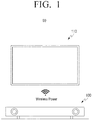
- FIG. 1 is a view illustrating an image processing system capable of transmitting and receiving wireless power according to an embodiment of the present disclosure.
- an image processing system 90 may include a sound output apparatus 100 and a display apparatus 110.
- the sound output apparatus 100 may include a wireless power transmission apparatus according to an embodiment of the present disclosure.
- the sound output apparatus 100 may be a peripheral apparatus disposed in the vicinity of the display apparatus 110, and replaced with various apparatuses such as a set-top box (STB), a BD reproducer, an access point (AP), etc.
- STB set-top box
- AP access point
- the sound output apparatus 100 may be connected to power plug where a power line provides commercial power (e.g. commercial power ranging from 85V to 265V), and the sound output apparatus 100 may convert the commercial power into a voltage required for the display apparatus 110 and stably transmit the voltage to the display apparatus 110.
- a power line provides commercial power (e.g. commercial power ranging from 85V to 265V)
- the sound output apparatus 100 may convert the commercial power into a voltage required for the display apparatus 110 and stably transmit the voltage to the display apparatus 110.
- it is preferable that the display apparatus 100 uses power of DC 200V and 150W.
- the display apparatus 110 may be disposed from the sound output apparatus 100 by a predetermined distance (e.g. within a range between 10cm and 70cm) so that power may be efficiently transmitted in a specific space.
- the sound output apparatus 100 may perform initial driving for transmitting power to the display apparatus 110 according to a distance (d) between two apparatuses. In other words, the sound output apparatus 100 may perform a setting operation process between two apparatuses.
- the sound output apparatus 100 may measure a distance between two apparatuses, and as a result of measurement, if the measured distance is within a predetermined range, i.e. a threshold distance, may perform an operation in connection with the display apparatus 110. However, if the measured distance is too short, voltage gain between the transmission unit and the receiving unit may be reduced by a frequency splitting phenomenon. The sound output apparatus 100 may notify the display apparatus 110 that the voltage gain is reduced, and the display apparatus 110 may adjust a duty ratio of a DC/DC converter which operates in a PWM method to compensate the reduced voltage gain. The detailed description thereof will be made later.
- the sound output apparatus 100 may use a Convertible High-Frequency Inverter driving method instead of adjusting a frequency/duty ratio.
- a half-bridge inverter may be converted into a full-bridge inverter.
- the sound output apparatus 100 may not perform an operation based on the measured distance.
- an inverter may be operated with a predetermined operating frequency. Therefore, the present disclosure is not limited thereto, but the detailed description will be made later.
- the display apparatus 110 may include a wireless power receiving apparatus.
- the wireless power receiving apparatus may receive power transmitted wirelessly from the wire power transmission apparatus and operate the display apparatus 110.
- the wireless power receiving apparatus may adjust a duty ratio when PWM control of a DC/DC converter is performed according to a distance from the wireless power transmission apparatus.
- the display apparatus 110 may adjust a second capacitor (Cp) value by varying a duty ratio between a first switching element and a second switching element to achieve target power by varying a resistance value of a load resistance (or an effective resistance).
- Cp capacitor
- a converter may be driven using a full-bridge method, not a half- bridge method. As such, if it is determined that control cannot be performed even by using such driving methods, it may be requested to change the operating frequency of the inverter by the sound output apparatus while the display apparatus operates with the specified duty.
- the above operations are not particularly limited as to what manner of operation is to be performed.
- the display apparatus 100 may obtain a desired target voltage by performing a switching operation.
- the rectifier includes a full-wave rectifying circuit comprising a plurality of diodes
- the rectifier may connect the plurality of diodes to the switching element and adjusting the capacitance of the capacitor located at the front end of the rectifier, a voltage changed by a resonance point changed according to the distance from the sound output apparatus 100, and a resonance frequency changed according to the change of the resonance point may be compensated.
- a duty with respect to a control signal of the switching element may vary depending on not only the distance, but also whether the sound output apparatus 100 includes a resonance circuit that changes a voltage source to a current source.
- an image process system 90 may stably transmit power regardless of the distance between the wireless power transmission apparatus and the wireless power receiving apparatus.
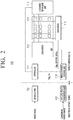
- FIG. 2 is a view illustrating an image processing system according to another embodiment of the present disclosure.
- an image processing system 190 may include an image relay apparatus 200 and a display apparatus 210.
- the image relay apparatus 200 may be a peripheral apparatus such as a set-top box (STB), a Blue-ray (BD) reproducer, or a relay apparatus (e.g. AP).
- STB set-top box
- BD Blue-ray
- AP relay apparatus
- the image relay apparatus 200 may be referred to as a power transmission apparatus.
- the image relay apparatus 200 may include an interface unit 201 and a wireless power transmission unit 203 as a set-top box.
- the interface unit 201 may convert image data input from an outside to correspond to resolution of the display apparatus 210 and output the data as an image board such as a graphic card.
- the image data may be video data of R, G and B of 8 bits or more
- the interface unit 210 may generate control signals such as a clock signal (DCLK), a vertical synchronization signal Vsync, and a horizontal synchronization signal Hsync, which correspond to the resolution of the display apparatus 210.
- the interface unit 201 may provide the vertical/horizontal synchronization signals and the image data to the controller 211.
- Data may be wirelessly transmitted from the interface unit 201 to the controller 211, but also may be transmitted in a wired manner, for example, using a USB cable. Therefore, an embodiment of the present disclosure is not limited thereto.
- the interface unit 201 may include a tuner for receiving a specific broadcasting program provided by a broadcasting station, a demodulator for demodulating image signals input by the tuner, a demultiplexer for separating the demodulated image signal into video/audio data and additional information, a decoder for decoding the separated video/audio data, an audio processing unit for converting the decoded audio data into a format suitable for a speaker, and a controller (e.g. MCU) for controlling the overall operations thereof.
- a tuner for receiving a specific broadcasting program provided by a broadcasting station
- a demodulator for demodulating image signals input by the tuner
- a demultiplexer for separating the demodulated image signal into video/audio data and additional information
- a decoder for decoding the separated video/audio data
- an audio processing unit for converting the decoded audio data into a format suitable for a speaker
- a controller e.g. MCU
- the wireless power transmission unit 203 may generate a voltage required for the display apparatus 210 by using commercial power within a range from 85V to 265V. In addition, the wireless power transmission unit 203 may transmit the generated voltage to the display 210, more specifically, to the wireless power receiving unit 216 wirelessly. Power transmission means that power of the wireless power transmission unit 203 is generated or changed rather than that actual information is transmitted. For example, it is the same principle that an inductive electromotive force is generated in the second coil when a current flows in the first coil (or an inductor) of a transformer.
- the wireless power transmission unit 203 may perform an operation depending on the position where the image relay apparatus 200 and the display apparatus 210 are installed by a user. That is, the wireless power transmission unit 203, if the wireless power transmission unit 203 and the wireless power receiving unit 216 are within a predetermined range, may transmit a first voltage to the wireless power receiving unit 216, and if both are output of the range, may transmit a second voltage. For example, a distance between the wireless power transmission unit 203 and the wireless power receiving unit 216 is small, the first voltage of 400V DC may be transmitted, and if the distance is out of a predetermined value, DC voltage of 200V may be transmitted. In order to easily perform such operation, the wireless power transmission unit 203 may apply a convertible high frequency inverter, and select a full-bridge inverter and a half-bridge inverter for driving. The detailed description thereof will be made below.
- the display apparatus 210 may include a controller 211, a scan driver 212, a data driver 213, a display panel 214, a discharge performing unit 215 and a wireless power receiving unit 216.
- the expression "including part or all” means that the scan driver 212 and/or the data driver 213 may be combined with (e.g. a COG method) or integrated with (e.g. AMOLED, etc.) the display panel 214, or the discharge performing unit 215 may be omitted to form the display apparatus 210.
- the display apparatus 210 includes all of the above components to convey full interpretation of the present disclosure.
- the controller 211 may generate control signals for controlling the scan driver 212 and the data driver 213 to display image data of RGB input through the interface unit 201 on the display panel 214.
- the controller 211 may express the grayscale information of R, G, and B data using a logic voltage Vlog provided by the wireless power receiving unit 216. For example, when the grayscale information of R is generated by using a logic voltage of 3.3 V, 8-bit information '10001001' may be generated by expressing 3.3V as 1 and OV as 0.
- the controller 211 may generate a gate shift clock (GSC) signal, a gate output enable (GOE) signal, and a gate start pulse (GSP) signal as gate control signals for controlling the scan driver 212.
- GSC gate shift clock
- GOE gate output enable
- GSP gate start pulse
- the GSC signal may be a signal for determining a time when a switching element connected to a light emitting element such as R, G, and B LED (or OLED) is turned on/off
- the GOE signal may be a signal for controlling the output of the scan driver 212
- the GSP signal may be a signal that indicates the first driving line of a screen from one vertical synchronization signal.
- the controller 211 may also generate a source sampling clock (SSC) signal, a source output enable (SOE) signal, and a source start pulse (SSP) signal as a data control signal.
- SSC source sampling clock
- SOE source output enable
- SSP source start pulse
- the SSC signal may be used as a sampling clock for latching data in the data driver 230, and the SOE signal may transfer the data latched by the SSC to the display panel 214.
- the SSP signal may be a signal for notifying the start of data latching or sampling during one horizontal synchronization period.
- the controller 211 may process data signals, serial data shift clock (S CLK), LAT, and grayscale (GS) pulse width modulation (PWM) reference clock (G CLK) with the IC.
- the data signal may be grayscale data of R, G, and B.
- the S CLK signal may be a signal for shifting data input to the data driver 213 to a shift register (e.g. 48-bit common shift register (MSB)) in synchronization with the rising edge of the S CLK.
- a shift register e.g. 48-bit common shift register (MSB)
- the data stored in the shift register may be shifted from each S CLK rising edge to the MSB.
- the LAT may be a signal for latching data at the falling edge from the MSB to a memory (ex. GS data memory).
- the G CLK may be a signal for increasing the GS counter by one on each rising edge of G CLK for PWM control.
- the controller 211 may include a control signal generation unit (not shown) and a data rearrangement unit (not shown).
- the control signal generation unit if a time for displaying an image in a unit frame on the display panel 214 is 16. 7ms, may generate a control signal to display a unit frame image within a predetermined time.
- the data rearrangement unit may reproduce the input RGB image data to be suitable for the display panel 214.
- the controller 211 may convert 8 bit data into 64 bit data.
- the scan driver 212 may receive a gate-on voltage (Vdd) and a gate-off voltage (Vss) provided by the wireless power receiving unit 216 and apply the voltage to the display panel 214 under the control of the controller 211.
- the gate-on voltage (Vdd) may be provided from a second line 1 (GL1) to a scan line N (GLn) sequentially to embody a unit frame image on the display panel 214.
- the scan driver 212 may operate in response to the scan signal generated by the controller 211 according to an embodiment of the present disclosure.
- the scan driver 212 may include a power voltage source and a switching element connected to each scan line as shown in FIG. 2 .
- the switching element may use not only a TFT element, but also a transistor (TR) and MOSFET.
- the data driver 213 may convert video data of R, G and B provided serially by the controller 211 into video data in parallel, convert digital data into an analogue current or a duty-on current (e.g. a pulse current), and provide video data corresponding to a single horizontal line on the display panel 214 for each horizontal line simultaneously and sequentially.
- Digital information of video data provided by the controller 211 may be converted into an analogue current including a color grayscale and the analogue current may be provided to the display panel 214.
- the analog current may be a pulse type current. It is preferable that the data driver 213 may also be synchronized with a gate signal provided to the scan driver 212 and output unit frame data.
- the data driver 213 may be variably configured depending on whether a light emitting element is driven with a constant current, or with a constant voltage.
- the Texas Instruments TLC5958 Series IC may be used for the data driver 213.
- the display panel 214 may include a plurality of scan lines and a plurality of data lines intersecting with each other to define a pixel area, and light emitting elements of R,G and B such as LED (or OLED) may be provided in the pixel area where the scan lines and the data lines cross each other.
- light emitting elements may generate a current corresponding to their grayscale information through the data lines connected to the scan lines to which a power voltage is supplied.
- the display panel 214 may display an image by adjusting brightness depending on the amount of charge flowing through a current path.
- the light emitting element may be driven by a constant voltage. Therefore, an embodiment of the present disclosure is not limited thereto.
- the discharge performing unit 215 may discharge parasitic charge by a parasitic capacitor of each scan line to a ground when each scan line discharges.
- the discharge performing unit 215 may be controlled by the controller 211.
- the discharge performing unit 215 may be controlled between when the power voltage Vdd provided to a scan line 1 is blocked, and when a power voltage is provided to a scan line 2.
- the wireless power receiving unit 216 may include a switching rectifier which switches a rectifier.
- the wireless power receiving unit 216 may control a switching element of a switching rectifier, perform the ZVS operation, and adjust a capacitance of a capacitor which is disposed at a front end of the switching rectifier and connected to the front end in parallel.
- the variance of the capacitance may allow a desired voltage to be output through the rectifier by adjusting a resonance frequency distorted depending on the distance between the wireless power receiving unit 216 and the wireless power transmission unit 203.
- the wireless power receiving unit 216 may generate a first voltage (e.g. DC 200V) and a second voltage (e.g. DC 13V) through a converter and provide the generated voltage to each functional block (e.g. a display panel, a driver, etc.).
- the wireless power receiving unit 216 may generate a voltage of DC 3.3V as a logic voltage to present a grayscale, and generate various magnitudes of voltages such as a voltage of DC 4.5V as a gate-on voltage Vdd for the scan driver 220.
- the wireless power receiving unit 216 may generate a VCC voltage (e.g. DC13V), which is input to an IC, when the controller 211, the scan driver 212, and the data driver 213 are integrated in IC form.
- a VCC voltage e.g. DC13V
- FIG. 3 is a block diagram showing a detailed structure of a wireless power transmission unit shown in FIG. 2 .
- a wireless power transmission unit 203 may include part or all of a filter 300, a PFC unit 310, a converter 320, a switching unit 330, a regulator 340, a controller 350, an inverter 360, a resonance circuit unit 370, and a first coil unit 380.
- the wireless power transmission unit 203 may be a stand-alone type individual apparatus, and the expression "include part or all” means that some constituent elements such as the converter 320, the switching unit 330, the regulator 340, and the resonance circuit unit 370 are omitted. However, it will be assumed that the wireless power transmission unit 203 includes all of the above components to convey full interpretation of the present disclosure.
- the filter 300 may rectify or smooth the input commercial power and output a DC voltage at a constant level.
- a half-wave or full-wave rectifier circuit may be used for rectification, and a capacitor may be connected to an output end of the rectifier circuit in parallel for smoothing.
- the PFC unit 310 may change the voltage output from the filter 330 to a voltage of 400V through a converter to output.
- the PFC unit 310 may include a flyback converter.
- the converter 320 may be provided with a smoothing voltage output from the filter 330, generate a DC voltage of 13V, and provide the DC voltage to the switching unit 330 and the regulator 340.
- the switching unit 330 may output a first voltage of DC 13V and a second voltage of DC 400V, which is selected under the control of the first controller 350.
- the regulator 340 may perform an operation for proving a stable voltage to the first controller 350.
- the regulator 340 may allow the ripple to be improved in the output voltage.
- the controller 350 may measure a distance between the image relay apparatus 220 and the display apparatus 210 automatically or by a command of a system designer or a user, more specifically, a distance between the wireless power transmission unit 203 and the wireless power receiving unit 216 of FIG. 2 .
- the first controller 350 may control the switching unit 330 and output a voltage of DC 13V to the inverter 360.
- the voltage of DC 13V may be a voltage for measuring a distance.
- the first controller 350 may sense a current of the inverter 360 and measure a distance between two apparatuses. For example, the first controller 350 may determine whether a current value of the sensed current coincides with the stored current value, and then determine an operating frequency and a distance.
- the first controller 350 may perform a down-scanning operation or an up-scanning operation for measuring a distance.
- the down-scanning may operate the wireless power transmission apparatus 203 at a maximum frequency within the given range and gradually reduce the frequency, determine the frequency at the time of sensing a current, and then determine the distance.
- the first controller 350 may store distance information which is matched with the frequency, and determine a distance based thereon.
- the first controller 350 may measure a distance using the up-scanning method. That is, a point where the current value is maximum may be found by sequentially increasing the operating frequency within the range. A distance may be determined based on the determined maximum current value. Since the distance information is matched with the maximum current value, the distance may be determined by retrieving the distance information.
- the first controller 350 may control the switching unit 330 so that the voltage of DC 400V may be output to the inverter 360. As a result, a wireless power operation may start.
- the inverter 360 may convert the input voltage of DC 400V into AC voltage and output the AC voltage.
- the inverter 360 may include a PWM circuit to allow the first controller 350 to perform PWM control.
- the first controller 350 may adjust an operating frequency and duty-on time by controlling the inverter 360, and when distance measurement is completed, the first controller 350 may operate using the determined operating frequency and duty ratio as a fixed value.
- the PWM circuit is well known in the related art, and thus the detailed description thereof will be omitted.
- the inverter 360 may include a convertible high frequency inverter.
- the inverter 360 may include a push-pull type inverter if high frequency AC magnetic field is generated according to an embodiment of the present disclosure.
- the inverter 360 may drive a full-bridge type inverter or a half-bridge type inverter depending on the distance.
- the full-bridge type inverter may further include a switching element compared to the half-bridge type inverter. Therefore, according to an embodiment, the inverter 360 may be conveniently driven using the half-bridge method by driving switching elements corresponding to one pole in the full-bridge method.
- the resonance circuit unit 370 may be configured to generate a current source, but can be omitted depending on an embodiment.
- the resonance circuit unit 370 may include an LC parallel resonance circuit for generating a current source, but if the current source is generated, various circuits other than the LC parallel resonance circuit may be provided.
- a Zero Voltage Switching (ZVC) unit may be provided on the output end of the resonance circuit unit 370.
- the ZVS unit may include a ZVC element (filter).
- Such the ZVC unit may operate when a distance between the wireless power transmission unit 203 and the wireless power receiving unit 216 is small. As the distance between the wireless power transmission unit 203 and the wireless power receiving unit 216 is reduced, gain for power transmission may be reduced. As a result, the display apparatus 210 may not obtain the desired power.
- the zero voltage may generate when a distance (e.g. 30cm) becomes too short, and the coil of the first coil unit 380 may be affected by the coil of the second coil unit 400, so that mutual inductance may increase, and a current may fail to flow through the first coil. As a result, power may not be properly transmitted.
- the ZVS unit may constantly maintain the efficiency of power transmission by allowing a current to flow through the ZVS element.
- the first coil unit 380 may include a coil, that is, an inductor, and when the ZVC unit 370 fails to operate, a current may flow through the first coil, so that the inductive electromotive force may be generated in the wireless power receiving unit 216.
- the wireless power transmission unit 203 may have the same structure as that shown in FIG. 5 .
- the detailed description will be made with reference to FIG. 5 .
- the wireless power receiving unit 216 may constantly maintain target power.
- the resonance circuit unit 370 may be omitted, and the ZVS circuit may be provided instead.
- FIG. 4 is a block diagram showing a detailed structure of a wireless power transmission unit shown in FIG. 2 .
- the wireless power receiving unit 216 may include some or all of a second coil unit 400, a rectifier 410, a smoothing circuit 420, a converter 430, an overvoltage detector 440, a second controller 450 and a switching unit 460.
- the expression "include part or all” means that some constituent elements such as the converter 430, the overvoltage detector 440 and/or the switching unit 460 are omitted or some constituent elements are integrated with other constituent elements. However, it will be assumed that the wireless power receiving unit 216 includes all of the above components to convey full interpretation of the present disclosure.
- the second coil unit 400 may include a coil, that is, an inductor, and the inductive electromotive force may be generated by a voltage applied to the first coil unit 380 and a current which flows through the first coil.
- Such inductive electromotive force may have a unit of voltage.
- the rectifier 410 and the smoothing circuit 420 may rectify and smooth the AC voltage provided by the second coil unit 400 and convert the AC voltage into the DC voltage.
- the converter 430 may include a DC-DC converter, and generate and output voltages of DC 200V and DC 13V.
- the voltage of DC 200V may be provided to drive an LED string provided in the display panel 214.
- the voltage of DC 13V may be used as a VCC power source of the controller 211, or the scan driver 212 and the data driver 213.
- PWM control may be performed on the DC-DC converter constituting the converter 430, and the duty ratio may be adjusted according to the distance.
- the converter 430 may operate in three manners. In other words, when the operating frequency of the inverter 360 is determined based on the distance, the wireless power transmission unit 203 may operate with a predetermined duty without additional duty adjustment.
- the converter 430 may operate by adjusting the duty according to the distance.
- the converter 430 may measure the distance by sensing the current output from the converter 430 and comparing the output current with a predetermined value, and adjust the duty by using pre-stored duty information, which is matched with the measured distance. Further, when the distance is too short, it is possible to adjust the duty with changing the operating frequency of the inverter.
- the overvoltage detector 440 may detect the overvoltage applied from the second coil unit 440 to the rectifier 410 and transmit the overvoltage to the second controller 450.
- the second controller 450 may temporarily block the voltage applied to the rectifier 410.
- the second controller 450 may control the converter 430 upon the request of the wireless power transmission unit 203. For example, if the converter unit 430 needs to adjust (input) the duty and control the effective resistance, the second controller 450 may adjust the duty ratio and control the converter 430 with the adjusted duty.
- the second controller 450 may maintain the switching unit 460 to be turned off so that the voltage of DC 13V may not be output during the initial driving, or the scanning operation for measuring the distance after the image replay apparatus 200 and the display apparatus 210 are installed.
- the switching unit 460 may be turned on and the voltage of DC 13V may be output.
- the wireless power receiving unit 216 may generate a stable voltage required by the display apparatus 210.
- the stable voltage may affect the image quality of the display panel 214.
- FIG. 5 is an entire IPTS circuit diagram illustrating that a variable switching capacitor (or a switching rectifier) is applied to a receiving end
- FIG. 6 is a variable switching capacitor application circuit diagram and an equivalent circuit diagram
- FIG. 7 is a view illustrating Ve waveform before and after applying a variable switching capacitor.
- the wireless power transmission unit 203 of FIG. 2 may include some or all of a filter 500, a rectifier 510, a PFC unit 520, an inverter 530, a resonance circuit unit 540, and a first coil unit 550.
- the wireless power receiving unit 216 may include a second coil unit 560, and a switching rectifier 570.
- the switching rectifier 570 may include a high frequency operation switch (or a capacitor variance unit) at the bottom of the rectifier to generate an effective capacitance (Cv) by adjusting the switching duty (ratio).
- effective capacitance refers to a capacitance (Cp) (or the second capacitor) connected to the front end of the switching rectifier 570 in parallel.
- the adjustment of the effective capacitance refers to adjusting the resonance frequency of the output end resonance circuit of the second coil unit 560, which is distorted according to the distance between the wireless power transmission unit 203 and the wireless power receiving unit 216. As a result, constant power control may become possible.
- the wireless power transmission unit 203 may include the resonance circuit unit 540 to change the voltage source to the current source, and allow a constant current to flow through the first coil unit 550. Accordingly, the wireless power receiving unit 216 may control the operation of the switching rectifier 570 only considering the effective capacitance according to the change in inductance of the second coil unit 56.
- the switching element may generate the effective capacitance by changing the switching duty and/or the switching frequency.
- a resonance capacitor (C 1 ) may be connected between the resonance circuit unit 540 and the first coil unit 550 in the IPTS, and a resonance capacitor (C 2 ) (or a first capacitor) may be connected between the second coil unit 560 and the switching rectifier 570 in the wireless power receiving unit 216.
- the resonance capacitors C 1 and C 2 may be series resonance capacitors, but an embodiment of the present disclosure is not limited thereto.
- the resonance capacitors may be connected either in series or in parallel.
- the LC parallel resonance filter may be applied to generate the current source, but the present disclosure is not limited thereto. Various types of circuits may be applied.
- the switching rectifier 370 may consist of a rectifier and a switching unit (or a capacitor variance unit).
- the switching unit may include first and second switching elements, drain terminals of the first and second switching elements may be respectively connected to both ends (terminals) of the capacitor (Cp), and the drain elements may be respectively connected to anode terminals of first and second diodes.
- the source terminals of the first and second switching elements may be commonly connected to a loading end.
- the cathode terminals of the first and second diodes may be connected to the loading end.
- the first and second control signals may be input to the gate terminals of the first and second switching elements.
- the switching duty may range from 0 to 0.5, and the effective capacitance (Cv) may be expressed as Equation 1 below.
- the input-output voltage gain may be obtained as in ⁇ Equation 2> below by using a variable switching capacitor in ⁇ Equation 1>, and output control may be possible through the variance of the effective capacitance (Cv) (or duty variance).
- Cv effective capacitance
- FIG. 8 is a VSC IPTS equivalent circuit diagram to which a Zyreiter model is applied
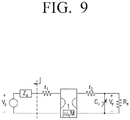
- FIG. 9 is an equivalent circuit diagram to which a Tebninc Circuit where L1 and C1, and L2 and C2 are completely resonant is applied
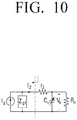
- FIG. 10 is an equivalent circuit diagram to which a Zyreiter model is applied
- FIG. 11 is a final equivalent circuit diagram according to an embodiment of the present disclosure.
- the final equivalent circuit of the IPTS when L1 and C1, and L2, and C2 are completely resonant (or partially resonant) is an RLC parallel resonance circuit as shown in FIG. 11 .
- the output power of the receiving end may be controlled. Even if the parallel resonance filter of La and Ca is applied or not applied, the resonance condition of the transmitting and receiving end may be appropriately designed to be an equivalent circuit as shown in FIG. 11 .
- equation is defined by P L ⁇ V L 2 R L ⁇ V e 2 R e , R e ⁇ 2 R L
- V a V 1 X a
- Z a j ⁇ s L a X a
- I g V a jX m
- Z g 1 X m 2 X a r 1 X a + j ⁇ s L a .
- V e R e V t R e 2 1 ⁇ ⁇ s 2 L t C v + r t + j ⁇ s L t + r t C v
- R e L t ⁇ L a X m 2 X a r 1 2 X a 2 + ⁇ s 2 L a 2
- Xa is designed to be negative in order for the above-mentioned effective inductance Lt to be a positive value.
- r t r 1 X m 2 X a r 1 2 X a 2 + ⁇ s 2 L a 2 + r 2 X a ⁇ 0
- FIG. 12 is an exemplary view of a wavelength for a ZVS operation of a high frequency operation switch.
- a switch in relation to the soft switching of the high-frequency operational switches S 1 and S 2 , a switch may be turned on before the operational range for Zero Voltage Switching (ZVS) of the high-frequency operational switches S 1 and S 2 embodied in the convertible switching capacitor and a turn-on state of the switch may be maintained for a predetermined period of time (tm) and then the switch may be turned off.
- ZVS Zero Voltage Switching
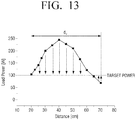
- FIG. 13 is a view illustrating an example of an output power characteristic when a variable switching capacitor is not applied during distance change
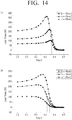
- FIG. 14 is a view illustrating an example of an output characteristic according to a duty change of a variable switching capacitor by distance
- FIG. 15 is a view illustrating an example of an output characteristic according to a variation of an operating frequency by duty of VSC.
- the output characteristic is significantly different according to the duty change and the switching operating frequency as shown in FIGS. 14 and 15 .
- FIG. 16 is a flowchart to explain a driving process of a display apparatus according to an embodiment of the present disclosure.
- the display apparatus 210 may wirelessly receive a voltage from an external apparatus, for example, the image relay apparatus 200 at step S1600.
- the expression "receive a voltage” means generating a voltage corresponding to the inductive electromotive force which is generated by the external apparatus disposed at a designated distance.
- the display apparatus 210 may adjust the resonance frequency of the resonance circuit determined depending on the distance from the external apparatus through the capacitance variance of the resonance circuit at step S1610.
- the resonance point of the resonance circuit may be changed by the distance, and it means the resonance frequency change. Therefore, it is necessary to adjust the changed resonance frequency to a predetermined value to generate target power. Therefore, according to an embodiment of the present disclosure, the capacitance of the resonance circuit may vary.
- the variable capacitance may be referred to as the effective capacitance (Cv) according to an embodiment of the present disclosure.
- the display apparatus 210 may adjust the received voltage to a target voltage, by the adjusted resonance frequency, and output the target voltage to a display panel at step S1620.
- target power for example, a voltage may be obtained by returning the predetermined condition to its original one.
- FIG. 17 is a flowchart to explain a driving process of an electronic apparatus according to an embodiment of the present disclosure.
- an electronic apparatus for example, the image relay apparatus 200 may be linked to the display apparatus 210 and process at least one of a video signal and an audio signal at step S1700.
- the electronic apparatus is the sound output apparatus 110 as in FIG. 1
- an audio signal may be received from the display apparatus 100 to be output.
- the electronic apparatus may change commercial power input from an outside into a current resource at step S1710.
- the LC parallel resonance circuit may be provided at a front end of the first coil unit of the electronic apparatus.
- the electronic apparatus may operate the coil unit, for example, the first coil unit with a constant current source regardless of the distance from the display apparatus 210, and wirelessly transmit a voltage to the display apparatus 210 at step S1720.
- the non-transitory computer readable medium refers to a medium that stores data semi-permanently rather than storing data for a very short time, such as a register, a cache, and a memory, and is readable by an apparatus.
- a non-transitory computer readable medium such as a compact disc (CD), a digital versatile disk (DVD), a hard disk, a Blu-ray disk, a universal serial bus (USB) memory stick, a memory card, and a read only memory (ROM), and may be provided.
Landscapes
- Engineering & Computer Science (AREA)
- Power Engineering (AREA)
- Computer Networks & Wireless Communication (AREA)
- Multimedia (AREA)
- Signal Processing (AREA)
- Control Of Indicators Other Than Cathode Ray Tubes (AREA)
Abstract
Description
- Devices and methods consistent with what is disclosed herein relate to a display apparatus, an operational method thereof, an electronic apparatus, and more particularly, to a display apparatus for receiving power regardless of a distance from a peripheral apparatus and maintaining target power constantly such as a DTV, an operational method thereof, and an electronic apparatus.
- Wireless power transfer is a technique for transmitting power wirelessly. The wireless power transfer is referred to as Wi-power similarly to a Wi-Fi technique which enables free Internet access only with a wireless adaptor anytime and anywhere.
- The wireless power transfer is categorized by an Inductive Power Transfer System (IPTS) method used for wireless charge, a Coupled Magnetic Resonance System (CMRS) method to be used for an electric vehicle, a high-speed train, etc., and a long distance microwave method using space solar power, which is an ongoing project.
- Recently, there is a demand for applying such technique to a display apparatus such as a TV to remove the complexity of wires in terms of interior design.
- Such technique may be applied to a TV without change, but considering the characteristic of a TV, a wall-mounted TV can be installed in various manners and in various spaces depending on a user. Therefore, it becomes difficult to transmit stable power.
- According to an embodiment of the present disclosure, there provided a display apparatus for receiving power regardless of a distance from a peripheral apparatus and maintaining target power constantly, an operational method thereof, and an electronic apparatus.
- According to an embodiment, there is provided a display apparatus including a resonance circuit unit configured to generate a voltage by using an inductive electromotive force generated by an external apparatus, a capacitance variance unit configured to vary a capacitance (Cv) of the resonance circuit unit to adjust a resonance point of the resonance circuit unit, the resonance point being changed due to a distance from the external apparatus, and a display panel configured to implement an image by using the voltage.
- The resonance circuit unit may include a first capacitor connected to one side of a coil unit of which one side terminal generates the inductive electromotive force, and a second capacitor (Cp) connected the other side of the coil unit and the other side terminal of the first capacitor, wherein a capacitance of the second capacitor is variable.
- The capacitance variance unit may include a first switching element in which a drain terminal is connected to the other side terminal of the first capacitor, and a first control signal is input to a gate terminal, and a second switching element in which a drain terminal is connected to the other side of the coil unit, a source terminal is connected to the first switching element, and a second control signal is input to a gate terminal.
- At least one of a driving frequency of the first switching element and the second switching element or a duty of the first control signal and the second control signal may be determined based on a distance between the external apparatus and the coil unit and whether a resonance circuit is present for forming a current source in the external apparatus.
- The duty according to the distance may be determined in a section where the first switching element and the second switching element operate oppositely, and wherein the capacitance varies depending on the determined duty (D).
- The first switching element and the second switching element, based on a current flowing in a reverse direction to a diode included in a switching element, or additionally added to an outside within a designated operational range, and a voltage of both ends of a switching element being zero or close to zero, may turn on a switching element in advance and turn off the switching element at a desired time to perform a zero voltage switching (ZVS) operation.
- The display apparatus as claimed in claim 4, wherein the capacitance (Cv) is determined by equation :

- The display apparatus may further include a rectifier connected to the resonance circuit unit and the capacitance variance unit and configured to rectify an output voltage of the resonance circuit unit, wherein the rectifier comprises a first diode and a second diode in which anode terminals are respectively connected to drain terminals of the first switching element and the second switching element, and cathode terminals are commonly connected to a load line.
- According to an embodiment, there is provided a method for driving a display apparatus including generating a voltage by using an inductive electromotive force generated by an external apparatus, varying a capacitance (Cv) of a resonance circuit unit to adjust a resonance point of the resonance circuit unit, the resonance point being changed due to a distance from the external apparatus, and implementing an image by using the voltage.
- The consonance circuit unit may include a first capacitor of which one side terminal is connected to one side of a coil unit which generates the inductive electromotive force, and a second capacitor (Cp) connected to the other side of the coil unit and the other side terminal of the first capacitor, wherein a capacitance of the second capacitor is variable.
- The varying of the capacitance may include varying the capacitance by using at least one of a driving frequency of a first switching element and a second switching element in which drain terminals are respectively connected to both terminals of the second capacitor, or a duty of a control signal which controls the first switching element and the second switching element.
- At least one of the driving frequency or the duty may be determined based on a distance between the external apparatus and the coil unit and whether a resonance circuit is present forming a current source in the external apparatus.
- The duty according to the distance may be determined in a section where the first switching element and the second switching element operate oppositely, and wherein the capacitance varies depending on the determined duty (D).
- The method as claimed in claim 11, wherein the capacitance (Cv) is determined by equation:

- The method may further include rectifying an output voltage of the resonance circuit unit by a rectifier, wherein the rectifier comprises a first diode and a second diode in which anode terminals are respectively connected to drain terminals of the first switching element and the second switching element, and cathode terminals are commonly connected to a load line.
- An electronic apparatus according to an embodiment of the present disclosure may include an inverter configured to an input DV voltage to an AC voltage, a resonance circuit unit configured to generate the AC voltage as a current source, and a coil unit configured to operate in the current source of the resonance circuit unit and generate an inductive electromotive force in a display apparatus.
-
-
FIG. 1 is a view illustrating an image processing system capable of transmitting and receiving wireless power according to an embodiment of the present disclosure; -
FIG. 2 is a view illustrating an image processing system according to another embodiment of the present disclosure; -
FIG. 3 is a block diagram showing a detailed structure of a wireless power transmission unit shown inFIG. 2 ; -
FIG. 4 is a block diagram showing a detailed structure of a wireless power transmission unit shown inFIG. 2 ; -
FIG. 5 is a view illustrating output power and efficiency characteristic according to a distance change of voltage source input inductive power transfer system, (IPTS); -
FIG. 6 is an equivalent circuit diagram of the IPTS under initial condition before load operation (RL = ∞); -
FIG. 7 is a view illustrating an example of frequency scanning for identifying a distance between a transmission unit and a receiving unit during initial operation; -
FIG. 8 is a VSC IPTS equivalent circuit diagram to which a Zyreiter model is applied; -
FIG. 9 is an equivalent circuit diagram to which a Tebninc Circuit where L1 and C1, and L2 and C2 are completely resonant is applied; -
FIG. 10 is an equivalent circuit diagram to which a Zyreiter model is applied; -
FIG. 11 is a final equivalent circuit diagram according to an embodiment of the present disclosure; -
FIG. 12 is an exemplary view of a wavelength for a ZVS operation of a high frequency operation switch; -
FIG. 13 is a view illustrating an example of an output power characteristic when a variable switching capacitor is not applied during distance change; -
FIG. 14 is a view illustrating an example of an output characteristic according to a duty change of a variable switching capacitor by distance; -
FIG. 15 is a view illustrating an example of an output characteristic according to a variation of an operating frequency by duty of VSC; -
FIG. 16 is a flowchart to explain a driving process of a display apparatus according to an embodiment of the present disclosure; and -
FIG. 17 is a flowchart to explain a driving process of an electronic apparatus according to an embodiment of the present disclosure. - Hereinafter, embodiments of the present disclosure will be described with reference to drawings.
-
FIG. 1 is a view illustrating an image processing system capable of transmitting and receiving wireless power according to an embodiment of the present disclosure. - Referring to
FIG. 1 , animage processing system 90 according to an embodiment of the present disclosure may include asound output apparatus 100 and adisplay apparatus 110. - The
sound output apparatus 100 may include a wireless power transmission apparatus according to an embodiment of the present disclosure. Thesound output apparatus 100 may be a peripheral apparatus disposed in the vicinity of thedisplay apparatus 110, and replaced with various apparatuses such as a set-top box (STB), a BD reproducer, an access point (AP), etc. Thesound output apparatus 100 may be connected to power plug where a power line provides commercial power (e.g. commercial power ranging from 85V to 265V), and thesound output apparatus 100 may convert the commercial power into a voltage required for thedisplay apparatus 110 and stably transmit the voltage to thedisplay apparatus 110. According to an embodiment of the present disclosure, it is preferable that thedisplay apparatus 100 uses power ofDC 200V and 150W. - The
display apparatus 110 may be disposed from thesound output apparatus 100 by a predetermined distance (e.g. within a range between 10cm and 70cm) so that power may be efficiently transmitted in a specific space. Thesound output apparatus 100 may perform initial driving for transmitting power to thedisplay apparatus 110 according to a distance (d) between two apparatuses. In other words, thesound output apparatus 100 may perform a setting operation process between two apparatuses. - In other words, the
sound output apparatus 100 may measure a distance between two apparatuses, and as a result of measurement, if the measured distance is within a predetermined range, i.e. a threshold distance, may perform an operation in connection with thedisplay apparatus 110. However, if the measured distance is too short, voltage gain between the transmission unit and the receiving unit may be reduced by a frequency splitting phenomenon. Thesound output apparatus 100 may notify thedisplay apparatus 110 that the voltage gain is reduced, and thedisplay apparatus 110 may adjust a duty ratio of a DC/DC converter which operates in a PWM method to compensate the reduced voltage gain. The detailed description thereof will be made later. If the measured distance is too short, thesound output apparatus 100 may use a Convertible High-Frequency Inverter driving method instead of adjusting a frequency/duty ratio. For example, a half-bridge inverter may be converted into a full-bridge inverter. - However, according to an embodiment of the present disclosure, when the
display apparatus 110 performs an operation of varying a capacitance according to a switching operation of a rectifier, thesound output apparatus 100 may not perform an operation based on the measured distance. In addition, an inverter may be operated with a predetermined operating frequency. Therefore, the present disclosure is not limited thereto, but the detailed description will be made later. - The
display apparatus 110 may include a wireless power receiving apparatus. The wireless power receiving apparatus may receive power transmitted wirelessly from the wire power transmission apparatus and operate thedisplay apparatus 110. The wireless power receiving apparatus may adjust a duty ratio when PWM control of a DC/DC converter is performed according to a distance from the wireless power transmission apparatus. - As a distance between two apparatuses is reduced, output characteristic may vary due to the increased mutual inductance and the reduced leakage inductance between a first coil unit and a second coil unit, so that desired target power transmission may become impossible. Therefore, the
display apparatus 110 may adjust a second capacitor (Cp) value by varying a duty ratio between a first switching element and a second switching element to achieve target power by varying a resistance value of a load resistance (or an effective resistance). When it is determined that the distance between the two apparatuses is too short, and target power cannot be achieved simply by changing the duty, and a converter may be driven using a full-bridge method, not a half- bridge method. As such, if it is determined that control cannot be performed even by using such driving methods, it may be requested to change the operating frequency of the inverter by the sound output apparatus while the display apparatus operates with the specified duty. - In relation to how to adjust the duty, it is possible to simply perform the duty change by sensing the voltage output from the rectifier and comparing the sensed voltage with the pre-stored target voltage. The pre-stores voltage value refers to a predetermined value by an experiment, or the like. Therefore, according to an embodiment of the present disclosure, the above operations are not particularly limited as to what manner of operation is to be performed.
- In addition, unless the
display apparatus 100 obtains a desired target voltage (or power) by changing the operating frequency of the inverter or changing the effective resistance (Re) of the DC/DC converter, as described above, thedisplay apparatus 100 may obtain a desired target voltage by performing a switching operation. In other words, when the rectifier includes a full-wave rectifying circuit comprising a plurality of diodes, by connecting the plurality of diodes to the switching element and adjusting the capacitance of the capacitor located at the front end of the rectifier, a voltage changed by a resonance point changed according to the distance from thesound output apparatus 100, and a resonance frequency changed according to the change of the resonance point may be compensated. A duty with respect to a control signal of the switching element may vary depending on not only the distance, but also whether thesound output apparatus 100 includes a resonance circuit that changes a voltage source to a current source. - As described above, an
image process system 90 according to an embodiment of the present disclosure may stably transmit power regardless of the distance between the wireless power transmission apparatus and the wireless power receiving apparatus. -
FIG. 2 is a view illustrating an image processing system according to another embodiment of the present disclosure. - Referring to
FIG. 2 , animage processing system 190 according to another embodiment of the present disclosure may include animage relay apparatus 200 and a display apparatus 210. - The
image relay apparatus 200 may be a peripheral apparatus such as a set-top box (STB), a Blue-ray (BD) reproducer, or a relay apparatus (e.g. AP). When theimage relay apparatus 200 fails to perform an image processing operation, but servers to receive commercial power and transmit the power to the display apparatus 210, theimage relay apparatus 200 may be referred to as a power transmission apparatus. - The
image relay apparatus 200 may include aninterface unit 201 and a wirelesspower transmission unit 203 as a set-top box. - The
interface unit 201 may convert image data input from an outside to correspond to resolution of the display apparatus 210 and output the data as an image board such as a graphic card. The image data may be video data of R, G and B of 8 bits or more, the interface unit 210 may generate control signals such as a clock signal (DCLK), a vertical synchronization signal Vsync, and a horizontal synchronization signal Hsync, which correspond to the resolution of the display apparatus 210. Theinterface unit 201 may provide the vertical/horizontal synchronization signals and the image data to thecontroller 211. Data may be wirelessly transmitted from theinterface unit 201 to thecontroller 211, but also may be transmitted in a wired manner, for example, using a USB cable. Therefore, an embodiment of the present disclosure is not limited thereto. - Further, the
interface unit 201 may include a tuner for receiving a specific broadcasting program provided by a broadcasting station, a demodulator for demodulating image signals input by the tuner, a demultiplexer for separating the demodulated image signal into video/audio data and additional information, a decoder for decoding the separated video/audio data, an audio processing unit for converting the decoded audio data into a format suitable for a speaker, and a controller (e.g. MCU) for controlling the overall operations thereof. - The wireless
power transmission unit 203 may generate a voltage required for the display apparatus 210 by using commercial power within a range from 85V to 265V. In addition, the wirelesspower transmission unit 203 may transmit the generated voltage to the display 210, more specifically, to the wirelesspower receiving unit 216 wirelessly. Power transmission means that power of the wirelesspower transmission unit 203 is generated or changed rather than that actual information is transmitted. For example, it is the same principle that an inductive electromotive force is generated in the second coil when a current flows in the first coil (or an inductor) of a transformer. - The wireless
power transmission unit 203 may perform an operation depending on the position where theimage relay apparatus 200 and the display apparatus 210 are installed by a user. That is, the wirelesspower transmission unit 203, if the wirelesspower transmission unit 203 and the wirelesspower receiving unit 216 are within a predetermined range, may transmit a first voltage to the wirelesspower receiving unit 216, and if both are output of the range, may transmit a second voltage. For example, a distance between the wirelesspower transmission unit 203 and the wirelesspower receiving unit 216 is small, the first voltage of 400V DC may be transmitted, and if the distance is out of a predetermined value, DC voltage of 200V may be transmitted. In order to easily perform such operation, the wirelesspower transmission unit 203 may apply a convertible high frequency inverter, and select a full-bridge inverter and a half-bridge inverter for driving. The detailed description thereof will be made below. - The display apparatus 210 may include a
controller 211, ascan driver 212, adata driver 213, adisplay panel 214, adischarge performing unit 215 and a wirelesspower receiving unit 216. - The expression "including part or all" means that the
scan driver 212 and/or thedata driver 213 may be combined with (e.g. a COG method) or integrated with (e.g. AMOLED, etc.) thedisplay panel 214, or thedischarge performing unit 215 may be omitted to form the display apparatus 210. However, it will be assumed that the display apparatus 210 includes all of the above components to convey full interpretation of the present disclosure. - The
controller 211 may generate control signals for controlling thescan driver 212 and thedata driver 213 to display image data of RGB input through theinterface unit 201 on thedisplay panel 214. Thecontroller 211 may express the grayscale information of R, G, and B data using a logic voltage Vlog provided by the wirelesspower receiving unit 216. For example, when the grayscale information of R is generated by using a logic voltage of 3.3 V, 8-bit information '10001001' may be generated by expressing 3.3V as 1 and OV as 0. - The
controller 211 may generate a gate shift clock (GSC) signal, a gate output enable (GOE) signal, and a gate start pulse (GSP) signal as gate control signals for controlling thescan driver 212. The GSC signal may be a signal for determining a time when a switching element connected to a light emitting element such as R, G, and B LED (or OLED) is turned on/off, the GOE signal may be a signal for controlling the output of thescan driver 212, and the GSP signal may be a signal that indicates the first driving line of a screen from one vertical synchronization signal. - The
controller 211 may also generate a source sampling clock (SSC) signal, a source output enable (SOE) signal, and a source start pulse (SSP) signal as a data control signal. The SSC signal may be used as a sampling clock for latching data in the data driver 230, and the SOE signal may transfer the data latched by the SSC to thedisplay panel 214. The SSP signal may be a signal for notifying the start of data latching or sampling during one horizontal synchronization period. - More specifically, if the
data driver 213 is formed of an IC of the Texas Instruments TCL 5958 series, for example, thecontroller 211 according to an embodiment of the present disclosure may process data signals, serial data shift clock (S CLK), LAT, and grayscale (GS) pulse width modulation (PWM) reference clock (G CLK) with the IC. The data signal may be grayscale data of R, G, and B. The S CLK signal may be a signal for shifting data input to thedata driver 213 to a shift register (e.g. 48-bit common shift register (MSB)) in synchronization with the rising edge of the S CLK. - The data stored in the shift register may be shifted from each S CLK rising edge to the MSB. The LAT may be a signal for latching data at the falling edge from the MSB to a memory (ex. GS data memory). The G CLK may be a signal for increasing the GS counter by one on each rising edge of G CLK for PWM control. The various signals described above can be changed, so that an embodiment of the present disclosure is not particularly limited to the above.
- The
controller 211 may include a control signal generation unit (not shown) and a data rearrangement unit (not shown). The control signal generation unit, if a time for displaying an image in a unit frame on thedisplay panel 214 is 16. 7ms, may generate a control signal to display a unit frame image within a predetermined time. In addition, the data rearrangement unit may reproduce the input RGB image data to be suitable for thedisplay panel 214. For example, thecontroller 211 may convert 8 bit data into 64 bit data. - The
scan driver 212 may receive a gate-on voltage (Vdd) and a gate-off voltage (Vss) provided by the wirelesspower receiving unit 216 and apply the voltage to thedisplay panel 214 under the control of thecontroller 211. However, according to an embodiment of the present disclosure, the gate-on voltage (Vdd) may be provided from a second line 1 (GL1) to a scan line N (GLn) sequentially to embody a unit frame image on thedisplay panel 214. Thescan driver 212 may operate in response to the scan signal generated by thecontroller 211 according to an embodiment of the present disclosure. Thescan driver 212 may include a power voltage source and a switching element connected to each scan line as shown inFIG. 2 . The switching element may use not only a TFT element, but also a transistor (TR) and MOSFET. - The
data driver 213 may convert video data of R, G and B provided serially by thecontroller 211 into video data in parallel, convert digital data into an analogue current or a duty-on current (e.g. a pulse current), and provide video data corresponding to a single horizontal line on thedisplay panel 214 for each horizontal line simultaneously and sequentially. Digital information of video data provided by thecontroller 211 may be converted into an analogue current including a color grayscale and the analogue current may be provided to thedisplay panel 214. The analog current may be a pulse type current. It is preferable that thedata driver 213 may also be synchronized with a gate signal provided to thescan driver 212 and output unit frame data. - In the following description, the configuration which is publicly known but irrelevant to the gist of the present disclosure would be omitted.
- Since the detailed configuration of the
data driver 213 is well known to those skilled in the art and irrelevant to the gist of the present disclosure, it would be omitted. In other words, thedata driver 213 may be variably configured depending on whether a light emitting element is driven with a constant current, or with a constant voltage. The Texas Instruments TLC5958 Series IC may be used for thedata driver 213. - The
display panel 214 may include a plurality of scan lines and a plurality of data lines intersecting with each other to define a pixel area, and light emitting elements of R,G and B such as LED (or OLED) may be provided in the pixel area where the scan lines and the data lines cross each other. When a power voltage is applied to each scan line of thedisplay panel 214, and a current path is formed between grounds through thedata driver 213, light emitting elements may generate a current corresponding to their grayscale information through the data lines connected to the scan lines to which a power voltage is supplied. - The
display panel 214 may display an image by adjusting brightness depending on the amount of charge flowing through a current path. The light emitting element may be driven by a constant voltage. Therefore, an embodiment of the present disclosure is not limited thereto. - The
discharge performing unit 215 may discharge parasitic charge by a parasitic capacitor of each scan line to a ground when each scan line discharges. Thedischarge performing unit 215 may be controlled by thecontroller 211. Thedischarge performing unit 215 may be controlled between when the power voltage Vdd provided to ascan line 1 is blocked, and when a power voltage is provided to a scan line 2. - The wireless
power receiving unit 216 may include a switching rectifier which switches a rectifier. The wirelesspower receiving unit 216 may control a switching element of a switching rectifier, perform the ZVS operation, and adjust a capacitance of a capacitor which is disposed at a front end of the switching rectifier and connected to the front end in parallel. The variance of the capacitance may allow a desired voltage to be output through the rectifier by adjusting a resonance frequency distorted depending on the distance between the wirelesspower receiving unit 216 and the wirelesspower transmission unit 203. - The wireless
power receiving unit 216 may generate a first voltage (e.g.DC 200V) and a second voltage (e.g.DC 13V) through a converter and provide the generated voltage to each functional block (e.g. a display panel, a driver, etc.). The wirelesspower receiving unit 216 may generate a voltage of DC 3.3V as a logic voltage to present a grayscale, and generate various magnitudes of voltages such as a voltage of DC 4.5V as a gate-on voltage Vdd for the scan driver 220. - The wireless
power receiving unit 216 may generate a VCC voltage (e.g. DC13V), which is input to an IC, when thecontroller 211, thescan driver 212, and thedata driver 213 are integrated in IC form. -
FIG. 3 is a block diagram showing a detailed structure of a wireless power transmission unit shown inFIG. 2 . - Referring to
FIG. 3 , a wirelesspower transmission unit 203 may include part or all of afilter 300, aPFC unit 310, aconverter 320, aswitching unit 330, aregulator 340, acontroller 350, aninverter 360, aresonance circuit unit 370, and afirst coil unit 380. - The wireless
power transmission unit 203 may be a stand-alone type individual apparatus, and the expression "include part or all" means that some constituent elements such as theconverter 320, theswitching unit 330, theregulator 340, and theresonance circuit unit 370 are omitted. However, it will be assumed that the wirelesspower transmission unit 203 includes all of the above components to convey full interpretation of the present disclosure. - The
filter 300 may rectify or smooth the input commercial power and output a DC voltage at a constant level. A half-wave or full-wave rectifier circuit may be used for rectification, and a capacitor may be connected to an output end of the rectifier circuit in parallel for smoothing. - The
PFC unit 310 may change the voltage output from thefilter 330 to a voltage of 400V through a converter to output. ThePFC unit 310 may include a flyback converter. - The
converter 320 may be provided with a smoothing voltage output from thefilter 330, generate a DC voltage of 13V, and provide the DC voltage to theswitching unit 330 and theregulator 340. - The
switching unit 330 may output a first voltage ofDC 13V and a second voltage ofDC 400V, which is selected under the control of thefirst controller 350. - The
regulator 340 may perform an operation for proving a stable voltage to thefirst controller 350. Theregulator 340 may allow the ripple to be improved in the output voltage. - When the image relay apparatus 220 and the display apparatus 210 of
FIG. 2 are initially installed and driven, thecontroller 350 may measure a distance between the image relay apparatus 220 and the display apparatus 210 automatically or by a command of a system designer or a user, more specifically, a distance between the wirelesspower transmission unit 203 and the wirelesspower receiving unit 216 ofFIG. 2 . - The
first controller 350 may control theswitching unit 330 and output a voltage ofDC 13V to theinverter 360. The voltage ofDC 13V may be a voltage for measuring a distance. Thefirst controller 350 may sense a current of theinverter 360 and measure a distance between two apparatuses. For example, thefirst controller 350 may determine whether a current value of the sensed current coincides with the stored current value, and then determine an operating frequency and a distance. - The
first controller 350 may perform a down-scanning operation or an up-scanning operation for measuring a distance. The down-scanning may operate the wirelesspower transmission apparatus 203 at a maximum frequency within the given range and gradually reduce the frequency, determine the frequency at the time of sensing a current, and then determine the distance. - The
first controller 350 may store distance information which is matched with the frequency, and determine a distance based thereon. Thefirst controller 350 may measure a distance using the up-scanning method. That is, a point where the current value is maximum may be found by sequentially increasing the operating frequency within the range. A distance may be determined based on the determined maximum current value. Since the distance information is matched with the maximum current value, the distance may be determined by retrieving the distance information. - When the frequency scanning operation for measuring a distance is completed, the
first controller 350 may control theswitching unit 330 so that the voltage ofDC 400V may be output to theinverter 360. As a result, a wireless power operation may start. - The
inverter 360 may convert the input voltage ofDC 400V into AC voltage and output the AC voltage. For example, theinverter 360 may include a PWM circuit to allow thefirst controller 350 to perform PWM control. Thefirst controller 350 may adjust an operating frequency and duty-on time by controlling theinverter 360, and when distance measurement is completed, thefirst controller 350 may operate using the determined operating frequency and duty ratio as a fixed value. The PWM circuit is well known in the related art, and thus the detailed description thereof will be omitted. However, theinverter 360 may include a convertible high frequency inverter. Theinverter 360 may include a push-pull type inverter if high frequency AC magnetic field is generated according to an embodiment of the present disclosure. - The
inverter 360 may drive a full-bridge type inverter or a half-bridge type inverter depending on the distance. The full-bridge type inverter may further include a switching element compared to the half-bridge type inverter. Therefore, according to an embodiment, theinverter 360 may be conveniently driven using the half-bridge method by driving switching elements corresponding to one pole in the full-bridge method. - The
resonance circuit unit 370 may be configured to generate a current source, but can be omitted depending on an embodiment. In addition, theresonance circuit unit 370 may include an LC parallel resonance circuit for generating a current source, but if the current source is generated, various circuits other than the LC parallel resonance circuit may be provided. - A Zero Voltage Switching (ZVC) unit may be provided on the output end of the
resonance circuit unit 370. The ZVS unit may include a ZVC element (filter). Such the ZVC unit may operate when a distance between the wirelesspower transmission unit 203 and the wirelesspower receiving unit 216 is small. As the distance between the wirelesspower transmission unit 203 and the wirelesspower receiving unit 216 is reduced, gain for power transmission may be reduced. As a result, the display apparatus 210 may not obtain the desired power. The zero voltage may generate when a distance (e.g. 30cm) becomes too short, and the coil of thefirst coil unit 380 may be affected by the coil of thesecond coil unit 400, so that mutual inductance may increase, and a current may fail to flow through the first coil. As a result, power may not be properly transmitted. The ZVS unit may constantly maintain the efficiency of power transmission by allowing a current to flow through the ZVS element. - The
first coil unit 380 may include a coil, that is, an inductor, and when theZVC unit 370 fails to operate, a current may flow through the first coil, so that the inductive electromotive force may be generated in the wirelesspower receiving unit 216. - However, according to an embodiment of the present disclosure, the wireless
power transmission unit 203 may have the same structure as that shown inFIG. 5 . The detailed description will be made with reference toFIG. 5 . - Referring to
FIG. 3 , by determining an operating frequency in the wirelesspower transmission unit 203 through a frequency scanning operation and driving an inverter with the determined operating frequency in order to measure the distance between the wirelesspower transmission unit 203 and the wirelesspower receiving unit 216, the wirelesspower receiving unit 216 may constantly maintain target power. Theresonance circuit unit 370 may be omitted, and the ZVS circuit may be provided instead. -
FIG. 4 is a block diagram showing a detailed structure of a wireless power transmission unit shown inFIG. 2 . - Referring to
FIG. 4 , the wirelesspower receiving unit 216 according to an embodiment of the present disclosure may include some or all of asecond coil unit 400, arectifier 410, a smoothingcircuit 420, aconverter 430, anovervoltage detector 440, asecond controller 450 and aswitching unit 460. - The expression "include part or all" means that some constituent elements such as the
converter 430, theovervoltage detector 440 and/or theswitching unit 460 are omitted or some constituent elements are integrated with other constituent elements. However, it will be assumed that the wirelesspower receiving unit 216 includes all of the above components to convey full interpretation of the present disclosure. - The
second coil unit 400 may include a coil, that is, an inductor, and the inductive electromotive force may be generated by a voltage applied to thefirst coil unit 380 and a current which flows through the first coil. Such inductive electromotive force may have a unit of voltage. - The
rectifier 410 and the smoothingcircuit 420 may rectify and smooth the AC voltage provided by thesecond coil unit 400 and convert the AC voltage into the DC voltage. - The
converter 430 may include a DC-DC converter, and generate and output voltages ofDC 200V andDC 13V. The voltage ofDC 200V may be provided to drive an LED string provided in thedisplay panel 214. The voltage ofDC 13V may be used as a VCC power source of thecontroller 211, or thescan driver 212 and thedata driver 213. PWM control may be performed on the DC-DC converter constituting theconverter 430, and the duty ratio may be adjusted according to the distance. According to an embodiment, theconverter 430 may operate in three manners. In other words, when the operating frequency of theinverter 360 is determined based on the distance, the wirelesspower transmission unit 203 may operate with a predetermined duty without additional duty adjustment. If the operating frequency of theinverter 360 is constant regardless of the distance, theconverter 430 may operate by adjusting the duty according to the distance. Theconverter 430 may measure the distance by sensing the current output from theconverter 430 and comparing the output current with a predetermined value, and adjust the duty by using pre-stored duty information, which is matched with the measured distance. Further, when the distance is too short, it is possible to adjust the duty with changing the operating frequency of the inverter. - The
overvoltage detector 440 may detect the overvoltage applied from thesecond coil unit 440 to therectifier 410 and transmit the overvoltage to thesecond controller 450. Thesecond controller 450 may temporarily block the voltage applied to therectifier 410. - The
second controller 450 may control theconverter 430 upon the request of the wirelesspower transmission unit 203. For example, if theconverter unit 430 needs to adjust (input) the duty and control the effective resistance, thesecond controller 450 may adjust the duty ratio and control theconverter 430 with the adjusted duty. - The
second controller 450 may maintain theswitching unit 460 to be turned off so that the voltage ofDC 13V may not be output during the initial driving, or the scanning operation for measuring the distance after theimage replay apparatus 200 and the display apparatus 210 are installed. When it is determined that the scanning operation is completed by sensing the current output from theconverter 430. Theswitching unit 460 may be turned on and the voltage ofDC 13V may be output. - As a result, the wireless
power receiving unit 216 may generate a stable voltage required by the display apparatus 210. The stable voltage may affect the image quality of thedisplay panel 214. -
FIG. 5 is an entire IPTS circuit diagram illustrating that a variable switching capacitor (or a switching rectifier) is applied to a receiving end,FIG. 6 is a variable switching capacitor application circuit diagram and an equivalent circuit diagram, andFIG. 7 is a view illustrating Ve waveform before and after applying a variable switching capacitor. - Referring to
FIG. 5 , the wirelesspower transmission unit 203 ofFIG. 2 according to another embodiment of the present disclosure may include some or all of afilter 500, arectifier 510, aPFC unit 520, aninverter 530, aresonance circuit unit 540, and afirst coil unit 550. The wirelesspower receiving unit 216 may include asecond coil unit 560, and a switchingrectifier 570. - The switching
rectifier 570 may include a high frequency operation switch (or a capacitor variance unit) at the bottom of the rectifier to generate an effective capacitance (Cv) by adjusting the switching duty (ratio). The term "effective capacitance" refers to a capacitance (Cp) (or the second capacitor) connected to the front end of the switchingrectifier 570 in parallel. The adjustment of the effective capacitance refers to adjusting the resonance frequency of the output end resonance circuit of thesecond coil unit 560, which is distorted according to the distance between the wirelesspower transmission unit 203 and the wirelesspower receiving unit 216. As a result, constant power control may become possible. - The wireless
power transmission unit 203 may include theresonance circuit unit 540 to change the voltage source to the current source, and allow a constant current to flow through thefirst coil unit 550. Accordingly, the wirelesspower receiving unit 216 may control the operation of the switchingrectifier 570 only considering the effective capacitance according to the change in inductance of the second coil unit 56. The switching element may generate the effective capacitance by changing the switching duty and/or the switching frequency. - Referring to
FIG. 5 , a resonance capacitor (C1) may be connected between theresonance circuit unit 540 and thefirst coil unit 550 in the IPTS, and a resonance capacitor (C2) (or a first capacitor) may be connected between thesecond coil unit 560 and the switchingrectifier 570 in the wirelesspower receiving unit 216. - The resonance capacitors C1 and C2 may be series resonance capacitors, but an embodiment of the present disclosure is not limited thereto. The resonance capacitors may be connected either in series or in parallel.
- In addition, referring to FIGL. 5, the LC parallel resonance filter may be applied to generate the current source, but the present disclosure is not limited thereto. Various types of circuits may be applied.
- To be more specific, the switching
rectifier 370 may consist of a rectifier and a switching unit (or a capacitor variance unit). The switching unit may include first and second switching elements, drain terminals of the first and second switching elements may be respectively connected to both ends (terminals) of the capacitor (Cp), and the drain elements may be respectively connected to anode terminals of first and second diodes. The source terminals of the first and second switching elements may be commonly connected to a loading end. The cathode terminals of the first and second diodes may be connected to the loading end. The first and second control signals may be input to the gate terminals of the first and second switching elements. - Referring to
FIGS. 5 to 7 , a variable switching capacitor operation principle will be described. - Referring to
FIG. 5 , by connecting a high frequency operational switch to a bottom end of the AC-DC rectifier connected to the resonance capacitor and varying the switching duty (D), it is possible to adjust the effective capacitance (Cv) (refer toFIGS. 6 and7 ). - The switching duty may range from 0 to 0.5, and the effective capacitance (Cv) may be expressed as
Equation 1 below. -

- The input-output voltage gain may be obtained as in <Equation 2> below by using a variable switching capacitor in <
Equation 1>, and output control may be possible through the variance of the effective capacitance (Cv) (or duty variance). -

- To be more specific, as shown in
FIG. 5 , a wireless power transmission system to which a variable switching capacitor is applied when an LD resonance filter is applied will be described below. -
FIG. 8 is a VSC IPTS equivalent circuit diagram to which a Zyreiter model is applied,FIG. 9 is an equivalent circuit diagram to which a Tebninc Circuit where L1 and C1, and L2 and C2 are completely resonant is applied,FIG. 10 is an equivalent circuit diagram to which a Zyreiter model is applied, andFIG. 11 is a final equivalent circuit diagram according to an embodiment of the present disclosure. - The final equivalent circuit of the IPTS when L1 and C1, and L2, and C2 are completely resonant (or partially resonant) is an RLC parallel resonance circuit as shown in
FIG. 11 . - When the effective capacitance (Cv) is electronically variable, the output power of the receiving end may be controlled. Even if the parallel resonance filter of La and Ca is applied or not applied, the resonance condition of the transmitting and receiving end may be appropriately designed to be an equivalent circuit as shown in
FIG. 11 . - Referring to
FIG. 8 , equation is defined by
FIG. 9 , equation is defined by

FIG. 10 , equation is defined by

- Therefore, as shown in
FIG. 11 , the final equivalent circuit in the present disclosure is expressed by <Equation 3> to <Equation 6>.

- Xa is designed to be negative in order for the above-mentioned effective inductance Lt to be a positive value.
-

-

-
FIG. 12 is an exemplary view of a wavelength for a ZVS operation of a high frequency operation switch. - Referring to
FIG. 12 , in relation to the soft switching of the high-frequency operational switches S1 and S2, a switch may be turned on before the operational range for Zero Voltage Switching (ZVS) of the high-frequency operational switches S1 and S2 embodied in the convertible switching capacitor and a turn-on state of the switch may be maintained for a predetermined period of time (tm) and then the switch may be turned off. - As a result, it is possible to finally operate with an effective duty as much as duty.
-
FIG. 13 is a view illustrating an example of an output power characteristic when a variable switching capacitor is not applied during distance change,FIG. 14 is a view illustrating an example of an output characteristic according to a duty change of a variable switching capacitor by distance, andFIG. 15 is a view illustrating an example of an output characteristic according to a variation of an operating frequency by duty of VSC. - Referring to
FIGS. 13 to 15 , in relation to the constant power output control characteristic at the time of the distance change between the wirelesspower transmission unit 203 and the wirelesspower receiving unit 216 over the wide range, as in an embodiment of the present disclosure, it is possible to control constant power output with target power (e.g. 100W) at the time of distance change between the wirelesspower transmission unit 203 and the wirelesspower receiving unit 216 by applying a convertible switch capacitor method. - In addition, the output characteristic is significantly different according to the duty change and the switching operating frequency as shown in
FIGS. 14 and15 . -
FIG. 16 is a flowchart to explain a driving process of a display apparatus according to an embodiment of the present disclosure. - Referring to
FIG. 16 together withFIG. 2 for ease of explanation, the display apparatus 210 according to an embodiment of the present disclosure may wirelessly receive a voltage from an external apparatus, for example, theimage relay apparatus 200 at step S1600. The expression "receive a voltage" means generating a voltage corresponding to the inductive electromotive force which is generated by the external apparatus disposed at a designated distance. - In addition, the display apparatus 210 may adjust the resonance frequency of the resonance circuit determined depending on the distance from the external apparatus through the capacitance variance of the resonance circuit at step S1610. In other words, the resonance point of the resonance circuit may be changed by the distance, and it means the resonance frequency change. Therefore, it is necessary to adjust the changed resonance frequency to a predetermined value to generate target power. Therefore, according to an embodiment of the present disclosure, the capacitance of the resonance circuit may vary. The variable capacitance may be referred to as the effective capacitance (Cv) according to an embodiment of the present disclosure.
- The display apparatus 210 may adjust the received voltage to a target voltage, by the adjusted resonance frequency, and output the target voltage to a display panel at step S1620. In other words, if the resonance frequency is changed by the distance, it can be considered that output power with respect to input power fails to satisfy a predetermined condition. According to an embodiment of the present disclosure, target power, for example, a voltage may be obtained by returning the predetermined condition to its original one.
-
FIG. 17 is a flowchart to explain a driving process of an electronic apparatus according to an embodiment of the present disclosure. - For ease of explanation, referring to
FIG. 17 together withFIG. 2 , an electronic apparatus according to an embodiment of the present disclosure, for example, theimage relay apparatus 200 may be linked to the display apparatus 210 and process at least one of a video signal and an audio signal at step S1700. For example, when the electronic apparatus is thesound output apparatus 110 as inFIG. 1 , an audio signal may be received from thedisplay apparatus 100 to be output. - The electronic apparatus may change commercial power input from an outside into a current resource at step S1710. The LC parallel resonance circuit may be provided at a front end of the first coil unit of the electronic apparatus.
- The electronic apparatus may operate the coil unit, for example, the first coil unit with a constant current source regardless of the distance from the display apparatus 210, and wirelessly transmit a voltage to the display apparatus 210 at step S1720.
- When the electronic apparatus operates with the constant current source, a constant voltage may occur in the first coil unit, and target power may be generated considering only the variables due to the change in inductance of the second coil unit according to the distance. Therefore, it is easy to generate target power.
- While the present disclosure has been described that all elements of an embodiment are coupled to one another or operate in combination, it is to be understood that the present disclosure is not limited to the disclosed embodiments. That is, within the scope of the present disclosure, all of the elements may be selectively coupled to one another in one or more of combinations. In addition, although all of the elements may be implemented as one independent hardware, some or all of the elements may be selectively combined to embody as a computer program including a program module performing a part or all of the functions in one or a plurality of hardware. The codes and code segments that constitute a computer program may be easily deduced by those skilled in the art. Such a computer program may be stored in a non-transitory computer readable medium readable by a computer, readable and executed by a computer, thereby realizing an embodiment of the present disclosure.
- The non-transitory computer readable medium refers to a medium that stores data semi-permanently rather than storing data for a very short time, such as a register, a cache, and a memory, and is readable by an apparatus. Specifically, the above-described various applications or programs may be stored in a non-transitory computer readable medium such as a compact disc (CD), a digital versatile disk (DVD), a hard disk, a Blu-ray disk, a universal serial bus (USB) memory stick, a memory card, and a read only memory (ROM), and may be provided.
- Although exemplary embodiments have been shown and described, it will be appreciated by those skilled in the art that changes may be made to these exemplary embodiments without departing from the principles and spirit of the present disclosure. Accordingly, the scope of the present disclosure is not construed as being limited to the described exemplary embodiments, but is defined by the appended claims as well as equivalents thereto.
Claims (15)
- A display apparatus, comprising:a resonance circuit unit configured to generate a voltage by using an inductive electromotive force generated by an external apparatus;a capacitance variance unit configured to vary a capacitance (Cv) of the resonance circuit unit to adjust a resonance point of the resonance circuit unit, the resonance point being changed due to a distance from the external apparatus; anda display panel configured to implement an image by using the voltage.
- The display apparatus as claimed in claim 1, wherein the resonance circuit unit comprises:a first capacitor connected to one side of a coil unit of which one side terminal generates the inductive electromotive force; anda second capacitor (Cp) connected the other side of the coil unit and the other side terminal of the first capacitor,wherein a capacitance of the second capacitor is variable.
- The display apparatus as claimed in claim 2, wherein the capacitance variance unit comprises:a first switching element in which a drain terminal is connected to the other side terminal of the first capacitor, and a first control signal is input to a gate terminal; anda second switching element in which a drain terminal is connected to the other side of the coil unit, a source terminal is connected to the first switching element, and a second control signal is input to a gate terminal.
- The display apparatus as claimed in claim 3, wherein at least one of a driving frequency of the first switching element and the second switching element or a duty of the first control signal and the second control signal is determined based on a distance between the external apparatus and the coil unit and whether a resonance circuit is present for forming a current source in the external apparatus.
- The display apparatus as claimed in claim 4, wherein the duty according to the distance is determined in a section where the first switching element and the second switching element operate oppositely, and
wherein the capacitance varies depending on the determined duty (D). - The display apparatus as claimed in claim 5, wherein the first switching element and the second switching element, based on a current flowing in a reverse direction to a diode included in a switching element, or additionally added to an outside within a designated operational range, and a voltage of both ends of a switching element being zero or close to zero, turns on a switching element in advance and turns off the switching element at a desired time to perform a zero voltage switching (ZVS) operation.
- The display apparatus as claimed in claim 4, wherein the capacitance (Cv) is determined by equation:

- The display apparatus as claimed in claim 3, further comprising:a rectifier connected to the resonance circuit unit and the capacitance variance unit and configured to rectify an output voltage of the resonance circuit unit,wherein the rectifier comprises a first diode and a second diode in which anode terminals are respectively connected to drain terminals of the first switching element and the second switching element, and cathode terminals are commonly connected to a load line.
- A method for driving a display apparatus, comprising:generating a voltage by using an inductive electromotive force generated by an external apparatus;varying a capacitance (Cv) of a resonance circuit unit to adjust a resonance point of the resonance circuit unit, the resonance point being changed due to a distance from the external apparatus; andimplementing an image by using the voltage.
- The method as claimed in claim 9, wherein the consonance circuit unit comprises:a first capacitor of which one side terminal is connected to one side of a coil unit which generates the inductive electromotive force; anda second capacitor (Cp) connected to the other side of the coil unit and the other side terminal of the first capacitor,wherein a capacitance of the second capacitor is variable.
- The method as claimed in claim 10, wherein the varying of the capacitance comprises varying the capacitance by using at least one of a driving frequency of a first switching element and a second switching element in which drain terminals are respectively connected to both terminals of the second capacitor, or a duty of a control signal which controls the first switching element and the second switching element.
- The method as claimed in claim 11, wherein at least one of the driving frequency or the duty is determined based on a distance between the external apparatus and the coil unit and whether a resonance circuit is present forming a current source in the external apparatus.
- The method as claimed in claim 11, wherein the duty according to the distance is determined in a section where the first switching element and the second switching element operate oppositely, and
wherein the capacitance varies depending on the determined duty (D). - The method as claimed in claim 11, wherein the capacitance (Cv) is determined by equation:

- The method as claimed in claim 9, further comprising:rectifying an output voltage of the resonance circuit unit by a rectifier,wherein the rectifier comprises a first diode and a second diode in which anode terminals are respectively connected to drain terminals of the first switching element and the second switching element, and cathode terminals are commonly connected to a load line.
Applications Claiming Priority (2)
| Application Number | Priority Date | Filing Date | Title |
|---|---|---|---|
| KR1020160090698A KR102518430B1 (en) | 2016-07-18 | 2016-07-18 | Display Apparatus and Driving Method Thereof, and Electronic Apparatus |
| PCT/KR2017/007673 WO2018016831A1 (en) | 2016-07-18 | 2017-07-17 | Display apparatus and operational method therefor, and electronic apparatus |
Publications (2)
| Publication Number | Publication Date |
|---|---|
| EP3481056A1 true EP3481056A1 (en) | 2019-05-08 |
| EP3481056A4 EP3481056A4 (en) | 2019-06-19 |
Family
ID=60992223
Family Applications (1)
| Application Number | Title | Priority Date | Filing Date |
|---|---|---|---|
| EP17831304.5A Withdrawn EP3481056A4 (en) | 2016-07-18 | 2017-07-17 | DISPLAY APPARATUS AND ASSOCIATED OPERATIONAL METHOD, AND ELECTRONIC APPARATUS |
Country Status (4)
| Country | Link |
|---|---|
| US (1) | US10938242B2 (en) |
| EP (1) | EP3481056A4 (en) |
| KR (1) | KR102518430B1 (en) |
| WO (1) | WO2018016831A1 (en) |
Families Citing this family (9)
| Publication number | Priority date | Publication date | Assignee | Title |
|---|---|---|---|---|
| KR102427343B1 (en) * | 2018-01-30 | 2022-07-29 | 현대모비스 주식회사 | Wireless charger |
| JP6919612B2 (en) * | 2018-03-27 | 2021-08-18 | オムロン株式会社 | Non-contact power supply device |
| KR102544616B1 (en) | 2018-04-10 | 2023-06-19 | 삼성전자주식회사 | Wireless power transfer system and display apparatus including the same |
| KR102479005B1 (en) * | 2018-07-13 | 2022-12-16 | 엘지전자 주식회사 | Wireless power receiving apparatus |
| KR102650122B1 (en) * | 2019-05-27 | 2024-03-21 | 삼성전자주식회사 | Display apparatus |
| US11418125B2 (en) | 2019-10-25 | 2022-08-16 | The Research Foundation For The State University Of New York | Three phase bidirectional AC-DC converter with bipolar voltage fed resonant stages |
| WO2021130965A1 (en) * | 2019-12-26 | 2021-07-01 | 三菱電機株式会社 | Power receiving device and wireless power feed system |
| US11277672B1 (en) * | 2020-10-07 | 2022-03-15 | Dish Wireless L.L.C. | 5G with ATSC 3.0 network extender |
| KR102768856B1 (en) * | 2024-04-25 | 2025-02-18 | 한화시스템 주식회사 | Wireless power transmission apparatus for eVTOL |
Family Cites Families (25)
| Publication number | Priority date | Publication date | Assignee | Title |
|---|---|---|---|---|
| JP3488166B2 (en) * | 2000-02-24 | 2004-01-19 | 日本電信電話株式会社 | Contactless IC card system, its reader / writer and contactless IC card |
| JP2004072832A (en) * | 2002-08-02 | 2004-03-04 | Hitachi Kiden Kogyo Ltd | Non-contact power feeding method |
| KR20060041334A (en) | 2004-11-08 | 2006-05-11 | 삼성전기주식회사 | Wideband voltage controlled oscillator |
| JP2008148210A (en) | 2006-12-13 | 2008-06-26 | Sharp Corp | Voltage controlled oscillator, PLL circuit |
| JP5178181B2 (en) * | 2006-12-27 | 2013-04-10 | 株式会社半導体エネルギー研究所 | Display device |
| JP5217319B2 (en) | 2007-09-12 | 2013-06-19 | 株式会社リコー | Constant current output control type switching regulator |
| JP5410228B2 (en) | 2009-10-01 | 2014-02-05 | 株式会社ジャパンディスプレイ | Liquid crystal display with capacitive input device |
| KR20110108596A (en) | 2010-03-29 | 2011-10-06 | 삼성전자주식회사 | Power reciveing apparatus and wireless power transiver |
| DE112011102500T5 (en) | 2010-07-28 | 2013-06-20 | Semiconductor Energy Laboratory Co., Ltd. | Wireless power supply system and wireless power supply method |
| US9071063B2 (en) * | 2010-09-02 | 2015-06-30 | Advantest Corporation | Wireless power receiving apparatus |
| KR101222749B1 (en) | 2010-12-14 | 2013-01-16 | 삼성전기주식회사 | Wireless power transmission apparatus and transmission method thereof |
| KR101580342B1 (en) | 2011-08-29 | 2015-12-24 | 삼성전기주식회사 | Wireless power transmission system and control method thereof |
| WO2013086445A1 (en) | 2011-12-09 | 2013-06-13 | The Regents Of The University Of California | Switched-capacitor isolated led driver |
| US9148024B2 (en) * | 2012-02-23 | 2015-09-29 | Integrated Device Technology Inc. | Apparatuses, systems, and methods for a monotonic transfer function in wireless power transfer systems |
| US10383990B2 (en) * | 2012-07-27 | 2019-08-20 | Tc1 Llc | Variable capacitor for resonant power transfer systems |
| US8627248B1 (en) | 2012-07-28 | 2014-01-07 | Synopsys, Inc. | Verification for functional independence of logic designs that use redundant representation |
| KR20140111881A (en) | 2013-03-12 | 2014-09-22 | 삼성전기주식회사 | Apparatus and method wireless power transmission, and wireless power transmission system using the same |
| US9998180B2 (en) | 2013-03-13 | 2018-06-12 | Integrated Device Technology, Inc. | Apparatuses and related methods for modulating power of a wireless power receiver |
| KR101983138B1 (en) | 2013-03-14 | 2019-05-28 | 삼성전기주식회사 | Apparatus and method wireless power transmission, and wireless power transmission system using the same |
| DE102013217816A1 (en) | 2013-09-06 | 2015-03-12 | Robert Bosch Gmbh | Device for inductive energy transmission and method for operating a device for inductive energy transmission |
| WO2015087398A1 (en) * | 2013-12-10 | 2015-06-18 | 中国電力株式会社 | Power-receiving device and power-feeding system |
| KR20150074801A (en) | 2013-12-24 | 2015-07-02 | 엘지전자 주식회사 | Wireless power transmitting apparatus and canceler |
| KR101708312B1 (en) * | 2014-02-07 | 2017-02-20 | 엘지전자 주식회사 | Wireless power transfer and receive method, apparatus and system |
| WO2016032981A1 (en) | 2014-08-25 | 2016-03-03 | NuVolta Technologies | Wireless power transfer system and method |
| US10498160B2 (en) * | 2015-08-03 | 2019-12-03 | Massachusetts Institute Of Technology | Efficiency maximization for device-to-device wireless charging |
-
2016
- 2016-07-18 KR KR1020160090698A patent/KR102518430B1/en active Active
-
2017
- 2017-07-17 US US16/312,791 patent/US10938242B2/en active Active
- 2017-07-17 EP EP17831304.5A patent/EP3481056A4/en not_active Withdrawn
- 2017-07-17 WO PCT/KR2017/007673 patent/WO2018016831A1/en not_active Ceased
Also Published As
| Publication number | Publication date |
|---|---|
| KR20180009154A (en) | 2018-01-26 |
| KR102518430B1 (en) | 2023-04-10 |
| US10938242B2 (en) | 2021-03-02 |
| WO2018016831A1 (en) | 2018-01-25 |
| EP3481056A4 (en) | 2019-06-19 |
| US20190222068A1 (en) | 2019-07-18 |
Similar Documents
| Publication | Publication Date | Title |
|---|---|---|
| US11088571B2 (en) | Electronic apparatus and display apparatus, and method for operating apparatuses | |
| US10938242B2 (en) | Display apparatus and operational method therefor, and electronic apparatus | |
| KR102436019B1 (en) | Power supply device, display apparatus having the same and method for power supply | |
| KR102576149B1 (en) | Display apparatus and control method thereof | |
| KR20250017266A (en) | Dc-dc converter and display device having the same | |
| KR101243402B1 (en) | Apparatus for driving hybrid backlight of LCD | |
| US9544953B2 (en) | Light source driving apparatus having a snubber to prevent voltage and current spikes, display apparatus and driving method thereof | |
| CN103715889B (en) | DC-DC converter control circuit, image display device using the same and driving method thereof | |
| US20140368741A1 (en) | Power circuit part, power control method thereof and display apparatus having the same | |
| KR102708696B1 (en) | Power supply device, display apparatus having the same and method for power supply | |
| KR102739582B1 (en) | Display apparatus | |
| US9564798B2 (en) | Display apparatus, power supply apparatus and power supply method thereof | |
| US20180323650A1 (en) | Wireless power transmission apparatus that is turned off in standby state and electronic apparatus including wireless power transmission apparatus | |
| KR20210106212A (en) | Display apparatus and controlling method thereof | |
| KR102389836B1 (en) | Power supply device, display apparatus having the same and method for power supply | |
| KR102151936B1 (en) | Light source driving apparatus, light source driving method, and display apparatus | |
| US20160036271A1 (en) | Display apparatus and power supplying method thereof | |
| US10644602B2 (en) | Adaptor, power supply system and power supply method thereof | |
| US9935555B2 (en) | Power supply apparatus and power supply method thereof | |
| US11741816B2 (en) | Electronic device having self-diagnosis function | |
| KR102663510B1 (en) | Electronic apparatus and the control method thereof | |
| CN101848591A (en) | Driving circuit of backlight system | |
| US20140347345A1 (en) | Circuit and television apparatus | |
| KR20000003101A (en) | Power control circuit for computer display devices |
Legal Events
| Date | Code | Title | Description |
|---|---|---|---|
| STAA | Information on the status of an ep patent application or granted ep patent |
Free format text: STATUS: THE INTERNATIONAL PUBLICATION HAS BEEN MADE |
|
| PUAI | Public reference made under article 153(3) epc to a published international application that has entered the european phase |
Free format text: ORIGINAL CODE: 0009012 |
|
| STAA | Information on the status of an ep patent application or granted ep patent |
Free format text: STATUS: REQUEST FOR EXAMINATION WAS MADE |
|
| PUAB | Information related to the publication of an a document modified or deleted |
Free format text: ORIGINAL CODE: 0009199EPPU |
|
| PUAI | Public reference made under article 153(3) epc to a published international application that has entered the european phase |
Free format text: ORIGINAL CODE: 0009012 |
|
| 17P | Request for examination filed |
Effective date: 20181130 |
|
| AK | Designated contracting states |
Kind code of ref document: A1 Designated state(s): AL AT BE BG CH CY CZ DE DK EE ES FI FR GB GR HR HU IE IS IT LI LT LU LV MC MK MT NL NO PL PT RO RS SE SI SK SM TR |
|
| AX | Request for extension of the european patent |
Extension state: BA ME |
|
| A4 | Supplementary search report drawn up and despatched |
Effective date: 20190522 |
|
| RIC1 | Information provided on ipc code assigned before grant |
Ipc: H03H 5/12 20060101ALI20190516BHEP Ipc: H04N 5/44 20110101AFI20190516BHEP Ipc: H02J 50/12 20160101ALI20190516BHEP |
|
| DAV | Request for validation of the european patent (deleted) | ||
| DAX | Request for extension of the european patent (deleted) | ||
| STAA | Information on the status of an ep patent application or granted ep patent |
Free format text: STATUS: EXAMINATION IS IN PROGRESS |
|
| 17Q | First examination report despatched |
Effective date: 20201015 |
|
| STAA | Information on the status of an ep patent application or granted ep patent |
Free format text: STATUS: THE APPLICATION IS DEEMED TO BE WITHDRAWN |
|
| 18D | Application deemed to be withdrawn |
Effective date: 20241210 |