EP3474290B1 - Systeme und verfahren zur optimierung einer gemeinsamen kostenfunktion und zum erfassen von neuro-muskulären profilen davon - Google Patents
Systeme und verfahren zur optimierung einer gemeinsamen kostenfunktion und zum erfassen von neuro-muskulären profilen davon Download PDFInfo
- Publication number
- EP3474290B1 EP3474290B1 EP18200343.4A EP18200343A EP3474290B1 EP 3474290 B1 EP3474290 B1 EP 3474290B1 EP 18200343 A EP18200343 A EP 18200343A EP 3474290 B1 EP3474290 B1 EP 3474290B1
- Authority
- EP
- European Patent Office
- Prior art keywords
- model parameters
- physiologically
- joint
- skeletal joints
- uuo
- Prior art date
- Legal status (The legal status is an assumption and is not a legal conclusion. Google has not performed a legal analysis and makes no representation as to the accuracy of the status listed.)
- Active
Links
Images






Classifications
-
- G—PHYSICS
- G16—INFORMATION AND COMMUNICATION TECHNOLOGY [ICT] SPECIALLY ADAPTED FOR SPECIFIC APPLICATION FIELDS
- G16H—HEALTHCARE INFORMATICS, i.e. INFORMATION AND COMMUNICATION TECHNOLOGY [ICT] SPECIALLY ADAPTED FOR THE HANDLING OR PROCESSING OF MEDICAL OR HEALTHCARE DATA
- G16H50/00—ICT specially adapted for medical diagnosis, medical simulation or medical data mining; ICT specially adapted for detecting, monitoring or modelling epidemics or pandemics
- G16H50/50—ICT specially adapted for medical diagnosis, medical simulation or medical data mining; ICT specially adapted for detecting, monitoring or modelling epidemics or pandemics for simulation or modelling of medical disorders
-
- A—HUMAN NECESSITIES
- A61—MEDICAL OR VETERINARY SCIENCE; HYGIENE
- A61B—DIAGNOSIS; SURGERY; IDENTIFICATION
- A61B5/00—Measuring for diagnostic purposes; Identification of persons
- A61B5/0002—Remote monitoring of patients using telemetry, e.g. transmission of vital signals via a communication network
- A61B5/0004—Remote monitoring of patients using telemetry, e.g. transmission of vital signals via a communication network characterised by the type of physiological signal transmitted
- A61B5/0011—Foetal or obstetric data
-
- A—HUMAN NECESSITIES
- A61—MEDICAL OR VETERINARY SCIENCE; HYGIENE
- A61B—DIAGNOSIS; SURGERY; IDENTIFICATION
- A61B5/00—Measuring for diagnostic purposes; Identification of persons
- A61B5/103—Measuring devices for testing the shape, pattern, colour, size or movement of the body or parts thereof, for diagnostic purposes
- A61B5/11—Measuring movement of the entire body or parts thereof, e.g. head or hand tremor or mobility of a limb
-
- G—PHYSICS
- G06—COMPUTING OR CALCULATING; COUNTING
- G06F—ELECTRIC DIGITAL DATA PROCESSING
- G06F3/00—Input arrangements for transferring data to be processed into a form capable of being handled by the computer; Output arrangements for transferring data from processing unit to output unit, e.g. interface arrangements
- G06F3/01—Input arrangements or combined input and output arrangements for interaction between user and computer
- G06F3/011—Arrangements for interaction with the human body, e.g. for user immersion in virtual reality
- G06F3/015—Input arrangements based on nervous system activity detection, e.g. brain waves [EEG] detection, electromyograms [EMG] detection, electrodermal response detection
-
- G—PHYSICS
- G06—COMPUTING OR CALCULATING; COUNTING
- G06F—ELECTRIC DIGITAL DATA PROCESSING
- G06F3/00—Input arrangements for transferring data to be processed into a form capable of being handled by the computer; Output arrangements for transferring data from processing unit to output unit, e.g. interface arrangements
- G06F3/01—Input arrangements or combined input and output arrangements for interaction between user and computer
- G06F3/017—Gesture based interaction, e.g. based on a set of recognized hand gestures
-
- G—PHYSICS
- G16—INFORMATION AND COMMUNICATION TECHNOLOGY [ICT] SPECIALLY ADAPTED FOR SPECIFIC APPLICATION FIELDS
- G16H—HEALTHCARE INFORMATICS, i.e. INFORMATION AND COMMUNICATION TECHNOLOGY [ICT] SPECIALLY ADAPTED FOR THE HANDLING OR PROCESSING OF MEDICAL OR HEALTHCARE DATA
- G16H50/00—ICT specially adapted for medical diagnosis, medical simulation or medical data mining; ICT specially adapted for detecting, monitoring or modelling epidemics or pandemics
- G16H50/30—ICT specially adapted for medical diagnosis, medical simulation or medical data mining; ICT specially adapted for detecting, monitoring or modelling epidemics or pandemics for calculating health indices; for individual health risk assessment
-
- A—HUMAN NECESSITIES
- A61—MEDICAL OR VETERINARY SCIENCE; HYGIENE
- A61B—DIAGNOSIS; SURGERY; IDENTIFICATION
- A61B5/00—Measuring for diagnostic purposes; Identification of persons
- A61B5/103—Measuring devices for testing the shape, pattern, colour, size or movement of the body or parts thereof, for diagnostic purposes
- A61B5/11—Measuring movement of the entire body or parts thereof, e.g. head or hand tremor or mobility of a limb
- A61B5/1121—Determining geometric values, e.g. centre of rotation or angular range of movement
- A61B5/1122—Determining geometric values, e.g. centre of rotation or angular range of movement of movement trajectories
-
- A—HUMAN NECESSITIES
- A61—MEDICAL OR VETERINARY SCIENCE; HYGIENE
- A61B—DIAGNOSIS; SURGERY; IDENTIFICATION
- A61B5/00—Measuring for diagnostic purposes; Identification of persons
- A61B5/40—Detecting, measuring or recording for evaluating the nervous system
- A61B5/4076—Diagnosing or monitoring particular conditions of the nervous system
- A61B5/4082—Diagnosing or monitoring movement diseases, e.g. Parkinson, Huntington or Tourette
Definitions
- the disclosure herein generally relate to sensory motor profiles detection techniques and systems, and, more particularly, to systems and methods for optimizing a joint cost function and detecting neuro muscular profiles thereof.
- the method may include constructing a model of a target person from three-dimensional (3D) image data of the target person performing an activity over a period of time.
- the method may also include tracking movement of the model of the target person in the 3D image data over the period of time, and detecting one or more motion features in the movement of the model of the target person that are relevant to diagnosis, treatment, care, or a combination thereof, of a potential chronic neurodegenerative or musculoskeletal medical condition.
- the method may also include computing a risk score associated with likelihood of the target person having the medical condition based on the detected motion features.
- Document US 2011054870 discloses a system, method, and computer program product for providing a user with a virtual environment in which the user can perform guided activities and receive feedback are described.
- the user is provided with guidance to perform certain movements.
- the user's movements are captured in an image stream.
- the image stream is analyzed to estimate the user's movements, which is tracked by a user-specific human model.
- Biomechanical quantities such as center of pressure and muscle forces are calculated based on the tracked movements.
- Feedback such as the biomechanical quantities and differences between the guided movements and the captured actual movements are provided to the user.
- Embodiments of the present disclosure present technological improvements as solutions to one or more of the above-mentioned technical problems recognized by the inventors in conventional systems.
- the first embodiment concerns a processor implemented method for optimizing a joint cost function and detecting one or more neuro muscular profiles thereof, as defined in appended claim 1.
- the method comprising obtaining from a Kinect ® sensor, neuro motor data pertaining to a User Under Observation (UUO), wherein the neuro motor data comprises information pertaining to a plurality of skeletal joints specific to one or more actions being performed by the UUO; scaling a joint model by identifying the one or more actions performed on the plurality of skeletal joints, wherein the step of scaling a joint model is based on the one or more actions that are extracted by tracking real world motion of the UUO; parameterizing the scaled joint model using one or more physiologically interpretable model parameters to obtain a joint cost function (JC), wherein the one or more physiologically interpretable model parameters comprise one or more applied torques at one or more skeletal joints of the plurality of skeletal joints in the joint model, velocity of motion at the one or more skeletal joints under consideration and one or more Euler angles of the one or more skeletal joints.
- UUO User Under Observation
- the method further comprises optimizing, using an inverse optimal control technique, the joint cost function by tuning the one or more physiologically interpretable model parameters; determining a level of the tuning of the one or more physiologically interpretable model parameters based on the optimized joint cost function; performing based on the level of the tuning, a comparison between the one or more tuned physiologically interpretable model parameters and one or more corresponding model parameters pre-computed for a normal user (NU); and detecting one or more neuro muscular profiles based on the comparison.
- NU normal user
- the step of detecting one or more neuro muscular profiles comprises determining a variation in one or more values associated with the one or more tuned physiologically interpretable model parameters when compared with the one or more corresponding model parameters pre-computed for the normal user (NU).
- the variation in the one or more values is indicative of (indicates) presence and severity of the one or more neuro muscular profiles, wherein the profiles comprise one or more states of the UUO.
- the second embodiment concerns a system for optimizing a joint cost function and detecting one or more neuro muscular profiles thereof as defined in appended claim 3.
- the system comprising: a memory storing instructions and a database; one or more communication interfaces; and one or more hardware processors coupled to the memory via the one or more communication interfaces, wherein the one or more hardware processors are configured by the instructions to: obtain from a Kinect ® sensor, neuro motor data pertaining to a user under observation (UUO), wherein the neuro motor data comprises information pertaining to a plurality of skeletal joints specific to one or more actions being performed by the UUO, scale a joint model by identifying the one or more actions performed on the plurality of skeletal joints, parameterize the scaled joint model using one or more physiologically interpretable model parameters to obtain a joint cost function (JC), optimize, using an inverse optimal control technique, the joint cost function by tuning the one or more physiologically interpretable model parameters, determine a level of the tuning of the one or more physiologically interpretable model parameters based on the optimized joint cost
- the one or more neuro muscular profiles are detected by determining a variation in one or more values associated with the one or more tuned physiologically interpretable model parameters when compared with the one or more corresponding model parameters pre-computed for the normal user (NU), wherein the variation in the one or more values is indicative of presence and severity of the one or more neuro muscular profiles.
- the joint model is scaled based on the one or more actions that are extracted by tracking real world motion of the UUO.
- the one or more physiologically interpretable model parameters comprise one or more applied torques at one or more skeletal joints of the plurality of skeletal joints in the joint model, velocity of motion at the one or more skeletal joints under consideration and one or more Euler angles of the one or more skeletal joints.
- the third embodiment concerns one or more non-transitory machine readable information storage mediums comprising one or more instructions as defined in appended claim 5.
- the one or more instructions which when executed by one or more hardware processors causes optimizing a joint cost function and detecting one or more neuro muscular profiles thereof by obtaining from a Kinect ® sensor, neuro motor data pertaining to a user under observation (UUO), wherein the neuro motor data comprises information pertaining to a plurality of skeletal joints specific to one or more actions being performed by the UUO; scaling a joint model by identifying the one or more actions performed on the plurality of skeletal joints, wherein the step of scaling a joint model is based on the one or more actions that are extracted by tracking real world motion of the UUO; parameterizing the scaled joint model using one or more physiologically interpretable model parameters to obtain a joint cost function (JC), wherein the one or more physiologically interpretable model parameters comprise one or more applied torques at one or more skeletal joints of the plurality of skeletal joints in the joint model, velocity of motion at
- the method further comprises optimizing, using an inverse optimal control technique, the joint cost function by tuning the one or more physiologically interpretable model parameters; determining a level of the tuning of the one or more physiologically interpretable model parameters based on the optimized joint cost function; performing based on the level of the tuning, a comparison between the one or more tuned physiologically interpretable model parameters and one or more corresponding model parameters pre-computed for a normal user (NU); and detecting one or more neuro muscular profiles based on the comparison.
- NU normal user
- the step of detecting one or more neuro muscular profiles comprises determining a variation in one or more values associated with the one or more tuned physiologically interpretable model parameters when compared with the one or more corresponding model parameters pre-computed for the normal user (NU).
- the variation in the one or more values is indicative of (indicates) presence and severity of the one or more neuro muscular profiles, wherein the profiles comprise one or more states of the UUO.
- the embodiments of the present disclosure intend to find this cost functional such that the trajectory of motion is optimal and interpret its physical meaning later. This helps in quantifying the neural process as it is, without making any rigid assumptions about nature of the joint cost functional.
- the present disclosure provides a semi-analytic-inverse optimal control method to solve this problem.
- the methodology used here estimates a set of parameters which are physiologically interpretable. This helps in personalized therapy of the patients and early detection of sensory-motor disorders.
- the solution for the first problem is obtained by using algebraic Riccati formulation and the second optimization problem is solved using downhill simplex algorithm.
- the present disclosure implements Microsoft Kinect ® for the data collection as it is a low-cost device with satisfactory accuracy. This system is increasingly being used in the rehabilitation and physical therapy. Furthermore, these disorders are detected once the condition reaches its full-blown state is trivial.
- a model developed to study these disorders should be able to delineate the mild variations in the neuro-motor function. This helps the diagnostician at an early stage to manage the condition effectively. Therefore the ideal set of subjects to be used to validate the methodology are those who have a mild form of these disabilities such as elderly and ones with diabetes mellitus.
- subjects may be referred as one of patients, abnormal patients, abnormal subjects, user under observation or subject under observation, and the like and may be interchangeably used.
- the present disclosure could benefit the patients with motor disorders such as Parkinson's disease and Huntington's.
- the embodiments of the present disclosure provide systems and methods for optimizing a joint cost function and detecting neuro muscular profiles thereof.
- the system implements a model (that is developed) that quantifies these disorders in terms of a cost functional, which captures the trade-off between the torques applied and the velocities experienced at the joints.
- Estimation of this cost functional otherwise known as Inverse optimal control was then carried out using an optimization procedure.
- the systems and methods of the present disclosure used Microsoft Kinect ® motion capture data from normal subjects (or referred as normal users hereinafter and may be interchangeably used) and a patient population with mild sensory-motor disabilities due to old age and Diabetes Mellitus.
- Movement is central to the all-important biological activities of animals from feeding and fleeing to procreation. Coordinated activities by the brain and spinal cord results in controlled motor patterns. Conditions such as Diabetes and Parkinson's affect this motion control circuitry at some stage of their progression. Determination of muscle activation during a movement is an inverse problem. In its 'naive' form this is ill-posed. There are multiple solutions for muscle activations that can result in the same trajectory of motion. Methods currently in use approach this problem using dynamic or static optimization techniques and validate the results using EMG studies when necessary.
- JC for a task varies between subjects and even within a subject over time. Brain and spinal cord minimize this JC throughout the movement. There is plurality of hypotheses about what exactly the nature of this JC is and how it is being minimized.
- the JC can be a function of metabolic energy, jerk or variance in motion. But it can be readily observed that JC for the system can be approximated to a function of applied torques and states.
- the problem of finding the right control trajectory and minimizing the JC is an optimal control problem.
- the present disclosure assumes the existence of a JC parameterized by states which are optimized by the neuro-mechanical control system for every trajectory of motion.
- FIGS. 1 through 8B where similar reference characters denote corresponding features consistently throughout the figures, there are shown preferred embodiments and these embodiments are described in the context of the following exemplary system and/or method.
- FIG. 1 illustrates an exemplary block diagram of a system for optimizing a joint cost function and detecting neuro muscular profiles thereof according to an embodiment of the present disclosure.
- the system 100 includes one or more processors 104, communication interface device(s) or input/output (I/O) interface(s) 106, and one or more data storage devices or memory 102 operatively coupled to the one or more processors 104.
- the one or more processors 104 may be one or more software processing modules and/or hardware processors.
- the hardware processors can be implemented as one or more microprocessors, microcomputers, microcontrollers, digital signal processors, central processing units, state machines, logic circuitries, and/or any devices that manipulate signals based on operational instructions.
- the I/O interface device(s) 106 can include a variety of software and hardware interfaces, for example, a web interface, a graphical user interface, and the like and can facilitate multiple communications within a wide variety of networks N/W and protocol types, including wired networks, for example, LAN, cable, etc., and wireless networks, such as WLAN, cellular, or satellite.
- the I/O interface device(s) can include one or more ports for connecting a number of devices to one another or to another server.
- the memory 102 may include any computer-readable medium known in the art including, for example, volatile memory, such as static random access memory (SRAM) and dynamic random access memory (DRAM), and/or non-volatile memory, such as read only memory (ROM), erasable programmable ROM, flash memories, hard disks, optical disks, and magnetic tapes.
- volatile memory such as static random access memory (SRAM) and dynamic random access memory (DRAM)
- DRAM dynamic random access memory
- non-volatile memory such as read only memory (ROM), erasable programmable ROM, flash memories, hard disks, optical disks, and magnetic tapes.
- a database 108 can be stored in the memory 102, wherein the database 108 may comprise, but are not limited to information pertaining to one or more user(s) under observation (UUO), normal user data, one or more physiologically interpretable model parameters pertaining to the UUO, a joint cost function (JC) of users, tuning information of the above parameters, one or more neuro muscular profiles (e.g., state of the UUO) being detected based on the JC being optimized and the like).
- the memory 102 may store one or more joint models (not shown in FIG. 1 ) and the like, which are scaled/personalized by the one or more hardware processors 104 (or by the system 100) to perform the methodology described herein.
- FIG. 2 illustrates an exemplary block diagram illustrating a method for optimizing a joint cost function and detecting neuro muscular profiles thereof in accordance with an embodiment of the present disclosure.
- FIG. 3 illustrates an exemplary flow diagram of a method for optimizing a joint cost function and detecting neuro muscular profiles thereof using the system 100 of FIG. 1 in accordance with an embodiment of the present disclosure.
- the system(s) 100 comprises one or more data storage devices or the memory 102 operatively coupled to the one or more hardware processors 104 and is configured to store instructions for execution of steps of the method by the one or more processors 104.
- the one or more hardware processors 104 obtain from a Kinect ® sensor, neuro-motor data (or Kinect ® signal) pertaining to a user under observation (UUO), wherein the neuro motor data comprises information pertaining to a plurality of skeletal joints specific to one or more actions being performed by the UUO.
- the input e.g., neuro-motor data or Kinect ® signal
- the input is as shown in block 202 of FIG. 2 .
- Kinect ® data after re-sampling (30 fps to 60 fps - wherein fps refers to frames per second) was used as the input to the system 100.
- the one or more hardware processors 104 scale (or personalize) a joint model (also referred as 'neuro motor model') by identifying the one or more actions performed on the plurality of skeletal joints. More particularly, block 204 depicts the scaling of joint model in FIG. 2 , in an example embodiment.
- the Kinect ® data after re-sampling the Kinect ® data, it was then scaled to correct the joint model with the joint coordinates of corresponding subject (e.g., the UUO).
- the step of scaling a joint model is based on the actions performed by the one or more skeletal joints that are extracted by tracking real world motion of the UUO.
- joint model is a depiction of the dynamic behavior of one or more skeletal joint(s) from the plurality of joints.
- the one or more hardware processors 104 parameterize the scaled joint model using one or more physiologically interpretable model parameters to obtain a joint cost function (JC).
- joint cost function refers to cost (e.g., energy, smoothness, and the like) associated with movement of one or more skeletal joint(s) against the gravity to perform one or more task(s).
- the one or more physiologically interpretable model parameters comprise, but are not limited to, one or more applied torques at one or more skeletal joints of the plurality of skeletal joints in the joint model, velocity of motion at the one or more skeletal joints under consideration and/or one or more Euler angles of the one or more skeletal joints from the plurality of joints.
- the one or more hardware processor 104 optimize, using an inverse optimal control technique, the joint cost function by tuning the one or more physiologically interpretable model parameters.
- the output is then fed to an inverse optimal control technique (see block 206 of FIG. 2 ) where the functional J is optimized to match the Kinect ® data.
- the optimal control in itself involved an optimization of a functional using variational calculus formulations where the search is done in space of smooth functions matching the boundary conditions.
- the one or more hardware processors 104 determine a level of the tuning of the one or more physiologically interpretable model parameters based on the optimized joint cost function.
- the one or more hardware processors 104 perform based on the level of the tuning, a comparison between the one or more tuned physiologically interpretable model parameters with one or more corresponding model parameters pre-computed (or pre-defined) for a normal user (NU).
- the one or more corresponding model parameters pre-computed for the normal user (NU) are stored in the database 108 and retrieved by query the database 108 for comparison.
- the one or more tuned physiologically interpretable model parameters are tuned to generate or obtained optimal tuned parameters for the UUO.
- the one or more hardware processors 104 detect one or more neuro muscular profiles based on the comparison.
- the one or more neuro muscular profiles comprise but are not limited to, one or more states (e.g., normal, abnormal, and the like) of the UUO.
- the one or more neuro muscular profiles are detected when variation(s) in one or more values associated with the one or more tuned physiologically interpretable model parameters are determined in comparison to the one or more corresponding model parameters pre-computed for the normal user (NU), wherein the variation(s) in the one or more values is indicative of presence and severity of the one or more neuro muscular profiles.
- Movement is central to the all-important biological activities of animals from feeding and fleeing to procreation. Coordinated activities by the brain and spinal cord results in controlled motor patterns. Conditions such as Diabetes and Parkinson's affect this motion control circuitry at some stage of their progression. Determination of muscle activation during a movement is an inverse problem. In its 'na ⁇ ve' form this is ill-posed. There are multiple solutions for muscle activations that can result in the same trajectory of motion. Methods currently in use approach this problem using dynamic or static optimization techniques and validate the results using EMG studies when necessary.
- the human nervous system is designed to choose the 'right' set of activations for every trajectory of motion.
- every search problem has a dual in optimization it can be safely assumed that the human physiological system is trying to optimize a cost functional.
- Research studies have shown that the sensory information is important to achieve optimal control. It is therefore anticipated that finding the right cost functional would reveal information about both sensory and motor systems of a subject.
- the embodiments of the present disclosure suggest a methodology to find the cost functional for an individual subject during movement. As the cost functional considers the activity of all joints in motion, it is hereinafter referred as the ⁇ joints cost (JC)' for the trajectory.
- JC ⁇ joints cost
- JC for a task varies between subjects and even within a subject over time. Brain and spinal cord minimize this JC throughout the movement. There is plurality of hypotheses about what exactly the nature of this JC is and how it is being minimized.
- the JC can be a function of metabolic energy, jerk or variance in motion. But it can be readily observed that JC for the system can be approximated to a function of applied torques and states.
- the problem of finding the right control trajectory and minimizing the JC is an optimal control problem.
- the present disclosure assumes the existence of a JC parameterized by states which are optimized by the neuro-mechanical control system for every trajectory of motion.
- the proposed disclosure developed a planar 3 linked arm model with revolute joints.
- a sigmoid non-linear constraint function ( k ⁇ C ⁇ ) 1 was imposed on the joints to avoid elbow hyperextension.
- the links were assumed to be rigid bodies with constant inertial properties.
- the reference frame was chosen to be shoulder joint and was considered to be at rest.
- the torques acting on different joints were modeled to be a function of time which were controlled by a control parameter c.
- Gravity was assumed to be acting at the center of mass of the links.
- M is the mass matrix and X the state vector and r is the forcing vector.
- X the state vector and r is the forcing vector.
- generalized coordinates and speeds were chosen to be angles and angular velocities respectively.
- a ⁇ C 6 ⁇ 6 and B ⁇ C 6 ⁇ 3 represents the linearized coefficients of the differential equation.
- C n is the set of all n times differentiable functions
- C m ⁇ n is the set of all m ⁇ n matrices.
- the model was scaled for each UUO (or subject) to match the experimentally obtained lengths of the different joints.
- Expression/equation (9) was then used as the cost functional.
- First term inside the integral represents cost on changes in state X and the second term represents the cost on controls c.
- the final time of the integral is assumed ⁇ as the UUO were not given an end time to complete the task.
- ⁇ (1 - 3)s are the joint angles in should, elbow and wrist respectively and ⁇ (1 - 3)s are the angular velocities.
- X is the state variable
- c the control torques
- Z ⁇ C 6 ⁇ 6 and U ⁇ C 3 ⁇ 3 are the weights of independent and controllable variables of the differential equation respectively. These were constrained to be positive definite. As the function was linearized at the final state X* and minimization of the cost-function J results in minimization of the Euclidean distance between this equilibrium point and the current state.
- the matrices Z and U were assumed to be diagonal and arbitrary with the following structure for Z .
- the inverse optimal control problem of determining the matrix Z was done using a ⁇ simplex method for function minimization technique', and/or 'direct search method(s)' known in the art.
- the overall algorithm/technique is depicted in FIG. 2 .
- Mathematically the optimization problem of finding the personalized J * can be described as in the following way.
- the function Er ( x ( J ) , x ⁇ ) maps the trajectories of the states x and x ⁇ to the l 2 norm of the difference between the corresponding displacements in the Cartesian y-coordinate of the wrist.
- the projection of the data in the way describes helps to reduce the complexity of the optimization problem significantly in a way that is physically meaningful.
- the data collection is described in below section.
- the range of motion for left shoulder flexion was collected using Microsoft Kinect ® XBox One.
- the mean (standard deviation) of the age for normal subjects and patients are 30.2 (8.4) years and 65.64 (4.62) respectively.
- the range of the age for normal subjects and patients are 22 to 45 years and 56 to 74 years respectively.
- Each session was repeated two times for all normal subjects resulting in a total of 26 samples whereas a single trial was used for patients generating total 19 samples.
- the collected data was then resampled to 60 fps from 30 fps for the analysis using built-in python Fourier method.
- the lengths of different bone segments were then computed for each subject using the 3D coordinates of the skeleton data of the initial 5 seconds of a static window before the start of the exercise. This was used for scaling and the scaled model was given as input to the inverse optimal control algorithm to optimize the cost functional.
- the first part of results verify the model by comparing it with the experimentally observed motion and the second part validates the model by finding its effectiveness in differentiating normals from patients with mild sensory-motor disabilities.
- FIGS. 4A-4B depict a graphical representation illustrating the scaled joint model predicting torques for wrist, shoulder and elbow joints for 4 normal subject samples, and FIG.
- FIGS. 1 through 4C depicts a graphical representation illustrating the scaled joint model being personalized to match the experimental observations of displacement in accordance with an example embodiment of the present disclosure.
- the range of motion is very well matched by the model used.
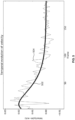
- FIG. 5 depicts a graphical representation illustrating modeled velocity profiles matching qualitatively with the Kinect ® data in accordance with an example embodiment of the present disclosure.
- the deviation of the Kinect ® data from the scaled joint model is due to the fact that the process of finding the instantaneous velocity involves taking numerical derivatives which amplify the high-frequency noise.
- Modeled velocity is represented by 502, and the data is shown represented by 504 in FIG. 5 .
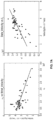
- FIG. 1 through 5 depicts a graphical representation illustrating variation in ⁇ p (state penalty) and ⁇ p (velocity penalty) with average applied torques in joints for a set of subjects in accordance with an example embodiment of the present disclosure.
- Each point (represented by black solid dot) in the plot represents a subject.
- FIGS. 7A-7B depict graphical representations illustrating variation in ⁇ p (state penalty) and ⁇ p (velocity penalty) with respect to average wrist velocities in different subjects in accordance with an example embodiment of the present disclosure.
- Each point (represented by black solid dot) in the plot represents a subject.
- FIG. 8A-8B depict variation in ⁇ p and ⁇ p for normal user(s) and user(s) under observation (patient) categories in accordance with an example embodiment of the present disclosure.
- the ⁇ p in FIG. 8A is significantly higher in patients (UUO) than in normal (normal users) whereas ⁇ p (in FIG. 8B ) is significantly lower in patients than in normal subjects (or normal users).
- FIG. 8A-8B show the comparison of the ⁇ p and ⁇ p in normal user and user under observation (e.g., patient) categories.
- To analyze the significance a welch's t-test was performed without assuming equal variance or equal number of samples.
- the objective of the embodiments of the present disclosure was to develop a methodology to quantify and understand the neuro-mechanical pathologies. It was found through the above experimental results and graphical representations as depicted in figures that the inverse optimal control methodology can be used to personalize model of the arm dynamics and joint cost (JC) functional. Thus the JC parameterized by ⁇ p and ⁇ p can be used to understand subject specific variations in different pathologies.
- the hardware device can be any kind of device which can be programmed including e.g. any kind of computer like a server or a personal computer, or the like, or any combination thereof.
- the device may also include means which could be e.g. hardware means like e.g. an application-specific integrated circuit (ASIC), a field-programmable gate array (FPGA), or a combination of hardware and software means, e.g.
- ASIC application-specific integrated circuit
- FPGA field-programmable gate array
- the means can include both hardware means and software means.
- the method embodiments described herein could be implemented in hardware and software.
- the device may also include software means.
- the embodiments may be implemented on different hardware devices, e.g. using a plurality of CPUs.
- the embodiments herein can comprise hardware and software elements.
- the embodiments that are implemented in software include but are not limited to, firmware, resident software, microcode, etc.
- the functions performed by various modules described herein may be implemented in other modules or combinations of other modules.
- a computer-usable or computer readable medium can be any apparatus that can comprise, store, communicate, propagate, or transport the program for use by or in connection with the instruction execution system, apparatus, or device.
- a computer-readable storage medium refers to any type of physical memory on which information or data readable by a processor may be stored.
- a computer-readable storage medium may store instructions for execution by one or more processors, including instructions for causing the processor(s) to perform steps or stages consistent with the embodiments described herein.
- the term "computer-readable medium” should be understood to include tangible items and exclude carrier waves and transient signals, i.e., be non-transitory. Examples include random access memory (RAM), read-only memory (ROM), volatile memory, nonvolatile memory, hard drives, CD ROMs, BLU-RAYs, DVDs, flash drives, disks, and any other known physical storage media.
Landscapes
- Health & Medical Sciences (AREA)
- Engineering & Computer Science (AREA)
- Public Health (AREA)
- Medical Informatics (AREA)
- Life Sciences & Earth Sciences (AREA)
- Biomedical Technology (AREA)
- General Health & Medical Sciences (AREA)
- Pathology (AREA)
- Physics & Mathematics (AREA)
- Theoretical Computer Science (AREA)
- General Engineering & Computer Science (AREA)
- Epidemiology (AREA)
- Databases & Information Systems (AREA)
- Primary Health Care (AREA)
- Data Mining & Analysis (AREA)
- Biophysics (AREA)
- Physiology (AREA)
- Heart & Thoracic Surgery (AREA)
- Molecular Biology (AREA)
- Surgery (AREA)
- Animal Behavior & Ethology (AREA)
- Veterinary Medicine (AREA)
- General Physics & Mathematics (AREA)
- Human Computer Interaction (AREA)
- Oral & Maxillofacial Surgery (AREA)
- Dentistry (AREA)
- Dermatology (AREA)
- Neurology (AREA)
- Neurosurgery (AREA)
- Gynecology & Obstetrics (AREA)
- Reproductive Health (AREA)
- Computer Networks & Wireless Communication (AREA)
- Measurement Of The Respiration, Hearing Ability, Form, And Blood Characteristics Of Living Organisms (AREA)
- Rehabilitation Tools (AREA)
Claims (6)
- Prozessorimplementiertes Verfahren, umfassend:Erhalten von neuromotorischen Daten von einem Kinect®-Sensor, die sich auf einen Benutzer unter Beobachtung (UUO) beziehen, wobei die neuromotorischen Daten Informationen umfassen, die sich auf eine Mehrzahl von Skelettgelenken beziehen, die für eine oder mehrere Aktionen spezifisch sind, die durch den UUO (302) durchgeführt werden;Skalieren eines Gelenkmodells für jeden UUO durch Identifizieren der einen oder mehreren Aktionen, die an der Mehrzahl von Skelettgelenken (304) durchgeführt werden, um mit einer oder mehreren experimentell erhaltenen Längen der Mehrzahl von Skelettgelenken übereinzustimmen;Parametrisieren des skalierten Gelenkmodells unter Verwendung eines oder mehrerer physiologisch interpretierbarer Modellparameter, um eine Gelenkkostenfunktion (JC) (306) zu erhalten;Optimieren der Gelenkkostenfunktion unter Verwendung einer inversen optimalen Steuerungstechnik durch Abstimmen des einen oder der mehreren physiologisch interpretierbaren Modellparameter (308), wobei die inverse optimale Steuerungstechnik eine Bilevel-Optimierung in der Natur ist und eine optimale Lösung auf zwei Ebenen erforderlich ist, und wobei eine erste Ebene das Finden einer richtigen Trajektorie unter Verwendung einer algebraischen Riccati-Formulierung erfordert und eine zweite Ebene unter Verwendung eines Downhill-Simplex-Algorithmus gelöst wird;Bestimmen einer Ebene der Abstimmung des einen oder der mehreren physiologisch interpretierbaren Modellparameter basierend auf der optimierten Gelenkkostenfunktion (310);Durchführen eines Vergleichs unter Verwendung eines oder mehrerer abgestimmter physiologisch interpretierbarer Modellparameter zwischen der Mehrzahl von Skelettgelenken, die für eine oder mehrere Aktionen spezifisch sind, die durch den UUO (302) durchgeführt werden, und einem oder mehreren entsprechenden Modellparametern, die für einen normalen Benutzer (NU) (312) vorberechnet werden, wobei der eine oder die mehreren physiologisch interpretierbaren Modellparameter ein oder mehrere angewandte Drehmomente an einem oder mehreren Skelettgelenken der Mehrzahl von Skelettgelenken im Gelenkmodell, Bewegungsgeschwindigkeit an dem einen oder den mehreren Skelettgelenken unter Berücksichtigung und einen oder mehrere Eulerwinkel des einen oder der mehreren Skelettgelenke umfassen; undDetektieren eines oder mehrerer Zustände einer Mehrzahl von neuromuskulären Profilen, wobei die neuromuskulären Profile detektiert werden, wenn Variation(en) in einem oder mehreren Werten, die mit dem einen oder den mehreren abgestimmten physiologisch interpretierbaren Modellparametern assoziiert sind, im Vergleich zu dem einen oder den mehreren entsprechenden Modellparametern, die für den normalen Benutzer (NU) vorberechnet werden, bestimmt werden, und wobei die neuromuskulären Profile modellierte Geschwindigkeitsprofile sind, die eine Darstellung einer zeitlichen Entwicklung von modellierter und beobachteter Geschwindigkeit gegenüber einem Rahmen von Kinect-Daten angeben.
- Prozessorimplementiertes Verfahren nach Anspruch 1, wobei der Schritt des Skalierens eines Gelenkmodells auf der einen oder den mehreren Aktionen basiert, die durch Verfolgen einer realen Bewegung des UUO extrahiert werden.
- System (100), umfassend:einen Speicher (102), der Anweisungen speichert;eine oder mehrere Kommunikationsschnittstellen (106); undeinen oder mehrere Hardwareprozessoren (104), die über die eine oder die mehreren Kommunikationsschnittstellen (106) mit dem Speicher (102) gekoppelt sind, wobei der eine oder die mehreren Hardwareprozessoren (104) durch die Anweisungen konfiguriert sind zum:Erhalten von neuromotorischen Daten von einem Kinect®-Sensor, die sich auf einen Benutzer unter Beobachtung (UUO) beziehen, wobei die neuromotorischen Daten Informationen umfassen, die sich auf eine Mehrzahl von Skelettgelenken beziehen, die für eine oder mehrere Aktionen spezifisch sind, die durch den UUO durchgeführt werden,Skalieren eines Gelenkmodells für jeden UUO durch Identifizieren der einen oder mehreren Aktionen, die an der Mehrzahl von Skelettgelenken durchgeführt werden, um mit einer oder mehreren experimentell erhaltenen Längen der Mehrzahl von Skelettgelenken übereinzustimmen;Parametrisieren des skalierten Gelenkmodells unter Verwendung eines oder mehrerer physiologisch interpretierbarer Modellparameter, um eine Gelenkkostenfunktion (JC) zu erhalten;Optimieren der Gelenkkostenfunktion unter Verwendung einer inversen optimalen Steuerungstechnik durch Abstimmen des einen oder der mehreren physiologisch interpretierbaren Modellparameter, wobei die inverse optimale Steuerungstechnik eine Bilevel-Optimierung in der Natur ist und eine optimale Lösung auf zwei Ebenen erforderlich ist, und wobei eine erste Ebene das Finden einer richtigen Trajektorie unter Verwendung einer algebraischen Riccati-Formulierung erfordert und eine zweite Ebene unter Verwendung eines Downhill-Simplex-Algorithmus gelöst wird;Bestimmen einer Ebene der Abstimmung des einen oder der mehreren physiologisch interpretierbaren Modellparameter basierend auf der optimierten Gelenkkostenfunktion,Durchführen eines Vergleichs unter Verwendung eines oder mehrerer abgestimmter physiologisch interpretierbarer Modellparameter zwischen der Mehrzahl von Skelettgelenken, die für eine oder mehrere Aktionen spezifisch sind, die durch den UUO (302) durchgeführt werden, und einem oder mehreren entsprechenden Modellparametern, die für einen normalen Benutzer (NU) vorberechnet werden, wobei der eine oder die mehreren physiologisch interpretierbaren Modellparameter ein oder mehrere angewandte Drehmomente an einem oder mehreren Skelettgelenken der Mehrzahl von Skelettgelenken im Gelenkmodell, Bewegungsgeschwindigkeit an dem einen oder den mehreren Skelettgelenken unter Berücksichtigung und einen oder mehrere Eulerwinkel des einen oder der mehreren Skelettgelenke umfassen;Detektieren eines oder mehrerer Zustände einer Mehrzahl von neuromuskulären Profilen, wobei die neuromuskulären Profile detektiert werden, wenn Variation(en) in einem oder mehreren Werten, die mit dem einen oder den mehreren abgestimmten physiologisch interpretierbaren Modellparametern assoziiert sind, im Vergleich zu dem einen oder den mehreren entsprechenden Modellparametern, die für den normalen Benutzer (NU) vorberechnet werden, bestimmt werden, und wobei die neuromuskulären Profile modellierte Geschwindigkeitsprofile sind, die eine Darstellung einer zeitlichen Entwicklung von modellierter und beobachteter Geschwindigkeit gegenüber einem Rahmen von Kinect-Daten angeben.
- System nach Anspruch 3, wobei das Gelenkmodell basierend auf der einen oder den mehreren Aktionen skaliert wird, die durch Verfolgen einer realen Bewegung des UUO extrahiert werden.
- Ein oder mehrere nichtflüchtige maschinenlesbare Informationsspeichermedien, umfassend eine oder mehrere Anweisungen, die, wenn sie durch einen oder mehrere Hardwareprozessoren ausgeführt werden, bewirken:Erhalten von neuromotorischen Daten von einem Kinect®-Sensor, die sich auf einen Benutzer unter Beobachtung (UUO) beziehen, wobei die neuromotorischen Daten Informationen umfassen, die sich auf eine Mehrzahl von Skelettgelenken beziehen, die für eine oder mehrere Aktionen spezifisch sind, die durch den UUO durchgeführt werden;Skalieren eines Gelenkmodells für jeden UUO durch Identifizieren der einen oder mehreren Aktionen, die an der Mehrzahl von Skelettgelenken durchgeführt werden, um mit einer oder mehreren experimentell erhaltenen Längen der Mehrzahl von Skelettgelenken übereinzustimmen;Parametrisieren des skalierten Gelenkmodells unter Verwendung eines oder mehrerer physiologisch interpretierbarer Modellparameter, um eine Gelenkkostenfunktion (JC) zu erhalten;Optimieren der Gelenkkostenfunktion unter Verwendung einer inversen optimalen Steuerungstechnik durch Abstimmen des einen oder der mehreren physiologisch interpretierbaren Modellparameter, wobei die inverse optimale Steuerungstechnik eine Bilevel-Optimierung in der Natur ist und eine optimale Lösung auf zwei Ebenen erforderlich ist, und wobei eine erste Ebene das Finden einer richtigen Trajektorie unter Verwendung einer algebraischen Riccati-Formulierung erfordert und eine zweite Ebene unter Verwendung eines Downhill-Simplex-Algorithmus gelöst wird;Bestimmen einer Ebene der Abstimmung des einen oder der mehreren physiologisch interpretierbaren Modellparameter basierend auf der optimierten Gelenkkostenfunktion;Durchführen eines Vergleichs unter Verwendung des einen oder der mehreren abgestimmten physiologisch interpretierbaren Modellparameter zwischen der Mehrzahl von Skelettgelenken, die für eine oder mehrere Aktionen spezifisch sind, die durch den UUO (302) durchgeführt werden, und einem oder mehreren entsprechenden Modellparametern, die für einen normalen Benutzer (NU) vorberechnet werden, wobei der eine oder die mehreren physiologisch interpretierbaren Modellparameter ein oder mehrere angewandte Drehmomente an einem oder mehreren Skelettgelenken der Mehrzahl von Skelettgelenken im Gelenkmodell, Bewegungsgeschwindigkeit an dem einen oder den mehreren Skelettgelenken unter Berücksichtigung und einen oder mehrere Eulerwinkel des einen oder der mehreren Skelettgelenke umfassen; und
Detektieren eines oder mehrerer Zustände einer Mehrzahl von neuromuskulären Profilen, wobei die neuromuskulären Profile detektiert werden, wenn Variation(en) in einem oder mehreren Werten, die mit dem einen oder den mehreren abgestimmten physiologisch interpretierbaren Modellparametern assoziiert sind, im Vergleich zu dem einen oder den mehreren entsprechenden Modellparametern, die für den normalen Benutzer (NU) vorberechnet werden, bestimmt werden, und wobei die neuromuskulären Profile modellierte Geschwindigkeitsprofile sind, die eine Darstellung einer zeitlichen Entwicklung von modellierter und beobachteter Geschwindigkeit gegenüber einem Rahmen von Kinect-Daten angeben. - Ein oder mehrere nichtflüchtige maschinenlesbare Informationsspeichermedien nach Anspruch 5, wobei der Schritt des Skalierens eines Gelenkmodells auf der einen oder den mehreren Aktionen basiert, die durch Verfolgen einer realen Bewegung des UUO extrahiert werden.
Applications Claiming Priority (1)
| Application Number | Priority Date | Filing Date | Title |
|---|---|---|---|
| IN201721037061 | 2017-10-18 |
Publications (3)
| Publication Number | Publication Date |
|---|---|
| EP3474290A1 EP3474290A1 (de) | 2019-04-24 |
| EP3474290B1 true EP3474290B1 (de) | 2024-06-19 |
| EP3474290C0 EP3474290C0 (de) | 2024-06-19 |
Family
ID=63857787
Family Applications (1)
| Application Number | Title | Priority Date | Filing Date |
|---|---|---|---|
| EP18200343.4A Active EP3474290B1 (de) | 2017-10-18 | 2018-10-15 | Systeme und verfahren zur optimierung einer gemeinsamen kostenfunktion und zum erfassen von neuro-muskulären profilen davon |
Country Status (3)
| Country | Link |
|---|---|
| US (1) | US20190115109A1 (de) |
| EP (1) | EP3474290B1 (de) |
| SG (1) | SG10201809077TA (de) |
Families Citing this family (1)
| Publication number | Priority date | Publication date | Assignee | Title |
|---|---|---|---|---|
| CN111048205A (zh) * | 2019-12-17 | 2020-04-21 | 创新工场(北京)企业管理股份有限公司 | 对帕金森病症状进行评估的方法与装置 |
Family Cites Families (6)
| Publication number | Priority date | Publication date | Assignee | Title |
|---|---|---|---|---|
| AU2001292946A1 (en) * | 2000-09-26 | 2002-04-08 | Advantage 3D Llc | Method and system for generation, storage and distribution of omni-directional object views |
| US8013852B2 (en) * | 2002-08-02 | 2011-09-06 | Honda Giken Kogyo Kabushiki Kaisha | Anthropometry-based skeleton fitting |
| US7804998B2 (en) * | 2006-03-09 | 2010-09-28 | The Board Of Trustees Of The Leland Stanford Junior University | Markerless motion capture system |
| US20110054870A1 (en) * | 2009-09-02 | 2011-03-03 | Honda Motor Co., Ltd. | Vision Based Human Activity Recognition and Monitoring System for Guided Virtual Rehabilitation |
| US9538940B2 (en) * | 2012-05-03 | 2017-01-10 | University of Pittsburgh—of the Commonwealth System of Higher Education | Intelligent algorithms for tracking three-dimensional skeletal movement from radiographic image sequences |
| US10262423B2 (en) * | 2016-03-29 | 2019-04-16 | Verily Life Sciences Llc | Disease and fall risk assessment using depth mapping systems |
-
2018
- 2018-10-12 US US16/159,245 patent/US20190115109A1/en not_active Abandoned
- 2018-10-15 SG SG10201809077TA patent/SG10201809077TA/en unknown
- 2018-10-15 EP EP18200343.4A patent/EP3474290B1/de active Active
Also Published As
| Publication number | Publication date |
|---|---|
| EP3474290C0 (de) | 2024-06-19 |
| US20190115109A1 (en) | 2019-04-18 |
| EP3474290A1 (de) | 2019-04-24 |
| SG10201809077TA (en) | 2019-05-30 |
Similar Documents
| Publication | Publication Date | Title |
|---|---|---|
| US11957478B2 (en) | Methods and apparatus for machine learning to analyze musculo-skeletal rehabilitation from images | |
| Zhu et al. | Using deep learning for energy expenditure estimation with wearable sensors | |
| US11759126B2 (en) | Scoring metric for physical activity performance and tracking | |
| Chiovetto et al. | Low-dimensional organization of angular momentum during walking on a narrow beam | |
| Sheng et al. | An automated system for motor function assessment in stroke patients using motion sensing technology: A pilot study | |
| Bao et al. | A global bibliometric and visualized analysis of gait analysis and artificial intelligence research from 1992 to 2022 | |
| Kim et al. | Learning-based 3D human kinematics estimation using behavioral constraints from activity classification | |
| Quesada et al. | EMG-to-torque models for exoskeleton assistance: a framework for the evaluation of in situ calibration | |
| EP3474290B1 (de) | Systeme und verfahren zur optimierung einer gemeinsamen kostenfunktion und zum erfassen von neuro-muskulären profilen davon | |
| CN119851869B (zh) | 一种重症康复训练监测方法及装置 | |
| Marusic et al. | PhysioFormer: A spatio-temporal transformer for physical rehabilitation assessment | |
| Hurtado-Perez et al. | Use of technologies for the acquisition and processing strategies for motion data analysis | |
| Das et al. | Online detection of compensatory strategies in human movement with supervised classification: a pilot study | |
| Galasso | Development of a Machine Learning-based Marker-less Gait Analysis System for Clinical Applications | |
| Heeb et al. | Building effective machine learning models for ankle joint power estimation during walking using FMG sensors | |
| Wang et al. | MicroXercise: A Micro-Level Comparative and Explainable System for Remote Physical Therapy | |
| Cai et al. | IoT-based gait monitoring system for static and dynamic classification of data | |
| Vijayan et al. | Implementing Pattern Recognition and Matching techniques to automatically detect standardized functional tests from wearable technology | |
| Zhang et al. | Real-time forecasting of pathological gait via IMU navigation: a few-shot and generative learning framework for wearable devices | |
| Patterson et al. | Online change detection for timely solicitation of user interaction | |
| Grandhi et al. | Adaptive robot-assisted telerehabilitation system using model predictive control and digital twin for personalized upper limb therapy | |
| Manouchehri et al. | Multivariate Beta-Based Hierarchical Dirichlet Process Hidden Markov Models in Medical Applications | |
| US12478311B1 (en) | System and method for early detection of movement instability | |
| Zhu et al. | Optimizing Athlete Workload Monitoring with Supervised Machine Learning for Running Surface Classification Using Inertial Sensors. | |
| Stihi et al. | Hierarchical Gaussian processes for characterizing gait variability in multiple sclerosis |
Legal Events
| Date | Code | Title | Description |
|---|---|---|---|
| PUAI | Public reference made under article 153(3) epc to a published international application that has entered the european phase |
Free format text: ORIGINAL CODE: 0009012 |
|
| STAA | Information on the status of an ep patent application or granted ep patent |
Free format text: STATUS: THE APPLICATION HAS BEEN PUBLISHED |
|
| AK | Designated contracting states |
Kind code of ref document: A1 Designated state(s): AL AT BE BG CH CY CZ DE DK EE ES FI FR GB GR HR HU IE IS IT LI LT LU LV MC MK MT NL NO PL PT RO RS SE SI SK SM TR |
|
| AX | Request for extension of the european patent |
Extension state: BA ME |
|
| STAA | Information on the status of an ep patent application or granted ep patent |
Free format text: STATUS: REQUEST FOR EXAMINATION WAS MADE |
|
| 17P | Request for examination filed |
Effective date: 20191024 |
|
| RBV | Designated contracting states (corrected) |
Designated state(s): AL AT BE BG CH CY CZ DE DK EE ES FI FR GB GR HR HU IE IS IT LI LT LU LV MC MK MT NL NO PL PT RO RS SE SI SK SM TR |
|
| STAA | Information on the status of an ep patent application or granted ep patent |
Free format text: STATUS: EXAMINATION IS IN PROGRESS |
|
| 17Q | First examination report despatched |
Effective date: 20210226 |
|
| GRAP | Despatch of communication of intention to grant a patent |
Free format text: ORIGINAL CODE: EPIDOSNIGR1 |
|
| STAA | Information on the status of an ep patent application or granted ep patent |
Free format text: STATUS: GRANT OF PATENT IS INTENDED |
|
| INTG | Intention to grant announced |
Effective date: 20240122 |
|
| GRAS | Grant fee paid |
Free format text: ORIGINAL CODE: EPIDOSNIGR3 |
|
| GRAA | (expected) grant |
Free format text: ORIGINAL CODE: 0009210 |
|
| STAA | Information on the status of an ep patent application or granted ep patent |
Free format text: STATUS: THE PATENT HAS BEEN GRANTED |
|
| AK | Designated contracting states |
Kind code of ref document: B1 Designated state(s): AL AT BE BG CH CY CZ DE DK EE ES FI FR GB GR HR HU IE IS IT LI LT LU LV MC MK MT NL NO PL PT RO RS SE SI SK SM TR |
|
| REG | Reference to a national code |
Ref country code: GB Ref legal event code: FG4D |
|
| REG | Reference to a national code |
Ref country code: CH Ref legal event code: EP |
|
| REG | Reference to a national code |
Ref country code: DE Ref legal event code: R096 Ref document number: 602018070730 Country of ref document: DE |
|
| U01 | Request for unitary effect filed |
Effective date: 20240619 |
|
| U07 | Unitary effect registered |
Designated state(s): AT BE BG DE DK EE FI FR IT LT LU LV MT NL PT SE SI Effective date: 20240627 |
|
| PG25 | Lapsed in a contracting state [announced via postgrant information from national office to epo] |
Ref country code: HR Free format text: LAPSE BECAUSE OF FAILURE TO SUBMIT A TRANSLATION OF THE DESCRIPTION OR TO PAY THE FEE WITHIN THE PRESCRIBED TIME-LIMIT Effective date: 20240619 |
|
| PG25 | Lapsed in a contracting state [announced via postgrant information from national office to epo] |
Ref country code: GR Free format text: LAPSE BECAUSE OF FAILURE TO SUBMIT A TRANSLATION OF THE DESCRIPTION OR TO PAY THE FEE WITHIN THE PRESCRIBED TIME-LIMIT Effective date: 20240920 |
|
| PG25 | Lapsed in a contracting state [announced via postgrant information from national office to epo] |
Ref country code: NO Free format text: LAPSE BECAUSE OF FAILURE TO SUBMIT A TRANSLATION OF THE DESCRIPTION OR TO PAY THE FEE WITHIN THE PRESCRIBED TIME-LIMIT Effective date: 20240919 Ref country code: HR Free format text: LAPSE BECAUSE OF FAILURE TO SUBMIT A TRANSLATION OF THE DESCRIPTION OR TO PAY THE FEE WITHIN THE PRESCRIBED TIME-LIMIT Effective date: 20240619 Ref country code: GR Free format text: LAPSE BECAUSE OF FAILURE TO SUBMIT A TRANSLATION OF THE DESCRIPTION OR TO PAY THE FEE WITHIN THE PRESCRIBED TIME-LIMIT Effective date: 20240920 Ref country code: RS Free format text: LAPSE BECAUSE OF FAILURE TO SUBMIT A TRANSLATION OF THE DESCRIPTION OR TO PAY THE FEE WITHIN THE PRESCRIBED TIME-LIMIT Effective date: 20240919 |
|
| U20 | Renewal fee for the european patent with unitary effect paid |
Year of fee payment: 7 Effective date: 20241025 |
|
| PG25 | Lapsed in a contracting state [announced via postgrant information from national office to epo] |
Ref country code: PL Free format text: LAPSE BECAUSE OF FAILURE TO SUBMIT A TRANSLATION OF THE DESCRIPTION OR TO PAY THE FEE WITHIN THE PRESCRIBED TIME-LIMIT Effective date: 20240619 |
|
| PG25 | Lapsed in a contracting state [announced via postgrant information from national office to epo] |
Ref country code: IS Free format text: LAPSE BECAUSE OF FAILURE TO SUBMIT A TRANSLATION OF THE DESCRIPTION OR TO PAY THE FEE WITHIN THE PRESCRIBED TIME-LIMIT Effective date: 20241019 |
|
| PG25 | Lapsed in a contracting state [announced via postgrant information from national office to epo] |
Ref country code: CZ Free format text: LAPSE BECAUSE OF FAILURE TO SUBMIT A TRANSLATION OF THE DESCRIPTION OR TO PAY THE FEE WITHIN THE PRESCRIBED TIME-LIMIT Effective date: 20240619 |
|
| PG25 | Lapsed in a contracting state [announced via postgrant information from national office to epo] |
Ref country code: RO Free format text: LAPSE BECAUSE OF FAILURE TO SUBMIT A TRANSLATION OF THE DESCRIPTION OR TO PAY THE FEE WITHIN THE PRESCRIBED TIME-LIMIT Effective date: 20240619 Ref country code: SK Free format text: LAPSE BECAUSE OF FAILURE TO SUBMIT A TRANSLATION OF THE DESCRIPTION OR TO PAY THE FEE WITHIN THE PRESCRIBED TIME-LIMIT Effective date: 20240619 |
|
| PG25 | Lapsed in a contracting state [announced via postgrant information from national office to epo] |
Ref country code: ES Free format text: LAPSE BECAUSE OF FAILURE TO SUBMIT A TRANSLATION OF THE DESCRIPTION OR TO PAY THE FEE WITHIN THE PRESCRIBED TIME-LIMIT Effective date: 20240619 Ref country code: SM Free format text: LAPSE BECAUSE OF FAILURE TO SUBMIT A TRANSLATION OF THE DESCRIPTION OR TO PAY THE FEE WITHIN THE PRESCRIBED TIME-LIMIT Effective date: 20240619 |
|
| PG25 | Lapsed in a contracting state [announced via postgrant information from national office to epo] |
Ref country code: SM Free format text: LAPSE BECAUSE OF FAILURE TO SUBMIT A TRANSLATION OF THE DESCRIPTION OR TO PAY THE FEE WITHIN THE PRESCRIBED TIME-LIMIT Effective date: 20240619 Ref country code: SK Free format text: LAPSE BECAUSE OF FAILURE TO SUBMIT A TRANSLATION OF THE DESCRIPTION OR TO PAY THE FEE WITHIN THE PRESCRIBED TIME-LIMIT Effective date: 20240619 Ref country code: RO Free format text: LAPSE BECAUSE OF FAILURE TO SUBMIT A TRANSLATION OF THE DESCRIPTION OR TO PAY THE FEE WITHIN THE PRESCRIBED TIME-LIMIT Effective date: 20240619 Ref country code: PL Free format text: LAPSE BECAUSE OF FAILURE TO SUBMIT A TRANSLATION OF THE DESCRIPTION OR TO PAY THE FEE WITHIN THE PRESCRIBED TIME-LIMIT Effective date: 20240619 Ref country code: IS Free format text: LAPSE BECAUSE OF FAILURE TO SUBMIT A TRANSLATION OF THE DESCRIPTION OR TO PAY THE FEE WITHIN THE PRESCRIBED TIME-LIMIT Effective date: 20241019 Ref country code: ES Free format text: LAPSE BECAUSE OF FAILURE TO SUBMIT A TRANSLATION OF THE DESCRIPTION OR TO PAY THE FEE WITHIN THE PRESCRIBED TIME-LIMIT Effective date: 20240619 Ref country code: CZ Free format text: LAPSE BECAUSE OF FAILURE TO SUBMIT A TRANSLATION OF THE DESCRIPTION OR TO PAY THE FEE WITHIN THE PRESCRIBED TIME-LIMIT Effective date: 20240619 |
|
| PLBE | No opposition filed within time limit |
Free format text: ORIGINAL CODE: 0009261 |
|
| STAA | Information on the status of an ep patent application or granted ep patent |
Free format text: STATUS: NO OPPOSITION FILED WITHIN TIME LIMIT |
|
| 26N | No opposition filed |
Effective date: 20250320 |
|
| PG25 | Lapsed in a contracting state [announced via postgrant information from national office to epo] |
Ref country code: MC Free format text: LAPSE BECAUSE OF FAILURE TO SUBMIT A TRANSLATION OF THE DESCRIPTION OR TO PAY THE FEE WITHIN THE PRESCRIBED TIME-LIMIT Effective date: 20240619 |
|
| PG25 | Lapsed in a contracting state [announced via postgrant information from national office to epo] |
Ref country code: IE Free format text: LAPSE BECAUSE OF NON-PAYMENT OF DUE FEES Effective date: 20241015 |
|
| REG | Reference to a national code |
Ref country code: CH Ref legal event code: U11 Free format text: ST27 STATUS EVENT CODE: U-0-0-U10-U11 (AS PROVIDED BY THE NATIONAL OFFICE) Effective date: 20251101 |
|
| U20 | Renewal fee for the european patent with unitary effect paid |
Year of fee payment: 8 Effective date: 20251027 |
|
| PGFP | Annual fee paid to national office [announced via postgrant information from national office to epo] |
Ref country code: GB Payment date: 20251023 Year of fee payment: 8 |
|
| PGFP | Annual fee paid to national office [announced via postgrant information from national office to epo] |
Ref country code: CH Payment date: 20251101 Year of fee payment: 8 |
|
| PG25 | Lapsed in a contracting state [announced via postgrant information from national office to epo] |
Ref country code: CY Free format text: LAPSE BECAUSE OF FAILURE TO SUBMIT A TRANSLATION OF THE DESCRIPTION OR TO PAY THE FEE WITHIN THE PRESCRIBED TIME-LIMIT; INVALID AB INITIO Effective date: 20181015 |