EP3474274B1 - Spracherkennungsverfahren und -vorrichtung - Google Patents
Spracherkennungsverfahren und -vorrichtung Download PDFInfo
- Publication number
- EP3474274B1 EP3474274B1 EP18199047.4A EP18199047A EP3474274B1 EP 3474274 B1 EP3474274 B1 EP 3474274B1 EP 18199047 A EP18199047 A EP 18199047A EP 3474274 B1 EP3474274 B1 EP 3474274B1
- Authority
- EP
- European Patent Office
- Prior art keywords
- pronunciation
- speech recognition
- layer
- frames
- skip
- Prior art date
- Legal status (The legal status is an assumption and is not a legal conclusion. Google has not performed a legal analysis and makes no representation as to the accuracy of the status listed.)
- Active
Links
Images




Classifications
-
- G—PHYSICS
- G10—MUSICAL INSTRUMENTS; ACOUSTICS
- G10L—SPEECH ANALYSIS TECHNIQUES OR SPEECH SYNTHESIS; SPEECH RECOGNITION; SPEECH OR VOICE PROCESSING TECHNIQUES; SPEECH OR AUDIO CODING OR DECODING
- G10L15/00—Speech recognition
- G10L15/08—Speech classification or search
- G10L15/16—Speech classification or search using artificial neural networks
-
- G—PHYSICS
- G10—MUSICAL INSTRUMENTS; ACOUSTICS
- G10L—SPEECH ANALYSIS TECHNIQUES OR SPEECH SYNTHESIS; SPEECH RECOGNITION; SPEECH OR VOICE PROCESSING TECHNIQUES; SPEECH OR AUDIO CODING OR DECODING
- G10L15/00—Speech recognition
- G10L15/06—Creation of reference templates; Training of speech recognition systems, e.g. adaptation to the characteristics of the speaker's voice
- G10L15/063—Training
-
- G—PHYSICS
- G06—COMPUTING OR CALCULATING; COUNTING
- G06N—COMPUTING ARRANGEMENTS BASED ON SPECIFIC COMPUTATIONAL MODELS
- G06N3/00—Computing arrangements based on biological models
- G06N3/02—Neural networks
- G06N3/08—Learning methods
- G06N3/084—Backpropagation, e.g. using gradient descent
-
- G—PHYSICS
- G10—MUSICAL INSTRUMENTS; ACOUSTICS
- G10L—SPEECH ANALYSIS TECHNIQUES OR SPEECH SYNTHESIS; SPEECH RECOGNITION; SPEECH OR VOICE PROCESSING TECHNIQUES; SPEECH OR AUDIO CODING OR DECODING
- G10L15/00—Speech recognition
- G10L15/08—Speech classification or search
-
- G—PHYSICS
- G10—MUSICAL INSTRUMENTS; ACOUSTICS
- G10L—SPEECH ANALYSIS TECHNIQUES OR SPEECH SYNTHESIS; SPEECH RECOGNITION; SPEECH OR VOICE PROCESSING TECHNIQUES; SPEECH OR AUDIO CODING OR DECODING
- G10L15/00—Speech recognition
- G10L15/08—Speech classification or search
- G10L15/18—Speech classification or search using natural language modelling
- G10L15/183—Speech classification or search using natural language modelling using context dependencies, e.g. language models
- G10L15/187—Phonemic context, e.g. pronunciation rules, phonotactical constraints or phoneme n-grams
-
- G—PHYSICS
- G10—MUSICAL INSTRUMENTS; ACOUSTICS
- G10L—SPEECH ANALYSIS TECHNIQUES OR SPEECH SYNTHESIS; SPEECH RECOGNITION; SPEECH OR VOICE PROCESSING TECHNIQUES; SPEECH OR AUDIO CODING OR DECODING
- G10L15/00—Speech recognition
- G10L15/06—Creation of reference templates; Training of speech recognition systems, e.g. adaptation to the characteristics of the speaker's voice
- G10L15/063—Training
- G10L2015/0631—Creating reference templates; Clustering
-
- G—PHYSICS
- G10—MUSICAL INSTRUMENTS; ACOUSTICS
- G10L—SPEECH ANALYSIS TECHNIQUES OR SPEECH SYNTHESIS; SPEECH RECOGNITION; SPEECH OR VOICE PROCESSING TECHNIQUES; SPEECH OR AUDIO CODING OR DECODING
- G10L15/00—Speech recognition
- G10L15/08—Speech classification or search
- G10L2015/085—Methods for reducing search complexity, pruning
Definitions
- the following description relates to a speech recognition method and apparatus.
- a speech recognition system may include an acoustic model, a language model, and a decoder.
- the acoustic model provides information on an association between a speech signal and a pronunciation
- the language model provides information on how frequently specific word sequences occur in the language.
- the decoder calculates an association between the speech signal and the sentence based on the information provided by the acoustic model and the language model.
- the acoustic model may be implemented by a neural network.
- a parallel calculation cannot be readily performed, and a calculation time may thus increase, as a number of frames of a speech signal increases.
- US-2006/111897 is acknowledged as prior art, over which features in the characterizing portions of the appended independent claims are novel and involve the presence of an inventive step.
- a speech recognition method includes the steps of claim 1 or the steps of claim 6.
- Claims 10 and 11 provide a corresponding non-transitory computer-readable medium and a speech recognition apparatus, respectively.
- first,” “second,” and “third” may be used herein to describe various members, components, regions, layers, or sections, these members, components, regions, layers, or sections are not to be limited by these terms. Rather, these terms are only used to distinguish one member, component, region, layer, or section from another member, component, region, layer, or section. Thus, a first member, component, region, layer, or section referred to in examples described herein may also be referred to as a second member, component, region, layer, or section without departing from the teachings of the examples.
- Examples described herein may be embodied in various types of products, for example, a personal computer (PC), a laptop computer, a tablet PC, a smartphone, a television (TV), a smart home appliance, an intelligent vehicle, a kiosk, and a wearable device.
- the examples may be applied to user verification or authentication used in, for example, a smartphone, a mobile device, and a smart home system.
- the examples may also be applied to payment services to be provided through user verification or authentication. Further, the examples may also be applied to an intelligent vehicle system that automatically starts a vehicle through user verification or authentication.
- FIG. 1 is a flowchart illustrating an example of a speech recognition method.
- the speech recognition method described hereinafter may be performed by a speech recognition apparatus described herein.
- the speech recognition apparatus obtains an acoustic sequence divided into a plurality of frames.
- the speech recognition apparatus is a hardware apparatus configured to process information required to perform speech recognition.
- the speech recognition apparatus performs operations and calculations and processes instructions that are related to speech recognition.
- the speech recognition apparatus may be provided in various computing apparatuses and/or systems, some examples of which include a smartphone, a tablet PC, a laptop computer, a desktop computer, a TV, a wearable device, a security system, and a smart home system.
- the speech recognition apparatus may load information associated with an acoustic model from a database provided in advance.
- the database may be embodied as a memory included in the speech recognition apparatus or an external device, such as a server connected to the speech recognition apparatus through a network or wired or wireless communications.
- the speech recognition apparatus obtains an acoustic sequence.
- the speech recognition apparatus divides the obtained acoustic sequence into a plurality of frames.
- the acoustic sequence is a speech signal including speech information and is divided into frames.
- a one second (sec) acoustic sequence is divided into 100 frames each including 10 milliseconds (msec) of speech information.
- the speech recognition apparatus predicts a duration of a same pronunciation in the acoustic sequence, and determines pronunciations in the acoustic sequence by skipping a pronunciation prediction for a frame corresponding to the predicted duration.
- the duration of the same pronunciation may be represented by the number of frames for which the pronunciation prediction is to be skipped.
- the speech recognition apparatus performs speech recognition by dynamically skipping at least a portion of the acoustic sequence.
- the speech recognition apparatus predicts a pronunciation of a frame included in the acoustic sequence, predicts a duration of the pronunciation, and skips a subsequent frame corresponding to the predicted duration of the pronunciation.
- the speech recognition method described herein dynamically determines the number of frames to be skipped based on a pronunciation.
- the speech recognition apparatus uses an acoustic model to process a speech signal.
- the acoustic model is embodied by a neural network.
- the neural network include a deep neural network (DNN), a recurrent neural network (RNN), and a recurrent DNN (RDNN).
- the speech recognition apparatus uses an acoustic model trained in advance to dynamically skip a time step that is considered relatively less important when predicting the pronunciations corresponding to the acoustic sequence. For example, using the acoustic model embodied by an RNN, the speech recognition apparatus predicts a target for which a pronunciation prediction is to be skipped, and predicts the pronunciations corresponding to the acoustic sequence.
- the RNN is trained to predict a pronunciation and skip a pronunciation prediction.
- the RNN includes a network for a pronunciation prediction and a network for a skipping prediction, and the networks share information in the speech signal corresponding to the acoustic sequence.
- the speech recognition apparatus when processing the acoustic sequence, dynamically adjusts a size of a portion of the acoustic sequence to be skipped to minimize an information loss and a processing time. For example, when processing sequential data such as text and speech, the speech recognition apparatus increases a processing speed of speech recognition by decreasing a number of read operations needed to process information, increases a response speed of speech recognition by reducing an amount of information in the acoustic sequence to be processed, and reduces a server cost by increasing a concurrent connection throughput of a server for speech recognition.
- FIGS. 2 through 4 a speech recognition method will be described with reference to FIGS. 2 through 4 , and a training method for speech recognition will be described with reference to FIGS. 5 and 6 .
- a system and an apparatus will be described with reference to FIGS. 7 and 8 .
- FIG. 2 is a diagram illustrating another example of a speech recognition method.
- the speech recognition method described hereinafter may be performed by a speech recognition apparatus described herein.
- the speech recognition apparatus performs speech recognition using an acoustic model embodied by a DNN, an RNN, or an RDNN.
- a DNN acoustic model embodied by a DNN
- RNN acoustic model embodied by a DNN
- RDNN RDNN
- an input and an output are independent of each other.
- the RNN has an architecture in which previous outputs affect a result of calculating or computing a new output.
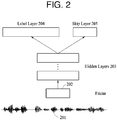
- the speech recognition apparatus divides an acoustic sequence 201 into a plurality of frames, and predicts at least one pronunciation of the frames and a duration of the pronunciation.
- the speech recognition apparatus performs speech recognition using an acoustic model, which includes an input layer (not shown), a plurality of hidden layers 203, and an output layer.
- the output layer of the acoustic model includes a label layer 204 and a skip layer 205.
- the label layer 204 is a layer used to predict a pronunciation of an input frame 202
- the skip layer 205 is a layer used to predict a duration of the pronunciation of the input frame 202.
- the label layer 204 and the skip layer 205 each may be a softmax layer.
- the label layer 204 includes a number of nodes that is equal to a number of all possible pronunciations. Each of the nodes of the label layer 204 indicates a probability of the input frame 202 having a certain pronunciation.
- the skip layer 205 includes a number of nodes that is equal to a number of all possible choices for a number of frames for which pronunciation prediction is to be skipped.
- a first node of the skip layer 205 indicates a probability of not skipping a frame, i.e., a probability of skipping 0 frames
- a second node of the skip layer 205 indicates a probability of skipping one frame
- a third node of the skip layer 205 indicates a probability of skipping two frames
- an n-th node of the skip layer 205 indicates a probability of skipping n-1 frames. That is, there are n choices of 0 to n-1 frames that are to be skipped, so the skip layer 205 includes n node respectively corresponding to these n choices.
- the maximum permissible number of frames for which the pronunciation prediction can be skipped is set based on a desired tradeoff between an accuracy of speech recognition and a speed of speech recognition. Increasing the maximum permissible number of frames for which the pronunciation prediction can be skipped decreases the accuracy of speech recognition and increases the speed of speech recognition, and decreasing the maximum permissible number of frames for which the pronunciation prediction can be skipped increases the accuracy of speech recognition and decreases the speed of speech recognition.
- FIG. 3 is a diagram illustrating another example of a speech recognition method.
- the speech recognition method described hereinafter may be performed by a speech recognition apparatus described herein.
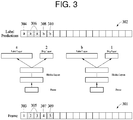
- the speech recognition apparatus predicts a pronunciation of a given frame using an acoustic model, and simultaneously predicts a number of frames following the given frame to be skipped.
- the speech recognition apparatus then applies, to a pronunciation probability of a frame to be skipped, a pronunciation probability of a current frame. For example, when a given frame is a first frame and five frames are determined to be skipped, the speech recognition apparatus skips five frames following the first frame, that is, second through sixth frames, without processing the five frames.
- the speech recognition apparatus predicts a pronunciation of a seventh frame following the sixth frame and also predicts a number of frames following the seventh frame to be skipped. The speech recognition apparatus repeats this process until there is no frame left to be processed.
- the speech recognition apparatus generates a plurality of labels 302 respectively corresponding to a plurality of frames 301.
- a label corresponds to a pronunciation.
- the speech recognition apparatus predicts that a pronunciation 304 of a first frame 303 is "a" and the number of frames to be skipped is two.
- a probability value corresponding to "a” the pronunciation 304, is a maximum value among probability values output from nodes of a label layer of an acoustic model
- a probability value corresponding to 2 is a maximum value among probability values output from nodes of a skip layer of the acoustic model.
- the speech recognition apparatus determines a pronunciation 306 of second and third frames 305 to be "a" without processing the second and third frames 305.
- the speech recognition apparatus then processes a fourth frame 307, and predicts that a pronunciation 308 of the fourth frame 307 is "b" and the number of frames to be skipped is one.
- the speech recognition apparatus determines a pronunciation 310 of a fifth frame 309 to be "b" without processing the fifth frame 309, and repeats this process until all of the plurality of frames 301 have been processed.
- FIG. 4 is a diagram illustrating another example of a speech recognition method.
- the speech recognition method described hereinafter may be performed by a speech recognition apparatus described herein.
- an acoustic model is embodied by an RNN, and includes a hidden layer corresponding to hidden states and an output layer that generates two outputs.
- Last hidden states are used to calculate probability values that are generated by a label layer and a skip layer, which are softmax layers.
- the speech recognition apparatus calculates hidden states by processing the first frame X 1 401.
- the label layer generates a probability value corresponding to a pronunciation and the skip layer generates a probability value corresponding to the number of frames to be skipped based on the hidden states, and the speech recognition apparatus predicts a pronunciation 402 of the first frame X 1 401 and the number of frames (1) to be skipped.
- the speech recognition apparatus copies an output of the label layer based on an output of the skip layer to determine a pronunciation 404 of a second frame x 2 403.
- the speech recognition apparatus predicts a pronunciation 406 of a third frame x 3 405 and the number of frames (3) to be skipped.
- the speech recognition apparatus repeats this process described in the foregoing until the last frame X T has been processed.
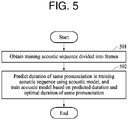
- FIG. 5 is a flowchart illustrating an example of a training method for speech recognition.
- the training method described hereinafter may be performed by a training apparatus for speech recognition described herein.
- the training apparatus for speech recognition obtains a training acoustic sequence divided into a plurality of training frames.
- the training apparatus is a hardware apparatus configured to perform training for the speech recognition.
- the training apparatus performs operations and calculations and processes instructions associated with the training. Examples of hardware used to implement the speech recognition apparatus described herein may also be used to implement the training apparatus.
- the training apparatus predicts a duration of a same pronunciation in the training acoustic sequence using an acoustic model, and trains the acoustic model based on the predicted duration and an optimal duration of the same pronunciation.
- the training apparatus generates a reward based on the predicted duration and the optimal duration, and trains the acoustic model based on the generated reward.
- the training apparatus predicts a duration corresponding to a training frame.
- the training apparatus generates a reward corresponding to the training frame based on the predicted duration corresponding to the training frame and an optimal duration corresponding to the training frame.
- the training apparatus generates the reward corresponding to the training frame by determining whether the predicted duration is equal to the optimal duration and applying a weight to a difference between the two durations. A weight to be applied when the predicted duration is greater than the optimal duration and a weight to be applied when the predicted duration is less than the optimal duration are set differently.
- the reward is generated using a reward function.
- the training apparatus uses objective function corresponding to a parameter that enables the acoustic model to predict a duration of a same pronunciation.
- the training apparatus optimizes the parameter to predict the duration by applying a generated reward to the objective function.
- the training apparatus uses an objective function corresponding to a parameter that allows the acoustic model to predict a pronunciation.
- the training apparatus optimizes the parameter to predict the duration and the parameter to predict the pronunciation by applying the reward to the objective function corresponding to the parameter to predict the duration and to the objective function corresponding to the parameter to predict the pronunciation.
- FIG. 6 is a diagram illustrating another example of a training method for speech recognition.
- the training apparatus predicts that a first pronunciation of a training frame is "a” and a duration of the pronunciation "a” is 2.
- the duration of 2 denotes the number of frames for which a pronunciation prediction is to be skipped, hereinafter simply referred to as the number of skip frames.
- optimal durations 4, 3, 2, 1, 0, 1, 0, 0, 1, 0, ... and labels "a,” “a,” “a,” “a,” “a,” “a,” “b,” “b,” “c,” “a,” “a,”... are ground truth values corresponding to training frames.
- 2, 1, 4, ... are durations predicted by an acoustic model.
- the training apparatus generates a reward corresponding to the training frame based on the duration 2 predicted from the training frame by the acoustic model and the optimal duration 4 corresponding to the training frame. As described above, the training apparatus optimizes a parameter of the acoustic model by applying the reward to an objective function.
- the acoustic model is defined by a parameter ⁇ 1 used to predict a pronunciation and a parameter ⁇ s used to predict the number of skip frames.
- the training apparatus optimizes the parameters ⁇ 1 and ⁇ s to train the acoustic model.
- the training apparatus defines a cross entropy objective function J 1 ( ⁇ 1 ) for the parameter ⁇ 1 .
- the objective function J 1 ( ⁇ 1 ) is a differentiable function, and the training apparatus finds the parameter ⁇ 1 that minimizes the objective function J 1 ( ⁇ 1 ) through a backpropagation algorithm.
- the training apparatus uses a reinforcement learning method to find the parameter ⁇ s .
- a reward function for the parameter ⁇ s is defined, and the training apparatus finds the parameter ⁇ s that maximizes the reward function through a policy gradient method. How to find the parameter ⁇ s for optimization will be now described.
- a sequence of numbers of frames skipped while the acoustic model is processing an acoustic sequence X 1:T divided into T frames is S 1:N
- the acoustic sequence X 1:T is a training acoustic sequence and the sequence S 1:N indicates a number of skip frames.
- S 1:N includes information of 2, 1, 4, ....
- a last hidden layer used when the acoustic model predicts the number of skip frames at an i-th time is h i
- a last hidden layer used when predicting 2 is h 1
- the acoustic model predicts the number of skip frames, for example, s i , by extracting a sample from a multinomial distribution p(s ;
- a skip layer of the acoustic model outputs p(s i
- a correct pronunciation of the acoustic sequence x 1:N is y 1:T
- the maximum number of skip frames is M
- the number of a frame used when predicting the number of skip frames at the i-th prediction is j.
- the training apparatus trains the acoustic model to skip all frames of the continuing pronunciation, except a first frame of the continuing pronunciation, so as to skip as many frames as possible without a loss of recognition accuracy.
- a pronunciation corresponding to the j-th frame is y i and a length, or a duration, of the pronunciation y i starting from the j-th frame is D(y i ).
- the maximum number of skip frames is M
- a target number of skip frames corresponding to the i-th prediction of the number of skip frames is s i *, which is represented by Equation 1 below.
- the training apparatus assigns a reward of 0 to the prediction of the number of skip frames. Otherwise, the training apparatus assigns a reward to a prediction of the number of skip frames based on a difference between the predicted number of skip frames and the target number of skip frames.
- Equation 2 s i denotes the predicted number of skip frames at the i-th prediction, and s i * denotes the target number of skip frames corresponding to the i-th prediction.
- a reward corresponding to an accurate prediction of the number of frames to be skipped is set 0, and a reward corresponding to an inaccurate prediction of the number of frames to be skipped is set a negative value, or a penalty.
- the penalty assigned to the training of the acoustic model increases, so the acoustic model is trained to make less inaccurate predictions of the number of frames to be skipped when the acoustic model is trained based on the reward function.
- Equation 3 An objective function J 2 ( ⁇ s ) used to optimize ⁇ s is represented by Equation 3 below.
- Equation 3 the objective function J 2 ( ⁇ s ) denotes an expected reward corresponding to an N-th prediction of the number of skip frames, starting from a first prediction of the number of skip frames, ⁇ denotes a discount factor, and N denotes a frame, or the number of a frame, at which the number of skip frames is predicted.
- the training apparatus trains the acoustic model to maximize the expected reward based on Equation 3.
- a probability value p(s 1:N ; ⁇ s ) used to predict the number of skip frames is represented by Equation 4 below.
- p s 1 : N ⁇ s ⁇ i p s i
- the training apparatus uses a reinforcement algorithm to optimize the objective function of Equation 3, and obtains an approximate derivative of the objective function of Equation 3 represented by Equation 5 below.
- the training apparatus calculates the approximate derivative of J 2 ( ⁇ s ) using a reward based on a prediction of the number of skip frames according to Equation 5.
- R i denotes a reward value that applies, in addition to a current prediction of the number of skip frames, subsequent predictions of the number of skip frames.
- the discount factor ⁇ is applied to R i .
- the derivative of the objective function including R i is used when the parameter ⁇ s is learned using a gradient descent, and thus the subsequent predictions of the number of skip frames are applied based on the discount factor ⁇ when training the current prediction of the number of skip frames.
- the training apparatus may use various methods to reduce a distribution of the approximate derivative of J 2 ( ⁇ s ).
- the training apparatus uses an objective function represented by Equation 7 below to train the acoustic model.
- a reward function is defined to skip as many frames in an acoustic sequence as possible while maintaining accuracy of speech recognition.
- accuracy of speech recognition may be considered more important than a recognition speed, or vice versa. That is, there is an inverse relationship between the accuracy of speech recognition and the recognition speed. For example, skipping many frames in an acoustic sequence to increase the recognition speed degrades the accuracy of speech recognition because modeling a change in a speech signal cannot be accurately performed. Conversely, skipping fewer frames in an acoustic sequence to increase the accuracy of speech recognition decreases the recognition speed.
- the training apparatus trains the acoustic model by determining whether to focus on the accuracy of speech recognition or the recognition speed. For example, in a case in which the acoustic model predicts a number of skip frames equal to a target number of skip frames, the reward function assigns a reward of 0 to the prediction of the number of skip frames. In another case in which a difference between the predicted number of skip frames and the target number of skip frames and the predicted number of skip frames increases, the reward function assigns a greater penalty to the prediction of the number of skip frames. In one example, the training apparatus changes the reward function to adjust the number of frames to be skipped by the acoustic model. In one example, the training apparatus applies a speed weight w to the reward function.
- a reward function r i ' in which different weights are assigned to a case in which the acoustic model predicts a number of skip frames that is less than the target number of skip frames and a case in which the acoustic model predicts a number of skip frames that is greater than the target number of skip frames is represented by Equation 8 below.
- Equation 8 A is a constant greater than or equal to 0.
- a case in which s i * ⁇ s i is a case in which the acoustic model predicts a greater number of skip frames than the target number of skip frames, and thus the training apparatus assigns a penalty to the prediction of the number of skip frames as described above.
- a case in which s i * > s i is a case in which the acoustic model predicts a fewer number of skip frames than the target number of skip frames, and thus the training apparatus increases a penalty assigned to the prediction of the fewer number of skip frames by multiplying the penalty assigned to the prediction of the greater number of skip frames by a speed weight w indicating how much more of a penalty is to be assigned to the prediction of the fewer number of skip frames than to the prediction of the greater number of skip frames.
- the training apparatus determines a value of the speed weight w by determining which one of the accuracy and the recognition speed needs a relatively greater weight. For example, when w is 1.0, similar rewards are assigned to the two cases of the prediction of the greater number of skip frames than the target number of skip frames and the prediction of the fewer number of skip frames than the target number of skip frames. When w is less than 1.0, a smaller disadvantage is assigned to the prediction of the fewer number of skip frames than the target number of skip frames, and thus the acoustic model skips fewer frames and the accuracy of recognition increases. However, when w is greater than 1.0, a greater disadvantage is assigned to the prediction of the fewer number of skip frames, and thus the acoustic model skips more frames and the recognition speed increases.
- FIG. 7 is a diagram illustrating an example of a speech recognition system.
- a speech recognition system includes an acoustic model 703, a decoder 705, and a language model 706.
- the speech recognition system predicts pronunciations 704 from an acoustic sequence 702 corresponding to a speech signal 701 using the acoustic model 703 and performs speech recognition using the decoder 705 and the language model 706.
- FIG. 8 is a diagram illustrating an example of an apparatus.
- an apparatus 801 includes a processor 802 and a memory 803.
- the apparatus 801 is either one or both of the speech recognition apparatus and the training apparatus described with reference to FIGS. 1 through 7 .
- the processor 802 implements at least part of either one or both of the speech recognition apparatus and the training apparatus described with reference to FIGS. 1 through 7 , and performs one or more operations or processes, or all of the operations or processes, performed by either one or both of the speech recognition apparatus and the training apparatus described with reference to FIGS. 1 through 7 .
- the memory 803 stores the speech recognition method described herein or information associated with the speech recognition method, stores the training method described herein or information associated with the training method, or stores a program that implements either one or both of the speech recognition method and the training method.
- the memory 803 may be a volatile memory or a nonvolatile memory.
- the processor 802 executes the program and controls the apparatus 801.
- Program code of the program executed by the processor 802 is stored in the memory 803.
- the apparatus 801 may be connected to an external device, for example, a PC and a network, through an input device and an output device (not shown), and may exchange data with the external device.
- the speech recognition apparatus described with reference to FIGS. 1 through 3 , the hidden layers 203, the label layer 204, and the skip layer 205 in FIG. 2 , the hidden layers, the label layer, and the skip layer in FIG. 3 , the training apparatus described with reference to FIGS. 5 and 6 , the speech recognition system, the acoustic model 703, the decoder 705, and the language model 706 of FIG. 7 , and the apparatus 801, the processor 802, and the memory 803 are implemented by hardware components.
- Examples of hardware components that may be used to perform the operations described in this application where appropriate include controllers, sensors, generators, drivers, memories, comparators, arithmetic logic units, adders, subtractors, multipliers, dividers, integrators, and any other electronic components configured to perform the operations described in this application.
- one or more of the hardware components that perform the operations described in this application are implemented by computing hardware, for example, by one or more processors or computers.
- a processor or computer may be implemented by one or more processing elements, such as an array of logic gates, a controller and an arithmetic logic unit, a digital signal processor, a microcomputer, a programmable logic controller, a fieldprogrammable gate array, a programmable logic array, a microprocessor, or any other device or combination of devices that is configured to respond to and execute instructions in a defined manner to achieve a desired result.
- a processor or computer includes, or is connected to, one or more memories storing instructions or software that are executed by the processor or computer.
- Hardware components implemented by a processor or computer may execute instructions or software, such as an operating system (OS) and one or more software applications that run on the OS, to perform the operations described in this application.
- OS operating system
- the hardware components may also access, manipulate, process, create, and store data in response to execution of the instructions or software.
- processor or “computer” may be used in the description of the examples described in this application, but in other examples multiple processors or computers may be used, or a processor or computer may include multiple processing elements, or multiple types of processing elements, or both.
- a single hardware component or two or more hardware components may be implemented by a single processor, or two or more processors, or a processor and a controller.
- One or more hardware components may be implemented by one or more processors, or a processor and a controller, and one or more other hardware components may be implemented by one or more other processors, or another processor and another controller.
- One or more processors may implement a single hardware component, or two or more hardware components.
- a hardware component may have any one or more of different processing configurations, examples of which include a single processor, independent processors, parallel processors, single-instruction single-data (SISD) multiprocessing, single-instruction multiple-data (SIMD) multiprocessing, multiple-instruction single-data (MISD) multiprocessing, and multiple-instruction multiple-data (MIMD) multiprocessing.
- SISD single-instruction single-data
- SIMD single-instruction multiple-data
- MIMD multiple-instruction multiple-data
- FIGS. 1 through 6 that perform the operations described in this application are performed by computing hardware, for example, by one or more processors or computers, implemented as described above executing instructions or software to perform the operations described in this application that are performed by the methods.
- a single operation or two or more operations may be performed by a single processor, or two or more processors, or a processor and a controller.
- One or more operations may be performed by one or more processors, or a processor and a controller, and one or more other operations may be performed by one or more other processors, or another processor and another controller.
- One or more processors, or a processor and a controller may perform a single operation, or two or more operations.
- Instructions or software to control computing hardware may be written as computer programs, code segments, instructions or any combination thereof, for individually or collectively instructing or configuring the one or more processors or computers to operate as a machine or special-purpose computer to perform the operations that are performed by the hardware components and the methods as described above.
- the instructions or software include machine code that is directly executed by the one or more processors or computers, such as machine code produced by a compiler.
- the instructions or software includes higher-level code that is executed by the one or more processors or computer using an interpreter.
- the instructions or software may be written using any programming language based on the block diagrams and the flow charts illustrated in the drawings and the corresponding descriptions in the specification, which disclose algorithms for performing the operations that are performed by the hardware components and the methods as described above.
- the instructions or software to control computing hardware for example, one or more processors or computers, to implement the hardware components and perform the methods as described above, and any associated data, data files, and data structures, may be recorded, stored, or fixed in or on one or more non-transitory computer-readable storage media.
- Examples of a non-transitory computer-readable storage medium include read-only memory (ROM), random-access memory (RAM), flash memory, CD-ROMs, CD-Rs, CD+Rs, CD-RWs, CD+RWs, DVD-ROMs, DVD-Rs, DVD+Rs, DVD-RWs, DVD+RWs, DVD-RAMs, BD-ROMs, BD-Rs, BD-R LTHs, BD-REs, magnetic tapes, floppy disks, magneto-optical data storage devices, optical data storage devices, hard disks, solid-state disks, and any other device that is configured to store the instructions or software and any associated data, data files, and data structures in a non-transitory manner and provide the instructions or software and any associated data, data files, and data structures to one or more processors or computers so that the one or more processors or computers can execute the instructions.
- ROM read-only memory
- RAM random-access memory
- flash memory CD-ROMs, CD-Rs, CD
- the instructions or software and any associated data, data files, and data structures are distributed over network-coupled computer systems so that the instructions and software and any associated data, data files, and data structures are stored, accessed, and executed in a distributed fashion by the one or more processors or computers.
Landscapes
- Engineering & Computer Science (AREA)
- Physics & Mathematics (AREA)
- Computational Linguistics (AREA)
- Health & Medical Sciences (AREA)
- Audiology, Speech & Language Pathology (AREA)
- Human Computer Interaction (AREA)
- Acoustics & Sound (AREA)
- Multimedia (AREA)
- Artificial Intelligence (AREA)
- Evolutionary Computation (AREA)
- Theoretical Computer Science (AREA)
- Biophysics (AREA)
- Biomedical Technology (AREA)
- Data Mining & Analysis (AREA)
- General Health & Medical Sciences (AREA)
- Molecular Biology (AREA)
- Computing Systems (AREA)
- General Engineering & Computer Science (AREA)
- General Physics & Mathematics (AREA)
- Mathematical Physics (AREA)
- Software Systems (AREA)
- Life Sciences & Earth Sciences (AREA)
- Telephonic Communication Services (AREA)
- Electrically Operated Instructional Devices (AREA)
Claims (11)
- Spracherkennungsverfahren, das Folgendes umfasst:Erhalten einer akustischen Sequenz, bei der es sich um ein Sprachsignal handelt, das Sprachinformationen umfasst, und die in eine Vielzahl von Frames unterteilt ist; undBestimmen von Aussprachen in der akustischen Sequenz durch:- Vorhersagen einer ersten Aussprache eines ersten Frames aus den Frames unter Verwendung eines Akustikmodells;- Vorhersagen einer Dauer der ersten Aussprache in der akustischen Sequenz unter Verwendung des Akustikmodells; und- Überspringen einer Aussprachevorhersage für eine Anzahl von Frames entsprechend der Dauer; undgekennzeichnet durch- Bestimmen einer Aussprache jedes Frames aus der Anzahl von Frames als die erste Aussprache.
- Spracherkennungsverfahren nach Anspruch 1, wobei die Dauer durch eine Anzahl von Frames dargestellt wird, für die die Aussprachevorhersage übersprungen werden soll.
- Spracherkennungsverfahren nach Anspruch 1 oder 2, wobei das Bestimmen der Aussprachen weiterhin das Vorhersagen von Folgendem umfasst:einer zweiten Aussprache eines Frames nach einem letzten Frame aus der Anzahl von Frames; undeiner Dauer der zweiten Aussprache.
- Spracherkennungsverfahren nach Anspruch 1, 2 oder 3, wobei das Akustikmodell ein neuronales Netzwerk umfasst,
eine Ausgabeschicht des neuronalen Netzwerks eine Markierungsschicht und eine Übersprungsschicht umfasst,
die Markierungsschicht konfiguriert ist, um eine Aussprache eines in das neuronale Netzwerk eingegebenen Eingangsframes vorherzusagen, und
die Übersprungsschicht konfiguriert ist, um eine Dauer der Aussprache des Eingangsframes vorherzusagen. - Spracherkennungsverfahren nach Anspruch 4, wobei
die Markierungsschicht eine Anzahl von Knoten umfasst, die einer Anzahl aller möglichen Aussprachen, die von der Markierungsschicht vorhergesagt werden können, entspricht,
die Übersprungsschicht eine Anzahl von Knoten umfasst, die einer Anzahl aller Auswahlmöglichkeiten für eine Anzahl von Frames, für die die Aussprachevorhersage übersprungen werden soll, entspricht. - Spracherkennungsverfahren, das Folgendes umfasst:Erhalten einer akustischen Sequenz, bei der es sich um ein Sprachsignal handelt, das Sprachinformationen umfasst, undBestimmen von Aussprachen in der akustischen Sequenz durch:- Vorhersagen einer ersten Aussprache zu einem ersten Zeitpunkt in der akustischen Sequenz unter Verwendung eines Akustikmodells;- Vorhersagen eines zweiten Zeitpunkts in der akustischen Sequenz, zu dem erwartet wird, dass die erste Aussprache endet oder sich ändert, wobei das Vorhersagen des zweiten Zeitpunkts das Vorhersagen einer Dauer nach dem ersten Zeitpunkt umfasst, während der erwartet wird, dass die erste Aussprache fortgesetzt wird, und zwar unter Verwendung des Akustikmodells;- Überspringen der Aussprachevorhersage für die Dauer, bis der zweite Zeitpunkt erreicht ist; undgekennzeichnet durch- Bestimmen einer Aussprache der Dauer als die erste Aussprache.
- Spracherkennungsverfahren nach Anspruch 6, wobei das Akustikmodell ein neuronales Netzwerk umfasst, das konfiguriert ist, um die akustische Sequenz zu erhalten,
das neuronale Netzwerk eine Ausgabeschicht umfasst,
die Ausgabeschicht eine Markierungsschicht und eine Übersprungsschicht umfasst,
die Markierungsschicht konfiguriert ist, um die erste Aussprache an einem Punkt in der akustischen Sequenz vorherzusagen, und
die Übersprungsschicht konfiguriert ist, um die Dauer der ersten Aussprache, die an einem Punkt in der akustischen Sequenz vorhergesagt wurde, vorherzusagen. - Spracherkennungsverfahren nach Anspruch 7, wobei die Markierungsschicht eine Anzahl von Knoten umfasst, die einer Anzahl aller möglichen Aussprachen, die von der Markierungsschicht vorhergesagt werden können, entspricht, und
die Übersprungsschicht eine Anzahl von Knoten umfasst, die einer Anzahl aller möglichen Dauern, die von der Übersprungsschicht vorhergesagt werden können, entspricht. - Spracherkennungsverfahren nach Anspruch 8, wobei es sich bei der Übersprungsschicht um eine Softmaxschicht handelt,
eine Aussprache, die einem Knoten der Markierungsschicht aus den Knoten der Markierungsschicht, der den größten Ausgabewert aufweist, entspricht, der vorhergesagten Aussprache zu dem ersten Zeitpunkt in der akustischen Sequenz entspricht,
es sich bei der Übersprungsschicht um eine Softmaxschicht handelt, und
eine Aussprache, die einem Knoten der Übersprungsschicht aus den Knoten der Übersprungsschicht, der den größten Ausgabewert aufweist, entspricht, der vorhergesagten Dauer der vorhergesagten Aussprache zu dem ersten Zeitpunkt in der akustischen Sequenz entspricht. - Nicht-flüchtiges, computerlesbares Medium, auf dem Anweisungen gespeichert sind, die, wenn sie von einem Prozessor ausgeführt werden, bewirken, dass der Prozessor das Spracherkennungsverfahren nach einem beliebigen der vorhergehenden Ansprüche ausführt.
- Spracherkennungsvorrichtung, die einen Prozessor umfasst, der konfiguriert ist, um die Schritte eines beliebigen der vorhergehenden Verfahrensansprüche auszuführen.
Applications Claiming Priority (2)
| Application Number | Priority Date | Filing Date | Title |
|---|---|---|---|
| US201762575643P | 2017-10-23 | 2017-10-23 | |
| KR1020180018301A KR102676221B1 (ko) | 2017-10-23 | 2018-02-14 | 음성 인식 방법 및 장치 |
Publications (2)
| Publication Number | Publication Date |
|---|---|
| EP3474274A1 EP3474274A1 (de) | 2019-04-24 |
| EP3474274B1 true EP3474274B1 (de) | 2021-07-14 |
Family
ID=63794356
Family Applications (1)
| Application Number | Title | Priority Date | Filing Date |
|---|---|---|---|
| EP18199047.4A Active EP3474274B1 (de) | 2017-10-23 | 2018-10-08 | Spracherkennungsverfahren und -vorrichtung |
Country Status (2)
| Country | Link |
|---|---|
| EP (1) | EP3474274B1 (de) |
| CN (1) | CN109697977B (de) |
Families Citing this family (9)
| Publication number | Priority date | Publication date | Assignee | Title |
|---|---|---|---|---|
| CN110197658B (zh) * | 2019-05-30 | 2021-01-26 | 百度在线网络技术(北京)有限公司 | 语音处理方法、装置以及电子设备 |
| CN110473547B (zh) * | 2019-07-12 | 2021-07-30 | 云知声智能科技股份有限公司 | 一种语音识别方法 |
| CN110517669B (zh) * | 2019-07-24 | 2022-04-19 | 北京捷通华声科技股份有限公司 | 一种预测词语发音的方法、装置、电子设备及存储介质 |
| US11227579B2 (en) * | 2019-08-08 | 2022-01-18 | International Business Machines Corporation | Data augmentation by frame insertion for speech data |
| CN114627863B (zh) * | 2019-09-24 | 2024-03-22 | 腾讯科技(深圳)有限公司 | 一种基于人工智能的语音识别方法和装置 |
| CN113593539B (zh) * | 2020-04-30 | 2024-08-02 | 阿里巴巴集团控股有限公司 | 流式端到端语音识别方法、装置及电子设备 |
| CN112017630B (zh) * | 2020-08-19 | 2022-04-01 | 北京字节跳动网络技术有限公司 | 一种语种识别方法、装置、电子设备及存储介质 |
| CN113053409B (zh) * | 2021-03-12 | 2024-04-12 | 科大讯飞股份有限公司 | 音频测评方法及装置 |
| CN113327599B (zh) * | 2021-06-30 | 2023-06-02 | 北京有竹居网络技术有限公司 | 语音识别方法、装置、介质及电子设备 |
Family Cites Families (6)
| Publication number | Priority date | Publication date | Assignee | Title |
|---|---|---|---|---|
| WO1998014934A1 (en) * | 1996-10-02 | 1998-04-09 | Sri International | Method and system for automatic text-independent grading of pronunciation for language instruction |
| US7769580B2 (en) * | 2002-12-23 | 2010-08-03 | Loquendo S.P.A. | Method of optimising the execution of a neural network in a speech recognition system through conditionally skipping a variable number of frames |
| WO2012025579A1 (en) * | 2010-08-24 | 2012-03-01 | Veovox Sa | System and method for recognizing a user voice command in noisy environment |
| US9520128B2 (en) * | 2014-09-23 | 2016-12-13 | Intel Corporation | Frame skipping with extrapolation and outputs on demand neural network for automatic speech recognition |
| KR102413692B1 (ko) * | 2015-07-24 | 2022-06-27 | 삼성전자주식회사 | 음성 인식을 위한 음향 점수 계산 장치 및 방법, 음성 인식 장치 및 방법, 전자 장치 |
| KR102423302B1 (ko) * | 2015-10-06 | 2022-07-19 | 삼성전자주식회사 | 음성 인식에서의 음향 점수 계산 장치 및 방법과, 음향 모델 학습 장치 및 방법 |
-
2018
- 2018-08-02 CN CN201810872293.0A patent/CN109697977B/zh active Active
- 2018-10-08 EP EP18199047.4A patent/EP3474274B1/de active Active
Non-Patent Citations (1)
| Title |
|---|
| None * |
Also Published As
| Publication number | Publication date |
|---|---|
| CN109697977A (zh) | 2019-04-30 |
| CN109697977B (zh) | 2023-10-31 |
| EP3474274A1 (de) | 2019-04-24 |
Similar Documents
| Publication | Publication Date | Title |
|---|---|---|
| EP3474274B1 (de) | Spracherkennungsverfahren und -vorrichtung | |
| US11348572B2 (en) | Speech recognition method and apparatus | |
| US11468324B2 (en) | Method and apparatus with model training and/or sequence recognition | |
| US12511535B2 (en) | Neural network method and apparatus | |
| EP3711000B1 (de) | Geregelte architektursuche für neuronales netz | |
| CN111279362B (zh) | 胶囊神经网络 | |
| EP3319015B1 (de) | Verfahren und vorrichtung zur verarbeitung eines neuronalen konvolutionsnetzwerks | |
| CN117709426B (zh) | 训练机器学习模型的方法、系统和计算机存储介质 | |
| CN113302605B (zh) | 鲁棒且数据效率的黑盒优化 | |
| EP4009239B1 (de) | Verfahren und vorrichtung mit neuronaler architektursuche basierend auf hardware-leistung | |
| US10504506B2 (en) | Neural network method and apparatus | |
| JP7460703B2 (ja) | 共有されたニューラルアイテム表現をコールドスタート推薦に用いる改良型のレコメンダシステム及び方法 | |
| US20140214735A1 (en) | Method for an optimizing predictive model using gradient descent and conjugate residuals | |
| US20250013862A1 (en) | Method and apparatus with neural network layer contraction | |
| EP3809405B1 (de) | Verfahren und vorrichtung zur bestimmung eines ausgabe-tokens | |
| KR101828215B1 (ko) | Long Short Term Memory 기반 순환형 상태 전이 모델의 학습 방법 및 장치 | |
| US12541963B2 (en) | Method and device with neural network training and image processing | |
| CN113348472A (zh) | 具有软内核选择的卷积神经网络 | |
| US20230259775A1 (en) | Method and apparatus with pruning | |
| Erreygers et al. | Computing inferences for large-scale continuous-time Markov chains by combining lumping with imprecision | |
| EP3629248B1 (de) | Betriebsverfahren und trainingsverfahren eines neuronalen netzes und neuronales netz dafür | |
| US20240152753A1 (en) | Method and apparatus with training of batch norm parameter | |
| US12197929B2 (en) | Systems and methods for sequential model framework for next-best user state | |
| US20250094809A1 (en) | Method and apparatus with neural network model training | |
| US20260093989A1 (en) | Electronic device, terminal, and operating method with neural network lightweighting |
Legal Events
| Date | Code | Title | Description |
|---|---|---|---|
| PUAI | Public reference made under article 153(3) epc to a published international application that has entered the european phase |
Free format text: ORIGINAL CODE: 0009012 |
|
| STAA | Information on the status of an ep patent application or granted ep patent |
Free format text: STATUS: THE APPLICATION HAS BEEN PUBLISHED |
|
| AK | Designated contracting states |
Kind code of ref document: A1 Designated state(s): AL AT BE BG CH CY CZ DE DK EE ES FI FR GB GR HR HU IE IS IT LI LT LU LV MC MK MT NL NO PL PT RO RS SE SI SK SM TR |
|
| AX | Request for extension of the european patent |
Extension state: BA ME |
|
| STAA | Information on the status of an ep patent application or granted ep patent |
Free format text: STATUS: REQUEST FOR EXAMINATION WAS MADE |
|
| 17P | Request for examination filed |
Effective date: 20191121 |
|
| RBV | Designated contracting states (corrected) |
Designated state(s): AL AT BE BG CH CY CZ DE DK EE ES FI FR GB GR HR HU IE IS IT LI LT LU LV MC MK MT NL NO PL PT RO RS SE SI SK SM TR |
|
| R17P | Request for examination filed (corrected) |
Effective date: 20190301 |
|
| STAA | Information on the status of an ep patent application or granted ep patent |
Free format text: STATUS: EXAMINATION IS IN PROGRESS |
|
| 17Q | First examination report despatched |
Effective date: 20200921 |
|
| GRAP | Despatch of communication of intention to grant a patent |
Free format text: ORIGINAL CODE: EPIDOSNIGR1 |
|
| STAA | Information on the status of an ep patent application or granted ep patent |
Free format text: STATUS: GRANT OF PATENT IS INTENDED |
|
| RIC1 | Information provided on ipc code assigned before grant |
Ipc: G10L 15/16 20060101ALN20210205BHEP Ipc: G10L 15/08 20060101AFI20210205BHEP |
|
| INTG | Intention to grant announced |
Effective date: 20210225 |
|
| GRAS | Grant fee paid |
Free format text: ORIGINAL CODE: EPIDOSNIGR3 |
|
| GRAA | (expected) grant |
Free format text: ORIGINAL CODE: 0009210 |
|
| STAA | Information on the status of an ep patent application or granted ep patent |
Free format text: STATUS: THE PATENT HAS BEEN GRANTED |
|
| AK | Designated contracting states |
Kind code of ref document: B1 Designated state(s): AL AT BE BG CH CY CZ DE DK EE ES FI FR GB GR HR HU IE IS IT LI LT LU LV MC MK MT NL NO PL PT RO RS SE SI SK SM TR |
|
| REG | Reference to a national code |
Ref country code: GB Ref legal event code: FG4D |
|
| REG | Reference to a national code |
Ref country code: DE Ref legal event code: R096 Ref document number: 602018020006 Country of ref document: DE |
|
| REG | Reference to a national code |
Ref country code: IE Ref legal event code: FG4D |
|
| REG | Reference to a national code |
Ref country code: AT Ref legal event code: REF Ref document number: 1411288 Country of ref document: AT Kind code of ref document: T Effective date: 20210815 |
|
| REG | Reference to a national code |
Ref country code: LT Ref legal event code: MG9D |
|
| REG | Reference to a national code |
Ref country code: NL Ref legal event code: MP Effective date: 20210714 |
|
| REG | Reference to a national code |
Ref country code: AT Ref legal event code: MK05 Ref document number: 1411288 Country of ref document: AT Kind code of ref document: T Effective date: 20210714 |
|
| PG25 | Lapsed in a contracting state [announced via postgrant information from national office to epo] |
Ref country code: SE Free format text: LAPSE BECAUSE OF FAILURE TO SUBMIT A TRANSLATION OF THE DESCRIPTION OR TO PAY THE FEE WITHIN THE PRESCRIBED TIME-LIMIT Effective date: 20210714 Ref country code: RS Free format text: LAPSE BECAUSE OF FAILURE TO SUBMIT A TRANSLATION OF THE DESCRIPTION OR TO PAY THE FEE WITHIN THE PRESCRIBED TIME-LIMIT Effective date: 20210714 Ref country code: HR Free format text: LAPSE BECAUSE OF FAILURE TO SUBMIT A TRANSLATION OF THE DESCRIPTION OR TO PAY THE FEE WITHIN THE PRESCRIBED TIME-LIMIT Effective date: 20210714 Ref country code: ES Free format text: LAPSE BECAUSE OF FAILURE TO SUBMIT A TRANSLATION OF THE DESCRIPTION OR TO PAY THE FEE WITHIN THE PRESCRIBED TIME-LIMIT Effective date: 20210714 Ref country code: FI Free format text: LAPSE BECAUSE OF FAILURE TO SUBMIT A TRANSLATION OF THE DESCRIPTION OR TO PAY THE FEE WITHIN THE PRESCRIBED TIME-LIMIT Effective date: 20210714 Ref country code: LT Free format text: LAPSE BECAUSE OF FAILURE TO SUBMIT A TRANSLATION OF THE DESCRIPTION OR TO PAY THE FEE WITHIN THE PRESCRIBED TIME-LIMIT Effective date: 20210714 Ref country code: AT Free format text: LAPSE BECAUSE OF FAILURE TO SUBMIT A TRANSLATION OF THE DESCRIPTION OR TO PAY THE FEE WITHIN THE PRESCRIBED TIME-LIMIT Effective date: 20210714 Ref country code: BG Free format text: LAPSE BECAUSE OF FAILURE TO SUBMIT A TRANSLATION OF THE DESCRIPTION OR TO PAY THE FEE WITHIN THE PRESCRIBED TIME-LIMIT Effective date: 20211014 Ref country code: NO Free format text: LAPSE BECAUSE OF FAILURE TO SUBMIT A TRANSLATION OF THE DESCRIPTION OR TO PAY THE FEE WITHIN THE PRESCRIBED TIME-LIMIT Effective date: 20211014 Ref country code: PT Free format text: LAPSE BECAUSE OF FAILURE TO SUBMIT A TRANSLATION OF THE DESCRIPTION OR TO PAY THE FEE WITHIN THE PRESCRIBED TIME-LIMIT Effective date: 20211115 Ref country code: NL Free format text: LAPSE BECAUSE OF FAILURE TO SUBMIT A TRANSLATION OF THE DESCRIPTION OR TO PAY THE FEE WITHIN THE PRESCRIBED TIME-LIMIT Effective date: 20210714 |
|
| PG25 | Lapsed in a contracting state [announced via postgrant information from national office to epo] |
Ref country code: PL Free format text: LAPSE BECAUSE OF FAILURE TO SUBMIT A TRANSLATION OF THE DESCRIPTION OR TO PAY THE FEE WITHIN THE PRESCRIBED TIME-LIMIT Effective date: 20210714 Ref country code: LV Free format text: LAPSE BECAUSE OF FAILURE TO SUBMIT A TRANSLATION OF THE DESCRIPTION OR TO PAY THE FEE WITHIN THE PRESCRIBED TIME-LIMIT Effective date: 20210714 Ref country code: GR Free format text: LAPSE BECAUSE OF FAILURE TO SUBMIT A TRANSLATION OF THE DESCRIPTION OR TO PAY THE FEE WITHIN THE PRESCRIBED TIME-LIMIT Effective date: 20211015 |
|
| REG | Reference to a national code |
Ref country code: DE Ref legal event code: R097 Ref document number: 602018020006 Country of ref document: DE |
|
| PG25 | Lapsed in a contracting state [announced via postgrant information from national office to epo] |
Ref country code: DK Free format text: LAPSE BECAUSE OF FAILURE TO SUBMIT A TRANSLATION OF THE DESCRIPTION OR TO PAY THE FEE WITHIN THE PRESCRIBED TIME-LIMIT Effective date: 20210714 |
|
| PLBE | No opposition filed within time limit |
Free format text: ORIGINAL CODE: 0009261 |
|
| STAA | Information on the status of an ep patent application or granted ep patent |
Free format text: STATUS: NO OPPOSITION FILED WITHIN TIME LIMIT |
|
| REG | Reference to a national code |
Ref country code: CH Ref legal event code: PL |
|
| PG25 | Lapsed in a contracting state [announced via postgrant information from national office to epo] |
Ref country code: SM Free format text: LAPSE BECAUSE OF FAILURE TO SUBMIT A TRANSLATION OF THE DESCRIPTION OR TO PAY THE FEE WITHIN THE PRESCRIBED TIME-LIMIT Effective date: 20210714 Ref country code: SK Free format text: LAPSE BECAUSE OF FAILURE TO SUBMIT A TRANSLATION OF THE DESCRIPTION OR TO PAY THE FEE WITHIN THE PRESCRIBED TIME-LIMIT Effective date: 20210714 Ref country code: RO Free format text: LAPSE BECAUSE OF FAILURE TO SUBMIT A TRANSLATION OF THE DESCRIPTION OR TO PAY THE FEE WITHIN THE PRESCRIBED TIME-LIMIT Effective date: 20210714 Ref country code: EE Free format text: LAPSE BECAUSE OF FAILURE TO SUBMIT A TRANSLATION OF THE DESCRIPTION OR TO PAY THE FEE WITHIN THE PRESCRIBED TIME-LIMIT Effective date: 20210714 Ref country code: CZ Free format text: LAPSE BECAUSE OF FAILURE TO SUBMIT A TRANSLATION OF THE DESCRIPTION OR TO PAY THE FEE WITHIN THE PRESCRIBED TIME-LIMIT Effective date: 20210714 Ref country code: AL Free format text: LAPSE BECAUSE OF FAILURE TO SUBMIT A TRANSLATION OF THE DESCRIPTION OR TO PAY THE FEE WITHIN THE PRESCRIBED TIME-LIMIT Effective date: 20210714 |
|
| 26N | No opposition filed |
Effective date: 20220419 |
|
| REG | Reference to a national code |
Ref country code: BE Ref legal event code: MM Effective date: 20211031 |
|
| PG25 | Lapsed in a contracting state [announced via postgrant information from national office to epo] |
Ref country code: MC Free format text: LAPSE BECAUSE OF FAILURE TO SUBMIT A TRANSLATION OF THE DESCRIPTION OR TO PAY THE FEE WITHIN THE PRESCRIBED TIME-LIMIT Effective date: 20210714 |
|
| PG25 | Lapsed in a contracting state [announced via postgrant information from national office to epo] |
Ref country code: LU Free format text: LAPSE BECAUSE OF NON-PAYMENT OF DUE FEES Effective date: 20211008 Ref country code: IT Free format text: LAPSE BECAUSE OF FAILURE TO SUBMIT A TRANSLATION OF THE DESCRIPTION OR TO PAY THE FEE WITHIN THE PRESCRIBED TIME-LIMIT Effective date: 20210714 Ref country code: BE Free format text: LAPSE BECAUSE OF NON-PAYMENT OF DUE FEES Effective date: 20211031 |
|
| PG25 | Lapsed in a contracting state [announced via postgrant information from national office to epo] |
Ref country code: LI Free format text: LAPSE BECAUSE OF NON-PAYMENT OF DUE FEES Effective date: 20211031 Ref country code: CH Free format text: LAPSE BECAUSE OF NON-PAYMENT OF DUE FEES Effective date: 20211031 |
|
| PG25 | Lapsed in a contracting state [announced via postgrant information from national office to epo] |
Ref country code: IE Free format text: LAPSE BECAUSE OF NON-PAYMENT OF DUE FEES Effective date: 20211008 |
|
| PG25 | Lapsed in a contracting state [announced via postgrant information from national office to epo] |
Ref country code: CY Free format text: LAPSE BECAUSE OF FAILURE TO SUBMIT A TRANSLATION OF THE DESCRIPTION OR TO PAY THE FEE WITHIN THE PRESCRIBED TIME-LIMIT Effective date: 20210714 |
|
| PG25 | Lapsed in a contracting state [announced via postgrant information from national office to epo] |
Ref country code: HU Free format text: LAPSE BECAUSE OF FAILURE TO SUBMIT A TRANSLATION OF THE DESCRIPTION OR TO PAY THE FEE WITHIN THE PRESCRIBED TIME-LIMIT; INVALID AB INITIO Effective date: 20181008 |
|
| PG25 | Lapsed in a contracting state [announced via postgrant information from national office to epo] |
Ref country code: MK Free format text: LAPSE BECAUSE OF FAILURE TO SUBMIT A TRANSLATION OF THE DESCRIPTION OR TO PAY THE FEE WITHIN THE PRESCRIBED TIME-LIMIT Effective date: 20210714 |
|
| PG25 | Lapsed in a contracting state [announced via postgrant information from national office to epo] |
Ref country code: TR Free format text: LAPSE BECAUSE OF FAILURE TO SUBMIT A TRANSLATION OF THE DESCRIPTION OR TO PAY THE FEE WITHIN THE PRESCRIBED TIME-LIMIT Effective date: 20210714 |
|
| PG25 | Lapsed in a contracting state [announced via postgrant information from national office to epo] |
Ref country code: MT Free format text: LAPSE BECAUSE OF FAILURE TO SUBMIT A TRANSLATION OF THE DESCRIPTION OR TO PAY THE FEE WITHIN THE PRESCRIBED TIME-LIMIT Effective date: 20210714 |
|
| PGFP | Annual fee paid to national office [announced via postgrant information from national office to epo] |
Ref country code: GB Payment date: 20250911 Year of fee payment: 8 |
|
| PGFP | Annual fee paid to national office [announced via postgrant information from national office to epo] |
Ref country code: FR Payment date: 20250908 Year of fee payment: 8 |
|
| PGFP | Annual fee paid to national office [announced via postgrant information from national office to epo] |
Ref country code: DE Payment date: 20250910 Year of fee payment: 8 |