EP3473946A1 - Multi-split air conditioner control device, multi-split air conditioner, multi-split air conditioner control method, and multi-split air conditioner control program - Google Patents
Multi-split air conditioner control device, multi-split air conditioner, multi-split air conditioner control method, and multi-split air conditioner control program Download PDFInfo
- Publication number
- EP3473946A1 EP3473946A1 EP17885879.1A EP17885879A EP3473946A1 EP 3473946 A1 EP3473946 A1 EP 3473946A1 EP 17885879 A EP17885879 A EP 17885879A EP 3473946 A1 EP3473946 A1 EP 3473946A1
- Authority
- EP
- European Patent Office
- Prior art keywords
- heat exchanger
- heat exchangers
- air conditioner
- defrosting
- flow rate
- Prior art date
- Legal status (The legal status is an assumption and is not a legal conclusion. Google has not performed a legal analysis and makes no representation as to the accuracy of the status listed.)
- Withdrawn
Links
- 238000000034 method Methods 0.000 title claims description 15
- 239000003507 refrigerant Substances 0.000 claims abstract description 145
- 238000010257 thawing Methods 0.000 claims description 166
- 238000003860 storage Methods 0.000 claims description 10
- 238000012360 testing method Methods 0.000 claims description 7
- 239000007788 liquid Substances 0.000 description 26
- 230000001276 controlling effect Effects 0.000 description 21
- 238000010586 diagram Methods 0.000 description 10
- 238000012545 processing Methods 0.000 description 10
- 238000004781 supercooling Methods 0.000 description 10
- 238000010438 heat treatment Methods 0.000 description 9
- 238000004378 air conditioning Methods 0.000 description 5
- 230000006870 function Effects 0.000 description 4
- 230000002265 prevention Effects 0.000 description 4
- 230000000694 effects Effects 0.000 description 3
- 230000002035 prolonged effect Effects 0.000 description 3
- 230000007423 decrease Effects 0.000 description 2
- 238000004891 communication Methods 0.000 description 1
- 238000013461 design Methods 0.000 description 1
- 238000005304 joining Methods 0.000 description 1
- 230000001105 regulatory effect Effects 0.000 description 1
- 230000004044 response Effects 0.000 description 1
- 239000004065 semiconductor Substances 0.000 description 1
- 238000004904 shortening Methods 0.000 description 1
- 230000005514 two-phase flow Effects 0.000 description 1
Images


Classifications
-
- F—MECHANICAL ENGINEERING; LIGHTING; HEATING; WEAPONS; BLASTING
- F24—HEATING; RANGES; VENTILATING
- F24F—AIR-CONDITIONING; AIR-HUMIDIFICATION; VENTILATION; USE OF AIR CURRENTS FOR SCREENING
- F24F11/00—Control or safety arrangements
- F24F11/30—Control or safety arrangements for purposes related to the operation of the system, e.g. for safety or monitoring
- F24F11/41—Defrosting; Preventing freezing
- F24F11/42—Defrosting; Preventing freezing of outdoor units
-
- F—MECHANICAL ENGINEERING; LIGHTING; HEATING; WEAPONS; BLASTING
- F25—REFRIGERATION OR COOLING; COMBINED HEATING AND REFRIGERATION SYSTEMS; HEAT PUMP SYSTEMS; MANUFACTURE OR STORAGE OF ICE; LIQUEFACTION SOLIDIFICATION OF GASES
- F25B—REFRIGERATION MACHINES, PLANTS OR SYSTEMS; COMBINED HEATING AND REFRIGERATION SYSTEMS; HEAT PUMP SYSTEMS
- F25B47/00—Arrangements for preventing or removing deposits or corrosion, not provided for in another subclass
- F25B47/02—Defrosting cycles
-
- F—MECHANICAL ENGINEERING; LIGHTING; HEATING; WEAPONS; BLASTING
- F25—REFRIGERATION OR COOLING; COMBINED HEATING AND REFRIGERATION SYSTEMS; HEAT PUMP SYSTEMS; MANUFACTURE OR STORAGE OF ICE; LIQUEFACTION SOLIDIFICATION OF GASES
- F25B—REFRIGERATION MACHINES, PLANTS OR SYSTEMS; COMBINED HEATING AND REFRIGERATION SYSTEMS; HEAT PUMP SYSTEMS
- F25B47/00—Arrangements for preventing or removing deposits or corrosion, not provided for in another subclass
- F25B47/02—Defrosting cycles
- F25B47/022—Defrosting cycles hot gas defrosting
-
- F—MECHANICAL ENGINEERING; LIGHTING; HEATING; WEAPONS; BLASTING
- F24—HEATING; RANGES; VENTILATING
- F24F—AIR-CONDITIONING; AIR-HUMIDIFICATION; VENTILATION; USE OF AIR CURRENTS FOR SCREENING
- F24F2140/00—Control inputs relating to system states
- F24F2140/20—Heat-exchange fluid temperature
Definitions
- the present invention relates to a control device of a multi-split air conditioner, a multi-split air conditioner, a method of controlling a multi-split air conditioner, and a program of controlling a multi-split air conditioner.
- defrosting operation is performed.
- the defrosting operation is operation of defrosting the frost attached to the heat exchanger by causing a high-temperature and high-pressure refrigerant to flow into the heat exchanger.
- a refrigerant flow rate required for defrosting varies according to each heat exchanger in a case where the volumes of the heat exchangers are different from each other.
- a technique of comparing temperatures of respective heat exchangers, which are measured by heat exchanging temperature measuring means, and controlling a refrigerant flow rate by means of the opening degree of an electric expansion valve is disclosed in PTL 1.
- a technique of measuring the temperature of an upper path and the temperature of a lower path of a heat exchanger and adjusting a refrigerant flow rate by means of the opening degree of an expansion valve according to a temperature difference is disclosed in PTL 2.
- the temperature of the heat exchanger is measured, the opening degree of the expansion valve is regulated based on the temperature, and the refrigerant flow rate of each heat exchanger (or the upper and lower paths inside the heat exchanger) is adjusted.
- the temperature of each heat exchanger is measured and the expansion valve is adjusted, it is difficult to effectively make defrosting regular due to a response delay of the expansion valve, thereby not leading to the shortening of the time it takes for defrosting.
- the present invention is devised in consideration of such circumstances, and an object thereof is to provide a control device of a multi-split air conditioner, a multi-split air conditioner, a method of controlling a multi-split air conditioner, and a program of controlling a multi-split air conditioner, which can shorten the time it takes for defrosting of heat exchangers having different volumes.
- control device of a multi-split air conditioner the multi-split air conditioner, the method of controlling a multi-split air conditioner, and the program of controlling a multi-split air conditioner of the present invention adopt the following means.
- a control device of a multi-split air conditioner including an outdoor unit that includes a plurality of heat exchangers, at least one of which is the heat exchanger having a volume different from a volume of the other heat exchanger, and a plurality of indoor units.
- each of the plurality of heat exchangers includes a flow rate adjusting device that adjusts a flow rate of a refrigerant to be supplied to the heat exchanger, and the flow rate of the refrigerant, which is to be supplied to each of the heat exchangers, is adjusted by control of the flow rate adjusting device according to each of the volumes of the plurality of heat exchangers at a time of defrosting operation.
- the control device of a multi-split air conditioner that includes the outdoor unit including the plurality of heat exchangers, at least one of which is the outdoor heat exchanger having a different volume, and the plurality of indoor units controls a refrigerant flow rate according to the volume of each of the heat exchangers at the time of defrosting operation. Accordingly, the defrosting of each of the heat exchangers can be substantially simultaneously completed. For example, even when the defrosting of only one heat exchanger is completed, it is necessary to circulate a refrigerant in order to prevent refrosting with respect to the heat exchanger in a case where the same amount of refrigerant is supplied to the plurality of heat exchangers having different volumes.
- control in a case where control is performed based on a heat exchanger temperature, it can be considered that it requires time until a heat exchanger temperature stabilizes due to defrosting and it takes time until the presence or absence of frosting is reflected in the temperature.
- the volume of each of the heat exchangers is an acquirable value beforehand, control can be performed from the start of defrosting operation, and time necessary for defrosting can be shortened.
- the flow rate adjusting device may include an electric expansion valve
- each of the plurality of heat exchangers may include a temperature sensor that measures a heat exchanger temperature of the heat exchanger, and valve opening degree determination control of determining an opening degree of each of the electric expansion valves of the plurality of heat exchangers such that the heat exchanger temperatures of all of the heat exchangers substantially simultaneously reach a defrosting completion temperature, which is a reference value of defrosting completion, may be performed.
- timings at which defrosting is completed become different from each other when refrigerant flow rates are made the same since refrigerant flow rates necessary for defrosting are different from each other due to a difference in volume.
- the opening degree of each of the electric expansion valves is set with respect to each of the heat exchangers with a defrosting completion temperature as reference since the opening degree of each of the electric expansion valves is adjusted and control of a refrigerant flow rate is performed such that the heat exchanger temperature of each of the heat exchangers simultaneously reaches a defrosting completion temperature.
- a ratio between refrigerant flow rates of the respective heat exchangers is determined beforehand, and based on this, the opening degree of each of the electric expansion valves is set such that the respective heat exchangers substantially simultaneously reach a defrosting completion temperature. Even in the multi-split air conditioner that includes the plurality of heat exchangers having different volumes, a refrigerant flow rate necessary for defrosting can be reduced since the defrosting of the respective heat exchangers is simultaneously completed.
- the opening degree of the electric expansion valve of the heat exchanger may be set to a minimum opening degree.
- the opening degree of the electric expansion valve of the heat exchanger on which defrosting is completed is set to have a minimum opening degree.
- a refrigerant flow rate can be minimized, a larger amount of refrigerant can be supplied to the other heat exchanger, on which defrosting is not completed, and the time it takes for defrosting all of the plurality of heat exchangers can be reduced.
- the opening degree of the expansion valve is set to a minimum opening degree instead of full closing, refrosting can be prevented so as to be kept to a minimum.
- the minimum opening degree is an opening degree that allows a small amount of refrigerant to an extent that an outdoor heat exchanger, on which defrosting is completed, are not refrosted to flow therein. For example, it is approximately 60 pulses.
- the opening degree of the electric expansion valve of the heat exchanger may be gradually increased.
- the heat exchanger, on which defrosting is completed and of which the electric expansion valve is set such that the opening degree is a minimum opening degree is refrosted since a refrigerant flow rate is set to a minimum.
- the heat exchanger temperature of this heat exchanger becomes lower than the defrosting completion temperature, there is a possibility of refrosting and thus the opening degree of the electric expansion valve is gradually increased. Accordingly, the frosting of the heat exchanger can be prevented by increasing the refrigerant flow rate.
- the opening degree of the electric expansion valve of the heat exchanger may be set to full opening.
- the opening degree of the electric expansion valve of the heat exchanger is set to full opening. Accordingly, a maximum amount of excess refrigerant can be supplied to the heat exchanger on which defrosting is not completed, and the time it takes for defrosting can be shortened.
- valve opening degree determination control may be carried out at a time of shipping from a factory or at a time of test operation, and the opening degree of the electric expansion valve may be stored in storage means.
- valve opening degree determining control for the electric expansion valve which serves as reference, is carried out at the time of shipping from a factory or at the time of test operation, and the opening degree is stored in the storage means. Accordingly, a refrigerant flow rate can be appropriately stored at the time of valve opening degree determining control which is carried out at the time of test operation, at the time of shipping from a factory, or the like before starting regular air conditioning operation. Therefore, since a refrigerant is supplied at a flow rate based on an opening degree, which serves as reference, at the time of regular air conditioning operation, defrosting operation can be started quickly, and defrosting can be simultaneously completed even in the air conditioner that has the plurality of heat exchangers having different volumes.
- a multi-split air conditioner including an outdoor unit that includes a plurality of heat exchangers, at least one of which is the heat exchanger having a volume different from a volume of the other heat exchanger, a plurality of indoor units, and the control device according to any description made above.
- a method of controlling a multi-split air conditioner which includes an outdoor unit that includes a plurality of heat exchangers, at least one of which is the heat exchanger having a volume different from a volume of the other heat exchanger, and a plurality of indoor units.
- the method of controlling a multi-split air conditioner in which each of the plurality of heat exchangers includes a flow rate adjusting device that adjusts a flow rate of a refrigerant to be supplied to the heat exchanger, includes a step of adjusting the flow rate of the refrigerant, which is to be supplied to each of the heat exchangers, by control of the flow rate adjusting device according to each of the volumes of the plurality of heat exchangers at a time of defrosting operation.
- a program of controlling a multi-split air conditioner which includes an outdoor unit that includes a plurality of heat exchangers, at least one of which is the heat exchanger having a volume different from a volume of the other heat exchanger, and a plurality of indoor units.
- the program of controlling a multi-split air conditioner in which each of the plurality of heat exchangers includes a flow rate adjusting device that adjusts a flow rate of a refrigerant to be supplied to the heat exchanger, includes a step of adjusting the flow rate of the refrigerant, which is to be supplied to each of the heat exchangers, by control of the flow rate adjusting device according to each of the volumes of the plurality of heat exchangers at a time of defrosting operation.
- each refrigerant flow rate is adjusted by performing control of the flow rate adjusting device based on the volume of each of the heat exchangers having different volumes in defrosting operation, the time it takes for defrosting can be shortened by substantially simultaneously completing the defrosting of each heat exchanger.
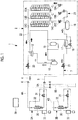
- Fig. 1 is a refrigerant circuit diagram at the time of heating operation of a multi-split air conditioner according to the embodiment.
- a plurality of indoor units 3A and 3B are connected in parallel to one outdoor unit 2.
- the plurality of indoor units 3A and 3B are connected to each other in parallel via splitters 6 between a gas side pipe 4 and a liquid side pipe 5, which are connected to the outdoor unit 2.
- the outdoor unit 2 includes an inverter-driven compressor 10 that compresses a refrigerant, a four-way switching valve 12 that switches between refrigerant circulation directions, a plurality of outdoor heat exchangers (heat exchangers) 13A, 13B, and 13C that causes heat exchange between a refrigerant and outside air, outdoor heat exchanger temperature sensors (temperature sensors) 14A, 14B and 14C that measure heat exchanger temperatures of the outdoor heat exchangers 13A, 13B, and 13C respectively, outdoor expansion valves (electric expansion valve: EEVH) (flow rate adjusting devices) 15A, 15B, and 15C that adjust refrigerant flow rates of the outdoor heat exchangers 13A, 13B, and 13C respectively, a receiver 16 that stores a liquid refrigerant, a supercooling heat exchanger 17 that supercools a liquid refrigerant, an expansion valve for supercooling (EEVSC) 18 that controls a refrigerant amount to be divided for the supercooling heat exchanger 17, an accumulator
- the volumes of the outdoor heat exchangers 13A, 13B, and 13C are different from each other.
- any one of A, B, or C will be assigned at the end, and in a case of not differentiating between the respective outdoor heat exchangers 13, A, B, or C will be omitted.
- any one of A, B, or C will be assigned at the end, and in a case of not differentiating between the respective outdoor heat exchanger temperature sensors 14, A, B, or C will be omitted.
- any one of A, B, or C will be assigned at the end, and in a case of not differentiating between the respective outdoor expansion valves 15, A, B, or C will be omitted.
- the respective devices on an outdoor unit 2 side are connected in turn via a refrigerant pipe 22, and configure a known outdoor side refrigerant circuit 23.
- the outdoor unit 2 is provided with an outdoor fan (not illustrated) that blows outside air with respect to the respective outdoor heat exchangers 13.
- the gas side pipe 4 and the liquid side pipe 5 are refrigerant pipes which are respectively connected to the gas side operating valve 20 and the liquid side operating valve 21 of the outdoor unit 2.
- the lengths of the pipes are set as appropriate according to a distance between the outdoor unit 2 and the plurality of indoor units 3A and 3B connected thereto.
- the plurality of splitters 6 are provided in the middle of the gas side pipe 4 and the liquid side pipe 5, and an appropriate number of indoor units 3A and 3B are connected via the splitters 6. Accordingly, one closed refrigerating cycle (refrigerant circuit) 7 is configured.
- the indoor units 3A and 3B each include an indoor heat exchanger 30 that cools or heats indoor air by causing heat exchange with a refrigerant and contributes to indoor air conditioning, an indoor expansion valve (EEVC) 31, an indoor fan 32 that circulates indoor air via the indoor heat exchanger 30, and an indoor controller 33.
- the indoor units are connected to the splitters 6 via gas side branch pipes 4A and 4B and liquid side branch pipes 5A and 5B on an indoor side.
- a control device 50 acquires values set by the indoor controllers 33, a refrigerant temperature, and the like, and performs switching control of the four-way switching valve 12 and control of opening and closing or an opening degree of each valve.
- the control device 50 is configured with, for example, a central processing unit (CPU), a random access memory (RAM), a read only memory (ROM), a computer readable storage medium, and the like.
- CPU central processing unit
- RAM random access memory
- ROM read only memory
- a series of processes for realizing a variety of functions are stored, for example, in a storage medium or the like in a form of a program.
- a variety of functions are realized by the CPU reading the program from the RAM or the like and executing processing and computing of information.
- the program may be applied in a form of being installed in advance in the ROM or other storage media, a form of being provided in a state where the program is stored in the computer readable storage medium, a form of being transmitted via communication means in a wired or wireless manner, or the like.
- the computer readable storage medium is a magnetic disk, a magneto-optical disk, a CD-ROM, a DVD-ROM, a semiconductor memory, or the like.
- heating operation is performed as follows.
- a high-temperature and high-pressure refrigerant gas which is compressed and discharged by the compressor 10 circulates to a gas side operating valve 20 side via the four-way switching valve 12.
- the high-pressure gas refrigerant is led out from the outdoor unit 2 via the gas side operating valve 20 and the gas side pipe 4, and is introduced into the plurality of indoor units 3A and 3B via the splitters 6 and the gas side branch pipes 4A and 4B on the indoor side.
- the high-temperature and high-pressure refrigerant gas introduced in the indoor units 3A and 3B exchanges heat with indoor air circulating in the indoor heat exchangers 30 via the indoor fans 32, and accordingly the heated indoor air is blown out indoors and contributes to heating.
- a refrigerant which is condensed and liquefied by the indoor heat exchangers 30 reaches the splitters 6 via the indoor expansion valves 31 and the liquid side branch pipes 5A and 5B, joins a refrigerant from the other indoor unit, and returns to the outdoor unit 2 via the liquid side pipe 5.
- the opening degree of each of the indoor expansion valves 31 is controlled via the indoor controller 33 such that a refrigerant outlet temperature or a degree of refrigerant supercooling of the indoor heat exchanger 30, which functions as a condenser, becomes a control target value.
- the refrigerant which has returned to the outdoor unit 2 is partially divided from a liquid refrigerant pipe, exchanges heat with a refrigerant adiabatically expanded by the expansion valve for supercooling 18 to be given with a degree of supercooling.
- a circulation amount is adjusted by the refrigerant flowing to the receiver 16 and being temporarily stored in the receiver.
- the liquid refrigerant flows into the outdoor heat exchangers 13.
- the defrosting operation is carried out in general in a case where the temperature of any one of the respective outdoor heat exchangers 13, which is measured by the outdoor heat exchanger temperature sensor 14, has become a certain temperature or lower.
- a temperature that causes the defrosting operation to be carried out varies according to each type of multi-split air conditioner 1, but the temperature is, for example, a value that is approximately 0°C.
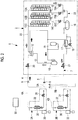
- Fig. 2 is a refrigerant circuit diagram at the time of defrosting operation of the multi-split air conditioner according to the embodiment.
- defrosting operation is performed as follows.
- a high-temperature and high-pressure refrigerant gas which is compressed and discharged by the compressor 10, circulates to an outdoor heat exchanger 13 side by means of the four-way switching valve 12, and exchanges heat with outside air blown to the respective outdoor heat exchangers 13 by the outdoor fan so as to be condensed and liquefied.
- the liquid refrigerant passes through the respective outdoor expansion valves 15 and is temporarily stored inside the receiver 16.
- defrosting is performed by a high-temperature and high-pressure refrigerant gas flowing in the respective outdoor heat exchangers 13.
- the liquid refrigerant of which a circulation amount is adjusted in the receiver 16 reaches the supercooling heat exchanger 17, and is supercooled as in the case of heating.
- the liquid refrigerant is led from the outdoor unit 2 to the liquid side pipe 5 via the liquid side operating valve 21, and is divided into the liquid side branch pipes 5A and 5B of the indoor units 3A and 3B respectively via the splitter 6.
- the liquid refrigerant divided into the liquid side branch pipes 5A and 5B flows into the indoor units 3A and 3B respectively, is adiabatically expanded by the indoor expansion valves 31, and forms a gas-liquid two-phase flow to flow into the indoor heat exchangers 30.
- the refrigerant becomes a gas, reaches the splitters 6 via the gas side branch pipes 4A and 4B, and joins a refrigerant from the other indoor unit in the gas side pipe 4.
- the refrigerant gas which has joined in the gas side pipe 4 returns to the outdoor unit 2 again and joins a refrigerant gas from the supercooling heat exchanger 17 via the gas side operating valve 20 and the four-way switching valve 12, the refrigerant is introduced into the accumulator 19.
- a liquid is separated out from the refrigerant gas, and only a gas is sucked into the compressor 10.
- the refrigerant is again compressed by the compressor 10, and defrosting operation is performed by repeating such cycle.
- the defrosting operation is completed in general in a case where the temperatures of all of the respective outdoor heat exchangers 13, which are measured by all of the outdoor heat exchanger temperature sensors 14, have become a certain temperature or lower.
- a temperature that serves as a reference value for defrosting operation completion that is, a defrosting completion temperature varies according to each type of multi-split air conditioner 1, but the temperature is, for example, a value that is approximately 9°C.
- Fig. 3 is a block diagram of outline of a refrigerant flow rate at the time of defrosting operation of each heat exchanger of the multi-split air conditioner according to the first embodiment of the present invention.
- Fig. 4 is a block diagram of outline of a refrigerant flow rate at the time of defrosting completion of each heat exchanger of the multi-split air conditioner according to the first embodiment of the present invention.
- the control device 50 Prior to the start of defrosting operation, the control device 50 first determines the opening degree of each of the outdoor expansion valves 15 according to the volume of each of the outdoor heat exchangers 13, and performs setting control of setting a valve opening degree. Since the volumes of the respective outdoor heat exchangers 13 are different from each other, and control is performed such that the defrosting of the respective outdoor heat exchangers 13 completes substantially simultaneously, that is, a defrosting completion temperature is reached almost simultaneously, a refrigerant flow rate at which a refrigerant flows into each of the outdoor heat exchangers 13 is determined by a ratio between the respective volumes.
- the opening degree of each of the outdoor expansion valves 15 of the outdoor heat exchangers 13 is determined, and the opening degree is set in each of the outdoor expansion valves 15. After the opening degrees of the outdoor expansion valves 15 are set, defrosting operation is started.
- the volume of each of the outdoor heat exchangers 13 based on the inner diameter, length, and number of pipes. As shown in Figs. 3 and 4 , the volume of the outdoor heat exchanger 13A is the largest, the volume of the outdoor heat exchanger 13B is the second largest, and the volume of the outdoor heat exchanger 13C is the smallest in the embodiment.
- the opening degree of the outdoor expansion valve 15A according to a refrigerant flow rate acquired based on a ratio between the respective volumes is set such that the amount of a refrigerant flowing into the outdoor heat exchanger 13A is the largest.
- the opening degrees of the outdoor expansion valves 15B and 15C are simultaneously set based on a ratio between the respective volumes of the outdoor heat exchangers 13B and 13C.
- the control of the opening degree of each of the outdoor expansion valves 15 according to each refrigerant flow rate acquired based on the ratio between the respective volumes of the outdoor heat exchangers 13 causes each heat exchanger temperature of each of all the outdoor heat exchangers 13, which is measured by each of the outdoor heat exchanger temperature sensors 14, to substantially simultaneously reach a defrosting completion temperature, and defrosting is completed as shown in Fig. 4 .
- the opening degree of each of the outdoor expansion valves 15 according to the volume of each of the outdoor heat exchangers 13 is first determined and set.
- Determining and setting of the opening degrees of the outdoor expansion valves 15 may be carried out at the time of shipping from a factory or at the time of test operation, and the opening degrees of the outdoor expansion valves 15 may be stored in storage means (not illustrated) of the control device 50.
- control device of a multi-split air conditioner the multi-split air conditioner, the method of controlling a multi-split air conditioner, and the program of controlling a multi-split air conditioner according to the embodiment.
- the control device 50 of the multi-split air conditioner 1 that includes the outdoor unit 2 including the plurality of outdoor heat exchangers 13, at least one of which is the outdoor heat exchanger 13 having a different volume, and the plurality of indoor units 3A and 3B controls a refrigerant flow rate according to the volume of each of the outdoor heat exchangers 13 at the time of defrosting operation. Accordingly, the defrosting of the respective outdoor heat exchangers 13 can be substantially simultaneously completed.
- the defrosting of only one outdoor heat exchanger 13 is completed, it is necessary to circulate a refrigerant in order to prevent refrosting with respect to the outdoor heat exchanger 13 in a case where the same amount of refrigerant is supplied to the plurality of outdoor heat exchangers 13 having different volumes. That is, when defrosting completion timings are different from each other, a refrigerant loss by an amount of the refrigerant circulated for refrosting prevention is caused.
- the defrosting of the respective outdoor heat exchangers 13 is substantially simultaneously completed by controlling a refrigerant flow rate according to the volume of each of the outdoor heat exchangers 13. Consequently, it is not necessary to circulate a refrigerant for refrosting prevention, and a refrigerant flow rate necessary for defrosting can be reduced.
- control in a case where control is performed based on a heat exchanger temperature, it can be considered that it requires time until a heat exchanger temperature stabilizes due to defrosting and it takes time until the presence or absence of frosting is reflected in the temperature.
- the volume of each of the outdoor heat exchangers 13 is an acquirable value beforehand, control can be performed from the start of defrosting operation, and time necessary for defrosting can be shortened in the embodiment.
- timings at which defrosting is completed become different from each other when refrigerant flow rates are made the same since refrigerant flow rates necessary for defrosting are different from each other due to a difference in volume.
- the opening degree of each of the outdoor expansion valves 15 is set with respect to each of the outdoor heat exchangers 13 with a defrosting completion temperature as reference since the opening degree of each of the outdoor expansion valves 15 is adjusted and control of a refrigerant flow rate is performed such that the heat exchanger temperature of each of the outdoor heat exchangers 13 simultaneously reaches a defrosting completion temperature.
- a ratio between refrigerant flow rates of the respective outdoor heat exchangers 13 is determined beforehand based on the ratio between the volumes of the respective outdoor heat exchangers 13, and based on this, the opening degree of each of the outdoor expansion valves 15 is set such that the respective outdoor heat exchangers 13 substantially simultaneously reach a defrosting completion temperature. Even in an air conditioner that includes the plurality of outdoor heat exchangers 13 having different volumes, a refrigerant flow rate necessary for defrosting can be reduced since the defrosting of the respective outdoor heat exchangers 13 is simultaneously completed.
- valve opening degree determination control for the respective outdoor expansion valves 15, which serve as reference is carried out at the time of shipping from a factory or at the time of test operation, and opening degrees thereof are stored in the storage means, each refrigerant flow rate can be appropriately stored at the time of valve opening degree determination control, which is carried out at the time of test operation, at the time of shipping from a factory, or the like, before starting regular air conditioning operation. Therefore, since a refrigerant is supplied at a flow rate based on an opening degree, which serves as reference, at the time of regular air conditioning operation, defrosting operation can be started quickly, and defrosting can be substantially simultaneously completed even in the multi-split air conditioner 1 that has the plurality of outdoor heat exchangers 13 having different volumes.
- the opening degree of each of the outdoor expansion valves is set based on the ratio between the volumes of the respective outdoor heat exchangers prior to the start of defrosting operation and defrosting is substantially simultaneously completed in the first embodiment described above, the opening degree of each of the outdoor expansion valves is controlled in a case where defrosting operation is not simultaneously completed in the embodiment. Since other points are the same as those of the first embodiment, the same configurations will be assigned with the same reference signs and description thereof will be omitted.
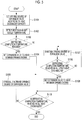
- Fig. 5 is a flow chart of control of the electric expansion valves at the time of defrosting operation by the control device of a multi-split air conditioner according to the second embodiment of the present invention.
- the opening degree of each of the outdoor expansion valves 15 according to the volume of each of the outdoor heat exchangers 13 is set first (S101). After the opening degree of each of the outdoor expansion valves 15 is set, defrosting operation is started.
- each heat exchanger temperature is measured by each of the outdoor heat exchanger temperature sensors 14 of the outdoor heat exchangers 13 (S102).
- Step S103 it is determined whether or not each heat exchanger temperature measured in Step S102 has reached a defrosting completion temperature (for example, 9°C) (S103). In a case where it is determined that the heat exchanger temperature has reached the defrosting completion temperature in Step S103, processing proceeds to Step S104. In a case where it is determined that the heat exchanger temperature has not reached the defrosting completion temperature in Step S103, processing proceeds to Step S107. Determination of Step S103 for each of the outdoor heat exchangers 13 is performed side by side.
- a defrosting completion temperature for example, 9°C
- the opening degree of the outdoor expansion valve 15A is set to a minimum opening degree (S104).
- the minimum opening degree is an opening degree that allows a small amount of refrigerant to an extent that the outdoor heat exchangers 13, on which defrosting is completed, are not refrosted to flow therein. For example, it is approximately 60 pulses.
- processing proceeds to Step S110.
- the opening degree of the outdoor expansion valve 15A is gradually increased (S106).
- the refrosting of the outdoor heat exchanger 13A is prevented by gradually increasing the opening degree of the outdoor expansion valve 15A.
- control of increasing the opening degree of the outdoor expansion valve 15A by x pulse/20s is performed for n times.
- Step S108 it is determined that whether or not the heat exchanger temperature of each of all the other outdoor heat exchangers 13 other than the outdoor heat exchanger 13A (in this case, the outdoor heat exchanger 13B and the outdoor heat exchanger 13C) has reached the defrosting completion temperature (S108). In a case where it is determined that the heat exchanger temperatures of all the other outdoor heat exchangers 13 have reached the defrosting completion temperature in Step S108, processing proceeds to Step S109. In a case where it is determined that the heat exchanger temperatures of all the other outdoor heat exchangers 13 have not reached the defrosting completion temperature in Step S108, processing returns to Step S107.
- the opening degree of the outdoor expansion valve 15A is set to a maximum opening degree (S109). That is, the maximum opening degree means full opening.
- Step S110 It is determined that whether or not the defrosting completion temperature is reached in all the outdoor heat exchangers 13 in Step S110. In a case where it is determined that the heat exchanger temperatures of all the outdoor heat exchangers 13 have reached the defrosting completion temperature in Step S110, defrosting operation is terminated.
- Step S110 processing returns to Step S106.
- Fig. 6 is a block diagram of a refrigerant flow rate at the time of making defrosting regular in each heat exchanger of the multi-split air conditioner according to the second embodiment of the present invention.
- the opening degree of the outdoor expansion valve 15B of the outdoor heat exchanger 13B and the opening degree of the outdoor expansion valve 15C of the outdoor heat exchanger 13C are set to a minimum opening degree, and the opening degree of the outdoor expansion valve 15A of the outdoor heat exchanger 13A is set to a maximum opening degree, that is full opening, as described in Step S104 and Step S109 of the flow chart in Fig. 5 .
- control device of a multi-split air conditioner the multi-split air conditioner, the method of controlling a multi-split air conditioner, and the program of controlling a multi-split air conditioner according to the embodiment.
- a refrigerant flow rate can be minimized, a larger amount of refrigerant can be supplied to the other outdoor heat exchangers 13 on which defrosting is not completed, and the time it takes for defrosting all of the plurality of outdoor heat exchangers 13 can be reduced.
- the opening degrees of the outdoor expansion valves 15 are set to a minimum opening degree instead of full closing, refrosting can be prevented so as kept to a minimum.
- the opening degree of the electric expansion valve of the outdoor heat exchangers 13 on which defrosting is not completed does not change and remains constant, it takes time for defrosting without an increase in the supply of a refrigerant flow rate.
- the opening degree of the outdoor expansion valve 15 of the outdoor heat exchanger 13 is set to full opening. Accordingly, a maximum amount of excess refrigerant can be supplied to the outdoor heat exchanger 13 on which defrosting is not completed, and the time it takes for defrosting can be shortened.
- the flow rate adjusting device is the outdoor expansion valve (electric expansion valve) in each of the embodiments described above, other devices may be used insofar as it is a device including a function in which a flow rate can be adjusted by the control device 50.
Landscapes
- Engineering & Computer Science (AREA)
- Mechanical Engineering (AREA)
- General Engineering & Computer Science (AREA)
- Physics & Mathematics (AREA)
- Thermal Sciences (AREA)
- Chemical & Material Sciences (AREA)
- Combustion & Propulsion (AREA)
- Air Conditioning Control Device (AREA)
Abstract
Description
- The present invention relates to a control device of a multi-split air conditioner, a multi-split air conditioner, a method of controlling a multi-split air conditioner, and a program of controlling a multi-split air conditioner.
- In a case where frost is formed on a heat exchanger in a multi-split air conditioner, defrosting operation is performed. The defrosting operation is operation of defrosting the frost attached to the heat exchanger by causing a high-temperature and high-pressure refrigerant to flow into the heat exchanger. In the defrosting operation of a multi-split air conditioner configured of a plurality of heat exchangers, a refrigerant flow rate required for defrosting varies according to each heat exchanger in a case where the volumes of the heat exchangers are different from each other. For example, in a case where the refrigerant flow rates of all the respective heat exchangers are substantially the same instead of appropriately assigning refrigerant flow rates required for defrosting, a refrigerant is continued to flow in a heat exchanger on which defrosting is completed, and the refrigerant flow rate of a heat exchanger on which defrosting is not completed does not change. As a result, defrosting operation is prolonged in some cases.
- Therefore, control of appropriately assigning a refrigerant flow rate required for defrosting of each heat exchanger is under consideration.
- For example, a technique of comparing temperatures of respective heat exchangers, which are measured by heat exchanging temperature measuring means, and controlling a refrigerant flow rate by means of the opening degree of an electric expansion valve is disclosed in
PTL 1. In addition, a technique of measuring the temperature of an upper path and the temperature of a lower path of a heat exchanger and adjusting a refrigerant flow rate by means of the opening degree of an expansion valve according to a temperature difference is disclosed inPTL 2. -
- [PTL 1] Japanese Unexamined Patent Application Publication No.
5-322388 - [PTL 2] Japanese Unexamined Patent Application Publication No.
2002-89980 - In both of the inventions disclosed in
PTLs - The present invention is devised in consideration of such circumstances, and an object thereof is to provide a control device of a multi-split air conditioner, a multi-split air conditioner, a method of controlling a multi-split air conditioner, and a program of controlling a multi-split air conditioner, which can shorten the time it takes for defrosting of heat exchangers having different volumes.
- In order to solve the problems, the control device of a multi-split air conditioner, the multi-split air conditioner, the method of controlling a multi-split air conditioner, and the program of controlling a multi-split air conditioner of the present invention adopt the following means.
- According to a first aspect of the present invention, there is provided a control device of a multi-split air conditioner including an outdoor unit that includes a plurality of heat exchangers, at least one of which is the heat exchanger having a volume different from a volume of the other heat exchanger, and a plurality of indoor units. In the control device of a multi-split air conditioner, each of the plurality of heat exchangers includes a flow rate adjusting device that adjusts a flow rate of a refrigerant to be supplied to the heat exchanger, and the flow rate of the refrigerant, which is to be supplied to each of the heat exchangers, is adjusted by control of the flow rate adjusting device according to each of the volumes of the plurality of heat exchangers at a time of defrosting operation.
- According to the aspect, the control device of a multi-split air conditioner that includes the outdoor unit including the plurality of heat exchangers, at least one of which is the outdoor heat exchanger having a different volume, and the plurality of indoor units controls a refrigerant flow rate according to the volume of each of the heat exchangers at the time of defrosting operation. Accordingly, the defrosting of each of the heat exchangers can be substantially simultaneously completed. For example, even when the defrosting of only one heat exchanger is completed, it is necessary to circulate a refrigerant in order to prevent refrosting with respect to the heat exchanger in a case where the same amount of refrigerant is supplied to the plurality of heat exchangers having different volumes. That is, when defrosting completion timings are different from each other, a refrigerant loss by an amount of the refrigerant circulated for refrosting prevention is caused. Therefore, the defrosting of each of the heat exchangers is substantially simultaneously completed by controlling a refrigerant flow rate according to the volume of each of the heat exchangers. Accordingly, it is not necessary to circulate the refrigerant for refrosting prevention, and a refrigerant flow rate necessary for defrosting can be reduced.
- In addition, when the refrigerant continues to flow in the heat exchanger on which defrosting is completed, defrosting operation is prolonged in some cases since a refrigerant flow rate with respect to the heat exchangers, which are being defrosted, is limited. However, according to the aspect, since a refrigerant flow rate necessary for each of the heat exchangers is assigned by the flow rate adjusting device, the defrosting of each of the heat exchangers is substantially simultaneously completed, and defrosting operation is terminated early.
- In addition, in a case where control is performed based on a heat exchanger temperature, it can be considered that it requires time until a heat exchanger temperature stabilizes due to defrosting and it takes time until the presence or absence of frosting is reflected in the temperature. On the contrary, the volume of each of the heat exchangers is an acquirable value beforehand, control can be performed from the start of defrosting operation, and time necessary for defrosting can be shortened.
- In the first aspect, the flow rate adjusting device may include an electric expansion valve, each of the plurality of heat exchangers may include a temperature sensor that measures a heat exchanger temperature of the heat exchanger, and valve opening degree determination control of determining an opening degree of each of the electric expansion valves of the plurality of heat exchangers such that the heat exchanger temperatures of all of the heat exchangers substantially simultaneously reach a defrosting completion temperature, which is a reference value of defrosting completion, may be performed.
- According to the aspect, in the air conditioner that includes the plurality of heat exchangers having different volumes, timings at which defrosting is completed become different from each other when refrigerant flow rates are made the same since refrigerant flow rates necessary for defrosting are different from each other due to a difference in volume. When controlling a refrigerant flow rate according to the volume of each of the heat exchangers, the opening degree of each of the electric expansion valves is set with respect to each of the heat exchangers with a defrosting completion temperature as reference since the opening degree of each of the electric expansion valves is adjusted and control of a refrigerant flow rate is performed such that the heat exchanger temperature of each of the heat exchangers simultaneously reaches a defrosting completion temperature. Specifically, a ratio between refrigerant flow rates of the respective heat exchangers is determined beforehand, and based on this, the opening degree of each of the electric expansion valves is set such that the respective heat exchangers substantially simultaneously reach a defrosting completion temperature. Even in the multi-split air conditioner that includes the plurality of heat exchangers having different volumes, a refrigerant flow rate necessary for defrosting can be reduced since the defrosting of the respective heat exchangers is simultaneously completed.
- In the first aspect, in a case where the heat exchanger temperature of at least one heat exchanger has become the defrosting completion temperature or higher, the opening degree of the electric expansion valve of the heat exchanger may be set to a minimum opening degree.
- Even in a case where control is performed such that defrosting is simultaneously completed in the plurality of heat exchangers having different volumes, a case where defrosting completion timings become different due to various factors is considered. In a case where a heat exchanger, on which defrosting is completed earlier than the other heat exchanger, exists, it is not necessary or needless to supply the same amount of refrigerant as an amount before defrosting completion. Thus, in the aspect, the opening degree of the electric expansion valve of the heat exchanger on which defrosting is completed, that is, the heat exchanger of which the temperature has become a defrosting completion temperature or higher is set to have a minimum opening degree. Accordingly, a refrigerant flow rate can be minimized, a larger amount of refrigerant can be supplied to the other heat exchanger, on which defrosting is not completed, and the time it takes for defrosting all of the plurality of heat exchangers can be reduced. In addition, since the opening degree of the expansion valve is set to a minimum opening degree instead of full closing, refrosting can be prevented so as to be kept to a minimum.
- Herein, the minimum opening degree is an opening degree that allows a small amount of refrigerant to an extent that an outdoor heat exchanger, on which defrosting is completed, are not refrosted to flow therein. For example, it is approximately 60 pulses.
- In the first aspect, in a case where the heat exchanger temperature has become lower than the defrosting completion temperature after the opening degree of the electric expansion valve of the heat exchanger is set to the minimum opening degree, the opening degree of the electric expansion valve of the heat exchanger may be gradually increased.
- There is a possibility that the heat exchanger, on which defrosting is completed and of which the electric expansion valve is set such that the opening degree is a minimum opening degree, is refrosted since a refrigerant flow rate is set to a minimum. On the contrary, in the aspect, in a case where the heat exchanger temperature of this heat exchanger becomes lower than the defrosting completion temperature, there is a possibility of refrosting and thus the opening degree of the electric expansion valve is gradually increased. Accordingly, the frosting of the heat exchanger can be prevented by increasing the refrigerant flow rate.
- In the first aspect, in a case where the heat exchanger temperature of only one of the heat exchangers is lower than the defrosting completion temperature, the opening degree of the electric expansion valve of the heat exchanger may be set to full opening.
- Even in a case where control is performed such that defrosting is simultaneously completed in the plurality of heat exchangers having different volumes, a case where defrosting completion timings become different due to various factors is considered. In a case where the defrosting of all of the other heat exchanger is completed and only one heat exchanger on which defrosting is not completed exists, the opening degree of the electric expansion valve of the other heat exchanger becomes a minimum opening degree, and there is a margin in a refrigerant supply amount. However, insofar as the opening degree of the electric expansion valve of the heat exchanger on which defrosting is not completed does not change and remains constant, it takes time for defrosting without an increase in the supply of a refrigerant flow rate. In the aspect, in a case where there is only one heat exchanger on which defrosting is not completed, the opening degree of the electric expansion valve of the heat exchanger is set to full opening. Accordingly, a maximum amount of excess refrigerant can be supplied to the heat exchanger on which defrosting is not completed, and the time it takes for defrosting can be shortened.
- In the first aspect, the valve opening degree determination control may be carried out at a time of shipping from a factory or at a time of test operation, and the opening degree of the electric expansion valve may be stored in storage means.
- According to the aspect, valve opening degree determining control for the electric expansion valve, which serves as reference, is carried out at the time of shipping from a factory or at the time of test operation, and the opening degree is stored in the storage means. Accordingly, a refrigerant flow rate can be appropriately stored at the time of valve opening degree determining control which is carried out at the time of test operation, at the time of shipping from a factory, or the like before starting regular air conditioning operation. Therefore, since a refrigerant is supplied at a flow rate based on an opening degree, which serves as reference, at the time of regular air conditioning operation, defrosting operation can be started quickly, and defrosting can be simultaneously completed even in the air conditioner that has the plurality of heat exchangers having different volumes.
- According to a second aspect of the present invention, there is provided a multi-split air conditioner including an outdoor unit that includes a plurality of heat exchangers, at least one of which is the heat exchanger having a volume different from a volume of the other heat exchanger, a plurality of indoor units, and the control device according to any description made above.
- According to a third aspect of the present invention, there is provided a method of controlling a multi-split air conditioner which includes an outdoor unit that includes a plurality of heat exchangers, at least one of which is the heat exchanger having a volume different from a volume of the other heat exchanger, and a plurality of indoor units. The method of controlling a multi-split air conditioner, in which each of the plurality of heat exchangers includes a flow rate adjusting device that adjusts a flow rate of a refrigerant to be supplied to the heat exchanger, includes a step of adjusting the flow rate of the refrigerant, which is to be supplied to each of the heat exchangers, by control of the flow rate adjusting device according to each of the volumes of the plurality of heat exchangers at a time of defrosting operation.
- According to a fourth aspect of the present invention, there is provided a program of controlling a multi-split air conditioner which includes an outdoor unit that includes a plurality of heat exchangers, at least one of which is the heat exchanger having a volume different from a volume of the other heat exchanger, and a plurality of indoor units. The program of controlling a multi-split air conditioner, in which each of the plurality of heat exchangers includes a flow rate adjusting device that adjusts a flow rate of a refrigerant to be supplied to the heat exchanger, includes a step of adjusting the flow rate of the refrigerant, which is to be supplied to each of the heat exchangers, by control of the flow rate adjusting device according to each of the volumes of the plurality of heat exchangers at a time of defrosting operation.
- According to the present invention, since each refrigerant flow rate is adjusted by performing control of the flow rate adjusting device based on the volume of each of the heat exchangers having different volumes in defrosting operation, the time it takes for defrosting can be shortened by substantially simultaneously completing the defrosting of each heat exchanger.
-
-
Fig. 1 is a refrigerant circuit diagram showing heating operation of a multi-split air conditioner according to a first embodiment of the present invention. -
Fig. 2 is a refrigerant circuit diagram showing defrosting operation of the multi-split air conditioner according to the first embodiment of the present invention. -
Fig. 3 is a block diagram showing a refrigerant flow rate at a time of defrosting operation of each heat exchanger of the multi-split air conditioner according to the first embodiment of the present invention. -
Fig. 4 is a block diagram showing a refrigerant flow rate at a time of defrosting completion of each heat exchanger of the multi-split air conditioner according to the first embodiment of the present invention. -
Fig. 5 is a flow chart showing control of an electric expansion valve at a time of defrosting operation by a control device of a multi-split air conditioner according to a second embodiment of the present invention. -
Fig. 6 is a block diagram showing a refrigerant flow rate at a time of making defrosting regular in each heat exchanger of the multi-split air conditioner according to the second embodiment of the present invention. - Hereinafter, embodiments of a control device of a multi-split air conditioner, a multi-split air conditioner, a method of controlling a multi-split air conditioner, and a program of controlling a multi-split air conditioner according to the present invention will be described with reference to the drawings.
- Hereinafter, a first embodiment of the present invention will be described with reference to
Figs. 1 to 4 . -
Fig. 1 is a refrigerant circuit diagram at the time of heating operation of a multi-split air conditioner according to the embodiment. - In the
multi-split air conditioner 1, a plurality ofindoor units outdoor unit 2. The plurality ofindoor units splitters 6 between agas side pipe 4 and a liquid side pipe 5, which are connected to theoutdoor unit 2. - The
outdoor unit 2 includes an inverter-drivencompressor 10 that compresses a refrigerant, a four-way switching valve 12 that switches between refrigerant circulation directions, a plurality of outdoor heat exchangers (heat exchangers) 13A, 13B, and 13C that causes heat exchange between a refrigerant and outside air, outdoor heat exchanger temperature sensors (temperature sensors) 14A, 14B and 14C that measure heat exchanger temperatures of theoutdoor heat exchangers outdoor heat exchangers receiver 16 that stores a liquid refrigerant, asupercooling heat exchanger 17 that supercools a liquid refrigerant, an expansion valve for supercooling (EEVSC) 18 that controls a refrigerant amount to be divided for thesupercooling heat exchanger 17, anaccumulator 19 that separates a liquid out from a refrigerant gas to be sucked by thecompressor 10 and sucks only a gas into acompressor 10 side, a gasside operating valve 20, and a liquidside operating valve 21. - In the embodiment, the volumes of the
outdoor heat exchangers - Although a case where the three
outdoor heat exchangers Figs. 1 and2 , the number of outdoor heat exchangers to be mounted may be determined as appropriate. - In the following description, in a case of differentiating between the respective outdoor heat exchangers 13, any one of A, B, or C will be assigned at the end, and in a case of not differentiating between the respective outdoor heat exchangers 13, A, B, or C will be omitted. In a case of differentiating between the respective outdoor heat exchanger temperature sensors 14, any one of A, B, or C will be assigned at the end, and in a case of not differentiating between the respective outdoor heat exchanger temperature sensors 14, A, B, or C will be omitted. In addition, in a case of differentiating between the respective outdoor expansion valves 15, any one of A, B, or C will be assigned at the end, and in a case of not differentiating between the respective outdoor expansion valves 15, A, B, or C will be omitted.
- The respective devices on an
outdoor unit 2 side are connected in turn via arefrigerant pipe 22, and configure a known outdoor siderefrigerant circuit 23. In addition, theoutdoor unit 2 is provided with an outdoor fan (not illustrated) that blows outside air with respect to the respective outdoor heat exchangers 13. - The
gas side pipe 4 and the liquid side pipe 5 are refrigerant pipes which are respectively connected to the gasside operating valve 20 and the liquidside operating valve 21 of theoutdoor unit 2. At the time of mounting in the field, the lengths of the pipes are set as appropriate according to a distance between theoutdoor unit 2 and the plurality ofindoor units splitters 6 are provided in the middle of thegas side pipe 4 and the liquid side pipe 5, and an appropriate number ofindoor units splitters 6. Accordingly, one closed refrigerating cycle (refrigerant circuit) 7 is configured. - The
indoor units indoor heat exchanger 30 that cools or heats indoor air by causing heat exchange with a refrigerant and contributes to indoor air conditioning, an indoor expansion valve (EEVC) 31, anindoor fan 32 that circulates indoor air via theindoor heat exchanger 30, and anindoor controller 33. The indoor units are connected to thesplitters 6 via gasside branch pipes side branch pipes - A
control device 50 acquires values set by theindoor controllers 33, a refrigerant temperature, and the like, and performs switching control of the four-way switching valve 12 and control of opening and closing or an opening degree of each valve. - The
control device 50 is configured with, for example, a central processing unit (CPU), a random access memory (RAM), a read only memory (ROM), a computer readable storage medium, and the like. A series of processes for realizing a variety of functions are stored, for example, in a storage medium or the like in a form of a program. A variety of functions are realized by the CPU reading the program from the RAM or the like and executing processing and computing of information. The program may be applied in a form of being installed in advance in the ROM or other storage media, a form of being provided in a state where the program is stored in the computer readable storage medium, a form of being transmitted via communication means in a wired or wireless manner, or the like. The computer readable storage medium is a magnetic disk, a magneto-optical disk, a CD-ROM, a DVD-ROM, a semiconductor memory, or the like. - In the
multi-split air conditioner 1, heating operation is performed as follows. - A high-temperature and high-pressure refrigerant gas which is compressed and discharged by the
compressor 10 circulates to a gasside operating valve 20 side via the four-way switching valve 12. The high-pressure gas refrigerant is led out from theoutdoor unit 2 via the gasside operating valve 20 and thegas side pipe 4, and is introduced into the plurality ofindoor units splitters 6 and the gasside branch pipes - The high-temperature and high-pressure refrigerant gas introduced in the
indoor units indoor heat exchangers 30 via theindoor fans 32, and accordingly the heated indoor air is blown out indoors and contributes to heating. On the other hand, a refrigerant which is condensed and liquefied by theindoor heat exchangers 30 reaches thesplitters 6 via theindoor expansion valves 31 and the liquidside branch pipes outdoor unit 2 via the liquid side pipe 5. At the time of heating, in theindoor units indoor expansion valves 31 is controlled via theindoor controller 33 such that a refrigerant outlet temperature or a degree of refrigerant supercooling of theindoor heat exchanger 30, which functions as a condenser, becomes a control target value. - In the process of reaching the
supercooling heat exchanger 17 via the liquidside operating valve 21 and flowing to a liquid refrigerant pipe side, the refrigerant which has returned to theoutdoor unit 2 is partially divided from a liquid refrigerant pipe, exchanges heat with a refrigerant adiabatically expanded by the expansion valve for supercooling 18 to be given with a degree of supercooling. After then, a circulation amount is adjusted by the refrigerant flowing to thereceiver 16 and being temporarily stored in the receiver. After being supplied to the respective outdoor expansion valves 15 and being adiabatically expanded, the liquid refrigerant flows into the outdoor heat exchangers 13. - In the respective outdoor heat exchangers 13, outside air blown from the outdoor fan exchanges heat with the refrigerant, and the refrigerant absorbs heat from the outside air to evaporate and become a gas. After joining a refrigerant gas from the supercooling
heat exchanger 17 via the four-way switching valve 12 from the respective outdoor heat exchangers 13, the refrigerant is introduced into theaccumulator 19. In theaccumulator 19, a liquid is separated out from the refrigerant gas and only a gas is sucked into thecompressor 10. The gas is again compressed by thecompressor 10. Heating operation is performed by repeating such cycle. - For example, in a case where an outside temperature is low and humidity is high at the time of heating operation of the
multi-split air conditioner 1, the temperature of the refrigerant flowing in the respective outdoor heat exchangers 13 decreases by the pressure thereof being lowered by the respective outdoor expansion valves 15. Thus, there is a possibility that frost is formed on the respective outdoor heat exchangers 13. When frost is formed on the outdoor heat exchangers 13, heating performance decreases. Therefore, in this case, defrosting operation is performed by switching of the four-way switching valve 12. - The defrosting operation is carried out in general in a case where the temperature of any one of the respective outdoor heat exchangers 13, which is measured by the outdoor heat exchanger temperature sensor 14, has become a certain temperature or lower. A temperature that causes the defrosting operation to be carried out varies according to each type of
multi-split air conditioner 1, but the temperature is, for example, a value that is approximately 0°C. -
Fig. 2 is a refrigerant circuit diagram at the time of defrosting operation of the multi-split air conditioner according to the embodiment. - In the
multi-split air conditioner 1, defrosting operation is performed as follows. - A high-temperature and high-pressure refrigerant gas, which is compressed and discharged by the
compressor 10, circulates to an outdoor heat exchanger 13 side by means of the four-way switching valve 12, and exchanges heat with outside air blown to the respective outdoor heat exchangers 13 by the outdoor fan so as to be condensed and liquefied. The liquid refrigerant passes through the respective outdoor expansion valves 15 and is temporarily stored inside thereceiver 16. - In such a manner, defrosting is performed by a high-temperature and high-pressure refrigerant gas flowing in the respective outdoor heat exchangers 13.
- The liquid refrigerant of which a circulation amount is adjusted in the
receiver 16 reaches thesupercooling heat exchanger 17, and is supercooled as in the case of heating. The liquid refrigerant is led from theoutdoor unit 2 to the liquid side pipe 5 via the liquidside operating valve 21, and is divided into the liquidside branch pipes indoor units splitter 6. - The liquid refrigerant divided into the liquid
side branch pipes indoor units indoor expansion valves 31, and forms a gas-liquid two-phase flow to flow into theindoor heat exchangers 30. In theindoor heat exchangers 30, the refrigerant becomes a gas, reaches thesplitters 6 via the gasside branch pipes gas side pipe 4. - After the refrigerant gas which has joined in the
gas side pipe 4 returns to theoutdoor unit 2 again and joins a refrigerant gas from the supercoolingheat exchanger 17 via the gasside operating valve 20 and the four-way switching valve 12, the refrigerant is introduced into theaccumulator 19. In theaccumulator 19, a liquid is separated out from the refrigerant gas, and only a gas is sucked into thecompressor 10. The refrigerant is again compressed by thecompressor 10, and defrosting operation is performed by repeating such cycle. - The defrosting operation is completed in general in a case where the temperatures of all of the respective outdoor heat exchangers 13, which are measured by all of the outdoor heat exchanger temperature sensors 14, have become a certain temperature or lower. A temperature that serves as a reference value for defrosting operation completion, that is, a defrosting completion temperature varies according to each type of
multi-split air conditioner 1, but the temperature is, for example, a value that is approximately 9°C. - Next, opening degree control of the outdoor expansion valves at the time of defrosting operation will be described with reference to
Figs. 3 and 4 . -
Fig. 3 is a block diagram of outline of a refrigerant flow rate at the time of defrosting operation of each heat exchanger of the multi-split air conditioner according to the first embodiment of the present invention. - In addition,
Fig. 4 is a block diagram of outline of a refrigerant flow rate at the time of defrosting completion of each heat exchanger of the multi-split air conditioner according to the first embodiment of the present invention. - Prior to the start of defrosting operation, the
control device 50 first determines the opening degree of each of the outdoor expansion valves 15 according to the volume of each of the outdoor heat exchangers 13, and performs setting control of setting a valve opening degree. Since the volumes of the respective outdoor heat exchangers 13 are different from each other, and control is performed such that the defrosting of the respective outdoor heat exchangers 13 completes substantially simultaneously, that is, a defrosting completion temperature is reached almost simultaneously, a refrigerant flow rate at which a refrigerant flows into each of the outdoor heat exchangers 13 is determined by a ratio between the respective volumes. Based on each of determined refrigerant flow rates, the opening degree of each of the outdoor expansion valves 15 of the outdoor heat exchangers 13 is determined, and the opening degree is set in each of the outdoor expansion valves 15. After the opening degrees of the outdoor expansion valves 15 are set, defrosting operation is started. - It is possible to calculate the volume of each of the outdoor heat exchangers 13 based on the inner diameter, length, and number of pipes. As shown in
Figs. 3 and 4 , the volume of theoutdoor heat exchanger 13A is the largest, the volume of theoutdoor heat exchanger 13B is the second largest, and the volume of theoutdoor heat exchanger 13C is the smallest in the embodiment. - Since the volume of the
outdoor heat exchanger 13A is the largest as shown inFig. 3 , the opening degree of theoutdoor expansion valve 15A according to a refrigerant flow rate acquired based on a ratio between the respective volumes is set such that the amount of a refrigerant flowing into theoutdoor heat exchanger 13A is the largest. Similarly, also the opening degrees of theoutdoor expansion valves outdoor heat exchangers - The control of the opening degree of each of the outdoor expansion valves 15 according to each refrigerant flow rate acquired based on the ratio between the respective volumes of the outdoor heat exchangers 13 causes each heat exchanger temperature of each of all the outdoor heat exchangers 13, which is measured by each of the outdoor heat exchanger temperature sensors 14, to substantially simultaneously reach a defrosting completion temperature, and defrosting is completed as shown in
Fig. 4 . - In the embodiment, prior to the start of defrosting operation, the opening degree of each of the outdoor expansion valves 15 according to the volume of each of the outdoor heat exchangers 13 is first determined and set.
- Determining and setting of the opening degrees of the outdoor expansion valves 15 may be carried out at the time of shipping from a factory or at the time of test operation, and the opening degrees of the outdoor expansion valves 15 may be stored in storage means (not illustrated) of the
control device 50. - As illustrated hereinbefore, the following effects are achieved in the control device of a multi-split air conditioner, the multi-split air conditioner, the method of controlling a multi-split air conditioner, and the program of controlling a multi-split air conditioner according to the embodiment.
- In the embodiment, the
control device 50 of themulti-split air conditioner 1 that includes theoutdoor unit 2 including the plurality of outdoor heat exchangers 13, at least one of which is the outdoor heat exchanger 13 having a different volume, and the plurality ofindoor units - In addition, when a refrigerant continues to flow in the outdoor heat exchangers 13 on which defrosting is completed, defrosting operation is prolonged since refrigerant flow rates with respect to the outdoor heat exchangers 13, which are being defrosted, are limited. In the embodiment, since a refrigerant flow rate necessary for each of the outdoor heat exchangers 13 is assigned by each of the outdoor expansion valves 15, the defrosting of the respective outdoor heat exchangers 13 is substantially simultaneously completed, and defrosting operation is terminated early.
- In addition, in a case where control is performed based on a heat exchanger temperature, it can be considered that it requires time until a heat exchanger temperature stabilizes due to defrosting and it takes time until the presence or absence of frosting is reflected in the temperature. On the contrary, the volume of each of the outdoor heat exchangers 13 is an acquirable value beforehand, control can be performed from the start of defrosting operation, and time necessary for defrosting can be shortened in the embodiment.
- In the
multi-split air conditioner 1 that includes the plurality of outdoor heat exchangers 13 having different volumes, timings at which defrosting is completed become different from each other when refrigerant flow rates are made the same since refrigerant flow rates necessary for defrosting are different from each other due to a difference in volume. In the embodiment, when controlling a refrigerant flow rate according to the volume of each of the outdoor heat exchangers 13, the opening degree of each of the outdoor expansion valves 15 is set with respect to each of the outdoor heat exchangers 13 with a defrosting completion temperature as reference since the opening degree of each of the outdoor expansion valves 15 is adjusted and control of a refrigerant flow rate is performed such that the heat exchanger temperature of each of the outdoor heat exchangers 13 simultaneously reaches a defrosting completion temperature. Specifically, a ratio between refrigerant flow rates of the respective outdoor heat exchangers 13 is determined beforehand based on the ratio between the volumes of the respective outdoor heat exchangers 13, and based on this, the opening degree of each of the outdoor expansion valves 15 is set such that the respective outdoor heat exchangers 13 substantially simultaneously reach a defrosting completion temperature. Even in an air conditioner that includes the plurality of outdoor heat exchangers 13 having different volumes, a refrigerant flow rate necessary for defrosting can be reduced since the defrosting of the respective outdoor heat exchangers 13 is simultaneously completed. - In the embodiment, since valve opening degree determination control for the respective outdoor expansion valves 15, which serve as reference, is carried out at the time of shipping from a factory or at the time of test operation, and opening degrees thereof are stored in the storage means, each refrigerant flow rate can be appropriately stored at the time of valve opening degree determination control, which is carried out at the time of test operation, at the time of shipping from a factory, or the like, before starting regular air conditioning operation. Therefore, since a refrigerant is supplied at a flow rate based on an opening degree, which serves as reference, at the time of regular air conditioning operation, defrosting operation can be started quickly, and defrosting can be substantially simultaneously completed even in the
multi-split air conditioner 1 that has the plurality of outdoor heat exchangers 13 having different volumes. - Hereinafter, a second embodiment of the present invention will be described with reference to
Figs. 5 and6 . - Although the opening degree of each of the outdoor expansion valves is set based on the ratio between the volumes of the respective outdoor heat exchangers prior to the start of defrosting operation and defrosting is substantially simultaneously completed in the first embodiment described above, the opening degree of each of the outdoor expansion valves is controlled in a case where defrosting operation is not simultaneously completed in the embodiment. Since other points are the same as those of the first embodiment, the same configurations will be assigned with the same reference signs and description thereof will be omitted.
-
Fig. 5 is a flow chart of control of the electric expansion valves at the time of defrosting operation by the control device of a multi-split air conditioner according to the second embodiment of the present invention. - Prior to the start of defrosting operation, the opening degree of each of the outdoor expansion valves 15 according to the volume of each of the outdoor heat exchangers 13 is set first (S101). After the opening degree of each of the outdoor expansion valves 15 is set, defrosting operation is started.
- Next, each heat exchanger temperature is measured by each of the outdoor heat exchanger temperature sensors 14 of the outdoor heat exchangers 13 (S102).
- Next, it is determined whether or not each heat exchanger temperature measured in Step S102 has reached a defrosting completion temperature (for example, 9°C) (S103). In a case where it is determined that the heat exchanger temperature has reached the defrosting completion temperature in Step S103, processing proceeds to Step S104. In a case where it is determined that the heat exchanger temperature has not reached the defrosting completion temperature in Step S103, processing proceeds to Step S107. Determination of Step S103 for each of the outdoor heat exchangers 13 is performed side by side.
- For example, in a case where it is determined that the heat exchanger temperature of the
outdoor heat exchanger 13A has reached the defrosting completion temperature in Step S103, the opening degree of theoutdoor expansion valve 15A is set to a minimum opening degree (S104). The minimum opening degree is an opening degree that allows a small amount of refrigerant to an extent that the outdoor heat exchangers 13, on which defrosting is completed, are not refrosted to flow therein. For example, it is approximately 60 pulses. Next, processing proceeds to Step S110. - For example, in a case where it is determined that the heat exchanger temperature of the
outdoor heat exchanger 13A falls short of the defrosting completion temperature in Step S110, the opening degree of theoutdoor expansion valve 15A is gradually increased (S106). The refrosting of theoutdoor heat exchanger 13A is prevented by gradually increasing the opening degree of theoutdoor expansion valve 15A. Specifically, for example, control of increasing the opening degree of theoutdoor expansion valve 15A by x pulse/20s is performed for n times. - When the control of gradually increasing the opening degree of the
outdoor expansion valve 15A is completed, processing proceeds to Step S110. - On the other hand, for example, in a case where it is determined that the heat exchanger temperature of the
outdoor heat exchanger 13A has not reached the defrosting completion temperature in Step S103, the opening degree of theoutdoor expansion valve 15A is maintained (S107). - Next, it is determined that whether or not the heat exchanger temperature of each of all the other outdoor heat exchangers 13 other than the
outdoor heat exchanger 13A (in this case, theoutdoor heat exchanger 13B and theoutdoor heat exchanger 13C) has reached the defrosting completion temperature (S108). In a case where it is determined that the heat exchanger temperatures of all the other outdoor heat exchangers 13 have reached the defrosting completion temperature in Step S108, processing proceeds to Step S109. In a case where it is determined that the heat exchanger temperatures of all the other outdoor heat exchangers 13 have not reached the defrosting completion temperature in Step S108, processing returns to Step S107. - In a case where it is determined that whether or not the heat exchanger temperatures of all the other outdoor heat exchangers 13 other than the
outdoor heat exchanger 13A (theoutdoor heat exchanger 13B and theoutdoor heat exchanger 13C) have reached the defrosting completion temperature in Step S108, the opening degree of theoutdoor expansion valve 15A is set to a maximum opening degree (S109). That is, the maximum opening degree means full opening. - After then, processing proceeds to Step S110.
- It is determined that whether or not the defrosting completion temperature is reached in all the outdoor heat exchangers 13 in Step S110. In a case where it is determined that the heat exchanger temperatures of all the outdoor heat exchangers 13 have reached the defrosting completion temperature in Step S110, defrosting operation is terminated.
- On the other hand, in a case where it is determined that the heat exchanger temperatures of all the outdoor heat exchangers 13 have not reached the defrosting completion temperature in Step S110, processing returns to Step S106.
-
Fig. 6 is a block diagram of a refrigerant flow rate at the time of making defrosting regular in each heat exchanger of the multi-split air conditioner according to the second embodiment of the present invention. - As shown in
Fig. 6 , in a case where the defrosting of theoutdoor heat exchanger 13B and theoutdoor heat exchanger 13C is completed and theoutdoor heat exchanger 13A is being defrosted, the opening degree of theoutdoor expansion valve 15B of theoutdoor heat exchanger 13B and the opening degree of theoutdoor expansion valve 15C of theoutdoor heat exchanger 13C are set to a minimum opening degree, and the opening degree of theoutdoor expansion valve 15A of theoutdoor heat exchanger 13A is set to a maximum opening degree, that is full opening, as described in Step S104 and Step S109 of the flow chart inFig. 5 . Accordingly, a small amount of refrigerant to an extent that refrosting is prevented flows into theoutdoor heat exchanger 13B and theoutdoor heat exchanger 13C, and a refrigerant that has not flowed into theoutdoor heat exchanger 13B and theoutdoor heat exchanger 13C flows into theoutdoor heat exchanger 13A. Therefore, the time it takes for defrosting theoutdoor heat exchanger 13A is shortened, and thus the time it takes for defrosting all of the outdoor heat exchangers 13 is shortened. - As illustrated hereinbefore, the following effects are achieved in the control device of a multi-split air conditioner, the multi-split air conditioner, the method of controlling a multi-split air conditioner, and the program of controlling a multi-split air conditioner according to the embodiment.
- Even in a case where control is performed such that defrosting is simultaneously completed in the plurality of outdoor heat exchangers 13 having different volumes, a case where defrosting completion timings become different due to various factors is considered. In a case where an outdoor heat exchanger 13 on which defrosting is completed earlier than the other outdoor heat exchangers 13 exists, it is not necessary or needless to supply the same amount of refrigerant as an amount before defrosting completion. Then, the opening degree of the outdoor expansion valve 15 of the outdoor heat exchanger 13 on which defrosting is completed, that is, the outdoor heat exchanger 13 of which the temperature has become a defrosting completion temperature or higher is set to have a minimum opening degree. Accordingly, a refrigerant flow rate can be minimized, a larger amount of refrigerant can be supplied to the other outdoor heat exchangers 13 on which defrosting is not completed, and the time it takes for defrosting all of the plurality of outdoor heat exchangers 13 can be reduced. In addition, since the opening degrees of the outdoor expansion valves 15 are set to a minimum opening degree instead of full closing, refrosting can be prevented so as kept to a minimum.
- There is a possibility that the outdoor heat exchanger 13, on which defrosting is completed and of which the outdoor expansion valve 15 is set such that the opening degree is a minimum opening degree, is refrosted since a refrigerant flow rate is set to a minimum. On the contrary, in a case where the heat exchanger temperature of this outdoor heat exchanger 13 becomes lower than the defrosting completion temperature, there is a possibility of refrosting, and thus the opening degree of the outdoor expansion valve 15 is gradually increased. Accordingly, the frosting of the outdoor heat exchanger 13 can be prevented by increasing the refrigerant flow rate.
- Even in a case where control is performed such that defrosting is simultaneously completed in the plurality of outdoor heat exchangers 13 having different volumes, a case where defrosting completion timings become different due to various factors is considered. In a case where the defrosting of all of the other outdoor heat exchangers 13 is completed and only one outdoor heat exchanger 13 on which defrosting is not completed exists, the opening degrees of the outdoor expansion valves 15 of the other outdoor heat exchangers 13 become a minimum opening degree, and there is a margin in a refrigerant supply amount. However, insofar as the opening degree of the electric expansion valve of the outdoor heat exchangers 13 on which defrosting is not completed does not change and remains constant, it takes time for defrosting without an increase in the supply of a refrigerant flow rate. In a case where there is only one outdoor heat exchanger 13 on which defrosting is not completed, the opening degree of the outdoor expansion valve 15 of the outdoor heat exchanger 13 is set to full opening. Accordingly, a maximum amount of excess refrigerant can be supplied to the outdoor heat exchanger 13 on which defrosting is not completed, and the time it takes for defrosting can be shortened.
- Although each of the embodiments of the present invention has been described in detail hereinbefore with reference to the drawings, specific configurations are not limited to the embodiments, and design that is modified without departing from the spirit of the present invention may be included as well.
- For example, although the flow rate adjusting device is the outdoor expansion valve (electric expansion valve) in each of the embodiments described above, other devices may be used insofar as it is a device including a function in which a flow rate can be adjusted by the
control device 50. -
- 1: multi-split air conditioner
- 2: outdoor unit
- 3: indoor unit
- 10: compressor
- 12: four-way switching valve
- 13: outdoor heat exchanger (heat exchanger)
- 14: outdoor heat exchanger temperature sensor (temperature sensor)
- 15: outdoor expansion valve (flow rate adjusting device)
- 50: control device
Claims (9)
- A control device of a multi-split air conditioner including an outdoor unit that includes a plurality of heat exchangers, at least one of which is the heat exchanger having a volume different from a volume of the other heat exchanger, and a plurality of indoor units,
wherein each of the plurality of heat exchangers includes a flow rate adjusting device that adjusts a flow rate of a refrigerant to be supplied to the heat exchanger, and
the flow rate of the refrigerant, which is to be supplied to each of the heat exchangers, is adjusted by control of the flow rate adjusting device according to each of the volumes of the plurality of heat exchangers at a time of defrosting operation. - The control device of a multi-split air conditioner according to Claim 1,
wherein the flow rate adjusting device includes an electric expansion valve,
each of the plurality of heat exchangers includes a temperature sensor that measures a heat exchanger temperature of the heat exchanger, and
valve opening degree determination control of determining an opening degree of each of the electric expansion valves of the plurality of heat exchangers such that the heat exchanger temperatures of all of the heat exchangers substantially simultaneously reach a defrosting completion temperature, which is a reference value of defrosting completion, is performed. - The control device of a multi-split air conditioner according to Claim 2,
wherein in a case where the heat exchanger temperature of at least one heat exchanger has become the defrosting completion temperature or higher, the opening degree of the electric expansion valve of the heat exchanger is set to a minimum opening degree. - The control device of a multi-split air conditioner according to Claim 3,
wherein in a case where the heat exchanger temperature has become lower than the defrosting completion temperature after the opening degree of the electric expansion valve of the heat exchanger is set to the minimum opening degree, the opening degree of the electric expansion valve of the heat exchanger is gradually increased. - The control device of a multi-split air conditioner according to Claim 3 or 4,
wherein in a case where the heat exchanger temperature of only one of the heat exchangers is lower than the defrosting completion temperature, the opening degree of the electric expansion valve of the heat exchanger is set to full opening. - The control device of a multi-split air conditioner according to any one of Claims 2 to 5,
wherein the valve opening degree determination control is carried out at a time of shipping from a factory or at a time of test operation, and the opening degree of the electric expansion valve is stored in storage means. - A multi-split air conditioner comprising:an outdoor unit that includes a plurality of heat exchangers, at least one of which is the heat exchanger having a volume different from a volume of the other heat exchanger;a plurality of indoor units; andthe control device according to any one of Claims 1 to 6.
- A method of controlling a multi-split air conditioner including an outdoor unit that includes a plurality of heat exchangers, at least one of which is the heat exchanger having a volume different from a volume of the other heat exchanger, and a plurality of indoor units,
wherein each of the plurality of heat exchangers includes a flow rate adjusting device that adjusts a flow rate of a refrigerant to be supplied to the heat exchanger,
the method comprising: a step of adjusting the flow rate of the refrigerant, which is to be supplied to each of the heat exchangers, by control of the flow rate adjusting device according to each of the volumes of the plurality of heat exchangers at a time of defrosting operation. - A program of controlling a multi-split air conditioner including an outdoor unit that includes a plurality of heat exchangers, at least one of which is the heat exchanger having a volume different from a volume of the other heat exchanger, and a plurality of indoor units,
wherein each of the plurality of heat exchangers includes a flow rate adjusting device that adjusts a flow rate of a refrigerant to be supplied to the heat exchanger,
the program comprising:
a step of adjusting the flow rate of the refrigerant, which is to be supplied to each of the heat exchangers, by control of the flow rate adjusting device according to each of the volumes of the plurality of heat exchangers at a time of defrosting operation.
Applications Claiming Priority (2)
| Application Number | Priority Date | Filing Date | Title |
|---|---|---|---|
| JP2016256599A JP2018109463A (en) | 2016-12-28 | 2016-12-28 | Controller of multiple-type air conditioner, multiple-type air conditioner, method of controlling multiple-type air conditioner, and control program for multiple-type air conditioner |
| PCT/JP2017/041936 WO2018123361A1 (en) | 2016-12-28 | 2017-11-22 | Multi-split air conditioner control device, multi-split air conditioner, multi-split air conditioner control method, and multi-split air conditioner control program |
Publications (2)
| Publication Number | Publication Date |
|---|---|
| EP3473946A1 true EP3473946A1 (en) | 2019-04-24 |
| EP3473946A4 EP3473946A4 (en) | 2019-06-26 |
Family
ID=62707199
Family Applications (1)
| Application Number | Title | Priority Date | Filing Date |
|---|---|---|---|
| EP17885879.1A Withdrawn EP3473946A4 (en) | 2016-12-28 | 2017-11-22 | Multi-split air conditioner control device, multi-split air conditioner, multi-split air conditioner control method, and multi-split air conditioner control program |
Country Status (3)
| Country | Link |
|---|---|
| EP (1) | EP3473946A4 (en) |
| JP (1) | JP2018109463A (en) |
| WO (1) | WO2018123361A1 (en) |
Cited By (6)
| Publication number | Priority date | Publication date | Assignee | Title |
|---|---|---|---|---|
| CN110762787A (en) * | 2019-10-12 | 2020-02-07 | 青岛海信日立空调系统有限公司 | Defrosting control method of multi-split central air conditioning system |
| CN110836467A (en) * | 2018-08-17 | 2020-02-25 | 青岛海尔空调器有限总公司 | Defrosting control method for fixed-frequency air conditioner |
| CN110836476A (en) * | 2018-08-17 | 2020-02-25 | 青岛海尔空调器有限总公司 | Defrost control method for fixed frequency air conditioner |
| CN110836466A (en) * | 2018-08-17 | 2020-02-25 | 青岛海尔空调器有限总公司 | Defrost control method for fixed frequency air conditioner |
| CN110836470A (en) * | 2018-08-17 | 2020-02-25 | 青岛海尔空调器有限总公司 | Defrost control method for fixed frequency air conditioner |
| CN111667637A (en) * | 2020-05-11 | 2020-09-15 | 中外运冷链物流有限公司 | Method for calculating electricity charge of single refrigeration house of centralized refrigeration system |
Families Citing this family (7)
| Publication number | Priority date | Publication date | Assignee | Title |
|---|---|---|---|---|
| CN109855234A (en) * | 2018-11-12 | 2019-06-07 | 青岛海尔空调器有限总公司 | Air conditioner and heating control method thereof |
| JP6835116B2 (en) * | 2019-02-18 | 2021-02-24 | ダイキン工業株式会社 | Refrigeration equipment |
| CN111854057B (en) * | 2019-04-29 | 2022-02-22 | 青岛海尔空调电子有限公司 | Control method and device for defrosting of air conditioner and air conditioner |
| JP7408942B2 (en) * | 2019-07-25 | 2024-01-09 | 株式会社富士通ゼネラル | air conditioner |
| CN113639413B (en) * | 2021-07-23 | 2023-05-26 | 青岛海尔空调电子有限公司 | Defrosting control method for air conditioner and air conditioner |
| JP7624911B2 (en) * | 2021-11-22 | 2025-01-31 | ダイキン工業株式会社 | Refrigeration Cycle Equipment |
| CN115950052A (en) * | 2022-12-02 | 2023-04-11 | 珠海格力节能环保制冷技术研究中心有限公司 | Defrosting control method and device, heat exchange system and multi-connected air conditioning unit |
Family Cites Families (5)
| Publication number | Priority date | Publication date | Assignee | Title |
|---|---|---|---|---|
| JPH0282061A (en) * | 1988-09-20 | 1990-03-22 | Sanden Corp | Air conditioner for multi room type dwelling building |
| JP3030109B2 (en) * | 1991-03-27 | 2000-04-10 | 三洋電機株式会社 | Control method of air conditioner |
| JP3271296B2 (en) | 1992-05-15 | 2002-04-02 | ダイキン工業株式会社 | Defrosting operation control device for refrigeration system |
| JP2002089980A (en) | 2000-09-20 | 2002-03-27 | Fujitsu General Ltd | Air conditioner |
| KR101319687B1 (en) * | 2011-10-27 | 2013-10-17 | 엘지전자 주식회사 | Multi type air conditioner and method of controlling the same |
-
2016
- 2016-12-28 JP JP2016256599A patent/JP2018109463A/en active Pending
-
2017
- 2017-11-22 WO PCT/JP2017/041936 patent/WO2018123361A1/en not_active Ceased
- 2017-11-22 EP EP17885879.1A patent/EP3473946A4/en not_active Withdrawn
Cited By (8)
| Publication number | Priority date | Publication date | Assignee | Title |
|---|---|---|---|---|
| CN110836467A (en) * | 2018-08-17 | 2020-02-25 | 青岛海尔空调器有限总公司 | Defrosting control method for fixed-frequency air conditioner |
| CN110836476A (en) * | 2018-08-17 | 2020-02-25 | 青岛海尔空调器有限总公司 | Defrost control method for fixed frequency air conditioner |
| CN110836466A (en) * | 2018-08-17 | 2020-02-25 | 青岛海尔空调器有限总公司 | Defrost control method for fixed frequency air conditioner |
| CN110836470A (en) * | 2018-08-17 | 2020-02-25 | 青岛海尔空调器有限总公司 | Defrost control method for fixed frequency air conditioner |
| CN110836470B (en) * | 2018-08-17 | 2021-07-23 | 青岛海尔空调器有限总公司 | Defrost control method for fixed frequency air conditioner |
| CN110836466B (en) * | 2018-08-17 | 2021-09-24 | 青岛海尔空调器有限总公司 | Defrost control method for fixed frequency air conditioner |
| CN110762787A (en) * | 2019-10-12 | 2020-02-07 | 青岛海信日立空调系统有限公司 | Defrosting control method of multi-split central air conditioning system |
| CN111667637A (en) * | 2020-05-11 | 2020-09-15 | 中外运冷链物流有限公司 | Method for calculating electricity charge of single refrigeration house of centralized refrigeration system |
Also Published As
| Publication number | Publication date |
|---|---|
| EP3473946A4 (en) | 2019-06-26 |
| JP2018109463A (en) | 2018-07-12 |
| WO2018123361A1 (en) | 2018-07-05 |
Similar Documents
| Publication | Publication Date | Title |
|---|---|---|
| EP2966385B1 (en) | Air-conditioning apparatus | |
| WO2018123361A1 (en) | Multi-split air conditioner control device, multi-split air conditioner, multi-split air conditioner control method, and multi-split air conditioner control program | |
| JP5333365B2 (en) | Air conditioner | |
| US8567203B2 (en) | Air conditioner and defrosting operation method of the same | |
| EP3483524A1 (en) | Control device of multiple-type air conditioning device, multiple-type air conditioning device, method of controlling multiple-type air conditioning device, and computer program of controlling multiple-type air conditioning device | |
| US10955160B2 (en) | Air conditioner including a plurality of utilization units connected in parallel to a heat source unit | |
| US11199342B2 (en) | Air conditioner | |
| US9733001B2 (en) | Multi type air conditioner and cooling and heating control method thereof | |
| KR101673105B1 (en) | Binary refrigeration cycle device | |
| WO2020208776A1 (en) | Air conditioning apparatus | |
| CN110741208B (en) | Air conditioner | |
| US11175065B2 (en) | Air conditioning apparatus | |
| EP3543618A1 (en) | Control device, multi-split air conditioning system provided with same, and control method, and control program | |
| JP6820654B2 (en) | Air conditioner | |
| US11493226B2 (en) | Airconditioning apparatus | |
| WO2019146490A1 (en) | Multi-type air conditioner device and multi-type air conditioner device setup method | |
| JP6537629B2 (en) | Air conditioner | |
| KR20120085403A (en) | Refrigerant circulation apparatus and method of controlling the same | |
| KR101485848B1 (en) | Control method of multi-type air conditioner | |
| CN109798633A (en) | The control method and air-conditioning system of air-conditioning system | |
| US11668482B2 (en) | Air conditioning system with pipe search | |
| US20250334288A1 (en) | Cooling system and controlling method thereof | |
| JP2018146169A (en) | air conditioner | |
| KR20090107310A (en) | Multi type air conditioner and its heating operation cooperative control method | |
| KR20220095071A (en) | Air conditioner and controlling method thereof |
Legal Events
| Date | Code | Title | Description |
|---|---|---|---|
| STAA | Information on the status of an ep patent application or granted ep patent |
Free format text: STATUS: THE INTERNATIONAL PUBLICATION HAS BEEN MADE |
|
| PUAI | Public reference made under article 153(3) epc to a published international application that has entered the european phase |
Free format text: ORIGINAL CODE: 0009012 |
|
| STAA | Information on the status of an ep patent application or granted ep patent |
Free format text: STATUS: REQUEST FOR EXAMINATION WAS MADE |
|
| 17P | Request for examination filed |
Effective date: 20190115 |
|
| AK | Designated contracting states |
Kind code of ref document: A1 Designated state(s): AL AT BE BG CH CY CZ DE DK EE ES FI FR GB GR HR HU IE IS IT LI LT LU LV MC MK MT NL NO PL PT RO RS SE SI SK SM TR |
|
| AX | Request for extension of the european patent |
Extension state: BA ME |
|
| A4 | Supplementary search report drawn up and despatched |
Effective date: 20190529 |
|
| RIC1 | Information provided on ipc code assigned before grant |
Ipc: F25B 47/02 20060101ALI20190523BHEP Ipc: F24F 11/42 20180101AFI20190523BHEP Ipc: F24F 140/20 20180101ALI20190523BHEP |
|
| STAA | Information on the status of an ep patent application or granted ep patent |
Free format text: STATUS: THE APPLICATION HAS BEEN WITHDRAWN |
|
| 18W | Application withdrawn |
Effective date: 20190904 |