EP3472685B1 - Display devices and methods for controlling a display device - Google Patents
Display devices and methods for controlling a display device Download PDFInfo
- Publication number
- EP3472685B1 EP3472685B1 EP16905622.3A EP16905622A EP3472685B1 EP 3472685 B1 EP3472685 B1 EP 3472685B1 EP 16905622 A EP16905622 A EP 16905622A EP 3472685 B1 EP3472685 B1 EP 3472685B1
- Authority
- EP
- European Patent Office
- Prior art keywords
- light source
- interface
- keyboard
- various embodiments
- user data
- Prior art date
- Legal status (The legal status is an assumption and is not a legal conclusion. Google has not performed a legal analysis and makes no representation as to the accuracy of the status listed.)
- Active
Links
Images
Classifications
-
- A—HUMAN NECESSITIES
- A61—MEDICAL OR VETERINARY SCIENCE; HYGIENE
- A61B—DIAGNOSIS; SURGERY; IDENTIFICATION
- A61B5/00—Measuring for diagnostic purposes; Identification of persons
- A61B5/0002—Remote monitoring of patients using telemetry, e.g. transmission of vital signals via a communication network
- A61B5/0004—Remote monitoring of patients using telemetry, e.g. transmission of vital signals via a communication network characterised by the type of physiological signal transmitted
- A61B5/0006—ECG or EEG signals
-
- A—HUMAN NECESSITIES
- A61—MEDICAL OR VETERINARY SCIENCE; HYGIENE
- A61B—DIAGNOSIS; SURGERY; IDENTIFICATION
- A61B5/00—Measuring for diagnostic purposes; Identification of persons
- A61B5/103—Measuring devices for testing the shape, pattern, colour, size or movement of the body or parts thereof, for diagnostic purposes
- A61B5/11—Measuring movement of the entire body or parts thereof, e.g. head or hand tremor or mobility of a limb
- A61B5/1103—Detecting muscular movement of the eye, e.g. eyelid movement
-
- A—HUMAN NECESSITIES
- A61—MEDICAL OR VETERINARY SCIENCE; HYGIENE
- A61B—DIAGNOSIS; SURGERY; IDENTIFICATION
- A61B5/00—Measuring for diagnostic purposes; Identification of persons
- A61B5/103—Measuring devices for testing the shape, pattern, colour, size or movement of the body or parts thereof, for diagnostic purposes
- A61B5/11—Measuring movement of the entire body or parts thereof, e.g. head or hand tremor or mobility of a limb
- A61B5/1123—Discriminating type of movement, e.g. walking or running
-
- A—HUMAN NECESSITIES
- A61—MEDICAL OR VETERINARY SCIENCE; HYGIENE
- A61B—DIAGNOSIS; SURGERY; IDENTIFICATION
- A61B5/00—Measuring for diagnostic purposes; Identification of persons
- A61B5/16—Devices for psychotechnics; Testing reaction times ; Devices for evaluating the psychological state
- A61B5/165—Evaluating the state of mind, e.g. depression, anxiety
-
- A—HUMAN NECESSITIES
- A61—MEDICAL OR VETERINARY SCIENCE; HYGIENE
- A61B—DIAGNOSIS; SURGERY; IDENTIFICATION
- A61B5/00—Measuring for diagnostic purposes; Identification of persons
- A61B5/24—Detecting, measuring or recording bioelectric or biomagnetic signals of the body or parts thereof
- A61B5/316—Modalities, i.e. specific diagnostic methods
- A61B5/369—Electroencephalography [EEG]
- A61B5/372—Analysis of electroencephalograms
-
- A—HUMAN NECESSITIES
- A61—MEDICAL OR VETERINARY SCIENCE; HYGIENE
- A61B—DIAGNOSIS; SURGERY; IDENTIFICATION
- A61B5/00—Measuring for diagnostic purposes; Identification of persons
- A61B5/24—Detecting, measuring or recording bioelectric or biomagnetic signals of the body or parts thereof
- A61B5/316—Modalities, i.e. specific diagnostic methods
- A61B5/369—Electroencephalography [EEG]
- A61B5/375—Electroencephalography [EEG] using biofeedback
-
- A—HUMAN NECESSITIES
- A61—MEDICAL OR VETERINARY SCIENCE; HYGIENE
- A61B—DIAGNOSIS; SURGERY; IDENTIFICATION
- A61B5/00—Measuring for diagnostic purposes; Identification of persons
- A61B5/68—Arrangements of detecting, measuring or recording means, e.g. sensors, in relation to patient
- A61B5/6801—Arrangements of detecting, measuring or recording means, e.g. sensors, in relation to patient specially adapted to be attached to or worn on the body surface
- A61B5/6802—Sensor mounted on worn items
- A61B5/6803—Head-worn items, e.g. helmets, masks, headphones or goggles
-
- A—HUMAN NECESSITIES
- A61—MEDICAL OR VETERINARY SCIENCE; HYGIENE
- A61B—DIAGNOSIS; SURGERY; IDENTIFICATION
- A61B5/00—Measuring for diagnostic purposes; Identification of persons
- A61B5/68—Arrangements of detecting, measuring or recording means, e.g. sensors, in relation to patient
- A61B5/6801—Arrangements of detecting, measuring or recording means, e.g. sensors, in relation to patient specially adapted to be attached to or worn on the body surface
- A61B5/6802—Sensor mounted on worn items
- A61B5/681—Wristwatch-type devices
-
- A—HUMAN NECESSITIES
- A61—MEDICAL OR VETERINARY SCIENCE; HYGIENE
- A61B—DIAGNOSIS; SURGERY; IDENTIFICATION
- A61B5/00—Measuring for diagnostic purposes; Identification of persons
- A61B5/74—Details of notification to user or communication with user or patient; User input means
- A61B5/742—Details of notification to user or communication with user or patient; User input means using visual displays
- A61B5/7445—Display arrangements, e.g. multiple display units
-
- A—HUMAN NECESSITIES
- A61—MEDICAL OR VETERINARY SCIENCE; HYGIENE
- A61M—DEVICES FOR INTRODUCING MEDIA INTO, OR ONTO, THE BODY; DEVICES FOR TRANSDUCING BODY MEDIA OR FOR TAKING MEDIA FROM THE BODY; DEVICES FOR PRODUCING OR ENDING SLEEP OR STUPOR
- A61M21/00—Other devices or methods to cause a change in the state of consciousness; Devices for producing or ending sleep by mechanical, optical, or acoustical means, e.g. for hypnosis
-
- A—HUMAN NECESSITIES
- A63—SPORTS; GAMES; AMUSEMENTS
- A63F—CARD, BOARD, OR ROULETTE GAMES; INDOOR GAMES USING SMALL MOVING PLAYING BODIES; VIDEO GAMES; GAMES NOT OTHERWISE PROVIDED FOR
- A63F13/00—Video games, i.e. games using an electronically generated display having two or more dimensions
- A63F13/20—Input arrangements for video game devices
-
- A—HUMAN NECESSITIES
- A63—SPORTS; GAMES; AMUSEMENTS
- A63F—CARD, BOARD, OR ROULETTE GAMES; INDOOR GAMES USING SMALL MOVING PLAYING BODIES; VIDEO GAMES; GAMES NOT OTHERWISE PROVIDED FOR
- A63F13/00—Video games, i.e. games using an electronically generated display having two or more dimensions
- A63F13/20—Input arrangements for video game devices
- A63F13/21—Input arrangements for video game devices characterised by their sensors, purposes or types
- A63F13/212—Input arrangements for video game devices characterised by their sensors, purposes or types using sensors worn by the player, e.g. for measuring heart beat or leg activity
-
- A—HUMAN NECESSITIES
- A63—SPORTS; GAMES; AMUSEMENTS
- A63F—CARD, BOARD, OR ROULETTE GAMES; INDOOR GAMES USING SMALL MOVING PLAYING BODIES; VIDEO GAMES; GAMES NOT OTHERWISE PROVIDED FOR
- A63F13/00—Video games, i.e. games using an electronically generated display having two or more dimensions
- A63F13/40—Processing input control signals of video game devices, e.g. signals generated by the player or derived from the environment
- A63F13/42—Processing input control signals of video game devices, e.g. signals generated by the player or derived from the environment by mapping the input signals into game commands, e.g. mapping the displacement of a stylus on a touch screen to the steering angle of a virtual vehicle
-
- G—PHYSICS
- G02—OPTICS
- G02B—OPTICAL ELEMENTS, SYSTEMS OR APPARATUS
- G02B27/00—Optical systems or apparatus not provided for by any of the groups G02B1/00 - G02B26/00, G02B30/00
- G02B27/0093—Optical systems or apparatus not provided for by any of the groups G02B1/00 - G02B26/00, G02B30/00 with means for monitoring data relating to the user, e.g. head-tracking, eye-tracking
-
- G—PHYSICS
- G02—OPTICS
- G02B—OPTICAL ELEMENTS, SYSTEMS OR APPARATUS
- G02B27/00—Optical systems or apparatus not provided for by any of the groups G02B1/00 - G02B26/00, G02B30/00
- G02B27/01—Head-up displays
- G02B27/017—Head mounted
- G02B27/0172—Head mounted characterised by optical features
-
- G—PHYSICS
- G06—COMPUTING OR CALCULATING; COUNTING
- G06F—ELECTRIC DIGITAL DATA PROCESSING
- G06F3/00—Input arrangements for transferring data to be processed into a form capable of being handled by the computer; Output arrangements for transferring data from processing unit to output unit, e.g. interface arrangements
- G06F3/01—Input arrangements or combined input and output arrangements for interaction between user and computer
- G06F3/011—Arrangements for interaction with the human body, e.g. for user immersion in virtual reality
- G06F3/015—Input arrangements based on nervous system activity detection, e.g. brain waves [EEG] detection, electromyograms [EMG] detection, electrodermal response detection
-
- H—ELECTRICITY
- H05—ELECTRIC TECHNIQUES NOT OTHERWISE PROVIDED FOR
- H05B—ELECTRIC HEATING; ELECTRIC LIGHT SOURCES NOT OTHERWISE PROVIDED FOR; CIRCUIT ARRANGEMENTS FOR ELECTRIC LIGHT SOURCES, IN GENERAL
- H05B47/00—Circuit arrangements for operating light sources in general, i.e. where the type of light source is not relevant
- H05B47/10—Controlling the light source
- H05B47/105—Controlling the light source in response to determined parameters
-
- A—HUMAN NECESSITIES
- A61—MEDICAL OR VETERINARY SCIENCE; HYGIENE
- A61B—DIAGNOSIS; SURGERY; IDENTIFICATION
- A61B2503/00—Evaluating a particular growth phase or type of persons or animals
- A61B2503/12—Healthy persons not otherwise provided for, e.g. subjects of a marketing survey
-
- A—HUMAN NECESSITIES
- A61—MEDICAL OR VETERINARY SCIENCE; HYGIENE
- A61M—DEVICES FOR INTRODUCING MEDIA INTO, OR ONTO, THE BODY; DEVICES FOR TRANSDUCING BODY MEDIA OR FOR TAKING MEDIA FROM THE BODY; DEVICES FOR PRODUCING OR ENDING SLEEP OR STUPOR
- A61M21/00—Other devices or methods to cause a change in the state of consciousness; Devices for producing or ending sleep by mechanical, optical, or acoustical means, e.g. for hypnosis
- A61M2021/0005—Other devices or methods to cause a change in the state of consciousness; Devices for producing or ending sleep by mechanical, optical, or acoustical means, e.g. for hypnosis by the use of a particular sense, or stimulus
- A61M2021/0044—Other devices or methods to cause a change in the state of consciousness; Devices for producing or ending sleep by mechanical, optical, or acoustical means, e.g. for hypnosis by the use of a particular sense, or stimulus by the sight sense
-
- A—HUMAN NECESSITIES
- A61—MEDICAL OR VETERINARY SCIENCE; HYGIENE
- A61M—DEVICES FOR INTRODUCING MEDIA INTO, OR ONTO, THE BODY; DEVICES FOR TRANSDUCING BODY MEDIA OR FOR TAKING MEDIA FROM THE BODY; DEVICES FOR PRODUCING OR ENDING SLEEP OR STUPOR
- A61M2205/00—General characteristics of the apparatus
- A61M2205/35—Communication
- A61M2205/3546—Range
- A61M2205/3553—Range remote, e.g. between patient's home and doctor's office
-
- A—HUMAN NECESSITIES
- A61—MEDICAL OR VETERINARY SCIENCE; HYGIENE
- A61M—DEVICES FOR INTRODUCING MEDIA INTO, OR ONTO, THE BODY; DEVICES FOR TRANSDUCING BODY MEDIA OR FOR TAKING MEDIA FROM THE BODY; DEVICES FOR PRODUCING OR ENDING SLEEP OR STUPOR
- A61M2205/00—General characteristics of the apparatus
- A61M2205/35—Communication
- A61M2205/3546—Range
- A61M2205/3561—Range local, e.g. within room or hospital
-
- A—HUMAN NECESSITIES
- A61—MEDICAL OR VETERINARY SCIENCE; HYGIENE
- A61M—DEVICES FOR INTRODUCING MEDIA INTO, OR ONTO, THE BODY; DEVICES FOR TRANSDUCING BODY MEDIA OR FOR TAKING MEDIA FROM THE BODY; DEVICES FOR PRODUCING OR ENDING SLEEP OR STUPOR
- A61M2205/00—General characteristics of the apparatus
- A61M2205/50—General characteristics of the apparatus with microprocessors or computers
- A61M2205/502—User interfaces, e.g. screens or keyboards
-
- A—HUMAN NECESSITIES
- A61—MEDICAL OR VETERINARY SCIENCE; HYGIENE
- A61M—DEVICES FOR INTRODUCING MEDIA INTO, OR ONTO, THE BODY; DEVICES FOR TRANSDUCING BODY MEDIA OR FOR TAKING MEDIA FROM THE BODY; DEVICES FOR PRODUCING OR ENDING SLEEP OR STUPOR
- A61M2205/00—General characteristics of the apparatus
- A61M2205/58—Means for facilitating use, e.g. by people with impaired vision
- A61M2205/583—Means for facilitating use, e.g. by people with impaired vision by visual feedback
- A61M2205/584—Means for facilitating use, e.g. by people with impaired vision by visual feedback having a color code
-
- A—HUMAN NECESSITIES
- A61—MEDICAL OR VETERINARY SCIENCE; HYGIENE
- A61M—DEVICES FOR INTRODUCING MEDIA INTO, OR ONTO, THE BODY; DEVICES FOR TRANSDUCING BODY MEDIA OR FOR TAKING MEDIA FROM THE BODY; DEVICES FOR PRODUCING OR ENDING SLEEP OR STUPOR
- A61M2205/00—General characteristics of the apparatus
- A61M2205/58—Means for facilitating use, e.g. by people with impaired vision
- A61M2205/587—Lighting arrangements
-
- A—HUMAN NECESSITIES
- A61—MEDICAL OR VETERINARY SCIENCE; HYGIENE
- A61M—DEVICES FOR INTRODUCING MEDIA INTO, OR ONTO, THE BODY; DEVICES FOR TRANSDUCING BODY MEDIA OR FOR TAKING MEDIA FROM THE BODY; DEVICES FOR PRODUCING OR ENDING SLEEP OR STUPOR
- A61M2230/00—Measuring parameters of the user
- A61M2230/08—Other bio-electrical signals
- A61M2230/10—Electroencephalographic signals
-
- A—HUMAN NECESSITIES
- A63—SPORTS; GAMES; AMUSEMENTS
- A63F—CARD, BOARD, OR ROULETTE GAMES; INDOOR GAMES USING SMALL MOVING PLAYING BODIES; VIDEO GAMES; GAMES NOT OTHERWISE PROVIDED FOR
- A63F2300/00—Features of games using an electronically generated display having two or more dimensions, e.g. on a television screen, showing representations related to the game
- A63F2300/10—Features of games using an electronically generated display having two or more dimensions, e.g. on a television screen, showing representations related to the game characterized by input arrangements for converting player-generated signals into game device control signals
- A63F2300/1012—Features of games using an electronically generated display having two or more dimensions, e.g. on a television screen, showing representations related to the game characterized by input arrangements for converting player-generated signals into game device control signals involving biosensors worn by the player, e.g. for measuring heart beat, limb activity
-
- A—HUMAN NECESSITIES
- A63—SPORTS; GAMES; AMUSEMENTS
- A63F—CARD, BOARD, OR ROULETTE GAMES; INDOOR GAMES USING SMALL MOVING PLAYING BODIES; VIDEO GAMES; GAMES NOT OTHERWISE PROVIDED FOR
- A63F2300/00—Features of games using an electronically generated display having two or more dimensions, e.g. on a television screen, showing representations related to the game
- A63F2300/60—Methods for processing data by generating or executing the game program
- A63F2300/6045—Methods for processing data by generating or executing the game program for mapping control signals received from the input arrangement into game commands
-
- G—PHYSICS
- G02—OPTICS
- G02B—OPTICAL ELEMENTS, SYSTEMS OR APPARATUS
- G02B27/00—Optical systems or apparatus not provided for by any of the groups G02B1/00 - G02B26/00, G02B30/00
- G02B27/01—Head-up displays
- G02B27/0101—Head-up displays characterised by optical features
- G02B2027/014—Head-up displays characterised by optical features comprising information/image processing systems
-
- G—PHYSICS
- G06—COMPUTING OR CALCULATING; COUNTING
- G06F—ELECTRIC DIGITAL DATA PROCESSING
- G06F1/00—Details not covered by groups G06F3/00 - G06F13/00 and G06F21/00
- G06F1/16—Constructional details or arrangements
- G06F1/1613—Constructional details or arrangements for portable computers
- G06F1/163—Wearable computers, e.g. on a belt
Definitions
- a “circuit” may be understood as any kind of a logic implementing entity, which may be special purpose circuitry or a processor executing software stored in a memory, firmware, or any combination thereof.
- a “circuit” may be a hard-wired logic circuit or a programmable logic circuit such as a programmable processor, e.g. a microprocessor (e.g. a Complex Instruction Set Computer (CISC) processor or a Reduced Instruction Set Computer (RISC) processor).
- a “circuit” may also be a processor executing software, e.g. any kind of computer program, e.g. a computer program using a virtual machine code such as e.g. Java. Any other kind of implementation of the respective functions which will be described in more detail below may also be understood as a "circuit” in accordance with an alternative embodiment.
- devices and methods may be provided which give an indication of a player's mental state in an easy to observe way.
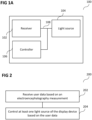
- a keyboard 100 may indicate data indicating an electroencephalography measurement received from external to the keyboard 100.
- the user data may include or may be or may be included in raw electroencephalography measurement data.
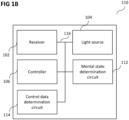
- FIG. 1B shows a keyboard 110 according to various embodiments.
- the keyboard 110 may, similar to the keyboard 100 shown in FIG. 1A , include a receiver 102 configured to receive user data based on an electroencephalography measurement.
- the keyboard 110 may, similar to the keyboard 100 shown in FIG. 1A , further include at least one light source 104.
- the keyboard 110 may, similar to the keyboard 100 shown in FIG. 1A , further include a controller 106 configured to control the at least one light source based on the user data.
- the keyboard 110 may further include a mental state determination circuit 112, like will be described in more detail below.
- the keyboard 110 may further include a control data determination circuit 114, like will be described in more detail below.
- the receiver 102, the at least one light source 104, the controller 106, the mental state determination circuit 112, and the control data determination circuit 114 may be coupled with each other, like indicated by lines 116, for example electrically coupled, for example using a line or a cable, and/ or mechanically coupled.
- the at least one of mental state or motor state may include or may be meditative, calm, attentive, focused, winking, blinking, smiling, frowning, clenching, laughing, smiling, excited, frustrated, and/ or bored.
- control data determination circuit 114 may be configured to determine control data for controlling the at least one light source based on the at least one of mental state or motor state.
- the user data may include or may be or may be included in control data for controlling the at least one light source.
- the keyboard 110 may be a peripheral device.
- the receiver 102 may include or may be at least one of a wired interface, a wireless interface, a Bluetooth interface, a ZigBee interface, an infrared interface, a wireless local area network interface, a Universal Serial Bus interface, or a Thunderbolt interface.
- the at least one light source 104 may include or may be at least one colored light source.
- the controller 106 may be configured to control a color of the at least one light source 104 based on the user data.
- a plurality of colored light sources may be provided, for example in a Chroma device.
- both light color and light intensity may be controlled.
- FIG. 2 shows a flow diagram 200 illustrating a method for controlling a keyboard according to various embodiments.
- user data based on an electroencephalography measurement may be received.
- at least one light source of the keyboard may be controlled based on the user data.
- the user data may include or may be or may be included in raw electroencephalography measurement data.
- the method may further include determining at least one of a mental state or a motor state based on the raw electroencephalography measurement data.
- the at least one of mental state or motor state may include or may be at least one of meditative, calm, attentive, focused, winking, blinking, smiling, frowning, clenching, laughing, smiling, excited, frustrated, or bored.
- the method may further include determining control data for controlling the at least one light source based on the at least one of mental state or motor state.
- the user data may include or may be or may be included in data indicating at least one of a mental state or a motor state.
- the at least one of mental state or motor state may include or may be at least one of meditative, calm, attentive, focused, winking, blinking, smiling, frowning, clenching, laughing, smiling, excited, frustrated, or bored.
- the method may further include determining control data for controlling the at least one light source based on the at least one of mental state or motor state.
- the user data may include or may be or may be included in control data for controlling the at least one light source.
- the keyboard may be a peripheral device.
- the user data may be received using at least one of a wired interface, a wireless interface, a Bluetooth interface, a ZigBee interface, an infrared interface, a wireless local area network interface, a Universal Serial Bus interface, or a Thunderbolt interface.
- the at least one light source may include or may be at least one colored light source.
- the method may further include controlling a color of the at least one light source based on the user data.
- EEG (electroencephalography) data may be collected via EEG sensors mounted on an EEG headset or a similar device and may be analyzed to understand the mental state of the person.
- the raw EEG data may be processed to determine if the subject is for example meditative (for example calm), attentive (for example focused), winking, blinking, smiling, frowning, clenching, laughing, smiling, excited, frustrated, and/ or bored.
- EEG (electroencephalography) data collected from non-invasive sensors of a BCI (brain-computer interface) headset worn by a user may be used.
- a remote device with a light source or a plurality of light sources (for example with LEDs) that is or are wirelessly connected to the BCI headset may reflect a specific color to indicate a state of mind of the user (e.g., excited, focused, calm, bored, etc.).
- the remote device may be an input device (such as our Chroma mouse and keyboard, wearable device) that may change colors according to the mood of the user wearing the BCI headset.
- game developers may incorporate into games a mental state of a gamer either as an integral part of the game or as a purely aesthetic effect that can be viewed by a much larger audience (for example when games are live-streamed).
- EEG data may drive an input device (for example a Chroma input device) to provide smart lighting effects that may sense the mood of the user.
- an input device for example a Chroma input device
- an individual or team members' behavior may be analyzed through wearable devices that indicate mental states.
- the mental states of the individual and entire teams may be observed on their wearable devices as they progress through their task or games. This may be used for studying intra group and inter group dynamics.
- a color (or a plurality of colors) of the light source (or plurality of light sources; for example LEDs) mounted on the EEG headset, wearable or peripheral device may be modified according to the mental state of the subject. For example, if the subject is calm, a soothing blue may be shown on the light sources. If the person is angry or excited, the colors can be changed to a fiery red.
- the EEG data may be analyzed using the processing power in the headset itself to arrive at the mental state to drive the LEDs.
- the algorithms processing the EEG data may be running on the headset itself.
- the raw EEG data may be sensed by the headset and transmitted to another computing device like a computer or a mobile phone.
- the raw EEG data may be processed on this external computing device to determine the mental state of the subject.
- the external device may then send the result of the processing back to the headset (or any other device).
- the headset may then display the colors on the LEDs accordingly. How and what to display (for example colors, patterns, etc.) may be determined either by the device worn (for example headset, wristband, watch, etc.) or by the external computing device.
- raw EEG data may be processed to determine mental state in a headset and/ or in an external computing device (for example a PC (personal computer) or a mobile phone).
- an external computing device for example a PC (personal computer) or a mobile phone.
- display color and/ or pattern may be determined based on mental state in a headset and/ or in an external computing device (for example a PC (personal computer) or a mobile phone).
- an external computing device for example a PC (personal computer) or a mobile phone.
- the color may be displayed in a headset and/ or in another device (for example a wristband, a watch, a mouse, or a keyboard).
- a headset for example a wristband, a watch, a mouse, or a keyboard.
- another device for example a wristband, a watch, a mouse, or a keyboard.
- the lighting effect may be achieved via LEDs.
- the same effect may be obtained by any LED equivalent device, for example a keyboard backlight.
- EEG data may be used to drive smart lighting effects (for example Chroma Effect on a Razer device).
- the LED lighting a large audience may see the results (for example the processed EEG, for example the derived mental state).
- multiple teams of subjects wearing the EEG headsets may be given a task (or multiple tasks).
- the mental states of the individual and entire teams may be quickly observed as they progress through their task or games. This may be used for studying Intra group and inter group dynamics.
- a light source for example LED display
- a PC personal computer
- an input device for example a keyboard or a mouse
- Various embodiments may be used during gaming or for a study of group dynamics.
- raw EEG data, computed mental states and LED patterns may be transmitted over wired and wireless channels.
- a mental state of a subject may be displayed on a headset, on a wearable and/ or on a peripheral.
- an outcome of EEG processing may be displayed on the human body (for example via a wearable device) or on a peripheral device (for example mouse, keyboard, or game controller).
- light sources may be used to indicate a mental state of a subject.
- the light sources may be embedded on a headset.
- the light sources may be mounted on a wearable device (e.g. wrist band or wrist watch).
- the light sources may be provided on a peripheral device like a mouse, keyboard, or game controller.
- EEG headsets audio headsets, VR (virtual reality) headsets, wearable devices (for example wrist bands or watches), peripherals (for example mice, keyboards, game controllers, or broadcasters), or computing systems (for example with lighting effect on build in keyboards, etc.).
- VR virtual reality
- wearable devices for example wrist bands or watches
- peripherals for example mice, keyboards, game controllers, or broadcasters
- computing systems for example with lighting effect on build in keyboards, etc.
Landscapes
- Health & Medical Sciences (AREA)
- Life Sciences & Earth Sciences (AREA)
- Engineering & Computer Science (AREA)
- Physics & Mathematics (AREA)
- General Health & Medical Sciences (AREA)
- Biomedical Technology (AREA)
- Heart & Thoracic Surgery (AREA)
- Animal Behavior & Ethology (AREA)
- Veterinary Medicine (AREA)
- Public Health (AREA)
- Biophysics (AREA)
- Molecular Biology (AREA)
- Surgery (AREA)
- Medical Informatics (AREA)
- Pathology (AREA)
- Multimedia (AREA)
- Psychiatry (AREA)
- Psychology (AREA)
- Human Computer Interaction (AREA)
- General Engineering & Computer Science (AREA)
- Theoretical Computer Science (AREA)
- Physiology (AREA)
- General Physics & Mathematics (AREA)
- Dentistry (AREA)
- Developmental Disabilities (AREA)
- Oral & Maxillofacial Surgery (AREA)
- Neurology (AREA)
- Neurosurgery (AREA)
- Child & Adolescent Psychology (AREA)
- Dermatology (AREA)
- Educational Technology (AREA)
- Hospice & Palliative Care (AREA)
- Social Psychology (AREA)
- Anesthesiology (AREA)
- Hematology (AREA)
- Acoustics & Sound (AREA)
- Computer Networks & Wireless Communication (AREA)
- Cardiology (AREA)
- Optics & Photonics (AREA)
- Ophthalmology & Optometry (AREA)
Description
- Various embodiments generally relate to keyboards and methods for controlling a keyboard.
-
US 9211077 B2 WO 2014/085910 A1 ,WO 2015/122846 A1 andUS 2010/240458 A1 disclose electroencephalography apparatus, andEP 1783740 A1 andCN 101655723 A disclose adjustable backlight. During computer gaming, it may be interesting for an audience to gain insight into the mental state of a player. As such, there may be a need for devices and methods which give an indication of a player's mental state in an easy to observe way. - According to various embodiments, a keyboard is provided. The keyboard includes the features of claim 1.
- According to various embodiments, a method for controlling a keyboard is provided. The method includes the features of claim 5.
- In the drawings, like reference characters generally refer to the same parts throughout the different views. The drawings are not necessarily to scale, emphasis instead generally being placed upon illustrating the principles of the invention. The dimensions of the various features or elements may be arbitrarily expanded or reduced for clarity. In the following description, various embodiments of the invention are described with reference to the following drawings, in which:
-
FIG. 1A shows a keyboard according to various embodiments; -
FIG. 1B shows a keyboard according to various embodiments; and -
FIG. 2 shows a flow diagram illustrating a method for controlling a keyboard according to various embodiments. - The following detailed description refers to the accompanying drawings that show, by way of illustration, specific details and embodiments in which the invention may be practiced. These embodiments are described in sufficient detail to enable those skilled in the art to practice the invention. Other embodiments may be utilized and structural, and logical changes may be made without departing from the scope of the invention as defined in the claims. The various embodiments are not necessarily mutually exclusive, as some embodiments can be combined with one or more other embodiments to form new embodiments.
- In this context, the keyboard as described in this description may include a memory which is for example used in the processing carried out in the keyboard. A memory used in the embodiments may be a volatile memory, for example a DRAM (Dynamic Random Access Memory) or a non-volatile memory, for example a PROM (Programmable Read Only Memory), an EPROM (Erasable PROM), EEPROM (Electrically Erasable PROM), or a flash memory, e.g., a floating gate memory, a charge trapping memory, an MRAM (Magnetoresistive Random Access Memory) or a PCRAM (Phase Change Random Access Memory).
- In an embodiment, a "circuit" may be understood as any kind of a logic implementing entity, which may be special purpose circuitry or a processor executing software stored in a memory, firmware, or any combination thereof. Thus, in an embodiment, a "circuit" may be a hard-wired logic circuit or a programmable logic circuit such as a programmable processor, e.g. a microprocessor (e.g. a Complex Instruction Set Computer (CISC) processor or a Reduced Instruction Set Computer (RISC) processor). A "circuit" may also be a processor executing software, e.g. any kind of computer program, e.g. a computer program using a virtual machine code such as e.g. Java. Any other kind of implementation of the respective functions which will be described in more detail below may also be understood as a "circuit" in accordance with an alternative embodiment.
- In the specification the term "comprising" shall be understood to have a broad meaning similar to the term "including" and will be understood to imply the inclusion of a stated integer or step or group of integers or steps but not the exclusion of any other integer or step or group of integers or steps. This definition also applies to variations on the term "comprising" such as "comprise" and "comprises".
- The reference to any prior art in this specification is not, and should not be taken as an acknowledgement or any form of suggestion that the referenced prior art forms part of the common general knowledge in Australia (or any other country).
- In order that the invention may be readily understood and put into practical effect, particular embodiments will now be described by way of examples and not limitations, and with reference to the figures.
- Various embodiments are provided for devices, and various embodiments are provided for methods. It will be understood that basic properties of the devices also hold for the methods and vice versa. Therefore, for sake of brevity, duplicate description of such properties may be omitted.
- It will be understood that any property described herein for a specific device may also hold for any device described herein. It will be understood that any property described herein for a specific method may also hold for any method described herein. Furthermore, it will be understood that for any device or method described herein, not necessarily all the components or steps described must be enclosed in the device or method, but only some (but not all) components or steps may be enclosed.
- The term "coupled" (or "connected") herein may be understood as electrically coupled or as mechanically coupled, for example attached or fixed, or just in contact without any fixation, and it will be understood that both direct coupling or indirect coupling (in other words: coupling without direct contact) may be provided.
- For example, during computer gaming, it may be interesting for an audience to gain insight into the mental state of a player. According to various embodiments, devices and methods may be provided which give an indication of a player's mental state in an easy to observe way.
- According to various embodiments, a mental state indication via a light source (for example via LEDs (light emitting diodes) or any similar light emitting devices) may be provided.
-
FIG. 1A shows akeyboard 100 according to various embodiments. Thekeyboard 100 may include areceiver 102 configured to receive user data based on an electroencephalography measurement. Thekeyboard 100 may further include at least onelight source 104. Thekeyboard 100 may further include acontroller 106 configured to control the at least one light source based on the user data. Thereceiver 102, the at least onelight source 104, and thecontroller 106 may be coupled with each other, like indicated bylines 108, for example electrically coupled, for example using a line or a cable, and/ or mechanically coupled. - In other words, a
keyboard 100 may indicate data indicating an electroencephalography measurement received from external to thekeyboard 100. - According to various embodiments, the user data may include or may be or may be included in raw electroencephalography measurement data.
-
FIG. 1B shows akeyboard 110 according to various embodiments. Thekeyboard 110 may, similar to thekeyboard 100 shown inFIG. 1A , include areceiver 102 configured to receive user data based on an electroencephalography measurement. Thekeyboard 110 may, similar to thekeyboard 100 shown inFIG. 1A , further include at least onelight source 104. Thekeyboard 110 may, similar to thekeyboard 100 shown inFIG. 1A , further include acontroller 106 configured to control the at least one light source based on the user data. Thekeyboard 110 may further include a mentalstate determination circuit 112, like will be described in more detail below. Thekeyboard 110 may further include a controldata determination circuit 114, like will be described in more detail below. Thereceiver 102, the at least onelight source 104, thecontroller 106, the mentalstate determination circuit 112, and the controldata determination circuit 114 may be coupled with each other, like indicated bylines 116, for example electrically coupled, for example using a line or a cable, and/ or mechanically coupled. - According to various embodiments, the mental
state determination circuit 112 may be configured to determine at least one of a mental state or a motor state based on the raw electroencephalography measurement data. - According to various embodiments, the at least one of mental state or motor state may include or may be meditative, calm, attentive, focused, winking, blinking, smiling, frowning, clenching, laughing, smiling, excited, frustrated, and/ or bored.
- According to various embodiments, the control
data determination circuit 114 may be configured to determine control data for controlling the at least one light source based on the at least one of mental state or motor state. - According to various embodiments, the user data may include or may be or may be included in data indicating at least one of a mental state or a motor state.
- According to various embodiments, the at least one of mental state or motor state may include or may be meditative, calm, attentive, focused, winking, blinking, smiling, frowning, clenching, laughing, smiling, excited, frustrated, and/ or bored.
- According to various embodiments, the control
data determination circuit 114 may be configured to determine control data for controlling the at least one light source based on the at least one of mental state or motor state. - According to various embodiments, the user data may include or may be or may be included in control data for controlling the at least one light source.
- According to various embodiments, the
keyboard 110 may be a peripheral device. - According to various embodiments, the
receiver 102 may include or may be at least one of a wired interface, a wireless interface, a Bluetooth interface, a ZigBee interface, an infrared interface, a wireless local area network interface, a Universal Serial Bus interface, or a Thunderbolt interface. - According to various embodiments, the at least one
light source 104 may include or may be at least one colored light source. According to various embodiments, thecontroller 106 may be configured to control a color of the at least onelight source 104 based on the user data. According to various embodiments, a plurality of colored light sources may be provided, for example in a Chroma device. According to various embodiments, both light color and light intensity may be controlled. -
FIG. 2 shows a flow diagram 200 illustrating a method for controlling a keyboard according to various embodiments. In 202, user data based on an electroencephalography measurement may be received. In 204, at least one light source of the keyboard may be controlled based on the user data. - According to various embodiments, the user data may include or may be or may be included in raw electroencephalography measurement data.
- According to various embodiments, the method may further include determining at least one of a mental state or a motor state based on the raw electroencephalography measurement data.
- According to various embodiments, the at least one of mental state or motor state may include or may be at least one of meditative, calm, attentive, focused, winking, blinking, smiling, frowning, clenching, laughing, smiling, excited, frustrated, or bored.
- According to various embodiments, the method may further include determining control data for controlling the at least one light source based on the at least one of mental state or motor state.
- According to various embodiments, the user data may include or may be or may be included in data indicating at least one of a mental state or a motor state.
- According to various embodiments, the at least one of mental state or motor state may include or may be at least one of meditative, calm, attentive, focused, winking, blinking, smiling, frowning, clenching, laughing, smiling, excited, frustrated, or bored.
- According to various embodiments, the method may further include determining control data for controlling the at least one light source based on the at least one of mental state or motor state.
- According to various embodiments, the user data may include or may be or may be included in control data for controlling the at least one light source.
- According to various embodiments, the keyboard may be a peripheral device.
- According to various embodiments, the user data may be received using at least one of a wired interface, a wireless interface, a Bluetooth interface, a ZigBee interface, an infrared interface, a wireless local area network interface, a Universal Serial Bus interface, or a Thunderbolt interface.
- According to various embodiments, the at least one light source may include or may be at least one colored light source. According to various embodiments, the method may further include controlling a color of the at least one light source based on the user data.
- According to various embodiments, EEG (electroencephalography) data may be collected via EEG sensors mounted on an EEG headset or a similar device and may be analyzed to understand the mental state of the person. The raw EEG data may be processed to determine if the subject is for example meditative (for example calm), attentive (for example focused), winking, blinking, smiling, frowning, clenching, laughing, smiling, excited, frustrated, and/ or bored.
- According to various embodiments, EEG (electroencephalography) data collected from non-invasive sensors of a BCI (brain-computer interface) headset worn by a user may be used. A remote device with a light source or a plurality of light sources (for example with LEDs) that is or are wirelessly connected to the BCI headset may reflect a specific color to indicate a state of mind of the user (e.g., excited, focused, calm, bored, etc.). The remote device may be an input device (such as our Chroma mouse and keyboard, wearable device) that may change colors according to the mood of the user wearing the BCI headset.
- According to various embodiments, game developers may incorporate into games a mental state of a gamer either as an integral part of the game or as a purely aesthetic effect that can be viewed by a much larger audience (for example when games are live-streamed).
- According to various embodiments, EEG data may drive an input device (for example a Chroma input device) to provide smart lighting effects that may sense the mood of the user.
- According to various embodiments, an individual or team members' behavior may be analyzed through wearable devices that indicate mental states. The mental states of the individual and entire teams may be observed on their wearable devices as they progress through their task or games. This may be used for studying intra group and inter group dynamics.
- According to various embodiments, a color (or a plurality of colors) of the light source (or plurality of light sources; for example LEDs) mounted on the EEG headset, wearable or peripheral device may be modified according to the mental state of the subject. For example, if the subject is calm, a soothing blue may be shown on the light sources. If the person is angry or excited, the colors can be changed to a fiery red.
- According to various embodiments, the EEG data may be analyzed using the processing power in the headset itself to arrive at the mental state to drive the LEDs. In this case, the algorithms processing the EEG data may be running on the headset itself.
- According to various embodiments, the raw EEG data may be sensed by the headset and transmitted to another computing device like a computer or a mobile phone. The raw EEG data may be processed on this external computing device to determine the mental state of the subject. The external device may then send the result of the processing back to the headset (or any other device). The headset may then display the colors on the LEDs accordingly. How and what to display (for example colors, patterns, etc.) may be determined either by the device worn (for example headset, wristband, watch, etc.) or by the external computing device.
- According to various embodiments, raw EEG data may be processed to determine mental state in a headset and/ or in an external computing device (for example a PC (personal computer) or a mobile phone).
- According to various embodiments, display color and/ or pattern may be determined based on mental state in a headset and/ or in an external computing device (for example a PC (personal computer) or a mobile phone).
- According to various embodiments, the color (or color pattern) may be displayed in a headset and/ or in another device (for example a wristband, a watch, a mouse, or a keyboard).
- According to various embodiments, the lighting effect may be achieved via LEDs. According to various embodiments, the same effect may be obtained by any LED equivalent device, for example a keyboard backlight.
- According to various embodiments, EEG data may be used to drive smart lighting effects (for example Chroma Effect on a Razer device).
- According to various embodiments, people looking at the subject may immediately understand the subject's mental state by looking directly at the person. It may be easier to co-relate facial expression, body language and mental state. Without this, the person looking at the subject would have to keep switching his view between the computer display and the subject.
- According to various embodiments, with the LED lighting, a large audience may see the results (for example the processed EEG, for example the derived mental state).
- According to various embodiments, it may be possible to quickly observe the mental states of a group of people. Thus, multiple teams of subjects wearing the EEG headsets may be given a task (or multiple tasks). The mental states of the individual and entire teams may be quickly observed as they progress through their task or games. This may be used for studying Intra group and inter group dynamics.
- According to various embodiments, a light source (for example LED display) may be provided on a PC (personal computer), on an input device (for example a keyboard or a mouse), and/ or on a wearable.
- According to various embodiments, EEG computations may be running on a PC and/ or mobile phone and/ or headset.
- Various embodiments may be used during gaming or for a study of group dynamics.
- According to various embodiments, raw EEG data, computed mental states and LED patterns may be transmitted over wired and wireless channels.
- According to various embodiments, a mental state of a subject may be displayed on a headset, on a wearable and/ or on a peripheral. In other words, an outcome of EEG processing may be displayed on the human body (for example via a wearable device) or on a peripheral device (for example mouse, keyboard, or game controller).
- According to various embodiments, light sources (for example LEDs) may be used to indicate a mental state of a subject. According to various embodiments, the light sources may be embedded on a headset. According to various embodiments, the light sources may be mounted on a wearable device (e.g. wrist band or wrist watch). According to various embodiments, the light sources may be provided on a peripheral device like a mouse, keyboard, or game controller.
- Various embodiments may be used in EEG headsets, audio headsets, VR (virtual reality) headsets, wearable devices (for example wrist bands or watches), peripherals (for example mice, keyboards, game controllers, or broadcasters), or computing systems (for example with lighting effect on build in keyboards, etc.).
- While the invention has been particularly shown and described with reference to specific embodiments, it should be understood by those skilled in the art that various changes in form and detail may be made therein without departing from the scope of the invention as defined by the appended claims. The scope of the invention is thus indicated by the appended claims and all changes which come within the meaning and range of equivalency of the claims are therefore intended to be embraced.
Claims (8)
- A keyboard comprising: a receiver (102) configured to receive user data; a backlight comprising at least one light source (104); and a controller (106) configured to control the at least one light source (104) of the backlight of the keyboard based on the user data,
characterized in that the user data comprises raw electroencephalography measurement data of a user playing a game; in that the keyboard further comprises a mental state determination circuit (112) configured to determine at least one of a mental state or a motor state based on the raw electroencephalography measurement data; and in that the keyboard comprises a control data determination circuit (114) configured to determine control data for controlling the at least one light source (104) based on the at least one of mental state or motor state. - The keyboard of claim 1, wherein the at least one of mental state or motor state comprises at least one of meditative, calm, attentive, focused, winking, blinking, smiling, frowning, clenching, laughing, smiling, excited, frustrated, or bored.
- The keyboard of any one of claims 1 or 2,
wherein the receiver (102) comprises at least one of a wired interface, a wireless interface, a Bluetooth interface, a ZigBee interface, an infrared interface, a wireless local area network interface, a Universal Serial Bus interface, or a Thunderbolt interface. - The keyboard of any one of claims 1 to 3,wherein the at least one light source (104) comprises at least one colored light source; andwherein the controller (106) is configured to control a color of the at least one light source (104) based on the user data.
- A method for controlling a keyboard comprising a backlight comprising at least one light source, the method comprising:receiving user data; andcontrolling at least one light source (104) of the backlight of the keyboard based on the user data,characterized in that the user data comprises raw electroencephalography measurement data of a user playing a game; in that the method further comprises determining at least one of a mental state or a motor state based on the raw electroencephalography measurement data; and in that the method further comprises determining control data for controlling the at least one light source (104) based on the at least one of mental state or motor state.
- The method of claim 5, wherein the at least one of mental state or motor state comprises at least one of meditative, calm, attentive, focused, winking, blinking, smiling, frowning, clenching, laughing, smiling, excited, frustrated, or bored.
- The method of any one of claims 5 or 6,
wherein the user data is received using at least one of a wired interface, a wireless interface, a Bluetooth interface, a ZigBee interface, an infrared interface, a wireless local area network interface, a Universal Serial Bus interface, or a Thunderbolt interface. - The method of any one of claims 5 to 7,wherein the at least one light source (104) comprises at least one colored light source; andwherein the method further comprises controlling a color of the at least one light source (104) based on the user data.
Applications Claiming Priority (1)
| Application Number | Priority Date | Filing Date | Title |
|---|---|---|---|
| PCT/SG2016/050279 WO2017217928A1 (en) | 2016-06-17 | 2016-06-17 | Display devices and methods for controlling a display device |
Publications (3)
| Publication Number | Publication Date |
|---|---|
| EP3472685A1 EP3472685A1 (en) | 2019-04-24 |
| EP3472685A4 EP3472685A4 (en) | 2019-05-15 |
| EP3472685B1 true EP3472685B1 (en) | 2025-04-30 |
Family
ID=60664544
Family Applications (1)
| Application Number | Title | Priority Date | Filing Date |
|---|---|---|---|
| EP16905622.3A Active EP3472685B1 (en) | 2016-06-17 | 2016-06-17 | Display devices and methods for controlling a display device |
Country Status (7)
| Country | Link |
|---|---|
| US (2) | US11439340B2 (en) |
| EP (1) | EP3472685B1 (en) |
| CN (2) | CN109564461A (en) |
| AU (1) | AU2016412145B2 (en) |
| SG (1) | SG11201810904RA (en) |
| TW (2) | TWI832273B (en) |
| WO (1) | WO2017217928A1 (en) |
Families Citing this family (4)
| Publication number | Priority date | Publication date | Assignee | Title |
|---|---|---|---|---|
| US11547333B2 (en) * | 2017-08-27 | 2023-01-10 | Aseeyah Shahid | Physiological parameter sensing device |
| US11720081B2 (en) * | 2019-03-18 | 2023-08-08 | Duke University | Mobile brain computer interface |
| US20220409850A1 (en) * | 2019-11-05 | 2022-12-29 | Reflect Innovation Ltd. | Apparatus, system and method for reducing stress |
| WO2023138973A1 (en) | 2022-01-19 | 2023-07-27 | Signify Holding B.V. | Lighting control for a brain control interface system |
Citations (2)
| Publication number | Priority date | Publication date | Assignee | Title |
|---|---|---|---|---|
| EP1783740A1 (en) * | 2003-08-05 | 2007-05-09 | Research In Motion Limited | Method for automatic backlight adjustment |
| CN101655723A (en) * | 2009-09-11 | 2010-02-24 | 深圳顶海电子有限公司 | Notebook computer capable of adjusting and controlling backlight brightness of keyboard and method for adjusting and controlling same |
Family Cites Families (34)
| Publication number | Priority date | Publication date | Assignee | Title |
|---|---|---|---|---|
| US6459919B1 (en) | 1997-08-26 | 2002-10-01 | Color Kinetics, Incorporated | Precision illumination methods and systems |
| WO2001004864A1 (en) * | 1999-07-09 | 2001-01-18 | The Government Of The United States As Represented By The Administrator Of The National Aeronautics And Space Administration (Nasa) | Method and apparatus for encouraging physiological self-regulation through modulation of an operators control input to a video game or training simulator |
| US6795724B2 (en) * | 2002-02-19 | 2004-09-21 | Mark Bradford Hogan | Color-based neurofeedback |
| US20080177197A1 (en) * | 2007-01-22 | 2008-07-24 | Lee Koohyoung | Method and apparatus for quantitatively evaluating mental states based on brain wave signal processing system |
| CN1719385A (en) | 2005-07-21 | 2006-01-11 | 高春平 | Physiological signal control device of computer game |
| US10076273B2 (en) | 2006-07-06 | 2018-09-18 | Biorics Nv | Real-time monitoring and control of physical and arousal status of individual organisms |
| US9211077B2 (en) * | 2007-12-13 | 2015-12-15 | The Invention Science Fund I, Llc | Methods and systems for specifying an avatar |
| WO2010106435A1 (en) * | 2009-03-20 | 2010-09-23 | Pub Company S.R.L. | Video game hardware systems and software methods using electroencephalography |
| US8556951B2 (en) | 2009-06-03 | 2013-10-15 | Koninklijke Philips N.V. | System and method of titrating a phototherapy regime using real-time EEG readings |
| TWM374844U (en) | 2009-08-31 | 2010-03-01 | shao-qin Zhang | Brain wave controlled color LED light tower structure |
| KR101668249B1 (en) | 2010-08-24 | 2016-10-21 | 엘지전자 주식회사 | Mobile terminal and operation control method thereof |
| US20120083668A1 (en) * | 2010-09-30 | 2012-04-05 | Anantha Pradeep | Systems and methods to modify a characteristic of a user device based on a neurological and/or physiological measurement |
| US8465531B2 (en) | 2011-03-29 | 2013-06-18 | Valkee Oy | Light therapy modality |
| US9007308B2 (en) * | 2012-08-03 | 2015-04-14 | Google Inc. | Adaptive keyboard lighting |
| SG11201501989QA (en) * | 2012-09-18 | 2015-04-29 | Razer Asia Pacific Pte Ltd | Computing systems, peripheral devices and methods for controlling a peripheral device |
| KR102282961B1 (en) | 2012-09-28 | 2021-07-29 | 더 리젠츠 오브 더 유니버시티 오브 캘리포니아 | Systems and methods for sensory and cognitive profiling |
| US10009644B2 (en) * | 2012-12-04 | 2018-06-26 | Interaxon Inc | System and method for enhancing content using brain-state data |
| US9320450B2 (en) | 2013-03-14 | 2016-04-26 | The Nielsen Company (Us), Llc | Methods and apparatus to gather and analyze electroencephalographic data |
| US9532748B2 (en) | 2013-04-22 | 2017-01-03 | Personal Neuro Devices Inc. | Methods and devices for brain activity monitoring supporting mental state development and training |
| US9213803B2 (en) * | 2013-05-02 | 2015-12-15 | David Rolley | System and method for collecting, analyzing and reporting fitness activity data |
| RU2664170C2 (en) | 2013-07-23 | 2018-08-15 | Конинклейке Филипс Н.В. | Non-ocular photo-biological stimulation |
| KR101373058B1 (en) * | 2013-08-14 | 2014-03-11 | 주식회사 코리아썬엘이디 | Folding type emotional stand and control method thereof |
| EP3053354B1 (en) | 2013-10-02 | 2020-12-09 | Acousticsheep LLC | Functional headwear |
| TWM475650U (en) * | 2013-10-04 | 2014-04-01 | National Taichung Univ Of Science And Technology | Emotion recognition and real-time feedback system |
| US20150204561A1 (en) | 2014-01-20 | 2015-07-23 | Innosys, Inc. | Control System With Mobile Sensors |
| WO2015113003A1 (en) | 2014-01-25 | 2015-07-30 | Innosys, Inc. | Solid state lighting systems |
| SG11201606480XA (en) * | 2014-02-14 | 2016-09-29 | Univ Singapore | System, device and methods for brainwave-based technologies |
| KR101712878B1 (en) * | 2014-04-04 | 2017-03-07 | 서병윤 | Induction system for a sound sleep by EEG monitoring |
| GB2526535A (en) | 2014-05-19 | 2015-12-02 | Timothy Jacob | Device for olfactory and visual stimulation |
| US9531859B2 (en) | 2014-05-27 | 2016-12-27 | Razer (Asia-Pacific) Pte. Ltd. | Wristbands, methods for controlling a wristband, and computer readable media |
| US10120413B2 (en) * | 2014-09-11 | 2018-11-06 | Interaxon Inc. | System and method for enhanced training using a virtual reality environment and bio-signal data |
| TWM509399U (en) * | 2015-05-26 | 2015-09-21 | Univ Hungkuang | Brain wave and gesture control feedback learning system |
| CN106020507B (en) | 2016-06-29 | 2019-09-24 | 左莉 | Computer input device sub-assembly |
| KR101907090B1 (en) | 2017-09-29 | 2018-10-11 | 단국대학교 산학협력단 | Speakers with light |
-
2016
- 2016-06-17 WO PCT/SG2016/050279 patent/WO2017217928A1/en not_active Ceased
- 2016-06-17 SG SG11201810904RA patent/SG11201810904RA/en unknown
- 2016-06-17 CN CN201680088265.9A patent/CN109564461A/en active Pending
- 2016-06-17 US US16/308,809 patent/US11439340B2/en active Active
- 2016-06-17 EP EP16905622.3A patent/EP3472685B1/en active Active
- 2016-06-17 CN CN202211240806.9A patent/CN115462807A/en active Pending
- 2016-06-17 AU AU2016412145A patent/AU2016412145B2/en active Active
-
2017
- 2017-06-14 TW TW111120731A patent/TWI832273B/en active
- 2017-06-14 TW TW106119807A patent/TWI769162B/en active
-
2022
- 2022-08-05 US US17/882,524 patent/US20220374079A1/en active Pending
Patent Citations (2)
| Publication number | Priority date | Publication date | Assignee | Title |
|---|---|---|---|---|
| EP1783740A1 (en) * | 2003-08-05 | 2007-05-09 | Research In Motion Limited | Method for automatic backlight adjustment |
| CN101655723A (en) * | 2009-09-11 | 2010-02-24 | 深圳顶海电子有限公司 | Notebook computer capable of adjusting and controlling backlight brightness of keyboard and method for adjusting and controlling same |
Also Published As
| Publication number | Publication date |
|---|---|
| US20220374079A1 (en) | 2022-11-24 |
| TWI769162B (en) | 2022-07-01 |
| WO2017217928A1 (en) | 2017-12-21 |
| TW202245681A (en) | 2022-12-01 |
| US11439340B2 (en) | 2022-09-13 |
| TW201808224A (en) | 2018-03-16 |
| CN109564461A (en) | 2019-04-02 |
| EP3472685A1 (en) | 2019-04-24 |
| CN115462807A (en) | 2022-12-13 |
| TWI832273B (en) | 2024-02-11 |
| AU2016412145A1 (en) | 2019-01-03 |
| US20190307351A1 (en) | 2019-10-10 |
| SG11201810904RA (en) | 2019-01-30 |
| EP3472685A4 (en) | 2019-05-15 |
| AU2016412145B2 (en) | 2021-11-11 |
Similar Documents
| Publication | Publication Date | Title |
|---|---|---|
| US20220374079A1 (en) | Display devices and methods for controlling a display device | |
| JP6650974B2 (en) | Electronic device and method for acquiring biological information | |
| US10216474B2 (en) | Variable computing engine for interactive media based upon user biometrics | |
| CN104080402B (en) | Health monitor | |
| CN107111683B (en) | Sports belt with removable modules | |
| KR101838414B1 (en) | Wireless initialization of electronic devices for first time use | |
| US10200780B2 (en) | Method and apparatus for conveying battery life of wireless earpiece | |
| US10740501B2 (en) | Product customization | |
| US10635385B2 (en) | Method and apparatus for interfacing with wireless earpieces | |
| KR102376816B1 (en) | Unlock augmented reality experience with target image detection | |
| CN110114741A (en) | Wearable terminal and its operating method | |
| CN105511750B (en) | switching method and electronic equipment | |
| US20240168552A1 (en) | Electroencephalograph-based user interface for virtual and augmented reality systems | |
| Nassajpour et al. | Objective estimation of m-CTSIB balance test scores using wearable sensors and machine learning | |
| Motti | Introduction to wearable computers | |
| KR20170136297A (en) | Electronic device, system and method for determining suitable workout by considering context | |
| Hänsel et al. | Wearable computing for health and fitness: exploring the relationship between data and human behaviour | |
| CN105094277A (en) | Method and device for adjusting operation state of wearable device | |
| KR20180073795A (en) | Electronic device interworking with smart clothes, operating method thereof and system | |
| EP4435568A1 (en) | Utilizing coincidental motion induced signals in photoplethysmography for gesture detection | |
| KR20180066321A (en) | Apparatus, Method and Electronic Apparatus for according to Movement of User using Wearable Device | |
| KR20190143289A (en) | Method And Apparatus for Providing Game by Using Wareable Device | |
| EP3380908B1 (en) | Wearable devices, methods for controlling a wearable device, and computer-readable media | |
| Domínguez-Hernández et al. | SpO2 alarm: a tool for health care | |
| KR20170017406A (en) | Electronic device and information providing method thereof |
Legal Events
| Date | Code | Title | Description |
|---|---|---|---|
| STAA | Information on the status of an ep patent application or granted ep patent |
Free format text: STATUS: THE INTERNATIONAL PUBLICATION HAS BEEN MADE |
|
| PUAI | Public reference made under article 153(3) epc to a published international application that has entered the european phase |
Free format text: ORIGINAL CODE: 0009012 |
|
| STAA | Information on the status of an ep patent application or granted ep patent |
Free format text: STATUS: REQUEST FOR EXAMINATION WAS MADE |
|
| 17P | Request for examination filed |
Effective date: 20181211 |
|
| AK | Designated contracting states |
Kind code of ref document: A1 Designated state(s): AL AT BE BG CH CY CZ DE DK EE ES FI FR GB GR HR HU IE IS IT LI LT LU LV MC MK MT NL NO PL PT RO RS SE SI SK SM TR |
|
| AX | Request for extension of the european patent |
Extension state: BA ME |
|
| A4 | Supplementary search report drawn up and despatched |
Effective date: 20190416 |
|
| RIC1 | Information provided on ipc code assigned before grant |
Ipc: A61B 5/00 20060101ALI20190410BHEP Ipc: A61B 5/16 20060101ALI20190410BHEP Ipc: A63F 13/00 20140101ALI20190410BHEP Ipc: A61M 21/00 20060101ALI20190410BHEP Ipc: A61B 5/0482 20060101ALI20190410BHEP Ipc: A61B 5/0476 20060101ALI20190410BHEP Ipc: G06F 3/01 20060101AFI20190410BHEP |
|
| DAV | Request for validation of the european patent (deleted) | ||
| DAX | Request for extension of the european patent (deleted) | ||
| STAA | Information on the status of an ep patent application or granted ep patent |
Free format text: STATUS: EXAMINATION IS IN PROGRESS |
|
| 17Q | First examination report despatched |
Effective date: 20210824 |
|
| RAP3 | Party data changed (applicant data changed or rights of an application transferred) |
Owner name: RAZER (ASIA-PACIFIC) PTE. LTD. |
|
| P01 | Opt-out of the competence of the unified patent court (upc) registered |
Effective date: 20230327 |
|
| RIC1 | Information provided on ipc code assigned before grant |
Ipc: A61B 5/16 20060101ALI20241009BHEP Ipc: A61B 5/369 20210101ALI20241009BHEP Ipc: A63F 13/00 20140101ALI20241009BHEP Ipc: G06F 3/01 20060101AFI20241009BHEP |
|
| GRAP | Despatch of communication of intention to grant a patent |
Free format text: ORIGINAL CODE: EPIDOSNIGR1 |
|
| STAA | Information on the status of an ep patent application or granted ep patent |
Free format text: STATUS: GRANT OF PATENT IS INTENDED |
|
| INTG | Intention to grant announced |
Effective date: 20241126 |
|
| GRAS | Grant fee paid |
Free format text: ORIGINAL CODE: EPIDOSNIGR3 |
|
| GRAA | (expected) grant |
Free format text: ORIGINAL CODE: 0009210 |
|
| STAA | Information on the status of an ep patent application or granted ep patent |
Free format text: STATUS: THE PATENT HAS BEEN GRANTED |
|
| AK | Designated contracting states |
Kind code of ref document: B1 Designated state(s): AL AT BE BG CH CY CZ DE DK EE ES FI FR GB GR HR HU IE IS IT LI LT LU LV MC MK MT NL NO PL PT RO RS SE SI SK SM TR |
|
| REG | Reference to a national code |
Ref country code: CH Ref legal event code: EP Ref country code: GB Ref legal event code: FG4D |
|
| REG | Reference to a national code |
Ref country code: DE Ref legal event code: R096 Ref document number: 602016092105 Country of ref document: DE |
|
| REG | Reference to a national code |
Ref country code: IE Ref legal event code: FG4D |
|
| PGFP | Annual fee paid to national office [announced via postgrant information from national office to epo] |
Ref country code: DE Payment date: 20250513 Year of fee payment: 10 |
|
| PGFP | Annual fee paid to national office [announced via postgrant information from national office to epo] |
Ref country code: GB Payment date: 20250620 Year of fee payment: 10 |
|
| PGFP | Annual fee paid to national office [announced via postgrant information from national office to epo] |
Ref country code: FR Payment date: 20250618 Year of fee payment: 10 |
|
| REG | Reference to a national code |
Ref country code: NL Ref legal event code: MP Effective date: 20250430 |
|
| REG | Reference to a national code |
Ref country code: AT Ref legal event code: MK05 Ref document number: 1790620 Country of ref document: AT Kind code of ref document: T Effective date: 20250430 |
|
| PG25 | Lapsed in a contracting state [announced via postgrant information from national office to epo] |
Ref country code: PT Free format text: LAPSE BECAUSE OF FAILURE TO SUBMIT A TRANSLATION OF THE DESCRIPTION OR TO PAY THE FEE WITHIN THE PRESCRIBED TIME-LIMIT Effective date: 20250901 Ref country code: FI Free format text: LAPSE BECAUSE OF FAILURE TO SUBMIT A TRANSLATION OF THE DESCRIPTION OR TO PAY THE FEE WITHIN THE PRESCRIBED TIME-LIMIT Effective date: 20250430 Ref country code: ES Free format text: LAPSE BECAUSE OF FAILURE TO SUBMIT A TRANSLATION OF THE DESCRIPTION OR TO PAY THE FEE WITHIN THE PRESCRIBED TIME-LIMIT Effective date: 20250430 |
|
| REG | Reference to a national code |
Ref country code: LT Ref legal event code: MG9D |
|
| PG25 | Lapsed in a contracting state [announced via postgrant information from national office to epo] |
Ref country code: GR Free format text: LAPSE BECAUSE OF FAILURE TO SUBMIT A TRANSLATION OF THE DESCRIPTION OR TO PAY THE FEE WITHIN THE PRESCRIBED TIME-LIMIT Effective date: 20250731 Ref country code: NO Free format text: LAPSE BECAUSE OF FAILURE TO SUBMIT A TRANSLATION OF THE DESCRIPTION OR TO PAY THE FEE WITHIN THE PRESCRIBED TIME-LIMIT Effective date: 20250730 |
|
| PG25 | Lapsed in a contracting state [announced via postgrant information from national office to epo] |
Ref country code: NL Free format text: LAPSE BECAUSE OF FAILURE TO SUBMIT A TRANSLATION OF THE DESCRIPTION OR TO PAY THE FEE WITHIN THE PRESCRIBED TIME-LIMIT Effective date: 20250430 Ref country code: PL Free format text: LAPSE BECAUSE OF FAILURE TO SUBMIT A TRANSLATION OF THE DESCRIPTION OR TO PAY THE FEE WITHIN THE PRESCRIBED TIME-LIMIT Effective date: 20250430 |
|
| PG25 | Lapsed in a contracting state [announced via postgrant information from national office to epo] |
Ref country code: BG Free format text: LAPSE BECAUSE OF FAILURE TO SUBMIT A TRANSLATION OF THE DESCRIPTION OR TO PAY THE FEE WITHIN THE PRESCRIBED TIME-LIMIT Effective date: 20250430 |
|
| PG25 | Lapsed in a contracting state [announced via postgrant information from national office to epo] |
Ref country code: HR Free format text: LAPSE BECAUSE OF FAILURE TO SUBMIT A TRANSLATION OF THE DESCRIPTION OR TO PAY THE FEE WITHIN THE PRESCRIBED TIME-LIMIT Effective date: 20250430 |
|
| PG25 | Lapsed in a contracting state [announced via postgrant information from national office to epo] |
Ref country code: AT Free format text: LAPSE BECAUSE OF FAILURE TO SUBMIT A TRANSLATION OF THE DESCRIPTION OR TO PAY THE FEE WITHIN THE PRESCRIBED TIME-LIMIT Effective date: 20250430 |
|
| PG25 | Lapsed in a contracting state [announced via postgrant information from national office to epo] |
Ref country code: RS Free format text: LAPSE BECAUSE OF FAILURE TO SUBMIT A TRANSLATION OF THE DESCRIPTION OR TO PAY THE FEE WITHIN THE PRESCRIBED TIME-LIMIT Effective date: 20250731 |
|
| PG25 | Lapsed in a contracting state [announced via postgrant information from national office to epo] |
Ref country code: IS Free format text: LAPSE BECAUSE OF FAILURE TO SUBMIT A TRANSLATION OF THE DESCRIPTION OR TO PAY THE FEE WITHIN THE PRESCRIBED TIME-LIMIT Effective date: 20250830 |
|
| PG25 | Lapsed in a contracting state [announced via postgrant information from national office to epo] |
Ref country code: LV Free format text: LAPSE BECAUSE OF FAILURE TO SUBMIT A TRANSLATION OF THE DESCRIPTION OR TO PAY THE FEE WITHIN THE PRESCRIBED TIME-LIMIT Effective date: 20250430 |
|
| PG25 | Lapsed in a contracting state [announced via postgrant information from national office to epo] |
Ref country code: SM Free format text: LAPSE BECAUSE OF FAILURE TO SUBMIT A TRANSLATION OF THE DESCRIPTION OR TO PAY THE FEE WITHIN THE PRESCRIBED TIME-LIMIT Effective date: 20250430 Ref country code: DK Free format text: LAPSE BECAUSE OF FAILURE TO SUBMIT A TRANSLATION OF THE DESCRIPTION OR TO PAY THE FEE WITHIN THE PRESCRIBED TIME-LIMIT Effective date: 20250430 |
|
| PG25 | Lapsed in a contracting state [announced via postgrant information from national office to epo] |
Ref country code: CZ Free format text: LAPSE BECAUSE OF FAILURE TO SUBMIT A TRANSLATION OF THE DESCRIPTION OR TO PAY THE FEE WITHIN THE PRESCRIBED TIME-LIMIT Effective date: 20250430 |
|
| PG25 | Lapsed in a contracting state [announced via postgrant information from national office to epo] |
Ref country code: EE Free format text: LAPSE BECAUSE OF FAILURE TO SUBMIT A TRANSLATION OF THE DESCRIPTION OR TO PAY THE FEE WITHIN THE PRESCRIBED TIME-LIMIT Effective date: 20250430 |
|
| PG25 | Lapsed in a contracting state [announced via postgrant information from national office to epo] |
Ref country code: SK Free format text: LAPSE BECAUSE OF FAILURE TO SUBMIT A TRANSLATION OF THE DESCRIPTION OR TO PAY THE FEE WITHIN THE PRESCRIBED TIME-LIMIT Effective date: 20250430 Ref country code: RO Free format text: LAPSE BECAUSE OF FAILURE TO SUBMIT A TRANSLATION OF THE DESCRIPTION OR TO PAY THE FEE WITHIN THE PRESCRIBED TIME-LIMIT Effective date: 20250430 |
|
| REG | Reference to a national code |
Ref country code: CH Ref legal event code: H13 Free format text: ST27 STATUS EVENT CODE: U-0-0-H10-H13 (AS PROVIDED BY THE NATIONAL OFFICE) Effective date: 20260127 |
|
| PG25 | Lapsed in a contracting state [announced via postgrant information from national office to epo] |
Ref country code: IT Free format text: LAPSE BECAUSE OF FAILURE TO SUBMIT A TRANSLATION OF THE DESCRIPTION OR TO PAY THE FEE WITHIN THE PRESCRIBED TIME-LIMIT Effective date: 20250430 |
|
| PG25 | Lapsed in a contracting state [announced via postgrant information from national office to epo] |
Ref country code: MC Free format text: LAPSE BECAUSE OF FAILURE TO SUBMIT A TRANSLATION OF THE DESCRIPTION OR TO PAY THE FEE WITHIN THE PRESCRIBED TIME-LIMIT Effective date: 20250430 |
|
| REG | Reference to a national code |
Ref country code: DE Ref legal event code: R097 Ref document number: 602016092105 Country of ref document: DE |
|
| PG25 | Lapsed in a contracting state [announced via postgrant information from national office to epo] |
Ref country code: LU Free format text: LAPSE BECAUSE OF NON-PAYMENT OF DUE FEES Effective date: 20250617 |
|
| REG | Reference to a national code |
Ref country code: BE Ref legal event code: MM Effective date: 20250630 |
|
| PLBE | No opposition filed within time limit |
Free format text: ORIGINAL CODE: 0009261 |
|
| STAA | Information on the status of an ep patent application or granted ep patent |
Free format text: STATUS: NO OPPOSITION FILED WITHIN TIME LIMIT |
|
| REG | Reference to a national code |
Ref country code: CH Ref legal event code: L10 Free format text: ST27 STATUS EVENT CODE: U-0-0-L10-L00 (AS PROVIDED BY THE NATIONAL OFFICE) Effective date: 20260311 |
|
| 26N | No opposition filed |
Effective date: 20260202 |
|
| PG25 | Lapsed in a contracting state [announced via postgrant information from national office to epo] |
Ref country code: IE Free format text: LAPSE BECAUSE OF NON-PAYMENT OF DUE FEES Effective date: 20250617 |
|
| PG25 | Lapsed in a contracting state [announced via postgrant information from national office to epo] |
Ref country code: BE Free format text: LAPSE BECAUSE OF NON-PAYMENT OF DUE FEES Effective date: 20250630 |
|
| PG25 | Lapsed in a contracting state [announced via postgrant information from national office to epo] |
Ref country code: CH Free format text: LAPSE BECAUSE OF NON-PAYMENT OF DUE FEES Effective date: 20250630 |