EP3471044A1 - Information processing method, server, and non-volatile storage medium - Google Patents
Information processing method, server, and non-volatile storage medium Download PDFInfo
- Publication number
- EP3471044A1 EP3471044A1 EP17805756.8A EP17805756A EP3471044A1 EP 3471044 A1 EP3471044 A1 EP 3471044A1 EP 17805756 A EP17805756 A EP 17805756A EP 3471044 A1 EP3471044 A1 EP 3471044A1
- Authority
- EP
- European Patent Office
- Prior art keywords
- display position
- information display
- terminal
- media information
- abnormal
- Prior art date
- Legal status (The legal status is an assumption and is not a legal conclusion. Google has not performed a legal analysis and makes no representation as to the accuracy of the status listed.)
- Ceased
Links
Images




Classifications
-
- G—PHYSICS
- G06—COMPUTING OR CALCULATING; COUNTING
- G06Q—INFORMATION AND COMMUNICATION TECHNOLOGY [ICT] SPECIALLY ADAPTED FOR ADMINISTRATIVE, COMMERCIAL, FINANCIAL, MANAGERIAL OR SUPERVISORY PURPOSES; SYSTEMS OR METHODS SPECIALLY ADAPTED FOR ADMINISTRATIVE, COMMERCIAL, FINANCIAL, MANAGERIAL OR SUPERVISORY PURPOSES, NOT OTHERWISE PROVIDED FOR
- G06Q30/00—Commerce
- G06Q30/02—Marketing; Price estimation or determination; Fundraising
- G06Q30/0241—Advertisements
- G06Q30/0248—Avoiding fraud
-
- G—PHYSICS
- G06—COMPUTING OR CALCULATING; COUNTING
- G06Q—INFORMATION AND COMMUNICATION TECHNOLOGY [ICT] SPECIALLY ADAPTED FOR ADMINISTRATIVE, COMMERCIAL, FINANCIAL, MANAGERIAL OR SUPERVISORY PURPOSES; SYSTEMS OR METHODS SPECIALLY ADAPTED FOR ADMINISTRATIVE, COMMERCIAL, FINANCIAL, MANAGERIAL OR SUPERVISORY PURPOSES, NOT OTHERWISE PROVIDED FOR
- G06Q30/00—Commerce
- G06Q30/02—Marketing; Price estimation or determination; Fundraising
- G06Q30/0207—Discounts or incentives, e.g. coupons or rebates
- G06Q30/0225—Avoiding frauds
-
- G—PHYSICS
- G06—COMPUTING OR CALCULATING; COUNTING
- G06Q—INFORMATION AND COMMUNICATION TECHNOLOGY [ICT] SPECIALLY ADAPTED FOR ADMINISTRATIVE, COMMERCIAL, FINANCIAL, MANAGERIAL OR SUPERVISORY PURPOSES; SYSTEMS OR METHODS SPECIALLY ADAPTED FOR ADMINISTRATIVE, COMMERCIAL, FINANCIAL, MANAGERIAL OR SUPERVISORY PURPOSES, NOT OTHERWISE PROVIDED FOR
- G06Q30/00—Commerce
- G06Q30/02—Marketing; Price estimation or determination; Fundraising
- G06Q30/0241—Advertisements
- G06Q30/0242—Determining effectiveness of advertisements
- G06Q30/0245—Surveys
-
- G—PHYSICS
- G06—COMPUTING OR CALCULATING; COUNTING
- G06Q—INFORMATION AND COMMUNICATION TECHNOLOGY [ICT] SPECIALLY ADAPTED FOR ADMINISTRATIVE, COMMERCIAL, FINANCIAL, MANAGERIAL OR SUPERVISORY PURPOSES; SYSTEMS OR METHODS SPECIALLY ADAPTED FOR ADMINISTRATIVE, COMMERCIAL, FINANCIAL, MANAGERIAL OR SUPERVISORY PURPOSES, NOT OTHERWISE PROVIDED FOR
- G06Q30/00—Commerce
- G06Q30/02—Marketing; Price estimation or determination; Fundraising
- G06Q30/0241—Advertisements
- G06Q30/0242—Determining effectiveness of advertisements
- G06Q30/0246—Traffic
-
- G—PHYSICS
- G06—COMPUTING OR CALCULATING; COUNTING
- G06Q—INFORMATION AND COMMUNICATION TECHNOLOGY [ICT] SPECIALLY ADAPTED FOR ADMINISTRATIVE, COMMERCIAL, FINANCIAL, MANAGERIAL OR SUPERVISORY PURPOSES; SYSTEMS OR METHODS SPECIALLY ADAPTED FOR ADMINISTRATIVE, COMMERCIAL, FINANCIAL, MANAGERIAL OR SUPERVISORY PURPOSES, NOT OTHERWISE PROVIDED FOR
- G06Q30/00—Commerce
- G06Q30/02—Marketing; Price estimation or determination; Fundraising
- G06Q30/0241—Advertisements
- G06Q30/0273—Determination of fees for advertising
Definitions
- the present disclosure relates to the information processing technologies, and in particular, to an information processing method, a server, and a non-volatile storage medium.
- a first type is to forge terminal information by a technical means.
- the terminal information is, for example, an international mobile equipment identity (IMEI) or an Android ID in an Android system, or an Identifier for Advertising (IDFA) or a Media Access Control (MAC) address in an iOS system.
- IMEI international mobile equipment identity
- IDFA Identifier for Advertising
- MAC Media Access Control
- a second type is to obtain almost all Internet Protocol (IP) resources by technical means.
- a third type is to perform click behaviors of users by click simulation technologies.
- Embodiments of the present disclosure aim to provide an information processing method, a server, and a non-volatile storage medium, to resolve the issue in the conventional technology that cheating users who cheat in media information display cannot be accurately detected and recognized by a technical means against cheating in the conventional technology.
- An information processing method is provided according to an embodiment of the present disclosure.
- the method includes:
- a server is further provided according to an embodiment of the present disclosure.
- the server includes a data obtaining unit, a data analysis unit, and a determining unit.
- the data obtaining unit is configured to obtain first log information in a first time period.
- the data analysis unit is configured to: obtaining, based on the first log information, terminal information of a terminal on which a click behavior is performed on a media information display position; determining, based on the terminal information, regional information corresponding to the terminal, the regional information being used to indicate a region in which the terminal is located; determining whether the number of regions in which the terminal is located in a preset time range is greater than a first threshold.
- the determining unit is configured to: obtain, based on a determining result obtained by the data analysis unit, first terminal information of which the number of corresponding regions is greater than the first threshold, and determine that a terminal corresponding to the first terminal information is an abnormal terminal.
- a nonvolatile storage medium in which program instructions are stored is further provided according to an embodiment of the present disclosure.
- a processor performs an information processing method when executing the stored program instructions.
- the information processing method includes:
- the information processing method, the server, and the non-volatile storage medium are provided according to the embodiments of the present disclosure.
- the method includes: obtaining first log information in a first time period; obtaining, based on the first log information, terminal information of a terminal on which a click behavior is performed on a media information display position; determining, based on the terminal information, regional information corresponding to the terminal, where the regional information is used to indicate a region in which the terminal is located; determining whether the number of regions in which the terminal is located in a preset time range is greater than a first threshold according to the regional information; and obtaining, based on a determining result, first terminal information of which the number of corresponding regions is greater than the first threshold, and determining that a terminal corresponding to the first terminal information is an abnormal terminal.
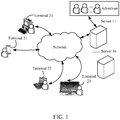
- FIG. 1 is a schematic diagram of hardware entities of parties that perform information exchange according to embodiments of the present disclosure.
- Servers 11 to In and terminal devices 21 to 24 are shown in FIG. 1 .
- the terminal devices 21 to 24 perform information exchange with the servers by using a wired network or a wireless network.
- the terminal device may include a mobile phone, a desktop computer, a personal computer, and an all-in-one machine.
- the server may interact with a first-type terminal by using a network.
- the first-type terminal may be, for example, a terminal of an advertiser, or may be referred to as an object that provides advertisement materials and content promotion. After the first-type terminal submits a to-be-published advertisement, the advertisement is stored in a server or a server cluster.
- the terminal devices 21 to 24 may be referred to as second-type terminals.
- the second-type terminal may be, for example, a terminal of a normal user, or may be referred to as an object to which the advertisement is exposed or presented.
- the second-type terminal may be, for example, a user that views a video by using a video application, or a user that uses a social application.
- Advertisements may be presented to users by using all applications or specified applications (for example, a game application, a video application, and a navigation application) installed on the terminal device, to recommend information to the user.
- the first-type server is used for providing traffic for media information publication, and is referred to as a traffic party in this embodiment.
- the first-type terminal for example, a terminal of an advertiser
- the second-type server is used for performing cheating detection on the above behaviors, to prevent the traffic party from increasing the number of clicks on the media information by a cheating means and damaging the interest of the advertiser.
- the information processing method in this embodiment is applied to the above second-type server or the server cluster.
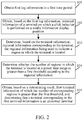
- FIG. 2 is a flowchart of an information processing method according to a first embodiment of the present disclosure. As shown in FIG. 1 , the method includes the following steps 101 to 105.
- step 101 first log information in a first time period is obtained.
- step 102 terminal information of a terminal on which a click behavior is performed on a media information display position is obtained based on the first log information.
- step 103 regional information corresponding to the terminal is determined based on the terminal information.
- the regional information is used to indicate a region in which the terminal is located.
- step 104 it is determined whether the number of regions in which the terminal is located in a preset time range is greater than a first threshold according to the regional information.
- step 105 first terminal information of which the number of corresponding regions is greater than the first threshold is obtained based on a determining result, and it is determined that a terminal corresponding to the first terminal information is an abnormal terminal.
- the information processing method in this embodiment of the present disclosure is applied to a media information publishing system.
- Content of the media information is, for example, content of an advertisement.
- the information processing method in this embodiment is for a technical means for cheating for forging users in the conventional technology.
- users are forged by changing an IP address in combination with changing terminal information.
- the terminal information is an IMEI
- the IMEI and the IP address are discrete if the IMEI and the IP address are considered in separated dimensions.
- the IMEI and the IP address are considered in combination with each other, and the IP address is corresponded to a region in which a terminal is located (the region may be accurate to a municipal-level, and the like), in a normal case, within a short period of time (for example, one hour), a normal terminal is fixed in a certain region, and it is a small probability event that the terminal occurs in multiple regions. Therefore, in data manifestation, a case in which an IMEI correspond to multiple regions within a short period of time needs to be found, and the terminal corresponding to this IMEI may be a forged terminal.
- Table 1 shows distribution of regions in which all IMEIs in a media information publishing platform occur in one hour. As shown by the collected statistics, approximately 97% of IMEIs only occur in only one region, a small amount of IMEIs, approximately 2%, occur in two regions, and less than 1 % of IMEIs occur in at least two regions within one hour. One IMEI occurs in up to 261 different regions (not shown). Table 1 Number of regions where IMEI occurs Number of IMEIs Percentage Equal to 1 513457 97.78% Equal to 2 10530 2.00% Greater than 2 1127 0.22%
- the terminal information may be forged by forging the terminal information in combination with changing an IP address, and the terminal is an abnormal terminal.
- the first threshold may be 2. Based on this, in this embodiment, terminal information in a media information pushing platform and corresponding regional information are obtained, and the regional information may be specifically represented as a municipal-level region range.
- a first terminal corresponding to the first terminal information is an abnormal terminal.
- the first log information is log information in a relatively short time range.
- the first log information may be hour-level log information, for example, one-hour log information.
- the first log information is not limited to the hour-level log information, and may be minute-level log information, and the like.
- the first log information includes all information obtained by a media information pushing platform, which includes a click behavior on a media information display position, terminal information, user information, and information about a position at which a terminal is located.
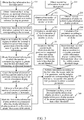
- FIG. 3 is a flowchart of an information processing method according a second embodiment of the present disclosure. As shown in FIG. 3 , after step 105 in the first embodiment, the information processing method includes the following steps 106 to 209.
- step 106 the number of abnormal terminals and the total number of terminals corresponding to a first media information display position among media information display positions corresponding to the abnormal terminals are counted.
- the first media information display position is any one of the media information display positions corresponding to the abnormal terminal.
- step 107 a first ratio of the number of abnormal terminals to the total number of terminals is calculated.
- step 108 the first media information display position is marked as a suspected abnormal media information display position if the first ratio is greater than a second threshold. Then, the method proceeds to step 208.
- step 201 second log information in a second time period is obtained.
- a time range of the second time period is greater than a time range of the first time period.
- a first number of clicks on a second media information display position in a first preset time range and a second number of clicks on the second media information display position in a second preset time range are obtained based on the second log information.
- the first preset time range and the second preset time range are different. Specifically, the first preset time range may be used for representing a time range during the day; and the second preset time range may be used for representing a time range during the night.
- step 203 a second ratio of the first number of clicks to the second number of clicks is calculated.
- step 204 the second media information display position is determined to be a suspected abnormal media information display position if the second ratio is less than the second threshold. Then the method proceeds to step 208.
- step 205 location information of clicks on a third media information display position is obtained based on the second log information.
- a first parameter is calculated according to the location information of clicks, where the first parameter indicates a distribution of locations of clicks on the third media information display position.
- step 207 it is determined that the third media information display position is a suspected abnormal media information display position if the first parameter does not fall within a preset threshold range. Then, the method proceeds to step 208.
- step 208 calculation is performed according to the first ratio, the second ratio, the first parameter, and weights respectively corresponding to the first ratio, the second ratio, and the first parameter, to obtain a second parameter corresponding to the suspected abnormal media information display position.
- step 209 it is determined that the suspected abnormal media information display position is an abnormal media information display position if the second parameter is greater than a third threshold.
- the traffic party cheats for obtaining a higher amount of publishing fee from a media information publisher (for example, an advertiser). Therefore, most traffic parties will increase the number of clicks on media information to the greatest extent by a cheating means. Manifestation of click behaviors on media information by using a cheating technology is different from manifestation of normal click behaviors on media information. One of the differences lies in that, to maximize the benefits, the traffic party clicks the media information regardless of day and night, which is inconsistent with a normal behavior.
- FIG. 4 is a graph of normal numbers of clicks on a media information display position according to an embodiment of the present disclosure. As shown in FIG. 4 , it may be seen that between 2 o'clock to 6 o'clock in the morning, the number of click behaviors on the media information display position is relatively small, and from 8 o'clock in the morning, the number of click behaviors on the media information display position gradually increases to the highest level of the day. At about 23 o'clock in the night, the number of click behaviors on the media information display position falls. It may be seen that the click behaviors on the media information display position is related to a schedule of the user.
- a probability that the user generates a click behavior on the media information display position is far greater than a probability that the user generates a click behavior on the media information display position in the night when the user sleeps.
- click behaviors on the media information display position which do not have a distinction between the day and the night as shown in FIG. 3 , that is, which are generated regardless of the day and the night, are considered as a small probability event from the perspective of statistics.
- FIG. 5a and FIG. 5b are schematic diagrams of abnormal numbers of clicks on a media information display position according to an embodiment of the present disclosure. It may be seen that curves of the abnormal numbers of clicks shown in FIG. 5a and FIG. 5b are different from the curve of a normal number of clicks on the media information display position shown in FIG. 4 . Specifically, as shown in FIG. 5a , although the number of clicks on the media information display position fluctuates, the number of clicks does not have a distinction during the day and the night, and it may be considered that the number of clicks on the media information display position during one day is evenly distributed. As shown in FIG.
- the number of clicks on the media information display position are all at relatively high values after 0 o'clock in the night and before 7 o'clock in the morning, and gradually decrease from 7 o'clock in the morning and are close to a lowest level at 11 o'clock in the morning, which is completely inconsistent with the distribution of normal click behaviors on the media information display position shown in FIG. 4 . From this, it may be considered that these click behaviors generated on the media information display position are manually intervened, and have a suspicion of cheating.
- step 202 to step 204 in this embodiment several representative time periods may be selected to represent the day and the night.
- "night” a time period in which a user is asleep
- “day” a time period in which a user is awake
- time period from 8 o'clock in the morning to 0 o'clock in the night may be defined as a time period from 8 o'clock in the morning to 0 o'clock in the night.
- “day” is a first preset time range, which indicates a time period in which a user is awake
- “night” is a second preset time range, which indicates a time period in which a user is asleep.
- a first number of clicks on the second media information display position in the first preset time range and a second number of clicks on the second media information display position in the second preset time range are counted.
- the second media information display position is any media information display position in a media information pushing platform.
- a second ratio of the first number of clicks to the second number of clicks is calculated. If the second ratio is less than a second threshold, it is determined that the second media information display position is a suspected abnormal media information display position.
- the second threshold is a value less than or equal to 1, and the second ratio being less than the second threshold indicates that the number of clicks on the second media information display position during the "day" is less than the number of clicks on the second media information display position during the "night".
- the part of which the horizontal coordinate is less than 1 indicates advertisement positions that are more active in the night than in the day.
- the vertical coordinate represents the number of advertisement positions. It may be seen that some advertisement positions are active in the night. Except some special applications, a large part of advertisement positions are cheating advertisement positions.
- a second difference lies in that, the location at which a media information display position clicked by each user is reported by using a software development kit (SDK), and a service end determines a distribution of coordinates of clicks on each media information display position. It may be found though statistical analysis that the distribution of locations of clicks on the media information display position by a cheating means is different from that of a normal media information display position.
- SDK software development kit
- FIG. 7a to FIG. 7c are schematic diagrams of distributions of locations of clicks on a media information display position.
- FIG. 7a is a schematic diagram of distribution of locations of clicks on a normal media information display position.
- the distribution of the locations of clicks on the normal media information display position includes hot spots according to the format and content of media information. For example, coordinates of the media information display positions in some region are in scattered distribution, and the media information display position in some regions are more focused by the user, and coordinates thereof are in a concentrated distribution. Distribution of locations of clicks on an abnormal media information display position may be as shown in FIG. 7b and FIG. 7c .
- FIG. 7b represents locations of clicks in scattered distribution.
- FIG. 7c represents locations of clicks in concentrated distribution.
- the thickness or line type of lines in FIG. 7c indicate different numbers of clicks.
- the line type may include a solid line or a dashed line. For example, a thin solid line indicates a first number of clicks, a bold solid line indicates a second number of clicks, and a dashed line indicates a third number of clicks.
- a first parameter is calculated according to location information of clicks on the third media information display position.
- the first parameter indicates a distribution of locations of clicks on the third media information display position. If the first parameter does not meet a preset condition, it is determined that the third media information display position is a suspected abnormal media information display position.
- the first parameter may be represented by an entropy value, that is, the media information display position of the media information is recognized by using an entropy algorithm.
- x represents a horizontal coordinate of a location of a click
- p (x) represents a probability when the horizontal coordinate of the location of the click is x
- H (x) represents an entropy value of locations of clicks on the media information display position
- x and y respectively represent a horizontal coordinate and a longitudinal coordinate of a location of a click
- p(x) represents a probability of the location of the click when the horizontal coordinate is x
- p(x, y) represents a probability of the location of the click when the horizontal coordinate is x, and the longitudinal coordinate is y
- X) represents an entropy value of locations of clicks on the media information display position.
- the first parameter is calculated for locations of clicks on each media information display position.
- the first parameter may be specifically an entropy value.
- the types are, for example, a banner advertisement and an interstitial advertisement
- corresponding preset threshold ranges are respectively set. If the calculated first parameter (for example, the entropy value) of the media information display position does not fall within the preset threshold range, it may be determined that the media information display position is a suspected abnormal media information display position.
- an entropy value of approximately 8 bits may be considered to represent an even distribution under certain cases, and is suspected of cheating. That is, it may be determined that the interstitial advertisement position is a suspected abnormal media information display position.
- P is a value that is infinitely close to 0, which indicates that such a case is an extremely small probability event. If in traffic of an advertisement position, there are a great number of such IMEIs that occur in multiple regions, the possibility that the advertisement position is a cheating advertisement position is great. Distribution in FIG. 8 also proves this. In a normal advertisement position, abnormal terminals account for a very small percentage.
- abnormal terminals For example, for approximately 2600 to 2700 advertisement positions among 3,000 advertisement positions, less than 5% of terminals on which the advertisement positions are clicked are abnormal terminals. In some advertisement positions, the percentage of abnormal terminals exceeds 10%. In approximately 100 advertisement positions, 100% of the terminals on which the advertisement position are clicked are abnormal terminals.
- step 105 to step 107 in this embodiment among the media information display positions corresponding to the abnormal terminals, the number of abnormal terminals and the total number of terminals corresponding to the first media information display position are counted.
- the first media information display position is any one of the media information display positions corresponding to the abnormal terminals.
- the first ratio of the number of abnormal terminals to the total number of terminals is calculated. If the first ratio is greater than the second threshold, the first media information display position is marked as a suspected abnormal media information display position.
- a second parameter corresponding to an abnormal media information display position is calculated according to respective preset weights.
- the weight corresponding to the first parameter may be relatively great.
- the parameters are respectively multiplied by corresponding weights and are added, to obtain the second parameter. It is determined whether the second parameter is greater than the third threshold. If the second parameter is greater than the third threshold, it is determined that the first suspected abnormal media information display position is an abnormal media information display position.
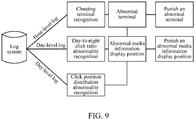
- FIG. 9 is a schematic diagram of a processing process of the information processing method according to an embodiment of the present disclosure.
- log information in a log system is obtained, and the obtained log information includes an hour-level log and a day-level log.
- the hour-level log may be, for example, the first log information in this embodiment
- the day-level log may be, for example, the second log information in this embodiment.
- a cheating terminal is recognized based on the hour-level log, and an abnormal terminal is determined according to the method in the first embodiment.
- the method further includes: marking a click behavior on the media information display position corresponding to the abnormal terminal as invalid.
- a cheating media information display position (for example, an advertisement position) is recognized based on the day-level log, and an abnormal media information display position is determined according to the method in the second embodiment. Further, after the determining the first suspected abnormal media information display position as an abnormal media information display position, the method further includes: marking a click behavior on the abnormal media information display position as invalid.
- the terminal information that performs a click behavior on the media information display position and corresponding regional information are analyzed, and a terminal of which the number of regions is greater than a first threshold is determined as an abnormal terminal.
- a ratio of the number of clicks during the day to the number of clicks during the night of the media information display position, and a distribution of locations of clicks are analyzed, so as to recognize an abnormal media information display position.
- FIG. 10 is a schematic diagram of a processing process of the information processing method in an application scenario according to an embodiment of the present disclosure.
- the information processing solution in this application scenario includes two parts: an abnormal user recognition and punishment process which includes step 41 to step 43; and an abnormal advertisement position recognition and punishment process which includes step 51 to step 57, and step 44, and step 45 to step 54.
- An abnormal user recognition and punishment process includes the following steps 41 to 43.
- step 41 hour-level log information is obtained.
- the server may set a timer for timing one hour. Each time when the timer expires, IMEIs and corresponding address information in one hour in the log system are obtained.
- step 42 abnormal IMEIs that occurs in multiple locations are hourly calculated.
- the preset threshold may be 3.
- step 43 an abnormal user is pushed for on-line punishment.
- a terminal corresponding to the abnormal IMEI is determined to be an abnormal terminal. This may also be understood as that a user corresponding to an abnormal IMEI is determined to be an abnormal user.
- the pushing the abnormal user for on-line punishment includes: marking a click behavior corresponding to the abnormal terminal as invalid.
- An abnormal advertisement position recognition and punishment process includes three parts.
- a suspected abnormal advertisement position is determined by recognizing a percentage of the number of clicks of abnormal users on the advertisement position.
- a suspected abnormal advertisement position is determined by recognizing a day-to-night click number ratio of the advertisement position.
- a suspected abnormal advertisement position is determined by using a distribution of coordinates at which the advertisement position is clicked.
- a final abnormal advertisement position is determined from suspected abnormal advertisement positions determined in the foregoing three manners, which includes the following step 44 to step 57.
- step 44 abnormal IMEIs are aggregated according to advertisement positions, and among clicks on the advertisement position, the number of abnormal users and the total number of users are counted.
- step 45 it is determined whether a percentage of the number of abnormal users to the total number of users exceeds a preset threshold; and if it is determined that the percentage of the number of abnormal users to the total number of users exceeds the preset threshold, it is determined that the advertisement position is a suspected abnormal advertisement position, and the suspected abnormal advertisement position is pushed to step 54 for abnormal advertisement position determining.
- the percentage of abnormal users is very small; and if the percentage of abnormal users is relatively great among clicks on a certain advertisement position, it may be determined that the advertisement position is a suspected abnormal advertisement position.
- step 51 a day-level log is obtained.
- the server may obtain log information of a previous day at a fixed time instant each day.
- step 52 a day-to-night click number ratio of each advertisement position is calculated based on the obtained day-level log.
- step 53 it is determine whether the day-to-night click number ratio exceeds a preset threshold; and if it is determined that the day-to-night click number ratio exceeds the preset threshold, it may be determined that the advertisement position is a suspected abnormal advertisement position, and the suspected abnormal advertisement position pushed to step 54 for abnormal advertisement position determining.
- step 55 the distribution of coordinates of clicks on the advertisement position is determined based on the obtained day-level log.
- step 56 a parameter indicating a concentration degree and a discrete degree of coordinates of clicks are calculated. Then the method proceeds to step 54.
- the calculated parameter indicating the concentration degree and the discrete degree of coordinates of clicks may be determined by calculating entropy of the coordinates of clicks on the advertisement positions.
- step 53 it is determined whether the parameter is greater than a preset threshold. If it is determined that the parameter is greater than the preset threshold, it may be determined that the advertisement position is a suspected abnormal advertisement position, and the suspected abnormal advertisement position is pushed to step 54 for abnormal advertisement position determining. Certainly, when step 53 is performed herein, the preset threshold for comparison is different from the preset threshold for comparison for the day-to-night click number ratio.
- abnormal advertisement position determining is performed for the suspected abnormal advertisement positions determined in the foregoing three manners.
- weights may be respectively pre-configured for the suspected abnormal advertisement positions determined in the foregoing three manners.
- the suspected abnormal advertisement positions determined in the foregoing three manners respectively correspond to three parameters: a second ratio indicating a day-to-night click number ratio obtained based on click behaviors during the day and the night, a first parameter indicating a concentration degree or a discrete degree of coordinates of clicks obtained based on a distribution of locations of clicks, and a first ratio indicating a ratio of the number of abnormal users to the total number of users obtained based on an abnormal terminal (that is, a user dimension).
- the parameters are respectively multiplied by corresponding weights, and are added, to obtain a final result. If the final result is greater than a preset threshold, it may be determined that the suspected abnormal advertisement position is an abnormal advertisement position.
- step 57 an abnormal advertisement position is pushed for on-line punishment.
- the pushing an abnormal advertisement position for on-line punishment includes: marking a click behavior corresponding to the abnormal advertisement position as invalid.
- FIG. 11 is a schematic diagram of a first configuration of a server according an embodiment of the present disclosure.
- the server includes: a data obtaining unit 31, a data analysis unit 32, and a determining unit 33.
- the data obtaining unit 31 is configured to obtain first log information in a first time period.
- the data analysis unit 32 is configured to: obtain, based on the first log information, terminal information of a terminal on which a click behavior is performed on a media information display position; determine, based on the terminal information, regional information corresponding to the terminal, the regional information being used to indicate a region in which the terminal is located; and determine whether the number of regions in which the terminal is located in a preset time range is greater than a first threshold.
- the determining unit 33 is configured to: obtain, based on a determining result obtained by the data analysis unit 32, first terminal information of which the number of corresponding regions is greater than the first threshold, and determine that a terminal corresponding to the first terminal information is an abnormal terminal.
- the first log information is log information in a relatively short time range.
- the first log information may be hour-level log information, for example, one-hour log information.
- the first log information is not limited to the hour-level log information, and may be minute-level log information.
- the first log information includes all information obtained by a media information pushing platform, which includes a click behavior on a media information display position, terminal information, user information, and information about a location at which a terminal is located.
- the data analysis unit 32 obtains the terminal information and corresponding regional information in the media information pushing platform.
- the regional information may be specifically represented by a municipal-level regional range. If the number of regions corresponding to the first terminal information in a time range less than a preset time range (for example, one hour) is greater than the first threshold, the determining unit 33 may determine that a first terminal corresponding to the first terminal information is an abnormal terminal.
- the first threshold may be 3.
- the server further includes a first punishment unit 35, configured to: after the determining unit 33 determines that the terminal corresponding to the first terminal information is an abnormal terminal, mark a click behavior corresponding to the abnormal terminal on the media information display position as invalid.
- FIG. 12 is a schematic diagram of a second configuration of a server according to an embodiment of the present disclosure.
- the server includes: a data obtaining unit 31, a data analysis unit 32, a determining unit 33, and a setting unit 34.
- the data obtaining unit 31 is configured to obtain first log information in a first time period.
- the data analysis unit 32 is configured to: obtain, based on the first log information obtained by the data obtaining unit 31, terminal information of a terminal on which a click behavior is performed on a media information display position; determine, based on the terminal information, regional information corresponding to the terminal, the regional information being used to indicate a region in which the terminal is located; and determine whether the number of regions in which the terminal is located in a preset time range is greater than a first threshold.
- the data analysis unit 32 is further configured to: count the number of abnormal terminals and the total number of terminals corresponding to a first media information display position among media information display positions corresponding to abnormal terminals, where the first media information display position is any one of the media information display positions corresponding to the abnormal terminals; and calculate a first ratio of the number of abnormal terminals to the total number of terminals.
- the determining unit 33 is configured to: obtain, based on a determining result obtained by the data analysis unit 32, first terminal information of which the number of corresponding regions is greater than the first threshold, and determine that a terminal corresponding to the first terminal information is an abnormal terminal.
- the determining unit 33 is further configured to mark the first media information display position as a suspected abnormal media information display position if the first ratio is greater than a second threshold.
- the data obtaining unit 31 is further configured to obtain second log information in a second time period, where a time range of the second time period is greater than a time range of the first time period.
- the data analysis unit 32 is further configured to: obtain, based on the second log information, a first number of clicks on a second media information display position in a first preset time range and a second number of clicks on the second media information display position in a second preset time range, where the first preset time range and the second preset time range are different; and calculate a second ratio of the first number of clicks to the second number of clicks.
- the data analysis unit 32 is further configured to: obtain, based on the second log information, location information of clicks on a third media information display position; calculate a first parameter according to the location information of clicks on the third media information display position, where the first parameter indicates a distribution of locations of clicks on the third media information display position; and determine whether the first parameter falls within a preset threshold range.
- the determining unit 33 is further configured to determine the second media information display position as a suspected abnormal media information display position if the second ratio is less than the second threshold; and is further configured to determine that the third media information display position is a suspected abnormal media information display position if the first parameter does not fall within the preset threshold range.
- the setting unit 34 is configured to respectively set weights for the first ratio, the second ratio, and the first parameter.
- the determining unit 33 is further configured to: perform calculation according to the first ratio, the second ratio, the first parameter, and weights respectively corresponding to the first ratio, the second ratio, and the first parameter, to obtain a second parameter corresponding to the suspected abnormal media information display position; and determine that the suspected abnormal media information display position is an abnormal media information display position if the second parameter is greater than a third threshold.
- the data obtaining unit 31 obtains the first log information and the second log information.
- the first log information is log information in a relatively short time range.
- the first log information may be hour-level log information, for example, one-hour log information.
- the first log information is not limited to hour-level log information and may be minute-level log information.
- a time range of the second log information is greater than a time range of the first log information. Relative to the first log information, the second log information has a relatively longer time range.
- the second log information may be day-level log information. Certainly, the second log information is not limited to log information in a range of one day, and may be log information in a range of ten days.
- the data analysis unit 32 analyzes, based on the second log information, the first number of clicks in the first preset time range (that is, the number of clicks during the day) on the media information display position and the second number of clicks in the second preset time range (that is, the number of clicks during the night) on the media information display position, and calculate a ratio of the number of clicks during the day to the number of clicks during the night.
- the determining unit 33 is further configured to determine the corresponding media information display position as a suspected abnormal media information display position if the ratio is less than the second threshold.
- the data analysis unit 32 analyzes, based on the second log information, location information of clicks on the media information display position, and calculates the first parameter (that is, an entropy value) based on the location information of clicks on the media information display position.
- the determining unit 33 is further configured to determine that the third media information display position is a suspected abnormal media information display position if the first parameter (that is, the entropy value) does not fall within the preset threshold range.
- the data analysis unit 32 analyzes the media information display position related to the abnormal terminal determined by the determining unit 33, and calculates a ratio of the number of abnormal terminals to the total number of terminals corresponding to the media information display position. If the ratio is greater than the second threshold, the determining unit 33 marks the first media information display position as a suspected abnormal media information display position.
- the determining unit 33 calculates, based on the weights set by the setting unit 34, a second parameter corresponding to the abnormal media information display position.
- the weight value corresponding to the first parameter may be relatively great; and the parameters are respectively multiplied by the corresponding weights and are added together to finally obtain the second parameter. It is determined whether the second parameter is greater than the third threshold. If the second parameter is greater than the third threshold, it is determined that the first suspected abnormal media information display position is an abnormal media information display position.
- the server further includes a first punishment unit 35, configured to: after the determining unit 33 determines that the terminal corresponding to the first terminal information is an abnormal terminal, mark a click behavior corresponding to the abnormal terminal on the media information display position as invalid.
- the server further includes a second punishment unit 36, configured to: after the determining unit 33 determines that the suspected abnormal media information display position is an abnormal media information display position, mark a click behavior on the abnormal media information display position as invalid.
- the data obtaining unit 31, the data analysis unit 32, the determining unit 33, the setting unit 34, the first punishment unit 35, and the second punishment unit 36 in the server all may be implemented by using a central processing unit (CPU), a digital signal processor (DSP), a microcontroller unit (MCU), or a field programmable gate array (FPGA) in the server during actual application.
- CPU central processing unit
- DSP digital signal processor
- MCU microcontroller unit
- FPGA field programmable gate array
- FIG. 13 is a schematic diagram of a modular structure of a server according to an embodiment of the present disclosure.
- log information is obtained by using a cheating terminal recognition module and a day-to-night click ratio abnormality recognition module, a click location distribution abnormality recognition module in a log system.
- the cheating terminal recognition module obtains hour-level log information.
- the day-to-night click ratio abnormality recognition module and the click location distribution abnormality recognition module respectively obtain day-level log information.
- a policy update module is configured with a cheating determining policy according to policy configuration information.
- the cheating terminal recognition module, the day-to-night click ratio abnormality recognition module and the click location distribution abnormality recognition module perform analysis and recognition according to the cheating determining policy in the policy update module.
- the policy update module obtains an abnormal terminal and an abnormal media information display position (that is, an abnormal advertisement position). After an on-line real-time system receives a request from a charging module, the on-line real-time system gives a punishment according to an obtained determining result, and marks a click behavior performed by an abnormal terminal as invalid and marks a click behavior on an abnormal media information display position as invalid. Meanwhile, the charging module does not charge for the click behavior recorded as invalid.
- FIG. 14 an example in which a server is a hardware entity is shown in FIG. 14 .
- the server includes a processor 61, a storage medium 62, and at least one external communications interface 63.
- the processor 61, the storage medium 62, and the external communications interface 63 are connected to each other by using a bus 64.
- the disclosed apparatus and method may be implemented in other manners.
- the described device embodiments are merely exemplary.
- the unit division is merely logical function division and may be other division during actual implementation.
- multiple units or components may be combined or integrated into another system, or some features may be ignored or not performed.
- the displayed or discussed mutual couplings or direct couplings or communication connections between the components may be implemented through some interfaces, indirect couplings or communication connections between the devices or units, or electrical connections, mechanical connections, or connections in other forms.
- the units described as separation parts may be or may not be physically separated.
- the part used as display unit may be or may not be a physical unit. That is, the units may be located in a same place, or may be distributed to many network units. Some or all of the units need to be selected according to actual requirements to implement the purpose of the solution of the embodiments.
- functional units in the embodiments of the present disclosure may be all integrated in a processing unit, each unit is separately used as a unit, or two or more units are integrated in a unit.
- the integrated unit may be implemented in a form of hardware, or may be implemented in form of hardware plus a software functional unit.
- the program may be stored in a computer readable storage medium.
- the storage medium includes various types of media that may store program code, for example, a mobile storage device, a read-only memory (ROM), a random access memory (RAM), a magnetic disk, or an optical disk.
- the integrated modules may be stored in a computer-readable storage medium.
- the computer software product is stored in a storage medium and includes several instructions for instructing a computer device (which may be a personal computer, a server, a network device, or the like) to perform all or some of the methods described in the embodiments of the present disclosure.
- the foregoing storage medium includes: any media that can store program code, such as a removable storage device, a ROM, a RAM, a magnetic disk, or an optical disc.
Landscapes
- Business, Economics & Management (AREA)
- Strategic Management (AREA)
- Engineering & Computer Science (AREA)
- Accounting & Taxation (AREA)
- Development Economics (AREA)
- Finance (AREA)
- Economics (AREA)
- Game Theory and Decision Science (AREA)
- Entrepreneurship & Innovation (AREA)
- Marketing (AREA)
- Physics & Mathematics (AREA)
- General Business, Economics & Management (AREA)
- General Physics & Mathematics (AREA)
- Theoretical Computer Science (AREA)
- Management, Administration, Business Operations System, And Electronic Commerce (AREA)
- Information Transfer Between Computers (AREA)
- Computer And Data Communications (AREA)
- Telephonic Communication Services (AREA)
Abstract
Description
- The application claims priority to Chinese Patent Application No.
201610389956.4 - The present disclosure relates to the information processing technologies, and in particular, to an information processing method, a server, and a non-volatile storage medium.
- During display of media information (for example, an advertisement) on mobile terminals, cheating methods continuously escalate with development of anti-cheating methods, in order to pursue economic benefits. To increase income, a cheating party needs to report more clicks, for which the easiest way is to forge new users. Currently, the technical means for cheating mainly includes the following types. A first type is to forge terminal information by a technical means. The terminal information is, for example, an international mobile equipment identity (IMEI) or an Android ID in an Android system, or an Identifier for Advertising (IDFA) or a Media Access Control (MAC) address in an iOS system. With the forged terminal information, one mobile terminal may be recognized as multiple terminals. A second type is to obtain almost all Internet Protocol (IP) resources by technical means. A third type is to perform click behaviors of users by click simulation technologies.
- In this way, by the three technical means described above and a combination thereof, cheating users cannot be accurately detected and recognized by using the existing anti-cheating detection policy. Consequently, the number of clicks of a media information display position cannot be accurately obtained. There is no effective solution to this issue in related technologies.
- Embodiments of the present disclosure aim to provide an information processing method, a server, and a non-volatile storage medium, to resolve the issue in the conventional technology that cheating users who cheat in media information display cannot be accurately detected and recognized by a technical means against cheating in the conventional technology.
- To achieve the foregoing objective, the technical solutions of the embodiments of the present disclosure are implemented as follows.
- An information processing method is provided according to an embodiment of the present disclosure. The method includes:
- obtaining first log information in a first time period;
- obtaining, based on the first log information, terminal information of a terminal on which a click behavior is performed on a media information display position;
- determining, based on the terminal information, regional information corresponding to the terminal, the regional information being used to indicate a region in which the terminal is located;
- determining, according to the regional information, whether the number of regions in which the terminal is located in a preset time range is greater than a first threshold; and
- obtaining, based on a determining result, first terminal information of which the number of corresponding regions is greater than the first threshold, and determining that a terminal corresponding to the first terminal information is an abnormal terminal.
- A server is further provided according to an embodiment of the present disclosure. The server includes a data obtaining unit, a data analysis unit, and a determining unit.
- The data obtaining unit is configured to obtain first log information in a first time period.
- The data analysis unit is configured to: obtaining, based on the first log information, terminal information of a terminal on which a click behavior is performed on a media information display position; determining, based on the terminal information, regional information corresponding to the terminal, the regional information being used to indicate a region in which the terminal is located; determining whether the number of regions in which the terminal is located in a preset time range is greater than a first threshold.
- The determining unit is configured to: obtain, based on a determining result obtained by the data analysis unit, first terminal information of which the number of corresponding regions is greater than the first threshold, and determine that a terminal corresponding to the first terminal information is an abnormal terminal.
- A nonvolatile storage medium in which program instructions are stored is further provided according to an embodiment of the present disclosure. A processor performs an information processing method when executing the stored program instructions. The information processing method includes:
- obtaining first log information in a first time period;
- obtaining, based on the first log information, terminal information of a terminal on which a click behavior is performed on a media information display position;
- determining, based on the terminal information, regional information corresponding to the terminal, the regional information being used to indicate a region in which the terminal is located;
- determining, according to the regional information, whether the number of regions in which the terminal is located in a preset time range is greater than a first threshold; and
- obtaining, based on a determining result, first terminal information of which the number of corresponding regions is greater than the first threshold, and determining that a terminal corresponding to the first terminal information is an abnormal terminal.
- The information processing method, the server, and the non-volatile storage medium are provided according to the embodiments of the present disclosure. The method includes: obtaining first log information in a first time period; obtaining, based on the first log information, terminal information of a terminal on which a click behavior is performed on a media information display position; determining, based on the terminal information, regional information corresponding to the terminal, where the regional information is used to indicate a region in which the terminal is located; determining whether the number of regions in which the terminal is located in a preset time range is greater than a first threshold according to the regional information; and obtaining, based on a determining result, first terminal information of which the number of corresponding regions is greater than the first threshold, and determining that a terminal corresponding to the first terminal information is an abnormal terminal. By means of the technical solutions of the embodiments of the present disclosure, information about a terminal on which a click behavior is performed on a media information display position and corresponding regional information are analyzed, and a terminal whose number of regions is greater than a first threshold is determined to be an abnormal terminal. Therefore, an issue in the conventional technology that cheating users who cheat in media information display cannot be accurately detected and recognized by a technical means against cheating is resolved, and accuracy of the number of clicks on the media information display position is greatly improved.
- To describe the technical solutions of the embodiments of this application more clearly, the accompanying drawings required for describing the embodiments are briefly introduced in the following. Apparently, the accompanying drawings in the following description show only some embodiments of this disclosure, and a person of ordinary skill in the art may still derive other drawings from these accompanying drawings without creative efforts.
-
FIG. 1 is a schematic diagram of hardware entities of parties that perform information exchange according to an embodiment of the present disclosure; -
FIG. 2 is a flowchart of an information processing method according to a first embodiment of the present disclosure; -
FIG. 3 is a flowchart of an information processing method according to a second embodiment of the present disclosure; -
FIG. 4 is a graph of normal numbers of clicks on a media information display position according to an embodiment of the present disclosure; -
FIG. 5a and FIG. 5b are schematic diagrams of abnormal numbers of clicks on a media information display position according to an embodiment of the present disclosure; -
FIG. 6 is a scatter chart of distribution of a day-to-night ratio of the number of clicks on a media information display position according to an embodiment of the present disclosure; -
FIG. 7a to FIG. 7c are schematic diagrams of distributions of locations of clicks on the media information display position; -
FIG. 8 is a schematic diagram of a proportional relationship between a percentage of abnormal terminals and the number of advertisement positions according to an embodiment of the present disclosure; -
FIG. 9 is a schematic diagram of a processing process of the information processing method according to an embodiment of the present disclosure; -
FIG. 10 is a schematic diagram of a processing process of the information processing method in an application scenario according to an embodiment of the present disclosure; -
FIG. 11 is a schematic diagram of a first configuration of a server according to an embodiment of the present disclosure; -
FIG. 12 is a schematic diagram of a second configuration of a server according to an embodiment of the present disclosure; -
FIG. 13 is schematic diagram of a modular structure of a server according to an embodiment of the present disclosure; and -
FIG. 14 is a diagram of an example in which the server is a hardware entity according to an embodiment of the present disclosure. - In the following, the present disclosure is described in detail with reference to the accompanying drawings and embodiments.
-
FIG. 1 is a schematic diagram of hardware entities of parties that perform information exchange according to embodiments of the present disclosure.Servers 11 to In andterminal devices 21 to 24 are shown inFIG. 1 . Theterminal devices 21 to 24 perform information exchange with the servers by using a wired network or a wireless network. The terminal device may include a mobile phone, a desktop computer, a personal computer, and an all-in-one machine. In an example, the server may interact with a first-type terminal by using a network. The first-type terminal may be, for example, a terminal of an advertiser, or may be referred to as an object that provides advertisement materials and content promotion. After the first-type terminal submits a to-be-published advertisement, the advertisement is stored in a server or a server cluster. A skilled person may be provided to perform a series of processing such as examining the advertisement provided by the first-type terminal. Relative to the first-type terminal, theterminal devices 21 to 24 may be referred to as second-type terminals. The second-type terminal may be, for example, a terminal of a normal user, or may be referred to as an object to which the advertisement is exposed or presented. The second-type terminal may be, for example, a user that views a video by using a video application, or a user that uses a social application. Advertisements may be presented to users by using all applications or specified applications (for example, a game application, a video application, and a navigation application) installed on the terminal device, to recommend information to the user. - In this embodiment, there are two types of servers. The first-type server is used for providing traffic for media information publication, and is referred to as a traffic party in this embodiment. The first-type terminal (for example, a terminal of an advertiser) needs to purchase traffic from the first-type server (for example, the traffic party), to publish media information using the purchased traffic. The second-type server is used for performing cheating detection on the above behaviors, to prevent the traffic party from increasing the number of clicks on the media information by a cheating means and damaging the interest of the advertiser. The information processing method in this embodiment is applied to the above second-type server or the server cluster.
- An information processing method is provided according to this embodiment of the present disclosure.
FIG. 2 is a flowchart of an information processing method according to a first embodiment of the present disclosure. As shown inFIG. 1 , the method includes the followingsteps 101 to 105. - In step 101: first log information in a first time period is obtained.
- In
step 102, terminal information of a terminal on which a click behavior is performed on a media information display position is obtained based on the first log information. - In
step 103, regional information corresponding to the terminal is determined based on the terminal information. The regional information is used to indicate a region in which the terminal is located. - In
step 104, it is determined whether the number of regions in which the terminal is located in a preset time range is greater than a first threshold according to the regional information. - In
step 105, first terminal information of which the number of corresponding regions is greater than the first threshold is obtained based on a determining result, and it is determined that a terminal corresponding to the first terminal information is an abnormal terminal. - The information processing method in this embodiment of the present disclosure is applied to a media information publishing system. Content of the media information is, for example, content of an advertisement.
- The information processing method in this embodiment is for a technical means for cheating for forging users in the conventional technology. In the conventional technology, users are forged by changing an IP address in combination with changing terminal information. It is found by the inventor that, for example, the terminal information is an IMEI, the IMEI and the IP address are discrete if the IMEI and the IP address are considered in separated dimensions. However, if the IMEI and the IP address are considered in combination with each other, and the IP address is corresponded to a region in which a terminal is located (the region may be accurate to a municipal-level, and the like), in a normal case, within a short period of time (for example, one hour), a normal terminal is fixed in a certain region, and it is a small probability event that the terminal occurs in multiple regions. Therefore, in data manifestation, a case in which an IMEI correspond to multiple regions within a short period of time needs to be found, and the terminal corresponding to this IMEI may be a forged terminal.
- Table 1 shows distribution of regions in which all IMEIs in a media information publishing platform occur in one hour. As shown by the collected statistics, approximately 97% of IMEIs only occur in only one region, a small amount of IMEIs, approximately 2%, occur in two regions, and less than 1 % of IMEIs occur in at least two regions within one hour. One IMEI occurs in up to 261 different regions (not shown).
Table 1 Number of regions where IMEI occurs Number of IMEIs Percentage Equal to 1 513457 97.78% Equal to 2 10530 2.00% Greater than 2 1127 0.22% - It may be seen that within each hour, there is a very small probability, approximately 0.22%, that one IMEI occurs in three regions or more than three regions. It may be considered that within a preset time range (for example, one hour) if the number of regions in which one piece of terminal information occurs is greater than a first threshold, it may be determined that the terminal information is forged by forging the terminal information in combination with changing an IP address, and the terminal is an abnormal terminal. The first threshold may be 2. Based on this, in this embodiment, terminal information in a media information pushing platform and corresponding regional information are obtained, and the regional information may be specifically represented as a municipal-level region range. If the number of regions corresponding to the first terminal information in a time range less than a preset time range (for example, one hour) is greater than the first threshold (for example, 3), it may be determined that a first terminal corresponding to the first terminal information is an abnormal terminal.
- In this embodiment, the first log information is log information in a relatively short time range. In an implementation, the first log information may be hour-level log information, for example, one-hour log information. Certainly, the first log information is not limited to the hour-level log information, and may be minute-level log information, and the like. The first log information includes all information obtained by a media information pushing platform, which includes a click behavior on a media information display position, terminal information, user information, and information about a position at which a terminal is located.
- By means of the technical solutions of the embodiments of the present disclosure, information about a terminal on which a click behavior is performed on a media information display position and corresponding regional information are analyzed, and a terminal whose number of regions is greater than a first threshold is determined to be an abnormal terminal. Therefore, an issue in the conventional technology that cheating users who cheat in media information display cannot be accurately detected and recognized by a technical means against cheating is resolved, and accuracy of the number of clicks on the media information display position is greatly improved. On the other hand, the benefits of a media information publishing party (for example, an advertiser) are protected.
- An information processing method is further provided according to an embodiment of the present disclosure. Based on the information processing solution in the first embodiment, based on a recognized abnormal terminal, and in combination with second log information in a longer time range, the information processing solution in this embodiment is mainly used for recognizing an abnormal media information display position.
FIG. 3 is a flowchart of an information processing method according a second embodiment of the present disclosure. As shown inFIG. 3 , afterstep 105 in the first embodiment, the information processing method includes the followingsteps 106 to 209. - In
step 106, the number of abnormal terminals and the total number of terminals corresponding to a first media information display position among media information display positions corresponding to the abnormal terminals are counted. The first media information display position is any one of the media information display positions corresponding to the abnormal terminal. - In
step 107, a first ratio of the number of abnormal terminals to the total number of terminals is calculated. - In
step 108, the first media information display position is marked as a suspected abnormal media information display position if the first ratio is greater than a second threshold. Then, the method proceeds to step 208. - In
step 201, second log information in a second time period is obtained. A time range of the second time period is greater than a time range of the first time period. -
step 202, a first number of clicks on a second media information display position in a first preset time range and a second number of clicks on the second media information display position in a second preset time range are obtained based on the second log information. The first preset time range and the second preset time range are different. Specifically, the first preset time range may be used for representing a time range during the day; and the second preset time range may be used for representing a time range during the night. - In
step 203, a second ratio of the first number of clicks to the second number of clicks is calculated. - In
step 204, the second media information display position is determined to be a suspected abnormal media information display position if the second ratio is less than the second threshold. Then the method proceeds to step 208. - In
step 205, location information of clicks on a third media information display position is obtained based on the second log information. - In
step 206, a first parameter is calculated according to the location information of clicks, where the first parameter indicates a distribution of locations of clicks on the third media information display position. - In
step 207, it is determined that the third media information display position is a suspected abnormal media information display position if the first parameter does not fall within a preset threshold range. Then, the method proceeds to step 208. - In
step 208, calculation is performed according to the first ratio, the second ratio, the first parameter, and weights respectively corresponding to the first ratio, the second ratio, and the first parameter, to obtain a second parameter corresponding to the suspected abnormal media information display position. - In
step 209, it is determined that the suspected abnormal media information display position is an abnormal media information display position if the second parameter is greater than a third threshold. - In this embodiment, it is considered that the traffic party cheats for obtaining a higher amount of publishing fee from a media information publisher (for example, an advertiser). Therefore, most traffic parties will increase the number of clicks on media information to the greatest extent by a cheating means. Manifestation of click behaviors on media information by using a cheating technology is different from manifestation of normal click behaviors on media information. One of the differences lies in that, to maximize the benefits, the traffic party clicks the media information regardless of day and night, which is inconsistent with a normal behavior.
-
FIG. 4 is a graph of normal numbers of clicks on a media information display position according to an embodiment of the present disclosure. As shown inFIG. 4 , it may be seen that between 2 o'clock to 6 o'clock in the morning, the number of click behaviors on the media information display position is relatively small, and from 8 o'clock in the morning, the number of click behaviors on the media information display position gradually increases to the highest level of the day. At about 23 o'clock in the night, the number of click behaviors on the media information display position falls. It may be seen that the click behaviors on the media information display position is related to a schedule of the user. During the day, the user is not in a sleeping state, and a probability that the user generates a click behavior on the media information display position is far greater than a probability that the user generates a click behavior on the media information display position in the night when the user sleeps. - Based on this, click behaviors on the media information display position which do not have a distinction between the day and the night as shown in
FIG. 3 , that is, which are generated regardless of the day and the night, are considered as a small probability event from the perspective of statistics. -
FIG. 5a and FIG. 5b are schematic diagrams of abnormal numbers of clicks on a media information display position according to an embodiment of the present disclosure. It may be seen that curves of the abnormal numbers of clicks shown inFIG. 5a and FIG. 5b are different from the curve of a normal number of clicks on the media information display position shown inFIG. 4 . Specifically, as shown inFIG. 5a , although the number of clicks on the media information display position fluctuates, the number of clicks does not have a distinction during the day and the night, and it may be considered that the number of clicks on the media information display position during one day is evenly distributed. As shown inFIG. 5b , the number of clicks on the media information display position are all at relatively high values after 0 o'clock in the night and before 7 o'clock in the morning, and gradually decrease from 7 o'clock in the morning and are close to a lowest level at 11 o'clock in the morning, which is completely inconsistent with the distribution of normal click behaviors on the media information display position shown inFIG. 4 . From this, it may be considered that these click behaviors generated on the media information display position are manually intervened, and have a suspicion of cheating. - According to a distribution of normal click behaviors on the media information display position shown in
FIG. 4 , instep 202 to step 204 in this embodiment, several representative time periods may be selected to represent the day and the night. For example, "night" (a time period in which a user is asleep) may be defined as a time period from 0 o'clock in the night to 8 o'clock in the morning, and "day" (a time period in which a user is awake) may be defined as a time period from 8 o'clock in the morning to 0 o'clock in the night. Certainly, in this embodiment, "day" is a first preset time range, which indicates a time period in which a user is awake, and "night" is a second preset time range, which indicates a time period in which a user is asleep. In this embodiment, a first number of clicks on the second media information display position in the first preset time range and a second number of clicks on the second media information display position in the second preset time range are counted. The second media information display position is any media information display position in a media information pushing platform. A second ratio of the first number of clicks to the second number of clicks is calculated. If the second ratio is less than a second threshold, it is determined that the second media information display position is a suspected abnormal media information display position. The second threshold is a value less than or equal to 1, and the second ratio being less than the second threshold indicates that the number of clicks on the second media information display position during the "day" is less than the number of clicks on the second media information display position during the "night". Specifically, as shown inFIG. 6 , the part of which the horizontal coordinate is less than 1 indicates advertisement positions that are more active in the night than in the day. The vertical coordinate represents the number of advertisement positions. It may be seen that some advertisement positions are active in the night. Except some special applications, a large part of advertisement positions are cheating advertisement positions. - In this embodiment, a second difference lies in that, the location at which a media information display position clicked by each user is reported by using a software development kit (SDK), and a service end determines a distribution of coordinates of clicks on each media information display position. It may be found though statistical analysis that the distribution of locations of clicks on the media information display position by a cheating means is different from that of a normal media information display position.
-
FIG. 7a to FIG. 7c are schematic diagrams of distributions of locations of clicks on a media information display position.FIG. 7a is a schematic diagram of distribution of locations of clicks on a normal media information display position. As shown inFIG. 7a , the distribution of the locations of clicks on the normal media information display position includes hot spots according to the format and content of media information. For example, coordinates of the media information display positions in some region are in scattered distribution, and the media information display position in some regions are more focused by the user, and coordinates thereof are in a concentrated distribution. Distribution of locations of clicks on an abnormal media information display position may be as shown inFIG. 7b andFIG. 7c . Because click behaviors on the media information display position by a cheating means are generate in a programmed fixed mode, and the locations of clicks present a particular profile. Based on data analysis, locations of clicks on the abnormal media information display position usually present a scattered distribution or a concentrated distribution. For details, reference is made toFIG. 7b andFIG. 7c .FIG. 7b represents locations of clicks in scattered distribution.FIG. 7c represents locations of clicks in concentrated distribution. The thickness or line type of lines inFIG. 7c indicate different numbers of clicks. The line type may include a solid line or a dashed line. For example, a thin solid line indicates a first number of clicks, a bold solid line indicates a second number of clicks, and a dashed line indicates a third number of clicks. - Based on the foregoing description, in
step 205 to step 207 in this embodiment, a first parameter is calculated according to location information of clicks on the third media information display position. The first parameter indicates a distribution of locations of clicks on the third media information display position. If the first parameter does not meet a preset condition, it is determined that the third media information display position is a suspected abnormal media information display position. The first parameter may be represented by an entropy value, that is, the media information display position of the media information is recognized by using an entropy algorithm. - Specifically, for a case in which locations of clicks on the abnormal media information display position are in a scattered distribution, as shown in
FIG. 7b , coordinate points are evenly distributed seen from a horizontal direction and a vertical direction. Therefore, if it can be determined in the horizontal direction or the vertical direction that the coordinate points are evenly distributed, it can be determined that the locations of clicks are in a scattered distribution, that is, it is determined that locations of clicks on the media information display position are abnormal. In a case that interval ranges of the horizontal direction and the vertical direction are given, a maximal entropy value may be obtained in even distribution. Evenness of distribution of clicks is described by using an entropy value. For example, in the horizontal direction, a calculation method is as follows:
- where x represents a horizontal coordinate of a location of a click; p (x) represents a probability when the horizontal coordinate of the location of the click is x; and H (x) represents an entropy value of locations of clicks on the media information display position.
- On the other hand, for a case that locations of clicks on an abnormal media information display position are in a concentrated distribution, as shown in
FIG. 7c , when the value of a horizontal coordinate x is fixed, selectivity of the value of a longitudinal coordinate y is small. That is, given a horizontal coordinate x, the uncertainty of the longitudinal coordinate y is relatively small. This may be represented by using condition entropy, as follows:
- Based on the foregoing entropy calculation method, the first parameter is calculated for locations of clicks on each media information display position. The first parameter may be specifically an entropy value. For different types of media information display positions (the types are, for example, a banner advertisement and an interstitial advertisement), corresponding preset threshold ranges are respectively set. If the calculated first parameter (for example, the entropy value) of the media information display position does not fall within the preset threshold range, it may be determined that the media information display position is a suspected abnormal media information display position. For example, for an interstitial advertisement position, an entropy value of approximately 8 bits may be considered to represent an even distribution under certain cases, and is suspected of cheating. That is, it may be determined that the interstitial advertisement position is a suspected abnormal media information display position.
- In this embodiment, a third difference lies in that, for an abnormal terminal recognized in the first embodiment, assuming that an advertisement position has 100 clicks each day, and 10% of the clicks are performed by such an IMEI, a probability of the occurrence of the event may be roughly estimated according to the following equation: P = (0.0022)10×(0.9978)90. P is a value that is infinitely close to 0, which indicates that such a case is an extremely small probability event. If in traffic of an advertisement position, there are a great number of such IMEIs that occur in multiple regions, the possibility that the advertisement position is a cheating advertisement position is great. Distribution in
FIG. 8 also proves this. In a normal advertisement position, abnormal terminals account for a very small percentage. For example, for approximately 2600 to 2700 advertisement positions among 3,000 advertisement positions, less than 5% of terminals on which the advertisement positions are clicked are abnormal terminals. In some advertisement positions, the percentage of abnormal terminals exceeds 10%. In approximately 100 advertisement positions, 100% of the terminals on which the advertisement position are clicked are abnormal terminals. - Based on the foregoing description, in
step 105 to step 107 in this embodiment, among the media information display positions corresponding to the abnormal terminals, the number of abnormal terminals and the total number of terminals corresponding to the first media information display position are counted. The first media information display position is any one of the media information display positions corresponding to the abnormal terminals. The first ratio of the number of abnormal terminals to the total number of terminals is calculated. If the first ratio is greater than the second threshold, the first media information display position is marked as a suspected abnormal media information display position. - Based on the suspected abnormal media information display position marked according to the foregoing three methods, that is, the second ratio obtained based on the click behavior during the day and the night, the first parameter obtained based on the distribution of locations of clicks, and the first ratio obtained based on the abnormal terminal (that is, the user dimension), a second parameter corresponding to an abnormal media information display position is calculated according to respective preset weights. The weight corresponding to the first parameter may be relatively great. The parameters are respectively multiplied by corresponding weights and are added, to obtain the second parameter. It is determined whether the second parameter is greater than the third threshold. If the second parameter is greater than the third threshold, it is determined that the first suspected abnormal media information display position is an abnormal media information display position.
-
FIG. 9 is a schematic diagram of a processing process of the information processing method according to an embodiment of the present disclosure. As shown inFIG. 9 , log information in a log system is obtained, and the obtained log information includes an hour-level log and a day-level log. Specifically, the hour-level log may be, for example, the first log information in this embodiment, and the day-level log may be, for example, the second log information in this embodiment. On one hand, a cheating terminal is recognized based on the hour-level log, and an abnormal terminal is determined according to the method in the first embodiment. Further, after the determining that a terminal corresponding to the first terminal information is an abnormal terminal, the method further includes: marking a click behavior on the media information display position corresponding to the abnormal terminal as invalid. On the other hand, a cheating media information display position (for example, an advertisement position) is recognized based on the day-level log, and an abnormal media information display position is determined according to the method in the second embodiment. Further, after the determining the first suspected abnormal media information display position as an abnormal media information display position, the method further includes: marking a click behavior on the abnormal media information display position as invalid. - By means of the technical solution in this embodiment of the present disclosure, on one hand, the terminal information that performs a click behavior on the media information display position and corresponding regional information are analyzed, and a terminal of which the number of regions is greater than a first threshold is determined as an abnormal terminal. On the other hand, a ratio of the number of clicks during the day to the number of clicks during the night of the media information display position, and a distribution of locations of clicks are analyzed, so as to recognize an abnormal media information display position. In this way, issues in the conventional technology that cheating users who cheat in media information display cannot be accurately detected and recognized by a technical means against cheating, and that the number of clicks on the media information display position cannot be accurately counted, are solved, thereby greatly improving the accuracy of the number of clicks on the media information display position, and protecting the benefits of a media information publishing party (for example, an advertiser).
- The information processing method in the embodiments of the present disclosure is described in detail below by using a specific application scenario of advertisement display.
-
FIG. 10 is a schematic diagram of a processing process of the information processing method in an application scenario according to an embodiment of the present disclosure. As shown inFIG. 10 , the information processing solution in this application scenario includes two parts: an abnormal user recognition and punishment process which includesstep 41 to step 43; and an abnormal advertisement position recognition and punishment process which includesstep 51 to step 57, and step 44, and step 45 to step 54. An abnormal user recognition and punishment process includes the followingsteps 41 to 43. - In
step 41, hour-level log information is obtained. - Specifically, the server may set a timer for timing one hour. Each time when the timer expires, IMEIs and corresponding address information in one hour in the log system are obtained.
- In
step 42, abnormal IMEIs that occurs in multiple locations are hourly calculated. - After hour-level log information is obtained, for each IMEI, regional information in which the IMEI occurs in the last hour is counted. If it is determined that the number of regions in which an IMEI occurs in one hour reaches a preset threshold, it is determined that the IMEI is an abnormal IMEI. The preset threshold may be 3.
- In
step 43, an abnormal user is pushed for on-line punishment. - Specifically, a terminal corresponding to the abnormal IMEI is determined to be an abnormal terminal. This may also be understood as that a user corresponding to an abnormal IMEI is determined to be an abnormal user. The pushing the abnormal user for on-line punishment includes: marking a click behavior corresponding to the abnormal terminal as invalid.
- An abnormal advertisement position recognition and punishment process includes three parts. In the first part, a suspected abnormal advertisement position is determined by recognizing a percentage of the number of clicks of abnormal users on the advertisement position. In the second part, a suspected abnormal advertisement position is determined by recognizing a day-to-night click number ratio of the advertisement position. In the third part, a suspected abnormal advertisement position is determined by using a distribution of coordinates at which the advertisement position is clicked. A final abnormal advertisement position is determined from suspected abnormal advertisement positions determined in the foregoing three manners, which includes the following
step 44 to step 57. - In
step 44, abnormal IMEIs are aggregated according to advertisement positions, and among clicks on the advertisement position, the number of abnormal users and the total number of users are counted. - In
step 45, it is determined whether a percentage of the number of abnormal users to the total number of users exceeds a preset threshold; and if it is determined that the percentage of the number of abnormal users to the total number of users exceeds the preset threshold, it is determined that the advertisement position is a suspected abnormal advertisement position, and the suspected abnormal advertisement position is pushed to step 54 for abnormal advertisement position determining. - Specifically, according to the analysis and description in the second embodiment, among clicks on a normal advertisement position, the percentage of abnormal users is very small; and if the percentage of abnormal users is relatively great among clicks on a certain advertisement position, it may be determined that the advertisement position is a suspected abnormal advertisement position.
- In
step 51, a day-level log is obtained. - Specifically, the server may obtain log information of a previous day at a fixed time instant each day.
- In
step 52, a day-to-night click number ratio of each advertisement position is calculated based on the obtained day-level log. - In
step 53, it is determine whether the day-to-night click number ratio exceeds a preset threshold; and if it is determined that the day-to-night click number ratio exceeds the preset threshold, it may be determined that the advertisement position is a suspected abnormal advertisement position, and the suspected abnormal advertisement position pushed to step 54 for abnormal advertisement position determining. - In
step 55, the distribution of coordinates of clicks on the advertisement position is determined based on the obtained day-level log. - In
step 56, a parameter indicating a concentration degree and a discrete degree of coordinates of clicks are calculated. Then the method proceeds to step 54. - Specifically, the calculated parameter indicating the concentration degree and the discrete degree of coordinates of clicks may be determined by calculating entropy of the coordinates of clicks on the advertisement positions.
- In
step 53, it is determined whether the parameter is greater than a preset threshold. If it is determined that the parameter is greater than the preset threshold, it may be determined that the advertisement position is a suspected abnormal advertisement position, and the suspected abnormal advertisement position is pushed to step 54 for abnormal advertisement position determining. Certainly, whenstep 53 is performed herein, the preset threshold for comparison is different from the preset threshold for comparison for the day-to-night click number ratio. - In
step 54, abnormal advertisement position determining is performed for the suspected abnormal advertisement positions determined in the foregoing three manners. Specifically, weights may be respectively pre-configured for the suspected abnormal advertisement positions determined in the foregoing three manners. The suspected abnormal advertisement positions determined in the foregoing three manners respectively correspond to three parameters: a second ratio indicating a day-to-night click number ratio obtained based on click behaviors during the day and the night, a first parameter indicating a concentration degree or a discrete degree of coordinates of clicks obtained based on a distribution of locations of clicks, and a first ratio indicating a ratio of the number of abnormal users to the total number of users obtained based on an abnormal terminal (that is, a user dimension). The parameters are respectively multiplied by corresponding weights, and are added, to obtain a final result. If the final result is greater than a preset threshold, it may be determined that the suspected abnormal advertisement position is an abnormal advertisement position. - In
step 57, an abnormal advertisement position is pushed for on-line punishment. - Specifically, the pushing an abnormal advertisement position for on-line punishment includes: marking a click behavior corresponding to the abnormal advertisement position as invalid.
- Based on the first embodiment, a server is provided according to an embodiment of the present disclosure.
FIG. 11 is a schematic diagram of a first configuration of a server according an embodiment of the present disclosure. As shown inFIG. 11 , the server includes: adata obtaining unit 31, adata analysis unit 32, and a determiningunit 33. - The
data obtaining unit 31 is configured to obtain first log information in a first time period. - The
data analysis unit 32 is configured to: obtain, based on the first log information, terminal information of a terminal on which a click behavior is performed on a media information display position; determine, based on the terminal information, regional information corresponding to the terminal, the regional information being used to indicate a region in which the terminal is located; and determine whether the number of regions in which the terminal is located in a preset time range is greater than a first threshold. - The determining
unit 33 is configured to: obtain, based on a determining result obtained by thedata analysis unit 32, first terminal information of which the number of corresponding regions is greater than the first threshold, and determine that a terminal corresponding to the first terminal information is an abnormal terminal. - In this embodiment, the first log information is log information in a relatively short time range. In an implementation, the first log information may be hour-level log information, for example, one-hour log information. Certainly, the first log information is not limited to the hour-level log information, and may be minute-level log information. The first log information includes all information obtained by a media information pushing platform, which includes a click behavior on a media information display position, terminal information, user information, and information about a location at which a terminal is located.
- In this embodiment, based on the description of the first embodiment, the
data analysis unit 32 obtains the terminal information and corresponding regional information in the media information pushing platform. The regional information may be specifically represented by a municipal-level regional range. If the number of regions corresponding to the first terminal information in a time range less than a preset time range (for example, one hour) is greater than the first threshold, the determiningunit 33 may determine that a first terminal corresponding to the first terminal information is an abnormal terminal. The first threshold may be 3. - In an implementation, the server further includes a
first punishment unit 35, configured to: after the determiningunit 33 determines that the terminal corresponding to the first terminal information is an abnormal terminal, mark a click behavior corresponding to the abnormal terminal on the media information display position as invalid. - A person skilled in the art should understand that, functions of all processing units in the server in the embodiment of the present disclosure may be understood by referring to the related description of the foregoing information processing method, and all processing units in the server in the embodiment of the present disclosure may be implemented by using an analog circuit for implementing the functions in the embodiments of the present disclosure, or may be implemented by running software for executing the functions in the embodiments of the present disclosure on an intelligent terminal.
- Based on the second embodiment, this embodiment of the present disclosure further provides a server is further provided according to an embodiment of the present disclosure.
FIG. 12 is a schematic diagram of a second configuration of a server according to an embodiment of the present disclosure. As shown inFIG. 12 , the server includes: adata obtaining unit 31, adata analysis unit 32, a determiningunit 33, and asetting unit 34. - The
data obtaining unit 31 is configured to obtain first log information in a first time period. - The
data analysis unit 32 is configured to: obtain, based on the first log information obtained by thedata obtaining unit 31, terminal information of a terminal on which a click behavior is performed on a media information display position; determine, based on the terminal information, regional information corresponding to the terminal, the regional information being used to indicate a region in which the terminal is located; and determine whether the number of regions in which the terminal is located in a preset time range is greater than a first threshold. Thedata analysis unit 32 is further configured to: count the number of abnormal terminals and the total number of terminals corresponding to a first media information display position among media information display positions corresponding to abnormal terminals, where the first media information display position is any one of the media information display positions corresponding to the abnormal terminals; and calculate a first ratio of the number of abnormal terminals to the total number of terminals. - The determining
unit 33 is configured to: obtain, based on a determining result obtained by thedata analysis unit 32, first terminal information of which the number of corresponding regions is greater than the first threshold, and determine that a terminal corresponding to the first terminal information is an abnormal terminal. The determining unit 33is further configured to mark the first media information display position as a suspected abnormal media information display position if the first ratio is greater than a second threshold. - The
data obtaining unit 31 is further configured to obtain second log information in a second time period, where a time range of the second time period is greater than a time range of the first time period. - The
data analysis unit 32 is further configured to: obtain, based on the second log information, a first number of clicks on a second media information display position in a first preset time range and a second number of clicks on the second media information display position in a second preset time range, where the first preset time range and the second preset time range are different; and calculate a second ratio of the first number of clicks to the second number of clicks. Thedata analysis unit 32 is further configured to: obtain, based on the second log information, location information of clicks on a third media information display position; calculate a first parameter according to the location information of clicks on the third media information display position, where the first parameter indicates a distribution of locations of clicks on the third media information display position; and determine whether the first parameter falls within a preset threshold range. - The determining
unit 33 is further configured to determine the second media information display position as a suspected abnormal media information display position if the second ratio is less than the second threshold; and is further configured to determine that the third media information display position is a suspected abnormal media information display position if the first parameter does not fall within the preset threshold range. - The setting
unit 34 is configured to respectively set weights for the first ratio, the second ratio, and the first parameter. - The determining
unit 33 is further configured to: perform calculation according to the first ratio, the second ratio, the first parameter, and weights respectively corresponding to the first ratio, the second ratio, and the first parameter, to obtain a second parameter corresponding to the suspected abnormal media information display position; and determine that the suspected abnormal media information display position is an abnormal media information display position if the second parameter is greater than a third threshold. - In this embodiment, the
data obtaining unit 31 obtains the first log information and the second log information. The first log information is log information in a relatively short time range. In an implementation, the first log information may be hour-level log information, for example, one-hour log information. Certainly, the first log information is not limited to hour-level log information and may be minute-level log information. A time range of the second log information is greater than a time range of the first log information. Relative to the first log information, the second log information has a relatively longer time range. In an implementation, the second log information may be day-level log information. Certainly, the second log information is not limited to log information in a range of one day, and may be log information in a range of ten days. - Based on the description of the second embodiment, in a first aspect, the
data analysis unit 32 analyzes, based on the second log information, the first number of clicks in the first preset time range (that is, the number of clicks during the day) on the media information display position and the second number of clicks in the second preset time range (that is, the number of clicks during the night) on the media information display position, and calculate a ratio of the number of clicks during the day to the number of clicks during the night. The determiningunit 33 is further configured to determine the corresponding media information display position as a suspected abnormal media information display position if the ratio is less than the second threshold. - According to a second aspect, the
data analysis unit 32 analyzes, based on the second log information, location information of clicks on the media information display position, and calculates the first parameter (that is, an entropy value) based on the location information of clicks on the media information display position. The determiningunit 33 is further configured to determine that the third media information display position is a suspected abnormal media information display position if the first parameter (that is, the entropy value) does not fall within the preset threshold range. - In a third aspect, the
data analysis unit 32 analyzes the media information display position related to the abnormal terminal determined by the determiningunit 33, and calculates a ratio of the number of abnormal terminals to the total number of terminals corresponding to the media information display position. If the ratio is greater than the second threshold, the determiningunit 33 marks the first media information display position as a suspected abnormal media information display position. - In combination with the foregoing three aspects, the determining
unit 33 calculates, based on the weights set by the settingunit 34, a second parameter corresponding to the abnormal media information display position. The weight value corresponding to the first parameter may be relatively great; and the parameters are respectively multiplied by the corresponding weights and are added together to finally obtain the second parameter. It is determined whether the second parameter is greater than the third threshold. If the second parameter is greater than the third threshold, it is determined that the first suspected abnormal media information display position is an abnormal media information display position. - In an implementation, the server further includes a
first punishment unit 35, configured to: after the determiningunit 33 determines that the terminal corresponding to the first terminal information is an abnormal terminal, mark a click behavior corresponding to the abnormal terminal on the media information display position as invalid. - In an implementation, the server further includes a
second punishment unit 36, configured to: after the determiningunit 33 determines that the suspected abnormal media information display position is an abnormal media information display position, mark a click behavior on the abnormal media information display position as invalid. - A person skilled in the art should understand that, functions of all processing units in the servers in the embodiments of the present disclosure may be understood by referring to the related description of the foregoing information processing method, and all processing units in the servers in the embodiments of the present disclosure may be implemented by using an analog circuit for implementing the functions in the embodiments of the present disclosure, or may be implemented by running software for executing the functions in the embodiments of the present disclosure on an intelligent terminal.
- In the third embodiment and the fourth embodiment of the present disclosure, the
data obtaining unit 31, thedata analysis unit 32, the determiningunit 33, the settingunit 34, thefirst punishment unit 35, and thesecond punishment unit 36 in the server all may be implemented by using a central processing unit (CPU), a digital signal processor (DSP), a microcontroller unit (MCU), or a field programmable gate array (FPGA) in the server during actual application. -
FIG. 13 is a schematic diagram of a modular structure of a server according to an embodiment of the present disclosure. As shown inFIG. 13 , log information is obtained by using a cheating terminal recognition module and a day-to-night click ratio abnormality recognition module, a click location distribution abnormality recognition module in a log system. The cheating terminal recognition module obtains hour-level log information. The day-to-night click ratio abnormality recognition module and the click location distribution abnormality recognition module respectively obtain day-level log information. A policy update module is configured with a cheating determining policy according to policy configuration information. The cheating terminal recognition module, the day-to-night click ratio abnormality recognition module and the click location distribution abnormality recognition module perform analysis and recognition according to the cheating determining policy in the policy update module. The policy update module obtains an abnormal terminal and an abnormal media information display position (that is, an abnormal advertisement position). After an on-line real-time system receives a request from a charging module, the on-line real-time system gives a punishment according to an obtained determining result, and marks a click behavior performed by an abnormal terminal as invalid and marks a click behavior on an abnormal media information display position as invalid. Meanwhile, the charging module does not charge for the click behavior recorded as invalid. - In the embodiments, an example in which a server is a hardware entity is shown in
FIG. 14 . The server includes aprocessor 61, astorage medium 62, and at least oneexternal communications interface 63. Theprocessor 61, thestorage medium 62, and theexternal communications interface 63 are connected to each other by using abus 64. - It needs to be pointed out that, the foregoing description related to the server is similar to the description of the method, and the description of beneficial effects of the server is the same as that of the method, and is not repeated herein. For technical details that are not disclosed in the server embodiments of the present disclosure, reference can be made to the description of the method embodiments of the present disclosure.
- In the several embodiments provided in the present application, it should be understood that the disclosed apparatus and method may be implemented in other manners. The described device embodiments are merely exemplary. For example, the unit division is merely logical function division and may be other division during actual implementation. For example, multiple units or components may be combined or integrated into another system, or some features may be ignored or not performed. In addition, the displayed or discussed mutual couplings or direct couplings or communication connections between the components may be implemented through some interfaces, indirect couplings or communication connections between the devices or units, or electrical connections, mechanical connections, or connections in other forms.
- The units described as separation parts may be or may not be physically separated. The part used as display unit may be or may not be a physical unit. That is, the units may be located in a same place, or may be distributed to many network units. Some or all of the units need to be selected according to actual requirements to implement the purpose of the solution of the embodiments.
- In addition, functional units in the embodiments of the present disclosure may be all integrated in a processing unit, each unit is separately used as a unit, or two or more units are integrated in a unit. The integrated unit may be implemented in a form of hardware, or may be implemented in form of hardware plus a software functional unit.
- A person of ordinary skill in the art may understand that, some or all of steps for implementing the method embodiments may be implemented by instructing related hardware by using a program. The program may be stored in a computer readable storage medium. When the program is executed, the steps including the method embodiments are performed. The storage medium includes various types of media that may store program code, for example, a mobile storage device, a read-only memory (ROM), a random access memory (RAM), a magnetic disk, or an optical disk.
- Alternatively, in the present disclosure, if implemented in the form of software functional modules and sold or used as independent products, the integrated modules may be stored in a computer-readable storage medium. Based on such an understanding, the technical solutions of the embodiments of the present disclosure essentially, or the part contributing to the prior art may be implemented in a form of a software product. The computer software product is stored in a storage medium and includes several instructions for instructing a computer device (which may be a personal computer, a server, a network device, or the like) to perform all or some of the methods described in the embodiments of the present disclosure. The foregoing storage medium includes: any media that can store program code, such as a removable storage device, a ROM, a RAM, a magnetic disk, or an optical disc.
- The foregoing descriptions are merely specific implementations of the present disclosure, but are not intended to limit the protection scope of the present disclosure. Any variation or replacement readily figured out by a person skilled in the art within the technical scope disclosed in the present disclosure shall fall within the protection scope of the present disclosure. Therefore, the protection scope of the present disclosure shall be subject to the protection scope of the claims.
Claims (15)
- An information processing method, comprising:obtaining first log information in a first time period;obtaining, based on the first log information, terminal information of a terminal on which a click behavior is performed on a media information display position;determining, based on the terminal information, regional information corresponding to the terminal, wherein the regional information is used to indicate a region in which the terminal is located;determining, according to the regional information, whether the number of regions in which the terminal is located in a preset time range is greater than a first threshold; andobtaining, based on a determining result, first terminal information of which the number of corresponding regions is greater than the first threshold, and determining that a terminal corresponding to the first terminal information is an abnormal terminal.
- The method according to claim 1, wherein the method further comprises:counting the number of abnormal terminals and the total number of terminals corresponding to a first media information display position among media information display positions corresponding to abnormal terminals, wherein the first media information display position is any one of the media information display positions corresponding to the abnormal terminals;calculating a first ratio of the number of abnormal terminals to the total number of terminals; andmarking the first media information display position as a suspected abnormal media information display position if the first ratio is greater than a second threshold.
- The method according to claim 2, wherein the method further comprises:obtaining second log information in a second time period, wherein a time range of the second time period is greater than a time range of the first time period;obtaining, based on the second log information, a first number of clicks on a second media information display position in a first preset time range and a second number of clicks on the second media information display position in a second preset time range, wherein the first preset time range and the second preset time range are different;calculating a second ratio of the first number of clicks to the second number of clicks; anddetermining the second media information display position as a suspected abnormal media information display position if the second ratio is less than the second threshold.
- The method according to claim 3, wherein after the obtaining second log information, the method further comprises:obtaining, based on the second log information, location information of clicks on a third media information display position;calculating a first parameter according to the location information of clicks, wherein the first parameter indicates a distribution of locations of clicks on the third media information display position; anddetermining that the third media information display position is a suspected abnormal media information display position if the first parameter does not fall within a preset threshold range.
- The method according to claim 4, further comprising:respectively setting weights for the first ratio, the second ratio, and the first parameter;performing calculation according to the first ratio, the second ratio, the first parameter, and weights respectively corresponding to the first ratio, the second ratio, and the first parameter, to obtain a second parameter corresponding to the suspected abnormal media information display position; anddetermining that the suspected abnormal media information display position is an abnormal media information display position if the second parameter is greater than a third threshold.
- The method according to claim 1, wherein after the determining that the terminal corresponding to the first terminal information is an abnormal terminal, the method further comprises: marking a click behavior corresponding to the abnormal terminal on the media information display position as invalid.
- The method according to claim 5, wherein after the determining that the suspected abnormal media information display position is the abnormal media information display position, the method further comprises: marking a click behavior on the abnormal media information display position as invalid.
- A server, comprising:a data obtaining unit configured to obtain first log information in a first time period;a data analysis unit configured to: obtain, based on the first log information, terminal information of a terminal on which a click behavior is performed on a media information display position; determine, based on the terminal information, regional information corresponding to the terminal, the regional information being used to indicate a region in which the terminal is located; and determine whether the number of regions in which the terminal is located in a preset time range is greater than a first threshold; anda determining unit configured to: obtain, based on a determining result obtained by the data analysis unit, first terminal information of which the number of corresponding regions is greater than the first threshold, and determine that a terminal corresponding to the first terminal information is an abnormal terminal.
- The server according to claim 8, wherein the data analysis unit is further configured to:count the number of abnormal terminals and the total number of terminals corresponding to a first media information display position among media information display positions corresponding to abnormal terminals, wherein the first media information display position is any one of the media information display positions corresponding to the abnormal terminals; and calculate a first ratio of the number of abnormal terminals to the total number of terminals; andthe determining unit is further configured to: mark the first media information display position as a suspected abnormal media information display position if the first ratio is greater than a second threshold.
- The server according to claim 9, wherein the data obtaining unit is further configured to obtain second log information in a second time period, wherein a time range of the second time period is greater than a time range of the first time period;
the data analysis unit is further configured to: obtain, based on the second log information, a first number of clicks on a second media information display position in a first preset time range and a second number of clicks on the second media information display position in a second preset time range, wherein the first preset time range and the second preset time range are different; and calculate a second ratio of the first number of clicks to the second number of clicks; and
the determining unit is further configured to determine the second media information display position as a suspected abnormal media information display position if the second ratio is less than the second threshold. - The server according to claim 10, wherein the data analysis unit is further configured to:obtain, based on the second log information, location information of clicks on a third media information display position; calculate a first parameter according to the location information of clicks, wherein the first parameter indicates a distribution of locations of clicks on the third media information display position; and determine whether the first parameter falls within a preset threshold range; andthe determining unit is further configured to determine that the third media information display position is a suspected abnormal media information display position if the first parameter does not fall within the preset threshold range.
- The server according to claim 11, further comprising:a setting unit, configured to respectively set weights for the first ratio, the second ratio, and the first parameter; andthe determining unit is further configured to: perform calculation according to the first ratio, the second ratio, the first parameter, and weights respectively corresponding the first ratio, the second ratio, and the first parameter, to obtain a second parameter corresponding to the suspected abnormal media information display position; and determine that the suspected abnormal media information display position is an abnormal media information display position if the second parameter is greater than a third threshold.
- The server according to claim 8, further comprising:
a first punishment unit, configured to: after the determining unit determines that the terminal corresponding to the first terminal information is an abnormal terminal, mark a click behavior corresponding to the abnormal terminal on the media information display position as invalid. - The server according to claim 12, further comprising: a second punishment unit, configured to: after the determining unit determines that the suspected abnormal media information display position is an abnormal media information display position, mark a click behavior on the abnormal media information display position as invalid.
- A nonvolatile storage medium, in which program instructions are stored, a processor performing the information processing method according to any one of claims 1 to 7 when executing the stored program instructions.
Applications Claiming Priority (2)
| Application Number | Priority Date | Filing Date | Title |
|---|---|---|---|
| CN201610389956.4A CN106097000B (en) | 2016-06-02 | 2016-06-02 | Information processing method and server |
| PCT/CN2017/086126 WO2017206811A1 (en) | 2016-06-02 | 2017-05-26 | Information processing method, server, and non-volatile storage medium |
Publications (2)
| Publication Number | Publication Date |
|---|---|
| EP3471044A1 true EP3471044A1 (en) | 2019-04-17 |
| EP3471044A4 EP3471044A4 (en) | 2019-11-27 |
Family
ID=57448565
Family Applications (1)
| Application Number | Title | Priority Date | Filing Date |
|---|---|---|---|
| EP17805756.8A Ceased EP3471044A4 (en) | 2016-06-02 | 2017-05-26 | INFORMATION PROCESSING METHOD, SERVER AND NON-VOLATILE INFORMATION CARRIER |
Country Status (5)
| Country | Link |
|---|---|
| US (1) | US11373205B2 (en) |
| EP (1) | EP3471044A4 (en) |
| JP (1) | JP6628376B2 (en) |
| CN (1) | CN106097000B (en) |
| WO (1) | WO2017206811A1 (en) |
Families Citing this family (23)
| Publication number | Priority date | Publication date | Assignee | Title |
|---|---|---|---|---|
| CN106097000B (en) * | 2016-06-02 | 2022-07-26 | 腾讯科技(深圳)有限公司 | Information processing method and server |
| CN108255879B (en) * | 2016-12-29 | 2021-10-08 | 北京国双科技有限公司 | Method and device for detecting cheating in web browsing traffic |
| JP6900825B2 (en) * | 2017-08-01 | 2021-07-07 | 株式会社リコー | Information processing system, information processing device, program and distribution method |
| CN107483443B (en) * | 2017-08-22 | 2020-06-05 | 北京京东尚科信息技术有限公司 | Advertisement information processing method, client, storage medium and electronic device |
| CN108011936B (en) * | 2017-11-28 | 2021-06-04 | 百度在线网络技术(北京)有限公司 | Method and device for pushing information |
| CN111615835B (en) | 2017-12-18 | 2021-11-30 | 杜比国际公司 | Method and system for rendering audio signals in a virtual reality environment |
| US20200118163A1 (en) * | 2018-10-15 | 2020-04-16 | Affle (India) Limited | Method and system for detection of advertisement fraud |
| US12406280B2 (en) | 2018-04-30 | 2025-09-02 | Affle (India) Limited | Method and system for hardware and software based user identification for advertisement fraud detection |
| CN108810947B (en) * | 2018-05-29 | 2021-05-11 | 每日互动股份有限公司 | Server for identifying real flow based on IP address |
| US12288222B2 (en) | 2018-10-15 | 2025-04-29 | Affle (India) Limited | Method and system for application installation and detection of fraud in advertisement |
| CN111105262B (en) * | 2018-10-29 | 2024-05-14 | 北京奇虎科技有限公司 | User identification method, device, electronic device and storage medium |
| CN109413103A (en) * | 2018-12-11 | 2019-03-01 | 泰康保险集团股份有限公司 | Processing method, device, equipment and the storage medium of fictitious users identification |
| CN110381063A (en) * | 2019-07-22 | 2019-10-25 | 秒针信息技术有限公司 | A kind of method and device of determining cheating flow |
| CN110413497B (en) * | 2019-07-30 | 2024-02-13 | Oppo广东移动通信有限公司 | Abnormal monitoring method, device, terminal equipment and computer-readable storage medium |
| WO2021220465A1 (en) * | 2020-04-30 | 2021-11-04 | 日本電信電話株式会社 | Rule processing device, method, and program |
| US12328326B2 (en) | 2020-06-25 | 2025-06-10 | Google Llc | Anomalous user interface input detection |
| CN113438201B (en) * | 2021-05-17 | 2023-03-28 | 北京达佳互联信息技术有限公司 | Equipment identification method, device, equipment and storage medium |
| CN114358819B (en) * | 2021-12-22 | 2025-05-06 | 广州趣丸网络科技有限公司 | A method and device for publishing advertisements covering multiple platforms |
| CN114584657A (en) * | 2022-02-28 | 2022-06-03 | 天翼安全科技有限公司 | Telephone number identification method, device, equipment and medium for abnormal communication |
| US20230410143A1 (en) * | 2022-05-31 | 2023-12-21 | Oracle International Corporation | Detecting anomalies in live marketing campaign data |
| CN115292331B (en) * | 2022-10-09 | 2023-03-24 | 淄博青禾检测科技有限公司 | Method, device and medium for acquiring abnormal geographic area |
| CN116501989B (en) * | 2023-01-31 | 2025-09-02 | 上海二三四五网络科技有限公司 | A method for calculating popular content based on time decay and click position factors |
| US12361447B2 (en) * | 2023-09-07 | 2025-07-15 | Lexisnexis Risk Solutions Fl Inc. | Systems and methods for detecting and mitigating click farm fraud |
Family Cites Families (26)
| Publication number | Priority date | Publication date | Assignee | Title |
|---|---|---|---|---|
| US8321269B2 (en) * | 2004-10-26 | 2012-11-27 | Validclick, Inc | Method for performing real-time click fraud detection, prevention and reporting for online advertising |
| JP2007286803A (en) * | 2006-04-14 | 2007-11-01 | Nippon Telegr & Teleph Corp <Ntt> | Advertisement distribution management device, advertisement distribution management method, advertisement distribution management program |
| US7657626B1 (en) * | 2006-09-19 | 2010-02-02 | Enquisite, Inc. | Click fraud detection |
| US20080052629A1 (en) * | 2006-08-26 | 2008-02-28 | Adknowledge, Inc. | Methods and systems for monitoring time on a web site and detecting click validity |
| US8131611B2 (en) * | 2006-12-28 | 2012-03-06 | International Business Machines Corporation | Statistics based method for neutralizing financial impact of click fraud |
| US20080162202A1 (en) * | 2006-12-29 | 2008-07-03 | Richendra Khanna | Detecting inappropriate activity by analysis of user interactions |
| US8676637B2 (en) * | 2007-02-15 | 2014-03-18 | At&T Intellectual Property I, L.P. | Methods, systems and computer program products that use measured location data to identify sources that fraudulently activate internet advertisements |
| US20080281606A1 (en) * | 2007-05-07 | 2008-11-13 | Microsoft Corporation | Identifying automated click fraud programs |
| US20080281941A1 (en) * | 2007-05-08 | 2008-11-13 | At&T Knowledge Ventures, Lp | System and method of processing online advertisement selections |
| JP4945490B2 (en) * | 2008-03-24 | 2012-06-06 | ヤフー株式会社 | Fraud detection device and fraud detection method |
| US8245282B1 (en) * | 2008-08-19 | 2012-08-14 | Eharmony, Inc. | Creating tests to identify fraudulent users |
| US8433785B2 (en) * | 2008-09-16 | 2013-04-30 | Yahoo! Inc. | System and method for detecting internet bots |
| US20120130801A1 (en) * | 2010-05-27 | 2012-05-24 | Victor Baranov | System and method for mobile advertising |
| US9219744B2 (en) * | 2010-12-08 | 2015-12-22 | At&T Intellectual Property I, L.P. | Mobile botnet mitigation |
| CN102663065B (en) * | 2012-03-30 | 2014-12-10 | 浙江盘石信息技术有限公司 | Method for identifying and screening abnormal data of advertising positions |
| US20130325591A1 (en) * | 2012-06-01 | 2013-12-05 | Airpush, Inc. | Methods and systems for click-fraud detection in online advertising |
| CN103714057A (en) * | 2012-09-28 | 2014-04-09 | 北京亿赞普网络技术有限公司 | Real-time monitoring method and device for online web information |
| CN103593415B (en) * | 2013-10-29 | 2017-08-01 | 北京国双科技有限公司 | The detection method and device of web page access amount cheating |
| US20150262226A1 (en) * | 2014-03-13 | 2015-09-17 | Mastercard International Incorporated | Method and system for identifying fraudulent and unconverted clicks in web advertisements |
| CN104580244B (en) * | 2015-01-26 | 2018-03-13 | 百度在线网络技术(北京)有限公司 | The defence method and device clicked maliciously |
| CN104715395A (en) * | 2015-02-13 | 2015-06-17 | 北京集奥聚合科技有限公司 | Method and system for filtering cheat clicks |
| US20160267529A1 (en) * | 2015-03-09 | 2016-09-15 | Qualcomm Incorporated | Method and System of Detecting Malicious Video Advertising Impressions |
| CN105046529A (en) * | 2015-07-30 | 2015-11-11 | 华南理工大学 | Mobile advertisement cheating recognition method |
| US10630707B1 (en) * | 2015-10-29 | 2020-04-21 | Integral Ad Science, Inc. | Methods, systems, and media for detecting fraudulent activity based on hardware events |
| JP6717046B2 (en) * | 2016-05-17 | 2020-07-01 | 富士通株式会社 | Interest level evaluation device, method and program |
| CN106097000B (en) * | 2016-06-02 | 2022-07-26 | 腾讯科技(深圳)有限公司 | Information processing method and server |
-
2016
- 2016-06-02 CN CN201610389956.4A patent/CN106097000B/en active Active
-
2017
- 2017-05-26 WO PCT/CN2017/086126 patent/WO2017206811A1/en not_active Ceased
- 2017-05-26 JP JP2018527752A patent/JP6628376B2/en active Active
- 2017-05-26 EP EP17805756.8A patent/EP3471044A4/en not_active Ceased
-
2018
- 2018-05-25 US US15/989,997 patent/US11373205B2/en active Active
Also Published As
| Publication number | Publication date |
|---|---|
| JP6628376B2 (en) | 2020-01-08 |
| CN106097000B (en) | 2022-07-26 |
| US20180276709A1 (en) | 2018-09-27 |
| EP3471044A4 (en) | 2019-11-27 |
| CN106097000A (en) | 2016-11-09 |
| US11373205B2 (en) | 2022-06-28 |
| JP2019510283A (en) | 2019-04-11 |
| WO2017206811A1 (en) | 2017-12-07 |
Similar Documents
| Publication | Publication Date | Title |
|---|---|---|
| EP3471044A1 (en) | Information processing method, server, and non-volatile storage medium | |
| US20180253755A1 (en) | Method and apparatus for identification of fraudulent click activity | |
| JP6918884B2 (en) | Methods and devices to compensate for misjudgment of the attribution of impression data and / or uncovered by the database owner | |
| CN109714404B (en) | Blockchain consensus method and device based on Raft algorithm | |
| US10402058B2 (en) | Message display method and terminal device | |
| CN105447724B (en) | Content item recommendation method and device | |
| CN104519032B (en) | A kind of security strategy and system of internet account number | |
| KR101300517B1 (en) | Optimum Tender Price prediction method and system | |
| KR102111223B1 (en) | Push information roughly select sorting method, device and computer storage media | |
| US20170083951A1 (en) | Ad serving and intelligent impression throttling techniques implemented in electronic data networks | |
| US10445789B2 (en) | Segment-based floors for use in online ad auctioning techniques | |
| CN108694607A (en) | A kind of Advertising Management System and the method for advertising management | |
| CN113220741B (en) | Internet advertisement false traffic identification method, system, equipment and storage medium | |
| CN113139826A (en) | Method and device for determining distribution authority of advertisement space and computer equipment | |
| CN108154379B (en) | Media information publishing method and device | |
| US20160330039A1 (en) | Information pushing method and apparatus | |
| CN108234293A (en) | Expression management method, expression managing device and intelligent terminal | |
| CN107819623A (en) | Applied performance analysis method and device | |
| CN111435284B (en) | Method, device and storage medium for detecting false click of media content display bit | |
| CN104410962A (en) | A terminal user network traffic monitoring method and device | |
| CN109544372B (en) | Artificial intelligence-based outpatient chronic disease qualification monitoring method and related device | |
| CN112381295A (en) | Resident electricity utilization reminding method and system based on electricity utilization behavior preference | |
| CN106993309B (en) | User value evaluation method and device | |
| CN106682930B (en) | Data processing method and device | |
| CN116887340A (en) | A real-time push system for SMS status reports |
Legal Events
| Date | Code | Title | Description |
|---|---|---|---|
| STAA | Information on the status of an ep patent application or granted ep patent |
Free format text: STATUS: THE INTERNATIONAL PUBLICATION HAS BEEN MADE |
|
| PUAI | Public reference made under article 153(3) epc to a published international application that has entered the european phase |
Free format text: ORIGINAL CODE: 0009012 |
|
| STAA | Information on the status of an ep patent application or granted ep patent |
Free format text: STATUS: REQUEST FOR EXAMINATION WAS MADE |
|
| 17P | Request for examination filed |
Effective date: 20190102 |
|
| AK | Designated contracting states |
Kind code of ref document: A1 Designated state(s): AL AT BE BG CH CY CZ DE DK EE ES FI FR GB GR HR HU IE IS IT LI LT LU LV MC MK MT NL NO PL PT RO RS SE SI SK SM TR |
|
| AX | Request for extension of the european patent |
Extension state: BA ME |
|
| DAV | Request for validation of the european patent (deleted) | ||
| DAX | Request for extension of the european patent (deleted) | ||
| A4 | Supplementary search report drawn up and despatched |
Effective date: 20191028 |
|
| RIC1 | Information provided on ipc code assigned before grant |
Ipc: G06Q 30/02 20120101AFI20191022BHEP |
|
| STAA | Information on the status of an ep patent application or granted ep patent |
Free format text: STATUS: EXAMINATION IS IN PROGRESS |
|
| 17Q | First examination report despatched |
Effective date: 20200710 |
|
| REG | Reference to a national code |
Ref country code: DE Ref legal event code: R003 |
|
| RAP3 | Party data changed (applicant data changed or rights of an application transferred) |
Owner name: TENCENT TECHNOLOGY (SHENZHEN) COMPANY LIMITED |
|
| STAA | Information on the status of an ep patent application or granted ep patent |
Free format text: STATUS: THE APPLICATION HAS BEEN REFUSED |
|
| 18R | Application refused |
Effective date: 20220406 |