EP3470730B1 - Lighting unit and luminaire for road and/or street lighting - Google Patents
Lighting unit and luminaire for road and/or street lighting Download PDFInfo
- Publication number
- EP3470730B1 EP3470730B1 EP17195682.4A EP17195682A EP3470730B1 EP 3470730 B1 EP3470730 B1 EP 3470730B1 EP 17195682 A EP17195682 A EP 17195682A EP 3470730 B1 EP3470730 B1 EP 3470730B1
- Authority
- EP
- European Patent Office
- Prior art keywords
- cavity
- light source
- lens
- led light
- light
- Prior art date
- Legal status (The legal status is an assumption and is not a legal conclusion. Google has not performed a legal analysis and makes no representation as to the accuracy of the status listed.)
- Active
Links
Images

Classifications
-
- F—MECHANICAL ENGINEERING; LIGHTING; HEATING; WEAPONS; BLASTING
- F21—LIGHTING
- F21V—FUNCTIONAL FEATURES OR DETAILS OF LIGHTING DEVICES OR SYSTEMS THEREOF; STRUCTURAL COMBINATIONS OF LIGHTING DEVICES WITH OTHER ARTICLES, NOT OTHERWISE PROVIDED FOR
- F21V14/00—Controlling the distribution of the light emitted by adjustment of elements
- F21V14/02—Controlling the distribution of the light emitted by adjustment of elements by movement of light sources
-
- F—MECHANICAL ENGINEERING; LIGHTING; HEATING; WEAPONS; BLASTING
- F21—LIGHTING
- F21V—FUNCTIONAL FEATURES OR DETAILS OF LIGHTING DEVICES OR SYSTEMS THEREOF; STRUCTURAL COMBINATIONS OF LIGHTING DEVICES WITH OTHER ARTICLES, NOT OTHERWISE PROVIDED FOR
- F21V19/00—Fastening of light sources or lamp holders
- F21V19/02—Fastening of light sources or lamp holders with provision for adjustment, e.g. for focusing
-
- F—MECHANICAL ENGINEERING; LIGHTING; HEATING; WEAPONS; BLASTING
- F21—LIGHTING
- F21V—FUNCTIONAL FEATURES OR DETAILS OF LIGHTING DEVICES OR SYSTEMS THEREOF; STRUCTURAL COMBINATIONS OF LIGHTING DEVICES WITH OTHER ARTICLES, NOT OTHERWISE PROVIDED FOR
- F21V5/00—Refractors for light sources
- F21V5/04—Refractors for light sources of lens shape
-
- F—MECHANICAL ENGINEERING; LIGHTING; HEATING; WEAPONS; BLASTING
- F21—LIGHTING
- F21W—INDEXING SCHEME ASSOCIATED WITH SUBCLASSES F21K, F21L, F21S and F21V, RELATING TO USES OR APPLICATIONS OF LIGHTING DEVICES OR SYSTEMS
- F21W2131/00—Use or application of lighting devices or systems not provided for in codes F21W2102/00-F21W2121/00
- F21W2131/10—Outdoor lighting
- F21W2131/103—Outdoor lighting of streets or roads
-
- F—MECHANICAL ENGINEERING; LIGHTING; HEATING; WEAPONS; BLASTING
- F21—LIGHTING
- F21Y—INDEXING SCHEME ASSOCIATED WITH SUBCLASSES F21K, F21L, F21S and F21V, RELATING TO THE FORM OR THE KIND OF THE LIGHT SOURCES OR OF THE COLOUR OF THE LIGHT EMITTED
- F21Y2115/00—Light-generating elements of semiconductor light sources
- F21Y2115/10—Light-emitting diodes [LED]
Definitions
- the present invention relates to a lighting unit and a luminaire to be used for street and/or road lighting.
- the present invention is directed to a lighting unit providing the possibility to adapt the light distribution in the longitudinal direction of a road.
- known street lighting luminaires are mounted on a pole or on a wall front, with the plane of symmetry being directed perpendicular to the longitudinal direction of the street or road to be lit.
- the luminaire must then direct the generated light sideways from the plane of symmetry so as to evenly light parts of the street or road on the left and on the right of the luminaire. Further, a portion of the light is also irradiated along the plane of symmetry so as to also illuminate the whole width of the street or road in front of the luminaire.
- Conventional road lighting luminaires are usually equipped with one lamp and a corresponding reflector system wherein the reflector system is designed to influence the light in such a way that a desired light distribution is obtained.
- road lighting luminaires which comprise a plurality of light emitting devices, in particular LEDs.
- the LEDs are arranged in a very specific pattern wherein each LED emits its light into a specific direction.
- the known luminaires are regularly spaced on one side or both sides of the road.
- the conventional luminaires mentioned above in most cases comprise a high-pressure sodium discharge lamp or a metal halide discharge lamp for which the emitted light of the burner is controlled by a reflector to obtain the desired street lighting. It is known to adapt the light distribution to different desired lighting schemes (i.e., a specific distance between the luminaires or a specific width of the road) by changing the position of the lamp with respect to the reflector. However, the range in which the light distribution can be adapted in this way is limited and the utilization factor of such conventional luminaires is limited to a value of 0,45 to 0,5. In order to obtain a significant change in the light distribution characteristics of these luminaires, it would be necessary to change the reflector or use additional optical elements that influence the emitted light in a desired way.
- DE 44 31 750 A1 An embodiment of such a luminaire as discussed above is disclosed in DE 44 31 750 A1 , comprising two lighting units each provided with a reflector and a HID lamp.
- One of the units is designed to provide illumination of a road mainly in longitudinal direction, whereas the other unit provides illumination in a direction mainly perpendicular to said longitudinal direction.
- the light intensities of the HID lamps can be varied in order to amend the combined light distribution. Yet, the utilization factor of the HID lamps remains low.
- US 2014/0168963 A1 describes a system for illumination of a target including a lighting assembly comprising plural LED sources, wherein single shared optical component or lens captures and controls light output from each of the plurality of light sources and at least partially mixes the individual patterns in a composite light output distribution.
- the US 2015/0036338 A1 provides a lens, which is elongated along an axis so to accommodate a linear array of LEDs, wherein the elongation of the lens results in a corresponding elongation of the beam output pattern.
- the KR 2016 0060843 A describes an illumination advice including a light source and an optical advice, wherein the optical device affects the light of the light source.
- the optical device affects the light of the light source.
- EP3 165 818 A1 describes a luminaire including a light source and a lens, wherein the lens comprises an elongate cavity in which the light source is arranged.
- the light distribution can be change by changing the position of the light source within the cavity, wherein primary the distribution in a direction parallel to the axis of the cavity of the lens is adjusted.
- the present invention in particular deals with the problem of adapting the light distribution in the longitudinal direction of the road or street.
- the light distribution characteristics of the luminaires arranged on the side of a road has to be adapted in such a way that a uniform illumination is obtained over the whole length of the road. It is therefore necessary to ensure that a portion of the light is emitted to both sides of the luminaire within a specific range.
- the light distribution characteristics must take into account not only the height of the street lighting luminaires but also the distance between two adjacent luminaires, road characteristics (e.g., width of the road) and lighting standards which have to be fulfilled.
- road characteristics e.g., width of the road
- a street lighting luminaire comprises a plurality of individual light sources, in particular LEDs, wherein said LEDs are directed into specific directions in order to individually illuminate a certain area around the luminaire.
- the overall light distribution of the luminaire can in such a case be amended by selecting only a sub-group of the LEDs, which is then activated.
- this solution requires a complicated control system and shows a low efficiency since only a fraction of the available light sources is actually used.
- EP 2 233 826 A1 discloses a lighting unit which has at least two light sources or groups of light sources wherein each of the light sources or groups of light sources has an individual basic light distribution characteristic.
- the overall light distribution is adapted by modifying the ration of the light outputs of the two light sources or groups of light sources in such a way that the mixed light emitted by both light sources/groups of light sources combines to the desired light distribution.
- the present invention aims to provide a new solution that allows providing a lighting unit with desired light emission characteristics in a fast and efficient way.
- the lens comprises a light entry region formed by a cavity wherein at least a light emitting portion of the LED light source is arranged within that cavity.
- the size of the cavity of the lens exceeds the size of the LED light source allowing multiple positioning of the LED light source within the cavity.
- a lighting unit for use in a luminaire in particular in a luminaire for road and/or street lighting
- said lighting unit comprises an LED light source and a primary optics formed by a lens, wherein that lens comprises a light entry region formed by a cavity, at least a light emitting portion of the LED light source being arranged within that cavity, and wherein the size of the cavity of the lens exceeds the size of the LED light source allowing multiple positioning of the LED light source within the cavity and wherein a distribution of light emitted by the lens depends on the positioning of the LED light source within the cavity and the cavity of the lens has a longitudinal shape, wherein the extension of an illuminated area in a direction perpendicular and in a direction parallel to the longitudinal direction of the cavity depends on the positioning of the LED light source within the cavity, whereas said lens - independent from the positioning of an LED light source - provides a symmetric light distribution in a direction perpendicular to the longitudinal direction of the cavity and an asymmetric light distribution
- a method for adapting the light distribution characteristics of a lighting unit wherein the lighting unit comprises an LED light source and a primary optics formed by a lens, wherein said lens comprises a light entry region formed by a cavity, at least a light emitting portion of the LED light source being arranged within that cavity and the size of the cavity of the lens exceeds the size of the LED light source allowing multiple positioning of the LED light source within the cavity.
- the light distribution characteristics of the lighting unit are adapted by selecting a desired position of the LED light source within the cavity, wherein the cavity of the lens has a longitudinal shape and the extension of an illuminated area in a direction perpendicular and parallel to the longitudinal direction of the cavity depends on the positioning of the LED light source within the cavity, whereas said lens - independent from the positioning of an LED light source - provides a symmetric light distribution in a direction perpendicular to the longitudinal direction of the cavity and an asymmetric light distribution in a direction parallel to the longitudinal direction of the cavity, and wherein shifting the position of the LED light source within the cavity slightly adapts the asymmetric light distribution in the direction parallel to the longitudinal direction of the cavity and and has a much stronger effect on the extension of the illuminated area in the direction perpendicular to the longitudinal direction of the cavity.
- the present invention makes use of the fact that a lens is used which preferably has a cavity as a light entry region with a longitudinal shape wherein a distribution of light emitted by the lens depends on the positioning of the LED light source within the cavity.
- the light emission characteristics can, thus, easily be adapted simply by selecting an appropriate position of the LED light source within the cavity wherein the position is selected in such a way that the light finally emitted corresponds to the desired light distribution.
- all light emitted by the LED light source contributes to the desired light distribution characteristics and, thus, a high efficiency is achieved. In particular, the situation where an LED light source is operated with reduced power or not operated at all can be avoided.
- the cavity of the lens according to the invention has a longitudinal shape wherein a distribution of light emitted by the lens depends on the positioning of the LED light source within the cavity.
- the distribution of light emitted by the lens in a direction perpendicular to the longitudinal direction of the cavity depends on the positioning of the LED light source.
- the distribution of light in a direction parallel to the longitudinal direction of the cavity does also change slightly depending on the position of the LED light source.
- the lens is arranged in such a way that it provides - independent from the positioning of an LED light source within the light entry region - a symmetric light distribution in a direction perpendicular to the longitudinal direction of the cavity and an asymmetric light distribution in a direction parallel to the longitudinal direction of the cavity. It has been shown that such light emission characteristics are preferred when using the lighting unit in luminaires for road and/or street lighting.
- the symmetric light distribution allows illuminating the road and/or street on both sides of the luminaire whereas the asymmetric light distribution takes into account that the luminaire is usually positioned on the side of a road and not in its middle.
- the length of the cavity is at least twice the length of one LED light source.
- a space between the light emitting regions of the LED light sources and the lens is filled with a transparent material.
- the filling material can be a transparent glue.
- the LED light sources used according to the present invention are preferably so-called chip scale packaging LEDs. This specific type of LED light sources is preferred as mounting the LED within the cavity of the lens and providing electric power for the LED light source can be achieved in an efficient and fast way.
- the lens used as a primary optics is provided in the form of a silicone lens.
- the present invention also provides a luminaire, in particular a luminaire for road and/or street lighting which luminaire comprises a lighting unit as mentioned above.
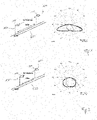
- Figures 1 and 2 schematically show the situation where street lighting luminaires 100 are arranged at a regular interval on the side of a road 200.
- the luminaires 100 are separated by a distance of 30m and therefore a specific light output distribution in the longitudinal direction of the road, i.e., in the so-called C0-C180 plane, is required as shown on the right side of figure 1 .
- a specific light output distribution in the longitudinal direction of the road i.e., in the so-called C0-C180 plane
- an asymmetric light distribution is preferred as the road 200 should be evenly illuminated overs its width while the luminaires 100 are arranged on the side of the road 200.
- the light distribution has to be adapted to form a more narrow light distribution in the C0-C180 plane as shown in figure 2 in order to ensure again a uniform luminance of the road over the whole length. If in this case luminaires would be used with a light distribution as shown in figure 1 , fluctuations in the luminance over the length of the road would result in a bad visibility of obstacles for drivers driving along the road.
- the present invention provides a very efficient and elegant solution to adapt the light distribution characteristics of the lighting units used in luminaires 100 in such a way that a desired light distribution can be finally obtained.
- the inventive concept makes use of a lighting unit which comprises as key elements at least one LED light source and a primary optics formed by a lens.
- a lighting unit which comprises as key elements at least one LED light source and a primary optics formed by a lens.
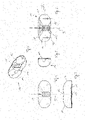
- the structure of the lens is explained with reference to figures 3 to 7 of the enclosed drawings, which show different views of a preferred lens.
- Lens 10 is preferably a one-piece silicone lens, which generally has the shown shape that is in particular characterized by two convex surface portions forming together the light emitting surface of the lens 10.
- the bottom 11 of the lens 10 is generally flat and comprises a cavity 15 that forms the light entry region of the lens 10.
- Four longitudinal flat grooves 16 extended from corners of the cavity 15 to side portions of the bottom 11, which grooves 16 support mounting of the lens 10 on a - not further shown - support of the lighting unit.
- lens 10 has a symmetric shape with respect to a center axis I which center axis I also forms a longitudinal axis of the cavity 15 forming the light entry portion of lens 10.
- Cavity 15 generally has a flat, rectangular shape.
- Longitudinal axis I intersects lens 10 in the middle to form two identical lens portions having convex light emitting surfaces 12, 13.
- a concave surface region 14 is formed reducing the amount of light that is directly emitted to a region in front of the lens 10.
- the shown configuration supports an emission of the light to both sides resulting in the desired symmetric light distribution in a direction perpendicular to longitudinal axis I, which is a preferred light distribution for illuminating roads and/or streets.
- lens 10 has no symmetry with respect to a second axis II perpendicular to center axis I. Accordingly, an asymmetric light distribution is obtained in a direction along center axis I.
- This specific type of light emission i.e. symmetric light emission in a first direction and asymmetric light emission in a second direction
- lenses as shown in figures 3 to 7 are generally widely used in this field.
- cavity 15 which forms the light entry region has a size that clearly exceeds the size of a LED light source.
- primary optics for LED light sources are adapted in a way to obtain very specific light distribution characteristics and, thus, the light source must be arranged on a specific position.
- Cavities used as light entry portions of lenses therefore, usually have a size comparable to the size of the LED.
- the present invention suggests to provide the light entry 15 region of the lens 10 in such a way that the position of the light source can be flexibly selected.
- the cavity 15 of the inventive lens 10 shown in figures 3 to 7 has a longitudinal shape allowing multiple positioning of the light source along center axis I within the cavity 15. This allows to adapt the light emission characteristics finally obtained as the light distribution along axis II (i.e. in a direction perpendicular to longitudinal axis I) depends on the actual position of the LED light source. This inventive concept is further explained in the following with reference to figures 8 and 9 .
- Figure 8a shows a first example where the LED light source 30 is located close to the lower end portion of cavity 15.
- Figure 8b shows the resulting light distribution of the light emitted by lens 10 and it can be seen that a relatively narrow light distribution is obtained in C0-C180 plane, i.e. in a direction perpendicular to center axis I.
- Figure 8b also shows that in C90-C270 plane, i.e. along center axis I, an asymmetric light distribution is obtained.
- an appropriate positon of the LED 30 must be selected which position corresponds to the desired light distribution and the LED light source 30 is then arranged within the cavity 15 and fixed in the desired position.
- the cavity 15 is, for example, filled with a transparent glue, which secures the LED light source 15 in the final position but does not further influence the transfer of the light emitted by the LED light source 30 within lens 10.
- the transparent filling material even supports the transfer of light emitted by the LED light source 30 into lens 10.
- a second inventive concept, which is not part of the claims is shown in figure 10 .
- two LED light sources 30-1 and 30-2 are arranged within cavity 15 wherein the position of the first LED light source 30-1 corresponds to the position shown in figure 8a and the position of second LED light source 30-2 corresponds to the position shown in figure 9a .
- light generated by the first LED light source 30-1 and influenced by lens 10 is emitted according to the light distribution shown in figure 8b whereas light generated by second LED light source 30-2 is finally distributed according to the light distribution shown in figure 9b .
- both LED light sources 30-1, 30-2 In case only one of both LED light sources 30-1, 30-2 is activated, the light emission of the system shown in figure 10 can be switched between the two examples shown in figures 8 and 9 . However, it is also possible to operate simultaneously both LED light sources 30-1, 30-2 in order to obtain an overall mixed light distribution, which is an intermediate light distribution of the one shown in figure 8b , and the second one shown in figure 9b . Depending on the ratio of light outputs for both LED light sources 30-1, 30-2, again an intermediate light distribution between both extreme distributions can be obtained. In this example, the light distribution can be adapted even after final installation of the system provided that an independent control of both LED light sources is possible. This allows adapting the light distribution of the lighting unit even during operation in case specific circumstances (as mentioned above e.g., rain, fog...) require an adaption.
- the space between the light emission area of the LED light sources 30-1, 30-2 and the lens 10 within cavity 15 is preferably filled with a transparent material, in particular a transparent glue to fix both LED light sources 30-1, 30-2 in the desired position.
- LED light sources are preferably provided as so-called chip scale packaging LEDs. This solution not only provides LED light sources with a reduced size but also improves the possibility to connect the light sources to power supplies or driver electronics.
Landscapes
- Engineering & Computer Science (AREA)
- General Engineering & Computer Science (AREA)
- Non-Portable Lighting Devices Or Systems Thereof (AREA)
Description
- The present invention relates to a lighting unit and a luminaire to be used for street and/or road lighting. In particular, the present invention is directed to a lighting unit providing the possibility to adapt the light distribution in the longitudinal direction of a road.
- As it is customary with luminaires for street and/or road lighting in urban areas, known street lighting luminaires are mounted on a pole or on a wall front, with the plane of symmetry being directed perpendicular to the longitudinal direction of the street or road to be lit. The luminaire must then direct the generated light sideways from the plane of symmetry so as to evenly light parts of the street or road on the left and on the right of the luminaire. Further, a portion of the light is also irradiated along the plane of symmetry so as to also illuminate the whole width of the street or road in front of the luminaire.
- When developing a luminaire for street lighting, different needs have to be addressed. At first, a fast and efficient installation of the luminaires is desirable. Further, a high utilization factor and efficiency is needed while at the same time the glare rating should be kept as low as possible. As in all lighting applications, a good visibility level should be obtained and the contribution to sky glow should be minimized.
- From the prior art, different solutions for road lighting luminaires are known which can generally be divided into two main families.
- Conventional road lighting luminaires are usually equipped with one lamp and a corresponding reflector system wherein the reflector system is designed to influence the light in such a way that a desired light distribution is obtained.
- Further, road lighting luminaires are known which comprise a plurality of light emitting devices, in particular LEDs. In this case, the LEDs are arranged in a very specific pattern wherein each LED emits its light into a specific direction. In both cases, the known luminaires are regularly spaced on one side or both sides of the road.
- The conventional luminaires mentioned above in most cases comprise a high-pressure sodium discharge lamp or a metal halide discharge lamp for which the emitted light of the burner is controlled by a reflector to obtain the desired street lighting. It is known to adapt the light distribution to different desired lighting schemes (i.e., a specific distance between the luminaires or a specific width of the road) by changing the position of the lamp with respect to the reflector. However, the range in which the light distribution can be adapted in this way is limited and the utilization factor of such conventional luminaires is limited to a value of 0,45 to 0,5. In order to obtain a significant change in the light distribution characteristics of these luminaires, it would be necessary to change the reflector or use additional optical elements that influence the emitted light in a desired way.
- An embodiment of such a luminaire as discussed above is disclosed in
DE 44 31 750 A1 , comprising two lighting units each provided with a reflector and a HID lamp. One of the units is designed to provide illumination of a road mainly in longitudinal direction, whereas the other unit provides illumination in a direction mainly perpendicular to said longitudinal direction. The light intensities of the HID lamps can be varied in order to amend the combined light distribution. Yet, the utilization factor of the HID lamps remains low. -
US 2014/0168963 A1 describes a system for illumination of a target including a lighting assembly comprising plural LED sources, wherein single shared optical component or lens captures and controls light output from each of the plurality of light sources and at least partially mixes the individual patterns in a composite light output distribution. - The
US 2015/0036338 A1 provides a lens, which is elongated along an axis so to accommodate a linear array of LEDs, wherein the elongation of the lens results in a corresponding elongation of the beam output pattern. - The
KR 2016 0060843 A -
EP3 165 818 A1 describes a luminaire including a light source and a lens, wherein the lens comprises an elongate cavity in which the light source is arranged. The light distribution can be change by changing the position of the light source within the cavity, wherein primary the distribution in a direction parallel to the axis of the cavity of the lens is adjusted. - With respect to the second main family wherein a luminaire is based on a plurality of light emitting devices, in particular LEDs, different approaches have been proposed. According to a first solution, several light sources with different tilts and orientations are provided to obtain a combined light distribution suitable for road lighting. However, this approach tends to increase the complexity of the system and a limitation of glare is difficult to obtain. In another approach, all the light sources are arranged on the same planar surface and the lighting head of the luminaire is tilted by a relatively high angle (approximately 20° to 30°) in order to obtain an asymmetrical lateral light distribution which is required to illuminate also the opposite side of the road.
US Patent 6,250,774 B1 discloses an embodiment of such a luminaire, taking the concept of theDE 44 31 750 A1 into account. - The present invention in particular deals with the problem of adapting the light distribution in the longitudinal direction of the road or street. The light distribution characteristics of the luminaires arranged on the side of a road has to be adapted in such a way that a uniform illumination is obtained over the whole length of the road. It is therefore necessary to ensure that a portion of the light is emitted to both sides of the luminaire within a specific range. The light distribution characteristics must take into account not only the height of the street lighting luminaires but also the distance between two adjacent luminaires, road characteristics (e.g., width of the road) and lighting standards which have to be fulfilled. During the design of a street lighting system, specific optics are selected, which are later used when assembling the luminaires which optics provide the desired light distribution. With this concept, it is thus necessary to provide different combinations of reflectors and/or lenses in order to ensure that an even illumination of the road can be obtained. Obviously, this solution is complicated and requires the storage of a plurality of different optical components.
- Further, even after the final installation of the street lighting system situations can occur were an adaptation of the light distribution is desired. For example, if the weather conditions or road reflectivity change, it would be desirable to influence the light distribution in order to obtain better luminance.
- As explained above, solutions are known in the prior art wherein a street lighting luminaire comprises a plurality of individual light sources, in particular LEDs, wherein said LEDs are directed into specific directions in order to individually illuminate a certain area around the luminaire. The overall light distribution of the luminaire can in such a case be amended by selecting only a sub-group of the LEDs, which is then activated. However, this solution requires a complicated control system and shows a low efficiency since only a fraction of the available light sources is actually used.
-
EP 2 233 826 A1 discloses a lighting unit which has at least two light sources or groups of light sources wherein each of the light sources or groups of light sources has an individual basic light distribution characteristic. The overall light distribution is adapted by modifying the ration of the light outputs of the two light sources or groups of light sources in such a way that the mixed light emitted by both light sources/groups of light sources combines to the desired light distribution. - This solution known in the prior art allows to adapt the light distribution of a luminaire even after the luminaire has been finally installed on the side of a road. On the other hand, situations may occur where the desired overall light distribution of the luminaire only requires activating one light source or one group of light sources. In such a case, the efficiency is reduced as only a fraction of the available light sources is activated. Further, the solution disclosed in
EP 2 233 826 A1 requires a complex arrangement as each light source or group of light sources has its own optical system specifically adapted to generate the corresponding basic light distribution. - The present invention, therefore, aims to provide a new solution that allows providing a lighting unit with desired light emission characteristics in a fast and efficient way.
- This object is solved according to a first inventive aspect by a lighting unit as defined in independent claim 1 and a method for adapting the light distribution characteristics of a lighting unit according to claim 7.
- Preferred embodiments of the present invention are subject matter of the dependent claims.
- According to the first inventive aspect, it is suggested to influence the light emission of an LED light source by using a primary optics formed by a lens. The lens comprises a light entry region formed by a cavity wherein at least a light emitting portion of the LED light source is arranged within that cavity. According to the present invention, the size of the cavity of the lens exceeds the size of the LED light source allowing multiple positioning of the LED light source within the cavity.
- Accordingly, according to the first inventive aspect, a lighting unit for use in a luminaire, in particular in a luminaire for road and/or street lighting is suggested wherein said lighting unit comprises an LED light source and a primary optics formed by a lens, wherein that lens comprises a light entry region formed by a cavity, at least a light emitting portion of the LED light source being arranged within that cavity, and wherein the size of the cavity of the lens exceeds the size of the LED light source allowing multiple positioning of the LED light source within the cavity and wherein a distribution of light emitted by the lens depends on the positioning of the LED light source within the cavity and the cavity of the lens has a longitudinal shape, wherein the extension of an illuminated area in a direction perpendicular and in a direction parallel to the longitudinal direction of the cavity depends on the positioning of the LED light source within the cavity, whereas said lens - independent from the positioning of an LED light source - provides a symmetric light distribution in a direction perpendicular to the longitudinal direction of the cavity and an asymmetric light distribution in a direction parallel to the longitudinal direction of the cavity, and wherein shifting the position of the LED light source within the cavity slightly adapts the asymmetric light distribution in the direction parallel to the longitudinal direction of the cavity and has a much stronger effect on the extension of the illuminated area in the direction perpendicular to the longitudinal direction of the cavity.
- Also according to this first inventive aspect, a method for adapting the light distribution characteristics of a lighting unit is suggested wherein the lighting unit comprises an LED light source and a primary optics formed by a lens, wherein said lens comprises a light entry region formed by a cavity, at least a light emitting portion of the LED light source being arranged within that cavity and the size of the cavity of the lens exceeds the size of the LED light source allowing multiple positioning of the LED light source within the cavity. The light distribution characteristics of the lighting unit are adapted by selecting a desired position of the LED light source within the cavity, wherein the cavity of the lens has a longitudinal shape and the extension of an illuminated area in a direction perpendicular and parallel to the longitudinal direction of the cavity depends on the positioning of the LED light source within the cavity, whereas said lens - independent from the positioning of an LED light source - provides a symmetric light distribution in a direction perpendicular to the longitudinal direction of the cavity and an asymmetric light distribution in a direction parallel to the longitudinal direction of the cavity, and wherein shifting the position of the LED light source within the cavity slightly adapts the asymmetric light distribution in the direction parallel to the longitudinal direction of the cavity and and has a much stronger effect on the extension of the illuminated area in the direction perpendicular to the longitudinal direction of the cavity.
- Accordingly, the present invention makes use of the fact that a lens is used which preferably has a cavity as a light entry region with a longitudinal shape wherein a distribution of light emitted by the lens depends on the positioning of the LED light source within the cavity. The light emission characteristics can, thus, easily be adapted simply by selecting an appropriate position of the LED light source within the cavity wherein the position is selected in such a way that the light finally emitted corresponds to the desired light distribution. In this solution, all light emitted by the LED light source contributes to the desired light distribution characteristics and, thus, a high efficiency is achieved. In particular, the situation where an LED light source is operated with reduced power or not operated at all can be avoided.
- As mentioned above, the cavity of the lens according to the invention has a longitudinal shape wherein a distribution of light emitted by the lens depends on the positioning of the LED light source within the cavity. In order to adapt the light emission to a specific distance between the luminaires, it is in particular provided that the distribution of light emitted by the lens in a direction perpendicular to the longitudinal direction of the cavity depends on the positioning of the LED light source. However, in addition, the distribution of light in a direction parallel to the longitudinal direction of the cavity does also change slightly depending on the position of the LED light source.
- According to the invention, the lens is arranged in such a way that it provides - independent from the positioning of an LED light source within the light entry region - a symmetric light distribution in a direction perpendicular to the longitudinal direction of the cavity and an asymmetric light distribution in a direction parallel to the longitudinal direction of the cavity. It has been shown that such light emission characteristics are preferred when using the lighting unit in luminaires for road and/or street lighting. In this case, the symmetric light distribution allows illuminating the road and/or street on both sides of the luminaire whereas the asymmetric light distribution takes into account that the luminaire is usually positioned on the side of a road and not in its middle.
- Preferably, the length of the cavity is at least twice the length of one LED light source. Further, according to a preferred further development of the inventive concept, a space between the light emitting regions of the LED light sources and the lens is filled with a transparent material. In particular, the filling material can be a transparent glue.
- The LED light sources used according to the present invention are preferably so-called chip scale packaging LEDs. This specific type of LED light sources is preferred as mounting the LED within the cavity of the lens and providing electric power for the LED light source can be achieved in an efficient and fast way.
- Preferably, the lens used as a primary optics is provided in the form of a silicone lens.
- The present invention also provides a luminaire, in particular a luminaire for road and/or street lighting which luminaire comprises a lighting unit as mentioned above.
- In the following, the present invention and preferred embodiments thereof are explained in more detail with respect to the enclosed drawings. In these drawings:
- Figures 1 and 2
- schematically show the problem underlying the present invention;
- Figures 3 to 7
- show different views of a primary optics used according to the present invention;
- Figures 8a and 8b
- show a first example of positioning of a light source within the light entry region of the lens and the resulting light distribution.
- Figures 9a and 9b
- show a second example of positioning of a light source and the corresponding light distribution; and
- Figure 10
- shows an example of using two LED light sources within the light entry region of the lens, which is not part of the claims.
-
Figures 1 and 2 schematically show the situation wherestreet lighting luminaires 100 are arranged at a regular interval on the side of aroad 200. In the present case, theluminaires 100 are separated by a distance of 30m and therefore a specific light output distribution in the longitudinal direction of the road, i.e., in the so-called C0-C180 plane, is required as shown on the right side offigure 1 . On the other hand, in the C90-C270 plane, i.e., in a direction perpendicular to theroad 200, an asymmetric light distribution is preferred as theroad 200 should be evenly illuminated overs its width while theluminaires 100 are arranged on the side of theroad 200. - If now the distance between two
luminaires 100 is reduced as shown infigure 2 , also the light distribution has to be adapted to form a more narrow light distribution in the C0-C180 plane as shown infigure 2 in order to ensure again a uniform luminance of the road over the whole length. If in this case luminaires would be used with a light distribution as shown infigure 1 , fluctuations in the luminance over the length of the road would result in a bad visibility of obstacles for drivers driving along the road. - Although this situation is not shown in the figures, also an adaptation of the light distribution would be required in case the height of the luminaires or the position of the
lighting head 110 is amended during lighting design. - Further, also situations during the operation of the street lighting system may occur where an adaptation of the light distribution is desired. In particular, if weather conditions change (rain, fog...) a slight adaptation of the light output could improve the quality of the illumination and luminance repartition on the road. In addition, changing road conditions due to rain, snow or other effects (for example aging or replacement of asphalt or renewing of the road surface) might require an adaptation of the light output.
- The present invention provides a very efficient and elegant solution to adapt the light distribution characteristics of the lighting units used in
luminaires 100 in such a way that a desired light distribution can be finally obtained. The inventive concept makes use of a lighting unit which comprises as key elements at least one LED light source and a primary optics formed by a lens. In a first step, the structure of the lens is explained with reference tofigures 3 to 7 of the enclosed drawings, which show different views of a preferred lens. -
Lens 10 is preferably a one-piece silicone lens, which generally has the shown shape that is in particular characterized by two convex surface portions forming together the light emitting surface of thelens 10. The bottom 11 of thelens 10 is generally flat and comprises acavity 15 that forms the light entry region of thelens 10. Four longitudinalflat grooves 16 extended from corners of thecavity 15 to side portions of the bottom 11, whichgrooves 16 support mounting of thelens 10 on a - not further shown - support of the lighting unit. - As can be seen in particular form
figures 4, 6 and 7 ,lens 10 has a symmetric shape with respect to a center axis I which center axis I also forms a longitudinal axis of thecavity 15 forming the light entry portion oflens 10.Cavity 15 generally has a flat, rectangular shape. - Longitudinal axis I intersects
lens 10 in the middle to form two identical lens portions having convexlight emitting surfaces concave surface region 14 is formed reducing the amount of light that is directly emitted to a region in front of thelens 10. In fact, the shown configuration supports an emission of the light to both sides resulting in the desired symmetric light distribution in a direction perpendicular to longitudinal axis I, which is a preferred light distribution for illuminating roads and/or streets. - On the other hand,
lens 10 has no symmetry with respect to a second axis II perpendicular to center axis I. Accordingly, an asymmetric light distribution is obtained in a direction along center axis I. This specific type of light emission (i.e. symmetric light emission in a first direction and asymmetric light emission in a second direction) has been proved valuable for use in road and/or street lighting applications and, thus, lenses as shown infigures 3 to 7 are generally widely used in this field. - An important aspect of the
lens 10 shown in the figures is, however, thatcavity 15 which forms the light entry region has a size that clearly exceeds the size of a LED light source. Usually, primary optics for LED light sources are adapted in a way to obtain very specific light distribution characteristics and, thus, the light source must be arranged on a specific position. Cavities used as light entry portions of lenses, therefore, usually have a size comparable to the size of the LED. - In contrast to this, the present invention suggests to provide the
light entry 15 region of thelens 10 in such a way that the position of the light source can be flexibly selected. In particular, thecavity 15 of theinventive lens 10 shown infigures 3 to 7 has a longitudinal shape allowing multiple positioning of the light source along center axis I within thecavity 15. This allows to adapt the light emission characteristics finally obtained as the light distribution along axis II (i.e. in a direction perpendicular to longitudinal axis I) depends on the actual position of the LED light source. This inventive concept is further explained in the following with reference tofigures 8 and 9 . -
Figure 8a shows a first example where theLED light source 30 is located close to the lower end portion ofcavity 15.Figure 8b shows the resulting light distribution of the light emitted bylens 10 and it can be seen that a relatively narrow light distribution is obtained in C0-C180 plane, i.e. in a direction perpendicular to center axis I.Figure 8b also shows that in C90-C270 plane, i.e. along center axis I, an asymmetric light distribution is obtained. - On the other hand, in case
LED light source 30 is arranged close to the upper end ofcavity 15 as it is shown infigure 9a , a light distribution according tofigure 9b is obtained. Obviously, shifting the positon of theLED 30 to the other end ofcavity 15 results in an extension of the area illuminated in the C0-C180 plane. Again, also in this case an asymmetric light distribution is obtained in C90-C270 plane. While also the light distribution of this asymmetric portion is slightly adapted by changing the position of the light source with respect to lens 20, shifting the position obviously has a much stronger effect on the symmetric light distribution. - Accordingly, changing the position of the
LED 15 withincavity 15 allows influencing the distribution of the light emitted bylens 10 in the C0-C180 plane and also has an influence on the light distribution in C90-C270 plane.Figures 8 and 9 merely show the end positions of theLED light source 30 and the corresponding light distributions wherein obviously it is possible to arrange theLED light source 30 in each intermediate position and, therefore, the extension of the illuminated area in the C0-C180 plane can be freely selected between both extreme light distributions. - According to the present invention, an appropriate positon of the
LED 30 must be selected which position corresponds to the desired light distribution and the LEDlight source 30 is then arranged within thecavity 15 and fixed in the desired position. In particular, thecavity 15 is, for example, filled with a transparent glue, which secures theLED light source 15 in the final position but does not further influence the transfer of the light emitted by theLED light source 30 withinlens 10. In fact, the transparent filling material even supports the transfer of light emitted by theLED light source 30 intolens 10. - A second inventive concept, which is not part of the claims is shown in
figure 10 . In this second embodiment, two LED light sources 30-1 and 30-2 are arranged withincavity 15 wherein the position of the first LED light source 30-1 corresponds to the position shown infigure 8a and the position of second LED light source 30-2 corresponds to the position shown infigure 9a . Obviously, light generated by the first LED light source 30-1 and influenced bylens 10 is emitted according to the light distribution shown infigure 8b whereas light generated by second LED light source 30-2 is finally distributed according to the light distribution shown infigure 9b . - In case only one of both LED light sources 30-1, 30-2 is activated, the light emission of the system shown in
figure 10 can be switched between the two examples shown infigures 8 and 9 . However, it is also possible to operate simultaneously both LED light sources 30-1, 30-2 in order to obtain an overall mixed light distribution, which is an intermediate light distribution of the one shown infigure 8b , and the second one shown infigure 9b . Depending on the ratio of light outputs for both LED light sources 30-1, 30-2, again an intermediate light distribution between both extreme distributions can be obtained. In this example, the light distribution can be adapted even after final installation of the system provided that an independent control of both LED light sources is possible. This allows adapting the light distribution of the lighting unit even during operation in case specific circumstances (as mentioned above e.g., rain, fog...) require an adaption. - Also in this second example, the space between the light emission area of the LED light sources 30-1, 30-2 and the
lens 10 withincavity 15 is preferably filled with a transparent material, in particular a transparent glue to fix both LED light sources 30-1, 30-2 in the desired position. - In both inventive examples, LED light sources are preferably provided as so-called chip scale packaging LEDs. This solution not only provides LED light sources with a reduced size but also improves the possibility to connect the light sources to power supplies or driver electronics.
Claims (7)
- Lighting unit for use in a luminaire (100), in particular in a luminaire for road and/or street lighting,wherein said lighting unit comprises an LED light source (30) and a primary optics formed by a lens (10),wherein said lens (10) comprises a light entry region formed by a cavity (15), at least a light emitting portion of the LED light source (30) being arranged within said cavity (15),wherein the size of the cavity (15) of the lens (10) exceeds the size of the LED light source (30) allowing multiple positioning of the LED light source (30) within the cavity (15), andwherein a distribution of light emitted by the lens (10) depends on the positioning of the LED light source (30, 30-1, 30-2) within the cavity (15),whereinthe cavity (15) of the lens (10) has a longitudinal shape,wherein the extension of an illuminated area in a direction perpendicular and in a direction parallel to the longitudinal direction (I) of the cavity (15) depends on the positioning of the LED light source (30, 30-1, 30-2) within the cavity (15),whereas said lens (10) - independent from the positioning of an LED light source (30, 30-1, 30-2) - provides a symmetric light distribution in the direction perpendicular to the longitudinal direction (I) of the cavity (15) and an asymmetric light distribution in the direction parallel to the longitudinal direction (I) of the cavity (15), characterized in thatshifting the position of the LED light source (30, 30-1, 30-2) within the cavity (15) slightly adapts the asymmetric light distribution in the direction parallel to the longitudinal direction (I) of the cavity (15) and has a much stronger effect on the extension of the illuminated area in the direction perpendicular to the longitudinal direction (I) of the cavity (15).
- Lighting unit according to claim 1,
wherein the length of the cavity (15) is at least twice the length of one LED light source (30, 30-1, 30-2). - Lighting unit according to one of the preceding claims,
wherein a space between the light emitting region(s) of the LED light source(s) (30, 30-1, 30-2) is filled with a transparent material, said material preferably being a glue. - Lighting unit according to one of the preceding claims,
wherein the LED light source (30) is a chip scale packaging LED. - Lighting unit according to one of the preceding claims,
wherein the lens (10) is a silicone lens. - Luminaire (100), in particular luminaire for road and/or street lighting comprising a lighting unit according to one of the preceding claims.
- Method for adapting the light distribution characteristics of a lighting unit,wherein said lighting unit comprises an LED light source (30) and a primary optics formed by a lens (10),wherein said lens (10) comprises a light entry region formed by a cavity (15), at least a light emitting portion of the LED light source (30) being arranged within said cavity (15),wherein the size of the cavity (15) of the lens (10) exceeds the size of the LED light source (30) allowing multiple positioning of the LED light source (30) within the cavity (15), andwherein a distribution of light emitted by the lens (10) depends on the positioning of the LED light source (30, 30-1, 30-2) within the cavity (15),whereinthe cavity (15) of the lens (10) has a longitudinal shape,wherein the extension of an illuminated area in a direction perpendicular and in a direction parallel to the longitudinal direction (I) of the cavity (15) is adapted by selecting a desired position of the LED light source (30) within the cavity (15),whereas said lens (10) - independent from the positioning of an LED light source (30, 30-1, 30-2) - provides a symmetric light distribution in a direction perpendicular to the longitudinal direction (I) of the cavity (15) and an asymmetric light distribution in a direction parallel to the longitudinal direction (I) of the cavity (15), characterized in thatshifting the position of the LED light source (30, 30-1, 30-2) within the cavity (15) slightly adapts the asymmetric light distribution in the direction parallel to the longitudinal direction (I) of the cavity (15) and has a much stronger effect on the extension of the illuminated area in the direction perpendicular to the longitudinal direction (I) of the cavity (15).
Priority Applications (1)
| Application Number | Priority Date | Filing Date | Title |
|---|---|---|---|
| EP17195682.4A EP3470730B1 (en) | 2017-10-10 | 2017-10-10 | Lighting unit and luminaire for road and/or street lighting |
Applications Claiming Priority (1)
| Application Number | Priority Date | Filing Date | Title |
|---|---|---|---|
| EP17195682.4A EP3470730B1 (en) | 2017-10-10 | 2017-10-10 | Lighting unit and luminaire for road and/or street lighting |
Publications (2)
| Publication Number | Publication Date |
|---|---|
| EP3470730A1 EP3470730A1 (en) | 2019-04-17 |
| EP3470730B1 true EP3470730B1 (en) | 2023-01-25 |
Family
ID=60083107
Family Applications (1)
| Application Number | Title | Priority Date | Filing Date |
|---|---|---|---|
| EP17195682.4A Active EP3470730B1 (en) | 2017-10-10 | 2017-10-10 | Lighting unit and luminaire for road and/or street lighting |
Country Status (1)
| Country | Link |
|---|---|
| EP (1) | EP3470730B1 (en) |
Families Citing this family (1)
| Publication number | Priority date | Publication date | Assignee | Title |
|---|---|---|---|---|
| CN118687131A (en) * | 2024-07-11 | 2024-09-24 | 宏泰智能科技(东莞)有限公司 | floodlight |
Citations (17)
| Publication number | Priority date | Publication date | Assignee | Title |
|---|---|---|---|---|
| EP2119955A1 (en) | 2008-04-23 | 2009-11-18 | COEMAR S.p.A. | Led Lighting Device |
| TWM380480U (en) | 2009-12-30 | 2010-05-11 | Ledlink Optics Inc | Asymmetric LED lens for street light |
| US20110235338A1 (en) | 2010-03-29 | 2011-09-29 | Everlight Electronics Co., Ltd. | Light emitting device and lens thereof |
| US20110242807A1 (en) | 2010-03-31 | 2011-10-06 | Aphos Lighting Llc | Light cover and illuminating apparatus applying the same |
| KR20120053919A (en) | 2010-11-18 | 2012-05-29 | 삼성엘이디 주식회사 | Optical lens, led module and lighting apparatus having the optical lens |
| JP2013225455A (en) | 2012-04-23 | 2013-10-31 | Sharp Corp | Lighting device |
| US8632225B2 (en) | 2010-08-24 | 2014-01-21 | Samsung Electronics Co., Ltd. | Optical lens, LED module having the optical lens, and lighting apparatus having the LED module |
| US20140104853A1 (en) | 2012-10-12 | 2014-04-17 | Genius Electronic Optical Co., Ltd. | Optical lens for lighting fixture |
| US20140168963A1 (en) | 2012-12-18 | 2014-06-19 | Musco Corporation | Multi-led lens with light pattern optimization |
| US8835969B2 (en) | 2009-11-17 | 2014-09-16 | Lg Innotek Co., Ltd. | Light emitting device package and lighting system |
| US20150036338A1 (en) | 2011-09-26 | 2015-02-05 | Musco Corporation | Lighting system having a multi-light source collimator and method of operating such |
| US9175832B2 (en) | 2013-09-16 | 2015-11-03 | Light Engine Limited | Faceted LED street lamp lens |
| US9297517B2 (en) | 2008-08-14 | 2016-03-29 | Cooper Technologies Company | LED devices for offset wide beam generation |
| US9297520B2 (en) | 2006-02-27 | 2016-03-29 | Illumination Management Solutions, Inc. | LED device for wide beam generation |
| KR20160060843A (en) | 2014-11-20 | 2016-05-31 | (주)엘티어스 | light distribution feature variable type lighting |
| KR101667902B1 (en) | 2016-04-25 | 2016-10-20 | 한국광기술원 | Lighting module with rectangular light source |
| EP3165818A1 (en) * | 2015-11-06 | 2017-05-10 | Siteco Beleuchtungstechnik GmbH | Internal or outdoor luminaire, in particular a street lamp, with adjustable free-form lens |
Family Cites Families (4)
| Publication number | Priority date | Publication date | Assignee | Title |
|---|---|---|---|---|
| DE4431750A1 (en) | 1994-09-06 | 1996-03-07 | Siemens Ag | Locally fixed lighting installation for public roads with number of lamp units |
| TW330233B (en) | 1997-01-23 | 1998-04-21 | Philips Eloctronics N V | Luminary |
| EP2233826B1 (en) | 2009-03-17 | 2015-12-16 | Thorn Europhane S.A. | Lighting unit and luminaire for road and/or street lighting |
| US9035328B2 (en) * | 2011-02-04 | 2015-05-19 | Cree, Inc. | Light-emitting diode component |
-
2017
- 2017-10-10 EP EP17195682.4A patent/EP3470730B1/en active Active
Patent Citations (17)
| Publication number | Priority date | Publication date | Assignee | Title |
|---|---|---|---|---|
| US9297520B2 (en) | 2006-02-27 | 2016-03-29 | Illumination Management Solutions, Inc. | LED device for wide beam generation |
| EP2119955A1 (en) | 2008-04-23 | 2009-11-18 | COEMAR S.p.A. | Led Lighting Device |
| US9297517B2 (en) | 2008-08-14 | 2016-03-29 | Cooper Technologies Company | LED devices for offset wide beam generation |
| US8835969B2 (en) | 2009-11-17 | 2014-09-16 | Lg Innotek Co., Ltd. | Light emitting device package and lighting system |
| TWM380480U (en) | 2009-12-30 | 2010-05-11 | Ledlink Optics Inc | Asymmetric LED lens for street light |
| US20110235338A1 (en) | 2010-03-29 | 2011-09-29 | Everlight Electronics Co., Ltd. | Light emitting device and lens thereof |
| US20110242807A1 (en) | 2010-03-31 | 2011-10-06 | Aphos Lighting Llc | Light cover and illuminating apparatus applying the same |
| US8632225B2 (en) | 2010-08-24 | 2014-01-21 | Samsung Electronics Co., Ltd. | Optical lens, LED module having the optical lens, and lighting apparatus having the LED module |
| KR20120053919A (en) | 2010-11-18 | 2012-05-29 | 삼성엘이디 주식회사 | Optical lens, led module and lighting apparatus having the optical lens |
| US20150036338A1 (en) | 2011-09-26 | 2015-02-05 | Musco Corporation | Lighting system having a multi-light source collimator and method of operating such |
| JP2013225455A (en) | 2012-04-23 | 2013-10-31 | Sharp Corp | Lighting device |
| US20140104853A1 (en) | 2012-10-12 | 2014-04-17 | Genius Electronic Optical Co., Ltd. | Optical lens for lighting fixture |
| US20140168963A1 (en) | 2012-12-18 | 2014-06-19 | Musco Corporation | Multi-led lens with light pattern optimization |
| US9175832B2 (en) | 2013-09-16 | 2015-11-03 | Light Engine Limited | Faceted LED street lamp lens |
| KR20160060843A (en) | 2014-11-20 | 2016-05-31 | (주)엘티어스 | light distribution feature variable type lighting |
| EP3165818A1 (en) * | 2015-11-06 | 2017-05-10 | Siteco Beleuchtungstechnik GmbH | Internal or outdoor luminaire, in particular a street lamp, with adjustable free-form lens |
| KR101667902B1 (en) | 2016-04-25 | 2016-10-20 | 한국광기술원 | Lighting module with rectangular light source |
Also Published As
| Publication number | Publication date |
|---|---|
| EP3470730A1 (en) | 2019-04-17 |
Similar Documents
| Publication | Publication Date | Title |
|---|---|---|
| EP2233826B1 (en) | Lighting unit and luminaire for road and/or street lighting | |
| AU2016200773B2 (en) | Led roadway luminaire | |
| KR101209696B1 (en) | Led light system | |
| AU2010224880B2 (en) | Lighting unit and luminaire for road and/or street lighting | |
| EP1794494A2 (en) | Sparsely spaced array led headlamp | |
| US20020039297A1 (en) | Head lamp device for a vehicle | |
| JP2004241388A (en) | Automotive headlight device having electroluminescent diode | |
| EP3470730A1 (en) | Lighting unit and luminaire for road and/or street lighting | |
| CN211475808U (en) | Optical arrays for vehicles, headlamps and vehicles | |
| KR102620500B1 (en) | Illuminating device for a motor vehicle headlamp for generating a basic light distribution with sign light | |
| JP2009245621A (en) | Outdoor illuminating light unit and outdoor illuminating light | |
| KR20200074714A (en) | Head lamp module for vehicle | |
| JP2024072312A (en) | Vehicle headlights |
Legal Events
| Date | Code | Title | Description |
|---|---|---|---|
| PUAI | Public reference made under article 153(3) epc to a published international application that has entered the european phase |
Free format text: ORIGINAL CODE: 0009012 |
|
| STAA | Information on the status of an ep patent application or granted ep patent |
Free format text: STATUS: REQUEST FOR EXAMINATION WAS MADE |
|
| 17P | Request for examination filed |
Effective date: 20171010 |
|
| AK | Designated contracting states |
Kind code of ref document: A1 Designated state(s): AL AT BE BG CH CY CZ DE DK EE ES FI FR GB GR HR HU IE IS IT LI LT LU LV MC MK MT NL NO PL PT RO RS SE SI SK SM TR |
|
| AX | Request for extension of the european patent |
Extension state: BA ME |
|
| RAP3 | Party data changed (applicant data changed or rights of an application transferred) |
Owner name: ZG LIGHTING FRANCE S.A.S |
|
| STAA | Information on the status of an ep patent application or granted ep patent |
Free format text: STATUS: EXAMINATION IS IN PROGRESS |
|
| 17Q | First examination report despatched |
Effective date: 20210610 |
|
| RIC1 | Information provided on ipc code assigned before grant |
Ipc: F21Y 115/10 20160101ALN20220725BHEP Ipc: F21W 131/103 20060101ALN20220725BHEP Ipc: F21V 5/04 20060101ALI20220725BHEP Ipc: F21V 19/02 20060101ALI20220725BHEP Ipc: F21V 14/02 20060101AFI20220725BHEP |
|
| RIC1 | Information provided on ipc code assigned before grant |
Ipc: F21Y 115/10 20160101ALN20220803BHEP Ipc: F21W 131/103 20060101ALN20220803BHEP Ipc: F21V 5/04 20060101ALI20220803BHEP Ipc: F21V 19/02 20060101ALI20220803BHEP Ipc: F21V 14/02 20060101AFI20220803BHEP |
|
| RIC1 | Information provided on ipc code assigned before grant |
Ipc: F21Y 115/10 20160101ALN20220901BHEP Ipc: F21W 131/103 20060101ALN20220901BHEP Ipc: F21V 5/04 20060101ALI20220901BHEP Ipc: F21V 19/02 20060101ALI20220901BHEP Ipc: F21V 14/02 20060101AFI20220901BHEP |
|
| GRAP | Despatch of communication of intention to grant a patent |
Free format text: ORIGINAL CODE: EPIDOSNIGR1 |
|
| STAA | Information on the status of an ep patent application or granted ep patent |
Free format text: STATUS: GRANT OF PATENT IS INTENDED |
|
| INTG | Intention to grant announced |
Effective date: 20221018 |
|
| GRAS | Grant fee paid |
Free format text: ORIGINAL CODE: EPIDOSNIGR3 |
|
| GRAA | (expected) grant |
Free format text: ORIGINAL CODE: 0009210 |
|
| STAA | Information on the status of an ep patent application or granted ep patent |
Free format text: STATUS: THE PATENT HAS BEEN GRANTED |
|
| AK | Designated contracting states |
Kind code of ref document: B1 Designated state(s): AL AT BE BG CH CY CZ DE DK EE ES FI FR GB GR HR HU IE IS IT LI LT LU LV MC MK MT NL NO PL PT RO RS SE SI SK SM TR |
|
| REG | Reference to a national code |
Ref country code: GB Ref legal event code: FG4D |
|
| REG | Reference to a national code |
Ref country code: CH Ref legal event code: EP |
|
| REG | Reference to a national code |
Ref country code: AT Ref legal event code: REF Ref document number: 1546135 Country of ref document: AT Kind code of ref document: T Effective date: 20230215 Ref country code: IE Ref legal event code: FG4D |
|
| REG | Reference to a national code |
Ref country code: DE Ref legal event code: R096 Ref document number: 602017065711 Country of ref document: DE |
|
| REG | Reference to a national code |
Ref country code: LT Ref legal event code: MG9D |
|
| REG | Reference to a national code |
Ref country code: NL Ref legal event code: MP Effective date: 20230125 |
|
| REG | Reference to a national code |
Ref country code: AT Ref legal event code: MK05 Ref document number: 1546135 Country of ref document: AT Kind code of ref document: T Effective date: 20230125 |
|
| PG25 | Lapsed in a contracting state [announced via postgrant information from national office to epo] |
Ref country code: NL Free format text: LAPSE BECAUSE OF FAILURE TO SUBMIT A TRANSLATION OF THE DESCRIPTION OR TO PAY THE FEE WITHIN THE PRESCRIBED TIME-LIMIT Effective date: 20230125 |
|
| P01 | Opt-out of the competence of the unified patent court (upc) registered |
Effective date: 20230530 |
|
| PG25 | Lapsed in a contracting state [announced via postgrant information from national office to epo] |
Ref country code: RS Free format text: LAPSE BECAUSE OF FAILURE TO SUBMIT A TRANSLATION OF THE DESCRIPTION OR TO PAY THE FEE WITHIN THE PRESCRIBED TIME-LIMIT Effective date: 20230125 Ref country code: PT Free format text: LAPSE BECAUSE OF FAILURE TO SUBMIT A TRANSLATION OF THE DESCRIPTION OR TO PAY THE FEE WITHIN THE PRESCRIBED TIME-LIMIT Effective date: 20230525 Ref country code: NO Free format text: LAPSE BECAUSE OF FAILURE TO SUBMIT A TRANSLATION OF THE DESCRIPTION OR TO PAY THE FEE WITHIN THE PRESCRIBED TIME-LIMIT Effective date: 20230425 Ref country code: LV Free format text: LAPSE BECAUSE OF FAILURE TO SUBMIT A TRANSLATION OF THE DESCRIPTION OR TO PAY THE FEE WITHIN THE PRESCRIBED TIME-LIMIT Effective date: 20230125 Ref country code: LT Free format text: LAPSE BECAUSE OF FAILURE TO SUBMIT A TRANSLATION OF THE DESCRIPTION OR TO PAY THE FEE WITHIN THE PRESCRIBED TIME-LIMIT Effective date: 20230125 Ref country code: HR Free format text: LAPSE BECAUSE OF FAILURE TO SUBMIT A TRANSLATION OF THE DESCRIPTION OR TO PAY THE FEE WITHIN THE PRESCRIBED TIME-LIMIT Effective date: 20230125 Ref country code: ES Free format text: LAPSE BECAUSE OF FAILURE TO SUBMIT A TRANSLATION OF THE DESCRIPTION OR TO PAY THE FEE WITHIN THE PRESCRIBED TIME-LIMIT Effective date: 20230125 Ref country code: AT Free format text: LAPSE BECAUSE OF FAILURE TO SUBMIT A TRANSLATION OF THE DESCRIPTION OR TO PAY THE FEE WITHIN THE PRESCRIBED TIME-LIMIT Effective date: 20230125 |
|
| PG25 | Lapsed in a contracting state [announced via postgrant information from national office to epo] |
Ref country code: SE Free format text: LAPSE BECAUSE OF FAILURE TO SUBMIT A TRANSLATION OF THE DESCRIPTION OR TO PAY THE FEE WITHIN THE PRESCRIBED TIME-LIMIT Effective date: 20230125 Ref country code: PL Free format text: LAPSE BECAUSE OF FAILURE TO SUBMIT A TRANSLATION OF THE DESCRIPTION OR TO PAY THE FEE WITHIN THE PRESCRIBED TIME-LIMIT Effective date: 20230125 Ref country code: IS Free format text: LAPSE BECAUSE OF FAILURE TO SUBMIT A TRANSLATION OF THE DESCRIPTION OR TO PAY THE FEE WITHIN THE PRESCRIBED TIME-LIMIT Effective date: 20230525 Ref country code: GR Free format text: LAPSE BECAUSE OF FAILURE TO SUBMIT A TRANSLATION OF THE DESCRIPTION OR TO PAY THE FEE WITHIN THE PRESCRIBED TIME-LIMIT Effective date: 20230426 Ref country code: FI Free format text: LAPSE BECAUSE OF FAILURE TO SUBMIT A TRANSLATION OF THE DESCRIPTION OR TO PAY THE FEE WITHIN THE PRESCRIBED TIME-LIMIT Effective date: 20230125 |
|
| REG | Reference to a national code |
Ref country code: DE Ref legal event code: R026 Ref document number: 602017065711 Country of ref document: DE |
|
| PLBI | Opposition filed |
Free format text: ORIGINAL CODE: 0009260 |
|
| PG25 | Lapsed in a contracting state [announced via postgrant information from national office to epo] |
Ref country code: SM Free format text: LAPSE BECAUSE OF FAILURE TO SUBMIT A TRANSLATION OF THE DESCRIPTION OR TO PAY THE FEE WITHIN THE PRESCRIBED TIME-LIMIT Effective date: 20230125 Ref country code: RO Free format text: LAPSE BECAUSE OF FAILURE TO SUBMIT A TRANSLATION OF THE DESCRIPTION OR TO PAY THE FEE WITHIN THE PRESCRIBED TIME-LIMIT Effective date: 20230125 Ref country code: EE Free format text: LAPSE BECAUSE OF FAILURE TO SUBMIT A TRANSLATION OF THE DESCRIPTION OR TO PAY THE FEE WITHIN THE PRESCRIBED TIME-LIMIT Effective date: 20230125 Ref country code: DK Free format text: LAPSE BECAUSE OF FAILURE TO SUBMIT A TRANSLATION OF THE DESCRIPTION OR TO PAY THE FEE WITHIN THE PRESCRIBED TIME-LIMIT Effective date: 20230125 Ref country code: CZ Free format text: LAPSE BECAUSE OF FAILURE TO SUBMIT A TRANSLATION OF THE DESCRIPTION OR TO PAY THE FEE WITHIN THE PRESCRIBED TIME-LIMIT Effective date: 20230125 |
|
| 26 | Opposition filed |
Opponent name: SCHOEPF, PATRICK Effective date: 20231025 |
|
| PG25 | Lapsed in a contracting state [announced via postgrant information from national office to epo] |
Ref country code: SK Free format text: LAPSE BECAUSE OF FAILURE TO SUBMIT A TRANSLATION OF THE DESCRIPTION OR TO PAY THE FEE WITHIN THE PRESCRIBED TIME-LIMIT Effective date: 20230125 |
|
| PLAX | Notice of opposition and request to file observation + time limit sent |
Free format text: ORIGINAL CODE: EPIDOSNOBS2 |
|
| PG25 | Lapsed in a contracting state [announced via postgrant information from national office to epo] |
Ref country code: SI Free format text: LAPSE BECAUSE OF FAILURE TO SUBMIT A TRANSLATION OF THE DESCRIPTION OR TO PAY THE FEE WITHIN THE PRESCRIBED TIME-LIMIT Effective date: 20230125 |
|
| PLBB | Reply of patent proprietor to notice(s) of opposition received |
Free format text: ORIGINAL CODE: EPIDOSNOBS3 |
|
| PG25 | Lapsed in a contracting state [announced via postgrant information from national office to epo] |
Ref country code: IT Free format text: LAPSE BECAUSE OF FAILURE TO SUBMIT A TRANSLATION OF THE DESCRIPTION OR TO PAY THE FEE WITHIN THE PRESCRIBED TIME-LIMIT Effective date: 20230125 Ref country code: MC Free format text: LAPSE BECAUSE OF FAILURE TO SUBMIT A TRANSLATION OF THE DESCRIPTION OR TO PAY THE FEE WITHIN THE PRESCRIBED TIME-LIMIT Effective date: 20230125 |
|
| REG | Reference to a national code |
Ref country code: CH Ref legal event code: PL |
|
| REG | Reference to a national code |
Ref country code: BE Ref legal event code: MM Effective date: 20231031 |
|
| PG25 | Lapsed in a contracting state [announced via postgrant information from national office to epo] |
Ref country code: LU Free format text: LAPSE BECAUSE OF NON-PAYMENT OF DUE FEES Effective date: 20231010 |
|
| PG25 | Lapsed in a contracting state [announced via postgrant information from national office to epo] |
Ref country code: LU Free format text: LAPSE BECAUSE OF NON-PAYMENT OF DUE FEES Effective date: 20231010 |
|
| PG25 | Lapsed in a contracting state [announced via postgrant information from national office to epo] |
Ref country code: CH Free format text: LAPSE BECAUSE OF NON-PAYMENT OF DUE FEES Effective date: 20231031 |
|
| PG25 | Lapsed in a contracting state [announced via postgrant information from national office to epo] |
Ref country code: CH Free format text: LAPSE BECAUSE OF NON-PAYMENT OF DUE FEES Effective date: 20231031 |
|
| PG25 | Lapsed in a contracting state [announced via postgrant information from national office to epo] |
Ref country code: BE Free format text: LAPSE BECAUSE OF NON-PAYMENT OF DUE FEES Effective date: 20231031 |
|
| PG25 | Lapsed in a contracting state [announced via postgrant information from national office to epo] |
Ref country code: IE Free format text: LAPSE BECAUSE OF NON-PAYMENT OF DUE FEES Effective date: 20231010 |
|
| PG25 | Lapsed in a contracting state [announced via postgrant information from national office to epo] |
Ref country code: IE Free format text: LAPSE BECAUSE OF NON-PAYMENT OF DUE FEES Effective date: 20231010 |
|
| PG25 | Lapsed in a contracting state [announced via postgrant information from national office to epo] |
Ref country code: BG Free format text: LAPSE BECAUSE OF FAILURE TO SUBMIT A TRANSLATION OF THE DESCRIPTION OR TO PAY THE FEE WITHIN THE PRESCRIBED TIME-LIMIT Effective date: 20230125 |
|
| PG25 | Lapsed in a contracting state [announced via postgrant information from national office to epo] |
Ref country code: BG Free format text: LAPSE BECAUSE OF FAILURE TO SUBMIT A TRANSLATION OF THE DESCRIPTION OR TO PAY THE FEE WITHIN THE PRESCRIBED TIME-LIMIT Effective date: 20230125 |
|
| PG25 | Lapsed in a contracting state [announced via postgrant information from national office to epo] |
Ref country code: CY Free format text: LAPSE BECAUSE OF FAILURE TO SUBMIT A TRANSLATION OF THE DESCRIPTION OR TO PAY THE FEE WITHIN THE PRESCRIBED TIME-LIMIT; INVALID AB INITIO Effective date: 20171010 |
|
| PG25 | Lapsed in a contracting state [announced via postgrant information from national office to epo] |
Ref country code: HU Free format text: LAPSE BECAUSE OF FAILURE TO SUBMIT A TRANSLATION OF THE DESCRIPTION OR TO PAY THE FEE WITHIN THE PRESCRIBED TIME-LIMIT; INVALID AB INITIO Effective date: 20171010 |
|
| RDAF | Communication despatched that patent is revoked |
Free format text: ORIGINAL CODE: EPIDOSNREV1 |
|
| APBP | Date of receipt of notice of appeal recorded |
Free format text: ORIGINAL CODE: EPIDOSNNOA2O |
|
| APAH | Appeal reference modified |
Free format text: ORIGINAL CODE: EPIDOSCREFNO |
|
| APAW | Appeal reference deleted |
Free format text: ORIGINAL CODE: EPIDOSDREFNO |
|
| PG25 | Lapsed in a contracting state [announced via postgrant information from national office to epo] |
Ref country code: TR Free format text: LAPSE BECAUSE OF FAILURE TO SUBMIT A TRANSLATION OF THE DESCRIPTION OR TO PAY THE FEE WITHIN THE PRESCRIBED TIME-LIMIT Effective date: 20230125 |
|
| PGFP | Annual fee paid to national office [announced via postgrant information from national office to epo] |
Ref country code: DE Payment date: 20251028 Year of fee payment: 9 |
|
| PGFP | Annual fee paid to national office [announced via postgrant information from national office to epo] |
Ref country code: GB Payment date: 20251023 Year of fee payment: 9 |
|
| PGFP | Annual fee paid to national office [announced via postgrant information from national office to epo] |
Ref country code: FR Payment date: 20251027 Year of fee payment: 9 |
|
| APBQ | Date of receipt of statement of grounds of appeal recorded |
Free format text: ORIGINAL CODE: EPIDOSNNOA3O |
|
| APAH | Appeal reference modified |
Free format text: ORIGINAL CODE: EPIDOSCREFNO |