EP3469844B1 - Anwendungsbewusste planung und ressourcenverwaltung - Google Patents
Anwendungsbewusste planung und ressourcenverwaltung Download PDFInfo
- Publication number
- EP3469844B1 EP3469844B1 EP16730499.7A EP16730499A EP3469844B1 EP 3469844 B1 EP3469844 B1 EP 3469844B1 EP 16730499 A EP16730499 A EP 16730499A EP 3469844 B1 EP3469844 B1 EP 3469844B1
- Authority
- EP
- European Patent Office
- Prior art keywords
- data
- wireless device
- application
- data profile
- communication
- Prior art date
- Legal status (The legal status is an assumption and is not a legal conclusion. Google has not performed a legal analysis and makes no representation as to the accuracy of the status listed.)
- Active
Links
Images




Classifications
-
- H—ELECTRICITY
- H04—ELECTRIC COMMUNICATION TECHNIQUE
- H04W—WIRELESS COMMUNICATION NETWORKS
- H04W72/00—Local resource management
- H04W72/50—Allocation or scheduling criteria for wireless resources
- H04W72/535—Allocation or scheduling criteria for wireless resources based on resource usage policies
-
- H—ELECTRICITY
- H04—ELECTRIC COMMUNICATION TECHNIQUE
- H04W—WIRELESS COMMUNICATION NETWORKS
- H04W72/00—Local resource management
- H04W72/20—Control channels or signalling for resource management
- H04W72/21—Control channels or signalling for resource management in the uplink direction of a wireless link, i.e. towards the network
-
- H—ELECTRICITY
- H04—ELECTRIC COMMUNICATION TECHNIQUE
- H04W—WIRELESS COMMUNICATION NETWORKS
- H04W72/00—Local resource management
- H04W72/50—Allocation or scheduling criteria for wireless resources
- H04W72/53—Allocation or scheduling criteria for wireless resources based on regulatory allocation policies
-
- H—ELECTRICITY
- H04—ELECTRIC COMMUNICATION TECHNIQUE
- H04W—WIRELESS COMMUNICATION NETWORKS
- H04W80/00—Wireless network protocols or protocol adaptations to wireless operation
- H04W80/02—Data link layer protocols
-
- H—ELECTRICITY
- H04—ELECTRIC COMMUNICATION TECHNIQUE
- H04W—WIRELESS COMMUNICATION NETWORKS
- H04W80/00—Wireless network protocols or protocol adaptations to wireless operation
- H04W80/08—Upper layer protocols
- H04W80/12—Application layer protocols, e.g. WAP [Wireless Application Protocol]
Definitions
- the present disclosure relates to communication systems and in particular, to a method, wireless device and network entity configured to communicate real time data communication requirements for applications running on a wireless device.
- a base station such as, for example, an evolved Node B (eNB) is responsible for the resource scheduling decisions for other wireless devices, for example, user equipments (UEs) in the network.
- the base station is also responsible for resource management algorithm decisions for these wireless devices.
- the base station requires real time data requirements for the applications running on each of the wireless devices of the communications network.
- the only data requirements generally known by the base station are the guaranteed bit rate (GBR), multiple bit rate (MBR) and average bit rate (ABR). This information alone does not provide any real time feedback to the base station about the actual and rapidly changing (i.e., very dynamic) data requirements for applications currently running on the wireless devices.
- the base station is not aware of the data requirements for each of the applications running on the wireless devices. It is also often the case that the base station may receive separate indications of the data requirements for certain applications but because of the dynamic nature of many applications, the data requirements are constantly changing and the data requirements the base station receives from the wireless devices may not be accurate.
- the European patent publication No. 2879339A1 filed November 27, 2013 , entitled “Method for distributing available bandwidth of a network amongst ongoing traffic sessions run by devices of the network, corresponding device", describes a background art of bandwidth distribution in a network.
- the US patent publication No. 2015/026309A1, filed March 3, 2000 entitled “Systems and methods for adaptive streaming control”, describes a background art of adaptive streaming control in a network.
- aspects of the present disclosure advantageously provide methods, wireless devices and network entities for communicating real time data communication requirements for applications running on a wireless device.
- the invention is defined by the independent claims. Furthermore, embodiments of the invention are defined by the claims.
- relational terms such as “first” and “second,” “top” and “bottom,” and the like, may be used solely to distinguish one entity or element from another entity or element without necessarily requiring or implying any physical or logical relationship or order between such entities or elements.
- the joining term, "in communication with” and the like may be used to indicate electrical or data communication, which may be accomplished by physical contact, induction, electromagnetic radiation, radio signaling, infrared signaling or optical signaling, for example.
- electrical or data communication may be accomplished by physical contact, induction, electromagnetic radiation, radio signaling, infrared signaling or optical signaling, for example.
- the data requirements of a given application running on a wireless device are not necessarily fixed. These requirements can change based on, for example, user action, negotiations with a remote server or application, or by the actions taken by the network. Although other network entities may know the maximum or average data requirements, the other network entities are not aware of the actual real-time data usage.
- the present disclosure provides embodiments for identifying changes in data requirements for applications running on an application layer of a communication reference model of a wireless device.
- a data profile is created which captures the identified data requirement changes and the data profile is provided to lower layers, within a given communication reference model.
- an aggregate data profile is created where the aggregate data profile represents additional data profiles and the data profile originally captured. This aggregate data profile and/or information (e.g.
- the network device such as a base station or other scheduling entity, can then utilize this real-time data requirement information in order to optimize scheduling and resource management.
- FIG. 1 an exemplary communication system "10" for identifying changes in data requirements for applications running on a wireless device, aggregating data profiles containing information related to the identified data requirement changes, and communicating messages based on the aggregate data profiles to a network entity to allow the network entity to utilize the aggregate data profiles for more efficient scheduling of the wireless devices.
- the network entity itself aggregates the data profiles received from the wireless device.
- Communication system 10 includes one or more wireless devices 12a through 12n (referred to collectively herein as wireless device 12). For simplicity, only one wireless device 12a and is shown in FIG. 1 , it being understood that more than one wireless device 12a may be implemented. Communication system 10 also includes one or more network entities 14a through 14n (referred to collectively herein as network entity 14) in wireless communication with wireless devices 12a through 12n. For simplicity, only one exemplary network entity 14a is shown in FIG. 1 , it being understood that communication system 10 may include more than one network entity 14a.
- the network entity 14 described herein can be the serving network node of wireless device 12 or any network node with which wireless device 12 can establish or maintain a communication link and/or receive information, e.g., via broadcast channel.
- a radio network node such as base station, radio base station, base transceiver station, base station controller, network controller, evolved Node B (eNB), Node B, Multi-cell/multicast Coordination Entity (MCE), relay node, access point, radio access point, Remote Radio Unit (RRU) Remote Radio Head (RRH), a core network node (e.g., Mobile Management Entity (MME), Self-Organizing Network (SON) node, a coordinating node, positioning node, Minimization of Drive Tests (MDT) node, etc.), or even an external node (e.g., 3rd party node, a node external to the current network), wireless access point, etc.
- MME Mobile Management Entity
- SON Self-Organizing Network
- MDT Minimization of Drive Tests
- an external node e.g., 3rd party node, a node external to the current network
- wireless access point etc.
- a base station is but one example of a network entity. Implement
- wireless device may refer to any network capable wireless device, such as a user equipment (UE).
- UE user equipment
- the wireless devices described herein need not be limited to a UE.
- the wireless devices may be any type of device that is configured or configurable for communication through wireless communication. Examples of such wireless devices are sensors, modems, smart phones, machine type (MTC) devices also known as machine to machine (M2M) devices, personal data assistants (PDAs), iPADs, Tablets, smart phones, laptop embedded equipped (LEE), laptop mounted equipment (LME), USB dongles, etc.
- MTC machine type
- M2M machine to machine
- PDAs personal data assistants
- iPADs iPADs
- Tablets smart phones
- laptop embedded equipped (LEE) laptop mounted equipment
- LME laptop mounted equipment
- USB dongles etc.
- wireless device 12a includes data profile creator 16 and data profile aggregator 18.
- Data profile creator 16 is configured to create one or more data profiles, each data profile representing data requirement changes in applications running on wireless device 12.
- Data profile aggregator 18 is configured to aggregate the data profiles so that aggregate data profile information can be sent to network entity 14.
- network entity 14a includes data profile utilizer 20 and data profile aggregator 22.
- Data profile utilizer 20 is configured to utilize the one or more data profile information received from wireless device 12 for optimally scheduling wireless device 12 and to optimize resource management.
- Data profile aggregator 22 is configured to aggregate the data profiles received from wireless device 12.
- Wireless device 12 includes a communication reference model having a plurality of communication reference model layers.
- the communication reference model is implemented across various hardware elements of wireless device 12, e.g., using a communication interface and/or processing circuity (these components are depicted and described with reference to FIG. 7 ).
- the communication reference model is an open system interconnection (OSI) model having, for example, the following layers (from lowest layer to highest layer): Physical Layer (Layer 1), Data Link (Layer 2), Network (Layer 3), Transport (Layer 4), Session (Layer 5), Presentation (Layer 6) and Application (Layer 7).
- OSI open system interconnection
- the application layer of wireless device 12 gathers information about real time changes in data requirements for the applications running on wireless device 12 and informs one or more lower layers of the real-time data requirements for each application.
- the application layer conveys a data profile to a lower layer in the OSI model, such as, for example, the media access control (MAC) layer in the Data Link.
- MAC media access control
- the application layer may send another data profile to one or more lower layers to replace the previous one.
- the OSI model is described as an example communication reference model, the disclosure is not limited solely to the OSI model.
- FIG. 2 illustrates an exemplary video application running on wireless device 12, where the application dynamically changes its data requirements.
- the video application When the video application is first initiated, it required a CBR of 135 MB/s with a frame frequency of 60 frames per second (FPS). Assume that at some point later in time, the bitrate requirements drop to 10 MB/s with a frame frequency of 30 FPS. This might happen, for example, when the user changes settings in an application or if there is a session initiation protocol (SIP) negotiation with the video server or a far end wireless device 12, or by other means. In this scenario, the only entity that is aware that the actual application data requirements dropped by 93% is the wireless device 12 running the application.
- SIP session initiation protocol
- the actual data in the data profile need not be fixed and can be expanded or decreased as is applicable for a given application.
- the data profile may be updated and/or may be conveyed to any of the lower layers at times when a change occurs in the application such as, for example, when an application is initiated, stopped, paused or any time a material change in the data needs changes.
- a lower layer that receives the data profiles i.e., the MAC layer in the Data Link
- the application layer directly or via intermediate layers in the communication the reference model
- the different data profiles are sent from the wireless device 12 to the network entity 14 which aggregates itself the different data profiles received from the wireless device 12.
- the aggregate data profile may also include other information (e.g., information about the type of application(s) embodied in the data profiles) that wireless device 12 may wish to convey to network entity 14 in order to allow network entity 14 to optimally schedule wireless device 12 and to facilitate its resource management strategy.
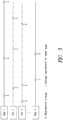
- FIG. 3 depicts an example of a number of applications running in parallel on wireless device 12.
- applications (App 1, App 2, App 3, and App n) are shown on a time line where requirement changes are indicated.
- more than one data requirement change may occur for a particular application over a period of time.
- the data requirement change is forwarded to a lower level in the communication reference model, in the form of a data profile.
- the lower level receiving the data profile is the MAC level.
- the actual data requirements for each application could change dynamically which could result in significant real-time wireless device level data requirements over time. Using the procedures defined herein, dynamic application data requirement changes will directly trigger updates from wireless device 12 to network entity 14.
- application data is passed from the wireless device application layer to one or more communication reference model lower layers of wireless device 12.
- the application layer may also convey to the lower layers information required to allow wireless device 12 to make an accurate data pattern assessment when sending data profiles to network entity 14.
- the uplink or downlink data pattern requirements might be quite different, or may be similar.
- the following are non-limiting examples of the type of information that may be conveyed from the application layer to lower levels of the communication reference model of wireless device 12 and thus used in an aggregate data profile.
- an application which is not video or audio may convey the frequency and nature of the data requirements for both the uplink and downlink transmissions. For example: Frequency of 80 ms, Max size: 3 Mb.
- the overall resource requirements for audio can vary greatly, depending on the compression scheme, the sample rate and the number of channels (e.g. mono vs. stereo).
- codecs with differing (some are multi-rate) bit rate requirements.
- codecs with differing (some are multi-rate) bit rate requirements.
- These include standardized codecs, such adaptive multi-rate wideband (AMR-WB), enhanced variable rate codec (EVRC), G.711 and "Internet” codecs, such as Internet lower bit rate codec (iLBC) or SPEEX.
- SPEEX for example, can have a maximum bit rate of about 44 kbps, or as little as 2 kbps, depending on compression settings.
- AMR-WB adaptive multi-rate wideband
- EVRC enhanced variable rate codec
- G.711 G.711
- Internet codecs such as Internet lower bit rate codec (iLBC) or SPEEX.
- SPEEX for example, can have a maximum bit rate of about 44 kbps, or as
- the overall resource requirements for video can vary greatly (even more than audio), depending on the screen size (number of pixels), frame rate (FPS), bits per pixel, the amount and type of compression.
- Typical video codecs include Moving Picture Experts Group (MPEG)-2, MPEG-3, VC-1.
- MPEG Moving Picture Experts Group
- MPEG-3 MPEG-3
- VC-1 Video Coding-1
- the bit rate can vary between 96 kbps (176 x 44 @ 15 FPS) and 135 Mbps (1920 x 1080 @ 60 FPS).
- the actual bit rate being used at any given instant is known by the application layer because it is the application layer which negotiates and/or configures the codec settings.
- media is a large user of data (and hence communication channel resources)
- applications which require large amounts of signaling bandwidth. This may be the case if the frequency of messaging is high and/or the message lengths are long. This information would be known by the application and may change periodically.
- NETFLIX® is a downlink-intensive application for viewing movies and TV shows.
- the user configures the application to select the video quality they want.
- the user should consider the resolution of the device used to view the video when selecting the video quality.
- a "low" quality setting on NETFLIX® would use about 0.3 Gb/hour and a "high” quality setting may use up to 7 Gb/hour of data for Ultra high definition (HD) (H.265).
- NETFLIX® uses the user quality selection to determine the codec and codec settings.
- the user may change the quality settings dynamically within the Application. In one embodiment of the present disclosure, this change is the trigger to convey new requirements to the lower layers which will result in an updated data requirements pattern being sent from wireless device 12 and network entity 14.
- USTREAM® is an uplink-intensive application used for webcasting.
- the user can manually configure the codec (video and voice) to be used, as well as configure other related settings. These settings allow the user to control the uplink bit rate.
- the user may change the quality settings dynamically within the application. This change may be a trigger to convey new requirements to the lower layers which will result in an updated data requirements pattern being sent from wireless device 12 and network entity 14.
- SKYPE® is an audio or video chat/conference program which has similar downlink and uplink data requirements for regular voice and video calls. SKYPE® may determine the best-quality video possible. The video quality can change if the connection quality changes. The changes in video quality may be the trigger to convey new requirements to the lower layers which will result in an updated data requirements pattern being updated data requirements pattern being sent from wireless device 12 and network entity 14.
- IP Multimedia Subsystem IMS/Voice over Long Term Evolution (VoLTE) is an SIP-based Voice over IP (VoIP) call over LTE.
- the IMS/VoIP client may use the SDP offer/answer protocol to negotiate which codec and which codec settings will be used. It is possible for the codec or codec settings to dynamically change during a call. This may be used as the trigger to convey new requirements to the lower layers which may result in an updated data requirement pattern being sent between wireless device 12 and network device 14.
- FIG. 4 is a flow diagram illustrating a method of processing real time data communication requirements for applications running on wireless device 12 according to one or more embodiments of the present disclosure.
- the method illustrated can be performed by the data profile creator 16 of wireless device 12 and, in particular, by the processing circuitry 25 of wireless device 12 shown in FIG. 7 .
- Some steps of the method, according to some aspects, may also be performed by the data profile aggregator 18.
- a change in a data communication requirement for an application running on an application layer of a communication reference model of wireless device 12 is identified (Block S400).
- a data profile is then provided to a lower layer of the communication reference model, the lower layer being lower than the application layer, where the data profile represents the change in the data requirements for the application running on the application layer of wireless device 12 (Block S402).
- the method of FIG. 4 also optionally includes creating an aggregate data profile, the aggregate data profile representing additional data profiles and the data profile, where each of the additional data profiles represents changes in data requirements for corresponding applications running on the application layer of wireless device 12 (Block S404).
- the lower communication reference model layer is a media access control (MAC) layer of an Open System Communication Interconnection (OSI) communication reference model.
- the changes in the data requirements include at least one of starting the application, pausing the application, stopping the application, and any changes to the application that result in a change in data requirements above a threshold amount.
- the creating of the aggregate data profile occurs at the MAC layer of the Open System Communication Interconnection (OSI) communication reference model.
- the method optionally includes transmitting an aggregate data profile message to network entity 14 at a first predetermined time interval, the aggregate data profile message based on the aggregate data profile (Block S406). In another embodiment, the method further includes transmitting additional aggregate data profile message to network entity 14 at the first predetermined time interval.
- the aggregate data profile message may include the actual aggregate data profile and/or other information based on the aggregate data profile that would be useful to network entity 14, such as a recommended scheduling pattern.
- the method further optionally includes partitioning data profiles in the aggregate data profile according to applications for a common bearer (Block S408), and transmitting, to network entity 14, the aggregate data profile message according to the partitioned data profiles (Block S410).
- FIG. 5 is a flow diagram illustrating a method of providing network entity 14 with a data profile representing changes in data communication requirements for applications running on wireless device 12 according to one or more embodiments of the present disclosure.
- the method depicted in FIG. 5 can be performed by data profile creator 16 of wireless device 12 and, in particular, by the processing circuitry 25 of wireless device 12 shown in FIG. 7 .
- a change in a data communication requirement for an application running on an application layer of a communication reference model of wireless device 12 is identified (Block S500).
- At least one data profile is then created where, each of the at least one data profile represents changes in data communication requirements for corresponding applications running on wireless device 12 (Block S502).
- a data profile messaged based on the at least one data profile is then transmitted to network entity 14 where the at least one data profile message is usable by network entity 14 to manage wireless communications for wireless device 12 (Block S504).
- Managing wireless communications for wireless device 12 may including, e.g., scheduling of the wireless device 12 and optimizing resource management algorithm decisions made by network entity 14.
- the method shown in FIG. 5 optionally includes combining each of the at least one data profile into an aggregate data profile via data profile aggregator 18 (Block S506) and optionally includes transmitting, to network entity 14 at a first predetermined time interval, an aggregate data profile message based on the aggregate data profile (Block S508).
- this embodiment is similar to the embodiment described above with respect to FIG. 4 where wireless device 12 and in some embodiments, the lower level layer, e.g., MAC layer, performs the aggregation of the data profiles such that an aggregate data profile may be sent to network entity 14 rather than multiple, separate data profiles, each representing data requirement changes for individual applications.
- the lower level layer e.g., MAC layer
- changes in the data requirements include at least one of starting the application, pausing the application, stopping the application, and any changes to the application that result in a change in data requirements above a threshold amount.
- additional aggregate data profile messages are optionally transmitted to network entity 14 at the first predetermined time intervals (Block S510).
- the method of FIG. 5 further includes optionally partitioning data profiles in the aggregate data profile according to applications for a common bearer (Block S512) and optionally transmitting, to network entity 14, the aggregate data profile message according to the partitioned data profiles (Block S514).
- wireless device 12 may transmit a message to network entity 14 conveying this information.
- each of the at least one data profile is combined into an aggregate data profile by network entity 14.
- the data profiles or aggregate data profiles are transmitted by wireless device 12 to network device 14 in the form of messages.
- the following is an exemplary aggregate data profile message that may be sent from wireless device 12 to network entity 14.
- the aggregate data profile message may identify application profiles according to bearer and/or indicate recommended scheduling patterns.
- Network entity 14 can respond to wireless device 12 with an acknowledgement (ACK) message.
- ACK acknowledgement
- the above message could pass either the APPLICATION_PROFILE_LIST or overall WIRELESS DEVICE_RECOMMENDED_SCHEDULING_PATTERN or both to network entity 14.
- the BIT_PATTERN may be up to 40 bits long with each bit representing one transmission time interval (TTI).
- the WIRELESS DEVICE_RESOURCE_AND_SCHEDULING_ REQUIREMENTS message could be sent as often as an interval equal to PATTERN_LENGTH * TTI duration (e.g., 1ms). It may also be limited to only sending when an overall change in the APPLICATION _PROFILE_LIST and/or WIRELESS_DEVICE_RECOMMENTED SCHEDULING_PATTERN occurs.
- sending the message allows wireless device 12 to inform network entity 14 that (for example) for the upcoming 40 TTI, which TTIs wireless device 12 requests data be optimally scheduled.
- the APPLICATION_PROFILE will also give the network entity 14 scheduler more accurate information about the actual data requirements.
- the pattern is considered to be repeated. For example, if a 10 bit pattern is chosen (e.g. 1110000000) network entity 14 would interpret that as a repeating pattern even through wireless device 12 doesn't resend the pattern every 10mS (e.g. 111000000011100000001110000000.). Note that it is not required that wireless device 12 send both the APPLICATION_ PROFILE_LIST and the WIRELESS DEVICE_RECOMMENTED_SCHEDULING_PATTERN information elements for any given session. It should be understood that the above-described message is but one example of a suitable message format and that other message formats may be used to convey the data profiles or aggregate data profiles.
- FIG. 6 is a flow diagram illustrating a method, at network entity 12, of receiving a data profile from wireless device 12, the data profile representing changes in data communication requirements for applications running on wireless device 12 according to one or more embodiments of the present disclosure.
- the method depicted in FIG. 6 can be performed by network entity 14 and, in particular, by the processing circuitry 32 of network entity 14 shown in FIG. 8 .
- network entity 14 receives, from wireless device 12, at least one data profile message, each of the at least one data profile message representing changes in data communication requirements for a corresponding application running on wireless device 12 (Block S600).
- Network entity 14 utilizes the received at least one data profile message to manage wireless communications for wireless device 12 (Block S602).
- network entity 14 optionally combines each of the at least one data profile into an aggregate data profile using data profile aggregator 22, the aggregate data profile being used to manage the wireless communications for wireless device 12 (Block S604).
- network entity 14 rather than wireless device 12 performs the aggregation of data profiles.
- network entity 14 optionally partitions data profiles in the aggregate data profile according to applications for a common bearer, the partitioned data profiles being used, e.g., by data profile utilizer 20, to manage the wireless communications for wireless device 12 (Block S606).
- network entity 14 rather than wireless device 12 partitions the data profiles per bearer.
- network entity 14 optionally receives an aggregate data profile message from wireless device 12 at a first predetermined time interval, wherein the aggregate data profile message includes each of the at least one data profiles, the aggregate data profile message being used to manage the wireless communications for wireless device 12 (Block S608).
- wireless device 12 performs the aggregation of the data profiles into an aggregate data profile.
- network entity 14 optionally receives additional aggregate data profile messages from the wireless device at the first predetermined time interval (Block S610).
- network entity 14 optionally receives from wireless device 12, partitioned data profiles, the partitioned data profiles representing data profiles corresponding to applications for a common bearer, the partitioned data profiles being used to manage the wireless communications for the wireless device (Block S612).
- wireless device 12 performs the partitioning of data profiles according to bearer.
- FIG. 7 is a block diagram of wireless device 12 configured to communicate real time data communication requirements for applications running on wireless device 12 according to one or more embodiments of the present disclosure.
- wireless device 12 includes a communications interface 24 and processing circuitry 25.
- Processing circuitry 25 includes a memory 26 in communication with processor 28.
- Memory 26 has instructions that, when executed by processor 28, configure processor 28 to perform a variety of functions as described herein including the functions shown in FIG. 4 .
- processing circuitry 25 may include integrated circuitry for processing and/or control, e.g., one or more processors and/or processor cores and/or FPGAs (Field Programmable Gate Array) and/or ASICs (Application Specific Integrated Circuitry).
- FPGAs Field Programmable Gate Array
- ASICs Application Specific Integrated Circuitry
- Processing circuitry 25 may comprise and/or be connected to and/or be configured to access (e.g., write to and/or read from) memory 26, which may comprise any kind of volatile and/or non-volatile memory, e.g., cache and/or buffer memory and/or RAM (Random Access Memory) and/or ROM (Read-Only Memory) and/or optical memory and/or EPROM (Erasable Programmable Read-Only Memory).
- memory 26 may be configured to store code executable by control circuitry and/or other data, e.g., data pertaining to communication, e.g., configuration and/or address data of nodes, etc.
- Processing circuitry 25 may be configured to control any of the methods described herein and/or to cause such methods to be performed, e.g., by wireless device 12. Corresponding instructions may be stored in the memory 26, which may be readable and/or readably connected to processing circuitry 25.
- processing circuitry 25 may include a controller, which may include a microprocessor and/or microcontroller and/or FPGA (Field-Programmable Gate Array) device and/or ASIC (Application Specific Integrated Circuit) device. It may be considered that processing circuitry 25 includes or may be connected or connectable to memory 26, which may be configured to be accessible for reading and/or writing by the controller and/or processing circuitry 25.
- processor 28 is configured to identify a change in a data communication requirement for an application running on an application layer of a communication reference model of wireless device 12.
- Processor 28 either alone or in conjunction with data profile creator 16 is configured to provide to a lower layer of the communication reference model layer, the lower layer being lower than the application layer, a data profile, the data profile representing the change in the data communication requirements for the application running on the application layer of wireless device 12.
- memory 26 further stores instructions that, when executed, configure processor 28, either alone or in conjunction with data profile aggregator 18, to create an aggregate data profile, the aggregate data profile representing the additional data profiles and the data profile, each of the additional data profiles representing changes in data communication requirements for corresponding applications running on the application layer of wireless device 12.
- the lower communication reference model layer is a media access control (MAC) layer of an Open System Communication Interconnection (OSI) communication reference model.
- changes in the data requirements include at least one of starting the application, pausing the application, stopping the application, and any changes to the application that result in a change in data requirements above a threshold amount.
- aggregating additional data profiles with the data profile occurs at a media access control (MAC) layer of an Open System Communication Interconnection (OSI) communication reference model.
- communications interface 24 is configured to transmit, to network entity 14 at a first predetermined time interval, an aggregate data profile message based on the aggregate data profile.
- communications interface 24 is configured to transmit additional aggregate data profile messages to network entity 14 at the first predetermined time interval.
- memory 26 further stores instructions that, when executed, configure processor 28 to partition data profiles in the aggregate data profile according to applications for a common bearer, wherein communications interface 24 is configured to transmit, to network entity 14, the aggregate data profile message according to the partitioned data profiles.
- FIG. 8 is a block diagram of network entity 14 configured to receive, aggregate and utilize data profiles from wireless device 12, the data profile representing changes in data communication requirements for applications running on wireless device 12 according to one or more embodiments of the present disclosure.
- network entity 14 includes a communications interface 30 configured to receive, from wireless device 12, at least one data profile message, each of the at least one data profile message representing changes in data communication requirements for a corresponding application running on wireless device 12.
- Network entity 14 also includes processing circuitry 32 having a memory 34 in communication with a processor 36, where memory 34 has instructions that, when executed by processor 36, configure processor 36 to perform a variety of functions described herein including those depicted in FIG. 5 .
- processing circuitry 32 may include integrated circuitry for processing and/or control, e.g., one or more processors and/or processor cores and/or FPGAs (Field Programmable Gate Array) and/or ASICs (Application Specific Integrated Circuitry).
- Processing circuitry 32 may comprise and/or be connected to and/or be configured to access (e.g., write to and/or read from) memory 34, which may comprise any kind of volatile and/or non-volatile memory, e.g., cache and/or buffer memory and/or RAM (Random Access Memory) and/or ROM (Read-Only Memory) and/or optical memory and/or EPROM (Erasable Programmable Read-Only Memory).
- Such memory 34 may be configured to store code executable by control circuitry and/or other data, e.g., data pertaining to communication, e.g., configuration and/or address data of nodes, etc.
- Processing circuitry 32 may be configured to control any of the methods described herein and/or to cause such methods to be performed, e.g., by network entity 14. Corresponding instructions may be stored in the memory 34, which may be readable and/or readably connected to processing circuitry 32.
- processing circuitry 32 may include a controller, which may include a microprocessor and/or microcontroller and/or FPGA (Field-Programmable Gate Array) device and/or ASIC (Application Specific Integrated Circuit) device. It may be considered that processing circuitry 32 includes or may be connected or connectable to memory 34, which may be configured to be accessible for reading and/or writing by the controller and/or processing circuitry 32.
- processor 36 is configured to utilize the received at least one data profile message to manage wireless communications for wireless device 12.
- memory 34 further stores instructions that, when executed, configure processor 36, either alone or in conjunction with data profile aggregator 22, to combine each of the at least one data profile into an aggregate data profile, the aggregate data profile being used to manage the wireless communications for wireless device 12.
- memory 34 further stores instructions that, when executed, configure processor 36 to partition data profiles in the aggregate data profile according to applications for a common bearer, the partitioned data profiles being used to manage the wireless communications for wireless device 12.
- communication interface 30 is further configured to receive an aggregate data profile message from wireless device 12 at first predetermined time intervals, wherein the aggregate data profile message includes each of the at least one data profiles, the aggregate data profile message being used to manage the wireless communications for wireless device 12. In one embodiment, communication interface 30 is further configured to receive additional aggregate data profile messages from wireless device 12 at the first predetermined time intervals. In one embodiment, communications interface 30 is further configured to receive, from wireless device 12, partitioned data profiles, the partitioned data profiles representing data profiles corresponding to applications for a common bearer, the partitioned data profiles being used to manage the wireless communications for wireless device 12.
- FIGS. 7 and 8 show data profile creator 16, data profile aggregator 18, data profile utilizer 20 and data profile aggregator 22 as being stored in memory devices of processing circuitry, as discussed above, embodiments are not limited solely to such implementations. Because processing circuitry can take forms other than a central processing unit and memory, it is understood that these elements may be implemented in hardware as part of a device.
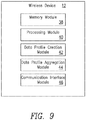
- FIG. 9 is a block diagram of alternate wireless device configured to communicate real time data communication requirements for applications running on the wireless device utilizing the principles of the present disclosure.
- wireless device 12 a memory module 38 in communication with a processing module 40.
- Processing module 40 is configured to identify a change in a data communication requirement for an application running on an application layer of a communication reference model of wireless device 12.
- Processing module 40 either alone or in conjunction with data profile creation module 42, is configured to provide to a lower layer of the communication reference model layer, the lower layer being lower than the application layer, a data profile, the data profile representing the change in the data communication requirements for the application running on the application layer of wireless device 12.
- processing module 40 either alone or in conjunction with data profile aggregation module 44, is configured to create an aggregate data profile, the aggregate data profile representing the additional data profiles and the data profile, each of the additional data profiles representing changes in data communication requirements for corresponding applications running on the application layer of wireless device 12.
- communication interface module 46 of wireless device 12 is configured to transmit an aggregate data profile message based on the aggregate data profile to network entity 14 at a first predetermined time interval.
- the concepts described herein may be embodied as a method, data processing system, and/or computer program product. Accordingly, the concepts described herein may take the form of an entirely hardware embodiment, an entirely software embodiment or an embodiment combining software and hardware aspects all generally referred to herein as a "circuit" or "module.” Furthermore, the disclosure may take the form of a computer program product on a tangible computer usable storage medium having computer program code embodied in the medium that can be executed by a computer. Any suitable tangible computer readable medium may be utilized including hard disks, CD-ROMs, electronic storage devices, optical storage devices, or magnetic storage devices.
- These computer program instructions may also be stored in a computer readable memory or storage medium that can direct a computer or other programmable data processing apparatus to function in a particular manner, such that the instructions stored in the computer readable memory produce an article of manufacture including instruction means which implement the function/act specified in the flowchart and/or block diagram block or blocks.
- the computer program instructions may also be loaded onto a computer or other programmable data processing apparatus to cause a series of operational steps to be performed on the computer or other programmable apparatus to produce a computer implemented process such that the instructions which execute on the computer or other programmable apparatus provide steps for implementing the functions/acts specified in the flowchart and/or block diagram block or blocks.
- Computer program code for carrying out operations of the concepts described herein may be written in an object oriented programming language such as Java® or C++.
- the computer program code for carrying out operations of the disclosure may also be written in conventional procedural programming languages, such as the "C" programming language.
- the program code may execute entirely on the user's computer, partly on the user's computer, as a stand-alone software package, partly on the user's computer and partly on a remote computer or entirely on the remote computer.
- the remote computer may be connected to the user's computer through a local area network (LAN) or a wide area network (WAN), or the connection may be made to an external computer (for example, through the Internet using an Internet Service Provider).
- LAN local area network
- WAN wide area network
- Internet Service Provider for example, AT&T, MCI, Sprint, EarthLink, MSN, GTE, etc.
Landscapes
- Engineering & Computer Science (AREA)
- Computer Networks & Wireless Communication (AREA)
- Signal Processing (AREA)
- Mobile Radio Communication Systems (AREA)
Claims (14)
- Verfahren, das in einem drahtlosen Gerät zum Kommunizieren von Echtzeitdatenkommunikationsanforderungen an eine Netzwerkeinheit für Anwendungen implementiert ist, die auf dem drahtlosen Gerät (12) laufen, wobei das Verfahren Folgendes umfasst:Identifizieren einer Veränderung in einer Datenkommunikationsanforderung für eine Anwendung, die auf einer Anwendungsschicht eines Kommunikationsreferenzmodells des drahtlosen Geräts (12) läuft (S400); wobei die Veränderung in der Datenanforderung mindestens eines aus Starten der Anwendung, Pausieren der Anwendung, Anhalten der Anwendung und beliebige Veränderungen an der Anwendung, die zu einer Veränderung der Datenanforderungen über einem Schwellenwert führen, beinhaltet;Bereitstellen an eine untere Schicht des Kommunikationsreferenzmodells, wobei die untere Schicht niedriger als die Anwendungsschicht ist, des Datenprofils, das die Veränderung in den Datenanforderungen für die Anwendung darstellt, die auf der Anwendungsschicht des drahtlosen Geräts (12) läuft (S402), wobei die untere Schicht des Kommunikationsreferenzmodells eine Media-Access-Control (MAC) - Schicht eines Open-System-Communication-Interconnection (OSI) - Kommunikationsreferenzmodells ist;Erzeugen eines Aggregatdatenprofils, wobei das Aggregatdatenprofil zusätzliche Datenprofile und das Datenprofil darstellt, wobei jedes der zusätzlichen Datenprofile Veränderungen in den Datenanforderungen für entsprechende Anwendungen darstellt, die auf der Anwendungsschicht des drahtlosen Geräts (12) laufen (S404), wobei das Erzeugen des Aggregatdatenprofils an der MAC-Schicht erfolgt; undÜbertragen, an eine Netzwerkeinheit (14), in einem ersten vorbestimmten Zeitintervall, einer Aggregatdatenprofilnachricht basierend auf dem Aggregatdatenprofil (S406).
- Verfahren nach einem aus Anspruch 1, ferner umfassend das Übertragen von zusätzlichen Aggregatdatenprofilnachrichten an eine Netzwerkeinheit (14) in einem ersten vorbestimmten Zeitintervall.
- Verfahren nach einem der Ansprüche 1-2, ferner umfassend:Partitionieren von Datenprofilen in dem Aggregatdatenprofil gemäß Anwendungen für einen gemeinsamen Träger (S408); undÜbertragen, an die Netzwerkeinheit (14), der Aggregatdatenprofilnachricht gemäß den partitionierten Datenprofilen (S410).
- Drahtloses Gerät (12), das konfiguriert ist, um Echtzeitdatenkommunikationsanforderungen für Anwendungen zu kommunizieren, die auf dem drahtlosen Gerät (12) laufen, wobei das drahtlose Gerät (12) Folgendes umfasst:eine Kommunikationsschnittstelle (24); undVerarbeitungsschaltung (25), umfassend:einen Speicher (26); undeinen Prozessor (28), wobei der Speicher (26) in Kommunikation mit dem Prozessor (28) ist, wobei der Speicher (26) Anweisungen hat, die, wenn sie durch den Prozessor (28) ausgeführt werden, den Prozessor (28) konfigurieren, Folgendes zu tun:Identifizieren einer Veränderung in einer Datenkommunikationsanforderung für eine Anwendung, die auf einer Anwendungsschicht eines Kommunikationsreferenzmodells des drahtlosen Geräts (12) läuft,wobei die Veränderung in der Datenanforderung mindestens eines aus Starten der Anwendung, Pausieren der Anwendung, Anhalten der Anwendung und beliebige Veränderungen an der Anwendung, die zu einer Veränderung der Datenanforderungen über einem Schwellenwert führen, beinhaltet;wobei der Speicher (26) ferner Anweisungen hat, die, wenn sie durch den Prozessor (28) ausgeführt werden, den Prozessor (28) konfigurieren, Folgendes zu tun:Bereitstellen an eine untere Schicht des Kommunikationsreferenzmodells, wobei die untere Schicht niedriger als die Anwendungsschicht ist, des Datenprofils, das die Veränderung in den Datenanforderungen für die Anwendung darstellt, die auf der Anwendungsschicht des drahtlosen Geräts (12) läuft, wobei die untere Schicht des Kommunikationsreferenzmodells eine Media-Access-Control (MAC) - Schicht eines Open-System-Communication-Interconnection (OSI) - Kommunikationsreferenzmodells ist;Erzeugen eines Aggregatdatenprofils, wobei das Aggregatdatenprofil die zusätzlichen Datenprofile und das Datenprofil darstellt, wobei jedes der zusätzlichen Datenprofile Veränderungen in Datenanforderungen für entsprechende Anwendungen darstellt, die auf der Anwendungsschicht des drahtlosen Geräts (12) laufen, wobei das Aggregatdatenprofil an der MAC-Schicht erzeugt ist; undÜbertragen, an eine Netzwerkeinheit (14), in einem ersten vorbestimmten Zeitintervall, einer Aggregatdatenprofilnachricht basierend auf dem Aggregatdatenprofil.
- Drahtloses Gerät (12) nach Anspruch 4, wobei die Kommunikationsschnittstelle (24) konfiguriert ist, um zusätzliche Aggregatdatenprofilnachrichten an die Netzwerkeinheit (14) in einem ersten vorbestimmten Zeitintervall zu übertragen.
- Drahtloses Gerät (12) nach einem der Ansprüche 4-5, wobei der Speicher (26) ferner Anweisungen speichert, die, wenn sie ausgeführt werden, den Prozessor (28) konfigurieren, Datenprofile in dem Aggregatdatenprofil gemäß Anwendungen für einen gemeinsamen Träger zu partitionieren, wobei die Kommunikationsschnittstelle (24) konfiguriert ist, um an die Netzwerkeinheit (14) die Aggregatdatenprofilnachricht gemäß den partitionierten Datenprofilen zu übertragen.
- Verfahren, das in eine Netzwerkeinheit (14) implementiert ist, zum Verwalten von drahtlosen Gerätkommunikationen basierend auf Echtzeitdatenkommunikationsanforderungen für Anwendungen, die auf dem drahtlosen Gerät (12) laufen, wobei das Verfahren Folgendes umfasst:Empfangen, in einer unteren Schicht der Kommunikationsreferenzmodellschicht, wobei die untere Schicht niedriger als die Anwendungsschicht ist, von dem drahtlosen Gerät (12), von mindestens einer Datenprofilnachricht, wobei jede der mindestens einen Datenprofilnachricht Veränderungen in Datenkommunikationsanforderungen für eine entsprechende Anwendung darstellt, die auf einer Anwendungsschicht eines Kommunikationsreferenzmodells des drahtlosen Geräts (12) läuft (S600) ;wobei die untere Schicht des Kommunikationsreferenzmodells eine Media-Access-Control (MAC) -Schicht eines Open-System-Communication-Interconnection (OSI) - Kommunikationsreferenzmodells ist;wobei Veränderungen in den Datenanforderungen mindestens eines aus Starten der Anwendung, Pausieren der Anwendung, Anhalten der Anwendung und beliebige Veränderungen an der Anwendung, die zu einer Veränderung der Datenanforderungen über einem Schwellenwert führen, beinhalten; undVerwenden der empfangenen mindestens einen Datenprofilnachricht, um drahtlose Kommunikationen für das drahtlose Gerät (12) zu verwalten (S602); wobei das Datenprofil die Veränderung in den Datenkommunikationsanforderungen für die Anwendung darstellt, die auf der Anwendungsschicht des drahtlosen Geräts (12) läuft;wobei das Verfahren ferner das Durchführen von einem aus Folgendem umfasst:Kombinieren von jedem des mindestens einen Datenprofils in ein Aggregatdatenprofil und Empfangen einer Aggregatdatenprofilnachricht von dem drahtlosen Gerät (12) in einem ersten vorbestimmten Zeitintervall;wobei die Aggregatdatenprofilnachricht jedes der mindestens einen Datenprofile beinhaltet, wobei die Aggregatdatenprofilnachricht verwendet wird, um die drahtlosen Kommunikationen für das drahtlose Gerät (12) zu verwalten (S608).
- Verfahren nach einem aus Anspruch 7, ferner umfassend das Partitionieren von Datenprofilen in dem Aggregatdatenprofil gemäß Anwendungen für einen gemeinsamen Träger, wobei die partitionierten Datenprofile verwendet werden, um die drahtlosen Kommunikationen für das drahtlose Gerät (12) zu verwalten (S606).
- Verfahren nach Anspruch 7, ferner umfassend das Empfangen von zusätzlichen Aggregatdatenprofilnachrichten von dem drahtlosen Gerät (12) in einem ersten vorbestimmten Zeitintervall (S610).
- Verfahren nach Anspruch 9, ferner umfassend:
Empfangen, von dem drahtlosen Gerät (12), von partitionierten Datenprofilen, wobei die partitionierten Datenprofile Datenprofile darstellen, die Anwendungen für einen gemeinsamen Träger entsprechen, wobei die partitionierten Datenprofile verwendet werden, um die drahtlosen Kommunikationen für das drahtlose Gerät (12) zu verwalten (S612). - Netzwerkeinheit (14), die konfiguriert ist, um drahtlose Gerätkommunikationen mit Echtzeitdatenkommunikationsanforderungen von Anwendungen zu verwalten, die auf dem drahtlosen Gerät (12) laufen, wobei die Netzwerkeinheit (14) Folgendes umfasst: eine Kommunikationsschnittstelle (30), die für Folgendes konfiguriert ist
Empfangen, in einer unteren Schicht der Kommunikationsreferenzmodellschicht, wobei die untere Schicht niedriger als die Anwendungsschicht ist, von dem drahtlosen Gerät (12), von mindestens einer Datenprofilnachricht, wobei jede der mindestens einen Datenprofilnachricht Veränderungen in Datenkommunikationsanforderungen für eine entsprechende Anwendung darstellt, die auf einer Anwendungsschicht eines Kommunikationsreferenzmodells des drahtlosen Geräts (12) läuft;
wobei die untere Schicht des Kommunikationsreferenzmodells eine Media-Access-Control (MAC) -Schicht eines Open-System-Communication-Interconnection (OSI) - Kommunikationsreferenzmodells ist;
wobei Veränderungen in den Datenanforderungen mindestens eines aus Starten der Anwendung, Pausieren der Anwendung, Anhalten der Anwendung und beliebige Veränderungen an der Anwendung, die zu einer Veränderung der Datenanforderungen über einem Schwellenwert führen, beinhalten; und
Verarbeitungsschaltung (32), umfassend:einen Speicher (34); undeinen Prozessor (36), wobei der Speicher (34) in Kommunikation mit dem Prozessor (36) ist, wobei der Speicher (34) Anweisungen hat, die, wenn sie durch den Prozessor (36) ausgeführt werden, den Prozessor (36) konfigurieren, Folgendes zu tun:Verwenden der empfangenen mindestens einen Datenprofilnachricht, um drahtlose Kommunikationen für das drahtlose Gerät (12) zu verwalten; wobei das Datenprofil die Veränderung in den Datenkommunikationsanforderungen für die Anwendung darstellt, die auf der Anwendungsschicht des drahtlosen Geräts (12) läuft; undwobei der Speicher (34) ferner Anweisungen speichert, die, wenn sie ausgeführt werden, den Prozessor (36) konfigurieren, eines aus Folgendem durchzuführen:Kombinieren von jedem des mindestens einen Datenprofils in ein Aggregatdatenprofil und Empfangen einer Aggregatdatenprofilnachricht von dem drahtlosen Gerät (12) in einem ersten vorbestimmten Zeitintervall,wobei die Aggregatdatenprofilnachricht jedes der mindestens einen Datenprofile beinhaltet, wobei die Aggregatdatenprofilnachricht verwendet wird, um die drahtlosen Kommunikationen für das drahtlose Gerät (12) zu verwalten. - Netzwerkeinheit (14) nach Anspruch 11, wobei der Speicher (34) ferner Anweisungen speichert, die, wenn sie ausgeführt werden, den Prozessor (36) konfigurieren, Datenprofile in dem Aggregatdatenprofil gemäß Anwendungen für einen gemeinsamen Träger zu partitionieren, wobei die partitionierten Datenprofile verwendet werden, um die drahtlosen Kommunikationen für das drahtlose Gerät (12) zu verwalten.
- Netzwerkeinheit (14) nach Anspruch 11, wobei die Kommunikationsschnittstelle (30) ferner konfiguriert ist, um zusätzliche Aggregatdatenprofilnachrichten von dem drahtlosen Gerät (12) in dem ersten vorbestimmten Zeitintervall zu empfangen.
- Netzwerkeinheit (14) nach einem der Ansprüche 12 und 13, wobei die Kommunikationsschnittstelle (30) ferner für Folgendes konfiguriert ist:
Empfangen, von dem drahtlosen Gerät (12), von partitionierten Datenprofilen, wobei die partitionierten Datenprofile Datenprofile darstellen, die Anwendungen für einen gemeinsamen Träger entsprechen, wobei die partitionierten Datenprofile verwendet werden, um die drahtlosen Kommunikationen für das drahtlose Gerät (12) zu verwalten.
Applications Claiming Priority (1)
| Application Number | Priority Date | Filing Date | Title |
|---|---|---|---|
| PCT/IB2016/053484 WO2017216601A1 (en) | 2016-06-13 | 2016-06-13 | Application aware scheduling and resource management |
Publications (2)
| Publication Number | Publication Date |
|---|---|
| EP3469844A1 EP3469844A1 (de) | 2019-04-17 |
| EP3469844B1 true EP3469844B1 (de) | 2021-01-27 |
Family
ID=56148621
Family Applications (1)
| Application Number | Title | Priority Date | Filing Date |
|---|---|---|---|
| EP16730499.7A Active EP3469844B1 (de) | 2016-06-13 | 2016-06-13 | Anwendungsbewusste planung und ressourcenverwaltung |
Country Status (3)
| Country | Link |
|---|---|
| US (1) | US10813112B2 (de) |
| EP (1) | EP3469844B1 (de) |
| WO (1) | WO2017216601A1 (de) |
Families Citing this family (3)
| Publication number | Priority date | Publication date | Assignee | Title |
|---|---|---|---|---|
| US12199985B2 (en) * | 2018-11-27 | 2025-01-14 | Salesforce, Inc. | Multi-modal user authorization in group-based communication systems |
| US11202301B2 (en) * | 2019-05-29 | 2021-12-14 | Hewlett Packard Enterprise Development Lp | Self-learning rate access prioritizer for applications in a wireless network |
| EP3989666B1 (de) * | 2020-10-21 | 2025-03-05 | Deutsche Telekom AG | Zuweisen einer dienstqualität zu einer drahtlosen verbindung |
Family Cites Families (11)
| Publication number | Priority date | Publication date | Assignee | Title |
|---|---|---|---|---|
| US6026097A (en) * | 1997-03-13 | 2000-02-15 | 8 X 8, Inc. | Data processor having controlled scalable input data source and method thereof |
| US7151749B2 (en) * | 2001-06-14 | 2006-12-19 | Microsoft Corporation | Method and System for providing adaptive bandwidth control for real-time communication |
| US8259566B2 (en) * | 2005-09-20 | 2012-09-04 | Qualcomm Incorporated | Adaptive quality of service policy for dynamic networks |
| US8665724B2 (en) * | 2009-06-12 | 2014-03-04 | Cygnus Broadband, Inc. | Systems and methods for prioritizing and scheduling packets in a communication network |
| US8837386B2 (en) * | 2010-07-02 | 2014-09-16 | Blackberry Limited | Application-based wireless device initiated radio resource management |
| US9167618B2 (en) * | 2010-11-16 | 2015-10-20 | At&T Mobility Ii Llc | Data bundling and fast dormancy based upon intelligent application learning |
| US8594747B2 (en) * | 2011-05-06 | 2013-11-26 | Apple Inc. | Adaptive fast dormancy in a mobile device |
| US20150026309A1 (en) | 2011-09-29 | 2015-01-22 | Avvasi Inc. | Systems and methods for adaptive streaming control |
| US9480101B2 (en) * | 2013-02-21 | 2016-10-25 | Altiostar Networks, Inc. | Systems and methods for scheduling of data packets based on application detection in a base station |
| EP2879339A1 (de) | 2013-11-27 | 2015-06-03 | Thomson Licensing | Verfahren zur Verteilung der verfügbaren Bandbreite eines Netzwerks zwischen laufenden Datenverkehrssitzungen, die von den Vorrichtungen des Netzwerks ausgeführt werden, zugehörige Vorrichtung |
| CN105873239B (zh) * | 2015-12-14 | 2017-10-17 | 上海连尚网络科技有限公司 | 用于为用户设备的应用建立无线连接的方法 |
-
2016
- 2016-06-13 EP EP16730499.7A patent/EP3469844B1/de active Active
- 2016-06-13 US US16/309,323 patent/US10813112B2/en active Active
- 2016-06-13 WO PCT/IB2016/053484 patent/WO2017216601A1/en not_active Ceased
Non-Patent Citations (1)
| Title |
|---|
| None * |
Also Published As
| Publication number | Publication date |
|---|---|
| EP3469844A1 (de) | 2019-04-17 |
| WO2017216601A1 (en) | 2017-12-21 |
| US20190261392A1 (en) | 2019-08-22 |
| US10813112B2 (en) | 2020-10-20 |
Similar Documents
| Publication | Publication Date | Title |
|---|---|---|
| EP2742724B1 (de) | Verfahren und vorrichtung zur steuerung drahtloser uplink- sitzungen | |
| US9113486B2 (en) | Method and apparatus for controlling wireless uplink sessions | |
| US10721715B2 (en) | Link-aware streaming adaptation | |
| US9629131B2 (en) | Energy-aware multimedia adaptation for streaming and conversational services | |
| CN112369038A (zh) | 用于对实时上行链路流式传输服务的高效操作的上行链路和下行链路方法 | |
| US11206298B2 (en) | Method and system utilizing event specific priority in a network controlled uplink media transmission for a collaborative media production | |
| WO2012134530A1 (en) | Cross-layer optimized adaptive http streaming | |
| US10813112B2 (en) | Application aware scheduling and resource management | |
| EP3804266B1 (de) | Netzwerkgesteuerte uplink-medienübertragung für eine kollaborative medienproduktion in netzkapazitätsbeschränkten szenarien | |
| US11368512B2 (en) | Method and system for utilizing network conditions feedback for improving quality of a collaborative media production | |
| CN112585979B (zh) | 用于所存储内容的网络控制媒体上传的方法和系统 | |
| US12585496B2 (en) | Method, apparatus and computer program for activating a scheduling configuration | |
| EP4274189B1 (de) | Paketgültigkeitszeitverbesserung für dienstgüteflüsse | |
| Sibel et al. | Optimization of H264 and 5G QoS parameters for a multi-agent live video streaming service | |
| Ahmadein | Dynamic Application-Aware Resource Allocation for LTE Networks |
Legal Events
| Date | Code | Title | Description |
|---|---|---|---|
| STAA | Information on the status of an ep patent application or granted ep patent |
Free format text: STATUS: THE INTERNATIONAL PUBLICATION HAS BEEN MADE |
|
| PUAI | Public reference made under article 153(3) epc to a published international application that has entered the european phase |
Free format text: ORIGINAL CODE: 0009012 |
|
| STAA | Information on the status of an ep patent application or granted ep patent |
Free format text: STATUS: REQUEST FOR EXAMINATION WAS MADE |
|
| 17P | Request for examination filed |
Effective date: 20190111 |
|
| AK | Designated contracting states |
Kind code of ref document: A1 Designated state(s): AL AT BE BG CH CY CZ DE DK EE ES FI FR GB GR HR HU IE IS IT LI LT LU LV MC MK MT NL NO PL PT RO RS SE SI SK SM TR |
|
| AX | Request for extension of the european patent |
Extension state: BA ME |
|
| DAV | Request for validation of the european patent (deleted) | ||
| DAX | Request for extension of the european patent (deleted) | ||
| GRAP | Despatch of communication of intention to grant a patent |
Free format text: ORIGINAL CODE: EPIDOSNIGR1 |
|
| STAA | Information on the status of an ep patent application or granted ep patent |
Free format text: STATUS: GRANT OF PATENT IS INTENDED |
|
| GRAS | Grant fee paid |
Free format text: ORIGINAL CODE: EPIDOSNIGR3 |
|
| GRAA | (expected) grant |
Free format text: ORIGINAL CODE: 0009210 |
|
| STAA | Information on the status of an ep patent application or granted ep patent |
Free format text: STATUS: THE PATENT HAS BEEN GRANTED |
|
| INTG | Intention to grant announced |
Effective date: 20201202 |
|
| AK | Designated contracting states |
Kind code of ref document: B1 Designated state(s): AL AT BE BG CH CY CZ DE DK EE ES FI FR GB GR HR HU IE IS IT LI LT LU LV MC MK MT NL NO PL PT RO RS SE SI SK SM TR |
|
| REG | Reference to a national code |
Ref country code: GB Ref legal event code: FG4D |
|
| REG | Reference to a national code |
Ref country code: CH Ref legal event code: EP |
|
| REG | Reference to a national code |
Ref country code: AT Ref legal event code: REF Ref document number: 1359457 Country of ref document: AT Kind code of ref document: T Effective date: 20210215 |
|
| REG | Reference to a national code |
Ref country code: IE Ref legal event code: FG4D |
|
| REG | Reference to a national code |
Ref country code: DE Ref legal event code: R096 Ref document number: 602016052052 Country of ref document: DE |
|
| REG | Reference to a national code |
Ref country code: SE Ref legal event code: TRGR |
|
| REG | Reference to a national code |
Ref country code: NL Ref legal event code: FP |
|
| REG | Reference to a national code |
Ref country code: GR Ref legal event code: EP Ref document number: 20210400695 Country of ref document: GR Effective date: 20210416 |
|
| REG | Reference to a national code |
Ref country code: LT Ref legal event code: MG9D |
|
| REG | Reference to a national code |
Ref country code: AT Ref legal event code: MK05 Ref document number: 1359457 Country of ref document: AT Kind code of ref document: T Effective date: 20210127 |
|
| PG25 | Lapsed in a contracting state [announced via postgrant information from national office to epo] |
Ref country code: BG Free format text: LAPSE BECAUSE OF FAILURE TO SUBMIT A TRANSLATION OF THE DESCRIPTION OR TO PAY THE FEE WITHIN THE PRESCRIBED TIME-LIMIT Effective date: 20210427 Ref country code: LT Free format text: LAPSE BECAUSE OF FAILURE TO SUBMIT A TRANSLATION OF THE DESCRIPTION OR TO PAY THE FEE WITHIN THE PRESCRIBED TIME-LIMIT Effective date: 20210127 Ref country code: FI Free format text: LAPSE BECAUSE OF FAILURE TO SUBMIT A TRANSLATION OF THE DESCRIPTION OR TO PAY THE FEE WITHIN THE PRESCRIBED TIME-LIMIT Effective date: 20210127 Ref country code: HR Free format text: LAPSE BECAUSE OF FAILURE TO SUBMIT A TRANSLATION OF THE DESCRIPTION OR TO PAY THE FEE WITHIN THE PRESCRIBED TIME-LIMIT Effective date: 20210127 Ref country code: PT Free format text: LAPSE BECAUSE OF FAILURE TO SUBMIT A TRANSLATION OF THE DESCRIPTION OR TO PAY THE FEE WITHIN THE PRESCRIBED TIME-LIMIT Effective date: 20210527 Ref country code: NO Free format text: LAPSE BECAUSE OF FAILURE TO SUBMIT A TRANSLATION OF THE DESCRIPTION OR TO PAY THE FEE WITHIN THE PRESCRIBED TIME-LIMIT Effective date: 20210427 |
|
| PG25 | Lapsed in a contracting state [announced via postgrant information from national office to epo] |
Ref country code: AT Free format text: LAPSE BECAUSE OF FAILURE TO SUBMIT A TRANSLATION OF THE DESCRIPTION OR TO PAY THE FEE WITHIN THE PRESCRIBED TIME-LIMIT Effective date: 20210127 Ref country code: PL Free format text: LAPSE BECAUSE OF FAILURE TO SUBMIT A TRANSLATION OF THE DESCRIPTION OR TO PAY THE FEE WITHIN THE PRESCRIBED TIME-LIMIT Effective date: 20210127 Ref country code: LV Free format text: LAPSE BECAUSE OF FAILURE TO SUBMIT A TRANSLATION OF THE DESCRIPTION OR TO PAY THE FEE WITHIN THE PRESCRIBED TIME-LIMIT Effective date: 20210127 Ref country code: RS Free format text: LAPSE BECAUSE OF FAILURE TO SUBMIT A TRANSLATION OF THE DESCRIPTION OR TO PAY THE FEE WITHIN THE PRESCRIBED TIME-LIMIT Effective date: 20210127 |
|
| PG25 | Lapsed in a contracting state [announced via postgrant information from national office to epo] |
Ref country code: IS Free format text: LAPSE BECAUSE OF FAILURE TO SUBMIT A TRANSLATION OF THE DESCRIPTION OR TO PAY THE FEE WITHIN THE PRESCRIBED TIME-LIMIT Effective date: 20210527 |
|
| REG | Reference to a national code |
Ref country code: DE Ref legal event code: R097 Ref document number: 602016052052 Country of ref document: DE |
|
| PG25 | Lapsed in a contracting state [announced via postgrant information from national office to epo] |
Ref country code: CZ Free format text: LAPSE BECAUSE OF FAILURE TO SUBMIT A TRANSLATION OF THE DESCRIPTION OR TO PAY THE FEE WITHIN THE PRESCRIBED TIME-LIMIT Effective date: 20210127 Ref country code: EE Free format text: LAPSE BECAUSE OF FAILURE TO SUBMIT A TRANSLATION OF THE DESCRIPTION OR TO PAY THE FEE WITHIN THE PRESCRIBED TIME-LIMIT Effective date: 20210127 Ref country code: SM Free format text: LAPSE BECAUSE OF FAILURE TO SUBMIT A TRANSLATION OF THE DESCRIPTION OR TO PAY THE FEE WITHIN THE PRESCRIBED TIME-LIMIT Effective date: 20210127 |
|
| PG25 | Lapsed in a contracting state [announced via postgrant information from national office to epo] |
Ref country code: DK Free format text: LAPSE BECAUSE OF FAILURE TO SUBMIT A TRANSLATION OF THE DESCRIPTION OR TO PAY THE FEE WITHIN THE PRESCRIBED TIME-LIMIT Effective date: 20210127 Ref country code: SK Free format text: LAPSE BECAUSE OF FAILURE TO SUBMIT A TRANSLATION OF THE DESCRIPTION OR TO PAY THE FEE WITHIN THE PRESCRIBED TIME-LIMIT Effective date: 20210127 Ref country code: RO Free format text: LAPSE BECAUSE OF FAILURE TO SUBMIT A TRANSLATION OF THE DESCRIPTION OR TO PAY THE FEE WITHIN THE PRESCRIBED TIME-LIMIT Effective date: 20210127 |
|
| PLBE | No opposition filed within time limit |
Free format text: ORIGINAL CODE: 0009261 |
|
| STAA | Information on the status of an ep patent application or granted ep patent |
Free format text: STATUS: NO OPPOSITION FILED WITHIN TIME LIMIT |
|
| 26N | No opposition filed |
Effective date: 20211028 |
|
| PG25 | Lapsed in a contracting state [announced via postgrant information from national office to epo] |
Ref country code: ES Free format text: LAPSE BECAUSE OF FAILURE TO SUBMIT A TRANSLATION OF THE DESCRIPTION OR TO PAY THE FEE WITHIN THE PRESCRIBED TIME-LIMIT Effective date: 20210127 Ref country code: AL Free format text: LAPSE BECAUSE OF FAILURE TO SUBMIT A TRANSLATION OF THE DESCRIPTION OR TO PAY THE FEE WITHIN THE PRESCRIBED TIME-LIMIT Effective date: 20210127 Ref country code: MC Free format text: LAPSE BECAUSE OF FAILURE TO SUBMIT A TRANSLATION OF THE DESCRIPTION OR TO PAY THE FEE WITHIN THE PRESCRIBED TIME-LIMIT Effective date: 20210127 |
|
| REG | Reference to a national code |
Ref country code: CH Ref legal event code: PL |
|
| PG25 | Lapsed in a contracting state [announced via postgrant information from national office to epo] |
Ref country code: SI Free format text: LAPSE BECAUSE OF FAILURE TO SUBMIT A TRANSLATION OF THE DESCRIPTION OR TO PAY THE FEE WITHIN THE PRESCRIBED TIME-LIMIT Effective date: 20210127 |
|
| REG | Reference to a national code |
Ref country code: BE Ref legal event code: MM Effective date: 20210630 |
|
| PG25 | Lapsed in a contracting state [announced via postgrant information from national office to epo] |
Ref country code: LU Free format text: LAPSE BECAUSE OF NON-PAYMENT OF DUE FEES Effective date: 20210613 |
|
| PG25 | Lapsed in a contracting state [announced via postgrant information from national office to epo] |
Ref country code: LI Free format text: LAPSE BECAUSE OF NON-PAYMENT OF DUE FEES Effective date: 20210630 Ref country code: IT Free format text: LAPSE BECAUSE OF FAILURE TO SUBMIT A TRANSLATION OF THE DESCRIPTION OR TO PAY THE FEE WITHIN THE PRESCRIBED TIME-LIMIT Effective date: 20210127 Ref country code: IE Free format text: LAPSE BECAUSE OF NON-PAYMENT OF DUE FEES Effective date: 20210613 Ref country code: CH Free format text: LAPSE BECAUSE OF NON-PAYMENT OF DUE FEES Effective date: 20210630 |
|
| PG25 | Lapsed in a contracting state [announced via postgrant information from national office to epo] |
Ref country code: IS Free format text: LAPSE BECAUSE OF FAILURE TO SUBMIT A TRANSLATION OF THE DESCRIPTION OR TO PAY THE FEE WITHIN THE PRESCRIBED TIME-LIMIT Effective date: 20210527 |
|
| PG25 | Lapsed in a contracting state [announced via postgrant information from national office to epo] |
Ref country code: BE Free format text: LAPSE BECAUSE OF NON-PAYMENT OF DUE FEES Effective date: 20210630 |
|
| PGFP | Annual fee paid to national office [announced via postgrant information from national office to epo] |
Ref country code: SE Payment date: 20220627 Year of fee payment: 7 |
|
| PGFP | Annual fee paid to national office [announced via postgrant information from national office to epo] |
Ref country code: GR Payment date: 20220629 Year of fee payment: 7 |
|
| P01 | Opt-out of the competence of the unified patent court (upc) registered |
Effective date: 20230524 |
|
| PG25 | Lapsed in a contracting state [announced via postgrant information from national office to epo] |
Ref country code: CY Free format text: LAPSE BECAUSE OF FAILURE TO SUBMIT A TRANSLATION OF THE DESCRIPTION OR TO PAY THE FEE WITHIN THE PRESCRIBED TIME-LIMIT Effective date: 20210127 |
|
| PG25 | Lapsed in a contracting state [announced via postgrant information from national office to epo] |
Ref country code: HU Free format text: LAPSE BECAUSE OF FAILURE TO SUBMIT A TRANSLATION OF THE DESCRIPTION OR TO PAY THE FEE WITHIN THE PRESCRIBED TIME-LIMIT; INVALID AB INITIO Effective date: 20160613 |
|
| REG | Reference to a national code |
Ref country code: SE Ref legal event code: EUG |
|
| PG25 | Lapsed in a contracting state [announced via postgrant information from national office to epo] |
Ref country code: GR Free format text: LAPSE BECAUSE OF NON-PAYMENT OF DUE FEES Effective date: 20240109 |
|
| PG25 | Lapsed in a contracting state [announced via postgrant information from national office to epo] |
Ref country code: MK Free format text: LAPSE BECAUSE OF FAILURE TO SUBMIT A TRANSLATION OF THE DESCRIPTION OR TO PAY THE FEE WITHIN THE PRESCRIBED TIME-LIMIT Effective date: 20210127 Ref country code: GR Free format text: LAPSE BECAUSE OF NON-PAYMENT OF DUE FEES Effective date: 20240109 |
|
| PG25 | Lapsed in a contracting state [announced via postgrant information from national office to epo] |
Ref country code: SE Free format text: LAPSE BECAUSE OF NON-PAYMENT OF DUE FEES Effective date: 20230614 |
|
| PG25 | Lapsed in a contracting state [announced via postgrant information from national office to epo] |
Ref country code: TR Free format text: LAPSE BECAUSE OF FAILURE TO SUBMIT A TRANSLATION OF THE DESCRIPTION OR TO PAY THE FEE WITHIN THE PRESCRIBED TIME-LIMIT Effective date: 20210127 |
|
| PG25 | Lapsed in a contracting state [announced via postgrant information from national office to epo] |
Ref country code: MT Free format text: LAPSE BECAUSE OF FAILURE TO SUBMIT A TRANSLATION OF THE DESCRIPTION OR TO PAY THE FEE WITHIN THE PRESCRIBED TIME-LIMIT Effective date: 20210127 |
|
| PGFP | Annual fee paid to national office [announced via postgrant information from national office to epo] |
Ref country code: DE Payment date: 20250627 Year of fee payment: 10 |
|
| PGFP | Annual fee paid to national office [announced via postgrant information from national office to epo] |
Ref country code: GB Payment date: 20250627 Year of fee payment: 10 |
|
| PGFP | Annual fee paid to national office [announced via postgrant information from national office to epo] |
Ref country code: NL Payment date: 20250626 Year of fee payment: 10 |
|
| PGFP | Annual fee paid to national office [announced via postgrant information from national office to epo] |
Ref country code: FR Payment date: 20250625 Year of fee payment: 10 |