EP3468366B1 - Safened herbicidal compositions containing halauxifen and methods of use thereof in brassica species - Google Patents
Safened herbicidal compositions containing halauxifen and methods of use thereof in brassica species Download PDFInfo
- Publication number
- EP3468366B1 EP3468366B1 EP17810849.4A EP17810849A EP3468366B1 EP 3468366 B1 EP3468366 B1 EP 3468366B1 EP 17810849 A EP17810849 A EP 17810849A EP 3468366 B1 EP3468366 B1 EP 3468366B1
- Authority
- EP
- European Patent Office
- Prior art keywords
- halauxifen
- brsns
- agriculturally acceptable
- brassica
- tolerant
- Prior art date
- Legal status (The legal status is an assumption and is not a legal conclusion. Google has not performed a legal analysis and makes no representation as to the accuracy of the status listed.)
- Active
Links
Classifications
-
- A—HUMAN NECESSITIES
- A01—AGRICULTURE; FORESTRY; ANIMAL HUSBANDRY; HUNTING; TRAPPING; FISHING
- A01N—PRESERVATION OF BODIES OF HUMANS OR ANIMALS OR PLANTS OR PARTS THEREOF; BIOCIDES, e.g. AS DISINFECTANTS, AS PESTICIDES OR AS HERBICIDES; PEST REPELLANTS OR ATTRACTANTS; PLANT GROWTH REGULATORS
- A01N25/00—Biocides, pest repellants or attractants, or plant growth regulators, characterised by their forms, or by their non-active ingredients or by their methods of application, e.g. seed treatment or sequential application; Substances for reducing the noxious effect of the active ingredients to organisms other than pests
- A01N25/32—Ingredients for reducing the noxious effect of the active substances to organisms other than pests, e.g. toxicity reducing compositions, self-destructing compositions
-
- A—HUMAN NECESSITIES
- A01—AGRICULTURE; FORESTRY; ANIMAL HUSBANDRY; HUNTING; TRAPPING; FISHING
- A01N—PRESERVATION OF BODIES OF HUMANS OR ANIMALS OR PLANTS OR PARTS THEREOF; BIOCIDES, e.g. AS DISINFECTANTS, AS PESTICIDES OR AS HERBICIDES; PEST REPELLANTS OR ATTRACTANTS; PLANT GROWTH REGULATORS
- A01N43/00—Biocides, pest repellants or attractants, or plant growth regulators containing heterocyclic compounds
- A01N43/02—Biocides, pest repellants or attractants, or plant growth regulators containing heterocyclic compounds having rings with one or more oxygen or sulfur atoms as the only ring hetero atoms
- A01N43/04—Biocides, pest repellants or attractants, or plant growth regulators containing heterocyclic compounds having rings with one or more oxygen or sulfur atoms as the only ring hetero atoms with one hetero atom
-
- A—HUMAN NECESSITIES
- A01—AGRICULTURE; FORESTRY; ANIMAL HUSBANDRY; HUNTING; TRAPPING; FISHING
- A01N—PRESERVATION OF BODIES OF HUMANS OR ANIMALS OR PLANTS OR PARTS THEREOF; BIOCIDES, e.g. AS DISINFECTANTS, AS PESTICIDES OR AS HERBICIDES; PEST REPELLANTS OR ATTRACTANTS; PLANT GROWTH REGULATORS
- A01N43/00—Biocides, pest repellants or attractants, or plant growth regulators containing heterocyclic compounds
- A01N43/34—Biocides, pest repellants or attractants, or plant growth regulators containing heterocyclic compounds having rings with one nitrogen atom as the only ring hetero atom
-
- A—HUMAN NECESSITIES
- A01—AGRICULTURE; FORESTRY; ANIMAL HUSBANDRY; HUNTING; TRAPPING; FISHING
- A01N—PRESERVATION OF BODIES OF HUMANS OR ANIMALS OR PLANTS OR PARTS THEREOF; BIOCIDES, e.g. AS DISINFECTANTS, AS PESTICIDES OR AS HERBICIDES; PEST REPELLANTS OR ATTRACTANTS; PLANT GROWTH REGULATORS
- A01N43/00—Biocides, pest repellants or attractants, or plant growth regulators containing heterocyclic compounds
- A01N43/34—Biocides, pest repellants or attractants, or plant growth regulators containing heterocyclic compounds having rings with one nitrogen atom as the only ring hetero atom
- A01N43/40—Biocides, pest repellants or attractants, or plant growth regulators containing heterocyclic compounds having rings with one nitrogen atom as the only ring hetero atom six-membered rings
-
- A—HUMAN NECESSITIES
- A01—AGRICULTURE; FORESTRY; ANIMAL HUSBANDRY; HUNTING; TRAPPING; FISHING
- A01N—PRESERVATION OF BODIES OF HUMANS OR ANIMALS OR PLANTS OR PARTS THEREOF; BIOCIDES, e.g. AS DISINFECTANTS, AS PESTICIDES OR AS HERBICIDES; PEST REPELLANTS OR ATTRACTANTS; PLANT GROWTH REGULATORS
- A01N43/00—Biocides, pest repellants or attractants, or plant growth regulators containing heterocyclic compounds
- A01N43/34—Biocides, pest repellants or attractants, or plant growth regulators containing heterocyclic compounds having rings with one nitrogen atom as the only ring hetero atom
- A01N43/40—Biocides, pest repellants or attractants, or plant growth regulators containing heterocyclic compounds having rings with one nitrogen atom as the only ring hetero atom six-membered rings
- A01N43/42—Biocides, pest repellants or attractants, or plant growth regulators containing heterocyclic compounds having rings with one nitrogen atom as the only ring hetero atom six-membered rings condensed with carbocyclic rings
-
- A—HUMAN NECESSITIES
- A01—AGRICULTURE; FORESTRY; ANIMAL HUSBANDRY; HUNTING; TRAPPING; FISHING
- A01N—PRESERVATION OF BODIES OF HUMANS OR ANIMALS OR PLANTS OR PARTS THEREOF; BIOCIDES, e.g. AS DISINFECTANTS, AS PESTICIDES OR AS HERBICIDES; PEST REPELLANTS OR ATTRACTANTS; PLANT GROWTH REGULATORS
- A01N43/00—Biocides, pest repellants or attractants, or plant growth regulators containing heterocyclic compounds
- A01N43/48—Biocides, pest repellants or attractants, or plant growth regulators containing heterocyclic compounds having rings with two nitrogen atoms as the only ring hetero atoms
- A01N43/56—1,2-Diazoles; Hydrogenated 1,2-diazoles
-
- A—HUMAN NECESSITIES
- A01—AGRICULTURE; FORESTRY; ANIMAL HUSBANDRY; HUNTING; TRAPPING; FISHING
- A01N—PRESERVATION OF BODIES OF HUMANS OR ANIMALS OR PLANTS OR PARTS THEREOF; BIOCIDES, e.g. AS DISINFECTANTS, AS PESTICIDES OR AS HERBICIDES; PEST REPELLANTS OR ATTRACTANTS; PLANT GROWTH REGULATORS
- A01N43/00—Biocides, pest repellants or attractants, or plant growth regulators containing heterocyclic compounds
- A01N43/72—Biocides, pest repellants or attractants, or plant growth regulators containing heterocyclic compounds having rings with nitrogen atoms and oxygen or sulfur atoms as ring hetero atoms
- A01N43/80—Biocides, pest repellants or attractants, or plant growth regulators containing heterocyclic compounds having rings with nitrogen atoms and oxygen or sulfur atoms as ring hetero atoms five-membered rings with one nitrogen atom and either one oxygen atom or one sulfur atom in positions 1,2
-
- A—HUMAN NECESSITIES
- A01—AGRICULTURE; FORESTRY; ANIMAL HUSBANDRY; HUNTING; TRAPPING; FISHING
- A01P—BIOCIDAL, PEST REPELLANT, PEST ATTRACTANT OR PLANT GROWTH REGULATORY ACTIVITY OF CHEMICAL COMPOUNDS OR PREPARATIONS
- A01P13/00—Herbicides; Algicides
-
- A—HUMAN NECESSITIES
- A01—AGRICULTURE; FORESTRY; ANIMAL HUSBANDRY; HUNTING; TRAPPING; FISHING
- A01N—PRESERVATION OF BODIES OF HUMANS OR ANIMALS OR PLANTS OR PARTS THEREOF; BIOCIDES, e.g. AS DISINFECTANTS, AS PESTICIDES OR AS HERBICIDES; PEST REPELLANTS OR ATTRACTANTS; PLANT GROWTH REGULATORS
- A01N2300/00—Combinations or mixtures of active ingredients covered by classes A01N27/00 - A01N65/48 with other active or formulation relevant ingredients, e.g. specific carrier materials or surfactants, covered by classes A01N25/00 - A01N65/48
Definitions
- WO 2011/144683 A1 mentions the possible use of a safener with the combination of halauxifen and organophosphate herbicides on Brassica crops, but a safening effect is not shown. Therefore, there exists a need for herbicide compositions that effectively control undesirable vegetation in Brassica crops while minimizing or preventing injury to the crops themselves.
- compositions for use in Brassica species susceptible to injury by halauxifen containing (a) a herbicidally effective amount of halauxifen, an agriculturally acceptable salt or ester thereof, and (b) one or more of (i) one or more herbicides, capable of safening halauxifen in Brassica species, or an agriculturally acceptable salt or ester thereof, or (ii) one or more herbicide safeners capable of safening halauxifen in Brassica species, or an agriculturally acceptable salt or ester thereof, as defined in appended claim 1.
- the compositions may also contain one or more agriculturally acceptable adjuvants or carriers and additional inert ingredients.
- a herbicidal composition containing (a) a herbicidally effective amount of halauxifen, an agriculturally acceptable salt or ester thereof, and (b) one or more of (i) one or more herbicides, capable of safening halauxifen in Brassica species, or an agriculturally acceptable salt or ester thereof, or (ii) one or more herbicide safeners capable of safening halauxifen in Brassica species, or an agriculturally acceptable salt or ester thereof, as defined in appended claim 2.
- the one or more herbicides capable of safening halauxifen in Brassica species susceptible to injury from halauxifen are clopyralid, quinclorac, agriculturally acceptable salts or esters thereof, and combinations thereof.
- the one or more herbicide safeners capable of safening halauxifen in Brassica species susceptible to injury from halauxifen are isoxadifen, cloquintocet, mefenpyr, agriculturally acceptable salts or esters thereof, and combinations thereof.
- the Brassica species susceptible to injury from halauxifen or an agriculturally acceptable salt or ester thereof include, but are not limited to, all varieties of canola and oilseed rape ( Brassica napus, BRSNN), forage brassica, garden brassica and seed producing brassica, including spring rape or Spring Argentine rape ( Brassica napus, BRSNS), winter oilseed rape ( Brassica napus, BRSNW), Roundup Ready ® canola ( Brassica napus, RR-BRSNN), Nexera TM canola ( Brassica napus, BRSNN-NEX), stem kale (Brassica oleracea var. acephala subvar.
- BRSOM medullosa
- BRSSS Brassica sp., BRSSS
- rutabaga Brassica napus var. napobrassica, BRSNA
- turnip or Polish canola Brassica rapa, BRSRR
- kale/Chinese kale Brassica alboglabra, BRSAG
- Juncea canola or brown mustard Brassicajuncea, BRSJU
- broccoli/cauliflower Brassica oleracea [botrytis], BRSOK
- cabbage Brassica oleracea [capitata], BRSOL
- Abyssinian mustard Brassica carinata, BRSCA
- yellow mustard Sinapis alba, SINAL
- Gold-of-Pleasure Camelina sativa, CMASA.
- herbicide means an active ingredient that kills, controls, or otherwise adversely modifies the growth of plants.
- herbicides capable of safening halauxifen refers to those herbicides or agriculturally acceptable salts or esters thereof that do not adversely impact the physical and/or biological properties of halauxifen or an agriculturally acceptable salt or ester thereof or compositions containing the same when used to safen halauxifen or an agriculturally acceptable salt or ester thereof, in Brassica species.
- a "Brassica species susceptible to injury from halauxifen” is a Brassica species that upon contact with halauxifen or an agriculturally acceptable salt or ester thereof experiences an adversely modifying effect such as, but not limited to, deviations from natural development, growth regulation, desiccation, growth retardation, plant death, and the like. Brassica species to be protected from the adverse effects of undesirable plant growth may be damaged to a certain degree when an effective dose of a herbicide is used.
- Safening means preventing or reducing the adverse effect of a herbicide on the Brassica species, i.e., protecting the Brassica species without, at the same time, noticeably influencing ( i.e ., overly diminishing) the herbicidal action on the undesirable plant growth, i.e ., weeds, to be combated.
- plants and vegetation include, but are not limited to, dormant seeds, germinant seeds, emerging seedlings, plants emerging from vegetative propagules, immature vegetation, mature vegetation, and established vegetation.
- mature vegetation refers to small vegetative plants prior to reproductive stage, and mature vegetation refers to vegetative plants during and after reproductive stage.
- agriculturally acceptable salts and esters refer to salts and esters that exhibit herbicidal activity or that are or can be converted in plants, water, or soil to the referenced herbicide.
- exemplary agriculturally acceptable esters are those that are or can be hydrolyzed, oxidized, metabolized, or otherwise converted, e.g ., in plants, water, or soil, to the corresponding carboxylic acid which, depending upon the pH, may be in the dissociated or undissociated form.
- Exemplary salts include those derived from alkali or alkaline earth metals and those derived from ammonia and amines.
- Exemplary cations include sodium, potassium, magnesium, and aminium cations of the formula: R 1 R 2 R 3 R 4 N + wherein R 1 , R 2 , R 3 and R 4 each, independently represents hydrogen or C 1 -C 12 alkyl, C 3 -C 12 alkenyl or C 3 -C 12 alkynyl, each of which is optionally substituted by one or more hydroxy, C 1 -C 4 alkoxy, C 1 -C 4 alkylthio or phenyl groups, provided that R 1 , R 2 , R 3 and R 4 are sterically compatible.
- any two of R 1 , R 2 , R 3 and R 4 together may represent an aliphatic difunctional moiety containing one to twelve carbon atoms and up to two oxygen or sulfur atoms.
- Salts can be prepared by treatment of the corresponding herbicidal carboxylic acid with a metal hydroxide, such as, for example, sodium hydroxide, with ammonia, with an amine, such as, for example, dimethylamine, trimethylamine, diethanolamine, 2-methyl-thiopropylamine, bisallylamine, 2-butoxyethylamine, morpholine, cyclododecylamine, or benzylamine or with a tetraalkylammonium hydroxide, such as, for example, tetramethylammonium hydroxide or choline hydroxide.
- a metal hydroxide such as, for example, sodium hydroxide
- an amine such as, for example, dimethylamine, trimethylamine, diethanolamine, 2-methyl-thiopropyl
- esters include those derived from C 1 -C 12 alkyl, C 3 -C 12 alkenyl, C 3 -C 12 alkynyl or C 7 -C 10 aryl-substituted alkyl alcohols, such as methyl alcohol, isopropyl alcohol, 1-butanol, 2-ethylhexanol, butoxyethanol, methoxypropanol, 2-octanol, allyl alcohol, propargyl alcohol, cyclohexanol or unsubstituted or substituted benzyl alcohols.
- aryl-substituted alkyl alcohols such as methyl alcohol, isopropyl alcohol, 1-butanol, 2-ethylhexanol, butoxyethanol, methoxypropanol, 2-octanol, allyl alcohol, propargyl alcohol, cyclohexanol or unsubstituted or substituted benzyl alcohols.
- Esters can be prepared by coupling of the acids with the alcohol using any number of suitable activating agents such as those used for peptide couplings such as dicyclohexylcarbodiimide (DCC) or carbonyl diimidazole (CDI); by reacting the acids with alkylating agents such as alkylhalides or alkylsulfonates in the presence of a base such as triethylamine or lithium carbonate; by reacting the corresponding acid chloride of an acid with an appropriate alcohol; by reacting the corresponding acid with an appropriate alcohol in the presence of an acid catalyst or by transesterification.
- suitable activating agents such as those used for peptide couplings such as dicyclohexylcarbodiimide (DCC) or carbonyl diimidazole (CDI)
- alkylating agents such as alkylhalides or alkylsulfonates in the presence of a base such as triethylamine or lithium carbonate
- alkylating agents such as alky
- compositions for use in Brassica species susceptible to injury by halauxifen containing: (a) a herbicidally effective amount of halauxifen or an agriculturally acceptable salt or ester thereof, or combinations thereof, and (b) one or more of (i) one or more herbicides capable of safening halauxifen in Brassica species, or an agriculturally acceptable salt or ester thereof, or (ii) one or more herbicide safeners capable of safening halauxifen in Brassica species, or an agriculturally acceptable salt or ester thereof, or combinations, as defined in appended claim 1.
- the described compositions may also contain an agriculturally acceptable adjuvant or carrier and additional inert ingredients.
- halauxifen is 4-amino-3-chloro-6-(4-chloro-2-fluoro-3-methoxyphenyl)-2-pyridineccarboxylate and has the following structure:
- halauxifen examples include, but are not limited to, for example, halauxifen-methyl, which is methyl 4-amino-3-chloro-6-(4-chloro-2-fluoro-3-methoxyphenyl)-2-pyridineccarboxylate and has the following structure:
- Halauxifen is described in U.S. Patent No. 7,314,849 (B2 ), which is incorporated herein by reference in its entirety.
- Exemplary uses of halauxifen-methyl include, but are not limited to, controlling broadleaf weeds, e.g ., in cereal crops.
- Halauxifen-methyl may be used as other forms, e.g. , halauxifen K + (potassium 4-amino-3-chloro-6-(4-chloro-2-fluoro-3-methoxyphenyl) picolinate), which has the following structure:
- an agriculturally acceptable ester or salt of halauxifen is employed.
- An agriculturally acceptable ester such as an aralkyl or alkyl ester, can be employed.
- the ester can be a C 1 -C 4 alkyl ester, a methyl ester, a n-butyl ester, a benzyl ester, or a substituted benzyl ester.
- the carboxylic acid form or the carboxylate salt of the halauxifen may be used.
- the herbicide capable of safening halauxifen in Brassica species includes, but is not limited to, clopyralid, quinclorac, agriculturally acceptable salts or esters thereof, and combinations thereof.
- the herbicide is clopyralid or an agriculturally acceptable salt or ester thereof.
- clopyralid is 3,6-dichloro-2-pyridinecarboxylic acid, which has the following structure:
- Exemplary uses of clopyralid include, but are not limited to, post-emergence control of many annual and perennial broadleaf weeds, e.g ., in sugar beet, fodder beet, oilseed rape, maize, cereals, brassicas, onions, leeks, strawberries and flax, and in grassland and non-crop land.
- clopyralid examples include, but are not limited to, for example, clopyralid MEA or clopyralid olamine, which is 2-hydroxyethanaminium 3,6-dichloro-2-pyridinecarboxylate and has the following structure: and clopyralid-triisopropanolammonium, which is (2 RS, 2 'RS, 2 "RS )-tris(2-hydroxypropyl)ammonium 3,6-dichloropyridine-2-carboxylate and has the following structure:
- the clopyralid is clopyralid (acid). In other embodiments, the clopyralid is clopyralid-olamine. In yet other embodiments, the clopyralid is clopyralid-triisopropanolammonium (TIPA).
- the composition further contains a safener selected from isoxadifen, cloquintocet, mefenpyr, agriculturally acceptable salts or esters thereof, and combinations thereof.
- the herbicide safener is isoxadifen-ethyl. In other embodiments, the herbicide safener is cloquintocet-mexyl. In yet other embodiments, the herbicide safener is mefenpyr-diethyl.
- the ratio of halauxifen to clopyralid can vary.
- the weight ratio of the halauxifen or a salt or ester thereof to the clopyralid or an agriculturally acceptable salt or ester thereof to the Brassica species is within the range of from 1:400 to 1.7:1.
- the weight ratio of the halauxifen or a salt or ester thereof, to the clopyralid or an agriculturally acceptable salt or ester thereof can also be within the range from 1:390 to 1.7:1, 1:380 to 1.7:1, 1:370 to 1.7:1, 1:360 to 1.7:1, 1:350 to 1.7:1, 1:340 to 1.7:1, 1:320 to 1.7:1, 1:310 to 1.7:1, 1:190 to 1.7:1, 1:180 to 1.7:1, 1:170 to 1.7:1, 1:160 to 1.7:1, 1:150 to 1.7:1, 1:140 to 1.7:1, 1:400 to 1:1, 1:380 to 1:1, 1:360 to 1:1, 1:340 to 1:1, 1:320 to 1:1, 1:300 to 1:1, 1:280 to 1:1, 1:260 to 1:1, 1:240 to 1:1, 1:220 to 1:1, 1:200 to 1:1, 1:180 to 1:1, 1:160 to 1:1, 1:140 to 1:1, 1:400 to 1:1.5, 1:380 to 1:1.5, 1:360 to 1:1.5, 1:340 to 1:1.
- the safening herbicide is quinclorac or an agriculturally acceptable salt or ester thereof.
- quinclorac is 3,7-dichloro-8-quinolinecarboxylic acid, which has the following structure:
- quinclorac examples include, but are not limited to, pre- and post-emergence control of grass weeds ( Echinochloa spp., Aeschynomene spp., Sesbania spp.) and other weeds in direct-seeded and transplanted rice.
- the quinclorac is quinclorac (acid). In other embodiments, the quinclorac is quinclorac-dimethylammonium.
- the composition further contains a herbicide safener selected from isoxadifen, cloquintocet, mefenpyr, agriculturally acceptable salts or esters thereof, and combinations thereof.
- the herbicide safener is isoxadifen-ethyl. In other embodiments, the herbicide safener is cloquintocet-mexyl. In yet other embodiments, the herbicide safener is mefenpyr-diethyl.
- the ratio of halauxifen to clopyralid can vary.
- the weight ratio of the halauxifen or a salt or ester thereof to the quinclorac or an agriculturally acceptable salt or ester thereof is within the range of from 1:300 to 1:1.2.
- the weight ratio of the halauxifen or a salt or ester thereof, to the quinclorac or an agriculturally acceptable salt or ester thereof can also be within the range from 1:290 to 1:1.2, 1:280 to 1:1.2, 1:270 to 1:1.2, 1:260 to 1:1.2, 1:250 to 1:1.2, 1:240 to 1:1.2, 1:220 to 1:1.2, 1:200 to 1:1.2, 1:180 to 1:1.2, 1:160 to 1:1.2, 1:140 to 1:1.2, 1:120 to 1:1.2, 1:100 to 1:1.2, 1:80 to 1:1.2, 1:300 to 1:2, 1:280 to 1:2, 1:260 to 1:2, 1:240 to 1:2, 1:220 to 1:2, 1:200 to 1:2, 1:180 to1:2, 1:160 to 1:2, 1:140 to 1:2, 1:120 to 1:2, 1:100 to 1:2, 1:90 to 1:2, 1:80 to 1:2, 1:300 to 1:5, 1:280 to 1:5, 1:260 to 1:5, 1:260 to 1:5, 1:260 to 1:5, 1:240 to 1:5, 1:240 to 1:5, 1:220 to 1:5, 1:200 to 1:5,
- the herbicide safener capable of safening halauxifen in Brassica species includes isoxadifen, cloquintocet, mefenpyr, agriculturally acceptable salts or esters thereof, and combinations thereof. In some embodiments, the herbicide safener is isoxadifen or an agriculturally acceptable salt or ester thereof.
- isoxadifen is 4,5-dihydro-5,5-diphenyl-1,2-oxazole-3-carboxylic acid, which has the following structure:
- isoxadifen-ethyl or ethyl 4,5-dihydro-5,5-diphenyl-1,2-oxazole-3-carboxylate which has the following structure:
- Isoxadifen-ethyl is used as a herbicide safener in maize and rice.
- the isoxadifen is isoxadifen (acid). In other embodiments the isoxadifen is isoxadifen-ethyl.
- the herbicide safener is cloquintocet or an agriculturally acceptable salt or ester thereof.
- Safeners from the quinolinyloxyacetate family of chemicals are described in U.S. Patent 4,902,340 and include derivatives of cloquintocet, such as cloquintocet acid, cloquintocet mexyl, cloquintocet triisopropylamine, and cloquintocet dimethylamine.
- Cloquintocet is (5-chloroquinolin-8-yloxy)acetate and has the following structure:
- Cloquintocet mexyl is 1-methylhexyl (5-chloroquinolin-8-yloxy)acetate and has the following structure:
- Exemplary uses of cloquintocet mexyl include its use as a herbicide safener in combination with grass-active herbicides (pinoxaden, clodinafop-propargyl) for selective control of annual grasses ( Alopecurus myosuroides, Avena spp., Lolium spp., Phalaris spp., Poa trivialis, Setaria spp.) in small grain cereals.
- the cloquintocet is cloquintocet (acid). In other embodiments, the cloquintocet is cloquintocet-mexyl.
- the herbicide safener is mefenpyr or an agriculturally acceptable salt or ester thereof.
- mefenpyr is 1-(2,4-dichlorophenyl)-5-methyl-2-pyrazoline-3,5-dicarboxylic acid, which has the following structure:
- mefenpyr-diethyl or diethyl ( RS )-1-(2,4-dichlorophenyl)-5-methyl-2-pyrazoline-3,5-dicarboxylate which has the following structure:
- Mefenpyr-diethyl is used as a herbicide safener in combination with fenoxaprop-P-ethyl, for selective weed control in wheat, rye, triticale and some barley varieties.
- the herbicide safener is mefenpyr-diethyl.
- the halauxifen or a salt or ester thereof is used in combination with (ii) a herbicide safener capable of safening the halauxifen to the Brassica species.
- the weight ratio of the halauxifen or a salt or ester thereof to (ii) a herbicide safener capable of safening the halauxifen to the Brassica species is within the range of from 1:50 to 10:1.
- the weight ratio of the halauxifen or a salt or ester thereof, to (ii) a herbicide safener capable of safening the halauxifen to the Brassica species can also be within the range from 1:45 to 10:1, 1:40 to 10:1, 1:35 to 10:1, 1:30 to 10:1, 1:25 to 10:1, 1:24 to 10:1, 1:23 to 10:1, 1:22 to 10:1, 1:20 to 10:1, 1:19 to 10:1, 1:18 to 10:1, 1:17 to 10:1, 1:16 to 10:1, 1:15 to 10:1, 1:10 to 10:1, 1:5 to 5:1, 1:2 to 2:1, 1:1.5 to 1.5:1, 1:1 to 1:2, 1:50 to 5:1, 1:48 to 5:1, 1:45 to 5:1, 1:40 to 5:1, 1:39 to 5:1, 1:38 to 5:1, 1:37 to 5:1, 1:36 to 5:1, 1:34 to 5:1, 1:32 to 5:1, 1:30 to 5:1, 1:30 to 5:1, 1:
- the (a) halauxifen or a salt or ester thereof is used in combination with (b) one or more of (i) a herbicide[s], capable of safening the halauxifen to the Brassica species, or a salt or ester thereof, and (ii) a herbicide safener, capable of safening the halauxifen to the Brassica species, or a salt or ester thereof, as defined in appended claims 1 and 2.
- the three components are used in amounts such that the weight ratio of the (a) halauxifen or a salt or ester thereof is used in combination with (b) (i) clopyralid or an agriculturally acceptable salt or ester thereof, and (ii) a herbicide safener, capable of safening the halauxifen to the Brassica species, or a salt or ester thereof [i.e. (a):(i):(ii)] is from about 1-10 of (a) to about 1-400 of (i) to about 1-50 of (ii).
- the weight ratios of the three components include from about 1-9 of (a) to about 1-375 of (i) to about 1-47 of (ii); from about 1-8 of (a) to about 1-350 of (i) to about 1-46 of (ii); from about 1-7 of (a) to about 1-335 of (i) to about 1-38 of (ii); from about 1-6 of (a) to about 1-320 of (i) to about 1-37 of (ii); from about 1-5 of (a) to about 1-300 of (i) to about 1-36 of (ii); from about 1-4.7 of (a) to about 1.1-275 of (i) to about 1-33 of (ii); from about 1-4.3 of (a) to about 1.2-250 of (i) to about 1-30 of (ii); from about 1-4 of (a) to about 1.2-200 of (i) to about 1-25 of (ii); and from about 1-3.5 of (a) to about 1.4-175 of (i) to about 1-20 of (c).
- the weight ratio of the (a) halauxifen or a salt or ester thereof is used in combination with (b) (i) clopyralid or an agriculturally acceptable salt or ester thereof, and (ii) a herbicide safener, capable of safening the halauxifen to the Brassica species, or a salt or ester thereof is within the range from about 1-3 of (a) to about 1.5-144 of (i) to about 1-16 of (ii).
- the three components are used in amounts such that the weight ratio of the (a) halauxifen or a salt or ester thereof is used in combination with (b) (i) clopyralid or an agriculturally acceptable salt or ester thereof and (ii) a herbicide safener, capable of safening the halauxifen to the Brassica species, or a salt or ester thereof [i.e.
- (a):(i):(ii)] is from about 1:400:50 to about 10:6: 1; from 1:30:50 to about 10:120:1; from about 1:200:36 to about 5: 10: 1; from about 1:32: 36 to about 5:62.5: 1; from about 1:80: 16 to about 2: 10:1; or from about 1:20: 16 to about 2:40: 1.
- the (a) halauxifen or a salt or ester thereof is used in combination with (b) one or more of (i) a herbicide[s], capable of safening the halauxifen to the Brassica species, or a salt or ester thereof, and (ii) a herbicide safener, capable of safening the halauxifen to the Brassica species, or a salt or ester thereof.
- the three components are used in amounts such that the weight ratio of the (a) halauxifen or a salt or ester thereof is used in combination with (b) (i) quinclorac or an agriculturally acceptable salt or ester thereof, and (ii) a herbicide safener, capable of safening the halauxifen to the Brassica species, or a salt or ester thereof [i.e. (a):(i):(ii)] is from about 1-25 of (a) to about 1.2-300 of (i) to about 1-50 of (ii).
- the weight ratios of the three components include from about 1-20 of (a) to about 1.2-250 of (i) to about 1-45 of (ii); from about 1-15 of (a) to about 1.2-200 of (i) to about 1-40 of (ii); from about 1-10 of (a) to about 1.2-150 of (i) to about 1-38 of (ii); from about 1-7.5 of (a) to about 1.2-140 of (i) to about 1-37 of (ii); from about 1-5 of (a) to about 2-200 of (i) to about 1-36 of (ii); from about 1-4.5 of (a) to about 1.2-100 of (i) to about 1-33 of (ii); from about 1-4 of (a) to about 1.2-80 of (i) to about 1-30 of (ii); from about 1-3.5 of (a) to about 3-180 of (i) to about 1-25 of (ii); and from about 1-3 of (a) to about 4-120 of (i) to about 1-20 of (c).
- the weight ratio of the (a) halauxifen or a salt or ester thereof is used in combination with (b) (i) quinclorac or an agriculturally acceptable salt or ester thereof, and (ii) a herbicide safener, capable of safening the halauxifen to the Brassica species, or a salt or ester thereof is within the range from about 1-2 of (a) to about 5-80 of (i) to about 1-16 of (ii).
- the three components are used in amounts such that the weight ratio of the (a) halauxifen or a salt or ester thereof is used in combination with (b) (i) quinclorac or an agriculturally acceptable salt or ester thereof, and (ii) a herbicide safener, capable of safening the halauxifen to the Brassica species, or a salt or ester thereof [i.e.
- (a):(i):(ii)] is from about 1:300:50 to about 10:12:1; from 1:15:50 to about 10:160:1; from about 1:300:36 to about 5:5:1; from about 1:16: 36 to about 5:93.8:1; from about 1:144:16 to about 3:4.5: 1; or from about 1:9:16 to about 3:72:1.
- compositions can further, be used in conjunction with 5-enolpyruvylshikimate-3-phosphate (EPSP) synthase inhibitors (e.g., glyphosate), glutamine synthetase inhibitors (e.g., glufosinate), synthetic auxins (e.g., dicamba, phenoxy auxins, pyridyloxy auxins), auxin transport inhibitors, acetyl CoA carboxylase (ACCase) inhibitors (e.g., aryloxyphenoxypropionates, cyclohexanediones, phenylpyrazolines), acetolactate synthase (ALS) or acetohydroxy acid synthase (AHAS) inhibitors (e.g., imidazolinones, sulfonylureas, pyrimidinylthiobenzoates, triazolopyrimidines, sulfonylamin
- EPP 5-enolpyr
- the safened herbicide mixtures described herein can be applied in conjunction with one or more other herbicides to control a wider variety of undesirable vegetation.
- the composition can be formulated with the other herbicide or herbicides, tank mixed with the other herbicide or herbicides, or applied sequentially with the other herbicide or herbicides.
- herbicides that can be employed in conjunction with the compositions and methods described herein include, but are not limited to: 4-CPA, 4-CPB, 4-CPP, 2,4-D, 3,4-DA, 2,4-DB, 3,4-DB, 2,4-DEB, 2,4-DEP, 3,4-DP, 2,3,6-TBA, 2,4,5-T, 2,4,5-TB, acetochlor, acifluorfen, aclonifen, alachlor, allidochlor, alloxydim, alorac, ametridione, ametryn, amibuzin, amicarbazone, amidosulfuron, aminocyclopyrachlor, aminopyralid, amiprofos-methyl, amitrole, ammonium sulfamate, anilofos, anisuron, asulam, atraton, atrazine, azafenidin, azimsulfuron, aziprotryne, barban, BCPC, beflubutamid, benazol
- compositions described herein are employed in combination with one or more plant growth regulators, such as 2,3,5-tri-iodobenzoic acid, IAA, IBA, naphthaleneacetamide, ⁇ -naphthaleneacetic acids, benzyladenine, 4-hydroxyphenethyl alcohol, kinetin, zeatin, endothal, pentachlorophenol, thidiazuron, tribufos, aviglycine, ethephon, maleic hydrazide, gibberellins, gibberellic acid, abscisic acid, ancymidol, fosamine, glyphosine, isopyrimol, jasmonic acid, maleic hydrazide, mepiquat, morphactins, dichlorflurenol, flurprimidol, mefluidide, paclobutrazol, tetcyclacis, uniconazole, brassinolide, brassinolide-eth, naphthal
- compositions provided herein can further include one or more agriculturally acceptable adjuvant or carrier.
- Suitable adjuvants or carriers should not be phytotoxic to the Brassica species, particularly at the concentrations employed in applying the compositions for selective weed control in the presence of the Brassica species and should not react chemically with herbicidal components or other composition ingredients.
- Such mixtures can be designed for application directly to weeds or their locus or can be concentrates or formulations that are normally diluted with additional carriers and adjuvants before application.
- the adjuvants or carriers can be solids, such as, for example, dusts, granules, water-dispersible granules, or wettable powders, or liquids, such as, for example, emulsifiable concentrates, solutions, emulsions or suspensions. Additionally, the adjuvants or carriers can also be provided as a premix or tank mixed.
- Suitable agricultural adjuvants and carriers include, but are not limited to, crop oil concentrate; nonylphenol ethoxylate; benzylcocoalkyldimethyl quaternary ammonium salt; blend of petroleum hydrocarbon, alkyl esters, organic acid, and anionic surfactant; C 9 -C 11 alkylpolyglycoside; phosphated alcohol ethoxylate; natural primary alcohol (C 12 -C 16 ) ethoxylate; di- sec -butylphenol EO-PO block copolymer; polysiloxane-methyl cap; nonylphenol ethoxylate + urea ammonium nitrate; emulsified methylated seed oil; tridecyl alcohol (synthetic) ethoxylate (8EO); tallow amine ethoxylate (15 EO); PEG(400) dioleate-99.
- crop oil concentrate nonylphenol ethoxylate
- liquid carriers that can be used in the compositions and methods described herein include water and organic solvents.
- useful organic solvents include, but are not limited to, petroleum fractions or hydrocarbons such as mineral oil, aromatic solvents, paraffinic oils, and the like; vegetable oils such as soybean oil, rapeseed oil, olive oil, castor oil, sunflower seed oil, coconut oil, corn oil, cottonseed oil, linseed oil, palm oil, peanut oil, safflower oil, sesame oil, tung oil and the like; esters of the above vegetable oils; esters of monoalcohols or dihydric, trihydric, or other lower polyalcohols (4-6 hydroxy containing), such as 2-ethyl hexyl stearate, n- butyl oleate, isopropyl myristate, propylene glycol dioleate, di-octyl succinate, di-butyl adipate, di-octyl phthalate and the like; esters
- organic solvents include, but are not limited to toluene, xylene, petroleum naphtha, crop oil, acetone, methyl ethyl ketone, cyclohexanone, trichloroethylene, perchloroethylene, ethyl acetate, amyl acetate, butyl acetate, propylene glycol monomethyl ether and diethylene glycol monomethyl ether, methyl alcohol, ethyl alcohol, isopropyl alcohol, amyl alcohol, ethylene glycol, propylene glycol, glycerine, N -methyl-2-pyrrolidinone, N , N -dimethyl alkylamides, dimethyl sulfoxide, liquid fertilizers and the like. Water is useful as a carrier for the dilution of concentrates.
- Suitable solid carriers include but are not limited to talc, pyrophyllite clay, silica, attapulgus clay, kaolin clay, kieselguhr, chalk, diatomaceous earth, lime, calcium carbonate, bentonite clay, Fuller's earth, cottonseed hulls, wheat flour, soybean flour, pumice, wood flour, walnut shell flour, lignin, cellulose, and the like.
- compositions described herein may further include one or more surface-active agents.
- Such surface-active agents can be used in both solid and liquid compositions, and can be designed to be diluted with a carrier before application.
- the surface-active agents can be anionic, cationic or nonionic in character and can be employed as emulsifying agents, wetting agents, suspending agents, or for other purposes.
- Surfactants which may also be used in the present formulations are described, inter alia, in McCutcheon's Detergents and Emulsifiers Annual, MC Publishing Corporation: Ridgewood, NJ, 1998 and in Encyclopedia of Surfactants, Vol. I-III, Chemical Publishing Company: New York, 1980-81 .
- Surface-active agents include, but are not limited to salts of alkyl sulfates, such as diethanolammonium lauryl sulfate; alkylarylsulfonate salts, such as calcium dodecylbenzenesulfonate; alkylphenol-alkylene oxide addition products, such as nonylphenol-C 18 ethoxylate; alcohol-alkylene oxide addition products, such as tridecyl alcohol-C 16 ethoxylate; soaps, such as sodium stearate; alkylnaphthalene-sulfonate salts, such as sodium dibutylnaphthalenesulfonate; dialkyl esters of sulfosuccinate salts, such as sodium di(2-ethylhexyl) sulfosuccinate; sorbitol esters, such as sorbitol oleate; quaternary amines, such as lauryl trimethylammonium chloride; polyethylene glycol est
- compositions include, but are not limited to, compatibilizing agents, antifoam agents, sequestering agents, neutralizing agents and buffers, corrosion inhibitors, dyes, odorants, spreading agents, penetration aids, sticking agents, dispersing agents, thickening agents, freezing point depressants, antimicrobial agents, and the like.
- the compositions may also contain other compatible components, for example, other herbicides, plant growth regulants, fungicides, insecticides, and the like and can be formulated with liquid fertilizers or solid, particulate fertilizer carriers such as ammonium nitrate, urea and the like.
- the concentration of active ingredients in the compositions described herein is generally from 0.0005 to 98 percent by weight. Additionally, concentrations from 0.0006 to 90 percent by weight can be used. In compositions designed to be employed as concentrates, the active ingredients can be present in a concentration from 0.1 to 98 weight percent or from 0.5 to 90 weight percent. Such compositions can be diluted with an inert carrier, such as, for example, water, before application. The diluted compositions usually applied to vegetation or the soil adjacent thereto can contain from 0.0006 to 15.0 weight percent active ingredient or from 0.001 to 10.0 weight percent active ingredient.
- a herbicidal composition containing (a) a herbicidally effective amount of halauxifen, an agriculturally acceptable salt or ester thereof, or combinations thereof and (b) one or more of (i) a herbicide[s], capable of safening the halauxifen to the Brassica species, or an agriculturally acceptable salt or ester thereof; or (ii) a herbicide safener, capable of safening the halauxifen to the Brassica species, or an agriculturally acceptable salt or ester thereof, as defined in appended claim 2.
- the Brassica species susceptible to injury from halauxifen or an agriculturally acceptable salt or ester thereof include, but are not limited to, all varieties of canola and oil seed rape ( Brassica napus, BRSNN), forage brassica, garden brassica and seed producing brassica, including spring rape or Spring Argentine canola ( Brassica napus, BRSNS), winter oilseed rape (Brassica napus, BRSNW), Roundup Ready ® canola ( Brassica napus, RR-BRSNN), Nexera TM canola ( Brassica napus, BRSNN-NEX), stem kale ( Brassica oleracea var. acephala subvar.
- BRSOM medullosa
- BRSSS Brassica sp., BRSSS
- rutabaga Brassica napus var. napobrassica, BRSNA
- turnip or Polish canola Brassica rapa, BRSRR
- kale/Chinese kale Brassica alboglabra, BRSAG
- Juncea canola or brown mustard Brassica juncea, BRSJU
- broccoli/cauliflower Brassica oleracea [botrytis], BRSOK
- cabbage Brassica oleracea [capitata], BRSOL
- Abyssinian mustard Brassica carinata, BRSCA
- yellow mustard Sinapis alba, SINAL
- Gold-of-Pleasure Camelina sativa, CMASA.
- halauxifen or an agriculturally acceptable salt or ester of thereof and the one or more of (i) one or more herbicide[s] capable of safening halauxifen in Brassica species, or an agriculturally acceptable salt or ester thereof; or (ii) a herbicide safener, capable of safening halauxifen in Brassica species, or an agriculturally acceptable salt or ester thereof as described herein, can be applied either separately or together as part of a system.
- halauxifen or an agriculturally acceptable salt or ester of thereof and the one or more of (i) one or more herbicide[s] capable of safening halauxifen in Brassica species, or an agriculturally acceptable salt or ester thereof; or (ii) a herbicide safener, capable of safening halauxifen in Brassica species, or an agriculturally acceptable salt or ester thereof as described herein can be formulated in one composition, tank mixed, applied simultaneously, or applied sequentially.
- halauxifen or an agriculturally acceptable salt or ester of thereof and the one or more of (i) one or more herbicide[s] capable of safening halauxifen in Brassica species or an agriculturally acceptable salt or ester thereof; or (ii) a herbicide safener, capable of safening halauxifen in Brassica species, or an agriculturally acceptable salt or ester thereof as described herein, can be applied pre-emergently to the Brassica species or the undesirable vegetation or post-emergently to the Brassica species or the undesirable vegetation.
- Herbicidal activity is exhibited by halauxifen or an agriculturally acceptable salt or ester of thereof, when it is applied directly to a plant or to the area adjacent to the plant at any stage of growth.
- the herbicidal activity observed depends upon the plant species to be controlled, the stage of growth of the plant, the application parameters of dilution and spray drop size, the particle size of solid components, the environmental conditions at the time of use, the specific compound employed, the specific adjuvants and carriers employed, the soil type, and the like, as well as the amount of chemical applied. These and other factors can be adjusted to promote non-selective or selective herbicidal action.
- the compositions of halauxifen described herein may be applied as a post-emergence application, or pre-emergence application, to relatively immature undesirable vegetation to achieve the maximum control of the undesirable vegetation.
- the application rate will depend upon the particular type of weed to be controlled, the degree of control required, and the timing and method of application.
- the halauxifen, or a salt or ester thereof can be applied at an application rate of from 1 gram acid equivalent per hectare (g ae/ha) to 25 g ae/ha based on the total amount of the halauxifen, or a salt or ester thereof, in the composition.
- the halauxifen, or a salt or ester thereof can be applied at an application rate of from 1 g ae/ha to 22 g ae/ha, 1 g ae/ha to 20 g ae/ha, 1 g ae/ha to 19 g ae/ha, 1 g ae/ha to 18 g ae/ha, 1 g ae/ha to 17 g ae/ha, 1 g ae/ha to 16 g ae/ha, 1 g ae/ha to 15 g ae/ha, 1.1 g ae/ha to 25 g ae/ha, 1.1 g ae/ha to 22 g ae/ha, 1.1 g ae/ha to 20 g ae/ha, 1.1 g ae/ha to 19 g ae/ha, 1.1 g ae/ha to 18 g ae/ha,
- the (i) herbicide capable of safening the halauxifen to the Brassica species is clopyralid or an agriculturally acceptable salt or ester thereof.
- the clopyralid or an agriculturally acceptable salt or ester thereof can be applied at an application rate of from 15 g ae/ha to 400 g ae/ha.
- the clopyralid or an agriculturally acceptable salt or ester thereof can be applied at an application rate of from 15 g ae/ha to 380 g ae/ha, 15 g ae/ha to 360 g ae/ha, 15 g ae/ha to 340 g ae/ha, 15 g ae/ha to 320 g ae/ha, 15 g ae/ha to 300 g ae/ha, 15 g ae/ha to 280 g ae/ha, 15 g ae/ha to 260 g ae/ha, 15 g ae/ha to 240 g ae/ha, 15 g ae/ha to 220 g ae/ha, 15 g ae/ha to 200 g ae/ha, 15 g ae/ha to 100 g ae/ha, 15 g ae/ha to 80 g ae
- the (i) herbicide capable of safening the halauxifen to the Brassica species is quinclorac or an agriculturally acceptable salt or ester thereof.
- the quinclorac or an agriculturally acceptable salt or ester thereof can be applied at an application rate of from 30 g ae/ha to 300 g ae/ha.
- the (i) herbicide[s] capable of safening the halauxifen to the Brassica species, or salt or ester thereof, can be applied at an application rate of from 30 g ae/ha to 280 g ae/ha, 30 g ae/ha to 260 g ae/ha, 30 g ae/ha to 240 g ae/ha, 30 g ae/ha to 220 g ae/ha, 30 g ae/ha to 200 g ae/ha, 30 g ae/ha to 180 g ae/ha, 30 g ae/ha to 160 g ae/ha, 30 g ae/ha to 140 g ae/ha, 30 g ae/ha to 120 g ae/ha, 30 g ae/ha to 100 g ae/ha, 30 g ae/ha to 90 g ae/ha, 30 g ae/ha to
- the (ii) herbicide safener capable of safening the halauxifen to the Brassica species, or salt or ester thereof, can be applied at an application rate of from 2.5 g ae/ha to 50 g ae/ha.
- the (ii) herbicide safener capable of safening the halauxifen to the Brassica species, or salt or ester thereof, can be applied at an application rate of from 2.5 g ae/ha to 48 g ae/ha, 2.5 g ae/ha to 46 g ae/ha, 2.5 g ae/ha to 44 g ae/ha, 2.5 g ae/ha to 42 g ae/ha, 2.5 g ae/ha to 40 g ae/ha, 4 g ae/ha to 50 g ae/ha, 4 g ae/ha to 48 g ae/ha, 4 g ae/ha to 46 g ae/ha, 4 g ae/ha to 45 g ae/ha, 4 g ae/ha to 44 g ae/ha, 4 g ae/ha to 43 g ae/ha, 4 g a ae/ha, 4 g
- the (i) herbicide[s], capable of safening the halauxifen to the Brassica species, or a salt or ester thereof may be applied at a rate from 30 g ae/ha to 300 g ae/ha
- the (ii) herbicide safener, capable of safening the halauxifen to the Brassica species, or a salt or ester thereof may be applied at a rate from 5 g ae/ha to 50 g ae/ha
- the halauxifen, or a salt or ester thereof may be applied at a rate from 1 g ae/ha to 25 g ae/ha.
- the components of the mixtures described herein can be applied either separately or as part of a multipart herbicidal system.
- compositions and methods provided herein can be used to control weeds in Brassica species, and also in 5-enolpyruvylshikimate-3-phosphate (EPSP) synthase inhibitor-tolerant (e.g., glyphosate-tolerant), glutamine synthetase inhibitor-tolerant (e.g., glufosinate-tolerant), synthetic auxin-tolerant (e.g., dicamba-tolerant, phenoxy auxin-tolerant, pyridyloxy auxin-tolerant), auxin transport inhibitor-tolerant, acetyl CoA carboxylase (ACCase) inhibitor-tolerant (e.g., aryloxyphenoxypropionate-tolerant), acetolactate synthase (ALS) or acetohydroxy acid synthase (AHAS) inhibitor-tolerant (e.g., imidazolinone-tolerant, sulfonylurea-tolerant, pyrimidinylthiobenzoate-tolerant, triazolopyrimidine-tolerant
- EPP 5-
- compositions and methods provided herein can be used applied to nursery Brassica species, pre-plant treatments and post-emergence treatments to Brassica species.
- the compositions and methods may be used in controlling undesirable vegetation in Brassica species genetically transformed to express specialized traits.
- specialized traits may include agronomic stress tolerance (including but not limited to drought, cold, heat, salt, water, nutrient, fertility, pH), pest tolerance (including but not limited to insects, fungi and pathogens) and crop improvement traits (including but not limited to yield; protein, carbohydrate, or oil content; protein, carbohydrate, or oil composition; plant stature and plant architecture).
- Additional examples include those expressing proteins toxic to invertebrate pests, such as Bacillus thuringiensis or other insecticidal toxins, or those with multiple or "stacked" foreign genes expressing insecticidal toxins, herbicide resistance, nutrition-enhancement and/or other beneficial traits, for example, grasses possessing multiple or stacked traits conferring tolerance to multiple chemistries and/or multiple modes of action via single and/or multiple resistance mechanisms.
- proteins toxic to invertebrate pests such as Bacillus thuringiensis or other insecticidal toxins
- those with multiple or "stacked" foreign genes expressing insecticidal toxins, herbicide resistance, nutrition-enhancement and/or other beneficial traits for example, grasses possessing multiple or stacked traits conferring tolerance to multiple chemistries and/or multiple modes of action via single and/or multiple resistance mechanisms.
- the halauxifen or a salt or ester thereof and one or more of can be used in combination with herbicides that are selective to the Brassica species and which complement the spectrum of weeds controlled by the halauxifen.
- the compositions described herein and the complementary herbicides can be applied at the same time, either as a combination formulation, as a tank mix or sequentially.
- compositions and methods may be used in controlling undesirable vegetation in Brassica species possessing agronomic stress tolerance (including but not limited to drought, cold, heat, salt, water, nutrient, fertility, pH), pest tolerance (including but not limited to insects, fungi and pathogens) and crop improvement traits (including but not limited to yield; protein, carbohydrate, or oil content; protein, carbohydrate, or oil composition; plant stature and plant architecture).
- agronomic stress tolerance including but not limited to drought, cold, heat, salt, water, nutrient, fertility, pH
- pest tolerance including but not limited to insects, fungi and pathogens
- crop improvement traits including but not limited to yield; protein, carbohydrate, or oil content; protein, carbohydrate, or oil composition; plant stature and plant architecture.
- compositions can be applied to vegetation or the soil or water adjacent thereto by the use of conventional ground or aerial dusters, sprayers, and granule applicators, by addition to irrigation or paddy water, and by other conventional means known to those skilled in the art.
- Colby's equation was used to determine the herbicidal effects expected from the mixtures evaluated in the described trials (Colby, S. R. Calculation of the synergistic and antagonistic response of herbicide combinations. Weeds 1967, 15, 20-22 .).
- compositions tested, application rates employed, plant species tested, and results are given in Table 1 through Table 41.
- herbicide treatments were applied post-emergence with applications made to the crops at the 2 to 5-leaf stage.
- Herbicides were applied with a belt spray chamber system with compressed air as a propellant.
- the sprayer utilized a flat fan spray nozzle calibrated to deliver a uniform spray pattern that provided thorough coverage of the foliage using a 200 liters per hectare (L/ha) spray volume.
- All treatments were applied with Uptake adjuvant (paraffinic oil + non-ionic surfactant blend) at 0.5% volume per volume (v/v).
- Phytotoxicity to the crops was assessed visually at several intervals after application as percent overall injury, compared to an untreated control plot.
- the overall injury assessments were based on visual ratings of growth inhibition, leaf deformity, epinasty, and chlorosis. In general, three to four replicates were assessed for each treatment. All treatment results, both for the single product and mixtures, are an average of five replicates.
- Halauxifen-methyl was applied as a technical formulation (95.94 grams acid equivalent per liter (g ae/L) suspension concentrate (SC)), and clopyralid-TIPA was applied as Versatill TM (300 g ae/L soluble (liquid) concentrate (SL)),
- herbicide treatments were applied post-emergence with applications made to the crops at the 3 to 5-leaf stage.
- Herbicides were applied with backpack sprayers using carbon dioxide (CO 2 ) as a propellant.
- the sprayers utilized flat fan spray nozzles calibrated to deliver a uniform spray pattern that provided thorough coverage of the foliage using a 187 L/ha spray volume.
- All treatments were applied with Uptake adjuvant (paraffinic oil + non-ionic surfactant blend) at 1% v/v.
- Phytotoxicity to the crops was assessed visually at several intervals after application as percent overall injury, compared to an untreated control plot.
- the overall injury assessments were based on visual ratings of growth inhibition, leaf deformity, epinasty, and chlorosis. In general, three to four replicates were assessed for each treatment. All treatment results, both for the single product and mixtures, are an average of five replicates.
- Halauxifen-methyl was applied as a technical formulation (95.94 g ae/L SC), and clopyralid-TIPA was applied as Versatill TM (300 g ae/L SL).
- herbicide treatments were applied post-emergence with applications made to the crops at the cotyledon to 6-leaf stage.
- Herbicides were applied with backpack, bicycle, or tractor-mounted sprayers using carbon dioxide (CO 2 ) as a propellant.
- the sprayers utilized flat fan air-induction spray nozzles calibrated to deliver a uniform spray pattern that provided thorough coverage of the foliage using a 100 L/ha spray volume.
- All treatments were applied with Uptake adjuvant (paraffinic oil + non-ionic surfactant blend) at 1% v/v.
- Phytotoxicity to the crops was assessed visually at several intervals after application as percent overall injury, compared to an untreated control plot.
- the overall injury assessments were based on visual ratings of growth inhibition, leaf deformity, epinasty, chlorosis and delay in maturity. In general, three to four replicates were assessed for each treatment. All treatment results, both for the single product and mixtures, are an average of four replicates.
- Halauxifen-methyl was applied as a technical formulation (200 g ae/kg WG); clopyralid-olamine was applied as Lontrel TM 360 (360 g ae/L SL), isoxadifen-ethyl was applied as a suspension concentrate formulation (100 g/L SC); and quinclorac was applied as Accord TM (750 grams active ingredient per kilogram (g ai/kg)).
- Halauxifen-methyl + clopyralid premixes were applied as emulsifiable concentrate (EC) formulations at 250 g ae/L EC and 125 g ae/L EC.
- compositions tested, application rates employed, plant species tested, and results are given in Table 7 through Table 28, as well as 30B. Table 7. Reduction in Percent (%) Visual Injury to BRSNS from Postemergence Applications of Halauxifen-methyl + Clopyralid-olamine in Field Trials.
- herbicide treatments were applied post-emergence with applications made to the crops at the beginning of stem elongation to flower bud formation (B30-B50) stage.
- Herbicides were applied with mechanical, high clearance or bicycle sprayers using air or carbon dioxide (CO 2 ) as a propellant.
- the sprayers utilized flat fan spray nozzles calibrated to deliver a uniform spray pattern that provided thorough coverage of the foliage using a 150-200 L/ha spray volume.
- All treatments were applied with Actirob B (methylated seed oil (MSO)) adjuvant at 0.5 L/ha.
- Phytotoxicity to the crops was assessed visually at several intervals after application as percent overall injury, compared to an untreated control plot. The overall injury assessments were based on visual ratings of growth inhibition, leaf deformity, epinasty, and chlorosis. All treatment results, both for the single product and mixtures, are an average of four replicates.
- Halauxifen-methyl was applied as a suspension concentration (SC) formulation (95.9 g ae/L SC), and clopyralid-olamine was applied as Lontrel TM 100 (100 g ae/L SL).
- SC suspension concentration
- clopyralid-olamine was applied as Lontrel TM 100 (100 g ae/L SL).
- Seeds of the desired test plant species were planted in Sun Gro MetroMix ® 306 planting mixture, which typically has a pH of 6.0 to 6.8 and an organic matter content of about 30 percent, in plastic pots with a surface area of 103.2 square centimeters (cm 2 ).
- a fungicide treatment and/or other chemical or physical treatment was applied.
- the plants were grown for 7-36 days (d) in a greenhouse with an approximate 14-hour (h) photoperiod which was maintained at about 23 °C during the day and 22 °C during the night.
- Nutrients and water were added on a regular basis and supplemental lighting was provided with overhead metal halide 1000-Watt lamps as necessary. The plants were employed for testing when they reached the second or third true leaf stage.
- Spray solutions of the compound mixtures were prepared by adding the stock solutions to the appropriate amount of dilution solution to form a 12 mL spray solution in two-way combinations.
- Formulated compounds were applied to the plant material with an overhead Mandel track sprayer equipped with 8002E nozzles calibrated to deliver 187 L/ha over an application area of 0.503 square meters (m 2 ) at a spray height of 18 inches (43 centimeters (cm)) above average plant canopy. Control plants were sprayed in the same manner with the solvent blank.
- the treated plants and control plants were placed in a greenhouse as described above and watered by sub-irrigation to prevent wash-off of the test compounds. After 20-22 d, the condition of the test plants as compared with that of the control plants was determined visually and scored on a scale of 0 to 100 percent where 0 corresponds to no injury and 100 corresponds to complete kill. The condition of the test plants was compared with that of the control plants as determined visually and scored on a scale of 0 to 100 percent, where 0 corresponds to no injury and 100 corresponds to complete kill. Colby's equation was used to determine the herbicidal effects expected from the mixtures.
- Halauxifen-methyl (95.94 g ae/L; 100 g ai/L SC) was combined in two-, three-, and four-way mixtures with one or more of the following: clopyralid-olamine (as Lontrel TM 35A Herbicidal Concentrate, 560 g ai/L SL), quinclorac (as Facet 75DF), isoxadifen-ethyl 100 g/L SC), cloquintocet-mexyl (120 g/L EC) or mefenpyr-diethyl (as mefenpyr-diethyl 15WP).
- clopyralid-olamine as Lontrel TM 35A Herbicidal Concentrate, 560 g ai/L SL
- quinclorac (as Facet 75DF)
- cloquintocet-mexyl
- the mixtures were applied to kale/Chinese kale ( Brassica alboglabra, BRSAG), Juncea canola or brown mustard ( Brassica juncea, BRSJU), rutabaga (Brassica napus var. napobrassica, BRSNA), all varieties of canola and oil seed rape (Brassica napus, BRSNN), Nexera TM canola (Brassica napus, BRSNN-NEX), winter oilseed rape (Brassica napus, BRSNW), turnip or Polish canola ( Brassica rapa, BRSRR), and Roundup Ready ® canola ( Brassica napus, RR-BRSNN), and the phytotoxicity of the compositions was measured.
- kale/Chinese kale Brassica alboglabra, BRSAG
- Juncea canola or brown mustard Brassica juncea, BRSJU
- rutabaga Brassica napus var. napobrassica,
- Table 33 Reduction in Percent (%) Visual Injury to Brassica species from Postemergence Applications of Halauxifen-methyl + Clopyralid-olamine in Greenhouse Trials.
Landscapes
- Life Sciences & Earth Sciences (AREA)
- Health & Medical Sciences (AREA)
- General Health & Medical Sciences (AREA)
- Wood Science & Technology (AREA)
- Plant Pathology (AREA)
- Engineering & Computer Science (AREA)
- Pest Control & Pesticides (AREA)
- Zoology (AREA)
- Environmental Sciences (AREA)
- Dentistry (AREA)
- Agronomy & Crop Science (AREA)
- Toxicology (AREA)
- Chemical & Material Sciences (AREA)
- Chemical Kinetics & Catalysis (AREA)
- General Chemical & Material Sciences (AREA)
- Agricultural Chemicals And Associated Chemicals (AREA)
Description
- The protection of Brassica species from weeds and other vegetation which inhibit the growth thereof is a constantly recurring problem. To help combat this problem, researchers in the field of synthetic chemistry have investigated an extensive variety of chemicals and chemical formulations effective in the control of such unwanted growth. Chemical herbicides of many types have been described in the literature including some in commercial use. Some herbicides, however, can injure the Brassica species in addition to the weeds and other vegetation intended to be controlled.
WO 2007/082098 A2 teaches the safening of halauxifen with the safener cloquinocet in cereal crops. However, safening of herbicides in dicotyledonous crops, such as Brassica, is known to be difficult.WO 2011/144683 A1 mentions the possible use of a safener with the combination of halauxifen and organophosphate herbicides on Brassica crops, but a safening effect is not shown. Therefore, there exists a need for herbicide compositions that effectively control undesirable vegetation in Brassica crops while minimizing or preventing injury to the crops themselves. - Provided herein are safened herbicidal compositions for use in Brassica species susceptible to injury by halauxifen containing (a) a herbicidally effective amount of halauxifen, an agriculturally acceptable salt or ester thereof, and (b) one or more of (i) one or more herbicides, capable of safening halauxifen in Brassica species, or an agriculturally acceptable salt or ester thereof, or (ii) one or more herbicide safeners capable of safening halauxifen in Brassica species, or an agriculturally acceptable salt or ester thereof, as defined in appended claim 1. The compositions may also contain one or more agriculturally acceptable adjuvants or carriers and additional inert ingredients.
- Provided herein also are methods for safening Brassica species susceptible to injury from halauxifen including applying to the Brassica species, contacting the vegetation, or area adjacent thereto with a herbicidal composition containing (a) a herbicidally effective amount of halauxifen, an agriculturally acceptable salt or ester thereof, and (b) one or more of (i) one or more herbicides, capable of safening halauxifen in Brassica species, or an agriculturally acceptable salt or ester thereof, or (ii) one or more herbicide safeners capable of safening halauxifen in Brassica species, or an agriculturally acceptable salt or ester thereof, as defined in appended claim 2.
- The one or more herbicides capable of safening halauxifen in Brassica species susceptible to injury from halauxifen are clopyralid, quinclorac, agriculturally acceptable salts or esters thereof, and combinations thereof.
- The one or more herbicide safeners capable of safening halauxifen in Brassica species susceptible to injury from halauxifen are isoxadifen, cloquintocet, mefenpyr, agriculturally acceptable salts or esters thereof, and combinations thereof.
- The Brassica species susceptible to injury from halauxifen or an agriculturally acceptable salt or ester thereof, include, but are not limited to, all varieties of canola and oilseed rape (Brassica napus, BRSNN), forage brassica, garden brassica and seed producing brassica, including spring rape or Spring Argentine rape (Brassica napus, BRSNS), winter oilseed rape (Brassica napus, BRSNW), Roundup Ready® canola (Brassica napus, RR-BRSNN), Nexera™ canola (Brassica napus, BRSNN-NEX), stem kale (Brassica oleracea var. acephala subvar. medullosa, BRSOM), Aparima Gold swede (Brassica sp., BRSSS), rutabaga (Brassica napus var. napobrassica, BRSNA), turnip or Polish canola (Brassica rapa, BRSRR), kale/Chinese kale (Brassica alboglabra, BRSAG), Juncea canola or brown mustard (Brassicajuncea, BRSJU), broccoli/cauliflower (Brassica oleracea [botrytis], BRSOK), cabbage (Brassica oleracea [capitata], BRSOL), Abyssinian mustard (Brassica carinata, BRSCA), yellow mustard (Sinapis alba, SINAL) and Gold-of-Pleasure (Camelina sativa, CMASA).
- It has been found that broadleaf herbicides that are normally injurious to Brassica crops, can be made less injurious to the Brassica crops while still providing excellent control of unwanted vegetation. It has also been surprisingly found that safeners that are traditionally used in monocot crops can reduce injury of certain herbicides to dicot crops.
- As used herein, "herbicide" means an active ingredient that kills, controls, or otherwise adversely modifies the growth of plants.
- As used herein, "one or more herbicides capable of safening halauxifen" refers to those herbicides or agriculturally acceptable salts or esters thereof that do not adversely impact the physical and/or biological properties of halauxifen or an agriculturally acceptable salt or ester thereof or compositions containing the same when used to safen halauxifen or an agriculturally acceptable salt or ester thereof, in Brassica species.
- As used herein, a "Brassica species susceptible to injury from halauxifen" is a Brassica species that upon contact with halauxifen or an agriculturally acceptable salt or ester thereof experiences an adversely modifying effect such as, but not limited to, deviations from natural development, growth regulation, desiccation, growth retardation, plant death, and the like. Brassica species to be protected from the adverse effects of undesirable plant growth may be damaged to a certain degree when an effective dose of a herbicide is used.
- "Safening", as used herein, means preventing or reducing the adverse effect of a herbicide on the Brassica species, i.e., protecting the Brassica species without, at the same time, noticeably influencing (i.e., overly diminishing) the herbicidal action on the undesirable plant growth, i.e., weeds, to be combated.
- As used herein, "plants and vegetation" include, but are not limited to, dormant seeds, germinant seeds, emerging seedlings, plants emerging from vegetative propagules, immature vegetation, mature vegetation, and established vegetation.
- As used herein, "immature vegetation" refers to small vegetative plants prior to reproductive stage, and mature vegetation refers to vegetative plants during and after reproductive stage.
- As used herein, "agriculturally acceptable salts and esters" refer to salts and esters that exhibit herbicidal activity or that are or can be converted in plants, water, or soil to the referenced herbicide. Exemplary agriculturally acceptable esters are those that are or can be hydrolyzed, oxidized, metabolized, or otherwise converted, e.g., in plants, water, or soil, to the corresponding carboxylic acid which, depending upon the pH, may be in the dissociated or undissociated form. Exemplary salts include those derived from alkali or alkaline earth metals and those derived from ammonia and amines. Exemplary cations include sodium, potassium, magnesium, and aminium cations of the formula:
R1R2R3R4N+
wherein R1, R2, R3 and R4 each, independently represents hydrogen or C1-C12 alkyl, C3-C12 alkenyl or C3-C12 alkynyl, each of which is optionally substituted by one or more hydroxy, C1-C4 alkoxy, C1-C4 alkylthio or phenyl groups, provided that R1, R2, R3 and R4 are sterically compatible. Additionally, any two of R1, R2, R3 and R4 together may represent an aliphatic difunctional moiety containing one to twelve carbon atoms and up to two oxygen or sulfur atoms. Salts can be prepared by treatment of the corresponding herbicidal carboxylic acid with a metal hydroxide, such as, for example, sodium hydroxide, with ammonia, with an amine, such as, for example, dimethylamine, trimethylamine, diethanolamine, 2-methyl-thiopropylamine, bisallylamine, 2-butoxyethylamine, morpholine, cyclododecylamine, or benzylamine or with a tetraalkylammonium hydroxide, such as, for example, tetramethylammonium hydroxide or choline hydroxide. - Exemplary esters include those derived from C1-C12 alkyl, C3-C12 alkenyl, C3-C12 alkynyl or C7-C10 aryl-substituted alkyl alcohols, such as methyl alcohol, isopropyl alcohol, 1-butanol, 2-ethylhexanol, butoxyethanol, methoxypropanol, 2-octanol, allyl alcohol, propargyl alcohol, cyclohexanol or unsubstituted or substituted benzyl alcohols. Benzyl alcohols may be substituted with from 1-3 substituents independently selected from halogen, C1-C4 alkyl or C1-C4 alkoxy. Esters can be prepared by coupling of the acids with the alcohol using any number of suitable activating agents such as those used for peptide couplings such as dicyclohexylcarbodiimide (DCC) or carbonyl diimidazole (CDI); by reacting the acids with alkylating agents such as alkylhalides or alkylsulfonates in the presence of a base such as triethylamine or lithium carbonate; by reacting the corresponding acid chloride of an acid with an appropriate alcohol; by reacting the corresponding acid with an appropriate alcohol in the presence of an acid catalyst or by transesterification.
- Provided herein are safened herbicidal compositions for use in Brassica species susceptible to injury by halauxifen containing: (a) a herbicidally effective amount of halauxifen or an agriculturally acceptable salt or ester thereof, or combinations thereof, and (b) one or more of (i) one or more herbicides capable of safening halauxifen in Brassica species, or an agriculturally acceptable salt or ester thereof, or (ii) one or more herbicide safeners capable of safening halauxifen in Brassica species, or an agriculturally acceptable salt or ester thereof, or combinations, as defined in appended claim 1. The described compositions may also contain an agriculturally acceptable adjuvant or carrier and additional inert ingredients.
- As used herein, "halauxifen" is 4-amino-3-chloro-6-(4-chloro-2-fluoro-3-methoxyphenyl)-2-pyridineccarboxylate and has the following structure:

- Exemplary chemical forms of halauxifen include, but are not limited to, for example, halauxifen-methyl, which is methyl 4-amino-3-chloro-6-(4-chloro-2-fluoro-3-methoxyphenyl)-2-pyridineccarboxylate and has the following structure:

- Halauxifen is described in
U.S. Patent No. 7,314,849 (B2 ), which is incorporated herein by reference in its entirety. Exemplary uses of halauxifen-methyl include, but are not limited to, controlling broadleaf weeds, e.g., in cereal crops. Halauxifen-methyl may be used as other forms, e.g., halauxifen K+ (potassium 4-amino-3-chloro-6-(4-chloro-2-fluoro-3-methoxyphenyl) picolinate), which has the following structure:
- In the compositions and methods described herein, an agriculturally acceptable ester or salt of halauxifen is employed. An agriculturally acceptable ester, such as an aralkyl or alkyl ester, can be employed. The ester can be a C1-C4 alkyl ester, a methyl ester, a n-butyl ester, a benzyl ester, or a substituted benzyl ester. Additionally, the carboxylic acid form or the carboxylate salt of the halauxifen may be used.
- The herbicide capable of safening halauxifen in Brassica species includes, but is not limited to, clopyralid, quinclorac, agriculturally acceptable salts or esters thereof, and combinations thereof.
- In some embodiments, the herbicide is clopyralid or an agriculturally acceptable salt or ester thereof.
- As used herein, clopyralid is 3,6-dichloro-2-pyridinecarboxylic acid, which has the following structure:

- Exemplary uses of clopyralid include, but are not limited to, post-emergence control of many annual and perennial broadleaf weeds, e.g., in sugar beet, fodder beet, oilseed rape, maize, cereals, brassicas, onions, leeks, strawberries and flax, and in grassland and non-crop land. Exemplary chemical forms of clopyralid include, but are not limited to, for example, clopyralid MEA or clopyralid olamine, which is 2-hydroxyethanaminium 3,6-dichloro-2-pyridinecarboxylate and has the following structure:


- In some embodiments, the clopyralid is clopyralid (acid). In other embodiments, the clopyralid is clopyralid-olamine. In yet other embodiments, the clopyralid is clopyralid-triisopropanolammonium (TIPA). In some embodiments, the composition further contains a safener selected from isoxadifen, cloquintocet, mefenpyr, agriculturally acceptable salts or esters thereof, and combinations thereof. In some embodiments, the herbicide safener is isoxadifen-ethyl. In other embodiments, the herbicide safener is cloquintocet-mexyl. In yet other embodiments, the herbicide safener is mefenpyr-diethyl.
- The ratio of halauxifen to clopyralid can vary. For example, the weight ratio of the halauxifen or a salt or ester thereof to the clopyralid or an agriculturally acceptable salt or ester thereof to the Brassica species is within the range of from 1:400 to 1.7:1. The weight ratio of the halauxifen or a salt or ester thereof, to the clopyralid or an agriculturally acceptable salt or ester thereof can also be within the range from 1:390 to 1.7:1, 1:380 to 1.7:1, 1:370 to 1.7:1, 1:360 to 1.7:1, 1:350 to 1.7:1, 1:340 to 1.7:1, 1:320 to 1.7:1, 1:310 to 1.7:1, 1:190 to 1.7:1, 1:180 to 1.7:1, 1:170 to 1.7:1, 1:160 to 1.7:1, 1:150 to 1.7:1, 1:140 to 1.7:1, 1:400 to 1:1, 1:380 to 1:1, 1:360 to 1:1, 1:340 to 1:1, 1:320 to 1:1, 1:300 to 1:1, 1:280 to 1:1, 1:260 to 1:1, 1:240 to 1:1, 1:220 to 1:1, 1:200 to 1:1, 1:180 to 1:1, 1:160 to 1:1, 1:140 to 1:1, 1:400 to 1:1.5, 1:380 to 1:1.5, 1:360 to 1:1.5, 1:340 to 1:1.5, 1:320 to 1:1.5, 1:300 to 1:1.5, 1:280 to 1:1.5, 1:260 to 1:1.5, 1:240 to 1:1.5, 1:220 to 1:1.5, 1:200 to 1:1.5, 1:180 to 1:1.5, 1:160 to 1:1.5, 1:150 to 1:1.5, 1:125 to 1:1.5, 1:100 to 1:1.5, 1:90 to 1:1.5, 1:80 to 1:1.5, 1:70 to 1:1.5, 1:60 to 1:1.5, 1:50 to 1:1.5, 1:40 to 1:1.5, 1:30 to 1:1.5, 1:20 to 1:1.5, or 1:144 to 1:1.5.
- In some embodiments, the safening herbicide is quinclorac or an agriculturally acceptable salt or ester thereof.
- As used herein, quinclorac is 3,7-dichloro-8-quinolinecarboxylic acid, which has the following structure:

- Exemplary uses of quinclorac include, but are not limited to, pre- and post-emergence control of grass weeds (Echinochloa spp., Aeschynomene spp., Sesbania spp.) and other weeds in direct-seeded and transplanted rice.
- In some embodiments, the quinclorac is quinclorac (acid). In other embodiments, the quinclorac is quinclorac-dimethylammonium. In some embodiments, the composition further containsa herbicide safener selected from isoxadifen, cloquintocet, mefenpyr, agriculturally acceptable salts or esters thereof, and combinations thereof. In some embodiments, the herbicide safener is isoxadifen-ethyl. In other embodiments, the herbicide safener is cloquintocet-mexyl. In yet other embodiments, the herbicide safener is mefenpyr-diethyl.
- The ratio of halauxifen to clopyralid can vary. For example, the weight ratio of the halauxifen or a salt or ester thereof to the quinclorac or an agriculturally acceptable salt or ester thereof is within the range of from 1:300 to 1:1.2. The weight ratio of the halauxifen or a salt or ester thereof, to the quinclorac or an agriculturally acceptable salt or ester thereof can also be within the range from 1:290 to 1:1.2, 1:280 to 1:1.2, 1:270 to 1:1.2, 1:260 to 1:1.2, 1:250 to 1:1.2, 1:240 to 1:1.2, 1:220 to 1:1.2, 1:200 to 1:1.2, 1:180 to 1:1.2, 1:160 to 1:1.2, 1:140 to 1:1.2, 1:120 to 1:1.2, 1:100 to 1:1.2, 1:80 to 1:1.2, 1:300 to 1:2, 1:280 to 1:2, 1:260 to 1:2, 1:240 to 1:2, 1:220 to 1:2, 1:200 to 1:2, 1:180 to1:2, 1:160 to 1:2, 1:140 to 1:2, 1:120 to 1:2, 1:100 to 1:2, 1:90 to 1:2, 1:80 to 1:2, 1:300 to 1:5, 1:280 to 1:5, 1:260 to 1:5, 1:260 to 1:5, 1:240 to 1:5, 1:240 to 1:5, 1:220 to 1:5, 1:200 to 1:5, 1:180 to 1:5, 1:160 to 1:5, 1:120 to 1:5, 1:115 to 1:5, 1:110 to 1:5, 1:105 to 1:5, 1:100 to 1:5, 1:95 to 1:5, 1:90 to 1:5, 1:89 to 1:5, 1:88 to 1:5, 1:87 to 1:5, 1:86 to 1:5, 1:85 to 1:5, 1:84 to 1:5, 1:83 to 1:5, 1:82 to 1:5, or 1:80 to 1:5.
- The herbicide safener capable of safening halauxifen in Brassica species includes isoxadifen, cloquintocet, mefenpyr, agriculturally acceptable salts or esters thereof, and combinations thereof. In some embodiments, the herbicide safener is isoxadifen or an agriculturally acceptable salt or ester thereof.
- As used herein, isoxadifen is 4,5-dihydro-5,5-diphenyl-1,2-oxazole-3-carboxylic acid, which has the following structure:

- An exemplary form of isoxadifen is isoxadifen-ethyl or ethyl 4,5-dihydro-5,5-diphenyl-1,2-oxazole-3-carboxylate, which has the following structure:

- Isoxadifen-ethyl is used as a herbicide safener in maize and rice.
- In some embodiments, the isoxadifen is isoxadifen (acid). In other embodiments the isoxadifen is isoxadifen-ethyl.
- In some embodiments, the herbicide safener is cloquintocet or an agriculturally acceptable salt or ester thereof.
- Safeners from the quinolinyloxyacetate family of chemicals are described in
U.S. Patent 4,902,340 and include derivatives of cloquintocet, such as cloquintocet acid, cloquintocet mexyl, cloquintocet triisopropylamine, and cloquintocet dimethylamine. Cloquintocet is (5-chloroquinolin-8-yloxy)acetate and has the following structure: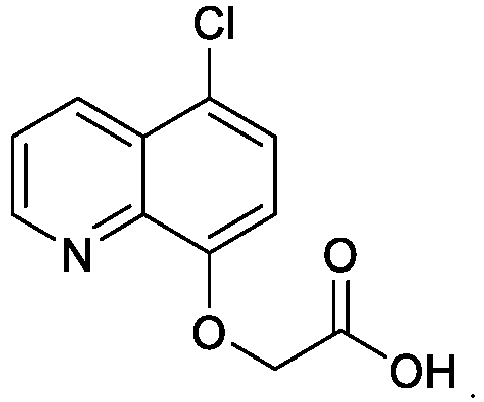
- Cloquintocet mexyl is 1-methylhexyl (5-chloroquinolin-8-yloxy)acetate and has the following structure:

- Exemplary uses of cloquintocet mexyl include its use as a herbicide safener in combination with grass-active herbicides (pinoxaden, clodinafop-propargyl) for selective control of annual grasses (Alopecurus myosuroides, Avena spp., Lolium spp., Phalaris spp., Poa trivialis, Setaria spp.) in small grain cereals.
- In some embodiments, the cloquintocet is cloquintocet (acid). In other embodiments, the cloquintocet is cloquintocet-mexyl.
- In some embodiments, the herbicide safener is mefenpyr or an agriculturally acceptable salt or ester thereof.
- As used herein, mefenpyr is 1-(2,4-dichlorophenyl)-5-methyl-2-pyrazoline-3,5-dicarboxylic acid, which has the following structure:

- An exemplary form of mefenpyr is mefenpyr-diethyl or diethyl (RS)-1-(2,4-dichlorophenyl)-5-methyl-2-pyrazoline-3,5-dicarboxylate, which has the following structure:

- Mefenpyr-diethyl is used as a herbicide safener in combination with fenoxaprop-P-ethyl, for selective weed control in wheat, rye, triticale and some barley varieties.
- In some embodiments, the herbicide safener is mefenpyr-diethyl.
- In the compositions and methods described herein, the halauxifen or a salt or ester thereof is used in combination with (ii) a herbicide safener capable of safening the halauxifen to the Brassica species. The weight ratio of the halauxifen or a salt or ester thereof to (ii) a herbicide safener capable of safening the halauxifen to the Brassica species is within the range of from 1:50 to 10:1. The weight ratio of the halauxifen or a salt or ester thereof, to (ii) a herbicide safener capable of safening the halauxifen to the Brassica species can also be within the range from 1:45 to 10:1, 1:40 to 10:1, 1:35 to 10:1, 1:30 to 10:1, 1:25 to 10:1, 1:24 to 10:1, 1:23 to 10:1, 1:22 to 10:1, 1:20 to 10:1, 1:19 to 10:1, 1:18 to 10:1, 1:17 to 10:1, 1:16 to 10:1, 1:15 to 10:1, 1:10 to 10:1, 1:5 to 5:1, 1:2 to 2:1, 1:1.5 to 1.5:1, 1:1 to 1:2, 1:50 to 5:1, 1:48 to 5:1, 1:45 to 5:1, 1:40 to 5:1, 1:39 to 5:1, 1:38 to 5:1, 1:37 to 5:1, 1:36 to 5:1, 1:34 to 5:1, 1:32 to 5:1, 1:30 to 5:1, 1:30 to 5:1, 1:28 to 5:1, 1:26 to 5:1, 1:24 to 5:1, 1:20 to 5:1, 1:18 to 5:1, 1:16 to 5:1, 1:50 to 2:1, 1:48 to 2:1, 1:46 to 2:1, 1:44 to 2:1, 1:42 to 2:1, 1:40 to 2:1, 1:38 to 2:1, 1:36 to 2:1, 1:34 to 2:1, 1:34 to 2:1, 1:32 to 2:1, 1:30 to 2:1, 1:28 to 2:1, 1:26 to 2:1, 1:25 to 2:1, 1:24 to 2:1, 1:23 to 2:1, 1:22 to 2:1, 1:20 to 2:1, 1:19 to 2:1, 1:18 to 2:1, 1:17 to 2:1, or 1:16 to 2:1.
- In certain embodiments of the compositions and methods described herein, the (a) halauxifen or a salt or ester thereof is used in combination with (b) one or more of (i) a herbicide[s], capable of safening the halauxifen to the Brassica species, or a salt or ester thereof, and (ii) a herbicide safener, capable of safening the halauxifen to the Brassica species, or a salt or ester thereof, as defined in appended claims 1 and 2. With regard to the compositions, in some embodiments, the three components are used in amounts such that the weight ratio of the (a) halauxifen or a salt or ester thereof is used in combination with (b) (i) clopyralid or an agriculturally acceptable salt or ester thereof, and (ii) a herbicide safener, capable of safening the halauxifen to the Brassica species, or a salt or ester thereof [i.e. (a):(i):(ii)] is from about 1-10 of (a) to about 1-400 of (i) to about 1-50 of (ii). In additional embodiments, the weight ratios of the three components include from about 1-9 of (a) to about 1-375 of (i) to about 1-47 of (ii); from about 1-8 of (a) to about 1-350 of (i) to about 1-46 of (ii); from about 1-7 of (a) to about 1-335 of (i) to about 1-38 of (ii); from about 1-6 of (a) to about 1-320 of (i) to about 1-37 of (ii); from about 1-5 of (a) to about 1-300 of (i) to about 1-36 of (ii); from about 1-4.7 of (a) to about 1.1-275 of (i) to about 1-33 of (ii); from about 1-4.3 of (a) to about 1.2-250 of (i) to about 1-30 of (ii); from about 1-4 of (a) to about 1.2-200 of (i) to about 1-25 of (ii); and from about 1-3.5 of (a) to about 1.4-175 of (i) to about 1-20 of (c). In other embodiments, the weight ratio of the (a) halauxifen or a salt or ester thereof is used in combination with (b) (i) clopyralid or an agriculturally acceptable salt or ester thereof, and (ii) a herbicide safener, capable of safening the halauxifen to the Brassica species, or a salt or ester thereof is within the range from about 1-3 of (a) to about 1.5-144 of (i) to about 1-16 of (ii).
- Stated another way, the three components are used in amounts such that the weight ratio of the (a) halauxifen or a salt or ester thereof is used in combination with (b) (i) clopyralid or an agriculturally acceptable salt or ester thereof and (ii) a herbicide safener, capable of safening the halauxifen to the Brassica species, or a salt or ester thereof [i.e. (a):(i):(ii)] is from about 1:400:50 to about 10:6: 1; from 1:30:50 to about 10:120:1; from about 1:200:36 to about 5: 10: 1; from about 1:32: 36 to about 5:62.5: 1; from about 1:80: 16 to about 2: 10:1; or from about 1:20: 16 to about 2:40: 1.
- In certain embodiments of the compositions and methods described herein, the (a) halauxifen or a salt or ester thereof is used in combination with (b) one or more of (i) a herbicide[s], capable of safening the halauxifen to the Brassica species, or a salt or ester thereof, and (ii) a herbicide safener, capable of safening the halauxifen to the Brassica species, or a salt or ester thereof. With regard to the compositions, in some embodiments, the three components are used in amounts such that the weight ratio of the (a) halauxifen or a salt or ester thereof is used in combination with (b) (i) quinclorac or an agriculturally acceptable salt or ester thereof, and (ii) a herbicide safener, capable of safening the halauxifen to the Brassica species, or a salt or ester thereof [i.e. (a):(i):(ii)] is from about 1-25 of (a) to about 1.2-300 of (i) to about 1-50 of (ii). In additional embodiments, the weight ratios of the three components include from about 1-20 of (a) to about 1.2-250 of (i) to about 1-45 of (ii); from about 1-15 of (a) to about 1.2-200 of (i) to about 1-40 of (ii); from about 1-10 of (a) to about 1.2-150 of (i) to about 1-38 of (ii); from about 1-7.5 of (a) to about 1.2-140 of (i) to about 1-37 of (ii); from about 1-5 of (a) to about 2-200 of (i) to about 1-36 of (ii); from about 1-4.5 of (a) to about 1.2-100 of (i) to about 1-33 of (ii); from about 1-4 of (a) to about 1.2-80 of (i) to about 1-30 of (ii); from about 1-3.5 of (a) to about 3-180 of (i) to about 1-25 of (ii); and from about 1-3 of (a) to about 4-120 of (i) to about 1-20 of (c). In other embodiments, the weight ratio of the (a) halauxifen or a salt or ester thereof is used in combination with (b) (i) quinclorac or an agriculturally acceptable salt or ester thereof, and (ii) a herbicide safener, capable of safening the halauxifen to the Brassica species, or a salt or ester thereof is within the range from about 1-2 of (a) to about 5-80 of (i) to about 1-16 of (ii).
- Stated another way, the three components are used in amounts such that the weight ratio of the (a) halauxifen or a salt or ester thereof is used in combination with (b) (i) quinclorac or an agriculturally acceptable salt or ester thereof, and (ii) a herbicide safener, capable of safening the halauxifen to the Brassica species, or a salt or ester thereof [i.e. (a):(i):(ii)] is from about 1:300:50 to about 10:12:1; from 1:15:50 to about 10:160:1; from about 1:300:36 to about 5:5:1; from about 1:16: 36 to about 5:93.8:1; from about 1:144:16 to about 3:4.5: 1; or from about 1:9:16 to about 3:72:1.
- The safened compositions can further, be used in conjunction with 5-enolpyruvylshikimate-3-phosphate (EPSP) synthase inhibitors (e.g., glyphosate), glutamine synthetase inhibitors (e.g., glufosinate), synthetic auxins (e.g., dicamba, phenoxy auxins, pyridyloxy auxins), auxin transport inhibitors, acetyl CoA carboxylase (ACCase) inhibitors (e.g., aryloxyphenoxypropionates, cyclohexanediones, phenylpyrazolines), acetolactate synthase (ALS) or acetohydroxy acid synthase (AHAS) inhibitors (e.g., imidazolinones, sulfonylureas, pyrimidinylthiobenzoates, triazolopyrimidines, sulfonylaminocarbonyltriazolinones), 4-hydroxyphenyl-pyruvate dioxygenase (HPPD) inhibitors, phytoene desaturase inhibitors, carotenoid biosynthesis inhibitors, protoporphyrinogen oxidase (PPO) inhibitors, cellulose biosynthesis inhibitors, mitosis inhibitors, microtubule inhibitors, very long chain fatty acid inhibitors, fatty acid and lipid biosynthesis inhibitors, photosystem I inhibitors, and photosystem II inhibitors (e.g., triazines and bromoxynil).
- The safened herbicide mixtures described herein can be applied in conjunction with one or more other herbicides to control a wider variety of undesirable vegetation. When used in conjunction with other herbicides, the composition can be formulated with the other herbicide or herbicides, tank mixed with the other herbicide or herbicides, or applied sequentially with the other herbicide or herbicides. Some of the herbicides that can be employed in conjunction with the compositions and methods described herein include, but are not limited to: 4-CPA, 4-CPB, 4-CPP, 2,4-D, 3,4-DA, 2,4-DB, 3,4-DB, 2,4-DEB, 2,4-DEP, 3,4-DP, 2,3,6-TBA, 2,4,5-T, 2,4,5-TB, acetochlor, acifluorfen, aclonifen, alachlor, allidochlor, alloxydim, alorac, ametridione, ametryn, amibuzin, amicarbazone, amidosulfuron, aminocyclopyrachlor, aminopyralid, amiprofos-methyl, amitrole, ammonium sulfamate, anilofos, anisuron, asulam, atraton, atrazine, azafenidin, azimsulfuron, aziprotryne, barban, BCPC, beflubutamid, benazolin, bencarbazone, benfluralin, benfuresate, bensulfuron-methyl, bensulide, benthiocarb, bentazon-sodium, benzadox, benzfendizone, benzipram, benzobicyclon, benzofenap, benzofluor, benzoylprop, benzthiazuron, bialaphos, bicyclopyrone, bifenox, bilanafos, bispyribac-sodium, borax, bromacil, bromobonil, bromobutide, bromofenoxim, bromoxynil, brompyrazon, butachlor, butafenacil, butamifos, butenachlor, buthidazole, buthiuron, butralin, butroxydim, buturon, butylate, cacodylic acid, cafenstrole, calcium chlorate, calcium cyanamide, cambendichlor, carbasulam, carbetamide, carboxazole, chlorprocarb, carfentrazone-ethyl, CDEA, CEPC, chlomethoxyfen, chloramben, chloranocryl, chlorazifop, chlorazine, chlorbromuron, chlorbufam, chloreturon, chlorfenac, chlorfenprop, chlorflurazole, chlorflurenol, chloridazon, chlorimuron, chlornitrofen, chloropon, chlorotoluron, chloroxuron, chloroxynil, chlorpropham, chlorsulfuron, chlorthal, chlorthiamid, cinidon-ethyl, cinmethylin, cinosulfuron, cisanilide, clethodim, cliodinate, clodinafop-propargyl, clofop, clomazone, clomeprop, cloprop, cloproxydim, cloransulam-methyl, CMA, copper sulfate, CPMF, CPPC, credazine, cresol, cumyluron, cyanatryn, cyanazine, cycloate, cyclopyrimorate, cyclosulfamuron, cycloxydim, cycluron, cyhalofop-butyl, cyperquat, cyprazine, cyprazole, cypromid, dalapon, dazomet, delachlor, desmedipham, desmetryn, di-allate, dicamba, dichlobenil, dichloralurea, dichlormate, dichlorprop, dichlorprop-P, diclofop-methyl, diclosulam, diethamquat, diethatyl, difenopenten, difenoxuron, difenzoquat, diflufenican, diflufenzopyr, dimefuron, dimethachlor, dimethametryn, dimethenamid, dimethenamid-P, dimexano, dimidazon, dinitramine, dinofenate, dinoprop, dinosam, dinoseb, dinoterb, diphenamid, dipropetryn, diquat, disul, dithiopyr, diuron, DMPA, DNOC, DSMA, EBEP, eglinazine, endothal, epronaz, EPTC, erbon, esprocarb, ethalfluralin, ethametsulfuron, ethidimuron, ethiolate, ethofumesate, ethoxyfen, ethoxysulfuron, etinofen, etnipromid, etobenzanid, EXD, fenasulam, fenoprop, fenoxaprop, fenoxaprop-P-ethyl, fenoxaprop-P-ethyl + isoxadifen-ethyl, fenoxasulfone, fenquinotrione, fenteracol, fenthiaprop, fentrazamide, fenuron, flamprop, flamprop-M, flazasulfuron, florasulam, florpyrauxifen, fluazifop, fluazifop-P-butyl, fluazolate, flucarbazone, flucetosulfuron, fluchloralin, flufenacet, flufenican, flufenpyr-ethyl, flumetsulam, flumezin, flumiclorac-pentyl, flumioxazin, flumipropyn, fluometuron, fluorodifen, fluoroglycofen, fluoromidine, fluoronitrofen, fluothiuron, flupoxam, flupropacil, flupropanate, flupyrsulfuron, fluridone, flurochloridone, fluroxypyr, flurtamone, fluthiacet, fomesafen, foramsulfuron, fosamine, fumiclorac, furyloxyfen, glufosinate salts and esters, glufosinate-ammonium, glufosinate-P-ammonium, glyphosate salts and esters, halosafen, halosulfuron-methyl, haloxydine, haloxyfop-methyl, haloxyfop-P-methyl, hexachloroacetone, hexaflurate, hexazinone, imazamethabenz, imazamox, imazapic, imazapyr, imazaquin, imazethapyr, imazosulfuron, indanofan, indaziflam, iodobonil, iodomethane, iodosulfuron, iodosulfuron-ethyl-sodium, iofensulfuron, ioxynil, ipazine, ipfencarbazone, iprymidam, isocarbamid, isocil, isomethiozin, isonoruron, isopolinate, isopropalin, isoproturon, isouron, isoxaben, isoxachlortole, isoxaflutole, isoxapyrifop, karbutilate, ketospiradox, lancotrione, lactofen, lenacil, linuron, MAA, MAMA, MCPA, MCPB, mecoprop, mecoprop-P, medinoterb, mefenacet, mefluidide, mesoprazine, mesosulfuron, mesotrione, metam, metamifop, metamitron, metazachlor, metazosulfuron, metflurazon, methabenzthiazuron, methalpropalin, methazole, methiobencarb, methiozolin, methiuron, methometon, methoprotryne, methyl isothiocyanate, methyldymron, metobenzuron, metobromuron, metolachlor, metosulam, metoxuron, metribuzin, metsulfuron, metsulfuron-methyl, molinate, monalide, monisouron, monochloroacetic acid, monolinuron, monuron, morfamquat, MSMA, naproanilide, napropamide, napropamide-M, naptalam, neburon, nicosulfuron, nipyraclofen, nitralin, nitrofen, nitrofluorfen, norflurazon, noruron, orbencarb, orthosulfamuron, oryzalin, oxadiargyl, oxadiazon, oxapyrazon, oxasulfuron, oxaziclomefone, oxyfluorfen, paraflufen-ethyl, parafluron, paraquat, pebulate, pelargonic acid, pendimethalin, penoxsulam, pentachlorophenol, pentanochlor, pentoxazone, perfluidone, pethoxamid, phenisopham, phenmedipham, phenmedipham-ethyl, phenobenzuron, phenyl mercury acetate, picloram, picolinafen, pinoxaden, piperophos, potassium arsenite, potassium azide, potassium cyanate, pretilachlor, primisulfuron-methyl, procyazine, prodiamine, profluazol, profluralin, profoxydim, proglinazine, prohexadione-calcium, prometon, prometryn, pronamide, propachlor, propanil, propaquizafop, propazine, propham, propisochlor, propoxycarbazone, propyrisulfuron, propyzamide, prosulfalin, prosulfocarb, prosulfuron, proxan, prynachlor, pydanon, pyraclonil, pyraflufen-ethyl, pyrasulfotole, pyrazogyl, pyrazolynate, pyrazosulfuron-ethyl, pyrazoxyfen, pyribenzoxim, pyributicarb, pyriclor, pyridafol, pyridate, pyriftalid, pyriminobac, pyrimisulfan, pyrithiobac-sodium, pyroxasulfone, pyroxsulam, quinclorac, quinmerac, quinoclamine, quinonamid, quizalofop, quizalofop-P-ethyl, rhodethanil, rimsulfuron, saflufenacil, S-metolachlor, sebuthylazine, secbumeton, sethoxydim, siduron, simazine, simeton, simetryn, SMA, sodium arsenite, sodium azide, sodium chlorate, sulcotrione, sulfallate, sulfentrazone, sulfometuron, sulfosate, sulfosulfuron, sulfuric acid, sulglycapin, swep, SYN-523, TCA, tebutam, tebuthiuron, tefuryltrione, tembotrione, tepraloxydim, terbacil, terbucarb, terbuchlor, terbumeton, terbuthylazine, terbutryn, tetrafluron, thenylchlor, thiazafluron, thiazopyr, thidiazimin, thidiazuron, thiencarbazone-methyl, thifensulfuron, thifensulfuron-methyl, thiobencarb, tiafenacil, tiocarbazil, tioclorim, tolpyralate, topramezone, tralkoxydim, triafamone, tri-allate, triasulfuron, triaziflam, tribenuron, tribenuron-methyl, tricamba, triclopyr, tridiphane, trietazine, trifloxysulfuron, trifludimoxazin, trifluralin, triflusulfuron, trifop, trifopsime, trihydroxytriazine, trimeturon, tripropindan, tritac, tritosulfuron, vernolate, xylachlor and salts, esters, optically active isomers and mixtures thereof.
- In some embodiments, the compositions described herein are employed in combination with one or more plant growth regulators, such as 2,3,5-tri-iodobenzoic acid, IAA, IBA, naphthaleneacetamide, α-naphthaleneacetic acids, benzyladenine, 4-hydroxyphenethyl alcohol, kinetin, zeatin, endothal, pentachlorophenol, thidiazuron, tribufos, aviglycine, ethephon, maleic hydrazide, gibberellins, gibberellic acid, abscisic acid, ancymidol, fosamine, glyphosine, isopyrimol, jasmonic acid, maleic hydrazide, mepiquat, morphactins, dichlorflurenol, flurprimidol, mefluidide, paclobutrazol, tetcyclacis, uniconazole, brassinolide, brassinolide-ethyl, cycloheximide, ethylene, methasulfocarb, prohexadione, triapenthenol, and trinexapac-ethyl. In some embodiments, the plant growth regulator is mixed with the halauxifen to cause a preferentially advantageous effect on plants.
- The compositions provided herein can further include one or more agriculturally acceptable adjuvant or carrier. Suitable adjuvants or carriers should not be phytotoxic to the Brassica species, particularly at the concentrations employed in applying the compositions for selective weed control in the presence of the Brassica species and should not react chemically with herbicidal components or other composition ingredients. Such mixtures can be designed for application directly to weeds or their locus or can be concentrates or formulations that are normally diluted with additional carriers and adjuvants before application. The adjuvants or carriers can be solids, such as, for example, dusts, granules, water-dispersible granules, or wettable powders, or liquids, such as, for example, emulsifiable concentrates, solutions, emulsions or suspensions. Additionally, the adjuvants or carriers can also be provided as a premix or tank mixed.
- Suitable agricultural adjuvants and carriers are well known to those of skill in the art and include, but are not limited to, crop oil concentrate; nonylphenol ethoxylate; benzylcocoalkyldimethyl quaternary ammonium salt; blend of petroleum hydrocarbon, alkyl esters, organic acid, and anionic surfactant; C9-C11 alkylpolyglycoside; phosphated alcohol ethoxylate; natural primary alcohol (C12-C16) ethoxylate; di-sec-butylphenol EO-PO block copolymer; polysiloxane-methyl cap; nonylphenol ethoxylate + urea ammonium nitrate; emulsified methylated seed oil; tridecyl alcohol (synthetic) ethoxylate (8EO); tallow amine ethoxylate (15 EO); PEG(400) dioleate-99.
- Examples of liquid carriers that can be used in the compositions and methods described herein include water and organic solvents. Examples of useful organic solvents include, but are not limited to, petroleum fractions or hydrocarbons such as mineral oil, aromatic solvents, paraffinic oils, and the like; vegetable oils such as soybean oil, rapeseed oil, olive oil, castor oil, sunflower seed oil, coconut oil, corn oil, cottonseed oil, linseed oil, palm oil, peanut oil, safflower oil, sesame oil, tung oil and the like; esters of the above vegetable oils; esters of monoalcohols or dihydric, trihydric, or other lower polyalcohols (4-6 hydroxy containing), such as 2-ethyl hexyl stearate, n-butyl oleate, isopropyl myristate, propylene glycol dioleate, di-octyl succinate, di-butyl adipate, di-octyl phthalate and the like; esters of mono, di and polycarboxylic acids and the like. Specific organic solvents include, but are not limited to toluene, xylene, petroleum naphtha, crop oil, acetone, methyl ethyl ketone, cyclohexanone, trichloroethylene, perchloroethylene, ethyl acetate, amyl acetate, butyl acetate, propylene glycol monomethyl ether and diethylene glycol monomethyl ether, methyl alcohol, ethyl alcohol, isopropyl alcohol, amyl alcohol, ethylene glycol, propylene glycol, glycerine, N-methyl-2-pyrrolidinone, N,N-dimethyl alkylamides, dimethyl sulfoxide, liquid fertilizers and the like. Water is useful as a carrier for the dilution of concentrates.
- Suitable solid carriers include but are not limited to talc, pyrophyllite clay, silica, attapulgus clay, kaolin clay, kieselguhr, chalk, diatomaceous earth, lime, calcium carbonate, bentonite clay, Fuller's earth, cottonseed hulls, wheat flour, soybean flour, pumice, wood flour, walnut shell flour, lignin, cellulose, and the like.
- The compositions described herein may further include one or more surface-active agents. Such surface-active agents can be used in both solid and liquid compositions, and can be designed to be diluted with a carrier before application. The surface-active agents can be anionic, cationic or nonionic in character and can be employed as emulsifying agents, wetting agents, suspending agents, or for other purposes. Surfactants which may also be used in the present formulations are described, inter alia, in McCutcheon's Detergents and Emulsifiers Annual, MC Publishing Corporation: Ridgewood, NJ, 1998 and in Encyclopedia of Surfactants, Vol. I-III, Chemical Publishing Company: New York, 1980-81. Surface-active agents include, but are not limited to salts of alkyl sulfates, such as diethanolammonium lauryl sulfate; alkylarylsulfonate salts, such as calcium dodecylbenzenesulfonate; alkylphenol-alkylene oxide addition products, such as nonylphenol-C18 ethoxylate; alcohol-alkylene oxide addition products, such as tridecyl alcohol-C16 ethoxylate; soaps, such as sodium stearate; alkylnaphthalene-sulfonate salts, such as sodium dibutylnaphthalenesulfonate; dialkyl esters of sulfosuccinate salts, such as sodium di(2-ethylhexyl) sulfosuccinate; sorbitol esters, such as sorbitol oleate; quaternary amines, such as lauryl trimethylammonium chloride; polyethylene glycol esters of fatty acids, such as polyethylene glycol stearate; block copolymers of ethylene oxide and propylene oxide; salts of mono and dialkyl phosphate esters; vegetable or seed oils such as soybean oil, rapeseed/canola oil, olive oil, castor oil, sunflower seed oil, coconut oil, corn oil, cottonseed oil, linseed oil, palm oil, peanut oil, safflower oil, sesame oil, tung oil and the like; and esters of the above vegetable oils, e.g., methyl esters. These materials, such as vegetable or seed oils and their esters, can be used interchangeably as an agricultural adjuvant, as a liquid carrier or as a surface active agent.
- Other additives useful in the compositions provided herein include, but are not limited to, compatibilizing agents, antifoam agents, sequestering agents, neutralizing agents and buffers, corrosion inhibitors, dyes, odorants, spreading agents, penetration aids, sticking agents, dispersing agents, thickening agents, freezing point depressants, antimicrobial agents, and the like. The compositions may also contain other compatible components, for example, other herbicides, plant growth regulants, fungicides, insecticides, and the like and can be formulated with liquid fertilizers or solid, particulate fertilizer carriers such as ammonium nitrate, urea and the like.
- The concentration of active ingredients in the compositions described herein is generally from 0.0005 to 98 percent by weight. Additionally, concentrations from 0.0006 to 90 percent by weight can be used. In compositions designed to be employed as concentrates, the active ingredients can be present in a concentration from 0.1 to 98 weight percent or from 0.5 to 90 weight percent. Such compositions can be diluted with an inert carrier, such as, for example, water, before application. The diluted compositions usually applied to vegetation or the soil adjacent thereto can contain from 0.0006 to 15.0 weight percent active ingredient or from 0.001 to 10.0 weight percent active ingredient.
- Provided herein also are methods for safening Brassica species susceptible to injury from halauxifen, including applying to the Brassica species, contacting the vegetation, or area adjacent thereto with a herbicidal composition containing (a) a herbicidally effective amount of halauxifen, an agriculturally acceptable salt or ester thereof, or combinations thereof and (b) one or more of (i) a herbicide[s], capable of safening the halauxifen to the Brassica species, or an agriculturally acceptable salt or ester thereof; or (ii) a herbicide safener, capable of safening the halauxifen to the Brassica species, or an agriculturally acceptable salt or ester thereof, as defined in appended claim 2.
- The Brassica species susceptible to injury from halauxifen or an agriculturally acceptable salt or ester thereof, include, but are not limited to, all varieties of canola and oil seed rape (Brassica napus, BRSNN), forage brassica, garden brassica and seed producing brassica, including spring rape or Spring Argentine canola (Brassica napus, BRSNS), winter oilseed rape (Brassica napus, BRSNW), Roundup Ready® canola (Brassica napus, RR-BRSNN), Nexera™ canola (Brassica napus, BRSNN-NEX), stem kale (Brassica oleracea var. acephala subvar. medullosa, BRSOM), Aparima Gold swede (Brassica sp., BRSSS), rutabaga (Brassica napus var. napobrassica, BRSNA), turnip or Polish canola (Brassica rapa, BRSRR), kale/Chinese kale (Brassica alboglabra, BRSAG), Juncea canola or brown mustard (Brassica juncea, BRSJU), broccoli/cauliflower (Brassica oleracea [botrytis], BRSOK), cabbage (Brassica oleracea [capitata], BRSOL), Abyssinian mustard (Brassica carinata, BRSCA), yellow mustard (Sinapis alba, SINAL) and Gold-of-Pleasure (Camelina sativa, CMASA).
- The halauxifen or an agriculturally acceptable salt or ester of thereof and the one or more of (i) one or more herbicide[s] capable of safening halauxifen in Brassica species, or an agriculturally acceptable salt or ester thereof; or (ii) a herbicide safener, capable of safening halauxifen in Brassica species, or an agriculturally acceptable salt or ester thereof as described herein, can be applied either separately or together as part of a system. When part of a system, for example, halauxifen or an agriculturally acceptable salt or ester of thereof and the one or more of (i) one or more herbicide[s] capable of safening halauxifen in Brassica species, or an agriculturally acceptable salt or ester thereof; or (ii) a herbicide safener, capable of safening halauxifen in Brassica species, or an agriculturally acceptable salt or ester thereof as described herein, can be formulated in one composition, tank mixed, applied simultaneously, or applied sequentially. The halauxifen or an agriculturally acceptable salt or ester of thereof and the one or more of (i) one or more herbicide[s] capable of safening halauxifen in Brassica species or an agriculturally acceptable salt or ester thereof; or (ii) a herbicide safener, capable of safening halauxifen in Brassica species, or an agriculturally acceptable salt or ester thereof as described herein, can be applied pre-emergently to the Brassica species or the undesirable vegetation or post-emergently to the Brassica species or the undesirable vegetation.
- Herbicidal activity is exhibited by halauxifen or an agriculturally acceptable salt or ester of thereof, when it is applied directly to a plant or to the area adjacent to the plant at any stage of growth. The herbicidal activity observed depends upon the plant species to be controlled, the stage of growth of the plant, the application parameters of dilution and spray drop size, the particle size of solid components, the environmental conditions at the time of use, the specific compound employed, the specific adjuvants and carriers employed, the soil type, and the like, as well as the amount of chemical applied. These and other factors can be adjusted to promote non-selective or selective herbicidal action. The compositions of halauxifen described herein may be applied as a post-emergence application, or pre-emergence application, to relatively immature undesirable vegetation to achieve the maximum control of the undesirable vegetation.
- The application rate will depend upon the particular type of weed to be controlled, the degree of control required, and the timing and method of application. In the compositions described herein the halauxifen, or a salt or ester thereof, can be applied at an application rate of from 1 gram acid equivalent per hectare (g ae/ha) to 25 g ae/ha based on the total amount of the halauxifen, or a salt or ester thereof, in the composition. Additionally, in the compositions described herein the halauxifen, or a salt or ester thereof, can be applied at an application rate of from 1 g ae/ha to 22 g ae/ha, 1 g ae/ha to 20 g ae/ha, 1 g ae/ha to 19 g ae/ha, 1 g ae/ha to 18 g ae/ha, 1 g ae/ha to 17 g ae/ha, 1 g ae/ha to 16 g ae/ha, 1 g ae/ha to 15 g ae/ha, 1.1 g ae/ha to 25 g ae/ha, 1.1 g ae/ha to 22 g ae/ha, 1.1 g ae/ha to 20 g ae/ha, 1.1 g ae/ha to 19 g ae/ha, 1.1 g ae/ha to 18 g ae/ha, 1.1 g ae/ha to 17 g ae/ha, 1.1 g ae/ha to 16 g ae/ha, 1.1 g ae/ha to 15 g ae/ha, 1.25 g ae/ha to 25 g ae/ha, 1.25 g ae/ha to 22 g ae/ha, 1.25 g ae/ha to 20 g ae/ha, 1.25 g ae/ha to 19 g ae/ha, 1.25 g ae/ha to 18 g ae/ha, 1.25 g ae/ha to 17 g ae/ha, 1.25 g ae/ha to 16 g ae/ha, 1.25 g ae/ha to 15 g ae/ha, 1.15 g ae/ha to 10 g ae/ha, 2.5 g ae/ha to 25 g ae/ha, 2.5 g ae/ha to 20 g ae/ha, 2.5 g ae/ha to 17.5 g ae/ha, or 2.5 g ae/ha to 15 g ae/ha based on the total amount of the halauxifen, or a salt or ester thereof, in the composition.
- In some embodiments, the (i) herbicide capable of safening the halauxifen to the Brassica species is clopyralid or an agriculturally acceptable salt or ester thereof. In the compositions described herein the clopyralid or an agriculturally acceptable salt or ester thereof, can be applied at an application rate of from 15 g ae/ha to 400 g ae/ha. Additionally, in the compositions described herein the clopyralid or an agriculturally acceptable salt or ester thereof, can be applied at an application rate of from 15 g ae/ha to 380 g ae/ha, 15 g ae/ha to 360 g ae/ha, 15 g ae/ha to 340 g ae/ha, 15 g ae/ha to 320 g ae/ha, 15 g ae/ha to 300 g ae/ha, 15 g ae/ha to 280 g ae/ha, 15 g ae/ha to 260 g ae/ha, 15 g ae/ha to 240 g ae/ha, 15 g ae/ha to 220 g ae/ha, 15 g ae/ha to 200 g ae/ha, 15 g ae/ha to 100 g ae/ha, 15 g ae/ha to 80 g ae/ha, 20 g ae/ha to 400 g ae/ha, 20 g ae/ha to 375 g ae/ha, 20 g ae/ha to 360 g ae/ha, 20 g ae/ha to 340 g ae/ha, 20 g ae/ha to 320 g ae/ha, 20 g ae/ha to 300 g ae/ha, 20 g ae/ha to 280 g ae/ha, 20 g ae/ha to 260 g ae/ha, 20 g ae/ha to 240 g ae/ha, 20 g ae/ha to 220 g ae/ha, 40 g ae/ha to 200 g ae/ha, 20 g ae/ha to 100 g ae/ha, 20 g ae/ha to 80 g ae/ha, 20 g ae/ha to 60 g ae/ha, 22.5 g ae/ha to 50 g ae/ha, 22.5 g ae/ha to 60 g ae/ha, 22.5 g ae/ha to 70 g ae/ha, 22.5 g ae/ha to 80 g ae/ha, 22.5 g ae/ha to 90 g ae/ha, 22.5 g ae/ha to 100 g ae/ha, 22.5 g ae/ha to 120 g ae/ha, 22.5 g ae/ha to 140 g ae/ha, 22.5 g ae/ha to 160 g ae/ha, 22.5 g ae/ha to 180 g ae/ha, 22.5 g ae/ha to 200 g ae/ha, 22.5 g ae/ha to 220 g ae/ha, 22.5 g ae/ha to 240 g ae/ha, 22.5 g ae/ha to 260 g ae/ha, 22.5 g ae/ha to 280 g ae/ha, 22.5 g ae/ha to 300 g ae/ha, 22.5 g ae/ha to 305 g ae/ha, 22.5 g ae/ha to 310 g ae/ha, 22.5 g ae/ha to 315 g ae/ha, 22.5 g ae/ha to 320 g ae/ha, 22.5 g ae/ha to 325 g ae/ha, 22.5 g ae/ha to 330 g ae/ha, 22.5 g ae/ha to 340 g ae/ha, 22.5 g ae/ha to 350 g ae/ha, 22.5 g ae/ha to 395 g ae/ha, 22.5 g ae/ha to 390 g ae/ha, 22.5 g ae/ha to 385 g ae/ha, 22.5 g ae/ha to 380 g ae/ha, 22.5 g ae/ha to 375 g ae/ha, 22.5 g ae/ha to 370 g ae/ha, or 22.5 g ae/ha to 360 g ae/ha, based on the total amount of the clopyralid or an agriculturally acceptable salt or ester thereof in the composition.
- In some embodiments, the (i) herbicide capable of safening the halauxifen to the Brassica species is quinclorac or an agriculturally acceptable salt or ester thereof. In the compositions described herein the quinclorac or an agriculturally acceptable salt or ester thereof, can be applied at an application rate of from 30 g ae/ha to 300 g ae/ha. Additionally, in the compositions described herein the (i) herbicide[s], capable of safening the halauxifen to the Brassica species, or salt or ester thereof, can be applied at an application rate of from 30 g ae/ha to 280 g ae/ha, 30 g ae/ha to 260 g ae/ha, 30 g ae/ha to 240 g ae/ha, 30 g ae/ha to 220 g ae/ha, 30 g ae/ha to 200 g ae/ha, 30 g ae/ha to 180 g ae/ha, 30 g ae/ha to 160 g ae/ha, 30 g ae/ha to 140 g ae/ha, 30 g ae/ha to 120 g ae/ha, 30 g ae/ha to 100 g ae/ha, 30 g ae/ha to 90 g ae/ha, 30 g ae/ha to 80 g ae/ha, 40 g ae/ha to 300 g ae/ha, 40 g ae/ha to 280 g ae/ha, 40 g ae/ha to 260 g ae/ha, 40 g ae/ha to 240 g ae/ha, 40 g ae/ha to 220 g ae/ha, 40 g ae/ha to 200 g ae/ha, 40 g ae/ha to 180 g ae/ha, 40 g ae/ha to 160 g ae/ha, 40 g ae/ha to 140 g ae/ha, 40 g ae/ha to 120 g ae/ha, 40 g ae/ha to 100 g ae/ha, 40 g ae/ha to 90 g ae/ha, 40 g ae/ha to 80 g ae/ha, 50 g ae/ha to 300 g ae/ha, 50 g ae/ha to 280 g ae/ha, 50 g ae/ha to 260 g ae/ha, 50 g ae/ha to 240 g ae/ha, 50 g ae/ha to 220 g ae/ha, 50 g ae/ha to 190 g ae/ha, 50 g ae/ha to 180 g ae/ha, 50 g ae/ha to 160 g ae/ha, 50 g ae/ha to 140 g ae/ha, 50 g ae/ha to 120 g ae/ha, 50 g ae/ha to 100 g ae/ha, 50 g ae/ha to 90 g ae/ha, 50 g ae/ha to 80 g ae/ha, 50 g ae/ha to 290 g ae/ha, 50 g ae/ha to 270 g ae/ha, 30 g ae/ha to 40 g ae/ha, 40 g ae/ha to 50 g ae/ha, 40 g ae/ha to 250 g ae/ha, 50 g ae/ha to 250 g ae/ha, 60 g ae/ha to 300 g ae/ha, 60 g ae/ha to 280 g ae/ha, 70 g ae/ha to 260 g ae/ha, 80 g ae/ha to 250 g ae/ha, 80 g ae/ha to 230 g ae/ha, 80 g ae/ha to 210 g ae/ha, 80 g ae/ha to 190 g ae/ha, 80 g ae/ha to 170 g ae/ha, 90 g ae/ha to 170 g ae/ha, 100 g ae/ha to 170 g ae/ha, or 50 g ae/ha to 200 g ae/ha, based on the total amount of the quinclorac or an agriculturally acceptable salt or ester thereof in the composition.
- In the compositions described herein the (ii) herbicide safener, capable of safening the halauxifen to the Brassica species, or salt or ester thereof, can be applied at an application rate of from 2.5 g ae/ha to 50 g ae/ha. Additionally, in the compositions described herein the (ii) herbicide safener, capable of safening the halauxifen to the Brassica species, or salt or ester thereof, can be applied at an application rate of from 2.5 g ae/ha to 48 g ae/ha, 2.5 g ae/ha to 46 g ae/ha, 2.5 g ae/ha to 44 g ae/ha, 2.5 g ae/ha to 42 g ae/ha, 2.5 g ae/ha to 40 g ae/ha, 4 g ae/ha to 50 g ae/ha, 4 g ae/ha to 48 g ae/ha, 4 g ae/ha to 46 g ae/ha, 4 g ae/ha to 45 g ae/ha, 4 g ae/ha to 44 g ae/ha, 4 g ae/ha to 43 g ae/ha, 4 g ae/ha to 42 g ae/ha, 4 g ae/ha to 41 g ae/ha, 4 g ae/ha to 40 g ae/ha, 5 g ae/ha to 50 g ae/ha, 5 g ae/ha to 48 g ae/ha, 5 g ae/ha to 46 g ae/ha, 5 g ae/ha to 45 g ae/ha, 5 g ae/ha to 44 g ae/ha, 5 g ae/ha to 43 g ae/ha, 5 g ae/ha to 42 g ae/ha, 5 g ae/ha to 41 g ae/ha, or 5 g ae/ha to 40 g ae/ha based on the total amount of the (ii) herbicide safener, capable of safening the halauxifen to the Brassica species in the composition. For example, the (i) herbicide[s], capable of safening the halauxifen to the Brassica species, or a salt or ester thereof, may be applied at a rate from 30 g ae/ha to 300 g ae/ha, the (ii) herbicide safener, capable of safening the halauxifen to the Brassica species, or a salt or ester thereof, may be applied at a rate from 5 g ae/ha to 50 g ae/ha, and the halauxifen, or a salt or ester thereof, may be applied at a rate from 1 g ae/ha to 25 g ae/ha.
- The components of the mixtures described herein can be applied either separately or as part of a multipart herbicidal system.
- The compositions and methods provided herein can be used to control weeds in Brassica species, and also in 5-enolpyruvylshikimate-3-phosphate (EPSP) synthase inhibitor-tolerant (e.g., glyphosate-tolerant), glutamine synthetase inhibitor-tolerant (e.g., glufosinate-tolerant), synthetic auxin-tolerant (e.g., dicamba-tolerant, phenoxy auxin-tolerant, pyridyloxy auxin-tolerant), auxin transport inhibitor-tolerant, acetyl CoA carboxylase (ACCase) inhibitor-tolerant (e.g., aryloxyphenoxypropionate-tolerant), acetolactate synthase (ALS) or acetohydroxy acid synthase (AHAS) inhibitor-tolerant (e.g., imidazolinone-tolerant, sulfonylurea-tolerant, pyrimidinylthiobenzoate-tolerant, triazolopyrimidine-tolerant, and sulfonylaminocarbonyltriazolinone-tolerant), 4-hydroxyphenyl-pyruvate dioxygenase (HPPD) inhibitor-tolerant, phytoene desaturase inhibitor-tolerant, carotenoid biosynthesis inhibitor-tolerant, protoporphyrinogen oxidase (PPO) inhibitor-tolerant, cellulose biosynthesis inhibitor-tolerant, mitosis inhibitor-tolerant, microtubule inhibitor-tolerant, very long chain fatty acid inhibitor-tolerant, fatty acid and lipid biosynthesis inhibitor-tolerant, photosystem I inhibitor-tolerant, and photosystem II inhibitor-tolerant (e.g., triazine-tolerant and bromoxynil-tolerant) Brassica species. The compositions and methods provided herein can be used applied to nursery Brassica species, pre-plant treatments and post-emergence treatments to Brassica species. The compositions and methods may be used in controlling undesirable vegetation in Brassica species genetically transformed to express specialized traits. Examples of specialized traits may include agronomic stress tolerance (including but not limited to drought, cold, heat, salt, water, nutrient, fertility, pH), pest tolerance (including but not limited to insects, fungi and pathogens) and crop improvement traits (including but not limited to yield; protein, carbohydrate, or oil content; protein, carbohydrate, or oil composition; plant stature and plant architecture). Additional examples include those expressing proteins toxic to invertebrate pests, such as Bacillus thuringiensis or other insecticidal toxins, or those with multiple or "stacked" foreign genes expressing insecticidal toxins, herbicide resistance, nutrition-enhancement and/or other beneficial traits, for example, grasses possessing multiple or stacked traits conferring tolerance to multiple chemistries and/or multiple modes of action via single and/or multiple resistance mechanisms.
- The halauxifen or a salt or ester thereof and one or more of (i) one or more herbicide[s], capable of safening halauxifen in Brassica species, or salt or ester thereof; or (ii) a herbicide safener, capable of safening halauxifen in Brassica species, or an agriculturally acceptable salt or ester thereof, can be used in combination with herbicides that are selective to the Brassica species and which complement the spectrum of weeds controlled by the halauxifen. The compositions described herein and the complementary herbicides can be applied at the same time, either as a combination formulation, as a tank mix or sequentially. The compositions and methods may be used in controlling undesirable vegetation in Brassica species possessing agronomic stress tolerance (including but not limited to drought, cold, heat, salt, water, nutrient, fertility, pH), pest tolerance (including but not limited to insects, fungi and pathogens) and crop improvement traits (including but not limited to yield; protein, carbohydrate, or oil content; protein, carbohydrate, or oil composition; plant stature and plant architecture).
- The present compositions can be applied to vegetation or the soil or water adjacent thereto by the use of conventional ground or aerial dusters, sprayers, and granule applicators, by addition to irrigation or paddy water, and by other conventional means known to those skilled in the art.
- The following Examples are presented to illustrate various aspects of the compositions and methods described herein and should not be construed as limitations to the claims.
- Colby's equation was used to determine the herbicidal effects expected from the mixtures evaluated in the described trials (Colby, S. R. Calculation of the synergistic and antagonistic response of herbicide combinations. Weeds 1967, 15, 20-22.).
- The following equation was used to calculate the expected activity of mixtures containing two active ingredients, A and B:

- A = observed efficacy of active ingredient A at the same concentration as used in the mixture;
- B = observed efficacy of active ingredient B at the same concentration as used in the mixture.
- The compositions tested, application rates employed, plant species tested, and results are given in Table 1 through Table 41.
- BRSOM = Brassica oleracea var. acephala subvar. Medullosa (stem kale)
- BRSSS = Brassica sp. (Aparima Gold swede)
- BRSNS = Brassica napus (spring rape or Spring Argentine rape)
- BRSNW = Brassica napus (winter oilseed rape)
- BRSAG = Brassica alboglabra (kale/Chinese kale)
- BRSJU = Brassica juncea (Juncea canola or brown mustard)
- BRSNA = Brassica napus var. napobrassica (rutabaga)
- BRSNN = Brassica napus (all varieties of canola and oilseed rape)
- BRSNN-NEX = Brassica napus (Nexera™ canola)
- BRSRR = Brassica rapa (turnip or Polish canola)
- RR-BRSNN = Brassica napus (Roundup Ready® canola)
- g ae/ha = grams acid equivalent per hectare
- g ai/ha = grams active ingredient per hectare
- Mean % visual injury = observed value of percent (%) injury rated visually
- Observed Mean % visual injury = observed value of percent (%) injury rated visually
- Colby predicted mean % visual injury = expected value of percent (%) injury as calculated by Colby's equation
- Mean % visual deformation = observed value of percent (%) deformation rated visually
- Observed Mean % visual deformation = observed value of percent (%) deformation rated visually
- Colby predicted mean % visual deformation = expected value of percent (%) deformation as calculated by Colby's equation
- Mean % visual growth inhibition = observed value of percent (%) growth inhibition rated visually
- Observed Mean % visual growth inhibition = observed value of percent (%) growth inhibition rated visually
- Colby predicted mean % visual growth inhibition = expected value of percent (%) growth inhibition as calculated by Colby's equation
- Mean % visual leafroll = observed value of percent (%) leafroll rated visually
- Observed Mean % visual leafroll = observed value of percent (%) leafroll rated visually
- Colby predicted mean % visual leafroll = expected value of percent (%) leafroll as calculated by Colby's equation
- Mean % visual epinasty = observed value of percent (%) epinasty rated visually
- Observed Mean % visual epinasty = observed value of percent (%) epinasty rated visually
- Colby predicted mean % visual epinasty = expected value of percent (%) epinasty as calculated by Colby's equation
- Obs = observed value of percent (%) injury rated visually
- Exp = expected value of percent (%) injury as calculated by Colby's equation
- Δ = difference between Obs and Exp values
- Two pot trials were established at Dow AgroSciences Waireka Field Station, New Zealand to evaluate crop safety of herbicide treatments to two species of leafy and bulb forage brassica crops (stem kale (Brassica oleracea var. acephala subvar. medullosa, BRSOM) and Aparima Gold swede (Brassica sp., BRSSS)). Trials were designed as randomized complete blocks with five replicates. Trials were established as weed-free tolerance trials. Pot size was 10 by 10 centimeters (cm, width x length). The forage brassica crops were grown using normal cultural practices for fertilization, seeding, watering and maintenance to ensure good growth of the crops.
- All herbicide treatments were applied post-emergence with applications made to the crops at the 2 to 5-leaf stage. Herbicides were applied with a belt spray chamber system with compressed air as a propellant. The sprayer utilized a flat fan spray nozzle calibrated to deliver a uniform spray pattern that provided thorough coverage of the foliage using a 200 liters per hectare (L/ha) spray volume. All treatments were applied with Uptake adjuvant (paraffinic oil + non-ionic surfactant blend) at 0.5% volume per volume (v/v). Phytotoxicity to the crops was assessed visually at several intervals after application as percent overall injury, compared to an untreated control plot. The overall injury assessments were based on visual ratings of growth inhibition, leaf deformity, epinasty, and chlorosis. In general, three to four replicates were assessed for each treatment. All treatment results, both for the single product and mixtures, are an average of five replicates.
- Halauxifen-methyl was applied as a technical formulation (95.94 grams acid equivalent per liter (g ae/L) suspension concentrate (SC)), and clopyralid-TIPA was applied as Versatill™ (300 g ae/L soluble (liquid) concentrate (SL)),
- The compositions tested, application rates employed, plant species tested, and results are given in Table 1 through Table 3.
Table 1. Reduction in Percent (%) Visual Injury to BRSOM from Postemergence Applications of Halauxifen-methyl + Clopyralid-triisopropanolammonium (TIPA) in Field Trials. Halauxifen-methyl Clopyralid-TIPA Clopyralid-TIPA + Halauxifen-methyl Crop Bayer Code Trial Number Evaluation Interval g ae/ha Mean % Visual Injury g ae/ha Mean % Visual Injury Observed Mean % Visual Injury Colby Predicted Mean % Visual Injury BRSOM 1 15DAA1 15 18.0 90 0.0 8.0 18.0 BRSOM 1 28DAA1 15 26.0 90 0.0 9.2 26.0 BRSOM 2 7DAA1 15 36.7 180 0.0 13.3 36.7 BRSOM 2 7DAA1 15 36.7 360 0.0 5.8 36.7 BRSOM 2 7DAA1 15 36.7 90 0.0 14.2 36.7 BRSOM 2 7DAA1 15 6.0 180 0.7 3.6 6.7 BRSOM 2 7DAA1 15 6.0 22.5 0.7 5.3 6.7 BRSOM 2 7DAA1 15 6.0 360 0.7 2.4 6.7 BRSOM 2 7DAA1 15 6.0 45 0.7 5.2 6.7 BRSOM 2 7DAA1 15 6.0 90 0.7 3.8 6.7 BRSOM 2 15DAA1 15 52.5 180 0.0 21.7 52.5 BRSOM 2 15DAA1 15 52.5 22.5 0.0 34.2 52.5 BRSOM 2 15DAA1 15 52.5 360 0.0 20.0 52.5 BRSOM 2 15DAA1 15 52.5 45 0.0 27.5 52.5 BRSOM 2 15DAA1 15 52.5 90 0.0 24.2 52.5 BRSOM 2 15DAA1 15 46.4 180 0.0 27.6 46.4 BRSOM 2 15DAA1 15 46.4 22.5 0.0 35.4 46.4 BRSOM 2 15DAA1 15 46.4 360 0 26.4 46.4 BRSOM 2 15DAA1 15 46.4 45 0 31.5 46.4 BRSOM 2 15DAA1 15 46.4 90 0 29.2 46.4 BRSOM 2 28DAA1 15 70.8 180 0 50.0 70.8 BRSOM 2 28DAA1 15 70.8 360 0 38.3 70.8 Table 2. Reduction in Percent (%) Visual Injury to BRSSS from Postemergence Applications of Halauxifen-methyl + Clopyralid-triisopropanolammonium (TIPA) in Field Trials. Halauxifen-methyl Clopyralid-TIPA Clopyralid-TIPA + Halauxifen-methyl Crop Bayer Code Evaluation Interval g ae/ha Mean % Visual Injury g ae/ha Mean % Visual Injury Observed Mean % Visual Injury Colby Predicted Mean % Visual Injury BRSSS 3DAA1 15 14.4 90 2.2 10.0 16.3 BRSSS 7DAA1 15 16.2 90 0.4 3.4 16.5 BRSSS 15DAA1 15 16.2 90 0.0 5.2 16.2 BRSSS 28DAA1 15 39.0 90 0.0 33.0 39.0 Table 3. Reduction in Percent (%) Visual Deformation to BRSOM from Postemergence Applications of Halauxifen-methyl + Clopyralid-triisopropanolammonium (TIPA) in Field Trials. Halauxifen-methyl Clopyralid-TIPA Clopyralid-TIPA + Halauxifen-methyl Crop Bayer Code Evaluation Interval g ae/ha Mean % Visual Deformation g ae/ha Mean % Visual Deformation Observed Mean % Visual Deformation Colby Predicted Mean % Visual Deformation BRSOM 7DAA1 15 55.0 180 0.0 8.0 55.0 BRSOM 7DAA1 15 55.0 22.5 0.0 20.8 55.0 BRSOM 7DAA1 15 55.0 360 0.0 3.5 55.0 BRSOM 7DAA1 15 55.0 45 0.0 19.2 55.0 BRSOM 7DAA1 15 55.0 90 0.0 10.0 55.0 BRSOM 7DAA1 15 7.3 180 0.7 2.6 7.9 BRSOM 7DAA1 15 7.3 22.5 0.7 4.5 7.9 BRSOM 7DAA1 15 7.3 360 0.7 1.8 7.9 BRSOM 7DAA1 15 7.3 45 0.7 4.3 7.9 BRSOM 7DAA1 15 7.3 90 0.7 3.2 7.9 BRSOM 15DAA1 15 42.5 180 0.0 15.0 42.5 BRSOM 15DAA1 15 42.5 22.5 0.0 21.7 42.5 BRSOM 15DAA1 15 42.5 360 0.0 10.0 42.5 BRSOM 15DAA1 15 42.5 45 0.0 20.8 42.5 BRSOM 15DAA1 15 42.5 90 0.0 19.2 42.5 BRSOM 15DAA1 15 40.0 180 0.0 22.3 40.0 BRSOM 15DAA1 15 40.0 360 0.0 16.2 40.0 BRSOM 15DAA1 15 40.0 45 0.0 27.0 40.0 BRSOM 15DAA1 15 40.0 90 0.0 25.6 40.0 BRSOM 28DAA1 15 70.0 180 0.0 36.7 70.0 BRSOM 28DAA1 15 70.0 360 0.0 30.0 70.0 BRSOM 28DAA1 15 70.0 90 0.0 41.7 70.0 - Two field trials were established in Canterbury, New Zealand to evaluate crop safety of herbicide treatments to leafy forage brassica crops (Aparima Gold swede (Brassica sp., BRSSS)). Trials were designed as randomized complete blocks with four replicates. All trials were established as weed-free tolerance trials with plot size of 3 meters (m) by 8 m (width x length). The crops were grown using normal cultural practices for fertilization, seeding, and maintenance to ensure good growth of the crop.
- All herbicide treatments were applied post-emergence with applications made to the crops at the 3 to 5-leaf stage. Herbicides were applied with backpack sprayers using carbon dioxide (CO2) as a propellant. The sprayers utilized flat fan spray nozzles calibrated to deliver a uniform spray pattern that provided thorough coverage of the foliage using a 187 L/ha spray volume. All treatments were applied with Uptake adjuvant (paraffinic oil + non-ionic surfactant blend) at 1% v/v. Phytotoxicity to the crops was assessed visually at several intervals after application as percent overall injury, compared to an untreated control plot. The overall injury assessments were based on visual ratings of growth inhibition, leaf deformity, epinasty, and chlorosis. In general, three to four replicates were assessed for each treatment. All treatment results, both for the single product and mixtures, are an average of five replicates.
- Halauxifen-methyl was applied as a technical formulation (95.94 g ae/L SC), and clopyralid-TIPA was applied as Versatill™ (300 g ae/L SL).
- The compositions tested, application rates employed, plant species tested, and results are given in Table 4 through Table 6.
Table 4. Reduction in Percent (%) Visual Injury to BRSSS from Postemergence Applications of Halauxifen-methyl + Clopyralid-triisopropanolammonium (TIPA) in Field Trials. Halauxifen-methyl Clopyralid-TIPA Clopyralid-TIPA + Halauxifen-methyl Crop Bayer Code Evaluation Interval g ae/ha Mean % Visual Injury g ae/ha Mean % Visual Injury Observed Mean % Visual Injury Colby Predicted Mean % Visual Injury BRSSS 22DAA1 7.5 32.5 180 0.5 20.0 32.8 BRSSS 22DAA1 7.5 32.5 90 0.5 27.5 32.9 BRSSS 28DAA1 3.75 10.0 180 3.0 3.5 12.7 BRSSS 28DAA1 3.75 10.0 45 2.8 4.5 12.5 BRSSS 28DAA1 3.75 10.0 90 4.5 5.5 14.1 BRSSS 28DAA1 7.5 27.5 180 3.0 15.0 29.7 Table 5. Reduction in Percent (%) Visual Growth Inhibition to BRSSS from Postemergence Applications of Halauxifen-methyl + Clopyralid-triisopropanolammonium (TIPA) in Field Trials. Halauxifen-methyl Clopyralid-TIPA Clopyralid-TIPA + Halauxifen-methyl Crop Bayer Code Evaluation Interval g ae/ha Mean % Visual Growth Inhibition g ae/ha Mean % Visual Growth Inhibition Observed Mean % Visual Growth Inhibition Colby Predicted Mean % Visual Growth Inhibition BRSSS 22DAA1 3.75 16.3 90 8.0 9.3 22.8 BRSSS 22DAA1 7.5 25.0 180 7.0 18.8 30.3 BRSSS 22DAA1 7.5 25.0 45 2.0 20.5 26.5 BRSSS 22DAA1 7.5 25.0 90 8.0 21.8 31.0 BRSSS 28DAA1 3.75 15.0 45 2.5 7.5 17.0 BRSSS 28DAA1 3.75 15.0 90 5.0 9.0 19.2 BRSSS 28DAA1 7.5 22.5 45 2.5 17.5 24.6 BRSSS 56DAA1 7.5 23.8 180 4.0 6.5 26.7 BRSSS 56DAA1 7.5 23.8 45 6.0 15.0 28.3 BRSSS 56DAA1 7.5 23.8 90 2.0 12.5 25.2 Table 6. Reduction in Percent (%) Visual Leafroll to BRSOM from Postemergence Applications of Halauxifen-methyl + Clopyralid-triisopropanolammonium (TIPA) in Field Trials. Halauxifen-methyl Clopyralid-TIPA Clopyralid-TIPA + Halauxifen-methyl Crop Bayer Code Evaluation Interval g ae/ha Mean % Visual Leafroll g ae/ha Mean % Visual Leafroll Observed Mean % Visual Leafroll Colby Predicted Mean % Visual Leafroll BRSOM 1DAA1 15 13.3 180 0 0.3 13.3 BRSOM 1DAA1 15 13.3 22.5 0 2.2 13.3 BRSOM 1DAA1 15 13.3 360 0 0.5 13.3 BRSOM 1DAA1 15 13.3 45 0 1.7 13.3 BRSOM 1DAA1 15 13.3 90 0 0.8 13.3 BRSOM 4DAA1 15 27.5 180 0 1.7 27.5 BRSOM 4DAA1 15 27.5 22.5 0 13.3 27.5 BRSOM 4DAA1 15 27.5 360 0 1.0 27.5 BRSOM 4DAA1 15 27.5 45 0 7.5 27.5 BRSOM 4DAA1 15 27.5 90 0 2.3 27.5 BRSOM 7DAA1 15 19.2 180 0 4.7 19.2 BRSOM 7DAA1 15 19.2 360 0 3.2 19.2 BRSOM 7DAA1 15 19.2 45 0 9.8 19.2 BRSOM 7DAA1 15 19.2 90 0 6.3 19.2 BRSOM 15DAA1 15 27.5 180 0 17.2 27.5 BRSOM 15DAA1 15 27.5 90 0 18.8 27.5 BRSOM 28DAA1 15 59.2 360 0 31.7 59.2 BRSOM 28DAA1 15 59.2 90 0 38.3 59.2 - Field trials were established in Canada (in Carman, Manitoba; Edmonton, Alberta; Osler, Saskatchewan; Nisku, Alberta; and Devon, Alberta) to evaluate crop safety of herbicide treatments to Spring Argentine canola (Brassica napus, BRSNS). Trials were designed as randomized complete blocks with four replicates. Trials were established as weed efficacy and crop tolerance trials with plot sizes of 2-3 meters (m) by 8-25 m (width x length). The crops were grown using normal cultural practices for fertilization, seeding, and maintenance to ensure good growth of the crop.
- All herbicide treatments were applied post-emergence with applications made to the crops at the cotyledon to 6-leaf stage. Herbicides were applied with backpack, bicycle, or tractor-mounted sprayers using carbon dioxide (CO2) as a propellant. The sprayers utilized flat fan air-induction spray nozzles calibrated to deliver a uniform spray pattern that provided thorough coverage of the foliage using a 100 L/ha spray volume. All treatments were applied with Uptake adjuvant (paraffinic oil + non-ionic surfactant blend) at 1% v/v. Phytotoxicity to the crops was assessed visually at several intervals after application as percent overall injury, compared to an untreated control plot. The overall injury assessments were based on visual ratings of growth inhibition, leaf deformity, epinasty, chlorosis and delay in maturity. In general, three to four replicates were assessed for each treatment. All treatment results, both for the single product and mixtures, are an average of four replicates.
- Halauxifen-methyl was applied as a technical formulation (200 g ae/kg WG); clopyralid-olamine was applied as Lontrel™ 360 (360 g ae/L SL), isoxadifen-ethyl was applied as a suspension concentrate formulation (100 g/L SC); and quinclorac was applied as Accord™ (750 grams active ingredient per kilogram (g ai/kg)). Halauxifen-methyl + clopyralid premixes were applied as emulsifiable concentrate (EC) formulations at 250 g ae/L EC and 125 g ae/L EC.
- The compositions tested, application rates employed, plant species tested, and results are given in Table 7 through Table 28, as well as 30B.
Table 7. Reduction in Percent (%) Visual Injury to BRSNS from Postemergence Applications of Halauxifen-methyl + Clopyralid-olamine in Field Trials. Halauxifen-methyl Clopyralid-olamine Clopyralid-olamine + Halauxifen-methyl Crop Bayer Code Trial Number Evaluation Interval g ae/ha Mean % Visual Injury g ae/ha Mean % Visual Injury Observed Mean % Visual Injury Colby Predicted Mean % Visual Injury BRSNS 1 7DAA1 1.25 1.8 150 1.0 1.0 2.7 BRSNS 1 7DAA1 2.5 1.8 150 1.0 1.3 2.7 BRSNS 1 7DAA1 5 2.0 150 1.0 1.5 3.0 BRSNS 1 17DAA1 0.62 2.5 150 1.3 1.8 3.7 BRSNS 1 17DAA1 1.25 2.5 150 1.3 2.0 3.7 BRSNS 1 17DAA1 2.5 3.3 150 1.3 2.5 4.5 BRSNS 1 17DAA1 5 3.3 150 1.3 2.3 4.5 BRSNS 1 32DAA1 0.62 8.3 150 7.0 4.8 14.7 BRSNS 1 32DAA1 1.25 13.0 150 7.0 10.0 19.0 BRSNS 1 49DAA1 0.62 0.3 150 2.8 0.3 3.0 BRSNS 1 49DAA1 1.25 2.3 150 2.8 1.3 5.0 BRSNS 1 49DAA1 2.5 2.5 150 2.8 1.5 5.2 BRSNS 2 8DAA1 10 4.8 150 1.8 4.0 6.4 BRSNS 2 8DAA1 5 4.0 150 1.8 3.0 5.7 BRSNS 2 8DAA1 10 3.3 150 2.0 3.3 5.2 BRSNS 2 8DAA1 5 3.0 150 2.0 2.0 4.9 BRSNS 2 8DAA1 10 2.8 150 1.3 2.0 4.0 BRSNS 2 8DAA1 5 2.0 150 1.4 2.3 3.2 BRSNS 2 8DAA1 5 2.0 150 1.5 2.0 3.5 BRSNS 2 8DAA1 10 2.0 150 1.0 1.8 3.0 BRSNS 2 17DAA1 10 35.5 150 2.5 25.3 37.3 BRSNS 2 48DAA1 5 1.8 150 2.0 0.5 3.7 BRSNS 2 48DAA1 5 1.5 150 0.8 0.5 2.2 BRSNS 3 33DAA1 10 5.5 150 0.5 3.5 6.0 BRSNS 3 33DAA1 5 6.5 150 0.5 2.5 7.0 BRSNS 3 33DAA1 5 2.0 150 1.0 1.0 3.0 BRSNS 3 69DAA1 2.5 3.0 150 0.0 1.0 3.0 BRSNS 3 69DAA1 5 4.0 150 0.0 0.0 4.0 BRSNS 4 8DAA1 5 8.0 150 1.5 4.0 9.4 BRSNS 4 15DAA1 0.62 3.5 150 1.5 0.0 5.0 BRSNS 4 15DAA1 2.5 14.3 150 1.5 8.5 15.6 BRSNS 4 15DAA1 5 26.3 150 1.5 17.5 27.3 BRSNS 4 41DAA1 5 8.0 150 0.8 5.0 8.7 BRSNS 4 82DAA1 5 6.0 150 0.0 2.3 6.0 BRSNS 5 7DAA1 5 7.5 150 0.5 0.5 8.0 BRSNS 5 7DAA1 10 9.0 150 0.0 2.0 9.0 BRSNS 5 7DAA1 10 3.5 150 0.0 0.5 3.5 BRSNS 5 7DAA1 10 2.0 150 1.3 0.0 3.3 BRSNS 5 7DAA1 10 1.5 150 1.5 0.0 3.0 BRSNS 5 15DAA1 5 27.0 150 0.0 9.8 27.0 BRSNS 5 15DAA1 10 9.0 150 0.0 2.5 9.0 BRSNS 5 15DAA1 10 2.5 150 0.5 1.0 3.0 BRSNS 5 15DAA1 10 1.0 150 0.5 0.0 1.5 BRSNS 5 36DAA1 10 6.0 150 0.5 2.5 6.5 BRSNS 5 79DAA1 10 3.0 150 0.0 0.0 3.0 BRSNS 5 79DAA1 10 4.5 150 0.0 0.8 4.5 BRSNS 5 79DAA1 10 5.3 150 0.0 2.3 5.3 BRSNS 6 6DAA1 10 27.5 150 0.0 12.0 27.5 BRSNS 6 6DAA1 5 24.5 150 0.0 3.8 24.5 BRSNS 6 23DAA1 2.5 38.8 150 0.0 15.5 38.8 BRSNS 6 23DAA1 5 52.5 150 0.0 28.8 52.5 BRSNS 6 33DAA1 2.5 22.5 150 2.0 1.0 24.3 BRSNS 6 33DAA1 5 43.0 150 2.0 10.5 44.5 BRSNS 6 59DAA1 2.5 28.5 150 3.5 11.0 31.7 BRSNS 7 17DAA1 5 45.0 150 0.0 11.7 45.0 BRSNS 7 17DAA1 5 45.0 200 0.0 4.3 45.0 BRSNS 7 17DAA1 5 45.0 100 0.0 18.3 45.0 BRSNS 7 27DAA1 5 34.0 150 0.0 11.0 34.0 BRSNS 7 27DAA1 5 34.0 200 3.0 14.3 36.2 BRSNS 8 7DAA1 5 0.8 150 1.5 0.3 2.3 BRSNS 8 57DAA1 0.62 4.8 150 2.3 4.5 6.9 BRSNS 9 27DAA1 5 6.8 150 1.0 1.0 7.7 BRSNS 9 60DAA1 10 22.5 150 0.0 12.5 22.5 BRSNS 9 60DAA1 10 12.5 150 0.0 5.5 12.5 Table 8. Reduction in Percent (%) Visual Growth Inhibition to BRSNS from Postemergence Applications of Halauxifen-methyl + Clopyralid-olamine in Field Trials. Halauxifen-methyl Clopyralid-olamine Clopyralid-olamine + Halauxifen-methyl Crop Bayer Code Trial Number Evaluation Interval g ae/ha Mean % Visual Growth Inhibition g ae/ha Mean % Visual Growth Inhibition Observed Mean % Visual Growth Inhibition Colby Predicted Mean % Visual Growth Inhibition BRSNS 1 16DAA1 2.5 1.5 150 5.5 3.0 6.9 BRSNS 1 30DAA1 2.5 3.3 150 6.3 4.5 9.3 BRSNS 1 58DAA1 2.5 1.0 150 2.8 0.8 3.7 BRSNS 2 32DAA1 0.62 1.0 150 2.8 0.3 3.7 BRSNS 2 32DAA1 1.25 3.8 150 2.8 1.0 6.4 BRSNS 2 32DAA1 2.5 8.0 150 2.8 2.8 10.5 BRSNS 2 49DAA1 0.62 0.3 150 2.8 0.3 3.0 BRSNS 2 49DAA1 1.25 2.3 150 2.8 1.3 5.0 BRSNS 2 49DAA1 2.5 2.5 150 2.8 1.5 5.2 BRSNS 3 8DAA1 10 3.3 150 0.8 2.3 4.0 BRSNS 3 8DAA1 5 2.5 150 0.8 1.3 3.2 BRSNS 3 8DAA1 10 2.3 150 0.3 1.5 2.5 BRSNS 3 8DAA1 5 1.5 150 0.3 0.5 1.8 BRSNS 3 17DAA1 10 29.5 150 1.0 16.8 30.2 BRSNS 3 17DAA1 5 1.3 150 1.0 1.0 2.2 BRSNS 3 17DAA1 10 2.8 150 1.3 1.3 4.0 BRSNS 3 17DAA1 5 1.5 150 1.3 1.0 2.7 BRSNS 3 35DAA1 10 0.8 150 0.8 0.3 1.5 BRSNS 3 48DAA1 5 1.8 150 2.0 0.5 3.7 BRSNS 3 48DAA1 5 1.5 150 0.8 0.5 2.2 BRSNS 4 13DAA1 10 57.5 150 0.0 45.0 57.5 BRSNS 4 13DAA1 10 31.3 150 0.0 21.3 31.3 BRSNS 5 7DAA1 0.62 1.0 150 1.3 1.3 2.2 BRSNS 5 7DAA1 1.25 1.5 150 1.3 1.0 2.7 BRSNS 5 7DAA1 2.5 1.5 150 1.3 1.5 2.7 BRSNS 5 7DAA1 5 2.0 150 1.3 0.5 3.2 BRSNS 6 33DAA1 5 4.5 150 0.5 0.0 5.0 BRSNS 7 8DAA1 5 8.0 150 1.5 4.0 9.4 BRSNS 7 15DAA1 0.62 2.5 150 1.0 0.0 3.5 BRSNS 7 15DAA1 5 15.5 150 1.0 10.0 16.3 BRSNS 8 7DAA1 5 7.5 150 0.5 0.5 8.0 BRSNS 8 7DAA1 10 9.0 150 0.0 2.0 9.0 BRSNS 8 7DAA1 10 3.5 150 0.0 0.5 3.5 BRSNS 8 7DAA1 10 2.0 150 1.3 0.0 3.3 BRSNS 8 7DAA1 10 1.5 150 1.5 0.0 3.0 BRSNS 8 15DAA1 5 20.0 150 0.0 7.0 20.0 BRSNS 8 15DAA1 10 6.0 150 0.0 2.5 6.0 BRSNS 8 15DAA1 10 2.0 150 0.5 1.0 2.5 BRSNS 9 6DAA1 5 16.3 150 0.0 3.8 16.3 BRSNS 9 23DAA1 2.5 35.0 150 0.0 8.8 35.0 BRSNS 9 23DAA1 5 50.0 150 0.0 26.3 50.0 BRSNS 9 33DAA1 5 25.0 150 0.0 3.8 25.0 BRSNS 9 59DAA1 5 6.3 150 0.0 0.0 6.3 BRSNS 10 17DAA1 5 46.7 150 0.0 13.3 46.7 BRSNS 10 17DAA1 5 46.7 200 0.0 3.3 46.7 BRSNS 10 17DAA1 5 46.7 100 0.0 20.0 46.7 BRSNS 10 27DAA1 5 16.7 150 0.0 1.7 16.7 BRSNS 10 27DAA1 5 16.7 200 1.7 5.0 18.2 BRSNS 11 7DAA1 5 1.3 150 2.5 0.8 3.8 BRSNS 11 15DAA1 0.62 2.0 150 3.0 2.5 4.9 BRSNS 11 15DAA1 1.25 6.5 150 3.0 4.5 9.3 BRSNS 12 15DAA1 10 25.0 150 0.0 13.8 25.0 BRSNS 12 27DAA1 5 5.8 150 1.0 0.5 6.7 Table 9. Reduction in Percent (%) Visual Epinasty to BRSNS from Postemergence Applications of Halauxifen-methyl + Clopyralid-olamine in Field Trials. Halauxifen-methyl Clopyralid-olamine Clopyralid-olamine + Halauxifen-methyl Crop Bayer Code Trial Number Evaluation Interval g ae/ha Mean % Visual Epinasty g ae/ha Mean % Visual Epinasty Observed Mean % Visual Epinasty Colby Predicted Mean % Epinasty BRSNS 1 17DAA1 0.62 2.5 150 1.0 1.3 3.5 BRSNS 1 17DAA1 1.25 2.5 150 1.0 1.8 3.5 BRSNS 1 17DAA1 2.5 3.0 150 1.0 2.3 4.0 BRSNS 1 17DAA1 5 2.5 150 1.0 2.0 3.5 BRSNS 1 32DAA1 0.62 5.0 150 3.5 3.5 8.3 BRSNS 2 35DAA1 10 4.0 150 3.5 5.5 7.4 BRSNS 2 35DAA1 10 2.8 150 2.0 3.0 4.7 BRSNS 3 6DAA1 10 8.8 150 0.0 1.3 8.8 BRSNS 3 6DAA1 5 9.5 150 0.0 0.0 9.5 BRSNS 3 23DAA1 2.5 38.8 150 0.0 15.0 38.8 BRSNS 3 23DAA1 5 50.0 150 0.0 30.0 50.0 BRSNS 4 17DAA1 5 23.3 200 0.0 5.0 23.3 Table 10. Reduction in Percent (%) Visual Injury to BRSNS from Postemergence Applications of Halauxifen-methyl + Clopyralid-olamine in Field Trials. Halauxifen-methyl Clopyralid-olamine Halauxifen-methyl + Clopyralid-olamine Crop Bayer Code Evaluation Interval g ae/ha Mean % Visual Injury g ae/ha Mean % Visual Injury Observed Mean % Visual Injury Colby Predicted Mean % Visual Injury BRSNS 7DAAA 5 0.8 150 0.0 0.0 0.8 BRSNS 15DAAA 5 50.5 150 1.5 17.0 51.2 BRSNS 27DAAA 5 48.5 150 1.0 16.0 49.0 BRSNS 57DAAA 5 30.3 150 2.0 20.8 31.7 Table 11. Reduction in Percent (%) Visual Injury to BRSNS from Postemergence Applications of Halauxifen-methyl + Clopyralid-olamine + Isoxadifen-ethyl in Field Trials. Halauxifen-methyl Clopyralid-olamine Isoxadifen-ethyl Halauxifen-methyl + Clopyralid-olamine + Isoxadifen-ethyl Crop Bayer Code Evaluation Interval g ae/ha Mean % Visual Injury g ae/ha Mean % Visual Injury g ae/ha Mean % Visual Injury* Observed Mean % Visual Injury Colby Predicted Mean % Visual Injury BRSNS 7DAAA 5 0.8 150 0.0 20 0 0.3 0.8 BRSNS 15DAAA 5 50.5 150 1.5 20 0 7.5 51.2 BRSNS 27DAAA 5 48.5 150 1.0 20 0 10.0 49.0 BRSNS 57DAAA 5 30.3 150 2.0 20 0 12.0 31.7 *Assumed to be no injury based upon greenhouse data; however there were no treatments in the field. Table 12. Reduction in Percent (%) Visual Injury to BRSNS from Postemergence Applications of Halauxifen-methyl + Clopyralid Premix (250 g ae/L EC) plus Isoxadifen-ethyl in Field Trials. Halauxifen-methyl + Clopyralid Premix* Isoxadifen-ethyl Halauxifen-methyl + Clopyralid Premix + Isoxadifen-ethyl Crop Bayer Code Evaluation Interval g ae/ha Mean % Visual Injury g ae/ha Mean % Visual Injury** Observed Mean % Visual Injury Colby Predicted Mean % Visual Injury BRSNS 7DAAA 125 0.0 20 0 0.0 0.8 BRSNS 15DAAA 125 20.5 20 0 13.0 51.2 BRSNS 27DAAA 125 23.0 20 0 16.3 49.0 BRSNS 57DAAA 125 23.0 20 0 20.8 31.7 *Halauxifen-methyl (5 g ae/ha) + clopyralid (120 g ae/ha)
**Assumed to be no injury based upon greenhouse data; however there were no treatments in the field.Table 13. Reduction in Percent (%) Visual Injury to BRSNS from Postemergence Applications of Halauxifen-methyl + Clopyralid Premix (125 g ae/L EC) plus Isoxadifen-ethyl in Field Trials. Halauxifen-methyl + Clopyralid Premix* Isoxadifen-ethyl Halauxifen-methyl + Clopyralid Premix + Isoxadifen-ethyl Crop Bayer Code Evaluation Interval g ae/ha Mean % Visual Injury g ae/ha Mean % Visual Injury** Observed Mean % Visual Injury Colby Predicted Mean % Visual Injury BRSNS 7DAAA 125 0.0 20 0 0 0.8 BRSNS 15DAAA 125 21.3 20 0 16 51.2 BRSNS 27DAAA 125 19.3 20 0 15 49.0 BRSNS 57DAAA 125 20.0 20 0 16 31.7 *Halauxifen-methyl (5 g ae/ha) + clopyralid (120 g ae/ha)
**Assumed to be no injury based upon greenhouse data; however there were no treatments in the field.Table 14. Reduction in Percent (%) Visual Injury to BRSNS from Postemergence Applications of Halauxifen-methyl + Quinclorac in Field Trials. Halauxifen-methyl Quinclorac Halauxifen-methyl + Quinclorac Crop Bayer Code Evaluation Interval g ae/ha Mean % Visual Injury g ae/ha Mean % Visual Injury Observed Mean % Visual Injury Colby Predicted Mean % Visual Injury BRSNS 7DAAA 5 0.8 101 0.8 0.0 1.6 BRSNS 15DAAA 5 50.5 101 1.0 8.0 51.0 BRSNS 27DAAA 5 48.5 101 3.0 8.3 50.1 BRSNS 57DAAA 5 30.3 101 1.5 10.8 31.4 Table 15. Reduction in Percent (%) Visual Injury to BRSNS from Postemergence Applications of Halauxifen-methyl + Clopyralid-olamine + Quinclorac in Field Trials. Halauxifen-methyl Clopyralid-olamine Quinclorac Halauxifen-methyl + Clopyralid-olamine + Quinclorac Crop Bayer Code Evaluation Interval g ae/ha Mean % Visual Injury g ae/ha Mean % Visual Injury g ae/ha Mean % Visual Injury Observed Mean % Visual Injury Colby Predicted Mean % Visual Injury BRSNS 7DAAA 5 0.8 150 0.0 101 0.8 0.8 1.6 BRSNS 15DAAA 5 50.5 150 1.5 101 1.0 7.8 51.7 BRSNS 27DAAA 5 48.5 150 1.0 101 3.0 9.0 50.5 BRSNS 57DAAA 5 30.3 150 2.0 101 1.5 12.0 32.7 Table 16. Reduction in Percent (%) Visual Injury to BRSNS from Postemergence Applications of Halauxifen-methyl + Isoxadifen-ethyl in Field Trials. Halauxifen-methyl Isoxadifen-ethyl Halauxifen-methyl + Isoxadifen-ethyl Crop Bayer Code Evaluation Interval g ae/ha Mean % Visual Injury g ae/ha Mean % Visual Injury* Observed Mean % Visual Injury Colby Predicted Mean % Visual Injury BRSNS 7DAAA 5 0.8 5 0 0.0 0.8 BRSNS 15DAAA 5 50.5 5 0 17.0 50.5 BRSNS 27DAAA 5 48.5 5 0 16.0 48.5 BRSNS 57DAAA 5 30.3 5 0 20.8 30.3 *Assumed to be no injury based upon greenhouse data; however there were no treatments in the field. Table 17. Reduction in Percent (%) Visual Injury to BRSNS from Postemergence Applications of Halauxifen-methyl + Clopyralid-olamine + Isoxadifen-ethyl in Field Trials. Halauxifen-methyl Clopyralid-olamine Isoxadifen-ethyl Halauxifen-methyl + Clopyralid-olamine + Isoxadifen-ethyl Crop Bayer Code Evaluation Interval g ae/ha Mean % Visual Injury g ae/ha Mean % Visual Injury g ae/ha Mean % Visual Injury* Observed Mean % Visual Injury Colby Predicted Mean % Visual Injury BRSNS 7DAAA 5 0.8 150 0.0 5 0 0.3 0.8 BRSNS 15DAAA 5 50.5 150 1.5 5 0 26.0 51.2 BRSNS 27DAAA 5 48.5 150 1.0 5 0 20.0 49.0 BRSNS 57DAAA 5 30.3 150 2.0 5 0 21.8 31.7 *Assumed to be no injury based upon greenhouse data; however there were no treatments in the field. Table 18. Reduction in Percent (%) Visual Injury to BRSNS from Postemergence Applications of Halauxifen-methyl + Clopyralid-olamine in Field Trials. Halauxifen-methyl Clopyralid-olamine Halauxifen-methyl + Clopyralid-olamine Crop Bayer Code Evaluation Interval g ae/ha Mean % Visual Injury g ae/ha Mean % Visual Injury Observed Mean % Visual Injury Colby Predicted Mean % Visual Injury BRSNS 8DAAA 5 10 150 0.5 3.0 10.5 BRSNS 14DAAA 5 24 150 0.5 14.5 24.4 BRSNS 40DAAA 5 7 150 0.0 6.8 7.0 BRSNS 81DAAA 5 6 150 0.0 5.3 6.0 Table 19. Reduction in Percent (%) Visual Injury to BRSNS from Postemergence Applications of Halauxifen-methyl + Clopyralid-olamine + Isoxadifen-ethyl in Field Trials. Halauxifen-methyl Clopyralid-olamine Isoxadifen-ethyl Halauxifen-methyl + Clopyralid-olamine + Isoxadifen-ethyl Crop Bayer Code Evaluation Interval g ae/ha Mean % Visual Injury g ae/ha Mean % Visual Injury g ae/ha Mean % Visual Injury* Observed Mean % Visual Injury Colby Predicted Mean % Visual Injury BRSNS 8DAAA 5 10 150 0.5 20 0 1.0 10.5 BRSNS 14DAAA 5 24 150 0.5 20 0 12.0 24.4 BRSNS 40DAAA 5 7 150 0.0 20 0 3.8 7.0 BRSNS 81DAAA 5 6 150 0.0 20 0 1.5 6.0 *Assumed to be no injury based upon greenhouse data; however there were no treatments in the field. Table 20. Reduction in Percent (%) Visual Injury to BRSNS from Postemergence Applications of Halauxifen-methyl + Clopyralid Premix plus Isoxadifen-ethyl in Field Trials. Halauxifen-methyl + Clopyralid Premix* Isoxadifen-ethyl Halauxifen-methyl + Clopyralid Premix + Isoxadifen-ethyl Crop Bayer Code Evaluation Interval g ae/ha Mean % Visual Injury g ae/ha Mean % Visual Injury** Observed Mean % Visual Injury Colby Predicted Mean % Visual Injury BRSNS 8DAAA 125 4.0 20 0 3.5 4.0 BRSNS 14DAAA 125 11.5 20 0 10.0 11.5 BRSNS 40DAAA 125 9.8 20 0 5.3 9.8 BRSNS 81DAAA 125 3.5 20 0 2.0 3.5 *Halauxifen-methyl (5 g ae/ha) + clopyralid (120 g ae/ha)
**Assumed to be no injury based upon greenhouse data; however there were no treatments in the field.Table 21. Reduction in Percent (%) Visual Injury to BRSNS from Postemergence Applications of Halauxifen-methyl + Quinclorac in Field Trials. Halauxifen-methyl Quinclorac Halauxifen-methyl + Quinclorac Crop Bayer Code Evaluation Interval g ae/ha Mean % Visual Injury g ae/ha Mean % Visual Injury Observed Mean % Visual Injury Colby Predicted Mean % Visual Injury BRSNS 8DAAA 5 10 101 3.5 2.9 13.2 BRSNS 14DAAA 5 24 101 1.0 2.5 24.8 BRSNS 40DAAA 5 7 101 0.5 1.5 7.5 BRSNS 81DAAA 5 6 101 0.0 1.5 6.0 Table 22. Reduction in Percent (%) Visual Injury to BRSNS from Postemergence Applications of Halauxifen-methyl + Clopyralid-olamine + Quinclorac in Field Trials. Halauxifen-methyl Clopyralid-olamine Quinclorac Halauxifen-methyl + Clopyralid-olamine + Quinclorac Crop Bayer Code Evaluation Interval g ae/ha Mean % Visual Injury g ae/ha Mean % Visual Injury g ae/ha Mean % Visual Injury Observed Mean % Visual Injury Colby Predicted Mean % Visual Injury BRSNS 8DAAA 5 10 150 0.5 101 3.5 2.5 13.6 BRSNS 14DAAA 5 24 150 0.5 101 1.0 0.5 25.1 BRSNS 40DAAA 5 7 150 0.0 101 0.5 0.5 7.5 BRSNS 81DAAA 5 6 150 0.0 101 0.0 0.0 6.0 Table 23. Reduction in Percent (%) Visual Injury to BRSNS from Postemergence Applications of Halauxifen-methyl + Clopyralid-olamine in Field Trials. Halauxifen-methyl Clopyralid-olamine Halauxifen-methyl + Clopyralid-olamine Crop Bayer Code Evaluation Interval g ae/ha Mean % Visual Injury g ae/ha Mean % Visual Injury Observed Mean % Visual Injury Colby Predicted Mean % Visual Injury BRSNS 7DAAA 5 2.5 150 2.0 1.8 2.5 BRSNS 17DAAA 5 3.0 150 1.0 2.5 4.5 BRSNS 32DAAA 5 21.3 150 2.0 28.3 22.1 BRSNS 49DAAA 5 2.5 150 0.8 2.8 4.5 Table 24. Reduction in Percent (%) Visual Injury to BRSNS from Postemergence Applications of Halauxifen-methyl + Clopyralid-olamine + Isoxadifen-ethyl in Field Trials. Halauxifen-methyl Clopyralid-olamine Isoxadifen-ethyl Halauxifen-methyl + Clopyralid-olamine + Isoxadifen-ethyl Crop Bayer Code Evaluation Interval g ae/ha Mean % Visual Injury g ae/ha Mean % Visual Injury g ae/ha Mean % Visual Injury* Observed Mean % Visual Injury Colby Predicted Mean % Visual Injury BRSNS 7DAAA 5 2.5 150 2.0 20 0 2.0 4.5 BRSNS 17DAAA 5 3.0 150 1.0 20 0 3.0 4.0 BRSNS 32DAAA 5 21.3 150 2.0 20 0 16.3 22.9 BRSNS 49DAAA 5 2.5 150 0.8 20 0 1.3 3.3 *Assumed to be no injury based upon greenhouse data; however there were no treatments in the field. Table 25. Reduction in Percent (%) Visual Injury to BRSNS from Postemergence Applications of Halauxifen-methyl + Clopyralid Premix (250 g ae/L EC) plus Isoxadifen-ethyl in Field Trials. Halauxifen-methyl + Clopyralid Premix* Isoxadifen-ethyl Halauxifen-methyl + Clopyralid Premix + Isoxadifen-ethyl Crop Bayer Code Evaluation Interval g ae/ha Mean % Visual Injury g ae/ha Mean % Visual Injury** Observed Mean % Visual Injury Colby Predicted Mean % Visual Injury BRSNS 7DAAA 125 1.8 20 0 1.5 1.8 BRSNS 17DAAA 125 2.0 20 0 3.5 2.0 BRSNS 32DAAA 125 23.5 20 0 18.0 23.5 BRSNS 49DAAA 125 2.3 20 0 0.5 2.3 *Halauxifen-methyl (5 g ae/ha) + clopyralid (120 g ae/ha)
* *Assumed to be no injury based upon greenhouse data; however there were no treatments in the field.Table 26. Reduction in Percent (%) Visual Injury to BRSNS from Postemergence Applications of Halauxifen-methyl + Clopyralid Premix (125 g ae/L EC) plus Isoxadifen-ethyl in Field Trials. Halauxifen-methyl + Clopyralid Premix* Isoxadifen-ethyl Halauxifen-methyl + Clopyralid Premix + Isoxadifen-ethyl Crop Bayer Code Evaluation Interval g ae/ha Mean % Visual Injury g ae/ha Mean % Visual Injury** Observed Mean % Visual Injury Colby Predicted Mean % Visual Injury BRSNS 7DAAA 125 1.8 20 0 2.0 1.8 BRSNS 17DAAA 125 2.5 20 0 2.8 2.5 BRSNS 32DAAA 125 18.0 20 0 15.5 18.0 BRSNS 49DAAA 125 0.5 20 0 0.3 0.5 *Halauxifen-methyl (5 g ae/ha) + clopyralid (120 g ae/ha)
* *Assumed to be no injury based upon greenhouse data; however there were no treatments in the field.Table 27. Reduction in Percent (%) Visual Injury to BRSNS from Postemergence Applications of Halauxifen-methyl + Quinclorac in Field Trials. Halauxifen-methyl Quinclorac Halauxifen-methyl + Quinclorac Crop Bayer Code Evaluation Interval g ae/ha Mean % Visual Injury g ae/ha Mean % Visual Injury Observed Mean % Visual Injury Colby Predicted Mean % Visual Injury BRSNS 7DAAA 5 2.5 101 2.3 1.8 4.7 BRSNS 17DAAA 5 3.0 101 1.8 3.5 4.8 BRSNS 32DAAA 5 21.3 101 5.3 17.5 25.5 BRSNS 49DAAA 5 2.5 101 0.5 2.3 3.0 Table 28. Reduction in Percent (%) Visual Injury to BRSNS from Postemergence Applications of Halauxifen-methyl + Clopyralid-olamine + Quinclorac in Field Trials. Halauxifen-methyl Clopyralid-olamine Quinclorac Halauxifen-methyl + Clopyralid-olamine + Quinclorac Crop Bayer Code Evaluation Interval g ae/ha Mean % Visual Injury g ae/ha Mean % Visual Injury g ae/ha Mean % Visual Injury Observed Mean % Visual Injury Colby Predicted Mean % Visual Injury BRSNS 7DAAA 5 2.5 150 2.0 101 2.3 2.3 6.7 BRSNS 17DAAA 5 3.0 150 1.0 101 1.8 4.0 5.7 BRSNS 32DAAA 5 21.3 150 2.0 101 5.3 15.0 27.0 BRSNS 49DAAA 5 2.5 150 0.8 101 0.5 0.5 3.8 - Field trials were established in Europe (Germany, Poland, and Sweden) to evaluate crop safety of herbicide treatments to oilseed brassica crops (spring oilseed rape (Brassica napus, BRSNS) and winter oilseed rape (Brassica napus, BRSNW)). Trials were designed as randomized complete blocks with four replicates. Trials were established as weed efficacy or tolerance trials with plot sizes of 1.4-3 meters (m) by 8-14.3 m (width x length). The crops were grown using normal cultural practices for fertilization, seeding, and maintenance to ensure good growth of the crop.
- All herbicide treatments were applied post-emergence with applications made to the crops at the beginning of stem elongation to flower bud formation (B30-B50) stage. Herbicides were applied with mechanical, high clearance or bicycle sprayers using air or carbon dioxide (CO2) as a propellant. The sprayers utilized flat fan spray nozzles calibrated to deliver a uniform spray pattern that provided thorough coverage of the foliage using a 150-200 L/ha spray volume. All treatments were applied with Actirob B (methylated seed oil (MSO)) adjuvant at 0.5 L/ha. Phytotoxicity to the crops was assessed visually at several intervals after application as percent overall injury, compared to an untreated control plot. The overall injury assessments were based on visual ratings of growth inhibition, leaf deformity, epinasty, and chlorosis. All treatment results, both for the single product and mixtures, are an average of four replicates.
- Halauxifen-methyl was applied as a suspension concentration (SC) formulation (95.9 g ae/L SC), and clopyralid-olamine was applied as Lontrel™ 100 (100 g ae/L SL).
- The compositions tested, application rates employed, plant species tested, and results are given in Table 29 through Table 32.
Table 29. Reduction in Percent (%) Visual Injury to BRSNW from Postemergence Applications of Halauxifen-methyl + Clopyralid-olamine in Field Trials. Halauxifen-methyl Clopyralid-olamine Clopyralid-olamine + Halauxifen-methyl Crop Bayer Code Evaluation Interval g ae/ha Mean % Visual Injury g ae/ha Mean % Visual Injury Observed Mean % Visual Injury Colby Predicted Mean % Visual Injury BRSNW 19DAA1 5 1 120 1 1 2.0 BRSNW 6DAA1 5 1 120 1 1 2.0 BRSNW 7DAA1 5 1 120 1 1 2.0 Table 30A. Reduction in Percent (%) Visual Deformation Injury to BRSNW from Postemergence Applications of Halauxifen-methyl + Clopyralid-olamine in Field Trials. Halauxifen-methyl Clopyralid-olamine Clopyralid-olamine + Halauxifen-methyl Crop Bayer Code Trial Number Evaluation Interval g ae/ha Mean % Visual Deformation g ae/ha Mean % Visual Deformation Observed Mean % Visual Deformation Colby Predicted Mean % Visual Deformation BRSNW 1 27DAA1 5 0 120 23.8 16.3 23.8 BRSNW 2 6DAA1 5 1 120 1.0 1.0 2.0 BRSNW 2 7DAA1 5 1 120 1.0 1.0 2.0 Table 30B. Reduction in Percent (%) Visual Deformation Injury to BRSNS from Postemergence Applications of Halauxifen-methyl + Clopyralid-olamine in Field Trials. Halauxifen-methyl Clopyralid-olamine Clopyralid-olamine + Halauxifen-methyl Crop Bayer Code Evaluation Interval g ae/ha Mean % Visual Deformation g ae/ha Mean % Visual Deformation Observed Mean % Visual Deformation Colby Predicted Mean % Visual Deformation BRSNS 60DAA1 10 13.8 150 0.0 7.5 13.8 Table 31. Reduction in Percent (%) Visual Growth Inhibition to BRSNS from Postemergence Applications of Halauxifen-methyl + Clopyralid-olamine in Field Trials. Halauxifen-methyl Clopyralid-olamine Clopyralid-olamine + Halauxifen-methyl Crop Bayer Code Trial Number Evaluation Interval g ae/ha Mean % Visual Growth Inhibition g ae/ha Mean % Visual Growth Inhibition Observed Mean % Visual Growth Inhibition Colby Predicted Mean % Visual Growth Inhibition BRSNS 1 14DAA1 10 3 125 3.0 3.0 5.9 BRSNS 1 14DAA1 10 3 250 3.0 3.0 5.9 BRSNS 1 14DAA1 12 3 125 3.0 3.0 5.9 BRSNS 1 14DAA1 12 3 250 3.0 3.0 5.9 BRSNS 1 14DAA1 5 3 125 3.0 3.0 5.9 BRSNS 1 14DAA1 5 3 250 3.0 3.0 5.9 BRSNS 1 14DAA1 6 3 125 3.0 3.0 5.9 BRSNS 1 14DAA1 6 3 250 3.0 3.0 5.9 BRSNS 2 17DAA1 5 10 100 0.0 2.3 10.0 BRSNS 2 17DAA1 5 10 120 2.3 2.3 12.0 BRSNS 2 24DAA1 5 10 100 0.0 2.0 10.0 BRSNS 2 24DAA1 5 10 120 2.0 2.0 11.8 Table 32. Reduction in Percent (%) Visual Growth Inhibition to BRSNW from Postemergence Applications of Halauxifen-methyl + Clopyralid-olamine in Field Trials. Halauxifen-methyl Clopyralid-olamine Clopyralid-olamine + Halauxifen-methyl Crop Bayer Code Evaluation Interval g ae/ha Mean % Visual Growth Inhibition g ae/ha Mean % Visual Growth Inhibition Observed Mean % Visual Growth Inhibition Colby Predicted Mean % Visual Growth Inhibition BRSNW 85DAA1 5 5.0 120 3.8 4.0 8.6 - Seeds of the desired test plant species were planted in Sun Gro MetroMix® 306 planting mixture, which typically has a pH of 6.0 to 6.8 and an organic matter content of about 30 percent, in plastic pots with a surface area of 103.2 square centimeters (cm2). When required to ensure good germination and healthy plants, a fungicide treatment and/or other chemical or physical treatment was applied. The plants were grown for 7-36 days (d) in a greenhouse with an approximate 14-hour (h) photoperiod which was maintained at about 23 °C during the day and 22 °C during the night. Nutrients and water were added on a regular basis and supplemental lighting was provided with overhead metal halide 1000-Watt lamps as necessary. The plants were employed for testing when they reached the second or third true leaf stage.
- An aliquot of formulated halauxifen-methyl (95.94 g ae/L; 100 g ai/L SC) was placed in a 25 mL glass vial and diluted in a volume of 1.25% (v/v) aqueous Agri-dex crop oil concentrated to obtain a stock solution. If the compound did not dissolve readily, the mixture was warmed and/or sonicated. The concentrated stock solutions were diluted with an aqueous mixture of 1.25% v/v of aqueous Agri-dex crop oil concentrate to provide the appropriate application rates. Compound requirements are based upon a 12 milliliter (mL) application volume at a rate of 187 liters per hectare (L/ha). Stock solutions of the formulated materials were prepared following the same procedure. Spray solutions of the compound mixtures were prepared by adding the stock solutions to the appropriate amount of dilution solution to form a 12 mL spray solution in two-way combinations. Formulated compounds were applied to the plant material with an overhead Mandel track sprayer equipped with 8002E nozzles calibrated to deliver 187 L/ha over an application area of 0.503 square meters (m2) at a spray height of 18 inches (43 centimeters (cm)) above average plant canopy. Control plants were sprayed in the same manner with the solvent blank.
- The treated plants and control plants were placed in a greenhouse as described above and watered by sub-irrigation to prevent wash-off of the test compounds. After 20-22 d, the condition of the test plants as compared with that of the control plants was determined visually and scored on a scale of 0 to 100 percent where 0 corresponds to no injury and 100 corresponds to complete kill. The condition of the test plants was compared with that of the control plants as determined visually and scored on a scale of 0 to 100 percent, where 0 corresponds to no injury and 100 corresponds to complete kill. Colby's equation was used to determine the herbicidal effects expected from the mixtures.
- Halauxifen-methyl (95.94 g ae/L; 100 g ai/L SC) was combined in two-, three-, and four-way mixtures with one or more of the following: clopyralid-olamine (as Lontrel™ 35A Herbicidal Concentrate, 560 g ai/L SL), quinclorac (as Facet 75DF), isoxadifen-ethyl 100 g/L SC), cloquintocet-mexyl (120 g/L EC) or mefenpyr-diethyl (as mefenpyr-diethyl 15WP). The mixtures were applied to kale/Chinese kale (Brassica alboglabra, BRSAG), Juncea canola or brown mustard (Brassica juncea, BRSJU), rutabaga (Brassica napus var. napobrassica, BRSNA), all varieties of canola and oil seed rape (Brassica napus, BRSNN), Nexera™ canola (Brassica napus, BRSNN-NEX), winter oilseed rape (Brassica napus, BRSNW), turnip or Polish canola (Brassica rapa, BRSRR), and Roundup Ready® canola (Brassica napus, RR-BRSNN), and the phytotoxicity of the compositions was measured. The results are summarized in Tables 33-41.
Table 33. Reduction in Percent (%) Visual Injury to Brassica species from Postemergence Applications of Halauxifen-methyl + Clopyralid-olamine in Greenhouse Trials. Application Rate (g ai/ha) BRSAG BRSJU BRSNA BRSNN Halauxifen-methyl Clopyralid-olamine Obs Exp Obs Exp Obs Exp Obs Exp 2.5 0 6 - 4 - 5 - 12 - 0 50 0 - 0 - 0 - 2 - 0 100 0 - 0 - 0 - 0 - 0 200 0 - 0 - 0 - 0 - 2.5 50 5 6 0 4 2 5 14 14 2.5 100 5 6 0 4 0 5 9 12 2.5 200 3 6 0 4 0 5 8 12 5 0 10 - 8 - 5 - 19 - 0 50 0 - 0 - 0 - 2 - 0 100 0 - 0 - 0 - 0 - 0 200 0 - 0 - 0 - 0 - 5 50 5 10 0 8 0 5 16 20 5 100 8 10 0 8 0 5 10 19 5 200 6 10 0 8 0 5 11 19 10 0 16 - 5 - 10 - 21 - 0 50 0 - 0 - 0 - 2 - 0 100 0 - 0 - 0 - 0 - 0 200 0 - 0 - 0 - 0 - 10 50 9 16 8 5 3 10 15 22 10 100 6 16 3 5 0 10 11 21 10 200 7 16 0 5 3 10 14 21 Application Rate (g ai/ha) BRSNN-NEX BRSNW BRSRR RR-BRSNN Halauxifen-methyl Clopyralid-olamine Obs Exp Obs Exp Obs Exp Obs Exp 2.5 0 15 - 7 - 5 - 11 - 0 50 0 - 0 - 0 - 0 - 0 100 0 - 0 - 0 - 0 - 0 200 0 - 0 - 0 - 0 - 2.5 50 10 15 2 7 0 5 6 11 2.5 100 3 15 2 7 0 5 9 11 2.5 200 3 15 0 7 0 5 4 11 5 0 20 - 10 - 6 - 14 - 0 50 0 - 0 - 0 - 0 - 0 100 0 - 0 - 0 - 0 - 0 200 0 - 0 - 0 - 0 - 5 50 14 20 3 10 0 6 13 14 5 100 5 20 0 10 0 6 15 14 5 200 6 20 0 10 0 6 8 14 10 0 23 - 14 - 10 - 21 - 0 50 0 - 0 - 0 - 0 - 0 100 0 - 0 - 0 - 0 - 0 200 0 - 0 - 0 - 0 - 10 50 14 23 8 14 0 10 18 21 10 100 9 23 9 14 5 10 14 21 10 200 8 23 4 14 4 10 13 21 Table 34. Reduction in Percent (%) Visual Injury to Brassica species from Postemergence Applications of Halauxifen-methyl + Quinclorac in Greenhouse Trials. Application Rate (g ai/ha) BRSAG BRSJU BRSNA BRSNN Halauxifen-methyl Quinclorac Obs Exp Obs Exp Obs Exp Obs Exp 2.5 0 6 - 4 - 5 - 12 - 0 50 0 - 0 - 0 - 0 - 0 100 0 - 0 - 0 - 0 - 0 200 0 - 0 - 0 - 0 - 2.5 50 3 6 0 4 0 5 9 12 2.5 100 3 6 0 4 0 5 4 12 2.5 200 4 6 0 4 0 5 3 12 5 0 10 - 8 - 5 - 19 - 0 50 0 - 0 - 0 - 0 - 0 100 0 - 0 - 0 - 0 - 0 200 0 - 0 - 0 - 0 - 5 50 5 10 5 8 0 5 10 19 5 100 5 10 3 8 0 5 9 19 5 200 3 10 3 8 0 5 8 19 10 0 16 - 5 - 10 - 21 - 0 50 0 - 0 - 0 - 0 - 0 100 0 - 0 - 0 - 0 - 0 200 0 - 0 - 0 - 0 - 10 50 6 16 0 5 0 10 14 21 10 100 9 16 0 5 4 10 11 21 10 200 9 16 0 5 5 10 13 21 Application Rate (g ai/ha) BRSNN-NEX BRSNW BRSRR RR-BRSNN Halauxifen-methyl Quinclorac Obs Exp Obs Exp Obs Exp Obs Exp 2.5 0 15 - 7 - 5 - 11 - 0 50 0 - 0 - 0 - 0 - 0 100 0 - 0 - 0 - 0 - 0 200 0 - 0 - 0 - 0 - 2.5 50 2 15 0 7 0 5 4 11 2.5 100 0 15 0 7 0 5 3 11 2.5 200 0 15 0 7 0 5 4 11 5 0 20 - 10 - 6 - 14 - 0 50 0 - 0 - 0 - 0 - 0 100 0 - 0 - 0 - 0 - 0 200 0 - 0 - 0 - 0 - 5 50 3 20 3 10 3 6 15 14 5 100 5 20 3 10 3 6 8 14 5 200 5 20 0 10 0 6 8 14 10 0 23 - 14 - 10 - 21 - 0 50 0 - 0 - 0 - 0 - 0 100 0 - 0 - 0 - 0 - 0 200 0 - 0 - 0 - 0 - 10 50 10 23 4 14 3 10 15 21 10 100 8 23 7 14 0 10 18 21 10 200 11 23 6 14 5 10 16 21 Table 35. Reduction in Percent (%) Visual Injury to Brassica species from Postemergence Applications of Halauxifen-methyl+ Isoxadifen-ethyl in Greenhouse Trials. Application Rate (g ai/ha) BRSAG BRSJU BRSNA BRSNN Halauxifen-methyl Isoxadifen-ethyl Obs Exp Obs Exp Obs Exp Obs Exp 2.5 0 6 - 4 - 5 - 12 - 0 5 0 - 0 - 0 - 0 - 0 10 0 - 0 - 0 - 0 - 0 20 0 - 0 - 0 - 0 - 0 40 0 - 0 - 0 - 0 - 2.5 5 5 6 5 4 5 5 12 12 2.5 10 4 6 7 4 5 5 9 12 2.5 20 1 6 6 4 5 5 9 12 2.5 40 3 6 8 4 3 5 8 12 5 0 10 - 8 - 5 - 19 - 0 5 0 - 0 - 0 - 0 - 0 10 0 - 0 - 0 - 0 - 0 20 0 - 0 - 0 - 0 - 0 40 0 - 0 - 0 - 0 - 5 5 5 10 5 8 6 5 18 19 5 10 9 10 6 8 1 5 19 19 5 20 6 10 6 8 3 5 14 19 5 40 4 10 9 8 4 5 13 19 10 0 16 - 5 - 10 - 21 - 0 5 0 - 0 - 0 - 0 - 0 10 0 - 0 - 0 - 0 - 0 20 0 - 0 - 0 - 0 - 0 40 0 - 0 - 0 - 0 - 10 5 16 16 8 5 9 10 19 21 10 10 8 16 8 5 6 10 20 21 10 20 11 16 8 5 9 10 18 21 10 40 7 16 6 5 9 10 16 21 Application Rate (g ai/ha) BRSNN-NEX BRSNW BRSRR RR-BRSNN Halauxifen-methyl Isoxadifen-ethyl Obs Exp Obs Exp Obs Exp Obs Exp 2.5 0 15 - 7 - 5 - 11 - 0 5 0 - 0 - 0 - 0 - 0 10 0 - 0 - 0 - 0 - 0 20 0 - 0 - 0 - 0 - 0 40 0 - 0 - 0 - 0 - 2.5 5 18 15 7 7 9 5 9 11 2.5 10 15 15 8 7 4 5 5 11 2.5 20 11 15 7 7 2 5 8 11 2.5 40 8 15 4 7 4 5 6 11 5 0 20 - 10 - 6 - 14 - 0 5 0 - 0 - 0 - 0 - 0 10 0 - 0 - 0 - 0 - 0 20 0 - 0 - 0 - 0 - 0 40 0 - 0 - 0 - 0 - 5 5 24 20 12 10 9 6 16 14 5 10 20 20 6 10 7 6 11 14 5 20 14 20 6 10 5 6 14 14 5 40 17 20 13 10 8 6 15 14 10 0 23 - 14 - 10 - 21 - 0 5 0 - 0 - 0 - 0 - 0 10 0 - 0 - 0 - 0 - 0 20 0 - 0 - 0 - 0 - 0 40 0 - 0 - 0 - 0 - 10 5 29 23 22 14 14 10 18 21 10 10 25 23 16 14 7 10 13 21 10 20 23 23 11 14 6 10 14 21 10 40 23 23 11 14 6 10 6 21 Table 36. Reduction in Percent (%) Visual Injury to Brassica species from Postemergence Applications of Halauxifen-methyl + Cloquintocet-mexyl in Greenhouse Trials. Application Rate (g ai/ha) BRSAG BRSJU BRSNA BRSNN Halauxifen-methyl Cloquintocet-mexyl Obs Exp Obs Exp Obs Exp Obs Exp 2.5 0 6 - 4 - 5 - 12 - 0 5 0 - 0 - 0 - 0 - 0 10 0 - 0 - 0 - 0 - 0 20 0 - 0 - 0 - 0 - 0 40 0 - 0 - 0 - 0 - 2.5 5 10 6 9 4 8 5 16 12 2.5 10 8 6 4 4 8 5 12 12 2.5 20 6 6 0 4 5 5 12 12 2.5 40 4 6 5 4 4 5 14 12 5 0 10 - 8 - 5 - 19 - 0 5 0 - 0 - 0 - 0 - 0 10 0 - 0 - 0 - 0 - 0 20 0 - 0 - 0 - 0 - 0 40 0 - 0 - 0 - 0 - 5 5 9 10 0 8 5 5 12 19 5 10 8 10 6 8 9 5 16 19 5 20 10 10 6 8 10 5 12 19 5 40 8 10 10 8 6 5 15 19 10 0 16 - 5 - 10 - 21 - 0 5 0 - 0 - 0 - 0 - 0 10 0 - 0 - 0 - 0 - 0 20 0 - 0 - 0 - 0 - 0 40 0 - 0 - 0 - 0 - 10 5 9 16 6 5 4 10 10 21 10 10 11 16 9 5 5 10 12 21 10 20 8 16 5 5 4 10 11 21 10 40 8 16 9 5 4 10 18 21 Application Rate (g ai/ha) BRSNN-NEX BRSNW BRSRR RR-BRSNN Halauxifen-methyl Cloquintocet-mexyl Obs Exp Obs Exp Obs Exp Obs Exp 2.5 0 15 - 7 - 5 - 11 - 0 5 0 - 0 - 0 - 0 - 0 10 0 - 0 - 0 - 0 - 0 20 0 - 0 - 0 - 0 - 0 40 0 - 0 - 0 - 0 - 2.5 5 30 15 10 7 7 5 13 11 2.5 10 25 15 5 7 7 5 6 11 2.5 20 16 15 6 7 5 5 11 11 2.5 40 24 15 6 7 5 5 13 11 5 0 20 - 10 - 6 - 14 - 0 5 0 - 0 - 0 - 0 - 0 10 0 - 0 - 0 - 0 - 0 20 0 - 0 - 0 - 0 - 0 40 0 - 0 - 0 - 0 - 5 5 28 20 8 10 10 6 10 14 5 10 26 20 9 10 9 6 14 14 5 20 26 20 6 10 8 6 12 14 5 40 28 20 8 10 5 6 14 14 10 0 23 - 14 - 10 - 21 - 0 5 0 - 0 - 0 - 0 - 0 10 0 - 0 - 0 - 0 - 0 20 0 - 0 - 0 - 0 - 0 40 0 - 0 - 0 - 0 - 10 5 30 23 15 14 11 10 13 21 10 10 31 23 12 14 10 10 15 21 10 20 29 23 13 14 1 10 20 21 10 40 35 23 13 14 3 10 24 21 Table 37. Reduction in Percent (%) Visual Injury to Brassica species from Postemergence Applications of Halauxifen-methyl + Mefenpyr-diethyl in Greenhouse Trials. Application Rate (g ai/ha) BRSAG BRSJU BRSNA BRSNN Halauxifen-methyl Mefenpyr-diethyl Obs Exp Obs Exp Obs Exp Obs Exp 2.5 0 6 - 4 - 5 - 12 - 0 5 0 - 0 - 0 - 0 - 0 10 0 - 0 - 0 - 0 - 0 20 0 - 0 - 0 - 0 - 0 40 0 - 0 - 0 - 0 - 2.5 5 10 6 6 4 0 5 14 12 2.5 10 5 6 6 4 1 5 14 12 2.5 20 6 6 8 4 3 5 11 12 2.5 40 4 6 3 4 3 5 11 12 5 0 10 - 8 - 5 - 19 - 0 5 0 - 0 - 0 - 0 - 0 10 0 - 0 - 0 - 0 - 0 20 0 - 0 - 0 - 0 - 0 40 0 - 0 - 0 - 0 - 5 5 3 10 5 8 1 5 11 19 5 10 3 10 5 8 0 5 11 19 5 20 4 10 3 8 0 5 7 19 5 40 1 10 1 8 0 5 10 19 10 0 16 - 5 - 10 - 21 - 0 5 0 - 0 - 0 - 0 - 0 10 0 - 0 - 0 - 0 - 0 20 0 - 0 - 0 - 0 - 0 40 0 - 0 - 0 - 0 - 10 5 16 16 3 5 0 10 18 21 10 10 13 16 3 5 0 10 18 21 10 20 13 16 4 5 1 10 17 21 10 40 10 16 1 5 0 10 13 21 Application Rate (g ai/ha) BRSNN-NEX BRSNW BRSRR RR-BRSNN Halauxifen-methyl Mefenpyr-diethyl Obs Exp Obs Exp Obs Exp Obs Exp 2.5 0 15 - 7 - 5 - 11 - 0 5 0 - 0 - 0 - 0 - 0 10 0 - 0 - 0 - 0 - 0 20 0 - 0 - 0 - 0 - 0 40 0 - 0 - 0 - 0 - 2.5 5 21 15 11 7 3 5 9 11 2.5 10 20 15 13 7 0 5 6 11 2.5 20 19 15 6 7 2 5 4 11 2.5 40 18 15 12 7 11 5 8 11 5 0 20 - 10 - 6 - 14 - 0 5 0 - 0 - 0 - 0 - 0 10 0 - 0 - 0 - 0 - 0 20 0 - 0 - 0 - 0 - 0 40 0 - 0 - 0 - 0 - 5 5 26 20 10 10 5 6 9 14 5 10 25 20 8 10 3 6 11 14 5 20 23 20 13 10 1 6 8 14 5 40 24 20 10 10 4 6 6 14 10 0 23 - 14 - 10 - 21 - 0 5 0 - 0 - 0 - 0 - 0 10 0 - 0 - 0 - 0 - 0 20 0 - 0 - 0 - 0 - 0 40 0 - 0 - 0 - 0 - 10 5 28 23 11 14 3 10 16 21 10 10 29 23 8 14 5 10 16 21 10 20 26 23 5 14 1 10 7 21 10 40 28 23 5 14 4 10 5 21 Table 38. Reduction in Percent (%) Visual Injury to Brassica species from Postemergence Applications of Halauxifen-methyl + Clopyralid-olamine + Isoxadifen-ethyl in Greenhouse Trials. Application Rate (g ai/ha) BRSAG BRSJU BRSNA BRSNN Halauxifen-methyl Clopyralid Isoxadifen-ethyl Obs Exp Obs Exp Obs Exp Obs Exp 2.5 0 0 6 - 4 - 5 - 12 - 5 0 0 10 - 8 - 5 - 19 - 10 0 0 16 - 5 - 10 - 21 - 0 50 0 0 - 0 - 0 - 2 - 0 100 0 0 - 0 - 0 - 0 - 0 200 0 0 - 0 - 0 - 0 - 0 0 5 0 - 0 - 0 - 0 - 0 0 10 0 - 0 - 0 - 0 - 0 0 20 0 - 0 - 0 - 0 - 0 0 40 0 - 0 - 0 - 0 - 2.5 50 5 0 6 0 4 0 5 0 12 2.5 50 10 0 6 0 4 0 5 0 12 2.5 50 20 2 6 0 4 0 5 0 12 2.5 50 40 2 6 0 4 0 5 0 12 2.5 100 5 0 6 0 4 0 5 2 12 2.5 100 10 2 6 0 4 0 5 0 12 2.5 100 20 0 6 0 4 0 5 0 12 2.5 100 40 0 6 0 4 0 5 0 12 2.5 200 5 3 6 0 4 0 5 0 12 2.5 200 10 3 6 0 4 0 5 2 12 2.5 200 20 0 6 0 4 0 5 2 12 2.5 200 40 0 6 2 4 3 5 0 12 5 50 5 5 10 0 8 2 5 5 19 5 50 10 6 10 0 8 0 5 3 19 5 50 20 2 10 0 8 2 5 0 19 5 50 40 3 10 0 8 3 5 4 19 5 100 5 3 10 0 8 0 5 5 19 5 100 10 3 10 3 8 0 5 5 19 5 100 20 0 10 3 8 0 5 4 19 5 100 40 0 10 0 8 0 5 3 19 5 200 5 2 10 0 8 0 5 0 19 5 200 10 0 10 0 8 0 5 0 19 5 200 20 0 10 0 8 0 5 0 19 5 200 40 5 10 0 8 0 5 8 19 10 50 5 5 16 0 5 0 10 10 21 10 50 10 3 16 0 5 0 10 11 21 10 50 20 3 16 0 5 3 10 8 21 10 50 40 0 16 4 5 4 10 6 21 10 100 5 0 16 0 5 0 10 5 21 10 100 10 0 16 0 5 0 10 3 21 10 100 20 0 16 0 5 0 10 3 21 10 100 40 0 16 0 5 3 10 5 21 10 200 5 0 16 5 5 0 10 0 21 10 200 10 0 16 0 5 0 10 6 21 10 200 20 0 16 0 5 2 10 4 21 10 200 40 0 16 3 5 3 10 0 21 Application Rate (g ai/ha) BRSNN-NEX BRSNW BRSRR RR-BRSNN Halauxifen-methyl Clopyralid Isoxadifen-ethyl Obs Exp Obs Exp Obs Exp Obs Exp 2.5 0 0 15 - 7 - 5 - 11 - 5 0 0 20 - 10 - 6 - 14 - 10 0 0 23 - 14 - 10 - 21 - 0 50 0 0 - 0 - 0 - 0 - 0 100 0 0 - 0 - 0 - 0 - 0 200 0 0 - 0 - 0 - 0 - 0 0 5 0 - 0 - 0 - 0 - 0 0 10 0 - 0 - 0 - 0 - 0 0 20 0 - 0 - 0 - 0 - 0 0 40 0 - 0 - 0 - 0 - 2.5 50 5 3 15 0 7 0 5 3 11 2.5 50 10 0 15 0 7 0 5 0 11 2.5 50 20 0 15 0 7 0 5 0 11 2.5 50 40 0 15 0 7 0 5 0 11 2.5 100 5 2 15 0 7 0 5 3 11 2.5 100 10 0 15 2 7 0 5 0 11 2.5 100 20 2 15 0 7 2 5 2 11 2.5 100 40 3 15 0 7 3 5 0 11 2.5 200 5 4 15 2 7 0 5 0 11 2.5 200 10 4 15 5 7 4 5 3 11 2.5 200 20 2 15 3 7 3 5 0 11 2.5 200 40 2 15 0 7 0 5 0 11 5 50 5 11 20 3 10 0 6 5 14 5 50 10 8 20 4 10 0 6 3 14 5 50 20 8 20 0 10 0 6 4 14 5 50 40 6 20 2 10 0 6 8 14 5 100 5 5 20 3 10 0 6 5 14 5 100 10 8 20 3 10 0 6 4 14 5 100 20 4 20 3 10 0 6 4 14 5 100 40 0 20 0 10 0 6 3 14 5 200 5 3 20 2 10 0 6 0 14 5 200 10 2 20 2 10 2 6 3 14 5 200 20 2 20 0 10 0 6 3 14 5 200 40 0 20 0 10 5 6 4 14 10 50 5 16 23 5 14 2 10 8 21 10 50 10 18 23 5 14 0 10 8 21 10 50 20 13 23 5 14 0 10 8 21 10 50 40 11 23 7 14 4 10 6 21 10 100 5 8 23 5 14 0 10 6 21 10 100 10 10 23 0 14 0 10 5 21 10 100 20 6 23 0 14 0 10 9 21 10 100 40 6 23 0 14 4 10 2 21 10 200 5 11 23 2 14 0 10 8 21 10 200 10 5 23 0 14 0 10 4 21 10 200 20 3 23 3 14 3 10 2 21 10 200 40 5 23 3 14 3 10 3 21 Table 39. Reduction in Percent (%) Visual Injury to Brassica species from Postemergence Applications of Halauxifen-methyl + Quinclorac + Isoxadifen-ethyl in Greenhouse Trials. Application Rate (g ai/ha) BRSAG BRSJU BRSNA BRSNN Halauxifen-methyl Quinclorac Isoxadifen-ethyl Obs Exp Obs Exp Obs Exp Obs Exp 2.5 0 0 6 - 4 - 5 - 12 - 5 0 0 10 - 8 - 5 - 19 - 10 0 0 16 - 5 - 10 - 21 - 0 50 0 0 - 0 - 0 - 0 - 0 100 0 0 - 0 - 0 - 0 - 0 200 0 0 - 0 - 0 - 0 - 0 0 5 0 - 0 - 0 - 0 - 0 0 10 0 - 0 - 0 - 0 - 0 0 20 0 - 0 - 0 - 0 - 0 0 40 0 - 0 - 0 - 0 - 2.5 50 5 0 6 0 4 0 5 0 12 2.5 50 10 0 6 0 4 0 5 0 12 2.5 50 20 0 6 3 4 0 5 0 12 2.5 50 40 0 6 4 4 0 5 0 12 2.5 100 5 0 6 0 4 0 5 0 12 2.5 100 10 0 6 3 4 0 5 0 12 2.5 100 20 0 6 0 4 0 5 0 12 2.5 100 40 0 6 0 4 0 5 0 12 2.5 200 5 0 6 0 4 0 5 0 12 2.5 200 10 0 6 0 4 0 5 0 12 2.5 200 20 0 6 0 4 0 5 0 12 2.5 200 40 0 6 0 4 0 5 0 12 5 50 5 0 10 0 8 0 5 2 19 5 50 10 0 10 0 8 0 5 0 19 5 50 20 0 10 0 8 0 5 0 19 5 50 40 0 10 0 8 0 5 0 19 5 100 5 0 10 0 8 0 5 0 19 5 100 10 0 10 0 8 0 5 0 19 5 100 20 0 10 0 8 0 5 0 19 5 100 40 0 10 0 8 0 5 0 19 5 200 5 0 10 0 8 0 5 0 19 5 200 10 0 10 0 8 0 5 0 19 5 200 20 0 10 0 8 0 5 0 19 5 200 40 0 10 0 8 0 5 0 19 10 50 5 0 16 0 5 0 10 2 21 10 50 10 0 16 0 5 0 10 3 21 10 50 20 0 16 0 5 0 10 0 21 10 50 40 0 16 0 5 0 10 0 21 10 100 5 0 16 0 5 0 10 2 21 10 100 10 0 16 0 5 0 10 0 21 10 100 20 0 16 0 5 0 10 0 21 10 100 40 0 16 0 5 0 10 0 21 10 200 5 0 16 0 5 0 10 4 21 10 200 10 0 16 0 5 0 10 0 21 10 200 20 0 16 0 5 0 10 0 21 10 200 40 0 16 0 5 0 10 0 21 Application Rate (g ai/ha) BRSNN-NEX BRSNW BRSRR RR-BRSNN Halauxifen-methyl Quinclorac Isoxadifen-ethyl Obs Exp Obs Exp Obs Exp Obs Exp 2.5 0 0 15 - 7 - 5 - 11 - 5 0 0 20 - 10 - 6 - 14 - 10 0 0 23 - 14 - 10 - 21 - 0 50 0 0 - 0 - 0 - 0 - 0 100 0 0 - 0 - 0 - 0 - 0 200 0 0 - 0 - 0 - 0 - 0 0 5 0 - 0 - 0 - 0 - 0 0 10 0 - 0 - 0 - 0 - 0 0 20 0 - 0 - 0 - 0 - 0 0 40 0 - 0 - 0 - 0 - 2.5 50 5 0 15 0 7 5 5 0 11 2.5 50 10 0 15 0 7 5 5 0 11 2.5 50 20 1 15 0 7 3 5 0 11 2.5 50 40 2 15 0 7 0 5 0 11 2.5 100 5 0 15 0 7 0 5 0 11 2.5 100 10 0 15 0 7 4 5 0 11 2.5 100 20 0 15 0 7 3 5 0 11 2.5 100 40 0 15 0 7 3 5 0 11 2.5 200 5 0 15 0 7 0 5 0 11 2.5 200 10 0 15 0 7 2 5 0 11 2.5 200 20 0 15 0 7 0 5 0 11 2.5 200 40 0 15 0 7 0 5 0 11 5 50 5 3 20 3 10 0 6 0 14 5 50 10 2 20 2 10 0 6 0 14 5 50 20 0 20 0 10 0 6 0 14 5 50 40 0 20 0 10 0 6 0 14 5 100 5 0 20 0 10 0 6 0 14 5 100 10 0 20 0 10 0 6 0 14 5 100 20 0 20 0 10 0 6 0 14 5 100 40 0 20 0 10 0 6 0 14 5 200 5 0 20 0 10 0 6 0 14 5 200 10 0 20 0 10 0 6 0 14 5 200 20 0 20 0 10 0 6 0 14 5 200 40 0 20 0 10 0 6 0 14 10 50 5 3 23 0 14 0 10 0 21 10 50 10 3 23 0 14 0 10 0 21 10 50 20 0 23 0 14 0 10 0 21 10 50 40 0 23 0 14 0 10 0 21 10 100 5 0 23 0 14 0 10 0 21 10 100 10 0 23 0 14 0 10 0 21 10 100 20 0 23 0 14 0 10 0 21 10 100 40 0 23 0 14 0 10 0 21 10 200 5 6 23 0 14 4 10 5 21 10 200 10 0 23 0 14 0 10 2 21 10 200 20 3 23 0 14 2 10 0 21 10 200 40 0 23 0 14 0 10 3 21 Table 40. Reduction in Percent (%) Visual Injury to Brassica species from Postemergence Applications of Halauxifen-methyl + Clopyralid-olamine + Quniclorac in Greenhouse Trials. Application Rate (g ai/ha) BRSAG BRSJU BRSNA BRSNN Halauxifen-methyl Clopyralid-olamine Quinclorac Obs Exp Obs Exp Obs Exp Obs Exp 2.5 0 0 6 - 4 - 5 - 12 - 5 0 0 10 - 8 - 5 - 19 - 10 0 0 16 - 5 - 10 - 21 - 0 50 0 0 - 0 - 0 - 2 - 0 100 0 0 - 0 - 0 - 0 - 0 200 0 0 - 0 - 0 - 0 - 0 0 50 0 - 0 - 0 - 0 - 0 0 100 0 - 0 - 0 - 0 - 0 0 200 0 - 0 - 0 - 0 - 2.5 50 50 3 6 0 4 0 5 2 12 2.5 50 100 4 6 0 4 0 5 5 12 2.5 50 200 4 6 0 4 0 5 5 12 2.5 100 50 3 6 0 4 0 5 5 12 2.5 100 100 2 6 0 4 0 5 4 12 2.5 100 200 2 6 3 4 3 5 3 12 2.5 200 50 3 6 3 4 3 5 4 12 2.5 200 100 0 6 2 4 0 5 4 12 2.5 200 200 0 6 0 4 0 5 4 12 5 50 50 5 10 0 8 0 5 5 19 5 50 100 6 10 0 8 0 5 6 19 5 50 200 5 10 0 8 4 5 4 19 5 100 50 4 10 0 8 0 5 3 19 5 100 100 4 10 0 8 0 5 4 19 5 100 200 4 10 2 8 0 5 5 19 5 200 50 4 10 0 8 0 5 3 19 5 200 100 3 10 6 8 0 5 4 19 5 200 200 5 10 4 8 0 5 4 19 10 50 50 5 16 3 5 0 10 10 21 10 50 100 9 16 6 5 0 10 9 21 10 50 200 5 16 0 5 0 10 15 21 10 100 50 6 16 4 5 0 10 5 21 10 100 100 6 16 0 5 0 10 10 21 10 100 200 6 16 2 5 5 10 8 21 10 200 50 6 16 0 5 0 10 4 21 10 200 100 8 16 4 5 0 10 9 21 10 200 200 6 16 0 5 4 10 9 21 Application Rate (g ai/ha) BRSNN-NEX BRSNW BRSRR RR-BRSNN Halauxifen-methyl Clopyralid-olamine Quinclorac Obs Exp Obs Exp Obs Exp Obs Exp 2.5 0 0 15 - 7 - 5 - 11 - 5 0 0 20 - 10 - 6 - 14 - 10 0 0 23 - 14 - 10 - 21 - 0 50 0 0 - 0 - 0 - 0 - 0 100 0 0 - 0 - 0 - 0 - 0 200 0 0 - 0 - 0 - 0 - 0 0 50 0 - 0 - 0 - 0 - 0 0 100 0 - 0 - 0 - 0 - 0 0 200 0 - 0 - 0 - 0 - 2.5 50 50 0 15 0 7 0 5 3 11 2.5 50 100 2 15 0 7 0 5 4 11 2.5 50 200 3 15 0 7 0 5 4 11 2.5 100 50 2 15 0 7 0 5 5 11 2.5 100 100 3 15 0 7 0 5 4 11 2.5 100 200 0 15 0 7 2 5 4 11 2.5 200 50 0 15 0 7 3 5 3 11 2.5 200 100 0 15 0 7 0 5 4 11 2.5 200 200 0 15 0 7 0 5 5 11 5 50 50 3 20 0 10 0 6 8 14 5 50 100 0 20 2 10 3 6 6 14 5 50 200 3 20 0 10 0 6 5 14 5 100 50 0 20 2 10 0 6 5 14 5 100 100 3 20 0 10 0 6 5 14 5 100 200 0 20 2 10 0 6 5 14 5 200 50 0 20 0 10 0 6 2 14 5 200 100 4 20 0 10 3 6 5 14 5 200 200 0 20 3 10 0 6 4 14 10 50 50 4 23 3 14 0 10 8 21 10 50 100 5 23 3 14 3 10 14 21 10 50 200 7 23 3 14 5 10 11 21 10 100 50 6 23 0 14 0 10 9 21 10 100 100 5 23 0 14 0 10 8 21 10 100 200 5 23 3 14 3 10 9 21 10 200 50 5 23 0 14 3 10 8 21 10 200 100 7 23 4 14 3 10 9 21 10 200 200 6 23 5 14 5 10 10 21 Table 41. Reduction in Percent (%) Visual Injury to Brassica species from Postemergence Applications of Halauxifen-methyl + Clopyralid-olamine + Quniclorac + Isoxadifen-ethyl in Greenhouse Trials. Application Rate (g ai/ha) BRSAG BRSJU BRSNA BRSNN Halauxifen-methyl Clopyralid-olamine Quinclorac Isoxadifen-ethyl Obs Exp Obs Exp Obs Exp Obs Exp 2.5 0 0 0 6 - 4 - 5 - 12 - 5 0 0 0 10 - 8 - 5 - 19 - 10 0 0 0 16 - 5 - 10 - 21 - 0 50 0 0 0 - 0 - 0 - 2 - 0 100 0 0 0 - 0 - 0 - 0 - 0 200 0 0 0 - 0 - 0 - 0 - 0 0 50 0 0 - 0 - 0 - 0 - 0 0 100 0 0 - 0 - 0 - 0 - 0 0 200 0 0 - 0 - 0 - 0 - 0 0 0 5 0 - 0 - 0 - 0 - 0 0 0 10 0 - 0 - 0 - 0 - 0 0 0 20 0 - 0 - 0 - 0 - 0 0 0 40 0 - 0 - 0 - 0 - 2.5 50 50 5 0 6 0 4 0 5 0 12 2.5 50 50 10 0 6 0 4 2 5 0 12 2.5 50 50 20 0 6 0 4 2 5 0 12 2.5 50 50 40 0 6 0 4 0 5 0 12 2.5 100 100 5 0 6 0 4 0 5 0 12 2.5 100 100 10 0 6 0 4 0 5 0 12 2.5 100 100 20 0 6 0 4 0 5 0 12 2.5 100 100 40 0 6 0 4 0 5 0 12 2.5 200 200 5 0 6 0 4 0 5 0 12 2.5 200 200 10 0 6 0 4 0 5 0 12 2.5 200 200 20 0 6 0 4 0 5 0 12 2.5 200 200 40 0 6 0 4 0 5 0 12 5 50 50 5 0 10 3 8 0 5 2 19 5 50 50 10 0 10 0 8 0 5 0 19 5 50 50 20 0 10 0 8 0 5 0 19 5 50 50 40 0 10 0 8 0 5 0 19 5 100 100 5 0 10 0 8 0 5 0 19 5 100 100 10 0 10 0 8 0 5 0 19 5 100 100 20 0 10 0 8 0 5 0 19 5 100 100 40 0 10 0 8 0 5 0 19 5 200 200 5 0 10 0 8 0 5 0 19 5 200 200 10 0 10 0 8 0 5 0 19 5 200 200 20 0 10 0 8 0 5 0 19 5 200 200 40 0 10 0 8 0 5 0 19 10 50 50 5 0 16 0 5 2 10 3 21 10 50 50 10 0 16 0 5 2 10 0 21 10 50 50 20 0 16 0 5 0 10 0 21 10 50 50 40 0 16 0 5 0 10 0 21 10 100 100 5 0 16 0 5 0 10 0 21 10 100 100 10 0 16 0 5 0 10 0 21 10 100 100 20 0 16 0 5 0 10 0 21 10 100 100 40 0 16 0 5 0 10 0 21 10 200 200 5 0 16 0 5 0 10 0 21 10 200 200 10 0 16 0 5 0 10 0 21 10 200 200 20 0 16 0 5 0 10 0 21 10 200 200 40 0 16 0 5 0 10 0 21 Application Rate (g ai/ha) BRSNN-NEX BRSNW BRSRR RR-BRSNN Halauxifen-methyl Clopyralid-olamine Quinclorac Isoxadifen-ethyl Obs Exp Obs Exp Obs Exp Obs Exp 2.5 0 0 0 15 - 7 - 5 - 11 - 5 0 0 0 20 - 10 - 6 - 14 - 10 0 0 0 23 - 14 - 10 - 21 - 0 50 0 0 0 - 0 - 0 - 0 - 0 100 0 0 0 - 0 - 0 - 0 - 0 200 0 0 0 - 0 - 0 - 0 - 0 0 50 0 0 - 0 - 0 - 0 - 0 0 100 0 0 - 0 - 0 - 0 - 0 0 200 0 0 - 0 - 0 - 0 - 0 0 0 5 0 - 0 - 0 - 0 - 0 0 0 10 0 - 0 - 0 - 0 - 0 0 0 20 0 - 0 - 0 - 0 - 0 0 0 40 0 - 0 - 0 - 0 - 2.5 50 50 5 0 15 0 7 0 5 0 11 2.5 50 50 10 0 15 0 7 0 5 0 11 2.5 50 50 20 0 15 0 7 0 5 0 11 2.5 50 50 40 0 15 0 7 0 5 0 11 2.5 100 100 5 0 15 0 7 0 5 0 11 2.5 100 100 10 0 15 0 7 0 5 0 11 2.5 100 100 20 0 15 0 7 0 5 0 11 2.5 100 100 40 0 15 0 7 0 5 0 11 2.5 200 200 5 0 15 0 7 0 5 0 11 2.5 200 200 10 0 15 0 7 0 5 0 11 2.5 200 200 20 0 15 0 7 0 5 0 11 2.5 200 200 40 0 15 0 7 0 5 0 11 5 50 50 5 0 20 2 10 2 6 5 14 5 50 50 10 0 20 0 10 0 6 2 14 5 50 50 20 0 20 0 10 0 6 0 14 5 50 50 40 0 20 0 10 0 6 2 14 5 100 100 5 0 20 0 10 0 6 0 14 5 100 100 10 0 20 0 10 0 6 0 14 5 100 100 20 0 20 0 10 0 6 0 14 5 100 100 40 0 20 0 10 0 6 0 14 5 200 200 5 0 20 0 10 0 6 0 14 5 200 200 10 0 20 0 10 0 6 0 14 5 200 200 20 0 20 0 10 0 6 0 14 5 200 200 40 0 20 0 10 0 6 0 14 10 50 50 5 3 23 2 14 3 10 3 21 10 50 50 10 3 23 0 14 0 10 3 21 10 50 50 20 2 23 0 14 0 10 3 21 10 50 50 40 0 23 0 14 0 10 3 21 10 100 100 5 2 23 0 14 0 10 4 21 10 100 100 10 0 23 0 14 0 10 0 21 10 100 100 20 0 23 0 14 0 10 0 21 10 100 100 40 0 23 0 14 0 10 0 21 10 200 200 5 0 23 0 14 0 10 0 21 10 200 200 10 0 23 0 14 0 10 0 21 10 200 200 20 0 23 0 14 3 10 2 21 10 200 200 40 0 23 0 14 3 10 0 21
Claims (14)
- A safened herbicidal composition for use in Brassica species susceptible to injury by halauxifen or an agriculturally acceptable salt or ester thereof comprising:a) a herbicidally effective amount of halauxifen or an agriculturally acceptable salt or ester thereof; andb) a safener comprising one or more of:i. one or more herbicide[s] capable of safening the halauxifen to the Brassica species, or an agriculturally acceptable salt or ester thereof which is/are selected from the group consisting of quinclorac, agriculturally acceptable salts, esters, and mixtures thereof;ii. a herbicide safener capable of safening the halauxifen to the Brassica species, or an agriculturally acceptable salt or ester thereof which is selected from the group consisting of isoxadifen, mefenpyr, agriculturally acceptable salts, esters, and mixtures thereof;iii. a mixture of:(i) one or more herbicide[s], selected from the group consisting of quinclorac, agriculturally acceptable salts, esters, and combinations thereof; and(ii) a herbicide safener selected from the group consisting of cloquintocet, isoxadifen, mefenpyr, agriculturally acceptable salts, esters, and mixtures thereof; oriv. a mixture of:(i) one or more herbicide[s], selected from the group consisting of clopyralid, quinclorac, agriculturally acceptable salts, esters, and combinations thereof; and(ii) a herbicide safener selected from the group consisting of isoxadifen, mefenpyr, agriculturally acceptable salts, esters, and mixtures thereof.
- A method for safening Brassica species susceptible to injury from halauxifen or an agriculturally acceptable salt or ester thereof, comprising applying to the Brassica species, contacting the vegetation, or area adjacent thereto with a herbicidal composition comprising:a) a herbicidally effective amount of halauxifen, or an agriculturally acceptable salt or ester thereof; andb) a safener comprising one or more of:i. one or more herbicide[s] capable of safening the halauxifen to the Brassica species, or an agriculturally acceptable salt or ester thereof which is/are selected from the group consisting of clopyralid, quinclorac, agriculturally acceptable salts, esters, and combinations thereof;ii. a herbicide safener capable of safening the halauxifen to the Brassica species, or an agriculturally acceptable salt or ester thereof which is selected from the group consisting of isoxadifen, cloquintocet, mefenpyr, agriculturally acceptable salts, esters, and mixtures thereof; oriii. a mixture of:(i) the one or more herbicide[s] capable of safening the halauxifen to the Brassica species, or an agriculturally acceptable salt or ester thereof which is/are selected from the group consisting of clopyralid, quinclorac, agriculturally acceptable salts, esters, and combinations thereof; and(ii) a herbicide safener capable of safening the halauxifen to the Brassica species, or an agriculturally acceptable salt or ester thereof.
- The composition of claim 1 or the method of claim 2, wherein (a) is halauxifen or halauxifen-methyl.
- The method of any of Claims 2-3, wherein (i) is selected from a group consisting of clopyralid, quinclorac, agriculturally acceptable salts, esters, and mixtures thereof.
- The composition of any of Claims 1 and 3, wherein (i) is quinclorac or an agriculturally acceptable salt or ester thereof, or clopyralid or an agriculturally acceptable salt or ester thereof and quinclorac or an agriculturally acceptable salt or ester thereof.
- The method of any of Claims 2-3, wherein (i) is clopyralid or an agriculturally acceptable salt or ester thereof, quinclorac or an agriculturally acceptable salt or ester thereof, or clopyralid or an agriculturally acceptable salt or ester thereof and quinclorac or an agriculturally acceptable salt or ester thereof.
- The composition of any of Claims 1, 3, and 5 or the method of any of Claims 2, 3, 4 and 6, wherein the weight ratio of (a) to (i) is from 1:300 to 1:1.2 or from about 1:200 to about 1:2 or from about 1:80 to about 1:5.
- The composition of any of Claims 1, 3, and 5 or the method of the method of any of Claims 2, 3, 4 and 6, wherein the weight ratio of (a) to (ii) is from about 1:50 to about 10:1 or from about 1:36 to about 5:1 or from about 1:16 to about 2:1.
- The composition of any of Claims 1, 3, and 5, wherein the weight ratio of (a) to (i) to (ii) is from about 1-25 of (a) to about 1.2-300 of (i) to about 1-50 of (ii) or from about 1-5 of (a) to about 2-200 of (i) to about 1-36 of (ii) or from about 1-2 of (a) to about 5-80 of (i) to about 1-16 of (ii).
- The method of any of Claims 2, 3, 4 and 6, wherein the weight ratio of (a) to (i) to (ii) is from 1:300:50 to 25:1.2:1 or from about 1:200:36 to about 5:2:1 or from about 1:80:16 to about 2:5:1.
- The method of any of Claims 2, 3, 4, 6-8 and 10, wherein the safened herbicidal composition further comprises an agriculturally acceptable adjuvant or carrier.
- The method of any of Claims 2, 3, 4, 6-8, 10 and 11, wherein the (a) and (b) are applied pre-emergently or post-emergently to the Brassica species or the undesirable vegetation.
- The method of any of Claims 2, 3, 4, 6-8, and 10-12, wherein the Brassica species is 5-enolpyruvylshikimate-3-phosphate (EPSP) synthase inhibitor-tolerant, glutamine synthetase inhibitor-tolerant, synthetic auxin-tolerant, acetyl CoA carboxylase (ACCase) inhibitor-tolerant, acetolactate synthase (ALS) inhibitor-tolerant, 4-hydroxyphenyl-pyruvate dioxygenase (HPPD) inhibitor-tolerant, protoporphyrinogen oxidase (PPO) inhibitor-tolerant, or photosystem II inhibitor-tolerant, preferably wherein the 5-enolpyruvylshikimate-3-phosphate (EPSP) synthase inhibitor-tolerant Brassica species is glyphosate-tolerant, or wherein the glutamine synthetase inhibitor-tolerant Brassica species is glufosinate-tolerant, or wherein the synthetic auxin-tolerant Brassica species is dicamba-tolerant, phenoxy auxin-tolerant, or pyridyloxy auxin-tolerant, or wherein the acetyl CoA carboxylase (ACCase) inhibitor-tolerant Brassica species is aryloxyphenoxypropionate-tolerant, or wherein the acetolactate synthase (ALS) inhibitor-tolerant Brassica species is imidazolinone-tolerant, sulfonylurea-tolerant, pyrimidinylthiobenzoate-tolerant, triazolopyrimidine-tolerant, or sulfonylaminocarbonyltriazolinone-tolerant, or wherein the photosystem II inhibitor-tolerant Brassica species is triazine-tolerant or bromoxynil-tolerant.
- The method of any of Claims 2, 3, 4, 6-8, and 10-12, wherein the Brassica species comprises multiple or stacked traits conferring tolerance to multiple chemistries and/or multiple modes of action or wherein the Brassica species is selected from a group consisting of all varieties of canola and oilseed rape (Brassica napus, BRSNN), forage brassica, garden brassica and seed producing brassica, spring rape or Spring Argentine rape (Brassica napus, BRSNS), winter oilseed rape (Brassica napus, BRSNW), Roundup Ready® canola (Brassica napus, RR-BRSNN), Nexera™ canola (Brassica napus, BRSNN-NEX), stem kale (Brassica oleracea var. acephala subvar. medullosa, BRSOM), Aparima Gold swede (Brassica sp., BRSSS), rutabaga (Brassica napus var. napobrassica, BRSNA), turnip or Polish canola (Brassica rapa, BRSRR), kale/Chinese kale (Brassica alboglabra, BRSAG), and Juncea canola or brown mustard (Brassica juncea, BRSJU).
Applications Claiming Priority (2)
| Application Number | Priority Date | Filing Date | Title |
|---|---|---|---|
| US201662348528P | 2016-06-10 | 2016-06-10 | |
| PCT/US2017/036135 WO2017214132A1 (en) | 2016-06-10 | 2017-06-06 | Safened herbicidal compositions containing halauxifen and methods of use thereof in brassica species |
Publications (3)
| Publication Number | Publication Date |
|---|---|
| EP3468366A1 EP3468366A1 (en) | 2019-04-17 |
| EP3468366A4 EP3468366A4 (en) | 2019-12-25 |
| EP3468366B1 true EP3468366B1 (en) | 2024-07-31 |
Family
ID=60572010
Family Applications (1)
| Application Number | Title | Priority Date | Filing Date |
|---|---|---|---|
| EP17810849.4A Active EP3468366B1 (en) | 2016-06-10 | 2017-06-06 | Safened herbicidal compositions containing halauxifen and methods of use thereof in brassica species |
Country Status (13)
| Country | Link |
|---|---|
| US (2) | US20170354148A1 (en) |
| EP (1) | EP3468366B1 (en) |
| CN (2) | CN109561683B (en) |
| AR (1) | AR108788A1 (en) |
| AU (2) | AU2017278355A1 (en) |
| BR (1) | BR102017012391A2 (en) |
| CA (1) | CA3026635A1 (en) |
| MX (1) | MX2018015186A (en) |
| PY (1) | PY1737026A (en) |
| RU (1) | RU2752581C2 (en) |
| UY (1) | UY37284A (en) |
| WO (1) | WO2017214132A1 (en) |
| ZA (1) | ZA201807905B (en) |
Families Citing this family (5)
| Publication number | Priority date | Publication date | Assignee | Title |
|---|---|---|---|---|
| EP2967057B1 (en) * | 2013-03-15 | 2018-11-21 | Dow AgroSciences LLC | Novel 4-aminopyridine and 6-aminopyrimidine carboxylates as herbicides |
| EP4029886B1 (en) | 2016-06-30 | 2024-10-09 | Dow Global Technologies LLC | Ethylene/alpha-olefin/polyene interpolymers and compositions containing the same |
| EP3987932A1 (en) * | 2020-10-26 | 2022-04-27 | Adama Agan Ltd. | Herbicidal combinations |
| CN113564184B (en) * | 2021-07-16 | 2023-04-18 | 昆明理工大学 | Gastrodia elata glutamine synthetase gene and application thereof |
| CN115281195B (en) * | 2022-04-22 | 2023-09-15 | 陕西美邦药业集团股份有限公司 | Plant growth regulating composition for regulating tobacco growth |
Family Cites Families (16)
| Publication number | Priority date | Publication date | Assignee | Title |
|---|---|---|---|---|
| ATE103902T1 (en) | 1982-05-07 | 1994-04-15 | Ciba Geigy Ag | USE OF QUINOLINE DERIVATIVES TO PROTECT CROPS. |
| CN101360713B (en) * | 2006-01-13 | 2012-08-15 | 美国陶氏益农公司 | 6-(Polysubstituted aryl)-4-aminopicolinates and their use as herbicides |
| US20090062121A1 (en) * | 2007-08-27 | 2009-03-05 | Dow Agrosciences Llc | Synergistic herbicidal composition containing certain pyridine or pyrimidine carboxylic acids and certain cereal and rice herbicides |
| PL2555615T3 (en) * | 2010-02-19 | 2014-09-30 | Dow Agrosciences Llc | Synergistic herbicide/fungicide composition containing 4-amino-3-chloro-6-(4-chloro-2-fluoro-3-methoxyphenyl)pyridine-2-carboxylic acid and a fungicide |
| AR084387A1 (en) * | 2010-05-21 | 2013-05-15 | Bayer Cropscience Ag | HERBICIDE AGENTS FOR TOLERANT OR RESISTANT CORN CROPS |
| AU2011254589B2 (en) * | 2010-05-21 | 2015-04-30 | Bayer Intellectual Property Gmbh | Herbicidal agents for tolerant or resistant rape cultures |
| UA109797C2 (en) * | 2010-11-05 | 2015-10-12 | A METHOD FOR COMBATING WEEDS THAT HAS RESISTANCE TO HERBICIDES ON THE BASIS OF PHENOXYCALCANIC ACIDS, WITH THE CONDITIONS OF 4-AMINO-3-CHLORINE Salts or esters | |
| DK2787829T3 (en) * | 2011-12-06 | 2016-12-05 | Dow Agrosciences Llc | Herbicidal composition containing 4-amino-3-chloro-6- (4-CHLORO-2-FLUORO-3-methoxy-phenyl) pyridine-2-carboxylic acid or a derivative thereof and Fluroxypyr OR DERIVATIVES |
| US8912120B2 (en) * | 2012-07-24 | 2014-12-16 | Dow Agrosciences, Llc. | Herbicidal compositions comprising 4-amino-3-chloro-5-fluoro-6-(4-chloro-2-fluoro-3-methoxyphenyl) pyridine-2-carboxylic acid or a derivative thereof and synthetic auxin herbicides |
| RS58738B1 (en) * | 2013-01-25 | 2019-06-28 | Dow Agrosciences Llc | Selective weed control methods |
| DK2947986T3 (en) * | 2013-01-25 | 2018-12-03 | Dow Agrosciences Llc | HERBICIDE COMPOSITIONS CONTAINING 4-AMINO-3-CHLOR-6- (4-CHLOR-2-FLUOR-3-METHOXYPHENYL) -PYRIDINE-2-CARBOXYLIC ACID |
| JP2016536289A (en) * | 2013-10-11 | 2016-11-24 | ダウ アグロサイエンシィズ エルエルシー | Aqueous herbicide concentrate |
| WO2015089247A1 (en) * | 2013-12-12 | 2015-06-18 | Dow Agrosciences Llc | Selective weed control with halauxifen |
| PL3094175T3 (en) * | 2014-01-15 | 2020-11-16 | Dow Agrosciences Llc | Herbicidal composition containing 4-amino-3-chloro-6-(4-chloro-2-fluoro-3-methoxyphenyl)pyridine-2- carboxylic acid, fluroxypyr and mcpa |
| HUE049268T2 (en) * | 2014-06-10 | 2020-09-28 | Dow Agrosciences Llc | Solid herbicidal compositions containing a safety enhancer |
| CN104170830A (en) * | 2014-09-19 | 2014-12-03 | 联保作物科技有限公司 | Wheat field weeding composition and preparation thereof |
-
2017
- 2017-06-06 AU AU2017278355A patent/AU2017278355A1/en not_active Abandoned
- 2017-06-06 EP EP17810849.4A patent/EP3468366B1/en active Active
- 2017-06-06 US US15/615,223 patent/US20170354148A1/en not_active Abandoned
- 2017-06-06 MX MX2018015186A patent/MX2018015186A/en unknown
- 2017-06-06 CN CN201780048345.6A patent/CN109561683B/en active Active
- 2017-06-06 CN CN202310236405.4A patent/CN117084250A/en active Pending
- 2017-06-06 WO PCT/US2017/036135 patent/WO2017214132A1/en not_active Ceased
- 2017-06-06 RU RU2019100024A patent/RU2752581C2/en active
- 2017-06-06 CA CA3026635A patent/CA3026635A1/en active Pending
- 2017-06-09 UY UY0001037284A patent/UY37284A/en not_active Application Discontinuation
- 2017-06-09 BR BR102017012391-0A patent/BR102017012391A2/en not_active Application Discontinuation
- 2017-06-12 AR ARP170101601A patent/AR108788A1/en not_active Application Discontinuation
- 2017-06-13 PY PY201701737026A patent/PY1737026A/en unknown
-
2018
- 2018-11-22 ZA ZA2018/07905A patent/ZA201807905B/en unknown
-
2021
- 2021-02-04 US US17/167,703 patent/US20210195898A1/en not_active Abandoned
-
2022
- 2022-03-28 AU AU2022202094A patent/AU2022202094B2/en active Active
Non-Patent Citations (1)
| Title |
|---|
| "Herbicides - Current Research and Case Studies in Use", 12 June 2013, INTECH, ISBN: 978-953-51-1112-2, article ISTVAN JABLONKAI: "Herbicide Safeners: Effective Tools to Improve Herbicide Selectivity", XP055266619, DOI: 10.5772/55168 * |
Also Published As
| Publication number | Publication date |
|---|---|
| WO2017214132A1 (en) | 2017-12-14 |
| AR108788A1 (en) | 2018-09-26 |
| CN117084250A (en) | 2023-11-21 |
| CN109561683B (en) | 2023-09-22 |
| ZA201807905B (en) | 2025-04-30 |
| CA3026635A1 (en) | 2017-12-14 |
| AU2022202094B2 (en) | 2024-04-18 |
| AU2017278355A1 (en) | 2018-12-13 |
| EP3468366A4 (en) | 2019-12-25 |
| PY1737026A (en) | 2018-10-01 |
| MX2018015186A (en) | 2019-04-24 |
| RU2019100024A (en) | 2020-07-10 |
| US20170354148A1 (en) | 2017-12-14 |
| UY37284A (en) | 2018-01-31 |
| US20210195898A1 (en) | 2021-07-01 |
| CN109561683A (en) | 2019-04-02 |
| RU2019100024A3 (en) | 2020-07-10 |
| BR102017012391A2 (en) | 2017-12-19 |
| RU2752581C2 (en) | 2021-07-29 |
| EP3468366A1 (en) | 2019-04-17 |
| AU2022202094A1 (en) | 2022-04-14 |
| NZ748627A (en) | 2025-05-30 |
Similar Documents
| Publication | Publication Date | Title |
|---|---|---|
| AU2022202094B2 (en) | Safened herbicidal compositions containing halauxifen and methods of use thereof in Brassica species | |
| EP3094175B1 (en) | Herbicidal composition containing 4-amino-3-chloro-6-(4-chloro-2-fluoro-3-methoxyphenyl)pyridine-2- carboxylic acid, fluroxypyr and mcpa | |
| WO2014018358A1 (en) | Safened herbicidal compositions for use in rice | |
| AU2013293357B2 (en) | Herbicidal compositions comprising 4-amino-3-chloro-5-fluoro-6-(4-chloro-2-fluoro-3-methoxyphenyl) pyridine-2-carboxylic acid | |
| AU2014209278B2 (en) | Selective weed control methods | |
| AU2018271351B2 (en) | Safened herbicidal compositions containing halauxifen or 4-amino-3-chloro-5-fluoro-6-(4-chloro-2-fluoro-3-methoxyphenyl) pyridine-2-carboxylic acid and methods of use thereof in turf | |
| US20170354147A1 (en) | Safening aminopyralid compositions in brassica species with clopyralid and methods of use thereof | |
| EP2964031B1 (en) | Method for controlling weeds in turf | |
| US10219513B2 (en) | Safening 4-amino-3-chloro-6-(4-chloro-2-fluoro-3-methoxyphenyl)-5-fluoropyridine-2-carboxylic acid compositions in Brassica species and methods of use thereof | |
| CA3027036C (en) | Safening 4-amino-3-chloro-6-(4-chloro-2-fluoro-3-methoxyphenyl)-5-fluoropyridine-2-carboxylic acid compositions in brassica species and methods of use thereof | |
| US20200178528A1 (en) | Safening aminopyralid compositions in brassica species with clopyralid and methods of use thereof | |
| US20190075797A1 (en) | Safened Herbicidal compositions containing halauxifen or 4-amino-3-chloro-6-(4-chloro-2-fluoro-3-methoxyphenyl)-5-fluoropyridine-2-carboxylic acid and methods of use thereof in centipedegrass | |
| HK1210663B (en) | Herbicidal compositions comprising 4-amino-3-chloro-5-fluoro-6-(4-chloro-2-fluoro-3-methoxyphenyl) pyridine-2-carboxylic acid |
Legal Events
| Date | Code | Title | Description |
|---|---|---|---|
| STAA | Information on the status of an ep patent application or granted ep patent |
Free format text: STATUS: THE INTERNATIONAL PUBLICATION HAS BEEN MADE |
|
| PUAI | Public reference made under article 153(3) epc to a published international application that has entered the european phase |
Free format text: ORIGINAL CODE: 0009012 |
|
| STAA | Information on the status of an ep patent application or granted ep patent |
Free format text: STATUS: REQUEST FOR EXAMINATION WAS MADE |
|
| 17P | Request for examination filed |
Effective date: 20190104 |
|
| AK | Designated contracting states |
Kind code of ref document: A1 Designated state(s): AL AT BE BG CH CY CZ DE DK EE ES FI FR GB GR HR HU IE IS IT LI LT LU LV MC MK MT NL NO PL PT RO RS SE SI SK SM TR |
|
| AX | Request for extension of the european patent |
Extension state: BA ME |
|
| DAV | Request for validation of the european patent (deleted) | ||
| DAX | Request for extension of the european patent (deleted) | ||
| A4 | Supplementary search report drawn up and despatched |
Effective date: 20191126 |
|
| RIC1 | Information provided on ipc code assigned before grant |
Ipc: A01N 43/42 20060101ALI20191120BHEP Ipc: A01N 43/40 20060101AFI20191120BHEP Ipc: A01N 43/34 20060101ALI20191120BHEP Ipc: A01N 25/32 20060101ALI20191120BHEP Ipc: A01N 43/00 20060101ALI20191120BHEP Ipc: A01N 25/00 20060101ALI20191120BHEP |
|
| STAA | Information on the status of an ep patent application or granted ep patent |
Free format text: STATUS: EXAMINATION IS IN PROGRESS |
|
| 17Q | First examination report despatched |
Effective date: 20210826 |
|
| RAP3 | Party data changed (applicant data changed or rights of an application transferred) |
Owner name: CORTEVA AGRISCIENCE LLC |
|
| P01 | Opt-out of the competence of the unified patent court (upc) registered |
Effective date: 20230530 |
|
| GRAP | Despatch of communication of intention to grant a patent |
Free format text: ORIGINAL CODE: EPIDOSNIGR1 |
|
| STAA | Information on the status of an ep patent application or granted ep patent |
Free format text: STATUS: GRANT OF PATENT IS INTENDED |
|
| INTG | Intention to grant announced |
Effective date: 20240318 |
|
| GRAS | Grant fee paid |
Free format text: ORIGINAL CODE: EPIDOSNIGR3 |
|
| GRAA | (expected) grant |
Free format text: ORIGINAL CODE: 0009210 |
|
| STAA | Information on the status of an ep patent application or granted ep patent |
Free format text: STATUS: THE PATENT HAS BEEN GRANTED |
|
| AK | Designated contracting states |
Kind code of ref document: B1 Designated state(s): AL AT BE BG CH CY CZ DE DK EE ES FI FR GB GR HR HU IE IS IT LI LT LU LV MC MK MT NL NO PL PT RO RS SE SI SK SM TR |
|
| REG | Reference to a national code |
Ref country code: CH Ref legal event code: EP Ref country code: GB Ref legal event code: FG4D |
|
| REG | Reference to a national code |
Ref country code: DE Ref legal event code: R096 Ref document number: 602017083724 Country of ref document: DE |
|
| REG | Reference to a national code |
Ref country code: IE Ref legal event code: FG4D |
|
| REG | Reference to a national code |
Ref country code: LT Ref legal event code: MG9D |
|
| REG | Reference to a national code |
Ref country code: NL Ref legal event code: MP Effective date: 20240731 |
|
| PG25 | Lapsed in a contracting state [announced via postgrant information from national office to epo] |
Ref country code: PT Free format text: LAPSE BECAUSE OF FAILURE TO SUBMIT A TRANSLATION OF THE DESCRIPTION OR TO PAY THE FEE WITHIN THE PRESCRIBED TIME-LIMIT Effective date: 20241202 |
|
| REG | Reference to a national code |
Ref country code: AT Ref legal event code: MK05 Ref document number: 1707553 Country of ref document: AT Kind code of ref document: T Effective date: 20240731 |
|
| PG25 | Lapsed in a contracting state [announced via postgrant information from national office to epo] |
Ref country code: PT Free format text: LAPSE BECAUSE OF FAILURE TO SUBMIT A TRANSLATION OF THE DESCRIPTION OR TO PAY THE FEE WITHIN THE PRESCRIBED TIME-LIMIT Effective date: 20241202 |
|
| PG25 | Lapsed in a contracting state [announced via postgrant information from national office to epo] |
Ref country code: NO Free format text: LAPSE BECAUSE OF FAILURE TO SUBMIT A TRANSLATION OF THE DESCRIPTION OR TO PAY THE FEE WITHIN THE PRESCRIBED TIME-LIMIT Effective date: 20241031 |
|
| PG25 | Lapsed in a contracting state [announced via postgrant information from national office to epo] |
Ref country code: PL Free format text: LAPSE BECAUSE OF FAILURE TO SUBMIT A TRANSLATION OF THE DESCRIPTION OR TO PAY THE FEE WITHIN THE PRESCRIBED TIME-LIMIT Effective date: 20240731 Ref country code: NL Free format text: LAPSE BECAUSE OF FAILURE TO SUBMIT A TRANSLATION OF THE DESCRIPTION OR TO PAY THE FEE WITHIN THE PRESCRIBED TIME-LIMIT Effective date: 20240731 Ref country code: GR Free format text: LAPSE BECAUSE OF FAILURE TO SUBMIT A TRANSLATION OF THE DESCRIPTION OR TO PAY THE FEE WITHIN THE PRESCRIBED TIME-LIMIT Effective date: 20241101 Ref country code: FI Free format text: LAPSE BECAUSE OF FAILURE TO SUBMIT A TRANSLATION OF THE DESCRIPTION OR TO PAY THE FEE WITHIN THE PRESCRIBED TIME-LIMIT Effective date: 20240731 |
|
| PG25 | Lapsed in a contracting state [announced via postgrant information from national office to epo] |
Ref country code: BG Free format text: LAPSE BECAUSE OF FAILURE TO SUBMIT A TRANSLATION OF THE DESCRIPTION OR TO PAY THE FEE WITHIN THE PRESCRIBED TIME-LIMIT Effective date: 20240731 |
|
| PG25 | Lapsed in a contracting state [announced via postgrant information from national office to epo] |
Ref country code: LV Free format text: LAPSE BECAUSE OF FAILURE TO SUBMIT A TRANSLATION OF THE DESCRIPTION OR TO PAY THE FEE WITHIN THE PRESCRIBED TIME-LIMIT Effective date: 20240731 |
|
| PG25 | Lapsed in a contracting state [announced via postgrant information from national office to epo] |
Ref country code: IS Free format text: LAPSE BECAUSE OF FAILURE TO SUBMIT A TRANSLATION OF THE DESCRIPTION OR TO PAY THE FEE WITHIN THE PRESCRIBED TIME-LIMIT Effective date: 20241130 Ref country code: AT Free format text: LAPSE BECAUSE OF FAILURE TO SUBMIT A TRANSLATION OF THE DESCRIPTION OR TO PAY THE FEE WITHIN THE PRESCRIBED TIME-LIMIT Effective date: 20240731 |
|
| PG25 | Lapsed in a contracting state [announced via postgrant information from national office to epo] |
Ref country code: HR Free format text: LAPSE BECAUSE OF FAILURE TO SUBMIT A TRANSLATION OF THE DESCRIPTION OR TO PAY THE FEE WITHIN THE PRESCRIBED TIME-LIMIT Effective date: 20240731 |
|
| PG25 | Lapsed in a contracting state [announced via postgrant information from national office to epo] |
Ref country code: RS Free format text: LAPSE BECAUSE OF FAILURE TO SUBMIT A TRANSLATION OF THE DESCRIPTION OR TO PAY THE FEE WITHIN THE PRESCRIBED TIME-LIMIT Effective date: 20241031 Ref country code: ES Free format text: LAPSE BECAUSE OF FAILURE TO SUBMIT A TRANSLATION OF THE DESCRIPTION OR TO PAY THE FEE WITHIN THE PRESCRIBED TIME-LIMIT Effective date: 20240731 |
|
| PG25 | Lapsed in a contracting state [announced via postgrant information from national office to epo] |
Ref country code: RS Free format text: LAPSE BECAUSE OF FAILURE TO SUBMIT A TRANSLATION OF THE DESCRIPTION OR TO PAY THE FEE WITHIN THE PRESCRIBED TIME-LIMIT Effective date: 20241031 Ref country code: PL Free format text: LAPSE BECAUSE OF FAILURE TO SUBMIT A TRANSLATION OF THE DESCRIPTION OR TO PAY THE FEE WITHIN THE PRESCRIBED TIME-LIMIT Effective date: 20240731 Ref country code: NO Free format text: LAPSE BECAUSE OF FAILURE TO SUBMIT A TRANSLATION OF THE DESCRIPTION OR TO PAY THE FEE WITHIN THE PRESCRIBED TIME-LIMIT Effective date: 20241031 Ref country code: NL Free format text: LAPSE BECAUSE OF FAILURE TO SUBMIT A TRANSLATION OF THE DESCRIPTION OR TO PAY THE FEE WITHIN THE PRESCRIBED TIME-LIMIT Effective date: 20240731 Ref country code: LV Free format text: LAPSE BECAUSE OF FAILURE TO SUBMIT A TRANSLATION OF THE DESCRIPTION OR TO PAY THE FEE WITHIN THE PRESCRIBED TIME-LIMIT Effective date: 20240731 Ref country code: IS Free format text: LAPSE BECAUSE OF FAILURE TO SUBMIT A TRANSLATION OF THE DESCRIPTION OR TO PAY THE FEE WITHIN THE PRESCRIBED TIME-LIMIT Effective date: 20241130 Ref country code: HR Free format text: LAPSE BECAUSE OF FAILURE TO SUBMIT A TRANSLATION OF THE DESCRIPTION OR TO PAY THE FEE WITHIN THE PRESCRIBED TIME-LIMIT Effective date: 20240731 Ref country code: GR Free format text: LAPSE BECAUSE OF FAILURE TO SUBMIT A TRANSLATION OF THE DESCRIPTION OR TO PAY THE FEE WITHIN THE PRESCRIBED TIME-LIMIT Effective date: 20241101 Ref country code: FI Free format text: LAPSE BECAUSE OF FAILURE TO SUBMIT A TRANSLATION OF THE DESCRIPTION OR TO PAY THE FEE WITHIN THE PRESCRIBED TIME-LIMIT Effective date: 20240731 Ref country code: ES Free format text: LAPSE BECAUSE OF FAILURE TO SUBMIT A TRANSLATION OF THE DESCRIPTION OR TO PAY THE FEE WITHIN THE PRESCRIBED TIME-LIMIT Effective date: 20240731 Ref country code: BG Free format text: LAPSE BECAUSE OF FAILURE TO SUBMIT A TRANSLATION OF THE DESCRIPTION OR TO PAY THE FEE WITHIN THE PRESCRIBED TIME-LIMIT Effective date: 20240731 Ref country code: AT Free format text: LAPSE BECAUSE OF FAILURE TO SUBMIT A TRANSLATION OF THE DESCRIPTION OR TO PAY THE FEE WITHIN THE PRESCRIBED TIME-LIMIT Effective date: 20240731 |
|
| PG25 | Lapsed in a contracting state [announced via postgrant information from national office to epo] |
Ref country code: SM Free format text: LAPSE BECAUSE OF FAILURE TO SUBMIT A TRANSLATION OF THE DESCRIPTION OR TO PAY THE FEE WITHIN THE PRESCRIBED TIME-LIMIT Effective date: 20240731 Ref country code: DK Free format text: LAPSE BECAUSE OF FAILURE TO SUBMIT A TRANSLATION OF THE DESCRIPTION OR TO PAY THE FEE WITHIN THE PRESCRIBED TIME-LIMIT Effective date: 20240731 |
|
| PG25 | Lapsed in a contracting state [announced via postgrant information from national office to epo] |
Ref country code: EE Free format text: LAPSE BECAUSE OF FAILURE TO SUBMIT A TRANSLATION OF THE DESCRIPTION OR TO PAY THE FEE WITHIN THE PRESCRIBED TIME-LIMIT Effective date: 20240731 |
|
| PG25 | Lapsed in a contracting state [announced via postgrant information from national office to epo] |
Ref country code: CZ Free format text: LAPSE BECAUSE OF FAILURE TO SUBMIT A TRANSLATION OF THE DESCRIPTION OR TO PAY THE FEE WITHIN THE PRESCRIBED TIME-LIMIT Effective date: 20240731 |
|
| PG25 | Lapsed in a contracting state [announced via postgrant information from national office to epo] |
Ref country code: SK Free format text: LAPSE BECAUSE OF FAILURE TO SUBMIT A TRANSLATION OF THE DESCRIPTION OR TO PAY THE FEE WITHIN THE PRESCRIBED TIME-LIMIT Effective date: 20240731 Ref country code: IT Free format text: LAPSE BECAUSE OF FAILURE TO SUBMIT A TRANSLATION OF THE DESCRIPTION OR TO PAY THE FEE WITHIN THE PRESCRIBED TIME-LIMIT Effective date: 20240731 |
|
| REG | Reference to a national code |
Ref country code: DE Ref legal event code: R097 Ref document number: 602017083724 Country of ref document: DE |
|
| PLBE | No opposition filed within time limit |
Free format text: ORIGINAL CODE: 0009261 |
|
| STAA | Information on the status of an ep patent application or granted ep patent |
Free format text: STATUS: NO OPPOSITION FILED WITHIN TIME LIMIT |
|
| 26N | No opposition filed |
Effective date: 20250501 |
|
| PGFP | Annual fee paid to national office [announced via postgrant information from national office to epo] |
Ref country code: DE Payment date: 20250523 Year of fee payment: 9 |
|
| PGFP | Annual fee paid to national office [announced via postgrant information from national office to epo] |
Ref country code: GB Payment date: 20250611 Year of fee payment: 9 |
|
| PGFP | Annual fee paid to national office [announced via postgrant information from national office to epo] |
Ref country code: FR Payment date: 20250613 Year of fee payment: 9 |
|
| PGFP | Annual fee paid to national office [announced via postgrant information from national office to epo] |
Ref country code: RO Payment date: 20250602 Year of fee payment: 9 |
|
| PG25 | Lapsed in a contracting state [announced via postgrant information from national office to epo] |
Ref country code: SE Free format text: LAPSE BECAUSE OF FAILURE TO SUBMIT A TRANSLATION OF THE DESCRIPTION OR TO PAY THE FEE WITHIN THE PRESCRIBED TIME-LIMIT Effective date: 20240731 |
|
| PGFP | Annual fee paid to national office [announced via postgrant information from national office to epo] |
Ref country code: CH Payment date: 20250701 Year of fee payment: 9 |
|
| PG25 | Lapsed in a contracting state [announced via postgrant information from national office to epo] |
Ref country code: MC Free format text: LAPSE BECAUSE OF FAILURE TO SUBMIT A TRANSLATION OF THE DESCRIPTION OR TO PAY THE FEE WITHIN THE PRESCRIBED TIME-LIMIT Effective date: 20240731 |
|
| PG25 | Lapsed in a contracting state [announced via postgrant information from national office to epo] |
Ref country code: LU Free format text: LAPSE BECAUSE OF NON-PAYMENT OF DUE FEES Effective date: 20250606 |
|
| REG | Reference to a national code |
Ref country code: BE Ref legal event code: MM Effective date: 20250630 |
|
| PG25 | Lapsed in a contracting state [announced via postgrant information from national office to epo] |
Ref country code: IE Free format text: LAPSE BECAUSE OF NON-PAYMENT OF DUE FEES Effective date: 20250606 |
|
| PG25 | Lapsed in a contracting state [announced via postgrant information from national office to epo] |
Ref country code: BE Free format text: LAPSE BECAUSE OF NON-PAYMENT OF DUE FEES Effective date: 20250630 |