EP3467720B1 - Lernverfahren und lernvorrichtung zur verbesserung der cnn-leistungsfähigkeit durch verwendung von feature-upsampling-netzwerken sowie testverfahren und testvorrichtung damit - Google Patents
Lernverfahren und lernvorrichtung zur verbesserung der cnn-leistungsfähigkeit durch verwendung von feature-upsampling-netzwerken sowie testverfahren und testvorrichtung damit Download PDFInfo
- Publication number
- EP3467720B1 EP3467720B1 EP18192817.7A EP18192817A EP3467720B1 EP 3467720 B1 EP3467720 B1 EP 3467720B1 EP 18192817 A EP18192817 A EP 18192817A EP 3467720 B1 EP3467720 B1 EP 3467720B1
- Authority
- EP
- European Patent Office
- Prior art keywords
- feature map
- sampling
- block
- testing
- feature
- Prior art date
- Legal status (The legal status is an assumption and is not a legal conclusion. Google has not performed a legal analysis and makes no representation as to the accuracy of the status listed.)
- Active
Links
Images




Classifications
-
- G—PHYSICS
- G06—COMPUTING OR CALCULATING; COUNTING
- G06V—IMAGE OR VIDEO RECOGNITION OR UNDERSTANDING
- G06V10/00—Arrangements for image or video recognition or understanding
- G06V10/70—Arrangements for image or video recognition or understanding using pattern recognition or machine learning
- G06V10/77—Processing image or video features in feature spaces; using data integration or data reduction, e.g. principal component analysis [PCA] or independent component analysis [ICA] or self-organising maps [SOM]; Blind source separation
- G06V10/7715—Feature extraction, e.g. by transforming the feature space, e.g. multi-dimensional scaling [MDS]; Mappings, e.g. subspace methods
-
- G—PHYSICS
- G06—COMPUTING OR CALCULATING; COUNTING
- G06F—ELECTRIC DIGITAL DATA PROCESSING
- G06F18/00—Pattern recognition
- G06F18/20—Analysing
- G06F18/24—Classification techniques
- G06F18/241—Classification techniques relating to the classification model, e.g. parametric or non-parametric approaches
- G06F18/2413—Classification techniques relating to the classification model, e.g. parametric or non-parametric approaches based on distances to training or reference patterns
- G06F18/24133—Distances to prototypes
- G06F18/24143—Distances to neighbourhood prototypes, e.g. restricted Coulomb energy networks [RCEN]
-
- G—PHYSICS
- G06—COMPUTING OR CALCULATING; COUNTING
- G06N—COMPUTING ARRANGEMENTS BASED ON SPECIFIC COMPUTATIONAL MODELS
- G06N3/00—Computing arrangements based on biological models
- G06N3/02—Neural networks
- G06N3/04—Architecture, e.g. interconnection topology
-
- G—PHYSICS
- G06—COMPUTING OR CALCULATING; COUNTING
- G06N—COMPUTING ARRANGEMENTS BASED ON SPECIFIC COMPUTATIONAL MODELS
- G06N3/00—Computing arrangements based on biological models
- G06N3/02—Neural networks
- G06N3/04—Architecture, e.g. interconnection topology
- G06N3/045—Combinations of networks
-
- G—PHYSICS
- G06—COMPUTING OR CALCULATING; COUNTING
- G06N—COMPUTING ARRANGEMENTS BASED ON SPECIFIC COMPUTATIONAL MODELS
- G06N3/00—Computing arrangements based on biological models
- G06N3/02—Neural networks
- G06N3/04—Architecture, e.g. interconnection topology
- G06N3/0464—Convolutional networks [CNN, ConvNet]
-
- G—PHYSICS
- G06—COMPUTING OR CALCULATING; COUNTING
- G06N—COMPUTING ARRANGEMENTS BASED ON SPECIFIC COMPUTATIONAL MODELS
- G06N3/00—Computing arrangements based on biological models
- G06N3/02—Neural networks
- G06N3/08—Learning methods
-
- G—PHYSICS
- G06—COMPUTING OR CALCULATING; COUNTING
- G06N—COMPUTING ARRANGEMENTS BASED ON SPECIFIC COMPUTATIONAL MODELS
- G06N3/00—Computing arrangements based on biological models
- G06N3/02—Neural networks
- G06N3/08—Learning methods
- G06N3/084—Backpropagation, e.g. using gradient descent
-
- G—PHYSICS
- G06—COMPUTING OR CALCULATING; COUNTING
- G06N—COMPUTING ARRANGEMENTS BASED ON SPECIFIC COMPUTATIONAL MODELS
- G06N3/00—Computing arrangements based on biological models
- G06N3/02—Neural networks
- G06N3/08—Learning methods
- G06N3/09—Supervised learning
-
- G—PHYSICS
- G06—COMPUTING OR CALCULATING; COUNTING
- G06T—IMAGE DATA PROCESSING OR GENERATION, IN GENERAL
- G06T7/00—Image analysis
- G06T7/10—Segmentation; Edge detection
-
- G—PHYSICS
- G06—COMPUTING OR CALCULATING; COUNTING
- G06V—IMAGE OR VIDEO RECOGNITION OR UNDERSTANDING
- G06V10/00—Arrangements for image or video recognition or understanding
- G06V10/40—Extraction of image or video features
- G06V10/44—Local feature extraction by analysis of parts of the pattern, e.g. by detecting edges, contours, loops, corners, strokes or intersections; Connectivity analysis, e.g. of connected components
- G06V10/443—Local feature extraction by analysis of parts of the pattern, e.g. by detecting edges, contours, loops, corners, strokes or intersections; Connectivity analysis, e.g. of connected components by matching or filtering
- G06V10/449—Biologically inspired filters, e.g. difference of Gaussians [DoG] or Gabor filters
- G06V10/451—Biologically inspired filters, e.g. difference of Gaussians [DoG] or Gabor filters with interaction between the filter responses, e.g. cortical complex cells
- G06V10/454—Integrating the filters into a hierarchical structure, e.g. convolutional neural networks [CNN]
-
- G—PHYSICS
- G06—COMPUTING OR CALCULATING; COUNTING
- G06V—IMAGE OR VIDEO RECOGNITION OR UNDERSTANDING
- G06V10/00—Arrangements for image or video recognition or understanding
- G06V10/40—Extraction of image or video features
- G06V10/46—Descriptors for shape, contour or point-related descriptors, e.g. scale invariant feature transform [SIFT] or bags of words [BoW]; Salient regional features
- G06V10/462—Salient features, e.g. scale invariant feature transforms [SIFT]
- G06V10/464—Salient features, e.g. scale invariant feature transforms [SIFT] using a plurality of salient features, e.g. bag-of-words [BoW] representations
-
- G—PHYSICS
- G06—COMPUTING OR CALCULATING; COUNTING
- G06V—IMAGE OR VIDEO RECOGNITION OR UNDERSTANDING
- G06V10/00—Arrangements for image or video recognition or understanding
- G06V10/70—Arrangements for image or video recognition or understanding using pattern recognition or machine learning
- G06V10/77—Processing image or video features in feature spaces; using data integration or data reduction, e.g. principal component analysis [PCA] or independent component analysis [ICA] or self-organising maps [SOM]; Blind source separation
- G06V10/776—Validation; Performance evaluation
-
- G—PHYSICS
- G06—COMPUTING OR CALCULATING; COUNTING
- G06V—IMAGE OR VIDEO RECOGNITION OR UNDERSTANDING
- G06V10/00—Arrangements for image or video recognition or understanding
- G06V10/70—Arrangements for image or video recognition or understanding using pattern recognition or machine learning
- G06V10/82—Arrangements for image or video recognition or understanding using pattern recognition or machine learning using neural networks
-
- G—PHYSICS
- G06—COMPUTING OR CALCULATING; COUNTING
- G06V—IMAGE OR VIDEO RECOGNITION OR UNDERSTANDING
- G06V30/00—Character recognition; Recognising digital ink; Document-oriented image-based pattern recognition
- G06V30/10—Character recognition
- G06V30/19—Recognition using electronic means
- G06V30/191—Design or setup of recognition systems or techniques; Extraction of features in feature space; Clustering techniques; Blind source separation
- G06V30/19173—Classification techniques
-
- G—PHYSICS
- G06—COMPUTING OR CALCULATING; COUNTING
- G06T—IMAGE DATA PROCESSING OR GENERATION, IN GENERAL
- G06T2207/00—Indexing scheme for image analysis or image enhancement
- G06T2207/20—Special algorithmic details
- G06T2207/20081—Training; Learning
-
- G—PHYSICS
- G06—COMPUTING OR CALCULATING; COUNTING
- G06T—IMAGE DATA PROCESSING OR GENERATION, IN GENERAL
- G06T2207/00—Indexing scheme for image analysis or image enhancement
- G06T2207/20—Special algorithmic details
- G06T2207/20084—Artificial neural networks [ANN]
-
- G—PHYSICS
- G06—COMPUTING OR CALCULATING; COUNTING
- G06T—IMAGE DATA PROCESSING OR GENERATION, IN GENERAL
- G06T2207/00—Indexing scheme for image analysis or image enhancement
- G06T2207/20—Special algorithmic details
- G06T2207/20112—Image segmentation details
- G06T2207/20164—Salient point detection; Corner detection
Definitions
- the present invention relates to a learning method and a learning device for improving performance of a CNN by using Feature Up-sampling Networks (FUN), and a testing method and a testing device using the same, more particularly, to the learning method including steps of: (a) the learning device, if an input image is obtained, allowing a down-sampling block to acquire a down-sampling image by applying a predetermined operation to the input image for reducing a size thereof; (b) the learning device, if the down-sampling image is obtained, allowing each of a (1-1)-th to a (1-k)-th filter blocks to respectively acquire each of a (1-1)-th to a (1-k)-th feature maps by applying one or more convolution operations to the down-sampling image; (c) the learning device (I) allowing a (2-1)-th up-sampling block to (i) receive the down-sampling image from the down-sampling block, and (ii) receive a (2-2)-
- Deep CNN Deep Convolution Neural Networks
- the CNN has been employed to solve character recognition problems in 1990s, it is not until recently that the CNN has become widespread in Machine Learning. Due to the recent researches, the CNN has been a very useful and powerful tool in the field of Machine Learning. For example, in 2012, the CNN significantly outperformed its competitors in an annual software contest, the ImageNet Large Scale Visual Recognition Challenge, and won the contest.
- Fig. 1 is a block diagram of a device adopting the CNN according to prior art.
- the device 100 includes a feature computation block 101, an application block 102, and an application-specific loss block 103.
- the feature computation block 101 including one or more convolution blocks and Feature Pyramid Networks (FPN) blocks may generate feature maps from the input image.
- each of the convolution blocks may be comprised of various layers such as convolutional layer, pooling layer, fully-connected layer, and activation layer, e.g., ReLU layer.
- the application block 102 may utilize at least part of the generated feature maps to acquire an application-specific output. For example, if the application block 102 performs a function of image segmentation, the application block 102 determines a type, e.g., person, car, foreground or background, for each pixel in the input image and cluster pixels with the same type to generate a label image. Or, if the application block 102 performs a function of object detection, information on the type, location, and size of object(s) in the input image may be outputted.
- a type e.g., person, car, foreground or background
- the application loss block 103 may compare between the application-specific output obtained from the application block 102 and its corresponding Ground Truth (GT) to compute a loss. Then, the device 100 may obtain optimal parameters by using the computed loss during a first backpropagation process. Thereafter, the device 100 may remove the application loss block 103 for a real test.
- GT Ground Truth
- Fig. 2A is a diagram illustrating an amount of computations varied according to a size of an input image
- Fig. 2B is a diagram showing an accuracy of a result of an application, e.g., object detection, varied according to the size of the input image.
- the amount of computations of the CNN adapted for the device is proportional to the size of the input image. This is also the case for the object detection accuracy.
- the detection accuracy may be sacrificed due to the reduced size of the input image.
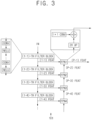
- Fig. 3 is a block diagram schematically illustrating a process of generating feature maps by using a conventional CNN with a configuration including the FPN blocks according to prior art.
- the feature computation block 101 may include a plurality of convolution blocks, i.e., a (1-1)-th to a (1-k)-th filter blocks, for performing convolution operations.
- each of the convolution blocks is comprised of multiple layers.
- each of the (1-1)-th to the (1-k)-th filter blocks includes alternately an arbitrary number of a convolutional layer and an activation layer, e.g., Rectified Linear Unit (ReLU).
- ReLU Rectified Linear Unit
- the (1-1)-th filter block generates a (1-1)-th feature map from the input image
- the (1-2)-th filter block generates a (1-2)-th feature map from the (1-1)-th feature map, and so on.
- Each of the filter blocks sequentially generates each of corresponding feature maps.
- the (1-1)-th feature map with a size and a channel of W/2 ⁇ H/2 ⁇ C and the (1-2)-th feature map with a size and a channel of W/4 ⁇ H/4 ⁇ 2C may be generated, and so on.
- each first factor e.g., W, W/2, W/4
- each second factor e.g., H, H/2, H/4
- each third factor e.g., 3, C, 2C
- the convolution blocks i.e., the (1-1)-th to the (1-k)-th filter blocks, may generate the feature maps with various sizes and number of channels, respectively.
- a plurality of FPN blocks i.e., a 1-st to a (k-1)-th FPN blocks, are respectively connected to each of the corresponding (1-1)-th to (1-k)-th filter blocks.
- Each of the FPN blocks includes a 1x1 convolution filter used for adjusting the number of channels of the feature map received from its corresponding filter block, an up-sampling block used for increasing the size of the feature map received from a previous FPN block, and a computation unit used for summing up an output of the 1x1 convolution filter and an output of the up-sampling block and then allowing the summed output to be provided to a next FPN block.
- the up-sampling block may double the size of the feature map received from the previous FPN block so that the size of the feature map received from the previous FPN block can be commensurate with that of the feature map received from the corresponding filter block.
- the 4-th FPN block receives the (1-4)-th feature map with a size and a channel of W/16 ⁇ H/16 ⁇ 8C from the (1-4)-th filter block and adjusts the number of channels of the (1-4)-th feature map from 8C to D without modifying the size thereof. Also, the 4-th FPN block receives the (P-5)-th feature map with a size and a channel of W/32 ⁇ H/32 ⁇ D from the 5-th FPN block and rescales the size of the (P-5) feature map to W/16 ⁇ H/16.
- the (P-4)-th feature map with a size and a channel of W/16 ⁇ H/16 ⁇ D is generated and carried to the 3-rd FPN block, and so on.
- Each of the rest of the FPN blocks follows the same procedure described above to ultimately output the (P-1)-th feature map with a size and a channel of W/2 ⁇ H/2 ⁇ D.
- massive amount of computations is required for the feature computation block 101 including the FPN blocks.
- XIAOYOUNG SHEN ET AL discloses a principled convolutional neural pyramid (CNP) framework for general low-level vision and image processing tasks.
- This pyramid structure can greatly enlarge field while not sacrificing computation efficiency and provides the additional benefit of adaptive network depth and progressive up-sampling for quasi-realtime testing on VGA-size input.
- CNNs enable learning data-driven, highly representative, hierarchical image features from sufficient training data.
- obtaining datasets as comprehensively annotated as ImageNet in the medical imaging domain remains a challenge.
- transfer learning i.e., fine-tuning CNN models pre-trained from natural image dataset to medical image tasks.
- transfer learning i.e., fine-tuning CNN models pre-trained from natural image dataset to medical image tasks.
- transfer learning i.e., fine-tuning CNN models pre-trained from natural image dataset to medical image tasks.
- CADe computer-aided detection
- LN thoraco-abdominal lymph node
- ILD interstitial lung disease
- the applicant of the present invention intends to disclose a novel method for generating feature maps with a high degree of accuracy of a result of an application while reducing computation time.
- a learning method for improving performance of a CNN by using feature up-sampling networks (FUN) included in a learning device wherein the learning device includes (i) a down-sampling block for reducing a size of an input image; (ii) each of a (1-1)-th to a (1-k)-th filter blocks from which each of a (1-1)-th to a (1-k)-th feature maps is acquired by performing one or more convolution operations; (iii) a (2-k)-th to a (2-1)-th up-sampling blocks each of which correspondingly interacts with each of the (1-1)-th to the (1-k)-th filter blocks and thereby generates each of a (2-k)-th to a (2-1)-th feature maps; (iv) an application block for generating an application-specific output by using at least part of the (2-k)-th to the (2-1)-th feature maps; and (v) an application-
- FUN feature up-sampling networks
- a testing method for applying operations to a test image as an input image by using a CNN with Feature Up-sampling Networks (FUN) included in a testing device to acquire an application-specific output comprising steps of: (a) the testing device acquiring the test image on the conditions that by using a learning device which includes (i) a down-sampling block for reducing a size of a training image; (ii) each of a (1-1)-th to a (1-k)-th filter blocks from which each of a (1-1)-th to a (1-k)-th feature maps is acquired by performing one or more convolution operations thereon; (iii) a (2-k)-th to a (2-1)-th up-sampling blocks each of which correspondingly interacts with each of the (1-1)-th to the (1-k)-th filter blocks; (iv) an application block for generating the application-specific output by using at least part of the (2-k)-
- a learning device which includes (i) a down
- a learning device for improving performance of a CNN by using Feature Up-sampling Networks (FUN), wherein the learning device includes (i) a down-sampling block for reducing a size of a training image as an input image; (ii) each of a (1-1)-th to a (1-k)-th filter blocks from which each of a (1-1)-th to a (1-k)-th feature maps is acquired by performing one or more convolution operations; (iii) a (2-k)-th to a (2-1)-th up-sampling blocks each of which correspondingly interacts with each of the (1-1)-th to the (1-k)-th filter blocks and thereby generates each of a (2-k)-th to a (2-1)-th feature maps; (iv) an application block for generating an application-specific output by using at least part of the (2-k)-th to the (2-1)-th feature maps; and (v) an application
- FUN Feature Up-sampling Networks
- a testing device for applying operations to a test image as an input image by using a CNN with Feature Up-sampling Networks (FUN) to acquire an application-specific output, comprising: a communication part for receiving the test image, on the conditions that by using a learning device which includes (i) a down-sampling block for reducing a size of a training image; (ii) each of a (1-1)-th to a (1-k)-th filter blocks from which each of a (1-1)-th to a (1-k)-th feature maps is acquired by performing one or more convolution operations thereon; (iii) a (2-k)-th to a (2-1)-th up-sampling blocks each of which correspondingly interacts with each of the (1-1)-th to the (1-k)-th filter blocks; (iv) an application block for generating the application-specific output by using at least part of the (2-k)-th to the (2-1)-
- a learning device which includes (i) a down-
- Fig. 4 is a block diagram illustrating a process of generating feature maps by using a CNN with a configuration including Feature Up-sampling Networks (FUN) blocks in accordance with one example embodiment of the present invention.
- FUN Feature Up-sampling Networks
- a Feature Computation Block 400 with a configuration including Feature Up-Sampling Networks (FUN) blocks may include a down-sampling block 401 to reduce a size of an input image before the input image is fed into a plurality of filter blocks, i.e., convolution filters.
- the down-sampling block 401 may perform a process of reducing the size of the input image to thereby generate a downsized image, i.e., a down-sampling image. If a size and a channel of the input image is W ⁇ H ⁇ 3, a size and a cannel of the down-sampling image, i.e., D_IMAGE, may be W/2 ⁇ H/2 ⁇ 3. As an example, the down-sampling block 401 may reduce the size of the input image by a ratio of 1/2, but it is not limited thereto.
- the Feature Computation Block 400 may include a plurality of convolution blocks, i.e., the (1-1)-th filter block 410_1, the (1-2)-th filter block 410_2, the (1-3)-th filter block 410_3, ..., and the (1-k)-th filter block 410_k, which are layered one after another.
- each of the (1-1)-th to the (1-k)-th filter blocks is iteratively and alternately comprised of an arbitrary number of a convolutional layer and an activation layer, e.g., Rectified Linear Unit (ReLU).
- a convolutional layer e.g., a convolutional layer
- an activation layer e.g., Rectified Linear Unit (ReLU).
- ReLU Rectified Linear Unit
- the (1-1)-th filter block 410_1 may generate the (1-1)-th feature map, i.e., (1-1)FEAT in Fig. 4 , by applying a convolution operation to the input image and the (1-2)-th filter block 410_2 may generate the (1-2)-th feature map, i.e., (1-2)FEAT, by applying a convolution operation to the (1-1)-th feature map and so on.
- the last filter block i.e., the (1-k)-th filter block 410_k, and produces an ultimate feature map outputted from the convolution blocks and indicated as (1-k)FEAT in Fig. 4 .
- the (1-1)-th filter block 410_1 receives the down-sampling image with a size and a channel of W/2 ⁇ H/2 ⁇ 3 and outputs the (1-1)-th feature map with a size and a channel of W/4 ⁇ H/4 ⁇ C.
- the (1-2)-th filter block 410_2 receives the (1-1)-th feature map with the size and the channel of W/4 ⁇ H/4 ⁇ C and outputs the (1-2)-th feature map with a size and a channel of W/8 ⁇ H/8 ⁇ 2C.
- the feature computation block 400 illustrated in Fig. 4 may perform operations on the feature maps with reduced sizes and thus, an amount of computations executed by the feature computation Block 400 may be decremented. That is, since each of the filter blocks, i.e., the (1-1)-th to the (1-k)-th filter blocks may apply convolution operations to half-sized feature maps compared to those shown in Fig. 3 , the amount of computations required for the overall convolution blocks is reduced and a performance of the overall convolution blocks is improved.
- the feature computation block 400 may rescale the sizes of the respective feature maps via the FUN blocks, hereinafter referred to as up-sampling blocks.
- each of the up-sampling blocks may include a first filter 420_1_A, e.g., 1x1 convolution filter, for adjusting the number of channels of a first feature map, a second filter 420_1_B, e.g., 1x1 convolution filter, for adjusting the number of channels of a second feature map, and a scaling-up block 420_1_C for applying an up-sampling operation to output of the second filter to thereby enlarge the size of the output.
- a first filter 420_1_A e.g., 1x1 convolution filter
- a second filter 420_1_B e.g., 1x1 convolution filter
- Each of the up-sampling blocks may further include an aggregation block 420_1_D for applying a certain operation, e.g., a summing-up operation, to outputs of both the first filter 420_1_A and the scaling-up block 420_1_C.
- a certain operation e.g., a summing-up operation
- the first filter 420_1_A in the (2-1)-th up-sampling block 420_1 may apply a convolution operation to the down-sampling image D_IMAGE to acquire an adjusted feature map D_IMAGE_A whose number of channels is modified.
- the second filter 420_1_B in the (2-1)-th up-sampling block 420_1 may apply a convolution operation to the (2-2)-th feature map (2-2)FEAT which is relayed from the (2-2)-th up-sampling block 420_2 in order to acquire a (2-2)-th adjusted feature map (2-2)FEAT_A.
- the scaling-up block 420_1_C in the (2-1)-th up-sampling block 420_1 may apply the up-sampling operation to the (2-2)-th adjusted feature map (2-2)FEAT_A for scaling up the size of the (2-2)-th adjusted feature map to thereby acquire a (2-2)-th rescaled feature map (2-2)FEAT_B.
- the aggregation block 420_1_D in the (2-1)-th up-sampling block 420_1 may apply a certain operation, e.g., a summing-up operation, to both the adjusted feature map D_IAMGE_A of the down-sampling image and the (2-2)-th rescaled feature map (2-2)FEAT_B for the generation of the (2-1)-th feature map (2-1)FEAT.
- a certain operation e.g., a summing-up operation
- the scaling-up block 420_1_C in the (2-1)-th up-sampling block may determine an up-sampling ratio for the (2-2)-th adjusted feature map (2-2)FEAT_A by referring to a down-sampling ratio of the down-sampling block 401. Then, the (2-2)-th rescaled feature map (2-2)FEAT_B is generated according to the determined up-sampling ratio.
- the first filter 420_(M+1)_A in the (2-(M+1))-th up-sampling block 420_(M+1) may apply a convolution operation to the (1-M)-th feature map (1-M)FEAT which is received from the (1-M)-th filter block to obtain the (1-M)-th adjusted feature map (1-M)FEAT_A whose number of channels is adjusted by the first filter 420_(M+1)_A.
- the second filter 420_(M+1)_B in the (2-(M+1))-th up-sampling block 420_(M+1) may apply a convolution operation to the (2-(M+2))-th feature map (2-(M+2))FEAT which is received from the (2-(M+2))-th up-sampling block 420_(M+2) to obtain the (2-(M+2))-th adjusted feature map (2-(M+2))FEAT_A.
- the scaling-up block 420_(M+1)_C within the (2-(M+1))-th up-sampling block 420_(M+1) may rescale the size of the (2-(M+2))-th adjusted feature map (2-(M+2))FEAT_A to be identical to that of the (1-M)-th adjusted feature map (1-M)FEAT_A and thus acquiring the (2-(M+2))-th rescaled feature map (2-(M+2))FEAT_B.
- the aggregation block 420_(M+1)_D within the (2-(M+1))-th up-sampling block apply the certain operation, e.g., the summing-up operation, to the (1-M)-th adjusted feature map (1-M)FEAT_A and the (2-(M+2))-th rescaled feature map (2-(M+2))FEAT_B in order to generate the (2-(M+1))-th feature map (2-(M+1))FEAT, thereby acquiring each of the (2-k)-th to the (2-2)-th feature maps.
- the certain operation e.g., the summing-up operation
- the (2-1)-th up-sampling block 420_1 may receive the down-sampling image D_IMAGE from the down-sampling block 401, and receive the (2-2)-th feature map (2-2)FEAT from the (2-2)-th up-sampling block 420_2, and then rescale the size of the (2-2)-th adjusted feature map (2-2)FEAT_A to be identical to that of the adjusted feature map of the down-sampling image D_IAMGE_A, and thereafter apply the certain operation to both feature maps, i.e., (2-2)FEAT_A and D_IAMGE A, to thereby outputting the (2-1)-th feature map (2-1)FEAT.
- the first filter 420_k_A in the (2-k)-th up-sampling block 420_k may apply the convolution operation to the (1-(k-1))-th feature map (1-(k-1))FEAT to acquire the (1-(k-1))-th adjusted feature map (1-(k-1))FEAT_A whose number of channels is adjusted by the first filter 420_k_A.
- the second filter 420_k_B within the (2-k)-th up-sampling block 420_k may apply the convolution operation to the (1-k)-th feature map (1-k)FEAT which is relayed from the (1-k)-th filter block 410_k in order to acquire the (1-k)-th adjusted feature map (1-k)FEAT_A.
- the scaling-up block 420_k_C in the (2-k)-th up-sampling block 420_k may apply the up-sampling operation to the (1-k)-th adjusted feature map (1-k)FEAT_A for scaling up the size of the (1-k)-th adjusted feature map in order to acquire a (1-k)-th rescaled feature map (1-k)FEAT_B.
- the aggregation block 420_1_D in the (2-k)-th up-sampling block 420_k may apply the certain operation to both the (1-(k-1))-th adjusted feature map (1-(k-1))FEAT_A and the (1-k)-th rescaled feature map (1-k)FEAT_B for the generation of the (2-k)-th feature map (2-k)FEAT.
- the operation of the second filter 420_k_B within the (2-k)-th up-sampling block 420_k may be skipped.
- the (2-k)-th up-sampling block 420_k may not include the second filter 420_k_B for adjusting the number of channels of the (1-k)-th feature map (1-k)FEAT, and the scaling-up block 420_k_C within the (2-k)-th up-sampling block 420_k may directly apply the up-sampling operation to the (1-k)-th feature map (1-k)FEAT thereby obtaining the (1-k)-th rescaled feature map (1-k)FEAT_B.
- the aggregation block 420_k_D within the (2-k)-th up-sampling block 420_k may apply the certain operation, e.g., the summing-up operation, to both the (1-(k-1))-th adjusted feature map (1-(k-1))FEAT_A and the (1-k)-th rescaled feature map (1-k)FEAT_B for the generation of the (2-k)-th feature map (2-k)FEAT.
- the certain operation e.g., the summing-up operation
- Fig. 5 is a drawing showing an up-sampling block and its computations in accordance with one example embodiment of the present invention.
- the (1-M)-th feature map (1-M)FEAT passes through the first filter 420_(M+1)_A of the (2-(M+1))-th up-sampling block 420_(M+1)
- the (1-M)-th adjusted feature map (1-M)FEAT_A is generated by doubling the number of channels of the (1-M)-th feature map (1-M)FEAT while maintaining its size as same as that of the (1-M)-th feature map.
- the (2-(M+2))-th adjusted feature map (2-(M+2))FEAT_A is generated by reducing the number of channels of the (2-(M+2))-th feature map (2-(M+2))FEAT to a half while retaining the size of the (2-(M+2))-th adjusted feature map as same as that of the (2-(M+2))-th feature map (2-(M+2))FEAT.
- the (2-(M+2))-th adjusted feature map (2-(M+2))FEAT_A passes through the scaling-up block 420_(M+1)_C of the (2-(M+1))-th up-sampling block 420_(M+1)
- the (2-(M+2))-th rescaled feature map (2-(M+2)) FEAT_B is generated by doubling the size of the (2-(M+2))-th adjusted feature map (2-(M+2))FEAT_A while retaining its number of channels as same as that of the (2-(M+2))-th adjusted feature map (2-(M+2))FEAT_A.
- the aggregation block 420_(M+1)_D of the (2-(M+1))-th up-sampling block 420_(M+1) can apply the certain operation, e.g., the summing-up operation, to both feature maps.
- the result of the operation performed by the aggregation block 420_(M+1)_D is the (2-(M+1))-th feature map (2-(M+1))FEAT.
- the convolution operations performed by both the first filter 420_(M+1)_A and the second filter 420_(M+1)_B of the (2-(M+1))-th up-sampling block is to adjust the number of channels of the (1-M)-th feature map (1-M)FEAT and the 2-(M+2)-th feature map (2-(M+2))FEAT to be identical to each other.
- the scaling-up block 420_(M+1)_C in the (2-(M+1))-th up-sampling block 420_(M+1) is used for changing the size of the (2-(M+2))-th feature map (2-(M+2))FEAT_A to be the same as that of the (1-M)-th adjusted feature map (1-M)FEAT_A.
- the scaling-up block may double the size of the (2-(M+2))-th adjusted feature map (2-(M+2))FEAT_A to be the same as that of the (1-M) -th feature map (1-M)FEAT, but the ratio of increment is not limited thereto.
- the (2-4)-th up-sampling block 420_ may receive the (1-3)-th feature map with a size and a channel of W/16 ⁇ H/16 ⁇ 4C and may adjust the number of channels from 4C to 8C and retain the size as that of the (1-3)-th feature map, e.g., W/16 ⁇ H/16.
- the FUN4 may receive the (2-5)-th feature map (2-5)FEAT with a size and a channel of W/32 ⁇ H/32 ⁇ 16C and may change the size and the number of channels thereof to be W/16 ⁇ H/16 ⁇ 8C, and then may perform operations on both the (2-5)-th rescaled feature map and the (1-3)-th adjusted feature map to thereby generate and output the (2-4)-th feature map (2-4)FEAT with a size and a channel of W/16 ⁇ H/16 ⁇ 8C.
- the (2-3)-th up-sampling block 420_3, i.e., FUN3, and the (2-2)-th up-sampling block 420_2, i.e., FUN2, may follow the same procedure as mentioned above and thereby may generate the (2-2)-th feature map and may relay it to the (2-1)-th up-sampling block 420_1, i.e., FUN1.
- the FUN1 may receive the down-sampling image D_IMAGE with the size and the channel of W/2 ⁇ H/2 ⁇ 3, and may adjust the number of channels of the down-sampling image from 3 to C and retain the size thereof, e.g., W/2 ⁇ H/2.
- the FUN1 may receive the (2-2)-th feature map (2-2)FEAT with the size and the channel of W/4 ⁇ H/4 ⁇ 2C and may adjust the number of channels of it to be C and rescale the size thereof to be W/2 ⁇ H/2. Then, the FUN1 may perform the certain operation, e.g., the summing-up operation, on the (2-2)-th rescaled feature map and the adjusted feature map of the down-sampling image to generate the (2-1)-th feature map (2-1)FEAT with a size and a channel of W/2 ⁇ H/2 ⁇ C.
- the certain operation e.g., the summing-up operation
- a device adopting the conventional CNN with the configuration including the FPN blocks as illustrated in Fig. 3 allows the FPN blocks to retain the number of channels of each of the feature maps generated by the respective FPN blocks to be same as that of an ultimate feature map (not shown).
- the device adopting the CNN with the configuration including the FUN blocks as shown in Fig. 4 allows the FUN blocks to iteratively reduce the number of channels of each of the feature maps outputted by the individual FUN blocks to be half of that of each of their corresponding inputted feature maps.
- each of the feature maps generated by the respective FPN blocks has the same dimension with each of the feature maps produced by the individual FUN blocks.
- performance of the CNN which is implemented in accordance with one example embodiment of the present invention, is improved as a result of reduced amount of computations of the CNN due to the decreased number of channels of the feature maps involved in the computations.
- the device adopting the CNN with the configuration including the FUN blocks may reduce the amount of computations performed by the CNN, the dimension of each of the feature maps generated through the FUN blocks is as equal as that of each of the feature maps outputted from the FPN blocks. Therefore, there is rarely a difference between the CNN with the configuration of the FUN blocks and the conventional CNN with the configuration of the FPN blocks regarding correctness of a result engendered by an application like object detection or other applications.
- Figs. 6A and 6B are block diagrams of a learning device adopting a CNN with a configuration including Feature Up-sampling Networks (FUN) blocks in accordance with one example embodiment of the present invention.
- FUN Feature Up-sampling Networks
- the device 600 may include a student feature computation block 601, an application block 602, an application loss block 603, a teacher feature computation block 604 and a regression loss block 605.
- the student feature computation block 601 may have a configuration merely including the down-sampling block 401 and the FUN blocks, i.e., the (2-1)-th up-sampling block 420_1 to the (2-k)-th up-sampling block 420_k, to thereby reduce the required amount of computations.
- the student feature computation block 601 receives an input image, a combination of the down-sampling block, the convolution blocks and the FUN blocks may generate feature maps based on the input image.
- the functions of the application block 602 and the application loss block 603 is similar to those illustrated in Fig. 1 , e.g., the functions of the application block 102 and those of the application loss block 103, descriptions of the functions of the duplicated components may be omitted.
- the teacher feature computation block 604, or teacher encoding layers may perform a process of respectively generating a (T-1)-th to a (T-k)-th feature maps whose respective sizes are corresponding to those of the respective (2-1)-th to the (2-k)-th feature maps and which are acquired by applying one or more convolution operations to the input image without passing through the down-sampling block.
- the student feature computation block 601 receives the same input image as the teacher feature computation block 604.
- the regression loss block 605 may generate regression losses by comparing each of the (2-1)-th to the (2-k)-th feature maps generated by the student feature computation block 601 with each of the (T-1)-th to the (T-k)-th feature maps generated by the teacher feature computation block 604, and then may allow parameters of at least part of the (1-1)-th to the (1-k)-th filter blocks and the (2-1)-th to the (2-k)-th up-sampling blocks to be adjusted during a second backpropagation process by using the regression losses.
- the device 600 may perform a learning process of diminishing application-specific losses along with the regression losses during the first and second backpropagation processes.
- the application-specific losses are acquired via the application loss block 603 and the regression losses are obtained via the regression loss block 605.
- the learning process seeks to make the feature maps generated by the FUN blocks of the student feature computation block 601 be as similar as possible to the feature maps generated by the teacher feature computation block 604. Hence, the regression losses are lessened as well.
- the first backpropagation process triggered by the application loss block 603 may adjust parameters of the student feature computation block 601 and the application block 602 whereas the second backpropagation process invoked by the regression loss block 605 may adjust the parameters of the student feature computation block 601.
- the parameters of each filter block in the student feature computation block 601, i.e., the (1-1)-th filter block to the (1-k)-th filter block, and each FUN block therein, i.e., the (2-1)-th up-sampling block to the (2-k)-th up-sampling block may be adjusted by both the application loss block 603 and the regression loss block 605 using the application-specific losses and the additional regression losses.
- the learning performance of the device 600 may be more efficient.
- Fig. 6B specifically illustrates details of the student feature computation block 601, the teacher feature computation block 604 and the regression loss block 605.
- a procedure for generating feature maps as illustrated in Fig. 4 is also demonstrated for the student feature computation block 601.
- the teacher feature computation block 604 may include a plurality of filter blocks 610_1, 610_2, 610_3, ..., and 610_k. As mentioned above and illustrated in Fig. 6B , the teacher feature computation block 604 and the student feature computation block 601 may receive the same input image and may perform one or more convolution operations thereon, but unlike the student feature computation block 601, the teacher feature computation block 604 may not include a down-sampling block and thus may perform the convolution operations without passing through the down-sampling block.
- the (T-1)-th filter block 610_1 receives the input image with the size and the channel of W ⁇ H ⁇ 3 and performs a convolution operation thereon to thereby output the (T-1)-th feature map (T-1)FEAT with the size and the channel of W/2 ⁇ H/2 ⁇ C.
- the (T-2)-th filter block 610_2 receives the (T-1)-th feature map (T-1)FEAT and performs a convolution operation thereon to thereby output the (T-2)-th feature map (T-2)FEAT with the size and the channel of W/4 ⁇ H/4 ⁇ 2C.
- the (T-3)-th filter block 610_3 receives the (T-2)-th feature map (T-2)FEAT and performs a convolution operation thereon to thereby generate the (T-3)-th feature map (T-3)FEAT with the size of W/8 ⁇ H/8 ⁇ 4C. Accordingly, the (T-1)-th to the (T-k)-th feature maps are generated in turn.
- the regression loss block 605 may produce the first regression loss by comparing the (2-1)-th feature map (2-1)FEAT to the (T-1)-th feature map (T-1)Feat, both of which have the same number of channels and size, e.g., W/2 ⁇ H/2 ⁇ C.
- the regression loss block 605 may generate the second regression loss by comparing the (2-2)-th feature map (2-2)FEAT to the (T-2)-th feature map (T-2)Feat, both of which have the same number of channels and size, e.g., W/4 ⁇ H/4 ⁇ 2C, and so on.
- the respective regression losses corresponding to each of the (2-1)-th to the (2-k)-th feature maps are calculated by the regression loss block 605.
- the device 600 may allow parameters of at least part of the (1-1)-th to the (1-k)-th filter blocks and the (2-1)-th to the (2-k)-th up-sampling blocks to be adjusted during the second backpropagation process by using the regression losses.
- the (T-1)-th filter block 610_1 to the (T-k)-th filter block 610_k of the teacher feature computation block 604 may use fixed parameters having been acquired during a pre-training process.
- the device 600 as shown in Fig. 6A may execute a testing process merely with the student feature computation block 601 and the application block 602 if the adjustment of the parameters is completed.
- Fig. 7 is a block diagram of a device for detecting an object in accordance to the present invention.
- an object detection block 700 is provided as the application block 602.
- the feature maps e.g., (2-1)FEAT, (2-2) FEAT, ..., and (2-k)FEAT, generated by the feature computation block 400 are carried to the object detection block 700.
- the object detection block 700 receives at least part of the feature maps from the feature computation block 400.
- FC layers within the object detection block 700 may perform particular operations, e.g., regression operations or classification operations, on the received feature maps to acquire interim results and forward the interim results to a merge layer, to thereby generate the application-specific output.
- the application-specific output is a detection result for an object.
- examples of the application block 602 may be semantic segmentation block, in an example not covered by the claims, or the object detection block of the invention 700 as illustrated in the Fig. 7 .
- input images described above e.g. the training image or the test image
- data for performing computations with feature maps may be held/maintained by the processor (and/or memory) thereof.
- the convolution operations, the deconvolution operations and the loss computations are mainly performed by the processor of the learning device and the testing device, but it is not limited thereto.
- the present invention has an effect of reducing the computation time of the CNN by decreasing the size of the input image via applying the down-sampling operation.
- the present invention has another effect of reducing computation time of the CNN without sacrificing the accuracy of the application-specific output.
- the present invention has another effect of improving computation speed of the CNN by reducing computation time of the CNN compared to conventional ones.
- the present invention has still another effect of substantially reducing the number of channels of the feature maps generated by the up-sampling block in accordance with the present invention.
- the present invention has still another effect of improving performance of the learning process by using the losses acquired from the Application Loss Block and additional regression losses acquired from the Regression Loss Block.
- the embodiments of the present invention as explained above can be implemented in a form of executable program command through a variety of computer means recordable to computer readable media.
- the computer readable media may include solely or in combination, program commands, data files, and data structures.
- the program commands recorded to the media may be components specially designed for the present invention or may be usable to a skilled human in a field of computer software.
- Computer readable record media include magnetic media such as hard disk, floppy disk, and magnetic tape, optical media such as CD-ROM and DVD, magneto-optical media such as floptical disk and hardware devices such as ROM, RAM, and flash memory specially designed to store and carry out programs.
- Program commands include not only a machine language code made by a compiler but also a high level code that can be used by an interpreter etc., which is executed by a computer.
- the aforementioned hardware device can work as more than a software module to perform the action of the present invention and they can do the same in the opposite case.
Landscapes
- Engineering & Computer Science (AREA)
- Theoretical Computer Science (AREA)
- Physics & Mathematics (AREA)
- General Physics & Mathematics (AREA)
- Evolutionary Computation (AREA)
- Artificial Intelligence (AREA)
- General Health & Medical Sciences (AREA)
- Health & Medical Sciences (AREA)
- Software Systems (AREA)
- Computing Systems (AREA)
- Life Sciences & Earth Sciences (AREA)
- Molecular Biology (AREA)
- Biomedical Technology (AREA)
- Data Mining & Analysis (AREA)
- Computer Vision & Pattern Recognition (AREA)
- General Engineering & Computer Science (AREA)
- Mathematical Physics (AREA)
- Computational Linguistics (AREA)
- Biophysics (AREA)
- Multimedia (AREA)
- Medical Informatics (AREA)
- Databases & Information Systems (AREA)
- Biodiversity & Conservation Biology (AREA)
- Bioinformatics & Cheminformatics (AREA)
- Bioinformatics & Computational Biology (AREA)
- Evolutionary Biology (AREA)
- Image Analysis (AREA)
- Complex Calculations (AREA)
- Image Processing (AREA)
Claims (16)
- Computerimplementiertes Lernverfahren zum Verbessern der Leistung eines CNN durch Verwenden von in einer Lernvorrichtung enthaltenen Merkmal-Aufwärtsabtastungs-Netzwerken (FUN), wobei die Lernvorrichtung enthält: (i) einen Abwärtsabtastungsblock zum Reduzieren einer Größe eines Eingabebildes, das ein Objekt enthält; (ii) jeden von einem (1-1)-ten bis zu einem (1-k)-ten Filterblock, von dem jede von einer (1-1)-ten bis zu einer (1-k)-ten Merkmalskarte erfasst wird, indem eine oder mehrere Faltungsoperationen durchgeführt werden; (iii) einen (2-k)-ten bis (2-1)-ten Aufwärtsabtastungsblock, von denen jeder entsprechend mit jedem der (1-1)-ten bis (1-k)-ten Filterblöcke zusammenwirkt und dadurch jede der (2-k)-ten bis (2-1)-ten Merkmalskarten erzeugt; (iv) einen Objekterkennungsblock zum Erzeugen einer anwendungsspezifischen Ausgabe unter Verwendung mindestens eines Teils der (2-k)-ten bis (2-1)-ten Merkmalskarten; und (v) einen anwendungsspezifischen Verlustblock zum Berechnen eines Verlusts durch Vergleichen zwischen der vom Objekterkennungsblock erzeugten anwendungsspezifischen Ausgabe und der Grundwahrheit (GT), umfassend die folgenden Schritte:(a) die Lernvorrichtung, nachdem das Eingabebild erhalten wurde, den Abwärtsabtastungsblock anweist, die Größe des Eingabebildes zu reduzieren, um ein Abwärtsabtastungsbild zu erzeugen;(b) die Lernvorrichtung, nachdem das Abwärtsabtastungsbild erhalten wurde, jeden der (1-1)-ten bis (1-k)-ten Filterblöcke anweist, jeweils jede der (1-1)-ten bis (1-k)-ten Merkmalskarten zu erfassen, indem die eine oder mehrere Faltungsoperationen auf das Abwärtsabtastungsbild angewendet werden;(c) die Lernvorrichtung (I) den (2-1)-ten Aufwärtsabtastungsblock anweist, (i) das Abwärtsabtastungsbild von dem Abwärtsabtastungsblock zu empfangen, und (ii) die (2-2)-te Merkmalskarte von dem (2-2)-ten Aufwärtsabtastungsblock zu empfangen, und dann eine Größe der (2-2)-ten Merkmalskarte so umskaliert, dass sie mit der des Abwärtsabtastungsbildes identisch ist, und (iii) eine bestimmte Operation auf das Abwärtsabtastungsbild und die (2-2)-te umskalierte Merkmalskarte anzuwenden, wodurch die (2-1)-te Merkmalskarte erfasst wird, und (II) den (2-(M+1))-ten Aufwärtsabtastungsblock anweist, (i) die (1-M)-te Merkmalskarte von dem (1-M)-ten Filterblock zu empfangen, und (ii) die (2-(M+2))-te Merkmalskarte von dem (2-(M+2))-ten Aufwärtsabtastungsblock zu empfangen und dann eine Größe der (2-(M+2))-ten Merkmalskarte so umzuskalieren, dass sie mit der der (1-M)-ten Merkmalskarte identisch ist, und (iii) eine bestimmte Operation auf die (1-M)-te Merkmalskarte und die (2-(M+2))-te umskalierte Merkmalskarte anzuwenden, um die (2-(M+1))-te Merkmalskarte zu erzeugen, wodurch die (2-k) -te bis die (2-2)-te Merkmalskarte erfasst wird, wobei M eine ganze Zahl größer oder gleich 1 ist; und(d) die Lernvorrichtung (i) den Objekterkennungsblock anweist, die anwendungsspezifische Ausgabe zu erzeugen, indem eine anwendungsspezifische Operation auf mindestens einen Teil der (2-k)-ten bis (2-1)-ten Merkmalskarten angewendet wird, und (ii) den anwendungsspezifischen Verlustblock anweist, den Verlust zu erzeugen, indem die anwendungsspezifische Ausgabe mit der GT verglichen wird; und dadurch die Parameter von mindestens einem Teil des Objekterkennungsblocks, des (2-k)-ten bis (2-1)-ten Aufwärtsabtastungsblocks und des (1-1)-ten bis (1-k)-ten Filterblocks unter Verwendung des Verlustes während eines ersten Rückpropagierungsprozesses anzupassen,wobei die anwendungsspezifische Ausgabe ein Erkennungsergebnis für das Objekt ist,wobei die anwendungsspezifische Operation umfasst:Übertragen zumindest eines Teils der (2-k)-ten bis (2-1) -ten Merkmalskarten auf vollständig verbundene (FC)-Schichten innerhalb des Objekterkennungsblocks, um Zwischenergebnisse zu erzeugen; undWeiterleiten der Zwischenergebnisse an eine Zusammenführungsschicht innerhalb des Objekterkennungsobjekts, um die anwendungsspezifische Ausgabe zu erzeugen.
- Lernverfahren nach Anspruch 1, wobei die Lernvorrichtung weiter enthält (vi) eine Lehrerkodierungsschicht mit einem (T-1)-ten bis (T-k)-ten Filterblock, der jeweils eine (T-1)-te bis (T-k)-te Merkmalskarte erzeugt, deren jeweilige Größen denen der (2-1)-ten bis (2-k)-ten Merkmalskarten entsprechen und die durch Anwendung einer oder mehrerer Faltungsoperationen auf das Eingabebild ohne Durchlaufen des Abwärtsabtastungsblocks erfasst werden, und (vii) einen Regressionsverlustblock, und wobei das Lernverfahren weiterhin einen Schritt umfasst: (e) die Lernvorrichtung weist den Regressionsverlustblock an, Regressionsverluste unter Verwendung jeder der (2-1)-ten bis (2-k)-ten Merkmalskarten und jeder der (T-1)-ten bis (T-k)-ten Merkmalskarten zu erzeugen, und weist dann Parameter von mindestens einem Teil der (1-1)-ten bis (1-k)-ten Filterblöcke und der (2-1)-ten bis (2-k)-ten Aufwärtsabtastungsblöcke an, unter Verwendung der Regressionsverluste während eines zweiten Rückpropagierungsprozesses eingestellt zu werden.
- Lernverfahren nach Anspruch 1, wobei die Lernvorrichtung im Schritt (c), falls M eine ganze Zahl größer oder gleich 1 und kleiner oder gleich (k-2) ist, den (2-(M+1))-ten Aufwärtsabtastungsblock anweist, die folgenden Prozesse durchzuführen: (i) Erhalten einer (1-M)-ten angepassten Merkmalskarte, deren Anzahl der Kanäle durch einen ersten Filter im (2-(M+1))-ten Aufwärtsabtastungsblock modifiziert wird, indem eine Faltungsoperation auf die (1-M)-te Merkmalskarte anwendet wird; (ii) Erhalten einer (2-(M+2))-ten angepassten Merkmalskarte, deren Anzahl von Kanälen durch einen zweiten Filter in dem (2-(M+1))-ten Aufwärtsabtastungsblock modifiziert wird, indem eine Faltungsoperation auf die (2-(M+2))-te Merkmalskarte anwendet wird; und dann das Erhalten der (2-(M+2))-ten umskalierten Merkmalskarte durch Anwenden einer Aufwärtsabtastungsoperation auf die (2-(M+2))-te angepasste Merkmalskarte; (iii) Berechnen der (1-M)-ten angepassten Merkmalskarte mit der (2-(M+2))-ten umskalierten Merkmalskarte, um die (2-(M+1))-te Merkmalskarte zu erzeugen; und (iv) Weiterleiten der (2-(M+1))-ten Merkmalskarte, die von dem (2-(M+1))-ten Aufwärtsabtastungsblock erfasst wurde, an den (2-M)-ten Aufwärtsabtastungsblock, wodurch die (2-(k-1))-ten bis (2-2)-ten Merkmalskarten erfasst werden.
- Lernverfahren nach Anspruch 3, wobei die Lernvorrichtung bei dem Schritt (c) den (2-1)-ten Aufwärtsabtastungsblock anweist, die (2-1)-te Merkmalskarte zu erzeugen, indem sie die folgenden Prozesse durchführt: (i) Erhalten einer angepassten Merkmalskarte des Abwärtsabtastungsbildes, deren Anzahl von Kanälen durch den ersten Filter in dem (2-1)-ten Aufwärtsabtastungsblock modifiziert wird, indem die Faltungsoperation auf das Abwärtsabtastbild anwendet wird; (ii) Erhalten einer (2-2)-ten angepassten Merkmalskarte, deren Anzahl von Kanälen durch das zweite Filter in dem (2-1)-ten Aufwärtsabtastungsblock modifiziert wird, indem die Faltungsoperation auf die (2-2)-te Merkmalskarte anwendet wird; und dann Erhalten der (2-2)-ten umskalierten Merkmalskarte durch Anwenden der Aufwärtsabtastungsoperation auf die (2-2)-te angepasste Merkmalskarte; und (iii) Berechnen der angepassten Merkmalskarte für das Abwärtsabtastungsbild mit der (2-2)-ten umskalierten Merkmalskarte, um die (2-1)-te Merkmalskarte zu erzeugen.
- Lernverfahren nach Anspruch 3, wobei die Lernvorrichtung im Schritt (c) den (2-k)-ten Aufwärtsabtastungsblock anweist, die (2-k)-te Merkmalskarte zu erzeugen, indem sie die folgenden Prozesse durchführt: (i) Erhalten einer (1-(k-1))-ten angepassten Merkmalskarte, deren Anzahl von Kanälen durch den ersten Filter im (2-k)-ten Aufwärtsabtastungsblock modifiziert wird, indem die Faltungsoperation auf die (1-(k-1))-te Merkmalskarte angewendet wird; (ii) Erhalten einer (1-k)-ten umskalierten Merkmalskarte durch Anwenden der Aufwärtsabtastungsoperation auf die (1-k)-te Merkmalskarte; (iii) Berechnen der (1-(k-1))-ten angepassten Merkmalskarte mit der (1-k)-ten umskalierten Merkmalskarte, um die (2-k)-te Merkmalskarte zu erzeugen; und (iv) Weiterleiten der von dem (2-k)-ten Aufwärtsabtastungsblock erfassten (2-k)-ten Merkmalskarte an den (2-(k-1))-ten Aufwärtsabtastungsblock.
- Lernverfahren nach Anspruch 1, wobei die Vorrichtung im Schritt (b) eine Faltungsoperation auf das von dem Abwärtsabtastungsblock über den (1-1)-ten Filterblock erfasste Abwärtsabtastungsbild anwendet, um die (1-1)-te Merkmalskarte zu erhalten, und dann eine Faltungsoperation auf die (1-M)-te Merkmalskarte anwendet, die von dem (1-M)-ten Filterblock über den (1-(M+1))-ten Filterblock erfasst wurde, um die (1-(M+1))-te Merkmalskarte zu erhalten, wobei M eine ganze Zahl von 2 bis (k-1) ist.
- Computerimplementiertes Testverfahren zum Anwenden von Operationen auf ein Testbild als Eingabebild unter Verwendung eines CNN mit Merkmal-Aufwärtsabtastung-Netzwerken (FUN), das in einer Testvorrichtung enthalten ist, um eine anwendungsspezifische Ausgabe zu erzeugen, umfassend die folgenden Schritte:(a) die Testvorrichtung das Testbild unter den Bedingungen erfasst, dass unter Verwendung einer Lernvorrichtung, die (i) einen Abwärtsabtastungsblock zum Reduzieren einer Größe eines Trainingsbildes, das ein Objekt enthält; (ii) jeden von einem (1-1)-ten bis zu einem (1-k)-ten Filterblock, von dem jede von einer (1-1)-ten bis zu einer (1-k)-ten Merkmalskarte erfasst wird, indem eine oder mehrere Faltungsoperationen darauf durchgeführt werden; (iii) einen (2-k)-ten bis (2-1)-ten Aufwärtsabtastungsblock, von denen jeder entsprechend mit jedem der (1-1)-ten bis (1-k)-ten Filterblöcke interagiert und dadurch jede der (2-k)-ten bis (2-1)-ten Merkmalskarten erzeugt; (iv) einen Objekterkennungsblock zum Erzeugen der anwendungsspezifischen Ausgabe unter Verwendung mindestens eines Teils der (2-k)-ten bis (2-1)-ten Merkmalskarten; und (v) einen anwendungsspezifischen Verlustblock zum Berechnen eines Verlustes durch Vergleich zwischen der vom Objekterkennungsblock erzeugten anwendungsspezifischen Ausgabe und der Grundwahrheit (GT), Prozesse davon, (1) Anweisen des Abwärtsabtastungsblocks, die Größe des Trainingsbildes zu reduzieren, um ein Abwärtsabtastungsbild zum Training zu erzeugen, nachdem das Trainingsbild erhalten wurde; (2) Anweisen jedes der (1-1)-ten bis (1-k)-ten Filterblöcke, jeweils jede der (1-1)-ten bis (1-k)-ten Merkmalskarten zum Training zu erfassen, indem die eine oder mehrere Faltungsoperationen auf das Abwärtsabtastungsbild zum Training angewendet werden, nachdem das Abwärtsabtastungsbild zum Training erhalten wurde; (3)(I) Anweisen des (2-1)-ten Aufwärtsabtastungsblocks, (i) das Abwärtsabtastungsbild von dem Abwärtsabtastungsblock zu empfangen, (ii) die (2-2)-te Merkmalskarte von dem (2-2)-ten Aufwärtsabtastungsblock zu empfangen und dann eine Größe der (2-2)-ten Merkmalskarte so umzuskalieren, dass sie mit derjenigen des Abwärtsabtastungsbildes identisch ist, und (iii) Anwenden einer bestimmten Operation auf das Abwärtsabtastungsbild und die (2-2)-te umskalierte Merkmalskarte, wodurch die (2-1)-te Merkmalskarte erfasst wird, und (II) Anweisen des (2-(M+1))-ten Aufwärtsabtastungsblocks, (i) die (1-M)-te Merkmalskarte von dem (1-M)-ten Filterblock zu empfangen, (ii) die (2-(M+2))-te Merkmalskarte vom (2-(M+2))-ten Aufwärtsabtastungsblock zu empfangen und dann eine Größe der (2-(M+2))-ten Merkmalskarte so umzuskalieren, dass sie mit der der (1-M)-ten Merkmalskarte identisch ist, und (iii) eine bestimmte Operation auf die (1-M)-te Merkmalskarte und die (2-(M+2))-te umskalierte Merkmalskarte anzuwenden, um die (2-(M+1))-te Merkmalskarte zu erzeugen, wodurch die (2-k)-te bis die (2-2)-te Merkmalskarte erfasst wird, wobei M eine ganze Zahl größer oder gleich eins ist; und (4)(i) Anweisen des Objekterkennungsblocks, die anwendungsspezifische Ausgabe zu erzeugen, indem eine anwendungsspezifische Operation auf mindestens einen Teil der (2-k)-ten bis (2-1)-ten Merkmalskarte zum Training angewendet wird, und (ii) Anweisen des anwendungsspezifischen Verlustblocks, den Verlust zu erzeugen, indem die anwendungsspezifische Ausgabe mit der GT verglichen wird; und dadurch die Parameter zumindest eines Teils des Objekterkennungsblocks, des (2-k)-ten bis (2-1)-ten Aufwärtsabtastungsblocks und des (1-1)-ten bis (1-k)-ten Filterblocks unter Verwendung des Verlustes während eines Rückpropagierungsprozesses angepasst werden, ausgeführt worden sind,wobei die anwendungsspezifische Ausgabe ein Erkennungsergebnis für das Objekt ist,wobei die anwendungsspezifische Operation umfasst:Übertragen zumindest eines Teils der (2-k) -ten bis (2-1)-ten Merkmalskarten auf vollständig verbundene (FC)-Schichten innerhalb des Objekterkennungsblocks, um Zwischenergebnisse zu erzeugen; undWeiterleiten der Zwischenergebnisse an eine Zusammenführungsschicht innerhalb des Objekterkennungsblocks, um die anwendungsspezifische Ausgabe zu erzeugen;(b) die Testvorrichtung, nachdem das Testbild erhalten wurde, den Abwärtsabtastungsblock anweist, ein Abwärtsabtastungsbild zum Testen zu erzeugen, indem eine vorbestimmte Operation auf das Testbild angewendet wird, um dessen Größe zu reduzieren;(c) die Testvorrichtung, nachdem das Abwärtsabtastbild zum Testen erhalten wurde, jeden der (1-1)-ten bis (1-k)-ten Filterblöcke anweist, jeweils jede der (1-1)-ten bis (1-k)-ten Merkmalskarten zum Testen zu erfassen, indem die eine oder mehrere Faltungsoperationen auf das Abwärtsabtastungsbild zum Testen angewendet werden;(d) die Testvorrichtung, (I) den (2-1) -ten Aufwärtsabtastungsblock anweist, (i) das Abwärtsabtastungsbild zum Testen von dem Abwärtsabtastungsblock zu empfangen, (ii) die (2-2) -te Merkmalskarte zum Testen von dem (2-2)-ten Aufwärtsabtastungsblock zu empfangen, und dann eine Größe der (2-2)-ten Merkmalskarte zum Testen umzuskalieren, so dass sie identisch mit derjenigen des Abwärtsabtastungsbildes zum Testen ist, und (iii) eine bestimmte Operation auf das Abwärtsabtastbild zum Testen und die (2-2)-te umskalierte Merkmalskarte zum Testen anzuwenden, wodurch die (2-1)-te Merkmalskarte zum Testen erfasst wird, und (II) den (2-(M+1))-ten Aufwärtsabtastungsblock anweist, (i) die (1-M)-te Merkmalskarte zum Testen von dem (1-M)-ten Filterblock zu empfangen, (ii) die (2-(M+2))-te Merkmalskarte zum Testen von dem (2-(M+2))-ten Aufwärtsabtastungsblock zu empfangen und dann eine Größe der (2-(M+2))-ten Merkmalskarte zum Testen so umzuskalieren, dass sie mit der der (1-M)-ten Merkmalskarte zum Testen identisch ist, und (iii) eine bestimmte Operation auf die (1-M)-te Merkmalskarte zum Testen und die (2-(M+2))-te umskalierte Merkmalskarte zum Testen anzuwenden, um die (2-(M+1))-te Merkmalskarte zum Testen zu erzeugen, wodurch die (2-k)-te bis die (2-2)-te Merkmalskarte zum Testen erfasst wird, wobei M eine ganze Zahl größer als oder gleich eins ist; und(e) die Testvorrichtung den Objekterkennungsblock anweist, die anwendungsspezifische Ausgabe zu erzeugen, indem eine anwendungsspezifische Operation auf mindestens einen Teil der (2-k)-ten bis (2-1)-ten Merkmalskarten zum Testen anwendet wird.
- Testverfahren nach Anspruch 7, wobei die Testvorrichtung im Schritt (d), wenn M eine ganze Zahl größer oder gleich 1 und kleiner oder gleich (k-2) ist, den (2-(M+1))-ten Aufwärtsabtastungsblock anweist, die folgenden Prozesse durchzuführen: (i) Erhalten einer (1-M)-ten angepassten Merkmalskarte zum Testen, deren Anzahl der Kanäle durch einen ersten Filter im (2-(M+1))-ten Aufwärtsabtastungsblock modifiziert wird, indem eine Faltungsoperation auf die (1-M)-te Merkmalskarte zum Testen anwendet wird; (ii) Erhalten einer (2-(M+2))-ten angepaßten Merkmalskarte zum Testen, deren Anzahl von Kanälen durch einen zweiten Filter in dem (2-(M+1))-ten Aufwärtsabtastungsblock modifiziert wird, indem eine Faltungsoperation auf die (2-(M+2))-te Merkmalskarte zum Testen anwendet wird; und dann Erhalten der (2-(M+2))-ten umskalierten Merkmalskarte zum Testen durch Anwenden einer Aufwärtsabtastungsoperation auf die (2-(M+2))-te angepasste Merkmalskarte zum Testen; (iii) Berechnen der (1-M)-ten angepassten Merkmalskarte zum Testen mit der (2-(M+2))-ten umskalierten Merkmalskarte zum Testen, um die (2-(M+1))-te Merkmalskarte zum Testen zu erzeugen; und (iv) Weiterleiten der (2-(M+1))-ten Merkmalskarte zum Testen an den (2-M)-ten Aufwärtsabtastungsblock, wodurch die (2-(k-1))-te bis die (2-2)-te Merkmalskarte zum Testen erfasst wird.
- Lernvorrichtung zum Verbessern der Leistung eines CNN unter Verwendung von Merkmal-Aufwärtsabtastung-Netzwerken (FUN), wobei die Lernvorrichtung enthält: (i) einen Abwärtsabtastungsblock zum Reduzieren der Größe eines Trainingsbildes als Eingabebild, das ein Objekt enthält; (ii) jeden von einem (1-1)-ten bis zu einem (1-k)-ten Filterblock, von dem jede von einer (1-1)-ten bis zu einer (1-k)-ten Merkmalskarte erfasst wird, indem eine oder mehrere Faltungsoperationen durchgeführt werden; (iii) einen (2-k)-ten bis (2-1)-ten Aufwärtsabtastungsblock, von denen jeder entsprechend mit jedem der (1-1)-ten bis (1-k)-ten Filterblöcke zusammenwirkt und dadurch jede der (2-k)-ten bis (2-1)-ten Merkmalskarten erzeugt; (iv) einen Objekterkennungsblock zum Erzeugen einer anwendungsspezifischen Ausgabe unter Verwendung mindestens eines Teils der (2-k)-ten bis (2-1)-ten Merkmalskarten; und (v) einen anwendungsspezifischen Verlustblock zum Berechnen eines Verlusts durch Vergleichen zwischen der vom Objekterkennungsblock erzeugten anwendungsspezifischen Ausgabe und der Grundwahrheit (GT), umfassend:einen Kommunikationsteil zum Empfangen des Trainingsbildes; undeinen Prozessor zum Durchführen der folgenden Prozesse: (1) Anweisen des Abwärtsabtastungsblocks, nachdem das Eingabebild erhalten wurde, die Größe des Eingabebildes zu reduzieren, um ein Abwärtsabtastbild zu erzeugen; (2) Anweisen jedes der (1-1)-ten bis (1-k)-ten Filterblöcke, nachdem das Abwärtsabtastbild erhalten wurde, jeweils jede der (1-1)-ten bis (1-k)-ten Merkmalskarten zu erfassen, indem die eine oder mehrere Faltungsoperationen auf das Abwärtsabtastbild angewendet werden; (3)(I) Anweisen des (2-1)-ten Aufwärtsabtastungsblocks, (i) das Abwärtsabtastungsbild von dem Abwärtsabtastungsblock zu empfangen, (ii) die (2-2)-te Merkmalskarte von dem (2-2)-ten Aufwärtsabtastungsblock zu empfangen und dann die Größe der (2-2)-ten Merkmalskarte so umzuskalieren, dass sie mit der des Abwärtsabtastungsbildes identisch ist, und (iii) eine bestimmte Operation auf das Abwärtsabtastungsbild und die (2-2)-te umskalierte Merkmalskarte anzuwenden, wodurch die (2-1)-te Merkmalskarte erfasst wird, und (II) Anweisen des (2-(M+1))-ten Aufwärtsabtastungsblocks, (i) die (1-M)-te Merkmalskarte von dem (1-M)-ten Filterblock zu empfangen, (ii) die (2-(M+2))-te Merkmalskarte vom (2-(M+2))-ten Aufwärtsabtastungsblock zu empfangen und dann eine Größe der (2-(M+2))-ten Merkmalskarte so umzuskalieren, dass sie mit der der (1-M)-ten Merkmalskarte identisch ist, und (iii) eine bestimmte Operation auf die (1-M)-te Merkmalskarte und die (2-(M+2))-te umskalierte Merkmalskarte anzuwenden, um die (2-(M+1))-te Merkmalskarte zu erzeugen, wodurch die (2-k)-te bis die (2-2)-te Merkmalskarte erfasst wird, wobei M eine ganze Zahl größer oder gleich eins ist; und (4) (i) Anweisen des Objekterkennungsblocks, die anwendungsspezifische Ausgabe zu erzeugen, indem eine anwendungsspezifische Operation auf mindestens einen Teil der (2-k)-ten bis (2-1)-ten Merkmalskarte angewendet wird, und (ii) Anweisen des anwendungsspezifischen Verlustblocks, den Verlust zu erzeugen, indem die anwendungsspezifische Ausgabe mit der GT verglichen wird; und dadurch die Parameter von mindestens einem Teil des Objekterkennungsblocks, des (2-k)-ten bis (2-1)-ten Aufwärtsabtastungsblocks und des (1-1)-ten bis (1-k)-ten Filterblocks unter Verwendung des Verlustes während eines ersten Rückpropagierungsprozesses anzupassen,wobei die anwendungsspezifische Ausgabe ein Erkennungsergebnis für das Objekt ist,wobei die anwendungsspezifische Operation umfasst:Übertragen zumindest eines Teils der (2-k)-ten bis (2-1)-ten Merkmalskarten auf vollständig verbundene (FC)-Schichten innerhalb des Objekterkennungsblocks, um Zwischenergebnisse zu erzeugen; undWeiterleiten der Zwischenergebnisse an eine Zusammenführungsschicht innerhalb des Objekterkennungsblocks, um die anwendungsspezifische Ausgabe zu erzeugen.
- Lernvorrichtung nach Anspruch 9, wobei (i) eine Lehrerkodierungsschicht mit einem (T-1)-ten bis (T-k)-ten Filterblock, der jeweils eine (T-1)-te bis (T-k)-te Merkmalskarte erzeugt, deren jeweilige Größe jeder der (2-1)-ten bis (2-k)-ten Merkmalskarten entspricht und die durch Anwendung einer oder mehrerer Faltungsoperationen auf das Eingabebild ohne Durchlaufen des Abwärtsabtastungsblocks erfasst werden, und (ii) ein Regressionsverlustblock weiter enthalten sind, und wobei der Prozessor weiter konfiguriert ist, um einen Prozess durchzuführen, bei dem der Regressionsverlustblock angewiesen wird, Regressionsverluste unter Verwendung jeder der (2-1)-ten bis (2-k)-ten Merkmalskarten und jeder der (T-1)-ten bis (T-k)-ten Merkmalskarten zu erzeugen, und dann das Anweisen von Parametern von mindestens einem Teil der (1-1)-ten bis (1-k)-ten Filterblöcke und der (2-1)-ten bis (2-k)-ten Aufwärtsabtastungsblöcke, unter Verwendung der Regressionsverluste während eines zweiten Rückpropagierungsprozesses angepasst zu werden.
- Lernvorrichtung nach Anspruch 9, wobei bei dem Prozess (3) für den Fall, dass M eine ganze Zahl größer oder gleich 1 und kleiner oder gleich (k-2) ist, der Prozessor so konfiguriert ist, dass er den (2-(M+1))-ten Aufwärtsabtastungsblock anweist, die folgenden Prozesse durchzuführen: (i) Erhalten einer (1-M)-ten angepassten Merkmalskarte, deren Anzahl der Kanäle durch einen ersten Filter in dem (2-(M+1))-ten Aufwärtsabtastungsblock modifiziert wird, der eine Faltungsoperation auf die (1-M)-te Merkmalskarte anwendet; (ii) Erhalten einer (2-(M+2))-ten angepassten Merkmalskarte, deren Anzahl von Kanälen durch einen zweiten Filter in dem (2-(M+1))-ten Aufwärtsabtastungsblock modifiziert wird, der eine Faltungsoperation auf die (2-(M+2))-te Merkmalskarte anwendet; und dann das Erhalten der (2-(M+2))-ten umskalierten Merkmalskarte durch Anwenden einer Aufwärtsabtastungsoperation auf die (2-(M+2))-te angepasste Merkmalskarte; (iii) Berechnen der (1-M)-ten angepassten Merkmalskarte mit der (2-(M+2))-ten umskalierten Merkmalskarte, um die (2-(M+1))-te Merkmalskarte zu erzeugen; und (iv) Weiterleiten der (2-(M+1))-ten Merkmalskarte, die von dem (2-(M+1))-ten Aufwärtsabtastungsblock erfasst wurde, an den (2-M)-ten Aufwärtsabtastungsblock, wodurch die (2-(k-1))-ten bis (2-2)-ten Merkmalskarten erfasst werden.
- Lernvorrichtung nach Anspruch 11, wobei der Prozessor bei dem Prozess (3) so konfiguriert ist, dass er den (2-1)-ten Aufwärtsabtastungsblock anweist, die (2-1)-te Merkmalskarte zu erzeugen, indem er die folgenden Prozesse durchführt: (i) Erhalten einer angepassten Merkmalskarte des Abwärtsabtastungsbildes, deren Anzahl von Kanälen durch das erste Filter in dem (2-1)-ten Aufwärtsabtastungsblock modifiziert wird, der die Faltungsoperation auf das Abwärtsabtastungsbild anwendet; (ii) Erhalten einer (2-2)-ten angepassten Merkmalskarte, deren Anzahl von Kanälen durch das zweite Filter in dem (2-1)-ten Aufwärtsabtastungsblock modifiziert wird, der die Faltungsoperation auf die (2-2)-te Merkmalskarte anwendet; und dann Erhalten der (2-2)-ten umskalierten Merkmalskarte durch Anwenden der Aufwärtsabtastungsoperation auf die (2-2)-te angepasste Merkmalskarte; und (iii) Berechnen der angepassten Merkmalskarte für das Abwärtsabtastungsbild mit der (2-2)-ten umskalierten Merkmalskarte, um die (2-1)-te Merkmalskarte zu erzeugen.
- Lernvorrichtung nach Anspruch 11, wobei der Prozessor bei dem Prozess (3) so konfiguriert ist, dass er den (2-k)-ten Aufwärtsabtastungsblock anweist, die (2-k)-te Merkmalskarte zu erzeugen, indem er die folgenden Prozesse durchführt: (i) Erhalten einer (1-(k-1))-ten angepassten Merkmalskarte, deren Anzahl von Kanälen durch den ersten Filter in dem (2-k)-ten Aufwärtsabtastungsblock modifiziert wird, der die Faltungsoperation auf die (1-(k-1))-te Merkmalskarte anwendet; (ii) Erhalten einer (1-k)-ten umskalierten Merkmalskarte durch Anwenden der Aufwärtsabtastungsoperation auf die (1-k)-te Merkmalskarte; (iii) Berechnen der (1-(k-1))-ten angepassten Merkmalskarte mit der (1-k)-ten umskalierten Merkmalskarte, um die (2-k)-te Merkmalskarte zu erzeugen; und (iv) Weiterleiten der von dem (2-k)-ten Aufwärtsabtastungsblock erfassten (2-k)-ten Merkmalskarte an den (2-(k-1))-ten Aufwärtsabtastungsblock.
- Lernvorrichtung nach Anspruch 9, wobei der Prozessor bei dem Prozess von (2) konfiguriert ist, um eine Faltungsoperation auf das von dem Abwärtsabtastungsblock erfasste Abwärtsabtastungsbild über den (1-1)-ten Filterblock anzuwenden, um die (1-1)-te Merkmalskarte zu erhalten, und dann eine Faltungsoperation auf die (1-M)-te Merkmalskarte anzuwenden, die von dem (1-M)-ten Filterblock über den (1-(M+1))-ten Filterblock erfasst wurde, um die (1-(M+1))-te Merkmalskarte zu erhalten, wobei M eine ganze Zahl von 2 bis (k-1) ist.
- Testvorrichtung zum Anwenden der Operationen auf ein Testbild als Eingabebild unter Verwendung eines CNN mit Merkmal-Aufwärtsabtastung-Netzwerk (FUN), um eine anwendungsspezifische Ausgabe zu erzeugen, umfassend:einen Kommunikationsteil zum Empfangen des Testbildes, unter den Bedingungen, dass unter Verwendung einer Lernvorrichtung, die Folgendes enthält: (i) einen Abwärtsabtastungsblock zur Reduzierung einer Größe eines Trainingsbildes, das ein Objekt enthält; (ii) jeden von einem (1-1)-ten bis zu einem (1-k)-ten Filterblock, von dem jede von einer (1-1)-ten bis zu einer (1-k)-ten Merkmalskarte aufgenommen wird, indem eine oder mehrere Faltungsoperationen darauf durchgeführt werden; (iii) einen (2-k)-ten bis (2-1)-ten Aufwärtsabtastungsblock, von denen jeder entsprechend mit jedem der (1-1)-ten bis (1-k)-ten Filterblöcke interagiert und dadurch jede der (2-k)-ten bis (2-1)-ten Merkmalskarten erzeugt; (iv) einen Objekterkennungsblock zum Erzeugen der anwendungsspezifischen Ausgabe unter Verwendung mindestens eines Teils der (2-k)-ten bis (2-1)-ten Merkmalskarten; und (v) einen anwendungsspezifischen Verlustblock zum Berechnen eines Verlustes durch Vergleich zwischen der vom Objekterkennungsblock erzeugten anwendungsspezifischen Ausgabe und der Grundwahrheit (GT), Prozesse davon, (1) Anweisen des Abwärtsabtastungsblocks, die Größe des Trainingsbildes zu reduzieren, um ein Abwärtsabtastungsbild zum Training zu erzeugen, nachdem das Trainingsbild erhalten wurde; (2) Anweisen jedes der (1-1)-ten bis (1-k)-ten Filterblöcke, jeweils jede der (1-1)-ten bis (1-k)-ten Merkmalskarten zum Training zu erfassen, indem die eine oder mehrere Faltungsoperationen auf das Abwärtsabtastungsbild zum Training angewendet werden, nachdem das Abwärtsabtastungsbild zum Training erhalten wurde; (3) (I) Anweisen des (2-1)-ten Aufwärtsabtastungsblocks, (i) das Abwärtsabtastungsbild von dem Abwärtsabtastungsblock zu empfangen, (ii) die (2-2)-te Merkmalskarte von dem (2-2)-ten Aufwärtsabtastungsblock zu empfangen und dann eine Größe der (2-2)-ten Merkmalskarte so umzuskalieren, dass sie mit derjenigen des Abwärtsabtastungsbildes identisch ist, und (iii) eine bestimmte Operation auf das Abwärtsabtastungsbild und die umskalierte (2-2)-te Merkmalskarte anzuwenden, wodurch die (2-1)-te Merkmalskarte erfasst wird, und (II) Anweisen des (2-(M+1))-ten Aufwärtsabtastungsblocks, (i) die (1-M)-te Merkmalskarte von dem (1-M)-ten Filterblock zu empfangen, (ii) die (2-(M+2))-te Merkmalskarte vom (2-(M+2))-ten Aufwärtsabtastungsblock zu empfangen und dann eine Größe der (2-(M+2))-ten Merkmalskarte so umzuskalieren, dass sie mit der der (1-M)-ten Merkmalskarte identisch ist, und (iii) eine bestimmte Operation auf die (1-M)-te Merkmalskarte und die (2-(M+2))-te umskalierte Merkmalskarte anzuwenden, um die (2-(M+1))-te Merkmalskarte zu erzeugen, wodurch die (2-k)-te bis die (2-2)-te Merkmalskarte erfasst wird, wobei M eine ganze Zahl größer oder gleich eins ist; und (4)(i) Anweisen des Objekterkennungsblocks, die anwendungsspezifische Ausgabe zu erzeugen, indem eine anwendungsspezifische Operation auf mindestens einen Teil der (2-k)-ten bis (2-1)-ten Merkmalskarte zum Training angewendet wird, und (ii) Anweisen des anwendungsspezifischen Verlustblocks, den Verlust zu erzeugen, indem die anwendungsspezifische Ausgabe mit der GT verglichen wird; und dadurch die Parameter zumindest eines Teils des Objekterkennungsblocks, des (2-k)-ten bis (2-1)-ten Aufwärtsabtastungsblocks und des (1-1)-ten bis (1-k)-ten Filterblocks unter Verwendung des Verlustes während eines Rückpropagierungsprozesses angepasst werden, ausgeführt worden sind,wobei die anwendungsspezifische Ausgabe ein Erkennungsergebnis für das Objekt ist,wobei die anwendungsspezifische Operation umfasst:Übertragen zumindest eines Teils der (2-k) -ten bis (2-1)-ten Merkmalskarten auf vollständig verbundene (FC)-Schichten innerhalb des Objekterkennungsblocks, um Zwischenergebnisse zu erzeugen; undWeiterleiten der Zwischenergebnisse an eine Zusammenführungsschicht innerhalb des Objekterkennungsblocks, um die anwendungsspezifische Ausgabe zu erzeugen; undeinen Prozessor zum Durchführen der folgenden Prozesse: (1) Anweisen des Abwärtsabtastungsblocks, ein Abwärtsabtastungsbild zum Testen zu erzeugen, indem eine vorbestimmte Operation auf das Testbild angewendet wird, um dessen Größe zu reduzieren, nachdem das Testbild erhalten wurde; (2) Anweisen jedes der (1-1) -ten bis (1-k) -ten Filterblöcke, jeweils jede der (1-1) -ten bis (1-k) -ten Merkmalskarten zum Testen zu erfassen, indem die eine oder mehrere Faltungsoperationen auf das Abwärtsabtastungsbild zum Testen angewendet werden, nachdem das Abwärtsabtastungsbild zum Testen erhalten wurde; (3)(I) Anweisen des (2-1)-ten Aufwärtsabtastungsblocks, (i) das Abwärtsabtastungsbild zum Testen von dem Abwärtsabtastungsblock zu empfangen, (ii) die (2-2) -te Merkmalskarte zum Testen von dem (2-2)-ten Aufwärtsabtastungsblock zu empfangen und dann eine Größe der (2-2)-ten Merkmalskarte zum Testen so umzuskalieren, dass sie mit der des Abwärtsabtastbildes zum Testen identisch ist, und (iii) eine bestimmte Operation auf das Abwärtsabtastungsbild zum Testen und die (2-2)-te umskalierte Merkmalskarte zum Testen anzuwenden, wodurch die (2-1)-te Merkmalskarte zum Testen erfasst wird, und (II) Anweisen des (2-(M+1))-ten Aufwärtsabtastungsblocks, (i) die (1-M)-te Merkmalskarte zum Testen von dem (1-M)-ten Filterblock zu empfangen, (ii) die (2-(M+2))-te Merkmalskarte zum Testen vom (2-(M+2))-ten Aufwärtsabtastungsblock zu empfangen und dann eine Größe der (2-(M+2))-ten Merkmalskarte zum Testen so umzuskalieren, dass sie identisch mit der der (1-M)-ten Merkmalskarte zum Testen ist, und (iii) eine bestimmte Operation auf die (1-M)-te Merkmalskarte zum Testen und die (2-(M+2))-te umskalierte Merkmalskarte zum Testen anzuwenden, um die (2-(M+1))-te Merkmalskarte zum Testen zu erzeugen, wodurch die (2-k)-te bis die (2-2)-te Merkmalskarte zum Testen erfasst wird, wobei M eine ganze Zahl größer als oder gleich eins ist; und (4) Anweisen des Objekterkennungsblocks, die anwendungsspezifische Ausgabe zu erzeugen, indem eine anwendungsspezifische Operation auf mindestens einen Teil der (2-k)-ten bis (2-1)-ten Merkmalskarte zum Testen angewendet wird.
- Testvorrichtung nach Anspruch 15, wobei bei dem Prozess (4), wenn M eine ganze Zahl größer oder gleich 1 und kleiner oder gleich (k-2) ist, der Prozessor so konfiguriert ist, dass er den (2-(M+1))-ten Aufwärtsabtastungsblock anweist, folgende Prozesse durchzuführen: (i) Erhalten einer (1-M)-ten angepassten Merkmalskarte zum Testen, deren Anzahl der Kanäle durch einen ersten Filter in dem (2-(M+1))-ten Aufwärtsabtastungsblock modifiziert wird, der eine Faltungsoperation auf die (1-M)-te Merkmalskarte zum Testen anwendet; (ii) Erhalten einer (2-(M+2))-ten angepassten Merkmalskarte zum Testen, deren Anzahl von Kanälen durch einen zweiten Filter in dem (2-(M+1))-ten Aufwärtsabtastungsblock modifiziert wird, der eine Faltungsoperation auf die (2-(M+2))-te Merkmalskarte zum Testen anwendet; und dann Erhalten der (2-(M+2))-ten umskalierten Merkmalskarte zum Testen durch Anwenden einer Aufwärtsabtastungsoperation auf die (2-(M+2))-te angepasste Merkmalskarte zum Testen; (iii) Berechnen der (1-M)-ten angepassten Merkmalskarte zum Testen mit der (2-(M+2))-ten umskalierten Merkmalskarte zum Testen, um die (2-(M+1))-te Merkmalskarte zum Testen zu erzeugen; und (iv) Weiterleiten der (2-(M+1))-ten Merkmalskarte zum Testen an den (2-M)-ten Aufwärtsabtastungsblock, wodurch die (2-(k-1))-te bis die (2-2)-te Merkmalskarte zum Testen erfasst wird.
Applications Claiming Priority (1)
| Application Number | Priority Date | Filing Date | Title |
|---|---|---|---|
| US15/724,643 US9984325B1 (en) | 2017-10-04 | 2017-10-04 | Learning method and learning device for improving performance of CNN by using feature upsampling networks, and testing method and testing device using the same |
Publications (3)
| Publication Number | Publication Date |
|---|---|
| EP3467720A1 EP3467720A1 (de) | 2019-04-10 |
| EP3467720B1 true EP3467720B1 (de) | 2024-11-27 |
| EP3467720C0 EP3467720C0 (de) | 2024-11-27 |
Family
ID=62165822
Family Applications (1)
| Application Number | Title | Priority Date | Filing Date |
|---|---|---|---|
| EP18192817.7A Active EP3467720B1 (de) | 2017-10-04 | 2018-09-05 | Lernverfahren und lernvorrichtung zur verbesserung der cnn-leistungsfähigkeit durch verwendung von feature-upsampling-netzwerken sowie testverfahren und testvorrichtung damit |
Country Status (5)
| Country | Link |
|---|---|
| US (1) | US9984325B1 (de) |
| EP (1) | EP3467720B1 (de) |
| JP (1) | JP6716658B2 (de) |
| KR (1) | KR102229342B1 (de) |
| CN (1) | CN109657688B (de) |
Families Citing this family (22)
| Publication number | Priority date | Publication date | Assignee | Title |
|---|---|---|---|---|
| US10402943B2 (en) * | 2016-10-20 | 2019-09-03 | Htc Corporation | Image enhancement device and method for convolutional network apparatus |
| US10713537B2 (en) | 2017-07-01 | 2020-07-14 | Algolux Inc. | Method and apparatus for joint image processing and perception |
| US12482068B2 (en) | 2017-07-01 | 2025-11-25 | Torc Cnd Robotics, Inc. | Method and system for determining auto-exposure for high-dynamic range object detection using neural network |
| CN108921225B (zh) * | 2018-07-10 | 2022-06-24 | 深圳市商汤科技有限公司 | 一种图像处理方法及装置、计算机设备和存储介质 |
| CN111542837B (zh) * | 2018-08-09 | 2023-07-28 | 深圳鲲云信息科技有限公司 | 三维卷积神经网络计算装置及相关产品 |
| US10304009B1 (en) * | 2018-10-08 | 2019-05-28 | StradVision, Inc. | Learning method and testing method for object detector based on R-CNN, and learning device and testing device using the same |
| US10387752B1 (en) * | 2019-01-22 | 2019-08-20 | StradVision, Inc. | Learning method and learning device for object detector with hardware optimization based on CNN for detection at distance or military purpose using image concatenation, and testing method and testing device using the same |
| US10387754B1 (en) * | 2019-01-23 | 2019-08-20 | StradVision, Inc. | Learning method and learning device for object detector based on CNN using 1×H convolution to be used for hardware optimization, and testing method and testing device using the same |
| US10872297B2 (en) * | 2019-01-30 | 2020-12-22 | StradVision, Inc. | Learning method and learning device for generating training data from virtual data on virtual world by using generative adversarial network, to thereby reduce annotation cost required in training processes of neural network for autonomous driving, and a testing method and a testing device using the same |
| CN110298346A (zh) * | 2019-05-23 | 2019-10-01 | 平安科技(深圳)有限公司 | 基于可分割卷积网络的图像识别方法、装置及计算机设备 |
| KR102325347B1 (ko) | 2019-10-14 | 2021-11-11 | 한국생산기술연구원 | 머신러닝 기반 결함 분류 장치 및 방법 |
| CN111027551B (zh) * | 2019-12-17 | 2023-07-07 | 腾讯科技(深圳)有限公司 | 图像处理方法、设备和介质 |
| KR102206792B1 (ko) | 2019-12-26 | 2021-01-22 | 고려대학교 산학협력단 | 병렬 특징 피라미드를 이용한 네트워크 영상 내 잡음 제거 방법, 이를 수행하기 위한 기록 매체 및 장치 |
| CN111353442A (zh) * | 2020-03-03 | 2020-06-30 | Oppo广东移动通信有限公司 | 图像处理方法、装置、设备及存储介质 |
| WO2021182798A1 (en) | 2020-03-07 | 2021-09-16 | Samsung Electronics Co., Ltd. | Method and electronic device for performing ai based zoom of image |
| CN111476249B (zh) * | 2020-03-20 | 2021-02-23 | 华东师范大学 | 多尺度大感受野卷积神经网络的构建方法 |
| CN113592724B (zh) * | 2020-04-30 | 2025-06-10 | 北京金山云网络技术有限公司 | 目标人脸图像的修复方法和装置 |
| CN112633490B (zh) * | 2020-12-31 | 2023-09-26 | 上海寒武纪信息科技有限公司 | 执行神经网络模型的数据处理装置、方法及相关产品 |
| CN112860533B (zh) * | 2021-03-15 | 2022-06-17 | 西安电子科技大学 | 面向分布式无人机群网络日志分析的异常检测方法及设备 |
| CN115294115A (zh) * | 2022-10-08 | 2022-11-04 | 南通如东依航电子研发有限公司 | 一种基于神经网络的pcb缺陷识别方法 |
| KR20240079009A (ko) * | 2022-11-28 | 2024-06-04 | 현대자동차주식회사 | 액티브 러닝 장치 및 그 방법 |
| KR20250065167A (ko) | 2023-11-03 | 2025-05-12 | 서울대학교산학협력단 | 3차원 컨볼루션을 이용하여 2차원 컨볼루션 네트워크 모델에서 정확하게 압축된 컨볼루션 필터를 생성하고 컨볼루션 연산을 수행하는 방법 및 장치 |
Family Cites Families (20)
| Publication number | Priority date | Publication date | Assignee | Title |
|---|---|---|---|---|
| US7643702B1 (en) * | 2004-07-23 | 2010-01-05 | Adobe Systems Incorporated | Object detection in images using a graphics processor |
| JP2009055465A (ja) * | 2007-08-28 | 2009-03-12 | Toshiba Corp | 画像処理装置および方法 |
| KR100963006B1 (ko) * | 2007-11-16 | 2010-06-09 | 경희대학교 산학협력단 | 변환 영역에서 영상 이미지의 크기를 변환하는 방법 및 그장치 |
| KR101519653B1 (ko) * | 2008-09-03 | 2015-05-12 | 엘지전자 주식회사 | 이미지 무손실 및 손실 압축 장치 |
| JP5772442B2 (ja) * | 2011-09-22 | 2015-09-02 | 富士ゼロックス株式会社 | 画像処理装置及び画像処理プログラム |
| CN105981050B (zh) * | 2013-11-30 | 2019-05-07 | 北京市商汤科技开发有限公司 | 用于从人脸图像的数据提取人脸特征的方法和系统 |
| US9405960B2 (en) * | 2014-06-17 | 2016-08-02 | Beijing Kuangshi Technology Co., Ltd. | Face hallucination using convolutional neural networks |
| US9530071B2 (en) * | 2014-10-10 | 2016-12-27 | Beijing Kuangshi Technology Co., Ltd. | Hierarchical interlinked multi-scale convolutional network for image parsing |
| DE202016009089U1 (de) * | 2015-02-19 | 2022-02-10 | Magic Pony Technology Limited | Online-Training von hierarchischen Algorithmen |
| CN106296638A (zh) * | 2015-06-04 | 2017-01-04 | 欧姆龙株式会社 | 显著性信息取得装置以及显著性信息取得方法 |
| KR20160144660A (ko) * | 2015-06-09 | 2016-12-19 | 김태경 | 컨볼루션 신경망을 위한 개선된 분류 층 |
| CN105184779B (zh) * | 2015-08-26 | 2018-04-06 | 电子科技大学 | 一种基于快速特征金字塔的车辆多尺度跟踪方法 |
| US9965719B2 (en) * | 2015-11-04 | 2018-05-08 | Nec Corporation | Subcategory-aware convolutional neural networks for object detection |
| US20170124409A1 (en) * | 2015-11-04 | 2017-05-04 | Nec Laboratories America, Inc. | Cascaded neural network with scale dependent pooling for object detection |
| US9881234B2 (en) * | 2015-11-25 | 2018-01-30 | Baidu Usa Llc. | Systems and methods for end-to-end object detection |
| US10402653B2 (en) * | 2016-03-30 | 2019-09-03 | Nec Corporation | Large margin high-order deep learning with auxiliary tasks for video-based anomaly detection |
| US9830529B2 (en) * | 2016-04-26 | 2017-11-28 | Xerox Corporation | End-to-end saliency mapping via probability distribution prediction |
| US9836853B1 (en) * | 2016-09-06 | 2017-12-05 | Gopro, Inc. | Three-dimensional convolutional neural networks for video highlight detection |
| CN106503729A (zh) * | 2016-09-29 | 2017-03-15 | 天津大学 | 一种基于顶层权值的图像卷积特征的生成方法 |
| CN107145908B (zh) * | 2017-05-08 | 2019-09-03 | 江南大学 | 一种基于r-fcn的小目标检测方法 |
-
2017
- 2017-10-04 US US15/724,643 patent/US9984325B1/en active Active
-
2018
- 2018-09-05 EP EP18192817.7A patent/EP3467720B1/de active Active
- 2018-10-02 KR KR1020180117321A patent/KR102229342B1/ko active Active
- 2018-10-03 JP JP2018188346A patent/JP6716658B2/ja active Active
- 2018-10-08 CN CN201811169744.0A patent/CN109657688B/zh active Active
Also Published As
| Publication number | Publication date |
|---|---|
| KR102229342B1 (ko) | 2021-03-19 |
| CN109657688B (zh) | 2023-08-08 |
| JP6716658B2 (ja) | 2020-07-01 |
| CN109657688A (zh) | 2019-04-19 |
| KR20190039459A (ko) | 2019-04-12 |
| JP2019067407A (ja) | 2019-04-25 |
| US9984325B1 (en) | 2018-05-29 |
| EP3467720A1 (de) | 2019-04-10 |
| EP3467720C0 (de) | 2024-11-27 |
Similar Documents
| Publication | Publication Date | Title |
|---|---|---|
| EP3467720B1 (de) | Lernverfahren und lernvorrichtung zur verbesserung der cnn-leistungsfähigkeit durch verwendung von feature-upsampling-netzwerken sowie testverfahren und testvorrichtung damit | |
| EP3467721B1 (de) | Verfahren und vorrichtung zur erzeugung von merkmalskarten durch verwendung von upsampling-netzwerken | |
| CN110210551B (zh) | 一种基于自适应主体敏感的视觉目标跟踪方法 | |
| US11508146B2 (en) | Convolutional neural network processing method and apparatus | |
| EP3427195B1 (de) | Neurale faltungsnetzwerke, insbesondere zur bildanalyse | |
| KR102144381B1 (ko) | 이미지 세그멘테이션을 위한 학습 방법 및 학습 장치, 그리고 이를 이용한 이미지 세그멘테이션 방법 및 이미지 세그멘테이션 장치 | |
| Fan et al. | Balanced two-stage residual networks for image super-resolution | |
| Singh et al. | Single image dehazing for a variety of haze scenarios using back projected pyramid network | |
| CN108648197B (zh) | 一种基于图像背景掩膜的目标候选区域提取方法 | |
| US20190087726A1 (en) | Hypercomplex deep learning methods, architectures, and apparatus for multimodal small, medium, and large-scale data representation, analysis, and applications | |
| CN106683048B (zh) | 一种图像超分辨率方法及设备 | |
| CN114419392B (zh) | 高光谱快照图像恢复方法、装置、设备及介质 | |
| US20160196672A1 (en) | Graph image representation from convolutional neural networks | |
| Wei et al. | Deep unfolding with normalizing flow priors for inverse problems | |
| US11176457B2 (en) | Method and apparatus for reconstructing 3D microstructure using neural network | |
| Liu et al. | Effective image super resolution via hierarchical convolutional neural network | |
| CN109815931B (zh) | 一种视频物体识别的方法、装置、设备以及存储介质 | |
| CN111583285A (zh) | 一种基于边缘关注策略的肝脏影像语义分割方法 | |
| US20240273811A1 (en) | Robustifying NeRF Model Novel View Synthesis to Sparse Data | |
| CN115018726A (zh) | 一种基于U-Net的图像非均匀模糊核的估计方法 | |
| US20230073175A1 (en) | Method and system for processing image based on weighted multiple kernels | |
| US12086953B2 (en) | Image processing device and operating method thereof | |
| CN116091893A (zh) | 一种基于U-net网络的地震图像反褶积方法及系统 | |
| KR20220157869A (ko) | 영상 처리 장치 및 그 동작 방법 | |
| KR20220125124A (ko) | 영상 처리 장치 및 그 동작방법 |
Legal Events
| Date | Code | Title | Description |
|---|---|---|---|
| PUAI | Public reference made under article 153(3) epc to a published international application that has entered the european phase |
Free format text: ORIGINAL CODE: 0009012 |
|
| STAA | Information on the status of an ep patent application or granted ep patent |
Free format text: STATUS: REQUEST FOR EXAMINATION WAS MADE |
|
| 17P | Request for examination filed |
Effective date: 20180905 |
|
| AK | Designated contracting states |
Kind code of ref document: A1 Designated state(s): AL AT BE BG CH CY CZ DE DK EE ES FI FR GB GR HR HU IE IS IT LI LT LU LV MC MK MT NL NO PL PT RO RS SE SI SK SM TR |
|
| AX | Request for extension of the european patent |
Extension state: BA ME |
|
| RBV | Designated contracting states (corrected) |
Designated state(s): AL AT BE BG CH CY CZ DE DK EE ES FI FR GB GR HR HU IE IS IT LI LT LU LV MC MK MT NL NO PL PT RO RS SE SI SK SM TR |
|
| R17P | Request for examination filed (corrected) |
Effective date: 20180905 |
|
| STAA | Information on the status of an ep patent application or granted ep patent |
Free format text: STATUS: EXAMINATION IS IN PROGRESS |
|
| 17Q | First examination report despatched |
Effective date: 20220316 |
|
| REG | Reference to a national code |
Ref legal event code: R079 Free format text: PREVIOUS MAIN CLASS: G06N0003040000 Ipc: G06N0003045000 Ref country code: DE Ref legal event code: R079 Ref document number: 602018076906 Country of ref document: DE Free format text: PREVIOUS MAIN CLASS: G06N0003040000 Ipc: G06N0003045000 |
|
| GRAP | Despatch of communication of intention to grant a patent |
Free format text: ORIGINAL CODE: EPIDOSNIGR1 |
|
| STAA | Information on the status of an ep patent application or granted ep patent |
Free format text: STATUS: GRANT OF PATENT IS INTENDED |
|
| RIC1 | Information provided on ipc code assigned before grant |
Ipc: G06V 30/19 20220101ALI20240612BHEP Ipc: G06V 10/82 20220101ALI20240612BHEP Ipc: G06V 10/44 20220101ALI20240612BHEP Ipc: G06N 3/084 20230101ALI20240612BHEP Ipc: G06N 3/045 20230101AFI20240612BHEP |
|
| INTG | Intention to grant announced |
Effective date: 20240701 |
|
| GRAS | Grant fee paid |
Free format text: ORIGINAL CODE: EPIDOSNIGR3 |
|
| GRAA | (expected) grant |
Free format text: ORIGINAL CODE: 0009210 |
|
| STAA | Information on the status of an ep patent application or granted ep patent |
Free format text: STATUS: THE PATENT HAS BEEN GRANTED |
|
| AK | Designated contracting states |
Kind code of ref document: B1 Designated state(s): AL AT BE BG CH CY CZ DE DK EE ES FI FR GB GR HR HU IE IS IT LI LT LU LV MC MK MT NL NO PL PT RO RS SE SI SK SM TR |
|
| REG | Reference to a national code |
Ref country code: GB Ref legal event code: FG4D |
|
| REG | Reference to a national code |
Ref country code: CH Ref legal event code: EP |
|
| REG | Reference to a national code |
Ref country code: DE Ref legal event code: R096 Ref document number: 602018076906 Country of ref document: DE |
|
| REG | Reference to a national code |
Ref country code: IE Ref legal event code: FG4D |
|
| U01 | Request for unitary effect filed |
Effective date: 20241211 |
|
| U07 | Unitary effect registered |
Designated state(s): AT BE BG DE DK EE FI FR IT LT LU LV MT NL PT RO SE SI Effective date: 20241220 |
|
| PG25 | Lapsed in a contracting state [announced via postgrant information from national office to epo] |
Ref country code: IS Free format text: LAPSE BECAUSE OF FAILURE TO SUBMIT A TRANSLATION OF THE DESCRIPTION OR TO PAY THE FEE WITHIN THE PRESCRIBED TIME-LIMIT Effective date: 20250327 Ref country code: HR Free format text: LAPSE BECAUSE OF FAILURE TO SUBMIT A TRANSLATION OF THE DESCRIPTION OR TO PAY THE FEE WITHIN THE PRESCRIBED TIME-LIMIT Effective date: 20241127 |
|
| PG25 | Lapsed in a contracting state [announced via postgrant information from national office to epo] |
Ref country code: ES Free format text: LAPSE BECAUSE OF FAILURE TO SUBMIT A TRANSLATION OF THE DESCRIPTION OR TO PAY THE FEE WITHIN THE PRESCRIBED TIME-LIMIT Effective date: 20241127 |
|
| PG25 | Lapsed in a contracting state [announced via postgrant information from national office to epo] |
Ref country code: NO Free format text: LAPSE BECAUSE OF FAILURE TO SUBMIT A TRANSLATION OF THE DESCRIPTION OR TO PAY THE FEE WITHIN THE PRESCRIBED TIME-LIMIT Effective date: 20250227 |
|
| PG25 | Lapsed in a contracting state [announced via postgrant information from national office to epo] |
Ref country code: GR Free format text: LAPSE BECAUSE OF FAILURE TO SUBMIT A TRANSLATION OF THE DESCRIPTION OR TO PAY THE FEE WITHIN THE PRESCRIBED TIME-LIMIT Effective date: 20250228 |
|
| PG25 | Lapsed in a contracting state [announced via postgrant information from national office to epo] |
Ref country code: PL Free format text: LAPSE BECAUSE OF FAILURE TO SUBMIT A TRANSLATION OF THE DESCRIPTION OR TO PAY THE FEE WITHIN THE PRESCRIBED TIME-LIMIT Effective date: 20241127 |
|
| PG25 | Lapsed in a contracting state [announced via postgrant information from national office to epo] |
Ref country code: RS Free format text: LAPSE BECAUSE OF FAILURE TO SUBMIT A TRANSLATION OF THE DESCRIPTION OR TO PAY THE FEE WITHIN THE PRESCRIBED TIME-LIMIT Effective date: 20250227 |
|
| PG25 | Lapsed in a contracting state [announced via postgrant information from national office to epo] |
Ref country code: SM Free format text: LAPSE BECAUSE OF FAILURE TO SUBMIT A TRANSLATION OF THE DESCRIPTION OR TO PAY THE FEE WITHIN THE PRESCRIBED TIME-LIMIT Effective date: 20241127 |
|
| PG25 | Lapsed in a contracting state [announced via postgrant information from national office to epo] |
Ref country code: SK Free format text: LAPSE BECAUSE OF FAILURE TO SUBMIT A TRANSLATION OF THE DESCRIPTION OR TO PAY THE FEE WITHIN THE PRESCRIBED TIME-LIMIT Effective date: 20241127 |
|
| PG25 | Lapsed in a contracting state [announced via postgrant information from national office to epo] |
Ref country code: CZ Free format text: LAPSE BECAUSE OF FAILURE TO SUBMIT A TRANSLATION OF THE DESCRIPTION OR TO PAY THE FEE WITHIN THE PRESCRIBED TIME-LIMIT Effective date: 20241127 |
|
| PLBE | No opposition filed within time limit |
Free format text: ORIGINAL CODE: 0009261 |
|
| STAA | Information on the status of an ep patent application or granted ep patent |
Free format text: STATUS: NO OPPOSITION FILED WITHIN TIME LIMIT |
|
| U20 | Renewal fee for the european patent with unitary effect paid |
Year of fee payment: 8 Effective date: 20250923 |
|
| 26N | No opposition filed |
Effective date: 20250828 |