EP3467574A1 - Eyeglass lens - Google Patents
Eyeglass lens Download PDFInfo
- Publication number
- EP3467574A1 EP3467574A1 EP17806658.5A EP17806658A EP3467574A1 EP 3467574 A1 EP3467574 A1 EP 3467574A1 EP 17806658 A EP17806658 A EP 17806658A EP 3467574 A1 EP3467574 A1 EP 3467574A1
- Authority
- EP
- European Patent Office
- Prior art keywords
- formula
- compound represented
- weight
- ultraviolet
- group
- Prior art date
- Legal status (The legal status is an assumption and is not a legal conclusion. Google has not performed a legal analysis and makes no representation as to the accuracy of the status listed.)
- Granted
Links
Images
Classifications
-
- G—PHYSICS
- G02—OPTICS
- G02C—SPECTACLES; SUNGLASSES OR GOGGLES INSOFAR AS THEY HAVE THE SAME FEATURES AS SPECTACLES; CONTACT LENSES
- G02C7/00—Optical parts
- G02C7/10—Filters, e.g. for facilitating adaptation of the eyes to the dark; Sunglasses
-
- G—PHYSICS
- G02—OPTICS
- G02B—OPTICAL ELEMENTS, SYSTEMS OR APPARATUS
- G02B1/00—Optical elements characterised by the material of which they are made; Optical coatings for optical elements
- G02B1/04—Optical elements characterised by the material of which they are made; Optical coatings for optical elements made of organic materials, e.g. plastics
- G02B1/041—Lenses
-
- C—CHEMISTRY; METALLURGY
- C08—ORGANIC MACROMOLECULAR COMPOUNDS; THEIR PREPARATION OR CHEMICAL WORKING-UP; COMPOSITIONS BASED THEREON
- C08G—MACROMOLECULAR COMPOUNDS OBTAINED OTHERWISE THAN BY REACTIONS ONLY INVOLVING UNSATURATED CARBON-TO-CARBON BONDS
- C08G18/00—Polymeric products of isocyanates or isothiocyanates
- C08G18/06—Polymeric products of isocyanates or isothiocyanates with compounds having active hydrogen
- C08G18/08—Processes
-
- C—CHEMISTRY; METALLURGY
- C08—ORGANIC MACROMOLECULAR COMPOUNDS; THEIR PREPARATION OR CHEMICAL WORKING-UP; COMPOSITIONS BASED THEREON
- C08G—MACROMOLECULAR COMPOUNDS OBTAINED OTHERWISE THAN BY REACTIONS ONLY INVOLVING UNSATURATED CARBON-TO-CARBON BONDS
- C08G18/00—Polymeric products of isocyanates or isothiocyanates
- C08G18/06—Polymeric products of isocyanates or isothiocyanates with compounds having active hydrogen
- C08G18/28—Polymeric products of isocyanates or isothiocyanates with compounds having active hydrogen characterised by the compounds used containing active hydrogen
- C08G18/30—Low-molecular-weight compounds
- C08G18/38—Low-molecular-weight compounds having heteroatoms other than oxygen
-
- C—CHEMISTRY; METALLURGY
- C08—ORGANIC MACROMOLECULAR COMPOUNDS; THEIR PREPARATION OR CHEMICAL WORKING-UP; COMPOSITIONS BASED THEREON
- C08G—MACROMOLECULAR COMPOUNDS OBTAINED OTHERWISE THAN BY REACTIONS ONLY INVOLVING UNSATURATED CARBON-TO-CARBON BONDS
- C08G18/00—Polymeric products of isocyanates or isothiocyanates
- C08G18/06—Polymeric products of isocyanates or isothiocyanates with compounds having active hydrogen
- C08G18/28—Polymeric products of isocyanates or isothiocyanates with compounds having active hydrogen characterised by the compounds used containing active hydrogen
- C08G18/30—Low-molecular-weight compounds
- C08G18/38—Low-molecular-weight compounds having heteroatoms other than oxygen
- C08G18/3855—Low-molecular-weight compounds having heteroatoms other than oxygen having sulfur
-
- C—CHEMISTRY; METALLURGY
- C08—ORGANIC MACROMOLECULAR COMPOUNDS; THEIR PREPARATION OR CHEMICAL WORKING-UP; COMPOSITIONS BASED THEREON
- C08G—MACROMOLECULAR COMPOUNDS OBTAINED OTHERWISE THAN BY REACTIONS ONLY INVOLVING UNSATURATED CARBON-TO-CARBON BONDS
- C08G18/00—Polymeric products of isocyanates or isothiocyanates
- C08G18/06—Polymeric products of isocyanates or isothiocyanates with compounds having active hydrogen
- C08G18/28—Polymeric products of isocyanates or isothiocyanates with compounds having active hydrogen characterised by the compounds used containing active hydrogen
- C08G18/30—Low-molecular-weight compounds
- C08G18/38—Low-molecular-weight compounds having heteroatoms other than oxygen
- C08G18/3855—Low-molecular-weight compounds having heteroatoms other than oxygen having sulfur
- C08G18/3876—Low-molecular-weight compounds having heteroatoms other than oxygen having sulfur containing mercapto groups
-
- C—CHEMISTRY; METALLURGY
- C08—ORGANIC MACROMOLECULAR COMPOUNDS; THEIR PREPARATION OR CHEMICAL WORKING-UP; COMPOSITIONS BASED THEREON
- C08G—MACROMOLECULAR COMPOUNDS OBTAINED OTHERWISE THAN BY REACTIONS ONLY INVOLVING UNSATURATED CARBON-TO-CARBON BONDS
- C08G18/00—Polymeric products of isocyanates or isothiocyanates
- C08G18/06—Polymeric products of isocyanates or isothiocyanates with compounds having active hydrogen
- C08G18/70—Polymeric products of isocyanates or isothiocyanates with compounds having active hydrogen characterised by the isocyanates or isothiocyanates used
- C08G18/72—Polyisocyanates or polyisothiocyanates
- C08G18/74—Polyisocyanates or polyisothiocyanates cyclic
- C08G18/76—Polyisocyanates or polyisothiocyanates cyclic aromatic
-
- C—CHEMISTRY; METALLURGY
- C08—ORGANIC MACROMOLECULAR COMPOUNDS; THEIR PREPARATION OR CHEMICAL WORKING-UP; COMPOSITIONS BASED THEREON
- C08G—MACROMOLECULAR COMPOUNDS OBTAINED OTHERWISE THAN BY REACTIONS ONLY INVOLVING UNSATURATED CARBON-TO-CARBON BONDS
- C08G18/00—Polymeric products of isocyanates or isothiocyanates
- C08G18/06—Polymeric products of isocyanates or isothiocyanates with compounds having active hydrogen
- C08G18/70—Polymeric products of isocyanates or isothiocyanates with compounds having active hydrogen characterised by the isocyanates or isothiocyanates used
- C08G18/72—Polyisocyanates or polyisothiocyanates
- C08G18/74—Polyisocyanates or polyisothiocyanates cyclic
- C08G18/76—Polyisocyanates or polyisothiocyanates cyclic aromatic
- C08G18/7614—Polyisocyanates or polyisothiocyanates cyclic aromatic containing only one aromatic ring
- C08G18/7628—Polyisocyanates or polyisothiocyanates cyclic aromatic containing only one aromatic ring containing at least one isocyanate or isothiocyanate group linked to the aromatic ring by means of an aliphatic group
- C08G18/7642—Polyisocyanates or polyisothiocyanates cyclic aromatic containing only one aromatic ring containing at least one isocyanate or isothiocyanate group linked to the aromatic ring by means of an aliphatic group containing at least two isocyanate or isothiocyanate groups linked to the aromatic ring by means of an aliphatic group having a primary carbon atom next to the isocyanate or isothiocyanate groups, e.g. xylylene diisocyanate or homologues substituted on the aromatic ring
-
- C—CHEMISTRY; METALLURGY
- C08—ORGANIC MACROMOLECULAR COMPOUNDS; THEIR PREPARATION OR CHEMICAL WORKING-UP; COMPOSITIONS BASED THEREON
- C08K—Use of inorganic or non-macromolecular organic substances as compounding ingredients
- C08K5/00—Use of organic ingredients
- C08K5/16—Nitrogen-containing compounds
- C08K5/34—Heterocyclic compounds having nitrogen in the ring
- C08K5/3442—Heterocyclic compounds having nitrogen in the ring having two nitrogen atoms in the ring
- C08K5/3445—Five-membered rings
- C08K5/3447—Five-membered rings condensed with carbocyclic rings
-
- C—CHEMISTRY; METALLURGY
- C08—ORGANIC MACROMOLECULAR COMPOUNDS; THEIR PREPARATION OR CHEMICAL WORKING-UP; COMPOSITIONS BASED THEREON
- C08K—Use of inorganic or non-macromolecular organic substances as compounding ingredients
- C08K5/00—Use of organic ingredients
- C08K5/16—Nitrogen-containing compounds
- C08K5/34—Heterocyclic compounds having nitrogen in the ring
- C08K5/3467—Heterocyclic compounds having nitrogen in the ring having more than two nitrogen atoms in the ring
- C08K5/3472—Five-membered rings
- C08K5/3475—Five-membered rings condensed with carbocyclic rings
-
- G—PHYSICS
- G02—OPTICS
- G02B—OPTICAL ELEMENTS, SYSTEMS OR APPARATUS
- G02B5/00—Optical elements other than lenses
- G02B5/20—Filters
- G02B5/208—Filters for use with infrared or ultraviolet radiation, e.g. for separating visible light from infrared and/or ultraviolet radiation
-
- G—PHYSICS
- G02—OPTICS
- G02B—OPTICAL ELEMENTS, SYSTEMS OR APPARATUS
- G02B5/00—Optical elements other than lenses
- G02B5/20—Filters
- G02B5/22—Absorbing filters
- G02B5/223—Absorbing filters containing organic substances, e.g. dyes, inks or pigments
-
- G—PHYSICS
- G02—OPTICS
- G02C—SPECTACLES; SUNGLASSES OR GOGGLES INSOFAR AS THEY HAVE THE SAME FEATURES AS SPECTACLES; CONTACT LENSES
- G02C7/00—Optical parts
- G02C7/02—Lenses; Lens systems ; Methods of designing lenses
-
- C—CHEMISTRY; METALLURGY
- C08—ORGANIC MACROMOLECULAR COMPOUNDS; THEIR PREPARATION OR CHEMICAL WORKING-UP; COMPOSITIONS BASED THEREON
- C08G—MACROMOLECULAR COMPOUNDS OBTAINED OTHERWISE THAN BY REACTIONS ONLY INVOLVING UNSATURATED CARBON-TO-CARBON BONDS
- C08G18/00—Polymeric products of isocyanates or isothiocyanates
- C08G18/06—Polymeric products of isocyanates or isothiocyanates with compounds having active hydrogen
- C08G18/08—Processes
- C08G18/16—Catalysts
- C08G18/22—Catalysts containing metal compounds
- C08G18/24—Catalysts containing metal compounds of tin
- C08G18/242—Catalysts containing metal compounds of tin organometallic compounds containing tin-carbon bonds
-
- C—CHEMISTRY; METALLURGY
- C08—ORGANIC MACROMOLECULAR COMPOUNDS; THEIR PREPARATION OR CHEMICAL WORKING-UP; COMPOSITIONS BASED THEREON
- C08K—Use of inorganic or non-macromolecular organic substances as compounding ingredients
- C08K2201/00—Specific properties of additives
- C08K2201/014—Additives containing two or more different additives of the same subgroup in C08K
-
- C—CHEMISTRY; METALLURGY
- C08—ORGANIC MACROMOLECULAR COMPOUNDS; THEIR PREPARATION OR CHEMICAL WORKING-UP; COMPOSITIONS BASED THEREON
- C08K—Use of inorganic or non-macromolecular organic substances as compounding ingredients
- C08K5/00—Use of organic ingredients
- C08K5/0008—Organic ingredients according to more than one of the "one dot" groups of C08K5/01 - C08K5/59
- C08K5/005—Stabilisers against oxidation, heat, light, ozone
Definitions
- the present invention relates to an eyeglass lens.
- Patent literature 1 discloses "an ultraviolet-absorbing plastic lens containing an ultraviolet absorber having a molecular weight of 360 or less at a ratio of 0.7-5 parts by weight with respect to 100 parts by weight of raw material monomer".
- Patent literature 1 Japanese Laid-Open Patent Application Publication JP H11-271501
- the present invention provides an eyeglass lens prepared using a resin composition containing m-xylylene diisocyanate, a polythiol compound and an ultraviolet absorber, wherein the ultraviolet absorber contains at least a compound represented by formula (1) and a compound represented by formula (2) and the M value represented by formula (X) is greater than 1.40 but less than 3.20.
- R 1 -R 9 each independently represent a hydrogen atom, an alkyl group, an alkoxy group, or a hydroxyl group.
- R 11 -R 18 each independently represent a hydrogen atom, an alkyl group, an alkoxy group, or a hydroxyl group or a halogen atom
- R 19 represents a hydrogen atom, an alkyl group, an alkoxy group, or a phenylalkyl group or a group represented by the following formula (3). However, if R 19 is a hydrogen atom, an alkyl group, or an alkoxy group, at least one of R 11 -R 14 is a halogen atom.
- R 20 represents an optionally substituted aromatic hydrocarbon group or a heterocyclic ring group.
- M value
- ⁇ 1 represents the maximum absorption wavelength of a compound represented by formula (1) in the ultraviolet-visible absorption spectrum of a chloroform solution in which the concentration of a compound represented by formula (1) is 10 weight ppm.
- ⁇ 2 represents the maximum absorption wavelength of a compound represented by formula (2) in the ultraviolet-visible absorption spectrum of a chloroform solution in which the concentration of a compound represented by formula (2) is 10 weight ppm.
- a 1 represents the absorbance at the maximum absorption wavelength of a compound represented by formula (1) in the ultraviolet-visible absorption spectrum of a chloroform solution in which the concentration of a compound represented by formula (1) is 10 weight ppm.
- a 2 represents the absorbance at the maximum absorption wavelength of a compound represented by formula (2) in the ultraviolet-visible absorption spectrum of a chloroform solution in which the concentration of a compound represented by formula (2) is 10 weight ppm.
- W 1 represents the amount (in parts by weight) of a compound represented by formula (1) when the total of the m-xylylene diisocyanate and the polythiol compound is 100 parts by weight.
- W 2 represents the amount (in parts by weight) of a compound represented by formula (2) when the total of the m-xylylene diisocyanate and the polythiol compound is 100 parts by weight.
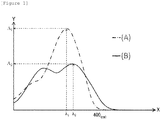
- FIG. 1 is a schematic view showing a typical ultraviolet-visible absorption spectrum of a compound represented by formula (1) and a compound represented by formula (2).
- a numerical range expressed by "-" means a range including the numerical values described before and after "-" as lower limit and upper limit values.
- the ultraviolet absorbing plastic lens specifically described in patent literature 1 to investigate the absorption rate (hereinafter also referred to as the "ultraviolet absorption rate") of ultraviolet light (having a wavelength of 200-400nm) and the low degree of the yellowness index (hereinafter also referred to as “low yellowness”), it became clear that there was the problem in which the level required for current eyeglass lenses had not yet been reached.
- the yellowness index means the degree to which the eyeglass lens is colored yellow and is a value which can be measured by a method described later.
- an eyeglass lens containing an ultraviolet absorber has the problem that the yellowness index tends to be high.
- the required amount of ultraviolet absorber must be combined into the eyeglass lens. Therefore, in terms of the eyeglass lens properties, ultraviolet absorbency and low yellowness have been considered to have a trade-off relationship.
- the inventors of the present invention have found that if use is made of an eyeglass lens in which the above-described ultraviolet absorber, which contains a predetermined monomer and an ultraviolet absorber, contains two kinds of predetermined compound, and in which the M value calculated from the content and physical properties of the two kinds of compounds is within a predetermined range, it is possible to provide an eyeglass lens having excellent ultraviolet absorbency and low yellowness and have achieved the present invention.
- the eyeglass lens in the present embodiment is an eyeglass lens prepared using a resin composition containing m-xylylene diisocyanate, a polythiol compound and an ultraviolet absorber, wherein the ultraviolet absorber contains at least a compound represented by formula (1) and a compound represented by formula (2) wherein the M value represented by formula (X) is greater than 1.40 but less than 3.20.
- An eyeglass lens having such a composition has excellent ultraviolet absorbency and low yellowness. The reason will be described with reference to Fig. 1 below.
- Fig. 1 shows a typical ultraviolet-visible absorption spectrum of a compound represented by formula (1) and a typical ultraviolet-visible absorption spectrum of a compound represented by formula (2).
- the two ultraviolet-visible absorption spectra were measured using a solution prepared by dissolving a compound represented by formula (1) and a compound represented by formula (2) in chloroform each at a concentration of 10 weight ppm.
- the X-axis represents wavelength (nm) and the Y-axis represents the absorbance.
- Fig. 1 is purely an example and the typical ultraviolet-visible absorption spectrum of an ultraviolet absorber represented by formula (1) and the typical ultraviolet-visible absorption spectrum of an ultraviolet absorber represented by formula (2) are not limited to the embodiment in Fig. 1 .
- curve A shown by the dot-dash line represents the ultraviolet-visible absorption spectrum of a compound represented by formula (1).
- a compound represented by formula (1) has a benzotriazole structure and usually has a maximum absorption wavelength ⁇ 1 in the range of 300-380nm.
- a compound represented by formula (1) with such ultraviolet absorption properties exhibits excellent ultraviolet absorbency in the range less than 380nm but has almost no absorption in the visible light range (approximately 400-800nm). Therefore, the absorbance at around 400nm of a compound represented by formula (1) is relatively low.
- curve B shown by the solid line represents the ultraviolet-visible absorption spectrum of a compound represented by formula (2).
- a compound represented by formula (2) has a benzotriazole structure and has predetermined functional groups, the ⁇ -conjugation system is easily extended compared to a compound represented by formula (1) and readily absorbs light in a longer wavelength region. Therefore, a compound represented by formula (2) has higher absorbance in the range of 380-400nm than a compound represented by formula (1). Thus, the absorbance of a compound represented by formula (2) at around 400nm is higher than the absorbance of a compound represented by formula (1) at around 400nm.
- the inventors of the present invention have found that upon using a predetermined monomer and simultaneously using two kinds of compounds having different ultraviolet absorption properties set forth above as the ultraviolet absorbing agent and with the M value calculated from the content and physical properties of the two kinds of compounds being within a predetermined range, an eyeglass having excellent ultraviolet absorbency and low yellowness can be provided.
- the M value calculated from the content and physical properties of the two kinds of compounds being within a predetermined range
- the resulting eyeglass lens shows an insufficient ultraviolet absorption rate (in particular, the ultraviolet absorption rate in the range of 380-400nm). Further, from the viewpoint of compatibility with resin components in the eyeglass lens, it is impossible to incorporate a large amount of a compound represented by formula (1) in the eyeglass lens. Furthermore, when a compound represented by formula (2) alone is used as an ultraviolet absorber, the resulting eyeglass lens tends to readily yellow. As described above, when only one kind of ultraviolet absorber was used, it was impossible to achieve both an excellent ultraviolet absorption rate and low yellowing in a well-balanced manner.
- the M value is a value represented by the following formula (X).
- ⁇ A 2 / A 1 ⁇ W 2 / W 1
- ⁇ 1 represents the maximum absorption wavelength of a compound represented by formula (1) in the ultraviolet-visible absorption spectrum of a chloroform solution in which the concentration of a compound represented by formula (1) is 10 weight ppm (see Fig. 1 ). That is, the maximum absorption wavelength ⁇ 1 refers to a wavelength exhibiting the maximum value in the ultraviolet-visible absorption spectrum obtained by ultraviolet-visible spectrophotometry (UV-Vis) using a solution in which a compound represented by formula (1) was dissolved in chloroform at a concentration of 10ppm by weight. In addition, if there are multiple maximum values, the maximum value on the longest wavelength side among the multiple maximum values is taken.
- ⁇ 2 represents the maximum absorption wavelength of a compound represented by formula (2) in the ultraviolet-visible absorption spectrum of a chloroform solution in which the concentration of a compound represented by formula (2) is 10 weight ppm (see Fig. 1 ). That is, the maximum absorption wavelength ⁇ 2 refers to a wavelength exhibiting the maximum value in the ultraviolet-visible absorption spectrum obtained by ultraviolet-visible spectrophotometry (UV-Vis) using a solution in which a compound represented by formula (2) was dissolved in chloroform at a concentration of 10 weight ppm. In addition, if there are multiple maximum values, the maximum value on the longest wavelength side among the multiple maximum values is taken.
- curve B is the ultraviolet-visible absorption spectrum of a compound represented by formula (2) and, among them, the wavelength showing the maximum value on the long wavelength side is set as the maximum absorption wavelength ⁇ 2 .
- ⁇ 1 is not particularly limited, it can be 340-350nm or 343-347nm from the viewpoint that the eyeglass lens of the present embodiment has superior ultraviolet absorbency and low yellowness.
- ⁇ 2 is not particularly limited, it can be 340-370nm or 341-354nm from the viewpoint that the eyeglass lens of the present embodiment has superior ultraviolet absorbency and low yellowness. Further, although the value of
- ⁇ 2 is larger than ⁇ 1 , it is not limited to this embodiment and ⁇ 1 may be larger than ⁇ 2 .
- a 1 represents the absorbance at the maximum absorption wavelength of a compound represented by formula (1) in the ultraviolet-visible absorption spectrum of a chloroform solution in which the concentration of a compound represented by formula (1) is 10 weight ppm (see Fig.1 ). That is, absorbance A 1 is the absorbance at the maximum absorption wavelength ⁇ 1 in an ultraviolet-visible absorption spectrum obtained by ultraviolet-visible spectrophotometry (UV-Vis) using a solution in which a compound represented by formula (1) was dissolved in chloroform at a concentration of 10ppm by weight.
- UV-Vis ultraviolet-visible spectrophotometry
- a 2 represents the absorbance at the maximum absorption wavelength of a compound represented by formula (2) in the ultraviolet-visible absorption spectrum of a chloroform solution in which the concentration of a compound represented by formula (2) is 10 weight ppm (see Fig. 1 ). That is, absorbance A 2 is the absorbance at the maximum absorption wavelength ⁇ 2 in an ultraviolet-visible absorption spectrum obtained by ultraviolet-visible spectrophotometry (UV-Vis) using a solution in which a compound represented by formula (2) was dissolved in chloroform at a concentration of 10ppm by weight.
- UV-Vis ultraviolet-visible spectrophotometry
- the method of measuring the absorbance is the same as the method of measuring the maximum absorption wavelength described above.
- a 2 /A 1 means the ratio of the amount of ultraviolet absorption at the maximum absorption wavelength of a compound represented by formula (2) to the amount of ultraviolet absorption at the maximum absorption wavelength of a compound represented by formula (1). If this value is too low, absorbency on the long wavelength side due to the absorption spectrum of a compound represented by formula (2) becomes insufficient, and the ultraviolet absorbency of the eyeglass lens tends to be poor. However, if this value is too high, absorbency on the long wavelength side becomes excessive, and the low yellowness of the eyeglass lens tends to be poor.
- a 1 is not particularly limited, it can be 0.2-2.0, further 0.3-2.0, further still 0.4-1.1 and also 0.7-1.1 from the viewpoint that the eyeglass lens of the present embodiment has superior ultraviolet absorbency and low yellowness.
- a 2 is not particularly limited, it can be 0.2-0.9 or 0.3-0.6 from the viewpoint that the eyeglass lens of the present embodiment has superior ultraviolet absorbency and low yellowness.
- a 2 /A 1 is not particularly limited, it can be 0.1-4.5, further 0.2-3.4 and further still 0.3-0.6 from the viewpoint that the eyeglass lens of the present embodiment has superior ultraviolet absorbency and low yellowness.
- W 1 represents the amount (in parts by weight) of a compound represented by formula (1) when the total of the m-xylylene diisocyanate and the polythiol compound is 100 parts by weight. That is, the above W 1 corresponds to the amount (in parts by weight) of a compound represented by formula (1) with respect to 100wt% of monomer mixture composed of m-xylylene diisocyanate and a polythiol compound in the resin composition.
- W 2 represents the amount (in parts by weight) of a compound represented by formula (2) when the total of the m-xylylene diisocyanate and the polythiol compound is 100 parts by weight. That is, the above W 2 corresponds to the amount (in parts by weight) of a compound represented by formula (2) with respect to 100wt% of monomer mixture composed of m-xylylene diisocyanate and a polythiol compound in the resin composition.
- W 2 /W 1 means the ratio of the amount of a compound represented by formula (2) to the amount of a compound represented by formula (1). If this value is too low, absorbency on the long wavelength side due to the absorption spectrum of a compound represented by formula (2) becomes insufficient, and the ultraviolet absorbency of the eyeglass lens tends to be poor. However, if this value is too high, absorbency on the long wavelength side becomes excessive, and the low yellowness of the eyeglass lens tends to be poor.
- the ultraviolet absorbency of the eyeglass lens tends to be poor and, if it is too high, the low yellowness of the eyeglass lens tends to be poor.
- the M value of the eyeglass lens of the present embodiment is greater than 1.40 and less than 3.20.
- the M value is below the lower limit value, the ultraviolet absorbency of the eyeglass lens is poor and, when it is above the upper limit value, the low yellowness of the eyeglass lens is poor.
- the M value can be greater than 1.63 and less than 3.20 and can be greater than 1.63 and less than 2.75 from the viewpoint that the eyeglass lens of the present embodiment has superior ultraviolet absorbency and low yellowness.
- the eyeglass lens of the present embodiment is formed using a predetermined monomer as mentioned above and simultaneously using two kinds of compound having different ultraviolet absorption properties as ultraviolet absorbers and with the M value calculated from the content and physical properties of the ultraviolet absorber being within a predetermined range, it is assumed that both ultraviolet absorbency and low yellowness, which were considered to have a trade-off relationship, could coexist at a high level.
- the resin composition contains m-xylylene diisocyanate, a polythiol compound, and an ultraviolet absorber.
- m-xylylene diisocyanate a polythiol compound
- ultraviolet absorber an ultraviolet absorber
- the ultraviolet absorber contains at least a compound represented by the following formula (1) and a compound represented by the following formula (2). These 2 compounds (ultraviolet absorbers) are structurally similar and both show excellent compatibility. In addition, these 2 kinds of ultraviolet absorbers also exhibit excellent compatibility with the monomer described later and are easily dispersed uniformly in the eyeglass lens.
- an ultraviolet absorber having a molecular weight of 360 or less can be used at less than 0.7 parts by weight when the total of m-xylylene diisocyanate and a polythiol compound is taken as 100 parts by weight.
- the ultraviolet absorber used in the present embodiment contains a compound (an ultraviolet absorber) represented by the following formula (1).
- R 1 -R 9 each independently represent a hydrogen atom, an alkyl group (the number of carbon atoms can be 1-8), an alkoxy group (the number of carbon atoms can be 1-8), or a hydroxyl group.
- R 1 -R 4 can be hydrogen atoms.
- at least one of R 5 -R 9 can be a hydroxyl group and R 5 can be a hydroxyl group.
- R 7 can be an alkoxy group from the viewpoint that the eyeglass lens of the present embodiment has superior ultraviolet absorbency and low yellowness.
- the number of carbon atoms in the alkoxy group can be 1-5.
- the molecular weight of a compound represented by the above formula (1) is not particularly limited, it can be 360 or less and can be 340 or less from the viewpoint of obtaining an eyeglass lens having superior low yellowness.
- the molecular weight of a compound represented by the above formula (1) can be 290 or less and can be 280 or less from the viewpoint of obtaining an eyeglass lens having superior ultraviolet absorbency.
- the lower limit value for the molecular weight of a compound represented by the above formula (1) is not particularly limited but is generally 210 or more.
- the molecular weight means the molecular weight which can be calculated from the structural formula.
- an ultraviolet absorber represented by above-mentioned formula (1) 2-(2-hydroxy-5-methylpropyl)-2H-benzotriazole, 2-(2-hydroxy-5-t-octylphenyl)-2H-benzotriazole, 2-(4-ethoxy-2-hydroxyphenyl)-2H-benzotriazole, and 2-(4-butoxy-2-hydroxyphenyl)-2H-benzotriazole and the like can be mentioned.
- the ultraviolet absorber used in the present embodiment contains a compound (an ultraviolet absorber) represented by formula (2).
- R 11 -R 19 each independently represent a hydrogen atom, an alkyl group (the number of carbon atoms can be 1-8), an alkoxy group (the number of carbon atoms can be 1-8), or a hydroxyl group or a halogen atom (for example, fluorine, chlorine, bromine and the like).
- R 11 -R 14 each independently represent a hydrogen atom, an alkyl, an alkoxy, or a hydroxyl group or a halogen atom, each can be a hydrogen atom, an alkyl, an alkoxy, or a hydroxyl group, each can be a hydrogen atom or an alkyl group or further each can be hydrogen atoms.
- R 19 is a hydrogen atom, an alkyl group, or an alkoxy group
- at least one of R 11 -R 14 is a halogen atom.
- R 15 can be a hydroxyl group.
- R 19 represents a hydrogen atom, an alkyl group (the number of carbon atoms can be 1-8), an alkoxy group (the number of carbon atoms can be 1-8), a phenylalkyl group (the number of carbon atoms is 1-8), or a group represented by the following formula (3), a phenylalkyl group, or a group represented by the following formula (3).
- a phenylalkyl group means a group in which at least one hydrogen atom in the phenyl group is substituted with an alkyl group.
- Formula (3) *-L-R 20 In formula (3), L represents an alkylene group.
- R 20 represents an optionally substituted aromatic hydrocarbon group or heterocyclic ring group.
- optionally substituted aromatic hydrocarbon groups include a phenyl group, a tolyl group, a xylyl group, a naphthyl group, and an anthryl group, and can be a phenyl group or a substituted phenyl group from the viewpoint that the ultraviolet absorbency on the longer wavelength side improves.
- the substituent is not particularly limited, for example, an alkyl group, an alkoxy group, a hydroxyl group, and a halogen atom can be mentioned and, among these, a hydroxyl group or an alkyl group can be used.
- aliphatic heterocyclic groups such as an oxetanyl group, a pyrrolidinyl group, a tetrahydrofuryl group, and a tetrahydrophthalamide group and the like and an aromatic heterocyclic group such as a thienyl group, a furanyl group, a pyridyl group, a pyrimidyl group, a thiazolyl group, an oxazolyl group, a triazolyl group, a benzothiophenyl group, a benzofuranyl group, a benzothiazolyl group, a benzoxazolyl group, and a benzotriazolyl group and the like can be mentioned.
- R 17 can be an alkyl group and, in particular, it can be an alkyl group having 1-8 carbon atoms.
- substituents groups exemplified as substituents which may be substituted on the above aromatic hydrocarbon group can be mentioned.
- the molecular weight of a compound represented by the above formula (2) is not particularly limited and can be greater than 360, it can be greater than 380 and can even be greater than 400 from the viewpoint of obtaining an eyeglass lens having superior ultraviolet absorbency.
- the upper limit for the molecular weight of the 2nd compound is not particularly limited but is generally 1000 or less.
- a compound represented by the above formula (2) can be a compound represented by the following formula (4) from the viewpoint that the eyeglass lens of the present embodiment has superior ultraviolet absorbency and low yellowness.
- R 51 -R 58 each independently represent a hydrogen atom, an alkyl group (the number of carbons can be 1-8), an alkoxy group (the number of carbons can be 1-8), or a hydroxyl group
- L represents an alkylene group (the number of carbon atoms can be 1-3)
- R 50 represents an optionally substituted aromatic hydrocarbon group or a heterocyclic ring group.
- the embodiments of R 51 -R 54 , R 55 -R 58 , and R 50 are the same as those of the above-described R 11 -R 14 , R 15 -R 18 , and R 20 , respectively.
- an ultraviolet absorber represented by the above-mentioned formula (2) 2-(3-tert-butyl-2-hydroxy-5-methylphenyl)-5-chloro-2H-benzotriazole, 2-(2H-benzotriazol-2-yl)-4-methyl-6-(3,4,5,6-tetrahydrophthalimidylmethyl) phenol, 6-(2-benzotriazolyl)-4-t-octyl-6'-t-butyl-4'-methyl-2,2'-methylenebisphenol, and 2-(2H-benzotriazol-2-yl)-6-(1-methyl-1-phenylethyl)-4-(1,1,3,3-tetramethylbutyl) phenol and the like can be mentioned.
- the ultraviolet absorber used in the present embodiment may contain at least a compound represented by formula (1) and a compound represented by formula (2) and, as long as the eyeglass lens of the present embodiment has superior ultraviolet absorbency and low yellowness, other compounds may be present as an ultraviolet absorber.
- the amount of ultraviolet absorber having a molecular weight of 360 or less can be used at less than 0.7 parts by weight when the total of m-xylylene diisocyanate and a polythiol compound is taken as 100 parts by weight. If the amount of ultraviolet absorber having a molecular weight of 360 or less is lower than the upper limit value, an eyeglass lens having superior low yellowness can be obtained.
- the lower limit of the amount of ultraviolet absorber having a molecular weight of 360 or less is not particularly limited and can be 0.001 parts by weight or more, further 0.01 parts by weight or more and further still 0.1 parts by weight or more from the viewpoint of obtaining an eyeglass lens having superior ultraviolet absorbency.
- the above-mentioned "amount of ultraviolet absorber having a molecular weight of 360 or less” means the sum of the amounts when the resin composition used in the present embodiment contains multiple compounds having a molecular weight of 360 or less as an ultraviolet absorber.
- the amount of ultraviolet absorber in the resin composition used in the present embodiment can be 0.01-7.0 parts by weight, further 0.1-6.0 parts by weight and further still 0.1-5.0 parts by weight when the total of m-xylylene diisocyanate and a polythiol compound is taken as 100 parts by weight from the viewpoint that the eyeglass lens of the present embodiment has superior ultraviolet absorbency and low yellowness.
- the amount W 1 (in parts by weight) of a compound represented by the above formula (1) and the amount W 2 (in parts by weight) of a compound represented by the above formula (2) are not particularly limited.
- W 1 can be 0.001-0.7 parts by weight and 0.01-0.7 parts by weight when the total of m-xylylene diisocyanate and a polythiol compound is taken as 100 parts by weight from the viewpoint that the eyeglass lens of the present embodiment has superior ultraviolet absorbency and low yellowness.
- W 2 can be 0.001-4.0 parts by weight, further 0.01-4.0 parts by weight, and further still 0.1-4.0 parts by weight.
- the sum (W 1 +W 2 ) of the amount W 1 of a compound represented by formula (1) and the amount W 2 of a compound represented by formula (2) is not particularly limited and can be 0.01 parts by weight and, from the viewpoint of obtaining an eyeglass lens having superior ultraviolet absorbency, can be 0.1 parts by weight, further 1.0 parts by weight and further still 1.5 parts by weight.
- the upper limit value is not particularly limited and can be 7.0 parts by weight or less and 5.0 parts by weight or less from the viewpoint that an eyeglass lens having superior low yellowness can be obtained.
- W 1 /W 2 is not particularly limited, it can be 0.01-100, further 0.05-10 and further still 0.5-3 from the viewpoint that the eyeglass lens of the present embodiment has superior ultraviolet absorbency and low yellowness.
- the polythiol compound is not particularly limited as long as it has 2 or more mercapto groups in the molecule but it may have 3 or 4 mercapto groups and, for example, pentaerythritol tetrakis thioglycolate, pentaerythritol tetrakis (3-mercaptopropionate), 1,2-bis[(2-mercaptoethyl)thio]-3-mercaptopropane, 4-mercaptomethyl-3,6-dithia-1,8-octanedithiol ethanedithiol and bis(mercaptomethyl)-3,6,9-trithio-1,11-undecanedithiol can be mentioned.
- One kind of polythiol compound may be used alone or two or more kinds may be used in combination.
- the resin composition may contain polyisocyanates other than m-xylylene diisocyanate as long as the eyeglass lens of this embodiment has superior ultraviolet absorbency and low yellowness.
- the ratio of the amount of m-xylylene diisocyanate (the total amount when other polyisocyanates are also present) to the amount of polythiol compound in the resin composition can be adjusted so that the ratio of functional isocyanate groups and mercapto groups shows an NCO/SH (molar ratio) value of 0.5-3.0 and can be 0.5-1.5
- the resin composition used in the present embodiment may contain components other than those described above as long as the eyeglass lens of the present embodiment has excellent ultraviolet absorbency and low yellowness.
- components other than the above for example, a preliminary reaction catalyst, a reaction adjustment agent, a polymerization catalyst, a dye and a pigment, and other additives can be mentioned.
- These polymerization catalysts may be used alone, or two or more kinds may be used in combination.
- the addition amount of polymerization catalyst can be 0.0001-10.0 parts by weight and can be 0.001-5.0 parts by weight with respect to 100 parts by weight for the total amount of m-xylylene diisocyanate and polythiol compound.
- Dyes and pigments are not particularly limited as long as they are substances capable of decreasing poor initial color tone or yellowness or redness, for example, dyes and/or pigments for optical materials such as commercially available bluing agents for use in eyeglass lens materials can be used.
- the lens can be manufactured by curing a resin composition obtained by mixing the above-mentioned respective components.
- desired processing may be performed on the obtained eyeglass lens as needed.
- the kind and amount of the ultraviolet absorber can be selected and designed so that the M value is within a predetermined range.
- the kind of eyeglass lens is not particularly limited and, for example, includes a finished lens wherein both the convex and concave surfaces are optically finished and that is molded to the desired power, a semi-finished lens that is optically finished only on the convex surface like a finished lens, and that is optically finished on the concave side to match the desired power according to subsequent orders and the like.
- a finished lens wherein both the convex and concave surfaces are optically finished and that is molded to the desired power
- a semi-finished lens that is optically finished only on the convex surface like a finished lens, and that is optically finished on the concave side to match the desired power according to subsequent orders and the like.
- lenses not subjected to grinding processing are also included.
- the method of producing the resin composition is not particularly limited and a method of simultaneously mixing the above-mentioned respective components in the same container to produce a resin composition, a method of adding and mixing the respective components in stages to produce a resin composition, and a method in which several components are separately mixed and further mixed again in the same container to produce a resin composition can be mentioned.
- the mixing order of each component is not limited.
- a degassing procedure may be carried out under reduced pressure before, during, or after mixing of each component and additive.
- the method for curing the resin composition for example, after injecting the resin composition into a glass or metal mold, thermal polymerization using an electric furnace or the like, ultraviolet curing using ultraviolet light irradiation, electron beam curing using electron beam irradiation, and a method in which radiation curing is performed using irradiation can be mentioned.
- the curing time using thermal polymerization curing can be 0.1-100 hours usually 1-72 hours, and the curing temperature can be -10-160°C usually 0-140°C.
- Polymerization can be carried out by maintaining a predetermined polymerization temperature for a predetermined time, raising the temperature at 0.1-100°C/h, and cooling at 0.1-100°C/h or using combinations thereof.
- the eyeglass lens may be annealed to remove distortion in the eyeglass lens.
- the eyeglass lens of the present embodiment may have a coating layer on one or both sides.
- a coating layer for example, a primer layer, a hard coating layer, an anti-reflection film layer, an anti-fog coating film layer, a stain-proof film layer and the like can be mentioned. These layers may be laminated.
- the thickness of the eyeglass lens of the present embodiment is not particularly limited and is often about 1-30mm from the viewpoint of handling.
- the eyeglass lens may not be transparent as long as it is translucent, and it may be colored.
- the surface shape is selected from an arbitrary shape such as convex, flat, and concave.
- the amount of 2-(4-butoxy-2-hydroxyphenyl)-2H-benzotriazole used was 0.64 parts by weight to a total of 100 parts by weight of the mixture of m-xylylene diisocyanate and bis(mercaptomethyl)-3,6,9-trithio-1,11-undecanedithiol (hereinafter referred to as "monomer mixture").
- the amount of 2-(2H-benzotriazol-2-yl)-6-(1-methyl-1-phenylethyl)-4-(1,1,3,3-tetramethylbutyl) phenol used was 1.0 parts by weight relative to 100 parts by weight of the total amount of monomer mixture.
- the amount of 2-(4-ethoxy-2-hydroxyphenyl)-2H-benzotriazole used was 0.64 parts by weight relative to 100 parts by weight of the total amount of monomer mixture.
- the amount of 2-(2H-benzotriazol-2-yl)-6-(1-methyl-1-phenylethyl)-4-(1,1,3,3-tetramethylbutyl) phenol used was 0.86 parts by weight relative to 100 parts by weight of the total amount of monomer mixture.
- the amount of 2-(4-ethoxy-2-hydroxyphenyl)-2H-benzotriazole used was 0.64 parts by weight relative to 100 parts by weight of the total amount of monomer mixture.
- the amount of 2-(2H-benzotriazol-2-yl)-6-(1-methyl-1-phenylethyl)-4-(1,1,3,3-tetramethylbutyl) phenol used was 1.0 parts by weight relative to 100 parts by weight of the total amount of monomer mixture.
- the amount of 2-(4-ethoxy-2-hydroxyphenyl)-2H-benzotriazole used was 0.64 parts by weight relative to 100 parts by weight of the total amount of monomer mixture.
- the amount of 2-(2H-benzotriazol-2-yl)-6-(1-methyl-1-phenylethyl)-4-(1,1,3,3-tetramethylbutyl) phenol used was 1.11 parts by weight relative to 100 parts by weight of the total amount of monomer mixture.
- the amount of 2-(2-hydroxy-5-t-octylphenyl)-2H-benzotriazole used was 0.6 parts by weight relative to 100 parts by weight of the total amount of monomer mixture.
- the amount of 2-(2H-benzotriazol-2-yl)-4-methyl-6-(3,4,5,6-tetrahydrophthalmidylmethyl) phenol used was 0.6 parts by weight relative to 100 parts by weight of the total amount of monomer mixture.
- the amount of 2-(4-ethoxy-2-hydroxyphenyl)-2H-benzotriazole used was 0.64 parts by weight relative to 100 parts by weight of the total amount of monomer mixture.
- the amount of 6-(2-benzotriazolyl)-4-t-octyl-6'-t-butyl-4'-methyl-2,2'-methylene bisphenol used was 1.31 parts by weight relative to 100 parts by weight of the total amount of monomer mixture.
- the amount of 2-(4-ethoxy-2-hydroxyphenyl)-2H-benzotriazole used was 0.64 parts by weight relative to 100 parts by weight of the total amount of monomer mixture.
- the amount of 2-(2H-benzotriazol-2-yl)-6-(1-methyl-1-phenylethyl)-4-(1,1,3,3-tetramethylbutyl) phenol used was 1.53 parts by weight relative to 100 parts by weight of the total amount of monomer mixture.
- the light transmittance is the transmittance (%) at each wavelength and the evaluation was performed using the maximum light transmittance (%) at a wavelength of 400nm or less.
- a sample having a maximum light transmittance of 1.0% or less at a wavelength of 400nm or less was determined to exhibit good ultraviolet absorbency.
- light transmittance was measured for each eyeglass lens for evaluation with an S-1.25 (D) lens of 1.0mm thickness. The light transmittance of each eyeglass lens for evaluation at 400nm or less is shown in Table 2.
- the yellowness index (YI) was calculated based on JIS-K 7373, which calculates the tristimulus values X, Y, Z from the ultraviolet-visible absorption spectrum, and a yellowness index below 5.0 was taken to be good.
- the yellowness index was measured for each eyeglass lens for evaluation of an S-0.00 (D) lens having a thickness of 2.0mm.
- Table 1 (Table 1) Compound represented by formula (1) Compound represented by formula (2) or (4) W 1 +W 2 M value Maximum light transmittance (%) at 400nm or less Yellowness index (YI) ⁇ 1 (nm) A 1 W 1 Mwt. ⁇ 2 (nm) A 2 W 2 Mwt.
- Example 1 346 0.92 0.64 283.3 349 0.32 1.0 441.6 1. 64 1.63 0.36 4.7
- Example 2 344 1.02 0.64 255.3 349 0.32 0.86 441.6 1.50 2.11 0.56 4.3
- Example 3 344 1.02 0.64 255.3 349 0.32 1.0 441.6 1.
Landscapes
- Chemical & Material Sciences (AREA)
- Health & Medical Sciences (AREA)
- Organic Chemistry (AREA)
- Physics & Mathematics (AREA)
- Chemical Kinetics & Catalysis (AREA)
- Polymers & Plastics (AREA)
- Medicinal Chemistry (AREA)
- General Physics & Mathematics (AREA)
- Optics & Photonics (AREA)
- Ophthalmology & Optometry (AREA)
- General Health & Medical Sciences (AREA)
- Toxicology (AREA)
- Inorganic Chemistry (AREA)
- Eyeglasses (AREA)
- Compositions Of Macromolecular Compounds (AREA)
- Polyurethanes Or Polyureas (AREA)
- Optical Filters (AREA)
Abstract
Description
- The present invention relates to an eyeglass lens.
- Patent literature 1 discloses "an ultraviolet-absorbing plastic lens containing an ultraviolet absorber having a molecular weight of 360 or less at a ratio of 0.7-5 parts by weight with respect to 100 parts by weight of raw material monomer".
- Patent literature 1: Japanese Laid-Open Patent Application Publication
JP H11-271501 - The present invention, according to the embodiments, provides an eyeglass lens prepared using a resin composition containing m-xylylene diisocyanate, a polythiol compound and an ultraviolet absorber, wherein the ultraviolet absorber contains at least a compound represented by formula (1) and a compound represented by formula (2) and the M value represented by formula (X) is greater than 1.40 but less than 3.20.

Formula (3) *-L-R20
In formula (3), L represents an alkylene group. R20 represents an optionally substituted aromatic hydrocarbon group or a heterocyclic ring group.)
- [
Fig. 1 ] is a schematic view showing a typical ultraviolet-visible absorption spectrum of a compound represented by formula (1) and a compound represented by formula (2). - The invention will be described in more detail in the following embodiments.
- In the following description, there are cases in which constitutional requirements will be described on the basis of typical embodiments of the present invention, but the present invention is not limited to the above-described embodiments.
- In addition, in the present specification, a numerical range expressed by "-" means a range including the numerical values described before and after "-" as lower limit and upper limit values.
- When the inventors of the present invention used the ultraviolet absorbing plastic lens specifically described in patent literature 1 to investigate the absorption rate (hereinafter also referred to as the "ultraviolet absorption rate") of ultraviolet light (having a wavelength of 200-400nm) and the low degree of the yellowness index (hereinafter also referred to as "low yellowness"), it became clear that there was the problem in which the level required for current eyeglass lenses had not yet been reached. In addition, the yellowness index means the degree to which the eyeglass lens is colored yellow and is a value which can be measured by a method described later.
- Generally, an eyeglass lens containing an ultraviolet absorber has the problem that the yellowness index tends to be high. However, in order to impart excellent ultraviolet absorbency to the eyeglass lens, the required amount of ultraviolet absorber must be combined into the eyeglass lens. Therefore, in terms of the eyeglass lens properties, ultraviolet absorbency and low yellowness have been considered to have a trade-off relationship.
- The inventors of the present invention have found that if use is made of an eyeglass lens in which the above-described ultraviolet absorber, which contains a predetermined monomer and an ultraviolet absorber, contains two kinds of predetermined compound, and in which the M value calculated from the content and physical properties of the two kinds of compounds is within a predetermined range, it is possible to provide an eyeglass lens having excellent ultraviolet absorbency and low yellowness and have achieved the present invention.
- The eyeglass lens in the present embodiment is an eyeglass lens prepared using a resin composition containing m-xylylene diisocyanate, a polythiol compound and an ultraviolet absorber, wherein the ultraviolet absorber contains at least a compound represented by formula (1) and a compound represented by formula (2) wherein the M value represented by formula (X) is greater than 1.40 but less than 3.20.
- An eyeglass lens having such a composition has excellent ultraviolet absorbency and low yellowness. The reason will be described with reference to
Fig. 1 below. -
Fig. 1 shows a typical ultraviolet-visible absorption spectrum of a compound represented by formula (1) and a typical ultraviolet-visible absorption spectrum of a compound represented by formula (2). The two ultraviolet-visible absorption spectra were measured using a solution prepared by dissolving a compound represented by formula (1) and a compound represented by formula (2) in chloroform each at a concentration of 10 weight ppm. InFig 1 , the X-axis represents wavelength (nm) and the Y-axis represents the absorbance.Fig. 1 is purely an example and the typical ultraviolet-visible absorption spectrum of an ultraviolet absorber represented by formula (1) and the typical ultraviolet-visible absorption spectrum of an ultraviolet absorber represented by formula (2) are not limited to the embodiment inFig. 1 . - Further, in
Fig. 1 , curve A shown by the dot-dash line represents the ultraviolet-visible absorption spectrum of a compound represented by formula (1). A compound represented by formula (1) has a benzotriazole structure and usually has a maximum absorption wavelength λ1 in the range of 300-380nm. A compound represented by formula (1) with such ultraviolet absorption properties exhibits excellent ultraviolet absorbency in the range less than 380nm but has almost no absorption in the visible light range (approximately 400-800nm). Therefore, the absorbance at around 400nm of a compound represented by formula (1) is relatively low. - In
Fig. 1 , curve B shown by the solid line represents the ultraviolet-visible absorption spectrum of a compound represented by formula (2). A compound represented by formula (2) has a benzotriazole structure and has predetermined functional groups, the π-conjugation system is easily extended compared to a compound represented by formula (1) and readily absorbs light in a longer wavelength region. Therefore, a compound represented by formula (2) has higher absorbance in the range of 380-400nm than a compound represented by formula (1). Thus, the absorbance of a compound represented by formula (2) at around 400nm is higher than the absorbance of a compound represented by formula (1) at around 400nm. - On the other hand, since a compound represented by formula (2) readily absorbs visible light at 400nm and above, the eyeglass lens incorporating this compound readily yellows.
- The inventors of the present invention have found that upon using a predetermined monomer and simultaneously using two kinds of compounds having different ultraviolet absorption properties set forth above as the ultraviolet absorbing agent and with the M value calculated from the content and physical properties of the two kinds of compounds being within a predetermined range, an eyeglass having excellent ultraviolet absorbency and low yellowness can be provided. Hereinafter, the technical significance of the M value will be described in more detail.
- In addition, if only a compound represented by formula (1) is used as an ultraviolet absorber, the resulting eyeglass lens shows an insufficient ultraviolet absorption rate (in particular, the ultraviolet absorption rate in the range of 380-400nm). Further, from the viewpoint of compatibility with resin components in the eyeglass lens, it is impossible to incorporate a large amount of a compound represented by formula (1) in the eyeglass lens. Furthermore, when a compound represented by formula (2) alone is used as an ultraviolet absorber, the resulting eyeglass lens tends to readily yellow. As described above, when only one kind of ultraviolet absorber was used, it was impossible to achieve both an excellent ultraviolet absorption rate and low yellowing in a well-balanced manner.
- The M value is a value represented by the following formula (X).

(In formula (X), λ1 represents the maximum absorption wavelength of a compound represented by formula (1) in the ultraviolet-visible absorption spectrum of a chloroform solution in which the concentration of a compound represented by formula (1) is 10 weight ppm (seeFig. 1 ). That is, the maximum absorption wavelength λ1 refers to a wavelength exhibiting the maximum value in the ultraviolet-visible absorption spectrum obtained by ultraviolet-visible spectrophotometry (UV-Vis) using a solution in which a compound represented by formula (1) was dissolved in chloroform at a concentration of 10ppm by weight. In addition, if there are multiple maximum values, the maximum value on the longest wavelength side among the multiple maximum values is taken. - Further, λ2 represents the maximum absorption wavelength of a compound represented by formula (2) in the ultraviolet-visible absorption spectrum of a chloroform solution in which the concentration of a compound represented by formula (2) is 10 weight ppm (see
Fig. 1 ). That is, the maximum absorption wavelength λ2 refers to a wavelength exhibiting the maximum value in the ultraviolet-visible absorption spectrum obtained by ultraviolet-visible spectrophotometry (UV-Vis) using a solution in which a compound represented by formula (2) was dissolved in chloroform at a concentration of 10 weight ppm. In addition, if there are multiple maximum values, the maximum value on the longest wavelength side among the multiple maximum values is taken. - In addition, in
Fig. 1 , two maxima are shown on curve B which is the ultraviolet-visible absorption spectrum of a compound represented by formula (2) and, among them, the wavelength showing the maximum value on the long wavelength side is set as the maximum absorption wavelength λ2. - As apparatus for measuring the ultraviolet-visible absorption spectrum, measurements are carried out using a spectrophotometer under the following conditions.
Cell: quartz, width 1cm (corresponds to a 1cm optical path length)
Blank: solvent (chloroform) - In formula (X), |λ2-λ1| is the absolute value of the difference between λ1 and λ2 and indicates the difference in the maximum absorption wavelength of a compound represented by formula (1) and the maximum absorption wavelength of a compound represented by formula (2). If this value is too low, the absorption band becomes narrow and the ultraviolet absorbency of the eyeglass lens tends to be poor. However, if this value is too high, the absorption band tends to be in the visible light region and the low yellowness of the eyeglass lens tends to be poor.
- In addition, although the size of λ1 is not particularly limited, it can be 340-350nm or 343-347nm from the viewpoint that the eyeglass lens of the present embodiment has superior ultraviolet absorbency and low yellowness.
- Although the size of λ2 is not particularly limited, it can be 340-370nm or 341-354nm from the viewpoint that the eyeglass lens of the present embodiment has superior ultraviolet absorbency and low yellowness. Further, although the value of |λ2-λ1| is not particularly limited, it can be 0.1-30nm or 1-9nm from the viewpoint that the eyeglass lens of the present embodiment has superior ultraviolet absorbency and low yellowness.
- In addition, in
Fig. 1 , although λ2 is larger than λ1, it is not limited to this embodiment and λ1 may be larger than λ2. - In formula (X), A1 represents the absorbance at the maximum absorption wavelength of a compound represented by formula (1) in the ultraviolet-visible absorption spectrum of a chloroform solution in which the concentration of a compound represented by formula (1) is 10 weight ppm (see
Fig.1 ). That is, absorbance A1 is the absorbance at the maximum absorption wavelength λ1 in an ultraviolet-visible absorption spectrum obtained by ultraviolet-visible spectrophotometry (UV-Vis) using a solution in which a compound represented by formula (1) was dissolved in chloroform at a concentration of 10ppm by weight. - A2 represents the absorbance at the maximum absorption wavelength of a compound represented by formula (2) in the ultraviolet-visible absorption spectrum of a chloroform solution in which the concentration of a compound represented by formula (2) is 10 weight ppm (see
Fig. 1 ). That is, absorbance A2 is the absorbance at the maximum absorption wavelength λ2 in an ultraviolet-visible absorption spectrum obtained by ultraviolet-visible spectrophotometry (UV-Vis) using a solution in which a compound represented by formula (2) was dissolved in chloroform at a concentration of 10ppm by weight. - The method of measuring the absorbance is the same as the method of measuring the maximum absorption wavelength described above.
- In formula (X), A2/A1 means the ratio of the amount of ultraviolet absorption at the maximum absorption wavelength of a compound represented by formula (2) to the amount of ultraviolet absorption at the maximum absorption wavelength of a compound represented by formula (1). If this value is too low, absorbency on the long wavelength side due to the absorption spectrum of a compound represented by formula (2) becomes insufficient, and the ultraviolet absorbency of the eyeglass lens tends to be poor. However, if this value is too high, absorbency on the long wavelength side becomes excessive, and the low yellowness of the eyeglass lens tends to be poor.
- Although the size of A1 is not particularly limited, it can be 0.2-2.0, further 0.3-2.0, further still 0.4-1.1 and also 0.7-1.1 from the viewpoint that the eyeglass lens of the present embodiment has superior ultraviolet absorbency and low yellowness.
- Although the size of A2 is not particularly limited, it can be 0.2-0.9 or 0.3-0.6 from the viewpoint that the eyeglass lens of the present embodiment has superior ultraviolet absorbency and low yellowness.
- Further, although the value of A2/A1 is not particularly limited, it can be 0.1-4.5, further 0.2-3.4 and further still 0.3-0.6 from the viewpoint that the eyeglass lens of the present embodiment has superior ultraviolet absorbency and low yellowness.
- In formula (X), W1 represents the amount (in parts by weight) of a compound represented by formula (1) when the total of the m-xylylene diisocyanate and the polythiol compound is 100 parts by weight. That is, the above W1 corresponds to the amount (in parts by weight) of a compound represented by formula (1) with respect to 100wt% of monomer mixture composed of m-xylylene diisocyanate and a polythiol compound in the resin composition.
- W2 represents the amount (in parts by weight) of a compound represented by formula (2) when the total of the m-xylylene diisocyanate and the polythiol compound is 100 parts by weight. That is, the above W2 corresponds to the amount (in parts by weight) of a compound represented by formula (2) with respect to 100wt% of monomer mixture composed of m-xylylene diisocyanate and a polythiol compound in the resin composition.
- W2/W1 means the ratio of the amount of a compound represented by formula (2) to the amount of a compound represented by formula (1). If this value is too low, absorbency on the long wavelength side due to the absorption spectrum of a compound represented by formula (2) becomes insufficient, and the ultraviolet absorbency of the eyeglass lens tends to be poor. However, if this value is too high, absorbency on the long wavelength side becomes excessive, and the low yellowness of the eyeglass lens tends to be poor.
- The specific ranges relating to W1 and W2 will be described later in detail.
- As described above, if the values of the items constituting the M value are too low, the ultraviolet absorbency of the eyeglass lens tends to be poor and, if it is too high, the low yellowness of the eyeglass lens tends to be poor.
- Thus, the M value of the eyeglass lens of the present embodiment is greater than 1.40 and less than 3.20. When the M value is below the lower limit value, the ultraviolet absorbency of the eyeglass lens is poor and, when it is above the upper limit value, the low yellowness of the eyeglass lens is poor. In particular, the M value can be greater than 1.63 and less than 3.20 and can be greater than 1.63 and less than 2.75 from the viewpoint that the eyeglass lens of the present embodiment has superior ultraviolet absorbency and low yellowness.
- Since, the eyeglass lens of the present embodiment is formed using a predetermined monomer as mentioned above and simultaneously using two kinds of compound having different ultraviolet absorption properties as ultraviolet absorbers and with the M value calculated from the content and physical properties of the ultraviolet absorber being within a predetermined range, it is assumed that both ultraviolet absorbency and low yellowness, which were considered to have a trade-off relationship, could coexist at a high level.
- The resin composition contains m-xylylene diisocyanate, a polythiol compound, and an ultraviolet absorber. Hereinafter, and each component present in the resin composition will be described in detail.
- The ultraviolet absorber contains at least a compound represented by the following formula (1) and a compound represented by the following formula (2). These 2 compounds (ultraviolet absorbers) are structurally similar and both show excellent compatibility. In addition, these 2 kinds of ultraviolet absorbers also exhibit excellent compatibility with the monomer described later and are easily dispersed uniformly in the eyeglass lens.
- Among the ultraviolet absorbers used in this embodiment, an ultraviolet absorber having a molecular weight of 360 or less can be used at less than 0.7 parts by weight when the total of m-xylylene diisocyanate and a polythiol compound is taken as 100 parts by weight.
- The ultraviolet absorber used in the present embodiment contains a compound (an ultraviolet absorber) represented by the following formula (1).


- In formula (1), R1-R9 each independently represent a hydrogen atom, an alkyl group (the number of carbon atoms can be 1-8), an alkoxy group (the number of carbon atoms can be 1-8), or a hydroxyl group. Among them, R1-R4 can be hydrogen atoms. Further, at least one of R5-R9 can be a hydroxyl group and R5 can be a hydroxyl group. Further, R7 can be an alkoxy group from the viewpoint that the eyeglass lens of the present embodiment has superior ultraviolet absorbency and low yellowness. The number of carbon atoms in the alkoxy group can be 1-5.
- Although the molecular weight of a compound represented by the above formula (1) is not particularly limited, it can be 360 or less and can be 340 or less from the viewpoint of obtaining an eyeglass lens having superior low yellowness. In particular, the molecular weight of a compound represented by the above formula (1) can be 290 or less and can be 280 or less from the viewpoint of obtaining an eyeglass lens having superior ultraviolet absorbency. The lower limit value for the molecular weight of a compound represented by the above formula (1) is not particularly limited but is generally 210 or more.
- In addition, in the present specification, the molecular weight means the molecular weight which can be calculated from the structural formula.
- As an ultraviolet absorber represented by above-mentioned formula (1), 2-(2-hydroxy-5-methylpropyl)-2H-benzotriazole, 2-(2-hydroxy-5-t-octylphenyl)-2H-benzotriazole, 2-(4-ethoxy-2-hydroxyphenyl)-2H-benzotriazole, and 2-(4-butoxy-2-hydroxyphenyl)-2H-benzotriazole and the like can be mentioned.
- The ultraviolet absorber used in the present embodiment contains a compound (an ultraviolet absorber) represented by formula (2).

- In formula (2), R11-R19 each independently represent a hydrogen atom, an alkyl group (the number of carbon atoms can be 1-8), an alkoxy group (the number of carbon atoms can be 1-8), or a hydroxyl group or a halogen atom (for example, fluorine, chlorine, bromine and the like). R11-R14 each independently represent a hydrogen atom, an alkyl, an alkoxy, or a hydroxyl group or a halogen atom, each can be a hydrogen atom, an alkyl, an alkoxy, or a hydroxyl group, each can be a hydrogen atom or an alkyl group or further each can be hydrogen atoms. In addition, if R19 is a hydrogen atom, an alkyl group, or an alkoxy group, at least one of R11-R14 is a halogen atom.
- R15 can be a hydroxyl group.
- R19 represents a hydrogen atom, an alkyl group (the number of carbon atoms can be 1-8), an alkoxy group (the number of carbon atoms can be 1-8), a phenylalkyl group (the number of carbon atoms is 1-8), or a group represented by the following formula (3), a phenylalkyl group, or a group represented by the following formula (3). In addition, in the present specification, a phenylalkyl group means a group in which at least one hydrogen atom in the phenyl group is substituted with an alkyl group.
Formula (3) *-L-R20
In formula (3), L represents an alkylene group. R20 represents an optionally substituted aromatic hydrocarbon group or heterocyclic ring group. Examples of optionally substituted aromatic hydrocarbon groups include a phenyl group, a tolyl group, a xylyl group, a naphthyl group, and an anthryl group, and can be a phenyl group or a substituted phenyl group from the viewpoint that the ultraviolet absorbency on the longer wavelength side improves. The substituent is not particularly limited, for example, an alkyl group, an alkoxy group, a hydroxyl group, and a halogen atom can be mentioned and, among these, a hydroxyl group or an alkyl group can be used. - As an optionally substituted heterocyclic group, aliphatic heterocyclic groups such as an oxetanyl group, a pyrrolidinyl group, a tetrahydrofuryl group, and a tetrahydrophthalamide group and the like and an aromatic heterocyclic group such as a thienyl group, a furanyl group, a pyridyl group, a pyrimidyl group, a thiazolyl group, an oxazolyl group, a triazolyl group, a benzothiophenyl group, a benzofuranyl group, a benzothiazolyl group, a benzoxazolyl group, and a benzotriazolyl group and the like can be mentioned.
- R17 can be an alkyl group and, in particular, it can be an alkyl group having 1-8 carbon atoms. As the kind of substituent, groups exemplified as substituents which may be substituted on the above aromatic hydrocarbon group can be mentioned.
- The molecular weight of a compound represented by the above formula (2) is not particularly limited and can be greater than 360, it can be greater than 380 and can even be greater than 400 from the viewpoint of obtaining an eyeglass lens having superior ultraviolet absorbency. The upper limit for the molecular weight of the 2nd compound is not particularly limited but is generally 1000 or less.
- A compound represented by the above formula (2) can be a compound represented by the following formula (4) from the viewpoint that the eyeglass lens of the present embodiment has superior ultraviolet absorbency and low yellowness.

- In formula (4), R51-R58 each independently represent a hydrogen atom, an alkyl group (the number of carbons can be 1-8), an alkoxy group (the number of carbons can be 1-8), or a hydroxyl group, L represents an alkylene group (the number of carbon atoms can be 1-3), and R50 represents an optionally substituted aromatic hydrocarbon group or a heterocyclic ring group. In addition, the embodiments of R51-R54, R55-R58, and R50 are the same as those of the above-described R11-R14, R15-R18, and R20, respectively.
- As an ultraviolet absorber represented by the above-mentioned formula (2), 2-(3-tert-butyl-2-hydroxy-5-methylphenyl)-5-chloro-2H-benzotriazole, 2-(2H-benzotriazol-2-yl)-4-methyl-6-(3,4,5,6-tetrahydrophthalimidylmethyl) phenol, 6-(2-benzotriazolyl)-4-t-octyl-6'-t-butyl-4'-methyl-2,2'-methylenebisphenol, and 2-(2H-benzotriazol-2-yl)-6-(1-methyl-1-phenylethyl)-4-(1,1,3,3-tetramethylbutyl) phenol and the like can be mentioned.
- The ultraviolet absorber used in the present embodiment may contain at least a compound represented by formula (1) and a compound represented by formula (2) and, as long as the eyeglass lens of the present embodiment has superior ultraviolet absorbency and low yellowness, other compounds may be present as an ultraviolet absorber.
- Among the ultraviolet absorbers used in this embodiment, the amount of ultraviolet absorber having a molecular weight of 360 or less can be used at less than 0.7 parts by weight when the total of m-xylylene diisocyanate and a polythiol compound is taken as 100 parts by weight. If the amount of ultraviolet absorber having a molecular weight of 360 or less is lower than the upper limit value, an eyeglass lens having superior low yellowness can be obtained. The lower limit of the amount of ultraviolet absorber having a molecular weight of 360 or less is not particularly limited and can be 0.001 parts by weight or more, further 0.01 parts by weight or more and further still 0.1 parts by weight or more from the viewpoint of obtaining an eyeglass lens having superior ultraviolet absorbency.
- In addition, the above-mentioned "amount of ultraviolet absorber having a molecular weight of 360 or less" means the sum of the amounts when the resin composition used in the present embodiment contains multiple compounds having a molecular weight of 360 or less as an ultraviolet absorber.
- The amount of ultraviolet absorber in the resin composition used in the present embodiment can be 0.01-7.0 parts by weight, further 0.1-6.0 parts by weight and further still 0.1-5.0 parts by weight when the total of m-xylylene diisocyanate and a polythiol compound is taken as 100 parts by weight from the viewpoint that the eyeglass lens of the present embodiment has superior ultraviolet absorbency and low yellowness.
- In particular, the amount W1 (in parts by weight) of a compound represented by the above formula (1) and the amount W2 (in parts by weight) of a compound represented by the above formula (2) are not particularly limited. In particular, W1 can be 0.001-0.7 parts by weight and 0.01-0.7 parts by weight when the total of m-xylylene diisocyanate and a polythiol compound is taken as 100 parts by weight from the viewpoint that the eyeglass lens of the present embodiment has superior ultraviolet absorbency and low yellowness. W2 can be 0.001-4.0 parts by weight, further 0.01-4.0 parts by weight, and further still 0.1-4.0 parts by weight.
- The sum (W1+W2) of the amount W1 of a compound represented by formula (1) and the amount W2 of a compound represented by formula (2) is not particularly limited and can be 0.01 parts by weight and, from the viewpoint of obtaining an eyeglass lens having superior ultraviolet absorbency, can be 0.1 parts by weight, further 1.0 parts by weight and further still 1.5 parts by weight. In addition, the upper limit value is not particularly limited and can be 7.0 parts by weight or less and 5.0 parts by weight or less from the viewpoint that an eyeglass lens having superior low yellowness can be obtained.
- Although the value of W1/W2 is not particularly limited, it can be 0.01-100, further 0.05-10 and further still 0.5-3 from the viewpoint that the eyeglass lens of the present embodiment has superior ultraviolet absorbency and low yellowness.
- The polythiol compound is not particularly limited as long as it has 2 or more mercapto groups in the molecule but it may have 3 or 4 mercapto groups and, for example, pentaerythritol tetrakis thioglycolate, pentaerythritol tetrakis (3-mercaptopropionate), 1,2-bis[(2-mercaptoethyl)thio]-3-mercaptopropane, 4-mercaptomethyl-3,6-dithia-1,8-octanedithiol ethanedithiol and bis(mercaptomethyl)-3,6,9-trithio-1,11-undecanedithiol can be mentioned. One kind of polythiol compound may be used alone or two or more kinds may be used in combination.
- Other than the above-mentioned polythiol compounds, the compounds described in paragraphs [0051-0058] in Japanese Laid-Open Patent Application Publication
JP2015-34990 JP1999-271501 - The resin composition may contain polyisocyanates other than m-xylylene diisocyanate as long as the eyeglass lens of this embodiment has superior ultraviolet absorbency and low yellowness.
- The ratio of the amount of m-xylylene diisocyanate (the total amount when other polyisocyanates are also present) to the amount of polythiol compound in the resin composition can be adjusted so that the ratio of functional isocyanate groups and mercapto groups shows an NCO/SH (molar ratio) value of 0.5-3.0 and can be 0.5-1.5
- The resin composition used in the present embodiment may contain components other than those described above as long as the eyeglass lens of the present embodiment has excellent ultraviolet absorbency and low yellowness. As components other than the above, for example, a preliminary reaction catalyst, a reaction adjustment agent, a polymerization catalyst, a dye and a pigment, and other additives can be mentioned.
- As a polymerization catalyst, tin compounds and amines, phosphines, quaternary ammonium salts, quaternary phosphonium salts, tertiary sulfonium salts, secondary iodonium salts, mineral acids, Lewis acids, organic acids, silicic acids, boron tetrafluorides, peroxides, azo compounds, condensates of aldehyde and ammonia compounds, guanidines, thiourea acids, thiazoles, sulfenamides, thiurams, dithiocarbamates, xanthogenates, and acidic phosphoric esters disclosed in Japanese Laid-Open Patent Application Publication
JP2004-315556 - The addition amount of polymerization catalyst can be 0.0001-10.0 parts by weight and can be 0.001-5.0 parts by weight with respect to 100 parts by weight for the total amount of m-xylylene diisocyanate and polythiol compound.
- Dyes and pigments are not particularly limited as long as they are substances capable of decreasing poor initial color tone or yellowness or redness, for example, dyes and/or pigments for optical materials such as commercially available bluing agents for use in eyeglass lens materials can be used.
- As a method of producing the eyeglass lens of this embodiment, the lens can be manufactured by curing a resin composition obtained by mixing the above-mentioned respective components. In addition, after curing treatment, desired processing (coating and/or cutting etc.) may be performed on the obtained eyeglass lens as needed. When producing the eyeglass lens, the kind and amount of the ultraviolet absorber can be selected and designed so that the M value is within a predetermined range.
- In addition, in the present specification, the kind of eyeglass lens is not particularly limited and, for example, includes a finished lens wherein both the convex and concave surfaces are optically finished and that is molded to the desired power, a semi-finished lens that is optically finished only on the convex surface like a finished lens, and that is optically finished on the concave side to match the desired power according to subsequent orders and the like. As well as the above, lenses not subjected to grinding processing are also included.
- The method of producing the resin composition is not particularly limited and a method of simultaneously mixing the above-mentioned respective components in the same container to produce a resin composition, a method of adding and mixing the respective components in stages to produce a resin composition, and a method in which several components are separately mixed and further mixed again in the same container to produce a resin composition can be mentioned. The mixing order of each component is not limited.
- A degassing procedure may be carried out under reduced pressure before, during, or after mixing of each component and additive.
- There are no particular restrictions for the method for curing the resin composition, for example, after injecting the resin composition into a glass or metal mold, thermal polymerization using an electric furnace or the like, ultraviolet curing using ultraviolet light irradiation, electron beam curing using electron beam irradiation, and a method in which radiation curing is performed using irradiation can be mentioned. The curing time using thermal polymerization curing can be 0.1-100 hours usually 1-72 hours, and the curing temperature can be -10-160°C usually 0-140°C. Polymerization can be carried out by maintaining a predetermined polymerization temperature for a predetermined time, raising the temperature at 0.1-100°C/h, and cooling at 0.1-100°C/h or using combinations thereof. Further, after curing has been completed, the eyeglass lens may be annealed to remove distortion in the eyeglass lens.
- The eyeglass lens of the present embodiment may have a coating layer on one or both sides. As a coating layer, for example, a primer layer, a hard coating layer, an anti-reflection film layer, an anti-fog coating film layer, a stain-proof film layer and the like can be mentioned. These layers may be laminated.
- The thickness of the eyeglass lens of the present embodiment is not particularly limited and is often about 1-30mm from the viewpoint of handling. The eyeglass lens may not be transparent as long as it is translucent, and it may be colored. Furthermore, the surface shape is selected from an arbitrary shape such as convex, flat, and concave.
- Embodiments of the present invention will be described hereinafter in more detail based on examples. The materials, amounts to be used, proportions, treatment contents, treatment procedures and the like shown in examples below can be appropriately changed without departing from the gist of the present invention. Therefore, the scope of the present invention is not intended to be construed as limited by the examples shown below.
- 50.7 parts by weight m-xylylene diisocyanate, 49.3 parts by weight bis(mercaptomethyl)-3,6,9-trithio-1,11-undecanedithiol (corresponding to a polythiol compound), 0.008 parts by weight dimethyl tin dichloride as a polymerization catalyst, 0.1 parts by weight an inner releaser containing phosphoric acid ester as the main component, 0.6 weight ppm Diaresin Blue J manufactured by Mitsubishi Chemical Corporation as a bluing agent and an ultraviolet absorber mentioned below were mixed to homogeneity to prepare a resin composition. The resin composition was then degassed and injected into a glass mold to cure the resin composition by thermal polymerization. After completion of curing, the mold was released, the obtained lens was cleaned, and the eyeglass lens, after washing, was subjected to annealing treatment to obtain an eyeglass lens for evaluation.
- In the above "Preparation of the Eyeglass Lens", 2-(4-butoxy-2-hydroxyphenyl)-2H-benzotriazole (molecular weight 283.3, corresponding to a compound represented by formula (1)) and 2-(2H-benzotriazol-2-yl)-6-(1-methyl-1-phenylethyl)-4-(1,1,3,3-tetramethylbutyl) phenol (molecular weight 441.6, corresponding to a compound represented by formula (4)) were used as ultraviolet absorbers and eyeglass lens 1 for evaluation was obtained.
- The amount of 2-(4-butoxy-2-hydroxyphenyl)-2H-benzotriazole used was 0.64 parts by weight to a total of 100 parts by weight of the mixture of m-xylylene diisocyanate and bis(mercaptomethyl)-3,6,9-trithio-1,11-undecanedithiol (hereinafter referred to as "monomer mixture").
- The amount of 2-(2H-benzotriazol-2-yl)-6-(1-methyl-1-phenylethyl)-4-(1,1,3,3-tetramethylbutyl) phenol used was 1.0 parts by weight relative to 100 parts by weight of the total amount of monomer mixture.
- In addition, in the ultraviolet-visible absorption spectrum of a chloroform solution having a concentration of 2-(4-butoxy-2-hydroxyphenyl)-2H-benzotriazole of 10 ppm, the maximum absorption wavelength of this compound was 346nm and the absorbance at this wavelength was 0.92.
- In addition, in the ultraviolet-visible absorption spectrum of a chloroform solution having a concentration of 2-(2H-benzotriazol-2-yl)-6-(1-methyl-1-phenylethyl)-4-(1,1,3,3-tetramethylbutyl) phenol of 10 ppm, the maximum absorption wavelength of this compound was 349nm and the absorbance at this wavelength was 0.32.
- In the above "Preparation of the Eyeglass Lens", 2-(4-ethoxy-2-hydroxyphenyl)-2H-benzotriazole (molecular weight 255.3, corresponding to a compound represented by formula (1)) and 2-(2H-benzotriazol-2-yl)-6-(1-methyl-1-phenylethyl)-4-(1,1,3,3-tetramethylbutyl) phenol (molecular weight 441.6, corresponding to a compound represented by formula (4)) were used as ultraviolet absorbers and
eyeglass lens 2 for evaluation was obtained. - The amount of 2-(4-ethoxy-2-hydroxyphenyl)-2H-benzotriazole used was 0.64 parts by weight relative to 100 parts by weight of the total amount of monomer mixture.
- The amount of 2-(2H-benzotriazol-2-yl)-6-(1-methyl-1-phenylethyl)-4-(1,1,3,3-tetramethylbutyl) phenol used was 0.86 parts by weight relative to 100 parts by weight of the total amount of monomer mixture.
- In addition, in the ultraviolet-visible absorption spectrum of a chloroform solution having a concentration of 2-(4-ethoxy-2-hydroxyphenyl)-2H-benzotriazole of 10 ppm, the maximum absorption wavelength of this compound was 344nm and the absorbance at this wavelength was 1.02.
- In addition, the optical characteristics of 2-(2H-benzotriazol-2-yl)-6-(1-methyl-1-phenylethyl)-4-(1,1,3,3-tetramethylbutyl) phenol are as described in Example 1.
- In the above "Preparation of the Eyeglass Lens", 2-(4-ethoxy-2-hydroxyphenyl)-2H-benzotriazole (molecular weight 255.3, corresponding to a compound represented by formula (1)) and 2-(2H-benzotriazol-2-yl)-6-(1-methyl-1-phenylethyl)-4-(1,1,3,3-tetramethylbutyl) phenol (molecular weight 441.6, corresponding to a compound represented by formula (4)) were used as ultraviolet absorbers and eyeglass lens 3 for evaluation was obtained.
- The amount of 2-(4-ethoxy-2-hydroxyphenyl)-2H-benzotriazole used was 0.64 parts by weight relative to 100 parts by weight of the total amount of monomer mixture.
- The amount of 2-(2H-benzotriazol-2-yl)-6-(1-methyl-1-phenylethyl)-4-(1,1,3,3-tetramethylbutyl) phenol used was 1.0 parts by weight relative to 100 parts by weight of the total amount of monomer mixture.
- In addition, the optical characteristics of 2-(4-ethoxy-2-hydroxyphenyl)-2H-benzotriazole are as described in Example 2.
- In addition, the optical characteristics of 2-(2H-benzotriazol-2-yl)-6-(1-methyl-1-phenylethyl)-4-(1,1,3,3-tetramethylbutyl) phenol are as described in Example 1.
- In the above "Preparation of the Eyeglass Lens", 2-(4-ethoxy-2-hydroxyphenyl)-2H-benzotriazole (molecular weight 255.3, corresponding to a compound represented by formula (1)) and 2-(2H-benzotriazol-2-yl)-6-(1-methyl-1-phenylethyl)-4-(1,1,3,3-tetramethylbutyl) phenol (molecular weight 441.6, corresponding to a compound represented by formula (4)) were used as ultraviolet absorbers and eyeglass lens 4 for evaluation was obtained.
- The amount of 2-(4-ethoxy-2-hydroxyphenyl)-2H-benzotriazole used was 0.64 parts by weight relative to 100 parts by weight of the total amount of monomer mixture.
- The amount of 2-(2H-benzotriazol-2-yl)-6-(1-methyl-1-phenylethyl)-4-(1,1,3,3-tetramethylbutyl) phenol used was 1.11 parts by weight relative to 100 parts by weight of the total amount of monomer mixture.
- In addition, the optical characteristics of 2-(4-ethoxy-2-hydroxyphenyl)-2H-benzotriazole are as described in Example 2.
- In addition, the optical characteristics of 2-(2H-benzotriazol-2-yl)-6-(1-methyl-1-phenylethyl)-4-(1,1,3,3-tetramethylbutyl) phenol are as described in Example 1.
- In the above "Preparation of the Eyeglass Lens", 2-(2-hydroxy-5-t-octylphenyl)-2H-benzotriazole (molecular weight 323.4, corresponding to a compound represented by formula (1)) and 2-(2H-benzotriazol-2-yl)-4-methyl-6-(3,4,5,6-tetrahydrophthalimidylmethyl) phenol (molecular weight 388.4, corresponding to a compound represented by formula (2)) were used as ultraviolet absorbers and eyeglass lens C1 for evaluation was obtained.
- The amount of 2-(2-hydroxy-5-t-octylphenyl)-2H-benzotriazole used was 0.6 parts by weight relative to 100 parts by weight of the total amount of monomer mixture.
- The amount of 2-(2H-benzotriazol-2-yl)-4-methyl-6-(3,4,5,6-tetrahydrophthalmidylmethyl) phenol used was 0.6 parts by weight relative to 100 parts by weight of the total amount of monomer mixture.
- In addition, in the ultraviolet-visible absorption spectrum of a chloroform solution having a concentration of 2-(2-hydroxy-5-t-octylphenyl)-2H-benzotriazole of 10 ppm, the maximum absorption wavelength of this compound was 342nm and the absorbance at this wavelength was 0.49.
- In addition, in the ultraviolet-visible absorption spectrum of a chloroform solution having a concentration of 2-(2H-benzotriazol-2-yl)-4-methyl-6-(3,4,5,6-tetrahydrophthalmidylmethyl) phenol of 10 ppm, the maximum absorption wavelength of this compound was 343nm and the absorbance at this wavelength was 0.46.
- In the above "Preparation of the Eyeglass Lens", 2-(4-ethoxy-2-hydroxyphenyl)-2H-benzotriazole (molecular weight 255.3, corresponding to a compound represented by formula (1)) and 6-(2-benzotriazolyl)-4-t-octyl-6'-t-butyl-4'-methyl-2,2'-methylene bisphenol (molecular weight 499.7, corresponding to a compound represented by formula (4)) were used as ultraviolet absorbers and eyeglass lens C2 for evaluation was obtained.
- The amount of 2-(4-ethoxy-2-hydroxyphenyl)-2H-benzotriazole used was 0.64 parts by weight relative to 100 parts by weight of the total amount of monomer mixture.
- The amount of 6-(2-benzotriazolyl)-4-t-octyl-6'-t-butyl-4'-methyl-2,2'-methylene bisphenol used was 1.31 parts by weight relative to 100 parts by weight of the total amount of monomer mixture.
- In addition, the optical characteristics of 2-(4-ethoxy-2-hydroxyphenyl)-2H-benzotriazole are as described in Example 2.
- In addition, in the ultraviolet-visible absorption spectrum of a chloroform solution having a concentration of 6-(2-benzotriazolyl)-4-t-octyl-6'-t-butyl-4'-methyl-2,2'-methylene bisphenol of 10 ppm, the maximum absorption wavelength of this compound was 342nm and the absorbance at this wavelength was 0.35.
- In the above "Preparation of the Eyeglass Lens", 2-(4-ethoxy-2-hydroxyphenyl)-2H-benzotriazole (molecular weight 255.3, corresponding to a compound represented by formula (1)) and 2-(2H-benzotriazol-2-yl)-6-(1-methyl-1-phenylethyl)-4-(1,1,3,3-tetramethylbutyl) phenol (molecular weight 441.6, corresponding to a compound represented by formula (4)) were used as ultraviolet absorbers and eyeglass lens C3 for evaluation was obtained. However, the obtained lens exhibited cloudiness.
- The amount of 2-(4-ethoxy-2-hydroxyphenyl)-2H-benzotriazole used was 0.64 parts by weight relative to 100 parts by weight of the total amount of monomer mixture.
- The amount of 2-(2H-benzotriazol-2-yl)-6-(1-methyl-1-phenylethyl)-4-(1,1,3,3-tetramethylbutyl) phenol used was 1.53 parts by weight relative to 100 parts by weight of the total amount of monomer mixture.
- In addition, the optical characteristics of 2-(4-ethoxy-2-hydroxyphenyl)-2H-benzotriazole are as described in Example 2.
- In addition, the optical characteristics of 2-(2H-benzotriazol-2-yl)-6-(1-methyl-1-phenylethyl)-4-(1,1,3,3-tetramethylbutyl) phenol are as described in Example 1.
- An evaluation of the ultraviolet absorbency and low yellowness of the eyeglass lenses for evaluation in the examples and comparative examples was carried out using the following method. Initially, the ultraviolet-visible absorption spectrum of the eyeglass lenses for evaluation was measured every 1nm over a wavelength range of 280-780 nm using a U-4100 spectrophotometer manufactured by Hitachi High-Technologies Corporation. Light transmittance and yellowness index were calculated from these measurements. The evaluation results are shown in Table 1.
- Here, the light transmittance is the transmittance (%) at each wavelength and the evaluation was performed using the maximum light transmittance (%) at a wavelength of 400nm or less. A sample having a maximum light transmittance of 1.0% or less at a wavelength of 400nm or less was determined to exhibit good ultraviolet absorbency. In addition, light transmittance was measured for each eyeglass lens for evaluation with an S-1.25 (D) lens of 1.0mm thickness. The light transmittance of each eyeglass lens for evaluation at 400nm or less is shown in Table 2.
- Here, the yellowness index (YI) was calculated based on JIS-K 7373, which calculates the tristimulus values X, Y, Z from the ultraviolet-visible absorption spectrum, and a yellowness index below 5.0 was taken to be good. In addition, the yellowness index was measured for each eyeglass lens for evaluation of an S-0.00 (D) lens having a thickness of 2.0mm.
[Table 1] (Table 1) Compound represented by formula (1) Compound represented by formula (2) or (4) W1+W2 M value Maximum light transmittance (%) at 400nm or less Yellowness index (YI) λ1 (nm) A1 W1 Mwt. λ2 (nm) A2 W2 Mwt. Example 1 346 0.92 0.64 283.3 349 0.32 1.0 441.6 1. 64 1.63 0.36 4.7 Example 2 344 1.02 0.64 255.3 349 0.32 0.86 441.6 1.50 2.11 0.56 4.3 Example 3 344 1.02 0.64 255.3 349 0.32 1.0 441.6 1. 64 2.45 0.33 4.7 Example 4 344 1.02 0.64 255.3 349 0.32 1.11 441.6 1.75 2.72 0.2 4.7 Comparative Example 1 342 0.49 0.6 323.4 343 0.46 0.6 388.4 1.20 0.94 15.97 1.8 Comparative Example 2 344 1.02 0.64 255.3 342 0.35 1.31 499.7 1.95 1.40 1.19 3.4 Comparative Example 3 344 1.02 0.64 255.3 349 0.32 1.53 441.6 2.17 3.75 0.06 8.4 [Table 2] (Table 2) Transmittance rate (%) Wavelength (nm) Example 1 Example 2 Example 3 Example 4 Comparative Example 1 Comparative Example 2 Comparative Example 3 400 0.36 0.56 0.33 0.2 15.97 1.19 0.06 399 0.18 0.3 0.16 0.09 12.21 0.63 0.03 398 0.07 0.12 0.07 0.04 8.45 0.28 0.01 397 0.03 0.06 0.03 0.02 5.99 0.13 0.01 396 0.01 0.02 0.01 0.01 3.61 0.05 0.01 280-395 0-0.03 0-0.03 0-0.03 0-0.03 0-2.2 0-0.03 0-0.03 - In addition, clouding occurred in the eyeglass lens for evaluation in Comparative Example 3.
- From the results shown in Table 1, it was found that the eyeglass lenses for evaluation in Examples 1-4 in which the M value was greater than 1.40 and less than 3.20 had excellent ultraviolet absorbency and low yellowness. However, the desired effect was not obtained in the eyeglass lenses for evaluation in Comparative Examples 1-3 in which the M value was not within the predetermined range.
Claims (6)
- An eyeglass lens prepared using a resin composition containing m-xylylene diisocyanate, a polythiol compound, and an ultraviolet absorber, wherein the ultraviolet absorber contains at least a compound represented by formula (1) and a compound represented by formula (2) and the M value represented by formula (X) is greater than 1.40 but less than 3.20.

In formula (2), R11-R18 each independently represent a hydrogen atom, an alkyl group, an alkoxy group, or a hydroxyl group or a halogen atom, R19 represents a hydrogen atom, an alkyl group, an alkoxy group, or a phenylalkyl group or a group represented by the following formula (3). However, if R19 is a hydrogen atom, an alkyl group, or an alkoxy group, at least one of R11-R14 is a halogen atom.
Formula (3) *-L-R20
In formula (3), L represents an alkylene group. R20 represents an optionally substituted aromatic hydrocarbon group or heterocyclic ring group.) A1 represents the absorbance at the maximum absorption wavelength of a compound represented by formula (1) in the ultraviolet-visible absorption spectrum of a chloroform solution in which the concentration of a compound represented by formula (1) is 10 weight ppm.A2 represents the absorbance at the maximum absorption wavelength of a compound represented by formula (2) in the ultraviolet-visible absorption spectrum of a chloroform solution in which the concentration of a compound represented by formula (2) is 10 weight ppm.W1 represents the amount (in parts by weight) of a compound represented by formula (1) when the total of the m-xylylene diisocyanate and the polythiol compound is 100 parts by weight.W2 represents the amount (in parts by weight) of a compound represented by formula (1) when the total of the m-xylylene diisocyanate and the polythiol compound is 100 parts by weight.)
 - The eyeglass lens as claimed in claim 1, wherein the amount of ultraviolet absorber having a molecular weight of 360 or less is less than 0.7 parts by weight when the total of the m-xylylene diisocyanate and the polythiol compound is 100 parts by weight.
- The eyeglass lens as claimed in claim 1 or 2, wherein the sum of W1 and W2 is 0.1 parts by weight or more.
- The eyeglass lens as claimed in any one of claims 1-3, wherein the molecular weight of a compound represented by formula (1) is 360 or less.
- The eyeglass lens as claimed in any one of claims 1-4, wherein the molecular weight of a compound represented by formula (2) is greater than 360.
- The eyeglass lens as claimed in any one of claims 1-5, wherein a compound represented by formula (2) is represented by the following formula (4).
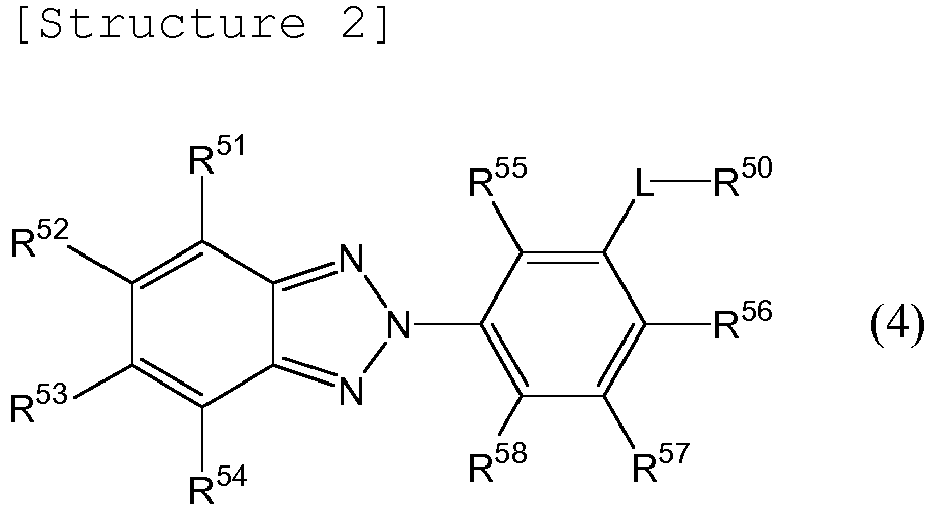
Applications Claiming Priority (2)
| Application Number | Priority Date | Filing Date | Title |
|---|---|---|---|
| JP2016110907 | 2016-06-02 | ||
| PCT/JP2017/020027 WO2017209104A1 (en) | 2016-06-02 | 2017-05-30 | Eyeglass lens |
Publications (3)
| Publication Number | Publication Date |
|---|---|
| EP3467574A1 true EP3467574A1 (en) | 2019-04-10 |
| EP3467574A4 EP3467574A4 (en) | 2020-03-25 |
| EP3467574B1 EP3467574B1 (en) | 2021-11-10 |
Family
ID=60478561
Family Applications (1)
| Application Number | Title | Priority Date | Filing Date |
|---|---|---|---|
| EP17806658.5A Active EP3467574B1 (en) | 2016-06-02 | 2017-05-30 | Eyeglass lens |
Country Status (6)
| Country | Link |
|---|---|
| US (1) | US10852454B2 (en) |
| EP (1) | EP3467574B1 (en) |
| JP (1) | JP7046801B2 (en) |
| KR (1) | KR102318269B1 (en) |
| CN (1) | CN109313358B (en) |
| WO (1) | WO2017209104A1 (en) |
Families Citing this family (4)
| Publication number | Priority date | Publication date | Assignee | Title |
|---|---|---|---|---|
| JP7036502B2 (en) | 2017-09-29 | 2022-03-15 | ホヤ レンズ タイランド リミテッド | Manufacturing method of resin for optical members, resin for optical members, spectacle lenses and spectacles |
| JP2021054915A (en) * | 2019-09-27 | 2021-04-08 | ホヤ レンズ タイランド リミテッドHOYA Lens Thailand Ltd | Polymerizable composition for optical member, optical member, and colored optical member |
| CN117826450B (en) * | 2024-02-06 | 2024-09-27 | 广州宝来眼镜科技有限公司 | Lens capable of realizing color enhancement and preparation method thereof |
| WO2026164249A1 (en) * | 2025-01-31 | 2026-08-06 | ホヤ レンズ タイランド リミテッド | Polymerizable composition, optical article, and spectacles |
Family Cites Families (18)
| Publication number | Priority date | Publication date | Assignee | Title |
|---|---|---|---|---|
| JP3354066B2 (en) * | 1996-01-26 | 2002-12-09 | 帝人化成株式会社 | Eyeglass lens |
| EP0786675B1 (en) * | 1996-01-26 | 2002-11-06 | Teijin Chemicals, Ltd. | Spectacle lens |
| JPH11218602A (en) * | 1998-02-03 | 1999-08-10 | Asahi Optical Co Ltd | Plastic lens |
| JP4334633B2 (en) | 1998-03-18 | 2009-09-30 | セイコーエプソン株式会社 | Polymerized composition for plastic lens |
| JP2004315556A (en) | 2003-04-11 | 2004-11-11 | Nikon-Essilor Co Ltd | Composition for optical material, optical material and spectacle lens |
| JP4399419B2 (en) * | 2004-01-20 | 2010-01-13 | 帝人化成株式会社 | Eyeglass lens and manufacturing method thereof |
| WO2006049228A1 (en) * | 2004-11-05 | 2006-05-11 | Teijin Chemicals Ltd. | Polycarbonate resin material for molding eyeglass lenses and optical elements |
| JP4804135B2 (en) * | 2005-01-25 | 2011-11-02 | 東海光学株式会社 | Manufacturing method of plastic lens for spectacles that can be manufactured with high productivity |
| JP5250289B2 (en) | 2008-03-31 | 2013-07-31 | 富士フイルム株式会社 | UV absorber composition |
| WO2012074125A1 (en) * | 2010-12-01 | 2012-06-07 | 帝人化成株式会社 | Eyeglasses lens |
| JP5620241B2 (en) | 2010-12-01 | 2014-11-05 | 帝人株式会社 | Eyeglass lenses |
| CN104725593B (en) * | 2011-02-15 | 2017-10-20 | 三菱瓦斯化学株式会社 | Composition for optical material and use its optical material |
| JP5824218B2 (en) | 2011-02-24 | 2015-11-25 | 伊藤光学工業株式会社 | Anti-glare optical element |
| JP5749683B2 (en) * | 2012-05-11 | 2015-07-15 | 伊藤光学工業株式会社 | Anti-glare optical element |
| CN103980643B (en) * | 2014-06-04 | 2017-05-31 | 江苏视客新材料股份有限公司 | Anti-blue light nano-composite resin material, eyeglass and preparation method thereof |
| WO2016021664A1 (en) * | 2014-08-05 | 2016-02-11 | ミヨシ油脂株式会社 | Additive for imparting ultraviolet absorptivity and/or high refractive index to matrix, and resin member using same |
| JP2015034990A (en) | 2014-09-10 | 2015-02-19 | 株式会社ニコン・エシロール | Method for manufacturing optical lens |
| KR101612940B1 (en) | 2015-09-15 | 2016-04-15 | (주)케미그라스 | Functional glasses lens having Fuction of Blocking UV Light And Blue Light |
-
2017
- 2017-05-30 WO PCT/JP2017/020027 patent/WO2017209104A1/en not_active Ceased
- 2017-05-30 CN CN201780033884.2A patent/CN109313358B/en active Active
- 2017-05-30 JP JP2018520916A patent/JP7046801B2/en active Active
- 2017-05-30 EP EP17806658.5A patent/EP3467574B1/en active Active
- 2017-05-30 KR KR1020187034684A patent/KR102318269B1/en active Active
- 2017-05-30 US US16/306,854 patent/US10852454B2/en active Active
Also Published As
| Publication number | Publication date |
|---|---|
| BR112018074837A2 (en) | 2019-03-06 |
| US10852454B2 (en) | 2020-12-01 |
| CN109313358B (en) | 2021-10-15 |
| EP3467574A4 (en) | 2020-03-25 |
| KR20190013792A (en) | 2019-02-11 |
| KR102318269B1 (en) | 2021-10-27 |
| EP3467574B1 (en) | 2021-11-10 |
| JP7046801B2 (en) | 2022-04-04 |
| CN109313358A (en) | 2019-02-05 |
| WO2017209104A1 (en) | 2017-12-07 |
| JPWO2017209104A1 (en) | 2019-03-28 |
| US20190154878A1 (en) | 2019-05-23 |
Similar Documents
| Publication | Publication Date | Title |
|---|---|---|
| EP2144092B1 (en) | Method for production of plastic lens | |
| EP3467574B1 (en) | Eyeglass lens | |
| US6770692B1 (en) | Plastic base material | |
| JP2019015922A (en) | Eyeglass lens material | |
| US9169373B2 (en) | Method for preparing a thermoplastic polyurethane of improved yellowness index, and optical articles made therefrom | |
| US10788605B2 (en) | Eyeglass lens | |
| EP3357948B1 (en) | Polythiol composition for plastic lens | |
| WO2020218615A1 (en) | Optical material, polymerizable composition for optical material, plastic lens, eyewear, infrared sensor, and infrared camera | |
| EP3916471B1 (en) | Plastic lens and eye glasses | |
| KR20200135048A (en) | Curable composition and optical material comprising the cured product thereof | |
| KR102372880B1 (en) | Curable composition and optical material comprising the cured product thereof | |
| KR102512563B1 (en) | Curable composition and optical material comprising the cured product thereof | |
| KR20180090721A (en) | Polythiol composition for plastic lens | |
| BR112018074837B1 (en) | GLASSES LENS | |
| EP4620987A1 (en) | Resin composition and article comprising same | |
| BR112018074819B1 (en) | LENS FOR GLASSES |
Legal Events
| Date | Code | Title | Description |
|---|---|---|---|
| STAA | Information on the status of an ep patent application or granted ep patent |
Free format text: STATUS: THE INTERNATIONAL PUBLICATION HAS BEEN MADE |
|
| PUAI | Public reference made under article 153(3) epc to a published international application that has entered the european phase |
Free format text: ORIGINAL CODE: 0009012 |
|
| STAA | Information on the status of an ep patent application or granted ep patent |
Free format text: STATUS: REQUEST FOR EXAMINATION WAS MADE |
|
| 17P | Request for examination filed |
Effective date: 20181130 |
|
| AK | Designated contracting states |
Kind code of ref document: A1 Designated state(s): AL AT BE BG CH CY CZ DE DK EE ES FI FR GB GR HR HU IE IS IT LI LT LU LV MC MK MT NL NO PL PT RO RS SE SI SK SM TR |
|
| AX | Request for extension of the european patent |
Extension state: BA ME |
|
| DAV | Request for validation of the european patent (deleted) | ||
| DAX | Request for extension of the european patent (deleted) | ||
| RIC1 | Information provided on ipc code assigned before grant |
Ipc: C08K 5/3447 20060101ALI20200212BHEP Ipc: G02B 5/22 20060101ALI20200212BHEP Ipc: G02B 5/20 20060101ALI20200212BHEP Ipc: C08G 18/08 20060101ALI20200212BHEP Ipc: C08G 18/38 20060101ALI20200212BHEP Ipc: G02C 7/02 20060101AFI20200212BHEP Ipc: G02B 1/04 20060101ALI20200212BHEP Ipc: C08G 18/76 20060101ALI20200212BHEP Ipc: C08K 5/00 20060101ALI20200212BHEP Ipc: C08G 18/24 20060101ALI20200212BHEP Ipc: G02C 7/10 20060101ALI20200212BHEP Ipc: C08K 5/3475 20060101ALI20200212BHEP |
|
| A4 | Supplementary search report drawn up and despatched |
Effective date: 20200224 |
|
| RIC1 | Information provided on ipc code assigned before grant |
Ipc: G02C 7/10 20060101ALI20200218BHEP Ipc: C08K 5/3475 20060101ALI20200218BHEP Ipc: C08G 18/38 20060101ALI20200218BHEP Ipc: C08G 18/76 20060101ALI20200218BHEP Ipc: G02C 7/02 20060101AFI20200218BHEP Ipc: C08K 5/00 20060101ALI20200218BHEP Ipc: C08G 18/24 20060101ALI20200218BHEP Ipc: G02B 5/20 20060101ALI20200218BHEP Ipc: C08G 18/08 20060101ALI20200218BHEP Ipc: C08K 5/3447 20060101ALI20200218BHEP Ipc: G02B 5/22 20060101ALI20200218BHEP Ipc: G02B 1/04 20060101ALI20200218BHEP |
|
| STAA | Information on the status of an ep patent application or granted ep patent |
Free format text: STATUS: EXAMINATION IS IN PROGRESS |
|
| 17Q | First examination report despatched |
Effective date: 20201021 |
|
| RAP1 | Party data changed (applicant data changed or rights of an application transferred) |
Owner name: ESSILOR INTERNATIONAL |
|
| GRAP | Despatch of communication of intention to grant a patent |
Free format text: ORIGINAL CODE: EPIDOSNIGR1 |
|
| STAA | Information on the status of an ep patent application or granted ep patent |
Free format text: STATUS: GRANT OF PATENT IS INTENDED |
|
| INTG | Intention to grant announced |
Effective date: 20210706 |
|
| GRAS | Grant fee paid |
Free format text: ORIGINAL CODE: EPIDOSNIGR3 |
|
| GRAA | (expected) grant |
Free format text: ORIGINAL CODE: 0009210 |
|
| STAA | Information on the status of an ep patent application or granted ep patent |
Free format text: STATUS: THE PATENT HAS BEEN GRANTED |
|
| AK | Designated contracting states |
Kind code of ref document: B1 Designated state(s): AL AT BE BG CH CY CZ DE DK EE ES FI FR GB GR HR HU IE IS IT LI LT LU LV MC MK MT NL NO PL PT RO RS SE SI SK SM TR |
|
| REG | Reference to a national code |
Ref country code: GB Ref legal event code: FG4D |
|
| REG | Reference to a national code |
Ref country code: AT Ref legal event code: REF Ref document number: 1446618 Country of ref document: AT Kind code of ref document: T Effective date: 20211115 Ref country code: CH Ref legal event code: EP |
|
| REG | Reference to a national code |
Ref country code: DE Ref legal event code: R096 Ref document number: 602017049180 Country of ref document: DE |
|
| REG | Reference to a national code |
Ref country code: IE Ref legal event code: FG4D |
|
| REG | Reference to a national code |
Ref country code: LT Ref legal event code: MG9D |
|
| REG | Reference to a national code |
Ref country code: NL Ref legal event code: MP Effective date: 20211110 |
|
| REG | Reference to a national code |
Ref country code: AT Ref legal event code: MK05 Ref document number: 1446618 Country of ref document: AT Kind code of ref document: T Effective date: 20211110 |
|
| PG25 | Lapsed in a contracting state [announced via postgrant information from national office to epo] |
Ref country code: RS Free format text: LAPSE BECAUSE OF FAILURE TO SUBMIT A TRANSLATION OF THE DESCRIPTION OR TO PAY THE FEE WITHIN THE PRESCRIBED TIME-LIMIT Effective date: 20211110 Ref country code: LT Free format text: LAPSE BECAUSE OF FAILURE TO SUBMIT A TRANSLATION OF THE DESCRIPTION OR TO PAY THE FEE WITHIN THE PRESCRIBED TIME-LIMIT Effective date: 20211110 Ref country code: FI Free format text: LAPSE BECAUSE OF FAILURE TO SUBMIT A TRANSLATION OF THE DESCRIPTION OR TO PAY THE FEE WITHIN THE PRESCRIBED TIME-LIMIT Effective date: 20211110 Ref country code: BG Free format text: LAPSE BECAUSE OF FAILURE TO SUBMIT A TRANSLATION OF THE DESCRIPTION OR TO PAY THE FEE WITHIN THE PRESCRIBED TIME-LIMIT Effective date: 20220210 Ref country code: AT Free format text: LAPSE BECAUSE OF FAILURE TO SUBMIT A TRANSLATION OF THE DESCRIPTION OR TO PAY THE FEE WITHIN THE PRESCRIBED TIME-LIMIT Effective date: 20211110 |
|
| PG25 | Lapsed in a contracting state [announced via postgrant information from national office to epo] |
Ref country code: IS Free format text: LAPSE BECAUSE OF FAILURE TO SUBMIT A TRANSLATION OF THE DESCRIPTION OR TO PAY THE FEE WITHIN THE PRESCRIBED TIME-LIMIT Effective date: 20220310 Ref country code: SE Free format text: LAPSE BECAUSE OF FAILURE TO SUBMIT A TRANSLATION OF THE DESCRIPTION OR TO PAY THE FEE WITHIN THE PRESCRIBED TIME-LIMIT Effective date: 20211110 Ref country code: PT Free format text: LAPSE BECAUSE OF FAILURE TO SUBMIT A TRANSLATION OF THE DESCRIPTION OR TO PAY THE FEE WITHIN THE PRESCRIBED TIME-LIMIT Effective date: 20220310 Ref country code: PL Free format text: LAPSE BECAUSE OF FAILURE TO SUBMIT A TRANSLATION OF THE DESCRIPTION OR TO PAY THE FEE WITHIN THE PRESCRIBED TIME-LIMIT Effective date: 20211110 Ref country code: NO Free format text: LAPSE BECAUSE OF FAILURE TO SUBMIT A TRANSLATION OF THE DESCRIPTION OR TO PAY THE FEE WITHIN THE PRESCRIBED TIME-LIMIT Effective date: 20220210 Ref country code: NL Free format text: LAPSE BECAUSE OF FAILURE TO SUBMIT A TRANSLATION OF THE DESCRIPTION OR TO PAY THE FEE WITHIN THE PRESCRIBED TIME-LIMIT Effective date: 20211110 Ref country code: LV Free format text: LAPSE BECAUSE OF FAILURE TO SUBMIT A TRANSLATION OF THE DESCRIPTION OR TO PAY THE FEE WITHIN THE PRESCRIBED TIME-LIMIT Effective date: 20211110 Ref country code: HR Free format text: LAPSE BECAUSE OF FAILURE TO SUBMIT A TRANSLATION OF THE DESCRIPTION OR TO PAY THE FEE WITHIN THE PRESCRIBED TIME-LIMIT Effective date: 20211110 Ref country code: GR Free format text: LAPSE BECAUSE OF FAILURE TO SUBMIT A TRANSLATION OF THE DESCRIPTION OR TO PAY THE FEE WITHIN THE PRESCRIBED TIME-LIMIT Effective date: 20220211 Ref country code: ES Free format text: LAPSE BECAUSE OF FAILURE TO SUBMIT A TRANSLATION OF THE DESCRIPTION OR TO PAY THE FEE WITHIN THE PRESCRIBED TIME-LIMIT Effective date: 20211110 |
|
| PG25 | Lapsed in a contracting state [announced via postgrant information from national office to epo] |
Ref country code: SM Free format text: LAPSE BECAUSE OF FAILURE TO SUBMIT A TRANSLATION OF THE DESCRIPTION OR TO PAY THE FEE WITHIN THE PRESCRIBED TIME-LIMIT Effective date: 20211110 Ref country code: SK Free format text: LAPSE BECAUSE OF FAILURE TO SUBMIT A TRANSLATION OF THE DESCRIPTION OR TO PAY THE FEE WITHIN THE PRESCRIBED TIME-LIMIT Effective date: 20211110 Ref country code: RO Free format text: LAPSE BECAUSE OF FAILURE TO SUBMIT A TRANSLATION OF THE DESCRIPTION OR TO PAY THE FEE WITHIN THE PRESCRIBED TIME-LIMIT Effective date: 20211110 Ref country code: EE Free format text: LAPSE BECAUSE OF FAILURE TO SUBMIT A TRANSLATION OF THE DESCRIPTION OR TO PAY THE FEE WITHIN THE PRESCRIBED TIME-LIMIT Effective date: 20211110 Ref country code: DK Free format text: LAPSE BECAUSE OF FAILURE TO SUBMIT A TRANSLATION OF THE DESCRIPTION OR TO PAY THE FEE WITHIN THE PRESCRIBED TIME-LIMIT Effective date: 20211110 Ref country code: CZ Free format text: LAPSE BECAUSE OF FAILURE TO SUBMIT A TRANSLATION OF THE DESCRIPTION OR TO PAY THE FEE WITHIN THE PRESCRIBED TIME-LIMIT Effective date: 20211110 |
|
| REG | Reference to a national code |
Ref country code: DE Ref legal event code: R097 Ref document number: 602017049180 Country of ref document: DE |
|
| PLBE | No opposition filed within time limit |
Free format text: ORIGINAL CODE: 0009261 |
|
| STAA | Information on the status of an ep patent application or granted ep patent |
Free format text: STATUS: NO OPPOSITION FILED WITHIN TIME LIMIT |
|
| 26N | No opposition filed |
Effective date: 20220811 |
|
| PG25 | Lapsed in a contracting state [announced via postgrant information from national office to epo] |
Ref country code: AL Free format text: LAPSE BECAUSE OF FAILURE TO SUBMIT A TRANSLATION OF THE DESCRIPTION OR TO PAY THE FEE WITHIN THE PRESCRIBED TIME-LIMIT Effective date: 20211110 |
|
| PG25 | Lapsed in a contracting state [announced via postgrant information from national office to epo] |
Ref country code: SI Free format text: LAPSE BECAUSE OF FAILURE TO SUBMIT A TRANSLATION OF THE DESCRIPTION OR TO PAY THE FEE WITHIN THE PRESCRIBED TIME-LIMIT Effective date: 20211110 |
|
| REG | Reference to a national code |
Ref country code: CH Ref legal event code: PL |
|
| REG | Reference to a national code |
Ref country code: BE Ref legal event code: MM Effective date: 20220531 |
|
| PG25 | Lapsed in a contracting state [announced via postgrant information from national office to epo] |
Ref country code: MC Free format text: LAPSE BECAUSE OF FAILURE TO SUBMIT A TRANSLATION OF THE DESCRIPTION OR TO PAY THE FEE WITHIN THE PRESCRIBED TIME-LIMIT Effective date: 20211110 Ref country code: LU Free format text: LAPSE BECAUSE OF NON-PAYMENT OF DUE FEES Effective date: 20220530 Ref country code: CH Free format text: LAPSE BECAUSE OF NON-PAYMENT OF DUE FEES Effective date: 20220531 Ref country code: LI Free format text: LAPSE BECAUSE OF NON-PAYMENT OF DUE FEES Effective date: 20220531 |
|
| PG25 | Lapsed in a contracting state [announced via postgrant information from national office to epo] |
Ref country code: IE Free format text: LAPSE BECAUSE OF NON-PAYMENT OF DUE FEES Effective date: 20220530 |
|
| PG25 | Lapsed in a contracting state [announced via postgrant information from national office to epo] |
Ref country code: IT Free format text: LAPSE BECAUSE OF FAILURE TO SUBMIT A TRANSLATION OF THE DESCRIPTION OR TO PAY THE FEE WITHIN THE PRESCRIBED TIME-LIMIT Effective date: 20211110 Ref country code: BE Free format text: LAPSE BECAUSE OF NON-PAYMENT OF DUE FEES Effective date: 20220531 |
|
| P01 | Opt-out of the competence of the unified patent court (upc) registered |
Effective date: 20230525 |
|
| PG25 | Lapsed in a contracting state [announced via postgrant information from national office to epo] |
Ref country code: HU Free format text: LAPSE BECAUSE OF FAILURE TO SUBMIT A TRANSLATION OF THE DESCRIPTION OR TO PAY THE FEE WITHIN THE PRESCRIBED TIME-LIMIT; INVALID AB INITIO Effective date: 20170530 |
|
| PG25 | Lapsed in a contracting state [announced via postgrant information from national office to epo] |
Ref country code: MK Free format text: LAPSE BECAUSE OF FAILURE TO SUBMIT A TRANSLATION OF THE DESCRIPTION OR TO PAY THE FEE WITHIN THE PRESCRIBED TIME-LIMIT Effective date: 20211110 Ref country code: CY Free format text: LAPSE BECAUSE OF FAILURE TO SUBMIT A TRANSLATION OF THE DESCRIPTION OR TO PAY THE FEE WITHIN THE PRESCRIBED TIME-LIMIT Effective date: 20211110 |
|
| PG25 | Lapsed in a contracting state [announced via postgrant information from national office to epo] |
Ref country code: TR Free format text: LAPSE BECAUSE OF FAILURE TO SUBMIT A TRANSLATION OF THE DESCRIPTION OR TO PAY THE FEE WITHIN THE PRESCRIBED TIME-LIMIT Effective date: 20211110 |
|
| PG25 | Lapsed in a contracting state [announced via postgrant information from national office to epo] |
Ref country code: MT Free format text: LAPSE BECAUSE OF FAILURE TO SUBMIT A TRANSLATION OF THE DESCRIPTION OR TO PAY THE FEE WITHIN THE PRESCRIBED TIME-LIMIT Effective date: 20211110 |
|
| PGFP | Annual fee paid to national office [announced via postgrant information from national office to epo] |
Ref country code: GB Payment date: 20260527 Year of fee payment: 10 |
|
| PGFP | Annual fee paid to national office [announced via postgrant information from national office to epo] |
Ref country code: DE Payment date: 20260528 Year of fee payment: 10 |
|
| PGFP | Annual fee paid to national office [announced via postgrant information from national office to epo] |
Ref country code: FR Payment date: 20260525 Year of fee payment: 10 |