EP3466092B1 - Method, device, and computer program for encapsulating and parsing timed media data - Google Patents
Method, device, and computer program for encapsulating and parsing timed media data Download PDFInfo
- Publication number
- EP3466092B1 EP3466092B1 EP17724830.9A EP17724830A EP3466092B1 EP 3466092 B1 EP3466092 B1 EP 3466092B1 EP 17724830 A EP17724830 A EP 17724830A EP 3466092 B1 EP3466092 B1 EP 3466092B1
- Authority
- EP
- European Patent Office
- Prior art keywords
- tile
- tileregiongroupentry
- video data
- region
- indicates
- Prior art date
- Legal status (The legal status is an assumption and is not a legal conclusion. Google has not performed a legal analysis and makes no representation as to the accuracy of the status listed.)
- Active
Links
Images


Classifications
-
- H—ELECTRICITY
- H04—ELECTRIC COMMUNICATION TECHNIQUE
- H04N—PICTORIAL COMMUNICATION, e.g. TELEVISION
- H04N21/00—Selective content distribution, e.g. interactive television or video on demand [VOD]
- H04N21/40—Client devices specifically adapted for the reception of or interaction with content, e.g. set-top-box [STB]; Operations thereof
- H04N21/47—End-user applications
- H04N21/472—End-user interface for requesting content, additional data or services; End-user interface for interacting with content, e.g. for content reservation or setting reminders, for requesting event notification, for manipulating displayed content
- H04N21/47217—End-user interface for requesting content, additional data or services; End-user interface for interacting with content, e.g. for content reservation or setting reminders, for requesting event notification, for manipulating displayed content for controlling playback functions for recorded or on-demand content, e.g. using progress bars, mode or play-point indicators or bookmarks
-
- H—ELECTRICITY
- H04—ELECTRIC COMMUNICATION TECHNIQUE
- H04N—PICTORIAL COMMUNICATION, e.g. TELEVISION
- H04N21/00—Selective content distribution, e.g. interactive television or video on demand [VOD]
- H04N21/80—Generation or processing of content or additional data by content creator independently of the distribution process; Content per se
- H04N21/83—Generation or processing of protective or descriptive data associated with content; Content structuring
- H04N21/845—Structuring of content, e.g. decomposing content into time segments
- H04N21/8456—Structuring of content, e.g. decomposing content into time segments by decomposing the content in the time domain, e.g. in time segments
-
- H—ELECTRICITY
- H04—ELECTRIC COMMUNICATION TECHNIQUE
- H04N—PICTORIAL COMMUNICATION, e.g. TELEVISION
- H04N19/00—Methods or arrangements for coding, decoding, compressing or decompressing digital video signals
- H04N19/10—Methods or arrangements for coding, decoding, compressing or decompressing digital video signals using adaptive coding
- H04N19/134—Methods or arrangements for coding, decoding, compressing or decompressing digital video signals using adaptive coding characterised by the element, parameter or criterion affecting or controlling the adaptive coding
- H04N19/167—Position within a video image, e.g. region of interest [ROI]
-
- H—ELECTRICITY
- H04—ELECTRIC COMMUNICATION TECHNIQUE
- H04N—PICTORIAL COMMUNICATION, e.g. TELEVISION
- H04N19/00—Methods or arrangements for coding, decoding, compressing or decompressing digital video signals
- H04N19/10—Methods or arrangements for coding, decoding, compressing or decompressing digital video signals using adaptive coding
- H04N19/169—Methods or arrangements for coding, decoding, compressing or decompressing digital video signals using adaptive coding characterised by the coding unit, i.e. the structural portion or semantic portion of the video signal being the object or the subject of the adaptive coding
- H04N19/17—Methods or arrangements for coding, decoding, compressing or decompressing digital video signals using adaptive coding characterised by the coding unit, i.e. the structural portion or semantic portion of the video signal being the object or the subject of the adaptive coding the unit being an image region, e.g. an object
- H04N19/174—Methods or arrangements for coding, decoding, compressing or decompressing digital video signals using adaptive coding characterised by the coding unit, i.e. the structural portion or semantic portion of the video signal being the object or the subject of the adaptive coding the unit being an image region, e.g. an object the region being a slice, e.g. a line of blocks or a group of blocks
-
- H—ELECTRICITY
- H04—ELECTRIC COMMUNICATION TECHNIQUE
- H04N—PICTORIAL COMMUNICATION, e.g. TELEVISION
- H04N19/00—Methods or arrangements for coding, decoding, compressing or decompressing digital video signals
- H04N19/10—Methods or arrangements for coding, decoding, compressing or decompressing digital video signals using adaptive coding
- H04N19/169—Methods or arrangements for coding, decoding, compressing or decompressing digital video signals using adaptive coding characterised by the coding unit, i.e. the structural portion or semantic portion of the video signal being the object or the subject of the adaptive coding
- H04N19/188—Methods or arrangements for coding, decoding, compressing or decompressing digital video signals using adaptive coding characterised by the coding unit, i.e. the structural portion or semantic portion of the video signal being the object or the subject of the adaptive coding the unit being a video data packet, e.g. a network abstraction layer [NAL] unit
-
- H—ELECTRICITY
- H04—ELECTRIC COMMUNICATION TECHNIQUE
- H04N—PICTORIAL COMMUNICATION, e.g. TELEVISION
- H04N19/00—Methods or arrangements for coding, decoding, compressing or decompressing digital video signals
- H04N19/10—Methods or arrangements for coding, decoding, compressing or decompressing digital video signals using adaptive coding
- H04N19/169—Methods or arrangements for coding, decoding, compressing or decompressing digital video signals using adaptive coding characterised by the coding unit, i.e. the structural portion or semantic portion of the video signal being the object or the subject of the adaptive coding
- H04N19/1883—Methods or arrangements for coding, decoding, compressing or decompressing digital video signals using adaptive coding characterised by the coding unit, i.e. the structural portion or semantic portion of the video signal being the object or the subject of the adaptive coding the unit relating to sub-band structure, e.g. hierarchical level, directional tree, e.g. low-high [LH], high-low [HL], high-high [HH]
-
- H—ELECTRICITY
- H04—ELECTRIC COMMUNICATION TECHNIQUE
- H04N—PICTORIAL COMMUNICATION, e.g. TELEVISION
- H04N19/00—Methods or arrangements for coding, decoding, compressing or decompressing digital video signals
- H04N19/70—Methods or arrangements for coding, decoding, compressing or decompressing digital video signals characterised by syntax aspects related to video coding, e.g. related to compression standards
-
- H—ELECTRICITY
- H04—ELECTRIC COMMUNICATION TECHNIQUE
- H04N—PICTORIAL COMMUNICATION, e.g. TELEVISION
- H04N21/00—Selective content distribution, e.g. interactive television or video on demand [VOD]
- H04N21/20—Servers specifically adapted for the distribution of content, e.g. VOD servers; Operations thereof
- H04N21/23—Processing of content or additional data; Elementary server operations; Server middleware
- H04N21/235—Processing of additional data, e.g. scrambling of additional data or processing content descriptors
- H04N21/2353—Processing of additional data, e.g. scrambling of additional data or processing content descriptors specifically adapted to content descriptors, e.g. coding, compressing or processing of metadata
-
- H—ELECTRICITY
- H04—ELECTRIC COMMUNICATION TECHNIQUE
- H04N—PICTORIAL COMMUNICATION, e.g. TELEVISION
- H04N21/00—Selective content distribution, e.g. interactive television or video on demand [VOD]
- H04N21/20—Servers specifically adapted for the distribution of content, e.g. VOD servers; Operations thereof
- H04N21/23—Processing of content or additional data; Elementary server operations; Server middleware
- H04N21/236—Assembling of a multiplex stream, e.g. transport stream, by combining a video stream with other content or additional data, e.g. inserting a URL [Uniform Resource Locator] into a video stream, multiplexing software data into a video stream; Remultiplexing of multiplex streams; Insertion of stuffing bits into the multiplex stream, e.g. to obtain a constant bit-rate; Assembling of a packetised elementary stream
- H04N21/23605—Creation or processing of packetized elementary streams [PES]
-
- H—ELECTRICITY
- H04—ELECTRIC COMMUNICATION TECHNIQUE
- H04N—PICTORIAL COMMUNICATION, e.g. TELEVISION
- H04N21/00—Selective content distribution, e.g. interactive television or video on demand [VOD]
- H04N21/40—Client devices specifically adapted for the reception of or interaction with content, e.g. set-top-box [STB]; Operations thereof
- H04N21/43—Processing of content or additional data, e.g. demultiplexing additional data from a digital video stream; Elementary client operations, e.g. monitoring of home network or synchronising decoder's clock; Client middleware
- H04N21/434—Disassembling of a multiplex stream, e.g. demultiplexing audio and video streams, extraction of additional data from a video stream; Remultiplexing of multiplex streams; Extraction or processing of SI; Disassembling of packetised elementary stream
- H04N21/4343—Extraction or processing of packetized elementary streams [PES]
-
- H—ELECTRICITY
- H04—ELECTRIC COMMUNICATION TECHNIQUE
- H04N—PICTORIAL COMMUNICATION, e.g. TELEVISION
- H04N21/00—Selective content distribution, e.g. interactive television or video on demand [VOD]
- H04N21/40—Client devices specifically adapted for the reception of or interaction with content, e.g. set-top-box [STB]; Operations thereof
- H04N21/43—Processing of content or additional data, e.g. demultiplexing additional data from a digital video stream; Elementary client operations, e.g. monitoring of home network or synchronising decoder's clock; Client middleware
- H04N21/435—Processing of additional data, e.g. decrypting of additional data, reconstructing software from modules extracted from the transport stream
- H04N21/4353—Processing of additional data, e.g. decrypting of additional data, reconstructing software from modules extracted from the transport stream involving decryption of additional data
-
- H—ELECTRICITY
- H04—ELECTRIC COMMUNICATION TECHNIQUE
- H04N—PICTORIAL COMMUNICATION, e.g. TELEVISION
- H04N21/00—Selective content distribution, e.g. interactive television or video on demand [VOD]
- H04N21/40—Client devices specifically adapted for the reception of or interaction with content, e.g. set-top-box [STB]; Operations thereof
- H04N21/43—Processing of content or additional data, e.g. demultiplexing additional data from a digital video stream; Elementary client operations, e.g. monitoring of home network or synchronising decoder's clock; Client middleware
- H04N21/439—Processing of audio elementary streams
-
- H—ELECTRICITY
- H04—ELECTRIC COMMUNICATION TECHNIQUE
- H04N—PICTORIAL COMMUNICATION, e.g. TELEVISION
- H04N21/00—Selective content distribution, e.g. interactive television or video on demand [VOD]
- H04N21/80—Generation or processing of content or additional data by content creator independently of the distribution process; Content per se
- H04N21/83—Generation or processing of protective or descriptive data associated with content; Content structuring
- H04N21/84—Generation or processing of descriptive data, e.g. content descriptors
Definitions
- the invention generally relates to the field of encapsulation and parsing of timed media data, e.g. according to Base Media File Format as defined by the MPEG standardization organization, to provide a flexible and extensible format that facilitates interchange, management, editing, and presentation of the media data and to improve stream delivery, in particular regarding HTTP ( HyperText Transfer Protocol ) and RTP ( Real-time Transport Protocol ) streaming of user-selected regions of interest in compressed video streams.
- HTTP HyperText Transfer Protocol
- RTP Real-time Transport Protocol
- the International Standard Organization Base Media File Format (ISO BMFF) is a well-known flexible and extensible format that describes encoded timed media data bit-streams either for local storage or transmission via a network or via another bit-stream delivery mechanism.
- This file format is object-oriented. It is composed of building blocks called boxes that are sequentially or hierarchically organized and that define parameters of the encoded timed media data bit-stream such as timing and structure parameters.
- This file format can describe various video formats such as SVC ( Scalable Video Coding ), HEVC ( High Efficiency Video Coding ) or Layered HEVC (L-HEVC).
- a single or multi-layer partitioned timed media data such as multi-layer tiled timed media data (e.g. scalable tiled or Multiview tiled video data) comprising timed samples (e.g. images) are transmitted as a set of several timed media data tracks, typically base tile tracks and tile tracks.
- the base tile tracks comprise a base layer base track and at least one enhancement layer base tile track and the tile tracks comprise base layer tile tracks and enhancement layer tile tracks.
- Each timed media data track comprises one spatial subsample (e.g.
- Each track can be transmitted from a server device to a client device as a set of media segment files.
- An initialization segment file can be used to transmit metadata required to decode media segment files
- samples of a track can be grouped to be associated to a common set of properties: this is the sample grouping mechanism that involves two boxes: the SampleToGroupBox and the SampleGroupDescriptionBox. Both can be associated by a grouping_type value.
- the track have several boxes and a hierarchy of boxes and sub-boxes to describe their properties in terms of media they contain, in terms of samples they contain, typically the sample table box, and in terms of relationships or dependencies with other tracks.
- w15928 defines descriptors for tiles: one is called TileRegionGroupEntry or RectTileRegionGroupEntry with an identifying code 'trif' and another one is called TileSetGroupEntry or UnconstrTileRegionGroupEntry with an identifying code 'tsif'.
- 'trif' describes tiles samples in terms of position, size, independence with respect to other tiles or not and indicate whether they cover the full video or not. Each trif has a unique identifier. 'tsif' builds on top of 'trif' to describe set of tiles by aggregating one or more 'trif', referenced through their groupID. 'tsif' also provides coding dependencies list for the tiles, for example when a tile depends on another tile, e.g. when some motion vector to predict a data block of a tile uses a data block from a neighbor tile.
- tile track is also defined and consists in putting in a track only the samples or parts of samples that pertain to a selected tile or set of tiles. When there are one or more tile tracks, they can reference a common tile base track that contains parameter sets information, i.e. initialization data for the decoders. These tile tracks are identified with a specific code (sample entry): 'hvt1' or 'Ihv1' (in case of layered media).
- the tiles from the enhancement layer will always have dependencies to the full picture or to some tiles in the lower layer(s), which implies:
- an efficient data organization and track description scheme suitable especially for handling spatial tiles, scalable layers and multiple views in Layered HEVC for multi-layer video streams. This ensures that the result of the ISO BMFF parsing is more efficient and adapted to single and/or multi layer HEVC.
- Documents GB2522014 A , WO2015/104303 A2 and WO2015/059194 A1 describe methods and devices for encapsulating multi-layer tiled media data in media segment files according to the ISO BMFF format.
- the invention also provides according to other aspects devices and computer programs for encapsulating and parsing partitioned timed media data as defined in the appended independent claims 7, 8, 11 and 12.
- a tangible carrier medium may comprise a storage medium such as a floppy disk, a CD-ROM, a hard disk drive, a magnetic tape device or a solid state memory device and the like.
- a transient carrier medium may include a signal such as an electrical signal, an electronic signal, an optical signal, an acoustic signal, a magnetic signal or an electromagnetic signal, e.g. a microwave or RF signal.
- Embodiments of the invention can apply, for example, to the video format known as HEVC.
- images can be spatially divided into tiles, slices, and slice segments.
- a tile corresponds to a rectangular region of an image that is defined by horizontal and vertical boundaries (i.e., rows and columns). It contains an integer number of Coding Tree Units (CTUs). Therefore, tiles can be efficiently used to identify regions of interest by defining, for example, positions and sizes for regions of interest.
- CTUs Coding Tree Units
- NAL Network Abstract Layer
- slices are sets of slice segments, the first slice segment of a set of slice segments being an independent slice segment, that is to say a slice segment whose general information stored within a header does not refer to that of another slice segment.
- the other slice segments of the set of slice segments, if any, are dependent slice segments (i.e. slice segments whose general information stored within a header refers to that of an independent slice segment).
- a slice segment contains an integer number of consecutive (in raster scan order) Coding Tree Units. Therefore, a slice segment can be of a rectangular shape or not and so, it is not suited to represent a region of interest. It is encoded in an HEVC bit-stream for a slice segment header followed by slice segment data. Independent and dependent slice segments differ by their header: since a dependent slice segment depends on an independent slice segment, the amount of information of its header is smaller than the one of an independent slice segment. Both independent and dependent slice segments contain a list of entry points in the corresponding bit-stream that are used to define tiles or as entropy decoding synchronization points.
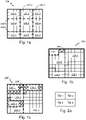
- Figure 1 illustrates examples of tiles and slice segments. More precisely, Figure 1a illustrates an image (100) divided into nine portions by vertical boundaries 105-1 and 105-2 and horizontal boundaries 110-1 and 110-2. Each of the nine portions referenced 115-1 to 115-9 represents a particular tile.
- Figure 1b illustrates an image (100') containing two vertical tiles delimited by vertical boundary 105'.
- Image 100' comprises a single slice (not referenced) containing five slice segments, one independent slice segment 120-1 (represented with hatched lines) and four dependent slice segments 120-2 to 120-5.
- Figure 1c illustrates an image (100") containing two vertical tiles delimited by vertical boundary 105".
- the left tile comprises two slices: a first slice containing one independent slice segment (120'-1) and one dependent slice segment (120'-2) and a second slice also containing one independent slice segment (120'-3) and one dependent slice segment (120'-4).
- the right tile comprises one slice containing one independent slice segment (120'-5) and one dependent slice segment (120'-6).
- slice segments are linked to tiles according to rules that may be summarized as follows (one or both conditions have to be met):
- one tile contains one slice having only one independent slice segment.
- embodiments of the invention can be carried out with other configurations like the ones illustrated in Figures 1b and 1c .
- slice segments are the entities that are actually put in NAL units for transport over a communication network and aggregated to form access units (i.e. coded picture or samples at file format level).
- the type of a NAL unit is encoded in two bytes of the NAL unit header that can be defined as follows:
- NAL units used to code slice segments comprise slice segment headers indicating the address of the first CTU in the slice segment thanks to a slice segment address syntax element.
- slice segment headers can be defined as follows:
- Tiling information is provided in a PPS (Picture Parameter Set) NAL unit.
- PPS Picture Parameter Set
- the relation between a slice segment and a tile can then be deduced from these parameters.
- the in-loop filters (deblocking and sample adaptive offset (SAO) filters) are preferably deactivated on the tile borders so that no error drift is introduced when decoding only one tile. It is to be noted that such a control of the in-loop filters is available in the HEVC standard. It is set in slice segment headers with a flag known as loop_filter_across_tiles__enabled_flag.
- tiles can be considered as "independently decodable tiles” or "independent tiles”.
- Figure 2 comprising Figures 2a and 2b , illustrates an example of encapsulating tiles in multiple tracks.
- Figure 2a illustrates an example of tile configuration. For the sake of illustration, it comprises four tiles (tile 1 to tile 4), the size of each tile being of 310 pixel width and 256 pixel height.
- Figure 2b illustrates an example of encapsulating the four tiles represented in Figure 2a into independent tracks according to the MPEG-4 file format. As illustrated, each tile is encapsulated in its own track, enabling efficient data addressing and leading to encapsulating the video as 5 tracks: four tile tracks referenced 201, 202, 203, and 204 for encapsulating each tile and one parameter set track 210 (also referred to as base track in the description) common to all tile tracks.
- each tile track (201, 202, 203, and 204) is based on a TileRegionGroupEntry box (identified by the ' trif ' reference), such as TileRegionGroupEntry box 206.
- the NAL units 221 corresponding to tile 1 are described in track 1 (referenced 201) in the TileRegionGroupEntry box 206.
- References 221 and 222 designate, respectively, data chunks that contain data for tile 1 and tile 4 from time 1 to time S (duration of the media file or media segment in case of track fragments).
- a sample stored in a tile track is a complete set of slices for one or more tiles, as defined in ISO/IEC 23008-2 (HEVC). This excludes parameter sets, SEI messages, and other non-VCL NAL units.
- An HEVC sample stored in a tile track is considered as a sync sample if the VCL NAL units in the sample indicate that the coded slices contained in the sample are Instantaneous Decoding Refresh (IDR) slices, Clean Random Access (CRA) slices, or Broken Link Access (BLA) slices.
- IDR Instantaneous Decoding Refresh
- CRA Clean Random Access
- BLA Broken Link Access
- conventional HEVC samples would have a size of 640 ⁇ 512 pixels while here, the HEVC samples stored in each tile track have a size of 320 ⁇ 256 pixels.
- the tile samples are signaled with a new type of VisualSampleEntry descriptor: the HEVCTileSampleEntry descriptor, such as HEVCTileSampleEntry descriptor 205 associated with track 1 (designated with 4-letter code 'hvt1' ).
- the sample entries of HEVC video tracks are HEVCSampleEntries declared in the sample description box of each track header.
- each tile track comprises an indication that the samples in the track are actually samples of a sub part of a complete video stream, indicating that these samples are samples of the HEVCTileSampleEntry type (each 'hvt1' box in the Sample Description box 'stsd ' of each track). Then, the decoding of a tile track does not involve any layout operation, and the tile is decoded at the same place in the video decoder memory as if all tiles were decoded.
- the layout information in the track header of a tile track are set identical to the track header information of the associated base track as identified by the 'tbas' track reference type. Otherwise, the tile track should be ignored. Additionally, visual information in a tile track does not differ from the visual information in its related base track. In particular, there is no need to redefine information like clean aperture box 'clap' or pixel sample aspect ratio 'pasp' in the sample description.
- neither the samples in the tile track or the sample description box can contain PS, SPS or PPS NAL units. These NAL units must be in the samples or in the sample description box of the track containing the base layer (as identified by the track references) in case of scalability or in a dedicated track such as dedicated track 210 in Figure 2b .
- Sub-sample and sample grouping defined for regular HEVC samples have the same definitions for an HEVC tile sample.
- the dependencies between the parameter set/base track 210 and the tile tracks are preferably described using a track reference box "tref" of type 'scal' referenced 211 (or any other four-byte code signaling an extractor-based tiling dependency).
- HEVC video coding standard supports multi-layer video encoding for multi-view or scalable applications.
- a given layer can be used as reference data for one or more other layers.
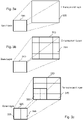
- Figure 3 comprising Figures 3a, 3b, and 3c , illustrates different examples of configurations of HEVC scalable bit-streams.
- Figure 3a is an example of a spatially scalable video bit-stream comprising a base layer 300 and an enhancement layer 305.
- Enhancement layer 305 is encoded as a function of base layer 300.
- Figure 3b illustrates another example of a scalable video bit-stream comprising a base layer 310 and an enhancement layer 315.
- enhancement layer 315 is a tiled enhancement layer comprising, in particular, tile 320.
- tile 320 In such a video bit-stream format, there exists a tile to picture dependency since tiles of the enhancement layer depend on the base layer.
- Figure 3c still illustrates another example of a scalable video bit-stream comprising a base layer 325 and an enhancement layer 330.
- base layer 325 is a tiled base layer comprising, in particular, tiles 335 and 340
- enhancement layer 330 is a tiled enhancement layer comprising, in particular, tile 345 and tile set 350.
- Base layer 325 can be spatially enhanced with enhancement layer 330.
- tile to tile dependency since tiles of the enhancement layer depend on tiles of the base layer.
- tile set to tile dependency since a tile set of the enhancement layer depends on tiles of the base layer.
- tile 345 depends on tile 340 and tile set 350 depends on tile 335.
- Other dependencies may exist such as a tile to tile set dependency or a tile set to tile set dependency.
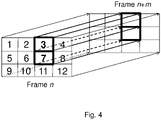
- Figure 4 illustrates a temporal pipe of tiles selected by a user to be displayed. More precisely, Figure 4 represents a first video frame n and a second video frame n + m (where n and m are integer values), each of the first and second video frames comprising twelve tiles numbered 1 to 12. For the sake of illustration, only the third and seventh tiles are to be displayed (as denoted with bold lines) amongst these twelve tiles. Video frames n and n + m belong to a series of consecutive frames corresponding to a given temporal period. Therefore, the third and seventh tiles of each frame from frame n to frame n + m are displayed consecutively.
- the data of a video bit-stream conforming to the standard mp4 file format are organized as temporal samples that correspond to full frames. Accordingly, it is required to access several small byte ranges for each frame when particular spatial areas of these frames are to be accessed during a given period of time as described above by reference to Figure 4 .
- This is inefficient in HTTP streaming in terms of the number of generated requests and in terms of data overhead. It is also less efficient for bit-stream extraction for RTP streaming because it requires multiple small file seeking operations.
- the timed media data bit-stream is to be reorganized so that data of a particular tile are organized as a contiguous byte range (forming a pipe) for a given time period (i.e. a set of consecutive frames).
- a server can extract more efficiently bigger data chunks from a source such as a hard disk, corresponding to a pipe of tiles.
- a unified tile descriptor to handle single tile and set of tiles for single and multi-layer video tracks in a transparent way, whatever the tile is independently decodable or not.
- a tile corresponds to one subsample obtained from at least one timed sample (e.g. images).
- Figure 5 provides the structure and features of the unified tile descriptor. It is a specific VisualSampleGroupEntry and is intended to be described as a property in the SampleGroupDescriptionBox of grouping_type 'trif', associated or not to a SampleToGroupBox with the same grouping_type. The various parameters contained in this unified tile descriptor are described below.
- the base region used in the TileRegionGroupEntry is the size of the picture to which the tile belongs. Note that for L-HEVC streams using spatial scalability and tiling on both the base and enhancement layers, the TileRegionGroupEntry sample descriptions of the base layer will give coordinates expressed in luma samples of the base layer, while the TileRegionGroupEntry sample descriptions of the enhancement layer will give coordinates expressed in luma samples of the enhancement layer.
- the unified tile descriptor reduces the number of sample groups present in SampleTableBox 'stbl' or in track fragments 'traf'. It also simplifies the description of inter-layer dependencies of HEVC tiles since only one descriptor has to be parsed, whatever a single tile or a tile set is described. It also simplifies the encapsulation process for mp4 writer.
- Another example not comprised within the scope of the appended claims consists in reserving another value for the independent_idc flag to indicate that a tile or tile set is independent in its layer but has dependencies in other layers, but only on the same co-located tile or tile set. This could avoid the explicit declaration of the dependencies list, even with multi-layer video.
- combining the tile_group flag and the reserved bit so as to form a 2-bit parameter can consist in signaling in the tile descriptor whether the tile is single tile (00 in binary), a tile set (01) or a tile subset (10), the value (11) being reserved.
- the new point here is the handling of encoding configuration where one slice contains more than one tile.
- FIG. 9 illustrates the parsing of a media file containing the tile descriptor according to the invention.
- This tile descriptor can be exploited by a ISOBMFF parser and more generally by media players to inform users on presence of region of interests in a video (908) or to identify data for a region of interest to transmit these data or store these data in another file.
- the player opens a media file and starts by building a list of tracks declared in the file in 901. It selects the video track, looking at the track handler declared in the track boxes in 902 and for these video tracks get the sample table box in 903. It can then determine the kind of samples contained in the video tracks in 904, in particular whether they correspond to tile tracks or not( test 904).
- tile descriptor is available for the track. It is read in 905 to get tile position and sizes, then dependency is read from the tile descriptor in 906 and if it indicated that the tile is independently decodable (test 907; from various dependencies flags or from independent_idc flag as explained above). If independently decodable, the tile can be exploited (display, storage, transmission, extraction, for user interface or information%) in 908. If the video track is not a video track, the mp4 parser looks for a tile descriptor in the list of sample group description boxes in 909. If one is found it is processed in steps 905 to 908 and next video track is processed in 910 and iterates over 903. The tile processing terminated when no more video tracks are available in 910.
- the first alternative 601 defines the new TileRegion sample group entry, identified by a specific reserved code, for example 'tile'.
- the TileRegion sample group description is used to describe the spatial relationship between video or image media tracks. It allows identifying that decoded samples of a track spatially correspond to a given rectangular area in another track. It contains the following parameters:
- the units used to describe the region size are arbitrary units and may correspond to video pixel resolution, but don't have to.
- This new TileRegion sample group description is used to describe the spatial relationship between video or image media tracks. It allows identifying that decoded samples of a track spatially correspond to a given rectangular area in another track. This can be useful for media files or live media streams encapsulating multiple video tracks. For example a TV program where several views are proposed, this can be used, depending on the current camera arrangement in displays (position of these different videos, for example picture in picture or video in video) to know where a specific content associate to one of the video tracks is located. This can be useful for example if video gadgets have to be superimposed or if subtitles have to be associated to the video.
- a video track “A” may use a track reference of type “tile” to a video track “B” in order to indicate that the content of "A” is a rectangular region of the content of "B".
- the description of the location of this area is given by TileGroupEntry sample group descriptions like in 401.
- the other alternative 602 contains the following parameters:
- Figure 7 illustrates another example not comprised within the scope of the appended claims for the unified tile descriptor 701 to address specific tile-based use case.
- it allows to address video sample organization as on 702 where each tiled video sample has a region of interest 703 and other tiles corresponding to background of the video (704).
- the new hidden flag proposed in the tile descriptor 701 allows to encapsulate less important tiles, here the background ones in a dummy or virtual tile descriptor.
- the tile descriptor for the region of interest contains the sizes of the region 703 and its positions in the video 702. But for background tiles, it is more efficient to define one rectangular region and mark it as hidden or not intended to be displayed, setting this hidden flag to 1.
- Identifying a dummy tile descriptor it would get the information that related track or samples or NAL units can be safely discarded from the bit-stream.
- An alternative to the use of this specific flag or parameter can be to indicate that when sizes are set to 0, then it is a dummy tile descriptor and then a region not intended to be displayed.
- An additional parameter can also be added to the unified tile descriptor to annotate the region, using for example an additional string parameter (not represented on figure 7 ). This additional string parameter can take: "ROI", "background” text description.
- dummy tile descriptor is that when content creator prepares a media presentation for streaming, the DASH packager in charge of transforming the ISOBMFF file into streamable DASH segments has the indication that, for example a tile track is a dummy one and this one would automatically not be exposed at DASH level.
- the tile_group parameter of the unified tile descriptor can be used to control the access granularity in terms of tiles. For example, one can decide to encapsulate video samples as on 702 into a first tile describing the region of interest 703 as a single rectangular region (thus not providing a finer access than the region: no access to each tile composing this region of interest is provided). This, when tile tracks are exposed in streaming manifest for tile-based transmission or adaptation can save description size in the streaming manifest and makes adaptation easier for DASH clients (less choices and configuration to compare and select).
- tiles When tiles are encapsulated in their own tracks, they refer to a base tile track to access initialization information, typically the parameter sets. There are cases where all tiles share the same set of properties with the base tile track: sync sample, dependency, sap types, 'rap ' and 'roll', likely most of the defined sample groups (except tiling). Some tables cannot be omitted in a track as their absence already has meaning (namely sync sample table).
- samples from a tile track inherit any property defined through sample groups for the corresponding sample in the base track, unless a sample group description of the same type is given in the tile track. For example, if the base tile track has a 'roll' sample group description and the tile track does not, the roll distance for samples in the tile track is the same as the roll distance for samples in the base track. More generally, when a sample group description (resp.
- sample to group of a given grouping_type value is not present in a tile track but is present in the base tile track, the sample group description (resp sample to group) of the given grouping_type of the base track applies to the samples of this tile track. This can reduce redundancy of some sample groups in multi-track files.
- SampleToGroup and SampleToGroupDescription are modified so as to indicate this information to the tracks they are related to (or tracks using them through the track reference mechanism).
- This can be done with a new version of these boxes and a new parameter, called for example shareable that takes a binary value: 1 means shareable (i.e. dependent tracks not redefining it will directly reuse the box) or 0 (i.e. dependent tracks not redefining it will not be able to share directly the box).
- Another example not comprised within the scope of the appended claims for this new parameter is to have different values of inheritance, like for example "public”, “protected”, “private” with the following semantics:
- the tile tracks from the ISOBMFF file or segment files have to be exposed in a streaming manifest or playlist.
- the MPEG DASH protocol for adaptive streaming on HTTP.
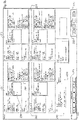
- FIG. 8 illustrates some usages of tile tracks for tile-based rendering: tile-based adaptation 820, tile-based view 825 or tile-based transcoding and rendering as a full-picture 830.
- tile-based adaptation 820 tile-based view 825 or tile-based transcoding and rendering as a full-picture 830.
- base tile track Each tile of each quality can typically be packaged in a single track containing only tile-related Video Coding Layer NAL units, and most non Video Coding Layer (non-VCL) NAL units would be in a dedicated track, called "base tile track”.
- reconstruction of the full Access Unit can be achieved based either on extractors from the base tile track to tile tracks, or on implicit AU reconstruction rules (mostly VCL NALU concatenation rules) from the base track to tile tracks.
- the HEVC file format also defines an extractor format giving rules to rewrite part of the bit-stream while copying other parts.
- a typical use case for this is to provide an extractor track that extracts a tile of a NxM motion-constrained tiled HEVC bit-stream into a conformant, non-tiled HEVC bit-stream with the same resolution as the extracted tile, allowing full-frame playback of a single tile without having to strip part of the reconstructed picture as shown on 830 on figure 8 .
- accessing only the tile of interest through DASH rather than the entire bit stream would save quite a lot of bandwidth and is interesting for ROI inspection using DASH or any adaptive streaming protocol.
- the base tile track 810 and the tile tracks 811 to 814 are each mapped to an MPEG-DASH Representation in its own AdaptationSet, where the tile location is given by an SRD descriptor at the AdaptationSet level.
- Each tile track Representation then has a dependencyId attribute towards the "base tile track", allowing locating and loading all non-VCL data for that track.
- Two approaches are then possible in order to reconstruct the complete video from all the tile tracks, as illustrated on figure 8 and described in the tables of the Appendix.
- all tile tracks 811 to 814 Representations and the base tile track 810 Representation share the same initialization segment (same physical file on media server called "v_base.mp4"), repeated in streaming manifest with each tile track Representation and with the base tile track.
- the base tile tracks 811 to 814 are described as Representations with the codecs attribute set to 'hvt1' followed by profile/tier/level information.
- the DASH client is responsible for fetching in order the different tiles of interest (from the corresponding AdaptationSets and/or Representations of the DASH MPD), for example selected by a user from a user interface.
- the user interface can for example reflect the SRD information obtained by DASH client during MPD parsing and can display the grid of tiles somewhere on the user interface.
- Each cell of the grid of tiles can be clickable to select one or a set of tiles.
- Each cell in the grid of tiles is then related to an AdaptationSet declared in the manifest.
- the DASH client then knows that clicking a cell or a selection of cells means selection of the one or more related AdaptationSets. This simplifies the design of the MPD, but however requires special processing at the DASH client to identify that all tiled Representations (Representation for tile tracks) belong to the same coded object, by analyzing dependency indications (for example the dependencyId attribute in DASH), mime type and SRD parameters.
- the so-selected tile tracks (through the AdaptationSets or Representations for example) are rendered as they are placed in the original file: i.e. the reconstructed video bit-stream for a selected tile is rendered in its position given in the SRD and from the position in the original video sequence as shown in 820.
- the initialization segment may be requested twice. But the HTTP stack of the DASH client will already have this segment in its cache and the request would then not be issued again.
- the Representation for the base tile track 810 in the Table 1 has specific SRD annotation with object_width and object_height set to 0. This is an indication that should prevent DASH clients to select this base tile track alone.
- each tile track Representation (or the base tile track 810 Representation) has its own initialization segment, typically including only the tile track and the base tile track (signaled with SRD object_width and object_height set to 0 to avoid selection by a DASH client).
- This description complies with the DASH rule on different initialization segments for dependent Representations.
- an extra "aggregation" AdaptationSet (for example using extractors as in composite track) is used to describe the set of tile tracks composing the full video for each quality; the Representations in this set would have their own initialization segment including all tile tracks, and dependencyId to all tile tracks Representation; the media segments of this Representation will be empty, as all data is carried in the base track and the tile tracks.
- This design is a bit heavier but does not require specific processing of the DASH client in order to reconstruct the full video.
- the selected tile track is rendered as a new compliant HEVC bit-stream resulting from high-level syntax modification (for example by transcoding video sizes and rewriting the position of the coding tree blocks for the tile) to render the tile or a set of tile as a new full video as shown in 830.
- each tile of the video stream can be packaged in a single track of type hvt1, and extraction instruction would be in an additional track of type hev2/hvc2 (since the resulting extracted bit-stream is a conformant HEVC bit-stream). Both tracks can be packaged in a single media file (for example ISOBMFF file).
- Table 4 is another example, reusing description of table 3 and adding an AdaptationSet for the full video that described a 2x1 tiling as on 800 on figure 8 .
- the "base tile track” is declared in a dedicated AdaptationSet containing an essential property SRD descriptor, with object_x, object_y, object_width, object_height all being set to 0.
- Adaptation Sets containing representations of codec type 'hvt1' can then be decoded using a single HEVC decoder if and only if provided that they share the same base tile track, as identified by their dependencyld and that they belong to the same SRD group, as identified by the source_id of the SRD descriptor.
- This description and organization of the streaming manifest avoids defining one "aggregation" AdaptationSet per tile and allows miwing tiles at different qualities and/or ROI inspection use cases.
- each tile track is accessible as a single conformant HEVC video through the Representations N_K_x, (N being the tile number and K the quality level) while at the same time the complete video can be recomputed by feeding all selected 'hvt1' representations to the HEVC decoder associated with SRD sharing the same source_id value. (1 in the example of Table 5).
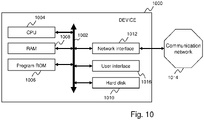
- Figure 10 represents a block diagram of a server or a client device 1000 in which steps of one or more embodiments may be implemented.
- the device 1000 comprises a communication bus 1002, a central processing unit (CPU) 1004 capable of executing instructions from program ROM 1006 on powering up of the device, and instructions relating to a software application from main memory 1008 after the powering up.
- the main memory 1008 is for example of Random Access Memory (RAM) type which functions as a working area of CPU 1004 via the communication bus 1002, and the memory capacity thereof can be expanded by an optional RAM connected to an expansion port (not illustrated).
- Instructions relating to the software application may be loaded to the main memory 1008 from a hard disk (HD) 1010 or the program ROM 1006 for example.
- HD hard disk
- Such software application when executed by the CPU 1004, causes the encapsulation step described with reference to Figures 1 and 2 to be performed in the server.
- Reference numeral 1012 is a network interface that allows the connection of the device 1000 to the communication network 1014.
- the software application when executed by the CPU 1004 is adapted to react to requests received through the network interface and to provide data streams and requests via the network to other devices.
- Reference numeral 1016 represents user interfaces to display information to, and/or receive inputs from, a user.
- the device 1000 for managing the reception or sending of multimedia bit-streams can consist of one or more dedicated integrated circuits (ASIC) that are capable of implementing the method as described with reference to Figure 9 .
- ASIC dedicated integrated circuits
- These integrated circuits are for example and non-restrictively, integrated into an apparatus for generating or displaying video sequences and/or for listening to audio sequences.
- Embodiments of the invention may be embedded in a device such as a camera, a smartphone, or a tablet that acts as a remote controller for a TV, for example to zoom into a particular region of interest. They can also be used from the same devices to have personalized browsing experience of a TV program by selecting specific areas of interest. Another usage of these devices by a user is to share selected sub-parts of his/her preferred videos with other connected devices. They can also be used in smartphone or tablet to monitor what happens in a specific area of a building placed under surveillance provided that the surveillance camera supports the generation part of this invention.
Landscapes
- Engineering & Computer Science (AREA)
- Multimedia (AREA)
- Signal Processing (AREA)
- Library & Information Science (AREA)
- Theoretical Computer Science (AREA)
- Databases & Information Systems (AREA)
- Human Computer Interaction (AREA)
- Compression Or Coding Systems Of Tv Signals (AREA)
- Two-Way Televisions, Distribution Of Moving Picture Or The Like (AREA)
Applications Claiming Priority (2)
| Application Number | Priority Date | Filing Date | Title |
|---|---|---|---|
| GB1609145.6A GB2550604A (en) | 2016-05-24 | 2016-05-24 | Method, device, and computer program for encapsulating and parsing timed media data |
| PCT/EP2017/062322 WO2017202799A1 (en) | 2016-05-24 | 2017-05-23 | Method, device, and computer program for encapsulating and parsing timed media data |
Publications (2)
| Publication Number | Publication Date |
|---|---|
| EP3466092A1 EP3466092A1 (en) | 2019-04-10 |
| EP3466092B1 true EP3466092B1 (en) | 2022-12-21 |
Family
ID=56369901
Family Applications (1)
| Application Number | Title | Priority Date | Filing Date |
|---|---|---|---|
| EP17724830.9A Active EP3466092B1 (en) | 2016-05-24 | 2017-05-23 | Method, device, and computer program for encapsulating and parsing timed media data |
Country Status (7)
| Country | Link |
|---|---|
| US (2) | US11153664B2 (enExample) |
| EP (1) | EP3466092B1 (enExample) |
| JP (2) | JP6965278B2 (enExample) |
| KR (2) | KR102201841B1 (enExample) |
| CN (2) | CN113949938B (enExample) |
| GB (1) | GB2550604A (enExample) |
| WO (1) | WO2017202799A1 (enExample) |
Families Citing this family (18)
| Publication number | Priority date | Publication date | Assignee | Title |
|---|---|---|---|---|
| EP3206408B1 (en) * | 2014-10-10 | 2020-12-30 | Sony Corporation | Encoding device and method, playback device and method, and program |
| EP3293981A1 (en) * | 2016-09-08 | 2018-03-14 | Koninklijke KPN N.V. | Partial video decoding method, device and system |
| GB2554877B (en) * | 2016-10-10 | 2021-03-31 | Canon Kk | Methods, devices, and computer programs for improving rendering display during streaming of timed media data |
| WO2019189340A1 (ja) * | 2018-03-28 | 2019-10-03 | パナソニックIpマネジメント株式会社 | 符号化装置、復号装置、符号化方法、および復号方法 |
| KR102486371B1 (ko) | 2018-06-26 | 2023-01-06 | 후아웨이 테크놀러지 컴퍼니 리미티드 | 포인트 클라우드 코딩을 위한 고급 구문 설계 |
| GB2575074B (en) | 2018-06-27 | 2022-09-28 | Canon Kk | Encapsulating video content with an indication of whether a group of tracks collectively represents a full frame or a part of a frame |
| US10630976B2 (en) * | 2018-08-17 | 2020-04-21 | Qualcomm Incorporated | Display refresh blocks determination for video coding |
| CN118972576A (zh) * | 2018-09-25 | 2024-11-15 | 数字洞察力有限公司 | 用于对图像进行编码或解码的方法和装置以及非暂态计算机可读介质 |
| US20220014774A1 (en) * | 2018-10-11 | 2022-01-13 | Samsung Electronics Co., Ltd. | Video encoding and decoding method using tiles and tile groups, and video encoding and decoding device using tiles and tile groups |
| KR102154407B1 (ko) * | 2018-11-15 | 2020-09-09 | 한국전자기술연구원 | 타일 기반 스트리밍을 위한 모션 제한 av1 영상 부호화 방법 및 장치 |
| GB201902829D0 (en) * | 2019-03-01 | 2019-04-17 | Canon Kk | Method and apparatus for encoding and decoding a video bitsream for merging regions of interest |
| US20220150487A1 (en) * | 2019-03-21 | 2022-05-12 | Kaonmedia Co., Ltd. | Image encoding method, image decoding method, and device for processing picture partitions |
| JP7472292B2 (ja) * | 2019-12-31 | 2024-04-22 | ノキア テクノロジーズ オサケユイチア | ビデオ符号化およびビデオ復号のための方法、装置、およびコンピュータプログラム製品 |
| CN114930866B (zh) * | 2020-01-03 | 2025-08-01 | 诺基亚技术有限公司 | 用于实时纹理适配的方法 |
| CN114930869B (zh) * | 2020-01-07 | 2025-02-21 | 诺基亚技术有限公司 | 用于视频编码和视频解码的方法、装置和计算机程序产品 |
| US11589032B2 (en) * | 2020-01-07 | 2023-02-21 | Mediatek Singapore Pte. Ltd. | Methods and apparatus for using track derivations to generate new tracks for network based media processing applications |
| WO2021198491A1 (en) * | 2020-04-02 | 2021-10-07 | Fraunhofer-Gesellschaft zur Förderung der angewandten Forschung e.V. | File format schemes allowing efficient roi, stream access and parameter set handling |
| GB2597642B (en) | 2020-06-16 | 2023-08-02 | Canon Kk | Method, device, and computer program for encapsulating media data into a media file |
Family Cites Families (18)
| Publication number | Priority date | Publication date | Assignee | Title |
|---|---|---|---|---|
| KR20120080214A (ko) * | 2009-09-29 | 2012-07-16 | 노키아 코포레이션 | 다이내믹 미디어 파일 스트리밍을 위한 시스템, 방법 및 장치 |
| US9131033B2 (en) * | 2010-07-20 | 2015-09-08 | Qualcomm Incoporated | Providing sequence data sets for streaming video data |
| GB2506911B (en) * | 2012-10-12 | 2015-12-09 | Canon Kk | Method and correponding device for streaming video data |
| US9591383B2 (en) | 2013-01-18 | 2017-03-07 | Canon Kabushiki Kaisha | Method, device, and computer program for encapsulating partitioned timed media data |
| GB2512880B (en) * | 2013-04-09 | 2017-12-20 | Canon Kk | Method, device, and computer program for encapsulating partitioned timed media data |
| EP2824885B1 (en) * | 2013-07-12 | 2019-01-23 | Provenance Asset Group LLC | A manifest file format supporting panoramic video |
| GB2516825B (en) * | 2013-07-23 | 2015-11-25 | Canon Kk | Method, device, and computer program for encapsulating partitioned timed media data using a generic signaling for coding dependencies |
| GB2542282B (en) * | 2013-10-22 | 2018-08-01 | Canon Kk | Method, device, and computer program for encapsulating partitioned timed media data in a server |
| US9712843B2 (en) * | 2013-10-23 | 2017-07-18 | Qualcomm Incorporated | Multi-layer video file format designs |
| EP3713234A1 (en) * | 2014-01-07 | 2020-09-23 | Canon Kabushiki Kaisha | Method, device, and computer program for encoding inter-layer dependencies in encapsulating multi-layer partitioned timed media data |
| GB2522014A (en) * | 2014-01-07 | 2015-07-15 | Canon Kk | Method, device, and computer program for encoding inter-layer dependencies in encapsulating multi-layer partitioned timed media data |
| EP3162074A1 (en) * | 2014-06-27 | 2017-05-03 | Koninklijke KPN N.V. | Determining a region of interest on the basis of a hevc-tiled video stream |
| US11418812B2 (en) * | 2015-02-11 | 2022-08-16 | Qualcomm Incorporated | Placement of parameter sets and sync samples in video coding |
| US9928297B2 (en) * | 2015-02-11 | 2018-03-27 | Qualcomm Incorporated | Sample grouping signaling in file formats |
| GB2539462B (en) | 2015-06-16 | 2019-04-03 | Canon Kk | Obtaining media data and metadata from encapsulated bit-streams wherein operating point descriptors can be dynamically set |
| US20160373771A1 (en) * | 2015-06-18 | 2016-12-22 | Qualcomm Incorporated | Design of tracks and operation point signaling in layered hevc file format |
| US10063861B2 (en) * | 2015-10-07 | 2018-08-28 | Qualcomm Incorporated | Methods and systems of performing predictive random access using a background picture |
| US10419768B2 (en) * | 2016-03-30 | 2019-09-17 | Qualcomm Incorporated | Tile grouping in HEVC and L-HEVC file formats |
-
2016
- 2016-05-24 GB GB1609145.6A patent/GB2550604A/en not_active Withdrawn
-
2017
- 2017-05-23 WO PCT/EP2017/062322 patent/WO2017202799A1/en not_active Ceased
- 2017-05-23 JP JP2018560024A patent/JP6965278B2/ja active Active
- 2017-05-23 CN CN202111363186.3A patent/CN113949938B/zh active Active
- 2017-05-23 US US16/099,667 patent/US11153664B2/en active Active
- 2017-05-23 KR KR1020187036180A patent/KR102201841B1/ko active Active
- 2017-05-23 KR KR1020217000387A patent/KR102254414B1/ko active Active
- 2017-05-23 EP EP17724830.9A patent/EP3466092B1/en active Active
- 2017-05-23 CN CN201780032220.4A patent/CN109155875B/zh active Active
-
2021
- 2021-09-15 US US17/475,764 patent/US11743558B2/en active Active
- 2021-10-21 JP JP2021172139A patent/JP7177902B2/ja active Active
Also Published As
| Publication number | Publication date |
|---|---|
| KR20190007036A (ko) | 2019-01-21 |
| JP6965278B2 (ja) | 2021-11-10 |
| US20220070554A1 (en) | 2022-03-03 |
| CN113949938B (zh) | 2024-04-12 |
| KR102254414B1 (ko) | 2021-05-24 |
| KR102201841B1 (ko) | 2021-01-12 |
| US20190158935A1 (en) | 2019-05-23 |
| CN109155875A (zh) | 2019-01-04 |
| JP7177902B2 (ja) | 2022-11-24 |
| CN113949938A (zh) | 2022-01-18 |
| CN109155875B (zh) | 2021-12-03 |
| GB2550604A (en) | 2017-11-29 |
| EP3466092A1 (en) | 2019-04-10 |
| KR20210006015A (ko) | 2021-01-15 |
| US11153664B2 (en) | 2021-10-19 |
| JP2019521574A (ja) | 2019-07-25 |
| WO2017202799A1 (en) | 2017-11-30 |
| GB201609145D0 (en) | 2016-07-06 |
| US11743558B2 (en) | 2023-08-29 |
| JP2022003841A (ja) | 2022-01-11 |
Similar Documents
| Publication | Publication Date | Title |
|---|---|---|
| US11743558B2 (en) | Method, device, and computer program for encapsulating and parsing timed media data | |
| US11128898B2 (en) | Method, device, and computer program for encapsulating scalable partitioned timed media data | |
| US10257247B2 (en) | Method, device, and computer program for encapsulating and parsing timed media data | |
| US11178470B2 (en) | Method, device, and computer program for encapsulating partitioned timed media data | |
| US11412017B2 (en) | Method, device, and computer program for encoding inter-layer dependencies in encapsulating multi-layer partitioned timed media data | |
| KR102037009B1 (ko) | 동작 포인트 디스크립터가 동적으로 설정될 수 있는 캡슐화된 비트-스트림으로부터 미디어 데이터 및 메타데이터를 획득하는 방법, 디바이스, 및 컴퓨터 프로그램 | |
| GB2522014A (en) | Method, device, and computer program for encoding inter-layer dependencies in encapsulating multi-layer partitioned timed media data | |
| GB2535453A (en) | Method, device, and computer program for encapsulating hevc layered media data |
Legal Events
| Date | Code | Title | Description |
|---|---|---|---|
| STAA | Information on the status of an ep patent application or granted ep patent |
Free format text: STATUS: UNKNOWN |
|
| STAA | Information on the status of an ep patent application or granted ep patent |
Free format text: STATUS: THE INTERNATIONAL PUBLICATION HAS BEEN MADE |
|
| PUAI | Public reference made under article 153(3) epc to a published international application that has entered the european phase |
Free format text: ORIGINAL CODE: 0009012 |
|
| STAA | Information on the status of an ep patent application or granted ep patent |
Free format text: STATUS: REQUEST FOR EXAMINATION WAS MADE |
|
| 17P | Request for examination filed |
Effective date: 20181128 |
|
| AK | Designated contracting states |
Kind code of ref document: A1 Designated state(s): AL AT BE BG CH CY CZ DE DK EE ES FI FR GB GR HR HU IE IS IT LI LT LU LV MC MK MT NL NO PL PT RO RS SE SI SK SM TR |
|
| AX | Request for extension of the european patent |
Extension state: BA ME |
|
| DAV | Request for validation of the european patent (deleted) | ||
| DAX | Request for extension of the european patent (deleted) | ||
| STAA | Information on the status of an ep patent application or granted ep patent |
Free format text: STATUS: EXAMINATION IS IN PROGRESS |
|
| 17Q | First examination report despatched |
Effective date: 20191129 |
|
| GRAP | Despatch of communication of intention to grant a patent |
Free format text: ORIGINAL CODE: EPIDOSNIGR1 |
|
| STAA | Information on the status of an ep patent application or granted ep patent |
Free format text: STATUS: GRANT OF PATENT IS INTENDED |
|
| INTG | Intention to grant announced |
Effective date: 20220711 |
|
| RAP3 | Party data changed (applicant data changed or rights of an application transferred) |
Owner name: CANON KABUSHIKI KAISHA |
|
| GRAS | Grant fee paid |
Free format text: ORIGINAL CODE: EPIDOSNIGR3 |
|
| GRAA | (expected) grant |
Free format text: ORIGINAL CODE: 0009210 |
|
| STAA | Information on the status of an ep patent application or granted ep patent |
Free format text: STATUS: THE PATENT HAS BEEN GRANTED |
|
| AK | Designated contracting states |
Kind code of ref document: B1 Designated state(s): AL AT BE BG CH CY CZ DE DK EE ES FI FR GB GR HR HU IE IS IT LI LT LU LV MC MK MT NL NO PL PT RO RS SE SI SK SM TR |
|
| REG | Reference to a national code |
Ref country code: GB Ref legal event code: FG4D |
|
| REG | Reference to a national code |
Ref country code: DE Ref legal event code: R096 Ref document number: 602017064771 Country of ref document: DE |
|
| REG | Reference to a national code |
Ref country code: CH Ref legal event code: EP |
|
| REG | Reference to a national code |
Ref country code: AT Ref legal event code: REF Ref document number: 1539758 Country of ref document: AT Kind code of ref document: T Effective date: 20230115 |
|
| REG | Reference to a national code |
Ref country code: IE Ref legal event code: FG4D |
|
| REG | Reference to a national code |
Ref country code: LT Ref legal event code: MG9D |
|
| REG | Reference to a national code |
Ref country code: NL Ref legal event code: MP Effective date: 20221221 |
|
| PG25 | Lapsed in a contracting state [announced via postgrant information from national office to epo] |
Ref country code: SE Free format text: LAPSE BECAUSE OF FAILURE TO SUBMIT A TRANSLATION OF THE DESCRIPTION OR TO PAY THE FEE WITHIN THE PRESCRIBED TIME-LIMIT Effective date: 20221221 Ref country code: NO Free format text: LAPSE BECAUSE OF FAILURE TO SUBMIT A TRANSLATION OF THE DESCRIPTION OR TO PAY THE FEE WITHIN THE PRESCRIBED TIME-LIMIT Effective date: 20230321 Ref country code: LT Free format text: LAPSE BECAUSE OF FAILURE TO SUBMIT A TRANSLATION OF THE DESCRIPTION OR TO PAY THE FEE WITHIN THE PRESCRIBED TIME-LIMIT Effective date: 20221221 Ref country code: FI Free format text: LAPSE BECAUSE OF FAILURE TO SUBMIT A TRANSLATION OF THE DESCRIPTION OR TO PAY THE FEE WITHIN THE PRESCRIBED TIME-LIMIT Effective date: 20221221 |
|
| REG | Reference to a national code |
Ref country code: AT Ref legal event code: MK05 Ref document number: 1539758 Country of ref document: AT Kind code of ref document: T Effective date: 20221221 |
|
| PG25 | Lapsed in a contracting state [announced via postgrant information from national office to epo] |
Ref country code: RS Free format text: LAPSE BECAUSE OF FAILURE TO SUBMIT A TRANSLATION OF THE DESCRIPTION OR TO PAY THE FEE WITHIN THE PRESCRIBED TIME-LIMIT Effective date: 20221221 Ref country code: LV Free format text: LAPSE BECAUSE OF FAILURE TO SUBMIT A TRANSLATION OF THE DESCRIPTION OR TO PAY THE FEE WITHIN THE PRESCRIBED TIME-LIMIT Effective date: 20221221 Ref country code: HR Free format text: LAPSE BECAUSE OF FAILURE TO SUBMIT A TRANSLATION OF THE DESCRIPTION OR TO PAY THE FEE WITHIN THE PRESCRIBED TIME-LIMIT Effective date: 20221221 Ref country code: GR Free format text: LAPSE BECAUSE OF FAILURE TO SUBMIT A TRANSLATION OF THE DESCRIPTION OR TO PAY THE FEE WITHIN THE PRESCRIBED TIME-LIMIT Effective date: 20230322 |
|
| PG25 | Lapsed in a contracting state [announced via postgrant information from national office to epo] |
Ref country code: NL Free format text: LAPSE BECAUSE OF FAILURE TO SUBMIT A TRANSLATION OF THE DESCRIPTION OR TO PAY THE FEE WITHIN THE PRESCRIBED TIME-LIMIT Effective date: 20221221 |
|
| PG25 | Lapsed in a contracting state [announced via postgrant information from national office to epo] |
Ref country code: SM Free format text: LAPSE BECAUSE OF FAILURE TO SUBMIT A TRANSLATION OF THE DESCRIPTION OR TO PAY THE FEE WITHIN THE PRESCRIBED TIME-LIMIT Effective date: 20221221 Ref country code: RO Free format text: LAPSE BECAUSE OF FAILURE TO SUBMIT A TRANSLATION OF THE DESCRIPTION OR TO PAY THE FEE WITHIN THE PRESCRIBED TIME-LIMIT Effective date: 20221221 Ref country code: PT Free format text: LAPSE BECAUSE OF FAILURE TO SUBMIT A TRANSLATION OF THE DESCRIPTION OR TO PAY THE FEE WITHIN THE PRESCRIBED TIME-LIMIT Effective date: 20230421 Ref country code: ES Free format text: LAPSE BECAUSE OF FAILURE TO SUBMIT A TRANSLATION OF THE DESCRIPTION OR TO PAY THE FEE WITHIN THE PRESCRIBED TIME-LIMIT Effective date: 20221221 Ref country code: EE Free format text: LAPSE BECAUSE OF FAILURE TO SUBMIT A TRANSLATION OF THE DESCRIPTION OR TO PAY THE FEE WITHIN THE PRESCRIBED TIME-LIMIT Effective date: 20221221 Ref country code: CZ Free format text: LAPSE BECAUSE OF FAILURE TO SUBMIT A TRANSLATION OF THE DESCRIPTION OR TO PAY THE FEE WITHIN THE PRESCRIBED TIME-LIMIT Effective date: 20221221 Ref country code: AT Free format text: LAPSE BECAUSE OF FAILURE TO SUBMIT A TRANSLATION OF THE DESCRIPTION OR TO PAY THE FEE WITHIN THE PRESCRIBED TIME-LIMIT Effective date: 20221221 |
|
| PG25 | Lapsed in a contracting state [announced via postgrant information from national office to epo] |
Ref country code: SK Free format text: LAPSE BECAUSE OF FAILURE TO SUBMIT A TRANSLATION OF THE DESCRIPTION OR TO PAY THE FEE WITHIN THE PRESCRIBED TIME-LIMIT Effective date: 20221221 Ref country code: PL Free format text: LAPSE BECAUSE OF FAILURE TO SUBMIT A TRANSLATION OF THE DESCRIPTION OR TO PAY THE FEE WITHIN THE PRESCRIBED TIME-LIMIT Effective date: 20221221 Ref country code: IS Free format text: LAPSE BECAUSE OF FAILURE TO SUBMIT A TRANSLATION OF THE DESCRIPTION OR TO PAY THE FEE WITHIN THE PRESCRIBED TIME-LIMIT Effective date: 20230421 Ref country code: AL Free format text: LAPSE BECAUSE OF FAILURE TO SUBMIT A TRANSLATION OF THE DESCRIPTION OR TO PAY THE FEE WITHIN THE PRESCRIBED TIME-LIMIT Effective date: 20221221 |
|
| REG | Reference to a national code |
Ref country code: DE Ref legal event code: R097 Ref document number: 602017064771 Country of ref document: DE |
|
| PLBE | No opposition filed within time limit |
Free format text: ORIGINAL CODE: 0009261 |
|
| STAA | Information on the status of an ep patent application or granted ep patent |
Free format text: STATUS: NO OPPOSITION FILED WITHIN TIME LIMIT |
|
| PG25 | Lapsed in a contracting state [announced via postgrant information from national office to epo] |
Ref country code: DK Free format text: LAPSE BECAUSE OF FAILURE TO SUBMIT A TRANSLATION OF THE DESCRIPTION OR TO PAY THE FEE WITHIN THE PRESCRIBED TIME-LIMIT Effective date: 20221221 |
|
| 26N | No opposition filed |
Effective date: 20230922 |
|
| REG | Reference to a national code |
Ref country code: CH Ref legal event code: PL |
|
| PG25 | Lapsed in a contracting state [announced via postgrant information from national office to epo] |
Ref country code: MC Free format text: LAPSE BECAUSE OF FAILURE TO SUBMIT A TRANSLATION OF THE DESCRIPTION OR TO PAY THE FEE WITHIN THE PRESCRIBED TIME-LIMIT Effective date: 20221221 |
|
| REG | Reference to a national code |
Ref country code: BE Ref legal event code: MM Effective date: 20230531 |
|
| PG25 | Lapsed in a contracting state [announced via postgrant information from national office to epo] |
Ref country code: SI Free format text: LAPSE BECAUSE OF FAILURE TO SUBMIT A TRANSLATION OF THE DESCRIPTION OR TO PAY THE FEE WITHIN THE PRESCRIBED TIME-LIMIT Effective date: 20221221 Ref country code: MC Free format text: LAPSE BECAUSE OF FAILURE TO SUBMIT A TRANSLATION OF THE DESCRIPTION OR TO PAY THE FEE WITHIN THE PRESCRIBED TIME-LIMIT Effective date: 20221221 Ref country code: LU Free format text: LAPSE BECAUSE OF NON-PAYMENT OF DUE FEES Effective date: 20230523 Ref country code: LI Free format text: LAPSE BECAUSE OF NON-PAYMENT OF DUE FEES Effective date: 20230531 Ref country code: CH Free format text: LAPSE BECAUSE OF NON-PAYMENT OF DUE FEES Effective date: 20230531 |
|
| REG | Reference to a national code |
Ref country code: IE Ref legal event code: MM4A |
|
| PG25 | Lapsed in a contracting state [announced via postgrant information from national office to epo] |
Ref country code: IE Free format text: LAPSE BECAUSE OF NON-PAYMENT OF DUE FEES Effective date: 20230523 |
|
| PG25 | Lapsed in a contracting state [announced via postgrant information from national office to epo] |
Ref country code: IE Free format text: LAPSE BECAUSE OF NON-PAYMENT OF DUE FEES Effective date: 20230523 |
|
| PG25 | Lapsed in a contracting state [announced via postgrant information from national office to epo] |
Ref country code: IT Free format text: LAPSE BECAUSE OF FAILURE TO SUBMIT A TRANSLATION OF THE DESCRIPTION OR TO PAY THE FEE WITHIN THE PRESCRIBED TIME-LIMIT Effective date: 20221221 Ref country code: BE Free format text: LAPSE BECAUSE OF NON-PAYMENT OF DUE FEES Effective date: 20230531 |
|
| PG25 | Lapsed in a contracting state [announced via postgrant information from national office to epo] |
Ref country code: BG Free format text: LAPSE BECAUSE OF FAILURE TO SUBMIT A TRANSLATION OF THE DESCRIPTION OR TO PAY THE FEE WITHIN THE PRESCRIBED TIME-LIMIT Effective date: 20221221 |
|
| PG25 | Lapsed in a contracting state [announced via postgrant information from national office to epo] |
Ref country code: BG Free format text: LAPSE BECAUSE OF FAILURE TO SUBMIT A TRANSLATION OF THE DESCRIPTION OR TO PAY THE FEE WITHIN THE PRESCRIBED TIME-LIMIT Effective date: 20221221 |
|
| PGFP | Annual fee paid to national office [announced via postgrant information from national office to epo] |
Ref country code: DE Payment date: 20250423 Year of fee payment: 9 |
|
| PGFP | Annual fee paid to national office [announced via postgrant information from national office to epo] |
Ref country code: GB Payment date: 20250423 Year of fee payment: 9 |
|
| PGFP | Annual fee paid to national office [announced via postgrant information from national office to epo] |
Ref country code: FR Payment date: 20250423 Year of fee payment: 9 |
|
| PG25 | Lapsed in a contracting state [announced via postgrant information from national office to epo] |
Ref country code: CY Free format text: LAPSE BECAUSE OF FAILURE TO SUBMIT A TRANSLATION OF THE DESCRIPTION OR TO PAY THE FEE WITHIN THE PRESCRIBED TIME-LIMIT; INVALID AB INITIO Effective date: 20170523 |
|
| PG25 | Lapsed in a contracting state [announced via postgrant information from national office to epo] |
Ref country code: HU Free format text: LAPSE BECAUSE OF FAILURE TO SUBMIT A TRANSLATION OF THE DESCRIPTION OR TO PAY THE FEE WITHIN THE PRESCRIBED TIME-LIMIT; INVALID AB INITIO Effective date: 20170523 |