EP3465807B1 - Electrode comprising heavily-doped ceria - Google Patents
Electrode comprising heavily-doped ceria Download PDFInfo
- Publication number
- EP3465807B1 EP3465807B1 EP17803610.9A EP17803610A EP3465807B1 EP 3465807 B1 EP3465807 B1 EP 3465807B1 EP 17803610 A EP17803610 A EP 17803610A EP 3465807 B1 EP3465807 B1 EP 3465807B1
- Authority
- EP
- European Patent Office
- Prior art keywords
- vol
- ceria
- electrode
- phase
- functional layer
- Prior art date
- Legal status (The legal status is an assumption and is not a legal conclusion. Google has not performed a legal analysis and makes no representation as to the accuracy of the status listed.)
- Active
Links
Images




Classifications
-
- C—CHEMISTRY; METALLURGY
- C04—CEMENTS; CONCRETE; ARTIFICIAL STONE; CERAMICS; REFRACTORIES
- C04B—LIME, MAGNESIA; SLAG; CEMENTS; COMPOSITIONS THEREOF, e.g. MORTARS, CONCRETE OR LIKE BUILDING MATERIALS; ARTIFICIAL STONE; CERAMICS; REFRACTORIES; TREATMENT OF NATURAL STONE
- C04B35/00—Shaped ceramic products characterised by their composition; Ceramics compositions; Processing powders of inorganic compounds preparatory to the manufacturing of ceramic products
- C04B35/01—Shaped ceramic products characterised by their composition; Ceramics compositions; Processing powders of inorganic compounds preparatory to the manufacturing of ceramic products based on oxide ceramics
-
- C—CHEMISTRY; METALLURGY
- C04—CEMENTS; CONCRETE; ARTIFICIAL STONE; CERAMICS; REFRACTORIES
- C04B—LIME, MAGNESIA; SLAG; CEMENTS; COMPOSITIONS THEREOF, e.g. MORTARS, CONCRETE OR LIKE BUILDING MATERIALS; ARTIFICIAL STONE; CERAMICS; REFRACTORIES; TREATMENT OF NATURAL STONE
- C04B35/00—Shaped ceramic products characterised by their composition; Ceramics compositions; Processing powders of inorganic compounds preparatory to the manufacturing of ceramic products
- C04B35/50—Shaped ceramic products characterised by their composition; Ceramics compositions; Processing powders of inorganic compounds preparatory to the manufacturing of ceramic products based on rare-earth compounds
-
- C—CHEMISTRY; METALLURGY
- C04—CEMENTS; CONCRETE; ARTIFICIAL STONE; CERAMICS; REFRACTORIES
- C04B—LIME, MAGNESIA; SLAG; CEMENTS; COMPOSITIONS THEREOF, e.g. MORTARS, CONCRETE OR LIKE BUILDING MATERIALS; ARTIFICIAL STONE; CERAMICS; REFRACTORIES; TREATMENT OF NATURAL STONE
- C04B35/00—Shaped ceramic products characterised by their composition; Ceramics compositions; Processing powders of inorganic compounds preparatory to the manufacturing of ceramic products
- C04B35/622—Forming processes; Processing powders of inorganic compounds preparatory to the manufacturing of ceramic products
- C04B35/626—Preparing or treating the powders individually or as batches ; preparing or treating macroscopic reinforcing agents for ceramic products, e.g. fibres; mechanical aspects section B
- C04B35/63—Preparing or treating the powders individually or as batches ; preparing or treating macroscopic reinforcing agents for ceramic products, e.g. fibres; mechanical aspects section B using additives specially adapted for forming the products, e.g.. binder binders
- C04B35/632—Organic additives
- C04B35/634—Polymers
- C04B35/63404—Polymers obtained by reactions only involving carbon-to-carbon unsaturated bonds
- C04B35/63408—Polyalkenes
-
- C—CHEMISTRY; METALLURGY
- C04—CEMENTS; CONCRETE; ARTIFICIAL STONE; CERAMICS; REFRACTORIES
- C04B—LIME, MAGNESIA; SLAG; CEMENTS; COMPOSITIONS THEREOF, e.g. MORTARS, CONCRETE OR LIKE BUILDING MATERIALS; ARTIFICIAL STONE; CERAMICS; REFRACTORIES; TREATMENT OF NATURAL STONE
- C04B35/00—Shaped ceramic products characterised by their composition; Ceramics compositions; Processing powders of inorganic compounds preparatory to the manufacturing of ceramic products
- C04B35/622—Forming processes; Processing powders of inorganic compounds preparatory to the manufacturing of ceramic products
- C04B35/626—Preparing or treating the powders individually or as batches ; preparing or treating macroscopic reinforcing agents for ceramic products, e.g. fibres; mechanical aspects section B
- C04B35/63—Preparing or treating the powders individually or as batches ; preparing or treating macroscopic reinforcing agents for ceramic products, e.g. fibres; mechanical aspects section B using additives specially adapted for forming the products, e.g.. binder binders
- C04B35/632—Organic additives
- C04B35/634—Polymers
- C04B35/63404—Polymers obtained by reactions only involving carbon-to-carbon unsaturated bonds
- C04B35/63416—Polyvinylalcohols [PVA]; Polyvinylacetates
-
- C—CHEMISTRY; METALLURGY
- C04—CEMENTS; CONCRETE; ARTIFICIAL STONE; CERAMICS; REFRACTORIES
- C04B—LIME, MAGNESIA; SLAG; CEMENTS; COMPOSITIONS THEREOF, e.g. MORTARS, CONCRETE OR LIKE BUILDING MATERIALS; ARTIFICIAL STONE; CERAMICS; REFRACTORIES; TREATMENT OF NATURAL STONE
- C04B35/00—Shaped ceramic products characterised by their composition; Ceramics compositions; Processing powders of inorganic compounds preparatory to the manufacturing of ceramic products
- C04B35/622—Forming processes; Processing powders of inorganic compounds preparatory to the manufacturing of ceramic products
- C04B35/626—Preparing or treating the powders individually or as batches ; preparing or treating macroscopic reinforcing agents for ceramic products, e.g. fibres; mechanical aspects section B
- C04B35/63—Preparing or treating the powders individually or as batches ; preparing or treating macroscopic reinforcing agents for ceramic products, e.g. fibres; mechanical aspects section B using additives specially adapted for forming the products, e.g.. binder binders
- C04B35/632—Organic additives
- C04B35/634—Polymers
- C04B35/63448—Polymers obtained otherwise than by reactions only involving carbon-to-carbon unsaturated bonds
- C04B35/63488—Polyethers, e.g. alkylphenol polyglycolether, polyethylene glycol [PEG], polyethylene oxide [PEO]
-
- C—CHEMISTRY; METALLURGY
- C04—CEMENTS; CONCRETE; ARTIFICIAL STONE; CERAMICS; REFRACTORIES
- C04B—LIME, MAGNESIA; SLAG; CEMENTS; COMPOSITIONS THEREOF, e.g. MORTARS, CONCRETE OR LIKE BUILDING MATERIALS; ARTIFICIAL STONE; CERAMICS; REFRACTORIES; TREATMENT OF NATURAL STONE
- C04B35/00—Shaped ceramic products characterised by their composition; Ceramics compositions; Processing powders of inorganic compounds preparatory to the manufacturing of ceramic products
- C04B35/622—Forming processes; Processing powders of inorganic compounds preparatory to the manufacturing of ceramic products
- C04B35/64—Burning or sintering processes
-
- C—CHEMISTRY; METALLURGY
- C25—ELECTROLYTIC OR ELECTROPHORETIC PROCESSES; APPARATUS THEREFOR
- C25B—ELECTROLYTIC OR ELECTROPHORETIC PROCESSES FOR THE PRODUCTION OF COMPOUNDS OR NON-METALS; APPARATUS THEREFOR
- C25B11/00—Electrodes; Manufacture thereof not otherwise provided for
- C25B11/04—Electrodes; Manufacture thereof not otherwise provided for characterised by the material
-
- C—CHEMISTRY; METALLURGY
- C25—ELECTROLYTIC OR ELECTROPHORETIC PROCESSES; APPARATUS THEREFOR
- C25B—ELECTROLYTIC OR ELECTROPHORETIC PROCESSES FOR THE PRODUCTION OF COMPOUNDS OR NON-METALS; APPARATUS THEREFOR
- C25B13/00—Diaphragms; Spacing elements
- C25B13/04—Diaphragms; Spacing elements characterised by the material
-
- H—ELECTRICITY
- H01—ELECTRIC ELEMENTS
- H01M—PROCESSES OR MEANS, e.g. BATTERIES, FOR THE DIRECT CONVERSION OF CHEMICAL ENERGY INTO ELECTRICAL ENERGY
- H01M4/00—Electrodes
- H01M4/02—Electrodes composed of, or comprising, active material
- H01M4/04—Processes of manufacture in general
- H01M4/0471—Processes of manufacture in general involving thermal treatment, e.g. firing, sintering, backing particulate active material, thermal decomposition, pyrolysis
-
- H—ELECTRICITY
- H01—ELECTRIC ELEMENTS
- H01M—PROCESSES OR MEANS, e.g. BATTERIES, FOR THE DIRECT CONVERSION OF CHEMICAL ENERGY INTO ELECTRICAL ENERGY
- H01M4/00—Electrodes
- H01M4/02—Electrodes composed of, or comprising, active material
- H01M4/36—Selection of substances as active materials, active masses, active liquids
- H01M4/48—Selection of substances as active materials, active masses, active liquids of inorganic oxides or hydroxides
-
- H—ELECTRICITY
- H01—ELECTRIC ELEMENTS
- H01M—PROCESSES OR MEANS, e.g. BATTERIES, FOR THE DIRECT CONVERSION OF CHEMICAL ENERGY INTO ELECTRICAL ENERGY
- H01M4/00—Electrodes
- H01M4/86—Inert electrodes with catalytic activity, e.g. for fuel cells
- H01M4/8605—Porous electrodes
- H01M4/8621—Porous electrodes containing only metallic or ceramic material, e.g. made by sintering or sputtering
-
- H—ELECTRICITY
- H01—ELECTRIC ELEMENTS
- H01M—PROCESSES OR MEANS, e.g. BATTERIES, FOR THE DIRECT CONVERSION OF CHEMICAL ENERGY INTO ELECTRICAL ENERGY
- H01M4/00—Electrodes
- H01M4/86—Inert electrodes with catalytic activity, e.g. for fuel cells
- H01M4/8647—Inert electrodes with catalytic activity, e.g. for fuel cells consisting of more than one material, e.g. consisting of composites
- H01M4/8652—Inert electrodes with catalytic activity, e.g. for fuel cells consisting of more than one material, e.g. consisting of composites as mixture
-
- H—ELECTRICITY
- H01—ELECTRIC ELEMENTS
- H01M—PROCESSES OR MEANS, e.g. BATTERIES, FOR THE DIRECT CONVERSION OF CHEMICAL ENERGY INTO ELECTRICAL ENERGY
- H01M4/00—Electrodes
- H01M4/86—Inert electrodes with catalytic activity, e.g. for fuel cells
- H01M4/88—Processes of manufacture
- H01M4/8878—Treatment steps after deposition of the catalytic active composition or after shaping of the electrode being free-standing body
- H01M4/8882—Heat treatment, e.g. drying, baking
- H01M4/8885—Sintering or firing
-
- H—ELECTRICITY
- H01—ELECTRIC ELEMENTS
- H01M—PROCESSES OR MEANS, e.g. BATTERIES, FOR THE DIRECT CONVERSION OF CHEMICAL ENERGY INTO ELECTRICAL ENERGY
- H01M4/00—Electrodes
- H01M4/86—Inert electrodes with catalytic activity, e.g. for fuel cells
- H01M4/90—Selection of catalytic material
- H01M4/9016—Oxides, hydroxides or oxygenated metallic salts
- H01M4/9025—Oxides specially used in fuel cell operating at high temperature, e.g. SOFC
-
- H—ELECTRICITY
- H01—ELECTRIC ELEMENTS
- H01M—PROCESSES OR MEANS, e.g. BATTERIES, FOR THE DIRECT CONVERSION OF CHEMICAL ENERGY INTO ELECTRICAL ENERGY
- H01M4/00—Electrodes
- H01M4/86—Inert electrodes with catalytic activity, e.g. for fuel cells
- H01M4/90—Selection of catalytic material
- H01M4/9041—Metals or alloys
- H01M4/905—Metals or alloys specially used in fuel cell operating at high temperature, e.g. SOFC
- H01M4/9066—Metals or alloys specially used in fuel cell operating at high temperature, e.g. SOFC of metal-ceramic composites or mixtures, e.g. cermets
-
- H—ELECTRICITY
- H01—ELECTRIC ELEMENTS
- H01M—PROCESSES OR MEANS, e.g. BATTERIES, FOR THE DIRECT CONVERSION OF CHEMICAL ENERGY INTO ELECTRICAL ENERGY
- H01M8/00—Fuel cells; Manufacture thereof
- H01M8/10—Fuel cells with solid electrolytes
- H01M8/12—Fuel cells with solid electrolytes operating at high temperature, e.g. with stabilised ZrO2 electrolyte
- H01M8/1213—Fuel cells with solid electrolytes operating at high temperature, e.g. with stabilised ZrO2 electrolyte characterised by the electrode/electrolyte combination or the supporting material
-
- H—ELECTRICITY
- H01—ELECTRIC ELEMENTS
- H01M—PROCESSES OR MEANS, e.g. BATTERIES, FOR THE DIRECT CONVERSION OF CHEMICAL ENERGY INTO ELECTRICAL ENERGY
- H01M8/00—Fuel cells; Manufacture thereof
- H01M8/10—Fuel cells with solid electrolytes
- H01M8/12—Fuel cells with solid electrolytes operating at high temperature, e.g. with stabilised ZrO2 electrolyte
- H01M8/124—Fuel cells with solid electrolytes operating at high temperature, e.g. with stabilised ZrO2 electrolyte characterised by the process of manufacturing or by the material of the electrolyte
- H01M8/1246—Fuel cells with solid electrolytes operating at high temperature, e.g. with stabilised ZrO2 electrolyte characterised by the process of manufacturing or by the material of the electrolyte the electrolyte consisting of oxides
- H01M8/126—Fuel cells with solid electrolytes operating at high temperature, e.g. with stabilised ZrO2 electrolyte characterised by the process of manufacturing or by the material of the electrolyte the electrolyte consisting of oxides the electrolyte containing cerium oxide
-
- C—CHEMISTRY; METALLURGY
- C04—CEMENTS; CONCRETE; ARTIFICIAL STONE; CERAMICS; REFRACTORIES
- C04B—LIME, MAGNESIA; SLAG; CEMENTS; COMPOSITIONS THEREOF, e.g. MORTARS, CONCRETE OR LIKE BUILDING MATERIALS; ARTIFICIAL STONE; CERAMICS; REFRACTORIES; TREATMENT OF NATURAL STONE
- C04B2235/00—Aspects relating to ceramic starting mixtures or sintered ceramic products
- C04B2235/02—Composition of constituents of the starting material or of secondary phases of the final product
- C04B2235/30—Constituents and secondary phases not being of a fibrous nature
- C04B2235/32—Metal oxides, mixed metal oxides, or oxide-forming salts thereof, e.g. carbonates, nitrates, (oxy)hydroxides, chlorides
- C04B2235/3205—Alkaline earth oxides or oxide forming salts thereof, e.g. beryllium oxide
- C04B2235/3213—Strontium oxides or oxide-forming salts thereof
-
- C—CHEMISTRY; METALLURGY
- C04—CEMENTS; CONCRETE; ARTIFICIAL STONE; CERAMICS; REFRACTORIES
- C04B—LIME, MAGNESIA; SLAG; CEMENTS; COMPOSITIONS THEREOF, e.g. MORTARS, CONCRETE OR LIKE BUILDING MATERIALS; ARTIFICIAL STONE; CERAMICS; REFRACTORIES; TREATMENT OF NATURAL STONE
- C04B2235/00—Aspects relating to ceramic starting mixtures or sintered ceramic products
- C04B2235/02—Composition of constituents of the starting material or of secondary phases of the final product
- C04B2235/30—Constituents and secondary phases not being of a fibrous nature
- C04B2235/32—Metal oxides, mixed metal oxides, or oxide-forming salts thereof, e.g. carbonates, nitrates, (oxy)hydroxides, chlorides
- C04B2235/3224—Rare earth oxide or oxide forming salts thereof, e.g. scandium oxide
-
- C—CHEMISTRY; METALLURGY
- C04—CEMENTS; CONCRETE; ARTIFICIAL STONE; CERAMICS; REFRACTORIES
- C04B—LIME, MAGNESIA; SLAG; CEMENTS; COMPOSITIONS THEREOF, e.g. MORTARS, CONCRETE OR LIKE BUILDING MATERIALS; ARTIFICIAL STONE; CERAMICS; REFRACTORIES; TREATMENT OF NATURAL STONE
- C04B2235/00—Aspects relating to ceramic starting mixtures or sintered ceramic products
- C04B2235/02—Composition of constituents of the starting material or of secondary phases of the final product
- C04B2235/30—Constituents and secondary phases not being of a fibrous nature
- C04B2235/32—Metal oxides, mixed metal oxides, or oxide-forming salts thereof, e.g. carbonates, nitrates, (oxy)hydroxides, chlorides
- C04B2235/3224—Rare earth oxide or oxide forming salts thereof, e.g. scandium oxide
- C04B2235/3227—Lanthanum oxide or oxide-forming salts thereof
-
- C—CHEMISTRY; METALLURGY
- C04—CEMENTS; CONCRETE; ARTIFICIAL STONE; CERAMICS; REFRACTORIES
- C04B—LIME, MAGNESIA; SLAG; CEMENTS; COMPOSITIONS THEREOF, e.g. MORTARS, CONCRETE OR LIKE BUILDING MATERIALS; ARTIFICIAL STONE; CERAMICS; REFRACTORIES; TREATMENT OF NATURAL STONE
- C04B2235/00—Aspects relating to ceramic starting mixtures or sintered ceramic products
- C04B2235/02—Composition of constituents of the starting material or of secondary phases of the final product
- C04B2235/30—Constituents and secondary phases not being of a fibrous nature
- C04B2235/32—Metal oxides, mixed metal oxides, or oxide-forming salts thereof, e.g. carbonates, nitrates, (oxy)hydroxides, chlorides
- C04B2235/3224—Rare earth oxide or oxide forming salts thereof, e.g. scandium oxide
- C04B2235/3229—Cerium oxides or oxide-forming salts thereof
-
- C—CHEMISTRY; METALLURGY
- C04—CEMENTS; CONCRETE; ARTIFICIAL STONE; CERAMICS; REFRACTORIES
- C04B—LIME, MAGNESIA; SLAG; CEMENTS; COMPOSITIONS THEREOF, e.g. MORTARS, CONCRETE OR LIKE BUILDING MATERIALS; ARTIFICIAL STONE; CERAMICS; REFRACTORIES; TREATMENT OF NATURAL STONE
- C04B2235/00—Aspects relating to ceramic starting mixtures or sintered ceramic products
- C04B2235/02—Composition of constituents of the starting material or of secondary phases of the final product
- C04B2235/30—Constituents and secondary phases not being of a fibrous nature
- C04B2235/32—Metal oxides, mixed metal oxides, or oxide-forming salts thereof, e.g. carbonates, nitrates, (oxy)hydroxides, chlorides
- C04B2235/327—Iron group oxides, their mixed metal oxides, or oxide-forming salts thereof
- C04B2235/3279—Nickel oxides, nickalates, or oxide-forming salts thereof
-
- C—CHEMISTRY; METALLURGY
- C04—CEMENTS; CONCRETE; ARTIFICIAL STONE; CERAMICS; REFRACTORIES
- C04B—LIME, MAGNESIA; SLAG; CEMENTS; COMPOSITIONS THEREOF, e.g. MORTARS, CONCRETE OR LIKE BUILDING MATERIALS; ARTIFICIAL STONE; CERAMICS; REFRACTORIES; TREATMENT OF NATURAL STONE
- C04B2235/00—Aspects relating to ceramic starting mixtures or sintered ceramic products
- C04B2235/60—Aspects relating to the preparation, properties or mechanical treatment of green bodies or pre-forms
- C04B2235/604—Pressing at temperatures other than sintering temperatures
-
- C—CHEMISTRY; METALLURGY
- C04—CEMENTS; CONCRETE; ARTIFICIAL STONE; CERAMICS; REFRACTORIES
- C04B—LIME, MAGNESIA; SLAG; CEMENTS; COMPOSITIONS THEREOF, e.g. MORTARS, CONCRETE OR LIKE BUILDING MATERIALS; ARTIFICIAL STONE; CERAMICS; REFRACTORIES; TREATMENT OF NATURAL STONE
- C04B2235/00—Aspects relating to ceramic starting mixtures or sintered ceramic products
- C04B2235/65—Aspects relating to heat treatments of ceramic bodies such as green ceramics or pre-sintered ceramics, e.g. burning, sintering or melting processes
- C04B2235/656—Aspects relating to heat treatments of ceramic bodies such as green ceramics or pre-sintered ceramics, e.g. burning, sintering or melting processes characterised by specific heating conditions during heat treatment
- C04B2235/6567—Treatment time
-
- C—CHEMISTRY; METALLURGY
- C04—CEMENTS; CONCRETE; ARTIFICIAL STONE; CERAMICS; REFRACTORIES
- C04B—LIME, MAGNESIA; SLAG; CEMENTS; COMPOSITIONS THEREOF, e.g. MORTARS, CONCRETE OR LIKE BUILDING MATERIALS; ARTIFICIAL STONE; CERAMICS; REFRACTORIES; TREATMENT OF NATURAL STONE
- C04B2235/00—Aspects relating to ceramic starting mixtures or sintered ceramic products
- C04B2235/70—Aspects relating to sintered or melt-casted ceramic products
- C04B2235/74—Physical characteristics
- C04B2235/77—Density
-
- C—CHEMISTRY; METALLURGY
- C04—CEMENTS; CONCRETE; ARTIFICIAL STONE; CERAMICS; REFRACTORIES
- C04B—LIME, MAGNESIA; SLAG; CEMENTS; COMPOSITIONS THEREOF, e.g. MORTARS, CONCRETE OR LIKE BUILDING MATERIALS; ARTIFICIAL STONE; CERAMICS; REFRACTORIES; TREATMENT OF NATURAL STONE
- C04B2235/00—Aspects relating to ceramic starting mixtures or sintered ceramic products
- C04B2235/70—Aspects relating to sintered or melt-casted ceramic products
- C04B2235/80—Phases present in the sintered or melt-cast ceramic products other than the main phase
-
- C—CHEMISTRY; METALLURGY
- C04—CEMENTS; CONCRETE; ARTIFICIAL STONE; CERAMICS; REFRACTORIES
- C04B—LIME, MAGNESIA; SLAG; CEMENTS; COMPOSITIONS THEREOF, e.g. MORTARS, CONCRETE OR LIKE BUILDING MATERIALS; ARTIFICIAL STONE; CERAMICS; REFRACTORIES; TREATMENT OF NATURAL STONE
- C04B2235/00—Aspects relating to ceramic starting mixtures or sintered ceramic products
- C04B2235/70—Aspects relating to sintered or melt-casted ceramic products
- C04B2235/96—Properties of ceramic products, e.g. mechanical properties such as strength, toughness, wear resistance
-
- C—CHEMISTRY; METALLURGY
- C04—CEMENTS; CONCRETE; ARTIFICIAL STONE; CERAMICS; REFRACTORIES
- C04B—LIME, MAGNESIA; SLAG; CEMENTS; COMPOSITIONS THEREOF, e.g. MORTARS, CONCRETE OR LIKE BUILDING MATERIALS; ARTIFICIAL STONE; CERAMICS; REFRACTORIES; TREATMENT OF NATURAL STONE
- C04B2235/00—Aspects relating to ceramic starting mixtures or sintered ceramic products
- C04B2235/70—Aspects relating to sintered or melt-casted ceramic products
- C04B2235/96—Properties of ceramic products, e.g. mechanical properties such as strength, toughness, wear resistance
- C04B2235/9607—Thermal properties, e.g. thermal expansion coefficient
-
- C—CHEMISTRY; METALLURGY
- C04—CEMENTS; CONCRETE; ARTIFICIAL STONE; CERAMICS; REFRACTORIES
- C04B—LIME, MAGNESIA; SLAG; CEMENTS; COMPOSITIONS THEREOF, e.g. MORTARS, CONCRETE OR LIKE BUILDING MATERIALS; ARTIFICIAL STONE; CERAMICS; REFRACTORIES; TREATMENT OF NATURAL STONE
- C04B2237/00—Aspects relating to ceramic laminates or to joining of ceramic articles with other articles by heating
- C04B2237/30—Composition of layers of ceramic laminates or of ceramic or metallic articles to be joined by heating, e.g. Si substrates
- C04B2237/32—Ceramic
- C04B2237/34—Oxidic
-
- C—CHEMISTRY; METALLURGY
- C04—CEMENTS; CONCRETE; ARTIFICIAL STONE; CERAMICS; REFRACTORIES
- C04B—LIME, MAGNESIA; SLAG; CEMENTS; COMPOSITIONS THEREOF, e.g. MORTARS, CONCRETE OR LIKE BUILDING MATERIALS; ARTIFICIAL STONE; CERAMICS; REFRACTORIES; TREATMENT OF NATURAL STONE
- C04B2237/00—Aspects relating to ceramic laminates or to joining of ceramic articles with other articles by heating
- C04B2237/30—Composition of layers of ceramic laminates or of ceramic or metallic articles to be joined by heating, e.g. Si substrates
- C04B2237/32—Ceramic
- C04B2237/34—Oxidic
- C04B2237/345—Refractory metal oxides
- C04B2237/348—Zirconia, hafnia, zirconates or hafnates
-
- C—CHEMISTRY; METALLURGY
- C04—CEMENTS; CONCRETE; ARTIFICIAL STONE; CERAMICS; REFRACTORIES
- C04B—LIME, MAGNESIA; SLAG; CEMENTS; COMPOSITIONS THEREOF, e.g. MORTARS, CONCRETE OR LIKE BUILDING MATERIALS; ARTIFICIAL STONE; CERAMICS; REFRACTORIES; TREATMENT OF NATURAL STONE
- C04B2237/00—Aspects relating to ceramic laminates or to joining of ceramic articles with other articles by heating
- C04B2237/30—Composition of layers of ceramic laminates or of ceramic or metallic articles to be joined by heating, e.g. Si substrates
- C04B2237/40—Metallic
- C04B2237/405—Iron metal group, e.g. Co or Ni
-
- C—CHEMISTRY; METALLURGY
- C04—CEMENTS; CONCRETE; ARTIFICIAL STONE; CERAMICS; REFRACTORIES
- C04B—LIME, MAGNESIA; SLAG; CEMENTS; COMPOSITIONS THEREOF, e.g. MORTARS, CONCRETE OR LIKE BUILDING MATERIALS; ARTIFICIAL STONE; CERAMICS; REFRACTORIES; TREATMENT OF NATURAL STONE
- C04B2237/00—Aspects relating to ceramic laminates or to joining of ceramic articles with other articles by heating
- C04B2237/50—Processing aspects relating to ceramic laminates or to the joining of ceramic articles with other articles by heating
- C04B2237/70—Forming laminates or joined articles comprising layers of a specific, unusual thickness
-
- H—ELECTRICITY
- H01—ELECTRIC ELEMENTS
- H01M—PROCESSES OR MEANS, e.g. BATTERIES, FOR THE DIRECT CONVERSION OF CHEMICAL ENERGY INTO ELECTRICAL ENERGY
- H01M8/00—Fuel cells; Manufacture thereof
- H01M8/10—Fuel cells with solid electrolytes
- H01M8/12—Fuel cells with solid electrolytes operating at high temperature, e.g. with stabilised ZrO2 electrolyte
- H01M2008/1293—Fuel cells with solid oxide electrolytes
-
- Y—GENERAL TAGGING OF NEW TECHNOLOGICAL DEVELOPMENTS; GENERAL TAGGING OF CROSS-SECTIONAL TECHNOLOGIES SPANNING OVER SEVERAL SECTIONS OF THE IPC; TECHNICAL SUBJECTS COVERED BY FORMER USPC CROSS-REFERENCE ART COLLECTIONS [XRACs] AND DIGESTS
- Y02—TECHNOLOGIES OR APPLICATIONS FOR MITIGATION OR ADAPTATION AGAINST CLIMATE CHANGE
- Y02E—REDUCTION OF GREENHOUSE GAS [GHG] EMISSIONS, RELATED TO ENERGY GENERATION, TRANSMISSION OR DISTRIBUTION
- Y02E60/00—Enabling technologies; Technologies with a potential or indirect contribution to GHG emissions mitigation
- Y02E60/10—Energy storage using batteries
-
- Y—GENERAL TAGGING OF NEW TECHNOLOGICAL DEVELOPMENTS; GENERAL TAGGING OF CROSS-SECTIONAL TECHNOLOGIES SPANNING OVER SEVERAL SECTIONS OF THE IPC; TECHNICAL SUBJECTS COVERED BY FORMER USPC CROSS-REFERENCE ART COLLECTIONS [XRACs] AND DIGESTS
- Y02—TECHNOLOGIES OR APPLICATIONS FOR MITIGATION OR ADAPTATION AGAINST CLIMATE CHANGE
- Y02E—REDUCTION OF GREENHOUSE GAS [GHG] EMISSIONS, RELATED TO ENERGY GENERATION, TRANSMISSION OR DISTRIBUTION
- Y02E60/00—Enabling technologies; Technologies with a potential or indirect contribution to GHG emissions mitigation
- Y02E60/30—Hydrogen technology
- Y02E60/50—Fuel cells
Definitions
- pages 151-162 relates to a composite cathode including Ln 2 NiO 4 and Sm doped ceria, Ce 1-x Sm x O 2- ⁇ .
- LSGM doped lanthanum gallium oxide
- vol% when used herein to describe the composition of a layer, refers to a percentage of the total volume of the solids, e.g., excluding porosity, of the layer.
- mol% when used herein to describe a dopant concentration, refers to a percentage of the total amount, in moles, of cations in a given compound.
- oxygen stoichiometry in any of the formulas provided below may vary slightly and, thus, is considered to include a delta (excess or deficiency), referred to as "d", of +/- 0.5.
- a doped ceria can have oxygen understoichiometry (oxygen deficiency) where d is a deficiency of at most 0.29, at most 0.27, or at most 0.25; and an Ln 2 MO 4+d can have oxygen overstoichiometry (oxygen excess) where d is an excess of at most 0.34, at most 0.32, or at most 0.3.
- La 0.40 Ce 0.60 O 2 would include, e.g., La 0.40 Ce 0.60 O 2-d , where d is at at most 0.25
- La 2 NiO 4+d would include, e.g., La 2 NiO 4+d , where d is at most 0.3.
- An electrode can include a composite functional layer including a heavily-doped ceria that is suitable for operating temperatures of greater than 700°C.
- the term "heavily-doped” refers to a dopant concentration of at least 40 mol%.
- the electrode can include a first phase comprising the heavily-doped ceria and a second phase including an Ln 2 MO 4 phase, where Ln is at least one lanthanide optionally doped with a metal and M is at least one 3d transition metal, without the reactivity problems encountered with existing composite electrode materials.
- High temperature electrochemical cells can include a number of requirements for high performance.
- the materials should withstand processing temperatures of at least 1000°C without decomposing or forming resistive phases and maintain a stable composition and crystal structure at operating conditions.
- the functional layers should retain porosity and facile electron transfer reaction kinetics.
- Ln 2 MO 4 materials can generally provide high electrode performance, where Ln is any of the lanthanide elements and M is a 3d transition metal.
- the Ln 2 MO 4 family of materials can offer a wider operating temperature range (e.g., 700°C to 900°C) as compared to other materials only suitable for either higher or lower temperatures.
- the Ln 2 MO 4 family of materials provides the additional advantage of mixed ionic electronic conductivity.
- Ln 2 MO 4 family of materials can be reactive with common high temperature electrolytes.
- Ln 2 MO 4 materials have a high coefficient of thermal expansion (referred to herein as "CTE"), reducing mechanical stability in a multilayer architecture.
- a rare earth-doped ceria can form a composite with the Ln 2 MO 4 materials to form a composite electrode with a reduced CTE.
- a lightly-doped ceria can react with Ln 2 MO 4 when in intimate contact at elevated temperatures.
- the term "lightly-doped” refers to a dopant concentration of less than 40 mol%.
- the solubility limit is the amount of rare earth oxide that can be incorporated into the ceria lattice while maintaining its fluorite structure. Further, diffusional transport of the lanthanide element from the Ln 2 MO 4 into the ceria is suppressed since the dopant concentration is close to the solubility limit of Ln in ceria.
- the Ln of the Ln 2 MO 4 phase includes at least one lanthanide.
- the Ln of the Ln 2 MO 4 phase includes at least one lanthanide selected from the group consisting of La, Sm, Er, Pr, Nd, Gd, Dy, or any combination thereof.
- the at least one lanthanide or combination thereof can be doped with a metal.
- the metal dopant can include an alkaline earth metal.
- the alkaline earth metal can include at least one alkaline earth selected from the group consisting of Sr, Ca, Ba, or any combination thereof to increase hole conductivity.
- the M of the Ln 2 MO 4 phase includes a 3d transition metal.
- the M of the Ln 2 MO 4 phase includes at least one 3d transition metal selected from the group consisting of Ni, Cu, Co, Fe, Mn or any combination thereof.
- the heavily-doped ceria phase includes a ceria and at least one dopant such that the total dopant concentration is at least 40 mol% and no greater than the solubility limit of ceria.
- the heavily-doped ceria has the general formula: Ce (1-x) A x O 2 , where A is at least one rare earth dopant, x is greater than 0.4 and no greater than the solubility limit of ceria.
- the rare earth dopant A includes at least one dopant selected from the group consisting of La, Gd, Nd, Sm, Dy, Er, Y, Yb, Ho, or any combination thereof. In a more particular embodiment, the rare earth dopant A includes at least one of La, Gd, Nd, or Sm. It would be expected that the use of heavily-doped ceria for cathode functional layers would lead to lower ionic conductivity. In addition, current literature indicates that electrode performance decreases as x increases up to 0.4.
- a lightly-doped ceria phase can be reactive with an Ln 2 MO 4 phase.
- Such a reaction can cause diffusion of the Ln into the lightly-doped ceria, leading to a reduction or even a complete removal of the Ln from the Ln 2 MO 4 phase.
- a reaction can lead to the presence of a metal oxide (MO) and/or a free rare earth oxide (RE 2 O 3 ), which were not initially present in the electrode, particularly when M is Ni.
- MO metal oxide
- RE 2 O 3 free rare earth oxide
- the reactivity is reduced or avoided such that, in an embodiment, less than 5 vol% of free RE 2 O 3 rare earth oxide is detectable in the functional layer of the electrode.
- less than 5 vol% of MO metal oxide is detectable in the functional layer of the electrode.
- the detection method is x-ray diffraction having a detection limit of 5 vol%.
- the ceria phase can be present in the functional layer of the electrode in an amount of at least 40 vol%, or at least 45 vol%, or at least 50 vol%, or at least 55 vol%, or at least 60 vol%, or at least 65 vol%, or at least 70 vol%, or at least 75 vol%, based on a total volume of the functional layer minus the volume occupied by porosity.
- a lightly-doped ceria phase increasing the volume percent of the ceria phase would increase the likelihood of rare earth diffusion.
- higher performance for composite electrodes including a lightly-doped ceria phase would be exhibited at lower concentrations of the ceria phase.
- the thermodynamic stability is increased and, thus, the volume percent of the ceria phase can be increased without increasing the likelihood of rare earth diffusion.
- the functional layer of the electrode has a porosity of at least 10 vol%, or at least 15 vol%, or at least 18 vol%, based on a total volume of the functional layer. Further, in an embodiment, the functional layer of the electrode has a porosity of at most 60 vol%, or at most 50 vol%, or at most 40 vol%, or at most 35 vol%, based on a total volume of the functional layer. The porosity is determined by image analysis of the cross section of the layer using an image analysis tool such as ImageJ to view and measure the porosity by contrast.
- the functional layer of the electrode has the functional layer has a thickness of at least 5 micron, or at least 10 microns, or at least 12 microns, or at least 15 microns, or at least 20 microns. Further, in an embodiment, the functional layer of the electrode has a thickness of at most 100 microns, at most 90 microns, at most 80 microns, or at most 70 microns.
- the electrode described herein is made by providing starter materials, mixing the starter materials, and sintering the mixture.
- the starter materials include an Ln 2 MO 4 material, where Ln is at least one lanthanide optionally doped with a metal and M is at least one 3d transition metal, and a ceria material comprising doped ceria having the general formula Ce (1-x-y) A x B y O 2 , where A is at least one rare earth dopant, B is at least one alkaline earth dopant, x is at least 0.2, y is in a range of 0 to 0.2, and x+y is at least 0.4 and no greater than the solubility limit of ceria.
- a binder system can be added to the Ln 2 MO 4 material and the ceria material to form a slurry.
- the binder system can include at least one polymer.
- the slurry can be deposited by a ceramic forming technique such as spraying, tape casting or screen printing and then sintered to form an electrode having an Ln 2 MO 4 phase and a ceria phase.
- the sintering temperature can be greater than the operating temperature.
- the sintering temperature can be at least 1000°C, or at least 1 100°C, or at least 1200°C, or at least 1300°C.
- the sintering temperature can be no greater than 1800°C, or no greater than 1700°C, or no greater than 1600°C.
- the electrode described herein can be utilized as a component in a variety of devices including electrochemical devices, sensor devices, and the like.
- the electrochemical device including the electrode described herein comprises an electrolyte layer, an optional barrier layer, and an anode layer.
- the electrolyte layer can comprise at least one electrolyte material selected from the group consisting of ceria, zirconia, lanthanum gallate, or a combination thereof.
- the electrolyte material includes a stabilized zirconia.
- the electrolyte layer includes a doped ceria having the general formula: Ce (1-x-y) A x B y O 2 , where A is at least one rare earth dopant, B is at least one alkaline earth dopant, x is at least 0.05, y is in a range of 0 to 0.1, and x+y is greater than 0.05 and less than 0.25.
- A is La, Gd, Nd, Sm, Dy, Er, Y, Yb, Ho, or any combination thereof.
- B is Sr, Ca, Ba, or any combination thereof.
- the electrolyte layer can have a thickness of at most 800 microns, or at most 600 microns, or at most 400 microns, or at most 200 microns, or at most 50 microns. Further, the electrolyte layer can have a thickness of at least 1 micron, at least 3 microns, or at least 5 microns.
- the electrolyte layer can have a porosity of at most 10 vol%, or at most 8 vol%, or at most 6 vol%, or at most 4 vol%, based on a total volume of the electrolyte layer. Further, while the electrolyte may be completely dense, it is possible that some porosity can exist, such as at least 0.01 vol%, or at least 0.05 vol%, or at least 0.1 vol%.
- the electrochemical device includes a barrier layer disposed between the electrode and the electrolyte layer.
- the barrier layer includes doped ceria having the general formula: Ce (1-x-y) A x B y O 2 , where A is at least one rare earth dopant, B is at least one alkaline earth dopant, x is at least 0.05, y is in a range of 0 to 0.2, and x+y is greater than 0.05 and no greater than the solubility limit of ceria.
- A is La, Gd, Nd, Sm, Dy, Er, Y, Yb, Ho, Pr, or any combination thereof.
- B is Sr, Ca, Ba, or any combination thereof.
- the barrier layer has a porosity of at most 15 vol%, or at most 12 vol%, or at most 10 vol%, based on a total volume of the barrier layer. In an embodiment, the barrier layer has a porosity of at least 0.5 vol%, or at least 1 vol%, or at least 2 vol%, or at least 3 vol%, based on a total volume of the barrier layer.
- the barrier layer has a thickness less than the electrolyte layer and the functional layer.
- the electrochemical device includes a solid oxide fuel cell (also referred to as "SOFC”), a solid oxide electrolyzer cell (also referred to as “SOEC”), or a reversible SOFC-SOEC.
- SOFC solid oxide fuel cell
- SOEC solid oxide electrolyzer cell
- electrode can be an oxygen electrode.
- the device can be a sensor device comprising the electrode described herein.
- the sensor device is an amperometric sensor.
- the sensor device is a potentiometric sensor.
- Embodiment 1 An electrode as defined in claim 1.
- Embodiment 2 An electrode as defined in claim 2.
- Embodiment 3 A method as defined in claim 3.
- Embodiment 4 The method of embodiment 3, wherein the sintering temperature is at least 1100°C, or at least 1200°C, or at least 1300°C.
- Embodiment 5 The electrode or method of any one of the preceding embodiments, wherein the lanthanide of the Ln 2 MO 4 phase includes at least one of La, Sm, Er, Pr, Nd, Gd, Dy or any combination thereof.
- Embodiment 6 The electrode or method of any one of the preceding embodiments, wherein the lanthanide of the Ln 2 MO 4 phase is doped with an alkaline earth metal.
- Embodiment 7 The electrode or method of any one of the preceding embodiments, wherein the lanthanide of the Ln 2 MO 4 phase is doped with an alkaline earth metal including at least one of Sr, Ca, Ba, or any combination thereof.
- Embodiment 8 The electrode or method of any one of the preceding embodiments, wherein the 3d transition metal of the Ln 2 MO 4 phase includes at least one of Ni, Cu, Co, Fe, Mn or any combination thereof.
- Embodiment 9 The electrode or method of any one of the preceding embodiments, wherein A is La, Gd, Nd, Sm, Dy, Er, Y, Yb, Ho, or any combination thereof.
- Embodiment 10 The electrode or method of any one of the preceding embodiments, wherein x is at least 0.41, or at least 0.42, or at least 0.43, or at least 0.44, or at least 0.45, or at least 0.46, or at least 0.47.
- Embodiment 11 The electrode or method of any one of the preceding embodiments, wherein x is at most 0.5.
- Embodiment 12 The electrode or method of any one of the preceding embodiments, wherein less than 5 vol% free rare earth oxide is detectable in the functional layer.
- Embodiment 13 The electrode or method of any one of the preceding embodiments, wherein less than 5 vol% of 3d transition metal oxide is detectable in the functional layer.
- Embodiment 14 The electrode or method of any one of the preceding embodiments, wherein the ceria phase is present in the functional layer in an amount of at least 45 vol%, or at least 50 vol%, or at least 55 vol%, or at least 60 vol%, or at least 65 vol%, or at least 70 vol%, or at least 75 vol%, based on a total volume of the functional layer minus porosity.
- Embodiment 15 The electrode or method of any one of the preceding embodiments, wherein the functional layer has a porosity of at least 10 vol%, or at least 15 vol%, or at least 18 vol%, based on a total volume of the functional layer.
- Embodiment 16 The electrode or method of any one of the preceding embodiments, wherein the functional layer has a porosity of at most 60 vol%, or at most 50 vol%, or at most 40 vol%, or at most 35 vol%, based on a total volume of the functional layer.
- Embodiment 17 The electrode or method of any one of the preceding embodiments, wherein the functional layer has a thickness of at least 5 micron, or at least 10 microns, or at least 12 microns, or at least 15 microns, or at least 20 microns.
- Embodiment 18 The electrode or method of any one of the preceding embodiments, wherein the functional layer has a thickness of at most 100 microns, at most 90 microns, at most 80 microns, or at most 70 microns.
- Embodiment 19 The electrode or method of any one of the preceding embodiments, wherein the functional layer includes the Ln 2 MO 4 phase in an initial composition.
- Embodiment 20 An electrochemical device comprising the electrode of any one of the preceding embodiments.
- Embodiment 21 The electrochemical device of embodiment 20, wherein the electrochemical device is an SOFC, an SOEC, or a reversible SOFC-SOEC.
- Embodiment 22 The electrochemical device of any one of embodiments 20 and 21, further comprising an electrolyte layer.
- Embodiment 23 The electrochemical device of embodiment 22, wherein the electrolyte layer has a thickness of at most 800 microns, or at most 600 microns, or at most 400 microns, or at most 200 microns, or at most 50 microns.
- Embodiment 24 The electrochemical device of any one of embodiments 22 and 23, wherein the electrolyte layer has a porosity of at most 10 vol%, or at most 8 vol%, or at most 6 vol%, or at most 4 vol%, based on a total volume of the electrolyte layer.
- Embodiment 25 The electrochemical device of any one of embodiments 22 to 24, wherein the electrolyte layer comprises at least one of ceria, zirconia, lanthanum gallate or a combination thereof.
- Embodiment 26 The electrochemical device of embodiment 25, wherein the electrolyte layer includes a doped ceria having the general formula Ce (1-x-y) A x B y O 2 , where A is at least one rare earth dopant, B is at least one alkaline earth dopant, x is at least 0.05, y is in a range of 0 to 0.1, and x+y is greater than 0 and less than 0.25.
- Embodiment 27 The electrochemical device of embodiment 25, wherein the electrolyte layer includes a stabilized zirconia.
- Embodiment 28 The electrochemical device of embodiment 27, further comprising a barrier layer disposed between the functional layer and the electrolyte layer.
- Embodiment 29 The electrochemical device of embodiment 28, wherein the barrier layer includes doped ceria having the general formula Ce (1-x-y) A x B y O 2 , where A is at least one rare earth dopant, B is at least one alkaline earth dopant, x is at least 0.05, y is in a range of 0 to 0.2, and x+y is greater than 0.05 and no greater than the solubility limit of ceria.
- Embodiment 30 The electrochemical device of embodiment 29, wherein A is La, Gd, Nd, Sm, Dy, Er, Y, Yb, Ho, Pr, or any combination thereof.
- Embodiment 31 The electrochemical device of any one of embodiments 28 to 30, wherein the barrier layer has a porosity of at most 15 vol%, or at most 12 vol%, or at most 10 vol%.
- Embodiment 32 The electrochemical device of any one of embodiments 28 to 31, wherein the barrier layer has a thickness less than the electrolyte layer and the functional layer.
- Embodiment 33 The electrochemical device of any one of embodiments 21 to 32, wherein the electrochemical device is a solid oxide fuel cell and the electrode is an oxygen electrode.
- Embodiment 34 The electrochemical device of embodiment 33, wherein the fuel electrode comprises a Ni-YSZ anode electrode.
- Embodiment 35 The electrochemical device of any one of embodiments 21 to 32, wherein the electrochemical device is a solid oxide electrolyzer cell and the electrode is an anode electrode.
- Embodiment 36 A sensor device comprising the electrode of any one of embodiments 1 to 19.
- Embodiment 37 The sensor device of embodiment 36, wherein the sensor device is an amperometric sensor.
- Embodiment 38 The sensor device of embodiment 36, wherein the sensor device is a potentiometric sensor.
- SDC:LNO mixtures were mixed poly(ethylene glycol) 400 and poly(vinyl alcohol) 205 as a binder system to form a slurry. Each sample was prepared with 0.6 g of the slurry pressed at room temperature in a 6 mm diameter cylinder. After sintering, they were heated up to 1200°C and back down to room temperature at 2°C/min to measure the CTE.
- the CTE reported in Table 1 is the value over the cooling down cycle in the range of 1200°C to 100°C.
- the CTE of LNO-SDC mixtures described in Table 1 is low enough to be used for SOFC cathodes with YSZ as the electrolyte.
- the initial composition included SDC as Sm 0.2 Ce 0.8 O 2 and LNO as La 2 NiO 4 .
- Sample 2 was prepared identically to Sample 1 except SDC was replaced with LDC40, where the initial composition included LDC40 as La 0.40 Ce 0.60 O 2 and LNO as La 2 NiO 4 .
- the results for Sample 2 are provided in Table 2.
- Table 2 LNO LNO-LDC40 54:46 vol% LNO-LDC40 44:56 vol% LNO-LDC40 34:66 vol% LNO-LDC40 23:77 vol% LDC40 CTE (ppm/K) 14.1 ⁇ 0.1 12.7 ⁇ 0.2 12.3 ⁇ 0.1 12.1 ⁇ 0.1 12.1 ⁇ 0.1 11.3
- the use of heavily-doped ceria lowers the CTE of the LNO phase, similar to Sample 1.
- the CTE values for heavily-doped ceria in Sample 2 follow here the rule of mixture, which further indicates that the phases for Sample 2 are thermodynamically stable.
- Sample 3 included SDC-LNO compositions at 46:54 vol% SDC:LNO, 56:44 vol% SDC:LNO, and 66:34 vol% SDC:LNO, each after annealing at 1300°C for 5 hrs.
- the initial composition for Sample 3 included a lightly-doped SDC phase (Sm 0.2 Ce 0.8 O 2 ), and an LNO phase (La 2 NiO 4 ).
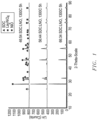
- the X-ray diffraction (XRD) patterns for Sample 3 are provided in the graph of FIG. 1 .
- the amount of La incorporated in the ceria lattice could be estimated, by measuring lattice parameters from XRD patterns, as Sm 0.2 La 0.23 Ce 0.57 O 2- ⁇ . Because of the adsorption of La 2 O 3 in the ceria lattice, LNO is La 2 O 3 depleted, which leads to its decomposition and the formation of NiO.
- Sample 4 included LDC30-LNO compositions at 77:23 vol% LDC30:LNO, 66:34 vol% LDC30:LNO, and 100:0 vol% LDC30:LNO, each after annealing at 1300°C for 5 hrs.
- the initial composition for Sample 4 included LDC30 as La 0.30 Ce 0.70 O 2 and LNO as La 2 NiO 4 .
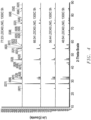
- the XRD patterns for Sample 4 are provided in the graph of FIG. 2 , and shows that the peaks (more specifically (111) and (200)) of the lightly-doped ceria, which had been introduced as single-phase ceria, were split. This was not desirable as it indicated significant diffusion of La 2 O 3 from the LNO phase into the LDC lattice, meaning that the LNO phase is decomposed.
- Sample 5 included LDC40-LNO compositions at 77:23 vol% LDC40:LNO, 66:34 vol% LDC40:LNO, and 100:0 vol% LDC40:LNO, each after annealing at 1300°C for 5 hrs.
- the initial composition for Sample 5 included LDC40 as La 0.40 Ce 0.60 O 2 and LNO as La 2 NiO 4 .
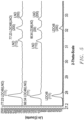
- the XRD patterns for Sample 5 are provided in the graph of FIG. 3 , showing there is no split peak.
- Sample 6 is similar to Sample 5 except that it included LDC40-LNO compositions at 77:23 vol% LDC40:LNO, 66:34 vol% LDC40:LNO, 56:44 vol% LDC40:LNO, and 46:54 vol% LDC40:LNO.
- the initial composition for Sample 6 included LDC40 as La 0.40 Ce 0.60 O 2 and LNO as La 2 NiO 4 .
- the XRD patterns for Sample 6 are provided in the graph of FIG. 4 , and are measured at a scale sufficient to show there was no extra peak indicating any decomposition of LNO or formation of NiO.
- Sample 7 included LDC48-LNO compositions at 77:23 vol% LDC48:LNO, 66:34 vol% LDC48:LNO, and 100:0 vol% LDC48:LNO, each after annealing at 1300°C for 5 hrs.
- the initial composition of Sample 7 includes LDC48 as La 0.48 Ce 0.52 O 2 and LNO as La 2 NiO 4 .
- the XRD patterns are provided in the graph of FIG. 5 .
- Samples 8, 9 and 10 below showed the stability of NNO and LSNO phases in the presence of a heavily-doped ceria phase.
- Sample 8 included NDC43-NNO compositions at 60:40 vol% NDC43:NNO and 80:20 vol% NDC43:NNO, each after annealing at 1300°C for 5 hrs.
- the initial composition of Sample 8 included NDC43 as Nd 0.43 Ce 0.57 O 2 and NNO as Nd 2 NiO 4 .
- the X-ray diffraction results are provided in the graph of FIG. 6 , and show the stability of NNO even in low NNO volume fractions, using a composite having a heavily-doped ceria phase.
- Sample 9 included LDC40-LSNO compositions at 50:50 vol% LDC40:LSNO, 60:40 vol% LDC40:LSNO, 70:30 vol% LDC40:LSNO, and 80:20 vol% LDC40:LSNO, each after annealing at 1300°C for 5 hrs.
- the initial composition of Sample 9 included LDC40 as La 0.40 Ce 0.60 O 2 and LSNO as La 1.8 Sr 0.2 NiO 4 .
- the X-ray diffraction patterns are provided in the graph of FIG. 7 , and show the stability of LSNO, even in low LSNO volume fractions, using a composite having a heavily-doped ceria phase.
- Sample 10 included LDC48-NNO compositions at 50:50 vol% LDC48:NNO, 60:40 vol% LDC48:NNO, and 80:20 vol% LDC48:NNO, each after annealing at 1300°C for 5 hrs.
- the initial composition for Sample 10 included LDC48 as La 0.48 Ce 0.52 O 2 and NNO as Nd 2 NiO 4 .
- the X-ray diffraction patterns are provided in the graph of FIG. 8 , and show the stability of NNO, even in low NNO volume fractions, using a composite having a heavily-doped ceria phase with a different rare earth dopant.
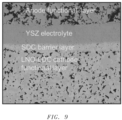
- a solid oxide fuel cell was prepared using a Ni-YSZ anode, YSZ electrolyte, SDC barrier layer, and LNO-LDC40 cathode functional layer.
- the thickness of the LNO-LDC40 cathode functional layer was about 20 to 30 ⁇ m.
- the porosity of the cathode functional layer was about 15%.
- a substantially dense SDC barrier layer was placed between the YSZ electrolyte and the functional layer to avoid the formation of any insulating phase between the electrolyte and the cathode functional layer.
- the thickness of the SDC barrier layer was about 3 ⁇ m and its porosity was about 3%.
Landscapes
- Chemical & Material Sciences (AREA)
- Engineering & Computer Science (AREA)
- Ceramic Engineering (AREA)
- Manufacturing & Machinery (AREA)
- Chemical Kinetics & Catalysis (AREA)
- Materials Engineering (AREA)
- Electrochemistry (AREA)
- General Chemical & Material Sciences (AREA)
- Organic Chemistry (AREA)
- Structural Engineering (AREA)
- Inorganic Chemistry (AREA)
- Composite Materials (AREA)
- Physics & Mathematics (AREA)
- Thermal Sciences (AREA)
- Sustainable Energy (AREA)
- Sustainable Development (AREA)
- Life Sciences & Earth Sciences (AREA)
- Metallurgy (AREA)
- Inert Electrodes (AREA)
- Catalysts (AREA)
- Fuel Cell (AREA)
- Measuring Oxygen Concentration In Cells (AREA)
- Inorganic Compounds Of Heavy Metals (AREA)
- Electrodes For Compound Or Non-Metal Manufacture (AREA)
Description
- The present disclosure relates to electrodes and devices comprising the electrodes.
- In the context of solid oxide fuel and electrolyzer cells, operating temperatures greater than 700°C are desirable for the more facile kinetics of the gas reactants and lower resistance of the ionic membrane. High operating temperatures also allow internal reformation of hydrocarbon fuels, which can reduce the system size significantly compared to systems with external reforming. However, the high operating temperatures can reduce electrode performance. D. PEREZ-COLL ET AL: "Optimization of the interface polarization of the La2NiO4-based cathode working with the Ce1-xSmxO2-[delta] electrolyte system", Journal of Power Sources, vol. 178, no 1., pages 151-162 relates to a composite cathode including Ln2NiO4 and Sm doped ceria, Ce1-xSmxO2-δ. KEQIN HUANG ET AL: "Increasing Power Density of LSGM-Based Solid Oxide Fuel Cells Using New Anode Materials", JOURNAL OF THE ELECTROCHEMICAL SOCIETY, vol. 148, no. 7, page A788 addresses issues of the reaction between electrolyte of a doped lanthanum gallium oxide (LSGM) and composite anode formed of CeO2 and NiO.
- A need exists for an improved electrode material.
- Embodiments are illustrated by way of example and are not limited in the accompanying figures.
-
FIGs. 1 to 8 include graphs of XRD patterns for various Samples described in the Examples. -
FIG. 9 includes a photograph of an SOFC button cell described in the Examples. -
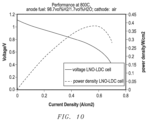
FIG. 10 includes a graph of performance characteristics of the SOFC button cell ofFIG. 9 . - Skilled artisans appreciate that elements in the figures are illustrated for simplicity and clarity and have not necessarily been drawn to scale. For example, the dimensions of some of the elements in the figures may be exaggerated relative to other elements to help to improve understanding of embodiments of the invention.
- The following description in combination with the figures is provided to assist in understanding the teachings disclosed herein. The following discussion will focus on specific implementations and embodiments of the teachings. This focus is provided to assist in describing the teachings and should not be interpreted as a limitation on the scope or applicability of the teachings. However, other embodiments can be used based on the teachings as disclosed in this application.
- The terms "comprises," "comprising," "includes," "including," "has," "having" or any other variation thereof, are intended to cover a non-exclusive inclusion. For example, a method, article, or apparatus that comprises a list of features is not necessarily limited only to those features but may include other features not expressly listed or inherent to such method, article, or apparatus. Further, unless expressly stated to the contrary, "or" refers to an inclusive-or and not to an exclusive-or. For example, a condition A or B is satisfied by any one of the following: A is true (or present) and B is false (or not present), A is false (or not present) and B is true (or present), and both A and B are true (or present).
- Also, the use of "a" or "an" is employed to describe elements and components described herein. This is done merely for convenience and to give a general sense of the scope of the invention. This description should be read to include one, at least one, or the singular as also including the plural, or vice versa, unless it is clear that it is meant otherwise. For example, when a single item is described herein, more than one item may be used in place of a single item. Similarly, where more than one item is described herein, a single item may be substituted for that more than one item.
- Unless otherwise stated, the term "vol%," when used herein to describe the composition of a layer, refers to a percentage of the total volume of the solids, e.g., excluding porosity, of the layer. Further, unless otherwise stated, the term "mol%," when used herein to describe a dopant concentration, refers to a percentage of the total amount, in moles, of cations in a given compound. Furthermore, the oxygen stoichiometry in any of the formulas provided below may vary slightly and, thus, is considered to include a delta (excess or deficiency), referred to as "d", of +/- 0.5. In particular, a doped ceria (CeABO(2-d)) can have oxygen understoichiometry (oxygen deficiency) where d is a deficiency of at most 0.29, at most 0.27, or at most 0.25; and an Ln2MO4+d can have oxygen overstoichiometry (oxygen excess) where d is an excess of at most 0.34, at most 0.32, or at most 0.3. For example, La0.40Ce0.60O2 would include, e.g., La0.40Ce0.60O2-d, where d is at at most 0.25, and La2NiO4+d would include, e.g., La2NiO4+d, where d is at most 0.3.
- Unless otherwise defined, all technical and scientific terms used herein have the same meaning as commonly understood by one of ordinary skill in the art to which this invention belongs. The materials, methods, and examples are illustrative only and not intended to be limiting. To the extent not described herein, many details regarding specific materials and processing acts are conventional and may be found in textbooks and other sources within the electrochemical arts.
- An electrode can include a composite functional layer including a heavily-doped ceria that is suitable for operating temperatures of greater than 700°C. As used herein, the term "heavily-doped" refers to a dopant concentration of at least 40 mol%. In an embodiment, the electrode can include a first phase comprising the heavily-doped ceria and a second phase including an Ln2MO4 phase, where Ln is at least one lanthanide optionally doped with a metal and M is at least one 3d transition metal, without the reactivity problems encountered with existing composite electrode materials. The concepts are better understood in view of the embodiments described below that illustrate and do not limit the scope of the present invention
- High temperature electrochemical cells can include a number of requirements for high performance. Ideally, the materials should withstand processing temperatures of at least 1000°C without decomposing or forming resistive phases and maintain a stable composition and crystal structure at operating conditions. In addition, the functional layers should retain porosity and facile electron transfer reaction kinetics.
- Ln2MO4 materials can generally provide high electrode performance, where Ln is any of the lanthanide elements and M is a 3d transition metal. In particular, the Ln2MO4 family of materials can offer a wider operating temperature range (e.g., 700°C to 900°C) as compared to other materials only suitable for either higher or lower temperatures. The Ln2MO4 family of materials provides the additional advantage of mixed ionic electronic conductivity.
- However, the Ln2MO4 family of materials can be reactive with common high temperature electrolytes. Moreover, Ln2MO4 materials have a high coefficient of thermal expansion (referred to herein as "CTE"), reducing mechanical stability in a multilayer architecture.
- A rare earth-doped ceria can form a composite with the Ln2MO4 materials to form a composite electrode with a reduced CTE. However, a lightly-doped ceria can react with Ln2MO4 when in intimate contact at elevated temperatures. As used herein, the term "lightly-doped" refers to a dopant concentration of less than 40 mol%.
- Applicants have discovered that an Ln2MO4:ceria composite including a heavily-doped ceria, especially near the solubility limit of ceria, surprisingly does not exhibit the same reactivity as the lightly-doped ceria. The solubility limit is the amount of rare earth oxide that can be incorporated into the ceria lattice while maintaining its fluorite structure. Further, diffusional transport of the lanthanide element from the Ln2MO4 into the ceria is suppressed since the dopant concentration is close to the solubility limit of Ln in ceria.
- As discussed above, the Ln of the Ln2MO4 phase includes at least one lanthanide. In an embodiment, the Ln of the Ln2MO4 phase includes at least one lanthanide selected from the group consisting of La, Sm, Er, Pr, Nd, Gd, Dy, or any combination thereof. Further, the at least one lanthanide or combination thereof can be doped with a metal. The metal dopant can include an alkaline earth metal. In a particular embodiment, the alkaline earth metal can include at least one alkaline earth selected from the group consisting of Sr, Ca, Ba, or any combination thereof to increase hole conductivity.
- Further, as discussed above, the M of the Ln2MO4 phase includes a 3d transition metal. In an embodiment, the M of the Ln2MO4 phase includes at least one 3d transition metal selected from the group consisting of Ni, Cu, Co, Fe, Mn or any combination thereof.
- The heavily-doped ceria phase includes a ceria and at least one dopant such that the total dopant concentration is at least 40 mol% and no greater than the solubility limit of ceria. The heavily-doped ceria has the general formula:
Ce(1-x)AxO2, where A is at least one rare earth dopant, x is greater than 0.4 and no greater than the solubility limit of ceria. - In an embodiment, the rare earth dopant A includes at least one dopant selected from the group consisting of La, Gd, Nd, Sm, Dy, Er, Y, Yb, Ho, or any combination thereof. In a more particular embodiment, the rare earth dopant A includes at least one of La, Gd, Nd, or Sm. It would be expected that the use of heavily-doped ceria for cathode functional layers would lead to lower ionic conductivity. In addition, current literature indicates that electrode performance decreases as x increases up to 0.4. See, for example, Figure 11 of Perez-Coll, et al., "Optimization of the interface polarization of the La2NiO4-based cathode working with the Ce1-x Sm x O2-δ electrolyte system." However, Applicant has discovered that, contrary to Perez-Coll et al., as x increases to 40 mol% or greater, even up to the solubility limit of ceria, the more thermodynamically stable the phase is and the diffusion of the lanthanide element from Ln2MO4 is reduced. That being said, the benefits of increasing the dopant concentration begin to deteriorate beyond the solubility limit of ceria.
- As mentioned previously, a lightly-doped ceria phase can be reactive with an Ln2MO4 phase. Such a reaction can cause diffusion of the Ln into the lightly-doped ceria, leading to a reduction or even a complete removal of the Ln from the Ln2MO4 phase. In addition, such a reaction can lead to the presence of a metal oxide (MO) and/or a free rare earth oxide (RE2O3), which were not initially present in the electrode, particularly when M is Ni. However, in the composite electrode described herein, the reactivity is reduced or avoided such that, in an embodiment, less than 5 vol% of free RE2O3 rare earth oxide is detectable in the functional layer of the electrode. In an embodiment, less than 5 vol% of MO metal oxide is detectable in the functional layer of the electrode. The detection method is x-ray diffraction having a detection limit of 5 vol%.
- In an embodiment, the ceria phase can be present in the functional layer of the electrode in an amount of at least 40 vol%, or at least 45 vol%, or at least 50 vol%, or at least 55 vol%, or at least 60 vol%, or at least 65 vol%, or at least 70 vol%, or at least 75 vol%, based on a total volume of the functional layer minus the volume occupied by porosity. For a lightly-doped ceria phase, increasing the volume percent of the ceria phase would increase the likelihood of rare earth diffusion. Thus, higher performance for composite electrodes including a lightly-doped ceria phase would be exhibited at lower concentrations of the ceria phase. On the other hand, as the heavily-doped ceria is near the solubility limit of ceria, the thermodynamic stability is increased and, thus, the volume percent of the ceria phase can be increased without increasing the likelihood of rare earth diffusion.
- In an embodiment, the functional layer of the electrode has a porosity of at least 10 vol%, or at least 15 vol%, or at least 18 vol%, based on a total volume of the functional layer. Further, in an embodiment, the functional layer of the electrode has a porosity of at most 60 vol%, or at most 50 vol%, or at most 40 vol%, or at most 35 vol%, based on a total volume of the functional layer. The porosity is determined by image analysis of the cross section of the layer using an image analysis tool such as ImageJ to view and measure the porosity by contrast.
- In an embodiment, the functional layer of the electrode has the functional layer has a thickness of at least 5 micron, or at least 10 microns, or at least 12 microns, or at least 15 microns, or at least 20 microns. Further, in an embodiment, the functional layer of the electrode has a thickness of at most 100 microns, at most 90 microns, at most 80 microns, or at most 70 microns.
- The electrode described herein is made by providing starter materials, mixing the starter materials, and sintering the mixture. The starter materials include an Ln2MO4 material, where Ln is at least one lanthanide optionally doped with a metal and M is at least one 3d transition metal, and a ceria material comprising doped ceria having the general formula Ce(1-x-y)AxByO2, where A is at least one rare earth dopant, B is at least one alkaline earth dopant, x is at least 0.2, y is in a range of 0 to 0.2, and x+y is at least 0.4 and no greater than the solubility limit of ceria.
- In an embodiment, a binder system can be added to the Ln2MO4 material and the ceria material to form a slurry. In an embodiment, the binder system can include at least one polymer. The slurry can be deposited by a ceramic forming technique such as spraying, tape casting or screen printing and then sintered to form an electrode having an Ln2MO4 phase and a ceria phase. The sintering temperature can be greater than the operating temperature. For example, the sintering temperature can be at least 1000°C, or at least 1 100°C, or at least 1200°C, or at least 1300°C. In an embodiment, the sintering temperature can be no greater than 1800°C, or no greater than 1700°C, or no greater than 1600°C.
- The electrode described herein can be utilized as a component in a variety of devices including electrochemical devices, sensor devices, and the like.
- In an embodiment, the electrochemical device including the electrode described herein comprises an electrolyte layer, an optional barrier layer, and an anode layer. The electrolyte layer can comprise at least one electrolyte material selected from the group consisting of ceria, zirconia, lanthanum gallate, or a combination thereof.
- In a particular embodiment, the electrolyte material includes a stabilized zirconia.
- In a particular embodiment, the electrolyte layer includes a doped ceria having the general formula:
Ce(1-x-y)AxByO2, where A is at least one rare earth dopant, B is at least one alkaline earth dopant, x is at least 0.05, y is in a range of 0 to 0.1, and x+y is greater than 0.05 and less than 0.25. In a particular embodiment, A is La, Gd, Nd, Sm, Dy, Er, Y, Yb, Ho, or any combination thereof. In a particular embodiment, B is Sr, Ca, Ba, or any combination thereof. - The electrolyte layer can have a thickness of at most 800 microns, or at most 600 microns, or at most 400 microns, or at most 200 microns, or at most 50 microns. Further, the electrolyte layer can have a thickness of at least 1 micron, at least 3 microns, or at least 5 microns.
- The electrolyte layer can have a porosity of at most 10 vol%, or at most 8 vol%, or at most 6 vol%, or at most 4 vol%, based on a total volume of the electrolyte layer. Further, while the electrolyte may be completely dense, it is possible that some porosity can exist, such as at least 0.01 vol%, or at least 0.05 vol%, or at least 0.1 vol%.
- In an embodiment, the electrochemical device includes a barrier layer disposed between the electrode and the electrolyte layer. In a particular embodiment, the barrier layer includes doped ceria having the general formula:
Ce(1-x-y)AxByO2, where A is at least one rare earth dopant, B is at least one alkaline earth dopant, x is at least 0.05, y is in a range of 0 to 0.2, and x+y is greater than 0.05 and no greater than the solubility limit of ceria. In a particular embodiment, A is La, Gd, Nd, Sm, Dy, Er, Y, Yb, Ho, Pr, or any combination thereof. In a particular embodiment, B is Sr, Ca, Ba, or any combination thereof. - In an embodiment, the barrier layer has a porosity of at most 15 vol%, or at most 12 vol%, or at most 10 vol%, based on a total volume of the barrier layer. In an embodiment, the barrier layer has a porosity of at least 0.5 vol%, or at least 1 vol%, or at least 2 vol%, or at least 3 vol%, based on a total volume of the barrier layer.
- In an embodiment, the barrier layer has a thickness less than the electrolyte layer and the functional layer.
- In a particular embodiment, the electrochemical device includes a solid oxide fuel cell (also referred to as "SOFC"), a solid oxide electrolyzer cell (also referred to as "SOEC"), or a reversible SOFC-SOEC. In a particular embodiment, electrode can be an oxygen electrode.
- Moreover, the device can be a sensor device comprising the electrode described herein. In a particular embodiment, the sensor device is an amperometric sensor. In another embodiment, the sensor device is a potentiometric sensor.
- Many different aspects and embodiments are possible. Some of those aspects and embodiments are described below. After reading this specification, skilled artisans will appreciate that those aspects and embodiments are only illustrative. Embodiments may be in accordance with any one or more of the items as embodiments below.
-
Embodiment 1. An electrode as defined inclaim 1. -
Embodiment 2. An electrode as defined inclaim 2. - Embodiment 3. A method as defined in claim 3.
- Embodiment 4. The method of embodiment 3, wherein the sintering temperature is at least 1100°C, or at least 1200°C, or at least 1300°C.
- Embodiment 5. The electrode or method of any one of the preceding embodiments, wherein the lanthanide of the Ln2MO4 phase includes at least one of La, Sm, Er, Pr, Nd, Gd, Dy or any combination thereof.
- Embodiment 6. The electrode or method of any one of the preceding embodiments, wherein the lanthanide of the Ln2MO4 phase is doped with an alkaline earth metal.
- Embodiment 7. The electrode or method of any one of the preceding embodiments, wherein the lanthanide of the Ln2MO4 phase is doped with an alkaline earth metal including at least one of Sr, Ca, Ba, or any combination thereof.
- Embodiment 8. The electrode or method of any one of the preceding embodiments, wherein the 3d transition metal of the Ln2MO4 phase includes at least one of Ni, Cu, Co, Fe, Mn or any combination thereof.
- Embodiment 9. The electrode or method of any one of the preceding embodiments, wherein A is La, Gd, Nd, Sm, Dy, Er, Y, Yb, Ho, or any combination thereof.
-
Embodiment 10. The electrode or method of any one of the preceding embodiments, wherein x is at least 0.41, or at least 0.42, or at least 0.43, or at least 0.44, or at least 0.45, or at least 0.46, or at least 0.47. - Embodiment 11. The electrode or method of any one of the preceding embodiments, wherein x is at most 0.5.
- Embodiment 12. The electrode or method of any one of the preceding embodiments, wherein less than 5 vol% free rare earth oxide is detectable in the functional layer.
- Embodiment 13. The electrode or method of any one of the preceding embodiments, wherein less than 5 vol% of 3d transition metal oxide is detectable in the functional layer.
- Embodiment 14. The electrode or method of any one of the preceding embodiments, wherein the ceria phase is present in the functional layer in an amount of at least 45 vol%, or at least 50 vol%, or at least 55 vol%, or at least 60 vol%, or at least 65 vol%, or at least 70 vol%, or at least 75 vol%, based on a total volume of the functional layer minus porosity.
- Embodiment 15. The electrode or method of any one of the preceding embodiments, wherein the functional layer has a porosity of at least 10 vol%, or at least 15 vol%, or at least 18 vol%, based on a total volume of the functional layer.
- Embodiment 16. The electrode or method of any one of the preceding embodiments, wherein the functional layer has a porosity of at most 60 vol%, or at most 50 vol%, or at most 40 vol%, or at most 35 vol%, based on a total volume of the functional layer.
- Embodiment 17. The electrode or method of any one of the preceding embodiments, wherein the functional layer has a thickness of at least 5 micron, or at least 10 microns, or at least 12 microns, or at least 15 microns, or at least 20 microns.
- Embodiment 18. The electrode or method of any one of the preceding embodiments, wherein the functional layer has a thickness of at most 100 microns, at most 90 microns, at most 80 microns, or at most 70 microns.
-
Embodiment 19. The electrode or method of any one of the preceding embodiments, wherein the functional layer includes the Ln2MO4 phase in an initial composition. -
Embodiment 20. An electrochemical device comprising the electrode of any one of the preceding embodiments. -
Embodiment 21. The electrochemical device ofembodiment 20, wherein the electrochemical device is an SOFC, an SOEC, or a reversible SOFC-SOEC. -
Embodiment 22. The electrochemical device of any one ofembodiments -
Embodiment 23. The electrochemical device ofembodiment 22, wherein the electrolyte layer has a thickness of at most 800 microns, or at most 600 microns, or at most 400 microns, or at most 200 microns, or at most 50 microns. -
Embodiment 24. The electrochemical device of any one ofembodiments -
Embodiment 25. The electrochemical device of any one ofembodiments 22 to 24, wherein the electrolyte layer comprises at least one of ceria, zirconia, lanthanum gallate or a combination thereof. -
Embodiment 26. The electrochemical device ofembodiment 25, wherein the electrolyte layer includes a doped ceria having the general formula Ce(1-x-y)AxByO2, where A is at least one rare earth dopant, B is at least one alkaline earth dopant, x is at least 0.05, y is in a range of 0 to 0.1, and x+y is greater than 0 and less than 0.25. -
Embodiment 27. The electrochemical device ofembodiment 25, wherein the electrolyte layer includes a stabilized zirconia. -
Embodiment 28. The electrochemical device ofembodiment 27, further comprising a barrier layer disposed between the functional layer and the electrolyte layer. -
Embodiment 29. The electrochemical device ofembodiment 28, wherein the barrier layer includes doped ceria having the general formula Ce(1-x-y)AxByO2, where A is at least one rare earth dopant, B is at least one alkaline earth dopant, x is at least 0.05, y is in a range of 0 to 0.2, and x+y is greater than 0.05 and no greater than the solubility limit of ceria. -
Embodiment 30. The electrochemical device ofembodiment 29, wherein A is La, Gd, Nd, Sm, Dy, Er, Y, Yb, Ho, Pr, or any combination thereof. -
Embodiment 31. The electrochemical device of any one ofembodiments 28 to 30, wherein the barrier layer has a porosity of at most 15 vol%, or at most 12 vol%, or at most 10 vol%. -
Embodiment 32. The electrochemical device of any one ofembodiments 28 to 31, wherein the barrier layer has a thickness less than the electrolyte layer and the functional layer. -
Embodiment 33. The electrochemical device of any one ofembodiments 21 to 32, wherein the electrochemical device is a solid oxide fuel cell and the electrode is an oxygen electrode. -
Embodiment 34. The electrochemical device ofembodiment 33, wherein the fuel electrode comprises a Ni-YSZ anode electrode. -
Embodiment 35. The electrochemical device of any one ofembodiments 21 to 32, wherein the electrochemical device is a solid oxide electrolyzer cell and the electrode is an anode electrode. -
Embodiment 36. A sensor device comprising the electrode of any one ofembodiments 1 to 19. -
Embodiment 37. The sensor device ofembodiment 36, wherein the sensor device is an amperometric sensor. - Embodiment 38. The sensor device of
embodiment 36, wherein the sensor device is a potentiometric sensor. - The CTE of various samples were measured.
- For
Sample 1, SDC:LNO mixtures were mixed poly(ethylene glycol) 400 and poly(vinyl alcohol) 205 as a binder system to form a slurry. Each sample was prepared with 0.6 g of the slurry pressed at room temperature in a 6 mm diameter cylinder. After sintering, they were heated up to 1200°C and back down to room temperature at 2°C/min to measure the CTE. The CTE reported in Table 1 is the value over the cooling down cycle in the range of 1200°C to 100°C. The CTE of LNO-SDC mixtures described in Table 1 is low enough to be used for SOFC cathodes with YSZ as the electrolyte. ForSample 1, the initial composition included SDC as Sm0.2Ce0.8O2 and LNO as La2NiO4.Table 1 LNO LNO-SDC 64:36 vol% LNO-SDC 54:46 vol% LNO-SDC 44:56 vol% LNO-SDC 34:66 vol% SDC CTE (ppm/K) 14.1 ± 0.1 13.4± 0.2 13.4± 0.1 12.6 ± 0.2 12.1 ± 0.1 12.6 ± 0.1 -
Sample 2 was prepared identically toSample 1 except SDC was replaced with LDC40, where the initial composition included LDC40 as La0.40Ce0.60O2 and LNO as La2NiO4. The results forSample 2 are provided in Table 2.Table 2 LNO LNO-LDC40 54:46 vol% LNO-LDC40 44:56 vol% LNO-LDC40 34:66 vol% LNO-LDC40 23:77 vol% LDC40 CTE (ppm/K) 14.1 ± 0.1 12.7± 0.2 12.3± 0.1 12.1 ± 0.1 12.1 ± 0.1 11.3 - Advantageously, the use of heavily-doped ceria lowers the CTE of the LNO phase, similar to
Sample 1. However, unlikeSample 1, the CTE values for heavily-doped ceria inSample 2 follow here the rule of mixture, which further indicates that the phases forSample 2 are thermodynamically stable. - Sample 3 included SDC-LNO compositions at 46:54 vol% SDC:LNO, 56:44 vol% SDC:LNO, and 66:34 vol% SDC:LNO, each after annealing at 1300°C for 5 hrs. The initial composition for Sample 3 included a lightly-doped SDC phase (Sm0.2Ce0.8O2), and an LNO phase (La2NiO4). The X-ray diffraction (XRD) patterns for Sample 3 are provided in the graph of
FIG. 1 . In the case of the 66:34 vol% SDC:LNO mixture, the amount of La incorporated in the ceria lattice could be estimated, by measuring lattice parameters from XRD patterns, as Sm0.2La0.23Ce0.57O2-δ. Because of the adsorption of La2O3 in the ceria lattice, LNO is La2O3 depleted, which leads to its decomposition and the formation of NiO. - Sample 4 included LDC30-LNO compositions at 77:23 vol% LDC30:LNO, 66:34 vol% LDC30:LNO, and 100:0 vol% LDC30:LNO, each after annealing at 1300°C for 5 hrs. The initial composition for Sample 4 included LDC30 as La0.30Ce0.70O2 and LNO as La2NiO4. The XRD patterns for Sample 4 are provided in the graph of
FIG. 2 , and shows that the peaks (more specifically (111) and (200)) of the lightly-doped ceria, which had been introduced as single-phase ceria, were split. This was not desirable as it indicated significant diffusion of La2O3 from the LNO phase into the LDC lattice, meaning that the LNO phase is decomposed. - However, when LDC (lanthanum-doped ceria) was introduced with a concentration of dopant at or above 40 vol%, and below the solubility limit of ceria, around 50 mol%, the peaks of doped ceria are not split, as it can be seen below in the case of 40 mol% (Sample 5 and 6 below), and 48 mol% (Sample 7 below). The closer the dopant concentration was to the solubility limit, the results were more desirable, as the XRD patterns indicated the composite was more thermodynamically stable.
- Sample 5 included LDC40-LNO compositions at 77:23 vol% LDC40:LNO, 66:34 vol% LDC40:LNO, and 100:0 vol% LDC40:LNO, each after annealing at 1300°C for 5 hrs. The initial composition for Sample 5 included LDC40 as La0.40Ce0.60O2 and LNO as La2NiO4. The XRD patterns for Sample 5 are provided in the graph of
FIG. 3 , showing there is no split peak. - Sample 6 is similar to Sample 5 except that it included LDC40-LNO compositions at 77:23 vol% LDC40:LNO, 66:34 vol% LDC40:LNO, 56:44 vol% LDC40:LNO, and 46:54 vol% LDC40:LNO. Like Sample 5, the initial composition for Sample 6 included LDC40 as La0.40Ce0.60O2 and LNO as La2NiO4. The XRD patterns for Sample 6 are provided in the graph of
FIG. 4 , and are measured at a scale sufficient to show there was no extra peak indicating any decomposition of LNO or formation of NiO. - Sample 7 included LDC48-LNO compositions at 77:23 vol% LDC48:LNO, 66:34 vol% LDC48:LNO, and 100:0 vol% LDC48:LNO, each after annealing at 1300°C for 5 hrs. The initial composition of Sample 7 includes LDC48 as La0.48Ce0.52O2 and LNO as La2NiO4. The XRD patterns are provided in the graph of
FIG. 5 . -
Samples 8, 9 and 10 below showed the stability of NNO and LSNO phases in the presence of a heavily-doped ceria phase. - Sample 8 included NDC43-NNO compositions at 60:40 vol% NDC43:NNO and 80:20 vol% NDC43:NNO, each after annealing at 1300°C for 5 hrs. The initial composition of Sample 8 included NDC43 as Nd0.43Ce0.57O2 and NNO as Nd2NiO4. The X-ray diffraction results are provided in the graph of
FIG. 6 , and show the stability of NNO even in low NNO volume fractions, using a composite having a heavily-doped ceria phase. - Sample 9 included LDC40-LSNO compositions at 50:50 vol% LDC40:LSNO, 60:40 vol% LDC40:LSNO, 70:30 vol% LDC40:LSNO, and 80:20 vol% LDC40:LSNO, each after annealing at 1300°C for 5 hrs. The initial composition of Sample 9 included LDC40 as La0.40Ce0.60O2 and LSNO as La1.8Sr0.2NiO4. The X-ray diffraction patterns are provided in the graph of
FIG. 7 , and show the stability of LSNO, even in low LSNO volume fractions, using a composite having a heavily-doped ceria phase. -
Sample 10 included LDC48-NNO compositions at 50:50 vol% LDC48:NNO, 60:40 vol% LDC48:NNO, and 80:20 vol% LDC48:NNO, each after annealing at 1300°C for 5 hrs. The initial composition forSample 10 included LDC48 as La0.48Ce0.52O2 and NNO as Nd2NiO4. The X-ray diffraction patterns are provided in the graph ofFIG. 8 , and show the stability of NNO, even in low NNO volume fractions, using a composite having a heavily-doped ceria phase with a different rare earth dopant. - For each of Samples 3 to 10, the densities listed in Table 3 were calculated based on XRD patterns of the single phase materials, and used in the calculations for the vol% of the different mixtures.
Table 3 Crystal structure Material Molar weight (g/mol) Density (g/ml) orthorhombic Nd2NiO4 411.75 7.4 tetragonal La2NiO4 400.5 7.11 FCC Nd0.43Ce0.55O2 173.89 6.82 FCC La0.30Ce0.70O2 171.76 6.74 FCC La0.40Ce0.60O2 171.63 6.59 FCC La0.48Ce0.52O2 171.54 6.48 tetragonal La1.8Sr0.2NiO4 390.25 6.92 - A solid oxide fuel cell was prepared using a Ni-YSZ anode, YSZ electrolyte, SDC barrier layer, and LNO-LDC40 cathode functional layer. The thickness of the LNO-LDC40 cathode functional layer was about 20 to 30µm. The porosity of the cathode functional layer was about 15%. In addition, a substantially dense SDC barrier layer was placed between the YSZ electrolyte and the functional layer to avoid the formation of any insulating phase between the electrolyte and the cathode functional layer. The thickness of the SDC barrier layer was about 3µm and its porosity was about 3%. An SEM image of the multilayer fuel cell is provided in
FIG. 8 and the performance characteristics of the SOFC button cell demonstrating high performance are provided in the graph ofFIG. 9 .
Claims (15)
- An electrode comprising:a functional layer comprising an Ln2MO4 phase, where Ln is at least one lanthanide optionally doped with a metal and M is at least one 3d transition metal;the functional layer further comprising a ceria phase comprising doped ceria having the general formula Ce(1-x)AxO2, where A is at least one rare earth dopant, x is greater than 0.4 and no greater than the solubility limit of ceria.
- An electrode comprising:a functional layer comprising an Ln2MO4 phase, where Ln is at least one lanthanide optionally doped with a metal and M is at least one 3d transition metal;the functional layer further comprising a ceria phase comprising doped ceria having the general formula Ce(1-x)AxO2, where A is at least one rare earth dopant, x is at least 0.4 and no greater than the solubility limit of ceria,wherein the ceria phase is present in the functional layer in an amount of at least 40 vol% based on a total volume of the functional layer absent any porosity.
- A method of forming an electrode, comprising:providing an Ln2MO4 material, where Ln is at least one lanthanide optionally doped with a metal and M is at least one 3d transition metal;providing a ceria material comprising doped ceria having the general formula Ce(1-x-y)AxO2, where A is at least one rare earth dopant, x is greater than0.4 and no greater than the solubility limit of ceria;mixing the Ln2MO4 material and the ceria material to form a mixture; andsintering the mixture at a temperature that is at least 1000 °C to form a functional layer of the oxygen electrode having an Ln2MO4 phase and a ceria phase.
- The electrode or method of any one of the preceding claims, wherein the lanthanide of the Ln2MO4 phase is doped with an alkaline earth metal.
- The electrode or method of any one of the preceding claims, wherein the 3d transition metal of the Ln2MO4 phase includes at least one of Ni, Cu, Co, Fe, Mn or any combination thereof.
- The electrode or method of any one of the preceding claims, wherein x is at least 0.41, or at least 0.42, or at least 0.43, or at least 0.44, or at least 0.45, or at least 0.46, or at least 0.47.
- The electrode or method of any one of the preceding claims, wherein x is at most 0.5.
- The electrode or method of any one of the preceding claims, wherein less than 5 vol% of 3d transition metal oxide is detectable in the functional layer.
- The electrode or method of any one of the preceding claims, wherein the ceria phase is present in the functional layer in an amount of at least 40 vol%, or at least 45 vol%, or at least 50 vol%, or at least 55 vol%, or at least 60 vol%, or at least 65 vol%, or at least 70 vol%, or at least 75 vol%, based on a total volume of the functional layer minus porosity.
- An electrochemical device comprising the electrode of any one of the preceding claims.
- The electrochemical device of claim 10, wherein the device comprises an electrolyte layer and the electrolyte layer comprises at least one of ceria, zirconia, lanthanum gallate or a combination thereof.
- The electrochemical device of claim 11, wherein the electrolyte layer includes a doped ceria having the general formula Ce(1-x-y)AxByO2, where A is at least one rare earth dopant, B is at least one alkaline earth dopant, x is at least 0.05, y is in a range of 0 to 0.1, and x+y is greater than 0 and less than 0.25.
- The electrochemical device of claim 11, wherein the electrolyte layer comprises a stabilized zirconia and the device further comprises a barrier layer disposed between the functional layer and the electrolyte layer.
- The electrochemical device of claim 13, wherein the barrier layer includes doped ceria having the general formula Ce(1-x-y)AxByO2, where A is at least one rare earth dopant, B is at least one alkaline earth dopant, x is at least 0.05, y is in a range of 0 to 0.2, and x+y is greater than 0.05 and no greater than the solubility limit of ceria.
- A sensor device comprising the electrode of any one of claims 1 to 9.
Applications Claiming Priority (2)
| Application Number | Priority Date | Filing Date | Title |
|---|---|---|---|
| US201662341470P | 2016-05-25 | 2016-05-25 | |
| PCT/US2017/034534 WO2017205660A1 (en) | 2016-05-25 | 2017-05-25 | Electrode comprising heavily-doped ceria |
Publications (3)
| Publication Number | Publication Date |
|---|---|
| EP3465807A1 EP3465807A1 (en) | 2019-04-10 |
| EP3465807A4 EP3465807A4 (en) | 2019-12-04 |
| EP3465807B1 true EP3465807B1 (en) | 2024-12-18 |
Family
ID=60411616
Family Applications (1)
| Application Number | Title | Priority Date | Filing Date |
|---|---|---|---|
| EP17803610.9A Active EP3465807B1 (en) | 2016-05-25 | 2017-05-25 | Electrode comprising heavily-doped ceria |
Country Status (7)
| Country | Link |
|---|---|
| US (1) | US10622628B2 (en) |
| EP (1) | EP3465807B1 (en) |
| JP (1) | JP6740528B2 (en) |
| KR (2) | KR102185472B1 (en) |
| CN (1) | CN109690847B (en) |
| DK (1) | DK3465807T3 (en) |
| WO (1) | WO2017205660A1 (en) |
Families Citing this family (5)
| Publication number | Priority date | Publication date | Assignee | Title |
|---|---|---|---|---|
| EP3686966A1 (en) | 2019-01-23 | 2020-07-29 | Karlsruher Institut für Technologie | An electrochemical energy storage device and a method for producing an anode active material for the electrochemical energy storage device |
| GB201909636D0 (en) * | 2019-07-04 | 2019-08-21 | Scg Chemicals Co Ltd | High emissivity cerium oxide coating |
| CN116888306A (en) * | 2021-03-25 | 2023-10-13 | 旭化成株式会社 | Electrode, preparation method thereof, anode for water electrolysis, electrolysis unit and hydrogen production method |
| CN114045520B (en) * | 2021-12-15 | 2023-05-26 | 中国科学院大连化学物理研究所 | Oxygen electrode for solid oxide electrolysis hydrogen production and preparation method thereof |
| CN118329980B (en) * | 2024-04-23 | 2024-10-15 | 电子科技大学长三角研究院(湖州) | A bimetallic oxide semiconductor gas-sensitive material, preparation method and application thereof |
Family Cites Families (17)
| Publication number | Priority date | Publication date | Assignee | Title |
|---|---|---|---|---|
| US20070009784A1 (en) | 2005-06-29 | 2007-01-11 | Pal Uday B | Materials system for intermediate-temperature SOFC based on doped lanthanum-gallate electrolyte |
| JP2008257943A (en) * | 2007-04-03 | 2008-10-23 | Mie Univ | Electrode for solid oxide fuel cell and solid oxide fuel cell having the electrode |
| EP2254180A1 (en) | 2007-08-31 | 2010-11-24 | Technical University of Denmark | Ceria and strontium titanate based electrodes |
| JP2010232135A (en) | 2009-03-30 | 2010-10-14 | Mitsubishi Materials Corp | Durable fuel electrode and solid oxide fuel cell incorporating this fuel electrode |
| JP5454434B2 (en) * | 2009-09-30 | 2014-03-26 | 大日本印刷株式会社 | Single-chamber solid oxide fuel cell |
| TWI531107B (en) | 2010-08-17 | 2016-04-21 | 博隆能源股份有限公司 | Method for manufacturing solid oxide fuel cell |
| KR20120027990A (en) | 2010-09-14 | 2012-03-22 | 삼성전자주식회사 | Material for solid oxide fuel cell, cathode including the material and solid oxide fuel cell including the material |
| GB201019156D0 (en) * | 2010-11-12 | 2010-12-29 | Ulive Entpr Ltd | Mixed metal oxide |
| EP2506351A3 (en) | 2011-03-31 | 2014-11-12 | Samsung Electro-Mechanics Co., Ltd | Material for solid oxide fuel cell, cathode including the material, and solid oxide fuel cell including the same |
| KR20120123639A (en) | 2011-04-19 | 2012-11-09 | 삼성전자주식회사 | Cathode material for fuel cell, cathode for fuel cell and solid oxide fuel cell including the material |
| US10446855B2 (en) * | 2013-03-15 | 2019-10-15 | Lg Fuel Cell Systems Inc. | Fuel cell system including multilayer interconnect |
| JP6121764B2 (en) * | 2013-03-22 | 2017-04-26 | 日本碍子株式会社 | Air electrode used in solid oxide fuel cell |
| JP6100050B2 (en) * | 2013-03-25 | 2017-03-22 | 日本碍子株式会社 | Air electrode for fuel cell |
| JP2015076129A (en) * | 2013-10-04 | 2015-04-20 | 日産自動車株式会社 | Air electrode material for fuel cell, air electrode for fuel cell and solid oxide fuel cell |
| US20160333476A1 (en) * | 2014-01-14 | 2016-11-17 | Elcogen As | Method for producing SOFC cathode diffusion barrier layer and a SOFC |
| JP2015185321A (en) | 2014-03-24 | 2015-10-22 | アイシン精機株式会社 | Air electrode for solid oxide fuel batteries, and solid oxide fuel battery cell |
| JP6315581B2 (en) * | 2014-08-22 | 2018-04-25 | 国立大学法人 熊本大学 | Cathode for solid oxide fuel cell, method for producing the same, and solid oxide fuel cell including the cathode |
-
2017
- 2017-05-25 DK DK17803610.9T patent/DK3465807T3/en active
- 2017-05-25 CN CN201780042762.XA patent/CN109690847B/en active Active
- 2017-05-25 US US15/605,622 patent/US10622628B2/en active Active
- 2017-05-25 JP JP2018561690A patent/JP6740528B2/en active Active
- 2017-05-25 KR KR1020187036566A patent/KR102185472B1/en active Active
- 2017-05-25 WO PCT/US2017/034534 patent/WO2017205660A1/en not_active Ceased
- 2017-05-25 KR KR1020207033352A patent/KR102248541B1/en active Active
- 2017-05-25 EP EP17803610.9A patent/EP3465807B1/en active Active
Also Published As
| Publication number | Publication date |
|---|---|
| JP6740528B2 (en) | 2020-08-19 |
| CN109690847B (en) | 2021-09-17 |
| US10622628B2 (en) | 2020-04-14 |
| KR20190035617A (en) | 2019-04-03 |
| DK3465807T3 (en) | 2025-01-13 |
| WO2017205660A1 (en) | 2017-11-30 |
| KR102248541B1 (en) | 2021-05-07 |
| CN109690847A (en) | 2019-04-26 |
| US20170346088A1 (en) | 2017-11-30 |
| EP3465807A4 (en) | 2019-12-04 |
| KR20200133819A (en) | 2020-11-30 |
| JP2019523820A (en) | 2019-08-29 |
| EP3465807A1 (en) | 2019-04-10 |
| KR102185472B1 (en) | 2020-12-03 |
Similar Documents
| Publication | Publication Date | Title |
|---|---|---|
| Badwal et al. | Oxygen-ion conducting electrolyte materials for solid oxide fuel cells | |
| US8637209B2 (en) | Cathode and electrolyte materials for solid oxide fuel cells and ion transport membranes | |
| EP1356535B1 (en) | Conductive material comprising at least two phases | |
| US10622628B2 (en) | Electrode comprising heavily-doped ceria | |
| EP2795708B1 (en) | Solid oxide fuel cell interconnects including a ceramic interconnect material and partially stabilized zirconia | |
| EP2377189B1 (en) | Highly sinterable lanthanum strontium titanate interconnects through doping | |
| KR101808387B1 (en) | Ceria electrolyte for low temperature sintering and solid oxide fuel cells using the same | |
| EP2461405A1 (en) | Solid oxide fuel cell | |
| US20120308915A1 (en) | Cathode material for fuel cell, cathode including the cathode material, solid oxide fuel cell including the cathode | |
| JP2020129433A (en) | Solid electrolytic member, solid oxide type fuel battery, water electrolyzer, hydrogen pump and manufacturing method of solid electrolytic member | |
| KR20120112245A (en) | Material for solid oxide fuel cell, cathode including the material and solid oxide fuel cell including the material | |
| He et al. | Positive effect of incorporating Er0. 4Bi1. 6O3 on the performance and stability of La2NiO4+ δ cathode | |
| KR20120140476A (en) | Material for solid oxide fuel cell, cathode including the material and solid oxide fuel cell including the material | |
| JP6100050B2 (en) | Air electrode for fuel cell | |
| KR101791442B1 (en) | Composite material for fuel cell, method for producing composite material for fuel cell, and fuel cell | |
| KR102052248B1 (en) | Low temperature sintered electrolyte composite for solid oxide fuel cell, and solid oxide fuel cell using the same | |
| US9368804B2 (en) | Scheelite-structured composite metal oxide with oxygen ionic conductivity | |
| US9236615B2 (en) | Methods for using novel cathode and electrolyte materials for solid oxide fuel cells and ion transport membranes | |
| KR20120085488A (en) | Solid electrolyte for solid oxide fuel cell, and solid oxide fuel cell including the solid electrolyte | |
| US20160293975A1 (en) | Separator for solid electrolyte fuel cell, and solid electrolyte fuel cell | |
| KR20170076143A (en) | Cell for solid oxid fuel cell comprising reaction preventing layer and method for manufacturing the same | |
| KR102026502B1 (en) | Solid oxide fuel cell, battery module comprising the same and method for manufacturing solid oxide fuel cell | |
| US20220363559A1 (en) | Enhanced proton conduction and steam tolerance of a donor doped electrolyte for solid oxide electrolysis cells | |
| Li et al. | Trace low-concentration calcium doping enhancement in ionic conductivity and electrochemical performance improvement of CeO 2-based electrolyte for solid oxide fuel cells (SOFCs) | |
| EP3123551B1 (en) | Electrolyte dopant system |
Legal Events
| Date | Code | Title | Description |
|---|---|---|---|
| STAA | Information on the status of an ep patent application or granted ep patent |
Free format text: STATUS: THE INTERNATIONAL PUBLICATION HAS BEEN MADE |
|
| PUAI | Public reference made under article 153(3) epc to a published international application that has entered the european phase |
Free format text: ORIGINAL CODE: 0009012 |
|
| STAA | Information on the status of an ep patent application or granted ep patent |
Free format text: STATUS: REQUEST FOR EXAMINATION WAS MADE |
|
| 17P | Request for examination filed |
Effective date: 20181221 |
|
| AK | Designated contracting states |
Kind code of ref document: A1 Designated state(s): AL AT BE BG CH CY CZ DE DK EE ES FI FR GB GR HR HU IE IS IT LI LT LU LV MC MK MT NL NO PL PT RO RS SE SI SK SM TR |
|
| AX | Request for extension of the european patent |
Extension state: BA ME |
|
| RIN1 | Information on inventor provided before grant (corrected) |
Inventor name: GOPALAN, SRIKANTH Inventor name: CETIN, DENIZ Inventor name: POIZEAU, SOPHIE MARIE CLAIRE |
|
| DAV | Request for validation of the european patent (deleted) | ||
| DAX | Request for extension of the european patent (deleted) | ||
| A4 | Supplementary search report drawn up and despatched |
Effective date: 20191031 |
|
| RIC1 | Information provided on ipc code assigned before grant |
Ipc: H01M 8/1213 20160101ALI20191025BHEP Ipc: H01M 8/124 20160101ALI20191025BHEP Ipc: H01M 4/86 20060101AFI20191025BHEP Ipc: C25B 11/04 20060101ALI20191025BHEP Ipc: C25B 13/04 20060101ALI20191025BHEP Ipc: H01M 4/88 20060101ALI20191025BHEP Ipc: H01M 8/126 20160101ALI20191025BHEP |
|
| STAA | Information on the status of an ep patent application or granted ep patent |
Free format text: STATUS: EXAMINATION IS IN PROGRESS |
|
| 17Q | First examination report despatched |
Effective date: 20200805 |
|
| GRAP | Despatch of communication of intention to grant a patent |
Free format text: ORIGINAL CODE: EPIDOSNIGR1 |
|
| STAA | Information on the status of an ep patent application or granted ep patent |
Free format text: STATUS: GRANT OF PATENT IS INTENDED |
|
| INTG | Intention to grant announced |
Effective date: 20240806 |
|
| GRAS | Grant fee paid |
Free format text: ORIGINAL CODE: EPIDOSNIGR3 |
|
| GRAA | (expected) grant |
Free format text: ORIGINAL CODE: 0009210 |
|
| STAA | Information on the status of an ep patent application or granted ep patent |
Free format text: STATUS: THE PATENT HAS BEEN GRANTED |
|
| AK | Designated contracting states |
Kind code of ref document: B1 Designated state(s): AL AT BE BG CH CY CZ DE DK EE ES FI FR GB GR HR HU IE IS IT LI LT LU LV MC MK MT NL NO PL PT RO RS SE SI SK SM TR |
|
| REG | Reference to a national code |
Ref country code: GB Ref legal event code: FG4D |
|
| REG | Reference to a national code |
Ref country code: CH Ref legal event code: EP |
|
| REG | Reference to a national code |
Ref country code: DE Ref legal event code: R096 Ref document number: 602017086848 Country of ref document: DE |
|
| REG | Reference to a national code |
Ref country code: DK Ref legal event code: T3 Effective date: 20250108 |
|
| P01 | Opt-out of the competence of the unified patent court (upc) registered |
Free format text: CASE NUMBER: APP_65191/2024 Effective date: 20241210 |
|
| REG | Reference to a national code |
Ref country code: IE Ref legal event code: FG4D |
|
| REG | Reference to a national code |
Ref country code: NL Ref legal event code: FP |
|
| REG | Reference to a national code |
Ref country code: LT Ref legal event code: MG9D |
|
| PG25 | Lapsed in a contracting state [announced via postgrant information from national office to epo] |
Ref country code: HR Free format text: LAPSE BECAUSE OF FAILURE TO SUBMIT A TRANSLATION OF THE DESCRIPTION OR TO PAY THE FEE WITHIN THE PRESCRIBED TIME-LIMIT Effective date: 20241218 |
|
| PG25 | Lapsed in a contracting state [announced via postgrant information from national office to epo] |
Ref country code: FI Free format text: LAPSE BECAUSE OF FAILURE TO SUBMIT A TRANSLATION OF THE DESCRIPTION OR TO PAY THE FEE WITHIN THE PRESCRIBED TIME-LIMIT Effective date: 20241218 |
|
| REG | Reference to a national code |
Ref country code: EE Ref legal event code: FG4A Ref document number: E024933 Country of ref document: EE Effective date: 20250117 |
|
| PG25 | Lapsed in a contracting state [announced via postgrant information from national office to epo] |
Ref country code: BG Free format text: LAPSE BECAUSE OF FAILURE TO SUBMIT A TRANSLATION OF THE DESCRIPTION OR TO PAY THE FEE WITHIN THE PRESCRIBED TIME-LIMIT Effective date: 20241218 |
|
| PG25 | Lapsed in a contracting state [announced via postgrant information from national office to epo] |
Ref country code: LV Free format text: LAPSE BECAUSE OF FAILURE TO SUBMIT A TRANSLATION OF THE DESCRIPTION OR TO PAY THE FEE WITHIN THE PRESCRIBED TIME-LIMIT Effective date: 20241218 Ref country code: GR Free format text: LAPSE BECAUSE OF FAILURE TO SUBMIT A TRANSLATION OF THE DESCRIPTION OR TO PAY THE FEE WITHIN THE PRESCRIBED TIME-LIMIT Effective date: 20250319 |
|
| PG25 | Lapsed in a contracting state [announced via postgrant information from national office to epo] |
Ref country code: RS Free format text: LAPSE BECAUSE OF FAILURE TO SUBMIT A TRANSLATION OF THE DESCRIPTION OR TO PAY THE FEE WITHIN THE PRESCRIBED TIME-LIMIT Effective date: 20250318 |
|
| PGFP | Annual fee paid to national office [announced via postgrant information from national office to epo] |
Ref country code: NL Payment date: 20250423 Year of fee payment: 9 |
|
| REG | Reference to a national code |
Ref country code: AT Ref legal event code: MK05 Ref document number: 1752985 Country of ref document: AT Kind code of ref document: T Effective date: 20241218 |
|
| PG25 | Lapsed in a contracting state [announced via postgrant information from national office to epo] |
Ref country code: SM Free format text: LAPSE BECAUSE OF FAILURE TO SUBMIT A TRANSLATION OF THE DESCRIPTION OR TO PAY THE FEE WITHIN THE PRESCRIBED TIME-LIMIT Effective date: 20241218 |
|
| PG25 | Lapsed in a contracting state [announced via postgrant information from national office to epo] |
Ref country code: PL Free format text: LAPSE BECAUSE OF FAILURE TO SUBMIT A TRANSLATION OF THE DESCRIPTION OR TO PAY THE FEE WITHIN THE PRESCRIBED TIME-LIMIT Effective date: 20241218 |
|
| PGFP | Annual fee paid to national office [announced via postgrant information from national office to epo] |
Ref country code: DE Payment date: 20250423 Year of fee payment: 9 |
|
| PG25 | Lapsed in a contracting state [announced via postgrant information from national office to epo] |
Ref country code: ES Free format text: LAPSE BECAUSE OF FAILURE TO SUBMIT A TRANSLATION OF THE DESCRIPTION OR TO PAY THE FEE WITHIN THE PRESCRIBED TIME-LIMIT Effective date: 20241218 |
|
| PGFP | Annual fee paid to national office [announced via postgrant information from national office to epo] |
Ref country code: GB Payment date: 20250423 Year of fee payment: 9 Ref country code: DK Payment date: 20250423 Year of fee payment: 9 |
|
| PG25 | Lapsed in a contracting state [announced via postgrant information from national office to epo] |
Ref country code: IS Free format text: LAPSE BECAUSE OF FAILURE TO SUBMIT A TRANSLATION OF THE DESCRIPTION OR TO PAY THE FEE WITHIN THE PRESCRIBED TIME-LIMIT Effective date: 20250418 |
|
| PGFP | Annual fee paid to national office [announced via postgrant information from national office to epo] |
Ref country code: NO Payment date: 20250424 Year of fee payment: 9 |
|
| PGFP | Annual fee paid to national office [announced via postgrant information from national office to epo] |
Ref country code: IT Payment date: 20250423 Year of fee payment: 9 |
|
| PG25 | Lapsed in a contracting state [announced via postgrant information from national office to epo] |
Ref country code: PT Free format text: LAPSE BECAUSE OF FAILURE TO SUBMIT A TRANSLATION OF THE DESCRIPTION OR TO PAY THE FEE WITHIN THE PRESCRIBED TIME-LIMIT Effective date: 20250421 |
|
| PGFP | Annual fee paid to national office [announced via postgrant information from national office to epo] |
Ref country code: EE Payment date: 20250429 Year of fee payment: 9 Ref country code: FR Payment date: 20250423 Year of fee payment: 9 |
|
| PGFP | Annual fee paid to national office [announced via postgrant information from national office to epo] |
Ref country code: CH Payment date: 20250601 Year of fee payment: 9 |
|
| PG25 | Lapsed in a contracting state [announced via postgrant information from national office to epo] |
Ref country code: AT Free format text: LAPSE BECAUSE OF FAILURE TO SUBMIT A TRANSLATION OF THE DESCRIPTION OR TO PAY THE FEE WITHIN THE PRESCRIBED TIME-LIMIT Effective date: 20241218 Ref country code: RO Free format text: LAPSE BECAUSE OF FAILURE TO SUBMIT A TRANSLATION OF THE DESCRIPTION OR TO PAY THE FEE WITHIN THE PRESCRIBED TIME-LIMIT Effective date: 20241218 |
|
| PG25 | Lapsed in a contracting state [announced via postgrant information from national office to epo] |
Ref country code: SK Free format text: LAPSE BECAUSE OF FAILURE TO SUBMIT A TRANSLATION OF THE DESCRIPTION OR TO PAY THE FEE WITHIN THE PRESCRIBED TIME-LIMIT Effective date: 20241218 |
|
| PG25 | Lapsed in a contracting state [announced via postgrant information from national office to epo] |
Ref country code: CZ Free format text: LAPSE BECAUSE OF FAILURE TO SUBMIT A TRANSLATION OF THE DESCRIPTION OR TO PAY THE FEE WITHIN THE PRESCRIBED TIME-LIMIT Effective date: 20241218 |
|
| PG25 | Lapsed in a contracting state [announced via postgrant information from national office to epo] |
Ref country code: SE Free format text: LAPSE BECAUSE OF FAILURE TO SUBMIT A TRANSLATION OF THE DESCRIPTION OR TO PAY THE FEE WITHIN THE PRESCRIBED TIME-LIMIT Effective date: 20241218 |
|
| REG | Reference to a national code |
Ref country code: DE Ref legal event code: R097 Ref document number: 602017086848 Country of ref document: DE |
|
| PLBE | No opposition filed within time limit |
Free format text: ORIGINAL CODE: 0009261 |
|
| STAA | Information on the status of an ep patent application or granted ep patent |
Free format text: STATUS: NO OPPOSITION FILED WITHIN TIME LIMIT |
|
| 26N | No opposition filed |
Effective date: 20250919 |
|
| PG25 | Lapsed in a contracting state [announced via postgrant information from national office to epo] |
Ref country code: LU Free format text: LAPSE BECAUSE OF NON-PAYMENT OF DUE FEES Effective date: 20250525 |
|
| REG | Reference to a national code |
Ref country code: BE Ref legal event code: MM Effective date: 20250531 |
|
| PG25 | Lapsed in a contracting state [announced via postgrant information from national office to epo] |
Ref country code: MC Free format text: LAPSE BECAUSE OF FAILURE TO SUBMIT A TRANSLATION OF THE DESCRIPTION OR TO PAY THE FEE WITHIN THE PRESCRIBED TIME-LIMIT Effective date: 20241218 |
|
| PG25 | Lapsed in a contracting state [announced via postgrant information from national office to epo] |
Ref country code: IE Free format text: LAPSE BECAUSE OF NON-PAYMENT OF DUE FEES Effective date: 20250525 |
|
| PG25 | Lapsed in a contracting state [announced via postgrant information from national office to epo] |
Ref country code: BE Free format text: LAPSE BECAUSE OF NON-PAYMENT OF DUE FEES Effective date: 20250531 |