EP3465500B1 - Genotypisierung von polyploiden loci - Google Patents
Genotypisierung von polyploiden loci Download PDFInfo
- Publication number
- EP3465500B1 EP3465500B1 EP17729717.3A EP17729717A EP3465500B1 EP 3465500 B1 EP3465500 B1 EP 3465500B1 EP 17729717 A EP17729717 A EP 17729717A EP 3465500 B1 EP3465500 B1 EP 3465500B1
- Authority
- EP
- European Patent Office
- Prior art keywords
- cluster
- genomic locus
- polyploid
- parameters
- genotypes
- Prior art date
- Legal status (The legal status is an assumption and is not a legal conclusion. Google has not performed a legal analysis and makes no representation as to the accuracy of the status listed.)
- Active
Links
Images







Classifications
-
- G—PHYSICS
- G16—INFORMATION AND COMMUNICATION TECHNOLOGY [ICT] SPECIALLY ADAPTED FOR SPECIFIC APPLICATION FIELDS
- G16B—BIOINFORMATICS, i.e. INFORMATION AND COMMUNICATION TECHNOLOGY [ICT] SPECIALLY ADAPTED FOR GENETIC OR PROTEIN-RELATED DATA PROCESSING IN COMPUTATIONAL MOLECULAR BIOLOGY
- G16B40/00—ICT specially adapted for biostatistics; ICT specially adapted for bioinformatics-related machine learning or data mining, e.g. knowledge discovery or pattern finding
-
- G—PHYSICS
- G16—INFORMATION AND COMMUNICATION TECHNOLOGY [ICT] SPECIALLY ADAPTED FOR SPECIFIC APPLICATION FIELDS
- G16B—BIOINFORMATICS, i.e. INFORMATION AND COMMUNICATION TECHNOLOGY [ICT] SPECIALLY ADAPTED FOR GENETIC OR PROTEIN-RELATED DATA PROCESSING IN COMPUTATIONAL MOLECULAR BIOLOGY
- G16B20/00—ICT specially adapted for functional genomics or proteomics, e.g. genotype-phenotype associations
-
- G—PHYSICS
- G16—INFORMATION AND COMMUNICATION TECHNOLOGY [ICT] SPECIALLY ADAPTED FOR SPECIFIC APPLICATION FIELDS
- G16B—BIOINFORMATICS, i.e. INFORMATION AND COMMUNICATION TECHNOLOGY [ICT] SPECIALLY ADAPTED FOR GENETIC OR PROTEIN-RELATED DATA PROCESSING IN COMPUTATIONAL MOLECULAR BIOLOGY
- G16B20/00—ICT specially adapted for functional genomics or proteomics, e.g. genotype-phenotype associations
- G16B20/20—Allele or variant detection, e.g. single nucleotide polymorphism [SNP] detection
-
- G—PHYSICS
- G16—INFORMATION AND COMMUNICATION TECHNOLOGY [ICT] SPECIALLY ADAPTED FOR SPECIFIC APPLICATION FIELDS
- G16B—BIOINFORMATICS, i.e. INFORMATION AND COMMUNICATION TECHNOLOGY [ICT] SPECIALLY ADAPTED FOR GENETIC OR PROTEIN-RELATED DATA PROCESSING IN COMPUTATIONAL MOLECULAR BIOLOGY
- G16B40/00—ICT specially adapted for biostatistics; ICT specially adapted for bioinformatics-related machine learning or data mining, e.g. knowledge discovery or pattern finding
- G16B40/20—Supervised data analysis
-
- G—PHYSICS
- G16—INFORMATION AND COMMUNICATION TECHNOLOGY [ICT] SPECIALLY ADAPTED FOR SPECIFIC APPLICATION FIELDS
- G16B—BIOINFORMATICS, i.e. INFORMATION AND COMMUNICATION TECHNOLOGY [ICT] SPECIALLY ADAPTED FOR GENETIC OR PROTEIN-RELATED DATA PROCESSING IN COMPUTATIONAL MOLECULAR BIOLOGY
- G16B40/00—ICT specially adapted for biostatistics; ICT specially adapted for bioinformatics-related machine learning or data mining, e.g. knowledge discovery or pattern finding
- G16B40/30—Unsupervised data analysis
-
- G—PHYSICS
- G16—INFORMATION AND COMMUNICATION TECHNOLOGY [ICT] SPECIALLY ADAPTED FOR SPECIFIC APPLICATION FIELDS
- G16B—BIOINFORMATICS, i.e. INFORMATION AND COMMUNICATION TECHNOLOGY [ICT] SPECIALLY ADAPTED FOR GENETIC OR PROTEIN-RELATED DATA PROCESSING IN COMPUTATIONAL MOLECULAR BIOLOGY
- G16B5/00—ICT specially adapted for modelling or simulations in systems biology, e.g. gene-regulatory networks, protein interaction networks or metabolic networks
- G16B5/20—Probabilistic models
Definitions
- the disclosure relates to technology for genotyping various organisms. More specifically, the disclosure relates to systems and methods for using cluster models to genotype polyploid organisms.
- a genotyping process provides signals such as fluorescence intensities for alleles.
- the genotypes are assigned by comparing the relative strengths of these intensities for different alleles.
- One method for assigning a genotype to a sample is to define data clusters for different genotypes, and assign the genotype of the cluster to the sample if the sample belongs to a cluster. Some methods generate clusters for diploid organisms, but have various limitations, especially with regard to polyploid organisms.
- the invention provides a method for genotyping a locus of a polyploid genome using a cluster model for genotyping polyploid organisms.
- the cluster model is produced by: (a) identifying a plurality of active genotypes expected to be observed at a genomic locus in the polyploid organisms; (b) fitting a plurality of parameters of a first function relating a first signal magnitude produced in a microarray by a first nucleotide type present in a first allele at the genomic locus to a count of the first nucleotide type at the genomic locus, wherein fitting the plurality of parameters of the first function assumes the identified plurality of active genotypes are observed in the polyploid organisms; (c) fitting a plurality of parameters of a second function relating a second signal magnitude produced in the microarray by a second nucleotide type present in a second allele at the genomic locus to a count of the second nucleotide type at the genomic locus, wherein fitting the plurality of
- identifying the plurality of active genotypes includes identifying fewer than all possible combinations of the first and second nucleotide types at the genomic locus.
- the polyploid genome is an allopolyploid genome. In some implementations, the polyploid genome is an allotetraploid genome and at most three active genotypes are identified.
- both the first and second function has the form above.
- at least one of the first and second functions is a non-linear function.
- adjusting the cluster positions of (d) includes updating the cluster positions using a Bayesian method.
- the updating includes: using the cluster positions identified by the first and second functions as prior, and obtaining posterior from the prior and the observed data of the training set.
- obtaining the posterior includes obtaining the posterior from the prior and a number, a central tendency, and variance of the observed data of the training set.
- Also described is a computer program product including a non-transitory computer readable medium on which is provided program instructions for performing the recited operations and other computational operations described herein.
- the disclosure also describes a system for genotyping polyploid SNPs (single nucleotide polymorphisms).
- the system includes a sequencer for receiving nucleic acids from the test sample providing nucleic acid sequence information from the sample, a processor; and one or more computer-readable storage media having stored thereon instructions for execution on the processor to evaluate copy number in the test sample using the method recited herein.
- the processors are configured to (i) receive data representing magnitudes of the first and second signals produced in a microarray in response to contact with the first and second nucleotide types at the genomic locus, wherein the first and second signal magnitudes together identify two-dimensional positions for the polyploid organisms; (ii) determine a plurality of cluster positions of a cluster model; (iii) compare the two-dimensional positions of the polyploid organisms to the plurality of cluster positions determined by the cluster model for the genomic locus; and (iv) assign genotypes to the polyploid organisms at the genomic locus based on the distance between the two-dimensional positions of the polyploid organisms and the nearest cluster position in the cluster model.
- the plurality of cluster positions of the cluster model are obtained by: (a) identifying a plurality of active genotypes expected to be observed at the genomic locus in the polyploid organisms; (b) fitting a plurality of parameters of a first function relating the first signal magnitude to a count of the first nucleotide type at the genomic locus, wherein fitting the plurality of parameters of the first function assumes the identified plurality of active genotypes are observed in the polyploid organisms; (c) fitting a plurality of parameters of a second function relating the second signal magnitude to a count of the second nucleotide type at the genomic locus, wherein fitting the plurality of parameters of the second function assumes the identified plurality of active genotypes are observed in the polyploid organisms, wherein fitting the plurality of parameters to the first and second functions is performed using a training set of the first and second signal magnitudes obtained by assaying the genomic locus of a plurality of polyploid organisms, and wherein the first and second functions together identify cluster positions for
- the plurality of cluster positions of the cluster model are obtained by: (a) fitting a plurality of parameters of a first function relating the first signal magnitude to a count of the first nucleotide type at the genomic locus, (b) fitting a plurality of parameters of a second function relating the second signal magnitude to a count of the second nucleotide type at the genomic locus, wherein fitting the plurality of parameters to the first and second functions is performed using a training set of the first and second signal magnitudes obtained by assaying the genomic locus of a plurality of polyploid organisms, and wherein the first and second functions together identify cluster positions for genotypes at the genomic locus; and (c) adjusting the cluster positions identified by the first and second functions to more closely match observed data from the training set.
- Ploidy is a measure of the number of chromosomes in a cell or organism.
- Haploid cells and organisms are those containing one set of chromosomes.
- the number of chromosomes in a haploid cell is known as the haploid number, often denoted as n.
- Diploid cells and organisms are those containing two sets of chromosomes.
- the chromosome number of a diploid cell can be denoted as 2n.
- Polyploidy involves a change in a complete set of chromosomes (above two sets).
- an organism in which a single chromosome or chromosome segment is under- or over-represented is referred to as aneuploid.
- An organism in which a chromosome segment is under- or overrepresented is referred to as partially aneuploid.
- aneuploidy refers to a numerical change in part of the chromosome set
- polyploidy refers to a numerical change in the complete set of chromosomes.
- Autopolyploids are polyploids with multiple chromosome sets derived from a single species. Autopolyploids can arise from spontaneous, naturally occurring genome duplications, such as in potatoes. Autopolyploidy can also form following fusion of unreduced gametes. One example of an autopolyploid is potato.
- Allopolyploids are polyploids having chromosomes originated from different species.
- One example is durum wheat.
- genotyping refers to the determination of the genetic makeup of a cell or an organism.
- SNP genotyping refers to determining the alleles of one or more single nucleotide polymorphisms (SNPs) of a cell or an organism.
- genotype typically implies a measurement of how an individual is different from others within a group of individuals of a species. When used in the context of a particular gene of interests, in polyploid individuals, genotype may refer to what combination of alleles the individual carries. When used in other broader contexts, such as genotyping for a phenotype or whole genome genotyping, a plurality of SNPs and genes are often involved.
- allele count is used herein to refer to the number of alleles per genomic locus (or simply “locus”). For instance, for a tetraploid individual at a bi-allelic location, there can be 0, 1, 2, 3, or 4 copies of allele A (e.g., having a nucleotide type), and corresponding 4, 3, 2, 1, or 0 copies of allele B. In other words, for polyploidy with X sets of chromosomes, there can be X+1 genotypes.
- genotype may be used to refer to the combination of alleles in a locus, a region, or a genome of an individual.
- allele count in some context may refer to the number of DNA molecules having an allele in a processed sample. This quantity is proportional to the number of alleles per locus as described above, and also dependent on experimental conditions affecting the total number of molecules provided and measured in an experimental procedure.
- the allele count for a SNP locus can refer to a normal number of copies of an allele at a genomic locus.
- the allele count maybe 0, 1, 2, 3, or 4.
- copy number of a copy number variation generally refers to an abnormal number of copies of a sequence. So in a tetraploid example as described above, an abnormal copy number may be more or less than four.
- the abnormal number of copies of sequence in a CNV situation may come from an additional number of a complete or partial chromosome.
- the abnormal addition or subtraction of one or more copies of a sequence of interest in a CNV may occur as insertion or deletion of a sequence without affecting chromosome structure.
- parameter refers to a numerical value that characterizes a property of a system such as a physical feature whose value or other characteristic has an impact on a relevant condition such as a sample.
- parameter is used with reference to a variable that affects the output of a mathematical relation or model, which variable may be an independent variable (i.e., an input to the model) or an intermediate variable based on one or more independent variables.
- an output of one model may become an input of another model, thereby becoming a parameter to the other model.
- Probe-target hybridization is detected and quantified using fluorophore, chemiluminescence, silver, and other methods to determine relative abundance of nucleic acid sequences of interest in the sample.
- microarrays provide sequences of a portions of sequences of nucleic acid samples and therefore may be considered sequencers.
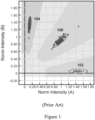
- clustering methods can define clusters for a biallelic SNPs in diploid organisms.
- genotypes and corresponding clusters of micro-array data for polyploid samples are different from diploid samples, and conventional methods need improvements for defining the clusters corresponding to different genotypes of the polyploid samples.
- the typical solution to this problem would be k-means clustering or another approach related to mixture modeling of distributions.
- these traditional cluster model generation approaches per se typically do not use genotype information to predict and/or use the locations of clusters.
- the disclosed methods and systems allow identification and definition of clusters that are suitable for different polyploid genotypes.
- the methods provided herein allow for customization of ploidy number as well as the nature of polyploidy.
- the method includes the ability to customize the genotypes used in the model that is built to fit the training data. The customization of the genotypes can be based on the characteristics of the genome that are known.
- the method includes the capability to learn to discriminate cluster positions in two dimensions such as in allele signal strength and type.
- sequence data is provide in polar coordinates, with R (radius) representing signal strength or intensity and angle (theta) representing allele type (e.g., A or B, or T or C).
- Genotyping polyploidy species has been a challenge for sequencing technologies such as micro-array data analysis, especially in the absence of a large amount of training data.
- the disclosed methods in some implementations provide an approach that works both on a limited amount of data and can improve as more data are included to train and improved the model used to generate the clusters for different possible genotypes.
- micro-array platforms provide data for genotyping various organisms with different genotypes.
- these platforms provide two or more channels of data representing the identities and relative quantities (e.g., counts) of nucleotides that are measured.
- micro array technology is used to provide sequence/allele signal.
- bead array technology may be used to provide SNP genotyping, over the whole genome or a portion thereof.
- the Illumina Infinium TM platform is used, which includes hundreds of thousands to millions of micro-wells on a beadchip, and microbeads are distributed in the microwells. The microbeads have diameters of roughly 3 ⁇ m.
- DNA samples are processed, amplified, and provided to the beadchip. Each bead is covered with hundreds of thousands of copies of a specific oligonucleotide that acts as capture sequences targeting different SNPs. The captured DNA fragments are used as the template to grow the oligonucleotides on the bead.
- the nucleotide added to the oligonucleotide is complementary to the captured DNA fragment and indicates the identity of the nucleotide of the specific allele on the captured nucleic acid fragment.
- the nucleotide corresponding to the allele is measured by an imaging device such as the Illumina iScan TM system.
- the image data having red and green signals of different intensities can then be plotted to form clusters in the data space or compared to clusters to determine genotypes.
- cluster 102 corresponds to genotype AA
- cluster 104 corresponding to genotype BB
- cluster 106 corresponding to genotype AB.
- the ⁇ values for the three clusters are about 0, 0.5, and 1.
- the origin of the duplicated chromosomes affects how traits are inherited and therefore on genotype of the organism. Specifically, allopolyploid genome exhibits a bivalent pairing of chromosomes, in which only the chromosome pair having the same origin would pair during meiosis. Conversely, an autopolyploid genome would exhibit multivalent pairing of chromosomes, in which all duplicated chromosomes can jointly pair during meiosis. In the allopolyploidy case, one would not expect recombination across the chromosomes of different original species.
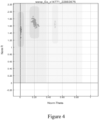
- the clusters in the allopolyploidy species is shifted relative to that of the diploid species.
- the ⁇ values for the three clusters are about 0, 0.2, and 5 for the allotetraploids in Figure 4 .
- the ⁇ values for the three clusters in Figure 2 for a diploid sample are 0, 0.5, and 1.
- Figure 5 is based on Figure 1(b) of Akhunov, Nicolet, and Dvorak (2009), Single nucleotide polymorphism genotyping in polyploid wheat with the Illumina GoldenGate assay, Theor Appl Genet., 119(3):507-17 .
- the solid bars indicate the copy numbers or dosages of the A allele
- the hatched bars indicate the copy numbers or dosages of the B allele.
- Shown at the top row of Figure 5 is a diploid organism. On the left of the top row is shown the AA genotype, having a 2 to 0 ratio of the A and B alleles. In the middle is shown the AB genome type, with the A and B alleles having a 1 to 1 ratio. On the right is shown the BB genotype, with the A and B alleles having a 0 to 2 ratio.
- the model allows for customization of the number of alleles of different genotypes.
- the nature of the genotypes can be used to form the allele-intensity model.
- the allele-intensity model may be improved by accounting for both the distributions of the clusters and the amount of information available using a Bayesian method.
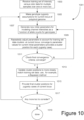
- Figures 7 , 8 , 9 , and 10 depict an example of a process for generating a clustering model for genotyping polyploid loci.
- Figure 10 presents a flowchart of operations that may be employed to generate such a model.
- Figures 7 , 8 , and 9 present a hypothetical example illustrating how the choice of cluster positions for a model evolves or is optimized over the course of the model generation process.
- These figures show hypothetical training set data, depicted as black-filled dots, along with corresponding cluster locations, depicted as hollow circles, for the clustering model.
- While the examples presented herein refer to color versus intensity data for genotyping, the disclosed embodiments extend to other types of data that may be collected by sequencers or other types of genotyping apparatus.
- wavelengths outside of the visible spectrum may be used for characterizing sequence data.
- ultraviolet radiation in two different regions of the ultraviolet spectrum may be used for two channels representing different alleles (nucleotide types).
- Other embodiments employ non-radiation based signals such as ion concentrations measured in separate channels (each associated with one or two nucleotide species) or electrical current changes associated with distinct nucleotide species.
- the signal can be viewed as providing a signal magnitude dimension (e.g., ion concentration, molecule count (e.g., hybridized molecules or sequenced molecules), or radiation intensity) and a nucleotides species dimension (e.g., color or time during exposure to a particular nucleotide species).
- a signal magnitude dimension e.g., ion concentration, molecule count (e.g., hybridized molecules or sequenced molecules), or radiation intensity
- a nucleotides species dimension e.g., color or time during exposure to a particular nucleotide species.
- the hypothetical training set data very coarsely distributes into three clusters of varying values of theta, centered around approximately 5°, 35°, and 50° (or in radians 0.09, 0.61, and 0.87)
- the model generation process may employ certain genotype zygosity assumptions for any one or more of the loci used to genotype the polyploid genome of a species under consideration. See process operation 1005 of Figure 10 .
- an allotetraploid genome locus may have three potential genotypes such as those shown in the upper portions of Figures 7 , 8 , and 9 .
- the active genotype combinations include AA(AB), AA(BB), and AA(AA), where A and B are nucleotide types (A, T, C, G).
- zygosities two of the four tetraploid chromosomes always have allele value A, while the other two chromosomes have diploid like zygosity options: homozygous A or B and heterozygous AB.
- Genotypes BB(AB) and BB(BB) are assumed not to occur.
- standard diploid-centric genotyping methods are generally unsuitable for genotyping such loci in tetraploid organisms.
- the allele counts for such locus are 4:0, 3: 1, and 2:2.
- the cluster model may employ expressions for calculating expected signal intensity for each of two (or more) channels as a function of allele count.
- Such expressions may employ one, two, three, or more fittable parameters, which are adjusted during the model generation process to better match the cluster locations with the training set data.
- the model generation system generates initial parameters for modeling the channel intensities as a function of allele counts for the various genotype zygosities at a particular locus. See process block 1007 of Figure 10 . Effectively, the model generation process used to adjust or fit these parameters moves the cluster locations such as cluster locations 701, 703, and 705 to new positions that better agree with the relative positions of the training set data.
- model parameters are adjusted to maximize the fit (e.g., likelihood) or minimize the error (e.g., aggregate distance) between the modeled cluster positions and the training set points.
- the model generation process and system repeatedly adjust the parameters by performing, for example, a gradient method such as maximum likelihood estimation to account for the training set data clusters at the current locus. Suitable examples of such process are described below.
- the process continues until convergence of the parameter values for the current set of initial conditions (i.e., initial values of the parameters that are used to relate allele count to channel intensity). See process block 1009. Also see Figure 8 in which the cluster positions 701, 703, and 705 move to improved positions 801, 803, and 805, respectively.
- the techniques employed to adjust the parameters relating allele count to channel intensity may be susceptible to converging in local maxima or minima, depending on the optimization technique.
- the process may employ multiple different initial parameter values during the process of adjusting the parameters to find an optimal fit based upon the underlying biology/genetics and the training set data.
- a decision operation 1011 determines whether enough initial parameter value sets (or iterations) have been considered to give confidence that one of them produces final parameter values that are at or near a global maximum or minimum. In certain embodiments, at least about five iterations are conducted. In certain embodiments, at least about ten iterations are conducted.
- process control is directed back to process operation 1007 where the model generation system provides a new set of initial parameter values for the relationship between allele count and channel intensity.
- the system again repeatedly adjusts the parameter values to account for training set data clusters as described earlier and reflected in process operation 1009.
- decision operation 1011 the system again checks at decision operation 1011 to determine whether a sufficient number of different initial parameter values have been considered.
- the method may check the fit parameter values for one or more convergence criteria, which are designed to identify global maxima or minima.
- the model generation system defines the model for the current locus by the final cluster positions output from operation 1013. See process operation 1015.
- Operations 1013 and 1015 are exemplified in Figure 9 , where initially optimized cluster positions 801, 803, and 805 are further optimized to cluster positions 901, 903, and 905, respectively.
- the model generation process is repeated for multiple loci of an organism.
- training set data is provided for each locus and a separate model, with separate parameters (for channel signal magnitude versus allele count) and separate cluster positions, is provided for each locus.
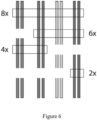
- the biological assumptions defining expected allele counts may be different for different loci. For example, as illustrated in Figure 6 , some chromosomes may possess some but not other polymorphic loci.
- the apparatus and process conditions employed to capture test data for genotyping a polyploid sample is also used to generate the training set data.
- the polyploid organisms to be genotyped are of the same species as those used to generate the training set samples, with the same expected range of genotypes.
- a training set grows or otherwise changes with the addition of new members, such as those obtained from test samples during genotyping.
- Modified training sets can be used to periodically update the cluster model by parameter fitting and/or cluster center adjusting as described above.
- the training set used to fit the parameters of the signal intensity functions may be used to adjust the cluster centers using a Bayesian method.
- separate or overlapping but not identical data sets are used to (i) fit the parameters and (ii) adjust the clusters.
- the polyploid genotyping software implements a generic clustering model that can be adapted to cluster either allopolyploid or autopolyploid data.
- this model is based on an underlying measured signal (e.g., intensity) model of the assay.
- intensity e.g., intensity
- the model assumes that for a given intensity channel the observed intensity is a function of the copy count of the allele associated with that channel.
- Various functions may be employed. In certain embodiments, the function is assumed to be non-linear and others it is assumed to be linear. Non-linear functions may employ only a single independent variable, which is the allele count for the channel, or may employ more than one independent variable, in which case at least one such variable is allele count.
- Non-linear functions may have an exponential component, in which allele count is raised to a power.
- intensity a x ⁇ counts allele a y + z
- x, y, and z are adjustable parameters of the model.
- a similar expression is used for the other channel, the b channel, for the second allele at the locus.
- the allele count may be represented as an integer value, although this is not necessary, as long at the relative quantities of the two alleles at a locus are correctly represented in the two intensity functions for the locus.
- intensity a x ⁇ ln counts allele a + y
- x and y are adjustable parameters of the model.
- two-dimensional cluster positions can be determined using the signal intensity expressions for both channels for a given genotype.
- the parameter values for x, y, and z in both the a and b channels are separately chosen based on the expected genotypes and the training set data. In certain embodiments, y is assumed to be equal for both the a and b channels.
- the challenge is then to identify the model parameter values that maximize the fit of the model to the data.
- the parameter values are fit via a pattern search with multiple different initialization conditions. This permits exploration of a wide range of parameter space with reduced risk of converging in local maximum that is quite unfavorable compared to a global maximum.
- various techniques may be employed to fit the model parameters to training set data.
- Certain techniques treat the data as a mixture of distributions, which are the clusters.
- the fitting procedure assumes that the mathematical form of the model will be a mixture of Gaussian distributions, and based on this finds a mean and a standard deviation for each Gaussian.
- the procedure employs the mentioned constraints (e.g. , the number of polyploid genotypes, the form of the functions for signal intensity measurements, etc.).
- the technique converges after a few iterations of refining the estimates of the means, standard deviations, and the proportions of data points in each cluster. The result is a model that fits the training data reasonably well.
- One fitting technique for mixture models is a maximum likelihood estimation, which may employ a well-known algorithm such as an expectation maximization (EM) algorithm, of which an example is described in Dempster, A. P., Laird, N. M., and Rubin D. B., "Maximum Likelihood from Incomplete Data via the EM Algorithm," Journal of the Royal Statistical Society B, 1977 [39]: 1-38 , and in McLachlan, Geoffrey J., and T. Krishnan (1997), The EM algorithm and extensions, John Wiley and Sons .
- EM expectation maximization
- Other maximization techniques may be employed.
- estimation techniques can be used, such as classical constrained maximum likelihood, MiniMax estimation, and Bayesian modelling with estimation using Gibbs sampling. If distributions other than Gaussian are modelled, an algorithm other than EM may be better suited.
- the model generation process is not designed to fit all possible genotypes for an organism. This may be the case, when underlying biology suggests that not all possible genotypes (zygosities) will occur at a given locus. See Figure 6 as an example. In an allotetraploid species, for example, the biology may suggest the occurrence of only three clusters based on the segregation of the alleles. See Figure 5 . Therefore, the model fitting process may have a notion of "active" clusters. This is an indication of which genotype clusters, out of all potential genotype clusters assuming maximum diversity in the organism, should actually occur in the samples under consideration. Genotypes that are not "active" are ignored in the optimization process.
- the model generation process may iterate over different possible configurations of active clusters. This is also useful in various contexts such as in in-bred populations.
- the biology may suggest observations of only the homozygous genotype clusters. In such cases, the homozygous clusters can be identified as "active" and the model fitting process can proceed in fashion described herein.
- the final version of a polyploid genotyping model employs the cluster positions using the model parameters identified as described.
- the cluster positions may be underfit for available data in a cluster; as some clusters may have relatively many members (training set points) and the fitting process does not fully account for all of them.
- the cluster locations obtained from the intensity model are restrained by the nature and form of the model.
- the disclosed process may adjust the cluster positions to more closely match the observed sample data. This adjustment allows a cluster location to be moved from a model predicted location to new location not entirely constrained by the form of the model. In some implementations, this adjustment may take into account the amount and values of sample data.
- a Bayesian method may be used perform this update, which involves using the cluster locations predicted by the intensity model as prior, and obtaining the posterior from the prior and information of the sample data.
- the information of the sample data may include the number, the central tendency (median), and the distribution (e.g., median absolute deviation).
- the normal-gamma distribution conjuggate prior of normal distribution with unknown mean and variance
- the parametric model may be used to set the prior expectation, while the mode of the posterior distribution may be used to set the updated cluster positions. This same update methodology may be used to set the intensity ( i.e., R value) for each genotyping cluster.
- the overall process employing an adjustment in the cluster positions may be represented as follows:
- Normal-gamma distribution can be described as follows.
- the updated expectation of X is ⁇ , while the expectation of T is ⁇ * ⁇ -1 .
- Cluster models such as those produced in accordance with the above description may be used in various ways to genotype one or more loci of a polyploid organism. Such techniques involve determining the cluster, which represents a particular genotype for a given locus, which is nearest to the sample data point under consideration. In certain embodiments, the nearness of a sample data point to a cluster position is determined by calculating a Euclidean distance. Other techniques known to those of skill in the art may be employed in appropriate circumstances. In addition to determining a nearest cluster, and hence assigning a locus genotype, the cluster assignment may be given a score indicating the reliability of the assignment. The reliability can be based on various criteria such as the specificity of the assignment based on, for example, whether the two nearest cluster positions are of nearly equal distances from the sample signal value.
- the process 1101 begins by receiving intensity and color readout data (or other signal strength versus nucleotide species data) from an assay for a current locus of the sample. See process operation 1103.
- the genotyping system determines distances between the signal value for the current locus of the sample and each cluster position in a model of genotypes. See operation 1105.
- the distances may be determined using any suitable distance function such as, for example, Euclidean distances and inverse probabilities.
- such model may be a cluster model prepared as described above.
- the genotyping system After determining the distances between the signal value for the sample under consideration and each of the cluster positions, the genotyping system next assigns a genotype based on the genotype associated with the cluster position closest to the signal value obtained for the sample. This may be a matter of simply assigning the genotype for the cluster having the smallest Euclidean distance to the signal data for the sample in question. See process operation 1107.
- the genotyping system determines or calculates a genotype score for the assigned genotype.
- score may indicate the relative reliability of the genotype call. See operation 1109.
- the score is high for cases where the signal value for the sample is near to the closest cluster position but far away from the second closest cluster position. Conversely, the score may be low where the sample signal value is nearly equally close to the first and second closest cluster positions.
- An example sequence for calculating a score proceeds as follows.
- the outlier threshold e.g., about 4
- the process may consider whether there are any further loci from the sample to genotype. See decision operation 1111. If so, the process returns to process operation 1103 where it receives signal data for the next genomic locus under consideration. Thereafter, the process proceeds through operations 1105, 1107, and 1109 as described above. When all loci of the polyploid sample under consideration are considered, the genotyping process is completed as indicated at 1113.
- the method illustrated here assigns genotypes and scores for different loci in serial iterations. However, in other implementations, multiple assignments for multiple loci may be performed in parallel.
- Samples that are used for determining a genotype can include samples taken from any cell, tissue, or organ in which a genotype is to be determined. Typically, the samples contain nucleic acids that are that are present in cells.
- the sample comprising the nucleic acid(s) to which the methods described herein are applied typically comprises a biological sample ("test sample").
- test sample typically comprises a biological sample ("test sample").
- the nucleic acid(s) to be genotyped is purified or isolated by any of a number of well-known methods.
- the sample comprises or consists of a purified or isolated polynucleotide, or it can comprise samples such as a tissue sample, a biological fluid sample, a cell sample, and the like.
- the sample is a mixture of two or more biological samples, e.g., a biological sample can comprise two or more of a biological fluid sample, a tissue sample, and a cell culture sample.
- samples can be obtained from sources, including, but not limited to, samples from different individuals, samples from different developmental stages of the same or different individuals, samples from different diseased individuals (e.g., individuals with cancer or suspected of having a genetic disorder), normal individuals, samples obtained at different stages of a disease in an individual, samples obtained from an individual subjected to different treatments for a disease, samples from individuals subjected to different environmental factors, samples from individuals with predisposition to a pathology, samples individuals with exposure to an infectious disease agent, and the like.
- sources including, but not limited to, samples from different individuals, samples from different developmental stages of the same or different individuals, samples from different diseased individuals (e.g., individuals with cancer or suspected of having a genetic disorder), normal individuals, samples obtained at different stages of a disease in an individual, samples obtained from an individual subjected to different treatments for a disease, samples from individuals subjected to different environmental factors, samples from individuals with predisposition to a pathology, samples individuals with exposure to an infectious disease agent, and the like.
- samples can also be obtained from in vitro cultured tissues, cells, or other polynucleotide-containing sources.
- the cultured samples can be taken from sources including, but not limited to, cultures (e.g., tissue or cells) maintained in different media and conditions (e.g., pH, pressure, or temperature), cultures (e.g., tissue or cells) maintained for different periods of length, cultures (e.g., tissue or cells) treated with different factors or reagents (e.g., a drug candidate, or a modulator), or cultures of different types of tissue and/or cells.
- nucleic acid samples are well known and will differ depending upon the nature of the source.
- One of skill in the art can readily isolate nucleic acid(s) from a source as needed for the method described herein.
- Embodiments disclosed herein also relate to apparatus for performing these operations.
- This apparatus may be specially constructed for the required purposes, or it may be a general-purpose computer (or a group of computers) selectively activated or reconfigured by a computer program and/or data structure stored in the computer.
- a group of processors performs some or all of the recited analytical operations collaboratively (e.g., via a network or cloud computing) and/or in parallel.
- a processor or group of processors for performing the methods described herein may be of various types including microcontrollers and microprocessors such as programmable devices (e.g., CPLDs and FPGAs) and non-programmable devices such as gate array ASICs or general purpose microprocessors.
- microcontrollers and microprocessors such as programmable devices (e.g., CPLDs and FPGAs) and non-programmable devices such as gate array ASICs or general purpose microprocessors.
- certain embodiments relate to tangible and/or non-transitory computer readable media or computer program products that include program instructions and/or data (including data structures) for performing various computer-implemented operations.
- Examples of computer-readable media include, but are not limited to, semiconductor memory devices, magnetic media such as disk drives, magnetic tape, optical media such as CDs, magneto-optical media, and hardware devices that are specially configured to store and perform program instructions, such as read-only memory devices (ROM) and random access memory (RAM).
- ROM read-only memory devices
- RAM random access memory
- the computer readable media may be directly controlled by an end user or the media may be indirectly controlled by the end user. Examples of directly controlled media include the media located at a user facility and/or media that are not shared with other entities.
- Examples of indirectly controlled media include media that is indirectly accessible to the user via an external network and/or via a service providing shared resources such as the "cloud.”
- Examples of program instructions include both machine code, such as produced by a compiler, and files containing higher level code that may be executed by the computer using an interpreter.
- the data or information employed in the disclosed methods and apparatus is provided in an electronic format.
- Such data or information may include signal intensities for each of multiple channels of a sequencer or microarray configured to distinguish between distinct alleles or nucleotide types present a nucleic acid test sample, counts or densities of such alleles, reference sequences (including reference sequences providing solely or primarily polymorphisms), calls such as genotype calls at certain loci, genotype scores, diagnoses, and the like.
- data or other information provided in electronic format is available for storage on a machine and transmission between machines.
- data in electronic format is provided digitally and may be stored as bits and/or bytes in various data structures, lists, databases, etc. The data may be embodied electronically, optically, etc.
- One embodiment provides a computer program product and/or associated system for generating an output indicating the genotype at one or more loci in a polyploid test sample.
- One embodiment provides a computer program product and/or associated system for generating a cluster model to genotype at one or more loci in a polyploid test sample.
- the computer product may contain instructions for performing any one or more of the above-described methods for determining a genotype or generating a cluster model.
- the computer product may include a non-transitory and/or tangible computer readable medium having a computer executable or compilable logic (e.g., instructions) recorded thereon for enabling a processor to determine appropriate cluster positions for a model and/or genotype a test sample.
- the computer product includes a computer readable medium having a computer executable or compilable logic (e.g., instructions) recorded thereon for enabling a processor to generate a cluster model by: (a) identifying a plurality of active genotypes expected to be observed at a genomic locus in the polyploid organisms; (b) fitting a plurality of parameters of a first function relating a first signal magnitude produced in a microarray by a first nucleotide type present in a first allele at the genomic locus to a count of the first nucleotide type at the genomic locus, wherein fitting the plurality of parameters of the first function assumes the identified plurality of active genotypes are observed in the polyploid organisms; (c) fitting a plurality of parameters of a second function relating a second signal magnitude produced in the microarray by a second nucleotide type present in a second allele at the genomic locus to a count of the second nucleotide type at the genomic locus, where
- the computer product includes a computer readable medium having a computer executable or compilable logic (e.g., instructions) recorded thereon for enabling a processor to generate a cluster model by: fitting a plurality of parameters of a first function relating a first signal magnitude produced in a microarray by a first nucleotide type present in a first allele at a genomic locus of the polyploid organisms to a count of the first nucleotide type at the genomic locus; fitting a plurality of parameters of a second function relating a second signal magnitude produced in the microarray by a second nucleotide type present in a second allele at the genomic locus to a count of the second nucleotide type at the genomic locus; wherein fitting the plurality of parameters to the first and second functions is performed using a training set of the first and second signal magnitudes obtained by assaying the genomic locus for a plurality of organisms, and wherein the first and second functions together identify cluster positions for genotypes
- the computer product includes a computer readable medium having a computer executable or compilable logic (e.g., instructions) recorded thereon for enabling a processor to generate a cluster model by: identifying a plurality of active genotypes expected to be observed at a genomic locus of the polyploid organisms; fitting a plurality of parameters of a first function relating a first signal magnitude produced in a microarray by a first nucleotide type present in a first allele at the genomic locus to a count of the first nucleotide type at the genomic locus, wherein fitting the plurality of parameters of the first function assumes the identified plurality of active genotypes are observed in the polyploid genome; and fitting a plurality of parameters of a second function relating a second signal magnitude produced in the microarray by a second nucleotide type present in a second allele at the genomic locus to a count of the second nucleotide type at the genomic locus, wherein fitting the plurality of parameters of
- the signal composition from a microarray or sequencer for a sample under consideration may be analyzed to determine magnitude (e.g., intensity) and color or other feature associated with relative quantities of alleles. This information then be used in cluster analysis and/or genotyping.
- the cluster positions, function parameters, sample locations, genotypes, or combinations of these are stored in a database such as a relational or object database.
- the methods disclosed herein can be performed using a system for genotyping one or more loci of interest in a test sample.
- the system may include: (a) a sequencer or microarray for receiving nucleic acids from the test sample providing nucleic acid sequence information from the sample; (b) a processor; and (c) one or more computer-readable storage media having stored thereon instructions for execution on said processor to carry out a method for genotyping the one or more loci using a cluster model produced as described herein.
- the instructions may further include automatically recording information pertinent to the method such as genotype assignments and genotype scores. Further, based on the results of the processor-implemented analysis, the method may further involve prescribing, initiating, and/or altering treatment of a polyploid subject from whom the test sample was taken. This may involve performing one or more additional tests or analyses on additional samples taken from the organism.
- Sequence or hybridization data can be input into a computer or stored on a computer readable medium either directly or indirectly.
- a computer system is directly coupled to a microarray or sequencing device that analyzes sequences of nucleic acids from samples. Signal intensities or other information from such tools are provided via interface in the computer system.
- the signals processed by system are provided from a storage source such as a database or other repository.
- a memory device or mass storage device buffers or stores, at least temporarily, signal information from the test nucleic acids.
- the memory device may store cluster information and/or genotypes for various chromosomes or genomes, etc.
- the memory may also store various routines and/or programs for analyzing the presenting the cluster model and/or called genotypes. Such programs/routines may include programs for performing statistical analyses, etc.
- a user provides a sample into a microarray apparatus.
- Data is collected and/or analyzed by the apparatus which is connected to a computer.
- Software on the computer allows for data collection and/or analysis.
- Data can be stored, displayed (via a monitor or other similar device), and/or sent to another location.
- the computer may be connected to the internet which is used to transmit data to a handheld device utilized by a remote user (e.g., scientist or analyst). It is understood that the data can be stored and/or analyzed prior to transmittal.
- raw data is collected and sent to a remote user or apparatus that will analyze and/or store the data. Transmittal can occur via the internet, but can also occur via satellite or other connection.
- data can be stored on a computer-readable medium and the medium can be shipped to an end user (e.g., via mail).
- the remote user can be in the same or a different geographical location including, but not limited to a building, city, state, country or continent.
- the methods also include collecting data regarding a plurality of polynucleotide sequences and sending the data to a computer or other computational system.
- the computer can be connected to laboratory equipment, e.g., a sample collection apparatus, a nucleotide amplification apparatus, a nucleotide sequencing apparatus, or a hybridization apparatus.
- the computer can then collect applicable data gathered by the laboratory device.
- the data can be stored on a computer at any step, e.g., while collected in real time, prior to the sending, during or in conjunction with the sending, or following the sending.
- the data can be stored on a computer-readable medium that can be extracted from the computer.
- the data collected or stored can be transmitted from the computer to a remote location, e.g., via a local network or a wide area network such as the internet. At the remote location various operations can be performed on the transmitted data as described below.
- test sample may be obtained, stored transmitted, analyzed, and/or manipulated at one or more locations using distinct apparatus.
- the processing options span a wide spectrum. At one end of the spectrum, all or much of this information is stored and used at the location where the test sample is processed, e.g., a research facility or other clinical setting. In other extreme, the sample is obtained at one location, it is processed and optionally hybridized or sequenced at a different location, genotype calls are made at one or more different locations, and diagnoses, recommendations and/or plans are prepared at still another location (which may be a location where the sample was obtained).
- the signals are generated with the microarray or sequencing apparatus and then transmitted to a remote site where they are processed to produce genotype calls.
- a remote site where they are processed to produce genotype calls.
- microarray signal information is applied a cluster model for polyploid genotyping. Also at the remote location, the signal information is converted to genotypes and genotype scores.
- any one or more of these operations may be automated.
- the microarray signal analysis and genotype calling will be performed computationally.
- the other operations may be performed manually or automatically.
- sample collection and/or processing examples include research facilities and field locations (where a sample collection tool or kit is provided).
- locations where sequencing may be performed examples include research facilities, field locations, health practitioners' offices, clinics, patients' homes (where a sample sequencing apparatus and/or kit is provided), etc.
- the sample collection, sample processing, and sequencing operations are performed at a first location and the analyzing and genotyping operation is performed at a second location.
- the sample collection is collected at one location (e.g., field site) and the sample processing and sequencing is performed at a different location that is optionally the same location where the analyzing and deriving take place.
- the location where the sequencing takes place may be provided with a dedicated network connection for transmitting sequence data (typically reads) in an electronic format.
- sequence data typically reads
- Such connection may be wired or wireless and have and may be configured to send the data to a site where the data can be processed and/or aggregated prior to transmission to a processing site.
- the analyzing and/or deriving operations may be performed at any of the foregoing locations or alternatively at a further remote site dedicated to computation and/or the service of analyzing nucleic acid sequence data.
- locations include for example, clusters such as general purpose server farms, the facilities of a genotype analysis service business, and the like.
- the computational apparatus employed to perform the analysis is leased or rented.
- the computational resources may be part of an Internet accessible collection of processors such as processing resources colloquially known as the cloud.
- the computations are performed by a parallel or massively parallel group of processors that are affiliated or unaffiliated with one another.
- the processing may be accomplished using distributed processing such as cluster computing, grid computing, and the like.
- a cluster or grid of computational resources collective form a super virtual computer composed of multiple processors or computers acting together to perform the analysis and/or derivation described herein.
- These technologies as well as more conventional supercomputers may be employed to process sequence data as described herein.
- Each is a form of parallel computing that relies on processors or computers.
- these processors (often whole computers) are connected by a network (private, public, or the Internet) by a conventional network protocol such as Ethernet.
- a supercomputer has many processors connected by a local high-speed computer bus.
- a sequence of the above-listed operations may be triggered by a user or entity initiating sample collection, sample processing and/or sequencing. After one or more these operations have begun execution the other operations may naturally follow.
- the sequencing operation may cause microarray signal to be automatically collected and sent to a processing apparatus which then conducts, often automatically and possibly without further user intervention, the genotyping operation.
- the result of this processing operation is then automatically delivered, possibly with reformatting, to a system component or entity that processes reports. This is accomplished even though parts of the overall system are physically separated and possibly remote from the location of, e.g., the sample and sequence/microarray apparatus.
- Figure 12 shows one implementation of a dispersed system for producing a genotype call of a test sample.
- a sample collection location 01 is used for obtaining a test sample.
- the samples then provided to a processing and sequencing location 03 where the test sample may be processed and sequenced as described above.
- Location 03 includes apparatus for processing the sample as well as apparatus for sequencing/hybridization of the processed sample.
- the result of the sequencing is microarray signal data which is typically provided in an electronic format and provided to a network such as the Internet, which is indicated by reference number 05 in Figure 12 .
- the microarray signal data is provided to a remote location 07 where analysis and call generation are performed.
- This location may include one or more powerful computational devices such as computers or processors.
- the call is relayed back to the network 05.
- an associated diagnosis is also generated.
- the call and/or score are then transmitted across the network and back to the sample collection location 01 as illustrated in Figure 12 .
- this is simply one of many variations on how the various operations associated with generating a call or diagnosis may be divided among various locations.
- One common variant involves providing sample collection and processing and sequencing in a single location.
- Another variation involves providing processing and sequencing at the same location as analysis and call generation.
- Example 1 sample processing and data generation
- microarray platforms may be implemented using microarray platforms.
- the methods and systems disclosed herein can be useful for whole-genome genotyping.
- This example provides a workflow for using microarray platform to process samples, generate data, and analyze the data for clustering data and genotyping samples.
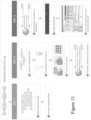
- the Illumina Infinium TM protocol is described and summarized in Figure 13 .
- the workflow begins with an overnight amplification of the DNA sample. This amplification has no appreciable allelic partiality. A relatively low DNA sample requirement of 200 ng is sufficient to assay over 300,000 SNP loci.
- the DNA samples are denatured and neutralized to prepare them for amplification.
- the amplified product is end fragmented.
- the denatured DNA is isothermally amplified in an overnight step. Whole genome amplification uniformly increases the amount of the DNA sample by several thousand sold without using large amount of amplification biases. (Steps 1 and 2)
- the amplified product is fragmented by a process that does not require gel electrophoresis.
- the process uses endpoint fragmentation to avoid over fragmenting the sample. (Step 3).
- Step 4 After isopropanol precipitation, the fragmented DNA is collected by centrifugation. The precipitated DNA is then resuspended in hybridization buffer. (Step 4).
- the bead chip is prepared for hybridization in the capillary flow-through chamber. Samples are applied to the bead chip. The loaded chip is incubated overnight. (Step 5)
- Step 6 The DNA samples are then hybridized to locus specific 50-mers covalently linked to one of over 300,000 bead types in the overnight hybridization step. Each bead has hundreds of thousands of locus specific oligomers targeting the same SNP. One bead type corresponds to each allele for SNP locus. (Step 6)
- allelic specificity is conferred by enzymatic base extension. Because the different bead types include allele specific probes, the specificity can be determined when growing the 50-mers using the captured DNA fragments including the allele of interest. Products are subsequently fluorescently stained. Two different colors, e.g., red and green, are used to stain two different nucleotides corresponding to the two alleles. (Step 7)
- the intensities of red and green fluorescence are detected by a scanning device such as the iScan system (Step 8).
- Intensity data of the red and green channels are analyzed using the methods described above to develop clusters and assign genotypes. (Step 9)
- the apparatus and process conditions employed to capture test data for genotyping a polyploid sample is also used to generate the training set data.
- the polyploid organisms to be genotyped are of the same species as those used to generate the training set samples, with the same expected range of genotypes.
- a training set grows or otherwise changes with the addition of new members, such as those obtained from test samples during genotyping.
- Modified training sets can be used to periodically update the cluster model by parameter fitting and/or cluster center adjusting as described above.
- the training set used to fit the parameters of the signal intensity functions may be used to adjust the cluster centers using a Bayesian method.
- separate or overlapping but not identical data sets are used to (i) fit the parameters and (ii) adjust the clusters.
Landscapes
- Engineering & Computer Science (AREA)
- Physics & Mathematics (AREA)
- Health & Medical Sciences (AREA)
- Life Sciences & Earth Sciences (AREA)
- Medical Informatics (AREA)
- Bioinformatics & Cheminformatics (AREA)
- Biophysics (AREA)
- Spectroscopy & Molecular Physics (AREA)
- Data Mining & Analysis (AREA)
- General Health & Medical Sciences (AREA)
- Evolutionary Biology (AREA)
- Biotechnology (AREA)
- Theoretical Computer Science (AREA)
- Bioinformatics & Computational Biology (AREA)
- Computer Vision & Pattern Recognition (AREA)
- Artificial Intelligence (AREA)
- Public Health (AREA)
- Evolutionary Computation (AREA)
- Epidemiology (AREA)
- Databases & Information Systems (AREA)
- Bioethics (AREA)
- Software Systems (AREA)
- Molecular Biology (AREA)
- Chemical & Material Sciences (AREA)
- Analytical Chemistry (AREA)
- Genetics & Genomics (AREA)
- Proteomics, Peptides & Aminoacids (AREA)
- Probability & Statistics with Applications (AREA)
- Physiology (AREA)
- Measuring Or Testing Involving Enzymes Or Micro-Organisms (AREA)
Claims (16)
- Verfahren zum Genotypisieren eines Locus eines polyploiden Genoms unter Verwendung eines Clustermodells zum Genotypisieren von polyploiden Organismen, wobei das Verfahren Folgendes umfasst:Bereitstellen eines Clustermodells, erstellt durch:(a) Identifizieren einer Vielzahl aktiver Genotypen, von denen erwartet wird, dass sie an einem genomischen Locus in den polyploiden Organismen beobachtet werden;(b) Angleichen einer Vielzahl von Parametern einer ersten Funktion betreffend eine erste Signalgröße, die in einer Mikroanordnung durch einen ersten Nucleotidtyp, der in einem ersten Allel an dem genomischen Locus vorhanden ist, erzeugt wird, an eine Zählung des ersten Nucleotidtyps an dem genomischen Locus, wobei das Angleichen der Vielzahl von Parametern der ersten Funktion annimmt, dass die identifizierte Vielzahl von aktiven Genotypen in den polyploiden Organismen beobachtet wird;(c) Angleichen einer Vielzahl von Parametern einer zweiten Funktion betreffend eine zweite Signalgröße, die in der Mikroanordnung durch einen zweiten Nucleotidtyp, der in einem zweiten Allel an dem genomischen Locus vorhanden ist, erzeugt wird, an eine Zählung des zweiten Nucleotidtyps an dem genomischen Locus, wobei das Angleichen der Vielzahl von Parametern der zweiten Funktion annimmt, dass die identifizierte Vielzahl von aktiven Genotypen in den polyploiden Organismen beobachtet wird;wobei das Angleichen der Vielzahl von Parametern an die erste und die zweite Funktion unter Verwendung eines Trainingssatzes der ersten und der zweiten Signalgröße durchgeführt wird, die durch Testen des genomischen Locus einer Vielzahl von polyploiden Organismen erhalten wird, undwobei die erste und die zweite Funktion zusammen Clusterpositionen für Genotypen an dem genomischen Locus identifizieren;Empfangen einer ersten Signalgröße, die in einer Mikroanordnung durch einen ersten Nucleotidtyp an dem genomischen Locus erzeugt wird, und Empfangen einer zweiten Signalgröße, die in einer Mikroanordnung durch einen zweiten Nucleotidtyp an dem genomischen Locus erzeugt wird, wobei die erste und die zweite Signalgröße zusammen eine zweidimensionale Position für den Locus-Genotyp des polyploiden Genoms identifizieren;Vergleichen der zweidimensionalen Position mit der Vielzahl von Clusterpositionen in dem Clustermodell für den genomischen Locus; undZuordnen eines Genotyps zu dem genomischen Locus basierend auf der Distanz zwischen dem Locus-Genotyp des polyploiden Genoms und der nächsten Clusterposition in dem Clustermodell.
- Verfahren nach Anspruch 1, wobei das Identifizieren der Vielzahl von aktiven Genotypen das Identifizieren von weniger als allen möglichen Kombinationen des ersten und des zweiten Nucleotidtyps an dem genomischen Locus umfasst.
- Verfahren nach einem der vorangegangenen Ansprüche, wobei das polyploide Genom ein allopolyploides Genom ist.
- Verfahren nach einem der vorangegangenen Ansprüche, wobei das polyploide Genom ein allotetraploides Genom ist und höchstens drei aktive Genotypen identifiziert werden.
- Verfahren nach einem der vorangegangenen Ansprüche, wobei zumindest eine aus der ersten und der zweiten Funktion folgende Formel aufweist:

- Verfahren nach einem der vorangegangenen Ansprüche, wobei die erste sowie die zweite Funktion folgende Formel aufweist:

- Verfahren nach einem der vorangegangenen Ansprüche, wobei zumindest eine aus der ersten und der zweiten Funktion eine nichtlineare Funktion ist.
- Verfahren nach einem der vorangegangenen Ansprüche, wobei das Angleichen einer Vielzahl von Parametern der ersten und der zweiten Funktion in (b) und (c) einen nichtüberwachten Prozess maschinellen Lernens umfasst.
- Verfahren nach einem der vorangegangenen Ansprüche, wobei das Angleichen von Parametern der ersten und der zweiten Funktion in (b) und (c) einen überwachten Prozess maschinellen Lernens umfasst.
- Verfahren nach einem der vorangegangenen Ansprüche, wobei das Angleichen einer Vielzahl von Parametern von zumindest einer der ersten und der zweiten Funktion in (b) und (c) ein Gradientenverfahren umfasst.
- Verfahren nach Anspruch 10, wobei das Gradientenverfahren eine Schätzung der maximalen Wahrscheinlichkeit ist.
- Verfahren nach Anspruch 11, wobei die Schätzung der maximalen Wahrscheinlichkeit die einstellbaren Parameter unter Verwendung einer Gaußschen Definition von Clustern in dem Trainingssatz an die Trainingssatzdaten angleicht.
- Verfahren nach Anspruch 12, wobei die Schätzung der maximalen Wahrscheinlichkeit die einstellbaren Parameter an die Trainingssatzdaten angleicht, um eine getrennte Gaußsche Definition von Clustern für jeden aus der Vielzahl von in (a) identifizierten aktiven Genotypen zu erzeugen.
- Verfahren nach einem der vorangegangenen Ansprüche, wobei das Verfahren weiters das Einstellen der Clusterpositionen, die durch die erste und die zweite Funktion identifiziert wurden, umfasst, um genauer mit beobachteten Daten aus dem Trainingssatz übereinzustimmen, wobei das Einstellen der Clusterpositionen das Aktualisieren der Clusterpositionen unter Verwendung eines Bayesschen Verfahrens umfasst, das Folgendes umfasst: Verwenden der durch die erste und die zweite Funktion identifizierten Clusterpositionen als A-priori-Verteilung und Erhalten einer A-posteriori-Verteilung aus der A-priori-Verteilung und den beobachteten Daten des Trainingssatzes.
- Verfahren nach Anspruch 14, wobei das Erhalten der A-posteriori-Verteilung das Erhalten der A-posteriori-Verteilung aus der A-priori-Verteilung und einer Zahl, einer zentralen Tendenz und einer Varianz der beobachteten Daten des Trainingssatzes umfasst.
- System zum Genotypisieren von polyploiden Organismen, wobei das System Folgendes umfasst:eine Mikroanordnung, die ausgelegt ist, um ein erstes Signal als Antwort auf Kontakt mit einem ersten Nucleotidtyp, der in einem ersten Allel an einem genomischen Locus der polyploiden Organismen vorhanden ist, zu erzeugen und ein zweites Signal als Antwort auf Kontakt mit einem zweiten Nucleotidtyp, der in einem zweiten Allel an dem genomischen Locus der polyploiden Organismen vorhanden ist, zu erzeugen; undeinen oder mehrere Prozessoren, die ausgelegt sind zum:(i) Empfangen von Daten, die Größen des ersten und des zweiten Signals darstellen, die in einer Mikroanordnung als Antwort auf Kontakt mit dem ersten und zweiten Nucleotidtyp an dem genomischen Locus erzeugt wurden, wobei die erste und die zweite Signalgröße zusammen zweidimensionale Positionen für die polyploiden Organismen identifizieren;(ii) Bestimmen einer Vielzahl von Clusterpositionen eines Clustermodells durch:(a) Identifizieren einer Vielzahl aktiver Genotypen, von denen erwartet wird, dass sie an dem genomischen Locus in den polyploiden Organismen beobachtet werden;(b) Angleichen einer Vielzahl von Parametern einer ersten Funktion betreffend die erste Signalgröße an eine Zählung des ersten Nucleotidtyps an dem genomischen Locus, wobei das Angleichen der Vielzahl von Parametern der ersten Funktion annimmt, dass die identifizierte Vielzahl von aktiven Genotypen in den polyploiden Organismen beobachtet wird;(c) Angleichen einer Vielzahl von Parametern einer zweiten Funktion betreffend eine zweite Signalgröße an eine Zählung des zweiten Nucleotidtyps an dem genomischen Locus, wobei das Angleichen der Vielzahl von Parametern der zweiten Funktion annimmt, dass die identifizierte Vielzahl von aktiven Genotypen in den polyploiden Organismen beobachtet wird,wobei das Angleichen der Vielzahl von Parametern an die erste und die zweite Funktion unter Verwendung eines Trainingssatzes der ersten und der zweiten Signalgröße durchgeführt wird, die durch Testen des genomischen Locus einer Vielzahl von polyploiden Organismen erhalten wird, undwobei die erste und die zweite Funktion zusammen Clusterpositionen für Genotypen an dem genomischen Locus identifizieren;(iii) Vergleichen der zweidimensionalen Positionen der polyploiden Organismen mit der Vielzahl von Clusterpositionen, die durch das Clustermodell für den genomischen Locus bestimmt wurden; und(iv) Zuordnen von Genotypen zu den polyploiden Organismen an dem genomischen Locus basierend auf der Distanz zwischen den zweidimensionalen Positionen der polyploiden Organismen und der nächsten Clusterposition in dem Clustermodell.
Applications Claiming Priority (2)
| Application Number | Priority Date | Filing Date | Title |
|---|---|---|---|
| US201662345577P | 2016-06-03 | 2016-06-03 | |
| PCT/US2017/035751 WO2017210603A1 (en) | 2016-06-03 | 2017-06-02 | Genotyping polyploid loci |
Publications (2)
| Publication Number | Publication Date |
|---|---|
| EP3465500A1 EP3465500A1 (de) | 2019-04-10 |
| EP3465500B1 true EP3465500B1 (de) | 2024-11-27 |
Family
ID=59054314
Family Applications (1)
| Application Number | Title | Priority Date | Filing Date |
|---|---|---|---|
| EP17729717.3A Active EP3465500B1 (de) | 2016-06-03 | 2017-06-02 | Genotypisierung von polyploiden loci |
Country Status (3)
| Country | Link |
|---|---|
| US (2) | US11456055B2 (de) |
| EP (1) | EP3465500B1 (de) |
| WO (1) | WO2017210603A1 (de) |
Families Citing this family (4)
| Publication number | Priority date | Publication date | Assignee | Title |
|---|---|---|---|---|
| CN111899239B (zh) * | 2020-07-27 | 2025-07-01 | 腾讯科技(深圳)有限公司 | 图像处理方法和装置 |
| CN114300045B (zh) * | 2022-01-04 | 2025-03-07 | 杭州博日科技股份有限公司 | 基于对照组的半监督snp分型方法、装置和电子设备 |
| EP4500539A1 (de) * | 2022-03-31 | 2025-02-05 | Illumina, Inc. | Maschinenlernmodellierung der sondenintensität |
| WO2025096279A1 (en) * | 2023-10-30 | 2025-05-08 | Illumina, Inc. | Genotyping array |
Family Cites Families (5)
| Publication number | Priority date | Publication date | Assignee | Title |
|---|---|---|---|---|
| US20160371432A1 (en) * | 2008-05-27 | 2016-12-22 | Natera, Inc. | Methods for allele calling and ploidy calling |
| US20100221708A1 (en) * | 2009-03-02 | 2010-09-02 | Yamada N Alice | Method for chromosome enumeration |
| EP2572003A4 (de) * | 2010-05-18 | 2016-01-13 | Natera Inc | Verfahren zur nichtinvasiven pränatalen ploidiezuordnung |
| JP6566484B2 (ja) * | 2013-06-14 | 2019-08-28 | キージーン ナムローゼ フェンノートシャップ | 表現形質改善のための制御された戦略 |
| WO2016183106A1 (en) * | 2015-05-11 | 2016-11-17 | Natera, Inc. | Methods and compositions for determining ploidy |
-
2017
- 2017-06-02 EP EP17729717.3A patent/EP3465500B1/de active Active
- 2017-06-02 US US16/305,818 patent/US11456055B2/en active Active
- 2017-06-02 WO PCT/US2017/035751 patent/WO2017210603A1/en not_active Ceased
-
2022
- 2022-08-15 US US17/888,439 patent/US20220399077A1/en not_active Abandoned
Also Published As
| Publication number | Publication date |
|---|---|
| EP3465500A1 (de) | 2019-04-10 |
| US20220399077A1 (en) | 2022-12-15 |
| US20200321075A1 (en) | 2020-10-08 |
| US11456055B2 (en) | 2022-09-27 |
| WO2017210603A1 (en) | 2017-12-07 |
Similar Documents
| Publication | Publication Date | Title |
|---|---|---|
| US10597724B2 (en) | System and method for cleaning noisy genetic data from target individuals using genetic data from genetically related individuals | |
| US12073922B2 (en) | Deep learning-based framework for identifying sequence patterns that cause sequence-specific errors (SSEs) | |
| US20260074018A1 (en) | FRAMEWORK FOR IDENTIFYING SEQUENCE PATTERNS THAT CAUSE SEQUENCE-SPECIFIC ERRORS (SSEs) | |
| JP6430998B2 (ja) | 予測を行うための、遺伝子データを清浄化し、そして、そのデータを使用するためのシステムおよび方法 | |
| US8532930B2 (en) | Method for determining the number of copies of a chromosome in the genome of a target individual using genetic data from genetically related individuals | |
| US20220399077A1 (en) | Genotyping polyploid loci | |
| HK40025634A (en) | Deep learning-based framework for identifying sequence patterns that cause sequence-specific errors | |
| HK40025634B (en) | Deep learning-based framework for identifying sequence patterns that cause sequence-specific errors |
Legal Events
| Date | Code | Title | Description |
|---|---|---|---|
| STAA | Information on the status of an ep patent application or granted ep patent |
Free format text: STATUS: UNKNOWN |
|
| STAA | Information on the status of an ep patent application or granted ep patent |
Free format text: STATUS: THE INTERNATIONAL PUBLICATION HAS BEEN MADE |
|
| PUAI | Public reference made under article 153(3) epc to a published international application that has entered the european phase |
Free format text: ORIGINAL CODE: 0009012 |
|
| STAA | Information on the status of an ep patent application or granted ep patent |
Free format text: STATUS: REQUEST FOR EXAMINATION WAS MADE |
|
| 17P | Request for examination filed |
Effective date: 20181221 |
|
| AK | Designated contracting states |
Kind code of ref document: A1 Designated state(s): AL AT BE BG CH CY CZ DE DK EE ES FI FR GB GR HR HU IE IS IT LI LT LU LV MC MK MT NL NO PL PT RO RS SE SI SK SM TR |
|
| AX | Request for extension of the european patent |
Extension state: BA ME |
|
| DAV | Request for validation of the european patent (deleted) | ||
| DAX | Request for extension of the european patent (deleted) | ||
| REG | Reference to a national code |
Ref country code: HK Ref legal event code: DE Ref document number: 40004110 Country of ref document: HK |
|
| STAA | Information on the status of an ep patent application or granted ep patent |
Free format text: STATUS: EXAMINATION IS IN PROGRESS |
|
| 17Q | First examination report despatched |
Effective date: 20220602 |
|
| REG | Reference to a national code |
Ref country code: DE Ref legal event code: R079 Ref document number: 602017086366 Country of ref document: DE Free format text: PREVIOUS MAIN CLASS: G06F0019180000 Ipc: G16B0020200000 |
|
| GRAP | Despatch of communication of intention to grant a patent |
Free format text: ORIGINAL CODE: EPIDOSNIGR1 |
|
| STAA | Information on the status of an ep patent application or granted ep patent |
Free format text: STATUS: GRANT OF PATENT IS INTENDED |
|
| RIC1 | Information provided on ipc code assigned before grant |
Ipc: G16B 40/30 20190101ALI20240610BHEP Ipc: G16B 40/20 20190101ALI20240610BHEP Ipc: G16B 20/20 20190101AFI20240610BHEP |
|
| INTG | Intention to grant announced |
Effective date: 20240709 |
|
| GRAS | Grant fee paid |
Free format text: ORIGINAL CODE: EPIDOSNIGR3 |
|
| GRAA | (expected) grant |
Free format text: ORIGINAL CODE: 0009210 |
|
| STAA | Information on the status of an ep patent application or granted ep patent |
Free format text: STATUS: THE PATENT HAS BEEN GRANTED |
|
| AK | Designated contracting states |
Kind code of ref document: B1 Designated state(s): AL AT BE BG CH CY CZ DE DK EE ES FI FR GB GR HR HU IE IS IT LI LT LU LV MC MK MT NL NO PL PT RO RS SE SI SK SM TR |
|
| REG | Reference to a national code |
Ref country code: GB Ref legal event code: FG4D |
|
| REG | Reference to a national code |
Ref country code: CH Ref legal event code: EP |
|
| REG | Reference to a national code |
Ref country code: DE Ref legal event code: R096 Ref document number: 602017086366 Country of ref document: DE |
|
| REG | Reference to a national code |
Ref country code: IE Ref legal event code: FG4D |
|
| P01 | Opt-out of the competence of the unified patent court (upc) registered |
Free format text: CASE NUMBER: APP_63735/2024 Effective date: 20241202 |
|
| REG | Reference to a national code |
Ref country code: LT Ref legal event code: MG9D |
|
| REG | Reference to a national code |
Ref country code: NL Ref legal event code: MP Effective date: 20241127 |
|
| PG25 | Lapsed in a contracting state [announced via postgrant information from national office to epo] |
Ref country code: PT Free format text: LAPSE BECAUSE OF FAILURE TO SUBMIT A TRANSLATION OF THE DESCRIPTION OR TO PAY THE FEE WITHIN THE PRESCRIBED TIME-LIMIT Effective date: 20250327 Ref country code: HR Free format text: LAPSE BECAUSE OF FAILURE TO SUBMIT A TRANSLATION OF THE DESCRIPTION OR TO PAY THE FEE WITHIN THE PRESCRIBED TIME-LIMIT Effective date: 20241127 Ref country code: IS Free format text: LAPSE BECAUSE OF FAILURE TO SUBMIT A TRANSLATION OF THE DESCRIPTION OR TO PAY THE FEE WITHIN THE PRESCRIBED TIME-LIMIT Effective date: 20250327 |
|
| PG25 | Lapsed in a contracting state [announced via postgrant information from national office to epo] |
Ref country code: FI Free format text: LAPSE BECAUSE OF FAILURE TO SUBMIT A TRANSLATION OF THE DESCRIPTION OR TO PAY THE FEE WITHIN THE PRESCRIBED TIME-LIMIT Effective date: 20241127 Ref country code: NL Free format text: LAPSE BECAUSE OF FAILURE TO SUBMIT A TRANSLATION OF THE DESCRIPTION OR TO PAY THE FEE WITHIN THE PRESCRIBED TIME-LIMIT Effective date: 20241127 |
|
| REG | Reference to a national code |
Ref country code: AT Ref legal event code: MK05 Ref document number: 1746537 Country of ref document: AT Kind code of ref document: T Effective date: 20241127 |
|
| PG25 | Lapsed in a contracting state [announced via postgrant information from national office to epo] |
Ref country code: BG Free format text: LAPSE BECAUSE OF FAILURE TO SUBMIT A TRANSLATION OF THE DESCRIPTION OR TO PAY THE FEE WITHIN THE PRESCRIBED TIME-LIMIT Effective date: 20241127 |
|
| PG25 | Lapsed in a contracting state [announced via postgrant information from national office to epo] |
Ref country code: ES Free format text: LAPSE BECAUSE OF FAILURE TO SUBMIT A TRANSLATION OF THE DESCRIPTION OR TO PAY THE FEE WITHIN THE PRESCRIBED TIME-LIMIT Effective date: 20241127 |
|
| PG25 | Lapsed in a contracting state [announced via postgrant information from national office to epo] |
Ref country code: NO Free format text: LAPSE BECAUSE OF FAILURE TO SUBMIT A TRANSLATION OF THE DESCRIPTION OR TO PAY THE FEE WITHIN THE PRESCRIBED TIME-LIMIT Effective date: 20250227 |
|
| PG25 | Lapsed in a contracting state [announced via postgrant information from national office to epo] |
Ref country code: LV Free format text: LAPSE BECAUSE OF FAILURE TO SUBMIT A TRANSLATION OF THE DESCRIPTION OR TO PAY THE FEE WITHIN THE PRESCRIBED TIME-LIMIT Effective date: 20241127 Ref country code: GR Free format text: LAPSE BECAUSE OF FAILURE TO SUBMIT A TRANSLATION OF THE DESCRIPTION OR TO PAY THE FEE WITHIN THE PRESCRIBED TIME-LIMIT Effective date: 20250228 Ref country code: AT Free format text: LAPSE BECAUSE OF FAILURE TO SUBMIT A TRANSLATION OF THE DESCRIPTION OR TO PAY THE FEE WITHIN THE PRESCRIBED TIME-LIMIT Effective date: 20241127 |
|
| PG25 | Lapsed in a contracting state [announced via postgrant information from national office to epo] |
Ref country code: PL Free format text: LAPSE BECAUSE OF FAILURE TO SUBMIT A TRANSLATION OF THE DESCRIPTION OR TO PAY THE FEE WITHIN THE PRESCRIBED TIME-LIMIT Effective date: 20241127 |
|
| PG25 | Lapsed in a contracting state [announced via postgrant information from national office to epo] |
Ref country code: RS Free format text: LAPSE BECAUSE OF FAILURE TO SUBMIT A TRANSLATION OF THE DESCRIPTION OR TO PAY THE FEE WITHIN THE PRESCRIBED TIME-LIMIT Effective date: 20250227 |
|
| PG25 | Lapsed in a contracting state [announced via postgrant information from national office to epo] |
Ref country code: SM Free format text: LAPSE BECAUSE OF FAILURE TO SUBMIT A TRANSLATION OF THE DESCRIPTION OR TO PAY THE FEE WITHIN THE PRESCRIBED TIME-LIMIT Effective date: 20241127 |
|
| PGFP | Annual fee paid to national office [announced via postgrant information from national office to epo] |
Ref country code: DE Payment date: 20250618 Year of fee payment: 9 |
|
| PG25 | Lapsed in a contracting state [announced via postgrant information from national office to epo] |
Ref country code: DK Free format text: LAPSE BECAUSE OF FAILURE TO SUBMIT A TRANSLATION OF THE DESCRIPTION OR TO PAY THE FEE WITHIN THE PRESCRIBED TIME-LIMIT Effective date: 20241127 |
|
| PGFP | Annual fee paid to national office [announced via postgrant information from national office to epo] |
Ref country code: GB Payment date: 20250620 Year of fee payment: 9 |
|
| PG25 | Lapsed in a contracting state [announced via postgrant information from national office to epo] |
Ref country code: EE Free format text: LAPSE BECAUSE OF FAILURE TO SUBMIT A TRANSLATION OF THE DESCRIPTION OR TO PAY THE FEE WITHIN THE PRESCRIBED TIME-LIMIT Effective date: 20241127 |
|
| PGFP | Annual fee paid to national office [announced via postgrant information from national office to epo] |
Ref country code: FR Payment date: 20250626 Year of fee payment: 9 |
|
| PG25 | Lapsed in a contracting state [announced via postgrant information from national office to epo] |
Ref country code: RO Free format text: LAPSE BECAUSE OF FAILURE TO SUBMIT A TRANSLATION OF THE DESCRIPTION OR TO PAY THE FEE WITHIN THE PRESCRIBED TIME-LIMIT Effective date: 20241127 |
|
| PG25 | Lapsed in a contracting state [announced via postgrant information from national office to epo] |
Ref country code: SK Free format text: LAPSE BECAUSE OF FAILURE TO SUBMIT A TRANSLATION OF THE DESCRIPTION OR TO PAY THE FEE WITHIN THE PRESCRIBED TIME-LIMIT Effective date: 20241127 |
|
| PG25 | Lapsed in a contracting state [announced via postgrant information from national office to epo] |
Ref country code: CZ Free format text: LAPSE BECAUSE OF FAILURE TO SUBMIT A TRANSLATION OF THE DESCRIPTION OR TO PAY THE FEE WITHIN THE PRESCRIBED TIME-LIMIT Effective date: 20241127 |
|
| PG25 | Lapsed in a contracting state [announced via postgrant information from national office to epo] |
Ref country code: IT Free format text: LAPSE BECAUSE OF FAILURE TO SUBMIT A TRANSLATION OF THE DESCRIPTION OR TO PAY THE FEE WITHIN THE PRESCRIBED TIME-LIMIT Effective date: 20241127 |
|
| REG | Reference to a national code |
Ref country code: DE Ref legal event code: R097 Ref document number: 602017086366 Country of ref document: DE |
|
| PG25 | Lapsed in a contracting state [announced via postgrant information from national office to epo] |
Ref country code: SE Free format text: LAPSE BECAUSE OF FAILURE TO SUBMIT A TRANSLATION OF THE DESCRIPTION OR TO PAY THE FEE WITHIN THE PRESCRIBED TIME-LIMIT Effective date: 20241127 |
|
| PLBE | No opposition filed within time limit |
Free format text: ORIGINAL CODE: 0009261 |
|
| STAA | Information on the status of an ep patent application or granted ep patent |
Free format text: STATUS: NO OPPOSITION FILED WITHIN TIME LIMIT |
|
| REG | Reference to a national code |
Ref country code: CH Ref legal event code: L10 Free format text: ST27 STATUS EVENT CODE: U-0-0-L10-L00 (AS PROVIDED BY THE NATIONAL OFFICE) Effective date: 20251008 |
|
| 26N | No opposition filed |
Effective date: 20250828 |
|
| REG | Reference to a national code |
Ref country code: HK Ref legal event code: WD Ref document number: 40004110 Country of ref document: HK |
|
| REG | Reference to a national code |
Ref country code: CH Ref legal event code: H13 Free format text: ST27 STATUS EVENT CODE: U-0-0-H10-H13 (AS PROVIDED BY THE NATIONAL OFFICE) Effective date: 20260127 |
|
| PG25 | Lapsed in a contracting state [announced via postgrant information from national office to epo] |
Ref country code: MC Free format text: LAPSE BECAUSE OF FAILURE TO SUBMIT A TRANSLATION OF THE DESCRIPTION OR TO PAY THE FEE WITHIN THE PRESCRIBED TIME-LIMIT Effective date: 20241127 |
|
| PG25 | Lapsed in a contracting state [announced via postgrant information from national office to epo] |
Ref country code: LU Free format text: LAPSE BECAUSE OF NON-PAYMENT OF DUE FEES Effective date: 20250602 |
|
| REG | Reference to a national code |
Ref country code: BE Ref legal event code: MM Effective date: 20250630 |
|
| PG25 | Lapsed in a contracting state [announced via postgrant information from national office to epo] |
Ref country code: IE Free format text: LAPSE BECAUSE OF NON-PAYMENT OF DUE FEES Effective date: 20250602 |
|
| PG25 | Lapsed in a contracting state [announced via postgrant information from national office to epo] |
Ref country code: BE Free format text: LAPSE BECAUSE OF NON-PAYMENT OF DUE FEES Effective date: 20250630 |