EP3465096B1 - Method for controlling a display mode in a combat aircraft - Google Patents
Method for controlling a display mode in a combat aircraft Download PDFInfo
- Publication number
- EP3465096B1 EP3465096B1 EP17803165.4A EP17803165A EP3465096B1 EP 3465096 B1 EP3465096 B1 EP 3465096B1 EP 17803165 A EP17803165 A EP 17803165A EP 3465096 B1 EP3465096 B1 EP 3465096B1
- Authority
- EP
- European Patent Office
- Prior art keywords
- combat aircraft
- aircraft
- enemy
- display mode
- combat
- Prior art date
- Legal status (The legal status is an assumption and is not a legal conclusion. Google has not performed a legal analysis and makes no representation as to the accuracy of the status listed.)
- Active
Links
Images
Classifications
-
- B—PERFORMING OPERATIONS; TRANSPORTING
- B64—AIRCRAFT; AVIATION; COSMONAUTICS
- B64D—EQUIPMENT FOR FITTING IN OR TO AIRCRAFT; FLIGHT SUITS; PARACHUTES; ARRANGEMENT OR MOUNTING OF POWER PLANTS OR PROPULSION TRANSMISSIONS IN AIRCRAFT
- B64D43/00—Arrangements or adaptations of instruments
-
- G—PHYSICS
- G01—MEASURING; TESTING
- G01C—MEASURING DISTANCES, LEVELS OR BEARINGS; SURVEYING; NAVIGATION; GYROSCOPIC INSTRUMENTS; PHOTOGRAMMETRY OR VIDEOGRAMMETRY
- G01C23/00—Combined instruments indicating more than one navigational value, e.g. for aircraft; Combined measuring devices for measuring two or more variables of movement, e.g. distance, speed or acceleration
- G01C23/005—Flight directors
-
- B—PERFORMING OPERATIONS; TRANSPORTING
- B64—AIRCRAFT; AVIATION; COSMONAUTICS
- B64D—EQUIPMENT FOR FITTING IN OR TO AIRCRAFT; FLIGHT SUITS; PARACHUTES; ARRANGEMENT OR MOUNTING OF POWER PLANTS OR PROPULSION TRANSMISSIONS IN AIRCRAFT
- B64D47/00—Equipment not otherwise provided for
-
- F—MECHANICAL ENGINEERING; LIGHTING; HEATING; WEAPONS; BLASTING
- F41—WEAPONS
- F41G—WEAPON SIGHTS; AIMING
- F41G3/00—Aiming or laying means
- F41G3/14—Indirect aiming means
- F41G3/16—Sighting devices adapted for indirect laying of fire
- F41G3/165—Sighting devices adapted for indirect laying of fire using a TV-monitor
-
- F—MECHANICAL ENGINEERING; LIGHTING; HEATING; WEAPONS; BLASTING
- F41—WEAPONS
- F41G—WEAPON SIGHTS; AIMING
- F41G3/00—Aiming or laying means
- F41G3/22—Aiming or laying means for vehicle-borne armament, e.g. on aircraft
-
- F—MECHANICAL ENGINEERING; LIGHTING; HEATING; WEAPONS; BLASTING
- F41—WEAPONS
- F41G—WEAPON SIGHTS; AIMING
- F41G9/00—Systems for controlling missiles or projectiles, not provided for elsewhere
- F41G9/002—Systems for controlling missiles or projectiles, not provided for elsewhere for guiding a craft to a correct firing position
-
- G—PHYSICS
- G01—MEASURING; TESTING
- G01C—MEASURING DISTANCES, LEVELS OR BEARINGS; SURVEYING; NAVIGATION; GYROSCOPIC INSTRUMENTS; PHOTOGRAMMETRY OR VIDEOGRAMMETRY
- G01C23/00—Combined instruments indicating more than one navigational value, e.g. for aircraft; Combined measuring devices for measuring two or more variables of movement, e.g. distance, speed or acceleration
-
- G—PHYSICS
- G01—MEASURING; TESTING
- G01S—RADIO DIRECTION-FINDING; RADIO NAVIGATION; DETERMINING DISTANCE OR VELOCITY BY USE OF RADIO WAVES; LOCATING OR PRESENCE-DETECTING BY USE OF THE REFLECTION OR RERADIATION OF RADIO WAVES; ANALOGOUS ARRANGEMENTS USING OTHER WAVES
- G01S7/00—Details of systems according to groups G01S13/00, G01S15/00, G01S17/00
- G01S7/02—Details of systems according to groups G01S13/00, G01S15/00, G01S17/00 of systems according to group G01S13/00
- G01S7/04—Display arrangements
-
- G—PHYSICS
- G02—OPTICS
- G02B—OPTICAL ELEMENTS, SYSTEMS OR APPARATUS
- G02B27/00—Optical systems or apparatus not provided for by any of the groups G02B1/00 - G02B26/00, G02B30/00
- G02B27/01—Head-up displays
- G02B27/0101—Head-up displays characterised by optical features
- G02B2027/0141—Head-up displays characterised by optical features characterised by the informative content of the display
-
- G—PHYSICS
- G02—OPTICS
- G02B—OPTICAL ELEMENTS, SYSTEMS OR APPARATUS
- G02B27/00—Optical systems or apparatus not provided for by any of the groups G02B1/00 - G02B26/00, G02B30/00
- G02B27/01—Head-up displays
Definitions
- the invention relates to a method for controlling a display mode in a combat aircraft.
- Document US 6,567,014 B1 describes an aircraft head up display system that displays a basic mode, an en route mode, or an approach/landing mode.
- the display changes to an unusual attitude mode to indicate the unusual attitude condition.
- the display in the unusual attitude mode removes non-essential symbols and displays the aircraft air speed, altitude and attitude.
- Document WO 2013/122521 A1 describes a method for decision support of a first combat aircraft in a combat situation.
- the method comprises detecting a second combat aircraft; analysing the second combat aircraft to determine its type, its sensor capacity and its total weapons capacity; and recording the sensor capacity and the total weapons capacity of the second combat aircraft to determine a first geographic zone adapted for defining the detection limit of the second combat aircraft, and a second geographic zone adapted for defining a shoot-down limit of the second combat aircraft respectively, wherein the first and the second geographic zone are adapted for decision support of the first combat aircraft in the combat situation with the second combat aircraft.
- assistance is provided to the pilot in decision support in complicated combat situations.
- HMI human machine interface
- decision support as support functions for the pilot environment in combat aircraft already exist. All solutions are based on and adapted for high tempo in flight and combat situations where HMI and decision support together describe the current position and display tools and solutions to the pilot. Existing solutions are based on the aircraft itself and its available resources and tools. Sensors, such as radar, are typically operated by the pilot as a tool for close-range scanning or for scanning objects for identification and continued pursuit. Decision support supports the multiple use of sensors by merging objects detected by several different sensors and coordinating and correlating these objects in a situation picture. This is usually done via networks in further steps to create a common situation picture between several aircraft within an aircraft group.
- the method comprises the step of recording sensor capacity and detection area, wherein the recorded data is adapted for generating a situation picture.
- the method preferably comprises the step of displaying the recorded data corresponding to displaying a plurality of situation pictures.
- the step of determining sensor capacity of the enemy combat aircraft is performed by detecting or by assuming the sensor capacity of the enemy combat aircraft.
- the detection of sensor capacity of the enemy combat aircraft is preferably done when the enemy combat aircraft is in proximity to the combat aircraft.
- the display mode is selected based on a predetermined condition comprising the determined change in position relative to a predefined zone.
- the predefined zone preferably corresponds to a geographic zone adapted for defining the detection limit of the enemy combat aircraft of to a geographic zone adapted for defining a shoot-down limit of the enemy combat aircraft, respectively, wherein the geographic zone is adapted for decision support of the combat aircraft in a combat situation with the enemy combat aircraft.
- detecting is preferably performed by a sensor, such as radar, a database and/or a link and controlling the display mode is performed in a continuous fashion such that the display is continuously switched between different modes when a probabilistic value is exceeded, wherein the probalistic value is determined by at least one of a predefined detection criterion, a predefined identification criterion and a predefined behaviour criterion of the enemy combat aircraft.
- a predefined criterion preferably comprises a predefined altitude limit, a predefined speed limit and/or a combat tactical criterion, such as at least one sensor parameter and/or a weapon limit.
- the terms "in a continuous fashion” and “continuously switched” refer to the switching of the display mode and mean that switching of the display mode is done continuously in time and/or in frequency. This is preferably done in a way such that a user cannot perceive a discrete change on the screen of the display. This preferably corresponds to the fact that a change of the display mode is done such that the display screen shows the change of the display mode without punctuation or without interruption, i.e. the user cannot perceive the change of display mode by a discrete fluctuation on the display screen itself.
- the enemy combat aircraft corresponds to at least one of a ground station, an unmanned aerial vehicle and a helicopter.
- step d is adapted for decision support when preferably handled three dimensionally, i.e. the calculations in the previous steps referring to the determination of different parameters, such as sensor capacity and position, are performed in three dimensions.
- a two dimensional display for the pilot is typically sufficient for decision support.
- the aircraft adapts its HMI to the pilot based on the assessed combat situation.
- the adaptation is achieved by two modes: Firstly, the pilot's own aircraft is assessed not to have been detected. This situation picture is recorded on the basis of a zone perspective with different zones indicated on the basis of the overall enemy situation. Secondly, the pilot's own aircraft is assessed to have been detected. The situation picture assumes a duel mode in which every enemy aircraft is recorded from a duel perspective. In this way, a good overview of combat in an early stage is provided by means of an overall perspective based on zone areas. In more intensive combat, where survival is assessed as critical, the perspective shifts to a duel situation with a duel against every defined enemy aircraft.
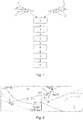
- Fig. 1 shows the steps of a method for controlling a display mode in a combat aircraft according to a preferred embodiment of the invention. Firstly, sensor capacity of an enemy combat aircraft 2 is determined 3. Secondly, a detection area based on the determined sensor capacity from the previous step is formed 4. Thirdly, the position of the combat aircraft 1 relative to the detection area is determined 5, and, finally, the display mode is controlled 6 based on the determined difference in position from the previous step. The determined difference in position is adapted for indicating whether the combat aircraft is inside or outside the detection area. In further steps, it is possible to record 7 sensor capacity and detection area and to display 8 the recorded data.
- Fig. 2 shows an HMI display mode controlled in a combat situation with zone mode or duel mode according to another preferred embodiment of the invention.
- HMI operates either zone-oriented or duel-oriented dependent on the assessed position. Zone position applies generally and it is not until the detection area is entered that the pilot's own aircraft is assumed to have been detected by the enemy aircraft. Any detection can be either analyzed by the decision support or set manually by the pilot. It is then shifted to a duel mode and HMI then operates with one duel for every enemy aircraft instead of with several duels combined. When the combat situation resumes its original character, HMI returns to zone position. This takes place either by manual switching or automatically by means of decision support.
- a good overview at an early stage facilitates planning an initiative-taking with low risk to one's own aircraft.
- the perspective switches to a duel situation with a threat object, such as an enemy combat aircraft or a ground station arranged near or on a surface-to-air missile site.
- a threat object such as an enemy combat aircraft or a ground station arranged near or on a surface-to-air missile site.
- every threat can be prioritized and handled on the basis of the risk it presents in the relevant time perspective.
Landscapes
- Engineering & Computer Science (AREA)
- Radar, Positioning & Navigation (AREA)
- Remote Sensing (AREA)
- Aviation & Aerospace Engineering (AREA)
- Physics & Mathematics (AREA)
- General Physics & Mathematics (AREA)
- General Engineering & Computer Science (AREA)
- Computer Networks & Wireless Communication (AREA)
- Radar Systems Or Details Thereof (AREA)
- Aiming, Guidance, Guns With A Light Source, Armor, Camouflage, And Targets (AREA)
- Traffic Control Systems (AREA)
Description
- The invention relates to a method for controlling a display mode in a combat aircraft.
- Document
US 6,567,014 B1 describes an aircraft head up display system that displays a basic mode, an en route mode, or an approach/landing mode. When the aircraft attitude changes to predefined unusual attitude conditions, the display changes to an unusual attitude mode to indicate the unusual attitude condition. The display in the unusual attitude mode removes non-essential symbols and displays the aircraft air speed, altitude and attitude. - Document
WO 2013/122521 A1 describes a method for decision support of a first combat aircraft in a combat situation. The method comprises detecting a second combat aircraft; analysing the second combat aircraft to determine its type, its sensor capacity and its total weapons capacity; and recording the sensor capacity and the total weapons capacity of the second combat aircraft to determine a first geographic zone adapted for defining the detection limit of the second combat aircraft, and a second geographic zone adapted for defining a shoot-down limit of the second combat aircraft respectively, wherein the first and the second geographic zone are adapted for decision support of the first combat aircraft in the combat situation with the second combat aircraft. Thereby assistance is provided to the pilot in decision support in complicated combat situations. - Highly developed functions for human machine interface, HMI for short, and decision support as support functions for the pilot environment in combat aircraft already exist. All solutions are based on and adapted for high tempo in flight and combat situations where HMI and decision support together describe the current position and display tools and solutions to the pilot. Existing solutions are based on the aircraft itself and its available resources and tools. Sensors, such as radar, are typically operated by the pilot as a tool for close-range scanning or for scanning objects for identification and continued pursuit. Decision support supports the multiple use of sensors by merging objects detected by several different sensors and coordinating and correlating these objects in a situation picture. This is usually done via networks in further steps to create a common situation picture between several aircraft within an aircraft group.
- When complexity increases because more tools and sensors are supplied, the possibilities available to the pilot to control his tools and/or sensors in time are limited and made difficult. In time-critical situations, for instance in air combat, the pilot risks becoming the underdog. Another limitation is the fact that each tool and/or sensor has its own characteristics and peculiarities. Each sensor and/or tool therefore requires its own interface and control functions which the pilot needs to be able to understand and use correctly.
- It is the object of the invention to provide a possibility for controlling a display mode such that the pilot gets a quick overview.
- This object is achieved by the subject matter of
independent claim 1. Preferred embodiments are defined in the sub claims. - According to an example which is not part of the invention, the method comprises the step of recording sensor capacity and detection area, wherein the recorded data is adapted for generating a situation picture. According to this example which is not part of the invention, the method preferably comprises the step of displaying the recorded data corresponding to displaying a plurality of situation pictures.
- According to a preferred embodiment of the invention, the step of determining sensor capacity of the enemy combat aircraft is performed by detecting or by assuming the sensor capacity of the enemy combat aircraft. The detection of sensor capacity of the enemy combat aircraft is preferably done when the enemy combat aircraft is in proximity to the combat aircraft.
- According to a preferred embodiment of the invention, the display mode is selected based on a predetermined condition comprising the determined change in position relative to a predefined zone. The predefined zone preferably corresponds to a geographic zone adapted for defining the detection limit of the enemy combat aircraft of to a geographic zone adapted for defining a shoot-down limit of the enemy combat aircraft, respectively, wherein the geographic zone is adapted for decision support of the combat aircraft in a combat situation with the enemy combat aircraft.
- According to an example which is not part of the invention, detecting is preferably performed by a sensor, such as radar, a database and/or a link and controlling the display mode is performed in a continuous fashion such that the display is continuously switched between different modes when a probabilistic value is exceeded, wherein the probalistic value is determined by at least one of a predefined detection criterion, a predefined identification criterion and a predefined behaviour criterion of the enemy combat aircraft. Such a predefined criterion preferably comprises a predefined altitude limit, a predefined speed limit and/or a combat tactical criterion, such as at least one sensor parameter and/or a weapon limit.
- The terms "in a continuous fashion" and "continuously switched" refer to the switching of the display mode and mean that switching of the display mode is done continuously in time and/or in frequency. This is preferably done in a way such that a user cannot perceive a discrete change on the screen of the display. This preferably corresponds to the fact that a change of the display mode is done such that the display screen shows the change of the display mode without punctuation or without interruption, i.e. the user cannot perceive the change of display mode by a discrete fluctuation on the display screen itself.
- According to a preferred embodiment of the invention, the enemy combat aircraft corresponds to at least one of a ground station, an unmanned aerial vehicle and a helicopter.
- It is an idea of the invention that the step of controlling, i.e. step d), is adapted for decision support when preferably handled three dimensionally, i.e. the calculations in the previous steps referring to the determination of different parameters, such as sensor capacity and position, are performed in three dimensions. However, a two dimensional display for the pilot is typically sufficient for decision support.
- It is an idea of the invention that the aircraft adapts its HMI to the pilot based on the assessed combat situation. The adaptation is achieved by two modes: Firstly, the pilot's own aircraft is assessed not to have been detected. This situation picture is recorded on the basis of a zone perspective with different zones indicated on the basis of the overall enemy situation. Secondly, the pilot's own aircraft is assessed to have been detected. The situation picture assumes a duel mode in which every enemy aircraft is recorded from a duel perspective. In this way, a good overview of combat in an early stage is provided by means of an overall perspective based on zone areas. In more intensive combat, where survival is assessed as critical, the perspective shifts to a duel situation with a duel against every defined enemy aircraft. It is a further idea of the invention to adapt to different situations. It is switched between a zone mode and a duel mode, wherein the duel mode is on top priority. If the pilot is inside the detection area it is switched to a duel mode and a duel with every opponent is established. If the pilot is outside of the detection area it is switched to a zone mode such that the pilot gets an overview over the complete situation. In the duel mode, there are restricted volumes of interest, i.e. the object is of interest. In the zone mode, there are areas of interest. Hence, it is an idea of the situation to provide a situation-adapted method in order to be almost always aware of the current situation.
- These and other aspects of the invention will be apparent from and elucidated with reference to the embodiments described hereinafter. In the drawings:
-
Fig. 1 illustrates the steps of a method for controlling a display mode in a combat aircraft according to a preferred embodiment of the inventions; and -
Fig. 2 shows an HMI display mode controlled in a combat situation with zone mode or duel mode according to another preferred embodiment of the invention. -
Fig. 1 shows the steps of a method for controlling a display mode in a combat aircraft according to a preferred embodiment of the invention. Firstly, sensor capacity of anenemy combat aircraft 2 is determined 3. Secondly, a detection area based on the determined sensor capacity from the previous step is formed 4. Thirdly, the position of thecombat aircraft 1 relative to the detection area is determined 5, and, finally, the display mode is controlled 6 based on the determined difference in position from the previous step. The determined difference in position is adapted for indicating whether the combat aircraft is inside or outside the detection area. In further steps, it is possible to record 7 sensor capacity and detection area and to display 8 the recorded data. -
Fig. 2 shows an HMI display mode controlled in a combat situation with zone mode or duel mode according to another preferred embodiment of the invention. HMI operates either zone-oriented or duel-oriented dependent on the assessed position. Zone position applies generally and it is not until the detection area is entered that the pilot's own aircraft is assumed to have been detected by the enemy aircraft. Any detection can be either analyzed by the decision support or set manually by the pilot. It is then shifted to a duel mode and HMI then operates with one duel for every enemy aircraft instead of with several duels combined. When the combat situation resumes its original character, HMI returns to zone position. This takes place either by manual switching or automatically by means of decision support. - In this way a good overview at an early stage facilitates planning an initiative-taking with low risk to one's own aircraft. When the risk increases because one's own aircraft is detected, the perspective switches to a duel situation with a threat object, such as an enemy combat aircraft or a ground station arranged near or on a surface-to-air missile site. In the duel situation every threat can be prioritized and handled on the basis of the risk it presents in the relevant time perspective.
- The embodiments of the invention as illustrated and described in detail in the drawings and foregoing description may be combined.
Claims (4)
- A method for controlling a display mode in a combat aircraft (1) comprising the steps of:a) determining (3) sensor capacity of an enemy combat aircraft (2),b) forming (4) a detection area based on the determined sensor capacity from the previous step a), andc) determining (5) the position of the combat aircraft (1) relative to the detection area,
characterized byd) controlling (6) the display mode based on the determined relative position from the previous step c), wherein the determined relative position is adapted for indicating whether the combat aircraft (1) is inside or outside the detection area, if the combat aircraft (1) is outside of the detection area the display mode is switched to a zone mode showing an overview of an overall enemy situation, and if the combat aircraft (1) is inside the detection area the display mode is switched to a duel mode showing restricted volumes of the overall enemy situation relating to the enemy combat aircraft (2). - The method according to claim 1, wherein the step of determining (3) sensor capacity of the enemy combat aircraft (2) is performed by detecting or by assuming the sensor capacity of the enemy combat aircraft (2).
- The method according to claim 1 or 2, wherein the display mode is selected based on a predetermined condition comprising the determined change in position relative to a predefined zone, wherein the predefined zone is a geographic zone indicative of a shoot-down limit of the enemy combat aircraft (2).
- The method according to one of the preceding claims, wherein the enemy combat aircraft (2) corresponds to at least one of an unmanned aerial vehicle and a helicopter.
Applications Claiming Priority (2)
| Application Number | Priority Date | Filing Date | Title |
|---|---|---|---|
| SE1650700A SE1650700A1 (en) | 2016-05-23 | 2016-05-23 | HMI controlled by combat situation |
| PCT/SE2017/050508 WO2017204721A1 (en) | 2016-05-23 | 2017-05-16 | Method for controlling a display mode in a combat aircraft |
Publications (3)
| Publication Number | Publication Date |
|---|---|
| EP3465096A1 EP3465096A1 (en) | 2019-04-10 |
| EP3465096A4 EP3465096A4 (en) | 2020-01-29 |
| EP3465096B1 true EP3465096B1 (en) | 2022-06-01 |
Family
ID=60411463
Family Applications (1)
| Application Number | Title | Priority Date | Filing Date |
|---|---|---|---|
| EP17803165.4A Active EP3465096B1 (en) | 2016-05-23 | 2017-05-16 | Method for controlling a display mode in a combat aircraft |
Country Status (3)
| Country | Link |
|---|---|
| EP (1) | EP3465096B1 (en) |
| SE (1) | SE1650700A1 (en) |
| WO (1) | WO2017204721A1 (en) |
Family Cites Families (7)
| Publication number | Priority date | Publication date | Assignee | Title |
|---|---|---|---|---|
| IL112239A0 (en) * | 1994-01-18 | 1995-03-30 | Honeywell Inc | Method and system for managing aircraft threat data |
| US6567014B1 (en) | 1998-11-05 | 2003-05-20 | Rockwell Collins, Inc. | Aircraft head up display system |
| SE518926C2 (en) * | 2001-05-10 | 2002-12-10 | Saab Ab | Vehicle display device and ways to display detected threats, remaining fuel quantity and time offset |
| IL145593A (en) * | 2001-09-24 | 2007-05-15 | Rafael Armament Dev Authority | Method of vehicle operation in an environment of high psychological pressure |
| US6865452B2 (en) * | 2002-08-30 | 2005-03-08 | Honeywell International Inc. | Quiet mode operation for cockpit weather displays |
| EP2815202B1 (en) | 2012-02-16 | 2020-11-18 | Saab Ab | A method for determining threat status for combat aircrafts |
| US9013500B2 (en) * | 2012-10-22 | 2015-04-21 | The Boeing Company | Real time intervisibility analysis |
-
2016
- 2016-05-23 SE SE1650700A patent/SE1650700A1/en not_active Application Discontinuation
-
2017
- 2017-05-16 EP EP17803165.4A patent/EP3465096B1/en active Active
- 2017-05-16 WO PCT/SE2017/050508 patent/WO2017204721A1/en not_active Ceased
Also Published As
| Publication number | Publication date |
|---|---|
| WO2017204721A1 (en) | 2017-11-30 |
| EP3465096A1 (en) | 2019-04-10 |
| EP3465096A4 (en) | 2020-01-29 |
| SE1650700A1 (en) | 2017-11-24 |
Similar Documents
| Publication | Publication Date | Title |
|---|---|---|
| EP3717352B1 (en) | Autonomous unmanned aerial vehicle and method of control thereof | |
| AU2020204166B2 (en) | Interactive weapon targeting system displaying remote sensed image of target area | |
| US8280702B2 (en) | Vehicle aspect control | |
| US9286807B2 (en) | Collision avoidance system and a method for determining an escape manoeuvre trajectory for collision avoidance | |
| US8700231B2 (en) | Device at an airborne vehicle and a method for collision avoidance | |
| EP2815202B1 (en) | A method for determining threat status for combat aircrafts | |
| EP0740772B1 (en) | Threat avoidance method for aircraft | |
| US10124907B1 (en) | Autorotation guidance command system, device, and method | |
| US10540898B2 (en) | Decision support system for air missioncommander dynamic mission re-planning | |
| CN109901617A (en) | UAV flight method, device and UAV | |
| US10037041B2 (en) | System and apparatus for integrating mobile sensor platforms into autonomous vehicle operational control | |
| US9007257B2 (en) | Method for variable control of a zone sensor in a combat aircraft | |
| KR101483058B1 (en) | Ground control system for UAV anticollision | |
| US20190244429A1 (en) | Head Wearable Device, System, and Method for Displaying Teamed Asset Information | |
| JP6200539B1 (en) | Reconnaissance position calculation device, reconnaissance position calculation method, and reconnaissance position calculation program | |
| WO2017204721A1 (en) | Method for controlling a display mode in a combat aircraft | |
| Theunissen et al. | Integration of threat information into the route (re-) planning task | |
| US20140288907A1 (en) | Method for duel handling in a combat aircraft | |
| CN106525048A (en) | Method and device for recommending air line and stop en route | |
| Kochan | Automation in the sky | |
| WO2013089606A1 (en) | Object-focussed decision support | |
| US20220326821A1 (en) | Mum-t route emphasis | |
| Helldin et al. | Supporting fighter pilot decision making through team option awareness | |
| Lewis | Comance tactics expert function | |
| HK40010978A (en) | Autonomous unmanned aerial vehicle and method of control thereof |
Legal Events
| Date | Code | Title | Description |
|---|---|---|---|
| STAA | Information on the status of an ep patent application or granted ep patent |
Free format text: STATUS: THE INTERNATIONAL PUBLICATION HAS BEEN MADE |
|
| PUAI | Public reference made under article 153(3) epc to a published international application that has entered the european phase |
Free format text: ORIGINAL CODE: 0009012 |
|
| STAA | Information on the status of an ep patent application or granted ep patent |
Free format text: STATUS: REQUEST FOR EXAMINATION WAS MADE |
|
| 17P | Request for examination filed |
Effective date: 20181121 |
|
| AK | Designated contracting states |
Kind code of ref document: A1 Designated state(s): AL AT BE BG CH CY CZ DE DK EE ES FI FR GB GR HR HU IE IS IT LI LT LU LV MC MK MT NL NO PL PT RO RS SE SI SK SM TR |
|
| AX | Request for extension of the european patent |
Extension state: BA ME |
|
| DAV | Request for validation of the european patent (deleted) | ||
| DAX | Request for extension of the european patent (deleted) | ||
| REG | Reference to a national code |
Ref country code: DE Ref legal event code: R079 Ref document number: 602017058076 Country of ref document: DE Free format text: PREVIOUS MAIN CLASS: G01C0023000000 Ipc: G02B0027010000 |
|
| A4 | Supplementary search report drawn up and despatched |
Effective date: 20200108 |
|
| RIC1 | Information provided on ipc code assigned before grant |
Ipc: F41G 9/00 20060101ALI20191220BHEP Ipc: G01S 7/04 20060101ALI20191220BHEP Ipc: B64D 47/00 20060101ALI20191220BHEP Ipc: B64D 43/00 20060101ALI20191220BHEP Ipc: F41G 3/16 20060101ALI20191220BHEP Ipc: F41G 3/22 20060101ALI20191220BHEP Ipc: G02B 27/01 20060101AFI20191220BHEP |
|
| GRAP | Despatch of communication of intention to grant a patent |
Free format text: ORIGINAL CODE: EPIDOSNIGR1 |
|
| STAA | Information on the status of an ep patent application or granted ep patent |
Free format text: STATUS: GRANT OF PATENT IS INTENDED |
|
| INTG | Intention to grant announced |
Effective date: 20220105 |
|
| GRAS | Grant fee paid |
Free format text: ORIGINAL CODE: EPIDOSNIGR3 |
|
| GRAA | (expected) grant |
Free format text: ORIGINAL CODE: 0009210 |
|
| STAA | Information on the status of an ep patent application or granted ep patent |
Free format text: STATUS: THE PATENT HAS BEEN GRANTED |
|
| AK | Designated contracting states |
Kind code of ref document: B1 Designated state(s): AL AT BE BG CH CY CZ DE DK EE ES FI FR GB GR HR HU IE IS IT LI LT LU LV MC MK MT NL NO PL PT RO RS SE SI SK SM TR |
|
| REG | Reference to a national code |
Ref country code: GB Ref legal event code: FG4D |
|
| REG | Reference to a national code |
Ref country code: AT Ref legal event code: REF Ref document number: 1495788 Country of ref document: AT Kind code of ref document: T Effective date: 20220615 Ref country code: CH Ref legal event code: EP Ref country code: DE Ref legal event code: R096 Ref document number: 602017058076 Country of ref document: DE |
|
| REG | Reference to a national code |
Ref country code: IE Ref legal event code: FG4D |
|
| REG | Reference to a national code |
Ref country code: LT Ref legal event code: MG9D |
|
| REG | Reference to a national code |
Ref country code: NL Ref legal event code: MP Effective date: 20220601 |
|
| PG25 | Lapsed in a contracting state [announced via postgrant information from national office to epo] |
Ref country code: SE Free format text: LAPSE BECAUSE OF FAILURE TO SUBMIT A TRANSLATION OF THE DESCRIPTION OR TO PAY THE FEE WITHIN THE PRESCRIBED TIME-LIMIT Effective date: 20220601 Ref country code: NO Free format text: LAPSE BECAUSE OF FAILURE TO SUBMIT A TRANSLATION OF THE DESCRIPTION OR TO PAY THE FEE WITHIN THE PRESCRIBED TIME-LIMIT Effective date: 20220901 Ref country code: LT Free format text: LAPSE BECAUSE OF FAILURE TO SUBMIT A TRANSLATION OF THE DESCRIPTION OR TO PAY THE FEE WITHIN THE PRESCRIBED TIME-LIMIT Effective date: 20220601 Ref country code: HR Free format text: LAPSE BECAUSE OF FAILURE TO SUBMIT A TRANSLATION OF THE DESCRIPTION OR TO PAY THE FEE WITHIN THE PRESCRIBED TIME-LIMIT Effective date: 20220601 Ref country code: GR Free format text: LAPSE BECAUSE OF FAILURE TO SUBMIT A TRANSLATION OF THE DESCRIPTION OR TO PAY THE FEE WITHIN THE PRESCRIBED TIME-LIMIT Effective date: 20220902 Ref country code: FI Free format text: LAPSE BECAUSE OF FAILURE TO SUBMIT A TRANSLATION OF THE DESCRIPTION OR TO PAY THE FEE WITHIN THE PRESCRIBED TIME-LIMIT Effective date: 20220601 Ref country code: ES Free format text: LAPSE BECAUSE OF FAILURE TO SUBMIT A TRANSLATION OF THE DESCRIPTION OR TO PAY THE FEE WITHIN THE PRESCRIBED TIME-LIMIT Effective date: 20220601 Ref country code: BG Free format text: LAPSE BECAUSE OF FAILURE TO SUBMIT A TRANSLATION OF THE DESCRIPTION OR TO PAY THE FEE WITHIN THE PRESCRIBED TIME-LIMIT Effective date: 20220901 |
|
| REG | Reference to a national code |
Ref country code: AT Ref legal event code: MK05 Ref document number: 1495788 Country of ref document: AT Kind code of ref document: T Effective date: 20220601 |
|
| PG25 | Lapsed in a contracting state [announced via postgrant information from national office to epo] |
Ref country code: RS Free format text: LAPSE BECAUSE OF FAILURE TO SUBMIT A TRANSLATION OF THE DESCRIPTION OR TO PAY THE FEE WITHIN THE PRESCRIBED TIME-LIMIT Effective date: 20220601 Ref country code: PL Free format text: LAPSE BECAUSE OF FAILURE TO SUBMIT A TRANSLATION OF THE DESCRIPTION OR TO PAY THE FEE WITHIN THE PRESCRIBED TIME-LIMIT Effective date: 20220601 Ref country code: LV Free format text: LAPSE BECAUSE OF FAILURE TO SUBMIT A TRANSLATION OF THE DESCRIPTION OR TO PAY THE FEE WITHIN THE PRESCRIBED TIME-LIMIT Effective date: 20220601 |
|
| PG25 | Lapsed in a contracting state [announced via postgrant information from national office to epo] |
Ref country code: NL Free format text: LAPSE BECAUSE OF FAILURE TO SUBMIT A TRANSLATION OF THE DESCRIPTION OR TO PAY THE FEE WITHIN THE PRESCRIBED TIME-LIMIT Effective date: 20220601 |
|
| PG25 | Lapsed in a contracting state [announced via postgrant information from national office to epo] |
Ref country code: SM Free format text: LAPSE BECAUSE OF FAILURE TO SUBMIT A TRANSLATION OF THE DESCRIPTION OR TO PAY THE FEE WITHIN THE PRESCRIBED TIME-LIMIT Effective date: 20220601 Ref country code: SK Free format text: LAPSE BECAUSE OF FAILURE TO SUBMIT A TRANSLATION OF THE DESCRIPTION OR TO PAY THE FEE WITHIN THE PRESCRIBED TIME-LIMIT Effective date: 20220601 Ref country code: RO Free format text: LAPSE BECAUSE OF FAILURE TO SUBMIT A TRANSLATION OF THE DESCRIPTION OR TO PAY THE FEE WITHIN THE PRESCRIBED TIME-LIMIT Effective date: 20220601 Ref country code: PT Free format text: LAPSE BECAUSE OF FAILURE TO SUBMIT A TRANSLATION OF THE DESCRIPTION OR TO PAY THE FEE WITHIN THE PRESCRIBED TIME-LIMIT Effective date: 20221003 Ref country code: EE Free format text: LAPSE BECAUSE OF FAILURE TO SUBMIT A TRANSLATION OF THE DESCRIPTION OR TO PAY THE FEE WITHIN THE PRESCRIBED TIME-LIMIT Effective date: 20220601 Ref country code: CZ Free format text: LAPSE BECAUSE OF FAILURE TO SUBMIT A TRANSLATION OF THE DESCRIPTION OR TO PAY THE FEE WITHIN THE PRESCRIBED TIME-LIMIT Effective date: 20220601 Ref country code: AT Free format text: LAPSE BECAUSE OF FAILURE TO SUBMIT A TRANSLATION OF THE DESCRIPTION OR TO PAY THE FEE WITHIN THE PRESCRIBED TIME-LIMIT Effective date: 20220601 |
|
| PG25 | Lapsed in a contracting state [announced via postgrant information from national office to epo] |
Ref country code: IS Free format text: LAPSE BECAUSE OF FAILURE TO SUBMIT A TRANSLATION OF THE DESCRIPTION OR TO PAY THE FEE WITHIN THE PRESCRIBED TIME-LIMIT Effective date: 20221001 |
|
| REG | Reference to a national code |
Ref country code: DE Ref legal event code: R097 Ref document number: 602017058076 Country of ref document: DE |
|
| PG25 | Lapsed in a contracting state [announced via postgrant information from national office to epo] |
Ref country code: AL Free format text: LAPSE BECAUSE OF FAILURE TO SUBMIT A TRANSLATION OF THE DESCRIPTION OR TO PAY THE FEE WITHIN THE PRESCRIBED TIME-LIMIT Effective date: 20220601 |
|
| PLBE | No opposition filed within time limit |
Free format text: ORIGINAL CODE: 0009261 |
|
| STAA | Information on the status of an ep patent application or granted ep patent |
Free format text: STATUS: NO OPPOSITION FILED WITHIN TIME LIMIT |
|
| PG25 | Lapsed in a contracting state [announced via postgrant information from national office to epo] |
Ref country code: DK Free format text: LAPSE BECAUSE OF FAILURE TO SUBMIT A TRANSLATION OF THE DESCRIPTION OR TO PAY THE FEE WITHIN THE PRESCRIBED TIME-LIMIT Effective date: 20220601 |
|
| 26N | No opposition filed |
Effective date: 20230302 |
|
| PG25 | Lapsed in a contracting state [announced via postgrant information from national office to epo] |
Ref country code: SI Free format text: LAPSE BECAUSE OF FAILURE TO SUBMIT A TRANSLATION OF THE DESCRIPTION OR TO PAY THE FEE WITHIN THE PRESCRIBED TIME-LIMIT Effective date: 20220601 |
|
| REG | Reference to a national code |
Ref country code: DE Ref legal event code: R119 Ref document number: 602017058076 Country of ref document: DE |
|
| REG | Reference to a national code |
Ref country code: CH Ref legal event code: PL |
|
| PG25 | Lapsed in a contracting state [announced via postgrant information from national office to epo] |
Ref country code: MC Free format text: LAPSE BECAUSE OF FAILURE TO SUBMIT A TRANSLATION OF THE DESCRIPTION OR TO PAY THE FEE WITHIN THE PRESCRIBED TIME-LIMIT Effective date: 20220601 |
|
| REG | Reference to a national code |
Ref country code: BE Ref legal event code: MM Effective date: 20230531 |
|
| PG25 | Lapsed in a contracting state [announced via postgrant information from national office to epo] |
Ref country code: MC Free format text: LAPSE BECAUSE OF FAILURE TO SUBMIT A TRANSLATION OF THE DESCRIPTION OR TO PAY THE FEE WITHIN THE PRESCRIBED TIME-LIMIT Effective date: 20220601 Ref country code: LU Free format text: LAPSE BECAUSE OF NON-PAYMENT OF DUE FEES Effective date: 20230516 Ref country code: LI Free format text: LAPSE BECAUSE OF NON-PAYMENT OF DUE FEES Effective date: 20230531 Ref country code: IT Free format text: LAPSE BECAUSE OF FAILURE TO SUBMIT A TRANSLATION OF THE DESCRIPTION OR TO PAY THE FEE WITHIN THE PRESCRIBED TIME-LIMIT Effective date: 20220601 Ref country code: CH Free format text: LAPSE BECAUSE OF NON-PAYMENT OF DUE FEES Effective date: 20230531 |
|
| REG | Reference to a national code |
Ref country code: IE Ref legal event code: MM4A |
|
| PG25 | Lapsed in a contracting state [announced via postgrant information from national office to epo] |
Ref country code: IE Free format text: LAPSE BECAUSE OF NON-PAYMENT OF DUE FEES Effective date: 20230516 |
|
| PG25 | Lapsed in a contracting state [announced via postgrant information from national office to epo] |
Ref country code: IE Free format text: LAPSE BECAUSE OF NON-PAYMENT OF DUE FEES Effective date: 20230516 Ref country code: DE Free format text: LAPSE BECAUSE OF NON-PAYMENT OF DUE FEES Effective date: 20231201 |
|
| PG25 | Lapsed in a contracting state [announced via postgrant information from national office to epo] |
Ref country code: BE Free format text: LAPSE BECAUSE OF NON-PAYMENT OF DUE FEES Effective date: 20230531 |
|
| PG25 | Lapsed in a contracting state [announced via postgrant information from national office to epo] |
Ref country code: BG Free format text: LAPSE BECAUSE OF FAILURE TO SUBMIT A TRANSLATION OF THE DESCRIPTION OR TO PAY THE FEE WITHIN THE PRESCRIBED TIME-LIMIT Effective date: 20220601 |
|
| PG25 | Lapsed in a contracting state [announced via postgrant information from national office to epo] |
Ref country code: BG Free format text: LAPSE BECAUSE OF FAILURE TO SUBMIT A TRANSLATION OF THE DESCRIPTION OR TO PAY THE FEE WITHIN THE PRESCRIBED TIME-LIMIT Effective date: 20220601 |
|
| PG25 | Lapsed in a contracting state [announced via postgrant information from national office to epo] |
Ref country code: CY Free format text: LAPSE BECAUSE OF FAILURE TO SUBMIT A TRANSLATION OF THE DESCRIPTION OR TO PAY THE FEE WITHIN THE PRESCRIBED TIME-LIMIT; INVALID AB INITIO Effective date: 20170516 |
|
| PG25 | Lapsed in a contracting state [announced via postgrant information from national office to epo] |
Ref country code: HU Free format text: LAPSE BECAUSE OF FAILURE TO SUBMIT A TRANSLATION OF THE DESCRIPTION OR TO PAY THE FEE WITHIN THE PRESCRIBED TIME-LIMIT; INVALID AB INITIO Effective date: 20170516 |
|
| PG25 | Lapsed in a contracting state [announced via postgrant information from national office to epo] |
Ref country code: TR Free format text: LAPSE BECAUSE OF FAILURE TO SUBMIT A TRANSLATION OF THE DESCRIPTION OR TO PAY THE FEE WITHIN THE PRESCRIBED TIME-LIMIT Effective date: 20220601 |
|
| PGFP | Annual fee paid to national office [announced via postgrant information from national office to epo] |
Ref country code: GB Payment date: 20260316 Year of fee payment: 10 |
|
| PGFP | Annual fee paid to national office [announced via postgrant information from national office to epo] |
Ref country code: FR Payment date: 20260316 Year of fee payment: 10 |