EP3461101B1 - System and method for secure two-party evaluation of utility of sharing data - Google Patents
System and method for secure two-party evaluation of utility of sharing data Download PDFInfo
- Publication number
- EP3461101B1 EP3461101B1 EP18196122.8A EP18196122A EP3461101B1 EP 3461101 B1 EP3461101 B1 EP 3461101B1 EP 18196122 A EP18196122 A EP 18196122A EP 3461101 B1 EP3461101 B1 EP 3461101B1
- Authority
- EP
- European Patent Office
- Prior art keywords
- data
- encrypted
- computing device
- utility
- statistic
- Prior art date
- Legal status (The legal status is an assumption and is not a legal conclusion. Google has not performed a legal analysis and makes no representation as to the accuracy of the status listed.)
- Active
Links
Images





Classifications
-
- H—ELECTRICITY
- H04—ELECTRIC COMMUNICATION TECHNIQUE
- H04L—TRANSMISSION OF DIGITAL INFORMATION, e.g. TELEGRAPHIC COMMUNICATION
- H04L63/00—Network architectures or network communication protocols for network security
- H04L63/06—Network architectures or network communication protocols for network security for supporting key management in a packet data network
- H04L63/061—Network architectures or network communication protocols for network security for supporting key management in a packet data network for key exchange, e.g. in peer-to-peer networks
-
- H—ELECTRICITY
- H04—ELECTRIC COMMUNICATION TECHNIQUE
- H04L—TRANSMISSION OF DIGITAL INFORMATION, e.g. TELEGRAPHIC COMMUNICATION
- H04L63/00—Network architectures or network communication protocols for network security
- H04L63/04—Network architectures or network communication protocols for network security for providing a confidential data exchange among entities communicating through data packet networks
- H04L63/0428—Network architectures or network communication protocols for network security for providing a confidential data exchange among entities communicating through data packet networks wherein the data content is protected, e.g. by encrypting or encapsulating the payload
- H04L63/0442—Network architectures or network communication protocols for network security for providing a confidential data exchange among entities communicating through data packet networks wherein the data content is protected, e.g. by encrypting or encapsulating the payload wherein the sending and receiving network entities apply asymmetric encryption, i.e. different keys for encryption and decryption
-
- H—ELECTRICITY
- H04—ELECTRIC COMMUNICATION TECHNIQUE
- H04L—TRANSMISSION OF DIGITAL INFORMATION, e.g. TELEGRAPHIC COMMUNICATION
- H04L63/00—Network architectures or network communication protocols for network security
- H04L63/04—Network architectures or network communication protocols for network security for providing a confidential data exchange among entities communicating through data packet networks
- H04L63/0428—Network architectures or network communication protocols for network security for providing a confidential data exchange among entities communicating through data packet networks wherein the data content is protected, e.g. by encrypting or encapsulating the payload
- H04L63/0435—Network architectures or network communication protocols for network security for providing a confidential data exchange among entities communicating through data packet networks wherein the data content is protected, e.g. by encrypting or encapsulating the payload wherein the sending and receiving network entities apply symmetric encryption, i.e. same key used for encryption and decryption
-
- H—ELECTRICITY
- H04—ELECTRIC COMMUNICATION TECHNIQUE
- H04L—TRANSMISSION OF DIGITAL INFORMATION, e.g. TELEGRAPHIC COMMUNICATION
- H04L63/00—Network architectures or network communication protocols for network security
- H04L63/08—Network architectures or network communication protocols for network security for authentication of entities
- H04L63/0853—Network architectures or network communication protocols for network security for authentication of entities using an additional device, e.g. smartcard, SIM or a different communication terminal
-
- H—ELECTRICITY
- H04—ELECTRIC COMMUNICATION TECHNIQUE
- H04L—TRANSMISSION OF DIGITAL INFORMATION, e.g. TELEGRAPHIC COMMUNICATION
- H04L67/00—Network arrangements or protocols for supporting network services or applications
- H04L67/01—Protocols
- H04L67/02—Protocols based on web technology, e.g. hypertext transfer protocol [HTTP]
-
- H—ELECTRICITY
- H04—ELECTRIC COMMUNICATION TECHNIQUE
- H04L—TRANSMISSION OF DIGITAL INFORMATION, e.g. TELEGRAPHIC COMMUNICATION
- H04L67/00—Network arrangements or protocols for supporting network services or applications
- H04L67/14—Session management
- H04L67/141—Setup of application sessions
-
- H—ELECTRICITY
- H04—ELECTRIC COMMUNICATION TECHNIQUE
- H04L—TRANSMISSION OF DIGITAL INFORMATION, e.g. TELEGRAPHIC COMMUNICATION
- H04L67/00—Network arrangements or protocols for supporting network services or applications
- H04L67/14—Session management
- H04L67/146—Markers for unambiguous identification of a particular session, e.g. session cookie or URL-encoding
-
- H—ELECTRICITY
- H04—ELECTRIC COMMUNICATION TECHNIQUE
- H04L—TRANSMISSION OF DIGITAL INFORMATION, e.g. TELEGRAPHIC COMMUNICATION
- H04L63/00—Network architectures or network communication protocols for network security
- H04L63/14—Network architectures or network communication protocols for network security for detecting or protecting against malicious traffic
- H04L63/1408—Network architectures or network communication protocols for network security for detecting or protecting against malicious traffic by monitoring network traffic
- H04L63/1416—Event detection, e.g. attack signature detection
Definitions
- This disclosure is generally related to machine learning. More specifically, this disclosure is related to a method and system for evaluating utility of sharing feature data.
- Data on different aspects of a system may be captured by different stakeholders. In order to get a complete perspective of the system, data can be traded between the stakeholders.
- IoT devices are owned by different owners (manufacturers, service providers, consumers, etc.), where data collected by a single owner provides only a partial view of the system.
- Identifying trading partners and determining the value of the data can be a tricky challenge, particularly because the value would depend on the quality and content of the data.
- a party seeking to obtain data may want the data only if the value or utility of the data can be determined beforehand.
- the data owner may not want to reveal the content of the data before agreeing on terms for transferring the data.
- US 8,418,249 B1 discloses a method for profiling network traffic.
- Embodiments described herein provide a system for securely estimating the utility of combining data from two or more parties.
- the system may exchange, in multiple rounds, encrypted data and encrypted statistics computed for the data.
- a statistic is a measure derived from one or more attributes of the data.
- the system may build an encrypted utility statistic using computations in an encrypted domain without sharing private decryption keys.
- One or more parties may then apply a respective private decryption key to decrypt the encrypted utility statistic to obtain a utility statistic.
- the system may determine that the utility statistic exceeds a predetermined threshold and request a set of data from the second computing device.
- the system may apply the set of data to improve a classifier.
- a system for obtaining a utility statistic is also described.
- the system may encrypt a set of class labels based on a public key/private key pair to obtain a set of encrypted class labels.
- the system may send a public key and the set of encrypted class labels to a second computing device.
- the system may receive an encrypted value computed by the second computing device based on the public key.
- the system may decrypt the encrypted value based on a private key to obtain a decrypted value.
- the system may then send a pair of encrypted values computed based on the decrypted value to the second computing device.
- the system may subsequently receive an encrypted utility statistic from the second computing device, and decrypt the encrypted utility statistic to obtain a decrypted utility statistic.
- sending the pair of encrypted values further includes computing a pair of values based on the decrypted value.
- the system may also encrypt, based on the public key, the pair of values to obtain the pair of encrypted values.
- the system may determine that the decrypted utility statistic exceeds a predetermined threshold.
- the system may request a set of data from the second computing device, and apply the set of data to improve the classifier
- class labels are associated with binary attributes.
- system may send a request to the second computing device to compute a utility statistic.
- sending the public key and the set of encrypted class labels further includes computing a value based on a sum of elements of a feature vector which includes the set of class labels.
- the system may encrypt the computed value, and send the encrypted value to the second computing device.
- the system may compute a second encrypted utility statistic in a two-stream mode, and send the second encrypted utility statistic to the second computing device.
- the system may re-encrypt the decrypted utility statistic based on a first single-use key to obtain a re-encrypted utility statistic.
- the system may send the re-encrypted utility statistic to the second computing device.
- the system may receive a second re-encrypted utility statistic value and a second single-use key from the second computing device.
- the system may then send the first single-use key to the second computing device.
- the system may decrypt the second re-encrypted utility statistic based on the second single-use key to obtain a second utility statistic, and determine that the second utility statistic is equal to the decrypted utility statistic.
- the second computing device applies a statistical privacy technique to a set of data to obtain a second set of data to be considered for sharing/combining.
- the second computing device performs operations comprising computing the encrypted value based on the set of encrypted class labels and the public key.
- the second computing device performs at least one of a binary operation associated with an additively homomorphic private key encryption scheme, and a binary operation associated with a scalar multiplication homomorphic private key encryption scheme.
- a non-transitory computer-readable storage medium storing instructions which when executed by a computing system with multiple computing devices cause the system to perform a method for securely estimating the utility of combining data from two or more parties.
- the system may exchange, in multiple rounds, encrypted data and encrypted statistics computed for the data.
- a statistic is a measure derived from one or more attributes of the data.
- the system may build an encrypted utility statistic using computations in an encrypted domain without sharing private decryption keys. One or more parties may then apply a respective private decryption key to decrypt the encrypted utility statistic to obtain a utility statistic.
- a non-transitory computer-readable storage medium is provided ,storing instructions which when executed by a computing system (e.g., computer) cause the system to perform a method for obtaining a utility statistic.
- the system may encrypt a set of class labels based on a public key/private key pair to obtain a set of encrypted class labels.
- the system may send a public key and the set of encrypted class labels to a second computing device.
- the system may receive an encrypted value computed by the second computing device based on the public key.
- the system may decrypt the encrypted value based on a private key to obtain a decrypted value.
- the system may then send a pair of encrypted values computed based on the decrypted value to the second computing device.
- the system may subsequently receive an encrypted utility statistic from the second computing device, and decrypt the encrypted utility statistic to obtain a decrypted utility statistic.
- a system for performing a protocol to facilitate generating a utility statistic is described.
- the system e.g. a server
- the system may receive requests to establish network connections with two computing devices.
- the system may set up the network connections and may assign a session ID.
- the system may send the session ID to the two computing devices.
- the system may receive data from a first computing device with the session ID, and send the data to a second computing device with a notification to perform a next round of the protocol.
- the system may receive data from the second computing device with the session ID, and send the data to the first computing device with a second notification to perform the next round of the protocol.
- a non-transitory computer-readable storage medium storing instructions that when executed by a computer cause the computer to perform a method to facilitate generating a utility statistic is described.
- the computer may receive requests to establish network connections with two computing devices.
- the computer may set up the network connections and may assign a session ID.
- the computer may send the session ID to the two computing devices.
- the computer may receive data from a first computing device with the session ID, and send the data to a second computing device with a notification to perform a next round of the protocol.
- Embodiments described herein solve the problem of improving a classifier by introducing a protocol which two computing systems may perform to securely compute a statistic that quantifies the utility of feature data.
- the statistic indicates the likelihood that feature data from one of the computing systems is useful for improving the classifier of the other computing system.
- the statistic is a ⁇ 2 value.
- the computing devices may perform the ⁇ 2 computations using encrypted data, thereby preserving the privacy of the data.
- the ⁇ 2 value may also be referred to as a chi-square value.
- the disclosure below describes an efficient protocol for securely computing utility of features in a binary classification problem without revealing the feature data.
- the protocol does not require a trusted third party intermediary, as the parties performing the protocol securely encrypt results of calculations using their data and do not give out the decryption key.
- this disclosure presents a four-round protocol between two parties.
- the two parties may be a data owner of a feature vector and another party (e.g., a data-receiving party) that may potentially obtain the feature vector.
- the data owner may have a binary feature vector and the data-receiving party may have a binary class vector, and the data-receiving party would like to learn if the data owner's feature vector can improve the correctness of his classification.
- the utility being considered is whether the data shared by the data owner is expected to improve the classification of the data-receiving party's existing dataset.
- the data owner and data-receiving party may determine the value of the data with respect to the data-receiving party's task at hand.
- the protocol reveals a utility measure for using the feature vector to improve the data-receiving party's classifier, without revealing the feature vector itself to the potential data-receiving party.
- the protocol also does not reveal the data-receiving party's data to the data owner.
- the two parties may securely measure utility of data for improving a classifier without access to the actual data.
- the potential recipient of data does not learn anything more about the data other than its specification in a shared data dictionary.
- the embodiments described herein may utilize Pallier homomorphic encryption for privacy-preserving computations.
- the protocol has provable security against honest-but-curious adversaries.
- the disclosure and examples disclosed herein may involve a structure dataset with classification based on all the features available.
- the examples may include two parties, Carol and Felix.
- Carol may have a dataset which includes certain features and a class vector generated according to the available features f (1) ,..., f (l) , where f ( j ) is a feature vector.
- Felix may possess a feature column f that may be useful for Carol in improving the classification.
- the parties may share a common index key for the feature vector and the class vector.
- both the class labels and the features are binary attributes. That is, for all 1 ⁇ i ⁇ n, c i ⁇ ⁇ 0, 1 ⁇ and f i ⁇ ⁇ 0, 1 ⁇ .
- c i denote the class variable of the i -th record in Carol's dataset.
- f i be the feature value, in Felix's feature vector, corresponding to the i -th record in Carol's dataset.
- Feature selection is the process of removing non-informative features and selecting a subset of features that are useful to build a good predictor.
- the criteria for feature selection may vary among applications. For example, Pearson correlation coefficients are often used to detect dependencies in linear regressions, and mutual information is commonly used to rank discrete or nominal features.
- a system may use ⁇ 2 statistics as a measure of utility, due to its wide applicability and its amenability towards cryptographic tools. More specifically, unlike mutual information which involves logarithmic computations, the calculation of ⁇ 2 statistics only involves additions and multiplications, which are more amenable towards cryptographic tools.
- Various embodiments may also use a utility measure that is different from the ⁇ 2 statistic, and may break a multiclass classifier down into a series of binary classifiers and then use the disclosed protocol/methods.
- Table 1 shows the two-way contingency table of f and c.
- the system may use ⁇ 2 ( f, c ) to test the independence of f and c.
- Table 2 shows the confidence of rejecting the independence hypothesis under different ⁇ 2 values. For example, when ⁇ 2 ( f, c ) is larger than 10.83, the independence hypothesis can be rejected with more than 99.9% confidence, indicating that the feature vector f is very likely to be correlated with the class label vector c.
- ⁇ 2 ( f , c ) Confidence 10.83 99.9% 7.88 99.5% 6.63 99% 3.84 95% 2.71 90%
- PKE scheme and CPA security are described below are descriptions of the standard definitions of public-key encryption (PKE) scheme and chosen plaintext attack (CPA) security, which are used in this disclosure.
- PKE public-key encryption
- CPA chosen plaintext attack
- a scheme PKE with message space M may include three probabilistically-polynomial-time (PPT) techniques Gen, Enc, Dec.
- Key generation technique Gen(1 k ) outputs a public key pk and a secret key sk.
- Encryption technique Enc( pk, m ) takes pk and a message m ⁇ M, and outputs a ciphertext c .
- Decryption technique Deo( sk , c ) takes sk and a ciphertext c, and outputs a message m .
- Negligible Function A function f : N ⁇ R is negligible if for every possible integer c, there exists an integer N such that for all x > N, f x ⁇ 1 x c . Negligible functions may be denoted by negl( ⁇ ).
- N pq and p and q are k -bit primes (except p or q is not prime with probability negligible in k ).
- Paillier Encryption This disclosure uses the Paillier encryption scheme to maintain privacy in the two-party feature selection technique, and employs the additive homomorphic property of Paillier encryption to calculate the ⁇ 2 statistics.
- Paillier encryption scheme supports additive homomorphism and scalar multiplication. Below are the definitions of additive homomorphism and scalar multiplication homomorphism. Embodiments are not limited to the Paillier encryption scheme and various embodiments may also utilize other encryption schemes.
- pk sk ⁇ Gen 1 k c 1 ⁇ Enc pk m 1 , c 2 ⁇ Enc pk m 2 c ⁇ ⁇ c 1 ⁇ c 2 m ⁇ ⁇ Dec sk c ⁇ 1 ⁇ negl k .
- pk sk ⁇ Gen 1 k c ⁇ Enc pk m 2 c ⁇ ⁇ m 1 ⁇ c m ⁇ ⁇ Dec sk c ⁇ 1 ⁇ negl k .
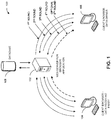
- FIG. 1 presents a block diagram illustrating an exemplary system for performing a protocol to compute a chi-square value and enhance a classifier, in accordance with an embodiment.
- FIG. 1 depicts a system 100 that two parties may use to perform the rounds of the protocol computation.
- a web server 102 may communicate with client computers 104, 106 over a communication network.
- web server 102 may manage the protocol for computing ⁇ 2 using web services.
- Client computers 104, 106 may include browsers that access the web server.
- the client computers may perform encryption computations.
- Two parties may open browser sessions, connect to web server 102, and agree they want to assess the utility of sharing data according to the protocol.
- Web server 102 may assign a session ID and share the session ID with both users.
- the web services may store and use the session ID in a database to keep track of the progress of the protocol rounds.
- the party responsible for performing round one may perform the computations and submit the result to the web server along with the session ID, e.g. using a HTTPS POST command.
- the web server may store the result in a database 108 and transmit the result to the other party, along with a notification that the next round of the protocol needs to be performed.
- the second party may perform the round two computations, and then post the result along with the session ID to the web server.
- the web server may store the result in database 108 and transmit the result to the first party, along with a notification to perform the next round.
- Web server 102 may continue to notify a client when there is an output of a round available from the other client. When notified that a round is ready, each party may perform the next round of computations and send the result to web server 102. The process continues until all 4 rounds are complete.
- a web application may include client-side computation of the rounds, e.g. using JavaScript and web socket tools, so that the user experience is simply giving the browser access to the data and then waiting until all rounds are complete.
- the system may notify the users that their data will not be uploaded to the server.
- the clients may perform the protocol by communicating directly with each other in a peer-to-peer network, and a web server is not required.
- the classifier may classify security data.
- the techniques disclosed herein may improve the classifier.
- the disclosed techniques may improve the classification of network events, such as whether network event are attacks on the network from outsiders or normal network activity.
- the classifier may also classify user activity, such as user activity in an enterprise, to determine whether users are performing insider attacks on the enterprise or performing normal network user activity.
- the classifier functionality may be implemented in a network router.
- the router may automatically classify network events and respond to suspicious network events by changing network routing, raising an alarm, or otherwise notifying an administrator.
- the router may automatically connect with other network devices to trade, receive, or transfer security data and automatically improve the classifier using the techniques described herein.
- the parties can determine whether data is likely to improve the classifier, before transmitting data. This may reduce the use of network resources, since the data transfer need not occur if the parties determine that the data would not be likely to improve the classifier.
- the data may be a large amount of data that may consume network bandwidth, and therefore it may be beneficial to first determine whether the data is likely to improve the classifier before transmitting the data.
- the classifier may also be a rule-based classifier.
- the system may improve a set of rules of the classifier by adding or changing the rules of the classifier. Using the protocol to obtain data and modifying the rules of the classifier, the system may improve the classifier so that the classifier can perform functions that the classifier was not previously able to perform.
- the parties may assess the utility of trading data without hiring a third party, which consumes both time and money and requires the third party to be trusted. Data privacy can be protected against third parties.
- the parties can efficiently consider more options, such as a provider of data choosing among potential recipients of data, a recipient choosing among potential data providers, and parties selecting among methods of data de-sensitization when needed.
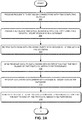
- FIG. 2A-2B presents a flowchart illustrating an exemplary method for performing the protocol by a server, in accordance with an embodiment.
- a server may perform the operations of FIG. 2A-2B .
- the server may receive requests to establish connections with two computing devices (operation 202).
- the server may respond by setting up the connections with the two computing devices.
- the server may assign a session ID and share the session ID with the two computing devices (operation 204).
- the server may store the session ID in a database.
- the server may then receive data from a data-receiving party with the session ID (operation 206).
- This data may include an encryption public key and encrypted class label elements of a feature vector, as well as other encrypted data.
- the server may store the data in the database.
- the server may then send the received data to the data owner with notification that the next round of the protocol needs to be performed (operation 208).
- the server may receive data from the data owner with the session ID.
- the received data may include Enc pk ( r D).
- the server may store the data in the database (operation 210).
- the server may subsequently send the received data to the data-receiving party with notification that the next round of the protocol needs to be performed (operation 212).
- the server may then receive data from the data-receiving party with the session ID.
- the server may store the data in the database (operation 214).
- the data may include a pair of encrypted values Enc pk r 2 D 2 B + D A + C , Enc pk r D A + C .
- the server may then send the received data to the data owner with notification that the next round of the protocol needs to be performed (operation 216).
- the server may then receive data (e.g., encrypted chi-square value) from the data owner with the session ID (operation 218).
- the server may store the data in the database.
- the server may send the received data to the data-receiving party (operation 220).
- the server and the two computing devices have completed four rounds of the protocol.
- Example 1 In this example, a data-receiving party is interested in obtaining a column of data from a data owner.
- the data-receiving party intends to add the data to a data table, in order to improve a classifier trained using that table.
- the owner is willing to provide the data, but the data-receiving party is not certain that the data will actually improve the classifier.
- the data-receiving party has access to the data dictionary for the owner's data and they share a common index key, but the data-receiving party does not know the actual values of the data elements.
- the parties agree to use the protocol, with the data-receiving party performing round one.
- the data-receiving party After following the protocol, the data-receiving party has a value for the ⁇ 2 statistic, which is a measure of the utility of the data the owner is willing to provide. Based on the value of ⁇ 2 , along with any other information the data-receiving party considers important, the data-receiving party decides whether to obtain the data. In some scenarios, a data owner may sell the data to the data-receiving party or trade for other data.
- Example 2 In this example, the parties agree to follow the protocol, but in two-stream mode.
- the two-stream mode begins with both parties computing and sending encrypted values in round one and both parties sending encrypted values of ⁇ 2 in round four. Since the computation for ⁇ 2 is symmetric with respect to c and f , both parties should end up with the same value of ⁇ 2 , assuming they used the same data in both streams (i.e., did not cheat).
- each party sends their re-encrypted ⁇ 2 to the other party.
- Each party may also send the one-use key, but only after receiving the re-encrypted ⁇ 2 message from the other party. They are doing this exchange of re-encrypted ⁇ 2 and the associated single-use key to verify that they are both looking at the same value of ⁇ 2 .
- Each party can decrypt their re-encrypted ⁇ 2 message with the one-use key from the other party, and verify that the ⁇ 2 decrypted by the other party in round four is the same one they received and decrypted in round four.
- This extra round assures both parties that they are looking at the same ⁇ 2 value, to eliminate the possibility that one party cheated by using different data in the two encrypted domain computation streams. Without such assurance, a data owner might be concerned that the potential data-receiving party used fake, low utility data for the data owner's ⁇ 2 , in order to hide the true value of the data to the data-receiving party. If ⁇ 2 needs to remain secure after this protocol is used, then the single-use keys can be encrypted with the other party's public key before transmitting, so that a third party adversary does not get access to the single use key.
- a feature column e.g., by selling, licensing, trading, and/or transferring
- the owner may want to choose the receiving parties that will get the highest utility out of the data.
- a data owner and/or data-receiving party may
- a data owner and/or data-receiving party may also want to maximize the value to data-receiving parties by guaranteeing to keep the data from their competitors and the public at large. Data is often more valuable and/or useful when access to it is limited.
- the parties may agree to follow the protocol, but using the two-stream mode described in the previous example.
- the data owner may sell access to the feature column to the limited number of recipients that get the highest utility from the data because they are willing to pay a higher price.
- the data owner may establish ⁇ 2 values for potential licensees, and the data owner can choose winning licensees out of that group, honoring any buyer conditions about field of use, maximum number of licensees, not selling to competitors of the buyer, etc.
- the price may either be pre-set, such as a fixed price or a schedule of price vs. utility, or the parties may negotiate after the winning licensees are selected.
- Potential licensees will be motivated to not use data in the utility computation protocol that will underestimate the true value, since that could remove them from consideration as a licensee.
- the data owner is motivated to use data that will yield the best utility numbers because that will show their data to be more valuable. Therefore, both parties have something to gain by not 'gaming' the utility computation protocol.
- Example 4 In this example, the owner of the data is willing to provide access to a feature column (e.g., by giving or selling access), but the owner needs to apply statistical privacy to the data to protect sensitive information. There are many different statistical privacy methods, so the owner and data-receiving party may want to choose a method (and corresponding method parameters and settings) that provides an acceptable tradeoff between security and utility. In this example, the parties may agree to follow the protocol, but using the two-stream mode described in Example 2 to help the data owner manage considerations among multiple data recipients. They may compute ⁇ 2 values for a set of statistical privacy alternatives, spanning a set of methods, parameter values and settings of mutual interest.
- ARX is open source software for anonymizing sensitive personal data.
- the data owner may communicate which methods and parameter values provide acceptable security, and the potential data-receiving party may communicate which choices provide acceptable utility. They may then come to an agreement on the method to use, and the data owner may apply that method and provide the data-receiving party with the privatized data. Examples of statistical privacy methods and their parameters are given in Table 3 below.
- Example 5 In this example, the owner of the data is willing to provide access to subsets of a feature column, but does not want to give access to the full set of data to any one recipient, to control proliferation of the data.
- the parties agree to follow the protocol, but using the two-stream mode described in Example 2 to help the data owner manage considerations among multiple data recipients. They compute ⁇ 2 values for different subsets of the data that the owner is willing to release (or license). They then come to an agreement on which subset to release (or license). As an option, if the owner needs to apply statistical privacy to the subset before releasing it, the parties can follow the process in example 4 to choose a statistical privacy method.
- Example 6 For two-stream cases like those in previous examples, both parties may complete each round, and a fifth round may be added as described in Example 2.
- web server 102 When web server 102 sets up the session for the two parties, web server 102 may store data in the database indicating that the session is performed with a two-stream method.
- the web application performs the client-side computations, e.g. with JavaScript or similar code executed on the client computer, so the users do not have to manually execute each round outside of the web application.
- the user experience is to load the data once into the client-side environment, and wait for the final result.
- the web application handles computing any necessary information, sending encrypted results, and listening for when a new result from the other party is ready. Since the computations are performed at the clients, the data of each party remains secure from the other parties and the web server itself.
- a system has a central server with documented application programming interfaces (APIs) that allow client systems to programmatically initiate and validate a session with a second party, deliver results of rounds of computations, and receive notifications and/or check on status when waiting for results from the other party.
- APIs application programming interfaces
- Custom or third-party client-side software can then use these APIs directly, as an alternative to a browser-based approach.
- the web server may maintain a database for each session, recording when a round is initiated and when a result for that round is returned. This allows the web services to perform actions like sending reminders to complete a transaction, identify if a round is being performed more than once and get clarification if that is intentional, and optionally store the encrypted data exchanged in each round. The web services may also finalize the exchange of information when the rounds have been completed.
- the web services may include a marketplace where owners of data could post data they have available (e.g., for possible licensing, trading, or otherwise providing the data), with a data dictionary or equivalent. Others that want to obtain the data (e.g., purchase a license to the data or trade data) may post their requests, or search what is being offered. For example, different parties may trade security-related data in order to improve their classifiers, thereby improving classification and detection of security events in a computer network. The parties' computing devices may automatically perform computations and obtain security-related data from each other in order to improve their classifiers. This is more efficient than traditional approaches to generating classifiers.
- the web services may also offer authentication of user identities, through data collected from users when they request an account.
- Example 7 In this example, a party may sell a license to the data by (e.g., electronic) auction. Before the auction, potential bidders may follow the protocol, with the potential bidder performing round one. After round four, the potential bidder has a value of ⁇ 2 for her classifier application. The number of potential bidders and the number of different ⁇ 2 evaluations can be limited by the auctioneer. This minimizes the risk of an adversary performing multiple ⁇ 2 evaluations for the purpose of reverse engineering information about the data that is not meant to be public.
- the auction can be a conventional "English" auction, a Dutch auction, a Vickrey auction, or another type of auction. Some embodiments may include a web-based auction system, expanding on the web services described in Example 6.
- both the class labels of c and the features of f are binary attributes. That is, for all 1 ⁇ i ⁇ n, c i ⁇ ⁇ 0, 1 ⁇ and f i ⁇ ⁇ 0, 1 ⁇ .
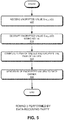
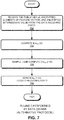
- FIG. 3 illustrates a flowchart illustrating an exemplary method for performing round one of the protocol by a data-receiving party, in accordance with an embodiment.
- the data-receiving party Carol may perform the operations of FIG. 3 .
- the data-receiving party may perform the computations described below.
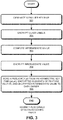
- FIG. 4 illustrates a flowchart illustrating an exemplary method for performing round two of the protocol by a data owner, in accordance with an embodiment.
- the data owner (Felix) may perform the operations of FIG. 4 .
- the data owner may receive the public key pk and encrypted data (e.g., encrypted elements of feature vector, and encrypted intermediate value) from the data-receiving party Carol (operation 402).
- encrypted data e.g., encrypted elements of feature vector, and encrypted intermediate value
- the data owner may perform the computations as described below.
- FIG. 5 presents a flowchart illustrating an exemplary method for performing round three of the protocol by a data-receiving party, in accordance with an embodiment.
- Data-receiving party Carol may perform the operations of FIG. 5 .
- the data-receiving party may receive an encrypted value Enc pk ( r D) (operation 502).
- the data-receiving party may perform the following computations.
- FIG. 6 presents a flowchart illustrating an exemplary method for performing round four of the protocol by a data owner, in accordance with an embodiment.
- data owner Felix may receive a pair of encrypted values from the data-receiving party (operation 602).
- Data owner Felix may compute an encrypted ⁇ 2 value based on a feature vector f and the pair of encrypted values (operation 604).
- Data owner Felix may perform the following computations.
- the system may use additive blinding rather than multiplicative blinding to introduce the random number r in round two, taking advantage of additive rather than multiplicative homomorphism.
- the system may perform round one as described above and round two to round four as described below.
- FIG. 7 illustrates a flowchart illustrating an exemplary method for performing round two of an alternative protocol by a data owner, in accordance with an embodiment.
- the data owner (Felix) may perform the operations of FIG. 7 .
- the data owner may receive the public key pk and encrypted data (e.g., encrypted elements of feature vector, and encrypted intermediate value) from the data-receiving party Carol (operation 702).
- encrypted data e.g., encrypted elements of feature vector, and encrypted intermediate value
- the data owner may perform the computations as described below.
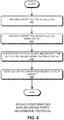
- FIG. 8 presents a flowchart illustrating an exemplary method for performing round three of an alternative protocol by a data-receiving party, in accordance with an embodiment.
- Data-receiving party Carol may perform the operations of FIG. 8 .
- the data-receiving party may receive an encrypted value Enc pk ( r + D) (operation 802).
- the data-receiving party may perform the following computations.
- FIG. 9 presents a flowchart illustrating an exemplary method for performing round four of an alternative protocol by a data owner, in accordance with an embodiment.
- data owner Felix may receive a set of five encrypted values from the data-receiving party (operation 902).
- Data owner Felix may compute an encrypted ⁇ 2 value based on a feature vector f and the set of five encrypted values (operation 904).
- Data owner Felix may perform the following computations.
- Data-receiving party Carol may decrypt Enc pk ( ⁇ 2 ( f, c )) to obtain ⁇ 2 ( f, c ). Note that only Carol receives the value ⁇ 2 ( f, c ). Depending on the application, if Felix also needs to know the value of ⁇ 2 ( f , c ), Carol may then send the value of ⁇ 2 ( f , c ) to Felix after running the protocol.
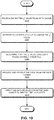
- FIG. 10 presents a flowchart illustrating an exemplary method for applying data to improve a classifier, in accordance with an embodiment.
- the data-receiving party may receive an encrypted ⁇ 2 value from the data owner (operation 1002).
- the data-receiving party may decrypt the encrypted ⁇ 2 value to obtain the ⁇ 2 value (operation 1004).
- the data-receiving party may determine that the ⁇ 2 value exceeds a predetermined threshold (operation 1006).
- the data-receiving party may request and receive the data from the data owner (operation 1008).
- the data-receiving party may then apply the data received from the data owner to improve the classifier (operation 1010).
- FIG. 11 presents a block diagram illustrating an exemplary apparatus 1100 associated with a data-receiving party, in accordance with an embodiment.
- Apparatus 1100 can comprise a plurality of modules which may communicate with one another via a wired or wireless communication channel.
- Apparatus 1100 may be realized using one or more integrated circuits, and may include fewer or more modules than those shown in FIG. 11 . Further, apparatus 1100 may be integrated in a computer system, or realized as a separate device which is capable of communicating with other computer systems and/or devices.
- apparatus 1100 can comprise any combination of an encryption module 1102, a computation module 1104, a connection module 1106, and a data storage 1108.
- apparatus 1100 may also include additional modules and data not depicted in FIG. 11 , and different implementations may arrange functionality according to a different set of modules. The embodiments disclosed herein are not limited to any particular arrangement of modules.
- Some implementations may include encryption module 1102 which may perform operations including encrypting and decrypting data, generating a key pair, and encrypting data such as feature vector data.
- Computation module 1104 may perform computations associated with the protocol, such as computing an intermediate value.
- Connection module 1106 may establish connections with the server and other computing devices.
- Data storage 1108 may store the data described herein, such as the data in feature vectors.
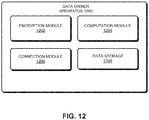
- FIG. 12 presents a block diagram illustrating an exemplary apparatus 1200 associated with a data owner, in accordance with an embodiment.
- Apparatus 1200 can comprise a plurality of modules which may communicate with one another via a wired or wireless communication channel.
- Apparatus 1200 may be realized using one or more integrated circuits, and may include fewer or more modules than those shown in FIG. 12 .
- apparatus 1200 may be integrated in a computer system, or realized as a separate device which is capable of communicating with other computer systems and/or devices.
- apparatus 1200 can comprise any combination of an encryption module 1202, a computation module 1204, a connection module 1206, and a data storage 1208.
- apparatus 1200 may also include additional modules and data not depicted in FIG. 12 , and different implementations may arrange functionality according to a different set of modules. The embodiments disclosed herein are not limited to any particular arrangement of modules.
- Some implementations may include encryption module 1202 which may encrypt and decrypt data.
- Computation module 1204 may perform the computations associated with the protocol.
- Connection module 1206 may establish connections with the server and other computing devices.
- Data storage 1208 may store the data described herein.
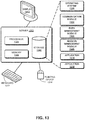
- FIG. 13 illustrates an exemplary computer and communication system that facilitates a classifier enhancement system, in accordance with an embodiment.
- a computer and communication system 1302 includes a processor 1304, a memory 1306, and a storage device 1308.
- Memory 1306 can include a volatile memory (e.g., RAM) that serves as a managed memory, and can be used to store one or more memory pools.
- computer and communication system 1302 can be coupled to a display device 1310, a keyboard 1312, and a pointing device 1314.
- Storage device 1308 can store a number of applications, such as applications 1316 and 1318 and operating system 1320. Storage device 1308 may also store code for a communication module 1322, a data management module 1324, and a session management module 1326. Communication module 1322 may establish network connections with client computing devices. Data management module 1324 may manage the data received from the computing devices, including allocating memory and/or disk storage space to store the data. Session management module 1326 may manage the sessions with the client computing devices, including establishing the session ID, sharing the session ID, storing the session ID, and terminating sessions.
- processor 1304. While executing the program, processor 1304 performs the aforementioned functions.
- the data structures and code described in this detailed description are typically stored on a computer-readable storage medium, which may be any device or medium that can store code and/or data for use by a computer system.
- the computer-readable storage medium includes, but is not limited to, volatile memory, non-volatile memory, magnetic and optical storage devices such as disk drives, magnetic tape, CDs (compact discs), DVDs (digital versatile discs or digital video discs), or other media capable of storing computer-readable media now known or later developed.
- the methods and processes described in the detailed description section can be embodied as code and/or data, which can be stored in a computer-readable storage medium as described above.
- a computer system reads and executes the code and/or data stored on the computer-readable storage medium, the computer system performs the methods and processes embodied as data structures and code and stored within the computer-readable storage medium.
- the methods and processes described above can be included in hardware modules or apparatus.
- the hardware modules or apparatus can include, but are not limited to, application-specific integrated circuit (ASIC) chips, field-programmable gate arrays (FPGAs), dedicated or shared processors that execute a particular software module or a piece of code at a particular time, and other programmable-logic devices now known or later developed.
- ASIC application-specific integrated circuit
- FPGA field-programmable gate arrays
- dedicated or shared processors that execute a particular software module or a piece of code at a particular time
- other programmable-logic devices now known or later developed.
Landscapes
- Engineering & Computer Science (AREA)
- Computer Networks & Wireless Communication (AREA)
- Signal Processing (AREA)
- Computer Security & Cryptography (AREA)
- Computer Hardware Design (AREA)
- Computing Systems (AREA)
- General Engineering & Computer Science (AREA)
- Information Retrieval, Db Structures And Fs Structures Therefor (AREA)
- Storage Device Security (AREA)
- Computer And Data Communications (AREA)
Applications Claiming Priority (1)
| Application Number | Priority Date | Filing Date | Title |
|---|---|---|---|
| US15/714,803 US10805281B2 (en) | 2017-09-25 | 2017-09-25 | System and method for secure two-party evaluation of utility of sharing data |
Publications (2)
| Publication Number | Publication Date |
|---|---|
| EP3461101A1 EP3461101A1 (en) | 2019-03-27 |
| EP3461101B1 true EP3461101B1 (en) | 2021-03-03 |
Family
ID=63794289
Family Applications (1)
| Application Number | Title | Priority Date | Filing Date |
|---|---|---|---|
| EP18196122.8A Active EP3461101B1 (en) | 2017-09-25 | 2018-09-21 | System and method for secure two-party evaluation of utility of sharing data |
Country Status (4)
| Country | Link |
|---|---|
| US (2) | US10805281B2 (enExample) |
| EP (1) | EP3461101B1 (enExample) |
| JP (1) | JP7152909B2 (enExample) |
| AU (1) | AU2018222992B2 (enExample) |
Families Citing this family (12)
| Publication number | Priority date | Publication date | Assignee | Title |
|---|---|---|---|---|
| CN110113203B (zh) * | 2019-04-30 | 2021-10-22 | 创新先进技术有限公司 | 一种用于加密模型的安全性评估的方法和设备 |
| CN110163008B (zh) * | 2019-04-30 | 2023-03-07 | 创新先进技术有限公司 | 一种部署的加密模型的安全性审计的方法和系统 |
| US11190336B2 (en) * | 2019-05-10 | 2021-11-30 | Sap Se | Privacy-preserving benchmarking with interval statistics reducing leakage |
| CN110222873B (zh) * | 2019-05-14 | 2023-10-31 | 北京城建智控科技股份有限公司 | 一种基于大数据的地铁站客流量预测方法 |
| KR20210016829A (ko) * | 2019-08-05 | 2021-02-17 | 엘지전자 주식회사 | 지능적 음성 인식 방법, 음성 인식 장치 및 지능형 컴퓨팅 디바이스 |
| US11228423B2 (en) | 2020-01-12 | 2022-01-18 | Advanced New Technologies Co., Ltd. | Method and device for security assessment of encryption models |
| US12099997B1 (en) | 2020-01-31 | 2024-09-24 | Steven Mark Hoffberg | Tokenized fungible liabilities |
| CN111539009B (zh) * | 2020-06-05 | 2023-05-23 | 支付宝(杭州)信息技术有限公司 | 保护隐私数据的有监督特征分箱方法及装置 |
| CN114091043A (zh) * | 2020-08-04 | 2022-02-25 | 中移(成都)信息通信科技有限公司 | 一种相关性系数计算方法、装置、设备及计算机存储介质 |
| CN113591942B (zh) * | 2021-07-13 | 2023-05-09 | 中国电子科技集团公司第三十研究所 | 大规模数据的密文机器学习模型训练方法 |
| CN116506188B (zh) * | 2023-05-04 | 2024-03-29 | 北京众谊越泰科技有限公司 | 一种基于b/s架构的非对称加密算法的操作方法和系统 |
| CN116894272B (zh) * | 2023-09-08 | 2023-11-28 | 北京数盾信息科技有限公司 | 一种基于高速加密技术的云计算系统数据处理方法 |
Family Cites Families (4)
| Publication number | Priority date | Publication date | Assignee | Title |
|---|---|---|---|---|
| US8418249B1 (en) | 2011-11-10 | 2013-04-09 | Narus, Inc. | Class discovery for automated discovery, attribution, analysis, and risk assessment of security threats |
| US10284570B2 (en) | 2013-07-24 | 2019-05-07 | Wells Fargo Bank, National Association | System and method to detect threats to computer based devices and systems |
| CN104869103B (zh) * | 2014-02-24 | 2018-05-18 | 华为终端(东莞)有限公司 | 查找多媒体文件的方法、终端设备和服务器 |
| US10019709B2 (en) * | 2015-06-22 | 2018-07-10 | Bank Of America Corporation | System of anonymous user creation based on oblivious transfer |
-
2017
- 2017-09-25 US US15/714,803 patent/US10805281B2/en active Active
-
2018
- 2018-08-30 AU AU2018222992A patent/AU2018222992B2/en active Active
- 2018-09-05 JP JP2018165692A patent/JP7152909B2/ja active Active
- 2018-09-21 EP EP18196122.8A patent/EP3461101B1/en active Active
-
2020
- 2020-09-09 US US17/016,073 patent/US11451527B2/en active Active
Non-Patent Citations (1)
| Title |
|---|
| None * |
Also Published As
| Publication number | Publication date |
|---|---|
| US10805281B2 (en) | 2020-10-13 |
| AU2018222992A1 (en) | 2019-04-11 |
| JP2019061233A (ja) | 2019-04-18 |
| AU2018222992B2 (en) | 2024-01-04 |
| JP7152909B2 (ja) | 2022-10-13 |
| US11451527B2 (en) | 2022-09-20 |
| EP3461101A1 (en) | 2019-03-27 |
| US20200412702A1 (en) | 2020-12-31 |
| US20190097985A1 (en) | 2019-03-28 |
Similar Documents
| Publication | Publication Date | Title |
|---|---|---|
| US11451527B2 (en) | System and method for secure two-party evaluation of utility of sharing data | |
| CN111162896B (zh) | 双方联合进行数据处理的方法及装置 | |
| US11374736B2 (en) | System and method for homomorphic encryption | |
| EP3924852B1 (en) | Fast oblivious transfers | |
| US12353591B2 (en) | Secure aggregation of information using federated learning | |
| CN111428887B (zh) | 一种基于多个计算节点的模型训练控制方法、装置及系统 | |
| US10885205B2 (en) | Secure multiparty computation | |
| CN112989368A (zh) | 多方联合进行隐私数据处理的方法及装置 | |
| US20150381349A1 (en) | Privacy-preserving ridge regression using masks | |
| US12348611B2 (en) | Method for processing multi-source data | |
| US20230014392A1 (en) | Method and system for privacy-preserving portfolio pricing | |
| EP2602755A1 (en) | Privacy-preserving collaborative filtering | |
| Jayaraman et al. | RETRACTED ARTICLE: A novel privacy preserving digital forensic readiness provable data possession technique for health care data in cloud | |
| US12580769B2 (en) | Round optimal oblivious transfers from isogenies | |
| JP5762232B2 (ja) | プライバシを保護したまま暗号化された要素の順序を選択するための方法およびシステム | |
| CN104521178A (zh) | 安全的多方云计算的方法和系统 | |
| CN114996449B (zh) | 一种基于隐私保护的聚类方法及装置 | |
| US20230046195A1 (en) | Data processing method, apparatus, and system, device, and medium | |
| Bao et al. | Secure multiparty computation protocol based on homomorphic encryption and its application in blockchain | |
| Singh et al. | IoT centric data protection using deep learning technique for preserving security and privacy in cloud | |
| Rao et al. | Secure two-party feature selection | |
| Nguyen | Advancing privacy and accuracy with federated learning and homomorphic encryption | |
| CN117254898A (zh) | 基于Batch-OT的隐私集合求交方法、系统、电子设备及介质 | |
| Miao et al. | Efficient privacy-preserving logistic model with malicious security | |
| Du et al. | Secure and efficient outsourcing of large-scale nonlinear programming |
Legal Events
| Date | Code | Title | Description |
|---|---|---|---|
| PUAI | Public reference made under article 153(3) epc to a published international application that has entered the european phase |
Free format text: ORIGINAL CODE: 0009012 |
|
| STAA | Information on the status of an ep patent application or granted ep patent |
Free format text: STATUS: THE APPLICATION HAS BEEN PUBLISHED |
|
| AK | Designated contracting states |
Kind code of ref document: A1 Designated state(s): AL AT BE BG CH CY CZ DE DK EE ES FI FR GB GR HR HU IE IS IT LI LT LU LV MC MK MT NL NO PL PT RO RS SE SI SK SM TR |
|
| AX | Request for extension of the european patent |
Extension state: BA ME |
|
| STAA | Information on the status of an ep patent application or granted ep patent |
Free format text: STATUS: REQUEST FOR EXAMINATION WAS MADE |
|
| 17P | Request for examination filed |
Effective date: 20190927 |
|
| RBV | Designated contracting states (corrected) |
Designated state(s): AL AT BE BG CH CY CZ DE DK EE ES FI FR GB GR HR HU IE IS IT LI LT LU LV MC MK MT NL NO PL PT RO RS SE SI SK SM TR |
|
| GRAP | Despatch of communication of intention to grant a patent |
Free format text: ORIGINAL CODE: EPIDOSNIGR1 |
|
| STAA | Information on the status of an ep patent application or granted ep patent |
Free format text: STATUS: GRANT OF PATENT IS INTENDED |
|
| RIC1 | Information provided on ipc code assigned before grant |
Ipc: H04L 29/08 20060101ALI20200914BHEP Ipc: H04L 29/06 20060101AFI20200914BHEP |
|
| INTG | Intention to grant announced |
Effective date: 20201001 |
|
| GRAS | Grant fee paid |
Free format text: ORIGINAL CODE: EPIDOSNIGR3 |
|
| GRAA | (expected) grant |
Free format text: ORIGINAL CODE: 0009210 |
|
| STAA | Information on the status of an ep patent application or granted ep patent |
Free format text: STATUS: THE PATENT HAS BEEN GRANTED |
|
| AK | Designated contracting states |
Kind code of ref document: B1 Designated state(s): AL AT BE BG CH CY CZ DE DK EE ES FI FR GB GR HR HU IE IS IT LI LT LU LV MC MK MT NL NO PL PT RO RS SE SI SK SM TR |
|
| REG | Reference to a national code |
Ref country code: GB Ref legal event code: FG4D |
|
| REG | Reference to a national code |
Ref country code: AT Ref legal event code: REF Ref document number: 1368493 Country of ref document: AT Kind code of ref document: T Effective date: 20210315 Ref country code: CH Ref legal event code: EP |
|
| REG | Reference to a national code |
Ref country code: DE Ref legal event code: R096 Ref document number: 602018013299 Country of ref document: DE |
|
| REG | Reference to a national code |
Ref country code: IE Ref legal event code: FG4D |
|
| REG | Reference to a national code |
Ref country code: LT Ref legal event code: MG9D |
|
| PG25 | Lapsed in a contracting state [announced via postgrant information from national office to epo] |
Ref country code: HR Free format text: LAPSE BECAUSE OF FAILURE TO SUBMIT A TRANSLATION OF THE DESCRIPTION OR TO PAY THE FEE WITHIN THE PRESCRIBED TIME-LIMIT Effective date: 20210303 Ref country code: FI Free format text: LAPSE BECAUSE OF FAILURE TO SUBMIT A TRANSLATION OF THE DESCRIPTION OR TO PAY THE FEE WITHIN THE PRESCRIBED TIME-LIMIT Effective date: 20210303 Ref country code: GR Free format text: LAPSE BECAUSE OF FAILURE TO SUBMIT A TRANSLATION OF THE DESCRIPTION OR TO PAY THE FEE WITHIN THE PRESCRIBED TIME-LIMIT Effective date: 20210604 Ref country code: BG Free format text: LAPSE BECAUSE OF FAILURE TO SUBMIT A TRANSLATION OF THE DESCRIPTION OR TO PAY THE FEE WITHIN THE PRESCRIBED TIME-LIMIT Effective date: 20210603 Ref country code: NO Free format text: LAPSE BECAUSE OF FAILURE TO SUBMIT A TRANSLATION OF THE DESCRIPTION OR TO PAY THE FEE WITHIN THE PRESCRIBED TIME-LIMIT Effective date: 20210603 Ref country code: LT Free format text: LAPSE BECAUSE OF FAILURE TO SUBMIT A TRANSLATION OF THE DESCRIPTION OR TO PAY THE FEE WITHIN THE PRESCRIBED TIME-LIMIT Effective date: 20210303 |
|
| REG | Reference to a national code |
Ref country code: NL Ref legal event code: MP Effective date: 20210303 |
|
| REG | Reference to a national code |
Ref country code: AT Ref legal event code: MK05 Ref document number: 1368493 Country of ref document: AT Kind code of ref document: T Effective date: 20210303 |
|
| PG25 | Lapsed in a contracting state [announced via postgrant information from national office to epo] |
Ref country code: SE Free format text: LAPSE BECAUSE OF FAILURE TO SUBMIT A TRANSLATION OF THE DESCRIPTION OR TO PAY THE FEE WITHIN THE PRESCRIBED TIME-LIMIT Effective date: 20210303 Ref country code: RS Free format text: LAPSE BECAUSE OF FAILURE TO SUBMIT A TRANSLATION OF THE DESCRIPTION OR TO PAY THE FEE WITHIN THE PRESCRIBED TIME-LIMIT Effective date: 20210303 Ref country code: LV Free format text: LAPSE BECAUSE OF FAILURE TO SUBMIT A TRANSLATION OF THE DESCRIPTION OR TO PAY THE FEE WITHIN THE PRESCRIBED TIME-LIMIT Effective date: 20210303 Ref country code: PL Free format text: LAPSE BECAUSE OF FAILURE TO SUBMIT A TRANSLATION OF THE DESCRIPTION OR TO PAY THE FEE WITHIN THE PRESCRIBED TIME-LIMIT Effective date: 20210303 |
|
| PG25 | Lapsed in a contracting state [announced via postgrant information from national office to epo] |
Ref country code: NL Free format text: LAPSE BECAUSE OF FAILURE TO SUBMIT A TRANSLATION OF THE DESCRIPTION OR TO PAY THE FEE WITHIN THE PRESCRIBED TIME-LIMIT Effective date: 20210303 |
|
| PG25 | Lapsed in a contracting state [announced via postgrant information from national office to epo] |
Ref country code: EE Free format text: LAPSE BECAUSE OF FAILURE TO SUBMIT A TRANSLATION OF THE DESCRIPTION OR TO PAY THE FEE WITHIN THE PRESCRIBED TIME-LIMIT Effective date: 20210303 Ref country code: CZ Free format text: LAPSE BECAUSE OF FAILURE TO SUBMIT A TRANSLATION OF THE DESCRIPTION OR TO PAY THE FEE WITHIN THE PRESCRIBED TIME-LIMIT Effective date: 20210303 Ref country code: AT Free format text: LAPSE BECAUSE OF FAILURE TO SUBMIT A TRANSLATION OF THE DESCRIPTION OR TO PAY THE FEE WITHIN THE PRESCRIBED TIME-LIMIT Effective date: 20210303 Ref country code: SM Free format text: LAPSE BECAUSE OF FAILURE TO SUBMIT A TRANSLATION OF THE DESCRIPTION OR TO PAY THE FEE WITHIN THE PRESCRIBED TIME-LIMIT Effective date: 20210303 |
|
| REG | Reference to a national code |
Ref country code: DE Ref legal event code: R079 Ref document number: 602018013299 Country of ref document: DE Free format text: PREVIOUS MAIN CLASS: H04L0029060000 Ipc: H04L0065000000 |
|
| PG25 | Lapsed in a contracting state [announced via postgrant information from national office to epo] |
Ref country code: RO Free format text: LAPSE BECAUSE OF FAILURE TO SUBMIT A TRANSLATION OF THE DESCRIPTION OR TO PAY THE FEE WITHIN THE PRESCRIBED TIME-LIMIT Effective date: 20210303 Ref country code: SK Free format text: LAPSE BECAUSE OF FAILURE TO SUBMIT A TRANSLATION OF THE DESCRIPTION OR TO PAY THE FEE WITHIN THE PRESCRIBED TIME-LIMIT Effective date: 20210303 Ref country code: PT Free format text: LAPSE BECAUSE OF FAILURE TO SUBMIT A TRANSLATION OF THE DESCRIPTION OR TO PAY THE FEE WITHIN THE PRESCRIBED TIME-LIMIT Effective date: 20210705 Ref country code: IS Free format text: LAPSE BECAUSE OF FAILURE TO SUBMIT A TRANSLATION OF THE DESCRIPTION OR TO PAY THE FEE WITHIN THE PRESCRIBED TIME-LIMIT Effective date: 20210703 |
|
| REG | Reference to a national code |
Ref country code: DE Ref legal event code: R097 Ref document number: 602018013299 Country of ref document: DE |
|
| PLBE | No opposition filed within time limit |
Free format text: ORIGINAL CODE: 0009261 |
|
| STAA | Information on the status of an ep patent application or granted ep patent |
Free format text: STATUS: NO OPPOSITION FILED WITHIN TIME LIMIT |
|
| PG25 | Lapsed in a contracting state [announced via postgrant information from national office to epo] |
Ref country code: DK Free format text: LAPSE BECAUSE OF FAILURE TO SUBMIT A TRANSLATION OF THE DESCRIPTION OR TO PAY THE FEE WITHIN THE PRESCRIBED TIME-LIMIT Effective date: 20210303 Ref country code: AL Free format text: LAPSE BECAUSE OF FAILURE TO SUBMIT A TRANSLATION OF THE DESCRIPTION OR TO PAY THE FEE WITHIN THE PRESCRIBED TIME-LIMIT Effective date: 20210303 Ref country code: ES Free format text: LAPSE BECAUSE OF FAILURE TO SUBMIT A TRANSLATION OF THE DESCRIPTION OR TO PAY THE FEE WITHIN THE PRESCRIBED TIME-LIMIT Effective date: 20210303 |
|
| 26N | No opposition filed |
Effective date: 20211206 |
|
| PG25 | Lapsed in a contracting state [announced via postgrant information from national office to epo] |
Ref country code: SI Free format text: LAPSE BECAUSE OF FAILURE TO SUBMIT A TRANSLATION OF THE DESCRIPTION OR TO PAY THE FEE WITHIN THE PRESCRIBED TIME-LIMIT Effective date: 20210303 |
|
| PG25 | Lapsed in a contracting state [announced via postgrant information from national office to epo] |
Ref country code: IT Free format text: LAPSE BECAUSE OF FAILURE TO SUBMIT A TRANSLATION OF THE DESCRIPTION OR TO PAY THE FEE WITHIN THE PRESCRIBED TIME-LIMIT Effective date: 20210303 |
|
| REG | Reference to a national code |
Ref country code: CH Ref legal event code: PL |
|
| REG | Reference to a national code |
Ref country code: BE Ref legal event code: MM Effective date: 20210930 |
|
| PG25 | Lapsed in a contracting state [announced via postgrant information from national office to epo] |
Ref country code: IS Free format text: LAPSE BECAUSE OF FAILURE TO SUBMIT A TRANSLATION OF THE DESCRIPTION OR TO PAY THE FEE WITHIN THE PRESCRIBED TIME-LIMIT Effective date: 20210703 Ref country code: MC Free format text: LAPSE BECAUSE OF FAILURE TO SUBMIT A TRANSLATION OF THE DESCRIPTION OR TO PAY THE FEE WITHIN THE PRESCRIBED TIME-LIMIT Effective date: 20210303 |
|
| PG25 | Lapsed in a contracting state [announced via postgrant information from national office to epo] |
Ref country code: LU Free format text: LAPSE BECAUSE OF NON-PAYMENT OF DUE FEES Effective date: 20210921 Ref country code: IE Free format text: LAPSE BECAUSE OF NON-PAYMENT OF DUE FEES Effective date: 20210921 Ref country code: BE Free format text: LAPSE BECAUSE OF NON-PAYMENT OF DUE FEES Effective date: 20210930 |
|
| PG25 | Lapsed in a contracting state [announced via postgrant information from national office to epo] |
Ref country code: LI Free format text: LAPSE BECAUSE OF NON-PAYMENT OF DUE FEES Effective date: 20210930 Ref country code: CH Free format text: LAPSE BECAUSE OF NON-PAYMENT OF DUE FEES Effective date: 20210930 |
|
| PG25 | Lapsed in a contracting state [announced via postgrant information from national office to epo] |
Ref country code: CY Free format text: LAPSE BECAUSE OF FAILURE TO SUBMIT A TRANSLATION OF THE DESCRIPTION OR TO PAY THE FEE WITHIN THE PRESCRIBED TIME-LIMIT Effective date: 20210303 |
|
| PG25 | Lapsed in a contracting state [announced via postgrant information from national office to epo] |
Ref country code: HU Free format text: LAPSE BECAUSE OF FAILURE TO SUBMIT A TRANSLATION OF THE DESCRIPTION OR TO PAY THE FEE WITHIN THE PRESCRIBED TIME-LIMIT; INVALID AB INITIO Effective date: 20180921 |
|
| PG25 | Lapsed in a contracting state [announced via postgrant information from national office to epo] |
Ref country code: MK Free format text: LAPSE BECAUSE OF FAILURE TO SUBMIT A TRANSLATION OF THE DESCRIPTION OR TO PAY THE FEE WITHIN THE PRESCRIBED TIME-LIMIT Effective date: 20210303 |
|
| PG25 | Lapsed in a contracting state [announced via postgrant information from national office to epo] |
Ref country code: TR Free format text: LAPSE BECAUSE OF FAILURE TO SUBMIT A TRANSLATION OF THE DESCRIPTION OR TO PAY THE FEE WITHIN THE PRESCRIBED TIME-LIMIT Effective date: 20210303 |
|
| PG25 | Lapsed in a contracting state [announced via postgrant information from national office to epo] |
Ref country code: MT Free format text: LAPSE BECAUSE OF FAILURE TO SUBMIT A TRANSLATION OF THE DESCRIPTION OR TO PAY THE FEE WITHIN THE PRESCRIBED TIME-LIMIT Effective date: 20210303 |
|
| PGFP | Annual fee paid to national office [announced via postgrant information from national office to epo] |
Ref country code: DE Payment date: 20250820 Year of fee payment: 8 |
|
| PGFP | Annual fee paid to national office [announced via postgrant information from national office to epo] |
Ref country code: GB Payment date: 20250820 Year of fee payment: 8 |
|
| PGFP | Annual fee paid to national office [announced via postgrant information from national office to epo] |
Ref country code: FR Payment date: 20250821 Year of fee payment: 8 |