EP3461053A1 - Fault attacks counter-measures for eddsa - Google Patents
Fault attacks counter-measures for eddsa Download PDFInfo
- Publication number
- EP3461053A1 EP3461053A1 EP17192193.5A EP17192193A EP3461053A1 EP 3461053 A1 EP3461053 A1 EP 3461053A1 EP 17192193 A EP17192193 A EP 17192193A EP 3461053 A1 EP3461053 A1 EP 3461053A1
- Authority
- EP
- European Patent Office
- Prior art keywords
- hash
- data component
- secret
- data
- eddsa
- Prior art date
- Legal status (The legal status is an assumption and is not a legal conclusion. Google has not performed a legal analysis and makes no representation as to the accuracy of the status listed.)
- Withdrawn
Links
- 238000000034 method Methods 0.000 claims abstract description 23
- 238000004422 calculation algorithm Methods 0.000 claims description 34
- 238000004590 computer program Methods 0.000 claims description 7
- 238000012545 processing Methods 0.000 claims description 4
- 230000006870 function Effects 0.000 description 3
- 238000011084 recovery Methods 0.000 description 2
- 239000004065 semiconductor Substances 0.000 description 2
- 238000012795 verification Methods 0.000 description 2
- 230000006399 behavior Effects 0.000 description 1
- 238000004364 calculation method Methods 0.000 description 1
- 238000009795 derivation Methods 0.000 description 1
- 238000010586 diagram Methods 0.000 description 1
- 230000007774 longterm Effects 0.000 description 1
- 239000000463 material Substances 0.000 description 1
- 238000012805 post-processing Methods 0.000 description 1
- 230000035945 sensitivity Effects 0.000 description 1
Images

Classifications
-
- H—ELECTRICITY
- H04—ELECTRIC COMMUNICATION TECHNIQUE
- H04L—TRANSMISSION OF DIGITAL INFORMATION, e.g. TELEGRAPHIC COMMUNICATION
- H04L9/00—Cryptographic mechanisms or cryptographic arrangements for secret or secure communications; Network security protocols
- H04L9/32—Cryptographic mechanisms or cryptographic arrangements for secret or secure communications; Network security protocols including means for verifying the identity or authority of a user of the system or for message authentication, e.g. authorization, entity authentication, data integrity or data verification, non-repudiation, key authentication or verification of credentials
- H04L9/3247—Cryptographic mechanisms or cryptographic arrangements for secret or secure communications; Network security protocols including means for verifying the identity or authority of a user of the system or for message authentication, e.g. authorization, entity authentication, data integrity or data verification, non-repudiation, key authentication or verification of credentials involving digital signatures
- H04L9/3252—Cryptographic mechanisms or cryptographic arrangements for secret or secure communications; Network security protocols including means for verifying the identity or authority of a user of the system or for message authentication, e.g. authorization, entity authentication, data integrity or data verification, non-repudiation, key authentication or verification of credentials involving digital signatures using DSA or related signature schemes, e.g. elliptic based signatures, ElGamal or Schnorr schemes
-
- H—ELECTRICITY
- H04—ELECTRIC COMMUNICATION TECHNIQUE
- H04L—TRANSMISSION OF DIGITAL INFORMATION, e.g. TELEGRAPHIC COMMUNICATION
- H04L63/00—Network architectures or network communication protocols for network security
- H04L63/12—Applying verification of the received information
-
- H—ELECTRICITY
- H04—ELECTRIC COMMUNICATION TECHNIQUE
- H04L—TRANSMISSION OF DIGITAL INFORMATION, e.g. TELEGRAPHIC COMMUNICATION
- H04L9/00—Cryptographic mechanisms or cryptographic arrangements for secret or secure communications; Network security protocols
- H04L9/002—Countermeasures against attacks on cryptographic mechanisms
- H04L9/004—Countermeasures against attacks on cryptographic mechanisms for fault attacks
-
- H—ELECTRICITY
- H04—ELECTRIC COMMUNICATION TECHNIQUE
- H04L—TRANSMISSION OF DIGITAL INFORMATION, e.g. TELEGRAPHIC COMMUNICATION
- H04L9/00—Cryptographic mechanisms or cryptographic arrangements for secret or secure communications; Network security protocols
- H04L9/06—Cryptographic mechanisms or cryptographic arrangements for secret or secure communications; Network security protocols the encryption apparatus using shift registers or memories for block-wise or stream coding, e.g. DES systems or RC4; Hash functions; Pseudorandom sequence generators
- H04L9/0643—Hash functions, e.g. MD5, SHA, HMAC or f9 MAC
-
- H—ELECTRICITY
- H04—ELECTRIC COMMUNICATION TECHNIQUE
- H04L—TRANSMISSION OF DIGITAL INFORMATION, e.g. TELEGRAPHIC COMMUNICATION
- H04L9/00—Cryptographic mechanisms or cryptographic arrangements for secret or secure communications; Network security protocols
- H04L9/08—Key distribution or management, e.g. generation, sharing or updating, of cryptographic keys or passwords
- H04L9/0816—Key establishment, i.e. cryptographic processes or cryptographic protocols whereby a shared secret becomes available to two or more parties, for subsequent use
- H04L9/0819—Key transport or distribution, i.e. key establishment techniques where one party creates or otherwise obtains a secret value, and securely transfers it to the other(s)
- H04L9/0825—Key transport or distribution, i.e. key establishment techniques where one party creates or otherwise obtains a secret value, and securely transfers it to the other(s) using asymmetric-key encryption or public key infrastructure [PKI], e.g. key signature or public key certificates
-
- H—ELECTRICITY
- H04—ELECTRIC COMMUNICATION TECHNIQUE
- H04L—TRANSMISSION OF DIGITAL INFORMATION, e.g. TELEGRAPHIC COMMUNICATION
- H04L9/00—Cryptographic mechanisms or cryptographic arrangements for secret or secure communications; Network security protocols
- H04L9/30—Public key, i.e. encryption algorithm being computationally infeasible to invert or user's encryption keys not requiring secrecy
- H04L9/3066—Public key, i.e. encryption algorithm being computationally infeasible to invert or user's encryption keys not requiring secrecy involving algebraic varieties, e.g. elliptic or hyper-elliptic curves
-
- H—ELECTRICITY
- H04—ELECTRIC COMMUNICATION TECHNIQUE
- H04L—TRANSMISSION OF DIGITAL INFORMATION, e.g. TELEGRAPHIC COMMUNICATION
- H04L9/00—Cryptographic mechanisms or cryptographic arrangements for secret or secure communications; Network security protocols
- H04L9/32—Cryptographic mechanisms or cryptographic arrangements for secret or secure communications; Network security protocols including means for verifying the identity or authority of a user of the system or for message authentication, e.g. authorization, entity authentication, data integrity or data verification, non-repudiation, key authentication or verification of credentials
- H04L9/3236—Cryptographic mechanisms or cryptographic arrangements for secret or secure communications; Network security protocols including means for verifying the identity or authority of a user of the system or for message authentication, e.g. authorization, entity authentication, data integrity or data verification, non-repudiation, key authentication or verification of credentials using cryptographic hash functions
Definitions
- the present disclosure relates to a computer-implemented method for obtaining a public-key digital signature for a data message based on an Edwards-curve Digital Signature Algorithm.
- the disclosure further relates to a data processing device, a computer program product and a computer-readable non-transitory storage medium.
- a digital signature is a mathematical scheme for demonstrating the authenticity of digital messages or documents.
- a valid digital signature gives a recipient reason to believe that the message was created by a known sender (authentication), that the sender cannot deny having sent the message (non-repudiation), and that the message was not altered in transit (integrity).
- Digital signatures are a standard element of most cryptographic protocol suites, and are commonly used for software distribution, financial transactions, contract management software, and in other cases where it is important to detect forgery or tampering.
- a digital signature scheme typically includes a key generation algorithm, a signing algorithm and a signature verifying algorithm.
- the key generation algorithm may select a private key uniformly at random from a set of possible private keys and outputs the private key and a corresponding public key.
- the signing algorithm may produce a digital signature for a data message based on the private key.
- the signature verifying algorithm may accept or reject a data message's claim to authenticity based on the data message, the public key and the signature.
- ECC Elliptic Curve Cryptography
- DSA Digital Signature Algorithm
- DLP Discrete Logarithm Problem
- EdDSA can be used to perform fast public-key digital signatures as a replacement for the Elliptic Curve Digital Signature Algorithm (ECDSA).
- EDSA Elliptic Curve Digital Signature Algorithm
- EdDSA is implemented in many products and libraries, such as OpenSSH. It was also recently defined in RFC 8032.
- EdDSA is known to have higher performance compared to ECDSA notably because of its existing straightforward, secure implementations with neither branch nor lookup operations depending on the secret values being performed during a signature.
- the disclosure provides a solution for making the EdDSA signature algorithm more resistant to fault attacks.
- a computer-implemented method for obtaining a public-key digital signature for a data message based on an EdDSA algorithm, wherein the public-key digital signature comprises a first data component and a second data component.
- the method can comprise receiving the first data component, a public key, a secret-integer, a secret-hash and the data message.
- the first data component can be an intermediate result of the EdDSA obtained from the secret-hash and the data message.
- the secret-integer can be derived from a part of a EdDSA private key.
- the derivation of the secret-integer uses a hash function and may further include clamping as defined in RFC8032.
- the secret-hash can be derived from a part of EdDSA private key and the data message.
- the method can further comprise computing a first hash based on the first data component, the public key and the data message.
- the method can further comprise computing a second hash based on the first data component, the public key and the data message.
- the method can further comprise computing the second data component based on the first hash, the second hash, the secret-integer, the secret-hash and a random value.
- the outcome of the computing of the second data component can be correct only if the first hash and the second hash are identical.
- the calculation of the two hashes and computing the second data component of the signature based on these two hashes makes it very difficult to perform fault attacks on the EdDSA algorithm and obtain a valid signature.
- the computing of the first hash and the computing of the second hash can be implemented and/or coded differently using hardware and/or software means.
- the random value can change with each computation of the second data component. This randomizes each computation of the signature to increase the security of the EdDSA algorithm.
- one or more further hashes can be computed based on the first data component, the public key and the data message. In another embodiment, it is possible to add more than one random values, as long as the introduced randomness cancels itself in the subsequent computations.
- the second data component can be computed further based on the one or more further hashes.
- the outcome of the computing of the second data component can be correct only if the first hash, the second hash and the one or more further hashes are identical.
- a data processing device can comprise a processor that is configured to perform one or more of the steps of the above described method. It will be well understood that this is not a limited example, and an integrated circuit can for example be used to implement the method.
- a computer program product is proposed.
- the computer program product can be implemented on a computer-readable non-transitory storage medium.
- the computer program product can comprise computer executable instructions which, when executed by a processor, cause the processor to carry out one or more of the steps of the above described method.
- a computer-readable non-transitory storage medium comprising computer executable instructions which, when executed by a processor, cause the processor to carry out one or more of the steps of the above described method.
- EdDSA is a public-key signature algorithm similar to ECDSA.
- RFC 8032 EdDSA is defined for two twisted Edwards curves edwards25519 and edwards448; nevertheless EdDSA may be instantiated over other curves.
- EdDSA uses a private key k that is b -bits long and a hash function H that produces a 2 b -bits output.
- H hash function
- the public key and the signatures may be output according to the encoding defined in RFC 8032.
- the signature ( R , S ) of a message M is typically computed according to the following Algorithm 1 (where the notation R corresponds to the value (y R
- Algorithm 1 EdDSA Signature Require: M, ( h 0 , h 1 , ..., h 2b-1 ), B and A 1: a ⁇ 2 b -2 + ⁇ 3 ⁇ i ⁇ b- 3 2 i h i 2: h ⁇ H ( h b ,..., h 2b-1 , M ) 3: r ⁇ h mod l 4: R ⁇ r ⁇ B 5: h ⁇ H ( R , A , M ) 6: S ⁇ ( r + ah ) mod l 7: return ( R , S )
- the signature computation following Algorithm 1 is deterministic, i.e., for a given message M , if multiple signatures are computed they will all be identical.
- the principle of fault attacks is to disturb the normal behavior of a device making it output erroneous results or bypass certain operations. If the fault happens during the computation of sensitive operations, the erroneous outputs may be used to recover sensitive information.
- An attack can for example be based on faulting operation 5 of Algorithm 1 during the computation of the signature.
- the output of the hash is faulted and changed to a value h' ⁇ h then the faulty signature will be ( R , S' ), i.e. as soon as the second part of the signature is changed.
- the value of h can be computed from R, A and M which are known, however, the value h' has to be known or guessed.
- This limitation can be overcome if the fault model is characterized properly and the faulted value can be guessed in a post-processing phase.
- i is an element of ⁇ 0, 1, ..., 31 ⁇ for edwards25519 and i is an element of ⁇ 0, 1, ..., 57 ⁇ for edwards448.
- S may be computed in a way which would prevent faults located in both the hash and the message to allow the recovery of the secret-integer a .
- steps 5-7 of Algorithm 1 may be replaced by the following three steps.
- Algorithm 1 prevent faults in h 1 or h 2 from outputting a value which leaks the actual value of a , except if two same faults are performed on both h 1 and h 2 .
- the latter is considered very difficult if not impossible because of the two implementations wherein h 1 and h 2 are computed. This is especially true if both implementations differ.
- FIG. 1 shows an exemplary flow chart of an improved EdDSA implementation 100 according to an aspect of the disclosure, with the following flow chart elements:
- the upper part of the implementation depicted “I” is similar to known EdDSA algorithms.
- the bottom part of the implementation depicted “II” includes the improvements to the EdDSA algorithm, wherein two hashes h 1 and h 2 may be computed in two parallel implementations in accordance with step 1 and step 2 described above.
- the thus calculated hashes h 1 and h 2 are input, together with a randomly chosen value r i , into the computational step of calculating the signature component S , in accordance with the above described step 3.
- the other signature component R is an intermediate result of the EdDSA algorithm, as shown in FIG. 1 in step 124.
- the resulting signature of the improved EdDSA algorithm is ( R , S ).
- more than two hashes may be calculated in different implementations.
- the computation of the signature component S may then be based on these more than two hashes and produce a valid signature if all computed hashes are the same.
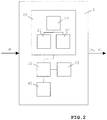
- FIG. 2 is an abstract representation of an exemplary cryptographic device 1.
- the device 1 may include a processor 10 for executing computer executable instructions 20.
- the computer executable instructions 20 may be stored on a computer-readable non-transitory storage medium.
- the device 1 may further include a random number generator 30 for generating a random number r i for each signature computation.
- the device 1 may further include a memory 40 for storing a private key k.
- a message M may be input to the device 1, for which a public-key digital signature ( R , S ) is to be obtained.
- Output of the device 1 may be the obtained signature ( R , S ).
- the computer executable instructions 20 form the improved EdDSA algorithm and includes a first implementation 21 for calculating the first hash h 1 and a second implementation 22 for calculating the second hash h 2 .
- the resulting hashes are used to compute the second data component S of the signature.
- the first data component R of the signature is an intermediate result of the EdDSA algorithm, as shown in FIG. 1 .
- random number r i and private key k are input to the algorithm at the required steps of the algorithm.
- One or more embodiments of the disclosure may be implemented as a computer program product for use with a computer system.
- the program(s) of the program product may define functions of the embodiments (including the methods described herein) and can be contained on a variety of computer-readable storage media.
- the computer-readable storage media may be non-transitory storage media.
- Illustrative computer-readable storage media include, but are not limited to: (i) non-writable storage media (e.g., read-only memory devices within a computer such as CD-ROM disks readable by a CD-ROM drive, ROM chips or any type of solid-state non-volatile semiconductor memory) on which information may be permanently stored; and (ii) writable storage media (e.g., hard disk drive or any type of solid-state random-access semiconductor memory, flash memory) on which alterable information may be stored.
- non-writable storage media e.g., read-only memory devices within a computer such as CD-ROM disks readable by a CD-ROM drive, ROM chips or any type of solid-state non-volatile semiconductor memory
- writable storage media e.g., hard disk drive or any type of solid-state random-access semiconductor memory, flash memory
Landscapes
- Engineering & Computer Science (AREA)
- Computer Security & Cryptography (AREA)
- Computer Networks & Wireless Communication (AREA)
- Signal Processing (AREA)
- Theoretical Computer Science (AREA)
- Computing Systems (AREA)
- Physics & Mathematics (AREA)
- Mathematical Analysis (AREA)
- Mathematical Optimization (AREA)
- Mathematical Physics (AREA)
- Pure & Applied Mathematics (AREA)
- General Physics & Mathematics (AREA)
- Algebra (AREA)
- Power Engineering (AREA)
- Computer Hardware Design (AREA)
- General Engineering & Computer Science (AREA)
- Storage Device Security (AREA)
Abstract
Description
- The present disclosure relates to a computer-implemented method for obtaining a public-key digital signature for a data message based on an Edwards-curve Digital Signature Algorithm. The disclosure further relates to a data processing device, a computer program product and a computer-readable non-transitory storage medium.
- A digital signature is a mathematical scheme for demonstrating the authenticity of digital messages or documents. A valid digital signature gives a recipient reason to believe that the message was created by a known sender (authentication), that the sender cannot deny having sent the message (non-repudiation), and that the message was not altered in transit (integrity). Digital signatures are a standard element of most cryptographic protocol suites, and are commonly used for software distribution, financial transactions, contract management software, and in other cases where it is important to detect forgery or tampering.
- A digital signature scheme typically includes a key generation algorithm, a signing algorithm and a signature verifying algorithm. The key generation algorithm may select a private key uniformly at random from a set of possible private keys and outputs the private key and a corresponding public key. The signing algorithm may produce a digital signature for a data message based on the private key. The signature verifying algorithm may accept or reject a data message's claim to authenticity based on the data message, the public key and the signature.
- It is known that Elliptic Curve Cryptography (ECC) can be used to build digital signature algorithms with a smaller key size than the Digital Signature Algorithm (DSA) with the same level of security. The security of such algorithms is generally based on the Discrete Logarithm Problem (DLP). Currently the best known algorithms to solve this DLP over elliptic curves are less efficient than ones over finite fields. This allowed the fast adoption of ECC to provide security in embedded ecosystems where resources are constrained.
- EdDSA can be used to perform fast public-key digital signatures as a replacement for the Elliptic Curve Digital Signature Algorithm (ECDSA).
- EdDSA is implemented in many products and libraries, such as OpenSSH. It was also recently defined in RFC 8032.
- EdDSA is known to have higher performance compared to ECDSA notably because of its existing straightforward, secure implementations with neither branch nor lookup operations depending on the secret values being performed during a signature.
- These properties thwart many side-channel attacks. Nevertheless, it has been found that a single-fault attack against EdDSA can recover enough private key material to forge valid signatures for any message. With a single fault, it is possible to retrieve the long term private key and then forge valid signatures for any message.
- It is an aim of the disclosure to make the EdDSA signature algorithm and its implementations more resistant to fault attacks.
- The disclosure provides a solution for making the EdDSA signature algorithm more resistant to fault attacks.
- According to an aspect of the disclosure, a computer-implemented method is proposed for obtaining a public-key digital signature for a data message based on an EdDSA algorithm, wherein the public-key digital signature comprises a first data component and a second data component. The method can comprise receiving the first data component, a public key, a secret-integer, a secret-hash and the data message. The first data component can be an intermediate result of the EdDSA obtained from the secret-hash and the data message. The secret-integer can be derived from a part of a EdDSA private key. Typically, the derivation of the secret-integer uses a hash function and may further include clamping as defined in RFC8032.The secret-hash can be derived from a part of EdDSA private key and the data message. The method can further comprise computing a first hash based on the first data component, the public key and the data message. The method can further comprise computing a second hash based on the first data component, the public key and the data message. The method can further comprise computing the second data component based on the first hash, the second hash, the secret-integer, the secret-hash and a random value. The outcome of the computing of the second data component can be correct only if the first hash and the second hash are identical.
- Advantageously, the calculation of the two hashes and computing the second data component of the signature based on these two hashes makes it very difficult to perform fault attacks on the EdDSA algorithm and obtain a valid signature.
- In an embodiment, the computing of the first hash and the computing of the second hash can be implemented and/or coded differently using hardware and/or software means. Hence, it becomes increasingly difficult to perform fault attacks on the EdDSA algorithm, knowing that the computation results of the hashes should be the same for obtaining the second data component of the signature.
- In an embodiment, the random value can change with each computation of the second data component. This randomizes each computation of the signature to increase the security of the EdDSA algorithm.
- In an embodiment, the second data component can be computed using the following formula: S = (r + h 1 + (a - r i ).h 1 + (r i - 1).h 2) mod ℓ, wherein "S" is the second data component, "h 1" is the first hash, "h 2" is the second hash, "r i" is the random value, "a" is the secret-integer, "r" is the secret-hash, and "ℓ" is the curve order of the Edwards-curve as defined in the EdDSA standard.
- In an embodiment, one or more further hashes can be computed based on the first data component, the public key and the data message. In another embodiment, it is possible to add more than one random values, as long as the introduced randomness cancels itself in the subsequent computations.
- The second data component can be computed further based on the one or more further hashes. The outcome of the computing of the second data component can be correct only if the first hash, the second hash and the one or more further hashes are identical.
- According to an aspect of the disclosure, a data processing device is proposed. The device can comprise a processor that is configured to perform one or more of the steps of the above described method. It will be well understood that this is not a limited example, and an integrated circuit can for example be used to implement the method.
- According to an aspect of the disclosure, a computer program product is proposed. The computer program product can be implemented on a computer-readable non-transitory storage medium. The computer program product can comprise computer executable instructions which, when executed by a processor, cause the processor to carry out one or more of the steps of the above described method.
- According to an aspect of the disclosure, a computer-readable non-transitory storage medium is proposed, comprising computer executable instructions which, when executed by a processor, cause the processor to carry out one or more of the steps of the above described method.
- The wording first, second, third and fourth as used in the claims is not intended to indicate any particular order. This wording is used to label different elements for distinguishing the elements.
- Hereinafter, embodiments of the disclosure will be described in further detail. It should be appreciated, however, that these embodiments may not be construed as limiting the scope of protection for the present disclosure.
- Embodiments will now be described, by way of example only, with reference to the accompanying schematic drawings in which corresponding reference symbols indicate corresponding parts, and in which:
-
FIG. 1 shows a flow diagram of an exemplary EdDSA implementation according to an aspect of the disclosure; and -
FIG. 2 is an abstract representation of an exemplarycryptographic device 1 according to an aspect of the disclosure. - The figures are meant for illustrative purposes only, and do not serve as restriction of the scope or the protection as laid down by the claims.
- EdDSA is a public-key signature algorithm similar to ECDSA. In RFC 8032 EdDSA is defined for two twisted Edwards curves edwards25519 and edwards448; nevertheless EdDSA may be instantiated over other curves.
- EdDSA uses a private key k that is b-bits long and a hash function H that produces a 2b-bits output. One common instance is to use SHA-512 for b = 256 bits. The secret-integer a is determined from H(k) = (h0, h1, ..., h2b-1) with:

- The public key A is then computed from the base point B ≠ (0, 1) of order ℓ, chosen as per the curve specifications or peers agreement, such that A = a · B. In practice the public key and the signatures may be output according to the encoding defined in RFC 8032.
- The signature ( R , S) of a message M is typically computed according to the following Algorithm 1 (where the notation R corresponds to the value (yR||bit sign of xR) constructed from R coordinates).
Algorithm 1: EdDSA Signature Require: M, (h 0, h 1, ..., h 2b-1), B and A 1: a ← 2 b-2 + ∑3≤i≤b-3 2 ihi 2: h ← H(hb ,..., h 2b-1,M) 3: r ← h mod ℓ 4: R ← r·B 5: h ← H( R, A , M) 6: S ← (r+ah) mod ℓ 7: return ( R , S) - Amongst its differences from ECDSA, the signature
computation following Algorithm 1 is deterministic, i.e., for a given message M, if multiple signatures are computed they will all be identical. - A signature may be considered valid if from the parsing of R , it can be checked that R is an element of E, S is an element of {0, 1, ..., ℓ-1} and the following equation holds in E:

- Herein, verification without the cofactor 8 is a stronger way to verify a signature.
- The principle of fault attacks is to disturb the normal behavior of a device making it output erroneous results or bypass certain operations. If the fault happens during the computation of sensitive operations, the erroneous outputs may be used to recover sensitive information.
- An attack can for example be based on faulting operation 5 of
Algorithm 1 during the computation of the signature. As long as the output of the hash is faulted and changed to a value h' ≠ h then the faulty signature will be ( R , S'), i.e. as soon as the second part of the signature is changed. The value of a can be then recovered with:
- The value of h can be computed from R, A and M which are known, however, the value h' has to be known or guessed. This limitation can be overcome if the fault model is characterized properly and the faulted value can be guessed in a post-processing phase. For example, if the fault model is a random byte e that is an element of {1, 2, ..., 255} injected at a random offset i after the hash computation, i.e. h' = 28i e ⊕ h. For example, i is an element of {0, 1, ..., 31} for edwards25519 and i is an element of {0, 1, ..., 57} for edwards448. In the first case, all the 255 · 32 = 8160 possibilities can be tested for h' until the computation of a · B matches the public key value A.
- Even if the secret-integer a is known, it remains impossible to compute the secret-hash r = H(hb, ..., h 2b-1,M) for a new message M since the values hb, ..., h 2b-1 are not known. However, by selecting the secret-hash r as a random number, and computing a new ( R , S) similarly for any message M, we have:

- The verification equation still holds. Thus it is possible to forge valid signatures for any message, since a verifier does not know the secret-hash r.
- To overcome the above weakness and sensitivity to fault attacks, in an embodiment, S may be computed in a way which would prevent faults located in both the hash and the message to allow the recovery of the secret-integer a.
- Hereto, steps 5-7 of
Algorithm 1 may be replaced by the following three steps. - Step 1) Compute h 1 = H( R, A, M) with a first implementation.
- Step 2) Compute h 2 = H( R, A, M) with a second implementation.
Herein the first and second implementation are different implementations. The first implementation is for example a hardware implementation, while the second implementation is a software implementation. Alternatively, two different software implementations are used. The two operations may also be implemented with two different hardware implementations. Preferably the two implementations run in parallel, but it is possible to perform these implementations in series. - Step 3) Compute S = (r + h 1 + (a - r i).h 1 + (r i - 1).h 2) mod ℓ
- Herein, r i is a random b-bit number, changed at each signature computation.
- If h 1 = h 2 = h, the signature part S will be obtained as S = r + ah mod ℓ
- If h 1 ≠ h 2, and a fault occurred on h 1, then the following is true:
- Thus, the introduction of the random r 1 hinders the recovery of a in case h 1 ≠ h 2, and a fault occurred on h 1 .
- If h 1 ≠ h 2, and a fault occurred on h 2, then the following is true:

- Thus, there is no link with the secret-integer a at all in case h 1 ≠ h 2, and a fault occurred on h 2.
- The replacement steps of
Algorithm 1 prevent faults in h 1 or h 2 from outputting a value which leaks the actual value of a, except if two same faults are performed on both h 1 and h 2. The latter is considered very difficult if not impossible because of the two implementations wherein h 1 and h 2 are computed. This is especially true if both implementations differ. -
FIG. 1 shows an exemplary flow chart of an improvedEdDSA implementation 100 according to an aspect of the disclosure, with the following flow chart elements: - 101: Private key = k (b bits)
- 102: Hash = H(x) (2b bits)
- 103: Message = M
- 110: Left half = H[0:b-1] (b bits)
- 111: Clamp as per RFC8032
- 112: Secret-integer = a (b bits)
- 113: Basepoint multiplication and point encoding
- 114: Public key = A (b bits)
- 120: Right half = H[b:2b] (b bits)
- 121: Hash = H(x) (2b bits)
- 122: Secret-hash = r (2b bits)
- 123: Basepoint multiplication and point encoding
- 124: R part of the signature = R (b bits)
- 130: Final hash input = R , A , M
- 140: Compute h 1 = H( R, A, M)
- 141: Final hash = h 1 (2b bits)
- 150: Compute h 2 = H( R, A, M)
- 151: Final hash = h 2 (2b bits)
- 160: Compute S = (r + h 1 + (a - r i).h 1 + (r i - 1).h 2) mod ℓ
- 161: Random value = r i (at least b bits)
- 170: S part of the signature = S (b bits)
- The variables and operations used in
FIG. 1 correspond with the variables and operations of the above described examples. - In
FIG. 1 , the upper part of the implementation depicted "I" is similar to known EdDSA algorithms. The bottom part of the implementation depicted "II" includes the improvements to the EdDSA algorithm, wherein two hashes h1 and h2 may be computed in two parallel implementations in accordance withstep 1 and step 2 described above. The thus calculated hashes h1 and h2 are input, together with a randomly chosen value r i, into the computational step of calculating the signature component S, in accordance with the above described step 3. - Note that the other signature component R is an intermediate result of the EdDSA algorithm, as shown in
FIG. 1 instep 124. - The resulting signature of the improved EdDSA algorithm is ( R , S).
- In an alternative embodiment, more than two hashes may be calculated in different implementations. The computation of the signature component S may then be based on these more than two hashes and produce a valid signature if all computed hashes are the same.
-
FIG. 2 is an abstract representation of anexemplary cryptographic device 1. Thedevice 1 may include aprocessor 10 for executing computerexecutable instructions 20. The computerexecutable instructions 20 may be stored on a computer-readable non-transitory storage medium. Thedevice 1 may further include arandom number generator 30 for generating a random number r i for each signature computation. Thedevice 1 may further include amemory 40 for storing a private key k. - A message M may be input to the
device 1, for which a public-key digital signature ( R , S) is to be obtained. Output of thedevice 1 may be the obtained signature ( R , S). - The computer
executable instructions 20 form the improved EdDSA algorithm and includes afirst implementation 21 for calculating the first hash h 1 and asecond implementation 22 for calculating the second hash h 2. The resulting hashes are used to compute the second data component S of the signature. The first data component R of the signature is an intermediate result of the EdDSA algorithm, as shown inFIG. 1 . During computation, random number r i and private key k are input to the algorithm at the required steps of the algorithm. - One or more embodiments of the disclosure may be implemented as a computer program product for use with a computer system. The program(s) of the program product may define functions of the embodiments (including the methods described herein) and can be contained on a variety of computer-readable storage media. The computer-readable storage media may be non-transitory storage media. Illustrative computer-readable storage media include, but are not limited to: (i) non-writable storage media (e.g., read-only memory devices within a computer such as CD-ROM disks readable by a CD-ROM drive, ROM chips or any type of solid-state non-volatile semiconductor memory) on which information may be permanently stored; and (ii) writable storage media (e.g., hard disk drive or any type of solid-state random-access semiconductor memory, flash memory) on which alterable information may be stored.

Claims (9)
- A computer-implemented method for obtaining a public-key digital signature for a data message (103) based on an Edwards-curve Digital Signature Algorithm (hereinafter: EdDSA), wherein the public-key digital signature comprises a first data component (124) and a second data component (170), the method comprising:receiving the first data component (124), a public key (114), a secret-integer (112), a secret-hash (122) and the data message (103), wherein the first data component (124) is an intermediate result of the EdDSA obtained from the secret-hash (122) and the data message (103), wherein the secret-integer (112) is derived from a part of a EdDSA private key (101);computing a first hash (141) based on the first data component (124), the public key (114) and the data message (103);computing a second hash (151) based on the first data component (124), the public key (114) and the data message (103); andcomputing the second data component (170) based on the first hash (141), the second hash (151), the secret-integer (112), the secret-hash (122) and a random value (161),wherein the outcome of the computing of the second data component (170) is correct only if the first hash (141) and the second hash (151) are identical.
- The method according to claim 1, wherein the computing of the first hash (141) and the computing of the second hash (151) are implemented and/or coded differently using hardware and/or software means.
- The method according to claim 1 or 2, wherein the random value (161) changes with each computation of the second data component (170).
- The method according to any of the preceding claims, wherein the second data component (170) is computed using the following formula:

- The method according to any one of the preceding claims, wherein one or more further hashes are computed based on the first data component (124), the public key (114) and the data message (103), wherein the second data component (170) is computed further based on the one or more further hashes, and wherein the outcome of the computing of the second data component (170) is correct only if the first hash (141), the second hash (151) and the one or more further hashes are identical.
- A data processing device (1) comprising a processor (2) configured to perform the steps of the method according to any one of the claims 1-5.
- A data processing device (1) comprising an integrated circuit configured to perform the steps of the method according to any one of the claims 1-5.
- A computer program product, implemented on a computer-readable non-transitory storage medium, the computer program product comprising computer executable instructions which, when executed by a processor, cause the processor to carry out the steps of the method according to any one of the claims 1-5.
- A computer-readable non-transitory storage medium comprising computer executable instructions which, when executed by a processor, cause the processor to carry out the steps of the method according to any one of the claims 1-5.
Priority Applications (2)
| Application Number | Priority Date | Filing Date | Title |
|---|---|---|---|
| EP17192193.5A EP3461053A1 (en) | 2017-09-20 | 2017-09-20 | Fault attacks counter-measures for eddsa |
| US16/129,846 US20190089543A1 (en) | 2017-09-20 | 2018-09-13 | FAULT ATTACKS COUNTER-MEASURES FOR EdDSA |
Applications Claiming Priority (1)
| Application Number | Priority Date | Filing Date | Title |
|---|---|---|---|
| EP17192193.5A EP3461053A1 (en) | 2017-09-20 | 2017-09-20 | Fault attacks counter-measures for eddsa |
Publications (1)
| Publication Number | Publication Date |
|---|---|
| EP3461053A1 true EP3461053A1 (en) | 2019-03-27 |
Family
ID=59923343
Family Applications (1)
| Application Number | Title | Priority Date | Filing Date |
|---|---|---|---|
| EP17192193.5A Withdrawn EP3461053A1 (en) | 2017-09-20 | 2017-09-20 | Fault attacks counter-measures for eddsa |
Country Status (2)
| Country | Link |
|---|---|
| US (1) | US20190089543A1 (en) |
| EP (1) | EP3461053A1 (en) |
Cited By (2)
| Publication number | Priority date | Publication date | Assignee | Title |
|---|---|---|---|---|
| CN111740843A (en) * | 2020-06-18 | 2020-10-02 | 成都卫士通信息产业股份有限公司 | Distributed EdDSA signature method, apparatus, device and storage medium |
| US12177363B2 (en) * | 2022-10-11 | 2024-12-24 | Nxp B.V. | Fault countermeasures for digital signatures with aborts |
Families Citing this family (1)
| Publication number | Priority date | Publication date | Assignee | Title |
|---|---|---|---|---|
| CN110929290B (en) * | 2019-12-04 | 2022-03-18 | 南京如般量子科技有限公司 | Private key threshold backup, loss reporting and recovery system and method based on alliance chain |
Citations (1)
| Publication number | Priority date | Publication date | Assignee | Title |
|---|---|---|---|---|
| US20150288524A1 (en) * | 2012-11-12 | 2015-10-08 | Cryptography Research Inc. | Methods and systems for glitch-resistant cryptographic signing |
Family Cites Families (2)
| Publication number | Priority date | Publication date | Assignee | Title |
|---|---|---|---|---|
| US11080414B2 (en) * | 2015-05-22 | 2021-08-03 | Huawei Device Co., Ltd. | Cryptographic unit for public key infrastructure (PKI) operations |
| IT201600076089A1 (en) * | 2016-07-20 | 2018-01-20 | St Microelectronics Srl | PROCEDURE FOR THE GENERATION OF A DIGITAL SIGNATURE OF A MESSAGE, CORRESPONDING GENERATION UNITS, ELECTRONIC EQUIPMENT AND COMPUTER PRODUCT |
-
2017
- 2017-09-20 EP EP17192193.5A patent/EP3461053A1/en not_active Withdrawn
-
2018
- 2018-09-13 US US16/129,846 patent/US20190089543A1/en not_active Abandoned
Patent Citations (1)
| Publication number | Priority date | Publication date | Assignee | Title |
|---|---|---|---|---|
| US20150288524A1 (en) * | 2012-11-12 | 2015-10-08 | Cryptography Research Inc. | Methods and systems for glitch-resistant cryptographic signing |
Non-Patent Citations (2)
| Title |
|---|
| ANONYMOUS: "Ed25519 leaks private key if public key is incorrect . Issue #170 . jedisct1/libsodium . GitHub", 30 October 2016 (2016-10-30), XP055458434, Retrieved from the Internet <URL:https://github.com/jedisct1/libsodium/issues/170> [retrieved on 20180312] * |
| MARGAUX DUGARDIN ET AL: "Using Modular Extension to Provably Protect Edwards Curves Against Fault Attacks", INTERNATIONAL ASSOCIATION FOR CRYPTOLOGIC RESEARCH,, vol. 20160814:122545, 14 August 2016 (2016-08-14), pages 1 - 18, XP061021466 * |
Cited By (2)
| Publication number | Priority date | Publication date | Assignee | Title |
|---|---|---|---|---|
| CN111740843A (en) * | 2020-06-18 | 2020-10-02 | 成都卫士通信息产业股份有限公司 | Distributed EdDSA signature method, apparatus, device and storage medium |
| US12177363B2 (en) * | 2022-10-11 | 2024-12-24 | Nxp B.V. | Fault countermeasures for digital signatures with aborts |
Also Published As
| Publication number | Publication date |
|---|---|
| US20190089543A1 (en) | 2019-03-21 |
Similar Documents
| Publication | Publication Date | Title |
|---|---|---|
| US8472621B2 (en) | Protection of a prime number generation for an RSA algorithm | |
| US8442216B2 (en) | Fault detection in exponentiation and point multiplication operations using a montgomery ladder | |
| EP2351286B1 (en) | Cryptographic algorithm fault protections | |
| US9219602B2 (en) | Method and system for securely computing a base point in direct anonymous attestation | |
| US9654290B2 (en) | Integrity verification of cryptographic key pairs | |
| JP2015534419A (en) | Method and system for anti-glitch cryptographic discrete log-based signature | |
| EP3742662A1 (en) | Method for securing against fault attacks a verification algorithm of a digital signature of a message | |
| CN110505061B (en) | Digital signature algorithm and system | |
| US20160149708A1 (en) | Electronic signature system | |
| JP2011530093A (en) | Solutions to protect power-based encryption | |
| US11444760B2 (en) | System, method, and apparatus for obfuscating device operations | |
| US20100208887A1 (en) | Method and device for countering faul attacks | |
| US20190089543A1 (en) | FAULT ATTACKS COUNTER-MEASURES FOR EdDSA | |
| CN101133593A (en) | Method for safely executing RSA-type cryptographic algorithm and corresponding components | |
| US20220092201A1 (en) | Authentication of files | |
| CN110602190B (en) | Block chain consensus method, block chain node and storage device | |
| Blömer et al. | Wagner’s Attack on a secure CRT-RSA Algorithm Reconsidered | |
| US7454625B2 (en) | Method and apparatus for protecting a calculation in a cryptographic algorithm | |
| US7760873B2 (en) | Method and a system for a quick verification rabin signature scheme | |
| CN117081739A (en) | Public key restoration method, device and medium based on cryptographic algorithm | |
| US20230135566A1 (en) | Methods and apparatus for cryptographic signature generation | |
| Barenghi et al. | A novel fault attack against ECDSA | |
| US11606195B2 (en) | Method of verifying integrity of a pair of cryptographic keys and cryptographic device | |
| US9680645B2 (en) | Integrity verification of cryptographic key pairs | |
| CA2278754A1 (en) | A method of using transient faults to verify the security of a cryptosystem |
Legal Events
| Date | Code | Title | Description |
|---|---|---|---|
| PUAI | Public reference made under article 153(3) epc to a published international application that has entered the european phase |
Free format text: ORIGINAL CODE: 0009012 |
|
| STAA | Information on the status of an ep patent application or granted ep patent |
Free format text: STATUS: THE APPLICATION HAS BEEN PUBLISHED |
|
| AK | Designated contracting states |
Kind code of ref document: A1 Designated state(s): AL AT BE BG CH CY CZ DE DK EE ES FI FR GB GR HR HU IE IS IT LI LT LU LV MC MK MT NL NO PL PT RO RS SE SI SK SM TR |
|
| AX | Request for extension of the european patent |
Extension state: BA ME |
|
| STAA | Information on the status of an ep patent application or granted ep patent |
Free format text: STATUS: REQUEST FOR EXAMINATION WAS MADE |
|
| 17P | Request for examination filed |
Effective date: 20190927 |
|
| RBV | Designated contracting states (corrected) |
Designated state(s): AL AT BE BG CH CY CZ DE DK EE ES FI FR GB GR HR HU IE IS IT LI LT LU LV MC MK MT NL NO PL PT RO RS SE SI SK SM TR |
|
| GRAP | Despatch of communication of intention to grant a patent |
Free format text: ORIGINAL CODE: EPIDOSNIGR1 |
|
| STAA | Information on the status of an ep patent application or granted ep patent |
Free format text: STATUS: GRANT OF PATENT IS INTENDED |
|
| RIC1 | Information provided on ipc code assigned before grant |
Ipc: H04L 9/00 20060101AFI20200407BHEP Ipc: H04L 9/32 20060101ALI20200407BHEP |
|
| INTG | Intention to grant announced |
Effective date: 20200511 |
|
| STAA | Information on the status of an ep patent application or granted ep patent |
Free format text: STATUS: THE APPLICATION IS DEEMED TO BE WITHDRAWN |
|
| 18D | Application deemed to be withdrawn |
Effective date: 20200922 |