EP3460781A1 - Flight simulator - Google Patents
Flight simulator Download PDFInfo
- Publication number
- EP3460781A1 EP3460781A1 EP18195641.8A EP18195641A EP3460781A1 EP 3460781 A1 EP3460781 A1 EP 3460781A1 EP 18195641 A EP18195641 A EP 18195641A EP 3460781 A1 EP3460781 A1 EP 3460781A1
- Authority
- EP
- European Patent Office
- Prior art keywords
- scramnet
- message
- bus
- flight control
- ethernet
- Prior art date
- Legal status (The legal status is an assumption and is not a legal conclusion. Google has not performed a legal analysis and makes no representation as to the accuracy of the status listed.)
- Granted
Links
Images


Classifications
-
- G—PHYSICS
- G09—EDUCATION; CRYPTOGRAPHY; DISPLAY; ADVERTISING; SEALS
- G09B—EDUCATIONAL OR DEMONSTRATION APPLIANCES; APPLIANCES FOR TEACHING, OR COMMUNICATING WITH, THE BLIND, DEAF OR MUTE; MODELS; PLANETARIA; GLOBES; MAPS; DIAGRAMS
- G09B9/00—Simulators for teaching or training purposes
- G09B9/02—Simulators for teaching or training purposes for teaching control of vehicles or other craft
- G09B9/08—Simulators for teaching or training purposes for teaching control of vehicles or other craft for teaching control of aircraft, e.g. Link trainer
- G09B9/30—Simulation of view from aircraft
- G09B9/301—Simulation of view from aircraft by computer-processed or -generated image
- G09B9/302—Simulation of view from aircraft by computer-processed or -generated image the image being transformed by computer processing, e.g. updating the image to correspond to the changing point of view
-
- G—PHYSICS
- G09—EDUCATION; CRYPTOGRAPHY; DISPLAY; ADVERTISING; SEALS
- G09B—EDUCATIONAL OR DEMONSTRATION APPLIANCES; APPLIANCES FOR TEACHING, OR COMMUNICATING WITH, THE BLIND, DEAF OR MUTE; MODELS; PLANETARIA; GLOBES; MAPS; DIAGRAMS
- G09B9/00—Simulators for teaching or training purposes
- G09B9/02—Simulators for teaching or training purposes for teaching control of vehicles or other craft
- G09B9/08—Simulators for teaching or training purposes for teaching control of vehicles or other craft for teaching control of aircraft, e.g. Link trainer
-
- G—PHYSICS
- G06—COMPUTING OR CALCULATING; COUNTING
- G06F—ELECTRIC DIGITAL DATA PROCESSING
- G06F3/00—Input arrangements for transferring data to be processed into a form capable of being handled by the computer; Output arrangements for transferring data from processing unit to output unit, e.g. interface arrangements
- G06F3/14—Digital output to display device ; Cooperation and interconnection of the display device with other functional units
- G06F3/1423—Digital output to display device ; Cooperation and interconnection of the display device with other functional units controlling a plurality of local displays, e.g. CRT and flat panel display
-
- G—PHYSICS
- G09—EDUCATION; CRYPTOGRAPHY; DISPLAY; ADVERTISING; SEALS
- G09B—EDUCATIONAL OR DEMONSTRATION APPLIANCES; APPLIANCES FOR TEACHING, OR COMMUNICATING WITH, THE BLIND, DEAF OR MUTE; MODELS; PLANETARIA; GLOBES; MAPS; DIAGRAMS
- G09B9/00—Simulators for teaching or training purposes
- G09B9/02—Simulators for teaching or training purposes for teaching control of vehicles or other craft
- G09B9/08—Simulators for teaching or training purposes for teaching control of vehicles or other craft for teaching control of aircraft, e.g. Link trainer
- G09B9/30—Simulation of view from aircraft
- G09B9/32—Simulation of view from aircraft by projected image
-
- H—ELECTRICITY
- H04—ELECTRIC COMMUNICATION TECHNIQUE
- H04L—TRANSMISSION OF DIGITAL INFORMATION, e.g. TELEGRAPHIC COMMUNICATION
- H04L12/00—Data switching networks
- H04L12/28—Data switching networks characterised by path configuration, e.g. LAN [Local Area Networks] or WAN [Wide Area Networks]
-
- H—ELECTRICITY
- H04—ELECTRIC COMMUNICATION TECHNIQUE
- H04L—TRANSMISSION OF DIGITAL INFORMATION, e.g. TELEGRAPHIC COMMUNICATION
- H04L69/00—Network arrangements, protocols or services independent of the application payload and not provided for in the other groups of this subclass
- H04L69/18—Multiprotocol handlers, e.g. single devices capable of handling multiple protocols
-
- H—ELECTRICITY
- H04—ELECTRIC COMMUNICATION TECHNIQUE
- H04L—TRANSMISSION OF DIGITAL INFORMATION, e.g. TELEGRAPHIC COMMUNICATION
- H04L69/00—Network arrangements, protocols or services independent of the application payload and not provided for in the other groups of this subclass
- H04L69/26—Special purpose or proprietary protocols or architectures
Definitions
- the field of the disclosure relates generally to flight simulation and, more specifically, to a flight simulator that utilizes both ScramNet protocols and Ethernet protocols, and methods of use.
- flight simulators include large static installations of aircraft cockpits, with flight controls, displays, instrumentation and other pilot interfaces, and out-the-window (OTW) displays.
- the aircraft cockpits include high-fidelity simulated hardware or actual flight hardware integrated into the flight simulation.
- Such hardware may include, for example, tactical displays, multi-function displays (MFDs), instrumentation, alert and warning indicators, heads-up displays (HUDs), flight controls, communication systems, and other avionics systems.
- FMDs multi-function displays
- HUDs heads-up displays
- flight controls communication systems
- communication systems and other avionics systems
- flight simulators include high-fidelity OTW display systems including, for example, curved-screen projection systems, multi-panel display systems, or dome projection systems.
- High-fidelity flight simulators enable training, testing, and marketing of complex aircraft without the expense of actual flight time in actual aircraft, although such flight simulators are generally dedicated to a particular aircraft.
- Flight simulators static and mobile, generally include at least one processing system, e.g., a computer, that executes flight simulation software for controlling various pilot interfaces, including, for example, flight controls and various displays.
- Many high-fidelity flight simulators include multiple processing systems respectively dedicated to controlling one or more subsystem of the flight simulator.
- a flight simulator may include one or more dedicated processing systems for controlling OTW displays, another processing system for controlling a cockpit display, such as, for example, an MFD or tactical display, and yet another processing system for controlling flight controls, such as, for example, a stick and throttle.
- Each of such processing systems executes a portion of flight simulation software, or simulation processes, for its dedicated purpose or function.
- the host process may include, for example, a math model that processes various inputs, such as, for example, flight control inputs and wind, to compute various outputs, or aircraft parameters, such as aircraft attitude, i.e., pitch, roll, and yaw, that represent the dynamics of the aircraft in simulated flight.
- the aircraft parameters are then communicated among the various simulation processes to enable each to carry out its dedicated purpose or function.
- an OTW process receives the aircraft's simulated position and attitude and uses it to determine what OTW scenery to render.
- a processing system for a flight simulator includes a ScramNet interface, a non-transitory memory, and a processor.
- the ScramNet interface is configured to establish a ScramNet bus on which ScramNet messages are transmitted and received.
- the non-transitory memory is configured to store computer-executable instructions for a host process and a ScramNet-to-Ethernet application programming interface (API).
- API application programming interface
- the processor is communicatively coupled to the ScramNet interface and the non-transitory memory, and is configured to execute the host process and the ScramNet-to-Ethernet API to: convert, using the ScramNet-to-Ethernet API, a flight control message to a first ScramNet message on the ScramNet bus, process, using the host process, the first ScramNet message to generate a second ScramNet message on the ScramNet bus, and convert, using the ScramNet-to-Ethernet API, the second ScramNet message to a display message.
- a flight simulator includes an Ethernet network, a flight control system, a host processing system, and a display system.
- the flight control system is coupled to the Ethernet network and is configured to receive flight control inputs and transmit a flight control message over the Ethernet network.
- the host processing system is coupled to the Ethernet network and includes a ScramNet bus.
- the host processing system is configured to convert the flight control message to a first ScramNet message on the ScramNet bus, execute a host process configured to communicate on the ScramNet bus and process the first ScramNet message to generate a second ScramNet message on the ScramNet bus, and convert the second ScramNet message to a display message.
- the display system is coupled to the Ethernet network and is configured to receive the display message.
- a method of conducting a flight simulation includes receiving a flight control message over an Ethernet network from a flight control system.
- the flight control message includes flight control inputs.
- the method includes converting the flight control message to a first ScramNet message and transmitting the first ScramNet message onto a ScramNet bus.
- the method includes executing a host process configured to gain access to the ScramNet bus and process the flight control inputs in the first ScramNet message to generate a second ScramNet message.
- the method includes transmitting the second ScramNet message onto the ScramNet bus.
- the method includes converting the second ScramNet message to a display message.
- the method includes transmitting the display message over the Ethernet network to a display system.
- FIG. 1 is a block diagram of an exemplary processing system 100.
- Processing system 100 includes a processor 102, a ScramNet interface 104, an Ethernet interface 106, and a non-transitory memory 108, all of which communicate over a communication bus 110, such as, for example, peripheral component interconnect (PCI), PCI Express, PCI Extended, or any other suitable communication bus for computing systems.
- PCI peripheral component interconnect
- Processing system 100 is an exemplary system on which one or more simulation processes may execute for a flight simulator. In certain embodiments, processing system 100 executes an operating system within which other simulation processes are executed.
- ScramNet interface 104 is a specialized hardware interface for an exemplary real-time communication protocol that utilizes reflective shared memory to achieve synchronized low-latency communication among processing systems and simulation processes.
- ScramNet interface 104 establishes a ScramNet bus (not shown) with which processor 102 communicates to transmit and receive messages, i.e., data. Transmitting data is generally referred to as putting a message on the ScramNet bus, and receiving data is generally referred to as pulling a message off the ScramNet bus.
- ScramNet interface 104 is further configured to communicate with remote processing systems that are enabled with their own ScramNet interface 104, i.e., that sit on the ScramNet bus.
- the various processing systems, such as processing system 100, that sit on the ScramNet bus are communicatively coupled over a token-ring network that may include copper connections, fiber optic connections, or any other suitable communication medium for establishing the network.
- FIG. 2 is a block diagram of an exemplary flight simulator 200.
- Flight simulator 200 includes a host processing system 202 that, in certain embodiments, is implemented as processing system 100 (shown in FIG. 1 ).
- Flight simulator 200 includes a cockpit 204 and OTW display systems 206, 208, and 210, i.e., center OTW (OTW-C) 206, left OTW (OTW-L) 208, and right OTW (OTW-R) 210.
- OOTW-C center OTW
- OW-L left OTW
- OW-R right OTW
- Cockpit 204 includes various pilot interfaces, including a flight control system 212, an MFD 214, a tactical display 216, a HUD 218, and various other avionics 220 integrated into flight simulator 200, all of which are communicatively coupled to a real-time bus 222, such as, for example Ethernet.
- a flight control system 212 an MFD 214
- tactical display 216 a HUD 218, and various other avionics 220 integrated into flight simulator 200, all of which are communicatively coupled to a real-time bus 222, such as, for example Ethernet.
- Each of host processing system 202, OTW display systems 206, 208, 210, flight control system 212, MFD 214, tactical display 216, HUD 218, and avionics 220 represents a simulation process executing on one or more processing system, and further represents the physical processing system or physical human interface on which its dedicated purpose or function is carried out.
- OTW-C 206 represents a center OTW process executing on a processing system as well as the display itself on which OTW scenery is rendered.
- flight control system 212 represents a flight control process executing on a processing system as well as the physical flight control interfaces, e.g., stick, throttle, rudder pedals, cyclic, collective, or other flight control device, with which the pilot interfaces.
- the pilot utilizes a stick to control pitch and roll in a fixed-wing aircraft.
- the pilot may utilize rudder pedals to control yaw.
- a stick or cyclic is generally used to control pitch and yaw, while a collective is used to control altitude.
- one or more of the cockpit display devices such as, for example, MFD 214, tactical display 216, or HUD 218 may include one or more tablet computing devices, flat panel displays, or other suitable display systems operable to receive a display message and render appropriate graphics, scenery, text, or other objects.
- FIG. 3 is another block diagram of flight simulator 200 that utilizes both ScramNet protocols and Ethernet protocols.
- FIG. 3 includes host processing system 202 coupled to flight control system 212 by real-time bus 222 (all shown in FIG. 2 ).
- FIG. 3 also includes a display system 300, such as, for example, OTW systems 206, 208, 210, MFD 214, tactical display 216, (all shown in FIG. 2 ) or any other suitable display system.
- Host processing system 202, flight control system 212, and display system 300 communicate using real-time bus 222 that is implemented as an Ethernet network.
- real-time bus 222 may further include one or more Ethernet switches, hubs, or other routing devices to enable real-time communication among various processing systems on the Ethernet network.
- Flight control system 212 receives flight control input from a pilot or user of flight simulator 200 and transmits a flight control message, e.g., an Ethernet message, over real-time bus 222.
- Flight control input may include, for example, pitch, roll, and yaw commands.
- flight control system 212 packs the flight control inputs into one or more Ethernet packets and transmits them to host processing system 202.
- Host processing system 202 includes memory, such as, for example, non-transitory memory 108 (shown in FIG. 1 ) that is configured to store computer executable instructions including, for example, a host process 302 and a ScramNet-to-Ethernet application programming interface (API) 304.
- Host process 302 and ScramNet-to-Ethernet API 304 are simulation processes that execute on one or more processors of host processing system 202.
- Host process 302 coordinates among all other simulation processes, including those executing on host processing system 202, as well as simulation processes executed on one or more remote processing system, such as a dedicated processing system for flight control system 212 or another dedicated processing system for display system 300.
- Host process 302 includes, for example, a math model that processes various inputs, such as, for example, flight control inputs and wind, to compute various outputs, or aircraft parameters, such as aircraft attitude, i.e., pitch, roll, and yaw, that represent the dynamics of the aircraft in simulated flight.
- Host processing system 202 includes a ScramNet interface, such as ScramNet interface 104 (shown in FIG. 1 ), that establishes a ScramNet bus 306.
- host processing system 202 may omit ScramNet interface 104, and may further implement ScramNet bus 306 within host process 302 or any other suitable process executing on host processing system 202.
- Host process 302 is generally configured to communicate among various simulation processes using ScramNet bus 306.
- Flight simulator 200 utilizes real-time bus 222, i.e., the Ethernet network, for communication among host processing system 202, flight control system 212, and display system 300.
- host processing system 202 executes ScramNet-to-Ethernet API 304 to handle conversion from real-time bus 222, i.e., the Ethernet network, to ScramNet bus 306.
- ScramNet-to-Ethernet API 304 enables host process 302 to operate without having to modify real-time communication protocols that utilize ScramNet bus 306. Rather, host process 302 continues to gain access to ScramNet bus 306 and transmit and receive messages, i.e., data, over ScramNet bus 306.
- any other simulation processes executing on host processing system 202 or other remote processing systems, such as, for example flight control system 212 and display system 300, that utilize ScramNet protocols may also utilize ScramNet-to-Ethernet API 304 to handle conversion from real-time bus 222, i.e., the Ethernet network, to ScramNet bus 306 or any other ScramNet bus local to that processing system.
- remote processing systems may be implemented similar to processing system 100 (shown in FIG. 1 ), including ScramNet interface 104 that establishes a local ScramNet bus, and Ethernet interface 106 that interfaces with real-time bus 222, e.g., the Ethernet network.
- Host processing system 202 receives the flight control message over real-time bus 222, i.e., the Ethernet bus, from flight control system 212.
- ScramNet-to-Ethernet API 304 converts the flight control message to a ScramNet message, e.g., a first ScramNet message, that is put onto, i.e., transmitted over, ScramNet bus 306.
- Such conversion generally includes unpacking the flight control message, i.e., the Ethernet message, into its flight control input components, and then repacking the flight control input components into the ScramNet message.
- ScramNet-to-Ethernet API 304 gains access to ScramNet bus 306 and the ScramNet message is then put onto ScramNet bus 306.
- Host process 302 gains access to ScramNet bus 306 and pulls down, i.e., receives, the ScramNet message containing the flight control inputs. Host process 302 then unpacks the ScramNet message for use within, for example, the math model for the aircraft.
- host process 302 executes the math model with the flight control inputs received from flight control system 212.
- Host process 302 generates, as a result, aircraft parameters including, for example, position and attitude of the aircraft in simulated flight.
- aircraft parameters are packed into another ScramNet message, e.g., a second ScramNet message that is put onto, i.e., transmitted over, ScramNet bus 306.
- ScramNet-to-Ethernet API 304 gains access to ScramNet bus 306 and pulls down, i.e., receives, the second ScramNet message.
- ScramNet-to-Ethernet API 304 unpacks the second ScramNet message into, for example, the aircraft parameter components, and repacks the data into, for example, a display message, e.g., an Ethernet message, that is transmitted onto real-time bus 222, i.e., the Ethernet network, to display system 300.
- a display message e.g., an Ethernet message
- Display system 300 includes a physical display on which graphics, scenery, text, or other objects are displayed for the pilot or user.
- Display system 300 also includes, in certain embodiments, a processing system dedicated for executing a display process that controls the physical display itself.
- a processing system in certain embodiments, is configured to operate directly on the display message transmitted from host processing system 202 over real-time bus 222, i.e., the Ethernet network.
- display system 300 receives the Ethernet message and renders appropriate graphics according to the aircraft parameters contained therein.
- display system 300 includes an MFD, such as, for example, MFD 214 (shown in FIG. 2 )
- the MFD may be configured to display a visual representation of the aircraft's position and/or attitude in simulated flight.
- display system 300 may include a ScramNet interface, such as ScramNet interface 104 (shown in FIG. 1 ) that establishes another ScramNet bus local to the processing system dedicated to display system 300.
- display system 300 may include a dedicated processing system for OTW-C 206 that similarly receives the display message transmitted from host processing system 202 over real-time bus 222, i.e., the Ethernet network.
- display system 300 would convert the Ethernet message into another ScramNet message containing the aircraft parameters that is then put onto the local ScramNet bus where the display process may gain access and control OTW-C 206 accordingly, e.g., render OTW scenery.
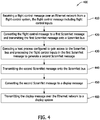
- FIG. 4 is a flow diagram of an exemplary method 400 of conducting a flight simulation using flight simulator 200 (shown in FIG. 2 and FIG. 3 ).
- Method 400 includes receiving 410 a flight control message at host processing system 202 over an Ethernet network, such as real-time bus 222, from flight control system 212. As described above, the flight control message includes flight control inputs received from the pilot or user.
- Method 400 includes converting 420 the flight control message to a first ScramNet message using ScramNet-to-Ethernet API 304 and transmitting the first ScramNet message onto ScramNet bus 306.
- Host process 302 is executed 430 on host processing system 202.
- Host process 302 gains access to ScramNet bus 306 and processes the flight control inputs in the first ScramNet message to generate a second ScramNet message containing, for example, aircraft parameters.
- the second ScramNet message is then transmitted 440 onto ScramNet bus 306 by host process 302.
- ScramNet-to-Ethernet API 304 then converts 450 the second ScramNet message to a display message, e.g., an Ethernet message.
- the display message is transmitted 460 over real-time bus, i.e., the Ethernet network, to display system 300.
- embodiments described herein provide a flight simulator that utilizes both ScramNet communication protocols and Ethernet communication protocols to achieve real-time communication among simulation processes. More specifically, embodiments described herein include a ScramNet-to-Ethernet API that converts between ScramNet messages and Ethernet messages to enable simulation processes configured to utilize ScramNet protocols to continue operating without modification. Further, the ScramNet-to-Ethernet API enables such flight simulators to utilize an Ethernet network as a real-time bus, thereby reducing complexity, cost, and bulk of specialized communication protocols that typically require specialized hardware and software.
- An exemplary technical effect of the methods, systems, and apparatus described herein includes at least one of: (a) reducing complexity of real-time communications; (b) reducing cost of processing systems for flight simulators by elimination of specialized hardware and software; (c) improving mobility and configurability of flight simulators by elimination or reduction of specialized hardware; and (d) improving configurability of flight simulators by simplification of real-time communication protocols.
- processors and “computer” and related terms, e.g., “processing device”, “computing device”, and “controller” are not limited to just those integrated circuits referred to in the art as a computer, but broadly refers to a processor, a processing device, a controller, a general purpose central processing unit (CPU), a graphics processing unit (GPU), a microcontroller, a microcomputer, a programmable logic controller (PLC), a reduced instruction set computer (RISC) processor, a field programmable gate array (FPGA), a digital signal processing (DSP) device, an application specific integrated circuit (ASIC), and other programmable circuits or processing devices capable of executing the functions described herein, and these terms are used interchangeably herein.
- CPU central processing unit
- GPU graphics processing unit
- microcontroller e.g., a microcontroller
- microcomputer e.g., a programmable logic controller
- RISC reduced instruction set computer
- FPGA field programmable gate array
- DSP
- memory may include, but is not limited to, a non-transitory computer-readable medium, such as flash memory, a random access memory (RAM), read-only memory (ROM), erasable programmable read-only memory (EPROM), electrically erasable programmable read-only memory (EEPROM), and non-volatile RAM (NVRAM).
- a non-transitory computer-readable medium such as flash memory, a random access memory (RAM), read-only memory (ROM), erasable programmable read-only memory (EPROM), electrically erasable programmable read-only memory (EEPROM), and non-volatile RAM (NVRAM).
- RAM random access memory
- ROM read-only memory
- EPROM erasable programmable read-only memory
- EEPROM electrically erasable programmable read-only memory
- NVRAM non-volatile RAM
- non-transitory computer-readable media is intended to be representative of any tangible, computer-readable media, including, without limitation, non-transitory computer storage devices, including, without limitation, volatile and non-volatile media, and removable and non-removable media such as a firmware, physical and virtual storage, CD-ROMs, DVDs, and any other digital source such as a network or the Internet, as well as yet to be developed digital means, with the sole exception being a transitory, propagating signal.
- a floppy disk a compact disc - read only memory (CD-ROM), a magneto-optical disk (MOD), a digital versatile disc (DVD), or any other computer-based device implemented in any method or technology for short-term and long-term storage of information, such as, computer-readable instructions, data structures, program modules and sub-modules, or other data
- the methods described herein may be encoded as executable instructions, e.g., "software” and "firmware,” embodied in a non-transitory computer-readable medium.
- the terms "software” and “firmware” are interchangeable, and include any computer program stored in memory for execution by personal computers, workstations, clients and servers. Such instructions, when executed by a processor, cause the processor to perform at least a portion of the methods described herein.
- additional input channels may be, but are not limited to, computer peripherals associated with an operator interface such as a mouse and a keyboard.
- other computer peripherals may also be used that may include, for example, but not be limited to, a scanner.
- additional output channels may include, but not be limited to, an operator interface monitor.
Landscapes
- Engineering & Computer Science (AREA)
- Theoretical Computer Science (AREA)
- Physics & Mathematics (AREA)
- General Physics & Mathematics (AREA)
- Aviation & Aerospace Engineering (AREA)
- Business, Economics & Management (AREA)
- Educational Administration (AREA)
- Educational Technology (AREA)
- Computer Networks & Wireless Communication (AREA)
- Signal Processing (AREA)
- Computer Hardware Design (AREA)
- General Engineering & Computer Science (AREA)
- Computer Security & Cryptography (AREA)
- Human Computer Interaction (AREA)
- Computing Systems (AREA)
- Traffic Control Systems (AREA)
- Computer And Data Communications (AREA)
- User Interface Of Digital Computer (AREA)
Abstract
Description
- The field of the disclosure relates generally to flight simulation and, more specifically, to a flight simulator that utilizes both ScramNet protocols and Ethernet protocols, and methods of use.
- Many known flight simulators include large static installations of aircraft cockpits, with flight controls, displays, instrumentation and other pilot interfaces, and out-the-window (OTW) displays. In some instances the aircraft cockpits include high-fidelity simulated hardware or actual flight hardware integrated into the flight simulation. Such hardware may include, for example, tactical displays, multi-function displays (MFDs), instrumentation, alert and warning indicators, heads-up displays (HUDs), flight controls, communication systems, and other avionics systems. Likewise, some flight simulators include high-fidelity OTW display systems including, for example, curved-screen projection systems, multi-panel display systems, or dome projection systems. High-fidelity flight simulators enable training, testing, and marketing of complex aircraft without the expense of actual flight time in actual aircraft, although such flight simulators are generally dedicated to a particular aircraft.
- Flight simulators, static and mobile, generally include at least one processing system, e.g., a computer, that executes flight simulation software for controlling various pilot interfaces, including, for example, flight controls and various displays. Many high-fidelity flight simulators include multiple processing systems respectively dedicated to controlling one or more subsystem of the flight simulator. For example, a flight simulator may include one or more dedicated processing systems for controlling OTW displays, another processing system for controlling a cockpit display, such as, for example, an MFD or tactical display, and yet another processing system for controlling flight controls, such as, for example, a stick and throttle. Each of such processing systems executes a portion of flight simulation software, or simulation processes, for its dedicated purpose or function. At the core of the flight simulation software is a host process that coordinates among all other simulation processes, whether they are executed on a single processing system or distributed among multiple processing systems. The host process may include, for example, a math model that processes various inputs, such as, for example, flight control inputs and wind, to compute various outputs, or aircraft parameters, such as aircraft attitude, i.e., pitch, roll, and yaw, that represent the dynamics of the aircraft in simulated flight. The aircraft parameters are then communicated among the various simulation processes to enable each to carry out its dedicated purpose or function. For example, an OTW process receives the aircraft's simulated position and attitude and uses it to determine what OTW scenery to render.
- It is often necessary for communication among the various simulation processes in a high-fidelity flight simulator to be carried out in real time, e.g., synchronized and low-latency, to maintain the realistic look and feel demanded of such systems. Many flight simulators utilize sophisticated communication protocols, such as, for example, reflective shared memory, e.g., ScramNet, to satisfy the real-time constraint. Sophisticated communication protocols typically require specialized hardware and software that introduces costs, complexity, and bulk to the flight simulator. Accordingly, it is realized herein, a flight simulator that is mobile, configurable for multiple aircraft, operable in real time, and affordable is desired.
- According to one aspect of the present disclosure, a processing system for a flight simulator is provided. The processing system includes a ScramNet interface, a non-transitory memory, and a processor. The ScramNet interface is configured to establish a ScramNet bus on which ScramNet messages are transmitted and received. The non-transitory memory is configured to store computer-executable instructions for a host process and a ScramNet-to-Ethernet application programming interface (API). The processor is communicatively coupled to the ScramNet interface and the non-transitory memory, and is configured to execute the host process and the ScramNet-to-Ethernet API to: convert, using the ScramNet-to-Ethernet API, a flight control message to a first ScramNet message on the ScramNet bus, process, using the host process, the first ScramNet message to generate a second ScramNet message on the ScramNet bus, and convert, using the ScramNet-to-Ethernet API, the second ScramNet message to a display message.
- According to another aspect of the present disclosure, a flight simulator is provided. The flight simulator includes an Ethernet network, a flight control system, a host processing system, and a display system. The flight control system is coupled to the Ethernet network and is configured to receive flight control inputs and transmit a flight control message over the Ethernet network. The host processing system is coupled to the Ethernet network and includes a ScramNet bus. The host processing system is configured to convert the flight control message to a first ScramNet message on the ScramNet bus, execute a host process configured to communicate on the ScramNet bus and process the first ScramNet message to generate a second ScramNet message on the ScramNet bus, and convert the second ScramNet message to a display message. The display system is coupled to the Ethernet network and is configured to receive the display message.
- According to yet another aspect of the present disclosure, a method of conducting a flight simulation is provided. The method includes receiving a flight control message over an Ethernet network from a flight control system. The flight control message includes flight control inputs. The method includes converting the flight control message to a first ScramNet message and transmitting the first ScramNet message onto a ScramNet bus. The method includes executing a host process configured to gain access to the ScramNet bus and process the flight control inputs in the first ScramNet message to generate a second ScramNet message. The method includes transmitting the second ScramNet message onto the ScramNet bus. The method includes converting the second ScramNet message to a display message. The method includes transmitting the display message over the Ethernet network to a display system.
- The features, functions, and advantages that have been discussed can be achieved independently in various embodiments or may be combined in yet other embodiments further details of which can be seen with reference to the following description and drawings.
-
-
FIG. 1 is a block diagram of an exemplary processing system; -
FIG. 2 is a block diagram of an exemplary flight simulator; -
FIG. 3 is another block diagram of the flight simulator shown inFIG. 2 that utilizes both ScramNet protocols and Ethernet protocols; and -
FIG. 4 is a flow diagram of an exemplary method of conducting a flight simulation. -
FIG. 1 is a block diagram of anexemplary processing system 100.Processing system 100 includes aprocessor 102, a ScramNetinterface 104, an Ethernetinterface 106, and anon-transitory memory 108, all of which communicate over acommunication bus 110, such as, for example, peripheral component interconnect (PCI), PCI Express, PCI Extended, or any other suitable communication bus for computing systems.Processing system 100 is an exemplary system on which one or more simulation processes may execute for a flight simulator. In certain embodiments,processing system 100 executes an operating system within which other simulation processes are executed. - ScramNet
interface 104 is a specialized hardware interface for an exemplary real-time communication protocol that utilizes reflective shared memory to achieve synchronized low-latency communication among processing systems and simulation processes. ScramNetinterface 104 establishes a ScramNet bus (not shown) with whichprocessor 102 communicates to transmit and receive messages, i.e., data. Transmitting data is generally referred to as putting a message on the ScramNet bus, and receiving data is generally referred to as pulling a message off the ScramNet bus. ScramNetinterface 104 is further configured to communicate with remote processing systems that are enabled with their own ScramNetinterface 104, i.e., that sit on the ScramNet bus. The various processing systems, such asprocessing system 100, that sit on the ScramNet bus are communicatively coupled over a token-ring network that may include copper connections, fiber optic connections, or any other suitable communication medium for establishing the network. -
FIG. 2 is a block diagram of anexemplary flight simulator 200.Flight simulator 200 includes ahost processing system 202 that, in certain embodiments, is implemented as processing system 100 (shown inFIG. 1 ).Flight simulator 200 includes acockpit 204 andOTW display systems Cockpit 204 includes various pilot interfaces, including aflight control system 212, an MFD 214, atactical display 216, aHUD 218, and variousother avionics 220 integrated intoflight simulator 200, all of which are communicatively coupled to a real-time bus 222, such as, for example Ethernet. Each ofhost processing system 202,OTW display systems flight control system 212, MFD 214,tactical display 216,HUD 218, andavionics 220 represents a simulation process executing on one or more processing system, and further represents the physical processing system or physical human interface on which its dedicated purpose or function is carried out. For example, OTW-C 206 represents a center OTW process executing on a processing system as well as the display itself on which OTW scenery is rendered. Likewise, for example,flight control system 212 represents a flight control process executing on a processing system as well as the physical flight control interfaces, e.g., stick, throttle, rudder pedals, cyclic, collective, or other flight control device, with which the pilot interfaces. For example, the pilot utilizes a stick to control pitch and roll in a fixed-wing aircraft. Likewise, the pilot may utilize rudder pedals to control yaw. In rotary aircraft, a stick or cyclic is generally used to control pitch and yaw, while a collective is used to control altitude. In either case, the throttle controls power to the engines of the aircraft, which affect airspeed. In certain embodiments, one or more of the cockpit display devices, such as, for example,MFD 214,tactical display 216, orHUD 218 may include one or more tablet computing devices, flat panel displays, or other suitable display systems operable to receive a display message and render appropriate graphics, scenery, text, or other objects. -
FIG. 3 is another block diagram offlight simulator 200 that utilizes both ScramNet protocols and Ethernet protocols.FIG. 3 includeshost processing system 202 coupled toflight control system 212 by real-time bus 222 (all shown inFIG. 2 ).FIG. 3 also includes adisplay system 300, such as, for example,OTW systems MFD 214,tactical display 216, (all shown inFIG. 2 ) or any other suitable display system.Host processing system 202,flight control system 212, anddisplay system 300 communicate using real-time bus 222 that is implemented as an Ethernet network. In such an embodiment, real-time bus 222 may further include one or more Ethernet switches, hubs, or other routing devices to enable real-time communication among various processing systems on the Ethernet network. -
Flight control system 212 receives flight control input from a pilot or user offlight simulator 200 and transmits a flight control message, e.g., an Ethernet message, over real-time bus 222. Flight control input may include, for example, pitch, roll, and yaw commands. In transmitting the flight control message,flight control system 212 packs the flight control inputs into one or more Ethernet packets and transmits them to hostprocessing system 202. -
Host processing system 202 includes memory, such as, for example, non-transitory memory 108 (shown inFIG. 1 ) that is configured to store computer executable instructions including, for example, ahost process 302 and a ScramNet-to-Ethernet application programming interface (API) 304.Host process 302 and ScramNet-to-Ethernet API 304 are simulation processes that execute on one or more processors ofhost processing system 202. -
Host process 302 coordinates among all other simulation processes, including those executing onhost processing system 202, as well as simulation processes executed on one or more remote processing system, such as a dedicated processing system forflight control system 212 or another dedicated processing system fordisplay system 300.Host process 302 includes, for example, a math model that processes various inputs, such as, for example, flight control inputs and wind, to compute various outputs, or aircraft parameters, such as aircraft attitude, i.e., pitch, roll, and yaw, that represent the dynamics of the aircraft in simulated flight. -
Host processing system 202 includes a ScramNet interface, such as ScramNet interface 104 (shown inFIG. 1 ), that establishes aScramNet bus 306. In alternative embodiments,host processing system 202 may omitScramNet interface 104, and may further implementScramNet bus 306 withinhost process 302 or any other suitable process executing onhost processing system 202.Host process 302 is generally configured to communicate among various simulation processes usingScramNet bus 306.Flight simulator 200 utilizes real-time bus 222, i.e., the Ethernet network, for communication amonghost processing system 202,flight control system 212, anddisplay system 300. Accordingly,host processing system 202 executes ScramNet-to-Ethernet API 304 to handle conversion from real-time bus 222, i.e., the Ethernet network, toScramNet bus 306. ScramNet-to-Ethernet API 304 enableshost process 302 to operate without having to modify real-time communication protocols that utilizeScramNet bus 306. Rather,host process 302 continues to gain access toScramNet bus 306 and transmit and receive messages, i.e., data, overScramNet bus 306. Likewise, any other simulation processes executing onhost processing system 202 or other remote processing systems, such as, for exampleflight control system 212 anddisplay system 300, that utilize ScramNet protocols may also utilize ScramNet-to-Ethernet API 304 to handle conversion from real-time bus 222, i.e., the Ethernet network, toScramNet bus 306 or any other ScramNet bus local to that processing system. For example, remote processing systems may be implemented similar to processing system 100 (shown inFIG. 1 ), includingScramNet interface 104 that establishes a local ScramNet bus, andEthernet interface 106 that interfaces with real-time bus 222, e.g., the Ethernet network. -
Host processing system 202 receives the flight control message over real-time bus 222, i.e., the Ethernet bus, fromflight control system 212. Upon receipt, ScramNet-to-Ethernet API 304 converts the flight control message to a ScramNet message, e.g., a first ScramNet message, that is put onto, i.e., transmitted over,ScramNet bus 306. Such conversion generally includes unpacking the flight control message, i.e., the Ethernet message, into its flight control input components, and then repacking the flight control input components into the ScramNet message. ScramNet-to-Ethernet API 304 gains access toScramNet bus 306 and the ScramNet message is then put ontoScramNet bus 306.Host process 302 gains access toScramNet bus 306 and pulls down, i.e., receives, the ScramNet message containing the flight control inputs.Host process 302 then unpacks the ScramNet message for use within, for example, the math model for the aircraft. - As described above,
host process 302 executes the math model with the flight control inputs received fromflight control system 212.Host process 302 generates, as a result, aircraft parameters including, for example, position and attitude of the aircraft in simulated flight. Such aircraft parameters are packed into another ScramNet message, e.g., a second ScramNet message that is put onto, i.e., transmitted over,ScramNet bus 306. Accordingly, ScramNet-to-Ethernet API 304 gains access toScramNet bus 306 and pulls down, i.e., receives, the second ScramNet message. ScramNet-to-Ethernet API 304 unpacks the second ScramNet message into, for example, the aircraft parameter components, and repacks the data into, for example, a display message, e.g., an Ethernet message, that is transmitted onto real-time bus 222, i.e., the Ethernet network, to displaysystem 300. -
Display system 300 includes a physical display on which graphics, scenery, text, or other objects are displayed for the pilot or user.Display system 300 also includes, in certain embodiments, a processing system dedicated for executing a display process that controls the physical display itself. Such a processing system, in certain embodiments, is configured to operate directly on the display message transmitted fromhost processing system 202 over real-time bus 222, i.e., the Ethernet network. In such an embodiment,display system 300 receives the Ethernet message and renders appropriate graphics according to the aircraft parameters contained therein. For example, wheredisplay system 300 includes an MFD, such as, for example, MFD 214 (shown inFIG. 2 ), the MFD may be configured to display a visual representation of the aircraft's position and/or attitude in simulated flight. Alternatively, in certain embodiments,display system 300 may include a ScramNet interface, such as ScramNet interface 104 (shown inFIG. 1 ) that establishes another ScramNet bus local to the processing system dedicated to displaysystem 300. For example,display system 300 may include a dedicated processing system for OTW-C 206 that similarly receives the display message transmitted fromhost processing system 202 over real-time bus 222, i.e., the Ethernet network. In such an embodiment,display system 300 would convert the Ethernet message into another ScramNet message containing the aircraft parameters that is then put onto the local ScramNet bus where the display process may gain access and control OTW-C 206 accordingly, e.g., render OTW scenery. -
FIG. 4 is a flow diagram of anexemplary method 400 of conducting a flight simulation using flight simulator 200 (shown inFIG. 2 andFIG. 3 ).Method 400 includes receiving 410 a flight control message athost processing system 202 over an Ethernet network, such as real-time bus 222, fromflight control system 212. As described above, the flight control message includes flight control inputs received from the pilot or user.Method 400 includes converting 420 the flight control message to a first ScramNet message using ScramNet-to-Ethernet API 304 and transmitting the first ScramNet message ontoScramNet bus 306.Host process 302 is executed 430 onhost processing system 202.Host process 302 gains access toScramNet bus 306 and processes the flight control inputs in the first ScramNet message to generate a second ScramNet message containing, for example, aircraft parameters. The second ScramNet message is then transmitted 440 ontoScramNet bus 306 byhost process 302. ScramNet-to-Ethernet API 304 then converts 450 the second ScramNet message to a display message, e.g., an Ethernet message. The display message is transmitted 460 over real-time bus, i.e., the Ethernet network, to displaysystem 300. - The above described embodiments of the flight simulator and methods described herein provide a flight simulator that utilizes both ScramNet communication protocols and Ethernet communication protocols to achieve real-time communication among simulation processes. More specifically, embodiments described herein include a ScramNet-to-Ethernet API that converts between ScramNet messages and Ethernet messages to enable simulation processes configured to utilize ScramNet protocols to continue operating without modification. Further, the ScramNet-to-Ethernet API enables such flight simulators to utilize an Ethernet network as a real-time bus, thereby reducing complexity, cost, and bulk of specialized communication protocols that typically require specialized hardware and software.
- An exemplary technical effect of the methods, systems, and apparatus described herein includes at least one of: (a) reducing complexity of real-time communications; (b) reducing cost of processing systems for flight simulators by elimination of specialized hardware and software; (c) improving mobility and configurability of flight simulators by elimination or reduction of specialized hardware; and (d) improving configurability of flight simulators by simplification of real-time communication protocols.
- Some embodiments involve the use of one or more electronic processing or computing devices. As used herein, the terms "processor" and "computer" and related terms, e.g., "processing device", "computing device", and "controller" are not limited to just those integrated circuits referred to in the art as a computer, but broadly refers to a processor, a processing device, a controller, a general purpose central processing unit (CPU), a graphics processing unit (GPU), a microcontroller, a microcomputer, a programmable logic controller (PLC), a reduced instruction set computer (RISC) processor, a field programmable gate array (FPGA), a digital signal processing (DSP) device, an application specific integrated circuit (ASIC), and other programmable circuits or processing devices capable of executing the functions described herein, and these terms are used interchangeably herein. The above examples are exemplary only, and thus are not intended to limit in any way the definition or meaning of the terms processor, processing device, and related terms.
- In the embodiments described herein, memory may include, but is not limited to, a non-transitory computer-readable medium, such as flash memory, a random access memory (RAM), read-only memory (ROM), erasable programmable read-only memory (EPROM), electrically erasable programmable read-only memory (EEPROM), and non-volatile RAM (NVRAM). As used herein, the term "non-transitory computer-readable media" is intended to be representative of any tangible, computer-readable media, including, without limitation, non-transitory computer storage devices, including, without limitation, volatile and non-volatile media, and removable and non-removable media such as a firmware, physical and virtual storage, CD-ROMs, DVDs, and any other digital source such as a network or the Internet, as well as yet to be developed digital means, with the sole exception being a transitory, propagating signal. Alternatively, a floppy disk, a compact disc - read only memory (CD-ROM), a magneto-optical disk (MOD), a digital versatile disc (DVD), or any other computer-based device implemented in any method or technology for short-term and long-term storage of information, such as, computer-readable instructions, data structures, program modules and sub-modules, or other data may also be used. Therefore, the methods described herein may be encoded as executable instructions, e.g., "software" and "firmware," embodied in a non-transitory computer-readable medium. Further, as used herein, the terms "software" and "firmware" are interchangeable, and include any computer program stored in memory for execution by personal computers, workstations, clients and servers. Such instructions, when executed by a processor, cause the processor to perform at least a portion of the methods described herein.
- Also, in the embodiments described herein, additional input channels may be, but are not limited to, computer peripherals associated with an operator interface such as a mouse and a keyboard. Alternatively, other computer peripherals may also be used that may include, for example, but not be limited to, a scanner. Furthermore, in the exemplary embodiment, additional output channels may include, but not be limited to, an operator interface monitor.
- The systems and methods described herein are not limited to the specific embodiments described herein, but rather, components of the systems and/or steps of the methods may be utilized independently and separately from other components and/or steps described herein.
- Although specific features of various embodiments of the disclosure may be shown in some drawings and not in others, this is for convenience only. In accordance with the principles of the disclosure, any feature of a drawing may be referenced and/or claimed in combination with any feature of any other drawing.
- As used herein, an element or step recited in the singular and proceeded with the word "a" or "an" should be understood as not excluding plural elements or steps unless such exclusion is explicitly recited. Furthermore, references to "one embodiment" of the present invention or the "exemplary embodiment" are not intended to be interpreted as excluding the existence of additional embodiments that also incorporate the recited features.
- Further, the disclosure comprises the following clauses:
- Clause 1. A processing system for a flight simulator, comprising:
- a ScramNet interface configured to establish a ScramNet bus on which ScramNet messages are transmitted and received;
- a non-transitory memory configured to store computer-executable instructions for a host process and a ScramNet-to-Ethernet application programming interface (API); and
- a processor communicatively coupled to said ScramNet interface and said non-transitory memory, and configured to execute the host process and the ScramNet-to-Ethernet API to:
- convert, using the ScramNet-to-Ethernet API, a flight control message to a first ScramNet message on the ScramNet bus;
- process, using the host process, the first ScramNet message to generate a second ScramNet message on the ScramNet bus; and
- convert, using the ScramNet-to-Ethernet API, the second ScramNet message to a display message.
- Clause 2. The processing system of clause 1 further comprising an Ethernet interface configured to be coupled to an Ethernet network, and further configured to receive the flight control message from a flight control system.
- Clause 3. The processing system of clause 1 or clause 2, wherein the processor, in executing the host process, is further configured to gain access to the first ScramNet message on the ScramNet bus and process flight control inputs from the first ScramNet message.
- Clause 4. The processing system of clause 3, wherein the processor, in executing the host process, is further configured to compute aircraft parameters, based on the flight control inputs, for generating the second ScramNet message on the ScramNet bus.
- Clause 5. The processing system of clause 4, wherein the processor, in executing the ScramNet-to-Ethernet API, is further configured to:
- gain access to the second ScramNet message on the ScramNet bus;
- unpack the aircraft parameters from second ScramNet message; and
- repack the aircraft parameters into the display message.
- Clause 6. The processing system of any of clauses 3-5, wherein the processor, in executing the ScramNet-to-Ethernet API, is further configured to:
- unpack the flight control inputs from the flight control message;
- repack the flight control inputs into the first ScramNet message; and
- transmit the first ScramNet message onto the ScramNet bus.
- Clause 7. The processing system of any of clauses 1-6 further comprising an Ethernet interface configured to be coupled to an Ethernet network, and further configured to transmit the display message to a display system.
- Clause 8. The processing system of any of clauses 2-7 further comprising a communication bus coupled to said ScramNet interface, said Ethernet interface, and said processor.
- Clause 9. A flight simulator, comprising:
- an Ethernet network;
- a flight control system coupled to said Ethernet network and configured to receive flight control inputs and transmit a flight control message over said Ethernet network;
- a host processing system coupled to said Ethernet network and comprising a ScramNet bus, said host processing system configured to:
- convert the flight control message to a first ScramNet message on the ScramNet bus;
- execute a host process configured to communicate on the ScramNet bus and process the first ScramNet message to generate a second ScramNet message on the ScramNet bus; and
- convert the second ScramNet message to a display message; and
- a display system coupled to said Ethernet network and configured to receive the display message.
- Clause 10. The flight simulator of clause 9, wherein said display system comprises a multifunction display (MFD) configured to render tactical graphics for a user based on the display message.
- Clause 11. The flight simulator of any of clauses 9-10, wherein said display system comprises an out-the-window (OTW) display configured to render scenery graphics based on the display message.
- Clause 12. The flight simulator of clause 11, wherein said display system comprises a local ScramNet bus onto which the display message is converted and transmitted before rendering the scenery.
- Clause 13. The flight simulator of any of clauses 9-12, wherein said flight control system comprises a stick configured to receive pitch and roll flight control inputs.
- Clause 14. The flight simulator of any of clauses 9-13, wherein said flight control system comprises rudder pedals configured to receive yaw flight control inputs.
- Clause 15. The flight simulator of any of clauses 9-14, wherein said host processing system comprises a computing system configured to execute an operating system within which the host process and a ScramNet-to-Ethernet application programming interface (API) are executed.
- Clause 16. A method of conducting a flight simulation, said method comprising:
- receiving a flight control message over an Ethernet network from a flight control system, the flight control message including flight control inputs;
- converting the flight control message to a first ScramNet message and transmitting the first ScramNet message onto a ScramNet bus;
- executing a host process configured to gain access to the ScramNet bus and process the flight control inputs in the first ScramNet message to generate a second ScramNet message;
- transmitting the second ScramNet message onto the ScramNet bus;
- converting the second ScramNet message to a display message; and
- transmitting the display message over the Ethernet network to a display system.
- Clause 17. The method of clause 16 further comprising:
- receiving the display message over the Ethernet network at the display system; and
- rendering out-the-window (OTW) scenery graphics based on the display message.
- Clause 18. The method of any of clauses 16-17, wherein executing the host process further comprises processing the flight control inputs to compute aircraft parameters.
- Clause 19. The method of any of clauses 16-18, wherein converting the flight control message comprises:
- unpacking, according to an Ethernet protocol, the flight control inputs from the flight control message; and
- repacking the flight control inputs into the first ScramNet message.
- Clause 20. The method of any of clauses 16-19, wherein converting the second ScramNet message comprises:
- gaining access to the ScramNet bus;
- unpacking aircraft parameters from the second ScramNet message; and
- repacking, according to an Ethernet protocol, the aircraft parameters into the display message.
- This written description uses examples to disclose various embodiments, which include the best mode, to enable any person skilled in the art to practice those embodiments, including making and using any devices or systems and performing any incorporated methods. The patentable scope is defined by the claims, and may include other examples that occur to those skilled in the art. Such other examples are intended to be within the scope of the claims if they have structural elements that do not differ from the literal language of the claims, or if they include equivalent structural elements with insubstantial differences from the literal languages of the claims.
Claims (15)
- A processing system (100) for a flight simulator (200), comprising:a ScramNet interface (104) configured to establish a ScramNet bus (306) on which ScramNet messages are transmitted and received;a non-transitory memory (108) configured to store computer-executable instructions for a host process (302) and a ScramNet-to-Ethernet application programming interface (API) (304); anda processor (102) communicatively coupled to said ScramNet interface (104) and said non-transitory memory (108), and configured to execute the host process (302) and the ScramNet-to-Ethernet API (304) to:convert, using the ScramNet-to-Ethernet API (304), a flight control message to a first ScramNet message on the ScramNet bus (306);process, using the host process (302), the first ScramNet message to generate a second ScramNet message on the ScramNet bus (306); andconvert, using the ScramNet-to-Ethernet API (304), the second ScramNet message to a display message.
- The processing system (100) of Claim 1 further comprising an Ethernet interface (106) configured to be coupled to an Ethernet network (222), and further configured to receive the flight control message from a flight control system (212).
- The processing system (100) of Claim 1 or Claim 2, wherein the processor (102), in executing the host process (302), is further configured to gain access to the first ScramNet message on the ScramNet bus (306) and process flight control inputs from the first ScramNet message.
- The processing system (100) of Claim 3, wherein the processor (102), in executing the host process (302), is further configured to compute aircraft parameters, based on the flight control inputs, for generating the second ScramNet message on the ScramNet bus (306).
- The processing system (100) of Claim 4, wherein the processor (102), in executing the ScramNet-to-Ethernet API (304), is further configured to:gain access to the second ScramNet message on the ScramNet bus (306);unpack the aircraft parameters from second ScramNet message; andrepack the aircraft parameters into the display message.
- The processing system (100) of any of Claims 3-5, wherein the processor (102), in executing the ScramNet-to-Ethernet API (304), is further configured to:unpack the flight control inputs from the flight control message;repack the flight control inputs into the first ScramNet message; andtransmit the first ScramNet message onto the ScramNet bus (306).
- The processing system (100) of any of Claims 1-6 further comprising an Ethernet interface (106) configured to be coupled to an Ethernet network (222), and further configured to transmit the display message to a display system (300).
- The processing system (100) of any of Claims 2-7 further comprising a communication bus (110) coupled to said ScramNet interface (104), said Ethernet interface (106), and said processor (102).
- A flight simulator (200), comprising:an Ethernet network (222);a flight control system (212) coupled to said Ethernet network (222) and configured to receive flight control inputs and transmit a flight control message over said Ethernet network (222);a host processing system (202) coupled to said Ethernet network (222) and comprising a ScramNet bus (306), said host processing system (202) configured to:convert the flight control message to a first ScramNet message on the ScramNet bus (306);execute a host process (302) configured to communicate on the ScramNet bus and process the first ScramNet message to generate a second ScramNet message on the ScramNet bus (306); andconvert the second ScramNet message to a display message; anda display system (300) coupled to said Ethernet network (222) and configured to receive the display message.
- The flight simulator (200) of Claim 9, wherein said display system (300) comprises a multifunction display (MFD) (214) configured to render tactical graphics for a user based on the display message.
- The flight simulator (200) of any of Claims 9-10, wherein said display system (300) comprises an out-the-window (OTW) display (206, 208, 210) configured to render scenery graphics based on the display message.
- The flight simulator (200) of Claim 11, wherein said display system (300) comprises a local ScramNet bus onto which the display message is converted and transmitted before rendering the scenery.
- The flight simulator (200) of any of Claims 9-12, wherein said flight control system (212) comprises a stick configured to receive pitch and roll flight control inputs.
- The flight simulator (200) of any of Claims 9-13, wherein said flight control system (212) comprises rudder pedals configured to receive yaw flight control inputs.
- The flight simulator (200) of any of Claims 9-14, wherein said host processing system (202) comprises a computing system (101) configured to execute an operating system within which the host process (302) and a ScramNet-to-Ethernet application programming interface (API) (304) are executed.
Applications Claiming Priority (1)
| Application Number | Priority Date | Filing Date | Title |
|---|---|---|---|
| US15/715,306 US10685583B2 (en) | 2017-09-26 | 2017-09-26 | Flight simulator and method of use |
Publications (2)
| Publication Number | Publication Date |
|---|---|
| EP3460781A1 true EP3460781A1 (en) | 2019-03-27 |
| EP3460781B1 EP3460781B1 (en) | 2021-05-12 |
Family
ID=63667744
Family Applications (1)
| Application Number | Title | Priority Date | Filing Date |
|---|---|---|---|
| EP18195641.8A Active EP3460781B1 (en) | 2017-09-26 | 2018-09-20 | Flight simulator |
Country Status (3)
| Country | Link |
|---|---|
| US (2) | US10685583B2 (en) |
| EP (1) | EP3460781B1 (en) |
| CN (1) | CN109559590B (en) |
Cited By (2)
| Publication number | Priority date | Publication date | Assignee | Title |
|---|---|---|---|---|
| CN114614917A (en) * | 2022-04-12 | 2022-06-10 | 中国电子科技集团公司第二十八研究所 | A wireless communication link simulation system and method |
| WO2023049646A1 (en) * | 2021-09-21 | 2023-03-30 | Cae Usa Inc. | Aircraft cockpit training simulator and associated method |
Families Citing this family (8)
| Publication number | Priority date | Publication date | Assignee | Title |
|---|---|---|---|---|
| US10685583B2 (en) * | 2017-09-26 | 2020-06-16 | The Boeing Company | Flight simulator and method of use |
| CN111047946A (en) * | 2020-01-14 | 2020-04-21 | 中仿智能科技(上海)股份有限公司 | Full-function flight simulator |
| CN112937914B (en) * | 2021-03-08 | 2023-02-03 | 中国航空工业集团公司北京长城航空测控技术研究所 | Ground simulation instruction processing method for aircraft complete machine test |
| CN113645082B (en) * | 2021-08-26 | 2024-07-09 | 北京润科通用技术有限公司 | AS5643 network dynamic simulation test method and device |
| US11694568B2 (en) * | 2021-11-10 | 2023-07-04 | Beta Air, Llc | System and method for an electric aircraft simulation network |
| US11694569B2 (en) * | 2021-11-11 | 2023-07-04 | Beta Air, Llc | Systems and methods for simulating an electrical vertical takeoff and landing (eVTOL) aircraft |
| US12249254B2 (en) | 2022-01-06 | 2025-03-11 | The Boeing Company | Programmable interface for flight control devices |
| US12609043B1 (en) * | 2025-10-28 | 2026-04-21 | Altimeter Motives, LLC | Flight simulator yoke with carriage pillar |
Citations (1)
| Publication number | Priority date | Publication date | Assignee | Title |
|---|---|---|---|---|
| KR100958373B1 (en) * | 2003-02-25 | 2010-05-17 | 한국항공우주산업 주식회사 | Flight simulation host device |
Family Cites Families (14)
| Publication number | Priority date | Publication date | Assignee | Title |
|---|---|---|---|---|
| US5863203A (en) | 1996-01-26 | 1999-01-26 | Dowling College | Intermodal transportation simulation system |
| US6134514A (en) * | 1998-06-25 | 2000-10-17 | Itt Manufacturing Enterprises, Inc. | Large-scale network simulation method and apparatus |
| US20040122637A1 (en) | 2002-10-08 | 2004-06-24 | United Space Alliance, Llc | System and methods for development and testing of payload interaction |
| KR20050082009A (en) * | 2004-02-17 | 2005-08-22 | 한국항공우주산업 주식회사 | Flight simulation realtime monitoring system |
| FR2868567B1 (en) | 2004-04-02 | 2008-03-14 | Airbus France Sas | SYSTEM FOR SIMULATION AND TESTING AT LEAST ONE EQUIPMENT ON AN AFDX NETWORK |
| US8827709B1 (en) * | 2008-05-08 | 2014-09-09 | ACME Worldwide Enterprises, Inc. | Dynamic motion seat |
| KR100968373B1 (en) | 2008-10-07 | 2010-07-09 | 주식회사 코아로직 | Variable length code table partitioning method and multi-codec memory sharing method and apparatus |
| CN103809581A (en) * | 2012-11-13 | 2014-05-21 | 沈阳高精数控技术有限公司 | SSB-III bus servo simulator and control method thereof |
| KR101445669B1 (en) | 2013-05-16 | 2014-11-04 | 국방과학연구소 | Combat Interface Analysis System for the interface performance check between command fire control system and ship installed equipments, Signal distribution apparatus and Conversion apparatus adopted thereto |
| CN103713940B (en) * | 2013-12-24 | 2017-02-01 | 四川川大智胜软件股份有限公司 | Method for reconfigurable distributed real-time simulation based on RTX-HLA reflection storage card |
| US8868808B1 (en) * | 2014-03-26 | 2014-10-21 | Cae Inc. | Configurable simulator with a plurality of configurable modular cards |
| US9482552B2 (en) | 2014-06-23 | 2016-11-01 | Ge Aviation Systems Llc | Method of simulating a real-time aircraft system input to an avionics component |
| CA2920913C (en) | 2016-02-17 | 2018-04-10 | Cae Inc | Simulation server capable of interacting with a plurality of simulators to perform a plurality of simulations |
| US10685583B2 (en) * | 2017-09-26 | 2020-06-16 | The Boeing Company | Flight simulator and method of use |
-
2017
- 2017-09-26 US US15/715,306 patent/US10685583B2/en active Active
-
2018
- 2018-09-20 EP EP18195641.8A patent/EP3460781B1/en active Active
- 2018-09-25 CN CN201811113771.6A patent/CN109559590B/en active Active
-
2020
- 2020-05-26 US US15/929,853 patent/US11232715B2/en active Active
Patent Citations (1)
| Publication number | Priority date | Publication date | Assignee | Title |
|---|---|---|---|---|
| KR100958373B1 (en) * | 2003-02-25 | 2010-05-17 | 한국항공우주산업 주식회사 | Flight simulation host device |
Non-Patent Citations (1)
| Title |
|---|
| LEE GAOMIN ET AL: "AN INTEGRATED PLATFORM FOR AIRCRAFT DESIGN: FLIGHT ENGINEERING SIMULATOR", 25TH INTERNATIONAL CONGRESS OF THE AERONAUTICAL SCIENCES, 31 December 2006 (2006-12-31), pages 1 - 8, XP055522267, Retrieved from the Internet <URL:http://www.icas.org/ICAS_ARCHIVE/ICAS2006/PAPERS/061.PDF> [retrieved on 20181108] * |
Cited By (4)
| Publication number | Priority date | Publication date | Assignee | Title |
|---|---|---|---|---|
| WO2023049646A1 (en) * | 2021-09-21 | 2023-03-30 | Cae Usa Inc. | Aircraft cockpit training simulator and associated method |
| US12293677B2 (en) | 2021-09-21 | 2025-05-06 | Cae Usa Inc. | Aircraft cockpit training simulator and associated method |
| CN114614917A (en) * | 2022-04-12 | 2022-06-10 | 中国电子科技集团公司第二十八研究所 | A wireless communication link simulation system and method |
| CN114614917B (en) * | 2022-04-12 | 2024-01-19 | 中国电子科技集团公司第二十八研究所 | Wireless communication link simulation system and method |
Also Published As
| Publication number | Publication date |
|---|---|
| US20190096275A1 (en) | 2019-03-28 |
| CN109559590A (en) | 2019-04-02 |
| US10685583B2 (en) | 2020-06-16 |
| CN109559590B (en) | 2022-03-29 |
| US20200286399A1 (en) | 2020-09-10 |
| EP3460781B1 (en) | 2021-05-12 |
| US11232715B2 (en) | 2022-01-25 |
Similar Documents
| Publication | Publication Date | Title |
|---|---|---|
| US11232715B2 (en) | Flight simulator and method of use | |
| US12027072B2 (en) | Virtual reality with virtualization in trainers and test environments | |
| US20180061269A1 (en) | Control and safety system maintenance training simulator | |
| CN107464471B (en) | A kind of display system and control method for flight simulator | |
| US10798189B1 (en) | Systems and methods for providing or requesting avionics simulation data using API adapter | |
| US20110207091A1 (en) | Compact multi-aircraft configurable flight simulator | |
| CN104050332A (en) | Distributed-type real-time comprehensive simulation method of avionics system | |
| KR20220083988A (en) | Method, device, electronic equipment and storage medium for synchronization of verification code | |
| US20210110732A1 (en) | Systems and methods for client device flight simulation using server system data | |
| Viertler et al. | Requirements and design challenges in rotorcraft flight simulations for research applications | |
| KR102564579B1 (en) | The inertial navigation system for naval vessel system simulation and the method of simulating using thereof | |
| Miranda | Single pilot operations: Performance in normal and abnormal scenarios | |
| US20160202874A1 (en) | System and method for generating, interacting with and inserting web browser displayable and non-displayable content into flight simulation systems | |
| EP4398220A1 (en) | Training lesson authoring and execution | |
| EP4407587A1 (en) | Master data model for aviation training | |
| US10839704B2 (en) | Simulation of a complex system | |
| JP2023100578A (en) | Programmable interface for flight control devices | |
| KR20180011512A (en) | Aircraft simulator based serial interface | |
| KR20200058056A (en) | Virtual Training Management System based on Learning Management System | |
| CN115220367A (en) | Virtual satellite measurement and control simulation method and device | |
| CN110853453A (en) | A Navigation Simulator System Based on Cloud Platform | |
| KR20180015344A (en) | Aircraft simulator based internet of things | |
| CN109165051A (en) | A kind of application system and method for the quick SaaSization of Linux common software |
Legal Events
| Date | Code | Title | Description |
|---|---|---|---|
| PUAI | Public reference made under article 153(3) epc to a published international application that has entered the european phase |
Free format text: ORIGINAL CODE: 0009012 |
|
| STAA | Information on the status of an ep patent application or granted ep patent |
Free format text: STATUS: REQUEST FOR EXAMINATION WAS MADE |
|
| 17P | Request for examination filed |
Effective date: 20180920 |
|
| AK | Designated contracting states |
Kind code of ref document: A1 Designated state(s): AL AT BE BG CH CY CZ DE DK EE ES FI FR GB GR HR HU IE IS IT LI LT LU LV MC MK MT NL NO PL PT RO RS SE SI SK SM TR |
|
| AX | Request for extension of the european patent |
Extension state: BA ME |
|
| REG | Reference to a national code |
Ref country code: DE Ref legal event code: R079 Ref document number: 602018016969 Country of ref document: DE Free format text: PREVIOUS MAIN CLASS: G09B0009000000 Ipc: G09B0009080000 |
|
| GRAP | Despatch of communication of intention to grant a patent |
Free format text: ORIGINAL CODE: EPIDOSNIGR1 |
|
| STAA | Information on the status of an ep patent application or granted ep patent |
Free format text: STATUS: GRANT OF PATENT IS INTENDED |
|
| RIC1 | Information provided on ipc code assigned before grant |
Ipc: G09B 9/08 20060101AFI20201126BHEP |
|
| INTG | Intention to grant announced |
Effective date: 20201222 |
|
| GRAS | Grant fee paid |
Free format text: ORIGINAL CODE: EPIDOSNIGR3 |
|
| GRAA | (expected) grant |
Free format text: ORIGINAL CODE: 0009210 |
|
| STAA | Information on the status of an ep patent application or granted ep patent |
Free format text: STATUS: THE PATENT HAS BEEN GRANTED |
|
| AK | Designated contracting states |
Kind code of ref document: B1 Designated state(s): AL AT BE BG CH CY CZ DE DK EE ES FI FR GB GR HR HU IE IS IT LI LT LU LV MC MK MT NL NO PL PT RO RS SE SI SK SM TR |
|
| REG | Reference to a national code |
Ref country code: GB Ref legal event code: FG4D |
|
| REG | Reference to a national code |
Ref country code: CH Ref legal event code: EP |
|
| REG | Reference to a national code |
Ref country code: DE Ref legal event code: R096 Ref document number: 602018016969 Country of ref document: DE |
|
| REG | Reference to a national code |
Ref country code: IE Ref legal event code: FG4D |
|
| REG | Reference to a national code |
Ref country code: AT Ref legal event code: REF Ref document number: 1392696 Country of ref document: AT Kind code of ref document: T Effective date: 20210615 |
|
| REG | Reference to a national code |
Ref country code: LT Ref legal event code: MG9D |
|
| REG | Reference to a national code |
Ref country code: AT Ref legal event code: MK05 Ref document number: 1392696 Country of ref document: AT Kind code of ref document: T Effective date: 20210512 |
|
| REG | Reference to a national code |
Ref country code: NL Ref legal event code: MP Effective date: 20210512 |
|
| PG25 | Lapsed in a contracting state [announced via postgrant information from national office to epo] |
Ref country code: HR Free format text: LAPSE BECAUSE OF FAILURE TO SUBMIT A TRANSLATION OF THE DESCRIPTION OR TO PAY THE FEE WITHIN THE PRESCRIBED TIME-LIMIT Effective date: 20210512 Ref country code: LT Free format text: LAPSE BECAUSE OF FAILURE TO SUBMIT A TRANSLATION OF THE DESCRIPTION OR TO PAY THE FEE WITHIN THE PRESCRIBED TIME-LIMIT Effective date: 20210512 Ref country code: FI Free format text: LAPSE BECAUSE OF FAILURE TO SUBMIT A TRANSLATION OF THE DESCRIPTION OR TO PAY THE FEE WITHIN THE PRESCRIBED TIME-LIMIT Effective date: 20210512 Ref country code: BG Free format text: LAPSE BECAUSE OF FAILURE TO SUBMIT A TRANSLATION OF THE DESCRIPTION OR TO PAY THE FEE WITHIN THE PRESCRIBED TIME-LIMIT Effective date: 20210812 Ref country code: AT Free format text: LAPSE BECAUSE OF FAILURE TO SUBMIT A TRANSLATION OF THE DESCRIPTION OR TO PAY THE FEE WITHIN THE PRESCRIBED TIME-LIMIT Effective date: 20210512 |
|
| PG25 | Lapsed in a contracting state [announced via postgrant information from national office to epo] |
Ref country code: LV Free format text: LAPSE BECAUSE OF FAILURE TO SUBMIT A TRANSLATION OF THE DESCRIPTION OR TO PAY THE FEE WITHIN THE PRESCRIBED TIME-LIMIT Effective date: 20210512 Ref country code: PT Free format text: LAPSE BECAUSE OF FAILURE TO SUBMIT A TRANSLATION OF THE DESCRIPTION OR TO PAY THE FEE WITHIN THE PRESCRIBED TIME-LIMIT Effective date: 20210913 Ref country code: PL Free format text: LAPSE BECAUSE OF FAILURE TO SUBMIT A TRANSLATION OF THE DESCRIPTION OR TO PAY THE FEE WITHIN THE PRESCRIBED TIME-LIMIT Effective date: 20210512 Ref country code: NO Free format text: LAPSE BECAUSE OF FAILURE TO SUBMIT A TRANSLATION OF THE DESCRIPTION OR TO PAY THE FEE WITHIN THE PRESCRIBED TIME-LIMIT Effective date: 20210812 Ref country code: SE Free format text: LAPSE BECAUSE OF FAILURE TO SUBMIT A TRANSLATION OF THE DESCRIPTION OR TO PAY THE FEE WITHIN THE PRESCRIBED TIME-LIMIT Effective date: 20210512 Ref country code: RS Free format text: LAPSE BECAUSE OF FAILURE TO SUBMIT A TRANSLATION OF THE DESCRIPTION OR TO PAY THE FEE WITHIN THE PRESCRIBED TIME-LIMIT Effective date: 20210512 Ref country code: IS Free format text: LAPSE BECAUSE OF FAILURE TO SUBMIT A TRANSLATION OF THE DESCRIPTION OR TO PAY THE FEE WITHIN THE PRESCRIBED TIME-LIMIT Effective date: 20210912 Ref country code: GR Free format text: LAPSE BECAUSE OF FAILURE TO SUBMIT A TRANSLATION OF THE DESCRIPTION OR TO PAY THE FEE WITHIN THE PRESCRIBED TIME-LIMIT Effective date: 20210813 |
|
| PG25 | Lapsed in a contracting state [announced via postgrant information from national office to epo] |
Ref country code: NL Free format text: LAPSE BECAUSE OF FAILURE TO SUBMIT A TRANSLATION OF THE DESCRIPTION OR TO PAY THE FEE WITHIN THE PRESCRIBED TIME-LIMIT Effective date: 20210512 |
|
| PG25 | Lapsed in a contracting state [announced via postgrant information from national office to epo] |
Ref country code: RO Free format text: LAPSE BECAUSE OF FAILURE TO SUBMIT A TRANSLATION OF THE DESCRIPTION OR TO PAY THE FEE WITHIN THE PRESCRIBED TIME-LIMIT Effective date: 20210512 Ref country code: CZ Free format text: LAPSE BECAUSE OF FAILURE TO SUBMIT A TRANSLATION OF THE DESCRIPTION OR TO PAY THE FEE WITHIN THE PRESCRIBED TIME-LIMIT Effective date: 20210512 Ref country code: DK Free format text: LAPSE BECAUSE OF FAILURE TO SUBMIT A TRANSLATION OF THE DESCRIPTION OR TO PAY THE FEE WITHIN THE PRESCRIBED TIME-LIMIT Effective date: 20210512 Ref country code: SK Free format text: LAPSE BECAUSE OF FAILURE TO SUBMIT A TRANSLATION OF THE DESCRIPTION OR TO PAY THE FEE WITHIN THE PRESCRIBED TIME-LIMIT Effective date: 20210512 Ref country code: SM Free format text: LAPSE BECAUSE OF FAILURE TO SUBMIT A TRANSLATION OF THE DESCRIPTION OR TO PAY THE FEE WITHIN THE PRESCRIBED TIME-LIMIT Effective date: 20210512 Ref country code: EE Free format text: LAPSE BECAUSE OF FAILURE TO SUBMIT A TRANSLATION OF THE DESCRIPTION OR TO PAY THE FEE WITHIN THE PRESCRIBED TIME-LIMIT Effective date: 20210512 Ref country code: ES Free format text: LAPSE BECAUSE OF FAILURE TO SUBMIT A TRANSLATION OF THE DESCRIPTION OR TO PAY THE FEE WITHIN THE PRESCRIBED TIME-LIMIT Effective date: 20210512 |
|
| REG | Reference to a national code |
Ref country code: DE Ref legal event code: R097 Ref document number: 602018016969 Country of ref document: DE |
|
| PLBE | No opposition filed within time limit |
Free format text: ORIGINAL CODE: 0009261 |
|
| STAA | Information on the status of an ep patent application or granted ep patent |
Free format text: STATUS: NO OPPOSITION FILED WITHIN TIME LIMIT |
|
| 26N | No opposition filed |
Effective date: 20220215 |
|
| REG | Reference to a national code |
Ref country code: CH Ref legal event code: PL |
|
| REG | Reference to a national code |
Ref country code: BE Ref legal event code: MM Effective date: 20210930 |
|
| PG25 | Lapsed in a contracting state [announced via postgrant information from national office to epo] |
Ref country code: IS Free format text: LAPSE BECAUSE OF FAILURE TO SUBMIT A TRANSLATION OF THE DESCRIPTION OR TO PAY THE FEE WITHIN THE PRESCRIBED TIME-LIMIT Effective date: 20210912 Ref country code: MC Free format text: LAPSE BECAUSE OF FAILURE TO SUBMIT A TRANSLATION OF THE DESCRIPTION OR TO PAY THE FEE WITHIN THE PRESCRIBED TIME-LIMIT Effective date: 20210512 Ref country code: AL Free format text: LAPSE BECAUSE OF FAILURE TO SUBMIT A TRANSLATION OF THE DESCRIPTION OR TO PAY THE FEE WITHIN THE PRESCRIBED TIME-LIMIT Effective date: 20210512 |
|
| PG25 | Lapsed in a contracting state [announced via postgrant information from national office to epo] |
Ref country code: LU Free format text: LAPSE BECAUSE OF NON-PAYMENT OF DUE FEES Effective date: 20210920 Ref country code: IT Free format text: LAPSE BECAUSE OF FAILURE TO SUBMIT A TRANSLATION OF THE DESCRIPTION OR TO PAY THE FEE WITHIN THE PRESCRIBED TIME-LIMIT Effective date: 20210512 Ref country code: IE Free format text: LAPSE BECAUSE OF NON-PAYMENT OF DUE FEES Effective date: 20210920 Ref country code: BE Free format text: LAPSE BECAUSE OF NON-PAYMENT OF DUE FEES Effective date: 20210930 |
|
| PG25 | Lapsed in a contracting state [announced via postgrant information from national office to epo] |
Ref country code: LI Free format text: LAPSE BECAUSE OF NON-PAYMENT OF DUE FEES Effective date: 20210930 Ref country code: CH Free format text: LAPSE BECAUSE OF NON-PAYMENT OF DUE FEES Effective date: 20210930 |
|
| P01 | Opt-out of the competence of the unified patent court (upc) registered |
Effective date: 20230516 |
|
| PG25 | Lapsed in a contracting state [announced via postgrant information from national office to epo] |
Ref country code: CY Free format text: LAPSE BECAUSE OF FAILURE TO SUBMIT A TRANSLATION OF THE DESCRIPTION OR TO PAY THE FEE WITHIN THE PRESCRIBED TIME-LIMIT Effective date: 20210512 |
|
| PG25 | Lapsed in a contracting state [announced via postgrant information from national office to epo] |
Ref country code: HU Free format text: LAPSE BECAUSE OF FAILURE TO SUBMIT A TRANSLATION OF THE DESCRIPTION OR TO PAY THE FEE WITHIN THE PRESCRIBED TIME-LIMIT; INVALID AB INITIO Effective date: 20180920 |
|
| PG25 | Lapsed in a contracting state [announced via postgrant information from national office to epo] |
Ref country code: MK Free format text: LAPSE BECAUSE OF FAILURE TO SUBMIT A TRANSLATION OF THE DESCRIPTION OR TO PAY THE FEE WITHIN THE PRESCRIBED TIME-LIMIT Effective date: 20210512 |
|
| PG25 | Lapsed in a contracting state [announced via postgrant information from national office to epo] |
Ref country code: MT Free format text: LAPSE BECAUSE OF FAILURE TO SUBMIT A TRANSLATION OF THE DESCRIPTION OR TO PAY THE FEE WITHIN THE PRESCRIBED TIME-LIMIT Effective date: 20210512 |
|
| PGFP | Annual fee paid to national office [announced via postgrant information from national office to epo] |
Ref country code: DE Payment date: 20250929 Year of fee payment: 8 |
|
| PGFP | Annual fee paid to national office [announced via postgrant information from national office to epo] |
Ref country code: GB Payment date: 20250929 Year of fee payment: 8 |
|
| PGFP | Annual fee paid to national office [announced via postgrant information from national office to epo] |
Ref country code: FR Payment date: 20250925 Year of fee payment: 8 |
|
| PG25 | Lapsed in a contracting state [announced via postgrant information from national office to epo] |
Ref country code: TR Free format text: LAPSE BECAUSE OF FAILURE TO SUBMIT A TRANSLATION OF THE DESCRIPTION OR TO PAY THE FEE WITHIN THE PRESCRIBED TIME-LIMIT Effective date: 20210512 |