EP3458992B1 - Entdeckung und auswahl der signatur von biomarkern - Google Patents
Entdeckung und auswahl der signatur von biomarkern Download PDFInfo
- Publication number
- EP3458992B1 EP3458992B1 EP16725936.5A EP16725936A EP3458992B1 EP 3458992 B1 EP3458992 B1 EP 3458992B1 EP 16725936 A EP16725936 A EP 16725936A EP 3458992 B1 EP3458992 B1 EP 3458992B1
- Authority
- EP
- European Patent Office
- Prior art keywords
- signature
- signatures
- filter
- dominance
- performance
- Prior art date
- Legal status (The legal status is an assumption and is not a legal conclusion. Google has not performed a legal analysis and makes no representation as to the accuracy of the status listed.)
- Active
Links
Images



Classifications
-
- G—PHYSICS
- G16—INFORMATION AND COMMUNICATION TECHNOLOGY [ICT] SPECIALLY ADAPTED FOR SPECIFIC APPLICATION FIELDS
- G16B—BIOINFORMATICS, i.e. INFORMATION AND COMMUNICATION TECHNOLOGY [ICT] SPECIALLY ADAPTED FOR GENETIC OR PROTEIN-RELATED DATA PROCESSING IN COMPUTATIONAL MOLECULAR BIOLOGY
- G16B40/00—ICT specially adapted for biostatistics; ICT specially adapted for bioinformatics-related machine learning or data mining, e.g. knowledge discovery or pattern finding
-
- G—PHYSICS
- G06—COMPUTING OR CALCULATING; COUNTING
- G06N—COMPUTING ARRANGEMENTS BASED ON SPECIFIC COMPUTATIONAL MODELS
- G06N7/00—Computing arrangements based on specific mathematical models
- G06N7/02—Computing arrangements based on specific mathematical models using fuzzy logic
-
- G—PHYSICS
- G16—INFORMATION AND COMMUNICATION TECHNOLOGY [ICT] SPECIALLY ADAPTED FOR SPECIFIC APPLICATION FIELDS
- G16B—BIOINFORMATICS, i.e. INFORMATION AND COMMUNICATION TECHNOLOGY [ICT] SPECIALLY ADAPTED FOR GENETIC OR PROTEIN-RELATED DATA PROCESSING IN COMPUTATIONAL MOLECULAR BIOLOGY
- G16B20/00—ICT specially adapted for functional genomics or proteomics, e.g. genotype-phenotype associations
-
- G—PHYSICS
- G16—INFORMATION AND COMMUNICATION TECHNOLOGY [ICT] SPECIALLY ADAPTED FOR SPECIFIC APPLICATION FIELDS
- G16B—BIOINFORMATICS, i.e. INFORMATION AND COMMUNICATION TECHNOLOGY [ICT] SPECIALLY ADAPTED FOR GENETIC OR PROTEIN-RELATED DATA PROCESSING IN COMPUTATIONAL MOLECULAR BIOLOGY
- G16B20/00—ICT specially adapted for functional genomics or proteomics, e.g. genotype-phenotype associations
- G16B20/20—Allele or variant detection, e.g. single nucleotide polymorphism [SNP] detection
Definitions
- the present invention concerns a method for discovering biomarkers signature, a device, a use and a computer program product related thereof.
- biomarkers In the biomedical field, there is a constant need to identify biomolecules (proteins, nucleic acids for instance) or physiological parameters called biomarkers, that are indicative of a specific biological status. Biomarkers are not only useful for diagnosis and prognosis of many diseases, but also for understanding the basis for development of therapeutics. Successful and effective identification of biomarkers can accelerate new drug development process.
- biomarkers such as numbers and forms of proteins expressed in a cell. It is possible to identify for each cell, a profile of expressed proteins characteristic of a particular patient status, either sick or healthy status. Additional information are provided by experimental measurements of physiological parameters of the patient for instance blood pressure, weight or cardio/renal related data.
- comparing biomarkers input from a patient with a disease to that of a healthy patient can provide opportunities to identify a set of biomarkers, called a signature, that are relevant for diagnosing, monitoring, prognosis or predicting a disease.
- a signature a set of biomarkers, called a signature
- several computer-based methods have been developed to identify signatures that best discriminate a sample from a sick patient from the one of a healthy patient.
- the document WO2013190086 teaches a method combining Significance Analysis of Microarrays (SAM) analysis and Limma analysis or Matthew correlation to generate a signature.
- SAM Significance Analysis of Microarrays
- the document EP0827611 discloses a method to generate signatures based on fuzzy logic to identify biomarkers chosen amongst cells pools, regulators, chemical production, human or anatomical response and manifestation of the disease at different level or hierarchy.
- the document US2012115138 concerns a method for the diagnosis of a disease.
- the diagnosis is made by measuring at least two different species of biomolecules and classifying the results by means of suitable classifier algorithms and other statistical procedures.
- US2012040861 provides a list of biomarkers that can be used alone or in various combinations to diagnose cancer generally or pancreatic cancer specifically.
- the method of US2012040861 is based on a comparison between a biomarker profile from an individual to be tested and a biomarker reference profile of an individual classified as having pancreatic cancer.
- Fuzzy logic is based on the assumption that a statement may be partially right (or false) in contrast with a Boolean system. Fuzzy logic is particularly suitable for processing biomedical data by allowing a more accurate description of the evolution of a medical status, for instance from a healthy to a sick status. Fuzzy logic permits to take into account the variations and the intermediate levels of a status whereas Boolean system would focus on arbitrary status, either sick or healthy for instance.
- fuzzy logic is combined with genetic algorithm. Genetic algorithm is a well-recognized technique that takes into account the natural evolution of genetic information, in particular the Darwinian principle of survival of the fittest.
- the first step to identify an accurate signature concerns the generation of a set of signatures comprising up to several thousands of signatures, each signature generally reciting several dozen or hundreds of biomarkers. It is necessary to generate several signatures to optimize the chance of identifying at least one accurate signature. Later on, a user analyses and compares the generated signatures among the set to select one or more of them. It is possible to provide satisfying results with a manual method if the set of signatures to be sorted out is limited, typically below a dozen signatures.
- One of the aim of the invention is to provide a method for discovering biomarker signature free from, or at least minimizing, the limitations of the known methods.
- Another aim of the invention is to provide a method for discovering at least one signature in an accurate and efficient manner in particular when the set of signatures comprises a great number of signatures, for instance above twenty to fifty signatures.
- At least a part of these aims are achieved by means of a computed implemented method for discovering at least a biomarker signature from biomarker data pools, said biomarkers signature being designed for being used for diagnosing, predicting or monitoring a disease, the method comprising the steps of:
- the method according to the present invention allows sorting out at least a target signature among a set of signatures.
- the inventors discovered that by applying at least one performance filter, at least one frequency filter and at least one dominance filter to a set of signatures generated by fuzzy logic and genetic algorithm, it is possible to select at least one target signature in a more efficient and accurate manner than with the existing methods.
- the present invention allows providing robust target signatures because the target signatures are selected in a soft, fine-tuned and stepwise approach.
- the use of at least a performance filter, a frequency filter and a dominance filter have a synergic effect, meaning that the selection of target signatures is more efficient by using at least a performance filter, a frequency filter and a dominance filter than when one of said filters is applied individually on the set of signatures.
- the present invention allows minimizing the number of biomarker in the target signature while maintaining exceptional results, for instance in terms of accuracy, sensitivity and specificity.
- the method according to the present invention also permits to minimize the number of rules in the target signature.
- a cleaner, more concise target signature can also aid developers in navigating the regulatory approval process likely to follow the discovery of a target signature.
- Performance filter is a filter that sorts out the signatures based on a threshold value of a performance criteria in learning.
- the performance criteria is chosen among specificity, sensitivity, accuracy, positive and negative predictive values (PPV and NPV respectively), number of biomarkers or rules per signature, area under the ROC curve (AUC), and average distance measurement (ADM).
- Sensitivity is a parameter focusing on sick people by describing the proportion of true positives, i.e. sick people, that are correctly identified as such among those who have the disease. Sensitivity is defined as : Sensitivity : TruePos / TruePos + FalseNeg
- Specificity is a parameter concerning healthy people by describing the proportion of true negatives, i.e. healthy people, that are correctly identified as such among those whose are healthy. Specificity is defined as : Sensitivity : TrueNeg / TrueNeg + FalsePos
- the accuracy is a parameter that takes into account the specificity and the sensitivity , said accuracy being defined as: Accuracy : TruePos + TrueNeg / TruePos + TrueNeg + FalsePos + FalseNeg
- PPV Positive and negative predictive values
- NPV is defined as: NPV : TrueNeg / TrueNeg + FalseNeg
- the application of one frequency filter comprises:
- the frequency filter can also be used to select the co-frequency of two or more biomarkers within one signature.
- the application of one frequency filter comprises:
- the frequency filter allows removing the signatures comprising biomarkers little used in the set of signatures.
- the dominance filter is an efficient filter to provide accurate target signatures.
- the dominance filter is used to compare the signatures depending on at least one performance criteria. First, the signatures are ranked depending on at least a performance criteria, said performance criteria can be the same than the performance criteria used in the performance filter or a different one. Then, a dominance threshold is set and the signature are sorted out by comparing their respective dominance value with the dominance threshold: if a signature has a dominance value above the dominance threshold, said signature is removed.
- a dominance filter uses the sensitivity and the specificity as performance criteria.
- the set of signatures to be sorted out is the following:
- the dominance values are the following:
- the signature C is always dominated by two signatures, either in sensitivity or in specificity.
- a dominance threshold is set to two, meaning the all the signatures being dominated by two or more signatures, called dominators, is removed.
- signature C is removed from the set of signatures.
- the dominance filter allows sorting out the set of signatures by comparing signatures to each other's: a signature is selected if said signature dominates "X" other signatures ("X" being the dominance threshold). On the contrary, with the performance filter for instance, a signature is selected if said signature has a performance value above a threshold.
- the advantage of the dominance compared with other filters is that it allows to select several good alternatives. Each option is first assessed under multiple criteria and then a subset of options is identified with the property that no other option can categorically outperform any of its members. By yielding all of the potentially optimal solutions, the selection can make focused trade-offs within this constrained set of parameters, rather than needing to consider the full ranges of parameters.
- the performance criteria of the dominance filter are the specificity and the sensitivity.
- the performance criteria of the dominance filter is the specificity.
- the performance criteria of the dominance filter is the sensitivity.
- the performance criteria of the dominance filter is the accuracy.
- the performance criteria used in the performance filter are the sensitivity and the specificity.
- the target signature is selected by using successively at least one performance filter, at least one frequency filter and at least one dominance filter.
- step ii) comprises:
- a sequence of filters comprises at least one filter.
- several sequences of filters are applied separately, i.e. in parallel, meaning that each sequence of filter is applied on the set of signature to provide one preselection of signature.
- Each preselection comprises a determined number of signatures.
- said signature is designated as a common signature. The common signatures are combined and subsequently filtered.
- step ii) comprises the successive steps of:
- two sequence filters are applied on the set of signatures, a first filter sequence comprising at least a frequency filter providing a first preselection and a second filter sequence comprising at least a dominance filter providing a second preselection.
- Signatures selected in both the first preselection and the second preselection are combined and filtered subsequently.
- This embodiment provides reliable target signatures, because each target signature is selected by two independent sequence filters.
- a family of target signatures can be provided to meet the specific needs of a client, for instance, some families are focused on sensitivity, others have a limited number of biomarkers.
- a family of target signatures gathers at least two target signatures with a special feature.
- a family of target signature can be generated by one iteration of the method according to the invention. Several families of target signature can be generated by running several iteration of the method according to the present invention.
- the target signature(s) comprises at least one rule.
- the rule(s) permits to define the relationship between the biomarkers.
- the method further comprises an expert filter applied by an expert in signature discovery to remove at least one biomarker from the target signature.
- the expert filter is used as a last step of the method, to fine tune the target signature.
- the expert filter is used to remove at least an irrelevant variable that remains after artificial evolution.
- the expert filter can also be used to choose in favour of a defined biomarker to meet a client request.
- the data pools comprises data chosen amongst protein or nucleic acid measurements, physiological parameters such as age, weight, gender, or other clinical data.
- the data pools comprise plasma/blood concentrations of biomolecules, or measurements of physiological parameters of healthy and sick patients.
- the data pools comprise biomedical data from sick and from healthy patients.
- the data pools comprise biomedical data from sick and from healthy human patients.
- the data pools can also comprise biomedical data from patients developing certain disease.
- the data pools can also comprise biomedical data from patients developing from patients at different disease stages.
- One or several pool(s) can comprise data from healthy patients and (an) other(s) pool(s) can comprise data from sick patient.
- the data pools comprises data from sick and from healthy plants.
- the method according to the present invention can be used with plants to discover biomarker signature comprising plants' biomarkers.
- the data pools from plants can comprise data from any healthy or sick plant, in particular crops for food production human or animal (for instance corn, soya etc), textile production (including cotton, Corchorus genus, Linum usitatissimum etc), plants used to create biofuels (including wheat, corn, sugar beets, sugar cane etc), medicinal plants (aloe vera, Wild Ginger, Belladonna etc), for production of alcoholic beverages (including vineyard, blue agave etc).
- the data pools comprises data from sick and from healthy animal.
- the method according to the present invention can be used with animals to discover biomarker signature comprising animals' biomarkers.
- the data pools from animals can comprise data from any healthy or sick animals, domestic animals or wild animals.
- animals are used for food production (chickens, fish, bees, cows), domestic animals (cats, dogs etc), animal in sport (including horses, dogs etc) and animals from pre-clinical studies.
- Another aim of the invention is to provide a device for discovering at least a biomarkers signature from biomarker data pools free from the limitations of the known device.
- this aim is achieved by means of a device for discovering at least a biomarkers signature from biomarkers data pools, the device comprising:
- the invention further concerns a biomarker signature discovered by a method according to the present invention for diagnosing, predicting or monitoring a disease.
- the disease is chosen among plant disease, human disease, animal disease.
- a method or a device according to the present invention can comprise an isolated embodiment.
- a method or a device according to the present invention can comprise a combination of a plurality of embodiments.
- biomarker is defined as a characteristic that is objectively measured and evaluated as an indicator of normal biologic processes, pathogenic processes, or pharmacologic responses to a therapeutic intervention, as defined by the National Health Institute (NIH, USA).
- a biomarker can be a biomolecule, such as protein or nucleic acids, or a physiological parameter (blood pressure for human or animal) of a human, an animal or a plant.
- the terms “signature” or “biomarker signature” are interchangeable and synonym.
- the terms “signature” or “biomarker signature” refer to at least two biomarkers that are relevant to describe a particular status of a patient.
- a target signature can comprise several rules.
- Rule describes the variation of the biomarker of a signature.
- the target signature(s) comprises at least one rule.
- high and low refers for instance to the plasma or blood concentration of biomarker with respect to one or several threshold(s) when the biomarkers are a biomolecule.
- filter refers to a mathematical operation allowing to remove at least one signature from the set of signatures.
- Figure 1 illustrates the filters used in a first and second embodiment of the present invention concerning respectively signatures for human colon cancer diagnosis and human prostate cancer diagnosis but it is intended that the invention is not limited to human disease, the invention can also be applied to plant or animal disease by using respectively plant or animal biomarker database pools.
- the method for signature discovery starts with a first performance filter 3, 4. Then, the method comprises two sequences of filter:
- the first embodiment aims at discovery a colon cancer target signature.
- a data pool of 40 tumors samples and 22 normal samples is analysed, each sample comprising 6000 genes ( Alon, U., Barkai, N., Notterman, D. A., Gish, K., Ybarra, S., Mack, D., & Levine, A. J. (1999).
- a set of 2000 signatures is then generated by using fuzzy logic and genetic algorithm.
- the set of signatures is sorted out by using the filters illustrated in figure 1 (references 1, 3, a1, 5, b1, 7, 9, 11, 13, 15 of figure 1 ).
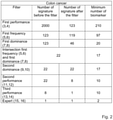
- the results obtained in this first embodiment are showed in Figure 2 .
- the method according to the present invention allows selecting a target signature comprising 2 biomarkers starting from a set of 2000 signatures.
- the method also permits to decrease drastically the number of biomarkers in the signature from 210 biomarkers to 2 biomarkers for the target signature.
- the accuracy of the target signature in the diagnosis of colon cancer was compared to the accuracy provided by other existing techniques, as shown in figure 3 .
- the present invention proved to be the best method with an accuracy of 94.14 % by using a target signature with only 2 biomarkers.
- the second embodiment aims at discovering a prostate cancer target signature.
- a data pools of 52 tumors samples and 50 normal sample were analysed, each samples comprising 12'600 genes ( Singh, D., Febbo, P. G., Ross, K., Jackson, D. G., Manola, J., Ladd, C., ... & Sellers, W. R. (2002). Gene expression correlates of clinical prostate cancer behavior. Cancer cell, 1(2), 203-209 ).
- a set of 900 signatures is generated by using fuzzy logic and genetic algorithms.
- the set of signatures is sorted out by using the filters illustrated in Figure 1 (references 2, 4, a2, b2, 6, 8, 10, 12, 14, 16 of figure 1 ).
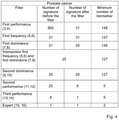
- the results obtained in this first embodiment are showed in Figure 4 .
- the method according to the present invention allows selecting a target signature comprising 2 biomarkers starting from a set of 900 signatures.
- the method also permits to decrease drastically the number of biomarkers in the signature from 148 biomarkers to 2 biomark
- the accuracy of the target signature in the diagnosis of prostate cancer was compared to the accuracy provided by other existing techniques, as shown in figure 5 .
- the present invention proved to be the best method with an accuracy of 97.29 % by using a target signature with only 2 biomarkers.
- TSP Topic scoring pair
- K-TSP k- Top scoring pair
- PAM Prediction analysis of microarrays
- DT C4.5 decision trees
- the invention is also related to a computer program product comprising computer code arranged to be executed by processing means in order to carry out some or all of the above described methods when the processing means execute this computer code.
Landscapes
- Engineering & Computer Science (AREA)
- Physics & Mathematics (AREA)
- Health & Medical Sciences (AREA)
- Life Sciences & Earth Sciences (AREA)
- Bioinformatics & Cheminformatics (AREA)
- Theoretical Computer Science (AREA)
- Medical Informatics (AREA)
- General Health & Medical Sciences (AREA)
- Biophysics (AREA)
- Evolutionary Biology (AREA)
- Spectroscopy & Molecular Physics (AREA)
- Biotechnology (AREA)
- Bioinformatics & Computational Biology (AREA)
- Software Systems (AREA)
- Molecular Biology (AREA)
- Data Mining & Analysis (AREA)
- Evolutionary Computation (AREA)
- Artificial Intelligence (AREA)
- Analytical Chemistry (AREA)
- Chemical & Material Sciences (AREA)
- Proteomics, Peptides & Aminoacids (AREA)
- Genetics & Genomics (AREA)
- General Physics & Mathematics (AREA)
- Epidemiology (AREA)
- Public Health (AREA)
- Bioethics (AREA)
- Computer Vision & Pattern Recognition (AREA)
- Databases & Information Systems (AREA)
- Automation & Control Theory (AREA)
- Mathematical Analysis (AREA)
- Mathematical Optimization (AREA)
- Pure & Applied Mathematics (AREA)
- Computing Systems (AREA)
- General Engineering & Computer Science (AREA)
- Mathematical Physics (AREA)
- Fuzzy Systems (AREA)
- Computational Mathematics (AREA)
- Algebra (AREA)
- Biomedical Technology (AREA)
- Investigating Or Analysing Biological Materials (AREA)
Claims (15)
- Computerimplementiertes Verfahren zum Entdecken mindestens einer Signatur von Biomarkern aus Biomarker-Datenbeständen, wobei die Signatur von Biomarkern dazu bestimmt ist, zum Diagnostizieren, Vorhersagen oder Überwachen einer Krankheit verwendet zu werden, wobei das Verfahren die folgenden Schritte umfasst:i) Generieren eines Satzes Signaturen (1, 2) mit Fuzzy-Logik und evolutionären Algorithmen, wobei jede Signatur eine bestimmte Anzahl von Biomarkern rezitiert;ii) Auswählen mindestens einer Zielsignatur aus dem Satz Signaturen (1, 2) durch Anwenden mindestens der folgenden Filter auf den Satz Signaturen (1, 2):a) eines Leistungsfilters, umfassend:- Festlegen einer Leistungsschwelle für mindestens ein Leistungskriterium;- Entfernen von Signaturen, die einen Wert aufweisen, der unter der Leistungsschwelle für die Leistungskriterien liegt;b) eines Häufigkeitsfilters zum Sortieren des Satzes Signaturen in Abhängigkeit von der Häufigkeit eines Biomarkers innerhalb des Satzes Signaturen (1, 2) oder der gemeinsamen Häufigkeit mehrerer Biomarker innerhalb derselben Signatur in dem Satz Signaturen (1, 2); undc) eines Dominanzfilters, umfassend:- Ordnen des Satzes Signaturen (1, 2) in eine Rangreihe in Abhängigkeit von mindestens einem Leistungskriterium;- Berechnen eines Dominanzwerts für jede Signatur, wobei der Dominanzwert die Anzahl der Signaturen mit einer höheren Rangordnung für die Leistungskriterien ist;- Festlegen eines Dominanzschwellenwerts und Entfernen der Signaturen, deren Dominanzwert höher als der Dominatorschwellenwert ist.
- Verfahren nach Anspruch 1, wobei die Zielsignatur ausgewählt wird, indem nacheinander mindestens ein Leistungsfilter, mindestens ein Häufigkeitsfilter und mindestens ein Dominanzfilter verwendet werden.
- Verfahren nach Anspruch 1, wobei Schritt ii) Folgendes umfasst:- Anwenden mehrerer Sequenzen von Filtern auf den Satz Signaturen (1, 2), wobei jede Filtersequenz mindestens ein Filter umfasst und jede Filtersequenz separat auf den Satz Signaturen (1, 2) angewandt wird, sodass jede Filtersequenz mindestens eine Signaturvorauswahl liefert;- Identifizieren mindestens einer gemeinsamen Signatur, wobei die gemeinsame Signatur mindestens eine überall in der Vorauswahl vorhandene Signatur ist;- Kombinieren der gemeinsamen Signatur(en);- Anwenden mindestens eines Filters auf die gemeinsame(n) Signatur(en).
- Verfahren nach Anspruch 1, wobei Schritt ii) die folgenden aufeinanderfolgenden Schritte umfasst:- Anwenden eines ersten Leistungsfilters (3, 4) auf den Satz Signaturen (1, 2);- Anwenden eines ersten Häufigkeitsfilters (5, 6) auf die im vorhergehenden Schritt isolierte Signatur, um eine erste Signaturvorauswahl zu treffen;- Anwenden eines ersten Dominanzfilters (7, 8) unabhängig von der mittels des ersten Leistungsfilters (3, 4) isolierten Signatur, um eine zweite Signaturvorauswahl zu treffen;- Kombinieren der sowohl in der ersten Vorauswahl als auch in der zweiten Vorauswahl enthaltenen Signatur(en);- Anwenden eines zweiten Dominanzfilters (9, 10) auf die im vorhergehenden Schritt isolierte Signatur;- Anwenden eines zweiten Leistungsfilters (11, 12) auf die im vorhergehenden Schritt isolierte Signatur;- Anwenden eines dritten Leistungsfilters (13, 14) auf die im vorhergehenden Schritt isolierte Signatur;- Anwenden eines Expertenfilters (15, 16) auf die im vorhergehenden Schritt isolierte Signatur.
- Verfahren nach einem der vorhergehenden Ansprüche, wobei die Zielsignatur(en) mindestens eine Regel umfasst (umfassen).
- Verfahren nach einem der vorhergehenden Ansprüche, wobei die Leistungskriterien aus Spezifität, Sensitivität, Genauigkeit, positivem und negativem Vorhersagewert (PPV bzw. NPV), Anzahl der Biomarker oder Regeln je Signatur, Fläche unter der ROC-Kurve (AUG, en: area under the ROC curve) und mittlerem Distanzmaß (ADM, en: average distance measurement) ausgewählt werden.
- Verfahren nach einem der vorhergehenden Ansprüche, ferner ein Expertenfilter (15, 16) umfassend, das von einem Experten für die Signaturentdeckung angewandt wird, um mindestens einen Biomarker aus der Zielsignatur zu entfernen.
- Verfahren nach einem der vorhergehenden Ansprüche, wobei die Anwendung eines Häufigkeitsfilters Folgendes umfasst:- Auswählen mindestens eines Biomarkers, der in dem Satz Signaturen (1, 2) enthalten ist;- Entfernen der Signatur, die den ausgewählten Biomarker nicht aufweist.
- Verfahren nach einem der vorhergehenden Ansprüche, wobei die Anwendung eines Häufigkeitsfilters Folgendes umfasst:- Berechnen der Häufigkeit jedes Biomarkers in dem Satz Signaturen (1, 2);- Definieren einer Häufigkeitsschwelle für mindestens einen Biomarker;- Entfernen der Signatur(en), die Biomarker mit einer Häufigkeit unter der Häufigkeitsschwelle umfasst (umfassen).
- Verfahren nach einem der vorhergehenden Ansprüche, wobei mehrere Iterationen des Verfahrens ausgeführt werden, wobei jede Iteration eine Familie von Zielsignaturen liefert.
- Verfahren nach einem der vorhergehenden Ansprüche, wobei die Datenbestände biomedizinische Daten von kranken und von gesunden Patienten umfassen.
- Verfahren nach einem der Ansprüche 1 bis 10, wobei die Datenbestände entweder Daten von kranken und von gesunden Pflanzen oder Daten von kranken und von gesunden Tieren umfassen.
- Verfahren nach einem der vorhergehenden Ansprüche, wobei die Datenbestände Daten umfassen, die aus Protein-oder Nukleinsäuremessungen, physiologischen Parametern wie Alter, Gewicht, Geschlecht oder klinischen Daten ausgewählt werden.
- Vorrichtung zum Entdecken mindestens einer Signatur von Biomarkern aus Biomarker-Datenbeständen, wobei die Signatur von Biomarkern dazu bestimmt ist, zum Diagnostizieren, Vorhersagen oder Überwachen einer Krankheit verwendet zu werden, wobei die Vorrichtung Folgendes umfasst:- ein System, das Fuzzy-Logik mit evolutionären Algorithmen kombiniert, um einen Satz Signaturen (1, 2) zu generieren, wobei jede Signatur eine bestimmte Anzahl von Biomarkern rezitiert;- ein Filtersystem zum Auswählen mindestens einer Zielsignatur aus dem Satz Signaturen (1, 2), wobei das Filtersystem mindestens die folgenden Filter umfasst:o ein Leistungsfilter zum Sortieren des Satzes Signaturen in Abhängigkeit von mindestens einem Leistungskriterium, wobei das Leistungsfilter derart eingerichtet ist, dass ein Leistungsschwellenwert für mindestens ein Leistungskriterium festgelegt wird und Signaturen, die einen Wert aufweisen, der unter dem Leistungsschwellenwert für die Leistungskriterien liegt, entfernt werden;o ein Häufigkeitsfilter zum Sortieren des Satzes Signaturen in Abhängigkeit von der Häufigkeit eines Biomarkers innerhalb des Satzes Signaturen (1, 2) oder der gemeinsamen Häufigkeit mehrerer Biomarker innerhalb derselben Signatur in dem Satz Signaturen (1, 2);o ein Dominanzfilter, wobei jede Signatur einen Dominanzwert aufweist, sodass das Dominanzfilter imstande ist, den Satz Signaturen (1, 2) in Abhängigkeit von dem Dominanzwert zu sortieren, wobei das Dominanzfilter dazu eingerichtet ist, dass es den Satz Signaturen (1, 2) in Abhängigkeit von mindestens einem Leistungskriterium in eine Rangreihe ordnet und für jede Signatur einen Dominanzwert berechnet, wobei der Dominanzwert die Anzahl der Signaturen mit einer höheren Rangordnung für die Leistungskriterien ist, und dass es einen Dominanzschwellenwert festlegt und die Signaturen, deren Dominanzwert höher als der Dominatorschwellenwert ist, entfernt.
- Computerprogrammprodukt, das Computercode umfasst, der mittels Verarbeitungsmitteln ausführbar ist, um das Verfahren nach einem der Ansprüche 1 bis 13 durchzuführen, wenn der Computercode ausgeführt wird.
Applications Claiming Priority (1)
| Application Number | Priority Date | Filing Date | Title |
|---|---|---|---|
| PCT/IB2016/052936 WO2017199067A1 (en) | 2016-05-19 | 2016-05-19 | Biomarkers signature discovery and selection |
Publications (2)
| Publication Number | Publication Date |
|---|---|
| EP3458992A1 EP3458992A1 (de) | 2019-03-27 |
| EP3458992B1 true EP3458992B1 (de) | 2022-03-02 |
Family
ID=56087472
Family Applications (1)
| Application Number | Title | Priority Date | Filing Date |
|---|---|---|---|
| EP16725936.5A Active EP3458992B1 (de) | 2016-05-19 | 2016-05-19 | Entdeckung und auswahl der signatur von biomarkern |
Country Status (3)
| Country | Link |
|---|---|
| US (1) | US20190164631A1 (de) |
| EP (1) | EP3458992B1 (de) |
| WO (1) | WO2017199067A1 (de) |
Families Citing this family (1)
| Publication number | Priority date | Publication date | Assignee | Title |
|---|---|---|---|---|
| CN111383716B (zh) * | 2020-03-20 | 2023-11-24 | 广州市妇女儿童医疗中心(广州市妇幼保健院、广州市儿童医院、广州市妇婴医院、广州市妇幼保健计划生育服务中心) | 基因对的筛选方法、装置、计算机设备和存储介质 |
Family Cites Families (4)
| Publication number | Priority date | Publication date | Assignee | Title |
|---|---|---|---|---|
| US5657255C1 (en) | 1995-04-14 | 2002-06-11 | Interleukin Genetics Inc | Hierarchic biological modelling system and method |
| EP2239675A1 (de) * | 2009-04-07 | 2010-10-13 | BIOCRATES Life Sciences AG | Verfahren zur In-vitro-Diagnose einer komplexen Krankheit |
| CN103415624B (zh) * | 2010-08-13 | 2017-03-01 | 私募蛋白质体公司 | 胰腺癌生物标记及其用途 |
| US10580515B2 (en) | 2012-06-21 | 2020-03-03 | Philip Morris Products S.A. | Systems and methods for generating biomarker signatures |
-
2016
- 2016-05-19 EP EP16725936.5A patent/EP3458992B1/de active Active
- 2016-05-19 WO PCT/IB2016/052936 patent/WO2017199067A1/en not_active Ceased
- 2016-05-19 US US16/098,817 patent/US20190164631A1/en not_active Abandoned
Also Published As
| Publication number | Publication date |
|---|---|
| US20190164631A1 (en) | 2019-05-30 |
| WO2017199067A1 (en) | 2017-11-23 |
| EP3458992A1 (de) | 2019-03-27 |
Similar Documents
| Publication | Publication Date | Title |
|---|---|---|
| Choi et al. | Multi-categorical deep learning neural network to classify retinal images: A pilot study employing small database | |
| Gower et al. | Detecting adaptive introgression in human evolution using convolutional neural networks | |
| US10713590B2 (en) | Bagged filtering method for selection and deselection of features for classification | |
| CN104584022B (zh) | 一种生成生物标记签名的系统及方法 | |
| JP2004524604A (ja) | 遺伝的疾患の分類および予測のため、ならびに分子遺伝的パラメーターと臨床的パラメーターとの関連付けのためのエキスパートシステム | |
| JPWO2003085548A1 (ja) | データ解析装置および方法 | |
| US20240038393A1 (en) | Predicting disease progression based on digital-pathology and gene-expression data | |
| CA2877436C (en) | Systems and methods for generating biomarker signatures | |
| JP2018530815A (ja) | 生体データにおけるパターン認識のマルチレベルアーキテクチャ | |
| Coleto-Alcudia et al. | A multi-objective optimization approach for the identification of cancer biomarkers from RNA-seq data | |
| CN113362894A (zh) | 一种对协同致死的癌症驱动基因进行预测的方法 | |
| JP7275334B2 (ja) | 個人の生物学的ステータスを予測するためのシステム、方法および遺伝子シグネチャ | |
| EP3458992B1 (de) | Entdeckung und auswahl der signatur von biomarkern | |
| Chen et al. | Integration of spatial and single-cell data across modalities with weak linkage | |
| CN112105381A (zh) | 用于识别癌症患者的原发性免疫抗性的设备和方法 | |
| US20240266002A1 (en) | Chromosome based cancer diagnosis | |
| Wani et al. | Evaluation of computational methods for single cell multi-omics integration | |
| CN113711313A (zh) | 用于识别手术后处于高复发风险的早期nsclc患者的预测性测试 | |
| CN117877718A (zh) | 一种基于集成学习的肺部感染的辅助诊断方法和装置 | |
| Hua et al. | Combining protein-protein interactions information with support vector machine to identify chronic obstructive pulmonary disease related genes | |
| Kavitha et al. | Predicting Breast Cancer Survivability Using Naïve Baysein Classifier and C4. 5 Algorithm | |
| Mythili et al. | CTCHABC-hybrid online sequential fuzzy Extreme Kernel learning method for detection of Breast Cancer with hierarchical Artificial Bee | |
| CN119763651B (zh) | 结合基因表达数据的ards治疗靶点分析系统 | |
| Triananda et al. | Use of Deep Learning to Identify COVID-19 through DNA/RNA Sequencing | |
| Harmén | An Unsupervised Exploration of the CNN Feature Space for Phenotype Structure Discovery in Alzheimer’s Disease |
Legal Events
| Date | Code | Title | Description |
|---|---|---|---|
| STAA | Information on the status of an ep patent application or granted ep patent |
Free format text: STATUS: THE INTERNATIONAL PUBLICATION HAS BEEN MADE |
|
| PUAI | Public reference made under article 153(3) epc to a published international application that has entered the european phase |
Free format text: ORIGINAL CODE: 0009012 |
|
| STAA | Information on the status of an ep patent application or granted ep patent |
Free format text: STATUS: REQUEST FOR EXAMINATION WAS MADE |
|
| 17P | Request for examination filed |
Effective date: 20181126 |
|
| AK | Designated contracting states |
Kind code of ref document: A1 Designated state(s): AL AT BE BG CH CY CZ DE DK EE ES FI FR GB GR HR HU IE IS IT LI LT LU LV MC MK MT NL NO PL PT RO RS SE SI SK SM TR |
|
| AX | Request for extension of the european patent |
Extension state: BA ME |
|
| DAV | Request for validation of the european patent (deleted) | ||
| DAX | Request for extension of the european patent (deleted) | ||
| STAA | Information on the status of an ep patent application or granted ep patent |
Free format text: STATUS: EXAMINATION IS IN PROGRESS |
|
| 17Q | First examination report despatched |
Effective date: 20200226 |
|
| RAP1 | Party data changed (applicant data changed or rights of an application transferred) |
Owner name: QUARTZ BIO SA |
|
| REG | Reference to a national code |
Ref country code: DE Ref legal event code: R079 Ref document number: 602016069561 Country of ref document: DE Free format text: PREVIOUS MAIN CLASS: G06F0019180000 Ipc: G16B0040000000 |
|
| GRAP | Despatch of communication of intention to grant a patent |
Free format text: ORIGINAL CODE: EPIDOSNIGR1 |
|
| STAA | Information on the status of an ep patent application or granted ep patent |
Free format text: STATUS: GRANT OF PATENT IS INTENDED |
|
| RIC1 | Information provided on ipc code assigned before grant |
Ipc: G16B 20/20 20190101ALI20210930BHEP Ipc: G16B 40/00 20190101AFI20210930BHEP |
|
| INTG | Intention to grant announced |
Effective date: 20211027 |
|
| GRAS | Grant fee paid |
Free format text: ORIGINAL CODE: EPIDOSNIGR3 |
|
| GRAA | (expected) grant |
Free format text: ORIGINAL CODE: 0009210 |
|
| STAA | Information on the status of an ep patent application or granted ep patent |
Free format text: STATUS: THE PATENT HAS BEEN GRANTED |
|
| AK | Designated contracting states |
Kind code of ref document: B1 Designated state(s): AL AT BE BG CH CY CZ DE DK EE ES FI FR GB GR HR HU IE IS IT LI LT LU LV MC MK MT NL NO PL PT RO RS SE SI SK SM TR |
|
| REG | Reference to a national code |
Ref country code: GB Ref legal event code: FG4D |
|
| REG | Reference to a national code |
Ref country code: CH Ref legal event code: EP Ref country code: AT Ref legal event code: REF Ref document number: 1472906 Country of ref document: AT Kind code of ref document: T Effective date: 20220315 |
|
| REG | Reference to a national code |
Ref country code: DE Ref legal event code: R096 Ref document number: 602016069561 Country of ref document: DE |
|
| REG | Reference to a national code |
Ref country code: IE Ref legal event code: FG4D |
|
| REG | Reference to a national code |
Ref country code: LT Ref legal event code: MG9D |
|
| REG | Reference to a national code |
Ref country code: NL Ref legal event code: MP Effective date: 20220302 |
|
| PG25 | Lapsed in a contracting state [announced via postgrant information from national office to epo] |
Ref country code: SE Free format text: LAPSE BECAUSE OF FAILURE TO SUBMIT A TRANSLATION OF THE DESCRIPTION OR TO PAY THE FEE WITHIN THE PRESCRIBED TIME-LIMIT Effective date: 20220302 Ref country code: RS Free format text: LAPSE BECAUSE OF FAILURE TO SUBMIT A TRANSLATION OF THE DESCRIPTION OR TO PAY THE FEE WITHIN THE PRESCRIBED TIME-LIMIT Effective date: 20220302 Ref country code: NO Free format text: LAPSE BECAUSE OF FAILURE TO SUBMIT A TRANSLATION OF THE DESCRIPTION OR TO PAY THE FEE WITHIN THE PRESCRIBED TIME-LIMIT Effective date: 20220602 Ref country code: LT Free format text: LAPSE BECAUSE OF FAILURE TO SUBMIT A TRANSLATION OF THE DESCRIPTION OR TO PAY THE FEE WITHIN THE PRESCRIBED TIME-LIMIT Effective date: 20220302 Ref country code: HR Free format text: LAPSE BECAUSE OF FAILURE TO SUBMIT A TRANSLATION OF THE DESCRIPTION OR TO PAY THE FEE WITHIN THE PRESCRIBED TIME-LIMIT Effective date: 20220302 Ref country code: ES Free format text: LAPSE BECAUSE OF FAILURE TO SUBMIT A TRANSLATION OF THE DESCRIPTION OR TO PAY THE FEE WITHIN THE PRESCRIBED TIME-LIMIT Effective date: 20220302 Ref country code: BG Free format text: LAPSE BECAUSE OF FAILURE TO SUBMIT A TRANSLATION OF THE DESCRIPTION OR TO PAY THE FEE WITHIN THE PRESCRIBED TIME-LIMIT Effective date: 20220602 |
|
| REG | Reference to a national code |
Ref country code: AT Ref legal event code: MK05 Ref document number: 1472906 Country of ref document: AT Kind code of ref document: T Effective date: 20220302 |
|
| PG25 | Lapsed in a contracting state [announced via postgrant information from national office to epo] |
Ref country code: PL Free format text: LAPSE BECAUSE OF FAILURE TO SUBMIT A TRANSLATION OF THE DESCRIPTION OR TO PAY THE FEE WITHIN THE PRESCRIBED TIME-LIMIT Effective date: 20220302 Ref country code: LV Free format text: LAPSE BECAUSE OF FAILURE TO SUBMIT A TRANSLATION OF THE DESCRIPTION OR TO PAY THE FEE WITHIN THE PRESCRIBED TIME-LIMIT Effective date: 20220302 Ref country code: GR Free format text: LAPSE BECAUSE OF FAILURE TO SUBMIT A TRANSLATION OF THE DESCRIPTION OR TO PAY THE FEE WITHIN THE PRESCRIBED TIME-LIMIT Effective date: 20220603 Ref country code: FI Free format text: LAPSE BECAUSE OF FAILURE TO SUBMIT A TRANSLATION OF THE DESCRIPTION OR TO PAY THE FEE WITHIN THE PRESCRIBED TIME-LIMIT Effective date: 20220302 |
|
| PG25 | Lapsed in a contracting state [announced via postgrant information from national office to epo] |
Ref country code: NL Free format text: LAPSE BECAUSE OF FAILURE TO SUBMIT A TRANSLATION OF THE DESCRIPTION OR TO PAY THE FEE WITHIN THE PRESCRIBED TIME-LIMIT Effective date: 20220302 |
|
| PG25 | Lapsed in a contracting state [announced via postgrant information from national office to epo] |
Ref country code: SM Free format text: LAPSE BECAUSE OF FAILURE TO SUBMIT A TRANSLATION OF THE DESCRIPTION OR TO PAY THE FEE WITHIN THE PRESCRIBED TIME-LIMIT Effective date: 20220302 Ref country code: SK Free format text: LAPSE BECAUSE OF FAILURE TO SUBMIT A TRANSLATION OF THE DESCRIPTION OR TO PAY THE FEE WITHIN THE PRESCRIBED TIME-LIMIT Effective date: 20220302 Ref country code: RO Free format text: LAPSE BECAUSE OF FAILURE TO SUBMIT A TRANSLATION OF THE DESCRIPTION OR TO PAY THE FEE WITHIN THE PRESCRIBED TIME-LIMIT Effective date: 20220302 Ref country code: PT Free format text: LAPSE BECAUSE OF FAILURE TO SUBMIT A TRANSLATION OF THE DESCRIPTION OR TO PAY THE FEE WITHIN THE PRESCRIBED TIME-LIMIT Effective date: 20220704 Ref country code: EE Free format text: LAPSE BECAUSE OF FAILURE TO SUBMIT A TRANSLATION OF THE DESCRIPTION OR TO PAY THE FEE WITHIN THE PRESCRIBED TIME-LIMIT Effective date: 20220302 Ref country code: CZ Free format text: LAPSE BECAUSE OF FAILURE TO SUBMIT A TRANSLATION OF THE DESCRIPTION OR TO PAY THE FEE WITHIN THE PRESCRIBED TIME-LIMIT Effective date: 20220302 Ref country code: AT Free format text: LAPSE BECAUSE OF FAILURE TO SUBMIT A TRANSLATION OF THE DESCRIPTION OR TO PAY THE FEE WITHIN THE PRESCRIBED TIME-LIMIT Effective date: 20220302 |
|
| PG25 | Lapsed in a contracting state [announced via postgrant information from national office to epo] |
Ref country code: IS Free format text: LAPSE BECAUSE OF FAILURE TO SUBMIT A TRANSLATION OF THE DESCRIPTION OR TO PAY THE FEE WITHIN THE PRESCRIBED TIME-LIMIT Effective date: 20220702 Ref country code: AL Free format text: LAPSE BECAUSE OF FAILURE TO SUBMIT A TRANSLATION OF THE DESCRIPTION OR TO PAY THE FEE WITHIN THE PRESCRIBED TIME-LIMIT Effective date: 20220302 |
|
| REG | Reference to a national code |
Ref country code: DE Ref legal event code: R097 Ref document number: 602016069561 Country of ref document: DE |
|
| PLBE | No opposition filed within time limit |
Free format text: ORIGINAL CODE: 0009261 |
|
| STAA | Information on the status of an ep patent application or granted ep patent |
Free format text: STATUS: NO OPPOSITION FILED WITHIN TIME LIMIT |
|
| REG | Reference to a national code |
Ref country code: BE Ref legal event code: MM Effective date: 20220531 |
|
| PG25 | Lapsed in a contracting state [announced via postgrant information from national office to epo] |
Ref country code: MC Free format text: LAPSE BECAUSE OF FAILURE TO SUBMIT A TRANSLATION OF THE DESCRIPTION OR TO PAY THE FEE WITHIN THE PRESCRIBED TIME-LIMIT Effective date: 20220302 Ref country code: LU Free format text: LAPSE BECAUSE OF NON-PAYMENT OF DUE FEES Effective date: 20220519 Ref country code: DK Free format text: LAPSE BECAUSE OF FAILURE TO SUBMIT A TRANSLATION OF THE DESCRIPTION OR TO PAY THE FEE WITHIN THE PRESCRIBED TIME-LIMIT Effective date: 20220302 |
|
| 26N | No opposition filed |
Effective date: 20221205 |
|
| PG25 | Lapsed in a contracting state [announced via postgrant information from national office to epo] |
Ref country code: SI Free format text: LAPSE BECAUSE OF FAILURE TO SUBMIT A TRANSLATION OF THE DESCRIPTION OR TO PAY THE FEE WITHIN THE PRESCRIBED TIME-LIMIT Effective date: 20220302 |
|
| PG25 | Lapsed in a contracting state [announced via postgrant information from national office to epo] |
Ref country code: IE Free format text: LAPSE BECAUSE OF NON-PAYMENT OF DUE FEES Effective date: 20220519 |
|
| PG25 | Lapsed in a contracting state [announced via postgrant information from national office to epo] |
Ref country code: BE Free format text: LAPSE BECAUSE OF NON-PAYMENT OF DUE FEES Effective date: 20220531 |
|
| PG25 | Lapsed in a contracting state [announced via postgrant information from national office to epo] |
Ref country code: IT Free format text: LAPSE BECAUSE OF FAILURE TO SUBMIT A TRANSLATION OF THE DESCRIPTION OR TO PAY THE FEE WITHIN THE PRESCRIBED TIME-LIMIT Effective date: 20220302 |
|
| PG25 | Lapsed in a contracting state [announced via postgrant information from national office to epo] |
Ref country code: HU Free format text: LAPSE BECAUSE OF FAILURE TO SUBMIT A TRANSLATION OF THE DESCRIPTION OR TO PAY THE FEE WITHIN THE PRESCRIBED TIME-LIMIT; INVALID AB INITIO Effective date: 20160519 |
|
| PG25 | Lapsed in a contracting state [announced via postgrant information from national office to epo] |
Ref country code: MK Free format text: LAPSE BECAUSE OF FAILURE TO SUBMIT A TRANSLATION OF THE DESCRIPTION OR TO PAY THE FEE WITHIN THE PRESCRIBED TIME-LIMIT Effective date: 20220302 Ref country code: CY Free format text: LAPSE BECAUSE OF FAILURE TO SUBMIT A TRANSLATION OF THE DESCRIPTION OR TO PAY THE FEE WITHIN THE PRESCRIBED TIME-LIMIT Effective date: 20220302 |
|
| PG25 | Lapsed in a contracting state [announced via postgrant information from national office to epo] |
Ref country code: MT Free format text: LAPSE BECAUSE OF FAILURE TO SUBMIT A TRANSLATION OF THE DESCRIPTION OR TO PAY THE FEE WITHIN THE PRESCRIBED TIME-LIMIT Effective date: 20220302 |
|
| PGFP | Annual fee paid to national office [announced via postgrant information from national office to epo] |
Ref country code: DE Payment date: 20250519 Year of fee payment: 10 |
|
| PGFP | Annual fee paid to national office [announced via postgrant information from national office to epo] |
Ref country code: FR Payment date: 20250523 Year of fee payment: 10 |
|
| PGFP | Annual fee paid to national office [announced via postgrant information from national office to epo] |
Ref country code: CH Payment date: 20250601 Year of fee payment: 10 |
|
| PG25 | Lapsed in a contracting state [announced via postgrant information from national office to epo] |
Ref country code: TR Free format text: LAPSE BECAUSE OF FAILURE TO SUBMIT A TRANSLATION OF THE DESCRIPTION OR TO PAY THE FEE WITHIN THE PRESCRIBED TIME-LIMIT Effective date: 20220302 |
|
| REG | Reference to a national code |
Ref country code: CH Ref legal event code: R14 Free format text: ST27 STATUS EVENT CODE: U-0-0-R10-R14 (AS PROVIDED BY THE NATIONAL OFFICE) Effective date: 20260115 |
|
| REG | Reference to a national code |
Ref country code: CH Ref legal event code: R17 Free format text: ST27 STATUS EVENT CODE: U-0-0-R10-R17 (AS PROVIDED BY THE NATIONAL OFFICE) Effective date: 20260126 |
|
| REG | Reference to a national code |
Ref country code: DE Ref legal event code: R081 Ref document number: 602016069561 Country of ref document: DE Owner name: PRECISION REGULATORY AND TRANSLATIONAL SCIENCE, US Free format text: FORMER OWNER: QUARTZ BIO SA, GENEVE, CH |
|
| PGFP | Annual fee paid to national office [announced via postgrant information from national office to epo] |
Ref country code: GB Payment date: 20260324 Year of fee payment: 11 |