EP3458020B1 - Compounds for promoting hair growth and/or inhibiting or delaying hair loss in humans, and compositions for such uses - Google Patents
Compounds for promoting hair growth and/or inhibiting or delaying hair loss in humans, and compositions for such uses Download PDFInfo
- Publication number
- EP3458020B1 EP3458020B1 EP17730678.4A EP17730678A EP3458020B1 EP 3458020 B1 EP3458020 B1 EP 3458020B1 EP 17730678 A EP17730678 A EP 17730678A EP 3458020 B1 EP3458020 B1 EP 3458020B1
- Authority
- EP
- European Patent Office
- Prior art keywords
- methyl
- form together
- compound
- formula
- hydrogen
- Prior art date
- Legal status (The legal status is an assumption and is not a legal conclusion. Google has not performed a legal analysis and makes no representation as to the accuracy of the status listed.)
- Active
Links
- 0 CC12C(C)(CCC=C(C)C*)C3CC1C2C3 Chemical compound CC12C(C)(CCC=C(C)C*)C3CC1C2C3 0.000 description 3
Images


Classifications
-
- A—HUMAN NECESSITIES
- A61—MEDICAL OR VETERINARY SCIENCE; HYGIENE
- A61K—PREPARATIONS FOR MEDICAL, DENTAL OR TOILETRY PURPOSES
- A61K31/00—Medicinal preparations containing organic active ingredients
- A61K31/045—Hydroxy compounds, e.g. alcohols; Salts thereof, e.g. alcoholates
-
- A—HUMAN NECESSITIES
- A61—MEDICAL OR VETERINARY SCIENCE; HYGIENE
- A61K—PREPARATIONS FOR MEDICAL, DENTAL OR TOILETRY PURPOSES
- A61K8/00—Cosmetics or similar toiletry preparations
- A61K8/18—Cosmetics or similar toiletry preparations characterised by the composition
- A61K8/30—Cosmetics or similar toiletry preparations characterised by the composition containing organic compounds
- A61K8/33—Cosmetics or similar toiletry preparations characterised by the composition containing organic compounds containing oxygen
- A61K8/34—Alcohols
-
- A—HUMAN NECESSITIES
- A61—MEDICAL OR VETERINARY SCIENCE; HYGIENE
- A61K—PREPARATIONS FOR MEDICAL, DENTAL OR TOILETRY PURPOSES
- A61K9/00—Medicinal preparations characterised by special physical form
- A61K9/0012—Galenical forms characterised by the site of application
- A61K9/0014—Skin, i.e. galenical aspects of topical compositions
-
- A—HUMAN NECESSITIES
- A61—MEDICAL OR VETERINARY SCIENCE; HYGIENE
- A61P—SPECIFIC THERAPEUTIC ACTIVITY OF CHEMICAL COMPOUNDS OR MEDICINAL PREPARATIONS
- A61P17/00—Drugs for dermatological disorders
-
- A—HUMAN NECESSITIES
- A61—MEDICAL OR VETERINARY SCIENCE; HYGIENE
- A61P—SPECIFIC THERAPEUTIC ACTIVITY OF CHEMICAL COMPOUNDS OR MEDICINAL PREPARATIONS
- A61P17/00—Drugs for dermatological disorders
- A61P17/14—Drugs for dermatological disorders for baldness or alopecia
-
- A—HUMAN NECESSITIES
- A61—MEDICAL OR VETERINARY SCIENCE; HYGIENE
- A61Q—SPECIFIC USE OF COSMETICS OR SIMILAR TOILETRY PREPARATIONS
- A61Q5/00—Preparations for care of the hair
- A61Q5/02—Preparations for cleaning the hair
-
- A—HUMAN NECESSITIES
- A61—MEDICAL OR VETERINARY SCIENCE; HYGIENE
- A61Q—SPECIFIC USE OF COSMETICS OR SIMILAR TOILETRY PREPARATIONS
- A61Q7/00—Preparations for affecting hair growth
Definitions
- the invention concerns the use of compounds to promote hair growth and/or inhibit or delay hair loss in humans, and compositions for such use comprising such compounds as active principles.
- sandalwood is referred to a class of woods from trees of the genus Santalum.
- the essential oil of sandalwood is usually extracted by steam distillation of wood from matured sandalwood trees, and is a well-known valued component for perfumes.
- sandalwood oil is also the subject of patent publications regarding officinal and empirical preparations for a number of different uses, including a generic treatment of hair loss and dandruff, such as for example the patent publication CN1075250A describing a medicinal extract, defined in fact as Chinese medicine, comprising sandalwood mixed with flower bud of magnolia, rose flower, liquorice root, peony bark powder, kaempferia, lilac, herba asari, ginseng and root of angelica dahurica.
- CN102000293 and CN103735443 describe similar Chinese medicines, the former made of a mixture of sandal wood, angelica roots, rhizoma kaempferiae seeds, talc, holy basil, natural indigo and spike nard, the latter made of a mixture of sandal wood, fleece flower root, pine needles and salvia miltiorrhiza, to be applied on hair.
- the Indian patent publication IN00177MU2002A describes a composition for the prevention of hair falling which comprises sandalwood oil mixed with coconut oil, eucalyptus oil, clove oil, lavender oil and rosemary oil.
- sandalwood oil the main components of sandalwood oil are ⁇ -santalol e ⁇ -santalol, which are alcohols basically showing a sesquiterpenic type chain.
- the structural formula of ⁇ -santalol is: whereas ⁇ -santalol is: characterized by a terminal tricyclohept-3-yl or a bicyclohept-2-yl group, respectively.
- sandalore is a synthetic odorant having a fragrance similar to sandalwood and consequently used in perfumes, emollients and skin cleaning agents as a less expensive ingredient mimicking the sandalwood scent.
- Sandalore, as well as the structurally similar compound named brahmanol, are alcohols having a chemical structure quite distinct from the said ingredients of natural sandalwood oil, that is, ⁇ -santalol e ⁇ -santalol.
- sandalore, or sandal pentanol, having formula: and brahmanol, or sandal cyclopentane, having formula: are synthetic molecules both characterized by a terminal cyclopenten-1-yl group and have no sesquiterpenic chain. They are also the subject of patent publications regarding the treatment of hair in cosmetic formulations such as shampoos and hair conditioners, however used merely as fragrances, in fact for the specific purpose of using their property of mimicking the valued sandalwood scent.
- EP1561476 describes deodorant compositions for improving deodorizing effects where, among a broad number of substances and a broad number of uses, the use of sandalore and brahmanol is also described as deodorizing fragrances in hair care products such as shampoos, conditioners, hair rinse, hair coloring agents, permanent-wave agents, wax, hair spray and mousse.
- the fragrance materials of natural origin to be used as fragrances in EP1561476 include sandalwood oil, and sandalore and brahmanol are defined as trade names of the above materials, thus meaning that according to this document there is no distinction between the fragrance provided by the natural extract and its synthetic substitutes.
- EP1346720 relates to a deodorant composition for hair color having a similar scope. There is no description in such publications, not even generically, of such synthetic odorants for the treatment of hair loss, or for promoting hair growth.
- Olfactory receptors (ORs) expression is not restricted to the nasal epithelium but it is also present in different human tissues, see F eldmesser E, Olender T, Khen M, Yanai I, Ophir R, Lancet D., Widespread ectopic expression of olfactory receptor genes.
- sandal pentanol compound 1
- sandal cyclopentane compound 5
- preferred compounds of formula (I) including the aforementioned sandal pentanol (compound 1) and sandal cyclopentane (compound 5) are reported in the following table: Compound IUPAC Name CAS N° Structural formula Formula/ MW 1 sandal pentanol 3-methyl-5-(2,2,3-trimethylcyclopent-3-en-1-yl)pentan-2-ol 65113-99-7 C 14 H 26 O 210.36
- sandal pentenol (4Z)-3-methyl-5-(2,2,3-trimethylcyclopent-3-en-1-yl)pent-4-en-2-ol 67801-20-1 C 14 H 24 O 208.35
- sandal cyclopropane 1-methyl-2-((1,2,2-trimethylbicyclo(3.1.0)hex-3-yl)methyl)-cyclopropane-methanol 198404-98-7 C 15 H 26 O 222.37
- compositions for use in promoting hair growth, and/or inhibiting or delaying hair loss suitable for topical administration on the human scalp, in which one or more compounds of formula (I) are used as active principles, preferably in a quantity between 0.1 and 10% by weight (w/w %), formulated with ingredients suitable for a topical administration.
- compositions of the invention are suitable both for a cosmetic and a therapeutic use in promoting hair growth and/or the treatment of hair loss in the human scalp, wherein at least one compound of general formula (I) is comprised as active principle.
- Component (INCI name) quantity (w/w %) magnesium laureth sulfate sodium lauroyl sarcosinate sandal pentanol 0.1-10.0 disodium laureth sulfosuccinate PEG-200 hydrogenated glyceryl palmate cocamide mipa 0.5-1.5 perfume glycol distearate PEG-7 glyceryl cocoate 0.25-0.75 betaine 0.25-0.75 lauryl methyl gluceth-10 hydroxypropyldimonium chloride....
- FIGS 1 to 5 concern the results obtained in the following experimental study, and are thus described in detail in the following description.
- the said compound 1 according to the invention i.e. sandal pentanol
- sandal pentanol was chosen among the compounds of formula (I) to be tested for experimental purposes as follows.
- Sandal pentanol is named Sandalore in the diagrams of Figs. 2-5 .
- HFs were treated with either the vehicle, sandal pentanol, Phenirat or a mixture of sandal pentanol and Phenirat.
- Ki67/TUNEL were performed and used to evaluate hair cycle score and hair matrix keratinocytes proliferation and apoptosis.
- TGF ⁇ 2 a potent catagen inducer
- TGF ⁇ 2 expression was analysed by immunofluorescence.
- Temporal and occipital normal human scalp skin was obtained from healthy donors (in an age range 38 - 69 years) undergoing routine face-lift surgery after informed consent and ethical approval.
- OCT embedded samples were sectioned (6 ⁇ m thickness) with a cryostat. Sections were fixed in 4% paraformaldehyde, pre-incubated with 10% of goat serum (for OR2AT4) or 5% goat serum +0,3% Tritton X-100 (for cleaved-caspase 3) and incubated with the corresponding primary antibody at 4°C overnight (1/100 for OR2AT4 and 1/400 for cleaved-caspase 3). Secondary antibody incubation was performed at RT for 45 min. Counterstaining with DAPI (1 ⁇ g/mL) was performed to visualize nuclei. For TGFb2, samples were fixed in acetone and the endogenous peroxidases were blocked with 3% of H 2 O 2 .
- This step was followed by an avidin-biotin blocking step and a preincubation with TNB buffer (Tris HCl+NaCl+Casein).
- TNB buffer Tris HCl+NaCl+Casein
- the corresponding primary antibody was incubated at 4°C overnight (1/1000 for TGFb2). Secondary antibody incubation was performed at RT for 45 min before using the Tyramide signal amplification kit (Perkin Elmer). Counterstaning with DAPI was performed to visualize nuclei.
- To stain apoptotic and proliferating cells we have used the apoptag kit (Merck Milipore) following manufacture's protocol followed by Ki67 staining. The primary antibody was incubated overnight (Ki67, 1/20) after the TdT-enzyme step.
- the secondary antibody was incubated for 45 min at RT after the fluorescent-labelled anti-Digoxigenin step of the apoptag kit. Counterstaining with DAPI was performed to visualize nuclei. Negative controls were performed by omitting the primary antibody. Images were taken using a Keyence fluorescence microscope (Osaka, Japan) maintaining a constant set exposure time throughout imaging for further analysis.
- Human scalp samples were obtained after face-lifting procedure and used at the same day for microdissecting human anagen VI scalp HFs.
- Microdissected human scalp HFs were cultured at 37°C with 5% CO 2 in a minimal media of William's E media (Gibco, Life technologies) supplemented with 2mM of L-glutamine (Gibco), 10ng/ml hydrocortisone (Sigma-Aldrich), 10 ⁇ g/ml insulin (Sigma- Aldrich) and 1% penicillin/streptomycin mix (Gibco) (WEM) as previously described (Philpott, 1990; Kloepper, 2010; Langan et al, 2015).
- HFs were treated with the corresponding substances for 6 days following experimental conditions. HFs were treated either with vehicle (0.1% DMSO), sandal pentanol (500 ⁇ M), Phenirat (in a ratio 1:1 to the agonist), or a mixture sandal pentanol+Phenirat.
- Phenirat was added 30 min before sandal pentanol. Hair shaft elongation was measured daily using an inverted binocular microscope (Philpott et al., 1990) and culture medium was replaced every second day. HFs were then embedded in cryomatrix (Fisher Scientific) and snap frozen in liquid nitrogen. Sections of 6 ⁇ m thickness were cut with a cryostat and stored at -80°C for further immunohistochemical analysis.
- Staining intensity was evaluated in well-defined reference areas by quantitative (immuno-)histomorphometry, as previously described (Bertolini et al., 2014) using NIH IMAGE software (NIH, Bethesda, MD, USA).
- OR2AT4 olfactory receptor 2AT4
- ORS suprabulbar outer root sheath
- CTS connective tissue sheath
- DP dermal papilla
- HM hair matrix
- IRS inner root sheath
- ORS outer root sheath
- HS hair shaft
- HB hair bulb
- HF hair follicles.
- Dotted lines delineate the IRS (inner root sheath), ORS (outer root sheath) and DP (dermal papilla).
- Fig. 1 shows that OR2AT4 is expressed in suprabulbar ORS keratinocytes of anagen scalp HFs and in suprabulbar and bulbar ORS, and in hair matrix tips keratinocytes in microdissected anagen HFs.
- Microdissected anagen HFs revealed OR2AT4 cells in the hair bulb, namely in ORS and hair matrix (HM) tips, see Fig.1B , in addition to the characteristic suprabulbar intrafollicular expression, see Fig. 1D .
- OR2AT4 The activation of OR2AT4 by sandal pentanol significantly delays catagen induction and decreases apoptosis in human hair matrix keratinocytes
- FIG. 3 shows that the compound of the invention significantly delays catagen development.
- Sandal pentanol significantly decreases hair matrix keratinocytes apoptosis
- hair matrix keratinocyte proliferation did not change in HFs treated with sandal pentanol or Phenirat alone.
- co-administration of the specific antagonist of OR2AT4, Phenirat, together with sandal pentanol induced a significant decrease on the hair matrix keratinocyte proliferation as shown in Fig. 4A .
- Sandal pentanol treatment significantly decreased hair matrix keratinocyte apoptosis, whilst co-administration of sandal pentanol+Phenirat significantly increased hair matrix keratinocyte apoptosis, as shown in Fig.4B .
- FIG. 5 Corresponding representative pictures of TGF ⁇ 2 immunofluorescence are shown in Fig. 5 , B (vehicle), C (sandalore), D (sandalore+ Phenirat).
- OR2AT4 is a hair growth modulator and the compound of the invention is an anagen-prolonging agent. Stimulation of OR2AT4 by the compound of the invention increases hair shaft elongation and delays catagen phase transition, while the effect is not obtained with the OR2AT4 inhibitor Phenirat, and is substantially counteracted when the compound of the invention is co-administered with Phenirat.
- Stimulation of OR2AT4 by the compound of the invention modulates apoptotic signalling pathways and significantly decreases apoptosis in human hair matrix keratinocytes, while this effect is not obtained with Phenirat and is substantially counteracted when the compound of the invention is co-administered with Phenirat.
- Stimulation of OR2AT4 by the compound of the invention significantly decreases the relevant catagen-promoting growth factor, TGF ⁇ 2, while this effect is not obtained with Phenirat.
- the experimental evidence shows that the compounds of formula (I) as defined above can be effectively used for promoting hair growth and/or inhibiting or delaying hair loss in human scalp.
Landscapes
- Health & Medical Sciences (AREA)
- Life Sciences & Earth Sciences (AREA)
- Veterinary Medicine (AREA)
- Public Health (AREA)
- General Health & Medical Sciences (AREA)
- Animal Behavior & Ethology (AREA)
- Epidemiology (AREA)
- Pharmacology & Pharmacy (AREA)
- Medicinal Chemistry (AREA)
- Chemical & Material Sciences (AREA)
- Dermatology (AREA)
- Emergency Medicine (AREA)
- Birds (AREA)
- Chemical Kinetics & Catalysis (AREA)
- Bioinformatics & Cheminformatics (AREA)
- Engineering & Computer Science (AREA)
- General Chemical & Material Sciences (AREA)
- Nuclear Medicine, Radiotherapy & Molecular Imaging (AREA)
- Organic Chemistry (AREA)
- Cosmetics (AREA)
- Acyclic And Carbocyclic Compounds In Medicinal Compositions (AREA)
- Organic Low-Molecular-Weight Compounds And Preparation Thereof (AREA)
- Pharmaceuticals Containing Other Organic And Inorganic Compounds (AREA)
Description
- The invention concerns the use of compounds to promote hair growth and/or inhibit or delay hair loss in humans, and compositions for such use comprising such compounds as active principles.
- The term sandalwood is referred to a class of woods from trees of the genus Santalum. The essential oil of sandalwood is usually extracted by steam distillation of wood from matured sandalwood trees, and is a well-known valued component for perfumes.
- Among a number of different uses in the cosmetic field, mostly related to its valued scent, sandalwood oil is also the subject of patent publications regarding officinal and empirical preparations for a number of different uses, including a generic treatment of hair loss and dandruff, such as for example the patent publication
CN1075250A describing a medicinal extract, defined in fact as Chinese medicine, comprising sandalwood mixed with flower bud of magnolia, rose flower, liquorice root, peony bark powder, kaempferia, lilac, herba asari, ginseng and root of angelica dahurica. -
CN102000293 andCN103735443 describe similar Chinese medicines, the former made of a mixture of sandal wood, angelica roots, rhizoma kaempferiae seeds, talc, holy basil, natural indigo and spike nard, the latter made of a mixture of sandal wood, fleece flower root, pine needles and salvia miltiorrhiza, to be applied on hair. - For a substantially similar generic use, the Indian patent publication
IN00177MU2002A - For such empirical preparations, the specific role of each ingredient as mixed in the final oil is not defined in such publications, so that neither the specific function of the ingredient sandalwood oil in the mixtures, whether as fragrance or possibly other than that, is determined.
- In any case, the main components of sandalwood oil are α-santalol e β-santalol, which are alcohols basically showing a sesquiterpenic type chain. The structural formula of α-santalol is:


- On the other hand, the compound known as sandalore is a synthetic odorant having a fragrance similar to sandalwood and consequently used in perfumes, emollients and skin cleaning agents as a less expensive ingredient mimicking the sandalwood scent. Sandalore, as well as the structurally similar compound named brahmanol, are alcohols having a chemical structure quite distinct from the said ingredients of natural sandalwood oil, that is, α-santalol e β-santalol.
- In fact sandalore, or sandal pentanol, having formula:

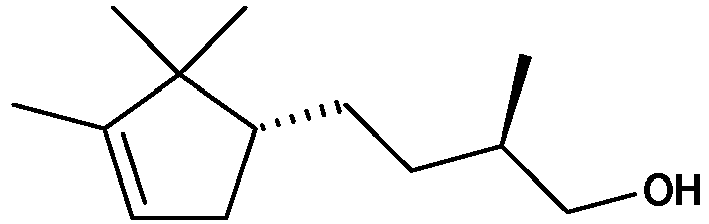
EP1561476 describes deodorant compositions for improving deodorizing effects where, among a broad number of substances and a broad number of uses, the use of sandalore and brahmanol is also described as deodorizing fragrances in hair care products such as shampoos, conditioners, hair rinse, hair coloring agents, permanent-wave agents, wax, hair spray and mousse. The fragrance materials of natural origin to be used as fragrances inEP1561476 include sandalwood oil, and sandalore and brahmanol are defined as trade names of the above materials, thus meaning that according to this document there is no distinction between the fragrance provided by the natural extract and its synthetic substitutes. -
EP1346720 relates to a deodorant composition for hair color having a similar scope. There is no description in such publications, not even generically, of such synthetic odorants for the treatment of hair loss, or for promoting hair growth. - According to Busse et al., A Synthetic Sandalwood Odorant Induces Wound-Healing Processes in Human Keratinocytes via the Olfactory Receptor OR2AT4, Journal of Investigative Dermatology, 2014, 134: 2823-2832, sandalore and brahmanol have been identified as agonists of the cutaneous olfactory receptor OR2AT4, and found to induce Ca2+ signals in cultured human keratinocytes. The long-term stimulation of keratinocytes with sandalore positively affects cell proliferation, migration and regeneration of keratinocyte monolayers in an in vitro wound scratch assay, and sandalore stimulation enhances epidermal wound healing in human skin organ cultures.
- According to Busse et al., evidence is described that natural sandalwood oil and other synthetic sandalwood odorants are not agonists of the olfactory receptor OR2AT4 and do not show the same epidermal wound healing effect.
- Olfactory receptors (ORs) expression is not restricted to the nasal epithelium but it is also present in different human tissues, see Feldmesser E, Olender T, Khen M, Yanai I, Ophir R, Lancet D., Widespread ectopic expression of olfactory receptor genes. BMC Genomics. 2006 May 22;7:121; Zhang X, Firestein S., Nose thyself: individuality in the human olfactory genome. Genome Biol. 2007;8(11):230; Flegel C, Manteniotis S, Osthold S, Hatt H, Gisselmann G., Expression profile of ectopic olfactory receptors determined by deep sequencing. PLoS One. 2013;8(2):55368). Numerous studies have described physiological roles for ORs in various human cell types (Kang N, Koo J. Olfactory receptors in non-chemosensory tissues. BMB Rep. 2012 Nov;45(11):612-22) such as spermatozoa (Spehr M, Gisselmann G, Poplawski A, Riffell JA, Wetzel CH, Zimmer RK, Hatt H. Identification of a testicular odorant receptor mediating human sperm chemotaxis. Science. 2003 Mar 28;299(5615):2054-8; Veitinger T, Riffell JR et al, Chemosensory Ca2+ dynamics correlate with diverse behavioural phenotypes in human sperm. J Biol Chem. 2011 May 13;286(19):17311-25), prostate epithelial cells (Neuhaus EM, Zhang W, Gelis L, Deng Y, Noldus J, Hatt H. Activation of an Olfactory Receptor Inhibits Proliferation of Prostate Cancer Cells. J Biol Chem. 2009;284(24):16218-16225), and enterochromaffin cells of the gut (Braun T, Voland P, Kunz L, Prinz C, Gratzl M. Enterochromaffin cells of the human gut: sensors for spices and odorants. Gastroenterology. 2007 May;132(5):1890-901).
- According to the present invention, it has been surprisingly found that hair growth can be promoted, and that hair loss can be inhibited or delayed, in the human scalp by the use of compounds of general formula (I):

- R1 and R2 form together a double bond, or R1 and R2 form together a cyclopropyl group;
- R3, R4 are the same or different and independently chosen from hydrogen, methyl, or R3 and R4 form together a double bond;
- R5, R6 are the same or different and independently chosen from hydrogen, methyl; or R5 and R6 form together a double bond, or R5 and R6 form together a cyclopropyl group;
- R7 = methyl, or ethyl;
- R8 = hydrogen, or methyl.
- Within the scope of the new use according to the present invention, preferred compounds of formula (I), including the aforementioned sandal pentanol (compound 1) and sandal cyclopentane (compound 5), are reported in the following table:
Compound IUPAC Name CAS N° Structural formula Formula/ MW 1 sandal pentanol 3-methyl-5-(2,2,3-trimethylcyclopent-3-en-1-yl)pentan-2-ol 65113-99-7 
C14H26O 210.36 2 sandal pentenol (4Z)-3-methyl-5-(2,2,3-trimethylcyclopent-3-en-1-yl)pent-4-en-2-ol 67801-20-1 
C14H24O 208.35 3 sandal cyclopropane 1-methyl-2-((1,2,2-trimethylbicyclo(3.1.0)hex-3-yl)methyl)-cyclopropane-methanol 198404-98-7 
C15H26O 222.37 4 Santol pentenol (E)-3,3-dimethyl-5-(2,2,3-trimethylcyclopent-3-en-1-yl)pent-4-en-2-ol 107898-54-4 
C15H26O 222.37 5 sandal cyclopentane 2-Methyl-4-(2,2,3-trimethyl-3-cyclopenten-1-yl)butanol 72089-08-8 
C13H24O 196.34 6 sandalrome (E)-2-ethyl-4-(2,2,3-trimethylcyclopent-3-en-1-yl)but-2-en-1-ol 28219-61-6 
C14H24O 208.35 7 sandal butenol (E)-2-methyl-4-(2,2,3-trimethyl-3-cyclopenten-1-yl)-2-buten-1-ol 28219-60-5 
C13H22O 194.32 - An object of the invention are also compositions for use in promoting hair growth, and/or inhibiting or delaying hair loss, suitable for topical administration on the human scalp, in which one or more compounds of formula (I) are used as active principles, preferably in a quantity between 0.1 and 10% by weight (w/w %), formulated with ingredients suitable for a topical administration.
- The compositions of the invention are suitable both for a cosmetic and a therapeutic use in promoting hair growth and/or the treatment of hair loss in the human scalp, wherein at least one compound of general formula (I) is comprised as active principle.
- In order to best understand the characteristics and advantages of the invention, nonlimiting practical examples thereof are described below. The components are named according to the INCI nomenclature.
-
component (INCI name) quantity (w/w %) Alcohol denat 15-35 PEG-40 Hydrogenated castor oil 0.5-3 Sandal pentanol 0.1-10.0 Ethoxydiglycol 0.25-1.0 Aqua q.s. to 100 g -
component (INCI name) quantity (w/w %) glycerin 1.5-4.5 ammonium acryloyldimethyltaurate/vp copolymer 1.0-2.0 sandal pentanol 0.1-10.0 cyclopentasiloxane 1.0-2.0 phenoxyethanol 0.25-0.75 parfum 0.5-1.0 caprylyl glycol 0.25-0.75 phenyl trimethicone 0.25-0.75 silicone quaternium-17 0.1-0.4 dimethicone 0.1-0.4 laureth-4 0.1-0.4 sericin 0.1-0.4 tocopheryl acetate 0.1-0.3 laureth-23 0.1-0.3 potassium sorbate 0.05-0.15 ammonium glycyrrhizate 0.05-0.15 citric acid 0.04-0.08 disodium edta 0.025-0.075 ethylhexyl methoxycinnamate 0.025-0.075 dimethiconol 0.025-0.075 aqua q.s. to 100 g -
Component (INCI name) quantity (w/w %) sandal pentanol 0.1-10.0 PEG-40 hydrogenated castor oil 1-3 parfum 0.5-1.5 polyacrylate-14 0.5-1.5 hydroxypropyl guar 0.5-1.5 hydrogenated starch hydrolysate 0.5-1.5 sodium hydroxymethylglycinate 0.25-1.0 benzophenone-4 0.15-0.45 disodium edta 0.05-0.15 polyquaternium-11 0.0025-0.025 aqua q.s. to 100 g -
Component (INCI name) quantity (w/w %) cetearyl alcohol 15-25 glyceryl stearate 15-25 dimethicone 10-20 C12-13 alkyl lactate 5-15 cetrimonium chloride 2.5-7.5 PEG-100 stearate 2.5-7.5 cyclopentasiloxane 2-6 xylitol 2-6 sandal pentanol 0.1-10.0 hydroxyethylcellulose 1-3 dimethiconol 1-3 benzyl alcohol 0.1-1.0 panthenol 1-3 parfum 1-2 bis-isobutyl PEG/PPG-20/35/amodimethicone copolymer 0.5-1.0 phytantriol 0.5-1.0 sodium benzoate 0.5-1.0 sodium dehydroacetate 0.5-1.0 cetyl ethylhexanoate 0.5-1.0 butylene glycol 0.5-1.0 disodium edta 0.2-0.6 polysorbate 80 0.2-0.6 sericin 0.2-0.6 dehydroacetic acid 0.1-0.3 yeast polysaccharides 0.1-0.3 gluconolactone 0.05-0.15 aqua q.s. to 100 g -
Component (INCI name) quantity (w/w %) magnesium laureth sulfate sodium lauroyl sarcosinate sandal pentanol 0.1-10.0 disodium laureth sulfosuccinate PEG-200 hydrogenated glyceryl palmate cocamide mipa 0.5-1.5 parfum glycol distearate PEG-7 glyceryl cocoate 0.25-0.75 betaine 0.25-0.75 lauryl methyl gluceth-10 hydroxypropyldimonium chloride.... 0.25-0.75 laureth-7 0.25-0.75 polyquaternium-10 0.25-0.75 sodium hydroxymethylglycinate 0.25-0.75 potassium undecylenoyl hydrolyzed wheat protein panthenol 0.1-0.3 tetrasodium edta phenyl trimethicone 0.05-0.15 silicone quaternium-17 0.05-0.12 laureth-4 0.05-0.12 laureth-23 0.025-0.075 sodium cocoamphoacetate 0.025-0.075 BHA 1 0.005-0.015 aqua q.s. to 100 g -
Component (INCI name) quantity (w/w %) alcohol 10-20 sandal pentanol 0.1-10.0 PEG-40 hydrogenated castor oil 1-2 glycerin 1-1.5 sodium olivamphoacetate 0.5-1.5 parfum 0.5-1 tocopherol 0.05-0.15 disodium EDTA 0.025-0.075 polyquaternium-16 0.025-0.075 potassium metabisulfite 0.01-0.03 aqua q.s. to 100 g - With reference to
Figures 1 to 5 of the accompanying drawings, -
Fig. 1 shows immunofluorescence images taken from samples of human scalp skin tissues and hair follicles (HFs). -
Fig. 2 shows a diagram relating to hair shaft elongation. -
Fig. 3 shows a diagram relating to hair growth cycle, with particular reference to the catagen phase. -
Fig. 4 shows a diagram relating to hair matrix keratinocyte proliferation and apoptosis. -
Fig. 5 shows a diagram relating to the catagen-promoting growth factor TGFβ2. -
Figures 1 to 5 concern the results obtained in the following experimental study, and are thus described in detail in the following description. - The said compound 1 according to the invention, i.e. sandal pentanol, was chosen among the compounds of formula (I) to be tested for experimental purposes as follows. Sandal pentanol is named Sandalore in the diagrams of
Figs. 2-5 . - As a first step, standard immunofluorescence technique was used on human scalp skin tissue sections from healthy donors in order to assess whether OR2AT4 is expressed in human scalp hair follicles (HFs).
- Then, in order to assess whether stimulation of OR2AT4 can influence human hair growth, microdissected HFs were treated with sandal pentanol at a concentration of 500 µM, as the agonist and a hair shaft elongation measurement was performed (see Philpott et al., 1990). In addition, a kinase assay was conducted in order to identify which signalling pathways are involved in the specific stimulation of OR2AT4 by sandal pentanol.
- Subsequently, in order to confirm that the anagen prolonging effect of sandal pentanol is specific, a HF organ culture was performed using sandal pentanol as the agonist and a specific antagonist, Phenirat (phenoxyethyl isobutyrate), a synthetic fragrance, see the Busse et al. reference mentioned above.
- HFs were treated with either the vehicle, sandal pentanol, Phenirat or a mixture of sandal pentanol and Phenirat. To analyse modifications of the hair cycle, Ki67/TUNEL were performed and used to evaluate hair cycle score and hair matrix keratinocytes proliferation and apoptosis.
- In addition, TGFβ2, a potent catagen inducer, was investigated with reference to the same above compounds.
- In order to downregulate the expression of OR2AT4 in human HFs and to study the effect of this in hair growth, HFs were transfected with OR2AT4-siRNA.
- qRT-PCR and (immuno-)histomorphometry analyses were employed to confirm a successfully siRNA-mediated downregulation of OR2AT4 gene and protein in microdissected HFs . Finally, in order to investigate how the knockdown of OR2AT4 influences human hair growth, Ki67/TUNEL immunofluorescence was used to quantify the hair cycle score and hair matrix keratinocytes proliferation and apoptosis.
- To check whether the knockdown can influence the catagen induction, TGFβ2 expression was analysed by immunofluorescence.
- Temporal and occipital normal human scalp skin was obtained from healthy donors (in an age range 38 - 69 years) undergoing routine face-lift surgery after informed consent and ethical approval.
- OCT embedded samples were sectioned (6 µm thickness) with a cryostat. Sections were fixed in 4% paraformaldehyde, pre-incubated with 10% of goat serum (for OR2AT4) or 5%
goat serum + 0,3% Tritton X-100 (for cleaved-caspase 3) and incubated with the corresponding primary antibody at 4°C overnight (1/100 for OR2AT4 and 1/400 for cleaved-caspase 3). Secondary antibody incubation was performed at RT for 45 min. Counterstaining with DAPI (1 µg/mL) was performed to visualize nuclei. For TGFb2, samples were fixed in acetone and the endogenous peroxidases were blocked with 3% of H2O2. This step was followed by an avidin-biotin blocking step and a preincubation with TNB buffer (Tris HCl+NaCl+Casein). The corresponding primary antibody was incubated at 4°C overnight (1/1000 for TGFb2). Secondary antibody incubation was performed at RT for 45 min before using the Tyramide signal amplification kit (Perkin Elmer). Counterstaning with DAPI was performed to visualize nuclei. To stain apoptotic and proliferating cells, we have used the apoptag kit (Merck Milipore) following manufacture's protocol followed by Ki67 staining. The primary antibody was incubated overnight (Ki67, 1/20) after the TdT-enzyme step. The secondary antibody was incubated for 45 min at RT after the fluorescent-labelled anti-Digoxigenin step of the apoptag kit. Counterstaining with DAPI was performed to visualize nuclei. Negative controls were performed by omitting the primary antibody. Images were taken using a Keyence fluorescence microscope (Osaka, Japan) maintaining a constant set exposure time throughout imaging for further analysis. - Human scalp samples were obtained after face-lifting procedure and used at the same day for microdissecting human anagen VI scalp HFs. Microdissected human scalp HFs were cultured at 37°C with 5% CO2 in a minimal media of William's E media (Gibco, Life technologies) supplemented with 2mM of L-glutamine (Gibco), 10ng/ml hydrocortisone (Sigma-Aldrich), 10µg/ml insulin (Sigma- Aldrich) and 1% penicillin/streptomycin mix (Gibco) (WEM) as previously described (Philpott, 1990; Kloepper, 2010; Langan et al, 2015).
- After 24h of incubation, WEM medium was replaced and HFs were treated with the corresponding substances for 6 days following experimental conditions. HFs were treated either with vehicle (0.1% DMSO), sandal pentanol (500 µM), Phenirat (in a ratio 1:1 to the agonist), or a mixture sandal pentanol+Phenirat.
- Phenirat was added 30 min before sandal pentanol. Hair shaft elongation was measured daily using an inverted binocular microscope (Philpott et al., 1990) and culture medium was replaced every second day. HFs were then embedded in cryomatrix (Fisher Scientific) and snap frozen in liquid nitrogen. Sections of 6 µm thickness were cut with a cryostat and stored at -80°C for further immunohistochemical analysis.
- Staining intensity was evaluated in well-defined reference areas by quantitative (immuno-)histomorphometry, as previously described (Bertolini et al., 2014) using NIH IMAGE software (NIH, Bethesda, MD, USA).
- All data are expressed as mean ± SEM and were analysed by One Way Anova or Kruskall Wallis test when more than 2 groups were compared and Student's t-test or Mann-Whitney test when sandal pentanol treatment was compared to vehicle (
Graph Pad Prism 6, GraphPad Software, San Diego, CA, USA). - Results are described with reference to the enclosed drawings of
Figs. 1 to 5 . - Firstly the presence of the olfactory receptor 2AT4 (OR2AT4) in HFs was investigated. OR2AT4 was observed in the suprabulbar outer root sheath (ORS) keratinocytes of human scalp anagen HFs, as shown by immunofluorescence in
Figure 1 . Pictures A) to D) fromFig. 1 represent OR2AT4 immunofluorescence in HFs in human scalp skin (see picture A and corresponding enlargements) and microdissected HFs (see pictures B-D and corresponding enlargements) from three different donors (n=3). CTS stands for connective tissue sheath, DP for dermal papilla, HM for hair matrix, IRS for inner root sheath, ORS for outer root sheath, HS for hair shaft, HB for hair bulb, HF for hair follicles. Dotted lines delineate the IRS (inner root sheath), ORS (outer root sheath) and DP (dermal papilla). -
Fig. 1 shows that OR2AT4 is expressed in suprabulbar ORS keratinocytes of anagen scalp HFs and in suprabulbar and bulbar ORS, and in hair matrix tips keratinocytes in microdissected anagen HFs. - Microdissected anagen HFs (Philpott model) revealed OR2AT4 cells in the hair bulb, namely in ORS and hair matrix (HM) tips, see
Fig.1B , in addition to the characteristic suprabulbar intrafollicular expression, seeFig. 1D . - To check whether the activation of OR2AT4 can influence the hair cycle of human HF, microdissected human HFs were specifically stimulated with the potential agonist, sandal pentanol. The effect of the sandal pentanol treatment was evaluated by measuring hair shaft elongation compared to vehicle.
- HF elongation was measured in cultured microdissected HFs. Mean±SEM, n=18 HFs for each donor, 2 donors, Student's t-test,
Graph Pad Prism 6. Despite inter-individual differences, the results reveal that sandal pentanol at concentration 500µM stimulates hair shaft elongation of cultured microdissected HFs deriving from two donors, as shown in the diagram ofFig. 2 reporting % elongation versus days of culture, sandalore compared to vehicle. - To investigate the specificity of the effect on hair growth of OR2AT4 stimulation by sandal pentanol, microdissected HFs were cultured with sandal pentanol and/or Phenirat, and hair cycle performed staging analysis as previously described (Kloepper, 2010; Langan et al, 2015). Hair cycle score was measured both in treated and vehicle HFs after 6 days of culture. N=16-24 HFs from 3 patients, Mean±SEM, Kruskal Wallis test and Dunn's multiple comparisons test as post hoc test, ns, Mann-Whitney test, #p<0.05,
Graph Pad Prism 6. - The obtained results indicate that the specific stimulation of OR2AT4 by sandal pentanol alone at concentration 500µM delayed catagen induction in treated HFs compared to vehicle after 6 days of culture, as shown in the diagram of
Figure 3 . On the contrary, both comparative reference Phenirat alone and the mixture of sandal pentanol administered together with Phenirat did not prolong anagen in treated HFs compared to vehicle. The data suggest that the stimulation of OR2AT4 by sandal pentanol promotes catagen delay, whilst these effects are counteracted by OR2AT4 inhibition when using Phenirat. - To sum up,
Fig. 3 shows that the compound of the invention significantly delays catagen development. - With reference to the evidence of
Figure 4 , to investigate whether sandal pentanol influences hair matrix keratinocytes proliferation and apoptosis, Ki67/TUNEL staining was performed. Proliferating (diagram ofFigure 4A ) and apoptotic (diagram ofFigure 4B ) hair matrix keratinocytes were counted in the hair matrix of treated and vehicle HFs. Representative pictures of Ki67/TUNEL are shown inFig. 4 from C to E. Mean±SEM, n=18-21 HFs from 3 patients, Kruskal-Wallis test and Dunn's multiple comparisons test as post hoc test, **p<0.01, ***p<0.001, Mann-Whitney test #p<0.05,Graph Pad Prism 6. - After 6 day-culture, hair matrix keratinocyte proliferation did not change in HFs treated with sandal pentanol or Phenirat alone. However co-administration of the specific antagonist of OR2AT4, Phenirat, together with sandal pentanol induced a significant decrease on the hair matrix keratinocyte proliferation as shown in
Fig. 4A . - Sandal pentanol treatment significantly decreased hair matrix keratinocyte apoptosis, whilst co-administration of sandal pentanol+Phenirat significantly increased hair matrix keratinocyte apoptosis, as shown in
Fig.4B . - With reference to the evidence of
Figure 5 , to further investigate how OR agonist and antagonist affect HFs growth, the expression of the relevant catagen-promoting growth factor during physiological human HF cycling, i.e. TGFβ2 (Soma et al., 2002), in the proximal ORs was examined. After 6 day-treatment with sandal pentanol, a significant decrease in TGFβ2 expression at the protein level was observed, while no change was detected by blocking the receptor with Phenirat. In this case the co-administration of sandal pentanol with Phenirat showed a comparable result as obtained by administration of sandal pentanol alone, as shown in the diagram ofFigure 5A . TGFβ2 expression was measured in ORS keratinocytes in treated and vehicle HFs. - Corresponding representative pictures of TGFβ2 immunofluorescence are shown in
Fig. 5 , B (vehicle), C (sandalore), D (sandalore+ Phenirat). - TGFβ2 expression was quantified using Image J. Mean±SEM, n=14-22 HFs from 2 patients, Kruskal-Wallis and Dunn's multiple comparisons test as post hoc test, *p<0.05, ***p<0.001, and Mann-Whitney test, ns.
Graph Pad Prism 6. - The above results overall show that OR2AT4 is a hair growth modulator and the compound of the invention is an anagen-prolonging agent. Stimulation of OR2AT4 by the compound of the invention increases hair shaft elongation and delays catagen phase transition, while the effect is not obtained with the OR2AT4 inhibitor Phenirat, and is substantially counteracted when the compound of the invention is co-administered with Phenirat.
- Stimulation of OR2AT4 by the compound of the invention modulates apoptotic signalling pathways and significantly decreases apoptosis in human hair matrix keratinocytes, while this effect is not obtained with Phenirat and is substantially counteracted when the compound of the invention is co-administered with Phenirat. Stimulation of OR2AT4 by the compound of the invention significantly decreases the relevant catagen-promoting growth factor, TGFβ2, while this effect is not obtained with Phenirat.
- In general terms, the experimental evidence shows that the compounds of formula (I) as defined above can be effectively used for promoting hair growth and/or inhibiting or delaying hair loss in human scalp.
Claims (16)
- Cosmetic use of compounds of general formula (I):
 R1 and R2 form together a double bond, or R1 and R2 form together a cyclopropyl group;R3, R4 are the same or different and independently chosen from hydrogen, methyl, or R3 and R4 form together a double bond;R5, R6 are the same or different and independently chosen from hydrogen, methyl; or R5 and R6 form together a double bond, or R5 and R6 form together a cyclopropyl group;R7 = methyl, or ethyl;R8 = hydrogen, or methyl,for promoting hair growth and/or inhibiting or delaying hair loss in the human scalp.
 - Use according to claim 1 characterized in that the compound of formula (I) is 3-methyl-5-(2,2,3-trimethylcyclopent-3-en-1-yl)pentan-2-ol.
- Use according to claim 1 characterized in that the compound of formula (I) is (4Z)-3-methyl-5-(2,2,3-trimethylcyclopent-3-en-1-yl)pent-4-en-2-ol.
- Use according to claim 1 characterized in that the compound of formula (I) is 1-methyl-2-((1,2,2-trimethylbicyclo(3.1.0)hex-3-yl)methyl)-cyclopropanemethanol.
- Use according to claim 1 characterized in that the compound of formula (I) is (E)-3,3-dimethyl-5-(2,2,3-trimethylcyclopent-3-en-1-yl)pent-4-en-2-ol.
- Use according to claim 1 characterized in that the compound of formula (I) is 2-methyl-4-(2,2,3-trimethyl-3-cyclopenten-1-yl)butanol.
- Use according to claim 1 characterized in that the compound of formula (I) is (E)-2-ethyl-4-(2,2,3-trimethylcyclopent-3-en-1-yl)but-2-en-1-ol.
- Use according to claim 1 characterized in that the compound of formula (I) is (E)-2-methyl-4-(2,2,3-trimethyl-3-cyclopenten-1-yl)-2-buten-1-ol.
- Cosmetic use of a cosmetic composition for promoting hair growth and/or inhibiting or delaying hair loss in the human scalp wherein said cosmetic composition comprises as active principle at least a compound of formula (I):
 R1 and R2 form together a double bond, or R1 and R2 form together a cyclopropyl group;R3, R4 are the same or different and independently chosen from hydrogen, methyl, or R3 and R4 form together a double bond;R5, R6 are the same or different and independently chosen from hydrogen, methyl; or R5 and R6 form together a double bond, or R5 and R6 form together a cyclopropyl group;R7 = methyl, or ethyl;R8 = hydrogen, or methyl.
 - Cosmetic use of a cosmetic composition according to claim 9 characterized in that it comprises as active principle at least a compound of formula (I) in a quantity between 0.1 and 10% by weight (w/w %), formulated with ingredients suitable for a topical administration.
- Cosmetic use of a cosmetic composition according to claim 9 characterized in that the compound of formula (I) is 3-methyl-5-(2,2,3-trimethylcyclopent-3-en-1-yl)pentan-2-ol and/or 2-methyl-4-(2,2,3-trimethyl-3-cyclopenten-1-yl)butanol.
- Compounds of general formula (I):
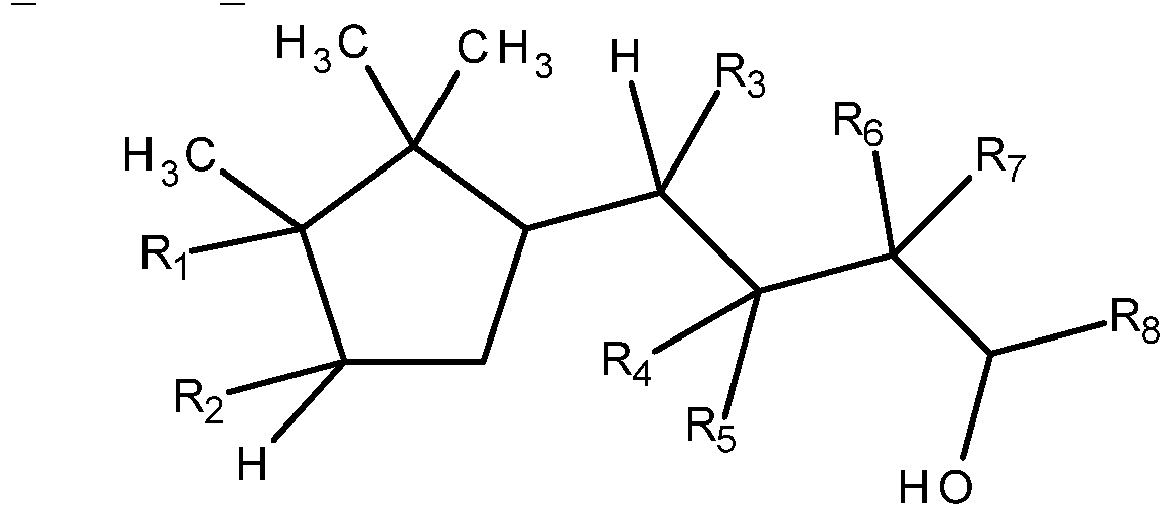 R1 and R2 form together a double bond, or R1 and R2 form together a cyclopropyl group;R3, R4 are the same or different and independently chosen from hydrogen, methyl, or R3 and R4 form together a double bond;R5, R6 are the same or different and independently chosen from hydrogen, methyl;or R5 and R6 form together a double bond, or R5 and R6 form together a cyclopropyl group;R7 = methyl, or ethyl;R8 = hydrogen, or methyl,for a therapeutic use in promoting hair growth and/or the treatment of hair loss in the human scalp.
 - Pharmaceutical composition for use in promoting hair growth and/or the treatment of hair loss in the human scalp, characterised in that it comprises as active principle a compound of general formula (I):
 R1 and R2 form together a double bond, or R1 and R2 form together a cyclopropyl group;R3, R4 are the same or different and independently chosen from hydrogen, methyl, or R3 and R4 form together a double bond;R5, R6 are the same or different and independently chosen from hydrogen, methyl;or R5 and R6 form together a double bond, or R5 and R6 form together a cyclopropyl group;R7 = methyl, or ethyl;R8 = hydrogen, or methyl.
 - Pharmaceutical composition for use according to claim 13 characterized in that it comprises as active principle at least a compound of formula (I) in a quantity between 0.1 and 10% by weight (w/w %), formulated with ingredients suitable for a topical administration.
- Pharmaceutical composition for use according to claim 13 characterized in that it comprises as active principle the compound 3-methyl-5-(2,2,3-trimethylcyclopent-3-en-1-yl)pentan-2-ol.
- Pharmaceutical composition for use according to claim 13 characterized in that it comprises as active principle the compound 2-Methyl-4-(2,2,3-trimethyl-3-cyclopenten-1-yl)butanol.
Priority Applications (5)
| Application Number | Priority Date | Filing Date | Title |
|---|---|---|---|
| HRP20210223TT HRP20210223T1 (en) | 2016-05-19 | 2017-05-19 | COMPOUNDS FOR PROMOTING HAIR GROWTH AND / OR PREVENTING OR DELAYING HAIR LOSS IN HUMANS AND PREPARATIONS FOR SUCH USES |
| PL17730678T PL3458020T3 (en) | 2016-05-19 | 2017-05-19 | Compounds for promoting hair growth and/or inhibiting or delaying hair loss in humans, and compositions for such uses |
| SI201730632T SI3458020T1 (en) | 2016-05-19 | 2017-05-19 | Compounds for promoting hair growth and/or inhibiting or delaying hair loss in humans, and compositions for such uses |
| RS20210106A RS61407B1 (en) | 2016-05-19 | 2017-05-19 | Compounds for promoting hair growth and/or inhibiting or delaying hair loss in humans, and compositions for such uses |
| SM20210139T SMT202100139T1 (en) | 2016-05-19 | 2017-05-19 | Compounds for promoting hair growth and/or inhibiting or delaying hair loss in humans, and compositions for such uses |
Applications Claiming Priority (2)
| Application Number | Priority Date | Filing Date | Title |
|---|---|---|---|
| ITUA2016A003604A ITUA20163604A1 (en) | 2016-05-19 | 2016-05-19 | COMPOUNDS TO PROMOTE HAIR GROWTH IN MAN AND / OR TO STOP OR DELAY ITS FALL, AND COMPOSITIONS FOR SUCH USES |
| PCT/EP2017/062110 WO2017198818A1 (en) | 2016-05-19 | 2017-05-19 | Compounds for promoting hair growth and/or inhibiting or delaying hair loss in humans, and compositions for such uses |
Publications (2)
| Publication Number | Publication Date |
|---|---|
| EP3458020A1 EP3458020A1 (en) | 2019-03-27 |
| EP3458020B1 true EP3458020B1 (en) | 2020-11-18 |
Family
ID=56990747
Family Applications (1)
| Application Number | Title | Priority Date | Filing Date |
|---|---|---|---|
| EP17730678.4A Active EP3458020B1 (en) | 2016-05-19 | 2017-05-19 | Compounds for promoting hair growth and/or inhibiting or delaying hair loss in humans, and compositions for such uses |
Country Status (27)
| Country | Link |
|---|---|
| US (1) | US10898419B2 (en) |
| EP (1) | EP3458020B1 (en) |
| JP (1) | JP7034944B2 (en) |
| KR (1) | KR102452350B1 (en) |
| CN (1) | CN109310597B (en) |
| AU (1) | AU2017267278B2 (en) |
| BR (1) | BR112018073626B1 (en) |
| CA (1) | CA3024001C (en) |
| CY (1) | CY1123780T1 (en) |
| DK (1) | DK3458020T3 (en) |
| ES (1) | ES2851899T3 (en) |
| HR (1) | HRP20210223T1 (en) |
| HU (1) | HUE053265T2 (en) |
| IT (1) | ITUA20163604A1 (en) |
| LT (1) | LT3458020T (en) |
| MA (1) | MA45043B1 (en) |
| MD (1) | MD3458020T2 (en) |
| MX (1) | MX379050B (en) |
| PL (1) | PL3458020T3 (en) |
| PT (1) | PT3458020T (en) |
| RS (1) | RS61407B1 (en) |
| RU (1) | RU2741021C2 (en) |
| SG (2) | SG11201810318RA (en) |
| SI (1) | SI3458020T1 (en) |
| SM (1) | SMT202100139T1 (en) |
| UA (1) | UA124236C2 (en) |
| WO (1) | WO2017198818A1 (en) |
Families Citing this family (13)
| Publication number | Priority date | Publication date | Assignee | Title |
|---|---|---|---|---|
| IT201800005585A1 (en) * | 2018-05-22 | 2019-11-22 | COMPOUNDS TO PREVENT AND TREAT DISEASES OF THE SKIN OR MUCOSA WITH INFLAMMATORY COMPONENT | |
| CA3114373A1 (en) * | 2018-09-29 | 2020-04-02 | Robert J. Petcavich | Natural product composition for stimulating hair growth |
| FR3110425B1 (en) * | 2020-05-19 | 2022-09-09 | Isp Investments Llc | METHOD FOR OBTAINING A SANDALWOOD EXTRACT, COMPOSITIONS COMPRISING IT AND COSMETIC USES THEREOF |
| JP7629096B2 (en) * | 2020-11-30 | 2025-02-12 | ウェラ ジャーマニー ゲーエムベーハー | Anti-hair loss composition |
| WO2022133354A1 (en) | 2020-12-19 | 2022-06-23 | Actera Ingredients, Inc. | Odorless active agents |
| JP7642955B2 (en) * | 2021-02-04 | 2025-03-11 | 株式会社ファンケル | Composition for promoting olfactory receptor expression |
| CN116940348A (en) * | 2021-03-22 | 2023-10-24 | 株式会社资生堂 | Meckel cell activator, enhancer for synaptic vesicle, neurotransmitter release promoter, method for evaluating neurotransmitter release activity of Meckel cell, and method for screening neurotransmitter release promoter of Meckel cell |
| JPWO2022202714A1 (en) * | 2021-03-22 | 2022-09-29 | ||
| CN118871088A (en) * | 2021-10-01 | 2024-10-29 | 科蒂公司 | Compositions comprising an OR2AT4 agonist |
| IT202200010358A1 (en) * | 2022-05-18 | 2023-11-18 | Giuliani Spa | OLFACTORY RECEPTOR 2A4/7 AGONIST FOR PROMOTING HAIR GROWTH AND IMPROVING AESTHETIC ASPECT |
| EP4531801A1 (en) | 2022-05-25 | 2025-04-09 | Wella Germany GmbH | Improving hair structure |
| EP4545063A1 (en) * | 2023-10-23 | 2025-04-30 | Wella Germany GmbH | Cosmetical use of a topically applicable rinse-of composition (rc) |
| EP4620463A1 (en) * | 2024-03-22 | 2025-09-24 | CUTANEON - Skin & Hair Innovations GmbH | Active agent for use in hair growth regulation |
Family Cites Families (14)
| Publication number | Priority date | Publication date | Assignee | Title |
|---|---|---|---|---|
| US4052341A (en) * | 1976-04-29 | 1977-10-04 | Givaudan Corporation | 3-methyl-5-(2,2,3-trimethylcyclopent-3-en-1-yl)pentan-2-ol compound and perfume compositions |
| CN1075250A (en) | 1992-10-27 | 1993-08-18 | 海南南洋实业有限公司 | The production method of shampoo |
| JP4020284B2 (en) * | 1999-05-27 | 2007-12-12 | 株式会社マンダム | Hair restorer raw material and hair restorer composition |
| JP2001151644A (en) * | 1999-11-29 | 2001-06-05 | Kao Corp | Flavor composition for scalp odor |
| JP3877537B2 (en) * | 2001-03-07 | 2007-02-07 | 高砂香料工業株式会社 | Antibacterial agent for oral composition and oral composition containing the same |
| JP2003277246A (en) * | 2002-03-22 | 2003-10-02 | Takasago Internatl Corp | Deodorant composition |
| JP3947149B2 (en) | 2002-10-28 | 2007-07-18 | 高砂香料工業株式会社 | Deodorant composition |
| JP2006160698A (en) * | 2004-12-10 | 2006-06-22 | Noevir Co Ltd | Vegf production promoter, hair grower and wound healing agent |
| US7879910B1 (en) * | 2006-10-10 | 2011-02-01 | Jan Marini Skin Research, Inc. | Compositions and methods for promoting lush hair growth |
| US20090197939A1 (en) * | 2008-02-01 | 2009-08-06 | Mary Kay Inc. | Methods of treating skin with aromatic skin-active ingredients |
| CN102000293A (en) | 2010-12-05 | 2011-04-06 | 孟凡伟 | Traditional Chinese medicine hair nourishing formulation |
| US9585826B2 (en) * | 2012-11-07 | 2017-03-07 | Kimberly-Clark Worldwide, Inc. | Triggerable compositions for two-stage, controlled release of active chemistry |
| CN103735443A (en) | 2013-12-10 | 2014-04-23 | 河南孟诜堂药业有限公司 | Alopecia-resistant smoothing shampoo and preparation method thereof |
| EP2957283B1 (en) * | 2014-06-19 | 2022-12-21 | Symrise AG | Process for identification of medicaments for acceleration of wound healing |
-
2016
- 2016-05-19 IT ITUA2016A003604A patent/ITUA20163604A1/en unknown
-
2017
- 2017-05-19 SI SI201730632T patent/SI3458020T1/en unknown
- 2017-05-19 DK DK17730678.4T patent/DK3458020T3/en active
- 2017-05-19 MA MA45043A patent/MA45043B1/en unknown
- 2017-05-19 PL PL17730678T patent/PL3458020T3/en unknown
- 2017-05-19 BR BR112018073626-0A patent/BR112018073626B1/en active IP Right Grant
- 2017-05-19 MD MDE20190369T patent/MD3458020T2/en unknown
- 2017-05-19 LT LTEP17730678.4T patent/LT3458020T/en unknown
- 2017-05-19 SG SG11201810318RA patent/SG11201810318RA/en unknown
- 2017-05-19 WO PCT/EP2017/062110 patent/WO2017198818A1/en not_active Ceased
- 2017-05-19 KR KR1020187035315A patent/KR102452350B1/en active Active
- 2017-05-19 SG SG10202011357RA patent/SG10202011357RA/en unknown
- 2017-05-19 CA CA3024001A patent/CA3024001C/en active Active
- 2017-05-19 AU AU2017267278A patent/AU2017267278B2/en active Active
- 2017-05-19 MX MX2018013763A patent/MX379050B/en unknown
- 2017-05-19 CN CN201780030965.7A patent/CN109310597B/en active Active
- 2017-05-19 SM SM20210139T patent/SMT202100139T1/en unknown
- 2017-05-19 EP EP17730678.4A patent/EP3458020B1/en active Active
- 2017-05-19 RU RU2018144755A patent/RU2741021C2/en active
- 2017-05-19 ES ES17730678T patent/ES2851899T3/en active Active
- 2017-05-19 JP JP2018559992A patent/JP7034944B2/en active Active
- 2017-05-19 US US16/302,472 patent/US10898419B2/en active Active
- 2017-05-19 HU HUE17730678A patent/HUE053265T2/en unknown
- 2017-05-19 HR HRP20210223TT patent/HRP20210223T1/en unknown
- 2017-05-19 RS RS20210106A patent/RS61407B1/en unknown
- 2017-05-19 UA UAA201811736A patent/UA124236C2/en unknown
- 2017-05-19 PT PT177306784T patent/PT3458020T/en unknown
-
2021
- 2021-02-05 CY CY20211100098T patent/CY1123780T1/en unknown
Non-Patent Citations (1)
| Title |
|---|
| None * |
Also Published As
Similar Documents
| Publication | Publication Date | Title |
|---|---|---|
| US10898419B2 (en) | Compounds for promoting hair growth and/or inhibiting or delaying hair loss in humans, and compositions for such uses | |
| CN103857379A (en) | Hair care compositions and methods of use | |
| JP2003171240A (en) | Method for preventing and improving gray hair and method for screening active ingredients for hair | |
| JP2014521655A (en) | Sandalwood oil and its use for skin diseases | |
| JPH11315012A (en) | Cyclic amp inducing agent | |
| WO2002022088A1 (en) | Hair nourishments and method of screening the same | |
| JPH06287135A (en) | External skin composition | |
| JP2003321330A (en) | Hair growth tonic composition | |
| HK40006226B (en) | Compounds for promoting hair growth and/or inhibiting or delaying hair loss in humans, and compositions for such uses | |
| HK40006226A (en) | Compounds for promoting hair growth and/or inhibiting or delaying hair loss in humans, and compositions for such uses | |
| JP4469617B2 (en) | Hair restoration | |
| JP2001139436A (en) | Hair tonic and grower | |
| EP4525823B1 (en) | Olfactory receptor 2a4/7 agonist for promoting hair growth and improving aesthetic aspect | |
| JP2005200357A (en) | Hair restoration | |
| JP4268329B2 (en) | Compositions for prevention or treatment of hair nourishing agents, hair regression phase transition inhibitors, etc. | |
| WO2020020791A1 (en) | Lespedeza capitata extract for use in the field of hair care | |
| WO2025041645A1 (en) | Whitening cosmetic composition that acts via olfactory receptors | |
| JPH1179950A (en) | Tyrosinase activity promoter | |
| KR102509285B1 (en) | Composition for promoting the hair growth comprising Alisol B-23-acetate | |
| KR20140131193A (en) | Method and Composition for regulating hair growth targeting placental growth factor | |
| KR20060134302A (en) | Hair cosmetic composition for preventing gray hair and promoting black hair | |
| JPH11106318A (en) | Composition for head |
Legal Events
| Date | Code | Title | Description |
|---|---|---|---|
| STAA | Information on the status of an ep patent application or granted ep patent |
Free format text: STATUS: UNKNOWN |
|
| STAA | Information on the status of an ep patent application or granted ep patent |
Free format text: STATUS: THE INTERNATIONAL PUBLICATION HAS BEEN MADE |
|
| PUAI | Public reference made under article 153(3) epc to a published international application that has entered the european phase |
Free format text: ORIGINAL CODE: 0009012 |
|
| STAA | Information on the status of an ep patent application or granted ep patent |
Free format text: STATUS: REQUEST FOR EXAMINATION WAS MADE |
|
| 17P | Request for examination filed |
Effective date: 20181218 |
|
| AK | Designated contracting states |
Kind code of ref document: A1 Designated state(s): AL AT BE BG CH CY CZ DE DK EE ES FI FR GB GR HR HU IE IS IT LI LT LU LV MC MK MT NL NO PL PT RO RS SE SI SK SM TR |
|
| AX | Request for extension of the european patent |
Extension state: BA ME |
|
| STAA | Information on the status of an ep patent application or granted ep patent |
Free format text: STATUS: EXAMINATION IS IN PROGRESS |
|
| 17Q | First examination report despatched |
Effective date: 20191002 |
|
| RIC1 | Information provided on ipc code assigned before grant |
Ipc: A61K 8/34 20060101AFI20200403BHEP Ipc: A61Q 7/00 20060101ALI20200403BHEP Ipc: A61P 17/14 20060101ALI20200403BHEP Ipc: A61K 31/045 20060101ALI20200403BHEP |
|
| REG | Reference to a national code |
Ref country code: HK Ref legal event code: DE Ref document number: 40006226 Country of ref document: HK |
|
| GRAP | Despatch of communication of intention to grant a patent |
Free format text: ORIGINAL CODE: EPIDOSNIGR1 |
|
| STAA | Information on the status of an ep patent application or granted ep patent |
Free format text: STATUS: GRANT OF PATENT IS INTENDED |
|
| RAP1 | Party data changed (applicant data changed or rights of an application transferred) |
Owner name: GIULIANI S.P.A. |
|
| INTG | Intention to grant announced |
Effective date: 20200609 |
|
| GRAS | Grant fee paid |
Free format text: ORIGINAL CODE: EPIDOSNIGR3 |
|
| GRAA | (expected) grant |
Free format text: ORIGINAL CODE: 0009210 |
|
| STAA | Information on the status of an ep patent application or granted ep patent |
Free format text: STATUS: THE PATENT HAS BEEN GRANTED |
|
| AK | Designated contracting states |
Kind code of ref document: B1 Designated state(s): AL AT BE BG CH CY CZ DE DK EE ES FI FR GB GR HR HU IE IS IT LI LT LU LV MC MK MT NL NO PL PT RO RS SE SI SK SM TR |
|
| AX | Request for extension of the european patent |
Extension state: BA ME |
|
| REG | Reference to a national code |
Ref country code: GB Ref legal event code: FG4D |
|
| REG | Reference to a national code |
Ref country code: CH Ref legal event code: EP |
|
| REG | Reference to a national code |
Ref country code: IE Ref legal event code: FG4D |
|
| REG | Reference to a national code |
Ref country code: DE Ref legal event code: R096 Ref document number: 602017027774 Country of ref document: DE |
|
| REG | Reference to a national code |
Ref country code: AT Ref legal event code: REF Ref document number: 1334956 Country of ref document: AT Kind code of ref document: T Effective date: 20201215 |
|
| REG | Reference to a national code |
Ref country code: RO Ref legal event code: EPE |
|
| REG | Reference to a national code |
Ref country code: HR Ref legal event code: TUEP Ref document number: P20210223T Country of ref document: HR |
|
| REG | Reference to a national code |
Ref country code: PT Ref legal event code: SC4A Ref document number: 3458020 Country of ref document: PT Date of ref document: 20210212 Kind code of ref document: T Free format text: AVAILABILITY OF NATIONAL TRANSLATION Effective date: 20210208 |
|
| REG | Reference to a national code |
Ref country code: DK Ref legal event code: T3 Effective date: 20210208 Ref country code: CH Ref legal event code: NV Representative=s name: VALIPAT S.A. C/O BOVARD SA NEUCHATEL, CH |
|
| REG | Reference to a national code |
Ref country code: FI Ref legal event code: FGE |
|
| REG | Reference to a national code |
Ref country code: SE Ref legal event code: TRGR |
|
| REG | Reference to a national code |
Ref country code: MA Ref legal event code: VAGR Ref document number: 45043 Country of ref document: MA Kind code of ref document: B1 |
|
| REG | Reference to a national code |
Ref country code: NL Ref legal event code: FP |
|
| REG | Reference to a national code |
Ref country code: HR Ref legal event code: T1PR Ref document number: P20210223 Country of ref document: HR |
|
| REG | Reference to a national code |
Ref country code: SK Ref legal event code: T3 Ref document number: E 36498 Country of ref document: SK |
|
| REG | Reference to a national code |
Ref country code: GR Ref legal event code: EP Ref document number: 20210400320 Country of ref document: GR Effective date: 20210316 |
|
| REG | Reference to a national code |
Ref country code: MD Ref legal event code: VAGR Ref document number: 3458020 Country of ref document: MD Date of ref document: 20210331 Kind code of ref document: T2 |
|
| REG | Reference to a national code |
Ref country code: EE Ref legal event code: FG4A Ref document number: E020370 Country of ref document: EE Effective date: 20210208 |
|
| REG | Reference to a national code |
Ref country code: NO Ref legal event code: T2 Effective date: 20201118 |
|
| REG | Reference to a national code |
Ref country code: HR Ref legal event code: ODRP Ref document number: P20210223 Country of ref document: HR Payment date: 20210512 Year of fee payment: 5 |
|
| REG | Reference to a national code |
Ref country code: HU Ref legal event code: AG4A Ref document number: E053265 Country of ref document: HU |
|
| REG | Reference to a national code |
Ref country code: DE Ref legal event code: R097 Ref document number: 602017027774 Country of ref document: DE |
|
| VSFP | Annual fee paid to validation state [announced via postgrant information from national office to epo] |
Ref country code: MD Payment date: 20210512 Year of fee payment: 5 |
|
| PLBE | No opposition filed within time limit |
Free format text: ORIGINAL CODE: 0009261 |
|
| STAA | Information on the status of an ep patent application or granted ep patent |
Free format text: STATUS: NO OPPOSITION FILED WITHIN TIME LIMIT |
|
| 26N | No opposition filed |
Effective date: 20210819 |
|
| REG | Reference to a national code |
Ref country code: HR Ref legal event code: ODRP Ref document number: P20210223 Country of ref document: HR Payment date: 20220517 Year of fee payment: 6 |
|
| VSFP | Annual fee paid to validation state [announced via postgrant information from national office to epo] |
Ref country code: MD Payment date: 20220505 Year of fee payment: 6 |
|
| REG | Reference to a national code |
Ref country code: HR Ref legal event code: ODRP Ref document number: P20210223 Country of ref document: HR Payment date: 20230517 Year of fee payment: 7 |
|
| P01 | Opt-out of the competence of the unified patent court (upc) registered |
Effective date: 20230525 |
|
| REG | Reference to a national code |
Ref country code: AT Ref legal event code: UEP Ref document number: 1334956 Country of ref document: AT Kind code of ref document: T Effective date: 20201118 |
|
| VSFP | Annual fee paid to validation state [announced via postgrant information from national office to epo] |
Ref country code: MD Payment date: 20230504 Year of fee payment: 7 |
|
| REG | Reference to a national code |
Ref country code: HR Ref legal event code: ODRP Ref document number: P20210223 Country of ref document: HR Payment date: 20240510 Year of fee payment: 8 |
|
| REG | Reference to a national code |
Ref country code: HR Ref legal event code: ODRP Ref document number: P20210223 Country of ref document: HR Payment date: 20250508 Year of fee payment: 9 |
|
| PGFP | Annual fee paid to national office [announced via postgrant information from national office to epo] |
Ref country code: NL Payment date: 20250521 Year of fee payment: 9 |
|
| PGFP | Annual fee paid to national office [announced via postgrant information from national office to epo] |
Ref country code: SM Payment date: 20250423 Year of fee payment: 9 |
|
| PGFP | Annual fee paid to national office [announced via postgrant information from national office to epo] |
Ref country code: MC Payment date: 20250527 Year of fee payment: 9 |
|
| PGFP | Annual fee paid to national office [announced via postgrant information from national office to epo] |
Ref country code: FI Payment date: 20250526 Year of fee payment: 9 |
|
| PGFP | Annual fee paid to national office [announced via postgrant information from national office to epo] |
Ref country code: PL Payment date: 20250513 Year of fee payment: 9 Ref country code: DE Payment date: 20250521 Year of fee payment: 9 |
|
| PGFP | Annual fee paid to national office [announced via postgrant information from national office to epo] |
Ref country code: GB Payment date: 20250527 Year of fee payment: 9 Ref country code: DK Payment date: 20250526 Year of fee payment: 9 |
|
| PGFP | Annual fee paid to national office [announced via postgrant information from national office to epo] |
Ref country code: LT Payment date: 20250424 Year of fee payment: 9 |
|
| PGFP | Annual fee paid to national office [announced via postgrant information from national office to epo] |
Ref country code: HU Payment date: 20250523 Year of fee payment: 9 Ref country code: IS Payment date: 20250512 Year of fee payment: 9 Ref country code: RS Payment date: 20250508 Year of fee payment: 9 Ref country code: NO Payment date: 20250523 Year of fee payment: 9 |
|
| VSFP | Annual fee paid to validation state [announced via postgrant information from national office to epo] |
Ref country code: MD Payment date: 20250519 Year of fee payment: 9 |
|
| PGFP | Annual fee paid to national office [announced via postgrant information from national office to epo] |
Ref country code: LU Payment date: 20250521 Year of fee payment: 9 Ref country code: IT Payment date: 20250528 Year of fee payment: 9 Ref country code: BE Payment date: 20250521 Year of fee payment: 9 Ref country code: AL Payment date: 20250508 Year of fee payment: 9 |
|
| PGFP | Annual fee paid to national office [announced via postgrant information from national office to epo] |
Ref country code: HR Payment date: 20250508 Year of fee payment: 9 |
|
| PGFP | Annual fee paid to national office [announced via postgrant information from national office to epo] |
Ref country code: PT Payment date: 20250508 Year of fee payment: 9 Ref country code: LV Payment date: 20250514 Year of fee payment: 9 |
|
| PGFP | Annual fee paid to national office [announced via postgrant information from national office to epo] |
Ref country code: EE Payment date: 20250530 Year of fee payment: 9 Ref country code: FR Payment date: 20250528 Year of fee payment: 9 |
|
| PGFP | Annual fee paid to national office [announced via postgrant information from national office to epo] |
Ref country code: MT Payment date: 20250425 Year of fee payment: 9 Ref country code: GR Payment date: 20250523 Year of fee payment: 9 Ref country code: BG Payment date: 20250521 Year of fee payment: 9 |
|
| PGFP | Annual fee paid to national office [announced via postgrant information from national office to epo] |
Ref country code: CH Payment date: 20250601 Year of fee payment: 9 |
|
| PGFP | Annual fee paid to national office [announced via postgrant information from national office to epo] |
Ref country code: RO Payment date: 20250514 Year of fee payment: 9 Ref country code: AT Payment date: 20250522 Year of fee payment: 9 |
|
| PGFP | Annual fee paid to national office [announced via postgrant information from national office to epo] |
Ref country code: TR Payment date: 20250513 Year of fee payment: 9 Ref country code: SK Payment date: 20250512 Year of fee payment: 9 |
|
| PGFP | Annual fee paid to national office [announced via postgrant information from national office to epo] |
Ref country code: CZ Payment date: 20250514 Year of fee payment: 9 |
|
| PGFP | Annual fee paid to national office [announced via postgrant information from national office to epo] |
Ref country code: IE Payment date: 20250521 Year of fee payment: 9 |
|
| PGFP | Annual fee paid to national office [announced via postgrant information from national office to epo] |
Ref country code: SI Payment date: 20250508 Year of fee payment: 9 Ref country code: SE Payment date: 20250521 Year of fee payment: 9 |
|
| VSFP | Annual fee paid to validation state [announced via postgrant information from national office to epo] |
Ref country code: MD Payment date: 20240519 Year of fee payment: 8 |
|
| PGFP | Annual fee paid to national office [announced via postgrant information from national office to epo] |
Ref country code: ES Payment date: 20250630 Year of fee payment: 9 |
|
| VSFP | Annual fee paid to validation state [announced via postgrant information from national office to epo] |
Ref country code: MA Payment date: 20230516 Year of fee payment: 7 |
|
| VSFP | Annual fee paid to validation state [announced via postgrant information from national office to epo] |
Ref country code: MA Payment date: 20240425 Year of fee payment: 8 Ref country code: MA Payment date: 20220519 Year of fee payment: 6 Ref country code: MA Payment date: 20210520 Year of fee payment: 5 |
|
| PGFP | Annual fee paid to national office [announced via postgrant information from national office to epo] |
Ref country code: MK Payment date: 20250423 Year of fee payment: 9 |
|
| VSFP | Annual fee paid to validation state [announced via postgrant information from national office to epo] |
Ref country code: MA Payment date: 20250512 Year of fee payment: 9 |
|
| PGFP | Annual fee paid to national office [announced via postgrant information from national office to epo] |
Ref country code: CY Payment date: 20250424 Year of fee payment: 9 |