EP3457480A1 - Unit cell for redox flow battery, for reducing pressure drop caused by electrolyte flow in stack - Google Patents
Unit cell for redox flow battery, for reducing pressure drop caused by electrolyte flow in stack Download PDFInfo
- Publication number
- EP3457480A1 EP3457480A1 EP16911698.5A EP16911698A EP3457480A1 EP 3457480 A1 EP3457480 A1 EP 3457480A1 EP 16911698 A EP16911698 A EP 16911698A EP 3457480 A1 EP3457480 A1 EP 3457480A1
- Authority
- EP
- European Patent Office
- Prior art keywords
- flow
- frame
- electrolyte
- stack
- furrow
- Prior art date
- Legal status (The legal status is an assumption and is not a legal conclusion. Google has not performed a legal analysis and makes no representation as to the accuracy of the status listed.)
- Granted
Links
Images




Classifications
-
- H—ELECTRICITY
- H01—ELECTRIC ELEMENTS
- H01M—PROCESSES OR MEANS, e.g. BATTERIES, FOR THE DIRECT CONVERSION OF CHEMICAL ENERGY INTO ELECTRICAL ENERGY
- H01M8/00—Fuel cells; Manufacture thereof
- H01M8/02—Details
- H01M8/0202—Collectors; Separators, e.g. bipolar separators; Interconnectors
- H01M8/0258—Collectors; Separators, e.g. bipolar separators; Interconnectors characterised by the configuration of channels, e.g. by the flow field of the reactant or coolant
-
- H—ELECTRICITY
- H01—ELECTRIC ELEMENTS
- H01M—PROCESSES OR MEANS, e.g. BATTERIES, FOR THE DIRECT CONVERSION OF CHEMICAL ENERGY INTO ELECTRICAL ENERGY
- H01M8/00—Fuel cells; Manufacture thereof
- H01M8/02—Details
- H01M8/0271—Sealing or supporting means around electrodes, matrices or membranes
- H01M8/0273—Sealing or supporting means around electrodes, matrices or membranes with sealing or supporting means in the form of a frame
-
- H—ELECTRICITY
- H01—ELECTRIC ELEMENTS
- H01M—PROCESSES OR MEANS, e.g. BATTERIES, FOR THE DIRECT CONVERSION OF CHEMICAL ENERGY INTO ELECTRICAL ENERGY
- H01M8/00—Fuel cells; Manufacture thereof
- H01M8/18—Regenerative fuel cells, e.g. redox flow batteries or secondary fuel cells
-
- H—ELECTRICITY
- H01—ELECTRIC ELEMENTS
- H01M—PROCESSES OR MEANS, e.g. BATTERIES, FOR THE DIRECT CONVERSION OF CHEMICAL ENERGY INTO ELECTRICAL ENERGY
- H01M8/00—Fuel cells; Manufacture thereof
- H01M8/18—Regenerative fuel cells, e.g. redox flow batteries or secondary fuel cells
- H01M8/184—Regeneration by electrochemical means
- H01M8/188—Regeneration by electrochemical means by recharging of redox couples containing fluids; Redox flow type batteries
-
- Y—GENERAL TAGGING OF NEW TECHNOLOGICAL DEVELOPMENTS; GENERAL TAGGING OF CROSS-SECTIONAL TECHNOLOGIES SPANNING OVER SEVERAL SECTIONS OF THE IPC; TECHNICAL SUBJECTS COVERED BY FORMER USPC CROSS-REFERENCE ART COLLECTIONS [XRACs] AND DIGESTS
- Y02—TECHNOLOGIES OR APPLICATIONS FOR MITIGATION OR ADAPTATION AGAINST CLIMATE CHANGE
- Y02E—REDUCTION OF GREENHOUSE GAS [GHG] EMISSIONS, RELATED TO ENERGY GENERATION, TRANSMISSION OR DISTRIBUTION
- Y02E60/00—Enabling technologies; Technologies with a potential or indirect contribution to GHG emissions mitigation
- Y02E60/30—Hydrogen technology
- Y02E60/50—Fuel cells
Definitions
- the present invention relates to a unit cell for a redox flow battery, and more particularly, to a unit cell for a redox flow battery for reducing pressure drop in a flow frame.
- a redox flow battery is one of core products closely related to renewable energy, reduction in greenhouse gas, rechargeable batteries, and smart grids, which have been attracting the greatest attention in the world in recent years.
- a fuel cell is a product which is expanding rapidly in the market in the world as a renewable energy source to replace fossil fuels without emission of pollutants.
- most of the energy is derived from fossil fuels, but there is a problem in that the use of such fossil fuels has serious adverse environmental impacts such as air pollution, acid rain and global warming, and low energy efficiency.
- a general structure of the redox flow battery to which the present invention is applied is configured by a stack with stacked cells in which an electrochemical reaction occurs, tanks for storing electrolytes, and pumps for supplying electrolytes to the stack from the tanks.
- a unit cell of the general redox flow battery is configured by a structure of a bipolar plate 400A-an electrode 300A- a flow frame 200A- a membrane 100- a flow frame 200B- an electrode 300B- a bipolar plate 400B, and the bipolar plates 400A and 400B are mainly made of carbon materials and serve to prevent the electrolyte from passing therethrough while electrically connecting the unit cells.
- the flow frames 200A and 200B include flow paths 230A and 240A; 230B and 240B forming channels, round holes 210A and 220A; 210B and 220B, and inner hollow spaces 250A and 250B in which electrodes 300A and 300B are disposed, respectively.
- the flow path of the flow frame 200B is not shown, but like the flow frame 200A, even in the flow frame 200B, flow paths corresponding to the flow paths 230A and 240A are formed on the surfaces which are not shown in FIG. 1 and represented by 230B and 240B in FIG. 2 .
- holes 410A, 420A; 410B, 420B are formed at positions corresponding to the holes 210A, 220A; 210B, 220B of the flow frames 200A and 200B, and in the stack, as shown in FIG. 2 , the bipolar plates, the holes 210A, 220A; 210B, 220B; 310A, 320A; 310B, 320B of the flow frames form a manifold.
- the electrodes 300A and 300B are disposed in the inner hollow spaces 250A and 250B of the flow frames 200A and 200B and compressed to a predetermined thickness by the bipolar plates 400A and 400B and a membrane.
- a membrane 100 is disposed between an anode and a cathode and serves to separate the anode and the cathode and selectively transmit ions.
- the electrolyte is stored in tanks of the anolyte and the catholyte and flows through the stack formed of a plurality of unit cells, and a pump is disposed between the tank and the stack to circulate the electrolyte in the tank through the inside of the stack.
- FIG. 3 shows the flow of the electrolyte in the flow frame 200A and it can be seen that the electrolyte flows in the order of manifold (inlet; 210A) ⁇ flow path 230A ⁇ electrode 300A in the inner hollow space 250A ⁇ flow path 240A ⁇ manifold (outlet; 220A).
- FIG. 4 is a front view of a conventional flow frame (an opposite surface of an ion-exchange membrane), and FIG. 5 is a three-dimensional perspective view of a conventional flow frame.
- the flow frame is formed of a plurality of frames.
- the electrolyte in a liquid state is circulated inside the stack by the pump and power is consumed to operate the pump, so that the efficiency of the overall system is reduced in association with the power consumed by the pump.
- Reducing the power consumption of the pump plays an important role in increasing the efficiency of the system, and the power consumption of the pump is closely related to the flow rate and pressure drop. As the flow rate is increased or the pressure drop of the flow rate in the system is increased, the power consumption is increased. Also, when the flow rate is increased, the speed increases and the resistance increases, resulting in a higher pressure drop.
- the pressure drop inside the stack mainly occurs at three places of the manifold, the flow path, and the electrode.
- mainly porous carbon or graphite felt is used in the electrode, and as a result, a considerable pressure drop occurs, and the pressure drop in the electrode occupies 50% or higher of the pressure drop of the entire stack.
- the pressure drop in the electrode is proportional to the length of the electrode in the flow direction, as the size of the electrode is increased, the pressure drop is increased, thereby reducing the efficiency of the system.
- the channels need to be formed in the bipolar plate.
- a thick bipolar plate needs to be used, and a carbon composite material used as a material of the bipolar plate is very expensive, the cost is further increased as the thickness is increased, and considerable cost is consumed in processing or forming the channels.
- the thick bipolar plate since the thick bipolar plate is used, the volume and weight of the stack are increased, and the flow in the electrode felt is not perfectly uniform to generate a dead zone, and thus there is a problem in that the electrode is wasted.
- the present invention has been made in an effort to solve a high pressure drop which is one of general problems of flow cells.
- the present invention Since a high flow rate is required for high power output of the stack, the present invention has been made in an effort to lower the pressure drop of the electrolyte in the stack so that a higher flow rate may be supplied at the same pressure drop.
- the present invention has been made in an effort to enhance price competitiveness and reduce the size of the entire system by using an expensive stack material less while the high output is generated.
- a redox flow battery stack comprising: an ion-exchange membrane (1000); two flow frames (2000A, 2000B) disposed on both sides of the ion-exchange membrane (1000), respectively; two bipolar plates (4000A, 4000B) disposed outside the flow frames (2000A, 2000B), respectively; and electrodes disposed in cavities inside outer frames of the flow frames (2000A, 2000B), respectively, in which the cavities of the flow frames include at least two cavities (2610A, 2620A) in which at least two electrodes (3100A, 3200A) are disposed, and in each flow frame, at least three furrows in which the electrolyte flows are formed between the at least two electrodes (3100A, 3200A) and each outer frame (2700A), respectively.
- a furrow which is directly or indirectly connected with the hole (2100A) of the flow frame (2000A) forming an inlet manifold may be blocked at an end opposite to the hole (2100A) and the electrolyte flowing in the furrow may flow into an adjacent furrow through an electrode in a lateral direction and the adjacent furrow may be directly or indirectly connected with a hole (2200A) of the flow frame (2000A) forming a discharge manifold.
- Each of the at least three furrows may be formed on each side support wall of the cavity formed in the flow frame.
- Each of the at least three furrows may be connected with the hole (2100A, 2200A) forming the inlet or outlet manifold through at least one of the flow path and sub flow path, and the depths of the flow path and the sub flow path may be equal to the depth of the furrow formed on the side support wall.
- the electrode may have a rectangular shape or other shapes.
- the hole (2100A) of the flow frame (2000A) forming the inlet manifold may be connected with three or more sub flow paths (2310A, 2320A, 2330A) through the flow path (2300A), each of the three or more sub flow paths (2310A, 2320A, 2330A) may be connected to the furrows (2312A, 2322A, 2332A) of which the ends are blocked, respectively, the hole (2200A) of the flow frame (2000A) forming the outlet manifold may be connected with two or more sub flow paths (2410A, 2420A) through the flow path (2400A), each of the two or more sub flow paths (2410A, 2420A) may be connected to furrows (2412A, 2422A), respectively, and the three or more sub flow paths (2310A, 2320A, 2330A) with the blocked ends and the two or more sub flow paths (2410A, 2420A) may be formed on the side support walls (2311A, 2321A, 2331A; 2411A, 2421A)
- the present invention it is possible to lower the pressure drop in the stack and use a pump with low power consumption at the same flow rate, and as a result, it is possible to reduce the system cost and reduce the power consumption by the pump, thereby increasing the system efficiency.
- a channel is formed in a flow frame without forming a channel in a bipolar plate to reduce the use of expensive materials, thereby enhancing cost competitiveness.
- the electrolyte passes between two or more rectangular felt electrodes to reduce the pressure drop of the electrolyte, thereby improving the system efficiency.
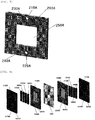
- FIG. 6 is an exploded perspective view of a unit cell of a stack for a redox flow battery of the present invention. It is shown that flow frames 200A and 200B and bipolar plates 4000A and 4000B are disposed at both sides of an ion-exchange membrane 1000 and two or more electrodes 3100A, 3200A, 3300A, and 3400A are disposed in two or more cavities 2610A, 2620A, 2630A, and 2640A (see FIG. 7 ) formed inside an outer frame 2700A of the flow frame 2000A, respectively. Also, similarly, it is shown that two or more electrodes 3100B, 3200B, 3300B, and 3400B are disposed in two or more cavities formed inside the flow frame 2000B.
- the widths of the electrodes 3100A, 3200A, 3300A, and 3400A; 3100B, 3200B, 3300B, and 3400B shown in FIG. 6 are shown to be constant, but are not limited thereto, and the widths can be changed.
- the outer frame 2700A is used to mean a frame excluding the side support walls 2311A, 2321A, 2331A; 2411A, 2421A, and the cavities 2610A, 2620A, 2630A, and 2640A located at the center in the flow frame 2000A.
- FIGS. 7 and 8 are a front view (an opposite surface of a surface facing an ion-exchange membrane) and a three-dimensional perspective view of the flow frame 2000A of the stack for the redox flow battery of the present invention.
- holes 2100A and 2200A forming a manifold with the holes 4100A and 4200A of the bipolar plate 4000A and flow paths 2300A and 2400A are formed.
- the flow paths 2300A and 2400A are connected to one or more sub flow paths 2310A, 2320A, 2330A; 2410A, 2420A, respectively.
- Each of the sub flow paths 2310A, 2320A, 2330A; 2410A, 2420A is connected with the side support walls 2311A, 2320B, and 2310A of the cavities 2610A, 2620A, 2630A, and 2640A in which two or more electrodes 3100A, 3200A, 3300A, and 3400A are located.
- the thickness of the side support walls 2311A, 2321A, 2331A; 2411A, 2421A is thinner than the entire thickness of the flow frame and the thickness of the electrode, and when the electrodes 3100A, 3200A, 3300A, and 3400A are disposed in the cavities 2610A, 2620A, 2630A, and 2640A, respectively, as shown in FIGS. 11 to 14 , the upper portions of the side support walls 2311A, 2321A, 2331A; 2411A, 2421A form furrows 2312A, 2322A, 2332A; 2412A, 2422A connected to the sub flow paths 2310A, 2320A, 2330A; 2410A, 2420A, respectively.
- FIG. 9 is a rear view (a surface facing the ion-exchange membrane) of the flow frame of the stack for the redox flow battery of the present invention and shows two or more cavities 2610A, 2620A, 2630A, and 2640A in which two or more electrodes 3100A, 3200A, 3300A, and 3400A are disposed, respectively, the side support walls 2412A, 2321A, and 2411A partitioning the cavities, and holes 2100A and 2200A forming the manifold.
- the bottom surfaces of the side support walls 2412A, 2321A, and 2411A form the same plane as the bottom surface of the flow frame 2000A, but are not limited thereto and may float from the bottom surface.
- FIG. 10 shows a lower portion of the flow frame taken along an arrow 10 of FIG. 8 and shows the side support walls 2311A, 2321A, 2331A; 2411A, 2421A, in which it can be seen that one end of the side support walls 2331A and 2311A may be blocked by the outer frame 2700A of the flow frame and the other side support wall 2321A is blocked by the lower support wall 2530A.
- the sub flow paths 2410A and 2420A are formed to be dented with a predetermined depth between the outer frame 2700A and the lower support portion 2530A and are connected to the flow path 2400A.
- the dented depths of the sub flow paths 2410A and 2420A are equal to the depth of the furrow formed on the side support wall and will be equal to a value obtained by subtracting a thickness of the side support walls 2421A and 2411A from a thickness of the outer frame 2700A when the bottom surfaces of the side support walls 2412A, 2321A, and 2411A form the same plane as the bottom surface of the flow frame 2000A in FIG. 9 .
- the dented depths of the sub flow paths 2310A, 2320A and 2330A in FIGS. 8 and 9 are equal to the depth of the furrow.
- FIG. 11 shows an electrolyte flow on the front surface (an opposite surface to the ion-exchange membrane side) of the flow frame while the stack for the redox flow battery of the present invention is assembled.
- the electrolyte is supplied to the flow path 2300A of the flow frame through the hole 2100A of the flow frame forming the manifold and the electrolyte flowing through the flow path 2300A branches and flows to the sub flow paths 2310A, 2320A and 2330A.
- the sub flow paths 2310A, 2320A and 2330A are connected to the furrows 2312A, 2322A, and 2332A formed on the side support walls 2311A, 2321A and 2331A between the electrodes 3100A, 3200A, 3300A and 3400A disposed in the cavities 2610A, 2620A, 2630A and 2640A and the outer frames 2700A, respectively, so that the electrolyte flows into the respective furrows 2312A, 2322A and 2332A along the sub flow paths 2310A, 2320A and 2330A.
- the depths of the sub flow paths 2310A, 2320A, and 2330A are equal to the depths of the furrows 2312A, 2322A, and 2332A, so that the electrolyte flow paths become continuous.
- the ends of the furrows 2312A and 2332A are blocked by the outer frame 2700A and the end of the furrow 2322A is blocked by the lower support wall 2530A.
- the electrolyte (arrow direction) flowing along the furrows 2312A, 2322A, and 2332A flows toward the adjacent electrodes 3100A, 3200A, 3300A, and 3400A in a lateral direction because the ends are blocked.
- the electrolyte flowing into the adjacent electrodes 3100A, 3200A, 3300A and 3400A flows into other furrows 2412A and 2422A as shown by arrows in FIG. 11 , and the electrolyte flowing in the other furrows 2412A and 2422A flows into the flow path 2400A through the sub flow paths 2410A and 2420A and then discharged through the hole 2200A forming a discharge manifold.
- the electrolyte flowing in the furrow 2312A is directed to the adjacent electrode 3100A because the end of the furrow 2312A is blocked, and the electrolyte passing through the electrode 3100A flows to the sub flow path 2410A along the furrow 2412A.
- the electrolyte flowing in the furrow 2322A is directed to the adjacent electrodes 3200A and 3300A because the end of the furrow 2322A is blocked, the electrolyte toward the electrode 3200A flows into the sub flow path 2410A along the furrow 2412A, and the electrolyte toward the electrode 3300A flows into the sub flow path 2420A along the furrow 2422A.
- the electrolyte flowing in the furrow 2332A is directed to the adjacent electrode 3400A because the end of the furrow 2332A is blocked and the electrolyte passing through the electrode 3400A flows into the sub flow path 2420A along the furrow 2422A.
- the electrolyte flowing in the sub flow paths 2410A and 2420A flows into the hole 2200A through the flow path 2400A and is discharged.
- FIG. 12 shows an electrolyte flow direction on a cross section of the stack for the redox flow battery of the present invention.
- the furrows 2312A, 2322A, 2332A; 2412A, 2422A formed in the flow frame 2000A which the electrolyte flows are formed in gaps between the electrodes 3100A and 3200A and the outer frame 2700A (see FIG. 8 ) on the side support walls 2311A, 2321A, 2331A; 2411A, 2421A (see FIG. 10 ).
- the flow frame 2000B also has furrows 2312B, 2322B, 2332B; 2412B, 2422B into which the electrolyte flows, so that the electrolyte passes through the electrodes in the direction of the arrow.
- FIG. 13 is an exploded perspective view of the stack cut in a first quadrant of FIG. 11 and shows that the electrolyte flowing through the manifold formed by the holes 4100A and 2100A flows along the furrow 2322A via the flow path 2300A and the sub flow path 2320A and flows into the furrow 2422A via the electrode 3300A because the end of the furrow 2322A is blocked, and the electrolyte flowing in the furrow 2332A flows into the furrow 2422A through the electrode 3400A because the end of the furrow 2332A is blocked.
- the electrolyte flowing through the manifold formed of the holes 4100B and 2100AB flows along the furrow 2322B through the flow path and the sub flow path and flows into the furrow 2422B through the electrode 3300B because the end of the furrow 2322B is blocked, and the electrolyte flowing in the furrow 2332B flows into the furrow 2422B through the electrode 3300B because the end of the furrow 2332B is also blocked.
- FIG. 14 is a cut perspective view of the stack for the redox flow battery of the present invention and shows a state in which no electrolyte flows.
- the furrows 2312A, 2322A, 2332A; 2412A, 2422A are formed on the side support walls 2311A, 2321A, 2331A; 2411A, 2421A (see FIG. 10 ) in gaps between the electrodes 3100A, 3200A, 3300A, and 3400A and the outer frame 2700A (see FIG. 8 ).
- the electrolyte flowing in the furrows formed on the side surface of the electrode is discharged through the adjacent furrows through the electrode, so that the length of the electrolyte passing through the electrode is much shorter than that of the conventional invention, thereby reducing the pressure drop.
- the amount of pressure drop is proportional to the length L
- the electrolyte is supplied through the hole 2100A of the flow frame to be discharged to the hole 2200A, but on the contrary, the configuration in which the electrolyte is supplied from the hole 2200A to be discharged to the hole 2100A can be modified.
Landscapes
- Life Sciences & Earth Sciences (AREA)
- Engineering & Computer Science (AREA)
- Manufacturing & Machinery (AREA)
- Sustainable Development (AREA)
- Sustainable Energy (AREA)
- Chemical & Material Sciences (AREA)
- Chemical Kinetics & Catalysis (AREA)
- Electrochemistry (AREA)
- General Chemical & Material Sciences (AREA)
- Fuel Cell (AREA)
Abstract
Description
- The present invention relates to a unit cell for a redox flow battery, and more particularly, to a unit cell for a redox flow battery for reducing pressure drop in a flow frame.
- A redox flow battery is one of core products closely related to renewable energy, reduction in greenhouse gas, rechargeable batteries, and smart grids, which have been attracting the greatest attention in the world in recent years. A fuel cell is a product which is expanding rapidly in the market in the world as a renewable energy source to replace fossil fuels without emission of pollutants. Currently, most of the energy is derived from fossil fuels, but there is a problem in that the use of such fossil fuels has serious adverse environmental impacts such as air pollution, acid rain and global warming, and low energy efficiency.
- In recent years, in order to solve the problems caused by the use of such fossil fuels, interest in renewable energy and fuel cells has rapidly increased. Interests and research on such renewable energy are being actively performed not only in domestic but also worldwide.
- Although the renewable energy market has entered the maturity stage both domestically and internationally, there is a problem that the amount of energy generated due to environmental influences such as time and weather is greatly changed due to the nature of renewable energy. As a result, the spread of an energy storage system (ESS) for storing regeneration energy generated for stabilization of renewable energy generation is very required, and the redox flow battery is attracting attention as such a large-capacity energy storage system.
- A lot of technologies for the fuel cells have already been developed due to environmental friendliness and unlimited supply of resources, and fuel cell vehicles, generators, and heating supply devices using the fuel cells have been developed and being sold. However, there is a disadvantage in that manufacture, assembly and maintenance of the fuel cells are still difficult.
- A general structure of the redox flow battery to which the present invention is applied is configured by a stack with stacked cells in which an electrochemical reaction occurs, tanks for storing electrolytes, and pumps for supplying electrolytes to the stack from the tanks.
- As shown in
FIG. 1 , a unit cell of the general redox flow battery is configured by a structure of abipolar plate 400A-anelectrode 300A- aflow frame 200A- a membrane 100- aflow frame 200B- anelectrode 300B- abipolar plate 400B, and thebipolar plates - The
flow frames flow paths round holes hollow spaces electrodes - In
FIG. 1 , the flow path of theflow frame 200B is not shown, but like theflow frame 200A, even in theflow frame 200B, flow paths corresponding to theflow paths FIG. 1 and represented by 230B and 240B inFIG. 2 . - Even in the
bipolar plates holes holes flow frames FIG. 2 , the bipolar plates, theholes - The
electrodes hollow spaces flow frames bipolar plates - A
membrane 100 is disposed between an anode and a cathode and serves to separate the anode and the cathode and selectively transmit ions. - In the flow cell, the electrolyte is stored in tanks of the anolyte and the catholyte and flows through the stack formed of a plurality of unit cells, and a pump is disposed between the tank and the stack to circulate the electrolyte in the tank through the inside of the stack.
- As shown in
FIG. 2 , when the plurality of unit cells are stacked, theholes bipolar plates holes flow paths flow paths hollow spaces -
FIG. 3 shows the flow of the electrolyte in theflow frame 200A and it can be seen that the electrolyte flows in the order of manifold (inlet; 210A) →flow path 230A →electrode 300A in the innerhollow space 250A →flow path 240A → manifold (outlet; 220A). -
FIG. 4 is a front view of a conventional flow frame (an opposite surface of an ion-exchange membrane), andFIG. 5 is a three-dimensional perspective view of a conventional flow frame. - In some cases, the flow frame is formed of a plurality of frames.
- As such, the electrolyte in a liquid state is circulated inside the stack by the pump and power is consumed to operate the pump, so that the efficiency of the overall system is reduced in association with the power consumed by the pump.
- Reducing the power consumption of the pump plays an important role in increasing the efficiency of the system, and the power consumption of the pump is closely related to the flow rate and pressure drop. As the flow rate is increased or the pressure drop of the flow rate in the system is increased, the power consumption is increased. Also, when the flow rate is increased, the speed increases and the resistance increases, resulting in a higher pressure drop.
- The pressure drop inside the stack mainly occurs at three places of the manifold, the flow path, and the electrode. In this case, mainly porous carbon or graphite felt is used in the electrode, and as a result, a considerable pressure drop occurs, and the pressure drop in the electrode occupies 50% or higher of the pressure drop of the entire stack.
- Since the pressure drop in the electrode is proportional to the length of the electrode in the flow direction, as the size of the electrode is increased, the pressure drop is increased, thereby reducing the efficiency of the system.
- When the flow rate is decreased to reduce the pressure drop, the energy capacity of the system is reduced. However, in order to obtain a large power density, there is a limitation in reducing the flow rate considering the pressure drop in a state where the large energy capacity is required.
- Therefore, there is a limitation in achieving high output and improved efficiency of the stack at the same time in the conventional structure, and thus, there have been attempts to solve such a problem.
- In the prior art
US2012/0244395 A1 , in order to reduce a pressure drop in an electrode, two or more channels are dug in a bipolar plate and an electrolyte passes through the electrode while moving between the adjacent channels so as to pass through only a short distance instead of an entire length of the electrode, thereby reducing the pressure drop. - However, in order to implement the invention of the prior art, the channels need to be formed in the bipolar plate. For this purpose, there is a problem in that a thick bipolar plate needs to be used, and a carbon composite material used as a material of the bipolar plate is very expensive, the cost is further increased as the thickness is increased, and considerable cost is consumed in processing or forming the channels.
- Also, since the thick bipolar plate is used, the volume and weight of the stack are increased, and the flow in the electrode felt is not perfectly uniform to generate a dead zone, and thus there is a problem in that the electrode is wasted.
- Also, in the prior art document
US Pat. No. 6,905,797 , there is published a stack structure in which a zigzag-shaped flow path is formed in an electrode felt itself. However, there is a problem in that a felt portion cut off to form the flow path can not be used so that materials are wasted, and the flow path formed in the felt is complicated to be difficult in handling so that the degree of difficulty of assembly increases and ununiform flow occurs. - The present invention has been made in an effort to solve a high pressure drop which is one of general problems of flow cells.
- Particularly, in the case of using a technique of forming a channel on a bipolar plate in the related art, there is a problem that the cost of the bipolar plate increases and the volume and weight of the stack increase. In addition, in the case of forming a flow path by processing an electrode felt, there is a problem in that the difficulty of the assembly increases.
- Since a high flow rate is required for high power output of the stack, the present invention has been made in an effort to lower the pressure drop of the electrolyte in the stack so that a higher flow rate may be supplied at the same pressure drop.
- Further, the present invention has been made in an effort to enhance price competitiveness and reduce the size of the entire system by using an expensive stack material less while the high output is generated.
- According to an aspect of the present invention, there is provided a redox flow battery stack comprising: an ion-exchange membrane (1000); two flow frames (2000A, 2000B) disposed on both sides of the ion-exchange membrane (1000), respectively; two bipolar plates (4000A, 4000B) disposed outside the flow frames (2000A, 2000B), respectively; and electrodes disposed in cavities inside outer frames of the flow frames (2000A, 2000B), respectively, in which the cavities of the flow frames include at least two cavities (2610A, 2620A) in which at least two electrodes (3100A, 3200A) are disposed, and in each flow frame, at least three furrows in which the electrolyte flows are formed between the at least two electrodes (3100A, 3200A) and each outer frame (2700A), respectively.
- A furrow which is directly or indirectly connected with the hole (2100A) of the flow frame (2000A) forming an inlet manifold may be blocked at an end opposite to the hole (2100A) and the electrolyte flowing in the furrow may flow into an adjacent furrow through an electrode in a lateral direction and the adjacent furrow may be directly or indirectly connected with a hole (2200A) of the flow frame (2000A) forming a discharge manifold.
- Each of the at least three furrows may be formed on each side support wall of the cavity formed in the flow frame.
- Each of the at least three furrows may be connected with the hole (2100A, 2200A) forming the inlet or outlet manifold through at least one of the flow path and sub flow path, and the depths of the flow path and the sub flow path may be equal to the depth of the furrow formed on the side support wall.
- The electrode may have a rectangular shape or other shapes.
- The hole (2100A) of the flow frame (2000A) forming the inlet manifold may be connected with three or more sub flow paths (2310A, 2320A, 2330A) through the flow path (2300A), each of the three or more sub flow paths (2310A, 2320A, 2330A) may be connected to the furrows (2312A, 2322A, 2332A) of which the ends are blocked, respectively, the hole (2200A) of the flow frame (2000A) forming the outlet manifold may be connected with two or more sub flow paths (2410A, 2420A) through the flow path (2400A), each of the two or more sub flow paths (2410A, 2420A) may be connected to furrows (2412A, 2422A), respectively, and the three or more sub flow paths (2310A, 2320A, 2330A) with the blocked ends and the two or more sub flow paths (2410A, 2420A) may be formed on the side support walls (2311A, 2321A, 2331A; 2411A, 2421A) of four or more cavities (2610A, 2620A, 2630A, 2640A) in which four or more electrodes (3100A, 3200A, 3300A, 3400A) disposed in the outer frame of the flow frame are disposed.
- According to the present invention, it is possible to lower the pressure drop in the stack and use a pump with low power consumption at the same flow rate, and as a result, it is possible to reduce the system cost and reduce the power consumption by the pump, thereby increasing the system efficiency.
- Particularly, in the present invention, a channel is formed in a flow frame without forming a channel in a bipolar plate to reduce the use of expensive materials, thereby enhancing cost competitiveness. Further, the electrolyte passes between two or more rectangular felt electrodes to reduce the pressure drop of the electrolyte, thereby improving the system efficiency.
- The above and other aspects, features and other advantages of the present invention will be more clearly understood from the following detailed description taken in conjunction with the accompanying drawings, in which:
-
FIG. 1 is an exploded perspective view of a unit cell of a stack for a conventional redox flow battery; -
FIG. 2 shows an electrolyte flow direction in the stack for the conventional redox flow battery; -
FIG. 3 shows an electrolyte flow direction in a conventional flow frame; -
FIG. 4 is a front view of the conventional flow frame. -
FIG. 5 is a three-dimensional perspective view of the conventional flow frame; -
FIG. 6 is an exploded perspective view of a unit cell of a stack for a redox flow battery of the present invention; -
FIG. 7 is a front view of a flow frame of the stack for the redox flow battery of the present invention; -
FIG. 8 is a three-dimensional perspective view of the flow frame of the stack for the redox flow battery of the present invention; -
FIG. 9 is a rear view of the flow frame of the stack for the redox flow battery of the present invention; -
FIG. 10 is a cut perspective view of the flow frame of the stack for the redox flow battery of the present invention; -
FIG. 11 shows an electrolyte flow on a front surface of the flow frame of the stack for the redox flow battery of the present invention; -
FIG. 12 shows an electrolyte flow direction on a cross section of the flow frame of the stack for the redox flow battery of the present invention; -
FIG. 13 shows an electrolyte flow direction in an exploded perspective view of the stack cut in a first quadrant ofFIG. 11 ; and -
FIG. 14 is a cut perspective view of the stack for the redox flow battery of the present invention. -
FIG. 6 is an exploded perspective view of a unit cell of a stack for a redox flow battery of the present invention. It is shown that flow frames 200A and 200B andbipolar plates exchange membrane 1000 and two ormore electrodes more cavities FIG. 7 ) formed inside anouter frame 2700A of theflow frame 2000A, respectively. Also, similarly, it is shown that two ormore electrodes flow frame 2000B. - The widths of the
electrodes FIG. 6 are shown to be constant, but are not limited thereto, and the widths can be changed. - For reference, in the present invention, the
outer frame 2700A is used to mean a frame excluding theside support walls cavities flow frame 2000A. -
FIGS. 7 and8 are a front view (an opposite surface of a surface facing an ion-exchange membrane) and a three-dimensional perspective view of theflow frame 2000A of the stack for the redox flow battery of the present invention. - Even in the
outer frame 2700A of theflow frame 2000A of the present invention, like a conventional invention, holes 2100A and 2200A forming a manifold with theholes bipolar plate 4000A andflow paths - However, in the present invention, the
flow paths sub flow paths - Each of the
sub flow paths side support walls more electrodes - The thickness of the
side support walls electrodes cavities FIGS. 11 to 14 , the upper portions of theside support walls sub flow paths - The other ends which are not connected to the
sub flow paths respective furrows frame 2700A of the flow frame or theupper support walls lower support wall 2530A of the cavities 2610A, 2620A, 2630A, and 2640A. -
FIG. 9 is a rear view (a surface facing the ion-exchange membrane) of the flow frame of the stack for the redox flow battery of the present invention and shows two ormore cavities more electrodes side support walls - In
FIG. 9 , the bottom surfaces of theside support walls flow frame 2000A, but are not limited thereto and may float from the bottom surface. -
FIG. 10 shows a lower portion of the flow frame taken along anarrow 10 ofFIG. 8 and shows theside support walls side support walls outer frame 2700A of the flow frame and the otherside support wall 2321A is blocked by thelower support wall 2530A. - The
sub flow paths outer frame 2700A and thelower support portion 2530A and are connected to theflow path 2400A. - The dented depths of the
sub flow paths side support walls outer frame 2700A when the bottom surfaces of theside support walls flow frame 2000A inFIG. 9 . - Similarly, the dented depths of the
sub flow paths FIGS. 8 and9 are equal to the depth of the furrow. -
FIG. 11 shows an electrolyte flow on the front surface (an opposite surface to the ion-exchange membrane side) of the flow frame while the stack for the redox flow battery of the present invention is assembled. - The electrolyte is supplied to the
flow path 2300A of the flow frame through thehole 2100A of the flow frame forming the manifold and the electrolyte flowing through theflow path 2300A branches and flows to thesub flow paths - The
sub flow paths furrows side support walls electrodes cavities outer frames 2700A, respectively, so that the electrolyte flows into therespective furrows sub flow paths - As shown in
FIGS. 8 and9 , the depths of thesub flow paths - The ends of the
furrows outer frame 2700A and the end of thefurrow 2322A is blocked by thelower support wall 2530A. - Accordingly, the electrolyte (arrow direction) flowing along the
furrows adjacent electrodes - The electrolyte flowing into the
adjacent electrodes other furrows FIG. 11 , and the electrolyte flowing in theother furrows flow path 2400A through thesub flow paths hole 2200A forming a discharge manifold. - That is, the electrolyte flowing in the
furrow 2312A is directed to theadjacent electrode 3100A because the end of thefurrow 2312A is blocked, and the electrolyte passing through theelectrode 3100A flows to thesub flow path 2410A along thefurrow 2412A. Also, the electrolyte flowing in thefurrow 2322A is directed to theadjacent electrodes furrow 2322A is blocked, the electrolyte toward theelectrode 3200A flows into thesub flow path 2410A along thefurrow 2412A, and the electrolyte toward theelectrode 3300A flows into thesub flow path 2420A along thefurrow 2422A. Further, the electrolyte flowing in thefurrow 2332A is directed to theadjacent electrode 3400A because the end of thefurrow 2332A is blocked and the electrolyte passing through theelectrode 3400A flows into thesub flow path 2420A along thefurrow 2422A. The electrolyte flowing in thesub flow paths hole 2200A through theflow path 2400A and is discharged. -
FIG. 12 shows an electrolyte flow direction on a cross section of the stack for the redox flow battery of the present invention. Thefurrows flow frame 2000A which the electrolyte flows are formed in gaps between theelectrodes outer frame 2700A (seeFIG. 8 ) on theside support walls FIG. 10 ). - Similarly, the
flow frame 2000B also has furrows 2312B, 2322B, 2332B; 2412B, 2422B into which the electrolyte flows, so that the electrolyte passes through the electrodes in the direction of the arrow. -
FIG. 13 is an exploded perspective view of the stack cut in a first quadrant ofFIG. 11 and shows that the electrolyte flowing through the manifold formed by theholes furrow 2322A via theflow path 2300A and thesub flow path 2320A and flows into thefurrow 2422A via theelectrode 3300A because the end of thefurrow 2322A is blocked, and the electrolyte flowing in thefurrow 2332A flows into thefurrow 2422A through theelectrode 3400A because the end of thefurrow 2332A is blocked. - Similarly, the electrolyte flowing through the manifold formed of the
holes 4100B and 2100AB flows along thefurrow 2322B through the flow path and the sub flow path and flows into thefurrow 2422B through theelectrode 3300B because the end of thefurrow 2322B is blocked, and the electrolyte flowing in thefurrow 2332B flows into thefurrow 2422B through theelectrode 3300B because the end of thefurrow 2332B is also blocked. -
FIG. 14 is a cut perspective view of the stack for the redox flow battery of the present invention and shows a state in which no electrolyte flows. - As shown in
FIG. 14 , it can be seen that thefurrows side support walls FIG. 10 ) in gaps between theelectrodes outer frame 2700A (seeFIG. 8 ). - As such, in the present invention, the electrolyte flowing in the furrows formed on the side surface of the electrode is discharged through the adjacent furrows through the electrode, so that the length of the electrolyte passing through the electrode is much shorter than that of the conventional invention, thereby reducing the pressure drop. (The amount of pressure drop is proportional to the length L)
- In the above description, it has been described that five furrows are formed in each of the flow frames. However, the number of furrows is not limited thereto, and may be changed to the number of two or more furrows.
- In the above description, the electrolyte is supplied through the
hole 2100A of the flow frame to be discharged to thehole 2200A, but on the contrary, the configuration in which the electrolyte is supplied from thehole 2200A to be discharged to thehole 2100A can be modified. - As described above, the present invention has been described by specified matters such as detailed components, and the like and limited exemplary embodiments and drawings, but the description is just provided to assist more overall understanding of the present invention and the present invention is not limited to the exemplary embodiment and various modifications and changes can be made by those skilled in the art from such a disclosure. Accordingly, the spirit of the present invention should not be defined only by the described exemplary embodiments, and it should be appreciated that claims to be described below and all which are equivalent to the claims or equivalently modified to the claims are included in the scope of the spirit of the present invention.
- In the drawings, the reference numbers disclosed in claims are inserted so as to more easily appreciate the present invention and the protection scope of the present invention is not limited to the reference numerals disclosed in the claims.
Claims (6)
- A redox flow battery stack comprising:an ion-exchange membrane (1000);two flow frames (2000A, 2000B) disposed on both sides of the ion-exchange membrane (1000), respectively;two bipolar plates (4000A, 4000B) disposed outside the flow frames (2000A, 2000B), respectively; andelectrodes disposed in cavities inside outer frames of the flow frames (2000A, 2000B), respectively,wherein the cavities of the flow frames include at least two cavities (2610A, 2620A) in which at least two electrodes (3100A, 3200A) are disposed, andin each flow frame, at least three furrows in which the electrolyte flows, are formed between the at least two electrodes (3100A, 3200A) and outer frame (2700A), respectively.
- The redox flow battery stack of claim 1, wherein a furrow which is directly or indirectly connected with a hole (2100A) of the flow frame (2000A) forming an inlet manifold is blocked at an opposite end to the hole (2100A), and the electrolyte flowing in the furrow flows into an adjacent furrow through an electrode in a lateral direction and the adjacent furrow is directly or indirectly connected with a hole (2200A) of the flow frame (2000A) forming an outlet manifold.
- The redox flow battery stack of claim 1, wherein each of the at least three furrows is formed on each side support wall of the cavity formed in the flow frame.
- The redox flow battery stack of claim 3, wherein each of the at least three furrows is connected with the hole (2100A, 2200A) forming the inlet or outlet manifold through the flow path and at least one sub flow path, and the depths of the flow path and the sub flow path are equal to the depth of the furrow formed on the side support wall.
- The redox flow battery stack of any one of claims 1 to 4, wherein the electrode has a rectangular shape.
- The redox flow battery stack of any one of claims 1 to 4, wherein the hole (2100A) of the flow frame (2000A) forming the inlet manifold is connected with three or more sub flow paths (2310A, 2320A, 2330A) through the flow path (2300A), each of the three or more sub flow paths (2310A, 2320A, 2330A) is connected to the furrows (2312A, 2322A, 2332A) of which the ends are blocked, respectively,
the hole (2200A) of the flow frame (2000A) forming the outlet manifold is connected with two or more sub flow paths (2410A, 2420A) through the flow path (2400A), each of the two or more sub flow paths (2410A, 2420A) is connected to the furrows (2412A, 2422A), respectively, and
the three or more sub flow paths (2310A, 2320A, 2330A) with the blocked ends and the two or more sub flow paths (2410A, 2420A) are formed on the side support walls (2311A, 2321A, 2331A; 2411A, 2421A) of four or more cavities (2610A, 2620A, 2630A, 2640A) in which four or more electrodes (3100A, 3200A, 3300A, 3400A) disposed inside the outer frame of the flow frame are disposed.
Applications Claiming Priority (1)
| Application Number | Priority Date | Filing Date | Title |
|---|---|---|---|
| PCT/KR2016/008634 WO2018026036A1 (en) | 2016-08-05 | 2016-08-05 | Unit cell for redox flow battery, for reducing pressure drop caused by electrolyte flow in stack |
Publications (3)
| Publication Number | Publication Date |
|---|---|
| EP3457480A1 true EP3457480A1 (en) | 2019-03-20 |
| EP3457480A4 EP3457480A4 (en) | 2020-02-12 |
| EP3457480B1 EP3457480B1 (en) | 2023-08-02 |
Family
ID=61073047
Family Applications (1)
| Application Number | Title | Priority Date | Filing Date |
|---|---|---|---|
| EP16911698.5A Active EP3457480B1 (en) | 2016-08-05 | 2016-08-05 | Unit cell for redox flow battery, for reducing pressure drop caused by electrolyte flow in stack |
Country Status (3)
| Country | Link |
|---|---|
| US (1) | US11038180B2 (en) |
| EP (1) | EP3457480B1 (en) |
| WO (1) | WO2018026036A1 (en) |
Families Citing this family (3)
| Publication number | Priority date | Publication date | Assignee | Title |
|---|---|---|---|---|
| JP7213144B2 (en) * | 2019-05-30 | 2023-01-26 | 東洋エンジニアリング株式会社 | redox flow battery |
| CN112436172A (en) * | 2019-08-26 | 2021-03-02 | 烟台大学 | Porous electrode and bipolar plate solidification integrated liquid flow energy storage battery |
| DE102023201177B4 (en) * | 2023-02-14 | 2024-08-22 | Kermi Gmbh | Electrode arrangement for a redox flow cell and method for producing an electrode arrangement for a redox flow cell |
Family Cites Families (9)
| Publication number | Priority date | Publication date | Assignee | Title |
|---|---|---|---|---|
| US6905797B2 (en) | 2001-04-12 | 2005-06-14 | Squirrel Holdings Ltd. | Porous mat electrodes for electrochemical reactor having electrolyte solution distribution channels |
| JP2006324117A (en) * | 2005-05-18 | 2006-11-30 | Sumitomo Electric Ind Ltd | Electrolyte circulating battery |
| DK2514015T3 (en) * | 2009-12-18 | 2015-07-20 | United Technologies Corp | CURRENT BATTERY WITH COMPLETE CURRENT FIELD |
| US8808897B2 (en) * | 2011-07-19 | 2014-08-19 | Fu Jen Catholic University | Electrode structure of vanadium redox flow battery |
| KR101335544B1 (en) | 2011-11-17 | 2013-12-05 | 한국에너지기술연구원 | Redox flow battery |
| IN2014DN03035A (en) | 2011-12-20 | 2015-05-08 | United Technologies Corp | |
| KR20140010713A (en) * | 2012-07-16 | 2014-01-27 | 주식회사 누리플랜 | Electrode for a redox flow battery |
| US9685651B2 (en) * | 2012-09-05 | 2017-06-20 | Ess Tech, Inc. | Internally manifolded flow cell for an all-iron hybrid flow battery |
| JP5433100B2 (en) | 2013-07-11 | 2014-03-05 | 住友電気工業株式会社 | Electrolytic solution for redox flow battery, redox flow battery, and operating method of redox flow battery |
-
2016
- 2016-08-05 WO PCT/KR2016/008634 patent/WO2018026036A1/en not_active Ceased
- 2016-08-05 EP EP16911698.5A patent/EP3457480B1/en active Active
- 2016-08-05 US US16/308,107 patent/US11038180B2/en active Active
Also Published As
| Publication number | Publication date |
|---|---|
| WO2018026036A1 (en) | 2018-02-08 |
| EP3457480A4 (en) | 2020-02-12 |
| EP3457480B1 (en) | 2023-08-02 |
| US20190165385A1 (en) | 2019-05-30 |
| US11038180B2 (en) | 2021-06-15 |
Similar Documents
| Publication | Publication Date | Title |
|---|---|---|
| JP5197995B2 (en) | Fuel cell | |
| EP2395584A1 (en) | Electrode for a flow battery | |
| JP6730693B2 (en) | Bipolar plate, cell frame, cell stack, and redox flow battery | |
| TW201409812A (en) | Bipolar electrode and its preparation method | |
| CN217848003U (en) | Improve flow cell runner frame of electrolyte distribution homogeneity | |
| EP3457480B1 (en) | Unit cell for redox flow battery, for reducing pressure drop caused by electrolyte flow in stack | |
| KR101885972B1 (en) | Separator for fuel cell and fuel cell | |
| AU2012230551A1 (en) | Electrochemical cell | |
| JP2021119570A (en) | Fuel cell having modular base active area | |
| CN110828843A (en) | A fuel cell bipolar plate | |
| JP2015002061A (en) | Fuel cell stack | |
| CN111224144A (en) | Flow battery pile structure and application thereof | |
| CN101764237A (en) | Liquid flow frame, vanadium battery and vanadium battery pack | |
| KR101661570B1 (en) | Unit cell for redox flow battery for reducing pressure drop in a stack | |
| KR102645988B1 (en) | Bipolar plate and unit cell for redox flow cell battery and redox flow battery comprising the same | |
| JP5297990B2 (en) | Fuel cell | |
| US20190109334A1 (en) | Cell plates for redox flow batteries | |
| JP2005190710A (en) | Fuel cell | |
| JP6170317B2 (en) | Fuel cell | |
| KR20130073874A (en) | Fuel cell stacks | |
| JPWO2019150570A1 (en) | Cell frame, battery cell, cell stack, and redox flow battery | |
| US10396369B2 (en) | Fuel cell stack | |
| TWI434451B (en) | An electrode material structure and a liquid flow battery device manufactured | |
| JP5583824B2 (en) | Fuel cell | |
| CN222338303U (en) | A flow battery guide plate for reducing electrolyte concentration difference |
Legal Events
| Date | Code | Title | Description |
|---|---|---|---|
| STAA | Information on the status of an ep patent application or granted ep patent |
Free format text: STATUS: THE INTERNATIONAL PUBLICATION HAS BEEN MADE |
|
| PUAI | Public reference made under article 153(3) epc to a published international application that has entered the european phase |
Free format text: ORIGINAL CODE: 0009012 |
|
| STAA | Information on the status of an ep patent application or granted ep patent |
Free format text: STATUS: REQUEST FOR EXAMINATION WAS MADE |
|
| 17P | Request for examination filed |
Effective date: 20181213 |
|
| AK | Designated contracting states |
Kind code of ref document: A1 Designated state(s): AL AT BE BG CH CY CZ DE DK EE ES FI FR GB GR HR HU IE IS IT LI LT LU LV MC MK MT NL NO PL PT RO RS SE SI SK SM TR |
|
| AX | Request for extension of the european patent |
Extension state: BA ME |
|
| DAV | Request for validation of the european patent (deleted) | ||
| DAX | Request for extension of the european patent (deleted) | ||
| A4 | Supplementary search report drawn up and despatched |
Effective date: 20200114 |
|
| RIC1 | Information provided on ipc code assigned before grant |
Ipc: H01M 8/18 20060101AFI20200108BHEP Ipc: H01M 8/0258 20160101ALI20200108BHEP Ipc: H01M 8/0273 20160101ALI20200108BHEP |
|
| RAP1 | Party data changed (applicant data changed or rights of an application transferred) |
Owner name: H2, INC. |
|
| GRAP | Despatch of communication of intention to grant a patent |
Free format text: ORIGINAL CODE: EPIDOSNIGR1 |
|
| STAA | Information on the status of an ep patent application or granted ep patent |
Free format text: STATUS: GRANT OF PATENT IS INTENDED |
|
| INTG | Intention to grant announced |
Effective date: 20230217 |
|
| RAP3 | Party data changed (applicant data changed or rights of an application transferred) |
Owner name: H2, INC. |
|
| GRAS | Grant fee paid |
Free format text: ORIGINAL CODE: EPIDOSNIGR3 |
|
| GRAA | (expected) grant |
Free format text: ORIGINAL CODE: 0009210 |
|
| STAA | Information on the status of an ep patent application or granted ep patent |
Free format text: STATUS: THE PATENT HAS BEEN GRANTED |
|
| AK | Designated contracting states |
Kind code of ref document: B1 Designated state(s): AL AT BE BG CH CY CZ DE DK EE ES FI FR GB GR HR HU IE IS IT LI LT LU LV MC MK MT NL NO PL PT RO RS SE SI SK SM TR |
|
| REG | Reference to a national code |
Ref country code: GB Ref legal event code: FG4D |
|
| REG | Reference to a national code |
Ref country code: CH Ref legal event code: EP |
|
| REG | Reference to a national code |
Ref country code: DE Ref legal event code: R096 Ref document number: 602016081680 Country of ref document: DE |
|
| REG | Reference to a national code |
Ref country code: IE Ref legal event code: FG4D |
|
| REG | Reference to a national code |
Ref country code: LT Ref legal event code: MG9D |
|
| REG | Reference to a national code |
Ref country code: NL Ref legal event code: MP Effective date: 20230802 |
|
| REG | Reference to a national code |
Ref country code: AT Ref legal event code: MK05 Ref document number: 1595829 Country of ref document: AT Kind code of ref document: T Effective date: 20230802 |
|
| PG25 | Lapsed in a contracting state [announced via postgrant information from national office to epo] |
Ref country code: GR Free format text: LAPSE BECAUSE OF FAILURE TO SUBMIT A TRANSLATION OF THE DESCRIPTION OR TO PAY THE FEE WITHIN THE PRESCRIBED TIME-LIMIT Effective date: 20231103 |
|
| PG25 | Lapsed in a contracting state [announced via postgrant information from national office to epo] |
Ref country code: IS Free format text: LAPSE BECAUSE OF FAILURE TO SUBMIT A TRANSLATION OF THE DESCRIPTION OR TO PAY THE FEE WITHIN THE PRESCRIBED TIME-LIMIT Effective date: 20231202 |
|
| PG25 | Lapsed in a contracting state [announced via postgrant information from national office to epo] |
Ref country code: SE Free format text: LAPSE BECAUSE OF FAILURE TO SUBMIT A TRANSLATION OF THE DESCRIPTION OR TO PAY THE FEE WITHIN THE PRESCRIBED TIME-LIMIT Effective date: 20230802 Ref country code: RS Free format text: LAPSE BECAUSE OF FAILURE TO SUBMIT A TRANSLATION OF THE DESCRIPTION OR TO PAY THE FEE WITHIN THE PRESCRIBED TIME-LIMIT Effective date: 20230802 Ref country code: PT Free format text: LAPSE BECAUSE OF FAILURE TO SUBMIT A TRANSLATION OF THE DESCRIPTION OR TO PAY THE FEE WITHIN THE PRESCRIBED TIME-LIMIT Effective date: 20231204 Ref country code: NO Free format text: LAPSE BECAUSE OF FAILURE TO SUBMIT A TRANSLATION OF THE DESCRIPTION OR TO PAY THE FEE WITHIN THE PRESCRIBED TIME-LIMIT Effective date: 20231102 Ref country code: NL Free format text: LAPSE BECAUSE OF FAILURE TO SUBMIT A TRANSLATION OF THE DESCRIPTION OR TO PAY THE FEE WITHIN THE PRESCRIBED TIME-LIMIT Effective date: 20230802 Ref country code: LV Free format text: LAPSE BECAUSE OF FAILURE TO SUBMIT A TRANSLATION OF THE DESCRIPTION OR TO PAY THE FEE WITHIN THE PRESCRIBED TIME-LIMIT Effective date: 20230802 Ref country code: LT Free format text: LAPSE BECAUSE OF FAILURE TO SUBMIT A TRANSLATION OF THE DESCRIPTION OR TO PAY THE FEE WITHIN THE PRESCRIBED TIME-LIMIT Effective date: 20230802 Ref country code: IS Free format text: LAPSE BECAUSE OF FAILURE TO SUBMIT A TRANSLATION OF THE DESCRIPTION OR TO PAY THE FEE WITHIN THE PRESCRIBED TIME-LIMIT Effective date: 20231202 Ref country code: HR Free format text: LAPSE BECAUSE OF FAILURE TO SUBMIT A TRANSLATION OF THE DESCRIPTION OR TO PAY THE FEE WITHIN THE PRESCRIBED TIME-LIMIT Effective date: 20230802 Ref country code: GR Free format text: LAPSE BECAUSE OF FAILURE TO SUBMIT A TRANSLATION OF THE DESCRIPTION OR TO PAY THE FEE WITHIN THE PRESCRIBED TIME-LIMIT Effective date: 20231103 Ref country code: FI Free format text: LAPSE BECAUSE OF FAILURE TO SUBMIT A TRANSLATION OF THE DESCRIPTION OR TO PAY THE FEE WITHIN THE PRESCRIBED TIME-LIMIT Effective date: 20230802 Ref country code: AT Free format text: LAPSE BECAUSE OF FAILURE TO SUBMIT A TRANSLATION OF THE DESCRIPTION OR TO PAY THE FEE WITHIN THE PRESCRIBED TIME-LIMIT Effective date: 20230802 |
|
| PG25 | Lapsed in a contracting state [announced via postgrant information from national office to epo] |
Ref country code: PL Free format text: LAPSE BECAUSE OF FAILURE TO SUBMIT A TRANSLATION OF THE DESCRIPTION OR TO PAY THE FEE WITHIN THE PRESCRIBED TIME-LIMIT Effective date: 20230802 |
|
| REG | Reference to a national code |
Ref country code: CH Ref legal event code: PL |
|
| PG25 | Lapsed in a contracting state [announced via postgrant information from national office to epo] |
Ref country code: LU Free format text: LAPSE BECAUSE OF NON-PAYMENT OF DUE FEES Effective date: 20230805 |
|
| PG25 | Lapsed in a contracting state [announced via postgrant information from national office to epo] |
Ref country code: ES Free format text: LAPSE BECAUSE OF FAILURE TO SUBMIT A TRANSLATION OF THE DESCRIPTION OR TO PAY THE FEE WITHIN THE PRESCRIBED TIME-LIMIT Effective date: 20230802 |
|
| PG25 | Lapsed in a contracting state [announced via postgrant information from national office to epo] |
Ref country code: SM Free format text: LAPSE BECAUSE OF FAILURE TO SUBMIT A TRANSLATION OF THE DESCRIPTION OR TO PAY THE FEE WITHIN THE PRESCRIBED TIME-LIMIT Effective date: 20230802 Ref country code: RO Free format text: LAPSE BECAUSE OF FAILURE TO SUBMIT A TRANSLATION OF THE DESCRIPTION OR TO PAY THE FEE WITHIN THE PRESCRIBED TIME-LIMIT Effective date: 20230802 Ref country code: LU Free format text: LAPSE BECAUSE OF NON-PAYMENT OF DUE FEES Effective date: 20230805 Ref country code: ES Free format text: LAPSE BECAUSE OF FAILURE TO SUBMIT A TRANSLATION OF THE DESCRIPTION OR TO PAY THE FEE WITHIN THE PRESCRIBED TIME-LIMIT Effective date: 20230802 Ref country code: EE Free format text: LAPSE BECAUSE OF FAILURE TO SUBMIT A TRANSLATION OF THE DESCRIPTION OR TO PAY THE FEE WITHIN THE PRESCRIBED TIME-LIMIT Effective date: 20230802 Ref country code: DK Free format text: LAPSE BECAUSE OF FAILURE TO SUBMIT A TRANSLATION OF THE DESCRIPTION OR TO PAY THE FEE WITHIN THE PRESCRIBED TIME-LIMIT Effective date: 20230802 Ref country code: CZ Free format text: LAPSE BECAUSE OF FAILURE TO SUBMIT A TRANSLATION OF THE DESCRIPTION OR TO PAY THE FEE WITHIN THE PRESCRIBED TIME-LIMIT Effective date: 20230802 Ref country code: CH Free format text: LAPSE BECAUSE OF NON-PAYMENT OF DUE FEES Effective date: 20230831 Ref country code: SK Free format text: LAPSE BECAUSE OF FAILURE TO SUBMIT A TRANSLATION OF THE DESCRIPTION OR TO PAY THE FEE WITHIN THE PRESCRIBED TIME-LIMIT Effective date: 20230802 |
|
| REG | Reference to a national code |
Ref country code: DE Ref legal event code: R097 Ref document number: 602016081680 Country of ref document: DE |
|
| REG | Reference to a national code |
Ref country code: BE Ref legal event code: MM Effective date: 20230831 |
|
| REG | Reference to a national code |
Ref country code: IE Ref legal event code: MM4A |
|
| PG25 | Lapsed in a contracting state [announced via postgrant information from national office to epo] |
Ref country code: IT Free format text: LAPSE BECAUSE OF FAILURE TO SUBMIT A TRANSLATION OF THE DESCRIPTION OR TO PAY THE FEE WITHIN THE PRESCRIBED TIME-LIMIT Effective date: 20230802 Ref country code: MC Free format text: LAPSE BECAUSE OF FAILURE TO SUBMIT A TRANSLATION OF THE DESCRIPTION OR TO PAY THE FEE WITHIN THE PRESCRIBED TIME-LIMIT Effective date: 20230802 |
|
| PLBE | No opposition filed within time limit |
Free format text: ORIGINAL CODE: 0009261 |
|
| STAA | Information on the status of an ep patent application or granted ep patent |
Free format text: STATUS: NO OPPOSITION FILED WITHIN TIME LIMIT |
|
| PG25 | Lapsed in a contracting state [announced via postgrant information from national office to epo] |
Ref country code: IE Free format text: LAPSE BECAUSE OF NON-PAYMENT OF DUE FEES Effective date: 20230805 |
|
| 26N | No opposition filed |
Effective date: 20240503 |
|
| GBPC | Gb: european patent ceased through non-payment of renewal fee |
Effective date: 20231102 |
|
| PG25 | Lapsed in a contracting state [announced via postgrant information from national office to epo] |
Ref country code: IE Free format text: LAPSE BECAUSE OF NON-PAYMENT OF DUE FEES Effective date: 20230805 Ref country code: FR Free format text: LAPSE BECAUSE OF NON-PAYMENT OF DUE FEES Effective date: 20231002 Ref country code: SI Free format text: LAPSE BECAUSE OF FAILURE TO SUBMIT A TRANSLATION OF THE DESCRIPTION OR TO PAY THE FEE WITHIN THE PRESCRIBED TIME-LIMIT Effective date: 20230802 |
|
| PG25 | Lapsed in a contracting state [announced via postgrant information from national office to epo] |
Ref country code: BE Free format text: LAPSE BECAUSE OF NON-PAYMENT OF DUE FEES Effective date: 20230831 |
|
| PG25 | Lapsed in a contracting state [announced via postgrant information from national office to epo] |
Ref country code: GB Free format text: LAPSE BECAUSE OF NON-PAYMENT OF DUE FEES Effective date: 20231102 |
|
| PG25 | Lapsed in a contracting state [announced via postgrant information from national office to epo] |
Ref country code: GB Free format text: LAPSE BECAUSE OF NON-PAYMENT OF DUE FEES Effective date: 20231102 |
|
| PG25 | Lapsed in a contracting state [announced via postgrant information from national office to epo] |
Ref country code: BG Free format text: LAPSE BECAUSE OF FAILURE TO SUBMIT A TRANSLATION OF THE DESCRIPTION OR TO PAY THE FEE WITHIN THE PRESCRIBED TIME-LIMIT Effective date: 20230802 |
|
| PG25 | Lapsed in a contracting state [announced via postgrant information from national office to epo] |
Ref country code: BG Free format text: LAPSE BECAUSE OF FAILURE TO SUBMIT A TRANSLATION OF THE DESCRIPTION OR TO PAY THE FEE WITHIN THE PRESCRIBED TIME-LIMIT Effective date: 20230802 |
|
| PG25 | Lapsed in a contracting state [announced via postgrant information from national office to epo] |
Ref country code: CY Free format text: LAPSE BECAUSE OF FAILURE TO SUBMIT A TRANSLATION OF THE DESCRIPTION OR TO PAY THE FEE WITHIN THE PRESCRIBED TIME-LIMIT; INVALID AB INITIO Effective date: 20160805 |
|
| PG25 | Lapsed in a contracting state [announced via postgrant information from national office to epo] |
Ref country code: HU Free format text: LAPSE BECAUSE OF FAILURE TO SUBMIT A TRANSLATION OF THE DESCRIPTION OR TO PAY THE FEE WITHIN THE PRESCRIBED TIME-LIMIT; INVALID AB INITIO Effective date: 20160805 |
|
| PGFP | Annual fee paid to national office [announced via postgrant information from national office to epo] |
Ref country code: DE Payment date: 20250829 Year of fee payment: 10 |
|
| PG25 | Lapsed in a contracting state [announced via postgrant information from national office to epo] |
Ref country code: TR Free format text: LAPSE BECAUSE OF FAILURE TO SUBMIT A TRANSLATION OF THE DESCRIPTION OR TO PAY THE FEE WITHIN THE PRESCRIBED TIME-LIMIT Effective date: 20230802 |