EP3457378A1 - Speed prediction method and apparatus - Google Patents
Speed prediction method and apparatus Download PDFInfo
- Publication number
- EP3457378A1 EP3457378A1 EP16901511.2A EP16901511A EP3457378A1 EP 3457378 A1 EP3457378 A1 EP 3457378A1 EP 16901511 A EP16901511 A EP 16901511A EP 3457378 A1 EP3457378 A1 EP 3457378A1
- Authority
- EP
- European Patent Office
- Prior art keywords
- traffic
- parameter information
- time period
- effecting
- road segment
- Prior art date
- Legal status (The legal status is an assumption and is not a legal conclusion. Google has not performed a legal analysis and makes no representation as to the accuracy of the status listed.)
- Granted
Links
Images


Classifications
-
- G—PHYSICS
- G06—COMPUTING OR CALCULATING; COUNTING
- G06Q—INFORMATION AND COMMUNICATION TECHNOLOGY [ICT] SPECIALLY ADAPTED FOR ADMINISTRATIVE, COMMERCIAL, FINANCIAL, MANAGERIAL OR SUPERVISORY PURPOSES; SYSTEMS OR METHODS SPECIALLY ADAPTED FOR ADMINISTRATIVE, COMMERCIAL, FINANCIAL, MANAGERIAL OR SUPERVISORY PURPOSES, NOT OTHERWISE PROVIDED FOR
- G06Q10/00—Administration; Management
- G06Q10/04—Forecasting or optimisation specially adapted for administrative or management purposes, e.g. linear programming or "cutting stock problem"
-
- G—PHYSICS
- G08—SIGNALLING
- G08G—TRAFFIC CONTROL SYSTEMS
- G08G1/00—Traffic control systems for road vehicles
- G08G1/01—Detecting movement of traffic to be counted or controlled
- G08G1/0104—Measuring and analyzing of parameters relative to traffic conditions
- G08G1/0125—Traffic data processing
- G08G1/0129—Traffic data processing for creating historical data or processing based on historical data
-
- G—PHYSICS
- G01—MEASURING; TESTING
- G01C—MEASURING DISTANCES, LEVELS OR BEARINGS; SURVEYING; NAVIGATION; GYROSCOPIC INSTRUMENTS; PHOTOGRAMMETRY OR VIDEOGRAMMETRY
- G01C21/00—Navigation; Navigational instruments not provided for in groups G01C1/00 - G01C19/00
- G01C21/26—Navigation; Navigational instruments not provided for in groups G01C1/00 - G01C19/00 specially adapted for navigation in a road network
- G01C21/34—Route searching; Route guidance
- G01C21/36—Input/output arrangements for on-board computers
- G01C21/3691—Retrieval, searching and output of information related to real-time traffic, weather, or environmental conditions
-
- G—PHYSICS
- G08—SIGNALLING
- G08G—TRAFFIC CONTROL SYSTEMS
- G08G1/00—Traffic control systems for road vehicles
- G08G1/01—Detecting movement of traffic to be counted or controlled
-
- G—PHYSICS
- G08—SIGNALLING
- G08G—TRAFFIC CONTROL SYSTEMS
- G08G1/00—Traffic control systems for road vehicles
- G08G1/01—Detecting movement of traffic to be counted or controlled
- G08G1/052—Detecting movement of traffic to be counted or controlled with provision for determining speed or overspeed
-
- G—PHYSICS
- G08—SIGNALLING
- G08G—TRAFFIC CONTROL SYSTEMS
- G08G1/00—Traffic control systems for road vehicles
- G08G1/01—Detecting movement of traffic to be counted or controlled
- G08G1/0104—Measuring and analyzing of parameters relative to traffic conditions
- G08G1/0125—Traffic data processing
- G08G1/0133—Traffic data processing for classifying traffic situation
Definitions
- the present application relates to the technical field of data processing, and particularly to a speed prediction method and apparatus.
- Embodiments of the present application provide a speed prediction method and apparatus, which achieves prediction of speeds of vehicles on a road segment.
- the method includes:
- the method may further include:
- the method may further include: predicting a congestion level for the vehicle on the first road segment in the next time period, according to the predicted speed of the vehicle on the first road segment in the next time period, and a preset correspondence between each speed and a congestion level.
- obtaining a second speed of a vehicle on each second road segment in the current time period may include:
- determining a similarity between the traffic-effecting parameter information and historical traffic-effecting parameter information of the first road segment stored in a historical traffic database may include:
- determining target historical traffic-effecting parameter information according to the determined similarity may include: determining historical traffic-effecting parameter information most similar to the traffic-effecting parameter information as the target historical traffic-effecting parameter information.
- determining target historical traffic-effecting parameter information according to the determined similarity may include: determining at least two items of historical traffic-effecting parameter information, having a similarity to the traffic-effecting parameter information greater than a first preset threshold, as the target historical traffic-effecting parameter information.
- predicting a first speed of a vehicle on the first road segment in a next time period, according to a speed of a vehicle in a next time period of a time period corresponding to the target historical traffic-effecting parameter information, stored in the historical traffic database may include:
- an embodiment of the present application further discloses a speed prediction apparatus.
- the apparatus includes:
- the apparatus may further include:
- the apparatus may further include: a third determining module configured to predict a congestion level for the vehicle on the first road segment in the next time period, according to the predicted speed of the vehicle on the first road segment in the next time period, and a preset correspondence between each speed and a congestion level.
- a third determining module configured to predict a congestion level for the vehicle on the first road segment in the next time period, according to the predicted speed of the vehicle on the first road segment in the next time period, and a preset correspondence between each speed and a congestion level.
- the second obtaining module may include:
- the first determining module may include:
- the second determining module may be specifically configured to: determine historical traffic-effecting parameter information most similar to the traffic-effecting parameter information as the target historical traffic-effecting parameter information.
- the second determining module may be specifically configured to: determine at least two items of historical traffic-effecting parameter information, having a similarity to the traffic-effecting parameter information greater than a first preset threshold, as the target historical traffic-effecting parameter information.
- the first predicting module may include:
- an embodiment of the present application further discloses an electronic device.
- the electronic device includes: a housing, a processor, a memory, a circuit board and a power supply circuit.
- the circuit board is placed in a space surrounded by the housing, and the processor and memory are disposed on the circuit board.
- the power supply circuit is configured to supply power for circuits and components of the electronic device;
- the memory is configured to store executable program codes;
- the processor is configured to execute a program corresponding to the executable program codes by reading the executable program codes stored in the memory, to perform the speed prediction method.
- an embodiment of the present application further discloses an executable program code that, when being executed, implements the speed prediction method.
- an embodiment of the present application further discloses a storage medium for storing an executable program code that, when being executed, implements the speed prediction method.
- thetraffic-effecting parameter information of a first road segment in a current time period is obtained, wherein the traffic-effecting parameter information includes at least one of a parameter of the effect of the current weather on the traffic, a parameter of the effect of an attribute of the current date on the traffic and a parameter of the effect of a special event on the traffic.
- a similarity between the traffic-effecting parameter information and historical traffic-effecting parameter information of the first road segment stored in a historical traffic database, and determine target historical traffic-effecting parameter information is determined according to the determined similarity.
- a first speed of a vehicle on the first road segment in a next time period is predicted, according to a speed of a vehicle in a next time period of a time period corresponding to the target historical traffic-effecting parameter information stored in the historical traffic database.
- embodiments of the present application are applied to determine a historical state closest to a state of the first road segment in the current time period according to at least one of the parameter of the effect of the current weather on the traffic, the parameter of the effect of an attribute of the current date on the traffic and the parameter of the effect of a special event on the traffic, and predict the speed of the vehicle on the first road segment in the next time period according to the speed of a vehicle in a next time period in the closest historical state, thereby achieving prediction of the speed of vehicles on the road segment.
- embodiments of the present application provide a speed prediction method and apparatus, which may be applicable to a computer, a microcontroller, an integrated circuit, or a microprocessor of a hand-held mobile device, which is not limited herein.
- a speed prediction method and apparatus which may be applicable to a computer, a microcontroller, an integrated circuit, or a microprocessor of a hand-held mobile device, which is not limited herein.
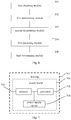
- Fig. 1 is a first flow chart of a speed prediction method according to an embodiment of the present application. The method includes:
- the traffic-effecting parameter information includes the parameter of the effect of the current weather on the traffic, the parameter of the effect of an attribute of the current date on the traffic and the parameter of the effect of a special event on the traffic
- W, H and E respectively represent the parameter of the effect of the current weather on the traffic, the parameter of the effect of an attribute of the current date on the traffic and the parameter of the effect of a special event on the traffic included in the traffic-effecting parameter information
- W h , H h and E h respectively represent a parameter of the effect of a historical weather on the traffic, a parameter of the effect of an attribute of a historical date on the traffic and a parameter
- S102 may include:
- the target time period is described below. It is assumed that the currnt instant is 9:15 a.m., and the current time period is 9:00-9:30 a.m. according to the division of time periods. The target time period is then a time period of 9:00-9:30 a.m. in a historical date stored in the historical traffic database.
- time peirod may be set to half an hour, or set to one hour, which is not limited herein.
- the target historical traffic-effecting parameter information may be determined in the following manners, but not limited thereto.
- the target historical traffic-effecting parameter information is determined as historical traffic-effecting parameter information that is most similar to the traffic-effecting parameter information.
- This manner of determining the target historical traffic-effecting parameter information is to select a historical state most similar to a state of the first road segment in the current time period, and use the most similar historical state to perform speed prediction.
- the prediction result is more accurate.
- the target historical traffic-effecting parameter information is determined as at least two items of historical traffic-effecting parameter information of which has a similarity with the traffic-effecting parameter information greater than a first preset threshold.
- similarities between respective historical traffic-effecting parameter information and the traffic-effecting parameter information are sorted in a descending order, and at least the top two items of historical traffic-effecting parameter information are selected as the target historical traffic-effecting parameter information.
- the vehicle speed are predicted with at least two items of target historical traffic-effecting parameter information are determined, avoiding occasionality existing during the determination of the similar historical state, and improving accuracy of the prediction.
- S104 predicting a first speed of a vehicle on the first road segment in a next time period, according to a speed of a vehicle in a next time period of a time period corresponding to the target historical traffic-effecting parameter information stored in the historical traffic database.
- S104 may include: determining a weight for each item of target historical traffic-effecting parameter information, according to a distance between the traffic-effecting parameter information and the target historical traffic-effecting parameter information; and determining the first speed of the vehicle on the first road segment in the next time period, according to the weight for each item of target historical traffic-effecting parameter information and the speed of the vehicle in the next time period of a time period corresponding to each item of target historical traffic-effecting parameter information, stored in the historical traffic database.
- the k-Nearest Neighbor algorithm may be used to perform sample training.
- K items of the target historical traffic-effecting parameter information which has a higher similarity to the traffic-effecting parameter information in the current time period are determined according to the simiarlities.
- the distance d i between the traffic-effecting parameter information in the current time period and the target historical traffic-effecting parameter information is then determined.
- the traffic-effecting parameter information includes the parameter of the effect of the current weather on the traffic, the parameter of the effect of an attribute of a current date on the traffic and the parameter of the effect of a special event on the traffic.
- the influences exerted by a weather factor, a festival and holiday factor and a special event factor on the traffic may be quantized into grade values, that is, the parameter of the effect of the current weather on the traffic, the parameter of the effect of an attribute of the current date on the traffic and the parameter of the effect of a special event on the traffic described above may be grade values.
- the present embodiment it is possible to first select the histrical traffic-effecting parameter information of the road segment A in 9:00-9:30 a.m. stored in the historical traffic database. The similarities between the traffic-effecting parameter information and the selected historical traffic-effecting parameter informaation are calculated.
- the histrical traffic-effecting parameter information of the road segment A in 9:00-9:30 a.m. stored in the historical traffic database is as shown in Table 1.
- Table 1 illustrates only partial content of "the histrical traffic-effecting parameter information of the road segment A in the time period 9:00-9:30 a.m.”, which does not represent all content stored in the histroical traffic database.
- Table 1 Serial No. W h H h E h 1 0.1 0.9 0.1 2 0.9 0.1 0 3 0.3 0.3 0.1 0.1
- the historical traffic-effecting parameter information which has the highest similarity to the traffic-effecting parameter information may be determined as the target historical traffic-effecting parameter information, namely, the #3 historical traffic-effecting parameter information is determined as the target historical traffic-effecting parameter information.
- At least two items of the historical traffic-effecting parameter information having a similarity to the traffic-effecting parameter information greater than a first preset threshold may also be determined as the target historical traffic-effecting parameter information.
- the first preset threshold is 0.8
- the historical traffic-effecting parameter information, time periods and vehicle speeds are correspondingly stored in the historical traffic database. Assuming partial content of "the historical traffic-effecting parameter information, time periods and vehicle speeds" stored in the historical traffic database is as shown in Table 2. For brevity purpose, Table 2 illustrates only partial content of "the historical traffic-effecting parameter information, time periods and vehicle speeds", which does not represent all content stored in the histroical traffic database. Table 2 Serial No. Historical traffic-effecting parameter information Time periods Vehicle speeds 1 W h : 0.1; H h : 0.9; E h : 0.1 9:00-9:30 a.m. 100 km/h 9:30-10:00 a.m.
- #2 and #3 historical traffic-effecting parameter information is determined as the target historical traffic-effecting parameter information.
- the distance d 1 between the #2 historical traffic-effecting parameter information and the traffic-effecting parameter information of a road segment A in the time period 9:00-9:30 a.m. is equal to 5
- the distance d 2 between the #3 historical traffic-effecting parameter information and the traffic-effecting parameter information of the road segment A in the time period 9:00-9:30 a.m. is equal to 3.
- the first speed of the vehicle on the first road segment in the next time period may be predicted according to the weight for each item of target historical traffic-effecting parameter information and the speed of the vehicle in a next time period of a time period corresponding to the target historical traffic-effecting parameter information stored in the historical traffic database, by performing weighted average of the speeds of vehicles in the next time period of the time period corresponding to each item of target historical traffic-effecting parameter information.
- the target historical traffic-effecting parameter information may be determined as the #3 historical traffic-effecting parameter information.
- the speed of the vehicle in the next time period of the time period corresponding to the #3 historical traffic-effecting parameter information is 60 km/h, and the first speed of the vehicle on the first road segment in the next time period is predicted to be 60 km/h.
- the first speed may reflect an average vehicle speed on the first road segment in the next time period, and the prediction of the speed of vehicles on the road segment is achieved.
- the embodiment shown in Fig. 1 of the present application may be applied to determine a historical state closest to a state of the first road segment in the current time period according to at least one of the parameter of the effect of the current weather on the traffic, the parameter of the effect of an attribute of the current date on the traffic and the parameter of the effect of a special event on the traffic, and predict the speed of the vehicle on the first road segment in the next time period according to the speed of a vehicle in a next time period in the closest historical state, thereby achieving prediction of the speed of vehicles on the road segment.
- Fig. 2 is a second flow chart of a speed prediction method according to an embodiment of the present application.
- the embodiment shown in Fig. 2 further includes the following operations: S105: identifying at least one second road segment with a distance to the first road segment less than a second preset threshold.
- the second road segment may be, for example, a road segment before or after the first road segment, or a road segment connected with the first road segment at a crossing.
- S106 obtaining a second speed of a vehicle on each second road segment in the current time period.
- obtaining a corresponding second speed of a vehicle on each second road segment in the current time period may include: obtaining a distance between a first base station and a second base station located in the second road segment, a first instant that a mobile device on the vehicle passes by the first base station in the current time period and a second instant that the mobile device on the vehicle passes by the second base station; calculating a speed of the mobile device on the vehicle between the first base station and the second base station according to the obtained distance, the first instant and the second instant; and determining an average value of speeds of mobile devices on a plurality of vehicles between the first base station and the second base station as the second speed of the vehicle on the second road segment in the current time period.
- the corresponding second speed of the vehicle on each second road segment in the current time period may be obtained in other ways.
- the current speed of the vehicle on the second road segment may be measured using a camera installed on the second road segment, using satellite cloud images, or using a GPS on the vehicle, and the like.
- S107 predicting a third speed of the vehicle on the first road segment in the next time period according to the first speed and each second speed.
- the second preset threshold is 1 km
- the second road segment with a distance from the first road segment less than the second preset threshold is to be identified.
- the above example is still taken for illustration. It is assumed that the identifyd second road segments whose distance from the first road segment (road segment A) is less than 1 km include road segment B and road segment C.
- the corresponding second speed of vehicles on the road segment B and on the road segment C in the current time period may be obtained through the following process.
- the distance between the base station X and the base station Y in the road segment B is 600 m
- the instant when the moble device on the vehicle pasess by the base station X in the current time period (9:00-9:30 a.m.) is 9:16 a.m.
- the instant when the moble device on the vehicle pasess by the base station Y is 9:18 a.m.
- the mobile device on the vehicle may be a mobile device used by a user travelling by the vehicle.
- a device employing the speed prediction method in the embodiment of the present application may predict a calculaton path based on the vehicle speed, predict time when reaching the destination, and thereby optimize the navigation path.
- the above method is used to obtain speeds of mobile devices on a plurlaity of vehicles between the base station X and base station Y. It is assumed that speeds of mobile devices on 6 vehicles between the base station X and base station Y are 18 km/h, 40 km/h, 30 km/h, 20 km/h, 26 km/h and 28 km/h. An average value of the above six values, namely, 27 km/h is determined as the corresponding second speed of the vehicle on the road segment B in the current time period (9:00-9:30 a.m.).
- the same method is employed to obtain the corresponding second speed of the vehicle on the road segment C in the current time period (9:00-9:30 a.m.), which is, for example, 45 km/h.
- a correlation coefficient for each second road segment with respect to the first road segment may be set in advance according to the influence exerted by the second road segment on the first road segment. The greater the influence is, the larger the correlation coefficient is.
- the correlation coefficient for the road segment B with respect to the first road segment A is 20%, and the correlation coefficient for the road segment C with respect to the first road segment A is 30%.
- the sum of the correlation coefficient for the second road segment with respect to the first road segment and the weight for the predicted first speed is a fixed value, for example 1.
- the weight for the first step is 50%.
- the third speed may reflect an average vehicle speed on the first road segment in the next time period, and the prediction of the speed of vehicles on the road segment is achieved.
- the embodiment shown in Fig. 2 of the present application may be applied to determine a historical state closest to a state of the first road segment in the current time period according to at least one of the parameter of the effect of the current weather on the traffic, the parameter of the effect of an attribute of the current date on the traffic and the parameter of the effect of a special event on the traffic, and predict the first speed of the vehicle on the first road segment in the next time period according to the speed of a vehicle in a next time period in the closest historical state; and predict the third speed of the vehicle on the first road segment in the next time period, based on the second speed of the vehicle on each second segment with a distance to the first road segment less than the second preset threshold in the current time period, thereby achieving precise prediction of the speed of vehicles on the road segment.
- Fig. 3 is a third flow chart of a speed prediction method according to an embodiment of the present application.
- the embodiment shown in Fig. 3 further includes the operation S108: determining a congestion level corresponding to the predicted speed, according to the predicted speed of the vehicle on the first road segment in the next time period and a preset correspondence between each speed and a congestion level.
- the preset correspondence between speeds and congestion levels includes: when the speed ⁇ 50 km/h, the corresponding congestion level is smooth; when 30 km/h ⁇ the speed ⁇ 50 km/h, the corresponding congestion level is crowded; when 10 km/h ⁇ the speed ⁇ 30 km/h, the corresponding congestion level is congested; when the speed is ⁇ 10 km/h, the corresponding congestion level is deadlock.
- Fig. 1 of the present application is take for illustration purpose. It is predicted that the speed of the vehicle on the first road segment in the next time period is 52.5 km/h, and the congestion level corresponding to 52.5 km/h is smooth. This indicates that the congestion level of the first road segment in the next time period is smooth.
- S108 may also be included in the embodiment shown in Fig. 2 of the present application.
- the embodiment shown in Fig. 3 of the present application may be applied to further predict the congestion level for the road segment in the next time period, according to the predicted speed of the vehicle on the road segment in the next time period and a preset correspondence between each speed and a congestion level.
- an embodiment of the present application further provide a speed prediction apparatus.
- Fig. 4 is a diagram illustrating a first structure of a speed prediction apparatus according to an embodiment of the present application.
- the speed prediction apparatus includes:
- the first determining module 202 may include: a first determining submodule and a second determining submodule (not shown).
- the first determining submodule is configured to determine a target time period corresponding to the current time period in the historical traffic database.
- the second determining submodule is configured to determine a similarity between the traffic-effecting parameter information and historical traffic-effecting parameter information of the first road segment in the target time period stored in the historical traffic database.
- a second determining module 203 is configured to determine target historical traffic-effecting parameter information according to the similarity determined by the first determining module.
- the second determining module 203 may be specifically configured to: determine historical traffic-effecting parameter information most similar to the traffic-effecting parameter information as the target historical traffic-effecting parameter information.
- the second determining module 203 may be specifically configured to: determine at least two items of historical traffic-effecting parameter information, having a similarity to the traffic-effecting parameter information greater than a first preset threshold, as the target historical traffic-effecting parameter information.
- a first predicting module 204 is configured to predict a first speed of a vehicle on the first road segment in a next time period, according to a speed of a vehicle in a next time period of a time period corresponding to the target historical traffic-effecting parameter information stored in the historical traffic database.
- the first predicting module 204 may include: a third determining submodule and a predicting submodule (not shown).
- the third determining submodule is configured to determine a weight for each item of target historical traffic-effecting parameter information, according to a distance between the traffic-effecting parameter information and the target historical traffic-effecting parameter information.
- the predicting submodule is configured to predict the first speed of the vehicle on the first road segment in the next time period, according to the weight for each item of target historical traffic-effecting parameter information and the speed of the vehicle in the next time period of a time period corresponding to the target historical traffic-effecting parameter information, stored in the historical traffic database.
- the embodiment shown in Fig. 1 of the present application may be applied to determine a historical state closest to a state of the first road segment in the current time period according to at least one of the parameter of the effect of the current weather on the traffic, the parameter of the effect of an attribute of the current date on the traffic and the parameter of the effect of a special event on the traffic, and predict the speed of the vehicle on the first road segment in the next time period according to the speed of a vehicle in a next time period in the closest historical state, thereby achieving prediction of the speed of vehicles on the road segment.
- Fig. 5 is a diagram illustrating a second structure of a speed prediction apparatus according to an embodiment of the present application.
- the embodiment shown in Fig. 5 may further include:
- the second obtaining module 206 may include: an obtaining submodule and a calculating submodule (not shown).
- the obtaining submodule is configured to obtain a distance between a first base station and a second base station located in the second road segment, a first instant that a mobile device on a vehicle passes by the first base station in the current time period and a second instant that the mobile device on the vehicle passes by the second base station.
- the calculating submodule is configured to calculate a speed of the mobile device on the vehicle between the first base station and the second base station according to the distance, the first instant and the second instant obtained by the obtaining submodule; determine an average value of speeds of mobile devices on a plurality of vehicles between the first base station and the second base station as the second speed of the vehicle on the second road segment in the current time period.
- a second predicting module 207 is configured to predict a third speed of the vehicle on the first road segment in the next time period according to the first speed and the second speed.
- the embodiment shown in Fig. 5 of the present application may be applied to determine a historical state closest to a state of the first road segment in the current time period according to at least one of the parameter of the effect of the current weather on the traffic, the parameter of the effect of an attribute of the current date on the traffic and the parameter of the effect of a special event on the traffic, and predict the first speed of the vehicle on the first road segment in the next time period according to the speed of a vehicle in a next time period in the closest historical state; and predict the third speed of the vehicle on the first road segment in the next time period, based on the second speed of the vehicle on each second segment with a distance to the first road segment less than the second preset threshold in the current time period, thereby achieving precise prediction of the speed of vehicles on the road segment.
- Fig. 6 is a diagram illustrating a third structure of a speed prediction apparatus according to an embodiment of the present application.
- the embodiment shown in Fig. 6 may further include: a third determining module 208 configured to predict a congestion level for the vehicle on the first road segment in the next time period, according to the predicted speed of the vehicle on the first road segment in the next time period and a preset correspondence between each speed and a congestion level.
- the third determining module 208 may also be included on the basis of the embodiment shown in Fig. 5 of the present application.
- the embodiment shown in Fig. 6 of the present application may be applied to further predict the congestion level of the road segment in the next time period, according to the predicted speed of the vehicle on the road segment in the next time period and the preset correspondence between each speed and a congestion level.
- the electronic device include: a housing 701, a processor 702, a memory 703, a circuit board 704 and a power supply circuit 705.
- the circuit board 704 is arranged in a space surrouned by the housing 701, and the processor 702 and the memory 703 are disposed on the circuit board 704.
- the power supply circuit 705 is configured to supply power for circuits and components of the electronic device.
- the memory 703 is configured to store executable program codes.
- the processor 702 is configured to execute a program corresponding to the executable program codes by reading the executable program codes stored in the memory 703, to perform the speed prediction method including:
- the embodiment shown in Fig. 7 of the present application may be applied to determine a historical state closest to a state of the first road segment in the current time period according to at least one of the parameter of the effect of the current weather on the traffic, the parameter of the effect of an attribute of the current date on the traffic and the parameter of the effect of a special event on the traffic, and predict the speed of the vehicle on the first road segment in the next time period according to the speed of the vehicle in a next time period in the closest historical state, thereby achieving prediction of the speed of vehicles on the road segment.
- An embodiment of the present application further provides an executable program code that, when being executed, implements the speed prediction method including:
- the embodiment illustrated of the present application may be applied to determine a historical state closest to a state of the first road segment in the current time period according to at least one of the parameter of the effect of the current weather on the traffic, the parameter of the effect of an attribute of the current date on the traffic and the parameter of the effect of a special event on the traffic, and predict the speed of the vehicle on the first road segment in the next time period according to the speed of the vehicle in a next time period in the closest historical state, thereby achieving prediction of the speed of vehicles on the road segment.
- An embodiment of the present application further provides a storage medium for storing an executable program code.
- the executable program code when being executeed, implements the speed prediction method, including:
- the embodiment shown of the present application may be applied to determine a historical state closest to a state of the first road segment in the current time period according to at least one of the parameter of the effect of the current weather on the traffic, the parameter of the effect of an attribute of the current date on the traffic and the parameter of the effect of a special event on the traffic, and predict the speed of the vehicle on the first road segment in the next time period according to the speed of the vehicle in a next time period in the closest historical state, thereby achieving prediction of the speed of vehicles on the road segment.
- Embodiments of the present application are all described in a relevant manner. Reference may be made among embodiments for similar portions. Each embodiment focuses on the differences from other embodiments. Particularly, for the apparatus embodiment, it is described in a simply way because it is substantially similar to the method embodiment, reference may be made to the method embodiment for the relevant portions.
- the program may be stored in a computer-readable storage medium.
- the storage medium may include: a ROM/ RAM, a magnetic disk, or an optical disk.
Landscapes
- Engineering & Computer Science (AREA)
- Physics & Mathematics (AREA)
- General Physics & Mathematics (AREA)
- Business, Economics & Management (AREA)
- Strategic Management (AREA)
- Human Resources & Organizations (AREA)
- Economics (AREA)
- Radar, Positioning & Navigation (AREA)
- Remote Sensing (AREA)
- Chemical & Material Sciences (AREA)
- Analytical Chemistry (AREA)
- Quality & Reliability (AREA)
- Tourism & Hospitality (AREA)
- Theoretical Computer Science (AREA)
- General Business, Economics & Management (AREA)
- Development Economics (AREA)
- Operations Research (AREA)
- Game Theory and Decision Science (AREA)
- Marketing (AREA)
- Entrepreneurship & Innovation (AREA)
- Atmospheric Sciences (AREA)
- Biodiversity & Conservation Biology (AREA)
- Ecology (AREA)
- Automation & Control Theory (AREA)
- Environmental Sciences (AREA)
- Environmental & Geological Engineering (AREA)
- Life Sciences & Earth Sciences (AREA)
- Traffic Control Systems (AREA)
- Navigation (AREA)
Abstract
Description
- The present application claims priority to the Chinese patent application No.
201610309481.3 - The present application relates to the technical field of data processing, and particularly to a speed prediction method and apparatus.
- As economy develops continuously, traffic congestion has become a big social issue. At present, real-time broadcast of road conditions have been achieved, and users travelling by vehicles can try to change to less congested routes according to the real-time broadcast of road conditions.
- However, solution to traffic congestion should first focus on prevention. In the prior art, it is impossible to predict road conditions in a next time period. The real-time broadcast of road conditions alone cannot accurately guide users traveling by vehicles to change their routes. For example, vehicles on a road segment travel smoothly in the current time period, but they may be confronted with very serious congestion in the next time period. Hence, it becomes very necessary to predict vehicles' speeds on a road segment.
- Embodiments of the present application provide a speed prediction method and apparatus, which achieves prediction of speeds of vehicles on a road segment.
- To achieve the above object, embodiments of the present applicationdiscloses a speed prediction method. The method includes:
- obtaining traffic-effecting parameter information of a first road segment in a current time period, wherein the traffic-effecting parameter information includes at least one of a parameter of the effect of the current weather on the traffic, a parameter of the effect of an attribute of the current date on the traffic and a parameter of the effect of a special event on the traffic;
- determining a similarity between the traffic-effecting parameter information and historical traffic-effecting parameter information of the first road segment stored in a historical traffic database, and determining target historical traffic-effecting parameter information according to the determined similarity; and
- predicting a first speed of a vehicle on the first road segment in a next time period, according to a speed of a vehicle in a next time period of a time period corresponding to the target historical traffic-effecting parameter information stored in the historical traffic database.
- Optionally, the method may further include:
- identifying at least one second road segment with a distance to the first road segment less than a second preset threshold, and obtaining a second speed of a vehicle on each second road segment in the current time period; and
- predicting a third speed of the vehicle on the first road segment in the next time period according to the first speed and the second speed.
- Optionally, the method may further include:
predicting a congestion level for the vehicle on the first road segment in the next time period, according to the predicted speed of the vehicle on the first road segment in the next time period, and a preset correspondence between each speed and a congestion level. - Optionally, obtaining a second speed of a vehicle on each second road segment in the current time period may include:
- obtaining a distance between a first base station and a second base station located in the second road segment, a first instant that a mobile device on a vehicle passes by the first base station in the current time period and a second instant that the mobile device on the vehicle passes by the second base station;
- calculating a speed of the mobile device on the vehicle between the first base station and the second base station according to the distance, first instant and second instant; and
- determining an average value of speeds of mobile devices on a plurality of vehicles between the first base station and the second base station as the second speed of the vehicle on the second road segment in the current time period.
- Optionally, determining a similarity between the traffic-effecting parameter information and historical traffic-effecting parameter information of the first road segment stored in a historical traffic database may include:
- determining a target time period corresponding to the current time period in the historical traffic database; and
- determining a similarity between the traffic-effecting parameter information and historical traffic-effecting parameter information of the first road segment in the target time period stored in the historical traffic database.
- Optionally, in the case that the traffic-effecting parameter information includes the parameter of the effect of the current weather on the traffic, the parameter of the effect of an attribute of a current date on the traffic and the parameter of the effect of a special event on the traffic, determining a similarity between the traffic-effecting parameter information and historical traffic-effecting parameter information of the first road segment stored in a historical traffic database may include:
obtaining the similarity between the traffic-effecting parameter information and the historical traffic-effecting parameter information of the first road segment stored in the historical traffic database according to the following formula:
- Optionally, determining target historical traffic-effecting parameter information according to the determined similarity may include:
determining historical traffic-effecting parameter information most similar to the traffic-effecting parameter information as the target historical traffic-effecting parameter information. - Optionally, determining target historical traffic-effecting parameter information according to the determined similarity may include:
determining at least two items of historical traffic-effecting parameter information, having a similarity to the traffic-effecting parameter information greater than a first preset threshold, as the target historical traffic-effecting parameter information. - Optionally, predicting a first speed of a vehicle on the first road segment in a next time period, according to a speed of a vehicle in a next time period of a time period corresponding to the target historical traffic-effecting parameter information, stored in the historical traffic database may include:
- determining a weight for each item of target historical traffic-effecting parameter information, according to a distance between the traffic-effecting parameter information and the target historical traffic-effecting parameter information;
- predicting the first speed of the vehicle on the first road segment in the next time period, according to the weight for each item of target historical traffic-effecting parameter information and the speed of the vehicle in the next time period of a time period corresponding to each item of target historical traffic-effecting parameter information, stored in the historical traffic database.
- Optionally, determining a weight for each item of target historical traffic-effecting parameter information, according to a distance between the traffic-effecting parameter information and the target historical traffic-effecting parameter information may include:
determining the weight for each item of target historical traffic-effecting parameter information through the following formula: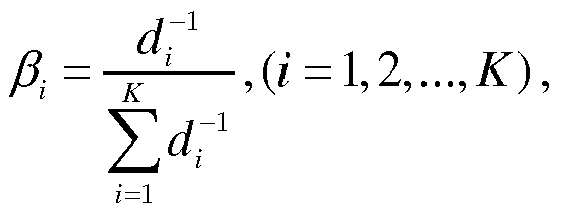
- To achieve the above object, an embodiment of the present application further discloses a speed prediction apparatus. The apparatus includes:
- a first obtaining module configured to obtain traffic-effecting parameter information for a first road segment in a current time period, wherein the traffic-effecting parameter information includes at least one of a parameter of the effect of the current weather on the traffic, a parameter of the effect of an attribute of the current date on the traffic and a parameter of the effect of a special event on the traffic;
- a first determining module configured to determine a similarity between the traffic-effecting parameter information and historical traffic-effecting parameter information of the first road segment stored in a historical traffic database; and
- a second determining module configured to determine target historical traffic-effecting parameter information according to the similarity determined by the first determining module;
- a first predicting module configured to predict a first speed of a vehicle on the first road segment in a next time period, according to a speed of a vehicle in a next time period of a time period corresponding to the target historical traffic-effecting parameter information, stored in the historical traffic database.
- Optionally, the apparatus may further include:
- an identifying module configured to identify at least one second road segment with a distance to the first road segment less than a second preset threshold;
- a second obtaining module configured to obtain a second speed of a vehicle on each second road segment in the current time period; and
- a second predicting module is configured to predict a third speed of the vehicle on the first road segment in the next time period, according to the first speed and the second speed.
- Optionally, the apparatus may further include:
a third determining module configured to predict a congestion level for the vehicle on the first road segment in the next time period, according to the predicted speed of the vehicle on the first road segment in the next time period, and a preset correspondence between each speed and a congestion level. - Optionally, the second obtaining module may include:
- an obtaining submodule configured to obtain a distance between a first base station and a second base station located in the second road segment, a first instant that a mobile device on a vehicle passes by the first base station in the current time period and a second instant that the mobile device on the vehicle passes by the second base station;
- a calculating submodule configured to calculate a speed of the mobile device on the vehicle between the first base station and the second base station according to the distance, first instant and second instant obtained by the obtaining submodule; determine an average value of speeds of mobile devices on a plurality of vehicles between the first base station and the second base station as the second speed of the vehicle on the second road segment in the current time period.
- Optionally, the first determining module may include:
- a first determining submodule configured to determine a target time period corresponding to the current time period in the historical traffic database; and
- a second determining submodule configured to determine a similarity between the traffic-effecting parameter information and historical traffic-effecting parameter information of the first road segment in the target time period stored in the historical traffic database.
- Optionally, in the case that the traffic-effecting parameter information includes the parameter of the effect of the current weather on the traffic, the parameter of the effect of an attribute of the current date on the traffic and the parameter of the effect of a special event on the traffic, the first determining module is specifically configured to:
obtain the similarity between the traffic-effecting parameter information and the historical traffic-effecting parameter information of the first road segment stored in the historical traffic database according to the following formula:
- Optionally, the second determining module may be specifically configured to:
determine historical traffic-effecting parameter information most similar to the traffic-effecting parameter information as the target historical traffic-effecting parameter information. - Optionally, the second determining module may be specifically configured to:
determine at least two items of historical traffic-effecting parameter information, having a similarity to the traffic-effecting parameter information greater than a first preset threshold, as the target historical traffic-effecting parameter information. - Optionally, the first predicting module may include:
- a third determining submodule configured to determine a weight for each item of target historical traffic-effecting parameter information, according to a distance between the traffic-effecting parameter information and the target historical traffic-effecting parameter information; and
- a predicting submodule configured to predict the first speed of the vehicle on the first road segment in the next time period, according to the weight for each item of target historical traffic-effecting parameter information and the speed of the vehicle in the next time period of a time period corresponding to each item of target historical traffic-effecting parameter information, stored in the historical traffic database.
- Optionally, the third determining submodule may be specifically configured to:
determine the weight for each item of target historical traffic-effecting parameter information through the following formula:
- To achieve the above object, an embodiment of the present application further discloses an electronic device. The electronic device includes: a housing, a processor, a memory, a circuit board and a power supply circuit. The circuit board is placed in a space surrounded by the housing, and the processor and memory are disposed on the circuit board. The power supply circuit is configured to supply power for circuits and components of the electronic device; the memory is configured to store executable program codes; and the processor is configured to execute a program corresponding to the executable program codes by reading the executable program codes stored in the memory, to perform the speed prediction method.
- To achieve the above object, an embodiment of the present application further discloses an executable program code that, when being executed, implements the speed prediction method.
- To achieve the above object, an embodiment of the present application further discloses a storage medium for storing an executable program code that, when being executed, implements the speed prediction method.
- As can be seen from the above technical solutions, thetraffic-effecting parameter information of a first road segment in a current time period is obtained, wherein the traffic-effecting parameter information includes at least one of a parameter of the effect of the current weather on the traffic, a parameter of the effect of an attribute of the current date on the traffic and a parameter of the effect of a special event on the traffic. A similarity between the traffic-effecting parameter information and historical traffic-effecting parameter information of the first road segment stored in a historical traffic database, and determine target historical traffic-effecting parameter information is determined according to the determined similarity. A first speed of a vehicle on the first road segment in a next time period is predicted, according to a speed of a vehicle in a next time period of a time period corresponding to the target historical traffic-effecting parameter information stored in the historical traffic database.
- As can be seen from the above, embodiments of the present application are applied to determine a historical state closest to a state of the first road segment in the current time period according to at least one of the parameter of the effect of the current weather on the traffic, the parameter of the effect of an attribute of the current date on the traffic and the parameter of the effect of a special event on the traffic, and predict the speed of the vehicle on the first road segment in the next time period according to the speed of a vehicle in a next time period in the closest historical state, thereby achieving prediction of the speed of vehicles on the road segment.
- The drawings used in embodiments and the prior art are hereafter introduced briefly to more clearly illustrate technical solutions of the embodiments of the present application and the prior art. Obviously, figures described below are only for some embodiments of the present application. One of ordinary skill in the art may obtain other figures according to these figures without creative efforts.
-
Fig. 1 is a first flow chart of a speed prediction method according to an embodiment of the present application; -
Fig. 2 is a second flow chart of a speed prediction method according to an embodiment of the present application; -
Fig. 3 is a third flow chart of a speed prediction method according to an embodiment of the present application; -
Fig. 4 is a first diagram illustrating the structure of a speed prediction apparatus according to an embodiment of the present application; -
Fig. 5 is a second diagram illustrating the structure of a speed prediction apparatus according to an embodiment of the present application; -
Fig. 6 is a third diagram illustrating the structure of a speed prediction apparatus according to an embodiment of the present application; -
Fig. 7 is a diagram illustrating the structure of an electronic device according to an embodiment of the present application. - To make objectives, technical solutions and advantages of the present application more apparent, embodiments of the present application are further illustrated in details with reference to the drawings by way of example. Obviously, embodiments described here are only some embodiments of the present application, not all embodiments. All other embodiments obtained by those having ordinary skill in the art based on the embodiments herein, without making any inventive efforts, fall within the extent of protection of the present application.
- To solve the problems existing in the prior art, embodiments of the present application provide a speed prediction method and apparatus, which may be applicable to a computer, a microcontroller, an integrated circuit, or a microprocessor of a hand-held mobile device, which is not limited herein. First, the speed prediction method according to an embodiment of the present application will be descibed below in detail.
-
Fig. 1 is a first flow chart of a speed prediction method according to an embodiment of the present application. The method includes: - S101: obtaining traffic-effecting parameter information of a first road segment in a current time period. The traffic-effecting parameter information comprises at least one of a parameter of the effect of the current weather on the traffic, a parameter of the effect of an attribute of the current date on the traffic and a parameter of the effect of a special event on the traffic.
- S102: determining a similarity between the traffic-effecting parameter information and historical traffic-effecting parameter information of the first road segment stored in a historical traffic database.
- Specifically, in the case that the traffic-effecting parameter information includes the parameter of the effect of the current weather on the traffic, the parameter of the effect of an attribute of the current date on the traffic and the parameter of the effect of a special event on the traffic, it is possible to obtain the similarity between the traffic-effecting parameter information and the historical traffic-effecting parameter information of the first road segment stored in the historical traffic database according to the following formula:

- In an implementation of the present application, S102 may include:
- determining a target time period corresponding to the current time period in the historical traffic database; and
- determining a similarity between the traffic-effecting parameter information of the first road segment in the current time period and historical traffic-effecting parameter information of the first road segment in the target time period stored in the historical traffic database.
- The target time period is described below. It is assumed that the currnt instant is 9:15 a.m., and the current time period is 9:00-9:30 a.m. according to the division of time periods. The target time period is then a time period of 9:00-9:30 a.m. in a historical date stored in the historical traffic database.
- That is to say, for determining the similarity, only historical traffic-effecting parameter information of the first road segment during 9:00-9:30 a.m. stored in the historical traffic database is selected, but not all historical traffic-effecting parameter informtion of the first road segment stored in the historical traffic database. The traffic-effecting parameter information at the same time period on different dates, on one hand, is of more instructive significance, and on the other hand, substantially reduces computing workload.
- It should be noted that the division of time periods can be implemented according to actual needs, for example a time peirod may be set to half an hour, or set to one hour, which is not limited herein.
- S103: determining target historical traffic-effecting parameter information according to the determined similarity.
- The target historical traffic-effecting parameter information may be determined in the following manners, but not limited thereto.
- The target historical traffic-effecting parameter information is determined as historical traffic-effecting parameter information that is most similar to the traffic-effecting parameter information.
- This manner of determining the target historical traffic-effecting parameter information is to select a historical state most similar to a state of the first road segment in the current time period, and use the most similar historical state to perform speed prediction. The prediction result is more accurate.
- Alternatively, the target historical traffic-effecting parameter information is determined as at least two items of historical traffic-effecting parameter information of which has a similarity with the traffic-effecting parameter information greater than a first preset threshold.
- Alternatively, similarities between respective historical traffic-effecting parameter information and the traffic-effecting parameter information are sorted in a descending order, and at least the top two items of historical traffic-effecting parameter information are selected as the target historical traffic-effecting parameter information.
- The vehicle speed are predicted with at least two items of target historical traffic-effecting parameter information are determined, avoiding occasionality existing during the determination of the similar historical state, and improving accuracy of the prediction.
- S104: predicting a first speed of a vehicle on the first road segment in a next time period, according to a speed of a vehicle in a next time period of a time period corresponding to the target historical traffic-effecting parameter information stored in the historical traffic database.
- In the case that at least two items of target historical traffic-effecting parameter information are determined, S104 may include: determining a weight for each item of target historical traffic-effecting parameter information, according to a distance between the traffic-effecting parameter information and the target historical traffic-effecting parameter information; and determining the first speed of the vehicle on the first road segment in the next time period, according to the weight for each item of target historical traffic-effecting parameter information and the speed of the vehicle in the next time period of a time period corresponding to each item of target historical traffic-effecting parameter information, stored in the historical traffic database.
- In an implementation of the present application, the weight for each item of target historical traffic-effecting parameter information is determined through the following formula:

- For example, the k-Nearest Neighbor algorithm (KNN algorithm) may be used to perform sample training. K items of the target historical traffic-effecting parameter information which has a higher similarity to the traffic-effecting parameter information in the current time period are determined according to the simiarlities. The distance di between the traffic-effecting parameter information in the current time period and the target historical traffic-effecting parameter information. The weight βi for each item of target historical traffic-effecting parameter information is then determined.
- In an embodiment illustrated in the present application, it is assumed that the traffic-effecting parameter information includes the parameter of the effect of the current weather on the traffic, the parameter of the effect of an attribute of a current date on the traffic and the parameter of the effect of a special event on the traffic.
- In an implementation of the present application, The influences exerted by a weather factor, a festival and holiday factor and a special event factor on the traffic may be quantized into grade values, that is, the parameter of the effect of the current weather on the traffic, the parameter of the effect of an attribute of the current date on the traffic and the parameter of the effect of a special event on the traffic described above may be grade values. For example, the parameter W about the current weather on the traffic may be defined as follows:

- The parameter H of the effect of an attribute of a current date on the traffic may be defied as: when the attribute of the current date is a non-holiday day, H=0.1; when the attribute of the current date is Saturday or Sunday, H=0.3; when the attribute of the current date is a certain day in a three-day holiday, H=0.5; when the attribute of the current date is a certain day in the National Day break, H=0.7; and when the attribute of the current date is a certain day in the Spring Festival holiday, H=0.9.
- The parameter E of the effect of a special event on the traffic may be defined as: when a special event such as road repair, traffic accident or important sport event occurs, E=0.1; when no special event occurs, E=0.
- It is assumed that the currnt instant is 9:15 a.m., and the current time period is 9:00-9:30 a.m. according to the division of time periods. The traffic-effecting parameter information of the first road segment (road segment A) in the current time period (9:00-9:30am) is obtained as: W=0.5, H=0.3, and E=0.1.
- It is possible to calcuate simiarlities between the above traffic-effecting parameter information and all historical traffic-effecting parmater information of the road segment A stored in the historical traffic database, or the histrical traffic-effecting parameter information of the road segment A in 9:00-9:30 a.m. stored in the historical traffic database may be selected to calculate the similarities between the traffic-effecting parameter information and the selected historical traffic-effecting parameter informaation.
- In the present embodiment, it is possible to first select the histrical traffic-effecting parameter information of the road segment A in 9:00-9:30 a.m. stored in the historical traffic database. The similarities between the traffic-effecting parameter information and the selected historical traffic-effecting parameter informaation are calculated.
- The similarity between the traffic-effecting parameter information and the histrical traffic-effecting parameter information of the road segment A in 9:00-9:30am stored in the historical traffic database may be determined according to the following formula:

- For example, the histrical traffic-effecting parameter information of the road segment A in 9:00-9:30 a.m. stored in the historical traffic database is as shown in Table 1. For brevity purpose, Table 1 illustrates only partial content of "the histrical traffic-effecting parameter information of the road segment A in the time period 9:00-9:30 a.m.", which does not represent all content stored in the histroical traffic database.
Table 1 Serial No. Wh Hh Eh 1 0.1 0.9 0.1 2 0.9 0.1 0 3 0.3 0.3 0.1 - It is possible to obtain the following according to

- the simiarlity between the historical traffic-effecting parameter information and the obtained traffic-effecting parameter information

- the simiarlity between the #2 historical traffic-effecting parameter information and the obtained traffic-effecting parameter information

- the simiarlity between the #3 historical traffic-effecting parameter information and the obtained traffic-effecting parameter information

- The historical traffic-effecting parameter information which has the highest similarity to the traffic-effecting parameter information may be determined as the target historical traffic-effecting parameter information, namely, the #3 historical traffic-effecting parameter information is determined as the target historical traffic-effecting parameter information.
- At least two items of the historical traffic-effecting parameter information having a similarity to the traffic-effecting parameter information greater than a first preset threshold may also be determined as the target historical traffic-effecting parameter information. Assuming that the first preset threshold is 0.8, the historical traffic-effecting parameter information whose similarity to the obtained traffic-effecting parameter information is greater than 0.8, namely, the #2 and #3 historical traffic-effecting parameter information is determined as the target historical traffic-effecting parameter information.
- The historical traffic-effecting parameter information, time periods and vehicle speeds are correspondingly stored in the historical traffic database. Assuming partial content of "the historical traffic-effecting parameter information, time periods and vehicle speeds" stored in the historical traffic database is as shown in Table 2. For brevity purpose, Table 2 illustrates only partial content of "the historical traffic-effecting parameter information, time periods and vehicle speeds", which does not represent all content stored in the histroical traffic database.
Table 2 Serial No. Historical traffic-effecting parameter information Time periods Vehicle speeds 1 Wh: 0.1; Hh: 0.9; Eh: 0.1 9:00-9:30 a.m. 100 km/h 9:30-10:00 a.m. 120 km/h 2 Wh: 0.9; Hh: 0.1; Eh: 0 9:00-9:30 a.m. 60 km/h 9:30-10:00 a.m. 40 km/h 3 Wh: 0.3; Hh: 03; Eh: 0.1 9:00-9:30 a.m. 70 km/h 9:30-10:00 a.m. 60 km/h - It is assumed that the #2 and #3 historical traffic-effecting parameter information is determined as the target historical traffic-effecting parameter information.
- It is possible to determine the distance di between each target historical traffic-effecting parameter information and the obtained traffic-effecting parameter information through but not limited to the following calculation manners: Euclidean distance, Manhattan distance, Mahalanobis distance and Hamming distance.
- The Manhattan distance is taken as an example to illustrat how to obtain the distance between the target historical traffic-effecting parameter information and the traffic-effecting parameter information in the current time period:
Assuming the vector for the traffic-effecting parameter information A in the current time period is (Wha, Hha, Eha), and the vector for the target historical traffic-effecting parameter information B is (Whb, Hhb, Ehb), the distance dab between A and B is calculated by the Manhattan distance formula as:
- It is assumed that the distance d1 between the #2 historical traffic-effecting parameter information and the traffic-effecting parameter information of a road segment A in the time period 9:00-9:30 a.m. is equal to 5, and the distance d2 between the #3 historical traffic-effecting parameter information and the traffic-effecting parameter information of the road segment A in the time period 9:00-9:30 a.m. is equal to 3.
- The weight for each target historical traffic-effecting parameter information is determined as

- The weight for #2 historical traffic-effecting parameter information is β1=3/8, and the weight for #3 historical traffic-effecting parameter information is β2=5/8.
- The first speed of the vehicle on the first road segment in the next time period may be predicted according to the weight for each item of target historical traffic-effecting parameter information and the speed of the vehicle in a next time period of a time period corresponding to the target historical traffic-effecting parameter information stored in the historical traffic database, by performing weighted average of the speeds of vehicles in the next time period of the time period corresponding to each item of target historical traffic-effecting parameter information.
- For example, the weight for #2 historical traffic-effecting parameter information is 3/8, and the speed of the vehicle in the next time period of the corresponding time period is 40 km/h; the weight for #3 historical traffic-effecting parameter information is 5/8, and the speed of the vehicle in the next time period of the corresponding time period is 60 km/h; it is predicted that the first speed of the vehicle on the first road segment in the next time period will be 40 km/h * 3/8 + 60 km/h * 5/8 = 52.5 km/h.
- In another embodiment of the present application, the target historical traffic-effecting parameter information may be determined as the #3 historical traffic-effecting parameter information. The speed of the vehicle in the next time period of the time period corresponding to the #3 historical traffic-effecting parameter information is 60 km/h, and the first speed of the vehicle on the first road segment in the next time period is predicted to be 60 km/h.
- The first speed may reflect an average vehicle speed on the first road segment in the next time period, and the prediction of the speed of vehicles on the road segment is achieved.
- The embodiment shown in
Fig. 1 of the present application may be applied to determine a historical state closest to a state of the first road segment in the current time period according to at least one of the parameter of the effect of the current weather on the traffic, the parameter of the effect of an attribute of the current date on the traffic and the parameter of the effect of a special event on the traffic, and predict the speed of the vehicle on the first road segment in the next time period according to the speed of a vehicle in a next time period in the closest historical state, thereby achieving prediction of the speed of vehicles on the road segment. -
Fig. 2 is a second flow chart of a speed prediction method according to an embodiment of the present application. On the basis of the embodiment shown inFig. 1 of the present application, the embodiment shown inFig. 2 further includes the following operations:
S105: identifying at least one second road segment with a distance to the first road segment less than a second preset threshold. - The second road segment may be, for example, a road segment before or after the first road segment, or a road segment connected with the first road segment at a crossing.
- S106: obtaining a second speed of a vehicle on each second road segment in the current time period.
- In an implementation of the present application, obtaining a corresponding second speed of a vehicle on each second road segment in the current time period may include:
obtaining a distance between a first base station and a second base station located in the second road segment, a first instant that a mobile device on the vehicle passes by the first base station in the current time period and a second instant that the mobile device on the vehicle passes by the second base station; calculating a speed of the mobile device on the vehicle between the first base station and the second base station according to the obtained distance, the first instant and the second instant; and determining an average value of speeds of mobile devices on a plurality of vehicles between the first base station and the second base station as the second speed of the vehicle on the second road segment in the current time period. - Alternatively, the corresponding second speed of the vehicle on each second road segment in the current time period may be obtained in other ways. For example, the current speed of the vehicle on the second road segment may be measured using a camera installed on the second road segment, using satellite cloud images, or using a GPS on the vehicle, and the like.
- S107: predicting a third speed of the vehicle on the first road segment in the next time period according to the first speed and each second speed.
- In an embodiment of the present application, assuming that the second preset threshold is 1 km, and the second road segment with a distance from the first road segment less than the second preset threshold is to be identified. The above example is still taken for illustration. It is assumed that the identifyd second road segments whose distance from the first road segment (road segment A) is less than 1 km include road segment B and road segment C.
- Specifically, the corresponding second speed of vehicles on the road segment B and on the road segment C in the current time period may be obtained through the following process.
- It is assumed that the distance between the base station X and the base station Y in the road segment B is 600 m, the instant when the moble device on the vehicle pasess by the base station X in the current time period (9:00-9:30 a.m.) is 9:16 a.m., and the instant when the moble device on the vehicle pasess by the base station Y is 9:18 a.m.
- It should be noted that the mobile device on the vehicle may be a mobile device used by a user travelling by the vehicle. In this case, a device employing the speed prediction method in the embodiment of the present application may predict a calculaton path based on the vehicle speed, predict time when reaching the destination, and thereby optimize the navigation path.
- Based on the obtained distance 600 m, first instant 9:16 a.m. and second instant 9:18 a.m., the speed of the mobile device on the vehicle between the first base station and second base station may be calculated as 600m/2m=18km/h.
- The above method is used to obtain speeds of mobile devices on a plurlaity of vehicles between the base station X and base station Y. It is assumed that speeds of mobile devices on 6 vehicles between the base station X and base station Y are 18 km/h, 40 km/h, 30 km/h, 20 km/h, 26 km/h and 28 km/h. An average value of the above six values, namely, 27 km/h is determined as the corresponding second speed of the vehicle on the road segment B in the current time period (9:00-9:30 a.m.).
- The same method is employed to obtain the corresponding second speed of the vehicle on the road segment C in the current time period (9:00-9:30 a.m.), which is, for example, 45 km/h.
- In practical application, a correlation coefficient for each second road segment with respect to the first road segment may be set in advance according to the influence exerted by the second road segment on the first road segment. The greater the influence is, the larger the correlation coefficient is.
- It is assumed that the correlation coefficient for the road segment B with respect to the first road segment A is 20%, and the correlation coefficient for the road segment C with respect to the first road segment A is 30%. In practical application, the sum of the correlation coefficient for the second road segment with respect to the first road segment and the weight for the predicted first speed is a fixed value, for example 1. Hence, the weight for the first step is 50%.
- It may be predicted from this that the third speed of the vehicle on the first road segment in the next time period = 52.5km/h*50%+27km/h*20%+45km/h*30%=45.15km/h.
- The third speed may reflect an average vehicle speed on the first road segment in the next time period, and the prediction of the speed of vehicles on the road segment is achieved.
- The embodiment shown in
Fig. 2 of the present application may be applied to determine a historical state closest to a state of the first road segment in the current time period according to at least one of the parameter of the effect of the current weather on the traffic, the parameter of the effect of an attribute of the current date on the traffic and the parameter of the effect of a special event on the traffic, and predict the first speed of the vehicle on the first road segment in the next time period according to the speed of a vehicle in a next time period in the closest historical state; and predict the third speed of the vehicle on the first road segment in the next time period, based on the second speed of the vehicle on each second segment with a distance to the first road segment less than the second preset threshold in the current time period, thereby achieving precise prediction of the speed of vehicles on the road segment. -
Fig. 3 is a third flow chart of a speed prediction method according to an embodiment of the present application. On the basis of the embodiment shown inFig. 1 of the present application, the embodiment shown inFig. 3 further includes the operation S108: determining a congestion level corresponding to the predicted speed, according to the predicted speed of the vehicle on the first road segment in the next time period and a preset correspondence between each speed and a congestion level. - In practical application, it is assumed that the preset correspondence between speeds and congestion levels includes: when the speed ≥ 50 km/h, the corresponding congestion level is smooth; when 30 km/h < the speed < 50 km/h, the corresponding congestion level is crowded; when 10 km/h ≤ the speed ≤ 30 km/h, the corresponding congestion level is congested; when the speed is < 10 km/h, the corresponding congestion level is deadlock.
- The example of the embodiment shown in
Fig. 1 of the present application is take for illustration purpose. It is predicted that the speed of the vehicle on the first road segment in the next time period is 52.5 km/h, and the congestion level corresponding to 52.5 km/h is smooth. This indicates that the congestion level of the first road segment in the next time period is smooth. - Alternatively, S108 may also be included in the embodiment shown in
Fig. 2 of the present application. - The embodiment shown in
Fig. 3 of the present application may be applied to further predict the congestion level for the road segment in the next time period, according to the predicted speed of the vehicle on the road segment in the next time period and a preset correspondence between each speed and a congestion level. - Corresponding to the above method embodiment, an embodiment of the present application further provide a speed prediction apparatus.
-
Fig. 4 is a diagram illustrating a first structure of a speed prediction apparatus according to an embodiment of the present application. The speed prediction apparatus includes: - a first obtaining
module 201 configured to obtain traffic-effecting parameter information of a first road segment in a current time period, wherein the traffic-effecting parameter information includes at least one of a parameter of the effect of the current weather on the traffic, a parameter of the effect of an attribute of the current date on the traffic and a parameter of the effect of a special event on the traffic; - a first determining
module 202 configured to determine a similarity between the traffic-effecting parameter information and historical traffic-effecting parameter information of the first road segment stored in a historical traffic database; - In an implementation of the present application, the first determining
module 202 may include: a first determining submodule and a second determining submodule (not shown). - The first determining submodule is configured to determine a target time period corresponding to the current time period in the historical traffic database.
- The second determining submodule is configured to determine a similarity between the traffic-effecting parameter information and historical traffic-effecting parameter information of the first road segment in the target time period stored in the historical traffic database.
- In an implementation of the present application, in the case that the traffic-effecting parameter information includes the parameter of the effect of the current weather on the traffic, the parameter of the effect of an attribute of the current date on the traffic and the parameter of the effect of a special event on the traffic, the first determining
module 202 is specifically configured to:
obtain the similarity between the traffic-effecting parameter information and the historical traffic-effecting parameter information of the first road segment stored in the historical traffic database according to the following formula:
- A second determining
module 203 is configured to determine target historical traffic-effecting parameter information according to the similarity determined by the first determining module. - In an implementation of the present application, the second determining
module 203 may be specifically configured to:
determine historical traffic-effecting parameter information most similar to the traffic-effecting parameter information as the target historical traffic-effecting parameter information. - In another implementation of the present application, the second determining
module 203 may be specifically configured to:
determine at least two items of historical traffic-effecting parameter information, having a similarity to the traffic-effecting parameter information greater than a first preset threshold, as the target historical traffic-effecting parameter information. - A
first predicting module 204 is configured to predict a first speed of a vehicle on the first road segment in a next time period, according to a speed of a vehicle in a next time period of a time period corresponding to the target historical traffic-effecting parameter information stored in the historical traffic database. - In an implementation of the present application, the
first predicting module 204 may include: a third determining submodule and a predicting submodule (not shown). - The third determining submodule is configured to determine a weight for each item of target historical traffic-effecting parameter information, according to a distance between the traffic-effecting parameter information and the target historical traffic-effecting parameter information.
- The predicting submodule is configured to predict the first speed of the vehicle on the first road segment in the next time period, according to the weight for each item of target historical traffic-effecting parameter information and the speed of the vehicle in the next time period of a time period corresponding to the target historical traffic-effecting parameter information, stored in the historical traffic database.
- In an implementation of the present application, the third determining submodule may be specifically configured to:
determine the weight for each item of target historical traffic-effecting parameter information through the following formula:
- The embodiment shown in
Fig. 1 of the present application may be applied to determine a historical state closest to a state of the first road segment in the current time period according to at least one of the parameter of the effect of the current weather on the traffic, the parameter of the effect of an attribute of the current date on the traffic and the parameter of the effect of a special event on the traffic, and predict the speed of the vehicle on the first road segment in the next time period according to the speed of a vehicle in a next time period in the closest historical state, thereby achieving prediction of the speed of vehicles on the road segment. -
Fig. 5 is a diagram illustrating a second structure of a speed prediction apparatus according to an embodiment of the present application. On the basis of the embodiment shown inFig. 4 of the present application, the embodiment shown inFig. 5 may further include: - an identifying
module 205 configured to identify at least one second road segment with a distance to the first road segment less than a second preset threshold; - a second obtaining
module 206 configured to obtain a second speed of a vehicle on each second road segment in the current time period. - In practical application, the second obtaining
module 206 may include: an obtaining submodule and a calculating submodule (not shown). - The obtaining submodule is configured to obtain a distance between a first base station and a second base station located in the second road segment, a first instant that a mobile device on a vehicle passes by the first base station in the current time period and a second instant that the mobile device on the vehicle passes by the second base station.
- The calculating submodule is configured to calculate a speed of the mobile device on the vehicle between the first base station and the second base station according to the distance, the first instant and the second instant obtained by the obtaining submodule; determine an average value of speeds of mobile devices on a plurality of vehicles between the first base station and the second base station as the second speed of the vehicle on the second road segment in the current time period.
- A
second predicting module 207 is configured to predict a third speed of the vehicle on the first road segment in the next time period according to the first speed and the second speed. - The embodiment shown in
Fig. 5 of the present application may be applied to determine a historical state closest to a state of the first road segment in the current time period according to at least one of the parameter of the effect of the current weather on the traffic, the parameter of the effect of an attribute of the current date on the traffic and the parameter of the effect of a special event on the traffic, and predict the first speed of the vehicle on the first road segment in the next time period according to the speed of a vehicle in a next time period in the closest historical state; and predict the third speed of the vehicle on the first road segment in the next time period, based on the second speed of the vehicle on each second segment with a distance to the first road segment less than the second preset threshold in the current time period, thereby achieving precise prediction of the speed of vehicles on the road segment. -
Fig. 6 is a diagram illustrating a third structure of a speed prediction apparatus according to an embodiment of the present application. On the basis of the embodiment shown inFig. 4 of the present application, the embodiment shown inFig. 6 may further include:
a third determiningmodule 208 configured to predict a congestion level for the vehicle on the first road segment in the next time period, according to the predicted speed of the vehicle on the first road segment in the next time period and a preset correspondence between each speed and a congestion level. - The third determining
module 208 may also be included on the basis of the embodiment shown inFig. 5 of the present application. - The embodiment shown in
Fig. 6 of the present application may be applied to further predict the congestion level of the road segment in the next time period, according to the predicted speed of the vehicle on the road segment in the next time period and the preset correspondence between each speed and a congestion level. - An embodiment of the present application further provides an electronic device. As shown in
Fig. 7 , the electronic device include: ahousing 701, aprocessor 702, amemory 703, acircuit board 704 and apower supply circuit 705. Thecircuit board 704 is arranged in a space surrouned by thehousing 701, and theprocessor 702 and thememory 703 are disposed on thecircuit board 704. Thepower supply circuit 705 is configured to supply power for circuits and components of the electronic device. Thememory 703 is configured to store executable program codes. Theprocessor 702 is configured to execute a program corresponding to the executable program codes by reading the executable program codes stored in thememory 703, to perform the speed prediction method including: - obtaining traffic-effecting parameter information of a first road segment in a current time period, wherein the traffic-effecting parameter information includes at least one of a parameter of the effect of the current weather on the traffic, a parameter of the effect of an attribute of the current date on the traffic and a parameter of the effect of a special event on the traffic.
- determining a similarity between the traffic-effecting parameter information and historical traffic-effecting parameter information of the first road segment stored in a historical traffic database, and determining target historical traffic-effecting parameter information according to the determined similarity; and
- predicting a first speed of a vehicle on the first road segment in a next time period, according to a speed of a vehicle in a next time period of a time period corresponding to the target historical traffic-effecting parameter information stored in the historical traffic database.
- The embodiment shown in
Fig. 7 of the present application may be applied to determine a historical state closest to a state of the first road segment in the current time period according to at least one of the parameter of the effect of the current weather on the traffic, the parameter of the effect of an attribute of the current date on the traffic and the parameter of the effect of a special event on the traffic, and predict the speed of the vehicle on the first road segment in the next time period according to the speed of the vehicle in a next time period in the closest historical state, thereby achieving prediction of the speed of vehicles on the road segment. - An embodiment of the present application further provides an executable program code that, when being executed, implements the speed prediction method including:
- obtaining traffic-effecting parameter information of a first road segment in a current time period, wherein the traffic-effecting parameter information includes at least one of a parameter of the effect of the current weather on the traffic, a parameter of the effect of an attribute of the current date on the traffic and a parameter of the effect of a special event on the traffic.
- determining a similarity between the traffic-effecting parameter information and historical traffic-effecting parameter information of the first road segment stored in a historical traffic database, and determining target historical traffic-effecting parameter information according to the determined similarity; and
- predicting a first speed of a vehicle on the first road segment in a next time period, according to a speed of a vehicle in a next time period of a time period corresponding to the target historical traffic-effecting parameter information stored in the historical traffic database.
- The embodiment illustrated of the present application may be applied to determine a historical state closest to a state of the first road segment in the current time period according to at least one of the parameter of the effect of the current weather on the traffic, the parameter of the effect of an attribute of the current date on the traffic and the parameter of the effect of a special event on the traffic, and predict the speed of the vehicle on the first road segment in the next time period according to the speed of the vehicle in a next time period in the closest historical state, thereby achieving prediction of the speed of vehicles on the road segment.
- An embodiment of the present application further provides a storage medium for storing an executable program code. The executable program code, when being executeed, implements the speed prediction method, including:
- obtaining traffic-effecting parameter information of a first road segment in a current time period, wherein the traffic-effecting parameter information includes at least one of a parameter of the effect of the current weather on the traffic, a parameter of the effect of an attribute of the current date on the traffic and a parameter of the effect of a special event on the traffic.
- determining a similarity between the traffic-effecting parameter information and historical traffic-effecting parameter information of the first road segment stored in a historical traffic database, and determining target historical traffic-effecting parameter information according to the determined similarity; and
- predicting a first speed of a vehicle on the first road segment in a next time period, according to a speed of a vehicle in a next time period of a time period corresponding to the target historical traffic-effecting parameter information, stored in the historical traffic database.
- The embodiment shown of the present application may be applied to determine a historical state closest to a state of the first road segment in the current time period according to at least one of the parameter of the effect of the current weather on the traffic, the parameter of the effect of an attribute of the current date on the traffic and the parameter of the effect of a special event on the traffic, and predict the speed of the vehicle on the first road segment in the next time period according to the speed of the vehicle in a next time period in the closest historical state, thereby achieving prediction of the speed of vehicles on the road segment.
- It should be noted that, terms such as "first","second" and the likeherein are only used to distinguish an entity or operation from another entity or opreation, but do not necessarily require or imply that there is any actual relationship or order between these entities or operations. Moreover, the terms "comprise", "include" and any variants thereof are intended to cover a non-exclusive inclusion, such that, a process, method, product or apparatus including a series of elements not only include those elements listed, but also include other elements not explicitly listed, or also include elements which are intrinsic to the process, method, product or apparatus. Without further limitations, an element defined by the wording "comprise(s) a/an..." does not exclude additional identical elements in the process, method, product or apparatus including the element.
- Embodiments of the present application are all described in a relevant manner. Reference may be made among embodiments for similar portions. Each embodiment focuses on the differences from other embodiments. Particularly, for the apparatus embodiment, it is described in a simply way because it is substantially similar to the method embodiment, reference may be made to the method embodiment for the relevant portions.
- Those having ordinary skill in the art may understand all or some steps in the above method embodiments may be carried out by instructing relevant hardware through a program. The program may be stored in a computer-readable storage medium. The storage medium may include: a ROM/ RAM, a magnetic disk, or an optical disk.
- What are stated above are only preferred embodiments of the present application and not intended to limit the present application. Any modifications, equivalent substitutions and improvements made within the spirit and principle of the present application all should be included in the extent of protection of the present application.
Claims (23)
- A speed prediction method, comprising:obtaining traffic-effecting parameter information of a first road segment in a current time period, wherein the traffic-effecting parameter information comprises at least one of a parameter of the effect of the current weather on the traffic, a parameter of the effect of an attribute of the current date on the traffic and a parameter of the effect of a special event on the traffic;determining a similarity between the traffic-effecting parameter information and historical traffic-effecting parameter information of the first road segment stored in a historical traffic database, and determining target historical traffic-effecting parameter information according to the determined similarity; andpredicting a first speed of a vehicle on the first road segment in a next time period, according to a speed of a vehicle in a next time period of a time period corresponding to the target historical traffic-effecting parameter information stored in the historical traffic database.
- The method of claim 1, further comprising:identifying at least one second road segment with a distance to the first road segment less than a second preset threshold, and obtaining a second speed of a vehicle on each second road segment in the current time period; andpredicting a third speed of the vehicle on the first road segment in the next time period according to the first speed and the second speed.
- The method of claim 1 or 2, further comprising:
predicting a congestion level for the vehicle on the first road segment in the next time period, according to the predicted speed of the vehicle on the first road segment in the next time period and a preset correspondence between each speed and a congestion level. - The method claim 2, wherein obtaining a second speed of a vehicle on each second road segment in the current time period comprises:obtaining a distance between a first base station and a second base station located in the second road segment, a first instant that a mobile device on a vehicle passes by the first base station in the current time period and a second instant that the mobile device on the vehicle passes by the second base station;calculating a speed of the mobile device on the vehicle between the first base station and the second base station according to the distance, the first instant and the second instant; anddetermining an average value of speeds of mobile devices on a plurality of vehicles between the first base station and the second base station as the second speed of the vehicle on the second road segment in the current time period.
- The method of claim 1, wherein determining a similarity between the traffic-effecting parameter information and historical traffic-effecting parameter information of the first road segment stored in a historical traffic database comprises:determining a target time period corresponding to the current time period in the historical traffic database; anddetermining a similarity between the traffic-effecting parameter information and historical traffic-effecting parameter information of the first road segment in the target time period stored in the historical traffic database.
- The method of claim 1, wherein in the case that the traffic-effecting parameter information comprises the parameter of the effect of the current weather on the traffic, the parameter of the effect of an attribute of the current date on the traffic and the parameter of the effect of a special event on the traffic, determining a similarity between the traffic-effecting parameter information and historical traffic-effecting parameter information of the first road segment stored in a historical traffic database comprises:
obtaining the similarity between the traffic-effecting parameter information and the historical traffic-effecting parameter information of the first road segment stored in the historical traffic database according to the following formula:
- The method of claim 1, wherein determining target historical traffic-effecting parameter information according to the determined similarity comprises:
determining historical traffic-effecting parameter information most similar to the traffic-effecting parameter information as the target historical traffic-effecting parameter information. - The method of claim 1, wherein determining target historical traffic-effecting parameter information according to the determined similarity comprises:
determining at least two items of historical traffic-effecting parameter information, having a similarity to the traffic-effecting parameter information greater than a first preset threshold, as the target historical traffic-effecting parameter information. - The method of claim 8, wherein predicting a first speed of a vehicle on the first road segment in a next time period, according to a speed of a vehicle in a next time period of a time period corresponding to the target historical traffic-effecting parameter information stored in the historical traffic database comprises:determining a weight for each item of target historical traffic-effecting parameter information, according to a distance between the traffic-effecting parameter information and the target historical traffic-effecting parameter information; andpredicting the first speed of the vehicle on the first road segment in the next time period, according to the weight for each item of target historical traffic-effecting parameter information and the speed of the vehicle in the next time period of a time period corresponding to each item of target historical traffic-effecting parameter information, stored in the historical traffic database.
- The method of claim 9, wherein determining a weight for each item of target historical traffic-effecting parameter information, according to a distance between the traffic-effecting parameter information and the target historical traffic-effecting parameter information comprises:
determining the weight for each item of target historical traffic-effecting parameter information through the following formula:
- A speed prediction apparatus, comprising:a first obtaining module configured to obtain traffic-effecting parameter information of a first road segment in a current time period, wherein the traffic-effecting parameter information comprises at least one of a parameter of the effect of the current weather on the traffic, a parameter of the effect of an attribute of the current date on the traffic and a parameter of the effect of a special event on the traffic;a first determining module configured to determine a similarity between the traffic-effecting parameter information and historical traffic-effecting parameter information of the first road segment stored in a historical traffic database;a second determining module configured to determine target historical traffic-effecting parameter information according to the similarity determined by the first determining module; anda first predicting module configured to predict a first speed of a vehicle on the first road segment in a next time period, according to a speed of a vehicle in a next time period of a time period corresponding to the target historical traffic-effecting parameter information stored in the historical traffic database.
- The apparatus of claim 11, further comprising:an identifying module configured to identify at least one second road segment with a distance to the first road segment less than a second preset threshold;a second obtaining module configured to obtain a second speed of a vehicle on each second road segment in the current time period; anda second predicting module is configured to predict a third speed of the vehicle on the first road segment in the next time period according to the first speed and the second speed.
- The apparatus of claim 11 or 12, further comprising:
a third determining module configured to predict a congestion level for the vehicle on the first road segment in the next time period, according to the predicted speed of the vehicle on the first road segment in the next time period and a preset correspondence between each speed and a congestion level. - The apparatus of claim 12, wherein the second obtaining module comprises:an obtaining submodule configured to obtain a distance between a first base station and a second base station located in the second road segment, a first instant that a mobile device on a vehicle passes by the first base station in the current time period and a second instant that the mobile device on the vehicle passes by the second base station;a calculating submodule configured to calculate a speed of the mobile device on the vehicle between the first base station and the second base station according to the distance, the first instant and the second instant obtained by the obtaining submodule; determine an average value of speeds of mobile devices on a plurality of vehicles between the first base station and the second base station as the second speed of the vehicle on the second road segment in the current time period.
- The apparatus of claim 11, wherein the first determining module comprises:a first determining submodule configured to determine a target time period corresponding to the current time period in the historical traffic database; anda second determining submodule configured to determine a similarity between the traffic-effecting parameter information and historical traffic-effecting parameter information of the first road segment in the target time period stored in the historical traffic database.
- The apparatus of claim 11, wherein in the case that the traffic-effecting parameter information comprises the parameter of the effect of the current weather on the traffic, the parameter of the effect of an attribute of the current date on the traffic and the parameter of the effect of a special event on the traffic, the first determining module is specifically configured to:
obtain the similarity between the traffic-effecting parameter information and the historical traffic-effecting parameter information of the first road segment stored in the historical traffic database according to the following formula:
- The apparatus of claim 11, wherein the second determining module is specifically configured to:
determine historical traffic-effecting parameter information most similar to the traffic-effecting parameter information as the target historical traffic-effecting parameter information. - The apparatus of claim 11, wherein the second determining module is specifically configured to:
determine at least two items of historical traffic-effecting parameter information, having a similarity to the traffic-effecting parameter information greater than a first preset threshold, as the target historical traffic-effecting parameter information. - The apparatus of claim 18, wherein the first predicting module comprises:a third determining submodule configured to determine a weight for each item of target historical traffic-effecting parameter information, according to a distance between the traffic-effecting parameter information and the target historical traffic-effecting parameter information; anda predicting submodule configured to predict the first speed of the vehicle on the first road segment in the next time period, according to the weight for each item of target historical traffic-effecting parameter information and the speed of the vehicle in the next time period of a time period corresponding to each item of target historical traffic-effecting parameter information, stored in the historical traffic database.
- The apparatus of claim 19, wherein the third determining submodule is specifically configured to:
determine the weight for each item of target historical traffic-effecting parameter information through the following formula:
- An electronic device, comprising: a housing, a processor, a memory, a circuit board and a power supply circuit, wherein the circuit board is arranged in a space surrounded by the housing, and the processor and memory are disposed on the circuit board; the power supply circuit is configured to supply power for circuits and components of the electronic device; the memory is configured to store executable program codes; and the processor is configured to execute a program corresponding to the executable program codes by reading the executable program codes stored in the memory to perform the speed prediction method of any of claims 1-10.
- An executable program code that, when being executed, implements the speed prediction method of any of claims 1-10.
- A storage medium for storing an executable program code that, when being executed, implements the speed prediction method of any of claims 1-10.
Applications Claiming Priority (2)
| Application Number | Priority Date | Filing Date | Title |
|---|---|---|---|
| CN201610309481.3A CN107369318A (en) | 2016-05-11 | 2016-05-11 | A kind of speed predicting method and device |
| PCT/CN2016/104495 WO2017193556A1 (en) | 2016-05-11 | 2016-11-04 | Speed prediction method and apparatus |
Publications (3)
| Publication Number | Publication Date |
|---|---|
| EP3457378A1 true EP3457378A1 (en) | 2019-03-20 |
| EP3457378A4 EP3457378A4 (en) | 2019-06-05 |
| EP3457378B1 EP3457378B1 (en) | 2024-08-21 |
Family
ID=60266040
Family Applications (1)
| Application Number | Title | Priority Date | Filing Date |
|---|---|---|---|
| EP16901511.2A Active EP3457378B1 (en) | 2016-05-11 | 2016-11-04 | Speed prediction method and apparatus |
Country Status (4)
| Country | Link |
|---|---|
| US (1) | US10872525B2 (en) |
| EP (1) | EP3457378B1 (en) |
| CN (1) | CN107369318A (en) |
| WO (1) | WO2017193556A1 (en) |
Families Citing this family (29)
| Publication number | Priority date | Publication date | Assignee | Title |
|---|---|---|---|---|
| US10154382B2 (en) | 2013-03-12 | 2018-12-11 | Zendrive, Inc. | System and method for determining a driver in a telematic application |
| US9818239B2 (en) | 2015-08-20 | 2017-11-14 | Zendrive, Inc. | Method for smartphone-based accident detection |
| WO2018049416A1 (en) | 2016-09-12 | 2018-03-15 | Zendrive, Inc. | Method for mobile device-based cooperative data capture |
| US10012993B1 (en) | 2016-12-09 | 2018-07-03 | Zendrive, Inc. | Method and system for risk modeling in autonomous vehicles |
| EP3698340A4 (en) * | 2017-10-20 | 2021-07-14 | Zendrive, Inc. | Method and system for vehicular-related communications |
| EP3717996B1 (en) | 2017-11-27 | 2023-12-20 | Zendrive, Inc. | System and method for vehicle sensing and analysis |
| CN110197582A (en) * | 2018-02-27 | 2019-09-03 | 沈阳美行科技有限公司 | Data analysing method, device and traffic prewarning method, apparatus |
| CN109377754B (en) * | 2018-10-29 | 2021-07-02 | 东南大学 | A short-term traffic flow speed prediction method in the Internet of Vehicles environment |
| CN110782652B (en) * | 2018-11-07 | 2020-10-16 | 滴图(北京)科技有限公司 | Speed prediction system and method |
| CN109872013A (en) * | 2019-03-26 | 2019-06-11 | 重庆同济同枥信息技术有限公司 | Freeway traffic time map construction method, apparatus and system |
| CN112309109B (en) * | 2019-08-01 | 2022-02-18 | 中移(苏州)软件技术有限公司 | Road traffic time prediction method, device and storage medium |
| CN110619748A (en) * | 2019-10-22 | 2019-12-27 | 江苏广宇协同科技发展研究院有限公司 | Traffic condition analysis and prediction method, device and system based on traffic big data |
| US11775010B2 (en) | 2019-12-02 | 2023-10-03 | Zendrive, Inc. | System and method for assessing device usage |
| US12400272B2 (en) | 2019-12-02 | 2025-08-26 | Credit Karma, Llc | System and method for assessing device usage |
| CN111143940B (en) * | 2019-12-19 | 2023-10-27 | 宁波吉利汽车研究开发有限公司 | Triggering method, device, electronic equipment and storage medium for vehicle coasting energy recovery |
| CN111583668B (en) * | 2020-05-27 | 2021-12-28 | 阿波罗智联(北京)科技有限公司 | Traffic jam detection method and device, electronic equipment and storage medium |
| CN111860763A (en) * | 2020-06-05 | 2020-10-30 | 北京嘀嘀无限科技发展有限公司 | Model training, parameter prediction method and device, electronic device and storage medium |
| CN113808384B (en) * | 2020-06-16 | 2023-02-10 | 英业达科技有限公司 | Traffic condition detection method |
| CN112071061B (en) * | 2020-09-11 | 2021-10-15 | 武汉云上融媒科技有限公司 | Vehicle service system based on cloud computing and data analysis |
| CN112926930A (en) * | 2021-04-14 | 2021-06-08 | 广州市钛菱云科技有限公司 | Takeaway fresh-keeping method, system, equipment and computer readable storage medium |
| CN113592136A (en) * | 2021-06-18 | 2021-11-02 | 阿波罗智联(北京)科技有限公司 | Traffic data prediction method and device and electronic equipment |
| CN113688350B (en) * | 2021-07-15 | 2026-03-24 | 千方捷通科技股份有限公司 | A method, apparatus, storage medium, and terminal for predicting traffic flow based on Fourier functions. |
| CN115909711A (en) * | 2021-08-05 | 2023-04-04 | 中移智行网络科技有限公司 | Traffic congestion index prediction method, device and related equipment |
| CN113665576B (en) * | 2021-08-31 | 2024-07-26 | 中国第一汽车股份有限公司 | Method, device, equipment and medium for predicting running condition of vehicle |
| WO2023102257A2 (en) | 2021-12-03 | 2023-06-08 | Zendrive, Inc. | System and method for trip classification |
| CN114840618A (en) * | 2022-03-29 | 2022-08-02 | 阿里巴巴(中国)有限公司 | Traffic characteristic prediction method, electronic device and storage medium |
| CN115440038B (en) * | 2022-08-31 | 2023-11-03 | 青岛海信网络科技股份有限公司 | Traffic information determining method and electronic equipment |
| CN115601967A (en) * | 2022-09-30 | 2023-01-13 | 广州天长信息技术有限公司(Cn) | Data analysis method for UJ type driving fee evasion behavior of expressway |
| CN116453328A (en) * | 2023-02-14 | 2023-07-18 | 四川成绵苍巴高速公路有限责任公司成都分公司 | Expressway special event traffic situation sensing and distinguishing method based on ETC data |
Family Cites Families (21)
| Publication number | Priority date | Publication date | Assignee | Title |
|---|---|---|---|---|
| US6317686B1 (en) * | 2000-07-21 | 2001-11-13 | Bin Ran | Method of providing travel time |
| US7221287B2 (en) * | 2002-03-05 | 2007-05-22 | Triangle Software Llc | Three-dimensional traffic report |
| JP4175312B2 (en) * | 2004-09-17 | 2008-11-05 | 株式会社日立製作所 | Traffic information prediction device |
| CN101086804A (en) * | 2006-06-06 | 2007-12-12 | 杜存君 | A method and system for traffic information management |
| US8103435B2 (en) * | 2007-07-27 | 2012-01-24 | George Mason Intellectual Properties, Inc. | Near real-time traffic routing |
| US20100070128A1 (en) * | 2008-09-15 | 2010-03-18 | Microsoft Corporation | vehicle operation by leveraging traffic related data |
| CN101436347A (en) | 2008-12-09 | 2009-05-20 | 北京交通大学 | Prediction method for rapid road travel time |
| CN101510357B (en) * | 2009-03-26 | 2011-05-11 | 美慧信息科技(上海)有限公司 | Method for detecting traffic state based on mobile phone signal data |
| US8682956B2 (en) * | 2011-06-09 | 2014-03-25 | Gm Global Technology Operations, Inc | Systems and methods for determining recommended media content for exchange between vehicles |
| US8781716B1 (en) * | 2012-09-18 | 2014-07-15 | Amazon Technologies, Inc. | Predictive travel notifications |
| US9286793B2 (en) * | 2012-10-23 | 2016-03-15 | University Of Southern California | Traffic prediction using real-world transportation data |
| CN103065469B (en) | 2012-12-14 | 2015-02-04 | 中国航天系统工程有限公司 | Travel time determination method and travel time determination device |
| US9224293B2 (en) * | 2013-03-16 | 2015-12-29 | Donald Warren Taylor | Apparatus and system for monitoring and managing traffic flow |
| CN104346925B (en) * | 2013-07-31 | 2016-08-31 | 国际商业机器公司 | The method and system of prediction running time |
| DE102013215208B4 (en) | 2013-08-02 | 2026-03-26 | Ford Global Technologies, Llc | Method and device for parking assistance of a vehicle |
| US20150141036A1 (en) | 2013-11-19 | 2015-05-21 | At&T Mobility Ii Llc | Method and apparatus for estimating traffic speed |
| US9536424B2 (en) * | 2014-02-10 | 2017-01-03 | Here Global B.V. | Adaptive traffic dynamics prediction |
| US20150253144A1 (en) * | 2014-03-10 | 2015-09-10 | Sackett Solutions & Innovations Llc | Methods and route planning systems for dynamic trip modifications and quick and easy alternative routes |
| US9659491B2 (en) * | 2015-03-19 | 2017-05-23 | Here Global B.V. | Dynamic location referencing strands |
| CN105511869A (en) * | 2015-12-01 | 2016-04-20 | 福建工程学院 | Demand tracking system and method based on user feedback |
| US10393534B2 (en) * | 2016-05-25 | 2019-08-27 | Here Global B.V. | Determining speed information |
-
2016
- 2016-05-11 CN CN201610309481.3A patent/CN107369318A/en active Pending
- 2016-11-04 US US16/099,785 patent/US10872525B2/en active Active
- 2016-11-04 WO PCT/CN2016/104495 patent/WO2017193556A1/en not_active Ceased
- 2016-11-04 EP EP16901511.2A patent/EP3457378B1/en active Active
Also Published As
| Publication number | Publication date |
|---|---|
| US10872525B2 (en) | 2020-12-22 |
| CN107369318A (en) | 2017-11-21 |
| WO2017193556A1 (en) | 2017-11-16 |
| EP3457378A4 (en) | 2019-06-05 |
| EP3457378B1 (en) | 2024-08-21 |
| US20190139402A1 (en) | 2019-05-09 |
Similar Documents
| Publication | Publication Date | Title |
|---|---|---|
| EP3457378B1 (en) | Speed prediction method and apparatus | |
| US20190186929A1 (en) | Route searching device, route searching system, and computer program | |
| EP3322961B1 (en) | Methods and systems for detecting a closure and/or opening of a navigable element | |
| CN112017447A (en) | Method and system for judging vehicle converse violation based on GPS position information | |
| Krumm et al. | From destination prediction to route prediction | |
| US9208478B2 (en) | Posted message providing system, posted message providing apparatus, posted message providing method, and computer program | |
| CN111523968B (en) | Method and equipment for spelling bill | |
| EP3349200A1 (en) | Method and device for processing traffic road information | |
| US20160210860A1 (en) | Method for processing measurement data of a vehicle in order to determine the start of a search for a parking space | |
| US20150308843A1 (en) | Building missing movement path of an object | |
| CN105910612A (en) | Personalized navigation method and system | |
| CN114771576B (en) | Behavior data processing method, autonomous driving vehicle control method, and autonomous driving vehicle | |
| CN102102992A (en) | Multistage network division-based preliminary screening method for matched roads and map matching system | |
| CN105608919B (en) | Method and device for determining station location | |
| CN114613137B (en) | Congestion index determination method, device, medium and equipment applied to expressway | |
| CN105551239A (en) | Travelling time prediction method and device | |
| CN110009902A (en) | Server apparatus and congestion recognition methods | |
| CN110427571A (en) | A kind of recommending scenery spot method, computer equipment and readable storage medium storing program for executing | |
| CN110260864B (en) | Method and device for constructing optimal reference trail route and electronic equipment | |
| CN114550453A (en) | Model training method, model determination method, electronic device, and computer storage medium | |
| US20150169794A1 (en) | Updating location relevant user behavior statistics from classification errors | |
| CN117523838A (en) | Road state determining method, device, vehicle and storage medium | |
| CN116793378A (en) | Tunnel detection method and device, electronic equipment and storage medium | |
| US11580850B2 (en) | Method, apparatus and computer program product for determining lane status confidence indicators using probe data | |
| CN109506666A (en) | Vehicle is returned the car region recommended method and device |
Legal Events
| Date | Code | Title | Description |
|---|---|---|---|
| STAA | Information on the status of an ep patent application or granted ep patent |
Free format text: STATUS: THE INTERNATIONAL PUBLICATION HAS BEEN MADE |
|
| PUAI | Public reference made under article 153(3) epc to a published international application that has entered the european phase |
Free format text: ORIGINAL CODE: 0009012 |
|
| STAA | Information on the status of an ep patent application or granted ep patent |
Free format text: STATUS: REQUEST FOR EXAMINATION WAS MADE |
|
| 17P | Request for examination filed |
Effective date: 20181120 |
|
| AK | Designated contracting states |
Kind code of ref document: A1 Designated state(s): AL AT BE BG CH CY CZ DE DK EE ES FI FR GB GR HR HU IE IS IT LI LT LU LV MC MK MT NL NO PL PT RO RS SE SI SK SM TR |
|
| AX | Request for extension of the european patent |
Extension state: BA ME |
|
| A4 | Supplementary search report drawn up and despatched |
Effective date: 20190503 |
|
| RIC1 | Information provided on ipc code assigned before grant |
Ipc: G06Q 10/04 20120101ALI20190426BHEP Ipc: G08G 1/01 20060101AFI20190426BHEP |
|
| DAV | Request for validation of the european patent (deleted) | ||
| DAX | Request for extension of the european patent (deleted) | ||
| STAA | Information on the status of an ep patent application or granted ep patent |
Free format text: STATUS: EXAMINATION IS IN PROGRESS |
|
| 17Q | First examination report despatched |
Effective date: 20210823 |
|
| RIC1 | Information provided on ipc code assigned before grant |
Ipc: G01C 21/36 20060101ALI20240123BHEP Ipc: G06Q 10/04 20120101ALI20240123BHEP Ipc: G08G 1/01 20060101AFI20240123BHEP |
|
| GRAP | Despatch of communication of intention to grant a patent |
Free format text: ORIGINAL CODE: EPIDOSNIGR1 |
|
| STAA | Information on the status of an ep patent application or granted ep patent |
Free format text: STATUS: GRANT OF PATENT IS INTENDED |
|
| INTG | Intention to grant announced |
Effective date: 20240315 |
|
| RAP3 | Party data changed (applicant data changed or rights of an application transferred) |
Owner name: HANGZHOU HIKVISION DIGITAL TECHNOLOGY CO., LTD. |
|
| GRAS | Grant fee paid |
Free format text: ORIGINAL CODE: EPIDOSNIGR3 |
|
| GRAA | (expected) grant |
Free format text: ORIGINAL CODE: 0009210 |
|
| STAA | Information on the status of an ep patent application or granted ep patent |
Free format text: STATUS: THE PATENT HAS BEEN GRANTED |
|
| AK | Designated contracting states |
Kind code of ref document: B1 Designated state(s): AL AT BE BG CH CY CZ DE DK EE ES FI FR GB GR HR HU IE IS IT LI LT LU LV MC MK MT NL NO PL PT RO RS SE SI SK SM TR |
|
| REG | Reference to a national code |
Ref country code: GB Ref legal event code: FG4D |
|
| REG | Reference to a national code |
Ref country code: CH Ref legal event code: EP |
|
| P01 | Opt-out of the competence of the unified patent court (upc) registered |
Free format text: CASE NUMBER: APP_45361/2024 Effective date: 20240806 |
|
| REG | Reference to a national code |
Ref country code: IE Ref legal event code: FG4D |
|
| REG | Reference to a national code |
Ref country code: DE Ref legal event code: R096 Ref document number: 602016089054 Country of ref document: DE |
|
| REG | Reference to a national code |
Ref country code: LT Ref legal event code: MG9D |
|
| REG | Reference to a national code |
Ref country code: NL Ref legal event code: MP Effective date: 20240821 |
|
| PG25 | Lapsed in a contracting state [announced via postgrant information from national office to epo] |
Ref country code: NO Free format text: LAPSE BECAUSE OF FAILURE TO SUBMIT A TRANSLATION OF THE DESCRIPTION OR TO PAY THE FEE WITHIN THE PRESCRIBED TIME-LIMIT Effective date: 20241121 |
|
| REG | Reference to a national code |
Ref country code: AT Ref legal event code: MK05 Ref document number: 1716296 Country of ref document: AT Kind code of ref document: T Effective date: 20240821 |
|
| PG25 | Lapsed in a contracting state [announced via postgrant information from national office to epo] |
Ref country code: PL Free format text: LAPSE BECAUSE OF FAILURE TO SUBMIT A TRANSLATION OF THE DESCRIPTION OR TO PAY THE FEE WITHIN THE PRESCRIBED TIME-LIMIT Effective date: 20240821 Ref country code: PT Free format text: LAPSE BECAUSE OF FAILURE TO SUBMIT A TRANSLATION OF THE DESCRIPTION OR TO PAY THE FEE WITHIN THE PRESCRIBED TIME-LIMIT Effective date: 20241223 Ref country code: NL Free format text: LAPSE BECAUSE OF FAILURE TO SUBMIT A TRANSLATION OF THE DESCRIPTION OR TO PAY THE FEE WITHIN THE PRESCRIBED TIME-LIMIT Effective date: 20240821 Ref country code: FI Free format text: LAPSE BECAUSE OF FAILURE TO SUBMIT A TRANSLATION OF THE DESCRIPTION OR TO PAY THE FEE WITHIN THE PRESCRIBED TIME-LIMIT Effective date: 20240821 Ref country code: GR Free format text: LAPSE BECAUSE OF FAILURE TO SUBMIT A TRANSLATION OF THE DESCRIPTION OR TO PAY THE FEE WITHIN THE PRESCRIBED TIME-LIMIT Effective date: 20241122 |
|
| PG25 | Lapsed in a contracting state [announced via postgrant information from national office to epo] |
Ref country code: BG Free format text: LAPSE BECAUSE OF FAILURE TO SUBMIT A TRANSLATION OF THE DESCRIPTION OR TO PAY THE FEE WITHIN THE PRESCRIBED TIME-LIMIT Effective date: 20240821 |
|
| PG25 | Lapsed in a contracting state [announced via postgrant information from national office to epo] |
Ref country code: LV Free format text: LAPSE BECAUSE OF FAILURE TO SUBMIT A TRANSLATION OF THE DESCRIPTION OR TO PAY THE FEE WITHIN THE PRESCRIBED TIME-LIMIT Effective date: 20240821 |
|
| PG25 | Lapsed in a contracting state [announced via postgrant information from national office to epo] |
Ref country code: AT Free format text: LAPSE BECAUSE OF FAILURE TO SUBMIT A TRANSLATION OF THE DESCRIPTION OR TO PAY THE FEE WITHIN THE PRESCRIBED TIME-LIMIT Effective date: 20240821 Ref country code: IS Free format text: LAPSE BECAUSE OF FAILURE TO SUBMIT A TRANSLATION OF THE DESCRIPTION OR TO PAY THE FEE WITHIN THE PRESCRIBED TIME-LIMIT Effective date: 20241221 |
|
| PG25 | Lapsed in a contracting state [announced via postgrant information from national office to epo] |
Ref country code: HR Free format text: LAPSE BECAUSE OF FAILURE TO SUBMIT A TRANSLATION OF THE DESCRIPTION OR TO PAY THE FEE WITHIN THE PRESCRIBED TIME-LIMIT Effective date: 20240821 |
|
| PG25 | Lapsed in a contracting state [announced via postgrant information from national office to epo] |
Ref country code: ES Free format text: LAPSE BECAUSE OF FAILURE TO SUBMIT A TRANSLATION OF THE DESCRIPTION OR TO PAY THE FEE WITHIN THE PRESCRIBED TIME-LIMIT Effective date: 20240821 Ref country code: RS Free format text: LAPSE BECAUSE OF FAILURE TO SUBMIT A TRANSLATION OF THE DESCRIPTION OR TO PAY THE FEE WITHIN THE PRESCRIBED TIME-LIMIT Effective date: 20241121 |
|
| PG25 | Lapsed in a contracting state [announced via postgrant information from national office to epo] |
Ref country code: RS Free format text: LAPSE BECAUSE OF FAILURE TO SUBMIT A TRANSLATION OF THE DESCRIPTION OR TO PAY THE FEE WITHIN THE PRESCRIBED TIME-LIMIT Effective date: 20241121 Ref country code: PT Free format text: LAPSE BECAUSE OF FAILURE TO SUBMIT A TRANSLATION OF THE DESCRIPTION OR TO PAY THE FEE WITHIN THE PRESCRIBED TIME-LIMIT Effective date: 20241223 Ref country code: PL Free format text: LAPSE BECAUSE OF FAILURE TO SUBMIT A TRANSLATION OF THE DESCRIPTION OR TO PAY THE FEE WITHIN THE PRESCRIBED TIME-LIMIT Effective date: 20240821 Ref country code: NO Free format text: LAPSE BECAUSE OF FAILURE TO SUBMIT A TRANSLATION OF THE DESCRIPTION OR TO PAY THE FEE WITHIN THE PRESCRIBED TIME-LIMIT Effective date: 20241121 Ref country code: NL Free format text: LAPSE BECAUSE OF FAILURE TO SUBMIT A TRANSLATION OF THE DESCRIPTION OR TO PAY THE FEE WITHIN THE PRESCRIBED TIME-LIMIT Effective date: 20240821 Ref country code: LV Free format text: LAPSE BECAUSE OF FAILURE TO SUBMIT A TRANSLATION OF THE DESCRIPTION OR TO PAY THE FEE WITHIN THE PRESCRIBED TIME-LIMIT Effective date: 20240821 Ref country code: IS Free format text: LAPSE BECAUSE OF FAILURE TO SUBMIT A TRANSLATION OF THE DESCRIPTION OR TO PAY THE FEE WITHIN THE PRESCRIBED TIME-LIMIT Effective date: 20241221 Ref country code: HR Free format text: LAPSE BECAUSE OF FAILURE TO SUBMIT A TRANSLATION OF THE DESCRIPTION OR TO PAY THE FEE WITHIN THE PRESCRIBED TIME-LIMIT Effective date: 20240821 Ref country code: GR Free format text: LAPSE BECAUSE OF FAILURE TO SUBMIT A TRANSLATION OF THE DESCRIPTION OR TO PAY THE FEE WITHIN THE PRESCRIBED TIME-LIMIT Effective date: 20241122 Ref country code: FI Free format text: LAPSE BECAUSE OF FAILURE TO SUBMIT A TRANSLATION OF THE DESCRIPTION OR TO PAY THE FEE WITHIN THE PRESCRIBED TIME-LIMIT Effective date: 20240821 Ref country code: ES Free format text: LAPSE BECAUSE OF FAILURE TO SUBMIT A TRANSLATION OF THE DESCRIPTION OR TO PAY THE FEE WITHIN THE PRESCRIBED TIME-LIMIT Effective date: 20240821 Ref country code: BG Free format text: LAPSE BECAUSE OF FAILURE TO SUBMIT A TRANSLATION OF THE DESCRIPTION OR TO PAY THE FEE WITHIN THE PRESCRIBED TIME-LIMIT Effective date: 20240821 Ref country code: AT Free format text: LAPSE BECAUSE OF FAILURE TO SUBMIT A TRANSLATION OF THE DESCRIPTION OR TO PAY THE FEE WITHIN THE PRESCRIBED TIME-LIMIT Effective date: 20240821 |
|
| PG25 | Lapsed in a contracting state [announced via postgrant information from national office to epo] |
Ref country code: DK Free format text: LAPSE BECAUSE OF FAILURE TO SUBMIT A TRANSLATION OF THE DESCRIPTION OR TO PAY THE FEE WITHIN THE PRESCRIBED TIME-LIMIT Effective date: 20240821 Ref country code: SM Free format text: LAPSE BECAUSE OF FAILURE TO SUBMIT A TRANSLATION OF THE DESCRIPTION OR TO PAY THE FEE WITHIN THE PRESCRIBED TIME-LIMIT Effective date: 20240821 Ref country code: RO Free format text: LAPSE BECAUSE OF FAILURE TO SUBMIT A TRANSLATION OF THE DESCRIPTION OR TO PAY THE FEE WITHIN THE PRESCRIBED TIME-LIMIT Effective date: 20240821 |
|
| PG25 | Lapsed in a contracting state [announced via postgrant information from national office to epo] |
Ref country code: EE Free format text: LAPSE BECAUSE OF FAILURE TO SUBMIT A TRANSLATION OF THE DESCRIPTION OR TO PAY THE FEE WITHIN THE PRESCRIBED TIME-LIMIT Effective date: 20240821 |
|
| PG25 | Lapsed in a contracting state [announced via postgrant information from national office to epo] |
Ref country code: CZ Free format text: LAPSE BECAUSE OF FAILURE TO SUBMIT A TRANSLATION OF THE DESCRIPTION OR TO PAY THE FEE WITHIN THE PRESCRIBED TIME-LIMIT Effective date: 20240821 |
|
| PG25 | Lapsed in a contracting state [announced via postgrant information from national office to epo] |
Ref country code: SK Free format text: LAPSE BECAUSE OF FAILURE TO SUBMIT A TRANSLATION OF THE DESCRIPTION OR TO PAY THE FEE WITHIN THE PRESCRIBED TIME-LIMIT Effective date: 20240821 Ref country code: IT Free format text: LAPSE BECAUSE OF FAILURE TO SUBMIT A TRANSLATION OF THE DESCRIPTION OR TO PAY THE FEE WITHIN THE PRESCRIBED TIME-LIMIT Effective date: 20240821 |
|
| REG | Reference to a national code |
Ref country code: DE Ref legal event code: R097 Ref document number: 602016089054 Country of ref document: DE |
|
| PLBE | No opposition filed within time limit |
Free format text: ORIGINAL CODE: 0009261 |
|
| STAA | Information on the status of an ep patent application or granted ep patent |
Free format text: STATUS: NO OPPOSITION FILED WITHIN TIME LIMIT |
|
| REG | Reference to a national code |
Ref country code: CH Ref legal event code: PL |
|
| PG25 | Lapsed in a contracting state [announced via postgrant information from national office to epo] |
Ref country code: MC Free format text: LAPSE BECAUSE OF FAILURE TO SUBMIT A TRANSLATION OF THE DESCRIPTION OR TO PAY THE FEE WITHIN THE PRESCRIBED TIME-LIMIT Effective date: 20240821 |
|
| PG25 | Lapsed in a contracting state [announced via postgrant information from national office to epo] |
Ref country code: LU Free format text: LAPSE BECAUSE OF NON-PAYMENT OF DUE FEES Effective date: 20241104 |
|
| REG | Reference to a national code |
Ref country code: CH Ref legal event code: PL |
|
| PG25 | Lapsed in a contracting state [announced via postgrant information from national office to epo] |
Ref country code: CH Free format text: LAPSE BECAUSE OF NON-PAYMENT OF DUE FEES Effective date: 20241130 |
|
| 26N | No opposition filed |
Effective date: 20250522 |
|
| REG | Reference to a national code |
Ref country code: BE Ref legal event code: MM Effective date: 20241130 |
|
| PG25 | Lapsed in a contracting state [announced via postgrant information from national office to epo] |
Ref country code: SE Free format text: LAPSE BECAUSE OF FAILURE TO SUBMIT A TRANSLATION OF THE DESCRIPTION OR TO PAY THE FEE WITHIN THE PRESCRIBED TIME-LIMIT Effective date: 20240821 |
|
| PG25 | Lapsed in a contracting state [announced via postgrant information from national office to epo] |
Ref country code: BE Free format text: LAPSE BECAUSE OF NON-PAYMENT OF DUE FEES Effective date: 20241130 |
|
| PG25 | Lapsed in a contracting state [announced via postgrant information from national office to epo] |
Ref country code: IE Free format text: LAPSE BECAUSE OF NON-PAYMENT OF DUE FEES Effective date: 20241104 |
|
| PGFP | Annual fee paid to national office [announced via postgrant information from national office to epo] |
Ref country code: DE Payment date: 20251117 Year of fee payment: 10 |
|
| PGFP | Annual fee paid to national office [announced via postgrant information from national office to epo] |
Ref country code: GB Payment date: 20251126 Year of fee payment: 10 |
|
| PGFP | Annual fee paid to national office [announced via postgrant information from national office to epo] |
Ref country code: FR Payment date: 20251127 Year of fee payment: 10 |
|
| PG25 | Lapsed in a contracting state [announced via postgrant information from national office to epo] |
Ref country code: HU Free format text: LAPSE BECAUSE OF FAILURE TO SUBMIT A TRANSLATION OF THE DESCRIPTION OR TO PAY THE FEE WITHIN THE PRESCRIBED TIME-LIMIT; INVALID AB INITIO Effective date: 20161104 |
|
| PG25 | Lapsed in a contracting state [announced via postgrant information from national office to epo] |
Ref country code: CY Free format text: LAPSE BECAUSE OF FAILURE TO SUBMIT A TRANSLATION OF THE DESCRIPTION OR TO PAY THE FEE WITHIN THE PRESCRIBED TIME-LIMIT; INVALID AB INITIO Effective date: 20161104 |