EP3457162A1 - Position measurement device - Google Patents
Position measurement device Download PDFInfo
- Publication number
- EP3457162A1 EP3457162A1 EP17795792.5A EP17795792A EP3457162A1 EP 3457162 A1 EP3457162 A1 EP 3457162A1 EP 17795792 A EP17795792 A EP 17795792A EP 3457162 A1 EP3457162 A1 EP 3457162A1
- Authority
- EP
- European Patent Office
- Prior art keywords
- mobile station
- target object
- measurement
- vehicle
- unit
- Prior art date
- Legal status (The legal status is an assumption and is not a legal conclusion. Google has not performed a legal analysis and makes no representation as to the accuracy of the status listed.)
- Withdrawn
Links
Images



Classifications
-
- G—PHYSICS
- G01—MEASURING; TESTING
- G01C—MEASURING DISTANCES, LEVELS OR BEARINGS; SURVEYING; NAVIGATION; GYROSCOPIC INSTRUMENTS; PHOTOGRAMMETRY OR VIDEOGRAMMETRY
- G01C21/00—Navigation; Navigational instruments not provided for in groups G01C1/00 - G01C19/00
- G01C21/10—Navigation; Navigational instruments not provided for in groups G01C1/00 - G01C19/00 by using measurements of speed or acceleration
- G01C21/12—Navigation; Navigational instruments not provided for in groups G01C1/00 - G01C19/00 by using measurements of speed or acceleration executed aboard the object being navigated; Dead reckoning
- G01C21/16—Navigation; Navigational instruments not provided for in groups G01C1/00 - G01C19/00 by using measurements of speed or acceleration executed aboard the object being navigated; Dead reckoning by integrating acceleration or speed, i.e. inertial navigation
- G01C21/165—Navigation; Navigational instruments not provided for in groups G01C1/00 - G01C19/00 by using measurements of speed or acceleration executed aboard the object being navigated; Dead reckoning by integrating acceleration or speed, i.e. inertial navigation combined with non-inertial navigation instruments
-
- G—PHYSICS
- G01—MEASURING; TESTING
- G01S—RADIO DIRECTION-FINDING; RADIO NAVIGATION; DETERMINING DISTANCE OR VELOCITY BY USE OF RADIO WAVES; LOCATING OR PRESENCE-DETECTING BY USE OF THE REFLECTION OR RERADIATION OF RADIO WAVES; ANALOGOUS ARRANGEMENTS USING OTHER WAVES
- G01S13/00—Systems using the reflection or reradiation of radio waves, e.g. radar systems; Analogous systems using reflection or reradiation of waves whose nature or wavelength is irrelevant or unspecified
- G01S13/74—Systems using reradiation of radio waves, e.g. secondary radar systems; Analogous systems
-
- G—PHYSICS
- G01—MEASURING; TESTING
- G01S—RADIO DIRECTION-FINDING; RADIO NAVIGATION; DETERMINING DISTANCE OR VELOCITY BY USE OF RADIO WAVES; LOCATING OR PRESENCE-DETECTING BY USE OF THE REFLECTION OR RERADIATION OF RADIO WAVES; ANALOGOUS ARRANGEMENTS USING OTHER WAVES
- G01S13/00—Systems using the reflection or reradiation of radio waves, e.g. radar systems; Analogous systems using reflection or reradiation of waves whose nature or wavelength is irrelevant or unspecified
- G01S13/88—Radar or analogous systems specially adapted for specific applications
- G01S13/93—Radar or analogous systems specially adapted for specific applications for anti-collision purposes
- G01S13/931—Radar or analogous systems specially adapted for specific applications for anti-collision purposes of land vehicles
-
- G—PHYSICS
- G01—MEASURING; TESTING
- G01S—RADIO DIRECTION-FINDING; RADIO NAVIGATION; DETERMINING DISTANCE OR VELOCITY BY USE OF RADIO WAVES; LOCATING OR PRESENCE-DETECTING BY USE OF THE REFLECTION OR RERADIATION OF RADIO WAVES; ANALOGOUS ARRANGEMENTS USING OTHER WAVES
- G01S19/00—Satellite radio beacon positioning systems; Determining position, velocity or attitude using signals transmitted by such systems
- G01S19/38—Determining a navigation solution using signals transmitted by a satellite radio beacon positioning system
- G01S19/39—Determining a navigation solution using signals transmitted by a satellite radio beacon positioning system the satellite radio beacon positioning system transmitting time-stamped messages, e.g. GPS [Global Positioning System], GLONASS [Global Orbiting Navigation Satellite System] or GALILEO
- G01S19/42—Determining position
- G01S19/45—Determining position by combining measurements of signals from the satellite radio beacon positioning system with a supplementary measurement
- G01S19/46—Determining position by combining measurements of signals from the satellite radio beacon positioning system with a supplementary measurement the supplementary measurement being of a radio-wave signal type
-
- G—PHYSICS
- G01—MEASURING; TESTING
- G01S—RADIO DIRECTION-FINDING; RADIO NAVIGATION; DETERMINING DISTANCE OR VELOCITY BY USE OF RADIO WAVES; LOCATING OR PRESENCE-DETECTING BY USE OF THE REFLECTION OR RERADIATION OF RADIO WAVES; ANALOGOUS ARRANGEMENTS USING OTHER WAVES
- G01S5/00—Position-fixing by co-ordinating two or more direction or position line determinations; Position-fixing by co-ordinating two or more distance determinations
- G01S5/0009—Transmission of position information to remote stations
- G01S5/0045—Transmission from base station to mobile station
- G01S5/0063—Transmission from base station to mobile station of measured values, i.e. measurement on base station and position calculation on mobile
-
- G—PHYSICS
- G01—MEASURING; TESTING
- G01S—RADIO DIRECTION-FINDING; RADIO NAVIGATION; DETERMINING DISTANCE OR VELOCITY BY USE OF RADIO WAVES; LOCATING OR PRESENCE-DETECTING BY USE OF THE REFLECTION OR RERADIATION OF RADIO WAVES; ANALOGOUS ARRANGEMENTS USING OTHER WAVES
- G01S5/00—Position-fixing by co-ordinating two or more direction or position line determinations; Position-fixing by co-ordinating two or more distance determinations
- G01S5/02—Position-fixing by co-ordinating two or more direction or position line determinations; Position-fixing by co-ordinating two or more distance determinations using radio waves
- G01S5/14—Determining absolute distances from a plurality of spaced points of known location
-
- G—PHYSICS
- G06—COMPUTING OR CALCULATING; COUNTING
- G06Q—INFORMATION AND COMMUNICATION TECHNOLOGY [ICT] SPECIALLY ADAPTED FOR ADMINISTRATIVE, COMMERCIAL, FINANCIAL, MANAGERIAL OR SUPERVISORY PURPOSES; SYSTEMS OR METHODS SPECIALLY ADAPTED FOR ADMINISTRATIVE, COMMERCIAL, FINANCIAL, MANAGERIAL OR SUPERVISORY PURPOSES, NOT OTHERWISE PROVIDED FOR
- G06Q10/00—Administration; Management
- G06Q10/06—Resources, workflows, human or project management; Enterprise or organisation planning; Enterprise or organisation modelling
-
- H—ELECTRICITY
- H04—ELECTRIC COMMUNICATION TECHNIQUE
- H04W—WIRELESS COMMUNICATION NETWORKS
- H04W56/00—Synchronisation arrangements
- H04W56/0055—Synchronisation arrangements determining timing error of reception due to propagation delay
-
- G—PHYSICS
- G01—MEASURING; TESTING
- G01S—RADIO DIRECTION-FINDING; RADIO NAVIGATION; DETERMINING DISTANCE OR VELOCITY BY USE OF RADIO WAVES; LOCATING OR PRESENCE-DETECTING BY USE OF THE REFLECTION OR RERADIATION OF RADIO WAVES; ANALOGOUS ARRANGEMENTS USING OTHER WAVES
- G01S13/00—Systems using the reflection or reradiation of radio waves, e.g. radar systems; Analogous systems using reflection or reradiation of waves whose nature or wavelength is irrelevant or unspecified
- G01S13/88—Radar or analogous systems specially adapted for specific applications
- G01S13/93—Radar or analogous systems specially adapted for specific applications for anti-collision purposes
- G01S13/931—Radar or analogous systems specially adapted for specific applications for anti-collision purposes of land vehicles
- G01S2013/9314—Parking operations
Definitions
- the present invention relates to a position measurement apparatus capable of determining with high precision a position of a target object in a relatively wide range of a measurement area.
- Patent Document 1 An invention related to a position determination in a wireless communication system is described in Patent Document 1.
- a position of a mobile station moving in a measurement area which is a cellular network, is determined.
- the position of the mobile station is determined by a satellite positioning system such as GPS and SPS. It should be noted, however, that the position of the mobile station cannot be determined according to the satellite positioning system when the mobile station is moving inside of a building or in a tunnel. In this case, the position of the mobile station is calculated by having communications between the mobile station and multiple base stations included in the cellular network and by having the mobile station receiving signal propagation delay information.
- a satellite positioning system such as GPS and SPS.
- Patent Document 1 Japanese Unexamined Patent Application Publication No. 2015-155909
- the mobile station is limited to a vehicle on which a communication device for communicating with the satellite positioning system and base stations is mounted, and thus, the above-noted invention is not appropriate to be used for determining a position of a simpler mobile terminal unit.
- a position of a base station may not be determined with high precision using signal propagation delay information that is transmitted by the base station and received by the mobile station.
- an object of the present invention is to provide a position measurement apparatus capable of detecting a position of a target object with high precision in a wide range of a measurement area.
- the present invention provides a position measurement apparatus for determining a position of a target object arranged in a measurement area, the position measurement apparatus including: a mobile station configured to move in the measurement area; an absolute position measurement unit configured to measure an absolute position of the mobile station in the measurement area; and a relative position measurement unit configured to measure a relative position of the target object with respect to the mobile station, wherein an absolute position of the target object in the measurement area is determined from a measurement value of the absolute position and a measurement value of the relative position.
- the absolute position measurement unit is a satellite positioning system mounted on the mobile station.
- the relative position measurement unit includes a direction sensor that detects a direction of the mobile station and a position determination unit that determines a position of the target object in a relative coordinate system with respect to the mobile station.
- the position determination unit is an RF transmission and reception unit disposed between the mobile station and the target object.
- the target object includes an inertial sensor and that the movement history of the target object in the measurement area is calculated from the relative position, measured by the relative position measurement unit, of the target object with respect to the mobile station and from the movement information of the target object detected by the inertial sensor.
- a position measurement apparatus of the present invention is characterized: by the target object being a mobile terminal unit held by a person; by the number of steps being counted by the inertial sensor; by a step width of the person being calculated from a relative position, which is measured by the relative position measurement unit, of the target object with respect to the mobile station and the number of steps; and by a movement distance of the mobile terminal unit, which cannot be measured by the relative position measurement unit in an area, being adjusted by the step width and the number of steps.
- the person is, for example, a driver who drives a vehicle in the measurement area
- the mobile station is a truck that carries the driver who has got out of the vehicle
- a parking position of the vehicle is determined by measuring a position of the mobile terminal unit held by the driver who has got out of the vehicle.
- an absolute position of the target object in the measurement area is determined by determining an absolute position of the mobile station in the measurement area, and by calculating a relative position of the target object with respect to the mobile station. It is possible to detect a relative position of the target object with high accuracy by having the mobile station close to the target object, and thus, it is possible to determine an absolute position of the target object in the measurement area with high accuracy.
- Fig. 1 illustrates an overall structure of a position measurement apparatus 1 according to an embodiment of the present invention.
- the position measurement apparatus 1 includes a measurement area 2.
- the measurement area 2 is, for example, a waiting area of vehicles m with an area equal to or greater than 1 km2.
- the measurement area 2 is divided into waiting blocks P1, P2, P3, P4, P5, and P6. Many vehicles m waiting for exportation and many vehicles m that have been imported are parked in waiting blocks systematically.
- Each of the waiting blocks P1, P2, P3, P4, P5, and P6 is further divided into a plurality of vehicle parking spaces, and each of the vehicle parking spaces is provided with a code indicating its position.
- Fig. 2 illustrates an enlarged part of the waiting block P3, and parking spaces of the waiting block P3 are provided with codes, for example, Pa, Pb, Pc, Pd, etc., respectively.
- a bring-in area 3 is provided on one side of the measurement area 2. Brought-in vehicles m are parked sequentially in the bring-in area 3.
- a driver (person) H who is a worker in the measurement area 2, gets on a specified vehicle ma among the vehicles m parked in the bring-in area 3.
- the driver drives the vehicle ma along a driving route (d), moves the vehicle ma to a specified parking space, and parks the vehicle ma in the specified parking space.
- the specified vehicle ma is parked at a parking space Pi in the waiting block P3.
- a position measurement apparatus 1 performs management of the entire measurement area 2 by determining which vehicle m is parked at which parking space of which waiting block P1, P2, P3, P4, P5, P6, ....
- Fig. 3 illustrates a functional block diagram of units included in the position measurement apparatus 1.
- a fixed station 10 near the bring-in area 3.
- a planar absolute coordinates (Abs) which is an orthogonal coordinates system (X-Y coordinates system)
- An origin (reference position) of the absolute coordinates system (Abs) may be set at any position.
- the origin (reference position) of the absolute coordinates system (Abs) is set at a predetermined position in the fixed station 10.
- the fixed station 10 includes a fixed control unit 11.
- the fixed control unit 11 manages the entire measurement area 2, and includes mainly a CPU and a memory.
- a communication device 12 used for communicating with the mobile station M is mounted on the fixed station 10.
- the driver H carries a mobile terminal unit (Tag) 20, a barcode reader 13, and a communication device 24 attached to the barcode reader 13.
- a barcode 15 is attached to the mobile terminal unit 20.
- the driver H reads the barcode 15 with the barcode reader 13.
- a barcode 14 is also allocated to (attached to) each vehicle m that is brought in the bring-in area 3.
- the driver H reads the barcode 14 of the vehicle ma with the barcode reader 13 held by the driver H.
- the code of the barcode 15 of the mobile terminal unit 20 and the code of the barcode 14 of the specified vehicle ma, which have been read by the barcode reader 13, are transmitted to the communication device 12 of the fixed station 10 from the communication device 24 carried by the driver H. These codes are transmitted to the fixed control unit 11 from the communication device 12, and thus, the mobile terminal unit 20 and the vehicle m are associated with each other by the fixed control unit 11.
- the mobile terminal unit (Tag) 20 is a "target object" whose position is measured by the position measurement apparatus 1.
- the position of the mobile terminal unit 20 held by the driver H is determined as an absolute position in the absolute coordinates system (Abs) set in the measurement area 2.
- the fixed control unit 22 it is possible for the fixed control unit 22 to manage (determine) the parking space among the many parking spaces at which the specified vehicle ma is parked.
- Different mobile terminal units 20 may be used for different vehicles m in a one-to-one relationship.
- the driver H may continue using the same mobile terminal unit 20 while moving many vehicles m.
- the mobile station M includes a mobile control unit 31.
- the mobile control unit 31 includes mainly a CPU and a memory.
- a planar orthogonal coordinates system (X-Y coordinates system) with reference to the mobile station M is set as a relative coordinate system (Rel) by the mobile control unit 31.
- An origin of the relative coordinate system (Rel) is set in the mobile station (truck) M, for example, X-axis is set in a front direction toward the traveling direction of the mobile station M, and Y-axis is set in a direction orthogonal to the traveling direction.
- the communication devices 12 and 32 are RF communication devices or microwave communication devices.
- a GPS module 33 as an absolute position measurement unit is mounted on the mobile station M.
- the GPS module 33 is provided as a part of a satellite positioning system.
- the satellite positioning system may be an SPS system.
- Coordinate position information detected and calculated by the referential GPS module 42 is transmitted to at least one of the mobile control unit 31 and the fixed control unit 11.
- the coordinate position of the mobile station M in the absolute coordinates system (Abs) is calculated, by the mobile control unit 31 or the fixed control unit 11, with high precision from the coordinate position information detected and calculated by the GPS module 33 mounted on the mobile station M and the coordinate position information detected and calculated by the referential GPS module 42.
- the coordinate position information calculated by the mobile control unit 31 is transmitted to the fixed control unit 11 using the communication devices 32 and 12.
- a vehicle speed sensor 34 and an inertial sensor 35 are mounted on the mobile station M.
- the inertial sensor 35 is a gyro sensor for detecting angular velocity, which also functions as a direction sensor.
- the vehicle speed sensor 34 and the inertial sensor 35 function as parts of the absolute position measurement unit.
- Information of a moving position or a direction of the mobile station M in the absolute coordinates system (Abs) detected by the GPS module 33 is adjusted by detected outputs from the vehicle speed sensor 34 and the inertial sensor 35.
- a relative position measurement unit includes the RF transmission and reception units 36 and the inertial sensor (direction sensor) 35.
- the inertial sensor (direction sensor) 35 may be used as the inertial sensor (direction sensor) 35 that is used as the relative position measurement unit.
- antennas 36a of the plurality of RF transmission and reception units 36 are attached onto the mobile station (truck) M, at positions separated from each other.
- a RF transmission and reception unit 21 is included in the mobile terminal unit (Tag) 20 as a target object.
- the measurement signals are transmitted from the plurality of RF transmission and reception units 36 included in the mobile station M, the measurement signals are detected by the RF transmission and reception unit 21 of the mobile terminal unit 20, and a response signal is transmitted from the RF transmission and reception unit 21 of the mobile terminal unit 20.
- the measurement signals transmitted from the RF transmission and reception units 36 of the mobile station M are analog signals with sine waves.
- the RF transmission and reception unit 21 of the mobile terminal unit 20 reflects the received measurement signals and transmits the reflected signals as response signals.
- a distance from the RF transmission and reception unit 36 to the RF transmission and reception unit 21 is measured from a phase difference (time difference) between the transmitted measurement signal and the received response signal.
- the distance measurement is performed by the plurality of RF transmission and reception units 36, and measurement values are provided to the mobile control unit 31.
- the mobile control unit 31 calculates, from the measurement values obtained by the RF transmission and reception units 36, a relative position of the mobile terminal unit 20 in the relative coordinate system (Rel) set in the mobile station M.
- a position determination unit for measuring a relative position includes the RF transmission and reception units 36 and the RF transmission and reception unit 21.
- a barcode 16 is attached to a loading gate of the mobile station M.
- the barcode 16 is read by the barcode reader 13 carried by the driver H when the driver H gets on the mobile station M after getting out of the specified vehicle ma.
- the code of the barcode 16 is transmitted from the communication device 24 to the communication device 12 of the fixed station 10, and further transmitted to the fixed control unit 11, and thus, the mobile terminal unit 20 carried by the driver H and the mobile station M are associated with each other by the fixed control unit 11.
- a terminal control unit 23 and an inertial sensor 22 are mounted on the mobile terminal unit 20.
- the terminal control unit 23 includes mainly a CPU and a memory.
- the inertial sensor 22 may be a gyro sensor functioning as a direction sensor, a geomagnetic sensor functions as an attitude sensor, an acceleration sensor functions as a number-of-steps sensor, or the like.
- the mobile terminal unit 20 may further include a pressure sensor. Various information items measured by these sensors are provided to the mobile control unit 31 using the RF transmission and reception units 21 and 36, or other communication units.
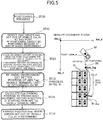
- each step is indicated by a (ST) code. Further, in Fig. 4 through Fig. 6 , operations of the mobile station M and the mobile terminal unit 20 corresponding to each step (ST) are schematically depicted on the right side of the figure.
- Fig. 4 illustrates basic operations for measuring an absolute position of the mobile terminal (target object) 20 in the measurement area 2.
- the mobile station M While the driver H drives a specified vehicle ma and moving the specified vehicle to a certain parking space in the measurement area 2, the mobile station M is moved to and parked at near the parking space at which the moving vehicle ma is expected to be parked.
- the measurement is started in ST0 in Fig. 4 .
- ST1 detected outputs from the GPS module 33, the inertial sensor 35 and the vehicle speed sensor 34 included in the absolute position measurement unit mounted on the mobile station M, are provided to the mobile control unit 31.
- An absolute position (absolute coordinate position) of the mobile station M in the absolute coordinates system (Abs) having an origin (reference position) at a predetermined position in the fixed station 10 is calculated by the mobile control unit 31 from these detected outputs.
- the measurement of the relative position is performed between the RF transmission and reception units 36 mounted on the mobile station M and the RF transmission and reception unit 21 of the mobile terminal unit 20, which are included in the relative position measurement unit. While the driver H carrying the mobile terminal unit 20 is driving the vehicle ma, the RF transmission and reception units 36 of the mobile station M are unable to detect existence of the mobile terminal unit 20 in the vehicle ma. After the vehicle ma is moved to a predetermined parking space and is parked at the parking space, when the driver H gets out of the vehicle ma, it becomes possible for the RF transmission and reception units 36 of the mobile station M to detect the response signal transmitted from the RF transmission and reception unit 21 of the mobile terminal unit 20.
- the mobile control unit 31 of the mobile station M calculates a walking route (w) (refer to Fig. 1 ) of the driver H, as a trajectory in the relative coordinate system (Rel), for movement from getting out of the vehicle ma after parking until arriving at the mobile station M.
- an orientation of the mobile station M is detected.
- the orientation of the mobile station M is detected by the inertial sensor (direction sensor) 35 that is a part of the relative position measurement unit, and a tilting angle ⁇ of the relative coordinate system (Rel) with respect to the absolute coordinate system (Abs) is calculated.
- the absolute coordinates system (Abs) is set in the measurement area 2, and the relative coordinate system (Rel) is set with respect to the mobile station M.
- the relative coordinate system (Rel) is rotated by ⁇ with respect to the origin in the absolute coordinates system (Abs), and thus, the relative coordinate system (Rel) is mapped to the absolute coordinates system (Abs).
- Results of the above calculations are transmitted from the mobile station M to the fixed station 10 through communications between the communication devices 32 and 12. It is possible for the fixed control unit 11 to determine that the specified vehicle ma is parked at a predetermined parking space (e.g., Pi) and to record the determination.
- a predetermined parking space e.g., Pi
- ST3 may be performed first to detect an orientation of the mobile station M in the absolute coordinates system (Abs), and at the same time, or after the orientation detection, ST2 may be performed to measure a relative position of the mobile terminal unit 20 in the relative coordinate system (Rel).
- Fig. 5 illustrates further detailed operations for measuring an absolute position of the mobile terminal (target object) 20 in the measurement area 2.
- the waling route (w) of the driver H, who has gotten out of the parked vehicle ma is illustrated in a section D and a section L.
- the section D indicates a range in which relative positions of the mobile terminal unit 20 cannot be accurately measured because, viewing from the mobile station M, the walking driver H who has gotten out of the vehicle is blocked by many vehicles m that are parked in line, and accuracy of communications between the RF transmission and reception units 21 and 36 is degraded.
- the section L indicates a range in which positions of the mobile terminal unit 20 can be accurately determined by the RF transmission and reception units 21 and 36 because the driver H is at positions at which there is no obstacle between the driver H and the mobile station M.
- a measurement process ST10 illustrated in Fig. 5 is performed as an internal process of the mobile terminal unit 20.
- ST11 illustrated in Fig. 5 it is detected that the driver H has gotten out of the vehicle ma.
- the above detection is performed by using the inertial sensor 22 or the pressure sensor mounted on the mobile terminal unit 20.
- the attitude change is detected by an attitude sensor such as a geomagnetic sensor.
- the acceleration change may be detected by the acceleration sensor (number-of-steps sensor).
- the pressure change may be detected by the pressure sensor.
- the terminal control unit 23 detects that the driver H has gotten out of the vehicle ma based on at least one of the detection outputs from the sensors.
- a movement history of the driver H in the section D is calculated.
- the movement history is calculated by the terminal control 23 based on the detection outputs of the inertial sensor 22 as a direction sensor (gyro sensor), the attitude sensor (geomagnetic sensor), or the number-of-steps sensor (acceleration sensor), mounted on the mobile terminal unit 20.
- the step width of the driver H is stored as a fixed value in advance, and a walking distance is calculated from a value of the number of steps calculated by the number-of-steps sensor and the step width value.
- the continuously measured movement history in the section D is sequentially stored in a memory.
- the operation proceeds to ST13.
- the operation proceeds to the measurement start (ST0) illustrated in Fig. 4 , after performing the steps ST1, ST2, ST4, which have been described above, it is possible to determine the position of the mobile terminal unit 20 in the absolute coordinates system (Abs) in ST5. It is limited to the section L where the movement history of the mobile terminal unit 20 can be calculated by using the RF transmission and reception units 21 and 36.
- the movement history in the section D stored in the memory of the terminal control unit 23 is transmitted to the mobile control unit 31 through the RF transmission and reception units 21 and 36, or through other communication means.
- the mobile control unit 31 determines the position of the parking space (Pi) of the vehicle ma, which is a starting point of the section D, by tracing back the transmitted movement history in the section D (ST15).
- the parking position information is transmitted to the fixed control unit 11 of the fixed station 10 by using the communication devices 32 and 12.
- Fig. 6 illustrates operations for measuring more accurately an absolute position of the mobile terminal unit (target object) 20 in the measurement area 2.
- the walking route of the driver H is detected and calculated using communications between the RF transmission and reception units 21 and 36.
- the number of steps in the section E is measured by using the number-of-steps sensor of the mobile terminal unit 20. Further, the step width of the driver H is calculated by (movement distance of the mobile terminal unit 20 in the section E measured by the RF transmission and reception units 31 and 36)/(the number of steps measured by the number-of-steps sensor).
Landscapes
- Engineering & Computer Science (AREA)
- Radar, Positioning & Navigation (AREA)
- Remote Sensing (AREA)
- Physics & Mathematics (AREA)
- General Physics & Mathematics (AREA)
- Computer Networks & Wireless Communication (AREA)
- Business, Economics & Management (AREA)
- Entrepreneurship & Innovation (AREA)
- Human Resources & Organizations (AREA)
- Automation & Control Theory (AREA)
- Economics (AREA)
- Strategic Management (AREA)
- Signal Processing (AREA)
- Electromagnetism (AREA)
- Marketing (AREA)
- Game Theory and Decision Science (AREA)
- Educational Administration (AREA)
- Operations Research (AREA)
- Quality & Reliability (AREA)
- Tourism & Hospitality (AREA)
- General Business, Economics & Management (AREA)
- Theoretical Computer Science (AREA)
- Development Economics (AREA)
- Traffic Control Systems (AREA)
- Navigation (AREA)
- Position Fixing By Use Of Radio Waves (AREA)
Abstract
Description
- The present invention relates to a position measurement apparatus capable of determining with high precision a position of a target object in a relatively wide range of a measurement area.
- An invention related to a position determination in a wireless communication system is described in
Patent Document 1. In this invention, a position of a mobile station moving in a measurement area, which is a cellular network, is determined. - In the invention described in
Patent Document 1, the basic idea is that the position of the mobile station is determined by a satellite positioning system such as GPS and SPS. It should be noted, however, that the position of the mobile station cannot be determined according to the satellite positioning system when the mobile station is moving inside of a building or in a tunnel. In this case, the position of the mobile station is calculated by having communications between the mobile station and multiple base stations included in the cellular network and by having the mobile station receiving signal propagation delay information. - [Patent Document 1] Japanese Unexamined Patent Application Publication No.
2015-155909 - In the invention described in
Patent Document 1, accuracy of determining a position of the mobile station is increased by using not only the satellite positioning system but also radio waves from the base stations of the cellular network that is used as a communication system for existing mobile telephones, or the like. - In the above-noted invention, although it is possible to calculate a position of a mobile station moving in a building or a tunnel, the mobile station is limited to a vehicle on which a communication device for communicating with the satellite positioning system and base stations is mounted, and thus, the above-noted invention is not appropriate to be used for determining a position of a simpler mobile terminal unit.
- Further, because base stations included in the cellular network are far away from the mobile station, a position of a base station may not be determined with high precision using signal propagation delay information that is transmitted by the base station and received by the mobile station.
- In view of the above-described problem, an object of the present invention is to provide a position measurement apparatus capable of detecting a position of a target object with high precision in a wide range of a measurement area.
- The present invention provides a position measurement apparatus for determining a position of a target object arranged in a measurement area, the position measurement apparatus including: a mobile station configured to move in the measurement area; an absolute position measurement unit configured to measure an absolute position of the mobile station in the measurement area; and a relative position measurement unit configured to measure a relative position of the target object with respect to the mobile station, wherein an absolute position of the target object in the measurement area is determined from a measurement value of the absolute position and a measurement value of the relative position.
- In a position measurement apparatus of the present invention, the absolute position measurement unit is a satellite positioning system mounted on the mobile station.
- In a position measurement apparatus of the present invention, the relative position measurement unit includes a direction sensor that detects a direction of the mobile station and a position determination unit that determines a position of the target object in a relative coordinate system with respect to the mobile station.
- In a position measurement apparatus of the present invention, the position determination unit is an RF transmission and reception unit disposed between the mobile station and the target object.
- It is preferable that, in the position measurement apparatus of the present invention, the target object includes an inertial sensor and that the movement history of the target object in the measurement area is calculated from the relative position, measured by the relative position measurement unit, of the target object with respect to the mobile station and from the movement information of the target object detected by the inertial sensor.
- Further, a position measurement apparatus of the present invention is characterized: by the target object being a mobile terminal unit held by a person; by the number of steps being counted by the inertial sensor; by a step width of the person being calculated from a relative position, which is measured by the relative position measurement unit, of the target object with respect to the mobile station and the number of steps; and by a movement distance of the mobile terminal unit, which cannot be measured by the relative position measurement unit in an area, being adjusted by the step width and the number of steps.
- In a position measurement apparatus of the present invention, the person is, for example, a driver who drives a vehicle in the measurement area, the mobile station is a truck that carries the driver who has got out of the vehicle, and a parking position of the vehicle is determined by measuring a position of the mobile terminal unit held by the driver who has got out of the vehicle.
- In the present invention, an absolute position of the target object in the measurement area is determined by determining an absolute position of the mobile station in the measurement area, and by calculating a relative position of the target object with respect to the mobile station. It is possible to detect a relative position of the target object with high accuracy by having the mobile station close to the target object, and thus, it is possible to determine an absolute position of the target object in the measurement area with high accuracy.
- Further, even when a relative position of the target object with respect to the mobile station cannot be detected with high accuracy because the target object is hidden from the mobile station, it is possible to obtain movement information of the target object from detection outputs of an inertial sensor by having the inertial sensor included in the target object.
-
-
Fig. 1 is a drawing illustrating an overall structure of a position measurement apparatus of the present invention. -
Fig. 2 is a drawing illustrating a relative position of a target object with respect to a mobile station in the position measurement apparatus of the present invention. -
Fig. 3 is a block diagram of the position measurement apparatus of the present invention. -
Fig. 4 is a flowchart illustrating a basic measurement operation of the position measurement apparatus of the present invention. -
Fig. 5 is a flowchart illustrating a further detailed measurement operation of the position measurement apparatus of the present invention. -
Fig. 6 is a flowchart illustrating a further detailed measurement operation of the position measurement apparatus of the present invention. -
Fig. 1 illustrates an overall structure of aposition measurement apparatus 1 according to an embodiment of the present invention. Theposition measurement apparatus 1 includes ameasurement area 2. Themeasurement area 2 is, for example, a waiting area of vehicles m with an area equal to or greater than 1 km2. Themeasurement area 2 is divided into waiting blocks P1, P2, P3, P4, P5, and P6. Many vehicles m waiting for exportation and many vehicles m that have been imported are parked in waiting blocks systematically. Each of the waiting blocks P1, P2, P3, P4, P5, and P6 is further divided into a plurality of vehicle parking spaces, and each of the vehicle parking spaces is provided with a code indicating its position.Fig. 2 illustrates an enlarged part of the waiting block P3, and parking spaces of the waiting block P3 are provided with codes, for example, Pa, Pb, Pc, Pd, etc., respectively. - A bring-
in area 3 is provided on one side of themeasurement area 2. Brought-in vehicles m are parked sequentially in the bring-inarea 3. A driver (person) H, who is a worker in themeasurement area 2, gets on a specified vehicle ma among the vehicles m parked in the bring-inarea 3. The driver drives the vehicle ma along a driving route (d), moves the vehicle ma to a specified parking space, and parks the vehicle ma in the specified parking space. In an embodiment of the present invention, as illustrated inFig. 2 , the specified vehicle ma is parked at a parking space Pi in the waiting block P3. - There is a mobile station (truck) M moved to near the driver H who has gotten out of the vehicle ma that has been parked at the parking space Pi. The driver H gets on the mobile station M together with another driver, returns to the bring-in
area 3, and moves another specified vehicle to a parking space. The driver H performs the above-described job repeatedly. - A
position measurement apparatus 1 according to an embodiment of the present invention performs management of theentire measurement area 2 by determining which vehicle m is parked at which parking space of which waiting block P1, P2, P3, P4, P5, P6, .... -
Fig. 3 illustrates a functional block diagram of units included in theposition measurement apparatus 1. As illustrated inFig. 1 , there is afixed station 10 near the bring-inarea 3. A planar absolute coordinates (Abs), which is an orthogonal coordinates system (X-Y coordinates system), is set in themeasurement area 2. An origin (reference position) of the absolute coordinates system (Abs) may be set at any position. The origin (reference position) of the absolute coordinates system (Abs) is set at a predetermined position in thefixed station 10. - As illustrated in
Fig. 3 , thefixed station 10 includes afixed control unit 11. Thefixed control unit 11 manages theentire measurement area 2, and includes mainly a CPU and a memory. Acommunication device 12 used for communicating with the mobile station M is mounted on thefixed station 10. - The driver H carries a mobile terminal unit (Tag) 20, a
barcode reader 13, and acommunication device 24 attached to thebarcode reader 13. Abarcode 15 is attached to themobile terminal unit 20. When the driver H carries themobile terminal unit 20, the driver H reads thebarcode 15 with thebarcode reader 13. Abarcode 14 is also allocated to (attached to) each vehicle m that is brought in the bring-inarea 3. When the driver holding the mobileterminal unit 20 gets on a specified vehicle ma in the bring-inarea 3, the driver H reads thebarcode 14 of the vehicle ma with thebarcode reader 13 held by the driver H. - The code of the
barcode 15 of the mobileterminal unit 20 and the code of thebarcode 14 of the specified vehicle ma, which have been read by thebarcode reader 13, are transmitted to thecommunication device 12 of the fixedstation 10 from thecommunication device 24 carried by the driver H. These codes are transmitted to the fixedcontrol unit 11 from thecommunication device 12, and thus, the mobileterminal unit 20 and the vehicle m are associated with each other by the fixedcontrol unit 11. - The mobile terminal unit (Tag) 20 is a "target object" whose position is measured by the
position measurement apparatus 1. When the driver H gets out of the vehicle ma after moving the vehicle ma to a certain parking space, the position of the mobileterminal unit 20 held by the driver H is determined as an absolute position in the absolute coordinates system (Abs) set in themeasurement area 2. With the above operation, it is possible for the fixedcontrol unit 22 to manage (determine) the parking space among the many parking spaces at which the specified vehicle ma is parked. - Different mobile
terminal units 20 may be used for different vehicles m in a one-to-one relationship. Alternatively, the driver H may continue using the same mobileterminal unit 20 while moving many vehicles m. - As illustrated in
Fig. 3 , the mobile station M includes amobile control unit 31. Themobile control unit 31 includes mainly a CPU and a memory. A planar orthogonal coordinates system (X-Y coordinates system) with reference to the mobile station M is set as a relative coordinate system (Rel) by themobile control unit 31. An origin of the relative coordinate system (Rel) is set in the mobile station (truck) M, for example, X-axis is set in a front direction toward the traveling direction of the mobile station M, and Y-axis is set in a direction orthogonal to the traveling direction. - There is a
communication device 32 in the mobile station M. Various information items are transmitted from the mobile station M to the fixedstation 10 through communications between thecommunication device 32 and thecommunication device 12. Thecommunication devices - A
GPS module 33 as an absolute position measurement unit is mounted on the mobile station M.The GPS module 33 is provided as a part of a satellite positioning system. The satellite positioning system may be an SPS system. As illustrated inFig. 1 , there is another fixedstation 40 in themeasurement area 2 and the other fixedstation 40 includes areferential GPS module 42. Positioning radio waves from a plurality ofGPS satellites 41 are detected by theGPS module 33 mounted on the mobile station M and by thereferential GPS module 42. - Coordinate position information detected and calculated by the
referential GPS module 42 is transmitted to at least one of themobile control unit 31 and the fixedcontrol unit 11. The coordinate position of the mobile station M in the absolute coordinates system (Abs) is calculated, by themobile control unit 31 or the fixedcontrol unit 11, with high precision from the coordinate position information detected and calculated by theGPS module 33 mounted on the mobile station M and the coordinate position information detected and calculated by thereferential GPS module 42. The coordinate position information calculated by themobile control unit 31 is transmitted to the fixedcontrol unit 11 using thecommunication devices - As illustrated in
Fig. 3 , avehicle speed sensor 34 and aninertial sensor 35 are mounted on the mobile station M. Theinertial sensor 35 is a gyro sensor for detecting angular velocity, which also functions as a direction sensor. Thevehicle speed sensor 34 and theinertial sensor 35 function as parts of the absolute position measurement unit. Information of a moving position or a direction of the mobile station M in the absolute coordinates system (Abs) detected by theGPS module 33 is adjusted by detected outputs from thevehicle speed sensor 34 and theinertial sensor 35. - There are a plurality of RF transmission and
reception units 36 in the mobile station M. A relative position measurement unit includes the RF transmission andreception units 36 and the inertial sensor (direction sensor) 35. Other than the gyro sensor, a geomagnetic sensor may be used as the inertial sensor (direction sensor) 35 that is used as the relative position measurement unit. - As illustrated in
Fig. 1 andFig. 2 ,antennas 36a of the plurality of RF transmission andreception units 36 are attached onto the mobile station (truck) M, at positions separated from each other. - A RF transmission and
reception unit 21 is included in the mobile terminal unit (Tag) 20 as a target object. When measurement signals are transmitted from the plurality of RF transmission andreception units 36 included in the mobile station M, the measurement signals are detected by the RF transmission andreception unit 21 of the mobileterminal unit 20, and a response signal is transmitted from the RF transmission andreception unit 21 of the mobileterminal unit 20. The measurement signals transmitted from the RF transmission andreception units 36 of the mobile station M are analog signals with sine waves. The RF transmission andreception unit 21 of the mobileterminal unit 20 reflects the received measurement signals and transmits the reflected signals as response signals. At each of the RF transmission andreception units 36 included in the mobile station M, a distance from the RF transmission andreception unit 36 to the RF transmission andreception unit 21 is measured from a phase difference (time difference) between the transmitted measurement signal and the received response signal. - The distance measurement is performed by the plurality of RF transmission and
reception units 36, and measurement values are provided to themobile control unit 31. Themobile control unit 31 calculates, from the measurement values obtained by the RF transmission andreception units 36, a relative position of the mobileterminal unit 20 in the relative coordinate system (Rel) set in the mobile station M. In other words, a position determination unit for measuring a relative position includes the RF transmission andreception units 36 and the RF transmission andreception unit 21. - As illustrated in
Fig. 3 , abarcode 16 is attached to a loading gate of the mobile station M. Thebarcode 16 is read by thebarcode reader 13 carried by the driver H when the driver H gets on the mobile station M after getting out of the specified vehicle ma. The code of thebarcode 16 is transmitted from thecommunication device 24 to thecommunication device 12 of the fixedstation 10, and further transmitted to the fixedcontrol unit 11, and thus, the mobileterminal unit 20 carried by the driver H and the mobile station M are associated with each other by the fixedcontrol unit 11. - As illustrated in
Fig. 3 , aterminal control unit 23 and aninertial sensor 22 are mounted on the mobileterminal unit 20. Theterminal control unit 23 includes mainly a CPU and a memory. Theinertial sensor 22 may be a gyro sensor functioning as a direction sensor, a geomagnetic sensor functions as an attitude sensor, an acceleration sensor functions as a number-of-steps sensor, or the like. The mobileterminal unit 20 may further include a pressure sensor. Various information items measured by these sensors are provided to themobile control unit 31 using the RF transmission andreception units - Next, operations of measuring a position of the mobile
terminal unit 20 as a target object in theposition measurement apparatus 1 will be described. - In flowcharts illustrated in
Fig. 4 , etc., each step is indicated by a (ST) code. Further, inFig. 4 through Fig. 6 , operations of the mobile station M and the mobileterminal unit 20 corresponding to each step (ST) are schematically depicted on the right side of the figure. -
Fig. 4 illustrates basic operations for measuring an absolute position of the mobile terminal (target object) 20 in themeasurement area 2. - While the driver H drives a specified vehicle ma and moving the specified vehicle to a certain parking space in the
measurement area 2, the mobile station M is moved to and parked at near the parking space at which the moving vehicle ma is expected to be parked. - When the mobile station M is parked, the measurement is started in ST0 in
Fig. 4 . In this measurement operation, in ST1, detected outputs from theGPS module 33, theinertial sensor 35 and thevehicle speed sensor 34 included in the absolute position measurement unit mounted on the mobile station M, are provided to themobile control unit 31. An absolute position (absolute coordinate position) of the mobile station M in the absolute coordinates system (Abs) having an origin (reference position) at a predetermined position in the fixedstation 10 is calculated by themobile control unit 31 from these detected outputs. - In ST2, a relative position of the mobile
terminal unit 20 as the target object in the relative coordinate system (Rel) that is set with reference to the mobile station M, is calculated. - The measurement of the relative position is performed between the RF transmission and
reception units 36 mounted on the mobile station M and the RF transmission andreception unit 21 of the mobileterminal unit 20, which are included in the relative position measurement unit. While the driver H carrying the mobileterminal unit 20 is driving the vehicle ma, the RF transmission andreception units 36 of the mobile station M are unable to detect existence of the mobileterminal unit 20 in the vehicle ma. After the vehicle ma is moved to a predetermined parking space and is parked at the parking space, when the driver H gets out of the vehicle ma, it becomes possible for the RF transmission andreception units 36 of the mobile station M to detect the response signal transmitted from the RF transmission andreception unit 21 of the mobileterminal unit 20. At this time, it becomes possible to calculate a relative position of the mobileterminal unit 20 as the target object in the relative coordinate system (Rel) that is set with reference to the mobile station M, by measuring distances from the plurality of RF transmission andreception units 36 to the RF transmission andreception unit 21. - It is possible for the
mobile control unit 31 of the mobile station M to, based on the measurement of the relative position measurement unit, calculate a walking route (w) (refer toFig. 1 ) of the driver H, as a trajectory in the relative coordinate system (Rel), for movement from getting out of the vehicle ma after parking until arriving at the mobile station M. - In ST3 illustrated in
Fig. 4 , an orientation of the mobile station M is detected. Here, the orientation of the mobile station M is detected by the inertial sensor (direction sensor) 35 that is a part of the relative position measurement unit, and a tilting angle θ of the relative coordinate system (Rel) with respect to the absolute coordinate system (Abs) is calculated. The absolute coordinates system (Abs) is set in themeasurement area 2, and the relative coordinate system (Rel) is set with respect to the mobile station M. - In ST4, the relative coordinate system (Rel) is rotated by θ with respect to the origin in the absolute coordinates system (Abs), and thus, the relative coordinate system (Rel) is mapped to the absolute coordinates system (Abs). With the above operations, it is possible to determine the walking route (w) of the driver H in the absolute coordinates system (Abs). Therefore, in ST5, it is possible to detect the start point of the walking route (w) as a parking position of the vehicle ma.
- Results of the above calculations are transmitted from the mobile station M to the fixed
station 10 through communications between thecommunication devices control unit 11 to determine that the specified vehicle ma is parked at a predetermined parking space (e.g., Pi) and to record the determination. - It should be noted that, in
Fig. 4 , ST3 may be performed first to detect an orientation of the mobile station M in the absolute coordinates system (Abs), and at the same time, or after the orientation detection, ST2 may be performed to measure a relative position of the mobileterminal unit 20 in the relative coordinate system (Rel). -
Fig. 5 illustrates further detailed operations for measuring an absolute position of the mobile terminal (target object) 20 in themeasurement area 2. - In
Fig. 2 andFig. 5 , the waling route (w) of the driver H, who has gotten out of the parked vehicle ma, is illustrated in a section D and a section L. The section D indicates a range in which relative positions of the mobileterminal unit 20 cannot be accurately measured because, viewing from the mobile station M, the walking driver H who has gotten out of the vehicle is blocked by many vehicles m that are parked in line, and accuracy of communications between the RF transmission andreception units terminal unit 20 can be accurately determined by the RF transmission andreception units - While performing the basic measurement operations illustrated in
Fig. 4 , it becomes possible to detect the mobileterminal unit 20 in ST2 when the driver H gets out of the section D and gets into the section L. As a result, there is a possibility that the boundary between the section D and the section L is determined in error to be a parking position of the vehicle. Therefore, it is possible to always measure the parking position of the vehicle ma accurately by performing measurement operations illustrated inFig. 5 in addition to the measurement operations illustrated inFig. 4 . - A measurement process ST10 illustrated in
Fig. 5 is performed as an internal process of the mobileterminal unit 20. In ST11 illustrated inFig. 5 , it is detected that the driver H has gotten out of the vehicle ma. The above detection is performed by using theinertial sensor 22 or the pressure sensor mounted on the mobileterminal unit 20. When the attitude of the driver H is changed from a sitting attitude at the driver sheet to a standing attitude outside the vehicle, the attitude change is detected by an attitude sensor such as a geomagnetic sensor. Alternatively, when the driver H gets out of the vehicle and stands on the ground, the acceleration change may be detected by the acceleration sensor (number-of-steps sensor). Further alternatively, when the mobileterminal unit 20 moves from the inside the vehicle to the outside the vehicle, the pressure change may be detected by the pressure sensor. Theterminal control unit 23 detects that the driver H has gotten out of the vehicle ma based on at least one of the detection outputs from the sensors. - In ST12, after detecting that the driver H has gotten out of the vehicle ma, a movement history of the driver H in the section D is calculated. The movement history is calculated by the
terminal control 23 based on the detection outputs of theinertial sensor 22 as a direction sensor (gyro sensor), the attitude sensor (geomagnetic sensor), or the number-of-steps sensor (acceleration sensor), mounted on the mobileterminal unit 20. It should be noted that the step width of the driver H is stored as a fixed value in advance, and a walking distance is calculated from a value of the number of steps calculated by the number-of-steps sensor and the step width value. In ST12, the continuously measured movement history in the section D is sequentially stored in a memory. - When it becomes possible for the RF transmission and
reception unit 21 to receive measurement signals from the RF transmission andreception units 36 and when it becomes possible for the RF transmission andreception units 36 to receive response signals from the RF transmission andreception unit 21, the operation proceeds to ST13. Here, the operation proceeds to the measurement start (ST0) illustrated inFig. 4 , after performing the steps ST1, ST2, ST4, which have been described above, it is possible to determine the position of the mobileterminal unit 20 in the absolute coordinates system (Abs) in ST5. It is limited to the section L where the movement history of the mobileterminal unit 20 can be calculated by using the RF transmission andreception units - Therefore, in ST14, the movement history in the section D stored in the memory of the
terminal control unit 23 is transmitted to themobile control unit 31 through the RF transmission andreception units mobile control unit 31 determines the position of the parking space (Pi) of the vehicle ma, which is a starting point of the section D, by tracing back the transmitted movement history in the section D (ST15). The parking position information is transmitted to the fixedcontrol unit 11 of the fixedstation 10 by using thecommunication devices -
Fig. 6 illustrates operations for measuring more accurately an absolute position of the mobile terminal unit (target object) 20 in themeasurement area 2. - In the measurement process ST20 illustrated in
Fig. 6 , operations from ST11 to ST14 are the same as the operations illustrated inFig. 5 . In other words, in ST11, it is detected that the driver H has gotten out of the vehicle ma, and in ST12, the movement history of the driver H is calculated in the section D in which measurement cannot be performed by the RF transmission andreception units - After communications of the measurement signals and the response signals between the RF transmission and
reception units reception units - In ST21, while the driver H walks in the section D towards the mobile station M, the number of steps in the section E is measured by using the number-of-steps sensor of the mobile
terminal unit 20. Further, the step width of the driver H is calculated by (movement distance of the mobileterminal unit 20 in the section E measured by the RF transmission andreception units 31 and 36)/(the number of steps measured by the number-of-steps sensor). - In ST22 illustrated in
Fig. 6 , the same as in ST14 illustrated inFig. 5 , the position where the driver has gotten out of the vehicle ma is determined by tracing back the movement history, which has already been measured, in the section D. At this time, it is possible to accurately calculate the movement distance of the driver H in the section D by multiplying the number of steps in the section D, which has been measured in ST12, by the step width calculated in ST21. - With the above operations, in ST23, it is possible to accurately determine the position where the driver H has gotten out of the vehicle ma.
-
- 1
- position measurement apparatus
- 2
- measurement area
- 10
- fixed station
- 13
- barcode reader
- 20
- mobile terminal unit
- 21, 36
- RF transmission and reception unit
- 22, 35
- inertial sensor
- 33
- GPS module
- Abs
- absolute coordinates system
- Rel
- relative coordinate system
- H
- driver
- M
- mobile station
- m
- vehicle
Claims (7)
- A position measurement apparatus for determining a position of a target object arranged in a measurement area, the position measurement apparatus comprising:a mobile station configured to move in the measurement area;an absolute position measurement unit configured to measure an absolute position of the mobile station in the measurement area;a relative position measurement unit configured to measure a relative position of the target object with respect to the mobile station,wherein an absolute position of the target object in the measurement area is determined from a measurement value of the absolute position and a measurement value of the relative position.
- The position measurement apparatus according to claim 1, wherein the absolute position measurement unit is a satellite positioning system mounted on the mobile station.
- The position measurement apparatus according to claim 1 or 2, wherein the relative position measurement unit includes a direction sensor that detects an orientation of the mobile station and a position determination unit that determines a position of the target object in a relative coordinate system with respect to the mobile station.
- The position measurement apparatus according to claim 3, wherein the position determination unit is RF transmission and reception units disposed between the mobile station and the target object.
- The position measurement apparatus according to any one of claims 1 to 4, wherein the target object includes an inertial sensor, and a movement history of the target object in the measurement area is calculated from a relative position, measured by the relative position measurement unit, of the target object with respect to the mobile station and from movement information of the target object detected by the inertial sensor.
- The position measurement apparatus according to claim 5, wherein the target object is a mobile terminal unit held by a person, a number of steps is measured by the inertial sensor, a step width of the person is calculated from the relative position, measured by the relative position measurement unit, of the target object with respect to the mobile station, and a movement distance of the mobile terminal unit in an area, in which the movement distance cannot be measured by the relative position measurement unit, is adjusted by the step width and the number of steps.
- The position measurement apparatus according to claim 6, wherein the person is a driver who drives a vehicle in the measurement area, the mobile station is a truck that carries the driver who has got out of the vehicle, and a parking position of the vehicle is determined by measuring a position of the mobile terminal unit held by the driver who has got out of the vehicle.
Applications Claiming Priority (2)
| Application Number | Priority Date | Filing Date | Title |
|---|---|---|---|
| JP2016095521 | 2016-05-11 | ||
| PCT/JP2017/006853 WO2017195431A1 (en) | 2016-05-11 | 2017-02-23 | Position measurement device |
Publications (2)
| Publication Number | Publication Date |
|---|---|
| EP3457162A1 true EP3457162A1 (en) | 2019-03-20 |
| EP3457162A4 EP3457162A4 (en) | 2020-04-22 |
Family
ID=60266916
Family Applications (1)
| Application Number | Title | Priority Date | Filing Date |
|---|---|---|---|
| EP17795792.5A Withdrawn EP3457162A4 (en) | 2016-05-11 | 2017-02-23 | Position measurement device |
Country Status (5)
| Country | Link |
|---|---|
| US (1) | US20200025863A1 (en) |
| EP (1) | EP3457162A4 (en) |
| JP (1) | JP6817294B2 (en) |
| CN (1) | CN109154643A (en) |
| WO (1) | WO2017195431A1 (en) |
Families Citing this family (3)
| Publication number | Priority date | Publication date | Assignee | Title |
|---|---|---|---|---|
| CN110444043B (en) * | 2019-09-16 | 2021-02-09 | 深圳普智联科机器人技术有限公司 | Parking space inspection system and method based on positioning technology |
| CA3179881A1 (en) * | 2020-04-10 | 2021-10-14 | Rohit Seth | System for calculating highly accurate gps location for mobile devices |
| CN112985842B (en) * | 2021-05-10 | 2021-07-20 | 湖北亿咖通科技有限公司 | Parking performance detection method, electronic device and readable storage medium |
Family Cites Families (24)
| Publication number | Priority date | Publication date | Assignee | Title |
|---|---|---|---|---|
| JPS6140509A (en) * | 1984-07-31 | 1986-02-26 | Nippon Soken Inc | Distance recording and regeneration apparatus |
| JPH0735851A (en) * | 1993-07-16 | 1995-02-07 | Hitachi Constr Mach Co Ltd | Distance measuring circuit |
| JP3431110B2 (en) * | 1995-02-27 | 2003-07-28 | 日本電信電話株式会社 | Moving object position detection device |
| JPH0989584A (en) * | 1995-09-26 | 1997-04-04 | Honda Motor Co Ltd | Portable navigation device |
| CN100353181C (en) * | 2003-07-16 | 2007-12-05 | 明基电通股份有限公司 | Geomagnetism-assisted wireless communication system positioning method and wireless communication positioning system |
| CA2585141C (en) * | 2004-10-29 | 2012-09-11 | Hitachi Zosen Corporation | Relative positioning method and relative positioning system using satellite |
| US7546182B2 (en) * | 2006-02-21 | 2009-06-09 | Gm Global Technology Operations, Inc. | Inter vehicular ad hoc routing protocol and communication system |
| US9239376B2 (en) * | 2010-10-08 | 2016-01-19 | Telecommunication Systems, Inc. | Doppler aided inertial navigation |
| KR100866487B1 (en) * | 2007-01-03 | 2008-11-03 | 삼성전자주식회사 | User track tracking device and method |
| EP2463679B1 (en) | 2007-05-01 | 2020-03-11 | Qualcomm Incorporated(1/3) | Position location for wireless communication systems |
| JP2009025123A (en) * | 2007-07-19 | 2009-02-05 | Nec Saitama Ltd | Portable information terminal and position calculation method |
| KR100986372B1 (en) * | 2007-11-28 | 2010-10-08 | 현대자동차주식회사 | Traffic information collection terminal and traffic information generation method |
| JP5369057B2 (en) * | 2010-06-18 | 2013-12-18 | 日立建機株式会社 | Work machine ambient monitoring device |
| EP2511658A1 (en) * | 2011-04-14 | 2012-10-17 | Hexagon Technology Center GmbH | Measuring system and method for new point determination |
| CN102645221B (en) * | 2012-03-26 | 2015-09-16 | 北京华虎兄弟科技有限公司 | Locating device and using method thereof |
| WO2014016841A1 (en) * | 2012-07-27 | 2014-01-30 | Neuner Tomer | Intelligent state determination |
| JP6060548B2 (en) * | 2012-07-30 | 2017-01-18 | カシオ計算機株式会社 | Positioning device, positioning method and program |
| WO2014038041A1 (en) * | 2012-09-06 | 2014-03-13 | 株式会社東芝 | Position detection device, position detection method and position detection program |
| CN102932742B (en) * | 2012-10-12 | 2016-05-25 | 上海交通大学 | Based on indoor orientation method and the system of inertial sensor and wireless signal feature |
| US9406222B2 (en) * | 2012-10-18 | 2016-08-02 | Calamp Corp. | Systems and methods for location reporting of detected events in vehicle operation |
| US9019129B2 (en) * | 2013-02-21 | 2015-04-28 | Apple Inc. | Vehicle location in weak location signal scenarios |
| JP2015017858A (en) * | 2013-07-10 | 2015-01-29 | セイコーエプソン株式会社 | Reference value generation apparatus and reference value generation method |
| JP6169962B2 (en) * | 2013-12-12 | 2017-07-26 | 三菱電機株式会社 | Positioning terminal, mobile phone search system, mobile phone search method, program, and server |
| JP6430196B2 (en) * | 2014-09-29 | 2018-11-28 | シャープ株式会社 | Determination device, determination method, determination program, and portable terminal |
-
2017
- 2017-02-23 CN CN201780028872.0A patent/CN109154643A/en not_active Withdrawn
- 2017-02-23 WO PCT/JP2017/006853 patent/WO2017195431A1/en not_active Ceased
- 2017-02-23 JP JP2018516352A patent/JP6817294B2/en active Active
- 2017-02-23 EP EP17795792.5A patent/EP3457162A4/en not_active Withdrawn
-
2018
- 2018-10-30 US US16/174,787 patent/US20200025863A1/en not_active Abandoned
Also Published As
| Publication number | Publication date |
|---|---|
| JPWO2017195431A1 (en) | 2019-02-28 |
| WO2017195431A1 (en) | 2017-11-16 |
| CN109154643A (en) | 2019-01-04 |
| JP6817294B2 (en) | 2021-01-20 |
| US20200025863A1 (en) | 2020-01-23 |
| EP3457162A4 (en) | 2020-04-22 |
Similar Documents
| Publication | Publication Date | Title |
|---|---|---|
| KR101755944B1 (en) | Autonomous driving method and system for determing position of car graft on gps, uwb and v2x | |
| EP2616774B1 (en) | Indoor positioning using pressure sensors | |
| US8700202B2 (en) | System for positioning a tool in a work space | |
| US10420059B2 (en) | Method and device for high-precision determination of a mobile device and method for locating or positioning stationary devices | |
| KR100779510B1 (en) | Reconnaissance Robot and Reconnaissance Robot Operation Control System | |
| EP3399327B1 (en) | Pose estimation using radio frequency identification (rfid) tags | |
| JP2011174829A (en) | Position estimating device | |
| EP3708952B1 (en) | System used for improving automatic control of machine operations of construction site machinery | |
| CN102725764B (en) | Mobile reading device, and method for locating an object that is marked with an active transponder | |
| US20200025863A1 (en) | Position measurement apparatus | |
| JP5900267B2 (en) | POSITION MEASURING SYSTEM AND GOOD STORAGE EQUIPMENT HAVING THE SAME | |
| CN105301586A (en) | Method for radar supported navigation | |
| US20090048778A1 (en) | Process for Determining Vehicle Position | |
| CN118981037A (en) | Vehicle positioning equipment | |
| KR101523147B1 (en) | Indoor Positioning Device and Method | |
| CN107110952A (en) | Position detecting system | |
| EP3385744B1 (en) | Position detection system | |
| RU2624790C1 (en) | Dynamic positioning method of mobile objects | |
| US9368032B1 (en) | System and method for locating a vehicle within a parking facility | |
| CN112955771A (en) | Position specifying system for moving body and moving body used for position specifying system | |
| KR102499002B1 (en) | System and Method for measuring position of a vehicle moving through a tunnel | |
| Sonnessa et al. | Indoor Positioning Methods–A Short Review and First Tests Using a Robotic Platform for Tunnel Monitoring | |
| EP3246723A1 (en) | Method for setting up a positioning system | |
| KR102036080B1 (en) | Portable positioning device and method for operating portable positioning device | |
| JP2003232843A (en) | Radio wave ranging device |
Legal Events
| Date | Code | Title | Description |
|---|---|---|---|
| STAA | Information on the status of an ep patent application or granted ep patent |
Free format text: STATUS: THE INTERNATIONAL PUBLICATION HAS BEEN MADE |
|
| PUAI | Public reference made under article 153(3) epc to a published international application that has entered the european phase |
Free format text: ORIGINAL CODE: 0009012 |
|
| STAA | Information on the status of an ep patent application or granted ep patent |
Free format text: STATUS: REQUEST FOR EXAMINATION WAS MADE |
|
| 17P | Request for examination filed |
Effective date: 20181109 |
|
| AK | Designated contracting states |
Kind code of ref document: A1 Designated state(s): AL AT BE BG CH CY CZ DE DK EE ES FI FR GB GR HR HU IE IS IT LI LT LU LV MC MK MT NL NO PL PT RO RS SE SI SK SM TR |
|
| AX | Request for extension of the european patent |
Extension state: BA ME |
|
| RAP1 | Party data changed (applicant data changed or rights of an application transferred) |
Owner name: ALPS ALPINE CO., LTD. |
|
| DAV | Request for validation of the european patent (deleted) | ||
| DAX | Request for extension of the european patent (deleted) | ||
| RIC1 | Information provided on ipc code assigned before grant |
Ipc: G01C 21/16 20060101ALI20191128BHEP Ipc: G06Q 10/06 20120101ALI20191128BHEP Ipc: G01S 13/74 20060101ALI20191128BHEP Ipc: G01S 19/48 20100101ALI20191128BHEP Ipc: G01S 5/02 20100101AFI20191128BHEP |
|
| A4 | Supplementary search report drawn up and despatched |
Effective date: 20200323 |
|
| RIC1 | Information provided on ipc code assigned before grant |
Ipc: G01S 19/48 20100101ALI20200317BHEP Ipc: G06Q 10/06 20120101ALI20200317BHEP Ipc: G01C 21/16 20060101ALI20200317BHEP Ipc: G01S 13/74 20060101ALI20200317BHEP Ipc: G01S 5/02 20100101AFI20200317BHEP |
|
| STAA | Information on the status of an ep patent application or granted ep patent |
Free format text: STATUS: THE APPLICATION HAS BEEN WITHDRAWN |
|
| 18W | Application withdrawn |
Effective date: 20200724 |