EP3456700A1 - Labeled inhibitors of prostate specific membrane antigen (psma), their use as imaging agents and pharmaceutical agents for the treatment of prostate cancer - Google Patents
Labeled inhibitors of prostate specific membrane antigen (psma), their use as imaging agents and pharmaceutical agents for the treatment of prostate cancer Download PDFInfo
- Publication number
- EP3456700A1 EP3456700A1 EP18184296.4A EP18184296A EP3456700A1 EP 3456700 A1 EP3456700 A1 EP 3456700A1 EP 18184296 A EP18184296 A EP 18184296A EP 3456700 A1 EP3456700 A1 EP 3456700A1
- Authority
- EP
- European Patent Office
- Prior art keywords
- psma
- imaging
- tumor
- compounds
- pet
- Prior art date
- Legal status (The legal status is an assumption and is not a legal conclusion. Google has not performed a legal analysis and makes no representation as to the accuracy of the status listed.)
- Withdrawn
Links
- 0 *C(c1ccc(CNC(c2ccc(CNC(c3ccc(CN*)cc3)=O)cc2)=O)cc1)=O Chemical compound *C(c1ccc(CNC(c2ccc(CNC(c3ccc(CN*)cc3)=O)cc2)=O)cc1)=O 0.000 description 2
Images








Classifications
-
- C—CHEMISTRY; METALLURGY
- C07—ORGANIC CHEMISTRY
- C07D—HETEROCYCLIC COMPOUNDS
- C07D295/00—Heterocyclic compounds containing polymethylene-imine rings with at least five ring members, 3-azabicyclo [3.2.2] nonane, piperazine, morpholine or thiomorpholine rings, having only hydrogen atoms directly attached to the ring carbon atoms
- C07D295/04—Heterocyclic compounds containing polymethylene-imine rings with at least five ring members, 3-azabicyclo [3.2.2] nonane, piperazine, morpholine or thiomorpholine rings, having only hydrogen atoms directly attached to the ring carbon atoms with substituted hydrocarbon radicals attached to ring nitrogen atoms
- C07D295/14—Heterocyclic compounds containing polymethylene-imine rings with at least five ring members, 3-azabicyclo [3.2.2] nonane, piperazine, morpholine or thiomorpholine rings, having only hydrogen atoms directly attached to the ring carbon atoms with substituted hydrocarbon radicals attached to ring nitrogen atoms substituted by carbon atoms having three bonds to hetero atoms with at the most one bond to halogen, e.g. ester or nitrile radicals
- C07D295/145—Heterocyclic compounds containing polymethylene-imine rings with at least five ring members, 3-azabicyclo [3.2.2] nonane, piperazine, morpholine or thiomorpholine rings, having only hydrogen atoms directly attached to the ring carbon atoms with substituted hydrocarbon radicals attached to ring nitrogen atoms substituted by carbon atoms having three bonds to hetero atoms with at the most one bond to halogen, e.g. ester or nitrile radicals with the ring nitrogen atoms and the carbon atoms with three bonds to hetero atoms attached to the same carbon chain, which is not interrupted by carbocyclic rings
-
- A—HUMAN NECESSITIES
- A61—MEDICAL OR VETERINARY SCIENCE; HYGIENE
- A61K—PREPARATIONS FOR MEDICAL, DENTAL OR TOILETRY PURPOSES
- A61K51/00—Preparations containing radioactive substances for use in therapy or testing in vivo
- A61K51/02—Preparations containing radioactive substances for use in therapy or testing in vivo characterised by the carrier, i.e. characterised by the agent or material covalently linked or complexing the radioactive nucleus
- A61K51/04—Organic compounds
- A61K51/0474—Organic compounds complexes or complex-forming compounds, i.e. wherein a radioactive metal (e.g. 111In3+) is complexed or chelated by, e.g. a N2S2, N3S, NS3, N4 chelating group
- A61K51/0482—Organic compounds complexes or complex-forming compounds, i.e. wherein a radioactive metal (e.g. 111In3+) is complexed or chelated by, e.g. a N2S2, N3S, NS3, N4 chelating group chelates from cyclic ligands, e.g. DOTA
-
- A—HUMAN NECESSITIES
- A61—MEDICAL OR VETERINARY SCIENCE; HYGIENE
- A61K—PREPARATIONS FOR MEDICAL, DENTAL OR TOILETRY PURPOSES
- A61K51/00—Preparations containing radioactive substances for use in therapy or testing in vivo
- A61K51/02—Preparations containing radioactive substances for use in therapy or testing in vivo characterised by the carrier, i.e. characterised by the agent or material covalently linked or complexing the radioactive nucleus
- A61K51/04—Organic compounds
-
- A—HUMAN NECESSITIES
- A61—MEDICAL OR VETERINARY SCIENCE; HYGIENE
- A61K—PREPARATIONS FOR MEDICAL, DENTAL OR TOILETRY PURPOSES
- A61K51/00—Preparations containing radioactive substances for use in therapy or testing in vivo
- A61K51/02—Preparations containing radioactive substances for use in therapy or testing in vivo characterised by the carrier, i.e. characterised by the agent or material covalently linked or complexing the radioactive nucleus
- A61K51/04—Organic compounds
- A61K51/0402—Organic compounds carboxylic acid carriers, fatty acids
-
- A—HUMAN NECESSITIES
- A61—MEDICAL OR VETERINARY SCIENCE; HYGIENE
- A61K—PREPARATIONS FOR MEDICAL, DENTAL OR TOILETRY PURPOSES
- A61K51/00—Preparations containing radioactive substances for use in therapy or testing in vivo
- A61K51/02—Preparations containing radioactive substances for use in therapy or testing in vivo characterised by the carrier, i.e. characterised by the agent or material covalently linked or complexing the radioactive nucleus
- A61K51/04—Organic compounds
- A61K51/041—Heterocyclic compounds
- A61K51/044—Heterocyclic compounds having nitrogen as a ring hetero atom, e.g. guanethidine, rifamycins
-
- A—HUMAN NECESSITIES
- A61—MEDICAL OR VETERINARY SCIENCE; HYGIENE
- A61K—PREPARATIONS FOR MEDICAL, DENTAL OR TOILETRY PURPOSES
- A61K51/00—Preparations containing radioactive substances for use in therapy or testing in vivo
- A61K51/02—Preparations containing radioactive substances for use in therapy or testing in vivo characterised by the carrier, i.e. characterised by the agent or material covalently linked or complexing the radioactive nucleus
- A61K51/04—Organic compounds
- A61K51/0497—Organic compounds conjugates with a carrier being an organic compounds
-
- A—HUMAN NECESSITIES
- A61—MEDICAL OR VETERINARY SCIENCE; HYGIENE
- A61P—SPECIFIC THERAPEUTIC ACTIVITY OF CHEMICAL COMPOUNDS OR MEDICINAL PREPARATIONS
- A61P13/00—Drugs for disorders of the urinary system
- A61P13/08—Drugs for disorders of the urinary system of the prostate
-
- A—HUMAN NECESSITIES
- A61—MEDICAL OR VETERINARY SCIENCE; HYGIENE
- A61P—SPECIFIC THERAPEUTIC ACTIVITY OF CHEMICAL COMPOUNDS OR MEDICINAL PREPARATIONS
- A61P35/00—Antineoplastic agents
-
- A—HUMAN NECESSITIES
- A61—MEDICAL OR VETERINARY SCIENCE; HYGIENE
- A61P—SPECIFIC THERAPEUTIC ACTIVITY OF CHEMICAL COMPOUNDS OR MEDICINAL PREPARATIONS
- A61P35/00—Antineoplastic agents
- A61P35/04—Antineoplastic agents specific for metastasis
-
- C—CHEMISTRY; METALLURGY
- C07—ORGANIC CHEMISTRY
- C07B—GENERAL METHODS OF ORGANIC CHEMISTRY; APPARATUS THEREFOR
- C07B59/00—Introduction of isotopes of elements into organic compounds ; Labelled organic compounds per se
- C07B59/002—Heterocyclic compounds
-
- C—CHEMISTRY; METALLURGY
- C07—ORGANIC CHEMISTRY
- C07D—HETEROCYCLIC COMPOUNDS
- C07D257/00—Heterocyclic compounds containing rings having four nitrogen atoms as the only ring hetero atoms
- C07D257/02—Heterocyclic compounds containing rings having four nitrogen atoms as the only ring hetero atoms not condensed with other rings
-
- G—PHYSICS
- G01—MEASURING; TESTING
- G01N—INVESTIGATING OR ANALYSING MATERIALS BY DETERMINING THEIR CHEMICAL OR PHYSICAL PROPERTIES
- G01N33/00—Investigating or analysing materials by specific methods not covered by groups G01N1/00 - G01N31/00
- G01N33/48—Biological material, e.g. blood, urine; Haemocytometers
- G01N33/50—Chemical analysis of biological material, e.g. blood, urine; Testing involving biospecific ligand binding methods; Immunological testing
- G01N33/53—Immunoassay; Biospecific binding assay; Materials therefor
- G01N33/575—Immunoassay; Biospecific binding assay; Materials therefor for cancer
-
- G—PHYSICS
- G01—MEASURING; TESTING
- G01N—INVESTIGATING OR ANALYSING MATERIALS BY DETERMINING THEIR CHEMICAL OR PHYSICAL PROPERTIES
- G01N33/00—Investigating or analysing materials by specific methods not covered by groups G01N1/00 - G01N31/00
- G01N33/48—Biological material, e.g. blood, urine; Haemocytometers
- G01N33/50—Chemical analysis of biological material, e.g. blood, urine; Testing involving biospecific ligand binding methods; Immunological testing
- G01N33/58—Chemical analysis of biological material, e.g. blood, urine; Testing involving biospecific ligand binding methods; Immunological testing involving labelled substances
- G01N33/60—Chemical analysis of biological material, e.g. blood, urine; Testing involving biospecific ligand binding methods; Immunological testing involving labelled substances involving radioactive labelled substances
Definitions
- the present invention generally relates to the field of radiopharmaceuticals and their use in nuclear medicine as tracers, imaging agents and for the treatment of various disease states of prostate cancer.
- Prostate cancer is the leading cancer in the US and European population. At least 1-2 million men in the western hemisphere suffer from prostate cancer and it is estimated that the disease will strike one in six men between the ages of 55 and 85. There are more than 300.000 new cases of prostate cancer diagnosed each year in USA. The mortality from the disease is second only to lung cancer.
- anatomic methods such as computed tomography (CT), magnetic resonance (MR) imaging and ultrasound, predominate for clinical imaging of prostate cancer. An estimated $ 2 billion is currently spent worldwide on surgical, radiation, drug therapy and minimally invasive treatments. However, there is presently no effective therapy for relapsing, metastatic, androgen-independent prostate cancer.
- PCa imaging agents include radiolabeled choline analogs [ 18 F]fluorodihydrotestosterone ([ 18 F]FDHT), anti-1-amino-3-[ 18 F]fluorocyclobutyl-1-carboxylic acid (anti[18F]F-FACBC, [ 11 C]acetate and 1-(2-deoxy-2-[ 18 F]flouro-L-arabinofuranosyl)-5-methyluracil (-[ 18 F]FMAU)( Scher, B.; et al. Eur J Nucl Med Mol Imaging 2007, 34, 45-53 ; Rinnab, L.; et al.
- tumors may express unique proteins associated with their malignant phenotype or may over-express normal constituent proteins in greater number than normal cells.
- the expression of distinct proteins on the surface of tumor cells offers the opportunity to diagnose and characterize disease by probing the phenotypic identity and biochemical composition and activity of the tumor.
- Radioactive molecules that selectively bind to specific tumor cell surface proteins provide an attractive route for imaging and treating tumors under non-invasive conditions.
- a promising new series of low molecular weight imaging agents targets the prostate-specific membrane antigen (PSMA) ( Mease R.C. et al. Clin Cancer Res. 2008, 14, 3036-3043 ; Foss, C.A.; et al.
- PSMA prostate-specific membrane antigen
- PSMA is a trans-membrane, 750 amino acid type II glycoprotein that has abundant and restricted expression on the surface of PCa, particularly in androgen-independent, advanced and metastatic disease ( Schulke, N.; et al. Proc Natl Acad Sci U S A 2003, 100, 12590-12595 ). The latter is important since almost all PCa become androgen independent over the time.
- PSMA possesses the criteria of a promising target for therapy, i.e., abundant and restricted (to prostate) expression at all stages of the disease, presentation at the cell surface but not shed into the circulation and association with enzymatic or signaling activity ( Schulke, N.; et al. Proc. Natl. Acad. Sci.
- the PSMA gene is located on the short arm of chromosome 11 and functions both as a folate hydrolase and neuropeptidase. It has neuropeptidase function that is equivalent to glutamate carboxypeptidase II (GCPII), which is referred to as the "brain PSMA", and may modulate glutamatergic transmission by cleaving N -acetylaspartylglutamate (NAAG) to N-acetylaspartate (NAA) and glutamate ( Nan, F.; et al. J Med Chem 2000, 43, 772-774 ). There are up to 10 6 PSMA molecules per cancer cell, further suggesting it as an ideal target for imaging and therapy with radionuclide-based techniques ( Tasch, J.; et al. Crit Rev Immunol 2001, 21, 249-261 ).
- this agent tends to produce images that are challenging to interpret ( Lange, P.H. PROSTASCINT scan for staging prostate cancer. Urology 2001, 57, 402-406 ; Haseman, M.K.; et al. Cancer Biother Radiopharm 2000, 15, 131-140 ; Rosenthal, S.A.; et al. Tech Urol 2001, 7, 27-37 ).
- monoclonal antibodies have been developed that bind to the extracellular domain of PSMA and have been radiolabeled and shown to accumulate in PSMA-positive prostate tumor models in animals.
- diagnosis and tumor detection using monoclonal antibodies has been limited by the low permeability of the monoclonal antibody in solid tumors.
- radionuclides are known to be useful for radio-imaging or cancer radiotherapy, including 111 In, 90 Y, 68 Ga, 177 Lu, 99m Tc, 123 I and 131 I. Recently it has been shown that some compounds containing a glutamate-urea-glutamate (GUG) or a glutamate-urea-lysine (GUL) recognition element linked to a radionuclide-ligand conjugate exhibit high affinity for PSMA.
- GAG glutamate-urea-glutamate
- GUL glutamate-urea-lysine
- the object of the present invention is to develop ligands that interact with PSMA and carry appropriate radionuclides which provide a promising and novel targeting option for the detection, treatment and management of prostate cancer.
- the novel imaging agents with structural modifications in the linker region have improved tumor targeting properties and pharmacokinetics.
- the pharmacophore presents three carboxylic groups able to interact with the respective side chains of PSMA and an oxygen as part of zinc complexation in the active center. Besides these obligatory interactions, the inventors were able to optimize the lipophilic interactions in the linker region.
- the present invention relates to radiopharmaceuticals and their use in nuclear medicine as tracers, imaging agents and for the treatment of various disease states of prostate cancer.
- the present invention concerns compounds that are represented by the general Formulae (Ia) or (Ib): or with: n: 0,1 m: 1,2,3,4 Z: -CO 2 H, -SO 2 H, -SO 3 H, -SO 4 H, -PO 2 H, -PO 3 H, -PO 4 H 2
- alkyl residue (preferably: C 1 to C 10 ) can be linear or branched, unsubstituted or substituted.
- Preferred alkyl residues are methyl, ethyl, n-propyl, iso-propyl, n-butyl, tert-butyl, n-pentanyl, n-hexanyl.
- the same also applies to the corresponding cycloalkyl compounds having preferably 3 to 10 carbon atoms.
- Aryl refers to an aromatic monocyclic or polycyclic ring system having 6 to 14 carbon atoms, preferably 6 to 10 carbon atoms.
- the aryl group can be substituted, where appropriate, with one or several ring substituents, like alkyl groups.
- Preferred aryl groups are phenyl, benzyl or naphthyl.
- the Z-Group is -CO 2 H it may be easily replaced with biosteric replacements such as -SO 2 H, -SO 2 H, -SO 4 H, -PO 2 H, -PO 3 H, -PO 4 H 2 , see e.g. " The Practice of Medicinal Chemistry” (Academic Press New York, 1996), page 203 .
- the motif specifically binding to cell membranes of neoplastic cells is a motif specifically binding to cell membranes of cancerous cells, preferably wherein said motif comprises a prostate-specific membrane antigen (PSMA), in particular wherein said PSMA comprises a glutamate-urea-lysine motif according to the following formula in Scheme1.
- PSMA prostate-specific membrane antigen
- Preferred compounds of the present invention are e.g. or
- the invention also relates to pharmaceutically acceptable salts of the compounds of general formula (Ia) and/or (lb).
- the invention also relates to solvates of the compounds, including the salts as well as the active metabolites thereof and, where appropriate, the tautomers thereof according to general formula (Ia) and/or (Ib) including prodrug formulations.
- a “pharmaceutically acceptable salt” is a pharmaceutically acceptable, organic or inorganic acid or base salt of a compound of the invention.
- Representative pharmaceutically acceptable salts include, e.g., alkali metal salts, alkali earth salts, ammonium salts, water-soluble and water-insoluble salts, such as the acetate, carbonate, chloride, gluconate, glutamate, lactate, laurate, malate or tartrate.
- prodrug refers to a precursor of a drug that is a compound which upon administration to a patient, must undergo chemical conversion by metabolic processes before becoming an active pharmacological agent.
- Illustrative prodrugs of compounds in accordance with Formula (Ia) and/or (lb) are esters and amides, preferably alkyl esters of fatty acid esters.
- Prodrug formulations here comprise all substances which are formed by simple transformation including hydrolysis, oxidation or reduction either enzymatically, metabolically or in any other way.
- a suitable prodrug contains e.g. a substance of general formula (Ia) and/or (Ib) bound via an enzymatically cleavable linker (e.g.
- a prodrug of a compound according to the invention can be applied to a patient, and this prodrug can be transformed into a substance of general formula (Ia) and/or (Ib) so as to obtain the desired pharmacological effect.
- Some compounds of Formula (Ia) and/or (Ib) are encompassed in form of the racemates, their enantiomers and optionally in form of their diastereomers and all possible mixtures thereof.
- all chiral C-atoms shall have D- and/or L-configuration; also combinations within one compound shall be possible, i.e. some of the chiral C-atoms may be D- and others may be L-configuration.
- the obtained compounds can be optionally separated by known methods (e.g. Allinger, N.L. und Elliel E.L. in “Topics in Stereochemistry” Vol. 6, Wiley Interscience, 1971 ) in their enantiomers and/or diasteromers.
- One possible method of enantiomeric separation is the use of chromatography.
- the invention also relates to pharmaceutical preparations which contain a therapeutically effective amount of the active ingredients (compound according to the invention of formula (Ia) or (Ib) together with organic or inorganic solid or liquid, pharmaceutically acceptable carriers which are suited for the intended administration and which interact with the active ingredients without drawbacks.
- phrases "pharmaceutically acceptable” is employed herein to refer to those compounds, material, compositions, and/or dosage forms which are, within the scope of sound medical judgment, suitable for use in contact with the tissues of a patient without excessive toxicity, irritation, allergic response, or other problem or complication, commensurate with a reasonable benefit/risk ratio.
- a "patient” includes an animal, such as a human, monkey, cow, horse, cat or dog.
- the animal can be a mammal such as a non-primate and a primate (e.g., monkey and human).
- a patient is a human being.
- Formula (Ia) or (Ib) compound or pharmaceutical compositions thereof may be administered orally or via a parenteral route, usually injection or infusion.
- a “parenteral administration route” means modes of administration other than enteral and topical administration, usually by injection, and includes, without limitation, intravenous, intramusclular, intraarterial, intrathecal, intracapsular, intraorbital, intracardiac, intradermal, intraperitoneal, transtracheal, subcutaneous, subcuticular, intraarticluare, subcapsular, subarachnoid, intraspinal and intrasternal injection and infusion.
- the dosage of the compounds according to the invention is determined by the physician on the basis of the patient-specific parameters, such as age, weight, sex, severity of the disease, etc.
- the dosage is preferably from 0.00001 mg/kg to 100 mg/kg body weight, preferably from 0.001 to 50 mg/kg body weight and most preferably from 0.01 to 10 mg/kg body weight.
- the medicament is suitably formulated, e.g. in the form of solutions or suspensions, simple tablets or dragees, hard or soft gelatine capsules, suppositories, ovules, preparations for injection, which are prepared according to common galenic methods.
- the compounds according to the invention can be formulated, where appropriate, together with further active substances and with excipients and carriers common in pharmaceutical compositions, e.g. - depending on the preparation to be produced - talcum, gum arabic, lactose, starch, magnesium stearate, cocoa butter, aqueous and non-aqueous carriers, fatty bodies of animal or vegetable origin, paraffin derivatives, glycols (in particular polyethylene glycol), various plasticizers, dispersants or emulsifiers, pharmaceutically compatible gases (e.g. air, oxygen, carbon dioxide, etc .), preservatives.
- excipients and carriers common in pharmaceutical compositions, e.g. - depending on the preparation to be produced - talcum, gum arabic, lactose, starch, magnesium stearate, cocoa butter, aqueous and non-aqueous carriers, fatty bodies of animal or vegetable origin, paraffin derivatives, glycols (in particular polyethylene glycol), various plasticizers, dispersants
- additives such as sodium chloride solution, ethanol, sorbitol, glycerine, olive oil, almond oil, propylene glycol or ethylene glycol, can be used.
- solutions for infusion or injection are preferably aqueous solutions or suspensions, it being possible to produce them prior to use, e.g. from lyophilized preparations which contain the active substance as such or together with a carrier, such as mannitol, lactose, glucose, albumin and the like.
- a carrier such as mannitol, lactose, glucose, albumin and the like.
- the ready made solutions are sterilized and, where appropriate, mixed with excipients, e.g. with preservatives, stabilizers, emulsifiers, solubilizers, buffers and/or salts for regulating the osmotic pressure.
- the sterilization can be obtained by sterile filtration using filters having a small pore size according to which the composition can be lyophilized, where appropriate. Small amounts of antibiotics can also be added to ensure the maintenance of sterility.
- phrases "effective amount” or “therapeutically-effective amount” as used herein means that amount of a compound, material, or composition comprising a compound of the invention, or other active ingredient which is effective for producing some desired therapeutic effect in at least a sub-population of cells in an animal at a reasonable benefit/risk ratio applicable to any medical treatment.
- a therapeutically effective amount with respect to a compound of the invention means that amount of therapeutic agent alone, or in combination with other therapies, that provides a therapeutic benefit in the treatment of prevention of a disease. Used in connection with a compound of the invention, the term can encompass an amount that improves overall therapy, reduces or avoids symptoms or causes of disease, or enhances the therapeutic efficacy of or synergies with another therapeutic agent.
- treating or “treatment” is intended to encompass also diagnosis, prophylaxis, prevention, therapy and cure.
- prevent refers to the prevention of the onset, recurrence, or spread of the disease in a patient resulting from the administration of a prophylactic or therapeutic agent.
- radionuclides include, for example, 89 Zr, 44 Sc, 111 In, 90 Y, 66 Ga, 67 Ga, 68 Ga, 177 Lu, 99m Tc, 61 Cu, 62 Cu, 64 Cu, 67 Cu, 149 Tb, 152 Tb, 155 Tb, 161 Tb, 153 Gd, 155 Gd, 157 Gd, 213 Bi, 225 Ac, 230 U, 223 Ra, 165 Er and Fe.
- the radionuclide is 111 In, 90 Y, 68 Ga, 64 Cu, 153 Gd, 155 Gd, 213 Bi, 225 Ac, Fe, or 177 Lu.
- complexes of the compounds according Formula (Ia) or (Ib) may contain one or more radionuclides which are suitable for use as radio-imaging agents or as therapeutics for the treatment of rapidly proliferating cells, for example, PSMA expressing prostate cancer cells. According to the present invention they are called “metal complexes” or “radiopharmaceuticals”.
- Preferred imaging methods are positron emission tomography (PET) or single photon emission computed tomography (SPECT).
- PET positron emission tomography
- SPECT single photon emission computed tomography
- a pharmaceutical composition including a complex that includes a radionuclide and a compound of Formula (Ia) or Formula (lb), a salt, solvate, stereoisomer, or tautomer thereof, and a pharmaceutically acceptable carrier.
- a pharmaceutical composition which is suitable for in vivo imaging and radiotherapy.
- Suitable pharmaceutical compositions may contain a radio imaging agent, or a radiotherapeutic agent that has a radionuclide either as an element, i.e. radioactive iodine, or a radioactive metal chelate complex of the compound of Formula (Ia) and/or (Ib) in an amount sufficient for imaging, together with a pharmaceutically acceptable radiological vehicle.
- the radiological vehicle should be suitable for injection or aspiration, such as human serum albumin; aqueous buffer solutions, e.g., tris(hydromethyl) aminomethane (and its salts), phosphate, citrate, bicarbonate, etc; sterile water physiological saline; and balanced ionic solutions containing chloride and or dicarbonate salts or normal blood plasma cautions such as calcium potassium, sodium and magnesium.
- aqueous buffer solutions e.g., tris(hydromethyl) aminomethane (and its salts), phosphate, citrate, bicarbonate, etc
- sterile water physiological saline sterile water physiological saline
- balanced ionic solutions containing chloride and or dicarbonate salts or normal blood plasma cautions such as calcium potassium, sodium and magnesium.
- the concentration of the imaging agent or the therapeutic agent in the radiological vehicle should be sufficient to provide satisfactory imaging.
- the dosage is about 1.0 to 100 millicuries.
- the actual dose administered to a patient for imaging or therapeutic purposes, however, is determined by the physician administering treatment.
- the imaging agent or therapeutic agent should be administered so as to remain in the patient for about 1 hour to 10 days, although both longer and shorter time periods are acceptable. Therefore, convenient ampoules containing 1 to 10 mL of aqueous solution may be prepared.
- Imaging may be carried out in the normal manner, for example by injecting a sufficient amount of the imaging composition to provide adequate imaging and then scanning with a suitable imaging or scanning machine, such as a tomograph or gamma camera.
- a method of imaging a region in a patient includes the steps of: (i) administering to a patient a diagnostically effective amount of a compound complexed with a radionuclide; exposing a region of the patient to the scanning device; and (ii) obtaining an image of the region of the patient.
- the region imaged is the head or thorax.
- the compounds and complexes of Formula I(a) and/or (Ib) target the PSMA protein.
- a method of imaging tissue such as spleen tissue, kidney tissue, or PSMA-expressing tumor tissue is provided including contacting the tissue with a complex synthesized by contacting a radionuclide and a Formula (Ia) and/or Formula (Ib) compound.
- the amount of the compound of the present invention, or a formulation comprising a complex of a metal and a compound according to Formula (Ia) and/or (lb), or its salt, solvate, stereoisomer, or tautomer that is administered to a patient depends on several physiological factors that are routinely used by the physician, including the nature of imaging to be carried out, tissue to be targeted for imaging or therapy and the body weight and medical history of the patient to be imaged or treated using a radiopharmaceutical.
- the invention provides a method for treating a patient by administering to a patient a therapeutically effective amount of a Formula (Ia) and/or (Ib) compound complexed to a radionuclide, or a pharmaceutically acceptable salt or solvate of the complex to treat a patient suffering from a cell proliferative disease or disorder.
- a cell proliferative disease or disorder to be treated or imaged using a compound, pharmaceutical composition or radiopharmaceutical in accordance with this invention is a cancer, for example, prostate cancer and/or prostate cancer metastasis in e.g. lung, liver, kidney, bones, brain, spinal cord, bladder, etc.
- the synthesized compounds are chemically characterized by RP-HPLC, MS, and/or NMR.
- the novel chelator-conjugated imaging agents with structural modifications in the linker region have improved tumor targeting properties and pharmacokinetics.
- the pharmacophore presents three carboxylic group able to interact with the respective side chains of PSMA and an oxygen as part of zinc complexation in the active center. Besides these obligatory interactions, the inventors were able to optimize the lipophilic interactions in the linker region.
- the preclinical evaluation includes in vitro assays (affinity, internalization) and in vivo experiments ( ⁇ PET screening and organ distribution).
- the compounds of the present invention are better than known reference compounds with regard to kidney clearance and enrichment in the tumor.
- the binding affinity of PSMA inhibitors of the present invention can be influenced by linker modifications. Two cyclic motives and at least one aromatic moiety in the linker region of the substance seem to be preferable and resulted in the high affinity compounds MB4 and MB17. In this regard, a very promising compound is MB17.
- the compounds of the present invention represent novel PSMA-targeting probes with optimal characteristics which was also confirmed by organ distribution and small animal PET imaging.
- the compounds of the present invention show a high PSMA-specific tumor uptake. In addition, they are characterized by an early enrichment in the bladder and also the maximum kidney uptake. With regard to therapeutic use, this gives clear clinical advantages for the compounds of the present invention compared to other PSMA-inhibitors.
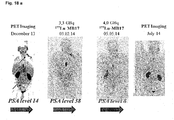
- the compounds of the present invention in particular MB17, show a rapid background clearance as well as a substantial reduction of the enrichment in the kidney after 2 hours while it is further accumulated and retained in the PSMA-expressing tumor. Also first in vivo treatments with MB 17 showed promising data (c.f. Fig. 17 and 18 ).
- the DOTA conjugated-PSMA inhibitors are synthesized via solid-phase peptide synthesis (c.f. Scheme 2).
- the isocyanate of the glutamyl moiety was generated in situ by adding a mixture of 3 mmol of bis(tert-butyl)-L-glutamate hydrochloride and 3 mL of N-ethyldiisopropylamine (DIPEA) in 200 mL of dry CH 2 Cl 2 to a solution of 1 mmol triphosgene in 10 mL of dry CH 2 Cl 2 at 5°C for 3 h.
- DIPEA N-ethyldiisopropylamine
- the subsequent synthesis of the peptidomimetic PSMA binding motif was performed according to standard Fmoc protocol.
- the following coupling of the linker part was performed using 2 mmol of the corresponding Fmoc-protected acid, 3.96 mmol of HBTU and 2 mmol of N-ethyl-diisopropylamine in a final volume of 4 mL DMF.
- 4 eq of tris(t-bu)-DOTA (Chematech) relative to the resin loading were reacted in a final volume of 3 mL DMF.
- the product was cleaved from the resin in a 2 mL mixture consisting of trifluoroacetic acid, triisopropylsilane, and water (95:2.5:2.5).
- the chelator was also conjugated by using HBTU activated DOTA-NHS ester (CheMatech) or DOTA-TFP ester ( Mier W., Hoffend J., Krämer S., Schuhmacher J., Hull W. E., Eisenhut M., Haberkorn U., Bioconjugate Chem. 2005, 16: 237-240 ).
- the radiolabeling of the compounds resulted in a radiochemical yield of >97% after 15 minutes at 95 °C and was determined by RP-HPLC and TLC. Subsequent purification was done using Sep-Pak C18 cartridges.
- the isocyanate of the glutamyl moiety was generated in situ by adding a mixture of 3 mmol of bis(tert-butyl) L-glutamate hydrochloride and 1.5 mL of N- ethyldiisopropylamine (DIPEA) in 200 mL of dry CH 2 Cl 2 to a solution of 1 mmol triphosgene in 10 mL of dry CH 2 Cl 2 at 0 °C over 4 h.
- DIPEA N- ethyldiisopropylamine
- MB-17D which is the stereoisomer of MB17(L)
- the synthesis was based on Fmoc-3(2-naphthyl)-D-alanine. If not stated otherwise, in the present description MB17 means the L-stereoisomer.
- the chelators (DOTA, NOTA, NODAGA, DTPA, CHX-DTPA, PCTA, Do3A) were coupled to the MB17 linker by solid phase synthesis.
- 13 ⁇ mol of resin which was coupled with the PSMA binding motif was swollen with DCM in a syringe with a filter. After washing the resin 5 ⁇ with DMF, it was incubated 2 ⁇ for 5 min with 20% of piperidine in DMF to deprotect the N-terminus. Another 5 ⁇ washing with DMF followed.
- test separations were used. This was achieved by washing a small amount of resin with DCM into a filter tip and adding 100 ⁇ l of separation solution containing 95% TFA, 2.5% water and 2.5% TIPS. After 30 min of incubation, the solution was pipetted into ice cold diethyl ether and centrifuged. The diethyl ether was decanted and the remaining pellet was dissolved in 35 ⁇ l of ACN : H 2 O (1 : 1) and analysed by HPLC (0 - 100% ACN in water within 5 min) and LC/MS. If the desired product was obtained, the complete peptide was separated from the resin.
- the dried resin was incubated with 500 ⁇ l of the separation solution (95% TFA, 2.5% H 2 O, 2.5% TIPS) for 2 hours.
- the resulting solution was mixed with ice cold diethyl ether and centrifuged (4000 min -1 , 5 min). The supernatant was discarded, new diethyl ether was added and the receptacle was shaken vigorously to resuspend the pellet. Again, the solution was centrifuged (4000 min -1 , 5 min) and the resulting supernatant discarded. The pellet was then vacuum dried and finally resuspended in 1 ml of ACN : H 2 O (1 : 1).
- CHX-DTPA was labelled with 68 Ga. 1 ml of 68 Ga was eluted from a 68 Ge/ 68 Ga generator with 0.6 M HCI. 298 ⁇ l NaOAc buffer and 1 ⁇ l of a 10 mM solution of CHX-DTPA in DMSO was added and incubated for 5 min. Afterwards the product was purified using a SOLA cartridge. Washing was done with a 0.9% NaCl solution and for elution ethanol was used. The ethanol then was vaporized and the remaining product was dissolved in 100 ⁇ l of a 0.9% NaCl solution and 10 ⁇ l of phosphate buffer.
- a filter plate MultiScreen HTS -DV was incubated at room temperature with 100 ⁇ l PBS with 1% BSA per well for 30 min. After removing the PBS/BSA solution 10 5 LNCaP cells in 50 ⁇ l of Opti-MEM were applied to each well. Different concentrations of the compounds (leading to concentrations of 0, 0.5, 1, 2.5, 5, 10, 25, 50, 100, 500, 1000 and 5000 nM in each well) in 300 ⁇ l of Opti-MEM were mixed with 3 ⁇ l of a 150 nM solution of 125 l-labeled MIP - 1466 in Opti-MEM. 50 ⁇ l of the resulting solution were added to each well, each concentration was pipetted in quadruples. Each well now contained the radioactively labelled ligand in a concentration of 0.75 nM and the competitive, not labelled ligand in the concentration mentioned above. The plate was then incubated for 45 min at room temperature on a shaker.
- the cells were washed 2 ⁇ with 100 ⁇ l of ice cold PBS and 1 ⁇ with 200 ⁇ l of ice cold PBS. Finally, the filters were collected and the remaining radioactivity was measured with a gamma counter. Each tube was measured for 5 min.
- Example 7 ⁇ PET - imaging using CHX-DTPA-MB17
- the solution containing the purified 68 Ga-CHX-DTPA-coupled PSMA inhibitor was sterile-filtered. 100 ⁇ l of this solution was taken up into a syringe and then injected into a BALB/c nude mouse LNCaP xenograft, intravenously into the tail vein. The PET scan was recorded for 140 min with a Siemens Inveon PET ( Fig. 15 )
- LNCaP cells metal-static lesion of human prostatic adenocarcinoma, ATCC CRL-1740
- RPMI medium supplemented with 10% fetal calf serum and Glutamax (PAA, Austria).
- PAA fetal calf serum
- Glutamax PAG, Austria
- cells were grown at 37°C in an incubator with humidified air, equilibrated with 5 % CO2.
- the cells were harvested using trypsin-ethylenediaminetetraacetic acid (trypsin-EDTA; 0.25% trypsin, 0.02% EDTA, all from PAA, Austria) and washed with PBS.
- trypsin-EDTA trypsin-ethylenediaminetetraacetic acid
- the competitive cell binding assay and internalization experiments were performed as described previously (Eder et al. 2012). Briefly, the respective cells (10 5 per well) were incubated with the radioligand (68Ga-labeled [Glu-urea-Lys(Ahx)]2-HBED-CC (Schafer et al., 2012) in the presence of 12 different concentrations of analyte (0-5000 nM, 100 ⁇ L/well). After incubation, washing was carried out using a multiscreen vacuum manifold (Millipore, Billerica, MA). Cell-bound radioactivity was measured using a gamma counter (Packard Cobra II, GMI, Minnesota, USA). The 50 % inhibitory concentration (IC50) was calculated by fitting the data using a nonlinear regression algorithm (GraphPad Software). Experiments were performed three times.
- the radioligand 68Ga-labeled [Glu-urea-Lys(Ahx)]2-HBED-CC (Schafer et al.,
- the cells were washed with 1 mL of ice-cold PBS and lysed using 0.3 N NaOH (0.5 mL).
- the surface-bound and the internalized fractions were measured in a gamma counter.
- the cell uptake was calculated as per cent of the initially added radioactivity bound to 10 6 cells [%ID/10 6 cells].
- Recombinant human PSMA (rhPSMA, R&D systems, Wiesbaden, Germany) was diluted in assay buffer (50 mM HEPES, 0.1 M NaCl, pH 7.5) to 0.4 ⁇ g/mL.
- assay buffer 50 mM HEPES, 0.1 M NaCl, pH 7.5
- the substrate Ac-Asp-Glu (Sigma, Taufkirchen, Germany, 40 ⁇ M final concentration) was mixed with natGa labeled analyte at concentrations ranging from 0.05 nM to 1000 nM in a final volume of 125 ⁇ L assay buffer.
- the mixtures were combined with 125 ⁇ L of the rhPSMA solution (0.4 ⁇ g/mL) and incubated for one hour at 37°C. The reaction was stopped by heating at 95°C for 5 minutes.
- mice 7- to 8-week-old male BALB/c nu/nu mice (Charles River Laboratories) were subcutaneously inoculated into the right trunk with 5 ⁇ 10 6 cells of LNCaP (in 50% Matrigel; Becton Dickinson, Heidelberg, Germany). The tumors were allowed to grow until approximately 1 cm3 in size. The radiolabeled compounds were injected into the tail vein (approx. 1 MBq per mouse; 0.06 nmol). At 1 h after injection the animals were sacrificed. Organs of interest were dissected, blotted dry, and weighed. The radioactivity was measured using a gamma counter and calculated as % ID/g.
- the present example shows that the binding affinity of PSMA inhibitors can be influenced by linker modifications.
- Two cyclic motives and at least one aromatic moiety in the linker region of the substance seem to be preferable and resulted in the high affinity compounds MB4 and MB17.
- These novel variants show low nanomolar affinity to LNCap cell line and were specifically internalized at 37 °C up to 48 %ID/10 6 cells.
- Former studies showed that besides binding affinity the internalization properties of PSMA-targeting probes are highly important and high internalization rates are essential for high in vivo tumor uptake and retention.
- MB17 represents a novel PSMA-targeting probe with optimal characteristics which was also confirmed by organ distribution and small animal PET imaging.
- MB 17 shows a high PSMA-specific tumor uptake ( Fig.2 ).
- dynamic PET imaging of MB17 ( Fig. 2 ) shows an early enrichment in the bladder and also the maximum kidney uptake (highest point in the time-activity-curve) is as early as 15 min after injection of the radiotracer and diminishes substantially already after 20 minutes. With regard to therapeutic use, this gives clear clinical advantages for MB17 compared to other PSMA-inhibitors.
- MB17 shows a rapid background clearance as well as a substantial reduction of the enrichment in the kidney after 2 hours while it is further accumulated and retained in the PSMA-expressing tumor.
- organ distribution with 177 Lu showed that the high initial kidney uptake is nearly completely washed out (2.13 ⁇ 1.36 % ID/g) after 24 hours while the tumor uptake remained high and even increased (10.58 ⁇ 4.50 % ID/g).
- Other organs as liver (0.08 ⁇ 0.03 % ID/g), lung (0.11 ⁇ 0.13 % ID/g) and spleen (0.13 ⁇ 0.05 % ID/g) showed very low uptake.
- the 68 Ge/ 68 Ga-generator used for radiopharmaceutical production was purchased from IDB-Holland BV (Baarle-Nassau, The Netherlands). Disposable cassette kits and chemicals including the precursor in GMP-compliant grade used for the radiosynthesis were obtained from ABX advanced biochemical compounds (Radeberg, Germany).
- the crude reaction mixture was then removed from the reaction vessel and transferred to a preconditioned (10 mL EtOH/10 mL ultrapure water) C18 cartridge (Waters Sep-Pak light). 9 mL ultrapure water was used to rinse the reaction vessel and passed over the C18 cartridge. The C18 cartridge was washed with another 5 mL of ultrapure water. The final product was eluted from the C18 cartridge with 2 mL of EtOH/H 2 O (v:v 1:1), sterile filtered (Millipore Cathivex-GV, 0.22 ⁇ m) and diluted with 10 mL of phosphate buffered saline (PBS) solution pH 7.4 (according to Eur. Ph. 8.0 (4005000)). The 68 Ga-MB17 complex solution was applied to patients via an intravenous bolus.
- PBS phosphate buffered saline
- the PSMA ligand MB17 was radiolabeled with Lu-177.
- 177 LuCl 3 was obtained from Perkin Elmer (4 GBq, NEZ307D, 0,04 M HCI).
- 80 nmoles of MB17 were dissolved in 400 ⁇ L sodium acetate buffer (0.4 M, pH 5) supplemented with 5 ⁇ L of 20 % ascorbic acid.
- the solution was transferred to the 177 LuCl 3 and incubated for 10 minutes at 95°C. Finally, 2 mL 0.9 % NaCl was added.
- ITLC and radio-HPLC was performed.
- the 177 Lu-labeled MB17 was applied to patients via an intravenous bolus (5 mL, slowly within 30 seconds).
- the intravenous application was accompanied by an infusion of 0.9% NaCl for 4.5 h starting at 0.5 h before injection.
Landscapes
- Health & Medical Sciences (AREA)
- Chemical & Material Sciences (AREA)
- Life Sciences & Earth Sciences (AREA)
- Organic Chemistry (AREA)
- General Health & Medical Sciences (AREA)
- Medicinal Chemistry (AREA)
- Veterinary Medicine (AREA)
- Public Health (AREA)
- Animal Behavior & Ethology (AREA)
- Pharmacology & Pharmacy (AREA)
- Physics & Mathematics (AREA)
- Engineering & Computer Science (AREA)
- Epidemiology (AREA)
- Proteomics, Peptides & Aminoacids (AREA)
- Optics & Photonics (AREA)
- Urology & Nephrology (AREA)
- Immunology (AREA)
- Hematology (AREA)
- Biomedical Technology (AREA)
- Molecular Biology (AREA)
- General Chemical & Material Sciences (AREA)
- Chemical Kinetics & Catalysis (AREA)
- Nuclear Medicine, Radiotherapy & Molecular Imaging (AREA)
- Microbiology (AREA)
- Cell Biology (AREA)
- Biotechnology (AREA)
- Food Science & Technology (AREA)
- Pathology (AREA)
- Biochemistry (AREA)
- General Physics & Mathematics (AREA)
- Analytical Chemistry (AREA)
- Oncology (AREA)
- Bioinformatics & Cheminformatics (AREA)
- Medicines Containing Antibodies Or Antigens For Use As Internal Diagnostic Agents (AREA)
- Medicines That Contain Protein Lipid Enzymes And Other Medicines (AREA)
- Medicinal Preparation (AREA)
- Hospice & Palliative Care (AREA)
- Pharmaceuticals Containing Other Organic And Inorganic Compounds (AREA)
- Acyclic And Carbocyclic Compounds In Medicinal Compositions (AREA)
- Organic Low-Molecular-Weight Compounds And Preparation Thereof (AREA)
Abstract
Description
- The present invention generally relates to the field of radiopharmaceuticals and their use in nuclear medicine as tracers, imaging agents and for the treatment of various disease states of prostate cancer.
- Prostate cancer (PCa) is the leading cancer in the US and European population. At least 1-2 million men in the western hemisphere suffer from prostate cancer and it is estimated that the disease will strike one in six men between the ages of 55 and 85. There are more than 300.000 new cases of prostate cancer diagnosed each year in USA. The mortality from the disease is second only to lung cancer. Currently anatomic methods, such as computed tomography (CT), magnetic resonance (MR) imaging and ultrasound, predominate for clinical imaging of prostate cancer. An estimated $ 2 billion is currently spent worldwide on surgical, radiation, drug therapy and minimally invasive treatments. However, there is presently no effective therapy for relapsing, metastatic, androgen-independent prostate cancer.
- A variety of experimental low molecular weight PCa imaging agents are currently being pursued clinically, including radiolabeled choline analogs [18F]fluorodihydrotestosterone ([18F]FDHT), anti-1-amino-3-[18F]fluorocyclobutyl-1-carboxylic acid (anti[18F]F-FACBC, [11C]acetate and 1-(2-deoxy-2-[18F]flouro-L-arabinofuranosyl)-5-methyluracil (-[18F]FMAU)(Scher, B.; et al. Eur J Nucl Med Mol Imaging 2007, 34, 45-53; Rinnab, L.; et al. BJU Int 2007, 100, 786,793; Reske, S.N.; et al. J Nucl Med 2006, 47, 1249-1254; Zophel, K.; Kotzerke, J. Eur J Nucl Med Mol Imaging 2004, 31, 756-759; Vees, H.; et al. BJU Int 2007, 99, 1415-1420; Larson, S. M.; et al. J Nucl Med 2004, 45, 366-373; Schuster, D.M.; et al. J Nucl Med 2007, 48, 56-63; Tehrani, O.S.; et al. J Nucl Med 2007, 48, 1436-1441). Each operates by a different mechanism and has certain advantages, e.g., low urinary excretion for [11C]choline, and disadvantages, such as the short physical half-life of positron-emitting radionuclides.
- It is well known that tumors may express unique proteins associated with their malignant phenotype or may over-express normal constituent proteins in greater number than normal cells. The expression of distinct proteins on the surface of tumor cells offers the opportunity to diagnose and characterize disease by probing the phenotypic identity and biochemical composition and activity of the tumor. Radioactive molecules that selectively bind to specific tumor cell surface proteins provide an attractive route for imaging and treating tumors under non-invasive conditions. A promising new series of low molecular weight imaging agents targets the prostate-specific membrane antigen (PSMA) (Mease R.C. et al. Clin Cancer Res. 2008, 14, 3036-3043; Foss, C.A.; et al. Clin Cancer Res 2005, 11, 4022-4028; Pomper, M.G.; et al. Mol Imaging 2002, 1, 96-101; Zhou, J.; etr al. Nat Rev Drug Discov 2005, 4, 1015-1026;
WO 2013/022797 ). - PSMA is a trans-membrane, 750 amino acid type II glycoprotein that has abundant and restricted expression on the surface of PCa, particularly in androgen-independent, advanced and metastatic disease (Schulke, N.; et al. Proc Natl Acad Sci U S A 2003, 100, 12590-12595). The latter is important since almost all PCa become androgen independent over the time. PSMA possesses the criteria of a promising target for therapy, i.e., abundant and restricted (to prostate) expression at all stages of the disease, presentation at the cell surface but not shed into the circulation and association with enzymatic or signaling activity (Schulke, N.; et al. Proc. Natl. Acad. Sci. U S A 2003, 100, 12590-12595). The PSMA gene is located on the short arm of chromosome 11 and functions both as a folate hydrolase and neuropeptidase. It has neuropeptidase function that is equivalent to glutamate carboxypeptidase II (GCPII), which is referred to as the "brain PSMA", and may modulate glutamatergic transmission by cleaving N-acetylaspartylglutamate (NAAG) to N-acetylaspartate (NAA) and glutamate (Nan, F.; et al. J Med Chem 2000, 43, 772-774). There are up to 106 PSMA molecules per cancer cell, further suggesting it as an ideal target for imaging and therapy with radionuclide-based techniques (Tasch, J.; et al. Crit Rev Immunol 2001, 21, 249-261).
- The radio-immunoconjugate of the anti-PSMA monoclonal antibody (mAb) 7E11, known as the PROSTASCINT® scan, is currently being used to diagnose prostate cancer metastasis and recurrence. However, this agent tends to produce images that are challenging to interpret (Lange, P.H. PROSTASCINT scan for staging prostate cancer. Urology 2001, 57, 402-406; Haseman, M.K.; et al. Cancer Biother Radiopharm 2000, 15, 131-140; Rosenthal, S.A.; et al. Tech Urol 2001, 7, 27-37). More recently, monoclonal antibodies have been developed that bind to the extracellular domain of PSMA and have been radiolabeled and shown to accumulate in PSMA-positive prostate tumor models in animals. However, diagnosis and tumor detection using monoclonal antibodies has been limited by the low permeability of the monoclonal antibody in solid tumors.
- The selective targeting of cancer cells with radiopharmaceuticals, either for imaging or therapeutic purposes is challenging. A variety of radionuclides are known to be useful for radio-imaging or cancer radiotherapy, including 111In, 90Y, 68Ga, 177Lu, 99mTc, 123I and 131I. Recently it has been shown that some compounds containing a glutamate-urea-glutamate (GUG) or a glutamate-urea-lysine (GUL) recognition element linked to a radionuclide-ligand conjugate exhibit high affinity for PSMA.
- New agents that will enable rapid visualization of prostate cancer and specific targeting to allow radiotherapy present are needed.
- Thus, the object of the present invention is to develop ligands that interact with PSMA and carry appropriate radionuclides which provide a promising and novel targeting option for the detection, treatment and management of prostate cancer.
- The solution of said object is achieved by providing the embodiments characterized in the claims.
- The inventors found new compounds which are useful radiopharmaceuticals and their use in nuclear medicine as tracers, imaging agents and for the treatment of various disease states of prostate cancer.
- The novel imaging agents with structural modifications in the linker region have improved tumor targeting properties and pharmacokinetics. The pharmacophore presents three carboxylic groups able to interact with the respective side chains of PSMA and an oxygen as part of zinc complexation in the active center. Besides these obligatory interactions, the inventors were able to optimize the lipophilic interactions in the linker region.
-
-
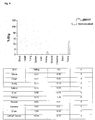
Figure 1 : PET - Imaging of MB17 Whole-body coronal microPET images of an athymic male nude mice bearing LNCaP tumor xenografts. The tumor-targeting efficacy and pharmacokinetic properties of [68Ga]MB17 were evaluated by dynamic microPET scans. Approximately 15 MBq / mouse were injected. Graph A shows the respective time-activity-curves of kidney and baldder and graph B the respective time-activity-curves of heart, muscle and tumor. The values are expressed as mean SUV (standardized uptake values). -
Figure 2 : Organ Distribution at 1 h post injection Organ distribution at one hour post injection of 0.06 nmol of the 68Ga labeled PSMA inhibitor MB17. PSMA-blocking by co-administration of 2 mg/kg body weight 2-PMPA indicates PSMA-specific uptake in the tumor and the kidneys. Data are expressed as mean % ID/g tissue ± SD (n=3). -
Figure 3 : PET - Imaging of MB4 Whole-body coronal microPET images of an athymic male nude mice bearing LNCaP tumor xenografts. The tumor-targeting efficacy and pharmacokinetic properties of [68Ga]MB4 were evaluated by dynamic microPET scans. Approximately 15 MBq / mouse were injected. Graph A shows the respective time-activity-curves of kidney and bladder and graph B the respective time-activity-curves of heart, muscle and tumor. The values are expressed as mean SUV (standardized uptake values) -
Figure 4 : Organ distribution expressed as % ID/g tissue ± SD (n=5) 24 h post injection of 0.06 nmol of the 177 Lu-labeled MB17 Organ distribution with 177Lu shows that the high initial kidney uptake is nearly completely washed out (2.13 ± 1.36 % ID/g) after 24 hours while the tumor uptake remained high and even increased (10.58 ± 4.50 % ID/g). Other organs as liver (0.08 ± 0.03 % ID/g), lung (0.11 ± 0.13 % ID/g) and spleen (0.13 ± 0.05 % ID/g) showed very low uptake. The favourable pharmacokinetics led to extremly high tumor-to-background ratios (Tumor/Blood: 1058; Tumor/Muscle: 529) after 24 hours -
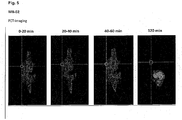
Figure 5 : PET - Imaging ofMB 2 Whole-body coronal microPET images of an athymic male nude mouse bearing LNCaP tumor xenografts. The tumor-targeting efficacy and pharmacokinetic properties of [68Ga]MB2 were evaluated by dynamic microPET scans. Approximately 15 MBq / mouse were injected. -
Figure 6 : PET - Imaging ofMB 3 Whole-body coronal microPET images of an athymic male nude mouse bearing LNCaP tumor xenografts. The tumor-targeting efficacy and pharmacokinetic properties of [68Ga]MB 3 were evaluated by dynamic microPET scans. Approximately 15 MBq / mouse were injected. -
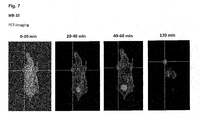
Figure 7 : PET - Imaging of MB10 Whole-body coronal microPET images of an athymic male nude mouse bearing LNCaP tumor xenografts. The tumor-targeting efficacy and pharmacokinetic properties of [68Ga]MB10 were evaluated by dynamic microPET scans. Approximately 15 MBq / mouse were injected. -
Figure 8 : PET - Imaging of MB17.D Whole-body coronal microPET images of an athymic male nude mouse bearing LNCaP tumor xenografts. The tumor-targeting efficacy and pharmacokinetic properties of [68Ga]MB17.D were evaluated by dynamic microPET scans. Approximately 15 MBq / mouse were injected. MB17D: stereoisomer of MB17(L); synthesis based on Fmoc-3(2-naphthyl)-D-alanine -
Figure 9 : PET - Imaging of MB22 Whole-body coronal microPET images of an athymic male nude mouse bearing LNCaP tumor xenografts. The tumor-targeting efficacy and pharmacokinetic properties of [68Ga]MB22 were evaluated by dynamic microPET scans. Approximately 15 MBq / mouse were injected. -
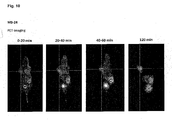
Figure 10 : PET - Imaging ofMB 24 Whole-body coronal microPET images of an athymic male nude mouse bearing LNCaP tumor xenografts. The tumor-targeting efficacy and pharmacokinetic properties of [68Ga]MB 24 were evaluated by dynamic microPET scans. Approximately 15 MBq / mouse were injected. -
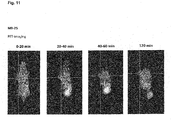
Figure 11 : PET - Imaging of MB25 Whole-body coronal microPET images of an athymic male nude mouse bearing LNCaP tumor xenografts. The tumor-targeting efficacy and pharmacokinetic properties of [68Ga]MB25 were evaluated by dynamic microPET scans. Approximately 15 MBq / mouse were injected. -
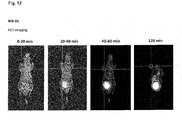
Figure 12 : PET - Imaging of MB31 Whole-body coronal microPET images of an athymic male nude mouse bearing LNCaP tumor xenografts. The tumor-targeting efficacy and pharmacokinetic properties of [68Ga]MB31 were evaluated by dynamic microPET scans. Approximately 15 MBq / mouse were injected. -
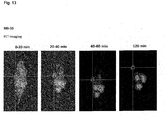
Figure 13 : PET - Imaging of MB33 Whole-body coronal microPET images of an athymic male nude mouse bearing LNCaP tumor xenografts. The tumor-targeting efficacy and pharmacokinetic properties of [68Ga]MB33 were evaluated by dynamic microPET scans. Approximately 15 MBq / mouse were injected. -
Figure 14 : PET - Imaging of MB35 Whole-body coronal microPET images of an athymic male nude mouse bearing LNCaP tumor xenografts. The tumor-targeting efficacy and pharmacokinetic properties of [68Ga]MB35 were evaluated by dynamic microPET scans. Approximately 15 MBq / mouse were injected. -
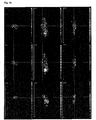
Figure 15 : PET scan of a mouse injected with 68 Ga-CHX-DTPA. On the left the caudal, in the centre the dorsal and on the right the lateral view. The pictures cover the time spans of 20-40 min (top), 40-60 min (centre) and 120-140 min (bottom). -
Fig. 16 : MB-17 vs MB-17.D Whole-body coronal microPET images of athymic male nude mice bearing LNCaP tumor xenografts. The tumor-targeting efficacy and pharmacokinetic properties of the stereoisomers MB-17 and MB-17 D were directly compared at 2 hours post injection. -
Fig. 17 : Human PET/CT imaging 68 Ga-labeled MB17- (a) First clinical experience with 68Ga-labeled MB17 PET/CT demonstrates the detection of small
lymph node metastases 1 hour post injection, primarily due to a high radiotracer uptake. Red arrows point to a representative lesion with a SUVmax of 36.5 and a tumor-to-background ratio of 52.1 one hour post injection. MIP = maximum intensity projection of the PET 1 h post injection. - (b) The significant advantage of 68Ga-labeled MB17 PET/CT is the sensitive detection of lesions even at low PSA level.
- (a) First clinical experience with 68Ga-labeled MB17 PET/CT demonstrates the detection of small
-
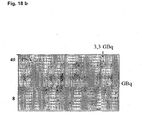
Fig. 18 : PET imaging of patient with multiple prostate cancer metastasis- (a) First scan demonstrate initial PET imaging of the patient with multiple prostate cancer metastases with blood PSA value of 14. Two months later 3.3 GBq of 177Lu-labeled MB17 was applied. At this time point, the amount of PSA in blood reached a value of 38. After the first cycle, the PSA level decreased to 8. Three months after the first cycle another 4 GBq of 177Lu-labeled MB17 was applied. The control PET scan was performed one month after the second cycle. The treatment has shown a significant impact on the tumor lesions and PSA value and resulted in a reduction of bone pain.
- (b) The graph demonstrates the significant impact on the PSA value which decreased after the first application of the therapeutic dose of 177Lu-labeled MB17.
- The present invention relates to radiopharmaceuticals and their use in nuclear medicine as tracers, imaging agents and for the treatment of various disease states of prostate cancer.
- Thus, the present invention concerns compounds that are represented by the general Formulae (Ia) or (Ib):


n: 0,1 m: 1,2,3,4 Z: -CO2H, -SO2H, -SO3H, -SO4H, -PO2H, -PO3H, -PO4H2 X: Naphthyl, Phenyl, Biphenyl, Indolyl (=2,3-benzopyrrolyl), Benzothiazolyl Y: Aryl, Alkylaryl, Cyclopentyl, Cyclohexyl, Cycloheptyl Chelator: 1,4,7,10-tetraazacyclododecane-N,N',N"N"'-tetraacetic acid (= DOTA), N,N "-bis[2-hydroxy-5-(carboxyethyl)benzyl]ethylenediamine-N, N "-diacetic acid (= HBED-CC), 1,4,7-triazacyclononane-1,4,7-triacetic acid (= NOTA), 2-(4,7-bis(carboxymethyl)-1,4,7-triazonan-1-yl)pentanedioic acid (NODAGA), 2-(4,7,10-tris(carboxymethyl)-1,4,7,10-tetraazacyclododecan-1-yl)pentanedioic acid (DOTAGA), 1,4,7-triazacyclononane phosphinic acid (TRAP), 1,4,7-triazacyclononane-1-[methyl(2-carboxyethyl)phosphinic acid]-4,7-bis[methyl(2-hydroxymethyl)phosphinic acid] (NOPO), 3,6,9,15-tetraazabicyclo[9.3.1.]pentadeca-1(15),11, 13-triene-3,6,9-triacetic acid (= PCTA), N'-{5-[Acetyl(hydroxy)amino]pentyl}-N-[5-({4-[(5-aminopentyl)(hydroxy)amino]-4-oxobutanoyl}amino)pentyl]-N-hydroxysuccinamide (DFO), Diethylenetriaminepentaacetic acid (DTPA) Trans-cyclohexyl-diethylenetriaminepentaacetic acid (CHX-DTPA) 1-oxa-4,7,10-triazacyclododecane-4,7,10-triacetic acid (oxo-Do3A) p-isothiocyanatobenzyl-DTPA (SCN-Bz-DTPA) 1-(p-isothiocyanatobenzyl)-3-methyl-DTPA (1B3M) 2-(p-isothiocyanatobenzyl)-4-methyl-DTPA (1M3B) 1-(2)-methyl-4-isocyanatobenzyl-DTPA MX-DTPA) - If not stated otherwise, in the present invention the "alkyl" residue (preferably: C1 to C10) can be linear or branched, unsubstituted or substituted. Preferred alkyl residues are methyl, ethyl, n-propyl, iso-propyl, n-butyl, tert-butyl, n-pentanyl, n-hexanyl. The same also applies to the corresponding cycloalkyl compounds having preferably 3 to 10 carbon atoms.
- "Aryl" refers to an aromatic monocyclic or polycyclic ring system having 6 to 14 carbon atoms, preferably 6 to 10 carbon atoms. The aryl group can be substituted, where appropriate, with one or several ring substituents, like alkyl groups. Preferred aryl groups are phenyl, benzyl or naphthyl.
- Although it is preferred that the Z-Group is -CO2H it may be easily replaced with biosteric replacements such as -SO2H, -SO2H, -SO4H, -PO2H, -PO3H, -PO4H2, see e.g. "The Practice of Medicinal Chemistry" (Academic Press New York, 1996), page 203.
- Within the meaning of the invention, all residues are considered combinable unless stated otherwise in the definition of the residues. All conceivable subgroupings thereof are considered to be disclosed.
- In a preferred embodiment, the motif specifically binding to cell membranes of neoplastic cells is a motif specifically binding to cell membranes of cancerous cells, preferably wherein said motif comprises a prostate-specific membrane antigen (PSMA), in particular wherein said PSMA comprises a glutamate-urea-lysine motif according to the following formula in Scheme1.
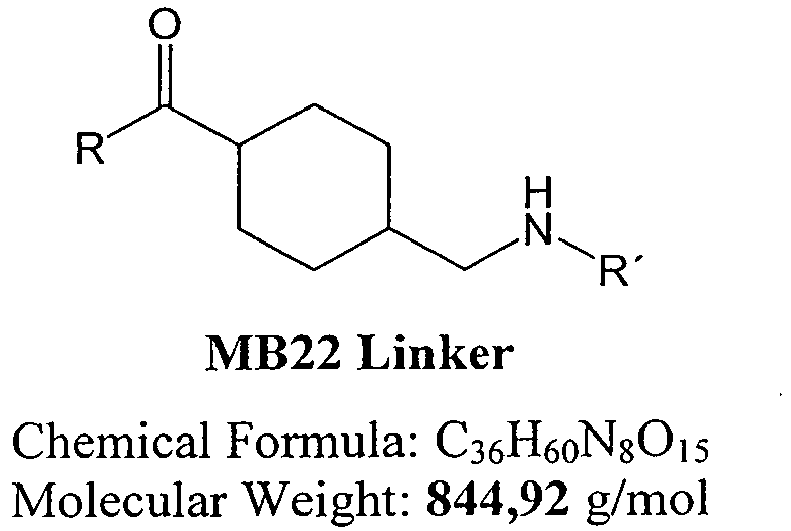
- Thus, preferred molecules of the present invention consist of three principle components (Scheme 1): the hydrophilic PSMA binding motif (Glu-Urea-Lys; = Glu-NH-CO-NH-Lys), a variable linker and the chelator which is preferably DOTA.

- The different preferred linkers are shown below, wherein R=Glu-urea-Lys and R'=DOTA (as a preferred example for the chelator), as shown above.




- Preferred compounds of the present invention are e.g.


- The invention also relates to pharmaceutically acceptable salts of the compounds of general formula (Ia) and/or (lb). The invention also relates to solvates of the compounds, including the salts as well as the active metabolites thereof and, where appropriate, the tautomers thereof according to general formula (Ia) and/or (Ib) including prodrug formulations.
- A "pharmaceutically acceptable salt" is a pharmaceutically acceptable, organic or inorganic acid or base salt of a compound of the invention. Representative pharmaceutically acceptable salts include, e.g., alkali metal salts, alkali earth salts, ammonium salts, water-soluble and water-insoluble salts, such as the acetate, carbonate, chloride, gluconate, glutamate, lactate, laurate, malate or tartrate.
- The term "prodrug" refers to a precursor of a drug that is a compound which upon administration to a patient, must undergo chemical conversion by metabolic processes before becoming an active pharmacological agent. Illustrative prodrugs of compounds in accordance with Formula (Ia) and/or (lb) are esters and amides, preferably alkyl esters of fatty acid esters. Prodrug formulations here comprise all substances which are formed by simple transformation including hydrolysis, oxidation or reduction either enzymatically, metabolically or in any other way. A suitable prodrug contains e.g. a substance of general formula (Ia) and/or (Ib) bound via an enzymatically cleavable linker (e.g. carbamate, phosphate, N-glycoside or a disulfide group) to a dissolution-improving substance (e.g. tetraethylene glycol, saccharides, formic acids or glucuronic acid, etc.). Such a prodrug of a compound according to the invention can be applied to a patient, and this prodrug can be transformed into a substance of general formula (Ia) and/or (Ib) so as to obtain the desired pharmacological effect.
- Some compounds of Formula (Ia) and/or (Ib) are encompassed in form of the racemates, their enantiomers and optionally in form of their diastereomers and all possible mixtures thereof.
- According to the invention all chiral C-atoms shall have D- and/or L-configuration; also combinations within one compound shall be possible, i.e. some of the chiral C-atoms may be D- and others may be L-configuration.
- The obtained compounds can be optionally separated by known methods (e.g. Allinger, N.L. und Elliel E.L. in "Topics in Stereochemistry" Vol. 6, Wiley Interscience, 1971) in their enantiomers and/or diasteromers. One possible method of enantiomeric separation is the use of chromatography.
- The invention also relates to pharmaceutical preparations which contain a therapeutically effective amount of the active ingredients (compound according to the invention of formula (Ia) or (Ib) together with organic or inorganic solid or liquid, pharmaceutically acceptable carriers which are suited for the intended administration and which interact with the active ingredients without drawbacks.
- The phrase "pharmaceutically acceptable" is employed herein to refer to those compounds, material, compositions, and/or dosage forms which are, within the scope of sound medical judgment, suitable for use in contact with the tissues of a patient without excessive toxicity, irritation, allergic response, or other problem or complication, commensurate with a reasonable benefit/risk ratio.
- A "patient" includes an animal, such as a human, monkey, cow, horse, cat or dog. The animal can be a mammal such as a non-primate and a primate (e.g., monkey and human). In one embodiment, a patient is a human being.
- In general, the Formula (Ia) or (Ib) compound or pharmaceutical compositions thereof, may be administered orally or via a parenteral route, usually injection or infusion.
- A "parenteral administration route" means modes of administration other than enteral and topical administration, usually by injection, and includes, without limitation, intravenous, intramusclular, intraarterial, intrathecal, intracapsular, intraorbital, intracardiac, intradermal, intraperitoneal, transtracheal, subcutaneous, subcuticular, intraarticluare, subcapsular, subarachnoid, intraspinal and intrasternal injection and infusion.
- The dosage of the compounds according to the invention is determined by the physician on the basis of the patient-specific parameters, such as age, weight, sex, severity of the disease, etc. The dosage is preferably from 0.00001 mg/kg to 100 mg/kg body weight, preferably from 0.001 to 50 mg/kg body weight and most preferably from 0.01 to 10 mg/kg body weight.
- Corresponding to the kind of administration, the medicament is suitably formulated, e.g. in the form of solutions or suspensions, simple tablets or dragees, hard or soft gelatine capsules, suppositories, ovules, preparations for injection, which are prepared according to common galenic methods.
- The compounds according to the invention can be formulated, where appropriate, together with further active substances and with excipients and carriers common in pharmaceutical compositions, e.g. - depending on the preparation to be produced - talcum, gum arabic, lactose, starch, magnesium stearate, cocoa butter, aqueous and non-aqueous carriers, fatty bodies of animal or vegetable origin, paraffin derivatives, glycols (in particular polyethylene glycol), various plasticizers, dispersants or emulsifiers, pharmaceutically compatible gases (e.g. air, oxygen, carbon dioxide, etc.), preservatives.
- In order to produce liquid preparations, additives, such as sodium chloride solution, ethanol, sorbitol, glycerine, olive oil, almond oil, propylene glycol or ethylene glycol, can be used.
- When solutions for infusion or injection are used, they are preferably aqueous solutions or suspensions, it being possible to produce them prior to use, e.g. from lyophilized preparations which contain the active substance as such or together with a carrier, such as mannitol, lactose, glucose, albumin and the like. The ready made solutions are sterilized and, where appropriate, mixed with excipients, e.g. with preservatives, stabilizers, emulsifiers, solubilizers, buffers and/or salts for regulating the osmotic pressure. The sterilization can be obtained by sterile filtration using filters having a small pore size according to which the composition can be lyophilized, where appropriate. Small amounts of antibiotics can also be added to ensure the maintenance of sterility.
- The phrases "effective amount" or "therapeutically-effective amount" as used herein means that amount of a compound, material, or composition comprising a compound of the invention, or other active ingredient which is effective for producing some desired therapeutic effect in at least a sub-population of cells in an animal at a reasonable benefit/risk ratio applicable to any medical treatment. A therapeutically effective amount with respect to a compound of the invention means that amount of therapeutic agent alone, or in combination with other therapies, that provides a therapeutic benefit in the treatment of prevention of a disease. Used in connection with a compound of the invention, the term can encompass an amount that improves overall therapy, reduces or avoids symptoms or causes of disease, or enhances the therapeutic efficacy of or synergies with another therapeutic agent.
- As used herein, the terms "treating" or "treatment" is intended to encompass also diagnosis, prophylaxis, prevention, therapy and cure.
- The terms "prevent", "preventing," and "prevention" refer to the prevention of the onset, recurrence, or spread of the disease in a patient resulting from the administration of a prophylactic or therapeutic agent.
- Depending on whether the inventive Formula (la) and/or (Ib) compounds are to be used as radio-imaging agents or radio-pharmaceuticals different radionuclides are complexed to the chelator. Illustrative radionuclides include, for example, 89Zr, 44Sc, 111In, 90Y, 66Ga, 67Ga, 68Ga, 177Lu, 99mTc, 61Cu, 62Cu, 64Cu, 67Cu, 149Tb, 152Tb, 155Tb, 161Tb, 153Gd, 155Gd, 157Gd, 213Bi, 225Ac, 230U, 223Ra, 165Er and Fe. According to one aspect of this invention, the radionuclide is 111In, 90Y, 68Ga, 64Cu, 153Gd, 155Gd, 213Bi, 225Ac, Fe, or 177Lu.
- As noted above, complexes of the compounds according Formula (Ia) or (Ib) may contain one or more radionuclides which are suitable for use as radio-imaging agents or as therapeutics for the treatment of rapidly proliferating cells, for example, PSMA expressing prostate cancer cells. According to the present invention they are called "metal complexes" or "radiopharmaceuticals".
- Preferred imaging methods are positron emission tomography (PET) or single photon emission computed tomography (SPECT).
- Accordingly, in one embodiment, a pharmaceutical composition is provided including a complex that includes a radionuclide and a compound of Formula (Ia) or Formula (lb), a salt, solvate, stereoisomer, or tautomer thereof, and a pharmaceutically acceptable carrier.
- According to another aspect, a pharmaceutical composition is provided, which is suitable for in vivo imaging and radiotherapy. Suitable pharmaceutical compositions may contain a radio imaging agent, or a radiotherapeutic agent that has a radionuclide either as an element, i.e. radioactive iodine, or a radioactive metal chelate complex of the compound of Formula (Ia) and/or (Ib) in an amount sufficient for imaging, together with a pharmaceutically acceptable radiological vehicle. The radiological vehicle should be suitable for injection or aspiration, such as human serum albumin; aqueous buffer solutions, e.g., tris(hydromethyl) aminomethane (and its salts), phosphate, citrate, bicarbonate, etc; sterile water physiological saline; and balanced ionic solutions containing chloride and or dicarbonate salts or normal blood plasma cautions such as calcium potassium, sodium and magnesium.
- The concentration of the imaging agent or the therapeutic agent in the radiological vehicle should be sufficient to provide satisfactory imaging. For example, when using an aqueous solution, the dosage is about 1.0 to 100 millicuries. The actual dose administered to a patient for imaging or therapeutic purposes, however, is determined by the physician administering treatment. The imaging agent or therapeutic agent should be administered so as to remain in the patient for about 1 hour to 10 days, although both longer and shorter time periods are acceptable. Therefore, convenient ampoules containing 1 to 10 mL of aqueous solution may be prepared.
- Imaging may be carried out in the normal manner, for example by injecting a sufficient amount of the imaging composition to provide adequate imaging and then scanning with a suitable imaging or scanning machine, such as a tomograph or gamma camera. In certain embodiments, a method of imaging a region in a patient includes the steps of: (i) administering to a patient a diagnostically effective amount of a compound complexed with a radionuclide; exposing a region of the patient to the scanning device; and (ii) obtaining an image of the region of the patient. In certain embodiments of the region imaged is the head or thorax. In other embodiments, the compounds and complexes of Formula I(a) and/or (Ib) target the PSMA protein.
- Thus, in some embodiments, a method of imaging tissue such as spleen tissue, kidney tissue, or PSMA-expressing tumor tissue is provided including contacting the tissue with a complex synthesized by contacting a radionuclide and a Formula (Ia) and/or Formula (Ib) compound.
- The amount of the compound of the present invention, or a formulation comprising a complex of a metal and a compound according to Formula (Ia) and/or (lb), or its salt, solvate, stereoisomer, or tautomer that is administered to a patient depends on several physiological factors that are routinely used by the physician, including the nature of imaging to be carried out, tissue to be targeted for imaging or therapy and the body weight and medical history of the patient to be imaged or treated using a radiopharmaceutical.
- Accordingly in another aspect, the invention provides a method for treating a patient by administering to a patient a therapeutically effective amount of a Formula (Ia) and/or (Ib) compound complexed to a radionuclide, or a pharmaceutically acceptable salt or solvate of the complex to treat a patient suffering from a cell proliferative disease or disorder. Specifically, the cell proliferative disease or disorder to be treated or imaged using a compound, pharmaceutical composition or radiopharmaceutical in accordance with this invention is a cancer, for example, prostate cancer and/or prostate cancer metastasis in e.g. lung, liver, kidney, bones, brain, spinal cord, bladder, etc.
- The synthesis of the compounds of the present invention is described in detail in the example section. An overview of the synthesis is exemplified in
Scheme 2 concerning DOTA conjugated-PSMA inhibitors. However, a person skilled in the art would be able to modify the reactions e.g. by using another chelator. Thus, this scheme shall not be understood to limit the compounds of the present invention to the DOTA chelator only.
- The synthesized compounds are chemically characterized by RP-HPLC, MS, and/or NMR.
- The novel chelator-conjugated imaging agents with structural modifications in the linker region have improved tumor targeting properties and pharmacokinetics. The pharmacophore presents three carboxylic group able to interact with the respective side chains of PSMA and an oxygen as part of zinc complexation in the active center. Besides these obligatory interactions, the inventors were able to optimize the lipophilic interactions in the linker region.
- The preclinical evaluation includes in vitro assays (affinity, internalization) and in vivo experiments (µPET screening and organ distribution).
- The compounds of the present invention are better than known reference compounds with regard to kidney clearance and enrichment in the tumor. The binding affinity of PSMA inhibitors of the present invention can be influenced by linker modifications. Two cyclic motives and at least one aromatic moiety in the linker region of the substance seem to be preferable and resulted in the high affinity compounds MB4 and MB17. In this regard, a very promising compound is MB17.
- Thus, the compounds of the present invention represent novel PSMA-targeting probes with optimal characteristics which was also confirmed by organ distribution and small animal PET imaging. The compounds of the present invention show a high PSMA-specific tumor uptake. In addition, they are characterized by an early enrichment in the bladder and also the maximum kidney uptake. With regard to therapeutic use, this gives clear clinical advantages for the compounds of the present invention compared to other PSMA-inhibitors. In the PET diagrams the compounds of the present invention, in particular MB17, show a rapid background clearance as well as a substantial reduction of the enrichment in the kidney after 2 hours while it is further accumulated and retained in the PSMA-expressing tumor. Also first in vivo treatments with
MB 17 showed promising data (c.f.Fig. 17 and18 ). - The below example explains the invention in more detail but are not construed to limit the invention in any way to the exemplified embodiments only.
- The DOTA conjugated-PSMA inhibitors are synthesized via solid-phase peptide synthesis (c.f. Scheme 2). In a first step, the isocyanate of the glutamyl moiety was generated in situ by adding a mixture of 3 mmol of bis(tert-butyl)-L-glutamate hydrochloride and 3 mL of N-ethyldiisopropylamine (DIPEA) in 200 mL of dry CH2Cl2 to a solution of 1 mmol triphosgene in 10 mL of dry CH2Cl2 at 5°C for 3 h. After the reaction, 0.5 mmol of a resin-immobilized (2-chloro-tritylresin) ε-allyloxycarbonyl protected lysine was added and reacted for 16 h with gentle agitation. The resin was filtered off and the allyloxy-protecting group was removed using 50 mg tetrakis-(triphenyl)palladium and 400 µL morpholine in 4 mL CH2Cl2 for 2 h.
- The subsequent synthesis of the peptidomimetic PSMA binding motif was performed according to standard Fmoc protocol. The following coupling of the linker part was performed using 2 mmol of the corresponding Fmoc-protected acid, 3.96 mmol of HBTU and 2 mmol of N-ethyl-diisopropylamine in a final volume of 4 mL DMF. After activation with 3.95 eq of HBTU and DIPEA for 2 h, 4 eq of tris(t-bu)-DOTA (Chematech) relative to the resin loading were reacted in a final volume of 3 mL DMF. The product was cleaved from the resin in a 2 mL mixture consisting of trifluoroacetic acid, triisopropylsilane, and water (95:2.5:2.5).
- The chelator was also conjugated by using HBTU activated DOTA-NHS ester (CheMatech) or DOTA-TFP ester (Mier W., Hoffend J., Krämer S., Schuhmacher J., Hull W. E., Eisenhut M., Haberkorn U., Bioconjugate Chem. 2005, 16: 237-240).
- Analysis of the synthesized molecules was performed using reversed-phase high performance liquid chromatography (RP-HPLC; Chromolith RP-18e, 100×4.6 mm; Merck, Darmstadt, Germany) with a linear A-B gradient (0% B to 100% B in 6 min) at a flow rate of 4 mL/min (analysis) or 6 mL/min (purification). Solvent A consisted of 0.1% aqueous TFA and solvent B was 0.1% TFA in CH3CN. The HPLC system (L6200 A; Merck-Hitachi, Darmstadt, Germany) was equipped with a UV and a gamma detector (Bioscan; Washington, USA). UV absorbance was measured at 214 nm. Mass spectrometry was performed with a MALDI-MS Daltonics Microflex system (Bruker Daltonics, Bremen, Germany).
- Typically, 1.5 nmol of a synthesized compound of Example 1 (dissolved in 0.1 M HEPES buffer pH 7.5) was added in a volume of 100 µL to a mixture of 10 µL 2.1 M HEPES solution and 40 µL [68Ga]Ga3+ eluate (40 MBq). The pH of the labeling solution was adjusted to 4.5.
- The radiolabeling of the compounds resulted in a radiochemical yield of >97% after 15 minutes at 95 °C and was determined by RP-HPLC and TLC. Subsequent purification was done using Sep-Pak C18 cartridges.
- The isocyanate of the glutamyl moiety was generated in situ by adding a mixture of 3 mmol of bis(tert-butyl) L-glutamate hydrochloride and 1.5 mL of N-ethyldiisopropylamine (DIPEA) in 200 mL of dry CH2Cl2 to a solution of 1 mmol triphosgene in 10 mL of dry CH2Cl2 at 0 °C over 4 h. After agitation of the reaction mixture for 1 h at 25 °C, 0.5 mmol of the resin-immobilized (2-chloro-tritylresin) ε-allyloxycarbonyl protected lysine in 4 mL DCM was added and reacted for 16 h with gentle agitation. The resin was filtered off and the allyloxy-protecting group was removed using 30 mg tetrakis(triphenyl)palladium(0) and 400 µL morpholine in 4 mL CH2Cl2 for 3 hours. The following coupling of 3 times 4-(Fmoc-aminomethyl)benzoic acid (in case of MB4) or Fmoc-3-(2-naphthyl)-L-alanine and trans-4-(Fmoc-aminomethyl)cyclohexanecarboxylic acid (in case of MB17), respectively, was performed stepwise using 2 mmol of the Fmoc-protected acid, 1.96 mmol of HBTU and 2 mmol of N-ethyldiisopropylamine in a final volume of 4 mL DMF. After activation with 3.95 eq of HBTU and DIPEA for 2 h, 4 eq of tris(t-bu)-DOTA (Chematech) relative to the resin loading were reacted for 3 h in a final volume of 3 mL DMF. The product was cleaved from the resin in a 2 mL mixture consisting of trifluoroacetic acid, triisopropylsilane, and water (95:2.5:2.5). Purification was performed using RP-HPLC and the purified product was analysed by analytical RP-HPLC and MALDI-MS.
- For preparing MB-17D which is the stereoisomer of MB17(L), the synthesis was based on Fmoc-3(2-naphthyl)-D-alanine. If not stated otherwise, in the present description MB17 means the L-stereoisomer.
-

- The chelators (DOTA, NOTA, NODAGA, DTPA, CHX-DTPA, PCTA, Do3A) were coupled to the MB17 linker by solid phase synthesis. In general, 13 µmol of resin which was coupled with the PSMA binding motif was swollen with DCM in a syringe with a filter. After washing the
resin 5 × with DMF, it was incubated 2 × for 5 min with 20% of piperidine in DMF to deprotect the N-terminus. Another 5 × washing with DMF followed. - Between 1.5 and 4 equivalents of the chelator (depending of the chelator), 0.98 × nchelator HATU (if needed) and 10 equivalents of DIPEA were dissolved in 500 µl of DMF, the solution was drawn up into the syringe containing the resin and incubated overnight. Next, the resin was washed 5 × each with DMF, methanol, DCM and diethyl ether and dried over vacuum.
- To check the state of the reaction, test separations were used. This was achieved by washing a small amount of resin with DCM into a filter tip and adding 100 µl of separation solution containing 95% TFA, 2.5% water and 2.5% TIPS. After 30 min of incubation, the solution was pipetted into ice cold diethyl ether and centrifuged. The diethyl ether was decanted and the remaining pellet was dissolved in 35 µl of ACN : H2O (1 : 1) and analysed by HPLC (0 - 100% ACN in water within 5 min) and LC/MS. If the desired product was obtained, the complete peptide was separated from the resin. The dried resin was incubated with 500 µl of the separation solution (95% TFA, 2.5% H2O, 2.5% TIPS) for 2 hours. The resulting solution was mixed with ice cold diethyl ether and centrifuged (4000 min-1, 5 min). The supernatant was discarded, new diethyl ether was added and the receptacle was shaken vigorously to resuspend the pellet. Again, the solution was centrifuged (4000 min-1, 5 min) and the resulting supernatant discarded. The pellet was then vacuum dried and finally resuspended in 1 ml of ACN : H2O (1 : 1).
- Purification was achieved by preparative HPLC, the peaks were analysed by analytic HPLC (0 - 100% ACN in water within 5 min) and LC/MS and those containing the product were pooled and lyophilized.
- 177Lu (approx. 100 MBq) was mixed with 200 µl of 0.4 M sodium acetate buffer containing Chelex (pH = 5). 10 µl of a 1 mM solution of the compound in 10% DMSO in water, 2 µl of a saturated solution of ascorbic acid and 40 µl of the solution containing 177Lu were mixed and heated to 95 °C for 10 min. The labelling was checked by radio-HPLC (0 - 100% ACN in water within 5 min, Monolith column).
- For the PET scan CHX-DTPA was labelled with 68Ga. 1 ml of 68Ga was eluted from a 68Ge/68Ga generator with 0.6 M HCI. 298 µl NaOAc buffer and 1 µl of a 10 mM solution of CHX-DTPA in DMSO was added and incubated for 5 min. Afterwards the product was purified using a SOLA cartridge. Washing was done with a 0.9% NaCl solution and for elution ethanol was used. The ethanol then was vaporized and the remaining product was dissolved in 100 µl of a 0.9% NaCl solution and 10 µl of phosphate buffer.
- A filter plate MultiScreenHTS-DV was incubated at room temperature with 100 µl PBS with 1% BSA per well for 30 min. After removing the PBS/
BSA solution 105 LNCaP cells in 50 µl of Opti-MEM were applied to each well. Different concentrations of the compounds (leading to concentrations of 0, 0.5, 1, 2.5, 5, 10, 25, 50, 100, 500, 1000 and 5000 nM in each well) in 300 µl of Opti-MEM were mixed with 3 µl of a 150 nM solution of 125l-labeled MIP - 1466 in Opti-MEM. 50 µl of the resulting solution were added to each well, each concentration was pipetted in quadruples. Each well now contained the radioactively labelled ligand in a concentration of 0.75 nM and the competitive, not labelled ligand in the concentration mentioned above. The plate was then incubated for 45 min at room temperature on a shaker. - After the incubation, the cells were washed 2 × with 100 µl of ice cold PBS and 1 × with 200 µl of ice cold PBS. Finally, the filters were collected and the remaining radioactivity was measured with a gamma counter. Each tube was measured for 5 min.
- The data measured by the gamma counter were evaluated with Graphpad Prism to achieve an inhibition concentration 50 (IC50) against the radioactively labelled MIP-1095.
Conjugate IC50[nM] MB17-DOTA 0.13 ± 0.08 MB17-NOTA 0.14 ± 0.08 MB17-DTPA 0.12 ± 0.05 MB17-CHX-DTPA 0.06 ± 0.04 MB17-PCTA 0.10 ± 0.06 MB17-DO3A 0.10 ± 0.05 MB17-NODAGA 0.09 ± 0.08 - Before injection into the mouse, the solution containing the purified 68Ga-CHX-DTPA-coupled PSMA inhibitor was sterile-filtered. 100 µl of this solution was taken up into a syringe and then injected into a BALB/c nude mouse LNCaP xenograft, intravenously into the tail vein. The PET scan was recorded for 140 min with a Siemens Inveon PET (
Fig. 15 ) - In order to compare the series of novel compounds the competitive binding affinity and the specific internalization was analyzed using the PSMA expressing cell line LNCaP. To determine specific cellular uptake, cells were blocked with 2-(phosphonomethyl)-pentanedioic acid (PMPA). The inhibition potency was also investigated by the enzyme-based NAALADase assay.
- For binding studies and in vivo experiments LNCaP cells (metastatic lesion of human prostatic adenocarcinoma, ATCC CRL-1740) were cultured in RPMI medium supplemented with 10% fetal calf serum and Glutamax (PAA, Austria). During cell culture, cells were grown at 37°C in an incubator with humidified air, equilibrated with 5 % CO2. The cells were harvested using trypsin-ethylenediaminetetraacetic acid (trypsin-EDTA; 0.25% trypsin, 0.02% EDTA, all from PAA, Austria) and washed with PBS.
- The competitive cell binding assay and internalization experiments were performed as described previously (Eder et al. 2012). Briefly, the respective cells (105 per well) were incubated with the radioligand (68Ga-labeled [Glu-urea-Lys(Ahx)]2-HBED-CC (Schafer et al., 2012) in the presence of 12 different concentrations of analyte (0-5000 nM, 100 µL/well). After incubation, washing was carried out using a multiscreen vacuum manifold (Millipore, Billerica, MA). Cell-bound radioactivity was measured using a gamma counter (Packard Cobra II, GMI, Minnesota, USA). The 50 % inhibitory concentration (IC50) was calculated by fitting the data using a nonlinear regression algorithm (GraphPad Software). Experiments were performed three times.
- To determine the specific cell uptake and internalization, 105 cells were seeded in poly-L-lysine coated 24-well cell culture plates 24 h before incubation. After washing, the cells were incubated with 25 nM of the radiolabeled compounds for 45 min at 37°C and at 4°C, respectively. Specific cellular uptake was determined by competitive blocking with 2-(phosphonomethyl)pentanedioic acid (500 µM final concentration , PMPA, Axxora, Loerrach, Germany). Cellular uptake was terminated by washing 4 times with 1 mL of ice-cold PBS. Cells were subsequently incubated twice with 0.5 mL glycine-HCI in PBS (50 mM, pH = 2.8) for 5 min to remove the surface-bound fraction. The cells were washed with 1 mL of ice-cold PBS and lysed using 0.3 N NaOH (0.5 mL). The surface-bound and the internalized fractions were measured in a gamma counter. The cell uptake was calculated as per cent of the initially added radioactivity bound to 106 cells [%ID/106 cells].
- Recombinant human PSMA (rhPSMA, R&D systems, Wiesbaden, Germany) was diluted in assay buffer (50 mM HEPES, 0.1 M NaCl, pH 7.5) to 0.4 µg/mL. The substrate Ac-Asp-Glu (Sigma, Taufkirchen, Germany, 40 µM final concentration) was mixed with natGa labeled analyte at concentrations ranging from 0.05 nM to 1000 nM in a final volume of 125 µL assay buffer. The mixtures were combined with 125 µL of the rhPSMA solution (0.4 µg/mL) and incubated for one hour at 37°C. The reaction was stopped by heating at 95°C for 5 minutes. 250 µL of a 15 mM solution of ortho-phthaldialdehyde (Sigma, Taufkirchen, Germany) was added to all vials and incubated for 10 minutes at ambient temperature. Finally, 200 µL of the reaction solutions were loaded onto a F16 Black Maxisorp Plate (Nunc, Langenselbold, Germany) and read at excitation and emission wavelengths of 330 nm and 450 nm, respectively, using a microplate reader (DTX-880, Beckman Coulter, Krefeld, Germany). The data were analyzed by a one site-total binding regression algorithm of GraphPad (GraphPad Software, California, USA).
- 7- to 8-week-old male BALB/c nu/nu mice (Charles River Laboratories) were subcutaneously inoculated into the right trunk with 5×10⁶ cells of LNCaP (in 50% Matrigel; Becton Dickinson, Heidelberg, Germany). The tumors were allowed to grow until approximately 1 cm3 in size. The radiolabeled compounds were injected into the tail vein (approx. 1 MBq per mouse; 0.06 nmol). At 1 h after injection the animals were sacrificed. Organs of interest were dissected, blotted dry, and weighed. The radioactivity was measured using a gamma counter and calculated as % ID/g.
- For the microPET studies, 10 - 25 MBq of the radiolabeled compounds in a volume of 0.15 ml (∼ 0.5 nmol) were injected via a lateral tail vein into mice bearing LNCaP tumor xenografts. The anesthetized animals (2% sevoflurane, Abbott, Wiesbaden, Germany) were placed in prone position into the Inveon small animal PET scanner (Siemens, Knoxville, Tenn, USA) to perform dynamic microPET scans and 20 min-static scans; c.f.
Fig.1 ,3 ,5-14 Table A Substance IC50 [nM] Internalization [%IA/106 cells] MB2 2.75 ± 0.82 8.78 ± 3.96 for Ga-68 5.22 ± 0.67 for Lu-177 MB3 10.51 ± 6.06 3.65 ± 1.32 for Lu-177 MB4 0.74 ± 0.50 14.18 ± 0.98 for Ga-68 14.25 ± 4.61 for Lu-177 MB10 8.67 ± 1.58 6.96 ± 3.90 for Lu-177 MB17 0.13 ± 0.08 17.02 ± 4.36 for Ga-68 17.51 ± 3.99 for Lu-177 MB17.D 12.41 ± 5.10 2.60 ± 0.14 for Lu-177 MB22 52.80 1.15 ± 0.19 for Lu-177 MB24 3.33 7.26 ± 2.76 for Lu-177 MB25 6.64 3.91 ± 0.54 for Lu-177 MB31 91.80 0.53 ± 0.48 for Lu-177 MB33 59.33 1.96 ± 0.20 for Lu-177 MB35 26.18 0.97 ± 0.17 for Lu-177 - The present example shows that the binding affinity of PSMA inhibitors can be influenced by linker modifications. Two cyclic motives and at least one aromatic moiety in the linker region of the substance seem to be preferable and resulted in the high affinity compounds MB4 and MB17. These novel variants show low nanomolar affinity to LNCap cell line and were specifically internalized at 37 °C up to 48 %ID/106 cells. Former studies showed that besides binding affinity the internalization properties of PSMA-targeting probes are highly important and high internalization rates are essential for high in vivo tumor uptake and retention. Thus, MB17 represents a novel PSMA-targeting probe with optimal characteristics which was also confirmed by organ distribution and small animal PET imaging.
MB 17 shows a high PSMA-specific tumor uptake (Fig.2 ). In addition, dynamic PET imaging of MB17 (Fig. 2 ) shows an early enrichment in the bladder and also the maximum kidney uptake (highest point in the time-activity-curve) is as early as 15 min after injection of the radiotracer and diminishes substantially already after 20 minutes. With regard to therapeutic use, this gives clear clinical advantages for MB17 compared to other PSMA-inhibitors. In the PET diagrams (Fig. 1 ) MB17 shows a rapid background clearance as well as a substantial reduction of the enrichment in the kidney after 2 hours while it is further accumulated and retained in the PSMA-expressing tumor. - In addition, organ distribution with 177Lu (
Fig. 4 ) showed that the high initial kidney uptake is nearly completely washed out (2.13 ± 1.36 % ID/g) after 24 hours while the tumor uptake remained high and even increased (10.58 ± 4.50 % ID/g). Other organs as liver (0.08 ± 0.03 % ID/g), lung (0.11 ± 0.13 % ID/g) and spleen (0.13 ± 0.05 % ID/g) showed very low uptake. The favourable pharmacokinetics led to extremly high tumor-to-background ratios (Tumor/Blood: 1058; Tumor/Muscle: 529) after 24 hours Table A clearly confirms that the chemical modifications in the linker region of the molecule affect the biological properties, e.g. affinity and internalization efficacy. MB17 and MB4 show the most promising binding properties on cells. - The 68Ge/68Ga-generator used for radiopharmaceutical production was purchased from IDB-Holland BV (Baarle-Nassau, The Netherlands). Disposable cassette kits and chemicals including the precursor in GMP-compliant grade used for the radiosynthesis were obtained from ABX advanced biochemical compounds (Radeberg, Germany). An Ultimate 3000 HPLC system (Dionex) (acetonitrile (A), water + 0,1 % TFA (B); gradient: 0.5 min 95% B, 10.0 min 80% A, flowrate: 2 mL/min) equipped with a Chromolith Performance RP-18e column (100 x 4.6 mm, Merck) and a NaI radiodetector (Raytest) was used to determine the radiochemical purity. Residual solvents were determined using a 6850 Series gas chromatograph (Agilent Technologies). Endotoxin testing was performed with an Endosafe®-PTS device (Charles River).
- 2 µg of MB17 were dissolved in 1.5 M acetate buffer pH 4.5 (1 mL) and 1 M ascorbic acid (10 µL) and transferred into the reaction vessel. The 68Ge/68Ga-generator was eluted with 10 mL of 0.6 M HCI and the eluate diluted with 9 mL of ultrapure water. The mixture was then transferred to a cation exchange cartridge (Macherey-Nagel PS-H+, Size M) and eluted with 5 M NaCl solution (1.2 mL) into the preheated reaction vessel (100°C). The reaction mixture was heated for 10 minutes. The crude reaction mixture was then removed from the reaction vessel and transferred to a preconditioned (10 mL EtOH/10 mL ultrapure water) C18 cartridge (Waters Sep-Pak light). 9 mL ultrapure water was used to rinse the reaction vessel and passed over the C18 cartridge. The C18 cartridge was washed with another 5 mL of ultrapure water. The final product was eluted from the C18 cartridge with 2 mL of EtOH/H2O (v:v 1:1), sterile filtered (Millipore Cathivex-GV, 0.22 µm) and diluted with 10 mL of phosphate buffered saline (PBS) solution pH 7.4 (according to Eur. Ph. 8.0 (4005000)). The 68Ga-MB17 complex solution was applied to patients via an intravenous bolus.
- For therapy, the PSMA ligand MB17 was radiolabeled with Lu-177. 177LuCl3 was obtained from Perkin Elmer (4 GBq, NEZ307D, 0,04 M HCI). 80 nmoles of MB17 were dissolved in 400 µL sodium acetate buffer (0.4 M, pH 5) supplemented with 5 µL of 20 % ascorbic acid. The solution was transferred to the 177LuCl3 and incubated for 10 minutes at 95°C. Finally, 2 mL 0.9 % NaCl was added. For quality control, ITLC and radio-HPLC was performed.
- The 177Lu-labeled MB17 was applied to patients via an intravenous bolus (5 mL, slowly within 30 seconds). The intravenous application was accompanied by an infusion of 0.9% NaCl for 4.5 h starting at 0.5 h before injection. Reference is made to
Fig. 18 .
Claims (5)
- A compound of the formula

- A compound according to claim 1 having a formula

- A lyophilized preparation containing a compound, or a pharmaceutically acceptable salt thereof, or a solvate thereof, or a solvate of the salt thereof, or an ester or an amide thereof, according to claim 1 or 2.
- A lyophilized preparation containing a compound or a pharmaceutically acceptable salt thereof, or a solvate thereof, or a solvate of the salt thereof, or an ester or an amide thereof, according to any of claims 1 to 3, further comprising a carrier.
- A lyophilized preparation according to claim 4, wherein said carrier is mannitol, lactose, glucose or albumin.
Applications Claiming Priority (4)
| Application Number | Priority Date | Filing Date | Title |
|---|---|---|---|
| EP20130004991 EP2862857A1 (en) | 2013-10-18 | 2013-10-18 | Labeled inhibitors of prostate specific membrane antigen (PSMA), their use as imaging agents and pharmaceutical agents for the treatment of prostate cancer |
| EP14175612 | 2014-07-03 | ||
| EP14799340.6A EP3038996B1 (en) | 2013-10-18 | 2014-10-17 | MARKED INHIBITORS OF PROSTATE-SPECIFIC MEMBRANE ANTIGEN (PSMA), THEIR USE AS IMAGING AGENTS AND PHARMACEUTICAL AGENTS FOR THE TREATMENT OF PROSTATE CANCER |
| PCT/EP2014/002808 WO2015055318A1 (en) | 2013-10-18 | 2014-10-17 | Labeled inhibitors of prostate specific membrane antigen (psma), their use as imaging agents and pharmaceutical agents for the treatment of prostate cancer |
Related Parent Applications (3)
| Application Number | Title | Priority Date | Filing Date |
|---|---|---|---|
| PCT/EP2014/002808 Previously-Filed-Application WO2015055318A1 (en) | 2013-10-18 | 2014-10-17 | Labeled inhibitors of prostate specific membrane antigen (psma), their use as imaging agents and pharmaceutical agents for the treatment of prostate cancer |
| EP14799340.6A Division-Into EP3038996B1 (en) | 2013-10-18 | 2014-10-17 | MARKED INHIBITORS OF PROSTATE-SPECIFIC MEMBRANE ANTIGEN (PSMA), THEIR USE AS IMAGING AGENTS AND PHARMACEUTICAL AGENTS FOR THE TREATMENT OF PROSTATE CANCER |
| EP14799340.6A Division EP3038996B1 (en) | 2013-10-18 | 2014-10-17 | MARKED INHIBITORS OF PROSTATE-SPECIFIC MEMBRANE ANTIGEN (PSMA), THEIR USE AS IMAGING AGENTS AND PHARMACEUTICAL AGENTS FOR THE TREATMENT OF PROSTATE CANCER |
Publications (1)
| Publication Number | Publication Date |
|---|---|
| EP3456700A1 true EP3456700A1 (en) | 2019-03-20 |
Family
ID=51903864
Family Applications (6)
| Application Number | Title | Priority Date | Filing Date |
|---|---|---|---|
| EP18184296.4A Withdrawn EP3456700A1 (en) | 2013-10-18 | 2014-10-17 | Labeled inhibitors of prostate specific membrane antigen (psma), their use as imaging agents and pharmaceutical agents for the treatment of prostate cancer |
| EP14799340.6A Withdrawn - After Issue EP3038996B1 (en) | 2013-10-18 | 2014-10-17 | MARKED INHIBITORS OF PROSTATE-SPECIFIC MEMBRANE ANTIGEN (PSMA), THEIR USE AS IMAGING AGENTS AND PHARMACEUTICAL AGENTS FOR THE TREATMENT OF PROSTATE CANCER |
| EP18203547.7A Withdrawn EP3495355A1 (en) | 2013-10-18 | 2014-10-17 | Labeled inhibitors of prostate specific membrane antigen (psma), their use as imaging agents and pharmaceutical agents for the treatment of prostate cancer |
| EP22178736.9A Active EP4095130B1 (en) | 2013-10-18 | 2014-10-17 | Labeled inhibitors of prostate specific membrane antigen (psma), their use as imaging agents and pharmaceutical agents for the treatment of prostate cancer |
| EP24154479.0A Pending EP4374924A3 (en) | 2013-10-18 | 2014-10-17 | Labeled inhibitors of prostate specific membrane antigen (psma), their use as imaging agents and pharmaceutical agents for the treatment of prostate cancer |
| EP18172716.5A Withdrawn EP3415489A1 (en) | 2013-10-18 | 2014-10-17 | Labeled inhibitors of prostate specific membrane antigen (psma), their use as imaging agents and pharmaceutical agents for the treatment of prostate cancer |
Family Applications After (5)
| Application Number | Title | Priority Date | Filing Date |
|---|---|---|---|
| EP14799340.6A Withdrawn - After Issue EP3038996B1 (en) | 2013-10-18 | 2014-10-17 | MARKED INHIBITORS OF PROSTATE-SPECIFIC MEMBRANE ANTIGEN (PSMA), THEIR USE AS IMAGING AGENTS AND PHARMACEUTICAL AGENTS FOR THE TREATMENT OF PROSTATE CANCER |
| EP18203547.7A Withdrawn EP3495355A1 (en) | 2013-10-18 | 2014-10-17 | Labeled inhibitors of prostate specific membrane antigen (psma), their use as imaging agents and pharmaceutical agents for the treatment of prostate cancer |
| EP22178736.9A Active EP4095130B1 (en) | 2013-10-18 | 2014-10-17 | Labeled inhibitors of prostate specific membrane antigen (psma), their use as imaging agents and pharmaceutical agents for the treatment of prostate cancer |
| EP24154479.0A Pending EP4374924A3 (en) | 2013-10-18 | 2014-10-17 | Labeled inhibitors of prostate specific membrane antigen (psma), their use as imaging agents and pharmaceutical agents for the treatment of prostate cancer |
| EP18172716.5A Withdrawn EP3415489A1 (en) | 2013-10-18 | 2014-10-17 | Labeled inhibitors of prostate specific membrane antigen (psma), their use as imaging agents and pharmaceutical agents for the treatment of prostate cancer |
Country Status (35)
| Country | Link |
|---|---|
| US (11) | US20160228587A1 (en) |
| EP (6) | EP3456700A1 (en) |
| JP (7) | JP2016535013A (en) |
| KR (3) | KR102210931B1 (en) |
| CN (2) | CN105636924B (en) |
| AU (3) | AU2014336638C1 (en) |
| CA (1) | CA2924360C (en) |
| CL (1) | CL2016000883A1 (en) |
| CY (1) | CY2024023I1 (en) |
| DE (2) | DE202014011593U1 (en) |
| DK (1) | DK4095130T3 (en) |
| EA (1) | EA037778B1 (en) |
| ES (1) | ES2977715T3 (en) |
| FI (2) | FI4095130T3 (en) |
| FR (1) | FR24C1028I2 (en) |
| GE (8) | GEP20237479B (en) |
| HR (1) | HRP20240398T1 (en) |
| HU (2) | HUE066137T2 (en) |
| IL (2) | IL245113B (en) |
| LT (2) | LT4095130T (en) |
| LU (1) | LUC00352I2 (en) |
| MX (3) | MX2016005013A (en) |
| MY (2) | MY194484A (en) |
| NL (1) | NL301281I2 (en) |
| NZ (1) | NZ718812A (en) |
| PE (2) | PE20211760A1 (en) |
| PH (2) | PH12019502571A1 (en) |
| PL (1) | PL4095130T3 (en) |
| RS (1) | RS65324B1 (en) |
| SA (1) | SA516370842B1 (en) |
| SG (1) | SG11201602249RA (en) |
| SI (1) | SI4095130T1 (en) |
| TN (1) | TN2016000137A1 (en) |
| WO (1) | WO2015055318A1 (en) |
| ZA (2) | ZA201603380B (en) |
Families Citing this family (106)
| Publication number | Priority date | Publication date | Assignee | Title |
|---|---|---|---|---|
| CA2669127C (en) | 2006-11-08 | 2016-09-13 | Molecular Insight Pharmaceuticals, Inc. | Heterodimers of glutamic acid |
| US9193763B2 (en) | 2007-08-17 | 2015-11-24 | Purdue Research Foundation | PSMA binding ligand-linker conjugates and methods for using |
| US9951324B2 (en) | 2010-02-25 | 2018-04-24 | Purdue Research Foundation | PSMA binding ligand-linker conjugates and methods for using |
| AU2013344778C1 (en) | 2012-11-15 | 2024-06-27 | Endocyte, Inc. | Conjugates for treating diseases caused by PSMA expressing cells |
| EP3456700A1 (en) | 2013-10-18 | 2019-03-20 | Deutsches Krebsforschungszentrum | Labeled inhibitors of prostate specific membrane antigen (psma), their use as imaging agents and pharmaceutical agents for the treatment of prostate cancer |
| CN105849568B (en) | 2013-11-14 | 2018-05-04 | 恩多塞特公司 | Compounds for Positron Emission Tomography |
| US10188759B2 (en) | 2015-01-07 | 2019-01-29 | Endocyte, Inc. | Conjugates for imaging |
| EP3337520A1 (en) * | 2015-08-20 | 2018-06-27 | Universität zu Köln | Pain tracking by pet-imaging (pain-trap) |
| SI3356385T1 (en) * | 2015-09-30 | 2021-04-30 | Deutsches Krebsforschungszentrum | 18f-tagged inhibitors of prostate specific membrane antigen (psma) and their use as imaging agents for prostate cancer |
| US10688200B2 (en) * | 2015-12-31 | 2020-06-23 | Five Eleven Pharma Inc. | Urea-based prostate specific membrane antigen (PSMA) inhibitors for imaging and therapy |
| RS62274B1 (en) * | 2016-03-22 | 2021-09-30 | Univ Johns Hopkins | Prostate-specific membrane antigen targeted high-affinity agents for endoradiotherapy of prostate cancer |
| US10806806B2 (en) | 2016-06-23 | 2020-10-20 | Cornell University | Trifunctional constructs with tunable pharmacokinetics useful in imaging and anti-tumor therapies |
| AU2017281364B2 (en) | 2016-06-23 | 2023-06-22 | Cornell University | Double targeted constructs to affect tumor kill |
| WO2018108287A1 (en) * | 2016-12-15 | 2018-06-21 | The European Atomic Energy Community (Euratom), Represented By The European Commission | Treatment of pmsa expressing cancers |
| KR102724812B1 (en) * | 2017-04-05 | 2024-11-01 | 코넬 유니버시티 | Trifunctional constructs with tunable pharmacokinetics useful for imaging and antitumor therapy |
| WO2018204477A1 (en) | 2017-05-02 | 2018-11-08 | Cornell University | Methods and reagents for tumor targeting with greater efficacy and less toxicity |
| JP7693317B2 (en) | 2017-05-05 | 2025-06-17 | センター・フォー・プローブ・デベロップメント・アンド・コマーシャライゼイション | Pharmacokinetic enhancement of bifunctional chelates and uses thereof |
| MA49398A (en) | 2017-05-05 | 2020-04-22 | Eric Steven Burak | ANTI-IGF-1R MONOCLONAL ANTIBODIES AND USES OF THEM |
| US10093741B1 (en) | 2017-05-05 | 2018-10-09 | Fusion Pharmaceuticals Inc. | IGF-1R monoclonal antibodies and uses thereof |
| KR102843240B1 (en) | 2017-05-24 | 2025-08-05 | 이테엠 이소토페 테크놀로기에스 뮈니치 에스이 | Novel PSMA-conjugates and their uses |
| WO2018233798A1 (en) | 2017-06-20 | 2018-12-27 | ITM Isotopen Technologien München AG | NOVEL PSMA BINDING AGENTS AND USE THEREOF |
| WO2018222778A1 (en) * | 2017-05-30 | 2018-12-06 | The Johns Hopkins University | Prostate-specific membrane antigen targeted high-affinity agents for endoradiotherapy of prostate cancer |
| JP7755371B2 (en) | 2017-06-09 | 2025-10-16 | アヴェンセル ユーロップ ゲー・エム・ベー・ハー | Targeting modules for common chimeric antigen receptor-expressing immune cells and uses in the treatment of cancer, infection and autoimmune disorders |
| CN109510921B (en) | 2017-09-15 | 2025-01-10 | 南昌欧菲光电技术有限公司 | Camera module |
| CN207184660U (en) | 2017-09-15 | 2018-04-03 | 南昌欧菲光电技术有限公司 | Camera module |
| CN109510925A (en) | 2017-09-15 | 2019-03-22 | 南昌欧菲光电技术有限公司 | Camera module |
| US20200339625A1 (en) * | 2017-10-22 | 2020-10-29 | Provincial Health Services Authority | Novel radiometal-binding compounds for diagnosis or treatment of prostate specific membrane antigen-expressing cancer |
| AU2018363807B2 (en) | 2017-11-13 | 2024-11-28 | Deutsches Krebsforschungszentrum | A double-labeled probe for molecular imaging and use thereof |
| EP3713606A1 (en) | 2017-11-21 | 2020-09-30 | Deutsches Krebsforschungszentrum | A double-labeled probe for molecular imaging and use thereof |
| SMT202400439T1 (en) * | 2017-12-11 | 2024-11-15 | Univ Muenchen Tech | Psma ligands for imaging and endoradiotherapy |
| WO2019115684A1 (en) * | 2017-12-13 | 2019-06-20 | Sciencons AS | Complex comprising a psma-targeting compound linked to a lead or thorium radionuclide |
| CA3090495A1 (en) * | 2018-02-06 | 2019-08-15 | The Johns Hopkins University | Psma targeted radiohalogenated urea-polyaminocarboxylates for cancer radiotherapy |
| MX380340B (en) | 2018-03-14 | 2025-03-11 | Instituto Nac De Investigaciones Nucleares | 177LU-DOTA-HYNIC-IPSMA AS A THERAPEUTIC RADIOPHARMACO DIRECTED AT THE PROSTATIC MEMBRANE-SPECIFIC ANTIGEN. |
| CA3094620C (en) | 2018-03-30 | 2022-11-22 | Futurechem Co., Ltd. | Psma-targeted radiopharmaceutical for diagnosing and treating prostate cancer |
| KR20210003135A (en) * | 2018-04-17 | 2021-01-11 | 엔도사이트, 인코포레이티드 | Cancer treatment method |
| EP3852816A4 (en) * | 2018-09-21 | 2022-07-13 | Endocyte, Inc. | CANCER TREATMENT METHODS |
| EP3853213A4 (en) * | 2018-09-21 | 2022-07-06 | Endocyte, Inc. | PROTECTIVE AGENTS AND THEIR USE |
| JP7500551B2 (en) * | 2018-09-28 | 2024-06-17 | ウニベルジテート ハイデルベルク | Labeled inhibitors of prostate specific membrane antigen (psma), their use as imaging agents, and pharmaceutical agents for the treatment of psma-expressing cancers - Patents.com |
| DE102018126558A1 (en) | 2018-10-24 | 2020-04-30 | Helmholtz-Zentrum Dresden - Rossendorf E.V. | Marking precursor with square acid coupling |
| WO2020108753A1 (en) | 2018-11-28 | 2020-06-04 | ITM Isotopen Technologien München AG | Novel tumor antigen binding agents and uses thereof |
| KR20210110834A (en) | 2018-12-18 | 2021-09-09 | 프로빈셜 헬스 서비시즈 오쏘리티 | Dual mode 18F-labeled theranostic compounds and uses thereof |
| WO2020157177A1 (en) * | 2019-01-30 | 2020-08-06 | Technische Universität München | Psma binding dual mode radiotracer and therapeutic |
| CN113710286A (en) | 2019-02-14 | 2021-11-26 | 海德堡鲁普雷希特卡尔斯大学 | Prostate Specific Membrane Antigen (PSMA) ligands with improved tissue specificity |
| US20220324898A1 (en) | 2019-02-14 | 2022-10-13 | Deutsches Krebsforschungszentrum | Prostate specific membrane antigen (psma) ligands comprising an amylase cleavable linker |
| US11396535B2 (en) | 2019-03-01 | 2022-07-26 | Provincial Health Services Authority | Cyclic peptide analogs of melanocortin and amanitin and methods of making such |
| PL239934B1 (en) | 2019-04-12 | 2022-01-31 | Narodowe Centrum Badan Jadrowych Osrodek Radioizotopow Polatom | Derivatives of PSMA inhibitors for ⁹⁹ᵐTc labelling by HYNIC, radiopharmaceutical kit, radiopharmaceutical preparations and their use in the diagnosis of prostate cancer |
| US12472272B2 (en) | 2019-04-17 | 2025-11-18 | Provincial Health Services Authority | Radiolabelled compounds for diagnosis or treatment of prostate-specific membrane antigen- expressing cancer |
| JP7729609B2 (en) * | 2019-04-26 | 2025-08-26 | ファイブ イレブン ファーマ インコーポレイテッド | Prostate-specific membrane antigen (PSMA) inhibitors as diagnostic and radionuclide therapeutic agents |
| JP7604397B2 (en) | 2019-05-20 | 2024-12-23 | エンドサイト・インコーポレイテッド | Methods for preparing PSMA conjugates |
| CA3144094A1 (en) | 2019-06-21 | 2020-12-24 | Provincial Health Services Authority | Radiolabeled compounds targeting the prostate-specific membrane antigen |
| AU2020299974A1 (en) * | 2019-07-02 | 2022-01-27 | Advanced Accelerator Applications (Italy) Srl | Prostate specific membrane antigen (PSMA) ligands and uses thereof |
| AR119479A1 (en) | 2019-07-25 | 2021-12-22 | Bayer As | DIRECTED RADIOPHARMACEUTICALS FOR THE DIAGNOSIS AND TREATMENT OF CANCER |
| KR102269315B1 (en) | 2019-10-24 | 2021-06-24 | 서울대학교산학협력단 | A radiolabeled compound for imaging or therapy of prostate cancer |
| DE102019135564B4 (en) | 2019-12-20 | 2022-05-19 | Johannes-Gutenberg-Universität Mainz | Connection for smart drug delivery and pharmaceutical kit for dual nuclear medicine-cytotoxic theranostics |
| CN115380117A (en) * | 2020-02-18 | 2022-11-22 | 恩多塞特公司 | Methods of treating PSMA-expressing cancers |
| CN113350531A (en) * | 2020-03-02 | 2021-09-07 | 上海核力星医药科技有限公司 | Prostate specific membrane antigen binding ligand conjugate and application thereof |
| WO2021202376A1 (en) | 2020-03-30 | 2021-10-07 | The United States Of America, As Represented By The Secretary, Department Of Health And Human Services | Method for blocking uptake of prostate-specific membrane antigen (psma)-targeted radionuclides by exocrine organs |
| US20230165979A1 (en) * | 2020-05-06 | 2023-06-01 | Cornell University | Copper-containing theragnostic compositions and methods of use |
| EP3919082A1 (en) * | 2020-06-04 | 2021-12-08 | Rigshospitalet | Psma targeting urea-based ligands for prostate cancer radiotherapy and imaging |
| JP2023539990A (en) | 2020-07-13 | 2023-09-21 | ポイント バイオファーマ インコーポレイテッド | Radiopharmaceuticals and methods |
| US11129912B1 (en) | 2020-07-13 | 2021-09-28 | POINT Biopharma Inc. | Radiopharmaceutical and methods |
| CN112062695B (en) * | 2020-08-14 | 2021-04-06 | 北京大学第一医院 | Prostate specific membrane antigen targeted inhibitor, application and probe |
| EP4204020A1 (en) | 2020-08-31 | 2023-07-05 | Advanced Accelerator Applications International S.A. | Method of treating psma-expressing cancers |
| WO2022043557A1 (en) | 2020-08-31 | 2022-03-03 | Advanced Accelerator Applications International Sa | Method of treating psma-expressing cancers |
| IL301342A (en) | 2020-10-21 | 2023-05-01 | Provincial Health Services Authority | Novel cxcr4-targeting compounds |
| CN112321673B (en) * | 2020-11-04 | 2022-09-20 | 北京市肿瘤防治研究所 | Prostate specific membrane antigen targeted inhibitor, application and probe |
| WO2022096103A1 (en) | 2020-11-05 | 2022-05-12 | ITM Isotopen Technologien München AG | Combination of para-aminohippuric acid (pah) and radiolabeled complexes for treating cancer |
| ES3053944T3 (en) * | 2020-11-19 | 2026-01-28 | Novartis Ag | Synthesis of prostate specific membrane antigen (psma) ligands |
| WO2022111800A1 (en) | 2020-11-25 | 2022-06-02 | Itm Solucin Gmbh | Stable formulations for radionuclide complexes |
| CN114685599A (en) * | 2020-12-30 | 2022-07-01 | 南京江原安迪科正电子研究发展有限公司 | PSMA (patterned beam mosaic Virus inhibitor) targeted inhibitor, radionuclide-labeled PSMA targeted inhibitor, preparation method and application |
| EP4023250A1 (en) * | 2021-01-04 | 2022-07-06 | Technische Universität München | Dual mode radiotracer and -therapeutics |
| DE102021101216A1 (en) | 2021-01-21 | 2022-07-21 | Johannes Gutenberg-Universität Mainz, Körperschaft des öffentlichen Rechts | Label precursors and radiotracers for nuclear medicine diagnosis and therapy of prostate cancer-induced bone metastases |
| WO2022157094A2 (en) | 2021-01-22 | 2022-07-28 | Bayer Aktiengesellschaft | Lrrc15 antibodies and conjugates thereof |
| CN112851637B (en) * | 2021-01-22 | 2022-11-18 | 北京瑞达福明科技有限公司 | PSMA inhibitor, compound, preparation method and application thereof |
| CN112898270B (en) * | 2021-01-22 | 2023-03-21 | 周彤 | Diagnosis and treatment integrated PSMA inhibitor and compound, and preparation method and application thereof |
| CA3206250A1 (en) | 2021-02-08 | 2022-08-11 | Mark RIJPKEMA | Psma-targeting ligands for multimodal applications |
| EP4326246A4 (en) | 2021-04-23 | 2026-04-15 | Wisconsin Alumni Res Found | Psma-targeting ligands with optimal properties for imaging and therapy |
| JP2024519970A (en) * | 2021-05-21 | 2024-05-21 | ノーススター メディカル テクノロジーズ リミテッド ライアビリティ カンパニー | Trivalent radioisotope biologically targeted radiopharmaceuticals, methods of preparation and uses |
| CN113372285B (en) * | 2021-05-28 | 2024-06-18 | 西南医科大学附属医院 | Prostate specific membrane antigen inhibitor, radionuclide marker, preparation method and application thereof |
| DE102021114711B4 (en) | 2021-06-08 | 2023-11-02 | Medianezia GmbH | Trislinker-conjugated dimeric labeling precursors and radiotracers derived therefrom |
| KR20240072996A (en) | 2021-07-30 | 2024-05-24 | 오사카 유니버시티 | Radiolabeled compounds and their uses |
| JP2024532475A (en) * | 2021-09-01 | 2024-09-05 | 天津恒瑞医薬有限公司 | Inhibitors of prostate specific membrane antigen and pharmaceutical uses thereof |
| CN118852043A (en) * | 2021-09-03 | 2024-10-29 | 晶核生物医药科技(南京)有限公司 | A peptide urea derivative, a pharmaceutical composition containing the same and its application |
| CN115806529A (en) * | 2021-09-15 | 2023-03-17 | 威智医药有限公司 | PSMA binding agents and uses thereof |
| CN114014843B (en) * | 2021-11-17 | 2022-09-20 | 北京大学第一医院 | PSMA targeted nuclide/fluorescent bimodal ligand, molecular probe and application |
| WO2023143612A1 (en) * | 2022-01-30 | 2023-08-03 | 晶核生物医药科技(南京)有限公司 | Peptide urea derivative, pharmaceutical composition containing peptide urea derivative, and application of peptide urea derivative |
| WO2023208928A1 (en) | 2022-04-26 | 2023-11-02 | Deutsches Krebsforschungszentrum Stiftung des öffentlichen Rechts | Dosage of psma-ligands for fluorescence based detection of cancerous tissue |
| WO2023222679A1 (en) | 2022-05-17 | 2023-11-23 | Deutsches Krebsforschungszentrum Stiftung des öffentlichen Rechts | Prostate specific membrane antigen (psma) ligands |
| US20250360236A1 (en) | 2022-05-17 | 2025-11-27 | Deutsches Krebsforschungszentrum Stiftung des öffentlichen Rechts | Prostate specific membrane antigen (psma) ligands |
| KR20250011145A (en) | 2022-05-17 | 2025-01-21 | 도이체스크레브스포르슝스젠트룸스티프퉁데스외펜트리헨레크츠 | Prostate-specific membrane antigen (PSMA) ligand with improved renal clearance |
| US20250312496A1 (en) | 2022-05-17 | 2025-10-09 | Deutsches Krebsforschungszentrum Stiftung des öffentlichen Rechts | Prostate specific membrane antigen (psma) ligands |
| CN114874122A (en) * | 2022-05-31 | 2022-08-09 | 南京航空航天大学 | Novel small molecule inhibitor and preparation method and application thereof |
| WO2023240135A2 (en) | 2022-06-07 | 2023-12-14 | Actinium Pharmaceuticals, Inc. | Bifunctional chelators and conjugates |
| AU2023283882A1 (en) | 2022-06-10 | 2025-01-30 | Peking University | Trifunctional compound and use thereof |
| TW202426433A (en) | 2022-09-23 | 2024-07-01 | 瑞士商紐利迪姆股份公司 | Fibroblast activation protein (fap) inhibitors, fap conjugates, and diagnostic and therapeutic uses thereof |
| WO2024064969A2 (en) | 2022-09-23 | 2024-03-28 | Nuclidium Ag | High-purity copper radiopharmaceutical compositions and diagnostic and therapeutic uses thereof |
| AU2024208501A1 (en) | 2023-01-10 | 2025-07-24 | Sun Pharma Advanced Research Company Limited | Ligand-drug conjugates |
| US12539339B2 (en) * | 2023-03-24 | 2026-02-03 | Jubilant Draximage Inc. | Radiopharmaceutical conjugate compound for diagnosis and/or therapeutic uses thereof |
| IL326014A (en) | 2023-07-21 | 2026-03-01 | Novartis Ag | Psma-targeting radioligand treatment regimen |
| WO2025041103A1 (en) | 2023-08-23 | 2025-02-27 | Bright Peak Therapeutics Ag | Psma targeting ligands and methods of use |
| WO2025071977A1 (en) * | 2023-09-28 | 2025-04-03 | The Johns Hopkins University | Pet/ct atlas for segmentation |
| WO2025088147A1 (en) | 2023-10-27 | 2025-05-01 | Deutsches Krebsforschungszentrum Stiftung des öffentlichen Rechts | Theranostic psma-targeting ligands for the diagnosis and treatment of psma-expressing cancers and their solid phase synthesis |
| KR20250062978A (en) * | 2023-10-31 | 2025-05-08 | 서울대학교병원 | Novel prostate specific membrane antigen ligand and the use thereof |
| WO2025128807A1 (en) | 2023-12-13 | 2025-06-19 | Amgen Inc. | Radiolabeled compounds for the detection of steap1 |
| WO2025218879A1 (en) | 2024-04-15 | 2025-10-23 | Itm Technologies Munich Se | Stable formulations comprising 225-actinium labeled complexes and methods for preparing the same |
| WO2026088112A1 (en) | 2024-10-23 | 2026-04-30 | Novartis Ag | Combination therapies with ar-degrading agents and psma-targeting radioligands |
Citations (1)
| Publication number | Priority date | Publication date | Assignee | Title |
|---|---|---|---|---|
| WO2013022797A1 (en) * | 2011-08-05 | 2013-02-14 | Molecular Insight Pharmaceuticals | Radiolabeled prostate specific membrane antigen inhibitors |
Family Cites Families (343)
| Publication number | Priority date | Publication date | Assignee | Title |
|---|---|---|---|---|
| US4713249A (en) | 1981-11-12 | 1987-12-15 | Schroeder Ulf | Crystallized carbohydrate matrix for biologically active substances, a process of preparing said matrix, and the use thereof |
| EP0116208B1 (en) | 1982-12-07 | 1988-03-30 | Kyowa Hakko Kogyo Co., Ltd. | Mitomycin analogues |
| JPS60255789A (en) | 1984-06-01 | 1985-12-17 | Kyowa Hakko Kogyo Co Ltd | Mitomycin derivative, its preparation, and antitumor agent |
| US5266333A (en) | 1985-03-06 | 1993-11-30 | American Cyanamid Company | Water dispersible and water soluble carbohydrate polymer compositions for parenteral administration of growth hormone |
| WO1988001622A1 (en) | 1986-08-29 | 1988-03-10 | Kyowa Hakko Kogyo Kabusiki Kaisha | Mitomycin derivatives |
| USH806H (en) | 1987-07-16 | 1990-08-07 | Fmc Corporation | Herbicidal clomazone compositions and methods of use tolerant to corn and other crops |
| JPH03206886A (en) | 1989-11-13 | 1991-09-10 | Green Cross Corp:The | Mouse-human chimera aio antibody having specificity against human tumor cell antigen |
| US5627165A (en) | 1990-06-13 | 1997-05-06 | Drug Innovation & Design, Inc. | Phosphorous prodrugs and therapeutic delivery systems using same |
| AU653565B2 (en) | 1990-12-21 | 1994-10-06 | Nikken Corporation | Raw sewage disposal apparatus and prefab for accomodating the same |
| US6342491B1 (en) | 1991-05-21 | 2002-01-29 | American Home Products Corporation | Method of treating estrogen receptor positive carcinoma with 17 α-dihydroequilin |
| US6291196B1 (en) | 1992-01-31 | 2001-09-18 | Research Corporation Technologies, Inc. | Melanoma and prostate cancer specific antibodies for immunodetection and immunotherapy |
| US7070782B1 (en) | 1992-11-05 | 2006-07-04 | Sloan-Kettering Institute For Cancer Research | Prostate-specific membrane antigen |
| US5674977A (en) | 1993-02-05 | 1997-10-07 | The Ontario Cancer Institute | Branched synthetic peptide conjugate |
| GB9314623D0 (en) | 1993-07-14 | 1993-08-25 | Nordion Int Inc | Localization and therapy with agents directed against prostate specific antigen in breast cancer |
| US6569432B1 (en) | 1995-02-24 | 2003-05-27 | Sloan-Kettering Institute For Cancer Research | Prostate-specific membrane antigen and uses thereof |
| JP3538221B2 (en) | 1993-11-19 | 2004-06-14 | 富士写真フイルム株式会社 | Fixing concentrate and processing method of silver halide photographic material using the same |
| US5417982A (en) | 1994-02-17 | 1995-05-23 | Modi; Pankaj | Controlled release of drugs or hormones in biodegradable polymer microspheres |
| US5866679A (en) | 1994-06-28 | 1999-02-02 | Merck & Co., Inc. | Peptides |
| GB9417873D0 (en) * | 1994-09-06 | 1994-10-26 | Sandoz Ltd | Organic compounds |
| US6946133B1 (en) | 1996-03-20 | 2005-09-20 | The United States Of America As Represented By The Department Of Health And Human Services | Prostate specific antigen oligo-epitope peptide |
| AU726914B2 (en) | 1996-04-01 | 2000-11-23 | Epix Pharmaceuticals, Inc. | Bioactivated diagnostic imaging contrast agents |
| WO1997038313A1 (en) | 1996-04-05 | 1997-10-16 | The Johns Hopkins University | A method of enriching rare cells |
| US5795877A (en) | 1996-12-31 | 1998-08-18 | Guilford Pharmaceuticals Inc. | Inhibitors of NAALADase enzyme activity |
| US5863536A (en) | 1996-12-31 | 1999-01-26 | Guilford Pharmaceuticals Inc. | Phosphoramidate derivatives |
| US5902817A (en) | 1997-04-09 | 1999-05-11 | Guilford Pharmaceuticals Inc. | Certain sulfoxide and sulfone derivatives |
| US5672592A (en) | 1996-06-17 | 1997-09-30 | Guilford Pharmaceuticals Inc. | Certain phosphonomethyl-pentanedioic acid derivatives thereof |
| US6054444A (en) | 1997-04-24 | 2000-04-25 | Guilford Pharmaceuticals Inc. | Phosphonic acid derivatives |
| US5998362A (en) | 1996-09-12 | 1999-12-07 | Merck & Co., Inc. | Conjugates useful in the treatment of prostate cancer |
| US6368598B1 (en) | 1996-09-16 | 2002-04-09 | Jcrt Radiation Oncology Support Services, Inc. | Drug complex for treatment of metastatic prostate cancer |
| US5962521A (en) | 1997-04-04 | 1999-10-05 | Guilford Pharmaceuticals Inc. | Hydroxamic acid derivatives |
| US6177404B1 (en) | 1996-10-15 | 2001-01-23 | Merck & Co., Inc. | Conjugates useful in the treatment of benign prostatic hyperplasia |
| US5948750A (en) | 1996-10-30 | 1999-09-07 | Merck & Co., Inc. | Conjugates useful in the treatment of prostate cancer |
| US6548260B1 (en) | 1997-01-21 | 2003-04-15 | Bayer Corporation | Detection of PSA-α2-macroglobulin complex in a biological fluid |
| AU7019498A (en) | 1997-04-10 | 1998-10-30 | Diagnocure Inc. | Pca3, pca3 genes, and methods of use |
| US6504014B1 (en) | 1997-05-19 | 2003-01-07 | The John Hopkins University | Tissue specific prodrug |
| US6265540B1 (en) | 1997-05-19 | 2001-07-24 | The Johns Hopkins University School Of Medicine | Tissue specific prodrug |
| US6127333A (en) | 1997-07-10 | 2000-10-03 | Merck & Co., Inc. | Conjugates useful in the treatment of prostate cancer |
| US6391305B1 (en) | 1997-09-10 | 2002-05-21 | Merck & Co., Inc. | Conjugates useful in the treatment of prostate cancer |
| US20020115596A1 (en) | 1997-10-27 | 2002-08-22 | Merk & Co., Inc. | Conjugates useful in the treatment of prostate cancer |
| US20040081659A1 (en) | 1997-12-02 | 2004-04-29 | Merck & Co., Inc. | Conjugates useful in the treatment of prostate cancer |
| EP1036093A1 (en) | 1997-12-02 | 2000-09-20 | Merck & Co., Inc. | Conjugates useful in the treatment of prostate cancer |
| ZA9810974B (en) | 1997-12-02 | 1999-06-03 | Merck & Co Inc | Conjugates useful in the treatment of prostate cancer |
| WO1999045374A2 (en) | 1998-03-03 | 1999-09-10 | Mosaic Technologies | Purification and detection processes using reversible affinity electrophoresis |
| US20020103136A1 (en) | 1998-03-05 | 2002-08-01 | Dong-Mei Feng | Conjugates useful in the treatment of prostate cancer |
| US6232287B1 (en) | 1998-03-13 | 2001-05-15 | The Burnham Institute | Molecules that home to various selected organs or tissues |
| US6093382A (en) | 1998-05-16 | 2000-07-25 | Bracco Research Usa Inc. | Metal complexes derivatized with folate for use in diagnostic and therapeutic applications |
| FR2778820B1 (en) | 1998-05-20 | 2000-07-28 | Rhone Poulenc Agrochimie | HERBICIDE MIXTURES BASED ON ACLONIFEN AND CLOMAZONE |
| AU757698C (en) | 1998-06-01 | 2004-04-08 | Agensys, Inc. | Novel serpentine transmembrane antigens expressed in human cancers and uses thereof |
| US6833438B1 (en) | 1999-06-01 | 2004-12-21 | Agensys, Inc. | Serpentine transmembrane antigens expressed in human cancers and uses thereof |
| US6518033B1 (en) | 1998-08-05 | 2003-02-11 | The Research Foundation Of State University Of New York | Method of detecting the presence of CD155 for diagnosis of cancer and to determine treatment |
| US20070020327A1 (en) | 1998-11-10 | 2007-01-25 | John Fikes | Inducing cellular immune responses to prostate cancer antigens using peptide and nucleic acid compositions |
| US6174858B1 (en) | 1998-11-17 | 2001-01-16 | Merck & Co., Inc. | Conjugates useful in the treatment of prostate cancer |
| US6602274B1 (en) | 1999-01-15 | 2003-08-05 | Light Sciences Corporation | Targeted transcutaneous cancer therapy |
| US20030207808A1 (en) | 1999-02-18 | 2003-11-06 | Kinneret Savitzky | Novel nucleic acid and amino acid sequences |
| AU4063600A (en) | 1999-04-05 | 2000-10-23 | Merck & Co., Inc. | A method of treating cancer |
| US6479470B1 (en) | 1999-04-28 | 2002-11-12 | Georgetown University | Ligands for metabotropic glutamate receptors and inhibitors of NAALAdase |
| US6528499B1 (en) | 2000-04-27 | 2003-03-04 | Georgetown University | Ligands for metabotropic glutamate receptors and inhibitors of NAALADase |
| AUPQ014799A0 (en) | 1999-05-04 | 1999-05-27 | Access Pharmaceuticals Australia Pty Limited | Amplification of folate-mediated targeting to tumor cells using polymers |
| US7166573B1 (en) | 1999-05-28 | 2007-01-23 | Ludwig Institute For Cancer Research | Breast, gastric and prostate cancer associated antigens and uses therefor |
| US20040146516A1 (en) | 1999-06-17 | 2004-07-29 | Utah Ventures Ii L.P. | Lumen-exposed molecules and methods for targeted delivery |
| IL147507A0 (en) | 1999-07-13 | 2002-08-14 | Us Gov Health & Human Serv | T-cell receptor y and uses thereof |
| JP4658423B2 (en) | 1999-08-03 | 2011-03-23 | ザ オハイオ ステイト ユニバーシティ | Polypeptides and polynucleotides for enhancing immunoreactivity against HER-2 protein |
| US7361338B2 (en) | 1999-10-05 | 2008-04-22 | Agensys, Inc. | Methods to inhibit growth of prostate cancer cells |
| US6692724B1 (en) | 1999-10-25 | 2004-02-17 | Board Of Regents, The University Of Texas System | Ethylenedicysteine (EC)-drug conjugates, compositions and methods for tissue specific disease imaging |
| EP1228089A2 (en) | 1999-10-27 | 2002-08-07 | Merck & Co., Inc. | Salt form of a conjugate useful in the treatment of prostate cancer |
| US6428785B1 (en) | 1999-10-28 | 2002-08-06 | Immunolytics Inc. | Method and composition for treating prostate cancer |
| US6511676B1 (en) | 1999-11-05 | 2003-01-28 | Teni Boulikas | Therapy for human cancers using cisplatin and other drugs or genes encapsulated into liposomes |
| CA2391534A1 (en) | 1999-11-15 | 2001-05-25 | Drug Innovation & Design, Inc. | Selective cellular targeting: multifunctional delivery vehicles |
| NZ521898A (en) | 2000-03-31 | 2004-11-26 | Purdue Research Foundation | Use of a ligand-immunogen conjugate such as folate-FITC for enhancing an endogenous immune response |
| US20030072794A1 (en) | 2000-06-09 | 2003-04-17 | Teni Boulikas | Encapsulation of plasmid DNA (lipogenes™) and therapeutic agents with nuclear localization signal/fusogenic peptide conjugates into targeted liposome complexes |
| JP4176466B2 (en) | 2000-10-16 | 2008-11-05 | ギリード・サイエンシズ・インコーポレーテッド | Nucleic acid ligands for prostate specific membrane antigen |
| US20020132983A1 (en) | 2000-11-30 | 2002-09-19 | Junghans Richard P. | Antibodies as chimeric effector cell receptors against tumor antigens |
| US7468354B2 (en) | 2000-12-01 | 2008-12-23 | Genspera, Inc. | Tissue specific prodrugs |
| AU2002249935A1 (en) | 2001-01-08 | 2002-08-19 | Neorx Corporation | Radioactively labelled conjugates of phosphonates |
| WO2002098885A1 (en) | 2001-02-07 | 2002-12-12 | Beth Israel Deaconess Medical Center | Modified psma ligands and uses related thereto |
| US7767202B2 (en) | 2001-03-16 | 2010-08-03 | The Johns Hopkins University | Modulation of systemic immune responses by transplantation of hematopoietic stem cells transduced with genes encoding antigens and antigen presenting cell regulatory molecules |
| ATE298341T1 (en) | 2001-03-21 | 2005-07-15 | Molteni & C | METAL-SUBSTITUTED NON-CENTROSYMMETRIC PHTHALOCYANINE ANALOGS, THEIR PREPARATION AND USE FOR PHOTODYNAMIC THERAPY AND AS IN VIVO DIAGNOSTICS |
| JP4206272B2 (en) | 2001-03-29 | 2009-01-07 | サイナージィ ファーマスーティカルズ、インコーポレイテッド | Guanylate cyclase receptor agonists for treating tissue inflammation and carcinogenesis |
| WO2002085908A1 (en) | 2001-04-24 | 2002-10-31 | Purdue Research Foundation | Folate mimetics and folate-receptor binding conjugates thereof |
| PL367102A1 (en) | 2001-05-02 | 2005-02-21 | Purdue Research Foundation | Treatment and diagnosis of macrophage mediated disease |
| US20040092890A1 (en) | 2001-05-10 | 2004-05-13 | Ash Stephen R. | Catheter lock solution including a photo-oxidant |
| US7109165B2 (en) | 2001-05-18 | 2006-09-19 | Sirna Therapeutics, Inc. | Conjugates and compositions for cellular delivery |
| US7666414B2 (en) | 2001-06-01 | 2010-02-23 | Cornell Research Foundation, Inc. | Methods for treating prostate cancer using modified antibodies to prostate-specific membrane antigen |
| JP4619651B2 (en) | 2001-06-01 | 2011-01-26 | コーネル・リサーチ・ファンデーション・インコーポレイテッド | Modified antibodies against prostate-specific membrane antigen and uses thereof |
| US7514078B2 (en) | 2001-06-01 | 2009-04-07 | Cornell Research Foundation, Inc. | Methods of treating prostate cancer with anti-prostate specific membrane antigen antibodies |
| US20040018203A1 (en) | 2001-06-08 | 2004-01-29 | Ira Pastan | Pegylation of linkers improves antitumor activity and reduces toxicity of immunoconjugates |
| AU2002315411A1 (en) | 2001-06-21 | 2003-01-08 | Glycotech Corporation | Detection and treatment of prostate cancer |
| US20030031677A1 (en) | 2001-06-25 | 2003-02-13 | Drug Innovation & Design, Incorporated | Exponential pattern recognition based cellular targeting, compositions, methods and anticancer applications |
| US6596755B2 (en) | 2001-07-02 | 2003-07-22 | Dabur Research Foundation | Oral formulation of methylglyoxal and its imino acid conjugates for human use |
| US6613793B2 (en) | 2001-07-02 | 2003-09-02 | Dabur Research Foundation | Anticancer activity of imino acid conjugates or methylglyoxal |
| US7893223B2 (en) | 2001-07-17 | 2011-02-22 | Bracco Imaging S.P.A. | Multidentate AZA ligands able to complex metal ions and the use thereof in diagnostics and therapy |
| ES2388170T3 (en) | 2001-08-24 | 2012-10-09 | Uvic Industry Partnerships Inc. | Proaerolysin containing protease activation sequences and methods of use for the treatment of prostate cancer |
| US20030049203A1 (en) | 2001-08-31 | 2003-03-13 | Elmaleh David R. | Targeted nucleic acid constructs and uses related thereto |
| IL159422A0 (en) | 2001-09-20 | 2004-06-01 | Cornell Res Foundation Inc | Methods and compositions for treating or preventing skin disorders using binding agents specific for prostate-specific membrane antigen |
| US20030232760A1 (en) | 2001-09-21 | 2003-12-18 | Merck & Co., Inc. | Conjugates useful in the treatment of prostate cancer |
| ES2338305T3 (en) | 2001-09-28 | 2010-05-06 | Purdue Research Foundation | TREATMENT METHOD THAT USES BINDING-IMMUNOGEN CONJUGATES. |
| US20030215456A1 (en) | 2001-10-02 | 2003-11-20 | Sui-Long Yao | Method of treating cancer |
| US20030133927A1 (en) | 2001-10-10 | 2003-07-17 | Defeo-Jones Deborah | Conjugates useful in the treatment of prostate cancer |
| US20040058857A1 (en) | 2001-11-29 | 2004-03-25 | Siu-Long Yao | Method of treating cancer |
| US20070031438A1 (en) | 2001-12-10 | 2007-02-08 | Junghans Richard P | Antibodies as chimeric effector cell receptors against tumor antigens |
| AU2002364202A1 (en) | 2001-12-21 | 2003-07-30 | The Government Of The United States Of America, As Represented By The Secretary, Department Of Healt | Novel metastasis suppressor gene on human chromosome 8 |
| ATE443260T1 (en) | 2002-01-10 | 2009-10-15 | Univ Johns Hopkins | CONTRAST AGENTS AND METHOD FOR IMAGING NAALDASE OR PSMA |
| AU2003215084A1 (en) | 2002-02-06 | 2003-09-02 | The Johns Hopkins University | Methods and compositions for the targeting of a systemic immune response to specific organs or tissues |
| US20040002587A1 (en) | 2002-02-20 | 2004-01-01 | Watkins Jeffry D. | Fc region variants |
| US8491896B2 (en) | 2002-06-14 | 2013-07-23 | Immunomedics, Inc. | Anti-pancreatic cancer antibodies |
| AU2003217304A1 (en) | 2002-02-28 | 2003-09-16 | The University Of Tennessee Research Corporation | Radiolabeled selective androgen receptor modulators and their use in prostate cancer imaging and therapy |
| US9745380B2 (en) | 2002-03-01 | 2017-08-29 | Immunomedics, Inc. | RS7 antibodies |
| CA2478047C (en) | 2002-03-01 | 2014-01-21 | Immunomedics, Inc. | Rs7 antibodies |
| US9770517B2 (en) | 2002-03-01 | 2017-09-26 | Immunomedics, Inc. | Anti-Trop-2 antibody-drug conjugates and uses thereof |
| US20170281791A1 (en) | 2002-03-01 | 2017-10-05 | Immunomedics, Inc. | Anti-trop-2 antibody-drug conjugates and uses thereof |
| CA2478592A1 (en) | 2002-03-07 | 2003-09-18 | The Johns Hopkins University School Of Medicine | Genomic screen for epigenetically silenced genes associated with cancer |
| US7534580B2 (en) | 2002-05-01 | 2009-05-19 | Ambrilia Biopharma Inc. | PSP94 diagnostic reagents and assays |
| EP2258401B1 (en) | 2002-05-06 | 2014-07-09 | Endocyte, Inc. | Folate-receptor targeted imaging agents |
| CA2484640C (en) | 2002-05-15 | 2012-01-17 | Endocyte, Inc. | Vitamin-mitomycin conjugates |
| CN101824090B (en) | 2002-06-14 | 2013-01-02 | 免疫医疗公司 | Monoclonal antibody hpam4 |
| US7767803B2 (en) | 2002-06-18 | 2010-08-03 | Archemix Corp. | Stabilized aptamers to PSMA and their use as prostate cancer therapeutics |
| ES2544527T3 (en) | 2002-07-31 | 2015-09-01 | Seattle Genetics, Inc. | Drug conjugates and their use to treat cancer, an autoimmune disease or an infectious disease |
| AR040956A1 (en) | 2002-07-31 | 2005-04-27 | Schering Ag | NEW CONJUGATES OF EFFECTORS, PROCEDURES FOR THEIR PREPARATION AND PHARMACEUTICAL USE |
| WO2006028429A2 (en) | 2002-08-05 | 2006-03-16 | The Johns Hopkins University | Peptides for targeting the prostate specific membrane antigen |
| US7662795B2 (en) | 2002-08-08 | 2010-02-16 | The Johns Hopkins University | Enhancement of adenoviral oncolytic activity by modification of the E1A gene product |
| US8487128B2 (en) | 2002-11-26 | 2013-07-16 | Chs Pharma, Inc. | Protection of normal cells |
| JP4959136B2 (en) | 2002-12-13 | 2012-06-20 | イミューノメディクス、インコーポレイテッド | Immunoconjugates with cleavable linkages in cells |
| US8420086B2 (en) | 2002-12-13 | 2013-04-16 | Immunomedics, Inc. | Camptothecin conjugates of anti-CD22 antibodies for treatment of B cell diseases |
| US7166691B2 (en) | 2002-12-20 | 2007-01-23 | Board Of Supervisors Of Louisiana State University And Agricultural And Mechanical College | Saposin C and receptors as targets for treatment of benign and malignant disorders |
| US7875586B2 (en) | 2002-12-20 | 2011-01-25 | The Johns Hopkins University | Treatment of metastatic colon cancer with b-subunit of shiga toxin |
| US7226577B2 (en) | 2003-01-13 | 2007-06-05 | Bracco Imaging, S. P. A. | Gastrin releasing peptide compounds |
| US20080008649A1 (en) * | 2003-01-13 | 2008-01-10 | Bracco Imaging S.P.A. | Gastrin Releasing Peptide Compounds |
| JP5576007B2 (en) | 2003-01-27 | 2014-08-20 | エンドサイト・インコーポレイテッド | Vitamin receptor binding drug delivery conjugates |
| CA2514419A1 (en) | 2003-01-28 | 2004-08-12 | Proscan Rx Pharma Inc. | Prostate cancer diagnosis and treatment |
| EP1444990A1 (en) | 2003-02-07 | 2004-08-11 | Amersham plc | Improved Radiometal Complex Compositions |
| US7160885B2 (en) | 2003-02-10 | 2007-01-09 | Cgi Pharmaceuticals, Inc. | Certain 6, 8-(heteroaryl or aryl) disubstituted imidazo[1,2-a]pyrazines as modulators of Hsp90 complex activity |
| US7638122B2 (en) | 2003-03-07 | 2009-12-29 | University Of South Florida | Stat3 antagonists and their use as vaccines against cancer |
| EP1603392A2 (en) | 2003-03-07 | 2005-12-14 | The University Of Toledo | Paclitaxel hybrid derivatives |
| US20070179100A1 (en) | 2003-04-09 | 2007-08-02 | Muthiah Manoharan | Protected monomers |
| JP4597976B2 (en) | 2003-04-17 | 2010-12-15 | アルナイラム ファーマシューティカルズ インコーポレイテッド | Modified iRNA agent |
| WO2004096120A2 (en) | 2003-05-01 | 2004-11-11 | Nst Neurosurvival Technologies Ltd. | Compounds that selectively bind to membranes of apoptotic cells |
| US8088387B2 (en) | 2003-10-10 | 2012-01-03 | Immunogen Inc. | Method of targeting specific cell populations using cell-binding agent maytansinoid conjugates linked via a non-cleavable linker, said conjugates, and methods of making said conjugates |
| JP4937751B2 (en) | 2003-06-13 | 2012-05-23 | イミューノメディクス、インコーポレイテッド | D-amino acid peptide |
| US7232805B2 (en) | 2003-09-10 | 2007-06-19 | Inflabloc Pharmaceuticals, Inc. | Cobalamin conjugates for anti-tumor therapy |
| WO2005051315A2 (en) | 2003-11-24 | 2005-06-09 | The Regents Of The University Of California | On-demand cleavable linkers for radioconjugates for cancer imaging and therapy |
| FR2864546A1 (en) | 2003-12-24 | 2005-07-01 | Assist Publ Hopitaux De Paris | METHOD OF IDENTIFYING AND PREPARING T REGULATORY / SUPPRESSOR T CELLS, COMPOSITIONS AND USES |
| EP1706424B1 (en) | 2004-01-12 | 2009-07-22 | Applied Molecular Evolution, Inc. | Fc region variants |
| US8586932B2 (en) | 2004-11-09 | 2013-11-19 | Spectrum Dynamics Llc | System and method for radioactive emission measurement |
| DE102004004787A1 (en) | 2004-01-30 | 2005-08-18 | Schering Ag | New effector-linker and effector-recognition unit conjugates derived from epothilones, useful as targeted drugs for treating proliferative diseases, e.g. tumors or neurodegenerative disease |
| EP1718667B1 (en) | 2004-02-23 | 2013-01-09 | Genentech, Inc. | Heterocyclic self-immolative linkers and conjugates |
| CN1926433A (en) | 2004-03-03 | 2007-03-07 | 拜奥默里克斯公司 | Method for detection of activatable free form of PSA and its use for diagnosis of benign pathology of the prostate and adenocarcinoma of the prostate |
| WO2005094882A1 (en) | 2004-03-03 | 2005-10-13 | Millennium Pharmaceuticals, Inc. | Modified antibodies to prostate-specific membrane antigen and uses thereof |
| ATE403157T1 (en) | 2004-03-15 | 2008-08-15 | Hoffmann La Roche | USE OF BNP-ART AND ANP-ART PEPTIDES FOR DETERMINING THE HAZARDS OF CARDIOVASCULAR COMPLICATIONS AS A RESULT OF VOLUME OVERLOAD |
| EP1737879B1 (en) | 2004-04-19 | 2012-10-10 | Archemix LLC | Aptamer-mediated intracellular delivery of therapeutic oligonucleotides |
| WO2005100404A1 (en) | 2004-04-19 | 2005-10-27 | Proscan Rx Pharma | Prostate cancer diagnosis and treatment |
| US7691962B2 (en) | 2004-05-19 | 2010-04-06 | Medarex, Inc. | Chemical linkers and conjugates thereof |
| US7517903B2 (en) | 2004-05-19 | 2009-04-14 | Medarex, Inc. | Cytotoxic compounds and conjugates |
| US20080008719A1 (en) | 2004-07-10 | 2008-01-10 | Bowdish Katherine S | Methods and compositions for the treatment of prostate cancer |
| JP5149620B2 (en) | 2004-07-23 | 2013-02-20 | エンドサイト,インコーポレイテッド | Bivalent linker and conjugate thereof |
| US20060148741A1 (en) | 2004-07-26 | 2006-07-06 | Government Of The Usa, Represented By The Secretary, Department Of Health And Human Services | Metastasis suppressor gene on human chromosome 8 and its use in the diagnosis, prognosis and treatment of cancer |
| EA012464B1 (en) | 2004-08-04 | 2009-10-30 | Эпплайд Молекьюлар Эволюшн, Инк. | Antibody against cd20 and use thereof |
| US20060045883A1 (en) | 2004-08-26 | 2006-03-02 | Jeffrey Molldrem | Anti-cancer vaccines |
| KR20070063526A (en) | 2004-08-30 | 2007-06-19 | 뉴로메드 파머큐티칼즈 리미티드 | Urea Derivatives, Calcium Channel Blockers |
| US8194660B2 (en) | 2004-09-09 | 2012-06-05 | Amx Llc | System, method, and computer-readable medium for dynamic device discovery for servers binding to multiple masters |
| US7713944B2 (en) | 2004-10-13 | 2010-05-11 | Isis Pharmaceuticals, Inc. | Oligomers comprising activated disulfides which bind to plasma proteins and their use for delivery to cells |
| US7638525B2 (en) | 2004-10-27 | 2009-12-29 | Janssen Pharmaceutica N.V. | Trisubstituted thiophenes as progesterone receptor modulators |
| US8423125B2 (en) | 2004-11-09 | 2013-04-16 | Spectrum Dynamics Llc | Radioimaging |
| US8606349B2 (en) | 2004-11-09 | 2013-12-10 | Biosensors International Group, Ltd. | Radioimaging using low dose isotope |
| US20060140871A1 (en) | 2004-11-30 | 2006-06-29 | Sillerud Laurel O | Magnetic resonance imaging of prostate cancer |
| US7872235B2 (en) | 2005-01-13 | 2011-01-18 | Spectrum Dynamics Llc | Multi-dimensional image reconstruction and analysis for expert-system diagnosis |
| US7741510B2 (en) | 2005-01-13 | 2010-06-22 | E. I. Du Pont De Nemours And Company | Rheology control agents |
| US20060155021A1 (en) | 2005-01-13 | 2006-07-13 | Lenges Christian P | Coating compositions containing rheology control agents |
| AU2006210794A1 (en) | 2005-02-01 | 2006-08-10 | Government Of The U.S.A., As Represented By The Secretary, Department Of Health & Human Services | Biomarkers for tissue status |
| WO2006093991A1 (en) | 2005-03-02 | 2006-09-08 | The Cleveland Clinic Foundation | Compounds which bind psma and uses thereof |
| CA2600418A1 (en) | 2005-03-07 | 2006-09-14 | Archemix Corp. | Stabilized aptamers to psma and their use as prostate cancer therapeutics |
| US8088908B2 (en) | 2005-05-10 | 2012-01-03 | City Of Hope | Humanized anti-prostate stem cell antigen monoclonal antibody |
| KR101068612B1 (en) | 2005-05-24 | 2011-09-30 | 휴마시스 주식회사 | Diagnostic device using similar structure protein ratio measurement |
| US8916161B2 (en) | 2005-06-14 | 2014-12-23 | Sophiris Bio Inc. | Method of treating or preventing benign prostatic hyperplasia using modified pore-forming proteins |
| CN103127523A (en) | 2005-06-20 | 2013-06-05 | Psma开发有限公司 | Psma antibody-drug conjugates |
| JP5175723B2 (en) | 2005-07-05 | 2013-04-03 | パーデュー・リサーチ・ファウンデーション | Preparation of compositions for treating monocyte-mediated diseases |
| US20070010014A1 (en) | 2005-07-06 | 2007-01-11 | General Electric Company | Compositions and methods for enhanced delivery to target sites |
| EP1908011B1 (en) | 2005-07-19 | 2013-09-04 | Spectrum Dynamics LLC | Reconstruction stabilizer and active vision |
| EP2374480A3 (en) | 2005-08-19 | 2013-05-01 | Endocyte, Inc. | Mutli-drug ligand conjugates |
| EP1940430A2 (en) | 2005-08-19 | 2008-07-09 | Cerus Corporation | Listeria-induced immunorecruitment and activation, and methods of use thereof |
| JP2009504783A (en) | 2005-08-19 | 2009-02-05 | エンドサイト,インコーポレイテッド | Ligand conjugates of vinca alkaloids, analogues and derivatives |
| US20100144641A1 (en) | 2005-09-12 | 2010-06-10 | Popel Aleksander S | Compositions Having Antiangiogenic Activity and Uses Thereof |
| CA2625196C (en) | 2005-10-07 | 2016-04-05 | Guerbet | Compounds comprising a biological target recognizing part, coupled to a signal part capable of complexing gallium |
| WO2008048298A2 (en) | 2005-11-21 | 2008-04-24 | Medivas, Llc | Polymer particles for delivery of macromolecules and methods of use |
| ES2548518T3 (en) | 2005-11-23 | 2015-10-19 | Ventana Medical Systems, Inc. | Molecular conjugate |
| WO2007087131A2 (en) | 2006-01-05 | 2007-08-02 | The Johns Hopkins University | Peptide prodrugs |
| US8258256B2 (en) | 2006-01-05 | 2012-09-04 | The Johns Hopkins University | Compositions and methods for the treatment of cancer |
| US7635682B2 (en) | 2006-01-06 | 2009-12-22 | Genspera, Inc. | Tumor activated prodrugs |
| JP2009525048A (en) | 2006-02-01 | 2009-07-09 | ザ ジョンズ ホプキンス ユニバーシティー | Polypeptide-nucleic acid complex for immunological prophylaxis or immunotherapy against neoplastic disorders or infections |
| ES2397973T3 (en) | 2006-03-14 | 2013-03-12 | Cancer Targeted Technology Llc | PSMA peptidomimetic inhibitors, compounds that comprise them and methods of use |
| EP1996716B1 (en) | 2006-03-20 | 2011-05-11 | The Regents of the University of California | Engineered anti-prostate stem cell antigen (psca) antibodies for cancer targeting |
| US20070225213A1 (en) | 2006-03-23 | 2007-09-27 | Kosak Matthew K | Nucleic acid carriers for delivery of therapeutic agents |
| CA2648099C (en) | 2006-03-31 | 2012-05-29 | The Brigham And Women's Hospital, Inc | System for targeted delivery of therapeutic agents |
| US20140314864A1 (en) | 2006-03-31 | 2014-10-23 | Massachusetts Institute Of Technology | System for Targeted Delivery of Therapeutic Agents |
| US7842280B2 (en) | 2006-09-06 | 2010-11-30 | Case Western Reserve University | Flexibly labeling peptides |
| US8685752B2 (en) | 2006-11-03 | 2014-04-01 | Purdue Research Foundation | Ex vivo flow cytometry method and device |
| CA2669127C (en) | 2006-11-08 | 2016-09-13 | Molecular Insight Pharmaceuticals, Inc. | Heterodimers of glutamic acid |
| WO2008079569A2 (en) | 2006-11-21 | 2008-07-03 | The Johns Hopkins University | System and method for determining amount of radioactive material to administer to a patient |
| CA2670749A1 (en) | 2006-12-05 | 2008-06-12 | Landec Corporation | Drug delivery |
| WO2008085828A2 (en) | 2007-01-03 | 2008-07-17 | The Johns Hopkins University | Peptide modulators of angiogenesis and use thereof |
| AU2007343600B2 (en) | 2007-01-11 | 2012-06-28 | Immunomedics, Inc. | Methods and compositions for improved F-18 labeling of proteins, peptides and other molecules |
| WO2008094254A2 (en) | 2007-01-26 | 2008-08-07 | City Of Hope | Methods and compositions for the treatment of cancer or other diseases |
| US8586595B2 (en) | 2007-02-07 | 2013-11-19 | Purdue Research Foundation | Positron emission tomography imaging method |
| US20100104626A1 (en) | 2007-02-16 | 2010-04-29 | Endocyte, Inc. | Methods and compositions for treating and diagnosing kidney disease |
| NZ580132A (en) | 2007-03-14 | 2012-11-30 | Endocyte Inc | Binding ligand linked drug delivery conjugates of tubulysins to vitamins |
| EP2155231B1 (en) | 2007-04-10 | 2012-08-08 | The Johns Hopkins University | Imaging and therapy of virus-associated tumors |
| CN104383553A (en) | 2007-06-25 | 2015-03-04 | 恩多塞特公司 | Conjugates containing hydrophilic spacer linkers |
| CA2926573C (en) | 2007-06-26 | 2018-08-28 | The Johns Hopkins University | Labeled inhibitors of prostate specific membrane antigen (psma), biological evaluation, and use as imaging agents |
| GB0723246D0 (en) | 2007-07-03 | 2008-01-09 | Barton Michelle | p53 modulator |
| AU2008293885A1 (en) | 2007-07-13 | 2009-03-05 | The John Hopkins University | B7-DC variants |
| CA2695385A1 (en) | 2007-07-31 | 2009-02-05 | Atul Bedi | Polypeptide-nucleic acid conjugate for immunoprophylaxis or immunotherapy for neoplastic or infectious disorders |
| US8013991B2 (en) | 2007-08-08 | 2011-09-06 | Chemimage Corporation | Raman difference spectra based disease classification |
| US9193763B2 (en) | 2007-08-17 | 2015-11-24 | Purdue Research Foundation | PSMA binding ligand-linker conjugates and methods for using |
| EP2185188B1 (en) | 2007-08-22 | 2014-08-06 | Medarex, L.L.C. | Site-specific attachment of drugs or other agents to engineered antibodies with c-terminal extensions |
| WO2009033161A1 (en) | 2007-09-07 | 2009-03-12 | The John Hopkins University | Adenosine receptor agonists and antagonists to modulate t cell responses |
| WO2009035942A1 (en) | 2007-09-13 | 2009-03-19 | Chemimage Corporation | Distinguishing between renal oncocytoma and chromophobe renal cell carcinoma using raman molecular imaging |
| SI2644192T1 (en) | 2007-09-28 | 2017-08-31 | Pfizer Inc. | Cancer Cell Targeting Using Nanoparticles |
| WO2009055562A1 (en) | 2007-10-25 | 2009-04-30 | Endocyte, Inc. | Tubulysins and processes for preparing |
| US8450290B2 (en) | 2007-11-26 | 2013-05-28 | Enzon Pharmaceuticals, Inc. | Methods for treating androgen receptor dependent disorders including cancers |
| US9422234B2 (en) | 2007-11-30 | 2016-08-23 | The Johns Hopkins University | Prostate specific membrane antigen (PSMA) targeted nanoparticles for therapy of prostate cancer |
| CA2708171C (en) | 2007-12-04 | 2018-02-27 | Alnylam Pharmaceuticals, Inc. | Folate conjugates |
| WO2009076434A1 (en) | 2007-12-12 | 2009-06-18 | Molecular Insight Pharmaceuticals, Inc. | Inhibitors of integrin vla-4 |
| US8562945B2 (en) | 2008-01-09 | 2013-10-22 | Molecular Insight Pharmaceuticals, Inc. | Technetium- and rhenium-bis(heteroaryl) complexes and methods of use thereof |
| AU2009204133B2 (en) | 2008-01-09 | 2014-04-10 | Molecular Insight Pharmaceuticals, Inc. | Inhibitors of carbonic anhydrase IX |
| US8565945B2 (en) | 2008-01-17 | 2013-10-22 | Lockheed Martin Corporation | Method for managing vital train movements |
| BRPI0910698A2 (en) | 2008-04-04 | 2018-03-27 | Molecular Insight Pharm Inc | shielded container, method for administering a radiolabelled compound, intravenous injection apparatus and method for reducing radiation exposure during infusion of a radioactive compound |
| ITTO20080313A1 (en) | 2008-04-22 | 2009-10-23 | Marco Colombatti | ISOLATED MONOCLONAL ANTIBODY OR ITS FRAGMENT BINDING THE PROSTATE'S SPECIFIC MEMBRANE ANTIGEN, ITS CONJUGATES AND ITS USES |
| US8258111B2 (en) | 2008-05-08 | 2012-09-04 | The Johns Hopkins University | Compositions and methods related to miRNA modulation of neovascularization or angiogenesis |
| US8852630B2 (en) | 2008-05-13 | 2014-10-07 | Yale University | Chimeric small molecules for the recruitment of antibodies to cancer cells |
| PT2291659E (en) | 2008-05-13 | 2016-01-22 | Univ Yale | SMALL CHEMICAL MOLECULES FOR THE RECRUITMENT OF ANTIBODIES AGAINST CANCER CELLS |
| EA020954B1 (en) | 2008-06-16 | 2015-03-31 | Бинд Терапьютикс, Инк. | POLYMERIC NANOPARTICLES, PHARMACEUTICAL COMPOSITION AND CANCER TREATMENT |
| WO2010002418A2 (en) | 2008-07-01 | 2010-01-07 | The Johns Hopkins University | Quick-dissolving oral thin film for targeted delivery of therapeutic agents |
| AU2009276423B2 (en) | 2008-08-01 | 2014-10-30 | The Johns Hopkins University | PSMA-binding agents and uses thereof |
| WO2010019446A1 (en) | 2008-08-09 | 2010-02-18 | University Of Iowa Research Foundation | Nucleic acid aptamers |
| CA2734322A1 (en) | 2008-08-15 | 2010-02-18 | Georgetown University | Na channels, disease, and related assays and compositions |
| EP2727606A3 (en) | 2008-09-08 | 2015-09-23 | Psma Development Company, L.L.C. | Compounds for killing psma-expressing, taxane-resistant cancer cells |
| EP2166021A1 (en) | 2008-09-16 | 2010-03-24 | Ganymed Pharmaceuticals AG | Monoclonal antibodies for treatment of cancer |
| US8546425B2 (en) | 2008-09-17 | 2013-10-01 | Purdue Research Foundation | Folate receptor binding conjugates of antifolates |
| WO2010045598A2 (en) | 2008-10-17 | 2010-04-22 | Purdue Research Foundation | Psma binding ligand-linker conjugates and methods for using |
| WO2010065906A2 (en) | 2008-12-05 | 2010-06-10 | Molecular Insight Pharmaceuticals, Inc. | Ca-ix specific radiopharmaceuticals for the treatment and imaging of cancer |
| BRPI0922839A2 (en) | 2008-12-05 | 2019-09-03 | Molecular Insight Pharmaceuticals, Inc. | ca-ix-specific radiopharmaceuticals for cancer treatment and imaging. |
| EP3243527B1 (en) | 2009-02-13 | 2019-06-05 | Immunomedics, Inc. | Immunoconjugates with an intracellularly-cleavable linkage |
| EP3495000A1 (en) | 2009-02-17 | 2019-06-12 | Cornell Research Foundation, Inc. | Methods and kits for diagnosis of cancer and prediction of therapeutic value |
| EP2403539A2 (en) | 2009-03-02 | 2012-01-11 | Massachusetts Institute of Technology | Methods and systems for treatment and/or diagnosis |
| US8772226B2 (en) | 2009-03-17 | 2014-07-08 | The Johns Hopkins University | Methods and compositions for the detection of cancer |
| PL3222617T3 (en) | 2009-03-19 | 2023-01-02 | The Johns Hopkins University | TARGETING COMPOUNDS IN PSMA AND THEIR APPLICATIONS |
| US10717750B2 (en) | 2009-03-19 | 2020-07-21 | The Johns Hopkins University | 68Ga-labeled NOTA-chelated PSMA-targeted imaging and therapeutic agents |
| US9757084B2 (en) | 2011-12-22 | 2017-09-12 | The Johns Hopkins University | Method and system for administering radiopharmaceutical therapy (RPT) |
| AU2010249719A1 (en) | 2009-05-19 | 2012-05-31 | Aic Blab Company | Composite current collector and methods therefor |
| BR112012000209B8 (en) | 2009-06-15 | 2021-07-27 | Molecular Insight Pharm Inc | glutamic acid heterodimers and their preparation processes |
| CN104857534A (en) | 2009-07-31 | 2015-08-26 | 恩多塞特公司 | Folate-targeted diagnostics and treatment |
| US8394922B2 (en) | 2009-08-03 | 2013-03-12 | Medarex, Inc. | Antiproliferative compounds, conjugates thereof, methods therefor, and uses thereof |
| WO2011031517A1 (en) | 2009-08-27 | 2011-03-17 | Nuclea Biotechnologies, LLC | Method and assay for determining fas expression |
| MX337600B (en) | 2009-12-02 | 2016-03-11 | Imaginab Inc | J591 minibodies and cys-diabodies for targeting human prostate specific membrane antigen (psma) and methods for their use. |
| TR201906255T4 (en) | 2009-12-11 | 2019-05-21 | Pfizer | Stable formulations for lyophilizing therapeutic particles. |
| CA2788907A1 (en) | 2010-02-04 | 2011-08-11 | Radius Health, Inc. | Selective androgen receptor modulators |
| US9951324B2 (en) | 2010-02-25 | 2018-04-24 | Purdue Research Foundation | PSMA binding ligand-linker conjugates and methods for using |
| WO2011106639A1 (en) | 2010-02-25 | 2011-09-01 | Purdue Research Foundation | Psma binding ligand-linker conjugates and methods for using |
| WO2011109422A2 (en) | 2010-03-02 | 2011-09-09 | The United States Of America, Represented By The Secretary, Department Of Health And Human Services | Compositions and methods for the treatment of cancer |
| JP2010159277A (en) | 2010-03-04 | 2010-07-22 | Sumitomo Chemical Co Ltd | Pest controlling composition, and method for controlling pest |
| EP2371864A1 (en) | 2010-03-23 | 2011-10-05 | Ganymed Pharmaceuticals AG | Monoclonal antibodies for treatment of cancer |
| WO2011127210A1 (en) | 2010-04-06 | 2011-10-13 | Massachusetts Institute Of Technology | Targeted delivery of nucleic acids |
| WO2011130598A1 (en) | 2010-04-15 | 2011-10-20 | Spirogen Limited | Pyrrolobenzodiazepines and conjugates thereof |
| HUE029293T2 (en) | 2010-05-05 | 2017-02-28 | Safety Syringes Inc | Needle based helical coil safety device |
| CN101863924B (en) | 2010-05-17 | 2012-06-27 | 北京师范大学 | 99mTc labeled hydrazinonicotinamide-dioxoctanoyl-folate complex and its preparation method |
| JP2013531043A (en) | 2010-07-16 | 2013-08-01 | ザ・ジョンズ・ホプキンス・ユニバーシティー | Methods and compositions for cancer immunotherapy |
| US9029340B2 (en) | 2010-07-22 | 2015-05-12 | The Johns Hopkins University | Radiation sensitization agents for prostate cancer |
| US9580474B2 (en) | 2010-09-08 | 2017-02-28 | The Johns Hopkins University | Polyionic papilloma virus-like particle (VLP) vaccines |
| KR101236142B1 (en) | 2010-09-30 | 2013-02-21 | 경북대학교 산학협력단 | MRI contrast agents comprising Gd-complexes |
| US9687572B2 (en) | 2010-12-06 | 2017-06-27 | Molecular Insight Pharmaceuticals, Inc. | PSMA-targeted dendrimers |
| WO2012135592A2 (en) | 2011-03-31 | 2012-10-04 | The Johns Hopkins University | Theranostic imaging agents and methods of use |
| AU2012236068A1 (en) | 2011-04-01 | 2013-10-17 | Eureka Therapeutics, Inc. | T cell receptor-like antibodies specific for a WT1 peptide presented by HLA-A2 |
| KR101958177B1 (en) | 2011-04-21 | 2019-03-15 | 오리온 코포레이션 | Androgen receptor modulating carboxamides |
| US9180214B1 (en) | 2011-04-22 | 2015-11-10 | Stc.Unm | Gonadotropin-releasing hormone receptor-targeting peptides and their use to treat and diagnose cancer |
| US9717484B2 (en) | 2011-05-06 | 2017-08-01 | The Johns Hopkins University | Method and device for statistical tissue sampling using microdevices |
| US20140308363A1 (en) | 2011-05-31 | 2014-10-16 | Bind Therapeutics, Inc. | Drug loaded polymeric nanoparticles and methods of making and using same |
| CN103930432B (en) * | 2011-06-15 | 2017-06-23 | 癌靶技术有限责任公司 | Chelated PSMA Inhibitors |
| US10011632B2 (en) | 2011-08-22 | 2018-07-03 | Siemens Medical Solutions Usa, Inc. | PSMA imaging agents |
| US9034318B2 (en) | 2011-08-30 | 2015-05-19 | The Regents Of The University Of Colorado, A Body Corporate | Chemically modified cystathionine beta-synthase enzyme for treatment of homocystinuria |
| WO2013060793A1 (en) * | 2011-10-25 | 2013-05-02 | Technische Universität München | Bifunctional ligands for radiometals |
| US9861444B2 (en) | 2011-11-01 | 2018-01-09 | The Johns Hopkins University | Method and device for endoscopic abrasion |
| CN107382890B (en) | 2011-11-30 | 2021-01-29 | 约翰霍普金斯大学 | Homogenic and xenogenic multivalent inhibitors of Prostate Specific Membrane Antigen (PSMA) and uses thereof |
| EP2800471A4 (en) | 2012-01-06 | 2015-11-04 | Molecular Insight Pharm Inc | Metal complexes of poly(carboxyl)amine-containing ligands having an affinity for carbonic anhydrase ix |
| WO2013130776A1 (en) | 2012-02-29 | 2013-09-06 | Purdue Research Foundation | Folate receptor alpha binding ligands |
| US9498546B2 (en) | 2012-03-14 | 2016-11-22 | The Johns Hopkins University | Synthesis and application of novel imaging agents conjugated to DPA 713 analogs for imaging inflammation |
| US9556167B2 (en) | 2012-05-02 | 2017-01-31 | Yale University | TLR-agonist-conjugated antibody recruiting molecules (TLR-ARMs) |
| NZ702392A (en) | 2012-06-08 | 2017-03-31 | Aduro Biotech | Compositions and methods for cancer immunotherapy |
| ES2764381T3 (en) | 2012-07-27 | 2020-06-03 | Aragon Pharmaceuticals Inc | Methods and compositions for determining resistance to androgen receptor therapy |
| JP2015536323A (en) | 2012-10-16 | 2015-12-21 | エンドサイト・インコーポレイテッドEndocyte, Inc. | Drug delivery conjugates comprising unnatural amino acids and methods of use |
| US20140107316A1 (en) | 2012-10-16 | 2014-04-17 | Endocyte, Inc. | Drug delivery conjugates containing unnatural amino acids and methods for using |
| US20140113322A1 (en) | 2012-10-22 | 2014-04-24 | The Johns Hopkins University | Supramolecular nanobeacon imaging agents as protease sensors |
| EP2911701A4 (en) | 2012-10-23 | 2016-06-08 | Univ Johns Hopkins | NOVEL AMPHIPHILIC SELF-ASSEMBLY MEDICAMENTS AND METHODS OF SYNTHESIS AND USE |
| AU2013344778C1 (en) | 2012-11-15 | 2024-06-27 | Endocyte, Inc. | Conjugates for treating diseases caused by PSMA expressing cells |
| US20140154702A1 (en) | 2012-11-30 | 2014-06-05 | Endocyte, Inc. | Methods For Treating Cancer Using Combination Therapies |
| KR102002826B1 (en) | 2012-12-04 | 2019-07-23 | 삼성전자 주식회사 | Storage device, flash memory and operating method for storage device |
| HK1216176A1 (en) | 2012-12-21 | 2016-10-21 | Medlmmune Limited | Unsymmetrical pyrrolobenzodiazepines-dimers for use in the treatment of proliferative and autoimmune diseases |
| US20140187501A1 (en) | 2012-12-28 | 2014-07-03 | Blend Therapeutics, Inc. | Targeted Conjugates Encapsulated in Particles and Formulations Thereof |
| CA2897437C (en) | 2013-01-14 | 2021-12-14 | Molecular Insight Pharmaceuticals, Inc. | Triazine based radiopharmaceuticals and radioimaging agents |
| US10207005B2 (en) | 2013-02-15 | 2019-02-19 | Case Western Reserve University | Photodynamic therapy composition |
| EP2958596B1 (en) | 2013-02-15 | 2019-12-04 | Case Western Reserve University | Psma ligands and uses thereof |
| US20140249315A1 (en) | 2013-03-01 | 2014-09-04 | Endocyte, Inc. | Processes for preparing tubulysins |
| US9255262B2 (en) | 2013-03-06 | 2016-02-09 | Vision Global Holdings Ltd. | Albumin-binding arginine deminase and the use thereof |
| US9567402B2 (en) | 2013-03-14 | 2017-02-14 | The Regents Of The University Of California | Internalizing human monoclonal antibodies targeting prostate and other cancer cells |
| US10434194B2 (en) | 2013-06-20 | 2019-10-08 | Case Western Reserve University | PSMA targeted nanobubbles for diagnostic and therapeutic applications |
| WO2015006555A2 (en) | 2013-07-10 | 2015-01-15 | Sutro Biopharma, Inc. | Antibodies comprising multiple site-specific non-natural amino acid residues, methods of their preparation and methods of their use |
| JP5817799B2 (en) | 2013-10-10 | 2015-11-18 | ダイキン工業株式会社 | Air conditioner |
| EP3054983B1 (en) | 2013-10-11 | 2019-03-20 | Medimmune Limited | Pyrrolobenzodiazepine-antibody conjugates |
| WO2015057692A1 (en) | 2013-10-14 | 2015-04-23 | The Johns Hopkins University | Prostate-specific membrane antigen-targeted photosensitizers for photodynamic therapy |
| US10406246B2 (en) | 2013-10-17 | 2019-09-10 | Deutsches Kresbsforschungszentrum | Double-labeled probe for molecular imaging and use thereof |
| WO2015057250A1 (en) | 2013-10-18 | 2015-04-23 | Psma Development Company, Llc | Combination therapies with psma ligand conjugates |
| EP3456700A1 (en) * | 2013-10-18 | 2019-03-20 | Deutsches Krebsforschungszentrum | Labeled inhibitors of prostate specific membrane antigen (psma), their use as imaging agents and pharmaceutical agents for the treatment of prostate cancer |
| EP3057620A4 (en) | 2013-10-18 | 2017-05-24 | Molecular Insight Pharmaceuticals, Inc. | Methods of using spect/ct analysis for staging cancer |
| CN105849568B (en) | 2013-11-14 | 2018-05-04 | 恩多塞特公司 | Compounds for Positron Emission Tomography |
| ITAN20130219A1 (en) | 2013-11-21 | 2015-05-22 | Gianluca Valentini | ANTI-CANCER DRUG, INCLUDING A COPPER RADIOISOTOPE |
| WO2015075477A1 (en) | 2013-11-25 | 2015-05-28 | Oxford Biotherapeutics Ltd | Antibodies anti matriptase for the treatment of cancer |
| US9346846B1 (en) | 2013-12-02 | 2016-05-24 | Yale University | Anti-cancer compounds and methods for treating cancer |
| US10363388B2 (en) | 2013-12-18 | 2019-07-30 | Koninklijke Philips N.V. | System and method for enhancing sleep slow wave activity based on cardiac characteristics or respiratory characteristics |
| US11124845B2 (en) | 2014-03-18 | 2021-09-21 | The Johns Hopkins University | PSMA-based molecular-genetic reporter system |
| CA2950892C (en) | 2014-05-06 | 2023-10-24 | The Johns Hopkins University | Metal/radiometal-labeled psma inhibitors for psma-targeted imaging and radiotherapy |
| EP2944635B1 (en) | 2014-05-15 | 2018-11-28 | Council of Scientific & Industrial Research | Pyrazole linked benzimidazole conjugates and a process for preparation thereof |
| US9814759B2 (en) | 2014-07-02 | 2017-11-14 | Cheer Global Ltd. | Pharmaceutical composition comprising recombinant hemoglobin protein or subunit-based therapeutic agent for cancer targeting treatment |
| CA2961575C (en) | 2014-08-06 | 2023-09-19 | The Johns Hopkins University | Methods for treating inflammatory bowel disease using prostate specific membrane antigen (psma) inhibitors |
| HUE058072T2 (en) | 2014-08-06 | 2022-07-28 | Univ Johns Hopkins | Prodrugs of prostate specific membrane antigen (psma) inhibitor |
| ES2912753T3 (en) | 2014-08-24 | 2022-05-27 | Max Planck Gesellschaft Zur Foerderung Der Wss | Method for the production of 18F-labeled active esters and their application exemplified by the preparation of a PSMA-specific PET label |
| EP2993171A1 (en) | 2014-09-04 | 2016-03-09 | Max-Planck-Gesellschaft zur Förderung der Wissenschaften e.V. | Method for the production of 18F-labeled PSMA-specific PET-tracers |
| EP3186393A4 (en) | 2014-08-25 | 2018-01-10 | The Johns Hopkins University | Methods and compositions related to prostate cancer therapeutics |
| US9956305B2 (en) | 2014-09-08 | 2018-05-01 | Molecular Insight Pharmaceuticals, Inc. | Organ protection in PSMA-targeted radionuclide therapy of prostate cancer |
| WO2016062370A1 (en) | 2014-10-20 | 2016-04-28 | Deutsches Krebsforschungszentrum | 18f-tagged inhibitors of prostate specific membrane antigen (psma), their use as imaging agents and pharmaceutical agents for the treatment of prostate cancer |
| WO2016065142A2 (en) | 2014-10-22 | 2016-04-28 | The Johns Hopkins University | New scaffolds and multifunctional intermediates for imaging psma and cancer therapy |
| ES2832802T3 (en) | 2014-11-21 | 2021-06-11 | Univ Maryland | Systems of directed administration of the specific particulate of a structure |
| KR101698654B1 (en) | 2014-12-24 | 2017-01-20 | 포항공과대학교 산학협력단 | DNA aptamer specifically binding to EN2 (Engrailed-2) and use thereof |
| US10596226B2 (en) | 2015-01-16 | 2020-03-24 | The Johns Hopkins University | Albumin-proaerolysin prodrugs |
| US20180148480A1 (en) | 2015-01-16 | 2018-05-31 | The Johns Hopkins University | Synthetic enhancement of the t-cell armamentarium as an anti-cancer therapy |
| MA44378A (en) | 2015-04-13 | 2019-01-23 | Aduro Biotech Inc | IMMUNOGEN FUSION PROTEINS FOR CANCER TREATMENT |
| AU2016249005B2 (en) | 2015-04-17 | 2022-06-16 | Novartis Ag | Methods for improving the efficacy and expansion of chimeric antigen receptor-expressing cells |
| US9808538B2 (en) | 2015-09-09 | 2017-11-07 | On Target Laboratories, LLC | PSMA-targeted NIR dyes and their uses |
| KR101639599B1 (en) | 2015-11-09 | 2016-07-14 | 서울대학교산학협력단 | Peptide thiourea derivatives, their radioisotope labeled compounds and pharmaceutical composition for treatment or diagnosis of prostate cancer comprising the same as an active ingredient |
| FR3043970B1 (en) | 2015-11-25 | 2019-06-21 | Medtech Sa | MECHANICAL GROUND STABILIZATION SYSTEM FOR VEHICLES WITH CASTERS |
| US10688200B2 (en) | 2015-12-31 | 2020-06-23 | Five Eleven Pharma Inc. | Urea-based prostate specific membrane antigen (PSMA) inhibitors for imaging and therapy |
| CA3035542A1 (en) | 2016-09-09 | 2018-03-15 | On Target Laboratories, LLC | Psma-targeted nir dyes and their uses |
| US12508271B2 (en) | 2017-04-11 | 2025-12-30 | The Johns Hopkins University | Prodrugs of 2-PMPA for healthy tissue protection during PSMA-targeted cancer imaging or radiotherapy |
| WO2019115684A1 (en) | 2017-12-13 | 2019-06-20 | Sciencons AS | Complex comprising a psma-targeting compound linked to a lead or thorium radionuclide |
| EP3755321B1 (en) | 2018-02-22 | 2026-04-08 | The United States of America, as represented by the Secretary, Department of Health and Human Services | Chemical conjugates of evans blue derivatives and their use as radiotherapy and imaging agents for targeting prostate cancer |
| CN112351820B (en) | 2018-06-21 | 2024-10-11 | 瑞泽恩制药公司 | Bispecific anti-PSMA x anti-CD28 antibodies and uses thereof |
-
2014
- 2014-10-17 EP EP18184296.4A patent/EP3456700A1/en not_active Withdrawn
- 2014-10-17 GE GEAP201415377A patent/GEP20237479B/en unknown
- 2014-10-17 SI SI201432067T patent/SI4095130T1/en unknown
- 2014-10-17 EP EP14799340.6A patent/EP3038996B1/en not_active Withdrawn - After Issue
- 2014-10-17 GE GEAP201414132A patent/GEP20217330B/en unknown
- 2014-10-17 PE PE2021001264A patent/PE20211760A1/en unknown
- 2014-10-17 KR KR1020197003504A patent/KR102210931B1/en active Active
- 2014-10-17 GE GEAP202215719A patent/GEAP202215719A/en unknown
- 2014-10-17 GE GEAP201415719A patent/GEP20237496B/en unknown
- 2014-10-17 HU HUE22178736A patent/HUE066137T2/en unknown
- 2014-10-17 CN CN201480056250.5A patent/CN105636924B/en active Active
- 2014-10-17 PH PH1/2019/502571A patent/PH12019502571A1/en unknown
- 2014-10-17 EP EP18203547.7A patent/EP3495355A1/en not_active Withdrawn
- 2014-10-17 KR KR1020167012314A patent/KR101947053B1/en active Active
- 2014-10-17 CA CA2924360A patent/CA2924360C/en active Active
- 2014-10-17 DK DK22178736.9T patent/DK4095130T3/en active
- 2014-10-17 MY MYPI2020002949A patent/MY194484A/en unknown
- 2014-10-17 DE DE202014011593.1U patent/DE202014011593U1/en not_active Expired - Lifetime
- 2014-10-17 EA EA201690495A patent/EA037778B1/en unknown
- 2014-10-17 ES ES22178736T patent/ES2977715T3/en active Active
- 2014-10-17 NZ NZ718812A patent/NZ718812A/en unknown
- 2014-10-17 SG SG11201602249RA patent/SG11201602249RA/en unknown
- 2014-10-17 MX MX2016005013A patent/MX2016005013A/en unknown
- 2014-10-17 EP EP22178736.9A patent/EP4095130B1/en active Active
- 2014-10-17 PL PL22178736.9T patent/PL4095130T3/en unknown
- 2014-10-17 GE GEAP202215377A patent/GEAP202215377A/en unknown
- 2014-10-17 AU AU2014336638A patent/AU2014336638C1/en active Active
- 2014-10-17 GE GEAP202114132A patent/GEAP202114132A/en unknown
- 2014-10-17 MY MYPI2016000645A patent/MY188934A/en unknown
- 2014-10-17 JP JP2016524427A patent/JP2016535013A/en not_active Ceased
- 2014-10-17 PE PE2016000519A patent/PE20160678A1/en unknown
- 2014-10-17 GE GEAP201415720A patent/GEP20237497B/en unknown
- 2014-10-17 TN TN2016000137A patent/TN2016000137A1/en unknown
- 2014-10-17 EP EP24154479.0A patent/EP4374924A3/en active Pending
- 2014-10-17 DE DE202014011600.8U patent/DE202014011600U1/en not_active Expired - Lifetime
- 2014-10-17 LT LTEP22178736.9T patent/LT4095130T/en unknown
- 2014-10-17 FI FIEP22178736.9T patent/FI4095130T3/en active
- 2014-10-17 KR KR1020217002788A patent/KR102282378B1/en active Active
- 2014-10-17 CN CN201810815832.7A patent/CN109053616B/en active Active
- 2014-10-17 HR HRP20240398TT patent/HRP20240398T1/en unknown
- 2014-10-17 RS RS20240346A patent/RS65324B1/en unknown
- 2014-10-17 WO PCT/EP2014/002808 patent/WO2015055318A1/en not_active Ceased
- 2014-10-17 EP EP18172716.5A patent/EP3415489A1/en not_active Withdrawn
-
2016
- 2016-03-31 SA SA516370842A patent/SA516370842B1/en unknown
- 2016-04-08 PH PH12016500656A patent/PH12016500656A1/en unknown
- 2016-04-14 IL IL245113A patent/IL245113B/en active IP Right Grant
- 2016-04-14 CL CL2016000883A patent/CL2016000883A1/en unknown
- 2016-04-18 MX MX2021008976A patent/MX2021008976A/en unknown
- 2016-04-18 US US15/131,118 patent/US20160228587A1/en not_active Abandoned
- 2016-04-18 MX MX2021008977A patent/MX2021008977A/en unknown
- 2016-05-18 ZA ZA2016/03380A patent/ZA201603380B/en unknown
-
2017
- 2017-10-17 GE GEAP202215720A patent/GEAP202215720A/en unknown
- 2017-10-31 JP JP2017210775A patent/JP6556805B2/en active Active
-
2018
- 2018-01-18 AU AU2018200419A patent/AU2018200419B2/en active Active
- 2018-07-18 US US16/038,729 patent/US10471160B2/en active Active
- 2018-08-28 US US16/114,988 patent/US10398791B2/en active Active
- 2018-10-12 JP JP2018193272A patent/JP6901451B2/en active Active
-
2019
- 2019-07-10 JP JP2019128294A patent/JP7036774B2/en active Active
- 2019-07-12 US US16/510,495 patent/US20190336622A1/en not_active Abandoned
- 2019-08-26 US US16/551,198 patent/US11045564B2/en active Active
- 2019-08-28 IL IL268974A patent/IL268974B/en active IP Right Grant
- 2019-11-18 ZA ZA2019/07607A patent/ZA201907607B/en unknown
-
2020
- 2020-02-14 AU AU2020201086A patent/AU2020201086B2/en active Active
- 2020-12-03 US US17/110,558 patent/US11931430B2/en active Active
- 2020-12-08 JP JP2020203704A patent/JP7194161B2/en active Active
-
2021
- 2021-01-07 US US17/143,280 patent/US11951190B2/en active Active
-
2022
- 2022-08-01 JP JP2022122499A patent/JP7393485B2/en active Active
-
2023
- 2023-11-24 JP JP2023198760A patent/JP2024028742A/en active Pending
-
2024
- 2024-02-13 US US18/440,783 patent/US20240350680A1/en active Pending
- 2024-04-05 US US18/628,570 patent/US20240382631A1/en active Pending
- 2024-06-28 LU LU00352C patent/LUC00352I2/en unknown
- 2024-06-28 FI FIC20240024C patent/FIC20240024I1/en unknown
- 2024-07-02 FR FR24C1028C patent/FR24C1028I2/en active Active
- 2024-07-04 LT LTPA2024522C patent/LTPA2024522I1/lt unknown
- 2024-07-05 CY CY2024023C patent/CY2024023I1/en unknown
- 2024-07-10 HU HUS2400024C patent/HUS2400024I1/en unknown
- 2024-07-10 NL NL301281C patent/NL301281I2/en unknown
-
2025
- 2025-09-11 US US19/326,529 patent/US20260007785A1/en active Pending
- 2025-09-11 US US19/326,445 patent/US20260007784A1/en active Pending
Patent Citations (1)
| Publication number | Priority date | Publication date | Assignee | Title |
|---|---|---|---|---|
| WO2013022797A1 (en) * | 2011-08-05 | 2013-02-14 | Molecular Insight Pharmaceuticals | Radiolabeled prostate specific membrane antigen inhibitors |
Also Published As
Similar Documents
| Publication | Publication Date | Title |
|---|---|---|
| US11951190B2 (en) | Use of labeled inhibitors of prostate specific membrane antigen (PSMA), as agents for the treatment of prostate cancer | |
| EP2862857A1 (en) | Labeled inhibitors of prostate specific membrane antigen (PSMA), their use as imaging agents and pharmaceutical agents for the treatment of prostate cancer | |
| HK40110189A (en) | Labeled inhibitors of prostate specific membrane antigen (psma), their use as imaging agents and pharmaceutical agents for the treatment of prostate cancer | |
| HK40080502A (en) | Labeled inhibitors of prostate specific membrane antigen (psma), their use as imaging agents and pharmaceutical agents for the treatment of prostate cancer | |
| HK40080502B (en) | Labeled inhibitors of prostate specific membrane antigen (psma), their use as imaging agents and pharmaceutical agents for the treatment of prostate cancer | |
| HK40010018A (en) | Labeled inhibitors of prostate specific membrane antigen (psma), their use as imaging agents and pharmaceutical agents for the treatment of prostate cancer | |
| HK40006280A (en) | Labeled inhibitors of prostate specific membrane antigen (psma), their use as imaging agents and pharmaceutical agents for the treatment of prostate cancer | |
| HK40001785A (en) | Labeled inhibitors of prostate specific membrane antigen (psma), their use as imaging agents and pharmaceutical agents for the treatment of prostate cancer |
Legal Events
| Date | Code | Title | Description |
|---|---|---|---|
| PUAI | Public reference made under article 153(3) epc to a published international application that has entered the european phase |
Free format text: ORIGINAL CODE: 0009012 |
|
| STAA | Information on the status of an ep patent application or granted ep patent |
Free format text: STATUS: REQUEST FOR EXAMINATION WAS MADE |
|
| 17P | Request for examination filed |
Effective date: 20180718 |
|
| AC | Divisional application: reference to earlier application |
Ref document number: 3038996 Country of ref document: EP Kind code of ref document: P |
|
| AK | Designated contracting states |
Kind code of ref document: A1 Designated state(s): AL AT BE BG CH CY CZ DE DK EE ES FI FR GB GR HR HU IE IS IT LI LT LU LV MC MK MT NL NO PL PT RO RS SE SI SK SM TR |
|
| AX | Request for extension of the european patent |
Extension state: BA |
|
| 19A | Proceedings stayed before grant |
Effective date: 20181127 |
|
| REG | Reference to a national code |
Ref country code: HK Ref legal event code: DE Ref document number: 40006280 Country of ref document: HK |
|
| 19F | Resumption of proceedings before grant (after stay of proceedings) |
Effective date: 20220502 |
|
| STAA | Information on the status of an ep patent application or granted ep patent |
Free format text: STATUS: THE APPLICATION HAS BEEN WITHDRAWN |
|
| 18W | Application withdrawn |
Effective date: 20221031 |
|
| REG | Reference to a national code |
Ref country code: HK Ref legal event code: WD Ref document number: 40006280 Country of ref document: HK |