EP3453274A1 - Article of footwear incorporating tensile strands with an elongate cross-sectional shape - Google Patents
Article of footwear incorporating tensile strands with an elongate cross-sectional shape Download PDFInfo
- Publication number
- EP3453274A1 EP3453274A1 EP18201191.6A EP18201191A EP3453274A1 EP 3453274 A1 EP3453274 A1 EP 3453274A1 EP 18201191 A EP18201191 A EP 18201191A EP 3453274 A1 EP3453274 A1 EP 3453274A1
- Authority
- EP
- European Patent Office
- Prior art keywords
- strands
- lace
- article
- footwear
- region
- Prior art date
- Legal status (The legal status is an assumption and is not a legal conclusion. Google has not performed a legal analysis and makes no representation as to the accuracy of the status listed.)
- Pending
Links
Images




Classifications
-
- A—HUMAN NECESSITIES
- A43—FOOTWEAR
- A43C—FASTENINGS OR ATTACHMENTS OF FOOTWEAR; LACES IN GENERAL
- A43C11/00—Other fastenings specially adapted for shoes
- A43C11/002—Fastenings using stretchable material attached to cuts in the uppers
-
- A—HUMAN NECESSITIES
- A43—FOOTWEAR
- A43B—CHARACTERISTIC FEATURES OF FOOTWEAR; PARTS OF FOOTWEAR
- A43B23/00—Uppers; Boot legs; Stiffeners; Other single parts of footwear
- A43B23/02—Uppers; Boot legs
-
- A—HUMAN NECESSITIES
- A43—FOOTWEAR
- A43B—CHARACTERISTIC FEATURES OF FOOTWEAR; PARTS OF FOOTWEAR
- A43B23/00—Uppers; Boot legs; Stiffeners; Other single parts of footwear
- A43B23/02—Uppers; Boot legs
- A43B23/0205—Uppers; Boot legs characterised by the material
- A43B23/0235—Different layers of different material
-
- A—HUMAN NECESSITIES
- A43—FOOTWEAR
- A43B—CHARACTERISTIC FEATURES OF FOOTWEAR; PARTS OF FOOTWEAR
- A43B23/00—Uppers; Boot legs; Stiffeners; Other single parts of footwear
- A43B23/02—Uppers; Boot legs
- A43B23/0245—Uppers; Boot legs characterised by the constructive form
- A43B23/0265—Uppers; Boot legs characterised by the constructive form having different properties in different directions
- A43B23/0275—Uppers; Boot legs characterised by the constructive form having different properties in different directions with a part of the upper particularly rigid, e.g. resisting articulation or torsion
-
- A—HUMAN NECESSITIES
- A43—FOOTWEAR
- A43B—CHARACTERISTIC FEATURES OF FOOTWEAR; PARTS OF FOOTWEAR
- A43B3/00—Footwear characterised by the shape or the use
- A43B3/26—Footwear characterised by the shape or the use adjustable as to length or size
-
- A—HUMAN NECESSITIES
- A43—FOOTWEAR
- A43B—CHARACTERISTIC FEATURES OF FOOTWEAR; PARTS OF FOOTWEAR
- A43B5/00—Footwear for sporting purposes
- A43B5/06—Running shoes; Track shoes
-
- A—HUMAN NECESSITIES
- A43—FOOTWEAR
- A43C—FASTENINGS OR ATTACHMENTS OF FOOTWEAR; LACES IN GENERAL
- A43C1/00—Shoe lacing fastenings
Definitions
- Articles of footwear generally include two primary elements: an upper and a sole structure.
- the upper is often formed from a plurality of material elements (e.g., textiles, polymer sheet layers, foam layers, leather, synthetic leather) that are stitched or adhesively bonded together to form a void on the interior of the footwear for comfortably and securely receiving a foot. More particularly, the upper forms a structure that extends over instep and toe areas of the foot, along medial and lateral sides of the foot, and around a heel area of the foot.
- the upper may also incorporate a lacing system to adjust fit of the footwear, as well as permitting entry and removal of the foot from the void within the upper.
- the upper may include a tongue that extends under the lacing system to enhance adjustability and comfort of the footwear, and the upper may incorporate a heel counter.
- the various material elements forming the upper impart specific properties to different areas of the upper.
- textile elements may provide breathability and may absorb moisture from the foot, foam layers may compress to impart comfort, and leather may impart durability and wear-resistance.
- the overall mass of the footwear may increase proportionally.
- the time and expense associated with transporting, stocking, cutting, and joining the material elements may also increase.
- waste material from cutting and stitching processes may accumulate to a greater degree as the number of material elements incorporated into an upper increases.
- products with a greater number of material elements may be more difficult to recycle than products formed from fewer material elements. By decreasing the number of material elements, therefore, the mass of the footwear and waste may be decreased, while increasing manufacturing efficiency and recyclability.
- the sole structure is secured to a lower portion of the upper so as to be positioned between the foot and the ground.
- the sole structure includes a midsole and an outsole.
- the midsole may be formed from a polymer foam material that attenuates ground reaction forces (i.e., provides cushioning) during walking, running, and other ambulatory activities.
- the midsole may also include fluid-filled chambers, plates, moderators, or other elements that further attenuate forces, enhance stability, or influence the motions of the foot, for example.
- the outsole forms a ground-contacting element of the footwear and is usually fashioned from a durable and wear-resistant rubber material that includes texturing to impart traction.
- the sole structure may also include a sockliner positioned within the upper and proximal a lower surface of the foot to enhance footwear comfort.
- the upper includes a base layer and a plurality of strands.
- the base layer forms at least a portion of an exterior surface of the upper.
- the strands are located adjacent to the base layer and form another portion of the exterior surface of the upper, the strands being unsecured to the base layer for a distance of at least five centimeters, and the strands having an elongate cross-sectional shape.
- the elongate cross-sectional shape may include (a) a pair of facing surfaces located opposite each other and (b) a pair of end surfaces located opposite each other.
- a dimension between the facing surfaces defines a thickness
- a dimension between the end surfaces defines a width, the width being greater than the thickness.
- one of the facing surface is oriented to face the base layer, or one of the end surfaces is oriented to face the upper.
- a ratio of the width to the thickness is greater than 1.3, or the ratio of the width to the thickness is greater than two.
- the strands are unsecured to the base layer for the distance of at least five centimeters in an area between the lace region and the lower region.
- the following discussion and accompanying figures disclose an article of footwear having an upper that includes tensile strand elements.
- the article of footwear is disclosed as having a general configuration suitable for walking or running.
- Concepts associated with the footwear, including the upper may also be applied to a variety of other athletic footwear types, including baseball shoes, basketball shoes, cross-training shoes, cycling shoes, football shoes, tennis shoes, soccer shoes, and hiking boots, for example.
- the concepts may also be applied to footwear types that are generally considered to be non-athletic, including dress shoes, loafers, sandals, and work boots.
- the concepts disclosed herein apply, therefore, to a wide variety of footwear types.
- footwear 10 is depicted in Figures 1 , 2 , 3A , and 3B as including a sole structure 20 and an upper 30.
- footwear 10 may be divided into three general regions: a forefoot region 11, a midfoot region 12, and a heel region 13.
- Footwear 10 also includes a lateral side 14 and a medial side 15.
- Forefoot region 11 generally includes portions of footwear 10 corresponding with the toes and the joints connecting the metatarsals with the phalanges.
- Midfoot region 12 generally includes portions of footwear 10 corresponding with the arch area of the foot, and heel region 13 corresponds with rear portions of the foot, including the calcaneus bone.
- Lateral side 14 and medial side 15 extend through each of regions 11-13 and correspond with opposite sides of footwear 10.
- lateral side 14 corresponds with an outside area of the foot (i.e. the surface that faces away from the other foot), and medial side 15 corresponds with an inside area of the foot (i.e., the surface that faces toward the other foot).
- Regions 11-13 and sides 14-15 are not intended to demarcate precise areas of footwear 10. Rather, regions 11-13 and sides 14-15 are intended to represent general areas of footwear 10 to aid in the following discussion. In addition to footwear 10, regions 11-13 and sides 14-15 may also be applied to sole structure 20, upper 30, and individual elements thereof.
- Sole structure 20 is secured to upper 30 and extends between the foot and the ground when footwear 10 is worn.
- the primary elements of sole structure 20 are a midsole 21, an outsole 22, and an sockliner 23.
- Midsole 21 is secured to a lower surface of upper 30 and may be formed from a compressible polymer foam element (e.g., a polyurethane or ethylvinylacetate foam) that attenuates ground reaction forces (i.e., provides cushioning) when compressed between the foot and the ground during walking, running, or other ambulatory activities.
- a compressible polymer foam element e.g., a polyurethane or ethylvinylacetate foam
- midsole 21 may incorporate fluid-filled chambers, plates, moderators, or other elements that further attenuate forces, enhance stability, or influence the motions of the foot, or midsole 21 may be primarily formed from a fluid-filled chamber.
- Outsole 22 is secured to a lower surface of midsole 21 and may be formed from a wear-resistant rubber material that is textured to impart traction.
- Sockliner 23 is located within upper 30 and is positioned to extend under a lower surface of the foot.
- the various portions of upper 30 may be formed from one or more of a plurality of material elements (e.g., textiles, polymer sheets, foam layers, leather, synthetic leather) that are stitched or bonded together to form a void within footwear 10 for receiving and securing a foot relative to sole structure 20.
- the void is shaped to accommodate the foot and extends along the lateral side of the foot, along the medial side of the foot, over the foot, around the heel, and under the foot.
- Access to the void is provided by an ankle opening 31 located in at least heel region 13.
- a lace 32 extends through various lace apertures 33 and permits the wearer to modify dimensions of upper 30 to accommodate the proportions of the foot.
- lace 32 permits the wearer to tighten upper 30 around the foot, and lace 32 permits the wearer to loosen upper 30 to facilitate entry and removal of the foot from the void (i.e., through ankle opening 31).
- upper 30 may include other lace-receiving elements, such as loops, eyelets, and D-rings.
- upper 30 includes a tongue 34 that extends between the interior void and lace 32 to enhance the comfort of footwear 10.
- upper 30 may incorporate a heel counter that limits heel movement in heel region 13 or a wear-resistant toe guard located in forefoot region 11.
- first strands 41 and second strands 42 are located exterior of a base layer 43.
- base layer 43 forms a surface of the void within upper 30
- strands 41 and 42 forms a portion of an exterior or exposed surface of upper 30.
- the combination of first strands 41, second strands 42, and base layer 43 may, therefore, form substantially all of a thickness of upper 30 in some areas.
- other material elements may be located inward or outward from base layer 43 and strands 41 and 42.
- a polymer foam layer and a textile layer may be located inward of base layer 43, with the textile layer forming a portion of the void.
- a mesh textile layer may be located exterior of strands 41 and 42.
- a lace region 16 and a lower region 17 are defined in Figures 1 and 2 .
- Lace region 16 generally encompasses an area where lace apertures 33 or other lace-receiving elements are located
- lower region 17 generally encompasses an area where upper 30 joins with sole structure 20.
- Regions 16 and 17 are not intended to demarcate precise areas of footwear 10, including upper 30. Rather, regions 16 and 17 are intended to represent general areas to aid in the following discussion.
- strands 41 and 42 may vary significantly. As an example, Figures 1 and 2 depict strands 41 and 42 as extending downward from lace apertures 33 and toward sole structure 20. More particularly, strands 41 and 42 extend from lace region 16 to lower region 17. During activities that involve walking, running, or other ambulatory movements, a foot within the void in footwear 10 may tend to stretch areas of upper 30. That is, many of the material elements forming upper 30 may stretch due to movements of the foot. Although strands 41 and 42 may also stretch, strands 41 and 42 generally stretch to a lesser degree than the other material elements forming upper 30 (e.g., base layer 43).
- Each of strands 41 and 42 may be located, therefore, to form structural components in upper 30 that (a) resist stretching in specific directions or locations, (b) limit excess movement of the foot relative to sole structure 20 and upper 30, (c) retain proper position of the foot relative to sole structure 20 and upper 30, and (d) reinforce locations where forces are concentrated.
- first strands 41 are oriented in a generally vertical direction in an area between regions 16 and 17
- second strands 42 are oriented in a rearwardly-angled direction in the area between regions 16 and 17. That is, strands 41 and 42 are angled with respect to each other.
- a similar configuration is disclosed in U.S. Patent Application Number 12/847,836 , which was filed in the U.S. Patent and Trademark Office on 30 July 2010 and entitled Footwear Incorporating Angled Tensile Strand Elements, such application being incorporated herein by reference.
- the orientations for strands 41 and 42 assist, for example, with cutting motions (i.e., side-to-side movements of the wearer) and braking motions (i.e., slowing the forward momentum of the wearer).
- first strands 41 resist stretch in upper 30 due to cutting motions and ensure that the foot remains properly positioned relative to footwear 10
- second strands 42 resist stretch in upper 30 due to braking motions, as well as jumping and running motions that flex or otherwise bend footwear 10.
- strands 41 and 42 may be oriented in other ways and located in other areas of upper 30. Accordingly, the configuration of first strands 41 and second strands 42 in Figures 1 and 2 is intended to provide an example of a suitable configuration for footwear 10.
- strands 41 and 42 may be unsecured to base layer 43.
- strands 41 and 42 are joined with base layer 43 or have a fixed position in regions 16 and 17. In the area between regions 16 and 17, however, strands 41 and 42 may be loose or otherwise unsecured to base layer 43. In some configurations, strands 41 and 42 may be loose for a distance of at least five centimeters.
- a similar configuration is disclosed in U.S. Patent Application Number 12/847,860 , which was filed in the U.S. Patent and Trademark Office on 30 July 2010 and entitled Article Of Footwear Incorporating Floating Tensile Strands, such application being incorporated herein by reference.
- An advantage to a configuration wherein strands 41 and 42 are loose is that each of strands 41 and 42 may tension, bend, move, or otherwise operate in a generally independent manner within footwear 10.
- Strands 41 and 42 may have the configuration of various filaments, fibers, yarns, threads, ropes, cables, or wires formed from various materials. Many conventional strands have a generally round cross-sectional shape. In contrast, strands 41 and 42 are depicted in Figures 3A , 3C , and 4 as having generally elongate cross-sectional shape, rather than round. In this configuration, the elongate cross-sectional shape defines two facing surfaces 51 and two end surfaces 52. Facing surfaces 51 are located opposite each other and have a generally planar or extended shape. As oriented, one of facing surfaces 51 contacts and lays against base layer 43, and the other of facing surfaces 51 faces outward and away from base layer 43. As such, facing surfaces 51 may be parallel to base layer 43.
- End surfaces 52 are also located opposite each other and have a generally rounded shape. As oriented, end surfaces 52 face along base layer 43 and toward forefoot region 11 and heel region 13. As an additional matter, a distance between facing surfaces 51 defines a thickness 53 of strands 41 and 42, and a distance between end surfaces 52 defines a width 54 of strands 41 and 42. In comparison, thickness 53 is less than width 54, thereby imparting the elongate cross-sectional shape to strands 41 and 42.
- cross-sectional shape is determined through a cross-section that is generally perpendicular to surfaces 51 and 52, rather than at an angle with respect to surfaces 51 and 52. Additionally, an "elongate cross-sectional shape” has a ratio of width to thickness (e.g., width 54 and thickness 53) of at least 1.3 to provide noticeable elongation. In many configurations the ratio of width to thickness will exceed two and may be greater than three or four.
- strands 41 and 42 may form structural components in upper 30 that resist stretching, limit foot movement, retain proper foot positioning, and reinforce locations. During activities that involve walking, running, or other ambulatory movements, therefore, strands 41 and 42 are placed in tension and lay securely against the exterior surface of base layer 43. When placed in tension and laying against base layer 43, strands 41 and 42 may tend to press inward on base layer 43 and against the foot. That is, strands 41 and 42 may form pressure points that press into the foot.
- the elongate cross-sectional shape of strands 41 and 42 distributes forces over a relatively wide area and reduces the degree to which strands 41 and 42 press into the foot.
- the generally planar and extended shape of facing surfaces 51 distributes forces over a greater area, thereby enhancing the comfort of footwear 10.
- strands 41 and 42 When not in tension or slightly compressed, strands 41 and 42 tend to bow, bend, or otherwise deflect relative to base layer 43. Given the different dimensions between thickness 53 and width 54, strands 41 and 42 tend to bow outward and away from base layer 43, as depicted in Figure 5 . That is, strands 41 and 42 tend to deflect in a direction that is perpendicular to facing surfaces 51, which corresponds with a direction that is outward and away from base layer 43, rather than side-to-side and along the surface of base layer 43.
- a first benefit of the outward deflection is that strands 41 and 42 are restrained from sideways movement and remain properly positioned relative to each other when not in tension or slightly compressed.
- a second benefit of the outward deflection relates to the aesthetics of footwear 10. More particularly, strands 41 and 42 remain properly positioned relative to each other when (a) on display in a retail environment and (b) when removed from a box or other packaging.
- Another advantage of the elongate cross-sectional shape and orientation of strands 41 and 42 relates to the profile of footwear 10.
- the area of the cross-sectional shape has a direct relationship with the overall strength of strands 41 and 42.
- a strand with a round cross-sectional shape and a strand with an elongate cross-sectional shape will have substantially equal strengths if the areas of the cross-sectional shapes are equal and the materials are identical.
- thickness 53 is less due to the elongate cross-sectional shape of strands 41 and 42.
- strands 41 and 42 protrude outward from base layer 43 to a lesser extent than round strands, which may offer the benefits of protecting strands 41 and 42 and reducing the probability that strands 41 and 42 will catch on other objects or be snagged by the objects.
- First strands 41 and second strands 42 may be formed from any material exhibiting a length that is substantially greater than a width and a thickness.
- suitable materials for strands 41 and 42 include various filaments, fibers, yarns, threads, cables, or ropes that are formed from rayon, nylon (e.g., 6.6 nylon), polyester, polyacrylic, silk, cotton, carbon, glass, aramids (e.g., para-aramid fibers and meta-aramid fibers), ultra high molecular weight polyethylene, liquid crystal polymer, copper, aluminum, and steel.
- filaments have an indefinite length and may be utilized individually as strands 41 and 42
- fibers have a relatively short length and generally go through spinning or twisting processes to produce a strand of suitable length.
- An individual filament utilized in strands 41 and 42 may be formed form a single material (i.e., a monocomponent filament) or from multiple materials (i.e., a bicomponent filament). Similarly, different filaments may be formed from different materials.
- yarns utilized as strands 41 and 42 may include filaments that are each formed from a common material, may include filaments that are each formed from two or more different materials, or may include filaments that are each formed from two or more different materials. Similar concepts also apply to threads, cables, or ropes.
- the thickness of strands 41 and 42 may also vary significantly to range from less than 0.03 millimeters to more than 5 millimeters, for example. Accordingly, a variety of materials may be utilized for strands 41 and 42.
- strands 41 and 42 in Figures 1 and 2 are intended to provide an example of a suitable configuration for footwear 10.
- strands 41 and 42 may be oriented differently, strands 41 and 42 may extend through other areas of footwear 10, various strands 41 and 42 may be absent, or additional strands 41 and 42 may be present to provide further structural components in footwear 10.
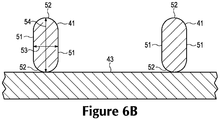
- strands 41 and 42 are oriented such that (a) facing surfaces 51 face along base layer 43, (b) one of end surfaces 52 contacts and lays against base layer 43, and (c) the other of end surfaces 52 faces outward and away from base layer 43.
- Figures 7A and 7B depict an advantage of orienting facing surfaces 51 to face along base layer 43.
- a foot within the void in footwear 10 may tend to bend, twist, or otherwise deform areas of upper 30 during activities that involve walking, running, or other ambulatory movements. That is, many of the material elements forming upper 30 may deform due to movements of the foot.
- strands 41 and 42 may be loose or otherwise unsecured to base layer 43 in the area between regions 16 and 17.
- loose sections of strands 41 and 42 may bend, bow, or otherwise move relative to the surface of base layer 43. Referring to Figures 7A and 7B , for example, deformation of footwear 10 induces some of strands 41 and 42 to deform.
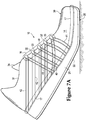
- Figure 7A depicts heel region 13 and midfoot region 12 as flexing upward relative to forefoot region 11.
- strands 41 and 42 located closer to forefoot region 11 may bend, bow, or otherwise move.
- selected strands 41 and 42 are depicted as bowing toward forefoot region 11.
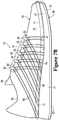
- Figure 7B depicts footwear 10 as deforming toward lateral side 14, which may occur during cutting motions (i.e., side-to-side movements of the wearer) or when the ankle rolls toward lateral side 14.
- strands 41 and 42 throughout lateral side 14 may bend, bow, or otherwise move.
- almost all of strands 41 and 42 on lateral side 14 are depicted as bowing toward forefoot region 11.
- strands 41 and 42 will tend to bend or bow along the surface of base layer 43, rather than outward from the surface of base layer 43. That is, strands 41 and 42 will tend to bend or bow in a direction that extends along the exterior surface of upper 30.
- strands 41 and 42 bend along the exterior surface of upper 30 and toward forefoot region 11.
- Configuring strands 41 and 42 to bend or bow in a direction that extends along the exterior surface of upper 30 imparts various advantages to footwear 10. For example, strands 41 and 42 lay against base layer 43 and do not protrude significantly from base layer 43 when upper 30 is deformed due to movements of the foot. As a result, strands 41 and 42 remain close to upper 30, which may offer the benefits of protecting strands 41 and 42 and reducing the probability that strands 41 and 42 will catch on other objects or be snagged by the objects.
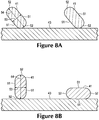
- Figure 8A depicts a configuration wherein strands 41 are oriented diagonally with respect to base layer 43.
- Figure 8B depicts a configuration wherein strands 41 are oriented differently with respect to base layer 43.
- Figure 9A depicts an elliptical configuration
- Figure 9B depicts a rectangular configuration
- Figure 9C depicts a triangular configuration.
- strands 41 and 41 may also have an elongate and irregular cross-sectional shape, as depicted in Figure 9D .
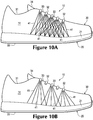
- strands 41 extend in a variety of directions from lace apertures 33 to sole structure 20.
- Figure 10B depicts a configuration where strands 41 extend downward from only some of lace apertures 33.
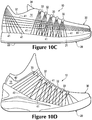
- various strands 41 extend longitudinally from forefoot region 11 to heel region 13.
- a basketball shoe incorporating strands 41 and 42 is depicted in Figure 10D . Accordingly, the orientations, locations, and quantity of strands 41 and 42 may vary considerably, as well as the types of footwear incorporating strands 41 and 42.
Landscapes
- Chemical & Material Sciences (AREA)
- Engineering & Computer Science (AREA)
- Materials Engineering (AREA)
- Health & Medical Sciences (AREA)
- General Health & Medical Sciences (AREA)
- Physical Education & Sports Medicine (AREA)
- Footwear And Its Accessory, Manufacturing Method And Apparatuses (AREA)
Abstract
Description
- Articles of footwear generally include two primary elements: an upper and a sole structure. The upper is often formed from a plurality of material elements (e.g., textiles, polymer sheet layers, foam layers, leather, synthetic leather) that are stitched or adhesively bonded together to form a void on the interior of the footwear for comfortably and securely receiving a foot. More particularly, the upper forms a structure that extends over instep and toe areas of the foot, along medial and lateral sides of the foot, and around a heel area of the foot. The upper may also incorporate a lacing system to adjust fit of the footwear, as well as permitting entry and removal of the foot from the void within the upper. In addition, the upper may include a tongue that extends under the lacing system to enhance adjustability and comfort of the footwear, and the upper may incorporate a heel counter.
- The various material elements forming the upper impart specific properties to different areas of the upper. For example, textile elements may provide breathability and may absorb moisture from the foot, foam layers may compress to impart comfort, and leather may impart durability and wear-resistance. As the number of material elements increases, the overall mass of the footwear may increase proportionally. The time and expense associated with transporting, stocking, cutting, and joining the material elements may also increase. Additionally, waste material from cutting and stitching processes may accumulate to a greater degree as the number of material elements incorporated into an upper increases. Moreover, products with a greater number of material elements may be more difficult to recycle than products formed from fewer material elements. By decreasing the number of material elements, therefore, the mass of the footwear and waste may be decreased, while increasing manufacturing efficiency and recyclability.
- The sole structure is secured to a lower portion of the upper so as to be positioned between the foot and the ground. In athletic footwear, for example, the sole structure includes a midsole and an outsole. The midsole may be formed from a polymer foam material that attenuates ground reaction forces (i.e., provides cushioning) during walking, running, and other ambulatory activities. The midsole may also include fluid-filled chambers, plates, moderators, or other elements that further attenuate forces, enhance stability, or influence the motions of the foot, for example. The outsole forms a ground-contacting element of the footwear and is usually fashioned from a durable and wear-resistant rubber material that includes texturing to impart traction. The sole structure may also include a sockliner positioned within the upper and proximal a lower surface of the foot to enhance footwear comfort.
- An article of footwear is disclosed below as having an upper and a sole structure secured to the upper. The upper includes a base layer and a plurality of strands. The base layer forms at least a portion of an exterior surface of the upper. The strands are located adjacent to the base layer and form another portion of the exterior surface of the upper, the strands being unsecured to the base layer for a distance of at least five centimeters, and the strands having an elongate cross-sectional shape.
- The elongate cross-sectional shape may include (a) a pair of facing surfaces located opposite each other and (b) a pair of end surfaces located opposite each other. A dimension between the facing surfaces defines a thickness, and a dimension between the end surfaces defines a width, the width being greater than the thickness. In some configurations, one of the facing surface is oriented to face the base layer, or one of the end surfaces is oriented to face the upper. In some configurations, a ratio of the width to the thickness is greater than 1.3, or the ratio of the width to the thickness is greater than two. In some configurations, the strands are unsecured to the base layer for the distance of at least five centimeters in an area between the lace region and the lower region.
- The advantages and features of novelty characterizing aspects of the invention are pointed out with particularity in the appended claims. To gain an improved understanding of the advantages and features of novelty, however, reference may be made to the following descriptive matter and accompanying figures that describe and illustrate various configurations and concepts related to the invention.
- The foregoing Summary and the following Detailed Description will be better understood when read in conjunction with the accompanying figures.
-
Figure 1 is a lateral side elevational view of an article of footwear. -
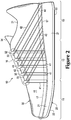
Figure 2 is a medial side elevational view of the article of footwear. -
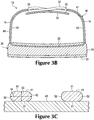
Figures 3A-3C are cross-sectional views of the article of footwear, as defined bysection lines 3A-3C inFigure 1 . -
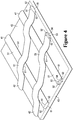
Figure 4 is a perspective view of a portion of the article of footwear, as defined inFigure 1 . -
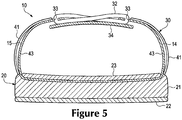
Figure 5 is a cross-sectional view corresponding withFigure 3B and depicting the article of footwear in a compressed configuration. -
Figures 6A and6B are cross-sectional views corresponding respectively withFigures 3A and3C and depicting another configuration of the article of footwear. -
Figures 7A and7B are lateral side elevational views of the article of footwear, as configured inFigures 6A and6B , in flexed states. -
Figures 8A and 8B are cross-sectional views corresponding withFigure 3C and depicting additional orientations of the strands. -
Figures 9A-9D are various cross-sectional shapes of strands from the article of footwear. -
Figures 10A-10D are lateral side elevational views corresponding withFigure 1 and depicting further configurations of the article of footwear. - The following discussion and accompanying figures disclose an article of footwear having an upper that includes tensile strand elements. The article of footwear is disclosed as having a general configuration suitable for walking or running. Concepts associated with the footwear, including the upper, may also be applied to a variety of other athletic footwear types, including baseball shoes, basketball shoes, cross-training shoes, cycling shoes, football shoes, tennis shoes, soccer shoes, and hiking boots, for example. The concepts may also be applied to footwear types that are generally considered to be non-athletic, including dress shoes, loafers, sandals, and work boots. The concepts disclosed herein apply, therefore, to a wide variety of footwear types.
- An article of
footwear 10 is depicted inFigures 1 ,2 ,3A , and3B as including asole structure 20 and an upper 30. For reference purposes,footwear 10 may be divided into three general regions: aforefoot region 11, amidfoot region 12, and aheel region 13. Footwear 10 also includes alateral side 14 and amedial side 15.Forefoot region 11 generally includes portions offootwear 10 corresponding with the toes and the joints connecting the metatarsals with the phalanges. Midfootregion 12 generally includes portions offootwear 10 corresponding with the arch area of the foot, andheel region 13 corresponds with rear portions of the foot, including the calcaneus bone.Lateral side 14 andmedial side 15 extend through each of regions 11-13 and correspond with opposite sides offootwear 10. More particularly,lateral side 14 corresponds with an outside area of the foot (i.e. the surface that faces away from the other foot), andmedial side 15 corresponds with an inside area of the foot (i.e., the surface that faces toward the other foot). Regions 11-13 and sides 14-15 are not intended to demarcate precise areas offootwear 10. Rather, regions 11-13 and sides 14-15 are intended to represent general areas offootwear 10 to aid in the following discussion. In addition tofootwear 10, regions 11-13 and sides 14-15 may also be applied tosole structure 20, upper 30, and individual elements thereof. -
Sole structure 20 is secured to upper 30 and extends between the foot and the ground whenfootwear 10 is worn. The primary elements ofsole structure 20 are amidsole 21, anoutsole 22, and ansockliner 23.Midsole 21 is secured to a lower surface of upper 30 and may be formed from a compressible polymer foam element (e.g., a polyurethane or ethylvinylacetate foam) that attenuates ground reaction forces (i.e., provides cushioning) when compressed between the foot and the ground during walking, running, or other ambulatory activities. In further configurations,midsole 21 may incorporate fluid-filled chambers, plates, moderators, or other elements that further attenuate forces, enhance stability, or influence the motions of the foot, ormidsole 21 may be primarily formed from a fluid-filled chamber.Outsole 22 is secured to a lower surface ofmidsole 21 and may be formed from a wear-resistant rubber material that is textured to impart traction.Sockliner 23 is located within upper 30 and is positioned to extend under a lower surface of the foot. Although this configuration forsole structure 20 provides an example of a sole structure that may be used in connection with upper 30, a variety of other conventional or nonconventional configurations forsole structure 20 may also be utilized. Accordingly, the structure and features ofsole structure 20 or any sole structure utilized with upper 30 may vary considerably. - The various portions of upper 30 may be formed from one or more of a plurality of material elements (e.g., textiles, polymer sheets, foam layers, leather, synthetic leather) that are stitched or bonded together to form a void within
footwear 10 for receiving and securing a foot relative tosole structure 20. The void is shaped to accommodate the foot and extends along the lateral side of the foot, along the medial side of the foot, over the foot, around the heel, and under the foot. Access to the void is provided by anankle opening 31 located in at leastheel region 13. Alace 32 extends throughvarious lace apertures 33 and permits the wearer to modify dimensions of upper 30 to accommodate the proportions of the foot. More particularly, lace 32 permits the wearer to tighten upper 30 around the foot, and lace 32 permits the wearer to loosen upper 30 to facilitate entry and removal of the foot from the void (i.e., through ankle opening 31). As an alternative to laceapertures 33, upper 30 may include other lace-receiving elements, such as loops, eyelets, and D-rings. In addition, upper 30 includes atongue 34 that extends between the interior void andlace 32 to enhance the comfort offootwear 10. In some configurations, upper 30 may incorporate a heel counter that limits heel movement inheel region 13 or a wear-resistant toe guard located inforefoot region 11. - A variety of material elements or other components may be incorporated into upper 30, as discussed above. In addition, areas of one or both of
lateral side 14 andmedial side 15 incorporate variousfirst strands 41 andsecond strands 42, as depicted inFigures 3A ,3B , and4 . When incorporated into upper 30,strands base layer 43. Whereasbase layer 43 forms a surface of the void within upper 30, a combination ofbase layer 43 andstrands first strands 41,second strands 42, andbase layer 43 may, therefore, form substantially all of a thickness of upper 30 in some areas. In further configurations, other material elements may be located inward or outward frombase layer 43 andstrands base layer 43, with the textile layer forming a portion of the void. As another example, a mesh textile layer may be located exterior ofstrands - A
lace region 16 and alower region 17 are defined inFigures 1 and2 .Lace region 16 generally encompasses an area wherelace apertures 33 or other lace-receiving elements are located, andlower region 17 generally encompasses an area where upper 30 joins withsole structure 20.Regions footwear 10, including upper 30. Rather,regions - The locations and orientations of
strands Figures 1 and2 depictstrands lace apertures 33 and towardsole structure 20. More particularly,strands lace region 16 tolower region 17. During activities that involve walking, running, or other ambulatory movements, a foot within the void infootwear 10 may tend to stretch areas of upper 30. That is, many of the material elements forming upper 30 may stretch due to movements of the foot. Althoughstrands strands strands sole structure 20 and upper 30, (c) retain proper position of the foot relative tosole structure 20 and upper 30, and (d) reinforce locations where forces are concentrated. - Whereas
first strands 41 are oriented in a generally vertical direction in an area betweenregions second strands 42 are oriented in a rearwardly-angled direction in the area betweenregions strands U.S. Patent Application Number 12/847,836strands first strands 41 resist stretch in upper 30 due to cutting motions and ensure that the foot remains properly positioned relative tofootwear 10, andsecond strands 42 resist stretch in upper 30 due to braking motions, as well as jumping and running motions that flex or otherwise bendfootwear 10. As discussed in greater detail below,strands first strands 41 andsecond strands 42 inFigures 1 and2 is intended to provide an example of a suitable configuration forfootwear 10. - Portions of
strands base layer 43. In general,strands base layer 43 or have a fixed position inregions regions strands base layer 43. In some configurations,strands U.S. Patent Application Number 12/847,860strands strands footwear 10. -
Strands strands Figures 3A ,3C , and4 as having generally elongate cross-sectional shape, rather than round. In this configuration, the elongate cross-sectional shape defines two facingsurfaces 51 and two end surfaces 52. Facingsurfaces 51 are located opposite each other and have a generally planar or extended shape. As oriented, one of facingsurfaces 51 contacts and lays againstbase layer 43, and the other of facingsurfaces 51 faces outward and away frombase layer 43. As such, facingsurfaces 51 may be parallel tobase layer 43. End surfaces 52 are also located opposite each other and have a generally rounded shape. As oriented, end surfaces 52 face alongbase layer 43 and towardforefoot region 11 andheel region 13. As an additional matter, a distance between facingsurfaces 51 defines athickness 53 ofstrands width 54 ofstrands thickness 53 is less thanwidth 54, thereby imparting the elongate cross-sectional shape tostrands - As utilized herein, "cross-sectional shape" is determined through a cross-section that is generally perpendicular to
surfaces surfaces width 54 and thickness 53) of at least 1.3 to provide noticeable elongation. In many configurations the ratio of width to thickness will exceed two and may be greater than three or four. - The elongate cross-sectional shape and orientation of
strands footwear 10. As discussed above,strands strands base layer 43. When placed in tension and laying againstbase layer 43,strands base layer 43 and against the foot. That is,strands strands strands surfaces 51 distributes forces over a greater area, thereby enhancing the comfort offootwear 10. - Further advantages of the elongate cross-sectional shape and orientation of
strands strands strands base layer 43. Given the different dimensions betweenthickness 53 andwidth 54,strands base layer 43, as depicted inFigure 5 . That is,strands surfaces 51, which corresponds with a direction that is outward and away frombase layer 43, rather than side-to-side and along the surface ofbase layer 43. A first benefit of the outward deflection is thatstrands footwear 10. More particularly,strands - Another advantage of the elongate cross-sectional shape and orientation of
strands footwear 10. The area of the cross-sectional shape has a direct relationship with the overall strength ofstrands thickness 53 is less due to the elongate cross-sectional shape ofstrands strands base layer 43 to a lesser extent than round strands, which may offer the benefits of protectingstrands strands -
First strands 41 andsecond strands 42 may be formed from any material exhibiting a length that is substantially greater than a width and a thickness. As such, suitable materials forstrands strands strands strands strands strands - Various manufacturing processes may be utilized to form upper 30 and incorporate
strands U.S. Patent Application Number 12/847,860 - The orientations, locations, and quantity of
strands Figures 1 and2 are intended to provide an example of a suitable configuration forfootwear 10. In other configurations offootwear 10,strands strands footwear 10,various strands additional strands footwear 10. Referring toFigures 6A and6B , for example,strands surfaces 51 face alongbase layer 43, (b) one of end surfaces 52 contacts and lays againstbase layer 43, and (c) the other of end surfaces 52 faces outward and away frombase layer 43. -
Figures 7A and7B depict an advantage of orienting facingsurfaces 51 to face alongbase layer 43. In addition to stretching upper 30, a foot within the void infootwear 10 may tend to bend, twist, or otherwise deform areas of upper 30 during activities that involve walking, running, or other ambulatory movements. That is, many of the material elements forming upper 30 may deform due to movements of the foot. As discussed above,strands base layer 43 in the area betweenregions strands base layer 43. Referring toFigures 7A and7B , for example, deformation offootwear 10 induces some ofstrands Figure 7A depictsheel region 13 andmidfoot region 12 as flexing upward relative to forefootregion 11. When flexed in this manner,strands region 11 may bend, bow, or otherwise move. Specifically, selectedstrands forefoot region 11.Figure 7B depictsfootwear 10 as deforming towardlateral side 14, which may occur during cutting motions (i.e., side-to-side movements of the wearer) or when the ankle rolls towardlateral side 14. When deformed in this manner,strands lateral side 14 may bend, bow, or otherwise move. Specifically, almost all ofstrands lateral side 14 are depicted as bowing towardforefoot region 11. - In the configuration of
Figures 6A ,6B ,7A , and7B ,strands base layer 43, rather than outward from the surface ofbase layer 43. That is,strands Figures 7A and7B , for example,strands forefoot region 11. Configuringstrands footwear 10. For example,strands base layer 43 and do not protrude significantly frombase layer 43 when upper 30 is deformed due to movements of the foot. As a result,strands strands strands - The orientation and cross-sectional shapes of
strands footwear 10. As another example,Figure 8A depicts a configuration whereinstrands 41 are oriented diagonally with respect tobase layer 43. Additionally,Figure 8B depicts a configuration whereinstrands 41 are oriented differently with respect tobase layer 43. With regard to cross-sectional shape,Figure 9A depicts an elliptical configuration,Figure 9B depicts a rectangular configuration, andFigure 9C depicts a triangular configuration. In addition to elongate and regular cross-sectional shapes,strands Figure 9D . - Additional configurations of
footwear 10 will now be discussed. Referring toFigure 10A ,strands 41 extend in a variety of directions fromlace apertures 33 tosole structure 20.Figure 10B depicts a configuration wherestrands 41 extend downward from only some oflace apertures 33. A configuration that includesadditional strands 41 inheel region 13, which may effectively form a heel counter, is depicted inFigure 10C . In addition,various strands 41 extend longitudinally fromforefoot region 11 toheel region 13. A basketballshoe incorporating strands Figure 10D . Accordingly, the orientations, locations, and quantity ofstrands footwear incorporating strands - The invention is disclosed above and in the accompanying figures with reference to a variety of configurations. The purpose served by the disclosure, however, is to provide an example of the various features and concepts related to the invention, not to limit the scope of the invention. One skilled in the relevant art will recognize that numerous variations and modifications may be made to the configurations described above without departing from the scope of the present invention, as defined by the appended claims.
-
- 1. An article of footwear having an upper and a sole structure secured to the upper, the upper comprising:
- a base layer forming at least a portion of an exterior surface of the upper; and
- a plurality of strands located adjacent to the base layer and forming another portion of the exterior surface of the upper, the strands being unsecured to the base layer for a distance of at least five centimeters, and the strands having an elongate cross-sectional shape.
- 2. The article of footwear recited in clause 1, wherein the elongate cross-sectional shape includes (a) a pair of facing surfaces located opposite each other and (b) a pair of end surfaces located opposite each other, a dimension between the facing surfaces defining a thickness, and a dimension between the end surfaces defining a width, the width being greater than the thickness, and one of the facing surfaces being oriented to face the base layer.
- 3. The article of footwear recited in clause 1, wherein the elongate cross-sectional shape includes (a) a pair of facing surfaces located opposite each other and (b) a pair of end surfaces located opposite each other, a dimension between the facing surfaces defining a thickness, and a dimension between the end surfaces defining a width, the width being greater than the thickness, and one of the end surfaces being oriented to face the base layer.
- 4. The article of footwear recited in clause 1, wherein the elongate cross-sectional shape includes (a) a pair of facing surfaces located opposite each other and (b) a pair of end surfaces located opposite each other, a dimension between the facing surfaces defining a thickness, and a dimension between the end surfaces defining a width, a ratio of the width to the thickness being greater than 1.3.
- 5. The article of footwear recited in clause 1, wherein the elongate cross-sectional shape includes (a) a pair of facing surfaces located opposite each other and (b) a pair of end surfaces located opposite each other, a dimension between the facing surfaces defining a thickness, and a dimension between the end surfaces defining a width, a ratio of the width to the thickness being greater than two.
- 6. The article of footwear recited in clause 1, wherein the upper includes (a) a lace region defining a plurality of lace-receiving elements and (b) a lower region where the sole structure is secured to the upper, the strands extending from the lace region to the lower region, the strands being secured to the upper in the lace region and the lower region, and the strands being unsecured to the base layer for the distance of at least five centimeters in an area between the lace region and the lower region.
- 7. The article of footwear recited in clause 1, wherein the strands include a plurality of first strands and a plurality of second strands, the first strands being angled with respect to the second strands.
- 8. The article of footwear recited in clause 1, wherein the strands are located on a lateral side of the article of footwear and a medial side of the article of footwear.
- 9. The article of footwear recited in clause 1, wherein the strands are selected from a group consisting of filaments, fibers, yarns, threads, cables, and ropes formed from rayon, nylon, polyester, polyacrylic, silk, cotton, carbon, glass, aramids, ultra high molecular weight polyethylene, liquid crystal polymer, copper, aluminum, and steel.
- 10. An article of footwear having an upper and a sole structure secured to the upper, the upper comprising:
- a base layer extending from a lace region of the upper to a lower region of the upper, the lace region defining a plurality of lace-receiving elements, and the lower region being where the sole structure is secured to the upper; and
- a plurality of strands extending from the lace region to the lower region, the strands being secured to the upper in the lace region and the lower region,
- the strands being unsecured for a distance of at least five centimeters in an area between the lace region and the lower region, and the strands having an elongate cross-sectional shape that includes (a) a pair of facing surfaces located opposite each other and (b) a pair of end surfaces located opposite each other, a dimension between the facing surfaces defining a thickness, and a dimension between the end surfaces defining a width, the width being greater than the thickness, and one of the facing surfaces being oriented to contact the base layer.
- 11. The article of footwear recited in
clause 10, wherein a ratio of the width to the thickness is greater than 1.3. - 12. The article of footwear recited in
clause 10, wherein a ratio of the width to the thickness is greater than two. - 13. The article of footwear recited in
clause 10, wherein the strands include a plurality of first strands and a plurality of second strands, the first strands being oriented in a generally vertical direction in the area between the lace region and the lower region, and the second strands being are oriented in a rearwardly-angled direction in the area between the lace region and the lower region. - 14. An article of footwear having an upper and a sole structure secured to the upper, the upper comprising:
- a base layer extending from a lace region of the upper to a lower region of the upper, the lace region defining a plurality of lace-receiving elements, and the lower region being where the sole structure is secured to the upper; and
- a plurality of strands extending from the lace region to the lower region, the strands being secured to the upper in the lace region and the lower region, the strands being unsecured for a distance of at least five centimeters in an area between the lace region and the lower region, and the strands having an elongate cross-sectional shape that includes (a) a pair of facing surfaces located opposite each other and (b) a pair of end surfaces located opposite each other, a dimension between the facing surfaces defining a thickness, and a dimension between the end surfaces defining a width, a ratio of the width to the thickness being at least two.
- 15. The article of footwear recited in
clause 14, wherein one of the facing surfaces is oriented to face the base layer. - 16. The article of footwear recited in
clause 14, wherein one of the end surfaces is oriented to face the base layer. - 17. The article of footwear recited in
clause 14, wherein the ratio of the width to the thickness is greater than three. - 18. The article of footwear recited in
clause 14, wherein the strands include a plurality of first strands and a plurality of second strands, the first strands being angled with respect to the second strands. - 19. The article of footwear recited in
clause 14, wherein the strands are located on a lateral side of the article of footwear and a medial side of the article of footwear. - 20. The article of footwear recited in
clause 14, wherein the strands are selected from a group consisting of filaments, fibers, yarns, threads, cables, and ropes formed from rayon, nylon, polyester, polyacrylic, silk, cotton, carbon, glass, aramids, ultra high molecular weight polyethylene, liquid crystal polymer, copper, aluminum, and steel.
Claims (15)
- An article of footwear having an upper and a sole structure secured to the upper, the upper comprising:a base layer forming at least a portion of an exterior surface of the upper; anda plurality of strands located adjacent to the base layer and forming another portion of the exterior surface of the upper, and the strands having an elongate cross-sectional shape,wherein the upper includes (a) a lace region defining a plurality of lace-receiving elements and (b) a lower region where the sole structure is secured to the upper, the plurality of strands extending from at least one of the plurality of lace-receiving elements in the lace region to the lower region, the strands being secured to the upper in the lace region and the lower region, and the strands being unsecured to the base layer for a distance of at least five centimeters in an area between the lace region and the lower region,wherein the plurality of strands is configured to lay against the base layer in the area between the lace region and the lower region when the plurality of strands is placed in tension; andwherein the plurality of strands is configured to be spaced away from the base layer in the area between the lace region and the lower region when the plurality of strands is compressed.
- The article of footwear according to claim 1, wherein two or more strands of the plurality of strands extend from the at least one of the plurality of lace-receiving elements in at least two different directions.
- The article of footwear according to claim 1, wherein the plurality of lace-receiving elements comprises three or more lace-receiving elements; and
wherein the plurality of strands extends from each of the plurality of lace-receiving elements to the lower region. - The article of footwear according to claim 1, wherein the plurality of lace-receiving elements comprises a first lace-receiving element and a second lace-receiving element;
wherein the plurality of strands extends from the first lace-receiving element to the lower region; and
wherein the plurality of strands are absent from the second lace-receiving element. - The article of footwear according to claim 4, wherein the first lace-receiving element is located adjacent to the second lace-receiving element in the lace region of the upper.
- The article of footwear according to claim 4, wherein the plurality of lace-receiving elements further comprises a third lace-receiving element; and
wherein the plurality of strands extends from the third lace-receiving element to the lower region. - The article of footwear according to claim 6, wherein the second lace-receiving element is located between the first lace-receiving element and the third lace-receiving element in the lace region of the upper.
- The article of footwear according to claim 6, wherein at least one strand of the plurality of strands extending from the first lace-receiving element crosses at least one strand of the plurality of strands extending from the third lace-receiving element.
- The article of footwear according to claim 1, further comprising another plurality of strands extending around a heel region of the upper between a medial side and a lateral side of the article of footwear.
- The article of footwear according to claim 1, wherein the plurality of lace-receiving elements comprises a first lace-receiving element and a second lace-receiving element;
wherein the plurality of strands extends from the first lace-receiving element to the lower region, including a first strand extending in a first direction and a second strand extending in a second direction; and
wherein the plurality of strands extends from the second lace-receiving element to the lower region, including a third strand extending in a rearwardly direction towards a heel region of the article of footwear. - The article of footwear according to claim 10, wherein the second lace-receiving element is located adjacent to an ankle opening of the upper.
- The article of footwear according to claim 10, wherein the second strand and the third strand extend to the lower region in a substantially similar direction.
- The article of footwear according to claim 1, wherein the plurality of strands extends from each of the plurality of lace-receiving elements to the lower region.
- The article of footwear recited in any one of claims 1 to 13, wherein the elongate cross-sectional shape includes (a) a pair of facing surfaces located opposite each other and (b) a pair of end surfaces located opposite each other, a dimension between the facing surfaces defining a thickness, and a dimension between the end surfaces defining a width, the width being greater than the thickness, and one of the facing surfaces being oriented to face the base layer.
- The article of footwear recited in any one of claims 1 to 14, wherein the strands are located on a lateral side of the article of footwear and a medial side of the article of footwear.
Applications Claiming Priority (3)
| Application Number | Priority Date | Filing Date | Title |
|---|---|---|---|
| US13/196,153 US8893405B2 (en) | 2006-05-25 | 2011-08-02 | Article of footwear incorporating tensile strands with an elongated cross-sectional shape |
| EP12819662.3A EP2739178B1 (en) | 2011-08-02 | 2012-07-13 | Article of footwear incorporating tensile strands with an elongate cross-sectional shape |
| PCT/US2012/046786 WO2013019391A2 (en) | 2011-08-02 | 2012-07-13 | Article of footwear incorporating tensile strands with an elongate cross-sectional shape |
Related Parent Applications (2)
| Application Number | Title | Priority Date | Filing Date |
|---|---|---|---|
| EP12819662.3A Division-Into EP2739178B1 (en) | 2011-08-02 | 2012-07-13 | Article of footwear incorporating tensile strands with an elongate cross-sectional shape |
| EP12819662.3A Division EP2739178B1 (en) | 2011-08-02 | 2012-07-13 | Article of footwear incorporating tensile strands with an elongate cross-sectional shape |
Publications (1)
| Publication Number | Publication Date |
|---|---|
| EP3453274A1 true EP3453274A1 (en) | 2019-03-13 |
Family
ID=47629839
Family Applications (2)
| Application Number | Title | Priority Date | Filing Date |
|---|---|---|---|
| EP18201191.6A Pending EP3453274A1 (en) | 2011-08-02 | 2012-07-13 | Article of footwear incorporating tensile strands with an elongate cross-sectional shape |
| EP12819662.3A Active EP2739178B1 (en) | 2011-08-02 | 2012-07-13 | Article of footwear incorporating tensile strands with an elongate cross-sectional shape |
Family Applications After (1)
| Application Number | Title | Priority Date | Filing Date |
|---|---|---|---|
| EP12819662.3A Active EP2739178B1 (en) | 2011-08-02 | 2012-07-13 | Article of footwear incorporating tensile strands with an elongate cross-sectional shape |
Country Status (4)
| Country | Link |
|---|---|
| US (2) | US8893405B2 (en) |
| EP (2) | EP3453274A1 (en) |
| CN (1) | CN103857307B (en) |
| WO (1) | WO2013019391A2 (en) |
Families Citing this family (30)
| Publication number | Priority date | Publication date | Assignee | Title |
|---|---|---|---|---|
| US8893405B2 (en) | 2006-05-25 | 2014-11-25 | Nike, Inc. | Article of footwear incorporating tensile strands with an elongated cross-sectional shape |
| US20100199406A1 (en) * | 2009-02-06 | 2010-08-12 | Nike, Inc. | Thermoplastic Non-Woven Textile Elements |
| US9179739B2 (en) * | 2012-06-21 | 2015-11-10 | Nike, Inc. | Footwear incorporating looped tensile strand elements |
| US9282784B2 (en) * | 2012-09-06 | 2016-03-15 | Nike, Inc. | Sole structures and articles of footwear having a lightweight midsole with segmented protective elements |
| JP6359025B2 (en) * | 2012-11-09 | 2018-07-18 | ファースト グループ, インコーポレイテッド | Footwear articles having a cord structure |
| US9635905B2 (en) * | 2012-12-10 | 2017-05-02 | Nike, Inc. | Upper having bonded differentially-oriented inner and outer reinforcing strips |
| US9132601B2 (en) * | 2013-01-15 | 2015-09-15 | Nike, Inc. | Spacer textile material with tensile strands having multiple entry and exit points |
| US9474328B2 (en) | 2013-01-15 | 2016-10-25 | Nike, Inc. | Spacer textile material with tensile strands in non-linear arrangements |
| US9226548B2 (en) | 2013-01-15 | 2016-01-05 | Nike, Inc. | Spacer textile material with channels having multiple tensile strands |
| US9241537B2 (en) | 2013-01-15 | 2016-01-26 | Nike, Inc. | Spacer textile material with tensile strands that intersect |
| US20140202034A1 (en) | 2013-01-23 | 2014-07-24 | Nike, Inc. | Anti-Stretch Treatment Of Leather For Articles Of Footwear |
| USD737561S1 (en) | 2013-11-08 | 2015-09-01 | Fuerst Group, Inc. | Footwear article |
| CN114343281B (en) * | 2014-09-30 | 2026-06-05 | 耐克创新有限合伙公司 | Footwear uppers incorporating textile components with tensile strength elements |
| US9192204B1 (en) | 2014-09-30 | 2015-11-24 | Nike, Inc. | Article of footwear upper incorporating a textile component with tensile elements |
| US10219580B2 (en) * | 2015-01-29 | 2019-03-05 | Nike, Inc. | Lace engaging structures and other features for articles of footwear and other foot-receiving devices |
| US12064010B2 (en) * | 2015-07-20 | 2024-08-20 | Nike, Inc. | Article of footwear having a chain-linked tensile support structure |
| EP4275539A3 (en) | 2015-10-19 | 2024-04-17 | NIKE Innovate C.V. | Tensile-strand enclosure system for footwear |
| CN106974354B (en) | 2016-01-19 | 2021-02-09 | 富尔斯特集团有限公司 | Shoes with rope structure |
| TWI607714B (en) * | 2016-07-21 | 2017-12-11 | Gary David Chang | Shoes with elastic uppers |
| CN110022714B (en) * | 2016-12-02 | 2021-04-27 | 耐克创新有限合伙公司 | Footwear with Aligned Stretch Limiters |
| CN106993849B (en) * | 2017-04-10 | 2022-06-10 | 北京小米移动软件有限公司 | footwear |
| US10711380B2 (en) * | 2017-07-13 | 2020-07-14 | Under Armour, Inc. | Article with embroidered tape segments |
| CN107549929B (en) * | 2017-10-17 | 2020-10-27 | 北京小米移动软件有限公司 | Article of footwear |
| USD893852S1 (en) | 2018-03-30 | 2020-08-25 | Fuerst Group, Inc. | Footwear article |
| CN112218556A (en) | 2018-05-31 | 2021-01-12 | 耐克创新有限合伙公司 | Article of footwear with thermoformed grooved sole structure |
| US10716362B2 (en) | 2018-07-03 | 2020-07-21 | Under Armour, Inc. | Article with ribbon structure having nodes and links |
| EP3902433B1 (en) * | 2018-12-27 | 2024-04-03 | NIKE Innovate C.V. | Article of footwear and method of manufacturing an article of footwear |
| EP4051042A1 (en) * | 2019-11-01 | 2022-09-07 | NIKE Innovate C.V. | Vision-guided stitching systems and logic for fabricating engineered textiles with interstitched superposed wires |
| US12310457B2 (en) * | 2020-10-09 | 2025-05-27 | Nike, Inc. | Upper for article of footwear |
| WO2023135813A1 (en) * | 2022-01-17 | 2023-07-20 | 株式会社アシックス | Upper, shoe, and upper manufacturing method |
Citations (4)
| Publication number | Priority date | Publication date | Assignee | Title |
|---|---|---|---|---|
| US20100018075A1 (en) * | 2008-07-25 | 2010-01-28 | Nike, Inc. | Composite Element With A Polymer Connecting Layer |
| US20100037483A1 (en) * | 2006-05-25 | 2010-02-18 | Nike, Inc. | Article Of Footwear Incorporating A Tensile Element |
| US20100251564A1 (en) * | 2009-04-07 | 2010-10-07 | Nike, Inc. | Footwear Incorporating Crossed Tensile Strand Elements |
| EP3028591A1 (en) * | 2010-07-30 | 2016-06-08 | NIKE Innovate C.V. | Article of footwear incorporating floating tensile strands |
Family Cites Families (92)
| Publication number | Priority date | Publication date | Assignee | Title |
|---|---|---|---|---|
| US2034091A (en) | 1931-12-26 | 1936-03-17 | Cambridge Rubber Co | Footwear and method of making |
| US2048294A (en) | 1932-12-03 | 1936-07-21 | Us Rubber Co | Footwear |
| US2108415A (en) * | 1936-03-14 | 1938-02-15 | Louis W Simister | Moccasin |
| US2205356A (en) | 1938-12-12 | 1940-06-18 | Gruensfelder | Shoe of elastic material |
| US2311996A (en) | 1940-11-28 | 1943-02-23 | Thomas Taylor & Sons Inc | Footwear |
| US3131490A (en) * | 1962-05-16 | 1964-05-05 | United Shoe Machinery Corp | Temporary shoe laces and lasted shoes using same |
| FR1462349A (en) | 1965-10-18 | 1966-12-16 | Stretch textile band, covered with strips of leather, or any other material, used in the manufacture of footwear, leather goods, clothing, furnishings and any novelty article, and its manufacturing process | |
| US3439434A (en) | 1967-03-22 | 1969-04-22 | Superga Spa | Ski shoe |
| US3823493A (en) | 1969-06-11 | 1974-07-16 | Freudenberg C | Foam polyurethane boot with lining |
| FR2046671A5 (en) | 1970-05-22 | 1971-03-05 | Andre Chaussures Sa | Elaborate shoe-upper polyurethane mould- - ings |
| US3672078A (en) | 1970-06-23 | 1972-06-27 | Tatsuo Fukuoka | Footwear |
| FR2457651A1 (en) | 1979-05-22 | 1980-12-26 | Frapima Sarl | Shoe for sensitive feet - has upper of skin and stretch fabric |
| IT8145209A0 (en) | 1981-12-21 | 1981-12-21 | Francalanci Natalino | PHYSIOLOGICAL SHOE WITH ELASTICIZED UPPER FOR COMPENSATION AND PROTECTION OF PAINFUL AND NON-PAINFUL DEFORMATIONS OF THE FOOT |
| US4627369A (en) | 1983-06-27 | 1986-12-09 | Conrad Industries, Inc. | System for improving embroidered articles |
| US4642819A (en) | 1985-01-10 | 1987-02-17 | Kimberly-Clark Corporation | Disposable garments with multiple strand elasticized openings |
| US4634616A (en) | 1986-01-30 | 1987-01-06 | Musante Louis P | Stencil art overlays |
| US4858339A (en) | 1987-01-10 | 1989-08-22 | Nippon Rubber Co., Ltd. | Composite rubber sheet material and sports shoe employing the same |
| US4756098A (en) | 1987-01-21 | 1988-07-12 | Gencorp Inc. | Athletic shoe |
| US4873725A (en) | 1988-04-21 | 1989-10-17 | Mitchell Tonia L | Infant care apron |
| WO1990004514A1 (en) | 1988-10-21 | 1990-05-03 | Ted Stahl | Pre-sewn letter and method |
| US5016327A (en) * | 1989-04-10 | 1991-05-21 | Klausner Fred P | Footwear lacing system |
| WO1992022223A1 (en) | 1991-06-17 | 1992-12-23 | Puma Aktiengesellschaft Rudolf Dassler Sport | Method of producing a shaped shoe part from a strip of fabric, and a shaped shoe part produced by this method |
| US5156022A (en) | 1991-06-25 | 1992-10-20 | Bruce Altman | Embroidered lace bracelets |
| US5271130A (en) | 1991-11-18 | 1993-12-21 | K-Swiss Inc. | Lacing system for shoes |
| EP0582158A1 (en) | 1992-07-28 | 1994-02-09 | Urase Corp. | Sheet for embroidered picture |
| US5359790A (en) | 1992-08-27 | 1994-11-01 | Gamer Corporation | Shoe having individualized display areas |
| JPH0811081B2 (en) | 1992-08-27 | 1996-02-07 | ゲイマー コーポレーション | Method for forming shoe and individual display portion of shoe |
| US5692320A (en) * | 1993-01-28 | 1997-12-02 | K-Swiss Inc. | Shock absorbing lacing system for a shoe |
| US5380480A (en) | 1993-08-04 | 1995-01-10 | E. I. Du Pont De Nemours And Company | Process of making a consolidated part |
| DE4443456A1 (en) | 1994-12-07 | 1996-07-04 | Hoechst Trevira Gmbh & Co Kg | Two-component loop yarns made from aramid filaments, process for their production and their use |
| GB9510624D0 (en) | 1995-05-25 | 1995-07-19 | Ellis Dev Ltd | Textile surgical implants |
| DE19601219C1 (en) | 1996-01-15 | 1997-01-02 | Rudolf Hieblinger | Football shoe with bracing tapes from instep to front and back of sole |
| USD405587S (en) | 1996-05-28 | 1999-02-16 | Chicago Protective Apparel, Inc. | Eyelet embroidered/mesh protective sleeve |
| FR2750830B1 (en) | 1996-07-09 | 1998-09-18 | Ncv Nebon Carle Vassoilles | COMPOSITE FABRIC, ESPECIALLY FOR HAND LUGGAGE OR CLOTHING |
| DE19628388A1 (en) | 1996-07-13 | 1998-01-15 | Inst Polymerforschung Dresden | Multi-axial, multi-layer, fiber preform with adequate force flow with at least partial Z-axis reinforcement and a process for its production |
| US5832540A (en) | 1997-02-21 | 1998-11-10 | Knight; Joel T. | Pocket assembly for use on clothes |
| WO1998043506A1 (en) | 1997-03-28 | 1998-10-08 | Fila U.S.A., Inc. | Engineered textile |
| US6003247A (en) | 1997-05-23 | 1999-12-21 | Steffe; Daniel D. | Anti-static boot having a conductive upper |
| US7591050B2 (en) * | 1997-08-22 | 2009-09-22 | Boa Technology, Inc. | Footwear lacing system |
| US5930918A (en) | 1997-11-18 | 1999-08-03 | Converse Inc. | Shoe with dual cushioning component |
| US6009637A (en) | 1998-03-02 | 2000-01-04 | Pavone; Luigi Alessio | Helium footwear sole |
| USD397858S (en) * | 1998-03-19 | 1998-09-08 | Nike, Inc. | Lacing system for an article of footwear |
| US6038702A (en) | 1998-08-25 | 2000-03-21 | Knerr; Charles R. | Decorative patch |
| US6170175B1 (en) | 1998-12-08 | 2001-01-09 | Douglas Funk | Footwear with internal reinforcement structure |
| US6029376A (en) | 1998-12-23 | 2000-02-29 | Nike, Inc. | Article of footwear |
| US6128835A (en) | 1999-01-28 | 2000-10-10 | Mark Thatcher | Self adjusting frame for footwear |
| US6164228A (en) | 1999-08-24 | 2000-12-26 | Lin; Chien-Lu | Process and configuration of protruding embroidery |
| US6213634B1 (en) | 2000-01-10 | 2001-04-10 | Ronald L. Harrington | Combined watch and wristband |
| JP2001347590A (en) | 2000-06-09 | 2001-12-18 | Nippon Petrochem Co Ltd | Laminated structure, manufacturing method and manufacturing apparatus |
| DE10061028A1 (en) | 2000-12-08 | 2002-06-20 | Eads Deutschland Gmbh | Process for producing multilayer TFP preforms using fusible fixing threads |
| JP2002306204A (en) * | 2001-04-11 | 2002-10-22 | Mizuno Corp | Athletics shoes |
| ITTV20010107A1 (en) | 2001-08-03 | 2003-02-03 | Benetton Spa | FOOTWEAR STRUCTURE |
| US6718895B1 (en) | 2001-08-30 | 2004-04-13 | Terrence M. Fortuna | Method for producing a raised applique on a substrate and articles made therefrom |
| US6665958B2 (en) | 2001-09-17 | 2003-12-23 | Nike, Inc. | Protective cage for footwear bladder |
| DE10210517B3 (en) | 2002-03-09 | 2004-01-29 | Airbus Deutschland Gmbh | Process for the production of a component in fiber composite construction |
| DE20215559U1 (en) | 2002-04-29 | 2003-02-06 | Raichle Boots Ag, Frauenfeld | Shoe, in particular sports shoe |
| US6785985B2 (en) | 2002-07-02 | 2004-09-07 | Reebok International Ltd. | Shoe having an inflatable bladder |
| US6615427B1 (en) | 2002-10-28 | 2003-09-09 | Ellis R. Hailey | Vented bed sheet |
| US6910288B2 (en) | 2002-12-18 | 2005-06-28 | Nike, Inc. | Footwear incorporating a textile with fusible filaments and fibers |
| US6931762B1 (en) | 2002-12-18 | 2005-08-23 | Nike, Inc. | Footwear with knit upper and method of manufacturing the footwear |
| US6796876B2 (en) | 2003-01-21 | 2004-09-28 | Regina Miracle International Limited | Breast cup for a bra with visual enhancement |
| US20040181972A1 (en) | 2003-03-19 | 2004-09-23 | Julius Csorba | Mechanism of tying of shoes circumferentially embracing the foot within the shoe |
| AU2003218823A1 (en) | 2003-04-08 | 2004-11-01 | Soo-Ho Beak | Method of manufacturing uppers of leather and mold for hot press |
| US7065820B2 (en) | 2003-06-30 | 2006-06-27 | Nike, Inc. | Article and method for laser-etching stratified materials |
| US6931764B2 (en) | 2003-08-04 | 2005-08-23 | Nike, Inc. | Footwear sole structure incorporating a cushioning component |
| US6860214B1 (en) | 2003-09-22 | 2005-03-01 | Tai Kuang Wang | Raised embroidery process |
| US7100310B2 (en) | 2003-12-23 | 2006-09-05 | Nike, Inc. | Article of footwear having a fluid-filled bladder with a reinforcing structure |
| US7086180B2 (en) | 2003-12-23 | 2006-08-08 | Nike, Inc. | Article of footwear having a fluid-filled bladder with a reinforcing structure |
| US7086179B2 (en) | 2003-12-23 | 2006-08-08 | Nike, Inc. | Article of footwear having a fluid-filled bladder with a reinforcing structure |
| US7556846B2 (en) | 2003-12-23 | 2009-07-07 | Nike, Inc. | Fluid-filled bladder with a reinforcing structure |
| US7562469B2 (en) | 2003-12-23 | 2009-07-21 | Nike, Inc. | Footwear with fluid-filled bladder and a reinforcing structure |
| DE102004001392A1 (en) * | 2004-01-09 | 2005-08-04 | Mtu Aero Engines Gmbh | Wear protection coating and component with a wear protection coating |
| US7155846B2 (en) | 2004-06-03 | 2007-01-02 | Nike, Inc. | Article of footwear with exterior ribs |
| US7793434B2 (en) | 2004-09-03 | 2010-09-14 | Nike, Inc. | Article of footwear having an upper with a structured intermediate layer |
| US7293371B2 (en) | 2004-09-22 | 2007-11-13 | Nike, Inc. | Woven shoe with integral lace loops |
| US7343701B2 (en) * | 2004-12-07 | 2008-03-18 | Michael David Pare | Footwear having an interactive strapping system |
| US7347012B2 (en) * | 2005-07-15 | 2008-03-25 | The Timberland Company | Shoe with lacing |
| US7631440B2 (en) * | 2005-07-15 | 2009-12-15 | The Timberland Company | Shoe with anatomical protection |
| US7320189B2 (en) * | 2005-07-15 | 2008-01-22 | The Timberland Company | Shoe with lacing |
| US20070199210A1 (en) | 2006-02-24 | 2007-08-30 | The Timberland Company | Compression molded footwear and methods of manufacture |
| US7574818B2 (en) | 2006-05-25 | 2009-08-18 | Nike, Inc. | Article of footwear having an upper with thread structural elements |
| US8312645B2 (en) | 2006-05-25 | 2012-11-20 | Nike, Inc. | Material elements incorporating tensile strands |
| US7870681B2 (en) | 2006-05-25 | 2011-01-18 | Nike, Inc. | Article of footwear having an upper with thread structural elements |
| US7546698B2 (en) * | 2006-05-25 | 2009-06-16 | Nike, Inc. | Article of footwear having an upper with thread structural elements |
| US8893405B2 (en) | 2006-05-25 | 2014-11-25 | Nike, Inc. | Article of footwear incorporating tensile strands with an elongated cross-sectional shape |
| US8418380B2 (en) | 2006-05-25 | 2013-04-16 | Nike, Inc. | Article of footwear having an upper incorporating a tensile strand with a cover layer |
| US8225530B2 (en) | 2006-11-10 | 2012-07-24 | Nike, Inc. | Article of footwear having a flat knit upper construction or other upper construction |
| US7849518B2 (en) | 2007-08-10 | 2010-12-14 | Hurley International, Llc | Water shorts incorporating a stretch textile |
| US8490299B2 (en) | 2008-12-18 | 2013-07-23 | Nike, Inc. | Article of footwear having an upper incorporating a knitted component |
| US8388791B2 (en) | 2009-04-07 | 2013-03-05 | Nike, Inc. | Method for molding tensile strand elements |
| US8266827B2 (en) | 2009-08-24 | 2012-09-18 | Nike, Inc. | Article of footwear incorporating tensile strands and securing strands |
| US8973288B2 (en) | 2010-07-30 | 2015-03-10 | Nike, Inc. | Footwear incorporating angled tensile strand elements |
-
2011
- 2011-08-02 US US13/196,153 patent/US8893405B2/en active Active
-
2012
- 2012-07-13 EP EP18201191.6A patent/EP3453274A1/en active Pending
- 2012-07-13 EP EP12819662.3A patent/EP2739178B1/en active Active
- 2012-07-13 WO PCT/US2012/046786 patent/WO2013019391A2/en not_active Ceased
- 2012-07-13 CN CN201280037060.XA patent/CN103857307B/en active Active
-
2014
- 2014-10-09 US US14/510,216 patent/US9609917B2/en active Active
Patent Citations (4)
| Publication number | Priority date | Publication date | Assignee | Title |
|---|---|---|---|---|
| US20100037483A1 (en) * | 2006-05-25 | 2010-02-18 | Nike, Inc. | Article Of Footwear Incorporating A Tensile Element |
| US20100018075A1 (en) * | 2008-07-25 | 2010-01-28 | Nike, Inc. | Composite Element With A Polymer Connecting Layer |
| US20100251564A1 (en) * | 2009-04-07 | 2010-10-07 | Nike, Inc. | Footwear Incorporating Crossed Tensile Strand Elements |
| EP3028591A1 (en) * | 2010-07-30 | 2016-06-08 | NIKE Innovate C.V. | Article of footwear incorporating floating tensile strands |
Also Published As
| Publication number | Publication date |
|---|---|
| WO2013019391A2 (en) | 2013-02-07 |
| EP2739178B1 (en) | 2018-11-28 |
| US8893405B2 (en) | 2014-11-25 |
| CN103857307B (en) | 2016-02-10 |
| US20150082661A1 (en) | 2015-03-26 |
| US9609917B2 (en) | 2017-04-04 |
| WO2013019391A3 (en) | 2013-07-25 |
| EP2739178A2 (en) | 2014-06-11 |
| CN103857307A (en) | 2014-06-11 |
| US20120017468A1 (en) | 2012-01-26 |
Similar Documents
| Publication | Publication Date | Title |
|---|---|---|
| EP2739178B1 (en) | Article of footwear incorporating tensile strands with an elongate cross-sectional shape | |
| US10758009B2 (en) | Footwear incorporating angled tensile strand elements | |
| EP2597985B1 (en) | Article of footwear incorporating floating tensile strands | |
| US10251449B2 (en) | Article of footwear incorporating tensile strands and securing strands | |
| US10912349B2 (en) | Footwear having an upper with forefoot tensile strand elements |
Legal Events
| Date | Code | Title | Description |
|---|---|---|---|
| PUAI | Public reference made under article 153(3) epc to a published international application that has entered the european phase |
Free format text: ORIGINAL CODE: 0009012 |
|
| STAA | Information on the status of an ep patent application or granted ep patent |
Free format text: STATUS: THE APPLICATION HAS BEEN PUBLISHED |
|
| AC | Divisional application: reference to earlier application |
Ref document number: 2739178 Country of ref document: EP Kind code of ref document: P |
|
| AK | Designated contracting states |
Kind code of ref document: A1 Designated state(s): AL AT BE BG CH CY CZ DE DK EE ES FI FR GB GR HR HU IE IS IT LI LT LU LV MC MK MT NL NO PL PT RO RS SE SI SK SM TR |
|
| STAA | Information on the status of an ep patent application or granted ep patent |
Free format text: STATUS: REQUEST FOR EXAMINATION WAS MADE |
|
| 17P | Request for examination filed |
Effective date: 20190909 |
|
| RBV | Designated contracting states (corrected) |
Designated state(s): AL AT BE BG CH CY CZ DE DK EE ES FI FR GB GR HR HU IE IS IT LI LT LU LV MC MK MT NL NO PL PT RO RS SE SI SK SM TR |
|
| STAA | Information on the status of an ep patent application or granted ep patent |
Free format text: STATUS: EXAMINATION IS IN PROGRESS |
|
| 17Q | First examination report despatched |
Effective date: 20210212 |
|
| P01 | Opt-out of the competence of the unified patent court (upc) registered |
Effective date: 20230515 |