EP3453208B1 - Verfahren und netzwerkknoten zur bereitstellung eines ue-speicherplatzes für vowifi-anrufe - Google Patents
Verfahren und netzwerkknoten zur bereitstellung eines ue-speicherplatzes für vowifi-anrufe Download PDFInfo
- Publication number
- EP3453208B1 EP3453208B1 EP16723173.7A EP16723173A EP3453208B1 EP 3453208 B1 EP3453208 B1 EP 3453208B1 EP 16723173 A EP16723173 A EP 16723173A EP 3453208 B1 EP3453208 B1 EP 3453208B1
- Authority
- EP
- European Patent Office
- Prior art keywords
- location
- received
- network
- ues
- request
- Prior art date
- Legal status (The legal status is an assumption and is not a legal conclusion. Google has not performed a legal analysis and makes no representation as to the accuracy of the status listed.)
- Active
Links
Images







Classifications
-
- H—ELECTRICITY
- H04—ELECTRIC COMMUNICATION TECHNIQUE
- H04W—WIRELESS COMMUNICATION NETWORKS
- H04W64/00—Locating users or terminals or network equipment for network management purposes, e.g. mobility management
-
- H—ELECTRICITY
- H04—ELECTRIC COMMUNICATION TECHNIQUE
- H04W—WIRELESS COMMUNICATION NETWORKS
- H04W36/00—Hand-off or reselection arrangements
- H04W36/34—Reselection control
- H04W36/36—Reselection control by user or terminal equipment
-
- H—ELECTRICITY
- H04—ELECTRIC COMMUNICATION TECHNIQUE
- H04W—WIRELESS COMMUNICATION NETWORKS
- H04W76/00—Connection management
- H04W76/10—Connection setup
-
- H—ELECTRICITY
- H04—ELECTRIC COMMUNICATION TECHNIQUE
- H04L—TRANSMISSION OF DIGITAL INFORMATION, e.g. TELEGRAPHIC COMMUNICATION
- H04L2101/00—Indexing scheme associated with group H04L61/00
- H04L2101/60—Types of network addresses
- H04L2101/686—Types of network addresses using dual-stack hosts, e.g. in Internet protocol version 4 [IPv4]/Internet protocol version 6 [IPv6] networks
-
- H—ELECTRICITY
- H04—ELECTRIC COMMUNICATION TECHNIQUE
- H04W—WIRELESS COMMUNICATION NETWORKS
- H04W88/00—Devices specially adapted for wireless communication networks, e.g. terminals, base stations or access point devices
- H04W88/02—Terminal devices
- H04W88/06—Terminal devices adapted for operation in multiple networks or having at least two operational modes, e.g. multi-mode terminals
Definitions
- This disclosure relates generally to methods and network nodes for providing User Equipment (UE) location for VoWIFI calls.
- UE User Equipment
- VoWiFi Voice over Wireless Fidelity
- VoIP Voice over Internet Protocol
- VoWIFI is the wireless version of this technology which is designed to work on wireless devices such as laptops, tablets, Personal Digital Assistants (PDA), smartphones, etc.
- Several cellular phone companies have already announced dual-mode cellular phones that will support seamless transactions from WiFi to cellular networks and from cellular to WiFi networks.
- operators can extend voice services to smartphones, tablets, computers and other personal devices through WiFi calling for multi-devices.
- WiFi calling consumers can use their smartphones, tablets and other personal Wi-Fi enabled devices to make regular phone calls using their Subscriber Identity Module (SIM) based mobile phone number.
- SIM Subscriber Identity Module
- This is beneficial to users that have poor residential cellular coverage, for example.
- the devices first connect via the WiFi access point in the users' homes and then connect automatically to the network operator provided voice service. Users can also make network operator voice calls at WiFi hotspots across the world.
- VoWIFI allows a UE to switch to WIFI to make voice calls instead of using the cellular network.
- US 2015/365989 A1 seems to disclose a system to receive call setup information associated with a call to be received by a terminating device via a particular untrusted wireless local area network (WLAN).
- WLAN wireless local area network
- US 9 1794 36 B1 seems to disclose system and method for location reporting in an untrusted network environment using IKEv2 protocol which permits use of appropriate security encryption measures over the SWu interface.
- US 2015/365989 A1 discloses a system that may receive call setup information associated with a call to be received by a terminating device via a particular untrusted wireless local area network (WLAN). The system may determine location information, associated with the terminating device, based on receiving the call setup information. The location information may include information that identifies the particular untrusted WLAN to which the terminating device is connected. The system may provide the call setup information to the terminating device via the particular untrusted WLAN.
- WLAN wireless local area network
- the call setup information may be provided to the terminating device based on the location information associated with the terminating device and may be provided to cause a tunnel to be created.
- US 9 179 436 B1 discloses a method including retrieving by a user equipment (UE) an access point (AP) Media Access Control (MAC) address for an AP to which the UE is connected; reporting location information for the UE to an evolved Packet Data Gateway over an SWu interface using Internet Key Exchange version 2 (IKEv2) protocol, wherein the location information includes, at least in part, a UE location in GPS coordinates, a service set identifier, the retrieved AP MAC address and cell identity information for the UE; and populating a location database with the location information.
- IKEv2 Internet Key Exchange version 2
- EP 2 413 630 A1 discloses a wireless network system including a plurality of wireless networks.
- the wireless network system includes a plurality of mobile devices coupled to the plurality of wireless networks, the plurality of mobile devices including at least a first mobile device and a second mobile device; and an information server coupled to each of the plurality of wireless networks, wherein the information server provides handover messages to the plurality of mobile devices to assist the mobile devices in performing a handover from one of the wireless networks to another one of the wireless networks, wherein the first mobile device negotiates information sharing rules with the information server, and wherein the first mobile device provides, to the second mobile device, shared information according to the information sharing rules.
- a method for providing a location of a first User Equipment (UE) in a Voice over Wireless Fidelity (VoWIFI) call comprises: sending a location request to an access point (AP), to which the first UE is attached to; receiving the location of the first UE from the AP, in response to the request; and sending the received location to a network node when establishing the VoWIFI call.
- AP access point
- a first User Equipment for providing location in a Voice over Wireless Fidelity (VoWIFI) call.
- the first UE comprises a processing circuitry adapted to cause the first UE to: send a location request to an access point (AP) to which the first UE is attached to; receive the location for the first UE from the AP, in response to the request; and send the received location to a network node when establishing the VoWIFI call.
- AP access point
- a method for providing a location to a first User Equipment (UE) for use in a Voice over Wireless Fidelity (VoWIFI) call comprises: receiving a location request from the first UE; determining the location of the first UE, in response to the received request; and sending the determined location to the first UE, for use when establishing the VoWIFI call.
- UE User Equipment
- VoIP Voice over Wireless Fidelity
- a network node for providing location to a first User Equipment (UE), for use in a VoWIFI call.
- the network node comprises a processing circuitry adapted to: receive a location request from the first UE; determine the location of the first UE, in response to the received request; and send the determined location to the first UE, for use when establishing a VoWIFI call.
- UE User Equipment
- the UE location is not provided to the network. This poses a problem when a UE is placing an emergency (911) call, for example. Any emergency call needs to provide the location of the calling UE.
- emergency 911
- network operators ask their VoWIFI subscribers to update their address if they want to use the VoWIFI calls, by providing their home address. Since the UE can connect to any available WIFI Access Point (AP) to place VoWIFI calls, continuous update of the home address (for each AP) is not an acceptable solution for providing the UE location in case of an emergency call, for example.
- AP WIFI Access Point
- the UE location information can be used for other applications such as: charging, communicating advertisements, traffic gating and policy control.
- a UE can be a smartphone, a tablet, a laptop, a communication device, a terminal device, or any devices capable of being connected wirelessly.
- embodiments of this disclosure allow a UE, that does not know its location, to provide a location of the UE to the network when establishing a VoWIFI call.
- the UE attaches to an AP, it sends a request to the AP for location.
- the AP determines a UE location and then sends the determined location to the UE.
- the UE receives the location, it can provide the location to the network when establishing the VoWIFI call.
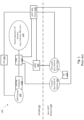
- Figure 1 illustrates a communication network architecture 100 for providing VoWIFI calls.
- the communication network architecture 100 comprises two networks, a Home Public Land Mobile Network (HPLMN) 102 and a non 3GPP network 104.
- HPLMN Home Public Land Mobile Network
- HPLMN Home Public Land Mobile Network
- the HPLMN 102 is the operator's cellular network, for example. It could be a Global System for Mobile communications (GSM), Code Division Multiple Access (CDMA) or Long Term Evolution (LTE) cellular network. It could be also a 5 th Generation (5G) network. Those networks are known in the art and are defined by the 3 rd Generation Partnership Project (3GPP).
- GSM Global System for Mobile communications
- CDMA Code Division Multiple Access
- LTE Long Term Evolution
- 5G 5 th Generation
- Those networks are known in the art and are defined by the 3 rd Generation Partnership Project (3GPP).
- the HPLMN 102 comprises a 3GPP access 106 for providing UEs 124 access to the core network 109 of the HPLMN 102.
- the 3GPP access 106 is connected to a HSS 108 and a Serving Gateway 110.
- the HSS 108 is a database for storing profiles of the users.
- the Serving Gateway 110 routes and forwards user data packets.
- the serving gateway 110 is connected to a Packet Data Network (PDN) gateway 112 which provides connectivity from the UEs 124 to an external packet data network, such as internet.
- PDN gateway 112 is connected to an operator's IP services network 114, which provides Internet, IP Multimedia Subsystem (IMS) services, etc.
- An evolved Packet Data Gateway (ePDG) 116 is connected to the PDN gateway 112 and is connected to a 3GPP AAA server 118.
- the ePDG 116 secures the data transmission with a UE 124 connected to the core network over an untrusted non-3GPP access, such as 122.
- the Authentication Authorization Accounting (AAA) server 118 provides authentication and identification functions to authenticate and identify UEs 124. Skilled persons in the art may appreciate that the different elements of the communication network 100 are known in the art and that the communication network 100 may have other functionalities as those described above.
- the core network 109 can be an Evolved Packet Core (EPC), which comprises, for example, the serving gateway 110, the PDN gateway 112, the ePDG 116 and the HSS 108.
- EPC Evolved Packet Core
- the 3GPP access 106 refers to access technologies specified by the 3GPP. They include GPRS, UMTS, EDGE, HSPA, LTE and LTE Advanced and 5G.
- the Non-3GPP network 104 comprises a trusted Non-3GPP IP access 120 and an Untrusted Non-3GPP IP access 122, which are not specified in the 3GPP.
- the UEs 124 can access the cellular network 102 through a trusted or non-trusted non-3GPP IP access (120 or 122), with different security mechanisms.
- the network operator considers it trustable from a security standpoint, for example, a cdma2000 network is considered to be trustable.
- trusted non-3GPP accesses can interface directly with the network.
- the network operator For the non-trusted access 122, the network operator doesn't consider it trustable from a security stand point, for example, a connection over a public WiFi hotspot. Untrusted non-3GPP accesses are connected to the network 102 via the ePDG 116, which provides additional security mechanisms, such as IPsec tunneling. It is up to the network operator to decide whether a non-3GPP access technology is trusted or untrusted.
- a security stand point for example, a connection over a public WiFi hotspot.
- Untrusted non-3GPP accesses are connected to the network 102 via the ePDG 116, which provides additional security mechanisms, such as IPsec tunneling. It is up to the network operator to decide whether a non-3GPP access technology is trusted or untrusted.
- the method can be carried out in an access point (AP), for example.
- AP access point
- the first UE does not have or does not know its location.
- the first UE can be a tablet, for example, where the tablet does not have a GPS integrated therein or a SIM card, which allows UEs to be serviced by a cellular network, for example.
- the user of the tablet is, for example, in a coffee shop, where other users are present as well.
- Some of the other users may have smartphones (referred to as second UEs, for example) including GPS and/or a SIM card allowing them to be connected to the cellular network.
- Method 200 starts with block 210, where method 200 receives a location request from the first UE.
- the first UE can send a request for location to the AP to which it is connected.
- method 200 determines a location, in response to the received request.
- method 200 sends the determined location to the first UE, for use when establishing a VoWIFI call.
- the determination of the location comprises first learning a location from a second UE located in the same area as the first UE, storing the location in a local memory and retrieving it when the location request is received.
- the AP that represents the non-trusted access 1264 may receive locations of UEs that know their locations (referred to as second UEs), so that it can share these locations with UEs that do not know their locations (referred to as first UEs), the first and second UEs being located within a same area, for example, in the coffee shop.
- the second UEs can have knowledge of their location through the use a GPS, for example. If the second UE 124 has a GPS integrated therein, the second UE 124 can obtain its location through the GPS and then stores this information locally in the second UE. Once the second UE 124 attaches to and authenticates with the nearby/detected AP (of the coffee shop), the second UE can send its location to the AP. Then, the AP can share this location with the first UE.
- a GPS for example. If the second UE 124 has a GPS integrated therein, the second UE 124 can obtain its location through the GPS and then stores this information locally in the second UE. Once the second UE 124 attaches to and authenticates with the nearby/detected AP (of the coffee shop), the second UE can send its location to the AP. Then, the AP can share this location with the first UE.
- some second UEs may not have an integrated GPS, but they may have a connection to the cellular network. As such, they can use the cellular network 102 for obtaining their location. This case is described with reference to Figure 3 .
- the second UE 124 has a SIM card, which allows it to be serviced by the cellular network 102.
- the operations illustrated in Figure 3 are triggered by a handover of the second UE 124 to the WIFI network from the cellular network.
- the operations can be done in parallel with the handover process.
- the handover process from the cellular network (such as LTE) and the WIFI network is well-known in the art and as such will not be described further.
- the second UE 124 After the second UE 124 detects a handover from the cellular network to the WIFI network, the second UE 124 sends a message to the Mobility Management Entity (MME) 205, to request for the location of the second UE, in step 310.
- MME Mobility Management Entity
- the request message can be a "uplink generic Non-Access Stratum (NAS) transport" message, for example.
- NAS Non-Access Stratum
- other messages could be used as well to convey the request for location.
- the MME 305 is a control-node for the LTE access network. For example, it is responsible for authenticating the users, by interacting with the HSS 108 of Figure 1 .
- step 320 the MME 305 sends a location request to the Gateway Mobile Location Centre (GMLC)/ Serving Mobile Location Centre (SMLC) 307.
- GMLC Gateway Mobile Location Centre
- SMLC Serving Mobile Location Centre
- the GMLC/SMLC 307 receives the location request, it initiates a communication with the eNodeB (eNB) 309 and UE 124, using the Location Positioning Protocol (LPP), for example, in step 330. It can request for information, such as the strength of the signals, the beam angles, the time of arrival, etc.
- LPP Location Positioning Protocol
- the GMLC/SMLC 307 determines or calculates a position or location of the second UE. It should be appreciated that the determination of the location of the second UE based on the received answers is well-known in the art. Then, in step 340, the GMLC/SMLC 307 sends the determined location to the MME 205 in a response message.
- step 350 the MME 205 sends a message, called "downlink generic NAS transport", which includes the location of the second UE, to the second UE 124.
- step 360 once the second UE 124 receives the location, it stores it locally in its memory.
- the second UE 124 attaches to the nearby/detected AP. For example, after the second UE 124 successfully authenticates with the AP, the second UE 124 sends its location, that it acquired through the cellular network as shown in Figure 3 , to the AP. Once the AP receives the location, it stores it locally in its memory.
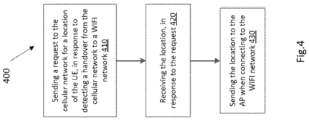
- Method 400 of Figure 4 allows for obtaining the UE location, when a handover of a UE from the cellular network to the WIFI network happens. It is assumed that the UE has a SIM card and is a subscriber of the cellular network.
- method 400 sends a request to the cellular network for a location of the UE, in response to detecting a handover from the cellular network to a WIFI network.
- the UE 124 sends the request to a network node in the cellular network, such as the MME 305.
- method 400 receives the UE location, in response to the request.
- the UE 124 receives the last/latest location of the UE registered by the cellular network.
- the location could be: a Cell Global Identification (CGI), an Evolved Universal Terrestrial Radio Access CGI (eCGI), or a geographical location, for example.
- CGI Cell Global Identification
- eCGI Evolved Universal Terrestrial Radio Access CGI
- geographical location for example.
- the UE 124 sends the received location to the AP, when connecting to the AP, so that the AP can share the location with other UEs that do not know their location.
- the AP receives the location, it stores it locally, in one or more of its memories, or in an associated AAA server, for example.
- the AP can retrieve the stored location given by the second UE and send that location to the first UE for use in VoWIFI calls.
- Figure 5 illustrates a signal flow 500 of the location learning process by the AP in the WIFI network, according to an embodiment.
- step 510 the authentication between the second UE and the associated/detected AP is successful.
- Authentication messages exchanged between the second UE and the AP are well-known in the art and thus will not be described.
- the second UE that has acquired its location, either through GPS or the cellular network, sends a message to the AP.
- the message can be a wireless Local Area Network (LAN) management frame of the IEEE 802.11 protocol, for example.
- This management frame has a field called "Tag parameter: Vendor Specific (221)".
- the tag parameter can incorporate a new Information Element (IE) in which the UE location can be inserted.
- IEs are a device's way to transfer descriptive information about itself inside management frames. There are usually several IEs inside each such frame, for example.
- messages other than the management frames can be used to convey the second UE's location to the AP.
- fields other than the tag parameter can be used to carry the second UE's location.
- the AP retrieves the second UE's location and stores it locally in a memory, in the form of a table, for example.
- the AP can be also associated with an Authentication Authorization and Accounting (AAA) server.
- AAA Authentication Authorization and Accounting
- the location from the second UE can be stored in the AAA server associated with the AP.
- the AP can use the RADIUS protocol to send the location to the AAA server.
- the AAA server binds/correlates the received location with the AP, using its identity, for example.
- step 540 the AP or the AAA server sends a message to the second UE to confirm and acknowledge the reception of the location.
- a plurality of second UEs can share their location with the AP using steps 510 to 540. For each second UE, the corresponding location is stored in the AP or its associated AAA server.
- the AP Once the AP has learned the location of UEs connected to itself, it can start sharing such information with UEs that do not know their location.
- Figure 6 illustrates a signal flow for providing a location to a first UE by sharing a location of a second UE, as learned in Figure 5 , for example.
- the first UE does not have a GPS or a SIM card but when it connects to the WIFI network via an AP, it wishes to make a VoWIFI call.
- the first UE can be a tablet that has WIFI connection and as such can connect to the nearby AP.
- the nearby AP is the same as the AP described above.
- the first UE is at the same coffee shop as the second UEs that provided their location to the AP.
- the first UE 124 sends a message to the AP (step 620).
- the message comprises a request for location.
- the request comprises an indication that the first UE 124 does not know or have its location.
- the message can be a LAN management frame in which the "Tag parameter: Vendor Specific" field includes the value of 0x0. This value indicates a lack of location information from the first UE, i.e. the first UE is not aware of its own location. It should be appreciated by skilled persons in the art that other messages, fields and values can be used by the first UE to indicate the lack of location information.
- the AP determines a UE location from all the locations received from the second UEs. For example, the AP selects the location that is received from the highest number of second UEs at the coffee shop. However, there may be some factors to consider in the determination of the location, for example, the age of the provided location. In other words, the most recently received locations may have higher weights in determining the location to be sent to the first UE, than locations received some time ago. Also, in the case that the received locations are different from each other, it is possible to consider only the common part of the different locations.
- step 640 the AP sends the determined location to the first UE.
- the first UE sends an acknowledgement to the AP, in step 650.
- the first UE As it is connected to the WIFI network, the first UE is enabled to make a VoWIFI call with the cellular network through a network node, such as ePDG 116.
- a network node such as ePDG 116.
- the first UE can include the location that it received from the AP.
- the AP has received at least one location from a second UE before it could share that location with the first UE.
- the AP could use its own location for sharing it with the first UE, if its location is available.
- the available location of the AP is usually entered manually during the AP setup. Therefore, when the AP is moved physically to another place, its new location may not be updated.
- step 710 the authentication between the first UE and the AP is successful.
- the first UE sends a location request to the AP once it is connected to the AP.
- the location request can be included in the header options for an IPv4 data packet or in the extended header option for an IPv6 data packet.
- the AP Upon receipt of the location request, in step 730 the AP broadcasts, or forwards the location request in its domain, i.e. to all UEs connected thereto.
- the UEs that know their location send a location answer with their locations to the AP, in step 640.
- the second UEs can reply back to the broadcast message with its location.
- the second UE can send its location to the AP in a data packet. If it is an IPv4 data packet, the location is included in the header options of the data packet. If it is an IPv6 data packet, the location is included in the extended header option of the data packet.
- the AP sends the location received from the second UE to the first UE.
- the AP can select the location that has been received/shared by the highest number of second UEs.
- metrics/factors can be used to select the most popular or probable location.
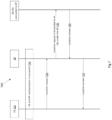
- Figure 8 shows a signal flow 800 for providing a UE location to the network when establishing a VoWIFI call, according to an embodiment.
- step 810 the connection between a UE and the AP is established, through an authentication process, for accessing the WIFI network for example. This is well-known in the art and thus will not be described.
- the UE 124 has obtained/acquired its location, either through the cellular network, as shown in Figure 3 , through the GPS or through the AP as shown in Figure 6 .
- the location is stored in a memory of the UE 124.
- step 830 the UE 124 starts the process of creating a session into the EPC network, such as with the EPC 109. This includes UE attachment in the EPC network. Once the UE is attached, UE registration in the IMS network will be performed, for example.
- the UE 124 communicates with the ePDG 116 by sending an IKE2 AUTH_REQ message.
- the UE location is included in this message.
- the IKE2 AUTH_REQ message is part of the IKE protocol that is used for communications between the UE and the ePDG 116.
- the UE location can be included in other types of messages, as will be appreciated by an ordinary person skilled in the art.
- step 850 upon receipt of the IKE2 AUTH_REQ message, the ePDG 116 sends a create session request to the EPC 109, the create session request comprising the location.
- the EPC 109 After the EPC 109 receives the create session request, it is in possession of the UE's location.
- the location can be shared with the IP Multimedia Subsystem (IMS) network as well.
- IMS IP Multimedia Subsystem
- the UE location is available at the UE, the ePDG 116 and the EPC 109 where it can be used, for emergency calls or other applications such as advertisements, policy control based location, location based services, etc.
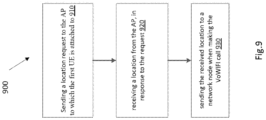
- method 900 sends a location request to the access point (AP) to which the first UE is attached to.
- AP access point
- method 900 receives a location from the AP, in response to the request.
- method 900 sends the received location to a network node when establishing the VoWIFI call.
- the network node is the ePDG 116 of Figure 1 , for example.
- the received location has been shared by a second UE with the AP, the second UE being previously or currently attached to the AP and having knowledge of its location.
- the second UE may have a GPS integrated therein and thus the received location is provided by the GPS.
- the second UE has a SIM card and is a subscriber of a cellular network.
- the received location is provided by the cellular network, during a handover from the cellular network to the WIFI network.
- the received location can be determined from a plurality of locations shared by a plurality of second UEs with the AP.
- the received location is the location shared by the highest number of second UEs (at the coffee shop, for example).
- the received location can be included in a session activation message when it is sent to the network node, e.g. ePDG 116.
- the session activation message is used for creating a session in the ePC network, which includes attachment in the EPC network.
- the UE will have an IP address assigned by the EPC.
- the IP address can be used by the UE to browse the internet or to make VoWIFI calls.
- the AP when the AP receives the location request, it can broadcast the request in its domain, to all the UEs (referred to as second UEs) that are connected thereto.
- the second UEs that have knowledge of their location (through GPS or cellular network), will send their location to the AP, in response to the broadcast message.
- the AP receives the location from the second UEs, it sends it to the first UE, in response to the received location request.
- the received location can be a CGI, an eCGI or a geographical location. Also, it should be noted that the location received by the first UE may comprise any information associated with the location.
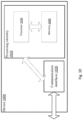
- Figure 10 illustrates a device 1000, for providing UE location for a VoWIFI call, according to one embodiment.
- the device can be the UE 124, for example.
- the device 1000 has a processing circuitry 1010 connected to one or more communication interfaces 1020.
- the communication interface(s) 1020 are configured to communicate with other network nodes or network elements in the cellular network and/or in the WIFI network.
- the processing circuitry 1010 comprises a processor 1030 and a memory 1040 connected thereto.
- the memory 1040 may contain instructions that, when executed, cause the computing device 1000 to perform method 900, for example.
- the processor 1010 is configured to carry out method 900, as described above.
- the memory 1040 can store the location received from the AP.
- the memory 940 may include one or more of volatile and non-volatile memories, such as Random Access Memory (“RAM”), Read Only Memory (“ROM”), a solid state disk (“SSD”), Flash, Phase Change Memory (“PCM”), or other types of data storage.
- RAM Random Access Memory
- ROM Read Only Memory
- SSD solid state disk
- PCM Phase Change Memory
- a computer program comprising non-transitory computer-readable storage medium storing instructions which, when executed by a processor, e.g. 1030, of a computing device, 1000, cause the computing device 1000 to carry out method 900 is provided.
- the instructions may be stored in the memory 1040, for example.
- processing circuitry 1010 when configured with appropriate program code, may be understood to comprise several functional "modules,” where each module comprises program code for carrying out the corresponding function, when executed by an appropriate processor.
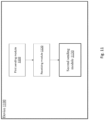
- Figure 11 illustrates a computing device 1100 adapted to carry out method 900, may be understood to comprise a first sending module 1110, a receiving module 1120, and a second sending module 1130, according to another embodiment.
- the first sending module 1110 is configured to send a location request to an access point to which the UE is attached to.
- the receiving module 1120 is configured to receive a location from the AP, in response to the request.
- the second sending module 1130 is configured to send the received location to a network node when establishing the VoWIFI call.
- the network node 1200 can be an access point, for example.
- the network node 1200 has a processing circuitry 1210 connected to one or more communication interfaces 1220.
- the communication interface(s) 1220 are configured to communicate with other network nodes or network elements in the WIFI network and with UEs.
- the processing circuitry 1210 comprises a processor 1230 and a memory 1240 connected thereto.
- the memory 1240 may contain instructions that, when executed, cause the network node 1200 to perform method 200, for example.
- the processor 1210 is configured to carry out method 200, as described above.
- the memory 1240 can store the location information received from the one or more first UEs.
- the memory 1240 may include one or more of volatile and non-volatile memories, such as Random Access Memory (“RAM”), Read Only Memory (“ROM”), a solid state disk (“SSD”), Flash, Phase Change Memory (“PCM”), or other types of data storage.
- RAM Random Access Memory
- ROM Read Only Memory
- SSD solid state disk
- PCM Phase Change Memory
- the memory 1240 may be internal or distributed memory.
- a computer program comprising non-transitory computer-readable storage medium storing instructions which, when executed by a processor, e.g. 1230, of a network node, such as 1200, cause the network node 1200 to carry out method 200 is provided.
- the instructions may be stored in the memory 1240, for example.
- processing circuitry 1210 when configured with appropriate program code, may be understood to comprise several functional "modules,” where each module comprises program code for carrying out the corresponding function, when executed by an appropriate processor.
- Figure 13 illustrates a network node 1300 adapted to carry out method 200, may be understood to comprise a receiving module 1310, a determining module 1320, and a sending module 1330, according to another embodiment.
- the receiving module 1310 is configured to receive a location request from the first UE.
- the determining module 1320 is configured to determine the location of the first UE, in response to the received location request.
- the sending module 1330 is configured to send the determined location to the first UE, for use when establishing the VoWIFI call.
- Embodiments may be represented as a software product stored in a machine-readable medium (such as the non-transitory machine readable storage media also referred to as a computer-readable medium, a processor-readable medium, or a computer usable medium having a computer readable program code embodied therein).
- the non-transitory machine-readable medium may be any suitable tangible medium including a magnetic, optical, or electrical storage medium including a diskette, compact disk read only memory (CD-ROM), digital versatile disc read only memory (DVD-ROM) memory device (volatile or non-volatile) such as hard drive or solid state drive, or similar storage mechanism.
- the machine-readable medium may contain various sets of instructions, code sequences, configuration information, or other data, which, when executed, cause a processor to perform steps in a method according to an embodiment. Those of ordinary skill in the art will appreciate that other instructions and operations necessary to implement the described embodiments may also be stored on the machine-readable medium. Software running from the machine-readable medium may interface with circuitry to perform the described tasks.
Landscapes
- Engineering & Computer Science (AREA)
- Computer Networks & Wireless Communication (AREA)
- Signal Processing (AREA)
- Mobile Radio Communication Systems (AREA)
Claims (10)
- Verfahren zum Bereitstellen eines Standorts eines ersten Benutzergeräts (User Equipment - UE) (124) bei einem VoWiFi(Voice over Wireless Fidelity)-Anruf, wobei das Verfahren durch das erste UE (124) ausgeführt wird und Folgendes umfasst:Senden (910) einer Standortanforderung an einen Zugangspunkt (access point - AP) (122), dem das erste UE (124) zugeordnet ist;Empfangen (920) des Standorts des ersten UE (124) von dem AP (122) als Antwort auf die Anforderung; undSenden (930) des empfangenen Standorts an einen Netzwerkknoten beim Aufbau des VoWiFi-Anrufs,wobei der empfangene Standort durch ein zweites UE dem AP mitgeteilt wurde, wobei das zweite UE dem AP zuvor zugeordnet war oder ihm aktuell zugeordnet ist und Kenntnis von seinem Standort hat,wobei der durch das zweite UE mitgeteilte Standort durch ein in das zweite UE integriertes Global Positioning System (GPS) oder durch ein Mobilfunknetzwerk, dessen Teilnehmer das zweite UE ist, bereitgestellt wird,wobei der von dem AP empfangene Standort aus einer Vielzahl von Standorten bestimmt wird, die durch eine Vielzahl von zweiten UEs dem AP mitgeteilt wird, wobei die Vielzahl von zweiten UEs Kenntnis von ihren Standorten hat, wobei der bestimmte Standort der Standort ist, der durch eine höchste Anzahl von zweiten UEs empfangen wird, undwobei der empfangene Standort dem AP durch die Vielzahl von zweiten UEs, die dem AP zugeordnet ist, als Reaktion auf eine Rundsendenachricht von dem AP mitgeteilt wird, wobei die Rundsendenachricht Standortinformationen anfordert.
- Erstes Benutzergerät (UE) (124) zum Bereitstellen eines Standorts in einem VoWiFi(Voice over Wireless Fidelity)-Anruf, wobei das erste UE (124) eine Verarbeitungsschaltung umfasst, die dazu ausgelegt ist, das erste UE (124) zu Folgendem zu veranlassen:Senden einer Standortanforderung an einen Zugangspunkt (access point - AP) (122), dem das erste UE (124) zugeordnet ist;Empfangen des Standorts für das erste UE (124) von dem AP (122) als Antwort auf die Anforderung; undSenden des empfangenen Standorts an einen Netzwerkknoten beim Aufbau des VoWiFi-Anrufs, wobei der Prozessor dazu ausgelegt ist, den empfangenen Standort in einer Sitzungsaktivierungsnachricht an den Netzwerkknoten zu senden, wobei die Sitzungsaktivierungsnachricht zum Erstellen einer Sitzung in einem EPC(Evolved Packet Core)-Netzwerk verwendet wird,wobei der empfangene Standort durch ein zweites UE dem AP mitgeteilt wurde, wobei das zweite UE dem AP zuvor zugeordnet war oder ihm aktuell zugeordnet ist und Kenntnis von seinem Standort hat,wobei der durch das zweite UE mitgeteilte Standort durch ein in das zweite UE integriertes Global Positioning System (GPS) oder durch ein Mobilfunknetzwerk, dessen Teilnehmer das zweite UE ist, bereitgestellt wird,wobei der von dem AP empfangene Standort aus einer Vielzahl von Standorten bestimmt wird, die durch eine Vielzahl von zweiten UEs dem AP mitgeteilt wird, wobei die Vielzahl von zweiten UEs Kenntnis von ihren Standorten hat, wobei der bestimmte Standort der Standort ist, der durch eine höchste Anzahl von zweiten UEs empfangen wird, undwobei der empfangene Standort dem AP durch die Vielzahl von zweiten UEs, die dem AP zugeordnet ist, als Reaktion auf eine Rundsendenachricht von dem AP mitgeteilt wird, wobei die Rundsendenachricht Standortinformationen anfordert.
- Erstes UE nach Anspruch 2, wobei die Verarbeitungsschaltung einen Prozessor sowie einen Speicher und eine Schnittstelle, die beide mit dem Prozessor gekoppelt sind, umfasst, wobei der Speicher Anweisungen enthält, die, wenn sie ausgeführt werden, den Prozessor veranlassen, Operationen zum Senden der Anforderung, Empfangen des Standorts und Senden des empfangenen Standorts durchzuführen.
- Erstes UE nach einem der Ansprüche 2-3, wobei der Prozessor dazu ausgelegt ist, die Standortanforderung in einem Informationselement (IE) eines Verwaltungsrahmens im IEEE-802.11-Wireless-Local-Area Network(LAN)-Protokoll zu senden, und/oder
wobei der Standort eine globale Zellkennung (cell global identification - CGI), eine globale Zellkennung des terrestrischen Funkzugangsnetzwerkes des Evolved Universal Mobile Telecommunications System (eCGI) oder einen geografischen Standort umfasst, wobei der Netzwerkknoten ein Evolved Packet Data Gateway (e-PDG) ist. - Verfahren zum Bereitstellen eines Standorts für ein erstes Benutzergerät (UE) (124) zur Verwendung in einem Voice-over-Wireless-Fidelity(VoWiFi)-Anruf, wobei das Verfahren durch einen Netzknoten ausgeführt wird und Folgendes umfasst:Empfangen (210) einer Standortanforderung von dem ersten UE (124);Bestimmen (220) des Standorts des ersten UE (124) als Reaktion auf die empfangene Anforderung; undSenden des bestimmten Standorts an das erste UE (124) zur Verwendung beim Aufbau des VoWiFi-Anrufs,wobei der Prozessor beim Bestimmen des Standorts des ersten UE einen in dem Netzwerkknoten gespeicherten Standort abruft, wobei der Standort von einem zweiten UE empfangen wird, das Kenntnis von seinem Standort hatte und das zuvor dem Netzwerkknoten zugeordnet war oder aktuell diesem zugeordnet ist, undwobei das zweite UE ein darin integriertes globales Positionierungssystem (GPS) aufweist und wobei das zweite UE eine Teilnehmeridentitätsmodul(Subscriber Identity Module - SIM)-Karte aufweist und ein Teilnehmer eines Mobilfunknetzwerkes ist und wobei der Standort von dem zweiten UE durch das Mobilfunknetz oder das GPS angegeben wird,wobei das Verfahren ferner Folgendes umfasst:
Empfangen einer Vielzahl von Standorten von einer Vielzahl von zweiten UEs, wobei das Bestimmen des Standorts das Auswählen eines Standorts aus der Vielzahl von Standorten, die durch eine höchste Anzahl von zweiten UEs mitgeteilt wurde, umfasst. - Netzwerkknoten zum Bereitstellen eines Standorts für ein erstes Benutzergerät (UE) (124) zur Verwendung in einem VoWiFi-Anruf, wobei der Netzwerkknoten eine Verarbeitungsschaltung umfasst, die für Folgendes ausgelegt ist:Empfangen einer Standortanforderung von dem ersten UE (124);Bestimmen des Standorts des ersten UE (124) als Reaktion auf die empfangene Anforderung; undSenden des bestimmten Standorts an das erste UE (124) zur Verwendung beim Aufbau eines VoWiFi-Anrufs,wobei der Prozessor einen in dem Netzwerkknoten gespeicherten Standort abruft, wenn er den Standort des ersten UE bestimmt, wobei der Standort von einem zweiten UE empfangen wird, das Kenntnis von seinem Standort hatte und das zuvor dem Netzwerkknoten zugeordnet war oder aktuell diesem zugeordnet ist,wobei das zweite UE ein darin integriertes globales Positionierungssystem (GPS) aufweist und wobei das zweite UE eine Teilnehmeridentitätsmodul(Subscriber Identity Module - SIM)-Karte aufweist und ein Teilnehmer eines Mobilfunknetzwerkes ist und wobei der Standort von dem zweiten UE durch das Mobilfunknetz oder das GPS angegeben wird,wobei die Verarbeitungsschaltung ferner zu Folgendem ausgelegt ist:
Empfangen einer Vielzahl von Standorten von einer Vielzahl von zweiten UEs und Auswählen eines Standorts aus der Vielzahl von Standorten, die durch eine höchste Anzahl von zweiten UEs mitgeteilt wurde. - Netzwerkknoten nach Anspruch 6, wobei die Verarbeitungsschaltung einen Prozessor sowie eine Netzwerkschnittstelle und einen Speicher, die beide mit dem Prozessor gekoppelt sind, umfasst, wobei der Speicher Anweisungen enthält, die, wenn sie ausgeführt werden, den Prozessor veranlassen, eine Operation des Empfangens der Standortanforderung, des Bestimmens des Standorts und des Sendens des bestimmten Standorts durchzuführen.
- Netzwerkknoten nach Anspruch 6,
wobei das zweite UE eine Anforderung an das Mobilfunknetzwerk nach seinem Standort sendet, nachdem eine Weiterreichung von dem Mobilfunknetzwerk in ein WiFi-Netzwerk erfolgt ist. - Netzwerkknoten nach einem der Ansprüche 6-8, wobei das erste UE kein GPS oder keine SIM-Karte aufweist und/oderwobei die Standortanforderung durch einen Verwaltungsrahmen im IEEE-802.11-Wireless-Local-Area Network(LAN)-Protokoll bereitgestellt wird und/oderwobei die bestimmte Standortinformation eine globale Zellkennung (cell global identification - CGI), eine globale Zellkennung des terrestrischen Funkzugangsnetzwerkes des Evolved Universal Mobile Telecommunications System (eCGI) oder ein geografischer Standort ist.
- Netzwerkknoten nach Anspruch 6, wobei der Prozessor ferner:die empfangene Standortanforderung innerhalb einer Domäne des Netzwerkknotens rundsendet;als Reaktion auf das Rundsenden Standorte von dritten UEs empfängt, die mit dem Netzwerkknoten verbunden sind, wobei die dritten UEs Kenntnis von ihrem Standort haben; undden Standort auswählt, der von einer höchsten Anzahl von dritten UEs empfangen wurde, und optionalwobei die dritten UEs über GPS oder das Mobilfunknetzwerk Kenntnis von ihrem Standort haben und/oderwobei die von den dritten UEs empfangenen Standorte in einer von einer Header-Option für ein IPv4-Datenpaket und einer erweiterten Header-Option für ein 1Pv6-Datenpaket enthalten sind und/oderwobei der Netzwerkknoten ein Zugangspunkt ist.
Applications Claiming Priority (1)
| Application Number | Priority Date | Filing Date | Title |
|---|---|---|---|
| PCT/IB2016/052520 WO2017191490A1 (en) | 2016-05-03 | 2016-05-03 | Methods and network nodes for providing ue location for vowifi calls |
Publications (2)
| Publication Number | Publication Date |
|---|---|
| EP3453208A1 EP3453208A1 (de) | 2019-03-13 |
| EP3453208B1 true EP3453208B1 (de) | 2024-09-18 |
Family
ID=56008827
Family Applications (1)
| Application Number | Title | Priority Date | Filing Date |
|---|---|---|---|
| EP16723173.7A Active EP3453208B1 (de) | 2016-05-03 | 2016-05-03 | Verfahren und netzwerkknoten zur bereitstellung eines ue-speicherplatzes für vowifi-anrufe |
Country Status (3)
| Country | Link |
|---|---|
| US (1) | US20190159160A1 (de) |
| EP (1) | EP3453208B1 (de) |
| WO (1) | WO2017191490A1 (de) |
Families Citing this family (12)
| Publication number | Priority date | Publication date | Assignee | Title |
|---|---|---|---|---|
| US10582435B2 (en) * | 2017-07-28 | 2020-03-03 | Samsung Electronics Co., Ltd. | Method and system for handling wireless communication in voice over wireless fidelity system |
| CN109862552A (zh) * | 2017-11-30 | 2019-06-07 | 西安华为技术有限公司 | VoWiFi业务的更新方法、控制方法和相关装置 |
| CN108111974A (zh) * | 2017-12-13 | 2018-06-01 | 广东欧珀移动通信有限公司 | 定位模块的控制方法、装置、存储介质及终端 |
| CN110839200B (zh) * | 2018-08-15 | 2022-02-25 | 华为技术有限公司 | 紧急呼叫实现方法及装置 |
| EP3864873B1 (de) * | 2018-10-08 | 2024-08-14 | Nokia Technologies OY | Kommunikationssystem |
| CN111263292B (zh) * | 2018-11-30 | 2021-07-27 | 中国电信股份有限公司 | 通信业务的处理方法、装置、系统和计算机可读存储介质 |
| CN110446277B (zh) * | 2019-07-09 | 2022-05-17 | 广东以诺通讯有限公司 | 一种双卡终端VoWiFi业务接入方法和终端 |
| WO2021062686A1 (zh) * | 2019-09-30 | 2021-04-08 | 华为技术有限公司 | 一种获取位置信息的方法、装置及系统 |
| CN113873491B (zh) * | 2021-10-29 | 2024-12-03 | 中国电信股份有限公司 | 通信装置、系统和计算机可读存储介质 |
| CN114338157B (zh) * | 2021-12-28 | 2023-11-07 | 中国电信股份有限公司 | 终端业务鉴权方法、装置、设备、系统及介质 |
| CN115996368A (zh) * | 2022-12-15 | 2023-04-21 | 中盈优创资讯科技有限公司 | 一种VoWiFi业务自动开通方法及装置 |
| CN117135562B (zh) * | 2023-02-27 | 2024-06-04 | 荣耀终端有限公司 | 参数设置方法、终端设备及可读存储介质 |
Citations (4)
| Publication number | Priority date | Publication date | Assignee | Title |
|---|---|---|---|---|
| WO2012149565A2 (en) * | 2011-04-28 | 2012-11-01 | Trekintelligence, Inc. | System and method for cell phone targeting and tracking |
| US20130281110A1 (en) * | 2012-04-18 | 2013-10-24 | Google Inc. | Using peer devices to locate a mobile device |
| US20150141043A1 (en) * | 2013-08-23 | 2015-05-21 | Cellepathy Ltd. | Corrective navigation instructions |
| EP3225042A1 (de) * | 2014-11-24 | 2017-10-04 | Qualcomm Incorporated | Verfahren zur unterstützung der ortung und von notrufen für einen ott-dienstanbieter |
Family Cites Families (6)
| Publication number | Priority date | Publication date | Assignee | Title |
|---|---|---|---|---|
| US20070202886A1 (en) * | 2006-02-24 | 2007-08-30 | Pratik Mahesh Dhebri | Location-specific broadcast messaging |
| EP2413630B1 (de) * | 2010-07-30 | 2013-07-03 | Samsung Electronics Co., Ltd. | Drahtloses Netzwerksystem und Verfahren zur Bereitstellung von Informationen in einem drahtlosen Netzwerksystem |
| CN103039036B (zh) * | 2011-08-09 | 2015-04-08 | 华为技术有限公司 | 用户数量计算方法及系统 |
| US9691115B2 (en) * | 2012-06-21 | 2017-06-27 | Cellepathy Inc. | Context determination using access points in transportation and other scenarios |
| US9386615B2 (en) * | 2014-06-16 | 2016-07-05 | Verizon Patent And Licensing Inc. | Adaptive paging procedure for a call terminating via a wireless local area network |
| US9179436B1 (en) * | 2014-08-22 | 2015-11-03 | Cisco Technology, Inc. | System and method for location reporting in an untrusted network environment |
-
2016
- 2016-05-03 EP EP16723173.7A patent/EP3453208B1/de active Active
- 2016-05-03 WO PCT/IB2016/052520 patent/WO2017191490A1/en not_active Ceased
- 2016-05-03 US US16/098,193 patent/US20190159160A1/en not_active Abandoned
Patent Citations (4)
| Publication number | Priority date | Publication date | Assignee | Title |
|---|---|---|---|---|
| WO2012149565A2 (en) * | 2011-04-28 | 2012-11-01 | Trekintelligence, Inc. | System and method for cell phone targeting and tracking |
| US20130281110A1 (en) * | 2012-04-18 | 2013-10-24 | Google Inc. | Using peer devices to locate a mobile device |
| US20150141043A1 (en) * | 2013-08-23 | 2015-05-21 | Cellepathy Ltd. | Corrective navigation instructions |
| EP3225042A1 (de) * | 2014-11-24 | 2017-10-04 | Qualcomm Incorporated | Verfahren zur unterstützung der ortung und von notrufen für einen ott-dienstanbieter |
Also Published As
| Publication number | Publication date |
|---|---|
| WO2017191490A1 (en) | 2017-11-09 |
| US20190159160A1 (en) | 2019-05-23 |
| EP3453208A1 (de) | 2019-03-13 |
Similar Documents
| Publication | Publication Date | Title |
|---|---|---|
| US20190159160A1 (en) | Methods and network nodes for providing ue location for vowifi calls | |
| US10917935B2 (en) | Emergency services support for non-cellular wireless access | |
| US9980130B2 (en) | Session and service control for wireless devices using common subscriber information | |
| EP3817502B1 (de) | Verfahren und vorrichtung zur handhabung eines sich im ruhezustand befindlichen benutzergerätes | |
| US12089129B2 (en) | Support of emergency services over WLAN access to 3GPP packet core for unauthenticated users | |
| US20170289883A1 (en) | Emergency services handover between untrusted wlan access and cellular access | |
| CA2977361A1 (en) | Techniques to support emergency services | |
| JP6522799B2 (ja) | モバイル通信ネットワークのハンドオーバ機能を発見するための方法、モバイル通信ネットワークのハンドオーバ機能を発見するためのシステム、ユーザ装置、プログラム及びコンピュータプログラム製品 | |
| US20240340834A1 (en) | Establishing a Multiple Access Connection | |
| TWI627870B (zh) | 通訊系統中閘道器節點之選擇 | |
| CN111405607A (zh) | 一种网络切换方法、设备及区块链系统 | |
| US9641531B2 (en) | Node and a method for enabling network access authorization | |
| WO2017035781A1 (en) | Methods and devices of authenticating non-sim mobile terminals accessing a wireless communication network | |
| EP4147493B1 (de) | Multi-usim-vorrichtung zum zugreifen auf dienste eines zweiten zellularen netzwerks über ein erstes zellulares netzwerk über ein gateway | |
| WO2017141175A1 (en) | Roaming management in communication systems | |
| WO2016183775A1 (zh) | 一种紧急呼叫方法、装置及设备 | |
| WO2016208639A1 (ja) | 端末装置、ゲートウェイ装置及び通信制御方法 | |
| EP3485668B1 (de) | Netzwerkknoten und durch einen netzwerkknoten durchgeführte verfahren zur auswahl eines authentifizierungsmechanismus | |
| US20240056804A1 (en) | Method, apparatus and computer program | |
| US20240155439A1 (en) | Securing communications at a change of connection | |
| CN108702619A (zh) | 获取、发送用户设备标识的方法及设备 | |
| HK1260371A1 (en) | Support of emergency services over wlan access to 3gpp evolved packet core for unauthenticated users |
Legal Events
| Date | Code | Title | Description |
|---|---|---|---|
| STAA | Information on the status of an ep patent application or granted ep patent |
Free format text: STATUS: THE INTERNATIONAL PUBLICATION HAS BEEN MADE |
|
| PUAI | Public reference made under article 153(3) epc to a published international application that has entered the european phase |
Free format text: ORIGINAL CODE: 0009012 |
|
| STAA | Information on the status of an ep patent application or granted ep patent |
Free format text: STATUS: REQUEST FOR EXAMINATION WAS MADE |
|
| 17P | Request for examination filed |
Effective date: 20181128 |
|
| AK | Designated contracting states |
Kind code of ref document: A1 Designated state(s): AL AT BE BG CH CY CZ DE DK EE ES FI FR GB GR HR HU IE IS IT LI LT LU LV MC MK MT NL NO PL PT RO RS SE SI SK SM TR |
|
| AX | Request for extension of the european patent |
Extension state: BA ME |
|
| DAV | Request for validation of the european patent (deleted) | ||
| DAX | Request for extension of the european patent (deleted) | ||
| STAA | Information on the status of an ep patent application or granted ep patent |
Free format text: STATUS: EXAMINATION IS IN PROGRESS |
|
| 17Q | First examination report despatched |
Effective date: 20210408 |
|
| GRAP | Despatch of communication of intention to grant a patent |
Free format text: ORIGINAL CODE: EPIDOSNIGR1 |
|
| STAA | Information on the status of an ep patent application or granted ep patent |
Free format text: STATUS: GRANT OF PATENT IS INTENDED |
|
| RIC1 | Information provided on ipc code assigned before grant |
Ipc: H04W 36/36 20090101ALI20240318BHEP Ipc: H04W 64/00 20090101AFI20240318BHEP |
|
| INTG | Intention to grant announced |
Effective date: 20240411 |
|
| RIN1 | Information on inventor provided before grant (corrected) |
Inventor name: ALBASHEIR, SULIMAN |
|
| GRAS | Grant fee paid |
Free format text: ORIGINAL CODE: EPIDOSNIGR3 |
|
| GRAA | (expected) grant |
Free format text: ORIGINAL CODE: 0009210 |
|
| STAA | Information on the status of an ep patent application or granted ep patent |
Free format text: STATUS: THE PATENT HAS BEEN GRANTED |
|
| AK | Designated contracting states |
Kind code of ref document: B1 Designated state(s): AL AT BE BG CH CY CZ DE DK EE ES FI FR GB GR HR HU IE IS IT LI LT LU LV MC MK MT NL NO PL PT RO RS SE SI SK SM TR |
|
| REG | Reference to a national code |
Ref country code: GB Ref legal event code: FG4D |
|
| REG | Reference to a national code |
Ref country code: CH Ref legal event code: EP |
|
| REG | Reference to a national code |
Ref country code: DE Ref legal event code: R096 Ref document number: 602016089442 Country of ref document: DE |
|
| REG | Reference to a national code |
Ref country code: IE Ref legal event code: FG4D |
|
| REG | Reference to a national code |
Ref country code: LT Ref legal event code: MG9D |
|
| PG25 | Lapsed in a contracting state [announced via postgrant information from national office to epo] |
Ref country code: NO Free format text: LAPSE BECAUSE OF FAILURE TO SUBMIT A TRANSLATION OF THE DESCRIPTION OR TO PAY THE FEE WITHIN THE PRESCRIBED TIME-LIMIT Effective date: 20241218 |
|
| PG25 | Lapsed in a contracting state [announced via postgrant information from national office to epo] |
Ref country code: GR Free format text: LAPSE BECAUSE OF FAILURE TO SUBMIT A TRANSLATION OF THE DESCRIPTION OR TO PAY THE FEE WITHIN THE PRESCRIBED TIME-LIMIT Effective date: 20241219 Ref country code: FI Free format text: LAPSE BECAUSE OF FAILURE TO SUBMIT A TRANSLATION OF THE DESCRIPTION OR TO PAY THE FEE WITHIN THE PRESCRIBED TIME-LIMIT Effective date: 20240918 |
|
| PG25 | Lapsed in a contracting state [announced via postgrant information from national office to epo] |
Ref country code: BG Free format text: LAPSE BECAUSE OF FAILURE TO SUBMIT A TRANSLATION OF THE DESCRIPTION OR TO PAY THE FEE WITHIN THE PRESCRIBED TIME-LIMIT Effective date: 20240918 |
|
| PG25 | Lapsed in a contracting state [announced via postgrant information from national office to epo] |
Ref country code: LV Free format text: LAPSE BECAUSE OF FAILURE TO SUBMIT A TRANSLATION OF THE DESCRIPTION OR TO PAY THE FEE WITHIN THE PRESCRIBED TIME-LIMIT Effective date: 20240918 |
|
| PG25 | Lapsed in a contracting state [announced via postgrant information from national office to epo] |
Ref country code: HR Free format text: LAPSE BECAUSE OF FAILURE TO SUBMIT A TRANSLATION OF THE DESCRIPTION OR TO PAY THE FEE WITHIN THE PRESCRIBED TIME-LIMIT Effective date: 20240918 |
|
| REG | Reference to a national code |
Ref country code: NL Ref legal event code: MP Effective date: 20240918 |
|
| PG25 | Lapsed in a contracting state [announced via postgrant information from national office to epo] |
Ref country code: RS Free format text: LAPSE BECAUSE OF FAILURE TO SUBMIT A TRANSLATION OF THE DESCRIPTION OR TO PAY THE FEE WITHIN THE PRESCRIBED TIME-LIMIT Effective date: 20241218 |
|
| PG25 | Lapsed in a contracting state [announced via postgrant information from national office to epo] |
Ref country code: RS Free format text: LAPSE BECAUSE OF FAILURE TO SUBMIT A TRANSLATION OF THE DESCRIPTION OR TO PAY THE FEE WITHIN THE PRESCRIBED TIME-LIMIT Effective date: 20241218 Ref country code: NO Free format text: LAPSE BECAUSE OF FAILURE TO SUBMIT A TRANSLATION OF THE DESCRIPTION OR TO PAY THE FEE WITHIN THE PRESCRIBED TIME-LIMIT Effective date: 20241218 Ref country code: LV Free format text: LAPSE BECAUSE OF FAILURE TO SUBMIT A TRANSLATION OF THE DESCRIPTION OR TO PAY THE FEE WITHIN THE PRESCRIBED TIME-LIMIT Effective date: 20240918 Ref country code: HR Free format text: LAPSE BECAUSE OF FAILURE TO SUBMIT A TRANSLATION OF THE DESCRIPTION OR TO PAY THE FEE WITHIN THE PRESCRIBED TIME-LIMIT Effective date: 20240918 Ref country code: GR Free format text: LAPSE BECAUSE OF FAILURE TO SUBMIT A TRANSLATION OF THE DESCRIPTION OR TO PAY THE FEE WITHIN THE PRESCRIBED TIME-LIMIT Effective date: 20241219 Ref country code: FI Free format text: LAPSE BECAUSE OF FAILURE TO SUBMIT A TRANSLATION OF THE DESCRIPTION OR TO PAY THE FEE WITHIN THE PRESCRIBED TIME-LIMIT Effective date: 20240918 Ref country code: BG Free format text: LAPSE BECAUSE OF FAILURE TO SUBMIT A TRANSLATION OF THE DESCRIPTION OR TO PAY THE FEE WITHIN THE PRESCRIBED TIME-LIMIT Effective date: 20240918 |
|
| REG | Reference to a national code |
Ref country code: AT Ref legal event code: MK05 Ref document number: 1725773 Country of ref document: AT Kind code of ref document: T Effective date: 20240918 |
|
| PG25 | Lapsed in a contracting state [announced via postgrant information from national office to epo] |
Ref country code: NL Free format text: LAPSE BECAUSE OF FAILURE TO SUBMIT A TRANSLATION OF THE DESCRIPTION OR TO PAY THE FEE WITHIN THE PRESCRIBED TIME-LIMIT Effective date: 20240918 |
|
| PG25 | Lapsed in a contracting state [announced via postgrant information from national office to epo] |
Ref country code: IS Free format text: LAPSE BECAUSE OF FAILURE TO SUBMIT A TRANSLATION OF THE DESCRIPTION OR TO PAY THE FEE WITHIN THE PRESCRIBED TIME-LIMIT Effective date: 20250118 Ref country code: PT Free format text: LAPSE BECAUSE OF FAILURE TO SUBMIT A TRANSLATION OF THE DESCRIPTION OR TO PAY THE FEE WITHIN THE PRESCRIBED TIME-LIMIT Effective date: 20250120 |
|
| PG25 | Lapsed in a contracting state [announced via postgrant information from national office to epo] |
Ref country code: SM Free format text: LAPSE BECAUSE OF FAILURE TO SUBMIT A TRANSLATION OF THE DESCRIPTION OR TO PAY THE FEE WITHIN THE PRESCRIBED TIME-LIMIT Effective date: 20240918 Ref country code: RO Free format text: LAPSE BECAUSE OF FAILURE TO SUBMIT A TRANSLATION OF THE DESCRIPTION OR TO PAY THE FEE WITHIN THE PRESCRIBED TIME-LIMIT Effective date: 20240918 |
|
| PG25 | Lapsed in a contracting state [announced via postgrant information from national office to epo] |
Ref country code: ES Free format text: LAPSE BECAUSE OF FAILURE TO SUBMIT A TRANSLATION OF THE DESCRIPTION OR TO PAY THE FEE WITHIN THE PRESCRIBED TIME-LIMIT Effective date: 20240918 |
|
| PG25 | Lapsed in a contracting state [announced via postgrant information from national office to epo] |
Ref country code: EE Free format text: LAPSE BECAUSE OF FAILURE TO SUBMIT A TRANSLATION OF THE DESCRIPTION OR TO PAY THE FEE WITHIN THE PRESCRIBED TIME-LIMIT Effective date: 20240918 Ref country code: AT Free format text: LAPSE BECAUSE OF FAILURE TO SUBMIT A TRANSLATION OF THE DESCRIPTION OR TO PAY THE FEE WITHIN THE PRESCRIBED TIME-LIMIT Effective date: 20240918 |
|
| PG25 | Lapsed in a contracting state [announced via postgrant information from national office to epo] |
Ref country code: CZ Free format text: LAPSE BECAUSE OF FAILURE TO SUBMIT A TRANSLATION OF THE DESCRIPTION OR TO PAY THE FEE WITHIN THE PRESCRIBED TIME-LIMIT Effective date: 20240918 Ref country code: PL Free format text: LAPSE BECAUSE OF FAILURE TO SUBMIT A TRANSLATION OF THE DESCRIPTION OR TO PAY THE FEE WITHIN THE PRESCRIBED TIME-LIMIT Effective date: 20240918 |
|
| PG25 | Lapsed in a contracting state [announced via postgrant information from national office to epo] |
Ref country code: SK Free format text: LAPSE BECAUSE OF FAILURE TO SUBMIT A TRANSLATION OF THE DESCRIPTION OR TO PAY THE FEE WITHIN THE PRESCRIBED TIME-LIMIT Effective date: 20240918 Ref country code: IT Free format text: LAPSE BECAUSE OF FAILURE TO SUBMIT A TRANSLATION OF THE DESCRIPTION OR TO PAY THE FEE WITHIN THE PRESCRIBED TIME-LIMIT Effective date: 20240918 |
|
| REG | Reference to a national code |
Ref country code: DE Ref legal event code: R097 Ref document number: 602016089442 Country of ref document: DE |
|
| PGFP | Annual fee paid to national office [announced via postgrant information from national office to epo] |
Ref country code: DE Payment date: 20250529 Year of fee payment: 10 |
|
| PG25 | Lapsed in a contracting state [announced via postgrant information from national office to epo] |
Ref country code: DK Free format text: LAPSE BECAUSE OF FAILURE TO SUBMIT A TRANSLATION OF THE DESCRIPTION OR TO PAY THE FEE WITHIN THE PRESCRIBED TIME-LIMIT Effective date: 20240918 |
|
| PGFP | Annual fee paid to national office [announced via postgrant information from national office to epo] |
Ref country code: GB Payment date: 20250527 Year of fee payment: 10 |
|
| PLBE | No opposition filed within time limit |
Free format text: ORIGINAL CODE: 0009261 |
|
| STAA | Information on the status of an ep patent application or granted ep patent |
Free format text: STATUS: NO OPPOSITION FILED WITHIN TIME LIMIT |
|
| 26N | No opposition filed |
Effective date: 20250619 |
|
| PG25 | Lapsed in a contracting state [announced via postgrant information from national office to epo] |
Ref country code: SE Free format text: LAPSE BECAUSE OF FAILURE TO SUBMIT A TRANSLATION OF THE DESCRIPTION OR TO PAY THE FEE WITHIN THE PRESCRIBED TIME-LIMIT Effective date: 20240918 |
|
| REG | Reference to a national code |
Ref country code: CH Ref legal event code: H13 Free format text: ST27 STATUS EVENT CODE: U-0-0-H10-H13 (AS PROVIDED BY THE NATIONAL OFFICE) Effective date: 20251223 |
|
| PG25 | Lapsed in a contracting state [announced via postgrant information from national office to epo] |
Ref country code: LU Free format text: LAPSE BECAUSE OF NON-PAYMENT OF DUE FEES Effective date: 20250503 |
|
| PG25 | Lapsed in a contracting state [announced via postgrant information from national office to epo] |
Ref country code: CH Free format text: LAPSE BECAUSE OF NON-PAYMENT OF DUE FEES Effective date: 20250531 |
|
| REG | Reference to a national code |
Ref country code: BE Ref legal event code: MM Effective date: 20250531 |
|
| PG25 | Lapsed in a contracting state [announced via postgrant information from national office to epo] |
Ref country code: MC Free format text: LAPSE BECAUSE OF FAILURE TO SUBMIT A TRANSLATION OF THE DESCRIPTION OR TO PAY THE FEE WITHIN THE PRESCRIBED TIME-LIMIT Effective date: 20240918 |
|
| PG25 | Lapsed in a contracting state [announced via postgrant information from national office to epo] |
Ref country code: IE Free format text: LAPSE BECAUSE OF NON-PAYMENT OF DUE FEES Effective date: 20250503 |
|
| PG25 | Lapsed in a contracting state [announced via postgrant information from national office to epo] |
Ref country code: BE Free format text: LAPSE BECAUSE OF NON-PAYMENT OF DUE FEES Effective date: 20250531 |
|
| PG25 | Lapsed in a contracting state [announced via postgrant information from national office to epo] |
Ref country code: FR Free format text: LAPSE BECAUSE OF NON-PAYMENT OF DUE FEES Effective date: 20250531 |