EP3452145B1 - Control device for controlling the administration of propofol to a patient - Google Patents
Control device for controlling the administration of propofol to a patient Download PDFInfo
- Publication number
- EP3452145B1 EP3452145B1 EP17721974.8A EP17721974A EP3452145B1 EP 3452145 B1 EP3452145 B1 EP 3452145B1 EP 17721974 A EP17721974 A EP 17721974A EP 3452145 B1 EP3452145 B1 EP 3452145B1
- Authority
- EP
- European Patent Office
- Prior art keywords
- propofol
- compartment
- effect
- model
- bis
- Prior art date
- Legal status (The legal status is an assumption and is not a legal conclusion. Google has not performed a legal analysis and makes no representation as to the accuracy of the status listed.)
- Active
Links
Images


Classifications
-
- A—HUMAN NECESSITIES
- A61—MEDICAL OR VETERINARY SCIENCE; HYGIENE
- A61M—DEVICES FOR INTRODUCING MEDIA INTO, OR ONTO, THE BODY; DEVICES FOR TRANSDUCING BODY MEDIA OR FOR TAKING MEDIA FROM THE BODY; DEVICES FOR PRODUCING OR ENDING SLEEP OR STUPOR
- A61M5/00—Devices for bringing media into the body in a subcutaneous, intra-vascular or intramuscular way; Accessories therefor, e.g. filling or cleaning devices, arm-rests
- A61M5/14—Infusion devices, e.g. infusing by gravity; Blood infusion; Accessories therefor
- A61M5/168—Means for controlling media flow to the body or for metering media to the body, e.g. drip meters, counters ; Monitoring media flow to the body
- A61M5/172—Means for controlling media flow to the body or for metering media to the body, e.g. drip meters, counters ; Monitoring media flow to the body electrical or electronic
- A61M5/1723—Means for controlling media flow to the body or for metering media to the body, e.g. drip meters, counters ; Monitoring media flow to the body electrical or electronic using feedback of body parameters, e.g. blood-sugar, pressure
-
- A—HUMAN NECESSITIES
- A61—MEDICAL OR VETERINARY SCIENCE; HYGIENE
- A61B—DIAGNOSIS; SURGERY; IDENTIFICATION
- A61B5/00—Measuring for diagnostic purposes; Identification of persons
- A61B5/48—Other medical applications
- A61B5/4821—Determining level or depth of anaesthesia
-
- A—HUMAN NECESSITIES
- A61—MEDICAL OR VETERINARY SCIENCE; HYGIENE
- A61K—PREPARATIONS FOR MEDICAL, DENTAL OR TOILETRY PURPOSES
- A61K31/00—Medicinal preparations containing organic active ingredients
- A61K31/045—Hydroxy compounds, e.g. alcohols; Salts thereof, e.g. alcoholates
- A61K31/05—Phenols
-
- A—HUMAN NECESSITIES
- A61—MEDICAL OR VETERINARY SCIENCE; HYGIENE
- A61M—DEVICES FOR INTRODUCING MEDIA INTO, OR ONTO, THE BODY; DEVICES FOR TRANSDUCING BODY MEDIA OR FOR TAKING MEDIA FROM THE BODY; DEVICES FOR PRODUCING OR ENDING SLEEP OR STUPOR
- A61M5/00—Devices for bringing media into the body in a subcutaneous, intra-vascular or intramuscular way; Accessories therefor, e.g. filling or cleaning devices, arm-rests
- A61M5/14—Infusion devices, e.g. infusing by gravity; Blood infusion; Accessories therefor
- A61M5/142—Pressure infusion, e.g. using pumps
-
- A—HUMAN NECESSITIES
- A61—MEDICAL OR VETERINARY SCIENCE; HYGIENE
- A61M—DEVICES FOR INTRODUCING MEDIA INTO, OR ONTO, THE BODY; DEVICES FOR TRANSDUCING BODY MEDIA OR FOR TAKING MEDIA FROM THE BODY; DEVICES FOR PRODUCING OR ENDING SLEEP OR STUPOR
- A61M5/00—Devices for bringing media into the body in a subcutaneous, intra-vascular or intramuscular way; Accessories therefor, e.g. filling or cleaning devices, arm-rests
- A61M5/14—Infusion devices, e.g. infusing by gravity; Blood infusion; Accessories therefor
- A61M5/168—Means for controlling media flow to the body or for metering media to the body, e.g. drip meters, counters ; Monitoring media flow to the body
- A61M5/16877—Adjusting flow; Devices for setting a flow rate
-
- A—HUMAN NECESSITIES
- A61—MEDICAL OR VETERINARY SCIENCE; HYGIENE
- A61P—SPECIFIC THERAPEUTIC ACTIVITY OF CHEMICAL COMPOUNDS OR MEDICINAL PREPARATIONS
- A61P23/00—Anaesthetics
-
- G—PHYSICS
- G16—INFORMATION AND COMMUNICATION TECHNOLOGY [ICT] SPECIALLY ADAPTED FOR SPECIFIC APPLICATION FIELDS
- G16H—HEALTHCARE INFORMATICS, i.e. INFORMATION AND COMMUNICATION TECHNOLOGY [ICT] SPECIALLY ADAPTED FOR THE HANDLING OR PROCESSING OF MEDICAL OR HEALTHCARE DATA
- G16H20/00—ICT specially adapted for therapies or health-improving plans, e.g. for handling prescriptions, for steering therapy or for monitoring patient compliance
- G16H20/10—ICT specially adapted for therapies or health-improving plans, e.g. for handling prescriptions, for steering therapy or for monitoring patient compliance relating to drugs or medications, e.g. for ensuring correct administration to patients
- G16H20/17—ICT specially adapted for therapies or health-improving plans, e.g. for handling prescriptions, for steering therapy or for monitoring patient compliance relating to drugs or medications, e.g. for ensuring correct administration to patients delivered via infusion or injection
-
- G—PHYSICS
- G16—INFORMATION AND COMMUNICATION TECHNOLOGY [ICT] SPECIALLY ADAPTED FOR SPECIFIC APPLICATION FIELDS
- G16H—HEALTHCARE INFORMATICS, i.e. INFORMATION AND COMMUNICATION TECHNOLOGY [ICT] SPECIALLY ADAPTED FOR THE HANDLING OR PROCESSING OF MEDICAL OR HEALTHCARE DATA
- G16H40/00—ICT specially adapted for the management or administration of healthcare resources or facilities; ICT specially adapted for the management or operation of medical equipment or devices
- G16H40/60—ICT specially adapted for the management or administration of healthcare resources or facilities; ICT specially adapted for the management or operation of medical equipment or devices for the operation of medical equipment or devices
- G16H40/63—ICT specially adapted for the management or administration of healthcare resources or facilities; ICT specially adapted for the management or operation of medical equipment or devices for the operation of medical equipment or devices for local operation
-
- G—PHYSICS
- G16—INFORMATION AND COMMUNICATION TECHNOLOGY [ICT] SPECIALLY ADAPTED FOR SPECIFIC APPLICATION FIELDS
- G16H—HEALTHCARE INFORMATICS, i.e. INFORMATION AND COMMUNICATION TECHNOLOGY [ICT] SPECIALLY ADAPTED FOR THE HANDLING OR PROCESSING OF MEDICAL OR HEALTHCARE DATA
- G16H50/00—ICT specially adapted for medical diagnosis, medical simulation or medical data mining; ICT specially adapted for detecting, monitoring or modelling epidemics or pandemics
- G16H50/30—ICT specially adapted for medical diagnosis, medical simulation or medical data mining; ICT specially adapted for detecting, monitoring or modelling epidemics or pandemics for calculating health indices; for individual health risk assessment
-
- A—HUMAN NECESSITIES
- A61—MEDICAL OR VETERINARY SCIENCE; HYGIENE
- A61M—DEVICES FOR INTRODUCING MEDIA INTO, OR ONTO, THE BODY; DEVICES FOR TRANSDUCING BODY MEDIA OR FOR TAKING MEDIA FROM THE BODY; DEVICES FOR PRODUCING OR ENDING SLEEP OR STUPOR
- A61M5/00—Devices for bringing media into the body in a subcutaneous, intra-vascular or intramuscular way; Accessories therefor, e.g. filling or cleaning devices, arm-rests
- A61M5/14—Infusion devices, e.g. infusing by gravity; Blood infusion; Accessories therefor
- A61M5/142—Pressure infusion, e.g. using pumps
- A61M2005/14288—Infusion or injection simulation
- A61M2005/14296—Pharmacokinetic models
-
- A—HUMAN NECESSITIES
- A61—MEDICAL OR VETERINARY SCIENCE; HYGIENE
- A61M—DEVICES FOR INTRODUCING MEDIA INTO, OR ONTO, THE BODY; DEVICES FOR TRANSDUCING BODY MEDIA OR FOR TAKING MEDIA FROM THE BODY; DEVICES FOR PRODUCING OR ENDING SLEEP OR STUPOR
- A61M2202/00—Special media to be introduced, removed or treated
- A61M2202/04—Liquids
- A61M2202/0468—Liquids non-physiological
- A61M2202/048—Anaesthetics
-
- A—HUMAN NECESSITIES
- A61—MEDICAL OR VETERINARY SCIENCE; HYGIENE
- A61M—DEVICES FOR INTRODUCING MEDIA INTO, OR ONTO, THE BODY; DEVICES FOR TRANSDUCING BODY MEDIA OR FOR TAKING MEDIA FROM THE BODY; DEVICES FOR PRODUCING OR ENDING SLEEP OR STUPOR
- A61M2205/00—General characteristics of the apparatus
- A61M2205/50—General characteristics of the apparatus with microprocessors or computers
-
- A—HUMAN NECESSITIES
- A61—MEDICAL OR VETERINARY SCIENCE; HYGIENE
- A61M—DEVICES FOR INTRODUCING MEDIA INTO, OR ONTO, THE BODY; DEVICES FOR TRANSDUCING BODY MEDIA OR FOR TAKING MEDIA FROM THE BODY; DEVICES FOR PRODUCING OR ENDING SLEEP OR STUPOR
- A61M2205/00—General characteristics of the apparatus
- A61M2205/50—General characteristics of the apparatus with microprocessors or computers
- A61M2205/502—User interfaces, e.g. screens or keyboards
-
- A—HUMAN NECESSITIES
- A61—MEDICAL OR VETERINARY SCIENCE; HYGIENE
- A61M—DEVICES FOR INTRODUCING MEDIA INTO, OR ONTO, THE BODY; DEVICES FOR TRANSDUCING BODY MEDIA OR FOR TAKING MEDIA FROM THE BODY; DEVICES FOR PRODUCING OR ENDING SLEEP OR STUPOR
- A61M2205/00—General characteristics of the apparatus
- A61M2205/70—General characteristics of the apparatus with testing or calibration facilities
-
- A—HUMAN NECESSITIES
- A61—MEDICAL OR VETERINARY SCIENCE; HYGIENE
- A61M—DEVICES FOR INTRODUCING MEDIA INTO, OR ONTO, THE BODY; DEVICES FOR TRANSDUCING BODY MEDIA OR FOR TAKING MEDIA FROM THE BODY; DEVICES FOR PRODUCING OR ENDING SLEEP OR STUPOR
- A61M2230/00—Measuring parameters of the user
- A61M2230/20—Blood composition characteristics
Definitions
- the invention relates to a control device for controlling the administration of propofol to a patient according to the preamble of claim 1.
- a bispectral index (BIS) target value is set which shall be, at least approximately, reached within a patient.
- a controller then computes a recommended infusion rate of propofol based on the target BIS value and optionally further based on a measured propofol level of the patient for administering propofol to the patient.
- the controller herein comprises a model unit for computing the recommended infusion rate such that, using the model unit for determining the propofol sensitivity of a patient by means of a mathematical model taking into account the bispectral index (BIS) value and optionally the measured propofol level as input variables, the recommended infusion rate for administering propofol to the patient to achieve the BIS target value may be determined.
- a method of this kind and a corresponding control device for carrying out such a method may in particular be used to provide a personalized, patient specific anesthesia in a patient.
- said method and said corresponding control device for carrying out such a method aim to reduce over- or under-infusion of anesthetic drugs and prevent potential side effects.
- Said method and said corresponding control device are further suitable to take real-time metabolism of the patient into account.
- the controller used in said method and corresponding control device allows avoiding of overdosing, in particular when a system with high delay is used for administering the anesthetic, such as propofol, to a patient.
- propofol has emerged as the most suitable and as a widely used intravenous anesthetic.
- Propofol offers many advantages as a total intravenous anesthetic in terms of its pharmacokinetic profile, but anesthetists still have difficulties with the use of intravenous agents to maintain anesthesia compared with standard volatile anesthetics delivered via calibrated vaporizers.
- Various suggestions have been made for suitable infusion rates of propofol to maintain satisfactory anesthesia.
- computer-controlled infusion of propofol designed to achieve a constant blood level throughout the duration of surgery has been proposed.
- such a scheme has the principal disadvantage of inability to vary the blood propofol concentration in response to changing surgical and anesthetic requirements. Volatile agents may then have to be introduced to maintain adequate anesthesia.
- TCI Target Controlled Infusion
- TCI infusion systems consist of an infusion system (syringe pump system) and a computer or microprocessor. Via a monitor or human machine interface, parameters such as patient age, weight, gender, type of anesthetic and the desired pharmacokinetic model as well as the target concentration of the substance to be administered into the patient's blood, can be defined.
- the microprocessor calculates the infusion rates and controls the syringe pump and the monitor based on these data.
- Audible and visual signals inform the anesthetist about infusion problems (such as disconnection, closing, end of infusion, etc.).
- the monitor displays both, graphically and numerically, the current infusion history, the infused volume and the expected concentration-time curve at the stop of the infusion.
- infusion problems such as disconnection, closing, end of infusion, etc.
- the monitor displays both, graphically and numerically, the current infusion history, the infused volume and the expected concentration-time curve at the stop of the infusion.
- all short-acting intravenous anesthetics with known pharmacokinetics and pharmacodynamics are suitable for TCI control.
- a TCI pump calculates a concentration over time in the patient's plasma or at the effect site (brain). Interactions with additionally used anesthetics also require a dose adjustment of propofol.
- a major problem in controlling the anesthesia supply via TCI systems is selecting the correct individual target value for the appropriate depth of anesthesia, as the patient-specific pharmacokinetics and pharmacodynamics may differ from the underlying population pharmacokinetic model. The accuracy of the concentration calculation also depends crucially on the choice of the mathematical model.
- the rate of plasma/effect-site equilibration depends on factors that determine the rate of drug delivery to the effect-site (such as cardiac output and cerebral blood flow) and pharmacological properties that determine the rate of drug transfer across the blood-brain barrier (lipid solubility, degree of ionization, etc).
- the time course of plasma/ effect-site equilibration can be mathematically described by a first-order rate constant typically referred to as the k e0 .
- the TCI system manipulates the plasma concentration to achieve the effect-site concentration as rapidly as possible.
- the TCI system briefly increases the plasma concentration to an optimal level above the target effect-site concentration.
- the system stops the infusion, allowing the plasma concentrations to fall, thereby generating a concentration gradient out of the effect-site, until the estimated effect-site concentration has fallen to the new target.
- the magnitude of the plasma concentration overshoot estimated by the system depends critically on the k e0 and also on the estimated rate of decline in the plasma concentration.
- the estimated rate of decline of the plasma concentration also has an influence on the overshoot.
- the net rate of decline caused by re-distribution depends on the concentration gradients between compartments.
- the document US2003036744 is known, referring to a system and method for controlling the administration of medication to a patient using a Bispectral Index and the main arterial pressure to control the target effect-site concentration with a TCI algorithm.
- a pharmokinetic and pharmacodynamic model is described but US2003036744 but is not elaborated as for the use in conjunction with a Bispectral Index.
- the controller when computing the recommended infusion rate based on the BIS target value, in addition takes also a measured propofol level of the patient into account.
- the measured propofol level of the patient herein may be taken into account directly as a parameter when computing the recommended infusion rate or the measured propofol level may be taken into account indirectly via the mathematical model when determining the propofol sensitivity.
- the propofol sensitivity hence is determined using a mathematical model taking into account, as parameters, the bispectral index (BIS) and if available the measured propofol level in the blood of the patient.
- control device of the invention comprises a depth-of-anesthesia monitor, preferably a bispectral index (BIS) monitor, and optionally a drug sensor for measuring the propofol level.
- a depth-of-anesthesia monitor preferably a bispectral index (BIS) monitor
- a drug sensor for measuring the propofol level.
- the instant invention is based on the idea to use a mathematical model to determine a value for the specific, situation-dependent propofol sensitivity of a patient.
- the model takes into account the bispectral index (BIS) and optionally the actually measured propofol level within a patient. Further, for example the administration of other substances, such as analgesics like Alfentanil ® or Remifentanil ® is taken into account.
- the model sets the actual infusion rate and the bispectral index (BIS) into relation with each other, wherein the relation is, among others, quantified by/through the propofol sensitivity.
- the bispectral index refers to a dimensionless number between 0 (deep anesthesia) and 100 (awake). Publications prove that the BIS closely correlates with various sedation scores and the blood concentration of anesthetics. Typical BIS scores and correlating anesthesia states are as follows: BIS Anesthesia status 90-100 awake 65-85 Sedation 45-60 Sufficiently deep anesthesia during general anesthesia 45-35 Deep narcosis, lack of unconscious memory ⁇ 40 Incipient burst suppression ⁇ 30 Increasing burst suppression 0 Baseline EEG
- the model preferably is a so called pharmacokinetic-pharmacodynamic (PK/PD) model taking into account patient-specific parameters such as the patient's height, weight, age, gender, body mass index (BMI) and/or other parameters to model the pharmacodynamics and pharmacokinetics of propofol in the patient.
- PK/PD pharmacokinetic-pharmacodynamic
- a PK/PD model for propofol is known in the art as the so-called "3+1 PK/PD model" as described in Figure 2 below. This model is based on the so called Schnider model or the so called Marsh model.
- the extended 3+1 PK/PD model of the invention has several advantages.
- the inventive model estimates the sensitivity of a patient to propofol and tunes model parameters according to the depth of anesthesia and drug level measurements, if available.
- an adaptive control method is used in the extended 3+1 PK/PD model of the invention.
- the adaptive control method of the invention has been designed to target a BIS level rather than a target propofol concentration. This invention is particularly suitable for use in operating and intensive care units.
- the extended 3+1 PK/PD model according to the invention is based on a central compartment A comprising a blood concentration C p of propofol, a rapid equilibrating compartment C RD , a slow equilibrating compartment C SD , and an effect compartment E comprising an effect compartment concentration C e of propofol.
- the compartments of the extended 3+1 PK/PD model can be calculated as set out in equations 1 to 10:
- the disclosure further includes a method for controlling the administration of propofol to a patient, in which:
- the clearance of a substance from the various compartments can be described by elimination constants and included by definition, a description of the distribution direction:
- the elimination constant k 12 for example, describes the distribution of the volume V1 in direction V2, k 21 describes the distribution in the opposite direction.
- An applied substance is eliminated by this model with the constant k 10 from the body. After reaching an equilibrium ("Steady state") between the individual compartments, the elimination rate determines the amount of substance that must be supplied to maintain equilibrium.
- An intravenously administered anesthetic is first distributed within the central compartment A. From there, the distribution will take place into the effect compartment E and into the peripheral compartments. The substance is eliminated by the constant k 10 from the central compartment A.
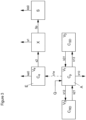
- Fig. 3 shows a schematic diagram of the extended 3+1 PK/PD model of the instant invention, which additionally comprises a remote compartment X and a BIS sensor S, wherein
- S P can be seen as the propofol sensitivity.
- High values of S P further lead to a short delay of the system and a high responsiveness of the system.
- the remote compartment X describes the delay between the propofol concentration in the effect-site compartment and its actual impact on the BIS value.
- the compartment S represents a patient-dependent BIS sensor, i.e. the actual BIS value displayed on the monitor.
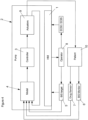
- Fig. 4 shows a schematic diagram of the control device for controlling the administration of propofol to a patient comprising a human machine interface (1), an infusion pump (2) which comprises a controller (3) for computing a infusion rate for administering propofol to the patient, a depth-of-anesthesia monitor (6), such as a bispectral index (BIS) monitor, and optionally a drug sensor (7), which further comprises, in accordance with the invention, a target setting unit (5) for setting a BIS target value and a model unit (4) for determining the propofol sensitivity of a patient by means of a mathematical model taking into account the bispectral index (BIS) and optionally the measured propofol level.
- the control device may further comprise at least one actuator. Actuators in the sense of the present invention are any mechanical parts of the infusion pump, including for example a motor or other mechanical parts between the model-driven controller and the injection syringe.
- the operator when using the control device according to the invention, the operator first plugs on the depth-of-anesthesia monitor (6), such as a BIS monitor .
- the operator is typically an anesthetist or an anesthesia nurse.
- TCI target controlled infusion
- TCI models for propofol are known in the art.
- the recently introduced open-target-controlled infusion (TCI) systems can be programmed with any pharmacokinetic model, and allow either plasma- or effect-site targeting. With effect-site targeting the goal is to achieve a user-defined target effect-site concentration as rapidly as possible, by manipulating the plasma concentration around the target.
- Currently systems are pre-programmed with the Marsh ( B. Marsh et al., "Pharmacokinetic model driven infusion of propofol in children" Br J Anaesth, 1991; 67, pages 41-48 ) and Schnider ( Thomas W.
- the operator (8) has then to enter patient parameters, such as age, gender, total weight, lean body mass (LBM) and height, for example.
- the BIS target value (5) has to be set by the operator (8). It can further be chosen whether the control device works in ramp mode or not, wherein ramp mode has been demonstrated as best practice to increase the patient's sensitivity to propofol.
- Ramp mode means that a desired BIS target value is not reached in a direct, linear manner, but in a stepwise manner. In contrast, if ramp mode is not chosen, a time for achievement a BIS target value is to be set, representing the aggressiveness of the controller.
Landscapes
- Health & Medical Sciences (AREA)
- Engineering & Computer Science (AREA)
- Public Health (AREA)
- General Health & Medical Sciences (AREA)
- Life Sciences & Earth Sciences (AREA)
- Biomedical Technology (AREA)
- Veterinary Medicine (AREA)
- Animal Behavior & Ethology (AREA)
- Medical Informatics (AREA)
- Epidemiology (AREA)
- Anesthesiology (AREA)
- Heart & Thoracic Surgery (AREA)
- Medicinal Chemistry (AREA)
- Primary Health Care (AREA)
- Chemical & Material Sciences (AREA)
- Hematology (AREA)
- Vascular Medicine (AREA)
- Physics & Mathematics (AREA)
- Pharmacology & Pharmacy (AREA)
- Pathology (AREA)
- Diabetes (AREA)
- Molecular Biology (AREA)
- Fluid Mechanics (AREA)
- Data Mining & Analysis (AREA)
- Databases & Information Systems (AREA)
- Bioinformatics & Cheminformatics (AREA)
- General Business, Economics & Management (AREA)
- Business, Economics & Management (AREA)
- Surgery (AREA)
- Biophysics (AREA)
- Chemical Kinetics & Catalysis (AREA)
- Organic Chemistry (AREA)
- Nuclear Medicine, Radiotherapy & Molecular Imaging (AREA)
- General Chemical & Material Sciences (AREA)
- Infusion, Injection, And Reservoir Apparatuses (AREA)
- Acyclic And Carbocyclic Compounds In Medicinal Compositions (AREA)
- Pharmaceuticals Containing Other Organic And Inorganic Compounds (AREA)
Description
- The invention relates to a control device for controlling the administration of propofol to a patient according to the preamble of
claim 1. - With a method of this kind a bispectral index (BIS) target value is set which shall be, at least approximately, reached within a patient. A controller then computes a recommended infusion rate of propofol based on the target BIS value and optionally further based on a measured propofol level of the patient for administering propofol to the patient. The controller herein comprises a model unit for computing the recommended infusion rate such that, using the model unit for determining the propofol sensitivity of a patient by means of a mathematical model taking into account the bispectral index (BIS) value and optionally the measured propofol level as input variables, the recommended infusion rate for administering propofol to the patient to achieve the BIS target value may be determined.
- A method of this kind and a corresponding control device for carrying out such a method may in particular be used to provide a personalized, patient specific anesthesia in a patient. In terms of medical needs, said method and said corresponding control device for carrying out such a method aim to reduce over- or under-infusion of anesthetic drugs and prevent potential side effects. Said method and said corresponding control device are further suitable to take real-time metabolism of the patient into account. The controller used in said method and corresponding control device allows avoiding of overdosing, in particular when a system with high delay is used for administering the anesthetic, such as propofol, to a patient.
- In recent years propofol has emerged as the most suitable and as a widely used intravenous anesthetic. Propofol offers many advantages as a total intravenous anesthetic in terms of its pharmacokinetic profile, but anesthetists still have difficulties with the use of intravenous agents to maintain anesthesia compared with standard volatile anesthetics delivered via calibrated vaporizers. Various suggestions have been made for suitable infusion rates of propofol to maintain satisfactory anesthesia. Besides manual infusion schemes, computer-controlled infusion of propofol designed to achieve a constant blood level throughout the duration of surgery has been proposed. However, such a scheme has the principal disadvantage of inability to vary the blood propofol concentration in response to changing surgical and anesthetic requirements. Volatile agents may then have to be introduced to maintain adequate anesthesia.
- The pharmacokinetics of propofol is affected by several factors. In the publication Thomas W. Schnider et al., "The influence of method of administration and covariates on the pharmacokinetics of propofol in adult volunteers", Anesthesiology, 1998, 88(5) pages 1170-82, it was demonstrated that the method of administration (bolus vs. infusion), influences the pharmacokinetics of propofol.
- In the publication M. White and G. N. C. Kenny; "Intravenous propofol anaesthesia using a computerized infusion system", Anaesthesia, 1990, Volume 45, pages 204-209, a computer-controlled device for the infusion of propofol has been constructed, which allows the variation of the blood propofol concentration in response to changing surgical and anesthetic requirements. The performance of this system has been evaluated by comparing the predicted blood concentrations of propofol selected by the anesthetist to produce a satisfactory level of anesthesia with the values measured from blood samples. This system has, however, the disadvantage that it is not possible to measure intravenous anesthetic blood concentrations in real time.
- In the meantime, a pharmacokinetic-based computer-controlled infusion systems, as for example the Diprifusor system (AstraZeneca Pharmaceuticals, UK) have become commercially available, which have been developed to achieve and maintain target blood concentrations of propofol with a reasonable degree of accuracy.
- "Target Controlled Infusion" (TCI) refers to a computer-assisted infusion system which calculates a substance concentration in a particular body tissue on the basis of mathematical models and which, after setting a target concentration by the anesthetist, adjusts the infusion rate until the target concentration is reached. TCI infusion systems consist of an infusion system (syringe pump system) and a computer or microprocessor. Via a monitor or human machine interface, parameters such as patient age, weight, gender, type of anesthetic and the desired pharmacokinetic model as well as the target concentration of the substance to be administered into the patient's blood, can be defined. The microprocessor calculates the infusion rates and controls the syringe pump and the monitor based on these data. Audible and visual signals inform the anesthetist about infusion problems (such as disconnection, closing, end of infusion, etc.). In addition, the monitor displays both, graphically and numerically, the current infusion history, the infused volume and the expected concentration-time curve at the stop of the infusion. In principle, all short-acting intravenous anesthetics with known pharmacokinetics and pharmacodynamics are suitable for TCI control.
- On the basis of an empirically determined population-pharmacokinetic model and using a known pharmacokinetic and patient-specific pharmacodynamic parameter set of a medicament (for example, propofol) as well as by means of patient-specific data, a TCI pump calculates a concentration over time in the patient's plasma or at the effect site (brain). Interactions with additionally used anesthetics also require a dose adjustment of propofol. A major problem in controlling the anesthesia supply via TCI systems is selecting the correct individual target value for the appropriate depth of anesthesia, as the patient-specific pharmacokinetics and pharmacodynamics may differ from the underlying population pharmacokinetic model. The accuracy of the concentration calculation also depends crucially on the choice of the mathematical model. Many TCI systems use the mathematical models for propofol application developed by Marsh et al and Schnider et al. The evaluation of the Marsh model for propofol revealed a deviation between - 7% and + 30%, in one case by 84% between the calculated and the real measured propofol in blood. Thus, using a pharmacokinetic model that takes into account more custom variables and which promises a more accurate calculation of the substance concentration, and thus a patient-adapted anesthesia, is desired.
- With the development and increasing use of these target-controlled infusion (TCI) systems, a number of research groups have investigated the correlation of propofol concentrations with dynamic effects.
- A. R. Absolom et al., Pharmacokinetic models for propofol-defining and illuminating the devil in the detail, British Journal of Anaesthesia , 2009, 103 (1), pages 26-37, have discussed pharmacokinetic models for propofol. Early target controlled infusion (TCI) systems were designed to achieve a user-defined plasma target concentration. It became apparent that there was hysteresis in the relationship between plasma concentration and clinical effect, caused by the temporal delay in equilibration between plasma concentrations and the concentration at the sites of action within the central nervous system, referred to as the effect-site. The rate of plasma/effect-site equilibration depends on factors that determine the rate of drug delivery to the effect-site (such as cardiac output and cerebral blood flow) and pharmacological properties that determine the rate of drug transfer across the blood-brain barrier (lipid solubility, degree of ionization, etc). The time course of plasma/ effect-site equilibration can be mathematically described by a first-order rate constant typically referred to as the ke0. This term is used to describe the rate of removal of drug from the effect-site out of the body, but the effect-site is regarded as having negligible volume, so that there is no need for separate constants describing the rate constants for movement into and out of the effect compartment (the ke0 defines the proportional change in each unit of time of the concentration gradient between the plasma and effect-site). With effect-site targeting, the TCI system manipulates the plasma concentration to achieve the effect-site concentration as rapidly as possible. When the effect-site target concentration is increased, the TCI system briefly increases the plasma concentration to an optimal level above the target effect-site concentration. If the target effect-site concentration is reduced the system stops the infusion, allowing the plasma concentrations to fall, thereby generating a concentration gradient out of the effect-site, until the estimated effect-site concentration has fallen to the new target. With effect-site targeting, the magnitude of the plasma concentration overshoot estimated by the system depends critically on the ke0 and also on the estimated rate of decline in the plasma concentration. The estimated rate of decline of the plasma concentration also has an influence on the overshoot. Naturally, the net rate of decline caused by re-distribution depends on the concentration gradients between compartments.
- Since the accuracy of the estimated plasma concentration itself and the degree of overshoot required depend on the accuracy of several parameters and assumptions, there are multiple potential sources of error. Model errors resulting in excessively high plasma concentrations may well be tolerated by young fit patients, but in frail, elderly subjects, they may result in significant cardiovascular instability.
- M.G. Irwin et al. investigated in the publication "Propofol effective concentration 50 and its relationship to bispectral index", Anaesthesia, 2002, volume 57, pages 242-8, how a commercially-available TCI system will produce anesthesia in clinical practice and how standard end-points determining anesthesia and loss of consciousness relate to the bispectral index (BIS) and predicted blood and effect site concentrations of propofol. Indeed, as M.G. Irwin and al. demonstrated in their publication, there is a relationship between the propofol effective concentration 50 (EC50) and the bispectral index (BIS). This was later confirmed in the publication of M. lannuzzi et al. "Relationship between bispectral index, electroencephalographic state entropy and effect-site EC50 for propofol at different clinical endpoints", Br J Anaesth, 2005, 94, pages 613-16, wherein propofol site effect concentrations and BIS were recorded at loss of verbal contact (LVC) and loss of consciousness (LOC).
- Additional recent studies have provided results, which were achieved with different patient populations and which confirm the results by Irwin et al. and lannuzzi et al. These results are summarized in the publication from T.A. Lim "Relationship between bispectral index and effect-site EC50 for propofol" Br J Anaesth, 2006, 267-268.
- With the information now available in the prior art, it is possible to correlate the effect-site concentration and the bispectral index (BIS) of propofol at defined points, e.g. at loss of consciousness (LOC) or at the point of anesthesia, i.e. it is no longer necessary to correlate the effect-site concentration of propofol with nerve response.
- However, the published pharmacokinetic models are based on small numbers of patients included in the studies and are not suitable to take real-time metabolism into account.
- The document
US2003036744 is known, referring to a system and method for controlling the administration of medication to a patient using a Bispectral Index and the main arterial pressure to control the target effect-site concentration with a TCI algorithm. A pharmokinetic and pharmacodynamic model is described butUS2003036744 but is not elaborated as for the use in conjunction with a Bispectral Index. - There is a desire for a safe method for controlling the administration of propofol to a patient which allows in a fast, reliable manner to maintain a patient's propofol level at or around a desired target value, in particular to reduce the risk for under- or overdosing of the anesthetic to the patient.
- It is an object of the instant invention to provide a control device for controlling the administration of propofol to a patient which in a reliable, computationally efficient manner allows for maintaining a patient's propofol level at or around a desired target propofol level.
- This object is achieved with a control device comprising the features of
claim 1. Further embodiments are disclosed in the dependent claims. - Accordingly,
- a propofol sensitivity of the patient is determined by means of a mathematical model taking into account the bispectral index (BIS) and optionally the measured propofol level in the blood, and
- based on a predefined BIS target value and if available the measured propofol level, a recommended infusion rate for administering propofol to the patient is computed by a controller.
- Advantageously, the controller, when computing the recommended infusion rate based on the BIS target value, in addition takes also a measured propofol level of the patient into account. The measured propofol level of the patient herein may be taken into account directly as a parameter when computing the recommended infusion rate or the measured propofol level may be taken into account indirectly via the mathematical model when determining the propofol sensitivity. The propofol sensitivity hence is determined using a mathematical model taking into account, as parameters, the bispectral index (BIS) and if available the measured propofol level in the blood of the patient.
- Accordingly, the control device of the invention comprises a depth-of-anesthesia monitor, preferably a bispectral index (BIS) monitor, and optionally a drug sensor for measuring the propofol level.
- The instant invention is based on the idea to use a mathematical model to determine a value for the specific, situation-dependent propofol sensitivity of a patient. The model takes into account the bispectral index (BIS) and optionally the actually measured propofol level within a patient. Further, for example the administration of other substances, such as analgesics like Alfentanil® or Remifentanil® is taken into account. The model sets the actual infusion rate and the bispectral index (BIS) into relation with each other, wherein the relation is, among others, quantified by/through the propofol sensitivity.
- The bispectral index (BIS) refers to a dimensionless number between 0 (deep anesthesia) and 100 (awake). Publications prove that the BIS closely correlates with various sedation scores and the blood concentration of anesthetics. Typical BIS scores and correlating anesthesia states are as follows:
BIS Anesthesia status 90-100 awake 65-85 Sedation 45-60 Sufficiently deep anesthesia during general anesthesia 45-35 Deep narcosis, lack of unconscious memory < 40 Incipient burst suppression < 30 Increasing burst suppression 0 Baseline EEG - The model preferably is a so called pharmacokinetic-pharmacodynamic (PK/PD) model taking into account patient-specific parameters such as the patient's height, weight, age, gender, body mass index (BMI) and/or other parameters to model the pharmacodynamics and pharmacokinetics of propofol in the patient.
- A PK/PD model for propofol is known in the art as the so-called "3+1 PK/PD model" as described in
Figure 2 below. This model is based on the so called Schnider model or the so called Marsh model. - It has surprisingly be found by the inventors that the reliability of a control device or a method for controlling the administration of propofol to a patient can be improved, when the existing "3+1 PK/PD model" is extended by two further compartments, a remote compartment X and a BIS sensor S. The X compartment is a remote compartment that models the delay of the propofol concentration effect on the bispectral index (BIS). In particular, the physiological delay but also the computational delay potentially induced by the signal processing in the BIS is modeled in the X compartment. The S compartment represents the BIS sensor itself. The inventive model is described in detail in
Figure 3 below. - The extended 3+1 PK/PD model of the invention has several advantages. The inventive model estimates the sensitivity of a patient to propofol and tunes model parameters according to the depth of anesthesia and drug level measurements, if available. In a further embodiment, an adaptive control method is used in the extended 3+1 PK/PD model of the invention. The adaptive control method of the invention has been designed to target a BIS level rather than a target propofol concentration. This invention is particularly suitable for use in operating and intensive care units.
- Suitably, the extended 3+1 PK/PD model according to the invention is based on a central compartment A comprising a blood concentration Cp of propofol, a rapid equilibrating compartment CRD, a slow equilibrating compartment CSD, and an effect compartment E comprising an effect compartment concentration Ce of propofol. The compartments of the extended 3+1 PK/PD model can be calculated as set out in
equations 1 to 10:
The S compartment is, according to the invention, calculated according to equation 1:
- SP
- represents the propofol-sensitivity of the patient;
- αM
- represents the saturation parameter of the velocity of effect of an anesthetic, such as propofol (i.e. the saturation of the propofol receptors);
- kb0
- represents the decay rate of the BIS index;
- OF
- represents the offset that can remain when no more anesthetic, such as propofol, is present in the patient body ;
- X
- represents a remote compartment; and
- S
- represents a BIS sensor.
- The X compartment can be calculated according to equation 2:

- s1 and s2
- represent constant transfer rate parameters between the remote compartment and the effect parameters;
- Ce
- represents the effect compartment concentration; and
- X
- represents a remote compartment.
- The rapid equilibrating compartment CRD can be calculated according to equation 3:

- k12
- is an elimination constant describing the distribution of propofol from the central compartment A in direction of rapid equilibrating compartment CRD,
- k21
- is an elimination constant describing the distribution of propofol from rapid equilibrating compartment CRD in direction of central compartment A,
- CRD
- represents the rapid equilibrating compartment, and
- Cp
- represents the blood concentration.
- The slow equilibrating compartment CSD can be calculated according to equation 4:
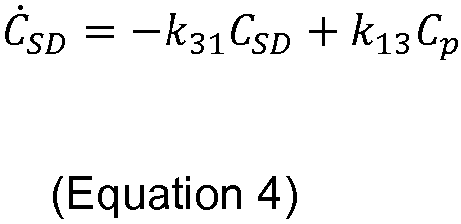
- k13
- is an elimination constant describing the distribution of propofol from central compartment A in direction of slow equilibrating compartment CSD,
- k31
- is an elimination constant describing the distribution of propofol from slow equilibrating compartment CSD in direction of central compartment A,
- CSD
- represents the slow equilibrating compartment; and
- Cp
- represents the blood concentration.
- The effect compartment concentration of propofol Ce can be calculated according to equation 5:

- ke0
- defines the decay rate for the propofol effect;
- k1e
- describes a "virtual" constant rate transfer from central compartment A and the effect compartment E; and
- Ce
- represents the effect comportment concentration.
- The blood concentration Cp of propofol can be calculated according to equation 6:

- k10
- represents the elimination constant of a n applied drug, such as propofol from the body,
- k12
- is an elimination constant describing the distribution of propofol from the central compartment A in direction of rapid equilibrating compartment CRD,
- k21
- is an elimination constant describing the distribution of propofol from rapid equilibrating compartment CRD in direction of central compartment A,
- k13
- is an elimination constant describing the distribution of propofol from central compartment A in direction of slow equilibrating compartment CSD,
- k31
- is an elimination constant describing the distribution of propofol from slow equilibrating compartment CSD in direction of central compartment A,
- CRD
- represents a rapid equilibrating compartment;
- CSD
- represents a slow equilibrating compartment; and
- Cp
- represents the blood concentration.
- Suitably, the model parameters ke0 and k1e are tunable online during anesthesia. In particular, instant invention provides a method, wherein the model parameters ke0 and k1e are tunable online according to the BIS value at the EC50 and EC95 points during anesthesia. Being tunable online means that the model parameters k̂ 1e and k̂ e0 are readjustable in order to have at the time of loss of consciousness the effect compartment concentration Ce equal to the value C e50 as set out in equation 7:

- Ce
- represents the effect compartment concentration;
- tLOC
- represents the time point of loss of consciousness;
- ke0
- defines the decay rate for the propofol effect;
- k1e
- describes a "virtual" constant rate transfer from central compartment A and the effect compartment E; and
- Ce50
- represents the effect compartment concentration at the EC50 point according to equation 8:
- E0
- represents the initial value of the BIS effect at time point zero;
- Emax
- represents the maximum value of the BIS effect;
- y
- represents the Hill coefficient,
- EC50
- defines how much propofol needs to be administered to obtain an effect in 50% of the patient population
- tLOC
- represents the time point of loss of consciousness;
- ke0
- defines the proportional change in each unit of time of the concentration gradient between the plasma and effect-site
- k1e
- describes an elimination constant for redistribution of propofol from the effect compartment E to the central compartment A; and
- Ce50
- represents the effect compartment concentration at the EC50 point
- EC50 concentrations shift when propofol is infused in combination with other substances, such as analgesics, like alfentanil or remifentanil. Accordingly, the control device and method of the invention can take into account interactions of propofol with other drugs, such as analgesics like Alfentanil® or Remifentanil®. This is accomplished by a recalibration of the extended 3+1 PK/PD model of the invention, after at least one analgesic has been administered.
- The further advantage of the instant invention is that the compartments of the extended 3+1 PK/PD model are re-estimated in real-time. This is preferably accomplished by using a Luenberger observer. A Luenberger observer belongs to the state observers, which provide an estimate of the internal state of a given real system, from measurements of the input and output of the real system. State observers, such as a Luenberger observer, are known to the person skilled in the art.
- The controller used in the control device according to the invention may be a model-based controller, suitably a controller based on the extended 3+1 PK/PD model as described above. This has the advantage that BIS data can be taken into account to achieve a BIS target value rather than to achieve a concentration target value of propofol. The use of said model-based controller supports the control of the administration of propofol to a patient in real-time.
- If a drug concentration measurement system (drug sensor) is available, the model compartments are re-estimated in real-time using a Luenberger observer. The controller is still a model-based controller to allow plug/unplug of the sensor at different instants of the surgery, where more accuracy is required.
- The disclosure further includes a method for controlling the administration of propofol to a patient, in which:
- a target BIS value is set, and
- a controller computes a recommended infusion rate for administering propofol to the patient based on the target BIS value and optionally the measured propofol level of a patient.
- Herein, the method further comprises the
- determination of a propofol sensitivity of the patient by means of a mathematical model taking into account the bispectral index (BIS) and optionally the measured propofol level, and
- tuning of parameters of the mathematical model according to the depth of anesthesia and/ or the level of the anesthetic in the body of said patient.
- The advantages and advantageous embodiments described above with regard to the control device equally apply also to the method of the invention, such that it shall be referred to the above.
- The idea underlying the invention shall subsequently be described in more detail with regard to the embodiments shown in the figures. Herein:
-
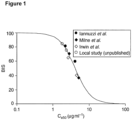
Fig. 1 shows the relationship between the propofol effective concentration 50 (EC50) and the bispectral index (BIS); -
Fig. 2 shows a schematic diagram of the 3+1 PK/PD model as known in the prior art; -
Fig. 3 shows a schematic diagram of the extended 3+1 PK/PD model of the instant invention; -
Fig. 4 shows a schematic diagram of the control device; and -
Fig. 5 shows a concentration-time diagram, displaying different aggressiveness of the controller. -
Fig. 1 shows the relationship between the propofol effective concentration 50 (EC50) and the bispectral index (BIS).Fig. 1 has been disclosed in the publication from T.A. Lim "Relationship between bispectral index and effect-site EC50 for propofol" Br J Anaesth, 2006, 267-268, where corroborating results on different patient populations were reviewed and summarized. This information provides a way to relate the effect-site concentration and the bispectral index (BIS) at defined points, such as at loss of consciousness (LOC) or at the point of anesthesia. - The concentration-effect relationship between EC50 and the BIS illustrated in
Fig. 1 is derived by the equation according to Hill as follows:
-
Fig. 2 shows a schematic diagram of the 3+1 PK/PD model as known in the prior art. Said 3+1 PK/PD model comprises a central compartment A comprising a blood concentration Cp of propofol, a rapid equilibrating compartment CRD, a slow equilibrating compartment CSD, an effect compartment E comprising an effect compartment concentration Ce of propofol.
wherein - Q
- represents an administered drug,
- ke0
- defines the proportional change in each unit of time of the concentration gradient between the plasma and effect-site,
- k1e
- describes an elimination constant for redistribution of propofol from the effect compartment E to the central compartment A,
- k12
- is an elimination constant describing the distribution of the volume V1 in direction of volume V2,
- k21
- is an elimination constant describing the distribution of the volume V2 in direction of volume V1,
- k13
- is an elimination constant describing the distribution of the volume V1 in direction of volume V3,
- k31
- is an elimination constant describing the distribution of the volume V3 in direction of volume V1,
- k10
- represents the elimination constant of a n applied drug, such as propofol from the body.
-
Fig. 2 visualizes the so called Schnider model, which can be described as follows: After intravenous injection, a drug Q is rapidly distributed in the circulation (called the central compartment A) and quickly reaches well perfused tissues. Then, a tissue-specific redistribution in various other compartments such as muscle or fat tissue and vice versa from the central compartment A occurs. At the same time the body eliminates the applied substance from the central compartment with a certain elimination rate. For the pharmacokinetic characterization of lipophilic anesthetics, a 3-compartment model has been established that comprises a central compartment A (heart, lung, kidney, brain), a rapid equilibrating compartment CRD (muscles, inner organs), and a slow equilibrating compartment CSD (fat, bone, the so-called "deep" compartment). The concentration-time curve of a drug is characterized by the distribution volume of a specific compartment and the clearance (which is the plasma volume, from which the drug is eliminated per time unit): V1 is used as the volume of the central compartment A, V2 as the volume of the well-perfused tissue CRD and V3 as the volume of the rather worse perfused compartment CSD . The clearance of a substance from the various compartments can be described by elimination constants and included by definition, a description of the distribution direction: The elimination constant k12 for example, describes the distribution of the volume V1 in direction V2, k21 describes the distribution in the opposite direction. An applied substance is eliminated by this model with the constant k10 from the body. After reaching an equilibrium ("Steady state") between the individual compartments, the elimination rate determines the amount of substance that must be supplied to maintain equilibrium. An intravenously administered anesthetic is first distributed within the central compartment A. From there, the distribution will take place into the effect compartment E and into the peripheral compartments. The substance is eliminated by the constant k10 from the central compartment A. - To assess the clinical effect (the so-called pharmacodynamics) of a drug at the target site, dose-response curves are used. These usually sigmoidal extending curves describe the association between drug concentration and the particular clinical effect. Knowing these dose-response relationship, a putative drug concentration at the site of action, the effect compartment E, can be calculated. The delay between the maximum plasma concentration and the maximum clinical effect is called hysteresis.
-
Fig. 3 shows a schematic diagram of the extended 3+1 PK/PD model of the instant invention, which additionally comprises a remote compartment X and a BIS sensor S,
wherein - s1 and s2
- represent constant transfer rate parameters between the remote compartment X and the effect compartment E,
- SP
- represents a transfer rate coefficient between the remote compartment X and the depth-of-anesthesia monitor S, and
- kb0
- represents the decay rate of the BIS index.
- Clinically, SP can be seen as the propofol sensitivity. The higher the value of SP is, the faster is the propofol effect achieved. High values of SP further lead to a short delay of the system and a high responsiveness of the system.
- The remote compartment X describes the delay between the propofol concentration in the effect-site compartment and its actual impact on the BIS value.
- The compartment S represents a patient-dependent BIS sensor, i.e. the actual BIS value displayed on the monitor.
-
Fig. 4 shows a schematic diagram of the control device for controlling the administration of propofol to a patient comprising a human machine interface (1), an infusion pump (2) which comprises a controller (3) for computing a infusion rate for administering propofol to the patient, a depth-of-anesthesia monitor (6), such as a bispectral index (BIS) monitor, and optionally a drug sensor (7), which further comprises, in accordance with the invention, a target setting unit (5) for setting a BIS target value and a model unit (4) for determining the propofol sensitivity of a patient by means of a mathematical model taking into account the bispectral index (BIS) and optionally the measured propofol level. The control device may further comprise at least one actuator. Actuators in the sense of the present invention are any mechanical parts of the infusion pump, including for example a motor or other mechanical parts between the model-driven controller and the injection syringe. - Typically, when using the control device according to the invention, the operator first plugs on the depth-of-anesthesia monitor (6), such as a BIS monitor . The operator is typically an anesthetist or an anesthesia nurse. Thereafter, a model for target controlled infusion (TCI) for propofol is chosen and set in the control device.
- TCI models for propofol are known in the art. The recently introduced open-target-controlled infusion (TCI) systems can be programmed with any pharmacokinetic model, and allow either plasma- or effect-site targeting. With effect-site targeting the goal is to achieve a user-defined target effect-site concentration as rapidly as possible, by manipulating the plasma concentration around the target. Currently systems are pre-programmed with the Marsh (B. Marsh et al., "Pharmacokinetic model driven infusion of propofol in children" Br J Anaesth, 1991; 67, pages 41-48) and Schnider (Thomas W. Schnider et al., "The influence of method of administration and covariates on the pharmacokinetics of propofol in adult volunteers", Anesthesiology, 1998, 88(5) pages 1170-82) pharmacokinetic models for propofol. The former is an adapted version of the Gepts model, in which the rate constants are fixed, whereas compartment volumes and clearances are weighed proportional. The Schnider model was developed during combined pharmacokinetic-pharmacodynamic modelling studies. It has fixed values for certain parameters, such as k13, and k31, adjusts others, k12, and k21 for age, and adjusts k10 according to total weight, lean body mass (LBM), and height. In plasma targeting mode, the Schnider model starts with smallerinitial doses on starting the system or on increasing the target concentration in comparison with the Marsh model. The Schnider model should thus always be used in effect-site targeting mode, in which larger initial doses are administered, albeit still smaller than for the Marsh model.
- Having chosen the appropriate TCI model, the operator (8) has then to enter patient parameters, such as age, gender, total weight, lean body mass (LBM) and height, for example. After the synchronization of the model/BIS in order to tune the OFFSET parameter of the model has occurred, the BIS target value (5) has to be set by the operator (8). It can further be chosen whether the control device works in ramp mode or not, wherein ramp mode has been demonstrated as best practice to increase the patient's sensitivity to propofol. Ramp mode means that a desired BIS target value is not reached in a direct, linear manner, but in a stepwise manner. In contrast, if ramp mode is not chosen, a time for achievement a BIS target value is to be set, representing the aggressiveness of the controller. In the next step, the protocol is started. At the point of loss of consciousness (LOC), the operator typically will click on the LOC button on the system (infusion pump or machine). This will give a feedback to the protocol that the EC50 has been reached and will recalibrate the model according to the patient parameters and the actual BIS value. To further improve precision, the physician optionally informs the system at the EC95 value. Several techniques exist to determine this value easily during the surgery, e.g. just before starting surgery.
-
Fig. 5 shows a concentration-time diagram, displaying different aggressiveness of the controller. As described forFig. 4 , the operator sets a BIS target value to the infusion pump and the controller uses the PK/PD model to compute the correct infusion rate to administer propofol to the patient to achieve the BIS target value. The controller of the invention (optionally in combination with PID controller with Smith predictor) is capable of avoiding overdosing of propofol when using a system with high delay. The controller can predict different scenarios in the future using trajectory generation and tracking to achieve the desired BIS target value. This technique further enables the operator to choose the time of target achievement, i.e. to choose the "aggressiveness" of the controller.Fig. 5 shows exemplary different "aggressiveness" trajectories of the controller. Short-dashed line, semi-dashed line and plain line represents high, medium and low aggressiveness, respectively. - Accordingly, the invention further provides a method of using of the control device according to invention, comprising the steps of:
- a) plugging the depth-of-anesthesia monitor (6),
- b) choosing a TCI model and entering patient parameters,
- c) waiting for TCI model/BIS synchronization,
- d) setting the BIS index target (5),
- e) selecting ramp mode or not,
- f) starting the protocol,
- g) at loss of consciousness point, clicking on the LOC button on the infusion device, such as the infusion pump or the infusion machine,
- h) optionally, informing the control device at the EC95; and
- i) further optionally choosing the time of target achievement (aggressiveness of the controller).
- The idea of the invention is not limited to the embodiments described above.
- In particular, the system described above in principal may also be set up as a closed-loop system which does not require interaction by an operator. For this, an infusion rate may automatically be sent by the controller to the infusion pump for administration of propofol to the patient, and a propofol level measurement may be taken automatically, for example in a periodic fashion at predefined measurement times for providing a feedback to the control device.
-
- 1
- Human machine interface
- 2
- Infusion pump
- 3
- Controller
- 4
- Model unit
- 5
- BIS Target value
- 6
- BIS Monitor
- 7
- Drug Sensor
- 8
- Operator
- 9
- Actuator
- 10
- Patient
- A
- Central compartment
- E
- Effect compartment
- Q
- Administered drug infusion rate


Claims (13)
- A control device for controlling the administration of propofol to a patient (10) comprising- a human machine interface (1),- an infusion pump (2) which comprises a controller (3) for computing a recommended infusion rate for administering propofol to the patient (10), and- a depth-of-anesthesia monitor (6),- a target setting unit (5) for setting a BIS target,- wherein the controller (3) comprises a model unit (4) for computing the recommended infusion rate to achieve the BIS target, by using the model unit for determining the propofol sensitivity of a patient (10) by means of a mathematical model taking into account the bispectral index BIS, wherein the mathematical model comprises a PK/PD model and wherein the estimation of the sensitivity of a patient to an anesthetic is based on a PK/PD model, which comprises a 3+1 PK/PD model with compartments, a remote compartment X and a BIS sensor compartment S, wherein the remote compartment X models the delay between the propofol concentration in an effect-site compartment and its actual impact on the BIS value, characterised in that the compartment S is calculated according to the following equation:
 sp represents the propofol sensitivity of the patient;αM represents the saturation parameters of the velocity of effect of an anesthetic;kb0 represents the decay rate of the BIS index;OF represents the offset that can remain when no more anesthetic is present in the patient body;X represents a remote compartment; andS represents a BIS sensor
 - The control device according to claim 1, further comprising a drug sensor (7), wherein the mathematical model also takes into account the measured propofol level.
- The control device according to claim 1 or 2, characterized in that the infusion pump (2) further comprises at least one actuator (9).
- The control device according to any one of the preceding claims, wherein said control device is based on a closed-loop system, characterized in that an infusion rate of propofol is sent automatically by the controller (3) to the infusion pump (2) for administering propofol to the patient (10), and optionally, a propofol level measurement is performed automatically, for example periodically at predefined measurement times for providing a feedback to the controller.
- The control device according to any one of the preceding claims, wherein the 3+1 PK/PD model is based on a central compartment A comprising a blood concentration Cp of propofol, a rapid equilibrating compartment CRD, a slow equilibrating compartment CSD, an effect compartment E comprising an effect compartment concentration Ce of propofol.
- The control device according to any one of the preceding claims, wherein model parameters ke0 and k1e are tunable online during anesthesia.
- The control device according to claim 6, wherein the model parameters ke0 and k1e are tunable online according to the BIS value at the EC50 and EC95 points during anesthesia.
- The control device according to any one of claims 6 and 7, wherein the model parameters k̂ 1e and k̂ e0 are readjusted in order to have, at the time of loss of consciousness, the effect compartment concentration Ce equal to the value Ce50 as set out in equation 7:
 Ce represents the effect compartment concentration;tLOC represents the time point of loss of consciousness;ke0 defines the proportional change in each unit of time of the concentration gradient between the plasma and effect-site,k1e describes an elimination constant for redistribution of propofol from the effect compartment E to the central compartment A; andC e50 represents the effect compartment concentration at the EC50 point according to equation 8:
 E0 represents the initial value of the BIS effect at time point zero;Emax represents the maximum value of the BIS effect;y represents the Hill coefficient;EC 50 defines how much drug needs to be administered to obtain an effect in 50% of the patient population
 - The control device according to claim 8, wherein said control device takes into account interactions of propofol with other drugs, such as analgesics like Alfentanil or Remifentanil.
- The control device according to claim 9, wherein the PK/PD model is recalibrated, after at least one analgesic has been administered.
- The control device according to any one of claims 2 to 10, wherein the compartments of the PK/PD model are re-estimated in real-time, preferably by using a Luenberger observer.
- The control device according to any one of claims 2 to 11, wherein the controller is a model-based controller.
- The control device according to any one of claims 2 to 12, wherein the controller allows the plugging and unplugging of the drug sensor.
Applications Claiming Priority (3)
| Application Number | Priority Date | Filing Date | Title |
|---|---|---|---|
| EP16305507 | 2016-05-02 | ||
| EP2016305507 | 2016-05-02 | ||
| PCT/EP2017/059502 WO2017190966A1 (en) | 2016-05-02 | 2017-04-21 | Control device for controlling the administration of propofol to a patient |
Publications (3)
| Publication Number | Publication Date |
|---|---|
| EP3452145A1 EP3452145A1 (en) | 2019-03-13 |
| EP3452145C0 EP3452145C0 (en) | 2025-01-29 |
| EP3452145B1 true EP3452145B1 (en) | 2025-01-29 |
Family
ID=55969077
Family Applications (1)
| Application Number | Title | Priority Date | Filing Date |
|---|---|---|---|
| EP17721974.8A Active EP3452145B1 (en) | 2016-05-02 | 2017-04-21 | Control device for controlling the administration of propofol to a patient |
Country Status (9)
| Country | Link |
|---|---|
| US (1) | US11167084B2 (en) |
| EP (1) | EP3452145B1 (en) |
| JP (1) | JP7002472B2 (en) |
| CN (1) | CN109069736B (en) |
| BR (1) | BR112018071795A8 (en) |
| ES (1) | ES3033818T3 (en) |
| IL (1) | IL262535B2 (en) |
| RU (1) | RU2713972C1 (en) |
| WO (1) | WO2017190966A1 (en) |
Families Citing this family (9)
| Publication number | Priority date | Publication date | Assignee | Title |
|---|---|---|---|---|
| JP6944183B2 (en) * | 2017-07-18 | 2021-10-06 | 国立大学法人福井大学 | Anesthesia Assistance Program, Anesthesia Assistance Device, Anesthesia Assistance System and Anesthesia Assistance Method |
| DE102018110275A1 (en) * | 2018-04-27 | 2019-10-31 | Susanne Koch | A method and apparatus for providing a parameter indicative of a patient's loss of consciousness under anesthesia |
| US11783934B2 (en) * | 2019-09-17 | 2023-10-10 | Carefusion 303, Inc. | Automatic safety adjustment system |
| US20230343418A1 (en) * | 2020-08-03 | 2023-10-26 | Sichuan Haisco Pharmaceutical Co., Ltd. | Method and system for determining population pharmacokinetic model of propofol and derivative thereof |
| CN116917994A (en) | 2021-05-27 | 2023-10-20 | 费森尤斯维尔公司 | Systems and methods for controlling target-controlled infusion |
| US20220395665A1 (en) * | 2021-06-14 | 2022-12-15 | GE Precision Healthcare LLC | Electronic vaporizer system and method of controlling the same |
| WO2023072789A1 (en) | 2021-10-29 | 2023-05-04 | Fresenius Vial Sas | System and method for controlling a target-controlled infusion |
| CN118176542A (en) | 2021-10-29 | 2024-06-11 | 费森尤斯维尔公司 | Systems and methods for controlling target-controlled infusion by specifying induction doses |
| CN118522406B (en) * | 2024-07-25 | 2024-11-12 | 武汉大学人民医院(湖北省人民医院) | Anesthesia auxiliary early warning method and system based on artificial intelligence |
Citations (1)
| Publication number | Priority date | Publication date | Assignee | Title |
|---|---|---|---|---|
| US20030036744A1 (en) * | 2000-05-03 | 2003-02-20 | Aspect Medical Systems, Inc. | System and method for adaptive drug delivery |
Family Cites Families (24)
| Publication number | Priority date | Publication date | Assignee | Title |
|---|---|---|---|---|
| US6981947B2 (en) * | 2002-01-22 | 2006-01-03 | University Of Florida Research Foundation, Inc. | Method and apparatus for monitoring respiratory gases during anesthesia |
| JP4495962B2 (en) * | 2001-07-31 | 2010-07-07 | スコット・ラボラトリーズ・インコーポレイテッド | Apparatus and method for titrating drug delivery |
| US7089927B2 (en) * | 2002-10-23 | 2006-08-15 | New York University | System and method for guidance of anesthesia, analgesia and amnesia |
| US8998808B2 (en) * | 2003-06-19 | 2015-04-07 | Wayne State University | System for identifying patient response to anesthesia infusion |
| US9757045B2 (en) * | 2004-01-27 | 2017-09-12 | Universiteit Gent | System and method for adaptive drug delivery |
| US20060009733A1 (en) * | 2004-07-07 | 2006-01-12 | Martin James F | Bis closed loop anesthetic delivery |
| DE102005028080A1 (en) * | 2005-06-17 | 2006-12-21 | Bayer Technology Services Gmbh | A method for timed intravenous administration of the anesthetic propofol |
| DE602006005333D1 (en) * | 2006-03-06 | 2009-04-09 | Gen Electric | Automatic calibration of a person's sensitivity to a drug |
| CN101046831B (en) * | 2006-03-31 | 2010-09-08 | 上海中医药大学 | Construction and Calculation Method of Mathematical Model of Multi-component Pharmacokinetics and Pharmacodynamics of Traditional Chinese Medicine |
| US20080091084A1 (en) * | 2006-10-12 | 2008-04-17 | Yudkovitch Laurence M | User interface for a pk/pd anesthetic drug model display |
| WO2008086624A1 (en) | 2007-01-17 | 2008-07-24 | Val-Chum, Societe En Commandite | Method and system for administering an anaesthetic |
| CN201049111Y (en) * | 2007-04-30 | 2008-04-23 | 陈宇珂 | Propofol closed-loop target controlled infusion/injection automatic control device |
| EP2205298B1 (en) * | 2007-10-15 | 2020-07-15 | The Secretary, Department Of Information Technology | An improved automatic anaesthesia delivery system |
| WO2011017778A1 (en) * | 2009-08-14 | 2011-02-17 | David Burton | Anaesthesia and consciousness depth monitoring system |
| CA2808379C (en) * | 2010-08-17 | 2019-04-09 | University Of Florida Research Foundation, Inc. | Central site photoplethysmography, medication administration, and safety |
| DE102012203897B4 (en) | 2012-03-13 | 2014-11-27 | Kist Europe Forschungsgesellschaft Mbh | Apparatus for performing anesthesia or analgesic sedation and method for operating an apparatus for performing anesthesia or analgesic sedation |
| CN103163218B (en) * | 2013-03-05 | 2015-01-14 | 浙江大学 | System and method for on-line monitoring of propofol concentration in blood |
| CN103212119B (en) * | 2013-04-09 | 2015-11-18 | 陕西君天行机电科技有限公司 | A kind of anesthesia target controlled infusion pump controller based on BIS feedback |
| WO2014173558A1 (en) * | 2013-04-24 | 2014-10-30 | Fresenius Kabi Deutschland Gmbh | Method of operating a control device for controlling an infusion device |
| CN105339943B (en) | 2013-06-21 | 2019-01-01 | 费森尤斯维尔公司 | Method and control device for controlling insulin administration to a patient |
| GB201319681D0 (en) | 2013-11-07 | 2013-12-25 | Imp Innovations Ltd | System and method for drug delivery |
| US9649063B2 (en) | 2013-12-16 | 2017-05-16 | General Electric Company | Point of care measurement of patient sensitivity to anesthetics |
| US11062797B2 (en) * | 2014-10-10 | 2021-07-13 | Continuous Precision Medicine | Method and system for obtaining and using pharmacokinetic data in drug administration |
| US11266780B2 (en) * | 2015-11-23 | 2022-03-08 | University Of British Columbia | Methods and systems for closed-loop control of drug administration |
-
2017
- 2017-04-21 EP EP17721974.8A patent/EP3452145B1/en active Active
- 2017-04-21 BR BR112018071795A patent/BR112018071795A8/en not_active IP Right Cessation
- 2017-04-21 WO PCT/EP2017/059502 patent/WO2017190966A1/en not_active Ceased
- 2017-04-21 US US16/098,086 patent/US11167084B2/en active Active
- 2017-04-21 CN CN201780027047.9A patent/CN109069736B/en not_active Expired - Fee Related
- 2017-04-21 ES ES17721974T patent/ES3033818T3/en active Active
- 2017-04-21 RU RU2018142034A patent/RU2713972C1/en active
- 2017-04-21 JP JP2018557335A patent/JP7002472B2/en active Active
-
2018
- 2018-10-24 IL IL262535A patent/IL262535B2/en unknown
Patent Citations (1)
| Publication number | Priority date | Publication date | Assignee | Title |
|---|---|---|---|---|
| US20030036744A1 (en) * | 2000-05-03 | 2003-02-20 | Aspect Medical Systems, Inc. | System and method for adaptive drug delivery |
Also Published As
| Publication number | Publication date |
|---|---|
| US20190143040A1 (en) | 2019-05-16 |
| BR112018071795A8 (en) | 2022-11-16 |
| BR112018071795A2 (en) | 2019-02-19 |
| EP3452145C0 (en) | 2025-01-29 |
| ES3033818T3 (en) | 2025-08-08 |
| WO2017190966A1 (en) | 2017-11-09 |
| CN109069736A (en) | 2018-12-21 |
| EP3452145A1 (en) | 2019-03-13 |
| CN109069736B (en) | 2022-03-01 |
| JP2019523659A (en) | 2019-08-29 |
| JP7002472B2 (en) | 2022-02-04 |
| IL262535B2 (en) | 2023-07-01 |
| US11167084B2 (en) | 2021-11-09 |
| RU2713972C1 (en) | 2020-02-11 |
| IL262535A (en) | 2018-12-31 |
| IL262535B1 (en) | 2023-03-01 |
Similar Documents
| Publication | Publication Date | Title |
|---|---|---|
| US11167084B2 (en) | Control device for controlling the administration of propofol to a patient | |
| EP1278564B1 (en) | System for adaptive drug delivery | |
| Irwin et al. | Patient‐maintained propofol sedation: Assessment of a target‐controlled infusion system | |
| van den Nieuwenhuyzen et al. | Target-controlled infusion systems: role in anaesthesia and analgesia | |
| US11707571B2 (en) | Hierarchical adaptive closed-loop fluid resuscitation and cardiovascular drug administration system | |
| EP1921553A1 (en) | Control of drug administration | |
| AU2020213388B2 (en) | Hierarchical adaptive closed-loop fluid resuscitation and cardiovascular drug administration system | |
| EP2020248B1 (en) | Cardiac disease treatment system | |
| EP4423762B1 (en) | System and method for controlling a target-controlled infusion | |
| US20250032707A1 (en) | System and method for controlling a target-controlled infusion by specifying an induction dose | |
| EP4346951A1 (en) | System and method for controlling a target controlled infusion | |
| Sivasubramaniam | Review of pharmacokinetic models for target controlled infusions in anesthesia | |
| Ceccato et al. | Reduced chattering target-tracking sliding mode control for intraprocedural propofol control | |
| JP2024009734A (en) | Blood pressure infusion control assistance program, blood pressure infusion control assistance device, blood pressure infusion control assistance system, and billing method | |
| WIDE et al. | TCI Anesthesia: New and More Universal Models | |
| Sivasubramaniam | TARGET CONTROLLED INFUSIONS IN ANAESTHETIC PRACTICE ANAESTHESIA TUTORIAL OF THE WEEK 75 26th NOVEMBER 2007 |
Legal Events
| Date | Code | Title | Description |
|---|---|---|---|
| STAA | Information on the status of an ep patent application or granted ep patent |
Free format text: STATUS: UNKNOWN |
|
| STAA | Information on the status of an ep patent application or granted ep patent |
Free format text: STATUS: THE INTERNATIONAL PUBLICATION HAS BEEN MADE |
|
| PUAI | Public reference made under article 153(3) epc to a published international application that has entered the european phase |
Free format text: ORIGINAL CODE: 0009012 |
|
| STAA | Information on the status of an ep patent application or granted ep patent |
Free format text: STATUS: REQUEST FOR EXAMINATION WAS MADE |
|
| 17P | Request for examination filed |
Effective date: 20181203 |
|
| AK | Designated contracting states |
Kind code of ref document: A1 Designated state(s): AL AT BE BG CH CY CZ DE DK EE ES FI FR GB GR HR HU IE IS IT LI LT LU LV MC MK MT NL NO PL PT RO RS SE SI SK SM TR |
|
| AX | Request for extension of the european patent |
Extension state: BA ME |
|
| DAV | Request for validation of the european patent (deleted) | ||
| DAX | Request for extension of the european patent (deleted) | ||
| STAA | Information on the status of an ep patent application or granted ep patent |
Free format text: STATUS: EXAMINATION IS IN PROGRESS |
|
| 17Q | First examination report despatched |
Effective date: 20220818 |
|
| GRAP | Despatch of communication of intention to grant a patent |
Free format text: ORIGINAL CODE: EPIDOSNIGR1 |
|
| STAA | Information on the status of an ep patent application or granted ep patent |
Free format text: STATUS: GRANT OF PATENT IS INTENDED |
|
| RIC1 | Information provided on ipc code assigned before grant |
Ipc: G16H 50/30 20180101ALI20240917BHEP Ipc: G16H 40/63 20180101ALI20240917BHEP Ipc: G16H 20/17 20180101ALI20240917BHEP Ipc: A61P 23/00 20060101ALI20240917BHEP Ipc: A61K 31/05 20060101ALI20240917BHEP Ipc: A61M 5/172 20060101ALI20240917BHEP Ipc: A61B 5/00 20060101ALI20240917BHEP Ipc: A61M 5/168 20060101ALI20240917BHEP Ipc: A61M 5/142 20060101AFI20240917BHEP |
|
| INTG | Intention to grant announced |
Effective date: 20241016 |
|
| GRAS | Grant fee paid |
Free format text: ORIGINAL CODE: EPIDOSNIGR3 |
|
| GRAA | (expected) grant |
Free format text: ORIGINAL CODE: 0009210 |
|
| STAA | Information on the status of an ep patent application or granted ep patent |
Free format text: STATUS: THE PATENT HAS BEEN GRANTED |
|
| AK | Designated contracting states |
Kind code of ref document: B1 Designated state(s): AL AT BE BG CH CY CZ DE DK EE ES FI FR GB GR HR HU IE IS IT LI LT LU LV MC MK MT NL NO PL PT RO RS SE SI SK SM TR |
|
| REG | Reference to a national code |
Ref country code: GB Ref legal event code: FG4D |
|
| REG | Reference to a national code |
Ref country code: CH Ref legal event code: EP |
|
| REG | Reference to a national code |
Ref country code: DE Ref legal event code: R096 Ref document number: 602017087536 Country of ref document: DE |
|
| REG | Reference to a national code |
Ref country code: IE Ref legal event code: FG4D |
|
| U01 | Request for unitary effect filed |
Effective date: 20250130 |
|
| U07 | Unitary effect registered |
Designated state(s): AT BE BG DE DK EE FI FR IT LT LU LV MT NL PT RO SE SI Effective date: 20250207 |
|
| U20 | Renewal fee for the european patent with unitary effect paid |
Year of fee payment: 9 Effective date: 20250507 |
|
| PG25 | Lapsed in a contracting state [announced via postgrant information from national office to epo] |
Ref country code: RS Free format text: LAPSE BECAUSE OF FAILURE TO SUBMIT A TRANSLATION OF THE DESCRIPTION OR TO PAY THE FEE WITHIN THE PRESCRIBED TIME-LIMIT Effective date: 20250429 |
|
| PG25 | Lapsed in a contracting state [announced via postgrant information from national office to epo] |
Ref country code: PL Free format text: LAPSE BECAUSE OF FAILURE TO SUBMIT A TRANSLATION OF THE DESCRIPTION OR TO PAY THE FEE WITHIN THE PRESCRIBED TIME-LIMIT Effective date: 20250129 |
|
| PGFP | Annual fee paid to national office [announced via postgrant information from national office to epo] |
Ref country code: GB Payment date: 20250428 Year of fee payment: 9 Ref country code: ES Payment date: 20250505 Year of fee payment: 9 |
|
| PG25 | Lapsed in a contracting state [announced via postgrant information from national office to epo] |
Ref country code: IS Free format text: LAPSE BECAUSE OF FAILURE TO SUBMIT A TRANSLATION OF THE DESCRIPTION OR TO PAY THE FEE WITHIN THE PRESCRIBED TIME-LIMIT Effective date: 20250529 Ref country code: NO Free format text: LAPSE BECAUSE OF FAILURE TO SUBMIT A TRANSLATION OF THE DESCRIPTION OR TO PAY THE FEE WITHIN THE PRESCRIBED TIME-LIMIT Effective date: 20250429 |
|
| PG25 | Lapsed in a contracting state [announced via postgrant information from national office to epo] |
Ref country code: HR Free format text: LAPSE BECAUSE OF FAILURE TO SUBMIT A TRANSLATION OF THE DESCRIPTION OR TO PAY THE FEE WITHIN THE PRESCRIBED TIME-LIMIT Effective date: 20250129 |
|
| PG25 | Lapsed in a contracting state [announced via postgrant information from national office to epo] |
Ref country code: GR Free format text: LAPSE BECAUSE OF FAILURE TO SUBMIT A TRANSLATION OF THE DESCRIPTION OR TO PAY THE FEE WITHIN THE PRESCRIBED TIME-LIMIT Effective date: 20250430 |
|
| PGFP | Annual fee paid to national office [announced via postgrant information from national office to epo] |
Ref country code: CH Payment date: 20250501 Year of fee payment: 9 |
|
| REG | Reference to a national code |
Ref country code: ES Ref legal event code: FG2A Ref document number: 3033818 Country of ref document: ES Kind code of ref document: T3 Effective date: 20250808 |
|
| PG25 | Lapsed in a contracting state [announced via postgrant information from national office to epo] |
Ref country code: SM Free format text: LAPSE BECAUSE OF FAILURE TO SUBMIT A TRANSLATION OF THE DESCRIPTION OR TO PAY THE FEE WITHIN THE PRESCRIBED TIME-LIMIT Effective date: 20250129 |
|
| PG25 | Lapsed in a contracting state [announced via postgrant information from national office to epo] |
Ref country code: CZ Free format text: LAPSE BECAUSE OF FAILURE TO SUBMIT A TRANSLATION OF THE DESCRIPTION OR TO PAY THE FEE WITHIN THE PRESCRIBED TIME-LIMIT Effective date: 20250129 |
|
| PG25 | Lapsed in a contracting state [announced via postgrant information from national office to epo] |
Ref country code: SK Free format text: LAPSE BECAUSE OF FAILURE TO SUBMIT A TRANSLATION OF THE DESCRIPTION OR TO PAY THE FEE WITHIN THE PRESCRIBED TIME-LIMIT Effective date: 20250129 |
|
| PLBE | No opposition filed within time limit |
Free format text: ORIGINAL CODE: 0009261 |
|
| STAA | Information on the status of an ep patent application or granted ep patent |
Free format text: STATUS: NO OPPOSITION FILED WITHIN TIME LIMIT |
|
| REG | Reference to a national code |
Ref country code: CH Ref legal event code: L10 Free format text: ST27 STATUS EVENT CODE: U-0-0-L10-L00 (AS PROVIDED BY THE NATIONAL OFFICE) Effective date: 20251210 |
|
| PG25 | Lapsed in a contracting state [announced via postgrant information from national office to epo] |
Ref country code: MC Free format text: LAPSE BECAUSE OF FAILURE TO SUBMIT A TRANSLATION OF THE DESCRIPTION OR TO PAY THE FEE WITHIN THE PRESCRIBED TIME-LIMIT Effective date: 20250129 |
|
| 26N | No opposition filed |
Effective date: 20251030 |
|
| PG25 | Lapsed in a contracting state [announced via postgrant information from national office to epo] |
Ref country code: IE Free format text: LAPSE BECAUSE OF NON-PAYMENT OF DUE FEES Effective date: 20250421 |
|
| REG | Reference to a national code |
Ref country code: CH Ref legal event code: U11 Free format text: ST27 STATUS EVENT CODE: U-0-0-U10-U11 (AS PROVIDED BY THE NATIONAL OFFICE) Effective date: 20260501 |