EP3451867B1 - Instrumentierte orthese - Google Patents
Instrumentierte orthese Download PDFInfo
- Publication number
- EP3451867B1 EP3451867B1 EP17793054.2A EP17793054A EP3451867B1 EP 3451867 B1 EP3451867 B1 EP 3451867B1 EP 17793054 A EP17793054 A EP 17793054A EP 3451867 B1 EP3451867 B1 EP 3451867B1
- Authority
- EP
- European Patent Office
- Prior art keywords
- orthotic
- plate
- sensors
- instrumented
- orthotic plate
- Prior art date
- Legal status (The legal status is an assumption and is not a legal conclusion. Google has not performed a legal analysis and makes no representation as to the accuracy of the status listed.)
- Active
Links
Images



Classifications
-
- A—HUMAN NECESSITIES
- A61—MEDICAL OR VETERINARY SCIENCE; HYGIENE
- A61F—FILTERS IMPLANTABLE INTO BLOOD VESSELS; PROSTHESES; DEVICES PROVIDING PATENCY TO, OR PREVENTING COLLAPSING OF, TUBULAR STRUCTURES OF THE BODY, e.g. STENTS; ORTHOPAEDIC, NURSING OR CONTRACEPTIVE DEVICES; FOMENTATION; TREATMENT OR PROTECTION OF EYES OR EARS; BANDAGES, DRESSINGS OR ABSORBENT PADS; FIRST-AID KITS
- A61F5/00—Orthopaedic methods or devices for non-surgical treatment of bones or joints; Nursing devices ; Anti-rape devices
- A61F5/01—Orthopaedic devices, e.g. long-term immobilising or pressure directing devices for treating broken or deformed bones such as splints, casts or braces
- A61F5/0102—Orthopaedic devices, e.g. long-term immobilising or pressure directing devices for treating broken or deformed bones such as splints, casts or braces specially adapted for correcting deformities of the limbs or for supporting them; Ortheses, e.g. with articulations
- A61F5/0127—Orthopaedic devices, e.g. long-term immobilising or pressure directing devices for treating broken or deformed bones such as splints, casts or braces specially adapted for correcting deformities of the limbs or for supporting them; Ortheses, e.g. with articulations for the feet
-
- A—HUMAN NECESSITIES
- A43—FOOTWEAR
- A43B—CHARACTERISTIC FEATURES OF FOOTWEAR; PARTS OF FOOTWEAR
- A43B17/00—Insoles for insertion, e.g. footbeds or inlays, for attachment to the shoe after the upper has been joined
-
- A—HUMAN NECESSITIES
- A43—FOOTWEAR
- A43B—CHARACTERISTIC FEATURES OF FOOTWEAR; PARTS OF FOOTWEAR
- A43B3/00—Footwear characterised by the shape or the use
- A43B3/34—Footwear characterised by the shape or the use with electrical or electronic arrangements
-
- A—HUMAN NECESSITIES
- A61—MEDICAL OR VETERINARY SCIENCE; HYGIENE
- A61B—DIAGNOSIS; SURGERY; IDENTIFICATION
- A61B5/00—Measuring for diagnostic purposes; Identification of persons
- A61B5/0002—Remote monitoring of patients using telemetry, e.g. transmission of vital signals via a communication network
- A61B5/0004—Remote monitoring of patients using telemetry, e.g. transmission of vital signals via a communication network characterised by the type of physiological signal transmitted
-
- A—HUMAN NECESSITIES
- A61—MEDICAL OR VETERINARY SCIENCE; HYGIENE
- A61B—DIAGNOSIS; SURGERY; IDENTIFICATION
- A61B5/00—Measuring for diagnostic purposes; Identification of persons
- A61B5/103—Measuring devices for testing the shape, pattern, colour, size or movement of the body or parts thereof, for diagnostic purposes
- A61B5/1036—Measuring load distribution, e.g. podologic studies
- A61B5/1038—Measuring plantar pressure during gait
-
- A—HUMAN NECESSITIES
- A61—MEDICAL OR VETERINARY SCIENCE; HYGIENE
- A61B—DIAGNOSIS; SURGERY; IDENTIFICATION
- A61B5/00—Measuring for diagnostic purposes; Identification of persons
- A61B5/103—Measuring devices for testing the shape, pattern, colour, size or movement of the body or parts thereof, for diagnostic purposes
- A61B5/11—Measuring movement of the entire body or parts thereof, e.g. head or hand tremor or mobility of a limb
- A61B5/112—Gait analysis
-
- A—HUMAN NECESSITIES
- A61—MEDICAL OR VETERINARY SCIENCE; HYGIENE
- A61B—DIAGNOSIS; SURGERY; IDENTIFICATION
- A61B5/00—Measuring for diagnostic purposes; Identification of persons
- A61B5/48—Other medical applications
- A61B5/4836—Diagnosis combined with treatment in closed-loop systems or methods
-
- A—HUMAN NECESSITIES
- A61—MEDICAL OR VETERINARY SCIENCE; HYGIENE
- A61B—DIAGNOSIS; SURGERY; IDENTIFICATION
- A61B5/00—Measuring for diagnostic purposes; Identification of persons
- A61B5/48—Other medical applications
- A61B5/4848—Monitoring or testing the effects of treatment, e.g. of medication
-
- A—HUMAN NECESSITIES
- A61—MEDICAL OR VETERINARY SCIENCE; HYGIENE
- A61B—DIAGNOSIS; SURGERY; IDENTIFICATION
- A61B5/00—Measuring for diagnostic purposes; Identification of persons
- A61B5/68—Arrangements of detecting, measuring or recording means, e.g. sensors, in relation to patient
- A61B5/6801—Arrangements of detecting, measuring or recording means, e.g. sensors, in relation to patient specially adapted to be attached to or worn on the body surface
- A61B5/6802—Sensor mounted on worn items
- A61B5/6804—Garments; Clothes
- A61B5/6807—Footwear
-
- A—HUMAN NECESSITIES
- A61—MEDICAL OR VETERINARY SCIENCE; HYGIENE
- A61B—DIAGNOSIS; SURGERY; IDENTIFICATION
- A61B5/00—Measuring for diagnostic purposes; Identification of persons
- A61B5/72—Signal processing specially adapted for physiological signals or for diagnostic purposes
-
- A—HUMAN NECESSITIES
- A61—MEDICAL OR VETERINARY SCIENCE; HYGIENE
- A61B—DIAGNOSIS; SURGERY; IDENTIFICATION
- A61B5/00—Measuring for diagnostic purposes; Identification of persons
- A61B5/74—Details of notification to user or communication with user or patient; User input means
- A61B5/742—Details of notification to user or communication with user or patient; User input means using visual displays
-
- A—HUMAN NECESSITIES
- A61—MEDICAL OR VETERINARY SCIENCE; HYGIENE
- A61B—DIAGNOSIS; SURGERY; IDENTIFICATION
- A61B2560/00—Constructional details of operational features of apparatus; Accessories for medical measuring apparatus
- A61B2560/04—Constructional details of apparatus
- A61B2560/0475—Special features of memory means, e.g. removable memory cards
-
- A—HUMAN NECESSITIES
- A61—MEDICAL OR VETERINARY SCIENCE; HYGIENE
- A61B—DIAGNOSIS; SURGERY; IDENTIFICATION
- A61B2562/00—Details of sensors; Constructional details of sensor housings or probes; Accessories for sensors
- A61B2562/02—Details of sensors specially adapted for in-vivo measurements
- A61B2562/0219—Inertial sensors, e.g. accelerometers, gyroscopes, tilt switches
-
- A—HUMAN NECESSITIES
- A61—MEDICAL OR VETERINARY SCIENCE; HYGIENE
- A61B—DIAGNOSIS; SURGERY; IDENTIFICATION
- A61B2562/00—Details of sensors; Constructional details of sensor housings or probes; Accessories for sensors
- A61B2562/02—Details of sensors specially adapted for in-vivo measurements
- A61B2562/0247—Pressure sensors
-
- A—HUMAN NECESSITIES
- A61—MEDICAL OR VETERINARY SCIENCE; HYGIENE
- A61B—DIAGNOSIS; SURGERY; IDENTIFICATION
- A61B5/00—Measuring for diagnostic purposes; Identification of persons
- A61B5/0002—Remote monitoring of patients using telemetry, e.g. transmission of vital signals via a communication network
- A61B5/0015—Remote monitoring of patients using telemetry, e.g. transmission of vital signals via a communication network characterised by features of the telemetry system
- A61B5/0022—Monitoring a patient using a global network, e.g. telephone networks, internet
Definitions
- This disclosure is related to a device and method for data collection and analysis of dynamic orthotic performance.
- Optimum fitting of foot orthotics to a particular user can be thought of as much an art as a science. It is said that some people are helped enormously even by a rolled up piece of newspaper put in their shoe, while others require multiple visits to a podiatrist for fine-tuning, usually accomplished by adding or removing material from an orthotic. For many years the prevailing thought that "supporting the arch” was the best way to control gait but newer thinking has focused on designing orthotics to restrict and influence motion as well as improve dynamic alignment of the joints in the lower extremity.
- US 2015/257679 A1 discloses a sensor system for performing gait analysis of a person that includes a sensor system that includes a pair of sensor insoles that include a plurality of force sensors, an accelerometer, and a transmitter for transmitting data to a portable electronic device.
- US 2011/214501 A1 discloses a sensor device that has an insole, a sensor body abutting the insole, pressure sensors operably mounted on the sensor body for generating a pressure data signal, and an accelerometer mounted on the insole for generating a movement data signal indicating the measuring movement of the insole.
- WO 2015/069781 A1 discloses systems and methods of developing a tissue deformation profile for a foot of a patient.
- US 2012/253234 A1 discloses a system for analyzing gait using textile sensors.
- the sensor suite includes three orthogonal accelerometers, three orthogonal gyroscopes, four force sensors, two bidirectional bend sensors, two dynamic pressure sensors, as well as electric field height sensors.
- One or more flexible portions of the orthotic can have embedded or secured sensors to detect and measure flexing, bending, or rotating in three planes.
- the sensors can include accelerometers, gyroscopes, magnetometers, strain gauges, and force transducers at one or more locations on the orthotic.
- Data can be read from those sensors by a microprocessor that also can be embedded in or secured to the orthotic. Preprocessing of the data can be performed by the microprocessor and further processing can be optionally performed on an external computing device like a smart phone or tablet computer or cloud-based server.
- the external device can be in wired or wireless communication with the microprocessor. Results can be displayed on the portable device.
- Preprocessing of the raw data can include determining the direction, magnitude and timing of flexing, bending, or rotating of the orthotic leading to data about the motions of the subtalar and midtarsal joints. Preprocessing can also extract the duration, position, velocity and acceleration of any flexing, bending, or rotating at multiple locations on the orthotic.
- the timing can be meaningfully expressed in terms of the point in the stance phase of a gait cycle that an event occurs. This allows measurement and recording of the bending and the motion at the same time. Comparison to data previously taken from that subject or other subjects with the same or other orthotics can be made to determine the effectiveness of the orthotic. Orthotic effectiveness is more than the user's subjective experience; it can also include achieving an optimal clinical alignment of the entire lower extremity.
- recommendations for altering the geometry or rigidity of the orthotic can be a component of the results produced by the analysis. If the orthotic was one with variable tilt settings, the recommendation to alter the geometry could be recommending a new setting. Measuring how the foot and also the thigh move can help create an algorithm to use orthotic flexing, bending, or rotating to evaluate issues with foot, knee and ankle motion.
- Each movement pattern the sensors pick up during walking, swinging a golf club, a cycling stroke, or during any other movement tasks represent distinct patterns that can be grouped into categories, studied, and used in a model.
- gait patterns can be modified.
- the use of the data analytics can create a database used to structurally classify and develop motion metrics for different structural variations of the lower extremity.
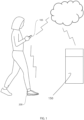
- Figure1 a user is shown examining, on her smart phone 105, the rating produced by the instrumented orthotic system 200 she is wearing.
- Figure 2 shows the positions of sensors and computing and communicating devices in an example embodiment of an instrumented orthotic.
- position, movement, and orientation sensors in a flexible forefoot area 101 and near the arch 106.
- this embodiment includes a pressure or force sensor 103 at the heel.
- These devices are electrically connected to a computing unit or microprocessor 104.
- the sensors and CPU are thin enough to be embedded in the orthotic and not interfere with its function.
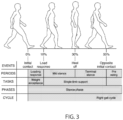
- Figure 3 illustrates points of the gait cycle during the stance phase.
- the stance phase is from heel strike to toe propulsion. This is the phase in which the most useful data is obtained by the system since the orthotic is under load.
- Figure 4 shows a schematic representation of the instrumented orthotic of Fig. 1 .
- the electrical interconnection 110 is depicted in this figure.
- figures 5a-5d show possible flexing, bending, or rotating of the forefoot region.
- the forefoot orthotic In attempting to control for over-pronation or over-supination, the forefoot orthotic will flex, bend, or rotate during points in the gait cycle when weight is put on the forefoot.
- This flexing, bending, or rotating will typically be a complex motion in three dimensions. If known, the direction and degree of flexing, bending, or rotating can inform a clinician who is trying to achieve an optimal clinical alignment of the lower extremity.
- Figure 6 shows a cut-away schematic view of an instrumented orthotic 200 of these teachings. It is shown being worn within a shoe 400 and supporting a foot 202. While the portions of the orthotic under the toes and heel rest directly on the sole of the shoe when weight is fully applied, the orthotic can also move in relation to the sole of the shoe at various points in the gait cycle. Regions 300 and 301 have three-dimensional freedom of movement with respect to the sole 201 of the shoe, and ultimately to the ground. These motions can be sensed by the two sets of sensors 101, 106 in this embodiment. Some alternative embodiments have a wireless sensor 110 in the shoe.
- FIG. 7 shows a block diagram of the electronics sub-system.
- the sensors are connected to an integrated circuit that has a processor, memory, and communication abilities.
- an integrated digital signal processor (DSP) is included in the example CPU.
- An electronic system includes a microprocessor 104, a forefoot 3-axis accelerometer/ 3-axis gyroscope 101, an arch region 3-axis accelerometer/ 3-axis gyroscope 106, and a wireless transmitter 111.
- the components are embedded in the orthotic. Suitable components can include the Intel ® Quark TM SE microcontroller, said to be the heart of the Intel Curie.
- the Quark TM SE CPU would be connected to a 3-axis accelerometer, and 3-axis gyroscope, and 3-axis magnetometer IC, also embedded in the orthotic.
- the STMicroelectronics LSM9DS0 9DOF IMU IC would be a suitable component for this purpose.
- Strain gauges in two dimensions can also measure the flexing, or bending of the orthotic.
- the electronic system overall, will measure and record raw sensor data, pre-process it for external analysis and analyze the data.
- the sensors can also be used to measure gross foot/shoe movement to follow the gait cycle. Those skilled in the art will know how to determine the point in a gait cycle a person is in from the data provided by the sensors.
- FIG 8 shows a high level flow chart of the steps in an example operation of the described system embodiment.
- steps S100 and S101 implement a loop continuously reading data from the sensors to track the gait phase.
- a heel strike is detected S101
- the data is read and is recorded S102.
- a rapid spike in deceleration around the heel strike indicates the start of the stance phase. This occurs until toe-off is detected in step S104, ending the stance phase.
- preprocessing is done that can organize and compress the data.
- the operation extracts salient features of the data including flex, bend, or rotate direction, magnitude, timing, duration and the acceleration of flexing, bending, or rotating S105.
- the preprocessing and analysis in this embodiment includes taking the combination of raw data from the various sensors to create a normalized, coherent record of the motions and forces for each gait cycle.
- step S105.5 the relative timing point in the stance phase is aligned and associated with the movement data.
- the relative orthotic movement data can be aligned on a timeline with the stance phase of the gait cycle for analysis.
- a person may vary their speed even on a step-by-step basis; therefore the wall-clock time when a relevant data point is captured can be difficult to match for multiple steps from multiple persons.
- the more useful timing is the point in the gait cycle that a particular event occurs. Establishing a time normalized gait cycle permits comparison of multiple trials to each other.
- step S106 the salient data is compared to data from many trials with many users and many orthotic geometries to produce a rating of effectiveness S107.
- That data can be analyzed with neural nets or by classification and clustering techniques as taught in Seiner US 8,139,822 , Designation of a Characteristic of a Physical Capability by Motion Analysis Systems and Methods, to produce a rating of the effectiveness of an orthotic for a wearer. It can also be used to construct a predictive model for improved treatment.
- the operation can optionally include step S108 and generate a recommendation for an improved orthotic for the tested user.
- S108 produces a recommendation to alter the geometry of the orthotic in an attempt to provide a better fit to a user and achieve an improved alignment.
- This improved alignment would help the user in achieving optimal clinical alignment of the lower extremity (reducing the rotational and vertical forces being transmitted up the kinetic chain of the lower extremity as a result of ground reaction forces).
- Recommendations to modify the geometry of the orthotic can include: suggesting a completely new orthotic or adding to or removing material on the present orthotic as traditionally done by podiatrists or orthotists. It could also include a setting change for a variable orthotic, or it could provide information to make a 3D printing of an optimized orthotic. If the user is still walking and still in the trial, the process repeats, starting back at S100.
- the orthotic and the sole of the shoe have relative freedom of motion between them.
- the location of the ground can be determined by assuming it is a plane generally tangent to the earth and knowing the location of the shoe at a heel strike.
- To calculate realtive motion between the floor and the orthotic by effectively doing a 3D comparing of the location, motion and orientation of the shoe from the same information for one or more regions of the orthotic, shoe-orthotic relative motion can be determined.
- Some of the steps of FIG. 8 are carried out by an instrumented orthotic, particularly by firmware and software executing on the embedded microprocessor 104. However, to keep the cost, size, and power dissipation low, many subsequent steps may be carried out by an application executing on a smart phone, tablet computer or other external computing device including a remote server 150. In that case, raw, preprocessed or partially analyzed data may be transmitted from the orthotic to a nearby computing and display device. In some embodiments data may be sent from the phone to a server and database via the cloud and the information returned from the server may supply the final information to have the phone display to a user.
- the embodiment shown has a wireless transceiver for communicating with an external computing device such as a smart phone 105 or tablet computer or cloud-based server.
- an external computing device such as a smart phone 105 or tablet computer or cloud-based server.
- the data is wirelessly sent to the external device for further processing and analysis.
- Steps S99 through S102 or alternatively S99 through S104 might be performed on the orthotics' electronics with the other steps performed on an external device or remote server and database.
- the microprocessor may have sufficient computing power to perform more of, or all of, the steps of the analysis. If some data or all data is sent to a remote server with a database, the server may analyze the current data in light of other data from the same subject or in light of an aggregation of data including data from other subjects.
- the recommendation for an improved orthotic can include directing setting changes on a variable or adjustable orthotic.
- Teachings for adjustable orthotics include US 8749115 Pas, et al. ; US 5345701 Smith ; US 8490301 Seiner ; and U7707751 Avent, et al.
- Figures 9a-9e show views of an example variable orthotic from Selner US 849030182 , Adjustable Forefoot Posting for Orthotic. Tilt settings on this device are changed by turning a selector wheel 401.
- an adjustable orthotic can have its setting changed electrically, the recommended change could be directly transmitted back to the orthotic to directly institute a geometry change. This might be practical if done when there is no weight on the post position.
- the external electronic computing device may become optional.
- the external portable electronic device such as a smart cellphone, tablet, or special purpose unit can be used primarily to display results.
- Variations can include versions that are connected by wires to a worn external computing device.
- the number of locations instrumented for measurement can vary.
- Sensors can include strain gauges and flex sensors, resistive, piezoelectric, and others.
- Another variation is a flexible printed circuit board with the electronic computers soldered onto it. The flexible circuit board could be permanently or temporarily adhered to any orthotic to transform it into an instrumented orthotic.
- a wireless sensor could be imbedded into a shoe or temporary secured to either the inside or outside of the sole as depicted in FIGs. 1 and 6 as element 110.
- the sensors and computing within the orthotic could be used to instrument the shoe, or a much simpler, less power consuming electronics might be used.
- Data could be transmitted directly to the external computing device or, saving power, may be sent to the orthotic directly above it.
- the instrumented orthotic may be transmitting to the Internet or other destination via cellular communications. WIFI or other technology. In other embodiments there may be no server connection necessary.
- the system can be used in research to collect data otherwise unavailable.
- Data collected by the dynamic orthotic can be compared to measurements taken in a human performance lab as a tool contributing to research in a predictive model that can help the clinician or consumer with a specific problem.
- This data could be used in an algorithm for the predictive model to assist clinicians and end users to better treat abnormalities, prevent injuries, as well as improve athletic performance.
- Algorithms can be constructed to more precisely identify individuals with correctable mechanically induced problems.
Landscapes
- Health & Medical Sciences (AREA)
- Life Sciences & Earth Sciences (AREA)
- Engineering & Computer Science (AREA)
- Public Health (AREA)
- General Health & Medical Sciences (AREA)
- Veterinary Medicine (AREA)
- Animal Behavior & Ethology (AREA)
- Biomedical Technology (AREA)
- Heart & Thoracic Surgery (AREA)
- Medical Informatics (AREA)
- Molecular Biology (AREA)
- Surgery (AREA)
- Pathology (AREA)
- Biophysics (AREA)
- Physics & Mathematics (AREA)
- Physiology (AREA)
- Oral & Maxillofacial Surgery (AREA)
- Dentistry (AREA)
- Nursing (AREA)
- Vascular Medicine (AREA)
- Orthopedic Medicine & Surgery (AREA)
- Microelectronics & Electronic Packaging (AREA)
- Computer Networks & Wireless Communication (AREA)
- Artificial Intelligence (AREA)
- Computer Vision & Pattern Recognition (AREA)
- Psychiatry (AREA)
- Signal Processing (AREA)
- Measurement Of The Respiration, Hearing Ability, Form, And Blood Characteristics Of Living Organisms (AREA)
- Footwear And Its Accessory, Manufacturing Method And Apparatuses (AREA)
- Rehabilitation Tools (AREA)
Claims (15)
- Instrumentierte Orthese (200), umfassend:a) eine orthetische Platte mit einer dem Fuß angepassten Form, die zumindest einen Teil ihres Vorderfußbereichs so aufweist, dass er bei normaler Fortbewegung halbflexibel ist, wobei die orthetische Platte so ausgelegt ist, dass sie in einem Schuh (400) eines Benutzers derart getragen wird, dass Bewegungsfreiheit zwischen der orthetischen Platte und dem Schuh (400) besteht;b) ein elektronisches System, das in die orthetische Platte eingebettet ist und umfasst::
einen Satz von Sensor (101), der so ausgelegt ist, dass er Folgendes misst:eine Position, eine Bewegung und eine Ausrichtung einer Region (300) im flexiblen Vorderfußbereich; undBiegung der orthetischen Platte in zwei Dimensionen; und eine CPU und einen Speicher in elektronischer Kommunikation mit dem Satz von Sensoren, wobei der Speicher ein Programm enthält, das Sensordaten ausliest; undc) einen Prozessor (104), der so ausgelegt ist, dass er eine Beugung in der orthetischen Platte und Bodenreaktionskräfte, die auf eine untere Extremität des Benutzers übertragen werden, zumindest basierend auf den vom Satz von Sensoren in der orthetischen Platte ausgelesenen Sensordaten misst. - Instrumentierte Orthese nach Anspruch 1, ferner umfassend mindestens einen zweiten Satz von Sensoren (106), der so ausgelegt ist, dass er die Position, die Ausrichtung und die Bewegung einer zweiten, unterschiedlichen flexiblen Region (301) der orthetischen Platte misst.
- Instrumentierte Orthese nach Anspruch 1, wobei das elektronische System ferner mindestens einen Sensor (103) des Satzes von Sensoren (101) umfasst, der zum Messen der Bodenreaktionskräfte ausgelegt ist.
- Instrumentierte Orthese nach Anspruch 1 in Kombination mit einer externen Computereinheit, wobei die externe Computereinheit einen Speicher aufweist und der Speicher ein Programm enthält, das die von der orthetischen Platte übertragenen Sensordaten analysiert und eine Zeitvorgabe, eine Richtung und einen Grad der Beugung an mehreren Punkten in einem Gangzyklus berechnet.
- Instrumentierte Orthese nach Anspruch 1 in Kombination mit einer externen Computereinheit, wobei der Speicher der externen Computereinheit ein Programm enthält, das basierend auf der Zeitvorgabe, der Richtung und dem Grad der Beugung, Biegung oder Drehung und den Bodenreaktionskräften die Wirksamkeit der instrumentierten Orthese für einen Träger bewertet.
- Instrumentierte Orthese nach Anspruch 5 in Kombination mit einer externen Computereinheit, wobei die Bewertung der Wirksamkeit eine vorgeschlagene Änderung der Geometrie der orthetischen Platte umfasst.
- Verfahren zum Messen der Wirksamkeit einer instrumentierten Orthese (200) nach einem der Ansprüche 1 bis 6 für einen Benutzer, der beim Gehen einen Schuh (400) mit der Orthese trägt, wobei die Orthese (200) so ausgelegt ist, dass sie im Schuh (400) des Benutzers derart getragen wird, dass Bewegungsfreiheit zwischen der Orthese (200) und dem Schuh (400) besteht, und die instrumentierte Orthese eine orthetische Platte umfasst, wobei das Verfahren umfasst:Messen der Position, Geschwindigkeit, Richtung und Ausrichtung einer Stelle auf der orthetischen Platte in Echtzeit, die sich während eines ersten Satzes von Punkten in einem Gangzyklus während der Verwendung beugt, biegt oder dreht, und Biegen der orthetischen Platte in zwei Dimensionen;Messen einer Beugung in der orthetischen Platte zumindest basierend auf Sensordaten, die von einem Satz von Sensoren in der orthetischen Platte ausgelesen werden;Bestimmen der Periode des Gangzyklus aus den Sensordaten; Bestimmen von Bodenreaktionskräften, die auf eine untere Extremität des Benutzers übertragen werden, aus den Sensordaten;Ableiten der Lage der Ebene des Bodens; undBestimmen einer relativen Bewegung zwischen der instrumentierten Orthese und dem Boden.
- Verfahren nach Anspruch 7, ferner umfassend ein Normalisieren der zeitlichen Abfolge der ermittelten relativen Bewegungsdaten hinsichtlich des Prozentsatzes des Weges durch einen Gangzyklus und Analysieren der normalisierten Daten, um die Wirksamkeit der instrumentierten Orthese zu bestimmen.
- Verfahren nach Anspruch 7, ferner umfassend ein Durchführen zusätzlicher Messungen der Bewegungen eines oder mehrerer Elemente der unteren Extremität und zeitliches Korrelieren derselben mit den Messungen von der orthetischen Platte.
- Verfahren nach Anspruch 8, wobei es sich bei einem weiteren Schritt um ein Senden eines Befehls an die orthetische Platte zum Ändern ihrer Geometrie basierend auf den Daten handelt.
- Computerprogrammprodukt, umfassend ein nichttransitorisches Medium,. das Anweisungen speichert, die bei Ausführung durch mindestens einen programmierbaren Prozessor, der in eine orthetische Platte einer Orthese (200) nach einem der Ansprüche 1 bis 6 eingebettet ist, den mindestens einen programmierbaren Prozessor zum Durchführen von Operationen veranlassen, die umfassen:Auslesen von Sensordaten von einem Satz von Sensoren, der in einen Vorderfußbereich der orthetischen Platte eingebettet ist, der bei normaler Fortbewegung halbflexibel ist, wobei die orthetische Platte so ausgelegt ist, dass sie in einem Schuh (400) eines Benutzers derart getragen wird, dass Bewegungsfreiheit zwischen der orthetischen Platte und dem Schuh (400) besteht;Bestimmen von Bodenreaktionskräften, die auf eine untere Extremität des Benutzers übertragen werden, aus den Sensordaten; undMessen einer Beugung in der orthetischen Platte in zwei Dimensionen zumindest basierend auf Sensordaten, die von dem Satz von Sensoren in der orthetischen Platte ausgelesen werden.
- Computerprogrammprodukt nach Anspruch 11, wobei die Operationen ferner umfassen:Messen einer Position, einer Bewegung und einer Ausrichtung einer Region im flexiblen Vorderfußbereich mit dem ersten Satz von Sensoren; undBerechnen einer Zeitvorgabe, einer Richtung und eines Grades der Beugung an mehreren Punkten in einem Gangzyklus unter Verwendung einer externen Computereinheit, die die von der orthetischen Platte übertragenen Sensordaten analysiert.
- Computerprogrammprodukt nach Anspruch 11, wobei die Operationen ferner umfassen:Messen einer Position, einer Bewegung und einer Ausrichtung einer Region im flexiblen Vorderfußbereich mit dem ersten Satz von Sensoren; undBewerten der Wirksamkeit einer instrumentierten Orthese für einen Träger unter Verwendung einer externen Computereinheiten basierend auf der Zeitvorgabe, der Richtung und dem Grad der Beugung, Biegung oder Drehung.
- Computerprogrammprodukt nach Anspruch 13, wobei die Operationen ferner umfassen:
Erzeugen der Bewertung der Wirksamkeit, die eine vorgeschlagene Änderung einer Geometrie der orthetischen Platte umfasst, unter Verwendung der externen Computereinheit. - Computerprogrammprodukt nach Anspruch 11, wobei die Operationen ferner umfassen:
Messen einer Position, einer Ausrichtung und einer Bewegung einer zweiten, unterschiedlichen flexiblen Region der orthetischen Platte mit einem zweiten Satz von Sensoren.
Applications Claiming Priority (2)
| Application Number | Priority Date | Filing Date | Title |
|---|---|---|---|
| US201662331915P | 2016-05-04 | 2016-05-04 | |
| PCT/US2017/030303 WO2017192409A2 (en) | 2016-05-04 | 2017-04-29 | Instrumented orthotic |
Publications (3)
| Publication Number | Publication Date |
|---|---|
| EP3451867A2 EP3451867A2 (de) | 2019-03-13 |
| EP3451867A4 EP3451867A4 (de) | 2019-10-23 |
| EP3451867B1 true EP3451867B1 (de) | 2024-09-04 |
Family
ID=60203211
Family Applications (1)
| Application Number | Title | Priority Date | Filing Date |
|---|---|---|---|
| EP17793054.2A Active EP3451867B1 (de) | 2016-05-04 | 2017-04-29 | Instrumentierte orthese |
Country Status (7)
| Country | Link |
|---|---|
| US (1) | US11318035B2 (de) |
| EP (1) | EP3451867B1 (de) |
| CN (1) | CN109310177B (de) |
| AU (1) | AU2017261203B2 (de) |
| CA (1) | CA3022913C (de) |
| ES (1) | ES2988365T3 (de) |
| WO (1) | WO2017192409A2 (de) |
Families Citing this family (14)
| Publication number | Priority date | Publication date | Assignee | Title |
|---|---|---|---|---|
| US20190037961A1 (en) | 2017-02-27 | 2019-02-07 | Voxel8, Inc. | 3d-printed articles of footwear with property gradients |
| EP3585620B1 (de) | 2017-02-27 | 2024-05-15 | Kornit Digital Technologies Ltd. | 3d-druck-vorrichtungen mit mischungsdüsen |
| US11857023B2 (en) | 2017-02-27 | 2024-01-02 | Kornit Digital Technologies Ltd. | Digital molding and associated articles and methods |
| US11470908B2 (en) | 2017-02-27 | 2022-10-18 | Kornit Digital Technologies Ltd. | Articles of footwear and apparel having a three-dimensionally printed feature |
| US11701813B2 (en) | 2017-02-27 | 2023-07-18 | Kornit Digital Technologies Ltd. | Methods for three-dimensionally printing and associated multi-input print heads and systems |
| US11904614B2 (en) | 2017-02-27 | 2024-02-20 | Kornit Digital Technologies Ltd. | Multi-input print heads for three-dimensionally printing and associated systems and methods |
| DE102018131852A1 (de) * | 2018-12-12 | 2020-06-18 | Ottobock Se & Co. Kgaa | Orthese und Verfahren zur Steuerung einer Orthese |
| WO2020187753A1 (en) * | 2019-03-20 | 2020-09-24 | Optima Molliter Srl | Orthosis brace with monitoring system |
| CN110974232A (zh) * | 2019-12-26 | 2020-04-10 | 上海交通大学 | 穿戴式负重监测与康复训练智能辅助装置 |
| FR3128366A1 (fr) | 2021-10-21 | 2023-04-28 | Digitsole | Procede et systeme de validation d’une correction orthopedique pour un individu |
| IL295690B2 (en) * | 2022-08-16 | 2024-06-01 | Foot Care Ltd | A method and system for designing orthoses |
| WO2025080802A1 (en) * | 2023-10-13 | 2025-04-17 | Michael Urbanowicz | Ankle foot orthotic assembly |
| PL447226A1 (pl) * | 2023-12-21 | 2025-06-23 | Telvis Spółka Z Ograniczoną Odpowiedzialnością | Antropotechniczny system neuromotorycznej stymulacji chodu człowieka |
| PL447871A1 (pl) * | 2024-02-27 | 2025-09-01 | Sieć Badawcza Łukasiewicz - Instytut Mikroelektroniki I Fotoniki | Sposób określania stopnia zaburzenia równowagi u osób z dysfunkcją chodu oraz układ do określania poziomu równowagi osób z dysfunkcją chodu |
Family Cites Families (16)
| Publication number | Priority date | Publication date | Assignee | Title |
|---|---|---|---|---|
| US6195921B1 (en) * | 1999-09-28 | 2001-03-06 | Vinncente Hoa Gia Truong | Virtual intelligence shoe with a podiatric analysis system |
| US20030009308A1 (en) * | 2000-06-24 | 2003-01-09 | Chris Kirtley | Instrumented insole |
| CA2863933C (en) * | 2004-12-22 | 2018-08-07 | Ossur Hf | Systems and methods for processing limb motion |
| US8117922B2 (en) * | 2006-09-21 | 2012-02-21 | Msd Consumer Care, Inc. | Footcare product dispensing kiosk |
| US7726206B2 (en) * | 2006-11-02 | 2010-06-01 | The Regents Of The University Of California | Foot pressure alert and sensing system |
| US20080306410A1 (en) * | 2007-06-05 | 2008-12-11 | 24/8 Llc | Methods and apparatuses for measuring pressure points |
| US8384551B2 (en) | 2008-05-28 | 2013-02-26 | MedHab, LLC | Sensor device and method for monitoring physical stresses placed on a user |
| US20100324455A1 (en) * | 2009-05-23 | 2010-12-23 | Lasercure Sciences, Inc. | Devices for management of foot injuries and methods of use and manufacture thereof |
| WO2011026257A1 (zh) | 2009-09-03 | 2011-03-10 | Yang Changming | 利用织品感测器的步态分析系统及方法 |
| US8525386B2 (en) * | 2009-12-09 | 2013-09-03 | Texas Instruments Incorporated | Dynamically adjustable orthotic device |
| US9993181B2 (en) | 2011-03-24 | 2018-06-12 | Med Hab, LLC | System and method for monitoring a runner'S gait |
| US20130219745A1 (en) * | 2012-02-27 | 2013-08-29 | Eduardo Moreno-Collado | Walking Device |
| CA2866025A1 (en) * | 2013-10-03 | 2015-04-03 | Quiang Song | Sensor unit for a functional electrical stimulation (fes) orthotic system |
| WO2015069781A1 (en) * | 2013-11-05 | 2015-05-14 | The Board Of Regents Of The Nevada System Of Higher Education On Behalf Of The University Of Nevada, | Actuated foot orthotic with sensors |
| US10070816B2 (en) * | 2014-09-09 | 2018-09-11 | Intel Corporation | Orthotic sensor device |
| CN104257393A (zh) * | 2014-10-14 | 2015-01-07 | 陈信岳 | 一种足压监测鞋垫及其监测系统 |
-
2017
- 2017-04-29 EP EP17793054.2A patent/EP3451867B1/de active Active
- 2017-04-29 WO PCT/US2017/030303 patent/WO2017192409A2/en not_active Ceased
- 2017-04-29 CA CA3022913A patent/CA3022913C/en active Active
- 2017-04-29 ES ES17793054T patent/ES2988365T3/es active Active
- 2017-04-29 AU AU2017261203A patent/AU2017261203B2/en active Active
- 2017-04-29 CN CN201780035895.4A patent/CN109310177B/zh active Active
- 2017-05-01 US US15/583,973 patent/US11318035B2/en active Active
Non-Patent Citations (1)
| Title |
|---|
| BAMBERG S ET AL: "Gait Analysis Using a Shoe-Integrated Wireless Sensor System", IEEE TRANSACTIONS ON INFORMATION TECHNOLOGY IN BIOMEDICINE, IEEE SERVICE CENTER, LOS ALAMITOS, CA, US, vol. 12, no. 4, 1 July 2008 (2008-07-01), pages 413 - 423, XP011345475, ISSN: 1089-7771, DOI: 10.1109/TITB.2007.899493 * |
Also Published As
| Publication number | Publication date |
|---|---|
| WO2017192409A3 (en) | 2017-12-14 |
| WO2017192409A2 (en) | 2017-11-09 |
| EP3451867A2 (de) | 2019-03-13 |
| US20170319368A1 (en) | 2017-11-09 |
| CN109310177A (zh) | 2019-02-05 |
| ES2988365T3 (es) | 2024-11-20 |
| AU2017261203A1 (en) | 2018-11-22 |
| US11318035B2 (en) | 2022-05-03 |
| EP3451867A4 (de) | 2019-10-23 |
| AU2017261203B2 (en) | 2022-06-30 |
| CN109310177B (zh) | 2023-04-04 |
| CA3022913C (en) | 2023-08-15 |
| CA3022913A1 (en) | 2017-11-09 |
Similar Documents
| Publication | Publication Date | Title |
|---|---|---|
| EP3451867B1 (de) | Instrumentierte orthese | |
| Klöpfer-Krämer et al. | Gait analysis–Available platforms for outcome assessment | |
| Bamberg et al. | Gait analysis using a shoe-integrated wireless sensor system | |
| Lee et al. | Portable activity monitoring system for temporal parameters of gait cycles | |
| US20200008745A1 (en) | Wearable Flexible Sensor Motion Capture System | |
| EP3249362A1 (de) | Einlegesohle mit integriertem nano-pedometer, schrittdetektion und zählverfahren unter verwendung dieser einlegesohle und schuh mit fester oder entnehmbarer einlegesohle | |
| Minto et al. | Validation of a footwear-based gait analysis system with action-related feedback | |
| Manna et al. | Optimal locations and computational frameworks of FSR and IMU sensors for measuring gait abnormalities | |
| JP2018011890A (ja) | 歩行データ取得装置および歩行データ取得システム | |
| US20260088177A1 (en) | Estimation device, estimation system, estimation method, and recording medium | |
| JP2020120807A (ja) | 転倒リスク評価装置、転倒リスク評価方法及び転倒リスク評価プログラム | |
| US20240108251A1 (en) | Calculation device, calculation method, and program recording medium | |
| EP3808268B1 (de) | System und verfahren zur propriozeptiven analyse der schulter | |
| Fusca et al. | Method for wearable kinematic gait analysis using a harmonic oscillator applied to the Center of Mass | |
| Majumder et al. | A wireless smart-shoe system for gait assistance | |
| US20230270354A1 (en) | Detection device, detection method, and program recording medium | |
| Shull et al. | An overview of wearable sensing and wearable feedback for gait retraining | |
| CN120046481A (zh) | 一种用于扁平足治疗的矫正鞋垫智能管理系统 | |
| Lo et al. | Bayesian analysis of sub-plantar ground reaction force with BSN | |
| TW202423334A (zh) | 足部感測器及分析裝置 | |
| US20240315390A1 (en) | Instrumented artificial intelligence (ai) driven motion tracking and alignment systems and methods for various applications | |
| KR102581588B1 (ko) | 사용자 맞춤형 깔창 제작 장치 및 방법 | |
| Sudha et al. | Smart Footwear for Patients with Diabetic Neuropathy | |
| Mehmood et al. | Development of a Portable Gait Analysis System Based on the 7 Principles of Universal Design | |
| Nguyen et al. | An Intelligent Shoe System for Real-Time Stride Length and Joint Angle Measurement: A Step Toward Self-Health Monitoring |
Legal Events
| Date | Code | Title | Description |
|---|---|---|---|
| STAA | Information on the status of an ep patent application or granted ep patent |
Free format text: STATUS: THE INTERNATIONAL PUBLICATION HAS BEEN MADE |
|
| PUAI | Public reference made under article 153(3) epc to a published international application that has entered the european phase |
Free format text: ORIGINAL CODE: 0009012 |
|
| STAA | Information on the status of an ep patent application or granted ep patent |
Free format text: STATUS: REQUEST FOR EXAMINATION WAS MADE |
|
| 17P | Request for examination filed |
Effective date: 20181204 |
|
| AK | Designated contracting states |
Kind code of ref document: A2 Designated state(s): AL AT BE BG CH CY CZ DE DK EE ES FI FR GB GR HR HU IE IS IT LI LT LU LV MC MK MT NL NO PL PT RO RS SE SI SK SM TR |
|
| AX | Request for extension of the european patent |
Extension state: BA ME |
|
| DAV | Request for validation of the european patent (deleted) | ||
| DAX | Request for extension of the european patent (deleted) | ||
| A4 | Supplementary search report drawn up and despatched |
Effective date: 20190925 |
|
| RIC1 | Information provided on ipc code assigned before grant |
Ipc: G06Q 50/22 20180101ALI20190919BHEP Ipc: A61F 5/01 20060101ALI20190919BHEP Ipc: A61B 5/103 20060101ALI20190919BHEP Ipc: A61B 5/11 20060101ALI20190919BHEP Ipc: A43B 3/00 20060101AFI20190919BHEP |
|
| STAA | Information on the status of an ep patent application or granted ep patent |
Free format text: STATUS: EXAMINATION IS IN PROGRESS |
|
| 17Q | First examination report despatched |
Effective date: 20210317 |
|
| GRAP | Despatch of communication of intention to grant a patent |
Free format text: ORIGINAL CODE: EPIDOSNIGR1 |
|
| STAA | Information on the status of an ep patent application or granted ep patent |
Free format text: STATUS: GRANT OF PATENT IS INTENDED |
|
| INTG | Intention to grant announced |
Effective date: 20240325 |
|
| P01 | Opt-out of the competence of the unified patent court (upc) registered |
Effective date: 20240429 |
|
| GRAS | Grant fee paid |
Free format text: ORIGINAL CODE: EPIDOSNIGR3 |
|
| GRAA | (expected) grant |
Free format text: ORIGINAL CODE: 0009210 |
|
| STAA | Information on the status of an ep patent application or granted ep patent |
Free format text: STATUS: THE PATENT HAS BEEN GRANTED |
|
| AK | Designated contracting states |
Kind code of ref document: B1 Designated state(s): AL AT BE BG CH CY CZ DE DK EE ES FI FR GB GR HR HU IE IS IT LI LT LU LV MC MK MT NL NO PL PT RO RS SE SI SK SM TR |
|
| REG | Reference to a national code |
Ref country code: GB Ref legal event code: FG4D |
|
| REG | Reference to a national code |
Ref country code: CH Ref legal event code: EP |
|
| REG | Reference to a national code |
Ref country code: IE Ref legal event code: FG4D |
|
| REG | Reference to a national code |
Ref country code: DE Ref legal event code: R096 Ref document number: 602017084659 Country of ref document: DE |
|
| REG | Reference to a national code |
Ref country code: NL Ref legal event code: FP |
|
| REG | Reference to a national code |
Ref country code: ES Ref legal event code: FG2A Ref document number: 2988365 Country of ref document: ES Kind code of ref document: T3 Effective date: 20241120 |
|
| REG | Reference to a national code |
Ref country code: LT Ref legal event code: MG9D |
|
| PG25 | Lapsed in a contracting state [announced via postgrant information from national office to epo] |
Ref country code: NO Free format text: LAPSE BECAUSE OF FAILURE TO SUBMIT A TRANSLATION OF THE DESCRIPTION OR TO PAY THE FEE WITHIN THE PRESCRIBED TIME-LIMIT Effective date: 20241204 |
|
| PG25 | Lapsed in a contracting state [announced via postgrant information from national office to epo] |
Ref country code: PL Free format text: LAPSE BECAUSE OF FAILURE TO SUBMIT A TRANSLATION OF THE DESCRIPTION OR TO PAY THE FEE WITHIN THE PRESCRIBED TIME-LIMIT Effective date: 20240904 Ref country code: GR Free format text: LAPSE BECAUSE OF FAILURE TO SUBMIT A TRANSLATION OF THE DESCRIPTION OR TO PAY THE FEE WITHIN THE PRESCRIBED TIME-LIMIT Effective date: 20241205 Ref country code: FI Free format text: LAPSE BECAUSE OF FAILURE TO SUBMIT A TRANSLATION OF THE DESCRIPTION OR TO PAY THE FEE WITHIN THE PRESCRIBED TIME-LIMIT Effective date: 20240904 |
|
| PG25 | Lapsed in a contracting state [announced via postgrant information from national office to epo] |
Ref country code: BG Free format text: LAPSE BECAUSE OF FAILURE TO SUBMIT A TRANSLATION OF THE DESCRIPTION OR TO PAY THE FEE WITHIN THE PRESCRIBED TIME-LIMIT Effective date: 20240904 |
|
| PG25 | Lapsed in a contracting state [announced via postgrant information from national office to epo] |
Ref country code: LV Free format text: LAPSE BECAUSE OF FAILURE TO SUBMIT A TRANSLATION OF THE DESCRIPTION OR TO PAY THE FEE WITHIN THE PRESCRIBED TIME-LIMIT Effective date: 20240904 |
|
| PG25 | Lapsed in a contracting state [announced via postgrant information from national office to epo] |
Ref country code: HR Free format text: LAPSE BECAUSE OF FAILURE TO SUBMIT A TRANSLATION OF THE DESCRIPTION OR TO PAY THE FEE WITHIN THE PRESCRIBED TIME-LIMIT Effective date: 20240904 |
|
| PG25 | Lapsed in a contracting state [announced via postgrant information from national office to epo] |
Ref country code: RS Free format text: LAPSE BECAUSE OF FAILURE TO SUBMIT A TRANSLATION OF THE DESCRIPTION OR TO PAY THE FEE WITHIN THE PRESCRIBED TIME-LIMIT Effective date: 20241204 |
|
| PG25 | Lapsed in a contracting state [announced via postgrant information from national office to epo] |
Ref country code: RS Free format text: LAPSE BECAUSE OF FAILURE TO SUBMIT A TRANSLATION OF THE DESCRIPTION OR TO PAY THE FEE WITHIN THE PRESCRIBED TIME-LIMIT Effective date: 20241204 Ref country code: PL Free format text: LAPSE BECAUSE OF FAILURE TO SUBMIT A TRANSLATION OF THE DESCRIPTION OR TO PAY THE FEE WITHIN THE PRESCRIBED TIME-LIMIT Effective date: 20240904 Ref country code: NO Free format text: LAPSE BECAUSE OF FAILURE TO SUBMIT A TRANSLATION OF THE DESCRIPTION OR TO PAY THE FEE WITHIN THE PRESCRIBED TIME-LIMIT Effective date: 20241204 Ref country code: LV Free format text: LAPSE BECAUSE OF FAILURE TO SUBMIT A TRANSLATION OF THE DESCRIPTION OR TO PAY THE FEE WITHIN THE PRESCRIBED TIME-LIMIT Effective date: 20240904 Ref country code: HR Free format text: LAPSE BECAUSE OF FAILURE TO SUBMIT A TRANSLATION OF THE DESCRIPTION OR TO PAY THE FEE WITHIN THE PRESCRIBED TIME-LIMIT Effective date: 20240904 Ref country code: GR Free format text: LAPSE BECAUSE OF FAILURE TO SUBMIT A TRANSLATION OF THE DESCRIPTION OR TO PAY THE FEE WITHIN THE PRESCRIBED TIME-LIMIT Effective date: 20241205 Ref country code: FI Free format text: LAPSE BECAUSE OF FAILURE TO SUBMIT A TRANSLATION OF THE DESCRIPTION OR TO PAY THE FEE WITHIN THE PRESCRIBED TIME-LIMIT Effective date: 20240904 Ref country code: BG Free format text: LAPSE BECAUSE OF FAILURE TO SUBMIT A TRANSLATION OF THE DESCRIPTION OR TO PAY THE FEE WITHIN THE PRESCRIBED TIME-LIMIT Effective date: 20240904 |
|
| REG | Reference to a national code |
Ref country code: AT Ref legal event code: MK05 Ref document number: 1719431 Country of ref document: AT Kind code of ref document: T Effective date: 20240904 |
|
| PG25 | Lapsed in a contracting state [announced via postgrant information from national office to epo] |
Ref country code: IS Free format text: LAPSE BECAUSE OF FAILURE TO SUBMIT A TRANSLATION OF THE DESCRIPTION OR TO PAY THE FEE WITHIN THE PRESCRIBED TIME-LIMIT Effective date: 20250104 Ref country code: PT Free format text: LAPSE BECAUSE OF FAILURE TO SUBMIT A TRANSLATION OF THE DESCRIPTION OR TO PAY THE FEE WITHIN THE PRESCRIBED TIME-LIMIT Effective date: 20250106 |
|
| PG25 | Lapsed in a contracting state [announced via postgrant information from national office to epo] |
Ref country code: SM Free format text: LAPSE BECAUSE OF FAILURE TO SUBMIT A TRANSLATION OF THE DESCRIPTION OR TO PAY THE FEE WITHIN THE PRESCRIBED TIME-LIMIT Effective date: 20240904 Ref country code: RO Free format text: LAPSE BECAUSE OF FAILURE TO SUBMIT A TRANSLATION OF THE DESCRIPTION OR TO PAY THE FEE WITHIN THE PRESCRIBED TIME-LIMIT Effective date: 20240904 |
|
| PG25 | Lapsed in a contracting state [announced via postgrant information from national office to epo] |
Ref country code: EE Free format text: LAPSE BECAUSE OF FAILURE TO SUBMIT A TRANSLATION OF THE DESCRIPTION OR TO PAY THE FEE WITHIN THE PRESCRIBED TIME-LIMIT Effective date: 20240904 Ref country code: AT Free format text: LAPSE BECAUSE OF FAILURE TO SUBMIT A TRANSLATION OF THE DESCRIPTION OR TO PAY THE FEE WITHIN THE PRESCRIBED TIME-LIMIT Effective date: 20240904 |
|
| PG25 | Lapsed in a contracting state [announced via postgrant information from national office to epo] |
Ref country code: CZ Free format text: LAPSE BECAUSE OF FAILURE TO SUBMIT A TRANSLATION OF THE DESCRIPTION OR TO PAY THE FEE WITHIN THE PRESCRIBED TIME-LIMIT Effective date: 20240904 |
|
| PG25 | Lapsed in a contracting state [announced via postgrant information from national office to epo] |
Ref country code: SK Free format text: LAPSE BECAUSE OF FAILURE TO SUBMIT A TRANSLATION OF THE DESCRIPTION OR TO PAY THE FEE WITHIN THE PRESCRIBED TIME-LIMIT Effective date: 20240904 |
|
| REG | Reference to a national code |
Ref country code: DE Ref legal event code: R097 Ref document number: 602017084659 Country of ref document: DE |
|
| PGFP | Annual fee paid to national office [announced via postgrant information from national office to epo] |
Ref country code: DE Payment date: 20250305 Year of fee payment: 9 |
|
| PG25 | Lapsed in a contracting state [announced via postgrant information from national office to epo] |
Ref country code: DK Free format text: LAPSE BECAUSE OF FAILURE TO SUBMIT A TRANSLATION OF THE DESCRIPTION OR TO PAY THE FEE WITHIN THE PRESCRIBED TIME-LIMIT Effective date: 20240904 |
|
| PGFP | Annual fee paid to national office [announced via postgrant information from national office to epo] |
Ref country code: ES Payment date: 20250508 Year of fee payment: 9 |
|
| PLBE | No opposition filed within time limit |
Free format text: ORIGINAL CODE: 0009261 |
|
| STAA | Information on the status of an ep patent application or granted ep patent |
Free format text: STATUS: NO OPPOSITION FILED WITHIN TIME LIMIT |
|
| 26N | No opposition filed |
Effective date: 20250605 |
|
| PG25 | Lapsed in a contracting state [announced via postgrant information from national office to epo] |
Ref country code: SE Free format text: LAPSE BECAUSE OF FAILURE TO SUBMIT A TRANSLATION OF THE DESCRIPTION OR TO PAY THE FEE WITHIN THE PRESCRIBED TIME-LIMIT Effective date: 20240904 |
|
| REG | Reference to a national code |
Ref country code: CH Ref legal event code: H13 Free format text: ST27 STATUS EVENT CODE: U-0-0-H10-H13 (AS PROVIDED BY THE NATIONAL OFFICE) Effective date: 20251125 |
|
| PG25 | Lapsed in a contracting state [announced via postgrant information from national office to epo] |
Ref country code: LU Free format text: LAPSE BECAUSE OF NON-PAYMENT OF DUE FEES Effective date: 20250429 |
|
| PG25 | Lapsed in a contracting state [announced via postgrant information from national office to epo] |
Ref country code: MC Free format text: LAPSE BECAUSE OF FAILURE TO SUBMIT A TRANSLATION OF THE DESCRIPTION OR TO PAY THE FEE WITHIN THE PRESCRIBED TIME-LIMIT Effective date: 20240904 |
|
| REG | Reference to a national code |
Ref country code: BE Ref legal event code: MM Effective date: 20250430 |
|
| PG25 | Lapsed in a contracting state [announced via postgrant information from national office to epo] |
Ref country code: BE Free format text: LAPSE BECAUSE OF NON-PAYMENT OF DUE FEES Effective date: 20250430 |
|
| PG25 | Lapsed in a contracting state [announced via postgrant information from national office to epo] |
Ref country code: CH Free format text: LAPSE BECAUSE OF NON-PAYMENT OF DUE FEES Effective date: 20250430 |
|
| PGFP | Annual fee paid to national office [announced via postgrant information from national office to epo] |
Ref country code: GB Payment date: 20260312 Year of fee payment: 10 |
|
| PG25 | Lapsed in a contracting state [announced via postgrant information from national office to epo] |
Ref country code: IE Free format text: LAPSE BECAUSE OF NON-PAYMENT OF DUE FEES Effective date: 20250429 |
|
| PGFP | Annual fee paid to national office [announced via postgrant information from national office to epo] |
Ref country code: IT Payment date: 20260320 Year of fee payment: 10 |
|
| PGFP | Annual fee paid to national office [announced via postgrant information from national office to epo] |
Ref country code: NL Payment date: 20260317 Year of fee payment: 10 |
|
| PGFP | Annual fee paid to national office [announced via postgrant information from national office to epo] |
Ref country code: FR Payment date: 20260309 Year of fee payment: 10 |