EP3450601A1 - Composite material comprising diatomaceous earth - Google Patents
Composite material comprising diatomaceous earth Download PDFInfo
- Publication number
- EP3450601A1 EP3450601A1 EP17306124.3A EP17306124A EP3450601A1 EP 3450601 A1 EP3450601 A1 EP 3450601A1 EP 17306124 A EP17306124 A EP 17306124A EP 3450601 A1 EP3450601 A1 EP 3450601A1
- Authority
- EP
- European Patent Office
- Prior art keywords
- composite material
- fibers
- diatomaceous earth
- weight
- natural fibers
- Prior art date
- Legal status (The legal status is an assumption and is not a legal conclusion. Google has not performed a legal analysis and makes no representation as to the accuracy of the status listed.)
- Granted
Links
Classifications
-
- D—TEXTILES; PAPER
- D04—BRAIDING; LACE-MAKING; KNITTING; TRIMMINGS; NON-WOVEN FABRICS
- D04H—MAKING TEXTILE FABRICS, e.g. FROM FIBRES OR FILAMENTARY MATERIAL; FABRICS MADE BY SUCH PROCESSES OR APPARATUS, e.g. FELTS, NON-WOVEN FABRICS; COTTON-WOOL; WADDING ; NON-WOVEN FABRICS FROM STAPLE FIBRES, FILAMENTS OR YARNS, BONDED WITH AT LEAST ONE WEB-LIKE MATERIAL DURING THEIR CONSOLIDATION
- D04H1/00—Non-woven fabrics formed wholly or mainly of staple fibres or like relatively short fibres
- D04H1/40—Non-woven fabrics formed wholly or mainly of staple fibres or like relatively short fibres from fleeces or layers composed of fibres without existing or potential cohesive properties
- D04H1/54—Non-woven fabrics formed wholly or mainly of staple fibres or like relatively short fibres from fleeces or layers composed of fibres without existing or potential cohesive properties by welding together the fibres, e.g. by partially melting or dissolving
- D04H1/541—Composite fibres, e.g. sheath-core, sea-island or side-by-side; Mixed fibres
- D04H1/5418—Mixed fibres, e.g. at least two chemically different fibres or fibre blends
-
- D—TEXTILES; PAPER
- D04—BRAIDING; LACE-MAKING; KNITTING; TRIMMINGS; NON-WOVEN FABRICS
- D04H—MAKING TEXTILE FABRICS, e.g. FROM FIBRES OR FILAMENTARY MATERIAL; FABRICS MADE BY SUCH PROCESSES OR APPARATUS, e.g. FELTS, NON-WOVEN FABRICS; COTTON-WOOL; WADDING ; NON-WOVEN FABRICS FROM STAPLE FIBRES, FILAMENTS OR YARNS, BONDED WITH AT LEAST ONE WEB-LIKE MATERIAL DURING THEIR CONSOLIDATION
- D04H1/00—Non-woven fabrics formed wholly or mainly of staple fibres or like relatively short fibres
- D04H1/40—Non-woven fabrics formed wholly or mainly of staple fibres or like relatively short fibres from fleeces or layers composed of fibres without existing or potential cohesive properties
- D04H1/54—Non-woven fabrics formed wholly or mainly of staple fibres or like relatively short fibres from fleeces or layers composed of fibres without existing or potential cohesive properties by welding together the fibres, e.g. by partially melting or dissolving
- D04H1/558—Non-woven fabrics formed wholly or mainly of staple fibres or like relatively short fibres from fleeces or layers composed of fibres without existing or potential cohesive properties by welding together the fibres, e.g. by partially melting or dissolving in combination with mechanical or physical treatments other than embossing
-
- B—PERFORMING OPERATIONS; TRANSPORTING
- B60—VEHICLES IN GENERAL
- B60R—VEHICLES, VEHICLE FITTINGS, OR VEHICLE PARTS, NOT OTHERWISE PROVIDED FOR
- B60R13/00—Elements for body-finishing, identifying, or decorating; Arrangements or adaptations for advertising purposes
- B60R13/02—Internal Trim mouldings ; Internal Ledges; Wall liners for passenger compartments; Roof liners
-
- D—TEXTILES; PAPER
- D04—BRAIDING; LACE-MAKING; KNITTING; TRIMMINGS; NON-WOVEN FABRICS
- D04H—MAKING TEXTILE FABRICS, e.g. FROM FIBRES OR FILAMENTARY MATERIAL; FABRICS MADE BY SUCH PROCESSES OR APPARATUS, e.g. FELTS, NON-WOVEN FABRICS; COTTON-WOOL; WADDING ; NON-WOVEN FABRICS FROM STAPLE FIBRES, FILAMENTS OR YARNS, BONDED WITH AT LEAST ONE WEB-LIKE MATERIAL DURING THEIR CONSOLIDATION
- D04H1/00—Non-woven fabrics formed wholly or mainly of staple fibres or like relatively short fibres
- D04H1/40—Non-woven fabrics formed wholly or mainly of staple fibres or like relatively short fibres from fleeces or layers composed of fibres without existing or potential cohesive properties
- D04H1/413—Non-woven fabrics formed wholly or mainly of staple fibres or like relatively short fibres from fleeces or layers composed of fibres without existing or potential cohesive properties containing granules other than absorbent substances
-
- D—TEXTILES; PAPER
- D04—BRAIDING; LACE-MAKING; KNITTING; TRIMMINGS; NON-WOVEN FABRICS
- D04H—MAKING TEXTILE FABRICS, e.g. FROM FIBRES OR FILAMENTARY MATERIAL; FABRICS MADE BY SUCH PROCESSES OR APPARATUS, e.g. FELTS, NON-WOVEN FABRICS; COTTON-WOOL; WADDING ; NON-WOVEN FABRICS FROM STAPLE FIBRES, FILAMENTS OR YARNS, BONDED WITH AT LEAST ONE WEB-LIKE MATERIAL DURING THEIR CONSOLIDATION
- D04H1/00—Non-woven fabrics formed wholly or mainly of staple fibres or like relatively short fibres
- D04H1/40—Non-woven fabrics formed wholly or mainly of staple fibres or like relatively short fibres from fleeces or layers composed of fibres without existing or potential cohesive properties
- D04H1/42—Non-woven fabrics formed wholly or mainly of staple fibres or like relatively short fibres from fleeces or layers composed of fibres without existing or potential cohesive properties characterised by the use of certain kinds of fibres insofar as this use has no preponderant influence on the consolidation of the fleece
- D04H1/425—Cellulose series
Definitions
- the present invention concerns a composite material notably for manufacturing vehicle parts, such as automotive interior trim parts.
- Natural fibers based composite materials are known in the art. However, natural fibers may induce volatile organic compound (VOC) emission and odor emission which are detrimental for their use as materials useful for vehicle parts. Among the volatile organic compound (VOC) to be avoided are formaldehyde and acetaldehyde.
- thermoplastic resin composition used for automotive materials comprising:
- One of the aims of the present invention is to provide a natural fibers based composite material which allows preventing fungus growth, while reducing the concentration of volatile organic compound and odor emission.
- a first object of the present invention is a composite material comprising:
- composite material » is meant to cover heterogeneous materials associating several types of materials which do not mix.
- the different materials/phases of a composite material may be detected with Electronical Scanning Microscopy (SEM).
- the invention is based on the discovery that incorporating diatomaceous earth to a natural fibers based composite material allows not only reducing emissions of odor and of organic volatile compounds, but also preventing fungus growth.
- the emission of odor can be measured by Volvo VCS 1027,2729 Variant C method or VW. Test PV 3900 Variant C3 method.
- the indoor total organic volatile compounds (TVOC) can be measured by VCS 1027,2749/1 method, VCS 1027,2759 method, Fogging VCS 1027,2719 method G (fogging behavior).
- Formaldehyde emissions can be measured by Formaldehyde BMW AA-0061 method or by Formaldehyde VCS 1027,2739 method.
- Acetaldehyde emissions can be measured by Acetaldehyde BMW AA-0061 method.
- Diatomaceous earth also called diatomite
- Diatomaceous earth is a naturally occurring, soft, siliceous sedimentary rock that is easily crumbled into a fine white to off-white powder.
- its particle size obtained from a laser particle size analyzer ranges from less than 3 ⁇ m to more than 1 mm, typically 5 to 500 ⁇ m, such as from 5 to 100 ⁇ m, preferably from 5 to 20 ⁇ m. These sizes are particularly well suited to obtain a good dispersion of the diatomaceous earth within the composite material.
- diatomaceous earth comprises 75 to 90% silica, 1 to 4% alumina and 0.1 to 2% iron oxide. It may comprise other oxides, such as calcium oxide (such as from 0 to 15%wt, preferably from 5 to 10%wt), magnesium oxide (such as from 0,01 to 1%), sodium oxide (such as from 0,01 to 1 %) and/or potassium oxide (such as from 0,01 to 1 %).
- calcium oxide such as from 0 to 15%wt, preferably from 5 to 10%wt
- magnesium oxide such as from 0,01 to 1%
- sodium oxide such as from 0,01 to 1 %
- potassium oxide such as from 0,01 to 1 %).
- the diatomaceous earth is advantageously well dispersed in the composite material. This allows obtaining uniform properties for all parts of the composite material.
- the composite material comprises from 1 to 7 % by weight, more preferably from 1 to 5% by weight, for example from 3 to 5% by weight of diatomaceous earth. These proportions are particularly suited to obtain a good dispersion of the diatomaceous earth within the composite material. Above 5% by weight of diatomaceous earth, the diatomaceous earth particles may tend to agglomerate and may disperse less reliably.
- the composite material comprises from 30 to 95%wt of natural fibers.
- the natural fibers are preferably:
- the natural fibers are preferably chosen from wood, hemp, flax and/or kenaf fibers.
- the natural fibers comprise (or consist of) wood fibers.
- the composite material preferably comprises from 50 to 95%wt of wood fibers, most preferably from 65 to 90%wt of wood fibers, for example from 70 to 85%wt of wood fibers.
- the natural fibers differ from wood fibers and are preferably chosen from hemp, flax and/or kenaf fibers.
- the composite material preferably comprises from 40 to 60% by weight of natural fibers chosen from flax fibers, hemp fibers, kenaf fibers and a mixture thereof.
- the length of the natural fibers may greatly vary depending on the contemplated applications for the composite material.
- fibers with an average length comprised between 0.1 and 100 mm, in particular from 60 to 100 mm, are preferably used.
- the composite material comprises a resin, preferably from 5 to 25% by weight of resin.
- the natural fibers comprise or consist of wood fibers.
- the resin of the composite material is a synthetic resin. Said synthetic resin can be prepared by polymerizing bio-sourced monomers.
- the resin of the composite material is typically a thermoset resin, such as a phenolic resin, an acrylic resin and a mixture thereof. This resin acts as a binder.
- the composite material may further comprise polyester fibers, for example from 0 to 24.9%wt, preferably from 15 to 24.9%wt of polyester fibers.
- polyester fibers Preferably, when the composite material comprises polyester fibers, it comprises wood fibers. Polyester fibers with an average length comprised between 0.1 and 100 mm, in particular from 40 to 80 mm as measured by ISO 6989 standard (1981, confirmed in 2015), are preferably used.
- polyester fibers is meant fibers comprising or consisting of polyester.
- the polyester fibers can be bicomponent polyester fibers (PET-BIKO fibers).
- the composite material may comprise a mixture of fibers consisting of polyester and of bicomponent polyester fibers.
- the composite material may also be free from polyester fibers.
- the composite material may further comprise polypropylene fibers, for example from 30 to 59.9%wt, such as from 45 to 55%wt of polypropylene fibers.
- polypropylene fibers when the composite material comprises polypropylene fibers, it comprises natural fibers different from wood fibers, and which are for example chosen from hemp, flax and/or kenaf fibers.
- the polypropylene fibers act as a binder when the polypropylene is melted.
- the polypropylene fibers help maintaining the cohesion of the composite material.
- the composite material comprises polypropylene fibers and comprises less than 5% by weight of resin, preferably less than 2% of resin.
- the composite material comprises polypropylene fibers and is free from phenolic resin and acrylic resin, or even free from resin.
- the composite material may also be free from polypropylene fibers.
- the composite material may further comprise additives usually used in composite materials used for the manufacture of vehicle parts, such as:
- the composite material » consists essentially of:
- the composite material consists essentially of:
- the composite material is in the form of a mat, the thickness of which is typically from 0.5 to 1.5 cm.
- the invention is directed to a method for preparing the composite material described above comprising the steps of:
- other components of the composite material is meant the components of the composite material other than the natural fibers and the diatomaceous earth, typically those described above, such as a resin, polyester fibers, polypropylene fibers, a wax...
- steps (i) and (iii) are carried out at room temperature (about 20°C).
- step (i) from 10% to 30% by weight of diatomaceous earth is dispersed in water, typically around 20% by weight.
- Step (ii) is generally carried out by spraying the dispersion on natural fibers.
- steps (ii) and (iii) are generally either subsequent ((i.e. step (ii) then step (iii))) or simultaneous.
- the natural fibers are wood fibers and the other components comprise (or are) a resin and optionally polyester fibers.
- Mixing the wood fibers with the resin before applying the diatomaceous dispersion on just the natural fibers i.e. performing step (iii) before step (ii)
- step (iii) i.e. performing step (iii) before step (ii)
- step (iii) generally leads to a bad dispersion of the diatomaceous earth within the composite material. Accordingly, it is better not to carry out step (iii) before step (ii).
- the method can comprise a drying step, preferably until obtaining a water content lower than 5% wt. Accordingly, in this embodiment, the method preferably comprises the steps of:
- polyester fibers used in optional step (iii) can be previously mixed with additives.
- the wood fibers used in the method come from cut-offs from Forestry /Timber / (Furniture or Building) industry. Even frequently the wood fibers are supplied by the sawmills.
- the wood fibers can come from wood chips, and the method can comprise, before step (i), a step of manufacturing wood fibers from wood chips.
- the natural fibers are chosen from flax fibers, hemp fibers, kenaf fibers and a mixture thereof, and the other components comprise (or are) polypropylene fibers.
- the method typically comprises the steps of:
- Step (iii) is preferably performed after step (ii).
- the method can comprise other steps.
- the method generally comprises, after step (iv), a step (v) of molding the composite material into a shaped component by compression.
- Final press-molded products usually have a thickness from 1.0 to 3.0 mm, preferably from 1.5 to 2.5 mm.
- the invention relates to the use of diatomaceous earth to prevent fungus growth of a composite material comprising natural fibers, and preferably to prevent fungus growth and to reduce the concentration of volatile organic compound and odor emission.
- the invention also concerns a method for preventing fungus growth of a composite material comprising natural fibers comprising the steps of:
- the invention relates to a method for manufacturing vehicle parts, such as automotive interior trim parts, by use of the composite material described above. Generally, this method comprises the steps of:
- Step a) is generally carried out by compression.
- the formed composite material usually has a thickness from 1.0 to 3.0 mm, preferably from 1.5 to 2.5 mm.
- Steps a) and b) can be carried out in any order.
- the decorative layer of step b) is a decorative film (such as pigmentation paper film), foil (such as vinyl foil), textile fabric (such as carpet, dilour or non-woven) or leather.
- a decorative film such as pigmentation paper film
- foil such as vinyl foil
- textile fabric such as carpet, dilour or non-woven
- the composite material comprises wood fibers as natural fibers, a resin and optionally polyester fibers.
- step a) of forming the composite material is carried out by hot compression, typically with a pressure from 15 to 20 kg/cm 2 and a temperature from 200 to 260°C, for example during several pressure stages between 5 to 10 seconds each and up to a total of maximal 60 seconds.
- the method for manufacturing vehicle parts may comprise before step a), a step a 0 ) of steaming the composite material, followed by a step a 1 ) of preforming the composite material.
- step b) of covering the composite material with a decorative layer is generally performed after step a).
- the formed composite material obtained at the end of step a) can be stored before carrying out step b).
- step b) is carried out by applying glue on the surface of the formed composite material obtained at the end of step a) (either by spraying or by roller coating system), and then edge wrapping with the decorative layer.
- the composite material comprises natural fibers are chosen from flax fibers, hemp fibers, kenaf fibers and polypropylene fibers.
- step a) of forming the composite material is carried out by compression, preferably at a temperature from 18 to 30°C, for example during 20 to 30 seconds.
- This step of compression can be preceded by a step of hot calibration, preferably at a temperature from 180 to 230°C, for example during several pressure stages between 5 to 30 seconds each and up to a total of around 60 seconds..
- step b) of covering the composite material with a decorative layer can be carried out at any stage.
- the method generally comprises the step of hot calibration, then the step of lamination of the composite material with a decorative layer, then the step of forming the composite material into the shape desired for the vehicle part by compression (1-shot compression).
- the invention relates to vehicle parts, such as automotive interior trim parts, for example decorative panels or door panels, comprising the composite material described above or vehicle parts obtainable by the manufacturing method described above.
- the vehicle interior trim part is almost always covered, either in 1-shot or in 2-shots or several steps depending on design complexity and decorative layer choice. Uncovered samples may be used just for testing.
- covering the vehicle trim part generally reduces the odor emission and VOC emission as a consequence of barrier effect, depending on the nature of the decorative layer.
- composite materials in the form of mats comprising either 4%wt of diatomaceous earth (examples according to the invention) or 4% of zeolite (comparative examples) were prepared following the above described procedures.
- Diatomaceous earth (Primisil A6 from Imerys, CAS number 61790-53-2) having a particle size of about 12.9 ⁇ m and a composition as specified in table 1 was used.
- Table 1 Composition of the used diatomaceous earth Loss on ignition 12.0 SiO 2 78 Al 2 O 3 1.1 Fe 2 O 3 0.5 CaO 8.0 mgO 0.1 Na 2 O 0.2 K 2 O 0.1
- zeolite Zeolite Natural Micro m425 from Zeocat, CAS number 12173-10-3
- zeolite Zeolite Natural Micro m425 from Zeocat, CAS number 12173-10-3 having a particle size of about 425 ⁇ m was used.
- Composite materials in the form of a mat comprising 48% by weight of natural fibers (NF) (kenaf fibers from Wilhelm G. Clasen e.K. and having a length of 60 ⁇ 10 mm), 48% by weight of polypropylene fibers (PP) having a length of 60 ⁇ 10 mm and either 4% by weight of diatomite or 4% by weight of zeolite were prepared.
- the composite materials were either uncovered, or covered with leather.
- composite materials comprising 50% by weight of natural fibers (NF) (kenaf fibers from Wilhelm G. Clasen e.K.
- Composite materials in the form of a mat comprising 70.2% by weight of wood fibers (WF) and 16% by weight of Polyester fibers and 8.5% by weight of a phenolic resin, 1% by weight of paraffin, and either 4% by weight of diatomite or 4% by weight of zeolite were prepared.
- the composite materials were either uncovered, or covered with leather.
- composite materials comprising 72.2% by weight of wood fibers (WF) and 18% by weight of polyester fibers and 8.5% by weight of resin, 1% by weight of paraffin and free from diatomite and from zeolite, either covered or uncovered, were also prepared.
- Their mechanical properties, emissions of odor and of VOC were tested. Table 3 provides the results of these tests.
Landscapes
- Engineering & Computer Science (AREA)
- Textile Engineering (AREA)
- Mechanical Engineering (AREA)
- Dry Formation Of Fiberboard And The Like (AREA)
- Vehicle Interior And Exterior Ornaments, Soundproofing, And Insulation (AREA)
- Compositions Of Macromolecular Compounds (AREA)
Abstract
Description
- The present invention concerns a composite material notably for manufacturing vehicle parts, such as automotive interior trim parts.
- Natural fibers based composite materials are known in the art. However, natural fibers may induce volatile organic compound (VOC) emission and odor emission which are detrimental for their use as materials useful for vehicle parts. Among the volatile organic compound (VOC) to be avoided are formaldehyde and acetaldehyde.
- Application
KR 10-1062899 - 30-65%wt of a thermoplastic resin,
- 20-65%wt of natural fibers,
- 1,0-10%wt of bamboo charcoal powder, chips elvan, activated charcoal or zeolite.
- Another issue when natural fibers, especially wood fibers, are used as component of a composite material is fungus growth, causing not only bad odor, but which may also lead to deterioration of the vehicle part comprising the composite material and/or to its function in the vehicle.
- One of the aims of the present invention is to provide a natural fibers based composite material which allows preventing fungus growth, while reducing the concentration of volatile organic compound and odor emission.
- For this purpose, a first object of the present invention is a composite material comprising:
- from 30 to 95% by weight of natural fibers, and
- from 0.1 to 10% by weight of diatomaceous earth.
- In the present application, « composite material » is meant to cover heterogeneous materials associating several types of materials which do not mix. The different materials/phases of a composite material may be detected with Electronical Scanning Microscopy (SEM).
- The invention is based on the discovery that incorporating diatomaceous earth to a natural fibers based composite material allows not only reducing emissions of odor and of organic volatile compounds, but also preventing fungus growth.
- For example, the emission of odor can be measured by Volvo VCS 1027,2729 Variant C method or VW. Test PV 3900 Variant C3 method. The indoor total organic volatile compounds (TVOC) can be measured by VCS 1027,2749/1 method, VCS 1027,2759 method, Fogging VCS 1027,2719 method G (fogging behavior). Formaldehyde emissions can be measured by Formaldehyde BMW AA-0061 method or by Formaldehyde VCS 1027,2739 method. Acetaldehyde emissions can be measured by Acetaldehyde BMW AA-0061 method.
- Diatomaceous earth (also called diatomite) is a naturally occurring, soft, siliceous sedimentary rock that is easily crumbled into a fine white to off-white powder. Generally, its particle size obtained from a laser particle size analyzer ranges from less than 3 µm to more than 1 mm, typically 5 to 500 µm, such as from 5 to 100 µm, preferably from 5 to 20 µm. These sizes are particularly well suited to obtain a good dispersion of the diatomaceous earth within the composite material.
- Typically, diatomaceous earth comprises 75 to 90% silica, 1 to 4% alumina and 0.1 to 2% iron oxide. It may comprise other oxides, such as calcium oxide (such as from 0 to 15%wt, preferably from 5 to 10%wt), magnesium oxide (such as from 0,01 to 1%), sodium oxide (such as from 0,01 to 1 %) and/or potassium oxide (such as from 0,01 to 1 %).
- The diatomaceous earth is advantageously well dispersed in the composite material. This allows obtaining uniform properties for all parts of the composite material.
- Preferably, the composite material comprises from 1 to 7 % by weight, more preferably from 1 to 5% by weight, for example from 3 to 5% by weight of diatomaceous earth. These proportions are particularly suited to obtain a good dispersion of the diatomaceous earth within the composite material. Above 5% by weight of diatomaceous earth, the diatomaceous earth particles may tend to agglomerate and may disperse less reliably.
- The composite material comprises from 30 to 95%wt of natural fibers.
- The natural fibers are preferably:
- fibers of plant origin, notably selected from the group formed by cotton, flax, hemp, Manila hemp or abaca, banana tree, coconut, jute, ramie, raffia, sisal, broom, bamboo, miscanthus, kenaf, coprah, agave, sorghum, switch-grass and wood, and/or
- fibers of animal origin, notably selected from the group formed by wool, alpaca fleece, mohair, cashmere, angora and silk.
- The natural fibers are preferably chosen from wood, hemp, flax and/or kenaf fibers.
- In one embodiment, the natural fibers comprise (or consist of) wood fibers. The composite material preferably comprises from 50 to 95%wt of wood fibers, most preferably from 65 to 90%wt of wood fibers, for example from 70 to 85%wt of wood fibers.
- In another embodiment, the natural fibers differ from wood fibers and are preferably chosen from hemp, flax and/or kenaf fibers. The composite material preferably comprises from 40 to 60% by weight of natural fibers chosen from flax fibers, hemp fibers, kenaf fibers and a mixture thereof.
- The length of the natural fibers may greatly vary depending on the contemplated applications for the composite material. For the manufacturing of automotive interior trim parts, fibers with an average length comprised between 0.1 and 100 mm, in particular from 60 to 100 mm, are preferably used.
- In one embodiment, the composite material comprises a resin, preferably from 5 to 25% by weight of resin. Preferably, when the composite material comprises a resin, the natural fibers comprise or consist of wood fibers. Generally, the resin of the composite material is a synthetic resin. Said synthetic resin can be prepared by polymerizing bio-sourced monomers. The resin of the composite material is typically a thermoset resin, such as a phenolic resin, an acrylic resin and a mixture thereof. This resin acts as a binder.
- The composite material may further comprise polyester fibers, for example from 0 to 24.9%wt, preferably from 15 to 24.9%wt of polyester fibers. Preferably, when the composite material comprises polyester fibers, it comprises wood fibers. Polyester fibers with an average length comprised between 0.1 and 100 mm, in particular from 40 to 80 mm as measured by ISO 6989 standard (1981, confirmed in 2015), are preferably used. By "polyester fibers" is meant fibers comprising or consisting of polyester. The polyester fibers can be bicomponent polyester fibers (PET-BIKO fibers). The composite material may comprise a mixture of fibers consisting of polyester and of bicomponent polyester fibers. The composite material may also be free from polyester fibers.
- The composite material may further comprise polypropylene fibers, for example from 30 to 59.9%wt, such as from 45 to 55%wt of polypropylene fibers. Preferably, when the composite material comprises polypropylene fibers, it comprises natural fibers different from wood fibers, and which are for example chosen from hemp, flax and/or kenaf fibers. The polypropylene fibers act as a binder when the polypropylene is melted. Thus, the polypropylene fibers help maintaining the cohesion of the composite material. In one embodiment, the composite material comprises polypropylene fibers and comprises less than 5% by weight of resin, preferably less than 2% of resin. In a preferred embodiment, the composite material comprises polypropylene fibers and is free from phenolic resin and acrylic resin, or even free from resin. The composite material may also be free from polypropylene fibers.
- The composite material may further comprise additives usually used in composite materials used for the manufacture of vehicle parts, such as:
- a wax, such as a paraffin,
- an structural-purpose Polyester Fibers non-woven fleece
- an anti-hydrolysis additive (for example carbodiimides, epoxides), and/or
- an antifungal agent, and/or
- anti-oxidants (phosphoric, phenolic...), and/or
- an anti-UV agent (phenolic hindered amines ...), and/or
- a coloring agent or a pigment, and/or
- a flame-retardant, and/or
- a compatibilizing agent (maleic anhydride, silanes...).
- In an embodiment, the composite material » consists essentially of:
- from 40 to 60% by weight of natural fibers chosen from flax fibers, hemp fibers, kenaf fibers and a mixture thereof,
- from 0.1 to 10% by weight of diatomaceous earth,
- from 30 to 59.9% by weight of polypropylene fibers, and
- from 0 to 1 % by weight of wax, preferably paraffin.
- In another embodiment, the composite material consists essentially of:
- from 65 to 90% by weight of wood fibers,
- from 5 to 25% by weight of resin, preferably chosen from a phenolic resin, an acrylic resin and a mixture thereof.
- from 0.1 to 10% by weight of diatomaceous earth,
- from 0 to 24.9% by weight of polyester fibers, and
- from 0 to 1 % by weight of wax, preferably paraffin.
- Preferably, the composite material is in the form of a mat, the thickness of which is typically from 0.5 to 1.5 cm.
- The composite material according to the invention exhibits the following advantageous properties:
- it allows reducing emissions of odor compared to a material free from diatomite,
- it allows reducing emissions of organic volatile compounds compared to a material free from diatomite,
- it allows reducing fungus growth,
- generally, its mechanical properties, such as flexural properties and/or tensile strength, are improved compared to a material free from diatomite.
- it is made mostly of green and renewable materials (i.e. natural fibers), and
- it is made of inexpensive materials.
- According to a second object, the invention is directed to a method for preparing the composite material described above comprising the steps of:
- (i) dispersing diatomaceous earth in water,
- (ii) applying the obtained dispersion on natural fibers,
- (iii) mixing the natural fibers with the other components of the composite material, then
- (iv) forming the composite material, preferably in the form of a mat.
- By "other components of the composite material" is meant the components of the composite material other than the natural fibers and the diatomaceous earth, typically those described above, such as a resin, polyester fibers, polypropylene fibers, a wax...
- Generally, steps (i) and (iii) are carried out at room temperature (about 20°C).
- Preferably, in step (i), from 10% to 30% by weight of diatomaceous earth is dispersed in water, typically around 20% by weight.
- Step (ii) is generally carried out by spraying the dispersion on natural fibers.
- In the method, steps (ii) and (iii) are generally either subsequent ((i.e. step (ii) then step (iii))) or simultaneous.
- In one embodiment, the natural fibers are wood fibers and the other components comprise (or are) a resin and optionally polyester fibers. Mixing the wood fibers with the resin before applying the diatomaceous dispersion on just the natural fibers (i.e. performing step (iii) before step (ii)) generally leads to a bad dispersion of the diatomaceous earth within the composite material. Accordingly, it is better not to carry out step (iii) before step (ii).
- Moreover, in this embodiment, the method can comprise a drying step, preferably until obtaining a water content lower than 5% wt. Accordingly, in this embodiment, the method preferably comprises the steps of:
- (i) dispersing diatomaceous earth in water,
- (ii1) applying the obtained dispersion on wood fibers when mixing with the resin to obtain a mixture comprising water, diatomaceous earth, wood fibers and a resin,
- (ii2) drying the obtained mixture, preferably until obtaining a water content lower than 5% wt, and
- (iii) optionally mixing the obtained mixture with polyester fibers, then
- (iv) forming the composite material, preferably in the form of a mat.
- The polyester fibers used in optional step (iii) can be previously mixed with additives.
- Typically, the wood fibers used in the method come from cut-offs from Forestry /Timber / (Furniture or Building) industry. Even frequently the wood fibers are supplied by the sawmills. Alternatively, the wood fibers can come from wood chips, and the method can comprise, before step (i), a step of manufacturing wood fibers from wood chips.
- In another embodiment, the natural fibers are chosen from flax fibers, hemp fibers, kenaf fibers and a mixture thereof, and the other components comprise (or are) polypropylene fibers.
- Thus, in this embodiment, the method typically comprises the steps of:
- (i) dispersing diatomaceous earth in water,
- (ii) applying the obtained dispersion on natural fibers chosen from flax fibers, hemp fibers, kenaf fibers and a mixture thereof,
- (iii) mixing the natural fibers with polypropylene fibers, then
- (iv) forming the composite material, preferably in the form of a mat.
- Step (iii) is preferably performed after step (ii).
- The method can comprise other steps. For example, the method generally comprises, after step (iv), a step (v) of molding the composite material into a shaped component by compression. Final press-molded products usually have a thickness from 1.0 to 3.0 mm, preferably from 1.5 to 2.5 mm.
- According to a third object, the invention relates to the use of diatomaceous earth to prevent fungus growth of a composite material comprising natural fibers, and preferably to prevent fungus growth and to reduce the concentration of volatile organic compound and odor emission. The invention also concerns a method for preventing fungus growth of a composite material comprising natural fibers comprising the steps of:
- (i) dispersing diatomaceous earth in water,
- (ii) applying the obtained dispersion on natural fibers,
- (iii) mixing the natural fibers with the other components of the composite material, then
- (iv) forming the composite material, preferably in the form of a mat.
- According to a fourth object, the invention relates to a method for manufacturing vehicle parts, such as automotive interior trim parts, by use of the composite material described above. Generally, this method comprises the steps of:
- a) forming the composite material described above into the shape desired for the vehicle part,
- b) optionally covering the composite material with a decorative layer.
- Step a) is generally carried out by compression. The formed composite material usually has a thickness from 1.0 to 3.0 mm, preferably from 1.5 to 2.5 mm.
- Steps a) and b) can be carried out in any order.
- For example, the decorative layer of step b) is a decorative film (such as pigmentation paper film), foil (such as vinyl foil), textile fabric (such as carpet, dilour or non-woven) or leather.
- In one embodiment, the composite material comprises wood fibers as natural fibers, a resin and optionally polyester fibers.
- Generally, in this embodiment, step a) of forming the composite material is carried out by hot compression, typically with a pressure from 15 to 20 kg/cm2 and a temperature from 200 to 260°C, for example during several pressure stages between 5 to 10 seconds each and up to a total of maximal 60 seconds.
- In this embodiment, for manufacturing vehicle parts having complex shapes and/or when the composite material is free from polyester fibers, the method for manufacturing vehicle parts may comprise before step a), a step a0) of steaming the composite material, followed by a step a1) of preforming the composite material.
- In this embodiment, when present, step b) of covering the composite material with a decorative layer is generally performed after step a). The formed composite material obtained at the end of step a) can be stored before carrying out step b). Typically, step b) is carried out by applying glue on the surface of the formed composite material obtained at the end of step a) (either by spraying or by roller coating system), and then edge wrapping with the decorative layer.
- In another embodiment, the composite material comprises natural fibers are chosen from flax fibers, hemp fibers, kenaf fibers and polypropylene fibers. Preferably, in this embodiment, step a) of forming the composite material is carried out by compression, preferably at a temperature from 18 to 30°C, for example during 20 to 30 seconds. This step of compression can be preceded by a step of hot calibration, preferably at a temperature from 180 to 230°C, for example during several pressure stages between 5 to 30 seconds each and up to a total of around 60 seconds..
- In this embodiment, step b) of covering the composite material with a decorative layer can be carried out at any stage. The method generally comprises the step of hot calibration, then the step of lamination of the composite material with a decorative layer, then the step of forming the composite material into the shape desired for the vehicle part by compression (1-shot compression).
- According to a fifth object, the invention relates to vehicle parts, such as automotive interior trim parts, for example decorative panels or door panels, comprising the composite material described above or vehicle parts obtainable by the manufacturing method described above.
- The vehicle interior trim part is almost always covered, either in 1-shot or in 2-shots or several steps depending on design complexity and decorative layer choice. Uncovered samples may be used just for testing. Advantageously, covering the vehicle trim part generally reduces the odor emission and VOC emission as a consequence of barrier effect, depending on the nature of the decorative layer.
- The invention will be explained in more detail by means of the following examples, purely given as an illustration.
- In the examples below, composite materials in the form of mats comprising either 4%wt of diatomaceous earth (examples according to the invention) or 4% of zeolite (comparative examples) were prepared following the above described procedures.
- Diatomaceous earth (Primisil A6 from Imerys, CAS number 61790-53-2) having a particle size of about 12.9 µm and a composition as specified in table 1 was used.
Table 1: Composition of the used diatomaceous earth Loss on ignition 12.0 SiO2 78 Al2O3 1.1 Fe2O3 0.5 CaO 8.0 mgO 0.1 Na2O 0.2 K2O 0.1 - For comparison, zeolite (Zeolite Natural Micro m425 from Zeocat, CAS number 12173-10-3) having a particle size of about 425 µm was used.
- Composite materials in the form of a mat comprising 48% by weight of natural fibers (NF) (kenaf fibers from Wilhelm G. Clasen e.K. and having a length of 60 ± 10 mm), 48% by weight of polypropylene fibers (PP) having a length of 60 ± 10 mm and either 4% by weight of diatomite or 4% by weight of zeolite were prepared. The composite materials were either uncovered, or covered with leather. For control, composite materials comprising 50% by weight of natural fibers (NF) (kenaf fibers from Wilhelm G. Clasen e.K. and having a length of 60 ± 10 mm), 50% by weight of polypropylene fibers (PP) and free from diatomite and from zeolite, either covered or uncovered, were also prepared. Their emissions of odor and of VOC were tested. Table 2 provides the results of these tests.
- Composite materials in the form of a mat comprising 70.2% by weight of wood fibers (WF) and 16% by weight of Polyester fibers and 8.5% by weight of a phenolic resin, 1% by weight of paraffin, and either 4% by weight of diatomite or 4% by weight of zeolite were prepared. The composite materials were either uncovered, or covered with leather. For control, composite materials comprising 72.2% by weight of wood fibers (WF) and 18% by weight of polyester fibers and 8.5% by weight of resin, 1% by weight of paraffin and free from diatomite and from zeolite, either covered or uncovered, were also prepared. Their mechanical properties, emissions of odor and of VOC were tested. Table 3 provides the results of these tests.
- In both tables 2 and 3, "comparative" is the composite material » free from diatomite and from zeolite, and "Note" is the assessment made on the odor perception by the persons eligible for performing the assessment and their rating is expressed as follows:
- Note 1: Not perceptible odor
- Note 2: Perceptible but not offensive
- Note 3: Clearly perceptible but not yet offensive
- Note 4: Offensive
- Note 5: Strongly offensive
- Note 6: Unbearable

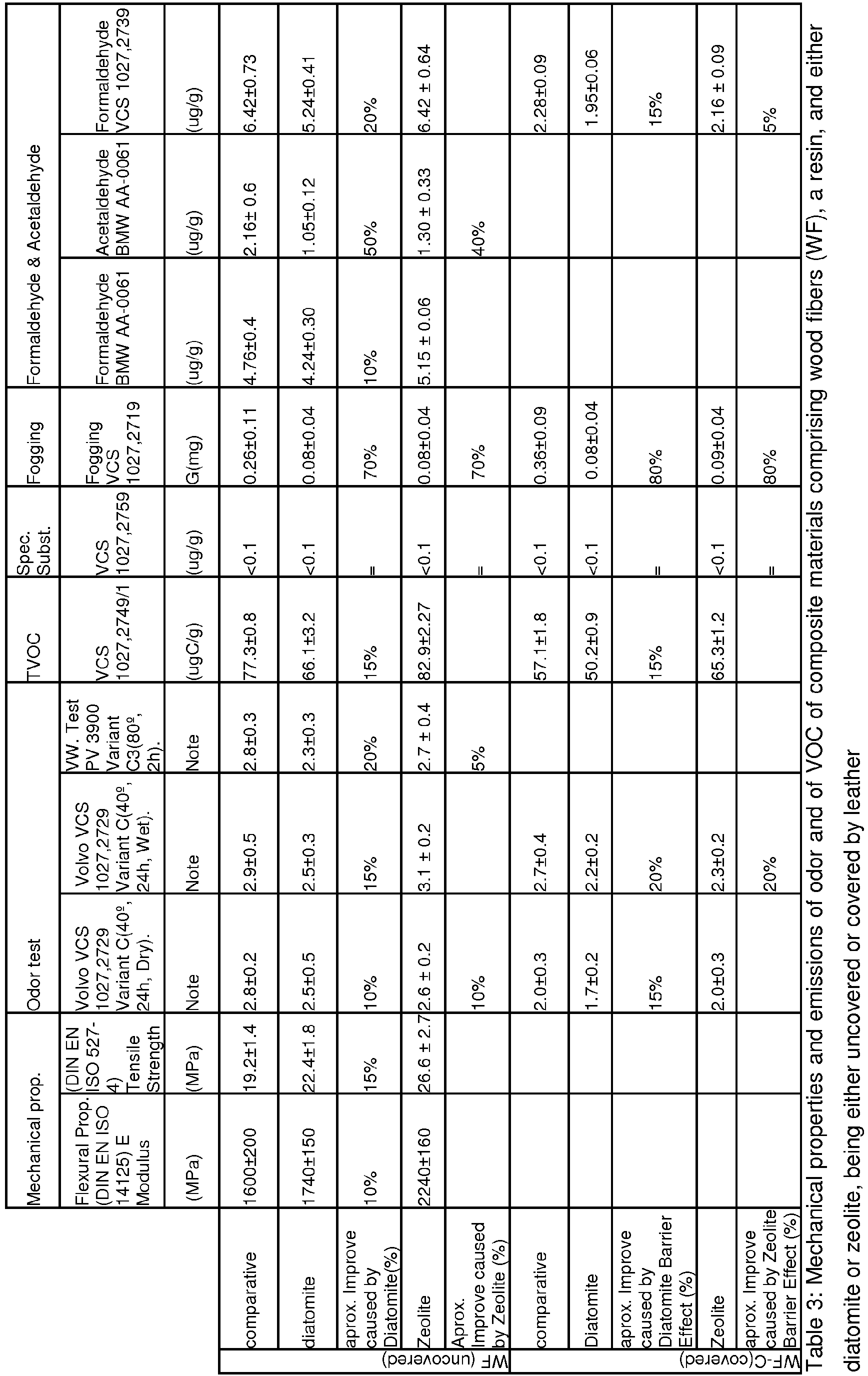
- The results demonstrate that:
- introducing diatomaceous earth allows reducing emissions of odor and of organic volatile compounds, and improving the mechanical properties,
- covering the composite material allows reducing emissions of odor and of organic volatile compounds further (Barrier Effect, that depends on the nature of the decorative layer)
- All the prepared composite materials were placed 1000 hours at 38°C and at 95% relative humidity (RH). High fungus growth was observed visually for the untreated composite material free from diatomite (control composite material or control sample). On the contrary, very low fungus growth was observed for the composite material comprising 4% by weight of diatomite (composite material according to the invention).
- For comparison, (wood fibers based or natural fiber based) composite materials comprising zeolite instead of diatomite were tested. No prevention of fungus growth was observed for these comparative composite materials.
Claims (15)
- Composite material » comprising:- from 30 to 95%wt of natural fibers, and- from 0.1 to 10%wt of diatomaceous earth.
- Composite material » according to claim 1, comprising from 1 to 5% by weight of diatomaceous earth.
- Composite material according to claim 1 or 2, wherein the natural fibers are wood fibers.
- Composite material according to claim 3, comprising from 65 to 90% by weight of wood fibers.
- Composite material according to claim 3 or 4, comprising a resin, preferably from 5 to 25% by weight.
- Composite material » according to anyone of claims 3 to 5, comprising polyester fibers, preferably from 0 to 24.9% by weight.
- Composite material according to claim 1 or 2, wherein the natural fibers are chosen from hemp fibers, flax fibers, kenaf fibers and a mixture thereof.
- Composite material according to claim 7, comprising from 40 to 60% by weight of natural fibers.
- Composite material according to claim 7 or 8, comprising polypropylene fibers, preferably from 30 to 59.9% by weight.
- Method for preparing the composite material » according to anyone of claims 1 to 9 comprising the steps of:(i) dispersing diatomaceous earth in water,(ii) applying the obtained dispersion on natural fibers,(iii) mixing the natural fibers with the other components of the composite material, then(iv) forming the composite material, preferably in the form of a mat.
- Method according to claim 10 for preparing the composite material » according to claim 5 or 6, comprising the steps of:(i) dispersing diatomaceous earth in water,(ii1) applying the obtained dispersion on wood fibers when mixing with the resin to obtain a mixture comprising water, diatomaceous earth, wood fibers, and a resin,(ii2) drying the obtained mixture, preferably until obtaining a water content lower than 5% wt,(iii) optionally mixing the obtained mixture with polyester fibers, then(iv) forming the composite material, preferably in the form of a mat.
- Method according to claim 10 for preparing the composite material » according to claim 9, comprising the steps of:(i) dispersing diatomaceous earth in water,(ii) applying the obtained dispersion on natural fibers chosen from flax fibers, hemp fibers, kenaf fibers and a mixture thereof, then(iii) mixing the natural fibers with polypropylene fibers, then(iv) forming the composite material, preferably in the form of a mat.
- Vehicle part, preferably automotive interior trim part, comprising the composite material according to anyone of claims 1 to 9.
- Method for manufacturing a vehicle part according to claim 13, such as automotive interior trim parts, comprising the steps of:a) forming the composite material according to anyone of claims 1 to 9 into the shape desired for the vehicle part,b) optionally covering the composite material with a decorative layer.
- Use of diatomaceous earth to prevent fungus growth of a composite material comprising natural fibers, preferably to prevent fungus growth and to reduce the concentration of volatile organic compound and odor emission of a composite material comprising natural fibers.
Priority Applications (2)
| Application Number | Priority Date | Filing Date | Title |
|---|---|---|---|
| ES17306124T ES2808990T3 (en) | 2017-08-31 | 2017-08-31 | Composite material comprising diatomaceous earth |
| EP17306124.3A EP3450601B1 (en) | 2017-08-31 | 2017-08-31 | Composite material comprising diatomaceous earth |
Applications Claiming Priority (1)
| Application Number | Priority Date | Filing Date | Title |
|---|---|---|---|
| EP17306124.3A EP3450601B1 (en) | 2017-08-31 | 2017-08-31 | Composite material comprising diatomaceous earth |
Publications (2)
| Publication Number | Publication Date |
|---|---|
| EP3450601A1 true EP3450601A1 (en) | 2019-03-06 |
| EP3450601B1 EP3450601B1 (en) | 2020-07-01 |
Family
ID=59858666
Family Applications (1)
| Application Number | Title | Priority Date | Filing Date |
|---|---|---|---|
| EP17306124.3A Active EP3450601B1 (en) | 2017-08-31 | 2017-08-31 | Composite material comprising diatomaceous earth |
Country Status (2)
| Country | Link |
|---|---|
| EP (1) | EP3450601B1 (en) |
| ES (1) | ES2808990T3 (en) |
Citations (8)
| Publication number | Priority date | Publication date | Assignee | Title |
|---|---|---|---|---|
| JP2002154178A (en) * | 2000-11-20 | 2002-05-28 | One Uiru:Kk | Wallpaper having moisture conditioning properties |
| GB2370224A (en) * | 2000-11-03 | 2002-06-26 | Second Nature U K Ltd | Protection of fibres from attack by insects |
| JP2010031136A (en) * | 2008-07-29 | 2010-02-12 | Akio Fukui | Fire retarding and sound absorbing member |
| KR101062899B1 (en) | 2010-10-15 | 2011-09-07 | 손승재 | Thermoplastic composition and its processing method using natural fiber with improved odor and volatile organic compounds |
| CN103894015A (en) * | 2014-04-15 | 2014-07-02 | 刁广祥 | Diatomite composite filtering material |
| CN104264366A (en) * | 2014-08-15 | 2015-01-07 | 刁广祥 | Composite non-woven fabric and production method thereof |
| CN106088495A (en) * | 2016-06-20 | 2016-11-09 | 钱学东 | A kind of antimildew and antibacterial composite wallpaper |
| US20170058451A1 (en) * | 2014-08-29 | 2017-03-02 | The North Face Apparel Corp. | Fibers and other constructs treated with diatomite particles |
Family Cites Families (1)
| Publication number | Priority date | Publication date | Assignee | Title |
|---|---|---|---|---|
| US5886306A (en) * | 1997-07-22 | 1999-03-23 | Kg Fibers, Inc. | Layered acoustical insulating web |
-
2017
- 2017-08-31 EP EP17306124.3A patent/EP3450601B1/en active Active
- 2017-08-31 ES ES17306124T patent/ES2808990T3/en active Active
Patent Citations (8)
| Publication number | Priority date | Publication date | Assignee | Title |
|---|---|---|---|---|
| GB2370224A (en) * | 2000-11-03 | 2002-06-26 | Second Nature U K Ltd | Protection of fibres from attack by insects |
| JP2002154178A (en) * | 2000-11-20 | 2002-05-28 | One Uiru:Kk | Wallpaper having moisture conditioning properties |
| JP2010031136A (en) * | 2008-07-29 | 2010-02-12 | Akio Fukui | Fire retarding and sound absorbing member |
| KR101062899B1 (en) | 2010-10-15 | 2011-09-07 | 손승재 | Thermoplastic composition and its processing method using natural fiber with improved odor and volatile organic compounds |
| CN103894015A (en) * | 2014-04-15 | 2014-07-02 | 刁广祥 | Diatomite composite filtering material |
| CN104264366A (en) * | 2014-08-15 | 2015-01-07 | 刁广祥 | Composite non-woven fabric and production method thereof |
| US20170058451A1 (en) * | 2014-08-29 | 2017-03-02 | The North Face Apparel Corp. | Fibers and other constructs treated with diatomite particles |
| CN106088495A (en) * | 2016-06-20 | 2016-11-09 | 钱学东 | A kind of antimildew and antibacterial composite wallpaper |
Also Published As
| Publication number | Publication date |
|---|---|
| ES2808990T3 (en) | 2021-03-02 |
| EP3450601B1 (en) | 2020-07-01 |
Similar Documents
| Publication | Publication Date | Title |
|---|---|---|
| CN104690979B (en) | A kind of low VOC natural fiber composite material, preparation method and application thereof | |
| DE19517763C2 (en) | Shaped body made of composite material based on cellulose acetate and reinforcing natural cellulose fibers and their use | |
| US20060252323A1 (en) | Fiber-containing article and method of manufacture | |
| EP2231809A1 (en) | High-strength, environmentally friendly corrugated boards | |
| EP3274493B1 (en) | Reuse of used woven or knitted textile | |
| DE102008059128A1 (en) | Binder-solidified textile fabric, process for its production and its use | |
| DE102011121589A1 (en) | Binder-solidified textile fabric, process for its production and its use | |
| KR102484574B1 (en) | Incombustible board using styrofoam and manufacturing mehtod thereof | |
| US20170144327A1 (en) | Flexible high-density fiberboard and method for manufacturing the same | |
| US20070042658A1 (en) | Fiber-containing article and method of manufacture | |
| KR20130070429A (en) | Bamboo fiber-polypropylene composition | |
| CN105218840A (en) | A kind of low VOC natural-fiber composite material, preparation method and application thereof | |
| EP3450601B1 (en) | Composite material comprising diatomaceous earth | |
| WO2017081672A1 (en) | Fire resistant composite mat | |
| WO2021083928A2 (en) | Flame-retardant thermoplastic composition, shaped body obtained from the thermoplastic composition, composite structure comprising the thermoplastic composition and/or the shaped body, and use of the thermoplastic composition, the shaped body and the composite structure | |
| KR101932004B1 (en) | Method for manufacturing of wood panel for eco-friendly furniture and furniture using the same | |
| CN103112208A (en) | Environment-friendly fiber/non-woven fabric composite board for home decoration and preparation method thereof | |
| DE102019107982A1 (en) | Flame, fire and glow-protected natural fiber insulation materials and their production and use, in particular for natural fiber insulation products | |
| CN104114342A (en) | Nonwoven, flame retardant, moisture resistant panel and method of construction thereof | |
| JP3180036B2 (en) | Non-combustible decorative board | |
| Karim et al. | Strength properties of mixed cocopeat fibres and Merawan Siput Jantan (Hopea odorata spp.) bonded with partial rubber latex adhesive and nano-SiO2 in particleboard manufacturing | |
| CA3175660A1 (en) | Binders and curable resins for mineral wool | |
| ZA200609309B (en) | Duroplastic-bonded molded fiber parts and method for producing the same | |
| CN118636539B (en) | Flame-retardant antibacterial sound-insulation composite fiber board and preparation method thereof | |
| WO2007143302A1 (en) | Fiber-containing article and method of manufacture |
Legal Events
| Date | Code | Title | Description |
|---|---|---|---|
| PUAI | Public reference made under article 153(3) epc to a published international application that has entered the european phase |
Free format text: ORIGINAL CODE: 0009012 |
|
| STAA | Information on the status of an ep patent application or granted ep patent |
Free format text: STATUS: THE APPLICATION HAS BEEN PUBLISHED |
|
| AK | Designated contracting states |
Kind code of ref document: A1 Designated state(s): AL AT BE BG CH CY CZ DE DK EE ES FI FR GB GR HR HU IE IS IT LI LT LU LV MC MK MT NL NO PL PT RO RS SE SI SK SM TR |
|
| AX | Request for extension of the european patent |
Extension state: BA ME |
|
| STAA | Information on the status of an ep patent application or granted ep patent |
Free format text: STATUS: REQUEST FOR EXAMINATION WAS MADE |
|
| 17P | Request for examination filed |
Effective date: 20190808 |
|
| RBV | Designated contracting states (corrected) |
Designated state(s): AL AT BE BG CH CY CZ DE DK EE ES FI FR GB GR HR HU IE IS IT LI LT LU LV MC MK MT NL NO PL PT RO RS SE SI SK SM TR |
|
| STAA | Information on the status of an ep patent application or granted ep patent |
Free format text: STATUS: EXAMINATION IS IN PROGRESS |
|
| 17Q | First examination report despatched |
Effective date: 20191029 |
|
| GRAP | Despatch of communication of intention to grant a patent |
Free format text: ORIGINAL CODE: EPIDOSNIGR1 |
|
| STAA | Information on the status of an ep patent application or granted ep patent |
Free format text: STATUS: GRANT OF PATENT IS INTENDED |
|
| INTG | Intention to grant announced |
Effective date: 20200409 |
|
| GRAS | Grant fee paid |
Free format text: ORIGINAL CODE: EPIDOSNIGR3 |
|
| GRAA | (expected) grant |
Free format text: ORIGINAL CODE: 0009210 |
|
| STAA | Information on the status of an ep patent application or granted ep patent |
Free format text: STATUS: THE PATENT HAS BEEN GRANTED |
|
| AK | Designated contracting states |
Kind code of ref document: B1 Designated state(s): AL AT BE BG CH CY CZ DE DK EE ES FI FR GB GR HR HU IE IS IT LI LT LU LV MC MK MT NL NO PL PT RO RS SE SI SK SM TR |
|
| REG | Reference to a national code |
Ref country code: CH Ref legal event code: EP Ref country code: AT Ref legal event code: REF Ref document number: 1286275 Country of ref document: AT Kind code of ref document: T Effective date: 20200715 |
|
| REG | Reference to a national code |
Ref country code: IE Ref legal event code: FG4D |
|
| REG | Reference to a national code |
Ref country code: DE Ref legal event code: R096 Ref document number: 602017018970 Country of ref document: DE |
|
| REG | Reference to a national code |
Ref country code: LT Ref legal event code: MG4D |
|
| PG25 | Lapsed in a contracting state [announced via postgrant information from national office to epo] |
Ref country code: BG Free format text: LAPSE BECAUSE OF FAILURE TO SUBMIT A TRANSLATION OF THE DESCRIPTION OR TO PAY THE FEE WITHIN THE PRESCRIBED TIME-LIMIT Effective date: 20201001 |
|
| REG | Reference to a national code |
Ref country code: NL Ref legal event code: MP Effective date: 20200701 |
|
| REG | Reference to a national code |
Ref country code: AT Ref legal event code: MK05 Ref document number: 1286275 Country of ref document: AT Kind code of ref document: T Effective date: 20200701 |
|
| PG25 | Lapsed in a contracting state [announced via postgrant information from national office to epo] |
Ref country code: GR Free format text: LAPSE BECAUSE OF FAILURE TO SUBMIT A TRANSLATION OF THE DESCRIPTION OR TO PAY THE FEE WITHIN THE PRESCRIBED TIME-LIMIT Effective date: 20201002 Ref country code: NO Free format text: LAPSE BECAUSE OF FAILURE TO SUBMIT A TRANSLATION OF THE DESCRIPTION OR TO PAY THE FEE WITHIN THE PRESCRIBED TIME-LIMIT Effective date: 20201001 Ref country code: HR Free format text: LAPSE BECAUSE OF FAILURE TO SUBMIT A TRANSLATION OF THE DESCRIPTION OR TO PAY THE FEE WITHIN THE PRESCRIBED TIME-LIMIT Effective date: 20200701 Ref country code: SE Free format text: LAPSE BECAUSE OF FAILURE TO SUBMIT A TRANSLATION OF THE DESCRIPTION OR TO PAY THE FEE WITHIN THE PRESCRIBED TIME-LIMIT Effective date: 20200701 Ref country code: FI Free format text: LAPSE BECAUSE OF FAILURE TO SUBMIT A TRANSLATION OF THE DESCRIPTION OR TO PAY THE FEE WITHIN THE PRESCRIBED TIME-LIMIT Effective date: 20200701 Ref country code: LT Free format text: LAPSE BECAUSE OF FAILURE TO SUBMIT A TRANSLATION OF THE DESCRIPTION OR TO PAY THE FEE WITHIN THE PRESCRIBED TIME-LIMIT Effective date: 20200701 Ref country code: CZ Free format text: LAPSE BECAUSE OF FAILURE TO SUBMIT A TRANSLATION OF THE DESCRIPTION OR TO PAY THE FEE WITHIN THE PRESCRIBED TIME-LIMIT Effective date: 20200701 Ref country code: PT Free format text: LAPSE BECAUSE OF FAILURE TO SUBMIT A TRANSLATION OF THE DESCRIPTION OR TO PAY THE FEE WITHIN THE PRESCRIBED TIME-LIMIT Effective date: 20201102 Ref country code: AT Free format text: LAPSE BECAUSE OF FAILURE TO SUBMIT A TRANSLATION OF THE DESCRIPTION OR TO PAY THE FEE WITHIN THE PRESCRIBED TIME-LIMIT Effective date: 20200701 |
|
| PG25 | Lapsed in a contracting state [announced via postgrant information from national office to epo] |
Ref country code: PL Free format text: LAPSE BECAUSE OF FAILURE TO SUBMIT A TRANSLATION OF THE DESCRIPTION OR TO PAY THE FEE WITHIN THE PRESCRIBED TIME-LIMIT Effective date: 20200701 Ref country code: RS Free format text: LAPSE BECAUSE OF FAILURE TO SUBMIT A TRANSLATION OF THE DESCRIPTION OR TO PAY THE FEE WITHIN THE PRESCRIBED TIME-LIMIT Effective date: 20200701 Ref country code: LV Free format text: LAPSE BECAUSE OF FAILURE TO SUBMIT A TRANSLATION OF THE DESCRIPTION OR TO PAY THE FEE WITHIN THE PRESCRIBED TIME-LIMIT Effective date: 20200701 Ref country code: IS Free format text: LAPSE BECAUSE OF FAILURE TO SUBMIT A TRANSLATION OF THE DESCRIPTION OR TO PAY THE FEE WITHIN THE PRESCRIBED TIME-LIMIT Effective date: 20201101 |
|
| REG | Reference to a national code |
Ref country code: ES Ref legal event code: FG2A Ref document number: 2808990 Country of ref document: ES Kind code of ref document: T3 Effective date: 20210302 |
|
| PG25 | Lapsed in a contracting state [announced via postgrant information from national office to epo] |
Ref country code: NL Free format text: LAPSE BECAUSE OF FAILURE TO SUBMIT A TRANSLATION OF THE DESCRIPTION OR TO PAY THE FEE WITHIN THE PRESCRIBED TIME-LIMIT Effective date: 20200701 Ref country code: MC Free format text: LAPSE BECAUSE OF FAILURE TO SUBMIT A TRANSLATION OF THE DESCRIPTION OR TO PAY THE FEE WITHIN THE PRESCRIBED TIME-LIMIT Effective date: 20200701 |
|
| REG | Reference to a national code |
Ref country code: CH Ref legal event code: PL |
|
| REG | Reference to a national code |
Ref country code: DE Ref legal event code: R097 Ref document number: 602017018970 Country of ref document: DE |
|
| PG25 | Lapsed in a contracting state [announced via postgrant information from national office to epo] |
Ref country code: IT Free format text: LAPSE BECAUSE OF FAILURE TO SUBMIT A TRANSLATION OF THE DESCRIPTION OR TO PAY THE FEE WITHIN THE PRESCRIBED TIME-LIMIT Effective date: 20200701 Ref country code: EE Free format text: LAPSE BECAUSE OF FAILURE TO SUBMIT A TRANSLATION OF THE DESCRIPTION OR TO PAY THE FEE WITHIN THE PRESCRIBED TIME-LIMIT Effective date: 20200701 Ref country code: SM Free format text: LAPSE BECAUSE OF FAILURE TO SUBMIT A TRANSLATION OF THE DESCRIPTION OR TO PAY THE FEE WITHIN THE PRESCRIBED TIME-LIMIT Effective date: 20200701 Ref country code: LI Free format text: LAPSE BECAUSE OF NON-PAYMENT OF DUE FEES Effective date: 20200831 Ref country code: LU Free format text: LAPSE BECAUSE OF NON-PAYMENT OF DUE FEES Effective date: 20200831 Ref country code: RO Free format text: LAPSE BECAUSE OF FAILURE TO SUBMIT A TRANSLATION OF THE DESCRIPTION OR TO PAY THE FEE WITHIN THE PRESCRIBED TIME-LIMIT Effective date: 20200701 Ref country code: CH Free format text: LAPSE BECAUSE OF NON-PAYMENT OF DUE FEES Effective date: 20200831 Ref country code: DK Free format text: LAPSE BECAUSE OF FAILURE TO SUBMIT A TRANSLATION OF THE DESCRIPTION OR TO PAY THE FEE WITHIN THE PRESCRIBED TIME-LIMIT Effective date: 20200701 |
|
| PLBE | No opposition filed within time limit |
Free format text: ORIGINAL CODE: 0009261 |
|
| STAA | Information on the status of an ep patent application or granted ep patent |
Free format text: STATUS: NO OPPOSITION FILED WITHIN TIME LIMIT |
|
| REG | Reference to a national code |
Ref country code: BE Ref legal event code: MM Effective date: 20200831 |
|
| PG25 | Lapsed in a contracting state [announced via postgrant information from national office to epo] |
Ref country code: AL Free format text: LAPSE BECAUSE OF FAILURE TO SUBMIT A TRANSLATION OF THE DESCRIPTION OR TO PAY THE FEE WITHIN THE PRESCRIBED TIME-LIMIT Effective date: 20200701 |
|
| 26N | No opposition filed |
Effective date: 20210406 |
|
| PG25 | Lapsed in a contracting state [announced via postgrant information from national office to epo] |
Ref country code: SK Free format text: LAPSE BECAUSE OF FAILURE TO SUBMIT A TRANSLATION OF THE DESCRIPTION OR TO PAY THE FEE WITHIN THE PRESCRIBED TIME-LIMIT Effective date: 20200701 |
|
| PG25 | Lapsed in a contracting state [announced via postgrant information from national office to epo] |
Ref country code: SI Free format text: LAPSE BECAUSE OF FAILURE TO SUBMIT A TRANSLATION OF THE DESCRIPTION OR TO PAY THE FEE WITHIN THE PRESCRIBED TIME-LIMIT Effective date: 20200701 Ref country code: IE Free format text: LAPSE BECAUSE OF NON-PAYMENT OF DUE FEES Effective date: 20200831 Ref country code: BE Free format text: LAPSE BECAUSE OF NON-PAYMENT OF DUE FEES Effective date: 20200831 |
|
| GBPC | Gb: european patent ceased through non-payment of renewal fee |
Effective date: 20210831 |
|
| PG25 | Lapsed in a contracting state [announced via postgrant information from national office to epo] |
Ref country code: TR Free format text: LAPSE BECAUSE OF FAILURE TO SUBMIT A TRANSLATION OF THE DESCRIPTION OR TO PAY THE FEE WITHIN THE PRESCRIBED TIME-LIMIT Effective date: 20200701 Ref country code: MT Free format text: LAPSE BECAUSE OF FAILURE TO SUBMIT A TRANSLATION OF THE DESCRIPTION OR TO PAY THE FEE WITHIN THE PRESCRIBED TIME-LIMIT Effective date: 20200701 Ref country code: CY Free format text: LAPSE BECAUSE OF FAILURE TO SUBMIT A TRANSLATION OF THE DESCRIPTION OR TO PAY THE FEE WITHIN THE PRESCRIBED TIME-LIMIT Effective date: 20200701 |
|
| PG25 | Lapsed in a contracting state [announced via postgrant information from national office to epo] |
Ref country code: MK Free format text: LAPSE BECAUSE OF FAILURE TO SUBMIT A TRANSLATION OF THE DESCRIPTION OR TO PAY THE FEE WITHIN THE PRESCRIBED TIME-LIMIT Effective date: 20200701 |
|
| PG25 | Lapsed in a contracting state [announced via postgrant information from national office to epo] |
Ref country code: GB Free format text: LAPSE BECAUSE OF NON-PAYMENT OF DUE FEES Effective date: 20210831 |
|
| PGFP | Annual fee paid to national office [announced via postgrant information from national office to epo] |
Ref country code: ES Payment date: 20250901 Year of fee payment: 9 |
|
| PGFP | Annual fee paid to national office [announced via postgrant information from national office to epo] |
Ref country code: DE Payment date: 20250724 Year of fee payment: 9 |
|
| PGFP | Annual fee paid to national office [announced via postgrant information from national office to epo] |
Ref country code: FR Payment date: 20250725 Year of fee payment: 9 |