EP3447838A1 - Lithium iron phosphate battery - Google Patents
Lithium iron phosphate battery Download PDFInfo
- Publication number
- EP3447838A1 EP3447838A1 EP17784825.6A EP17784825A EP3447838A1 EP 3447838 A1 EP3447838 A1 EP 3447838A1 EP 17784825 A EP17784825 A EP 17784825A EP 3447838 A1 EP3447838 A1 EP 3447838A1
- Authority
- EP
- European Patent Office
- Prior art keywords
- iron phosphate
- lithium iron
- phosphate battery
- electrolyte
- electrode plate
- Prior art date
- Legal status (The legal status is an assumption and is not a legal conclusion. Google has not performed a legal analysis and makes no representation as to the accuracy of the status listed.)
- Granted
Links
Classifications
-
- H—ELECTRICITY
- H01—ELECTRIC ELEMENTS
- H01M—PROCESSES OR MEANS, e.g. BATTERIES, FOR THE DIRECT CONVERSION OF CHEMICAL ENERGY INTO ELECTRICAL ENERGY
- H01M10/00—Secondary cells; Manufacture thereof
- H01M10/05—Accumulators with non-aqueous electrolyte
- H01M10/056—Accumulators with non-aqueous electrolyte characterised by the materials used as electrolytes, e.g. mixed inorganic/organic electrolytes
- H01M10/0564—Accumulators with non-aqueous electrolyte characterised by the materials used as electrolytes, e.g. mixed inorganic/organic electrolytes the electrolyte being constituted of organic materials only
- H01M10/0566—Liquid materials
-
- H—ELECTRICITY
- H01—ELECTRIC ELEMENTS
- H01M—PROCESSES OR MEANS, e.g. BATTERIES, FOR THE DIRECT CONVERSION OF CHEMICAL ENERGY INTO ELECTRICAL ENERGY
- H01M10/00—Secondary cells; Manufacture thereof
- H01M10/05—Accumulators with non-aqueous electrolyte
- H01M10/056—Accumulators with non-aqueous electrolyte characterised by the materials used as electrolytes, e.g. mixed inorganic/organic electrolytes
- H01M10/0564—Accumulators with non-aqueous electrolyte characterised by the materials used as electrolytes, e.g. mixed inorganic/organic electrolytes the electrolyte being constituted of organic materials only
- H01M10/0566—Liquid materials
- H01M10/0567—Liquid materials characterised by the additives
-
- H—ELECTRICITY
- H01—ELECTRIC ELEMENTS
- H01M—PROCESSES OR MEANS, e.g. BATTERIES, FOR THE DIRECT CONVERSION OF CHEMICAL ENERGY INTO ELECTRICAL ENERGY
- H01M10/00—Secondary cells; Manufacture thereof
- H01M10/05—Accumulators with non-aqueous electrolyte
- H01M10/052—Li-accumulators
- H01M10/0525—Rocking-chair batteries, i.e. batteries with lithium insertion or intercalation in both electrodes; Lithium-ion batteries
-
- H—ELECTRICITY
- H01—ELECTRIC ELEMENTS
- H01M—PROCESSES OR MEANS, e.g. BATTERIES, FOR THE DIRECT CONVERSION OF CHEMICAL ENERGY INTO ELECTRICAL ENERGY
- H01M10/00—Secondary cells; Manufacture thereof
- H01M10/05—Accumulators with non-aqueous electrolyte
- H01M10/056—Accumulators with non-aqueous electrolyte characterised by the materials used as electrolytes, e.g. mixed inorganic/organic electrolytes
- H01M10/0564—Accumulators with non-aqueous electrolyte characterised by the materials used as electrolytes, e.g. mixed inorganic/organic electrolytes the electrolyte being constituted of organic materials only
- H01M10/0566—Liquid materials
- H01M10/0569—Liquid materials characterised by the solvents
-
- H—ELECTRICITY
- H01—ELECTRIC ELEMENTS
- H01M—PROCESSES OR MEANS, e.g. BATTERIES, FOR THE DIRECT CONVERSION OF CHEMICAL ENERGY INTO ELECTRICAL ENERGY
- H01M4/00—Electrodes
- H01M4/02—Electrodes composed of, or comprising, active material
- H01M4/36—Selection of substances as active materials, active masses, active liquids
- H01M4/58—Selection of substances as active materials, active masses, active liquids of inorganic compounds other than oxides or hydroxides, e.g. sulfides, selenides, tellurides, halogenides or LiCoFy; of polyanionic structures, e.g. phosphates, silicates or borates
- H01M4/5825—Oxygenated metallic salts or polyanionic structures, e.g. borates, phosphates, silicates, olivines
-
- H—ELECTRICITY
- H01—ELECTRIC ELEMENTS
- H01M—PROCESSES OR MEANS, e.g. BATTERIES, FOR THE DIRECT CONVERSION OF CHEMICAL ENERGY INTO ELECTRICAL ENERGY
- H01M4/00—Electrodes
- H01M4/02—Electrodes composed of, or comprising, active material
- H01M4/36—Selection of substances as active materials, active masses, active liquids
- H01M4/58—Selection of substances as active materials, active masses, active liquids of inorganic compounds other than oxides or hydroxides, e.g. sulfides, selenides, tellurides, halogenides or LiCoFy; of polyanionic structures, e.g. phosphates, silicates or borates
- H01M4/583—Carbonaceous material, e.g. graphite-intercalation compounds or CFx
-
- H—ELECTRICITY
- H01—ELECTRIC ELEMENTS
- H01M—PROCESSES OR MEANS, e.g. BATTERIES, FOR THE DIRECT CONVERSION OF CHEMICAL ENERGY INTO ELECTRICAL ENERGY
- H01M4/00—Electrodes
- H01M4/02—Electrodes composed of, or comprising, active material
- H01M2004/026—Electrodes composed of, or comprising, active material characterised by the polarity
- H01M2004/028—Positive electrodes
-
- H—ELECTRICITY
- H01—ELECTRIC ELEMENTS
- H01M—PROCESSES OR MEANS, e.g. BATTERIES, FOR THE DIRECT CONVERSION OF CHEMICAL ENERGY INTO ELECTRICAL ENERGY
- H01M2300/00—Electrolytes
- H01M2300/0017—Non-aqueous electrolytes
- H01M2300/0025—Organic electrolyte
- H01M2300/0028—Organic electrolyte characterised by the solvent
- H01M2300/0037—Mixture of solvents
-
- Y—GENERAL TAGGING OF NEW TECHNOLOGICAL DEVELOPMENTS; GENERAL TAGGING OF CROSS-SECTIONAL TECHNOLOGIES SPANNING OVER SEVERAL SECTIONS OF THE IPC; TECHNICAL SUBJECTS COVERED BY FORMER USPC CROSS-REFERENCE ART COLLECTIONS [XRACs] AND DIGESTS
- Y02—TECHNOLOGIES OR APPLICATIONS FOR MITIGATION OR ADAPTATION AGAINST CLIMATE CHANGE
- Y02E—REDUCTION OF GREENHOUSE GAS [GHG] EMISSIONS, RELATED TO ENERGY GENERATION, TRANSMISSION OR DISTRIBUTION
- Y02E60/00—Enabling technologies; Technologies with a potential or indirect contribution to GHG emissions mitigation
- Y02E60/10—Energy storage using batteries
Definitions
- the present application relates to the field of batteries, and more particularly, to a lithium iron phosphate battery.
- Lithium-iron secondary batteries are widely used in electric vehicles and consumer electronics because of their high energy density, high output power, long cycle life and small environmental pollution.
- Lithium iron phosphate is one of the most commonly used positive materials in power battery, due to its high cycle life, good safety and low price and other characteristics.
- the disadvantage of lithium iron phosphate batteries is that their energy density is low.
- To improve the energy density one way is to increase the capacity per gram of the positive material and negative material, and the other way is to increase the press density of the positive electrode film and negative electrode film.
- a lithium iron phosphate battery comprising: a positive electrode plate comprising a positive current collector and a positive electrode film provided on the surface of the positive current collector; a negative electrode plate comprising a negative current collector and a negative electrode film provided on the surface of the negative current collector; a separator provided between the positive electrode plate and the negative electrode plate; and an electrolyte comprising an organic solvent, a lithium salt and an electrolyte additive.
- the positive active material in the positive electrode plate comprises lithium iron phosphate; and the negative active material in the negative electrode plate comprises graphite.
- the electrolyte additive comprises a cyclic carbonate containing a double bond and a cyclic disulfonate represented by the Formula I; in Formula I, A and B are each independently selected from an alkylene group having 1 to 3 carbon atoms.
- the present application has the following advantages: the present application can solve the problem that the electrode plate with high press density has poor wettability in the electrolyte, so that the low temperature performance and the cycle performance at normal temperature and high temperature of the lithium iron phosphate battery are improved, and the service life of the lithium iron phosphate battery is prolonged effectively.
- the lithium iron phosphate battery according to the present application will be described in details below.
- the lithium iron phosphate battery according to the present application comprises a positive electrode plate comprising a positive current collector and a positive electrode film provided on the surface of the positive current collector; a negative electrode plate comprising a negative current collector and a negative electrode film provided on the surface of the negative current collector; a separator provided between the positive electrode plate and the negative electrode plate; and an electrolyte comprising an organic solvent, a lithium salt and an electrolyte additive.
- the positive active material in the positive electrode plate comprises lithium iron phosphate; and the negative active material in the negative electrode plate comprises graphite.
- the electrolyte additive comprises a cyclic carbonate containing a double bond and a cyclic disulfonate represented by the formula I; in formula I, A and B are each independently selected from an alkylene group having 1 to 3 carbon atoms.
- the cyclic carbonate containing a double bond can improve the capacity retention rate of the lithium iron phosphate battery in the high temperature environment, but the unavoidable problem is that the SEI film impedance is increased, which will affect the use of lithium iron phosphate battery in the low temperature environment.
- the cyclic disulfonate shown in Formula I can reduce the SEI film impedance.
- the combination of the cyclic carbonate containing a double bond and the cyclic disulfonate used in the electrolyte can improve the low temperature performance and the cycle performance at normal temperature and high temperature of the lithium iron phosphate battery and effectively prolong the service life of the lithium iron phosphate battery.
- the cyclic carbonate containing a double bond may be selected from one or both of vinylene carbonate (VC) and vinyl ethylene carbonate (VEC).
- the content of the cyclic carbonate containing a double bond may be 0.5% to 4% by mass. If the content is low, SEI film will be unstable and the cycle performance at high temperature of the lithium iron phosphate battery will be deteriorated; if the content is high, it will result in too thick SEI film and Li plating will occur after the lithium iron phosphate battery cycles, which will lead to cycle capacity diving.
- the content of the cyclic carbonate containing a double bond is 0.5% to 3% by mass.
- the cyclic disulfonate may be selected from one or more of methylene methane disulfonate (MMDS), ethylene ethane disulfonate and propylene methane disulfonate.
- MMDS methylene methane disulfonate
- ethylene ethane disulfonate ethylene ethane disulfonate
- propylene methane disulfonate propylene methane disulfonate
- the content of the cyclic disulfonate in the electrolyte may be 0.2% to 2% by mass. If the content is too low, the effect on the improvement of the SEI film impedance is very little, and if the content is too high, such cyclic disulfonate is easy to crystallize and precipitate in the electrolyte. At the same time, because of its poor high-temperature stability, the high addition amount is more likely to deteriorate the electrochemical performance of the lithium iron phosphate battery.
- the cyclic disulfonate is present in an amount of from 0.2% to 1% by mass.
- the charge cut-off voltage of the lithium iron phosphate battery may not exceed 3.8 V, and preferably, the charge cut-off voltage of the lithium iron phosphate battery may not exceed 3.6 V.
- VC vinylene carbonate
- VEC vinyl ethylene carbonate
- cyclic disulfonate at high voltage is unstable, easily decomposed by oxidation, and the probability of side reaction in the electrolyte is higher.
- the side reaction product will deteriorate the performance of the SEI film formed on the surface of the negative electrode, so that the charging cut-off voltage should not be too high.
- the SEI film of the electrolyte according to the present application is better and the impedance is smaller, and the wettability of the electrode plate in the electrolyte is excellent.
- the low temperature performance and the cycle performance at normal temperature and high temperature of the lithium iron phosphate battery containing the high-press density electrode plate can be more remarkably improved.
- the press density of the negative electrode plate may be 1.4 g/cm 3 to 1.8g/cm 3 . If the press density is too low, the contact resistance between the powder particles will increase, and the overall energy density of the lithium iron phosphate battery will be too low; if the press density is too high, the electrode plate will be easily crushed and the cycle performance of the lithium iron phosphate battery will be deteriorated.
- the press density of the positive electrode plate may be 2 g/cm 3 to 2.5 g/cm 3 . If the press density is too low, the contact resistance between the powder particles will increase, and the overall energy density of the lithium iron phosphate battery will be too low; if the press density is too high, the electrode plate will be easily crushed and the cycle performance of the lithium iron phosphate battery will be deteriorated.
- the electrolyte according to the present application can form a denser and more stable SEI film than the conventional electrolyte, and the SEI film has small impedance and the electrode plate has good wettability in the electrolyte.
- the electrolyte according to the present application can make the lithium iron phosphate battery have good low temperature performance and good cycle performance at normal temperature and high temperature.
- the electrolyte has a conductivity of 8 mS/cm to 11 mS/cm at 25°C. If the conductivity is too low, the dynamic performance of the electrolyte will be poor, and the lithium iron phosphate battery's polarization is great, affecting the cycle performance at normal temperature and low temperature performance; if the conductivity is too high, the thermal stability of the electrolyte will be poor, resulting in the lithium iron phosphate battery having poor cycle performance at high temperature.
- the viscosity of the electrolyte at 25°C may be ranging from 2 mPa ⁇ s to 4 mPa ⁇ s. If the viscosity is too high, on one hand the dynamic performance of the electrolyte will be poor, on the other hand the ability of the electrolyte for infiltrating the electrode plate will decline, which will deteriorate the comprehensive performance of the lithium iron phosphate battery; if the viscosity is too low, the thermal stability of the electrolyte will be poor, resulting in the lithium iron phosphate battery having poor cycle performance at high temperature.
- the type of the lithium salt is not limited and can be selected according to the actual demands.
- the lithium salt may be selected from one or more of LiPF 6 , LiBF 4 , LiBOB, LiAsF 6 , LiCF 3 SO 3 , LiFSI and LiTFSI.
- the organic solvent may be selected from one or more of ethylene carbonate, propylene carbonate, butylene carbonate, pentylene carbonate, 1,2-butylene glycol carbonate, 2,3-butylene glycol carbonate, dimethyl carbonate, diethyl carbonate, dipropyl carbonate, methyl ethyl carbonate, methyl formate, ethyl formate, propyl formate, methyl acetate, ethyl acetate, propyl acetate, methyl propionate, ethyl propionate, propyl propionate, methyl butyrate and ethyl butyrate.
- the organic solvent comprises a mixed solvent of a cyclic carbonate and a chain carbonate.
- Such mixed solvent can be conducive to the preparation of an electrolyte having better conductivity, viscosity and other comprehensive performance.
- the organic solvent comprises a chain carbonate having a methyl group.
- the content of the chain carbonate having a methyl group may be 40% or more by mass based on the total mass of the organic solvent of the electrolyte.
- the chain carbonate having a methyl group is preferably selected from one or two of dimethyl carbonate and methyl ethyl carbonate. Chain carbonate having a methyl group helps to further improve the anti-overcharge performance of the electrolyte.
- the content of the chain carbonate having a methyl group is 40% or more by mass, the conductivity, viscosity and other comprehensive performance of the electrolyte are better.
- the organic solvent further comprises a carboxylic acid ester and the content of the carboxylic acid ester is less than 30% by mass based on the total mass of the organic solvent of the electrolyte.
- the addition of the carboxylic acid ester can further improve the conductivity and viscosity of the electrolyte, improve the wettability of the electrode plate having high press density in the electrolyte, and further improve the low temperature performance and other electrochemical performance of the lithium iron phosphate battery.
- the content of the carboxylic acid ester is too high, it will affect the stability at high temperature of the electrolyte and deteriorate the cycle performance at high temperature of the lithium iron phosphate battery.
- the oxidation potential of the carboxylic acid ester is lower than that of the cyclic carbonate and the chain carbonate, adding too much carboxylic acid ester may increase the gas production of lithium iron phosphate battery.
- Examples 1-15 and Comparative Examples 1-13 were prepared according to the following methods.
- the positive active material lithium iron phosphate, the binder PVDF and the conductive agent acetylene black were mixed in a mass ratio of 98: 1: 1. Then N-methylpyrrolidone was added and the mixture was stirred uniformly under a vacuum stirrer to obtain a positive electrode paste.
- the positive electrode paste was evenly coated on the aluminum foil, and the aluminum foil was dried at room temperature and then transferred to a blast drying oven at 120°C for 1 hour. Then, the positive electrode plate was obtained after cold pressing and slitting.
- the negative active material graphite, the conductive agent acetylene black, the thickening agent sodium carboxymethyl cellulose (CMC) solution and the binder styrenebutadiene rubber emulsion were mixed in the mass ratio of 97: 1: 1: 1. Then deionized water was added and the mixture was stirred uniformly under a vacuum stirrer to obtain a negative electrode paste.
- the negative electrode paste was evenly coated on the copper foil, and the copper foil was dried at room temperature and then transferred to a blast drying oven at 120°C for 1 hour. Then, the negative electrode plate was obtained after cold pressing and slitting.
- the organic solvent was a mixed organic solvent of ethylene carbonate (EC), methyl ethyl carbonate (EMC), diethyl carbonate (DEC), dimethyl carbonate (DMC) and methyl propionate (MP).
- Lithium salt was LiPF 6 , wherein the content of LiPF 6 was 12.5% by mass, based on the total mass of the electrolyte.
- the cyclic carbonate containing a double bond and cyclic disulfonate were added.
- the mass content of each component in the electrolyte was shown in Table 1.
- the positive electrode plate, the negative electrode plate and the separator were wound to obtain a battery core, and the battery core was put into the packaging shell, the electrolyte was injected and sealed.
- the lithium iron phosphate battery was obtained by the steps of standing, pressing, forming, degassing and the like. Table 1.
- the lithium iron phosphate battery was firstly discharged to 2.0V with a current of 1C; and then charged to 3.6V with a constant current of 1C, and then charged to a current of 0.05C with a constant voltage, wherein the charge capacity was represented by CC; and then the furnace temperature was adjusted to -10°C, and the battery was discharged to 2.0V with a constant current of 1C, wherein the discharge capacity was represented by CDT.
- the ratio of discharge capacity to charge capacity is a discharge capacity retention rate.
- the discharge capacity retention rate % of lithium iron phosphate battery at ⁇ 10 ° C CDT / CC ⁇ 100 ⁇ % .
- the lithium iron phosphate battery was firstly discharged to 2.0V with a current of 1C, and then was subjected to the cycle test.
- the battery was charged to 3.6V with a constant current of 1C, and then charged to the current of 0.05C with a constant voltage, and then discharged to 2.0V with a constant current of 1C. Charging/discharging cycles were done in such way.
- the cycle capacity retention rate of the lithium iron phosphate battery of 1000 th cycle at 25°C was calculated.
- Cycle capacity retention rate of the lithium iron phosphate battery % of 1000 th cycle at 25 ° C discharge capacity of the 1000 th cycle / discharge capacity at the first cycle ⁇ 100 ⁇ % .
- the lithium iron phosphate battery was first discharged to 2.0V with a current of 1C, and then was subjected to the cycle test.
- the oven was heated to 60°C, and then the battery was charged to 3.6 V with a constant current of 1C, and then charged to the current of 0.05C with a constant voltage, and then discharged to 2.0V with a constant current of 1C. Charging/discharging cycles were done in such way.
- the cycle capacity retention rate of the lithium iron phosphate battery of 500 th cycle at 60°C was calculated.
- Cycle capacity retention rate of the lithium iron phosphate battery % of 500 th cycle at 60 ° C discharge capacity of the 500 th cycle / discharge capacity at the first cycle ⁇ 100 ⁇ % . Table 2.
- Comparative Example 7 when using a high-press density positive electrode film and negative electrode film, it was difficult to infiltrate the electrode plate with the electrolyte, resulting in a low capacity retention rate of the lithium iron phosphate battery after cycles at normal temperature and at high temperature, which will in turn affect the service life at normal temperature and high temperature.
- Comparative Example 3 and Comparative Example 6 VC and VEC were added, respectively, which can significantly improve the cycle performance at normal temperature and high temperature of lithium iron phosphate battery, but the unavoidable problem was that the SEI film impedance was increased, which will affect the use of the lithium iron phosphate battery in low temperature environment.
- Comparative Example 8 the addition amount of VC was too low and the SEI film was unstable, and the improvement of the high-temperature cycle performance of the lithium iron phosphate battery was not obvious.
- Comparative Example 9 the content of VC was too high, and even the addition of MMDS cannot suppress the increase of the SEI film resistance, thus the performance of the lithium iron phosphate battery was deteriorated.
- Example 10 As the added amount of MMDS was increased, the normal-temperature cycle performance and the low temperature performance of the lithium iron phosphate battery were significantly improved; however, the effect of improving the high-temperature cycle performance was poor.
- Comparative Example 10 the added amount of MMDS was too high, and it was easily precipitated in the electrolyte to affect the quality of the electrolyte, meanwhile it was not consumed at the beginning of the cycle, then it was decomposed into by-products due to its own instability, which will deteriorate the performance of the lithium iron phosphate battery instead, especially for high-temperature cycle performance.
- Examples 12-15 it is possible to improve the viscosity and the conductivity of the electrolyte by adjusting the composition of the organic solvent, thereby improving the low temperature performance and the cycle performance at normal temperature and high temperature of the lithium iron phosphate battery.
- the content of the cyclic carbonate was controlled to 30%, and the total amount of the chain carbonate was 70%. Since only the chain carbonic acid esters having a methyl group EMC and DMC were used in Example 14 without adding DEC, so the conductivity, viscosity and other comprehensive performance of the electrolyte were better, and then the comprehensive performance of the lithium iron phosphate battery was also better.
- Example 15 a carboxylic acid ester was further added as an organic solvent which could further improve the conductivity and viscosity of the electrolyte and improve the wettability of the high press density electrode plate in the electrolyte, but it would inevitably affect the high-temperature cycle performance of the lithium iron phosphate battery.
- the conductivity of the electrolyte was too low, and the viscosity was too high, resulting in that the electrode plate has poor wettability in the electrolyte, which will deteriorate the power performance of the lithium iron phosphate battery and deteriorate the low-temperature discharge capacity and normal-temperature cycle performance.
- the present application can be used to improve the performance of a lithium iron phosphate battery comprising a high-press density electrode plate by adjusting the amount of the cyclic carbonate containing a double bond and the cyclic disulfonate and adjusting the composition of the organic solvent system. Then an electrolyte having better comprehensive performance can be obtained, and the low temperature performance and the cycle performance at normal temperature and high temperature of the lithium iron phosphate battery have been improved.
Landscapes
- Chemical & Material Sciences (AREA)
- General Chemical & Material Sciences (AREA)
- Chemical Kinetics & Catalysis (AREA)
- Electrochemistry (AREA)
- Engineering & Computer Science (AREA)
- Inorganic Chemistry (AREA)
- Manufacturing & Machinery (AREA)
- General Physics & Mathematics (AREA)
- Condensed Matter Physics & Semiconductors (AREA)
- Physics & Mathematics (AREA)
- Materials Engineering (AREA)
- Crystallography & Structural Chemistry (AREA)
- Secondary Cells (AREA)
- Battery Electrode And Active Subsutance (AREA)
Abstract
Description
- The present application relates to the field of batteries, and more particularly, to a lithium iron phosphate battery.
- Lithium-iron secondary batteries are widely used in electric vehicles and consumer electronics because of their high energy density, high output power, long cycle life and small environmental pollution. Lithium iron phosphate is one of the most commonly used positive materials in power battery, due to its high cycle life, good safety and low price and other characteristics. The disadvantage of lithium iron phosphate batteries is that their energy density is low. To improve the energy density, one way is to increase the capacity per gram of the positive material and negative material, and the other way is to increase the press density of the positive electrode film and negative electrode film. However, it is difficult to diffuse the lithium irons after increasing the press density, and the wettability of the electrode plate in the electrolyte is deteriorated, so that the cycle life of the lithium iron phosphate battery is reduced. Therefore, there is a need to improve the performance of lithium iron phosphate batteries having a high press density electrode plate system from the perspective of electrolyte.
- In view of the problems as mentioned in the background art, it is an object of the present application to provide a lithium iron phosphate battery capable of solving the problem of poor wettability of an electrode plate having high press density in an electrolyte, to improve the low-temperature performance and the cycle performance at normal temperature and high temperature of a lithium iron phosphate battery, and to effectively prolong the service life of lithium iron phosphate battery.
- In order to achieve the above objects, the present application provides a lithium iron phosphate battery comprising: a positive electrode plate comprising a positive current collector and a positive electrode film provided on the surface of the positive current collector; a negative electrode plate comprising a negative current collector and a negative electrode film provided on the surface of the negative current collector; a separator provided between the positive electrode plate and the negative electrode plate; and an electrolyte comprising an organic solvent, a lithium salt and an electrolyte additive. The positive active material in the positive electrode plate comprises lithium iron phosphate; and the negative active material in the negative electrode plate comprises graphite. The electrolyte additive comprises a cyclic carbonate containing a double bond and a cyclic disulfonate represented by the Formula I; in Formula I, A and B are each independently selected from an alkylene group having 1 to 3 carbon atoms.

- Compared with the prior art, the present application has the following advantages: the present application can solve the problem that the electrode plate with high press density has poor wettability in the electrolyte, so that the low temperature performance and the cycle performance at normal temperature and high temperature of the lithium iron phosphate battery are improved, and the service life of the lithium iron phosphate battery is prolonged effectively.
- The lithium iron phosphate battery according to the present application will be described in details below.
- The lithium iron phosphate battery according to the present application comprises a positive electrode plate comprising a positive current collector and a positive electrode film provided on the surface of the positive current collector; a negative electrode plate comprising a negative current collector and a negative electrode film provided on the surface of the negative current collector; a separator provided between the positive electrode plate and the negative electrode plate; and an electrolyte comprising an organic solvent, a lithium salt and an electrolyte additive. The positive active material in the positive electrode plate comprises lithium iron phosphate; and the negative active material in the negative electrode plate comprises graphite. The electrolyte additive comprises a cyclic carbonate containing a double bond and a cyclic disulfonate represented by the formula I; in formula I, A and B are each independently selected from an alkylene group having 1 to 3 carbon atoms.
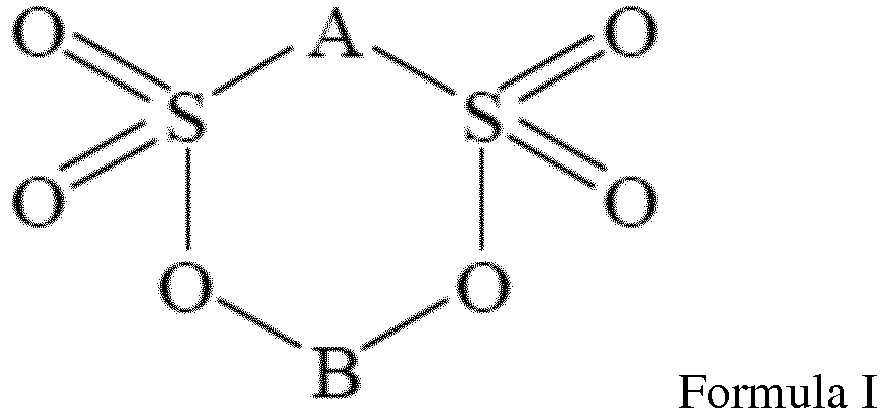
- In the lithium iron phosphate battery according to the present application, the cyclic carbonate containing a double bond can improve the capacity retention rate of the lithium iron phosphate battery in the high temperature environment, but the unavoidable problem is that the SEI film impedance is increased, which will affect the use of lithium iron phosphate battery in the low temperature environment. The cyclic disulfonate shown in Formula I can reduce the SEI film impedance. The combination of the cyclic carbonate containing a double bond and the cyclic disulfonate used in the electrolyte can improve the low temperature performance and the cycle performance at normal temperature and high temperature of the lithium iron phosphate battery and effectively prolong the service life of the lithium iron phosphate battery.
- In the lithium iron phosphate battery according to the present application, the cyclic carbonate containing a double bond may be selected from one or both of vinylene carbonate (VC) and vinyl ethylene carbonate (VEC).
- In the lithium iron phosphate battery according to the present application, in the electrolyte the content of the cyclic carbonate containing a double bond may be 0.5% to 4% by mass. If the content is low, SEI film will be unstable and the cycle performance at high temperature of the lithium iron phosphate battery will be deteriorated; if the content is high, it will result in too thick SEI film and Li plating will occur after the lithium iron phosphate battery cycles, which will lead to cycle capacity diving. Preferably, the content of the cyclic carbonate containing a double bond is 0.5% to 3% by mass.
- In the lithium iron phosphate battery according to the present application, the cyclic disulfonate may be selected from one or more of methylene methane disulfonate (MMDS), ethylene ethane disulfonate and propylene methane disulfonate.
- In the lithium iron phosphate battery according to the present application, the content of the cyclic disulfonate in the electrolyte may be 0.2% to 2% by mass. If the content is too low, the effect on the improvement of the SEI film impedance is very little, and if the content is too high, such cyclic disulfonate is easy to crystallize and precipitate in the electrolyte. At the same time, because of its poor high-temperature stability, the high addition amount is more likely to deteriorate the electrochemical performance of the lithium iron phosphate battery. Preferably, the cyclic disulfonate is present in an amount of from 0.2% to 1% by mass.
- In the lithium iron phosphate battery according to the present application, the charge cut-off voltage of the lithium iron phosphate battery may not exceed 3.8 V, and preferably, the charge cut-off voltage of the lithium iron phosphate battery may not exceed 3.6 V. This is because that the performance of vinylene carbonate (VC), vinyl ethylene carbonate (VEC) and cyclic disulfonate at high voltage is unstable, easily decomposed by oxidation, and the probability of side reaction in the electrolyte is higher. In addition, even in the case that the added amount is very small the side reaction product will deteriorate the performance of the SEI film formed on the surface of the negative electrode, so that the charging cut-off voltage should not be too high. Under such conditions, the SEI film of the electrolyte according to the present application is better and the impedance is smaller, and the wettability of the electrode plate in the electrolyte is excellent. Thus the low temperature performance and the cycle performance at normal temperature and high temperature of the lithium iron phosphate battery containing the high-press density electrode plate can be more remarkably improved.
- In the lithium iron phosphate battery according to the present application, the press density of the negative electrode plate may be 1.4 g/cm3 to 1.8g/cm3. If the press density is too low, the contact resistance between the powder particles will increase, and the overall energy density of the lithium iron phosphate battery will be too low; if the press density is too high, the electrode plate will be easily crushed and the cycle performance of the lithium iron phosphate battery will be deteriorated.
- In the lithium iron phosphate battery according to the present application, the press density of the positive electrode plate may be 2 g/cm3 to 2.5 g/cm3. If the press density is too low, the contact resistance between the powder particles will increase, and the overall energy density of the lithium iron phosphate battery will be too low; if the press density is too high, the electrode plate will be easily crushed and the cycle performance of the lithium iron phosphate battery will be deteriorated.
- On the surface of the negative electrode plate having a high press density, the electrolyte according to the present application can form a denser and more stable SEI film than the conventional electrolyte, and the SEI film has small impedance and the electrode plate has good wettability in the electrolyte. Thus in the lithium iron phosphate battery containing a negative electrode plate having a high press density, the electrolyte according to the present application can make the lithium iron phosphate battery have good low temperature performance and good cycle performance at normal temperature and high temperature.
- In the lithium iron phosphate battery according to the present application, the electrolyte has a conductivity of 8 mS/cm to 11 mS/cm at 25°C. If the conductivity is too low, the dynamic performance of the electrolyte will be poor, and the lithium iron phosphate battery's polarization is great, affecting the cycle performance at normal temperature and low temperature performance; if the conductivity is too high, the thermal stability of the electrolyte will be poor, resulting in the lithium iron phosphate battery having poor cycle performance at high temperature.
- In the lithium iron phosphate battery according to the present application, the viscosity of the electrolyte at 25°C may be ranging from 2 mPa·s to 4 mPa·s. If the viscosity is too high, on one hand the dynamic performance of the electrolyte will be poor, on the other hand the ability of the electrolyte for infiltrating the electrode plate will decline, which will deteriorate the comprehensive performance of the lithium iron phosphate battery; if the viscosity is too low, the thermal stability of the electrolyte will be poor, resulting in the lithium iron phosphate battery having poor cycle performance at high temperature.
- In the lithium iron phosphate battery according to the present application, the type of the lithium salt is not limited and can be selected according to the actual demands. Preferably, the lithium salt may be selected from one or more of LiPF6, LiBF4, LiBOB, LiAsF6, LiCF3SO3, LiFSI and LiTFSI.
- In the lithium iron phosphate battery according to the present application, the organic solvent may be selected from one or more of ethylene carbonate, propylene carbonate, butylene carbonate, pentylene carbonate, 1,2-butylene glycol carbonate, 2,3-butylene glycol carbonate, dimethyl carbonate, diethyl carbonate, dipropyl carbonate, methyl ethyl carbonate, methyl formate, ethyl formate, propyl formate, methyl acetate, ethyl acetate, propyl acetate, methyl propionate, ethyl propionate, propyl propionate, methyl butyrate and ethyl butyrate.
- In the lithium iron phosphate battery according to the present application, it is preferable that the organic solvent comprises a mixed solvent of a cyclic carbonate and a chain carbonate. Such mixed solvent can be conducive to the preparation of an electrolyte having better conductivity, viscosity and other comprehensive performance.
- In the lithium iron phosphate battery according to the present application, it is further preferable that the organic solvent comprises a chain carbonate having a methyl group. Still more preferably, the content of the chain carbonate having a methyl group may be 40% or more by mass based on the total mass of the organic solvent of the electrolyte. The chain carbonate having a methyl group is preferably selected from one or two of dimethyl carbonate and methyl ethyl carbonate. Chain carbonate having a methyl group helps to further improve the anti-overcharge performance of the electrolyte. When the content of the chain carbonate having a methyl group is 40% or more by mass, the conductivity, viscosity and other comprehensive performance of the electrolyte are better.
- In the lithium iron phosphate battery according to the present application, it is preferable that the organic solvent further comprises a carboxylic acid ester and the content of the carboxylic acid ester is less than 30% by mass based on the total mass of the organic solvent of the electrolyte. The addition of the carboxylic acid ester can further improve the conductivity and viscosity of the electrolyte, improve the wettability of the electrode plate having high press density in the electrolyte, and further improve the low temperature performance and other electrochemical performance of the lithium iron phosphate battery. However, if the content of the carboxylic acid ester is too high, it will affect the stability at high temperature of the electrolyte and deteriorate the cycle performance at high temperature of the lithium iron phosphate battery. Meanwhile, due to that the oxidation potential of the carboxylic acid ester is lower than that of the cyclic carbonate and the chain carbonate, adding too much carboxylic acid ester may increase the gas production of lithium iron phosphate battery.
- The present application will be described in further detail with reference to the following examples, in order to make the object of the present application, the technical solution and the advantageous technical effects clearer. It should be understood that the embodiments described in this specification are merely for the purpose of explaining the disclosure and are not intended to limit the scope of the disclosure. The formulation of the examples, the proportions, and the like may have no substantial effect on the results.
- Examples 1-15 and Comparative Examples 1-13 were prepared according to the following methods.
- The positive active material lithium iron phosphate, the binder PVDF and the conductive agent acetylene black were mixed in a mass ratio of 98: 1: 1. Then N-methylpyrrolidone was added and the mixture was stirred uniformly under a vacuum stirrer to obtain a positive electrode paste. The positive electrode paste was evenly coated on the aluminum foil, and the aluminum foil was dried at room temperature and then transferred to a blast drying oven at 120°C for 1 hour. Then, the positive electrode plate was obtained after cold pressing and slitting.
- The negative active material graphite, the conductive agent acetylene black, the thickening agent sodium carboxymethyl cellulose (CMC) solution and the binder styrenebutadiene rubber emulsion were mixed in the mass ratio of 97: 1: 1: 1. Then deionized water was added and the mixture was stirred uniformly under a vacuum stirrer to obtain a negative electrode paste. The negative electrode paste was evenly coated on the copper foil, and the copper foil was dried at room temperature and then transferred to a blast drying oven at 120°C for 1 hour. Then, the negative electrode plate was obtained after cold pressing and slitting.
- The organic solvent was a mixed organic solvent of ethylene carbonate (EC), methyl ethyl carbonate (EMC), diethyl carbonate (DEC), dimethyl carbonate (DMC) and methyl propionate (MP). Lithium salt was LiPF6, wherein the content of LiPF6 was 12.5% by mass, based on the total mass of the electrolyte. Finally the cyclic carbonate containing a double bond and cyclic disulfonate were added. The mass content of each component in the electrolyte was shown in Table 1. By adjusting the adding proportion of each component, the conductivity and viscosity of the electrolyte can be adjusted correspondingly.
- The positive electrode plate, the negative electrode plate and the separator were wound to obtain a battery core, and the battery core was put into the packaging shell, the electrolyte was injected and sealed. The lithium iron phosphate battery was obtained by the steps of standing, pressing, forming, degassing and the like.
Table 1. Process parameters of Examples 1-15 and Comparative examples 1-13 Press density g/m3 The composition of the organic solvent (mass ratio) EC/DEC/EMC/DMC/MP cyclic carbonate containing a double bond cyclic disulfonate Conductivity of the electrolyte mS/cm Viscosity of the electrolyte mPa.s Positive electrode plate Negative electrode plate type content type content Comparative example 1 2.1 1.5 3:1:5:1:0 VC 2.0% / / 9.01 3.10 Comparative example 2 2.1 1.7 3:1:5:1:0 VC 2.0% / / 9.01 3.10 Comparative example 3 2.4 1.7 3:1:5:1:0 VC 2.0% / / 9.01 3.10 Comparative example 4 2.4 1.7 3:1:5:1:0 VC 1.0% / / 8.93 3.12 Comparative example 5 2.4 1.7 3:1:5:1:0 VC 3.0% / / 9.12 3.15 Comparative example 6 2.4 1.7 3:1:5:1:0 VEC 2.0% / / 9.04 3.14 Comparative example 7 2.4 1.7 3:1:5:1:0 / / / / 8.83 3.08 Comparative example 8 2.4 1.7 3:1:5:1:0 VC 0.2% Methylenemethanedisulfonate 0.1% 8.84 3.09 Comparative example 9 2.4 1.7 3:1:5:1:0 VC 5.0% Methylenemethanedisulfonate 0.2% 9.26 3.23 Comparative example 10 2.4 1.7 3:1:5:1:0 VC 0.2% Methylenemethanedisulfonate 3.0% 8.87 3.10 Comparative example 11 2.4 1.7 4:0:6:0:0 VC 2.0% Methylenemethanedisulfonate 0.2% 7.75 4.13 Comparative example 12 2.4 1.7 3:5:2:0:0 VC 2.0% Methylenemethanedisulfonate 0.2% 7.49 3.53 Comparative example 13 2.4 1.7 3:0:1:1:5 VC 2.0% Methylenemethanedisulfonate 0.2% 12.84 1.95 Example 1 2.1 1.5 3:1:5:1:0 VC 2.0% Methylenemethanedisulfonate 0.2% 9.02 3.12 Example 2 2.1 1.7 3:1:5:1:0 VC 2.0% Methylenemethanedisulfonate 0.2% 9.02 3.12 Example 3 2.4 1.7 3:1:5:1:0 VC 2.0% Methylenemethanedisulfonate 0.2% 9.02 3.12 Example 4 2.4 1.7 3:1:5:1:0 VC 2.0% Methylenemethanedisulfonate 0.5% 9.03 3.14 Example 5 2.4 1.7 3:1:5:1:0 VC 2.0% Methylenemethanedisulfonate 1.0% 9.05 3.17 Example 6 2.4 1.7 3:1:5:1:0 VC 2.0% Methylenemethanedisulfonate 2.0% 9.08 3.20 Example 7 2.4 1.7 3:1:5:1:0 VC 1.5% Methylenemethanedisulfonate 0.5% 9.03 3.15 Example 8 2.4 1.7 3:1:5:1:0 VC 2.5% Methylenemethanedisulfonate 0.5% 9.09 3.22 Example 9 2.4 1.7 3:1:5:1:0 VC 4.0% Methylenemethanedisulfonate 0.5% 9.23 3.24 Example 10 2.4 1.7 3:1:5:1:0 VEC 2.0% Methylenemethanedisulfonate 0.5% 9.22 3.23 Example 11 2.4 1.7 3:1:5:1:0 VEC 2.0% Ethyleneethanedisulfonate 0.5% 9.22 3.24 Example 12 2.4 1.7 3:1:3:3:0 VEC 2.0% Propylenemethanedisulfonate 0.5% 9.98 3.16 Example 13 2.4 1.7 3:2:5:0:0 VEC 2.0% Propylenemethanedisulfonate 0.5% 8.15 3.37 Example 14 2.4 1.7 3:0:5:2:0 VEC 2.0% Propylenemethanedisulfonate 0.5% 9.87 3.11 Example 15 2.4 1.7 3:0:5:0:2 VEC 2.0% Propylenemethanedisulfonate 0.5% 10.58 2.92 - Next to explain the test of lithium iron phosphate battery.
- At 25°C, the lithium iron phosphate battery was firstly discharged to 2.0V with a current of 1C; and then charged to 3.6V with a constant current of 1C, and then charged to a current of 0.05C with a constant voltage, wherein the charge capacity was represented by CC; and then the furnace temperature was adjusted to -10°C, and the battery was discharged to 2.0V with a constant current of 1C, wherein the discharge capacity was represented by CDT. The ratio of discharge capacity to charge capacity is a discharge capacity retention rate.

- At 25°C, the lithium iron phosphate battery was firstly discharged to 2.0V with a current of 1C, and then was subjected to the cycle test. The battery was charged to 3.6V with a constant current of 1C, and then charged to the current of 0.05C with a constant voltage, and then discharged to 2.0V with a constant current of 1C. Charging/discharging cycles were done in such way. Then, the cycle capacity retention rate of the lithium iron phosphate battery of 1000th cycle at 25°C was calculated.

- At 25°C, the lithium iron phosphate battery was first discharged to 2.0V with a current of 1C, and then was subjected to the cycle test. The oven was heated to 60°C, and then the battery was charged to 3.6 V with a constant current of 1C, and then charged to the current of 0.05C with a constant voltage, and then discharged to 2.0V with a constant current of 1C. Charging/discharging cycles were done in such way. Then, the cycle capacity retention rate of the lithium iron phosphate battery of 500th cycle at 60°C was calculated.

Table 2. Test results of Examples 1-15 and Comparative examples 1-13 discharge capacity retention rate at -10°C Cycle capacity retention rate of 1000th cycle at 25°C Cycle capacity retention rate of 500th cycle at 60°C Comparative example 1 84.10% 89.40% 87.50% Comparative example 2 82.30% 88.70% 86.00% Comparative example 3 80.40% 87.90% 85.80% Comparative example 4 87.40% 85.40% 82.50% Comparative example 5 70.60% 86.50% 89.30% Comparative example 6 75.40% 85.30% 85.20% Comparative example 7 90.30% 58.00% 37.80% Comparative example 8 90.10% 63.40% 44.50% Comparative example 9 68.70% 80.40% 88.30% Comparative example 10 88.70% 84.50% 81.20% Comparative example 11 64.50% 74.50% 83.50% Comparative example 12 74.50% 81.60% 83.90% Comparative example 13 88.70% 90.50% 81.40% Example 1 85.20% 90.10% 87.80% Example 2 84.20% 89.10% 87.20% Example 3 83.50% 88.40% 86.40% Example 4 86.40% 91.20% 87.30% Example 5 86.30% 90.90% 86.00% Example 6 87.40% 91.30% 84.50% Example 7 88.20% 92.30% 85.30% Example 8 83.60% 89.60% 88.40% Example 9 75.40% 84.50% 89.60% Example 10 83.40% 88.40% 86.00% Example 11 82.40% 88.00% 85.80% Example 12 81.50% 87.50% 85.70% Example 13 80.40% 86.50% 86.20% Example 14 82.70% 88.10% 84.80% Example 15 85.20% 88.90% 83.40% - As can be seen from Comparative Examples 1-3, if the press density of the positive electrode film and negative electrode film was improved, the performance of the lithium iron phosphate battery was rapidly decreased without adding the MMDS. However, in Examples 1 to 3, the press density of the positive electrode film and negative electrode film was improved, and the downtrend of the lithium iron phosphate battery performance was remarkably changed after the addition of MMDS into the electrolyte, and the cycle life of the lithium iron phosphate battery was prolonged. This shows that in the lithium iron phosphate battery system comprising high press density electrode plate, the low temperature performance and the cycle performance at normal temperature and high temperature of lithium iron phosphate battery can be improved by adjusting the ratio and the amount of the cyclic carbonate containing a double bond and the cyclic disulfonate.
- In Comparative Example 7, when using a high-press density positive electrode film and negative electrode film, it was difficult to infiltrate the electrode plate with the electrolyte, resulting in a low capacity retention rate of the lithium iron phosphate battery after cycles at normal temperature and at high temperature, which will in turn affect the service life at normal temperature and high temperature. In Comparative Example 3 and Comparative Example 6, VC and VEC were added, respectively, which can significantly improve the cycle performance at normal temperature and high temperature of lithium iron phosphate battery, but the unavoidable problem was that the SEI film impedance was increased, which will affect the use of the lithium iron phosphate battery in low temperature environment. As can be seen from Comparative Examples 3-5, the high-temperature cycle performance of the lithium iron phosphate battery was improved with the increase of the VC content, but the low temperature performance and the cycle performance at normal temperature were deteriorated due to that the impedance of the solid electrolyte interface film (SEI film) was increased. In Examples 4 and 8-11, 0.5% of the cyclic disulfonate was added into the electrolyte, with the synergistic effect of the cyclic disulfonate and the cyclic carbonate containing a double bond, the SEI film impedance was effectively reduced, so that the low temperature and the cycle performance at normal temperature of the electrode plate having a high press density have been significantly improved. In Comparative Example 8, the addition amount of VC was too low and the SEI film was unstable, and the improvement of the high-temperature cycle performance of the lithium iron phosphate battery was not obvious. In Comparative Example 9, the content of VC was too high, and even the addition of MMDS cannot suppress the increase of the SEI film resistance, thus the performance of the lithium iron phosphate battery was deteriorated.
- In Examples 4-6, as the added amount of MMDS was increased, the normal-temperature cycle performance and the low temperature performance of the lithium iron phosphate battery were significantly improved; however, the effect of improving the high-temperature cycle performance was poor. In Comparative Example 10, the added amount of MMDS was too high, and it was easily precipitated in the electrolyte to affect the quality of the electrolyte, meanwhile it was not consumed at the beginning of the cycle, then it was decomposed into by-products due to its own instability, which will deteriorate the performance of the lithium iron phosphate battery instead, especially for high-temperature cycle performance.
- As can be seen from Examples 12-15, it is possible to improve the viscosity and the conductivity of the electrolyte by adjusting the composition of the organic solvent, thereby improving the low temperature performance and the cycle performance at normal temperature and high temperature of the lithium iron phosphate battery. For example, in Examples 12-14, the content of the cyclic carbonate was controlled to 30%, and the total amount of the chain carbonate was 70%. Since only the chain carbonic acid esters having a methyl group EMC and DMC were used in Example 14 without adding DEC, so the conductivity, viscosity and other comprehensive performance of the electrolyte were better, and then the comprehensive performance of the lithium iron phosphate battery was also better. In Example 15, a carboxylic acid ester was further added as an organic solvent which could further improve the conductivity and viscosity of the electrolyte and improve the wettability of the high press density electrode plate in the electrolyte, but it would inevitably affect the high-temperature cycle performance of the lithium iron phosphate battery. In Comparative Examples 11 and 12, the conductivity of the electrolyte was too low, and the viscosity was too high, resulting in that the electrode plate has poor wettability in the electrolyte, which will deteriorate the power performance of the lithium iron phosphate battery and deteriorate the low-temperature discharge capacity and normal-temperature cycle performance. In Comparative Example 13, the content of the chain carbonate having a methyl group was low (only 20%), and the content of the carboxylic acid ester was high (up to 50%), which will result in that the conductivity of the electrolyte is too high and that the viscosity is too low. The stability of the electrolyte will be worse, which will seriously deteriorate the high-temperature cycle performance of the lithium iron phosphate battery. So the conductivity and viscosity of the electrolyte also need to be controlled in a certain range in order to make that the low temperature performance and the cycle performance at normal temperature and high temperature of lithium iron phosphate battery have been improved.
- In summary, the present application can be used to improve the performance of a lithium iron phosphate battery comprising a high-press density electrode plate by adjusting the amount of the cyclic carbonate containing a double bond and the cyclic disulfonate and adjusting the composition of the organic solvent system. Then an electrolyte having better comprehensive performance can be obtained, and the low temperature performance and the cycle performance at normal temperature and high temperature of the lithium iron phosphate battery have been improved.
- It will be apparent to those skilled in the art that the present application may be modified and varied in accordance with the above teachings. Accordingly, the present application is not limited to the specific embodiments disclosed and described above, and modifications and variations of the present application are intended to be included within the scope of the claims of the present application. In addition, although some specific terminology is used in this specification, these terms are for convenience of illustration only and are not intended to limit the present application in any way.
Claims (10)
- A lithium iron phosphate battery comprising:A positive electrode plate comprising a positive current collector and a positive electrode film provided on the surface of the positive current collector;A negative electrode plate comprising a negative current collector and a negative electrode film provided on the surface of the negative current collector;a separator provided between the positive electrode plate and the negative electrode plate; andan electrolyte comprising an organic solvent, a lithium salt and an electrolyte additive;characterized in that,a positive active material in the positive electrode plate comprises lithium iron phosphate;a negative active material in the negative electrode plate comprises graphite;the electrolyte additive comprises a cyclic carbonate containing a double bond and a cyclic disulfonate represented by the formula I;

- The lithium iron phosphate battery according to claim 1, characterized in that, a charge cut-off voltage of the lithium iron phosphate battery does not exceed 3.8 V, and preferably, the charge cut-off voltage of the lithium iron phosphate battery does not exceed 3.6 V.
- The lithium iron phosphate battery according to claim 1, characterized in that, a press density of the negative electrode plate is 1.4 g/cm3 to 1.8 g/cm3.
- The lithium iron phosphate battery according to claim 1, characterized in that, the cyclic carbonate containing a double bond is selected from one or both of vinylene carbonate and vinyl ethylene carbonate.
- The lithium iron phosphate battery according to claim 1, characterized in that, the cyclic disulfonate is selected from one or more of methylene methane disulfonate, ethylene ethane disulfonate and propylene methane disulfonate.
- The lithium iron phosphate battery according to claim 1, characterized in that, in the electrolyte the content of the cyclic carbonate containing a double bond is 0.5% to 4% by mass, preferably the content of the cyclic carbonate containing a double bond is 0.5% to 3% by mass;
the content of the cyclic disulfonate is 0.2% to 2% by mass, preferably the content of the cyclic disulfonate is 0.2% to 1% by mass. - The lithium iron phosphate battery according to claim 1, characterized in that, the electrolyte has a conductivity of 8 mS/cm to 11 mS/cm at 25 °C.
- The lithium iron phosphate battery according to claim 1, characterized in that, the electrolyte has a viscosity of 2 mPa.s to 4 mPa.s at 25°C.
- The lithium iron phosphate battery according to claim 1, characterized in that, the organic solvent includes a mixed solvent of a cyclic carbonate and a chain carbonate, and the organic solvent comprises a chain carbonate having a methyl group, the content of the chain carbonate having a methyl group is 40% or more by mass based on the total mass of the organic solvent of the electrolyte.
- The lithium iron phosphate battery according to claim 9, characterized in that, the organic solvent further comprises a carboxylic acid ester and the content of the carboxylic acid ester is 30% or less by mass based on the total mass of the organic solvent of the electrolyte.
Applications Claiming Priority (2)
| Application Number | Priority Date | Filing Date | Title |
|---|---|---|---|
| CN201710486002.XA CN109119686B (en) | 2017-06-23 | 2017-06-23 | Lithium iron phosphate battery |
| PCT/CN2017/098784 WO2018232979A1 (en) | 2017-06-23 | 2017-08-24 | Lithium iron phosphate battery |
Publications (3)
| Publication Number | Publication Date |
|---|---|
| EP3447838A1 true EP3447838A1 (en) | 2019-02-27 |
| EP3447838A4 EP3447838A4 (en) | 2019-04-10 |
| EP3447838B1 EP3447838B1 (en) | 2020-11-11 |
Family
ID=64732132
Family Applications (1)
| Application Number | Title | Priority Date | Filing Date |
|---|---|---|---|
| EP17784825.6A Active EP3447838B1 (en) | 2017-06-23 | 2017-08-24 | Lithium iron phosphate battery |
Country Status (4)
| Country | Link |
|---|---|
| US (1) | US20200020980A1 (en) |
| EP (1) | EP3447838B1 (en) |
| CN (1) | CN109119686B (en) |
| WO (1) | WO2018232979A1 (en) |
Cited By (2)
| Publication number | Priority date | Publication date | Assignee | Title |
|---|---|---|---|---|
| EP3796437B1 (en) * | 2019-05-31 | 2023-01-11 | Contemporary Amperex Technology Co., Limited | Lithium-ion secondary battery |
| EP4254582A4 (en) * | 2020-11-30 | 2025-03-05 | Shenzhen Capchem Technology Co., Ltd | LITHIUM-ION BATTERY |
Families Citing this family (17)
| Publication number | Priority date | Publication date | Assignee | Title |
|---|---|---|---|---|
| CN109860708A (en) * | 2019-01-04 | 2019-06-07 | 上海德朗能动力电池有限公司 | A kind of lithium titanate battery electrolyte |
| CN111584925B (en) * | 2019-02-22 | 2021-11-05 | 叶小剑 | Lithium iron phosphate battery and preparation method thereof |
| CN111180737B (en) | 2019-05-31 | 2021-08-03 | 宁德时代新能源科技股份有限公司 | Lithium-ion secondary battery, cell and negative electrode |
| JP7890808B2 (en) * | 2020-11-06 | 2026-07-15 | 株式会社Gsユアサ | Positive electrode for energy storage element and energy storage element |
| CN112421109B (en) * | 2020-11-19 | 2022-04-26 | 中节能万润股份有限公司 | Cyclic sulfonate lithium ion battery electrolyte additive, preparation method and application thereof |
| CN112271338B (en) * | 2020-11-27 | 2022-10-11 | 中创新航技术研究院(江苏)有限公司 | Electrolyte and lithium ion battery containing same |
| WO2022196829A2 (en) * | 2021-03-19 | 2022-09-22 | Sekisui Chemical Co., Ltd. | Positive electrode for non-aqueous electrolyte secondary battery, and non-aqueous electrolyte secondary battery, battery module and battery system using the same |
| CN115207441B (en) * | 2021-04-13 | 2025-05-16 | 深圳新宙邦科技股份有限公司 | Lithium iron phosphate battery |
| CN115917825B (en) * | 2021-07-30 | 2024-09-17 | 宁德时代新能源科技股份有限公司 | Secondary battery, battery module, battery pack and electric device containing the same |
| CN114243089B (en) * | 2021-12-13 | 2023-10-13 | 上海瑞浦青创新能源有限公司 | Lithium iron phosphate secondary battery |
| CN118765452A (en) * | 2022-07-28 | 2024-10-11 | 宁德时代新能源科技股份有限公司 | Battery packs and power devices |
| CN115275367B (en) * | 2022-09-26 | 2023-01-06 | 比亚迪股份有限公司 | Lithium battery and electric equipment |
| CN115548445B (en) * | 2022-10-14 | 2023-06-06 | 欣旺达电动汽车电池有限公司 | Secondary battery |
| CN115974041B (en) * | 2023-03-07 | 2024-10-22 | 蜂巢能源科技股份有限公司 | A lithium iron phosphate positive electrode material and its preparation method and application |
| CN117691189B (en) * | 2024-02-02 | 2024-04-23 | 深圳海辰储能科技有限公司 | Electrolyte, battery and electrical equipment |
| EP4726802A1 (en) * | 2024-06-28 | 2026-04-15 | Contemporary Amperex Technology Co., Limited | Secondary battery and electric device |
| CN119481225B (en) * | 2024-12-05 | 2026-01-20 | 中创新航科技集团股份有限公司 | A lithium-ion battery |
Family Cites Families (9)
| Publication number | Priority date | Publication date | Assignee | Title |
|---|---|---|---|---|
| CN101394008A (en) * | 2008-11-03 | 2009-03-25 | 广州天赐高新材料股份有限公司 | Lithium ion secondary battery non-aqueous electrolyte taking lithium iron phosphate with high and low temperature performance as positive electrode material |
| JP5472041B2 (en) * | 2010-10-28 | 2014-04-16 | 三菱化学株式会社 | Non-aqueous electrolyte and non-aqueous electrolyte secondary battery using the same |
| CN102983358B (en) * | 2011-09-05 | 2015-04-15 | 轻工业化学电源研究所 | Nonaqueous electrolyte solution for lithium iron phosphate lithium-ion battery |
| CN104798245B (en) * | 2012-11-20 | 2017-06-23 | 日本电气株式会社 | Lithium-ion secondary battery |
| CN105789684A (en) * | 2014-12-22 | 2016-07-20 | 宁德时代新能源科技股份有限公司 | Lithium ion secondary battery and electrolyte thereof |
| JP6403278B2 (en) * | 2015-06-30 | 2018-10-10 | オートモーティブエナジーサプライ株式会社 | Lithium ion secondary battery |
| JP6580886B2 (en) * | 2015-06-30 | 2019-09-25 | 株式会社エンビジョンAescジャパン | Lithium ion secondary battery |
| CN105789611A (en) * | 2016-03-23 | 2016-07-20 | 合肥国轩高科动力能源有限公司 | An electrolyte and lithium-ion battery that take into account the high and low temperature cycle performance of the battery |
| CN106505249B (en) * | 2016-12-15 | 2021-01-05 | 东莞市杉杉电池材料有限公司 | Lithium ion battery electrolyte and lithium ion battery containing same |
-
2017
- 2017-06-23 CN CN201710486002.XA patent/CN109119686B/en active Active
- 2017-08-24 EP EP17784825.6A patent/EP3447838B1/en active Active
- 2017-08-24 WO PCT/CN2017/098784 patent/WO2018232979A1/en not_active Ceased
- 2017-08-24 US US15/572,599 patent/US20200020980A1/en not_active Abandoned
Cited By (3)
| Publication number | Priority date | Publication date | Assignee | Title |
|---|---|---|---|---|
| EP3796437B1 (en) * | 2019-05-31 | 2023-01-11 | Contemporary Amperex Technology Co., Limited | Lithium-ion secondary battery |
| US11646424B2 (en) | 2019-05-31 | 2023-05-09 | Contemporary Amperex Technology Co., Limited | Lithium-ion secondary battery |
| EP4254582A4 (en) * | 2020-11-30 | 2025-03-05 | Shenzhen Capchem Technology Co., Ltd | LITHIUM-ION BATTERY |
Also Published As
| Publication number | Publication date |
|---|---|
| EP3447838A4 (en) | 2019-04-10 |
| US20200020980A1 (en) | 2020-01-16 |
| WO2018232979A1 (en) | 2018-12-27 |
| CN109119686B (en) | 2020-11-20 |
| CN109119686A (en) | 2019-01-01 |
| EP3447838B1 (en) | 2020-11-11 |
Similar Documents
| Publication | Publication Date | Title |
|---|---|---|
| EP3447838B1 (en) | Lithium iron phosphate battery | |
| CN108808071B (en) | Electrolyte for high-nickel ternary positive electrode material system battery and lithium ion battery | |
| CN100470915C (en) | A kind of lithium battery non-aqueous electrolyte | |
| EP3809507B1 (en) | Lithium-ion battery and device comprising the same | |
| CN104979589A (en) | High-voltage electrolyte and lithium ion battery using electrolyte | |
| EP3783723B1 (en) | Lithium-ion battery and apparatus | |
| EP3836279B1 (en) | Non-aqueous electrolyte, lithium-ion battery, battery module, battery pack, and device | |
| CN104269576A (en) | Electrolyte and lithium ion battery adopting same | |
| EP3832773B1 (en) | Non-aqueous electrolyte, lithium-ion battery, battery module, battery pack and apparatus | |
| US11316197B2 (en) | Lithium-ion battery and apparatus | |
| WO2023236509A1 (en) | Electrolyte solution and preparation method therefor, and lithium-ion battery | |
| CN116454361A (en) | Lithium ion battery | |
| US12183922B2 (en) | Lithium-ion battery and apparatus | |
| EP3832771B1 (en) | Non-aqueous electrolyte, lithium-ion battery, battery module, battery pack and device | |
| EP4489171A1 (en) | Battery | |
| CN113991181B (en) | High-rate electrolyte suitable for unmanned aerial vehicle lithium battery | |
| CN110854436B (en) | Secondary lithium metal battery electrolyte and preparation method thereof | |
| US20210111433A1 (en) | Lithium-ion battery and apparatus | |
| CN112615050A (en) | Low-gas-production long-cycle high-voltage electrolyte, preparation method and lithium ion battery | |
| CN112216869B (en) | High-voltage electrolyte additive, high-voltage electrolyte and lithium ion battery | |
| EP3836278B1 (en) | Lithium ion battery, battery module, battery pack, and apparatus | |
| CN119764571B (en) | An electrolyte additive and an electrolyte containing the additive, and a lithium-ion battery. | |
| CN106941191A (en) | Lithium ion battery and its nonaqueous electrolytic solution | |
| CN116404249B (en) | Electrolyte additive, electrolyte containing same and battery | |
| CN115395104A (en) | Lithium battery and electrolyte |
Legal Events
| Date | Code | Title | Description |
|---|---|---|---|
| STAA | Information on the status of an ep patent application or granted ep patent |
Free format text: STATUS: UNKNOWN |
|
| STAA | Information on the status of an ep patent application or granted ep patent |
Free format text: STATUS: THE INTERNATIONAL PUBLICATION HAS BEEN MADE |
|
| PUAI | Public reference made under article 153(3) epc to a published international application that has entered the european phase |
Free format text: ORIGINAL CODE: 0009012 |
|
| STAA | Information on the status of an ep patent application or granted ep patent |
Free format text: STATUS: REQUEST FOR EXAMINATION WAS MADE |
|
| 17P | Request for examination filed |
Effective date: 20171027 |
|
| AK | Designated contracting states |
Kind code of ref document: A1 Designated state(s): AL AT BE BG CH CY CZ DE DK EE ES FI FR GB GR HR HU IE IS IT LI LT LU LV MC MK MT NL NO PL PT RO RS SE SI SK SM TR |
|
| AX | Request for extension of the european patent |
Extension state: BA ME |
|
| R17P | Request for examination filed (corrected) |
Effective date: 20171027 |
|
| A4 | Supplementary search report drawn up and despatched |
Effective date: 20190311 |
|
| RIC1 | Information provided on ipc code assigned before grant |
Ipc: H01M 4/583 20100101ALI20190301BHEP Ipc: H01M 4/58 20100101ALI20190301BHEP Ipc: H01M 10/0566 20100101AFI20190301BHEP Ipc: H01M 10/0567 20100101ALI20190301BHEP |
|
| STAA | Information on the status of an ep patent application or granted ep patent |
Free format text: STATUS: EXAMINATION IS IN PROGRESS |
|
| 17Q | First examination report despatched |
Effective date: 20200114 |
|
| GRAP | Despatch of communication of intention to grant a patent |
Free format text: ORIGINAL CODE: EPIDOSNIGR1 |
|
| STAA | Information on the status of an ep patent application or granted ep patent |
Free format text: STATUS: GRANT OF PATENT IS INTENDED |
|
| DAV | Request for validation of the european patent (deleted) | ||
| DAX | Request for extension of the european patent (deleted) | ||
| INTG | Intention to grant announced |
Effective date: 20200518 |
|
| GRAS | Grant fee paid |
Free format text: ORIGINAL CODE: EPIDOSNIGR3 |
|
| GRAA | (expected) grant |
Free format text: ORIGINAL CODE: 0009210 |
|
| STAA | Information on the status of an ep patent application or granted ep patent |
Free format text: STATUS: THE PATENT HAS BEEN GRANTED |
|
| RAP1 | Party data changed (applicant data changed or rights of an application transferred) |
Owner name: CONTEMPORARY AMPEREX TECHNOLOGY CO., LIMITED |
|
| RIN1 | Information on inventor provided before grant (corrected) |
Inventor name: TIAN, SHAOJIE Inventor name: HAN, CHANGLONG Inventor name: JU, FENG Inventor name: ZHANG, CUI |
|
| AK | Designated contracting states |
Kind code of ref document: B1 Designated state(s): AL AT BE BG CH CY CZ DE DK EE ES FI FR GB GR HR HU IE IS IT LI LT LU LV MC MK MT NL NO PL PT RO RS SE SI SK SM TR |
|
| REG | Reference to a national code |
Ref country code: GB Ref legal event code: FG4D |
|
| REG | Reference to a national code |
Ref country code: CH Ref legal event code: EP |
|
| REG | Reference to a national code |
Ref country code: AT Ref legal event code: REF Ref document number: 1334329 Country of ref document: AT Kind code of ref document: T Effective date: 20201115 |
|
| REG | Reference to a national code |
Ref country code: DE Ref legal event code: R096 Ref document number: 602017027468 Country of ref document: DE |
|
| REG | Reference to a national code |
Ref country code: IE Ref legal event code: FG4D |
|
| REG | Reference to a national code |
Ref country code: NL Ref legal event code: MP Effective date: 20201111 |
|
| REG | Reference to a national code |
Ref country code: AT Ref legal event code: MK05 Ref document number: 1334329 Country of ref document: AT Kind code of ref document: T Effective date: 20201111 |
|
| PG25 | Lapsed in a contracting state [announced via postgrant information from national office to epo] |
Ref country code: RS Free format text: LAPSE BECAUSE OF FAILURE TO SUBMIT A TRANSLATION OF THE DESCRIPTION OR TO PAY THE FEE WITHIN THE PRESCRIBED TIME-LIMIT Effective date: 20201111 Ref country code: PT Free format text: LAPSE BECAUSE OF FAILURE TO SUBMIT A TRANSLATION OF THE DESCRIPTION OR TO PAY THE FEE WITHIN THE PRESCRIBED TIME-LIMIT Effective date: 20210311 Ref country code: FI Free format text: LAPSE BECAUSE OF FAILURE TO SUBMIT A TRANSLATION OF THE DESCRIPTION OR TO PAY THE FEE WITHIN THE PRESCRIBED TIME-LIMIT Effective date: 20201111 Ref country code: NO Free format text: LAPSE BECAUSE OF FAILURE TO SUBMIT A TRANSLATION OF THE DESCRIPTION OR TO PAY THE FEE WITHIN THE PRESCRIBED TIME-LIMIT Effective date: 20210211 Ref country code: GR Free format text: LAPSE BECAUSE OF FAILURE TO SUBMIT A TRANSLATION OF THE DESCRIPTION OR TO PAY THE FEE WITHIN THE PRESCRIBED TIME-LIMIT Effective date: 20210212 |
|
| PG25 | Lapsed in a contracting state [announced via postgrant information from national office to epo] |
Ref country code: AT Free format text: LAPSE BECAUSE OF FAILURE TO SUBMIT A TRANSLATION OF THE DESCRIPTION OR TO PAY THE FEE WITHIN THE PRESCRIBED TIME-LIMIT Effective date: 20201111 Ref country code: IS Free format text: LAPSE BECAUSE OF FAILURE TO SUBMIT A TRANSLATION OF THE DESCRIPTION OR TO PAY THE FEE WITHIN THE PRESCRIBED TIME-LIMIT Effective date: 20210311 Ref country code: LV Free format text: LAPSE BECAUSE OF FAILURE TO SUBMIT A TRANSLATION OF THE DESCRIPTION OR TO PAY THE FEE WITHIN THE PRESCRIBED TIME-LIMIT Effective date: 20201111 Ref country code: PL Free format text: LAPSE BECAUSE OF FAILURE TO SUBMIT A TRANSLATION OF THE DESCRIPTION OR TO PAY THE FEE WITHIN THE PRESCRIBED TIME-LIMIT Effective date: 20201111 Ref country code: SE Free format text: LAPSE BECAUSE OF FAILURE TO SUBMIT A TRANSLATION OF THE DESCRIPTION OR TO PAY THE FEE WITHIN THE PRESCRIBED TIME-LIMIT Effective date: 20201111 Ref country code: BG Free format text: LAPSE BECAUSE OF FAILURE TO SUBMIT A TRANSLATION OF THE DESCRIPTION OR TO PAY THE FEE WITHIN THE PRESCRIBED TIME-LIMIT Effective date: 20210211 |
|
| REG | Reference to a national code |
Ref country code: LT Ref legal event code: MG9D |
|
| PG25 | Lapsed in a contracting state [announced via postgrant information from national office to epo] |
Ref country code: HR Free format text: LAPSE BECAUSE OF FAILURE TO SUBMIT A TRANSLATION OF THE DESCRIPTION OR TO PAY THE FEE WITHIN THE PRESCRIBED TIME-LIMIT Effective date: 20201111 |
|
| PG25 | Lapsed in a contracting state [announced via postgrant information from national office to epo] |
Ref country code: LT Free format text: LAPSE BECAUSE OF FAILURE TO SUBMIT A TRANSLATION OF THE DESCRIPTION OR TO PAY THE FEE WITHIN THE PRESCRIBED TIME-LIMIT Effective date: 20201111 Ref country code: CZ Free format text: LAPSE BECAUSE OF FAILURE TO SUBMIT A TRANSLATION OF THE DESCRIPTION OR TO PAY THE FEE WITHIN THE PRESCRIBED TIME-LIMIT Effective date: 20201111 Ref country code: EE Free format text: LAPSE BECAUSE OF FAILURE TO SUBMIT A TRANSLATION OF THE DESCRIPTION OR TO PAY THE FEE WITHIN THE PRESCRIBED TIME-LIMIT Effective date: 20201111 Ref country code: SM Free format text: LAPSE BECAUSE OF FAILURE TO SUBMIT A TRANSLATION OF THE DESCRIPTION OR TO PAY THE FEE WITHIN THE PRESCRIBED TIME-LIMIT Effective date: 20201111 Ref country code: RO Free format text: LAPSE BECAUSE OF FAILURE TO SUBMIT A TRANSLATION OF THE DESCRIPTION OR TO PAY THE FEE WITHIN THE PRESCRIBED TIME-LIMIT Effective date: 20201111 Ref country code: SK Free format text: LAPSE BECAUSE OF FAILURE TO SUBMIT A TRANSLATION OF THE DESCRIPTION OR TO PAY THE FEE WITHIN THE PRESCRIBED TIME-LIMIT Effective date: 20201111 |
|
| REG | Reference to a national code |
Ref country code: DE Ref legal event code: R097 Ref document number: 602017027468 Country of ref document: DE |
|
| PG25 | Lapsed in a contracting state [announced via postgrant information from national office to epo] |
Ref country code: DK Free format text: LAPSE BECAUSE OF FAILURE TO SUBMIT A TRANSLATION OF THE DESCRIPTION OR TO PAY THE FEE WITHIN THE PRESCRIBED TIME-LIMIT Effective date: 20201111 |
|
| PLBE | No opposition filed within time limit |
Free format text: ORIGINAL CODE: 0009261 |
|
| STAA | Information on the status of an ep patent application or granted ep patent |
Free format text: STATUS: NO OPPOSITION FILED WITHIN TIME LIMIT |
|
| 26N | No opposition filed |
Effective date: 20210812 |
|
| PG25 | Lapsed in a contracting state [announced via postgrant information from national office to epo] |
Ref country code: NL Free format text: LAPSE BECAUSE OF FAILURE TO SUBMIT A TRANSLATION OF THE DESCRIPTION OR TO PAY THE FEE WITHIN THE PRESCRIBED TIME-LIMIT Effective date: 20201111 Ref country code: AL Free format text: LAPSE BECAUSE OF FAILURE TO SUBMIT A TRANSLATION OF THE DESCRIPTION OR TO PAY THE FEE WITHIN THE PRESCRIBED TIME-LIMIT Effective date: 20201111 Ref country code: IT Free format text: LAPSE BECAUSE OF FAILURE TO SUBMIT A TRANSLATION OF THE DESCRIPTION OR TO PAY THE FEE WITHIN THE PRESCRIBED TIME-LIMIT Effective date: 20201111 |
|
| PG25 | Lapsed in a contracting state [announced via postgrant information from national office to epo] |
Ref country code: SI Free format text: LAPSE BECAUSE OF FAILURE TO SUBMIT A TRANSLATION OF THE DESCRIPTION OR TO PAY THE FEE WITHIN THE PRESCRIBED TIME-LIMIT Effective date: 20201111 |
|
| PG25 | Lapsed in a contracting state [announced via postgrant information from national office to epo] |
Ref country code: ES Free format text: LAPSE BECAUSE OF FAILURE TO SUBMIT A TRANSLATION OF THE DESCRIPTION OR TO PAY THE FEE WITHIN THE PRESCRIBED TIME-LIMIT Effective date: 20201111 |
|
| REG | Reference to a national code |
Ref country code: CH Ref legal event code: PL |
|
| PG25 | Lapsed in a contracting state [announced via postgrant information from national office to epo] |
Ref country code: MC Free format text: LAPSE BECAUSE OF FAILURE TO SUBMIT A TRANSLATION OF THE DESCRIPTION OR TO PAY THE FEE WITHIN THE PRESCRIBED TIME-LIMIT Effective date: 20201111 |
|
| REG | Reference to a national code |
Ref country code: BE Ref legal event code: MM Effective date: 20210831 |
|
| PG25 | Lapsed in a contracting state [announced via postgrant information from national office to epo] |
Ref country code: LI Free format text: LAPSE BECAUSE OF NON-PAYMENT OF DUE FEES Effective date: 20210831 Ref country code: CH Free format text: LAPSE BECAUSE OF NON-PAYMENT OF DUE FEES Effective date: 20210831 |
|
| PG25 | Lapsed in a contracting state [announced via postgrant information from national office to epo] |
Ref country code: IS Free format text: LAPSE BECAUSE OF FAILURE TO SUBMIT A TRANSLATION OF THE DESCRIPTION OR TO PAY THE FEE WITHIN THE PRESCRIBED TIME-LIMIT Effective date: 20210311 Ref country code: LU Free format text: LAPSE BECAUSE OF NON-PAYMENT OF DUE FEES Effective date: 20210824 |
|
| PG25 | Lapsed in a contracting state [announced via postgrant information from national office to epo] |
Ref country code: IE Free format text: LAPSE BECAUSE OF NON-PAYMENT OF DUE FEES Effective date: 20210824 Ref country code: BE Free format text: LAPSE BECAUSE OF NON-PAYMENT OF DUE FEES Effective date: 20210831 |
|
| P01 | Opt-out of the competence of the unified patent court (upc) registered |
Effective date: 20230516 |
|
| PG25 | Lapsed in a contracting state [announced via postgrant information from national office to epo] |
Ref country code: CY Free format text: LAPSE BECAUSE OF FAILURE TO SUBMIT A TRANSLATION OF THE DESCRIPTION OR TO PAY THE FEE WITHIN THE PRESCRIBED TIME-LIMIT Effective date: 20201111 |
|
| PG25 | Lapsed in a contracting state [announced via postgrant information from national office to epo] |
Ref country code: HU Free format text: LAPSE BECAUSE OF FAILURE TO SUBMIT A TRANSLATION OF THE DESCRIPTION OR TO PAY THE FEE WITHIN THE PRESCRIBED TIME-LIMIT; INVALID AB INITIO Effective date: 20170824 |
|
| PG25 | Lapsed in a contracting state [announced via postgrant information from national office to epo] |
Ref country code: MK Free format text: LAPSE BECAUSE OF FAILURE TO SUBMIT A TRANSLATION OF THE DESCRIPTION OR TO PAY THE FEE WITHIN THE PRESCRIBED TIME-LIMIT Effective date: 20201111 |
|
| REG | Reference to a national code |
Ref country code: DE Ref legal event code: R081 Ref document number: 602017027468 Country of ref document: DE Owner name: CONTEMPORARY AMPEREX TECHNOLOGY (HONG KONG) LI, HK Free format text: FORMER OWNER: CONTEMPORARY AMPEREX TECHNOLOGY CO., LTD., NINGDE CITY, FUJIAN, CN |
|
| REG | Reference to a national code |
Ref country code: GB Ref legal event code: 732E Free format text: REGISTERED BETWEEN 20240829 AND 20240904 |
|
| PG25 | Lapsed in a contracting state [announced via postgrant information from national office to epo] |
Ref country code: MT Free format text: LAPSE BECAUSE OF FAILURE TO SUBMIT A TRANSLATION OF THE DESCRIPTION OR TO PAY THE FEE WITHIN THE PRESCRIBED TIME-LIMIT Effective date: 20201111 |
|
| PGFP | Annual fee paid to national office [announced via postgrant information from national office to epo] |
Ref country code: DE Payment date: 20250702 Year of fee payment: 9 |
|
| PGFP | Annual fee paid to national office [announced via postgrant information from national office to epo] |
Ref country code: GB Payment date: 20250703 Year of fee payment: 9 |
|
| PGFP | Annual fee paid to national office [announced via postgrant information from national office to epo] |
Ref country code: FR Payment date: 20250703 Year of fee payment: 9 |
|
| PG25 | Lapsed in a contracting state [announced via postgrant information from national office to epo] |
Ref country code: TR Free format text: LAPSE BECAUSE OF FAILURE TO SUBMIT A TRANSLATION OF THE DESCRIPTION OR TO PAY THE FEE WITHIN THE PRESCRIBED TIME-LIMIT Effective date: 20201111 |