EP3445016B2 - Method for streaming real-time data from a user device to a dispatch unit terminal - Google Patents
Method for streaming real-time data from a user device to a dispatch unit terminal Download PDFInfo
- Publication number
- EP3445016B2 EP3445016B2 EP18188748.0A EP18188748A EP3445016B2 EP 3445016 B2 EP3445016 B2 EP 3445016B2 EP 18188748 A EP18188748 A EP 18188748A EP 3445016 B2 EP3445016 B2 EP 3445016B2
- Authority
- EP
- European Patent Office
- Prior art keywords
- user device
- real
- dispatch unit
- video data
- link
- Prior art date
- Legal status (The legal status is an assumption and is not a legal conclusion. Google has not performed a legal analysis and makes no representation as to the accuracy of the status listed.)
- Active
Links
Images
Classifications
-
- H—ELECTRICITY
- H04—ELECTRIC COMMUNICATION TECHNIQUE
- H04L—TRANSMISSION OF DIGITAL INFORMATION, e.g. TELEGRAPHIC COMMUNICATION
- H04L65/00—Network arrangements, protocols or services for supporting real-time applications in data packet communication
- H04L65/10—Architectures or entities
- H04L65/1046—Call controllers; Call servers
-
- H—ELECTRICITY
- H04—ELECTRIC COMMUNICATION TECHNIQUE
- H04L—TRANSMISSION OF DIGITAL INFORMATION, e.g. TELEGRAPHIC COMMUNICATION
- H04L12/00—Data switching networks
- H04L12/02—Details
- H04L12/16—Arrangements for providing special services to substations
- H04L12/18—Arrangements for providing special services to substations for broadcast or conference, e.g. multicast
- H04L12/1895—Arrangements for providing special services to substations for broadcast or conference, e.g. multicast for short real-time information, e.g. alarms, notifications, alerts, updates
-
- H—ELECTRICITY
- H04—ELECTRIC COMMUNICATION TECHNIQUE
- H04L—TRANSMISSION OF DIGITAL INFORMATION, e.g. TELEGRAPHIC COMMUNICATION
- H04L41/00—Arrangements for maintenance, administration or management of data switching networks, e.g. of packet switching networks
- H04L41/06—Management of faults, events, alarms or notifications
- H04L41/0654—Management of faults, events, alarms or notifications using network fault recovery
-
- H—ELECTRICITY
- H04—ELECTRIC COMMUNICATION TECHNIQUE
- H04L—TRANSMISSION OF DIGITAL INFORMATION, e.g. TELEGRAPHIC COMMUNICATION
- H04L65/00—Network arrangements, protocols or services for supporting real-time applications in data packet communication
- H04L65/10—Architectures or entities
- H04L65/1053—IP private branch exchange [PBX] functionality entities or arrangements
-
- H—ELECTRICITY
- H04—ELECTRIC COMMUNICATION TECHNIQUE
- H04L—TRANSMISSION OF DIGITAL INFORMATION, e.g. TELEGRAPHIC COMMUNICATION
- H04L65/00—Network arrangements, protocols or services for supporting real-time applications in data packet communication
- H04L65/1066—Session management
- H04L65/1069—Session establishment or de-establishment
-
- H—ELECTRICITY
- H04—ELECTRIC COMMUNICATION TECHNIQUE
- H04L—TRANSMISSION OF DIGITAL INFORMATION, e.g. TELEGRAPHIC COMMUNICATION
- H04L65/00—Network arrangements, protocols or services for supporting real-time applications in data packet communication
- H04L65/1066—Session management
- H04L65/1096—Supplementary features, e.g. call forwarding or call holding
-
- H—ELECTRICITY
- H04—ELECTRIC COMMUNICATION TECHNIQUE
- H04L—TRANSMISSION OF DIGITAL INFORMATION, e.g. TELEGRAPHIC COMMUNICATION
- H04L67/00—Network arrangements or protocols for supporting network services or applications
- H04L67/14—Session management
- H04L67/146—Markers for unambiguous identification of a particular session, e.g. session cookie or URL-encoding
-
- H—ELECTRICITY
- H04—ELECTRIC COMMUNICATION TECHNIQUE
- H04M—TELEPHONIC COMMUNICATION
- H04M1/00—Substation equipment, e.g. for use by subscribers
- H04M1/72—Mobile telephones; Cordless telephones, i.e. devices for establishing wireless links to base stations without route selection
- H04M1/724—User interfaces specially adapted for cordless or mobile telephones
- H04M1/72403—User interfaces specially adapted for cordless or mobile telephones with means for local support of applications that increase the functionality
- H04M1/72418—User interfaces specially adapted for cordless or mobile telephones with means for local support of applications that increase the functionality for supporting emergency services
-
- H—ELECTRICITY
- H04—ELECTRIC COMMUNICATION TECHNIQUE
- H04M—TELEPHONIC COMMUNICATION
- H04M3/00—Automatic or semi-automatic exchanges
- H04M3/42—Systems providing special services or facilities to subscribers
- H04M3/50—Centralised arrangements for answering calls; Centralised arrangements for recording messages for absent or busy subscribers ; Centralised arrangements for recording messages
- H04M3/51—Centralised call answering arrangements requiring operator intervention, e.g. call or contact centers for telemarketing
- H04M3/5116—Centralised call answering arrangements requiring operator intervention, e.g. call or contact centers for telemarketing for emergency applications
-
- H—ELECTRICITY
- H04—ELECTRIC COMMUNICATION TECHNIQUE
- H04W—WIRELESS COMMUNICATION NETWORKS
- H04W4/00—Services specially adapted for wireless communication networks; Facilities therefor
- H04W4/90—Services for handling of emergency or hazardous situations, e.g. earthquake and tsunami warning systems [ETWS]
-
- H—ELECTRICITY
- H04—ELECTRIC COMMUNICATION TECHNIQUE
- H04M—TELEPHONIC COMMUNICATION
- H04M2242/00—Special services or facilities
- H04M2242/15—Information service where the information is dependent on the location of the subscriber
-
- H—ELECTRICITY
- H04—ELECTRIC COMMUNICATION TECHNIQUE
- H04W—WIRELESS COMMUNICATION NETWORKS
- H04W4/00—Services specially adapted for wireless communication networks; Facilities therefor
- H04W4/02—Services making use of location information
- H04W4/025—Services making use of location information using location based information parameters
- H04W4/027—Services making use of location information using location based information parameters using movement velocity, acceleration information
-
- H—ELECTRICITY
- H04—ELECTRIC COMMUNICATION TECHNIQUE
- H04W—WIRELESS COMMUNICATION NETWORKS
- H04W4/00—Services specially adapted for wireless communication networks; Facilities therefor
- H04W4/12—Messaging; Mailboxes; Announcements
- H04W4/14—Short messaging services, e.g. short message services [SMS] or unstructured supplementary service data [USSD]
-
- H—ELECTRICITY
- H04—ELECTRIC COMMUNICATION TECHNIQUE
- H04W—WIRELESS COMMUNICATION NETWORKS
- H04W76/00—Connection management
- H04W76/10—Connection setup
- H04W76/19—Connection re-establishment
Definitions
- the present disclosure relates to a method and system of streaming data from a user device without the need to download and install a specialized application.
- PSAP public-safety answering point
- Some communication applications allow the device to connected to a dispatch unit system, by which audio, video, messages, and the like can be transmitted to the call center system.
- the dispatch operator is able to hear the user, see video captured in real time by the user's device, e.g., a smart phone or tablet, send and receive text messages, identify the communication device location, and the like.
- US Patent Application Pub. No US20150056946A1 teaches systems and methods provide, to emergency operators at an emergency call center, the ability to communicate through textual messages with wireless mobile devices from which emergency voice calls have been placed. By virtue of such textual communication, callers using wireless mobile devices can receive emergency instructions and/or provide information about their current location.
- the invention includes a method and a system for enabling streaming of real-time video data to a dispatch unit terminal, from a user device initiating an emergency call to a call center.
- the method implements initiating a call by a user using a user device to a call center, through a first communication connection of a network, identifying, by a server connected to said network said call and transmitting, by said server, through a second communication connection of said network a link to said user device following an identification of said user device, wherein said link, when activated, initiates streaming of real-time video data, the link further comprises a unique identifier associated with the user device, receiving, by said used device, through said second communication connection, said link and enabling the user of said user device to activate said link, upon identification, by said user device, of an activation of said link by the user of said user device, launching, on said user device, a web browser having a WebRTC, Web Real-Time Communication, interface configured to initiate streaming of real-time video data from the user device by
- Certain embodiments disclosed herein which are not according to the invention and are preset for illustration purposes only include a non-transitory computer readable medium having stored thereon instructions for causing a processing circuitry to perform a process, the process comprising: identifying a connection between a user device and a call center; sending a link to the user device, wherein the link comprises instructions to initiate streaming of real-time data from the user device, and further comprises a unique identifier associated with the user device; sending the real-time data to a dispatch unit terminal, wherein the unique identifier is used to match the real-time data with the dispatch terminal used in the connection.
- Certain embodiments disclosed herein which are not according to the invention and are preset for illustration purposes only include system for streaming real-time data from a user device to a dispatch unit terminal, comprising: a processing circuitry; and a memory, the memory containing instructions that, when executed by the processing circuitry, configure the system to: identify a connection between a user device and a call center; send a link to the user device, wherein the link comprises instructions to initiate streaming of real-time data from the user device, and further comprises a unique identifier associated with the user device; send the real-time data to a dispatch unit terminal, wherein the unique identifier is used to match the real-time data with the dispatch terminal used in the connection.
- the invention includes a method and system for streaming real-time data from a user device to a call center.
- the method includes identifying a first connection between a user device and a call center, such as a public-safety answering point (PSAP) for reporting on an emergency or non-emergency incident.
- PSAP public-safety answering point
- the reporting is a call initiated between the call center and user device.
- Both the user device and the call center are identified, and a link, such as a uniform resource locator (URL), that includes an identifier unique to the user device is sent to the user device.
- a link such as a uniform resource locator (URL)
- URL uniform resource locator
- the uploaded real-time data is associated with the user device using the identifier.
- the uploading of data may be accomplished by a preinstalled application, or an instant application, on the user device, as explained herein.
- the real-time data is forwarded to a first dispatch unit terminal (DUT).
- the first DUT receives the real-time data and associates the received data with at least an audio content received over the first connection.
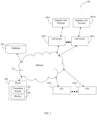
- Fig. 1 shows a diagram of a networked system 100 utilized to describe the various disclosed embodiments.
- the system 100 includes a network 110 which enables communication between the different elements of the system 100 that are connected to the network 110.
- the network 110 may include a cellular network, such as a third or fourth generation cellular network, e.g., the Global System for Mobile Communications (GSM) network, the Enhanced Data rates for GSM Evolution (EDGE) network, the Universal Mobile Telecommunications Service (UMTS) network, the Long-Term Evolution (LTE) network, LTE Advanced network, and the like.
- GSM Global System for Mobile Communications
- EDGE Enhanced Data rates for GSM Evolution
- UMTS Universal Mobile Telecommunications Service
- LTE Long-Term Evolution
- LTE Advanced network LTE Advanced network
- the system 100 further includes a server 120 that is connected to the network 110.
- the server 120 contains a hardware and a software component configured to execute predetermined computing tasks, and includes a processing circuitry 123 and a memory 125.
- the processing circuitry 123 may be realized as one or more hardware logic components and circuits.
- illustrative types of hardware logic components include field programmable gate arrays (FPGAs), application-specific integrated circuits (ASICs), application-specific standard products (ASSPs), system-on-a-chip systems (SOCs), general-purpose microprocessors, microcontrollers, digital signal processors (DSPs), and the like, or any other hardware logic components that can perform calculations or other manipulations of information.
- the memory 125 is configured to store software.
- Software shall be construed broadly to mean any type of instructions, whether referred to as software, firmware, middleware, microcode, hardware description language, or otherwise. Instructions may include code (e.g., in source code format, binary code format, executable code format, or any other suitable format of code). The instructions, when executed, cause the processing circuitry 123 to perform the various processes described herein.
- One or more user devices (UD) 130 are connected to the network 110, i.e., UD 130-1 through 130-n, where 'n' is an integer equal to or greater than 1.
- the UD 130 may be, for example, a smartphone, a mobile phone, a laptop, a tablet computer, a wearable computing device, and the like.
- the UD 130 may be configured to collect and upload data and real-time data captured by the UD 130, including, but not limited to, audio data, video data, location data and the like. Additionally, the UD 130 may connect to the network 110using voice calls as well as voice over internet protocol (VOIP).
- VOIP voice over internet protocol
- a call center 135 may be, for example, a public-safety answering point (PSAP) that is configured to receive calls made by citizens regarding emergency or non-emergency situations.
- PSAP routes the calls to a suitable dispatch unit, such as a dispatch unit terminal (DUT) 140 associated with a particular type of incident.
- DUT dispatch unit terminal
- a DUT 140 i.e. DUT 140-1 through DUT 140-m (where 'm' is an integer equal to or greater than 1), is an electronic end-point device for receiving emergency and non-emergency calls, live streaming data, data related to the UD 130, and the like.
- the call center 135 may forward a call to a fire department's DUT for a call regarding a fire, or a police's DUT for a call regarding a criminal act.
- the DUTs 140 may be connected to the network 110 directly, or via the call center 134.
- the system 100 further includes a database 150 connected to the network 110.
- the database 150 may be connected directly to the server 120 (not shown).
- the database 150 may be a data warehouse, a cloud database, and the like, designed to store therein data sent by, for example, the UD 130.
- the database may further be configured to be accessed by various other components of the system 100, including the call center 135 and the DUT 140.
- the server 120 is configured to detect an establishment or an attempted establishment of a first connection between a UD 130 and a call center 135.
- the first connection may be, for example, a voice call over a cellular network, such as a when a phone call is established between the user device and a call center.
- the UD 130 may be used to call an emergency response number, e.g., 9-1-1, via a cellular network.
- an attempt to establish a connection is determined when a call from a UD 130 is queued.
- the call is forwarded to a suitable DUT 140
- the server is configured to detect when a first connection is established between a UD 130 and a DUT 140, e.g., after the call center 135 routes a call from a UD 130 to an appropriate DUT 140.
- the server 120 is configured to detect the establishment or an attempted establishment of a first connection through an application programming interface (API) of a private branch exchange (PBX) of the call center 135. Through the API, the server 120 can search for an established (or queued) connection, and identify UDs 130 connected to a call center 135. The identification of a UD 130 may be based on its phone number or other unique parameters associated with the UD 130.
- API application programming interface
- PBX private branch exchange
- the server 120 Upon identification of the UD 130 and the call center 135 and/or the DUT 140, the server 120 is configured to send an electronic message to the UD 130 over a second connection over the network 110.
- the second connection is directly established between the server 120 and a UD 130 over the network 110.
- the electronic message may be, for example, a short message service (SMS), an MMS, an electronic mail (email) message, and the like.
- the electronic message includes at least a link that includes an identifier unique to the UD 130.
- the identifier may be, for example, a code snippet, a randomly generated string, a signature, and so on. Each identifier is uniquely generated for each UD 130 and therefore distinguishes any data sent from different UDs.
- the link may be, for example, a URL where the unique identifier may be the suffix of the URL, referencing a web address of the call center connected to the UD.
- the server 120 When the link has been engaged on the UD 130, e.g., selected, tapped, or clicked on, the server 120 is configured to launch an application on the UD 130.
- the application is a web browser, where the web browser includes an interface for uploading and/or streaming data.
- the web browser is utilized to upload or stream real-time data collected by the UD 130.
- the link sent to the UD 130 is configured to launch an instant application.
- Instant applications such as Google ® Android Instant Apps
- the instant application enables the UD 130 to rapidly open a designated application, such as an emergency application, and start uploading and/or streaming real-time data to the call center 135 (referenced in the link) without requiring any specialized application to be installed on the UD 130 beforehand.
- a designated application such as an emergency application
- start uploading and/or streaming real-time data to the call center 135 referenced in the link
- the link is engaged, only the necessary parts of an application's code are downloaded that enable the UD 130 to rapidly stream real-time data.
- significant and often critical time is saved, as an instant application can be downloaded and launched more quickly than a full application, thus allowing a UD 130 to begin streaming the real-time data quickly.
- Real-time data may include video, audio, and images captured by the UD 130, text messages, chats, location data and the like.
- the real-time data further includes GPS coordinates and/or indoor coordinates.
- the GPS coordinates may be provided by a GPS receiver installed in the UD 130.
- the indoor coordinates may be determined using Wi-Fi signals or other RF signals.
- a request for using at least one media-capturing component of the UD 130 is included in the link.
- the link may initiate the real-time streaming of just audio data, or just video data, to the call center 135.
- streaming the real-time data is achieved using a Web Real-Time Communication (WebRTC) API that enables real-time communication over peer-to-peer connections.
- WebRTC Web Real-Time Communication
- the server 120 may cause the UD 130 to establish a WebRTC session using a WebRTC API that would allow streaming real-time data from the UD 130 to the call center 135 and/or the DUT 140.
- WebRTC protocol typically includes the ability to connect two devices without requiring an intermediate server, thereby allowing for data to stream directly without requiring an intermediate server.
- some or all portions of the streaming data may be sent using other communication protocols, such as hypertext transfer protocol (HTTP), WebSocket, and so on.
- HTTP hypertext transfer protocol
- WebSocket WebSocket
- the real-time data is streamed from the UD 130 to a server, such as the server 120, in order to first convert the real-time data collected by the UD 130 into a format more suitable for streaming on a DUT 140.
- the conversion allows the end point devices of the call center 135 to receive, identify and use the real-time data sent initially from the UD 130 through the server 120.
- the server 120 is configured to send the converted real-time data to the call center 135 or directly to the DUT 140.
- any real-time data streamed or otherwise uploaded to the call center 135 is coupled with the unique identifier included in the link.
- the call center 135, e.g. a PSAP receives the real-time data with the identifier
- the call center 135 routes the received real-time data to a DUT 140 to which the UD 130 was connected to through the first connection.
- the real-time data is associated, at the first DUT 140, with at least an audio content that was received over the first connection. That is, when the real-time data is sent to the first DUT 140, the identifier that was included within the link is utilized for associating the real-time data with the at least audio content at the first DUT 140.
- the real-time data is sent from the UD 130 directly to the DUT 140 that it was connected to over the first connection.
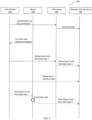
- Fig. 2 is a sequence diagram illustrating the method 200 according to the present disclosure.
- a call is initiated from a user device 130, e.g., a user dials 9-1-1 to report a robbery, and is first connected to a call center 135.
- the call is then forwarded to an appropriate DUT 140.
- the server 120 identifies the UD 130 and sends a link over a second connection, such as an SMS, to the UD 130.
- a web browser is launched, enabling the streaming of real-time data, such as video, audio, location data, and the like, from the UD 130 to the call center 135.
- the call center then forwards the real-time data to the DUT 140.
- the real-time data is sent directly to the DUT 140.
- the real-time data may be initially converted by the server 120 or a different proxy server (not shown) that is configured to convert the data from the UD 130 into a format that is optimized for the DUT 140 to review and analyze the data. After the conversion, the data is sent to the DUT 140.
- the server 120 is further configured to launch an application on the DUT 140 that is designed to display the streamed real-time date from the UD 130.
- the application may be, for example, a video player through which the real-time data is displayed and may enable a dispatch operator operating the DUT 140 to have a better perspective of the circumstances where the UD 130 is located.
- the server 120 is configured to use the identification of the UD 130, using for example, the phone number of the UD 130, to extract information associated with the user of the UD 130.
- the information may be related to, for example, the user's name, sensitivities to certain medications, blood type, disabilities, and so on.
- the information may be extracted from at least one source, such as the database 150, a web source, and the like, and sent to the DUT 140 together with the real-time data, such that the dispatch operator of the DUT 140 may be able to receive the additional information related to the user.
- the system 100 may be used by one user to assist another user.
- a first user associated with a first UD 130-1 may contact the call center 135 to report that a second user associated with a second UD 130-2 requires assistance.
- the first UD 130-1 may provide an identifier for the second UD 130-2, such as a phone number.
- the identifier of the second UD 130-2 may be received by the server 120, where the server 120 is configured to send a link to the second UD 130-2 over a second connection to initiate streaming of real-time data from the second UD 130-2.
- the system 100 may be utilized for reestablishing a connection between a UD 130 and the call center 135, or a specific DUT 140, upon identification that the connection was lost. For example, a first connection between a first UD 130-1 and a call center 135 is identified, and after a while the connection is lost.
- the server 120 uses the identifier, i.e. the phone number, associated with the first UD 130-1, for reestablishing the first connection with the first UD 130-1, and sends, over a second connection, a link to the first UD 130-1 in order to initiate streaming of real-time data from the first UD 130-1.
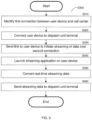
- Fig. 3 is a flowchart of the method 300 used by the system for streaming real-time data according to the present disclosure.
- the operation starts by identifying the establishment of a first connection between a user device and a call center.
- the first connection is passed over a network, such as a cellular or mobile network.
- the first connection includes a voice call or a VOIP call from a user device, such as a smartphone, to a call center, such as a PSAP.
- the call center determines what the nature of the call is, such as reporting a fire, a crime, a medical emergency, and the like.
- the user device is further connected to a dispatch unit terminal that is suitable for the situation.
- the dispatch unit terminal would be connected to a fire station if the scenario involves a fire, and a police station if the scenario involves a crime.
- the user device is identified. The identification may be achieved by identifying a phone number or other unique identifier associated with the user device.
- a link is sent to the user device over a second connection as further described herein above with respect of Figs. 1 and 2 .
- the link includes an identifier unique to the UD 130, and an instruction set to begin streaming data from the user device.
- an application is launched that includes an interface for streaming real-time data collected by the user device.
- the collection of data may include video or images from a camera, audio from a microphone, location data from a global positioning system, movement from an accelerometer, detected radio frequency signals, and the like.
- the real-time data is further associated with the user device by a unique identifier.
- the application that is launched is a web browser, namely an application primarily designed to display web pages from the internet.
- a web browser namely an application primarily designed to display web pages from the internet.
- the browser is capable of initiating and carrying out the streaming of data.
- user devices such as smartphones, tablets, personal computers and so on, come pre-installed with a browser application, there is no need to require additional downloading and installation of a specialized application, thus ensuring increased compatibility.
- the application can be an instant application, which is reduced version of a full application.
- An instant application can be initiated from within a browser when activated by a link, and involves downloading only portions of the application that are necessary for the desired task. Further, instant applications do not require a traditional installation on a user device. For example, while a full streaming application would require access to an application marketplace, and account associated with that marketplace, and the completion of a full installation, an instant application can be launched automatically, after only downloading a reduced version of the application, without requiring access to or an account associated with an application marketplace.
- the real-time data is first forwarded to a server, where it is converted into a format that is optimized to allow for quicker streaming of the user device data to the dispatch unit terminal.
- a unique identifier is associated with the real-time data, allowing the dispatch unit terminal to associate the data with the user device, even if the streaming is accomplished over a second or third connection.
- the real-time data is uploaded and sent to the dispatch unit.
- a peer to peer connection is established between the user device and the call center, where the real-time data is further forwarded to the dispatch unit terminal.
- a direct peer to peer connection is established between the user device and the dispatch unit terminal, where the real-time data is directly uploaded without an intermediary step.
- the streaming real-time data is transmitted to the dispatch unit terminal using the WebRTC (Web Real-Time Communication) protocol, which allows for real-time communication and transfer of audio, video, and other data directly from within a browser, without requiring the installation of a separate application.
- WebRTC can be used with many widely used browsers, both in mobile format (e.g., on a smartphone or a tablet), and desktop format (e.g., on a desktop or laptop computer).
- WebRTC employs APIs that can be executed over multiple platforms, e.g., over Windows ® , Android ® , iOS ® and Linux ® without requiring rewriting any of the code.
- a link to run browser for streaming real-time data can be executed over a variety of platforms without having to tailor the streaming procedure by individual device. This ensures expanded compatibility allowing for many user devices to successfully stream data.
- the phrase "at least one of” followed by a listing of items means that any of the listed items can be utilized individually, or any combination of two or more of the listed items can be utilized. For example, if a system is described as including "at least one of A, B, and C," the system can include A alone; B alone; C alone; A and B in combination; B and C in combination; A and C in combination; or A, B, and C in combination.
- the various embodiments disclosed herein can be implemented as hardware, firmware, software, or any combination thereof.
- the software is preferably implemented as an application program tangibly embodied on a program storage unit or computer readable medium consisting of parts, or of certain devices and/or a combination of devices.
- the application program may be uploaded to, and executed by, a machine comprising any suitable architecture.
- the machine is implemented on a computer platform having hardware such as one or more central processing units (“CPUs"), a memory, and input/output interfaces.
- CPUs central processing units
- the computer platform may also include an operating system and microinstruction code.
- a non-transitory computer readable medium is any computer readable medium except for a transitory propagating signal.
Landscapes
- Engineering & Computer Science (AREA)
- Signal Processing (AREA)
- Computer Networks & Wireless Communication (AREA)
- Business, Economics & Management (AREA)
- Multimedia (AREA)
- Emergency Management (AREA)
- General Business, Economics & Management (AREA)
- Health & Medical Sciences (AREA)
- Environmental & Geological Engineering (AREA)
- Public Health (AREA)
- Marketing (AREA)
- Human Computer Interaction (AREA)
- Telephonic Communication Services (AREA)
Description
- The present disclosure relates to a method and system of streaming data from a user device without the need to download and install a specialized application.
- Many mobile devices on the market today, including smartphones, tablets, notebook computers, and the like, come equipped with built-in media capturing components, including still cameras, video cameras, microphones, global positioning receivers, and the like. These components are used by millions of users to share photos and videos, use the internet for video chats, navigate roads with ease, along with a multitude of other uses.
- However, when a person calls an emergency or municipal dispatch unit to report an incident from a mobile device, these media capturing capabilities are rarely used. Rather, an operator of a call center, such as a public-safety answering point (PSAP), receives the incoming calls, asks the caller several questions to assess the nature of the incident, and then delivers the call to a suitable dispatch unit, such as police, firefighting, ambulance services, and the like.
- In many cases the calls received at these call centers are critical and every additional detail that can be retrieved from the call may help the dispatch operator better understand the situation in the field, and explain to the dispatched forces the situation before they arrive on-scene so they can be better prepared.
- Some communication applications allow the device to connected to a dispatch unit system, by which audio, video, messages, and the like can be transmitted to the call center system. Thus, the dispatch operator is able to hear the user, see video captured in real time by the user's device, e.g., a smart phone or tablet, send and receive text messages, identify the communication device location, and the like.
- However, these proposed systems require a user to download and install specialized applications, which may take time, losing precious moments of data. Further, in many emergency situations involving large numbers of individuals, available bandwidth of cellular networks become limited, as many devices attempt to connect the cellular networks at the same time. As such, communication and access to download applications over a cellular network may become unfeasible. Additionally, individuals experiencing a stressful emergency situation may be unfocused and unable to operate a previously installed application, let alone download and set up a new application on their devices.
- US Patent Application Pub. No
US20150056946A1 teaches systems and methods provide, to emergency operators at an emergency call center, the ability to communicate through textual messages with wireless mobile devices from which emergency voice calls have been placed. By virtue of such textual communication, callers using wireless mobile devices can receive emergency instructions and/or provide information about their current location. - It would therefore be advantageous to provide a solution that would overcome the challenges noted above.
- The invention is set out in the appended set of claims.
- The invention includes a method and a system for enabling streaming of real-time video data to a dispatch unit terminal, from a user device initiating an emergency call to a call center. The method implements initiating a call by a user using a user device to a call center, through a first communication connection of a network, identifying, by a server connected to said network said call and transmitting, by said server, through a second communication connection of said network a link to said user device following an identification of said user device, wherein said link, when activated, initiates streaming of real-time video data, the link further comprises a unique identifier associated with the user device, receiving, by said used device, through said second communication connection, said link and enabling the user of said user device to activate said link, upon identification, by said user device, of an activation of said link by the user of said user device, launching, on said user device, a web browser having a WebRTC, Web Real-Time Communication, interface configured to initiate streaming of real-time video data from the user device by establishing a WebRTC session for streaming said real-time video data, and sending the real-time video data, from said user device, through said WebRTC session and sending the unique identifier, to a dispatch unit terminal, wherein the unique identifier allows said dispatch unit terminal to associate the real-time video data with said user device ..
- Certain embodiments disclosed herein which are not according to the invention and are preset for illustration purposes only include a non-transitory computer readable medium having stored thereon instructions for causing a processing circuitry to perform a process, the process comprising: identifying a connection between a user device and a call center; sending a link to the user device, wherein the link comprises instructions to initiate streaming of real-time data from the user device, and further comprises a unique identifier associated with the user device; sending the real-time data to a dispatch unit terminal, wherein the unique identifier is used to match the real-time data with the dispatch terminal used in the connection.
- Certain embodiments disclosed herein which are not according to the invention and are preset for illustration purposes only include system for streaming real-time data from a user device to a dispatch unit terminal, comprising: a processing circuitry; and a memory, the memory containing instructions that, when executed by the processing circuitry, configure the system to: identify a connection between a user device and a call center; send a link to the user device, wherein the link comprises instructions to initiate streaming of real-time data from the user device, and further comprises a unique identifier associated with the user device; send the real-time data to a dispatch unit terminal, wherein the unique identifier is used to match the real-time data with the dispatch terminal used in the connection.
- The subject matter disclosed herein is particularly pointed out and distinctly claimed in the claims at the conclusion of the specification. The foregoing and other objects, features, and advantages of the disclosed embodiments will be apparent from the following detailed description taken in conjunction with the accompanying drawings.
-
Figure 1 is a network diagram of the system for streaming real-time data according to the present disclosure. -
Figure 2 is a sequence diagram illustrating the method according to the present disclosure. -
Figure 3 is a flowchart of the method used by the system for streaming real-time data according to the present disclosure. - In general, statements made in the specification may apply to some inventive features but not to others. In general, unless otherwise indicated, singular elements may be in plural and vice versa with no loss of generality. In the drawings, like numerals refer to like parts through several views.
- By way of example, the invention includes a method and system for streaming real-time data from a user device to a call center. The method includes identifying a first connection between a user device and a call center, such as a public-safety answering point (PSAP) for reporting on an emergency or non-emergency incident. The reporting is a call initiated between the call center and user device. Both the user device and the call center are identified, and a link, such as a uniform resource locator (URL), that includes an identifier unique to the user device is sent to the user device. Upon identification that the link was engaged, the user device is configured to initiate the uploading of streaming real-time data from the user device to the call center. In the present disclosure the uploaded real-time data is associated with the user device using the identifier. The uploading of data may be accomplished by a preinstalled application, or an instant application, on the user device, as explained herein. The real-time data is forwarded to a first dispatch unit terminal (DUT). According to optional embodiment, the first DUT receives the real-time data and associates the received data with at least an audio content received over the first connection.
-
Fig. 1 shows a diagram of a networkedsystem 100 utilized to describe the various disclosed embodiments. Thesystem 100 includes anetwork 110 which enables communication between the different elements of thesystem 100 that are connected to thenetwork 110. Thenetwork 110 may include a cellular network, such as a third or fourth generation cellular network, e.g., the Global System for Mobile Communications (GSM) network, the Enhanced Data rates for GSM Evolution (EDGE) network, the Universal Mobile Telecommunications Service (UMTS) network, the Long-Term Evolution (LTE) network, LTE Advanced network, and the like. - The
system 100 further includes aserver 120 that is connected to thenetwork 110. Theserver 120 contains a hardware and a software component configured to execute predetermined computing tasks, and includes aprocessing circuitry 123 and amemory 125. Theprocessing circuitry 123 may be realized as one or more hardware logic components and circuits. For example, and without limitation, illustrative types of hardware logic components that can be used include field programmable gate arrays (FPGAs), application-specific integrated circuits (ASICs), application-specific standard products (ASSPs), system-on-a-chip systems (SOCs), general-purpose microprocessors, microcontrollers, digital signal processors (DSPs), and the like, or any other hardware logic components that can perform calculations or other manipulations of information. - The
memory 125 is configured to store software. Software shall be construed broadly to mean any type of instructions, whether referred to as software, firmware, middleware, microcode, hardware description language, or otherwise. Instructions may include code (e.g., in source code format, binary code format, executable code format, or any other suitable format of code). The instructions, when executed, cause theprocessing circuitry 123 to perform the various processes described herein. - One or more user devices (UD) 130, are connected to the
network 110, i.e., UD 130-1 through 130-n, where 'n' is an integer equal to or greater than 1. The UD 130 may be, for example, a smartphone, a mobile phone, a laptop, a tablet computer, a wearable computing device, and the like. The UD 130 may be configured to collect and upload data and real-time data captured by the UD 130, including, but not limited to, audio data, video data, location data and the like. Additionally, the UD 130 may connect to the network 110using voice calls as well as voice over internet protocol (VOIP). - Also connected to the
network 110 are one ormore call centers 135, i.e. call center 135-1 through call center 135-z where 'z' is an integer equal to or greater than 1. Acall center 135 may be, for example, a public-safety answering point (PSAP) that is configured to receive calls made by citizens regarding emergency or non-emergency situations. The PSAP routes the calls to a suitable dispatch unit, such as a dispatch unit terminal (DUT) 140 associated with a particular type of incident. - A
DUT 140, i.e. DUT 140-1 through DUT 140-m (where 'm' is an integer equal to or greater than 1), is an electronic end-point device for receiving emergency and non-emergency calls, live streaming data, data related to theUD 130, and the like. For example, thecall center 135 may forward a call to a fire department's DUT for a call regarding a fire, or a police's DUT for a call regarding a criminal act. TheDUTs 140 may be connected to thenetwork 110 directly, or via the call center 134. - The
system 100 further includes adatabase 150 connected to thenetwork 110. Alternatively, thedatabase 150 may be connected directly to the server 120 (not shown). Thedatabase 150 may be a data warehouse, a cloud database, and the like, designed to store therein data sent by, for example, theUD 130. The database may further be configured to be accessed by various other components of thesystem 100, including thecall center 135 and theDUT 140. - According to the present disclosure, the
server 120 is configured to detect an establishment or an attempted establishment of a first connection between aUD 130 and acall center 135. The first connection may be, for example, a voice call over a cellular network, such as a when a phone call is established between the user device and a call center. For example, theUD 130 may be used to call an emergency response number, e.g., 9-1-1, via a cellular network. When the call is received at acall center 135, a first connection is established. An attempt to establish a connection is determined when a call from aUD 130 is queued. In an additional embodiment, the call is forwarded to asuitable DUT 140, and the server is configured to detect when a first connection is established between aUD 130 and aDUT 140, e.g., after thecall center 135 routes a call from aUD 130 to anappropriate DUT 140. - In the present disclosure, the
server 120 is configured to detect the establishment or an attempted establishment of a first connection through an application programming interface (API) of a private branch exchange (PBX) of thecall center 135. Through the API, theserver 120 can search for an established (or queued) connection, and identifyUDs 130 connected to acall center 135. The identification of aUD 130 may be based on its phone number or other unique parameters associated with theUD 130. - Upon identification of the
UD 130 and thecall center 135 and/or theDUT 140, theserver 120 is configured to send an electronic message to theUD 130 over a second connection over thenetwork 110. The second connection is directly established between theserver 120 and aUD 130 over thenetwork 110. The electronic message may be, for example, a short message service (SMS), an MMS, an electronic mail (email) message, and the like. The electronic message includes at least a link that includes an identifier unique to theUD 130. The identifier may be, for example, a code snippet, a randomly generated string, a signature, and so on. Each identifier is uniquely generated for eachUD 130 and therefore distinguishes any data sent from different UDs. The link may be, for example, a URL where the unique identifier may be the suffix of the URL, referencing a web address of the call center connected to the UD. - When the link has been engaged on the
UD 130, e.g., selected, tapped, or clicked on, theserver 120 is configured to launch an application on theUD 130. In the present disclosure, the application is a web browser, where the web browser includes an interface for uploading and/or streaming data. In this particular embodiment, the web browser is utilized to upload or stream real-time data collected by theUD 130. - In the present disclosure, the link sent to the
UD 130 is configured to launch an instant application. Instant applications, such as Google® Android Instant Apps, allow users to run applications instantly, without requiring a user to download and install a full application file. The instant application enables theUD 130 to rapidly open a designated application, such as an emergency application, and start uploading and/or streaming real-time data to the call center 135 (referenced in the link) without requiring any specialized application to be installed on theUD 130 beforehand. For example, when the link is engaged, only the necessary parts of an application's code are downloaded that enable theUD 130 to rapidly stream real-time data. By using an instant application, significant and often critical time is saved, as an instant application can be downloaded and launched more quickly than a full application, thus allowing aUD 130 to begin streaming the real-time data quickly. - Real-time data may include video, audio, and images captured by the
UD 130, text messages, chats, location data and the like. In another embodiment, the real-time data further includes GPS coordinates and/or indoor coordinates. The GPS coordinates may be provided by a GPS receiver installed in theUD 130. The indoor coordinates may be determined using Wi-Fi signals or other RF signals. In the present disclosure, a request for using at least one media-capturing component of theUD 130 is included in the link. For example, the link may initiate the real-time streaming of just audio data, or just video data, to thecall center 135. - According to the present disclosure, streaming the real-time data is achieved using a Web Real-Time Communication (WebRTC) API that enables real-time communication over peer-to-peer connections. When initiating the web browser on the
UD 130 to stream data to thecall center 135 and/or to theDUT 140, theserver 120 may cause theUD 130 to establish a WebRTC session using a WebRTC API that would allow streaming real-time data from theUD 130 to thecall center 135 and/or theDUT 140. WebRTC protocol typically includes the ability to connect two devices without requiring an intermediate server, thereby allowing for data to stream directly without requiring an intermediate server. - According to the present disclosure, some or all portions of the streaming data, such as the location of the
UD 130, audio data, and the like, may be sent using other communication protocols, such as hypertext transfer protocol (HTTP), WebSocket, and so on. - According to the present disclosure, the real-time data is streamed from the
UD 130 to a server, such as theserver 120, in order to first convert the real-time data collected by theUD 130 into a format more suitable for streaming on aDUT 140. The conversion allows the end point devices of thecall center 135 to receive, identify and use the real-time data sent initially from theUD 130 through theserver 120. Theserver 120 is configured to send the converted real-time data to thecall center 135 or directly to theDUT 140. - Any real-time data streamed or otherwise uploaded to the
call center 135 is coupled with the unique identifier included in the link. In the present disclosure where the real-time data is streamed to thecall center 135, after thecall center 135, e.g. a PSAP, receives the real-time data with the identifier, thecall center 135 routes the received real-time data to aDUT 140 to which theUD 130 was connected to through the first connection. - According to the present disclosure, the real-time data is associated, at the
first DUT 140, with at least an audio content that was received over the first connection. That is, when the real-time data is sent to thefirst DUT 140, the identifier that was included within the link is utilized for associating the real-time data with the at least audio content at thefirst DUT 140. In an alternative embodiment, the real-time data is sent from theUD 130 directly to theDUT 140 that it was connected to over the first connection. -
Fig. 2 is a sequence diagram illustrating themethod 200 according to the present disclosure. As a non-limiting example, a call is initiated from auser device 130, e.g., a user dials 9-1-1 to report a robbery, and is first connected to acall center 135. The call is then forwarded to anappropriate DUT 140. When the call is answered, or while still in queue, by theDUT 140, theserver 120 identifies theUD 130 and sends a link over a second connection, such as an SMS, to theUD 130. When the user engages the link, a web browser is launched, enabling the streaming of real-time data, such as video, audio, location data, and the like, from theUD 130 to thecall center 135. The call center then forwards the real-time data to theDUT 140. - In the present disclosure, the real-time data is sent directly to the
DUT 140. As further described herein above, the real-time data may be initially converted by theserver 120 or a different proxy server (not shown) that is configured to convert the data from theUD 130 into a format that is optimized for theDUT 140 to review and analyze the data. After the conversion, the data is sent to theDUT 140. - In the present disclosure, the
server 120 is further configured to launch an application on theDUT 140 that is designed to display the streamed real-time date from theUD 130. The application may be, for example, a video player through which the real-time data is displayed and may enable a dispatch operator operating theDUT 140 to have a better perspective of the circumstances where theUD 130 is located. - According to the present disclosure, the
server 120 is configured to use the identification of theUD 130, using for example, the phone number of theUD 130, to extract information associated with the user of theUD 130. The information may be related to, for example, the user's name, sensitivities to certain medications, blood type, disabilities, and so on. The information may be extracted from at least one source, such as thedatabase 150, a web source, and the like, and sent to theDUT 140 together with the real-time data, such that the dispatch operator of theDUT 140 may be able to receive the additional information related to the user. - According to the present disclosure, the
system 100 may be used by one user to assist another user. For example, a first user associated with a first UD 130-1 may contact thecall center 135 to report that a second user associated with a second UD 130-2 requires assistance. The first UD 130-1 may provide an identifier for the second UD 130-2, such as a phone number. The identifier of the second UD 130-2 may be received by theserver 120, where theserver 120 is configured to send a link to the second UD 130-2 over a second connection to initiate streaming of real-time data from the second UD 130-2. - According to the present disclosure, the
system 100 may be utilized for reestablishing a connection between aUD 130 and thecall center 135, or aspecific DUT 140, upon identification that the connection was lost. For example, a first connection between a first UD 130-1 and acall center 135 is identified, and after a while the connection is lost. Theserver 120 uses the identifier, i.e. the phone number, associated with the first UD 130-1, for reestablishing the first connection with the first UD 130-1, and sends, over a second connection, a link to the first UD 130-1 in order to initiate streaming of real-time data from the first UD 130-1. -
Fig. 3 is a flowchart of the method 300 used by the system for streaming real-time data according to the present disclosure. At S310, the operation starts by identifying the establishment of a first connection between a user device and a call center. The first connection is passed over a network, such as a cellular or mobile network. For example, the first connection includes a voice call or a VOIP call from a user device, such as a smartphone, to a call center, such as a PSAP. The call center determines what the nature of the call is, such as reporting a fire, a crime, a medical emergency, and the like. - At S320, the user device is further connected to a dispatch unit terminal that is suitable for the situation. For example, the dispatch unit terminal would be connected to a fire station if the scenario involves a fire, and a police station if the scenario involves a crime. Further, the user device is identified. The identification may be achieved by identifying a phone number or other unique identifier associated with the user device.
- At S330, based on the identification of the user device, and the specific dispatch unit terminal to which it has been connected over the first connection, a link is sent to the user device over a second connection as further described herein above with respect of
Figs. 1 and2 . The link includes an identifier unique to theUD 130, and an instruction set to begin streaming data from the user device. - At S340, based on determination of whether the link was engaged on the user device, e.g., tapped, selected, clicked on, and the like, an application is launched that includes an interface for streaming real-time data collected by the user device. The collection of data may include video or images from a camera, audio from a microphone, location data from a global positioning system, movement from an accelerometer, detected radio frequency signals, and the like. The real-time data is further associated with the user device by a unique identifier.
- In the present disclosure the application that is launched is a web browser, namely an application primarily designed to display web pages from the internet. As many browser applications have native support for the uploading of real-time data, such as audio recordings, images, video and the like, the browser is capable of initiating and carrying out the streaming of data. Further, as most commonly used user devices, such as smartphones, tablets, personal computers and so on, come pre-installed with a browser application, there is no need to require additional downloading and installation of a specialized application, thus ensuring increased compatibility.
- The application can be an instant application, which is reduced version of a full application. An instant application can be initiated from within a browser when activated by a link, and involves downloading only portions of the application that are necessary for the desired task. Further, instant applications do not require a traditional installation on a user device. For example, while a full streaming application would require access to an application marketplace, and account associated with that marketplace, and the completion of a full installation, an instant application can be launched automatically, after only downloading a reduced version of the application, without requiring access to or an account associated with an application marketplace.
- At optional S350, the real-time data is first forwarded to a server, where it is converted into a format that is optimized to allow for quicker streaming of the user device data to the dispatch unit terminal. A unique identifier is associated with the real-time data, allowing the dispatch unit terminal to associate the data with the user device, even if the streaming is accomplished over a second or third connection.
- At S360, the real-time data is uploaded and sent to the dispatch unit. In the present disclosure, a peer to peer connection is established between the user device and the call center, where the real-time data is further forwarded to the dispatch unit terminal. In another embodiment, a direct peer to peer connection is established between the user device and the dispatch unit terminal, where the real-time data is directly uploaded without an intermediary step.
- The streaming real-time data is transmitted to the dispatch unit terminal using the WebRTC (Web Real-Time Communication) protocol, which allows for real-time communication and transfer of audio, video, and other data directly from within a browser, without requiring the installation of a separate application. WebRTC can be used with many widely used browsers, both in mobile format (e.g., on a smartphone or a tablet), and desktop format (e.g., on a desktop or laptop computer). WebRTC employs APIs that can be executed over multiple platforms, e.g., over Windows®, Android®, iOS® and Linux® without requiring rewriting any of the code. Thus, a link to run browser for streaming real-time data can be executed over a variety of platforms without having to tailor the streaming procedure by individual device. This ensures expanded compatibility allowing for many user devices to successfully stream data.
- As used herein, the phrase "at least one of" followed by a listing of items means that any of the listed items can be utilized individually, or any combination of two or more of the listed items can be utilized. For example, if a system is described as including "at least one of A, B, and C," the system can include A alone; B alone; C alone; A and B in combination; B and C in combination; A and C in combination; or A, B, and C in combination.
- The various embodiments disclosed herein can be implemented as hardware, firmware, software, or any combination thereof. Moreover, the software is preferably implemented as an application program tangibly embodied on a program storage unit or computer readable medium consisting of parts, or of certain devices and/or a combination of devices. The application program may be uploaded to, and executed by, a machine comprising any suitable architecture. Preferably, the machine is implemented on a computer platform having hardware such as one or more central processing units ("CPUs"), a memory, and input/output interfaces. The computer platform may also include an operating system and microinstruction code. The various processes and functions described herein may be either part of the microinstruction code or part of the application program, or any combination thereof, which may be executed by a CPU, whether or not such a computer or processing circuitry is explicitly shown. In addition, various other peripheral units may be connected to the computer platform such as an additional data storage unit and a printing unit. Furthermore, a non-transitory computer readable medium is any computer readable medium except for a transitory propagating signal.
Claims (10)
- A method for enabling streaming of real-time video data to a dispatch unit terminal (140) from a user device (130) initiating an emergency call to a call center (135), comprising:initiating a call by a user using a user device (130) to a call center (135), through a first communication connection of a network (110);forwarding the call to the dispatch unit terminal (140);identifying, by a server (120) connected to said network (110), said call and transmitting, by said server (120), through a second communication connection of said network (110), a link to said user device (130) following an identification of said user device (130), wherein said link comprises instructions that, when activated, initiates streaming of real-time video data from the user device (130) to a dispatch unit terminal (140), the link further comprises a unique identifier associated with the user device (130);receiving, by said user device (130), through said second communication connection, said link and enabling the user of said user device (130) to activate said link;upon identification, by said user device (130), of an activation of said link by the user of said user device (130), launching, on said user device, a web browser having a WebRTC, Web Real-Time Communication, interface configured to initiate streaming of real-time video data from the user device by establishing a WebRTC session for streaming said real-time video data; andsending the real-time video data coupled with the unique identifier, from said user device (130), through said WebRTC session directly to the dispatch unit terminal (140), wherein the unique identifier is utilized by said dispatch unit terminal (140) to associate the real-time video data with audio content of the emergency call being forwarded by the call centre to the dispatch unit terminal; andwherein the first connection is a voice call over a cellular network.
- The method of claim 1, wherein the link is configured to initiate the streaming of the real-time data via an application on the user device (130).
- The method of any of the previous claims, wherein the unique identifier is a phone number associated with the user device (130).
- The method of any of the previous claims, wherein said sending the real-time video data includes sending said real-time video data to said server (120), which converts the real-time data for use by the dispatch unit terminal and sends the real-time data to the dispatch unit terminal (140).
- The method of claim 1, wherein said link is a Uniform Resource Locator (URL).
- A system (120) for enabling streaming of real-time video data to a dispatch unit terminal (140), from a user device (130) initiating an emergency call to a call center (135), the system (120) comprising:a dispatch unit terminal (140);a user device (130);a call center (135); anda server (120) comprising:a processing circuitry (123); anda memory (125), the memory containing computer instructions that, when executed by the processing circuitry (123), configure the server (120) to:identify a call initiated by a user device (130) to the call center (135), through a first communication connection of a network (110); andsend, through a second communication connection of said network (110), a link to the user device (130), following an identification of said user device, the link is made available to be activated by a user of said user device (130);wherein the link comprises instructions that, when activated, initiates streaming of real-time video data from the user device (130) to the dispatch unit terminal (140), the link further comprises a unique identifier associated with the user device (130) that is utilized by the dispatch unit terminal (140) to associate the streamed real-time video data with audio content of the emergency call being forwarded by the call centre to the dispatch unit terminal when said user device (130) sends said real time video data coupled with the unique identifier directly to said dispatch unit (140);wherein said initiating streaming of real- time video data from the user device (130) by activation of said link comprises launching a web browser having a WebRCT, Web Real-Time Communication, interface configured to initiate streaming of real-time video data from the user device (130), by establishing a WebRTC session for streaming said real-time video data coupled with the unique identifier, to the dispatch unit terminal (140);wherein said link, when activated, further instructs the user device (130) to send said real-time video data coupled with the unique identifier to said dispatch unit terminal (140), through said WebRCT session; andwherein the first connection is a voice call over a cellular network.
- The system of claim 6, wherein the link is configured to initiate the streaming of the real-time video data via an application on the user device (130); wherein the application comprises at least one of: a browser and an instant application, said instant application allowing said user to run said application without downloading and installing a full application on said user device.
- The system of any of claims 6-7, wherein said computer instructions further comprising instructions that when executed by the processor circuitry (123) further configure the system to:receive the real-time video data sent from said user device (130);convert the real-time data for use by the dispatch unit terminal (140); andsend the converted real-time video data to the dispatch unit terminal (140).
- The method of claim 2, wherein the application comprises at least one of: a browser and an instant application, said instant application allowing said user to run said application without downloading and installing a full application on said user device.
- The method of any of claims 1-5 and 9, wherein said identifying said call is conducted at said server (120) through an application programming interface (API) of a private branch exchange (PBX) of said call center (135).
Priority Applications (1)
| Application Number | Priority Date | Filing Date | Title |
|---|---|---|---|
| EP22152510.8A EP4007324A1 (en) | 2017-08-13 | 2018-08-13 | Method for streaming real-time data from a user device to a dispatch unit terminal |
Applications Claiming Priority (2)
| Application Number | Priority Date | Filing Date | Title |
|---|---|---|---|
| US201762544835P | 2017-08-13 | 2017-08-13 | |
| US15/822,927 US10686618B2 (en) | 2017-08-13 | 2017-11-27 | Method for streaming real-time data from a user device to a dispatch unit terminal |
Related Child Applications (2)
| Application Number | Title | Priority Date | Filing Date |
|---|---|---|---|
| EP22152510.8A Division-Into EP4007324A1 (en) | 2017-08-13 | 2018-08-13 | Method for streaming real-time data from a user device to a dispatch unit terminal |
| EP22152510.8A Division EP4007324A1 (en) | 2017-08-13 | 2018-08-13 | Method for streaming real-time data from a user device to a dispatch unit terminal |
Publications (3)
| Publication Number | Publication Date |
|---|---|
| EP3445016A1 EP3445016A1 (en) | 2019-02-20 |
| EP3445016B1 EP3445016B1 (en) | 2022-03-09 |
| EP3445016B2 true EP3445016B2 (en) | 2025-05-07 |
Family
ID=63442391
Family Applications (2)
| Application Number | Title | Priority Date | Filing Date |
|---|---|---|---|
| EP22152510.8A Pending EP4007324A1 (en) | 2017-08-13 | 2018-08-13 | Method for streaming real-time data from a user device to a dispatch unit terminal |
| EP18188748.0A Active EP3445016B2 (en) | 2017-08-13 | 2018-08-13 | Method for streaming real-time data from a user device to a dispatch unit terminal |
Family Applications Before (1)
| Application Number | Title | Priority Date | Filing Date |
|---|---|---|---|
| EP22152510.8A Pending EP4007324A1 (en) | 2017-08-13 | 2018-08-13 | Method for streaming real-time data from a user device to a dispatch unit terminal |
Country Status (2)
| Country | Link |
|---|---|
| US (6) | US10686618B2 (en) |
| EP (2) | EP4007324A1 (en) |
Families Citing this family (7)
| Publication number | Priority date | Publication date | Assignee | Title |
|---|---|---|---|---|
| US10686618B2 (en) | 2017-08-13 | 2020-06-16 | Carbyne Ltd. | Method for streaming real-time data from a user device to a dispatch unit terminal |
| US11593082B2 (en) * | 2020-04-10 | 2023-02-28 | Apple Inc. | Registered applications for electronic devices |
| US12047529B2 (en) | 2020-08-24 | 2024-07-23 | Motorola Solutions, Inc. | Method and apparatus for identifying a fake video call |
| JP7577983B2 (en) * | 2020-11-30 | 2024-11-06 | ブラザー工業株式会社 | Image forming device |
| CN114466322B (en) * | 2022-02-15 | 2024-01-23 | 阿里巴巴(中国)有限公司 | Communication method, system, device, storage medium and processor |
| US12596780B2 (en) * | 2022-06-27 | 2026-04-07 | Capital One Services, LLC. | Techniques to perform dynamic call center authentication utilizing a contactless card |
| CN120151376B (en) * | 2025-05-14 | 2025-09-02 | 奥特酷智能科技(南京)有限公司 | Vehicle diagnostic log data real-time access system and method |
Family Cites Families (43)
| Publication number | Priority date | Publication date | Assignee | Title |
|---|---|---|---|---|
| US7751826B2 (en) | 2002-10-24 | 2010-07-06 | Motorola, Inc. | System and method for E911 location privacy protection |
| US20050176441A1 (en) | 2004-02-06 | 2005-08-11 | Jurecka Joseph W. | Method and apparatus for locating mobile stations in a wireless telecommunications system |
| US20100261492A1 (en) | 2004-08-06 | 2010-10-14 | Powerphone, Inc. | Integrated call handler and email systems and methods |
| KR20070015766A (en) * | 2005-08-01 | 2007-02-06 | (주)판도라티비 | Personal video broadcasting system and service method using internet |
| US8145183B2 (en) | 2005-09-23 | 2012-03-27 | University Of South Florida | On-demand emergency notification system using GPS-equipped devices |
| US8270935B2 (en) | 2007-12-05 | 2012-09-18 | Apple Inc. | Method and system for prolonging emergency calls |
| US20100174560A1 (en) | 2008-03-27 | 2010-07-08 | Tom Quan | Method, system and apparatus for assembling data associated with an emergency call event |
| US8358744B2 (en) | 2009-02-27 | 2013-01-22 | Centurylink Intellectual Property Llc | Teletypewriter (TTY) for communicating pre-stored emergency messages to public safety answering points (PSAPS) |
| US9237431B2 (en) | 2009-10-13 | 2016-01-12 | Verizon Patent And Licensing Inc. | Method and apparatus for extended emergency service |
| US8509731B2 (en) | 2009-11-06 | 2013-08-13 | Research In Motion Limited | Location determination for mobile devices in emergency situations |
| US8504090B2 (en) | 2010-03-29 | 2013-08-06 | Motorola Solutions, Inc. | Enhanced public safety communication system |
| US8630610B2 (en) | 2010-07-28 | 2014-01-14 | Cisco Technology, Inc. | Call to call center as trigger to capture and record other geographically relevant data |
| US8538468B2 (en) | 2010-12-14 | 2013-09-17 | At&T Mobility Ii Llc | Provision of text messages to emergency call takers |
| CA2760342C (en) | 2011-01-26 | 2018-07-24 | The Goodyear Tire & Rubber Company | Management of roadside service requests |
| US8811939B2 (en) | 2011-02-07 | 2014-08-19 | Qualcomm Incorporated | Method and/or apparatus for location privacy via uniform resource identifier provisioning |
| US20140007158A1 (en) | 2012-06-29 | 2014-01-02 | Cable Television Laboratories, Inc. | Emergency alert system (eas) alert generation |
| US9167379B1 (en) | 2012-12-17 | 2015-10-20 | Tritech Software Systems | Automatic location-based emergency response system |
| US8976939B1 (en) | 2013-01-29 | 2015-03-10 | Tritech Software Systems | Prioritization of emergency calls |
| US9854420B2 (en) | 2013-02-28 | 2017-12-26 | Anand SUNDARARAJ | Method and system for optimal emergency communication |
| US9247291B2 (en) | 2013-03-13 | 2016-01-26 | Echostar Technologies L.L.C. | Systems and methods for securely providing adaptive bit rate streaming media content on-demand |
| US9792654B1 (en) * | 2013-03-15 | 2017-10-17 | United Services Automobile Association (Usaa) | Insurance claim processing via streaming video |
| US10694149B2 (en) * | 2013-03-26 | 2020-06-23 | Verizon Patent And Licensing Inc. | Web based security system |
| EP2992692B1 (en) | 2013-05-04 | 2018-08-29 | DECHARMS, Christopher | Mobile security technology |
| CN104283760B (en) * | 2013-07-04 | 2018-05-04 | 华为技术有限公司 | A kind of WebRTC communication means, relevant device and system |
| US9414225B2 (en) * | 2013-07-23 | 2016-08-09 | Broadcom Corporation | User equipment having web real time communication architecture |
| US9113030B2 (en) | 2013-07-25 | 2015-08-18 | Verizon Patent And Licensing Inc. | Multimedia-enhanced emergency call systems |
| US10033862B2 (en) | 2013-08-05 | 2018-07-24 | Avaya Inc. | Emergency request prior insight delivery |
| US9301117B2 (en) | 2013-08-21 | 2016-03-29 | Tritech Software Systems | SMS communication during emergencies |
| US20150086946A1 (en) | 2013-09-20 | 2015-03-26 | David A. Mandina | NDT File Cabinet |
| US9820119B2 (en) | 2013-10-09 | 2017-11-14 | SWN Communications, Inc. | Method and systems for lockbox secured file transmission |
| US9628566B2 (en) * | 2013-10-15 | 2017-04-18 | Verizon Patent And Licensing Inc. | Communication of data of a web real-time communication via a carrier-grade environment |
| KR101563172B1 (en) | 2014-05-20 | 2015-10-27 | (주) 타우피엔유메디칼 | Tissue protective device for the cerclage annuloplasty procedure |
| DE102014009495B4 (en) | 2014-06-26 | 2020-07-23 | Unify Gmbh & Co. Kg | Method for establishing a communication connection suitable for the transmission of media streams from a first RTC client to a second RTC client |
| US9942739B2 (en) | 2014-09-19 | 2018-04-10 | Rapidsos, Inc. | Method and system for emergency call management |
| US20160037126A1 (en) | 2014-10-21 | 2016-02-04 | Livegenic Inc. | Real-Time Visual Customer Support Enablement System and Method |
| EP3235274A4 (en) | 2014-12-18 | 2018-07-04 | Qualcomm Incorporated | Techniques to support emergency calls with over-the-top service provider |
| US10356589B2 (en) * | 2015-05-15 | 2019-07-16 | Rave Wireless, Inc. | Real-time over the top 9-1-1 caller location data |
| US9871835B2 (en) * | 2015-06-27 | 2018-01-16 | Avaya Inc. | System and method for managing multi-modal communication sessions |
| FR3039030A1 (en) * | 2015-07-17 | 2017-01-20 | Orange | METHOD AND DEVICE FOR ESTABLISHING WEBRTC COMMUNICATIONS |
| US9888122B2 (en) | 2015-07-29 | 2018-02-06 | Genesys Telecommunications Laboratories, Inc. | System and method for dynamic call diversion |
| WO2017079354A1 (en) | 2015-11-02 | 2017-05-11 | Rapidsos, Inc. | Method and system for situational awareness for emergency response |
| CN108702409A (en) | 2015-12-17 | 2018-10-23 | 快速求救公司 | Apparatus and method for effective emergency calling |
| US10686618B2 (en) | 2017-08-13 | 2020-06-16 | Carbyne Ltd. | Method for streaming real-time data from a user device to a dispatch unit terminal |
-
2017
- 2017-11-27 US US15/822,927 patent/US10686618B2/en active Active
-
2018
- 2018-08-13 EP EP22152510.8A patent/EP4007324A1/en active Pending
- 2018-08-13 EP EP18188748.0A patent/EP3445016B2/en active Active
-
2020
- 2020-06-15 US US16/901,074 patent/US11139996B2/en active Active
-
2021
- 2021-10-04 US US17/492,757 patent/US11716217B2/en active Active
-
2022
- 2022-09-13 US US17/943,956 patent/US11689383B2/en active Active
-
2023
- 2023-05-09 US US18/195,257 patent/US12309207B2/en active Active
-
2025
- 2025-05-19 US US19/212,069 patent/US20250280044A1/en active Pending
Non-Patent Citations (8)
| Title |
|---|
| "New app to allow 999 callers to live stream from the scene of emergencies", ITV NEWS REPORT, 22 October 2014 (2014-10-22), XP093007049, Retrieved from the Internet <URL:https://www.itv.com/news/central/2014-10-22/new-app-to-allow-999-callers-to-live-stream-from-the-scene-of-emergencies> † |
| HEGGIE-COLLINS SAM: "Capita and West Midlands Fire Service launch 999EYE", 7 November 2016 (2016-11-07), XP093013742, Retrieved from the Internet <URL:https://directorsclub.news/2016/11/07/captiva-and-west-midlands-fire-service-launch-999eye> † |
| Mobile Mark, "BAPCO ANNUAL CONFERENCE AND EXHIBITION"21.03.2017, [cited 14.11.2022] † |
| PageOne, "999EYE wins BAPCO Innovation Award" [cited 14.11.2022] † |
| Release notes provided by Apple for Safari version 11.0 archive date of 14November2017:https//web archive org/web/20171114193322/https7/developer apple.com/library/content/release notes/General/Whats New ln Safari/Safan_11_0/Safari_11_0 html" † |
| Safari 11 now available for macOS Sierra and OS X El Capitan’’ by Michael Potuck dated 19 September 2017 on https://9to5mac.com/ accessible on https //web archive.org/web/20170919231428/https //9to5mac com/2017/09/19/safari-11/ † |
| WEST MIDLANDS FIRE SERVICE: "Two years of 999eye", YOUTUBE, 15 November 2018 (2018-11-15), Retrieved from the Internet <URL:https://www.youtube.com/watch?v=8E-DVij0km8> † |
| YouTube, "Two years of 999EYE"15 11 2018, [cited 14.11.2022]Available from: [https //www. youtube com/watch?v=8E-D\/ij0km8] † |
Also Published As
| Publication number | Publication date |
|---|---|
| US20230275778A1 (en) | 2023-08-31 |
| US12309207B2 (en) | 2025-05-20 |
| US11689383B2 (en) | 2023-06-27 |
| US20230006854A1 (en) | 2023-01-05 |
| US11139996B2 (en) | 2021-10-05 |
| US20190052474A1 (en) | 2019-02-14 |
| US20250280044A1 (en) | 2025-09-04 |
| EP4007324A1 (en) | 2022-06-01 |
| US10686618B2 (en) | 2020-06-16 |
| US20220029846A1 (en) | 2022-01-27 |
| US11716217B2 (en) | 2023-08-01 |
| EP3445016B1 (en) | 2022-03-09 |
| US20200313922A1 (en) | 2020-10-01 |
| EP3445016A1 (en) | 2019-02-20 |
Similar Documents
| Publication | Publication Date | Title |
|---|---|---|
| US11689383B2 (en) | System, method, and computer-readable medium for streaming real-time data from a user device | |
| US11956853B2 (en) | Apparatus and method for obtaining emergency data and providing a map view | |
| US8301463B2 (en) | Emergency alert feature on a mobile communication device | |
| US10069872B2 (en) | Architecture to establish serverless WebRTC connections | |
| US9882865B1 (en) | Multiple phone numbers for mobile device | |
| US20160104368A1 (en) | Sos quick capture | |
| US20170034358A1 (en) | Method and system for processing interactive voice response input in a call setup message | |
| CN114245057B (en) | Audio and video call method, device, equipment and storage medium based on insurance business | |
| US10728375B2 (en) | International one-way recorded transmitter over a cellular network | |
| US10841429B1 (en) | Handling unanswered calls for alternate phone number on mobile device | |
| JP6173681B2 (en) | COMMUNICATION SYSTEM, CONTROL DEVICE, AND PROGRAM | |
| US11785131B2 (en) | Enhanced text-to-911 system via cloud-based page service | |
| US9742924B2 (en) | Methods for handing over a circuit switched call to an internet protocol call and related electronic devices and computer program products | |
| US20140364090A1 (en) | Gateway for voice communication | |
| JP2015039217A (en) | Voice communication system, method, communication terminal, and program | |
| US12598220B2 (en) | RCS proxy system and method for PSAP sessions | |
| WO2022147352A9 (en) | Apparatus and method for handling mobile device emergency data payloads | |
| WO2020063462A1 (en) | Control method for media display and related products |
Legal Events
| Date | Code | Title | Description |
|---|---|---|---|
| PUAI | Public reference made under article 153(3) epc to a published international application that has entered the european phase |
Free format text: ORIGINAL CODE: 0009012 |
|
| STAA | Information on the status of an ep patent application or granted ep patent |
Free format text: STATUS: REQUEST FOR EXAMINATION WAS MADE |
|
| 17P | Request for examination filed |
Effective date: 20180813 |
|
| AK | Designated contracting states |
Kind code of ref document: A1 Designated state(s): AL AT BE BG CH CY CZ DE DK EE ES FI FR GB GR HR HU IE IS IT LI LT LU LV MC MK MT NL NO PL PT RO RS SE SI SK SM TR |
|
| AX | Request for extension of the european patent |
Extension state: BA ME |
|
| STAA | Information on the status of an ep patent application or granted ep patent |
Free format text: STATUS: EXAMINATION IS IN PROGRESS |
|
| 17Q | First examination report despatched |
Effective date: 20201030 |
|
| GRAP | Despatch of communication of intention to grant a patent |
Free format text: ORIGINAL CODE: EPIDOSNIGR1 |
|
| STAA | Information on the status of an ep patent application or granted ep patent |
Free format text: STATUS: GRANT OF PATENT IS INTENDED |
|
| INTG | Intention to grant announced |
Effective date: 20210927 |
|
| GRAS | Grant fee paid |
Free format text: ORIGINAL CODE: EPIDOSNIGR3 |
|
| GRAA | (expected) grant |
Free format text: ORIGINAL CODE: 0009210 |
|
| STAA | Information on the status of an ep patent application or granted ep patent |
Free format text: STATUS: THE PATENT HAS BEEN GRANTED |
|
| RAP3 | Party data changed (applicant data changed or rights of an application transferred) |
Owner name: CARBYNE LTD. |
|
| AK | Designated contracting states |
Kind code of ref document: B1 Designated state(s): AL AT BE BG CH CY CZ DE DK EE ES FI FR GB GR HR HU IE IS IT LI LT LU LV MC MK MT NL NO PL PT RO RS SE SI SK SM TR |
|
| REG | Reference to a national code |
Ref country code: CH Ref legal event code: EP Ref country code: AT Ref legal event code: REF Ref document number: 1475078 Country of ref document: AT Kind code of ref document: T Effective date: 20220315 |
|
| REG | Reference to a national code |
Ref country code: IE Ref legal event code: FG4D |
|
| REG | Reference to a national code |
Ref country code: DE Ref legal event code: R096 Ref document number: 602018031873 Country of ref document: DE |
|
| REG | Reference to a national code |
Ref country code: LT Ref legal event code: MG9D |
|
| REG | Reference to a national code |
Ref country code: NL Ref legal event code: MP Effective date: 20220309 |
|
| PG25 | Lapsed in a contracting state [announced via postgrant information from national office to epo] |
Ref country code: SE Free format text: LAPSE BECAUSE OF FAILURE TO SUBMIT A TRANSLATION OF THE DESCRIPTION OR TO PAY THE FEE WITHIN THE PRESCRIBED TIME-LIMIT Effective date: 20220309 Ref country code: RS Free format text: LAPSE BECAUSE OF FAILURE TO SUBMIT A TRANSLATION OF THE DESCRIPTION OR TO PAY THE FEE WITHIN THE PRESCRIBED TIME-LIMIT Effective date: 20220309 Ref country code: NO Free format text: LAPSE BECAUSE OF FAILURE TO SUBMIT A TRANSLATION OF THE DESCRIPTION OR TO PAY THE FEE WITHIN THE PRESCRIBED TIME-LIMIT Effective date: 20220609 Ref country code: LT Free format text: LAPSE BECAUSE OF FAILURE TO SUBMIT A TRANSLATION OF THE DESCRIPTION OR TO PAY THE FEE WITHIN THE PRESCRIBED TIME-LIMIT Effective date: 20220309 Ref country code: HR Free format text: LAPSE BECAUSE OF FAILURE TO SUBMIT A TRANSLATION OF THE DESCRIPTION OR TO PAY THE FEE WITHIN THE PRESCRIBED TIME-LIMIT Effective date: 20220309 Ref country code: BG Free format text: LAPSE BECAUSE OF FAILURE TO SUBMIT A TRANSLATION OF THE DESCRIPTION OR TO PAY THE FEE WITHIN THE PRESCRIBED TIME-LIMIT Effective date: 20220609 |
|
| REG | Reference to a national code |
Ref country code: AT Ref legal event code: MK05 Ref document number: 1475078 Country of ref document: AT Kind code of ref document: T Effective date: 20220309 |
|
| PG25 | Lapsed in a contracting state [announced via postgrant information from national office to epo] |
Ref country code: LV Free format text: LAPSE BECAUSE OF FAILURE TO SUBMIT A TRANSLATION OF THE DESCRIPTION OR TO PAY THE FEE WITHIN THE PRESCRIBED TIME-LIMIT Effective date: 20220309 Ref country code: GR Free format text: LAPSE BECAUSE OF FAILURE TO SUBMIT A TRANSLATION OF THE DESCRIPTION OR TO PAY THE FEE WITHIN THE PRESCRIBED TIME-LIMIT Effective date: 20220610 Ref country code: FI Free format text: LAPSE BECAUSE OF FAILURE TO SUBMIT A TRANSLATION OF THE DESCRIPTION OR TO PAY THE FEE WITHIN THE PRESCRIBED TIME-LIMIT Effective date: 20220309 |
|
| PG25 | Lapsed in a contracting state [announced via postgrant information from national office to epo] |
Ref country code: NL Free format text: LAPSE BECAUSE OF FAILURE TO SUBMIT A TRANSLATION OF THE DESCRIPTION OR TO PAY THE FEE WITHIN THE PRESCRIBED TIME-LIMIT Effective date: 20220309 |
|
| PG25 | Lapsed in a contracting state [announced via postgrant information from national office to epo] |
Ref country code: SM Free format text: LAPSE BECAUSE OF FAILURE TO SUBMIT A TRANSLATION OF THE DESCRIPTION OR TO PAY THE FEE WITHIN THE PRESCRIBED TIME-LIMIT Effective date: 20220309 Ref country code: SK Free format text: LAPSE BECAUSE OF FAILURE TO SUBMIT A TRANSLATION OF THE DESCRIPTION OR TO PAY THE FEE WITHIN THE PRESCRIBED TIME-LIMIT Effective date: 20220309 Ref country code: RO Free format text: LAPSE BECAUSE OF FAILURE TO SUBMIT A TRANSLATION OF THE DESCRIPTION OR TO PAY THE FEE WITHIN THE PRESCRIBED TIME-LIMIT Effective date: 20220309 Ref country code: PT Free format text: LAPSE BECAUSE OF FAILURE TO SUBMIT A TRANSLATION OF THE DESCRIPTION OR TO PAY THE FEE WITHIN THE PRESCRIBED TIME-LIMIT Effective date: 20220711 Ref country code: ES Free format text: LAPSE BECAUSE OF FAILURE TO SUBMIT A TRANSLATION OF THE DESCRIPTION OR TO PAY THE FEE WITHIN THE PRESCRIBED TIME-LIMIT Effective date: 20220309 Ref country code: EE Free format text: LAPSE BECAUSE OF FAILURE TO SUBMIT A TRANSLATION OF THE DESCRIPTION OR TO PAY THE FEE WITHIN THE PRESCRIBED TIME-LIMIT Effective date: 20220309 Ref country code: CZ Free format text: LAPSE BECAUSE OF FAILURE TO SUBMIT A TRANSLATION OF THE DESCRIPTION OR TO PAY THE FEE WITHIN THE PRESCRIBED TIME-LIMIT Effective date: 20220309 Ref country code: AT Free format text: LAPSE BECAUSE OF FAILURE TO SUBMIT A TRANSLATION OF THE DESCRIPTION OR TO PAY THE FEE WITHIN THE PRESCRIBED TIME-LIMIT Effective date: 20220309 |
|
| PG25 | Lapsed in a contracting state [announced via postgrant information from national office to epo] |
Ref country code: PL Free format text: LAPSE BECAUSE OF FAILURE TO SUBMIT A TRANSLATION OF THE DESCRIPTION OR TO PAY THE FEE WITHIN THE PRESCRIBED TIME-LIMIT Effective date: 20220309 Ref country code: IS Free format text: LAPSE BECAUSE OF FAILURE TO SUBMIT A TRANSLATION OF THE DESCRIPTION OR TO PAY THE FEE WITHIN THE PRESCRIBED TIME-LIMIT Effective date: 20220709 Ref country code: AL Free format text: LAPSE BECAUSE OF FAILURE TO SUBMIT A TRANSLATION OF THE DESCRIPTION OR TO PAY THE FEE WITHIN THE PRESCRIBED TIME-LIMIT Effective date: 20220309 |
|
| REG | Reference to a national code |
Ref country code: DE Ref legal event code: R026 Ref document number: 602018031873 Country of ref document: DE |
|
| PLBI | Opposition filed |
Free format text: ORIGINAL CODE: 0009260 |
|
| PLAX | Notice of opposition and request to file observation + time limit sent |
Free format text: ORIGINAL CODE: EPIDOSNOBS2 |
|
| 26 | Opposition filed |
Opponent name: DENTONS UK AND MIDDLE EAST LLP Effective date: 20221209 |
|
| PG25 | Lapsed in a contracting state [announced via postgrant information from national office to epo] |
Ref country code: DK Free format text: LAPSE BECAUSE OF FAILURE TO SUBMIT A TRANSLATION OF THE DESCRIPTION OR TO PAY THE FEE WITHIN THE PRESCRIBED TIME-LIMIT Effective date: 20220309 |
|
| PG25 | Lapsed in a contracting state [announced via postgrant information from national office to epo] |
Ref country code: SI Free format text: LAPSE BECAUSE OF FAILURE TO SUBMIT A TRANSLATION OF THE DESCRIPTION OR TO PAY THE FEE WITHIN THE PRESCRIBED TIME-LIMIT Effective date: 20220309 |
|
| PG25 | Lapsed in a contracting state [announced via postgrant information from national office to epo] |
Ref country code: MC Free format text: LAPSE BECAUSE OF FAILURE TO SUBMIT A TRANSLATION OF THE DESCRIPTION OR TO PAY THE FEE WITHIN THE PRESCRIBED TIME-LIMIT Effective date: 20220309 |
|
| REG | Reference to a national code |
Ref country code: CH Ref legal event code: PL |
|
| PG25 | Lapsed in a contracting state [announced via postgrant information from national office to epo] |
Ref country code: LU Free format text: LAPSE BECAUSE OF NON-PAYMENT OF DUE FEES Effective date: 20220813 Ref country code: LI Free format text: LAPSE BECAUSE OF NON-PAYMENT OF DUE FEES Effective date: 20220831 Ref country code: CH Free format text: LAPSE BECAUSE OF NON-PAYMENT OF DUE FEES Effective date: 20220831 |
|
| PLBB | Reply of patent proprietor to notice(s) of opposition received |
Free format text: ORIGINAL CODE: EPIDOSNOBS3 |
|
| REG | Reference to a national code |
Ref country code: BE Ref legal event code: MM Effective date: 20220831 |
|
| PG25 | Lapsed in a contracting state [announced via postgrant information from national office to epo] |
Ref country code: IT Free format text: LAPSE BECAUSE OF FAILURE TO SUBMIT A TRANSLATION OF THE DESCRIPTION OR TO PAY THE FEE WITHIN THE PRESCRIBED TIME-LIMIT Effective date: 20220309 Ref country code: IE Free format text: LAPSE BECAUSE OF NON-PAYMENT OF DUE FEES Effective date: 20220813 |
|
| PG25 | Lapsed in a contracting state [announced via postgrant information from national office to epo] |
Ref country code: BE Free format text: LAPSE BECAUSE OF NON-PAYMENT OF DUE FEES Effective date: 20220831 |
|
| PG25 | Lapsed in a contracting state [announced via postgrant information from national office to epo] |
Ref country code: HU Free format text: LAPSE BECAUSE OF FAILURE TO SUBMIT A TRANSLATION OF THE DESCRIPTION OR TO PAY THE FEE WITHIN THE PRESCRIBED TIME-LIMIT; INVALID AB INITIO Effective date: 20180813 |
|
| PG25 | Lapsed in a contracting state [announced via postgrant information from national office to epo] |
Ref country code: CY Free format text: LAPSE BECAUSE OF FAILURE TO SUBMIT A TRANSLATION OF THE DESCRIPTION OR TO PAY THE FEE WITHIN THE PRESCRIBED TIME-LIMIT Effective date: 20220309 |
|
| PG25 | Lapsed in a contracting state [announced via postgrant information from national office to epo] |
Ref country code: MK Free format text: LAPSE BECAUSE OF FAILURE TO SUBMIT A TRANSLATION OF THE DESCRIPTION OR TO PAY THE FEE WITHIN THE PRESCRIBED TIME-LIMIT Effective date: 20220309 |
|
| PLBP | Opposition withdrawn |
Free format text: ORIGINAL CODE: 0009264 |
|
| PG25 | Lapsed in a contracting state [announced via postgrant information from national office to epo] |
Ref country code: MT Free format text: LAPSE BECAUSE OF FAILURE TO SUBMIT A TRANSLATION OF THE DESCRIPTION OR TO PAY THE FEE WITHIN THE PRESCRIBED TIME-LIMIT Effective date: 20220309 |
|
| REG | Reference to a national code |
Ref country code: CH Ref legal event code: PK Free format text: BERICHTIGUNGEN |
|
| RIC2 | Information provided on ipc code assigned after grant |
Ipc: H04W 4/14 20090101ALN20241106BHEP Ipc: H04W 4/02 20180101ALN20241106BHEP Ipc: H04W 4/90 20180101ALI20241106BHEP Ipc: H04L 67/146 20220101ALI20241106BHEP Ipc: H04L 65/1046 20220101ALI20241106BHEP Ipc: H04L 65/1096 20220101ALI20241106BHEP Ipc: H04L 65/1053 20220101ALI20241106BHEP Ipc: H04L 65/1069 20220101AFI20241106BHEP |
|
| PUAH | Patent maintained in amended form |
Free format text: ORIGINAL CODE: 0009272 |
|
| STAA | Information on the status of an ep patent application or granted ep patent |
Free format text: STATUS: PATENT MAINTAINED AS AMENDED |
|
| 27A | Patent maintained in amended form |
Effective date: 20250507 |
|
| AK | Designated contracting states |
Kind code of ref document: B2 Designated state(s): AL AT BE BG CH CY CZ DE DK EE ES FI FR GB GR HR HU IE IS IT LI LT LU LV MC MK MT NL NO PL PT RO RS SE SI SK SM TR |
|
| REG | Reference to a national code |
Ref country code: DE Ref legal event code: R102 Ref document number: 602018031873 Country of ref document: DE |
|
| PGFP | Annual fee paid to national office [announced via postgrant information from national office to epo] |
Ref country code: DE Payment date: 20250828 Year of fee payment: 8 |
|
| PGFP | Annual fee paid to national office [announced via postgrant information from national office to epo] |
Ref country code: GB Payment date: 20250829 Year of fee payment: 8 |
|
| PGFP | Annual fee paid to national office [announced via postgrant information from national office to epo] |
Ref country code: FR Payment date: 20250829 Year of fee payment: 8 |
|
| PG25 | Lapsed in a contracting state [announced via postgrant information from national office to epo] |
Ref country code: TR Free format text: LAPSE BECAUSE OF FAILURE TO SUBMIT A TRANSLATION OF THE DESCRIPTION OR TO PAY THE FEE WITHIN THE PRESCRIBED TIME-LIMIT Effective date: 20220309 |