EP3444150A1 - Sicherung einer funkkommunikation für fahrzeug-zugangssysteme - Google Patents
Sicherung einer funkkommunikation für fahrzeug-zugangssysteme Download PDFInfo
- Publication number
- EP3444150A1 EP3444150A1 EP18177089.2A EP18177089A EP3444150A1 EP 3444150 A1 EP3444150 A1 EP 3444150A1 EP 18177089 A EP18177089 A EP 18177089A EP 3444150 A1 EP3444150 A1 EP 3444150A1
- Authority
- EP
- European Patent Office
- Prior art keywords
- connection
- transmitter
- control device
- communication
- connection parameters
- Prior art date
- Legal status (The legal status is an assumption and is not a legal conclusion. Google has not performed a legal analysis and makes no representation as to the accuracy of the status listed.)
- Granted
Links
Images

Classifications
-
- H—ELECTRICITY
- H04—ELECTRIC COMMUNICATION TECHNIQUE
- H04L—TRANSMISSION OF DIGITAL INFORMATION, e.g. TELEGRAPHIC COMMUNICATION
- H04L63/00—Network architectures or network communication protocols for network security
- H04L63/04—Network architectures or network communication protocols for network security for providing a confidential data exchange among entities communicating through data packet networks
- H04L63/0428—Network architectures or network communication protocols for network security for providing a confidential data exchange among entities communicating through data packet networks wherein the data content is protected, e.g. by encrypting or encapsulating the payload
-
- B—PERFORMING OPERATIONS; TRANSPORTING
- B60—VEHICLES IN GENERAL
- B60R—VEHICLES, VEHICLE FITTINGS, OR VEHICLE PARTS, NOT OTHERWISE PROVIDED FOR
- B60R25/00—Fittings or systems for preventing or indicating unauthorised use or theft of vehicles
- B60R25/20—Means to switch the anti-theft system on or off
-
- H—ELECTRICITY
- H04—ELECTRIC COMMUNICATION TECHNIQUE
- H04B—TRANSMISSION
- H04B1/00—Details of transmission systems, not covered by a single one of groups H04B3/00 - H04B13/00; Details of transmission systems not characterised by the medium used for transmission
- H04B1/69—Spread spectrum techniques
- H04B1/713—Spread spectrum techniques using frequency hopping
-
- H—ELECTRICITY
- H04—ELECTRIC COMMUNICATION TECHNIQUE
- H04W—WIRELESS COMMUNICATION NETWORKS
- H04W12/00—Security arrangements; Authentication; Protecting privacy or anonymity
- H04W12/08—Access security
-
- H—ELECTRICITY
- H04—ELECTRIC COMMUNICATION TECHNIQUE
- H04W—WIRELESS COMMUNICATION NETWORKS
- H04W76/00—Connection management
- H04W76/10—Connection setup
-
- B—PERFORMING OPERATIONS; TRANSPORTING
- B60—VEHICLES IN GENERAL
- B60R—VEHICLES, VEHICLE FITTINGS, OR VEHICLE PARTS, NOT OTHERWISE PROVIDED FOR
- B60R2325/00—Indexing scheme relating to vehicle anti-theft devices
- B60R2325/10—Communication protocols, communication systems of vehicle anti-theft devices
- B60R2325/101—Bluetooth®
-
- B—PERFORMING OPERATIONS; TRANSPORTING
- B60—VEHICLES IN GENERAL
- B60R—VEHICLES, VEHICLE FITTINGS, OR VEHICLE PARTS, NOT OTHERWISE PROVIDED FOR
- B60R2325/00—Indexing scheme relating to vehicle anti-theft devices
- B60R2325/10—Communication protocols, communication systems of vehicle anti-theft devices
- B60R2325/108—Encryption
-
- H—ELECTRICITY
- H04—ELECTRIC COMMUNICATION TECHNIQUE
- H04W—WIRELESS COMMUNICATION NETWORKS
- H04W4/00—Services specially adapted for wireless communication networks; Facilities therefor
- H04W4/80—Services using short range communication, e.g. near-field communication [NFC], radio-frequency identification [RFID] or low energy communication
Definitions
- the invention relates to a method for securing radio links in access systems for vehicles.
- a radio system is integrated, which can communicate with a so-called ID transmitter, which carries an authorized user with him.
- ID transmitter can be a radio key
- mobile communication systems in particular smartphones, have increasingly been used for access.
- mobile communication systems involve communication capabilities that are not proprietary to a radio key, but are routinely subject to a publicly available standard.
- such access systems can rely on short range radio communication standards, such as the Bluetooth standard.
- Such standardized communication protocols often use frequency spreading methods for wireless data transmission, for example the Frequency Hopping Spread Spectrum (FHSS) method.
- FHSS Frequency Hopping Spread Spectrum
- the carrier frequency (channel) of wireless data transmission changes over time in discrete jumps. Both the sequence of frequency changes and the residence time on a frequency can be varied.
- Such methods are generally more favorable in terms of susceptibility and security against eavesdropping than methods without frequency spreading.
- an ID transmitter for example, a smartphone with an application for access to the vehicle
- a control device in the vehicle due to the frequency change is more difficult, but in principle is also there a monitoring possible.
- the attacker may intercept a frequency change information from the communication between the control device in the vehicle and the ID transmitter. If successful, a so-called relay station attacks can be carried out even with such a radio connection.
- the document EP 1747955 B1 discloses a method in which communication between a radio key and a vehicle is secured by establishing a frequency pattern in accordance with a random number and performing communication based on this frequency pattern. In addition, on the vehicle side it is checked whether other carrier frequencies deviating from the agreed frequency pattern are emitted in the surroundings of the vehicle, in which case, if this is ascertained, the communication or legitimization is interrupted.
- the object of the invention is an improved method for securing communications between a vehicle and to provide its control device and a mobile ID transmitter, in particular a mobile communication device.
- a communication connection between an ID transmitter and the control device in the vehicle is initially established.
- the connection parameters are established according to a proprietary protocol or a standard protocol.
- a Bluetooth connection this is done, for example, such that one of the participating units, for example the ID transmitter, sends a pairing request to the vehicle-side control device, which responds with a pairing response.
- a key is exchanged between the devices according to an established connection method. Then a mutual authentication and the generation of a secret key. Then an encrypted Bluetooth connection is established.
- a so-called long-term key is created and exchanged, which is stored in both devices and used to derive a new key each time an encrypted connection is picked up again.
- the connection parameters are not changed according to a standardized algorithm, eg according to the Bluetooth standard, but the frequency changes and / or residence times can be changed according to a different algorithm or specifications specified by the exchanged connection parameters. Therefore, the advantage of the invention is to carry out the construction of the invention according to a standardized protocol, while then there is a proprietary negotiation of the connection parameters and the physical properties of the frequency spreading method via the encrypted exchanged connection parameters.
- the invention uses the approach of changing the connection parameters of a communication connection after establishing an encrypted data connection, from first connection parameters to second connection parameters, these second connection parameters being exchanged only after the encrypted data connection has been established.
- connection parameters can be exchanged again with each new connection as soon as the connection is encrypted and thus secure against eavesdropping.
- the frequency hopping table, the hop duration (jump duration), RSSI level or also the output power come into consideration as connection parameters and also their change in predetermined patterns or time intervals.
- connection parameters contain a frequency sequence of carrier frequencies.
- the transmitter and receiver use the same start parameter and are synchronized in time, the transmitter and receiver simultaneously change to the appropriate frequencies, each frequency or each channel being active only for a certain period of time.
- the starting parameter can be used as connection parameter or a parameter specifying the sequence of frequencies or channels.
- the dwell time on a channel or frequency can also be stored in the connection parameters. It is essential that On the one hand, the connection parameters are exchanged according to a standardized method, but after establishing a communication connection and data communication established thereon, which is encrypted, new connection parameters according to the invention are determined and exchanged. Then, the communication link subject to data communication is switched according to these new connection parameters. Thereafter, the communication connection is performed according to the new connection parameters, whereby the superordinate data communication is continued.
- It may preferably be provided to initiate the backup of the data communication only when access to functions of the vehicle takes place.
- the establishment of a secure data communication and an exchange of changed connection parameters can be triggered.
- the user and wearer of an ID transmitter accesses a door handle of a vehicle.
- a basic connection in the form of a Bluetooth network between the ID transmitter and the control device of the vehicle.
- the access to the door handle is detected by a sensor, in particular a capacitive sensor.
- the vehicle-mounted control device triggers the construction of a secure data communication.
- the ID transmitter and the control device establish a data connection.
- a software-side encryption is established and with existing encrypted connection, the new connection parameters are exchanged.
- the communication link subject to data communication is switched according to these new connection parameters.
- the communication connection becomes according to the new connection parameters carried out, wherein the parent, software-encrypted data communication is continued.
- This procedure has the advantage that the energy-intensive encrypted data connection is activated only when necessary and thus the energy requirement of the ID transmitter is reduced.
- an ID transmitter of a passive entry system for a motor vehicle is in a communication readiness according to the Bluetooth standard.
- the ID transmitter can be addressed in passive mode according to this Bluetooth standard.
- the ID transmitter approaches a vehicle with associated control device, which controls the passive access system on the vehicle side and can release functions in the vehicle.
- the vehicle-mounted control device sends inquiry messages in step 15 according to the Bluetooth standard. If the ID transmitter arrives in the transmission range of the control device and receives the inquiry messages, a connection between the ID transmitter and the control device of the vehicle is established in accordance with the Bluetooth standard. For this purpose, a synchronization between ID transmitter and in step 20 in the known manner Control (paging) made.
- an encrypted data connection is to be understood as a software-controlled encryption.
- step 50 new connection parameters are generated and exchanged.
- the generation of new connection parameters can basically be done both in the ID transmitter and the control device in the vehicle. Preferably, however, it is due to the lower risk of manipulation in the control device of the vehicle.
- the newly generated connection parameter for example a start parameter for generation of a sequence of pseudorandom numbers which determine a series of hopping frequencies, will accordingly be present in both devices after replacement.
- the connection parameter exchanged over this encrypted connection is used at step 60 to connect the communication connection subject to the encrypted data connection according to the second connection Reconfigure connection parameters.
- the type and the sequence of the frequency spreading method are reconfigured. This increases the security of a communication link over the conventional method because the actual physical data transfer is reconfigured with channel changes or channel utilization durations according to a parameter of an encrypted connection.
- the parent encrypted data connection continues.
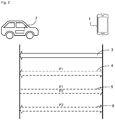
- FIG. 2 the components and the procedure of the procedure are visualized in a diagram.
- the ID transmitter 1 is formed in this example in a smartphone with an application running on it.
- a controller 2 in a vehicle provides a wireless interface for communication with the ID transmitter 1.
- connection 4 is established according to a wireless communication standard (e.g., Bluetooth) using a frequency spreading method, wherein connection parameters P1 of the frequency spreading method determine the connection.
- a wireless communication standard e.g., Bluetooth
- connection parameters P2 are transmitted from the control device 2 to the ID transmitter 1. Subsequently, the connection 6 between the control device 2 and the ID transmitter 1 is newly established with connection parameters P2 of the frequency spreading method.
- connection parameters P2 were transmitted within the connection 5, it is not possible for outsiders to understand the new connection parameters P2.
Landscapes
- Engineering & Computer Science (AREA)
- Computer Networks & Wireless Communication (AREA)
- Signal Processing (AREA)
- Computer Security & Cryptography (AREA)
- Mechanical Engineering (AREA)
- Computer Hardware Design (AREA)
- Computing Systems (AREA)
- General Engineering & Computer Science (AREA)
- Mobile Radio Communication Systems (AREA)
- Lock And Its Accessories (AREA)
Abstract
Description
- Die Erfindung betrifft ein Verfahren zur Absicherung von Funkverbindungen bei Zugangssystemen für Fahrzeuge.
- Es ist bekannt, Benutzern von Fahrzeugen einen Zugang zum Fahrzeug ohne aktive Schlüsselverwendung zu ermöglichen. Dazu stehen sogenannte Keyless-Entry- und Keyless-Go-Systeme zur Verfügung. In solch vorbereiteten Fahrzeugen ist ein Funksystem integriert, dass mit einem sogenannten ID-Geber kommunizieren kann, den ein berechtigter Benutzer bei sich trägt. Ein solcher ID-Geber kann grundsätzlich ein Funkschlüssel sein, in jüngerer Zeit werden jedoch auch zunehmend mobile Kommunikationssysteme, insbesondere Smartphones für den Zugang verwendet. Derartige mobile Kommunikationssysteme bringen standardmäßig Kommunikationsfähigkeiten mit sich, die nicht proprietär wie bei einem Funkschlüssel sind, sondern regelmäßig einem allgemein zugänglichen Standard unterliegen.
- Insbesondere können solche Zugangssysteme auf Funkkommunikationsstandards mit kurzer Reichweite zurückgreifen, wie beispielsweise den Bluetooth-Standard.
- Derart standardisierte Kommunikationsprotokolle nutzen häufig Frequenzspreizverfahren für die drahtlose Datenübertragung, beispielsweise das Verfahren Frequency Hopping Spread Spectrum (FHSS). Bei diesem Verfahren wechselt die Trägerfrequenz (der Kanal) einer drahtlosen Datenübertragung über die Zeit in diskreten Sprüngen. Sowohl die Folge der Frequenzwechsel als auch die Verweildauer auf einer Frequenz kann dabei variiert werden. Solche Verfahren sind grundsätzlich hinsichtlich Störanfälligkeit und auch Abhörsicherheit günstiger als Verfahren ohne Frequenzspreizung.
- Bei Fahrzeugen und funkbasierten Zugangssystemen besteht grundsätzlich die Gefahr, dass Funkkommunikationen abgehört oder verlängert werden. Auf diese Weise sind sogenannte Relay-Station-Attacken möglich, bei denen eine Funkstrecke zwischen einem Fahrzeug und einem autorisierenden ID-Geber verlängert werden. Damit ist selbst dann Zugriff auf ein Fahrzeug möglich, wenn sich der zugehörige ID-Geber eigentlich außerhalb der Reichweite des Fahrzeuges befindet, weil eine dazwischen befindliche Funkstrecke von einem Angreifer mit mehreren Funkstationen verlängert wird.
- Bei der Nutzung des Bluetooth-Protokolls oder einem anderen Protokoll unter Verwendung von Frequenzspreizverfahren ist eine Verbindung zwischen einem ID-Geber (beispielsweise einem Smartphone mit einer Applikation zum Zugang zum Fahrzeug) und einer Steuereinrichtung im Fahrzeug aufgrund der Frequenzwechsel zwar schwieriger, grundsätzlich ist jedoch auch dort ein Mithören möglich. Der Angreifer kann eine Frequenzwechsel-Information aus der Kommunikation zwischen der Steuereinrichtung im Fahrzeug und dem ID-Geber abhören. Ist dies erfolgreich gelungen, kann selbst bei einer solchen Funkverbindung eine sogenannte Relay-Station-Attacken ausgeführt werden.
- Das Dokument
EP 1747955 B1 offenbart ein Verfahren, bei dem eine Kommunikation zwischen einem Funkschlüssel und einem Fahrzeug gesichert wird, indem ein Frequenzmuster in Abhängigkeit von einer Zufallszahl erstellt wird und eine Kommunikation auf Grundlage dieses Frequenzmusters durchgeführt wird. Außerdem wird fahrzeugseitig geprüft, ob von dem vereinbarten Frequenzmuster abweichende weitere Trägerfrequenzen in der Umgebung des Fahrzeuges abgestrahlt werden, wobei dann, wenn dies festgestellt wird, die Kommunikation oder Legitimation abgebrochen wird. - Aufgabe der Erfindung ist es, ein verbessertes Verfahren zur Absicherung von Kommunikationen zwischen einem Fahrzeug und dessen Steuereinrichtung und einem mobilen ID-Geber, insbesondere einem mobilen Kommunikationsgerät bereitzustellen.
- Diese Aufgabe wird durch ein Verfahren mit den Merkmalen des Patentanspruches 1 gelöst.
- Gemäß der Erfindung wird sichergestellt, dass ein Angreifer nicht in der Lage ist, die Funkkommunikation zwischen ID-Geber und fahrzeugseitiger Steuereinrichtung zu verfolgen.
- Erfindungsgemäß wird zunächst eine Kommunikationsverbindung zwischen einem ID-Geber und der Steuereinrichtung im Fahrzeug aufgebaut. Dazu werden die Verbindungsparameter gemäß einem proprietären Protokoll oder einem Standardprotokoll etabliert. Im Falle einer Bluetooth-Verbindung geschieht dies beispielsweise so, dass eine der beteiligten Einheiten, beispielsweise der ID-Geber, einen Pairing-Request an die fahrzeugseitige Steuereinrichtung sendet, welche mit einer Pairing-Response antwortet. Anschließend wird ein Schlüssel zwischen den Einrichtungen gemäß einem etablierten Verbindungsverfahren ausgetauscht. Dann erfolgen eine gegenseitige Authentifizierung und die Generierung eines geheimen Schlüssels. Anschließend ist eine verschlüsselte Bluetooth-Verbindung etabliert.
- Dazu wird bei einer Bluetooth-Low-Energy-Verbindung beispielsweise ein sogenannter Long-Term-Key erstellt und ausgetauscht, welcher in beiden Geräten gespeichert wird und zur Ableitung eines neuen Schlüssels bei jeder erneuten Aufnahme einer verschlüsselten Verbindung verwendet wird.
- Gemäß der Erfindung wird dann, wenn die gesicherte und verschlüsselte Datenverbindung auf der unterliegenden Kommunikationsverbindung aufgebaut ist, zwischen den verbundenen Geräten ein Austausch geänderter Verbindungsparameter vorgenommen. Die verschlüsselte Datenverbindung wird entsprechend genutzt, um geänderte Verbindungsparameter, insbesondere Parameter der Frequenzspreizung auszutauschen. Im Falle des Bluetooth-Standards bedeutet dies, sobald eine verschlüsselte Datenverbindung etabliert ist, wird die Sequenz der Frequenzwechsel und ggf. die Kanal-Verweildauer verändert. Auf den Inhalt der verschlüsselten Verbindung hat ein Angreifer keinen Zugriff. Entsprechend kann die Relay-Station-Attacke den nun geänderten Frequenzwechseln und Sprungdauern nicht folgen. Der Angreifer ist nicht in der Lage, die Funkstrecke zu verlängern oder zu manipulieren. Dabei werden die Verbindungsparameter nicht nach einem standardisierten Algorithmus geändert, z.B. gemäß dem Bluetooth-Standard, sondern die Frequenzwechsel oder/und Verweildauern können gemäß einem abweichenden Algorithmus oder Vorgaben geändert werden, die durch die ausgetauschten Verbindungsparameter spezifiziert werden. Daher liegt der Vorteil der Erfindung darin, den Aufbau der Erfindung gemäß einem standardisierten Protokollvorzunehmen, während dann eine proprietäre Aushandlung der Verbindungsparameter und der physikalischen Eigenschaften des Frequenzspreizverfahrens über die verschlüsselt ausgetauschten Verbindungsparameter erfolgt.
- Entsprechend nutzt die Erfindung den Ansatz, die Verbindungsparameter eine Kommunikationsverbindung nach Etablierung einer verschlüsselten Datenverbindung, von ersten Verbindungsparametern hin zu zweiten Verbindungsparametern zu ändern, wobei diese zweiten Verbindungsparameter erst nach Erstellung der verschlüsselten Datenverbindung ausgetauscht werden.
- Dabei gilt, dass die Verbindungsparameter bei jeder neuen Verbindung erneut ausgetauscht werden können, sobald die Verbindung verschlüsselt und damit abhörsicher ist. Als Verbindungsparameter kommt dabei insbesondere die Frequenzsprungtabelle, die Hopp-Dauer (Sprungdauer), RSSI-Pegel oder auch die Ausgangsleistung in Frage und auch deren Änderung in vorgegebenen Mustern oder Zeitintervallen.
- Bei der Nutzung des Bluetooth-Protokolls ergibt sich dabei insbesondere der Vorteil, dass zunächst für einen Verbindungsaufbau ein energiesparender Advertising-Betriebsmodus aktiviert werden kann und erst bei sicherheitsrelevanten Situationen, beispielsweise dem Zugriff auf das Fahrzeug oder den Motorstart, in den für einen Energieverbrauch ungünstigeren verschlüsselten Connected-Mode übergegangen werden kann, in welchem dann Verbindungsparameter geändert und ausgetauscht werden.
- In einer vorteilhaften Ausführungsform der Erfindung enthalten die Verbindungsparameter eine Frequenzabfolge von Trägerfrequenzen.
- Es ist in Verfahren zur Frequenzspreizung, insbesondere beim sogenannten Frequency Hopping Spread Spectrum (FHSS)-Verfahren bekannt, eine Kommunikationsverbindung mit zeitlich wechselnden Kanälen zu nutzen. Die auf der Kommunikationsverbindung ausgeführte Datenverbindung wird also kontinuierlich gehalten, die unterliegende Kommunikationsverbindung wechselt jedoch in synchronisierter Weise zwischen Sender und Empfänger über verschiedene Kanäle. Dieses Verfahren wird beispielsweise beim Bluetooth-Standard verwendet. Eine Nutzung dieser Frequenzwechsel erfolgt jedoch üblicherweise erst im sogenannten Connected-Mode des Bluetooth-Verfahrens. Das bei Bluetooth verwendete Frequenzspreizungsverfahren verwendet 79 Kanäle die innerhalb des 2,4 GHz-Bandes liegen, wobei jeder der Kanäle 1 MHz breit ist. Ein Generator für Pseudozufallszahlen erzeugt eine Folge von Frequenzen auf die gewechselt wird. Verwenden dabei Sender und Empfänger den gleichen Startparameter und sind dabei zeitlich synchronisiert, wechseln Sender und Empfänger gleichzeitig auf die passenden Frequenzen, wobei jede Frequenz bzw. jeder Kanal nur für eine gewisse Zeitspanne aktiv ist. Als Verbindungsparameter kann in einem solchen Fall der Startparameter verwandt werden oder ein Parameter, welcher die Abfolge von Frequenzen oder Kanälen spezifiziert. Auch die Verweildauer auf einem Kanal oder einer Frequenz kann in den Verbindungsparametern hinterlegt sein. Wesentlich ist, dass einerseits die Verbindungsparameter gemäß einem standardisierten Verfahren ausgetauscht werden, nach Herstellung einer Kommunikationsverbindung und darauf etablierten Datenkommunikation, welche verschlüsselt ist, werden jedoch neue Verbindungsparameter gemäß der Erfindung ermittelt und ausgetauscht. Dann wird die der Datenkommunikation unterliegende Kommunikationsverbindung gemäß diesen neuen Verbindungsparametern umgestellt. Danach wird die Kommunikationsverbindung gemäß den neuen Verbindungsparametern durchgeführt, wobei die übergeordnete Datenkommunikation fortgesetzt wird.
- Es kann vorzugsweise vorgesehen sein, die Sicherung der Datenkommunikation erst einzuleiten, wenn ein Zugriff auf Funktionen des Fahrzeugs erfolgt. Insbesondere kann beim Zugriffs eines Benutzers auf einen Türgriff eines Fahrzeugs der Aufbau einer gesicherten Datenkommunikation und ein Austausch geänderter Verbindungsparameter getriggert werden.
- Der Benutzer und Träger eines ID-Gebers greift auf einen Türgriff eines Fahrzeugs zu. Zu diesem Zeitpunkt kann bereits eine grundsätzliche Verbindung in Gestalt eines Bluetooth-Netzwerks zwischen ID-Geber und Steuereinrichtung des Fahrzeuges bestehen. Der Zugriff auf den Türgriff wird von einem Sensor, insbesondere einem kapazitiven Sensor erfasst. Daraufhin löst die fahrzeugseitige Steuereinrichtung den Aufbau einer gesicherten Datenkommunikation aus. Der ID-Geber und die Steuereinrichtung bauen, sofern noch nicht erfolgt, eine Datenverbindung auf. Dann wird eine softwareseitige Verschlüsselung etabliert und bei bestehender verschlüsselter Verbindung werden die neuen Verbindungsparameter ausgetauscht. Dann wird die der Datenkommunikation unterliegende Kommunikationsverbindung gemäß diesen neuen Verbindungsparametern umgestellt. Danach wird die Kommunikationsverbindung gemäß den neuen Verbindungsparametern durchgeführt, wobei die übergeordnete, softwareseitig verschlüsselte Datenkommunikation fortgesetzt wird.
- Dieses Vorgehen hat den Vorteil, dass die energieaufwendige verschlüsselte Datenverbindung nur bei Bedarf aktiviert wird und damit der Energiebedarf des ID-Gebers reduziert wird.
- Es kann in diesem Zusammenhang auch eine weitere Plausibilitätskontrolle der Beziehung zwischen ID-Geber und Steuereinrichtung erfolgen. Insbesondere können Abstandsprüfungen durchgeführt werden, wobei die Signale zwischen Steuereinrichtung und ID-Geber hinsichtlich ihrer Laufzeit oder Signalstärke einem Plausibilitätstest unterzogen werden. Nur dann, wenn der Abstand zwischen ID-Geber und Steuereinrichtung plausibel ist (z.B. <2m), kann die verschlüsselte Datenkommunikation erfolgreich eine Entsperrung des Fahrzeugs bewirken.
- Die Erfindung wird nun anhand der beiliegenden Zeichnung näher erläutert.
-
Figur 1 zeigt den Ablauf des erfindungsgemäßen Verfahrens; -
Figur 2 visualisiert die Komponenten und den Ablauf des erfindungsgemäßen Verfahrens; - Im Schritt 10 befindet sich ein ID-Geber eines passiven Zugangssystems für ein Kraftfahrzeug in einer Kommunikationsbereitschaft gemäß dem Bluetooth-Standard. Der ID-Geber ist dabei im passiven Modus gemäß diesem Bluetooth-Standard ansprechbar. Der ID-Geber näher sich einem Fahrzeug mit zugehöriger Steuereinrichtung, welches das passive Zugangssystem fahrzeugseitig steuert und Funktionen im Fahrzeug freigeben kann. Die fahrzeugseitige Steuereinrichtung sendet bei Schritt 15 gemäß dem Bluetooth-Standard Inquiry-Nachrichten aus. Gelangt der ID-Geber in den Sendebereich der Steuereinrichtung und empfängt die Inquiry-Nachrichten, wird gemäß dem Bluetooth-Standard eine Verbindung zwischen ID-Geber und Steuereinrichtung des Fahrzeuges etabliert. Dazu wird in Schritt 20 in der bekannten Weise eine Synchronisierung zwischen ID-Geber und Steuereinrichtung (paging) vorgenommen. Ein solcher Vorgang ist im Stand der Technik und insbesondere der Bluetooth-Spezifikation hinreichend beschrieben und führt zu einem Connected-Zustand zwischen ID-Geber und Steuereinrichtung. Es kann grundsätzlich vorgesehen sein, dass ID-Geber und Steuereinrichtung bei einer ersten Verbindung noch ein sogenanntes Pairing durchlaufen müssen, dies ist jedoch nicht wesentlich für die Erfindung.
- Nachdem in Schritt 20 die Synchronisierung zwischen ID-Geber und Steuereinrichtung stattgefunden hat, wird in Schritt 30 der Aufbau einer Kommunikationsverbindung durchgeführt. Anschließend wird auf der Kommunikationsverbindung aufsetzend eine Datenverbindung mit Verschlüsselung etabliert, was bei Schritt 40 geschieht. Dies kann insbesondere durch einen Programmablauf erfolgen, der auf dem ID-Geber und der Steuereinrichtung ausgeführt wird. Wird als ID-Geber ein Smartphone verwendet, kann eine Applikation die softwaregestützte Verschlüsselung zwischen den Daten dieser Applikation und der Steuereinrichtung vornehmen. Gemäß diesem Ausführungsbeispiel ist unter verschlüsselter Datenverbindung entsprechend eine softwaregesteuerte Verschlüsselung zu verstehen.
- In Schritt 50 werden neue Verbindungsparameter generiert und ausgetauscht. Die Generierung von neuen Verbindungsparametern kann grundsätzlich sowohl im ID-Geber als auch der Steuereinrichtung im Fahrzeug erfolgen. Vorzugsweise erfolgt sie jedoch aufgrund der geringeren Manipulationsrisiken in der Steuereinrichtung des Fahrzeuges. Der neu generierte Verbindungsparameter, beispielsweise ein Startparameter für eine Erzeugung einer Folge von Pseudozufallszahlen, die eine Serie von Sprungfrequenzen bestimmen, wird entsprechend in beiden Geräten nach dem Austauschen vorliegen. Dann wird der über diese verschlüsselte Verbindung ausgetauschte Verbindungsparameter bei Schritt 60 genutzt, um die der verschlüsselten Datenverbindung unterliegende Kommunikationsverbindung gemäß dem zweiten Verbindungsparameter neu zu konfigurieren. Es wird also gemäß einem in der verschlüsselten Datenverbindung ausgetauschten Verbindungsparameter oder Parametersatz die Art und der Ablauf des Frequenzspreizungsverfahrens neu konfiguriert. Dies erhöht die Sicherheit einer Kommunikationsverbindung gegenüber dem herkömmlichen Verfahren, da die tatsächliche physikalische Datenübertragung mit Kanalwechseln oder Kanalnutzungsdauern gemäß einem Parameter einer verschlüsselten Verbindung neu konfiguriert wird.
- Bei Schritt 70 wird auf Basis der umgestellten und neu konfigurierten unterliegenden Kommunikationsverbindung die übergeordnete verschlüsselte Datenverbindung fortgesetzt.
- In
Figur 2 sind die Komponenten und der Ablauf des Verfahrens in einem Schaubild visualisiert. - Der ID-Geber 1 ist in diesem Beispiel in einem Smartphone mit einer darauf ablaufenden Applikation gebildet. Eine Steuereinrichtung 2 in einem Fahrzeug stellt eine drahtlose Schnittstelle zu Kommunikation mit dem ID-Geber 1 zur Verfügung.
- Mit einer drahtlosen Kommunikationsanfrage 3 gemäß einem in der Steuereinrichtung 2 und dem ID-Geber 1 etablierten Protokoll wird eine Kopplung zwischen ID-Geber und Steuereinrichtung 2 gestartet. Es wird gemäß einem drahtlosen Kommunikationsstandard (z.B. Bluetooth) eine Verbindung 4 unter Verwendung eines Frequenzspreizverfahrens aufgebaut, wobei Verbindungsparameter P1 des Frequenzspreizverfahrens die Verbindung bestimmen.
- In einer Datenkommunikation 5, welche gemäß der etablierten Verbindung mit den Verbindungsparametern P1 abgewickelt wird, werden die Parameter P2 von der Steuereinrichtung 2 an den ID-Geber 1 übermittelt. Anschließend wird die Verbindung 6 zwischen der Steuereinrichtung 2 und dem ID-Geber 1 mit Verbindungsparametern P2 des Frequenzspreizverfahrens neu etabliert.
- Da die Verbindungsparameter P2 innerhalb der Verbindung 5 übermittelt wurden, ist es für Außenstehende nicht möglich, die neuen Verbindungsparameter P2 nachzuvollziehen.
Claims (7)
- Verfahren zum gesicherten Übertragen von Daten zwischen einem mobilen ID-Geber und einer Steuereinrichtung eines Kraftfahrzeugs,
mit den Schritten:Aufbau einer drahtlosen Kommunikationsverbindung zwischen dem ID-Geber und der Steuereinrichtung, wobei eine Verbindung unter Verwendung eines Frequenzspreizungsverfahrens mit ersten Verbindungsparametern etabliert wird,Herstellen einer verschlüsselten Datenkommunikation über die Kommunikationsverbindung,Generieren von zweiten Verbindungsparametern in dem mobilen ID-Geber oder der Steuereinrichtung und Übermitteln der zweiten Verbindungsparameter über die verschlüsselte Datenkommunikation der drahtlosen Kommunikationsverbindung,Umstellen der Kommunikationsverbindung auf eine Nutzung der zweiten Verbindungsparameter des Frequenzspreizungsverfahrens in dem ID-Geber und der Steuereinrichtung und Fortsetzen der Datenkommunikation über die umgestellte Kommunikationsverbindung. - Verfahren nach Anspruch 1, wobei die Verbindung gemäß dem Bluetooth-Standard hergestellt wird.
- Verfahren nach einem der vorangehenden Ansprüche, wobei die Verbindungsparameter eine Frequenzabfolge von Trägerfrequenzen enthalten.
- Verfahren nach einem der vorangehenden Ansprüche, wobei die Verbindungsparameter eine Serie von Sendedauern enthalten.
- Verfahren nach einem der Ansprüche 1 bis 2, wobei die Verbindungsparameter in dem ID-Geber und der Steuereinrichtung in eine identische Berechnungsvorschrift eingesetzt werden, um Frequenzabfolgen und/oder zugeordnete Sendedauern zu berechnen.
- Verfahren nach einem der Ansprüche 1 bis 2, wobei die Schritte des Aufbaus einer verschlüsselten Datenkommunikation und des Austauschs geänderter Verbindungsparameter in Reaktion auf eine Betätigung einer Sensoreinrichtung am Fahrzeug erfolgen.
- Verfahren nach Anspruch 6, wobei zur Erfassung einer Betätigung einer Sensoreinrichtung ein Türgriff eines Fahrzeugs überwacht wird.
Applications Claiming Priority (1)
| Application Number | Priority Date | Filing Date | Title |
|---|---|---|---|
| DE102017118830.4A DE102017118830A1 (de) | 2017-08-17 | 2017-08-17 | Sicherung einer Funkkommunikation für Fahrzeug-Zugangssysteme |
Publications (2)
| Publication Number | Publication Date |
|---|---|
| EP3444150A1 true EP3444150A1 (de) | 2019-02-20 |
| EP3444150B1 EP3444150B1 (de) | 2020-11-04 |
Family
ID=62778675
Family Applications (1)
| Application Number | Title | Priority Date | Filing Date |
|---|---|---|---|
| EP18177089.2A Active EP3444150B1 (de) | 2017-08-17 | 2018-06-11 | Sicherung einer funkkommunikation für fahrzeug-zugangssysteme |
Country Status (3)
| Country | Link |
|---|---|
| US (1) | US20190058698A1 (de) |
| EP (1) | EP3444150B1 (de) |
| DE (1) | DE102017118830A1 (de) |
Citations (2)
| Publication number | Priority date | Publication date | Assignee | Title |
|---|---|---|---|---|
| EP1747955B1 (de) | 2005-07-25 | 2008-03-12 | Huf Hülsbeck & Fürst GmbH & Co. KG | Verfahren zur Überprüfung einer Legitimation für einen Zugriff auf ein Kraftfahrzeug |
| US20140169564A1 (en) * | 2012-12-14 | 2014-06-19 | GM Global Technology Operations LLC | Method and system for secure and authorized communication between a vehicle and wireless communication devices or key fobs |
Family Cites Families (2)
| Publication number | Priority date | Publication date | Assignee | Title |
|---|---|---|---|---|
| DE102015012598A1 (de) * | 2014-10-01 | 2016-04-07 | U-Shin Ltd. | Näherungssensor und schlüssellose Zugangseinrichtung, die diesen enthält |
| US10574445B2 (en) * | 2016-12-21 | 2020-02-25 | Intel IP Corporation | Range constrained device configuration |
-
2017
- 2017-08-17 DE DE102017118830.4A patent/DE102017118830A1/de not_active Withdrawn
-
2018
- 2018-06-08 US US16/003,677 patent/US20190058698A1/en not_active Abandoned
- 2018-06-11 EP EP18177089.2A patent/EP3444150B1/de active Active
Patent Citations (2)
| Publication number | Priority date | Publication date | Assignee | Title |
|---|---|---|---|---|
| EP1747955B1 (de) | 2005-07-25 | 2008-03-12 | Huf Hülsbeck & Fürst GmbH & Co. KG | Verfahren zur Überprüfung einer Legitimation für einen Zugriff auf ein Kraftfahrzeug |
| US20140169564A1 (en) * | 2012-12-14 | 2014-06-19 | GM Global Technology Operations LLC | Method and system for secure and authorized communication between a vehicle and wireless communication devices or key fobs |
Also Published As
| Publication number | Publication date |
|---|---|
| DE102017118830A1 (de) | 2019-02-21 |
| EP3444150B1 (de) | 2020-11-04 |
| US20190058698A1 (en) | 2019-02-21 |
Similar Documents
| Publication | Publication Date | Title |
|---|---|---|
| DE102013224330B4 (de) | Verfahren und System zum Erkennen von Annäherung eines Endgeräts an ein Fahrzeug, das auf der Information über eine Signalstärke basiert, die über einen Bluetooth-Sendekanal von geringer Energie (BLE) empfangen wird | |
| DE102017210523B3 (de) | Verfahren zum Betreiben einer passiven funkbasierten Schließvorrichtung und passive funkbasierte Schließvorrichtung | |
| EP3507966B1 (de) | Verfahren zum aufbau eines drahtlosen fahrzeug-netzwerks | |
| EP3580938B1 (de) | Verfahren zur positionsbestimmung eines mobilen ble-geräts relativ zu einem fahrzeug | |
| WO2012022637A1 (de) | Verfahren zum bereitstellen eines drahtlosen fahrzeugzugangs | |
| DE102014200417B4 (de) | Kommunikationssystem und Kommunikationsvorrichtung | |
| EP3207537A1 (de) | Verfahren zum aufbau und betrieb eines drahtlosen fahrzeug-netzwerks | |
| EP2242027A2 (de) | Verfahren zur Sicherung einer Keyless-Entry-Kommunikation für Kraftfahrzeuge | |
| EP3580942B1 (de) | Verfahren zur erfassung von signalstärken für eine signalstärkenbasierte positionsbestimmung eines mobilen ble-geräts | |
| EP2304693A1 (de) | Zugangskontrollverfahren und zugangskontrollsystem | |
| EP1081000B1 (de) | Sicherungseinrichtung | |
| DE102005045118B4 (de) | Anmeldeverfahren zwischen Teilnehmern eines Kommunikationssystems und Teilnehmer | |
| EP3444150B1 (de) | Sicherung einer funkkommunikation für fahrzeug-zugangssysteme | |
| EP3363145B1 (de) | Verfahren und vorrichtung zur erzeugung eines gemeinsamen geheimnisses | |
| EP1088401A1 (de) | Verfahren und vorrichtung zur übertragung von informationen in verschiedenen trägerfrequenzen mittels eines frequenzsprungverfahrens | |
| EP2584541A1 (de) | Verfahren zur Zutrittskontrolle | |
| DE102008007842B3 (de) | Synchronisation der Kommunikation zwischen Identifikationsgeber und Fahrzeugstation einer Zugangsvorrichtung | |
| EP1287221B1 (de) | Verfahren und vorrichtung zur zugangskontrolle zu einem gesicherten ort, insbesondere einem kraftfahrzeug | |
| DE102016201786A1 (de) | Zusatzgerät zur Verwendung mit einem intelligenten Gerät sowie System und Verfahren mit einem solchen Zusatzgerät | |
| EP1603280B1 (de) | Verfahren zur drahtlosen Übertragung von Information | |
| DE102016203047A1 (de) | Verfahren und Vorrichtungen für insbesondere ein Kraftfahr-Zugzugangs- und/oder -Start-System | |
| EP2866376A1 (de) | Verfahren und Vorrichtungen zum Erzeugen eines gemeinsamen Geheimnisses | |
| EP3616357A1 (de) | Kommunikationsverfahren, mobile einheit, schnittstelleneinheit und kommunikationssystem | |
| WO2018072896A1 (de) | Maschine zur verarbeitung von lebensmitteln und verpackungsprodukten | |
| DE102016208453A1 (de) | Verfahren zur Erzeugung eines Geheimnisses oder eines Schlüssels in einem Netzwerk |
Legal Events
| Date | Code | Title | Description |
|---|---|---|---|
| PUAI | Public reference made under article 153(3) epc to a published international application that has entered the european phase |
Free format text: ORIGINAL CODE: 0009012 |
|
| STAA | Information on the status of an ep patent application or granted ep patent |
Free format text: STATUS: THE APPLICATION HAS BEEN PUBLISHED |
|
| STAA | Information on the status of an ep patent application or granted ep patent |
Free format text: STATUS: REQUEST FOR EXAMINATION WAS MADE |
|
| AK | Designated contracting states |
Kind code of ref document: A1 Designated state(s): AL AT BE BG CH CY CZ DE DK EE ES FI FR GB GR HR HU IE IS IT LI LT LU LV MC MK MT NL NO PL PT RO RS SE SI SK SM TR |
|
| AX | Request for extension of the european patent |
Extension state: BA ME |
|
| 17P | Request for examination filed |
Effective date: 20190204 |
|
| RBV | Designated contracting states (corrected) |
Designated state(s): AL AT BE BG CH CY CZ DE DK EE ES FI FR GB GR HR HU IE IS IT LI LT LU LV MC MK MT NL NO PL PT RO RS SE SI SK SM TR |
|
| GRAP | Despatch of communication of intention to grant a patent |
Free format text: ORIGINAL CODE: EPIDOSNIGR1 |
|
| STAA | Information on the status of an ep patent application or granted ep patent |
Free format text: STATUS: GRANT OF PATENT IS INTENDED |
|
| INTG | Intention to grant announced |
Effective date: 20200703 |
|
| GRAS | Grant fee paid |
Free format text: ORIGINAL CODE: EPIDOSNIGR3 |
|
| GRAA | (expected) grant |
Free format text: ORIGINAL CODE: 0009210 |
|
| STAA | Information on the status of an ep patent application or granted ep patent |
Free format text: STATUS: THE PATENT HAS BEEN GRANTED |
|
| AK | Designated contracting states |
Kind code of ref document: B1 Designated state(s): AL AT BE BG CH CY CZ DE DK EE ES FI FR GB GR HR HU IE IS IT LI LT LU LV MC MK MT NL NO PL PT RO RS SE SI SK SM TR |
|
| REG | Reference to a national code |
Ref country code: GB Ref legal event code: FG4D Free format text: NOT ENGLISH |
|
| REG | Reference to a national code |
Ref country code: CH Ref legal event code: EP |
|
| REG | Reference to a national code |
Ref country code: AT Ref legal event code: REF Ref document number: 1330425 Country of ref document: AT Kind code of ref document: T Effective date: 20201115 |
|
| REG | Reference to a national code |
Ref country code: DE Ref legal event code: R096 Ref document number: 502018002887 Country of ref document: DE |
|
| REG | Reference to a national code |
Ref country code: IE Ref legal event code: FG4D Free format text: LANGUAGE OF EP DOCUMENT: GERMAN |
|
| REG | Reference to a national code |
Ref country code: NL Ref legal event code: MP Effective date: 20201104 |
|
| PG25 | Lapsed in a contracting state [announced via postgrant information from national office to epo] |
Ref country code: GR Free format text: LAPSE BECAUSE OF FAILURE TO SUBMIT A TRANSLATION OF THE DESCRIPTION OR TO PAY THE FEE WITHIN THE PRESCRIBED TIME-LIMIT Effective date: 20210205 Ref country code: NO Free format text: LAPSE BECAUSE OF FAILURE TO SUBMIT A TRANSLATION OF THE DESCRIPTION OR TO PAY THE FEE WITHIN THE PRESCRIBED TIME-LIMIT Effective date: 20210204 Ref country code: PT Free format text: LAPSE BECAUSE OF FAILURE TO SUBMIT A TRANSLATION OF THE DESCRIPTION OR TO PAY THE FEE WITHIN THE PRESCRIBED TIME-LIMIT Effective date: 20210304 Ref country code: RS Free format text: LAPSE BECAUSE OF FAILURE TO SUBMIT A TRANSLATION OF THE DESCRIPTION OR TO PAY THE FEE WITHIN THE PRESCRIBED TIME-LIMIT Effective date: 20201104 Ref country code: FI Free format text: LAPSE BECAUSE OF FAILURE TO SUBMIT A TRANSLATION OF THE DESCRIPTION OR TO PAY THE FEE WITHIN THE PRESCRIBED TIME-LIMIT Effective date: 20201104 |
|
| PG25 | Lapsed in a contracting state [announced via postgrant information from national office to epo] |
Ref country code: BG Free format text: LAPSE BECAUSE OF FAILURE TO SUBMIT A TRANSLATION OF THE DESCRIPTION OR TO PAY THE FEE WITHIN THE PRESCRIBED TIME-LIMIT Effective date: 20210204 Ref country code: LV Free format text: LAPSE BECAUSE OF FAILURE TO SUBMIT A TRANSLATION OF THE DESCRIPTION OR TO PAY THE FEE WITHIN THE PRESCRIBED TIME-LIMIT Effective date: 20201104 Ref country code: IS Free format text: LAPSE BECAUSE OF FAILURE TO SUBMIT A TRANSLATION OF THE DESCRIPTION OR TO PAY THE FEE WITHIN THE PRESCRIBED TIME-LIMIT Effective date: 20210304 Ref country code: PL Free format text: LAPSE BECAUSE OF FAILURE TO SUBMIT A TRANSLATION OF THE DESCRIPTION OR TO PAY THE FEE WITHIN THE PRESCRIBED TIME-LIMIT Effective date: 20201104 Ref country code: SE Free format text: LAPSE BECAUSE OF FAILURE TO SUBMIT A TRANSLATION OF THE DESCRIPTION OR TO PAY THE FEE WITHIN THE PRESCRIBED TIME-LIMIT Effective date: 20201104 Ref country code: ES Free format text: LAPSE BECAUSE OF FAILURE TO SUBMIT A TRANSLATION OF THE DESCRIPTION OR TO PAY THE FEE WITHIN THE PRESCRIBED TIME-LIMIT Effective date: 20201104 |
|
| REG | Reference to a national code |
Ref country code: LT Ref legal event code: MG9D |
|
| PG25 | Lapsed in a contracting state [announced via postgrant information from national office to epo] |
Ref country code: HR Free format text: LAPSE BECAUSE OF FAILURE TO SUBMIT A TRANSLATION OF THE DESCRIPTION OR TO PAY THE FEE WITHIN THE PRESCRIBED TIME-LIMIT Effective date: 20201104 |
|
| PG25 | Lapsed in a contracting state [announced via postgrant information from national office to epo] |
Ref country code: SK Free format text: LAPSE BECAUSE OF FAILURE TO SUBMIT A TRANSLATION OF THE DESCRIPTION OR TO PAY THE FEE WITHIN THE PRESCRIBED TIME-LIMIT Effective date: 20201104 Ref country code: RO Free format text: LAPSE BECAUSE OF FAILURE TO SUBMIT A TRANSLATION OF THE DESCRIPTION OR TO PAY THE FEE WITHIN THE PRESCRIBED TIME-LIMIT Effective date: 20201104 Ref country code: LT Free format text: LAPSE BECAUSE OF FAILURE TO SUBMIT A TRANSLATION OF THE DESCRIPTION OR TO PAY THE FEE WITHIN THE PRESCRIBED TIME-LIMIT Effective date: 20201104 Ref country code: SM Free format text: LAPSE BECAUSE OF FAILURE TO SUBMIT A TRANSLATION OF THE DESCRIPTION OR TO PAY THE FEE WITHIN THE PRESCRIBED TIME-LIMIT Effective date: 20201104 Ref country code: CZ Free format text: LAPSE BECAUSE OF FAILURE TO SUBMIT A TRANSLATION OF THE DESCRIPTION OR TO PAY THE FEE WITHIN THE PRESCRIBED TIME-LIMIT Effective date: 20201104 Ref country code: EE Free format text: LAPSE BECAUSE OF FAILURE TO SUBMIT A TRANSLATION OF THE DESCRIPTION OR TO PAY THE FEE WITHIN THE PRESCRIBED TIME-LIMIT Effective date: 20201104 |
|
| REG | Reference to a national code |
Ref country code: DE Ref legal event code: R097 Ref document number: 502018002887 Country of ref document: DE |
|
| PG25 | Lapsed in a contracting state [announced via postgrant information from national office to epo] |
Ref country code: DK Free format text: LAPSE BECAUSE OF FAILURE TO SUBMIT A TRANSLATION OF THE DESCRIPTION OR TO PAY THE FEE WITHIN THE PRESCRIBED TIME-LIMIT Effective date: 20201104 |
|
| PLBE | No opposition filed within time limit |
Free format text: ORIGINAL CODE: 0009261 |
|
| STAA | Information on the status of an ep patent application or granted ep patent |
Free format text: STATUS: NO OPPOSITION FILED WITHIN TIME LIMIT |
|
| 26N | No opposition filed |
Effective date: 20210805 |
|
| PG25 | Lapsed in a contracting state [announced via postgrant information from national office to epo] |
Ref country code: IT Free format text: LAPSE BECAUSE OF FAILURE TO SUBMIT A TRANSLATION OF THE DESCRIPTION OR TO PAY THE FEE WITHIN THE PRESCRIBED TIME-LIMIT Effective date: 20201104 Ref country code: NL Free format text: LAPSE BECAUSE OF FAILURE TO SUBMIT A TRANSLATION OF THE DESCRIPTION OR TO PAY THE FEE WITHIN THE PRESCRIBED TIME-LIMIT Effective date: 20201104 Ref country code: AL Free format text: LAPSE BECAUSE OF FAILURE TO SUBMIT A TRANSLATION OF THE DESCRIPTION OR TO PAY THE FEE WITHIN THE PRESCRIBED TIME-LIMIT Effective date: 20201104 |
|
| PG25 | Lapsed in a contracting state [announced via postgrant information from national office to epo] |
Ref country code: SI Free format text: LAPSE BECAUSE OF FAILURE TO SUBMIT A TRANSLATION OF THE DESCRIPTION OR TO PAY THE FEE WITHIN THE PRESCRIBED TIME-LIMIT Effective date: 20201104 |
|
| PG25 | Lapsed in a contracting state [announced via postgrant information from national office to epo] |
Ref country code: MC Free format text: LAPSE BECAUSE OF FAILURE TO SUBMIT A TRANSLATION OF THE DESCRIPTION OR TO PAY THE FEE WITHIN THE PRESCRIBED TIME-LIMIT Effective date: 20201104 |
|
| REG | Reference to a national code |
Ref country code: CH Ref legal event code: PL |
|
| REG | Reference to a national code |
Ref country code: BE Ref legal event code: MM Effective date: 20210630 |
|
| PG25 | Lapsed in a contracting state [announced via postgrant information from national office to epo] |
Ref country code: LU Free format text: LAPSE BECAUSE OF NON-PAYMENT OF DUE FEES Effective date: 20210611 |
|
| PG25 | Lapsed in a contracting state [announced via postgrant information from national office to epo] |
Ref country code: LI Free format text: LAPSE BECAUSE OF NON-PAYMENT OF DUE FEES Effective date: 20210630 Ref country code: IE Free format text: LAPSE BECAUSE OF NON-PAYMENT OF DUE FEES Effective date: 20210611 Ref country code: CH Free format text: LAPSE BECAUSE OF NON-PAYMENT OF DUE FEES Effective date: 20210630 |
|
| PG25 | Lapsed in a contracting state [announced via postgrant information from national office to epo] |
Ref country code: IS Free format text: LAPSE BECAUSE OF FAILURE TO SUBMIT A TRANSLATION OF THE DESCRIPTION OR TO PAY THE FEE WITHIN THE PRESCRIBED TIME-LIMIT Effective date: 20210304 |
|
| PG25 | Lapsed in a contracting state [announced via postgrant information from national office to epo] |
Ref country code: BE Free format text: LAPSE BECAUSE OF NON-PAYMENT OF DUE FEES Effective date: 20210630 |
|
| GBPC | Gb: european patent ceased through non-payment of renewal fee |
Effective date: 20220611 |
|
| PG25 | Lapsed in a contracting state [announced via postgrant information from national office to epo] |
Ref country code: GB Free format text: LAPSE BECAUSE OF NON-PAYMENT OF DUE FEES Effective date: 20220611 |
|
| P01 | Opt-out of the competence of the unified patent court (upc) registered |
Effective date: 20230507 |
|
| PG25 | Lapsed in a contracting state [announced via postgrant information from national office to epo] |
Ref country code: CY Free format text: LAPSE BECAUSE OF FAILURE TO SUBMIT A TRANSLATION OF THE DESCRIPTION OR TO PAY THE FEE WITHIN THE PRESCRIBED TIME-LIMIT Effective date: 20201104 |
|
| PG25 | Lapsed in a contracting state [announced via postgrant information from national office to epo] |
Ref country code: HU Free format text: LAPSE BECAUSE OF FAILURE TO SUBMIT A TRANSLATION OF THE DESCRIPTION OR TO PAY THE FEE WITHIN THE PRESCRIBED TIME-LIMIT; INVALID AB INITIO Effective date: 20180611 |
|
| PG25 | Lapsed in a contracting state [announced via postgrant information from national office to epo] |
Ref country code: MK Free format text: LAPSE BECAUSE OF FAILURE TO SUBMIT A TRANSLATION OF THE DESCRIPTION OR TO PAY THE FEE WITHIN THE PRESCRIBED TIME-LIMIT Effective date: 20201104 |
|
| PG25 | Lapsed in a contracting state [announced via postgrant information from national office to epo] |
Ref country code: TR Free format text: LAPSE BECAUSE OF FAILURE TO SUBMIT A TRANSLATION OF THE DESCRIPTION OR TO PAY THE FEE WITHIN THE PRESCRIBED TIME-LIMIT Effective date: 20201104 |
|
| REG | Reference to a national code |
Ref country code: AT Ref legal event code: MM01 Ref document number: 1330425 Country of ref document: AT Kind code of ref document: T Effective date: 20230611 |
|
| PG25 | Lapsed in a contracting state [announced via postgrant information from national office to epo] |
Ref country code: MT Free format text: LAPSE BECAUSE OF FAILURE TO SUBMIT A TRANSLATION OF THE DESCRIPTION OR TO PAY THE FEE WITHIN THE PRESCRIBED TIME-LIMIT Effective date: 20201104 |
|
| PG25 | Lapsed in a contracting state [announced via postgrant information from national office to epo] |
Ref country code: AT Free format text: LAPSE BECAUSE OF NON-PAYMENT OF DUE FEES Effective date: 20230611 |
|
| PG25 | Lapsed in a contracting state [announced via postgrant information from national office to epo] |
Ref country code: AT Free format text: LAPSE BECAUSE OF NON-PAYMENT OF DUE FEES Effective date: 20230611 |
|
| PGFP | Annual fee paid to national office [announced via postgrant information from national office to epo] |
Ref country code: DE Payment date: 20250630 Year of fee payment: 8 |
|
| PGFP | Annual fee paid to national office [announced via postgrant information from national office to epo] |
Ref country code: FR Payment date: 20250626 Year of fee payment: 8 |
|
| PGFP | Annual fee paid to national office [announced via postgrant information from national office to epo] |
Ref country code: AT Payment date: 20260410 Year of fee payment: 5 |