EP3442944B1 - Process for the preparation of 4-aminoindane derivatives and related aminoindane amides - Google Patents
Process for the preparation of 4-aminoindane derivatives and related aminoindane amides Download PDFInfo
- Publication number
- EP3442944B1 EP3442944B1 EP16717473.9A EP16717473A EP3442944B1 EP 3442944 B1 EP3442944 B1 EP 3442944B1 EP 16717473 A EP16717473 A EP 16717473A EP 3442944 B1 EP3442944 B1 EP 3442944B1
- Authority
- EP
- European Patent Office
- Prior art keywords
- formula
- group
- groups
- acyl
- aminoindane
- Prior art date
- Legal status (The legal status is an assumption and is not a legal conclusion. Google has not performed a legal analysis and makes no representation as to the accuracy of the status listed.)
- Active
Links
- 0 CC(CC(C)(C)c1c(cc2)F)c1c2NC(c1c[n](C)nc1*)=O Chemical compound CC(CC(C)(C)c1c(cc2)F)c1c2NC(c1c[n](C)nc1*)=O 0.000 description 5
- WOWUXBKVJPNKRG-UHFFFAOYSA-N CC(C)(C=C(C)c1c2)Nc1ccc2F Chemical compound CC(C)(C=C(C)c1c2)Nc1ccc2F WOWUXBKVJPNKRG-UHFFFAOYSA-N 0.000 description 1
- KYJMCSGXJLHJBD-UHFFFAOYSA-N CC1c(cc(cc2)F)c2NC(C)(C)C1 Chemical compound CC1c(cc(cc2)F)c2NC(C)(C)C1 KYJMCSGXJLHJBD-UHFFFAOYSA-N 0.000 description 1
- KRZCOLNOCZKSDF-UHFFFAOYSA-N Nc(cc1)ccc1F Chemical compound Nc(cc1)ccc1F KRZCOLNOCZKSDF-UHFFFAOYSA-N 0.000 description 1
Classifications
-
- C—CHEMISTRY; METALLURGY
- C07—ORGANIC CHEMISTRY
- C07D—HETEROCYCLIC COMPOUNDS
- C07D211/00—Heterocyclic compounds containing hydrogenated pyridine rings, not condensed with other rings
- C07D211/04—Heterocyclic compounds containing hydrogenated pyridine rings, not condensed with other rings with only hydrogen or carbon atoms directly attached to the ring nitrogen atom
- C07D211/06—Heterocyclic compounds containing hydrogenated pyridine rings, not condensed with other rings with only hydrogen or carbon atoms directly attached to the ring nitrogen atom having no double bonds between ring members or between ring members and non-ring members
- C07D211/36—Heterocyclic compounds containing hydrogenated pyridine rings, not condensed with other rings with only hydrogen or carbon atoms directly attached to the ring nitrogen atom having no double bonds between ring members or between ring members and non-ring members with hetero atoms or with carbon atoms having three bonds to hetero atoms with at the most one bond to halogen, e.g. ester or nitrile radicals, directly attached to ring carbon atoms
- C07D211/60—Carbon atoms having three bonds to hetero atoms with at the most one bond to halogen, e.g. ester or nitrile radicals
-
- C—CHEMISTRY; METALLURGY
- C07—ORGANIC CHEMISTRY
- C07C—ACYCLIC OR CARBOCYCLIC COMPOUNDS
- C07C209/00—Preparation of compounds containing amino groups bound to a carbon skeleton
- C07C209/62—Preparation of compounds containing amino groups bound to a carbon skeleton by cleaving carbon-to-nitrogen, sulfur-to-nitrogen, or phosphorus-to-nitrogen bonds, e.g. hydrolysis of amides, N-dealkylation of amines or quaternary ammonium compounds
-
- C—CHEMISTRY; METALLURGY
- C07—ORGANIC CHEMISTRY
- C07C—ACYCLIC OR CARBOCYCLIC COMPOUNDS
- C07C209/00—Preparation of compounds containing amino groups bound to a carbon skeleton
- C07C209/68—Preparation of compounds containing amino groups bound to a carbon skeleton from amines, by reactions not involving amino groups, e.g. reduction of unsaturated amines, aromatisation, or substitution of the carbon skeleton
- C07C209/70—Preparation of compounds containing amino groups bound to a carbon skeleton from amines, by reactions not involving amino groups, e.g. reduction of unsaturated amines, aromatisation, or substitution of the carbon skeleton by reduction of unsaturated amines
-
- C—CHEMISTRY; METALLURGY
- C07—ORGANIC CHEMISTRY
- C07C—ACYCLIC OR CARBOCYCLIC COMPOUNDS
- C07C231/00—Preparation of carboxylic acid amides
- C07C231/02—Preparation of carboxylic acid amides from carboxylic acids or from esters, anhydrides, or halides thereof by reaction with ammonia or amines
-
- C—CHEMISTRY; METALLURGY
- C07—ORGANIC CHEMISTRY
- C07C—ACYCLIC OR CARBOCYCLIC COMPOUNDS
- C07C231/00—Preparation of carboxylic acid amides
- C07C231/08—Preparation of carboxylic acid amides from amides by reaction at nitrogen atoms of carboxamide groups
-
- C—CHEMISTRY; METALLURGY
- C07—ORGANIC CHEMISTRY
- C07C—ACYCLIC OR CARBOCYCLIC COMPOUNDS
- C07C231/00—Preparation of carboxylic acid amides
- C07C231/14—Preparation of carboxylic acid amides by formation of carboxamide groups together with reactions not involving the carboxamide groups
-
- C—CHEMISTRY; METALLURGY
- C07—ORGANIC CHEMISTRY
- C07D—HETEROCYCLIC COMPOUNDS
- C07D215/00—Heterocyclic compounds containing quinoline or hydrogenated quinoline ring systems
- C07D215/02—Heterocyclic compounds containing quinoline or hydrogenated quinoline ring systems having no bond between the ring nitrogen atom and a non-ring member or having only hydrogen atoms or carbon atoms directly attached to the ring nitrogen atom
- C07D215/16—Heterocyclic compounds containing quinoline or hydrogenated quinoline ring systems having no bond between the ring nitrogen atom and a non-ring member or having only hydrogen atoms or carbon atoms directly attached to the ring nitrogen atom with hetero atoms or with carbon atoms having three bonds to hetero atoms with at the most one bond to halogen, e.g. ester or nitrile radicals, directly attached to ring carbon atoms
- C07D215/18—Halogen atoms or nitro radicals
-
- C—CHEMISTRY; METALLURGY
- C07—ORGANIC CHEMISTRY
- C07C—ACYCLIC OR CARBOCYCLIC COMPOUNDS
- C07C2602/00—Systems containing two condensed rings
- C07C2602/02—Systems containing two condensed rings the rings having only two atoms in common
- C07C2602/04—One of the condensed rings being a six-membered aromatic ring
- C07C2602/08—One of the condensed rings being a six-membered aromatic ring the other ring being five-membered, e.g. indane
Definitions
- the present invention relates to a process for the preparation of 4-aminoindane derivatives of Formula (I)
- the present invention also relates to a process for the preparation of aminoindane amides of Formula (II), having fungicidal activity, starting from a 4-aminoindane derivative intermediate of Formula (I) obtained through the above-mentioned process.
- Aminoindane amides as well as the processes for the preparation thereof have been widely reported in the prior art, such as in JP1070479 , JP1117864 , JP1313402 , JP2157266 , JP2249966 , JP3077381 , JP62096471 , EP199822 , EP256503 , EP276177 , EP280275 , EP569912 , US5093347 , WO01/53259 , WO2004/018438 , WO2004/039789 , WO2004/072023 , WO2004/103975 , WO2005/075452 , WO2012/084812 and WO2013/186325 .
- WO2013/186325 discloses that the compound 3-difluoromethyl-N-(7-fluoro-1,1,3-trimethyl-4-indanyl)-1-methyl-4-pyrazolecarboxamide can be prepared in four steps starting from 4-fluoroaniline and acetone. These two compounds are first condensed together to form a substituted dihydroquinoline, which is then hydrogenated to afford the corresponding tetrahydroquinoline. The tetrahydroquinoline is then reacted with a pyrazole carboxylic acid derivative and the resulting compound is subjected to acid rearrangement to provide the corresponding aminoindane amide derivative. The 4-step preparation is reported below in Scheme 1.
- 4-aminoindane derivatives can be used as key intermediates for synthesizing aminoindane amide derivative.
- An example of such a synthesis can be found in EP199822 , which discloses that aminoindane amide derivatives can be obtained through a condensation reaction between a pyrazole carboxylic acid halide and a 4-aminoindane derivative, as reported below in Scheme 2.
- EP654464 discloses that 4-aminoindane derivatives in diastereoisomerically-enriched form can be obtained in four steps, as reported in Scheme 3: i) condensation between a dihydroquinoline and a carboxylic acid derivative bearing both a chiral center (indicated with * in the scheme below) and a terminal leaving group LG; ii) catalytic hydrogenation to provide the corresponding tetrahydroquinoline; iii) addition of a strong acid to obtain the corresponding 4-aminoindane derivative; and iv) hydrolysis of the amide bond.
- the acyl dihydroquinoline and the corresponding tetrahydroquinoline are scarcely soluble in apolar solvents, such as aliphatic hydrocarbons. Consequently, in order to completely convert the acyl dihydroquinoline into the corresponding tetrahydroquinoline, higher reaction temperatures or dilution of the reaction mixture are required.
- a first object of the present invention is therefore a process for the preparation of 4-aminoindane derivatives of Formula (I), salts and enantiomers thereof comprising the following steps:
- the process object of the present invention comprises at least the four steps indicated above, which are carried out in the indicated order.
- the Applicant has surprisingly found that by inverting the steps of hydrogenation and condensation (acylation) of the process disclosed in EP654464 it becomes possible to use only one type of organic solvent (e.g. an aliphatic hydrocarbon, such as heptane) in the whole production process of the 4-amnoindane derivatives of Formula (I), thus simplifying the process and reducing its costs and production times.
- organic solvent e.g. an aliphatic hydrocarbon, such as heptane
- the preparation process according to the present invention can be advantageously carried out by performing the steps (a) to (c) without being necessary to isolate and/or purify the intermediate products of the Formulae (VI) and (VII) at the end of their respective formation steps.
- the present invention thus provides a more cost-effective route for the preparation of 4-aminoindane derivatives of Formula (I) as well as of other compounds of industrial and commercial interest which are typically prepared starting from these 4-aminoindane derivatives, such as the aminoindane amides of Formula (II) which can be used as fungicides.
- a 1,2-dihydroquinoline of Formula (IV) is first subjected to catalytic hydrogenation, as reported below in Scheme 4.
- the compound of Formula (IV) is either commercially available or can be prepared, for instance, as described in Organic Synthesis, Vol. III, pag. 329. According to a preferred aspect of the present invention, an aniline derivative of Formula (III) is condensed with acetone in presence of an acidic catalyst to afford the corresponding dihydroquinoline of Formula (IV), as reported below in Scheme 5.
- the aniline derivative of Formula (III) is reacted with acetone, in a quantity comprised between 1 and 15 molar equivalents, preferably between 3 and 10 molar equivalents, more preferably between 4 and 7 molar equivalents, with respect to the starting aniline of Formula (III).
- the acetone is added to said aniline derivative of Formula (III) during a time comprised between 1 and 15 hours, more preferably between 2 and 12 hours, even more preferably between 5 and 10 hours.
- an acidic catalyst is added, preferably an acidic catalyst selected from an organic acid, an inorganic acid or a mixture thereof.
- suitable acidic catalysts according to the present invention are: methanesulfonic acid, paratoluenesulfonic acid, acetic acid, tetrafluoboric acid, hydrochloric acid, hydrobromic acid, sulfuric acid or mixtures thereof.
- Most preferred acidic catalysts are selected from tetrafluoboric acid and paratoluenesulfonic acid.
- the reaction mixture is kept at a temperature comprised between 80°C and 200°C, preferably between 100°C and 180°C, more preferably between 125°C and 145°C.
- the dihydroquinoline derivative of Formula (IV) thus obtained can be isolated and purified according to methods well known to those skilled in the art.
- the reaction mixture can be treated with a base, such as an inorganic base, to remove free acidity and extracted by mixing it with an organic solvent slightly-miscible or immiscible with water.
- a base such as an inorganic base
- the desired 1,2-dihydroquinoline product can be recovered for instance by fractional distillation.
- the residual aniline derivative of Formula (III) can also be recovered by fractional distillation and advantageously reused in the subsequent production batch.
- the compound of Formula (IV) is dissolved in an organic solvent, preferably a polar organic solvent, and a metal catalyst is added to the reaction mixture.
- Said metal catalyst is preferably an heterogeneous catalyst, more preferably selected from palladium on charcoal, palladium hydroxide on charcoal, Raney nickel and platinum oxide; even more preferably the metal catalyst is palladium on charcoal.
- the catalyst loading is comprised between 0.05 and 0.7%, preferably comprised between 0.1 and 0.6%, more preferably the loading is of about 0.5%, with respect to the molar amount of dihydroquinoline of Formula (IV).
- Non-limiting examples of solvents that can be used in the hydrogenation reaction are: aliphatic or cycloaliphatic hydrocarbons (e.g. petroleum ether, hexane, cyclohexane, heptane), chlorinated hydrocarbons (e.g. methylene chloride, chloroform, carbon tetrachloride, dichloroethane), aromatic hydrocarbons (e.g. benzene, toluene, xylene, chlorobenzene), alcohols and glycols (e.g. methanol, ethanol, isopropanol, ethylene glycol), esters (e.g. ethyl acetate, butyl acetate) or mixtures thereof.
- aliphatic or cycloaliphatic hydrocarbons e.g. petroleum ether, hexane, cyclohexane, heptane
- chlorinated hydrocarbons e.g. methylene chloride, chloroform,
- the preferred solvents are: aliphatic hydrocarbons, such as hexane and heptanes; chlorinated hydrocarbons, such as methylene chloride and dichloroethane; alcohols, such as methanol, ethanol and isopropanol; toluene; ethyl acetate.
- Heptane, dichloroethane, methanol and toluene are particularly preferred.
- heptane refers either to n-heptane or to a mixture of isomers.
- the hydrogenation reaction of step a) can be carried out at a pressure greater than 1 bar or at atmospheric pressure.
- the step a) of the present invention is carried out at atmospheric pressure.
- the catalyst loading is preferably of about 0.5% and the reaction mixture is left to react for a time preferably comprised between 1 and 5 hours at room temperature.
- said overpressure is preferably comprised between 5 to 9 bar.
- the catalyst loading is preferably comprised between 0.1 and 0.6% and the reaction mixture is left to react for a time preferably comprised between 10 and 18 hours at a temperature preferably comprised between 35 and 50°C.
- step (a) the catalyst is recovered and preferably reused for subsequent production batches.
- the tetrahydroquinoline of Formula (V) obtained in the hydrogenation step a) is isolated from the reaction mixture by methods well known to those skilled in the art, for example by solvent concentration.
- the isolated compound of Formula (V) is not purified and it is used as such in the subsequent step of the process.
- Step b) of acylation is performed by adding a carboxylic acid derivative of Formula RC(O)LG to the tetrahydroquinoline of Formula (V), as reported below in Scheme 6. in which:
- the carboxylic acid derivative is added in an amount comprised between 5 and 30%, more preferably between 10 and 25%, with respect to the molar quantity of the starting tetrahydroquinoline of Formula (V).
- the carboxylic acid derivative is selected from acetyl chloride and acetic anhydride, even more preferably the carboxylic acid derivative is acetic anhydride.
- the acylation reaction can be carried out in an organic solvent or in the absence of a solvent. According to the present invention, said reaction is preferably carried out in the absence of any added solvent.
- the reaction mixture is maintained at a temperature comprised between 80°C and 200°C, preferably comprised between 100°C and 150°C, more preferably of about 130°C.
- acetic anhydride is used, once the conversion is complete, some water is preferably added to cause decomposition of the residual acetic anhydride to acetic acid.
- a solvent immiscible with water can be added to the reaction mixture, preferably an aliphatic hydrocarbon such as hexane or heptane.
- the acetic acid is removed from the reaction mixture by vacuum distillation/azeotropic distillation with heptane.
- the acyl tetrahydroquinoline of Formula (VI) obtained at the end of the acylation step can be purified according to methods well known to the skilled person, for example, by precipitation, crystallization and the like.
- said acyl tetrahydroquinoline of Formula (VI) is subjected to crystallization with an organic solvent thus forming a slurry with that solvent.
- the solvent used for the crystallization is of the same type as the solvent used for removing the residual acetic acid.
- the acyl tetrahydroquinoline of Formula (VI) contained in said slurry is preferably not isolated.
- the slurry can be used as such in the next step.
- the acidic pH condition which allows the rearrangement of the tetrahydroquinoline of Formula (VI) to give the corresponding indane derivative of Formula (VII) can be obtained by addition of an organic or inorganic acid to the compound of Formula (VI).
- an inorganic acid is added, more preferably an inorganic acid selected from orthophosphoric acid and sulfuric acid, even more preferably the inorganic acid is sulfuric acid.
- Said inorganic or organic acid is added in an amount comprised between 3 and 10 molar equivalents, preferably between 4 and 9 molar equivalents, more preferably between 6 and 7 molar equivalents, with respect to the tetrahydroquinoline of Formula (VI).
- the concentration of the acid is comprised between 80% and 98%, even more preferably between 90% and 97%.
- the temperature of the reaction mixture is to be controlled.
- the reaction mixture is preferably kept at a temperature comprised between 10°C and 60°C, more preferably between room temperature (25°C) and 40°C.
- the reaction mixture is left to react for a time comprised between 10 and 30 hours, more preferably between 15 and 25 hours, even more preferably of about 20 hours, in order to obtain a substantially complete conversion of the tetrahydroquinoline into the corresponding indane derivative of Formula (VII).
- step c) the rearrangement reaction of step c) is complete, the acyl indane of Formula (VII) is not isolated and the reaction mixture is used as such in the next hydrolysis step d), as reported below in Scheme 8.
- step d) the reaction mixture of step c) containing the acyl indane of Formula (VII) is diluted with water so as to preferably obtain an acid concentration in the reaction mixture comprised between 30% and 70% by weight, more preferably between 40% and 60%, even more preferably of about 50%.
- reaction mixture is then brought to a temperature preferably comprised between 60°C and the reflux temperature, more preferably between 95°C and 110°C. After a few hours at the selected temperature, the corresponding 4-aminoindane is formed, as acid addition salt of Formula (VIII).
- Said salt of Formula (VIII) can be isolated and purified according to methods well known to those skilled in the art, such as precipitation or crystallization.
- the salt can be precipitated by adding water and the organic impurities can be removed by adding an organic solvent, preferably a solvent immiscible with water, such as an aliphatic hydrocarbon, more preferably heptane.
- an organic solvent preferably a solvent immiscible with water, such as an aliphatic hydrocarbon, more preferably heptane.
- the acid addition salt of 4-aminoindane (VIII) is suspended in water and a basic solution is added so as to obtain the desired 4-aminoindane of Formula (I) in free form.
- the basic solution is preferably added in an amount comprised between 10% and 80% molar excess, more preferably comprised between 40% and 60% molar excess with respect to the amount of the salt of formula (VIII).
- Non-limiting examples of bases suitable for the present invention are alkaline metal hydroxides, such as sodium hydroxide and potassium hydroxide, or alkaline metal carbonates.
- Particularly preferred bases according to the present invention are alkaline metal hydroxides.
- reaction mixture is left to react at a temperature comprised between 35°C and 70°C, preferably between 40°C and 60°C, more preferably of about 55°C.
- reaction mixture can be extracted by mixing it with an organic solvent slightly-miscible or immiscible with water, preferably heptane, and the organic layer can be filtered so as to remove the solid residues.
- the organic solution containing the 4-aminoindane of Formula (I) obtained at the end of the step (d) is preferably not concentrated and, advantageously, can be used as such for the preparation of the aminoindane amides of Formula (II).
- a further object of the present invention is a process for the preparation of aminoindane amides of Formula (II), comprising the steps of:
- Examples of a C 1 -C 6 alkyl group are methyl, ethyl, propyl, butyl, pentyl, hexyl.
- Examples of a C 1 -C 6 haloalkyl group are dichloromethyl, difluoromethyl, trichloromethyl, trifluoromethyl, chloro-difluoromethyl, dichloroethyl, trifluoroethyl, tetra-fluoroethyl, pentafluoroethyl, tetrafluoropropyl, pentafluoropropyl, dichlorobutyl, difluorobutyl, dichloropentyl, difluoropentyl, dichlorohexyl, difluorohexyl.
- Examples of a C 3 -C 6 cycloalkyl group are cyclopropyl, cyclobutyl, cyclopentyl, cyclohexyl.
- Examples of a C 4 -C 9 cycloalkylalkyl group are cyclopropylmethyl, cyclobutylmethyl, cyclopentylmethyl, cyclohexylmethyl, cyclohexylethyl, cyclohexylpropyl.
- Examples of a C 2 -C 6 alkenyl group are ethenyl, propenyl, butenyl, pentenyl, hexenyl.
- Examples of a C 2 -C 6 alkinyl group are ethinyl, propinyl, butinyl, pentinyl, hexinyl.
- Examples of a C 6 -C 10 aryl group are phenyl, naphthyl.
- Examples of a C 7 -C 12 arylalkyl group are benzyl, phenylethyl, phenylpropyl, phenylbutyl, phenylpentyl, phenylhexyl, naphthylmethyl, naphthylethyl.
- heterocyclic ring with 5 or 6 atoms containing from 1 to 3 heteroatoms selected from N, O, S are pyrrolyl, pyrazolyl, imidazolyl, triazolyl, thiadiazolyl, oxadiazolyl, furanyl, thiophenyl, pyridyl, pyrimidyl, triazinyl.
- heterocyclic nitrogenated ring with 5 or 6 atoms examples include pyrrolidyl, piperidyl, morpholyl.
- halogen atoms are fluorine, chlorine, bromine, iodine.
- aminoindane amides having general formula (II) that can be prepared with the process of the present invention, preferred are those wherein:
- a carboxylic acid derivative of Formula AC(O)X is added to the solution of 4-aminoindane of Formula (I) obtained in step d), preferably in a molar ratio comprised between 0.9 and 1.1, more preferably between 0.95 and 1.05, even more preferably in equimolar amount with respect to the quantity of 4-aminoindane of Formula (I).
- said carboxylic acid derivative of Formula AC(O)X is an acid chloride, i.e. X represents a chlorine atom.
- the reaction mixture is brought to a temperature comprised between 60°C and the reflux temperature of the hydrocarbon solvent, preferably between 95°C and 100°C.
- the reaction mixture can be cooled and an alkaline aqueous solution added in order to neutralize residual acidity.
- the aminoindane amide of Formula (II) formed at the end of the condensation step can be subsequently isolated and possibly purified according to well-known techniques, for instance, by precipitation and subsequent filtration and washing of the solid product.
- the fact that the final aminoindane amide product can be isolated by filtration from the reaction mass represents a further advantage of the present invention with respect to the preparation process of the prior art.
- the flask is fitted with thermometer and a glass distillation system, comprising a vertical column filled with coarse glass rings, and condenser. An efficient magnetic stirring is employed.
- the flask is heated in an external bath, set at the temperature of 150 - 155°C.
- the distillation is performed in the same reaction vessel, maintaining the same fractioning column.
- the reaction mass is subjected to preliminary evaporation at 50°C at 20-40 mbar to complete acetone and water removal.
- Vacuum is applied in the range 2.0 - 3.0 mbar.
- the flask is heated, with temperature of the external bath progressively increased and reaching the final maximum of 170°C, at which the collection of the product is completed, with vacuum increased to 1.0 mbar.
- the crude liquid Dihydroquinoline (IV) (96% purity, 106 grams, 0.530 mol) is dissolved in 400 mL heptane and extracted with 200 mL 1% aqueous hydrochloric acid. The aqueous layer is discarded and the organic solution is transferred to a 1-litre hydrogenation autoclave. Catalytic palladium on carbon (10%, 2.5 grams) is charged, hydrogen gas is introduced at 3 bar pressure and reaction performed at 30°C for 2 hours.
- Tetrahydroquinoline (V) (98% purity, 100.0 grams, 0.506 mol) is mixed with acetic anhydride (60.0 grams, 0.58 mol).
- the reaction mixture is heated in an external bath, set at the temperature of 150°C, with internal temperature reaching 134 to 138°C at which it is maintained for 5 hours. Further excess acetic anhydride (1.0 g) can be added to achieve complete conversion.
- reaction mixture is refrigerated to ca. 40°C, and water (2.0 mL) is added to decompose excess acetic anhydride.
- the liquid (acetic acid) is distilled from the reaction vessel at reduced pressure (60 mbar and then 20 mbar; with temperature in the range 70-90°C).
- the semi-solid residue is consequently taken up with heptane (300 mL) and again subjected to complete distillation at atmospheric pressure, with internal temperature 98-124°C, in order to completely remove acetic acid.
- acetyl-tetrahydroquinoline (VI) 119 grams, 0.50 mol
- heptane suspension from step c is slowly added into the sulfuric acid layer with efficient stirring while the mass temperature is controlled between 15 and 20°C.
- the resulting biphasic suspension is then maintained with stirring at 34-36°C for 20 hours.
- reaction mass (320 mL) is slowly added under stirring with strong exotherm (in order to obtain ca. 50% H 2 SO 4 concentration).
- the reaction mass is progressively heated and heptane is distilled off, with collection of organic layer (170 mL) and some water.
- the solution is then heated to a reflux (110-111°C, internal temperature) and maintained 5 hours.
- reaction mass is refrigerated to 40°C and slowly poured into ice-cold water (1000 grams) with evident exotherm (in order to obtain ca. 20% H 2 SO 4 concentration) in a 2-litre vessel with mechanical stirring.
- the final temperature is adjusted around 20°C and the resulting slurry of indanamine sulfate salt (VIII) is filtered.
- the solid is washed on the filter with 150 mL water, followed by heptane (250 mL).
- the filtration cake is sucked on the filter for sufficient time, then the wet solid (approximately 180 grams) is sent to salt un-blocking.
- the solid indanamine sulfate salt (total amount, 0.450 mol) is added to 400 grams aqueous solution containing NaOH (28 grams, 0.68 mol) in a 2-litre flask.
- heptane 400 mL
- heptane 300 mL
- the combined warm heptane solution 540 grams
- Part of the heptane is distilled off at reduced pressure (275 mbar, 57°C), in order to azeotropically remove some traces of water and reach the suitable volume for use in next Step.
- the final weight of the solution is approximately 460 grams, containing around 89.0 grams indanamine (I).
- the pyrazole acid chloride is prepared from 3-difluoromethyl-1-methyl-1H-pyrazole-4-carboxylic acid and thionyl chloride in heptane shortly before use.
- pyrazole acid (74.0 grams, 0.42 mol) is suspended in heptane (170 mL).
- Dimethylformamide (0.70 grams, 0.009 mol) and thionyl chloride (55.0 grams, 0.462 mol) are added and the bi-phasic mixture is stirred and heated at 42-45 °C.
- Liquid pyrazole acid chloride is obtained as the residue (approximately 81.0 grams).
- a 2-litre glass reactor with efficient mechanical stirrer, reflux condenser and alkaline scrubber is employed.
- indanamine heptane solution (I) total amount, 460 grams, 0.46 mol indanamine
- the liquid pyrazole acid chloride obtained in step a) is added during ca. 10 min at 50-70°C with exothermic reaction and formation of a precipitate. More heptane (20 mL) is used for rinsing.
- the reaction is stirred at reflux (95-97°C internal temperature) during 4 hours, after which the reaction is completed.
- the evolution of HCl ceases within 3 hours.
- reaction suspension is refrigerated below 30°C, then NaOH aqueous solution (215 mL, 2.5 % concentration) is added, and the mixture stirred at least 30 min, while the temperature is adjusted to 22°C.
- the slurry is filtered on a flat sintered glass filter and the solid washed at 45°C with water (250 mL) after re-slurrying and stirring.
- the resulting solid is filtered again and washed on the filter with water, (250 mL, or until resulting pH is neutral) and successively with heptane (250 mL).
- the moist solid (165 grams) is dried in a vacuum oven at 55°C.
- the desired product is obtained (approximately 140 grams, with assay 98%).
- Heptane mother liquors contain excess indanamine, which is sent to recycle.
- Step 1 is run according to Example 1, step a).
- the resulting distilled dihydroquinoline is dissolved in a proper solvent and stirred with 1% aqueous solution of hydrochloric acid, in order to remove any residual 4-fluoroaniline and reach around 98% purity.
- Said solvent is removed by vacuum distillation before running the following step.
- Dihydroquinoline (98% purity, 104.0 grams, 0.533 mol) is mixed with acetic anhydride (65.0 grams, 0.635 mol).
- the reaction mixture is heated in an external bath, set at the temperature of 150°C, with internal temperature reaching around 138°C at which it is maintained for 5 hours to achieve complete conversion.
- reaction mixture is refrigerated to ca. 40°C, and water (3.0 mL) is added to decompose excess acetic anhydride.
- the liquid (acetic acid) is distilled from the reaction vessel at reduced pressure (60 mbar and then 20 mbar; with temperature in the range 70-90°C).
- the oily residue is consequently taken up with heptane (300 mL) and again subjected to complete distillation at atmospheric pressure, with internal temperature 96-125°C, in order to completely remove acetic acid.
- the organic solution is transferred to a 1-litre hydrogenation autoclave under nitrogen.
- Catalytic palladium on carbon (10%, 2.5 grams) is charged, hydrogen gas is introduced at 3 bar pressure and reaction performed at 50°C for 2 hours.
- acetyl-THQ 119 grams, 0.50 mol
- heptane suspension from Step 3 is slowly added into the sulfuric acid layer with efficient stirring while the mass temperature is controlled between 15 and 20°C.
- the resulting biphasic suspension is then maintained with stirring at 34-36°C during 20 hours.
- reaction mass (320 mL) is slowly added under stirring with strong exotherm (in order to obtain ca. 50% H 2 SO 4 concentration).
- the reaction mass is progressively heated and heptane is distilled off, with collection of organic layer (170 mL) and some water.
- the solution is then heated to a reflux (110-111°C, internal temperature) and maintained 5 hours.
- reaction mass is refrigerated to 40°C and slowly poured into ice-cold water (1000 grams) with evident exotherm in a 2-litre vessel with mechanical stirring.
- the final temperature is adjusted around 20°C and the resulting slurry of indanamine sulfate salt is filtered.
- the solid is washed on the filter with 150 mL water, followed by heptane (250 mL).
- the wet filtration cake is then added to 400 grams aqueous solution containing NaOH (28 grams, 0.68 mol) in a 2-litre flask.
- heptane 400 mL
- the whole is stirred with heating to 55°C.
- the phases are separated.
- the aqueous layer is extracted again with heptane (300 mL) at 55°C.
- the combined warm heptane solution (540 grams) is filtered on a layer of celite to remove some undissolved material.
Landscapes
- Chemical & Material Sciences (AREA)
- Organic Chemistry (AREA)
- Chemical Kinetics & Catalysis (AREA)
- Organic Low-Molecular-Weight Compounds And Preparation Thereof (AREA)
- Low-Molecular Organic Synthesis Reactions Using Catalysts (AREA)
- Agricultural Chemicals And Associated Chemicals (AREA)
Description
- The present invention relates to a process for the preparation of 4-aminoindane derivatives of Formula (I)

- The present invention also relates to a process for the preparation of aminoindane amides of Formula (II), having fungicidal activity, starting from a 4-aminoindane derivative intermediate of Formula (I) obtained through the above-mentioned process.

- Aminoindane amides as well as the processes for the preparation thereof have been widely reported in the prior art, such as in
JP1070479 JP1117864 JP1313402 JP2157266 JP2249966 JP3077381 JP62096471 EP199822 EP256503 EP276177 EP280275 EP569912 US5093347 ,WO01/53259 WO2004/018438 ,WO2004/039789 ,WO2004/072023 ,WO2004/103975 ,WO2005/075452 ,WO2012/084812 andWO2013/186325 . - In particular,
WO2013/186325 discloses that the compound 3-difluoromethyl-N-(7-fluoro-1,1,3-trimethyl-4-indanyl)-1-methyl-4-pyrazolecarboxamide can be prepared in four steps starting from 4-fluoroaniline and acetone. These two compounds are first condensed together to form a substituted dihydroquinoline, which is then hydrogenated to afford the corresponding tetrahydroquinoline. The tetrahydroquinoline is then reacted with a pyrazole carboxylic acid derivative and the resulting compound is subjected to acid rearrangement to provide the corresponding aminoindane amide derivative. The 4-step preparation is reported below in Scheme 1.
- However, said process is not satisfactory since from a chemical point of view, the secondary amine in the tetrahydroquinoline ring is quite difficult to acylate; therefore, forcing reaction conditions such as addition of an excess of a base and the use of a chlorinated organic solvent are needed so as to obtain the corresponding acyl tetrahydroquinoline. Moreover, the overall yields of this process are relatively low and lead to a significant loss of the pyrazole acid chloride derivative, which is an expensive material.
- It is also known that 4-aminoindane derivatives can be used as key intermediates for synthesizing aminoindane amide derivative. An example of such a synthesis can be found in
EP199822 
- However, in
EP199822 - Few prior art documents actually describe a process for the preparation of such 4-aminoindane derivatives.
- For example,
EP654464 
- However, the above-mentioned process for the preparation of the 4-aminoindane derivatives is not satisfactory from an industrial point of view, since it requires to use a different solvent for each step (i.e. tetrahydrofuran, methanol and sulphuric acid + water + acetic acid in Example 1, Route N. 1, page 9). Therefore, additional operations are to be performed at the end of any single reaction step in order to avoid for instance, contamination of the subsequent reaction mixture by a remaining chemical or solvent.
- Moreover, the acyl dihydroquinoline and the corresponding tetrahydroquinoline are scarcely soluble in apolar solvents, such as aliphatic hydrocarbons. Consequently, in order to completely convert the acyl dihydroquinoline into the corresponding tetrahydroquinoline, higher reaction temperatures or dilution of the reaction mixture are required.
- It is therefore desirable to provide an easier process for preparing aminoindane derivatives, in particular aminoindane amides on a large scale, which would reduce costs and production times.
- It has now been surprisingly found that, by inverting the hydrogenation and condensation steps of the process disclosed in
EP654464 - A first object of the present invention is therefore a process for the preparation of 4-aminoindane derivatives of Formula (I), salts and enantiomers thereof

- a) hydrogenating a 1,2-dihydroquinoline of Formula(IV)


- b) acylating the tetrahydroquinoline of Formula (V) with a carboxylic acid derivative of Formula RC(O)LG to afford an acyl derivative compound of Formula (VI)

- c) rearranging the acyl derivative compound of Formula (VI) under acidic conditions to give an acyl indane compound of Formula (VII)
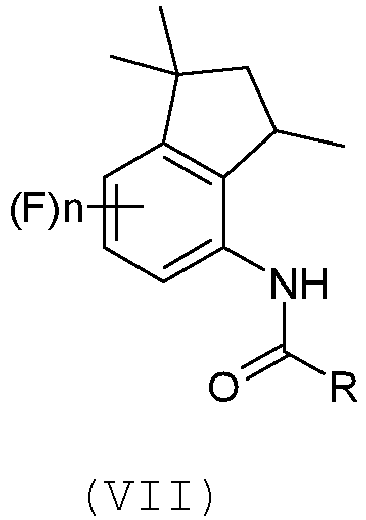
- d) hydrolysing the acyl group of the acyl indane compound of Formula (VII) to provide the desired 4-aminoindane of Formula (I),
wherein in said formulae:- n is an integer selected within the range from 0 to 3;
- R is a C1-C6 alkyl group, a C6-C10 aryl group, these groups being optionally substituted with one or more of: C1-C6 alkyl group, halogen atom;
- LG is a leaving group selected from: (i) a hydroxy group; (ii) a halogen atom; (iii) a C1-C6 alkylsulfonyloxy group; (iv) a C6-C10 arylsulfonyloxy group; (v) a RaCOO group wherein Ra is a C1-C6 alkyl group, the groups (iii)-(v) being optionally substituted with one or more halogen atoms.
- The process object of the present invention comprises at least the four steps indicated above, which are carried out in the indicated order.
- As evidenced by the experimental data included in the present description, the Applicant has surprisingly found that by inverting the steps of hydrogenation and condensation (acylation) of the process disclosed in
EP654464 - Moreover, the preparation process according to the present invention can be advantageously carried out by performing the steps (a) to (c) without being necessary to isolate and/or purify the intermediate products of the Formulae (VI) and (VII) at the end of their respective formation steps.
- The present invention thus provides a more cost-effective route for the preparation of 4-aminoindane derivatives of Formula (I) as well as of other compounds of industrial and commercial interest which are typically prepared starting from these 4-aminoindane derivatives, such as the aminoindane amides of Formula (II) which can be used as fungicides. According to the presently claimed process, in the step (a) a 1,2-dihydroquinoline of Formula (IV) is first subjected to catalytic hydrogenation, as reported below in Scheme 4.

- The compound of Formula (IV) is either commercially available or can be prepared, for instance, as described in Organic Synthesis, Vol. III, pag. 329. According to a preferred aspect of the present invention, an aniline derivative of Formula (III) is condensed with acetone in presence of an acidic catalyst to afford the corresponding dihydroquinoline of Formula (IV), as reported below in Scheme 5.

- The aniline derivative of Formula (III) is reacted with acetone, in a quantity comprised between 1 and 15 molar equivalents, preferably between 3 and 10 molar equivalents, more preferably between 4 and 7 molar equivalents, with respect to the starting aniline of Formula (III).
- Preferably, the acetone is added to said aniline derivative of Formula (III) during a time comprised between 1 and 15 hours, more preferably between 2 and 12 hours, even more preferably between 5 and 10 hours. To the mixture thus formed, an acidic catalyst is added, preferably an acidic catalyst selected from an organic acid, an inorganic acid or a mixture thereof. Non-limiting examples of suitable acidic catalysts according to the present invention are: methanesulfonic acid, paratoluenesulfonic acid, acetic acid, tetrafluoboric acid, hydrochloric acid, hydrobromic acid, sulfuric acid or mixtures thereof.
- Most preferred acidic catalysts are selected from tetrafluoboric acid and paratoluenesulfonic acid.
- During the addition of the acetone to the aniline derivative of Formula (III), the reaction mixture is kept at a temperature comprised between 80°C and 200°C, preferably between 100°C and 180°C, more preferably between 125°C and 145°C.
- When the reaction is complete, the dihydroquinoline derivative of Formula (IV) thus obtained can be isolated and purified according to methods well known to those skilled in the art. For example, the reaction mixture can be treated with a base, such as an inorganic base, to remove free acidity and extracted by mixing it with an organic solvent slightly-miscible or immiscible with water. The desired 1,2-dihydroquinoline product can be recovered for instance by fractional distillation.
- According to a preferred aspect of the present invention, the residual aniline derivative of Formula (III) can also be recovered by fractional distillation and advantageously reused in the subsequent production batch.
- According to the present invention, in the step (a) the compound of Formula (IV) is dissolved in an organic solvent, preferably a polar organic solvent, and a metal catalyst is added to the reaction mixture.
- Said metal catalyst is preferably an heterogeneous catalyst, more preferably selected from palladium on charcoal, palladium hydroxide on charcoal, Raney nickel and platinum oxide; even more preferably the metal catalyst is palladium on charcoal.
- According to the present invention, the catalyst loading is comprised between 0.05 and 0.7%, preferably comprised between 0.1 and 0.6%, more preferably the loading is of about 0.5%, with respect to the molar amount of dihydroquinoline of Formula (IV).
- Non-limiting examples of solvents that can be used in the hydrogenation reaction are: aliphatic or cycloaliphatic hydrocarbons (e.g. petroleum ether, hexane, cyclohexane, heptane), chlorinated hydrocarbons (e.g. methylene chloride, chloroform, carbon tetrachloride, dichloroethane), aromatic hydrocarbons (e.g. benzene, toluene, xylene, chlorobenzene), alcohols and glycols (e.g. methanol, ethanol, isopropanol, ethylene glycol), esters (e.g. ethyl acetate, butyl acetate) or mixtures thereof.
- Among these, the preferred solvents are: aliphatic hydrocarbons, such as hexane and heptanes; chlorinated hydrocarbons, such as methylene chloride and dichloroethane; alcohols, such as methanol, ethanol and isopropanol; toluene; ethyl acetate.
- Heptane, dichloroethane, methanol and toluene are particularly preferred.
- Within the meaning of the present invention, the term "heptane" refers either to n-heptane or to a mixture of isomers.
- As it is well known to the skilled person, the hydrogenation reaction of step a) can be carried out at a pressure greater than 1 bar or at atmospheric pressure.
- Preferably, the step a) of the present invention is carried out at atmospheric pressure.
- When the step a) is carried out at atmospheric pressure, the catalyst loading is preferably of about 0.5% and the reaction mixture is left to react for a time preferably comprised between 1 and 5 hours at room temperature.
- When the step a) is carried out under a hydrogen overpressure, said overpressure is preferably comprised between 5 to 9 bar.
- When the step a) is carried out under a hydrogen overpressure, the catalyst loading is preferably comprised between 0.1 and 0.6% and the reaction mixture is left to react for a time preferably comprised between 10 and 18 hours at a temperature preferably comprised between 35 and 50°C.
- At the end of step (a), the catalyst is recovered and preferably reused for subsequent production batches.
- The tetrahydroquinoline of Formula (V) obtained in the hydrogenation step a) is isolated from the reaction mixture by methods well known to those skilled in the art, for example by solvent concentration.
- Preferably, the isolated compound of Formula (V) is not purified and it is used as such in the subsequent step of the process.
- Step b) of acylation is performed by adding a carboxylic acid derivative of Formula RC(O)LG to the tetrahydroquinoline of Formula (V), as reported below in Scheme 6.

- R is a C1-C6 alkyl group, a C6-C10 aryl group, these groups being optionally substituted by one or more of: C1-C6 alkyl groups, halogen atoms;
- LG is a leaving group selected from: (i) a hydroxyl group; (ii) a halogen atom; (iii) a C1-C6 alkylsulfonyloxy group; (iv) a C6-C10 arylsulfonyloxy group; (v) a RaCOO group wherein Ra is C1-C6 alkyl group, the groups (iii)-(v) being optionally substituted with one or more halogen atoms.
- Preferably, the carboxylic acid derivative is added in an amount comprised between 5 and 30%, more preferably between 10 and 25%, with respect to the molar quantity of the starting tetrahydroquinoline of Formula (V). According to a more preferred aspect, the carboxylic acid derivative is selected from acetyl chloride and acetic anhydride, even more preferably the carboxylic acid derivative is acetic anhydride.
- The acylation reaction can be carried out in an organic solvent or in the absence of a solvent. According to the present invention, said reaction is preferably carried out in the absence of any added solvent.
- In the step c), the reaction mixture is maintained at a temperature comprised between 80°C and 200°C, preferably comprised between 100°C and 150°C, more preferably of about 130°C.
- If the acetic anhydride is used, once the conversion is complete, some water is preferably added to cause decomposition of the residual acetic anhydride to acetic acid.
- In order to completely remove the residual acetic acid, a solvent immiscible with water can be added to the reaction mixture, preferably an aliphatic hydrocarbon such as hexane or heptane.
- According to a preferred aspect of the present invention, the acetic acid is removed from the reaction mixture by vacuum distillation/azeotropic distillation with heptane.
- The acyl tetrahydroquinoline of Formula (VI) obtained at the end of the acylation step can be purified according to methods well known to the skilled person, for example, by precipitation, crystallization and the like.
- Preferably, said acyl tetrahydroquinoline of Formula (VI) is subjected to crystallization with an organic solvent thus forming a slurry with that solvent.
- Advantageously, according to the present invention, the solvent used for the crystallization is of the same type as the solvent used for removing the residual acetic acid.
- The acyl tetrahydroquinoline of Formula (VI) contained in said slurry is preferably not isolated. The slurry can be used as such in the next step.
- Subsequently, the acyl tetrahydroquinoline of Formula (VI) is subjected to rearrangement in acidic environment, as reported below in Scheme 7.
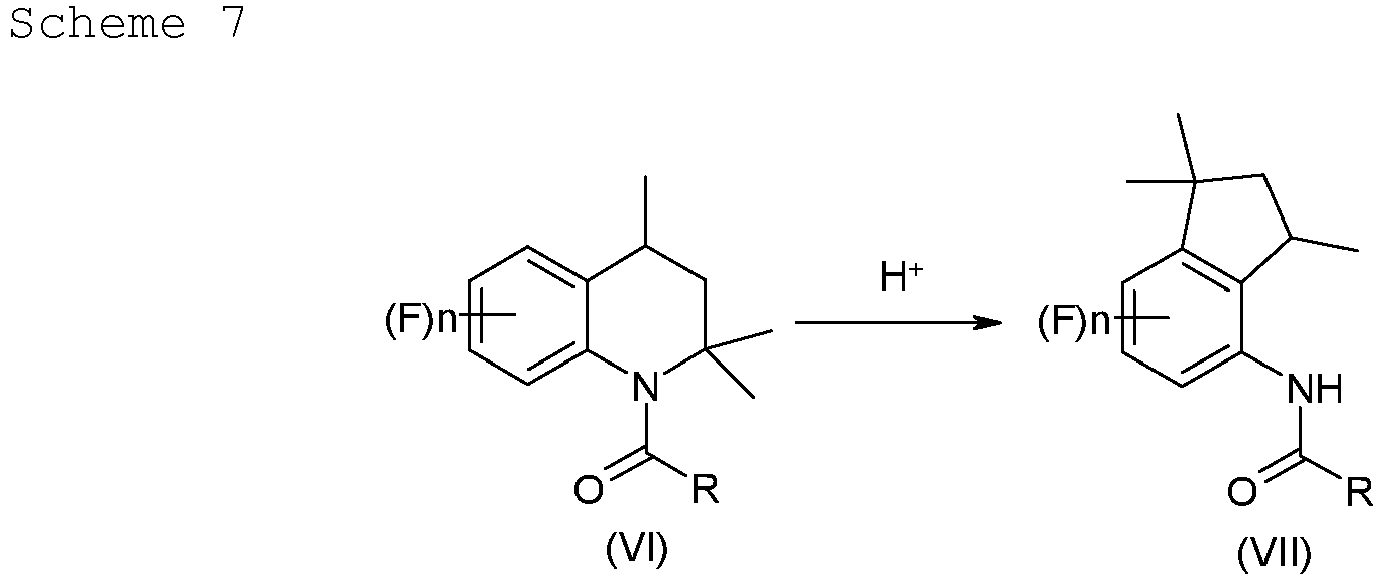
- The acidic pH condition which allows the rearrangement of the tetrahydroquinoline of Formula (VI) to give the corresponding indane derivative of Formula (VII) can be obtained by addition of an organic or inorganic acid to the compound of Formula (VI).
- Preferably, an inorganic acid is added, more preferably an inorganic acid selected from orthophosphoric acid and sulfuric acid, even more preferably the inorganic acid is sulfuric acid.
- Said inorganic or organic acid is added in an amount comprised between 3 and 10 molar equivalents, preferably between 4 and 9 molar equivalents, more preferably between 6 and 7 molar equivalents, with respect to the tetrahydroquinoline of Formula (VI). According to a more preferred aspect of the present invention, the concentration of the acid is comprised between 80% and 98%, even more preferably between 90% and 97%.
- Since the acid dissolution is exothermic, the temperature of the reaction mixture is to be controlled.
- Therefore, according to the presently claimed process, the reaction mixture is preferably kept at a temperature comprised between 10°C and 60°C, more preferably between room temperature (25°C) and 40°C.
- Preferably, the reaction mixture is left to react for a time comprised between 10 and 30 hours, more preferably between 15 and 25 hours, even more preferably of about 20 hours, in order to obtain a substantially complete conversion of the tetrahydroquinoline into the corresponding indane derivative of Formula (VII).
- Advantageously, once the rearrangement reaction of step c) is complete, the acyl indane of Formula (VII) is not isolated and the reaction mixture is used as such in the next hydrolysis step d), as reported below in Scheme 8.


- In step d), the reaction mixture of step c) containing the acyl indane of Formula (VII) is diluted with water so as to preferably obtain an acid concentration in the reaction mixture comprised between 30% and 70% by weight, more preferably between 40% and 60%, even more preferably of about 50%.
- The reaction mixture is then brought to a temperature preferably comprised between 60°C and the reflux temperature, more preferably between 95°C and 110°C. After a few hours at the selected temperature, the corresponding 4-aminoindane is formed, as acid addition salt of Formula (VIII).
- Said salt of Formula (VIII) can be isolated and purified according to methods well known to those skilled in the art, such as precipitation or crystallization.
- According to a preferred aspect of the present invention, the salt can be precipitated by adding water and the organic impurities can be removed by adding an organic solvent, preferably a solvent immiscible with water, such as an aliphatic hydrocarbon, more preferably heptane.
- Subsequently, the acid addition salt of 4-aminoindane (VIII) is suspended in water and a basic solution is added so as to obtain the desired 4-aminoindane of Formula (I) in free form. The basic solution is preferably added in an amount comprised between 10% and 80% molar excess, more preferably comprised between 40% and 60% molar excess with respect to the amount of the salt of formula (VIII).
- Non-limiting examples of bases suitable for the present invention are alkaline metal hydroxides, such as sodium hydroxide and potassium hydroxide, or alkaline metal carbonates.
- Particularly preferred bases according to the present invention are alkaline metal hydroxides.
- After the addition of the basic solution, the reaction mixture is left to react at a temperature comprised between 35°C and 70°C, preferably between 40°C and 60°C, more preferably of about 55°C.
- As it is well known to the skilled person, different techniques can be used in order to isolate the desired product of Formula (I); for instance, the reaction mixture can be extracted by mixing it with an organic solvent slightly-miscible or immiscible with water, preferably heptane, and the organic layer can be filtered so as to remove the solid residues.
- According to the present invention, the organic solution containing the 4-aminoindane of Formula (I) obtained at the end of the step (d) is preferably not concentrated and, advantageously, can be used as such for the preparation of the aminoindane amides of Formula (II).
- A further object of the present invention is a process for the preparation of aminoindane amides of Formula (II),

- preparing at least one 4-aminoindane derivative of Formula (I) by carrying out the steps (a)-(d) of the process described above;
- condensing said 4-aminoindane derivative of Formula (I) with at least one compound of Formula AC(O)X
- A represents a C6-C10 aryl group or a heterocyclic ring with 5 or 6 atoms containing from 1 to 3 heteroatoms selected from N, O, S, these groups being optionally substituted by one or more R1 and R2 groups;
- R1 represents a C1-C6 alkyl group or a C1-C6 haloalkyl group, said groups being optionally substituted with one or more groups selected from R', OR', S(O)mR'; or R1 represents a C3-C6 cycloalkyl group, a C4-C9 cycloalkylalkyl group, a C2-C6 alkenyl group, a C2-C6 alkinyl group, a C6-C10 aryl group, a C7-C12 arylalkyl group, a heterocyclic ring with 5 or 6 atoms containing from 1 to 3 heteroatoms selected from N, O, S, these groups being optionally substituted by one or more groups selected from halogen atoms, R', OR', NR'R", S(O)mR', CONR'R", COR', CO2R', CN, NO2;
- R2 represents a C1-C6 alkyl group or a C1-C6 haloalkyl group, said groups being optionally substituted with one or more groups selected from R', OR', S(O)mR'; or R2 represents a C3-C6 cycloalkyl group, a C4-C9 cycloalkylalkyl group, a C6-C10 aryl group, a C7-C12 arylalkyl group, these groups being optionally substituted by one or more groups selected from halogen atoms, R', OR', S(O)mR', NR'R", CONR'R", COR', CO2R', NO2, CN;
- R' and R'' represent a hydrogen atom, a C1-C4 alkyl group, a C1-C4 haloalkyl group;
- X represents a hydroxyl group, halogen, a C1-C6 alkoxy group, a C1-C6 alkylsulfonyloxy group, a C6-C10 arylsulfonyloxy group, these groups being optionally substituted by one or more halogen atoms;
- n is an integer selected within the range from 0 to 3;
- m is an integer selected within the range from 0 to 2.
- Examples of a C1-C6 alkyl group are methyl, ethyl, propyl, butyl, pentyl, hexyl.
- Examples of a C1-C6 haloalkyl group are dichloromethyl, difluoromethyl, trichloromethyl, trifluoromethyl, chloro-difluoromethyl, dichloroethyl, trifluoroethyl, tetra-fluoroethyl, pentafluoroethyl, tetrafluoropropyl, pentafluoropropyl, dichlorobutyl, difluorobutyl, dichloropentyl, difluoropentyl, dichlorohexyl, difluorohexyl.
- Examples of a C3-C6 cycloalkyl group are cyclopropyl, cyclobutyl, cyclopentyl, cyclohexyl.
- Examples of a C4-C9 cycloalkylalkyl group are cyclopropylmethyl, cyclobutylmethyl, cyclopentylmethyl, cyclohexylmethyl, cyclohexylethyl, cyclohexylpropyl. Examples of a C2-C6 alkenyl group are ethenyl, propenyl, butenyl, pentenyl, hexenyl.
- Examples of a C2-C6 alkinyl group are ethinyl, propinyl, butinyl, pentinyl, hexinyl.
- Examples of a C6-C10 aryl group are phenyl, naphthyl. Examples of a C7-C12 arylalkyl group are benzyl, phenylethyl, phenylpropyl, phenylbutyl, phenylpentyl, phenylhexyl, naphthylmethyl, naphthylethyl.
- Examples of a heterocyclic ring with 5 or 6 atoms containing from 1 to 3 heteroatoms selected from N, O, S, are pyrrolyl, pyrazolyl, imidazolyl, triazolyl, thiadiazolyl, oxadiazolyl, furanyl, thiophenyl, pyridyl, pyrimidyl, triazinyl.
- Examples of a heterocyclic nitrogenated ring with 5 or 6 atoms are pyrrolidyl, piperidyl, morpholyl.
- Examples of halogen atoms are fluorine, chlorine, bromine, iodine.
- Among the aminoindane amides having general formula (II) that can be prepared with the process of the present invention, preferred are those wherein:
- A represents one of the following heterocycles A1-A5:


- R1 represents a C1-C6 alkyl group, a C1-C6 haloalkyl group or a phenyl group optionally substituted with halogen atoms, C1-C4 alkyl groups, C1-C4 haloalkyl groups, C1-C4 alkoxyl groups, C1-C4 haloalkoxyl groups;
- R2 represents a C1-C6 alkyl group, a C1-C6 haloalkyl group, or a phenyl group optionally substituted with halogen atoms, C1-C4 alkyl groups, C1-C4 haloalkyl groups, C1-C4 alkoxyl groups, C1-C4 haloalkoxyl groups;
- R1 represents a C1-C6 alkyl group or a phenyl optionally substituted by halogen atoms;
- R2 represents a methyl, a difluoromethyl, a trifluoromethyl or a phenyl optionally substituted by halogen atoms;
- A represents A1;
- R1 represents a methyl;
- R2 represents a methyl, a difluoromethyl, a trifluoromethyl.
- According to a preferred aspect of the present invention, a carboxylic acid derivative of Formula AC(O)X is added to the solution of 4-aminoindane of Formula (I) obtained in step d), preferably in a molar ratio comprised between 0.9 and 1.1, more preferably between 0.95 and 1.05, even more preferably in equimolar amount with respect to the quantity of 4-aminoindane of Formula (I).
- Preferably, said carboxylic acid derivative of Formula AC(O)X is an acid chloride, i.e. X represents a chlorine atom.
- After the addition of the acid derivative, the reaction mixture is brought to a temperature comprised between 60°C and the reflux temperature of the hydrocarbon solvent, preferably between 95°C and 100°C. At the end of the condensation step, the reaction mixture can be cooled and an alkaline aqueous solution added in order to neutralize residual acidity.
- The aminoindane amide of Formula (II) formed at the end of the condensation step can be subsequently isolated and possibly purified according to well-known techniques, for instance, by precipitation and subsequent filtration and washing of the solid product. The fact that the final aminoindane amide product can be isolated by filtration from the reaction mass represents a further advantage of the present invention with respect to the preparation process of the prior art.
- The following examples are provided for illustrative purposes of the present invention.
- In a one-litre round-bottomed flask under nitrogen blanketing 4-fluoroaniline (III) (445 grams, 4.0 mol) is charged, together with HBF4 (48% aqueous solution, 56 grams, 0.32 mol) and 50 mL acetone.
- The flask is fitted with thermometer and a glass distillation system, comprising a vertical column filled with coarse glass rings, and condenser. An efficient magnetic stirring is employed.
- The flask is heated in an external bath, set at the temperature of 150 - 155°C.
- When the internal temperature reaches 120°C and condensate starts being collected at the distillation end, the addition of acetone is started. Acetone is fed through PTFE tubing, ending near the bottom of the reaction mass, at the constant rate of approximately. 150-175 mL/hour, so as to maintain a very slow distillation rate. The internal temperature of the reaction is maintained in the interval 132 - 140°C. An overall time of 8-10 hours is employed for the supply of acetone (1500 mL), after which the reaction is stirred for further 20 min at 140°C; the reaction mass is then cooled below 40°C.
- The distillation is performed in the same reaction vessel, maintaining the same fractioning column. The reaction mass is subjected to preliminary evaporation at 50°C at 20-40 mbar to complete acetone and water removal.
- Vacuum is applied in the range 2.0 - 3.0 mbar. The flask is heated, with temperature of the external bath progressively increased and reaching the final maximum of 170°C, at which the collection of the product is completed, with vacuum increased to 1.0 mbar.
- Four main fractions are separated.
- 1. Distillate at 49-52°C (head temperature), constituted mainly of Fluoroaniline (ca. 98 %).
- 2. Distillate at 52-90°C, small amount of mixed fractions (4 grams).
- 3. Distillate at 92-102°C constituting the product dihydroquinoline.
- 4. Residue in the flask: dark dense material (tars), that solidifies on cooling.
- The results of the representative experiment, including the recovery of Fluoroaniline, in term of weight and molar yields were:
- Dihydroquinoline (as ca.95% GCA purity distilled material): 340 grams, ca. 42%
- Dihydroquinoline yield (overall available): ca. 43%
- Recovered 4-Fluoroaniline yield (overall available): ca. 42%
- Dihydroquinoline yield, calculated on consumed 4-Fluoroaniline: ca. 72%
- Distilled 4-Fluoroaniline and any mixed fractions are sent to recycle in a successive batch.
- The crude liquid Dihydroquinoline (IV) (96% purity, 106 grams, 0.530 mol) is dissolved in 400 mL heptane and extracted with 200 mL 1% aqueous hydrochloric acid. The aqueous layer is discarded and the organic solution is transferred to a 1-litre hydrogenation autoclave. Catalytic palladium on carbon (10%, 2.5 grams) is charged, hydrogen gas is introduced at 3 bar pressure and reaction performed at 30°C for 2 hours.
- After filtration of the catalyst, the solvent is completely removed by distillation, thus obtaining 100.0 grams crude Tetrahydroquinoline (V), having purity 98.5%.
- In a one-litre round-bottomed flask with mechanical stirring under nitrogen blanketing, Tetrahydroquinoline (V) (98% purity, 100.0 grams, 0.506 mol) is mixed with acetic anhydride (60.0 grams, 0.58 mol).
- The reaction mixture is heated in an external bath, set at the temperature of 150°C, with internal temperature reaching 134 to 138°C at which it is maintained for 5 hours. Further excess acetic anhydride (1.0 g) can be added to achieve complete conversion.
- The reaction mixture is refrigerated to ca. 40°C, and water (2.0 mL) is added to decompose excess acetic anhydride.
- The liquid (acetic acid) is distilled from the reaction vessel at reduced pressure (60 mbar and then 20 mbar; with temperature in the range 70-90°C).
- The semi-solid residue is consequently taken up with heptane (300 mL) and again subjected to complete distillation at atmospheric pressure, with internal temperature 98-124°C, in order to completely remove acetic acid.
- More heptane (150 mL) is added, so as to obtain a complete solution at 95°C. The mass is then allowed to cool slowly to 20°C with stirring, in order to cause the precipitation of a finely divided solid product.
- In a one-litre round-bottomed flask with mechanical stirring sulfuric acid (93% concentration, 375 grams, 3.50 mol) is initially charged.
- The acetyl-tetrahydroquinoline (VI) (119 grams, 0.50 mol) heptane suspension from step c is slowly added into the sulfuric acid layer with efficient stirring while the mass temperature is controlled between 15 and 20°C. The resulting biphasic suspension is then maintained with stirring at 34-36°C for 20 hours.
- One additional hour with temperature increased to 48-50°C is allowed for completing the conversion.
- To the reaction mass water (320 mL) is slowly added under stirring with strong exotherm (in order to obtain ca. 50% H2SO4 concentration). The reaction mass is progressively heated and heptane is distilled off, with collection of organic layer (170 mL) and some water.
- The solution is then heated to a reflux (110-111°C, internal temperature) and maintained 5 hours.
- The reaction mass is refrigerated to 40°C and slowly poured into ice-cold water (1000 grams) with evident exotherm (in order to obtain ca. 20% H2SO4 concentration) in a 2-litre vessel with mechanical stirring. The final temperature is adjusted around 20°C and the resulting slurry of indanamine sulfate salt (VIII) is filtered. The solid is washed on the filter with 150 mL water, followed by heptane (250 mL).
- The filtration cake is sucked on the filter for sufficient time, then the wet solid (approximately 180 grams) is sent to salt un-blocking.
- The solid indanamine sulfate salt (total amount, 0.450 mol) is added to 400 grams aqueous solution containing NaOH (28 grams, 0.68 mol) in a 2-litre flask. To the alkaline suspension heptane (400 mL) is added and the whole is stirred with heating to 55°C. After complete solids dissolution, the phases are separated. The aqueous layer is extracted again with heptane (300 mL) at 55°C. The combined warm heptane solution (540 grams) is filtered on a layer of celite to remove some undissolved material.
- Part of the heptane is distilled off at reduced pressure (275 mbar, 57°C), in order to azeotropically remove some traces of water and reach the suitable volume for use in next Step. The final weight of the solution is approximately 460 grams, containing around 89.0 grams indanamine (I).
- The pyrazole acid chloride is prepared from 3-difluoromethyl-1-methyl-1H-pyrazole-4-carboxylic acid and thionyl chloride in heptane shortly before use.
- In a 500-mL round-bottomed flask provided with alkaline scrubber, pyrazole acid (74.0 grams, 0.42 mol) is suspended in heptane (170 mL). Dimethylformamide (0.70 grams, 0.009 mol) and thionyl chloride (55.0 grams, 0.462 mol) are added and the bi-phasic mixture is stirred and heated at 42-45 °C.
- After complete conversion of pyrazole acid (2.5 hours), the solvent and excess thionyl chloride are completely removed by vacuum distillation.
- Liquid pyrazole acid chloride is obtained as the residue (approximately 81.0 grams).
- A 2-litre glass reactor with efficient mechanical stirrer, reflux condenser and alkaline scrubber is employed.
- To the indanamine heptane solution (I) (total amount, 460 grams, 0.46 mol indanamine) at 50°C, the liquid pyrazole acid chloride obtained in step a) is added during ca. 10 min at 50-70°C with exothermic reaction and formation of a precipitate. More heptane (20 mL) is used for rinsing.
- The reaction is stirred at reflux (95-97°C internal temperature) during 4 hours, after which the reaction is completed. The evolution of HCl ceases within 3 hours.
- The resulting reaction suspension is refrigerated below 30°C, then NaOH aqueous solution (215 mL, 2.5 % concentration) is added, and the mixture stirred at least 30 min, while the temperature is adjusted to 22°C.
- The slurry is filtered on a flat sintered glass filter and the solid washed at 45°C with water (250 mL) after re-slurrying and stirring.
- The resulting solid is filtered again and washed on the filter with water, (250 mL, or until resulting pH is neutral) and successively with heptane (250 mL).
- After aspiration on the filter for 1 hour, the moist solid (165 grams) is dried in a vacuum oven at 55°C.
- The desired product is obtained (approximately 140 grams, with assay 98%).
- Heptane mother liquors contain excess indanamine, which is sent to recycle.
-
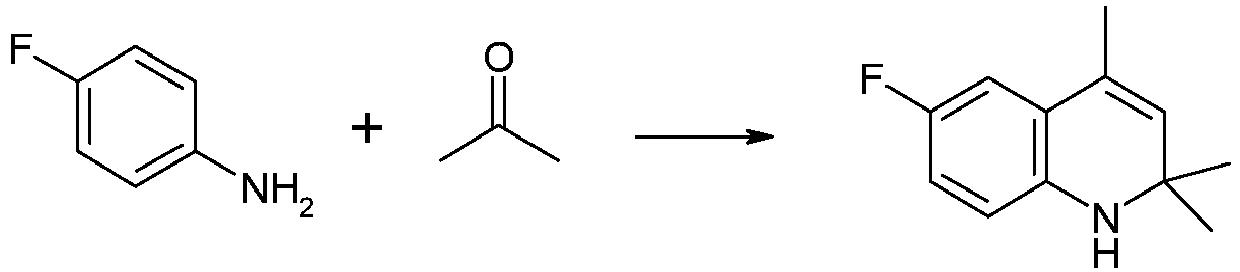
- Step 1 is run according to Example 1, step a). In addition, the resulting distilled dihydroquinoline is dissolved in a proper solvent and stirred with 1% aqueous solution of hydrochloric acid, in order to remove any residual 4-fluoroaniline and reach around 98% purity. Said solvent is removed by vacuum distillation before running the following step.
-

- In a one-litre round-bottomed flask with mechanical stirring under nitrogen blanketing, Dihydroquinoline (98% purity, 104.0 grams, 0.533 mol) is mixed with acetic anhydride (65.0 grams, 0.635 mol).
- The reaction mixture is heated in an external bath, set at the temperature of 150°C, with internal temperature reaching around 138°C at which it is maintained for 5 hours to achieve complete conversion.
- The reaction mixture is refrigerated to ca. 40°C, and water (3.0 mL) is added to decompose excess acetic anhydride.
- The liquid (acetic acid) is distilled from the reaction vessel at reduced pressure (60 mbar and then 20 mbar; with temperature in the range 70-90°C).
- The oily residue is consequently taken up with heptane (300 mL) and again subjected to complete distillation at atmospheric pressure, with internal temperature 96-125°C, in order to completely remove acetic acid.
- More heptane (500 mL) is added, so as to obtain a complete solution at 65°C. The mass is kept at temperature around 50°C and transferred to the following stage.
-

- The organic solution is transferred to a 1-litre hydrogenation autoclave under nitrogen. Catalytic palladium on carbon (10%, 2.5 grams) is charged, hydrogen gas is introduced at 3 bar pressure and reaction performed at 50°C for 2 hours.
- After filtration of the catalyst, the solvent is partly removed by vacuum distillation, and eventually refrigerated to 20°C, thus obtaining 119 grams crude acetyl-THQ, having purity 98%, as the approximately 240 grams heptane suspension.
-

- In a one-litre round-bottomed flask with mechanical stirring sulfuric acid (93% concentration, 375 grams, 3.50 mol) is initially charged.
- The acetyl-THQ (119 grams, 0.50 mol) heptane suspension from Step 3 is slowly added into the sulfuric acid layer with efficient stirring while the mass temperature is controlled between 15 and 20°C. The resulting biphasic suspension is then maintained with stirring at 34-36°C during 20 hours.
- One additional hour with temperature increased to 48-50°C is allowed for completing the conversion.
- To the reaction mass water (320 mL) is slowly added under stirring with strong exotherm (in order to obtain ca. 50% H2SO4 concentration). The reaction mass is progressively heated and heptane is distilled off, with collection of organic layer (170 mL) and some water.
- The solution is then heated to a reflux (110-111°C, internal temperature) and maintained 5 hours.
- The reaction mass is refrigerated to 40°C and slowly poured into ice-cold water (1000 grams) with evident exotherm in a 2-litre vessel with mechanical stirring. The final temperature is adjusted around 20°C and the resulting slurry of indanamine sulfate salt is filtered. The solid is washed on the filter with 150 mL water, followed by heptane (250 mL).
- The wet filtration cake is then added to 400 grams aqueous solution containing NaOH (28 grams, 0.68 mol) in a 2-litre flask. To the alkaline suspension heptane (400 mL) is added and the whole is stirred with heating to 55°C. After complete solids dissolution, the phases are separated. The aqueous layer is extracted again with heptane (300 mL) at 55°C. The combined warm heptane solution (540 grams) is filtered on a layer of celite to remove some undissolved material.
- When heptane is completely distilled off at reduced pressure, a dark solid residue is obtained, constituted of approximately 89.0 grams indanamine free-base, having purity above 99%.
Claims (13)
- A process for the preparation of 4-aminoindane derivatives of Formula (I), salts and enantiomers thereof
 a) hydrogenating a 1,2-dihydroquinoline of Formula(IV)
 b) acylating the tetrahydroquinoline of Formula (V) with a carboxylic acid derivative of Formula RC(O)LG to obtain a corresponding acyl derivative compound of Formula (VI)
 c) rearranging the acyl derivative compound of Formula (VI) under acidic conditions so as to give an acyl indane compound of Formula (VII)
 d) hydrolysing the acyl group of the acyl indane compound of Formula (VII) so as to obtain the 4-aminoindane compound of Formula (I),wherein in said formulae:- n is an integer selected within the range from 0 to 3;- R is selected from a C1-C6 alkyl group or a C6-C10 aryl group, these groups being optionally substituted with one or more of: C1-C6 alkyl groups, halogen atoms;- LG is a leaving group selected from: (i) a hydroxy group; (ii) a halogen atom; (iii) a C1-C6 alkylsulfonyloxy group; (iv) a C6-C10 arylsulfonyloxy group, (v) a RaCOO group wherein Ra is a C1-C6 alkyl group, the groups (iii) - (v) being optionally substituted with one or more halogen atoms.
 - The process according to the preceding claim, wherein said hydrogenating step (a) comprises contacting said 1,2-dihydroquinoline of Formula (IV) dissolved in an organic solvent, preferably a polar solvent, with gaseous hydrogen in the presence of a hydrogenation catalyst so as to obtain said tetrahydroquinoline of Formula (V).
- The process according to any of the preceding claims, wherein said carboxylic acid derivative of Formula RC(O)LG is preferably selected from acetyl chloride, acetic anhydride or mixture thereof.
- The process according to any of the preceding claims, wherein said step (b) is carried out in the absence of an added solvent.
- The process according to any of the preceding claims, wherein the reaction mixture obtained at the end of said step (b) is added with an organic solvent and then subjected to distillation to remove the excess of said carboxylic acid derivative and to form a slurry containing the acyl derivative compound of Formula (VI).
- The process according to the preceding claims, wherein said slurry containing said acyl derivative compound of Formula (VI) is fed to said step (c).
- The process according to any of the preceding claims, wherein said step (c) comprises suspending said acyl derivative compound of Formula (VI) in an organic solvent and contacting the thus obtained suspension with an organic acid or an inorganic acid, preferably selected from sulphuric acid or orthophosphoric acid, so as to obtain said acyl indane compound of Formula (VII) in the form of an addition salt.
- The process according to any of the preceding claims, wherein said step (d) of hydrolysis comprises contacting said acyl indane compound of Formula (VII) with water.
- The process according to claim 7, wherein said slurry containing said acyl indane compound of Formula (VII) is fed to said step (d).
- The process according to the claim 7, wherein said acyl indane compound of Formula (VII) in the form of said addition salt is contacted with an alkaline aqueous solution so as to obtain said 4-aminoindane derivative of Formula (I).
- The process according to any of the claims 2,5 and 7, wherein said organic solvent is selected from: aliphatic or cycloaliphatic hydrocarbons; chlorinated hydrocarbons; aromatic hydrocarbons; alcohols; glycols; esters or mixtures thereof.
- The process according to the preceding claim, wherein said organic solvent is selected from: hexane, heptanes, methylene chloride, dichloroethane, methanol, ethanol, isopropanol, toluene, ethyl acetate and mixtures thereof, preferably from heptane, dichloroethane, methanol, toluene and mixture thereof.
- A process for the preparation of aminoindane amides of Formula (II),
 - preparing at least one 4-aminoindane derivative of Formula (I) by carrying out the steps (a)-(d) of the process according to the preceding claims- condensing said 4-aminoindane derivative of Formula (I) with at least one compound of Formula AC(O)Xwherein in said formulae:- A represents a C6-C10 aryl group or a heterocyclic ring with 5 or 6 atoms containing from 1 to 3 heteroatoms selected from N, O, S, these groups being optionally substituted by one or more R1 and R2 groups;- R1 represents a C1-C6 alkyl group or a C1-C6 haloalkyl group, said groups being optionally substituted with one or more groups selected from R', OR', S(O)mR'; or R1 represents a C3-C6 cycloalkyl group, a C4-C9 cycloalkylalkyl group, a C2-C6 alkenyl group, a C2-C6 alkinyl group, a C6-C10 aryl group, a C7-C12 arylalkyl group, a heterocyclic ring with 5 or 6 atoms containing from 1 to 3 heteroatoms selected from N, O, S, these groups being optionally substituted by one or more groups selected from halogen atoms, R', OR', NR'R", S(O)mR' CONR'R", COR', CO2R', CN, NO2;- R2 represents a C1-C6 alkyl group or a C1-C6 haloalkyl group, said groups being optionally substituted with one or more groups selected from R', OR', S(O)mR'; or R2 represents a C3-C6 cycloalkyl group, a C4-C9 cycloalkylalkyl group, a C6-C10 aryl group, a C7-C12 arylalkyl group, these groups being optionally substituted by one or more groups selected from halogen atoms, R', OR', S(O)mR', NR'R", CONR'R", COR', CO2R', NO2, CN;- R' and R'' represent a hydrogen atom, a C1-C4 alkyl group, a C1-C4 haloalkyl group;- X represents a hydroxyl group, halogen, a C1-C6 alkoxy group, a C1-C6 alkylsulfonyloxy group, a C6-C10 arylsulfonyloxy group, these groups being optionally substituted by one or more halogen atoms;- n is an integer selected within the range from 0 to 3;- m is an integer selected within the range from 0 to 2.
Priority Applications (2)
| Application Number | Priority Date | Filing Date | Title |
|---|---|---|---|
| HUE16717473A HUE051536T2 (en) | 2016-04-15 | 2016-04-15 | Process for the preparation of 4-aminoindane derivatives and related aminoindane amides |
| PL16717473T PL3442944T3 (en) | 2016-04-15 | 2016-04-15 | Process for the preparation of 4-aminoindane derivatives and related aminoindane amides |
Applications Claiming Priority (1)
| Application Number | Priority Date | Filing Date | Title |
|---|---|---|---|
| PCT/IB2016/052169 WO2017178868A1 (en) | 2016-04-15 | 2016-04-15 | Process for the preparation of 4-aminoindane derivatives and related aminoindane amides |
Publications (2)
| Publication Number | Publication Date |
|---|---|
| EP3442944A1 EP3442944A1 (en) | 2019-02-20 |
| EP3442944B1 true EP3442944B1 (en) | 2020-04-15 |
Family
ID=55795012
Family Applications (1)
| Application Number | Title | Priority Date | Filing Date |
|---|---|---|---|
| EP16717473.9A Active EP3442944B1 (en) | 2016-04-15 | 2016-04-15 | Process for the preparation of 4-aminoindane derivatives and related aminoindane amides |
Country Status (10)
| Country | Link |
|---|---|
| US (3) | US10640454B2 (en) |
| EP (1) | EP3442944B1 (en) |
| JP (1) | JP6780011B2 (en) |
| CN (1) | CN109071439B (en) |
| BR (1) | BR112018070345B1 (en) |
| DK (1) | DK3442944T3 (en) |
| ES (1) | ES2806460T3 (en) |
| HU (1) | HUE051536T2 (en) |
| PL (1) | PL3442944T3 (en) |
| WO (1) | WO2017178868A1 (en) |
Families Citing this family (6)
| Publication number | Priority date | Publication date | Assignee | Title |
|---|---|---|---|---|
| WO2017178868A1 (en) * | 2016-04-15 | 2017-10-19 | Stichting I-F Product Collaboration | Process for the preparation of 4-aminoindane derivatives and related aminoindane amides |
| CN108276329B (en) * | 2018-04-02 | 2020-05-08 | 金凯(辽宁)化工有限公司 | Preparation method of 6-fluoro-2, 2,4-trimethyl-1,2-dihydroquinoline |
| JP2021524854A (en) | 2018-05-23 | 2021-09-16 | バイエル・アクチエンゲゼルシヤフト | Substitution 4-Aminoindane Production Method |
| IT201900017330A1 (en) | 2019-09-26 | 2021-03-26 | Isagro Spa | PROCESS FOR THE PREPARATION OF (R) -4-AMINOINDANE AND CORRESPONDING AMIDES. |
| WO2022014414A1 (en) * | 2020-07-17 | 2022-01-20 | 住友化学株式会社 | Method for producing optically active compound |
| TW202506625A (en) * | 2023-04-25 | 2025-02-16 | 韓商Jw製藥公司 | Method of preparing 4-aminoindan and method of preparing dihydroindenyl-pyrazolo[3,4-b]pyridine amine |
Family Cites Families (26)
| Publication number | Priority date | Publication date | Assignee | Title |
|---|---|---|---|---|
| US4742074A (en) * | 1984-10-29 | 1988-05-03 | Sumitomo Chemical Company, Limited | Pyrazolecarboxamide derivative and fungicide containing it as active ingredient |
| DK383086A (en) | 1985-08-21 | 1987-02-22 | Rohm & Haas | (2-CYANO-2-ARYLETHYL) PYRIDINES, THEIR PREPARATION AND THEIR USE AS FUNGICIDES |
| EP0256503B1 (en) | 1986-08-12 | 1992-12-02 | Mitsubishi Kasei Corporation | Pyridinecarboxamide derivatives and their use as fungicide |
| US4837242A (en) | 1987-01-20 | 1989-06-06 | Sumitomo Chemical Company, Limited | Thiazoles and pyrazoles as fungicides |
| US4914097A (en) | 1987-02-25 | 1990-04-03 | Mitsubishi Kasei Corporation | N-indanyl carboxamide derivative and agricultural/horticultural fungicide containing the derivative as active ingredient |
| JP2582863B2 (en) | 1988-06-13 | 1997-02-19 | 三菱化学株式会社 | Gray mold control agent containing N-indanylcarboxylic acid amide derivative as active ingredient |
| JP2717852B2 (en) | 1988-12-09 | 1998-02-25 | 株式会社紀文食品 | Method for measuring freshness of frozen surimi |
| JPH02157266A (en) | 1988-12-12 | 1990-06-18 | Mitsubishi Kasei Corp | N-indanylcarboxylic acid amide derivatives and agricultural and horticultural fungicides containing the same as active ingredients |
| US5093347A (en) | 1991-01-28 | 1992-03-03 | Monsanto Company | 3-difluoromethylpyrazolecarboxamide fungicides, compositions and use |
| JP3077381B2 (en) | 1992-05-14 | 2000-08-14 | 住友化学工業株式会社 | Wood preservatives |
| HUT63941A (en) | 1992-05-15 | 1993-11-29 | Hoechst Ag | Process for producing 4-alkyl-substituted pyrimidine-5-carboxanilide derivatives, and fungicidal compositions comprising same |
| US5521317A (en) * | 1993-10-22 | 1996-05-28 | American Cyanamid Co. | Processes for the preparation of pesticides and intermediates |
| EP0654464A1 (en) | 1993-10-22 | 1995-05-24 | Shell Internationale Researchmaatschappij B.V. | Processes for the preparation of pesticides and intermediates |
| JPH1070479A (en) | 1996-08-29 | 1998-03-10 | Nippon Seiki Co Ltd | FM multiplex receiver |
| JP3675112B2 (en) | 1997-06-23 | 2005-07-27 | 富士写真フイルム株式会社 | Image reading apparatus and information processing apparatus |
| GB0001447D0 (en) | 2000-01-21 | 2000-03-08 | Novartis Ag | Organic compounds |
| EP2258690B1 (en) | 2002-08-22 | 2013-02-20 | Syngenta Participations AG | Tricyclic amines as intermediates in the synthesis of fungicidal carboxamide derivatives |
| DE10250110A1 (en) | 2002-10-28 | 2004-05-13 | Bayer Cropscience Ag | Thiazole (bi) cycloalkylcarboxanilides |
| AU2004212056A1 (en) | 2003-02-14 | 2004-08-26 | Bayer Cropscience Aktiengesellschaft | Oxathiin carboxamide |
| EP1628962B1 (en) | 2003-05-21 | 2014-10-01 | Bayer Intellectual Property GmbH | Iodopyrazolyl carboxanilides |
| DE102004005785A1 (en) | 2004-02-06 | 2005-08-25 | Bayer Cropscience Ag | 2-Halogenfuryl / thienyl-3-carboxamide |
| ITMI20090488A1 (en) | 2009-03-27 | 2010-09-28 | Isagro Ricerca Srl | HIGH-ACTIVITY BENZAMIDIC COMPOUNDS FUNGICIDAL AND RELATED USE |
| IT1403275B1 (en) | 2010-12-20 | 2013-10-17 | Isagro Ricerca Srl | HIGH-ACTIVITY INDANYLANILIDES FUNGICIDE AND THEIR PHYTOSANITARY COMPOSITIONS |
| ITMI20121045A1 (en) | 2012-06-15 | 2013-12-16 | Isagro Ricerca Srl | SYNERGIC COMPOSITIONS FOR THE PROTECTION OF AGRICULTURAL CROPS AND ITS USE |
| BR112015015097B1 (en) * | 2012-12-27 | 2021-02-17 | Sumitomo Chemical Company, Limited | method for producing purified amine compound |
| WO2017178868A1 (en) * | 2016-04-15 | 2017-10-19 | Stichting I-F Product Collaboration | Process for the preparation of 4-aminoindane derivatives and related aminoindane amides |
-
2016
- 2016-04-15 WO PCT/IB2016/052169 patent/WO2017178868A1/en not_active Ceased
- 2016-04-15 EP EP16717473.9A patent/EP3442944B1/en active Active
- 2016-04-15 ES ES16717473T patent/ES2806460T3/en active Active
- 2016-04-15 JP JP2018553223A patent/JP6780011B2/en active Active
- 2016-04-15 DK DK16717473.9T patent/DK3442944T3/en active
- 2016-04-15 HU HUE16717473A patent/HUE051536T2/en unknown
- 2016-04-15 BR BR112018070345-1A patent/BR112018070345B1/en active IP Right Grant
- 2016-04-15 CN CN201680084469.5A patent/CN109071439B/en active Active
- 2016-04-15 PL PL16717473T patent/PL3442944T3/en unknown
- 2016-04-15 US US16/091,764 patent/US10640454B2/en active Active
-
2020
- 2020-03-31 US US16/836,038 patent/US11148995B2/en active Active
-
2021
- 2021-09-15 US US17/476,101 patent/US11851388B2/en active Active
Non-Patent Citations (1)
| Title |
|---|
| None * |
Also Published As
| Publication number | Publication date |
|---|---|
| EP3442944A1 (en) | 2019-02-20 |
| JP2019511524A (en) | 2019-04-25 |
| US20200231533A1 (en) | 2020-07-23 |
| ES2806460T3 (en) | 2021-02-17 |
| HUE051536T2 (en) | 2021-03-01 |
| CN109071439A (en) | 2018-12-21 |
| US10640454B2 (en) | 2020-05-05 |
| BR112018070345A2 (en) | 2019-01-29 |
| US11148995B2 (en) | 2021-10-19 |
| PL3442944T3 (en) | 2020-09-21 |
| CN109071439B (en) | 2022-07-15 |
| JP6780011B2 (en) | 2020-11-04 |
| US11851388B2 (en) | 2023-12-26 |
| US20220002225A1 (en) | 2022-01-06 |
| US20190119195A1 (en) | 2019-04-25 |
| WO2017178868A1 (en) | 2017-10-19 |
| DK3442944T3 (en) | 2020-07-13 |
| BR112018070345B1 (en) | 2022-01-18 |
Similar Documents
| Publication | Publication Date | Title |
|---|---|---|
| US11851388B2 (en) | Compound of 1-acetyl-6-fluoro-2,2,4-trimethyl-1,2,3,4-tetrahydroquinoline | |
| JP6441478B2 (en) | Process for preparing disubstituted 1,4-benzenediamine and salts thereof | |
| JP6269508B2 (en) | Process for producing purified amine compound | |
| JP2021504418A (en) | Method for producing 2- (5-methoxyisochroman-1-yl) -4,5-dihydro-1H-imidazole and its hydrogen sulfate | |
| JP2019511524A5 (en) | ||
| JP2020502077A (en) | R-6-hydroxy-8- [1-hydroxy-2- [2- (4-methoxyphenyl) -1,1-dimethylethylaminoethyl] -2H-1,4-benzoxazin-3 (4H) -one Improved process for producing hydrochloride | |
| JP6340471B2 (en) | Apixaban production method | |
| EP1375487B1 (en) | Process for producing quinoline-3-carboxylic acid compounds | |
| KR100574350B1 (en) | Method for preparing 2-aminopyridine derivative | |
| EP0990647A1 (en) | Process for producing quinolone derivatives | |
| JP2013544819A (en) | Intermediate compounds and processes for the preparation of quinoline derivatives such as laquinimod sodium | |
| US12570601B2 (en) | Process for preparing (R)-4-aminoindane and corresponding amides | |
| RU2635094C2 (en) | Method for production of 4-(cyclopropylmethoxy)-n-(3,5-dichloro-1-oxide-4-pyridyl)-5-methoxypyridine-2-carboxamide | |
| RU2264391C2 (en) | Method for preparing quinoline carboxaldehyde derivative and intermediate compounds | |
| JP4232211B2 (en) | Method for producing 3,4-dihydrocarbostyrils | |
| JP2013517235A (en) | Process for the preparation of indazole-3-carboxylic acid and N- (S) -1-azabicyclo [2.2.2] oct-3-yl-1H-indazole-3-carboxamide hydrochloride | |
| JPH0820577A (en) | Method for producing enamine in aqueous medium | |
| WO2010064212A1 (en) | Method for obtaining an optically pure 1,2,3,4 tetrahydro-isoquinoline derivative |
Legal Events
| Date | Code | Title | Description |
|---|---|---|---|
| STAA | Information on the status of an ep patent application or granted ep patent |
Free format text: STATUS: THE INTERNATIONAL PUBLICATION HAS BEEN MADE |
|
| PUAI | Public reference made under article 153(3) epc to a published international application that has entered the european phase |
Free format text: ORIGINAL CODE: 0009012 |
|
| STAA | Information on the status of an ep patent application or granted ep patent |
Free format text: STATUS: REQUEST FOR EXAMINATION WAS MADE |
|
| 17P | Request for examination filed |
Effective date: 20181001 |
|
| AK | Designated contracting states |
Kind code of ref document: A1 Designated state(s): AL AT BE BG CH CY CZ DE DK EE ES FI FR GB GR HR HU IE IS IT LI LT LU LV MC MK MT NL NO PL PT RO RS SE SI SK SM TR |
|
| AX | Request for extension of the european patent |
Extension state: BA ME |
|
| DAV | Request for validation of the european patent (deleted) | ||
| DAX | Request for extension of the european patent (deleted) | ||
| GRAP | Despatch of communication of intention to grant a patent |
Free format text: ORIGINAL CODE: EPIDOSNIGR1 |
|
| STAA | Information on the status of an ep patent application or granted ep patent |
Free format text: STATUS: GRANT OF PATENT IS INTENDED |
|
| INTG | Intention to grant announced |
Effective date: 20191108 |
|
| GRAS | Grant fee paid |
Free format text: ORIGINAL CODE: EPIDOSNIGR3 |
|
| GRAA | (expected) grant |
Free format text: ORIGINAL CODE: 0009210 |
|
| STAA | Information on the status of an ep patent application or granted ep patent |
Free format text: STATUS: THE PATENT HAS BEEN GRANTED |
|
| AK | Designated contracting states |
Kind code of ref document: B1 Designated state(s): AL AT BE BG CH CY CZ DE DK EE ES FI FR GB GR HR HU IE IS IT LI LT LU LV MC MK MT NL NO PL PT RO RS SE SI SK SM TR |
|
| REG | Reference to a national code |
Ref country code: CH Ref legal event code: EP |
|
| REG | Reference to a national code |
Ref country code: DE Ref legal event code: R096 Ref document number: 602016034018 Country of ref document: DE |
|
| REG | Reference to a national code |
Ref country code: IE Ref legal event code: FG4D |
|
| REG | Reference to a national code |
Ref country code: AT Ref legal event code: REF Ref document number: 1257125 Country of ref document: AT Kind code of ref document: T Effective date: 20200515 |
|
| REG | Reference to a national code |
Ref country code: FI Ref legal event code: FGE |
|
| REG | Reference to a national code |
Ref country code: DK Ref legal event code: T3 Effective date: 20200708 |
|
| REG | Reference to a national code |
Ref country code: CH Ref legal event code: NV Representative=s name: VALIPAT S.A. C/O BOVARD SA NEUCHATEL, CH |
|
| REG | Reference to a national code |
Ref country code: NL Ref legal event code: FP |
|
| REG | Reference to a national code |
Ref country code: SE Ref legal event code: TRGR |
|
| REG | Reference to a national code |
Ref country code: NO Ref legal event code: T2 Effective date: 20200415 |
|
| REG | Reference to a national code |
Ref country code: LT Ref legal event code: MG4D |
|
| REG | Reference to a national code |
Ref country code: SK Ref legal event code: T3 Ref document number: E 34793 Country of ref document: SK |
|
| PG25 | Lapsed in a contracting state [announced via postgrant information from national office to epo] |
Ref country code: PT Free format text: LAPSE BECAUSE OF FAILURE TO SUBMIT A TRANSLATION OF THE DESCRIPTION OR TO PAY THE FEE WITHIN THE PRESCRIBED TIME-LIMIT Effective date: 20200817 Ref country code: LT Free format text: LAPSE BECAUSE OF FAILURE TO SUBMIT A TRANSLATION OF THE DESCRIPTION OR TO PAY THE FEE WITHIN THE PRESCRIBED TIME-LIMIT Effective date: 20200415 Ref country code: IS Free format text: LAPSE BECAUSE OF FAILURE TO SUBMIT A TRANSLATION OF THE DESCRIPTION OR TO PAY THE FEE WITHIN THE PRESCRIBED TIME-LIMIT Effective date: 20200815 Ref country code: GR Free format text: LAPSE BECAUSE OF FAILURE TO SUBMIT A TRANSLATION OF THE DESCRIPTION OR TO PAY THE FEE WITHIN THE PRESCRIBED TIME-LIMIT Effective date: 20200716 |
|
| PG25 | Lapsed in a contracting state [announced via postgrant information from national office to epo] |
Ref country code: RS Free format text: LAPSE BECAUSE OF FAILURE TO SUBMIT A TRANSLATION OF THE DESCRIPTION OR TO PAY THE FEE WITHIN THE PRESCRIBED TIME-LIMIT Effective date: 20200415 Ref country code: LV Free format text: LAPSE BECAUSE OF FAILURE TO SUBMIT A TRANSLATION OF THE DESCRIPTION OR TO PAY THE FEE WITHIN THE PRESCRIBED TIME-LIMIT Effective date: 20200415 Ref country code: HR Free format text: LAPSE BECAUSE OF FAILURE TO SUBMIT A TRANSLATION OF THE DESCRIPTION OR TO PAY THE FEE WITHIN THE PRESCRIBED TIME-LIMIT Effective date: 20200415 Ref country code: BG Free format text: LAPSE BECAUSE OF FAILURE TO SUBMIT A TRANSLATION OF THE DESCRIPTION OR TO PAY THE FEE WITHIN THE PRESCRIBED TIME-LIMIT Effective date: 20200715 |
|
| PG25 | Lapsed in a contracting state [announced via postgrant information from national office to epo] |
Ref country code: AL Free format text: LAPSE BECAUSE OF FAILURE TO SUBMIT A TRANSLATION OF THE DESCRIPTION OR TO PAY THE FEE WITHIN THE PRESCRIBED TIME-LIMIT Effective date: 20200415 |
|
| REG | Reference to a national code |
Ref country code: DE Ref legal event code: R097 Ref document number: 602016034018 Country of ref document: DE |
|
| PG25 | Lapsed in a contracting state [announced via postgrant information from national office to epo] |
Ref country code: MC Free format text: LAPSE BECAUSE OF FAILURE TO SUBMIT A TRANSLATION OF THE DESCRIPTION OR TO PAY THE FEE WITHIN THE PRESCRIBED TIME-LIMIT Effective date: 20200415 Ref country code: LU Free format text: LAPSE BECAUSE OF NON-PAYMENT OF DUE FEES Effective date: 20200415 Ref country code: EE Free format text: LAPSE BECAUSE OF FAILURE TO SUBMIT A TRANSLATION OF THE DESCRIPTION OR TO PAY THE FEE WITHIN THE PRESCRIBED TIME-LIMIT Effective date: 20200415 Ref country code: SM Free format text: LAPSE BECAUSE OF FAILURE TO SUBMIT A TRANSLATION OF THE DESCRIPTION OR TO PAY THE FEE WITHIN THE PRESCRIBED TIME-LIMIT Effective date: 20200415 Ref country code: RO Free format text: LAPSE BECAUSE OF FAILURE TO SUBMIT A TRANSLATION OF THE DESCRIPTION OR TO PAY THE FEE WITHIN THE PRESCRIBED TIME-LIMIT Effective date: 20200415 |
|
| REG | Reference to a national code |
Ref country code: ES Ref legal event code: FG2A Ref document number: 2806460 Country of ref document: ES Kind code of ref document: T3 Effective date: 20210217 |
|
| PLBE | No opposition filed within time limit |
Free format text: ORIGINAL CODE: 0009261 |
|
| STAA | Information on the status of an ep patent application or granted ep patent |
Free format text: STATUS: NO OPPOSITION FILED WITHIN TIME LIMIT |
|
| REG | Reference to a national code |
Ref country code: HU Ref legal event code: AG4A Ref document number: E051536 Country of ref document: HU |
|
| 26N | No opposition filed |
Effective date: 20210118 |
|
| PG25 | Lapsed in a contracting state [announced via postgrant information from national office to epo] |
Ref country code: SI Free format text: LAPSE BECAUSE OF FAILURE TO SUBMIT A TRANSLATION OF THE DESCRIPTION OR TO PAY THE FEE WITHIN THE PRESCRIBED TIME-LIMIT Effective date: 20200415 |
|
| REG | Reference to a national code |
Ref country code: AT Ref legal event code: UEP Ref document number: 1257125 Country of ref document: AT Kind code of ref document: T Effective date: 20200415 |
|
| PG25 | Lapsed in a contracting state [announced via postgrant information from national office to epo] |
Ref country code: MT Free format text: LAPSE BECAUSE OF FAILURE TO SUBMIT A TRANSLATION OF THE DESCRIPTION OR TO PAY THE FEE WITHIN THE PRESCRIBED TIME-LIMIT Effective date: 20200415 Ref country code: CY Free format text: LAPSE BECAUSE OF FAILURE TO SUBMIT A TRANSLATION OF THE DESCRIPTION OR TO PAY THE FEE WITHIN THE PRESCRIBED TIME-LIMIT Effective date: 20200415 |
|
| PG25 | Lapsed in a contracting state [announced via postgrant information from national office to epo] |
Ref country code: MK Free format text: LAPSE BECAUSE OF FAILURE TO SUBMIT A TRANSLATION OF THE DESCRIPTION OR TO PAY THE FEE WITHIN THE PRESCRIBED TIME-LIMIT Effective date: 20200415 |
|
| REG | Reference to a national code |
Ref country code: BE Ref legal event code: PD Owner name: FMC AGRICULTURAL PRODUCTS INTERNATIONAL AG; CH Free format text: DETAILS ASSIGNMENT: CHANGE OF OWNER(S), ASSIGNMENT; FORMER OWNER NAME: STICHTING I-F PRODUCT COLLABORATION Effective date: 20220318 |
|
| REG | Reference to a national code |
Ref country code: GB Ref legal event code: 732E Free format text: REGISTERED BETWEEN 20220707 AND 20220713 |
|
| REG | Reference to a national code |
Ref country code: GB Ref legal event code: 732E Free format text: REGISTERED BETWEEN 20221013 AND 20221019 |
|
| REG | Reference to a national code |
Ref country code: NL Ref legal event code: PD Owner name: FMC AGRICULTURAL PRODUCTS INTERNATIONAL AG; CH Free format text: DETAILS ASSIGNMENT: CHANGE OF OWNER(S), ASSIGNMENT; FORMER OWNER NAME: STICHTING I-F PRODUCT COLLABORATION Effective date: 20221110 |
|
| REG | Reference to a national code |
Ref country code: AT Ref legal event code: PC Ref document number: 1257125 Country of ref document: AT Kind code of ref document: T Owner name: FMC AGRICULTURAL PRODUCTS INTERNATIONAL AG, CH Effective date: 20221221 |
|
| REG | Reference to a national code |
Ref country code: BE Ref legal event code: PD Owner name: FMC AGRICULTURAL PRODUCTS INTERNATIONAL AG; CH Free format text: DETAILS ASSIGNMENT: CHANGE OF OWNER(S), ASSIGNMENT; FORMER OWNER NAME: STICHTING I-F PRODUCT COLLABORATION Effective date: 20221122 |
|
| REG | Reference to a national code |
Ref country code: DE Ref legal event code: R081 Ref document number: 602016034018 Country of ref document: DE Owner name: FMC AGRICULTURAL PRODUCTS INTERNATIONAL AG, CH Free format text: FORMER OWNER: STICHTING I-F PRODUCT COLLABORATION, AMSTERDAM, NL Ref country code: DE Ref legal event code: R081 Ref document number: 602016034018 Country of ref document: DE Owner name: FMC AGRO SINGAPORE PTE. LTD., SG Free format text: FORMER OWNER: STICHTING I-F PRODUCT COLLABORATION, AMSTERDAM, NL |
|
| REG | Reference to a national code |
Ref country code: NO Ref legal event code: CHAD Owner name: FMC AGRICULTURAL PRODUCTS INTERNATIONAL AG, CH |
|
| REG | Reference to a national code |
Ref country code: ES Ref legal event code: PC2A Owner name: FMC AGRICULTURAL PRODUCTS INTERNATIONAL AG Effective date: 20230428 |
|
| REG | Reference to a national code |
Ref country code: SK Ref legal event code: PC4A Ref document number: E 34793 Country of ref document: SK Owner name: FMC AGRICULTURAL PRODUCTS INTERNATIONAL AG, ZU, CH Free format text: FORMER OWNER: STICHTING I-F PRODUCT COLLABORATION, AMSTERDAM, NL Effective date: 20230510 |
|
| P01 | Opt-out of the competence of the unified patent court (upc) registered |
Effective date: 20230509 |
|
| REG | Reference to a national code |
Ref country code: HU Ref legal event code: GB9C Owner name: FMC AGRICULTURAL PRODUCTS INTERNATIONAL AG, CH Free format text: FORMER OWNER(S): STICHTING I-F PRODUCT COLLABORATION, NL Ref country code: HU Ref legal event code: FH1C Free format text: FORMER REPRESENTATIVE(S): SBGK SZABADALMI UEGYVIVOEI IRODA, HU Representative=s name: SBGK SZABADALMI UEGYVIVOEI IRODA, HU |
|
| REG | Reference to a national code |
Ref country code: NO Ref legal event code: CHAD Owner name: FMC AGRO SINGAPORE PTE. LTD., SG |
|
| REG | Reference to a national code |
Ref country code: NL Ref legal event code: PD Owner name: FMC AGRO SINGAPORE PTE. LTD.; SG Free format text: DETAILS ASSIGNMENT: CHANGE OF OWNER(S), ASSIGNMENT; FORMER OWNER NAME: STICHTING I-F PRODUCT COLLABORATION Effective date: 20231107 |
|
| REG | Reference to a national code |
Ref country code: FI Ref legal event code: PCE Owner name: FMC AGRO SINGAPORE PTE. LTD. , SG |
|
| REG | Reference to a national code |
Ref country code: DE Ref legal event code: R081 Ref document number: 602016034018 Country of ref document: DE Owner name: FMC AGRO SINGAPORE PTE. LTD., SG Free format text: FORMER OWNER: FMC AGRICULTURAL PRODUCTS INTERNATIONAL AG, ZUG, CH |
|
| REG | Reference to a national code |
Ref country code: SK Ref legal event code: PC4A Ref document number: E 34793 Country of ref document: SK Owner name: FMC AGRO SINGAPORE PTE. LTD., SINGAPORE, SG Free format text: FORMER OWNER: FMC AGRICULTURAL PRODUCTS INTERNATIONAL AG, ZUG, CH Effective date: 20231127 |
|
| REG | Reference to a national code |
Ref country code: HU Ref legal event code: GB9C Owner name: FMC AGRO SINGAPORE PTE. LTD., SG Free format text: FORMER OWNER(S): STICHTING I-F PRODUCT COLLABORATION, NL; FMC AGRICULTURAL PRODUCTS INTERNATIONAL AG, CH Ref country code: HU Ref legal event code: FH1C Free format text: FORMER REPRESENTATIVE(S): SBGK SZABADALMI UEGYVIVOEI IRODA, HU Representative=s name: SBGK SZABADALMI UEGYVIVOEI IRODA, HU |
|
| REG | Reference to a national code |
Ref country code: AT Ref legal event code: PC Ref document number: 1257125 Country of ref document: AT Kind code of ref document: T Owner name: FMC AGRO SINGAPORE PTE. LTD., SG Effective date: 20240318 |
|
| REG | Reference to a national code |
Ref country code: ES Ref legal event code: PC2A Owner name: FMC AGRO SINGAPORE PTE. LTD. Effective date: 20240612 |
|
| REG | Reference to a national code |
Ref country code: GB Ref legal event code: 732E Free format text: REGISTERED BETWEEN 20240628 AND 20240703 |
|
| PGFP | Annual fee paid to national office [announced via postgrant information from national office to epo] |
Ref country code: NL Payment date: 20250427 Year of fee payment: 10 |
|
| REG | Reference to a national code |
Ref country code: BE Ref legal event code: PD Owner name: FMC AGRICULTURAL PRODUCTS INTERNATIONAL AG; CH Free format text: DETAILS ASSIGNMENT: CHANGE OF OWNER(S), ASSIGNMENT; FORMER OWNER NAME: FMC AGRICULTURAL PRODUCTS INTERNATIONAL AG Effective date: 20241030 |
|
| PGFP | Annual fee paid to national office [announced via postgrant information from national office to epo] |
Ref country code: FI Payment date: 20250425 Year of fee payment: 10 |
|
| PGFP | Annual fee paid to national office [announced via postgrant information from national office to epo] |
Ref country code: DE Payment date: 20250429 Year of fee payment: 10 |
|
| PGFP | Annual fee paid to national office [announced via postgrant information from national office to epo] |
Ref country code: GB Payment date: 20250428 Year of fee payment: 10 Ref country code: ES Payment date: 20250505 Year of fee payment: 10 Ref country code: DK Payment date: 20250425 Year of fee payment: 10 |
|
| PGFP | Annual fee paid to national office [announced via postgrant information from national office to epo] |
Ref country code: HU Payment date: 20250326 Year of fee payment: 10 Ref country code: NO Payment date: 20250429 Year of fee payment: 10 |
|
| PGFP | Annual fee paid to national office [announced via postgrant information from national office to epo] |
Ref country code: BE Payment date: 20250428 Year of fee payment: 10 Ref country code: IT Payment date: 20250422 Year of fee payment: 10 |
|
| PGFP | Annual fee paid to national office [announced via postgrant information from national office to epo] |
Ref country code: FR Payment date: 20250425 Year of fee payment: 10 |
|
| PGFP | Annual fee paid to national office [announced via postgrant information from national office to epo] |
Ref country code: CH Payment date: 20250501 Year of fee payment: 10 |
|
| PGFP | Annual fee paid to national office [announced via postgrant information from national office to epo] |
Ref country code: AT Payment date: 20250319 Year of fee payment: 10 |
|
| PGFP | Annual fee paid to national office [announced via postgrant information from national office to epo] |
Ref country code: IE Payment date: 20250428 Year of fee payment: 10 |
|
| PGFP | Annual fee paid to national office [announced via postgrant information from national office to epo] |
Ref country code: SE Payment date: 20250430 Year of fee payment: 10 |
|
| REG | Reference to a national code |
Ref country code: BE Ref legal event code: PD Owner name: FMC IP TECHNOLOGY GMBH; CH Free format text: DETAILS ASSIGNMENT: CHANGE OF OWNER(S), ASSIGNMENT; FORMER OWNER NAME: FMC AGRO SINGAPORE PTE. LTD. Effective date: 20251203 |
|
| PGFP | Annual fee paid to national office [announced via postgrant information from national office to epo] |
Ref country code: TR Payment date: 20260325 Year of fee payment: 11 |
|
| PGFP | Annual fee paid to national office [announced via postgrant information from national office to epo] |
Ref country code: CZ Payment date: 20260324 Year of fee payment: 11 |
|
| PGFP | Annual fee paid to national office [announced via postgrant information from national office to epo] |
Ref country code: PL Payment date: 20260318 Year of fee payment: 11 |
|
| PGFP | Annual fee paid to national office [announced via postgrant information from national office to epo] |
Ref country code: SK Payment date: 20260318 Year of fee payment: 11 |
|
| REG | Reference to a national code |
Ref country code: CH Ref legal event code: U11 Free format text: ST27 STATUS EVENT CODE: U-0-0-U10-U11 (AS PROVIDED BY THE NATIONAL OFFICE) Effective date: 20260501 |