EP3442496B1 - Skin restoration product - Google Patents
Skin restoration product Download PDFInfo
- Publication number
- EP3442496B1 EP3442496B1 EP17715500.9A EP17715500A EP3442496B1 EP 3442496 B1 EP3442496 B1 EP 3442496B1 EP 17715500 A EP17715500 A EP 17715500A EP 3442496 B1 EP3442496 B1 EP 3442496B1
- Authority
- EP
- European Patent Office
- Prior art keywords
- skin
- composition
- sgag
- total
- sulfated
- Prior art date
- Legal status (The legal status is an assumption and is not a legal conclusion. Google has not performed a legal analysis and makes no representation as to the accuracy of the status listed.)
- Active
Links
Images


Classifications
-
- A—HUMAN NECESSITIES
- A61—MEDICAL OR VETERINARY SCIENCE; HYGIENE
- A61K—PREPARATIONS FOR MEDICAL, DENTAL OR TOILETRY PURPOSES
- A61K8/00—Cosmetics or similar toiletry preparations
- A61K8/18—Cosmetics or similar toiletry preparations characterised by the composition
- A61K8/30—Cosmetics or similar toiletry preparations characterised by the composition containing organic compounds
- A61K8/60—Sugars; Derivatives thereof
- A61K8/602—Glycosides, e.g. rutin
-
- A—HUMAN NECESSITIES
- A61—MEDICAL OR VETERINARY SCIENCE; HYGIENE
- A61Q—SPECIFIC USE OF COSMETICS OR SIMILAR TOILETRY PREPARATIONS
- A61Q19/00—Preparations for care of the skin
- A61Q19/08—Anti-ageing preparations
-
- A—HUMAN NECESSITIES
- A61—MEDICAL OR VETERINARY SCIENCE; HYGIENE
- A61K—PREPARATIONS FOR MEDICAL, DENTAL OR TOILETRY PURPOSES
- A61K8/00—Cosmetics or similar toiletry preparations
- A61K8/18—Cosmetics or similar toiletry preparations characterised by the composition
- A61K8/19—Cosmetics or similar toiletry preparations characterised by the composition containing inorganic ingredients
-
- A—HUMAN NECESSITIES
- A61—MEDICAL OR VETERINARY SCIENCE; HYGIENE
- A61K—PREPARATIONS FOR MEDICAL, DENTAL OR TOILETRY PURPOSES
- A61K8/00—Cosmetics or similar toiletry preparations
- A61K8/18—Cosmetics or similar toiletry preparations characterised by the composition
- A61K8/19—Cosmetics or similar toiletry preparations characterised by the composition containing inorganic ingredients
- A61K8/23—Sulfur; Selenium; Tellurium; Compounds thereof
-
- A—HUMAN NECESSITIES
- A61—MEDICAL OR VETERINARY SCIENCE; HYGIENE
- A61K—PREPARATIONS FOR MEDICAL, DENTAL OR TOILETRY PURPOSES
- A61K8/00—Cosmetics or similar toiletry preparations
- A61K8/18—Cosmetics or similar toiletry preparations characterised by the composition
- A61K8/30—Cosmetics or similar toiletry preparations characterised by the composition containing organic compounds
- A61K8/60—Sugars; Derivatives thereof
Definitions
- This disclosure relates to skin tightening and to compositions and methods for achieving this.
- the dermis consists of cells held in an extracellular matrix composed of glycosaminoglycans (sulfated and unsulfated), such as chondroitin sulfate, heparan sulfate, dermatan sulfate and hyaluronic acid, proteins (e.g. collagens and elastin), hybrid protein-sugar molecules and proteoglycans.
- glycosaminoglycans sulfated and unsulfated
- proteins e.g. collagens and elastin
- hybrid protein-sugar molecules e.g. collagens and elastin
- the extracellular matrix In young skin, the extracellular matrix is dense and compact, but as the person ages, some of the dermis constituents, particularly the glycosaminoglycans and the proteoglycans, diminish, leading to the epidermis noticeably wrinkling and sagging, loss of firmness and elasticity.
- composition comprising N-acetyl-glucosamine-6-phosphate, glucuronic acid, and a magnesium sulfate in the proportions of 50 to 75, 55 to 83 and 33 to 66 mmoles/kg respectively.
- a skin restoration product comprising a composition as hereinabove defined.
- the three components are all commercially available.
- the N-acetyl-glucosamine-6-phosphate and glucuronic acid may be used in the form of their alkali metal (usually sodium) salts.
- Magnesium sulfate may be used in any of its commercially available forms, anhydrous or the 7H 2 O hydrated form (Epsom salts).
- the three components are in approximately equimolar proportions.
- composition hereinabove described provides a filling and lifting effect, thus diminishing and sometimes even removing completely sagging and wrinkling. It also improves the mechanical properties of the skin. It is believed, without limiting the disclosure in any way, that the composition acts to promote restructuring of the dermis components, such as collagen and elastic fibres, and a regeneration of the glycosaminoglycans and the proteoglycans missing from aged skin.
- the composition may be incorporated in a skin restoration product, typically in a proportion of from 0,005-5% by weight.
- the skin restoration product will additionally contain those common ingredients used in the formulation of such compositions. These will depend on the nature of the composition, which may be fluid pastes, either aqueous or non-aqueous, or emulsions (W/O or O/W). Typical ingredients include glycols, oils, triglycerides, waxes, colouring matters and dyestuffs, emulsifiers, fragrances, preservatives, and the like.
- the product may be applied to the skin in the normal fashion of such products.
- the raw materials were:
- the pH of the solution was adjusted to a value ranging from 5.7 to 5.9 using a 2.0 N sodium hydroxide solution, and water then added to obtain a mass in the reactor corresponding to 51.5% of the final mass (for 103 kg, the final mass of the aqueous solution is 53 kg).
- Glycerin was introduced into the reactor to obtain the final expected mass of the solution (50 kg added to 53kg of aqueous solution).
- the final solution was filtered under sterile conditions (biosafety cabinet, sterile filters and bottles) and stored at a temperature not exceeding 30°C.
- Example 1 Effect of the composition of Example 1 on gene expression of enzymes involved in sulfated glycosaminoglycan synthesis pathway studied in vitro on normal human dermal fibroblasts (45 year-old)
- TGF- ⁇ 1 at 20 ng/mL was used as positive control.
- the extraction of the total RNAs was performed using the RNeasyTM Mini Kit. The reverse transcriptions (RTs) of the RNAs were then performed.
- Table 1 Gene expression of enzymes involved in sulfated glycosaminoglycan synthesis pathway modified following normal human dermal fibroblasts treatment with the composition for 18 h.
- Gene identification Relative gene expression
- composition significantly increased the gene expressions of enzymes involved in sulfated glycosaminoglycans synthesis pathway.
- composition significantly increased the gene expression of two proteoglycans, biglycan and glypican.
- the composition was applied at 0.5 and 1 mM to normal human dermal fibroblasts (NHFs) over a period of 72 hours.
- Normal human fibroblasts (NHFs) were isolated from the skin dermis of 41 and 62-year-old Caucasian women donors (plastic surgery). Cells were seeded at 80 000 fibroblasts/well in 24-wells plates and were left to adhere for 24 hours at 37°C/5% CO 2 in complete DMEM (Dulbecco's Modified Eagle Medium) (with antibiotics and FBS, fetal bovine serum).
- DMEM Dulbecco's Modified Eagle Medium
- the cells were then treated with the composition in non-supplemented medium (without FBS) for 72 hours and incubated at 37°C/5% CO 2 , and then total sGAG (sulfated Glycosaminoglycans) and HS (Heparan sulfate, or N-sulfated GAG) were dosed in culture supernatants and cells pellets (total proteins were dosed in cells pellets). Each product concentration was tested in duplicate. Furthermore, dosages were reported as a proportion of total amount of proteins.
- supernatants were collected. Cells were lysed in a papain containing buffer (Papaya latex Sigma P3125). Cells extracts were collected and centrifuged. Supernatants and cells pellets were dosed for sGAG, HS, or total proteins.
- the BlyscanTM assay is a quantitative dye-binding method for the analysis of sulfated proteoglycans and glycosaminoglycans (sGAG).
- the dye label used in the assay is 1, 9-dimethylmethylene blue and the dye is employed under conditions that provide a specific label for the sulfated polysaccharide component of proteoglycans or the protein free sulfated glycosaminoglycan chains.
- the method consists of adding a specific blue dye reagent to an aliquot of supernatants or cells pellets which makes sGAG precipitate (a complex dye-sGAG is formed and precipitates out from the soluble unbound dye).
- N-sulfated GAG was dosed indirectly, by dosing O-sulfated GAG and substracting it from the total sGAG, following a specific reaction. For this purpose, N-sGAG dosage was inhibited by a reaction with nitrous acid. After this reaction, O-sGAG level can be measured using the protocol as normal, and N-sulfated content was subsequently calculated from the difference between the total sGAG value (determined earlier) and the O-sGAG content.
- Total proteins dosage principle Total proteins dosage in cells pellets was performed in parallel by colorimetric method based on bicinchoninic acid (BCA).
- BCA bicinchoninic acid
- the principle of the BCA assay relies on the formation of a protein-Cu 2+ complex under alkaline conditions, followed by reduction of the Cu 2+ to Cu + .
- BCA is highly specific for Cu + ion and forms a purple-blue complex with Cu + in alkaline environments, thus providing a basis to monitor the reduction of alkaline Cu 2+ by proteins.
- the amount of reduction and of BCA-Cu + complex is proportional to the protein concentration present and is quantified by spectrophotometric lecture at 570nm.
- the dosage kit used was from Sigma (Sigma B9643). Standard range was prepared with BSA (Bovine Serum Albumin - Sigma A9418).
- Condition tested N-sulfated GAG synthesis improvement p-value TGF beta transforming growth factor beta +43% p ⁇ 0.001 Composition at 1 mM +66% p ⁇ 0.05
- Table 6 Evaluation of the composition on total N sulfated GAG synthesis (production + liberation) by 62-year-old fibroblasts treated for 72h (data reported to total proteins amount).
- Condition tested N-sulfated GAG synthesis improvement p-value TGF beta transforming growth factor beta +24% p ⁇ 0.01 Composition at 1 mM +32% p ⁇ 0.01
- composition was topically applied at 0.5 mM to normal human skin explants kept in survival on day 0 (D0), 1 (D1), 2 (D2), 5 (D5), 6 (D6), 7 (D7) and 8 (D8).
- the control explants did not receive any treatment except the renewal of the medium.
- Each condition was studied in triplicate.
- samples were either embedded in frozen condition or in paraffin. 5 to 7- ⁇ m-thick sections were made from these embedding samples for immunostaining analysis for heparin sulfate, chondroitin sulfate, decorin, perlecan and versican. Heparan sulfate immunostaining was realized on frozen sections with an anti-heparan sulfate monoclonal antibody (clone A7L6; Thermo, Ref: MA1-06821), diluted at 1:100 with water and revealed by FITC (SA 1001, Invitrogen).
- Chondro ⁇ tin sulfate immunostaining was realized on paraffinized sections with an anti-chondro ⁇ tin sulfate monoclonal antibody (clone CS-56; Abcam, Ref: ab11570) diluted at 1:400 with water and revealed by VIP (Vector, Ref. SK-4600).
- Perlecan immunostaining was realized on frozen sections with an anti-perlecan monoclonal antibody, (clone7B5; Invitrogen, Ref: 13-4400) diluted at 1:200 with water.
- Decorin immunostaining has been realized on frozen sections with an anti-decorin monoclonal antibody, (clone 9XX; Santa Cruz, Ref: sc-73896 diluted at 1:200 with water.
- Nuclei were post-stained with propidium iodide.
- the immunostainings were assessed by microscopical observation.
- the dermis organization of skin explants treated with the composition was assessed by biphoton microscopy to observe the organization of extracellular matrix components. An intense green color is linked to elastin fibers autofluorescence, whereas a blue color is linked to collagen fibers detection.
- the dermis ultrastructure was also assessed by transmission electron microscopy with a focus on collagen fibers, elastic fibers and telocytes (a cell type described as important in skin homeostasis and regeneration process) structures.
- the clinical efficacy of the composition formulated in a cream at 2% was evaluated in a double blind test versus placebo under dermatological control by assessment of skin mechanical properties, skin isotropy, skin dermis echogenicity and silicone replicas after 14, 28, 56 and 84 days of application (respectively D14, D28, D56 and D84).
- Twenty four female volunteers aged between 47 to 65-years-old participated in the study, 50% of them being menopaused. The volunteers applied twice a day the placebo on one side of their face, and a cream containing 2% of the composition on the other side.
- Mechanical properties of the skin were evaluated on each side of their face after 2 weeks using Cutometer® tool. Cheek skin of a baby was also analyzed by ultrasound tool as a benchmark.
- the effect of the composition on skin dermis reorganization was evaluated by ultrasound tool.
- Skin isotropy was determined by PRIMOS 3D tool at D84. Skin isotropy is directly correlated with the quality and organization of the skin dermis.
- Some silicone replicas were made to visualize the skin surface, and full face pictures were taken with the Visia-CR device in standardized conditions, to illustrate the benefit for the volunteer. All raw data were statistically analyzed using a Student's t-test.
- Formulation at 2% increased the skin's isotropy: the rejuvenation of the skin matrix is clearly demonstrated on silicone replicas ( figure 8 ).
- the skin treated during 84 days with the formulation was visibly smoothed, as shown in Figure 10 (see arrows).
- the formulation acted as a lifting agent, meaning that the dermis structure was better organized.
Landscapes
- Health & Medical Sciences (AREA)
- Life Sciences & Earth Sciences (AREA)
- Public Health (AREA)
- Veterinary Medicine (AREA)
- Animal Behavior & Ethology (AREA)
- General Health & Medical Sciences (AREA)
- Epidemiology (AREA)
- Birds (AREA)
- Chemical & Material Sciences (AREA)
- Inorganic Chemistry (AREA)
- Gerontology & Geriatric Medicine (AREA)
- Dermatology (AREA)
- Pharmaceuticals Containing Other Organic And Inorganic Compounds (AREA)
- Cosmetics (AREA)
- Medicines That Contain Protein Lipid Enzymes And Other Medicines (AREA)
Description
- This disclosure relates to skin tightening and to compositions and methods for achieving this.
- Skin is composed of three layers, the epidermis at the surface, and under that the dermis and then the hypodermis. Wrinkling and sagging with age is mainly a result of changes in the dermis. The dermis consists of cells held in an extracellular matrix composed of glycosaminoglycans (sulfated and unsulfated), such as chondroitin sulfate, heparan sulfate, dermatan sulfate and hyaluronic acid, proteins (e.g. collagens and elastin), hybrid protein-sugar molecules and proteoglycans. In young skin, the extracellular matrix is dense and compact, but as the person ages, some of the dermis constituents, particularly the glycosaminoglycans and the proteoglycans, diminish, leading to the epidermis noticeably wrinkling and sagging, loss of firmness and elasticity.
- The universality of the problem is evidenced by the number of alleged remedies available, ranging from plastic surgery to injection of botulinum toxin.
- It has now been found that aged skin can be at least partially restored by the application of a particular composition. There is therefore provided a composition comprising N-acetyl-glucosamine-6-phosphate, glucuronic acid, and a magnesium sulfate in the proportions of 50 to 75, 55 to 83 and 33 to 66 mmoles/kg respectively.
- There is further provided a skin restoration product comprising a composition as hereinabove defined.
- There is further provided a method of restoring aged skin, comprising the topical application of a product as hereinabove defined.
- The three components are all commercially available. The N-acetyl-glucosamine-6-phosphate and glucuronic acid may be used in the form of their alkali metal (usually sodium) salts.
- Magnesium sulfate may be used in any of its commercially available forms, anhydrous or the 7H2O hydrated form (Epsom salts).
- In a particular embodiment, the three components are in approximately equimolar proportions.
- The composition hereinabove described provides a filling and lifting effect, thus diminishing and sometimes even removing completely sagging and wrinkling. It also improves the mechanical properties of the skin. It is believed, without limiting the disclosure in any way, that the composition acts to promote restructuring of the dermis components, such as collagen and elastic fibres, and a regeneration of the glycosaminoglycans and the proteoglycans missing from aged skin.
- The composition may be incorporated in a skin restoration product, typically in a proportion of from 0,005-5% by weight. The skin restoration product will additionally contain those common ingredients used in the formulation of such compositions. These will depend on the nature of the composition, which may be fluid pastes, either aqueous or non-aqueous, or emulsions (W/O or O/W). Typical ingredients include glycols, oils, triglycerides, waxes, colouring matters and dyestuffs, emulsifiers, fragrances, preservatives, and the like. The product may be applied to the skin in the normal fashion of such products.
- The disclosure is further described with reference to the following non-limiting examples.
- Preparation of a skin treatment composition.
- For the preparation of a skin treatment composition, the raw materials were:
- Concentrated aqueous solution of N-acetyl-glucosamine 6-phosphate (concentration 440 mmoles/kg; pH lower than 2); prepared according to the method described in
US patent publication 2013/00122475 - magnesium sulfate heptahydrate (246.47 Da): preparation M1880 (Sigma-Aldrich Chemie S.a.r.l.; L'Isle d'Abeau Chesnes; 38297 Saint-Quentin Fallavier, France)
- sodium D-glucuronate, monohydrate (234.14 Da): preparation G8645 (Sigma-Aldrich) glycerin: preparation G7893 (Sigma-Aldrich) sodium hydroxide
- The preparation of 103 Kg of the composition was as follows:
- 6.695 moles of each compound were used. This meant 1.65 kg of magnesium sulfate heptahydrate (molecular mass 246.47) and 1.57 kg of sodium D-glucuronate monohydrate (molecular mass 234.14).
- 15.22 kg of concentrated and acidic N-acetyl-glucosamine 6-phosphate were introduced into the reactor. Agitation was started and the amount of water necessary to obtain a mass in the reactor of 35% of the final mass was added (20.83 kg). The magnesium sulfate was introduced into the reactor and agitation was maintained until complete dissolution, followed by the same procedure for the sodium D-glucuronate.
- The pH of the solution was adjusted to a value ranging from 5.7 to 5.9 using a 2.0 N sodium hydroxide solution, and water then added to obtain a mass in the reactor corresponding to 51.5% of the final mass (for 103 kg, the final mass of the aqueous solution is 53 kg).
- Glycerin was introduced into the reactor to obtain the final expected mass of the solution (50 kg added to 53kg of aqueous solution). The final solution was filtered under sterile conditions (biosafety cabinet, sterile filters and bottles) and stored at a temperature not exceeding 30°C.
- Effect of the composition of Example 1 on gene expression of enzymes involved in sulfated glycosaminoglycan synthesis pathway studied in vitro on normal human dermal fibroblasts (45 year-old)
- Study protocol: The composition was applied at 0.5 mM and 1 mM (i.e., each of N-acetyl-glucosamine-6-phosphate, sodium D-glucuronate, and magnesium sulfate were present at 0.5 or 1 mM) to normal human dermal fibroblasts NHDFs for 18 hours (n=3). TGF-β1 at 20 ng/mL was used as positive control. The extraction of the total RNAs was performed using the RNeasy™ Mini Kit. The reverse transcriptions (RTs) of the RNAs were then performed.
- The results are shown in Table 1.
Table 1: Gene expression of enzymes involved in sulfated glycosaminoglycan synthesis pathway modified following normal human dermal fibroblasts treatment with the composition for 18 h. Gene identification Relative gene expression RQ P-Value Concentration carbohydrate (chondroitin 4) sulfotransferase 12 (CHST12) 3,23 0,04 0.5 mM carbohydrate (N-acetylgalactosamine 4-sulfate 6-O) sulfotransferase 15 (CHST15) 1,79 0,01 0.5 mM chondroitin sulfate synthase 1 (CHSY1) 1,76 0,05 0.5 mM dermatan sulfate epimerase (DSE) 1,57 0,00 0.5 mM xylosylprotein beta 1,4-galactosyltransferase, polypeptide 7 (B4GAL T7) 1,51 0,01 0.5 mM exostosin glycosyltransferase 1 (EXT1) 1,33 0,02 0.5 mM exostosin-like glycosyltransferase 2 (EXTL2) 1.62 0.03 1 mM beta-1,3-glucuronyltransferase 3 (glucuronosyltransferase I) (B3GA T3)* 1.60 0.02 1 mM RQ means relative gene expression in comparison to untreated cells (RQ > 1 : increased gene expression - RQ < 1 : decreased gene expression, and p values were mentioned to confirm the significance of the results).
* This enzyme was also over expressed at 0.5 mM but after 40 hours of cell treatment. - The composition significantly increased the gene expressions of enzymes involved in sulfated glycosaminoglycans synthesis pathway.
- Study protocol: The composition was applied at 0.5 mM and 1 mM to normal human dermal fibroblasts NHDFs for 18 hours (n=3). TGF-β1 at 20 ng/mLwas used as positive control. The extraction of the total RNAs was performed using the RNeasy™ Mini Kit. The RTs of the RNAs were then performed. The results are shown in Table 2.
Table 2: Gene expression of proteoglycans modified following normal human dermal fibroblasts treatment with the composition for 18h. Gene identification Relative gene expression RQ P-Value Concentration biglycan (BGN) 1.81 and 1.71 0.04 0.5 mM and 1 mM glypican 1 1.48 0.05 0.5 mM - The composition significantly increased the gene expression of two proteoglycans, biglycan and glypican.
- Effect of composition on sulfated glycosaminoglycans synthesis in vitro by normal human dermal fibroblasts (41 and 62-year-old)
- The composition was applied at 0.5 and 1 mM to normal human dermal fibroblasts (NHFs) over a period of 72 hours. Normal human fibroblasts (NHFs), were isolated from the skin dermis of 41 and 62-year-old Caucasian women donors (plastic surgery). Cells were seeded at 80 000 fibroblasts/well in 24-wells plates and were left to adhere for 24 hours at 37°C/5% CO2 in complete DMEM (Dulbecco's Modified Eagle Medium) (with antibiotics and FBS, fetal bovine serum).
- The cells were then treated with the composition in non-supplemented medium (without FBS) for 72 hours and incubated at 37°C/5% CO2, and then total sGAG (sulfated Glycosaminoglycans) and HS (Heparan sulfate, or N-sulfated GAG) were dosed in culture supernatants and cells pellets (total proteins were dosed in cells pellets). Each product concentration was tested in duplicate. Furthermore, dosages were reported as a proportion of total amount of proteins. At the end of treatment, supernatants were collected. Cells were lysed in a papain containing buffer (Papaya latex Sigma P3125). Cells extracts were collected and centrifuged. Supernatants and cells pellets were dosed for sGAG, HS, or total proteins.
- sGAG and HS dosage principles: Total sulfated GAG (sGAG). were dosed using the Blyscan™ sGAG Assay kit (Biocolor B1000 or B3000). The Blyscan™ assay is a quantitative dye-binding method for the analysis of sulfated proteoglycans and glycosaminoglycans (sGAG). The dye label used in the assay is 1, 9-dimethylmethylene blue and the dye is employed under conditions that provide a specific label for the sulfated polysaccharide component of proteoglycans or the protein free sulfated glycosaminoglycan chains. The method consists of adding a specific blue dye reagent to an aliquot of supernatants or cells pellets which makes sGAG precipitate (a complex dye-sGAG is formed and precipitates out from the soluble unbound dye).
- Centrifugation permitted the collection of a pellet of precipitate at the tube bottom. After having carefully drained the dye, the pellet was solubilized in a dissociation reagent (5-10% Sodium dodecyl sulphate). Absorbance was read at 656 nm in duplicate, in a 96-wells microplate. N-sulfated GAG was dosed indirectly, by dosing O-sulfated GAG and substracting it from the total sGAG, following a specific reaction. For this purpose, N-sGAG dosage was inhibited by a reaction with nitrous acid. After this reaction, O-sGAG level can be measured using the protocol as normal, and N-sulfated content was subsequently calculated from the difference between the total sGAG value (determined earlier) and the O-sGAG content.
- Total proteins dosage principle: Total proteins dosage in cells pellets was performed in parallel by colorimetric method based on bicinchoninic acid (BCA). The principle of the BCA assay relies on the formation of a protein-Cu2+ complex under alkaline conditions, followed by reduction of the Cu2+ to Cu+. BCA is highly specific for Cu+ ion and forms a purple-blue complex with Cu+ in alkaline environments, thus providing a basis to monitor the reduction of alkaline Cu2+ by proteins. The amount of reduction and of BCA-Cu+ complex is proportional to the protein concentration present and is quantified by spectrophotometric lecture at 570nm. The dosage kit used was from Sigma (Sigma B9643). Standard range was prepared with BSA (Bovine Serum Albumin - Sigma A9418).
- When results were totalled (cells pellets+supernatants), an induction of total sGAG by TGFβ treatment from fibroblasts was observed. This result validates the NsGAG experiment. The total sGAG synthesis with TGF beta was increased by 23% and 28% for the 41-year-old and the 62-year-old fibroblasts respectively, whereas it was increased by 28% and 16% with the composition, for the corresponding fibroblasts. (Table 3 and table 4).
Table 3: Evaluation of products effect on total sGAG synthesis (production + liberation) by 41 year-old fibroblasts treated for 72h (data reported to total proteins amount). Condition tested Total sGAG synthesis improvement p-value TGF beta : transforming growth factor beta +23% p<0.001 Composition at 1 mM +34% p<0.05 Table 4: Evaluation of products effect on total sGAG synthesis (production + liberation) by 62 year-old fibroblasts treated for 72h (data reported to total proteins amount). Condition tested Total sGAG synthesis improvement p-value TGF beta : transforming growth factor beta +28% p<0.001 Composition at 1 mM +16% p<0.01 - When results were totalized (cells pellets + supernatants), an induction of N-sulfated GAG (heparin sulfate, HS) by TGFβ treatment from fibroblasts was observed. This result validates the NsGAG experiment. With TGFβ, the N-sulfated GAG synthesis was improved by +43% and +24% and with the composition by +66% and +32% at 1 mM, respectively for 41-year-old and 62-year-old donor (Table 5 and Table 6).
Table 5: Evaluation of the composition on total N sulfated GAG synthesis (production + liberation) by 41 year old fibroblasts treated for 72h (data reported to total proteins amount). Condition tested N-sulfated GAG synthesis improvement p-value TGF beta : transforming growth factor beta +43% p<0.001 Composition at 1 mM +66% p<0.05 Table 6: Evaluation of the composition on total N sulfated GAG synthesis (production + liberation) by 62-year-old fibroblasts treated for 72h (data reported to total proteins amount). Condition tested N-sulfated GAG synthesis improvement p-value TGF beta : transforming growth factor beta +24% p<0.01 Composition at 1 mM +32% p<0.01 - Effect of the composition on sulfated glycosaminoglycans (heparan sulfate and chondroitin sulfate), proteoglycans synthesis and dermis organization studied using normal human skin explants (maintained in survival (41-year-old, ex-vivo study).
- The composition was topically applied at 0.5 mM to normal human skin explants kept in survival on day 0 (D0), 1 (D1), 2 (D2), 5 (D5), 6 (D6), 7 (D7) and 8 (D8). The control explants did not receive any treatment except the renewal of the medium. Each condition was studied in triplicate.
- For histological and immunohistological analysis, samples were either embedded in frozen condition or in paraffin. 5 to 7-µm-thick sections were made from these embedding samples for immunostaining analysis for heparin sulfate, chondroitin sulfate, decorin, perlecan and versican. Heparan sulfate immunostaining was realized on frozen sections with an anti-heparan sulfate monoclonal antibody (clone A7L6; Thermo, Ref: MA1-06821), diluted at 1:100 with water and revealed by FITC (SA 1001, Invitrogen). Chondroïtin sulfate immunostaining was realized on paraffinized sections with an anti-chondroïtin sulfate monoclonal antibody (clone CS-56; Abcam, Ref: ab11570) diluted at 1:400 with water and revealed by VIP (Vector, Ref. SK-4600). Perlecan immunostaining was realized on frozen sections with an anti-perlecan monoclonal antibody, (clone7B5; Invitrogen, Ref: 13-4400) diluted at 1:200 with water. Decorin immunostaining has been realized on frozen sections with an anti-decorin monoclonal antibody, (clone 9XX; Santa Cruz, Ref: sc-73896 diluted at 1:200 with water. Nuclei were post-stained with propidium iodide. The immunostainings were assessed by microscopical observation. The dermis organization of skin explants treated with the composition was assessed by biphoton microscopy to observe the organization of extracellular matrix components. An intense green color is linked to elastin fibers autofluorescence, whereas a blue color is linked to collagen fibers detection. The dermis ultrastructure was also assessed by transmission electron microscopy with a focus on collagen fibers, elastic fibers and telocytes (a cell type described as important in skin homeostasis and regeneration process) structures.
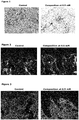
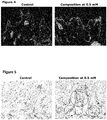
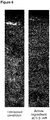
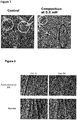
- The results are shown in the accompanying figures, whose details are given below:
-
Figure 1 - effect of the composition on chondroitin sulfate. It was increased by 14% (arrows) -
Figure 2 - effect of the composition on heparan sulfate. It was increased by 14% (white arrows) -
Figure 3 - effect of the composition on decorin. 18% increase observed (white asterisks) -
Figure 4 - effect of the composition on perlecan. 48% increase observed (white arrows) -
Figure 5 - effect of the composition on versican The composition induces an increase in the versican expression (black dotted rings). - In
Figure 6 , biphoton microscopy showed that the composition (at 0.5 mM) induced a visible effect on the skin fibers. Elastic fibers looked repaired and compacted, collagen fibers showed homogeneous diameters and a proper organization. This is confirmed inFigure 7 , where telocytes are found to be numerous and look healthier in the skin treated with the composition. White rings focus on elastic fibers, black ring shows a telocyte, and arrows show collagen fibers. - Effect of the composition on human aged skins (in vivo study).
- The clinical efficacy of the composition formulated in a cream at 2% was evaluated in a double blind test versus placebo under dermatological control by assessment of skin mechanical properties, skin isotropy, skin dermis echogenicity and silicone replicas after 14, 28, 56 and 84 days of application (respectively D14, D28, D56 and D84). Twenty four female volunteers aged between 47 to 65-years-old participated in the study, 50% of them being menopaused. The volunteers applied twice a day the placebo on one side of their face, and a cream containing 2% of the composition on the other side. Mechanical properties of the skin were evaluated on each side of their face after 2 weeks using Cutometer® tool. Cheek skin of a baby was also analyzed by ultrasound tool as a benchmark. The effect of the composition on skin dermis reorganization was evaluated by ultrasound tool. Skin isotropy was determined by PRIMOS 3D tool at D84. Skin isotropy is directly correlated with the quality and organization of the skin dermis. Some silicone replicas were made to visualize the skin surface, and full face pictures were taken with the Visia-CR device in standardized conditions, to illustrate the benefit for the volunteer. All raw data were statistically analyzed using a Student's t-test.
- The composition at 2 % gave in 14 days (D14) a significant improvement of the skin mechanical properties in comparison to placebo for all mechanical parameters studied : skin firmness , skin tonicity , skin viscoelasticity, and skin plasticity (table 8):
Table 8: Effect of composition formulated at 2% on skin mechanical properties (Cutometer® measurements) % of increase of mechanical properties at D14 in comparison to D0 % of improvement of placebo in comparison to D0 / (p value) % of improvement of the formulation 2% in comparison to D0 / (p value)Skin Firmness (R0 parameter) 8% / (p=0.014) 14% / (p= 0.0001) Skin tonicity 7% / (p: non-significant) 16% / (p= 0.002) Skin viscoelasticity 6% / (p: non-significant) 13% / (p= 0.002) Skin plasticity 12% / (p=0.0001) 22% / (p= 0.0001) - Formulation at 2% increased the skin's isotropy: the rejuvenation of the skin matrix is clearly demonstrated on silicone replicas (
figure 8 ). - The formulation at 2% visibly improved the skin density leading to a skin organization almost equivalent to baby skin. On the placebo side, a significant degradation of the skin matrix was observed (more black, decrease of the echogenic components), confirming the aging process progress. On the formulation applied side, a compact dermis was seen with more echogenic areas (
figure 9 ). - The skin treated during 84 days with the formulation was visibly smoothed, as shown in
Figure 10 (see arrows). The formulation acted as a lifting agent, meaning that the dermis structure was better organized.
Claims (5)
- A composition comprising N-acetyl-glucosamine-6-phosphate, glucuronic acid, and a magnesium sulfate in the proportions of 50 to 75, 55 to 83 and 33 to 66 mmoles/kg respectively.
- A composition according to claim 1, in which the three components are present in approximately equimolar proportions
- A skin restoration product, comprising a composition according to claim 1.
- A skin restoration product according to claim 3, in which the composition is present in a proportion of from 0,005-5% by weight.
- A method of restoring aged skin, comprising the topical application of a product according to claim 3.
Applications Claiming Priority (2)
| Application Number | Priority Date | Filing Date | Title |
|---|---|---|---|
| EP16290066 | 2016-04-11 | ||
| PCT/EP2017/058516 WO2017178415A1 (en) | 2016-04-11 | 2017-04-10 | Skin restoration product |
Publications (2)
| Publication Number | Publication Date |
|---|---|
| EP3442496A1 EP3442496A1 (en) | 2019-02-20 |
| EP3442496B1 true EP3442496B1 (en) | 2020-04-01 |
Family
ID=55809051
Family Applications (1)
| Application Number | Title | Priority Date | Filing Date |
|---|---|---|---|
| EP17715500.9A Active EP3442496B1 (en) | 2016-04-11 | 2017-04-10 | Skin restoration product |
Country Status (9)
| Country | Link |
|---|---|
| US (1) | US11026875B2 (en) |
| EP (1) | EP3442496B1 (en) |
| JP (1) | JP6966534B2 (en) |
| CN (1) | CN108883047B (en) |
| BR (1) | BR112018070698B1 (en) |
| ES (1) | ES2802416T3 (en) |
| MX (1) | MX374723B (en) |
| SG (1) | SG11201807971PA (en) |
| WO (1) | WO2017178415A1 (en) |
Family Cites Families (5)
| Publication number | Priority date | Publication date | Assignee | Title |
|---|---|---|---|---|
| ITMI20072348A1 (en) * | 2007-12-17 | 2009-06-18 | Medichem Srl | METHOD FOR CELL RIGENERATION OF HYALURONIC ACID AND ITS COSMETIC COMPOSITION |
| FR2958157B1 (en) * | 2010-04-02 | 2012-06-29 | Libragen | COSMETIC AND PHARMACEUTICAL COMPOSITION COMPRISING N-ACETYL-GLUCOSAMINE-6-PHOSPHATE |
| US20130122475A1 (en) | 2011-11-15 | 2013-05-16 | Kimberly Regan Schoenfeldt | Learning center regulator and method of operating same |
| JP6332902B2 (en) * | 2012-10-29 | 2018-05-30 | 株式会社ピカソ美化学研究所 | Cosmetic composition |
| JP6231993B2 (en) * | 2012-12-10 | 2017-11-15 | 三洋化成工業株式会社 | Hyaluronic acid composition |
-
2017
- 2017-04-10 MX MX2018011431A patent/MX374723B/en active IP Right Grant
- 2017-04-10 US US16/089,524 patent/US11026875B2/en active Active
- 2017-04-10 JP JP2019503780A patent/JP6966534B2/en not_active Expired - Fee Related
- 2017-04-10 ES ES17715500T patent/ES2802416T3/en active Active
- 2017-04-10 EP EP17715500.9A patent/EP3442496B1/en active Active
- 2017-04-10 SG SG11201807971PA patent/SG11201807971PA/en unknown
- 2017-04-10 WO PCT/EP2017/058516 patent/WO2017178415A1/en not_active Ceased
- 2017-04-10 BR BR112018070698-1A patent/BR112018070698B1/en active IP Right Grant
- 2017-04-10 CN CN201780023011.3A patent/CN108883047B/en not_active Expired - Fee Related
Non-Patent Citations (1)
| Title |
|---|
| None * |
Also Published As
| Publication number | Publication date |
|---|---|
| MX2018011431A (en) | 2019-01-10 |
| MX374723B (en) | 2025-03-06 |
| CN108883047A (en) | 2018-11-23 |
| CN108883047B (en) | 2021-10-01 |
| SG11201807971PA (en) | 2018-10-30 |
| JP2019510833A (en) | 2019-04-18 |
| BR112018070698B1 (en) | 2021-11-16 |
| US20200297611A1 (en) | 2020-09-24 |
| EP3442496A1 (en) | 2019-02-20 |
| ES2802416T3 (en) | 2021-01-19 |
| WO2017178415A1 (en) | 2017-10-19 |
| BR112018070698A2 (en) | 2019-02-12 |
| US11026875B2 (en) | 2021-06-08 |
| JP6966534B2 (en) | 2021-11-17 |
Similar Documents
| Publication | Publication Date | Title |
|---|---|---|
| JP6157448B2 (en) | Use of natural active ingredients in cosmetic or therapeutic compositions | |
| US6946551B2 (en) | Preparation of hyaluronic acid from eggshell membrane | |
| AU2015356587B2 (en) | Aminoacid-based composition for fibroelastin recovery in dermal connective tissues | |
| CN113876623B (en) | Use of a hyaluronic acid oligosaccharide composition in anti-skin aging and promoting collagen production | |
| CN113476362B (en) | Facial skin cutin renewal promoter and application thereof | |
| ITMI20120896A1 (en) | CONDROITIN FOR USE IN MEDICINE | |
| JP2019023218A (en) | Method for obtaining a mixture of neutral oligosaccharides extracted from flax seeds | |
| EP2136771B1 (en) | Compositions containing n-acetylglucosamine for use in dermo-cosmetology and aesthetic medicine | |
| US11026875B2 (en) | Skin restoration product | |
| TW202320812A (en) | Hyaluronic acid oligosaccharide composition, and preparation method therefor and use thereof | |
| US20190365637A1 (en) | Cytomimetic formulations and methods of manufacturing the same | |
| Ren et al. | Study on moisturizing effect of Dendrobium officinale, sparassis crispa, and their compound extracts | |
| TWI541352B (en) | Process for stimulating hyaluronic acid production with ascorbic acid derivatives and the composition thereof | |
| JP4524296B2 (en) | Hair growth promoter | |
| JP4881246B2 (en) | Hair growth effect enhancer | |
| JP2000103723A (en) | Trichogenous agent | |
| EP4520838A1 (en) | Proteoglycan production method and proteoglycan | |
| EP4329893A1 (en) | Cosmetic composition, cosmetic preparation containing said composition and their uses and the use of rna sodium salt | |
| CN119700634A (en) | An anti-aging composition containing sheep placenta, and its application and cosmetics | |
| JP2024035284A (en) | Hyaluronic acid production promoter | |
| Eriksson et al. | Exploration of bioactive additives for hyaluronan based hydrogels: A literature study | |
| JP2007176957A (en) | Trichogenous agent | |
| HK40014822A (en) | Chondroitin for use in medicine |
Legal Events
| Date | Code | Title | Description |
|---|---|---|---|
| STAA | Information on the status of an ep patent application or granted ep patent |
Free format text: STATUS: UNKNOWN |
|
| STAA | Information on the status of an ep patent application or granted ep patent |
Free format text: STATUS: THE INTERNATIONAL PUBLICATION HAS BEEN MADE |
|
| PUAI | Public reference made under article 153(3) epc to a published international application that has entered the european phase |
Free format text: ORIGINAL CODE: 0009012 |
|
| STAA | Information on the status of an ep patent application or granted ep patent |
Free format text: STATUS: REQUEST FOR EXAMINATION WAS MADE |
|
| 17P | Request for examination filed |
Effective date: 20181010 |
|
| AK | Designated contracting states |
Kind code of ref document: A1 Designated state(s): AL AT BE BG CH CY CZ DE DK EE ES FI FR GB GR HR HU IE IS IT LI LT LU LV MC MK MT NL NO PL PT RO RS SE SI SK SM TR |
|
| AX | Request for extension of the european patent |
Extension state: BA ME |
|
| DAV | Request for validation of the european patent (deleted) | ||
| DAX | Request for extension of the european patent (deleted) | ||
| GRAP | Despatch of communication of intention to grant a patent |
Free format text: ORIGINAL CODE: EPIDOSNIGR1 |
|
| STAA | Information on the status of an ep patent application or granted ep patent |
Free format text: STATUS: GRANT OF PATENT IS INTENDED |
|
| INTG | Intention to grant announced |
Effective date: 20191212 |
|
| GRAS | Grant fee paid |
Free format text: ORIGINAL CODE: EPIDOSNIGR3 |
|
| GRAA | (expected) grant |
Free format text: ORIGINAL CODE: 0009210 |
|
| STAA | Information on the status of an ep patent application or granted ep patent |
Free format text: STATUS: THE PATENT HAS BEEN GRANTED |
|
| AK | Designated contracting states |
Kind code of ref document: B1 Designated state(s): AL AT BE BG CH CY CZ DE DK EE ES FI FR GB GR HR HU IE IS IT LI LT LU LV MC MK MT NL NO PL PT RO RS SE SI SK SM TR |
|
| REG | Reference to a national code |
Ref country code: GB Ref legal event code: FG4D |
|
| REG | Reference to a national code |
Ref country code: CH Ref legal event code: EP Ref country code: AT Ref legal event code: REF Ref document number: 1250436 Country of ref document: AT Kind code of ref document: T Effective date: 20200415 |
|
| REG | Reference to a national code |
Ref country code: DE Ref legal event code: R096 Ref document number: 602017014012 Country of ref document: DE |
|
| REG | Reference to a national code |
Ref country code: IE Ref legal event code: FG4D |
|
| REG | Reference to a national code |
Ref country code: CH Ref legal event code: NV Representative=s name: GIVAUDAN SA, CH |
|
| PG25 | Lapsed in a contracting state [announced via postgrant information from national office to epo] |
Ref country code: BG Free format text: LAPSE BECAUSE OF FAILURE TO SUBMIT A TRANSLATION OF THE DESCRIPTION OR TO PAY THE FEE WITHIN THE PRESCRIBED TIME-LIMIT Effective date: 20200701 |
|
| REG | Reference to a national code |
Ref country code: NL Ref legal event code: MP Effective date: 20200401 |
|
| REG | Reference to a national code |
Ref country code: LT Ref legal event code: MG4D |
|
| PG25 | Lapsed in a contracting state [announced via postgrant information from national office to epo] |
Ref country code: PT Free format text: LAPSE BECAUSE OF FAILURE TO SUBMIT A TRANSLATION OF THE DESCRIPTION OR TO PAY THE FEE WITHIN THE PRESCRIBED TIME-LIMIT Effective date: 20200817 Ref country code: LT Free format text: LAPSE BECAUSE OF FAILURE TO SUBMIT A TRANSLATION OF THE DESCRIPTION OR TO PAY THE FEE WITHIN THE PRESCRIBED TIME-LIMIT Effective date: 20200401 Ref country code: NO Free format text: LAPSE BECAUSE OF FAILURE TO SUBMIT A TRANSLATION OF THE DESCRIPTION OR TO PAY THE FEE WITHIN THE PRESCRIBED TIME-LIMIT Effective date: 20200701 Ref country code: GR Free format text: LAPSE BECAUSE OF FAILURE TO SUBMIT A TRANSLATION OF THE DESCRIPTION OR TO PAY THE FEE WITHIN THE PRESCRIBED TIME-LIMIT Effective date: 20200702 Ref country code: NL Free format text: LAPSE BECAUSE OF FAILURE TO SUBMIT A TRANSLATION OF THE DESCRIPTION OR TO PAY THE FEE WITHIN THE PRESCRIBED TIME-LIMIT Effective date: 20200401 Ref country code: CZ Free format text: LAPSE BECAUSE OF FAILURE TO SUBMIT A TRANSLATION OF THE DESCRIPTION OR TO PAY THE FEE WITHIN THE PRESCRIBED TIME-LIMIT Effective date: 20200401 Ref country code: SE Free format text: LAPSE BECAUSE OF FAILURE TO SUBMIT A TRANSLATION OF THE DESCRIPTION OR TO PAY THE FEE WITHIN THE PRESCRIBED TIME-LIMIT Effective date: 20200401 Ref country code: IS Free format text: LAPSE BECAUSE OF FAILURE TO SUBMIT A TRANSLATION OF THE DESCRIPTION OR TO PAY THE FEE WITHIN THE PRESCRIBED TIME-LIMIT Effective date: 20200801 Ref country code: FI Free format text: LAPSE BECAUSE OF FAILURE TO SUBMIT A TRANSLATION OF THE DESCRIPTION OR TO PAY THE FEE WITHIN THE PRESCRIBED TIME-LIMIT Effective date: 20200401 |
|
| REG | Reference to a national code |
Ref country code: AT Ref legal event code: MK05 Ref document number: 1250436 Country of ref document: AT Kind code of ref document: T Effective date: 20200401 |
|
| PG25 | Lapsed in a contracting state [announced via postgrant information from national office to epo] |
Ref country code: HR Free format text: LAPSE BECAUSE OF FAILURE TO SUBMIT A TRANSLATION OF THE DESCRIPTION OR TO PAY THE FEE WITHIN THE PRESCRIBED TIME-LIMIT Effective date: 20200401 Ref country code: RS Free format text: LAPSE BECAUSE OF FAILURE TO SUBMIT A TRANSLATION OF THE DESCRIPTION OR TO PAY THE FEE WITHIN THE PRESCRIBED TIME-LIMIT Effective date: 20200401 Ref country code: LV Free format text: LAPSE BECAUSE OF FAILURE TO SUBMIT A TRANSLATION OF THE DESCRIPTION OR TO PAY THE FEE WITHIN THE PRESCRIBED TIME-LIMIT Effective date: 20200401 |
|
| PG25 | Lapsed in a contracting state [announced via postgrant information from national office to epo] |
Ref country code: AL Free format text: LAPSE BECAUSE OF FAILURE TO SUBMIT A TRANSLATION OF THE DESCRIPTION OR TO PAY THE FEE WITHIN THE PRESCRIBED TIME-LIMIT Effective date: 20200401 |
|
| REG | Reference to a national code |
Ref country code: DE Ref legal event code: R097 Ref document number: 602017014012 Country of ref document: DE |
|
| REG | Reference to a national code |
Ref country code: ES Ref legal event code: FG2A Ref document number: 2802416 Country of ref document: ES Kind code of ref document: T3 Effective date: 20210119 |
|
| PG25 | Lapsed in a contracting state [announced via postgrant information from national office to epo] |
Ref country code: MC Free format text: LAPSE BECAUSE OF FAILURE TO SUBMIT A TRANSLATION OF THE DESCRIPTION OR TO PAY THE FEE WITHIN THE PRESCRIBED TIME-LIMIT Effective date: 20200401 Ref country code: RO Free format text: LAPSE BECAUSE OF FAILURE TO SUBMIT A TRANSLATION OF THE DESCRIPTION OR TO PAY THE FEE WITHIN THE PRESCRIBED TIME-LIMIT Effective date: 20200401 Ref country code: SM Free format text: LAPSE BECAUSE OF FAILURE TO SUBMIT A TRANSLATION OF THE DESCRIPTION OR TO PAY THE FEE WITHIN THE PRESCRIBED TIME-LIMIT Effective date: 20200401 Ref country code: EE Free format text: LAPSE BECAUSE OF FAILURE TO SUBMIT A TRANSLATION OF THE DESCRIPTION OR TO PAY THE FEE WITHIN THE PRESCRIBED TIME-LIMIT Effective date: 20200401 Ref country code: LU Free format text: LAPSE BECAUSE OF NON-PAYMENT OF DUE FEES Effective date: 20200410 Ref country code: AT Free format text: LAPSE BECAUSE OF FAILURE TO SUBMIT A TRANSLATION OF THE DESCRIPTION OR TO PAY THE FEE WITHIN THE PRESCRIBED TIME-LIMIT Effective date: 20200401 Ref country code: DK Free format text: LAPSE BECAUSE OF FAILURE TO SUBMIT A TRANSLATION OF THE DESCRIPTION OR TO PAY THE FEE WITHIN THE PRESCRIBED TIME-LIMIT Effective date: 20200401 |
|
| REG | Reference to a national code |
Ref country code: BE Ref legal event code: MM Effective date: 20200430 |
|
| PLBE | No opposition filed within time limit |
Free format text: ORIGINAL CODE: 0009261 |
|
| STAA | Information on the status of an ep patent application or granted ep patent |
Free format text: STATUS: NO OPPOSITION FILED WITHIN TIME LIMIT |
|
| PG25 | Lapsed in a contracting state [announced via postgrant information from national office to epo] |
Ref country code: SK Free format text: LAPSE BECAUSE OF FAILURE TO SUBMIT A TRANSLATION OF THE DESCRIPTION OR TO PAY THE FEE WITHIN THE PRESCRIBED TIME-LIMIT Effective date: 20200401 Ref country code: PL Free format text: LAPSE BECAUSE OF FAILURE TO SUBMIT A TRANSLATION OF THE DESCRIPTION OR TO PAY THE FEE WITHIN THE PRESCRIBED TIME-LIMIT Effective date: 20200401 Ref country code: BE Free format text: LAPSE BECAUSE OF NON-PAYMENT OF DUE FEES Effective date: 20200430 |
|
| 26N | No opposition filed |
Effective date: 20210112 |
|
| PG25 | Lapsed in a contracting state [announced via postgrant information from national office to epo] |
Ref country code: IE Free format text: LAPSE BECAUSE OF NON-PAYMENT OF DUE FEES Effective date: 20200410 |
|
| PG25 | Lapsed in a contracting state [announced via postgrant information from national office to epo] |
Ref country code: SI Free format text: LAPSE BECAUSE OF FAILURE TO SUBMIT A TRANSLATION OF THE DESCRIPTION OR TO PAY THE FEE WITHIN THE PRESCRIBED TIME-LIMIT Effective date: 20200401 |
|
| PG25 | Lapsed in a contracting state [announced via postgrant information from national office to epo] |
Ref country code: TR Free format text: LAPSE BECAUSE OF FAILURE TO SUBMIT A TRANSLATION OF THE DESCRIPTION OR TO PAY THE FEE WITHIN THE PRESCRIBED TIME-LIMIT Effective date: 20200401 Ref country code: MT Free format text: LAPSE BECAUSE OF FAILURE TO SUBMIT A TRANSLATION OF THE DESCRIPTION OR TO PAY THE FEE WITHIN THE PRESCRIBED TIME-LIMIT Effective date: 20200401 Ref country code: CY Free format text: LAPSE BECAUSE OF FAILURE TO SUBMIT A TRANSLATION OF THE DESCRIPTION OR TO PAY THE FEE WITHIN THE PRESCRIBED TIME-LIMIT Effective date: 20200401 |
|
| PG25 | Lapsed in a contracting state [announced via postgrant information from national office to epo] |
Ref country code: MK Free format text: LAPSE BECAUSE OF FAILURE TO SUBMIT A TRANSLATION OF THE DESCRIPTION OR TO PAY THE FEE WITHIN THE PRESCRIBED TIME-LIMIT Effective date: 20200401 |
|
| PGFP | Annual fee paid to national office [announced via postgrant information from national office to epo] |
Ref country code: IT Payment date: 20230426 Year of fee payment: 7 |
|
| PG25 | Lapsed in a contracting state [announced via postgrant information from national office to epo] |
Ref country code: IT Free format text: LAPSE BECAUSE OF NON-PAYMENT OF DUE FEES Effective date: 20240410 |
|
| PGFP | Annual fee paid to national office [announced via postgrant information from national office to epo] |
Ref country code: DE Payment date: 20250422 Year of fee payment: 9 |
|
| PGFP | Annual fee paid to national office [announced via postgrant information from national office to epo] |
Ref country code: GB Payment date: 20250423 Year of fee payment: 9 Ref country code: ES Payment date: 20250530 Year of fee payment: 9 |
|
| PGFP | Annual fee paid to national office [announced via postgrant information from national office to epo] |
Ref country code: FR Payment date: 20250425 Year of fee payment: 9 |
|
| PGFP | Annual fee paid to national office [announced via postgrant information from national office to epo] |
Ref country code: CH Payment date: 20250501 Year of fee payment: 9 |
|
| REG | Reference to a national code |
Ref country code: CH Ref legal event code: U11 Free format text: ST27 STATUS EVENT CODE: U-0-0-U10-U11 (AS PROVIDED BY THE NATIONAL OFFICE) Effective date: 20260501 |