EP3441829B1 - System state prediction - Google Patents
System state prediction Download PDFInfo
- Publication number
- EP3441829B1 EP3441829B1 EP17184735.3A EP17184735A EP3441829B1 EP 3441829 B1 EP3441829 B1 EP 3441829B1 EP 17184735 A EP17184735 A EP 17184735A EP 3441829 B1 EP3441829 B1 EP 3441829B1
- Authority
- EP
- European Patent Office
- Prior art keywords
- state
- filter
- physical system
- model
- prediction
- Prior art date
- Legal status (The legal status is an assumption and is not a legal conclusion. Google has not performed a legal analysis and makes no representation as to the accuracy of the status listed.)
- Active
Links
Images


Classifications
-
- H—ELECTRICITY
- H02—GENERATION; CONVERSION OR DISTRIBUTION OF ELECTRIC POWER
- H02P—CONTROL OR REGULATION OF ELECTRIC MOTORS, ELECTRIC GENERATORS OR DYNAMO-ELECTRIC CONVERTERS; CONTROLLING TRANSFORMERS, REACTORS OR CHOKE COILS
- H02P21/00—Arrangements or methods for the control of electric machines by vector control, e.g. by control of field orientation
- H02P21/0003—Control strategies in general, e.g. linear type, e.g. P, PI, PID, using robust control
- H02P21/0014—Control strategies in general, e.g. linear type, e.g. P, PI, PID, using robust control using neural networks
-
- G—PHYSICS
- G05—CONTROLLING; REGULATING
- G05B—CONTROL OR REGULATING SYSTEMS IN GENERAL; FUNCTIONAL ELEMENTS OF SUCH SYSTEMS; MONITORING OR TESTING ARRANGEMENTS FOR SUCH SYSTEMS OR ELEMENTS
- G05B13/00—Adaptive control systems, i.e. systems automatically adjusting themselves to have a performance which is optimum according to some preassigned criterion
- G05B13/02—Adaptive control systems, i.e. systems automatically adjusting themselves to have a performance which is optimum according to some preassigned criterion electric
- G05B13/0265—Adaptive control systems, i.e. systems automatically adjusting themselves to have a performance which is optimum according to some preassigned criterion electric the criterion being a learning criterion
- G05B13/027—Adaptive control systems, i.e. systems automatically adjusting themselves to have a performance which is optimum according to some preassigned criterion electric the criterion being a learning criterion using neural networks only
-
- G—PHYSICS
- G05—CONTROLLING; REGULATING
- G05B—CONTROL OR REGULATING SYSTEMS IN GENERAL; FUNCTIONAL ELEMENTS OF SUCH SYSTEMS; MONITORING OR TESTING ARRANGEMENTS FOR SUCH SYSTEMS OR ELEMENTS
- G05B13/00—Adaptive control systems, i.e. systems automatically adjusting themselves to have a performance which is optimum according to some preassigned criterion
- G05B13/02—Adaptive control systems, i.e. systems automatically adjusting themselves to have a performance which is optimum according to some preassigned criterion electric
- G05B13/04—Adaptive control systems, i.e. systems automatically adjusting themselves to have a performance which is optimum according to some preassigned criterion electric involving the use of models or simulators
- G05B13/048—Adaptive control systems, i.e. systems automatically adjusting themselves to have a performance which is optimum according to some preassigned criterion electric involving the use of models or simulators using a predictor
-
- G—PHYSICS
- G05—CONTROLLING; REGULATING
- G05B—CONTROL OR REGULATING SYSTEMS IN GENERAL; FUNCTIONAL ELEMENTS OF SUCH SYSTEMS; MONITORING OR TESTING ARRANGEMENTS FOR SUCH SYSTEMS OR ELEMENTS
- G05B17/00—Systems involving the use of models or simulators of said systems
- G05B17/02—Systems involving the use of models or simulators of said systems electric
-
- G—PHYSICS
- G06—COMPUTING OR CALCULATING; COUNTING
- G06N—COMPUTING ARRANGEMENTS BASED ON SPECIFIC COMPUTATIONAL MODELS
- G06N3/00—Computing arrangements based on biological models
- G06N3/02—Neural networks
- G06N3/04—Architecture, e.g. interconnection topology
- G06N3/042—Knowledge-based neural networks; Logical representations of neural networks
-
- G—PHYSICS
- G06—COMPUTING OR CALCULATING; COUNTING
- G06N—COMPUTING ARRANGEMENTS BASED ON SPECIFIC COMPUTATIONAL MODELS
- G06N3/00—Computing arrangements based on biological models
- G06N3/02—Neural networks
- G06N3/04—Architecture, e.g. interconnection topology
- G06N3/044—Recurrent networks, e.g. Hopfield networks
- G06N3/0442—Recurrent networks, e.g. Hopfield networks characterised by memory or gating, e.g. long short-term memory [LSTM] or gated recurrent units [GRU]
-
- G—PHYSICS
- G06—COMPUTING OR CALCULATING; COUNTING
- G06N—COMPUTING ARRANGEMENTS BASED ON SPECIFIC COMPUTATIONAL MODELS
- G06N3/00—Computing arrangements based on biological models
- G06N3/02—Neural networks
- G06N3/08—Learning methods
- G06N3/09—Supervised learning
-
- G—PHYSICS
- G06—COMPUTING OR CALCULATING; COUNTING
- G06N—COMPUTING ARRANGEMENTS BASED ON SPECIFIC COMPUTATIONAL MODELS
- G06N7/00—Computing arrangements based on specific mathematical models
- G06N7/01—Probabilistic graphical models, e.g. probabilistic networks
-
- H—ELECTRICITY
- H02—GENERATION; CONVERSION OR DISTRIBUTION OF ELECTRIC POWER
- H02P—CONTROL OR REGULATION OF ELECTRIC MOTORS, ELECTRIC GENERATORS OR DYNAMO-ELECTRIC CONVERTERS; CONTROLLING TRANSFORMERS, REACTORS OR CHOKE COILS
- H02P21/00—Arrangements or methods for the control of electric machines by vector control, e.g. by control of field orientation
- H02P21/0003—Control strategies in general, e.g. linear type, e.g. P, PI, PID, using robust control
- H02P21/0017—Model reference adaptation, e.g. MRAS or MRAC, useful for control or parameter estimation
Definitions
- Present invention concerns the prediction of the future state of a dynamical system. More particularly present invention concerns the combination of different models for state prediction.
- an asynchronous electric motor converts a considerable portion of the electric current that flows through it into heat, which may build up sharply on a pole shoe of the rotor. This happens due to slippage of magnetic fields between the stator and the rotor while the rotor rotates slower than the electrical frequency dictates. Such excess heat can cause structural damage to the motor and therefore needs to be closely monitored. Since the pole shoe is part of the rotating assembly, a sensor for direct temperature measurement of the pole shoe surface cannot be placed in a production device due to the high associated cost. Hence, a simulation model for calculation and prediction of these temperatures may be set up.
- Prediction of system state is traditionally performed using either a physical model or a data based regression model.
- the physical model is susceptible to modelling errors and needs calibration.
- the data driven model can only predict behaviour that can be directly observed in real systems.
- a data driven model will produce poor results if the space of possible control inputs is not densely sampled in the recorded data.
- US 2016/253440 A1 proposes a technique for automating prognostics for a physical assset.
- US 8 600 917 B1 concerns the coupling of an evolution model with an emprical regression model.
- a method for predicting a state of a physical system comprises steps of providing a state space model of behaviour of a physical system, the model including covariances for state transition and measurement errors; providing a data based regression model for prediction of state variables of the physical system; observing a state vector comprising state variables of the physical system; determining a prediction vector of state variables based on the state vector, using the regression model; and combining information from the state space model with predictions from the regression model through a Bayesian filter.
- the method may be used to make predictions for one or more state variables of the state vector. Behaviour of the physical system may thus be forecast and a potentially dangerous situation may be identified even before it occurs. A countermeasure to prevent that situation may be conducted in time. Should the covariances for state transition and measurement errors not be available, estimations thereof may be used.
- the method combines a mathematical model of system behaviour based on the physics of the underlying process and measurement data collected during operation of actual instances of the real system. Due to the combination, in practical applications the prediction accuracy of the described method is expected to be improved when compared to the prediction accuracy achieved by using a model-driven approach by itself. On the other hand, data-driven approaches by themselves do not allow prediction of unobserved state variables.
- the physical system is preferred to be a time-discrete linear time-invariant system but other systems can also be addressed, as will be shown below.
- the system must be physical for the physical model to make sense.
- the system may for instance represent a mechanism for carrying out a predetermined technical process or a motor, especially an asynchronous electric motor.
- the Bayesian filter may be realized by a Kalman filter.
- the Kalman filter can be used for making a prediction for the state vector by carrying out only steps of predicting an estimate and predicting a covariance for each time step.
- the Kalman filter will be adequate to a Bayes filter if the filter variables are linear and normally distributed. Kalman filtering is state-of-the-art and can be done with moderate computational means. Processing libraries are available for a broad range of processing environments.
- the Bayesian filter may be realized through an Extended Kalman filter. This may be especially useful if the physical system is nonlinear.
- the Extended Kalman filter (EKF) is the nonlinear version of the Kalman filter which linearises about an estimate of the current mean and covariance. In the case of well defined transition models, the EKF has been considered the de facto standard in the theory of nonlinear state estimation. The EKF may therefore allow for both linear and nonlinear variables, making it more flexible and versatile.
- the Bayesian filter may also comprise a particle filter. This may be especially advantageous if a distribution of the measurement errors is non-Gaussian.
- the particle filter is also called a Sequential Monte Carlo (SMC) method for solving filtering problems in Bayesian filter inference.
- the regression model may comprise a trained recurrent neural network (RNN).
- RNN may be used to predict system outputs for given control inputs.
- the RNN may be trained offline and deployed to the place where the method is carried out.
- connections between units generally form a directed cycle, so that the RNN may exhibit dynamic temporal behavior.
- RNNs can use their internal memory to process arbitrary sequences of inputs. This ability makes an RNN a favourable choice for the regression model.
- a different machine learning method that allows time series regression from a given input signal may also be used.
- the Recurrent Neural Network may be interpolated between discrete time steps and the Bayesian filter may comprise a Continuous Kalman Filter.
- the state equation of the state space system model may be continuous, too.
- An apparatus for predicting a state of a physical system comprises an interface for observing a state vector comprising state variables in a physical system; and processing means adapted to carry out above-described method completely or in part.
- the described method may be formulated as a computer program product with program code means. Advantages or features of the method may apply to the apparatus and vice versa.
- Approach i) is susceptible to modelling errors, i.e. the model not describing the behaviour of the actual real-world system with sufficient accuracy. Deriving a model that covers all relevant behaviour of a real world system with respect to the intended application can be a challenging problem. Calibration needs to be performed in order to adapt model parameters to match observed system behaviour as accurately as possible. But even then, any unmodelled dynamics in the system will substantially degrade long-term prediction performance of the model-driven approach.
- the method described herein combines approaches i) and ii) to allow more accurate state predictions than would be possible by using either of the two approaches by themselves.
- the method makes use of these ingredients to predict system state over a time range in the future for which the control input is given.
- the method is detailed using specific variants for a), b) and c). However, it is noted that the method is applicable in a much more general setting.
- x k denotes the system state at time step k
- A is the state-transition matrix
- B the control matrix
- u k the input
- w k the process noise at time step k
- z k are the measurements
- H the output matrix
- v k the measurement noise at time step k .
- noise terms w k and v k are mean-free normally distributed random variables with covariance matrix Q k and R k respectively: v k ⁇ N (0, Q k ), w k ⁇ N (0, R k ) .
- Figure 1 shows schematically a method 100 of using a Kalman-filter for state prediction.
- a present point in time is indicated as a broken line between times k and k+1. Times k, k-1 and lower are considered to lie in the past and times k+1, k+2 and higher in the future.
- the Kalman-filter method provides an estimator x ⁇ k
- the algorithm consists of the following computational steps:
- the Kalman-filter Given previous state and current measurements, the Kalman-filter is known to compute the optimal estimate of the current state and its covariance.
- the Kalman-filter can also be used for predicting future states if only the first two prediction steps are carried out in each time step. However, in this case there is no correction from measurements being applied, and this leads to a rapid increase of the covariance of predicted states, indicating that the uncertainty of predicted state values increases rapidly with increasing time step.
- FIG. 2 A schematic representation of a method for system state prediction is shown in Figure 2 .
- a broken line symbolically separates a past (above) from a future (below).
- the trained Recurrent Neural Network RNN is then applied to the validation data set and the predicted validation output is compared to the measured validation outputs to create an empirical covariance matrix Q k for the expected error of the RNN prediction for each time step k .
- the computationally expensive task of training the Recurrent Neural Network may be carried out offline in advance, while the state-prediction only uses a forward evaluation of the RNN and the Kalman-filter equations, which can be solved numerically with very low computational costs. Hence, in most cases the proposed state prediction method is expected to be calculated faster than real-time.
- Figure 3 shows a flow chart of an exemplary method that may be based on the above described methods 100 and/or 200 of Figures 1 and 2 , respectively.
- a state space model of behaviour of a physical system is provided, the model including covariances for state transition and measurement errors.
- a data based regression model for prediction of state variables of the physical system is provided.
- a state vector comprising state variables of the physical system is observed.
- a prediction vector of state variables based on the state vector is determined using the regression model.
- Results of the two models are then combined in a step 325 by using a Bayesian filter.
- the method 300 may start over and loop over steps 315 - 325 for continuous operation.
- FIG 4 shows a depiction 400 of a physical system 405 that is represented by an exemplary asynchronous electric motor, although present invention is not limited to electric machinery.
- the electric motor 405 may be a large drive motor for an elevator, a belt conveyor or a sewage pump, potentially with a maximum power in the range of up to 100 kW or more.
- the motor 405 comprises a stator 410 and a rotor 415.
- the apparatus 430 comprises processing means 435 which may comprise a programmable microcomputer or microcontroller.
- the processing means 435 is adapted to carry out a method for state variable prediction, especially according to method 300.
- Features or advantages of the method 300 may be applied to the system 405 or vice versa. Carrying out said method 300 may comprise execution of a computer program product with program code means.
- the determined forecast for one or more state variables may be provided via an optional second interface 440.
- the forecast may also be used for protection of motor 405. Should the forecast state indicate a pending critical situation of motor 405, say, an overheating about to take place, electrical power to the motor 405 may be temporarily reduced or cut.
- a forecast state may be compared against a predetermined threshold. Other approaches comprise observation of the rising speed of a predicted state variable or a combination of several state variables fulfilling a predetermined condition. The condition may for instance be given in the form of a predetermined polynomial, the value of which may exceed a predetermined threshold upon a pending critical situation.
- the apparatus 430 may also be adapted to output a signal that hints at the pending critical situation, or activate means to prevent the situation.
Landscapes
- Engineering & Computer Science (AREA)
- Physics & Mathematics (AREA)
- Artificial Intelligence (AREA)
- General Physics & Mathematics (AREA)
- Evolutionary Computation (AREA)
- Theoretical Computer Science (AREA)
- Software Systems (AREA)
- Health & Medical Sciences (AREA)
- Automation & Control Theory (AREA)
- Computer Vision & Pattern Recognition (AREA)
- General Engineering & Computer Science (AREA)
- Medical Informatics (AREA)
- Mathematical Physics (AREA)
- Computing Systems (AREA)
- Data Mining & Analysis (AREA)
- Molecular Biology (AREA)
- Biomedical Technology (AREA)
- Biophysics (AREA)
- Life Sciences & Earth Sciences (AREA)
- Computational Linguistics (AREA)
- General Health & Medical Sciences (AREA)
- Power Engineering (AREA)
- Computational Mathematics (AREA)
- Pure & Applied Mathematics (AREA)
- Mathematical Optimization (AREA)
- Mathematical Analysis (AREA)
- Algebra (AREA)
- Probability & Statistics with Applications (AREA)
- Testing And Monitoring For Control Systems (AREA)
- Geometry (AREA)
- Control Of Electric Motors In General (AREA)
- Computer Hardware Design (AREA)
Description
- Present invention concerns the prediction of the future state of a dynamical system. More particularly present invention concerns the combination of different models for state prediction.
- During start-up, an asynchronous electric motor converts a considerable portion of the electric current that flows through it into heat, which may build up sharply on a pole shoe of the rotor. This happens due to slippage of magnetic fields between the stator and the rotor while the rotor rotates slower than the electrical frequency dictates. Such excess heat can cause structural damage to the motor and therefore needs to be closely monitored. Since the pole shoe is part of the rotating assembly, a sensor for direct temperature measurement of the pole shoe surface cannot be placed in a production device due to the high associated cost. Hence, a simulation model for calculation and prediction of these temperatures may be set up.
- Prediction of system state is traditionally performed using either a physical model or a data based regression model. The physical model is susceptible to modelling errors and needs calibration. The data driven model can only predict behaviour that can be directly observed in real systems. A data driven model will produce poor results if the space of possible control inputs is not densely sampled in the recorded data.
-
US 2016/253440 A1 proposes a technique for automating prognostics for a physical assset. -
US 8 600 917 B1 concerns the coupling of an evolution model with an emprical regression model. - It is therefore a task of the present invention to provide an improved technique for predicting the state vector of a physical system.
- A method for predicting a state of a physical system comprises steps of providing a state space model of behaviour of a physical system, the model including covariances for state transition and measurement errors; providing a data based regression model for prediction of state variables of the physical system; observing a state vector comprising state variables of the physical system; determining a prediction vector of state variables based on the state vector, using the regression model; and combining information from the state space model with predictions from the regression model through a Bayesian filter.
- The method may be used to make predictions for one or more state variables of the state vector. Behaviour of the physical system may thus be forecast and a potentially dangerous situation may be identified even before it occurs. A countermeasure to prevent that situation may be conducted in time. Should the covariances for state transition and measurement errors not be available, estimations thereof may be used.
- The method combines a mathematical model of system behaviour based on the physics of the underlying process and measurement data collected during operation of actual instances of the real system. Due to the combination, in practical applications the prediction accuracy of the described method is expected to be improved when compared to the prediction accuracy achieved by using a model-driven approach by itself. On the other hand, data-driven approaches by themselves do not allow prediction of unobserved state variables.
- The physical system is preferred to be a time-discrete linear time-invariant system but other systems can also be addressed, as will be shown below. Note that the system must be physical for the physical model to make sense. The system may for instance represent a mechanism for carrying out a predetermined technical process or a motor, especially an asynchronous electric motor.
- The Bayesian filter may be realized by a Kalman filter. The Kalman filter can be used for making a prediction for the state vector by carrying out only steps of predicting an estimate and predicting a covariance for each time step. The Kalman filter will be adequate to a Bayes filter if the filter variables are linear and normally distributed. Kalman filtering is state-of-the-art and can be done with moderate computational means. Processing libraries are available for a broad range of processing environments.
- The Bayesian filter may be realized through an Extended Kalman filter. This may be especially useful if the physical system is nonlinear. The Extended Kalman filter (EKF) is the nonlinear version of the Kalman filter which linearises about an estimate of the current mean and covariance. In the case of well defined transition models, the EKF has been considered the de facto standard in the theory of nonlinear state estimation. The EKF may therefore allow for both linear and nonlinear variables, making it more flexible and versatile.
- The Bayesian filter may also comprise a particle filter. This may be especially advantageous if a distribution of the measurement errors is non-Gaussian. The particle filter is also called a Sequential Monte Carlo (SMC) method for solving filtering problems in Bayesian filter inference.
- The regression model may comprise a trained recurrent neural network (RNN). The RNN may be used to predict system outputs for given control inputs. The RNN may be trained offline and deployed to the place where the method is carried out. In an RNN, connections between units generally form a directed cycle, so that the RNN may exhibit dynamic temporal behavior. Unlike feedforward neural networks, RNNs can use their internal memory to process arbitrary sequences of inputs. This ability makes an RNN a favourable choice for the regression model. In other embodiments, a different machine learning method that allows time series regression from a given input signal may also be used.
- Especially if the physical system is time continuous, the Recurrent Neural Network may be interpolated between discrete time steps and the Bayesian filter may comprise a Continuous Kalman Filter. In that case, the state equation of the state space system model may be continuous, too.
- An apparatus for predicting a state of a physical system comprises an interface for observing a state vector comprising state variables in a physical system; and processing means adapted to carry out above-described method completely or in part. To this ends, the described method may be formulated as a computer program product with program code means. Advantages or features of the method may apply to the apparatus and vice versa.
- The above-described properties, features and advantages of present invention as well as the way they are achieved will be made clearer and better understandable in the light of the following discussion, making reference to exemplary embodiments shown in accompanying figures, in which
-
Fig. 1 shows schematically how a Kalman filter may be used for state prediction; -
Fig. 2 shows a schematic representation of a method for providing improved state information prediction; and -
Fig. 3 shows an exemplary physical system and an exemplary apparatus for prediction of a state of the physical system. - Prediction of system state is traditionally performed using one of the following approaches:
- i) A mathematical model is derived from the physical system behaviour and numerically simulated forward in time, starting from a known initial state and using given future system inputs.
- ii) Measurements are collected from a real system and a data-based regression model is constructed that allows prediction of the system output given its inputs.
- Approach i) is susceptible to modelling errors, i.e. the model not describing the behaviour of the actual real-world system with sufficient accuracy. Deriving a model that covers all relevant behaviour of a real world system with respect to the intended application can be a challenging problem. Calibration needs to be performed in order to adapt model parameters to match observed system behaviour as accurately as possible. But even then, any unmodelled dynamics in the system will substantially degrade long-term prediction performance of the model-driven approach.
- In Approach ii), machine learning techniques are used to train a data-driven model in order to learn the behaviour of the system from recorded measurements of system output for given control inputs. This approach does not suffer from errors due to unmodelled dynamics, but on the other hand can only predict behaviour that can be directly observed in real systems. Any part of the system state that is not observed through outputs cannot be targeted by data-driven methods without a model of how these states are connected to observable quantities. In addition, if the space of possible control inputs is not densely sampled in the recorded data, a data-driven approach will produce poor prediction results for control inputs that are far from the inputs covered by the recorded data. Also, the accuracy of data-driven prediction approaches inherently depends on the accuracy of measurements.
- The method described herein combines approaches i) and ii) to allow more accurate state predictions than would be possible by using either of the two approaches by themselves.
- Ingredients to the proposed method are the following:
- a) a state space description of the system behaviour including covariances for state-transition and measurement errors (or estimates thereof),
- b) a data-based regression model for predicting system outputs to given control inputs,
- c) a Bayesian filter method for combining information from the state space model with predictions from the regression model.
- The method makes use of these ingredients to predict system state over a time range in the future for which the control input is given. In the following, for clarity of exposition, the method is detailed using specific variants for a), b) and c). However, it is noted that the method is applicable in a much more general setting.
- In particular, for the detailed exposition we assume that
- The system under consideration is a time-discrete linear time-invariant (LTI) system, in which all random variables are normally distributed,
- For the Bayesian filter the well-known Kalman-filter method is applied,
- A recurrent neural network is trained using historic measurements to predict system outputs for given control inputs.
- A time-discrete LTI system can be described by the equations:


- Here, xk denotes the system state at time step k, A is the state-transition matrix, B the control matrix, uk the input and wk the process noise at time step k. Likewise, in the output equation, zk are the measurements, H the output matrix and vk the measurement noise at time step k.
- We assume that the noise terms wk and vk are mean-free normally distributed random variables with covariance matrix Qk and Rk respectively: vk ∼ N(0,Qk ), wk ∼ N(0,Rk ).
- The problem of state prediction can now be stated as follows: Given an initial state x 0 and known control inputs uj for j in {1,..K}, predict the system state xj for each j in {1,..K}.
- In addition to the state space model given above, it is assumed that large amounts of historic data from existing instances of the real-world system are available. This historic data consists of a large number M of sets of inputs


-
Figure 1 shows schematically amethod 100 of using a Kalman-filter for state prediction. A present point in time is indicated as a broken line between times k and k+1. Times k, k-1 and lower are considered to lie in the past and times k+1, k+2 and higher in the future. - The Kalman-filter method provides an estimator x̂ k|k for the system state at time k given measurements at time k. The algorithm consists of the following computational steps:
- Predicted estimate: x̂ k|k-1 = Ax̂ k|k-1 + Buk
- Predicted covariance: P k|k-1 = AP k-1|k-1 AT +Q k-1
- Measurement residual: ỹk = zk - Hx̂ k|k-1
- Residual covariance: Sk = HP k|k-1 HT + Rk
- Kalman gain matrix: Kk = P k|k-1 HT + Rk
- Corrected prediction: x̂ k|k = x̂ k|k-1 +Kkỹk
- Corrected covariance: P k|k = (I-KkH)P k|k-1
- Given previous state and current measurements, the Kalman-filter is known to compute the optimal estimate of the current state and its covariance. The Kalman-filter can also be used for predicting future states if only the first two prediction steps are carried out in each time step. However, in this case there is no correction from measurements being applied, and this leads to a rapid increase of the covariance of predicted states, indicating that the uncertainty of predicted state values increases rapidly with increasing time step.
- A schematic representation of a method for system state prediction is shown in
Figure 2 . As inFigure 1 , a broken line symbolically separates a past (above) from a future (below). - For the regression model, the available historic data


z j to given inputs uj :
- The trained Recurrent Neural Network RNN is then applied to the validation data set and the predicted validation output is compared to the measured validation outputs to create an empirical covariance matrix
Q k for the expected error of the RNN prediction for each time step k. - Finally, the method suggested herein combines the state-space and data-driven models to produce a joint state prediction
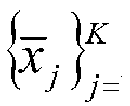

- The control input is fed into the neural network model produces predicted outputs


- The Kalman-filter algorithm is applied iteratively to the state estimates where in each time step, zk is replaced by
z k and Qk byQ k. - The computationally expensive task of training the Recurrent Neural Network (RNN) may be carried out offline in advance, while the state-prediction only uses a forward evaluation of the RNN and the Kalman-filter equations, which can be solved numerically with very low computational costs. Hence, in most cases the proposed state prediction method is expected to be calculated faster than real-time.
-
Figure 3 shows a flow chart of an exemplary method that may be based on the above describedmethods 100 and/or 200 ofFigures 1 and2 , respectively. In astep 305, a state space model of behaviour of a physical system is provided, the model including covariances for state transition and measurement errors. In astep 310, a data based regression model for prediction of state variables of the physical system is provided. - The two models have different strengths and weaknesses (or limitations) as was discussed above. In a
step 315, a state vector comprising state variables of the physical system is observed. Similarly, in astep 320, a prediction vector of state variables based on the state vector is determined using the regression model. - Results of the two models are then combined in a
step 325 by using a Bayesian filter. Themethod 300 may start over and loop over steps 315 - 325 for continuous operation. - Figure 4 shows a depiction 400 of a physical system 405 that is represented by an exemplary asynchronous electric motor, although present invention is not limited to electric machinery. The electric motor 405 may be a large drive motor for an elevator, a belt conveyor or a sewage pump, potentially with a maximum power in the range of up to 100 kW or more. The motor 405 comprises a stator 410 and a rotor 415. On the motor 405 there may be one or more sensors 420 to pick up conditions of motor 405, like a temperature in a predetermined position, a rotating speed, a provided torque or an electric current.
- Via an optional first interface 425 the measurements are made available to an apparatus 430 that is adapted to make a state variable forecast based on the received measurements. The apparatus 430 comprises processing means 435 which may comprise a programmable microcomputer or microcontroller. The processing means 435 is adapted to carry out a method for state variable prediction, especially according to
method 300. Features or advantages of themethod 300 may be applied to the system 405 or vice versa. Carrying out saidmethod 300 may comprise execution of a computer program product with program code means. The determined forecast for one or more state variables may be provided via an optional second interface 440. - The forecast may also be used for protection of motor 405. Should the forecast state indicate a pending critical situation of motor 405, say, an overheating about to take place, electrical power to the motor 405 may be temporarily reduced or cut. To determine a critical situation, a forecast state may be compared against a predetermined threshold. Other approaches comprise observation of the rising speed of a predicted state variable or a combination of several state variables fulfilling a predetermined condition. The condition may for instance be given in the form of a predetermined polynomial, the value of which may exceed a predetermined threshold upon a pending critical situation. The apparatus 430 may also be adapted to output a signal that hints at the pending critical situation, or activate means to prevent the situation.
- Even though present invention has been illustrated and explained in detail above with reference to the preferred embodiments, the invention is not to be construed as limited to the given examples. Variants or alternate combinations of features given in different embodiments may be derived by a subject matter expert without exceeding the scope of present invention.
Claims (7)
- Method (300) for predicting a state of a physical system, the method comprising the following steps:- providing (305) a state space model of behaviour of a physical system, the model including covariances for state transition and measurement errors;- providing (310) a data based regression model for prediction of state variables of the physical system;- observing (315) a state vector comprising state variables of the physical system;- determining (320) a prediction vector of state variables based on the state vector, using the regression model; and- combining (325) information from the state space model with predictions from the regression model through a Bayesian filter.
- Method (300) according to claim 1, wherein the Bayesian filter is realized by a Kalman filter.
- Method (300) according to claim 1, wherein the Bayesian filter is realized by an Extended Kalman filter.
- Method (300) according to claim 1, wherein the Bayesian filter comprises a particle filter.
- Method (300) according to one of the previous claims, wherein the regression model comprises a trained Recurrent Neural Network.
- Method (300) according to claim 5, wherein the physical system is time continuous, the Recurrent Neural Network is interpolated between discrete time steps and the Bayesian filter comprises a Continuous Kalman Filter.
- Apparatus (430) for predicting a state of a physical system, comprising the following elements:- an interface (425) for observing a state vector comprising state variables in a physical system;- processing means (435), adapted to carry out a method (200) according to one of the above claims.
Priority Applications (4)
| Application Number | Priority Date | Filing Date | Title |
|---|---|---|---|
| EP17184735.3A EP3441829B1 (en) | 2017-08-08 | 2017-08-08 | System state prediction |
| KR1020180091783A KR102173653B1 (en) | 2017-08-08 | 2018-08-07 | System state prediction |
| CN201810895969.8A CN109391195B (en) | 2017-08-08 | 2018-08-08 | System state prediction |
| US16/106,153 US11347996B2 (en) | 2017-08-08 | 2018-08-21 | System state prediction |
Applications Claiming Priority (1)
| Application Number | Priority Date | Filing Date | Title |
|---|---|---|---|
| EP17184735.3A EP3441829B1 (en) | 2017-08-08 | 2017-08-08 | System state prediction |
Publications (2)
| Publication Number | Publication Date |
|---|---|
| EP3441829A1 EP3441829A1 (en) | 2019-02-13 |
| EP3441829B1 true EP3441829B1 (en) | 2020-11-11 |
Family
ID=59738115
Family Applications (1)
| Application Number | Title | Priority Date | Filing Date |
|---|---|---|---|
| EP17184735.3A Active EP3441829B1 (en) | 2017-08-08 | 2017-08-08 | System state prediction |
Country Status (4)
| Country | Link |
|---|---|
| US (1) | US11347996B2 (en) |
| EP (1) | EP3441829B1 (en) |
| KR (1) | KR102173653B1 (en) |
| CN (1) | CN109391195B (en) |
Families Citing this family (5)
| Publication number | Priority date | Publication date | Assignee | Title |
|---|---|---|---|---|
| CN109842344B (en) * | 2019-03-07 | 2019-12-13 | 湖南科技大学 | Adaptive Adjustment Method of Control Parameters of BBMC Asynchronous Motor Speed Control System |
| FR3095424B1 (en) * | 2019-04-23 | 2024-10-04 | Safran | System and method for monitoring an aircraft engine |
| CN110232169B (en) * | 2019-05-09 | 2022-01-04 | 北京航空航天大学 | Track denoising method based on bidirectional long-time and short-time memory model and Kalman filtering |
| CN110531149B (en) * | 2019-08-31 | 2021-06-18 | 广东石油化工学院 | Power signal filtering method and system based on waveform regularization |
| CN110954132B (en) * | 2019-10-31 | 2023-06-09 | 太原理工大学 | GRNN Assisted Adaptive Kalman Filtering Method for Navigation Fault Identification |
Family Cites Families (17)
| Publication number | Priority date | Publication date | Assignee | Title |
|---|---|---|---|---|
| KR100307202B1 (en) * | 1998-10-27 | 2001-12-17 | 전기준 | Feed rate control method using neural network |
| GB0027238D0 (en) * | 2000-11-08 | 2000-12-27 | Secr Defence | Adaptive filter |
| JP4389046B2 (en) * | 2005-08-18 | 2009-12-24 | 独立行政法人沖縄科学技術研究基盤整備機構 | State vector estimation method and autonomous moving body |
| CA2620586A1 (en) * | 2005-08-31 | 2007-03-08 | Boris P. Kovatchev | Improving the accuracy of continuous glucose sensors |
| JP5196653B2 (en) | 2006-04-14 | 2013-05-15 | 国立大学法人岩手大学 | System identification method, program, storage medium, and system identification apparatus |
| JP5089281B2 (en) * | 2007-07-26 | 2012-12-05 | 三菱電機株式会社 | State estimation device and state estimation method |
| US8600917B1 (en) * | 2011-04-18 | 2013-12-03 | The Boeing Company | Coupling time evolution model with empirical regression model to estimate mechanical wear |
| EP2799902A1 (en) * | 2013-04-30 | 2014-11-05 | Baselabs GmbH | Method and apparatus for the tracking of multiple objects |
| US10364042B2 (en) * | 2014-11-24 | 2019-07-30 | Sikorsky Aircraft Corporation | Multispectral sensor fusion system for platform state estimation |
| CN104485866B (en) * | 2014-12-15 | 2018-10-12 | 南京理工大学 | Motor indirect self-adaptive robust output feedback control method based on High-Order Sliding Mode differentiator |
| US9727671B2 (en) * | 2015-02-26 | 2017-08-08 | General Electric Company | Method, system, and program storage device for automating prognostics for physical assets |
| US20180004171A1 (en) * | 2016-06-30 | 2018-01-04 | Johnson Controls Technology Company | Hvac system using model predictive control with distributed low-level airside optimization and airside power consumption model |
| EP3487595A4 (en) * | 2016-07-25 | 2019-12-25 | CTRL-Labs Corporation | SYSTEM AND METHOD FOR MEASURING MOVEMENTS OF ARTICULATED RIGID BODIES |
| US10154624B2 (en) * | 2016-08-08 | 2018-12-18 | The Climate Corporation | Estimating nitrogen content using hyperspectral and multispectral images |
| CN106533299B (en) * | 2016-12-27 | 2018-10-02 | 山东大学 | Back-emf, the method for servo-controlling that load torque disturbs and its system are eliminated simultaneously |
| JP6928119B2 (en) * | 2017-06-02 | 2021-09-01 | アスペン テクノロジー インコーポレイテッド | Computer systems and methods for building and deploying predictive inference models online |
| US10935940B2 (en) * | 2017-08-03 | 2021-03-02 | Johnson Controls Technology Company | Building management system with augmented deep learning using combined regression and artificial neural network modeling |
-
2017
- 2017-08-08 EP EP17184735.3A patent/EP3441829B1/en active Active
-
2018
- 2018-08-07 KR KR1020180091783A patent/KR102173653B1/en not_active Expired - Fee Related
- 2018-08-08 CN CN201810895969.8A patent/CN109391195B/en not_active Expired - Fee Related
- 2018-08-21 US US16/106,153 patent/US11347996B2/en active Active
Non-Patent Citations (1)
| Title |
|---|
| None * |
Also Published As
| Publication number | Publication date |
|---|---|
| US11347996B2 (en) | 2022-05-31 |
| EP3441829A1 (en) | 2019-02-13 |
| CN109391195A (en) | 2019-02-26 |
| KR20190016458A (en) | 2019-02-18 |
| KR102173653B1 (en) | 2020-11-03 |
| CN109391195B (en) | 2022-04-26 |
| US20190138886A1 (en) | 2019-05-09 |
Similar Documents
| Publication | Publication Date | Title |
|---|---|---|
| EP3441829A1 (en) | System state prediction | |
| CN110515351B (en) | Abnormality detector | |
| Ahmad et al. | A hybrid prognostics technique for rolling element bearings using adaptive predictive models | |
| Kirchgässner et al. | Deep residual convolutional and recurrent neural networks for temperature estimation in permanent magnet synchronous motors | |
| EP3206094B1 (en) | Predicted value modification system, control system, predicted value modification method, control method, and predicted value modification program | |
| Orchard et al. | A particle filtering approach for on-line failure prognosis in a planetary carrier plate | |
| CN106485992B (en) | Machine learning method, machine learning device, control device, and motor device | |
| US20170090428A1 (en) | Machine learning apparatus for optimizing cycle processing time of processing machine, motor control apparatus, processing machine, and machine learning method | |
| Wang et al. | An evolving fuzzy predictor for industrial applications | |
| CN106919162A (en) | The control device of the learning functionality with detection noise producing cause | |
| US20220058481A1 (en) | Abnormality determination apparatus, signal feature value predictor, method of determining abnormality, method of generating learning model, method of training learning model and computer-readable medium | |
| EP3489782A1 (en) | Control system, machine learning apparatus, maintenance assistance apparatus, data generating method, and maintenance assisting method | |
| US20250180452A1 (en) | Crack growth prediction device, crack inspection system, and crack growth prediction method | |
| CN114136538A (en) | Pressure sensor calibration device temperature modeling method based on stochastic variational Bayesian learning | |
| US20220383194A1 (en) | Information processing device, method, and program | |
| Al-Mohamad et al. | Zonotopic extended Kalman filter for RUL forecasting with unknown degradation behaviors | |
| CN112541243B (en) | A data-driven method for predicting system remaining service life | |
| EP2988186B1 (en) | Detection of consistent steady-state behavior in process plants | |
| EP3413153A1 (en) | Method and distributed control system for carrying out an automated industrial process | |
| JP4811997B2 (en) | State estimation device, state estimation system, and computer program | |
| EP3343389A1 (en) | Method for the calculation of an open-circuit voltage of an energy accumulator, and associated graphic representation device | |
| CN118153433B (en) | Event trigger model learning method based on physical information neural network | |
| CN118230804B (en) | Parameter identification method of multitasking lactobacillus acidophilus fermentation system under unknown noise | |
| Bedoui et al. | ARMAX time delay systems identification based on least square approach | |
| JP7441811B2 (en) | diagnostic equipment |
Legal Events
| Date | Code | Title | Description |
|---|---|---|---|
| PUAI | Public reference made under article 153(3) epc to a published international application that has entered the european phase |
Free format text: ORIGINAL CODE: 0009012 |
|
| STAA | Information on the status of an ep patent application or granted ep patent |
Free format text: STATUS: THE APPLICATION HAS BEEN PUBLISHED |
|
| AK | Designated contracting states |
Kind code of ref document: A1 Designated state(s): AL AT BE BG CH CY CZ DE DK EE ES FI FR GB GR HR HU IE IS IT LI LT LU LV MC MK MT NL NO PL PT RO RS SE SI SK SM TR |
|
| AX | Request for extension of the european patent |
Extension state: BA ME |
|
| XX | Miscellaneous (additional remarks) |
Free format text: MISSING DRAWINGS FILED IN ACCORDANCE WITH RULE 56(2) EPC. |
|
| STAA | Information on the status of an ep patent application or granted ep patent |
Free format text: STATUS: REQUEST FOR EXAMINATION WAS MADE |
|
| 17P | Request for examination filed |
Effective date: 20190605 |
|
| RBV | Designated contracting states (corrected) |
Designated state(s): AL AT BE BG CH CY CZ DE DK EE ES FI FR GB GR HR HU IE IS IT LI LT LU LV MC MK MT NL NO PL PT RO RS SE SI SK SM TR |
|
| GRAJ | Information related to disapproval of communication of intention to grant by the applicant or resumption of examination proceedings by the epo deleted |
Free format text: ORIGINAL CODE: EPIDOSDIGR1 |
|
| STAA | Information on the status of an ep patent application or granted ep patent |
Free format text: STATUS: GRANT OF PATENT IS INTENDED |
|
| GRAP | Despatch of communication of intention to grant a patent |
Free format text: ORIGINAL CODE: EPIDOSNIGR1 |
|
| INTG | Intention to grant announced |
Effective date: 20200717 |
|
| GRAS | Grant fee paid |
Free format text: ORIGINAL CODE: EPIDOSNIGR3 |
|
| GRAA | (expected) grant |
Free format text: ORIGINAL CODE: 0009210 |
|
| STAA | Information on the status of an ep patent application or granted ep patent |
Free format text: STATUS: THE PATENT HAS BEEN GRANTED |
|
| AK | Designated contracting states |
Kind code of ref document: B1 Designated state(s): AL AT BE BG CH CY CZ DE DK EE ES FI FR GB GR HR HU IE IS IT LI LT LU LV MC MK MT NL NO PL PT RO RS SE SI SK SM TR |
|
| REG | Reference to a national code |
Ref country code: GB Ref legal event code: FG4D |
|
| XX | Miscellaneous (additional remarks) |
Free format text: MISSING DRAWINGS FILED IN ACCORDANCE WITH RULE 56(2) EPC. |
|
| REG | Reference to a national code |
Ref country code: CH Ref legal event code: EP |
|
| REG | Reference to a national code |
Ref country code: AT Ref legal event code: REF Ref document number: 1334088 Country of ref document: AT Kind code of ref document: T Effective date: 20201115 |
|
| REG | Reference to a national code |
Ref country code: DE Ref legal event code: R096 Ref document number: 602017027256 Country of ref document: DE |
|
| REG | Reference to a national code |
Ref country code: IE Ref legal event code: FG4D |
|
| REG | Reference to a national code |
Ref country code: NL Ref legal event code: MP Effective date: 20201111 |
|
| REG | Reference to a national code |
Ref country code: AT Ref legal event code: MK05 Ref document number: 1334088 Country of ref document: AT Kind code of ref document: T Effective date: 20201111 |
|
| PG25 | Lapsed in a contracting state [announced via postgrant information from national office to epo] |
Ref country code: NO Free format text: LAPSE BECAUSE OF FAILURE TO SUBMIT A TRANSLATION OF THE DESCRIPTION OR TO PAY THE FEE WITHIN THE PRESCRIBED TIME-LIMIT Effective date: 20210211 Ref country code: PT Free format text: LAPSE BECAUSE OF FAILURE TO SUBMIT A TRANSLATION OF THE DESCRIPTION OR TO PAY THE FEE WITHIN THE PRESCRIBED TIME-LIMIT Effective date: 20210311 Ref country code: RS Free format text: LAPSE BECAUSE OF FAILURE TO SUBMIT A TRANSLATION OF THE DESCRIPTION OR TO PAY THE FEE WITHIN THE PRESCRIBED TIME-LIMIT Effective date: 20201111 Ref country code: FI Free format text: LAPSE BECAUSE OF FAILURE TO SUBMIT A TRANSLATION OF THE DESCRIPTION OR TO PAY THE FEE WITHIN THE PRESCRIBED TIME-LIMIT Effective date: 20201111 Ref country code: GR Free format text: LAPSE BECAUSE OF FAILURE TO SUBMIT A TRANSLATION OF THE DESCRIPTION OR TO PAY THE FEE WITHIN THE PRESCRIBED TIME-LIMIT Effective date: 20210212 |
|
| PG25 | Lapsed in a contracting state [announced via postgrant information from national office to epo] |
Ref country code: SE Free format text: LAPSE BECAUSE OF FAILURE TO SUBMIT A TRANSLATION OF THE DESCRIPTION OR TO PAY THE FEE WITHIN THE PRESCRIBED TIME-LIMIT Effective date: 20201111 Ref country code: LV Free format text: LAPSE BECAUSE OF FAILURE TO SUBMIT A TRANSLATION OF THE DESCRIPTION OR TO PAY THE FEE WITHIN THE PRESCRIBED TIME-LIMIT Effective date: 20201111 Ref country code: PL Free format text: LAPSE BECAUSE OF FAILURE TO SUBMIT A TRANSLATION OF THE DESCRIPTION OR TO PAY THE FEE WITHIN THE PRESCRIBED TIME-LIMIT Effective date: 20201111 Ref country code: IS Free format text: LAPSE BECAUSE OF FAILURE TO SUBMIT A TRANSLATION OF THE DESCRIPTION OR TO PAY THE FEE WITHIN THE PRESCRIBED TIME-LIMIT Effective date: 20210311 Ref country code: BG Free format text: LAPSE BECAUSE OF FAILURE TO SUBMIT A TRANSLATION OF THE DESCRIPTION OR TO PAY THE FEE WITHIN THE PRESCRIBED TIME-LIMIT Effective date: 20210211 Ref country code: AT Free format text: LAPSE BECAUSE OF FAILURE TO SUBMIT A TRANSLATION OF THE DESCRIPTION OR TO PAY THE FEE WITHIN THE PRESCRIBED TIME-LIMIT Effective date: 20201111 |
|
| REG | Reference to a national code |
Ref country code: LT Ref legal event code: MG9D |
|
| PG25 | Lapsed in a contracting state [announced via postgrant information from national office to epo] |
Ref country code: HR Free format text: LAPSE BECAUSE OF FAILURE TO SUBMIT A TRANSLATION OF THE DESCRIPTION OR TO PAY THE FEE WITHIN THE PRESCRIBED TIME-LIMIT Effective date: 20201111 |
|
| PG25 | Lapsed in a contracting state [announced via postgrant information from national office to epo] |
Ref country code: SM Free format text: LAPSE BECAUSE OF FAILURE TO SUBMIT A TRANSLATION OF THE DESCRIPTION OR TO PAY THE FEE WITHIN THE PRESCRIBED TIME-LIMIT Effective date: 20201111 Ref country code: LT Free format text: LAPSE BECAUSE OF FAILURE TO SUBMIT A TRANSLATION OF THE DESCRIPTION OR TO PAY THE FEE WITHIN THE PRESCRIBED TIME-LIMIT Effective date: 20201111 Ref country code: EE Free format text: LAPSE BECAUSE OF FAILURE TO SUBMIT A TRANSLATION OF THE DESCRIPTION OR TO PAY THE FEE WITHIN THE PRESCRIBED TIME-LIMIT Effective date: 20201111 Ref country code: CZ Free format text: LAPSE BECAUSE OF FAILURE TO SUBMIT A TRANSLATION OF THE DESCRIPTION OR TO PAY THE FEE WITHIN THE PRESCRIBED TIME-LIMIT Effective date: 20201111 Ref country code: RO Free format text: LAPSE BECAUSE OF FAILURE TO SUBMIT A TRANSLATION OF THE DESCRIPTION OR TO PAY THE FEE WITHIN THE PRESCRIBED TIME-LIMIT Effective date: 20201111 Ref country code: SK Free format text: LAPSE BECAUSE OF FAILURE TO SUBMIT A TRANSLATION OF THE DESCRIPTION OR TO PAY THE FEE WITHIN THE PRESCRIBED TIME-LIMIT Effective date: 20201111 |
|
| REG | Reference to a national code |
Ref country code: DE Ref legal event code: R097 Ref document number: 602017027256 Country of ref document: DE |
|
| PG25 | Lapsed in a contracting state [announced via postgrant information from national office to epo] |
Ref country code: DK Free format text: LAPSE BECAUSE OF FAILURE TO SUBMIT A TRANSLATION OF THE DESCRIPTION OR TO PAY THE FEE WITHIN THE PRESCRIBED TIME-LIMIT Effective date: 20201111 |
|
| PLBE | No opposition filed within time limit |
Free format text: ORIGINAL CODE: 0009261 |
|
| STAA | Information on the status of an ep patent application or granted ep patent |
Free format text: STATUS: NO OPPOSITION FILED WITHIN TIME LIMIT |
|
| 26N | No opposition filed |
Effective date: 20210812 |
|
| PG25 | Lapsed in a contracting state [announced via postgrant information from national office to epo] |
Ref country code: NL Free format text: LAPSE BECAUSE OF FAILURE TO SUBMIT A TRANSLATION OF THE DESCRIPTION OR TO PAY THE FEE WITHIN THE PRESCRIBED TIME-LIMIT Effective date: 20201111 Ref country code: AL Free format text: LAPSE BECAUSE OF FAILURE TO SUBMIT A TRANSLATION OF THE DESCRIPTION OR TO PAY THE FEE WITHIN THE PRESCRIBED TIME-LIMIT Effective date: 20201111 |
|
| PG25 | Lapsed in a contracting state [announced via postgrant information from national office to epo] |
Ref country code: SI Free format text: LAPSE BECAUSE OF FAILURE TO SUBMIT A TRANSLATION OF THE DESCRIPTION OR TO PAY THE FEE WITHIN THE PRESCRIBED TIME-LIMIT Effective date: 20201111 |
|
| PG25 | Lapsed in a contracting state [announced via postgrant information from national office to epo] |
Ref country code: ES Free format text: LAPSE BECAUSE OF FAILURE TO SUBMIT A TRANSLATION OF THE DESCRIPTION OR TO PAY THE FEE WITHIN THE PRESCRIBED TIME-LIMIT Effective date: 20201111 |
|
| PG25 | Lapsed in a contracting state [announced via postgrant information from national office to epo] |
Ref country code: MC Free format text: LAPSE BECAUSE OF FAILURE TO SUBMIT A TRANSLATION OF THE DESCRIPTION OR TO PAY THE FEE WITHIN THE PRESCRIBED TIME-LIMIT Effective date: 20201111 |
|
| REG | Reference to a national code |
Ref country code: BE Ref legal event code: MM Effective date: 20210831 |
|
| PG25 | Lapsed in a contracting state [announced via postgrant information from national office to epo] |
Ref country code: IS Free format text: LAPSE BECAUSE OF FAILURE TO SUBMIT A TRANSLATION OF THE DESCRIPTION OR TO PAY THE FEE WITHIN THE PRESCRIBED TIME-LIMIT Effective date: 20210311 Ref country code: LU Free format text: LAPSE BECAUSE OF NON-PAYMENT OF DUE FEES Effective date: 20210808 |
|
| PG25 | Lapsed in a contracting state [announced via postgrant information from national office to epo] |
Ref country code: IE Free format text: LAPSE BECAUSE OF NON-PAYMENT OF DUE FEES Effective date: 20210808 Ref country code: BE Free format text: LAPSE BECAUSE OF NON-PAYMENT OF DUE FEES Effective date: 20210831 |
|
| P01 | Opt-out of the competence of the unified patent court (upc) registered |
Effective date: 20230510 |
|
| PG25 | Lapsed in a contracting state [announced via postgrant information from national office to epo] |
Ref country code: CY Free format text: LAPSE BECAUSE OF FAILURE TO SUBMIT A TRANSLATION OF THE DESCRIPTION OR TO PAY THE FEE WITHIN THE PRESCRIBED TIME-LIMIT Effective date: 20201111 |
|
| PG25 | Lapsed in a contracting state [announced via postgrant information from national office to epo] |
Ref country code: HU Free format text: LAPSE BECAUSE OF FAILURE TO SUBMIT A TRANSLATION OF THE DESCRIPTION OR TO PAY THE FEE WITHIN THE PRESCRIBED TIME-LIMIT; INVALID AB INITIO Effective date: 20170808 |
|
| PGFP | Annual fee paid to national office [announced via postgrant information from national office to epo] |
Ref country code: IT Payment date: 20230828 Year of fee payment: 7 Ref country code: GB Payment date: 20230904 Year of fee payment: 7 |
|
| PGFP | Annual fee paid to national office [announced via postgrant information from national office to epo] |
Ref country code: FR Payment date: 20230822 Year of fee payment: 7 |
|
| PGFP | Annual fee paid to national office [announced via postgrant information from national office to epo] |
Ref country code: DE Payment date: 20231019 Year of fee payment: 7 Ref country code: CH Payment date: 20231113 Year of fee payment: 7 |
|
| PG25 | Lapsed in a contracting state [announced via postgrant information from national office to epo] |
Ref country code: MK Free format text: LAPSE BECAUSE OF FAILURE TO SUBMIT A TRANSLATION OF THE DESCRIPTION OR TO PAY THE FEE WITHIN THE PRESCRIBED TIME-LIMIT Effective date: 20201111 |
|
| PG25 | Lapsed in a contracting state [announced via postgrant information from national office to epo] |
Ref country code: TR Free format text: LAPSE BECAUSE OF FAILURE TO SUBMIT A TRANSLATION OF THE DESCRIPTION OR TO PAY THE FEE WITHIN THE PRESCRIBED TIME-LIMIT Effective date: 20201111 |
|
| PG25 | Lapsed in a contracting state [announced via postgrant information from national office to epo] |
Ref country code: MT Free format text: LAPSE BECAUSE OF FAILURE TO SUBMIT A TRANSLATION OF THE DESCRIPTION OR TO PAY THE FEE WITHIN THE PRESCRIBED TIME-LIMIT Effective date: 20201111 |
|
| REG | Reference to a national code |
Ref country code: DE Ref legal event code: R119 Ref document number: 602017027256 Country of ref document: DE |
|
| REG | Reference to a national code |
Ref country code: CH Ref legal event code: PL |
|
| GBPC | Gb: european patent ceased through non-payment of renewal fee |
Effective date: 20240808 |
|
| PG25 | Lapsed in a contracting state [announced via postgrant information from national office to epo] |
Ref country code: CH Free format text: LAPSE BECAUSE OF NON-PAYMENT OF DUE FEES Effective date: 20240831 |
|
| PG25 | Lapsed in a contracting state [announced via postgrant information from national office to epo] |
Ref country code: DE Free format text: LAPSE BECAUSE OF NON-PAYMENT OF DUE FEES Effective date: 20250301 |
|
| PG25 | Lapsed in a contracting state [announced via postgrant information from national office to epo] |
Ref country code: GB Free format text: LAPSE BECAUSE OF NON-PAYMENT OF DUE FEES Effective date: 20240808 |
|
| PG25 | Lapsed in a contracting state [announced via postgrant information from national office to epo] |
Ref country code: IT Free format text: LAPSE BECAUSE OF NON-PAYMENT OF DUE FEES Effective date: 20240808 |
|
| PG25 | Lapsed in a contracting state [announced via postgrant information from national office to epo] |
Ref country code: FR Free format text: LAPSE BECAUSE OF NON-PAYMENT OF DUE FEES Effective date: 20240831 |