EP3438020B1 - Food container with reduced elution of hazardous substances - Google Patents
Food container with reduced elution of hazardous substances Download PDFInfo
- Publication number
- EP3438020B1 EP3438020B1 EP16917824.1A EP16917824A EP3438020B1 EP 3438020 B1 EP3438020 B1 EP 3438020B1 EP 16917824 A EP16917824 A EP 16917824A EP 3438020 B1 EP3438020 B1 EP 3438020B1
- Authority
- EP
- European Patent Office
- Prior art keywords
- food container
- resin
- layer
- present
- food
- Prior art date
- Legal status (The legal status is an assumption and is not a legal conclusion. Google has not performed a legal analysis and makes no representation as to the accuracy of the status listed.)
- Active
Links
Images

Classifications
-
- C—CHEMISTRY; METALLURGY
- C08—ORGANIC MACROMOLECULAR COMPOUNDS; THEIR PREPARATION OR CHEMICAL WORKING-UP; COMPOSITIONS BASED THEREON
- C08J—WORKING-UP; GENERAL PROCESSES OF COMPOUNDING; AFTER-TREATMENT NOT COVERED BY SUBCLASSES C08B, C08C, C08F, C08G or C08H
- C08J9/00—Working-up of macromolecular substances to porous or cellular articles or materials; After-treatment thereof
- C08J9/0066—Use of inorganic compounding ingredients
-
- B—PERFORMING OPERATIONS; TRANSPORTING
- B65—CONVEYING; PACKING; STORING; HANDLING THIN OR FILAMENTARY MATERIAL
- B65D—CONTAINERS FOR STORAGE OR TRANSPORT OF ARTICLES OR MATERIALS, e.g. BAGS, BARRELS, BOTTLES, BOXES, CANS, CARTONS, CRATES, DRUMS, JARS, TANKS, HOPPERS, FORWARDING CONTAINERS; ACCESSORIES, CLOSURES, OR FITTINGS THEREFOR; PACKAGING ELEMENTS; PACKAGES
- B65D65/00—Wrappers or flexible covers; Packaging materials of special type or form
- B65D65/38—Packaging materials of special type or form
- B65D65/40—Applications of laminates for particular packaging purposes
-
- B—PERFORMING OPERATIONS; TRANSPORTING
- B29—WORKING OF PLASTICS; WORKING OF SUBSTANCES IN A PLASTIC STATE IN GENERAL
- B29C—SHAPING OR JOINING OF PLASTICS; SHAPING OF MATERIAL IN A PLASTIC STATE, NOT OTHERWISE PROVIDED FOR; AFTER-TREATMENT OF THE SHAPED PRODUCTS, e.g. REPAIRING
- B29C51/00—Shaping by thermoforming, i.e. shaping sheets or sheet like preforms after heating, e.g. shaping sheets in matched moulds or by deep-drawing; Apparatus therefor
- B29C51/002—Shaping by thermoforming, i.e. shaping sheets or sheet like preforms after heating, e.g. shaping sheets in matched moulds or by deep-drawing; Apparatus therefor characterised by the choice of material
-
- B—PERFORMING OPERATIONS; TRANSPORTING
- B29—WORKING OF PLASTICS; WORKING OF SUBSTANCES IN A PLASTIC STATE IN GENERAL
- B29C—SHAPING OR JOINING OF PLASTICS; SHAPING OF MATERIAL IN A PLASTIC STATE, NOT OTHERWISE PROVIDED FOR; AFTER-TREATMENT OF THE SHAPED PRODUCTS, e.g. REPAIRING
- B29C51/00—Shaping by thermoforming, i.e. shaping sheets or sheet like preforms after heating, e.g. shaping sheets in matched moulds or by deep-drawing; Apparatus therefor
- B29C51/14—Shaping by thermoforming, i.e. shaping sheets or sheet like preforms after heating, e.g. shaping sheets in matched moulds or by deep-drawing; Apparatus therefor using multilayered preforms or sheets
-
- B—PERFORMING OPERATIONS; TRANSPORTING
- B32—LAYERED PRODUCTS
- B32B—LAYERED PRODUCTS, i.e. PRODUCTS BUILT-UP OF STRATA OF FLAT OR NON-FLAT, e.g. CELLULAR OR HONEYCOMB, FORM
- B32B27/00—Layered products comprising a layer of synthetic resin
- B32B27/06—Layered products comprising a layer of synthetic resin as the main or only constituent of a layer, which is next to another layer of the same or of a different material
- B32B27/065—Layered products comprising a layer of synthetic resin as the main or only constituent of a layer, which is next to another layer of the same or of a different material of foam
-
- B—PERFORMING OPERATIONS; TRANSPORTING
- B32—LAYERED PRODUCTS
- B32B—LAYERED PRODUCTS, i.e. PRODUCTS BUILT-UP OF STRATA OF FLAT OR NON-FLAT, e.g. CELLULAR OR HONEYCOMB, FORM
- B32B27/00—Layered products comprising a layer of synthetic resin
- B32B27/36—Layered products comprising a layer of synthetic resin comprising polyesters
-
- B—PERFORMING OPERATIONS; TRANSPORTING
- B32—LAYERED PRODUCTS
- B32B—LAYERED PRODUCTS, i.e. PRODUCTS BUILT-UP OF STRATA OF FLAT OR NON-FLAT, e.g. CELLULAR OR HONEYCOMB, FORM
- B32B5/00—Layered products characterised by the non- homogeneity or physical structure, i.e. comprising a fibrous, filamentary, particulate or foam layer; Layered products characterised by having a layer differing constitutionally or physically in different parts
- B32B5/18—Layered products characterised by the non- homogeneity or physical structure, i.e. comprising a fibrous, filamentary, particulate or foam layer; Layered products characterised by having a layer differing constitutionally or physically in different parts characterised by features of a layer of foamed material
-
- B—PERFORMING OPERATIONS; TRANSPORTING
- B65—CONVEYING; PACKING; STORING; HANDLING THIN OR FILAMENTARY MATERIAL
- B65D—CONTAINERS FOR STORAGE OR TRANSPORT OF ARTICLES OR MATERIALS, e.g. BAGS, BARRELS, BOTTLES, BOXES, CANS, CARTONS, CRATES, DRUMS, JARS, TANKS, HOPPERS, FORWARDING CONTAINERS; ACCESSORIES, CLOSURES, OR FITTINGS THEREFOR; PACKAGING ELEMENTS; PACKAGES
- B65D81/00—Containers, packaging elements, or packages, for contents presenting particular transport or storage problems, or adapted to be used for non-packaging purposes after removal of contents
- B65D81/38—Containers, packaging elements, or packages, for contents presenting particular transport or storage problems, or adapted to be used for non-packaging purposes after removal of contents with thermal insulation
-
- B—PERFORMING OPERATIONS; TRANSPORTING
- B65—CONVEYING; PACKING; STORING; HANDLING THIN OR FILAMENTARY MATERIAL
- B65D—CONTAINERS FOR STORAGE OR TRANSPORT OF ARTICLES OR MATERIALS, e.g. BAGS, BARRELS, BOTTLES, BOXES, CANS, CARTONS, CRATES, DRUMS, JARS, TANKS, HOPPERS, FORWARDING CONTAINERS; ACCESSORIES, CLOSURES, OR FITTINGS THEREFOR; PACKAGING ELEMENTS; PACKAGES
- B65D85/00—Containers, packaging elements or packages, specially adapted for particular articles or materials
- B65D85/70—Containers, packaging elements or packages, specially adapted for particular articles or materials for materials not otherwise provided for
- B65D85/72—Containers, packaging elements or packages, specially adapted for particular articles or materials for materials not otherwise provided for for edible or potable liquids, semiliquids, or plastic or pasty materials
-
- C—CHEMISTRY; METALLURGY
- C08—ORGANIC MACROMOLECULAR COMPOUNDS; THEIR PREPARATION OR CHEMICAL WORKING-UP; COMPOSITIONS BASED THEREON
- C08J—WORKING-UP; GENERAL PROCESSES OF COMPOUNDING; AFTER-TREATMENT NOT COVERED BY SUBCLASSES C08B, C08C, C08F, C08G or C08H
- C08J9/00—Working-up of macromolecular substances to porous or cellular articles or materials; After-treatment thereof
-
- C—CHEMISTRY; METALLURGY
- C08—ORGANIC MACROMOLECULAR COMPOUNDS; THEIR PREPARATION OR CHEMICAL WORKING-UP; COMPOSITIONS BASED THEREON
- C08J—WORKING-UP; GENERAL PROCESSES OF COMPOUNDING; AFTER-TREATMENT NOT COVERED BY SUBCLASSES C08B, C08C, C08F, C08G or C08H
- C08J9/00—Working-up of macromolecular substances to porous or cellular articles or materials; After-treatment thereof
- C08J9/0014—Use of organic additives
- C08J9/0023—Use of organic additives containing oxygen
-
- C—CHEMISTRY; METALLURGY
- C08—ORGANIC MACROMOLECULAR COMPOUNDS; THEIR PREPARATION OR CHEMICAL WORKING-UP; COMPOSITIONS BASED THEREON
- C08J—WORKING-UP; GENERAL PROCESSES OF COMPOUNDING; AFTER-TREATMENT NOT COVERED BY SUBCLASSES C08B, C08C, C08F, C08G or C08H
- C08J9/00—Working-up of macromolecular substances to porous or cellular articles or materials; After-treatment thereof
- C08J9/0095—Mixtures of at least two compounding ingredients belonging to different one-dot groups
-
- C—CHEMISTRY; METALLURGY
- C08—ORGANIC MACROMOLECULAR COMPOUNDS; THEIR PREPARATION OR CHEMICAL WORKING-UP; COMPOSITIONS BASED THEREON
- C08J—WORKING-UP; GENERAL PROCESSES OF COMPOUNDING; AFTER-TREATMENT NOT COVERED BY SUBCLASSES C08B, C08C, C08F, C08G or C08H
- C08J9/00—Working-up of macromolecular substances to porous or cellular articles or materials; After-treatment thereof
- C08J9/04—Working-up of macromolecular substances to porous or cellular articles or materials; After-treatment thereof using blowing gases generated by a previously added blowing agent
- C08J9/12—Working-up of macromolecular substances to porous or cellular articles or materials; After-treatment thereof using blowing gases generated by a previously added blowing agent by a physical blowing agent
- C08J9/14—Working-up of macromolecular substances to porous or cellular articles or materials; After-treatment thereof using blowing gases generated by a previously added blowing agent by a physical blowing agent organic
- C08J9/141—Hydrocarbons
-
- C—CHEMISTRY; METALLURGY
- C08—ORGANIC MACROMOLECULAR COMPOUNDS; THEIR PREPARATION OR CHEMICAL WORKING-UP; COMPOSITIONS BASED THEREON
- C08J—WORKING-UP; GENERAL PROCESSES OF COMPOUNDING; AFTER-TREATMENT NOT COVERED BY SUBCLASSES C08B, C08C, C08F, C08G or C08H
- C08J9/00—Working-up of macromolecular substances to porous or cellular articles or materials; After-treatment thereof
- C08J9/36—After-treatment
- C08J9/365—Coating
-
- B—PERFORMING OPERATIONS; TRANSPORTING
- B29—WORKING OF PLASTICS; WORKING OF SUBSTANCES IN A PLASTIC STATE IN GENERAL
- B29K—INDEXING SCHEME ASSOCIATED WITH SUBCLASSES B29B, B29C OR B29D, RELATING TO MOULDING MATERIALS OR TO MATERIALS FOR MOULDS, REINFORCEMENTS, FILLERS OR PREFORMED PARTS, e.g. INSERTS
- B29K2067/00—Use of polyesters or derivatives thereof, as moulding material
- B29K2067/003—PET, i.e. poylethylene terephthalate
-
- B—PERFORMING OPERATIONS; TRANSPORTING
- B29—WORKING OF PLASTICS; WORKING OF SUBSTANCES IN A PLASTIC STATE IN GENERAL
- B29K—INDEXING SCHEME ASSOCIATED WITH SUBCLASSES B29B, B29C OR B29D, RELATING TO MOULDING MATERIALS OR TO MATERIALS FOR MOULDS, REINFORCEMENTS, FILLERS OR PREFORMED PARTS, e.g. INSERTS
- B29K2105/00—Condition, form or state of moulded material or of the material to be shaped
- B29K2105/04—Condition, form or state of moulded material or of the material to be shaped cellular or porous
-
- B—PERFORMING OPERATIONS; TRANSPORTING
- B29—WORKING OF PLASTICS; WORKING OF SUBSTANCES IN A PLASTIC STATE IN GENERAL
- B29L—INDEXING SCHEME ASSOCIATED WITH SUBCLASS B29C, RELATING TO PARTICULAR ARTICLES
- B29L2031/00—Other particular articles
- B29L2031/712—Containers; Packaging elements or accessories, Packages
-
- B—PERFORMING OPERATIONS; TRANSPORTING
- B32—LAYERED PRODUCTS
- B32B—LAYERED PRODUCTS, i.e. PRODUCTS BUILT-UP OF STRATA OF FLAT OR NON-FLAT, e.g. CELLULAR OR HONEYCOMB, FORM
- B32B2250/00—Layers arrangement
- B32B2250/02—2 layers
-
- B—PERFORMING OPERATIONS; TRANSPORTING
- B32—LAYERED PRODUCTS
- B32B—LAYERED PRODUCTS, i.e. PRODUCTS BUILT-UP OF STRATA OF FLAT OR NON-FLAT, e.g. CELLULAR OR HONEYCOMB, FORM
- B32B2250/00—Layers arrangement
- B32B2250/03—3 layers
-
- B—PERFORMING OPERATIONS; TRANSPORTING
- B32—LAYERED PRODUCTS
- B32B—LAYERED PRODUCTS, i.e. PRODUCTS BUILT-UP OF STRATA OF FLAT OR NON-FLAT, e.g. CELLULAR OR HONEYCOMB, FORM
- B32B2250/00—Layers arrangement
- B32B2250/40—Symmetrical or sandwich layers, e.g. ABA, ABCBA, ABCCBA
-
- B—PERFORMING OPERATIONS; TRANSPORTING
- B32—LAYERED PRODUCTS
- B32B—LAYERED PRODUCTS, i.e. PRODUCTS BUILT-UP OF STRATA OF FLAT OR NON-FLAT, e.g. CELLULAR OR HONEYCOMB, FORM
- B32B2266/00—Composition of foam
- B32B2266/02—Organic
- B32B2266/0214—Materials belonging to B32B27/00
- B32B2266/0264—Polyester
-
- B—PERFORMING OPERATIONS; TRANSPORTING
- B32—LAYERED PRODUCTS
- B32B—LAYERED PRODUCTS, i.e. PRODUCTS BUILT-UP OF STRATA OF FLAT OR NON-FLAT, e.g. CELLULAR OR HONEYCOMB, FORM
- B32B2266/00—Composition of foam
- B32B2266/08—Closed cell foam
-
- B—PERFORMING OPERATIONS; TRANSPORTING
- B32—LAYERED PRODUCTS
- B32B—LAYERED PRODUCTS, i.e. PRODUCTS BUILT-UP OF STRATA OF FLAT OR NON-FLAT, e.g. CELLULAR OR HONEYCOMB, FORM
- B32B2266/00—Composition of foam
- B32B2266/10—Composition of foam characterised by the foam pores
-
- B—PERFORMING OPERATIONS; TRANSPORTING
- B32—LAYERED PRODUCTS
- B32B—LAYERED PRODUCTS, i.e. PRODUCTS BUILT-UP OF STRATA OF FLAT OR NON-FLAT, e.g. CELLULAR OR HONEYCOMB, FORM
- B32B2307/00—Properties of the layers or laminate
- B32B2307/30—Properties of the layers or laminate having particular thermal properties
- B32B2307/304—Insulating
-
- B—PERFORMING OPERATIONS; TRANSPORTING
- B32—LAYERED PRODUCTS
- B32B—LAYERED PRODUCTS, i.e. PRODUCTS BUILT-UP OF STRATA OF FLAT OR NON-FLAT, e.g. CELLULAR OR HONEYCOMB, FORM
- B32B2307/00—Properties of the layers or laminate
- B32B2307/30—Properties of the layers or laminate having particular thermal properties
- B32B2307/306—Resistant to heat
-
- B—PERFORMING OPERATIONS; TRANSPORTING
- B32—LAYERED PRODUCTS
- B32B—LAYERED PRODUCTS, i.e. PRODUCTS BUILT-UP OF STRATA OF FLAT OR NON-FLAT, e.g. CELLULAR OR HONEYCOMB, FORM
- B32B2307/00—Properties of the layers or laminate
- B32B2307/50—Properties of the layers or laminate having particular mechanical properties
-
- B—PERFORMING OPERATIONS; TRANSPORTING
- B32—LAYERED PRODUCTS
- B32B—LAYERED PRODUCTS, i.e. PRODUCTS BUILT-UP OF STRATA OF FLAT OR NON-FLAT, e.g. CELLULAR OR HONEYCOMB, FORM
- B32B2307/00—Properties of the layers or laminate
- B32B2307/50—Properties of the layers or laminate having particular mechanical properties
- B32B2307/54—Yield strength; Tensile strength
-
- B—PERFORMING OPERATIONS; TRANSPORTING
- B32—LAYERED PRODUCTS
- B32B—LAYERED PRODUCTS, i.e. PRODUCTS BUILT-UP OF STRATA OF FLAT OR NON-FLAT, e.g. CELLULAR OR HONEYCOMB, FORM
- B32B2307/00—Properties of the layers or laminate
- B32B2307/70—Other properties
- B32B2307/72—Density
-
- B—PERFORMING OPERATIONS; TRANSPORTING
- B32—LAYERED PRODUCTS
- B32B—LAYERED PRODUCTS, i.e. PRODUCTS BUILT-UP OF STRATA OF FLAT OR NON-FLAT, e.g. CELLULAR OR HONEYCOMB, FORM
- B32B2307/00—Properties of the layers or laminate
- B32B2307/70—Other properties
- B32B2307/724—Permeability to gases, adsorption
- B32B2307/7242—Non-permeable
- B32B2307/7244—Oxygen barrier
-
- B—PERFORMING OPERATIONS; TRANSPORTING
- B32—LAYERED PRODUCTS
- B32B—LAYERED PRODUCTS, i.e. PRODUCTS BUILT-UP OF STRATA OF FLAT OR NON-FLAT, e.g. CELLULAR OR HONEYCOMB, FORM
- B32B2307/00—Properties of the layers or laminate
- B32B2307/70—Other properties
- B32B2307/724—Permeability to gases, adsorption
- B32B2307/7242—Non-permeable
- B32B2307/7246—Water vapor barrier
-
- B—PERFORMING OPERATIONS; TRANSPORTING
- B32—LAYERED PRODUCTS
- B32B—LAYERED PRODUCTS, i.e. PRODUCTS BUILT-UP OF STRATA OF FLAT OR NON-FLAT, e.g. CELLULAR OR HONEYCOMB, FORM
- B32B2307/00—Properties of the layers or laminate
- B32B2307/70—Other properties
- B32B2307/732—Dimensional properties
-
- B—PERFORMING OPERATIONS; TRANSPORTING
- B32—LAYERED PRODUCTS
- B32B—LAYERED PRODUCTS, i.e. PRODUCTS BUILT-UP OF STRATA OF FLAT OR NON-FLAT, e.g. CELLULAR OR HONEYCOMB, FORM
- B32B2307/00—Properties of the layers or laminate
- B32B2307/70—Other properties
- B32B2307/738—Thermoformability
-
- B—PERFORMING OPERATIONS; TRANSPORTING
- B32—LAYERED PRODUCTS
- B32B—LAYERED PRODUCTS, i.e. PRODUCTS BUILT-UP OF STRATA OF FLAT OR NON-FLAT, e.g. CELLULAR OR HONEYCOMB, FORM
- B32B2307/00—Properties of the layers or laminate
- B32B2307/70—Other properties
- B32B2307/75—Printability
-
- B—PERFORMING OPERATIONS; TRANSPORTING
- B32—LAYERED PRODUCTS
- B32B—LAYERED PRODUCTS, i.e. PRODUCTS BUILT-UP OF STRATA OF FLAT OR NON-FLAT, e.g. CELLULAR OR HONEYCOMB, FORM
- B32B2439/00—Containers; Receptacles
- B32B2439/70—Food packaging
-
- C—CHEMISTRY; METALLURGY
- C08—ORGANIC MACROMOLECULAR COMPOUNDS; THEIR PREPARATION OR CHEMICAL WORKING-UP; COMPOSITIONS BASED THEREON
- C08J—WORKING-UP; GENERAL PROCESSES OF COMPOUNDING; AFTER-TREATMENT NOT COVERED BY SUBCLASSES C08B, C08C, C08F, C08G or C08H
- C08J2201/00—Foams characterised by the foaming process
- C08J2201/02—Foams characterised by the foaming process characterised by mechanical pre- or post-treatments
- C08J2201/03—Extrusion of the foamable blend
-
- C—CHEMISTRY; METALLURGY
- C08—ORGANIC MACROMOLECULAR COMPOUNDS; THEIR PREPARATION OR CHEMICAL WORKING-UP; COMPOSITIONS BASED THEREON
- C08J—WORKING-UP; GENERAL PROCESSES OF COMPOUNDING; AFTER-TREATMENT NOT COVERED BY SUBCLASSES C08B, C08C, C08F, C08G or C08H
- C08J2203/00—Foams characterized by the expanding agent
- C08J2203/14—Saturated hydrocarbons, e.g. butane; Unspecified hydrocarbons
-
- C—CHEMISTRY; METALLURGY
- C08—ORGANIC MACROMOLECULAR COMPOUNDS; THEIR PREPARATION OR CHEMICAL WORKING-UP; COMPOSITIONS BASED THEREON
- C08J—WORKING-UP; GENERAL PROCESSES OF COMPOUNDING; AFTER-TREATMENT NOT COVERED BY SUBCLASSES C08B, C08C, C08F, C08G or C08H
- C08J2205/00—Foams characterised by their properties
- C08J2205/04—Foams characterised by their properties characterised by the foam pores
- C08J2205/044—Micropores, i.e. average diameter being between 0,1 micrometer and 0,1 millimeter
-
- C—CHEMISTRY; METALLURGY
- C08—ORGANIC MACROMOLECULAR COMPOUNDS; THEIR PREPARATION OR CHEMICAL WORKING-UP; COMPOSITIONS BASED THEREON
- C08J—WORKING-UP; GENERAL PROCESSES OF COMPOUNDING; AFTER-TREATMENT NOT COVERED BY SUBCLASSES C08B, C08C, C08F, C08G or C08H
- C08J2207/00—Foams characterised by their intended use
-
- C—CHEMISTRY; METALLURGY
- C08—ORGANIC MACROMOLECULAR COMPOUNDS; THEIR PREPARATION OR CHEMICAL WORKING-UP; COMPOSITIONS BASED THEREON
- C08J—WORKING-UP; GENERAL PROCESSES OF COMPOUNDING; AFTER-TREATMENT NOT COVERED BY SUBCLASSES C08B, C08C, C08F, C08G or C08H
- C08J2325/00—Characterised by the use of homopolymers or copolymers of compounds having one or more unsaturated aliphatic radicals, each having only one carbon-to-carbon double bond, and at least one being terminated by an aromatic carbocyclic ring; Derivatives of such polymers
- C08J2325/02—Homopolymers or copolymers of hydrocarbons
- C08J2325/04—Homopolymers or copolymers of styrene
- C08J2325/06—Polystyrene
-
- C—CHEMISTRY; METALLURGY
- C08—ORGANIC MACROMOLECULAR COMPOUNDS; THEIR PREPARATION OR CHEMICAL WORKING-UP; COMPOSITIONS BASED THEREON
- C08J—WORKING-UP; GENERAL PROCESSES OF COMPOUNDING; AFTER-TREATMENT NOT COVERED BY SUBCLASSES C08B, C08C, C08F, C08G or C08H
- C08J2367/00—Characterised by the use of polyesters obtained by reactions forming a carboxylic ester link in the main chain; Derivatives of such polymers
- C08J2367/02—Polyesters derived from dicarboxylic acids and dihydroxy compounds
-
- C—CHEMISTRY; METALLURGY
- C08—ORGANIC MACROMOLECULAR COMPOUNDS; THEIR PREPARATION OR CHEMICAL WORKING-UP; COMPOSITIONS BASED THEREON
- C08J—WORKING-UP; GENERAL PROCESSES OF COMPOUNDING; AFTER-TREATMENT NOT COVERED BY SUBCLASSES C08B, C08C, C08F, C08G or C08H
- C08J2467/00—Characterised by the use of polyesters obtained by reactions forming a carboxylic ester link in the main chain; Derivatives of such polymers
- C08J2467/02—Polyesters derived from dicarboxylic acids and dihydroxy compounds
-
- C—CHEMISTRY; METALLURGY
- C08—ORGANIC MACROMOLECULAR COMPOUNDS; THEIR PREPARATION OR CHEMICAL WORKING-UP; COMPOSITIONS BASED THEREON
- C08J—WORKING-UP; GENERAL PROCESSES OF COMPOUNDING; AFTER-TREATMENT NOT COVERED BY SUBCLASSES C08B, C08C, C08F, C08G or C08H
- C08J2467/00—Characterised by the use of polyesters obtained by reactions forming a carboxylic ester link in the main chain; Derivatives of such polymers
- C08J2467/04—Polyesters derived from hydroxy carboxylic acids, e.g. lactones
-
- C—CHEMISTRY; METALLURGY
- C08—ORGANIC MACROMOLECULAR COMPOUNDS; THEIR PREPARATION OR CHEMICAL WORKING-UP; COMPOSITIONS BASED THEREON
- C08K—Use of inorganic or non-macromolecular organic substances as compounding ingredients
- C08K3/00—Use of inorganic substances as compounding ingredients
- C08K3/34—Silicon-containing compounds
- C08K3/346—Clay
Definitions
- the present invention relates to a food container.
- food containers such as beverage containers, yogurt containers, single-size containers and containers for cup ramen, and disposable containers for medical supplies require properties such as tensile strength, thermal resistance, a thermal barrier property, light resistance, moldability, surface glossiness, compressive strength, and printability.
- a synthetic resin is advantageous in that it is light and strong, not rusted or rotted, easily transparent and colored and easily mass-produced, has excellent electrical insulation and excellent heat insulation, is clean, and excellent in food preservation, and thus is used for various purposes.
- containers manufactured of synthetic resins have been used for various purposes due to many advantages of low costs, light weights, easy molding and rigidity, and particularly, have been widely used as containers for food.
- synthetic resins used for food containers polystyrenes, polypropylenes, AS resins, and polycarbonates have been widely used.
- an environmental hormone which is a hazardous substance, is eluted from a surface of the synthetic resin container and comes in contact with foods, and thus may cause a problem of threatening the health of the human body.
- the environmental hormone is a substance that disturbs the endocrine system from which human hormones arise, and breaks the balance of the human body and hinders the development of the human body.
- Hormones are substances that help the exchange of information between various cells and organs, and are dissolved in the blood and act on receptors of certain cells. If, rather than a hormone in the body, an environmental hormone having a similar chemical structure to the hormone, binds to the receptor, or an environmental hormone blocks an opening of the receptor, there may be an abnormality in the human body.
- a styrene trimer assumed as an environmental hormone, is generated from a cup ramen container, and bisphenol A is generated from a coating layer in a beverage can, a baby bottle, etc.
- Another method is to mold a container using a foam sheet manufactured by foaming a polystyrene resin.
- a foam sheet manufactured by foaming a polystyrene resin there is be a drawback in that, during the use of a thermal-resistant product, a styrene monomer is released and harmful to the human body.
- EP1160274 describes a foam layer comprised of crystalline aromatic polyester resin prepuffs laminated with a film of an aromatic polyester resin.
- the present invention is directed to providing a food container which satisfies the basic physical properties of a food container, for example, compressive strength, thermal resistance, printability and moldability, and has excellent safety in use due to a reduced elution amount of a hazardous substance.
- the present invention provides a food container as defined in the appended claims.
- the food container has an inner layer and an outer layer, wherein the inner layer is formed of a foamed layer and the outer layer is formed of a resin layer, wherein the foamed layer has an average cell size of 100 to 500 ⁇ m and is a foam sheet of a polyethylene terephthalate resin, wherein the resin layer is a coating layer of a resin having a repeating unit of Formula 1 below:
- m and n represent mole fractions of repeating units, and range from 1 to 100, respectively.
- a food container according to the present invention has an inner layer and an outer layer, wherein the inner layer is formed of a foamed layer controlled in cell size and the inner layer is a resin coating layer, thereby improving compressive strength, and having less deformation due to a physical force and improved moldability due to improved elongation, so that it can be provided in various sizes and shapes.
- the food container according to the present invention can easily store food due to low oxygen and moisture permeability, and prevent deformation even in high-temperature water due to excellent heat resistance.
- the food container according to the present invention is harmless to the human body due to a considerably low elution amount of a hazardous substance, and has improved strength, printability and moldability and a superior thermal barrier property, thereby exhibiting improved heat insulation for food.
- Conventional food containers for example, beverage containers, yogurt containers, single-size containers and containers for cup ramen, are generally manufactured of a polystyrene resin.
- a synthetic resin container manufactured of such polystyrene resin is used as a food container, an environmental hormone, which is a hazardous substance, is eluted from a surface of the synthetic resin container and comes in contact with food, and it may cause a problem of threatening the health of the human body.
- a paper food container for preventing the elution of such a hazardous substance has problems of a significantly low thermal barrier property, significantly low compressive strength, and a 3 to 10-fold higher production cost than that of a synthetic resin container.
- the present invention is provided to solve the problems of the conventional food container, and provides a food container, which comprises an inner foam layer made of a polyethyleneterephthalate (PET) resin such that it has a controlled cell size, improved compressive strength and a thermal barrier property and a relatively low glass transition temperature and an outer resin coating layer having a relatively high glass transition temperature, thereby significantly reducing an elution amount of a hazardous substance.
- PET polyethyleneterephthalate
- the food container according to the present invention has an inner foamed layer having an average cell size of 100 to 500 ⁇ m and an outer resin layer, wherein the resin layer is a coating layer of a resin having a repeating unit of Formula 1 below.
- m and n represent mole fractions of repeating units, and range from 1 to 100, respectively.
- m and n are mole fractions of repeating units, and a ratio of m and n may range from 1:9 to 7:2.
- a content of the polymerization unit derived from cyclohexanedimethanol (CHDM) in a molecule may be 20 mol% or more, and specifically, the content of the polymerization unit derived from CHDM may range from 20 to 90 mol%, or 30 to 90 mol%.
- CHDM cyclohexanedimethanol
- Tm melting point
- an average cell size of the foamed layer may be 110 to 450 ⁇ m, 130 to 430 ⁇ m,150 to 410 ⁇ m,180 to 400 ⁇ m, 200 to 380 ⁇ m, 220 to 360 ⁇ m or 250 to 350 ⁇ m.
- the average cell size of the foamed layer is within the above-mentioned range, the thermal barrier property and compressive strength of the food container are improved, and it is easy to form a deeper inside of the food container in molding of the food container.
- the cell size is larger than 500 ⁇ m, it is difficult to produce a deeper container by thermoforming in manufacture of the food container, and compressive strength may be reduced, and when the cell size is smaller than the above-mentioned range, the compressive strength and the thermal barrier property may be reduced.
- a glass transition temperature (Tg) of the resin constituting the foamed layer may be 70 to 90 °C, 75 to 85 °C or 80 to 90 °C.
- a glass transition temperature of the resin constituting the resin layer may be 65 to 95 °C, 70 to 90 °C, 75 to 85 °C or 78 to 90 °C. Since the foamed layer according to the present invention satisfies the above-mentioned range of the glass transition temperature, a food container having excellent thermal resistance is provided.
- the resin having the repeating unit of Formula 1 may be, for example, a polyethylene terephthalate glycol (hereinafter, referred to PETG) resin.
- PETG polyethylene terephthalate glycol
- Such a PETG resin may have a CHDM-copolymerized structure.
- the CHDM acts to prevent crystallization of the resin, and the CHDM-copolymerized PETG has a non-crystalline region. Therefore, the viscosity of the PETG resin is easily maintained, and thus a cohesive property between the foamed layer and the resin layer is imparted.
- the present invention Since the present invention has a structure in which a foamed layer of a resin having the glass transition temperature within the above-mentioned range and a PETG resin layer having a non-crystalline region are laminated, the present invention satisfies both moldability and thermal resistance of a food container.
- the resin constituting the resin layer may not have a melting point (Tm) within the range of 40 to 270 °C.
- Tm melting point
- a content of the polymerization unit derived from CHDM in a molecule constituting Formula 1 satisfies the above range, and thus includes a repeating unit that decreases the melting point of the resin as a main repeating unit. Therefore, since the resin layer according to the present invention does not have a melting point, it may have a low degree of crystallinity, and thus exhibit an excellent adhesive property. In addition, the non-crystallinity may result in excellent lightness.
- a degree of crystallinity of the resin forming the resin layer may be less than 10%. Specifically, the degree of crystallinity may be 5% or less, 2% or less, 0 to 2%, 0.001 to 0.5%, or 0.001 to 0.1%, and more specifically, the degree of crystallinity may be 0%. Since the resin forming the resin layer according to the present invention satisfies the degree of crystallinity within the above-mentioned range, viscosity may be maintained within a suitable range even at a relatively low temperature in the manufacture of a food container, and thus excellent processability may be exhibited.
- the food container according to the present invention has a bilayer structure, in which an inner layer of the container is formed of the foamed layer, and an outer layer of the container is formed of the resin layer. That is, the inner layer of the container is the foamed layer of the resin having a glass transition temperature of 65 to 95 °C, and the outer layer of the container is the resin layer of the resin having a repeating unit of Formula 1 below.
- m and n represent mole fractions of repeating units, and range from 1 to 100, respectively.
- the food container according to the present invention may have a styrene elution amount of 50 mg/kg or less while being heated in an 800W microwave oven for 5 minutes. Specifically, when a prepared food container sample is heated in an 800W microwave oven for 5 minutes, an elution amount of a volatile substance is measured. For example, when the food container is heated in a microwave oven, the styrene elution amount may be 20 mg/kg or less, 10 mg/kg or less or 0.01 mg/kg or less, and more specifically, styrene may not be eluted.
- a volatile substance such as toluene, ethylbenzene, isopropyl benzene or n-propyl benzene, in addition to the styrene, may not be eluted, and therefore, it can be seen that, when the food container according to the present invention is heated in a microwave oven, it is possible to effectively prevent the human body from being exposed to a hazardous substance.
- the food container according to the present invention may have a difference in temperature between the inside and outside of the container of 10 °C or more, measured, under ambient conditions at room temperature, two minutes after 60 to 100 °C water is put into the container at 70% (v/v).
- a difference in temperature between the inside and outside of the container may be 13 to 40 °C, 15 to 35 °C, 20 to 32 °C or 21.5 to 30 °C.
- the inner temperature of the container may be 60 to 80 °C.
- the difference in temperature between the inside and outside of the container according to the present invention is maintained relatively large under the above-mentioned conditions, it can be seen that the food container has an excellent thermal barrier property, and thus effectively improves heat insulation for food.
- the foamed layer is a foam sheet of a PET resin
- the resin layer is a coating layer of a PETG resin.
- the foamed layer may be provided in the form of a relatively thin foam sheet to achieve lightness, and the coating layer may be provided to achieve compressive strength.
- the foamed layer according to the present invention may have a density of 30 to 400 kg/m 3 .
- the density of the foam sheet may be 50 to 350 kg/m 3 , 70 to 300 kg/m 3 , 80 to 250 kg/m 3 , 90 to 200 kg/m 3 or 100 to 150 kg/m 3 .
- the foamed layer according to the present invention may have a small thickness and improved compressive strength.
- the PETG resin does not generate a hazardous substance, there is a low risk in the manufacturing process and incineration, and therefore, when food is cooked using the food container according to the present invention, the elution amount of a hazardous substance is considerably reduced.
- a coating layer is formed of the PETG resin, it imparts strength to the food container, thereby improving compressive strength, and has excellent printability and moldability. Therefore, a food container with a good appearance may be easily manufactured.
- the multilayer structure may have an average thickness of 1.2 to 4 mm, 1.5 to 3.5 mm, 1.8 to 3 mm, or 2 mm.
- a thickness ratio of the foamed layer to the resin layer may be, specifically, 10:0.2 to 1.5, 10:0.3 to 1, or 10:0.5.
- compressive strength may be improved, and lightness may also be satisfied.
- the food container may have an average thickness of 2 mm
- the foamed layer may have an average thickness of 1.9 mm
- the resin layer may have an average thickness of 0.1 mm.
- the food container according to the present invention may satisfy a condition represented by Mathematical Expression 1 below.
- V 0 is a volume (mm 3 ) of the food container before being exposed to 100 °C
- V 1 is a volume (mm 3 ) of the food container after being exposed to 100 °C for 20 minutes.
- a dimensional variation before and after the manufactured food container sample is exposed to 100 °C for 20 minutes is measured.
- This is a measured value corresponding to a long-term dimensional variation of the food container according to the present invention.
- the volume may refer to a value calculated by multiplying a length, a width and a thickness of a thermal-resistant material.
- the dimensional variation according to Mathematical Expression 1 may be 3% or less, 1% or less, 0.1% or less, 0.001% or less, or 0.0001 to 0.001%, and specifically, there may be no change in dimension.
- Mathematical Expression 1 When the value of Mathematical Expression 1 is more than 5%, it can mean that swell, distortion, discoloration or deformation may easily occur in the food container.
- the food container according to the present invention may have compressive strength of 40 kgf or more, which is measured when a load is applied vertically to one surface or a lower surface of the food container at a speed of 100 mm/min.
- the compressive strength may be measured when a load is applied vertically using Load Cell 1KN at a speed of 100 mm/min, and for example, the compressive strength may be 41 to 95 kgf, 45 to 90 kgf, 48 to 85 kgf or 50 to 80 kgf.
- the food container according to the present invention may have the above-mentioned range of compressive strength by forming a PET foam sheet as the inner layer of the container, and forming a coating layer consisting of a PETG resin as an outer layer of the container. Such a food container has an advantage in that it is not easily deformed by an external physical force.
- the food container according to the present invention may have a moisture permeability of 16 g/m 2 ⁇ day or less, which is measured according to ASTM D 1249. Specifically, the moisture permeability of the manufactured food container sample is measured under conditions of 37.8 ⁇ 1 °C and 100% R.H for 30 minutes. For example, the moisture permeability measured under the above conditions may be 15 g/m 2 ⁇ day or less, 13 g/m 2 ⁇ day or less, 1 to 10 g/m 2 ⁇ day, 2 to 9 g/m 2 ⁇ day or 3 to 8.8 g/m 2 ⁇ day.
- the food container according to the present invention may have an oxygen permeability of 1,500 cc/m 2 ⁇ day or less, which is measured according to ASTM D 3985.
- the oxygen permeability of the manufactured food container sample is measured under conditions of 23 ⁇ 1 °C for 30 minutes.
- the oxygen permeability measured under the above conditions may satisfy 50 to 1,450 cc/m 2 ⁇ day, 100 to 1,400 cc/m 2 ⁇ day, or 150 to 1,350 cc/m 2 ⁇ day.
- the food container according to the present invention is manufactured by forming a PET foam sheet as the inner layer of the container and forming a coating layer consisting of a PETG resin as the outer layer of the container, thereby satisfying the moisture permeability and oxygen permeability as described above, and the food container according to the present invention may satisfy the above-mentioned ranges of low moisture permeability and low oxygen permeability, thereby exhibiting excellent oxygen and moisture barrier performance, resulting in the extension of the preservation period of food.
- the food container according to the present invention may have a transverse direction (TD) tensile strength and a machine direction (MD) tensile strength, which are measured according to ASTM D 638, within a range of 4 to 20.
- TD transverse direction
- MD machine direction
- the transverse direction (TD) tensile strength may be in the range of 4.5 to 7 MPa
- the machine direction (MD) tensile strength may be in the range of 4 to 6 MPa.
- the food container according to the present invention may exhibit tensile strengths within the above-mentioned ranges, and thus it may not be easily deformed by a physical force.
- the food container according to the present invention may have a transverse direction (TD) elongation of 3 to 10% and a machine direction (MD) elongation of 5 to 20%, which are measured according to ASTM D 638.
- TD transverse direction
- MD machine direction
- ASTM D 638 ASTM D 638
- the transverse direction (TD) elongation may be in a range of 4 to 7%
- the machine direction (MD) elongation may be in a range of 7 to 15%.
- the food container according to the present invention may satisfy the above-mentioned ranges of TD and MD elongations by forming a PET foam sheet as the inner layer of the container, and forming a coating layer consisting of a PETG resin as the outer layer of the container, and thereby exhibit excellent moldability.
- a PET resin was dried at 130 °C to remove moisture, mixed with 1 part by weight of pyromellitic dianhydride, 1 part by weight of talc and 0.1 part by weight of Irganox (IRG 1010) with respect to 100 parts by weight of the moisture-removed PET resin in a first extruder and heated to 280 °C, thereby preparing a resin melt.
- IRG 1010 Irganox
- 5 parts by weight of butane gas as a foaming agent was added to the first extruder, with respect to 100 parts by weight of the PET resin, and extrusion foaming was performed, thereby obtaining a PET foam sheet.
- the obtained foam sheet has a density of approximately 120 kg/m 3 , and a thickness of approximately 1.9 mm.
- one surface of the foam sheet was extrusion-coated with PETG, thereby forming a coating layer with a thickness of 100 ⁇ m.
- the foam sheet having the coating layer was subjected to thermoforming at 140 °C, thereby manufacturing a food container.
- the manufactured food container had an average thickness of 2 mm.
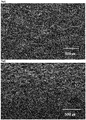
- FIG. 1 is an SEM image showing a cell size of the foam sheet formed according to the example. Referring to FIG. 1 , it can be confirmed that cells were formed to have an average size of 330 ⁇ m.
- a food container was manufactured by the same method as described in the example, except that a foam sheet (2.5 mm) was formed using a polystyrene (PS) resin instead of a PET resin, and a polystyrene coating layer (100 ⁇ m), instead of a PETG coating layer, was formed. At this time, an average cell size of the foam sheet was 180 ⁇ m.
- PS polystyrene
- a polystyrene coating layer 100 ⁇ m
- FIG. 2 is an SEM image showing a cell size of the foam sheet formed according to Comparative Example 1. Referring to FIG. 2 , it can be confirmed that cells were formed to have an average size of 180 ⁇ m.
- FIG. 3 is an SEM image showing a cell size of the foam sheet formed according to Comparative Example 2. Referring to FIG. 3 , it can be confirmed that cells were formed to have an average size of 900 ⁇ m.
- a food container manufactured of paper was purchased commercially. At this time, the paper food container had a thickness of approximately 1 mm.
- a polypropylene (PP rigid) sheet having a thickness of 1 mm was commercially purchased, and used to mold a food container using the same mold as used in the example.
- the food container according to Comparative Example 1 contained a large amount of residual styrene, measuring at 412 mg/kg.
- 4% acetic acid and water were not eluted
- 4% acetic acid and water were eluted. Therefore, it was confirmed that the food container according to the present invention can considerably reduce residual and elution amounts of a hazardous substance.
- V 0 is a volume (mm 3 ) of the food container before being exposed to 100 °C
- V 1 is a volume (mm 3 ) of the food container after being exposed to 100 °C for 20 minutes.
- the food container according to the example had a difference in temperature between the inside and outside of the container of 22 °C, indicating an excellent thermal barrier property, which was similar to that of Comparative Example 1, and the food containers according to Comparative Examples 3 and 4 had the temperature differences of 10 °C and 4 °C, respectively, indicating a considerably poor thermal barrier property. Therefore, it was confirmed that the food container according to the present invention is manufactured by applying a PETG resin layer to one surface of a foam sheet with a cell size controlled in a predetermined range, thereby having excellent thermal barrier property, and thus can exhibit excellent heat insulation.
- Moisture permeability and oxygen permeability of each of the food containers manufactured in Example and Comparative Example 1 were measured. Methods of measuring moisture permeability and oxygen permeability are described below, and the results are shown in Table 4 below.
- both of the first and second measurements showed low moisture permeability, measuring at 8.23 g/m 2 ⁇ day and 8.69 g/m 2 ⁇ day, respectively, and in the case of the food container according to Comparative Example 1, both of the first and second measurements showed high moisture permeability, measuring at 16.60 g/m 2 ⁇ day and 17.30 g/m 2 ⁇ day, respectively, which are higher than those of the food container according to the example.
- the food container according to the example exhibited oxygen permeability, measuring at 1336 cc/m 2 ⁇ day and 893.1 cc/m 2 ⁇ day in the first and second measurements, respectively, which are considerably lower than those of Comparative Example 1.
- the food container according to the present invention is highly effective in blocking oxygen and moisture to extend the preservation period of food.
- Compressive strength was assessed by measuring the maximum load measured when a load was applied vertically to the food container at a speed of 100 mm/min.
- Tensile strength was measured according to ASTM D 638, and a test speed was 5 mm/min.
- Elongation was measured according to ASTM D 638.
- Puncture strength was measured according to ASTM D 5748, and a test speed was 6 mm/min. [Table 5] Classification Compressive strength (kgf/m 3 ) Tensile strength (MPa) Elongation (%) Puncture strength (N) TD MD TD MD Example 51.9 5.68 4.77 4.83 9.19 409.48 Comparative Example 1 28 3.2 2.8 2.5 3.1 210
- the food container according to the example was not easily deformed by an external force due to remarkably higher compressive strength and tensile strength than those of the food container according to Comparative Example 1, and exhibited excellent moldability due to higher elongation than that of the food container according to Comparative Example 1.
- the food container according to the example exhibited higher puncture strength than the food container of Comparative Example 1, and thus was highly resistant to physical shocks.
- the food container according to the present invention can be used in a microwave oven due to improved thermal resistance by forming a PETG coating layer to a suitable thickness on the outer layer of a PET foam sheet, and have improved compressive strength, tensile strength, elongation and puncture strength.
- a melting point (Tm) and a glass transition temperature (Tg) of the PET resin and the PETG resin used in manufacture of the food container according to the example were measured within a range from 40 to 270 °C (increased by 20 °C/min) using a differential scanning calorimeter (Perkin Elmer, DSC-7). The results are shown in Table 6, and in FIGS. 4 and 5 .
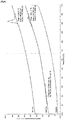
- FIG. 4 is a graph showing the melting point (Tm) and the glass transition temperature (Tg) of the PET resin
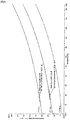
- FIG. 5 is a graph showing the melting point (Tm) and the glass transition temperature (Tg) of the PETG resin.
- the melting point of the PET resin was approximately 251.17 °C, and the glass transition temperature of the PET resin was approximately 81.65 °C. Meanwhile, the melting point of the PETG resin was not measured, and the glass transition temperature of the PETG resin was approximately 79.01 °C, which is similar to that of the PET resin (refer to FIG. 5 ). Therefore, it can be seen that the PETG resin has a non-crystalline characteristic, and that it is possible to implement an excellent adhesive property, excellent processability and excellent thermal resistance by manufacturing a food container using the PETG resin coating layer.
- a food container according to the present invention has improved compressive strength, and less deformation due to a physical force and improved moldability due to improved elongation, so that it can be provided in various sizes and shapes.
- the food container according to the present invention can easily store food due to low oxygen and moisture permeability, and prevent deformation even in high-temperature water due to excellent heat resistance.
- the food container according to the present invention is harmless to the human body due to a considerably low elution amount of a hazardous substance, and has improved strength, printability and moldability and a superior thermal barrier property, thereby exhibiting improved heat insulation for food.
Landscapes
- Chemical & Material Sciences (AREA)
- Engineering & Computer Science (AREA)
- Health & Medical Sciences (AREA)
- Materials Engineering (AREA)
- Organic Chemistry (AREA)
- Chemical Kinetics & Catalysis (AREA)
- Medicinal Chemistry (AREA)
- Polymers & Plastics (AREA)
- Mechanical Engineering (AREA)
- Inorganic Chemistry (AREA)
- Emergency Medicine (AREA)
- Laminated Bodies (AREA)
- Containers Having Bodies Formed In One Piece (AREA)
- Wrappers (AREA)
- Packging For Living Organisms, Food Or Medicinal Products That Are Sensitive To Environmental Conditiond (AREA)
- Blow-Moulding Or Thermoforming Of Plastics Or The Like (AREA)
Description
- The present invention relates to a food container.
- Conventionally, food containers such as beverage containers, yogurt containers, single-size containers and containers for cup ramen, and disposable containers for medical supplies require properties such as tensile strength, thermal resistance, a thermal barrier property, light resistance, moldability, surface glossiness, compressive strength, and printability.
- Generally, a synthetic resin (plastic) is advantageous in that it is light and strong, not rusted or rotted, easily transparent and colored and easily mass-produced, has excellent electrical insulation and excellent heat insulation, is clean, and excellent in food preservation, and thus is used for various purposes.
- Particularly, containers manufactured of synthetic resins have been used for various purposes due to many advantages of low costs, light weights, easy molding and rigidity, and particularly, have been widely used as containers for food. As synthetic resins used for food containers, polystyrenes, polypropylenes, AS resins, and polycarbonates have been widely used.
- However, when such a synthetic resin container is used as a food container, an environmental hormone, which is a hazardous substance, is eluted from a surface of the synthetic resin container and comes in contact with foods, and thus may cause a problem of threatening the health of the human body. The environmental hormone is a substance that disturbs the endocrine system from which human hormones arise, and breaks the balance of the human body and hinders the development of the human body.
- Hormones are substances that help the exchange of information between various cells and organs, and are dissolved in the blood and act on receptors of certain cells. If, rather than a hormone in the body, an environmental hormone having a similar chemical structure to the hormone, binds to the receptor, or an environmental hormone blocks an opening of the receptor, there may be an abnormality in the human body.
- According to the US Environmental Protection Agency (EPA), such environmental hormones that have been proven to be hazardous until now are only a few, which include DDT used as an insecticide, DES used as a medication for preventing miscarriages, and dioxin generated during incineration of industrial wastes. However, other environmental hormones suspected to be hazardous mostly include an organic chlorine-based substance having a chemical structure similar to that of DDT. Other than these, vinclozolin, chlorothalonil, endosulfan, fenvalerate, styrene dimers, styrene trimers, bisphenol A, nonylphenol, and some heavy metal compounds are also classified as environmental hormones.
- A styrene trimer, assumed as an environmental hormone, is generated from a cup ramen container, and bisphenol A is generated from a coating layer in a beverage can, a baby bottle, etc.
- Theoretically, these environmental hormones pose risks to all of the organs including the genitalia and affect the immune and nervous systems as well, and therefore they may lead to frequent sickness, and disorders such as anxiety, a lack of concentration, etc.
- To solve these problems, conventionally, a method of blocking the conduction of heat of contents in a cup or container by wrapping a paper (napkin) or thick corrugated paper cut to size, or double covering the cup or container with another disposable cup or the like has been used.
- When an external wrapping material is used by being rolled in a round shape, it has a heat insulating effect, but since the cup and an insulating sheet must be separately manufactured for use, due to separate manufacturing processes and a large amount of waste paper, high production and processing costs are needed.
- Another method is to mold a container using a foam sheet manufactured by foaming a polystyrene resin. In this case, there is be a drawback in that, during the use of a thermal-resistant product, a styrene monomer is released and harmful to the human body.
- Therefore, there is an urgent demand for development of a food container which satisfies basic physical properties of food containers, such as thermal resistance, moldability, strength, etc., does not generate a hazardous substance, has an improved thermal barrier property, thereby having an excellent heat insulation and safety in use.
-
- The present invention is directed to providing a food container which satisfies the basic physical properties of a food container, for example, compressive strength, thermal resistance, printability and moldability, and has excellent safety in use due to a reduced elution amount of a hazardous substance.
- To attain the above-mentioned object, the present invention provides a food container as defined in the appended claims. In the claimed invention, the food container has an inner layer and an outer layer, wherein the inner layer is formed of a foamed layer and the outer layer is formed of a resin layer, wherein the foamed layer has an average cell size of 100 to 500 µm and is a foam sheet of a polyethylene terephthalate resin, wherein the resin layer is a coating layer of a resin having a repeating unit of Formula 1 below:

- In Formula 1, m and n represent mole fractions of repeating units, and range from 1 to 100, respectively.
- A food container according to the present invention has an inner layer and an outer layer, wherein the inner layer is formed of a foamed layer controlled in cell size and the inner layer is a resin coating layer, thereby improving compressive strength, and having less deformation due to a physical force and improved moldability due to improved elongation, so that it can be provided in various sizes and shapes. The food container according to the present invention can easily store food due to low oxygen and moisture permeability, and prevent deformation even in high-temperature water due to excellent heat resistance. In addition, the food container according to the present invention is harmless to the human body due to a considerably low elution amount of a hazardous substance, and has improved strength, printability and moldability and a superior thermal barrier property, thereby exhibiting improved heat insulation for food.
-
-
FIG. 1 is a scanned electron microscope (SEM) image showing a cell size of a foam sheet of a food container according to an example. -
FIG. 2 is an SEM image showing a cell size of a foam sheet of a food container according to Comparative Example 1. -
FIG. 3 is an SEM image showing a cell size of a foam sheet of a food container according to Comparative Example 2. -
FIG. 4 is a graph showing a melting point (Tm) and a glass transition temperature (Tg) of a polyethylene terephthalate (PET) resin used in an example. -
FIG. 5 is a graph showing a melting point (Tm) and a glass transition temperature (Tg) of a polyethylene terephthalate glycol (PETG) resin used in an example. - The present invention may have various modifications and various examples, and thus specific examples are illustrated in the drawings and described in detail in the detailed description.
- However, it should be understood that the present invention is not limited to specific embodiments, and includes all modifications, equivalents or alternatives within technical scope of the claimed invention. In the explanation of the present invention, detailed description of the related art will be omitted if it is determined that the gist of the present invention can be obscured.
- The terms "first," "second" and the like may be used to describe various components, but the components should not be limited by these terms. The terms are used only to distinguish one component from another component.
- The terms used in the present invention are used only to explain specific examples, not to limit the present invention. Singular expressions include plural referents unless clearly indicated otherwise in the context.
- The terms "include," "have" and the like used herein designate the presence of characteristics, numbers, stages, actions, components or members described in the specification or a combination thereof, and it should be understood that the possibility of the presence or addition of one or more other characteristics, numbers, stages, actions, components, members or a combination thereof is not excluded in advance.
- Accordingly, the configuration illustrated in the example described in the specification is merely the most preferable example of the present invention, but does not represent all of the technical ideas of the present invention. Therefore, there may be various equivalents and modified examples, which can substitute for these at the time of the application of the present invention.
- Conventional food containers, for example, beverage containers, yogurt containers, single-size containers and containers for cup ramen, are generally manufactured of a polystyrene resin. When a synthetic resin container manufactured of such polystyrene resin is used as a food container, an environmental hormone, which is a hazardous substance, is eluted from a surface of the synthetic resin container and comes in contact with food, and it may cause a problem of threatening the health of the human body. A paper food container for preventing the elution of such a hazardous substance has problems of a significantly low thermal barrier property, significantly low compressive strength, and a 3 to 10-fold higher production cost than that of a synthetic resin container.
- The present invention is provided to solve the problems of the conventional food container, and provides a food container, which comprises an inner foam layer made of a polyethyleneterephthalate (PET) resin such that it has a controlled cell size, improved compressive strength and a thermal barrier property and a relatively low glass transition temperature and an outer resin coating layer having a relatively high glass transition temperature, thereby significantly reducing an elution amount of a hazardous substance.
- The food container according to the present invention has an inner foamed layer having an average cell size of 100 to 500 µm and an outer resin layer, wherein the resin layer is a coating layer of a resin having a repeating unit of Formula 1 below.

- In Formula 1, m and n represent mole fractions of repeating units, and range from 1 to 100, respectively.
- For example, m and n are mole fractions of repeating units, and a ratio of m and n may range from 1:9 to 7:2. Specifically, in a resin forming the resin layer, a content of the polymerization unit derived from cyclohexanedimethanol (CHDM) in a molecule may be 20 mol% or more, and specifically, the content of the polymerization unit derived from CHDM may range from 20 to 90 mol%, or 30 to 90 mol%. In Formula 1, when the content of the polymerization unit induced from CHDM satisfies the above-mentioned range, a melting point (Tm) may be reduced due to an induced decrease in crystallinity of the resin, resulting in the achievement of excellent processability.
- Specifically, an average cell size of the foamed layer may be 110 to 450 µm, 130 to 430 µm,150 to 410 µm,180 to 400 µm, 200 to 380 µm, 220 to 360 µm or 250 to 350 µm. When the average cell size of the foamed layer is within the above-mentioned range, the thermal barrier property and compressive strength of the food container are improved, and it is easy to form a deeper inside of the food container in molding of the food container. When the cell size is larger than 500 µm, it is difficult to produce a deeper container by thermoforming in manufacture of the food container, and compressive strength may be reduced, and when the cell size is smaller than the above-mentioned range, the compressive strength and the thermal barrier property may be reduced.
- In one example, a glass transition temperature (Tg) of the resin constituting the foamed layer may be 70 to 90 °C, 75 to 85 °C or 80 to 90 °C. In addition, a glass transition temperature of the resin constituting the resin layer may be 65 to 95 °C, 70 to 90 °C, 75 to 85 °C or 78 to 90 °C. Since the foamed layer according to the present invention satisfies the above-mentioned range of the glass transition temperature, a food container having excellent thermal resistance is provided.
- In the present invention, the resin having the repeating unit of Formula 1 may be, for example, a polyethylene terephthalate glycol (hereinafter, referred to PETG) resin. Such a PETG resin may have a CHDM-copolymerized structure. The CHDM acts to prevent crystallization of the resin, and the CHDM-copolymerized PETG has a non-crystalline region. Therefore, the viscosity of the PETG resin is easily maintained, and thus a cohesive property between the foamed layer and the resin layer is imparted. Since the present invention has a structure in which a foamed layer of a resin having the glass transition temperature within the above-mentioned range and a PETG resin layer having a non-crystalline region are laminated, the present invention satisfies both moldability and thermal resistance of a food container.
- In the present invention, the resin constituting the resin layer may not have a melting point (Tm) within the range of 40 to 270 °C. In the resin layer according to the present invention, a content of the polymerization unit derived from CHDM in a molecule constituting Formula 1 satisfies the above range, and thus includes a repeating unit that decreases the melting point of the resin as a main repeating unit. Therefore, since the resin layer according to the present invention does not have a melting point, it may have a low degree of crystallinity, and thus exhibit an excellent adhesive property. In addition, the non-crystallinity may result in excellent lightness.
- In one example, in the present invention, a degree of crystallinity of the resin forming the resin layer may be less than 10%. Specifically, the degree of crystallinity may be 5% or less, 2% or less, 0 to 2%, 0.001 to 0.5%, or 0.001 to 0.1%, and more specifically, the degree of crystallinity may be 0%. Since the resin forming the resin layer according to the present invention satisfies the degree of crystallinity within the above-mentioned range, viscosity may be maintained within a suitable range even at a relatively low temperature in the manufacture of a food container, and thus excellent processability may be exhibited.
- The food container according to the present invention has a bilayer structure, in which an inner layer of the container is formed of the foamed layer, and an outer layer of the container is formed of the resin layer. That is, the inner layer of the container is the foamed layer of the resin having a glass transition temperature of 65 to 95 °C, and the outer layer of the container is the resin layer of the resin having a repeating unit of Formula 1 below.

- In Formula 1, m and n represent mole fractions of repeating units, and range from 1 to 100, respectively.
- The food container according to the present invention may have a styrene elution amount of 50 mg/kg or less while being heated in an 800W microwave oven for 5 minutes. Specifically, when a prepared food container sample is heated in an 800W microwave oven for 5 minutes, an elution amount of a volatile substance is measured. For example, when the food container is heated in a microwave oven, the styrene elution amount may be 20 mg/kg or less, 10 mg/kg or less or 0.01 mg/kg or less, and more specifically, styrene may not be eluted. In the food container according to the present invention, a volatile substance such as toluene, ethylbenzene, isopropyl benzene or n-propyl benzene, in addition to the styrene, may not be eluted, and therefore, it can be seen that, when the food container according to the present invention is heated in a microwave oven, it is possible to effectively prevent the human body from being exposed to a hazardous substance.
- The food container according to the present invention may have a difference in temperature between the inside and outside of the container of 10 °C or more, measured, under ambient conditions at room temperature, two minutes after 60 to 100 °C water is put into the container at 70% (v/v). This shows that the food container according to the present invention exhibits an excellent thermal barrier property, and specifically, the difference in temperature between the inside and outside of the container is measured 2 minutes after 100 °C water is put into the container at 70% (v/v). For example, the difference in temperature between the inside and outside of the food container under the above-described conditions may be 13 to 40 °C, 15 to 35 °C, 20 to 32 °C or 21.5 to 30 °C.
- As an example, two minutes after 60 to 100 °C water was put into the food container according to the present invention at 70% (v/v), when the outer temperature of the container is 40 °C, the inner temperature of the container may be 60 to 80 °C. As the difference in temperature between the inside and outside of the container according to the present invention is maintained relatively large under the above-mentioned conditions, it can be seen that the food container has an excellent thermal barrier property, and thus effectively improves heat insulation for food.
- In the present invention, the foamed layer is a foam sheet of a PET resin, and the resin layer is a coating layer of a PETG resin. The foamed layer may be provided in the form of a relatively thin foam sheet to achieve lightness, and the coating layer may be provided to achieve compressive strength.
- The foamed layer according to the present invention, that is, the foam sheet, may have a density of 30 to 400 kg/m3. Specifically, the density of the foam sheet may be 50 to 350 kg/m3, 70 to 300 kg/m3, 80 to 250 kg/m3, 90 to 200 kg/m3 or 100 to 150 kg/m3. As the density of the foamed layer according to the present invention is in the above-mentioned range, the foamed layer may have a small thickness and improved compressive strength.
- Since the PETG resin does not generate a hazardous substance, there is a low risk in the manufacturing process and incineration, and therefore, when food is cooked using the food container according to the present invention, the elution amount of a hazardous substance is considerably reduced. In addition, when a coating layer is formed of the PETG resin, it imparts strength to the food container, thereby improving compressive strength, and has excellent printability and moldability. Therefore, a food container with a good appearance may be easily manufactured.
- Specifically, the multilayer structure may have an average thickness of 1.2 to 4 mm, 1.5 to 3.5 mm, 1.8 to 3 mm, or 2 mm. In addition, a thickness ratio of the foamed layer to the resin layer may be, specifically, 10:0.2 to 1.5, 10:0.3 to 1, or 10:0.5. As the food container according to the present invention has the foamed layer and the resin layer, which have the above-mentioned thickness range, compressive strength may be improved, and lightness may also be satisfied.
- As an example, the food container may have an average thickness of 2 mm, the foamed layer may have an average thickness of 1.9 mm, and the resin layer may have an average thickness of 0.1 mm.
- The food container according to the present invention may satisfy a condition represented by Mathematical Expression 1 below.

- In Mathematical Expression 1, V0 is a volume (mm3) of the food container before being exposed to 100 °C, and V1 is a volume (mm3) of the food container after being exposed to 100 °C for 20 minutes.
- Specifically, a dimensional variation before and after the manufactured food container sample is exposed to 100 °C for 20 minutes is measured. This is a measured value corresponding to a long-term dimensional variation of the food container according to the present invention. For example, the volume may refer to a value calculated by multiplying a length, a width and a thickness of a thermal-resistant material. For example, the dimensional variation according to Mathematical Expression 1 may be 3% or less, 1% or less, 0.1% or less, 0.001% or less, or 0.0001 to 0.001%, and specifically, there may be no change in dimension. As the above-mentioned range of the value of Mathematical Expression 1 is satisfied, it can be seen that there is almost no change in shape of the food container according to the present invention even when used in a high temperature environment. Therefore, it can be seen that the food container according to the present invention has excellent thermal resistance.
- When the value of Mathematical Expression 1 is more than 5%, it can mean that swell, distortion, discoloration or deformation may easily occur in the food container.
- The food container according to the present invention may have compressive strength of 40 kgf or more, which is measured when a load is applied vertically to one surface or a lower surface of the food container at a speed of 100 mm/min.
- Specifically, the compressive strength may be measured when a load is applied vertically using Load Cell 1KN at a speed of 100 mm/min, and for example, the compressive strength may be 41 to 95 kgf, 45 to 90 kgf, 48 to 85 kgf or 50 to 80 kgf. The food container according to the present invention may have the above-mentioned range of compressive strength by forming a PET foam sheet as the inner layer of the container, and forming a coating layer consisting of a PETG resin as an outer layer of the container. Such a food container has an advantage in that it is not easily deformed by an external physical force.
- The food container according to the present invention may have a moisture permeability of 16 g/m2·day or less, which is measured according to ASTM D 1249. Specifically, the moisture permeability of the manufactured food container sample is measured under conditions of 37.8±1 °C and 100% R.H for 30 minutes. For example, the moisture permeability measured under the above conditions may be 15 g/m2·day or less, 13 g/m2·day or less, 1 to 10 g/m2·day, 2 to 9 g/m2·day or 3 to 8.8 g/m2·day.
- In addition, the food container according to the present invention may have an oxygen permeability of 1,500 cc/m2·day or less, which is measured according to ASTM D 3985. Specifically, the oxygen permeability of the manufactured food container sample is measured under conditions of 23±1 °C for 30 minutes. For example, the oxygen permeability measured under the above conditions may satisfy 50 to 1,450 cc/m2·day, 100 to 1,400 cc/m2·day, or 150 to 1,350 cc/m2·day. The food container according to the present invention is manufactured by forming a PET foam sheet as the inner layer of the container and forming a coating layer consisting of a PETG resin as the outer layer of the container, thereby satisfying the moisture permeability and oxygen permeability as described above, and the food container according to the present invention may satisfy the above-mentioned ranges of low moisture permeability and low oxygen permeability, thereby exhibiting excellent oxygen and moisture barrier performance, resulting in the extension of the preservation period of food.
- As an example, the food container according to the present invention may have a transverse direction (TD) tensile strength and a machine direction (MD) tensile strength, which are measured according to ASTM D 638, within a range of 4 to 20. Specifically, when a tensile strength is measured at a speed of 5 mm/min using a universal testing machine (Model 3367, Instron), the transverse direction (TD) tensile strength may be in the range of 4.5 to 7 MPa, and the machine direction (MD) tensile strength may be in the range of 4 to 6 MPa. As a PET foam sheet is formed as the inner layer of the container, and a coating layer consisting of a PETG resin is formed as the outer layer of the container, the food container according to the present invention may exhibit tensile strengths within the above-mentioned ranges, and thus it may not be easily deformed by a physical force.
- As another example, the food container according to the present invention may have a transverse direction (TD) elongation of 3 to 10% and a machine direction (MD) elongation of 5 to 20%, which are measured according to ASTM D 638. Specifically, when elongations are measured using a universal testing machine (Model 3367, Instron), the transverse direction (TD) elongation may be in a range of 4 to 7%, and the machine direction (MD) elongation may be in a range of 7 to 15%. The food container according to the present invention may satisfy the above-mentioned ranges of TD and MD elongations by forming a PET foam sheet as the inner layer of the container, and forming a coating layer consisting of a PETG resin as the outer layer of the container, and thereby exhibit excellent moldability.
- Hereinafter, the present invention will be described in further detail with reference to examples and comparative examples, but the scope of the present invention is not limited to the following descriptions.
- To manufacture a food container according to the present invention, first, 100 parts by weight of a PET resin was dried at 130 °C to remove moisture, mixed with 1 part by weight of pyromellitic dianhydride, 1 part by weight of talc and 0.1 part by weight of Irganox (IRG 1010) with respect to 100 parts by weight of the moisture-removed PET resin in a first extruder and heated to 280 °C, thereby preparing a resin melt. Subsequently, 5 parts by weight of butane gas as a foaming agent was added to the first extruder, with respect to 100 parts by weight of the PET resin, and extrusion foaming was performed, thereby obtaining a PET foam sheet. The obtained foam sheet has a density of approximately 120 kg/m3, and a thickness of approximately 1.9 mm. Afterward, one surface of the foam sheet was extrusion-coated with PETG, thereby forming a coating layer with a thickness of 100 µm. And then, the foam sheet having the coating layer was subjected to thermoforming at 140 °C, thereby manufacturing a food container. The manufactured food container had an average thickness of 2 mm.
FIG. 1 is an SEM image showing a cell size of the foam sheet formed according to the example. Referring toFIG. 1 , it can be confirmed that cells were formed to have an average size of 330 µm. - A food container was manufactured by the same method as described in the example, except that a foam sheet (2.5 mm) was formed using a polystyrene (PS) resin instead of a PET resin, and a polystyrene coating layer (100 µm), instead of a PETG coating layer, was formed. At this time, an average cell size of the foam sheet was 180 µm.
-
FIG. 2 is an SEM image showing a cell size of the foam sheet formed according to Comparative Example 1. Referring toFIG. 2 , it can be confirmed that cells were formed to have an average size of 180 µm. - A food container was manufactured by the same method as described in the example, except that an average cell size of a foam sheet was controlled to approximately 900 µm.
FIG. 3 is an SEM image showing a cell size of the foam sheet formed according to Comparative Example 2. Referring toFIG. 3 , it can be confirmed that cells were formed to have an average size of 900 µm. - A food container manufactured of paper was purchased commercially. At this time, the paper food container had a thickness of approximately 1 mm.
- A polypropylene (PP rigid) sheet having a thickness of 1 mm was commercially purchased, and used to mold a food container using the same mold as used in the example.
- Elution amounts of a hazardous substance from the food container manufactured in the example and Comparative Example 1 were evaluated. Evaluation was performed by measuring an elution amount of a hazardous substance after each food container was heated in an 800W microwave oven for 5 minutes, and it was demonstrated that evaluation items satisfy the criteria according to the Ministry of Food and Drug Safety (MFDS) Notification No. 2016-51. The evaluation items and results are shown in in Table 1 below.
[Table 1] Classification Item Units Example Comparative Example 1 Standard Analysis result Standard Analysis result Residue specification Volatile substance (styrene, toluene, ethylbenzene, isopropylene, n-propyl benzene) mg/kg - Not detected ≤5,000 412 (styrene) Elution specification 4% acetic acid mg/L ≤30 Not detected ≤30 7 Water ≤30 Not detected ≤30 10 n-heptane ≤30 6 ≤240 8 - Referring to Table 1, while no volatile substance was detected from the food container according to the example, indicating that the food container satisfied the criteria notified by the MFDS, the food container according to Comparative Example 1 contained a large amount of residual styrene, measuring at 412 mg/kg. In the case of the food container according to the example, 4% acetic acid and water were not eluted, whereas in the case of the food container according to Comparative Example 1, 4% acetic acid and water were eluted. Therefore, it was confirmed that the food container according to the present invention can considerably reduce residual and elution amounts of a hazardous substance.
- Thermal resistance of the food containers manufactured in the example and Comparative Example 1 was assessed. A measurement method is described below, and the result is shown in Table 2 below.
- The thermal resistance was assessed by measuring a dimensional variation according to Mathematical Expression 1 below.

- In Mathematical Expression 1, V0 is a volume (mm3) of the food container before being exposed to 100 °C, and V1 is a volume (mm3) of the food container after being exposed to 100 °C for 20 minutes.
- At this time, the exposure to 100 °C was carried out using a convection oven, and the volume (mm3) of the sample before each of the food containers according to the example and Comparative Example 1 was exposed to 100 °C was 100 × 100 × 3 (width × length × height).
[Table 2] Classification Dimensional variation (%) Example 0 Comparative Example 1 5.95 - Referring to Table 2, it can be seen that although the food container according to the present invention was exposed to a high temperature for a long time, the dimensional variation was approximately 0%, indicating that it has excellent thermal resistance. Compared with this, it can be seen that the food container according to Comparative Example 1 exhibited the dimensional variation of approximately 5.95%, indicating that it did not have excellent thermal resistance. Therefore, it can be shown that when being used at a high temperature, the food container of the present invention does not experience a change in shape, and the food container according to Comparative Example 1 is easily deformed.
- To evaluate a thermal barrier property of each of the food containers according to the example, Comparative Example 1, and Comparative Examples 3 and 4, temperatures at a random position inside the container and at a random position outside the container were measured two minutes after 100 °C water was put into the container at 70%(v/v).
- The result is shown in Table 3 below.
[Table 3] Classification External temperature of container (°C) Internal temperature of container (°C) Difference in temperature between inside and outside container (°C) Example 40 62 22 Comparative Example 1 40 61 21 Comparative Example 3 45 55 10 Comparative Example 4 42 46 4 - Referring to Table 3, the food container according to the example had a difference in temperature between the inside and outside of the container of 22 °C, indicating an excellent thermal barrier property, which was similar to that of Comparative Example 1, and the food containers according to Comparative Examples 3 and 4 had the temperature differences of 10 °C and 4 °C, respectively, indicating a considerably poor thermal barrier property. Therefore, it was confirmed that the food container according to the present invention is manufactured by applying a PETG resin layer to one surface of a foam sheet with a cell size controlled in a predetermined range, thereby having excellent thermal barrier property, and thus can exhibit excellent heat insulation.
- Moisture permeability and oxygen permeability of each of the food containers manufactured in Example and Comparative Example 1 were measured. Methods of measuring moisture permeability and oxygen permeability are described below, and the results are shown in Table 4 below.
- 1) Test for moisture permeability
- Test method: ASTM D 1249
- Test instrument: Permatran W-700 (MOCON, USA)
- Test temperature: (37.8±1) °C, 100% R.H
- Test time: 30 min
- Measurement range: 0.05 ~ 100 g/m2·day
- Sample size: 5 cm2
- 2) Test for oxygen permeability
- Test method: ASTM D 3985
- Test instrument: OX-TRAN 702 (MOCON, USA)
- Test temperature: (23±1) °C
- Test time: 30 min
- Measurement range: 0.1 ~ 2000 cc/m2·day
- Sample size: 5 cm2
- Referring to Table 4, in the case of the food container according to the example, both of the first and second measurements showed low moisture permeability, measuring at 8.23 g/m2·day and 8.69 g/m2·day, respectively, and in the case of the food container according to Comparative Example 1, both of the first and second measurements showed high moisture permeability, measuring at 16.60 g/m2·day and 17.30 g/m2·day, respectively, which are higher than those of the food container according to the example. In addition, according to the test for oxygen permeability, the food container according to the example exhibited oxygen permeability, measuring at 1336 cc/m2·day and 893.1 cc/m2·day in the first and second measurements, respectively, which are considerably lower than those of Comparative Example 1.
- Therefore, it was confirmed that the food container according to the present invention is highly effective in blocking oxygen and moisture to extend the preservation period of food.
- The compressive strength, tensile strength, elongation and puncture strength of each of the food containers manufactured in Example and Comparative Example 1 were measured. An instrument used in measurement was a universal testing machine (Model 3367, Instron), and corresponding measurement conditions are described below, and the results are shown in Table 5.
- Compressive strength was assessed by measuring the maximum load measured when a load was applied vertically to the food container at a speed of 100 mm/min.
- Tensile strength was measured according to ASTM D 638, and a test speed was 5 mm/min.
- Elongation was measured according to ASTM D 638.
- Puncture strength was measured according to ASTM D 5748, and a test speed was 6 mm/min.
[Table 5] Classification Compressive strength (kgf/m3) Tensile strength (MPa) Elongation (%) Puncture strength (N) TD MD TD MD Example 51.9 5.68 4.77 4.83 9.19 409.48 Comparative Example 1 28 3.2 2.8 2.5 3.1 210 - Referring to Table 5, it can be seen that the food container according to the example was not easily deformed by an external force due to remarkably higher compressive strength and tensile strength than those of the food container according to Comparative Example 1, and exhibited excellent moldability due to higher elongation than that of the food container according to Comparative Example 1. In addition, it was confirmed that the food container according to the example exhibited higher puncture strength than the food container of Comparative Example 1, and thus was highly resistant to physical shocks.
- Therefore, it can be seen that the food container according to the present invention can be used in a microwave oven due to improved thermal resistance by forming a PETG coating layer to a suitable thickness on the outer layer of a PET foam sheet, and have improved compressive strength, tensile strength, elongation and puncture strength.
- To evaluate physical properties of the food container according to the present invention, a melting point (Tm) and a glass transition temperature (Tg) of the PET resin and the PETG resin used in manufacture of the food container according to the example were measured within a range from 40 to 270 °C (increased by 20 °C/min) using a differential scanning calorimeter (Perkin Elmer, DSC-7). The results are shown in Table 6, and in
FIGS. 4 and5 .FIG. 4 is a graph showing the melting point (Tm) and the glass transition temperature (Tg) of the PET resin, andFIG. 5 is a graph showing the melting point (Tm) and the glass transition temperature (Tg) of the PETG resin.[Table 6] Tm (°C) Tg (°C) PET 251.17 81.65 PETG - 79.01 - Referring to Table 6 and
FIG. 4 , the melting point of the PET resin was approximately 251.17 °C, and the glass transition temperature of the PET resin was approximately 81.65 °C. Meanwhile, the melting point of the PETG resin was not measured, and the glass transition temperature of the PETG resin was approximately 79.01 °C, which is similar to that of the PET resin (refer toFIG. 5 ). Therefore, it can be seen that the PETG resin has a non-crystalline characteristic, and that it is possible to implement an excellent adhesive property, excellent processability and excellent thermal resistance by manufacturing a food container using the PETG resin coating layer. - A food container according to the present invention, as defined in the appended claims, has improved compressive strength, and less deformation due to a physical force and improved moldability due to improved elongation, so that it can be provided in various sizes and shapes. The food container according to the present invention can easily store food due to low oxygen and moisture permeability, and prevent deformation even in high-temperature water due to excellent heat resistance. In addition, the food container according to the present invention is harmless to the human body due to a considerably low elution amount of a hazardous substance, and has improved strength, printability and moldability and a superior thermal barrier property, thereby exhibiting improved heat insulation for food.
| Classification | Test item | Units | Measurement result | |
| First | Second | |||
| Example | Moisture permeability | g/m2·day | 8.23 | 8.69 |
| Oxygen permeability | cc/m2·day | 1336 | 893.1 | |
| Comparative Example 1 | Moisture permeability | g/m2·day | 16.60 | 17.30 |
| Oxygen permeability | cc/m2·day | 2591.2 | 1003.7 | |
Claims (4)
- A food container having a bilayer structure being an inner layer and an outer layer,wherein the inner layer is formed of a foamed layer and the outer layer is formed of a resin layer,wherein the foamed layer has an average cell size of 100 to 500 µm and is a foam sheet of a polyethylene terephthalate resin,wherein the resin layer is a coating layer of a resin having a repeating unit of Formula 1 below:

m and n represent mole fractions of repeating units, and range from 1 to 100, respectively. - The food container according to claim 1, wherein the resin forming the resin layer has a polymerization unit derived from cyclohexanedimethanol (CHDM) in a molecule at a content of 10 mol% or more.
- The food container according to claim 1, wherein the foamed layer has a density of 30 to 400 kg/m3.
- The food container according to claim 1, wherein the food container has an average thickness of 1 to 5 mm, and a thickness ratio of the foamed layer and the resin layer is 10:0.1 to 2.
Applications Claiming Priority (3)
| Application Number | Priority Date | Filing Date | Title |
|---|---|---|---|
| KR1020160127001A KR101906866B1 (en) | 2016-09-30 | 2016-09-30 | Food Container Reduced Harmful Substance Elution |
| KR1020160127002A KR101887918B1 (en) | 2016-09-30 | 2016-09-30 | Food Container Improved Heat-blocking Ability |
| PCT/KR2016/013991 WO2018062623A1 (en) | 2016-09-30 | 2016-11-30 | Food container with reduced elution of hazardous substances |
Publications (3)
| Publication Number | Publication Date |
|---|---|
| EP3438020A1 EP3438020A1 (en) | 2019-02-06 |
| EP3438020A4 EP3438020A4 (en) | 2019-11-27 |
| EP3438020B1 true EP3438020B1 (en) | 2021-10-06 |
Family
ID=61759876
Family Applications (1)
| Application Number | Title | Priority Date | Filing Date |
|---|---|---|---|
| EP16917824.1A Active EP3438020B1 (en) | 2016-09-30 | 2016-11-30 | Food container with reduced elution of hazardous substances |
Country Status (5)
| Country | Link |
|---|---|
| US (1) | US11230418B2 (en) |
| EP (1) | EP3438020B1 (en) |
| JP (1) | JP6826129B2 (en) |
| CN (1) | CN109195882B (en) |
| WO (1) | WO2018062623A1 (en) |
Families Citing this family (6)
| Publication number | Priority date | Publication date | Assignee | Title |
|---|---|---|---|---|
| KR102040237B1 (en) * | 2018-06-28 | 2019-11-06 | 주식회사 휴비스 | A molded product having gas barrier layer, A packaging container comprising the same, and Method for preparing the molded product |
| KR102199226B1 (en) * | 2018-06-28 | 2021-01-06 | 주식회사 휴비스 | Container for packing food and Method for preparing the same |
| KR102063785B1 (en) * | 2018-12-26 | 2020-01-10 | 주식회사 휴비스 | A packaging container having lid film, and Method for preparing the same |
| JP7352500B2 (en) * | 2019-03-26 | 2023-09-28 | 積水化成品工業株式会社 | Thermoplastic polyester resin laminated foam sheet and thermoplastic polyester resin laminated foam container |
| KR102443537B1 (en) * | 2020-04-21 | 2022-09-16 | 주식회사 휴비스 | Polyester foam sheet with controlled equivalent of carboxyl end groups |
| CN116472161A (en) * | 2020-09-25 | 2023-07-21 | 莫塞尔挤出有限责任公司 | Non-wicking synthetic foam container and method of making same |
Family Cites Families (26)
| Publication number | Priority date | Publication date | Assignee | Title |
|---|---|---|---|---|
| US3492273A (en) * | 1966-03-04 | 1970-01-27 | Du Pont | Regular sequential copolyesters |
| JPH0698982B2 (en) | 1989-09-25 | 1994-12-07 | 積水化成品工業株式会社 | Food container |
| CA2004300C (en) * | 1988-12-01 | 1999-05-11 | Motoshige Hayashi | Process for producing polyester resin foam and polyester resin foam sheet |
| JPH02251543A (en) * | 1989-01-12 | 1990-10-09 | Sekisui Plastics Co Ltd | Production of foamed polyester resin |
| JPH0621847Y2 (en) * | 1990-07-10 | 1994-06-08 | 積水化成品工業株式会社 | Food container |
| JPH083358A (en) * | 1994-06-23 | 1996-01-09 | Sekisui Plastics Co Ltd | Foam sheet of thermoplastic polyester resin |
| JP3005738U (en) * | 1994-06-28 | 1995-01-10 | 積水化成品工業株式会社 | Insulated shutter |
| JP3278796B2 (en) * | 1994-09-29 | 2002-04-30 | 積水化成品工業株式会社 | Method for producing thermoplastic polyester resin foam |
| JP2000043843A (en) * | 1998-07-24 | 2000-02-15 | Goyo Paper Working Co Ltd | Insulated paper container |
| DE69924063T2 (en) | 1998-09-25 | 2006-04-13 | Cobarr S.P.A., Anagni | Polyester resin foam sheets |
| ATE305949T1 (en) * | 1998-12-11 | 2005-10-15 | Sekisui Plastics | PRE-FOAMED PARTICLES OF CRYSTALLINE AROMATIC POLYESTER RESIN, PRODUCT EXPANDED IN THE MOLD AND EXPANDED LAMINATE PRODUCED THEREFROM |
| JP2000289173A (en) * | 1999-04-07 | 2000-10-17 | Jsp Corp | Food storage containers |
| JP2001315277A (en) | 2000-03-02 | 2001-11-13 | Sekisui Plastics Co Ltd | Polypropylene resin laminated foam and molded container using the same |
| JP2004034302A (en) * | 2002-06-28 | 2004-02-05 | Idemitsu Unitech Co Ltd | Multilayer materials, containers and packages |
| US7588808B2 (en) * | 2004-04-16 | 2009-09-15 | Advanced Plastics Technologies Luxembourg S.A. | Mono and multi-layer articles and injection molding methods of making the same |
| JP4616042B2 (en) * | 2005-03-10 | 2011-01-19 | 積水化成品工業株式会社 | Polypropylene resin laminate foam and molded product thereof |
| KR100955324B1 (en) | 2008-01-28 | 2010-04-29 | 경상대학교산학협력단 | Foam of Polyethylene Terephthalate Copolymer and Manufacturing Method Thereof |
| RU2010152350A (en) * | 2008-05-22 | 2012-06-27 | Крайовак, Инк. (Us) | GAS-BARRIER AND ADSORPTIVE LIQUID CAPACITY FOR FOOD PACKAGING |
| JP3163094U (en) * | 2010-07-16 | 2010-09-30 | 竹内産業株式会社 | Instant food container |
| US20120187019A1 (en) * | 2011-01-22 | 2012-07-26 | Fina Technology, Inc. | Methods to Produce Semi-Durable Foamed Articles |
| WO2012150560A1 (en) * | 2011-05-02 | 2012-11-08 | Sabic Innovative Plastics Ip B.V. | High purity bisphenol a and polycarbonate materials prepared therefrom |
| JP2013199532A (en) * | 2012-03-23 | 2013-10-03 | Sekisui Plastics Co Ltd | Resin foam molded body, and method of manufacturing resin foam molded body |
| JP5753812B2 (en) * | 2012-04-02 | 2015-07-22 | 株式会社Act | Multilayer sheet for container, method for producing the same, and container |
| KR101459275B1 (en) * | 2013-12-30 | 2014-11-07 | 도레이케미칼 주식회사 | The method for preparation of molded body for food packing by co-extruding and molded body for food packing thereof |
| US20160325871A1 (en) * | 2014-01-24 | 2016-11-10 | Toyo Seikan Group Holdings, Ltd. | Multilayered stretch-blow-molded container and multilayered preform |
| CN204222303U (en) * | 2014-09-05 | 2015-03-25 | 威玛精密化学科技股份有限公司 | Plastic container with double layer structure |
-
2016
- 2016-11-30 JP JP2018556326A patent/JP6826129B2/en active Active
- 2016-11-30 CN CN201680086119.2A patent/CN109195882B/en active Active
- 2016-11-30 US US16/097,722 patent/US11230418B2/en active Active
- 2016-11-30 WO PCT/KR2016/013991 patent/WO2018062623A1/en not_active Ceased
- 2016-11-30 EP EP16917824.1A patent/EP3438020B1/en active Active
Non-Patent Citations (1)
| Title |
|---|
| None * |
Also Published As
| Publication number | Publication date |
|---|---|
| US20190382176A1 (en) | 2019-12-19 |
| JP6826129B2 (en) | 2021-02-03 |
| CN109195882A (en) | 2019-01-11 |
| CN109195882B (en) | 2021-04-27 |
| JP2019514800A (en) | 2019-06-06 |
| EP3438020A4 (en) | 2019-11-27 |
| EP3438020A1 (en) | 2019-02-06 |
| US11230418B2 (en) | 2022-01-25 |
| WO2018062623A1 (en) | 2018-04-05 |
Similar Documents
| Publication | Publication Date | Title |
|---|---|---|
| US11230418B2 (en) | Food container with reduced elution of hazardous substances | |
| KR101887918B1 (en) | Food Container Improved Heat-blocking Ability | |
| JP6970390B2 (en) | Packaging bag using polybutylene terephthalate film | |
| EP1577346B1 (en) | Polylactic acid polymer composition for thermoforming, polylactic acid polymer sheet for thermoforming, and thermoformed object obtained therefrom | |
| US11332574B2 (en) | Sealant film and method for producing same | |
| US12264243B2 (en) | Biaxially oriented formable polyester film | |
| KR101344551B1 (en) | Easy-split shrink film, easy-split laminate film, easy-split bag and production method of easy-split shrink film | |
| KR20180108670A (en) | Biaxially stretched polyester film, laminate and pouch | |
| EP3323590A1 (en) | Multilayer preform and multilayer stretch blow molded container | |
| KR102858435B1 (en) | Biaxially oriented polyester film and method for producing the same | |
| CN110494476A (en) | Biaxially oriented polyester film and its manufacturing method | |
| EP3318501A1 (en) | Cup-type multilayered container | |
| JP6890939B2 (en) | Easy-to-open stretch film and easy-to-open laminating material using it | |
| JP6005580B2 (en) | Polyethylene multilayer film | |
| JPH01201326A (en) | Polyester molding material and molding | |
| JP2006192806A (en) | Polylactic acid-based stretched laminated film | |
| JPH0819246B2 (en) | Polyester film for container molding | |
| KR101906866B1 (en) | Food Container Reduced Harmful Substance Elution | |
| JP2020163849A (en) | Thermoplastic polyester resin laminated foam sheet and thermoplastic polyester resin laminated foam container | |
| JP4080953B2 (en) | Polylactic acid-based heat-folded molded body and method for producing the same | |
| JP2011093102A (en) | Multi-layer container | |
| JPH0692525B2 (en) | Heat resistant polyester container | |
| EP4019249B1 (en) | Resin layered body | |
| JP3811636B2 (en) | Polyester laminated sheet and molded product comprising the same | |
| JP2009241323A (en) | Biaxially oriented film |
Legal Events
| Date | Code | Title | Description |
|---|---|---|---|
| STAA | Information on the status of an ep patent application or granted ep patent |
Free format text: STATUS: THE INTERNATIONAL PUBLICATION HAS BEEN MADE |
|
| PUAI | Public reference made under article 153(3) epc to a published international application that has entered the european phase |
Free format text: ORIGINAL CODE: 0009012 |
|
| STAA | Information on the status of an ep patent application or granted ep patent |
Free format text: STATUS: REQUEST FOR EXAMINATION WAS MADE |
|
| 17P | Request for examination filed |
Effective date: 20181029 |
|
| AK | Designated contracting states |
Kind code of ref document: A1 Designated state(s): AL AT BE BG CH CY CZ DE DK EE ES FI FR GB GR HR HU IE IS IT LI LT LU LV MC MK MT NL NO PL PT RO RS SE SI SK SM TR |
|
| AX | Request for extension of the european patent |
Extension state: BA ME |
|
| A4 | Supplementary search report drawn up and despatched |
Effective date: 20191028 |
|
| RIC1 | Information provided on ipc code assigned before grant |
Ipc: B05D 7/04 20060101ALI20191022BHEP Ipc: C08J 9/00 20060101ALI20191022BHEP Ipc: C08L 67/03 20060101ALI20191022BHEP Ipc: B65D 25/34 20060101ALI20191022BHEP Ipc: C08J 7/04 20060101ALI20191022BHEP Ipc: B65D 85/72 20060101AFI20191022BHEP Ipc: B65D 81/38 20060101ALI20191022BHEP Ipc: B29C 51/14 20060101ALI20191022BHEP Ipc: B65D 25/14 20060101ALI20191022BHEP Ipc: B05D 7/24 20060101ALI20191022BHEP |
|
| DAV | Request for validation of the european patent (deleted) | ||
| DAX | Request for extension of the european patent (deleted) | ||
| STAA | Information on the status of an ep patent application or granted ep patent |
Free format text: STATUS: EXAMINATION IS IN PROGRESS |
|
| 17Q | First examination report despatched |
Effective date: 20200724 |
|
| GRAP | Despatch of communication of intention to grant a patent |
Free format text: ORIGINAL CODE: EPIDOSNIGR1 |
|
| STAA | Information on the status of an ep patent application or granted ep patent |
Free format text: STATUS: GRANT OF PATENT IS INTENDED |
|
| INTG | Intention to grant announced |
Effective date: 20210504 |
|
| GRAS | Grant fee paid |
Free format text: ORIGINAL CODE: EPIDOSNIGR3 |
|
| GRAA | (expected) grant |
Free format text: ORIGINAL CODE: 0009210 |
|
| STAA | Information on the status of an ep patent application or granted ep patent |
Free format text: STATUS: THE PATENT HAS BEEN GRANTED |
|
| AK | Designated contracting states |
Kind code of ref document: B1 Designated state(s): AL AT BE BG CH CY CZ DE DK EE ES FI FR GB GR HR HU IE IS IT LI LT LU LV MC MK MT NL NO PL PT RO RS SE SI SK SM TR |
|
| REG | Reference to a national code |
Ref country code: GB Ref legal event code: FG4D |
|
| REG | Reference to a national code |
Ref country code: CH Ref legal event code: EP Ref country code: AT Ref legal event code: REF Ref document number: 1436050 Country of ref document: AT Kind code of ref document: T Effective date: 20211015 |
|
| REG | Reference to a national code |
Ref country code: IE Ref legal event code: FG4D |
|
| REG | Reference to a national code |
Ref country code: DE Ref legal event code: R096 Ref document number: 602016064776 Country of ref document: DE |
|
| REG | Reference to a national code |
Ref country code: LT Ref legal event code: MG9D |
|
| REG | Reference to a national code |
Ref country code: NL Ref legal event code: MP Effective date: 20211006 |
|
| REG | Reference to a national code |
Ref country code: AT Ref legal event code: MK05 Ref document number: 1436050 Country of ref document: AT Kind code of ref document: T Effective date: 20211006 |
|
| PG25 | Lapsed in a contracting state [announced via postgrant information from national office to epo] |
Ref country code: RS Free format text: LAPSE BECAUSE OF FAILURE TO SUBMIT A TRANSLATION OF THE DESCRIPTION OR TO PAY THE FEE WITHIN THE PRESCRIBED TIME-LIMIT Effective date: 20211006 Ref country code: LT Free format text: LAPSE BECAUSE OF FAILURE TO SUBMIT A TRANSLATION OF THE DESCRIPTION OR TO PAY THE FEE WITHIN THE PRESCRIBED TIME-LIMIT Effective date: 20211006 Ref country code: FI Free format text: LAPSE BECAUSE OF FAILURE TO SUBMIT A TRANSLATION OF THE DESCRIPTION OR TO PAY THE FEE WITHIN THE PRESCRIBED TIME-LIMIT Effective date: 20211006 Ref country code: BG Free format text: LAPSE BECAUSE OF FAILURE TO SUBMIT A TRANSLATION OF THE DESCRIPTION OR TO PAY THE FEE WITHIN THE PRESCRIBED TIME-LIMIT Effective date: 20220106 Ref country code: AT Free format text: LAPSE BECAUSE OF FAILURE TO SUBMIT A TRANSLATION OF THE DESCRIPTION OR TO PAY THE FEE WITHIN THE PRESCRIBED TIME-LIMIT Effective date: 20211006 |
|
| PG25 | Lapsed in a contracting state [announced via postgrant information from national office to epo] |
Ref country code: IS Free format text: LAPSE BECAUSE OF FAILURE TO SUBMIT A TRANSLATION OF THE DESCRIPTION OR TO PAY THE FEE WITHIN THE PRESCRIBED TIME-LIMIT Effective date: 20220206 Ref country code: SE Free format text: LAPSE BECAUSE OF FAILURE TO SUBMIT A TRANSLATION OF THE DESCRIPTION OR TO PAY THE FEE WITHIN THE PRESCRIBED TIME-LIMIT Effective date: 20211006 Ref country code: PT Free format text: LAPSE BECAUSE OF FAILURE TO SUBMIT A TRANSLATION OF THE DESCRIPTION OR TO PAY THE FEE WITHIN THE PRESCRIBED TIME-LIMIT Effective date: 20220207 Ref country code: PL Free format text: LAPSE BECAUSE OF FAILURE TO SUBMIT A TRANSLATION OF THE DESCRIPTION OR TO PAY THE FEE WITHIN THE PRESCRIBED TIME-LIMIT Effective date: 20211006 Ref country code: NO Free format text: LAPSE BECAUSE OF FAILURE TO SUBMIT A TRANSLATION OF THE DESCRIPTION OR TO PAY THE FEE WITHIN THE PRESCRIBED TIME-LIMIT Effective date: 20220106 Ref country code: NL Free format text: LAPSE BECAUSE OF FAILURE TO SUBMIT A TRANSLATION OF THE DESCRIPTION OR TO PAY THE FEE WITHIN THE PRESCRIBED TIME-LIMIT Effective date: 20211006 Ref country code: LV Free format text: LAPSE BECAUSE OF FAILURE TO SUBMIT A TRANSLATION OF THE DESCRIPTION OR TO PAY THE FEE WITHIN THE PRESCRIBED TIME-LIMIT Effective date: 20211006 Ref country code: HR Free format text: LAPSE BECAUSE OF FAILURE TO SUBMIT A TRANSLATION OF THE DESCRIPTION OR TO PAY THE FEE WITHIN THE PRESCRIBED TIME-LIMIT Effective date: 20211006 Ref country code: GR Free format text: LAPSE BECAUSE OF FAILURE TO SUBMIT A TRANSLATION OF THE DESCRIPTION OR TO PAY THE FEE WITHIN THE PRESCRIBED TIME-LIMIT Effective date: 20220107 Ref country code: ES Free format text: LAPSE BECAUSE OF FAILURE TO SUBMIT A TRANSLATION OF THE DESCRIPTION OR TO PAY THE FEE WITHIN THE PRESCRIBED TIME-LIMIT Effective date: 20211006 |
|
| REG | Reference to a national code |
Ref country code: CH Ref legal event code: PL |
|
| REG | Reference to a national code |
Ref country code: DE Ref legal event code: R097 Ref document number: 602016064776 Country of ref document: DE |
|
| PG25 | Lapsed in a contracting state [announced via postgrant information from national office to epo] |
Ref country code: SM Free format text: LAPSE BECAUSE OF FAILURE TO SUBMIT A TRANSLATION OF THE DESCRIPTION OR TO PAY THE FEE WITHIN THE PRESCRIBED TIME-LIMIT Effective date: 20211006 Ref country code: SK Free format text: LAPSE BECAUSE OF FAILURE TO SUBMIT A TRANSLATION OF THE DESCRIPTION OR TO PAY THE FEE WITHIN THE PRESCRIBED TIME-LIMIT Effective date: 20211006 Ref country code: RO Free format text: LAPSE BECAUSE OF FAILURE TO SUBMIT A TRANSLATION OF THE DESCRIPTION OR TO PAY THE FEE WITHIN THE PRESCRIBED TIME-LIMIT Effective date: 20211006 Ref country code: MC Free format text: LAPSE BECAUSE OF FAILURE TO SUBMIT A TRANSLATION OF THE DESCRIPTION OR TO PAY THE FEE WITHIN THE PRESCRIBED TIME-LIMIT Effective date: 20211006 Ref country code: LU Free format text: LAPSE BECAUSE OF NON-PAYMENT OF DUE FEES Effective date: 20211130 Ref country code: EE Free format text: LAPSE BECAUSE OF FAILURE TO SUBMIT A TRANSLATION OF THE DESCRIPTION OR TO PAY THE FEE WITHIN THE PRESCRIBED TIME-LIMIT Effective date: 20211006 Ref country code: DK Free format text: LAPSE BECAUSE OF FAILURE TO SUBMIT A TRANSLATION OF THE DESCRIPTION OR TO PAY THE FEE WITHIN THE PRESCRIBED TIME-LIMIT Effective date: 20211006 Ref country code: CZ Free format text: LAPSE BECAUSE OF FAILURE TO SUBMIT A TRANSLATION OF THE DESCRIPTION OR TO PAY THE FEE WITHIN THE PRESCRIBED TIME-LIMIT Effective date: 20211006 Ref country code: BE Free format text: LAPSE BECAUSE OF NON-PAYMENT OF DUE FEES Effective date: 20211130 |
|
| REG | Reference to a national code |
Ref country code: BE Ref legal event code: MM Effective date: 20211130 |
|
| PLBE | No opposition filed within time limit |
Free format text: ORIGINAL CODE: 0009261 |
|
| STAA | Information on the status of an ep patent application or granted ep patent |
Free format text: STATUS: NO OPPOSITION FILED WITHIN TIME LIMIT |
|
| PG25 | Lapsed in a contracting state [announced via postgrant information from national office to epo] |
Ref country code: LI Free format text: LAPSE BECAUSE OF NON-PAYMENT OF DUE FEES Effective date: 20211130 Ref country code: CH Free format text: LAPSE BECAUSE OF NON-PAYMENT OF DUE FEES Effective date: 20211130 |
|
| 26N | No opposition filed |
Effective date: 20220707 |
|
| PG25 | Lapsed in a contracting state [announced via postgrant information from national office to epo] |
Ref country code: IE Free format text: LAPSE BECAUSE OF NON-PAYMENT OF DUE FEES Effective date: 20211130 Ref country code: AL Free format text: LAPSE BECAUSE OF FAILURE TO SUBMIT A TRANSLATION OF THE DESCRIPTION OR TO PAY THE FEE WITHIN THE PRESCRIBED TIME-LIMIT Effective date: 20211006 |
|
| PG25 | Lapsed in a contracting state [announced via postgrant information from national office to epo] |
Ref country code: SI Free format text: LAPSE BECAUSE OF FAILURE TO SUBMIT A TRANSLATION OF THE DESCRIPTION OR TO PAY THE FEE WITHIN THE PRESCRIBED TIME-LIMIT Effective date: 20211006 |
|
| PG25 | Lapsed in a contracting state [announced via postgrant information from national office to epo] |
Ref country code: CY Free format text: LAPSE BECAUSE OF FAILURE TO SUBMIT A TRANSLATION OF THE DESCRIPTION OR TO PAY THE FEE WITHIN THE PRESCRIBED TIME-LIMIT Effective date: 20211006 |
|
| PG25 | Lapsed in a contracting state [announced via postgrant information from national office to epo] |
Ref country code: HU Free format text: LAPSE BECAUSE OF FAILURE TO SUBMIT A TRANSLATION OF THE DESCRIPTION OR TO PAY THE FEE WITHIN THE PRESCRIBED TIME-LIMIT; INVALID AB INITIO Effective date: 20161130 |
|
| PG25 | Lapsed in a contracting state [announced via postgrant information from national office to epo] |
Ref country code: MK Free format text: LAPSE BECAUSE OF FAILURE TO SUBMIT A TRANSLATION OF THE DESCRIPTION OR TO PAY THE FEE WITHIN THE PRESCRIBED TIME-LIMIT Effective date: 20211006 |
|
| PG25 | Lapsed in a contracting state [announced via postgrant information from national office to epo] |
Ref country code: MT Free format text: LAPSE BECAUSE OF FAILURE TO SUBMIT A TRANSLATION OF THE DESCRIPTION OR TO PAY THE FEE WITHIN THE PRESCRIBED TIME-LIMIT Effective date: 20211006 |
|
| PGFP | Annual fee paid to national office [announced via postgrant information from national office to epo] |
Ref country code: DE Payment date: 20251127 Year of fee payment: 10 |
|
| PGFP | Annual fee paid to national office [announced via postgrant information from national office to epo] |
Ref country code: GB Payment date: 20251128 Year of fee payment: 10 |
|
| PGFP | Annual fee paid to national office [announced via postgrant information from national office to epo] |
Ref country code: IT Payment date: 20251127 Year of fee payment: 10 |
|
| PGFP | Annual fee paid to national office [announced via postgrant information from national office to epo] |
Ref country code: FR Payment date: 20251127 Year of fee payment: 10 |
|
| PGFP | Annual fee paid to national office [announced via postgrant information from national office to epo] |
Ref country code: TR Payment date: 20251123 Year of fee payment: 10 |