EP3437381B1 - Staffelung von unbeaufsichtigtem verkehr in lte nach sperrung - Google Patents
Staffelung von unbeaufsichtigtem verkehr in lte nach sperrung Download PDFInfo
- Publication number
- EP3437381B1 EP3437381B1 EP16897446.7A EP16897446A EP3437381B1 EP 3437381 B1 EP3437381 B1 EP 3437381B1 EP 16897446 A EP16897446 A EP 16897446A EP 3437381 B1 EP3437381 B1 EP 3437381B1
- Authority
- EP
- European Patent Office
- Prior art keywords
- data traffic
- enb
- unattended data
- sib
- barring
- Prior art date
- Legal status (The legal status is an assumption and is not a legal conclusion. Google has not performed a legal analysis and makes no representation as to the accuracy of the status listed.)
- Active
Links
Images




Classifications
-
- H—ELECTRICITY
- H04—ELECTRIC COMMUNICATION TECHNIQUE
- H04W—WIRELESS COMMUNICATION NETWORKS
- H04W48/00—Access restriction; Network selection; Access point selection
- H04W48/02—Access restriction performed under specific conditions
- H04W48/06—Access restriction performed under specific conditions based on traffic conditions
-
- H—ELECTRICITY
- H04—ELECTRIC COMMUNICATION TECHNIQUE
- H04W—WIRELESS COMMUNICATION NETWORKS
- H04W48/00—Access restriction; Network selection; Access point selection
- H04W48/08—Access restriction or access information delivery, e.g. discovery data delivery
- H04W48/12—Access restriction or access information delivery, e.g. discovery data delivery using downlink control channel
Definitions
- Embodiments pertain to wireless communications. Some embodiments relate to wireless networks including 3GPP (Third Generation Partnership Project) networks, 3GPP LTE (Long Term Evolution) networks, 3GPP LTE-A (LTE Advanced) networks, and 5G networks, although the scope of the embodiments is not limited in this respect. Some embodiments relate to barring of unattended (or background) traffic in LTE.
- 3GPP Third Generation Partnership Project
- 3GPP LTE Long Term Evolution
- 3GPP LTE-A Long Term Evolution Advanced
- 5G Fifth Generation Partnership Project
- 3GPP LTE systems With the increase in different types of devices communicating with various network devices, usage of 3GPP LTE systems has increased. The penetration of mobile devices (user equipment or UEs) in modern society has continued to drive demand for a wide variety of networked devices in a number of disparate environments. The use of networked UEs using 3GPP LTE systems has increased in all areas of home and work life. Fifth generation (5G) wireless systems are forthcoming, and are expected to enable even greater speed, connectivity, and usability.
- 5G Fifth generation
- UEs One concern with UEs is handling of unattended (or background) traffic. More specifically, when an Evolved Node-B (eNB) has allowed communication of background traffic after background traffic has been previously disallowed, all UEs in the eNB cell may initiate (or resume) communication of their background traffic at the same (or similar) time instant, which can result in cell traffic overload and reduction of data rates.
- eNB Evolved Node-B
- 3GPP draft R2-154033 by Verizon et al., "Restricting Unattended/Background Data Traffic", October 4, 2015 provides some field studies on unattended/background data traffic. Based on the analysis of field results and existing mechanisms, the document proposes a possible enhancement to ensure the fulfilment of the requirement.
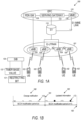
- FIG. 1A shows an example of a portion of an end-to-end network architecture of a Long Term Evolution (LTE) network with various components of the network in accordance with some embodiments.
- LTE and LTE-A networks and devices are referred to merely as LTE networks and devices.
- the network 100 may comprise a radio access network (RAN) (e.g., as depicted, the E-UTRAN or evolved universal terrestrial radio access network) 101 and the core network 120 (e.g., shown as an evolved packet core (EPC)) coupled together through an S1 interface 115.
- RAN radio access network
- EPC evolved packet core
- the MME 122 is similar in function to the control plane of legacy Serving GPRS Support Nodes (SGSN).
- the MME 122 manages mobility aspects in access such as gateway selection and tracking area list management.
- the serving GW 124 terminates the interface toward the RAN 101, and routes data packets between the RAN 101 and the core network 120. In addition, it may be a local mobility anchor point for inter-eNB handovers and also may provide an anchor for inter-3GPP mobility. Other responsibilities may include lawful intercept, charging, and some policy enforcement.
- the serving GW 124 and the MME 122 may be implemented in one physical node or separate physical nodes.
- the PDN GW 126 terminates a SGi interface toward the packet data network (PDN).
- PDN packet data network
- the PDN GW 126 routes data packets between the EPC 120 and the external PDN, and may be a key node for policy enforcement and charging data collection. It may also provide an anchor point for mobility with non-LTE accesses.
- the external PDN can be any kind of IP network, as well as an IP Multimedia Subsystem (IMS) domain.
- IMS IP Multimedia Subsystem
- the PDN GW 126 and the serving GW 124 may be implemented in one physical node or separated physical nodes.
- FIG. 1B illustrates transmission of system information in subsequent modification periods.
- system information e.g., 170
- SIB system information block
- the network transmits the updated system information (e.g., 172) during the subsequent modification period (e.g., 162).
- the SIB changes can be read by the UEs 102 periodically during a modification period time interval (e.g., 162), and can act on it at the modification period boundary (e.g., 181, 182).
- a modification period time interval e.g. 162
- the modification period boundary e.g., 181, 182
- all UEs 102 within the eNB cell can read and act on the SIB indication at the same instant in time. Consequently, when the restricting bit is removed, the UEs that have accumulated background data while it was barred, may try to access the cell network at the same time instant (e.g., immediately after the barring is removed), which can cause surge in traffic.
- LTE Access class barring allows barring of fractional number of users. This fraction can be changed by the network over time and can be used to avoid the issue discussed here.
- network can gradually reduce the fraction of users that is barred, thereby avoiding the surge that can happen when the barring is suddenly removed.
- barring background traffic only a single barring bit is used and the barring of a fraction of traffic or users is not possible.
- the eNB can temporarily restrict (or bar) all data traffic immediately after removal of the restricting bit. For example, after background traffic has been restricted (restricting bit has been set), background traffic can be allowed by removing/clearing the restricting bit. After the restricting bit has been cleared (and background traffic is allowed), a random timer may be initiated for a random duration. After the random timer has expired, background traffic communication may resume. This solution, however, may result in barring of normal traffic during the transition period.
- the UE can start a random timer when there is background data to send and the restricting bit is set (i.e., TRUE status/state). If the restricting bit 131 was already cleared in the previous modification period (e.g., the bit is not set at the modification period boundary just prior to the timer expiry), then the UE 102 is allowed to access the cell with unattended data traffic when the timer expires. Other examples of handling unattended data traffic are disclosed herein below.
- the SIB 130 may also include a timer base value 132.
- the timer base value 132 can be used by the UE 102 as a base value in configuring the duration of the random timer.
- the S1 interface 115 is the interface that separates the RAN 101 and the EPC 120. It is split into two parts: the S1-U, which carries traffic data between the eNB 104 and the serving GW 124, and the S1-MME, which is a signaling interface between the eNB 104 and the MME 122.
- the X2 interface is the interface between eNB 104.
- the X2 interface comprises two parts, the X2-C and X2-U.
- the X2-C is the control plane interface between the eNB 104
- the X2-U is the user plane interface between the eNB 104.
- Low Power (LP) cells are typically used to extend coverage to indoor areas where outdoor signals do not reach well, or to add network capacity in areas with very dense phone usage, such as train stations.
- LP low power
- the term low power (LP) eNB refers to any suitable relatively low power eNB for implementing a narrower cell (narrower than a macro cell) such as a femtocell, a picocell, or a micro cell.
- Femtocell eNBs are typically provided by a mobile network operator to its residential or enterprise customers.
- a femtocell is typically the size of a residential gateway or smaller and generally connects to the user's broadband line.
- LP eNB may be implemented with a picocell eNB since it is coupled to a macro eNB via an X2 interface.
- Picocell eNBs or other LP eNBs may incorporate some or all functionality of a macro eNB. In some cases, this may be referred to as an access point base station or enterprise femtocell.
- Communication over an LTE network may be split up into 10ms frames, each of which contains ten 1ms subframes. Each subframe, in turn, may contain two slots of 0.5ms. Each slot may contain 6-7 symbols, depending on the system used.
- a resource block (RB) (also called physical resource block (PRB)) may be the smallest unit of resources that can be allocated to a UE.
- a resource block may be 180 kHz wide in frequency and 1 slot long in time. In frequency, resource blocks may be either 12 x 15 kHz subcarriers or 24 x 7.5 kHz subcarriers wide. For most channels and signals, 12 subcarriers may be used per resource block.
- both the uplink and downlink frames may be 10ms and may be frequency (full-duplex) or time (half-duplex) separated.
- Time Division Duplexed the uplink and downlink subframes may be transmitted on the same frequency and may be multiplexed in the time domain.
- a downlink resource grid may be used for downlink transmissions from an eNB to a UE.
- the grid may be a time-frequency grid, which is the physical resource in the downlink in each slot.
- Each column and each row of the resource grid may correspond to one OFDM symbol and one OFDM subcarrier, respectively.
- the duration of the resource grid in the time domain may correspond to one slot.
- Each resource grid may comprise a number of the above resource blocks, which describe the mapping of certain physical channels to resource elements.
- Each resource grid comprises a number of resource blocks (RBs), which describe the mapping of certain physical channels to resource elements.
- Each resource block comprises a collection of resource elements in the frequency domain and may represent the smallest quanta of resources that currently can be allocated.
- Each subframe may be partitioned into the PDCCH and the PDSCH.
- the PDCCH uses CCEs (control channel elements) to convey the control information.
- CCEs control channel elements
- the PDCCH complex-valued symbols are first organized into quadruplets, which are then permuted using a sub-block inter-leaver for rate matching.
- Each PDCCH is transmitted using one or more of these control channel elements (CCEs), where each CCE corresponds to nine sets of four physical resource elements known as resource element groups (REGs).
- RAGs resource element groups
- Four QPSK symbols are mapped to each REG.
- the PDCCH can be transmitted using one or more CCEs, depending on the size of downlink control information (DCI) and the channel condition.
- DCI downlink control information
- There may be four or more different PDCCH formats defined in LTE with different numbers of CCEs (e.g., aggregation level, L 1, 2, 4, or 8).
- processing circuitry may include one or more elements or components, some or all of which may be included in the application circuitry 202 or the baseband circuitry 204.
- transceiver circuitry may include one or more elements or components, some or all of which may be included in the RF circuitry 206 or the FEM circuitry 208. These examples are not limiting, however, as the processing circuitry or the transceiver circuitry may also include other elements or components in some cases.
- the application circuitry 202 may include one or more application processors.
- the application circuitry 202 may include circuitry such as, but not limited to, one or more single-core or multi-core processors.
- the processor(s) may include any combination of general-purpose processors and dedicated processors (e.g., graphics processors, application processors, etc.).
- the processors may be coupled with or may include memory/storage and may be configured to execute instructions stored in the memory/storage to enable various applications or operating systems to run on the system to perform one or more of the functionalities described herein.
- the baseband circuitry 204 may include circuitry such as, but not limited to, one or more single-core or multi-core processors.
- the baseband circuitry 204 may include one or more baseband processors or control logic to process baseband signals received from a receive signal path of the RF circuitry 206 and to generate baseband signals for a transmit signal path of the RF circuitry 206.
- Baseband processing circuity 204 may interface with the application circuitry 202 for generation and processing of the baseband signals and for controlling operations of the RF circuitry 206.
- the baseband circuitry 204 may include a second generation (2G) baseband processor 204a, third generation (3G) baseband processor 204b, fourth generation (4G) baseband processor 204c, or other baseband processor(s) 204d for other existing generations, generations in development or to be developed in the future (e.g., fifth generation (5G), 6G, etc.).
- the baseband circuitry 204 e.g., one or more of baseband processors 204a-d
- the radio control functions may include, but are not limited to, signal modulation/demodulation, encoding/decoding, radio frequency shifting, etc.
- modulation/demodulation circuitry of the baseband circuitry 204 may include Fast-Fourier Transform (FFT), precoding, or constellation mapping/demapping functionality.
- FFT Fast-Fourier Transform
- encoding/decoding circuitry of the baseband circuitry 204 may include Low Density Parity Check (LDPC) encoder/decoder functionality, optionally along-side other techniques such as, for example, block codes, convolutional codes, turbo codes, or the like, which may be used to support legacy protocols.
- LDPC Low Density Parity Check
- Embodiments of modulation/demodulation and encoder/decoder functionality are not limited to these examples and may include other suitable functionality in other embodiments.
- the baseband circuitry 204 may include elements of a protocol stack such as, for example, elements of an evolved universal terrestrial radio access network (EUTRAN) protocol including, for example, physical (PHY) 205a, media access control (MAC) 205b, radio link control (RLC) 205c, packet data convergence protocol (PDCP) 205d, and/or radio resource control (RRC) 205e elements.
- EUTRAN evolved universal terrestrial radio access network
- the UE 200 may further include network attached storage 205f.
- a central processing unit (CPU) 204e of the baseband circuitry 204 may be configured to run elements of the protocol stack for signaling of the PHY, MAC, RLC, PDCP or RRC layers.
- the baseband circuitry may include one or more audio digital signal processor(s) (DSP) 204f.
- the audio DSP(s) 204f may be include elements for compression/decompression and echo cancellation and may include other suitable processing elements in other embodiments.
- Components of the baseband circuitry may be suitably combined in a single chip, a single chipset, or disposed on a same circuit board in some embodiments.
- some or all of the constituent components of the baseband circuitry 204 and the application circuitry 202 may be implemented together such as, for example, on a system on chip (SOC).
- SOC system on chip
- the baseband circuitry 204 may provide for communication compatible with one or more radio technologies.
- the baseband circuitry 204 may support communication with an evolved universal terrestrial radio access network (EUTRAN) or other wireless metropolitan area networks (WMAN), a wireless local area network (WLAN), a wireless personal area network (WPAN).
- EUTRAN evolved universal terrestrial radio access network
- WMAN wireless metropolitan area networks
- WLAN wireless local area network
- WPAN wireless personal area network
- Embodiments in which the baseband circuitry 204 is configured to support radio communications of more than one wireless protocol may be referred to as multi-mode baseband circuitry.
- RF circuitry 206 may enable communication with wireless networks using modulated electromagnetic radiation through a non-solid medium.
- the RF circuitry 206 may include switches, filters, amplifiers, etc. to facilitate the communication with the wireless network.
- RF circuitry 206 may include a receive signal path which may include circuitry to down-convert RF signals received from the FEM circuitry 208 and provide baseband signals to the baseband circuitry 204.
- RF circuitry 206 may also include a transmit signal path which may include circuitry to up-convert baseband signals provided by the baseband circuitry 204 and provide RF output signals to the FEM circuitry 208 for transmission.
- the mixer circuitry 206a of the receive signal path may be configured to down-convert RF signals received from the FEM circuitry 208 based on the synthesized frequency provided by synthesizer circuitry 206d.
- the amplifier circuitry 206b may be configured to amplify the down-converted signals and the filter circuitry 206c may be a low-pass filter (LPF) or band-pass filter (BPF) configured to remove unwanted signals from the down-converted signals to generate output baseband signals.
- LPF low-pass filter
- BPF band-pass filter
- Output baseband signals may be provided to the baseband circuitry 204 for further processing.
- the output baseband signals may be zero-frequency baseband signals, although this is not a requirement.
- mixer circuitry 206a of the receive signal path may comprise passive mixers, although the scope of the embodiments is not limited in this respect.
- the mixer circuitry 206a of the transmit signal path may be configured to up-convert input baseband signals based on the synthesized frequency provided by the synthesizer circuitry 206d to generate RF output signals for the FEM circuitry 208.
- the baseband signals may be provided by the baseband circuitry 204 and may be filtered by filter circuitry 206c.
- the filter circuitry 206c may include a low-pass filter (LPF), although the scope of the embodiments is not limited in this respect.
- LPF low-pass filter
- the mixer circuitry 206a of the receive signal path and the mixer circuitry 206a of the transmit signal path may include two or more mixers and may be arranged for quadrature downconversion or upconversion respectively.
- the mixer circuitry 206a of the receive signal path and the mixer circuitry 206a of the transmit signal path may include two or more mixers and may be arranged for image rejection (e.g., Hartley image rejection).
- the mixer circuitry 206a of the receive signal path and the mixer circuitry 206a may be arranged for direct downconversion or direct upconversion, respectively.
- the mixer circuitry 206a of the receive signal path and the mixer circuitry 206a of the transmit signal path may be configured for super-heterodyne operation.
- the output baseband signals and the input baseband signals may be analog baseband signals, although the scope of the embodiments is not limited in this respect.
- the output baseband signals and the input baseband signals may be digital baseband signals.
- the RF circuitry 206 may include analog-to-digital converter (ADC) and digital-to-analog converter (DAC) circuitry and the baseband circuitry 204 may include a digital baseband interface to communicate with the RF circuitry 206.
- ADC analog-to-digital converter
- DAC digital-to-analog converter
- a separate radio IC circuitry may be provided for processing signals for each spectrum, although the scope of the embodiments is not limited in this respect.
- the synthesizer circuitry 206d may be a fractional-N synthesizer or a fractional N/N+1 synthesizer, although the scope of the embodiments is not limited in this respect as other types of frequency synthesizers may be suitable.
- synthesizer circuitry 206d may be a delta-sigma synthesizer, a frequency multiplier, or a synthesizer comprising a phase-locked loop with a frequency divider.
- the synthesizer circuitry 206d may be configured to synthesize an output frequency for use by the mixer circuitry 206a of the RF circuitry 206 based on a frequency input and a divider control input.
- synthesizer circuitry 206d may be configured to generate a carrier frequency as the output frequency, while in other embodiments, the output frequency may be a multiple of the carrier frequency (e.g., twice the carrier frequency, four times the carrier frequency) and used in conjunction with quadrature generator and divider circuitry to generate multiple signals at the carrier frequency with multiple different phases with respect to each other.
- the output frequency may be a LO frequency (fLO).
- the RF circuitry 206 may include an IQ/polar converter.
- FIG. 3 is a functional diagram of an Evolved Node-B (eNB) in accordance with some embodiments.
- the eNB 300 may be a stationary non-mobile device.
- the eNB 300 may be suitable for use as an eNB 104 as depicted in FIG. 1A .
- the components of eNB 300 may be included in a single device or a plurality of devices.
- the eNB 300 may include physical layer (PHY) circuitry 302 and a transceiver 305, one or both of which may enable transmission and reception of signals to and from the UE 200, other eNBs, other UEs or other devices using one or more antennas 301A-B.
- PHY physical layer
- the physical layer circuitry 302 may perform various encoding and decoding functions that may include formation of baseband signals for transmission and decoding of received signals.
- physical layer circuitry 302 may include LDPC encoder/decoder functionality, optionally along-side other techniques such as, for example, block codes, convolutional codes, turbo codes, or the like, which may be used to support legacy protocols.
- Embodiments of modulation/demodulation and encoder/decoder functionality are not limited to these examples and may include other suitable functionality in other embodiments.
- the transceiver 305 may perform various transmission and reception functions such as conversion of signals between a baseband range and a Radio Frequency (RF) range.
- RF Radio Frequency
- the physical layer circuitry 302 and the transceiver 305 may be separate components or may be part of a combined component.
- some of the described functionality related to transmission and reception of signals may be performed by a combination that may include one, any or all of the physical layer circuitry 302, the transceiver 305, and other components or layers.
- the eNB 300 may also include medium access control layer (MAC) circuitry 304 for controlling access to the wireless medium.
- the eNB 300 may also include processing circuitry 306 and memory 308 arranged to perform the operations described herein.
- the eNB 300 may also include one or more interfaces 310, which may enable communication with other components, including other eNB 104 ( FIG. 1A ), components in the EPC 120 ( FIG. 1A ) or other network components.
- the interfaces 310 may enable communication with other components that may not be shown in FIG. 1A , including components external to the network.
- the interfaces 310 may be wired or wireless or a combination thereof.
- the antennas 210A-D (in the UE) and 301A-B (in the eNB) may comprise one or more directional or omnidirectional antennas, including, for example, dipole antennas, monopole antennas, patch antennas, loop antennas, microstrip antennas or other types of antennas suitable for transmission of RF signals.
- the antennas 210A-D, 301A-B may be effectively separated to take advantage of spatial diversity and the different channel characteristics that may result.
- the UE 200 or the eNB 300 may be a mobile device and may be a portable wireless communication device, such as a personal digital assistant (PDA), a laptop or portable computer with wireless communication capability, a web tablet, a wireless telephone, a smartphone, a wireless headset, a pager, an instant messaging device, a digital camera, an access point, a television, a wearable device such as a medical device (e.g., a heart rate monitor, a blood pressure monitor, etc.), or other device that may receive or transmit information wirelessly.
- PDA personal digital assistant
- laptop or portable computer with wireless communication capability such as a personal digital assistant (PDA), a laptop or portable computer with wireless communication capability, a web tablet, a wireless telephone, a smartphone, a wireless headset, a pager, an instant messaging device, a digital camera, an access point, a television, a wearable device such as a medical device (e.g., a heart rate monitor, a blood pressure monitor, etc.), or other device that may receive or
- the UE 200 and the eNB 300 are each illustrated as having several separate functional elements, one or more of the functional elements may be combined and may be implemented by combinations of software-configured elements, such as processing elements including digital signal processors (DSPs), or other hardware elements.
- processing elements including digital signal processors (DSPs), or other hardware elements.
- DSPs digital signal processors
- some elements may comprise one or more microprocessors, DSPs, field-programmable gate arrays (FPGAs), application specific integrated circuits (ASICs), radio-frequency integrated circuits (RFICs) and combinations of various hardware and logic circuitry for performing at least the functions described herein.
- the functional elements may refer to one or more processes operating on one or more processing elements.
- FIG. 4 illustrates reception of a system information block (SIB) during a modification period, in accordance with some embodiments. Additional modification period structure is illustrated in reference to FIG. 1B and corresponding description herein above.
- the system information can include a system information block (SIB) 410.
- the SIB 410 can include cell access related information, information for cell selection, scheduling information, radio resource configuration information, as well as other system information.
- the SIB 410 can be a System Information Block - Type 2, which can include radio resource configuration information that is common for all UEs 102 within the cell of the eNB 104.
- FIGS. 5A-5E illustrate example System_Information_Block_Type2 signaling, in accordance with some embodiments.
- SIB-2 System Information Block - Type 2
- the SIB-2 can include a restricting bit 502 and a timer base value 504.
- the restricting bit 502 may be similar to the restricting bit 131, and the timer base value 504 can be similar to the timer base value 132.
- the restricting bit 502 can be an unattended data traffic (udt) restricting bit, which is designated as udt-Restricting in FIG. 5 .
- a restricting bit value of TRUE indicates to the UE to restrict unattended data traffic.
- the UE can indicate to a higher layer (e.g., operating system layer or an application layer) to restrict the unattended data traffic. should indicate to the higher layers to restrict unattended data traffic.
- the timer base value 504 can be an unattended data traffic (udt) RestrictingTime value, as illustrated in FIG. 5 .
- udt unattended data traffic
- the UE can run a random timer for a period equal to, e.g., (rand * udt-RestrictingTime) seconds, where rand can be a random number drawn that is uniformly distributed in the range 0 ⁇ rand ⁇ 1.
- rand can be a random number drawn that is uniformly distributed in the range 0 ⁇ rand ⁇ 1.
- the random timer can stop (or expire).
- the UE may indicates to the higher layers that the restriction on unattended data traffic is alleviated.
- FIG. 5 illustrates the SIB-2 information element as using designations of udt-Restricting and udt-RestrictingTime for the restricting bit and the timer base value
- the disclosure is not limited in this regard and other designations may be used as well.
- udt-Barring and udt-BarringTime may be used instead.
- the terms "restricting” and "barring” are used interchangeably.
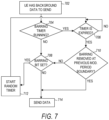
- FIGS. 6-9 are flow diagrams illustrating example functionalities for solutions for staggering unattended data traffic after barring, in accordance with some embodiments.
- the UE 102 can communicate any kind of data traffic to the eNB 104 as access to the eNB is not barred.
- SIBs e.g., 410
- a modification period e.g., 402
- the UE 102 can monitor status of the restricting bit 131.
- the UE 102 may process the SIB at the modification period boundary, and detect the status of the restricting bit at that time. If the restricting bit is not set, then communication of unattended data traffic to the eNB may continue.
- the restricting bit 131 is set (i.e., it has a value of TRUE indicating unattended data traffic is to be restricted), then at 606, the UE 102 restricts communication of unattended data traffic. Such restriction may take place at the end of the modification period (e.g., boundary 406).
- it may be determined (e.g., after the UE receives a new SIB and reads it at the modification period boundary) whether the restricting bit 131 has been cleared (e.g., the status has changed from TRUE to FALSE, or from restricting to non-restricting). If the bit has not cleared, then processing resumes at 606, when unattended data traffic is still barred. If the bit has cleared, then processing resumes at 610.
- the UE 102 can start a random timer when it is detected that the restricting bit status has changed to non-restricting.
- the UE 102 reads the SIB 130 at the modification period boundary and, therefore, the barring removal is identified by the UE at the modification period boundary.
- the UE 102 may then access the eNB cell with unattended data traffic (and/or any other type of data traffic) when the timer expires.
- the timer value (e.g., the timer duration) may be randomly chosen and may be based on the timer base value 132 that is broadcast with the SIB 130. Since different UEs may select different random values, each UE may be allowed to access the cell at different times, thereby distributing the load to the eNB and reducing the potential for data overload.
- the timer base value of the random timer may be provided in the SIB, as illustrated in FIG. 1A .
- the timer base value may be specified in a wireless standard (i.e., be pre-determined and known to all UEs) rather than being broadcast by the eNB.
- the timer base value may be determined by the UE.
- the timer base value (or the random timer altogether) may be handled or provided by the higher layers, such as, operating system layer, application, connection manager, and so forth.
- the barring timer may be set differently in instances when there is certain granularity within the background applications or categorizations of data traffic within the UE. For example, instead of treating all background traffic the same, certain classification may be implemented which may allow for setting of different barring rules. For example, different restricting bits can be defined and used within the SIB, where each restricting bit can be associated with a different type of unattended data traffic.
- Example types of background/unattended data traffic may include higher priority traffic (e.g., synchronization of news, work/personal email or shared notes) and lower priority traffic (e.g., synchronization of social media/network applications, discussion forums, or maps).
- the example method illustrated may start at 702, when it may be determined that the UE 102 has unattended data traffic to send.
- a barring (random) timer is already running. If no timer is running, at 708, it may be determined whether the barring/restricting bit 131 is set (i.e., unattended traffic is being barred/restricted). If the bit is set, then at 712, a random timer may be started, and if it is not
- processing may continue at 710, when it may be determined whether the restricting of unattended data traffic has been removed at a previous modification period boundary. If restricting has not been removed, then processing may continue at 708. If the restricting has been removed (i.e., the restricting bit is set to FALSE), then processing may continue at 714 when unattended data may be sent out to the eNB.
- a change in the restricting bit status may be detected from barring of unattended data traffic to non-barring of the unattended data traffic.
- the UE 102 may initially detect that the restricting bit 130 is set and unattended data traffic is restricted/barred. During a subsequent modification period, however, the UE may detect that the restricting bit status has changed from barring (e.g., TRUE value for the bit) to non-barring (e.g., FALSE value for the bit).
- a timer may be initiated for a time interval with a random duration. For example, the UE 102 may initiate a random timer using, e.g., the timer base value 132 received from the eNB.
- the restricting bit may be an unattended data traffic (udt) Restricting bit
- the timer base value may be a udt-RestrictingTime value
- the example method 900 may start at 902, when a System Information Block (SIB) information element (IE) may be decoded to determine status of a restricting bit in the SIB IE.
- SIB System Information Block
- the UE 102 may receive data from the eNB (e.g., a SIB 130), and the SIB 130 may be decoded to determine status of the restricting bit 131.
- the SIB IE 130 may be received during a modification period (e.g., 402).
- the SIB IE 130 may be received a number of times within the modification period 402 (e.g., as illustrated in FIG. 4 ).
- a first timer with a random duration may be initiated, upon detecting availability of unattended data for communication to the eNB and the restricting bit status indicates barring of unattended data traffic.
- the UE 102 may detect that there is unattended data traffic for communication to the eNB 104.
- the UE may further determine that the restricting bit 131 status indicates restricting of unattended data traffic.
- the UE may then initiate a timer with a random duration.
- communication of the unattended data traffic to the eNB may be initiated, when the restricting bit status indicates non-barring of the unattended data traffic.
- the UE 102 may verify (e.g., at modification period boundary 406) that the restricting bit 131 status has changed to non-barring before proceeding with communication of the unattended data traffic to the eNB 104.
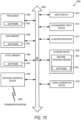
- FIG. 10 illustrates a block diagram of a communication device such as an eNB or a UE, in accordance with some embodiments.
- the communication device 1000 may operate as a standalone device or may be connected (e.g., networked) to other communication devices.
- the communication device 1000 may operate in the capacity of a server communication device, a client communication device, or both in server-client network environments.
- the communication device 1000 may act as a peer communication device in peer-to-peer (P2P) (or other distributed) network environment.
- P2P peer-to-peer
- the communication device 1000 may be a UE, eNB, PC, a tablet PC, a STB, a PDA, a mobile telephone, a smart phone, a web appliance, a network router, switch or bridge, or any communication device capable of executing instructions (sequential or otherwise) that specify actions to be taken by that communication device.
- the term "communication device” shall also be taken to include any collection of communication devices that individually or jointly execute a set (or multiple sets) of instructions to perform any one or more of the methodologies discussed herein, such as cloud computing, software as a service (SaaS), other computer cluster configurations.
- Examples, as described herein, may include, or may operate on, logic or a number of components, modules, or mechanisms.
- Modules are tangible entities (e.g., hardware) capable of performing specified operations and may be configured or arranged in a certain manner.
- circuits may be arranged (e.g., internally or with respect to external entities such as other circuits) in a specified manner as a module.
- the whole or part of one or more computer systems (e.g., a standalone, client or server computer system) or one or more hardware processors may be configured by firmware or software (e.g., instructions, an application portion, or an application) as a module that operates to perform specified operations.
- the software may reside on a communication device readable medium.
- the software when executed by the underlying hardware of the module, causes the hardware to perform the specified operations.
Landscapes
- Engineering & Computer Science (AREA)
- Computer Security & Cryptography (AREA)
- Computer Networks & Wireless Communication (AREA)
- Signal Processing (AREA)
- Mobile Radio Communication Systems (AREA)
Claims (10)
- Benutzervorrichtung (user equipment), UE (102, 200), die konfiguriert ist, um mit einem entwickelten Knoten B, eNB, (104, 300) zu kommunizieren, wobei die UE (102, 200) Folgendes umfasst:einen Speicher; undeine Verarbeitungsschaltung, die mit dem Speicher gekoppelt ist, wobei die Verarbeitungsschaltung konfiguriert ist zum:Decodieren (802) eines Systeminformationsblock-Informationselements, SIB-IE, um den Status eines Beschränkungsbits in dem SIB-IE sowie einen Zeitgeberbasiswert in dem SIB-IE zu bestimmen, wobei das SIB-IE während einer Modifikationsperiode von einem entwickelten Knoten B, eNB, empfangen wird, wobei das Beschränkungsbit ein Beschränkungsbit für unbeaufsichtigten Datenverkehr, udt, ist und der Zeitgeberbasiswert ein udt-Beschränkungszeitwert ist, der durch den eNB bestimmt wird;Detektieren (804) einer Änderung des Beschränkungsbitstatus vom Sperren von unbeaufsichtigtem Datenverkehr zum Nicht-Sperren des unbeaufsichtigten Datenverkehrs;Initiieren (806), zu einer Grenzzeit der Systeminformationsmodifikationsperiode, eines Zeitgebers für ein Zeitintervall mit einer zufälligen Dauer, wobei die zufällige Dauer auf dem udt-Beschränkungszeitwert basiert, als Reaktion auf das Detektieren der Änderung vom Sperren von unbeaufsichtigtem Datenverkehr zum Nicht-Sperren des unbeaufsichtigten Datenverkehrs; undnach Ablauf des Zeitgebers, Wiederaufnehmen (808) der Kommunikation des unbeaufsichtigten Datenverkehrs mit dem eNB.
- UE (102, 200) nach Anspruch 1, wobei das SIB-IE ein System_Information_Block_Type_2-Informationselement ist.
- UE (102, 200) nach Anspruch 1, wobei:ein WAHR-Status des Beschränkungsbits angibt, dass der unbeaufsichtigte Datenverkehr für die Kommunikation durch das UE (102, 200) gesperrt werden soll; undein FALSCH-Status des Beschränkungsbits angibt, dass der unbeaufsichtigte Datenverkehr für die Kommunikation durch das UE (102, 200) nicht gesperrt werden soll.
- UE (102, 200) nach Anspruch 3, wobei die Verarbeitungsschaltung ferner konfiguriert ist zum:
wenn der Status des Beschränkungsbits WAHR ist, Bereitstellen einer Anzeige an eine Betriebssystemschicht oder eine Anwendungsschicht des UE (102, 200), um den unbeaufsichtigten Datenverkehr zu beschränken. - UE (102, 200) nach Anspruch 1, wobei die Verarbeitungsschaltung ferner konfiguriert ist zum:nach Ablauf des Zeitintervalls, Verifizieren, dass der Beschränkungsbitstatus weiterhin das Nicht-Sperren von unbeaufsichtigtem Datenverkehr angibt; undWiederaufnehmen der Kommunikation des unbeaufsichtigten Datenverkehrs mit dem eNB nach erfolgreicher Verifizierung.
- UE (102, 200) nach Anspruch 1, wobei die Verarbeitungsschaltung ferner konfiguriert ist zum:nach Ablauf des Zeitintervalls, Verifizieren, dass der Beschränkungsbitstatus weiterhin das Nicht-Sperren von unbeaufsichtigtem Datenverkehr angibt; undFortsetzen des Sperrens des unbeaufsichtigten Datenverkehrs nach erfolgloser Verifizierung.
- UE (102, 200) nach Anspruch 1, wobei die Verarbeitungsschaltung ferner konfiguriert ist zum:
Empfangen einer Vielzahl von SIB-IEs während der Systeminformationsmodifikationsperiode, wobei jedes der Vielzahl von SIB-IEs das Beschränkungsbit umfasst. - Computerlesbares Speichermedium, das Anweisungen umfasst, die bei Ausführung durch einen oder mehrere Prozessoren einer Benutzervorrichtung, UE (102, 200), den einen oder die mehreren Prozessoren zu Folgendem veranlassen:Decodieren eines Systeminformationsblock-Informationselements, SIB-IE, um den Status eines Beschränkungsbits in dem SIB-IE sowie einen Zeitgeberbasiswert in dem SIB-IE zu bestimmen, wobei das SIB-IE während einer Modifikationsperiode von einem entwickelten Knoten B, eNB, empfangen wird, wobei das Beschränkungsbit ein Beschränkungsbit für unbeaufsichtigten Datenverkehr, udt, ist und der Zeitgeberbasiswert ein udt-Beschränkungszeitwert ist, der durch den eNB bestimmt wird;Detektieren einer Änderung des Beschränkungsbitstatus vom Sperren von unbeaufsichtigtem Datenverkehr zum Nicht-Sperren des unbeaufsichtigten Datenverkehrs;Initiieren, zu einer Grenzzeit der Systeminformationsmodifikationsperiode, eines Zeitgebers für ein Zeitintervall mit einer zufälligen Dauer, wobei die zufällige Dauer auf dem udt-Beschränkungszeitwert basiert, als Reaktion auf das Detektieren der Änderung vom Sperren von unbeaufsichtigtem Datenverkehr zum Nicht-Sperren des unbeaufsichtigten Datenverkehrs; undnach Ablauf des Zeitgebers, Wiederaufnehmen der Kommunikation des unbeaufsichtigten Datenverkehrs mit dem eNB.
- Computerlesbares Speichermedium nach Anspruch 8, wobei:ein WAHR-Status des Beschränkungsbits angibt, dass der unbeaufsichtigte Datenverkehr für die Kommunikation durch das UE (102, 200) gesperrt werden soll; undein FALSCH-Status des Beschränkungsbits angibt, dass der unbeaufsichtigte Datenverkehr für die Kommunikation durch das UE (102, 200) nicht gesperrt werden soll.
- Computerlesbares Speichermedium nach Anspruch 9, wobei die Anweisungen ferner den einen oder die mehreren Prozessoren zu Folgendem veranlassen:
wenn der Status des Beschränkungsbits WAHR ist, Bereitstellen einer Anzeige an eine Betriebssystemschicht oder eine Anwendungsschicht des UE (102, 200), um den unbeaufsichtigten Datenverkehr zu beschränken.
Applications Claiming Priority (2)
| Application Number | Priority Date | Filing Date | Title |
|---|---|---|---|
| US201662316735P | 2016-04-01 | 2016-04-01 | |
| PCT/US2016/053820 WO2017171921A1 (en) | 2016-04-01 | 2016-09-26 | Staggering unattended traffic in lte after barring |
Publications (3)
| Publication Number | Publication Date |
|---|---|
| EP3437381A1 EP3437381A1 (de) | 2019-02-06 |
| EP3437381A4 EP3437381A4 (de) | 2019-11-13 |
| EP3437381B1 true EP3437381B1 (de) | 2025-07-09 |
Family
ID=59965055
Family Applications (1)
| Application Number | Title | Priority Date | Filing Date |
|---|---|---|---|
| EP16897446.7A Active EP3437381B1 (de) | 2016-04-01 | 2016-09-26 | Staffelung von unbeaufsichtigtem verkehr in lte nach sperrung |
Country Status (3)
| Country | Link |
|---|---|
| EP (1) | EP3437381B1 (de) |
| TW (1) | TWI826348B (de) |
| WO (1) | WO2017171921A1 (de) |
Family Cites Families (9)
| Publication number | Priority date | Publication date | Assignee | Title |
|---|---|---|---|---|
| US8180335B2 (en) * | 2008-01-11 | 2012-05-15 | Qualcomm Incorporated | System information modification notification and detection in wireless communications |
| US8837443B2 (en) * | 2010-08-13 | 2014-09-16 | Sharp Kabushiki Kaisha | Reducing congestion in wireless communication networks |
| KR101967721B1 (ko) * | 2011-08-10 | 2019-04-10 | 삼성전자 주식회사 | 무선 통신 시스템에서 확장 접속 차단 적용 방법 및 장치 |
| US20140171061A1 (en) * | 2011-08-15 | 2014-06-19 | Telefonaktiebolaget L M Ericsson (Publ) | Network access delay for eab-configured ues and/or group-based addressed ues |
| US9526091B2 (en) * | 2012-03-16 | 2016-12-20 | Intel Corporation | Method and apparatus for coordination of self-optimization functions in a wireless network |
| EP2829121B1 (de) * | 2012-03-21 | 2020-12-30 | Samsung Electronics Co., Ltd. | Granulare Netzwerkzugangssteuerung und Verfahren dafür |
| WO2014051370A1 (en) * | 2012-09-27 | 2014-04-03 | Lg Electronics Inc. | Method and apparatus for receiving extended access barring parameters in wireless communication system |
| US9326311B2 (en) * | 2013-12-13 | 2016-04-26 | Blackberry Limited | Managing connection retries due to access class barring |
| US10075902B2 (en) * | 2014-04-08 | 2018-09-11 | Qualcomm Incorporated | Method of unified control of random access and traffic ingress in a congested radio access network |
-
2016
- 2016-09-26 EP EP16897446.7A patent/EP3437381B1/de active Active
- 2016-09-26 WO PCT/US2016/053820 patent/WO2017171921A1/en not_active Ceased
-
2017
- 2017-02-23 TW TW106106235A patent/TWI826348B/zh active
Also Published As
| Publication number | Publication date |
|---|---|
| WO2017171921A1 (en) | 2017-10-05 |
| EP3437381A4 (de) | 2019-11-13 |
| TWI826348B (zh) | 2023-12-21 |
| TW201742481A (zh) | 2017-12-01 |
| EP3437381A1 (de) | 2019-02-06 |
Similar Documents
| Publication | Publication Date | Title |
|---|---|---|
| US10986692B2 (en) | Evolved node-b, user equipment, and methods for transition between idle and connected modes | |
| US11039466B2 (en) | User equipment (UE), evolved node-B (ENB) and methods for multiplexing new radio (NR) physical uplink shared channel (NR PUSCH) and NR physical uplink control channel (NR PUCCH) | |
| US11412450B2 (en) | Paging and essential system information block (SIB) transmission in the unlicensed internet of things (U-IOT) system | |
| US10581537B2 (en) | Devices and methods for robust measurement and data receiving | |
| US10911996B2 (en) | Beamforming measurements based on PSS/SSS | |
| US11824814B2 (en) | Physical resource block indexing for coexistence of narrow band, carrier aggregation, and wide band user equipment in new radio | |
| US10897776B2 (en) | Downlink control information design with shorter TTI | |
| EP3590297B1 (de) | Txop mit fortgesetztem lbt nach einer pause | |
| CN111149406A (zh) | 用于上行链路调度的通信网络装置 | |
| WO2018031638A1 (en) | Uplink transmission request for multiple numerologies | |
| US11082950B2 (en) | User equipment (UE) and method of sidelink data communication in fifth generation (5G) new radio (NR) things networks | |
| EP4228341B1 (de) | Leistungseffiziente kommunikation mit drahtlosem intelligenten repeater | |
| WO2018106911A2 (en) | Multefire user equipment for grantless uplink transmission | |
| US20220321281A1 (en) | Technologies for constructing hybrid automatic repeat request - acknowledgment codebook | |
| US20190254015A1 (en) | Channel configuration and downlink/uplink configuration for narrow band internet of things (nb-iot) systems | |
| KR20220167316A (ko) | 무선 통신에서의 향상된 업링크 송신 | |
| WO2017136000A1 (en) | Pbch design for narrowband internet-of-things (nb-iot) | |
| JP2025504298A (ja) | サイドリンク間欠受信(drx)受信機ユーザ機器(ue)のためのリソース選択の向上 | |
| EP3498047B1 (de) | Mehrere mac-einheiten pro benutzervorrichtung | |
| EP3437381B1 (de) | Staffelung von unbeaufsichtigtem verkehr in lte nach sperrung | |
| WO2017171898A1 (en) | User equipment (ue), evolved node-b (enb) and methods for suspension and resumption of communication links of a radio bearer | |
| US20250317807A1 (en) | Systems, methods, and devices for enhancements based on packet importance |
Legal Events
| Date | Code | Title | Description |
|---|---|---|---|
| STAA | Information on the status of an ep patent application or granted ep patent |
Free format text: STATUS: THE INTERNATIONAL PUBLICATION HAS BEEN MADE |
|
| PUAI | Public reference made under article 153(3) epc to a published international application that has entered the european phase |
Free format text: ORIGINAL CODE: 0009012 |
|
| STAA | Information on the status of an ep patent application or granted ep patent |
Free format text: STATUS: REQUEST FOR EXAMINATION WAS MADE |
|
| 17P | Request for examination filed |
Effective date: 20180831 |
|
| AK | Designated contracting states |
Kind code of ref document: A1 Designated state(s): AL AT BE BG CH CY CZ DE DK EE ES FI FR GB GR HR HU IE IS IT LI LT LU LV MC MK MT NL NO PL PT RO RS SE SI SK SM TR |
|
| AX | Request for extension of the european patent |
Extension state: BA ME |
|
| RIN1 | Information on inventor provided before grant (corrected) |
Inventor name: CHOI, HYUNG-NAM Inventor name: PALAT, SUDEEP K. Inventor name: HEO, YOUN HYOUNG Inventor name: MARTINEZ TARRADELL, MARTA |
|
| RIN1 | Information on inventor provided before grant (corrected) |
Inventor name: CHOI, HYUNG-NAM Inventor name: MARTINEZ TARRADELL, MARTA Inventor name: HEO, YOUN HYOUNG Inventor name: PALAT, SUDEEP K. |
|
| DAV | Request for validation of the european patent (deleted) | ||
| DAX | Request for extension of the european patent (deleted) | ||
| A4 | Supplementary search report drawn up and despatched |
Effective date: 20191011 |
|
| RIC1 | Information provided on ipc code assigned before grant |
Ipc: H04W 48/12 20090101ALN20191007BHEP Ipc: H04W 48/06 20090101AFI20191007BHEP |
|
| RAP1 | Party data changed (applicant data changed or rights of an application transferred) |
Owner name: APPLE INC. |
|
| STAA | Information on the status of an ep patent application or granted ep patent |
Free format text: STATUS: EXAMINATION IS IN PROGRESS |
|
| 17Q | First examination report despatched |
Effective date: 20210219 |
|
| REG | Reference to a national code |
Ref country code: DE Ref legal event code: R079 Free format text: PREVIOUS MAIN CLASS: H04W0048080000 Ipc: H04W0048060000 Ref document number: 602016092877 Country of ref document: DE |
|
| GRAP | Despatch of communication of intention to grant a patent |
Free format text: ORIGINAL CODE: EPIDOSNIGR1 |
|
| STAA | Information on the status of an ep patent application or granted ep patent |
Free format text: STATUS: GRANT OF PATENT IS INTENDED |
|
| INTG | Intention to grant announced |
Effective date: 20250331 |
|
| RIC1 | Information provided on ipc code assigned before grant |
Ipc: H04W 48/12 20090101ALN20250324BHEP Ipc: H04W 48/06 20090101AFI20250324BHEP |
|
| GRAS | Grant fee paid |
Free format text: ORIGINAL CODE: EPIDOSNIGR3 |
|
| GRAA | (expected) grant |
Free format text: ORIGINAL CODE: 0009210 |
|
| STAA | Information on the status of an ep patent application or granted ep patent |
Free format text: STATUS: THE PATENT HAS BEEN GRANTED |
|
| AK | Designated contracting states |
Kind code of ref document: B1 Designated state(s): AL AT BE BG CH CY CZ DE DK EE ES FI FR GB GR HR HU IE IS IT LI LT LU LV MC MK MT NL NO PL PT RO RS SE SI SK SM TR |
|
| REG | Reference to a national code |
Ref country code: GB Ref legal event code: FG4D |
|
| REG | Reference to a national code |
Ref country code: CH Ref legal event code: EP |
|
| P01 | Opt-out of the competence of the unified patent court (upc) registered |
Free format text: CASE NUMBER: APP_28036/2025 Effective date: 20250611 |
|
| REG | Reference to a national code |
Ref country code: IE Ref legal event code: FG4D |
|
| REG | Reference to a national code |
Ref country code: DE Ref legal event code: R096 Ref document number: 602016092877 Country of ref document: DE |
|
| PGFP | Annual fee paid to national office [announced via postgrant information from national office to epo] |
Ref country code: DE Payment date: 20250916 Year of fee payment: 10 |
|
| REG | Reference to a national code |
Ref country code: NL Ref legal event code: MP Effective date: 20250709 |
|
| PG25 | Lapsed in a contracting state [announced via postgrant information from national office to epo] |
Ref country code: PT Free format text: LAPSE BECAUSE OF FAILURE TO SUBMIT A TRANSLATION OF THE DESCRIPTION OR TO PAY THE FEE WITHIN THE PRESCRIBED TIME-LIMIT Effective date: 20251110 |
|
| PG25 | Lapsed in a contracting state [announced via postgrant information from national office to epo] |
Ref country code: NL Free format text: LAPSE BECAUSE OF FAILURE TO SUBMIT A TRANSLATION OF THE DESCRIPTION OR TO PAY THE FEE WITHIN THE PRESCRIBED TIME-LIMIT Effective date: 20250709 |
|
| REG | Reference to a national code |
Ref country code: AT Ref legal event code: MK05 Ref document number: 1813046 Country of ref document: AT Kind code of ref document: T Effective date: 20250709 |
|
| PG25 | Lapsed in a contracting state [announced via postgrant information from national office to epo] |
Ref country code: IS Free format text: LAPSE BECAUSE OF FAILURE TO SUBMIT A TRANSLATION OF THE DESCRIPTION OR TO PAY THE FEE WITHIN THE PRESCRIBED TIME-LIMIT Effective date: 20251109 |
|
| PG25 | Lapsed in a contracting state [announced via postgrant information from national office to epo] |
Ref country code: NO Free format text: LAPSE BECAUSE OF FAILURE TO SUBMIT A TRANSLATION OF THE DESCRIPTION OR TO PAY THE FEE WITHIN THE PRESCRIBED TIME-LIMIT Effective date: 20251009 |
|
| REG | Reference to a national code |
Ref country code: LT Ref legal event code: MG9D |
|
| PG25 | Lapsed in a contracting state [announced via postgrant information from national office to epo] |
Ref country code: AT Free format text: LAPSE BECAUSE OF FAILURE TO SUBMIT A TRANSLATION OF THE DESCRIPTION OR TO PAY THE FEE WITHIN THE PRESCRIBED TIME-LIMIT Effective date: 20250709 |
|
| PG25 | Lapsed in a contracting state [announced via postgrant information from national office to epo] |
Ref country code: FI Free format text: LAPSE BECAUSE OF FAILURE TO SUBMIT A TRANSLATION OF THE DESCRIPTION OR TO PAY THE FEE WITHIN THE PRESCRIBED TIME-LIMIT Effective date: 20250709 |
|
| PG25 | Lapsed in a contracting state [announced via postgrant information from national office to epo] |
Ref country code: HR Free format text: LAPSE BECAUSE OF FAILURE TO SUBMIT A TRANSLATION OF THE DESCRIPTION OR TO PAY THE FEE WITHIN THE PRESCRIBED TIME-LIMIT Effective date: 20250709 |
|
| PG25 | Lapsed in a contracting state [announced via postgrant information from national office to epo] |
Ref country code: GR Free format text: LAPSE BECAUSE OF FAILURE TO SUBMIT A TRANSLATION OF THE DESCRIPTION OR TO PAY THE FEE WITHIN THE PRESCRIBED TIME-LIMIT Effective date: 20251010 |
|
| PG25 | Lapsed in a contracting state [announced via postgrant information from national office to epo] |
Ref country code: SE Free format text: LAPSE BECAUSE OF FAILURE TO SUBMIT A TRANSLATION OF THE DESCRIPTION OR TO PAY THE FEE WITHIN THE PRESCRIBED TIME-LIMIT Effective date: 20250709 |
|
| PG25 | Lapsed in a contracting state [announced via postgrant information from national office to epo] |
Ref country code: LV Free format text: LAPSE BECAUSE OF FAILURE TO SUBMIT A TRANSLATION OF THE DESCRIPTION OR TO PAY THE FEE WITHIN THE PRESCRIBED TIME-LIMIT Effective date: 20250709 |
|
| PG25 | Lapsed in a contracting state [announced via postgrant information from national office to epo] |
Ref country code: PL Free format text: LAPSE BECAUSE OF FAILURE TO SUBMIT A TRANSLATION OF THE DESCRIPTION OR TO PAY THE FEE WITHIN THE PRESCRIBED TIME-LIMIT Effective date: 20250709 Ref country code: BG Free format text: LAPSE BECAUSE OF FAILURE TO SUBMIT A TRANSLATION OF THE DESCRIPTION OR TO PAY THE FEE WITHIN THE PRESCRIBED TIME-LIMIT Effective date: 20250709 |
|
| PG25 | Lapsed in a contracting state [announced via postgrant information from national office to epo] |
Ref country code: RS Free format text: LAPSE BECAUSE OF FAILURE TO SUBMIT A TRANSLATION OF THE DESCRIPTION OR TO PAY THE FEE WITHIN THE PRESCRIBED TIME-LIMIT Effective date: 20251009 |
|
| PG25 | Lapsed in a contracting state [announced via postgrant information from national office to epo] |
Ref country code: ES Free format text: LAPSE BECAUSE OF FAILURE TO SUBMIT A TRANSLATION OF THE DESCRIPTION OR TO PAY THE FEE WITHIN THE PRESCRIBED TIME-LIMIT Effective date: 20250709 |