EP3435279A1 - License plate detection method and device - Google Patents
License plate detection method and device Download PDFInfo
- Publication number
- EP3435279A1 EP3435279A1 EP17769300.9A EP17769300A EP3435279A1 EP 3435279 A1 EP3435279 A1 EP 3435279A1 EP 17769300 A EP17769300 A EP 17769300A EP 3435279 A1 EP3435279 A1 EP 3435279A1
- Authority
- EP
- European Patent Office
- Prior art keywords
- license plate
- candidate
- plate area
- area
- obtaining
- Prior art date
- Legal status (The legal status is an assumption and is not a legal conclusion. Google has not performed a legal analysis and makes no representation as to the accuracy of the status listed.)
- Ceased
Links
Images



Classifications
-
- G—PHYSICS
- G06—COMPUTING OR CALCULATING; COUNTING
- G06V—IMAGE OR VIDEO RECOGNITION OR UNDERSTANDING
- G06V20/00—Scenes; Scene-specific elements
-
- G—PHYSICS
- G06—COMPUTING OR CALCULATING; COUNTING
- G06V—IMAGE OR VIDEO RECOGNITION OR UNDERSTANDING
- G06V20/00—Scenes; Scene-specific elements
- G06V20/60—Type of objects
- G06V20/62—Text, e.g. of license plates, overlay texts or captions on TV images
- G06V20/63—Scene text, e.g. street names
-
- G—PHYSICS
- G06—COMPUTING OR CALCULATING; COUNTING
- G06F—ELECTRIC DIGITAL DATA PROCESSING
- G06F18/00—Pattern recognition
- G06F18/20—Analysing
- G06F18/21—Design or setup of recognition systems or techniques; Extraction of features in feature space; Blind source separation
- G06F18/214—Generating training patterns; Bootstrap methods, e.g. bagging or boosting
- G06F18/2155—Generating training patterns; Bootstrap methods, e.g. bagging or boosting characterised by the incorporation of unlabelled data, e.g. multiple instance learning [MIL], semi-supervised techniques using expectation-maximisation [EM] or naïve labelling
-
- G—PHYSICS
- G06—COMPUTING OR CALCULATING; COUNTING
- G06F—ELECTRIC DIGITAL DATA PROCESSING
- G06F18/00—Pattern recognition
- G06F18/20—Analysing
- G06F18/24—Classification techniques
- G06F18/241—Classification techniques relating to the classification model, e.g. parametric or non-parametric approaches
- G06F18/2413—Classification techniques relating to the classification model, e.g. parametric or non-parametric approaches based on distances to training or reference patterns
-
- G—PHYSICS
- G06—COMPUTING OR CALCULATING; COUNTING
- G06V—IMAGE OR VIDEO RECOGNITION OR UNDERSTANDING
- G06V10/00—Arrangements for image or video recognition or understanding
- G06V10/40—Extraction of image or video features
- G06V10/42—Global feature extraction by analysis of the whole pattern, e.g. using frequency domain transformations or autocorrelation
- G06V10/421—Global feature extraction by analysis of the whole pattern, e.g. using frequency domain transformations or autocorrelation by analysing segments intersecting the pattern
-
- G—PHYSICS
- G06—COMPUTING OR CALCULATING; COUNTING
- G06V—IMAGE OR VIDEO RECOGNITION OR UNDERSTANDING
- G06V10/00—Arrangements for image or video recognition or understanding
- G06V10/40—Extraction of image or video features
- G06V10/44—Local feature extraction by analysis of parts of the pattern, e.g. by detecting edges, contours, loops, corners, strokes or intersections; Connectivity analysis, e.g. of connected components
-
- G—PHYSICS
- G06—COMPUTING OR CALCULATING; COUNTING
- G06V—IMAGE OR VIDEO RECOGNITION OR UNDERSTANDING
- G06V10/00—Arrangements for image or video recognition or understanding
- G06V10/40—Extraction of image or video features
- G06V10/44—Local feature extraction by analysis of parts of the pattern, e.g. by detecting edges, contours, loops, corners, strokes or intersections; Connectivity analysis, e.g. of connected components
- G06V10/443—Local feature extraction by analysis of parts of the pattern, e.g. by detecting edges, contours, loops, corners, strokes or intersections; Connectivity analysis, e.g. of connected components by matching or filtering
- G06V10/449—Biologically inspired filters, e.g. difference of Gaussians [DoG] or Gabor filters
- G06V10/451—Biologically inspired filters, e.g. difference of Gaussians [DoG] or Gabor filters with interaction between the filter responses, e.g. cortical complex cells
- G06V10/454—Integrating the filters into a hierarchical structure, e.g. convolutional neural networks [CNN]
-
- G—PHYSICS
- G06—COMPUTING OR CALCULATING; COUNTING
- G06V—IMAGE OR VIDEO RECOGNITION OR UNDERSTANDING
- G06V10/00—Arrangements for image or video recognition or understanding
- G06V10/40—Extraction of image or video features
- G06V10/46—Descriptors for shape, contour or point-related descriptors, e.g. scale invariant feature transform [SIFT] or bags of words [BoW]; Salient regional features
-
- G—PHYSICS
- G06—COMPUTING OR CALCULATING; COUNTING
- G06V—IMAGE OR VIDEO RECOGNITION OR UNDERSTANDING
- G06V10/00—Arrangements for image or video recognition or understanding
- G06V10/40—Extraction of image or video features
- G06V10/60—Extraction of image or video features relating to illumination properties, e.g. using a reflectance or lighting model
-
- G—PHYSICS
- G06—COMPUTING OR CALCULATING; COUNTING
- G06V—IMAGE OR VIDEO RECOGNITION OR UNDERSTANDING
- G06V10/00—Arrangements for image or video recognition or understanding
- G06V10/70—Arrangements for image or video recognition or understanding using pattern recognition or machine learning
- G06V10/764—Arrangements for image or video recognition or understanding using pattern recognition or machine learning using classification, e.g. of video objects
-
- G—PHYSICS
- G06—COMPUTING OR CALCULATING; COUNTING
- G06V—IMAGE OR VIDEO RECOGNITION OR UNDERSTANDING
- G06V20/00—Scenes; Scene-specific elements
- G06V20/60—Type of objects
- G06V20/62—Text, e.g. of license plates, overlay texts or captions on TV images
-
- G—PHYSICS
- G06—COMPUTING OR CALCULATING; COUNTING
- G06V—IMAGE OR VIDEO RECOGNITION OR UNDERSTANDING
- G06V20/00—Scenes; Scene-specific elements
- G06V20/60—Type of objects
- G06V20/62—Text, e.g. of license plates, overlay texts or captions on TV images
- G06V20/625—License plates
Definitions
- the present disclosure relates to the field of intelligent transportation, and in particular to a method and apparatus for detecting a license plate.
- license plate detection technology has expanded from original scenes (such as tolls and security checkpoints) having a substantially unchanging background to universal surveillance scenes such as E-polices and doorways.
- original scenes such as tolls and security checkpoints
- a scene may provide an ever-changing background for a traffic monitoring image obtained therefrom.
- complicated textures and noises may also be present in vicinity of a license plate area.
- a strong resemblance between the texture of a non-license plate area e.g., window, lamp, and radiator of grille of a vehicle, leaves, grass, fences, and road markings
- a strong resemblance between the texture of a non-license plate area e.g., window, lamp, and radiator of grille of a vehicle, leaves, grass, fences, and road markings
- a strong resemblance between the texture of a non-license plate area e.g., window, lamp, and radiator of grille of a vehicle, leaves, grass, fences, and road markings
- a real license plate area may include a part of the background; as a result, the identification of the boundary between the license plate and a part of the background may have a reduced accuracy. Therefore, an improper result and low accuracy of license plate detection may tend to arise from this.
- Embodiments of the present disclosure disclose a method and apparatus for detecting a license plate, in order to improve the accuracy of license plate detection.
- embodiments of the present disclose a method for detecting a license plate, including:
- obtaining, according to pixel values of pixels in an image to be detected, a candidate license plate area M 1 in the image to be detected includes:
- obtaining a valid pixel segment in each pixel row of the image to be detected in a predefined scan order includes: obtaining a valid pixel segment in each pixel row of the image to be detected in a predefined scan order by:
- obtaining the candidate license plate area M 1 in the image to be detected according to the merged valid pixel segments includes:
- determining a new candidate license plate area M 2 from the candidate license plate area M 1 according to a predefined machine learning-based regression algorithm includes:
- the first predefined classification model is obtained by:
- the method before obtaining the first predefined classification model according to the predefined machine learning algorithm and the positive sample, the method further includes:
- the method further includes:
- embodiments of the present application also discloses an apparatus for detecting a license plate, including a candidate area obtaining module, an aspect ratio determining module, a candidate area determining module, a first license plate area determining module and a detection result generating module; wherein, the candidate area obtaining module is configured for obtaining, according to pixel values of pixels in an image to be detected, a candidate license plate area M 1 in the image to be detected; the aspect ratio determining module is configured for calculating an aspect ratio of the candidate license plate area M 1 and determining whether the aspect ratio is greater than a first predefined threshold, and activating the candidate area determining module if the aspect ratio is greater than the first predefined threshold; the candidate area determining module is configured for determining a new candidate license plate area M 2 from the candidate license plate area M 1 according to a predefined machine learning-based regression algorithm, wherein the candidate license plate area M 2 is an area whose aspect ratio is no greater than the first predefined threshold; the first license plate area determining module is configured for detemining,
- the candidate area obtaining module includes: a valid pixel segment obtaining submodule, a similarity calculating submodule, a pixel segment merging submodule and a candidate area obtaining submodule; wherein, the valid pixel segment obtaining submodule is configured for obtaining a valid pixel segment in each pixel row of the image to be detected in a predefined scan order, wherein, the valid pixel segment is a pixel segment that is determined according to pixels having a greyscale jump value greater than a second predefined threshold in a pixel row; the similarity calculating submodule is configured for calculating a boundary similarity for vertically adjacent valid pixel segments, according to pixel values of pixels at both ends of each valid pixel segment and pixel values of pixels at both ends of another valid pixel segment vertically adjacent to that valid pixel segment; the pixel segment merging submodule is configured for merging adjacent valid pixel segments which have a boundary similarity greater than a third predefined threshold; and the candidate area obtaining submodule is configured for
- the valid pixel segment obtaining submodule is configured for:
- the candidate area obtaining submodule includes: a suspected character string area determining unit, a color information obtaining unit, a boundary determining unit and a candidate area obtaining unit; wherein, the suspected character string area determining unit is configured for determining a suspected character string area in the merged valid pixel segments; the color information obtaining unit is configured for obtaining color information of chracter string according to a pixel value of a pixel in the suspected character string area, and obtaining color information of background according to a pixel value of a pixel not in the non-suspected character string area in the merged valid pixel segments; the boundary determining unit is configured for determining boundary of the candidate license plate M 1 accordng to the color information of character string and the color information of background; and the candidate area obtaining unit is configured for obtaining the candidate license plate area M 1 according to the determined boundary.
- the candidate area determining module includes: a position determining submodule, a boundary determining submodule and a candidate area determining submodule; wherein, the position determining submodule is configured for determining a position of a suspected character string in the candidate license plate area M 1 ; the boundary determining submodule is configured for determining, through the predefined machine learning-based regression algorithm, a new boundary of the candidate license plate area according to the determined position; and the candidate area determining submodule is configured for obtaining the candidate license plate area M 2 according to the new boundary.
- the apparatus further includes a first sample area obtaining module and a classification model obtaining module; wherein, the first sample area obtaining module is configured for obtaining a sample license plate area having a boundary accuracy greater than a predefined accuracy threshold and/or a sample license plate area having an aspect ratio less than the first predefined threshold, and taking the obtained sample license plate area as a positive sample; and the classification model obtaining module is configured for obtaining the first predefined classification model according to the predefined machine learning algorithm and the positive sample.
- the apparatus further includes a second sample area obtaining module and a sample area classification module; wherein, the second sample area obtaining module is configured for obtaining a sample area that is a non-license plate area; the sample area classification module is configured for classifying the obtained sample area according to content of the obtained sample area to obtain negative samples of multiple categories; and wherein, the classification model obtaining module is configured for obtaining the first predefined classification model according to the machine learning algorithm, the positive sample, and the negative samples of multiple categories.
- the apparatus further includes a brightness determining module, a grey-equalization module and a second license plate area determining module; wherein, the brightness determining module is configured for determining, in response to a determination that the candidate license plate area M 2 is not a license plate area, whether brightness of the candidate license plate area M 2 is within a predefined range of brightness, and if the brightness is not within the predefined range of brightness, activating the grey-equalization module; the grey-equalization module is configured for performing a grey equalization on the candidate license plate area M 2 ; the second license plate area determining module is configured for determining whether the grey-equalized candidate license plate area M 2 is a license plate area according to a second predefined classification model, and if so, activating the detection result generating module, wherein, the second predefined classification model is a classification model obtained by learning grey-equalized sample license plate areas through a machine learning algorithm.
- the second predefined classification model is a classification model obtained by learning grey-equalized sample license plate areas through a
- embodiments of the present application also disclose a terminal, including: a housing, a processor, a memory, a circuit board and a power supply circuit, wherein, the circuit board is placed within the space enclosed by the housing; the processor and memory are disposed on the circuit board; the power supply circuit is configured for supplying power to circuits and devices of the terminal; the memory is configured for storing executable program instructions; and the processor is configured for executing the executable program instructions stored in the memory to perform the method for detecting a license plate as described above.
- embodiments of the present application also disclose an executable program, configured for performing, when executed, the method for detecting a license plate as described above.
- embodiments of the present application also disclose a storage medium, configured for storing executable program codes which, when executed, perform the method for detecting a license plate as described above.
- a detection terminal may obtain, after receipt of an image to be detected, a candidate license plate area M 1 in the image to be detected according to pixel values of pixels in the image to be detected.
- a candidate license plate area M 2 may be determined from the candidate license plate area M 1 according to a predefined machine learning-based regression algorithm.
- a determination is made, according to a machine learning-based first predefined classification model, as to whether the candidate license plate area M 2 is a license plate area. If so, the candidate license plate area M 2 is determined as the license plate area and a detection result is generated based on the candidate license plate area M 2 .
- a candidate license plate area containing a real license plate may be prevented from being wrongly determined as a non-license plate area due to its excessively large aspect ratio.
- the accuracy of license plate detection is thus improved.
- a first predefined classification model based on machine learning is used to acquire features of a candidate license plate area, so as to classify the candidate license plate area and thereby determine if a candidate license plate area is a license plate area. The accuracy of license plate detetion is further improved.
- FIG. 1 a schematic flow chart of a method for detecting a license plate provided by an embodiment of the present application is illustrated.
- the method may includes the following steps.
- a detection terminal may determine an area in the image that is likely to contain license plate content (i.e., a candidate license plate area M 1 ) according to pixel values of pixels in the image to be detected.
- a pixel having a greyscale jump value greater than a predefined threshold in each pixel row is obtained; a pixel segment between two pixels satifying a predefined greyscale jump rule is then determined as a valid pixel segment; and valid pixel segments vertically adjacent to each other and having a boundary similarity greater than another predefined threshold are merged to obtain the candidate license plate area M 1 .
- step S102 calculating an aspect ratio of the candidate license plate area M 1 and determine whether the aspect ratio is greater than a first predefined threshold, and if so, proceeding to step S103.
- the first predefined threshold may be determined based on an aspect ratio of a real license plate that is actually used. For example, a real license plate has a width and height of 440mm*140mm. As such, the first predefined threshold may be set to 440/140 ⁇ 3.14.
- the candidate license plate area M 1 In an image of an actual traffic scene, many background areas that are similar to the real license plate area may be present around the actual license plate area. Therefore, in detecting license plates, if the candidate license plate area M 1 has a too high aspect ratio, the candidate license plate area M 1 would contain too many areas that do not belong to a license plate. As such, when determining whether the candidate license plate area M 1 is a real license plate area, features of a non-license plate area may be liable to be taken into consideration. As a result, the candidate license plate area M 1 tend to be determined as a non-license plate area. This may lead to an erroneous determination if the candidate license plate area M 1 actually contains a real license plate area. Therefore, to obtain a proper candidate license plate area, it is necessary to determine if the aspect ratio of the candidate license plate area M 1 is greater than the first predefined threshold and then adjust the aspect ratio of the candidate license plate area M 1 if the determination is positive.
- the candidate license plate area M 1 may be determined as a candidate license plate area M 2 if the aspect ratio is determined to be not greater than the first predefined threshold. The method then proceeds to step S104.
- the candidate license plate area M 2 is an area whose aspect ratio is no greater than the first predefined threshold.
- machine learing-based regression algorithm is a boundary regression algorithm constructed by learning features of a sample area.
- machine learing-based regression algorithm may include learning, from a sample area, features of an object in the sample by means of model training; and then determining a boundary of the object according to the learned features of the object.
- step S104 detemining, according to a first predefined classification model, whether the candidate license plate area M 2 is a license plate area, and if so, proceeding to step S105.
- the first predefined classification model may be a classification model obtained by learning sample license plate areas through a machine learning algorithm. In the construction of the first classification model, a large amount of sample license plate areas previously found may be learned through a machine learning algorithm so as to obtain a classification model, which may be used to divide simply an area into a license plate area and non-license plate area.
- the first predefined classification model described above may be a random forest-, support vector machine-, deep neural network- or convolutional neural network-based classification model.
- convolutional features of the candidate license plate area M 2 may be obtained with the convolutional neural network-based classification model. The obtained convolutional features may then be used to classify the the candidate license plate area M 2 to determine if it is a license plate area.
- features that would facilitate the classification are learned from sample license plate areas. Generalization capability of the machine learning algorithm and accuracy of license plate detection may thus be improved.
- the first predefined classification model may be obtained though the following steps.
- the boundary accuracy may represent a distance between a boundary of a sample license plate area and a boundary of a real license plate, or the coherence of a real license plate.
- the present application is not limited in this aspect.
- a sample license plate area having a boundary accuracy above a predefined accuracy threshold and/or a sample license plate area having an aspect ratio below a first predefined threshold are considered as two types of positive samples, and the first predefined classification model is trained with a machine learning algorithm. With types of sample license plate areas distinctly distringuished in this way, the first predefined classification model may have an increased immunity to interference of background noise.
- the method may include, before step S12, the following steps.
- the non-license plate area herein may include areas of, for example, lanes, green belts, isolation fences, and a door, window, lamp, radiator grille, logo, and mobile billboard of a vehicle.
- areas of lanes, green belts and isolation fences may be classified into sample license plate areas of a road surface-category, areas of a door, window, lamp, radiator grille of a vehicle may be classified into sample license plate areas of a vehicle body-category, and areas of logo and mobile billboard of a vehicle may be classified into sample license plate areas of a vehicle graphic-category.
- sample areas of other categories description of which is omitted herein.
- step S12 may include: obtaining the first predefined classification model according to the machine learning algorithm, the positive sample, and the negative samples of multiple categories.
- Such a specific classification of samples may facilitate convergence of the model and may thus improve the accuracy of license plate detection.
- the detection result after being generated, may be stored in a detection terminal.
- the detection results may then be transmitted to a predefined terminal when the number of the results has reached a certain amount, so as to avoid the situation that the predefined terminal frequently receives detection results, which may have an impact on user's utilization of the terminal.
- the generated detection result may also be directly transmitted to the predefined terminal so as to timely notify the user of the license plate detection result.
- a detection terminal may obtain, after receipt of an image to be detected, a candidate license plate area M 1 in the image to be detected according to pixel values of pixels in the image to be detected.
- a new candidate license plate area M 2 may be determined from the candidate license plate area M 1 according to a predefined machine learning-based regression algorithm.
- a determination is made, according to a machine learning-based first predefined classification model, as to whether the candidate license plate area M 2 is a license plate area. If so, the candidate license plate area M 2 is determined as the license plate area and a detection result is generated based on the candidate license plate area M 2 .
- a candidate license plate area containing a real license plate may be prevented from being wrongly determined as a non-license plate area due to its excessively large aspect ratio.
- the accuracy of license plate detection is thus improved.
- a first predefined classification model based on machine learning is used to acquire features of a candidate license plate area, so as to classify the candidate license plate area and thereby determine if a candidate license plate area is a license plate area. The accuracy of license plate detetion is further improved.
- step S101 may further include the following steps.
- a valid pixel segment is a pixel segment that is determined according to pixels having a greyscale jump value greater than a second predefined threshold in a pixel row.
- the predefined scan order may include a lateral progressive scan or an interleave scan. Other orders are also possible.
- the present application is not limited in this aspect.
- the step S1011 as described above may include: obtaining, according to a predefined scan order, a valid pixel segment in each pixel row of the image to be detected through the following steps: S21, calculating a greyscale jump value of each pixel in a pixel row X.
- the pixel row X may be any pixel row in the image to be detected.
- the greyscale jump value of a pixel is the difference between the pixel value of this pixel and the pixel value of the previously scanned pixel.
- a license plate may have prescribed colors, for example, white characters on blue, black characters on yellow, white characters on black and black characters on white.
- the greyscale jump value between a pixel in the background of the license plate and a pixel in the character string of the license plate may be predetermined. Therefore, the second predefined threshold may be determined based on a greyscale jump value between the bottom and characters of a real license plate (i.e., background and foreground of the license plate). In an example, if a greyscale jump value between the bottom and characters of a real license plate is 10, the second predefined threshold may be determined as 10.
- the second predefined threshold may be set as a multiple of the greyscale jump value between the bottom and characters of a real license plate when influences such as environment factors and resolution of an image acquiring device are taken into consideration.
- the second defined threshold may be set as 0.8 times the greyscale jump value between the bottom and characters of a real license plate.
- step S24 determining whether greyscale jump values of pixels in the candidate pixel segment conform to a predefined greyscale jumpping rule; and if so, proceeding to step S25.
- characters on a license plate have a prescribed type and arrangement.
- the characters are organized as including a Chinese character, a letter, a ".”, and five characters (including a letter, number, or a Chinese character). Therefore, greyscale jump values of pixels in each pixel row of a license plate area may vary regularly.
- a greyscale jumpping rule may be set according to such a variation.
- a candidate pixel segment in a pixel row of a candidate license plate may be determined as a valid pixel segment if it satisfies the greyscale jumpping rule.
- a determined candidate pixel segment may be excessively long, such that when being conformed to the predefined greyscale jumpping rule, some part of the candidate pixel segment is found to satisfy the greyscale jumpping rule while another part does not satisfy the greyscale jumpping rule.
- the part that satisfies the greyscale jumpping rule may be truncated as a candidate pixel segment.
- the boundary similarity may be the difference (or ratio) between a pixel value of a pixel at either end of a valid pixel segment and a pixel value of a pixel at either end of a vertically adjacent valid pixel segment.
- the present application is not limited in this aspect.
- X1 and X2 two vertically adjacent valid pixel segments are respectively denoted as X1 and X2.
- X1 has a left end A and a right end B
- X2 has a left end C and a right end D.
- the boundary similarity between X1 and X2 may be the difference (or ratio) between A and B (or between C and D), or the difference (or ratio) between A and C (or between B and D).
- a license plate occupies, in an image to be detected, a certain area rather than a single pixel row. Therefore, a merging of adjacent valid pixel segments that have a boundary similarity above a third predefined threshold may be required.
- a merged valid pixel segment may be taken as a candidate license plate area M 1 in an image to be detected.
- the boudary of the merged valid pixel segment may not be a straight or substantially straight line, but a irregular curve.
- a further determination of the boundary of the candidate license plate area M 1 may be required. Therefore, the step S1014 as described above may include:
- the bottom (background) and characters (foreground) of a license plate may have prescribed colors.
- the color contrast between the bottom and charaters is predetermined. Therefore, color information of the bottom and characters of the license plate may be obtained so as to determine the boundary of the candidate license plate area.
- an area adjacent to the suspected character string area and having a color of black may be determined as a background area, the boudary of which represents the boudary of the candidate license plate area.
- the color information of character string as described above may be an average A1 of pixel values of all the pixels in the suspected character string area
- the color information of background may be an average A2 of pixel values of all the pixels in the non-suspected character area.
- a fourth predefined threshold may be determined according to the ratio of A1 and A2. If a radio between an average A3 of pixel values of all the pixels in an area adjacent to the suspected character string area and A1 matches with the fourth predefined threshold, the adjacent area may be determined as a background area, the boundary of which represents the boundary of the candidate plate license area.
- a license plate detection method based on edge features of a license plate or a genetic algorithm may be utilized, in the present application, to determine the candidate license plate area.
- An Adaboost license plate detector based on Harr features may also be used to determine the candidate license plate area.
- the present application is not limited in this aspect. However, compared with the method for detecting a candidate licese plate area described above, these methods for detecting a candidate license plate area is more complex and have a relatively poor generalization capability.
- the detection terminal obtains, according to a predefined scan order, a valid pixel segment in a pixel row of an image to be detected, calculates a boundary similarity between vertically adjacent valid pixel segments according to pixel values of pixels at both ends of each valid pixel segment and pixel values of pixels at both ends of another valid pixel segment vertically adjacent to that valid pixel segment, merges adjacent valid pixel segments that have a boundary similarity above a third predefined threshold, obtains a candidate license plate area M 1 according to the merged valid pixel segment.
- This method for obtaining a candidate license plate area is simple and easy for implementation. The universality and generalization of a license plate detection method is thus improved.
- FIG. 3 wherein a schematic flow chart of another method for detecting license plate area is illustated.
- An aspect ratio of the candidate license plate area M 1 larger than a first predefined threshold indicates that the candidate license plate area M 1 contains excessive background areas. Excessive background areas may produce background noise that would cause interference in the detection of a license plate area. The accuracy of license plate detection is thus reduced. Therefore, if the candidate license plate area M 1 has an aspect ratio larger than a first predefined threshold, a new candidate license plate area may have to be determined. A license plate area definitely contains license plate characters. Therefore, in the determination of the new candidate license plate area, a position of a suspected character string in the candidate license plate area M 1 may first be determined, and then the new candidate license plate may be determined based on the position.
- features of object are not manually set by a user but learned based on machine learning. Object features obtained in this way are more comprehensive. Therefore, the boundary may be more accurately determined and interference on the license plate detection introduced by background textures may be effectively reduced.
- the area within the boundary is the candidate license plate area M 2 .
- the detection terminal in a case where the aspect ratio of a candidate license plate area M 1 is larger than a first predefined threshold, the detection terminal first determines a position of a suspected character string in the candidate license plate area M 1 . The detection terminal then determines, by means of a predefined machine learning-based regression algorithm, a new boundary of the candidate license plate area according to the determined position. A candidate license plate area M 2 is then determined according to the new boundary.
- features are learned by means of a machine learning-based regression algorithm rather than being manually set by a user.
- the boundary may be more accurately determined and interference on the license plate detection introduced by background textures may be effectively reduced.
- a schematic flow chart of another method for detecting license plate area is illustated.
- the method may further include the following steps.
- step S106 determining whether brightness of the candidate license plate area M 2 is within a predefined range of brightness, and if so, proceeding to step S107.
- the brightness of the candidate license plate area M 2 may be an average of brightness of all the pixels in the candidate license plate area M 2 , or an average of brightness of all the pixels in a certain part of the candidate license plate area M 2 , or otherwise an average of brightness of a predefined number of pixels randomly selected from the candidate license plate area M 2 .
- the present application is not limited in this aspect.
- step S108 determining whether the grey-equalized candidate license plate area M 2 is a license plate area according to a second predefined classification model, and if so, proceeding to step S105 to generate a detection result.
- the second predefined classification model is a classification obtained by learning grey-equalized sample license plate areas through a machine learning algorithm.
- the candidate license plate area M 2 in a case where a determination is made that the grey-equalized candidate license plate area M 2 is not a license plate area, the candidate license plate area M 2 may be determined as a non-license plate area. The proess of license plate detection terminates.
- the second predefined classification model may be obtained in the same manner as the first predefined classification model.
- positive and the negative samples used for model training are all grey-equalized sample license plate areas.
- the detection terminal determines whether the brightness of the candidate license plate area M 2 is within a predefined range of brightness. If the brightness is not within the predefined range of brightness, a grey equalization is performed on the candidate license plate area M 2 . A determination is then made, according to a second predefined classification model, as to whether the grey-equalized candidate license plate area M 2 is a license plate area; and if so, the candidate license plate area M 2 is determined as a license plate area. A detection result may thus be generated according to the candidate license plate area M 2 . As such, a candidate license plate M 2 containing a real license plate is prevented from being wrongly determined as a non-license plate area due to excessive or insufficient brightness of the candidate license plate area M 2 . The accuracy of licese plate determination is thus improved.
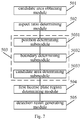
- the apparatus includes a candidate area obtaining module 501, an aspect ratio determining module 502, a candidate area determining module 503, a first license plate area determining module 504 and a detection result generating module 505.
- the candidate area obtaining module 501 is configured for obtaining, according to pixel values of pixels in an image to be detected, a candidate license plate area M 1 in the image to be detected.
- the aspect ratio determining module is configured for calculating an aspect ratio of the candidate license plate area M 1 and determining whether the aspect ratio is greater than a first predefined threshold, and activating the candidate area determining module 503 if the aspect ratio is greater than a first predefined threshold.
- the candidate area determining module 503 is configured for determining a new candidate license plate area M 2 from the candidate license plate area M 1 according to a predefined machine learning-based regression algorithm, wherein the candidate license plate area M 2 is an area whose aspect ratio is no greater than the first predefined threshold.
- the first license plate area determining module 504 is configured for detemining, according to a first predefined classification model, whether the candidate license plate area M 2 is a license plate area, wherein, the first predefined classification model is a classification model obtained by learning sample license plate areas through a machine learning algorithm, and activating the detection result generating module 505 if the candidate license plate area M 2 is a license plate area.
- the detection result generating module 505 is configured for determining the candidate license plate area M 2 as a license plate area, and generating a detection result based on the candidate license plate area M 2 .
- the apparatus for detecting a license plate may further include a first sample area obtaining module and a classification model obtaining module (not shown in Fig. 5 ).
- the first sample area obtaining module is configured for obtaining a sample license plate area having a boundary accuracy greater than a predefined accuracy threshold and/or a sample license plate area having an aspect ratio less than the first predefined threshold, and taking the obtained sample license plate area as a positive sample.
- the classification model obtaining module is configured for obtaining the first predefined classification model according to the predefined machine learning algorithm and the positive sample.
- the apparatus for detecting a license plate may further include a second sample area obtaining module and a sample area classification module (not shown in Fig. 5 ).
- the second sample area obtaining module is configured for obtaining a sample area that is a non-license plate area.
- the sample area classification module is configured for classifying the obtained sample area according to content of the obtained sample area to obtain negative samples of multiple categories.
- the classification model obtaining module is specifically configured for obtaining the first predefined classification model according to the machine learning algorithm, the positive sample, and the negative samples of multiple categories.
- a detection terminal may obtain, after receipt of an image to be detected, a candidate license plate area M 1 in the image to be detected according to pixel values of pixels in the image to be detected.
- a new candidate license plate area M 2 may be determined from the candidate license plate area M 1 according to a predefined machine learning-based regression algorithm.
- a determination is made, according to a machine learning-based first predefined classification model, as to whether the candidate license plate area M 2 is a license plate area. If so, the candidate license plate area M 2 is determined as the license plate area and a detection result is generated based on the candidate license plate area M 2 .
- a candidate license plate area containing a real license plate may be prevented from being wrongly determined as a non-license plate area due to its excessively large aspect ratio.
- the accuracy of license plate detection is thus improved.
- a first predefined classification model based on machine learning is used to acquire features of a candidate license plate area, so as to classify the candidate license plate area and thereby determine if a candidate license plate area is a license plate area. The accuracy of license plate detetion is further improved.
- the candidate area obtaining module 501 includes a valid pixel segment obtaining submodule 5011, a similarity calculating submodule 5012, a pixel segment merging submodule 5013 and a candidate area obtaining submodule 5014.
- the valid pixel segment obtaining submodule 5011 is configured for obtaining a valid pixel segment in each pixel row of the image to be detected in a predefined scan order, wherein, the valid pixel segment is a pixel segment that is determined according to pixels having a greyscale jump value greater than a second predefined threshold in a pixel row.
- the similarity calculating submodule 5012 is configured for calculating a boundary similarity for vertically adjacent valid pixel segments, according to pixel values of pixels at both ends of each valid pixel segment and pixel values of pixels at both ends of another valid pixel segment vertically adjacent to that valid pixel segment.
- the pixel segment merging submodule 5013 is configured for merging adjacent valid pixel segments which have a boundary similarity greater than a third predefined threshold.
- the candidate area obtaining submodule 5014 is configured for obtaining the candidate license plate area M 1 in the image to be detected according to the merged valid pixel segments.
- the valid pixel segment obtaining submodule 5011 is configured for obtaining a valid pixel segment in each pixel row of the image to be detected in a predefined scan order.
- the valid pixel segment obtaining submodule 5011 may include a greyscale jump value calculating unit, a pixel selecting unit, a candidate pixel segment obtaining unit, a greyscale jump determining unit and a valid pixel segment determining unit (not shown in Fig. 6 ).
- the greyscale jump value calculating unit is configured for calculating a greyscale jump value of each pixel in a pixel row X, wherein the pixel row X is any pixel row in the image to be detected.
- the pixel selecting unit is configured for selecting pixels having a greyscale value greater than the second predefined threshold.
- the candidate pixel segment obtaining unit is configured for obtaining a candidate pixel segment in the pixel row X according to a pixel having a maximum horizonal coordinate and a pixel having a minimum horizon coordinate among the selected pixels.
- the greyscale jump determining unit is configured for determining whether greyscale jump values of pixels in the candidate pixel segment conform to a predefined greyscale jumpping rule, and if so, activating the valid pixel segment determining unit.
- the valid pixel segment determining unit is configured for determining the candidate pixel segment as a valid pixel segment.
- the candidate area obtaining submodule 5014 may include a suspected character string area determining unit, a color information obtaining unit, a boundary determining unit and a candidate area obtaining unit (not shown in Fig. 6 ).
- the suspected character string area determining unit is configured for determining a suspected character string area in the merged valid pixel segments.
- the color information obtaining unit is configured for obtaining color information of chracter string according to a pixel value of a pixel in the suspected character string area, and obtaining color information of background according to a pixel value of a pixel not in the non-suspected character string area in the merged valid pixel segments.
- the boundary determining unit is configured for determining boundary of the candidate license plate M 1 accordng to the color information of character string and the color information of background.
- the candidate area obtaining unit is configured for obtaining the candidate license plate area M 1 according to the determined boundary.
- the detection terminal obtains, according to a predefined scan order, a valid pixel segment in a pixel row of an image to be detected, calculates a boundary similarity between vertically adjacent valid pixel segments according to pixel values of pixels at both ends of each valid pixel segment and pixel values of pixels at both ends of another valid pixel segment vertically adjacent to that valid pixel segment, merges adjacent valid pixel segments that have a boundary similarity above a third predefined threshold, obtains a candidate license plate area M 1 according to the merged valid pixel segment.
- This method for obtaining a candidate license plate area is simple and easy for implementation. The universality and generalization of a license plate detection method is thus improved.
- the candidate area determining module 503 includes a position determining submodule 5031, a boundary determining submodule 5032 and a candidate area determining submodule 5033.
- the position determining submodule 5031 is configured for determining a position of a suspected character string in the candidate license plate area M 1 .
- the boundary determining submodule 5032 is configured for determining, through the predefined machine learning-based regression algorithm, a new boundary of the candidate license plate area according to the determined position.
- the candidate area determining submodule 5033 is configured for obtaining the candidate license plate area M 2 according to the new boundary.
- the detection terminal in a case where the aspect ratio of a candidate license plate area M 1 is larger than a first predefined threshold, the detection terminal first determines a position of a suspected character string in the candidate license plate area M 1 . The detection terminal then determines, by means of a predefined machine learning-based regression algorithm, a new boundary of the candidate license plate area according to the determined position. A candidate license plate area M 2 is then determined according to the new boundary.
- features are learned by means of a machine learning-based regression algorithm rather than being manually set by a user.
- the boundary may be more accurately determined and interference on the license plate detection introduced by background textures may be effectively reduced.
- FIG. 8 a structural diagram of another apparatus for detecting a license plate as provided by an embodiment of the present disclosure is illustrated.
- the apparatus further includes a brightness determining module 506, a grey-equalization module 507 and a second license plate area determining module 508.
- the brightness determining module 506 is configured for determining, in response to a determination that the candidate license plate area M 2 is not a license plate area, whether brightness of the candidate license plate area M 2 is within a predefined range of brightness, and if the brightness is not within the predefined range of brightness, activating the grey-equalization module 507.
- the grey-equalization module 507 is configured for performing grey equalization on the candidate license plate area M 2 .
- the second license plate area determining module 508 is configured for determining whether the grey-equalized candidate license plate area M 2 is a license plate area according to a second predefined classification model, and if so, activating the detection result generating module 505, wherein, the second predefined classification model is a classification model obtained by learning grey-equalized sample license plate areas through a machine learning algorithm.
- the detection terminal determines whether the brightness of the candidate license plate area M 2 is within a predefined range of brightness. If the brightness is not within the predefined range of brightness, a grey equalization is performed on the candidate license plate area M 2 . A determination is then made, according to a second predefined classification model, as to whether the grey-equalized candidate license plate area M 2 is a license plate area; and if so, the candidate license plate area M 2 is determined as a license plate area. A detection result may thus be generated according to the candidate license plate area M 2 . As such, a candidate license plate M 2 containing a real license plate is prevented from being wrongly determined as a non-license plate area due to excessive or insufficient brightness of the candidate license plate area M 2 . The accuracy of licese plate determination is thus improved.
- the terminal includes a housing 901, a processor 902, a memory 903, a circuit board 904 and a power supply circuit 905, wherein, the circuit board 904 is placed within the space enclosed by the housing 901; the processor 902 and memory 903 are disposed on the circuit board 1004; the power supply circuit 905 is configured for supplying power to circuits and devices of the terminal; the memory 903 is configured for storing executable program instructions; and the processor 902 is configured for executing the program instructions stored in the memory 903 to perform the following steps:
- a detection terminal may obtain, after receipt of an image to be detected, a candidate license plate area M 1 in the image to be detected according to pixel values of pixels in the image to be detected.
- a new candidate license plate area M 2 may be determined from the candidate license plate area M 1 according to a predefined machine learning-based regression algorithm.
- a determination is made, according to a machine learning-based first predefined classification model, as to whether the candidate license plate area M 2 is a license plate area. If so, the candidate license plate area M 2 is determined as the license plate area and a detection result is generated based on the candidate license plate area M 2 .
- a candidate license plate area containing a real license plate may be prevented from being wrongly determined as a non-license plate area due to its excessively large aspect ratio.
- the accuracy of license plate detection is thus improved.
- a first predefined classification model based on machine learning is used to acquire features of a candidate license plate area, so as to classify the candidate license plate area and thereby determine if a candidate license plate area is a license plate area. The accuracy of license plate detetion is further improved.
- the terminal may take a variety of forms, including but not limited to:
- Embodiments of the present application also provide an executable program, configured for performing, when executed, the method for detecting a license plate as provided in an embodiment of the present application.
- the method for detecting a license plate includes:
- a detection terminal may obtain, after receipt of an image to be detected, a candidate license plate area M 1 in the image to be detected according to pixel values of pixels in the image to be detected.
- a new candidate license plate area M 2 may be determined from the candidate license plate area M 1 according to a predefined machine learning-based regression algorithm.
- a determination is made, according to a machine learning-based first predefined classification model, as to whether the candidate license plate area M 2 is a license plate area. If so, the candidate license plate area M 2 is determined as the license plate area and a detection result is generated based on the candidate license plate area M 2 .
- a candidate license plate area containing a real license plate may be prevented from being wrongly determined as a non-license plate area due to its excessively large aspect ratio.
- the accuracy of license plate detection is thus improved.
- a first predefined classification model based on machine learning is used to acquire features of a candidate license plate area, so as to classify the candidate license plate area and thereby determine if a candidate license plate area is a license plate area. The accuracy of license plate detetion is further improved.
- Embodiments of the present application also provide a storage medium, configured for storing executable program codes which, when executed, perform the method for detecting a license plate provided by an embodiment of the present application.
- the method includes:
- a detection terminal may obtain, after receipt of an image to be detected, a candidate license plate area M 1 in the image to be detected according to pixel values of pixels in the image to be detected.
- a new candidate license plate area M 2 may be determined from the candidate license plate area M 1 according to a predefined machine learning-based regression algorithm.
- a determination is made, according to a machine learning-based first predefined classification model, as to whether the candidate license plate area M 2 is a license plate area. If so, the candidate license plate area M 2 is determined as the license plate area and a detection result is generated based on the candidate license plate area M 2 .
- a candidate license plate area containing a real license plate may be prevented from being wrongly determined as a non-license plate area due to its excessively large aspect ratio.
- the accuracy of license plate detection is thus improved.
- a first predefined classification model based on machine learning is used to acquire features of a candidate license plate area, so as to classify the candidate license plate area and thereby determine if a candidate license plate area is a license plate area. The accuracy of license plate detetion is further improved.
- Embodiments of the apparatus, terminal, executable program, and storage medium are merely described in brief in view of their resemblance with the method embodiments. Relevant parts may be understood with referene to the method embodiments.
- the program can be stored in a computer readable storage medium such as a ROM/RAM, magnetic disk, and optic disk.
Landscapes
- Engineering & Computer Science (AREA)
- Theoretical Computer Science (AREA)
- General Physics & Mathematics (AREA)
- Physics & Mathematics (AREA)
- Multimedia (AREA)
- Computer Vision & Pattern Recognition (AREA)
- Evolutionary Computation (AREA)
- Artificial Intelligence (AREA)
- Data Mining & Analysis (AREA)
- Life Sciences & Earth Sciences (AREA)
- General Engineering & Computer Science (AREA)
- Bioinformatics & Cheminformatics (AREA)
- General Health & Medical Sciences (AREA)
- Health & Medical Sciences (AREA)
- Evolutionary Biology (AREA)
- Bioinformatics & Computational Biology (AREA)
- Software Systems (AREA)
- Medical Informatics (AREA)
- Databases & Information Systems (AREA)
- Computing Systems (AREA)
- Biodiversity & Conservation Biology (AREA)
- Biomedical Technology (AREA)
- Molecular Biology (AREA)
- Image Analysis (AREA)
Abstract
Description
- The present disclosure claims priority to the Chinese patent application No.
201610160790.9 - The present disclosure relates to the field of intelligent transportation, and in particular to a method and apparatus for detecting a license plate.
- With the developments of the intelligent transportation technology, the application of license plate detection technology has expanded from original scenes (such as tolls and security checkpoints) having a substantially unchanging background to universal surveillance scenes such as E-polices and doorways. However, such a scene may provide an ever-changing background for a traffic monitoring image obtained therefrom. In such an image, complicated textures and noises may also be present in vicinity of a license plate area. In addition, a strong resemblance between the texture of a non-license plate area (e.g., window, lamp, and radiator of grille of a vehicle, leaves, grass, fences, and road markings) in the image and that of a license plate would lead to a greatly increased error rate in the identification of the license plate area. Meanwhile, a real license plate area may include a part of the background; as a result, the identification of the boundary between the license plate and a part of the background may have a reduced accuracy. Therefore, an improper result and low accuracy of license plate detection may tend to arise from this.
- Embodiments of the present disclosure disclose a method and apparatus for detecting a license plate, in order to improve the accuracy of license plate detection.
- For this purpose, embodiments of the present disclose a method for detecting a license plate, including:
- obtaining, according to pixel values of pixels in an image to be detected, a candidate license plate area M1 in the image to be detected;
- calculating an aspect ratio of the candidate license plate area M1 and determining whether the aspect ratio is greater than a first predefined threshold;
- if the aspect ratio is greater than the first predefined threshold, determining a new candidate license plate area M2 from the candidate license plate area M1 according to a predefined machine learning-based regression algorithm, wherein the candidate license plate area M2 is an area whose aspect ratio is no greater than the first predefined threshold;
- detemining, according to a first predefined classification model, whether the candidate license plate area M2 is a license plate area, wherein, the first predefined classification model is a classification model obtained by learning sample license plate areas through a machine learning algorithm;
- if the candidate license plate area M2 is a license plate area, determining the candidate license plate area M2 as a license plate area, and generating a detection result based on the candidate license plate area M2.
- Optionally, obtaining, according to pixel values of pixels in an image to be detected, a candidate license plate area M1 in the image to be detected includes:
- obtaining a valid pixel segment in each pixel row of the image to be detected in a predefined scan order, wherein, the valid pixel segment is a pixel segment that is determined according to pixels having a greyscale jump value greater than a second predefined threshold in a pixel row;
- calculating a boundary similarity for vertically adjacent valid pixel segments, according to pixel values of pixels at both ends of each valid pixel segment and pixel values of pixels at both ends of another valid pixel segment vertically adjacent to that valid pixel segment;
- merging adjacent valid pixel segments which have a boundary similarity greater than a third predefined threshold; and
- obtaining the candidate license plate area M1 in the image to be detected according to the merged valid pixel segments.
- Optionally, obtaining a valid pixel segment in each pixel row of the image to be detected in a predefined scan order includes:
obtaining a valid pixel segment in each pixel row of the image to be detected in a predefined scan order by: - calculating a greyscale jump value of each pixel in a pixel row X, wherein the pixel row X is any pixel row in the image to be detected;
- selecting pixels having a greyscale value greater than the second predefined threshold;
- obtaining a candidate pixel segment in the pixel row X according to a pixel having a maximum horizonal coordinate and a pixel having a minimum horizon coordinate among the selected pixels;
- determining whether greyscale jump values of pixels in the candidate pixel segment conform to a predefined greyscale jumpping rule; and
- if so, determining the candidate pixel segment as a valid pixel segment.
- Optionally, obtaining the candidate license plate area M1 in the image to be detected according to the merged valid pixel segments includes:
- determining a suspected character string area in the merged valid pixel segments;
- obtaining color information of chracter string according to a pixel value of a pixel in the suspected character string area, and obtaining color information of background according to a pixel value of a pixel not in the non-suspected character string area in the merged valid pixel segments;
- determining boundary of the candidate license plate M1 according to the color information of character string and the color information of background; and
- obtaining the candidate license plate area M1 according to the determined boundary.
- Optionally, determining a new candidate license plate area M2 from the candidate license plate area M1 according to a predefined machine learning-based regression algorithm includes:
- determining a position of a suspected character string in the candidate license plate area M1;
- determining, through the predefined machine learning-based regression algorithm, a new boundary of the candidate license plate area according to the determined position; and obtaining the candidate license plate area M2 according to the new boundary.
- Optionally, the first predefined classification model is obtained by:
- obtaining a sample license plate area having a boundary accuracy greater than a predefined accuracy threshold and/or a sample license plate area having an aspect ratio less than the first predefined threshold, and taking the obtained sample license plate area as a positive sample; and
- obtaining the first predefined classification model according to the predefined machine learning algorithm and the positive sample.
- Optionally, before obtaining the first predefined classification model according to the predefined machine learning algorithm and the positive sample, the method further includes:
- obtaining a sample area that is a non-license plate area;
- classifying the obtained sample area according to content of the obtained sample area to obtain negative samples of multiple categories;
- wherein, obtaining the first predefined classification model according to the predefined machine learning algorithm and the positive sample includes:
obtaining the first predefined classification model according to the predefined machine learning algorithm, the positive sample, and the negative samples of multiple categories. - Optionally, the method the method further includes:
- determining, in response to a determination that the candidate license plate area M2 is not a license plate area, whether brightness of the candidate license plate area M2 is within a predefined range of brightness;
- performing, if the brightness of the license plate candidate area M2 is not within a predefined range of brightness, grey equalization on the candidate license plate area M2;
- determining whether the grey-equalized candidate license plate area M2 is a license plate area according to a second predefined classification model, wherein, the second predefined classification model is a classification model obtained by learning grey-equalized sample license plate areas through a machine learning algorithm;
- performing, if the candidate license plate area M2 is a license plate area, the steps of determining the candidate license plate area M2 as a license plate area and generating a detection result based on the candidate license plate area M2.
- For the above purpose, embodiments of the present application also discloses an apparatus for detecting a license plate, including a candidate area obtaining module, an aspect ratio determining module, a candidate area determining module, a first license plate area determining module and a detection result generating module; wherein,
the candidate area obtaining module is configured for obtaining, according to pixel values of pixels in an image to be detected, a candidate license plate area M1 in the image to be detected;
the aspect ratio determining module is configured for calculating an aspect ratio of the candidate license plate area M1 and determining whether the aspect ratio is greater than a first predefined threshold, and activating the candidate area determining module if the aspect ratio is greater than the first predefined threshold;
the candidate area determining module is configured for determining a new candidate license plate area M2 from the candidate license plate area M1 according to a predefined machine learning-based regression algorithm, wherein the candidate license plate area M2 is an area whose aspect ratio is no greater than the first predefined threshold;
the first license plate area determining module is configured for detemining, according to a first predefined classification model, whether the candidate license plate area M2 is a license plate area, wherein, the first predefined classification model is a classification model obtained by learning sample license plate areas through a machine learning algorithm; and activating the detection result generating module if the candidate license plate area M2 is a license plate area; and
the detection result generating module is configured for determining the candidate license plate area M2 as a license plate area, and generating a detection result based on the candidate license plate area M2. - Optionally, the candidate area obtaining module includes: a valid pixel segment obtaining submodule, a similarity calculating submodule, a pixel segment merging submodule and a candidate area obtaining submodule; wherein,
the valid pixel segment obtaining submodule is configured for obtaining a valid pixel segment in each pixel row of the image to be detected in a predefined scan order, wherein, the valid pixel segment is a pixel segment that is determined according to pixels having a greyscale jump value greater than a second predefined threshold in a pixel row;
the similarity calculating submodule is configured for calculating a boundary similarity for vertically adjacent valid pixel segments, according to pixel values of pixels at both ends of each valid pixel segment and pixel values of pixels at both ends of another valid pixel segment vertically adjacent to that valid pixel segment;
the pixel segment merging submodule is configured for merging adjacent valid pixel segments which have a boundary similarity greater than a third predefined threshold; and
the candidate area obtaining submodule is configured for obtaining the candidate license plate area M1 in the image to be detected according to the merged valid pixel segments. - Optionally, the valid pixel segment obtaining submodule is configured for:
- obtaining a valid pixel segment in each pixel row of the image to be detected in a predefined scan order;
- the valid pixel segment obtaining submodule comprises: a greyscale jump value calculating unit, a pixel selecting unit, a candidate pixel segment obtaining unit, a greyscale jump determining unit and a valid pixel segment determining unit; wherein,
- the greyscale jump value calculating unit is configured for calculating a greyscale jump value of each pixel in a pixel row X, wherein the pixel row X is any pixel row in the image to be detected;
- the pixel selecting unit is configured for selecting pixels having a greyscale value greater than the second predefined threshold;
- the candidate pixel segment obtaining unit is configured for obtaining a candidate pixel segment in the pixel row X according to a pixel having a maximum horizonal coordinate and a pixel having a minimum horizon coordinate among the selected pixels;
- the greyscale jump determining unit is configured for determining whether greyscale jump values of pixels in the candidate pixel segment conform to a predefined greyscale jumpping rule, and if so, activating the valid pixel segment determining unit;
- the valid pixel segment determining unit is configured for determining the candidate pixel segment as a valid pixel segment.
- Optionally, the candidate area obtaining submodule includes: a suspected character string area determining unit, a color information obtaining unit, a boundary determining unit and a candidate area obtaining unit; wherein,
the suspected character string area determining unit is configured for determining a suspected character string area in the merged valid pixel segments;
the color information obtaining unit is configured for obtaining color information of chracter string according to a pixel value of a pixel in the suspected character string area, and obtaining color information of background according to a pixel value of a pixel not in the non-suspected character string area in the merged valid pixel segments;
the boundary determining unit is configured for determining boundary of the candidate license plate M1 accordng to the color information of character string and the color information of background; and
the candidate area obtaining unit is configured for obtaining the candidate license plate area M1 according to the determined boundary. - Optionally, the candidate area determining module includes: a position determining submodule, a boundary determining submodule and a candidate area determining submodule; wherein,
the position determining submodule is configured for determining a position of a suspected character string in the candidate license plate area M1;
the boundary determining submodule is configured for determining, through the predefined machine learning-based regression algorithm, a new boundary of the candidate license plate area according to the determined position; and
the candidate area determining submodule is configured for obtaining the candidate license plate area M2 according to the new boundary. - Optionally, the apparatus further includes a first sample area obtaining module and a classification model obtaining module; wherein,
the first sample area obtaining module is configured for obtaining a sample license plate area having a boundary accuracy greater than a predefined accuracy threshold and/or a sample license plate area having an aspect ratio less than the first predefined threshold, and taking the obtained sample license plate area as a positive sample; and
the classification model obtaining module is configured for obtaining the first predefined classification model according to the predefined machine learning algorithm and the positive sample. - Optionally, the apparatus further includes a second sample area obtaining module and a sample area classification module; wherein,
the second sample area obtaining module is configured for obtaining a sample area that is a non-license plate area;
the sample area classification module is configured for classifying the obtained sample area according to content of the obtained sample area to obtain negative samples of multiple categories; and
wherein, the classification model obtaining module is configured for obtaining the first predefined classification model according to the machine learning algorithm, the positive sample, and the negative samples of multiple categories. - Optionally, the apparatus further includes a brightness determining module, a grey-equalization module and a second license plate area determining module; wherein,
the brightness determining module is configured for determining, in response to a determination that the candidate license plate area M2 is not a license plate area, whether brightness of the candidate license plate area M2 is within a predefined range of brightness, and if the brightness is not within the predefined range of brightness, activating the grey-equalization module;
the grey-equalization module is configured for performing a grey equalization on the candidate license plate area M2;
the second license plate area determining module is configured for determining whether the grey-equalized candidate license plate area M2 is a license plate area according to a second predefined classification model, and if so, activating the detection result generating module, wherein, the second predefined classification model is a classification model obtained by learning grey-equalized sample license plate areas through a machine learning algorithm. - For the purpose above, embodiments of the present application also disclose a terminal, including: a housing, a processor, a memory, a circuit board and a power supply circuit, wherein, the circuit board is placed within the space enclosed by the housing; the processor and memory are disposed on the circuit board; the power supply circuit is configured for supplying power to circuits and devices of the terminal; the memory is configured for storing executable program instructions; and the processor is configured for executing the executable program instructions stored in the memory to perform the method for detecting a license plate as described above.
- For the purpose above, embodiments of the present application also disclose an executable program, configured for performing, when executed, the method for detecting a license plate as described above.
- For the purpose above, embodiments of the present application also disclose a storage medium, configured for storing executable program codes which, when executed, perform the method for detecting a license plate as described above.
- As can be appreciated from above, in embodiments of the present application, a detection terminal may obtain, after receipt of an image to be detected, a candidate license plate area M1 in the image to be detected according to pixel values of pixels in the image to be detected. In a case where the aspect ratio of the candidate license plate area M1 is greater than a first predefined threshold, a candidate license plate area M2 may be determined from the candidate license plate area M1 according to a predefined machine learning-based regression algorithm. A determination is made, according to a machine learning-based first predefined classification model, as to whether the candidate license plate area M2 is a license plate area. If so, the candidate license plate area M2 is determined as the license plate area and a detection result is generated based on the candidate license plate area M2. As such, a candidate license plate area containing a real license plate may be prevented from being wrongly determined as a non-license plate area due to its excessively large aspect ratio. The accuracy of license plate detection is thus improved. In addition, instead of establishing a classification model by means of manual setting, a first predefined classification model based on machine learning is used to acquire features of a candidate license plate area, so as to classify the candidate license plate area and thereby determine if a candidate license plate area is a license plate area. The accuracy of license plate detetion is further improved.
- To describe the solutions of embodiments of the present application and the prior art more clearly, the accompanying drawings to be used in the embodiments and the prior art are described briefly below. Obviously, the accompanying drawings described below are merely some embodiments of the application, based on which those skilled in the art can obtain other drawings without creative efforts.
-
Fig. 1 is a schematic flow chart of a method for detecting a license plate provided by an embodiment of the present disclosure; -
Fig. 2 is a schematic flow chart of another method for detecting a license plate provided by another embodiment of the present disclosure; -
Fig. 3 is a schematic flow chart of another method for detecting a license plate provided by another embodiment of the present disclosure; -
Fig. 4 is a schematic flow chart of another method for detecting a license plate provided by another embodiment of the present disclosure; -
Fig. 5 is a structural schematic diagram of an apparatus for detecting a license plate provided by an embodiment of the present disclosure; -
Fig. 6 is a structural schematic diagram of an apparatus for detecting a license plate provided by another embodiment of the present disclosure; -
Fig. 7 is a structural schematic diagram of an apparatus for detecting a license plate provided by another embodiment of the present disclosure; -
Fig. 8 is a structural schematic diagram of an apparatus for detecting a license plate provided by another embodiment of the present disclosure; and -
Fig. 9 is a structural schematic diagram of a terminal provided by an embodiment of the present disclosure. - Technical solutions in the embodiments of the present application are clearly and completely described below with reference to the accompanying drawings in association with embodiments of the present application. Obviously, the described embodiments are merely a part of but not all the embodiments of the present application. All other embodiments obtained without creative efforts in view of the embodiments of the present application by those skilled in the art fall within the scope of the present application.
- A detailed description of the present disclosure is provided below with reference to specific embodiments.
- Referring to
Fig. 1 , a schematic flow chart of a method for detecting a license plate provided by an embodiment of the present application is illustrated. The method may includes the following steps. - S101, obtaining, according to pixel values of pixels in an image to be detected, a candidate license plate area M1 in the image to be detected.
- In general, after receipt of an image to be detected, a detection terminal may determine an area in the image that is likely to contain license plate content (i.e., a candidate license plate area M1) according to pixel values of pixels in the image to be detected. In an example, a pixel having a greyscale jump value greater than a predefined threshold in each pixel row is obtained; a pixel segment between two pixels satifying a predefined greyscale jump rule is then determined as a valid pixel segment; and valid pixel segments vertically adjacent to each other and having a boundary similarity greater than another predefined threshold are merged to obtain the candidate license plate area M1.
- S102, calculating an aspect ratio of the candidate license plate area M1 and determine whether the aspect ratio is greater than a first predefined threshold, and if so, proceeding to step S103.
- The first predefined threshold may be determined based on an aspect ratio of a real license plate that is actually used. For example, a real license plate has a width and height of 440mm*140mm. As such, the first predefined threshold may be set to 440/140 ≈ 3.14.
- In an image of an actual traffic scene, many background areas that are similar to the real license plate area may be present around the actual license plate area. Therefore, in detecting license plates, if the candidate license plate area M1 has a too high aspect ratio, the candidate license plate area M1 would contain too many areas that do not belong to a license plate. As such, when determining whether the candidate license plate area M1 is a real license plate area, features of a non-license plate area may be liable to be taken into consideration. As a result, the candidate license plate area M1 tend to be determined as a non-license plate area. This may lead to an erroneous determination if the candidate license plate area M1 actually contains a real license plate area. Therefore, to obtain a proper candidate license plate area, it is necessary to determine if the aspect ratio of the candidate license plate area M1 is greater than the first predefined threshold and then adjust the aspect ratio of the candidate license plate area M1 if the determination is positive.
- In one implementation of the presnet disclosure, the candidate license plate area M1 may be determined as a candidate license plate area M2 if the aspect ratio is determined to be not greater than the first predefined threshold. The method then proceeds to step S104.
- S103, determining a new candidate license plate area M2 from the candidate license plate area M1 according to a predefined machine learning-based regression algorithm.
- At this point, the candidate license plate area M2 is an area whose aspect ratio is no greater than the first predefined threshold.
- In addition, the abovementioned machine learing-based regression algorithm is a boundary regression algorithm constructed by learning features of a sample area. Typically, machine learing-based regression algorithm may include learning, from a sample area, features of an object in the sample by means of model training; and then determining a boundary of the object according to the learned features of the object.
- It is noted that, the features of an object learned by means of the machine learing-based regression algorithm are more comprehensive than those manually set by a user. Accordingly, the determination of boundary is more accurate, and inference on license plate detection introduced by background textures may be significantly reduced.
- S104, detemining, according to a first predefined classification model, whether the candidate license plate area M2 is a license plate area, and if so, proceeding to step S105.
- The first predefined classification model may be a classification model obtained by learning sample license plate areas through a machine learning algorithm. In the construction of the first classification model, a large amount of sample license plate areas previously found may be learned through a machine learning algorithm so as to obtain a classification model, which may be used to divide simply an area into a license plate area and non-license plate area.
- A person of ordinary skill in the art may appreciate that, in the construction of the first predefined classification model, the greater the number and variety of sample license plate areas are, the better the classification model is constructed.
- In one implementation of the present application, the first predefined classification model described above may be a random forest-, support vector machine-, deep neural network- or convolutional neural network-based classification model. In an example of the convolutional neural network-based classification model, convolutional features of the candidate license plate area M2 may be obtained with the convolutional neural network-based classification model. The obtained convolutional features may then be used to classify the the candidate license plate area M2 to determine if it is a license plate area. In an embodiment of the present application, in the application of the machine-learning classification model, instead of being manually set by a user, features that would facilitate the classification are learned from sample license plate areas. Generalization capability of the machine learning algorithm and accuracy of license plate detection may thus be improved.
- In one implementation of the present application, the first predefined classification model may be obtained though the following steps.
- S11, obtaining a sample license plate area having a boundary accuracy above the predefined accuracy threshold and/or a sample license plate area having an aspect ratio below the first predefined threshold, and taking the obtained sample license plate area as a positive sample.
- The boundary accuracy may represent a distance between a boundary of a sample license plate area and a boundary of a real license plate, or the coherence of a real license plate. The present application is not limited in this aspect.
- S12, obtaining the first predefined classification model according to the predefined machine learning algorithm and the positive sample.
- In general, a sample license plate area having a boundary accuracy above a predefined accuracy threshold and/or a sample license plate area having an aspect ratio below a first predefined threshold are considered as two types of positive samples, and the first predefined classification model is trained with a machine learning algorithm. With types of sample license plate areas distinctly distringuished in this way, the first predefined classification model may have an increased immunity to interference of background noise.
- In practice, for the purpose of an increased accuracy of license plate detection, a negative sample may also need to be obtained for the training of model in order to obtain the first predefined classification model. Therefore, in one implementation of the present application, the method may include, before step S12, the following steps.
- S13, obtaining a sample area that is a non-license plate area.
- The non-license plate area herein may include areas of, for example, lanes, green belts, isolation fences, and a door, window, lamp, radiator grille, logo, and mobile billboard of a vehicle.
- S14, classifying the obtained sample area according to the content of the obtained sample area so as to obtain negative samples of multiple categories.
- In the example above, areas of lanes, green belts and isolation fences may be classified into sample license plate areas of a road surface-category, areas of a door, window, lamp, radiator grille of a vehicle may be classified into sample license plate areas of a vehicle body-category, and areas of logo and mobile billboard of a vehicle may be classified into sample license plate areas of a vehicle graphic-category. Of course, there may be sample areas of other categories, description of which is omitted herein.
- In this case, step S12 may include:
obtaining the first predefined classification model according to the machine learning algorithm, the positive sample, and the negative samples of multiple categories. - Such a specific classification of samples may facilitate convergence of the model and may thus improve the accuracy of license plate detection.
- S105, determining the candidate license plate area M2 as a license plate area and generating a detection result based on the candidate license plate area M2.
- In one implementation of the present application, the detection result, after being generated, may be stored in a detection terminal. The detection results may then be transmitted to a predefined terminal when the number of the results has reached a certain amount, so as to avoid the situation that the predefined terminal frequently receives detection results, which may have an impact on user's utilization of the terminal. Alternatively, after the generation of the detection result, the generated detection result may also be directly transmitted to the predefined terminal so as to timely notify the user of the license plate detection result.
- In the embodiment as shown in
Fig. 1 , a detection terminal may obtain, after receipt of an image to be detected, a candidate license plate area M1 in the image to be detected according to pixel values of pixels in the image to be detected. In a case where the aspect ratio of the candidate license plate area M1 is greater than a first predefined threshold, a new candidate license plate area M2 may be determined from the candidate license plate area M1 according to a predefined machine learning-based regression algorithm. A determination is made, according to a machine learning-based first predefined classification model, as to whether the candidate license plate area M2 is a license plate area. If so, the candidate license plate area M2 is determined as the license plate area and a detection result is generated based on the candidate license plate area M2. As such, a candidate license plate area containing a real license plate may be prevented from being wrongly determined as a non-license plate area due to its excessively large aspect ratio. The accuracy of license plate detection is thus improved. In addition, instead of establishing a classification model by means of manual setting, a first predefined classification model based on machine learning is used to acquire features of a candidate license plate area, so as to classify the candidate license plate area and thereby determine if a candidate license plate area is a license plate area. The accuracy of license plate detetion is further improved. - Referring to
Fig. 2 , wherein a schematic flow chart of another method for detecting a license plate is illustrated. In this method, step S101 may further include the following steps. - S1011, obtaining a valid pixel segment in each pixel row of the image to be detected in a predefined scan order.
- A valid pixel segment is a pixel segment that is determined according to pixels having a greyscale jump value greater than a second predefined threshold in a pixel row.
- In one implementation of the present disclosure, the predefined scan order may include a lateral progressive scan or an interleave scan. Other orders are also possible. The present application is not limited in this aspect.
- In one implementation of the present application, the step S1011 as described above may include:
obtaining, according to a predefined scan order, a valid pixel segment in each pixel row of the image to be detected through the following steps:
S21, calculating a greyscale jump value of each pixel in a pixel row X. - The pixel row X may be any pixel row in the image to be detected.
- It is noted that, the greyscale jump value of a pixel is the difference between the pixel value of this pixel and the pixel value of the previously scanned pixel.
- S22, selecting pixels having a greyscale value greater than the second predefined threshold.
- In a practical application, a license plate may have prescribed colors, for example, white characters on blue, black characters on yellow, white characters on black and black characters on white. As such, the greyscale jump value between a pixel in the background of the license plate and a pixel in the character string of the license plate may be predetermined. Therefore, the second predefined threshold may be determined based on a greyscale jump value between the bottom and characters of a real license plate (i.e., background and foreground of the license plate). In an example, if a greyscale jump value between the bottom and characters of a real license plate is 10, the second predefined threshold may be determined as 10. In addition, the second predefined threshold may be set as a multiple of the greyscale jump value between the bottom and characters of a real license plate when influences such as environment factors and resolution of an image acquiring device are taken into consideration. For example, the second defined threshold may be set as 0.8 times the greyscale jump value between the bottom and characters of a real license plate.
- S23, determining a candidate pixel segment in the pixel row X according to a pixel having a maximum horizonal coordinate and a pixel having a minimum horizonal coordinate among the selected pixels.
- S24, determining whether greyscale jump values of pixels in the candidate pixel segment conform to a predefined greyscale jumpping rule; and if so, proceeding to step S25.
- In a practical application, characters on a license plate have a prescribed type and arrangement. For example, the characters are organized as including a Chinese character, a letter, a ".", and five characters (including a letter, number, or a Chinese character). Therefore, greyscale jump values of pixels in each pixel row of a license plate area may vary regularly. A greyscale jumpping rule may be set according to such a variation. A candidate pixel segment in a pixel row of a candidate license plate may be determined as a valid pixel segment if it satisfies the greyscale jumpping rule.
- In one implementation of the present application, a determined candidate pixel segment may be excessively long, such that when being conformed to the predefined greyscale jumpping rule, some part of the candidate pixel segment is found to satisfy the greyscale jumpping rule while another part does not satisfy the greyscale jumpping rule. In this case, the part that satisfies the greyscale jumpping rule may be truncated as a candidate pixel segment.
- S25, determining the candidate pixel segment as a valid pixel segment.
- S1012, calculating a boundary similarity for vertically adjacent valid pixel segments, according to pixel values of pixels at both ends of each valid pixel segment and pixel values of pixels at both ends of another valid pixel segment vertically adjacent to that valid pixel segment.
- The boundary similarity may be the difference (or ratio) between a pixel value of a pixel at either end of a valid pixel segment and a pixel value of a pixel at either end of a vertically adjacent valid pixel segment. The present application is not limited in this aspect.
- In an example, two vertically adjacent valid pixel segments are respectively denoted as X1 and X2. X1 has a left end A and a right end B, while X2 has a left end C and a right end D. In this case, the boundary similarity between X1 and X2 may be the difference (or ratio) between A and B (or between C and D), or the difference (or ratio) between A and C (or between B and D).
- S1013, merging adjacent valid pixel segments which have a boundary similarity greater than a third predefined threshold.
- In a practical application, a license plate occupies, in an image to be detected, a certain area rather than a single pixel row. Therefore, a merging of adjacent valid pixel segments that have a boundary similarity above a third predefined threshold may be required.
- S1014, obtaining the candidate license plate area M1 in the image to be detected according to the merged valid pixel segments.
- Typically, a merged valid pixel segment may be taken as a candidate license plate area M1 in an image to be detected. However, the boudary of the merged valid pixel segment may not be a straight or substantially straight line, but a irregular curve. In this case, a further determination of the boundary of the candidate license plate area M1 may be required. Therefore, the step S1014 as described above may include:
- S26, determining a suspected character string area in the merged valid pixel segments.
- S27, obtaining color information of chracter string according to a pixel value of a pixel in the suspected character string area, and obtaining color information of background according to a pixel value of a pixel not in the non-suspected character string area in the merged valid pixel segments.
- In a practical application, the bottom (background) and characters (foreground) of a license plate may have prescribed colors. As such, the color contrast between the bottom and charaters is predetermined. Therefore, color information of the bottom and characters of the license plate may be obtained so as to determine the boundary of the candidate license plate area.
- S28, determining boundary of the candidate license plate M1 according to the color information of character string and the color information of background.
- Assuming that the color of the character string is determined to be white and the color of background is determined to be black, then an area adjacent to the suspected character string area and having a color of black may be determined as a background area, the boudary of which represents the boudary of the candidate license plate area.
- In addition, the color information of character string as described above may be an average A1 of pixel values of all the pixels in the suspected character string area, and the color information of background may be an average A2 of pixel values of all the pixels in the non-suspected character area. A fourth predefined threshold may be determined according to the ratio of A1 and A2. If a radio between an average A3 of pixel values of all the pixels in an area adjacent to the suspected character string area and A1 matches with the fourth predefined threshold, the adjacent area may be determined as a background area, the boundary of which represents the boundary of the candidate plate license area.
- S29, obtaining the candidate license plate area M1 according to the determined boundary.
- In addition, a license plate detection method based on edge features of a license plate or a genetic algorithm may be utilized, in the present application, to determine the candidate license plate area. An Adaboost license plate detector based on Harr features may also be used to determine the candidate license plate area. The present application is not limited in this aspect. However, compared with the method for detecting a candidate licese plate area described above, these methods for detecting a candidate license plate area is more complex and have a relatively poor generalization capability.
- In the embodiment as shown in
Fig. 2 , the detection terminal obtains, according to a predefined scan order, a valid pixel segment in a pixel row of an image to be detected, calculates a boundary similarity between vertically adjacent valid pixel segments according to pixel values of pixels at both ends of each valid pixel segment and pixel values of pixels at both ends of another valid pixel segment vertically adjacent to that valid pixel segment, merges adjacent valid pixel segments that have a boundary similarity above a third predefined threshold, obtains a candidate license plate area M1 according to the merged valid pixel segment. This method for obtaining a candidate license plate area is simple and easy for implementation. The universality and generalization of a license plate detection method is thus improved. - Referring to
Fig. 3 , wherein a schematic flow chart of another method for detecting license plate area is illustated. - S1031, determining a position of a suspected character string in the candidate license plate area M1.
- An aspect ratio of the candidate license plate area M1 larger than a first predefined threshold indicates that the candidate license plate area M1 contains excessive background areas. Excessive background areas may produce background noise that would cause interference in the detection of a license plate area. The accuracy of license plate detection is thus reduced. Therefore, if the candidate license plate area M1 has an aspect ratio larger than a first predefined threshold, a new candidate license plate area may have to be determined. A license plate area definitely contains license plate characters. Therefore, in the determination of the new candidate license plate area, a position of a suspected character string in the candidate license plate area M1 may first be determined, and then the new candidate license plate may be determined based on the position.
- S1032, determining, through the predefined machine learning-based regression algorithm, a new boundary of the candidate license plate area according to the determined position.
- In one implementation of the present application, by means of the predefined machine learning-based regression algorithm above described, features of object are not manually set by a user but learned based on machine learning. Object features obtained in this way are more comprehensive. Therefore, the boundary may be more accurately determined and interference on the license plate detection introduced by background textures may be effectively reduced.
- S1033, obtaining the candidate license plate area M2 according to the new boundary.
- After the boundary is determined, the area within the boundary is the candidate license plate area M2.
- In the embodiment as shown in
Fig. 3 , in a case where the aspect ratio of a candidate license plate area M1 is larger than a first predefined threshold, the detection terminal first determines a position of a suspected character string in the candidate license plate area M1. The detection terminal then determines, by means of a predefined machine learning-based regression algorithm, a new boundary of the candidate license plate area according to the determined position. A candidate license plate area M2 is then determined according to the new boundary. As such, features are learned by means of a machine learning-based regression algorithm rather than being manually set by a user. As a result of the determination of the candidate license plate area based on a regression algorithm, the boundary may be more accurately determined and interference on the license plate detection introduced by background textures may be effectively reduced. - Referring to
Fig. 4 , wherein a schematic flow chart of another method for detecting license plate area is illustated. The method may further include the following steps. - S106, determining whether brightness of the candidate license plate area M2 is within a predefined range of brightness, and if so, proceeding to step S107.
- In one implementation of the present application, the brightness of the candidate license plate area M2 may be an average of brightness of all the pixels in the candidate license plate area M2, or an average of brightness of all the pixels in a certain part of the candidate license plate area M2, or otherwise an average of brightness of a predefined number of pixels randomly selected from the candidate license plate area M2. The present application is not limited in this aspect.
- In one implementation of the present application, in response to a determination that the candidate license plate area M2 is not a license plate area, a determination is made as to whether the brightness of the candidate license plate area M2 is within a predefined range of brightness, and if so, the candidate license plate area M2 may be determined as a non-license plate area. The process of license plate detection thus terminates.
- S107, performing grey equalization on the candidate license plate area M2.
- The method of grey equalization is a well known prior art and thus is not described in detail herein.
- S108, determining whether the grey-equalized candidate license plate area M2 is a license plate area according to a second predefined classification model, and if so, proceeding to step S105 to generate a detection result.
- The second predefined classification model is a classification obtained by learning grey-equalized sample license plate areas through a machine learning algorithm.
- In one implementation of the present application, in a case where a determination is made that the grey-equalized candidate license plate area M2 is not a license plate area, the candidate license plate area M2 may be determined as a non-license plate area. The proess of license plate detection terminates.
- In addition, in one implementation of the present application, the second predefined classification model may be obtained in the same manner as the first predefined classification model.
- It is noted that, in the acquisition of the second predefined classification model, positive and the negative samples used for model training are all grey-equalized sample license plate areas.
- In the embodiment as shown in
Fig. 4 , in a case where the candidate license plate area M2 is a non-license plate area, the detection terminal determines whether the brightness of the candidate license plate area M2 is within a predefined range of brightness. If the brightness is not within the predefined range of brightness, a grey equalization is performed on the candidate license plate area M2. A determination is then made, according to a second predefined classification model, as to whether the grey-equalized candidate license plate area M2 is a license plate area; and if so, the candidate license plate area M2 is determined as a license plate area. A detection result may thus be generated according to the candidate license plate area M2. As such, a candidate license plate M2 containing a real license plate is prevented from being wrongly determined as a non-license plate area due to excessive or insufficient brightness of the candidate license plate area M2. The accuracy of licese plate determination is thus improved. - Referring to
Fig. 5 , a structural diagram of an apparatus for detecting a license plate as provided by an embodiment of the present disclosure is illustrated. The apparatus includes a candidatearea obtaining module 501, an aspectratio determining module 502, a candidatearea determining module 503, a first license platearea determining module 504 and a detectionresult generating module 505. - The candidate
area obtaining module 501 is configured for obtaining, according to pixel values of pixels in an image to be detected, a candidate license plate area M1 in the image to be detected. - The aspect ratio determining module is configured for calculating an aspect ratio of the candidate license plate area M1 and determining whether the aspect ratio is greater than a first predefined threshold, and activating the candidate
area determining module 503 if the aspect ratio is greater than a first predefined threshold. - The candidate
area determining module 503 is configured for determining a new candidate license plate area M2 from the candidate license plate area M1 according to a predefined machine learning-based regression algorithm, wherein the candidate license plate area M2 is an area whose aspect ratio is no greater than the first predefined threshold. - The first license plate
area determining module 504 is configured for detemining, according to a first predefined classification model, whether the candidate license plate area M2 is a license plate area, wherein, the first predefined classification model is a classification model obtained by learning sample license plate areas through a machine learning algorithm, and activating the detectionresult generating module 505 if the candidate license plate area M2 is a license plate area. - The detection
result generating module 505 is configured for determining the candidate license plate area M2 as a license plate area, and generating a detection result based on the candidate license plate area M2. - In one implementation of the present application, the apparatus for detecting a license plate may further include a first sample area obtaining module and a classification model obtaining module (not shown in
Fig. 5 ). - The first sample area obtaining module is configured for obtaining a sample license plate area having a boundary accuracy greater than a predefined accuracy threshold and/or a sample license plate area having an aspect ratio less than the first predefined threshold, and taking the obtained sample license plate area as a positive sample.
- The classification model obtaining module is configured for obtaining the first predefined classification model according to the predefined machine learning algorithm and the positive sample.
- In one implementation of the present application, the apparatus for detecting a license plate may further include a second sample area obtaining module and a sample area classification module (not shown in
Fig. 5 ). - The second sample area obtaining module is configured for obtaining a sample area that is a non-license plate area.
- The sample area classification module is configured for classifying the obtained sample area according to content of the obtained sample area to obtain negative samples of multiple categories.
- In this case, the classification model obtaining module is specifically configured for obtaining the first predefined classification model according to the machine learning algorithm, the positive sample, and the negative samples of multiple categories.
- In the embodiment as shown in
Fig. 5 , a detection terminal may obtain, after receipt of an image to be detected, a candidate license plate area M1 in the image to be detected according to pixel values of pixels in the image to be detected. In a case where the aspect ratio of the candidate license plate area M1 is greater than a first predefined threshold, a new candidate license plate area M2 may be determined from the candidate license plate area M1 according to a predefined machine learning-based regression algorithm. A determination is made, according to a machine learning-based first predefined classification model, as to whether the candidate license plate area M2 is a license plate area. If so, the candidate license plate area M2 is determined as the license plate area and a detection result is generated based on the candidate license plate area M2. As such, a candidate license plate area containing a real license plate may be prevented from being wrongly determined as a non-license plate area due to its excessively large aspect ratio. The accuracy of license plate detection is thus improved. In addition, instead of establishing a classification model by means of manual setting, a first predefined classification model based on machine learning is used to acquire features of a candidate license plate area, so as to classify the candidate license plate area and thereby determine if a candidate license plate area is a license plate area. The accuracy of license plate detetion is further improved. - Referring to
Fig. 6 , wherein a structural diagram of another apparatus for detecting a license plate as provided by an embodiment of the present disclosure is illustrated. In the apparatus, the candidatearea obtaining module 501 includes a valid pixelsegment obtaining submodule 5011, a similarity calculating submodule 5012, a pixelsegment merging submodule 5013 and a candidatearea obtaining submodule 5014. - The valid pixel
segment obtaining submodule 5011 is configured for obtaining a valid pixel segment in each pixel row of the image to be detected in a predefined scan order, wherein, the valid pixel segment is a pixel segment that is determined according to pixels having a greyscale jump value greater than a second predefined threshold in a pixel row. - The similarity calculating submodule 5012 is configured for calculating a boundary similarity for vertically adjacent valid pixel segments, according to pixel values of pixels at both ends of each valid pixel segment and pixel values of pixels at both ends of another valid pixel segment vertically adjacent to that valid pixel segment.
- The pixel
segment merging submodule 5013 is configured for merging adjacent valid pixel segments which have a boundary similarity greater than a third predefined threshold. - The candidate
area obtaining submodule 5014 is configured for obtaining the candidate license plate area M1 in the image to be detected according to the merged valid pixel segments. - In one implementation of the present application, the valid pixel
segment obtaining submodule 5011 is configured for obtaining a valid pixel segment in each pixel row of the image to be detected in a predefined scan order. - In this case, the valid pixel
segment obtaining submodule 5011 may include a greyscale jump value calculating unit, a pixel selecting unit, a candidate pixel segment obtaining unit, a greyscale jump determining unit and a valid pixel segment determining unit (not shown inFig. 6 ). - The greyscale jump value calculating unit is configured for calculating a greyscale jump value of each pixel in a pixel row X, wherein the pixel row X is any pixel row in the image to be detected.
- The pixel selecting unit is configured for selecting pixels having a greyscale value greater than the second predefined threshold.
- The candidate pixel segment obtaining unit is configured for obtaining a candidate pixel segment in the pixel row X according to a pixel having a maximum horizonal coordinate and a pixel having a minimum horizon coordinate among the selected pixels.
- The greyscale jump determining unit is configured for determining whether greyscale jump values of pixels in the candidate pixel segment conform to a predefined greyscale jumpping rule, and if so, activating the valid pixel segment determining unit.
- The valid pixel segment determining unit is configured for determining the candidate pixel segment as a valid pixel segment.
- In one implementation of the present application, the candidate
area obtaining submodule 5014 may include a suspected character string area determining unit, a color information obtaining unit, a boundary determining unit and a candidate area obtaining unit (not shown inFig. 6 ). - The suspected character string area determining unit is configured for determining a suspected character string area in the merged valid pixel segments.
- The color information obtaining unit is configured for obtaining color information of chracter string according to a pixel value of a pixel in the suspected character string area, and obtaining color information of background according to a pixel value of a pixel not in the non-suspected character string area in the merged valid pixel segments.
- The boundary determining unit is configured for determining boundary of the candidate license plate M1 accordng to the color information of character string and the color information of background.
- The candidate area obtaining unit is configured for obtaining the candidate license plate area M1 according to the determined boundary.
- In the embodiment as shown in
Fig. 6 , the detection terminal obtains, according to a predefined scan order, a valid pixel segment in a pixel row of an image to be detected, calculates a boundary similarity between vertically adjacent valid pixel segments according to pixel values of pixels at both ends of each valid pixel segment and pixel values of pixels at both ends of another valid pixel segment vertically adjacent to that valid pixel segment, merges adjacent valid pixel segments that have a boundary similarity above a third predefined threshold, obtains a candidate license plate area M1 according to the merged valid pixel segment. This method for obtaining a candidate license plate area is simple and easy for implementation. The universality and generalization of a license plate detection method is thus improved. - Referring to
Fig. 7 , a structural diagram of another apparatus for detecting a license plate as provided by an embodiment of the present disclosure is illustrated. In the apparatus, the candidatearea determining module 503 includes a position determining submodule 5031, a boundary determining submodule 5032 and a candidatearea determining submodule 5033. - The position determining submodule 5031 is configured for determining a position of a suspected character string in the candidate license plate area M1.
- The
boundary determining submodule 5032 is configured for determining, through the predefined machine learning-based regression algorithm, a new boundary of the candidate license plate area according to the determined position. - The candidate
area determining submodule 5033 is configured for obtaining the candidate license plate area M2 according to the new boundary. - In the embodiment as shown in
Fig. 7 , in a case where the aspect ratio of a candidate license plate area M1 is larger than a first predefined threshold, the detection terminal first determines a position of a suspected character string in the candidate license plate area M1. The detection terminal then determines, by means of a predefined machine learning-based regression algorithm, a new boundary of the candidate license plate area according to the determined position. A candidate license plate area M2 is then determined according to the new boundary. As such, features are learned by means of a machine learning-based regression algorithm rather than being manually set by a user. As a result of the determination of the candidate license plate area based on a regression algorithm, the boundary may be more accurately determined and interference on the license plate detection introduced by background textures may be effectively reduced. - Referring to
Fig. 8 , a structural diagram of another apparatus for detecting a license plate as provided by an embodiment of the present disclosure is illustrated. The apparatus further includes abrightness determining module 506, a grey-equalization module 507 and a second license platearea determining module 508. - The
brightness determining module 506 is configured for determining, in response to a determination that the candidate license plate area M2 is not a license plate area, whether brightness of the candidate license plate area M2 is within a predefined range of brightness, and if the brightness is not within the predefined range of brightness, activating the grey-equalization module 507. - The grey-
equalization module 507 is configured for performing grey equalization on the candidate license plate area M2. - The second license plate
area determining module 508 is configured for determining whether the grey-equalized candidate license plate area M2 is a license plate area according to a second predefined classification model, and if so, activating the detectionresult generating module 505, wherein, the second predefined classification model is a classification model obtained by learning grey-equalized sample license plate areas through a machine learning algorithm. - In the embodiment as shown in
Fig. 8 , in a case where the candidate license plate area M2 is a non-license plate area, the detection terminal determines whether the brightness of the candidate license plate area M2 is within a predefined range of brightness. If the brightness is not within the predefined range of brightness, a grey equalization is performed on the candidate license plate area M2. A determination is then made, according to a second predefined classification model, as to whether the grey-equalized candidate license plate area M2 is a license plate area; and if so, the candidate license plate area M2 is determined as a license plate area. A detection result may thus be generated according to the candidate license plate area M2. As such, a candidate license plate M2 containing a real license plate is prevented from being wrongly determined as a non-license plate area due to excessive or insufficient brightness of the candidate license plate area M2. The accuracy of licese plate determination is thus improved. - Referring to
Fig. 9 , illustrating a structural schematic diagram of a terminal provided by an embodiment of the present disclosure. The terminal includes a housing 901, aprocessor 902, amemory 903, acircuit board 904 and apower supply circuit 905, wherein, thecircuit board 904 is placed within the space enclosed by the housing 901; theprocessor 902 andmemory 903 are disposed on the circuit board 1004; thepower supply circuit 905 is configured for supplying power to circuits and devices of the terminal; thememory 903 is configured for storing executable program instructions; and theprocessor 902 is configured for executing the program instructions stored in thememory 903 to perform the following steps: - obtaining, according to pixel values of pixels in an image to be detected, a candidate license plate area M1 in the image to be detected;
- calculating an aspect ratio of the candidate license plate area M1 and determining whether the aspect ratio is greater than a first predefined threshold;
- if the aspect ratio is greater than the first predefined threshold, determining a new candidate license plate area M2 from the candidate license plate area M1 according to a predefined machine learning-based regression algorithm, wherein the candidate license plate area M2 is an area whose aspect ratio is no greater than the first predefined threshold;
- detemining, according to a first predefined classification model, whether the candidate license plate area M2 is a license plate area, wherein, the first predefined classification model is a classification model obtained by learning sample license plate areas through a machine learning algorithm;
- if the candidate license plate area M2 is a license plate area, determining the candidate license plate area M2 as a license plate area, and generating a detection result based on the candidate license plate area M2.
- For the specific process of how the
processor 902 performs the steps above and further steps that theprocessor 902 may perform by running executable program codes, reference can be made to embodiments described with respect toFigs. 1-8 of the present application, the detail of which is not repeated herein. - In view of above, in embodiments of the present application, a detection terminal may obtain, after receipt of an image to be detected, a candidate license plate area M1 in the image to be detected according to pixel values of pixels in the image to be detected. In a case where the aspect ratio of the candidate license plate area M1 is greater than a first predefined threshold, a new candidate license plate area M2 may be determined from the candidate license plate area M1 according to a predefined machine learning-based regression algorithm. A determination is made, according to a machine learning-based first predefined classification model, as to whether the candidate license plate area M2 is a license plate area. If so, the candidate license plate area M2 is determined as the license plate area and a detection result is generated based on the candidate license plate area M2. As such, a candidate license plate area containing a real license plate may be prevented from being wrongly determined as a non-license plate area due to its excessively large aspect ratio. The accuracy of license plate detection is thus improved. In addition, instead of establishing a classification model by means of manual setting, a first predefined classification model based on machine learning is used to acquire features of a candidate license plate area, so as to classify the candidate license plate area and thereby determine if a candidate license plate area is a license plate area. The accuracy of license plate detetion is further improved.
- The terminal may take a variety of forms, including but not limited to:
- (1) mobile communication devices, featured of an ability of mobile communication and capable of providing voice and data communication. Terminals of this kind may include: smart phone (e.g, iPhone), multi-media phone, functional phone, and low-end phone.
- (2) Ultra-mobile personal computer devices. Such devices fall within the category of personal computer, have computation and processing capabilities, and is typically capable of accessing Internet. Terminals of this kind may include devices such as PDA, MID, and UMPC (e.g., iPad).
- (3) Portable entertainment device capable of presenting or displaying multi-media contents. Terminals of this kind may include audio/video player (e.g., iPod), handheld game console, Ebook, smart toy and portable in-vehicle navigation device.
- (4) Server capable of providing computation services. The server may constitute of a processor, a hard disk, a memory, and a system bus. The server is similar to a general-purpose computer in computational architecture, but may have a higher requirement in aspects such as processing ability, stability, reliability, security, extensibility, and manageabilit, so as to provide services of high reliability.
- (5) Other electronic device capable of data communication.
- Embodiments of the present application also provide an executable program, configured for performing, when executed, the method for detecting a license plate as provided in an embodiment of the present application. The method for detecting a license plate includes:
- obtaining, according to pixel values of pixels in an image to be detected, a candidate license plate area M1 in the image to be detected;
- calculating an aspect ratio of the candidate license plate area M1 and determining whether the aspect ratio is greater than a first predefined threshold;
- if the aspect ratio is greater than the first predefined threshold, determining a new candidate license plate area M2 from the candidate license plate area M1 according to a predefined machine learning-based regression algorithm, wherein the candidate license plate area M2 is an area whose aspect ratio is no greater than the first predefined threshold;
- detemining, according to a first predefined classification model, whether the candidate license plate area M2 is a license plate area, wherein, the first predefined classification model is a classification model obtained by learning sample license plate areas through a machine learning algorithm;
- if the candidate license plate area M2 is a license plate area, determining the candidate license plate area M2 as a license plate area, and generating a detection result based on the candidate license plate area M2.
- In this embodiment, a detection terminal may obtain, after receipt of an image to be detected, a candidate license plate area M1 in the image to be detected according to pixel values of pixels in the image to be detected. In a case where the aspect ratio of the candidate license plate area M1 is greater than a first predefined threshold, a new candidate license plate area M2 may be determined from the candidate license plate area M1 according to a predefined machine learning-based regression algorithm. A determination is made, according to a machine learning-based first predefined classification model, as to whether the candidate license plate area M2 is a license plate area. If so, the candidate license plate area M2 is determined as the license plate area and a detection result is generated based on the candidate license plate area M2. As such, a candidate license plate area containing a real license plate may be prevented from being wrongly determined as a non-license plate area due to its excessively large aspect ratio. The accuracy of license plate detection is thus improved. In addition, instead of establishing a classification model by means of manual setting, a first predefined classification model based on machine learning is used to acquire features of a candidate license plate area, so as to classify the candidate license plate area and thereby determine if a candidate license plate area is a license plate area. The accuracy of license plate detetion is further improved.
- Embodiments of the present application also provide a storage medium, configured for storing executable program codes which, when executed, perform the method for detecting a license plate provided by an embodiment of the present application. The method includes:
- obtaining, according to pixel values of pixels in an image to be detected, a candidate license plate area M1 in the image to be detected;
- calculating an aspect ratio of the candidate license plate area M1 and determining whether the aspect ratio is greater than a first predefined threshold;
- if the aspect ratio is greater than the first predefined threshold, determining a new candidate license plate area M2 from the candidate license plate area M1 according to a predefined machine learning-based regression algorithm, wherein the candidate license plate area M2 is an area whose aspect ratio is no greater than the first predefined threshold;
- detemining, according to a first predefined classification model, whether the candidate license plate area M2 is a license plate area, wherein, the first predefined classification model is a classification model obtained by learning sample license plate areas through a machine learning algorithm;
- if the candidate license plate area M2 is a license plate area, determining the candidate license plate area M2 as a license plate area, and generating a detection result based on the candidate license plate area M2.
- In this embodiment, a detection terminal may obtain, after receipt of an image to be detected, a candidate license plate area M1 in the image to be detected according to pixel values of pixels in the image to be detected. In a case where the aspect ratio of the candidate license plate area M1 is greater than a first predefined threshold, a new candidate license plate area M2 may be determined from the candidate license plate area M1 according to a predefined machine learning-based regression algorithm. A determination is made, according to a machine learning-based first predefined classification model, as to whether the candidate license plate area M2 is a license plate area. If so, the candidate license plate area M2 is determined as the license plate area and a detection result is generated based on the candidate license plate area M2. As such, a candidate license plate area containing a real license plate may be prevented from being wrongly determined as a non-license plate area due to its excessively large aspect ratio. The accuracy of license plate detection is thus improved. In addition, instead of establishing a classification model by means of manual setting, a first predefined classification model based on machine learning is used to acquire features of a candidate license plate area, so as to classify the candidate license plate area and thereby determine if a candidate license plate area is a license plate area. The accuracy of license plate detetion is further improved.
- Embodiments of the apparatus, terminal, executable program, and storage medium are merely described in brief in view of their resemblance with the method embodiments. Relevant parts may be understood with referene to the method embodiments.
- It should be noted that in the claims and the specification, relationship terms such as "first", "second" and the like are only used to distringuish one entity or operation from another entity or operation, and do not necessarily require or imply that there is any such actual relationship or order between those entities or operations. Moreover, the terms "comprise" "include" or any other variants are intended to cover a non-exclusive inclusion, such that processes, methods, objects or devices including a series of elements include not only those elements, but also other elements not specified or the elements inherent to those processes, methods, objects or devices. Without further limitations, elements limited by the phrase "include(s) a... " do not exclude that there are other identical elements in the processes, methods, objects or devices that include that element.
- Those of ordinary skill in the art can appreciate that all or a part of the embodiments described above can be implemented by instructing relevant hardware through a program. The program can be stored in a computer readable storage medium such as a ROM/RAM, magnetic disk, and optic disk.
- What has been described above are merely preferred embodiments of the present application, and are not used to limit the scope of protection of the present application. Any modification, equivalent replacement or improvement made within the spirit and principle of the present application falls within the scope of protection of the present application.
Claims (19)
- A method for detecting a license plate, comprising:obtaining, according to pixel values of pixels in an image to be detected, a candidate license plate area M1 in the image to be detected;calculating an aspect ratio of the candidate license plate area M1 and determining whether the aspect ratio is greater than a first predefined threshold;if the aspect ratio is greater than the first predefined threshold, determining a new candidate license plate area M2 from the candidate license plate area M1 according to a predefined machine learning-based regression algorithm, wherein the candidate license plate area M2 is an area whose aspect ratio is no greater than the first predefined threshold;detemining, according to a first predefined classification model, whether the candidate license plate area M2 is a license plate area, wherein, the first predefined classification model is a classification model obtained by learning sample license plate areas through a machine learning algorithm;if the candidate license plate area M2 is a license plate area, determining the candidate license plate area M2 as a license plate area, and generating a detection result based on the candidate license plate area M2.
- The method of claim 1, wherein, obtaining, according to pixel values of pixels in an image to be detected, a candidate license plate area M1 in the image to be detected comprises:obtaining a valid pixel segment in each pixel row of the image to be detected in a predefined scan order, wherein, the valid pixel segment is a pixel segment that is determined according to pixels having a greyscale jump value greater than a second predefined threshold in a pixel row;calculating a boundary similarity for vertically adjacent valid pixel segments, according to pixel values of pixels at both ends of each valid pixel segment and pixel values of pixels at both ends of another valid pixel segment vertically adjacent to that valid pixel segment;merging adjacent valid pixel segments which have a boundary similarity greater than a third predefined threshold; andobtaining the candidate license plate area M1 in the image to be detected according to the merged valid pixel segments.
- The method of claim 2, wherein, obtaining a valid pixel segment in each pixel row of the image to be detected in a predefined scan order comprises:
obtaining a valid pixel segment in each pixel row of the image to be detected in a predefined scan order by:calculating a greyscale jump value of each pixel in a pixel row X, wherein the pixel row X is any pixel row in the image to be detected;selecting pixels having a greyscale value greater than the second predefined threshold;obtaining a candidate pixel segment in the pixel row X according to a pixel having a maximum horizonal coordinate and a pixel having a minimum horizonal coordinate among the selected pixels;determining whether greyscale jump values of pixels in the candidate pixel segment conform to a predefined greyscale jumpping rule; andif so, determining the candidate pixel segment as a valid pixel segment. - The method of claim 2, wherein, obtaining the candidate license plate area M1 in the image to be detected according to the merged valid pixel segments comprises:determining a suspected character string area in the merged valid pixel segments;obtaining color information of chracter string according to a pixel value of a pixel in the suspected character string area, and obtaining color information of background according to a pixel value of a pixel not in the non-suspected character string area in the merged valid pixel segments;determining boundary of the candidate license plate M1 according to the color information of character string and the color information of background; andobtaining the candidate license plate area M1 according to the determined boundary.
- The method of claim 1, wherein, determining a new candidate license plate area M2 from the candidate license plate area M1 according to a predefined machine learning-based regression algorithm comprises:determining a position of a suspected character string in the candidate license plate area M1;determining, through the predefined machine learning-based regression algorithm, a new boundary of the candidate license plate area according to the determined position; andobtaining the candidate license plate area M2 according to the new boundary.
- The method of claim 1, wherein, the first predefined classification model is obtained by:obtaining a sample license plate area having a boundary accuracy greater than a predefined accuracy threshold and/or a sample license plate area having an aspect ratio less than the first predefined threshold, and taking the obtained sample license plate area as a positive sample; andobtaining the first predefined classification model according to the predefined machine learning algorithm and the positive sample.
- The method of claim 6, wherein, before obtaining the first predefined classification model according to the predefined machine learning algorithm and the positive sample, the method further comprises:obtaining a sample area that is a non-license plate area;classifying the obtained sample area according to content of the obtained sample area to obtain negative samples of multiple categories;wherein, obtaining the first predefined classification model according to the predefined machine learning algorithm and the positive sample comprises:
obtaining the first predefined classification model according to the predefined machine learning algorithm, the positive sample, and the negative samples of multiple categories. - The method of claim 1, further comprising :determining, in response to a determination that the candidate license plate area M2 is not a license plate area, whether brightness of the candidate license plate area M2 is within a predefined range of brightness;performing, if the brightness of the license plate candidate area M2 is not within a predefined range of brightness, grey equalization on the candidate license plate area M2;determining whether the grey-equalized candidate license plate area M2 is a license plate area according to a second predefined classification model, wherein, the second predefined classification model is a classification model obtained by learning grey-equalized sample license plate areas through a machine learning algorithm;performing, if the candidate license plate area M2 is a license plate area, the steps of determining the candidate license plate area M2 as a license plate area and generating a detection result based on the candidate license plate area M2.
- An apparatus for detecting a license plate, comprising a candidate area obtaining module, an aspect ratio determining module, a candidate area determining module, a first license plate area determining module and a detection result generating module; wherein,
the candidate area obtaining module is configured for obtaining, according to pixel values of pixels in an image to be detected, a candidate license plate area M1 in the image to be detected;
the aspect ratio determining module is configured for calculating an aspect ratio of the candidate license plate area M1 and determining whether the aspect ratio is greater than a first predefined threshold, and activating the candidate area determining module if the aspect ratio is greater than the first predefined threshold;
the candidate area determining module is configured for determining a new candidate license plate area M2 from the candidate license plate area M1 according to a predefined machine learning-based regression algorithm, wherein the candidate license plate area M2 is an area whose aspect ratio is no greater than the first predefined threshold;
the first license plate area determining module is configured for detemining, according to a first predefined classification model, whether the candidate license plate area M2 is a license plate area, wherein, the first predefined classification model is a classification model obtained by learning sample license plate areas through a machine learning algorithm, and activating the detection result generating module if the candidate license plate area M2 is a license plate area; and
the detection result generating module is configured for determining the candidate license plate area M2 as a license plate area, and generating a detection result based on the candidate license plate area M2. - The apparatus of claim 9, wherein, the candidate area obtaining module comprises: a valid pixel segment obtaining submodule, a similarity calculating submodule, a pixel segment merging submodule and a candidate area obtaining submodule; wherein,
the valid pixel segment obtaining submodule is configured for obtaining a valid pixel segment in each pixel row of the image to be detected in a predefined scan order, wherein, the valid pixel segment is a pixel segment that is determined according to pixels having a greyscale jump value greater than a second predefined threshold in a pixel row;
the similarity calculating submodule is configured for calculating a boundary similarity for vertically adjacent valid pixel segments, according to pixel values of pixels at both ends of each valid pixel segment and pixel values of pixels at both ends of another valid pixel segment vertically adjacent to that valid pixel segment;
the pixel segment merging submodule is configured for merging adjacent valid pixel segments which have a boundary similarity greater than a third predefined threshold; and
the candidate area obtaining submodule is configured for obtaining the candidate license plate area M1 in the image to be detected according to the merged valid pixel segments. - The apparatus of claim 10, wherein, the valid pixel segment obtaining submodule is configured for:obtaining a valid pixel segment in each pixel row of the image to be detected in a predefined scan order;the valid pixel segment obtaining submodule comprises: a greyscale jump value calculating unit, a pixel selecting unit, a candidate pixel segment obtaining unit, a greyscale jump determining unit and a valid pixel segment determining unit; wherein,the greyscale jump value calculating unit is configured for calculating a greyscale jump value of each pixel in a pixel row X, wherein the pixel row X is any pixel row in the image to be detected;the pixel selecting unit is configured for selecting pixels having a greyscale value greater than the second predefined threshold;the candidate pixel segment obtaining unit is configured for obtaining a candidate pixel segment in the pixel row X according to a pixel having a maximum horizonal coordinate and a pixel having a minimum horizon coordinate among the selected pixels;the greyscale jump determining unit is configured for determining whether greyscale jump values of pixels in the candidate pixel segment conform to a predefined greyscale jumpping rule, and if so, activating the valid pixel segment determining unit;the valid pixel segment determining unit is configured for determining the candidate pixel segment as a valid pixel segment.
- The apparatus of claim 10, wherein, the candidate area obtaining submodule comprises: a suspected character string area determining unit, a color information obtaining unit, a boundary determining unit and a candidate area obtaining unit; wherein,
the suspected character string area determining unit is configured for determining a suspected character string area in the merged valid pixel segments;
the color information obtaining unit is configured for obtaining color information of chracter string according to a pixel value of a pixel in the suspected character string area, and obtaining color information of background according to a pixel value of a pixel not in the non-suspected character string area in the merged valid pixel segments;
the boundary determining unit is configured for determining boundary of the candidate license plate M1 accordng to the color information of character string and the color information of background; and
the candidate area obtaining unit is configured for obtaining the candidate license plate area M1 according to the determined boundary. - The apparatus of claim 9, wherein, the candidate area determining module comprises: a position determining submodule, a boundary determining submodule and a candidate area determining submodule; wherein,
the position determining submodule is configured for determining a position of a suspected character string in the candidate license plate area M1;
the boundary determining submodule is configured for determining, through the predefined machine learning-based regression algorithm, a new boundary of the candidate license plate area according to the determined position; and
the candidate area determining submodule is configured for obtaining the candidate license plate area M2 according to the new boundary. - The apparatus of claim 9, further comprising a first sample area obtaining module and a classification model obtaining module; wherein,
the first sample area obtaining module is configured for obtaining a sample license plate area having a boundary accuracy greater than a predefined accuracy threshold and/or a sample license plate area having an aspect ratio less than the first predefined threshold, and taking the obtained sample license plate area as a positive sample; and
the classification model obtaining module is configured for obtaining the first predefined classification model according to the predefined machine learning algorithm and the positive sample. - The apparatus of claim 14, further comprising a second sample area obtaining module and a sample area classification module; wherein,
the second sample area obtaining module is configured for obtaining a sample area that is a non-license plate area;
the sample area classification module is configured for classifying the obtained sample area according to content of the obtained sample area to obtain negative samples of multiple categories; and
wherein, the classification model obtaining module is configured for obtaining the first predefined classification model according to the machine learning algorithm, the positive sample, and the negative samples of multiple categories. - The apparatus of claim 9, further comprising a brightness determining module, a grey-equalization module and a second license plate area determining module; wherein,
the brightness determining module is configured for determining, in response to a determination that the candidate license plate area M2 is not a license plate area, whether brightness of the candidate license plate area M2 is within a predefined range of brightness, and if the brightness is not within the predefined range of brightness, activating the grey-equalization module;
the grey-equalization module is configured for performing grey equalization on the candidate license plate area M2;
the second license plate area determining module is configured for determining whether the grey-equalized candidate license plate area M2 is a license plate area according to a second predefined classification model, and if so, activating the detection result generating module, wherein, the second predefined classification model is a classification model obtained by learning grey-equalized sample license plate areas through a machine learning algorithm. - A terminal, comprising: a housing, a processor, a memory, a circuit board and a power supply circuit, wherein, the circuit board is arranged within a space enclosed by the housing; the processor and memory are disposed on the circuit board; the power supply circuit is configured for supplying power to circuits and devices of the terminal; the memory is configured for storing executable program instructions; and the processor is configured for executing the executable program instructions stored in the memory to perform the method for detecting a license plate according to any one of claims 1-8.
- An executable program code, which is configured for implementing, when being executed, the method for detecting a license plate according to any one of claims 1-8.
- A storage medium, which is used for storing executable program codes, wherein the executable program codes is configured for, when being executed, implement the method for detecting a license plate according to any one of claims 1-8.
Applications Claiming Priority (2)
| Application Number | Priority Date | Filing Date | Title |
|---|---|---|---|
| CN201610160790.9A CN107220579B (en) | 2016-03-21 | 2016-03-21 | License plate detection method and device |
| PCT/CN2017/075941 WO2017162023A1 (en) | 2016-03-21 | 2017-03-08 | License plate detection method and device |
Publications (2)
| Publication Number | Publication Date |
|---|---|
| EP3435279A1 true EP3435279A1 (en) | 2019-01-30 |
| EP3435279A4 EP3435279A4 (en) | 2019-04-17 |
Family
ID=59899361
Family Applications (1)
| Application Number | Title | Priority Date | Filing Date |
|---|---|---|---|
| EP17769300.9A Ceased EP3435279A4 (en) | 2016-03-21 | 2017-03-08 | METHOD AND DEVICE FOR DETECTION OF LICENSE PLATE |
Country Status (4)
| Country | Link |
|---|---|
| US (1) | US10769476B2 (en) |
| EP (1) | EP3435279A4 (en) |
| CN (1) | CN107220579B (en) |
| WO (1) | WO2017162023A1 (en) |
Families Citing this family (14)
| Publication number | Priority date | Publication date | Assignee | Title |
|---|---|---|---|---|
| CN108121984B (en) * | 2016-11-30 | 2021-09-21 | 杭州海康威视数字技术股份有限公司 | Character recognition method and device |
| CN110245544A (en) * | 2018-09-26 | 2019-09-17 | 浙江大华技术股份有限公司 | A kind of method and device of determining dead ship condition |
| CN109948612A (en) * | 2019-03-19 | 2019-06-28 | 苏州怡林城信息科技有限公司 | Detection method of license plate, storage medium and detection device based on convolutional network |
| CN110781887A (en) * | 2019-10-25 | 2020-02-11 | 上海眼控科技股份有限公司 | License plate screw detection method and device and computer equipment |
| CN110807459B (en) * | 2019-10-31 | 2022-06-17 | 深圳市捷顺科技实业股份有限公司 | License plate correction method and device and readable storage medium |
| CN111027560B (en) * | 2019-11-07 | 2023-09-29 | 浙江大华技术股份有限公司 | Text detection method and related device |
| CN111027544B (en) * | 2019-11-29 | 2023-09-29 | 武汉虹信技术服务有限责任公司 | MSER license plate positioning method and system based on visual saliency detection |
| CN111797694B (en) * | 2020-06-09 | 2024-05-28 | 浙江大华技术股份有限公司 | License plate detection method and device |
| CN114283284A (en) * | 2021-08-17 | 2022-04-05 | 嘉善力通信息科技股份有限公司 | Community vehicle access control method and device |
| CN114004965B (en) * | 2021-09-30 | 2025-05-27 | 浙江大华技术股份有限公司 | Vehicle detection method, terminal and computer-readable storage medium |
| TWI827996B (en) * | 2021-11-02 | 2024-01-01 | 英屬開曼群島商睿能創意公司 | Image capturing method |
| CN114359884A (en) * | 2021-12-06 | 2022-04-15 | 浙江大华技术股份有限公司 | A license plate recognition method, device, electronic device and storage medium |
| CN115880474B (en) * | 2022-12-27 | 2026-06-26 | 上海华测导航技术股份有限公司 | A method, apparatus, electronic device and storage medium for multi-prism target recognition |
| CN116129415A (en) * | 2022-12-30 | 2023-05-16 | 天翼物联科技有限公司 | Night license plate detection method, system and storage medium |
Family Cites Families (21)
| Publication number | Priority date | Publication date | Assignee | Title |
|---|---|---|---|---|
| GB2217498B (en) | 1988-04-18 | 1992-03-18 | Ind Tech Res Inst | Method and apparatus for automatically recognising licence plate characters |
| CN101183425B (en) | 2007-12-20 | 2010-06-09 | 四川川大智胜软件股份有限公司 | License plate positioning method in Guangdong and Hong Kong |
| TWI409718B (en) * | 2009-12-04 | 2013-09-21 | Huper Lab Co Ltd | Method of locating license plate of moving vehicle |
| CN101789080B (en) * | 2010-01-21 | 2012-07-04 | 上海交通大学 | Detection method for vehicle license plate real-time positioning character segmentation |
| TWI431559B (en) * | 2010-10-29 | 2014-03-21 | Univ Nat Chiao Tung | A vehicle registration-plate detecting method and system thereof |
| US9104939B2 (en) * | 2011-08-16 | 2015-08-11 | Xerox Corporation | Emergency rescue vehicle video based violation enforcement method and system |
| CN102375982B (en) * | 2011-10-18 | 2013-01-02 | 华中科技大学 | Multi-character characteristic fused license plate positioning method |
| US9760789B2 (en) * | 2012-04-17 | 2017-09-12 | Conduent Business Services, Llc | Robust cropping of license plate images |
| CN102999753B (en) * | 2012-05-07 | 2016-09-14 | 深圳市腾讯计算机系统有限公司 | License plate locating method |
| US8606011B1 (en) * | 2012-06-07 | 2013-12-10 | Amazon Technologies, Inc. | Adaptive thresholding for image recognition |
| US8836788B2 (en) * | 2012-08-06 | 2014-09-16 | Cloudparc, Inc. | Controlling use of parking spaces and restricted locations using multiple cameras |
| CN103049742B (en) * | 2012-12-26 | 2016-05-25 | 四川九洲电器集团有限责任公司 | The method of a kind of car plate location |
| CN103870803A (en) * | 2013-10-21 | 2014-06-18 | 北京邮电大学 | Vehicle license plate recognition method and system based on coarse positioning and fine positioning fusion |
| CN103824066B (en) * | 2014-03-18 | 2017-10-10 | 厦门翼歌软件科技有限公司 | A kind of licence plate recognition method based on video flowing |
| US9569681B2 (en) * | 2014-04-10 | 2017-02-14 | Xerox Corporation | Methods and systems for efficient image cropping and analysis |
| US10311731B1 (en) * | 2014-09-16 | 2019-06-04 | Knightscope, Inc. | Autonomous parking monitor |
| US20160232410A1 (en) * | 2015-02-06 | 2016-08-11 | Michael F. Kelly | Vehicle speed detection |
| CN105205489B (en) * | 2015-08-27 | 2018-07-20 | 华南理工大学 | Detection method of license plate based on color and vein analyzer and machine learning |
| US10706330B2 (en) * | 2015-10-01 | 2020-07-07 | Intellivision Technologies Corp | Methods and systems for accurately recognizing vehicle license plates |
| CN105354570B (en) * | 2015-10-15 | 2019-04-09 | 深圳市捷顺科技实业股份有限公司 | A kind of pinpoint method and system of license plate right boundary |
| US9911055B2 (en) * | 2016-03-08 | 2018-03-06 | Conduent Business Services, Llc | Method and system for detection and classification of license plates |
-
2016
- 2016-03-21 CN CN201610160790.9A patent/CN107220579B/en active Active
-
2017
- 2017-03-08 EP EP17769300.9A patent/EP3435279A4/en not_active Ceased
- 2017-03-08 US US16/086,789 patent/US10769476B2/en active Active
- 2017-03-08 WO PCT/CN2017/075941 patent/WO2017162023A1/en not_active Ceased
Also Published As
| Publication number | Publication date |
|---|---|
| WO2017162023A1 (en) | 2017-09-28 |
| US20190073551A1 (en) | 2019-03-07 |
| US10769476B2 (en) | 2020-09-08 |
| CN107220579B (en) | 2020-02-04 |
| EP3435279A4 (en) | 2019-04-17 |
| CN107220579A (en) | 2017-09-29 |
Similar Documents
| Publication | Publication Date | Title |
|---|---|---|
| US10769476B2 (en) | License plate detection method and device | |
| EP3564855B1 (en) | Method and device for license plate positioning | |
| CN112418214B (en) | Vehicle identification code identification method and device, electronic equipment and storage medium | |
| US8391560B2 (en) | Method and system for image identification and identification result output | |
| CN108345641B (en) | Method for crawling website data, storage medium and server | |
| US20120224765A1 (en) | Text region detection system and method | |
| WO2018090771A1 (en) | Vehicle license plate recognition method and apparatus | |
| CN108875667B (en) | Target identification method and device, terminal equipment and storage medium | |
| US20090169066A1 (en) | Multidirectonal face detection method | |
| CN111414888A (en) | Low-resolution face recognition method, system, device and storage medium | |
| CN112861683B (en) | A driving direction detection method, device, computer equipment and storage medium | |
| CN111298446B (en) | Game plug-in detection method, device, computer and readable storage medium | |
| CN105184294B (en) | It is a kind of based on pixel tracking inclination text judge recognition methods | |
| CN108268641A (en) | Invoice information recognition methods and invoice information identification device, equipment and storage medium | |
| EP3454244A1 (en) | Authentication method and device, method and device for generating information for authentication | |
| CN113516099A (en) | Traffic behavior recognition method and device, electronic equipment and storage medium | |
| CN115147818A (en) | Playing mobile phone behavior recognition method and device | |
| CN115762172A (en) | A method, device, equipment and medium for identifying vehicles entering and exiting parking spaces | |
| CN111860093B (en) | Image processing method, device, equipment and computer readable storage medium | |
| CN119672756A (en) | Pedestrian re-identification method, device, equipment and storage medium based on image optimization | |
| CN115965927A (en) | Pavement information extraction method and device, electronic equipment and readable storage medium | |
| CN116311205A (en) | License plate recognition method, license plate recognition device, electronic equipment and storage medium | |
| US10915780B2 (en) | Error block determination | |
| CN108898134B (en) | Number identification method and device, terminal equipment and storage medium | |
| CN119441723A (en) | Data denoising method, device, electronic device and storage medium |
Legal Events
| Date | Code | Title | Description |
|---|---|---|---|
| STAA | Information on the status of an ep patent application or granted ep patent |
Free format text: STATUS: THE INTERNATIONAL PUBLICATION HAS BEEN MADE |
|
| PUAI | Public reference made under article 153(3) epc to a published international application that has entered the european phase |
Free format text: ORIGINAL CODE: 0009012 |
|
| STAA | Information on the status of an ep patent application or granted ep patent |
Free format text: STATUS: REQUEST FOR EXAMINATION WAS MADE |
|
| 17P | Request for examination filed |
Effective date: 20181011 |
|
| AK | Designated contracting states |
Kind code of ref document: A1 Designated state(s): AL AT BE BG CH CY CZ DE DK EE ES FI FR GB GR HR HU IE IS IT LI LT LU LV MC MK MT NL NO PL PT RO RS SE SI SK SM TR |
|
| AX | Request for extension of the european patent |
Extension state: BA ME |
|
| A4 | Supplementary search report drawn up and despatched |
Effective date: 20190318 |
|
| RIC1 | Information provided on ipc code assigned before grant |
Ipc: G06K 9/48 20060101ALI20190312BHEP Ipc: G06K 9/62 20060101ALI20190312BHEP Ipc: G06K 9/32 20060101ALI20190312BHEP Ipc: G06K 9/46 20060101ALI20190312BHEP Ipc: G06K 9/50 20060101ALI20190312BHEP Ipc: G06K 9/00 20060101AFI20190312BHEP |
|
| DAV | Request for validation of the european patent (deleted) | ||
| DAX | Request for extension of the european patent (deleted) | ||
| STAA | Information on the status of an ep patent application or granted ep patent |
Free format text: STATUS: EXAMINATION IS IN PROGRESS |
|
| 17Q | First examination report despatched |
Effective date: 20201006 |
|
| REG | Reference to a national code |
Ref country code: DE Ref legal event code: R003 |
|
| STAA | Information on the status of an ep patent application or granted ep patent |
Free format text: STATUS: THE APPLICATION HAS BEEN REFUSED |
|
| 18R | Application refused |
Effective date: 20221110 |