EP3432274A1 - Automated secured-area access system for an automated vehicle - Google Patents
Automated secured-area access system for an automated vehicle Download PDFInfo
- Publication number
- EP3432274A1 EP3432274A1 EP18182134.9A EP18182134A EP3432274A1 EP 3432274 A1 EP3432274 A1 EP 3432274A1 EP 18182134 A EP18182134 A EP 18182134A EP 3432274 A1 EP3432274 A1 EP 3432274A1
- Authority
- EP
- European Patent Office
- Prior art keywords
- vehicle
- security
- host
- access
- identification
- Prior art date
- Legal status (The legal status is an assumption and is not a legal conclusion. Google has not performed a legal analysis and makes no representation as to the accuracy of the status listed.)
- Withdrawn
Links
Images

Classifications
-
- G—PHYSICS
- G08—SIGNALLING
- G08G—TRAFFIC CONTROL SYSTEMS
- G08G1/00—Traffic control systems for road vehicles
- G08G1/20—Monitoring the location of vehicles belonging to a group, e.g. fleet of vehicles, countable or determined number of vehicles
- G08G1/207—Monitoring the location of vehicles belonging to a group, e.g. fleet of vehicles, countable or determined number of vehicles with respect to certain areas, e.g. forbidden or allowed areas with possible alerting when inside or outside boundaries
-
- B—PERFORMING OPERATIONS; TRANSPORTING
- B60—VEHICLES IN GENERAL
- B60R—VEHICLES, VEHICLE FITTINGS, OR VEHICLE PARTS, NOT OTHERWISE PROVIDED FOR
- B60R25/00—Fittings or systems for preventing or indicating unauthorised use or theft of vehicles
- B60R25/20—Means to switch the anti-theft system on or off
- B60R25/24—Means to switch the anti-theft system on or off using electronic identifiers containing a code not memorised by the user
- B60R25/241—Means to switch the anti-theft system on or off using electronic identifiers containing a code not memorised by the user whereby access privileges are related to the identifiers
-
- G—PHYSICS
- G07—CHECKING-DEVICES
- G07B—TICKET-ISSUING APPARATUS; FARE-REGISTERING APPARATUS; FRANKING APPARATUS
- G07B15/00—Arrangements or apparatus for collecting fares, tolls or entrance fees at one or more control points
- G07B15/02—Arrangements or apparatus for collecting fares, tolls or entrance fees at one or more control points taking into account a variable factor such as distance or time, e.g. for passenger transport, parking systems or car rental systems
- G07B15/04—Arrangements or apparatus for collecting fares, tolls or entrance fees at one or more control points taking into account a variable factor such as distance or time, e.g. for passenger transport, parking systems or car rental systems comprising devices to free a barrier, turnstile, or the like
-
- G—PHYSICS
- G07—CHECKING-DEVICES
- G07B—TICKET-ISSUING APPARATUS; FARE-REGISTERING APPARATUS; FRANKING APPARATUS
- G07B15/00—Arrangements or apparatus for collecting fares, tolls or entrance fees at one or more control points
-
- G—PHYSICS
- G07—CHECKING-DEVICES
- G07C—TIME OR ATTENDANCE REGISTERS; REGISTERING OR INDICATING THE WORKING OF MACHINES; GENERATING RANDOM NUMBERS; VOTING OR LOTTERY APPARATUS; ARRANGEMENTS, SYSTEMS OR APPARATUS FOR CHECKING NOT PROVIDED FOR ELSEWHERE
- G07C9/00—Individual registration on entry or exit
- G07C9/00174—Electronically operated locks; Circuits therefor; Nonmechanical keys therefor, e.g. passive or active electrical keys or other data carriers without mechanical keys
- G07C9/00309—Electronically operated locks; Circuits therefor; Nonmechanical keys therefor, e.g. passive or active electrical keys or other data carriers without mechanical keys operated with bidirectional data transmission between data carrier and locks
-
- G—PHYSICS
- G08—SIGNALLING
- G08G—TRAFFIC CONTROL SYSTEMS
- G08G1/00—Traffic control systems for road vehicles
- G08G1/123—Traffic control systems for road vehicles indicating the position of vehicles, e.g. scheduled vehicles; Managing passenger vehicles circulating according to a fixed timetable, e.g. buses, trains, trams
-
- G—PHYSICS
- G08—SIGNALLING
- G08G—TRAFFIC CONTROL SYSTEMS
- G08G1/00—Traffic control systems for road vehicles
- G08G1/123—Traffic control systems for road vehicles indicating the position of vehicles, e.g. scheduled vehicles; Managing passenger vehicles circulating according to a fixed timetable, e.g. buses, trains, trams
- G08G1/127—Traffic control systems for road vehicles indicating the position of vehicles, e.g. scheduled vehicles; Managing passenger vehicles circulating according to a fixed timetable, e.g. buses, trains, trams to a central station ; Indicators in a central station
-
- G—PHYSICS
- G08—SIGNALLING
- G08G—TRAFFIC CONTROL SYSTEMS
- G08G1/00—Traffic control systems for road vehicles
- G08G1/20—Monitoring the location of vehicles belonging to a group, e.g. fleet of vehicles, countable or determined number of vehicles
-
- G—PHYSICS
- G07—CHECKING-DEVICES
- G07C—TIME OR ATTENDANCE REGISTERS; REGISTERING OR INDICATING THE WORKING OF MACHINES; GENERATING RANDOM NUMBERS; VOTING OR LOTTERY APPARATUS; ARRANGEMENTS, SYSTEMS OR APPARATUS FOR CHECKING NOT PROVIDED FOR ELSEWHERE
- G07C9/00—Individual registration on entry or exit
- G07C9/00174—Electronically operated locks; Circuits therefor; Nonmechanical keys therefor, e.g. passive or active electrical keys or other data carriers without mechanical keys
- G07C9/00896—Electronically operated locks; Circuits therefor; Nonmechanical keys therefor, e.g. passive or active electrical keys or other data carriers without mechanical keys specially adapted for particular uses
- G07C2009/00928—Electronically operated locks; Circuits therefor; Nonmechanical keys therefor, e.g. passive or active electrical keys or other data carriers without mechanical keys specially adapted for particular uses for garage doors
Definitions
- This disclosure generally relates to a secured-area access system, and more particularly relates to a system that operates an identification-device to convey an access-authorization (e.g. an access-code) to a security-device when a host-vehicle approaches a secured-area.
- an access-authorization e.g. an access-code
- a secured-area access system for an automated vehicle includes an identification-device, an input-device, and a controller.
- the identification-device conveys an access-authorization from a host-vehicle to a security-device.
- the input-device receives instructions regarding interaction with the security-device.
- the controller is in communication with the identification-device and the input-device. The controller operates the identification-device based on the instructions to convey the access-authorization to the security-device when the host-vehicle approaches the secured-area.
- the instructions may be input to the input-device by an occupant of the host-vehicle, i.e. the instruction may be manually input to the input-device.
- the access-authorization may be indicative of an identity of an occupant.
- the system may include a location-detector that indicates when host-vehicle approaches the secured-area.
- the identification-device may include a transmitter that broadcasts the access-authorization to the security-device.
- the identification-device may include a reconfigurable-display that displays the access-authorization to the security-device.
- the identification-device may include an acoustic-transducer that emits the access-authorization to the security-device.
- the system may include a payment-device that communicates a payment to the security-device
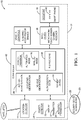
- Fig. 1 illustrates a non-limiting example of a secured-area access system 10, hereafter referred to as the system 10.
- the system 10 is configured for use by an automated vehicle, e.g. a host-vehicle 12, to automate interactions necessary for the host-vehicle 12 to gain access to a secured-area 20.
- an automated vehicle may apply to instances when the host-vehicle 12 is being operated in an automated-mode 14, i.e. a fully autonomous mode, where an occupant 18 (e.g. a human-operator) of the host-vehicle 12 may do little more than designate a destination in order to operate the host-vehicle 12.
- full automation is not a requirement.
- the teachings presented herein are useful when the host-vehicle 12 is operated in a manual-mode 16 where the occupant 18 operates the steering, accelerator, and brakes of the host-vehicle 12, and the degree or level of automation may be little more than automating an authorization/identification process necessary for the host-vehicle 12 to enter the secured-area 20. It is also contemplated that the system 10 may be used when the host-vehicle 12 is not occupied by the occupant 18. For example, the host-vehicle 12 may be entering the secured-area 20 unoccupied for the purpose of picking up the occupant 18.
- Fig. 2 illustrates a non-limiting example of a control-site 22 that controls access to the secured-area 20 beyond, i.e. forward with respect to the orientation of the host-vehicle 12, the control-site 22.
- the system 10 provides the means (i.e. equipment and/or method) to enable the host-vehicle 12 to operate/interact autonomously with various devices and/or means used at the control-site 22 to determine if the host-vehicle 12, and the occupant 18 (not shown in Fig 2 ) if present, should be allowed to enter the secured-area 20.
- the system 10 includes an identification-device 24 that conveys an access-authorization 26 from the host-vehicle 12 to a security-device 28 that is typically part of, or located at, the control-site 22.
- the access-authorization 26 may consist of or include, but is not limited to, an occupant-identification, a vehicle-identification, an authorization-code, or any combination thereof.
- the occupant-identification may indicate the identity 40 of the occupant 18 if the occupant 18 is present in the host-vehicle 12, or may indicate the owner of the host-vehicle if the host-vehicle 12 is empty of any occupants, or may indicate who the host-vehicle 12 is contracted to pick-up as part of an automated-mobility-on-demand (AMOD) transportation contract.
- the authorization-code may also be a secret password that may be updated on a periodic basis.
- the identification-device 24 may consist of or include, but is not limited to, a reconfigurable-display 30 (hereafter the display 30), a transmitter 32 such as a radio-frequency (RF) transmitter, an acoustic-transducer 34 (e.g. speaker), or any combination thereof.
- the security-device 28 may consist of or include, but is not limited to, a camera, an RF receiver, a microphone, or any combination thereof. Further details about the configuration of the identification-device 24 and the security-device 28 will be presented later is this document.
- the host-vehicle 12 may encounter a variety of security-system configurations where each instance has unique requirements and/or procedures that must be adhered to for the host-vehicle 12 to be afforded access to the secured-area 20.
- the system 10 includes an input-device 36 that receives instructions 38 regarding interaction with the security-device 28.
- the input-device 36 may consist of or include, but is not limited to, a microphone, a touch-screen, a camera, a receiver, or any combination thereof.
- the microphone may be used by the system 10 to receive the instructions 38 as voice-commands from the occupant 18.
- the touch-screen may be operated by the occupant 18 to select from a menu of options for the instructions 38, where the options may be stored in a security-system data-base located within the host-vehicle and/or located 'in the cloud'.
- the camera may be used by the system 10 to 'read' signage proximate to the control-site 22 that is relevant to the instructions 38.
- the receiver may be configured to receive the instructions 38 from a smart-phone that is owned by and/or operated by the occupant 18.
- the receiver may also be used to receive metadata from a personal area network, a local area network, or a wide area network.
- the mode, method, or process of security access information can be independently learned by the host vehicle 12. It is also contemplated that the instructions 38 may be received from a different vehicle that has previously, possibly independently, learned the security access mode from an external information database which stores accumulated and shared security access mode information.
- the instructions 38 are input to the input-device 36 by the occupant 18 of the host-vehicle 12.
- the instructions 38 may be down-loaded from a website or a secure database repository.
- the camera may be used to 'read' a quick-reference (QR) code or text that indicates a uniform-resource-locator (URL), and the system 10 may access a website related to the QR code or URL to receive the instructions 38.
- QR quick-reference
- URL uniform-resource-locator
- the system 10 also includes a controller 42 in communication with the identification-device 24 and the input-device 36.
- the controller 42 may include a processor (not specifically shown) such as a microprocessor or other control circuitry such as analog and/or digital control circuitry including an application specific integrated circuit (ASIC) for processing data as should be evident to those in the art.
- the controller 42 may include memory (not specifically shown), including non-volatile memory, such as electrically erasable programmable read-only memory (EEPROM) for storing one or more routines, thresholds, and captured data.
- the one or more routines may be executed by the processor to perform steps for executing the instructions 38 based on signals received by the controller 42 from the input-device 36 as described herein.
- the controller 42 is programmed or configured to operate the identification-device 24 based on the instructions 38 to convey the access-authorization 26 to the security-device 28 when the host-vehicle 12 approaches the secured-area 20.
- the system may include a location-detector 44 such as a global-positioning-system (GPS) receiver that receives signals from satellites to determine the location of the host-vehicle with respect to a digital-map (not shown), as will be recognized by those in the art.
- GPS global-positioning-system
- the location detector may use objects from a map database and align those map objects with sensor detections from radars, lidars, cameras, ultrasonic transducers or other sensors to determine a location on a map.
- the instructions for the particular instance of the control-site 22 at the location may be up-loaded to a network-server (i.e. stored 'in the cloud') to retain the instructions 38 for future use by other-vehicles that encounter the same instance of the control-site 22.
- a network-server i.e. stored 'in the cloud'
- the identification-device 24 may be or include the display 30 that may be mounted on the host-vehicle 12 where it may be readily seen by a security-camera 46 and/or a human-being 48, i.e. a security-guard.
- the display 30 may convey the access-authorization 26 as text that can be read by the security-guard, or the access-authorization 26 may be a bar-code and/or a sequence of lights/colors that can be captured by the security-camera 46 and interpreted by a computer (not shown) that is part of the security-device 28 at the control-site 22.
- the transmitter 32 may broadcast a radio-frequency (RF) signal similar to that used to operate garage-door-openers.
- RF radio-frequency
- the transmitter 32 may be part of a transceiver that provides for bi-directional communication with the security-device 28 so that the system 10 has a more sophisticated security protocol than that associated with a garage-door-opener.
- both the identification-device 24 and the security-device 28 are or include transceivers, then the instructions 38 may be conveyed to the host-vehicle 12 by the security-device 28 so that the occupant 18 and/or the host-vehicle 12 will be more readily identified during some future instance of the host-vehicle 12 arriving at the control-site 22.
- the identification-device 24 is or includes the acoustic-transducer 34
- that device may be a speaker that conveys an audible form of the access-authorization 26 to the security-guard 48.
- the acoustic-transducer 34 may be an ultrasonic-transducer 50A ( Fig. 2 ) mounted on the exterior of the host-vehicle 12 and positioned so that it aligns with a corresponding instance of an ultrasonic-transducer 50B at the control-site 22.
- the gate-arm 52 likely closer than illustrated in Fig.
- the ultrasonic-transducer 50A and the ultrasonic-transducer 50B may be used by the system 10 to communicate the access-authorization 26 and/or the instructions 38.
- Using ultrasonic-transducers may provide for enhanced security because the signals from such devices are relatively short ranged so would be difficult for some unauthorized persons to intercept the communication between the ultrasonic-transducer 50A and the ultrasonic-transducer 50B. Decreased power levels of RF could also be used to limit the range of the system. In systems where a secured wired access is required, a physical coupler could transmit the access information.
- the system 10 may also include a payment-device 54 ( Fig. 1 ) that communicates a payment from the host-vehicle 12 or the occupant 18 to the security-device.
- the payment may be necessary if the secured-area is a parking-lot, or if the host-vehicle is being rented by the occupant 18
- a secured-area access system (the system 10), a controller 42 for the system 10, and a method of operating the system 10 is provided.
- the system 10 provides the means by which the security of a secured-area 20 can be maintained while automating the authorization process by removing much of the burden to the occupant 18 to, for example, show identification, enter a security-code into a key-pad at a control-site 22, or inefficiently communicate verbally with a human-being 48 such as security-guard.
Landscapes
- Physics & Mathematics (AREA)
- General Physics & Mathematics (AREA)
- Engineering & Computer Science (AREA)
- Business, Economics & Management (AREA)
- Finance (AREA)
- Radar, Positioning & Navigation (AREA)
- Remote Sensing (AREA)
- Computer Networks & Wireless Communication (AREA)
- Mechanical Engineering (AREA)
- Traffic Control Systems (AREA)
- Lock And Its Accessories (AREA)
Abstract
A secured-area access system (10) for an automated vehicle includes an identification-device (24), an input-device (36), and a controller (42). The identification-device (24) conveys an access-authorization (26) from a host-vehicle (12) to a security-device (28). The input-device (36) receives instructions (38) regarding interaction with the security-device (28). The controller (42) is in communication with the identification-device (24) and the input-device (36). The controller (42) operates the identification-device (24) based on the instructions (38) to convey the access-authorization (26) to the security-device (28) when the host-vehicle (12) approaches the secured-area (20).
Description
- This disclosure generally relates to a secured-area access system, and more particularly relates to a system that operates an identification-device to convey an access-authorization (e.g. an access-code) to a security-device when a host-vehicle approaches a secured-area.
- It is known to restrict vehicle access to parking facilities or government property to only vehicles operated by authorized persons. Unfortunately, an automated vehicle is often unable to access such secured facilities without some action on the part of an authorized occupant of the automated vehicle such as displaying identification and/or manually entering an access code or swiping an identification card.
- In accordance with one embodiment, a secured-area access system for an automated vehicle is provided. The system includes an identification-device, an input-device, and a controller. The identification-device conveys an access-authorization from a host-vehicle to a security-device. The input-device receives instructions regarding interaction with the security-device. The controller is in communication with the identification-device and the input-device. The controller operates the identification-device based on the instructions to convey the access-authorization to the security-device when the host-vehicle approaches the secured-area.
- The instructions may be input to the input-device by an occupant of the host-vehicle, i.e. the instruction may be manually input to the input-device. The access-authorization may be indicative of an identity of an occupant. The system may include a location-detector that indicates when host-vehicle approaches the secured-area. The identification-device may include a transmitter that broadcasts the access-authorization to the security-device. The identification-device may include a reconfigurable-display that displays the access-authorization to the security-device. The identification-device may include an acoustic-transducer that emits the access-authorization to the security-device. The system may include a payment-device that communicates a payment to the security-device
- Further features and advantages will appear more clearly on a reading of the following detailed description of the preferred embodiment, which is given by way of non-limiting example only and with reference to the accompanying drawings.
- The present invention will now be described, by way of example with reference to the accompanying drawings, in which:
-
Fig. 1 is a diagram of a secured-area access system in accordance with one embodiment; and -
Fig. 2 is an illustration of a control-site that interacts with the system ofFig. 1 in accordance with one embodiment. -
Fig. 1 illustrates a non-limiting example of a secured-area access system 10, hereafter referred to as thesystem 10. In general, thesystem 10 is configured for use by an automated vehicle, e.g. a host-vehicle 12, to automate interactions necessary for the host-vehicle 12 to gain access to a secured-area 20. As used herein, the term automated vehicle may apply to instances when the host-vehicle 12 is being operated in an automated-mode 14, i.e. a fully autonomous mode, where an occupant 18 (e.g. a human-operator) of the host-vehicle 12 may do little more than designate a destination in order to operate the host-vehicle 12. However, full automation is not a requirement. It is contemplated that the teachings presented herein are useful when the host-vehicle 12 is operated in a manual-mode 16 where theoccupant 18 operates the steering, accelerator, and brakes of the host-vehicle 12, and the degree or level of automation may be little more than automating an authorization/identification process necessary for the host-vehicle 12 to enter the secured-area 20. It is also contemplated that thesystem 10 may be used when the host-vehicle 12 is not occupied by theoccupant 18. For example, the host-vehicle 12 may be entering the secured-area 20 unoccupied for the purpose of picking up theoccupant 18. -
Fig. 2 illustrates a non-limiting example of a control-site 22 that controls access to the secured-area 20 beyond, i.e. forward with respect to the orientation of the host-vehicle 12, the control-site 22. As will be described by way of non-limiting examples below, thesystem 10 provides the means (i.e. equipment and/or method) to enable the host-vehicle 12 to operate/interact autonomously with various devices and/or means used at the control-site 22 to determine if the host-vehicle 12, and the occupant 18 (not shown inFig 2 ) if present, should be allowed to enter the secured-area 20. - With reference to both
Figs. 1 and2 , thesystem 10 includes an identification-device 24 that conveys an access-authorization 26 from the host-vehicle 12 to a security-device 28 that is typically part of, or located at, the control-site 22. The access-authorization 26 may consist of or include, but is not limited to, an occupant-identification, a vehicle-identification, an authorization-code, or any combination thereof. The occupant-identification may indicate theidentity 40 of theoccupant 18 if theoccupant 18 is present in the host-vehicle 12, or may indicate the owner of the host-vehicle if the host-vehicle 12 is empty of any occupants, or may indicate who the host-vehicle 12 is contracted to pick-up as part of an automated-mobility-on-demand (AMOD) transportation contract. The authorization-code may also be a secret password that may be updated on a periodic basis. - The identification-
device 24 may consist of or include, but is not limited to, a reconfigurable-display 30 (hereafter the display 30), atransmitter 32 such as a radio-frequency (RF) transmitter, an acoustic-transducer 34 (e.g. speaker), or any combination thereof. Accordingly, the security-device 28 may consist of or include, but is not limited to, a camera, an RF receiver, a microphone, or any combination thereof. Further details about the configuration of the identification-device 24 and the security-device 28 will be presented later is this document. - It is recognized that the host-
vehicle 12 may encounter a variety of security-system configurations where each instance has unique requirements and/or procedures that must be adhered to for the host-vehicle 12 to be afforded access to the secured-area 20. In order for the host-vehicle 12 to 'learn' or be programmed with the unique requirements and/or procedures for a particular instance/configuration of the control-site 22, thesystem 10 includes an input-device 36 that receivesinstructions 38 regarding interaction with the security-device 28. The input-device 36 may consist of or include, but is not limited to, a microphone, a touch-screen, a camera, a receiver, or any combination thereof. The microphone may be used by thesystem 10 to receive theinstructions 38 as voice-commands from theoccupant 18. The touch-screen may be operated by theoccupant 18 to select from a menu of options for theinstructions 38, where the options may be stored in a security-system data-base located within the host-vehicle and/or located 'in the cloud'. The camera may be used by thesystem 10 to 'read' signage proximate to the control-site 22 that is relevant to theinstructions 38. The receiver may be configured to receive theinstructions 38 from a smart-phone that is owned by and/or operated by theoccupant 18. The receiver may also be used to receive metadata from a personal area network, a local area network, or a wide area network. In this way, the mode, method, or process of security access information can be independently learned by thehost vehicle 12. It is also contemplated that theinstructions 38 may be received from a different vehicle that has previously, possibly independently, learned the security access mode from an external information database which stores accumulated and shared security access mode information. - In the above examples the
instructions 38 are input to the input-device 36 by theoccupant 18 of the host-vehicle 12. However, it is also contemplated that theinstructions 38 may be down-loaded from a website or a secure database repository. For example, the camera may be used to 'read' a quick-reference (QR) code or text that indicates a uniform-resource-locator (URL), and thesystem 10 may access a website related to the QR code or URL to receive theinstructions 38. - The
system 10 also includes acontroller 42 in communication with the identification-device 24 and the input-device 36. Thecontroller 42 may include a processor (not specifically shown) such as a microprocessor or other control circuitry such as analog and/or digital control circuitry including an application specific integrated circuit (ASIC) for processing data as should be evident to those in the art. Thecontroller 42 may include memory (not specifically shown), including non-volatile memory, such as electrically erasable programmable read-only memory (EEPROM) for storing one or more routines, thresholds, and captured data. The one or more routines may be executed by the processor to perform steps for executing theinstructions 38 based on signals received by thecontroller 42 from the input-device 36 as described herein. - The
controller 42 is programmed or configured to operate the identification-device 24 based on theinstructions 38 to convey the access-authorization 26 to the security-device 28 when the host-vehicle 12 approaches the secured-area 20. In order for thesystem 10 to determine the location of the host-vehicle 12, the system may include a location-detector 44 such as a global-positioning-system (GPS) receiver that receives signals from satellites to determine the location of the host-vehicle with respect to a digital-map (not shown), as will be recognized by those in the art. The location detector may use objects from a map database and align those map objects with sensor detections from radars, lidars, cameras, ultrasonic transducers or other sensors to determine a location on a map. In instances when theoccupant 18 manually enters theinstructions 38, or is otherwise instrumental in the process of thecontroller 42 receiving theinstructions 38, it is contemplated that the instructions for the particular instance of the control-site 22 at the location may be up-loaded to a network-server (i.e. stored 'in the cloud') to retain theinstructions 38 for future use by other-vehicles that encounter the same instance of the control-site 22. - Returning now to non-limiting examples of various possible configurations of the identification-
device 24 and the security-device 28, in one embodiment of thesystem 10 the identification-device 24 may be or include thedisplay 30 that may be mounted on the host-vehicle 12 where it may be readily seen by a security-camera 46 and/or a human-being 48, i.e. a security-guard. Thedisplay 30 may convey the access-authorization 26 as text that can be read by the security-guard, or the access-authorization 26 may be a bar-code and/or a sequence of lights/colors that can be captured by the security-camera 46 and interpreted by a computer (not shown) that is part of the security-device 28 at the control-site 22. - If the identification-
device 24 is or includes thetransmitter 32, thetransmitter 32 may broadcast a radio-frequency (RF) signal similar to that used to operate garage-door-openers. Alternatively, thetransmitter 32 may be part of a transceiver that provides for bi-directional communication with the security-device 28 so that thesystem 10 has a more sophisticated security protocol than that associated with a garage-door-opener. It is also contemplated that if both the identification-device 24 and the security-device 28 are or include transceivers, then theinstructions 38 may be conveyed to the host-vehicle 12 by the security-device 28 so that theoccupant 18 and/or the host-vehicle 12 will be more readily identified during some future instance of the host-vehicle 12 arriving at the control-site 22. - If the identification-
device 24 is or includes the acoustic-transducer 34, that device may be a speaker that conveys an audible form of the access-authorization 26 to the security-guard 48. Alternatively, the acoustic-transducer 34 may be an ultrasonic-transducer 50A (Fig. 2 ) mounted on the exterior of the host-vehicle 12 and positioned so that it aligns with a corresponding instance of an ultrasonic-transducer 50B at the control-site 22. When the host-vehicle 12 approaches the gate-arm 52 (likely closer than illustrated inFig. 2 ), the ultrasonic-transducer 50A and the ultrasonic-transducer 50B may be used by thesystem 10 to communicate the access-authorization 26 and/or theinstructions 38. Using ultrasonic-transducers may provide for enhanced security because the signals from such devices are relatively short ranged so would be difficult for some unauthorized persons to intercept the communication between the ultrasonic-transducer 50A and the ultrasonic-transducer 50B. Decreased power levels of RF could also be used to limit the range of the system. In systems where a secured wired access is required, a physical coupler could transmit the access information. - The
system 10 may also include a payment-device 54 (Fig. 1 ) that communicates a payment from the host-vehicle 12 or theoccupant 18 to the security-device. The payment may be necessary if the secured-area is a parking-lot, or if the host-vehicle is being rented by theoccupant 18 - Accordingly, a secured-area access system (the system 10), a
controller 42 for thesystem 10, and a method of operating thesystem 10 is provided. Thesystem 10 provides the means by which the security of a secured-area 20 can be maintained while automating the authorization process by removing much of the burden to theoccupant 18 to, for example, show identification, enter a security-code into a key-pad at a control-site 22, or inefficiently communicate verbally with a human-being 48 such as security-guard. - While this invention has been described in terms of the preferred embodiments thereof, it is not intended to be so limited, but rather only to the extent set forth in the claims that follow.
Claims (8)
- A secured-area access system (10) for an automated vehicle, said system (10)
comprising:an identification-device (24) that conveys an access-authorization (26) from a host-vehicle (12) to a security-device (28);an input-device (36) that receives instructions (38) regarding interaction with the security-device (28); anda controller (42) in communication with the identification-device (24) and the input-device (36), wherein the controller (42) operates the identification-device (24) based on the instructions (38) to convey the access-authorization (26) to the security-device (28) when the host-vehicle (12) approaches the secured-area (20). - The system (10) in accordance with claim 1, wherein the instructions (38) are input to the input-device (36) by an occupant (18) of the host-vehicle (12).
- The system (10) according to any one of the preceding claims, wherein the access-authorization (26) is indicative of an identity (40) of an occupant (18).
- The system (10) according to any one of the preceding claims, wherein the system (10) includes a location-detector (44) that indicates when host-vehicle (12) approaches the secured-area (20).
- The system (10) according to any one of the preceding claims, wherein the identification-device (24) includes a transmitter (32) that broadcasts the access-authorization (26) to the security-device (28).
- The system (10) according to any one of the preceding claims, wherein the identification-device (24) includes a reconfigurable-display (30) that displays the access-authorization (26) to the security-device (28).
- The system (10) according to any one of the preceding claims, wherein the identification-device (24) includes an acoustic-transducer (34) that emits the access-authorization (26) to the security-device (28).
- The system (10) according to any one of the preceding claims, wherein the system (10) includes a payment-device (54) that communicates a payment to the security-device (28).
Applications Claiming Priority (1)
| Application Number | Priority Date | Filing Date | Title |
|---|---|---|---|
| US15/653,832 US20190027044A1 (en) | 2017-07-19 | 2017-07-19 | Automated secured-area access system for an automated vehicle |
Publications (1)
| Publication Number | Publication Date |
|---|---|
| EP3432274A1 true EP3432274A1 (en) | 2019-01-23 |
Family
ID=62874742
Family Applications (1)
| Application Number | Title | Priority Date | Filing Date |
|---|---|---|---|
| EP18182134.9A Withdrawn EP3432274A1 (en) | 2017-07-19 | 2018-07-06 | Automated secured-area access system for an automated vehicle |
Country Status (3)
| Country | Link |
|---|---|
| US (1) | US20190027044A1 (en) |
| EP (1) | EP3432274A1 (en) |
| CN (1) | CN109278703A (en) |
Cited By (2)
| Publication number | Priority date | Publication date | Assignee | Title |
|---|---|---|---|---|
| FR3098333A1 (en) * | 2019-07-04 | 2021-01-08 | B.A. Developpement | Detection device |
| DE102024135101A1 (en) | 2024-10-08 | 2026-04-09 | GM Global Technology Operations LLC | SYSTEM AND METHOD FOR DISPLAYING A VEHICLE PASSPORT |
Families Citing this family (6)
| Publication number | Priority date | Publication date | Assignee | Title |
|---|---|---|---|---|
| US10643408B2 (en) * | 2017-02-24 | 2020-05-05 | Ecolink Intelligent Technology, Inc. | Automatic garage door control |
| US11218330B2 (en) | 2019-03-25 | 2022-01-04 | Micron Technology, Inc. | Generating an identity for a computing device using a physical unclonable function |
| US11361660B2 (en) | 2019-03-25 | 2022-06-14 | Micron Technology, Inc. | Verifying identity of an emergency vehicle during operation |
| US11323275B2 (en) | 2019-03-25 | 2022-05-03 | Micron Technology, Inc. | Verification of identity using a secret key |
| US11233650B2 (en) * | 2019-03-25 | 2022-01-25 | Micron Technology, Inc. | Verifying identity of a vehicle entering a trust zone |
| JP7548147B2 (en) * | 2021-07-19 | 2024-09-10 | トヨタ自動車株式会社 | Delivery vehicle |
Citations (3)
| Publication number | Priority date | Publication date | Assignee | Title |
|---|---|---|---|---|
| US20120197806A1 (en) * | 2011-01-31 | 2012-08-02 | Jason Lester Hill | Sonic based digital networking |
| US20150325058A1 (en) * | 2012-12-14 | 2015-11-12 | Bluecarsharing | Method and system for controlling access to a station for automated rental of vehicles situated within a structure access to which is controlled |
| WO2017040196A1 (en) * | 2015-08-28 | 2017-03-09 | Gentex Corporation | Vehicle security accessory and methods of identity authentication |
Family Cites Families (16)
| Publication number | Priority date | Publication date | Assignee | Title |
|---|---|---|---|---|
| US4325146A (en) * | 1979-12-20 | 1982-04-13 | Lennington John W | Non-synchronous object identification system |
| US5829913A (en) * | 1996-12-31 | 1998-11-03 | Puckett; Robert | Bollard cap |
| US6052068A (en) * | 1997-03-25 | 2000-04-18 | Frederick J. Price | Vehicle identification system |
| US20050258935A1 (en) * | 2001-01-26 | 2005-11-24 | Hom Wayne C | Manual override apparatus and method for an automated secure area entry access system |
| FR2835075B1 (en) * | 2002-01-23 | 2004-05-21 | Ier | METHOD FOR CONTROLLING ACCESS TO A SENSITIVE AREA, PARTICULARLY A TRANSPORT APPARATUS, BY BIOMETRIC VERIFICATION |
| US7401732B2 (en) * | 2002-12-30 | 2008-07-22 | Haddad Michael A | Apparatus for reading standardized personal identification credentials for integration with automated access control systems |
| US20040189493A1 (en) * | 2003-03-27 | 2004-09-30 | Estus Jay M. | RF electronic license plate and information system for vehicle tracking |
| US7466223B2 (en) * | 2004-05-21 | 2008-12-16 | Pips Technology, Inc. | Automated site security, monitoring and access control system |
| US20060071791A1 (en) * | 2004-09-29 | 2006-04-06 | Honeywell International Inc. | Enhanced RFID vehicle presence detection system |
| SG121906A1 (en) * | 2004-10-11 | 2006-05-26 | Stratech Systems Ltd | Intelligent vehicle access control system |
| US7899583B2 (en) * | 2005-04-12 | 2011-03-01 | Ehud Mendelson | System and method of detecting and navigating to empty parking spaces |
| US10572852B2 (en) * | 2009-12-30 | 2020-02-25 | Louis A. Santo, JR. | Software application for the automated drop-off and pick-up of a service item at a service facility |
| US9602164B1 (en) * | 2011-04-29 | 2017-03-21 | United Services Automobile Association (Usaa) | Methods and systems for making a pre-payment |
| US20150179070A1 (en) * | 2013-12-20 | 2015-06-25 | Frogparking Limited | Location-Based Vehicle Parking System |
| CN104952277B (en) * | 2015-06-02 | 2017-08-29 | 深圳市真地智能科技有限公司 | A kind of intelligent parking system and method based on internet |
| US20170060135A1 (en) * | 2015-08-28 | 2017-03-02 | Delphi Technologies, Inc. | Vehicle-location system for an automated vehicle |
-
2017
- 2017-07-19 US US15/653,832 patent/US20190027044A1/en not_active Abandoned
-
2018
- 2018-07-06 EP EP18182134.9A patent/EP3432274A1/en not_active Withdrawn
- 2018-07-17 CN CN201810783526.XA patent/CN109278703A/en active Pending
Patent Citations (3)
| Publication number | Priority date | Publication date | Assignee | Title |
|---|---|---|---|---|
| US20120197806A1 (en) * | 2011-01-31 | 2012-08-02 | Jason Lester Hill | Sonic based digital networking |
| US20150325058A1 (en) * | 2012-12-14 | 2015-11-12 | Bluecarsharing | Method and system for controlling access to a station for automated rental of vehicles situated within a structure access to which is controlled |
| WO2017040196A1 (en) * | 2015-08-28 | 2017-03-09 | Gentex Corporation | Vehicle security accessory and methods of identity authentication |
Cited By (2)
| Publication number | Priority date | Publication date | Assignee | Title |
|---|---|---|---|---|
| FR3098333A1 (en) * | 2019-07-04 | 2021-01-08 | B.A. Developpement | Detection device |
| DE102024135101A1 (en) | 2024-10-08 | 2026-04-09 | GM Global Technology Operations LLC | SYSTEM AND METHOD FOR DISPLAYING A VEHICLE PASSPORT |
Also Published As
| Publication number | Publication date |
|---|---|
| CN109278703A (en) | 2019-01-29 |
| US20190027044A1 (en) | 2019-01-24 |
Similar Documents
| Publication | Publication Date | Title |
|---|---|---|
| US20190027044A1 (en) | Automated secured-area access system for an automated vehicle | |
| US12013694B2 (en) | Operation-security system for an automated vehicle | |
| US11772489B2 (en) | Visually obstructed object detection for automated vehicle using V2V/V2I communications | |
| US11423350B2 (en) | Apparatus and method for flexibly collecting and/or delivering a shipment | |
| CN108572645B (en) | driverless transportation system | |
| US10991176B2 (en) | Driverless transportation system | |
| US10846545B2 (en) | Method for verifying the content and installation site of traffic signs | |
| US11427317B2 (en) | Vehicle having drone landing functionality | |
| US20180373236A1 (en) | Method for activating a loading and/or unloading equipment of a vehicle via a home automation device and method for steering a vehicle to a predetermined stopping area | |
| CN109263634B (en) | Driver assistance system remote control method, driver assistance system and motor vehicle | |
| US10577124B2 (en) | Method for destination approach control of unmanned aerial vehicles | |
| CN113678077A (en) | Method and apparatus for teleoperated travel of a vehicle | |
| EP3480793A1 (en) | Mobile credential management system for vehicle key box access control | |
| US20180292836A1 (en) | Automated vehicle operation-rules selected based on automation-level other vehicles | |
| EP3501932A1 (en) | Automated vehicle system and method for changing from automated-mode to manual-mode near a construction-zone | |
| CN107580322A (en) | Upgrade method, device and the automatic driving vehicle of automatic driving vehicle software systems | |
| US20190102728A1 (en) | Parcel delivery system and method | |
| EP3258455B1 (en) | Warning system for an automated vehicle | |
| KR20150068680A (en) | Smart parking assistant apparatus and system, and Smart parking assisting method using the same | |
| CN107031646A (en) | For determining the method and apparatus in the environment of the motor vehicle in parking lot with the presence or absence of object | |
| US11568509B2 (en) | Transport request processing device, method and storage medium | |
| US11017553B2 (en) | Information processing system | |
| US10403139B2 (en) | Local navigation system for vehicle navigation | |
| KR102316601B1 (en) | Hi-pass payment system and method thereof | |
| CN116798261A (en) | Methods and systems for assisting vehicles, methods and systems for guiding vehicles, equipment and storage media |
Legal Events
| Date | Code | Title | Description |
|---|---|---|---|
| PUAI | Public reference made under article 153(3) epc to a published international application that has entered the european phase |
Free format text: ORIGINAL CODE: 0009012 |
|
| AK | Designated contracting states |
Kind code of ref document: A1 Designated state(s): AL AT BE BG CH CY CZ DE DK EE ES FI FR GB GR HR HU IE IS IT LI LT LU LV MC MK MT NL NO PL PT RO RS SE SI SK SM TR |
|
| AX | Request for extension of the european patent |
Extension state: BA ME |
|
| STAA | Information on the status of an ep patent application or granted ep patent |
Free format text: STATUS: THE APPLICATION IS DEEMED TO BE WITHDRAWN |
|
| 18D | Application deemed to be withdrawn |
Effective date: 20190724 |