EP3432182A1 - Systems and methods for secure, accessible and usable captcha - Google Patents
Systems and methods for secure, accessible and usable captcha Download PDFInfo
- Publication number
- EP3432182A1 EP3432182A1 EP18161355.5A EP18161355A EP3432182A1 EP 3432182 A1 EP3432182 A1 EP 3432182A1 EP 18161355 A EP18161355 A EP 18161355A EP 3432182 A1 EP3432182 A1 EP 3432182A1
- Authority
- EP
- European Patent Office
- Prior art keywords
- captcha
- media file
- input
- user
- decision
- Prior art date
- Legal status (The legal status is an assumption and is not a legal conclusion. Google has not performed a legal analysis and makes no representation as to the accuracy of the status listed.)
- Granted
Links
Images





Classifications
-
- G—PHYSICS
- G06—COMPUTING OR CALCULATING; COUNTING
- G06F—ELECTRIC DIGITAL DATA PROCESSING
- G06F21/00—Security arrangements for protecting computers, components thereof, programs or data against unauthorised activity
- G06F21/30—Authentication, i.e. establishing the identity or authorisation of security principals
- G06F21/31—User authentication
-
- G—PHYSICS
- G06—COMPUTING OR CALCULATING; COUNTING
- G06F—ELECTRIC DIGITAL DATA PROCESSING
- G06F21/00—Security arrangements for protecting computers, components thereof, programs or data against unauthorised activity
- G06F21/30—Authentication, i.e. establishing the identity or authorisation of security principals
- G06F21/31—User authentication
- G06F21/36—User authentication by graphic or iconic representation
-
- G—PHYSICS
- G06—COMPUTING OR CALCULATING; COUNTING
- G06F—ELECTRIC DIGITAL DATA PROCESSING
- G06F16/00—Information retrieval; Database structures therefor; File system structures therefor
- G06F16/30—Information retrieval; Database structures therefor; File system structures therefor of unstructured textual data
- G06F16/33—Querying
- G06F16/332—Query formulation
- G06F16/3329—Natural language query formulation
-
- G—PHYSICS
- G06—COMPUTING OR CALCULATING; COUNTING
- G06F—ELECTRIC DIGITAL DATA PROCESSING
- G06F16/00—Information retrieval; Database structures therefor; File system structures therefor
- G06F16/30—Information retrieval; Database structures therefor; File system structures therefor of unstructured textual data
- G06F16/36—Creation of semantic tools, e.g. ontology or thesauri
- G06F16/374—Thesaurus
-
- G—PHYSICS
- G06—COMPUTING OR CALCULATING; COUNTING
- G06F—ELECTRIC DIGITAL DATA PROCESSING
- G06F16/00—Information retrieval; Database structures therefor; File system structures therefor
- G06F16/90—Details of database functions independent of the retrieved data types
- G06F16/95—Retrieval from the web
- G06F16/951—Indexing; Web crawling techniques
-
- G—PHYSICS
- G06—COMPUTING OR CALCULATING; COUNTING
- G06N—COMPUTING ARRANGEMENTS BASED ON SPECIFIC COMPUTATIONAL MODELS
- G06N20/00—Machine learning
-
- G—PHYSICS
- G09—EDUCATION; CRYPTOGRAPHY; DISPLAY; ADVERTISING; SEALS
- G09B—EDUCATIONAL OR DEMONSTRATION APPLIANCES; APPLIANCES FOR TEACHING, OR COMMUNICATING WITH, THE BLIND, DEAF OR MUTE; MODELS; PLANETARIA; GLOBES; MAPS; DIAGRAMS
- G09B21/00—Teaching, or communicating with, the blind, deaf or mute
- G09B21/001—Teaching or communicating with blind persons
- G09B21/006—Teaching or communicating with blind persons using audible presentation of the information
-
- G—PHYSICS
- G06—COMPUTING OR CALCULATING; COUNTING
- G06F—ELECTRIC DIGITAL DATA PROCESSING
- G06F2221/00—Indexing scheme relating to security arrangements for protecting computers, components thereof, programs or data against unauthorised activity
- G06F2221/21—Indexing scheme relating to G06F21/00 and subgroups addressing additional information or applications relating to security arrangements for protecting computers, components thereof, programs or data against unauthorised activity
- G06F2221/2103—Challenge-response
-
- G—PHYSICS
- G06—COMPUTING OR CALCULATING; COUNTING
- G06F—ELECTRIC DIGITAL DATA PROCESSING
- G06F2221/00—Indexing scheme relating to security arrangements for protecting computers, components thereof, programs or data against unauthorised activity
- G06F2221/21—Indexing scheme relating to G06F21/00 and subgroups addressing additional information or applications relating to security arrangements for protecting computers, components thereof, programs or data against unauthorised activity
- G06F2221/2133—Verifying human interaction, e.g., Captcha
Definitions
- the embodiments herein generally relate to data processing and information security, and more particularly to systems and methods for inclusive CAPTCHA that addresses users of all abilities and particularly optimizes tradeoff between security and accessibility.
- CAPTCHA Completely Automated Public Turing Tests to Tell Computers and Humans Apart
- the purpose of the CAPTCHA is to protect web applications like website registrations, online polls, etc. from malicious programs (bots), dictionary attacks and web crawlers. Users are given a challenge to solve which is understandable by humans. Based on the response given, the system determines whether the user is human or not.
- CAPTCHAs are classified based on the type of content that is distorted. Some types of CAPTCHA are CAPTCHA based on text, CAPTCHA based on image, CAPTCHA based on audio and CAPTCHA based on puzzle.
- the state of art CAPTCHA imperatively involves a tradeoff between goals of security and accessibility. It has been observed that in order to provide accessible CAPTCHA for users with disabilities, protected applications may need to be compromised on security aspects. Since CAPTCHA is primarily targeted at information security, it is a challenge to manage security while ensuring usability and accessibility for users of all abilities.
- Embodiments of the present disclosure present technological improvements as solutions to one or more of the above-mentioned technical problems recognized by the inventors in conventional systems.
- a processor implemented method for inclusive CAPTCHA comprising: in response to a user request for a webpage having CAPTCHA, creating a media file in real-time, wherein the created media file is characterized by distortion interference and corresponds to a selected theme from a plurality of themes associated with real-world scenarios; randomly selecting a comprehension question based on the created media file as the CAPTCHA, the comprehension question being based on the selected theme, geography associated with a user requesting the webpage and context of the created media file; and transmitting the webpage including the CAPTCHA.
- the method intelligently detects either a human input or a machine input based on a self-learning CAPTCHA decision module.
- a system comprising: one or more hardware processors and one or more data storage devices (102) operatively coupled to the one or more processors for storing instructions configured for execution by the one or more processors, the instructions being comprised in: a CAPTCHA generating module configured to, in response to a user request for a webpage having CAPTCHA, create a media file in real-time, wherein the created media file is characterized by distortion interference and corresponds to a selected theme from a plurality of themes associated with real-world scenarios; randomly select a comprehension question based on the created media file as the CAPTCHA, the comprehension question being based on the selected theme, geography associated with a user requesting the webpage and context of the created media file; and transmit the webpage including the CAPTCHA.
- the instructions are further comprised in a self-learning CAPTCHA decision module configured to, in response to a user input to the comprehension question, intelligently detect either a human input or a machine input.
- a computer program product comprising a non-transitory computer readable medium having a computer readable program embodied therein, wherein the computer readable program, when executed on a computing device, causes the computing device to: in response to a user request for a webpage having CAPTCHA, create a media file in real-time, wherein the created media file is characterized by distortion interference and corresponds to a selected theme from a plurality of themes associated with real-world scenarios; randomly select a comprehension question based on the created media file as the CAPTCHA, the comprehension question being based on the selected theme, geography associated with a user requesting the webpage and context of the created media file; and transmit the webpage including the CAPTCHA.
- the computing device intelligently detects either a human input or a machine input based on a self-learning CAPTCHA decision module.
- the created media file is at least one of an aural form or a visual form.
- the created media file is a combination of two or more media files of the same form but varying type or a combination of two or more media files of different forms, each combination corresponding to the selected theme.
- the varying types of the two or more media files are associated with an environment and contextual information thereof.
- the CAPTCHA generating module is further configured to, in response to a user input to the comprehension question, select and transmit at least one alternative comprehension question for the selected theme.
- each comprehension question is associated with a plurality of solutions corresponding to the created media file for the selected theme.
- the CAPTCHA generating module is further configured to present the selected comprehension question in at least one of visual or aural form.
- the self-learning CAPTCHA decision module is configured to intelligently detect either a human input or a machine input by: intelligently comparing the user input to previously stored user inputs from a decision repository of the self-learning CAPTCHA decision module, considering one or more of spelling errors, incomplete responses, contextual metonyms, synonyms and variants thereof; detecting either a human input or a machine input based on the comparing and associated decision thereof; and updating the decision repository with the user input and associated decision based on the detected input.
- any block diagram herein represent conceptual views of illustrative systems embodying the principles of the present subject matter.
- any flow charts, flow diagrams, state transition diagrams, pseudo code, and the like represent various processes which may be substantially represented in computer readable medium and so executed by a computing device or processor, whether or not such computing device or processor is explicitly shown.
- CAPTCHA Completely Automated Public Turing Tests to Tell Computers and Humans Apart
- the present disclosure addresses particularly the tradeoff between accessibility and security seen in state of the art CAPTCHA and accordingly, the methods and systems of the present disclosure aim to provide an inclusive CAPTCHA that meets the orthogonal requirements of usability, accessibility and security while addressing users of all needs and hence being inclusive.
- FIGS. 1 through 9 where similar reference characters denote corresponding features consistently throughout the figures, there are shown preferred embodiments and these embodiments are described in the context of the following exemplary system and method.
- FIG.1 illustrates an exemplary block diagram of a system 100 for providing inclusive CAPTCHA, in accordance with an embodiment of the present disclosure.
- the system 100 includes one or more processors 104, communication interface device(s) or input/output (I/O) interface(s) 106, and one or more data storage devices or memory 102 operatively coupled to the one or more processors 104.
- the one or more processors 104 that are hardware processors can be implemented as one or more microprocessors, microcomputers, microcontrollers, digital signal processors, central processing units, state machines, graphics controllers, logic circuitries, and/or any devices that manipulate signals based on operational instructions.
- the processor(s) are configured to fetch and execute computer-readable instructions stored in the memory.
- the system 100 can be implemented in a variety of computing systems, such as laptop computers, notebooks, hand-held devices, workstations, mainframe computers, servers, a network cloud and the like.
- the I/O interface device(s) 106 can include a variety of software and hardware interfaces, for example, a web interface, a graphical user interface, and the like and can facilitate multiple communications within a wide variety of networks N/W and protocol types, including wired networks, for example, LAN, cable, etc., and wireless networks, such as WLAN, cellular, or satellite.
- the I/O interface device(s) can include one or more ports for connecting a number of devices to one another or to another server.
- the memory 102 may include any computer-readable medium known in the art including, for example, volatile memory, such as static random access memory (SRAM) and dynamic random access memory (DRAM), and/or non-volatile memory, such as read only memory (ROM), erasable programmable ROM, flash memories, hard disks, optical disks, and magnetic tapes.
- volatile memory such as static random access memory (SRAM) and dynamic random access memory (DRAM)
- non-volatile memory such as read only memory (ROM), erasable programmable ROM, flash memories, hard disks, optical disks, and magnetic tapes.
- ROM read only memory
- erasable programmable ROM erasable programmable ROM
- FIG.2 illustrates an exemplary architectural diagram of the system for providing inclusive CAPTCHA, in accordance with an embodiment of the present disclosure.
- the inclusive CAPTCHA of the present disclosure considers the orthogonal requirements of usability, security and accessibility for users with disabilities (visual, hear, motor, disability) and also main stream users to make the CAPTCHA practically inclusive.
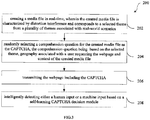
- FIG.3 is an exemplary flow diagram illustrating a computer implemented method 200 for inclusive CAPTCHA, in accordance with an embodiment of the present disclosure.
- the system 100 comprises one or more data storage devices or memory 102 operatively coupled to the one or more processors 104 and is configured to store instructions configured for execution of steps of the method 200 by the one or more processors 104.
- the system 100 may comprise exemplary modules such a CAPTCHA generation module (not particularly illustrated). and a self-learning CAPTCHA decision module (not particularly illustrated).
- the CAPTCHA generating module is configured to create in real-time, a media file, at step 202, in response to a user request for a webpage having CAPTCHA, wherein the created media file is characterized by distortion interference.
- distortion interference involves overlap of media files.
- the created file may have an aural form, a visual form or a combination of both, such as audio-visual form, wherein the visual form may include videos or animations.
- the created media file is a combination of two or more media files that are of the same form or of different forms. Again, when the two or more media files are of the same form, they may be of varying type.
- the created media file may be an audio file exemplifying conversation in a school, traffic, railway station, zoo, park, and the like.
- the created media file corresponds to a selected theme from the plurality of themes.
- Each of the mentioned themes such as school, railway station, zoo, and the like may be associated with a library of media files.
- the varying types of the two or more media files are associated with an environment and associated contextual information.
- each theme may be associated with a library of audio files wherein each library may comprise further sub-libraries of audio files pertaining to main dialogues, environmental noise, background noise and background speech in line with the theme of the environment which may be combined in real-time and presented to the user as a created media file.
- each library may comprise further sub-libraries of audio files pertaining to main dialogues, environmental noise, background noise and background speech in line with the theme of the environment which may be combined in real-time and presented to the user as a created media file.
- the CAPTCHA generating module is configured to select a comprehension question randomly, at step 204, for the created media file as the CAPTCHA.
- a question bank may comprise all possible comprehension questions related to each theme.
- the selected comprehension question is based on the selected theme, geography associated with a user requesting the webpage and context of the created media file; wherein geography associated with a user also pertains to the corresponding culture and language.
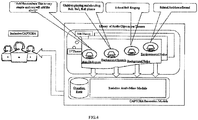
- FIG.4 illustrates a working flow diagram of the method for inclusive CAPTCHA, in accordance with an embodiment of the present disclosure.
- the CAPTCHA generating module first randomly selects a theme (a school in the illustration of FIG.4 ).
- the created media file is an audio file that is a combination in real-time of four types of audio files viz., main dialogues, background noise, environmental noise and background speech.
- This technique of combining media files makes it difficult for an ASR engine to interpret the CAPTCHA question.
- the dialogue in the created audio file may be in single language or multiple languages, grammatically correct /incorrect to make it tough for ASRs to break.
- the created audio file presented to the user is a real-world scenario which a human experiences in day-to day life like the school in FIG.4 , processing, extracting and interpreting information would require minimal mental effort.
- the fact that the theme relates to a real-world scenario and the selected question is based on the context of the created media file facilitates accessibility for users of all abilities.
- the created media (audio in the exemplary embodiment) file may also be customized considering the geography, culture and language of the user.
- a comprehension question presented to the user is " What is the teacher teaching ".
- the question asked in the CAPTCHA is purely based on the context of the school theme and the created audio file, thereby reducing cognitive load on the user.
- the CAPTCHA generating module is configured to transmit the webpage including the CAPTCHA, at step 206.
- the selected comprehension question may be presented in a visual form, an aural form or a combination thereof such as audio-visual form.
- the self-learning CAPTCHA decision module is configured to, at step 208, in response to a user input to the comprehension question, intelligently detect either a human input or a machine input.
- the CAPTCHA generating module may select and transmit at least one alternative comprehension question for the selected theme. For instance, if the self-learning CAPTCHA decision module is unable to make a decision based on the user input to the comprehension question, the CAPTCHA generating module may present an alternative comprehension question for the selected theme.
- the self-learning CAPTCHA decision module determines its correctness and decides whether the access is made by a human or a machine.
- the self-learning CAPTCHA decision module is configured to detect either a human input or a machine input by firstly intelligently comparing the user input to previously stored user inputs from a decision repository of the self-learning CAPTCHA decision module.
- the CAPTCHA decision module may use information retrieval technology strategies to compare the user input by the user with stored user inputs by considering one or more of spelling errors, incomplete responses, contextual metonyms, synonyms and variants thereof.
- a response to a comprehension question is "tea”
- possible acceptable responses include “chai (Hindi language synonym), tea (actual answer), chaha (Marathi language synonym), tee (incorrect spelling), hot drink (metonym), cha (incomplete response)”.
- chai Hindi language synonym
- tea actual answer
- chaha Marathi language synonym
- tee incorrect spelling
- hot drink metalonym
- cha (incomplete response) ensures accessibility particularly to dyslexic users and users with learning disabilities.
- the step of detecting either a human input or a machine input is based on the comparing and associated decision thereof.
- each user input and associated decision based on the detected input by the self-learning CAPTCHA decision module is dynamically updated in the decision repository to build a knowledge base that may be continually updated for improved decision accuracy.
- an acceptable user response for the question asked may be "math / mathematics /sum/ plus/ add /addition" which only a human can interpret and answer.
- the question asked may remain same (" What is teacher teaching ") but if the main dialogue audio file selected by the CAPTCHA generating module was modified wherein the teacher was teaching English, the accepted answers may change to "english / angrezi / british / foreign".
- each comprehension question may be associated with a plurality of solutions corresponding to the created media file for the selected theme making it more complicated for ASR and machine learning engines to crack the CAPTCHA.
- usability with regards to the inclusive CAPTCHA may be further enhanced by enabling replay of the created media file.
- User interface may be further enhanced by enabling the user to listen and type at the same time using screen reader and providing keyboard accessibility. As the user clicks on 'play', the focus may automatically set on a text input field to enable the user to type as soon as the audio is heard.
- a shortcut key may be implemented to replay the audio for the user while the focus remains on the text field, thus reducing the number of interaction clicks needed by the user to complete the CAPTCHA.
- CAPTCHA is a mechanism adopted by several portals to protect their web applications from malicious programs such as bots. Powerful robots backed by machine learning algorithms have the capability to break the existing audio CAPTCHAs.
- the inclusive CAPTCHA of the present disclosure consists of a media file such as an audio file in the exemplary of FIG.4 which is a combination of multiple orthogonal speech conversations and different sounds.
- the inclusive CAPTCHA consisted of human spoken dialogues superimposed with background noise in form of human voices and environment noise relevant to the theme. These created audio CAPTCHA were not decodable by a tested state of the art general purpose Automatic Speech Recognition engine (Speech to text convertor). Table 1 below shows some of the transcripts obtained from the ASR.
- Audio_7 Export gate by he how can it be quantify it first people please on my face What's the price of onions? Its 45 per kg. How can it be 45, it was 30 on Monday Hotel Reception null Here's your key. Your Environment:audio_ 8 room number is 324. If you need anything, please dial 0 for the reception area.
- the inclusive CAPTCHA audio of the present disclosure has an average play time of 11 seconds.
- the usability and accessibility of the CAPTCHA was measured on the following metrics:
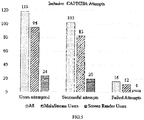
- FIG.5 illustrates a graphical representation of users with different abilities and number of successful and failed attempts using the inclusive CAPTCHA in accordance with an embodiment of the present disclosure.
- the failed attempts in the FIG.5 represent the number of users who failed to solve the CAPTCHA in the first attempt. However they were able to complete the CAPTCHA task after two or more attempts as shown in FIG.6 . As observed, there was no user who required a third attempt in the mainstream category while only one user in screen reader category needed a third attempt.
- Table 2 shows a statistical measure for average response time taken to solve the CAPTCHA in the user study by all, mainstream and screen reader users.
- Table 2 Time Response comparison for inclusive CAPTCHA All users Mainstream users Screen reader users Avg. response time 31 seconds 30 seconds 38 seconds Minimum time 8 seconds 8 seconds 14 seconds Maximum time 142 seconds 130 seconds 142 seconds
- FIG.7 illustrates a graphical representation, in the form of a box plot of users with different abilities and time taken to complete the inclusive CAPTCHA in accordance with an embodiment of the present disclosure.
- the plot clearly shows no significant difference in the completion time scores of the lower and upper quartile range for all and mainstream users however more number of screen reader users fall in the upper quartile range.
- screen reader users took more time to respond to the CAPTCHA ( FIG.7 ) but 84% of the users got it right in the first attempt (with no background about the inclusive CAPTCHA) also the response time improves when used multiple times.
- the average time to complete the inclusive CAPTCHA test is 30 seconds with minimum of 8 seconds for main stream users and 38 seconds with minimum of 14 seconds for the screen reader users which is less than 65.64 seconds, the average time to complete a ReCAPTCHA test as known in the art, thus making it more usable.
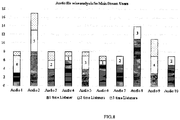
- FIG.8 illustrates a graphical representation of audio file wise analysis for main stream users of the inclusive CAPTCHA in accordance with an embodiment of the present disclosure. As observed, more than 85% of the mainstream users have played the audio for one time or two times. In the FIG.8 , Audio 8 has the highest number of users listening to the audio file one time. This clearly is indicative of how clear the audio sounds were to a human.
- FIG.9 illustrates a graphical representation of audio file wise analysis for screen reader users of the inclusive CAPTCHA in accordance with an embodiment of the present disclosure. As observed, more than 83 % of the screen reader users have played the audio for one time or two times. This clearly is indicative of how clear the audio sounds were to a screen reader user.
- Table 3 below present the results comparing the inclusive CAPTCHA with the standard image CAPTCHA.
- Table 3 Comparing inclusive CAPTCHA and image CAPTCHA between mainstream users.
- Inclusive CAPTCHA Image CAPTCHA Average time taken to complete the CAPTCHA challenge 33 seconds 22 seconds Minimum time 8 seconds 1.62 seconds Maximum time 130 seconds 39 seconds Average typing time 6 seconds 8 seconds Minimum 1.43 seconds 3 seconds Maximum 31 seconds 22 seconds
- the average time taken to complete the inclusive CAPTCHA of the present disclosure is on higher side however it was observed that average typing time taken for inclusive CAPTCHA is less than that of Image CAPTCHA because the user had read the questions, listened to the audio file and answered the question based on the audio file thus reducing the cognitive load of thinking of an answer to solve the CAPTCHA.
- systems and methods described herein above provide an inclusive CAPTCHA based on real-world scenarios that users could relate to in day to day life thereby decreasing the cognitive load.
- Results of security test shows it was difficult to crack and decode by automated engines known in the art.
- Accessibility and usability tests showed positive responses, easy to use and had a task success rate of 100% and 83% of the screen reader users participated were successful in the first attempt without any initial training of the inclusive CAPTCHA of the present disclosure.
- Screen Reader users were able to complete the task with an average time of 38 seconds with minimum of 14 seconds which is less as compared to previous studies thus making the inclusive CAPTCHA truly secure, accessible and usable for users of all abilities.
- the hardware device can be any kind of device which can be programmed including e.g. any kind of computer like a server or a personal computer, or the like, or any combination thereof.
- the device may also include means which could be e.g. hardware means like e.g. an application-specific integrated circuit (ASIC), a field-programmable gate array (FPGA), or a combination of hardware and software means, e.g.
- ASIC application-specific integrated circuit
- FPGA field-programmable gate array
- the means can include both hardware means and software means.
- the method embodiments described herein could be implemented in hardware and software.
- the device may also include software means.
- the embodiments of the present disclosure may be implemented on different hardware devices, e.g. using a plurality of CPUs.
- the embodiments herein can comprise hardware and software elements.
- the embodiments that are implemented in software include but are not limited to, firmware, resident software, microcode, etc.
- the functions performed by various modules comprising the system of the present disclosure and described herein may be implemented in other modules or combinations of other modules.
- a computer-usable or computer readable medium can be any apparatus that can comprise, store, communicate, propagate, or transport the program for use by or in connection with the instruction execution system, apparatus, or device.
- the various modules described herein may be implemented as software and/or hardware modules and may be stored in any type of non-transitory computer readable medium or other storage device.
- Some nonlimiting examples of non-transitory computer-readable media include CDs, DVDs, BLU-RAY, flash memory, and hard disk drives.
Landscapes
- Engineering & Computer Science (AREA)
- Theoretical Computer Science (AREA)
- Physics & Mathematics (AREA)
- General Physics & Mathematics (AREA)
- General Engineering & Computer Science (AREA)
- Computer Security & Cryptography (AREA)
- Software Systems (AREA)
- Data Mining & Analysis (AREA)
- Databases & Information Systems (AREA)
- Computer Hardware Design (AREA)
- Mathematical Physics (AREA)
- Artificial Intelligence (AREA)
- Computational Linguistics (AREA)
- Health & Medical Sciences (AREA)
- Audiology, Speech & Language Pathology (AREA)
- General Health & Medical Sciences (AREA)
- Business, Economics & Management (AREA)
- Educational Administration (AREA)
- Educational Technology (AREA)
- Medical Informatics (AREA)
- Computer Vision & Pattern Recognition (AREA)
- Evolutionary Computation (AREA)
- Computing Systems (AREA)
- Human Computer Interaction (AREA)
- User Interface Of Digital Computer (AREA)
- Management, Administration, Business Operations System, And Electronic Commerce (AREA)
Abstract
Description
- The present application claims priority from: Indian Patent Application No.
201721025362 - The embodiments herein generally relate to data processing and information security, and more particularly to systems and methods for inclusive CAPTCHA that addresses users of all abilities and particularly optimizes tradeoff between security and accessibility.
- Completely Automated Public Turing Tests to Tell Computers and Humans Apart (CAPTCHA) is a computer program or system intended to distinguish human from machine input as a security measure. The purpose of the CAPTCHA is to protect web applications like website registrations, online polls, etc. from malicious programs (bots), dictionary attacks and web crawlers. Users are given a challenge to solve which is understandable by humans. Based on the response given, the system determines whether the user is human or not. CAPTCHAs are classified based on the type of content that is distorted. Some types of CAPTCHA are CAPTCHA based on text, CAPTCHA based on image, CAPTCHA based on audio and CAPTCHA based on puzzle. The state of art CAPTCHA imperatively involves a tradeoff between goals of security and accessibility. It has been observed that in order to provide accessible CAPTCHA for users with disabilities, protected applications may need to be compromised on security aspects. Since CAPTCHA is primarily targeted at information security, it is a challenge to manage security while ensuring usability and accessibility for users of all abilities.
- Embodiments of the present disclosure present technological improvements as solutions to one or more of the above-mentioned technical problems recognized by the inventors in conventional systems.
- In an aspect, there is provided a processor implemented method for inclusive CAPTCHA comprising: in response to a user request for a webpage having CAPTCHA, creating a media file in real-time, wherein the created media file is characterized by distortion interference and corresponds to a selected theme from a plurality of themes associated with real-world scenarios; randomly selecting a comprehension question based on the created media file as the CAPTCHA, the comprehension question being based on the selected theme, geography associated with a user requesting the webpage and context of the created media file; and transmitting the webpage including the CAPTCHA. Again in response to a user input to the comprehension question, the method intelligently detects either a human input or a machine input based on a self-learning CAPTCHA decision module.
- In another aspect, there is provided a system comprising: one or more hardware processors and one or more data storage devices (102) operatively coupled to the one or more processors for storing instructions configured for execution by the one or more processors, the instructions being comprised in: a CAPTCHA generating module configured to, in response to a user request for a webpage having CAPTCHA, create a media file in real-time, wherein the created media file is characterized by distortion interference and corresponds to a selected theme from a plurality of themes associated with real-world scenarios; randomly select a comprehension question based on the created media file as the CAPTCHA, the comprehension question being based on the selected theme, geography associated with a user requesting the webpage and context of the created media file; and transmit the webpage including the CAPTCHA. The instructions are further comprised in a self-learning CAPTCHA decision module configured to, in response to a user input to the comprehension question, intelligently detect either a human input or a machine input.
- In yet another aspect, there is provided a computer program product comprising a non-transitory computer readable medium having a computer readable program embodied therein, wherein the computer readable program, when executed on a computing device, causes the computing device to: in response to a user request for a webpage having CAPTCHA, create a media file in real-time, wherein the created media file is characterized by distortion interference and corresponds to a selected theme from a plurality of themes associated with real-world scenarios; randomly select a comprehension question based on the created media file as the CAPTCHA, the comprehension question being based on the selected theme, geography associated with a user requesting the webpage and context of the created media file; and transmit the webpage including the CAPTCHA. Again in response to a user input to the comprehension question, the computing device intelligently detects either a human input or a machine input based on a self-learning CAPTCHA decision module.
- In an embodiment of the present disclosure, the created media file is at least one of an aural form or a visual form.
- In an embodiment of the present disclosure, the created media file is a combination of two or more media files of the same form but varying type or a combination of two or more media files of different forms, each combination corresponding to the selected theme.
- In an embodiment of the present disclosure, the varying types of the two or more media files are associated with an environment and contextual information thereof.
- In an embodiment of the present disclosure, the CAPTCHA generating module is further configured to, in response to a user input to the comprehension question, select and transmit at least one alternative comprehension question for the selected theme.
- In an embodiment of the present disclosure, each comprehension question is associated with a plurality of solutions corresponding to the created media file for the selected theme.
- In an embodiment of the present disclosure, the CAPTCHA generating module is further configured to present the selected comprehension question in at least one of visual or aural form.
- In an embodiment of the present disclosure, the self-learning CAPTCHA decision module is configured to intelligently detect either a human input or a machine input by: intelligently comparing the user input to previously stored user inputs from a decision repository of the self-learning CAPTCHA decision module, considering one or more of spelling errors, incomplete responses, contextual metonyms, synonyms and variants thereof; detecting either a human input or a machine input based on the comparing and associated decision thereof; and updating the decision repository with the user input and associated decision based on the detected input.
- It is to be understood that both the foregoing general description and the following detailed description are exemplary and explanatory only and are not restrictive of the embodiments of the present disclosure, as claimed.
- The embodiments herein will be better understood from the following detailed description with reference to the drawings, in which:
-
FIG.1 illustrates an exemplary block diagram of a system for providing inclusive CAPTCHA, in accordance with an embodiment of the present disclosure; -
FIG.2 illustrates an exemplary architectural diagram of the system for providing inclusive CAPTCHA, in accordance with an embodiment of the present disclosure; -
FIG.3 is an exemplary flow diagram illustrating a computer implemented method for inclusive CAPTCHA, in accordance with an embodiment of the present disclosure; -
FIG.4 illustrates a working flow diagram of the method for inclusive CAPTCHA, in accordance with an embodiment of the present disclosure; -
FIG.5 illustrates a graphical representation of users with different abilities and number of successful and failed attempts using the inclusive CAPTCHA in accordance with an embodiment of the present disclosure; -
FIG.6 illustrates a graphical representation of users with different abilities and number of attempts made to successfully complete the inclusive CAPTCHA in accordance with an embodiment of the present disclosure; -
FIG.7 illustrates a graphical representation of users with different abilities and time taken to complete the inclusive CAPTCHA in accordance with an embodiment of the present disclosure; -
FIG.8 illustrates a graphical representation of audio file wise analysis for main stream users of the inclusive CAPTCHA in accordance with an embodiment of the present disclosure; and -
FIG.9 illustrates a graphical representation of audio file wise analysis for screen reader users of the inclusive CAPTCHA in accordance with an embodiment of the present disclosure. - It should be appreciated by those skilled in the art that any block diagram herein represent conceptual views of illustrative systems embodying the principles of the present subject matter. Similarly, it will be appreciated that any flow charts, flow diagrams, state transition diagrams, pseudo code, and the like represent various processes which may be substantially represented in computer readable medium and so executed by a computing device or processor, whether or not such computing device or processor is explicitly shown.
- Exemplary embodiments are described with reference to the accompanying drawings. In the figures, the left-most digit(s) of a reference number identifies the figure in which the reference number first appears. Wherever convenient, the same reference numbers are used throughout the drawings to refer to the same or like parts. While examples and features of disclosed principles are described herein, modifications, adaptations, and other implementations are possible without departing from the spirit and scope of the disclosed embodiments. It is intended that the following detailed description be considered as exemplary only, with the true scope and spirit being indicated by the following claims.
- Before setting forth the detailed explanation, it is noted that all of the discussion below, regardless of the particular implementation being described, is exemplary in nature, rather than limiting.
- Completely Automated Public Turing Tests to Tell Computers and Humans Apart (CAPTCHA) is a challenge-response test which determines whether the user is a human or not. There are different types of CAPTCHA based on distortion introduced.
- 1) CAPTCHA based on text: A textual challenge based on reading text or other visual/aural perception tasks are presented to users. For example,
- Flower, resting, lawyer and campsite: the word starting with "c" is?
- What is 1 + six?
- Which of sock, library, cake or red is a color?
- The word in capitals from relieves, luxuriate or CAMPAIGN is?
- 2) CAPTCHA based on image: Image having combinations of distorted characters and obfuscation techniques or images of real-world objects like animals, people or landscapes are presented to users which they have to identify or read and retype. They are based on reading text or other visual-perception tasks. For example,
- An image having 12 pets may be presented and user maybe asked to identify all images of cats.
- User may be presented a picture divided into chunks and user has to combine or swap them to form a complete picture like a jigsaw puzzle.
- 3) CAPTCHA based on audio: Audio CAPTCHA was developed particularly for visually impaired users based on sound based systems. Users are generally required to listen to an audio and type into a textbox. They are based on aural-perception tasks. As per research literature, humans find audio CAPTCHA difficult to solve because of distortion interference present. Misinterpretation of letters like T and D, B and P which sound similar when distorted is common. Also, these audios may be easily decoded by current automated speech recognition (ASR) techniques raising a security concern. Audio CAPTCHA also face localization issues as the content in the audios may not be understandable to every user. Audio playback is linear. User relying on screen reader may have a challenge in understanding the difference between voice of the screen reader and the audio.
- It may be noted from the state of art CAPTCHA that successful implementation of CAPTCHA that is accessible, secure and simultaneously usable is a challenge. Visually impaired, low vision users find image based CAPTCHA challenging as they are unable to visually perceive it thus making it inaccessible and un-usable. Security aspect of image based CAPTCHA may also be negotiated and broken with machine learning techniques unless accessibility is compromised. Audio CAPTCHA may cater to visually challenged users but may be difficult to solve and time consuming and have a low success rate as seen in research literature, thus further degrading usability and effecting accessibility. Also state of art audio CAPTCHA may be been broken by high-quality Automatic Speech Recognition (ASR) and noise removal systems. The present disclosure addresses particularly the tradeoff between accessibility and security seen in state of the art CAPTCHA and accordingly, the methods and systems of the present disclosure aim to provide an inclusive CAPTCHA that meets the orthogonal requirements of usability, accessibility and security while addressing users of all needs and hence being inclusive.
- Referring now to the drawings, and more particularly to
FIGS. 1 through 9 , where similar reference characters denote corresponding features consistently throughout the figures, there are shown preferred embodiments and these embodiments are described in the context of the following exemplary system and method. -
FIG.1 illustrates an exemplary block diagram of asystem 100 for providing inclusive CAPTCHA, in accordance with an embodiment of the present disclosure. In an embodiment, thesystem 100 includes one ormore processors 104, communication interface device(s) or input/output (I/O) interface(s) 106, and one or more data storage devices ormemory 102 operatively coupled to the one ormore processors 104. The one ormore processors 104 that are hardware processors can be implemented as one or more microprocessors, microcomputers, microcontrollers, digital signal processors, central processing units, state machines, graphics controllers, logic circuitries, and/or any devices that manipulate signals based on operational instructions. Among other capabilities, the processor(s) are configured to fetch and execute computer-readable instructions stored in the memory. In an embodiment, thesystem 100 can be implemented in a variety of computing systems, such as laptop computers, notebooks, hand-held devices, workstations, mainframe computers, servers, a network cloud and the like. - The I/O interface device(s) 106 can include a variety of software and hardware interfaces, for example, a web interface, a graphical user interface, and the like and can facilitate multiple communications within a wide variety of networks N/W and protocol types, including wired networks, for example, LAN, cable, etc., and wireless networks, such as WLAN, cellular, or satellite. In an embodiment, the I/O interface device(s) can include one or more ports for connecting a number of devices to one another or to another server.
- The
memory 102 may include any computer-readable medium known in the art including, for example, volatile memory, such as static random access memory (SRAM) and dynamic random access memory (DRAM), and/or non-volatile memory, such as read only memory (ROM), erasable programmable ROM, flash memories, hard disks, optical disks, and magnetic tapes. In an embodiment, one or more modules (not shown) of thesystem 100 can be stored in thememory 102. -
FIG.2 illustrates an exemplary architectural diagram of the system for providing inclusive CAPTCHA, in accordance with an embodiment of the present disclosure. The inclusive CAPTCHA of the present disclosure considers the orthogonal requirements of usability, security and accessibility for users with disabilities (visual, hear, motor, disability) and also main stream users to make the CAPTCHA practically inclusive.FIG.3 is an exemplary flow diagram illustrating a computer implementedmethod 200 for inclusive CAPTCHA, in accordance with an embodiment of the present disclosure. In an embodiment, thesystem 100 comprises one or more data storage devices ormemory 102 operatively coupled to the one ormore processors 104 and is configured to store instructions configured for execution of steps of themethod 200 by the one ormore processors 104. - The steps of the
method 200 will now be explained in detail with reference to the components of thesystem 100 based on the architectural diagram ofFIG.2 . In an embodiment, thesystem 100 may comprise exemplary modules such a CAPTCHA generation module (not particularly illustrated). and a self-learning CAPTCHA decision module (not particularly illustrated). In an embodiment, the CAPTCHA generating module is configured to create in real-time, a media file, atstep 202, in response to a user request for a webpage having CAPTCHA, wherein the created media file is characterized by distortion interference. In the context of the present disclosure, distortion interference involves overlap of media files. In accordance with the present disclosure, the created file may have an aural form, a visual form or a combination of both, such as audio-visual form, wherein the visual form may include videos or animations. However, for ease of explanation, certain exemplary embodiments may be explained with reference to audio files that may not be construed as limiting the scope and/or the applicability of the appended claims. In another embodiment, the created media file is a combination of two or more media files that are of the same form or of different forms. Again, when the two or more media files are of the same form, they may be of varying type. In accordance with the present disclosure, there may be a plurality of themes associated with real-world scenarios. For instance, the created media file may be an audio file exemplifying conversation in a school, traffic, railway station, zoo, park, and the like. The created media file corresponds to a selected theme from the plurality of themes. Each of the mentioned themes such as school, railway station, zoo, and the like may be associated with a library of media files. Again, in an embodiment, the varying types of the two or more media files are associated with an environment and associated contextual information. For instance, in case of the created media file being an audio file, each theme may be associated with a library of audio files wherein each library may comprise further sub-libraries of audio files pertaining to main dialogues, environmental noise, background noise and background speech in line with the theme of the environment which may be combined in real-time and presented to the user as a created media file. The level of possible combinations for each theme and the possible variants along with the distortion interference or overlap of the media files, for instance the described four types of audio files to create the media file enables addressing the security aspect. - In an embodiment, the CAPTCHA generating module is configured to select a comprehension question randomly, at
step 204, for the created media file as the CAPTCHA. In an embodiment, a question bank may comprise all possible comprehension questions related to each theme. In an embodiment, the selected comprehension question is based on the selected theme, geography associated with a user requesting the webpage and context of the created media file; wherein geography associated with a user also pertains to the corresponding culture and language.FIG.4 illustrates a working flow diagram of the method for inclusive CAPTCHA, in accordance with an embodiment of the present disclosure. The CAPTCHA generating module first randomly selects a theme (a school in the illustration ofFIG.4 ). In the exemplary embodiment as illustrated inFIG.4 , the created media file is an audio file that is a combination in real-time of four types of audio files viz., main dialogues, background noise, environmental noise and background speech. This technique of combining media files (for instance, audio files, by say a real-time audio mixer module) makes it difficult for an ASR engine to interpret the CAPTCHA question. The dialogue in the created audio file may be in single language or multiple languages, grammatically correct /incorrect to make it tough for ASRs to break. As the created audio file presented to the user is a real-world scenario which a human experiences in day-to day life like the school inFIG.4 , processing, extracting and interpreting information would require minimal mental effort. Also, the fact that the theme relates to a real-world scenario and the selected question is based on the context of the created media file facilitates accessibility for users of all abilities. Again, the created media (audio in the exemplary embodiment) file may also be customized considering the geography, culture and language of the user. As seen inFIG.4 , a comprehension question presented to the user is " What is the teacher teaching". The question asked in the CAPTCHA is purely based on the context of the school theme and the created audio file, thereby reducing cognitive load on the user. - It may be noted that merging multiple media files makes it difficult for automated scripts to recognize audio or images and extract information accurately to respond to the CAPTCHA; whereas, being context related and associated with real-world scenarios, the CAPTCHA is easy for a human to comprehend.
- In an embodiment, the CAPTCHA generating module is configured to transmit the webpage including the CAPTCHA, at
step 206. In an embodiment, the selected comprehension question may be presented in a visual form, an aural form or a combination thereof such as audio-visual form. - In an embodiment, the self-learning CAPTCHA decision module is configured to, at
step 208, in response to a user input to the comprehension question, intelligently detect either a human input or a machine input. - In an embodiment, in response to the user input to the comprehension question, the CAPTCHA generating module may select and transmit at least one alternative comprehension question for the selected theme. For instance, if the self-learning CAPTCHA decision module is unable to make a decision based on the user input to the comprehension question, the CAPTCHA generating module may present an alternative comprehension question for the selected theme.
- Once the user answers the comprehensive question presented the self-learning CAPTCHA decision module determines its correctness and decides whether the access is made by a human or a machine. In an embodiment, the self-learning CAPTCHA decision module is configured to detect either a human input or a machine input by firstly intelligently comparing the user input to previously stored user inputs from a decision repository of the self-learning CAPTCHA decision module. The CAPTCHA decision module may use information retrieval technology strategies to compare the user input by the user with stored user inputs by considering one or more of spelling errors, incomplete responses, contextual metonyms, synonyms and variants thereof. For instance, if a response to a comprehension question is "tea", possible acceptable responses include "chai (Hindi language synonym), tea (actual answer), chaha (Marathi language synonym), tee (incorrect spelling), hot drink (metonym), cha (incomplete response)". This feature of the present disclosure ensures accessibility particularly to dyslexic users and users with learning disabilities. The step of detecting either a human input or a machine input is based on the comparing and associated decision thereof. In a self-learning manner, each user input and associated decision based on the detected input by the self-learning CAPTCHA decision module is dynamically updated in the decision repository to build a knowledge base that may be continually updated for improved decision accuracy.
- In the exemplary example of
FIG.4 , an acceptable user response for the question asked may be "math / mathematics /sum/ plus/ add /addition" which only a human can interpret and answer. In another instance, if the same theme (school) is selected, the question asked may remain same (" What is teacher teaching") but if the main dialogue audio file selected by the CAPTCHA generating module was modified wherein the teacher was teaching English, the accepted answers may change to "english / angrezi / british / foreign". Thus, in an embodiment, each comprehension question may be associated with a plurality of solutions corresponding to the created media file for the selected theme making it more complicated for ASR and machine learning engines to crack the CAPTCHA. - In another exemplary example, there may be four types of audio files:
- Background noise: traffic sound,
car honk 2 times, car driving sound - Background speech: beggar sound, a person selling newspaper in the traffic
- Environment noise: A person in a car which is moving traffic is having a conversation on the phone.
- Main dialogues: Hi Srikanth. What's the time there? It is 10o'clock in the morning in India.
- To whom was the person asking time? Srikanth / male / Srikant
- What is the time in India as specified in the audio? 10am /10 o'clock / dus
- How many times did the car in the background honk? 2 times / twice / do / 2 / two
- Which country is being referred in the audio? India / Bharat
- Which part of the day is 10o'clock - Morning
- In accordance with the present disclosure, usability with regards to the inclusive CAPTCHA may be further enhanced by enabling replay of the created media file. User interface (UI) may be further enhanced by enabling the user to listen and type at the same time using screen reader and providing keyboard accessibility. As the user clicks on 'play', the focus may automatically set on a text input field to enable the user to type as soon as the audio is heard. In an embodiment, a shortcut key may be implemented to replay the audio for the user while the focus remains on the text field, thus reducing the number of interaction clicks needed by the user to complete the CAPTCHA.
- Evaluation study conducted on an exemplary embodiment of the present disclosure with audio files:
- Procedure: A user study and security testing was conducted to evaluate the usability, accessibility and security of the inclusive CAPTCHA. A total of 119 participants took part in the user study where 24 participants were screen reader users (partially blind or completely blind) and 95 were non-disabled (main stream) users recruited by crowd sourcing. There was no restriction on the type of screen reader software used by the screen reader users and all the users were asked to use their own devices. The users were given a brief introduction about CAPTCHA and were required to fill a web-form which had the inclusive CAPTCHA incorporated in it. Through the web-form, the users were asked information like name, age, electronic mail, whether visually impaired. From a set of 10 audios files, a single audio file was selected at random and presented to the user. To take the edge of usability issue, the user was asked to fill a feedback questionnaire consisting of three questions where the users were asked to rate the inclusive CAPTCHA of the present disclosure between
land 5 where 1 is the least and 5 is the highest rating. - Security Analysis: CAPTCHA is a mechanism adopted by several portals to protect their web applications from malicious programs such as bots. Powerful robots backed by machine learning algorithms have the capability to break the existing audio CAPTCHAs. However, the inclusive CAPTCHA of the present disclosure consists of a media file such as an audio file in the exemplary of
FIG.4 which is a combination of multiple orthogonal speech conversations and different sounds. The inclusive CAPTCHA consisted of human spoken dialogues superimposed with background noise in form of human voices and environment noise relevant to the theme. These created audio CAPTCHA were not decodable by a tested state of the art general purpose Automatic Speech Recognition engine (Speech to text convertor). Table 1 below shows some of the transcripts obtained from the ASR.Table 2: Comparison of ASR engine and actual audio file transcripts Theme and audio file Transcripts obtained from ASR Actual scripts of the audio file Temple Environment:audio_1 He couldn't refrain greenness Where are you going, Kiran? I am going to the Temple, John. Phone Conversation in Busy Street: audio_2 null Hi Tina, What's the time there? It's 10'0 clock morning in India School Environment :audio_3 added on the line Newton anything but how do you live like Florida yeah family jewels Add the numbers and you will add like 43 plus 72 Train Station Environment: audio_4 null 78861 from Delhi to Raipur is arriving on platform number 6Zoo Environment: audio_5 null Mummy, see the white elephant Lift Environment: Audio_ 6can you clarify for legal shelf 7th floor. Can u press the 4th floor? Sure. 4th Floor. Going up. Grocery Store Environment: audio_7 Export gate by he how can it be quantify it first people please on my face What's the price of onions? Its 45 per kg. How can it be 45, it was 30 on Monday Hotel Reception null Here's your key. Your Environment:audio_ 8 room number is 324. If you need anything, please dial 0 for the reception area. - The results clearly indicate that the transcripts obtained from ASR were not at all close to the actual scripts of the audio, thereby proving the inclusive CAPTCHA of the present disclosure is strong and difficult for a machine to decode.
- Quantitative analysis: The inclusive CAPTCHA audio of the present disclosure has an average play time of 11 seconds. The usability and accessibility of the CAPTCHA was measured on the following metrics:
- Time to complete one entire challenge (completion time)
- Thinking time of the user (the time duration between the audio completion and before the user types his response)
- Number of times the user heard the audio to solve the CAPTCHA
- User Performance Analysis: With the assumption that a user is able to solve the CAPTCHA in first attempt it is recorded as a successful attempt.
FIG.5 illustrates a graphical representation of users with different abilities and number of successful and failed attempts using the inclusive CAPTCHA in accordance with an embodiment of the present disclosure. Of 86 % (103 out of 119) successful attempts by all users, 84 % (20 out of 24) of the users using screen reader and 88 % of the non-disabled (main stream) users were able to complete the challenge in the first attempt; however all the users were able to complete the task (success rate is 100 % as shown inFIG.6 wherein a graphical representation of users with different abilities and number of attempts made to successfully complete the inclusive CAPTCHA in accordance with an embodiment of the present disclosure is illustrated. - The failed attempts in the
FIG.5 represent the number of users who failed to solve the CAPTCHA in the first attempt. However they were able to complete the CAPTCHA task after two or more attempts as shown inFIG.6 . As observed, there was no user who required a third attempt in the mainstream category while only one user in screen reader category needed a third attempt. - Response time analysis: Table 2 below shows a statistical measure for average response time taken to solve the CAPTCHA in the user study by all, mainstream and screen reader users.
Table 2: Time Response comparison for inclusive CAPTCHA All users Mainstream users Screen reader users Avg. response time 31 seconds 30 seconds 38 seconds Minimum time 8 seconds 8 seconds 14 seconds Maximum time 142 seconds 130 seconds 142 seconds FIG.7 illustrates a graphical representation, in the form of a box plot of users with different abilities and time taken to complete the inclusive CAPTCHA in accordance with an embodiment of the present disclosure. The plot clearly shows no significant difference in the completion time scores of the lower and upper quartile range for all and mainstream users however more number of screen reader users fall in the upper quartile range. Summarizing, screen reader users took more time to respond to the CAPTCHA (FIG.7 ) but 84% of the users got it right in the first attempt (with no background about the inclusive CAPTCHA) also the response time improves when used multiple times. The average time to complete the inclusive CAPTCHA test is 30 seconds with minimum of 8 seconds for main stream users and 38 seconds with minimum of 14 seconds for the screen reader users which is less than 65.64 seconds, the average time to complete a ReCAPTCHA test as known in the art, thus making it more usable. - Audio file-wise analysis:
FIG.8 illustrates a graphical representation of audio file wise analysis for main stream users of the inclusive CAPTCHA in accordance with an embodiment of the present disclosure. As observed, more than 85% of the mainstream users have played the audio for one time or two times. In theFIG.8 , Audio 8 has the highest number of users listening to the audio file one time. This clearly is indicative of how clear the audio sounds were to a human.FIG.9 illustrates a graphical representation of audio file wise analysis for screen reader users of the inclusive CAPTCHA in accordance with an embodiment of the present disclosure. As observed, more than 83 % of the screen reader users have played the audio for one time or two times. This clearly is indicative of how clear the audio sounds were to a screen reader user. Table 3 below present the results comparing the inclusive CAPTCHA with the standard image CAPTCHA.Table 3: Comparing inclusive CAPTCHA and image CAPTCHA between mainstream users. Inclusive CAPTCHA Image CAPTCHA Average time taken to complete the CAPTCHA challenge 33 seconds 22 seconds Minimum time 8 seconds 1.62 seconds Maximum time 130 seconds 39 seconds Average typing time 6 seconds 8 seconds Minimum 1.43 seconds 3 seconds Maximum 31 seconds 22 seconds - Qualitative Analysis: At the end, a feedback questionnaire of 3 questions was asked and the users were supposed to rate between
land 5 where 1 is the least and 5 is the highest rating. Table 4 below summarizes the average score of the each question given by the users depicting a positive feedback about the overall experience in solving the inclusive CAPTCHA.Table 4: Average score for the feedback questions asked. Inclusive CAPTCHA Image CAPTCHA How easy was it to use the inclusive CAPTCHA? 4.31 4.62 How easy is it to understand the content in the audio file? 4.13 4.48 How easy was it to solve the CAPTCHA challenge? 4.27 4.62 - Thus in accordance with the present disclosure, systems and methods described herein above provide an inclusive CAPTCHA based on real-world scenarios that users could relate to in day to day life thereby decreasing the cognitive load. Results of security test shows it was difficult to crack and decode by automated engines known in the art. Accessibility and usability tests showed positive responses, easy to use and had a task success rate of 100% and 83% of the screen reader users participated were successful in the first attempt without any initial training of the inclusive CAPTCHA of the present disclosure. Screen Reader users were able to complete the task with an average time of 38 seconds with minimum of 14 seconds which is less as compared to previous studies thus making the inclusive CAPTCHA truly secure, accessible and usable for users of all abilities.
- The written description describes the subject matter herein to enable any person skilled in the art to make and use the embodiments of the present disclosure. The scope of the subject matter embodiments defined here may include other modifications that occur to those skilled in the art. Such other modifications are intended to be within the scope if they have similar elements that do not differ from the literal language of the claims or if they include equivalent elements with insubstantial differences from the literal language.
- The scope of the subject matter embodiments defined here may include other modifications that occur to those skilled in the art. Such other modifications are intended to be within the scope if they have similar elements that do not differ from the literal language of the claims or if they include equivalent elements with insubstantial differences from the literal language.
- It is, however to be understood that the scope of the protection is extended to such a program and in addition to a computer-readable means having a message therein; such computer-readable storage means contain program-code means for implementation of one or more steps of the method, when the program runs on a server or mobile device or any suitable programmable device. The hardware device can be any kind of device which can be programmed including e.g. any kind of computer like a server or a personal computer, or the like, or any combination thereof. The device may also include means which could be e.g. hardware means like e.g. an application-specific integrated circuit (ASIC), a field-programmable gate array (FPGA), or a combination of hardware and software means, e.g. an ASIC and an FPGA, or at least one microprocessor and at least one memory with software modules located therein. Thus, the means can include both hardware means and software means. The method embodiments described herein could be implemented in hardware and software. The device may also include software means. Alternatively, the embodiments of the present disclosure may be implemented on different hardware devices, e.g. using a plurality of CPUs.
- The embodiments herein can comprise hardware and software elements. The embodiments that are implemented in software include but are not limited to, firmware, resident software, microcode, etc. The functions performed by various modules comprising the system of the present disclosure and described herein may be implemented in other modules or combinations of other modules. For the purposes of this description, a computer-usable or computer readable medium can be any apparatus that can comprise, store, communicate, propagate, or transport the program for use by or in connection with the instruction execution system, apparatus, or device. The various modules described herein may be implemented as software and/or hardware modules and may be stored in any type of non-transitory computer readable medium or other storage device. Some nonlimiting examples of non-transitory computer-readable media include CDs, DVDs, BLU-RAY, flash memory, and hard disk drives.
- Further, although process steps, method steps, techniques or the like may be described in a sequential order, such processes, methods and techniques may be configured to work in alternate orders. In other words, any sequence or order of steps that may be described does not necessarily indicate a requirement that the steps be performed in that order. The steps of processes described herein may be performed in any order practical. Further, some steps may be performed simultaneously.
- The illustrated steps are set out to explain the exemplary embodiments shown, and it should be anticipated that ongoing technological development will change the manner in which particular functions are performed. These examples are presented herein for purposes of illustration, and not limitation. Further, the boundaries of the functional building blocks have been arbitrarily defined herein for the convenience of the description. Alternative boundaries can be defined so long as the specified functions and relationships thereof are appropriately performed. Alternatives (including equivalents, extensions, variations, deviations, etc., of those described herein) will be apparent to persons skilled in the relevant art(s) based on the teachings contained herein. Such alternatives fall within the scope and spirit of the disclosed embodiments. Also, the words "comprising," "having," "containing," and "including," and other similar forms are intended to be equivalent in meaning and be open ended in that an item or items following any one of these words is not meant to be an exhaustive listing of such item or items, or meant to be limited to only the listed item or items. It must also be noted that as used herein and in the appended claims, the singular forms "a," "an," and "the" include plural references unless the context clearly dictates otherwise.
- It is intended that the disclosure and examples be considered as exemplary only, with a true scope and spirit of disclosed embodiments being indicated by the following claims.
Claims (15)
- A processor implemented method (200) for inclusive CAPTCHA, the method comprising:in response to a user request for a webpage having CAPTCHA,creating a media file in real-time, wherein the created media file is characterized by distortion interference and corresponds to a selected theme from a plurality of themes associated with real-world scenarios (202);randomly selecting a comprehension question for the created media file as the CAPTCHA, the comprehension question being based on the selected theme, geography associated with a user requesting the webpage and context of the created media file (204); andtransmitting the webpage including the CAPTCHA (206); andin response to a user input to the comprehension question,intelligently detecting either a human input or a machine input based on a self-learning CAPTCHA decision module (208).
- The processor implemented method of claim 1, wherein the created media file is at least one of an aural form or a visual form.
- The processor implemented method of claim 2, wherein the created media file is a combination of two or more media files of the same form but varying type or a combination of two or more media files of different forms, each combination corresponding to the selected theme.
- The processor implemented method of claim 3, wherein the varying types of the two or more media files are associated with an environment and contextual information thereof.
- The processor implemented method of claim 1, wherein the step of in response to a user input to the comprehension question further comprises selecting and transmitting at least one alternative comprehension question for the selected theme.
- The processor implemented method of claim 1, wherein each comprehension question is associated with a plurality of solutions corresponding to the created media file for the selected theme.
- The processor implemented method of claim 1, wherein the step of transmitting the webpage including the CAPTCHA comprises presenting the selected comprehension question in at least one of visual or aural form.
- The processor implemented method of claim 1, wherein the step of intelligently detecting either a human input or a machine input based on a self-learning CAPTCHA decision module comprises:intelligently comparing the user input to previously stored user inputs from a decision repository of the self-learning CAPTCHA decision module, considering one or more of spelling errors, incomplete responses, contextual metonyms, synonyms and variants thereof;detecting either a human input or a machine input based on the comparing and associated decision thereof; anddynamically updating the decision repository with the user input and associated decision based on the detected input.
- A system (100) for providing inclusive CAPTCHA comprising:one or more hardware processors (104); andone or more data storage devices (102) operatively coupled to the one or more processors (104) for storing instructions configured for execution by the one or more processors (104), the instructions being comprised in:a CAPTCHA generating module configured to, in response to a user request for a webpage having CAPTCHA,create a media file in real-time, wherein the created media file is characterized by distortion interference and corresponds to a selected theme from a plurality of themes associated with real-world scenarios;randomly select a comprehension question for the created media file as the CAPTCHA, the comprehension question being based on the selected theme, geography associated with a user requesting the webpage and context of the created media file; andtransmit the webpage including the CAPTCHA; anda self-learning CAPTCHA decision module configured to, in response to a user input to the comprehension question,intelligently detect either a human input or a machine input.
- The system of claim 9, wherein the created media file is at least one of an aural form or a visual form and is a combination of two or more media files of the same form but varying type or a combination of two or more media files of different forms, each combination corresponding to the selected theme, and wherein the varying type of the two or more media files are associated with an environment and contextual information thereof.
- The system of claim 9, wherein the CAPTCHA generating module is further configured to, in response to a user input to the comprehension question, select and transmit at least one alternative comprehension question for the selected theme.
- The system of claim 9, wherein each comprehension question is associated with a plurality of solutions corresponding to the created media file for the selected theme.
- The system of claim 9, wherein the CAPTCHA generating module is further configured to present the selected comprehension question in at least one of visual or aural form.
- The system of claim 9, wherein the self-learning CAPTCHA decision module is configured to intelligently detect either a human input or a machine input by:intelligently comparing the user input to previously stored user inputs from a decision repository of the self-learning CAPTCHA decision module, considering one or more of spelling errors, incomplete responses, contextual metonyms, synonyms and variants thereof;detecting either a human input or a machine input based on the comparing and associated decision thereof; andupdating the decision repository with the user input and associated decision based on the detected input.
- A computer program product comprising a non-transitory computer readable medium having a computer readable program embodied therein, wherein the computer readable program, when executed on a computing device, causes the computing device to:in response to a user request for a webpage having CAPTCHA,create a media file in real-time, wherein the created media file is characterized by distortion interference and corresponds to a selected theme from a plurality of themes associated with real-world scenarios;randomly select a comprehension question for the created media file as the CAPTCHA, the comprehension question being based on the selected theme, geography associated with a user requesting the webpage and context of the created media file; andtransmit the webpage including the CAPTCHA; and in response to a user input to the comprehension question,intelligently detect either a human input or a machine input.
Applications Claiming Priority (1)
| Application Number | Priority Date | Filing Date | Title |
|---|---|---|---|
| IN201721025362 | 2017-07-17 |
Publications (2)
| Publication Number | Publication Date |
|---|---|
| EP3432182A1 true EP3432182A1 (en) | 2019-01-23 |
| EP3432182B1 EP3432182B1 (en) | 2020-04-15 |
Family
ID=61628146
Family Applications (1)
| Application Number | Title | Priority Date | Filing Date |
|---|---|---|---|
| EP18161355.5A Active EP3432182B1 (en) | 2017-07-17 | 2018-03-13 | Systems and methods for secure, accessible and usable captcha |
Country Status (5)
| Country | Link |
|---|---|
| US (1) | US10915610B2 (en) |
| EP (1) | EP3432182B1 (en) |
| CN (1) | CN110020059B (en) |
| AU (1) | AU2018201883B2 (en) |
| CA (1) | CA3011151C (en) |
Cited By (2)
| Publication number | Priority date | Publication date | Assignee | Title |
|---|---|---|---|---|
| US20190018937A1 (en) * | 2017-07-17 | 2019-01-17 | Tata Consultancy Services Limited | Systems and methods for inclusive captcha |
| US11204987B2 (en) | 2019-11-07 | 2021-12-21 | Nxp B.V. | Method for generating a test for distinguishing humans from computers |
Families Citing this family (11)
| Publication number | Priority date | Publication date | Assignee | Title |
|---|---|---|---|---|
| US11429725B1 (en) * | 2018-04-26 | 2022-08-30 | Citicorp Credit Services, Inc. (Usa) | Automated security risk assessment systems and methods |
| US10795982B2 (en) | 2018-08-23 | 2020-10-06 | International Business Machines Corporation | CAPTCHA generation based on environment-specific vocabulary |
| US11663307B2 (en) * | 2018-09-24 | 2023-05-30 | Georgia Tech Research Corporation | RtCaptcha: a real-time captcha based liveness detection system |
| US11568087B2 (en) | 2019-05-22 | 2023-01-31 | International Business Machines Corporation | Contextual API captcha |
| KR102321806B1 (en) * | 2019-08-27 | 2021-11-05 | 엘지전자 주식회사 | Method for Building Database in which Voice Signals and Texts are Matched and a System therefor, and a Computer-Readable Recording Medium Recording the Same |
| US11386193B2 (en) * | 2020-02-21 | 2022-07-12 | Dell Products L.P. | Framework to design completely automated reverse Turing tests |
| KR102756264B1 (en) * | 2021-07-27 | 2025-01-21 | 주식회사 에스투더블유 | Method and device of collecting web site |
| US12051399B2 (en) * | 2021-12-02 | 2024-07-30 | Jpmorgan Chase Bank, N.A. | Evaluating screen content for accessibility |
| CN117112793B (en) * | 2022-11-25 | 2025-09-12 | 苏州全时空信息技术有限公司 | Human-machine fusion common sense graph construction method and system |
| CN116738407B (en) * | 2023-08-14 | 2023-10-27 | 北京安天网络安全技术有限公司 | Method, device and medium for determining abiotic user |
| US12511368B2 (en) | 2024-01-08 | 2025-12-30 | Kyndryl, Inc. | User-friendly and self-managed challenge-response authentication |
Citations (3)
| Publication number | Priority date | Publication date | Assignee | Title |
|---|---|---|---|---|
| US20140101739A1 (en) * | 2012-10-09 | 2014-04-10 | Microsoft Corporation | Semantic challenge for audio human interactive proof |
| US20140307876A1 (en) * | 2013-04-10 | 2014-10-16 | Google Inc. | Systems and Methods for Three-Dimensional Audio CAPTCHA |
| US20150271166A1 (en) * | 2011-03-24 | 2015-09-24 | AYaH, LLC | Method for generating a human likeness score |
Family Cites Families (39)
| Publication number | Priority date | Publication date | Assignee | Title |
|---|---|---|---|---|
| US7125336B2 (en) * | 2001-12-18 | 2006-10-24 | Nokia Corporation | Distributed game over a wireless telecommunications network |
| US20050208458A1 (en) * | 2003-10-16 | 2005-09-22 | Leapfrog Enterprises, Inc. | Gaming apparatus including platform |
| US20070052169A1 (en) * | 2005-08-23 | 2007-03-08 | Heather Shanks | Educational board game and method of playing |
| US8036902B1 (en) * | 2006-06-21 | 2011-10-11 | Tellme Networks, Inc. | Audio human verification |
| US7890857B1 (en) * | 2006-07-25 | 2011-02-15 | Hewlett-Packard Development Company, L.P. | Method and system for utilizing sizing directives for media |
| US8601538B2 (en) * | 2006-08-22 | 2013-12-03 | Fuji Xerox Co., Ltd. | Motion and interaction based CAPTCHA |
| US20080104065A1 (en) * | 2006-10-26 | 2008-05-01 | Microsoft Corporation | Automatic generator and updater of faqs |
| US8655939B2 (en) * | 2007-01-05 | 2014-02-18 | Digital Doors, Inc. | Electromagnetic pulse (EMP) hardened information infrastructure with extractor, cloud dispersal, secure storage, content analysis and classification and method therefor |
| AU2008209429B2 (en) * | 2007-01-23 | 2013-03-14 | Carnegie Mellon University | Controlling access to computer systems and for annotating media files |
| US20090055193A1 (en) * | 2007-02-22 | 2009-02-26 | Pudding Holdings Israel Ltd. | Method, apparatus and computer code for selectively providing access to a service in accordance with spoken content received from a user |
| CN101286093A (en) * | 2007-04-09 | 2008-10-15 | 谷歌股份有限公司 | client input method |
| US8151343B1 (en) * | 2007-07-30 | 2012-04-03 | Intuit Inc. | Method and system for providing authentication credentials |
| US8666909B2 (en) * | 2007-11-02 | 2014-03-04 | Ebay, Inc. | Interestingness recommendations in a computing advice facility |
| EP2218019A4 (en) * | 2007-11-02 | 2012-04-18 | Hunch Inc | Interactive machine learning advice facility |
| US9842204B2 (en) * | 2008-04-01 | 2017-12-12 | Nudata Security Inc. | Systems and methods for assessing security risk |
| US8387122B2 (en) * | 2008-05-16 | 2013-02-26 | University Of Washington | Access control by testing for shared knowledge |
| US8380503B2 (en) * | 2008-06-23 | 2013-02-19 | John Nicholas and Kristin Gross Trust | System and method for generating challenge items for CAPTCHAs |
| US8245277B2 (en) * | 2008-10-15 | 2012-08-14 | Towson University | Universally usable human-interaction proof |
| US8959621B2 (en) * | 2009-12-22 | 2015-02-17 | Disney Enterprises, Inc. | Human verification by contextually iconic visual public turing test |
| US9213821B2 (en) * | 2010-02-24 | 2015-12-15 | Infosys Limited | System and method for monitoring human interaction |
| EP2410450A1 (en) * | 2010-07-19 | 2012-01-25 | Dan-Mihai Negrea | Method for providing a challenge based on a content |
| US8959648B2 (en) * | 2010-10-01 | 2015-02-17 | Disney Enterprises, Inc. | Audio challenge for providing human response verification |
| US8719930B2 (en) * | 2010-10-12 | 2014-05-06 | Sonus Networks, Inc. | Real-time network attack detection and mitigation infrastructure |
| US8667566B2 (en) * | 2010-11-30 | 2014-03-04 | Towson University | Audio based human-interaction proof |
| US8590058B2 (en) * | 2011-07-31 | 2013-11-19 | International Business Machines Corporation | Advanced audio CAPTCHA |
| US9621528B2 (en) * | 2011-08-05 | 2017-04-11 | 24/7 Customer, Inc. | Creating and implementing scalable and effective multimedia objects with human interaction proof (HIP) capabilities, with challenges comprising secret question and answer created by user, and advertisement corresponding to the secret question |
| US20130344468A1 (en) * | 2012-06-26 | 2013-12-26 | Robert Taaffe Lindsay | Obtaining Structured Data From Freeform Textual Answers in a Research Poll |
| US8978121B2 (en) * | 2013-01-04 | 2015-03-10 | Gary Stephen Shuster | Cognitive-based CAPTCHA system |
| US20140379456A1 (en) * | 2013-06-24 | 2014-12-25 | United Video Properties, Inc. | Methods and systems for determining impact of an advertisement |
| US9767263B1 (en) * | 2014-09-29 | 2017-09-19 | Amazon Technologies, Inc. | Turing test via failure |
| CN106156597A (en) * | 2015-04-16 | 2016-11-23 | 深圳市腾讯计算机系统有限公司 | The implementation method of a kind of identifying code, and device |
| US10250629B2 (en) * | 2015-05-08 | 2019-04-02 | A10 Networks, Incorporated | Captcha risk or score techniques |
| CN106487747B (en) * | 2015-08-26 | 2019-10-08 | 阿里巴巴集团控股有限公司 | User identification method, system, device and processing method, device |
| US9519766B1 (en) * | 2015-09-07 | 2016-12-13 | Voicebox Technologies Corporation | System and method of providing and validating enhanced CAPTCHAs |
| US9760700B2 (en) * | 2015-12-03 | 2017-09-12 | Google Inc. | Image based CAPTCHA challenges |
| US9852768B1 (en) * | 2016-06-03 | 2017-12-26 | Maverick Co., Ltd. | Video editing using mobile terminal and remote computer |
| US11138262B2 (en) * | 2016-09-21 | 2021-10-05 | Melodia, Inc. | Context-aware music recommendation methods and systems |
| US20180129976A1 (en) * | 2016-11-09 | 2018-05-10 | Gamalon, Inc. | Machine learning data analysis system and method |
| EP3432182B1 (en) * | 2017-07-17 | 2020-04-15 | Tata Consultancy Services Limited | Systems and methods for secure, accessible and usable captcha |
-
2018
- 2018-03-13 EP EP18161355.5A patent/EP3432182B1/en active Active
- 2018-03-15 US US15/922,632 patent/US10915610B2/en active Active
- 2018-03-16 CN CN201810219454.6A patent/CN110020059B/en active Active
- 2018-03-16 AU AU2018201883A patent/AU2018201883B2/en active Active
- 2018-07-13 CA CA3011151A patent/CA3011151C/en active Active
Patent Citations (3)
| Publication number | Priority date | Publication date | Assignee | Title |
|---|---|---|---|---|
| US20150271166A1 (en) * | 2011-03-24 | 2015-09-24 | AYaH, LLC | Method for generating a human likeness score |
| US20140101739A1 (en) * | 2012-10-09 | 2014-04-10 | Microsoft Corporation | Semantic challenge for audio human interactive proof |
| US20140307876A1 (en) * | 2013-04-10 | 2014-10-16 | Google Inc. | Systems and Methods for Three-Dimensional Audio CAPTCHA |
Non-Patent Citations (1)
| Title |
|---|
| MATEJ SARIC: "The Accessibility Demand for Audio CAPTCHA", 25 December 2016 (2016-12-25), XP055489169, Retrieved from the Internet <URL:https://web.archive.org/web/20161225043132/https://captcha.com/articles/audio-captcha.html> [retrieved on 20180629] * |
Cited By (3)
| Publication number | Priority date | Publication date | Assignee | Title |
|---|---|---|---|---|
| US20190018937A1 (en) * | 2017-07-17 | 2019-01-17 | Tata Consultancy Services Limited | Systems and methods for inclusive captcha |
| US10915610B2 (en) * | 2017-07-17 | 2021-02-09 | Tata Consultancy Services Limited | Systems and methods for inclusive captcha |
| US11204987B2 (en) | 2019-11-07 | 2021-12-21 | Nxp B.V. | Method for generating a test for distinguishing humans from computers |
Also Published As
| Publication number | Publication date |
|---|---|
| CA3011151C (en) | 2020-12-15 |
| CN110020059B (en) | 2023-04-07 |
| AU2018201883B2 (en) | 2020-03-26 |
| CA3011151A1 (en) | 2018-09-12 |
| EP3432182B1 (en) | 2020-04-15 |
| US10915610B2 (en) | 2021-02-09 |
| AU2018201883A1 (en) | 2019-01-31 |
| CN110020059A (en) | 2019-07-16 |
| US20190018937A1 (en) | 2019-01-17 |
Similar Documents
| Publication | Publication Date | Title |
|---|---|---|
| US10915610B2 (en) | Systems and methods for inclusive captcha | |
| Lovato et al. | Hey Google, do unicorns exist? Conversational agents as a path to answers to children's questions | |
| Cunningham-Nelson et al. | A review of chatbots in education: practical steps forward | |
| Kuznekoff et al. | The impact of mobile phone usage on student learning | |
| Nees et al. | Auditory pareidolia: Effects of contextual priming on perceptions of purportedly paranormal and ambiguous auditory stimuli | |
| Gollan et al. | Translation-priming effects on tip-of-the-tongue states | |
| Nettlefold et al. | News media literacy challenges and opportunities for Australian school students and teachers in the age of platforms | |
| Joy et al. | SiLearn: An intelligent sign vocabulary learning tool | |
| Horton et al. | How learners produce data from text in classifying clickbait | |
| Gafni et al. | CAPTCHA: Impact on user experience of users with learning disabilities | |
| Sharevski et al. | Assessing suspicious emails with banner warnings among blind and {low-vision} users in realistic settings | |
| Murphy et al. | Mobile learning trends among students in Vietnam | |
| De Bruijn | Citizen journalism at crossroads: Mediated political agency and duress in Central Africa | |
| Long | Protocols of silence in educational discourse | |
| Harper | Introducing the social-ecological model of cyberbullying and uncovering post-secondary students’ perceptions of cyberbullying through interviews with young adults | |
| Chuey et al. | Children's understanding of how noise disrupts verbal communication | |
| Stremlau | Transforming media and conflict research | |
| Mehigan | Towards intelligent education: developments in artificial intelligence for accessibility and inclusion for all students | |
| Willoughby | Language practices in multilingual communities: insights from a suburban high school | |
| KR20200041010A (en) | Method of learning words and system thereof | |
| Nguyen | Vietglish: translanguaging in Vietnamese and English | |
| Higgins et al. | Localizing the transnational call center industry: Training creole speakers in Dominica to serve Pidgin speakers in Hawai ‘i | |
| Finch et al. | Student perceptions of technology in assessment | |
| Mapwanyire et al. | A Shona language mobile application to facilitate reading amongst dyslexic learners | |
| Hanson | My client talks! Do I still need to consider AAC in my treatment planning? Speech supplementation strategies: AAC for clients who talk! |
Legal Events
| Date | Code | Title | Description |
|---|---|---|---|
| PUAI | Public reference made under article 153(3) epc to a published international application that has entered the european phase |
Free format text: ORIGINAL CODE: 0009012 |
|
| STAA | Information on the status of an ep patent application or granted ep patent |
Free format text: STATUS: THE APPLICATION HAS BEEN PUBLISHED |
|
| AK | Designated contracting states |
Kind code of ref document: A1 Designated state(s): AL AT BE BG CH CY CZ DE DK EE ES FI FR GB GR HR HU IE IS IT LI LT LU LV MC MK MT NL NO PL PT RO RS SE SI SK SM TR |
|
| AX | Request for extension of the european patent |
Extension state: BA ME |
|
| STAA | Information on the status of an ep patent application or granted ep patent |
Free format text: STATUS: REQUEST FOR EXAMINATION WAS MADE |
|
| 17P | Request for examination filed |
Effective date: 20190723 |
|
| RBV | Designated contracting states (corrected) |
Designated state(s): AL AT BE BG CH CY CZ DE DK EE ES FI FR GB GR HR HU IE IS IT LI LT LU LV MC MK MT NL NO PL PT RO RS SE SI SK SM TR |
|
| GRAP | Despatch of communication of intention to grant a patent |
Free format text: ORIGINAL CODE: EPIDOSNIGR1 |
|
| STAA | Information on the status of an ep patent application or granted ep patent |
Free format text: STATUS: GRANT OF PATENT IS INTENDED |
|
| RIC1 | Information provided on ipc code assigned before grant |
Ipc: G06F 21/36 20130101AFI20191008BHEP |
|
| INTG | Intention to grant announced |
Effective date: 20191028 |
|
| GRAS | Grant fee paid |
Free format text: ORIGINAL CODE: EPIDOSNIGR3 |
|
| GRAA | (expected) grant |
Free format text: ORIGINAL CODE: 0009210 |
|
| STAA | Information on the status of an ep patent application or granted ep patent |
Free format text: STATUS: THE PATENT HAS BEEN GRANTED |
|
| AK | Designated contracting states |
Kind code of ref document: B1 Designated state(s): AL AT BE BG CH CY CZ DE DK EE ES FI FR GB GR HR HU IE IS IT LI LT LU LV MC MK MT NL NO PL PT RO RS SE SI SK SM TR |
|
| REG | Reference to a national code |
Ref country code: CH Ref legal event code: EP |
|
| REG | Reference to a national code |
Ref country code: DE Ref legal event code: R096 Ref document number: 602018003694 Country of ref document: DE |
|
| REG | Reference to a national code |
Ref country code: IE Ref legal event code: FG4D |
|
| REG | Reference to a national code |
Ref country code: AT Ref legal event code: REF Ref document number: 1258130 Country of ref document: AT Kind code of ref document: T Effective date: 20200515 |
|
| REG | Reference to a national code |
Ref country code: NL Ref legal event code: FP |
|
| REG | Reference to a national code |
Ref country code: LT Ref legal event code: MG4D |
|
| REG | Reference to a national code |
Ref country code: CH Ref legal event code: NV Representative=s name: ISLER AND PEDRAZZINI AG, CH |
|
| PG25 | Lapsed in a contracting state [announced via postgrant information from national office to epo] |
Ref country code: GR Free format text: LAPSE BECAUSE OF FAILURE TO SUBMIT A TRANSLATION OF THE DESCRIPTION OR TO PAY THE FEE WITHIN THE PRESCRIBED TIME-LIMIT Effective date: 20200716 Ref country code: NO Free format text: LAPSE BECAUSE OF FAILURE TO SUBMIT A TRANSLATION OF THE DESCRIPTION OR TO PAY THE FEE WITHIN THE PRESCRIBED TIME-LIMIT Effective date: 20200715 Ref country code: LT Free format text: LAPSE BECAUSE OF FAILURE TO SUBMIT A TRANSLATION OF THE DESCRIPTION OR TO PAY THE FEE WITHIN THE PRESCRIBED TIME-LIMIT Effective date: 20200415 Ref country code: PT Free format text: LAPSE BECAUSE OF FAILURE TO SUBMIT A TRANSLATION OF THE DESCRIPTION OR TO PAY THE FEE WITHIN THE PRESCRIBED TIME-LIMIT Effective date: 20200817 Ref country code: FI Free format text: LAPSE BECAUSE OF FAILURE TO SUBMIT A TRANSLATION OF THE DESCRIPTION OR TO PAY THE FEE WITHIN THE PRESCRIBED TIME-LIMIT Effective date: 20200415 Ref country code: IS Free format text: LAPSE BECAUSE OF FAILURE TO SUBMIT A TRANSLATION OF THE DESCRIPTION OR TO PAY THE FEE WITHIN THE PRESCRIBED TIME-LIMIT Effective date: 20200815 Ref country code: SE Free format text: LAPSE BECAUSE OF FAILURE TO SUBMIT A TRANSLATION OF THE DESCRIPTION OR TO PAY THE FEE WITHIN THE PRESCRIBED TIME-LIMIT Effective date: 20200415 |
|
| REG | Reference to a national code |
Ref country code: AT Ref legal event code: MK05 Ref document number: 1258130 Country of ref document: AT Kind code of ref document: T Effective date: 20200415 |
|
| PG25 | Lapsed in a contracting state [announced via postgrant information from national office to epo] |
Ref country code: BG Free format text: LAPSE BECAUSE OF FAILURE TO SUBMIT A TRANSLATION OF THE DESCRIPTION OR TO PAY THE FEE WITHIN THE PRESCRIBED TIME-LIMIT Effective date: 20200715 Ref country code: RS Free format text: LAPSE BECAUSE OF FAILURE TO SUBMIT A TRANSLATION OF THE DESCRIPTION OR TO PAY THE FEE WITHIN THE PRESCRIBED TIME-LIMIT Effective date: 20200415 Ref country code: LV Free format text: LAPSE BECAUSE OF FAILURE TO SUBMIT A TRANSLATION OF THE DESCRIPTION OR TO PAY THE FEE WITHIN THE PRESCRIBED TIME-LIMIT Effective date: 20200415 Ref country code: HR Free format text: LAPSE BECAUSE OF FAILURE TO SUBMIT A TRANSLATION OF THE DESCRIPTION OR TO PAY THE FEE WITHIN THE PRESCRIBED TIME-LIMIT Effective date: 20200415 |
|
| PG25 | Lapsed in a contracting state [announced via postgrant information from national office to epo] |
Ref country code: AL Free format text: LAPSE BECAUSE OF FAILURE TO SUBMIT A TRANSLATION OF THE DESCRIPTION OR TO PAY THE FEE WITHIN THE PRESCRIBED TIME-LIMIT Effective date: 20200415 |
|
| REG | Reference to a national code |
Ref country code: DE Ref legal event code: R097 Ref document number: 602018003694 Country of ref document: DE |
|
| PG25 | Lapsed in a contracting state [announced via postgrant information from national office to epo] |
Ref country code: SM Free format text: LAPSE BECAUSE OF FAILURE TO SUBMIT A TRANSLATION OF THE DESCRIPTION OR TO PAY THE FEE WITHIN THE PRESCRIBED TIME-LIMIT Effective date: 20200415 Ref country code: AT Free format text: LAPSE BECAUSE OF FAILURE TO SUBMIT A TRANSLATION OF THE DESCRIPTION OR TO PAY THE FEE WITHIN THE PRESCRIBED TIME-LIMIT Effective date: 20200415 Ref country code: CZ Free format text: LAPSE BECAUSE OF FAILURE TO SUBMIT A TRANSLATION OF THE DESCRIPTION OR TO PAY THE FEE WITHIN THE PRESCRIBED TIME-LIMIT Effective date: 20200415 Ref country code: DK Free format text: LAPSE BECAUSE OF FAILURE TO SUBMIT A TRANSLATION OF THE DESCRIPTION OR TO PAY THE FEE WITHIN THE PRESCRIBED TIME-LIMIT Effective date: 20200415 Ref country code: IT Free format text: LAPSE BECAUSE OF FAILURE TO SUBMIT A TRANSLATION OF THE DESCRIPTION OR TO PAY THE FEE WITHIN THE PRESCRIBED TIME-LIMIT Effective date: 20200415 Ref country code: RO Free format text: LAPSE BECAUSE OF FAILURE TO SUBMIT A TRANSLATION OF THE DESCRIPTION OR TO PAY THE FEE WITHIN THE PRESCRIBED TIME-LIMIT Effective date: 20200415 Ref country code: EE Free format text: LAPSE BECAUSE OF FAILURE TO SUBMIT A TRANSLATION OF THE DESCRIPTION OR TO PAY THE FEE WITHIN THE PRESCRIBED TIME-LIMIT Effective date: 20200415 Ref country code: ES Free format text: LAPSE BECAUSE OF FAILURE TO SUBMIT A TRANSLATION OF THE DESCRIPTION OR TO PAY THE FEE WITHIN THE PRESCRIBED TIME-LIMIT Effective date: 20200415 |
|
| PLBE | No opposition filed within time limit |
Free format text: ORIGINAL CODE: 0009261 |
|
| STAA | Information on the status of an ep patent application or granted ep patent |
Free format text: STATUS: NO OPPOSITION FILED WITHIN TIME LIMIT |
|
| PG25 | Lapsed in a contracting state [announced via postgrant information from national office to epo] |
Ref country code: PL Free format text: LAPSE BECAUSE OF FAILURE TO SUBMIT A TRANSLATION OF THE DESCRIPTION OR TO PAY THE FEE WITHIN THE PRESCRIBED TIME-LIMIT Effective date: 20200415 Ref country code: SK Free format text: LAPSE BECAUSE OF FAILURE TO SUBMIT A TRANSLATION OF THE DESCRIPTION OR TO PAY THE FEE WITHIN THE PRESCRIBED TIME-LIMIT Effective date: 20200415 |
|
| 26N | No opposition filed |
Effective date: 20210118 |
|
| PG25 | Lapsed in a contracting state [announced via postgrant information from national office to epo] |
Ref country code: SI Free format text: LAPSE BECAUSE OF FAILURE TO SUBMIT A TRANSLATION OF THE DESCRIPTION OR TO PAY THE FEE WITHIN THE PRESCRIBED TIME-LIMIT Effective date: 20200415 |
|
| PG25 | Lapsed in a contracting state [announced via postgrant information from national office to epo] |
Ref country code: MC Free format text: LAPSE BECAUSE OF FAILURE TO SUBMIT A TRANSLATION OF THE DESCRIPTION OR TO PAY THE FEE WITHIN THE PRESCRIBED TIME-LIMIT Effective date: 20200415 |
|
| REG | Reference to a national code |
Ref country code: BE Ref legal event code: MM Effective date: 20210331 |
|
| PG25 | Lapsed in a contracting state [announced via postgrant information from national office to epo] |
Ref country code: IE Free format text: LAPSE BECAUSE OF NON-PAYMENT OF DUE FEES Effective date: 20210313 Ref country code: LU Free format text: LAPSE BECAUSE OF NON-PAYMENT OF DUE FEES Effective date: 20210313 |
|
| PG25 | Lapsed in a contracting state [announced via postgrant information from national office to epo] |
Ref country code: BE Free format text: LAPSE BECAUSE OF NON-PAYMENT OF DUE FEES Effective date: 20210331 |
|
| PG25 | Lapsed in a contracting state [announced via postgrant information from national office to epo] |
Ref country code: CY Free format text: LAPSE BECAUSE OF FAILURE TO SUBMIT A TRANSLATION OF THE DESCRIPTION OR TO PAY THE FEE WITHIN THE PRESCRIBED TIME-LIMIT Effective date: 20200415 |
|
| P01 | Opt-out of the competence of the unified patent court (upc) registered |
Effective date: 20230526 |
|
| PG25 | Lapsed in a contracting state [announced via postgrant information from national office to epo] |
Ref country code: HU Free format text: LAPSE BECAUSE OF FAILURE TO SUBMIT A TRANSLATION OF THE DESCRIPTION OR TO PAY THE FEE WITHIN THE PRESCRIBED TIME-LIMIT; INVALID AB INITIO Effective date: 20180313 |
|
| PG25 | Lapsed in a contracting state [announced via postgrant information from national office to epo] |
Ref country code: MK Free format text: LAPSE BECAUSE OF FAILURE TO SUBMIT A TRANSLATION OF THE DESCRIPTION OR TO PAY THE FEE WITHIN THE PRESCRIBED TIME-LIMIT Effective date: 20200415 |
|
| PG25 | Lapsed in a contracting state [announced via postgrant information from national office to epo] |
Ref country code: MT Free format text: LAPSE BECAUSE OF FAILURE TO SUBMIT A TRANSLATION OF THE DESCRIPTION OR TO PAY THE FEE WITHIN THE PRESCRIBED TIME-LIMIT Effective date: 20200415 |
|
| PGFP | Annual fee paid to national office [announced via postgrant information from national office to epo] |
Ref country code: CH Payment date: 20250401 Year of fee payment: 8 |
|
| PG25 | Lapsed in a contracting state [announced via postgrant information from national office to epo] |
Ref country code: TR Free format text: LAPSE BECAUSE OF FAILURE TO SUBMIT A TRANSLATION OF THE DESCRIPTION OR TO PAY THE FEE WITHIN THE PRESCRIBED TIME-LIMIT Effective date: 20200415 |
|
| REG | Reference to a national code |
Ref country code: CH Ref legal event code: U11 Free format text: ST27 STATUS EVENT CODE: U-0-0-U10-U11 (AS PROVIDED BY THE NATIONAL OFFICE) Effective date: 20260401 |
|
| PGFP | Annual fee paid to national office [announced via postgrant information from national office to epo] |
Ref country code: GB Payment date: 20260304 Year of fee payment: 9 |
|
| PGFP | Annual fee paid to national office [announced via postgrant information from national office to epo] |
Ref country code: DE Payment date: 20260320 Year of fee payment: 9 |
|
| PGFP | Annual fee paid to national office [announced via postgrant information from national office to epo] |
Ref country code: NL Payment date: 20260323 Year of fee payment: 9 |
|
| PGFP | Annual fee paid to national office [announced via postgrant information from national office to epo] |
Ref country code: FR Payment date: 20260323 Year of fee payment: 9 |