EP3428996A1 - Method for preparing lithium-ion battery separator - Google Patents
Method for preparing lithium-ion battery separator Download PDFInfo
- Publication number
- EP3428996A1 EP3428996A1 EP17762417.8A EP17762417A EP3428996A1 EP 3428996 A1 EP3428996 A1 EP 3428996A1 EP 17762417 A EP17762417 A EP 17762417A EP 3428996 A1 EP3428996 A1 EP 3428996A1
- Authority
- EP
- European Patent Office
- Prior art keywords
- stretching
- manufacture method
- filling agent
- polyethylene
- lithium
- Prior art date
- Legal status (The legal status is an assumption and is not a legal conclusion. Google has not performed a legal analysis and makes no representation as to the accuracy of the status listed.)
- Granted
Links
Images

Classifications
-
- B—PERFORMING OPERATIONS; TRANSPORTING
- B29—WORKING OF PLASTICS; WORKING OF SUBSTANCES IN A PLASTIC STATE IN GENERAL
- B29C—SHAPING OR JOINING OF PLASTICS; SHAPING OF MATERIAL IN A PLASTIC STATE, NOT OTHERWISE PROVIDED FOR; AFTER-TREATMENT OF THE SHAPED PRODUCTS, e.g. REPAIRING
- B29C55/00—Shaping by stretching, e.g. drawing through a die; Apparatus therefor
- B29C55/005—Shaping by stretching, e.g. drawing through a die; Apparatus therefor characterised by the choice of materials
-
- B—PERFORMING OPERATIONS; TRANSPORTING
- B29—WORKING OF PLASTICS; WORKING OF SUBSTANCES IN A PLASTIC STATE IN GENERAL
- B29C—SHAPING OR JOINING OF PLASTICS; SHAPING OF MATERIAL IN A PLASTIC STATE, NOT OTHERWISE PROVIDED FOR; AFTER-TREATMENT OF THE SHAPED PRODUCTS, e.g. REPAIRING
- B29C41/00—Shaping by coating a mould, core or other substrate, i.e. by depositing material and stripping-off the shaped article; Apparatus therefor
- B29C41/003—Shaping by coating a mould, core or other substrate, i.e. by depositing material and stripping-off the shaped article; Apparatus therefor characterised by the choice of material
-
- B—PERFORMING OPERATIONS; TRANSPORTING
- B29—WORKING OF PLASTICS; WORKING OF SUBSTANCES IN A PLASTIC STATE IN GENERAL
- B29C—SHAPING OR JOINING OF PLASTICS; SHAPING OF MATERIAL IN A PLASTIC STATE, NOT OTHERWISE PROVIDED FOR; AFTER-TREATMENT OF THE SHAPED PRODUCTS, e.g. REPAIRING
- B29C55/00—Shaping by stretching, e.g. drawing through a die; Apparatus therefor
- B29C55/02—Shaping by stretching, e.g. drawing through a die; Apparatus therefor of plates or sheets
- B29C55/10—Shaping by stretching, e.g. drawing through a die; Apparatus therefor of plates or sheets multiaxial
- B29C55/12—Shaping by stretching, e.g. drawing through a die; Apparatus therefor of plates or sheets multiaxial biaxial
- B29C55/16—Shaping by stretching, e.g. drawing through a die; Apparatus therefor of plates or sheets multiaxial biaxial simultaneously
-
- B—PERFORMING OPERATIONS; TRANSPORTING
- B29—WORKING OF PLASTICS; WORKING OF SUBSTANCES IN A PLASTIC STATE IN GENERAL
- B29C—SHAPING OR JOINING OF PLASTICS; SHAPING OF MATERIAL IN A PLASTIC STATE, NOT OTHERWISE PROVIDED FOR; AFTER-TREATMENT OF THE SHAPED PRODUCTS, e.g. REPAIRING
- B29C67/00—Shaping techniques not covered by groups B29C39/00 - B29C65/00, B29C70/00 or B29C73/00
- B29C67/20—Shaping techniques not covered by groups B29C39/00 - B29C65/00, B29C70/00 or B29C73/00 for porous or cellular articles, e.g. of foam plastics, coarse-pored
- B29C67/202—Shaping techniques not covered by groups B29C39/00 - B29C65/00, B29C70/00 or B29C73/00 for porous or cellular articles, e.g. of foam plastics, coarse-pored comprising elimination of a solid or a liquid ingredient
-
- B—PERFORMING OPERATIONS; TRANSPORTING
- B29—WORKING OF PLASTICS; WORKING OF SUBSTANCES IN A PLASTIC STATE IN GENERAL
- B29C—SHAPING OR JOINING OF PLASTICS; SHAPING OF MATERIAL IN A PLASTIC STATE, NOT OTHERWISE PROVIDED FOR; AFTER-TREATMENT OF THE SHAPED PRODUCTS, e.g. REPAIRING
- B29C71/00—After-treatment of articles without altering their shape; Apparatus therefor
- B29C71/02—Thermal after-treatment
-
- H—ELECTRICITY
- H01—ELECTRIC ELEMENTS
- H01M—PROCESSES OR MEANS, e.g. BATTERIES, FOR THE DIRECT CONVERSION OF CHEMICAL ENERGY INTO ELECTRICAL ENERGY
- H01M10/00—Secondary cells; Manufacture thereof
- H01M10/05—Accumulators with non-aqueous electrolyte
- H01M10/052—Li-accumulators
- H01M10/0525—Rocking-chair batteries, i.e. batteries with lithium insertion or intercalation in both electrodes; Lithium-ion batteries
-
- H—ELECTRICITY
- H01—ELECTRIC ELEMENTS
- H01M—PROCESSES OR MEANS, e.g. BATTERIES, FOR THE DIRECT CONVERSION OF CHEMICAL ENERGY INTO ELECTRICAL ENERGY
- H01M50/00—Constructional details or processes of manufacture of the non-active parts of electrochemical cells other than fuel cells, e.g. hybrid cells
- H01M50/40—Separators; Membranes; Diaphragms; Spacing elements inside cells
- H01M50/403—Manufacturing processes of separators, membranes or diaphragms
-
- H—ELECTRICITY
- H01—ELECTRIC ELEMENTS
- H01M—PROCESSES OR MEANS, e.g. BATTERIES, FOR THE DIRECT CONVERSION OF CHEMICAL ENERGY INTO ELECTRICAL ENERGY
- H01M50/00—Constructional details or processes of manufacture of the non-active parts of electrochemical cells other than fuel cells, e.g. hybrid cells
- H01M50/40—Separators; Membranes; Diaphragms; Spacing elements inside cells
- H01M50/409—Separators, membranes or diaphragms characterised by the material
- H01M50/411—Organic material
- H01M50/414—Synthetic resins, e.g. thermoplastics or thermosetting resins
- H01M50/417—Polyolefins
-
- H—ELECTRICITY
- H01—ELECTRIC ELEMENTS
- H01M—PROCESSES OR MEANS, e.g. BATTERIES, FOR THE DIRECT CONVERSION OF CHEMICAL ENERGY INTO ELECTRICAL ENERGY
- H01M50/00—Constructional details or processes of manufacture of the non-active parts of electrochemical cells other than fuel cells, e.g. hybrid cells
- H01M50/40—Separators; Membranes; Diaphragms; Spacing elements inside cells
- H01M50/489—Separators, membranes, diaphragms or spacing elements inside the cells, characterised by their physical properties, e.g. swelling degree, hydrophilicity or shut down properties
- H01M50/491—Porosity
-
- B—PERFORMING OPERATIONS; TRANSPORTING
- B29—WORKING OF PLASTICS; WORKING OF SUBSTANCES IN A PLASTIC STATE IN GENERAL
- B29K—INDEXING SCHEME ASSOCIATED WITH SUBCLASSES B29B, B29C OR B29D, RELATING TO MOULDING MATERIALS OR TO MATERIALS FOR MOULDS, REINFORCEMENTS, FILLERS OR PREFORMED PARTS, e.g. INSERTS
- B29K2023/00—Use of polyalkenes or derivatives thereof as moulding material
- B29K2023/04—Polymers of ethylene
- B29K2023/06—PE, i.e. polyethylene
-
- B—PERFORMING OPERATIONS; TRANSPORTING
- B29—WORKING OF PLASTICS; WORKING OF SUBSTANCES IN A PLASTIC STATE IN GENERAL
- B29L—INDEXING SCHEME ASSOCIATED WITH SUBCLASS B29C, RELATING TO PARTICULAR ARTICLES
- B29L2031/00—Other particular articles
- B29L2031/34—Electrical apparatus, e.g. sparking plugs or parts thereof
- B29L2031/3468—Batteries, accumulators or fuel cells
-
- B—PERFORMING OPERATIONS; TRANSPORTING
- B29—WORKING OF PLASTICS; WORKING OF SUBSTANCES IN A PLASTIC STATE IN GENERAL
- B29L—INDEXING SCHEME ASSOCIATED WITH SUBCLASS B29C, RELATING TO PARTICULAR ARTICLES
- B29L2031/00—Other particular articles
- B29L2031/755—Membranes, diaphragms
-
- H—ELECTRICITY
- H01—ELECTRIC ELEMENTS
- H01M—PROCESSES OR MEANS, e.g. BATTERIES, FOR THE DIRECT CONVERSION OF CHEMICAL ENERGY INTO ELECTRICAL ENERGY
- H01M50/00—Constructional details or processes of manufacture of the non-active parts of electrochemical cells other than fuel cells, e.g. hybrid cells
- H01M50/40—Separators; Membranes; Diaphragms; Spacing elements inside cells
- H01M50/489—Separators, membranes, diaphragms or spacing elements inside the cells, characterised by their physical properties, e.g. swelling degree, hydrophilicity or shut down properties
-
- Y—GENERAL TAGGING OF NEW TECHNOLOGICAL DEVELOPMENTS; GENERAL TAGGING OF CROSS-SECTIONAL TECHNOLOGIES SPANNING OVER SEVERAL SECTIONS OF THE IPC; TECHNICAL SUBJECTS COVERED BY FORMER USPC CROSS-REFERENCE ART COLLECTIONS [XRACs] AND DIGESTS
- Y02—TECHNOLOGIES OR APPLICATIONS FOR MITIGATION OR ADAPTATION AGAINST CLIMATE CHANGE
- Y02E—REDUCTION OF GREENHOUSE GAS [GHG] EMISSIONS, RELATED TO ENERGY GENERATION, TRANSMISSION OR DISTRIBUTION
- Y02E60/00—Enabling technologies; Technologies with a potential or indirect contribution to GHG emissions mitigation
- Y02E60/10—Energy storage using batteries
-
- Y—GENERAL TAGGING OF NEW TECHNOLOGICAL DEVELOPMENTS; GENERAL TAGGING OF CROSS-SECTIONAL TECHNOLOGIES SPANNING OVER SEVERAL SECTIONS OF THE IPC; TECHNICAL SUBJECTS COVERED BY FORMER USPC CROSS-REFERENCE ART COLLECTIONS [XRACs] AND DIGESTS
- Y02—TECHNOLOGIES OR APPLICATIONS FOR MITIGATION OR ADAPTATION AGAINST CLIMATE CHANGE
- Y02P—CLIMATE CHANGE MITIGATION TECHNOLOGIES IN THE PRODUCTION OR PROCESSING OF GOODS
- Y02P70/00—Climate change mitigation technologies in the production process for final industrial or consumer products
- Y02P70/50—Manufacturing or production processes characterised by the final manufactured product
Definitions
- the invention relates to electrochemical field, particularly to a method for preparing a lithium-ion battery separator.
- the first process comprises processing polyolefin into fibrous form, and then processing the fibrous polyolefin into thin-film structure by a non-woven fabric process
- the second process which is a dry process, comprises melt extruding to obtain high crystalline and highly oriented polyolefin films, annealing to obtain a regular platelet structure, and high-temperature stretching to separate the platelets so as to obtain micropores
- the third process which is a wet process, i.e., TIPS (Thermally Induced Phase Separation) proposed by A. J.
- polyolefin and a filling agent are mixed at a high temperature to form a liquid-phase stabilization system, the polyolefin forms a solid phase during cooling while the filling agent remains in liquid phase, and the filling agent in the liquid phase is extracted using a solvent to form pores.
- lithium-ion batteries comprise separators for separating positive and negative electrode materials, and their safety requirements are also very high; in addition, the consistency of physical properties such as thickness and the high strength of separators are also important indicators for quality measurement.
- the mechanical strength of the separators is generally improved by using polyethylene with a higher molecular weight.
- the increased molecular weight of polyethylene tends to cause some disadvantageous effects, such as increased twin screw extrusion load, uneven mixture of polyethylene and filling agents, high load on the stretcher during stretching, non-uniform stretching, and slow stretching speed. These disadvantageous effects cause reduced production efficiency and decreased consistency of separators.
- excessively high molecular weight polyethylene may cause increased pore-closing temperature of separators, which also poses a safety hazard during the use of lithium-ion batteries.
- the present invention aims at providing a method for preparing a lithium-ion battery separator and a lithium-ion battery separator manufactured by the method.
- a method for preparing a lithium-ion battery separator comprising the steps of:
- the pre-stretching is longitudinal stretching.
- the pre-stretching is performed at a temperature between 80°C and 130°C.
- the stretching ratio of the pre-stretching is 1.01-6; more preferably 1.01-3.
- the synchronous bidirectional stretching includes transverse stretching and longitudinal stretching, and the stretching ratios of the transverse stretching and the longitudinal stretching are each 1.01 to 8, more preferably 4 to 8;
- the liquid-phase stabilization system contains 18 to 50 wt% of polyethylene and 50 to 82 wt% of filling agent.
- the polyethylene has a weight average molecular weight of 2 ⁇ 10 5 to 3 ⁇ 10 6 , more preferably 8 ⁇ 10 5 to 2 ⁇ 10 6 ; the boiling point of the filling agent is above 200°C.
- the organic solvent is an organic solvent that is miscible with the filling agent.
- the filling agent is selected from liquid paraffin oil, dioctyl phthalate, dibutyl phthalate, or a combination thereof.
- the near melting temperature of the polyethylene is 100-160°C, preferably 115-145°C.
- the lithium-ion battery separator obtained by the preparing method according to the present invention as described above.
- a third aspect of the present invention there is provided a use of the lithium-ion battery separator obtained by the preparing method according to the present invention as described above.
- the present invention provides a novel method for preparing a lithium-ion battery separator; the method enables the resulting separator to have high mechanical strength and excellent consistency in physical and chemical properties and to meet safety requirements during the use of lithium-ion batteries, while maintaining high production efficiency.
- the method for preparing a lithium-ion battery separator comprises: cooling and shaping a liquid-phase stabilization system containing polyethylene, stretching to enlarge pores, extracting with a solvent, and heat-setting to obtain a lithium-ion battery separator, wherein the stretching includes pre-stretching and synchronous bidirectional stretching, and the pre-stretching is completed before the synchronous bidirectional stretching.
- the method for preparing a lithium-ion battery separator comprises the steps of:
- the liquid-phase stabilization system containing polyethylene and a filling agent comprises 18 to 50wt% of polyethylene and 50 to 82wt% of a filling agent based on the total weight thereof.
- the polyethylene has a weight average molecular weight of 2 ⁇ 10 5 to 3 ⁇ 10 6 , preferably 8 ⁇ 10 5 to 2 ⁇ 10 6 , more preferably 8 ⁇ 10 5 to 1.6 ⁇ 10 6 .
- the filling agent is a low molecular weight liquid organic substance with a molecular structure similar to polyethylene structure and having a boiling point above 200°C, for example, but not limited to, liquid paraffin oil, dioctyl phthalate, and dibutyl phthalate, and so on.
- the filling agent and the polyethylene form a thermodynamic single phase, i.e., a liquid-phase stabilization system, at a temperature under which polyethylene can be melted. Therefore, the temperature of forming liquid-phase stabilization system in the step 1 is generally in a temperature range within which the used polyethylene can be melted, typically in the range of 140-260°C.
- Step 1 can be accomplished by means of conventional equipment in the art, for example, but not limited to, extruding a mixture containing polyethylene and a filling agent by using a twin screw extruder, and the extrusion temperature is typically 150-250°C.
- the separator according to the present invention may further contain additives, for example, but not limited to: an antioxidant that mitigates or even prevents the oxidation of materials during processing (e.g. Antioxidant 1010, with a dosage of 0.1 to 0.5% by weight), an antistatic agent that can reduce static electricity of finished separator, and an X-RAY fluorescent agent, and the like.
- an antioxidant that mitigates or even prevents the oxidation of materials during processing
- an antistatic agent that can reduce static electricity of finished separator
- an X-RAY fluorescent agent and the like.
- thermodynamic single phase i.e. the liquid-phase stabilization system obtained in the step 1 is cooled in a cooling system to normal temperature (10-80°C, preferably 10-60°C, more preferably 10-40°C) to form a cast film with the liquid-phase filling agent; a phase separation occurs between the polyethylene and the filling agent in the cast film, that is, the single phase formed in the early stage is divided into a polyethylene solid phase formed mainly of a polyethylene solidified lamella and a filling agent liquid phase.
- the formed cast film has a thickness of 400-1500 ⁇ m.
- a common cooling system may be used.
- a cooling system including a pressure roller is used to form the extruded melt into a cast film: a mixture containing polyethylene and a filling agent is extruded by using a twin screw extruder and sent to a cooling system; the gap between pressure rollers is adjusted and the corresponding pressure and thickness are controlled; and the effect of cooling quenching is adjusted by controlling the temperature of a contact roller and a cooling roller.
- the microporous structure of the polyethylene solid phase is filled with a filling agent liquid phase.
- the microporous structure is expanded by stretching so that the filling agent is separated from the microporous structure.
- the pre-stretching is performed firstly, at a stretching ratio of 1.01-6, more preferably 1.01-3; and then the synchronous bidirectional stretching including transverse stretching and longitudinal stretching is performed, the stretching ratios of the transverse stretching and the longitudinal stretching are each 1.01 to 8, more preferably 4 to 8. In a preferred embodiment, the stretching ratios of the transverse stretching and the longitudinal stretching are the same or slightly different.
- the pre-stretching is performed in longitudinal or transverse direction, preferably longitudinal direction.
- the bidirectional stretching is preferably synchronous bidirectional stretching, but the stretching ratios of the longitudinal stretching and the transverse stretching may be the same or different.
- a longitudinal stretching generally refers to a stretching along the direction of film advancement
- transverse stretching refers to a stretching perpendicular to the direction of film advancement
- synchronous bidirectional stretching refers to a stretching performed simultaneously in both longitudinal and transverse directions.
- the stretching temperature can be adjusted within a certain range according to the specification of the film to be obtained and the stretching ratio.
- the range of the stretching temperature for adjustment can be set by referring to the Tm of the differential thermal analysis performed on the cast film obtained in the step 2 (there may be some deviations).
- the pre-stretching temperature is in the range of 80-130°C, preferably 90-120°C; the synchronous bidirectional stretching temperature is in the range of 90-150°C, preferably 100-140°C.
- the production speed of the pre-stretching ranges from 1 to 8 m/min; and the production speed of the synchronous bidirectional stretching ranges from 10 to 80 m/min.
- Stretching may be performed using common equipment in the art, as long as the stretching requirements of the present invention can be met. That is, by pre-stretching and synchronous bidirectional stretching, the cast film forms a structure having uniform pore size after subjected to the pre-stretching and the synchronous bidirectional stretching. At the same time, the pre-stretching enables the film to have a certain molecular orientation, so that the strength of the entire film can be improved.
- the synchronous bidirectional stretching makes the pore size uniform, which can improve the consistency of permeability and mechanical strength.
- the intermediate film formed in the above step 3 has a thickness of 10 to 50 ⁇ m, preferably 12 to 45 ⁇ m, more preferably 14 to 40 ⁇ m.
- the formed intermediate film is subjected to the above step 4, i.e., extracting the filling agent using an organic solvent to form a microporous polyethylene film having a uniform pore size.
- the organic solvent may be any solvent capable of extracting the filling agent in the porous film, for example, but not limited to, methyl ethyl ketone, dichloromethane and isoamylene.
- the extraction of filling agent includes, but is not limited to, one or more of impregnation, ultrasonic cleaning, diacolation, and the like. It is desired that the less filling agent remains after extraction the better. Up to 0.8 wt% of remaining filling agent is allowable on the basis of total weight of the microporous polyethylene film obtained.
- the filling agent is extracted by ultrasonic washing, then the amount of the remaining filling agent largely depends on the ultrasonic frequency and time for extraction.
- the ultrasonic frequency and time for extraction generally an organic solvent with relatively high vapor pressure is utilized.
- the volatilization of organic solvents tends to take away heat, thus it is generally difficult to increase the speed of molecular motion by adjusting the temperature to improve the efficiency of extraction. Therefore, the efficiency of extraction is improved generally by ultrasonic principle and increased time.
- the extraction time depends on the film thickness. In the manufacture of a microporous film having a thickness of 10 to 30 ⁇ m, for example, the extraction time is preferably 2 to 4 minutes.
- the microporous polyethylene film obtained in the above step 4 is subjected to a heat-setting treatment to remove the residual stress and to reduce the shrinkage of the resulting film.
- the heat-setting treatment By the heat-setting treatment, the pore structure of the film can be fixed, and then the film is heated to forcefully maintain the original shape of the film so as to eliminate residual stress.
- the heat-setting temperature is high, the heat-setting time is relatively short; and when the heat-setting temperature is low, the heat-setting time is relatively long.
- the heat-setting time is 20 to 120 seconds.
- the heat-setting temperature ranges typically from 100 to 160°C, preferably 115 to 145°C.
- the unit of weight-volume percent in the present invention is well known to those skilled in the art, and refers to, for example, the weight of a solute in a 100 ml solution.
- the intrinsic viscosity of polyethylene involved in the following examples of the present invention is determined according to the standard of "EN ISO 1628-3-2010 Plastics-Determination of the viscosity of polymers in dilute solution using capillary viscometers-Part 3: Polyethylenes and polypropylenes".
- the sheet is analyzed by DSC to assess the melting of the crystalline part under different temperature conditions.
- the analysis instrument is a differential scanning calorimeter (DSC) produced by Mettler with a sample weight of 10 mg ⁇ 2 mg and a heating rate of 10°C/min.
- the stretching ratio, the temperature and the speed are controlled by improving the stretching system section, wherein the stretching temperature may depend on the results of DSC test.
- the filling agent can be extracted directly using a ultrasonic washer for experiment: a stretched intermediate film sample with a size of 15 cm x 15 cm is placed in the washer and extracted with dichloromethane filling agent; ultrasonic washings are carried out for several times and each washing lasts for 10 min, and the amount of the residual filling agent in the sample is measured after each washing until the difference in the amount of the residual filling agent in the sample after two consecutive washings does not exceed 10%, then it is considered that the extraction of the filling agent is completed, and the total washing time when the previous washing in the two consecutive washings is completed is taken as the actual extraction time.
- the film (microporous polyethylene film) after extracting the filling agent is placed in an oven with multi-section temperature setting; and the baking temperature and the time of different sections are set according to the requirements of production, thereby the heat-setting process is completed.
- the physical and chemical properties of the separator are measured, such as, tensile strength, pin puncture strength, liquid absorption rate, liquid retention rate, porosity, air permeability, thermal shrinkage, thickness.
- the method of measuring the liquid absorption rate is as follows: a piece of 40 mm x 60 mm lithium-ion battery separator manufactured by the present invention is immersed completely in an electrolyte solution for one hour, and the liquid absorption rate is calculated by weighing the weight before and after the immersion.
- the method of measuring the liquid retention rate is as follows: a lithium-ion battery separator manufactured by the present invention is impregnated with an electrolyte solution, then the separator is placed under a normal temperature and normal humidity condition for one hour, and the liquid retention rate is calculated by weighing the weight before and after the placement.
- Thickness GB/T 6672-2001 ISO 4593:1993.
- the thickness test is performed using a Marr thickness gauge.
- Tensile strength GB 6672-2001.
- a sample having a width of 15 mm is tensiled using a universal tensile tester at a speed of 200 mm/min.
- Pin puncture strength the force needed to puncture the product with a ⁇ 1mm pin at a certain speed.
- Air permeability the time required for 100 ml air to pass through a ⁇ 1 inch circular cross-section in Curley test.
- Porosity the porosity of the sample separator is measured by gravimetric method: [(raw material density ⁇ sample area ⁇ sample thickness) - sample weight] / (raw material density ⁇ sample area ⁇ sample thickness).
- component I Polyethylene having a weight average molecular weight of 1.4 ⁇ 10 6 to 1.6 ⁇ 10 6 was used as component I, and a paraffin oil having a kinematic viscosity of (7-8) mm 2 /s at 100°C was used as component II (filling agent).
- component II filling agent
- the contents of component I and component II were 30 wt% and 70 wt%, respectively.
- the pre-stretching was performed at a temperature of 103°C with a stretching ratio of 1.2; the synchronous bidirectional stretching was performed at a temperature of 125°C with a longitudinal stretching ratio of 5 and a transverse stretching ratio of 6.
- component I Polyethylene having a weight average molecular weight of 1.4 ⁇ 10 6 to 1.6 ⁇ 10 6 was used as component I, and a paraffin oil having a kinematic viscosity of (7-8) mm 2 /s at 100°C was used as component II (filling agent).
- component II filling agent
- the contents of component I and component II were 30 wt% and 70 wt%, respectively.
- the pre-stretching was performed at a temperature of 98°C at a stretching ratio of 1.5; the synchronous bidirectional stretching was performed at a temperature of 120°C with a longitudinal stretching ratio of 4 and a transverse stretching ratio of 6.
- component I Polyethylene having a weight average molecular weight of 1.4 ⁇ 10 6 to 1.6 ⁇ 10 6 was used as component I, and a paraffin oil having a kinematic viscosity of (7-8) mm 2 /s at 100°C was used as component II (filling agent).
- component II filling agent
- the contents of component I and component II were 30 wt% and 70 wt%, respectively.
- the pre-stretching was performed at a temperature of 88°C at a stretching ratio of 2; the synchronous bidirectional stretching was performed at a temperature of 115°C with a longitudinal stretching ratio of 3 and a transverse stretching ratio of 6.
- component I Polyethylene having a weight average molecular weight of 8 ⁇ 10 5 to 1 ⁇ 10 6 was used as component I, and a paraffin oil having a kinematic viscosity of (7-8) mm 2 /s at 100°C was used as component II (filling agent).
- component II filling agent
- the contents of component I and component II were 30 wt% and 70 wt%, respectively.
- the pre-stretching was performed at a temperature of 103°C at a stretching ratio of 1.2; the synchronous bidirectional stretching was performed at a temperature of 125°C with a longitudinal stretching ratio of 5 and a transverse stretching ratio of 7.5.
- component I Polyethylene having a weight average molecular weight of 8 ⁇ 10 5 to 1 ⁇ 10 6 was used as component I, and a paraffin oil having a kinematic viscosity of (7-8) mm 2 /s at 100°C was used as component II (filling agent).
- component II filling agent
- the contents of component I and component II were 30 wt% and 70 wt%, respectively.
- the pre-stretching was performed at a temperature of 98°C at a stretching ratio of 1.5; the synchronous bidirectional stretching was performed at a temperature of 120°C with a longitudinal stretching ratio of 4 and a transverse stretching ratio of 7.5.
- component I Polyethylene having a weight average molecular weight of 8 ⁇ 10 5 to 1 ⁇ 10 6 was used as component I, and a paraffin oil having a kinematic viscosity of (7-8) mm 2 /s at 100°C was used as component II (filling agent).
- component II filling agent
- the contents of component I and component II were 30 wt% and 70 wt%, respectively.
- the pre-stretching was performed at a temperature of 88°C at a stretching ratio of 2; the synchronous bidirectional stretching was performed at a temperature of 115°C with a longitudinal stretching ratio of 3 and a transverse stretching ratio of 7.5.
- component I Polyethylene having a weight average molecular weight of 1.4 ⁇ 10 6 to 1.6 ⁇ 10 6 was used as component I, and a paraffin oil having a kinematic viscosity of (7-8) mm 2 /s at 100°C was used as component II (filling agent).
- component II filling agent
- the contents of component I and component II were 30 wt% and 70 wt%, respectively.
- the cast film passed through the pre-stretching roller but did not subject to any pre-stretching, and subjected to synchronous bidirectional stretching directly; the synchronous bidirectional stretching was performed at a temperature of 130°C with a longitudinal stretching ratio of 6 and a transverse stretching ratio of 6.
- component I Polyethylene having a weight average molecular weight of 8 ⁇ 10 5 to 1 ⁇ 10 6 was used as component I, and a paraffin oil having a kinematic viscosity of (7-8) mm 2 /s at 100°C was used as component II (filling agent).
- component II filling agent
- the contents of component I and component II were 30 wt% and 70 wt%, respectively.
- the cast film passed through the pre-stretching roller but did not subject to any pre-stretching, and subjected to synchronous bidirectional stretching directly; the synchronous bidirectional stretching was performed at a temperature of 130°C with a longitudinal stretching ratio of 6 and a transverse stretching ratio of 7.5.
- the separators obtained in Examples 1-6 have significantly higher tensile strength and pin puncture strength than the separators obtained in Comparative Examples 1-2.
- the results of Tables 1 and 2 showed that by adding pre-stretching before synchronous bidirectional stretching, and controlling the stretching ratio and stretching temperature of the pre-stretching and synchronous bidirectional stretching (the separator gauge was 12 ⁇ m in the examples), the present invention tends to achieve a film having a smooth appearance and a uniform thickness after the pre-stretching and the synchronous bidirectional stretching, which contributes to form a film with higher mechanical strength, and can be used in various lithium-ion batteries.
- Example 3 Table 3 boxplot data of air permeability in the examples and the comparative examples Comparative Example1 Example 1 Example 2 Example 3 Comparative Example2 Example 4 Example 5 Example 6 Sample size 100 100 100 100 100 100 100 100 100 100 100 100 100 100 100 100 100 100 100 100 100 100 100 100 100 100 100 100 100 100 100 100 100 100 100 100 100 100 100 100 100 100 100 100 100 100 100 100 100 100 100 100 100 100 100 Maximum 251 229 216 224 238 215 203 207 Minimum 187 199 188 195 171 187 176 181 Range 64 30 28 29 67 28 27 26 CPK 1.34 1.64 1.58 1.55 1.36 1.61 1.56 1.52 Average 206 209 203 207 196 202 192 194
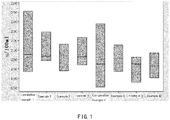
- Fig. 1 and Table 3 showed the results of the air permeability of the separators obtained in the examples and the comparative examples (wherein the heights of the rectangular bars indicate the distribution of the results of the air permeability in each of the examples and the comparative examples).
- the separators of Examples 1 to 6 have significantly smaller air permeability distribution range than the separators of Comparative Examples 1-2; therefore, the results in Fig. 1 and table 3 indicate that the performance consistency of the product is significantly improved by pre-stretching.
- FIG. 2A is an SEM image of a lithium-ion battery separator obtained without pre-stretching (Comparative Example 1);
- FIG. 2B is an SEM image of a lithium-ion battery separator obtained by pre-stretching (Example 1).
- the consistency of the pore size of the film that undergoes pre-stretching is significantly improved.
Landscapes
- Engineering & Computer Science (AREA)
- Chemical & Material Sciences (AREA)
- Chemical Kinetics & Catalysis (AREA)
- Electrochemistry (AREA)
- General Chemical & Material Sciences (AREA)
- Mechanical Engineering (AREA)
- Manufacturing & Machinery (AREA)
- Materials Engineering (AREA)
- Physics & Mathematics (AREA)
- Thermal Sciences (AREA)
- Cell Separators (AREA)
- Manufacture Of Porous Articles, And Recovery And Treatment Of Waste Products (AREA)
Abstract
Description
- The invention relates to electrochemical field, particularly to a method for preparing a lithium-ion battery separator.
- Good chemical stability and excellent physical properties make microporous films widely used in secondary lithium-ion batteries. Currently, there are mainly three kinds of processes for preparing microporous polyethylene films: the first process comprises processing polyolefin into fibrous form, and then processing the fibrous polyolefin into thin-film structure by a non-woven fabric process; the second process, which is a dry process, comprises melt extruding to obtain high crystalline and highly oriented polyolefin films, annealing to obtain a regular platelet structure, and high-temperature stretching to separate the platelets so as to obtain micropores; the third process, which is a wet process, i.e., TIPS (Thermally Induced Phase Separation) proposed by A. J. Castro, USA in 1981), wherein polyolefin and a filling agent are mixed at a high temperature to form a liquid-phase stabilization system, the polyolefin forms a solid phase during cooling while the filling agent remains in liquid phase, and the filling agent in the liquid phase is extracted using a solvent to form pores.
- As electric vehicles being widely used in life, battery packs comprising relatively large number of lithium-ion batteries connected in series or in parallel have emerged, such battery packs require good consistency of lithium-ion batteries. At the same time, lithium-ion batteries comprise separators for separating positive and negative electrode materials, and their safety requirements are also very high; in addition, the consistency of physical properties such as thickness and the high strength of separators are also important indicators for quality measurement.
- Currently, the mechanical strength of the separators is generally improved by using polyethylene with a higher molecular weight. However, the increased molecular weight of polyethylene tends to cause some disadvantageous effects, such as increased twin screw extrusion load, uneven mixture of polyethylene and filling agents, high load on the stretcher during stretching, non-uniform stretching, and slow stretching speed. These disadvantageous effects cause reduced production efficiency and decreased consistency of separators. In addition, excessively high molecular weight polyethylene may cause increased pore-closing temperature of separators, which also poses a safety hazard during the use of lithium-ion batteries.
- Therefore, there is an urgent need in the art to find a new method for preparing lithium-ion battery separators, which method enables the resulting separators to have high mechanical strength and excellent consistency in physical and chemical properties and to meet safety requirements during the use of lithium-ion batteries, while maintaining high production efficiency.
- The present invention aims at providing a method for preparing a lithium-ion battery separator and a lithium-ion battery separator manufactured by the method.
- In a first aspect of the present invention, there is provided a method for preparing a lithium-ion battery separator, comprising the steps of:
-
step 1, forming a liquid-phase stabilization system containing polyethylene and a filling agent; - step 2: forming the liquid-phase stabilization system into a cast film with the liquid-phase filling agent in a cooling system;
- step 3: subjecting the cast film to pre-stretching and then to synchronous bidirectional stretching, to form an intermediate film;
- step 4: extracting the filling agent contained in the intermediate film by using an organic solvent to form a microporous polyethylene film; and
- step 5: heat-setting the microporous polyethylene film at a near melting temperature of the polyethylene to obtain the lithium-ion battery separator of the present invention.
- In one embodiment, the pre-stretching is longitudinal stretching.
- In another embodiment, the pre-stretching is performed at a temperature between 80°C and 130°C.
- In another embodiment, the stretching ratio of the pre-stretching is 1.01-6; more preferably 1.01-3.
- In another embodiment, the synchronous bidirectional stretching includes transverse stretching and longitudinal stretching, and the stretching ratios of the transverse stretching and the longitudinal stretching are each 1.01 to 8, more preferably 4 to 8;
- In another embodiment, the liquid-phase stabilization system contains 18 to 50 wt% of polyethylene and 50 to 82 wt% of filling agent. In another embodiment, the polyethylene has a weight average molecular weight of 2×10⁵ to 3×10⁶, more preferably 8×10⁵ to 2×10⁶; the boiling point of the filling agent is above 200°C.
- In another embodiment, the organic solvent is an organic solvent that is miscible with the filling agent.
- In another embodiment, the filling agent is selected from liquid paraffin oil, dioctyl phthalate, dibutyl phthalate, or a combination thereof.
- In another embodiment, the near melting temperature of the polyethylene is 100-160°C, preferably 115-145°C.
- In a second aspect of the present invention, there is provided the lithium-ion battery separator obtained by the preparing method according to the present invention as described above.
- In a third aspect of the present invention, there is provided a use of the lithium-ion battery separator obtained by the preparing method according to the present invention as described above.
- Accordingly, the present invention provides a novel method for preparing a lithium-ion battery separator; the method enables the resulting separator to have high mechanical strength and excellent consistency in physical and chemical properties and to meet safety requirements during the use of lithium-ion batteries, while maintaining high production efficiency.
-
-
FIG. 1 is a boxplot of the longitudinal air permeability of the lithium-ion battery separators obtained according to the example of the present invention and a comparative example, respectively. -
FIG. 2A is an SEM image of a lithium-ion battery separator (Comparative Example 1) obtained without pre-stretching. -
FIG. 2B is an SEM image of a lithium-ion battery separator (Example 1) obtained by pre-stretching. - After extensive theoretical studies and production tests, the inventor found that the stretching manner and condition have an important effect on improving the mechanical strength and solving the consistency in physical and chemical properties in the manufacture of a lithium-ion battery separator by wet process. On such basis, the present invention has been completed.
- Specifically, the method for preparing a lithium-ion battery separator provided by present invention comprises: cooling and shaping a liquid-phase stabilization system containing polyethylene, stretching to enlarge pores, extracting with a solvent, and heat-setting to obtain a lithium-ion battery separator, wherein the stretching includes pre-stretching and synchronous bidirectional stretching, and the pre-stretching is completed before the synchronous bidirectional stretching.
- In an embodiment of the present invention, the method for preparing a lithium-ion battery separator comprises the steps of:
- step 1: forming a liquid-phase stabilization system containing polyethylene and a filling agent;
- step 2: forming the liquid-phase stabilization system obtained in the
step 1 into a cast film with the liquid-phase filling agent in a cooling system; - step 3: subjecting the cast film obtained in the
step 2 to pre-stretching and then to synchronous bidirectional stretching to form an intermediate film; - step 4: extracting the filling agent contained in the intermediate film obtained in the
step 3 by using an organic solvent to form a microporous polyethylene film; and - step 5: heat-setting the microporous polyethylene film obtained in the
step 4 at a near melting temperature of the polyethylene to obtain the lithium-ion battery separator of the present invention. - In
above step 1, the liquid-phase stabilization system containing polyethylene and a filling agent comprises 18 to 50wt% of polyethylene and 50 to 82wt% of a filling agent based on the total weight thereof. The polyethylene has a weight average molecular weight of 2×10⁵ to 3×10⁶, preferably 8×10⁵ to 2×10⁶, more preferably 8×10⁵ to 1.6×10⁶. The filling agent is a low molecular weight liquid organic substance with a molecular structure similar to polyethylene structure and having a boiling point above 200°C, for example, but not limited to, liquid paraffin oil, dioctyl phthalate, and dibutyl phthalate, and so on. The filling agent and the polyethylene form a thermodynamic single phase, i.e., a liquid-phase stabilization system, at a temperature under which polyethylene can be melted. Therefore, the temperature of forming liquid-phase stabilization system in thestep 1 is generally in a temperature range within which the used polyethylene can be melted, typically in the range of 140-260°C. Step 1 can be accomplished by means of conventional equipment in the art, for example, but not limited to, extruding a mixture containing polyethylene and a filling agent by using a twin screw extruder, and the extrusion temperature is typically 150-250°C. - In a preferred embodiment of the present invention, the separator according to the present invention may further contain additives, for example, but not limited to: an antioxidant that mitigates or even prevents the oxidation of materials during processing (e.g. Antioxidant 1010, with a dosage of 0.1 to 0.5% by weight), an antistatic agent that can reduce static electricity of finished separator, and an X-RAY fluorescent agent, and the like.
- In
above step 2, a solution of polyethylene and filling agent in thermodynamic single phase (i.e. the liquid-phase stabilization system obtained in the step 1) is cooled in a cooling system to normal temperature (10-80°C, preferably 10-60°C, more preferably 10-40°C) to form a cast film with the liquid-phase filling agent; a phase separation occurs between the polyethylene and the filling agent in the cast film, that is, the single phase formed in the early stage is divided into a polyethylene solid phase formed mainly of a polyethylene solidified lamella and a filling agent liquid phase. The formed cast film has a thickness of 400-1500 µm. A common cooling system may be used. In an embodiment of the present invention, a cooling system including a pressure roller is used to form the extruded melt into a cast film: a mixture containing polyethylene and a filling agent is extruded by using a twin screw extruder and sent to a cooling system; the gap between pressure rollers is adjusted and the corresponding pressure and thickness are controlled; and the effect of cooling quenching is adjusted by controlling the temperature of a contact roller and a cooling roller. - In the cast film obtained in the
above step 2, the microporous structure of the polyethylene solid phase is filled with a filling agent liquid phase. In theabove step 3, the microporous structure is expanded by stretching so that the filling agent is separated from the microporous structure. - In the
above step 3, the pre-stretching is performed firstly, at a stretching ratio of 1.01-6, more preferably 1.01-3; and then the synchronous bidirectional stretching including transverse stretching and longitudinal stretching is performed, the stretching ratios of the transverse stretching and the longitudinal stretching are each 1.01 to 8, more preferably 4 to 8. In a preferred embodiment, the stretching ratios of the transverse stretching and the longitudinal stretching are the same or slightly different. - The pre-stretching is performed in longitudinal or transverse direction, preferably longitudinal direction. The bidirectional stretching is preferably synchronous bidirectional stretching, but the stretching ratios of the longitudinal stretching and the transverse stretching may be the same or different.
- In this art, a longitudinal stretching generally refers to a stretching along the direction of film advancement; transverse stretching refers to a stretching perpendicular to the direction of film advancement; and synchronous bidirectional stretching refers to a stretching performed simultaneously in both longitudinal and transverse directions.
- The stretching temperature can be adjusted within a certain range according to the specification of the film to be obtained and the stretching ratio. Generally, the range of the stretching temperature for adjustment can be set by referring to the Tm of the differential thermal analysis performed on the cast film obtained in the step 2 (there may be some deviations). The pre-stretching temperature is in the range of 80-130°C, preferably 90-120°C; the synchronous bidirectional stretching temperature is in the range of 90-150°C, preferably 100-140°C.
- The production speed of the pre-stretching ranges from 1 to 8 m/min; and the production speed of the synchronous bidirectional stretching ranges from 10 to 80 m/min.
- Stretching may be performed using common equipment in the art, as long as the stretching requirements of the present invention can be met. That is, by pre-stretching and synchronous bidirectional stretching, the cast film forms a structure having uniform pore size after subjected to the pre-stretching and the synchronous bidirectional stretching. At the same time, the pre-stretching enables the film to have a certain molecular orientation, so that the strength of the entire film can be improved. The synchronous bidirectional stretching makes the pore size uniform, which can improve the consistency of permeability and mechanical strength.
- The intermediate film formed in the
above step 3 has a thickness of 10 to 50 µm, preferably 12 to 45 µm, more preferably 14 to 40 µm. The formed intermediate film is subjected to theabove step 4, i.e., extracting the filling agent using an organic solvent to form a microporous polyethylene film having a uniform pore size. - The organic solvent may be any solvent capable of extracting the filling agent in the porous film, for example, but not limited to, methyl ethyl ketone, dichloromethane and isoamylene.
- The extraction of filling agent includes, but is not limited to, one or more of impregnation, ultrasonic cleaning, diacolation, and the like. It is desired that the less filling agent remains after extraction the better. Up to 0.8 wt% of remaining filling agent is allowable on the basis of total weight of the microporous polyethylene film obtained.
- In a preferred embodiment of the present invention, the filling agent is extracted by ultrasonic washing, then the amount of the remaining filling agent largely depends on the ultrasonic frequency and time for extraction. Considering thickness and organic solvent residues, generally an organic solvent with relatively high vapor pressure is utilized. In addition, the volatilization of organic solvents tends to take away heat, thus it is generally difficult to increase the speed of molecular motion by adjusting the temperature to improve the efficiency of extraction. Therefore, the efficiency of extraction is improved generally by ultrasonic principle and increased time. However, since the fluctuation ultrasonic wave tends to generate heat and bring safety hazards, the efficiency of extraction is generally improved by lengthening the distance across the extraction section. The extraction time depends on the film thickness. In the manufacture of a microporous film having a thickness of 10 to 30 µm, for example, the extraction time is preferably 2 to 4 minutes.
- In the
above step 5, the microporous polyethylene film obtained in theabove step 4 is subjected to a heat-setting treatment to remove the residual stress and to reduce the shrinkage of the resulting film. By the heat-setting treatment, the pore structure of the film can be fixed, and then the film is heated to forcefully maintain the original shape of the film so as to eliminate residual stress. When the heat-setting temperature is high, the heat-setting time is relatively short; and when the heat-setting temperature is low, the heat-setting time is relatively long. However, when the heat-setting temperature is relatively high, the polyethylene tends to melt; and when the heat-setting temperature is relatively low, the processing time is too long. Preferably, within the crystallization temperature range of the polyethylene, the heat-setting time is 20 to 120 seconds. The heat-setting temperature ranges typically from 100 to 160°C, preferably 115 to 145°C. - The above features mentioned in the present invention or the features mentioned in the examples can be combined at will. All the features disclosed in the specification of the present application can be used in combination with any composition. Each feature disclosed in the specification can be replaced with any alternative feature that can provide identical, equivalent or similar purposes. Therefore, unless specified otherwise, the features disclosed herein are only general examples of identical or similar features.
- The main advantages of the present invention are:
- 1. The lithium-ion battery separator product obtained by the manufacture method according to the present invention has high mechanical strength, and the micro pore sizes in the separator are uniform and controllable.
- 2. The present invention provides a lithium-ion battery separator with higher mechanical strength, not by using polyethylene with higher molecular weight, but with control on the intrinsic viscosity of polyethylene, to more efficiently achieve high-speed production.
- 3. The lithium-ion battery separator manufactured by the present invention is used for a lithium-ion battery, and can effectively decrease the short circuit generated during the processing, and can reduce the potential safety hazards during use, such as self-discharge and micro-short circuit.
- The present invention will be further described hereinafter in combination with specific examples. It should be understood that these examples are used only to illustrate present invention and are not intended to limit the scope of present invention. The experimental method in the following examples whose specific condition is not specified are generally in accordance with conventional conditions or conditions recommended by manufacturers. Unless otherwise specified, all percentages, ratios, proportions, or parts are measured by weight.
- The unit of weight-volume percent in the present invention is well known to those skilled in the art, and refers to, for example, the weight of a solute in a 100 ml solution.
- Unless otherwise defined, all professional and scientific terms used herein have the same meaning as those familiar to the skilled person in the art. In addition, any methods and materials similar or equivalent to those described herein can be used in the method of the present invention. The preferred methods and materials described herein are for demonstration purposes only.
- The intrinsic viscosity of polyethylene involved in the following examples of the present invention is determined according to the standard of "EN ISO 1628-3-2010 Plastics-Determination of the viscosity of polymers in dilute solution using capillary viscometers-Part 3: Polyethylenes and polypropylenes".
- The steps, methods, and materials involved in the following examples include:
The polyethylene and the filling agent are mixed and extruded using a twin-screw extruder (ϕ=30 mm) at an extrusion temperature of 150 to 250°C for a residence time of 3 minutes, and the melt extruded from the trapezoidal die is formed into a sheet having a thickness of 400 to 1500 µm (i.e. a cast film) using a cooling system including a pressure roller. - The sheet is analyzed by DSC to assess the melting of the crystalline part under different temperature conditions. The analysis instrument is a differential scanning calorimeter (DSC) produced by Mettler with a sample weight of 10 mg±2 mg and a heating rate of 10°C/min.
- In the present invention, the stretching ratio, the temperature and the speed are controlled by improving the stretching system section, wherein the stretching temperature may depend on the results of DSC test.
- The filling agent can be extracted directly using a ultrasonic washer for experiment: a stretched intermediate film sample with a size of 15 cm x 15 cm is placed in the washer and extracted with dichloromethane filling agent; ultrasonic washings are carried out for several times and each washing lasts for 10 min, and the amount of the residual filling agent in the sample is measured after each washing until the difference in the amount of the residual filling agent in the sample after two consecutive washings does not exceed 10%, then it is considered that the extraction of the filling agent is completed, and the total washing time when the previous washing in the two consecutive washings is completed is taken as the actual extraction time.
- The film (microporous polyethylene film) after extracting the filling agent is placed in an oven with multi-section temperature setting; and the baking temperature and the time of different sections are set according to the requirements of production, thereby the heat-setting process is completed.
- The physical and chemical properties of the separator are measured, such as, tensile strength, pin puncture strength, liquid absorption rate, liquid retention rate, porosity, air permeability, thermal shrinkage, thickness.
- The method of measuring the liquid absorption rate is as follows: a piece of 40 mm x 60 mm lithium-ion battery separator manufactured by the present invention is immersed completely in an electrolyte solution for one hour, and the liquid absorption rate is calculated by weighing the weight before and after the immersion.
- The method of measuring the liquid retention rate is as follows: a lithium-ion battery separator manufactured by the present invention is impregnated with an electrolyte solution, then the separator is placed under a normal temperature and normal humidity condition for one hour, and the liquid retention rate is calculated by weighing the weight before and after the placement.
- Thickness: GB/T 6672-2001 ISO 4593:1993. The thickness test is performed using a Marr thickness gauge.
- Tensile strength: GB 6672-2001. A sample having a width of 15 mm is tensiled using a universal tensile tester at a speed of 200 mm/min.
- Pin puncture strength: the force needed to puncture the product with a ϕ1mm pin at a certain speed.
- Air permeability: the time required for 100 ml air to pass through a ϕ1 inch circular cross-section in Curley test.
- Porosity: the porosity of the sample separator is measured by gravimetric method: [(raw material density × sample area × sample thickness) - sample weight] / (raw material density × sample area × sample thickness).
- Thermal shrinkage: testing according to GB/T 2027-2004.
- Polyethylene having a weight average molecular weight of 1.4×10⁶ to 1.6×10⁶ was used as component I, and a paraffin oil having a kinematic viscosity of (7-8) mm2/s at 100°C was used as component II (filling agent). The contents of component I and component II were 30 wt% and 70 wt%, respectively.
- The pre-stretching was performed at a temperature of 103°C with a stretching ratio of 1.2; the synchronous bidirectional stretching was performed at a temperature of 125°C with a longitudinal stretching ratio of 5 and a transverse stretching ratio of 6.
- Polyethylene having a weight average molecular weight of 1.4×10⁶ to 1.6×10⁶ was used as component I, and a paraffin oil having a kinematic viscosity of (7-8) mm2/s at 100°C was used as component II (filling agent). The contents of component I and component II were 30 wt% and 70 wt%, respectively.
- The pre-stretching was performed at a temperature of 98°C at a stretching ratio of 1.5; the synchronous bidirectional stretching was performed at a temperature of 120°C with a longitudinal stretching ratio of 4 and a transverse stretching ratio of 6.
- Polyethylene having a weight average molecular weight of 1.4×10⁶ to 1.6×10⁶ was used as component I, and a paraffin oil having a kinematic viscosity of (7-8) mm2/s at 100°C was used as component II (filling agent). The contents of component I and component II were 30 wt% and 70 wt%, respectively.
- The pre-stretching was performed at a temperature of 88°C at a stretching ratio of 2; the synchronous bidirectional stretching was performed at a temperature of 115°C with a longitudinal stretching ratio of 3 and a transverse stretching ratio of 6.
- Polyethylene having a weight average molecular weight of 8×10⁵ to 1×10⁶ was used as component I, and a paraffin oil having a kinematic viscosity of (7-8) mm2/s at 100°C was used as component II (filling agent). The contents of component I and component II were 30 wt% and 70 wt%, respectively.
- The pre-stretching was performed at a temperature of 103°C at a stretching ratio of 1.2; the synchronous bidirectional stretching was performed at a temperature of 125°C with a longitudinal stretching ratio of 5 and a transverse stretching ratio of 7.5.
- Polyethylene having a weight average molecular weight of 8×10⁵ to 1×10⁶ was used as component I, and a paraffin oil having a kinematic viscosity of (7-8) mm2/s at 100°C was used as component II (filling agent). The contents of component I and component II were 30 wt% and 70 wt%, respectively.
- The pre-stretching was performed at a temperature of 98°C at a stretching ratio of 1.5; the synchronous bidirectional stretching was performed at a temperature of 120°C with a longitudinal stretching ratio of 4 and a transverse stretching ratio of 7.5.
- Polyethylene having a weight average molecular weight of 8×10⁵ to 1×10⁶ was used as component I, and a paraffin oil having a kinematic viscosity of (7-8) mm2/s at 100°C was used as component II (filling agent). The contents of component I and component II were 30 wt% and 70 wt%, respectively.
- The pre-stretching was performed at a temperature of 88°C at a stretching ratio of 2; the synchronous bidirectional stretching was performed at a temperature of 115°C with a longitudinal stretching ratio of 3 and a transverse stretching ratio of 7.5.
- Polyethylene having a weight average molecular weight of 1.4×10⁶ to 1.6×10⁶ was used as component I, and a paraffin oil having a kinematic viscosity of (7-8) mm2/s at 100°C was used as component II (filling agent). The contents of component I and component II were 30 wt% and 70 wt%, respectively.
- The cast film passed through the pre-stretching roller but did not subject to any pre-stretching, and subjected to synchronous bidirectional stretching directly; the synchronous bidirectional stretching was performed at a temperature of 130°C with a longitudinal stretching ratio of 6 and a transverse stretching ratio of 6.
- Polyethylene having a weight average molecular weight of 8×10⁵ to 1×10⁶ was used as component I, and a paraffin oil having a kinematic viscosity of (7-8) mm2/s at 100°C was used as component II (filling agent). The contents of component I and component II were 30 wt% and 70 wt%, respectively.
- The cast film passed through the pre-stretching roller but did not subject to any pre-stretching, and subjected to synchronous bidirectional stretching directly; the synchronous bidirectional stretching was performed at a temperature of 130°C with a longitudinal stretching ratio of 6 and a transverse stretching ratio of 7.5.
Table 1 Examples 1-6 Examples manufacture conditions and test results units 1 2 3 4 5 6 Pre-stretching (longitudinal) Stretching temperature °C 103 98 88 103 98 88 Stretching ratio - 1.2 1.5 2 1.2 1.5 2 Synchronous bidirectional stretch ing Stretching temperature °C 115 110 105 120 115 110 Longitudinal stretching ratio - 5 4 3 5 4 3 Transverse stretching ratio 6 6 6 7.5 7.5 7.5 Thickness µm 12 12 12 12 12 12 Thickness Cpk - 1.92 1.87 1.83 1.96 1.82 1.71 Tensile strength MD kgf/cm2 1671 1715 1770 1692 1735 1816 TD kgf/cm2 1542 1530 1523 1687 1576 1627 Pin puncture strength gf 415 448 476 424 457 483 Air permeability sec/100ml 209 203 207 202 192 194 Porosity % 40 41 43 41 42 44 Liquid absorption rate % 95 108 110 94 109 115 liquid retention rate % 85 88 90 87 91 93 105°C thermal shrinkage MD % 2.76 2.82 2.75 2.82 2.75 2.62 TD % 0.09 0.12 0.13 0.13 0.15 0.14 Table 2 Comparative Examples 1-2 Comparative Examples manufacture conditions and test results units 1 2 Pre-stretching Temperature °C 108 108 ratio - No No Synchronous bidirectional stretching Stretching temperature °C 120 125 Longitudinal ratio - 6 6 Transverse ratio 6 7.5 Thickness µm 12 12 Thickness Cpk - 1.76 1.85 Tensile strength MD kgf/cm2 1430 1493 TD kgf/cm2 1365 1461 Pin puncture strength gf 397 390 Air permeability sec/100ml 206 196 Porosity % 38 39 Liquid absorption rate % 88 92 liquid retention rate % 82 83 105°C thermal shrinkage MD % 2.89 2.73 TD % 0.14 0.15 - As can be seen from the results in Tables 1 and 2, the separators obtained in Examples 1-6 have significantly higher tensile strength and pin puncture strength than the separators obtained in Comparative Examples 1-2. The results of Tables 1 and 2 showed that by adding pre-stretching before synchronous bidirectional stretching, and controlling the stretching ratio and stretching temperature of the pre-stretching and synchronous bidirectional stretching (the separator gauge was 12 µm in the examples), the present invention tends to achieve a film having a smooth appearance and a uniform thickness after the pre-stretching and the synchronous bidirectional stretching, which contributes to form a film with higher mechanical strength, and can be used in various lithium-ion batteries.
Table 3 boxplot data of air permeability in the examples and the comparative examples Comparative Example1 Example 1 Example 2 Example 3 Comparative Example2 Example 4 Example 5 Example 6 Sample size 100 100 100 100 100 100 100 100 Maximum 251 229 216 224 238 215 203 207 Minimum 187 199 188 195 171 187 176 181 Range 64 30 28 29 67 28 27 26 CPK 1.34 1.64 1.58 1.55 1.36 1.61 1.56 1.52 Average 206 209 203 207 196 202 192 194 -
Fig. 1 and Table 3 showed the results of the air permeability of the separators obtained in the examples and the comparative examples (wherein the heights of the rectangular bars indicate the distribution of the results of the air permeability in each of the examples and the comparative examples). As can be seen fromFig. 1 and table 3, the separators of Examples 1 to 6 have significantly smaller air permeability distribution range than the separators of Comparative Examples 1-2; therefore, the results inFig. 1 and table 3 indicate that the performance consistency of the product is significantly improved by pre-stretching. -
Fig. 2A is an SEM image of a lithium-ion battery separator obtained without pre-stretching (Comparative Example 1);FIG. 2B is an SEM image of a lithium-ion battery separator obtained by pre-stretching (Example 1). As can be seen by comparingFigs. 2A and 2B , the consistency of the pore size of the film that undergoes pre-stretching is significantly improved. - The above descriptions are merely preferred embodiments of the present invention, and are not intended to limit the scope of the substantive technical content of the present invention. The substantive technical content of the present invention is defined broadly within the scope of the claims of the present application. Any technical entity or method performed by another person, if it is exactly the same as defined in the scope of the claims of the present application, or an equivalent modification, will be deemed to be covered by the scope of the claims.
Claims (13)
- A method for preparing a lithium-ion battery separator, comprising the steps of:step 1: forming a liquid-phase stabilization system containing polyethylene and a filling agent;step 2: forming the liquid-phase stabilization system into a cast film with the liquid-phase filling agent in a cooling system;step 3: subjecting the cast film to pre-stretching and then to synchronous bidirectional stretching to form an intermediate film;step 4: extracting the filling agent contained in the intermediate film by using an organic solvent to form a microporous polyethylene film; andstep 5: heat-setting the microporous polyethylene film in a temperature range that the crystalline polyethylene partially melts to obtain the lithium-ion battery separator.
- The manufacture method according to claim 1, wherein the pre-stretching is a longitudinal stretching.
- The manufacture method according to claim 1, wherein the pre-stretching is performed at a temperature of 80°C to 130°C.
- The manufacture method according to any one of claims 1 to 3, wherein the stretching ratio of the pre-stretching is 1.01-6; preferably 1.01-3.
- The manufacture method according to claim 1, wherein the synchronous bidirectional stretching includes transverse stretching and longitudinal stretching, wherein the stretching ratios of the transverse stretching and the longitudinal stretching are each 1.01-8, preferably 4-8.
- The manufacture method according to claim 1, wherein the liquid-phase stabilization system contains 18-50 wt% of the polyethylene and 50-82 wt% of the filling agent.
- The manufacture method according to claim 1, wherein the polyethylene has a weight average molecular weight of 2 × 10⁵ to 3 × 10⁶; preferably 8 × 10⁵ to 2 × 10⁶.
- The manufacture method according to claim 1, wherein the filling agent has a boiling point above 200°C.
- The manufacture method according to claim 1, wherein the filling agent is selected from the group consisting of liquid paraffin oil, dioctyl phthalate, dibutyl phthalate or a combination thereof.
- The manufacture method according to claim 1, wherein the organic solvent is an organic solvent that is miscible with the filling agent.
- The manufacture method according to claim 1, wherein the organic solvent is selected from the group consisting of methyl ethyl ketone, dichloromethane, isoamylene or a combination thereof.
- The manufacture method according to claim 1, wherein the near melting temperature of the polyethylene is 100-160°C, preferably 115-145°C.
- A lithium-ion battery separator obtained by the manufacture method according to any one of claims 1-12.
Applications Claiming Priority (2)
| Application Number | Priority Date | Filing Date | Title |
|---|---|---|---|
| CN201610127268.0A CN105552280B (en) | 2016-03-07 | 2016-03-07 | A kind of preparation method of lithium ion battery separator |
| PCT/CN2017/073087 WO2017152731A1 (en) | 2016-03-07 | 2017-02-08 | Method for preparing lithium-ion battery separator |
Publications (3)
| Publication Number | Publication Date |
|---|---|
| EP3428996A1 true EP3428996A1 (en) | 2019-01-16 |
| EP3428996A4 EP3428996A4 (en) | 2019-08-28 |
| EP3428996B1 EP3428996B1 (en) | 2023-08-09 |
Family
ID=55831346
Family Applications (1)
| Application Number | Title | Priority Date | Filing Date |
|---|---|---|---|
| EP17762417.8A Active EP3428996B1 (en) | 2016-03-07 | 2017-02-08 | Method for preparing lithium-ion battery separator |
Country Status (13)
| Country | Link |
|---|---|
| US (1) | US11101524B2 (en) |
| EP (1) | EP3428996B1 (en) |
| JP (1) | JP2019509591A (en) |
| KR (1) | KR102181448B1 (en) |
| CN (1) | CN105552280B (en) |
| DK (1) | DK3428996T3 (en) |
| ES (1) | ES2954663T3 (en) |
| FI (1) | FI3428996T3 (en) |
| HU (1) | HUE063237T2 (en) |
| LT (1) | LT3428996T (en) |
| PL (1) | PL3428996T3 (en) |
| PT (1) | PT3428996T (en) |
| WO (1) | WO2017152731A1 (en) |
Families Citing this family (7)
| Publication number | Priority date | Publication date | Assignee | Title |
|---|---|---|---|---|
| CN105552280B (en) * | 2016-03-07 | 2018-09-11 | 上海恩捷新材料科技股份有限公司 | A kind of preparation method of lithium ion battery separator |
| CN110048054A (en) * | 2018-01-16 | 2019-07-23 | 溧阳月泉电能源有限公司 | A kind of production method and system of Rapid Extraction oil-containing substrate |
| CN110048055A (en) * | 2018-01-16 | 2019-07-23 | 溧阳月泉电能源有限公司 | A kind of production method and system of lithium ion secondary battery membrane |
| CN110416470B (en) * | 2019-08-07 | 2022-03-11 | 江苏厚生新能源科技有限公司 | Battery separator and preparation process thereof, and improved method for reducing the consumption of dichloromethane |
| CN114512767B (en) * | 2020-11-16 | 2022-11-15 | 青岛蓝科途膜材料有限公司 | Lithium-ion battery separator, its preparation method and lithium-ion battery made therefrom |
| CN114228122B (en) * | 2022-02-24 | 2022-06-14 | 佛山市盟思拉伸机械有限公司 | Film bidirectional mixed stretching device and method |
| CN114914631A (en) * | 2022-06-29 | 2022-08-16 | 上海恩捷新材料科技有限公司 | Ultrahigh-strength diaphragm and preparation method thereof |
Family Cites Families (15)
| Publication number | Priority date | Publication date | Assignee | Title |
|---|---|---|---|---|
| JP2657430B2 (en) | 1991-01-30 | 1997-09-24 | 東燃株式会社 | Polyolefin microporous membrane and method for producing the same |
| JP4344550B2 (en) | 2002-06-25 | 2009-10-14 | 東燃化学株式会社 | Method for producing polyolefin microporous membrane and polyolefin microporous membrane |
| JP4600970B2 (en) * | 2003-11-28 | 2010-12-22 | 旭化成イーマテリアルズ株式会社 | Method for producing polyolefin microporous membrane |
| WO2009084719A1 (en) | 2007-12-31 | 2009-07-09 | Tonen Chemical Corporation | Microporous membrane, process for producing such a membrane and the use of such a membrane |
| CN102241832B (en) | 2011-05-14 | 2013-08-28 | 中材科技股份有限公司 | Polyolefin film and preparation method thereof |
| JP5920602B2 (en) * | 2011-07-22 | 2016-05-18 | 東レバッテリーセパレータフィルム株式会社 | Method for producing microporous polyethylene film |
| CN102569699A (en) * | 2011-12-02 | 2012-07-11 | 佛山市金辉高科光电材料有限公司 | Preparation method of power lithium battery diaphragm |
| CN102850573B (en) * | 2012-09-21 | 2014-08-13 | 中国乐凯集团有限公司 | Method for preparation of polyolefin microporous membrane by wet process |
| CN102931371B (en) * | 2012-11-13 | 2015-07-08 | 辽源鸿图锂电隔膜科技股份有限公司 | Battery diaphragm preparation method |
| CN103522550A (en) * | 2013-10-27 | 2014-01-22 | 中国乐凯集团有限公司 | Polyolefin microporous film preparation method for lithium ion battery and microporous film |
| CN103724951B (en) * | 2013-12-27 | 2016-01-20 | 四川东方绝缘材料股份有限公司 | Serondary lithium battery polyester micro-pore septum and preparation method thereof |
| CN103840113B (en) * | 2014-02-28 | 2016-08-24 | 苏州捷力新能源材料有限公司 | A kind of preparation method of the polyethylene separators for lithium battery |
| HUE051857T2 (en) * | 2014-08-12 | 2021-03-29 | Toray Industries | Polyolefin microporous film and method for manufacturing same, separator for nonaqueous electrolyte secondary cell, and nonaqueous electrolyte secondary cell |
| CN104327351B (en) * | 2014-10-20 | 2017-10-03 | 上海恩捷新材料科技股份有限公司 | A kind of microporous polyethylene film |
| CN105552280B (en) | 2016-03-07 | 2018-09-11 | 上海恩捷新材料科技股份有限公司 | A kind of preparation method of lithium ion battery separator |
-
2016
- 2016-03-07 CN CN201610127268.0A patent/CN105552280B/en active Active
-
2017
- 2017-02-08 US US16/082,711 patent/US11101524B2/en active Active
- 2017-02-08 PL PL17762417.8T patent/PL3428996T3/en unknown
- 2017-02-08 JP JP2018543309A patent/JP2019509591A/en active Pending
- 2017-02-08 WO PCT/CN2017/073087 patent/WO2017152731A1/en not_active Ceased
- 2017-02-08 HU HUE17762417A patent/HUE063237T2/en unknown
- 2017-02-08 KR KR1020187027760A patent/KR102181448B1/en active Active
- 2017-02-08 PT PT177624178T patent/PT3428996T/en unknown
- 2017-02-08 LT LTEPPCT/CN2017/073087T patent/LT3428996T/en unknown
- 2017-02-08 EP EP17762417.8A patent/EP3428996B1/en active Active
- 2017-02-08 DK DK17762417.8T patent/DK3428996T3/en active
- 2017-02-08 ES ES17762417T patent/ES2954663T3/en active Active
- 2017-02-08 FI FIEP17762417.8T patent/FI3428996T3/en active
Also Published As
| Publication number | Publication date |
|---|---|
| WO2017152731A1 (en) | 2017-09-14 |
| EP3428996B1 (en) | 2023-08-09 |
| PT3428996T (en) | 2023-09-04 |
| US11101524B2 (en) | 2021-08-24 |
| CN105552280B (en) | 2018-09-11 |
| HUE063237T2 (en) | 2024-01-28 |
| CN105552280A (en) | 2016-05-04 |
| KR102181448B1 (en) | 2020-11-23 |
| FI3428996T3 (en) | 2023-09-01 |
| PL3428996T3 (en) | 2023-11-06 |
| DK3428996T3 (en) | 2023-09-04 |
| KR20180118711A (en) | 2018-10-31 |
| US20190393463A1 (en) | 2019-12-26 |
| JP2019509591A (en) | 2019-04-04 |
| LT3428996T (en) | 2023-09-11 |
| ES2954663T3 (en) | 2023-11-23 |
| EP3428996A4 (en) | 2019-08-28 |
Similar Documents
| Publication | Publication Date | Title |
|---|---|---|
| EP3428996B1 (en) | Method for preparing lithium-ion battery separator | |
| CN101983219B (en) | Polyolefin microporous film and roll | |
| EP3960421B1 (en) | Device and method for preparing high-strength high-modulus polyolefin thin film, and high-strength high-modulus polyolefin thin film | |
| US20230216140A1 (en) | Lithium-ion battery separator, preparation method thereof, and lithium-ion battery prepared therefrom | |
| US8486521B2 (en) | Microporous polyethylene film with good property of strength and permeability at high temperature | |
| CN104327351B (en) | A kind of microporous polyethylene film | |
| KR100943697B1 (en) | Polyethylene microporous membrane with excellent physical properties, productivity and quality uniformity and its manufacturing method | |
| CN103178227A (en) | Polyethylene based composite material microporous diaphragm with hot-pressing adhesive characteristic | |
| CN109517210A (en) | Ultra-thin, high-strength polyolefin microporous membrane and preparation method thereof | |
| US20170092920A1 (en) | Polyolefin microporous membrane and production method thereof | |
| CN101223217A (en) | Microporous polyethylene film prepared by liquid-liquid phase separation mechanism and preparation method thereof | |
| CN115020909B (en) | Diaphragm for lithium ion battery and preparation method thereof | |
| CN105428574B (en) | A kind of lithium battery micro-pore septum and preparation method thereof | |
| CN111086181A (en) | Preparation method of lithium battery diaphragm | |
| JPWO2011043160A1 (en) | Porous polypropylene film roll | |
| CN105355811A (en) | Polyolefin microporous membrane, making method thereof, and lithium ion battery | |
| KR20150066532A (en) | Microporous separator film having homogeneous porosity and greater resistance to puncturing | |
| KR101970492B1 (en) | A resin composition for manufacturing a porous separator | |
| KR20230063283A (en) | Polyolefin microporous membrane and manufacturing method thereof | |
| JP2009149710A (en) | Polyolefin microporous membrane | |
| JP5274081B2 (en) | Polyolefin microporous membrane | |
| CN112886136A (en) | Polyolefin microporous barrier film | |
| CN112795066A (en) | Polyolefin microporous membrane | |
| KR20120063876A (en) | Manufacturing method of polyolefin separator for lithium secondary battery and polyolefin separator therefrom | |
| JP2011162669A (en) | Porous polypropylene film roll and method for producing the same |
Legal Events
| Date | Code | Title | Description |
|---|---|---|---|
| STAA | Information on the status of an ep patent application or granted ep patent |
Free format text: STATUS: THE INTERNATIONAL PUBLICATION HAS BEEN MADE |
|
| PUAI | Public reference made under article 153(3) epc to a published international application that has entered the european phase |
Free format text: ORIGINAL CODE: 0009012 |
|
| STAA | Information on the status of an ep patent application or granted ep patent |
Free format text: STATUS: REQUEST FOR EXAMINATION WAS MADE |
|
| 17P | Request for examination filed |
Effective date: 20180926 |
|
| AK | Designated contracting states |
Kind code of ref document: A1 Designated state(s): AL AT BE BG CH CY CZ DE DK EE ES FI FR GB GR HR HU IE IS IT LI LT LU LV MC MK MT NL NO PL PT RO RS SE SI SK SM TR |
|
| AX | Request for extension of the european patent |
Extension state: BA ME |
|
| DAV | Request for validation of the european patent (deleted) | ||
| DAX | Request for extension of the european patent (deleted) | ||
| A4 | Supplementary search report drawn up and despatched |
Effective date: 20190726 |
|
| RIC1 | Information provided on ipc code assigned before grant |
Ipc: H01M 10/0525 20100101ALI20190722BHEP Ipc: H01M 2/16 20060101ALI20190722BHEP Ipc: H01M 2/14 20060101AFI20190722BHEP |
|
| STAA | Information on the status of an ep patent application or granted ep patent |
Free format text: STATUS: EXAMINATION IS IN PROGRESS |
|
| 17Q | First examination report despatched |
Effective date: 20220429 |
|
| REG | Reference to a national code |
Ref country code: DE Free format text: PREVIOUS MAIN CLASS: H01M0002140000 Ref country code: DE Ref legal event code: R079 Ref document number: 602017072473 Country of ref document: DE Free format text: PREVIOUS MAIN CLASS: H01M0002140000 Ipc: H01M0050403000 |
|
| GRAP | Despatch of communication of intention to grant a patent |
Free format text: ORIGINAL CODE: EPIDOSNIGR1 |
|
| STAA | Information on the status of an ep patent application or granted ep patent |
Free format text: STATUS: GRANT OF PATENT IS INTENDED |
|
| RIC1 | Information provided on ipc code assigned before grant |
Ipc: H01M 50/417 20210101ALI20230504BHEP Ipc: H01M 10/0525 20100101ALI20230504BHEP Ipc: H01M 50/403 20210101AFI20230504BHEP |
|
| INTG | Intention to grant announced |
Effective date: 20230519 |
|
| GRAS | Grant fee paid |
Free format text: ORIGINAL CODE: EPIDOSNIGR3 |
|
| GRAA | (expected) grant |
Free format text: ORIGINAL CODE: 0009210 |
|
| STAA | Information on the status of an ep patent application or granted ep patent |
Free format text: STATUS: THE PATENT HAS BEEN GRANTED |
|
| AK | Designated contracting states |
Kind code of ref document: B1 Designated state(s): AL AT BE BG CH CY CZ DE DK EE ES FI FR GB GR HR HU IE IS IT LI LT LU LV MC MK MT NL NO PL PT RO RS SE SI SK SM TR |
|
| REG | Reference to a national code |
Ref country code: GB Ref legal event code: FG4D |
|
| REG | Reference to a national code |
Ref country code: CH Ref legal event code: EP |
|
| REG | Reference to a national code |
Ref country code: DE Ref legal event code: R096 Ref document number: 602017072473 Country of ref document: DE |
|
| REG | Reference to a national code |
Ref country code: RO Ref legal event code: EPE |
|
| REG | Reference to a national code |
Ref country code: IE Ref legal event code: FG4D |
|
| REG | Reference to a national code |
Ref country code: FI Ref legal event code: FGE |
|
| REG | Reference to a national code |
Ref country code: PT Ref legal event code: SC4A Ref document number: 3428996 Country of ref document: PT Date of ref document: 20230904 Kind code of ref document: T Free format text: AVAILABILITY OF NATIONAL TRANSLATION Effective date: 20230830 Ref country code: DK Ref legal event code: T3 Effective date: 20230830 |
|
| REG | Reference to a national code |
Ref country code: SE Ref legal event code: TRGR |
|
| P01 | Opt-out of the competence of the unified patent court (upc) registered |
Effective date: 20230901 |
|
| REG | Reference to a national code |
Ref country code: NO Ref legal event code: T2 Effective date: 20230809 |
|
| REG | Reference to a national code |
Ref country code: NL Ref legal event code: MP Effective date: 20230809 |
|
| REG | Reference to a national code |
Ref country code: AT Ref legal event code: MK05 Ref document number: 1598587 Country of ref document: AT Kind code of ref document: T Effective date: 20230809 |
|
| PG25 | Lapsed in a contracting state [announced via postgrant information from national office to epo] |
Ref country code: GR Free format text: LAPSE BECAUSE OF FAILURE TO SUBMIT A TRANSLATION OF THE DESCRIPTION OR TO PAY THE FEE WITHIN THE PRESCRIBED TIME-LIMIT Effective date: 20231110 |
|
| PG25 | Lapsed in a contracting state [announced via postgrant information from national office to epo] |
Ref country code: IS Free format text: LAPSE BECAUSE OF FAILURE TO SUBMIT A TRANSLATION OF THE DESCRIPTION OR TO PAY THE FEE WITHIN THE PRESCRIBED TIME-LIMIT Effective date: 20231209 |
|
| REG | Reference to a national code |
Ref country code: HU Ref legal event code: AG4A Ref document number: E063237 Country of ref document: HU |
|
| PG25 | Lapsed in a contracting state [announced via postgrant information from national office to epo] |
Ref country code: RS Free format text: LAPSE BECAUSE OF FAILURE TO SUBMIT A TRANSLATION OF THE DESCRIPTION OR TO PAY THE FEE WITHIN THE PRESCRIBED TIME-LIMIT Effective date: 20230809 Ref country code: NL Free format text: LAPSE BECAUSE OF FAILURE TO SUBMIT A TRANSLATION OF THE DESCRIPTION OR TO PAY THE FEE WITHIN THE PRESCRIBED TIME-LIMIT Effective date: 20230809 Ref country code: LV Free format text: LAPSE BECAUSE OF FAILURE TO SUBMIT A TRANSLATION OF THE DESCRIPTION OR TO PAY THE FEE WITHIN THE PRESCRIBED TIME-LIMIT Effective date: 20230809 Ref country code: IS Free format text: LAPSE BECAUSE OF FAILURE TO SUBMIT A TRANSLATION OF THE DESCRIPTION OR TO PAY THE FEE WITHIN THE PRESCRIBED TIME-LIMIT Effective date: 20231209 Ref country code: HR Free format text: LAPSE BECAUSE OF FAILURE TO SUBMIT A TRANSLATION OF THE DESCRIPTION OR TO PAY THE FEE WITHIN THE PRESCRIBED TIME-LIMIT Effective date: 20230809 Ref country code: GR Free format text: LAPSE BECAUSE OF FAILURE TO SUBMIT A TRANSLATION OF THE DESCRIPTION OR TO PAY THE FEE WITHIN THE PRESCRIBED TIME-LIMIT Effective date: 20231110 Ref country code: AT Free format text: LAPSE BECAUSE OF FAILURE TO SUBMIT A TRANSLATION OF THE DESCRIPTION OR TO PAY THE FEE WITHIN THE PRESCRIBED TIME-LIMIT Effective date: 20230809 |
|
| PG25 | Lapsed in a contracting state [announced via postgrant information from national office to epo] |
Ref country code: SM Free format text: LAPSE BECAUSE OF FAILURE TO SUBMIT A TRANSLATION OF THE DESCRIPTION OR TO PAY THE FEE WITHIN THE PRESCRIBED TIME-LIMIT Effective date: 20230809 Ref country code: EE Free format text: LAPSE BECAUSE OF FAILURE TO SUBMIT A TRANSLATION OF THE DESCRIPTION OR TO PAY THE FEE WITHIN THE PRESCRIBED TIME-LIMIT Effective date: 20230809 Ref country code: SK Free format text: LAPSE BECAUSE OF FAILURE TO SUBMIT A TRANSLATION OF THE DESCRIPTION OR TO PAY THE FEE WITHIN THE PRESCRIBED TIME-LIMIT Effective date: 20230809 |
|
| REG | Reference to a national code |
Ref country code: DE Ref legal event code: R097 Ref document number: 602017072473 Country of ref document: DE |
|
| PLBE | No opposition filed within time limit |
Free format text: ORIGINAL CODE: 0009261 |
|
| STAA | Information on the status of an ep patent application or granted ep patent |
Free format text: STATUS: NO OPPOSITION FILED WITHIN TIME LIMIT |
|
| 26N | No opposition filed |
Effective date: 20240513 |
|
| PG25 | Lapsed in a contracting state [announced via postgrant information from national office to epo] |
Ref country code: SI Free format text: LAPSE BECAUSE OF FAILURE TO SUBMIT A TRANSLATION OF THE DESCRIPTION OR TO PAY THE FEE WITHIN THE PRESCRIBED TIME-LIMIT Effective date: 20230809 |
|
| PG25 | Lapsed in a contracting state [announced via postgrant information from national office to epo] |
Ref country code: BG Free format text: LAPSE BECAUSE OF FAILURE TO SUBMIT A TRANSLATION OF THE DESCRIPTION OR TO PAY THE FEE WITHIN THE PRESCRIBED TIME-LIMIT Effective date: 20230809 |
|
| PG25 | Lapsed in a contracting state [announced via postgrant information from national office to epo] |
Ref country code: BG Free format text: LAPSE BECAUSE OF FAILURE TO SUBMIT A TRANSLATION OF THE DESCRIPTION OR TO PAY THE FEE WITHIN THE PRESCRIBED TIME-LIMIT Effective date: 20230809 |
|
| PGFP | Annual fee paid to national office [announced via postgrant information from national office to epo] |
Ref country code: ES Payment date: 20250331 Year of fee payment: 9 |
|
| PG25 | Lapsed in a contracting state [announced via postgrant information from national office to epo] |
Ref country code: CY Free format text: LAPSE BECAUSE OF FAILURE TO SUBMIT A TRANSLATION OF THE DESCRIPTION OR TO PAY THE FEE WITHIN THE PRESCRIBED TIME-LIMIT; INVALID AB INITIO Effective date: 20170208 |
|
| PG25 | Lapsed in a contracting state [announced via postgrant information from national office to epo] |
Ref country code: TR Free format text: LAPSE BECAUSE OF FAILURE TO SUBMIT A TRANSLATION OF THE DESCRIPTION OR TO PAY THE FEE WITHIN THE PRESCRIBED TIME-LIMIT Effective date: 20230809 |
|
| REG | Reference to a national code |
Ref country code: CH Ref legal event code: U11 Free format text: ST27 STATUS EVENT CODE: U-0-0-U10-U11 (AS PROVIDED BY THE NATIONAL OFFICE) Effective date: 20260301 |
|
| PGFP | Annual fee paid to national office [announced via postgrant information from national office to epo] |
Ref country code: LU Payment date: 20260218 Year of fee payment: 10 |
|
| PGFP | Annual fee paid to national office [announced via postgrant information from national office to epo] |
Ref country code: HU Payment date: 20260220 Year of fee payment: 10 |
|
| PGFP | Annual fee paid to national office [announced via postgrant information from national office to epo] |
Ref country code: SE Payment date: 20260218 Year of fee payment: 10 |
|
| PGFP | Annual fee paid to national office [announced via postgrant information from national office to epo] |
Ref country code: GB Payment date: 20260219 Year of fee payment: 10 Ref country code: LT Payment date: 20260123 Year of fee payment: 10 |
|
| PGFP | Annual fee paid to national office [announced via postgrant information from national office to epo] |
Ref country code: MC Payment date: 20260220 Year of fee payment: 10 |
|
| PGFP | Annual fee paid to national office [announced via postgrant information from national office to epo] |
Ref country code: NO Payment date: 20260220 Year of fee payment: 10 Ref country code: DE Payment date: 20260218 Year of fee payment: 10 Ref country code: DK Payment date: 20260220 Year of fee payment: 10 Ref country code: IE Payment date: 20260218 Year of fee payment: 10 |
|
| PGFP | Annual fee paid to national office [announced via postgrant information from national office to epo] |
Ref country code: FI Payment date: 20260226 Year of fee payment: 10 Ref country code: RO Payment date: 20260203 Year of fee payment: 10 Ref country code: BE Payment date: 20260218 Year of fee payment: 10 Ref country code: IT Payment date: 20260224 Year of fee payment: 10 |
|
| PGFP | Annual fee paid to national office [announced via postgrant information from national office to epo] |
Ref country code: FR Payment date: 20260218 Year of fee payment: 10 |
|
| PGFP | Annual fee paid to national office [announced via postgrant information from national office to epo] |
Ref country code: CH Payment date: 20260301 Year of fee payment: 10 Ref country code: CZ Payment date: 20260203 Year of fee payment: 10 Ref country code: PT Payment date: 20260129 Year of fee payment: 10 |
|
| PGFP | Annual fee paid to national office [announced via postgrant information from national office to epo] |
Ref country code: PL Payment date: 20260130 Year of fee payment: 10 Ref country code: MT Payment date: 20260127 Year of fee payment: 10 |